54
Special Edition on 21st Century Solutions
SOI-CMOS Device Technology
Yasuhiro FUKUDA*, Shuji ITO**, Masahiro ITO**
Abstract
In recent years, the mobile communication market represented by the mobile telephone has been showing remarkable
growth. This market has been making tough demands for semiconductor integrated circuits, which are mounted
components, to consume less power, have higher integration, have multi-function capability, and be faster. We at Oki
have been working on developing complete depletion type SOI devices in order to meet these needs. We have already
implemented 0.35 ␮m and 0.2 ␮m SOI-CMOS devices1
. This article explains SOI-CMOS device technology and
discusses current developments.
* Silicon Solutions Company, VLSI R&D Center, Advanced VLSI Device/Process R&D
Dept.-1, General Manager
** Silicon Solutions Company, VLSI R&D Center, AdvancedVLSI Device/Process R&D
Dept.-1, SOI Circuit R&D Team-2, Team Leader
SOI Device Structure
The term SOI means Silicon On Insulator structure, which
consists of devices on silicon thin film (SOI layers) that
exists on insulating film. Figure 1 illustrates an outline
sketch of bulk, partial depletion type and complete deple-
tion type SOI-MOS (Metal Oxide Semiconductor) tran-
sistor structure. In the case of bulk CMOS devices, P/N
type MOS transistors are isolated from the well layer. In
contrast, SOI-CMOS devices are separated into Si sup-
porting substrate and buried oxide film (BOX). Also, these
devices are structured so each element is completely iso-
lated by LOCOS (Local Oxidation of Silicon) oxide film
and the operating elements area (called the SOI layer) is
completely isolated by insulators. Also, elements that have
a thin SOI layer (normally <50 nm) and have all body areas
under the channel depleted, are called complete depletion
type SOI. Conversely, elements that have a thick SOI layer
(normally >100 nm) and have some areas at the bottom of
the body area that are not depleted, are called partial
depletion type SOI.
Characteristics of SOI-CMOS Devices
As indicated below in Table 1, the S value that indicates the
sub-threshold characteristics is unique in that only the S
value of complete depletion type SOI transistors is the low
value of 60 - 70 mV/dec. (The S value is the gate voltage at
the sub-threshold area that changes the drain current by one
digit with the drain voltage held constant.) Also, as illus-
trated in Figure 1, the source, drain, substrate, and the PN
junction formed between wells in bulk transistors do not
exist as complete depletion type transistors. Also, the junc-
tion capacity is very small. Since a PN junction exists at the
bottom of the body in partial depletion type transistors, it
is located exactly between them. The advantages of the S
value, reduced junction capacitance, and the totally iso-
lated structure are as follows.
1. A low operating voltage is possible since the threshold
voltage (Vt) can be set low without increasing the off-
leak current. (Reduced S value)
2. Development of high-speed, low power consumption
CMOS devices is possible since the load capacitance CL
is reduced. (Reduced junction capacitance)
3. Reduced signal transmission loss during high-speed
operation. (Reduced junction capacitance)
4. Realizing high-frequency component performance, in-
cluding passive devices, is possible since high-resistance
Si wafers can be used as supporting substrates. (Totally
isolated structure)
5. Reduced operation errors such as cross talk via the
substrate. (Totally isolated structure)
6. It is possible to prevent operation errors including latch
up phenomena. (Totally isolated structure)
N Well
Gate
Source (P-)
Drain (P-)
Drain (P-)
N- N-
Source (P-) Drain (P-)
Buried Oxide Film (BOX)Buried Oxide Film (BOX)
Figure 1: Comparison Between Bulk CMOS and
SOI-CMOS Structures
Gate
Source (P-)
LOCOS
Oxide Film
Si Substrate (P type) Depletion Layer
Bulk CMOS Structure
Gate
GateLOCOS
Oxide Film LOCOS
Oxide Film
Body
Depletion Layer Depletion Layer
Si Supporting Substrate (P type)
Partial Depletion Type SOI
Transistor
Complete Depletion Type SOI
Transistor
Si Supporting Substrate (P type)
Body
55
March 2001 OKI Technical Review 185 Vol. 68
7. Improved soft error durability by injecting radiation.
(SOI layer thin film)
Since we are considering expanding into the mobile
communication market, we are aiming to develop one-chip
low power consumption CMOS-LSI with combined analog
and digital logic. We have therefore adopted complete
depletion type SOI structure transistors as our develop-
ment of low power consumption devices that use the low S
value to make low power operation possible. On the other
hand, the following issues accompany complete isolation or
thin-film SOI layers.
1. Source drain withstand voltage reduced by parasitic
bipolar transistor operation (floating body potential
effect due to complete isolation)
2. Increased transistor parasitic resistance (thin-film SOI
layer)
3. Reduced tolerance to electrostatic discharge (ESD) (thin-
film SOI layer)
Next we would like to introduce the performance of 0.2
␮mSIO-CMOSdeviceswedevelopedusingcompletedepletion
type SIO structure transistors to overcome these issues and
take advantage of the previously mentioned advantages.
0.2␮m SOI-CMOS Device Development
We developed 0.2 ␮m SOI-CMOS devices by stipulating the
power supply voltage specifications to be 1.8 V. In consider-
ation of the complete depletion type transistor characteristics
and the current wafer variations, we specified 50 nm as the
SOI layer thickness. We decided to employ the Co (Cobalt)
Silicide structure since we found that it is the most stable
means of reducing transistor parasitic resistance.2
Figure 2
illustrates the transistor sub-threshold characteristics. This
figure illustrates the characteristics of complete depletion
type SOI transistors when both P and N type MOS transistors
have a threshold voltage of 0.25 V, and the S value becomes
70 mV/dec. Photograph 1 shows a transistor cross-section.
In this photograph, it is possible to confirm that the SOI layer
is very thin by using the gate metal as a comparison. We
developed the advanced fabrication technology and process
technology that makes this possible.
Expansion into Digital Devices
We will verify the fundamental characteristics that would
result if we use this transistor in a digital CMOS device.
Figure 3 compares the power supply voltage dependency of
the minimum operating cycle time for a processor manufac-
tured using this process with that of an equivalent device.
Compared to bulk CMOS devices, SOI-CMOS devices can
have reduced power supply voltage while maintaining oper-
ating performance, and can greatly reduce power consump-
tion. The reduction of junction capacitance in SOI struc-
ture transistors prominently appears as a performance com-
parison. We have already developed low power consump-
1.8
1.4
1.0
0.6
0.5 2.51.5
Minimum Operating Cycle Time
(Normalization: Tcyc = 1/Bulk: Vcc = 2.5 V)
SOI
Bulk
Power Supply Voltage: Vcc(V)
Figure 3: Power Supply Voltage Dependency of
Minimum Processor Operating Cycle Time
Comparative Evaluation Using
Same Mask
Photograph 1: Cross-section Photograph
Embedded
Contact
Thin SOI Film
Layer
BOX Film
P Type
Supporting
Substrate
Gate Metal
Gate Voltage: Vg[V]
DrainCurrent:Id[µA/µm]
-2.0
1.E-04
1.E-02
1.E-06
1.E-08
1.E-10
1.E-12
-1.0 0.0 1.0 2.0
-70mv/dec
70mv/dec
Pc
Vd=-2.0V Vd=2.0V
L=0.20mm W=10.0mm
Nc
Figure 2: 0.2 µm SOI Transistor Sub-threshold
Characteristics
56
Special Edition on 21st Century Solutions
tion 256 kb SRAM using the above characteristics and will
expand it as mixed logic components.
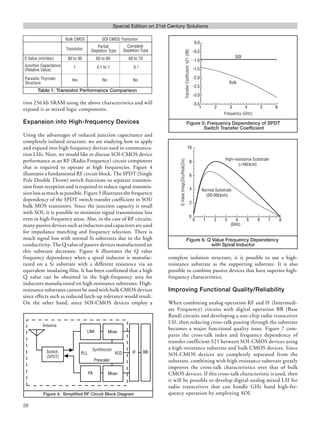
Expansion into High-frequency Devices
Using the advantages of reduced junction capacitance and
completely isolated structure, we are studying how to apply
and expand into high-frequency devices used in communica-
tion LSIs. Next, we would like to discuss SOI-CMOS device
performance as an RF (Radio Frequency) circuit component
that is required to operate at high frequencies. Figure 4
illustrates a fundamental RF circuit block. The SPDT (Single
Pole Double Throw) switch functions to separate transmis-
sion from reception and is required to reduce signal transmis-
sion loss as much as possible. Figure 5 illustrates the frequency
dependency of the SPDT switch transfer coefficient in SOI/
bulk MOS transistors. Since the junction capacity is small
with SOI, it is possible to minimize signal transmission loss
even in high-frequency areas. Also, in the case of RF circuits,
many passive devices such as inductors and capacitors are used
for impedance matching and frequency selection. There is
much signal loss with normal Si substrates due to the high
conductivity. The Q value of passive devices manufactured on
this substrate decreases. Figure 6 illustrates the Q value
frequency dependency when a spiral inductor is manufac-
tured on a Si substrate with a different resistance via an
equivalent insulating film. It has been confirmed that a high
Q value can be obtained in the high-frequency area for
inductors manufactured on high-resistance substrates. High-
resistance substrates cannot be used with bulk CMOS devices
since effects such as reduced latch-up tolerance would result.
On the other hand, since SOI-CMOS devices employ a
complete isolation structure, it is possible to use a high-
resistance substrate as the supporting substrate. It is also
possible to combine passive devices that have superior high-
frequency characteristics.
Improving Functional Quality/Reliability
When combining analog operation RF and IF (Intermedi-
ate Frequency) circuits with digital operation BB (Base
Band) circuits and developing a one-chip radio transceiver
LSI, then reducing cross-talk passing through the substrate
becomes a major functional quality issue. Figure 7 com-
pares the cross-talk index and frequency dependency of
transfer coefficient S21 between SOI-CMOS devices using
a high-resistance substrate and bulk CMOS devices. Since
SOI-CMOS devices are completely separated from the
substrate, combining with high-resistance substrate greatly
improves the cross-talk characteristics over that of bulk
CMOS devices. If this cross-talk characteristic is used, then
it will be possible to develop digital-analog mixed LSI for
radio transceivers that can handle GHz band high-fre-
quency operation by employing SOI.
Table 1: Transistor Performance Comparison
Partial
Depletion Type
S Value (mV/dec) 80 to 90 80 to 90 60 to 70
1 0.1 to 1 0.1
Yes No No
Bulk CMOS
Transistor
SOI CMOS Transistor
Complete
Depletion Type
Junction Capacitance
(Relative Value)
Parasitic Thyrister
Structure
LNA Mixer
Mixer
PLL VCO
Prescaler
PA
IF BB
Figure 4: Simplified RF Circuit Block Diagram
Antenna
Switch
(SPDT)
Synthesizer
0.0
-0.5
-1.0
-1.5
-2.0
-2.5
-3.0
-3.5
1 2 3 4 5 6
SOI
TransferCoefficient:s21(dB)
Frequency (GHz)
Figure 5: Frequency Dependency of SPDT
Switch Transfer Coefficient
Bulk
High-resistance Substrate
(>1K⍀cm)
Normal Substrate
(20-30⍀cm)
(GHz)
QValueImag(Zin)/Real(Zin)
10
8
6
4
2
0
0 1 2 3 4 5 6 7 8
Figure 6: Q Value Frequency Dependency
with Spiral Inductor
57
March 2001 OKI Technical Review 185 Vol. 68
Also, when reducing power consumption, operation error
caused by either disturbance noise or internally generated
noise resulting when the power supply voltage is decreased
becomes a major reliability concern. The CMOS device latch-
up phenomenon is a representative example of this.
Since the well area electrically isolates bulk CMOS
devices from the substrate, a parasitic thyrister is inevitably
constructed between the power supply and GND pins.
Latch-up is the phenomenon in which this parasitic thyrister
is activated by well/substrate current resulting from either
a disturbance surge or internal transistor operation. As a
result, the system will either malfunction or shut down.
(See Figure 8.) This phenomenon is more likely to occur
when the device integration is improved and when the
device temperature increases. Placing fixed substrate layers
and independent well drain holes between all devices with
different polarities generally prevents occurrences of this
phenomenon. However, these measures cannot prevent the
area that the devices occupy from increasing. In the case of
SOI-CMOS devices, each element is completely isolated by
BOX oxide film and LOCOS oxide film, so no parasitic
thyristers are formed and the latch-up phenomenon does
not occur. It is not necessary to place fixed layers and drain
layers. Also, improved integration and improved high-
temperature operation performance can be expected.
Overcoming SOI-CMOS Issues
In this article we discussed the advantages of the 0.2 ␮m SOI-
CMOS devices that were developed, but there were also issues
that we needed to overcome. As is evident in Photograph 1,
the SOI structure transistor is made up of a very thin SOI
layer. Therefore, the SOI elements themselves can be easily
thermally destroyed by electrostatic surge current from a
charged human body (HBM: Human Body Model).3
We at Oki are considering incorporating devices such as
an ESD protective device into our transistor structure. We
have developed protective circuitry that takes electrostatic
surge response into account, so we have also realized various
ESD tolerances that are appropriate for the I/O character-
istics of each product.
Conclusion
In order to reduce power consumption, the power supply
voltage used will probably continue to decrease and there will
probably be stronger demand for devices with high-frequency
operating performance. If the power supply voltage is re-
duced, then either soft errors caused by injecting radiation or
latch-up operation error caused by disturbance noise may
become quite problematic. In order to resolve these issues, we
will use SOI-CMOS device technology to provide low power
consumption system LSI products for analog-digital RF mixed
circuits in the mobile and personal communication markets.
References
1. “Reduced LSI Power Consumption to 1/3 of Previous
Level Using SOI Technology”, Fumio Ichikawa, Nikkei
Electronics, March 8, 1999 (No. 738).
2. T. Ichimori, N. Hirashita, and J. Kanamori,
“Advanced Co Salicide Technology For Sub-0.20µm
FD-SOI Devices”, IC-SSDM, (JSAP, Sendai, 2000).
3. “Electrostatic Damage Phenomenon of Semiconduc-
tor Devices”, Yasuhiro Fukuda, Reliability Engineer-
ing Association of Japan Newsletter, Jan., 2000 (Vol.
22/No. 1).
-40
-50
-60
-70
-80
-90
-100
-110
0.1 1 10
SOI + High-resistance Substrate
Frequency (GHz)
TransferCoefficient:s21(dB)
Figure 7: Frequency Dependency of Cross-talk
Characteristics
Bulk
Vss Vcc
P+ P+ P+N+ N+
N+
icl
icv ibl
ibv iwell
Figure 8: Explanation of Bulk CMOS Device Internal
Latch-up Phenomenon
Fixed
Substrate
(P-)
Output
Gate Gate
Output Fixed
Well
(N–)
Parasitic Thyrister
On; Latch-up
Power Supply N Well
Substrate Potential Increase Well Potential Decrease/
Base Current Increase
Si Substrate (P type)
Internal Latch-up Generation Mechanism
1. MOS Tr operation causes generation of well current.
2. Vertical Parasitic Tr between P+/N Well/P Substrate is On.
3. Substrate current is generated.
4. Lateral Parasitic Tr between N Well/P Substrate/N+ is also On.
5. Parasitic Thyrister between P+/N Well/N+ is On.

Soi cmos device technology

  • 1.
    54 Special Edition on21st Century Solutions Special Edition on 21st Century Solutions SOI-CMOS Device Technology Yasuhiro FUKUDA*, Shuji ITO**, Masahiro ITO** Abstract In recent years, the mobile communication market represented by the mobile telephone has been showing remarkable growth. This market has been making tough demands for semiconductor integrated circuits, which are mounted components, to consume less power, have higher integration, have multi-function capability, and be faster. We at Oki have been working on developing complete depletion type SOI devices in order to meet these needs. We have already implemented 0.35 ␮m and 0.2 ␮m SOI-CMOS devices1 . This article explains SOI-CMOS device technology and discusses current developments. * Silicon Solutions Company, VLSI R&D Center, Advanced VLSI Device/Process R&D Dept.-1, General Manager ** Silicon Solutions Company, VLSI R&D Center, AdvancedVLSI Device/Process R&D Dept.-1, SOI Circuit R&D Team-2, Team Leader SOI Device Structure The term SOI means Silicon On Insulator structure, which consists of devices on silicon thin film (SOI layers) that exists on insulating film. Figure 1 illustrates an outline sketch of bulk, partial depletion type and complete deple- tion type SOI-MOS (Metal Oxide Semiconductor) tran- sistor structure. In the case of bulk CMOS devices, P/N type MOS transistors are isolated from the well layer. In contrast, SOI-CMOS devices are separated into Si sup- porting substrate and buried oxide film (BOX). Also, these devices are structured so each element is completely iso- lated by LOCOS (Local Oxidation of Silicon) oxide film and the operating elements area (called the SOI layer) is completely isolated by insulators. Also, elements that have a thin SOI layer (normally <50 nm) and have all body areas under the channel depleted, are called complete depletion type SOI. Conversely, elements that have a thick SOI layer (normally >100 nm) and have some areas at the bottom of the body area that are not depleted, are called partial depletion type SOI. Characteristics of SOI-CMOS Devices As indicated below in Table 1, the S value that indicates the sub-threshold characteristics is unique in that only the S value of complete depletion type SOI transistors is the low value of 60 - 70 mV/dec. (The S value is the gate voltage at the sub-threshold area that changes the drain current by one digit with the drain voltage held constant.) Also, as illus- trated in Figure 1, the source, drain, substrate, and the PN junction formed between wells in bulk transistors do not exist as complete depletion type transistors. Also, the junc- tion capacity is very small. Since a PN junction exists at the bottom of the body in partial depletion type transistors, it is located exactly between them. The advantages of the S value, reduced junction capacitance, and the totally iso- lated structure are as follows. 1. A low operating voltage is possible since the threshold voltage (Vt) can be set low without increasing the off- leak current. (Reduced S value) 2. Development of high-speed, low power consumption CMOS devices is possible since the load capacitance CL is reduced. (Reduced junction capacitance) 3. Reduced signal transmission loss during high-speed operation. (Reduced junction capacitance) 4. Realizing high-frequency component performance, in- cluding passive devices, is possible since high-resistance Si wafers can be used as supporting substrates. (Totally isolated structure) 5. Reduced operation errors such as cross talk via the substrate. (Totally isolated structure) 6. It is possible to prevent operation errors including latch up phenomena. (Totally isolated structure) N Well Gate Source (P-) Drain (P-) Drain (P-) N- N- Source (P-) Drain (P-) Buried Oxide Film (BOX)Buried Oxide Film (BOX) Figure 1: Comparison Between Bulk CMOS and SOI-CMOS Structures Gate Source (P-) LOCOS Oxide Film Si Substrate (P type) Depletion Layer Bulk CMOS Structure Gate GateLOCOS Oxide Film LOCOS Oxide Film Body Depletion Layer Depletion Layer Si Supporting Substrate (P type) Partial Depletion Type SOI Transistor Complete Depletion Type SOI Transistor Si Supporting Substrate (P type) Body
  • 2.
    55 March 2001 OKITechnical Review 185 Vol. 68 7. Improved soft error durability by injecting radiation. (SOI layer thin film) Since we are considering expanding into the mobile communication market, we are aiming to develop one-chip low power consumption CMOS-LSI with combined analog and digital logic. We have therefore adopted complete depletion type SOI structure transistors as our develop- ment of low power consumption devices that use the low S value to make low power operation possible. On the other hand, the following issues accompany complete isolation or thin-film SOI layers. 1. Source drain withstand voltage reduced by parasitic bipolar transistor operation (floating body potential effect due to complete isolation) 2. Increased transistor parasitic resistance (thin-film SOI layer) 3. Reduced tolerance to electrostatic discharge (ESD) (thin- film SOI layer) Next we would like to introduce the performance of 0.2 ␮mSIO-CMOSdeviceswedevelopedusingcompletedepletion type SIO structure transistors to overcome these issues and take advantage of the previously mentioned advantages. 0.2␮m SOI-CMOS Device Development We developed 0.2 ␮m SOI-CMOS devices by stipulating the power supply voltage specifications to be 1.8 V. In consider- ation of the complete depletion type transistor characteristics and the current wafer variations, we specified 50 nm as the SOI layer thickness. We decided to employ the Co (Cobalt) Silicide structure since we found that it is the most stable means of reducing transistor parasitic resistance.2 Figure 2 illustrates the transistor sub-threshold characteristics. This figure illustrates the characteristics of complete depletion type SOI transistors when both P and N type MOS transistors have a threshold voltage of 0.25 V, and the S value becomes 70 mV/dec. Photograph 1 shows a transistor cross-section. In this photograph, it is possible to confirm that the SOI layer is very thin by using the gate metal as a comparison. We developed the advanced fabrication technology and process technology that makes this possible. Expansion into Digital Devices We will verify the fundamental characteristics that would result if we use this transistor in a digital CMOS device. Figure 3 compares the power supply voltage dependency of the minimum operating cycle time for a processor manufac- tured using this process with that of an equivalent device. Compared to bulk CMOS devices, SOI-CMOS devices can have reduced power supply voltage while maintaining oper- ating performance, and can greatly reduce power consump- tion. The reduction of junction capacitance in SOI struc- ture transistors prominently appears as a performance com- parison. We have already developed low power consump- 1.8 1.4 1.0 0.6 0.5 2.51.5 Minimum Operating Cycle Time (Normalization: Tcyc = 1/Bulk: Vcc = 2.5 V) SOI Bulk Power Supply Voltage: Vcc(V) Figure 3: Power Supply Voltage Dependency of Minimum Processor Operating Cycle Time Comparative Evaluation Using Same Mask Photograph 1: Cross-section Photograph Embedded Contact Thin SOI Film Layer BOX Film P Type Supporting Substrate Gate Metal Gate Voltage: Vg[V] DrainCurrent:Id[µA/µm] -2.0 1.E-04 1.E-02 1.E-06 1.E-08 1.E-10 1.E-12 -1.0 0.0 1.0 2.0 -70mv/dec 70mv/dec Pc Vd=-2.0V Vd=2.0V L=0.20mm W=10.0mm Nc Figure 2: 0.2 µm SOI Transistor Sub-threshold Characteristics
  • 3.
    56 Special Edition on21st Century Solutions tion 256 kb SRAM using the above characteristics and will expand it as mixed logic components. Expansion into High-frequency Devices Using the advantages of reduced junction capacitance and completely isolated structure, we are studying how to apply and expand into high-frequency devices used in communica- tion LSIs. Next, we would like to discuss SOI-CMOS device performance as an RF (Radio Frequency) circuit component that is required to operate at high frequencies. Figure 4 illustrates a fundamental RF circuit block. The SPDT (Single Pole Double Throw) switch functions to separate transmis- sion from reception and is required to reduce signal transmis- sion loss as much as possible. Figure 5 illustrates the frequency dependency of the SPDT switch transfer coefficient in SOI/ bulk MOS transistors. Since the junction capacity is small with SOI, it is possible to minimize signal transmission loss even in high-frequency areas. Also, in the case of RF circuits, many passive devices such as inductors and capacitors are used for impedance matching and frequency selection. There is much signal loss with normal Si substrates due to the high conductivity. The Q value of passive devices manufactured on this substrate decreases. Figure 6 illustrates the Q value frequency dependency when a spiral inductor is manufac- tured on a Si substrate with a different resistance via an equivalent insulating film. It has been confirmed that a high Q value can be obtained in the high-frequency area for inductors manufactured on high-resistance substrates. High- resistance substrates cannot be used with bulk CMOS devices since effects such as reduced latch-up tolerance would result. On the other hand, since SOI-CMOS devices employ a complete isolation structure, it is possible to use a high- resistance substrate as the supporting substrate. It is also possible to combine passive devices that have superior high- frequency characteristics. Improving Functional Quality/Reliability When combining analog operation RF and IF (Intermedi- ate Frequency) circuits with digital operation BB (Base Band) circuits and developing a one-chip radio transceiver LSI, then reducing cross-talk passing through the substrate becomes a major functional quality issue. Figure 7 com- pares the cross-talk index and frequency dependency of transfer coefficient S21 between SOI-CMOS devices using a high-resistance substrate and bulk CMOS devices. Since SOI-CMOS devices are completely separated from the substrate, combining with high-resistance substrate greatly improves the cross-talk characteristics over that of bulk CMOS devices. If this cross-talk characteristic is used, then it will be possible to develop digital-analog mixed LSI for radio transceivers that can handle GHz band high-fre- quency operation by employing SOI. Table 1: Transistor Performance Comparison Partial Depletion Type S Value (mV/dec) 80 to 90 80 to 90 60 to 70 1 0.1 to 1 0.1 Yes No No Bulk CMOS Transistor SOI CMOS Transistor Complete Depletion Type Junction Capacitance (Relative Value) Parasitic Thyrister Structure LNA Mixer Mixer PLL VCO Prescaler PA IF BB Figure 4: Simplified RF Circuit Block Diagram Antenna Switch (SPDT) Synthesizer 0.0 -0.5 -1.0 -1.5 -2.0 -2.5 -3.0 -3.5 1 2 3 4 5 6 SOI TransferCoefficient:s21(dB) Frequency (GHz) Figure 5: Frequency Dependency of SPDT Switch Transfer Coefficient Bulk High-resistance Substrate (>1K⍀cm) Normal Substrate (20-30⍀cm) (GHz) QValueImag(Zin)/Real(Zin) 10 8 6 4 2 0 0 1 2 3 4 5 6 7 8 Figure 6: Q Value Frequency Dependency with Spiral Inductor
  • 4.
    57 March 2001 OKITechnical Review 185 Vol. 68 Also, when reducing power consumption, operation error caused by either disturbance noise or internally generated noise resulting when the power supply voltage is decreased becomes a major reliability concern. The CMOS device latch- up phenomenon is a representative example of this. Since the well area electrically isolates bulk CMOS devices from the substrate, a parasitic thyrister is inevitably constructed between the power supply and GND pins. Latch-up is the phenomenon in which this parasitic thyrister is activated by well/substrate current resulting from either a disturbance surge or internal transistor operation. As a result, the system will either malfunction or shut down. (See Figure 8.) This phenomenon is more likely to occur when the device integration is improved and when the device temperature increases. Placing fixed substrate layers and independent well drain holes between all devices with different polarities generally prevents occurrences of this phenomenon. However, these measures cannot prevent the area that the devices occupy from increasing. In the case of SOI-CMOS devices, each element is completely isolated by BOX oxide film and LOCOS oxide film, so no parasitic thyristers are formed and the latch-up phenomenon does not occur. It is not necessary to place fixed layers and drain layers. Also, improved integration and improved high- temperature operation performance can be expected. Overcoming SOI-CMOS Issues In this article we discussed the advantages of the 0.2 ␮m SOI- CMOS devices that were developed, but there were also issues that we needed to overcome. As is evident in Photograph 1, the SOI structure transistor is made up of a very thin SOI layer. Therefore, the SOI elements themselves can be easily thermally destroyed by electrostatic surge current from a charged human body (HBM: Human Body Model).3 We at Oki are considering incorporating devices such as an ESD protective device into our transistor structure. We have developed protective circuitry that takes electrostatic surge response into account, so we have also realized various ESD tolerances that are appropriate for the I/O character- istics of each product. Conclusion In order to reduce power consumption, the power supply voltage used will probably continue to decrease and there will probably be stronger demand for devices with high-frequency operating performance. If the power supply voltage is re- duced, then either soft errors caused by injecting radiation or latch-up operation error caused by disturbance noise may become quite problematic. In order to resolve these issues, we will use SOI-CMOS device technology to provide low power consumption system LSI products for analog-digital RF mixed circuits in the mobile and personal communication markets. References 1. “Reduced LSI Power Consumption to 1/3 of Previous Level Using SOI Technology”, Fumio Ichikawa, Nikkei Electronics, March 8, 1999 (No. 738). 2. T. Ichimori, N. Hirashita, and J. Kanamori, “Advanced Co Salicide Technology For Sub-0.20µm FD-SOI Devices”, IC-SSDM, (JSAP, Sendai, 2000). 3. “Electrostatic Damage Phenomenon of Semiconduc- tor Devices”, Yasuhiro Fukuda, Reliability Engineer- ing Association of Japan Newsletter, Jan., 2000 (Vol. 22/No. 1). -40 -50 -60 -70 -80 -90 -100 -110 0.1 1 10 SOI + High-resistance Substrate Frequency (GHz) TransferCoefficient:s21(dB) Figure 7: Frequency Dependency of Cross-talk Characteristics Bulk Vss Vcc P+ P+ P+N+ N+ N+ icl icv ibl ibv iwell Figure 8: Explanation of Bulk CMOS Device Internal Latch-up Phenomenon Fixed Substrate (P-) Output Gate Gate Output Fixed Well (N–) Parasitic Thyrister On; Latch-up Power Supply N Well Substrate Potential Increase Well Potential Decrease/ Base Current Increase Si Substrate (P type) Internal Latch-up Generation Mechanism 1. MOS Tr operation causes generation of well current. 2. Vertical Parasitic Tr between P+/N Well/P Substrate is On. 3. Substrate current is generated. 4. Lateral Parasitic Tr between N Well/P Substrate/N+ is also On. 5. Parasitic Thyrister between P+/N Well/N+ is On.