MapReduce
Dr M Zunnun Khan
Map Reduce
 MapReduce
◦ processing technique
◦ a program model
◦ For any type distributed computing
◦ based on java.
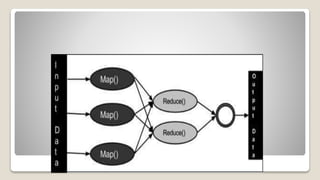
 The MapReduce algorithm contains two important tasks
◦ namely Map and Reduce.
◦ Map takes a set of data and converts it into another set of data, where
individual elements are broken down into tuples (key/value pairs).
◦ Secondly, reduce task, which takes the output from a map as an input
and combines those data tuples into a smaller set of tuples.
◦ As the sequence of the name MapReduce implies, the reduce task is
always performed after the map job.
Inputs and Outputs (Java Perspective)
 The MapReduce framework operates on <key, value> pairs,
 the input to the job as a set of <key, value> pairs
 produces a set of <key, value> pairs as the output of the job,
 conceivably of different types.
 The key and the value classes should be in serialized manner by
the framework and hence, need to implement the Writable
interface.
 Additionally, the key classes have to implement the Writable-
Comparable interface to facilitate sorting by the framework.
 Input and Output types of a MapReduce job −
 (Input) <k1, v1> → map → <k2, v2> → reduce → <k3,
v3>(Output).
 Example Scenario
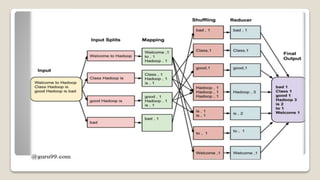
 Given sample is the random data
Input Sequence
Welcome to Hadoop
Class Hadoop is good
Hadoop is bad
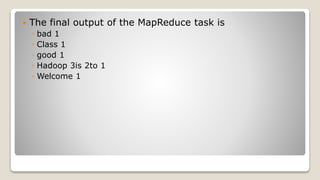
 The final output of the MapReduce task is
◦ bad 1
◦ Class 1
◦ good 1
◦ Hadoop 3is 2to 1
◦ Welcome 1
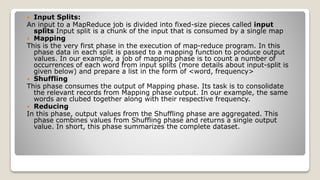
 Input Splits:
An input to a MapReduce job is divided into fixed-size pieces called input
splits Input split is a chunk of the input that is consumed by a single map
 Mapping
This is the very first phase in the execution of map-reduce program. In this
phase data in each split is passed to a mapping function to produce output
values. In our example, a job of mapping phase is to count a number of
occurrences of each word from input splits (more details about input-split is
given below) and prepare a list in the form of <word, frequency>
 Shuffling
This phase consumes the output of Mapping phase. Its task is to consolidate
the relevant records from Mapping phase output. In our example, the same
words are clubed together along with their respective frequency.
 Reducing
In this phase, output values from the Shuffling phase are aggregated. This
phase combines values from Shuffling phase and returns a single output
value. In short, this phase summarizes the complete dataset.
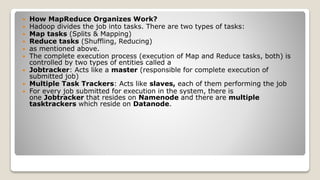
 How MapReduce Organizes Work?
 Hadoop divides the job into tasks. There are two types of tasks:
 Map tasks (Splits & Mapping)
 Reduce tasks (Shuffling, Reducing)
 as mentioned above.
 The complete execution process (execution of Map and Reduce tasks, both) is
controlled by two types of entities called a
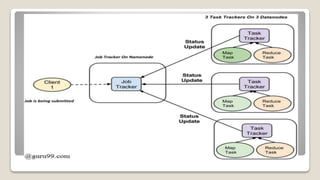
 Jobtracker: Acts like a master (responsible for complete execution of
submitted job)
 Multiple Task Trackers: Acts like slaves, each of them performing the job
 For every job submitted for execution in the system, there is
one Jobtracker that resides on Namenode and there are multiple
tasktrackers which reside on Datanode.
 A job is divided into multiple tasks which are then run onto
multiple data nodes in a cluster.
 It is the responsibility of job tracker to coordinate the
activity by scheduling tasks to run on different data nodes.
 Execution of individual task is then to look after by task
tracker, which resides on every data node executing part of
the job.
 Task tracker's responsibility is to send the progress report
to the job tracker.
 In addition, task tracker periodically
sends 'heartbeat' signal to the Jobtracker so as to notify
him of the current state of the system.
 Thus job tracker keeps track of the overall progress of each
job. In the event of task failure, the job tracker can
reschedule it on a different task tracker.

Unit3 MapReduce

  • 1.
  • 2.
    Map Reduce  MapReduce ◦processing technique ◦ a program model ◦ For any type distributed computing ◦ based on java.  The MapReduce algorithm contains two important tasks ◦ namely Map and Reduce. ◦ Map takes a set of data and converts it into another set of data, where individual elements are broken down into tuples (key/value pairs). ◦ Secondly, reduce task, which takes the output from a map as an input and combines those data tuples into a smaller set of tuples. ◦ As the sequence of the name MapReduce implies, the reduce task is always performed after the map job.
  • 4.
    Inputs and Outputs(Java Perspective)  The MapReduce framework operates on <key, value> pairs,  the input to the job as a set of <key, value> pairs  produces a set of <key, value> pairs as the output of the job,  conceivably of different types.  The key and the value classes should be in serialized manner by the framework and hence, need to implement the Writable interface.  Additionally, the key classes have to implement the Writable- Comparable interface to facilitate sorting by the framework.  Input and Output types of a MapReduce job −  (Input) <k1, v1> → map → <k2, v2> → reduce → <k3, v3>(Output).
  • 5.
     Example Scenario Given sample is the random data Input Sequence Welcome to Hadoop Class Hadoop is good Hadoop is bad
  • 7.
     The finaloutput of the MapReduce task is ◦ bad 1 ◦ Class 1 ◦ good 1 ◦ Hadoop 3is 2to 1 ◦ Welcome 1
  • 8.
     Input Splits: Aninput to a MapReduce job is divided into fixed-size pieces called input splits Input split is a chunk of the input that is consumed by a single map  Mapping This is the very first phase in the execution of map-reduce program. In this phase data in each split is passed to a mapping function to produce output values. In our example, a job of mapping phase is to count a number of occurrences of each word from input splits (more details about input-split is given below) and prepare a list in the form of <word, frequency>  Shuffling This phase consumes the output of Mapping phase. Its task is to consolidate the relevant records from Mapping phase output. In our example, the same words are clubed together along with their respective frequency.  Reducing In this phase, output values from the Shuffling phase are aggregated. This phase combines values from Shuffling phase and returns a single output value. In short, this phase summarizes the complete dataset.
  • 9.
     How MapReduceOrganizes Work?  Hadoop divides the job into tasks. There are two types of tasks:  Map tasks (Splits & Mapping)  Reduce tasks (Shuffling, Reducing)  as mentioned above.  The complete execution process (execution of Map and Reduce tasks, both) is controlled by two types of entities called a  Jobtracker: Acts like a master (responsible for complete execution of submitted job)  Multiple Task Trackers: Acts like slaves, each of them performing the job  For every job submitted for execution in the system, there is one Jobtracker that resides on Namenode and there are multiple tasktrackers which reside on Datanode.
  • 11.
     A jobis divided into multiple tasks which are then run onto multiple data nodes in a cluster.  It is the responsibility of job tracker to coordinate the activity by scheduling tasks to run on different data nodes.  Execution of individual task is then to look after by task tracker, which resides on every data node executing part of the job.  Task tracker's responsibility is to send the progress report to the job tracker.  In addition, task tracker periodically sends 'heartbeat' signal to the Jobtracker so as to notify him of the current state of the system.  Thus job tracker keeps track of the overall progress of each job. In the event of task failure, the job tracker can reschedule it on a different task tracker.