
DEVELOPMENT OF SOFTWARE
FOR
STRUCTURAL HEALTH MONITORIING SYSTEM
Outline
 Introduction to Structural Health Monitoring
 Composition of SHM
 Architecture design of SHMSF
 Benefits of SHM
 Structural Monitoring Challenges
 Technological Solutions
 Conclusion
Conventional Structural Systems
are dumb, very dumb
 Designed to achieve a set of
intended functions under pre-
selected loads and forces.
 Large safety factor is employed
to account for the uncertainty in
external loads
 Unable to adapt to structural
changes and to varying usage
patterns and loading conditions.
Both pictures were taken from the
1995 Kobe Earthquake
Design, Build, and Cross-your-fingers
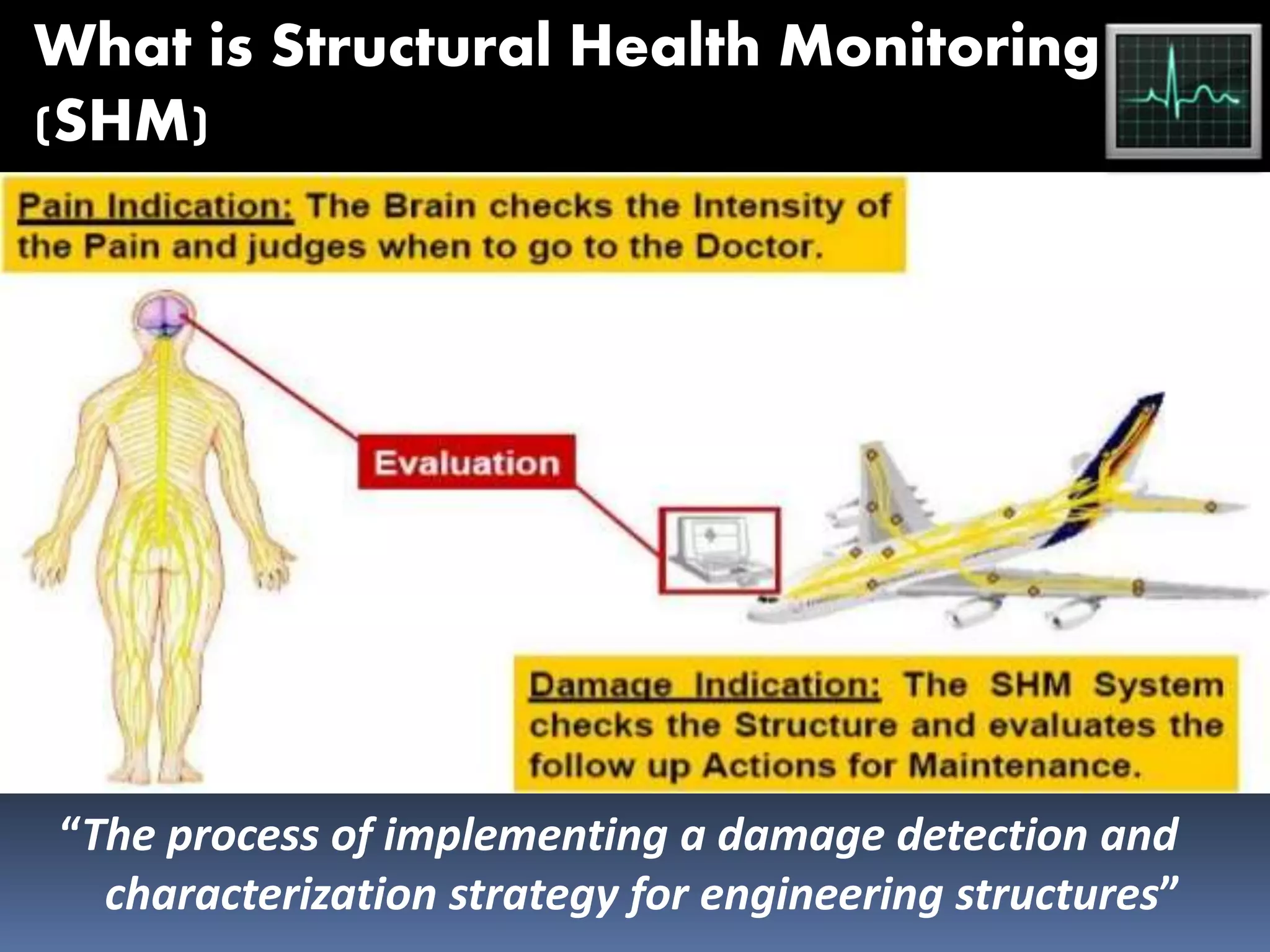
What is Structural Health Monitoring
(SHM)
“The process of implementing a damage detection and
characterization strategy for engineering structures”
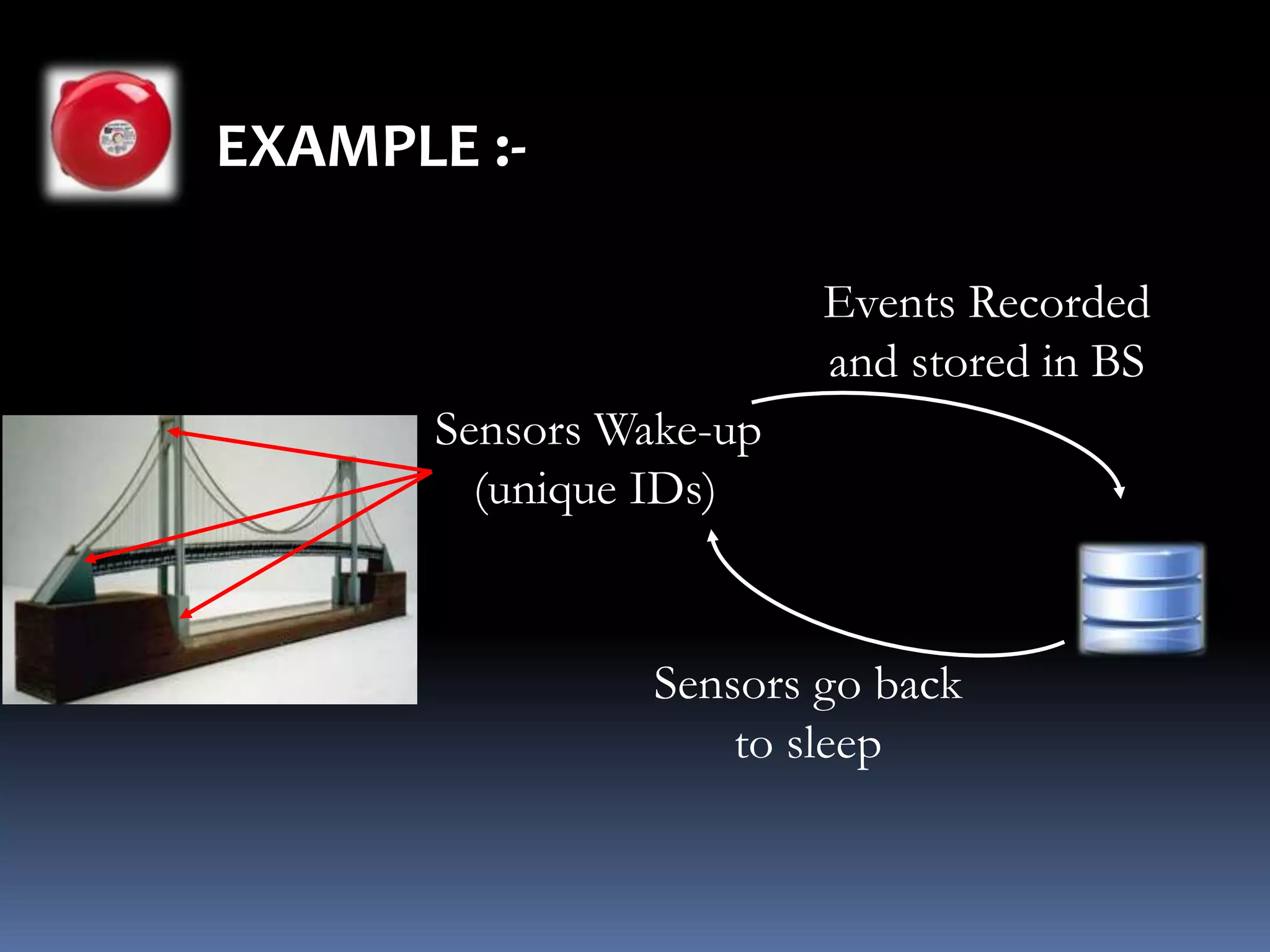
EXAMPLE :-
Sensors Wake-up
(unique IDs)
Events Recorded
and stored in BS
Sensors go back
to sleep
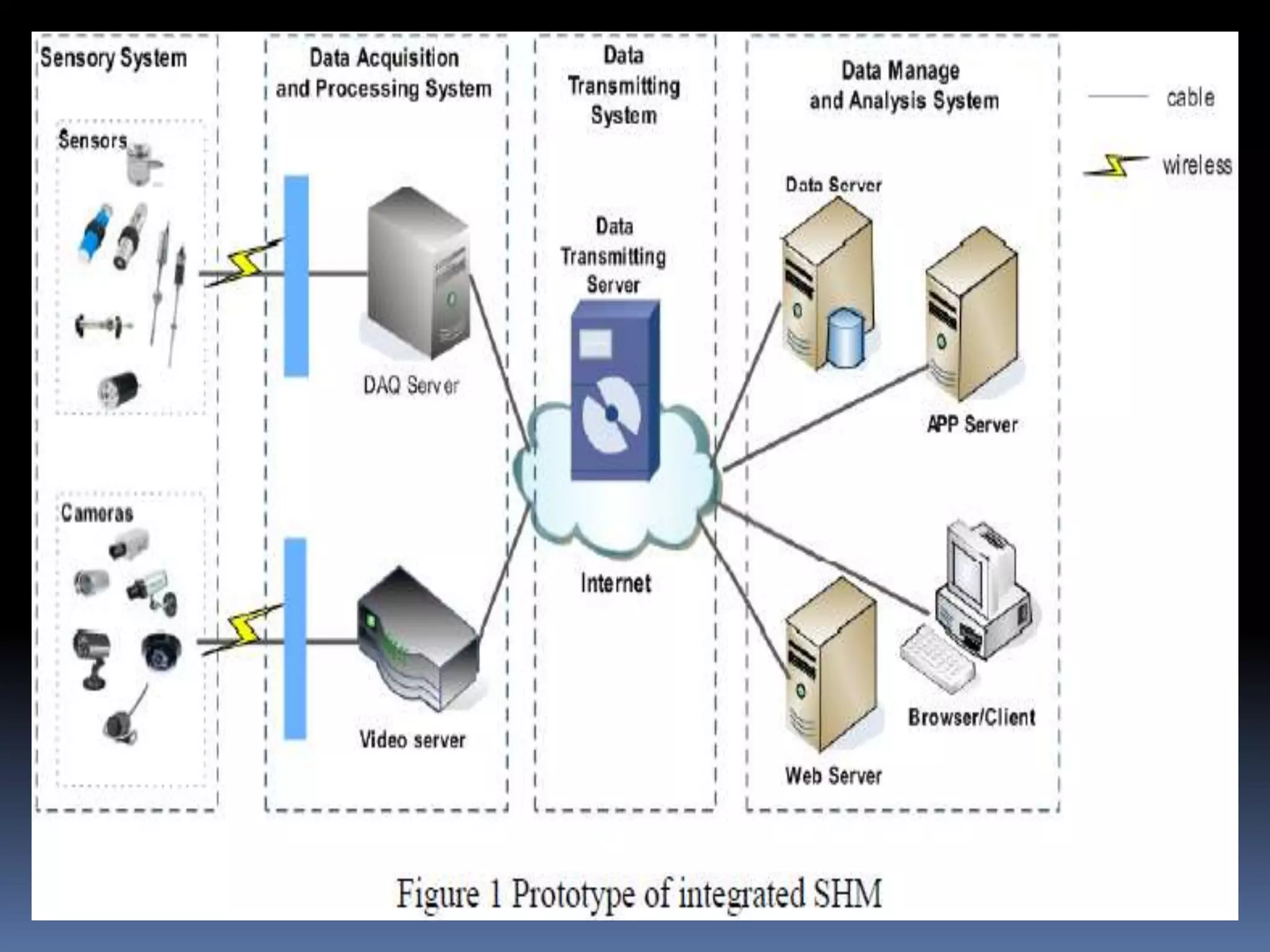
THE COMPOSITION OF SHM
1. Sensory subsystem
2. Signal acquisition and processing subsystem
3. Data transmitting subsystem
4. Data management and analysis subsystem
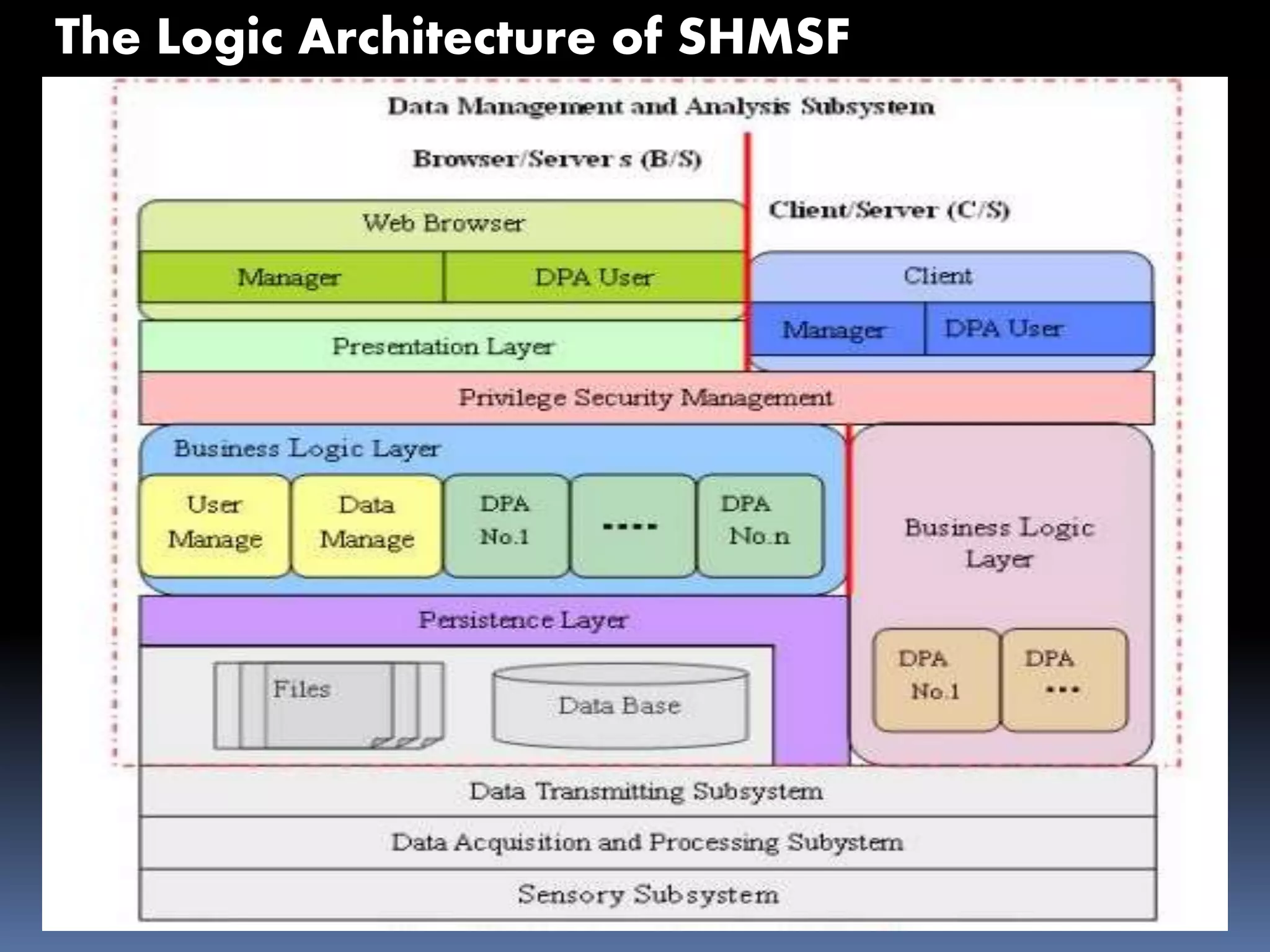
ARCHITECTURE DESIGN OF SHMSF
 Presentation layer
 Privilege Security Management
 Business logic layer
 Persistence layer
 Data sources
The Logic Architecture of SHMSF
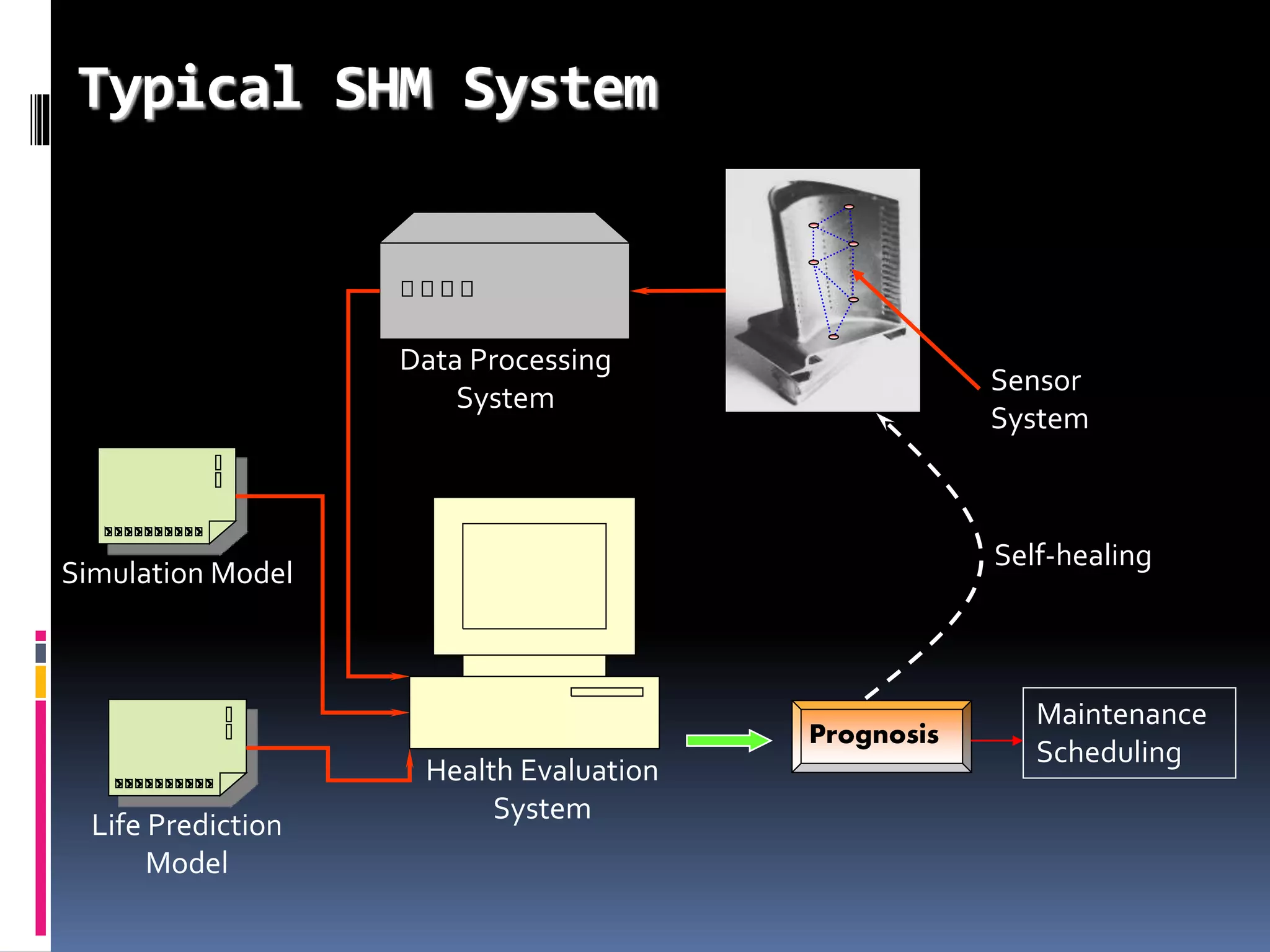
Typical SHM System
Sensor
System
Prognosis
Data Processing
System
Health Evaluation
System
Simulation Model
Life Prediction
Model
Maintenance
Scheduling
Self-healing
Benefits of SHM
 Better safety ensurance
 Cost-saving
 Cost of inspection (e.g. 40% saving on airplane
inspection)
 Early detection
 Autonomous damage detection for disaster
mitigation
Structural Monitoring Challenges
• Infrastructure is expected to provide:
– reliable service for long periods of time,
– following major technology changes,
– spanning several generations and experiencing dramatic evolutions
• Develop Wireless Sensor Networks
– Reliable
– Energy aware
– Smart
• Develop Design-to-service Solutions
– Efficient Monitoring
– DSP strategies
– Evaluation Criteria
– Knowledge bases
• Develop Smart Control Units
– Real-time Feedback
– Centralized (or not)
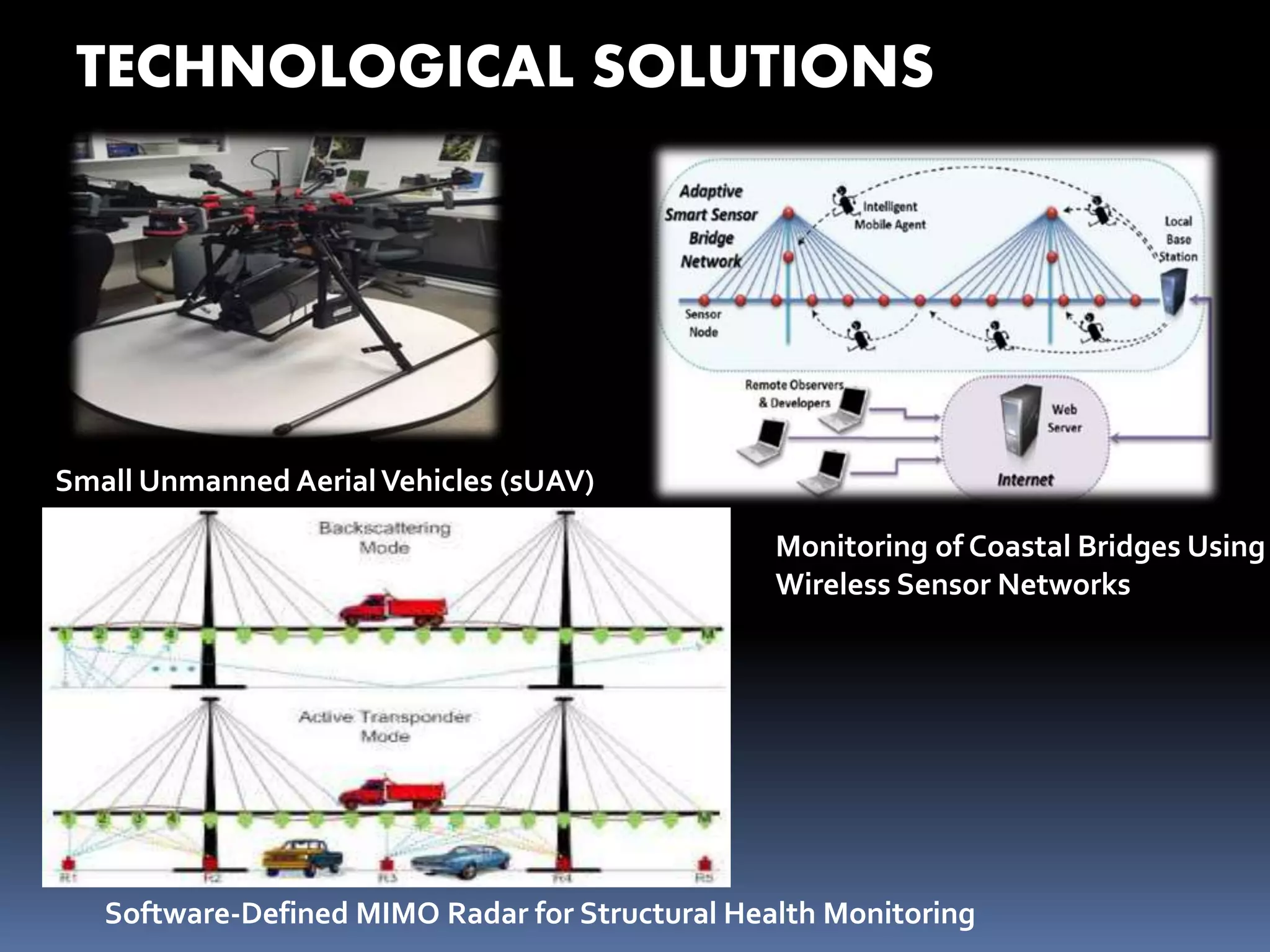
Small Unmanned AerialVehicles (sUAV)
TECHNOLOGICAL SOLUTIONS
Monitoring of Coastal Bridges Using
Wireless Sensor Networks
Software-Defined MIMO Radar for Structural Health Monitoring
CONCLUSION
 It can allow user focus on data analysis methods rather than
deal with low-level details of system(e.g., how to get the data
from sensors, how to store data, and how to display data,
etc.).
 It also sets up connection between monitored structure to
implement more meaningful works including data sharing,
reciprocal access and coordinated test, etc..
 The design of the framework promises great scalability in
terms of both extensibility and portability.
 In the future, the framework will be implemented and applied
to practical projects, and more data analysis functions will be
integrated into this software framework to support more
sophisticated structural condition evaluation.
REFERENCES
 The study of Software Framework of Structural
Health Monitoring System based NEESit
 Darbani, B.M., and Hammad, A. (2007). Critical
Review of New Directions in Bridge
Management Systems.
 AASCE conference of Computing in Civil
Engineering 2007, Pittsburgh, PA.
 Len Bass, Paul Clements, Rick Kazman. (2003)
Software Architecture in Practice, Second
Edition. AddisonWesley, U.S.

Software project management ppt

  • 1.
    DEVELOPMENT OF SOFTWARE FOR STRUCTURALHEALTH MONITORIING SYSTEM
  • 2.
    Outline  Introduction toStructural Health Monitoring  Composition of SHM  Architecture design of SHMSF  Benefits of SHM  Structural Monitoring Challenges  Technological Solutions  Conclusion
  • 3.
    Conventional Structural Systems ConventionalStructural Systems are dumb, very dumb  Designed to achieve a set of intended functions under pre- selected loads and forces.  Large safety factor is employed to account for the uncertainty in external loads  Unable to adapt to structural changes and to varying usage patterns and loading conditions. Both pictures were taken from the 1995 Kobe Earthquake Design, Build, and Cross-your-fingers
  • 4.
    What is StructuralHealth Monitoring (SHM) “The process of implementing a damage detection and characterization strategy for engineering structures”
  • 5.
    EXAMPLE :- Sensors Wake-up (uniqueIDs) Events Recorded and stored in BS Sensors go back to sleep
  • 6.
    THE COMPOSITION OFSHM 1. Sensory subsystem 2. Signal acquisition and processing subsystem 3. Data transmitting subsystem 4. Data management and analysis subsystem
  • 8.
    ARCHITECTURE DESIGN OFSHMSF  Presentation layer  Privilege Security Management  Business logic layer  Persistence layer  Data sources
  • 9.
  • 10.
    Typical SHM System Sensor System Prognosis DataProcessing System Health Evaluation System Simulation Model Life Prediction Model Maintenance Scheduling Self-healing
  • 11.
    Benefits of SHM Better safety ensurance  Cost-saving  Cost of inspection (e.g. 40% saving on airplane inspection)  Early detection  Autonomous damage detection for disaster mitigation
  • 12.
    Structural Monitoring Challenges •Infrastructure is expected to provide: – reliable service for long periods of time, – following major technology changes, – spanning several generations and experiencing dramatic evolutions • Develop Wireless Sensor Networks – Reliable – Energy aware – Smart • Develop Design-to-service Solutions – Efficient Monitoring – DSP strategies – Evaluation Criteria – Knowledge bases • Develop Smart Control Units – Real-time Feedback – Centralized (or not)
  • 13.
    Small Unmanned AerialVehicles(sUAV) TECHNOLOGICAL SOLUTIONS Monitoring of Coastal Bridges Using Wireless Sensor Networks Software-Defined MIMO Radar for Structural Health Monitoring
  • 15.
    CONCLUSION  It canallow user focus on data analysis methods rather than deal with low-level details of system(e.g., how to get the data from sensors, how to store data, and how to display data, etc.).  It also sets up connection between monitored structure to implement more meaningful works including data sharing, reciprocal access and coordinated test, etc..  The design of the framework promises great scalability in terms of both extensibility and portability.  In the future, the framework will be implemented and applied to practical projects, and more data analysis functions will be integrated into this software framework to support more sophisticated structural condition evaluation.
  • 16.
    REFERENCES  The studyof Software Framework of Structural Health Monitoring System based NEESit  Darbani, B.M., and Hammad, A. (2007). Critical Review of New Directions in Bridge Management Systems.  AASCE conference of Computing in Civil Engineering 2007, Pittsburgh, PA.  Len Bass, Paul Clements, Rick Kazman. (2003) Software Architecture in Practice, Second Edition. AddisonWesley, U.S.