Software Engineering: 9
Software Cost Estimation
Prof Neeraj Bhargava
Vaibhav Khanna
Department of Computer Science
School of Engineering and Systems Sciences
Maharshi Dayanand Saraswati University Ajmer
Software Cost and Effort Estimation
• Today, software is the most expensive element of
virtually all computer-based systems.
• Estimation will never be an exact science.
• Too many variables— human, technical,
environmental, political—can affect the ultimate
cost of software and effort applied to develop it.
• By decomposing a project into major functions
and related software engineering activities, cost
and effort estimation can be performed in a
stepwise fashion.
Software Sizing
• The accuracy of a software project estimate is
predicated on a number of things:
• (1) the degree to which the planner has properly
estimated the size of the product to be built;
• (2) the ability to translate the size estimate into
human effort, calendar time, and dollars
• (3) the degree to which the project plan reflects
the abilities of the software team; and
• (4) the stability of product requirements and the
environment that supports the software
engineering effort.
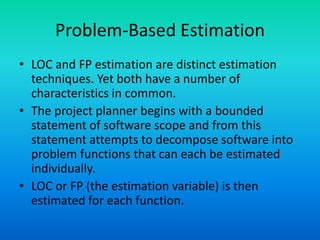
Problem-Based Estimation
• LOC and FP estimation are distinct estimation
techniques. Yet both have a number of
characteristics in common.
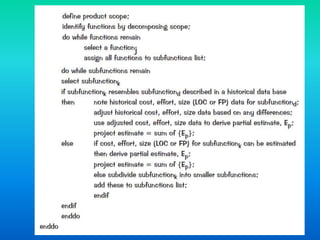
• The project planner begins with a bounded
statement of software scope and from this
statement attempts to decompose software into
problem functions that can each be estimated
individually.
• LOC or FP (the estimation variable) is then
estimated for each function.
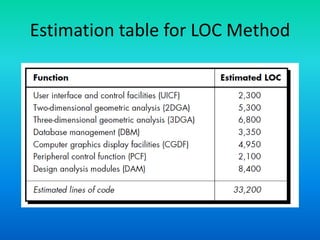
Estimation table for LOC Method
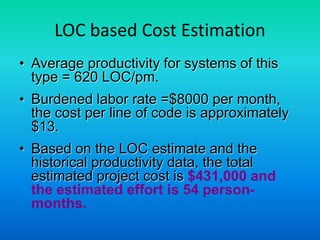
LOC based Cost Estimation
• Average productivity for systems of this
type = 620 LOC/pm.
• Burdened labor rate =$8000 per month,
the cost per line of code is approximately
$13.
• Based on the LOC estimate and the
historical productivity data, the total
estimated project cost is $431,000 and
the estimated effort is 54 person-
months.
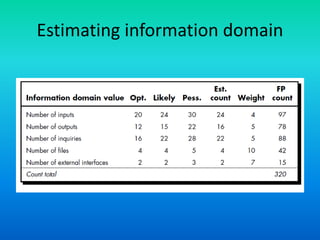
Estimating information domain
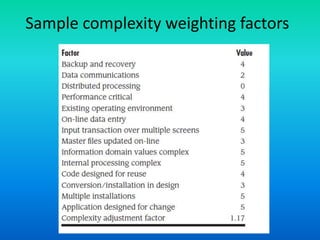
Sample complexity weighting factors
Sample Project cost estimation
• Finally, the estimated number of FP is derived:
– FPestimated = count-total x [0.65 + 0.01 x (Fi)]
– FPestimated = 375
• The organizational average productivity for
systems of this type is 6.5 FP/pm.
• Based on a burdened labor rate of $8000 per
month, the cost per FP is approximately $1230.
• Based on the LOC estimate and the historical
productivity data, the total estimated project cost
is $461,000 and the estimated effort is 58 person-
months.
Process-Based Estimation
• The process is decomposed into a relatively small
set of tasks and the effort required to accomplish
each task is estimated.
• It begins with a delineation of software functions
obtained from the project scope.
• Once problem functions and process activities are
melded, the planner estimates the effort (e.g.,
person-months)
• Average labor rates (i.e., cost/unit effort) are then
applied to the effort estimated for each process
activity
Assignment
• Discuss in detail the various matrix for
software project cost estimation.
• Thank You

Software engineering 9 software cost estimation

  • 1.
    Software Engineering: 9 SoftwareCost Estimation Prof Neeraj Bhargava Vaibhav Khanna Department of Computer Science School of Engineering and Systems Sciences Maharshi Dayanand Saraswati University Ajmer
  • 2.
    Software Cost andEffort Estimation • Today, software is the most expensive element of virtually all computer-based systems. • Estimation will never be an exact science. • Too many variables— human, technical, environmental, political—can affect the ultimate cost of software and effort applied to develop it. • By decomposing a project into major functions and related software engineering activities, cost and effort estimation can be performed in a stepwise fashion.
  • 3.
    Software Sizing • Theaccuracy of a software project estimate is predicated on a number of things: • (1) the degree to which the planner has properly estimated the size of the product to be built; • (2) the ability to translate the size estimate into human effort, calendar time, and dollars • (3) the degree to which the project plan reflects the abilities of the software team; and • (4) the stability of product requirements and the environment that supports the software engineering effort.
  • 4.
    Problem-Based Estimation • LOCand FP estimation are distinct estimation techniques. Yet both have a number of characteristics in common. • The project planner begins with a bounded statement of software scope and from this statement attempts to decompose software into problem functions that can each be estimated individually. • LOC or FP (the estimation variable) is then estimated for each function.
  • 6.
  • 7.
    LOC based CostEstimation • Average productivity for systems of this type = 620 LOC/pm. • Burdened labor rate =$8000 per month, the cost per line of code is approximately $13. • Based on the LOC estimate and the historical productivity data, the total estimated project cost is $431,000 and the estimated effort is 54 person- months.
  • 8.
  • 9.
  • 10.
    Sample Project costestimation • Finally, the estimated number of FP is derived: – FPestimated = count-total x [0.65 + 0.01 x (Fi)] – FPestimated = 375 • The organizational average productivity for systems of this type is 6.5 FP/pm. • Based on a burdened labor rate of $8000 per month, the cost per FP is approximately $1230. • Based on the LOC estimate and the historical productivity data, the total estimated project cost is $461,000 and the estimated effort is 58 person- months.
  • 11.
    Process-Based Estimation • Theprocess is decomposed into a relatively small set of tasks and the effort required to accomplish each task is estimated. • It begins with a delineation of software functions obtained from the project scope. • Once problem functions and process activities are melded, the planner estimates the effort (e.g., person-months) • Average labor rates (i.e., cost/unit effort) are then applied to the effort estimated for each process activity
  • 12.
    Assignment • Discuss indetail the various matrix for software project cost estimation. • Thank You