SOFTWARE ENGINEERING
TOPIC NAME – CLASSICAL WATERFALL MODEL
PAPER NAME – SOFTWARE ENGINEERING
PAPER CODE – ESC501
STUDENT NAME – PROVAT MAJHI
STREAM – CSE
SEMESTER – 5TH
UNIVERSITY ROLL NUMBER – 23000121055
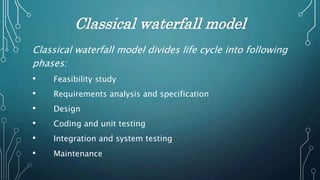
Classical waterfall model
Classical waterfall model divides life cycle into following
phases:
• Feasibility study
• Requirements analysis and specification
• Design
• Coding and unit testing
• Integration and system testing
• Maintenance
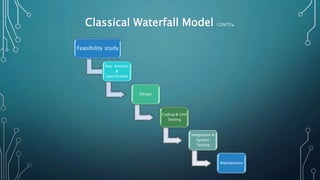
Classical Waterfall Model CONTD.
Feasibility study
Req. Analysis
&
specification
Design
Coding & Unit
Testing
Integration &
System
Testing
Maintenance
Feasibility Study
• Aim of feasibility study
- To determine whether developing the product is
• financially worthwhile
• technically feasible.
• Main activities during Feasibility Study
ˉWork out an overall understanding of the problem.
ˉFormulate different solution strategies.
ˉExamine alternate solution strategies
ˉPerform a cost/benefit analysis to determine which solution is the best.
Requirements Analysis and Specification
Aim of this phase:
- understand the exact requirements of the customer,
- document them properly.
Consists of two distinct activities:
- requirements gathering and analysis
- requirements specification.
Requirements Gathering
Collect all related data from the customer:
• analyze the collected data to clearly understand
• what the customer wants,
Gathering relevant data:
• usually collected from the end-users through
• interviews and discussions.
For example, for a business accounting software:
• interview all the accountants of the
• organization to find out their requirements.
Requirements Specifications
Next, requirements are organized:
• into a Software Requirements Specification (SRS)
document.
Engineers doing requirements analysis and
specification:
• are designated as Requirement Engineer or analysts.
Design
• Design phase transforms requirements specification into a form
suitable for implementation in some programming language.
• In technical terms, during design phase, software architecture
is derived from the SRS document.
• Two design approaches:
• traditional structured approach,
• object oriented approach.
• Traditional structured approach consists of:
• Structured analysis
• Structured design
Structured Analysis
Structured Analysis Steps
Identify all the functions to be performed.
Identify data flow among the functions.
Decompose each function recursively into sub- functions.
• Identify data flow among the sub functions as well.
Carry out design using Data flow diagrams (DFDs).
After structured analysis, carry out structured design:
• architectural design (or high-level design)
• detailed design (or low-level design).
Structured Design
High-level design:
• decompose the system into modules,
• represent invocation relationships among the modules.
Detailed design:
• different modules designed in greater detail:
• data structures and algorithms for each module are designed.
Object Oriented Design
First identify various objects (real world entities) occurring in
the problem:
• identify the relationships among the objects.
• For example, the objects in a pay-roll software may be employees,
managers, Departments, etc.
Object structure
• further refined to obtain the detailed design.
Coding and Unit Testing
Purpose of coding and unit testing phase:
• translate software design into source code.
During this phase:
• each module of the design is coded
• each module is unit tested
• each module is documented.
Integration and System Testing
Different modules are integrated in a planned manner:
• modules are almost never integrated in one shot.
• Normally integration is carried out through a number of steps.
During each integration step,
• the partially integrated system is tested.
Integration and System Testing contd..
After all the modules have been successfully integrated and
tested:
• system testing is carried out.
Goal of system testing:
• ensure that the developed system functions according to its
requirements as specified in the SRS document.
Maintenance
Maintenance of any software product:
• requires much more effort than the effort to develop the product itself.
Corrective maintenance:
• Correct errors which were not discovered during the product development
phases.
Perfective maintenance:
• Improve implementation of the system
• enhance functionalities of the system.
Adaptive maintenance:
• Port software to a new environment,
e.g. to a new computer or to a new operating system.
When to use the Waterfall Model?
• Requirements are very well known
• Product definition is stable
• Technology is understood
• New version of an existing product
• Porting an existing product to a new platform.

Software engineering.pptx

  • 1.
    SOFTWARE ENGINEERING TOPIC NAME– CLASSICAL WATERFALL MODEL PAPER NAME – SOFTWARE ENGINEERING PAPER CODE – ESC501 STUDENT NAME – PROVAT MAJHI STREAM – CSE SEMESTER – 5TH UNIVERSITY ROLL NUMBER – 23000121055
  • 2.
    Classical waterfall model Classicalwaterfall model divides life cycle into following phases: • Feasibility study • Requirements analysis and specification • Design • Coding and unit testing • Integration and system testing • Maintenance
  • 3.
    Classical Waterfall ModelCONTD. Feasibility study Req. Analysis & specification Design Coding & Unit Testing Integration & System Testing Maintenance
  • 4.
    Feasibility Study • Aimof feasibility study - To determine whether developing the product is • financially worthwhile • technically feasible. • Main activities during Feasibility Study ˉWork out an overall understanding of the problem. ˉFormulate different solution strategies. ˉExamine alternate solution strategies ˉPerform a cost/benefit analysis to determine which solution is the best.
  • 5.
    Requirements Analysis andSpecification Aim of this phase: - understand the exact requirements of the customer, - document them properly. Consists of two distinct activities: - requirements gathering and analysis - requirements specification.
  • 6.
    Requirements Gathering Collect allrelated data from the customer: • analyze the collected data to clearly understand • what the customer wants, Gathering relevant data: • usually collected from the end-users through • interviews and discussions. For example, for a business accounting software: • interview all the accountants of the • organization to find out their requirements.
  • 7.
    Requirements Specifications Next, requirementsare organized: • into a Software Requirements Specification (SRS) document. Engineers doing requirements analysis and specification: • are designated as Requirement Engineer or analysts.
  • 8.
    Design • Design phasetransforms requirements specification into a form suitable for implementation in some programming language. • In technical terms, during design phase, software architecture is derived from the SRS document. • Two design approaches: • traditional structured approach, • object oriented approach. • Traditional structured approach consists of: • Structured analysis • Structured design
  • 9.
    Structured Analysis Structured AnalysisSteps Identify all the functions to be performed. Identify data flow among the functions. Decompose each function recursively into sub- functions. • Identify data flow among the sub functions as well. Carry out design using Data flow diagrams (DFDs). After structured analysis, carry out structured design: • architectural design (or high-level design) • detailed design (or low-level design).
  • 10.
    Structured Design High-level design: •decompose the system into modules, • represent invocation relationships among the modules. Detailed design: • different modules designed in greater detail: • data structures and algorithms for each module are designed.
  • 11.
    Object Oriented Design Firstidentify various objects (real world entities) occurring in the problem: • identify the relationships among the objects. • For example, the objects in a pay-roll software may be employees, managers, Departments, etc. Object structure • further refined to obtain the detailed design.
  • 12.
    Coding and UnitTesting Purpose of coding and unit testing phase: • translate software design into source code. During this phase: • each module of the design is coded • each module is unit tested • each module is documented.
  • 13.
    Integration and SystemTesting Different modules are integrated in a planned manner: • modules are almost never integrated in one shot. • Normally integration is carried out through a number of steps. During each integration step, • the partially integrated system is tested.
  • 14.
    Integration and SystemTesting contd.. After all the modules have been successfully integrated and tested: • system testing is carried out. Goal of system testing: • ensure that the developed system functions according to its requirements as specified in the SRS document.
  • 15.
    Maintenance Maintenance of anysoftware product: • requires much more effort than the effort to develop the product itself. Corrective maintenance: • Correct errors which were not discovered during the product development phases. Perfective maintenance: • Improve implementation of the system • enhance functionalities of the system. Adaptive maintenance: • Port software to a new environment, e.g. to a new computer or to a new operating system.
  • 16.
    When to usethe Waterfall Model? • Requirements are very well known • Product definition is stable • Technology is understood • New version of an existing product • Porting an existing product to a new platform.