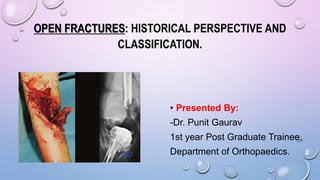
OPEN FRACTURES: HISTORICAL PERSPECTIVE AND
CLASSIFICATION.
• Presented By:
-Dr. Punit Gaurav
1st year Post Graduate Trainee.
Department of Orthopaedics.
INTRODUCTION
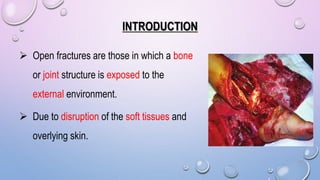
 Open fractures are those in which a bone
or joint structure is exposed to the
external environment.
 Due to disruption of the soft tissues and
overlying skin.
Usually high energy injuries with severe bone and soft
tissue involvement.
Often associated with decreased vascular supply,
contamination,degloving of skin and a variable degree
of soft tissue damage.
HISTORICAL ASPECTS :
Egyptians 1st time recognised need for
coverage over fracture wounds to
minimise morbidity.
 Hippocrates favoured the debridement
of purulent material.
• In 1895, Stanley Boyd
said “The most
important divisions of
fractures - simple,
compound and
complicated - are
based upon the
condition of the soft
parts.”
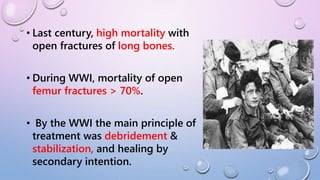
• Last century, high mortality with
open fractures of long bones.
• During WWI, mortality of open
femur fractures > 70%.
• By the WWI the main principle of
treatment was debridement &
stabilization, and healing by
secondary intention.
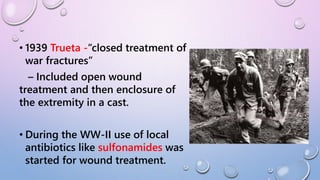
• 1939 Trueta -“closed treatment of
war fractures”
– Included open wound
treatment and then enclosure of
the extremity in a cast.
• During the WW-II use of local
antibiotics like sulfonamides was
started for wound treatment.
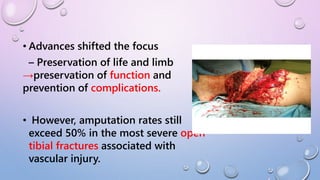
• Advances shifted the focus
– Preservation of life and limb
→preservation of function and
prevention of complications.
• However, amputation rates still
exceed 50% in the most severe open
tibial fractures associated with
vascular injury.
EPIDEMIOLOGY
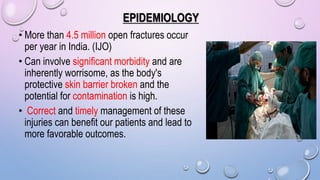
• More than 4.5 million open fractures occur
per year in India. (IJO)
• Can involve significant morbidity and are
inherently worrisome, as the body's
protective skin barrier broken and the
potential for contamination is high.
• Correct and timely management of these
injuries can benefit our patients and lead to
more favorable outcomes.
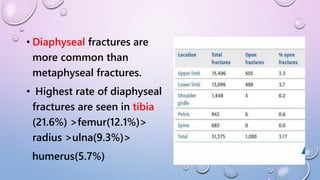
• Diaphyseal fractures are
more common than
metaphyseal fractures.
• Highest rate of diaphyseal
fractures are seen in tibia
(21.6%) >femur(12.1%)>
radius >ulna(9.3%)>
humerus(5.7%)
MODE OF INJURY:
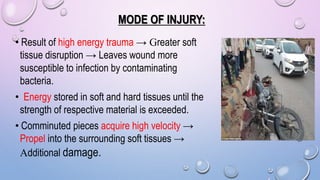
• Result of high energy trauma → Greater soft
tissue disruption → Leaves wound more
susceptible to infection by contaminating
bacteria.
• Energy stored in soft and hard tissues until the
strength of respective material is exceeded.
• Comminuted pieces acquire high velocity →
Propel into the surrounding soft tissues →
Additional damage.
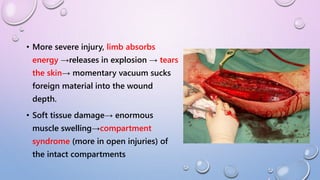
• More severe injury, limb absorbs
energy →releases in explosion → tears
the skin→ momentary vacuum sucks
foreign material into the wound
depth.
• Soft tissue damage→ enormous
muscle swelling→compartment
syndrome (more in open injuries) of
the intact compartments
OPEN FRACTURE CLASSIFICATION:
• Purpose of any fracture classification system in the
clinical setting is to allow communication that infers
fracture morphology and treatment parameters.
• In the setting of open fractures, there are four
classification systems that surgeons treating these
injuries should be familiar with.
1. GUSTILO AND ANDERSON CLASSIFICATION
• Most widely used system and is
generally accepted as the primary
classification system for open fractures.
• Takes into consideration- energy of the
fracture, soft-tissue damage, and the
degree of contamination.
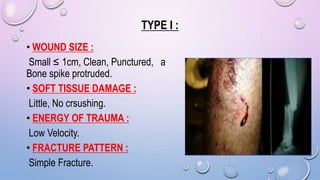
TYPE I :
• WOUND SIZE :
Small ≤ 1cm, Clean, Punctured, a
Bone spike protruded.
• SOFT TISSUE DAMAGE :
Little, No crsushing.
• ENERGY OF TRAUMA :
Low Velocity.
• FRACTURE PATTERN :
Simple Fracture.
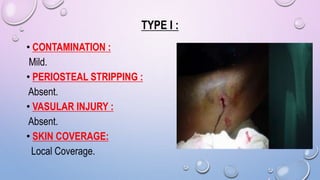
TYPE I :
• CONTAMINATION :
Mild.
• PERIOSTEAL STRIPPING :
Absent.
• VASULAR INJURY :
Absent.
• SKIN COVERAGE:
Local Coverage.
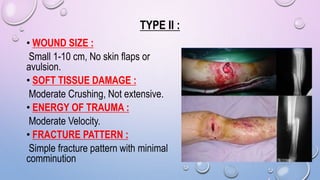
TYPE II :
• WOUND SIZE :
Small 1-10 cm, No skin flaps or
avulsion.
• SOFT TISSUE DAMAGE :
Moderate Crushing, Not extensive.
• ENERGY OF TRAUMA :
Moderate Velocity.
• FRACTURE PATTERN :
Simple fracture pattern with minimal
comminution
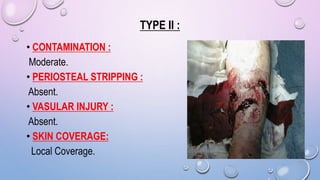
TYPE II :
• CONTAMINATION :
Moderate.
• PERIOSTEAL STRIPPING :
Absent.
• VASULAR INJURY :
Absent.
• SKIN COVERAGE:
Local Coverage.
TYPE III :
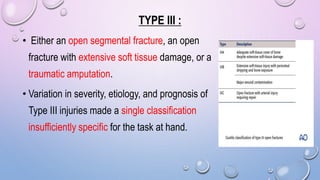
• Either an open segmental fracture, an open
fracture with extensive soft tissue damage, or a
traumatic amputation.
• Variation in severity, etiology, and prognosis of
Type III injuries made a single classification
insufficiently specific for the task at hand.
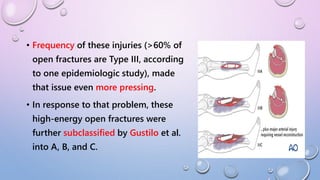
• Frequency of these injuries (>60% of
open fractures are Type III, according
to one epidemiologic study), made
that issue even more pressing.
• In response to that problem, these
high-energy open fractures were
further subclassified by Gustilo et al.
into A, B, and C.
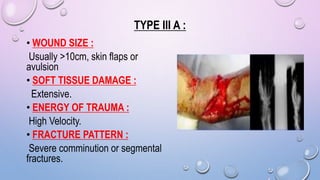
TYPE III A :
• WOUND SIZE :
Usually >10cm, skin flaps or
avulsion
• SOFT TISSUE DAMAGE :
Extensive.
• ENERGY OF TRAUMA :
High Velocity.
• FRACTURE PATTERN :
Severe comminution or segmental
fractures.
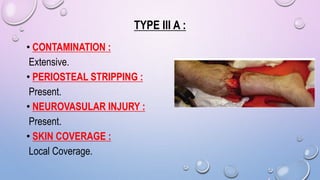
TYPE III A :
• CONTAMINATION :
Extensive.
• PERIOSTEAL STRIPPING :
Present.
• NEUROVASULAR INJURY :
Present.
• SKIN COVERAGE :
Local Coverage.
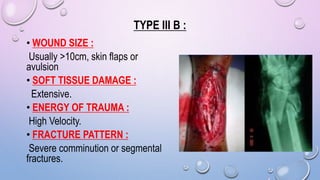
TYPE III B :
• WOUND SIZE :
Usually >10cm, skin flaps or
avulsion
• SOFT TISSUE DAMAGE :
Extensive.
• ENERGY OF TRAUMA :
High Velocity.
• FRACTURE PATTERN :
Severe comminution or segmental
fractures.
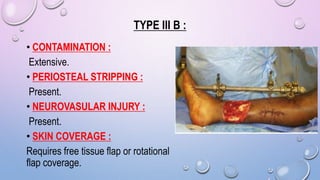
TYPE III B :
• CONTAMINATION :
Extensive.
• PERIOSTEAL STRIPPING :
Present.
• NEUROVASULAR INJURY :
Present.
• SKIN COVERAGE :
Requires free tissue flap or rotational
flap coverage.
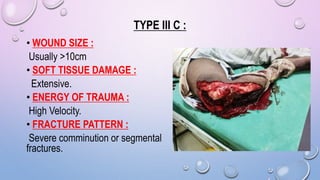
TYPE III C :
• WOUND SIZE :
Usually >10cm
• SOFT TISSUE DAMAGE :
Extensive.
• ENERGY OF TRAUMA :
High Velocity.
• FRACTURE PATTERN :
Severe comminution or segmental
fractures.
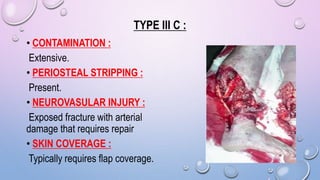
TYPE III C :
• CONTAMINATION :
Extensive.
• PERIOSTEAL STRIPPING :
Present.
• NEUROVASULAR INJURY :
Exposed fracture with arterial
damage that requires repair
• SKIN COVERAGE :
Typically requires flap coverage.
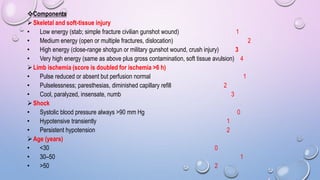
MANGLED EXTREMITY SEVERITY SCORE
• Second classification system, the MESS, originally designed as an
objective tool to assist the surgeon in decision-making for
amputation vs limb salvage in complex lower extremity trauma
• Given by Johansen in 1990.
• Strong weightage given for the presence of warm ischemia time and
an age >30 years.
• Johansen reported that a score of 7 or more predicted amputation
with 100% accuracy
Components
Skeletal and soft-tissue injury
• Low energy (stab; simple fracture civilian gunshot wound) 1
• Medium energy (open or multiple fractures, dislocation) 2
• High energy (close-range shotgun or military gunshot wound, crush injury) 3
• Very high energy (same as above plus gross contamination, soft tissue avulsion) 4
Limb ischemia (score is doubled for ischemia >6 h)
• Pulse reduced or absent but perfusion normal 1
• Pulselessness; paresthesias, diminished capillary refill 2
• Cool, paralyzed, insensate, numb 3
Shock
• Systolic blood pressure always >90 mm Hg 0
• Hypotensive transiently 1
• Persistent hypotension 2
Age (years)
• <30 0
• 30–50 1
• >50 2
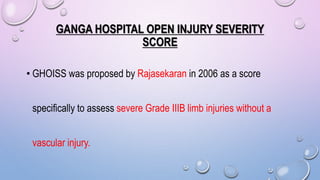
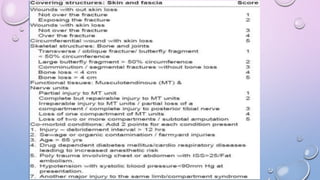
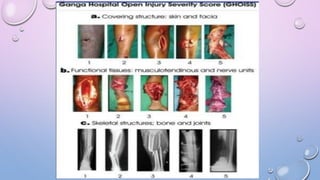
GANGA HOSPITAL OPEN INJURY SEVERITY
SCORE
• GHOISS was proposed by Rajasekaran in 2006 as a score
specifically to assess severe Grade IIIB limb injuries without a
vascular injury.
• Injuries with a score of 14 and below should be attempted for
salvage.
• 17 and above should be considered for primary amputation,
in between(15,16) must be assessed by an experienced team
on a case-to-case basis
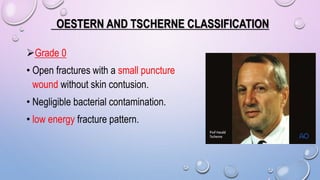
OESTERN AND TSCHERNE CLASSIFICATION
Grade 0
• Open fractures with a small puncture
wound without skin contusion.
• Negligible bacterial contamination.
• low energy fracture pattern.
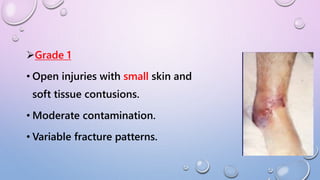
Grade 1
• Open injuries with small skin and
soft tissue contusions.
• Moderate contamination.
• Variable fracture patterns.
Grade 2
• Open fractures with heavy contamination
• Extensive soft tissue damage
• Often, associated arterial or neural injuries
Grade 3
• Open fracture with incomplete
or complete amputations.
COMPLICATIONS
• Hypovolemic shock
• Compartment syndrome
• Fat embolism
• ARDS
• Neurovascular injuries
• Infection
REFRENCES
• Rockwood & Green’s fractures in Adults. Fifth Edition.
• Koval's handbook of fractures.
• Campbell’s Operative Orthopaedics Ninth Edition, Edited by
Terry Canale.
• Apleys and solomon texbook of trauma 10th edition.
• William W Cross et al - Indian Journal of Orthopaedics
(https://www.ncbi.nlm.nih.gov/pmc/articles/PMC2740354/)
• Sudhir Babhulkar et al - Indian Journal of Orthopaedics
(https://www.ncbi.nlm.nih.gov/pmc/articles/PMC2740363/)
Open fractures Punit

Open fractures Punit

  • 1.
    OPEN FRACTURES: HISTORICALPERSPECTIVE AND CLASSIFICATION. • Presented By: -Dr. Punit Gaurav 1st year Post Graduate Trainee. Department of Orthopaedics.
  • 2.
    INTRODUCTION  Open fracturesare those in which a bone or joint structure is exposed to the external environment.  Due to disruption of the soft tissues and overlying skin.
  • 3.
    Usually high energyinjuries with severe bone and soft tissue involvement. Often associated with decreased vascular supply, contamination,degloving of skin and a variable degree of soft tissue damage.
  • 4.
    HISTORICAL ASPECTS : Egyptians1st time recognised need for coverage over fracture wounds to minimise morbidity.  Hippocrates favoured the debridement of purulent material.
  • 5.
    • In 1895,Stanley Boyd said “The most important divisions of fractures - simple, compound and complicated - are based upon the condition of the soft parts.”
  • 6.
    • Last century,high mortality with open fractures of long bones. • During WWI, mortality of open femur fractures > 70%. • By the WWI the main principle of treatment was debridement & stabilization, and healing by secondary intention.
  • 7.
    • 1939 Trueta-“closed treatment of war fractures” – Included open wound treatment and then enclosure of the extremity in a cast. • During the WW-II use of local antibiotics like sulfonamides was started for wound treatment.
  • 8.
    • Advances shiftedthe focus – Preservation of life and limb →preservation of function and prevention of complications. • However, amputation rates still exceed 50% in the most severe open tibial fractures associated with vascular injury.
  • 9.
    EPIDEMIOLOGY • More than4.5 million open fractures occur per year in India. (IJO) • Can involve significant morbidity and are inherently worrisome, as the body's protective skin barrier broken and the potential for contamination is high. • Correct and timely management of these injuries can benefit our patients and lead to more favorable outcomes.
  • 10.
    • Diaphyseal fracturesare more common than metaphyseal fractures. • Highest rate of diaphyseal fractures are seen in tibia (21.6%) >femur(12.1%)> radius >ulna(9.3%)> humerus(5.7%)
  • 11.
    MODE OF INJURY: •Result of high energy trauma → Greater soft tissue disruption → Leaves wound more susceptible to infection by contaminating bacteria. • Energy stored in soft and hard tissues until the strength of respective material is exceeded. • Comminuted pieces acquire high velocity → Propel into the surrounding soft tissues → Additional damage.
  • 12.
    • More severeinjury, limb absorbs energy →releases in explosion → tears the skin→ momentary vacuum sucks foreign material into the wound depth. • Soft tissue damage→ enormous muscle swelling→compartment syndrome (more in open injuries) of the intact compartments
  • 13.
    OPEN FRACTURE CLASSIFICATION: •Purpose of any fracture classification system in the clinical setting is to allow communication that infers fracture morphology and treatment parameters. • In the setting of open fractures, there are four classification systems that surgeons treating these injuries should be familiar with.
  • 14.
    1. GUSTILO ANDANDERSON CLASSIFICATION • Most widely used system and is generally accepted as the primary classification system for open fractures. • Takes into consideration- energy of the fracture, soft-tissue damage, and the degree of contamination.
  • 15.
    TYPE I : •WOUND SIZE : Small ≤ 1cm, Clean, Punctured, a Bone spike protruded. • SOFT TISSUE DAMAGE : Little, No crsushing. • ENERGY OF TRAUMA : Low Velocity. • FRACTURE PATTERN : Simple Fracture.
  • 16.
    TYPE I : •CONTAMINATION : Mild. • PERIOSTEAL STRIPPING : Absent. • VASULAR INJURY : Absent. • SKIN COVERAGE: Local Coverage.
  • 17.
    TYPE II : •WOUND SIZE : Small 1-10 cm, No skin flaps or avulsion. • SOFT TISSUE DAMAGE : Moderate Crushing, Not extensive. • ENERGY OF TRAUMA : Moderate Velocity. • FRACTURE PATTERN : Simple fracture pattern with minimal comminution
  • 18.
    TYPE II : •CONTAMINATION : Moderate. • PERIOSTEAL STRIPPING : Absent. • VASULAR INJURY : Absent. • SKIN COVERAGE: Local Coverage.
  • 19.
    TYPE III : •Either an open segmental fracture, an open fracture with extensive soft tissue damage, or a traumatic amputation. • Variation in severity, etiology, and prognosis of Type III injuries made a single classification insufficiently specific for the task at hand.
  • 20.
    • Frequency ofthese injuries (>60% of open fractures are Type III, according to one epidemiologic study), made that issue even more pressing. • In response to that problem, these high-energy open fractures were further subclassified by Gustilo et al. into A, B, and C.
  • 21.
    TYPE III A: • WOUND SIZE : Usually >10cm, skin flaps or avulsion • SOFT TISSUE DAMAGE : Extensive. • ENERGY OF TRAUMA : High Velocity. • FRACTURE PATTERN : Severe comminution or segmental fractures.
  • 22.
    TYPE III A: • CONTAMINATION : Extensive. • PERIOSTEAL STRIPPING : Present. • NEUROVASULAR INJURY : Present. • SKIN COVERAGE : Local Coverage.
  • 23.
    TYPE III B: • WOUND SIZE : Usually >10cm, skin flaps or avulsion • SOFT TISSUE DAMAGE : Extensive. • ENERGY OF TRAUMA : High Velocity. • FRACTURE PATTERN : Severe comminution or segmental fractures.
  • 24.
    TYPE III B: • CONTAMINATION : Extensive. • PERIOSTEAL STRIPPING : Present. • NEUROVASULAR INJURY : Present. • SKIN COVERAGE : Requires free tissue flap or rotational flap coverage.
  • 25.
    TYPE III C: • WOUND SIZE : Usually >10cm • SOFT TISSUE DAMAGE : Extensive. • ENERGY OF TRAUMA : High Velocity. • FRACTURE PATTERN : Severe comminution or segmental fractures.
  • 26.
    TYPE III C: • CONTAMINATION : Extensive. • PERIOSTEAL STRIPPING : Present. • NEUROVASULAR INJURY : Exposed fracture with arterial damage that requires repair • SKIN COVERAGE : Typically requires flap coverage.
  • 27.
    MANGLED EXTREMITY SEVERITYSCORE • Second classification system, the MESS, originally designed as an objective tool to assist the surgeon in decision-making for amputation vs limb salvage in complex lower extremity trauma • Given by Johansen in 1990. • Strong weightage given for the presence of warm ischemia time and an age >30 years. • Johansen reported that a score of 7 or more predicted amputation with 100% accuracy
  • 28.
    Components Skeletal and soft-tissueinjury • Low energy (stab; simple fracture civilian gunshot wound) 1 • Medium energy (open or multiple fractures, dislocation) 2 • High energy (close-range shotgun or military gunshot wound, crush injury) 3 • Very high energy (same as above plus gross contamination, soft tissue avulsion) 4 Limb ischemia (score is doubled for ischemia >6 h) • Pulse reduced or absent but perfusion normal 1 • Pulselessness; paresthesias, diminished capillary refill 2 • Cool, paralyzed, insensate, numb 3 Shock • Systolic blood pressure always >90 mm Hg 0 • Hypotensive transiently 1 • Persistent hypotension 2 Age (years) • <30 0 • 30–50 1 • >50 2
  • 29.
    GANGA HOSPITAL OPENINJURY SEVERITY SCORE • GHOISS was proposed by Rajasekaran in 2006 as a score specifically to assess severe Grade IIIB limb injuries without a vascular injury.
  • 32.
    • Injuries witha score of 14 and below should be attempted for salvage. • 17 and above should be considered for primary amputation, in between(15,16) must be assessed by an experienced team on a case-to-case basis
  • 33.
    OESTERN AND TSCHERNECLASSIFICATION Grade 0 • Open fractures with a small puncture wound without skin contusion. • Negligible bacterial contamination. • low energy fracture pattern.
  • 34.
    Grade 1 • Openinjuries with small skin and soft tissue contusions. • Moderate contamination. • Variable fracture patterns.
  • 35.
    Grade 2 • Openfractures with heavy contamination • Extensive soft tissue damage • Often, associated arterial or neural injuries
  • 36.
    Grade 3 • Openfracture with incomplete or complete amputations.
  • 37.
    COMPLICATIONS • Hypovolemic shock •Compartment syndrome • Fat embolism • ARDS • Neurovascular injuries • Infection
  • 38.
    REFRENCES • Rockwood &Green’s fractures in Adults. Fifth Edition. • Koval's handbook of fractures. • Campbell’s Operative Orthopaedics Ninth Edition, Edited by Terry Canale. • Apleys and solomon texbook of trauma 10th edition. • William W Cross et al - Indian Journal of Orthopaedics (https://www.ncbi.nlm.nih.gov/pmc/articles/PMC2740354/) • Sudhir Babhulkar et al - Indian Journal of Orthopaedics (https://www.ncbi.nlm.nih.gov/pmc/articles/PMC2740363/)