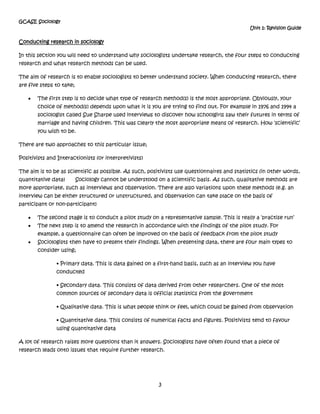
00Sociology Unit One Revision GuideSociology Unit One Revision Guide<br />Within this pack you will find:<br />Revision Notes<br />Useful Websites<br />Example essays and questions<br />Remember:<br />You are doing the WJCE GCSE Sociology course<br />In Unit 1 you have studied:<br />Socialisation: Compulsory<br />Research Methods: Compulsory<br />Family and Households: Option 1<br />Education: Option 2<br />The exam in 1 hour and 30 mins. You have to answer all questions in section one and you have three essays to choose from in section 2. You either choose mass media, family or education – but you answer all three on the same subject.<br />What is Sociology?<br />Sociology is the “study of human society.” For the examination, you need to know a number of concepts and terms used in the subject. There are three main areas you need to consider;<br />Social structures (e.g. the family, education, social stratification, etc.)<br />Social systems (e.g. culture and identity, agents of social control, etc.)<br />Social issues (e.g. the causes of crime, the impact of unemployment, etc.)<br />As you might expect of a social science, there are several explanations as to how we can best understand human society. The main theoretical perspectives covered in GCSE Sociology are;<br />Functionalism<br />Marxism<br />Feminism<br />The New Right<br />Functionalism<br />Functionalists believe that society can best be compared to a living organ, in which institutions and people all have a function to play with society. For example, the function of the family is to socialise children. Functionalist theorists include Talcott Parsons and Emile Durkheim.<br />Marxism<br />Marxists believe that a capitalist society is characterised by a class conflict between the bourgeoisie (the owners of capital) and the proletariat (the working-class). In a capitalist economic system such as the UK, the bourgeoisie exploit the proletariat. Marxist theorists include Friedrich Engels and Karl Marx.<br />Feminism<br />Feminists argue that society is dominated by men. In this patriarchal society men discriminate against women in order to prevent males and females gaining equal rights. There are various strands of belief within feminism; such as radical feminism, liberal feminism and Marxist feminism. Feminist theorists include Germaine Greer and Ann Oakley.<br />The New Right<br />Sociologists who take a New Right perspective believe that traditional roles within society have been undermined by the permissive values of the 1960s and 1970s. They argue that the nuclear family is the bedrock of society, and that the welfare state creates a dependency culture. New Right theorists include Charles Murray and Sir Keith Joseph.<br />Conducting research in sociology<br />In this section you will need to understand why sociologists undertake research, the four steps to conducting research and what research methods can be used. <br />The aim of research is to enable sociologists to better understand society. When conducting research, there are five steps to take;<br />The first step is to decide what type of research method(s) is the most appropriate. Obviously, your choice of method(s) depends upon what it is you are trying to find out. For example in 1976 and 1994 a sociologist called Sue Sharpe used interviews to discover how schoolgirls saw their futures in terms of marriage and having children. This was clearly the most appropriate means of research. How ‘scientific’ you wish to be. There are two approaches to this particular issue;<br />Positivists and Interactionists (or interpretivists)<br />The aim is to be as scientific as possible. As such, positivists use questionnaires and statistics (in other words, quantitative data)Sociology cannot be understood on a scientific basis. As such, qualitative methods are more appropriate, such as interviews and observation. There are also variations upon these methods (e.g. an interview can be either structured or unstructured, and observation can take place on the basis of participant or non-participant)<br />The second stage is to conduct a pilot study on a representative sample. This is really a ‘practise run’
The next step is to amend the research in accordance with the findings of the pilot study. For example, a questionnaire can often be improved on the basis of feedback from the pilot study
Sociologists then have to present their findings. When presenting data, there are four main types to consider using;• Primary data. This is data gained on a first-hand basis, such as an interview you have conducted<br />• Secondary data. This consists of data derived from other researchers. One of the most common sources of secondary data is official statistics from the government<br />• Qualitative data. This is what people think or feel, which could be gained from observation<br />• Quantitative data. This consists of numerical facts and figures. Positivists tend to favour using quantitative data<br />A lot of research raises more questions than it answers. Sociologists have often found that a piece of research leads onto issues that require further research. <br />Methods to use<br />MethodData producedPerspectiveAdvantagesDisadvantagesQuestionnaires/SurveysClosed questions are Quantitative and open questions are Qualitative. Positivist (Primary data)*Large sample*Cheap and quick to do*Quantitative data collected so can easily compare trends*Respondent rate (people may not send them back)*People can lie*Cant clarify meaning of questionsStructured InterviewsMainly Quantitative Positivist (Primary data)*High in reliability *Quantitative data collected so can easily compare trends*Low in Validity*Less of a rapport is developed between interviewer and interviewee. Unstructured InterviewsQualitative Interpretivist (Primary data)*High in Validity*Qualitative data gives great amounts of insight into the social world*Like a conversation so good rapport between interviewer and interviewee is generated so more information can be gathered due to higher levels of trust. *Low in reliability*Time consuming to transcribe information and conduct interviews*Limited sampleObservation(Participant and non-participant, Overt and Covert)QualitativeInterpretivist (Primary data)*High in validity as you are out in the social world*Generate lots of information*Can create good relationships with participants*Low in reliability as they are really hard to repeat*Small sample*Can be dangerous (e.g. if you are researching a criminal gang)*Researcher could go native (covert participant obs – join in with the gang etc)*Unethical (covert)Official StatisticsQuantitative Positivist (Secondary data)*Information is generated already*Cheap and quick*Can make comparisons easily *High levels of reliability*Low levels of validity*Crime stats have a dark figure of crime (crime that is not shown in the official stats)*Not always enough info for your specific research topicDocuments, Autobiographies etcQualitativeInterpretivist (Secondary data)*Information is generated already*Cheap*Lots of information to look at and examine*Time consuming to read lots of information*Not always enough info for your specific research topic<br />What is good research?<br />Please be aware that ‘good’ research should be;<br />Valid (true representation of everyday life)
Objective. Always try to avoid bias when conducting research
The sample used should be representative
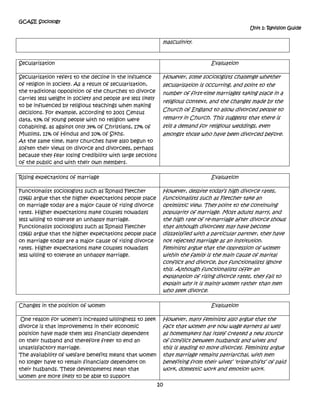
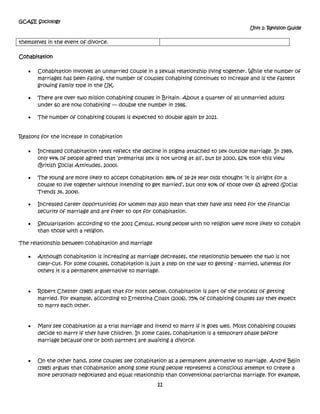
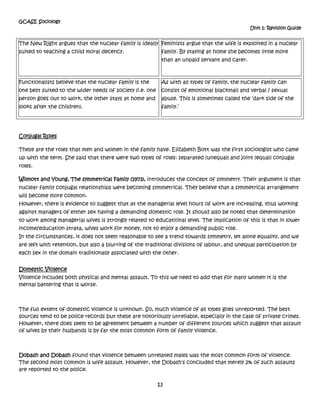
Reliable (can be repeated again and will get similar results)Sociological approaches to the family<br />TheoryThe importance of the familyFunctionalistThe function of the family is to socialise children, which in turn benefits both children and society.Parsons argues that the family is the means of primary socialisation and that the nuclear family is the preferred type as it provides emotional stability for adult personalities.Murdock argues that the family provides 4 functions:• Sexual – controls sexuality, provides stability for adults• Reproductive – provides new members of society.• Economic – family provides for its members.• Educational – family socialises the young into societies norms and values.MarxismThe function of the family is to serve Capitalism. This theory criticise Functionalism as they argue that the family does not serve the needs of its members, but only the needs of capitalism.The monogamous nuclear family was created to ensure inheritance to the legitimate heirs.The family are also a consumer unit that feed the need of capitalism as they work for capitalist bosses and then they buy back the goods they create at highly inflated prices. (Used to criticise Functionalism)FeministThe purpose of the family is to reinforce the dominant position of men within a patriarchal society. They argue that the nuclear family is oppressive and they welcome the increase in divorce and cohabitation as these family types provide more freedom for women. (Used to criticise Functionalism)New RightThe role of the family is to teach children the difference between right and wrong, and to provide a sense of morality more widely known as ‘family values.’ They value the nuclear family, and criticise family diversity. They especially criticise single parent families arguing that they are the biggest social problem of our time. (Used to support functionalism) <br />Marriage, Divorce and Cohabitation<br />1. Marriage<br />The number of first marriages has significantly declined since the 1970s: from 480000 in 1972 to 306000 in 2000.<br />Remarriages increased from 57000 in 1961 to 126000 (46% of all marriages) in 2000.  Most remarriages involve divorced persons rather than widows and widowers.  The largest increase occurred between 1971 and 1972 following the introduction of the Divorce Reform Act of 1969.<br />People are marrying later: the average age of first marriage rose by seven years between 1971 and 2005 when it was 32 years for men and 30 for women.<br />Reasons for changing patterns of marriage<br />Changing attitudes to marriageEvaluationThere is less pressure to marry and more freedom for individuals to choose the type of relationship they want. .The postmodernist David Cheal argues that this greater  choice over the type of family we create has led to an increase in family diversity.However, some sociologists point out that greater freedom of choice in relationships means a greater risk of instability, since these relationships are more likely to break up.<br />The decline of religious influenceEvaluationThe decline in influence of the Church means that people no longer feel they should get married for religious reasons.  People are freer to choose what type of relationship they enter into.However, the majority of first-time marriages take place within a religious context, which suggests that religion still has some influence over the decision to get married.<br />The declining stigma attached to alternatives to marriageEvaluationCohabitation, remaining single and having children outside marriage are all now regarded as acceptable.  In 1989 70% of respondents to the British Social Attitudes Survey believed that couples who wanted children should get married.  By 2000 this had dropped to 54%.However, despite this, most couples who cohabit do tend to get married.  It is just that the average age of getting married has risen.<br />Changes in the position of womenEvaluationMany women are now financially independent from men because of better education and better career prospects.  This gives them greater freedom not to marry.The growing impact of the feminist view that marriage is an oppressive patriarchal institution may also dissuade women from marrying.However, changes to the position of women in society does not necessarily mean that they don’t get married, they merely put off marriage until their careers are established.Many feminists also argue that the fact that women are now wage earners as well as homemakers has itself created a new source of conflict between husbands and wives and this is leading to more divorces. Feminists argue that marriage remains patriarchal, with men benefiting from their wives’ ‘triple-shifts’ of paid work, domestic work and emotion work<br />Divorce<br />Changing patterns of divorce<br />Since the 1960s, there has been a great increase in the number of divorces in the United Kingdom. <br />The number of divorces doubled between 1961 and 1969, and doubled again by 1972. The upward trend continued, peaking in 1993 at 180,000. Since then, numbers have fallen somewhat, but still stood at 157,000 in 2001 — about six times higher than in 1961. This rate means that about 40% of all marriages will end in divorce. <br />About 7 out of every 10 petitions (applications) for divorce now come from women. This is in sharp contrast to the situation in the past. For example, in 1946, only 37% of petitions came from women — barely half today’s figure. <br />Some couples are more likely than others to divorce. Couples whose marriages are at greatest risk include those who marry young, have a child before they marry or cohabit before marriage, and those where one or both partners have been married before. <br />Theoretical approaches to divorce<br />Sociologists disagree as to what today’s high divorce rate tells us about the state of marriage and the family:The New Right see a high divorce rate as undesirable because it undermines the traditional nuclear family. Divorce creates an underclass of welfare-dependent lone mothers and leaves boys without the adult role model they need.Feminists disagree. They see a high divorce rate as desirable because it shows that women are breaking from the oppression of the patriarchal nuclear family.Postmodernists see a high divorce rate as giving individuals the freedom to choose to end a relationship when it no longer meets their needs.  They see it as a cause of greater family diversity.Functionalists argue that a high divorce rate does not necessarily prove that marriage as a social institution is under threat.  It is simply the result of people’s higher expectations of marriage today.  The high rate of re-marriage demonstrates people’s continuing commitment to the idea of marriage.<br />Explanations of the increase in divorce<br />Changes in the lawEvaluationDivorce was very difficult to obtain in 19th-century Britain, especially for women. Gradually, changes in the law have made divorce easier. There have been three kinds of change in the law: Equalising the grounds (the legal reasons) for divorce between the sexes ;Widening the grounds for divorce; Making divorce cheaper. The widening of the grounds in 1971 to ‘irretrievable breakdown’ made divorce easier to obtain and produced a doubling of the divorce rate almost overnight. The introduction of legal aid for divorce cases in 1 949 lowered the cost of divorcing. Divorce rates have risen with each change in the law.Yet although changes in the law have given people the freedom to divorce more easily, this does not in itself explain why more people should choose to take advantage of this freedom. To explain the rise in divorce rates we must therefore look at other changes too. These include changes in public attitudes towards divorce. <br />Declining stigma and changing attitudesEvaluationJuliet Mitchell and Jack Goody (1997) note that an important change since the 1 960s has been the rapid decline in the stigma attached to divorce. As stigma declines and divorce becomes more socially acceptable, couples become more willing to resort to divorce as a means of solving their marital problems. In turn, the fact that divorce is now more common begins to ‘normalise’ it and reduces the stigma attached to it. Rather than being seen as shameful, today it is more likely to be regarded simply as a misfortune.However, despite these changing attitudes, family patterns tend to be fairly traditional.  Most people still live in a family; most children are brought up by couples; most couples marry and many divorcees re-marry.Also, some sociologists have suggested that these changes have led to a ‘crisis of masculinity’ in which some men experience anxiety about their role.  As such, the result of this could be an increase in domestic violence in an attempt to re-assert their traditional masculinity.<br />SecularisationEvaluationSecularisation refers to the decline in the influence of religion in society. As a result of secularisation, the traditional opposition of the churches to divorce carries less weight in society and people are less likely to be influenced by religious teachings when making decisions. For example, according to 2001 Census data, 43% of young people with no religion were cohabiting, as against only 34% of Christians, 17% of Muslims, 11% of Hindus and 10% of Sikhs. At the same time, many churches have also begun to soften their views on divorce and divorcees, perhaps because they fear losing credibility with large sections of the public and with their own members. However, some sociologists challenge whether secularisation is occurring, and point to the number of first-time marriages taking place in a religious context, and the changes made by the Church of England to allow divorced people to remarry in Church. This suggests that there is still a demand for religious weddings, even amongst those who have been divorced before.<br />Rising expectations of marriageEvaluationFunctionalist sociologists such as Ronald Fletcher (1966) argue that the higher expectations people place on marriage today are a major cause of rising divorce rates. Higher expectations make couples nowadays less willing to tolerate an unhappy marriage. Functionalist sociologists such as Ronald Fletcher (1966) argue that the higher expectations people place on marriage today are a major cause of rising divorce rates. Higher expectations make couples nowadays less willing to tolerate an unhappy marriage. However, despite today’s high divorce rates, functionalists such as Fletcher take an optimistic view. They point to the continuing popularity of marriage. Most adults marry, and the high rate of re-marriage after divorce shows that although divorcees may have become dissatisfied with a particular partner, they have not rejected marriage as an institution. Feminists argue that the oppression of women within the family is the main cause of marital conflict and divorce, but functionalists ignore this. Although functionalists offer an explanation of rising divorce rates, they fail to explain why it is mainly women rather than men who seek divorce. <br />Changes in the position of womenEvaluation One reason for women’s increased willingness to seek divorce is that improvements in their economic position have made them less financially dependent on their husband and therefore freer to end an unsatisfactory marriage. The availability of welfare benefits means that women no longer have to remain financially dependent on their husbands. These developments mean that women are more likely to be able to support themselves in the event of divorce. However, many feminists also argue that the fact that women are now wage earners as well as homemakers has itself created a new source of conflict between husbands and wives and this is leading to more divorces. Feminists argue that marriage remains patriarchal, with men benefiting from their wives’ ‘triple-shifts’ of paid work, domestic work and emotion work.<br />Cohabitation<br />Cohabitation involves an unmarried couple in a sexual relationship living together. While the number of marriages has been falling, the number of couples cohabiting continues to increase and is the fastest growing family type in the UK.<br />There are over two million cohabiting couples in Britain. About a quarter of all unmarried adults under 60 are now cohabiting — double the number in 1986. <br />The number of cohabiting couples is expected to double again by 2021. <br />Reasons for the increase in cohabitation<br />Increased cohabitation rates reflect the decline in stigma attached to sex outside marriage. In 1989, only 44% of people agreed that ‘premarital sex is not wrong at all’, but by 2000, 62% took this view (British Social Attitudes, 2000). <br />The young are more likely to accept cohabitation: 88% of 18-24 year olds thought ‘it is airight for a couple to live together without intending to get married’, but only 40% of those over 65 agreed (Social Trends 34, 2004). <br />Increased career opportunities for women may also mean that they have less need for the financial security of marriage and are freer to opt for cohabitation. <br />Secularisation: according to the 2001 Census, young people with no religion were more likely to cohabit than those with a religion. <br />The relationship between cohabitation and marriage<br />Although cohabitation is increasing as marriage decreases, the relationship between the two is not clear-cut. For some couples, cohabitation is just a step on the way to getting - married, whereas for others it is a permanent alternative to marriage. <br />Robert Chester (1985) argues that for most people, cohabitation is part of the process of getting married. For example, according to Ernestina Coast (2006), 75% of cohabiting couples say they expect to marry each other. <br />Many see cohabitation as a trial marriage and intend to marry if it goes well. Most cohabiting couples decide to marry if they have children. In some cases, cohabitation is a temporary phase before marriage because one or both partners are awaiting a divorce. <br />On the other hand, some couples see cohabitation as a permanent alternative to marriage. André Bejin (1985) argues that cohabitation among some young people represents a conscious attempt to create a more personally negotiated and equal relationship than conventional patriarchal marriage. For example, Shelton and John (1993) found that women who cohabit do less housework than their married counterparts. <br />Clearly, then, cohabitation does not mean the same thing to every couple. Eleanor MackIm (1980) argues that the term covers a diverse range of partnerships, and that the relationship between marriage and cohabitation is a complex and variable one.<br />Diversity<br />There are several types of family within UK society. These include:<br />Nuclear<br />Single – parent<br />Gay / lesbian<br />Extended<br />Reconstituted (or reconstructed)<br />Some important trends:<br />In the past 30 or 40 years, there have been some major changes in family and household patterns. For examples:<br />The number of traditional nuclear family households has fallen<br />Divorce rates have increased<br />There are fewer first time marriages, but more re-marriages. People are marrying later in life<br />More couples are cohabiting<br />Same-sex relationships can be legally recognised through civil partnerships<br />Women are having fewer children and having them later<br />There are more births outside marriage<br />There are more lone-parent families<br />More people live alone<br />There are more stepfamilies, and more couples without children<br />All of these upset the New Right<br />Alternatives to family life include single-person households, communes and living in a kibbutz.<br />For the examination, you will need to describe the different types of family, understand their significance and consider their pros and cons. For example the nuclear family consists of a married couple with children. It is the most common type of family, although sociologists argue that it is under threat. As with all types of family, there are both positives and negatives to consider.<br />POSITIVESNEGATIVESThe New Right argues that the nuclear family is ideally suited to teaching a child moral decency.Feminists argue that the wife is exploited in a nuclear family. By staying at home she becomes little more than an unpaid servant and carer.Functionalists believe that the nuclear family is the one best suited to the wider needs of society (i.e. one person goes out to work, the other stays at home and looks after the children).As with all types of family, the nuclear family can consist of emotional blackmail and verbal / sexual abuse. This is sometimes called the ‘dark side of the family.’<br />Conjugal Roles<br />These are the roles that men and women in the family have. Elizabeth Bott was the first sociologist who came up with the term. She said that there were two types of roles: separated (unequal) and joint (equal) conjugal roles. <br />Wilmott and Young, The symmetrical Family (1973), introduces the concept of symmetry. Their argument is that nuclear family conjugal relationships were becoming symmetrical. They believe that a symmetrical arrangement will become more common.<br />However, there is evidence to suggest that at the managerial level hours of work are increasing, thus working against managers of either sex having a demanding domestic role. It should also be noted that determination to work among managerial wives is strongly related to educational level. The implication of this is that in lower income/education strata, wives work for money, not to enjoy a demanding public role.<br />In the circumstances, it does not seem reasonable to see a trend towards symmetry, let alone equality, and we are left with retention, but also a blurring of the traditional divisions of labour, and unequal participation by each sex in the domain traditionally associated with the other.<br />Domestic Violence<br />Violence includes both physical and mental assault. To this we need to add that for many women it is the mental battering that is worse.<br />The full extent of domestic violence is unknown. So, much violence of all types goes unreported. The best sources tend to be police records but these are notoriously unreliable, especially in the case of private crimes. However, there does seem to be agreement between a number of different sources which suggest that assault of wives by their husbands is by far the most common form of family violence.<br />Dobash and Dobash found that violence between unrelated males was the most common form of violence. The second most common is wife assault. However, the Dobash's concluded that merely 2% of such assaults are reported to the police.<br />It is difficult to uncover the extent of violence in family life generally because what evidence there is usually comes from wives who have sought refuge or reported their partners to the police. It has been suggested that it is more likely to be middle class violence that goes unreported.<br />The only large study to have investigated violence in the general population was carried out in the USA by Strauss, Gelles and Stienmetz (1980). They concluded that: 'Overall, every other house in America is the scene of family violence at least once a year'.<br />The focus on domestic violence should not blind us to the fact that such violence is part of a larger pattern of male violence against women. Research by Hanmer and Saunders (1984) and Radford (1987) has found that women's behaviour is very much restricted by fear of men, both in the domestic sphere and in public. Hanmer (1983) in a study of community violence to women showed that 59% of the women interviewed had experienced violent or threatening behaviour during the previous year, 21% of these at home. <br />The Role of Education<br />Functionalism sees education as a positive institution and that it benefits society.
Marxism sees education as a negative institution and argues that the powerful groups in society oppress the working class. They believe that the working class are exploited and that education creates a docile (accepting and quiet) workforce.The economic role:<br />Functionalists believe that schools teach the skills and knowledge as necessary for working in society. Education prepares you for the roles you will play in society.
Marxists see education as reinforcing the class system. Social Class and Achievement<br />Trends in Class and Achievement<br />Children from working class backgrounds underachieve compared with their middle class peers.  Jeffries (2002) studied 11000 children born in 1958 and noted that, by the age of seven, those who experienced childhood poverty had significantly fallen behind children from middle class backgrounds in mathematics, reading and other ability tests.  The research also found that the gap in educational attainment between individuals from higher and lower social classes widened as time went on and was greatest by the age of 33.
The Institute of Education (2000) found that more children were born to educated parents in 1970 than in 1958, but those born into poverty persistently underachieve.  The research concludes that childhood poverty makes educational attainment more difficult, even for children with similar test scores.
In 2003, the National Children’s Bureau noted that children from poor backgrounds (i.e. from families living on state benefits) were two-thirds less likely to gain at least 5 GCSEs graded from A*-C than those from affluent backgrounds.
Joan Payne’s (2001) research into participation in further education (16-19) showed that differences in home background influence staying-on rates.  For example, 82% of children of professionals and managers were in further education in 2000, compared with only 60% of children of semi/unskilled workers.
Connor and Dewson’s (2001) study of students in higher education found that fewer than one in five young people from lower social class groups participate in higher education.External Explanations for the Class Gap<br />The main external (outside school factors) explanations for the class gap in achievement are:<br />Cultural deprivation – these include class differences in norms and values acquired through socialisation, attitudes to education, speech patterns etc
Material deprivation – these are the physical necessities of life, such as adequate housing, diet and income.
Cultural capital – the values and attitudes needed to be successful at school.1. Cultural deprivation theories<br />A number of studies have argued that the values, attitudes and aspirations of parents have an important effect on their children's education.  It is argued that working class parents tend to value education less than middle class parents, and this has a negative effect on working class students in terms of their poorer performance.
Basil Bernstein distinguishes between elaborated and restricted speech codes. Working class children tend to use a restricted code which is less analytic and more descriptive.  It is particularistic – it assumes that the listener shares the particular meanings that the speaker holds, so does not spell them out. Middle class children use an elaborate code which is more analytic in which speakers spell out exactly what they mean. Crucially, the elaborate code is the one used in the education system, giving middle class children an advantage over working class children.  This could partly explain the class gap in achievement.2. Material deprivation factors:<br />Material deprivation refers to the lack of physical resources such as money, room, equipment etc which may have an adverse effect on the educational achievement of working class children.
Research by Warwick University found that many students face selection or admission by mortgage whereby wealthier middle class parents can move into the catchment area of good schools, leaving less successful schools full of working class students.3. Cultural capital<br />Pierre Bourdieu uses the concept of cultural capital to explain why middle class students are more successful. He uses the term cultural capital to refer to the knowledge, attitudes, values, language, tastes and abilities of the middle class.
Bourdieu sees middle class culture as capital because it can be translated into wealth and power, and gives an advantage to those who have it.
This is because the culture, knowledge and language of the school fits more closely to  middle class culture, therefore middle class students have an in-built advantage.
On the other hand, the children of working class parents experience a cultural deficit.  They soon realize that the school and teachers attach little importance to their experiences and values.  As such they may lack the cultural capital necessary for educational success.Internal Explanations for the Class Gap<br />The main internal (inside school) explanations for the class gap in achievement are:<br />Labelling
Banding, setting and streaming,
Marketisation and selection policies1. Labelling <br />One of the most important aspects of the interactionist approach to education concerns the ways in which teachers make sense of and respond to the behaviour of their pupils.
In a study of an American kindergarten Rist found that it was not ability which determined where each child was seated, but the degree to which the children conformed to the teacher's own middle class standards.  In other words, the kindergarten teacher was evaluating and labelling pupils on the basis of their social class, not on the abilities they demonstrated in class.
As such, all this research suggests that teachers tend to expect more from middle class students, and are more likely to convey their expectations to them and act in terms of it.  The result is a self-fulfilling prophecy, whereby teachers expectations of students future behaviour and attainment will tend to come true.2. Banding, Setting and Streaming<br />A number of studies by Ball, Hargreaves and Lacey have looked at the effects of ability grouping in secondary schools.  In general they found a tendency for middle class students to be placed in higher groups and for working class students to be placed in the lower groups.They found that teachers tend to have lower expectations of working class students, deny them access to higher level knowledge and tend to enter them for lower level examination tiers. Gender and Achievement<br />Some patterns and trends<br />Both girls and boys are doing better.  Over the last 50 years the educational performance of boys has steadily improved.  The performance of girls has risen at a faster rate at some levels and in some subjects.  As Coffey (2200) suggests, this hardly justifies labelling all boys as underachievers.
Only some boys are failing.  There is a close link between boys underachievement and social class.  Epstein et al show that, compared to other groups, a high proportion of working class boys are failing.
Hiding girls’ failure.  The pre-occupation with so-called failing boys’ diverts attention from underachieveing girls.  Research by Plummer suggests that a high proportion of working class girls are failing in the school system.

SociologyExchange.co.uk Shared Resource

  • 1.
    00Sociology Unit OneRevision GuideSociology Unit One Revision Guide<br />Within this pack you will find:<br />Revision Notes<br />Useful Websites<br />Example essays and questions<br />Remember:<br />You are doing the WJCE GCSE Sociology course<br />In Unit 1 you have studied:<br />Socialisation: Compulsory<br />Research Methods: Compulsory<br />Family and Households: Option 1<br />Education: Option 2<br />The exam in 1 hour and 30 mins. You have to answer all questions in section one and you have three essays to choose from in section 2. You either choose mass media, family or education – but you answer all three on the same subject.<br />What is Sociology?<br />Sociology is the “study of human society.” For the examination, you need to know a number of concepts and terms used in the subject. There are three main areas you need to consider;<br />Social structures (e.g. the family, education, social stratification, etc.)<br />Social systems (e.g. culture and identity, agents of social control, etc.)<br />Social issues (e.g. the causes of crime, the impact of unemployment, etc.)<br />As you might expect of a social science, there are several explanations as to how we can best understand human society. The main theoretical perspectives covered in GCSE Sociology are;<br />Functionalism<br />Marxism<br />Feminism<br />The New Right<br />Functionalism<br />Functionalists believe that society can best be compared to a living organ, in which institutions and people all have a function to play with society. For example, the function of the family is to socialise children. Functionalist theorists include Talcott Parsons and Emile Durkheim.<br />Marxism<br />Marxists believe that a capitalist society is characterised by a class conflict between the bourgeoisie (the owners of capital) and the proletariat (the working-class). In a capitalist economic system such as the UK, the bourgeoisie exploit the proletariat. Marxist theorists include Friedrich Engels and Karl Marx.<br />Feminism<br />Feminists argue that society is dominated by men. In this patriarchal society men discriminate against women in order to prevent males and females gaining equal rights. There are various strands of belief within feminism; such as radical feminism, liberal feminism and Marxist feminism. Feminist theorists include Germaine Greer and Ann Oakley.<br />The New Right<br />Sociologists who take a New Right perspective believe that traditional roles within society have been undermined by the permissive values of the 1960s and 1970s. They argue that the nuclear family is the bedrock of society, and that the welfare state creates a dependency culture. New Right theorists include Charles Murray and Sir Keith Joseph.<br />Conducting research in sociology<br />In this section you will need to understand why sociologists undertake research, the four steps to conducting research and what research methods can be used. <br />The aim of research is to enable sociologists to better understand society. When conducting research, there are five steps to take;<br />The first step is to decide what type of research method(s) is the most appropriate. Obviously, your choice of method(s) depends upon what it is you are trying to find out. For example in 1976 and 1994 a sociologist called Sue Sharpe used interviews to discover how schoolgirls saw their futures in terms of marriage and having children. This was clearly the most appropriate means of research. How ‘scientific’ you wish to be. There are two approaches to this particular issue;<br />Positivists and Interactionists (or interpretivists)<br />The aim is to be as scientific as possible. As such, positivists use questionnaires and statistics (in other words, quantitative data)Sociology cannot be understood on a scientific basis. As such, qualitative methods are more appropriate, such as interviews and observation. There are also variations upon these methods (e.g. an interview can be either structured or unstructured, and observation can take place on the basis of participant or non-participant)<br />The second stage is to conduct a pilot study on a representative sample. This is really a ‘practise run’
  • 2.
    The next stepis to amend the research in accordance with the findings of the pilot study. For example, a questionnaire can often be improved on the basis of feedback from the pilot study
  • 3.
    Sociologists then haveto present their findings. When presenting data, there are four main types to consider using;• Primary data. This is data gained on a first-hand basis, such as an interview you have conducted<br />• Secondary data. This consists of data derived from other researchers. One of the most common sources of secondary data is official statistics from the government<br />• Qualitative data. This is what people think or feel, which could be gained from observation<br />• Quantitative data. This consists of numerical facts and figures. Positivists tend to favour using quantitative data<br />A lot of research raises more questions than it answers. Sociologists have often found that a piece of research leads onto issues that require further research. <br />Methods to use<br />MethodData producedPerspectiveAdvantagesDisadvantagesQuestionnaires/SurveysClosed questions are Quantitative and open questions are Qualitative. Positivist (Primary data)*Large sample*Cheap and quick to do*Quantitative data collected so can easily compare trends*Respondent rate (people may not send them back)*People can lie*Cant clarify meaning of questionsStructured InterviewsMainly Quantitative Positivist (Primary data)*High in reliability *Quantitative data collected so can easily compare trends*Low in Validity*Less of a rapport is developed between interviewer and interviewee. Unstructured InterviewsQualitative Interpretivist (Primary data)*High in Validity*Qualitative data gives great amounts of insight into the social world*Like a conversation so good rapport between interviewer and interviewee is generated so more information can be gathered due to higher levels of trust. *Low in reliability*Time consuming to transcribe information and conduct interviews*Limited sampleObservation(Participant and non-participant, Overt and Covert)QualitativeInterpretivist (Primary data)*High in validity as you are out in the social world*Generate lots of information*Can create good relationships with participants*Low in reliability as they are really hard to repeat*Small sample*Can be dangerous (e.g. if you are researching a criminal gang)*Researcher could go native (covert participant obs – join in with the gang etc)*Unethical (covert)Official StatisticsQuantitative Positivist (Secondary data)*Information is generated already*Cheap and quick*Can make comparisons easily *High levels of reliability*Low levels of validity*Crime stats have a dark figure of crime (crime that is not shown in the official stats)*Not always enough info for your specific research topicDocuments, Autobiographies etcQualitativeInterpretivist (Secondary data)*Information is generated already*Cheap*Lots of information to look at and examine*Time consuming to read lots of information*Not always enough info for your specific research topic<br />What is good research?<br />Please be aware that ‘good’ research should be;<br />Valid (true representation of everyday life)
  • 4.
    Objective. Always tryto avoid bias when conducting research
  • 5.
    The sample usedshould be representative
  • 6.
    Reliable (can berepeated again and will get similar results)Sociological approaches to the family<br />TheoryThe importance of the familyFunctionalistThe function of the family is to socialise children, which in turn benefits both children and society.Parsons argues that the family is the means of primary socialisation and that the nuclear family is the preferred type as it provides emotional stability for adult personalities.Murdock argues that the family provides 4 functions:• Sexual – controls sexuality, provides stability for adults• Reproductive – provides new members of society.• Economic – family provides for its members.• Educational – family socialises the young into societies norms and values.MarxismThe function of the family is to serve Capitalism. This theory criticise Functionalism as they argue that the family does not serve the needs of its members, but only the needs of capitalism.The monogamous nuclear family was created to ensure inheritance to the legitimate heirs.The family are also a consumer unit that feed the need of capitalism as they work for capitalist bosses and then they buy back the goods they create at highly inflated prices. (Used to criticise Functionalism)FeministThe purpose of the family is to reinforce the dominant position of men within a patriarchal society. They argue that the nuclear family is oppressive and they welcome the increase in divorce and cohabitation as these family types provide more freedom for women. (Used to criticise Functionalism)New RightThe role of the family is to teach children the difference between right and wrong, and to provide a sense of morality more widely known as ‘family values.’ They value the nuclear family, and criticise family diversity. They especially criticise single parent families arguing that they are the biggest social problem of our time. (Used to support functionalism) <br />Marriage, Divorce and Cohabitation<br />1. Marriage<br />The number of first marriages has significantly declined since the 1970s: from 480000 in 1972 to 306000 in 2000.<br />Remarriages increased from 57000 in 1961 to 126000 (46% of all marriages) in 2000. Most remarriages involve divorced persons rather than widows and widowers. The largest increase occurred between 1971 and 1972 following the introduction of the Divorce Reform Act of 1969.<br />People are marrying later: the average age of first marriage rose by seven years between 1971 and 2005 when it was 32 years for men and 30 for women.<br />Reasons for changing patterns of marriage<br />Changing attitudes to marriageEvaluationThere is less pressure to marry and more freedom for individuals to choose the type of relationship they want. .The postmodernist David Cheal argues that this greater choice over the type of family we create has led to an increase in family diversity.However, some sociologists point out that greater freedom of choice in relationships means a greater risk of instability, since these relationships are more likely to break up.<br />The decline of religious influenceEvaluationThe decline in influence of the Church means that people no longer feel they should get married for religious reasons. People are freer to choose what type of relationship they enter into.However, the majority of first-time marriages take place within a religious context, which suggests that religion still has some influence over the decision to get married.<br />The declining stigma attached to alternatives to marriageEvaluationCohabitation, remaining single and having children outside marriage are all now regarded as acceptable. In 1989 70% of respondents to the British Social Attitudes Survey believed that couples who wanted children should get married. By 2000 this had dropped to 54%.However, despite this, most couples who cohabit do tend to get married. It is just that the average age of getting married has risen.<br />Changes in the position of womenEvaluationMany women are now financially independent from men because of better education and better career prospects. This gives them greater freedom not to marry.The growing impact of the feminist view that marriage is an oppressive patriarchal institution may also dissuade women from marrying.However, changes to the position of women in society does not necessarily mean that they don’t get married, they merely put off marriage until their careers are established.Many feminists also argue that the fact that women are now wage earners as well as homemakers has itself created a new source of conflict between husbands and wives and this is leading to more divorces. Feminists argue that marriage remains patriarchal, with men benefiting from their wives’ ‘triple-shifts’ of paid work, domestic work and emotion work<br />Divorce<br />Changing patterns of divorce<br />Since the 1960s, there has been a great increase in the number of divorces in the United Kingdom. <br />The number of divorces doubled between 1961 and 1969, and doubled again by 1972. The upward trend continued, peaking in 1993 at 180,000. Since then, numbers have fallen somewhat, but still stood at 157,000 in 2001 — about six times higher than in 1961. This rate means that about 40% of all marriages will end in divorce. <br />About 7 out of every 10 petitions (applications) for divorce now come from women. This is in sharp contrast to the situation in the past. For example, in 1946, only 37% of petitions came from women — barely half today’s figure. <br />Some couples are more likely than others to divorce. Couples whose marriages are at greatest risk include those who marry young, have a child before they marry or cohabit before marriage, and those where one or both partners have been married before. <br />Theoretical approaches to divorce<br />Sociologists disagree as to what today’s high divorce rate tells us about the state of marriage and the family:The New Right see a high divorce rate as undesirable because it undermines the traditional nuclear family. Divorce creates an underclass of welfare-dependent lone mothers and leaves boys without the adult role model they need.Feminists disagree. They see a high divorce rate as desirable because it shows that women are breaking from the oppression of the patriarchal nuclear family.Postmodernists see a high divorce rate as giving individuals the freedom to choose to end a relationship when it no longer meets their needs. They see it as a cause of greater family diversity.Functionalists argue that a high divorce rate does not necessarily prove that marriage as a social institution is under threat. It is simply the result of people’s higher expectations of marriage today. The high rate of re-marriage demonstrates people’s continuing commitment to the idea of marriage.<br />Explanations of the increase in divorce<br />Changes in the lawEvaluationDivorce was very difficult to obtain in 19th-century Britain, especially for women. Gradually, changes in the law have made divorce easier. There have been three kinds of change in the law: Equalising the grounds (the legal reasons) for divorce between the sexes ;Widening the grounds for divorce; Making divorce cheaper. The widening of the grounds in 1971 to ‘irretrievable breakdown’ made divorce easier to obtain and produced a doubling of the divorce rate almost overnight. The introduction of legal aid for divorce cases in 1 949 lowered the cost of divorcing. Divorce rates have risen with each change in the law.Yet although changes in the law have given people the freedom to divorce more easily, this does not in itself explain why more people should choose to take advantage of this freedom. To explain the rise in divorce rates we must therefore look at other changes too. These include changes in public attitudes towards divorce. <br />Declining stigma and changing attitudesEvaluationJuliet Mitchell and Jack Goody (1997) note that an important change since the 1 960s has been the rapid decline in the stigma attached to divorce. As stigma declines and divorce becomes more socially acceptable, couples become more willing to resort to divorce as a means of solving their marital problems. In turn, the fact that divorce is now more common begins to ‘normalise’ it and reduces the stigma attached to it. Rather than being seen as shameful, today it is more likely to be regarded simply as a misfortune.However, despite these changing attitudes, family patterns tend to be fairly traditional. Most people still live in a family; most children are brought up by couples; most couples marry and many divorcees re-marry.Also, some sociologists have suggested that these changes have led to a ‘crisis of masculinity’ in which some men experience anxiety about their role. As such, the result of this could be an increase in domestic violence in an attempt to re-assert their traditional masculinity.<br />SecularisationEvaluationSecularisation refers to the decline in the influence of religion in society. As a result of secularisation, the traditional opposition of the churches to divorce carries less weight in society and people are less likely to be influenced by religious teachings when making decisions. For example, according to 2001 Census data, 43% of young people with no religion were cohabiting, as against only 34% of Christians, 17% of Muslims, 11% of Hindus and 10% of Sikhs. At the same time, many churches have also begun to soften their views on divorce and divorcees, perhaps because they fear losing credibility with large sections of the public and with their own members. However, some sociologists challenge whether secularisation is occurring, and point to the number of first-time marriages taking place in a religious context, and the changes made by the Church of England to allow divorced people to remarry in Church. This suggests that there is still a demand for religious weddings, even amongst those who have been divorced before.<br />Rising expectations of marriageEvaluationFunctionalist sociologists such as Ronald Fletcher (1966) argue that the higher expectations people place on marriage today are a major cause of rising divorce rates. Higher expectations make couples nowadays less willing to tolerate an unhappy marriage. Functionalist sociologists such as Ronald Fletcher (1966) argue that the higher expectations people place on marriage today are a major cause of rising divorce rates. Higher expectations make couples nowadays less willing to tolerate an unhappy marriage. However, despite today’s high divorce rates, functionalists such as Fletcher take an optimistic view. They point to the continuing popularity of marriage. Most adults marry, and the high rate of re-marriage after divorce shows that although divorcees may have become dissatisfied with a particular partner, they have not rejected marriage as an institution. Feminists argue that the oppression of women within the family is the main cause of marital conflict and divorce, but functionalists ignore this. Although functionalists offer an explanation of rising divorce rates, they fail to explain why it is mainly women rather than men who seek divorce. <br />Changes in the position of womenEvaluation One reason for women’s increased willingness to seek divorce is that improvements in their economic position have made them less financially dependent on their husband and therefore freer to end an unsatisfactory marriage. The availability of welfare benefits means that women no longer have to remain financially dependent on their husbands. These developments mean that women are more likely to be able to support themselves in the event of divorce. However, many feminists also argue that the fact that women are now wage earners as well as homemakers has itself created a new source of conflict between husbands and wives and this is leading to more divorces. Feminists argue that marriage remains patriarchal, with men benefiting from their wives’ ‘triple-shifts’ of paid work, domestic work and emotion work.<br />Cohabitation<br />Cohabitation involves an unmarried couple in a sexual relationship living together. While the number of marriages has been falling, the number of couples cohabiting continues to increase and is the fastest growing family type in the UK.<br />There are over two million cohabiting couples in Britain. About a quarter of all unmarried adults under 60 are now cohabiting — double the number in 1986. <br />The number of cohabiting couples is expected to double again by 2021. <br />Reasons for the increase in cohabitation<br />Increased cohabitation rates reflect the decline in stigma attached to sex outside marriage. In 1989, only 44% of people agreed that ‘premarital sex is not wrong at all’, but by 2000, 62% took this view (British Social Attitudes, 2000). <br />The young are more likely to accept cohabitation: 88% of 18-24 year olds thought ‘it is airight for a couple to live together without intending to get married’, but only 40% of those over 65 agreed (Social Trends 34, 2004). <br />Increased career opportunities for women may also mean that they have less need for the financial security of marriage and are freer to opt for cohabitation. <br />Secularisation: according to the 2001 Census, young people with no religion were more likely to cohabit than those with a religion. <br />The relationship between cohabitation and marriage<br />Although cohabitation is increasing as marriage decreases, the relationship between the two is not clear-cut. For some couples, cohabitation is just a step on the way to getting - married, whereas for others it is a permanent alternative to marriage. <br />Robert Chester (1985) argues that for most people, cohabitation is part of the process of getting married. For example, according to Ernestina Coast (2006), 75% of cohabiting couples say they expect to marry each other. <br />Many see cohabitation as a trial marriage and intend to marry if it goes well. Most cohabiting couples decide to marry if they have children. In some cases, cohabitation is a temporary phase before marriage because one or both partners are awaiting a divorce. <br />On the other hand, some couples see cohabitation as a permanent alternative to marriage. André Bejin (1985) argues that cohabitation among some young people represents a conscious attempt to create a more personally negotiated and equal relationship than conventional patriarchal marriage. For example, Shelton and John (1993) found that women who cohabit do less housework than their married counterparts. <br />Clearly, then, cohabitation does not mean the same thing to every couple. Eleanor MackIm (1980) argues that the term covers a diverse range of partnerships, and that the relationship between marriage and cohabitation is a complex and variable one.<br />Diversity<br />There are several types of family within UK society. These include:<br />Nuclear<br />Single – parent<br />Gay / lesbian<br />Extended<br />Reconstituted (or reconstructed)<br />Some important trends:<br />In the past 30 or 40 years, there have been some major changes in family and household patterns. For examples:<br />The number of traditional nuclear family households has fallen<br />Divorce rates have increased<br />There are fewer first time marriages, but more re-marriages. People are marrying later in life<br />More couples are cohabiting<br />Same-sex relationships can be legally recognised through civil partnerships<br />Women are having fewer children and having them later<br />There are more births outside marriage<br />There are more lone-parent families<br />More people live alone<br />There are more stepfamilies, and more couples without children<br />All of these upset the New Right<br />Alternatives to family life include single-person households, communes and living in a kibbutz.<br />For the examination, you will need to describe the different types of family, understand their significance and consider their pros and cons. For example the nuclear family consists of a married couple with children. It is the most common type of family, although sociologists argue that it is under threat. As with all types of family, there are both positives and negatives to consider.<br />POSITIVESNEGATIVESThe New Right argues that the nuclear family is ideally suited to teaching a child moral decency.Feminists argue that the wife is exploited in a nuclear family. By staying at home she becomes little more than an unpaid servant and carer.Functionalists believe that the nuclear family is the one best suited to the wider needs of society (i.e. one person goes out to work, the other stays at home and looks after the children).As with all types of family, the nuclear family can consist of emotional blackmail and verbal / sexual abuse. This is sometimes called the ‘dark side of the family.’<br />Conjugal Roles<br />These are the roles that men and women in the family have. Elizabeth Bott was the first sociologist who came up with the term. She said that there were two types of roles: separated (unequal) and joint (equal) conjugal roles. <br />Wilmott and Young, The symmetrical Family (1973), introduces the concept of symmetry. Their argument is that nuclear family conjugal relationships were becoming symmetrical. They believe that a symmetrical arrangement will become more common.<br />However, there is evidence to suggest that at the managerial level hours of work are increasing, thus working against managers of either sex having a demanding domestic role. It should also be noted that determination to work among managerial wives is strongly related to educational level. The implication of this is that in lower income/education strata, wives work for money, not to enjoy a demanding public role.<br />In the circumstances, it does not seem reasonable to see a trend towards symmetry, let alone equality, and we are left with retention, but also a blurring of the traditional divisions of labour, and unequal participation by each sex in the domain traditionally associated with the other.<br />Domestic Violence<br />Violence includes both physical and mental assault. To this we need to add that for many women it is the mental battering that is worse.<br />The full extent of domestic violence is unknown. So, much violence of all types goes unreported. The best sources tend to be police records but these are notoriously unreliable, especially in the case of private crimes. However, there does seem to be agreement between a number of different sources which suggest that assault of wives by their husbands is by far the most common form of family violence.<br />Dobash and Dobash found that violence between unrelated males was the most common form of violence. The second most common is wife assault. However, the Dobash's concluded that merely 2% of such assaults are reported to the police.<br />It is difficult to uncover the extent of violence in family life generally because what evidence there is usually comes from wives who have sought refuge or reported their partners to the police. It has been suggested that it is more likely to be middle class violence that goes unreported.<br />The only large study to have investigated violence in the general population was carried out in the USA by Strauss, Gelles and Stienmetz (1980). They concluded that: 'Overall, every other house in America is the scene of family violence at least once a year'.<br />The focus on domestic violence should not blind us to the fact that such violence is part of a larger pattern of male violence against women. Research by Hanmer and Saunders (1984) and Radford (1987) has found that women's behaviour is very much restricted by fear of men, both in the domestic sphere and in public. Hanmer (1983) in a study of community violence to women showed that 59% of the women interviewed had experienced violent or threatening behaviour during the previous year, 21% of these at home. <br />The Role of Education<br />Functionalism sees education as a positive institution and that it benefits society.
  • 7.
    Marxism sees educationas a negative institution and argues that the powerful groups in society oppress the working class. They believe that the working class are exploited and that education creates a docile (accepting and quiet) workforce.The economic role:<br />Functionalists believe that schools teach the skills and knowledge as necessary for working in society. Education prepares you for the roles you will play in society.
  • 8.
    Marxists see educationas reinforcing the class system. Social Class and Achievement<br />Trends in Class and Achievement<br />Children from working class backgrounds underachieve compared with their middle class peers. Jeffries (2002) studied 11000 children born in 1958 and noted that, by the age of seven, those who experienced childhood poverty had significantly fallen behind children from middle class backgrounds in mathematics, reading and other ability tests. The research also found that the gap in educational attainment between individuals from higher and lower social classes widened as time went on and was greatest by the age of 33.
  • 9.
    The Institute ofEducation (2000) found that more children were born to educated parents in 1970 than in 1958, but those born into poverty persistently underachieve. The research concludes that childhood poverty makes educational attainment more difficult, even for children with similar test scores.
  • 10.
    In 2003, theNational Children’s Bureau noted that children from poor backgrounds (i.e. from families living on state benefits) were two-thirds less likely to gain at least 5 GCSEs graded from A*-C than those from affluent backgrounds.
  • 11.
    Joan Payne’s (2001)research into participation in further education (16-19) showed that differences in home background influence staying-on rates. For example, 82% of children of professionals and managers were in further education in 2000, compared with only 60% of children of semi/unskilled workers.
  • 12.
    Connor and Dewson’s(2001) study of students in higher education found that fewer than one in five young people from lower social class groups participate in higher education.External Explanations for the Class Gap<br />The main external (outside school factors) explanations for the class gap in achievement are:<br />Cultural deprivation – these include class differences in norms and values acquired through socialisation, attitudes to education, speech patterns etc
  • 13.
    Material deprivation –these are the physical necessities of life, such as adequate housing, diet and income.
  • 14.
    Cultural capital –the values and attitudes needed to be successful at school.1. Cultural deprivation theories<br />A number of studies have argued that the values, attitudes and aspirations of parents have an important effect on their children's education. It is argued that working class parents tend to value education less than middle class parents, and this has a negative effect on working class students in terms of their poorer performance.
  • 15.
    Basil Bernstein distinguishesbetween elaborated and restricted speech codes. Working class children tend to use a restricted code which is less analytic and more descriptive. It is particularistic – it assumes that the listener shares the particular meanings that the speaker holds, so does not spell them out. Middle class children use an elaborate code which is more analytic in which speakers spell out exactly what they mean. Crucially, the elaborate code is the one used in the education system, giving middle class children an advantage over working class children. This could partly explain the class gap in achievement.2. Material deprivation factors:<br />Material deprivation refers to the lack of physical resources such as money, room, equipment etc which may have an adverse effect on the educational achievement of working class children.
  • 16.
    Research by WarwickUniversity found that many students face selection or admission by mortgage whereby wealthier middle class parents can move into the catchment area of good schools, leaving less successful schools full of working class students.3. Cultural capital<br />Pierre Bourdieu uses the concept of cultural capital to explain why middle class students are more successful. He uses the term cultural capital to refer to the knowledge, attitudes, values, language, tastes and abilities of the middle class.
  • 17.
    Bourdieu sees middleclass culture as capital because it can be translated into wealth and power, and gives an advantage to those who have it.
  • 18.
    This is becausethe culture, knowledge and language of the school fits more closely to middle class culture, therefore middle class students have an in-built advantage.
  • 19.
    On the otherhand, the children of working class parents experience a cultural deficit. They soon realize that the school and teachers attach little importance to their experiences and values. As such they may lack the cultural capital necessary for educational success.Internal Explanations for the Class Gap<br />The main internal (inside school) explanations for the class gap in achievement are:<br />Labelling
  • 20.
  • 21.
    Marketisation and selectionpolicies1. Labelling <br />One of the most important aspects of the interactionist approach to education concerns the ways in which teachers make sense of and respond to the behaviour of their pupils.
  • 22.
    In a studyof an American kindergarten Rist found that it was not ability which determined where each child was seated, but the degree to which the children conformed to the teacher's own middle class standards. In other words, the kindergarten teacher was evaluating and labelling pupils on the basis of their social class, not on the abilities they demonstrated in class.
  • 23.
    As such, allthis research suggests that teachers tend to expect more from middle class students, and are more likely to convey their expectations to them and act in terms of it. The result is a self-fulfilling prophecy, whereby teachers expectations of students future behaviour and attainment will tend to come true.2. Banding, Setting and Streaming<br />A number of studies by Ball, Hargreaves and Lacey have looked at the effects of ability grouping in secondary schools. In general they found a tendency for middle class students to be placed in higher groups and for working class students to be placed in the lower groups.They found that teachers tend to have lower expectations of working class students, deny them access to higher level knowledge and tend to enter them for lower level examination tiers. Gender and Achievement<br />Some patterns and trends<br />Both girls and boys are doing better. Over the last 50 years the educational performance of boys has steadily improved. The performance of girls has risen at a faster rate at some levels and in some subjects. As Coffey (2200) suggests, this hardly justifies labelling all boys as underachievers.
  • 24.
    Only some boysare failing. There is a close link between boys underachievement and social class. Epstein et al show that, compared to other groups, a high proportion of working class boys are failing.
  • 25.
    Hiding girls’ failure. The pre-occupation with so-called failing boys’ diverts attention from underachieveing girls. Research by Plummer suggests that a high proportion of working class girls are failing in the school system.