AS Sociology Induction Handout


                          What is Sociology?

   Introduction to Sociology for A level.
Today‟s learning Aims:

      Understand what sociology is about

      Get to know each other.

      Decide whether sociology is for you.

In this session you will:

Learn some new words and write down their definitions.
Watch videos which will help you understand some of the
terms used.
Discuss what you think with your neighbours.
Do some reading.
Take part in a group exercise about the „Organic Analogy‟

Expectations of you if you take this course:

   - Attend all sociology lessons.
   - In lessons work on your own, in pairs and in small groups, as
     well as contribute to discussions.
   - Keep up to date with assessed pieces of work.
   - Use the teachers to help you understand if you get stuck.
   - Use the library, the internet and other media for reading to
     understand concepts and ideas outside lessons time.
   - Keep a record of your assessment feedback as well as your
     grades.
   - Re-do any assessments in which you get below your
     predicted grade.
AS Sociology Induction Handout


Introduction.

1. Most, if not all of you will begin this course with a fairly vague
idea about what is involved in the “study of society”. A copy of the
syllabus is an initial starting point because it maps-out for you the
areas you will be studying during your course. You will be given
one of these in September. However, it doesn‟t tell you a great
deal about what Sociology is. This Introduction, therefore, is
designed to help you identify the subject matter of Sociology.


The Subject Matter of Sociology.

1. As I noted above, Sociology is the study of human societies. It is
usually classed as one of the social sciences (along with subjects
like psychology) and was established as a subject in the late 18th
century through the work of people like the French writer Auguste
Comte.

   However, the subject has only really gained acceptance as an
academic subject in the 20th century through the work of writers
such as Emile Durkheim, Max Weber and Talcott Parsons (all
names that, for the present, probably mean very little to you). One
name that you may have heard of - Karl Marx (the founder of
modern Communism) - has probably done more to stimulate
people‟s interest in the subject than anyone else, even though he
lived and wrote (1818 - 1884) in a period before Sociology became
fully established as an academic discipline.

Sociology, therefore, has a reasonably long history of development
(150 - 200 years) although in Britain it has only been in the last 30
- 40 years that Sociology as an examined subject in the education
system has achieved a level of prominence equivalent to or above
    most of the other subjects it is possible to study. At present,
   approximately 60,000 students sit an A-level Sociology exam,
     making it one of the most popular A-levels in our society.
AS Sociology Induction Handout


2. A precise definition is not always easy to come by, each of the
following have sufficient in common for us to draw some sort of
overall conclusion about how Sociology can be defined.

a. Ginsberg (“The Study of Society”, 1939):

“Sociology may be defined as the study of society; that is of the web of
human interactions and relationships”.

b. Sugarman (“Sociology”, 1968):

“Sociology is the objective study of human behaviour in so far as it is
affected by the fact that people live in groups”.

d. Ritzer (“Sociology”, 1979):

“Sociology is the study of individuals in a social setting that includes
groups, organisations, cultures and societies. Sociologists study the
interrelationships between individuals, organisations, cultures and
societies”.

e. Giddens (“Sociology”, 1989):

“Sociology is the study of human social life, groups and societies. It is a
dazzling and compelling enterprise, having as its subject matter our own
behaviour as social beings. The scope of sociology is extremely wide,
ranging from the analysis of passing encounters between individuals in
the street up to the investigation of world-wide social processes”.

f. Lawson and Garrod (“The Complete A-Z Sociology Handbook”, 1996):

“Sociology is the study of individuals in groups in a systematic way,
which grew out of the search for understanding associated with the
industrial and scientific revolutions of the 18th and 19th centuries”.

3. I have deliberately provided a relatively large number of possible
definitions to enable you to get some initial flavour of the subject matter
of Sociology.


Identify the major common themes in the above definitions.
AS Sociology Induction Handout


4. In the above definitions there are two basic themes we can identify
and investigate further:

a. What sociologists study

   Sociology is the study of the social world. It involves studying
human beings and their patterns of behaviour. In order to do this, we
focus on the way people form relationships and how these
relationships, considered in their totality, are represented by the
concept of a “society”.

   In this respect, the focus of the sociologist‟s attention is group
behaviour. That is, the effect that the groups people join or are born
into (family, work, education and so forth) have upon people‟s social
behaviour.

b. How sociologists study the social world.

  The definitions included words like “scientific”, “systematic” and
“objective” - ideas that tell us something about the both the way
sociologists study social behaviour and the kind of knowledge they
are trying to produce about social life. While we will develop these
ideas in much greater detail in another part of the course (“Theory
and Methods”), we need to note a couple of things about them now.

a. Objective basically means that sociologists try to create
knowledge that is factual, rather than simply based on opinion. In
simple terms, sociologists try to avoid personal bias intruding into
their research. To do this, they use:

b. Systematic ways of studying social behaviour. By this is meant
that sociologists try to use methods of research (questionnaires,
observations, experiments and so forth) that are governed by certain
rules of evidence. For example, a sociologist will try to test his or her
ideas in some way. As sociologists you will be able to identify that
there is a difference between Naturalistic (commonsense) and
sociological explanations of human behaviour.

5. To summarise, therefore:
AS Sociology Induction Handout


               Key words foran introduction to Sociology

Try to match as many definitions to key words as you can before
watching http://www.youtube.com/watch?v=azWs-ESXZrk


Socialisation

Norms

Culture

Values

Value consensus

Social solidarity

Role

Exploitation

Ideology

Ruling class

Marx

Capitalism
AS Sociology Induction Handout


As you watch the video check your answers or fill in ones you haven‟t


When capitalists force the         The process whereby the
labourer to work beyond what       young in society learn the
is necessary for survival, then    values, culture and roles of
take away the surplus value        their society.
for their own.

                                   Social rules which define what
The way of life of a society,
                                   is expected of individuals in
e.g. language, customs, dress
                                   certain situations.
etc.


One of the classical
sociologists. He had enormous
                                   A type of society in which the
influence on world politics.
                                   private ownership of the
From 1917 followers of his
                                   means of production is the
theory seized political power
                                   dominant form of providing the
throughout a third of the world
                                   means to live.
until the collapse of soviet
communism in the 1980s.

The group at the top of the
                                   A general agreement about
social order who govern the
                                   what things are worth in
rest of society.
                                   society.

A systematic set of beliefs        The expected pattern of
which serve the interest of        behaviour associated with a
some social group in society.      particular social status

                                   Ideas or beliefs which are
The shared feeling of
                                   thought to be valuable to those
identification and mutual
                                   who hold them.
interest in a social group
got.
AS Sociology Induction Handout


                      Functionalism and the Organic Analogy.

     Watch the clip the following clip for no more than 3minutes and 10
     seconds
     http://www.youtube.com/user/lizvoges1#p/u/16/Ri2lh6ZB4LU

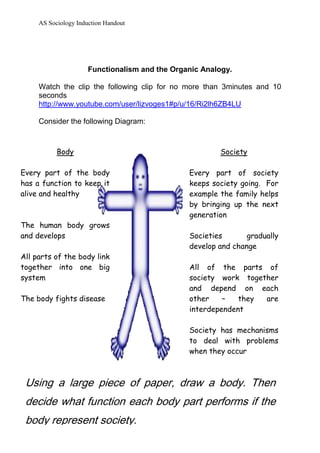
     Consider the following Diagram:


           Body                                         Society

Every part of the body                          Every part of society
has a function to keep it                       keeps society going. For
alive and healthy                               example the family helps
                                                by bringing up the next
                                                generation
The human body grows
and develops                                    Societies       gradually
                                                develop and change
All parts of the body link
together into one big                           All of the parts of
system                                          society work together
                                                and depend on each
The body fights disease                         other    –   they are
                                                interdependent

                                                Society has mechanisms
                                                to deal with problems
                                                when they occur


 Using a large piece of paper, draw a body. Then
 decide what function each body part performs if the
 body represent society.

SociologyExchange.co.uk Shared Resource

  • 1.
    AS Sociology InductionHandout What is Sociology? Introduction to Sociology for A level. Today‟s learning Aims: Understand what sociology is about Get to know each other. Decide whether sociology is for you. In this session you will: Learn some new words and write down their definitions. Watch videos which will help you understand some of the terms used. Discuss what you think with your neighbours. Do some reading. Take part in a group exercise about the „Organic Analogy‟ Expectations of you if you take this course: - Attend all sociology lessons. - In lessons work on your own, in pairs and in small groups, as well as contribute to discussions. - Keep up to date with assessed pieces of work. - Use the teachers to help you understand if you get stuck. - Use the library, the internet and other media for reading to understand concepts and ideas outside lessons time. - Keep a record of your assessment feedback as well as your grades. - Re-do any assessments in which you get below your predicted grade.
  • 2.
    AS Sociology InductionHandout Introduction. 1. Most, if not all of you will begin this course with a fairly vague idea about what is involved in the “study of society”. A copy of the syllabus is an initial starting point because it maps-out for you the areas you will be studying during your course. You will be given one of these in September. However, it doesn‟t tell you a great deal about what Sociology is. This Introduction, therefore, is designed to help you identify the subject matter of Sociology. The Subject Matter of Sociology. 1. As I noted above, Sociology is the study of human societies. It is usually classed as one of the social sciences (along with subjects like psychology) and was established as a subject in the late 18th century through the work of people like the French writer Auguste Comte. However, the subject has only really gained acceptance as an academic subject in the 20th century through the work of writers such as Emile Durkheim, Max Weber and Talcott Parsons (all names that, for the present, probably mean very little to you). One name that you may have heard of - Karl Marx (the founder of modern Communism) - has probably done more to stimulate people‟s interest in the subject than anyone else, even though he lived and wrote (1818 - 1884) in a period before Sociology became fully established as an academic discipline. Sociology, therefore, has a reasonably long history of development (150 - 200 years) although in Britain it has only been in the last 30 - 40 years that Sociology as an examined subject in the education system has achieved a level of prominence equivalent to or above most of the other subjects it is possible to study. At present, approximately 60,000 students sit an A-level Sociology exam, making it one of the most popular A-levels in our society.
  • 3.
    AS Sociology InductionHandout 2. A precise definition is not always easy to come by, each of the following have sufficient in common for us to draw some sort of overall conclusion about how Sociology can be defined. a. Ginsberg (“The Study of Society”, 1939): “Sociology may be defined as the study of society; that is of the web of human interactions and relationships”. b. Sugarman (“Sociology”, 1968): “Sociology is the objective study of human behaviour in so far as it is affected by the fact that people live in groups”. d. Ritzer (“Sociology”, 1979): “Sociology is the study of individuals in a social setting that includes groups, organisations, cultures and societies. Sociologists study the interrelationships between individuals, organisations, cultures and societies”. e. Giddens (“Sociology”, 1989): “Sociology is the study of human social life, groups and societies. It is a dazzling and compelling enterprise, having as its subject matter our own behaviour as social beings. The scope of sociology is extremely wide, ranging from the analysis of passing encounters between individuals in the street up to the investigation of world-wide social processes”. f. Lawson and Garrod (“The Complete A-Z Sociology Handbook”, 1996): “Sociology is the study of individuals in groups in a systematic way, which grew out of the search for understanding associated with the industrial and scientific revolutions of the 18th and 19th centuries”. 3. I have deliberately provided a relatively large number of possible definitions to enable you to get some initial flavour of the subject matter of Sociology. Identify the major common themes in the above definitions.
  • 4.
    AS Sociology InductionHandout 4. In the above definitions there are two basic themes we can identify and investigate further: a. What sociologists study Sociology is the study of the social world. It involves studying human beings and their patterns of behaviour. In order to do this, we focus on the way people form relationships and how these relationships, considered in their totality, are represented by the concept of a “society”. In this respect, the focus of the sociologist‟s attention is group behaviour. That is, the effect that the groups people join or are born into (family, work, education and so forth) have upon people‟s social behaviour. b. How sociologists study the social world. The definitions included words like “scientific”, “systematic” and “objective” - ideas that tell us something about the both the way sociologists study social behaviour and the kind of knowledge they are trying to produce about social life. While we will develop these ideas in much greater detail in another part of the course (“Theory and Methods”), we need to note a couple of things about them now. a. Objective basically means that sociologists try to create knowledge that is factual, rather than simply based on opinion. In simple terms, sociologists try to avoid personal bias intruding into their research. To do this, they use: b. Systematic ways of studying social behaviour. By this is meant that sociologists try to use methods of research (questionnaires, observations, experiments and so forth) that are governed by certain rules of evidence. For example, a sociologist will try to test his or her ideas in some way. As sociologists you will be able to identify that there is a difference between Naturalistic (commonsense) and sociological explanations of human behaviour. 5. To summarise, therefore:
  • 5.
    AS Sociology InductionHandout Key words foran introduction to Sociology Try to match as many definitions to key words as you can before watching http://www.youtube.com/watch?v=azWs-ESXZrk Socialisation Norms Culture Values Value consensus Social solidarity Role Exploitation Ideology Ruling class Marx Capitalism
  • 6.
    AS Sociology InductionHandout As you watch the video check your answers or fill in ones you haven‟t When capitalists force the The process whereby the labourer to work beyond what young in society learn the is necessary for survival, then values, culture and roles of take away the surplus value their society. for their own. Social rules which define what The way of life of a society, is expected of individuals in e.g. language, customs, dress certain situations. etc. One of the classical sociologists. He had enormous A type of society in which the influence on world politics. private ownership of the From 1917 followers of his means of production is the theory seized political power dominant form of providing the throughout a third of the world means to live. until the collapse of soviet communism in the 1980s. The group at the top of the A general agreement about social order who govern the what things are worth in rest of society. society. A systematic set of beliefs The expected pattern of which serve the interest of behaviour associated with a some social group in society. particular social status Ideas or beliefs which are The shared feeling of thought to be valuable to those identification and mutual who hold them. interest in a social group got.
  • 7.
  • 8.
    AS Sociology InductionHandout Functionalism and the Organic Analogy. Watch the clip the following clip for no more than 3minutes and 10 seconds http://www.youtube.com/user/lizvoges1#p/u/16/Ri2lh6ZB4LU Consider the following Diagram: Body Society Every part of the body Every part of society has a function to keep it keeps society going. For alive and healthy example the family helps by bringing up the next generation The human body grows and develops Societies gradually develop and change All parts of the body link together into one big All of the parts of system society work together and depend on each The body fights disease other – they are interdependent Society has mechanisms to deal with problems when they occur Using a large piece of paper, draw a body. Then decide what function each body part performs if the body represent society.