Social NetworkingGet ConnectedKingston Springs Public Library Heather Lambert March 2011
WelcomeIntroductionsHousekeepingQuestionsFuture ClassesResources6/3/20112
OutlineWhat is social networking?Why engage in social networking?Networking sitesFacebookTwitterLinkedInCompare/ContrastHow to protect your privacyHow to maintain an online presenceHow to networkHow to create an avatarHow to set up accounts6/3/20113
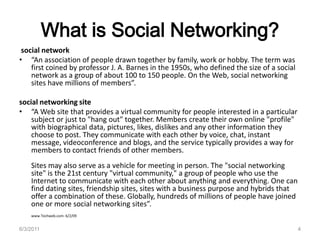
What is Social Networking?social network“An association of people drawn together by family, work or hobby. The term was first coined by professor J. A. Barnes in the 1950s, who defined the size of a social network as a group of about 100 to 150 people. On the Web, social networking sites have millions of members”.social networking site“A Web site that provides a virtual community for people interested in a particular subject or just to "hang out" together. Members create their own online "profile" with biographical data, pictures, likes, dislikes and any other information they choose to post. They communicate with each other by voice, chat, instant message, videoconference and blogs, and the service typically provides a way for members to contact friends of other members.Sites may also serve as a vehicle for meeting in person. The "social networking site" is the 21st century "virtual community," a group of people who use the Internet to communicate with each other about anything and everything. One can find dating sites, friendship sites, sites with a business purpose and hybrids that offer a combination of these. Globally, hundreds of millions of people have joined one or more social networking sites”.www.Techweb.com- 6/2/09 6/3/20114
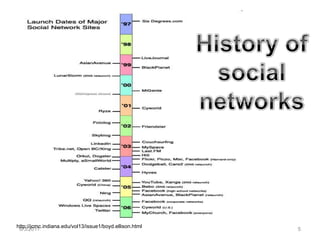
6/3/20115History of social networkshttp://jcmc.indiana.edu/vol13/issue1/boyd.ellison.html
Why Engage in Social Networking?Meet new peopleNetworkFind old friendsStay current with tech trends and interestsKeep friends and family up to dateOrganize for an event Make plans with friendsPromote business6/3/20116
Who Uses Social Networks?http://www.pewinternet.org/Reports/2009/Adults-and-Social-Network-Websites.aspx6/3/20117
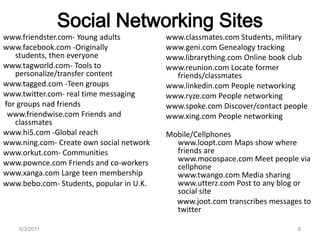
Social Networking Siteswww.friendster.com- Young adultswww.facebook.com -Originally students, then everyonewww.tagworld.com- Tools to personalize/transfer contentwww.tagged.com -Teen groupswww.twitter.com- real time messaging for groups nad friends  www.friendwise.com Friends and classmateswww.hi5.com -Global reachwww.ning.com- Create own social networkwww.orkut.com- Communitieswww.pownce.com Friends and co-workerswww.xanga.com Large teen membershipwww.bebo.com- Students, popular in U.K.www.classmates.com Students, militarywww.geni.com Genealogy trackingwww.librarything.com Online book clubwww.reunion.com Locate former friends/classmateswww.linkedin.com People networkingwww.ryze.com People networkingwww.spoke.com Discover/contact peoplewww.xing.com People networkingMobile/Cellphoneswww.loopt.com Maps show where friends arewww.mocospace.com Meet people via cellphonewww.twango.com Media sharingwww.utterz.com Post to any blog or social site       www.joot.com transcribes messages to twitter6/3/20118
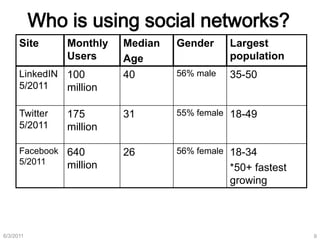
Who is using social networks?6/3/20119
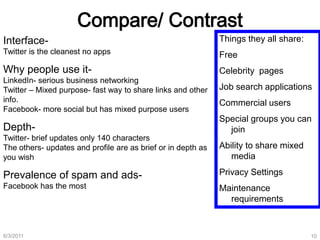
Compare/ Contrast6/3/201110Things they all share:FreeCelebrity  pagesJob search applicationsCommercial usersSpecial groups you can joinAbility to share mixed mediaPrivacy SettingsMaintenance requirementsInterface-Twitter is the cleanest no appsWhy people use it-LinkedIn- serious business networkingTwitter – Mixed purpose- fast way to share links and other info.Facebook- more social but has mixed purpose usersDepth- Twitter- brief updates only 140 charactersThe others- updates and profile are as brief or in depth as you wish Prevalence of spam and ads-Facebook has the most
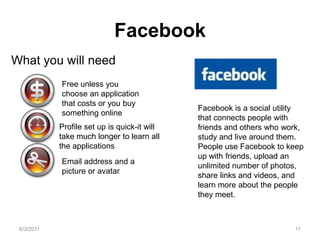
Facebook6/3/201111What you will needProfile set up is quick-it will take much longer to learn all the applicationsEmail address and a picture or avatar Free unless you choose an application that costs or you buy something onlineFacebook is a social utility that connects people with friends and others who work, study and live around them. People use Facebook to keep up with friends, upload an unlimited number of photos, share links and videos, and learn more about the people they meet.
FacebookWall- write a status message / view other’s messages to you /see changes in friend’s profiles Info- your information- can limit what is seen by othersEvents- calendar that you scheduleNotes- notes to yourself or others that see your profileBoxes- the home for your applications or extras that you add +- click there to add a new tabProfile- what people see when they view your facebook accountFriends- people that you have added to your network- must accept an invitation in order to view profile (tip: keep a personal and professional list of contacts)Inbox- emailApplications- extras that you can add to your account like games, etc., there are 52,000 to choose from. Groups- friends network linked by common interest, cause, etc6/3/201112
Twitter6/3/201113What you will needTwitter is a service for friends, family, and co–workers to communicate and stay connected through the exchange of quick, frequent answers to one simple question: What are you doing?FreeProfile set up is the quickest of the four, requires the least amount of personal information- only applications are mobile or for embedded twitterEmail address and a picture or avatar, smart phone
TwitterHome- input bar and all the tweets you’re following
Profile- your tweets and your bio
Find People- You can search for people you know who already have a Twitter account.
Settings- From here you can change your basic account info, fill in your profile data, and set whether you want to be private or public.
Mobile Tweets- many use their phone to tweet. Most common use. Many applications you can download to do this. 6/3/201114
LinkedInLinkedIn is an online network of morethan 21 million experienced professionals from around the world,representing 150 industries. When youjoin, you create a profile that summarizes your professional accomplishments. Your profile helps youfind and be found by former colleagues, clients, and partners. You can add more connections by inviting trusted contactsto join LinkedIn and connect to you. YourNetwork consists of your connections,Your connections’ connections, and thepeople they know, linking you tothousands of qualified professionals. 6/3/201115What you will needFree for basic24.95-499.95 for expanded accountsProfile set up is simple but requires care, takes a long  time to establish connectionsEmail address, contacts, a picture and résumé
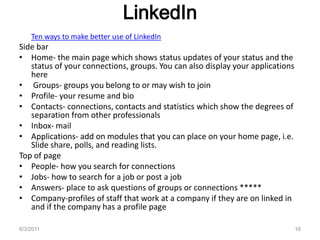
LinkedInTen ways to make better use of LinkedInSide barHome- the main page which shows status updates of your status and the status of your connections, groups. You can also display your applications here Groups- groups you belong to or may wish to joinProfile- your resume and bioContacts- connections, contacts and statistics which show the degrees of separation from other professionalsInbox- mailApplications- add on modules that you can place on your home page, i.e. Slide share, polls, and reading lists.Top of pagePeople- how you search for connectionsJobs- how to search for a job or post a jobAnswers- place to ask questions of groups or connections *****Company-profiles of staff that work at a company if they are on linked in and if the company has a profile page6/3/201116
How to protect your privacySocial networking tools are useful only as long as you can manage the noise and keep these services from intruding on your work and privacy. Follow these guidelines to make sure the networking remains productive:Checklist: Ways to Keep Social Networks Safe and Productive  By AllBusiness.com--Use pseudonym's for family and especially children.     --Don’t post pictures of other people with out permission, ask the same from themDon’t post pictures of your children.    --Think about the information you post does it give away your location, identity, workplace, history or other personal information?6/3/201117Set your profile to "private."      ---Put an end to friends who post embarrassing pictures and blog about weekend activities.     --Tell your friends not to put "tags" on their photos or blogs.     --Monitor openly accessible social networks you're involved in.      --Contact the Web site itself if something is beyond your control.     --Consider an avatar instead of a photo.

Socialnetworking for seniors 2011

  • 1.
    Social NetworkingGet ConnectedKingstonSprings Public Library Heather Lambert March 2011
  • 2.
  • 3.
    OutlineWhat is socialnetworking?Why engage in social networking?Networking sitesFacebookTwitterLinkedInCompare/ContrastHow to protect your privacyHow to maintain an online presenceHow to networkHow to create an avatarHow to set up accounts6/3/20113
  • 4.
    What is SocialNetworking?social network“An association of people drawn together by family, work or hobby. The term was first coined by professor J. A. Barnes in the 1950s, who defined the size of a social network as a group of about 100 to 150 people. On the Web, social networking sites have millions of members”.social networking site“A Web site that provides a virtual community for people interested in a particular subject or just to "hang out" together. Members create their own online "profile" with biographical data, pictures, likes, dislikes and any other information they choose to post. They communicate with each other by voice, chat, instant message, videoconference and blogs, and the service typically provides a way for members to contact friends of other members.Sites may also serve as a vehicle for meeting in person. The "social networking site" is the 21st century "virtual community," a group of people who use the Internet to communicate with each other about anything and everything. One can find dating sites, friendship sites, sites with a business purpose and hybrids that offer a combination of these. Globally, hundreds of millions of people have joined one or more social networking sites”.www.Techweb.com- 6/2/09 6/3/20114
  • 5.
    6/3/20115History of socialnetworkshttp://jcmc.indiana.edu/vol13/issue1/boyd.ellison.html
  • 6.
    Why Engage inSocial Networking?Meet new peopleNetworkFind old friendsStay current with tech trends and interestsKeep friends and family up to dateOrganize for an event Make plans with friendsPromote business6/3/20116
  • 7.
    Who Uses SocialNetworks?http://www.pewinternet.org/Reports/2009/Adults-and-Social-Network-Websites.aspx6/3/20117
  • 8.
    Social Networking Siteswww.friendster.com-Young adultswww.facebook.com -Originally students, then everyonewww.tagworld.com- Tools to personalize/transfer contentwww.tagged.com -Teen groupswww.twitter.com- real time messaging for groups nad friends www.friendwise.com Friends and classmateswww.hi5.com -Global reachwww.ning.com- Create own social networkwww.orkut.com- Communitieswww.pownce.com Friends and co-workerswww.xanga.com Large teen membershipwww.bebo.com- Students, popular in U.K.www.classmates.com Students, militarywww.geni.com Genealogy trackingwww.librarything.com Online book clubwww.reunion.com Locate former friends/classmateswww.linkedin.com People networkingwww.ryze.com People networkingwww.spoke.com Discover/contact peoplewww.xing.com People networkingMobile/Cellphoneswww.loopt.com Maps show where friends arewww.mocospace.com Meet people via cellphonewww.twango.com Media sharingwww.utterz.com Post to any blog or social site www.joot.com transcribes messages to twitter6/3/20118
  • 9.
    Who is usingsocial networks?6/3/20119
  • 10.
    Compare/ Contrast6/3/201110Things theyall share:FreeCelebrity pagesJob search applicationsCommercial usersSpecial groups you can joinAbility to share mixed mediaPrivacy SettingsMaintenance requirementsInterface-Twitter is the cleanest no appsWhy people use it-LinkedIn- serious business networkingTwitter – Mixed purpose- fast way to share links and other info.Facebook- more social but has mixed purpose usersDepth- Twitter- brief updates only 140 charactersThe others- updates and profile are as brief or in depth as you wish Prevalence of spam and ads-Facebook has the most
  • 11.
    Facebook6/3/201111What you willneedProfile set up is quick-it will take much longer to learn all the applicationsEmail address and a picture or avatar Free unless you choose an application that costs or you buy something onlineFacebook is a social utility that connects people with friends and others who work, study and live around them. People use Facebook to keep up with friends, upload an unlimited number of photos, share links and videos, and learn more about the people they meet.
  • 12.
    FacebookWall- write astatus message / view other’s messages to you /see changes in friend’s profiles Info- your information- can limit what is seen by othersEvents- calendar that you scheduleNotes- notes to yourself or others that see your profileBoxes- the home for your applications or extras that you add +- click there to add a new tabProfile- what people see when they view your facebook accountFriends- people that you have added to your network- must accept an invitation in order to view profile (tip: keep a personal and professional list of contacts)Inbox- emailApplications- extras that you can add to your account like games, etc., there are 52,000 to choose from. Groups- friends network linked by common interest, cause, etc6/3/201112
  • 13.
    Twitter6/3/201113What you willneedTwitter is a service for friends, family, and co–workers to communicate and stay connected through the exchange of quick, frequent answers to one simple question: What are you doing?FreeProfile set up is the quickest of the four, requires the least amount of personal information- only applications are mobile or for embedded twitterEmail address and a picture or avatar, smart phone
  • 14.
    TwitterHome- input barand all the tweets you’re following
  • 15.
  • 16.
    Find People- Youcan search for people you know who already have a Twitter account.
  • 17.
    Settings- From hereyou can change your basic account info, fill in your profile data, and set whether you want to be private or public.
  • 18.
    Mobile Tweets- manyuse their phone to tweet. Most common use. Many applications you can download to do this. 6/3/201114
  • 19.
    LinkedInLinkedIn is anonline network of morethan 21 million experienced professionals from around the world,representing 150 industries. When youjoin, you create a profile that summarizes your professional accomplishments. Your profile helps youfind and be found by former colleagues, clients, and partners. You can add more connections by inviting trusted contactsto join LinkedIn and connect to you. YourNetwork consists of your connections,Your connections’ connections, and thepeople they know, linking you tothousands of qualified professionals. 6/3/201115What you will needFree for basic24.95-499.95 for expanded accountsProfile set up is simple but requires care, takes a long time to establish connectionsEmail address, contacts, a picture and résumé
  • 20.
    LinkedInTen ways tomake better use of LinkedInSide barHome- the main page which shows status updates of your status and the status of your connections, groups. You can also display your applications here Groups- groups you belong to or may wish to joinProfile- your resume and bioContacts- connections, contacts and statistics which show the degrees of separation from other professionalsInbox- mailApplications- add on modules that you can place on your home page, i.e. Slide share, polls, and reading lists.Top of pagePeople- how you search for connectionsJobs- how to search for a job or post a jobAnswers- place to ask questions of groups or connections *****Company-profiles of staff that work at a company if they are on linked in and if the company has a profile page6/3/201116
  • 21.
    How to protectyour privacySocial networking tools are useful only as long as you can manage the noise and keep these services from intruding on your work and privacy. Follow these guidelines to make sure the networking remains productive:Checklist: Ways to Keep Social Networks Safe and Productive By AllBusiness.com--Use pseudonym's for family and especially children. --Don’t post pictures of other people with out permission, ask the same from themDon’t post pictures of your children. --Think about the information you post does it give away your location, identity, workplace, history or other personal information?6/3/201117Set your profile to "private." ---Put an end to friends who post embarrassing pictures and blog about weekend activities. --Tell your friends not to put "tags" on their photos or blogs. --Monitor openly accessible social networks you're involved in. --Contact the Web site itself if something is beyond your control. --Consider an avatar instead of a photo.

Editor's Notes

  • #19 Less careful and more trusting