








Innovative Technologies
  and Student Success
Innovative Technologies
  and Student Success

       Heather Lambert
Emerging Technologies Librarian
     MTSU, Walker Library
Mediatedcultures.net


  http://mediatedcultures.net/
When Google Images launched in 2001, 250
million images were indexed. By 2005, this was up
to a billion images. Now, in 2010, there are over
10 billion images indexed. TechCrunch, July
2010
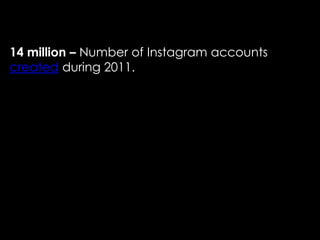
14 million – Number of Instagram accounts
created during 2011.
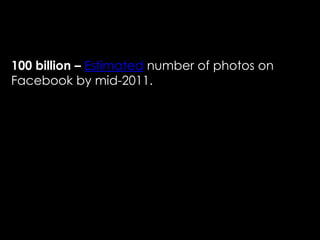
100 billion – Estimated number of photos on
Facebook by mid-2011.
140 – The number of YouTube video playbacks
per person on Earth.
48 hours – The amount of video uploaded to
YouTube every minute.
201.4 billion – Number of videos viewed online
per month (October 2011).
88.3 billion – Videos viewed per month on
Google sites, incl. YouTube (October 2011).
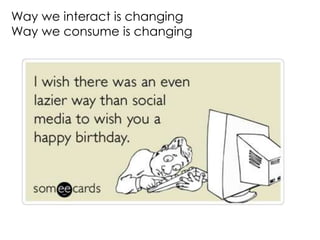
Way we interact is changing
Way we consume is changing
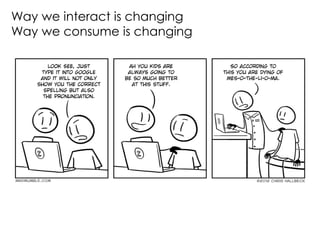
Way we interact is changing
Way we consume is changing
Way we interact is changing
Way we consume is changing
Way we interact is changing
Way we consume is changing
Way we learn is changing
Way we teach has to change
Way ^we teach has to change
What

Way ^we teach has to change
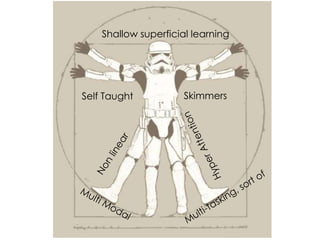
Shallow superficial learning


Self Taught           Skimmers
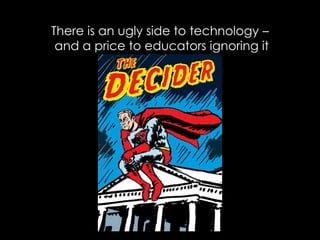
There is an ugly side to technology –
 and a price to educators ignoring it
The TRUTH:


Digital Natives ≠ digital literacy or
information literacy
Information Literacy Technological Literacy
Information and Technological Literacy
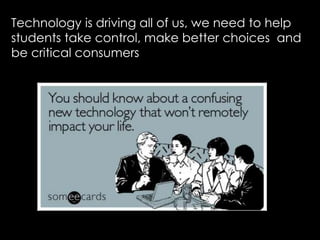
Technology is driving all of us, we need to help
students take control, make better choices and
be critical consumers
visual is powerful
http://s3-
ec.buzzfed.com/static/enhanced/web
05/2011/12/2/17/enhanced-buzz-wide-
1392-1322863709-9.jpg
Jaws-
Jaws-


• Determined that Shark was bigger than
  originally thought

• Decided that they would need a bigger boat
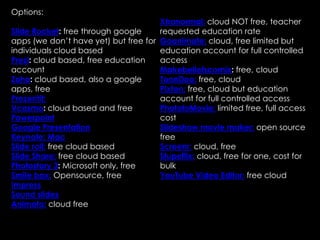
Options:
                                      Xtranormal: cloud NOT free, teacher
Slide Rocket: free through google     requested education rate
apps (we don’t have yet) but free for Goanimate: cloud, free limited but
individuals cloud based               education account for full controlled
Prezi: cloud based, free education    access
account                               Makebeliefscomix: free, cloud
Zoho: cloud based, also a google      ToonDoo: free, cloud
apps, free                            Pixton: free, cloud but education
Prezentit:                            account for full controlled access
Vcasmo: cloud based and free          PhototoMovie: limited free, full access
Powerpoint                            cost
Google Presentation                   Slideshow movie maker: open source
Keynote: Mac                          free
Slide roll: free cloud based          Screenr: cloud, free
Slide Share: free cloud based         Stupeflix: cloud, free for one, cost for
Photostory 3: Microsoft only, free    bulk
Smile box: Opensource, free           YouTube Video Editor: free cloud
Impress
Sound slides
Animoto: cloud free
participatory cultures.

“A participatory culture is a culture with relatively low
barriers to artistic expression and civic engagement,
strong support for creating and sharing one’s creations,
and some type of informal mentorship whereby what is
known by the most experienced is passed along to
novices. A participatory culture is also one in which
members believe their contributions matter, and feel
some degree of social connection with one another (at
the least they care what other people think about what
they have created)”
http://digitallearning.macfound.org/atf/cf/%7B7E45C7E0-A3E0-4B89-AC9C-E807E1B0AE4E%7D/JENKINS_WHITE_PAPER.PDF
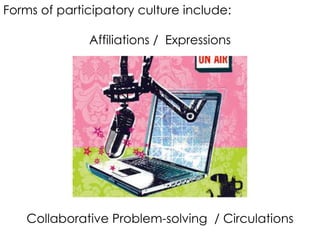
Forms of participatory culture include:

              Affiliations / Expressions


   Collaborative Problem-solving / Circulations
The Participation Gap — the unequal access to the
opportunities, experiences, skills, and knowledge that
will prepare youth for full participation in the world of
tomorrow.

The Transparency Problem — The challenges young
people face in learning to see clearly the ways that
media shape perceptions of the world.

The Ethics Challenge — The breakdown of traditional
forms of professional training and socialization that
might prepare young people for their increasingly
public roles as media makers and community
participants.
Summary-

Chalkboards, even electronic ones aren’t effective
                                             tools

  Know your audience, and know what they don’t
                               know, ya know?

                 Create Participatory Explorations

      Demonstrate technological and information
                                         literacy

                                  Tell a great story
http://emergingtechwl.blogspot.com/

hlambert@mtsu.edu

Twitter- heatherneptune

Summer college

  • 1.
    Innovative Technologies and Student Success
  • 2.
    Innovative Technologies and Student Success Heather Lambert Emerging Technologies Librarian MTSU, Walker Library
  • 3.
  • 4.
    When Google Imageslaunched in 2001, 250 million images were indexed. By 2005, this was up to a billion images. Now, in 2010, there are over 10 billion images indexed. TechCrunch, July 2010
  • 5.
    14 million –Number of Instagram accounts created during 2011.
  • 6.
    100 billion –Estimated number of photos on Facebook by mid-2011.
  • 7.
    140 – Thenumber of YouTube video playbacks per person on Earth.
  • 8.
    48 hours –The amount of video uploaded to YouTube every minute.
  • 9.
    201.4 billion –Number of videos viewed online per month (October 2011).
  • 10.
    88.3 billion –Videos viewed per month on Google sites, incl. YouTube (October 2011).
  • 11.
    Way we interactis changing Way we consume is changing
  • 12.
    Way we interactis changing Way we consume is changing
  • 13.
    Way we interactis changing Way we consume is changing
  • 14.
    Way we interactis changing Way we consume is changing Way we learn is changing
  • 15.
    Way we teachhas to change
  • 16.
    Way ^we teachhas to change
  • 17.
    What Way ^we teachhas to change
  • 18.
  • 20.
    There is anugly side to technology – and a price to educators ignoring it
  • 22.
    The TRUTH: Digital Natives≠ digital literacy or information literacy
  • 23.
  • 24.
  • 25.
    Technology is drivingall of us, we need to help students take control, make better choices and be critical consumers
  • 27.
  • 28.
  • 31.
  • 32.
    Jaws- • Determined thatShark was bigger than originally thought • Decided that they would need a bigger boat
  • 33.
    Options: Xtranormal: cloud NOT free, teacher Slide Rocket: free through google requested education rate apps (we don’t have yet) but free for Goanimate: cloud, free limited but individuals cloud based education account for full controlled Prezi: cloud based, free education access account Makebeliefscomix: free, cloud Zoho: cloud based, also a google ToonDoo: free, cloud apps, free Pixton: free, cloud but education Prezentit: account for full controlled access Vcasmo: cloud based and free PhototoMovie: limited free, full access Powerpoint cost Google Presentation Slideshow movie maker: open source Keynote: Mac free Slide roll: free cloud based Screenr: cloud, free Slide Share: free cloud based Stupeflix: cloud, free for one, cost for Photostory 3: Microsoft only, free bulk Smile box: Opensource, free YouTube Video Editor: free cloud Impress Sound slides Animoto: cloud free
  • 35.
    participatory cultures. “A participatoryculture is a culture with relatively low barriers to artistic expression and civic engagement, strong support for creating and sharing one’s creations, and some type of informal mentorship whereby what is known by the most experienced is passed along to novices. A participatory culture is also one in which members believe their contributions matter, and feel some degree of social connection with one another (at the least they care what other people think about what they have created)” http://digitallearning.macfound.org/atf/cf/%7B7E45C7E0-A3E0-4B89-AC9C-E807E1B0AE4E%7D/JENKINS_WHITE_PAPER.PDF
  • 36.
    Forms of participatoryculture include: Affiliations / Expressions Collaborative Problem-solving / Circulations
  • 37.
    The Participation Gap— the unequal access to the opportunities, experiences, skills, and knowledge that will prepare youth for full participation in the world of tomorrow. The Transparency Problem — The challenges young people face in learning to see clearly the ways that media shape perceptions of the world. The Ethics Challenge — The breakdown of traditional forms of professional training and socialization that might prepare young people for their increasingly public roles as media makers and community participants.
  • 39.
    Summary- Chalkboards, even electronicones aren’t effective tools Know your audience, and know what they don’t know, ya know? Create Participatory Explorations Demonstrate technological and information literacy Tell a great story
  • 40.

Editor's Notes

  • #4 Video highlighting the challenges of being relevant to todays studentsAnd the challenge for students to deal with the information and technical tsunami that is their daily lives, what is educations role?
  • #5 Im going to throw up some statistics regarding the movement towards VISUAL, multi modal online experience.
  • #12 Text rather than talk.Meet online than in person, North America There are 54 million singles in the United States. 5.5 million of those use dating services[6] 81% of members of dating sites lie about their height, weight, or age in their profiles85% of our buying is online, 1 in 4 purchases atstarbucks are made with phone,More than 1 in 4 UK adults claim that online product reviews have a major influence on their purchasing decisions. TGI, June 201158% of purchase decisions begin on search engines GroupM, February 201127% of people rarely or never look at more than one page of search engine results. Verdict Research as cited by digitalstrategyconsulting.com, April 201129% of people think the placement of a brand on the search results page reflects the importance of the brand company. Verdict Research as cited by digitalstrategyconsulting.com, April 201151% of people expect leading brands to be on top of the search results page. Verdict Research as cited by digitalstrategyconsulting.com, April 201163% of people normally find websites via a search engine. Verdict Research as cited by digitalstrategyconsulting.com, April 201190% of consumers use the internet to research vehicle purchases. Kia Motors as cited by Marketing Week, March 2011Who is directing this research, who is the authority? If we don’t know basics of technological and information literacy, why would students? Consumerization of information. Personal determinations of Value and worth is being based on results by for profit companies. Dumbing down and it’s a problem. Who is the decider? http://www.theatlantic.com/magazine/archive/2008/07/is-google-making-us-stupid/6868/ -- Nicholas Carr
  • #13 Text rather than talk.Meet online than in person, North America There are 54 million singles in the United States. 5.5 million of those use dating services[6] 81% of members of dating sites lie about their height, weight, or age in their profiles85% of our buying is online, 1 in 4 purchases atstarbucks are made with phone,More than 1 in 4 UK adults claim that online product reviews have a major influence on their purchasing decisions. TGI, June 201158% of purchase decisions begin on search engines GroupM, February 201127% of people rarely or never look at more than one page of search engine results. Verdict Research as cited by digitalstrategyconsulting.com, April 201129% of people think the placement of a brand on the search results page reflects the importance of the brand company. Verdict Research as cited by digitalstrategyconsulting.com, April 201151% of people expect leading brands to be on top of the search results page. Verdict Research as cited by digitalstrategyconsulting.com, April 201163% of people normally find websites via a search engine. Verdict Research as cited by digitalstrategyconsulting.com, April 201190% of consumers use the internet to research vehicle purchases. Kia Motors as cited by Marketing Week, March 2011Who is directing this research, who is the authority? If we don’t know basics of technological and information literacy, why would students? Consumerization of information. Personal determinations of Value and worth is being based on results by for profit companies. Dumbing down and it’s a problem. Who is the decider? http://www.theatlantic.com/magazine/archive/2008/07/is-google-making-us-stupid/6868/ -- Nicholas Carr
  • #14 The REALITY? The way that we, as consumers, interact with the world is the SAME way that students interact with information and educationRepeatSo, if the way we interact is changing, way we consume is changing then the way we ….
  • #15 How we learn is changing too. And the educations response to that has to be
  • #18 This presentation will highlight some ways, hows and what that technology can affect.Let me explain- Begin with who. Who are the new consumers (this includes most of us)
  • #19 Rewarded in a digital environment – shallow superficial learning. Jack of all, master of none. That is the self perception of most of us but studies show that because most of this superficial learning comes from self directed exploration- we know EVEN LESS THEN WE THINK WE DO.No one is teaching us the core social media programs we need, the best privacy practices, the best study habits, the best newspapers to read, there is no western canon of modern life. Where do you start and when do you stop? Deep attention vs. Hyper attention. Humming bird vs woodpecker (lets remove the judgment from this, it is what it is)Multi tasking- again, our brains haven’t evolutionarily caught up with the technology. We think we are MT but we aren’t. we either aren’t really multi tasking, we are just hummingbird-ing. Or we are multi tasking and doing it all very poorly.
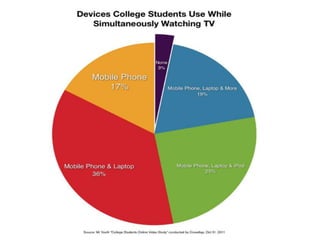
  • #20 In addition they might be studying, reading, talking to friends, eating, etc.
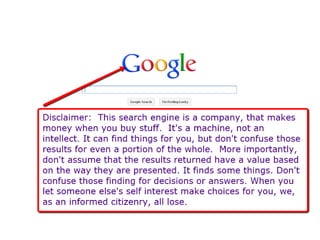
  • #21 Most of us are self taught, because there is NO ONE teaching us how navigate, learn apps, stay in touch and make sound decisions about where to invest our time So who becomes the decider?Self select via peer group or the Market makes decisions for them- just like the we do when we make consumer decisions. Direct implications for student learning outcomes- recognize and explain complex social institutions and culturesThink critically? Separate self and society? Analyze communication? Engage in research? This leads to the issue of consumerization of information (hello, Google I’m talking to you). http://www.columbiastate.edu/File/TBR%20learning%20outcomes%20for%20Psychology.pdf
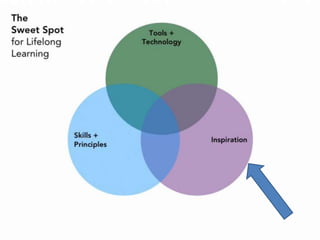
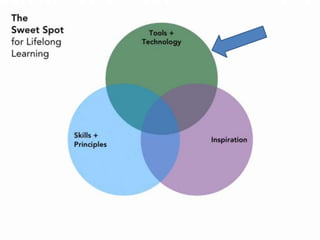
  • #26 This is one essential way the library can be relevant and directly effect student learning outcomes, and create lifelong learnersThis of course means we need to teach using effective technologies that make sense, not that are just the next cool thing
  • #27 Skills and principles- what we just talked about – informing students about the consumerization of information, that it’s a commodity bought and sold and how to be Socratic learners, informed citizens.The last two things I am going to touch on is the inspiration and the technology.
  • #28 5,000 hours reading a lifetime, 10,000 gaming- visual is powerful
  • #29 5,000 hours reading a lifetime, 10,000 gaming- visual is powerful
  • #32 To be effective educators, especially online, we have to tell a storyJon Robertson Director of Learning and development lynda.comProduction quality mattersIncorporate graphics, video, audioUse technology (speak their language)Be inspiring and relevantSupport non linear learningCreate deeper associations by engaging and having experiential moments- in other words turn the camera around- which leads to the next area
  • #33 To be effective educators, especially online, we have to tell a storyJon Robertson Director of Learning and development lynda.comProduction quality mattersIncorporate graphics, video, audioUse technology (speak their language)Be inspiring and relevantThe library has a great story. We are the center of their universe, the mighty oz (in front of the curtain) they just don’t know it. TELL THEM. Use statistics, charts, graphs, videos, audio to explain why the library is relevant and the internet and Google has pitfalls. Support non linear learningCreate deeper associations by engaging and having experiential moments- in other words turn the camera around- which leads to the next areaTell a story
  • #36 Henry Jenkins, MIT, et all, macArthur foundation white paperEducators must work together to ensure that every American young person has access to the skills and experiences needed to become a full participant, can articulate their understanding of how media shapes perceptions, and has been socialized into the emerging ethical standards thatshould shape their practices as media makers and participants in online communities.
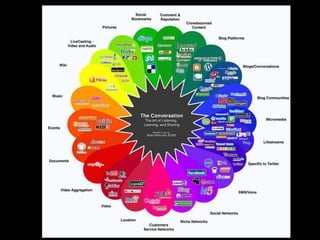
  • #37 memberships, formal and informal, in online communities centered around various forms of media, such as Friendster, Facebook, message boards, metagaming, game clans, or MySpace). producing new creative forms, such as digital sampling, skinning and modding, fan videomaking, fan fiction writing, zines, mash-ups).working together in teams, formal and informal, to complete tasks and develop new knowledge (such as through Wikipedia, alternative reality gaming, spoiling).Shaping the flow of media (such as podcasting, blogging).
  • #38 Addressing education through participatory culture is an opportunities for educators to address these pitfalls (and by the way directly address learning outcomes)A growing body of scholarship suggests potential benefits of these forms of participatory culture, including opportunities for peer-to-peer learning, a changed attitude toward intellectual property, the diversification of cultural expression, the development of skills valued in the modern workplace, and a more empowered conception of citizenship. Access to this participatory culture functions as a new form of the hidden curriculum, shaping which youth will succeed and which will be left behind as they enter school and the workplace.Some have argued that children and youth acquire these key skills and competencies on their own by interacting with popular culture
  • #39 Collaborative documents, a synchronistic group workMind mapping- non linear learning, conceptualizing, deconstructionZines, blogs, web sites- debunking and creatingKickstarter projects- tie to valuesAlternate Reality GamingData MiningClass expand -international, go where the action isFocus on creation skills versus sampling skillsGo beyond discussion boards, and even pollsInline commentingFlipped classroomGive an outlet for creative expressions outside the classroom, but keep them safeMoseley, A. (2008), An Alternative Reality for Higher Education? Lessons to be learned from onlinereality games. In: ALT-C 2008, Leeds, UK, 9-11th September 2008 (Unpublished).Available:http://moerg.files.wordpress.com/2008/10/moseley2008a.pdf