

ORGANIZATIONAL ENCOUNTER
COMMUNICATION &
Ch.	3
Uncertainty Management & Newcomer Socialization
THE EXPERIENCE
OF BEING NEW
NEW AT WORK
WHAT IS THE COMMON EMOTION
OF BEING NEW
?
WHAT IS THE COMMON EMOTION
OF BEING NEW
?
NEW AT CHURCH
6
NEWCOMERS EXPERIENCE
• Task-related uncertainty
• Relational uncertainty
• Uncertainty about org. culture/norms
• Uncertainty about power relationships
Picture yourself as a new Amazon employee
What kind of uncertainty might you encounter?
8
REDUCTION THEORY
• When we meet someone new, we experience uncertainty
• Uncertainty makes us feel uncomfortable
• Goal: reduce uncertainty by seeking info & communicating
• As we reduce uncertainty & gain info, liking increases
• Gaining additional info can lead to increased uncertainty
and decreased liking
9
MANAGEMENT THEORY Kramer, 2004
KEY DIFFERENCES:2
9
MANAGEMENT THEORY
• We can manage uncertainty through cognitive
processes without seeking info or communicating
with others
Kramer, 2004
KEY DIFFERENCES:2
9
MANAGEMENT THEORY
• We can manage uncertainty through cognitive
processes without seeking info or communicating
with others
• We often don’t actively seek info because of
impression management needs
Kramer, 2004
KEY DIFFERENCES:2
9
MANAGEMENT THEORY
• We can manage uncertainty through cognitive
processes without seeking info or communicating
with others
• We often don’t actively seek info because of
impression management needs
Kramer, 2004
KEY DIFFERENCES:2
Goal: Manage (not necessarily reduce) uncertainty
Information Seeking Strategies
• Direct inquiry/overt questions
• Indirect inquiry/questions
• Disguising conversation
• Third-party inquiry
• Observation
• Surveillance
• Testing/intentionally break norm
• Consult documents
@client @client @client
A DEFINITION
ROLE
The social process that
newcomers face in
needing to figure out
what their work role
responsibilities will be
and how those duties will
be performed. Some
negotiated before entry,
most after entry.
NEGOTIATION
1. Org. members have role
expectations
Expectations communicated
to newcomer
2.
Newcomer interprets
expectations
3.
Newcomer enacts role,
communicates an understanding
4.
Enacted role provides
feedback to org
5.
@client @client @client
A DEFINITION
BOUNDARY
Psychological or socially
constructed boundaries
that separate social
spheres and groups of
individuals.
PASSAGES
Functional boundaries1.
Hierarchical boundaries
2.
Inclusionary boundaries3.
• Departments
• Different lingo
• Related to rank or status
• Who is influential, part of
decision makers? Who is on
the fringe of the group?
NEW FACULTY CROSSING AN
INCLUSIONARY BOUNDARY
INSTITUTIONAL STRATEGIES INDIVIDUAL STRATEGIES
• Group socialization
• Formal socialization
• Serial socialization
• Individual socialization
• Informal socialization
• Disjunctive socialization
• Sequential socialization
• Fixed socialization
• Random socialization
• Variable socialization
• Divestiture • Investiture
SOCIALIZATION
STRATEGIES:TRAINING & ORIENTATION
INSTITUTIONAL STRATEGIES INDIVIDUAL STRATEGIES
• Group socialization
• Formal socialization
• Serial socialization
• Individual socialization
• Informal socialization
• Disjunctive socialization
• Sequential socialization
• Fixed socialization
• Random socialization
• Variable socialization
• Divestiture • Investiture
SOCIALIZATION
STRATEGIES:TRAINING & ORIENTATION
• Reduce uncertainty, higher
employee satisfaction, more
commitment, lower turnover
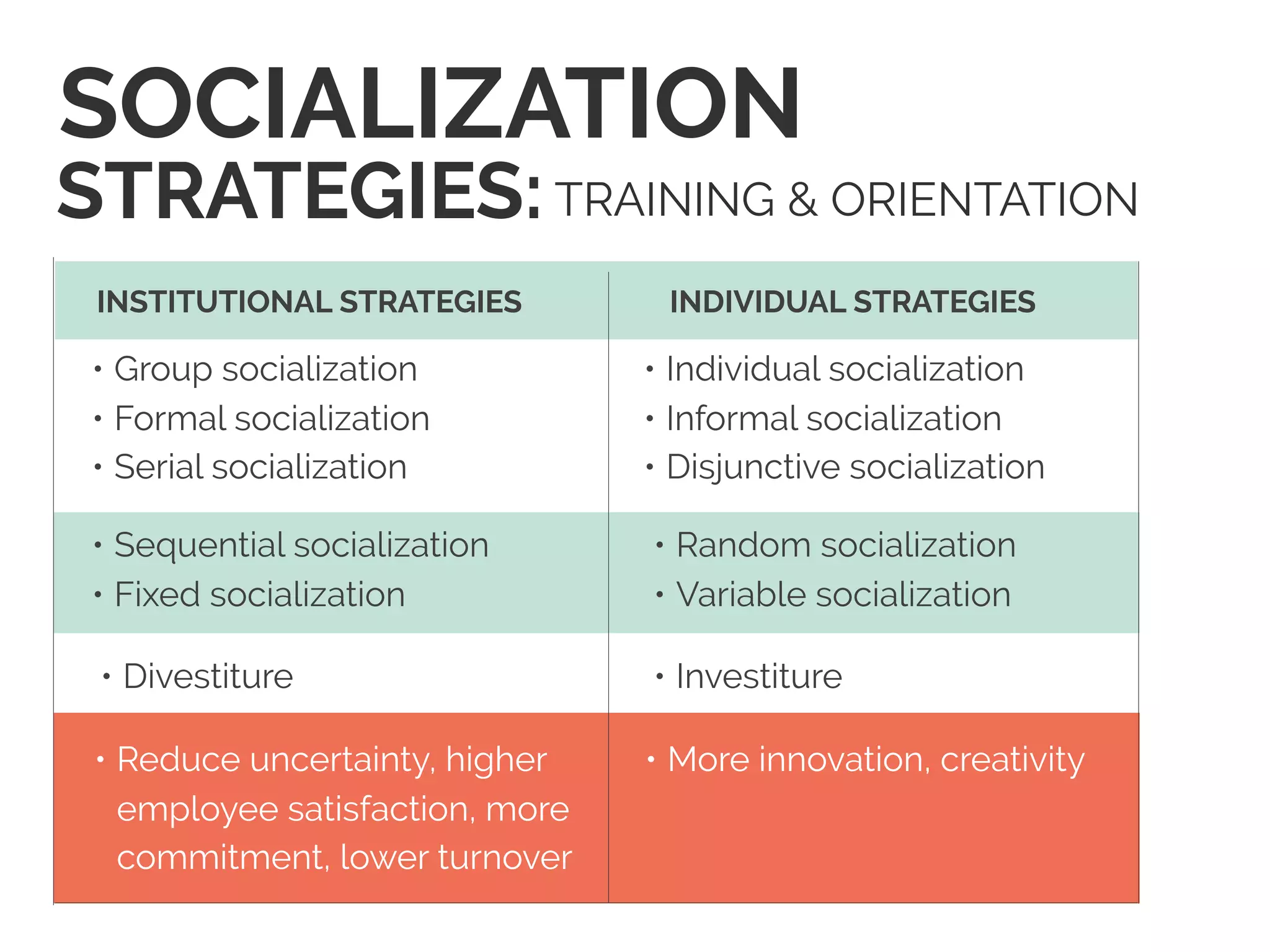
INSTITUTIONAL STRATEGIES INDIVIDUAL STRATEGIES
• Group socialization
• Formal socialization
• Serial socialization
• Individual socialization
• Informal socialization
• Disjunctive socialization
• Sequential socialization
• Fixed socialization
• Random socialization
• Variable socialization
• Divestiture • Investiture
SOCIALIZATION
STRATEGIES:TRAINING & ORIENTATION
• Reduce uncertainty, higher
employee satisfaction, more
commitment, lower turnover
• More innovation, creativity
DIVESTITURE
INVESTITURE
or
DIVESTITURE
INVESTITURE
or
DIVESTITURE
INVESTITURE
or
3CATEGORIES:
• Changes
• Contrasts
• Surprises
COMPARING EXPECTATIONS & EXPERIENCES

Chapter 3: Org. Encounter

  • 1.
  • 2.
  • 3.
  • 4.
    WHAT IS THECOMMON EMOTION OF BEING NEW ?
  • 5.
    WHAT IS THECOMMON EMOTION OF BEING NEW ?
  • 6.
  • 7.
    6 NEWCOMERS EXPERIENCE • Task-relateduncertainty • Relational uncertainty • Uncertainty about org. culture/norms • Uncertainty about power relationships
  • 8.
    Picture yourself asa new Amazon employee What kind of uncertainty might you encounter?
  • 9.
    8 REDUCTION THEORY • Whenwe meet someone new, we experience uncertainty • Uncertainty makes us feel uncomfortable • Goal: reduce uncertainty by seeking info & communicating • As we reduce uncertainty & gain info, liking increases • Gaining additional info can lead to increased uncertainty and decreased liking
  • 10.
    9 MANAGEMENT THEORY Kramer,2004 KEY DIFFERENCES:2
  • 11.
    9 MANAGEMENT THEORY • Wecan manage uncertainty through cognitive processes without seeking info or communicating with others Kramer, 2004 KEY DIFFERENCES:2
  • 12.
    9 MANAGEMENT THEORY • Wecan manage uncertainty through cognitive processes without seeking info or communicating with others • We often don’t actively seek info because of impression management needs Kramer, 2004 KEY DIFFERENCES:2
  • 13.
    9 MANAGEMENT THEORY • Wecan manage uncertainty through cognitive processes without seeking info or communicating with others • We often don’t actively seek info because of impression management needs Kramer, 2004 KEY DIFFERENCES:2 Goal: Manage (not necessarily reduce) uncertainty
  • 14.
    Information Seeking Strategies •Direct inquiry/overt questions • Indirect inquiry/questions • Disguising conversation • Third-party inquiry • Observation • Surveillance • Testing/intentionally break norm • Consult documents
  • 15.
    @client @client @client ADEFINITION ROLE The social process that newcomers face in needing to figure out what their work role responsibilities will be and how those duties will be performed. Some negotiated before entry, most after entry. NEGOTIATION 1. Org. members have role expectations Expectations communicated to newcomer 2. Newcomer interprets expectations 3. Newcomer enacts role, communicates an understanding 4. Enacted role provides feedback to org 5.
  • 16.
    @client @client @client ADEFINITION BOUNDARY Psychological or socially constructed boundaries that separate social spheres and groups of individuals. PASSAGES Functional boundaries1. Hierarchical boundaries 2. Inclusionary boundaries3. • Departments • Different lingo • Related to rank or status • Who is influential, part of decision makers? Who is on the fringe of the group?
  • 17.
    NEW FACULTY CROSSINGAN INCLUSIONARY BOUNDARY
  • 18.
    INSTITUTIONAL STRATEGIES INDIVIDUALSTRATEGIES • Group socialization • Formal socialization • Serial socialization • Individual socialization • Informal socialization • Disjunctive socialization • Sequential socialization • Fixed socialization • Random socialization • Variable socialization • Divestiture • Investiture SOCIALIZATION STRATEGIES:TRAINING & ORIENTATION
  • 19.
    INSTITUTIONAL STRATEGIES INDIVIDUALSTRATEGIES • Group socialization • Formal socialization • Serial socialization • Individual socialization • Informal socialization • Disjunctive socialization • Sequential socialization • Fixed socialization • Random socialization • Variable socialization • Divestiture • Investiture SOCIALIZATION STRATEGIES:TRAINING & ORIENTATION • Reduce uncertainty, higher employee satisfaction, more commitment, lower turnover
  • 20.
    INSTITUTIONAL STRATEGIES INDIVIDUALSTRATEGIES • Group socialization • Formal socialization • Serial socialization • Individual socialization • Informal socialization • Disjunctive socialization • Sequential socialization • Fixed socialization • Random socialization • Variable socialization • Divestiture • Investiture SOCIALIZATION STRATEGIES:TRAINING & ORIENTATION • Reduce uncertainty, higher employee satisfaction, more commitment, lower turnover • More innovation, creativity
  • 21.
  • 22.
  • 23.
  • 24.
    3CATEGORIES: • Changes • Contrasts •Surprises COMPARING EXPECTATIONS & EXPERIENCES