
John Breslin
National University of Ireland, Galway
@johnbreslin / johnbreslin.com
Lecturer at NUI Galway


  College of Engineering and
                 Informatics
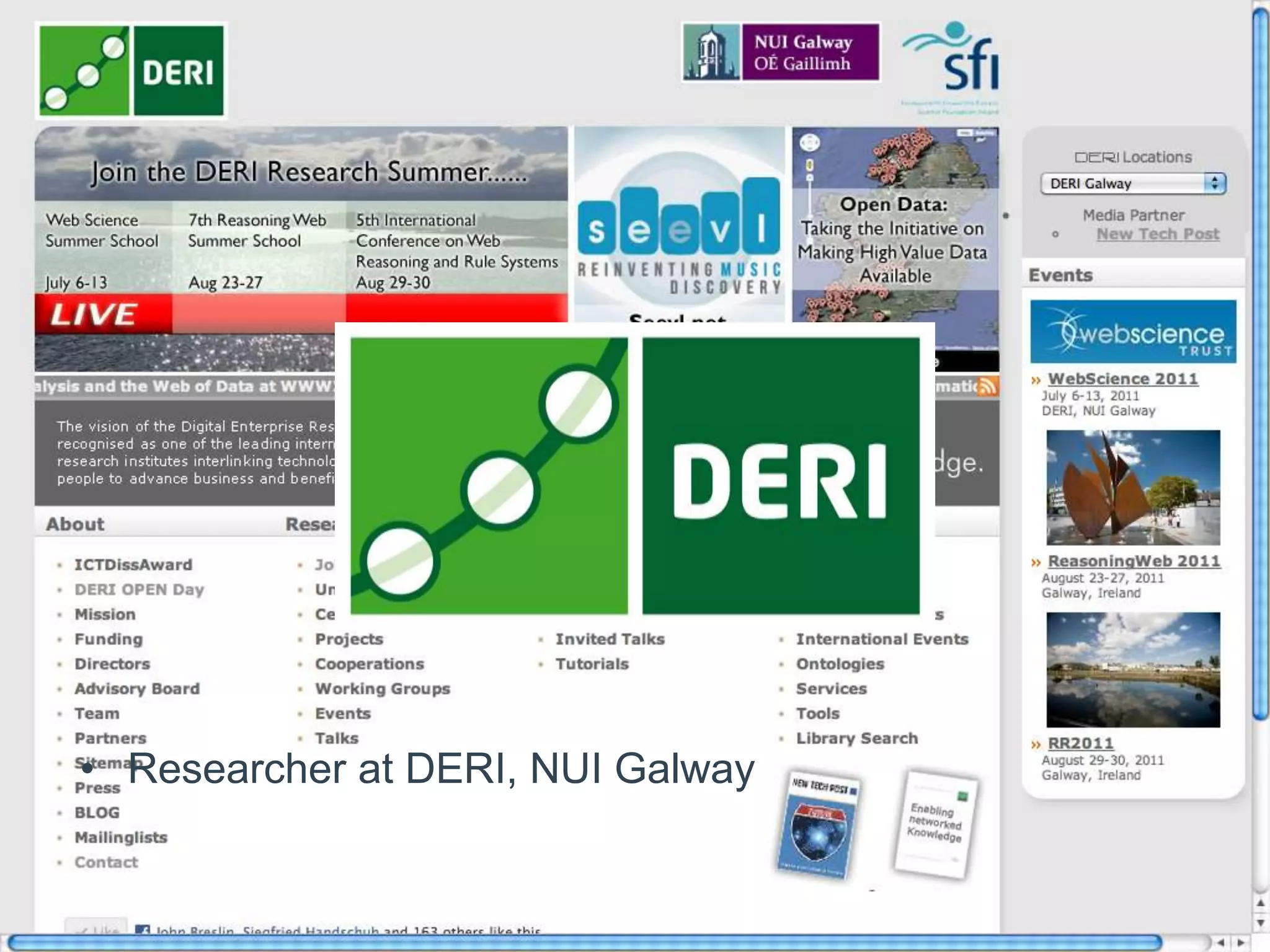
• Researcher at DERI, NUI Galway
Social, semantics and me
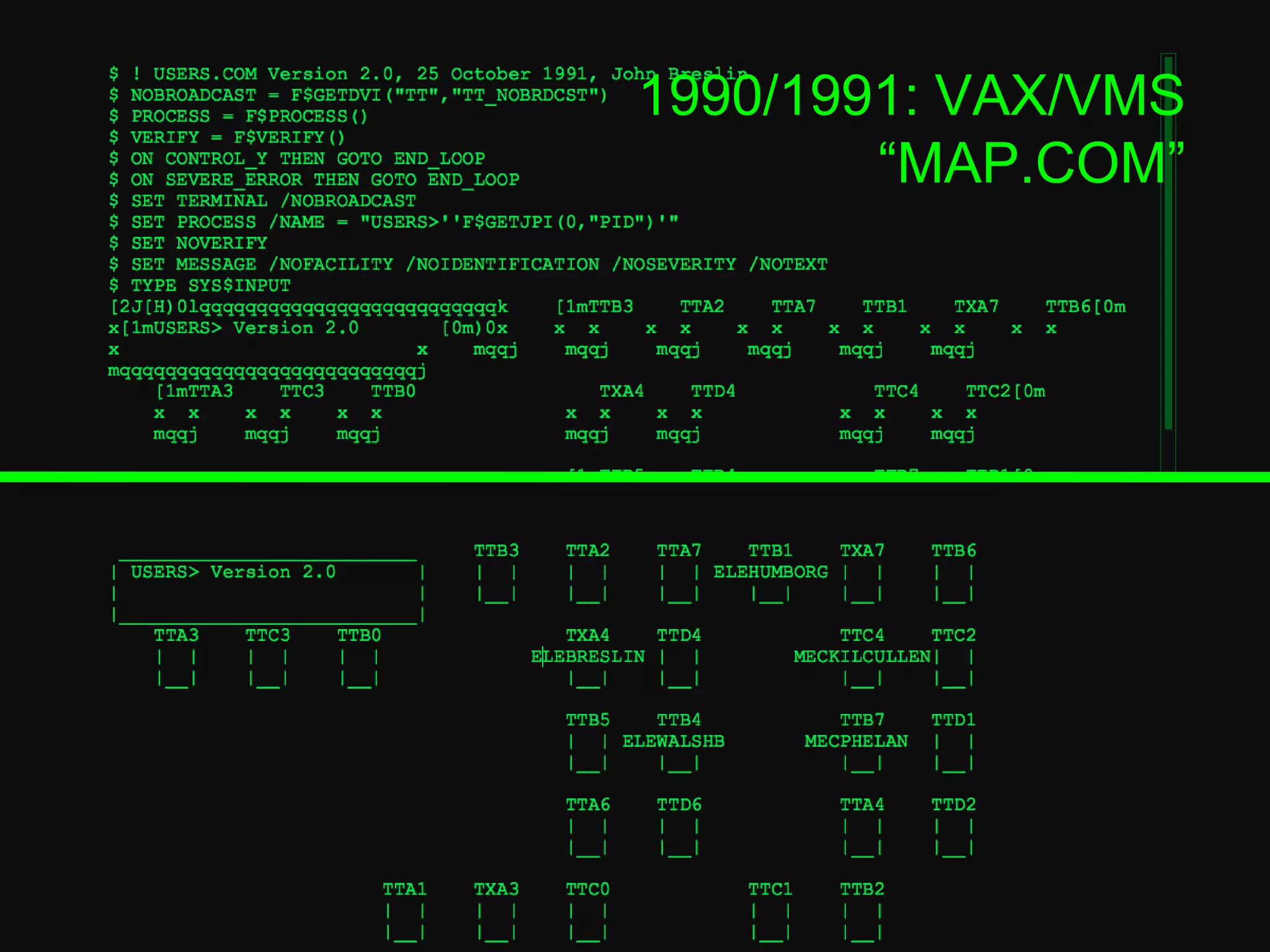
1990/1991: VAX/VMS
        “MAP.COM”
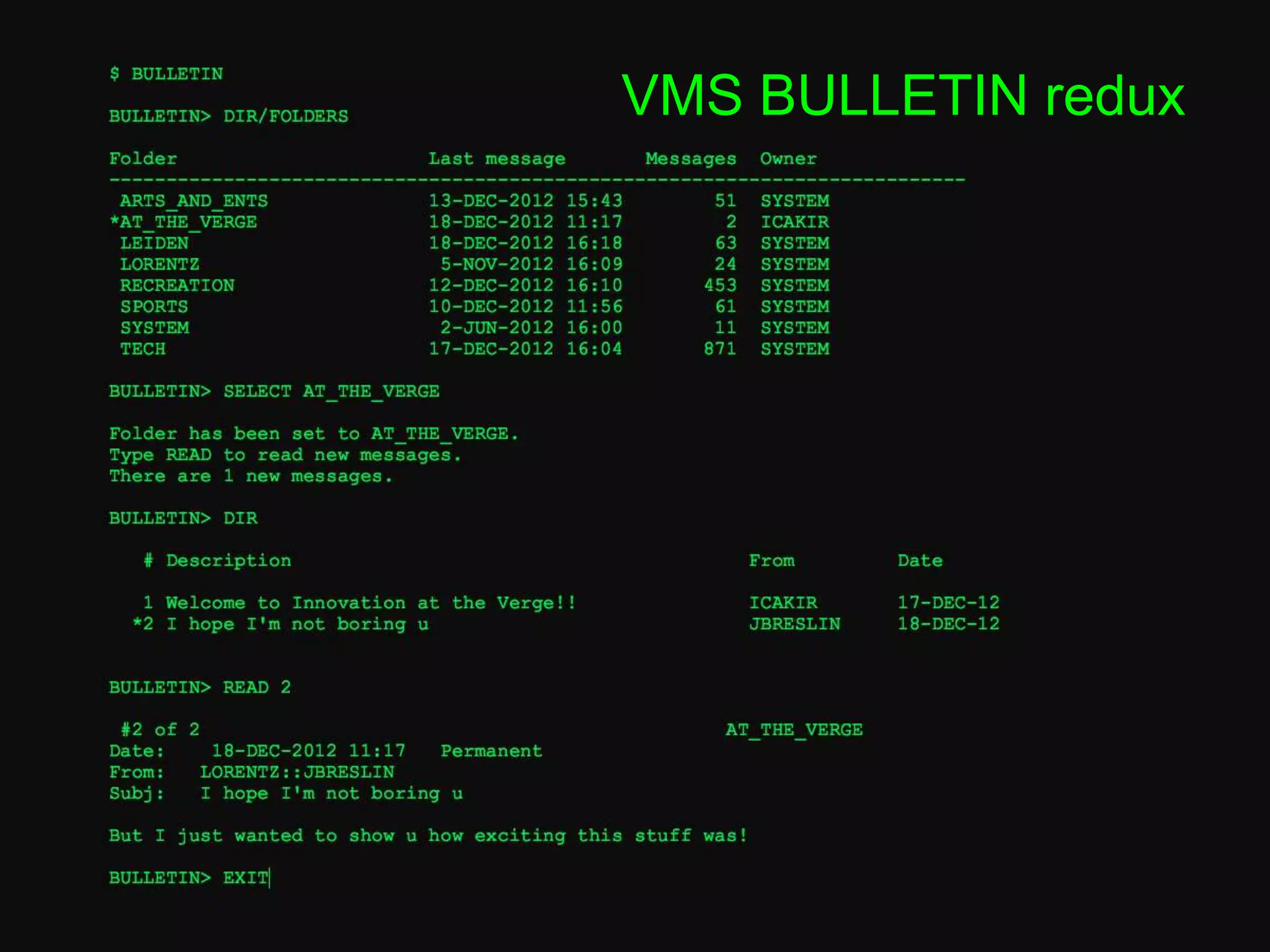
VMS BULLETIN redux
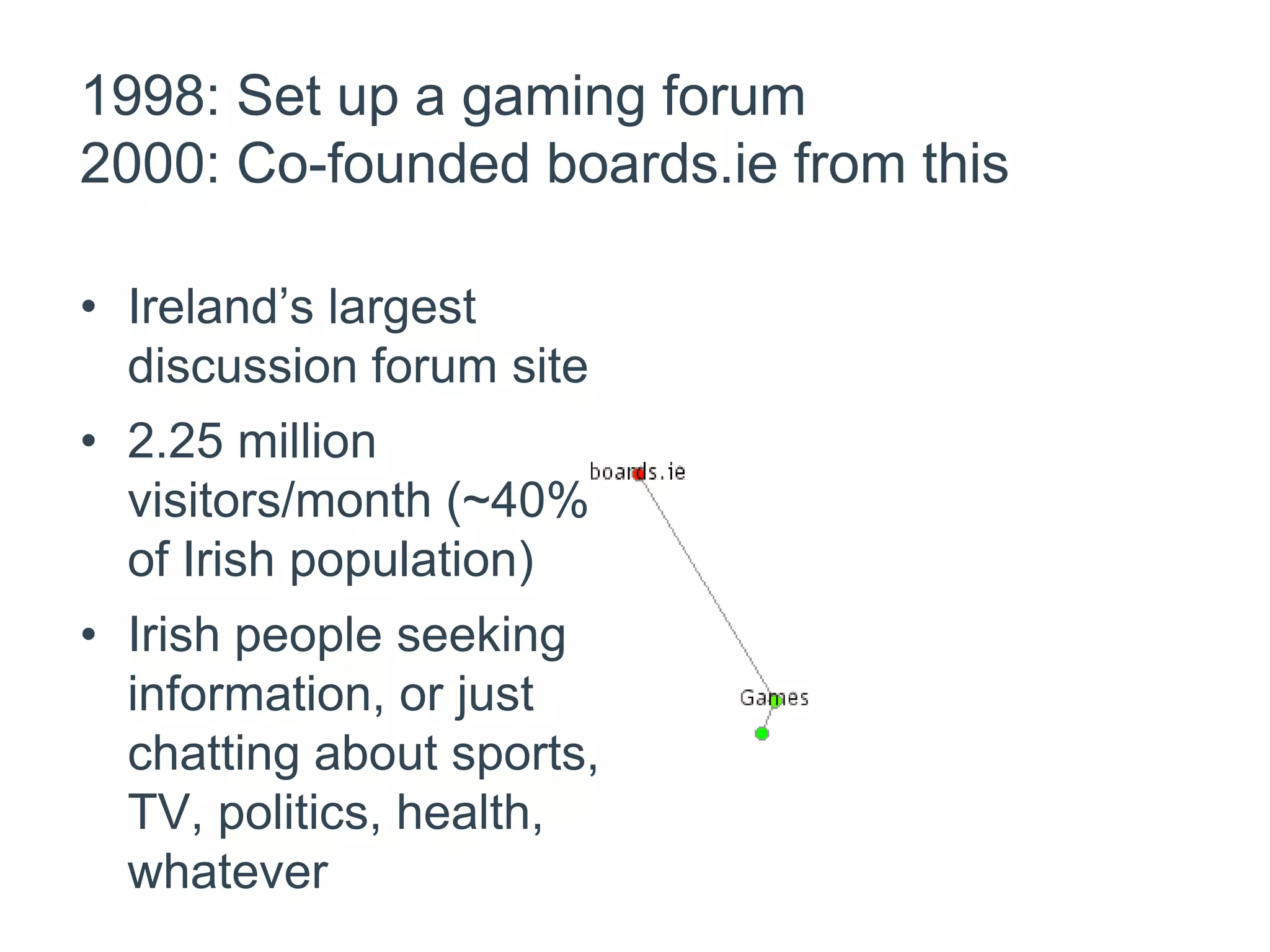
1998: Set up a gaming forum
2000: Co-founded boards.ie from this

• Ireland’s largest
  discussion forum site
• 2.25 million
  visitors/month (~40%
  of Irish population)
• Irish people seeking
  information, or just
  chatting about sports,
  TV, politics, health,
  whatever
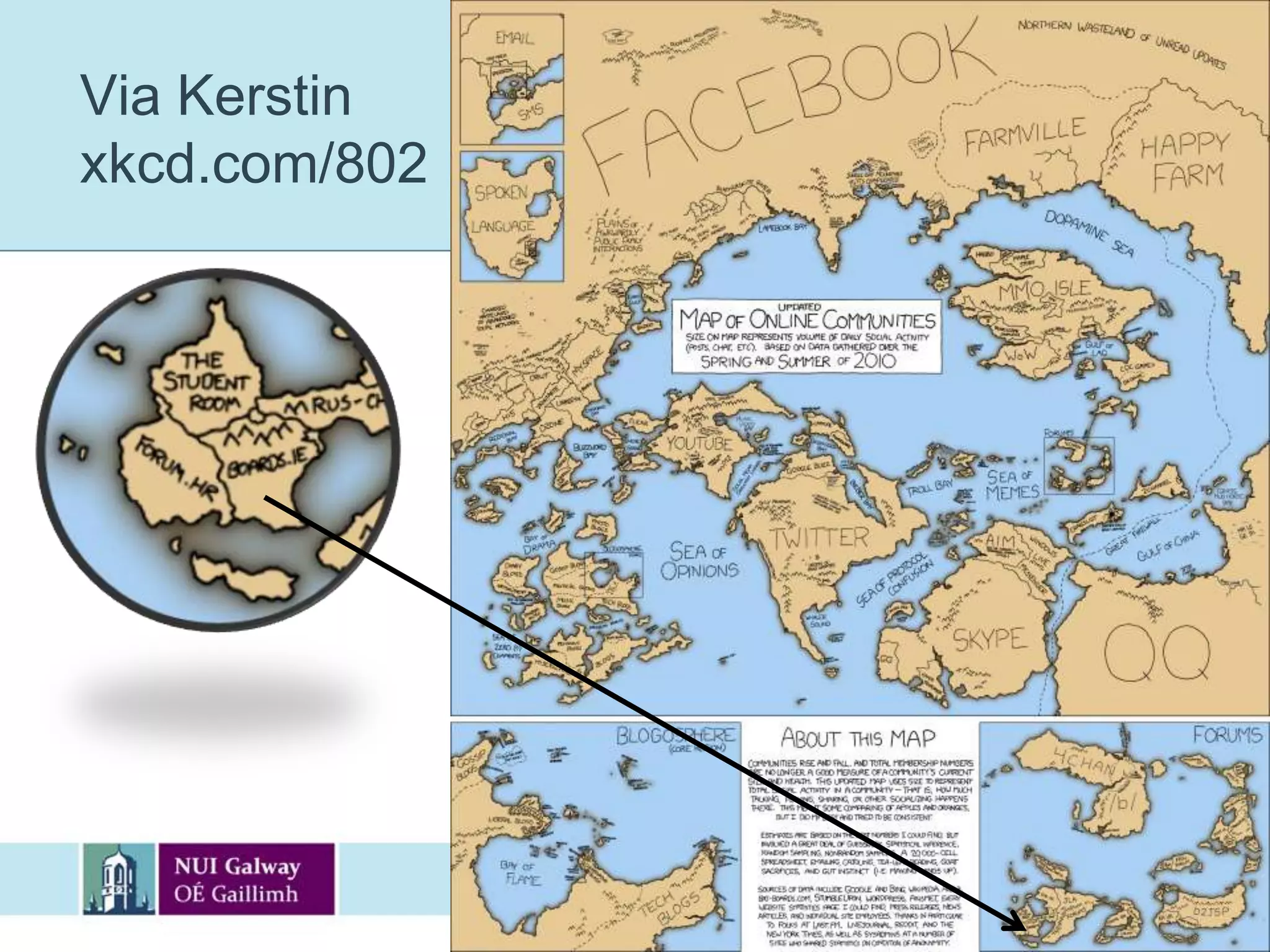
Via Kerstin
xkcd.com/802
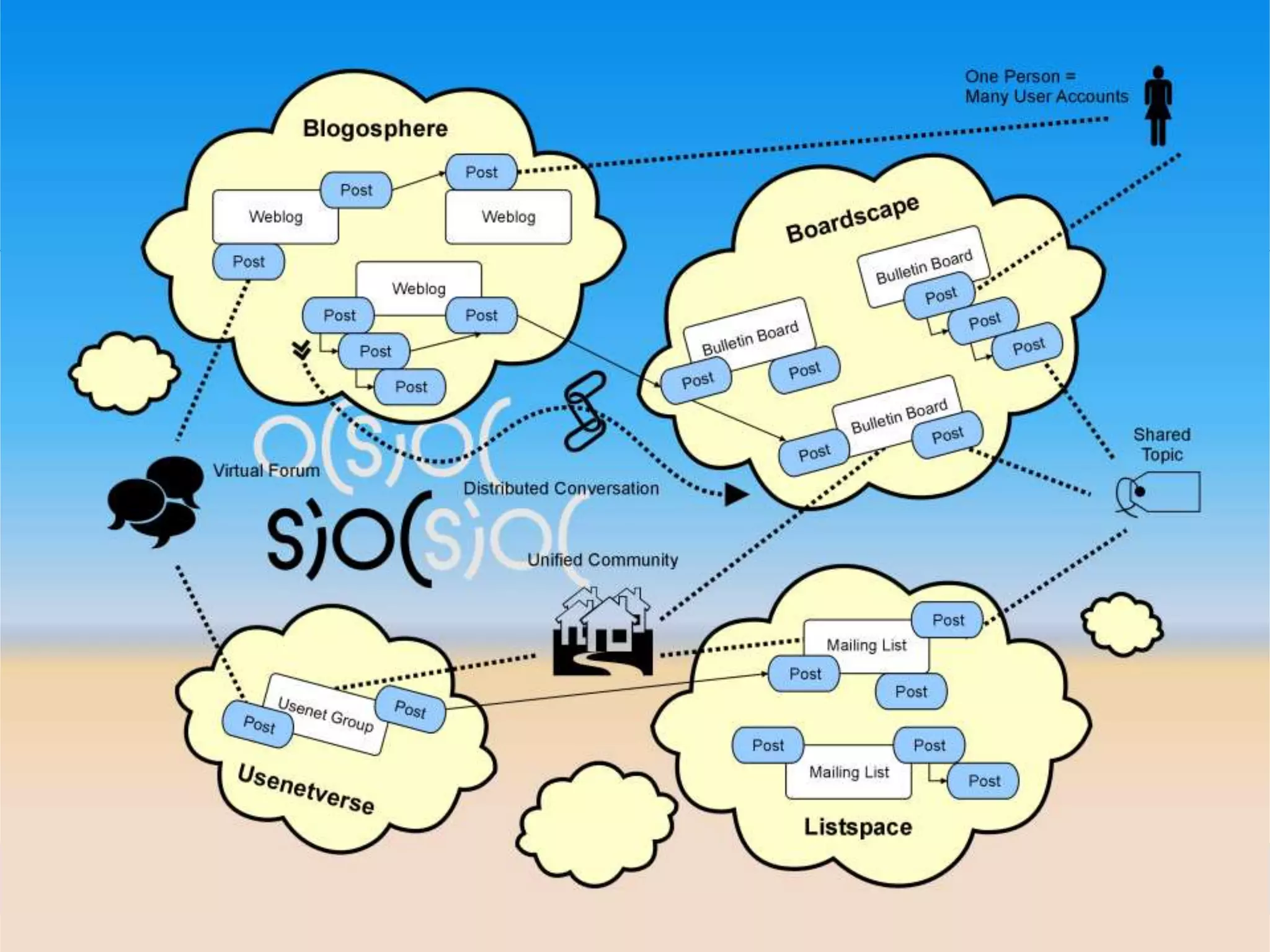
2004: Joined DERI, founded the SIOC
project

• Semantically-
  Interlinked Online
  Communities
• Enables
  interoperability and
  exchange of social
  content:
   – Blogs, forums, wikis...
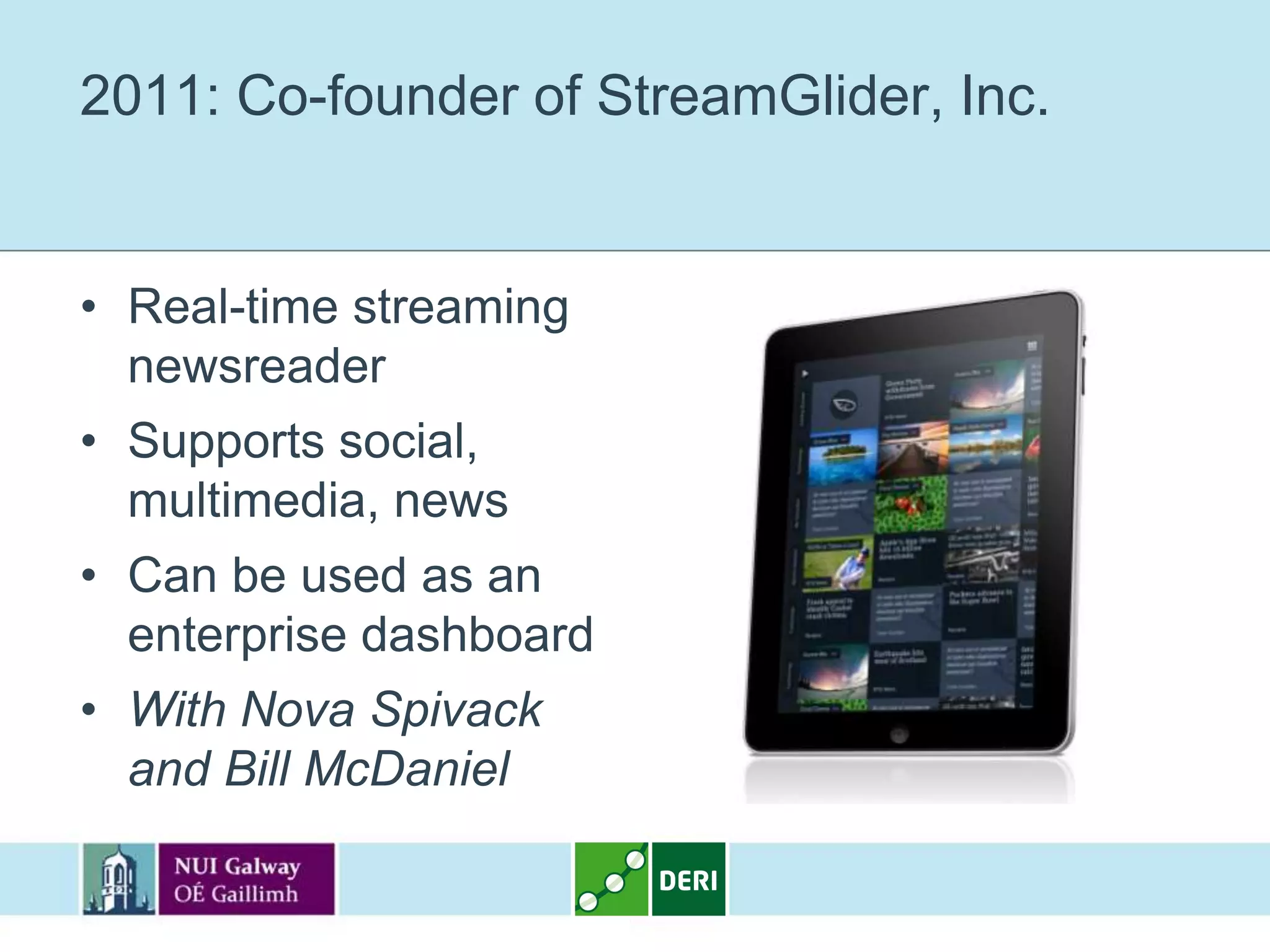
2011: Co-founder of StreamGlider, Inc.


• Real-time streaming
  newsreader
• Supports social,
  multimedia, news
• Can be used as an
  enterprise dashboard
• With Nova Spivack
  and Bill McDaniel
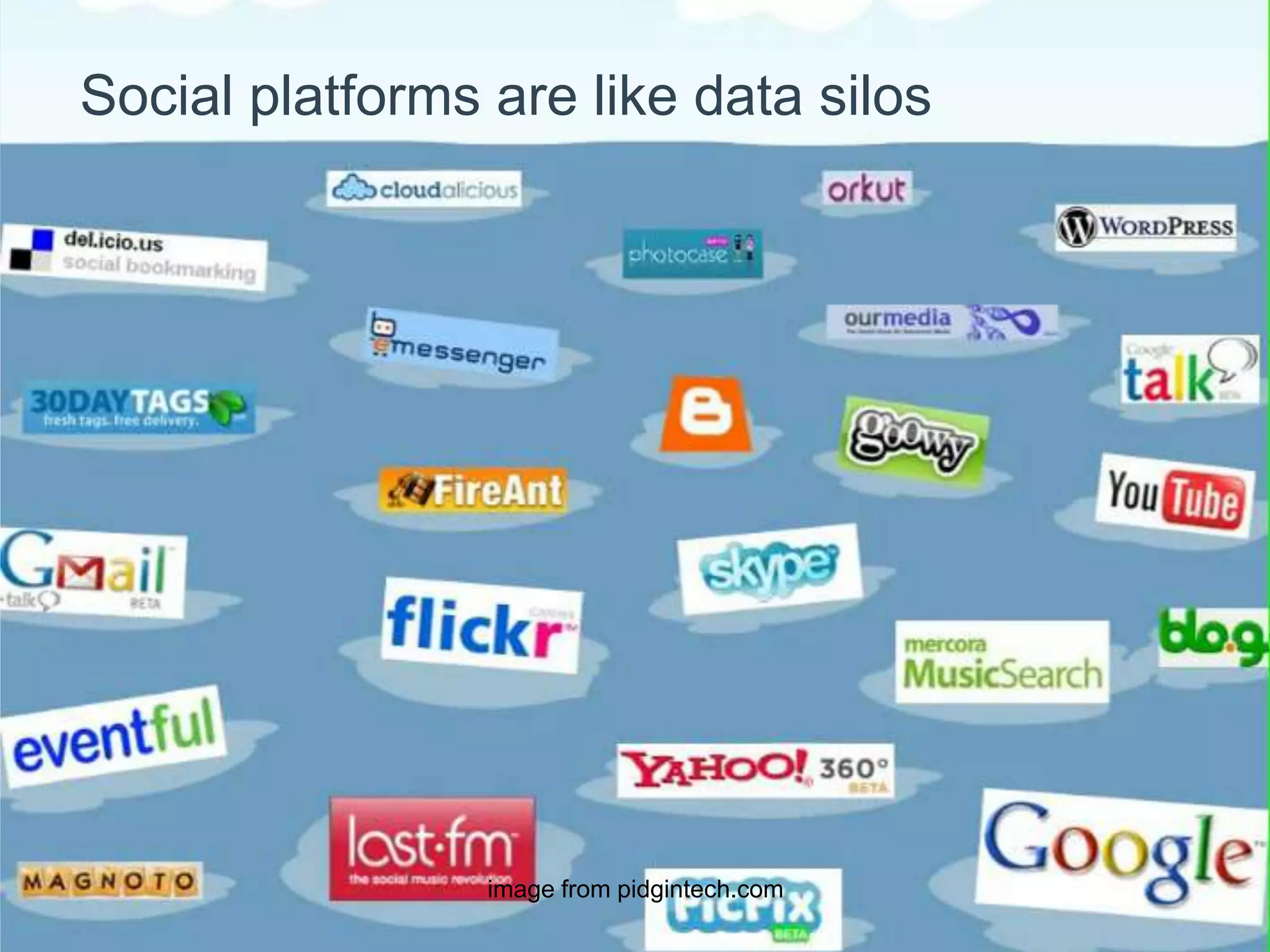
Social platforms are like data silos


                 image from pidgintech.com
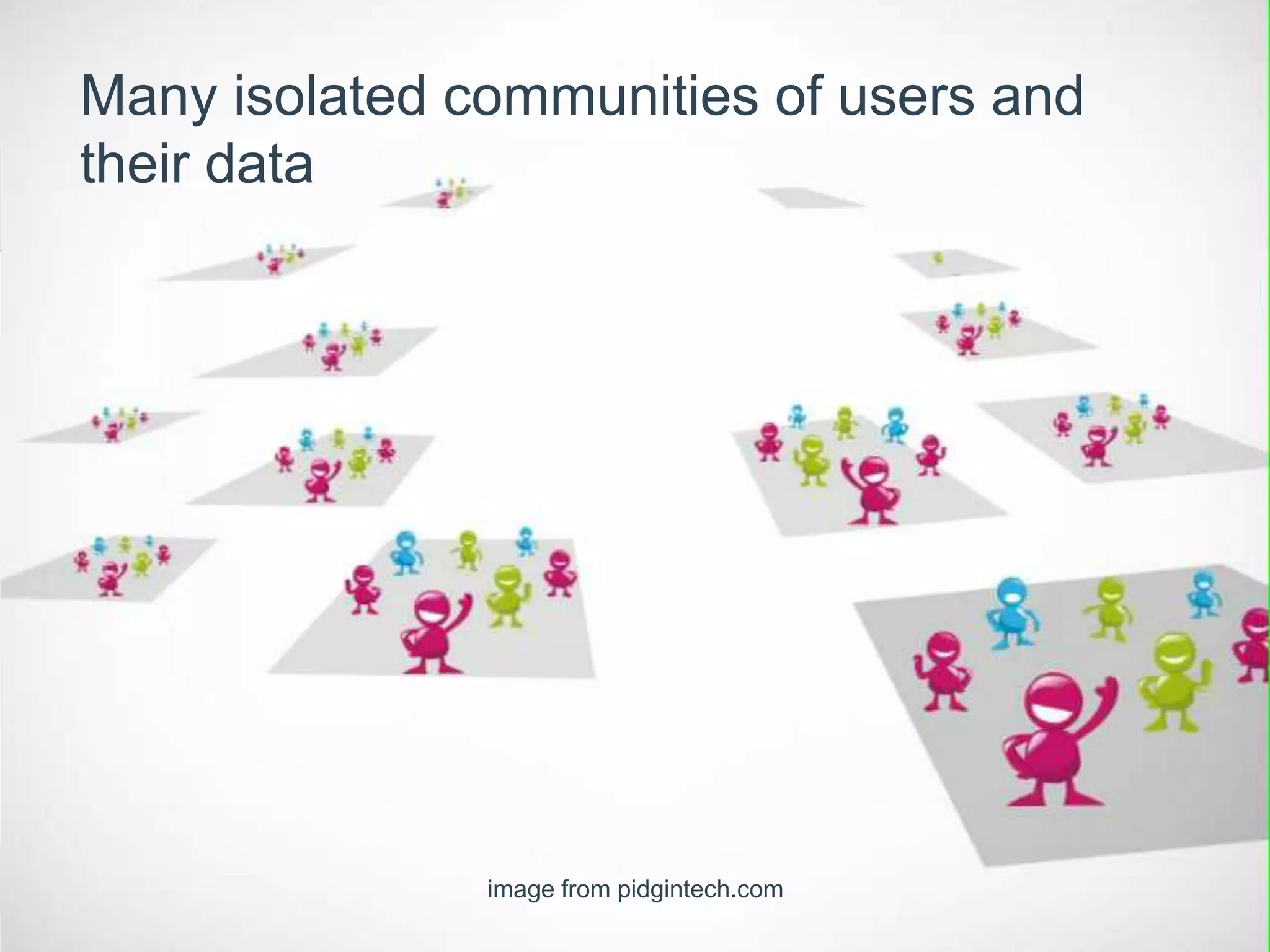
Many isolated communities of users and
their data


               image from pidgintech.com
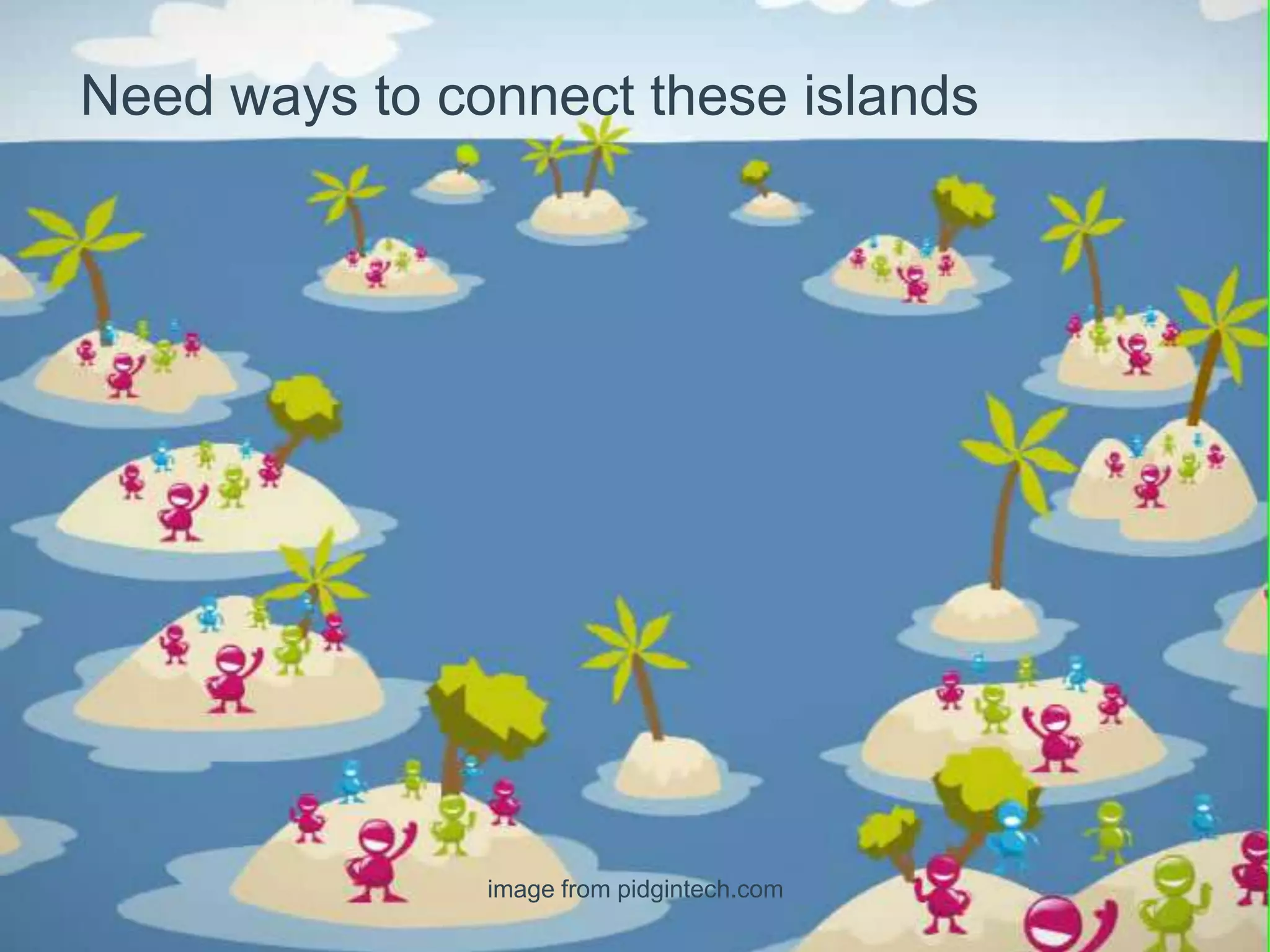
Need ways to connect these islands


               image from pidgintech.com
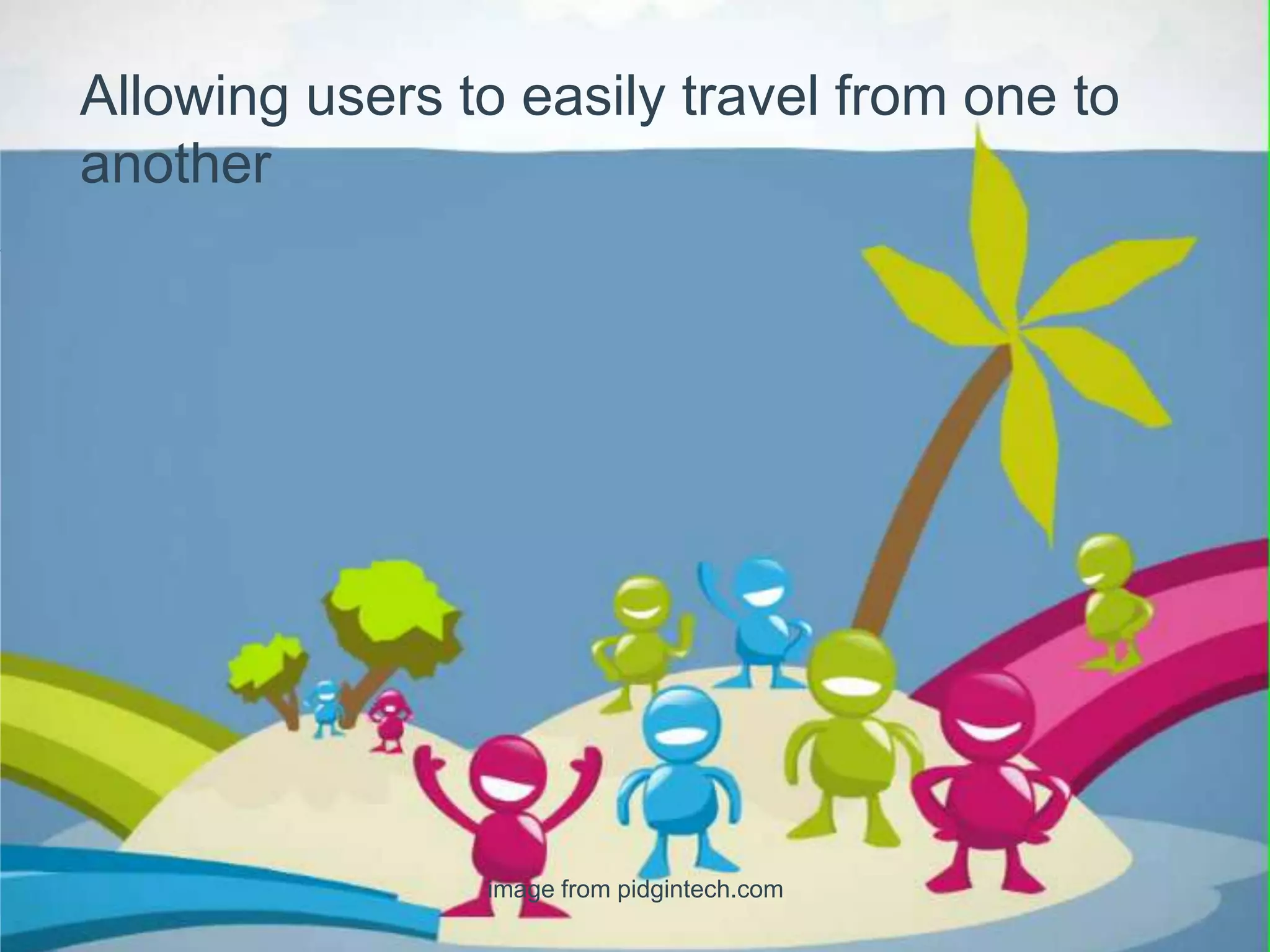
Allowing users to easily travel from one to
another


                image from pidgintech.com
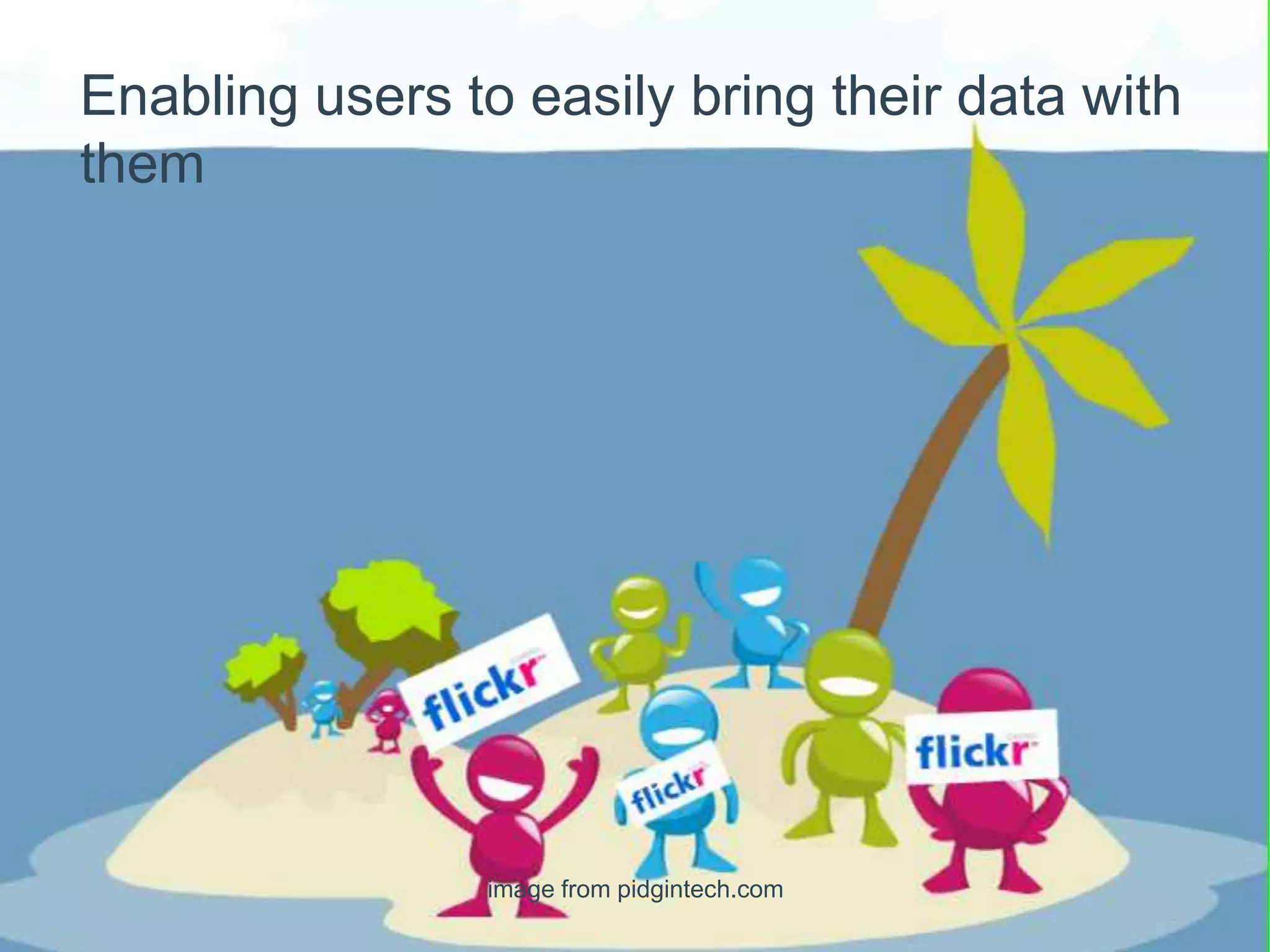
Enabling users to easily bring their data with
them


                 image from pidgintech.com
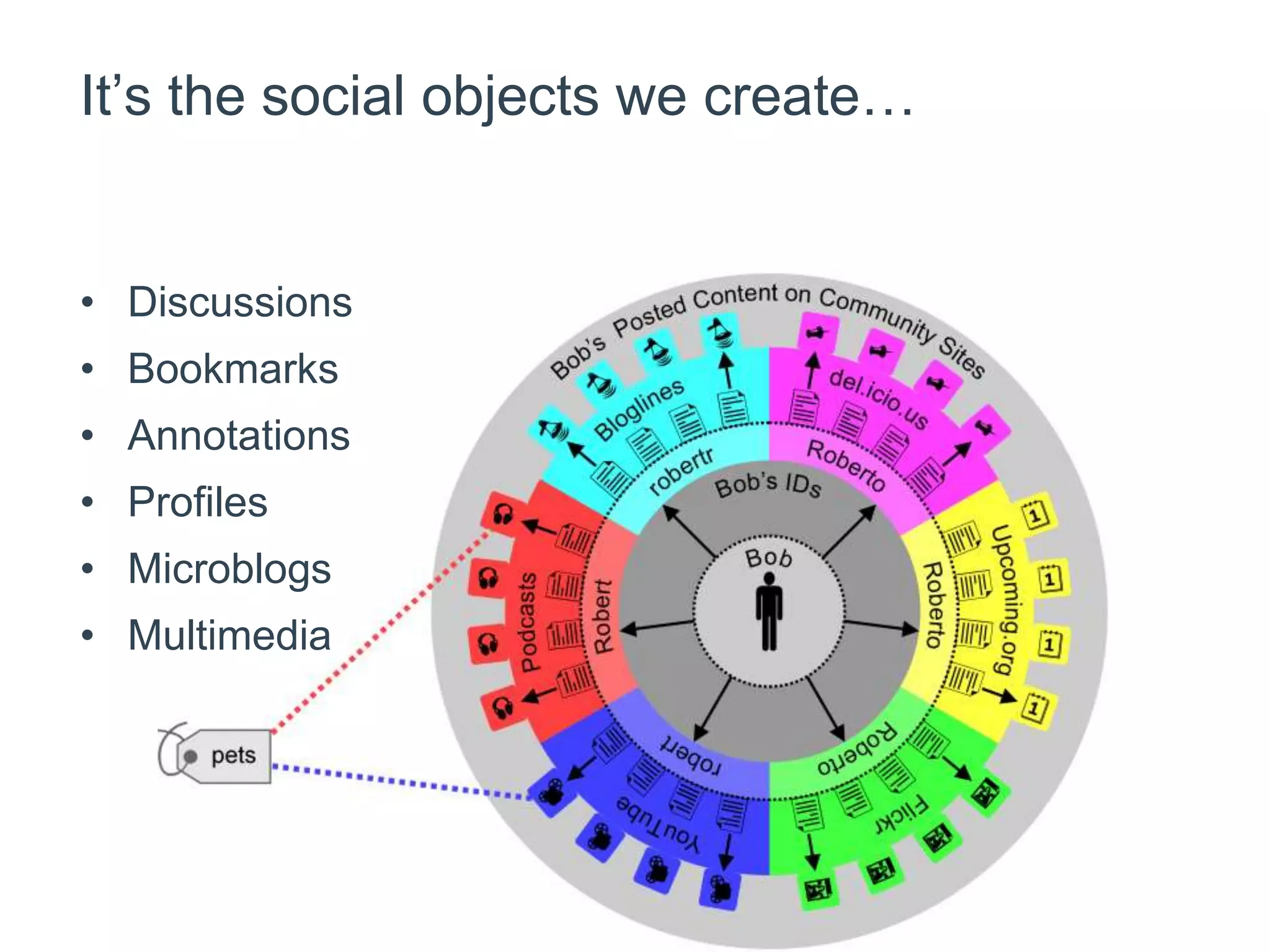
Object-centred sociality (AKA social
objects)

• Users are connected via a common object:
   – Their job, university, hobbies, interests, a date…
• “According to this theory, people don’t just connect to
  each other. They connect through a shared object.
  […]Good services allow people to create social objects
  that add value.” – JyriEngestrom
   – Flickr = photos
   – del.icio.us = bookmarks
   – Blogs = discussion posts
It’s the social objects we create…


• Discussions
• Bookmarks
• Annotations
• Profiles
• Microblogs
• Multimedia
…that connect us
to other people
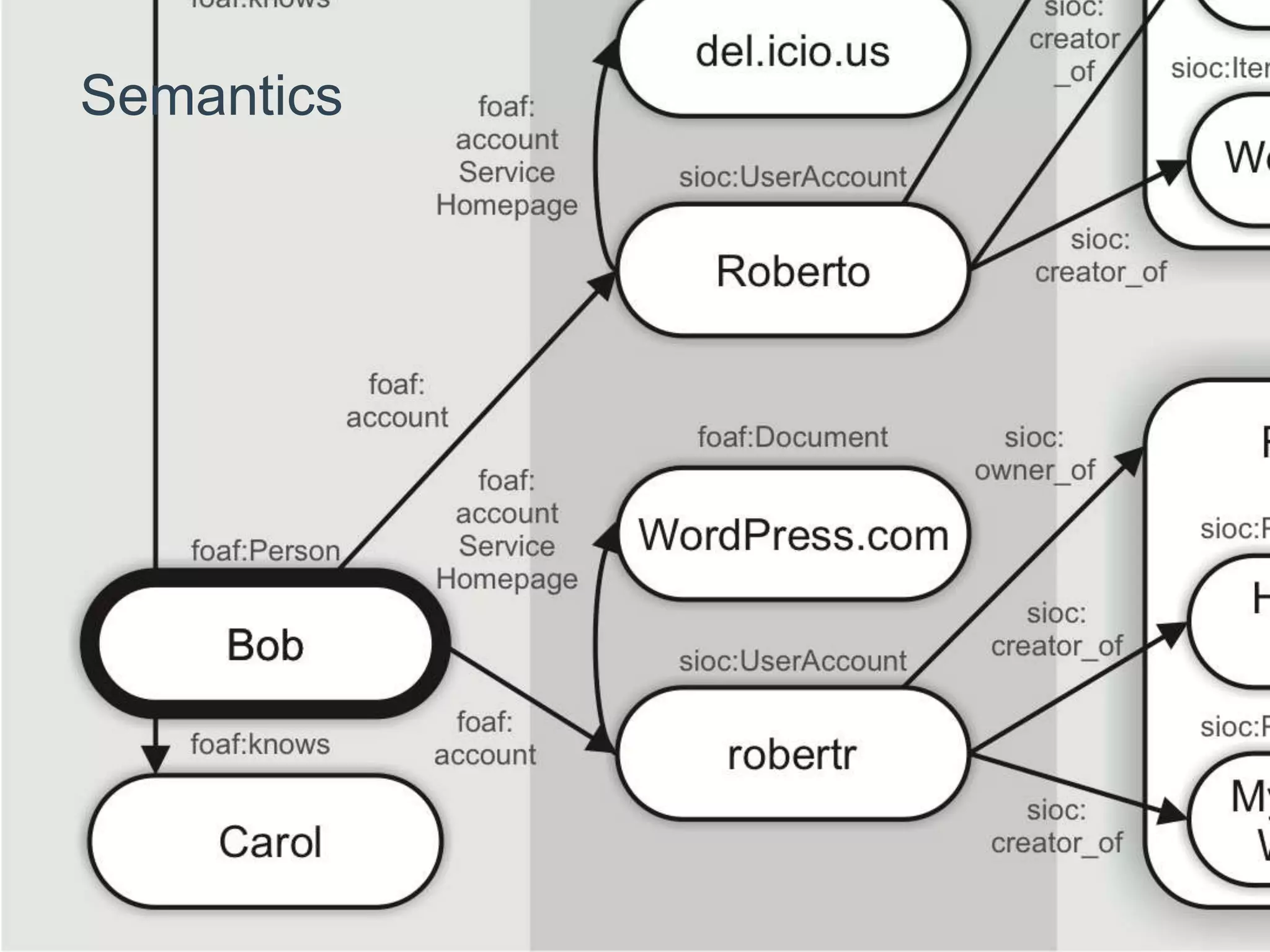
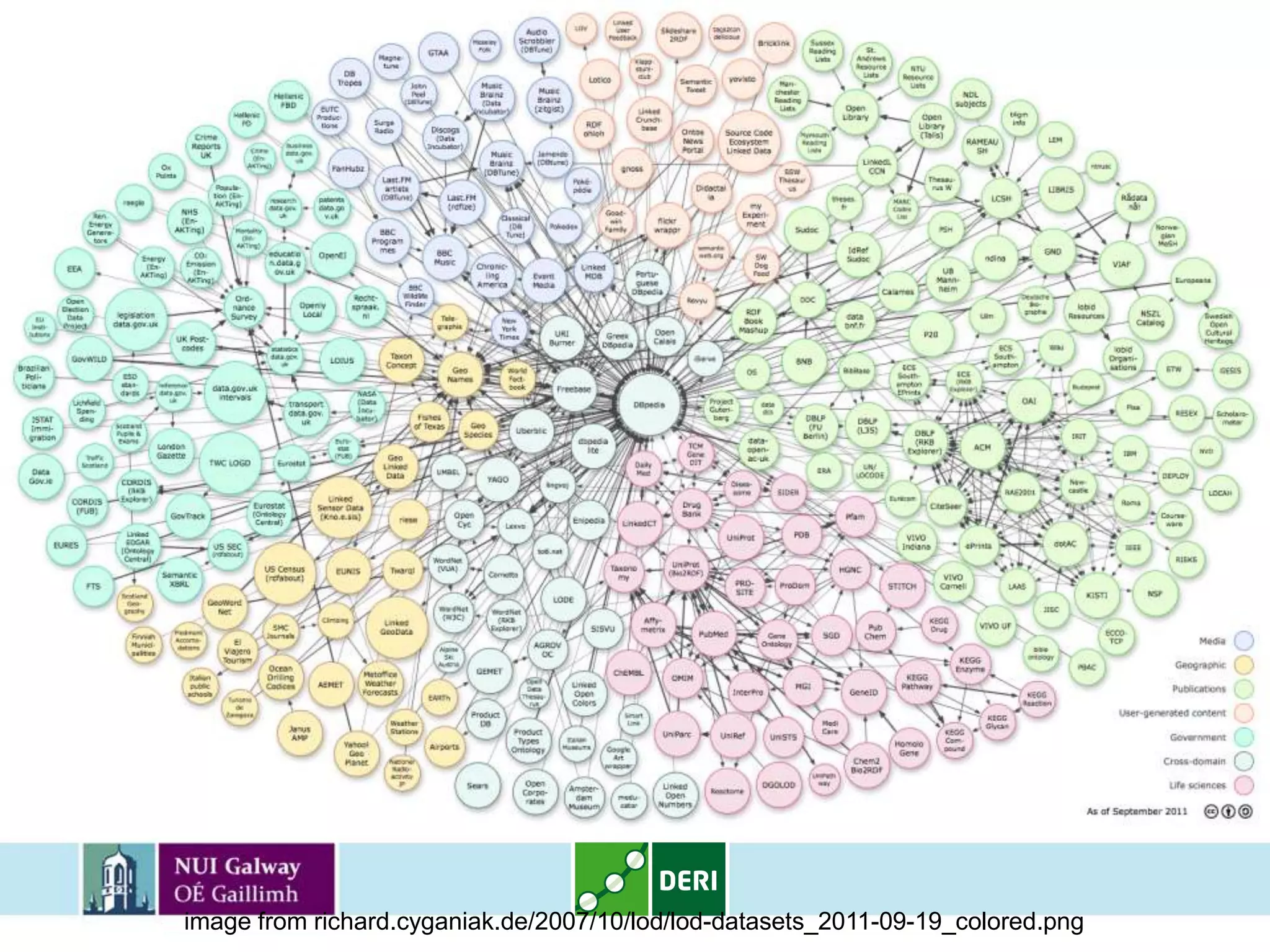
Semantics
image from richard.cyganiak.de/2007/10/lod/lod-datasets_2011-09-19_colored.png
Social semantic representation
models


Using ontologies to model social data
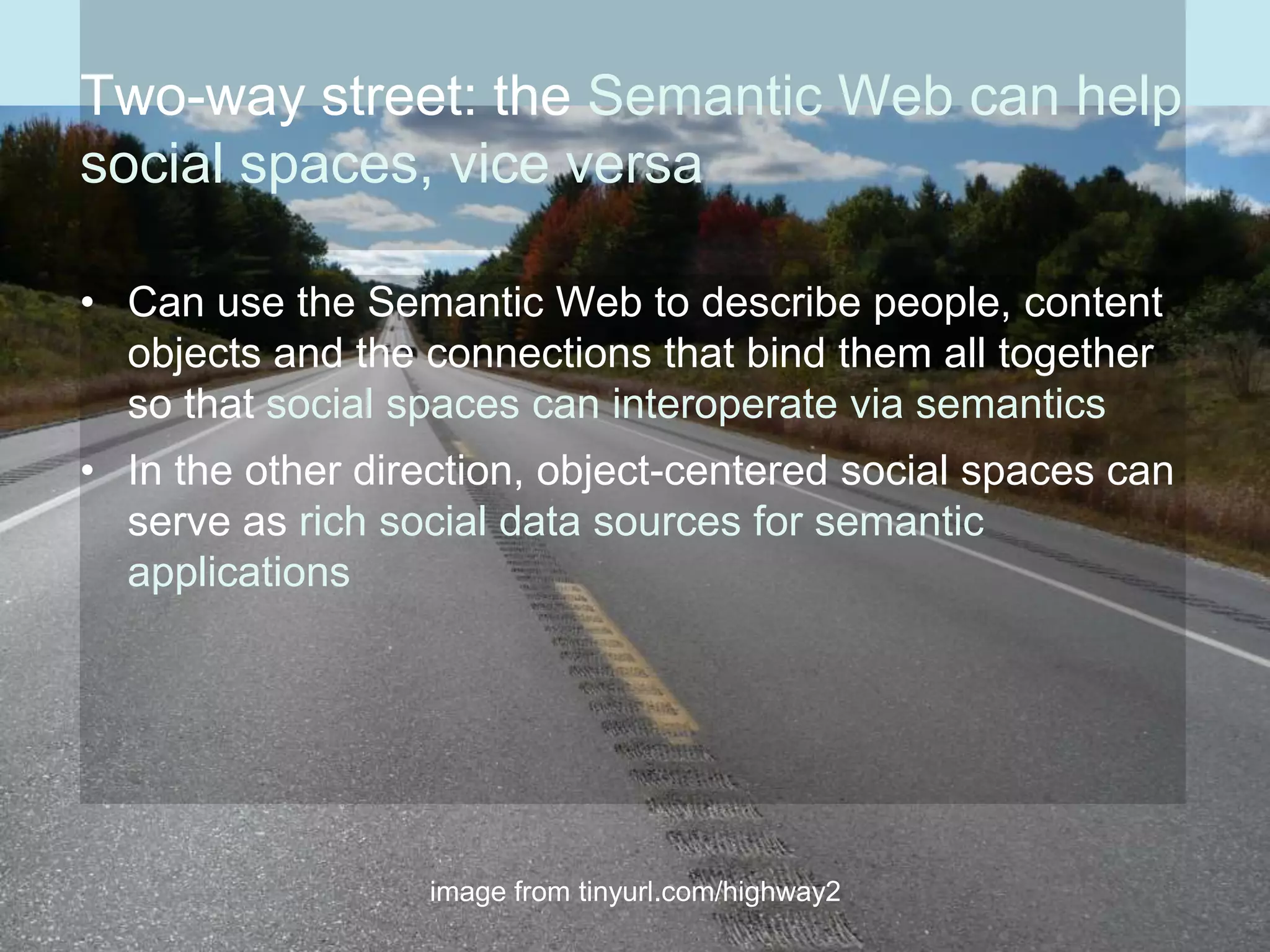
Two-way street: the Semantic Web can help
social spaces, vice versa

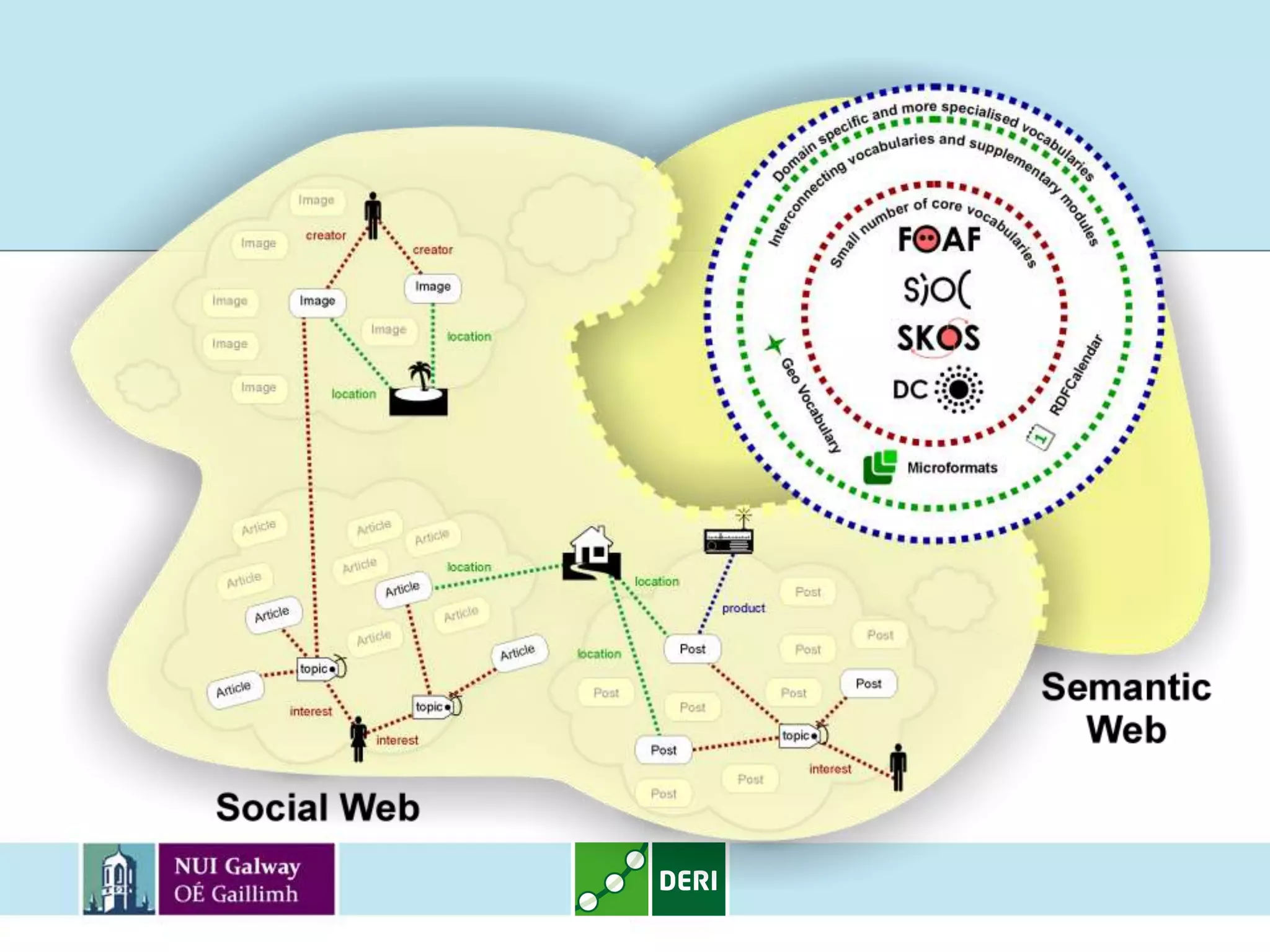
• Can use the Semantic Web to describe people, content
  objects and the connections that bind them all together
  so that social spaces can interoperate via semantics
• In the other direction, object-centered social spaces can
  serve as rich social data sources for semantic
  applications


                  image from tinyurl.com/highway2
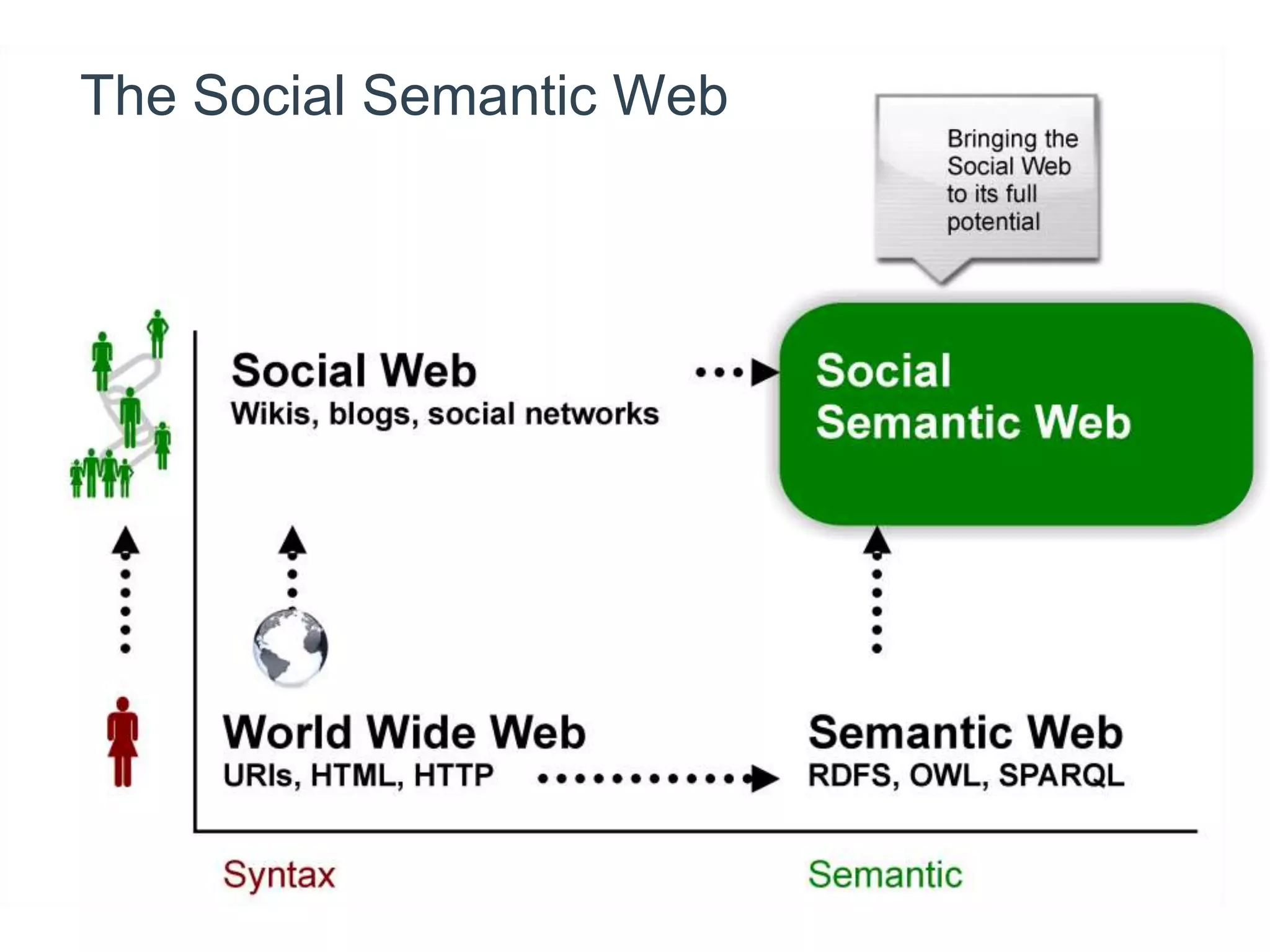
The Social Semantic Web
FOAF


Friend Of A Friend
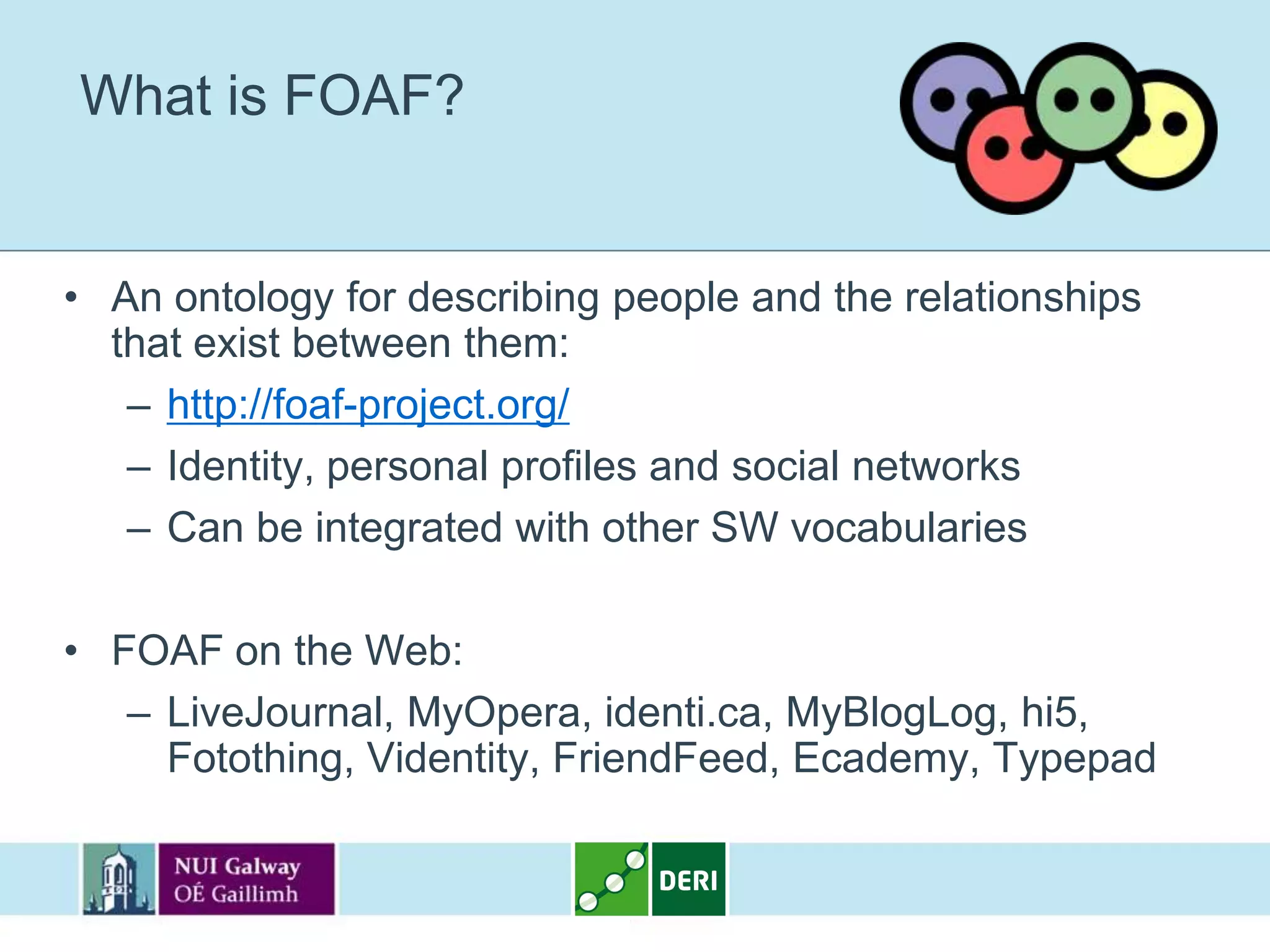
What is FOAF?


• An ontology for describing people and the relationships
  that exist between them:
   – http://foaf-project.org/
   – Identity, personal profiles and social networks
   – Can be integrated with other SW vocabularies

• FOAF on the Web:
   – LiveJournal, MyOpera, identi.ca, MyBlogLog, hi5,
     Fotothing, Videntity, FriendFeed, Ecademy, Typepad
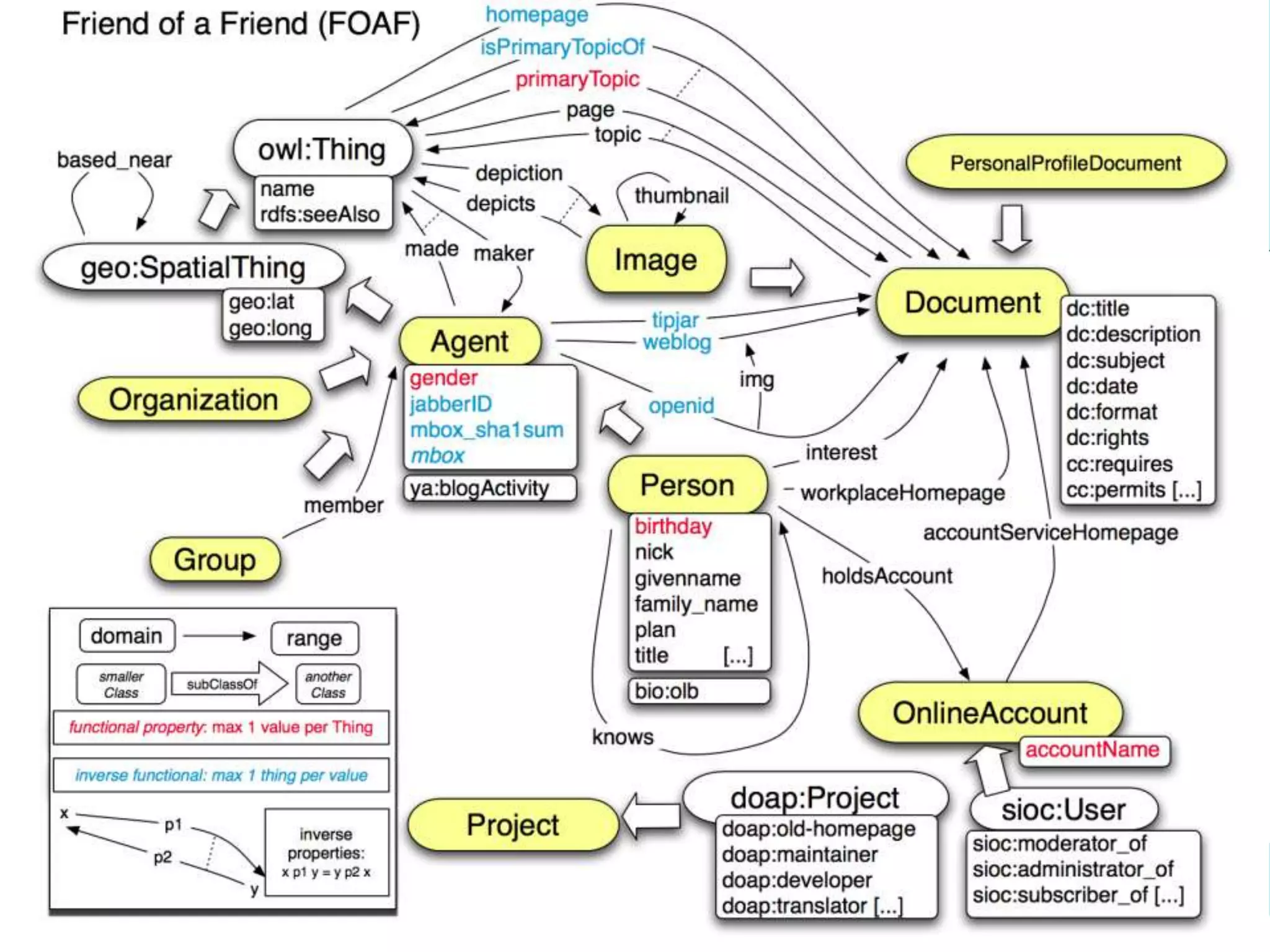
FOAF at a glance
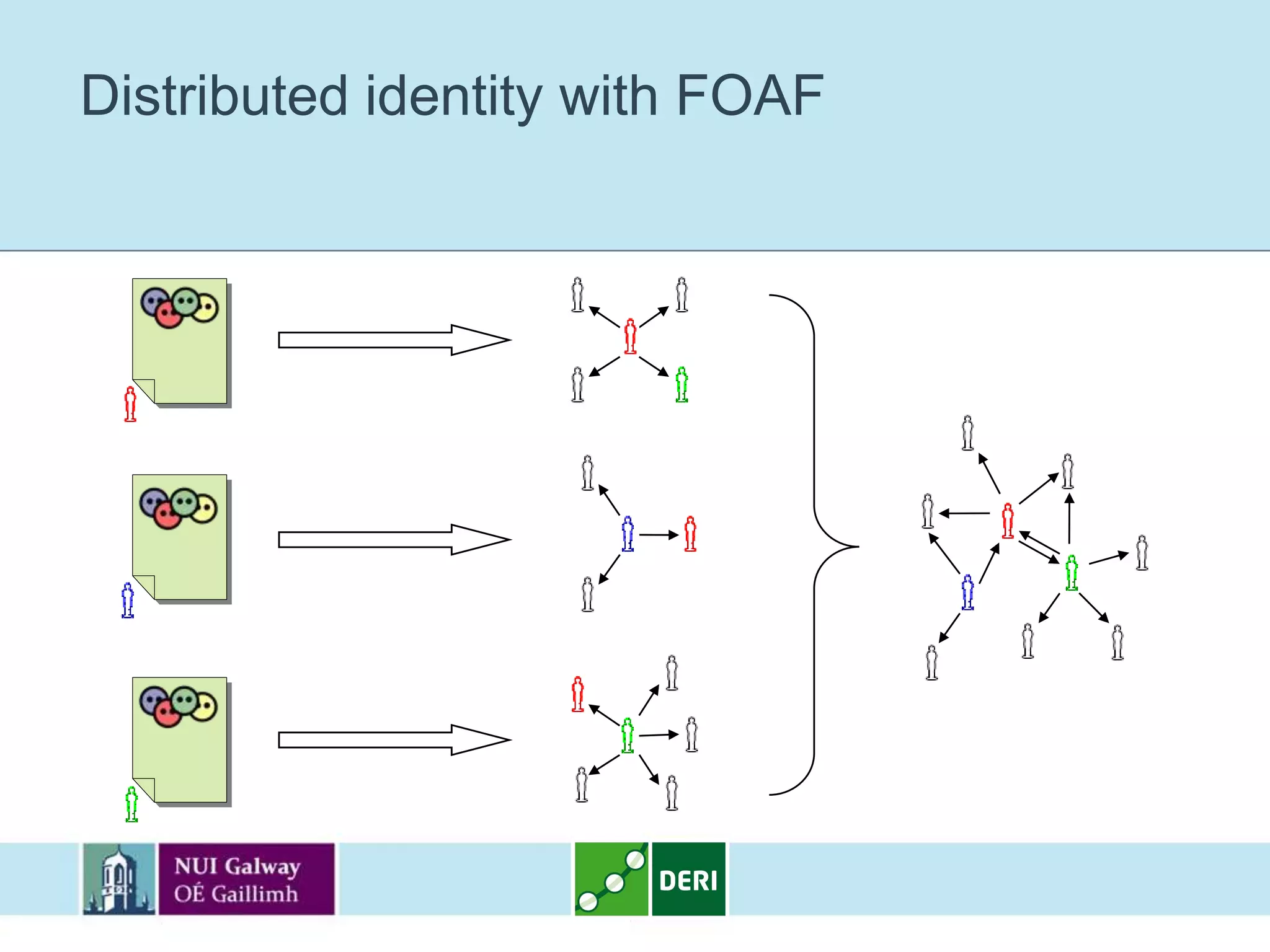
Distributed identity with FOAF
SIOC, pronounced shock


             image from tinyurl.com/siocshock
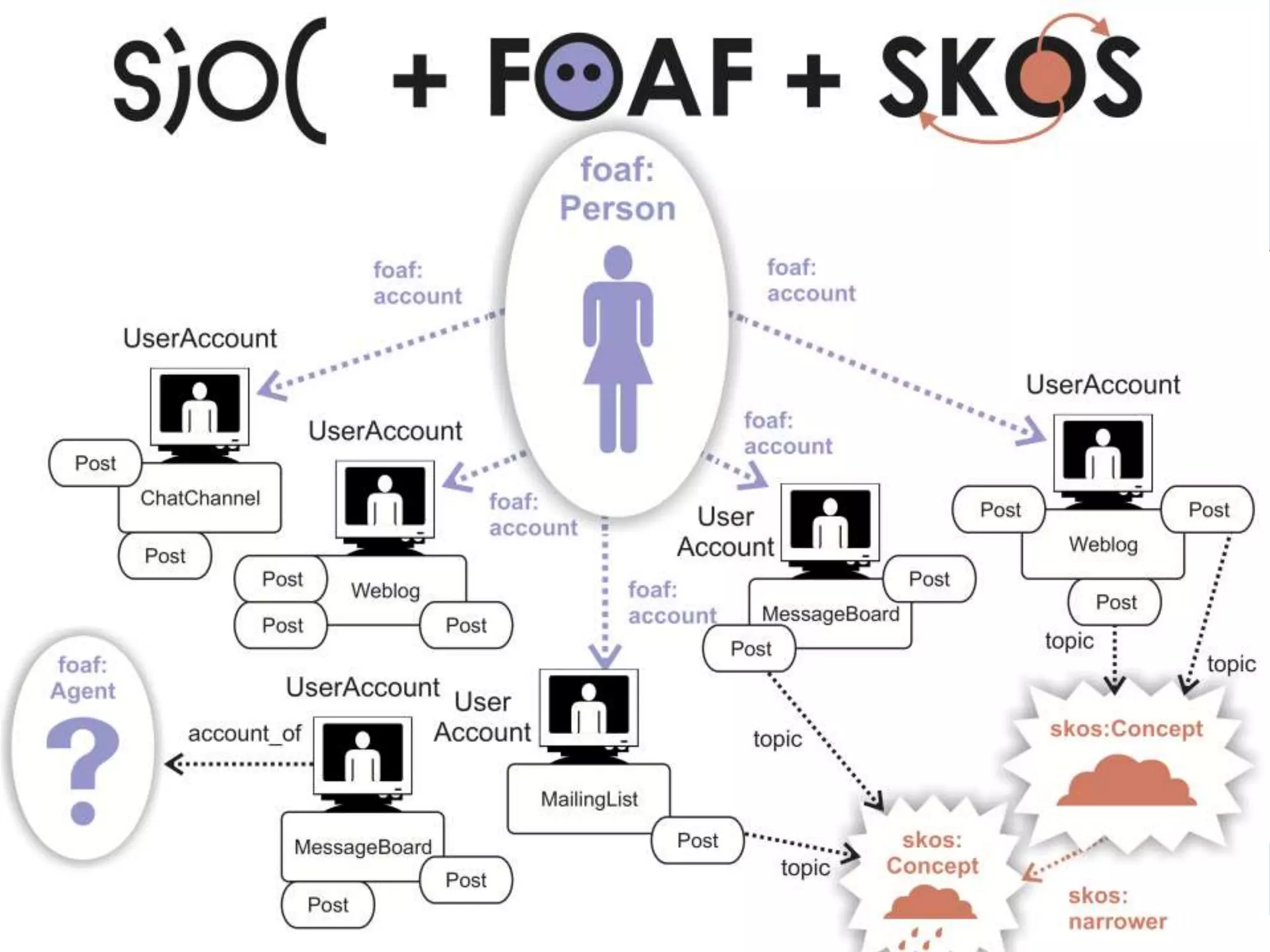
Semantically-Interlinked Online
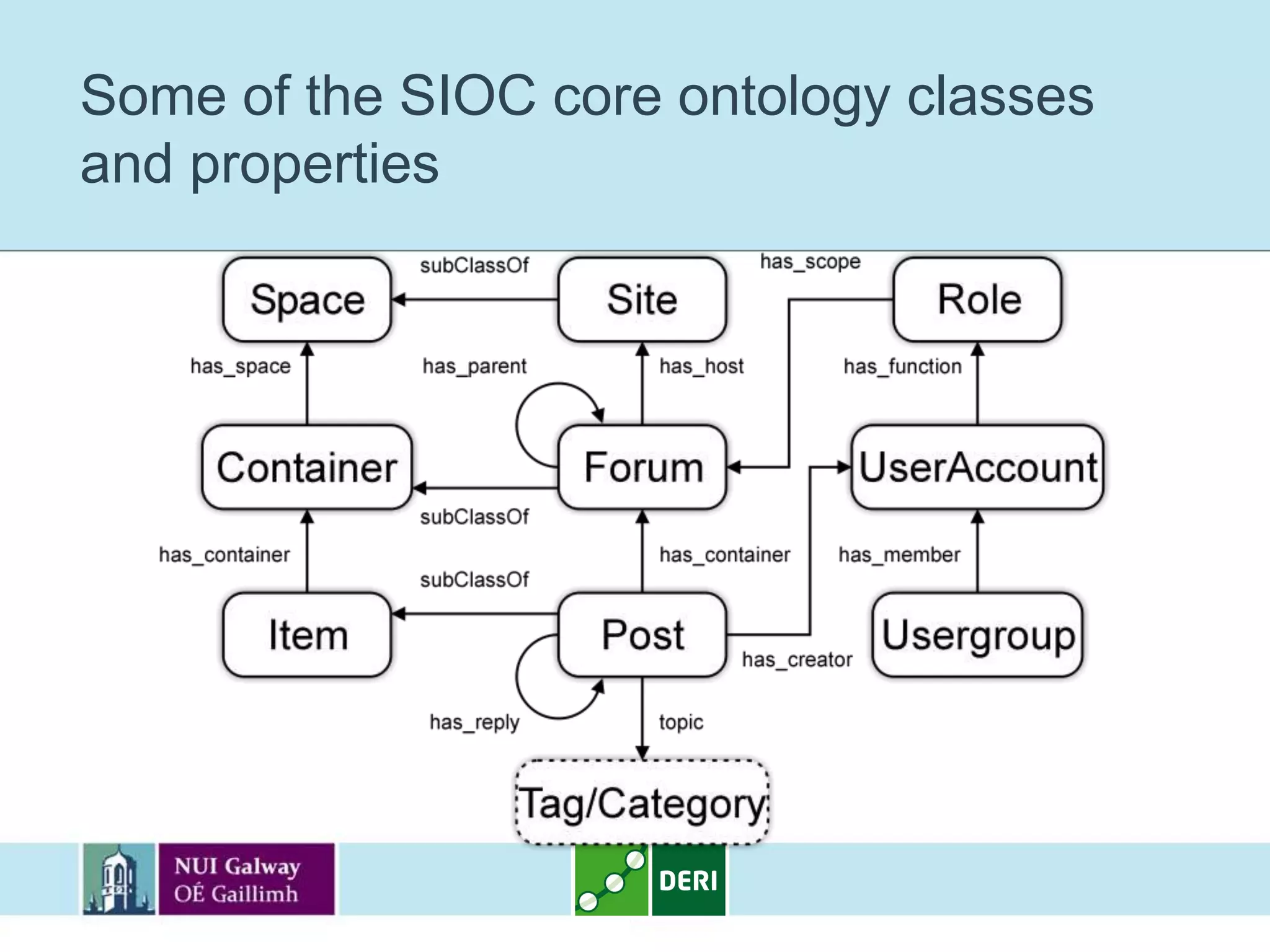
Communities (SIOC)

• Goal of the SIOC ontology is to address interoperability
  issues on the Social Web
   – sioc-project.org
   – W3C member submission in 2007
   – SIOC has been adopted in a framework of applications
     or modules deployed on hundreds of sites
   – Web 2.0, enterprise information integration, HCLS, e-
     government


                  image from tinyurl.com/friendship2
Some of the SIOC core ontology classes
and properties
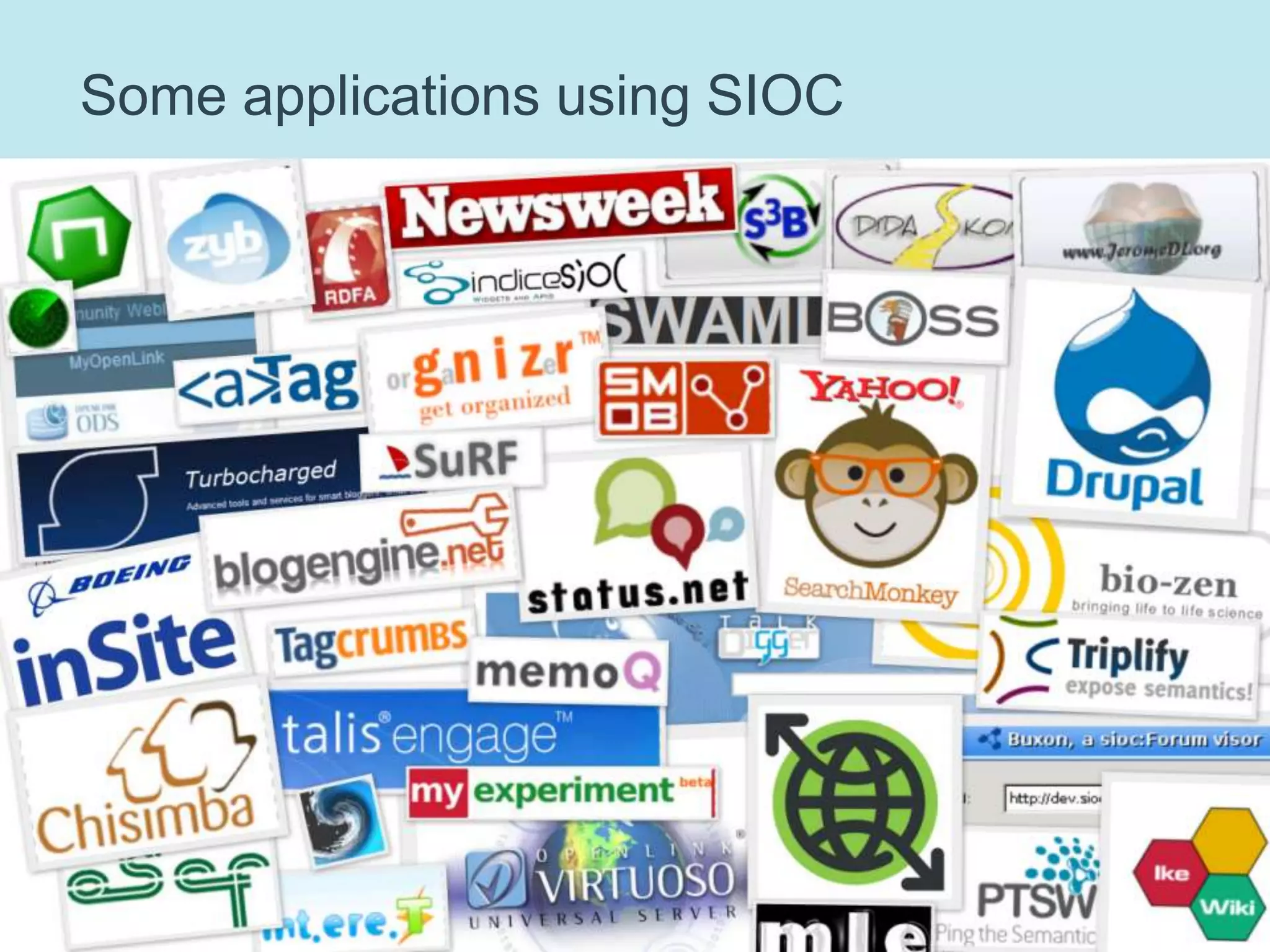
Some applications using SIOC
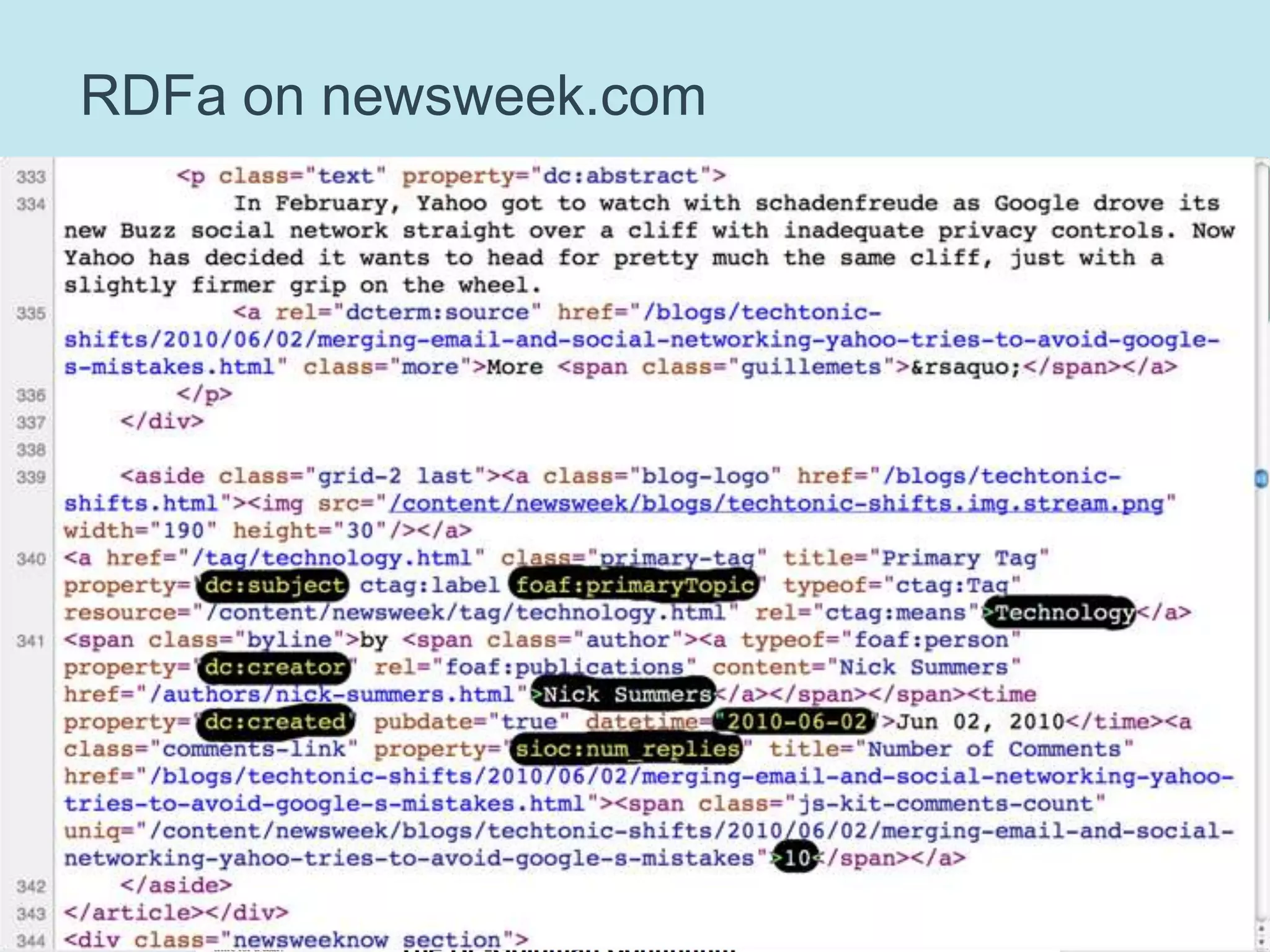
RDFa on newsweek.com
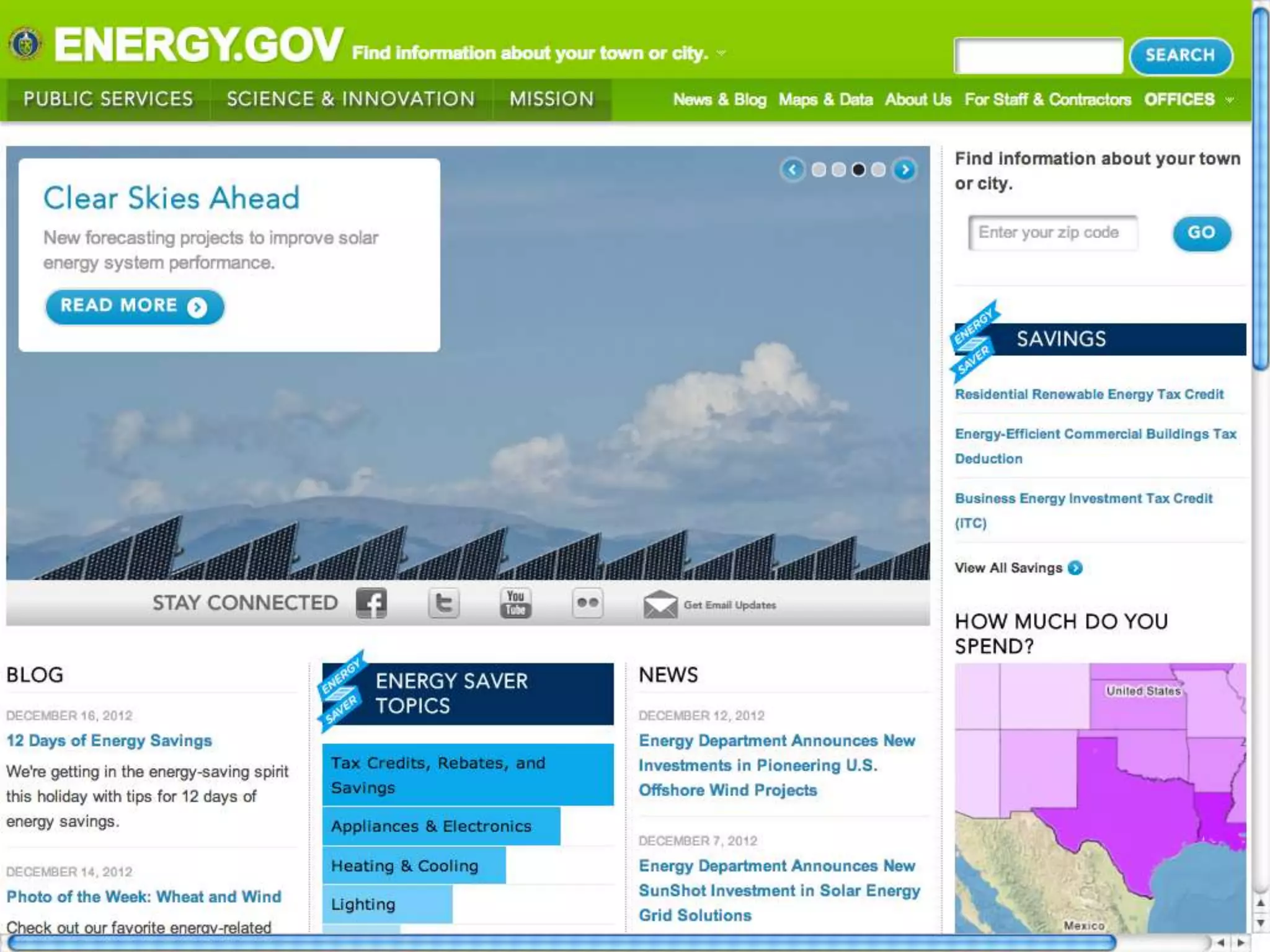
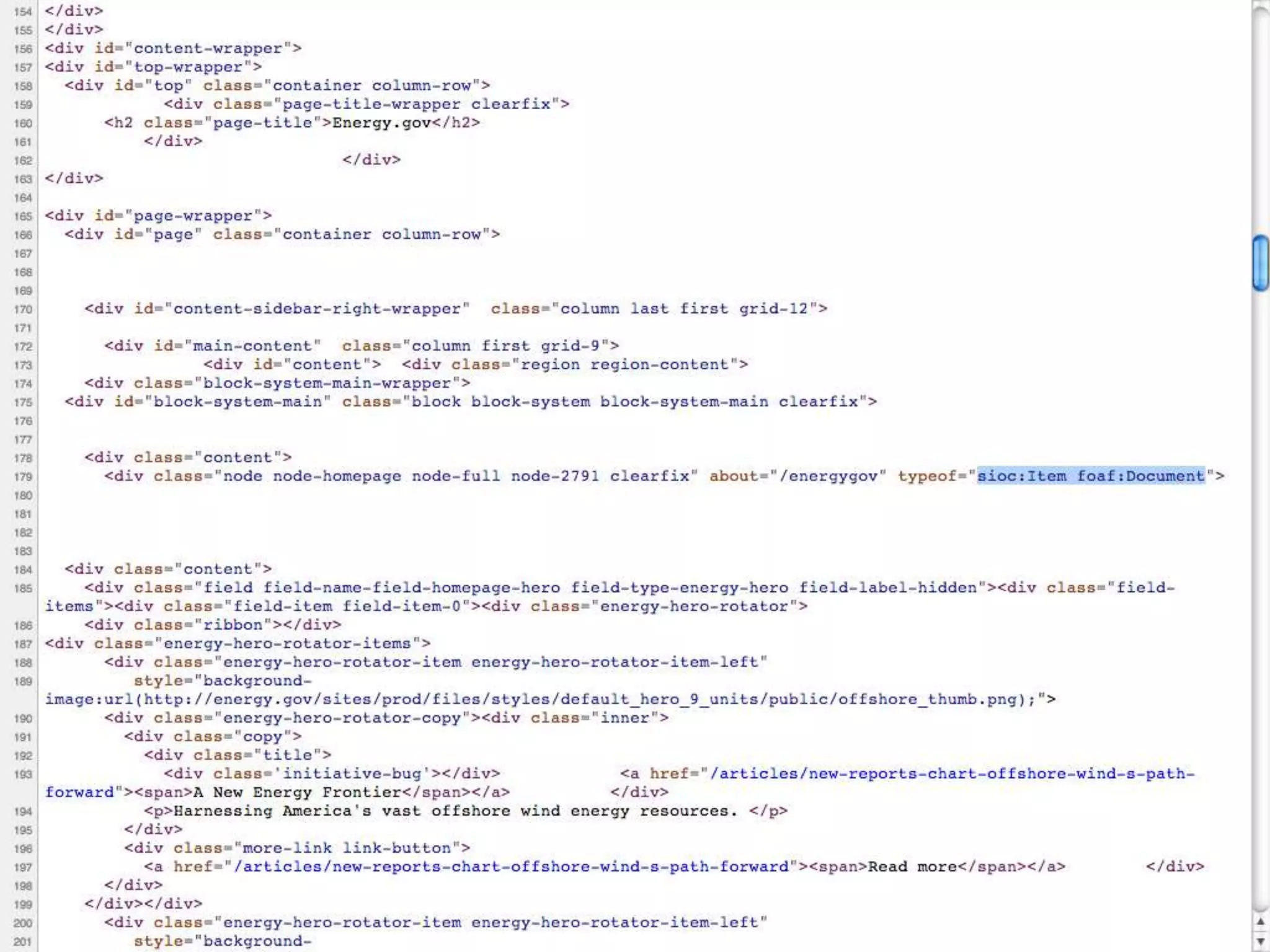
RDFa in Drupal 7


• Drupal CMS used by 2% of all sites (7% of CMS)
   – 24% of .gov sites
• Drupal 7 release has Semantic Web support built-in
• RDFa (SIOC, FOAF, Dublin Core, SKOS) data for blog
  posts, forums, etc.
• Video at www.semantic-drupal.com


                 image from tinyurl.com/drupaper
SIOC can be used to...


• ...provide a layer of rdfa metadata from a social website,
  e.g. to enhance search results>> superceded by
  schema.org?
• ...get a complete representation/XML dump of a social
  website (export, import)
• ...be a native format for social websites
• ...do other stuff; just imagine!


                     image from tinyurl.com/orionw
How much SSW data is out there?


   images (this one and later backgrounds) from publicdomainpictures.net
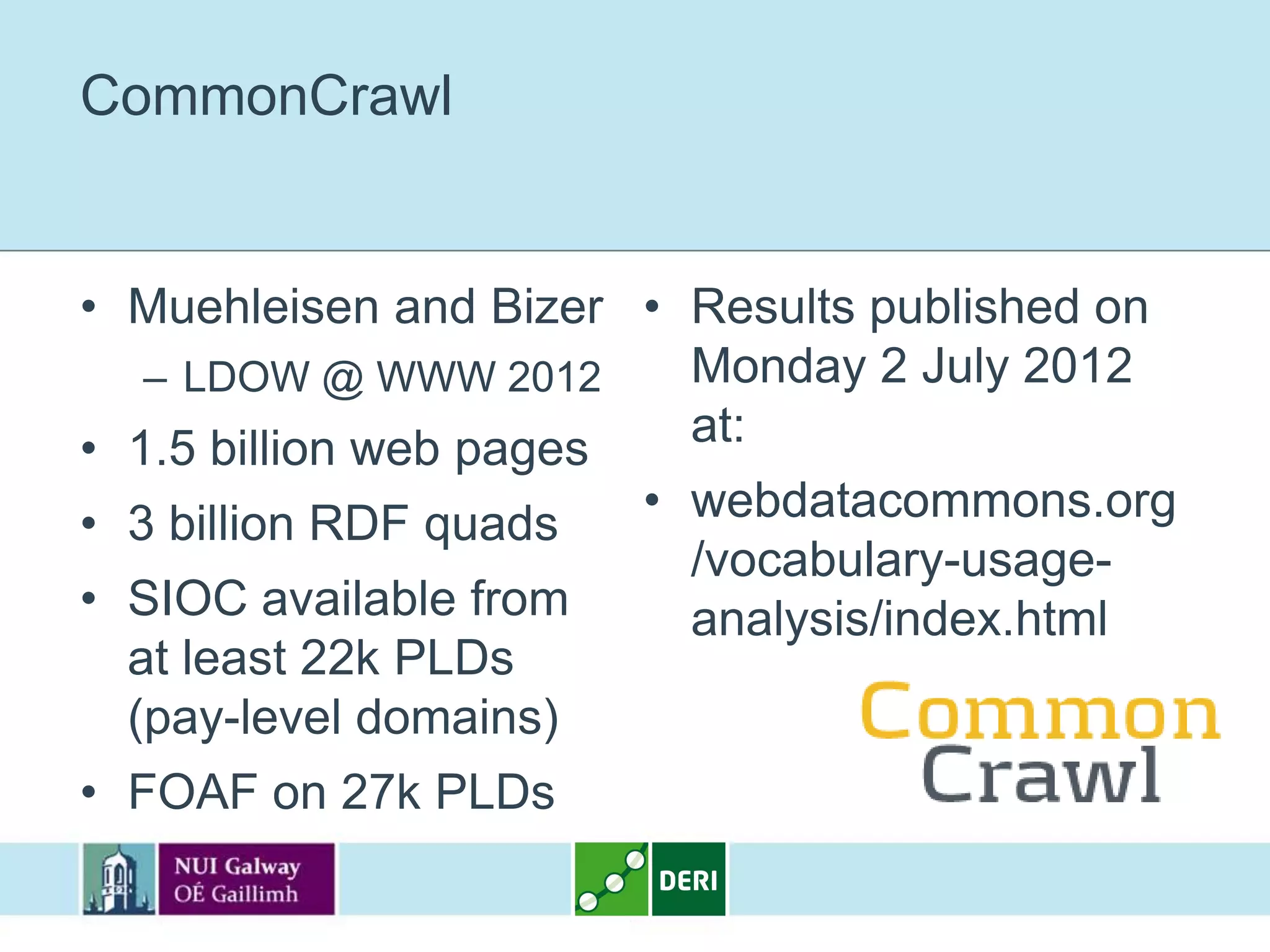
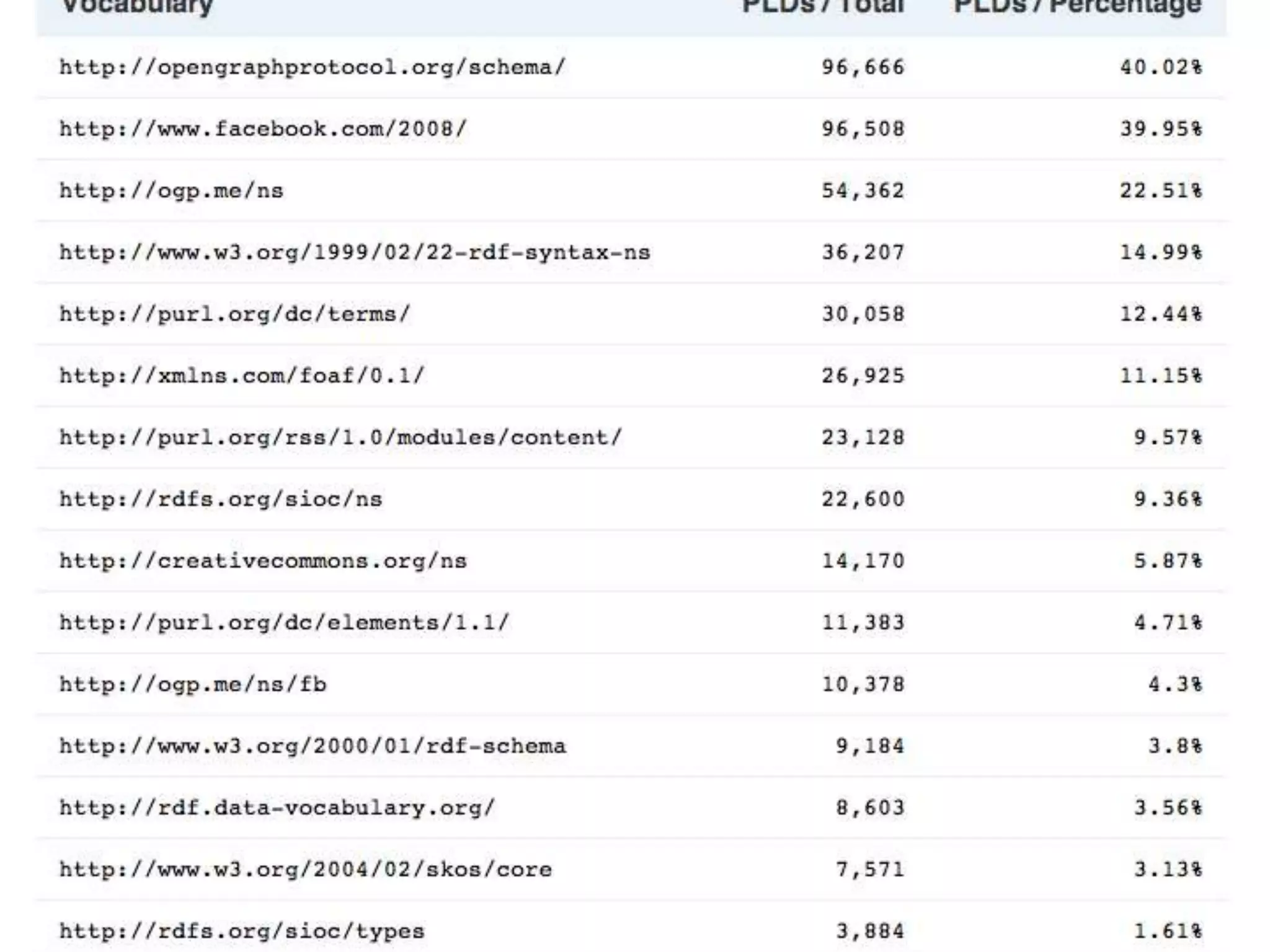
CommonCrawl


• Muehleisen and Bizer • Results published on
   – LDOW @ WWW 2012     Monday 2 July 2012
• 1.5 billion web pages  at:
• 3 billion RDF quads   • webdatacommons.org
                          /vocabulary-usage-
• SIOC available from     analysis/index.html
  at least 22k PLDs
  (pay-level domains)
• FOAF on 27k PLDs
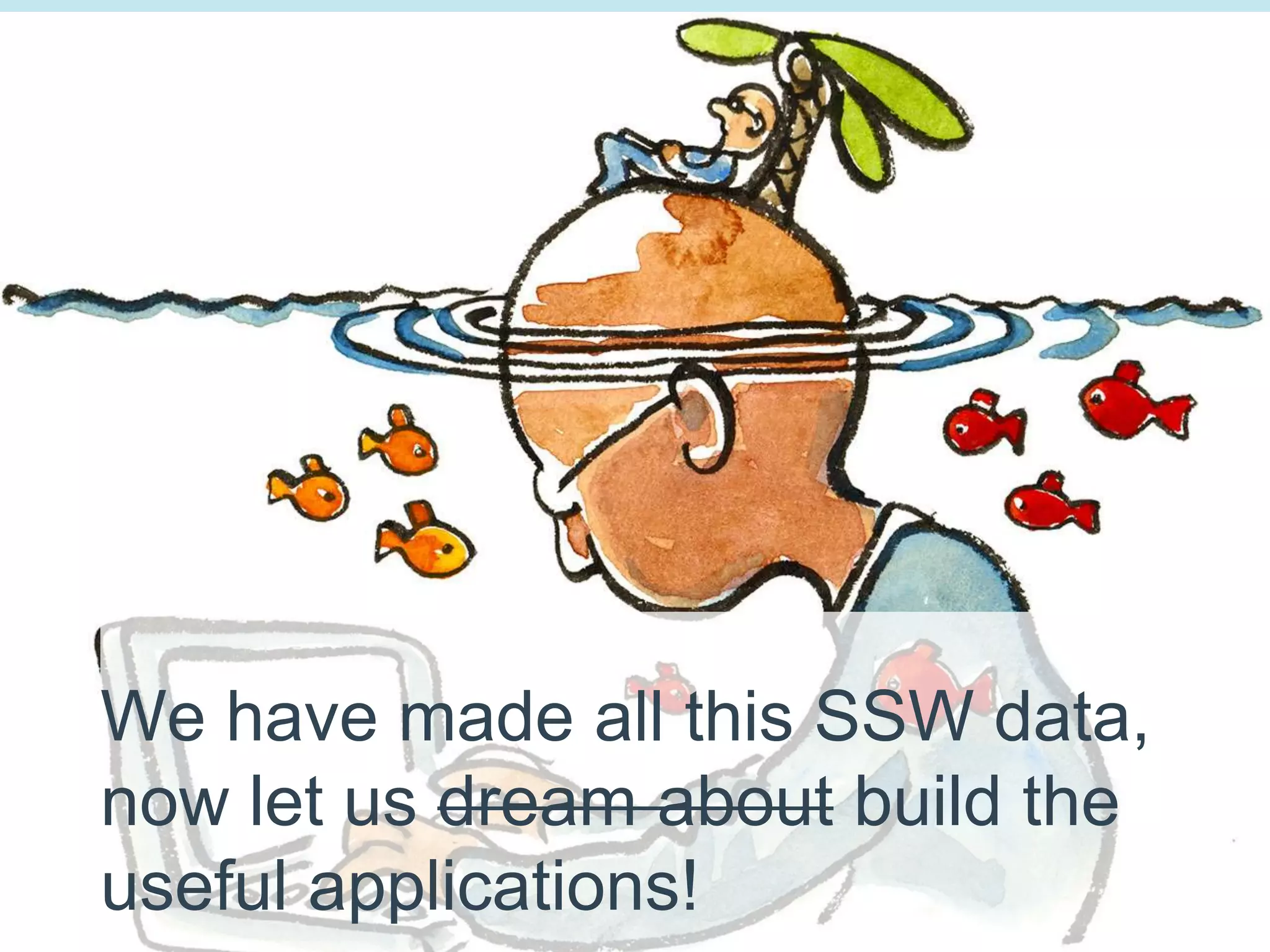
We have made all this SSW data,
now let us dream about build the
useful applications!
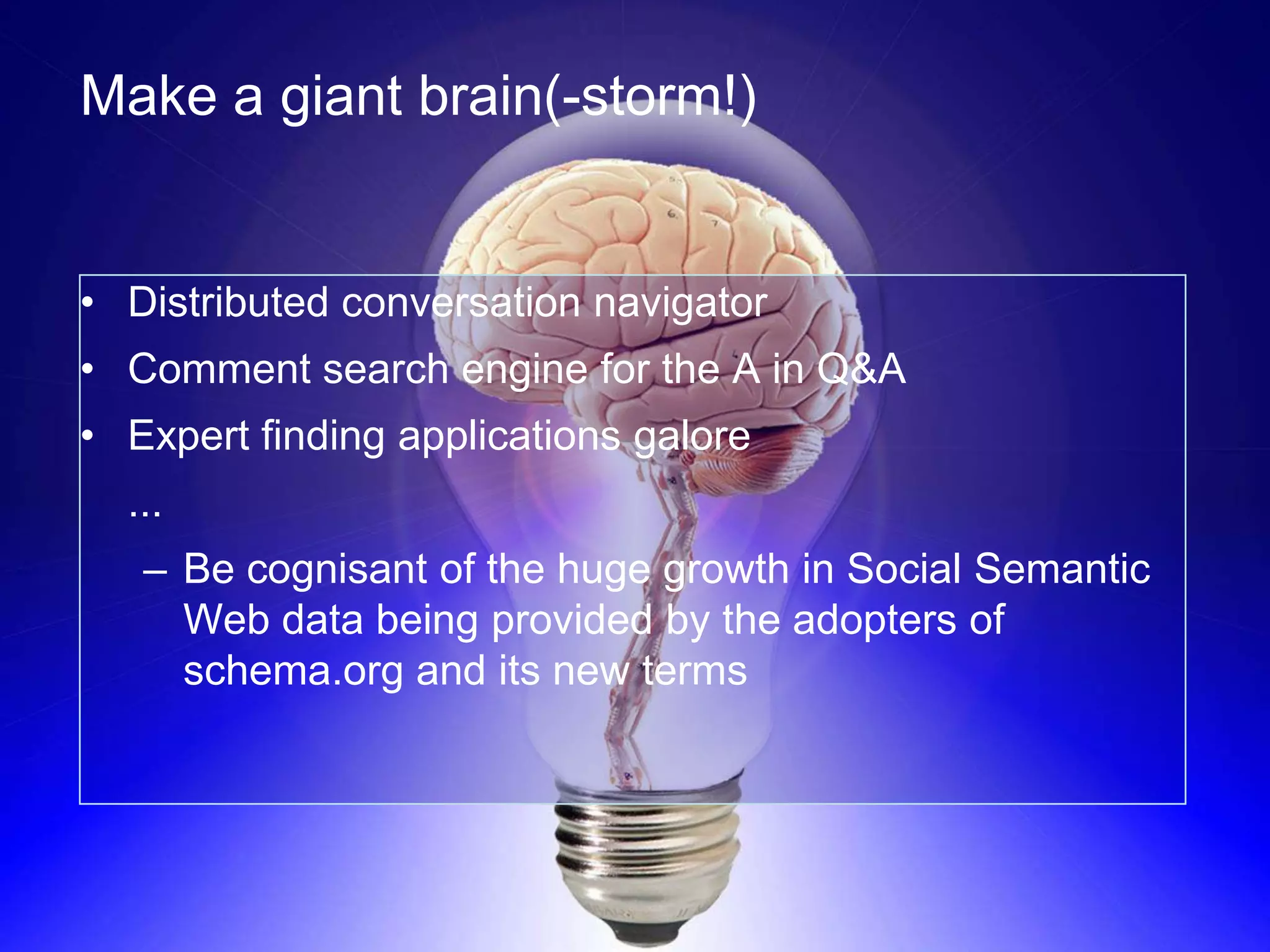
Make a giant brain(-storm!)


• Distributed conversation navigator
• Comment search engine for the A in Q&A
• Expert finding applications galore
  ...
   – Be cognisant of the huge growth in Social Semantic
     Web data being provided by the adopters of
     schema.org and its new terms
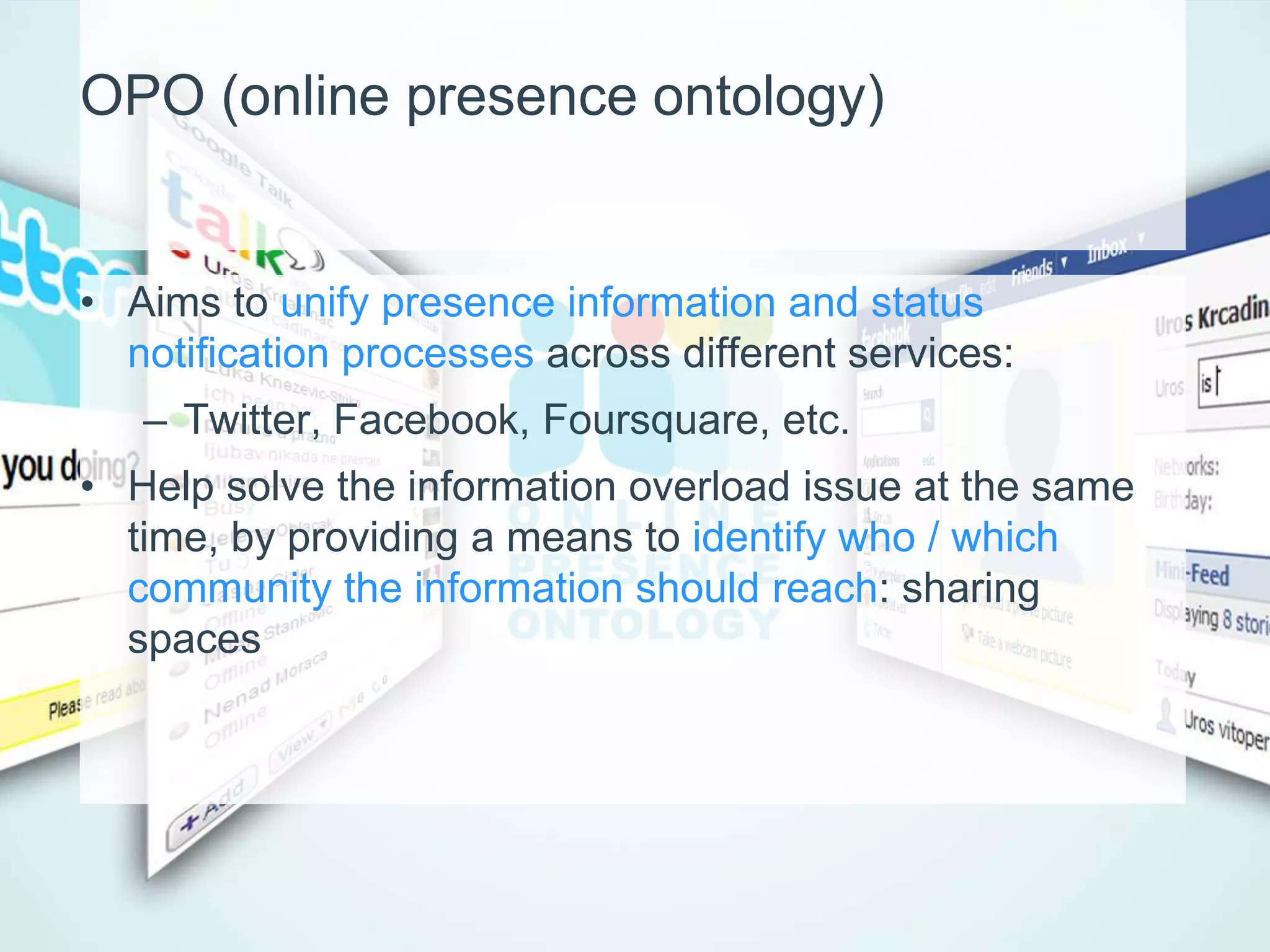
OPO (online presence ontology)


• Aims to unify presence information and status
  notification processes across different services:
   – Twitter, Facebook, Foursquare, etc.
• Help solve the information overload issue at the same
  time, by providing a means to identify who / which
  community the information should reach: sharing
  spaces
MOAT (meaning of a tag)


• moat-project.org
• A model to define "meanings" of tags
   – SPARQL →dbpedia.org/resource/SPARQL
• User-driven interlinking
• Tagged content enters Linked Data web
• Collaborative approach towards the sharing of
  meanings in a community


                  image from tinyurl.com/whichapple
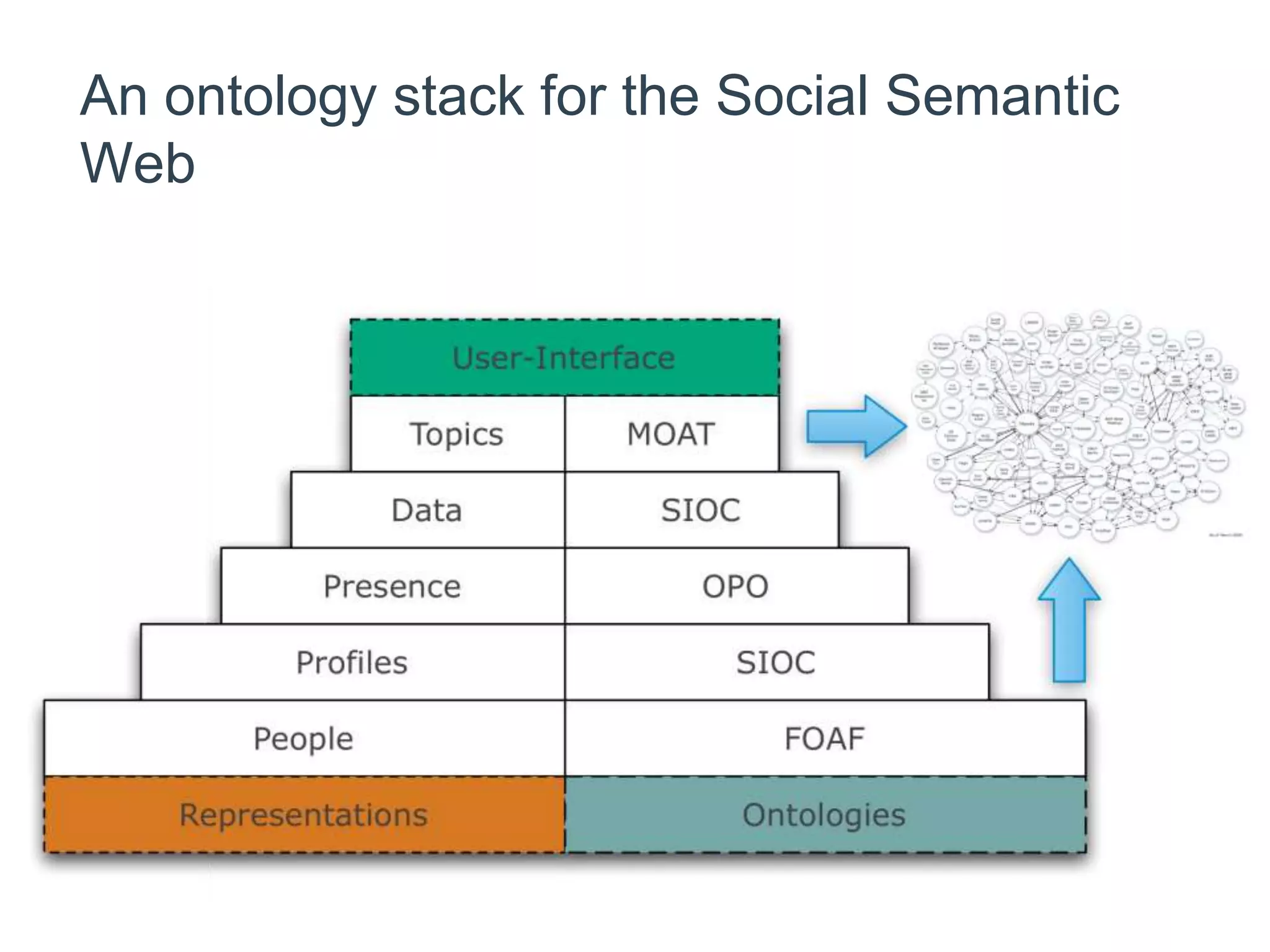
An ontology stack for the Social Semantic
Web
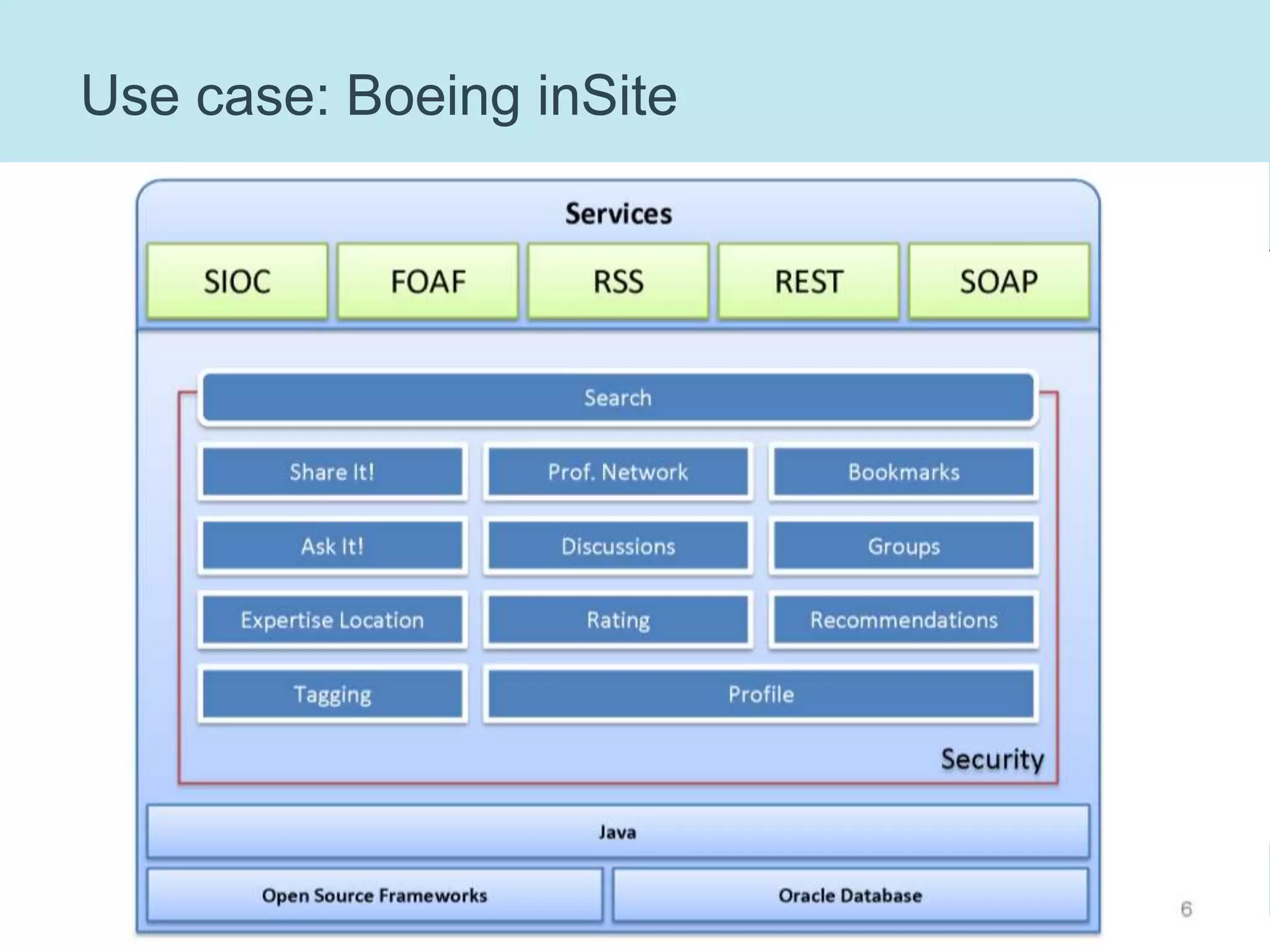
Use case: Boeing inSite
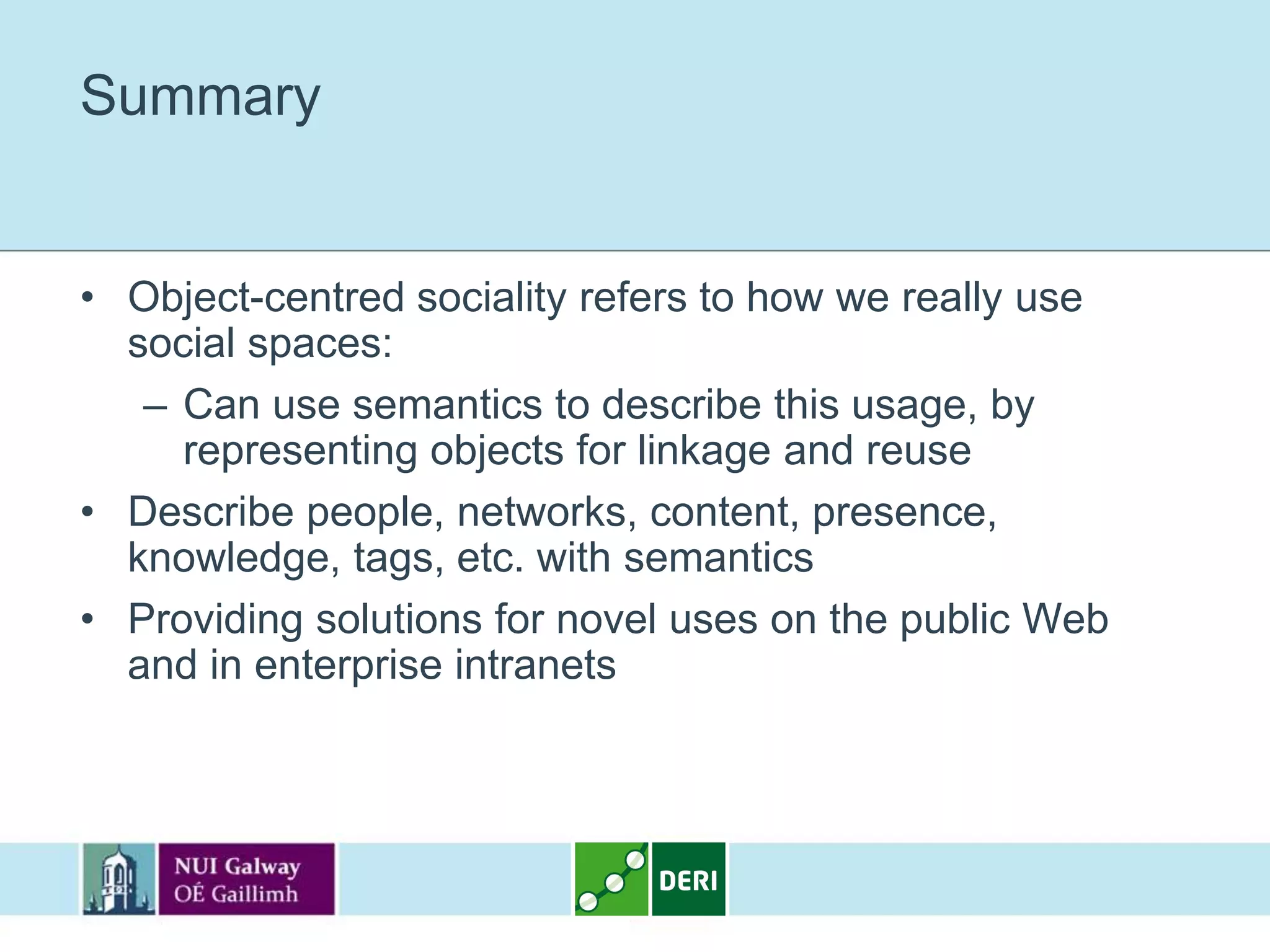
Summary


• Object-centred sociality refers to how we really use
  social spaces:
   – Can use semantics to describe this usage, by
     representing objects for linkage and reuse
• Describe people, networks, content, presence,
  knowledge, tags, etc. with semantics
• Providing solutions for novel uses on the public Web
  and in enterprise intranets
image from tinyurl.com/starshiptr
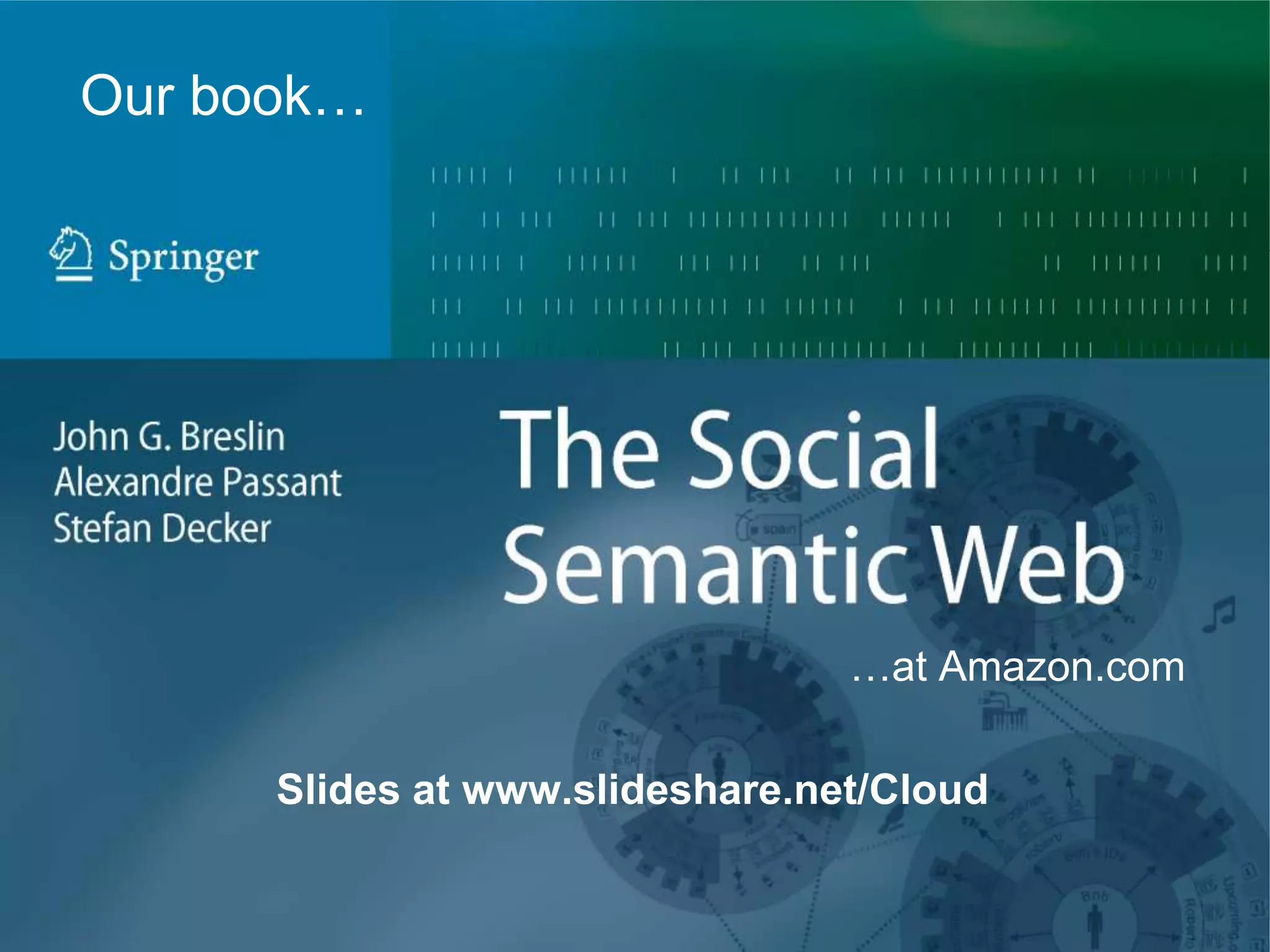
Our book…


                                 …at Amazon.com

      Slides at www.slideshare.net/Cloud

The Social Semantic Web

  • 1.
    John Breslin National Universityof Ireland, Galway @johnbreslin / johnbreslin.com
  • 2.
    Lecturer at NUIGalway College of Engineering and Informatics
  • 3.
    • Researcher atDERI, NUI Galway
  • 4.
  • 5.
    1990/1991: VAX/VMS “MAP.COM”
  • 6.
  • 7.
    1998: Set upa gaming forum 2000: Co-founded boards.ie from this • Ireland’s largest discussion forum site • 2.25 million visitors/month (~40% of Irish population) • Irish people seeking information, or just chatting about sports, TV, politics, health, whatever
  • 8.
  • 9.
    2004: Joined DERI,founded the SIOC project • Semantically- Interlinked Online Communities • Enables interoperability and exchange of social content: – Blogs, forums, wikis...
  • 10.
    2011: Co-founder ofStreamGlider, Inc. • Real-time streaming newsreader • Supports social, multimedia, news • Can be used as an enterprise dashboard • With Nova Spivack and Bill McDaniel
  • 11.
    Social platforms arelike data silos image from pidgintech.com
  • 12.
    Many isolated communitiesof users and their data image from pidgintech.com
  • 13.
    Need ways toconnect these islands image from pidgintech.com
  • 14.
    Allowing users toeasily travel from one to another image from pidgintech.com
  • 15.
    Enabling users toeasily bring their data with them image from pidgintech.com
  • 16.
    Object-centred sociality (AKAsocial objects) • Users are connected via a common object: – Their job, university, hobbies, interests, a date… • “According to this theory, people don’t just connect to each other. They connect through a shared object. […]Good services allow people to create social objects that add value.” – JyriEngestrom – Flickr = photos – del.icio.us = bookmarks – Blogs = discussion posts
  • 17.
    It’s the socialobjects we create… • Discussions • Bookmarks • Annotations • Profiles • Microblogs • Multimedia
  • 18.
  • 19.
  • 21.
  • 22.
    Social semantic representation models Usingontologies to model social data
  • 23.
    Two-way street: theSemantic Web can help social spaces, vice versa • Can use the Semantic Web to describe people, content objects and the connections that bind them all together so that social spaces can interoperate via semantics • In the other direction, object-centered social spaces can serve as rich social data sources for semantic applications image from tinyurl.com/highway2
  • 24.
  • 25.
  • 26.
    What is FOAF? •An ontology for describing people and the relationships that exist between them: – http://foaf-project.org/ – Identity, personal profiles and social networks – Can be integrated with other SW vocabularies • FOAF on the Web: – LiveJournal, MyOpera, identi.ca, MyBlogLog, hi5, Fotothing, Videntity, FriendFeed, Ecademy, Typepad
  • 27.
    FOAF at aglance
  • 28.
  • 30.
    SIOC, pronounced shock image from tinyurl.com/siocshock
  • 31.
    Semantically-Interlinked Online Communities (SIOC) •Goal of the SIOC ontology is to address interoperability issues on the Social Web – sioc-project.org – W3C member submission in 2007 – SIOC has been adopted in a framework of applications or modules deployed on hundreds of sites – Web 2.0, enterprise information integration, HCLS, e- government image from tinyurl.com/friendship2
  • 33.
    Some of theSIOC core ontology classes and properties
  • 35.
  • 36.
  • 37.
    RDFa in Drupal7 • Drupal CMS used by 2% of all sites (7% of CMS) – 24% of .gov sites • Drupal 7 release has Semantic Web support built-in • RDFa (SIOC, FOAF, Dublin Core, SKOS) data for blog posts, forums, etc. • Video at www.semantic-drupal.com image from tinyurl.com/drupaper
  • 40.
    SIOC can beused to... • ...provide a layer of rdfa metadata from a social website, e.g. to enhance search results>> superceded by schema.org? • ...get a complete representation/XML dump of a social website (export, import) • ...be a native format for social websites • ...do other stuff; just imagine! image from tinyurl.com/orionw
  • 41.
    How much SSWdata is out there? images (this one and later backgrounds) from publicdomainpictures.net
  • 42.
    CommonCrawl • Muehleisen andBizer • Results published on – LDOW @ WWW 2012 Monday 2 July 2012 • 1.5 billion web pages at: • 3 billion RDF quads • webdatacommons.org /vocabulary-usage- • SIOC available from analysis/index.html at least 22k PLDs (pay-level domains) • FOAF on 27k PLDs
  • 44.
    We have madeall this SSW data, now let us dream about build the useful applications!
  • 45.
    Make a giantbrain(-storm!) • Distributed conversation navigator • Comment search engine for the A in Q&A • Expert finding applications galore ... – Be cognisant of the huge growth in Social Semantic Web data being provided by the adopters of schema.org and its new terms
  • 46.
    OPO (online presenceontology) • Aims to unify presence information and status notification processes across different services: – Twitter, Facebook, Foursquare, etc. • Help solve the information overload issue at the same time, by providing a means to identify who / which community the information should reach: sharing spaces
  • 47.
    MOAT (meaning ofa tag) • moat-project.org • A model to define "meanings" of tags – SPARQL →dbpedia.org/resource/SPARQL • User-driven interlinking • Tagged content enters Linked Data web • Collaborative approach towards the sharing of meanings in a community image from tinyurl.com/whichapple
  • 48.
    An ontology stackfor the Social Semantic Web
  • 50.
  • 51.
    Summary • Object-centred socialityrefers to how we really use social spaces: – Can use semantics to describe this usage, by representing objects for linkage and reuse • Describe people, networks, content, presence, knowledge, tags, etc. with semantics • Providing solutions for novel uses on the public Web and in enterprise intranets
  • 52.
  • 53.
    Our book… …at Amazon.com Slides at www.slideshare.net/Cloud