The Social Web

Dagje Studeren IMM 25-2-2014
Victor de Boer
(met slides van Lora Aroyo en Marieke van Erp)
Our goal is to …

understand the practices, implications, culture, &
meaning of the sites, as well as users' engagement
with them

include this understanding as part of software
engineering for the new social world
agapegeek.com
In Social Web course to goal is to understand & try out
how the Social Web works

•
•
•
•
•
•

What IS the Social Web?
What do people DO on the Social Web?
How is DATA on the Social Web ACCESSED?
How is DATA on the Social Web STUDIED?
What are typical Social Web APPLICATIONS?
What are CHALLENGES on the Social Web?
What is the Social Web?
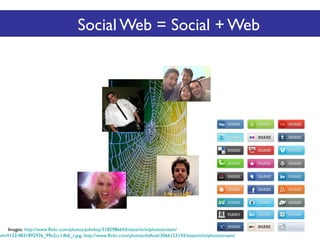
Social Web = Social + Web

Images: http://www.flickr.com/photos/johnkay/3182986643/sizes/m/in/photostream/
om/4132/4831892926_99a2cc1db6_t.jpg, http://www.flickr.com/photos/dizfunk/3066153143/sizes/m/in/photostream/
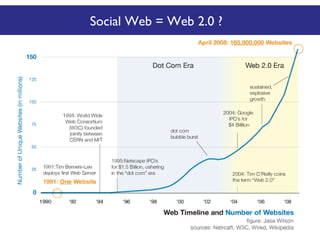
Social Web = Web 2.0 ?
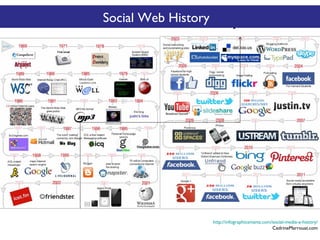
Social Web History
Social Web: A History

http://infographicsmania.com/social-media-a-history/
CedrineMarrouat.com
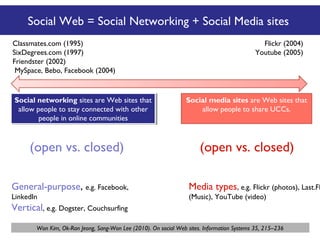
Social Web = Social Networking + Social Media sites
Classmates.com (1995)
SixDegrees.com (1997)
Friendster (2002)
MySpace, Bebo, Facebook (2004)

Social networking sites are Web sites that
allow people to stay connected with other
people in online communities
(open vs. closed)

Flickr (2004)
Youtube (2005)

Social media sites are Web sites that
allow people to share UCCs.

(open vs. closed)

General-purpose, e.g. Facebook,

Media types, e.g. Flickr (photos), Last.FM

LinkedIn

(Music), YouTube (video)

Vertical, e.g. Dogster, Couchsurfing
Won Kim, Ok-Ran Jeong, Sang-Won Lee (2010). On social Web sites. Information Systems 35, 215–236
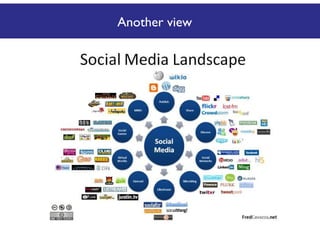
Another view
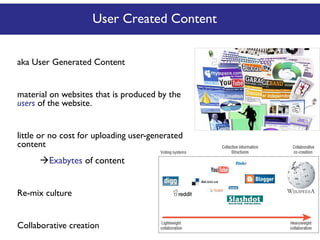
User Created Content
aka User Generated Content
material on websites that is produced by the
users of the website.
little or no cost for uploading user-generated
content

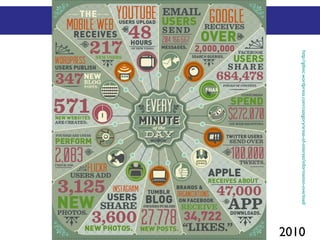
Exabytes of content
Re-mix culture
Collaborative creation
http://gibsic.wordpress.com/category/areas-of-interest/information-overload/

2010
The Big Ones
2004: Facebook
distinct college networks only
(Harvard-only SNS)
2005: Facebook
including other universities, high school students,
professionals inside corporate networks, and,
eventually - everyone
ability for outside developers to build
"Applications"
2007: Facebook API
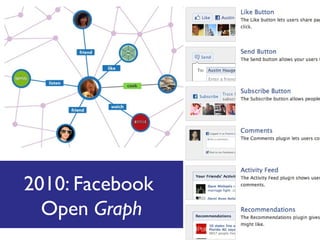
2010: Facebook
Open Graph
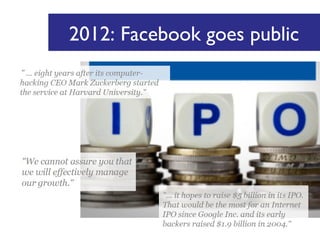
2012: Facebook goes public
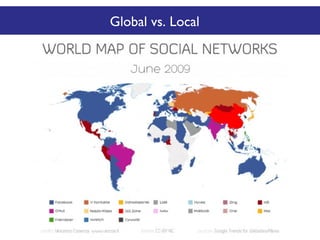
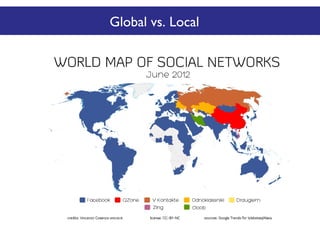
Global vs. Local
Global vs. Local
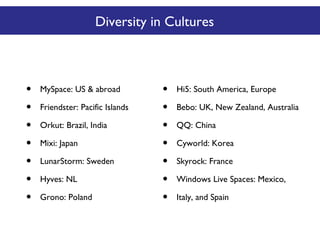
Diversity in Cultures

•
•
•
•
•
•
•

MySpace: US & abroad
Friendster: Pacific Islands
Orkut: Brazil, India
Mixi: Japan
LunarStorm: Sweden
Hyves: NL
Grono: Poland

•
•
•
•
•
•
•

Hi5: South America, Europe
Bebo: UK, New Zealand, Australia
QQ: China
Cyworld: Korea
Skyrock: France
Windows Live Spaces: Mexico,
Italy, and Spain
It’s not all fun and
games...
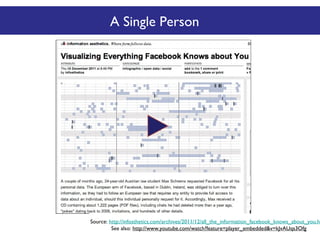
A Single Person

Source: http://infosthetics.com/archives/2011/12/all_the_information_facebook_knows_about_you.ht
See also: http://www.youtube.com/watch?feature=player_embedded&v=kJvAUqs3Ofg
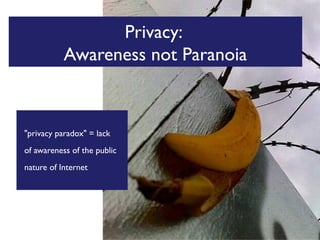
Privacy:
Awareness not Paranoia

"privacy paradox" = lack
of awareness of the public
nature of Internet
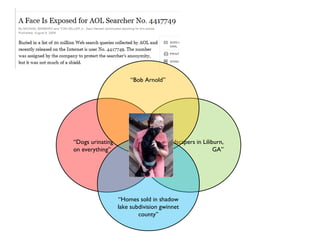
“Bob Arnold”

“Dogs urinating
on everything”

“Landscapers in Liliburn,
GA”

“Homes sold in shadow
lake subdivision gwinnet
county”
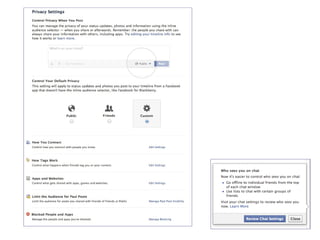
Privacy concerns

•
•

Legal still in its infancy, but courts do rule on new behavior

•

e.g., do police officers have the right to access content
posted to Facebook without a warrant?

•

Truthfulness of personal profiles has become a subject of
debate

•

Privacy hard to understand (few read Terms) and
misinterpret ‘Friends’

fourth amendment to the U.S. Constitution & legal
decisions concerning privacy are not equipped to address
social network sites
Security
security from people (sex offenders)
security of computers and data
With enormous numbers of users and
enormous amounts of data, sites are natural
targets of spammers, and phishing and
malware attacks (‘new friend malware’,
‘twitter spam’ etc.)
Social Web Analysis
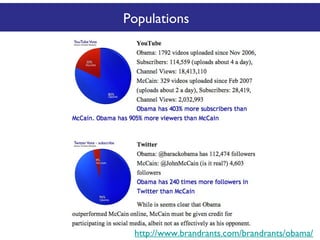
Populations

http://www.brandrants.com/brandrants/obama/
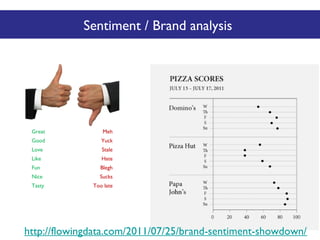
Sentiment / Brand analysis

Great

Meh

Good

Yuck

Love

Stale

Like

Hate

Fun

Blegh

Nice

Sucks

Tasty

Too late

http://flowingdata.com/2011/07/25/brand-sentiment-showdown/
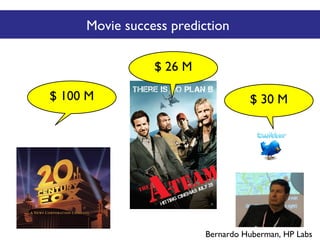
Movie success prediction
$ 26 M
$ 100 M

$ 30 M

?
Bernardo Huberman, HP Labs
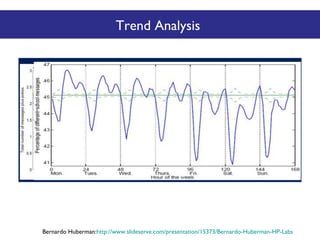
Trend Analysis

Bernardo Huberman:http://www.slideserve.com/presentation/15373/Bernardo-Huberman-HP-Labs
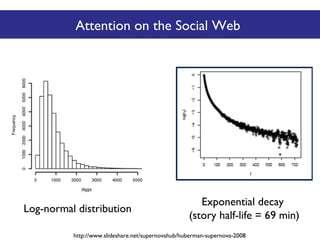
Attention on the Social Web

Log-normal distribution

Exponential decay
(story half-life = 69 min)

http://www.slideshare.net/supernovahub/huberman-supernova-2008
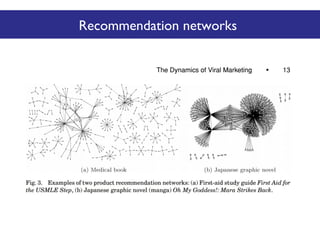
Recommendation networks
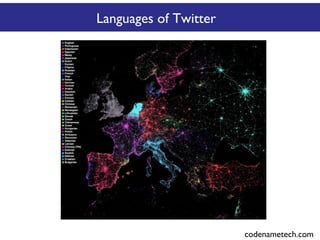
Languages of Twitter

codenametech.com
Reflections

•
•
•

Twitter profile vs. Facebook profile?

•
•

Pros & cons of (a)symmetry of friendship?

•

How often do you experience problems of duplication of content
shared across different sites?

•

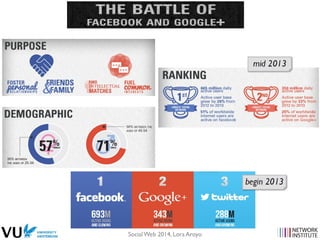
FB vs Google+ actions for retaining users?

Find friends on different networks?
How does LinkedIn facilitate the forming & joining of groups? FB?
Google+? Others?

Twitter vs. Facebook vs. Flickr vs.Vine differences in terms facilitating
communication?
Where do YOU come in
• understand the practices, implications,

culture & meaning of the sites, as well as
users' engagement with them

• learn how to use this knowledge in

designing successful social web applications
Hands-on Teaser
•
•
•

Visualise your Facebook Network
Tag Cloud of your wall posts
Analyse what’s trending on Twitter
and how people talk about certain
topics

image source: http://www.flickr.com/photos/bionicteaching/1375254387/

Social Web for VU Dagje Studeren

  • 1.
    The Social Web DagjeStuderen IMM 25-2-2014 Victor de Boer (met slides van Lora Aroyo en Marieke van Erp)
  • 3.
    Our goal isto … understand the practices, implications, culture, & meaning of the sites, as well as users' engagement with them include this understanding as part of software engineering for the new social world agapegeek.com
  • 4.
    In Social Webcourse to goal is to understand & try out how the Social Web works • • • • • • What IS the Social Web? What do people DO on the Social Web? How is DATA on the Social Web ACCESSED? How is DATA on the Social Web STUDIED? What are typical Social Web APPLICATIONS? What are CHALLENGES on the Social Web?
  • 5.
    What is theSocial Web?
  • 6.
    Social Web =Social + Web Images: http://www.flickr.com/photos/johnkay/3182986643/sizes/m/in/photostream/ om/4132/4831892926_99a2cc1db6_t.jpg, http://www.flickr.com/photos/dizfunk/3066153143/sizes/m/in/photostream/
  • 7.
    Social Web =Web 2.0 ?
  • 8.
    Social Web History SocialWeb: A History http://infographicsmania.com/social-media-a-history/ CedrineMarrouat.com
  • 10.
    Social Web =Social Networking + Social Media sites Classmates.com (1995) SixDegrees.com (1997) Friendster (2002) MySpace, Bebo, Facebook (2004) Social networking sites are Web sites that Social networking sites are Web sites that allow people to stay connected with other allow people to stay connected with other people in online communities people in online communities (open vs. closed) Flickr (2004) Youtube (2005) Social media sites are Web sites that allow people to share UCCs. (open vs. closed) General-purpose, e.g. Facebook, Media types, e.g. Flickr (photos), Last.FM LinkedIn (Music), YouTube (video) Vertical, e.g. Dogster, Couchsurfing Won Kim, Ok-Ran Jeong, Sang-Won Lee (2010). On social Web sites. Information Systems 35, 215–236
  • 11.
  • 12.
    User Created Content akaUser Generated Content material on websites that is produced by the users of the website. little or no cost for uploading user-generated content Exabytes of content Re-mix culture Collaborative creation
  • 13.
  • 15.
  • 16.
    2004: Facebook distinct collegenetworks only (Harvard-only SNS)
  • 17.
    2005: Facebook including otheruniversities, high school students, professionals inside corporate networks, and, eventually - everyone ability for outside developers to build "Applications"
  • 18.
  • 19.
  • 20.
  • 21.
  • 22.
  • 24.
    Diversity in Cultures • • • • • • • MySpace:US & abroad Friendster: Pacific Islands Orkut: Brazil, India Mixi: Japan LunarStorm: Sweden Hyves: NL Grono: Poland • • • • • • • Hi5: South America, Europe Bebo: UK, New Zealand, Australia QQ: China Cyworld: Korea Skyrock: France Windows Live Spaces: Mexico, Italy, and Spain
  • 25.
    It’s not allfun and games...
  • 26.
    A Single Person Source:http://infosthetics.com/archives/2011/12/all_the_information_facebook_knows_about_you.ht See also: http://www.youtube.com/watch?feature=player_embedded&v=kJvAUqs3Ofg
  • 27.
    Privacy: Awareness not Paranoia "privacyparadox" = lack of awareness of the public nature of Internet
  • 28.
    “Bob Arnold” “Dogs urinating oneverything” “Landscapers in Liliburn, GA” “Homes sold in shadow lake subdivision gwinnet county”
  • 29.
    Privacy concerns • • Legal stillin its infancy, but courts do rule on new behavior • e.g., do police officers have the right to access content posted to Facebook without a warrant? • Truthfulness of personal profiles has become a subject of debate • Privacy hard to understand (few read Terms) and misinterpret ‘Friends’ fourth amendment to the U.S. Constitution & legal decisions concerning privacy are not equipped to address social network sites
  • 32.
    Security security from people(sex offenders) security of computers and data With enormous numbers of users and enormous amounts of data, sites are natural targets of spammers, and phishing and malware attacks (‘new friend malware’, ‘twitter spam’ etc.)
  • 33.
  • 34.
  • 35.
    Sentiment / Brandanalysis Great Meh Good Yuck Love Stale Like Hate Fun Blegh Nice Sucks Tasty Too late http://flowingdata.com/2011/07/25/brand-sentiment-showdown/
  • 36.
    Movie success prediction $26 M $ 100 M $ 30 M ? Bernardo Huberman, HP Labs
  • 37.
  • 38.
    Attention on theSocial Web Log-normal distribution Exponential decay (story half-life = 69 min) http://www.slideshare.net/supernovahub/huberman-supernova-2008
  • 39.
  • 40.
  • 42.
    Reflections • • • Twitter profile vs.Facebook profile? • • Pros & cons of (a)symmetry of friendship? • How often do you experience problems of duplication of content shared across different sites? • FB vs Google+ actions for retaining users? Find friends on different networks? How does LinkedIn facilitate the forming & joining of groups? FB? Google+? Others? Twitter vs. Facebook vs. Flickr vs.Vine differences in terms facilitating communication?
  • 43.
    Where do YOUcome in • understand the practices, implications, culture & meaning of the sites, as well as users' engagement with them • learn how to use this knowledge in designing successful social web applications
  • 45.
    Hands-on Teaser • • • Visualise yourFacebook Network Tag Cloud of your wall posts Analyse what’s trending on Twitter and how people talk about certain topics image source: http://www.flickr.com/photos/bionicteaching/1375254387/

Editor's Notes

  • #3 http://www.youtube.com/watch?v=JdyBM-p05Ss
  • #5 Naturally we won’t treat everything here, but just to give you a taste of what aspects are all in there. Perhaps also link to other courses in introduction.
  • #13 exabyte (EB)1018  1 Miljard gigabytes
  • #17 A more in-depth use case
  • #18 I joined facebook 19 december 2006
  • #20 requires not only engineering good software but also understanding how it impacts people and their social relationships
  • #23 As his animated map shows, over the last few years Facebook has cut down the number of top social networks around the world from 17 to just six. More specifically, there were 17 in June 2009, 16 in December 2009, 14 in June 2010, 11 in December 2010, nine in June 2011, and six in December 2011. Here are the remaining six: Facebook, QZone, V Kontakte, Odnoklassniki,Drauglem, and Zing. Between June 2011 and December 2011, Facebook managed to conquer Netherlands, and with it the whole Europe, Brazil, after a long struggle to overtake Google's Orkut, as well as Japan (although a large part of Japanese networking activities are on mobile, including Gree, Mobage, and Mixi). If you remember that Facebook is still banned in many countries, such as China (the world's largest Internet population with 500 million people), the service's dominance is certainly impressive. If this trend continues, it won't be long before the social network is king in all the countries it can be accessed in.
  • #28 "privacy paradox" lack of awareness of the public nature of Internet (safety of younger users)reconstruct users' social security numbers with profile info, e.g. hometown and date of birthfrom freely accessible profile data - craft a "phishing" scheme appearing from a friendusers' ability to control impressions and manage social contexts, e.g. "News Feed" could disrupt users’ sense of controlno flexibility to handle conflicts with friends with different conceptions of privacy
  • #30 Pew found that 55% of online teens have profiles, 66% of whom report that their profile is not visible to all Internet users (Lenhart & Madden, 2007). Of the teens with completely open profiles, 46% reported including at least some false information.
  • #36 Brand example