Machine-to-machine
communication in rural conditions:
Realizing KasadakaNet
By Fahad Ali
Supervised by Victor de Boer
Contents
● Related works
● Problem description
● Research question
● Our solution: KasadakaNet
● Evaluation
● Discussion and conclusion
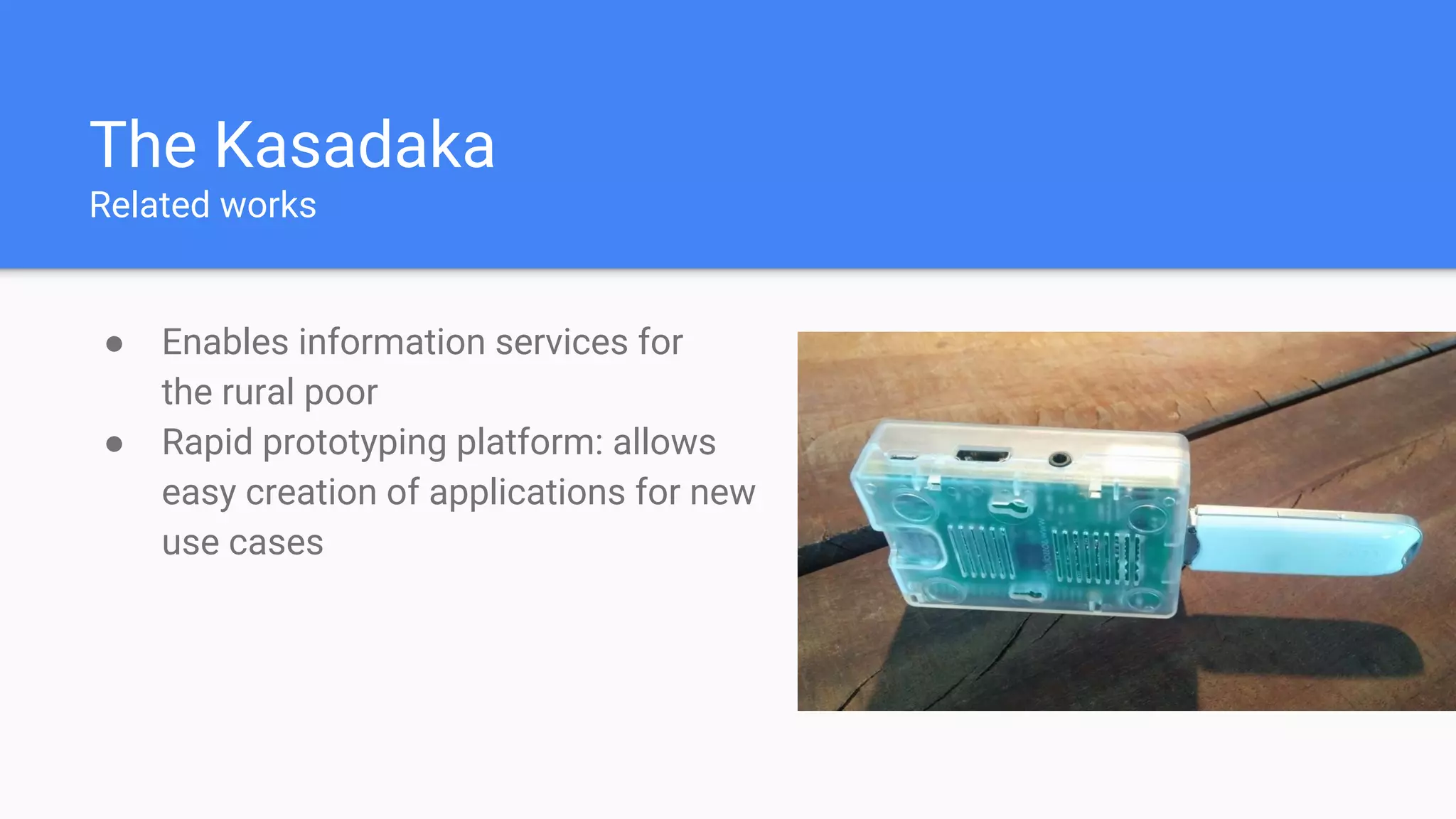
The Kasadaka
Related works
● Enables information services for
the rural poor
● Rapid prototyping platform: allows
easy creation of applications for new
use cases
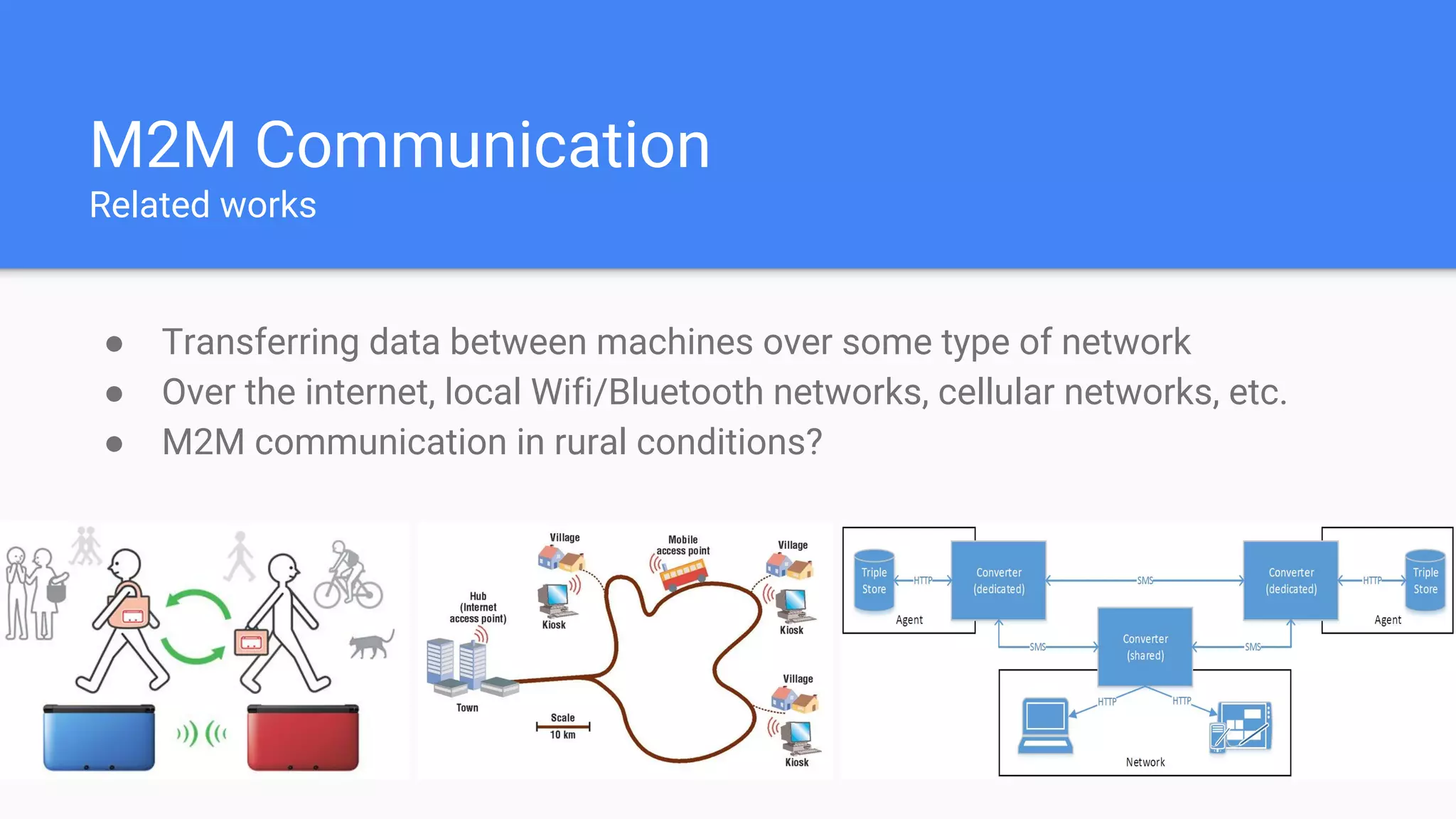
M2M Communication
Related works
● Transferring data between machines over some type of network
● Over the internet, local Wifi/Bluetooth networks, cellular networks, etc.
● M2M communication in rural conditions?
Problem description
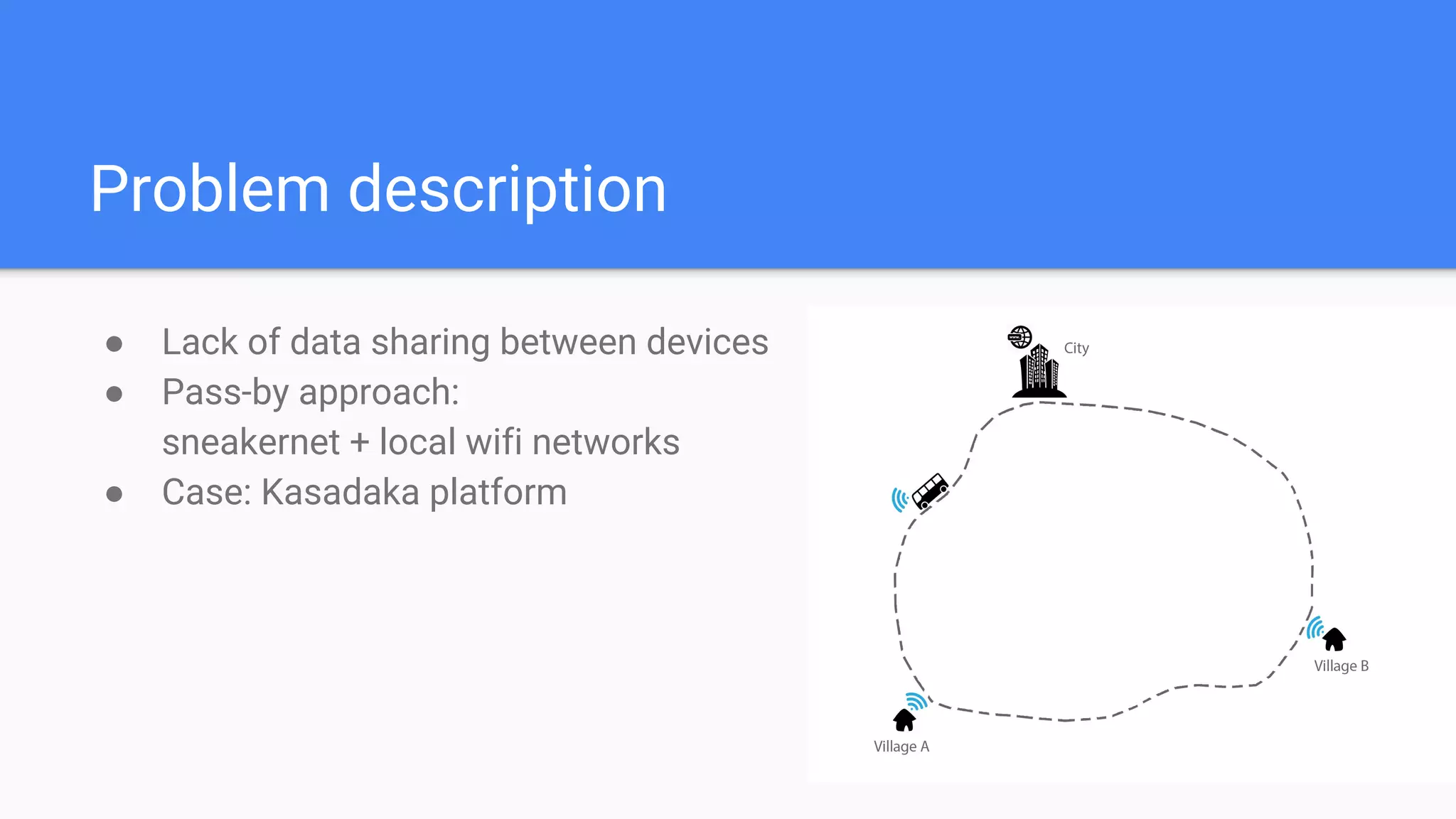
● Lack of data sharing between devices
● Pass-by approach:
sneakernet + local wifi networks
● Case: Kasadaka platform
Research question
● RQ: "How can machine-to-machine communication and semantic data
sharing be achieved using a pass-by communication method in such a way
that it matches requirements from ICT4D use cases?"
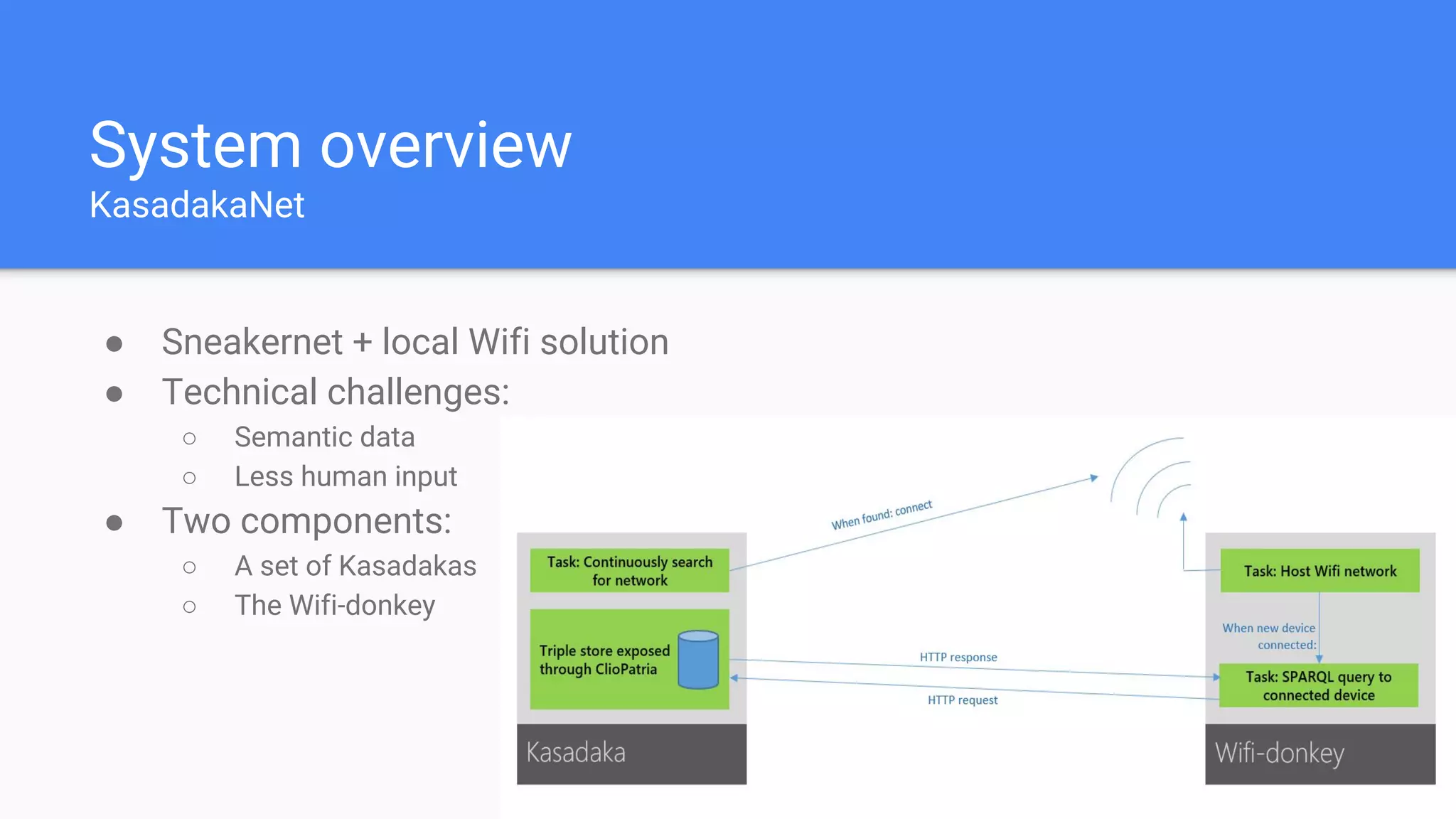
System overview
KasadakaNet
● Sneakernet + local Wifi solution
● Technical challenges:
○ Semantic data
○ Less human input
● Two components:
○ A set of Kasadakas
○ The Wifi-donkey
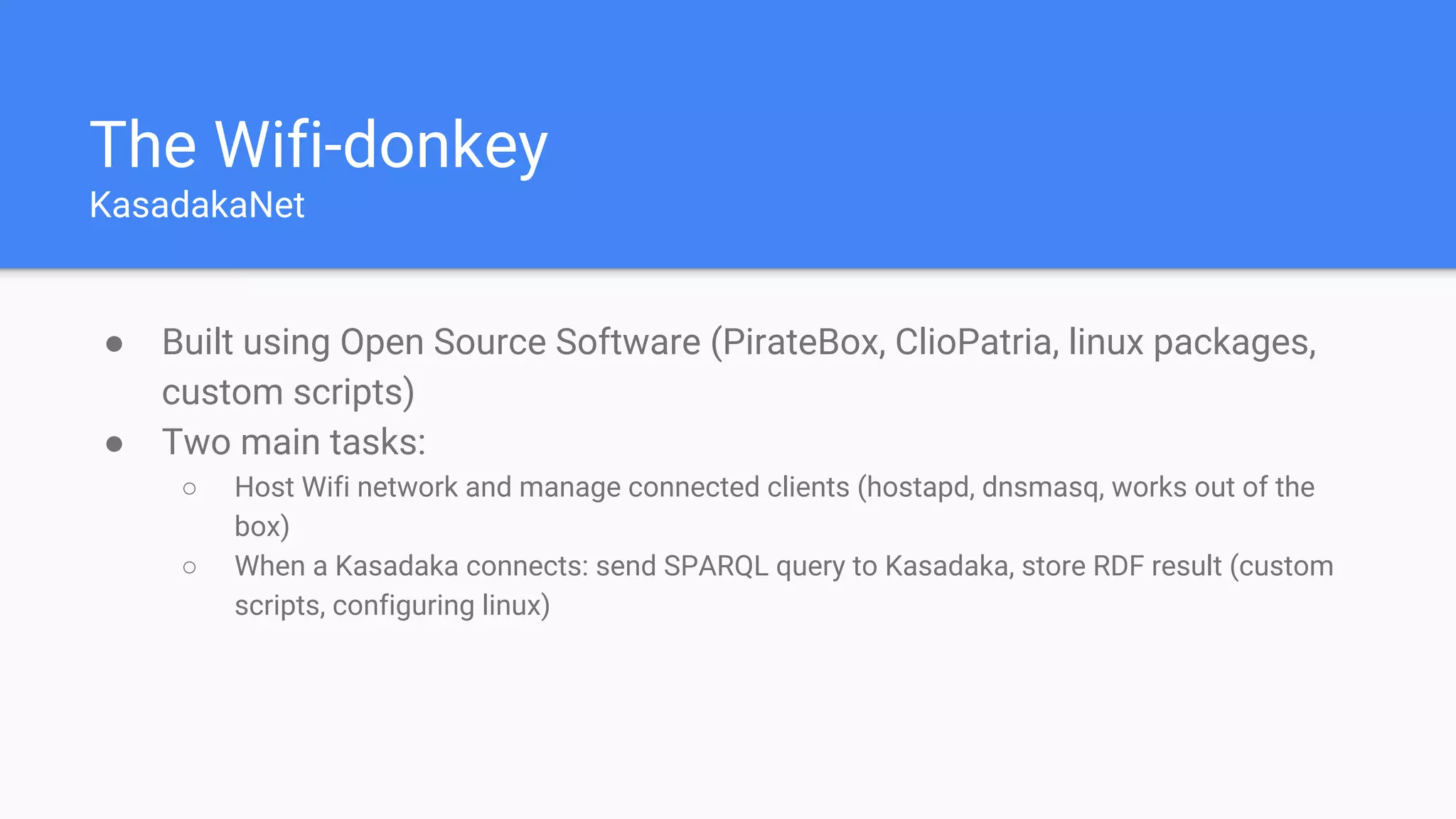
The Wifi-donkey
KasadakaNet
● Built using Open Source Software (PirateBox, ClioPatria, linux packages,
custom scripts)
● Two main tasks:
○ Host Wifi network and manage connected clients (hostapd, dnsmasq, works out of the
box)
○ When a Kasadaka connects: send SPARQL query to Kasadaka, store RDF result (custom
scripts, configuring linux)
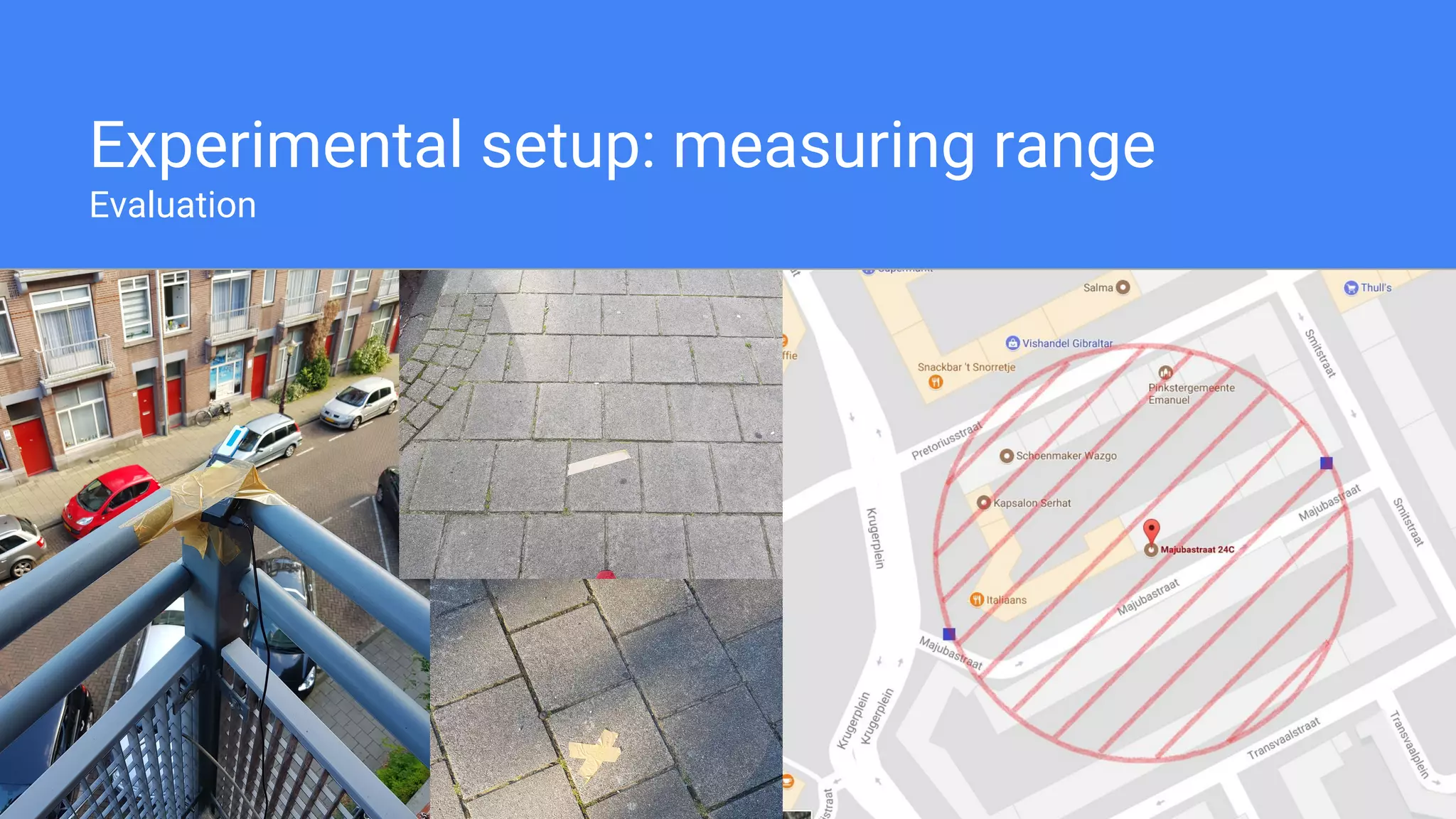
Experimental setup: measuring range
Evaluation
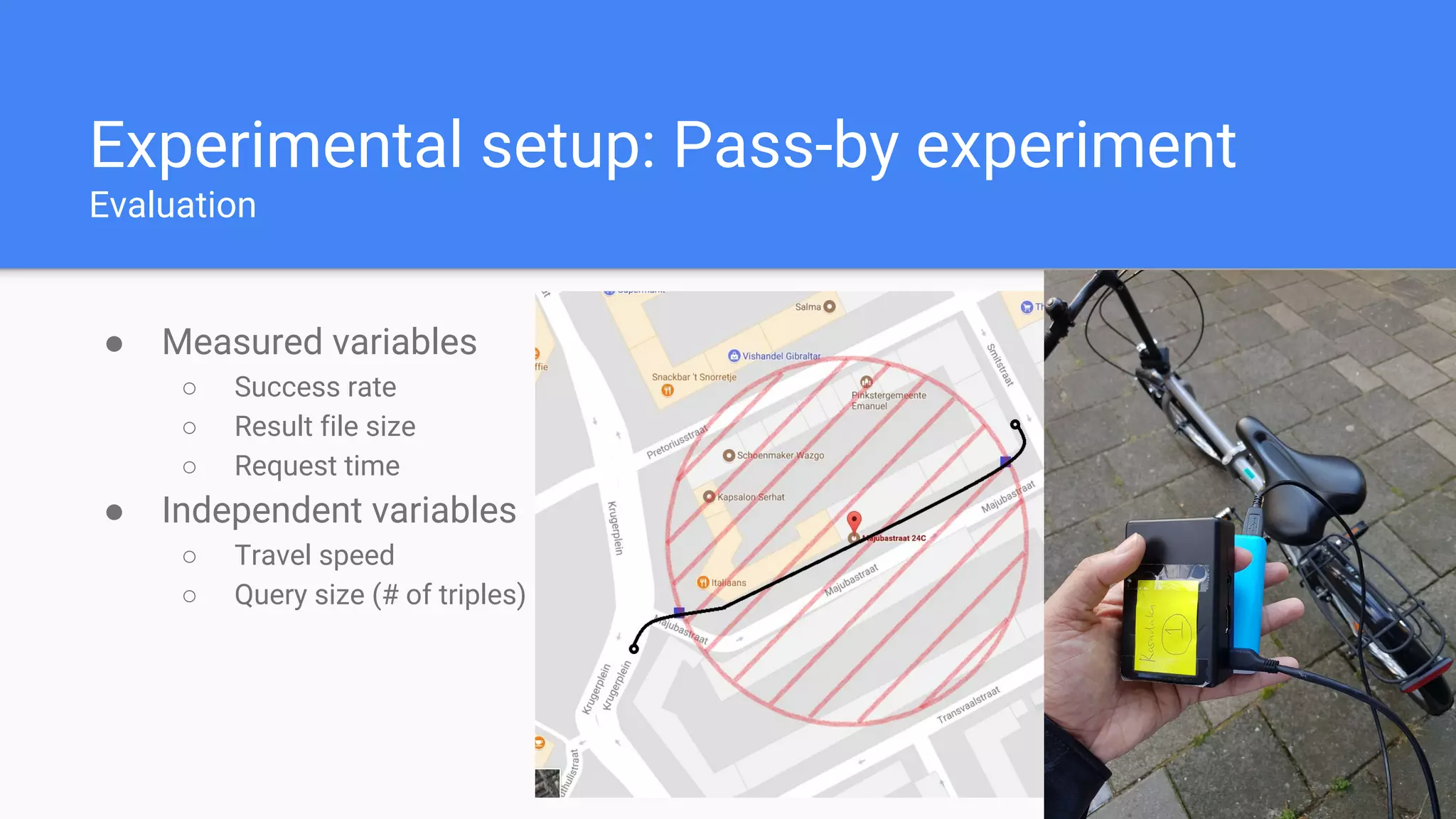
Experimental setup: Pass-by experiment
Evaluation
● Measured variables
○ Success rate
○ Result file size
○ Request time
● Independent variables
○ Travel speed
○ Query size (# of triples)
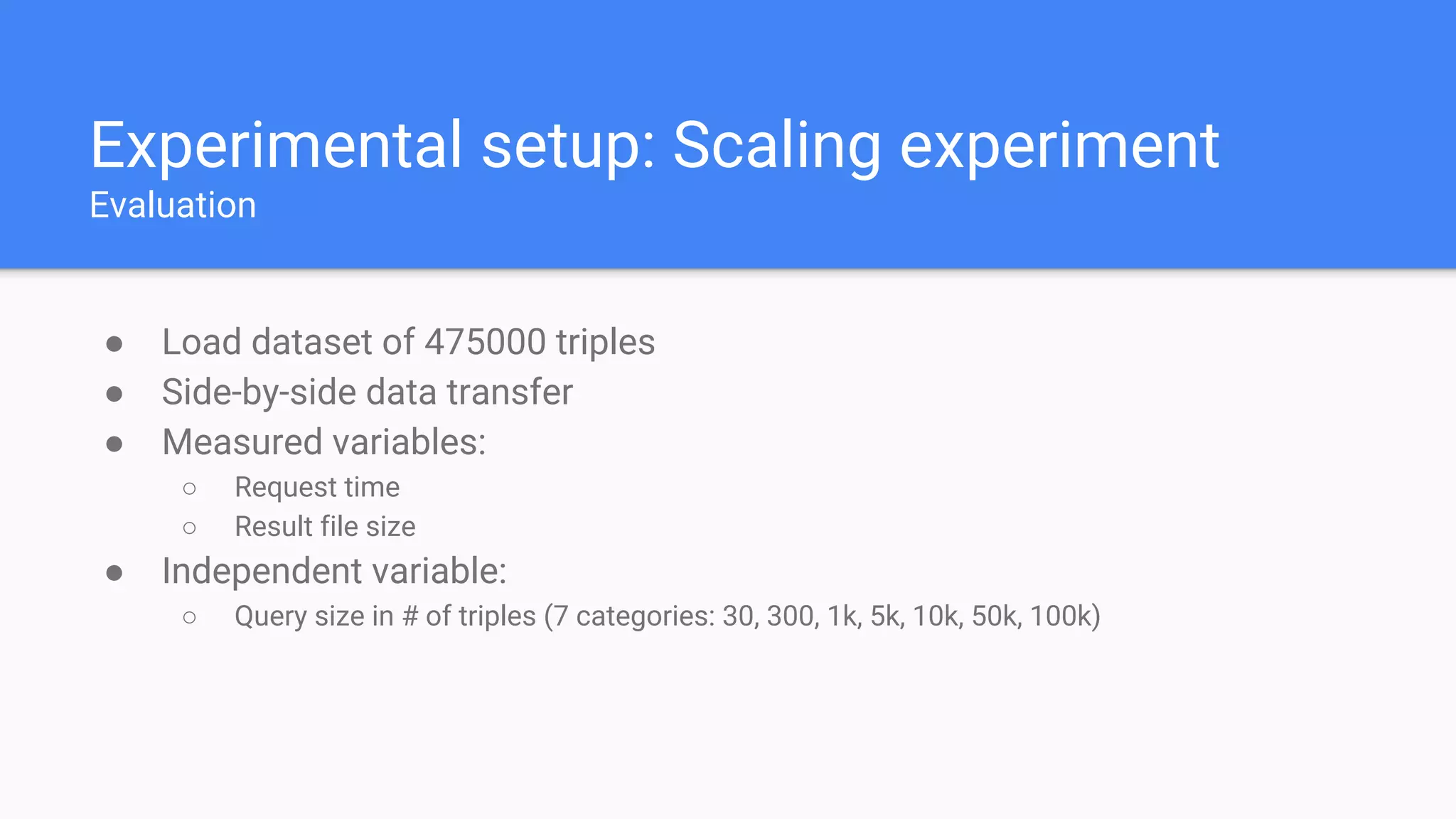
Experimental setup: Scaling experiment
Evaluation
● Load dataset of 475000 triples
● Side-by-side data transfer
● Measured variables:
○ Request time
○ Result file size
● Independent variable:
○ Query size in # of triples (7 categories: 30, 300, 1k, 5k, 10k, 50k, 100k)
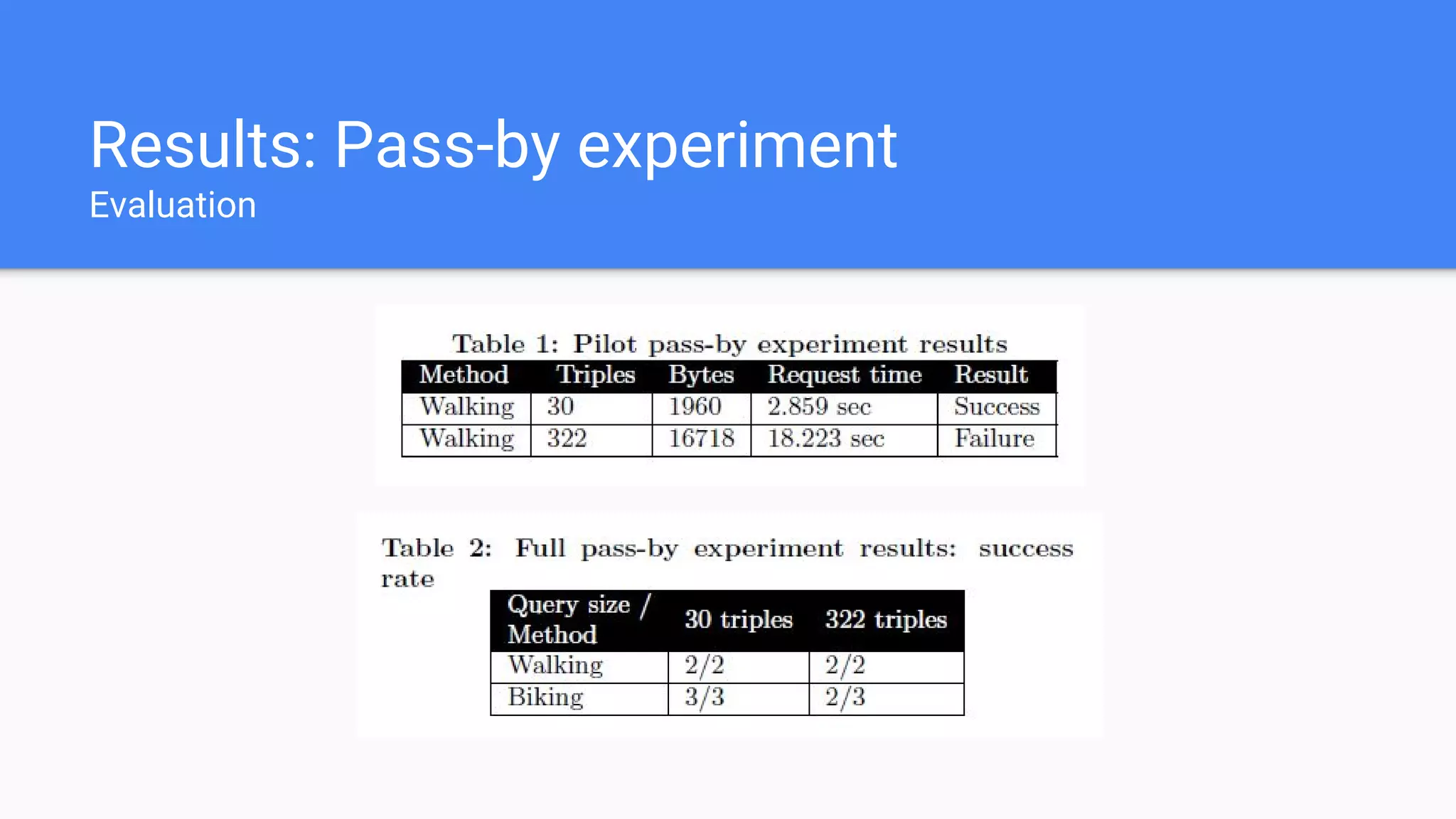
Results: Pass-by experiment
Evaluation
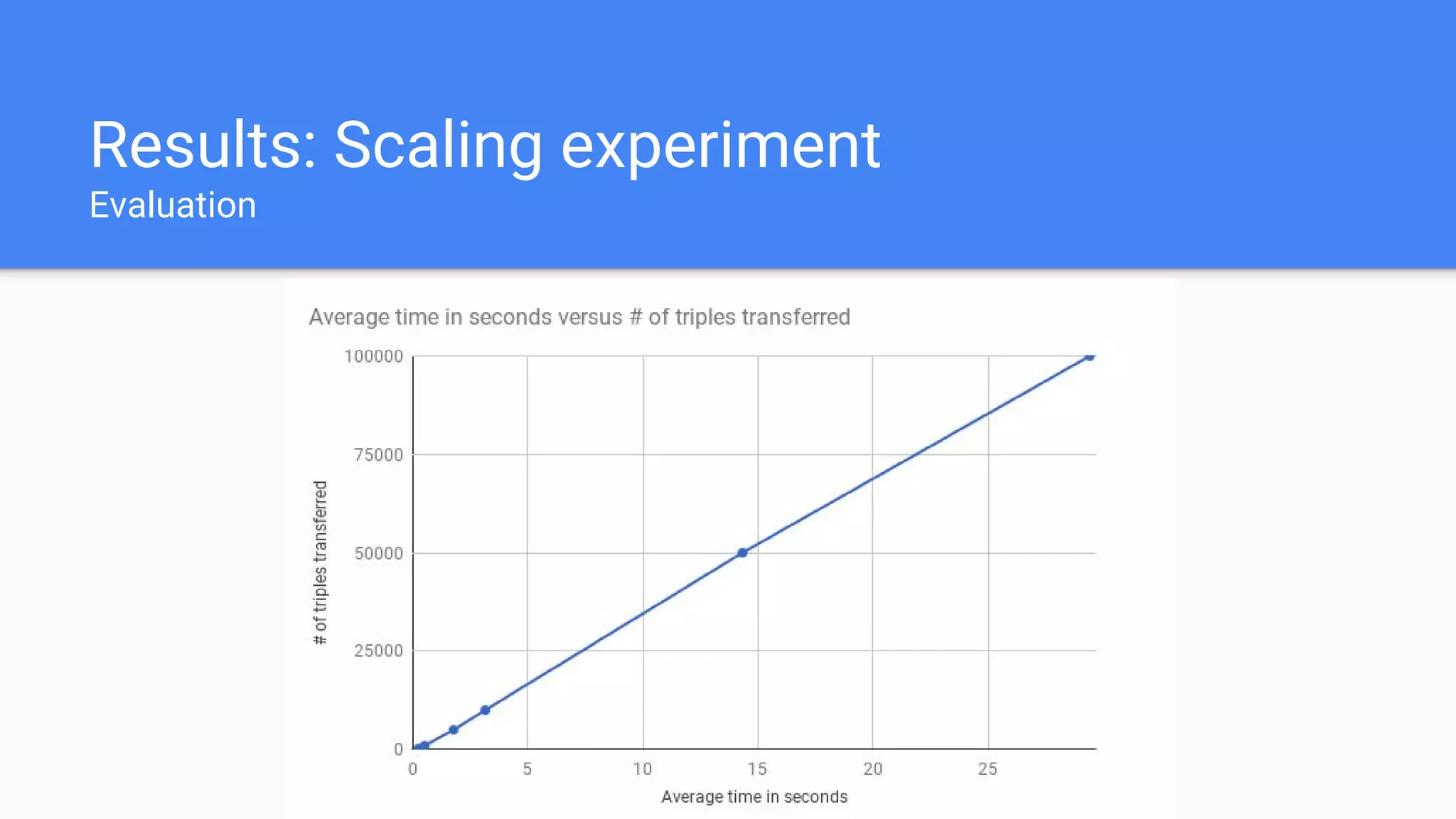
Results: Scaling experiment
Evaluation
Discussion and conclusion
● Results show that the system works in the setting it was tested in.
● Success rate depends mostly on time spent within range.
● What about rural conditions and real scenarios?
● And non-Kasadaka ICT4D implementations?
● A Sneakernet + local wifi solution is a viable approach in extending
knowledge sharing systems with M2M capabilities:
○ low cost hardware
○ open source
Questions?

Fahad Ali's slides for Machine to-machine communication in rural conditions realizing kasadaka-net (1)

  • 1.
    Machine-to-machine communication in ruralconditions: Realizing KasadakaNet By Fahad Ali Supervised by Victor de Boer
  • 2.
    Contents ● Related works ●Problem description ● Research question ● Our solution: KasadakaNet ● Evaluation ● Discussion and conclusion
  • 3.
    The Kasadaka Related works ●Enables information services for the rural poor ● Rapid prototyping platform: allows easy creation of applications for new use cases
  • 4.
    M2M Communication Related works ●Transferring data between machines over some type of network ● Over the internet, local Wifi/Bluetooth networks, cellular networks, etc. ● M2M communication in rural conditions?
  • 5.
    Problem description ● Lackof data sharing between devices ● Pass-by approach: sneakernet + local wifi networks ● Case: Kasadaka platform
  • 6.
    Research question ● RQ:"How can machine-to-machine communication and semantic data sharing be achieved using a pass-by communication method in such a way that it matches requirements from ICT4D use cases?"
  • 7.
    System overview KasadakaNet ● Sneakernet+ local Wifi solution ● Technical challenges: ○ Semantic data ○ Less human input ● Two components: ○ A set of Kasadakas ○ The Wifi-donkey
  • 8.
    The Wifi-donkey KasadakaNet ● Builtusing Open Source Software (PirateBox, ClioPatria, linux packages, custom scripts) ● Two main tasks: ○ Host Wifi network and manage connected clients (hostapd, dnsmasq, works out of the box) ○ When a Kasadaka connects: send SPARQL query to Kasadaka, store RDF result (custom scripts, configuring linux)
  • 9.
  • 10.
    Experimental setup: Pass-byexperiment Evaluation ● Measured variables ○ Success rate ○ Result file size ○ Request time ● Independent variables ○ Travel speed ○ Query size (# of triples)
  • 11.
    Experimental setup: Scalingexperiment Evaluation ● Load dataset of 475000 triples ● Side-by-side data transfer ● Measured variables: ○ Request time ○ Result file size ● Independent variable: ○ Query size in # of triples (7 categories: 30, 300, 1k, 5k, 10k, 50k, 100k)
  • 12.
  • 13.
  • 14.
    Discussion and conclusion ●Results show that the system works in the setting it was tested in. ● Success rate depends mostly on time spent within range. ● What about rural conditions and real scenarios? ● And non-Kasadaka ICT4D implementations? ● A Sneakernet + local wifi solution is a viable approach in extending knowledge sharing systems with M2M capabilities: ○ low cost hardware ○ open source
  • 15.