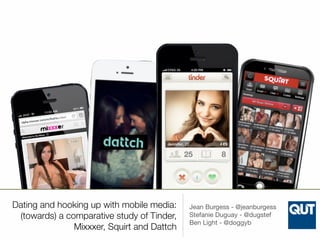
Dating and hooking up with mobile media: 
(towards) a comparative study of Tinder, 
Mixxxer, Squirt and Dattch 
Jean Burgess - @jeanburgess 
Stefanie Duguay - @dugstef 
Ben Light - @doggyb
#hookupappstudies 
DISCIPLINES 
STS + media & cultural studies (including queer media studies) 
APPROACHES 
platform and software studies 
cultural histories of dating and media technology 
cultural economy 
cross-platform, cross-community and cross-purpose research 
METHODS 
Background research - e.g. crunchbase, tech press 
Archival web research - media representation, self-representations and discursive 
appeals to users 
Walkthroughs, interface and textual analysis 
Analytical focus on phases of use: Getting In, Getting On, Getting Off
The final computation of the subject’s S.Q. 
is made by automatic machines, chiefly 
through the means of electronic 
calculators —the so-called electronic brain 
— and punched index cards. The rating is 
automatically printed on each card in 
percentages. 
When the final S.Q. has been noted on the 
card, it becomes a comparatively routine 
matter for the psychologist in charge to 
“match” the male and female cards of the 
marriage applicants. 
The answer will not be simply 
“compatible” or “noncompatible” but the 
machine rather will answer in 
percentages. Thus the electronic brain may 
say: 90 per cent. Translated, this means that 
the marriage will be in all likelihood, 90 per 
cent satisfactory. The next two candidates 
may rate only 73 per cent, and so forth.
Lesbian Cafe - early 1990s - EBB (Correll 1995) 
French Minitel System 1982 - (Livia 2002) 
Gaydar - 1999 (Light 2007, Mowlabocus 2007) 
Internet Relay Chat - 1988 (Campbell 2004) 
Match.com - 1993 (Arvidsson 2004) 
Usenet - 1983 (O’Riordan 2005) 
Squirt site 1998/mobile 2009 (Light 2014) 
Grindr 2009 (Brubaker et. al. 2014) 
From type to swipe...
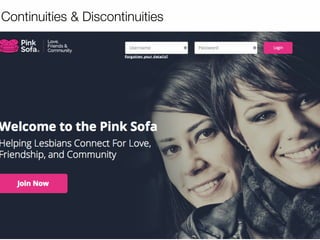
Continuities & Discontinuities
The mainstreaming of location-based dating 
services
Tinder, Squirt, Mixxxer and Dattch: market position 
Tinder is the fun way to connect with new and interesting people around you. Swipe right to 
like or left to pass. If someone likes you back, it’s a match! 
• A game & “like real life, but better” 
• Targets young, middle-upper class, heterosexual, urban-dwellers. Focus on 
women; first marketed to frats and sororities 
Hookups. Gay and bi hookups; Find straight or married guys; Real people, real profiles; Cam and 
chat with horny men; Find your sexual match … 
• Sex-positive community focused on “sex, fun and friendship” 
• Targets men attracted to men 
The Mobile Sex Finder. Looking for casual adult fun? Find local swingers and sex partners 
tonight! All from your mobile phone. 
• Targets adults with a range of gender identities and sexual preferences; promo 
materials focus on heterosexual cultures 
• Casual sex, not dating or friendship 
With thousands of lesbian & bisexual women joining each week, Dattch is the most 
popular social network and dating app to meet lesbian and bisexual girls. Loved by 
AfterEllen, Autostraddle, Elle & Grazia, it’s the female answer to Grindr. 
• Women only - specifically lesbians and bisexuals 
• Friendship, dating, or sex 
• Promotes itself through blogs about celebrities and lesbian culture
Business models 
• Owned by IAC/InterActiveCorp; owner of match.com & others 
• Some revenue from advertising profiles for TV shows 
• No monetization plan firmly established yet but have discussed 
subscription, advertising and freemium models 
• Owned by Pink Triangle Press - Canadian gay & lesbian publisher 
• “Freemium” model where users can pay for access to additional 
features 
• Owned by SocialSoft Networks - medium to large start-up 
incubator targeting “under-serviced niches” 
• Advertising plus “freemium” (for more connectivity) 
• London-based start-up with ~$250,000 investment so far, ~3 
employees, housed by Wayra incubator (Spanish Telefonica) 
• Integrates dating/hook-up services with pink media
Platforms and ‘digital delegation’ 
iOS, Android; integrates with Facebook 
“Yes, we use Facebook to make sure you are matched with 
real people” 
Mobile web/ HTML 5 
“Currently, apps that contain adult material are not allowed in the App Store 
or the Android Marketplace. Squirt does not believe in censorship. We are 
pro-sex, and we celebrate sexuality.” 
Mobile web / HTML 5 
“Apple and Android have strict rules that their apps must abide by. By 
avoiding their rules, we are able to offer our members a true “Adults Only” 
experience, such as the posting of sexually explicit material.” 
iOS, Android; integrates with Facebook 
"From the outset we decided to check that every Dattch 
user is female-identified.
Getting In: registration and onboarding 
• Importing personal information
Getting In: registration and onboarding 
• Constructing identity
Getting In: registration and onboarding 
• Specifying physique, relationship configuration, etc.
Getting On: Browsing, searching and filtering 
• Search specifications
Getting On: Browsing, searching and filtering 
• Gamified dating, location-based selection, and community
Getting On: Browsing, searching and filtering 
• Privacy, rejection, and limiting visibility
• Different modes of interaction 
Shopping Centre 
City Park 
Getting Off: Matching and 
Meeting Up
#hookupappstudies: what’s next? 
DISCIPLINES 
STS + media & cultural studies (including queer media studies) 
APPROACHES 
platform and software studies 
cultural histories of dating and media 
technology 
cultural economy 
METHODS 
Background research 
Archival web research 
Walkthroughs, interface and textual analysis 
Analytical focus on phases of use 
NEXT STEPS 
Multiple walkthroughs (different users, 
multiple iterations) 
User interviews including e.g. 
screenshot elicitation, co-walkthroughs 
Multiple app, cross-app analysis 
Further platform studies work 
(business model + affordances) 
Ancillary digital media practices and 
texts (e.g. Douchebags of Grindr) 
Location-based participant 
observation??
https://www.facebook.com/groups/hookup.apps.studies/
References 
Akrich, M. (1992). The De-Scription of Technical Objects. Shaping Technology/Building Society: Studies in Sociotechnical Change. W. 
E. Bijker and J. Law. London, MIT Press: 205-224. 
Arvidsson, A. (2006). "'Quality singles': internet dating and the work of fantasy." New Media and Society 8(4): 671-691. 
Brubaker, J. R., M. Ananny and K. Crawford (2014). "Departing glances: A sociotechnical account of ‘leaving’ Grindr." New Media & 
Society. (Forthcoming) 
Campbell, J. E. (2004). Getting It On Online: Cyberspace, Gay Male Sexuality and Emboddied Identity. New York, Harrington Parker 
Press. 
Correll, S. (1995). "The Ethnography of an Electronic Bar: The Lesbian Cafe." Journal of Contemporary Ethnography 24(sic): 270-298. 
Latour, B. (1992). Where are the Missing Masses? The Sociology of a Few Mundane Artifacts. Shaping Technology/Building Society: 
Studies in Sociotechnical Change. W. E. Bijker and J. Law. London, MIT Press: 225-258. 
Latour, B. (2005). Reassembling the Social: An Introduction to Actor Network Theory. Oxford, Oxford University Press. 
Light, B. (2007). "Introducing Masculinity Studies to Information Systems Research: the Case of Gaydar." European Journal of 
Information Systems 16(5): 658-665. 
Light, B., G. Fletcher and A. Adam (2008). "Gay men, Gaydar and the commodification of difference." Information Technology and 
People 21(3): 300-314. 
Light, B. (2014). Creating Pseudonymous Publics with Squirt: An Expansion of the Possibilities for Networked Publics. 35th 
International Conference on Information Systems, 14-17 December, Auckland : 1-16. See: http://aisel.aisnet.org/icis2014/ 
(Forthcoming). 
Livia, A. (2002). "Public and Clandestine: Gay Men's Pseudonyms on the French Minitel." Sexualities 5(2): 201-217. 
Mowlabocus, S. (2007). Gay Men and the Pornification of Everyday Life. Pornification: Sex and Sexuality in Media Culture. S. 
Paasonen, K. Nikunen and L. Saarenmaa. Oxford, Berg: 61-71. 
O'Riordan, K. (2005). "From usenet to Gaydar: a comment on queer online community." SIGGROUP Bull. 25(2): 28-32. 
Woolgar, S. (1991). Configuring the User: The Case of Usability Trials. A Sociology of Monsters: Essays on Power, Technology and 
Domination. J. Law. London, Routledge: 66-75.

Dating and hooking up with mobile media: Towards a comparative study of Tinder, Mixxxer, Squirt and Dattch

  • 1.
    Dating and hookingup with mobile media: (towards) a comparative study of Tinder, Mixxxer, Squirt and Dattch Jean Burgess - @jeanburgess Stefanie Duguay - @dugstef Ben Light - @doggyb
  • 2.
    #hookupappstudies DISCIPLINES STS+ media & cultural studies (including queer media studies) APPROACHES platform and software studies cultural histories of dating and media technology cultural economy cross-platform, cross-community and cross-purpose research METHODS Background research - e.g. crunchbase, tech press Archival web research - media representation, self-representations and discursive appeals to users Walkthroughs, interface and textual analysis Analytical focus on phases of use: Getting In, Getting On, Getting Off
  • 3.
    The final computationof the subject’s S.Q. is made by automatic machines, chiefly through the means of electronic calculators —the so-called electronic brain — and punched index cards. The rating is automatically printed on each card in percentages. When the final S.Q. has been noted on the card, it becomes a comparatively routine matter for the psychologist in charge to “match” the male and female cards of the marriage applicants. The answer will not be simply “compatible” or “noncompatible” but the machine rather will answer in percentages. Thus the electronic brain may say: 90 per cent. Translated, this means that the marriage will be in all likelihood, 90 per cent satisfactory. The next two candidates may rate only 73 per cent, and so forth.
  • 4.
    Lesbian Cafe -early 1990s - EBB (Correll 1995) French Minitel System 1982 - (Livia 2002) Gaydar - 1999 (Light 2007, Mowlabocus 2007) Internet Relay Chat - 1988 (Campbell 2004) Match.com - 1993 (Arvidsson 2004) Usenet - 1983 (O’Riordan 2005) Squirt site 1998/mobile 2009 (Light 2014) Grindr 2009 (Brubaker et. al. 2014) From type to swipe...
  • 5.
  • 6.
  • 7.
    The mainstreaming oflocation-based dating services
  • 8.
    Tinder, Squirt, Mixxxerand Dattch: market position Tinder is the fun way to connect with new and interesting people around you. Swipe right to like or left to pass. If someone likes you back, it’s a match! • A game & “like real life, but better” • Targets young, middle-upper class, heterosexual, urban-dwellers. Focus on women; first marketed to frats and sororities Hookups. Gay and bi hookups; Find straight or married guys; Real people, real profiles; Cam and chat with horny men; Find your sexual match … • Sex-positive community focused on “sex, fun and friendship” • Targets men attracted to men The Mobile Sex Finder. Looking for casual adult fun? Find local swingers and sex partners tonight! All from your mobile phone. • Targets adults with a range of gender identities and sexual preferences; promo materials focus on heterosexual cultures • Casual sex, not dating or friendship With thousands of lesbian & bisexual women joining each week, Dattch is the most popular social network and dating app to meet lesbian and bisexual girls. Loved by AfterEllen, Autostraddle, Elle & Grazia, it’s the female answer to Grindr. • Women only - specifically lesbians and bisexuals • Friendship, dating, or sex • Promotes itself through blogs about celebrities and lesbian culture
  • 9.
    Business models •Owned by IAC/InterActiveCorp; owner of match.com & others • Some revenue from advertising profiles for TV shows • No monetization plan firmly established yet but have discussed subscription, advertising and freemium models • Owned by Pink Triangle Press - Canadian gay & lesbian publisher • “Freemium” model where users can pay for access to additional features • Owned by SocialSoft Networks - medium to large start-up incubator targeting “under-serviced niches” • Advertising plus “freemium” (for more connectivity) • London-based start-up with ~$250,000 investment so far, ~3 employees, housed by Wayra incubator (Spanish Telefonica) • Integrates dating/hook-up services with pink media
  • 10.
    Platforms and ‘digitaldelegation’ iOS, Android; integrates with Facebook “Yes, we use Facebook to make sure you are matched with real people” Mobile web/ HTML 5 “Currently, apps that contain adult material are not allowed in the App Store or the Android Marketplace. Squirt does not believe in censorship. We are pro-sex, and we celebrate sexuality.” Mobile web / HTML 5 “Apple and Android have strict rules that their apps must abide by. By avoiding their rules, we are able to offer our members a true “Adults Only” experience, such as the posting of sexually explicit material.” iOS, Android; integrates with Facebook "From the outset we decided to check that every Dattch user is female-identified.
  • 11.
    Getting In: registrationand onboarding • Importing personal information
  • 12.
    Getting In: registrationand onboarding • Constructing identity
  • 13.
    Getting In: registrationand onboarding • Specifying physique, relationship configuration, etc.
  • 14.
    Getting On: Browsing,searching and filtering • Search specifications
  • 15.
    Getting On: Browsing,searching and filtering • Gamified dating, location-based selection, and community
  • 16.
    Getting On: Browsing,searching and filtering • Privacy, rejection, and limiting visibility
  • 17.
    • Different modesof interaction Shopping Centre City Park Getting Off: Matching and Meeting Up
  • 18.
    #hookupappstudies: what’s next? DISCIPLINES STS + media & cultural studies (including queer media studies) APPROACHES platform and software studies cultural histories of dating and media technology cultural economy METHODS Background research Archival web research Walkthroughs, interface and textual analysis Analytical focus on phases of use NEXT STEPS Multiple walkthroughs (different users, multiple iterations) User interviews including e.g. screenshot elicitation, co-walkthroughs Multiple app, cross-app analysis Further platform studies work (business model + affordances) Ancillary digital media practices and texts (e.g. Douchebags of Grindr) Location-based participant observation??
  • 19.
  • 20.
    References Akrich, M.(1992). The De-Scription of Technical Objects. Shaping Technology/Building Society: Studies in Sociotechnical Change. W. E. Bijker and J. Law. London, MIT Press: 205-224. Arvidsson, A. (2006). "'Quality singles': internet dating and the work of fantasy." New Media and Society 8(4): 671-691. Brubaker, J. R., M. Ananny and K. Crawford (2014). "Departing glances: A sociotechnical account of ‘leaving’ Grindr." New Media & Society. (Forthcoming) Campbell, J. E. (2004). Getting It On Online: Cyberspace, Gay Male Sexuality and Emboddied Identity. New York, Harrington Parker Press. Correll, S. (1995). "The Ethnography of an Electronic Bar: The Lesbian Cafe." Journal of Contemporary Ethnography 24(sic): 270-298. Latour, B. (1992). Where are the Missing Masses? The Sociology of a Few Mundane Artifacts. Shaping Technology/Building Society: Studies in Sociotechnical Change. W. E. Bijker and J. Law. London, MIT Press: 225-258. Latour, B. (2005). Reassembling the Social: An Introduction to Actor Network Theory. Oxford, Oxford University Press. Light, B. (2007). "Introducing Masculinity Studies to Information Systems Research: the Case of Gaydar." European Journal of Information Systems 16(5): 658-665. Light, B., G. Fletcher and A. Adam (2008). "Gay men, Gaydar and the commodification of difference." Information Technology and People 21(3): 300-314. Light, B. (2014). Creating Pseudonymous Publics with Squirt: An Expansion of the Possibilities for Networked Publics. 35th International Conference on Information Systems, 14-17 December, Auckland : 1-16. See: http://aisel.aisnet.org/icis2014/ (Forthcoming). Livia, A. (2002). "Public and Clandestine: Gay Men's Pseudonyms on the French Minitel." Sexualities 5(2): 201-217. Mowlabocus, S. (2007). Gay Men and the Pornification of Everyday Life. Pornification: Sex and Sexuality in Media Culture. S. Paasonen, K. Nikunen and L. Saarenmaa. Oxford, Berg: 61-71. O'Riordan, K. (2005). "From usenet to Gaydar: a comment on queer online community." SIGGROUP Bull. 25(2): 28-32. Woolgar, S. (1991). Configuring the User: The Case of Usability Trials. A Sociology of Monsters: Essays on Power, Technology and Domination. J. Law. London, Routledge: 66-75.