Ralf Klamma RWTH Aachen University SCOOP Workshop Bremen, August 30, 2007 Social Software and  Community Information Systems
Agenda Social Software is not enough for Community Information Systems ATLAS Framework Infrastructures for  Cross-Media Community Information Systems Self-observation tools for learning communities Conclusions and Outlooks
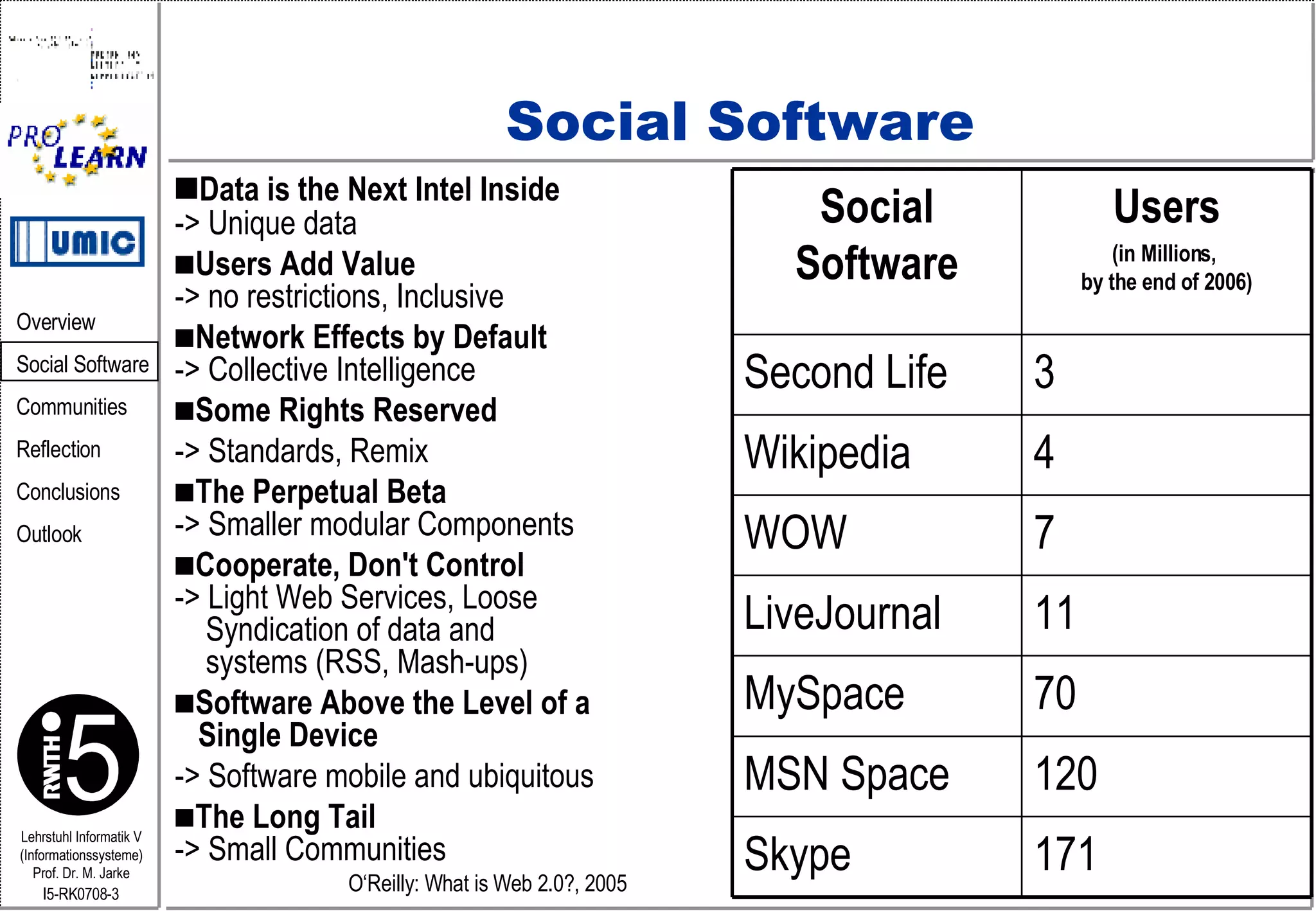
Social Software Second Life 7 WOW 70 MySpace 171 Skype 120 MSN Space 11 LiveJournal 4 Wikipedia 3 Second Life Users (in Millions,  by the end of 2006) Social Software Data is the Next Intel Inside -> Unique data  Users Add Value -> no restrictions, Inclusive Network Effects by Default -> Collective Intelligence Some Rights Reserved   -> Standards, Remix   The Perpetual Beta -> Smaller modular Components Cooperate, Don't Control -> Light Web Services, Loose    Syndication of data and   systems (RSS, Mash-ups) Software Above the Level of a    Single Device   -> Software mobile and ubiquitous The Long Tail -> Small Communities O‘Reilly: What is Web 2.0?, 2005
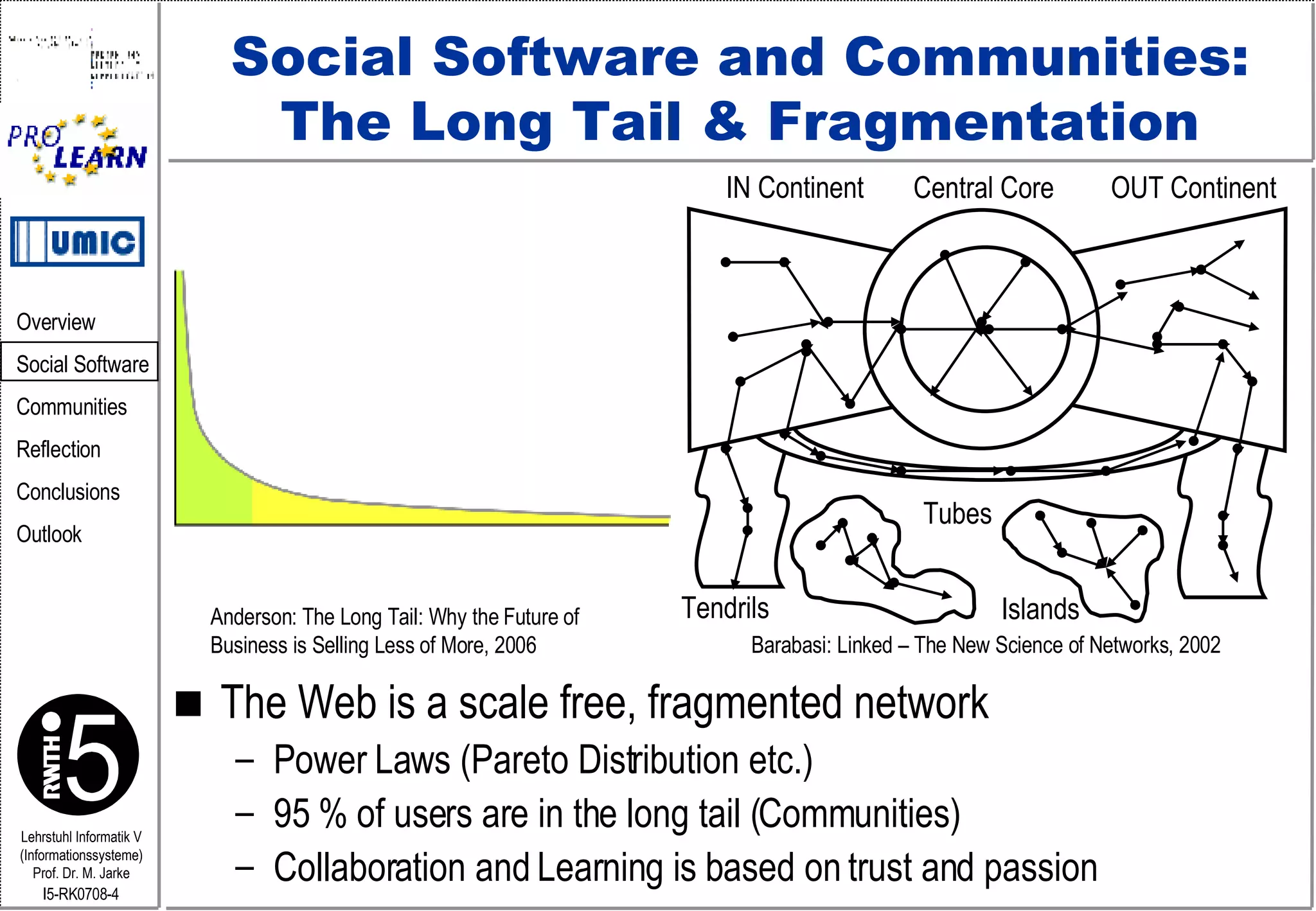
Social Software and Communities: The Long Tail & Fragmentation The Web is a scale free, fragmented network Power Laws (Pareto Distribution etc.) 95 % of users are in the long tail (Communities) Collaboration and Learning is based on trust and passion Islands Tendrils IN Continent Central Core OUT Continent Tubes Barabasi: Linked – The New Science of Networks, 2002 Anderson: The Long Tail: Why the Future of  Business is Selling Less of More, 2006
Communities of practice Community of practice (CoP) as the basic concept for community information systems Communities of practice are groups of people who share a concern or a passion for something they do and who interact regularly to learn how to do it better   Usability & Sociability Wenger: Communities of Practice: Learning, Meaning and Identity, 1998 Preece: Online Communities: Designing Usability, Supporting Sociability, 2000
Key Community Features Mutual engagement (ME) If you are aware of "what matters" in the scope of a  community your engagement is enabled Joint enterprises (JE) CoPs and theirs members can follow the situations  happening around them and because of them Shared repertoire (SR) Legitimate peripheral participation: from borders to the  center; from novices to experts
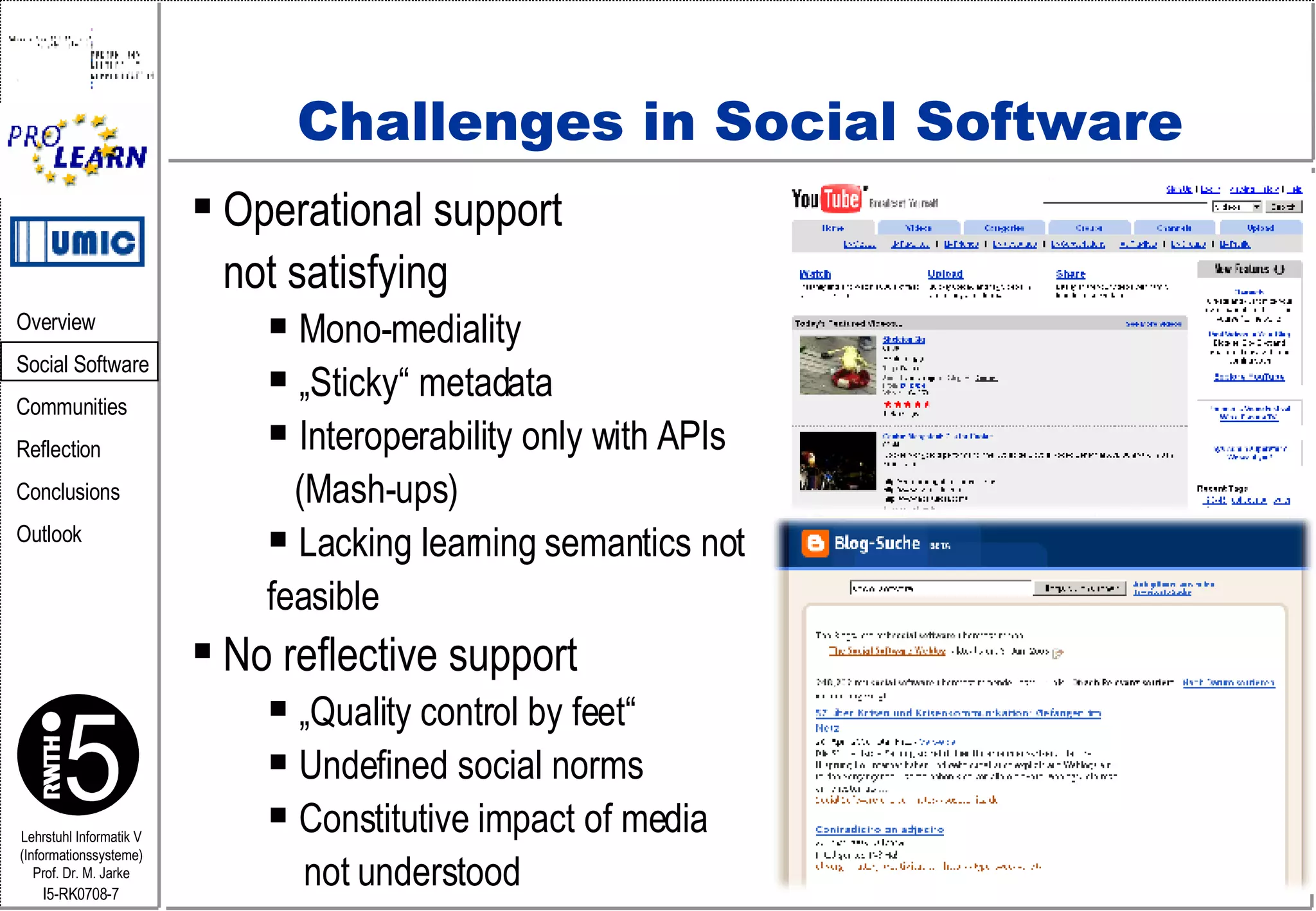
Challenges in Social Software Operational support    not satisfying Mono-mediality „ Sticky“ metadata Interoperability only with APIs   (Mash-ups) Lacking learning semantics not feasible No reflective support „ Quality control by feet“ Undefined social norms Constitutive impact of media   not understood
Challenges for  Community Information Systems Operational Support (Usability) Can we support CoPs with the  collaborative creation of complex multimedia learning objects ? Can CoPs make use of  metadata  over the frontiers of media and standards? Can we support CoPs by  personalized learning and networking strategies  in Social Software? How do  adaptive, mobile web-based interfaces  for CoPs look like? Reflective Support (Sociability) Can CoPs continuously elicitate and implement requirements for learning and teaching? How much computer science support is needed?  Can CoPs learn meaningful social Interaction and make use of disturbances? How can CoPs record their complex their complex media learning traces and  how they can deal with them? Can CoPs maintain or even improve their agency (Learning, Researching, Working) in the Web 2.0?
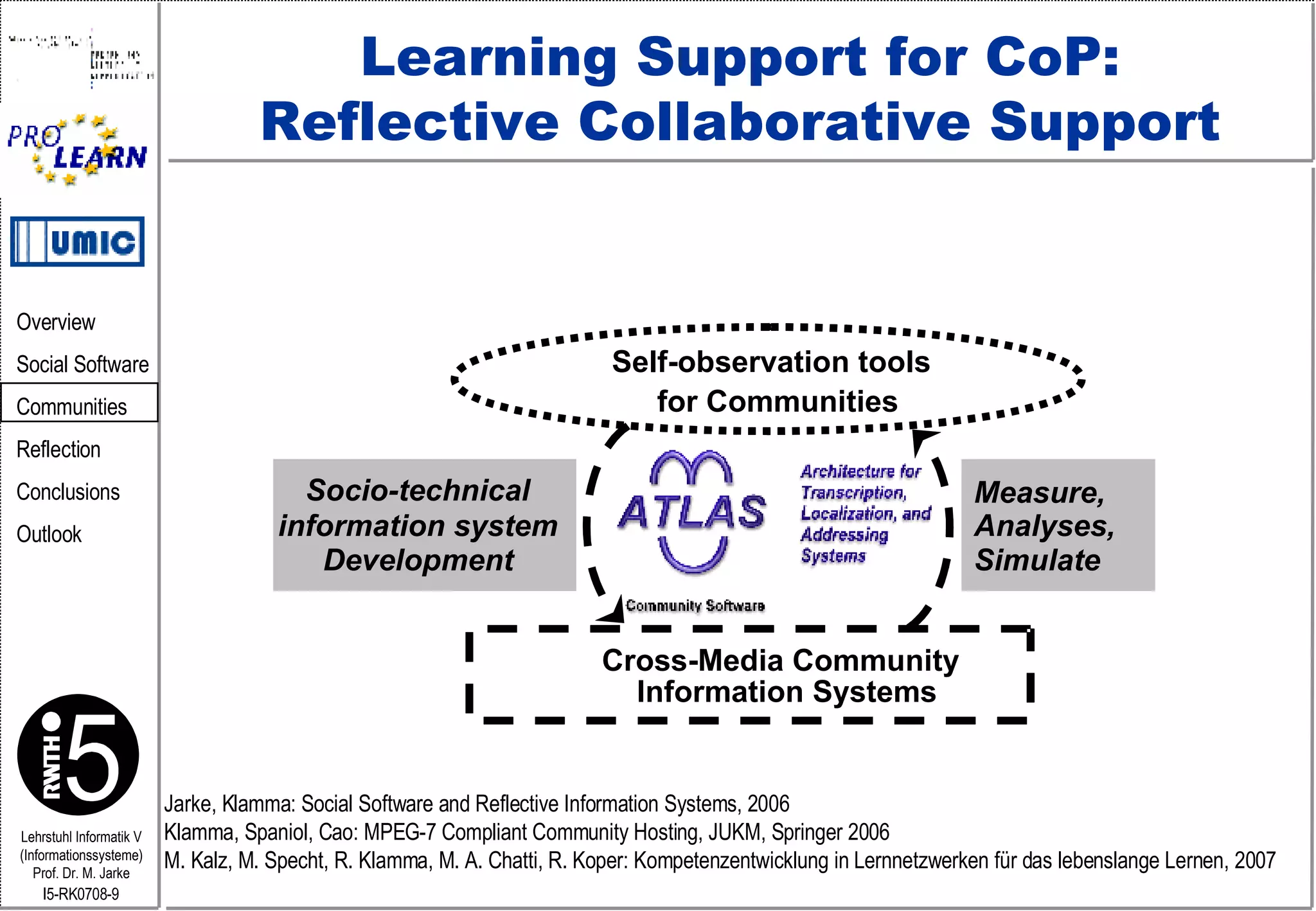
Learning Support for CoP: Reflective Collaborative Support Cross-Media Community Information Systems Self-observation tools for Communities Measure,  Analyses, Simulate Socio-technical information system Development Jarke, Klamma: Social Software and Reflective Information Systems, 2006 Klamma, Spaniol, Cao: MPEG-7 Compliant Community Hosting, JUKM, Springer 2006 M. Kalz, M. Specht, R. Klamma, M. A. Chatti, R. Koper: Kompetenzentwicklung in Lernnetzwerken für das lebenslange Lernen, 2007
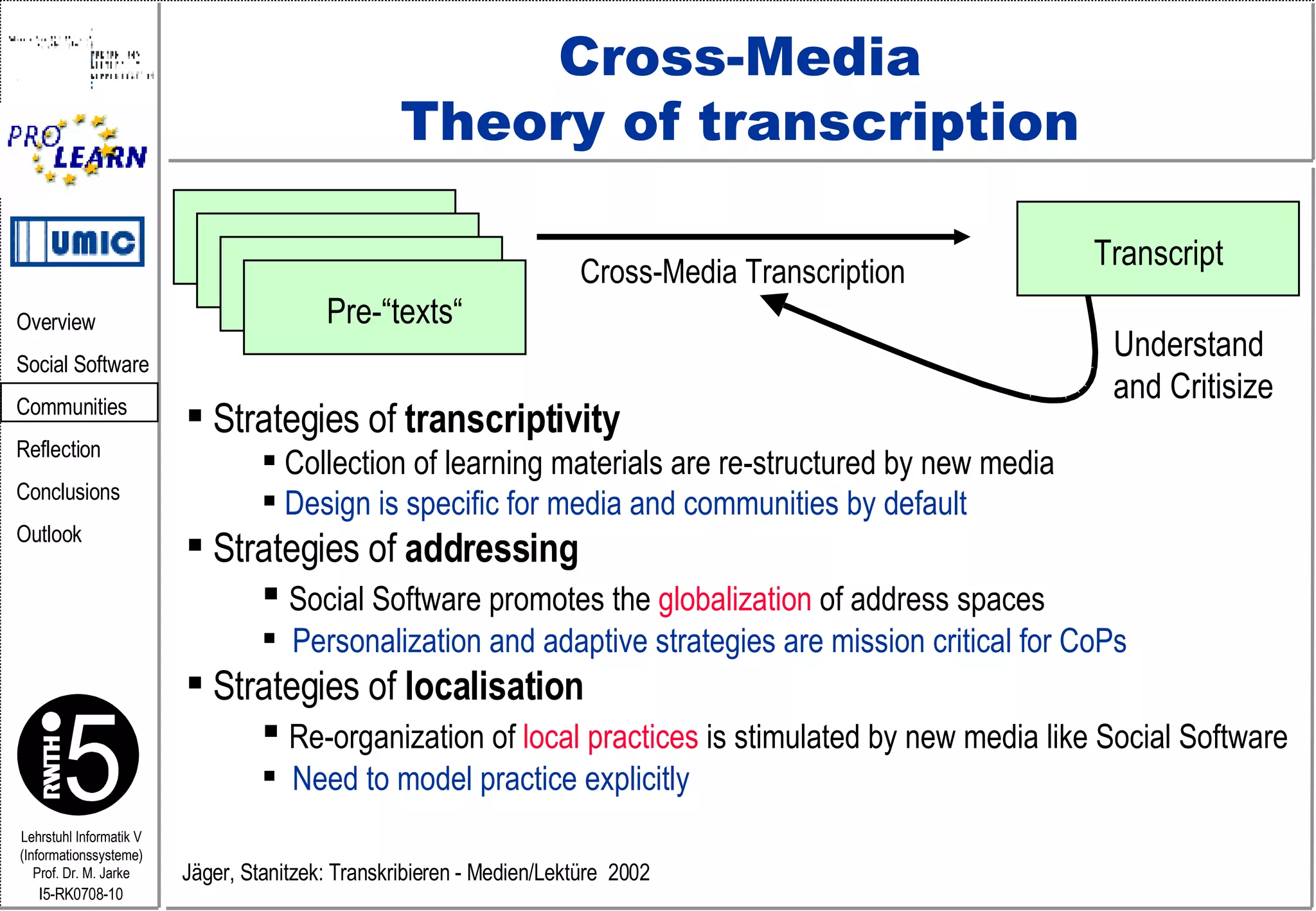
Cross-Media Theory of transcription Pre-“texts“ Transcript Cross-Media Transcription Understand and Critisize Jäger, Stanitzek: Transkribieren - Medien/Lektüre  2002 Strategies of  transcriptivity Collection of learning materials are re-structured by new media Design is specific for media and communities by default Strategies of  addressing Social Software promotes the  globalization  of address spaces Personalization and adaptive strategies are mission critical for CoPs Strategies of  localisation Re-organization of  local practices  is stimulated by new media like Social Software Need to model practice explicitly
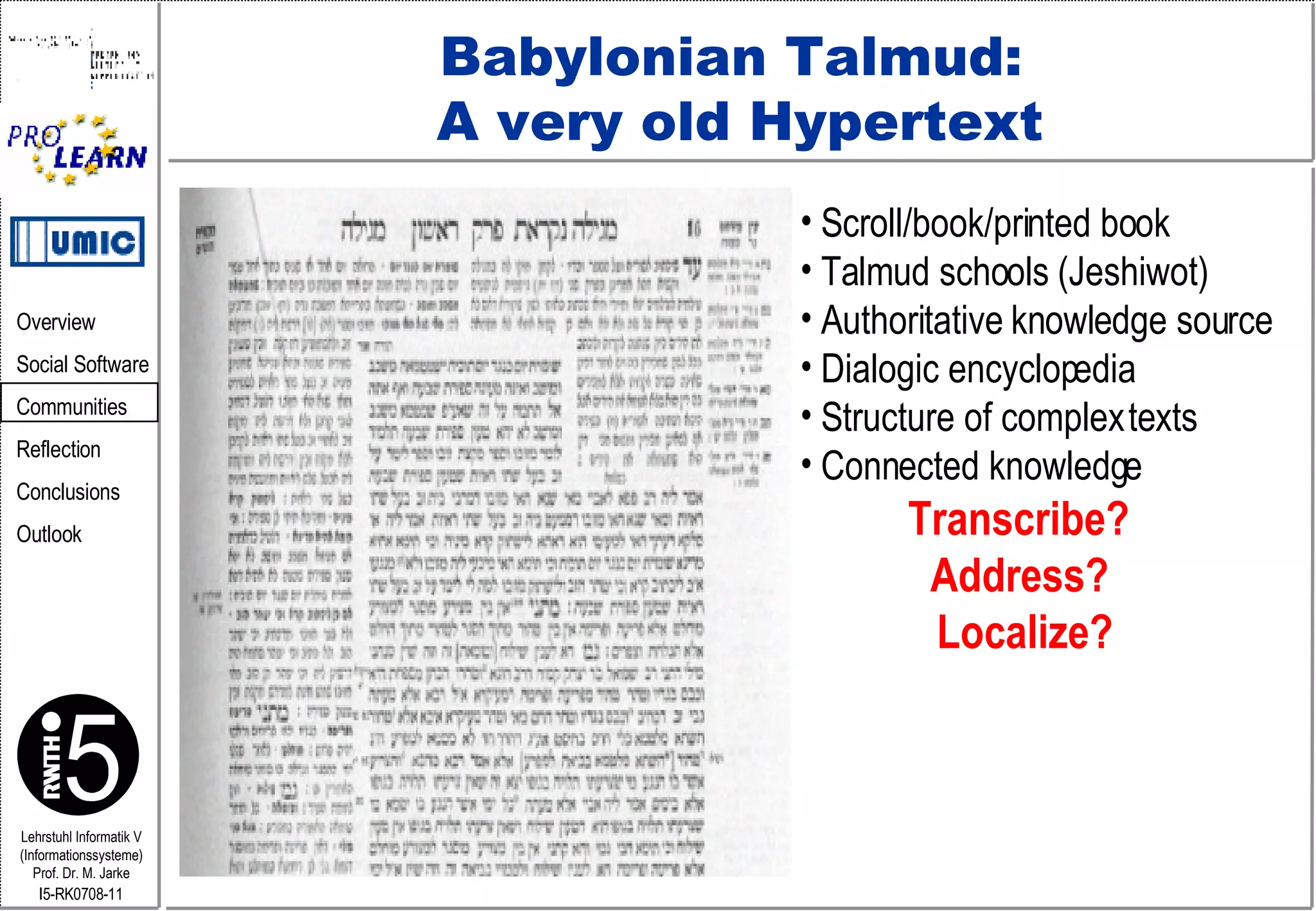
Babylonian Talmud:  A very old Hypertext Scroll/book/printed book  Talmud schools (Jeshiwot)  Authoritative  knowledge source Dialogic encyclopedia  Structure of complex texts Connected knowledge Transcribe?  Address?  Localize?
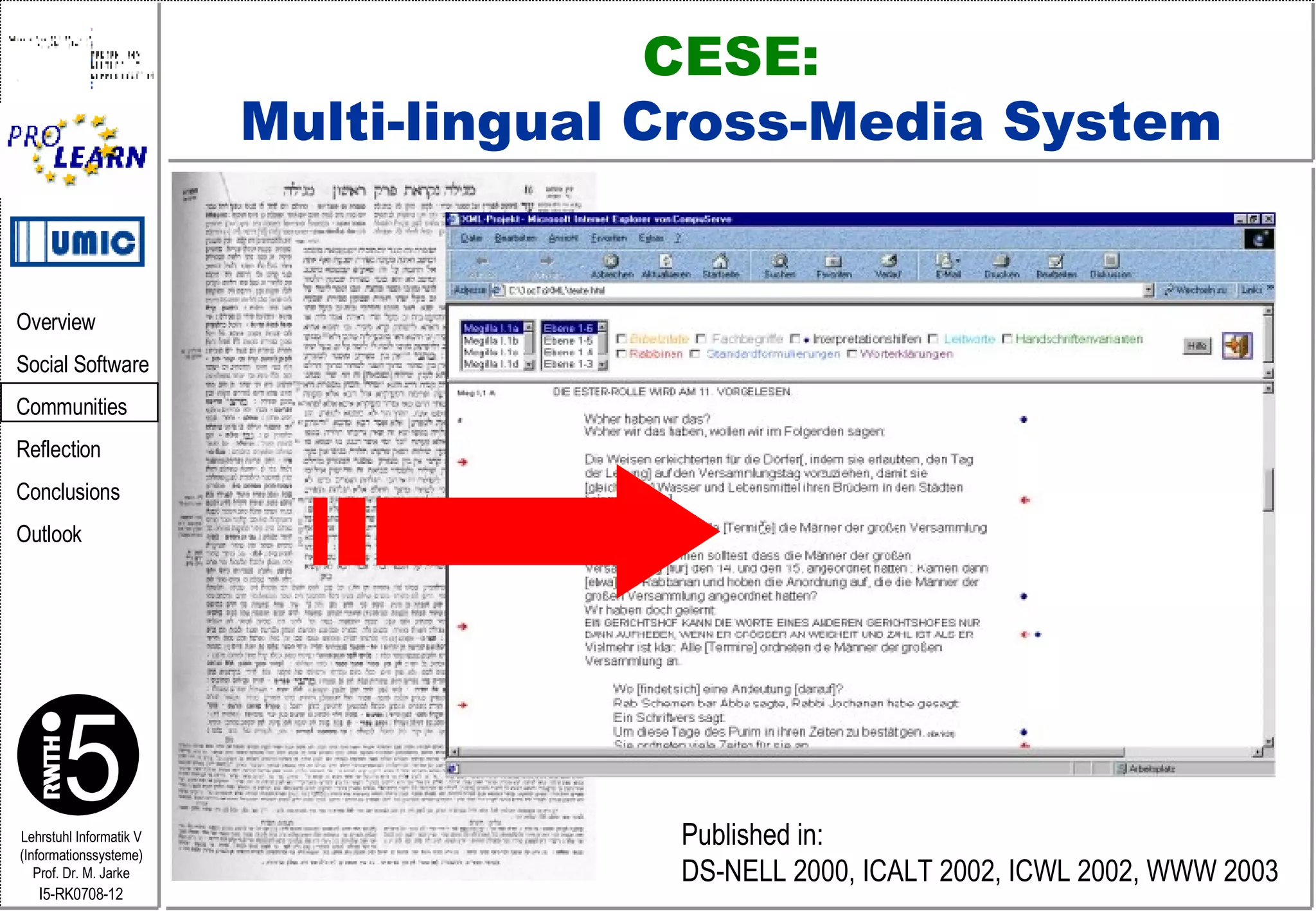
CESE:   Multi-lingual Cross-Media System  Published in:  DS-NELL 2000, ICALT 2002, ICWL 2002, WWW 2003
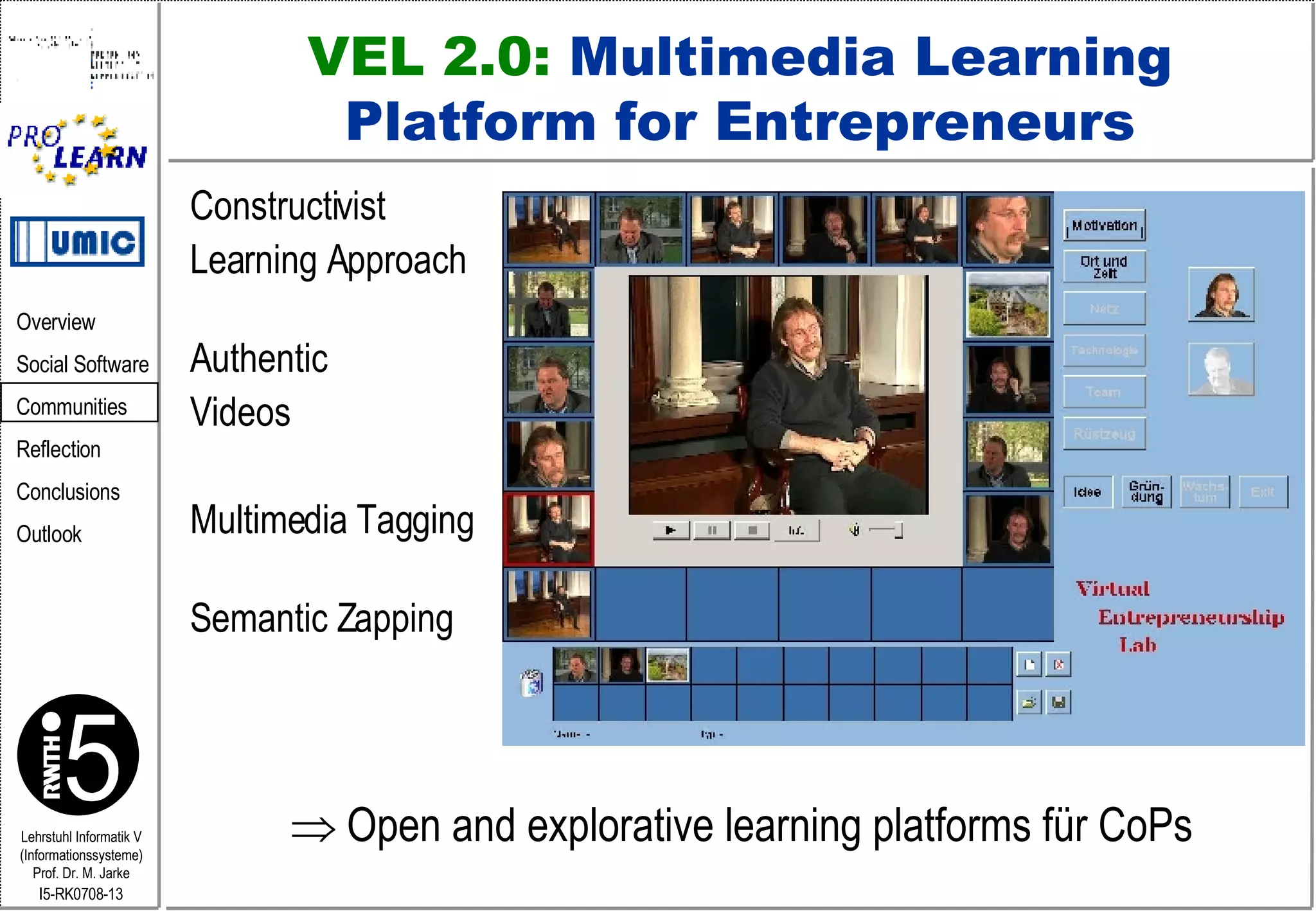
VEL 2.0:  Multimedia Learning Platform for Entrepreneurs Constructivist Learning Approach Authentic Videos  Multimedia Tagging Semantic Zapping      Open and explorative learning platforms für CoPs
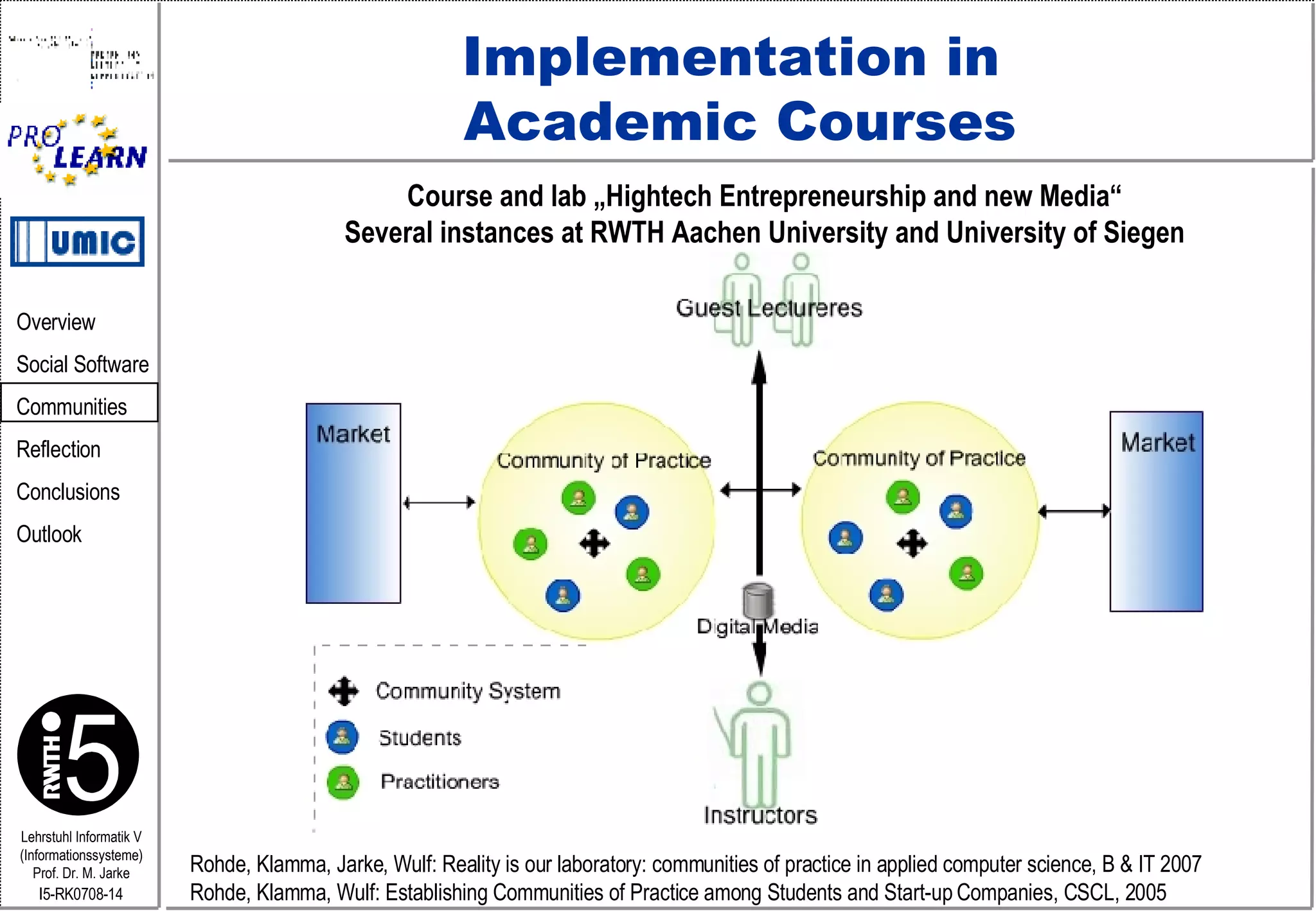
Implementation in  Academic Courses Rohde, Klamma, Jarke, Wulf: Reality is our laboratory: communities of practice in applied computer science, B & IT 2007  Rohde, Klamma, Wulf: Establishing Communities of Practice among Students and Start-up Companies, CSCL, 2005  Course and lab „Hightech Entrepreneurship and new Media“ Several instances at RWTH Aachen University and University of Siegen
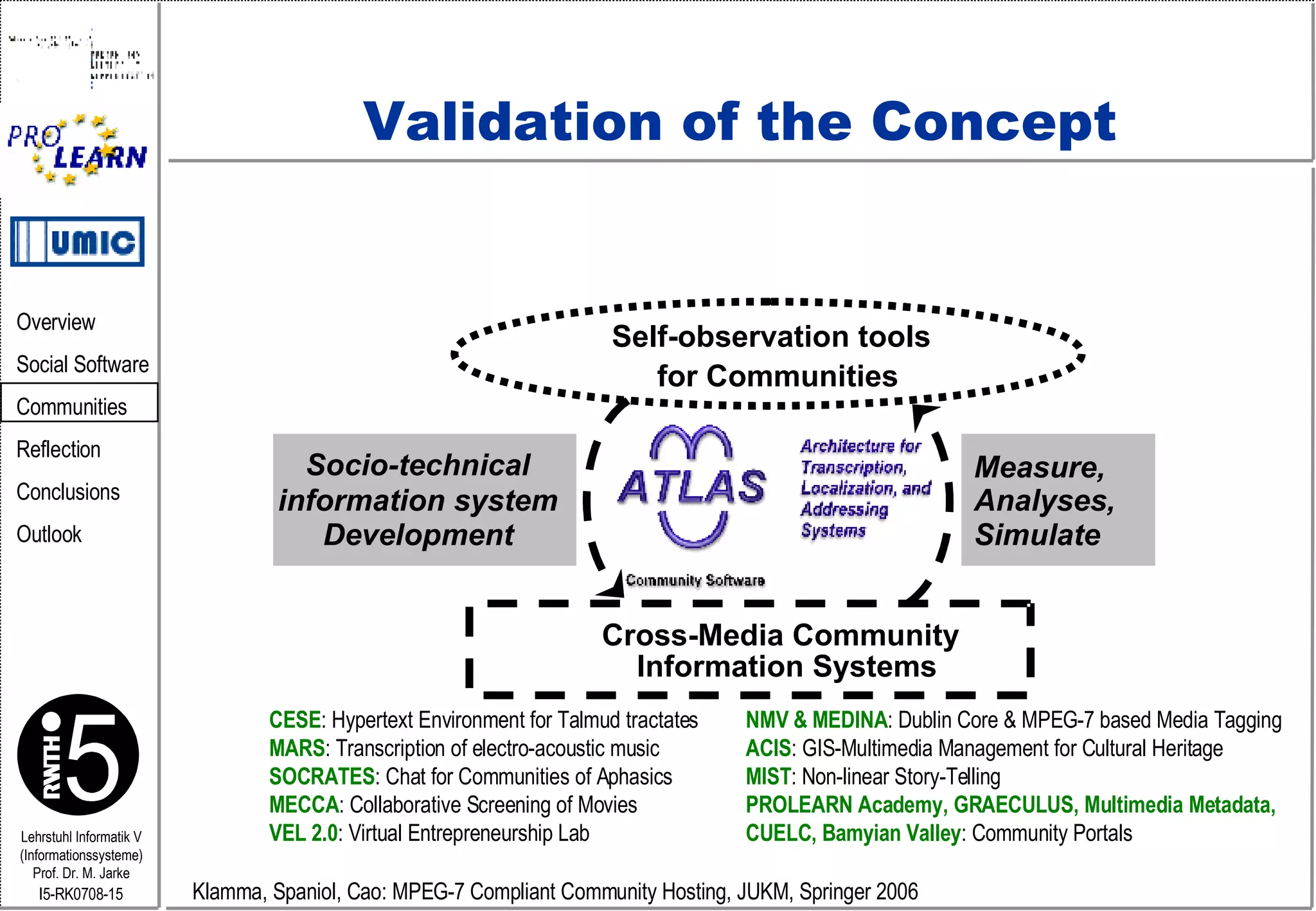
Validation of the Concept Klamma, Spaniol, Cao: MPEG-7 Compliant Community Hosting, JUKM, Springer 2006 CESE : Hypertext Environment for Talmud tractates MARS : Transcription of electro-acoustic music SOCRATES : Chat for Communities of Aphasics MECCA : Collaborative Screening of Movies VEL 2.0 : Virtual Entrepreneurship Lab NMV & MEDINA : Dublin Core & MPEG-7 based Media Tagging ACIS : GIS-Multimedia Management for Cultural Heritage MIST : Non-linear Story-Telling  PROLEARN Academy, GRAECULUS, Multimedia Metadata, CUELC, Bamyian Valley : Community Portals Cross-Media Community Information Systems Self-observation tools for Communities Measure,  Analyses, Simulate Socio-technical information system Development
Challenges for  Community Information Systems Operational Support (Usability) Can we support CoPs with the ´collaborative creation of complex multimedia learning objects? Can CoPs make use of metadata over the frontiers of media and standards? Can we support CoPs by personalized learning and networking strategies in Social Software? How do adaptive, mobile web-based interfaces for CoPs look like? Reflective Support (Sociability) Can CoPs  continuously  elicitate and implement  requirements  for learning and teaching? How much computer science support is needed?  Can CoPs learn meaningful  social Interaction  and make use of disturbances? How can CoPs record their complex their c omplex media learning traces  and  how they can deal with them? Can CoPs maintain or even improve their  agency  (Learning, Researching, Working) in the Web 2.0?
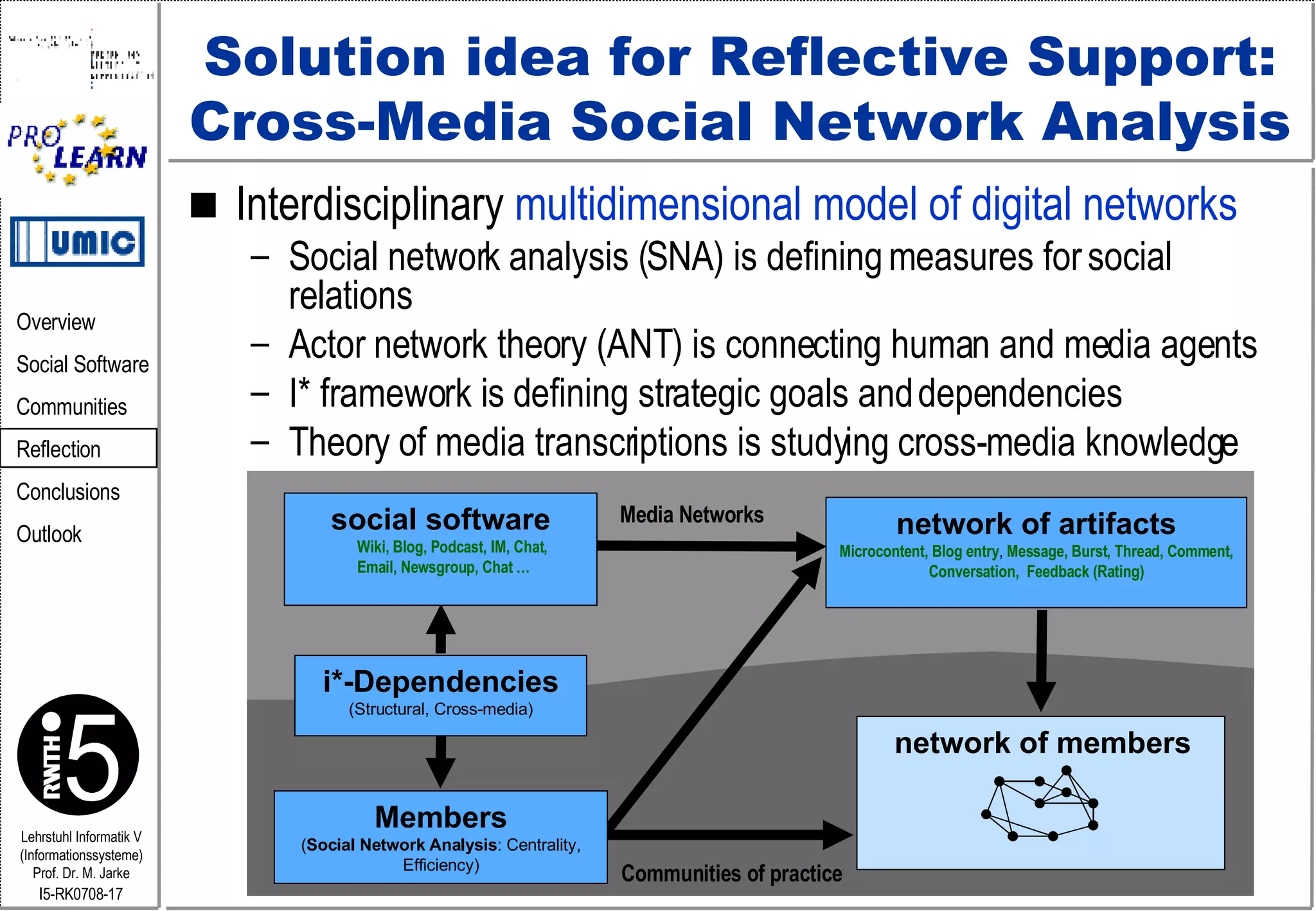
Solution idea for Reflective Support: Cross-Media Social Network Analysis Interdisciplinary  multidimensional model of digital networks Social network analysis (SNA) is defining measures for social relations Actor network theory (ANT) is connecting human and media agents I* framework is defining strategic goals and dependencies Theory of media transcriptions is studying cross-media knowledge social software Wiki, Blog, Podcast, IM, Chat, Email, Newsgroup, Chat … i*-Dependencies (Structural, Cross-media) Members ( Social Network Analysis : Centrality, Efficiency) network of artifacts Microcontent, Blog entry ,  Message, Burst, Thread, Comment, Conversation,  Feedback (Rating) network of members Communities of practice Media Networks
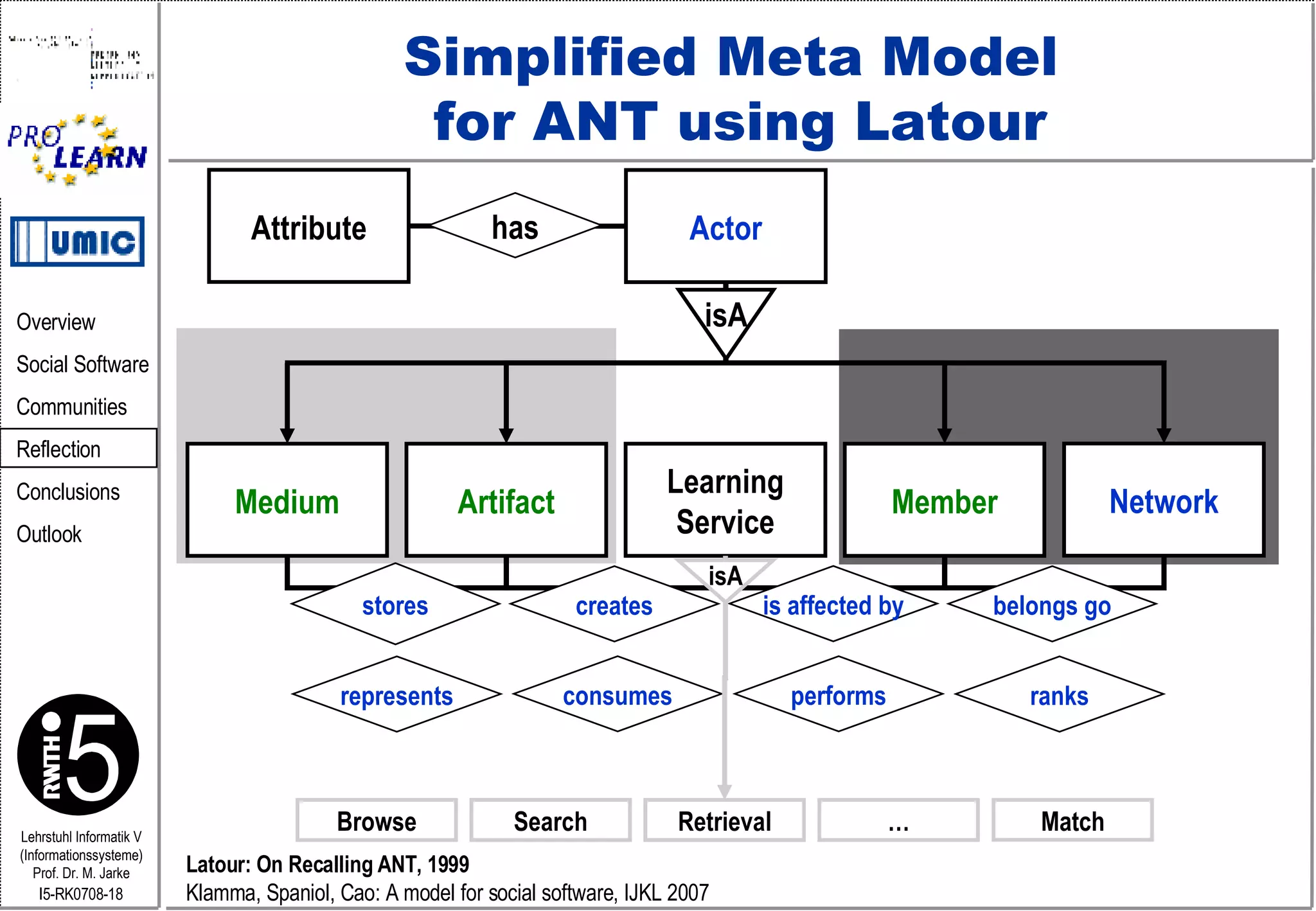
Simplified Meta Model  for ANT using Latour Actor Attribute has isA isA Latour: On Recalling ANT , 1999 Klamma, Spaniol, Cao: A model for social software, IJKL 2007  Member Network Learning Service Medium Artifact stores creates is affected by belongs go represents consumes performs ranks … Match Retrieval Browse Search
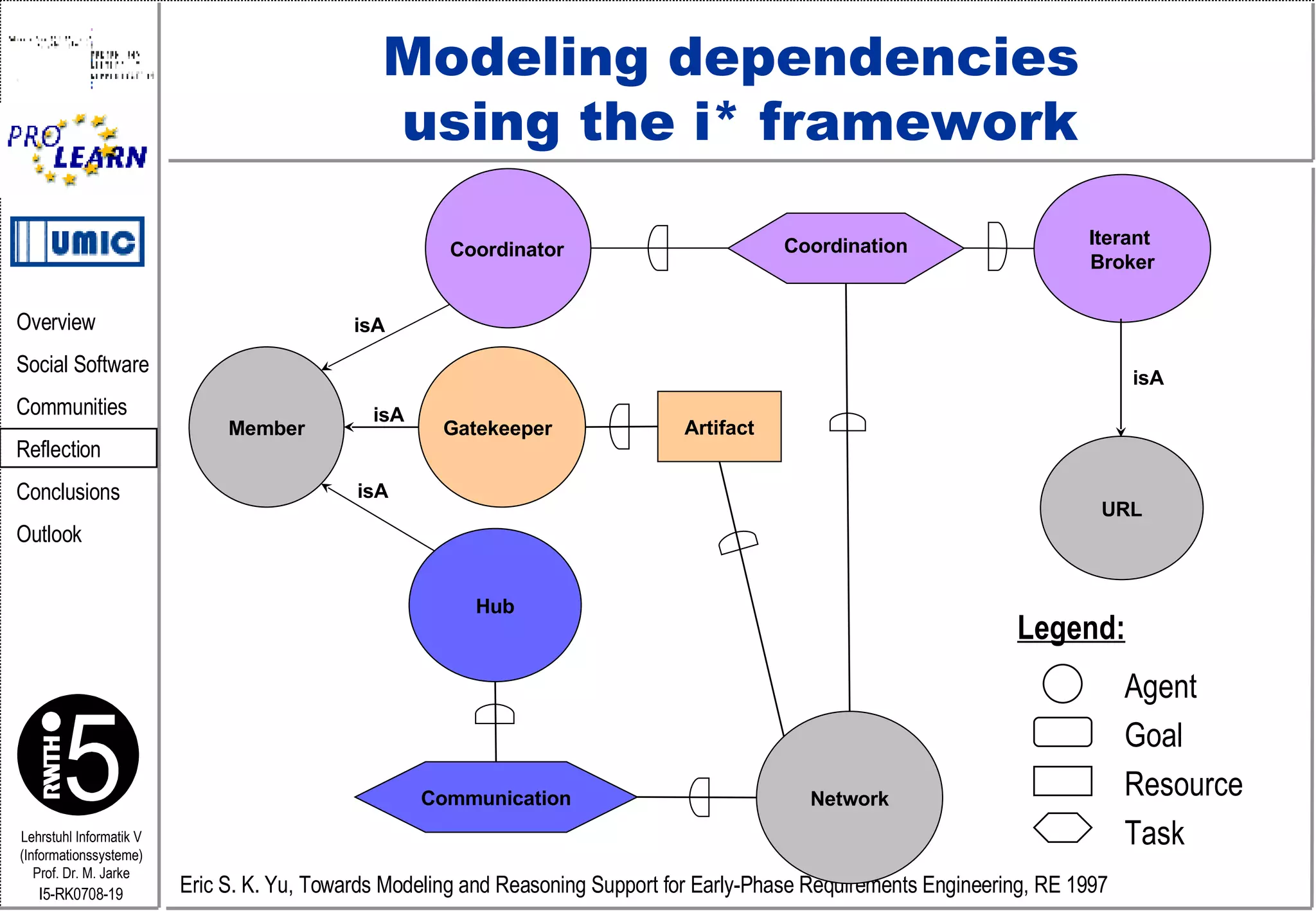
Modeling dependencies  using the i* framework Eric S. K. Yu, Towards Modeling and Reasoning Support for Early-Phase Requirements Engineering, RE 1997 Network Coordinator Gatekeeper Hub Member Iterant  Broker URL isA isA isA Coordination Artifact Communication isA Legend: Agent Goal Resource  Task
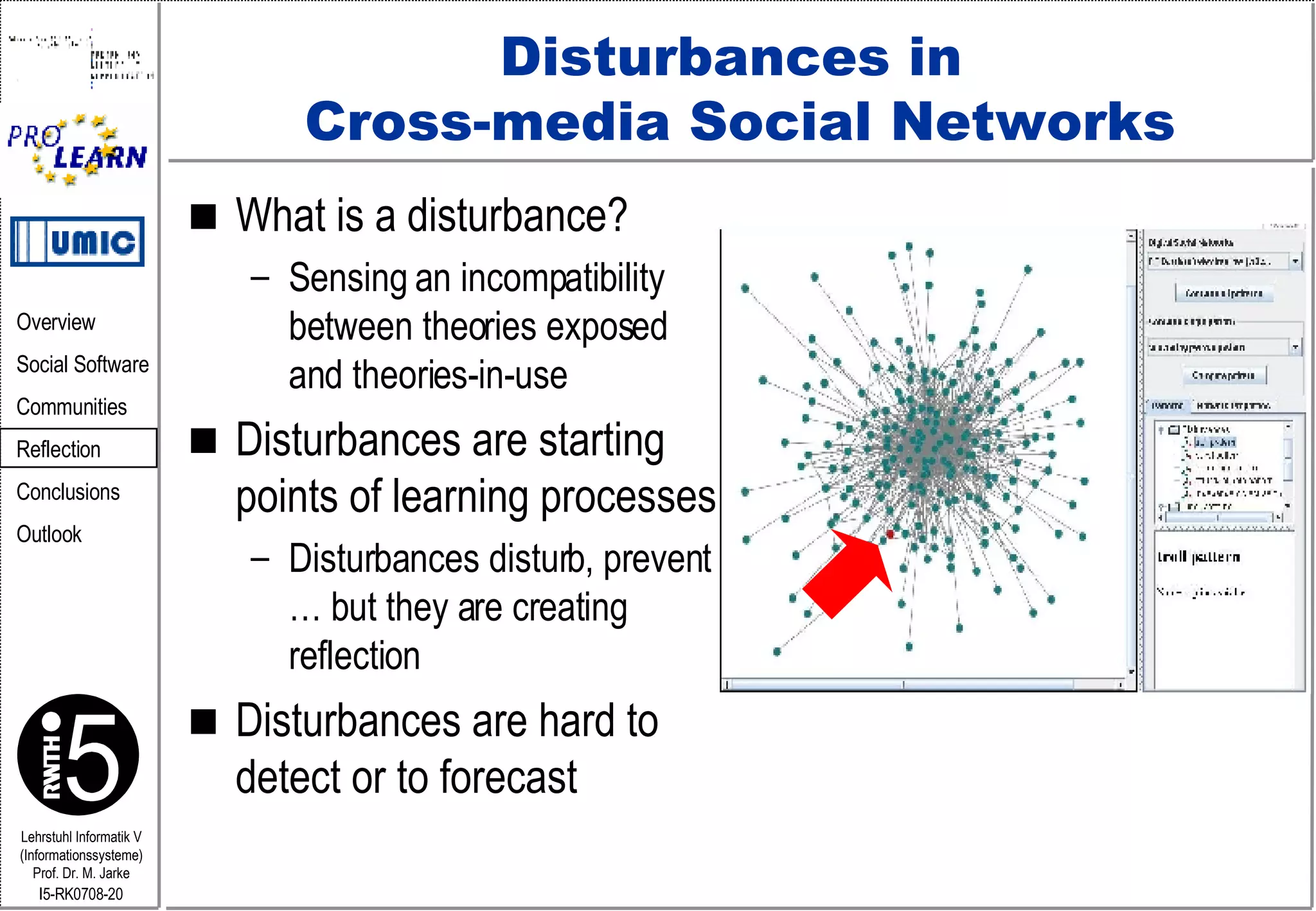
Disturbances in  Cross-media Social Networks What is a disturbance? Sensing an incompatibility between theories exposed and theories-in-use Disturbances are starting points of learning processes Disturbances disturb, prevent … but they are creating reflection Disturbances are hard to detect or to forecast
Pattern Language for  PALADIN : Example Troll Troll Pattern : This pattern tries to discover the cases when a troll exists in a digital social network. A troll in the network is considered a disturbance.   Disturbance :   (EXISTS [medium | medium.affordance = threadArtefact]) &  (EXISTS [troll |(EXISTS [thread | (thread.author = troll) &    (COUNT [message | (message.author = troll) &    (message.posted = thread)]) > minPosts]) &   (~EXISTS[ thread 1 , message 1 | (thread 1 .author 1  != troll) &   (message 1 .author = troll & message 1 .posted = thread 1  ]))])]) Forces :  medium; troll; network; member; thread; message; url Force Relations :  neighbour(troll, member); own thread(troll, thread) Solution :   No attention must be paid to the discussions started by the   troll .  Rationale : The troll needs attention to continue its activities. If no attention is paid, he/she will stop participating in the discussions.  Pattern Relations : Associates Spammer pattern.
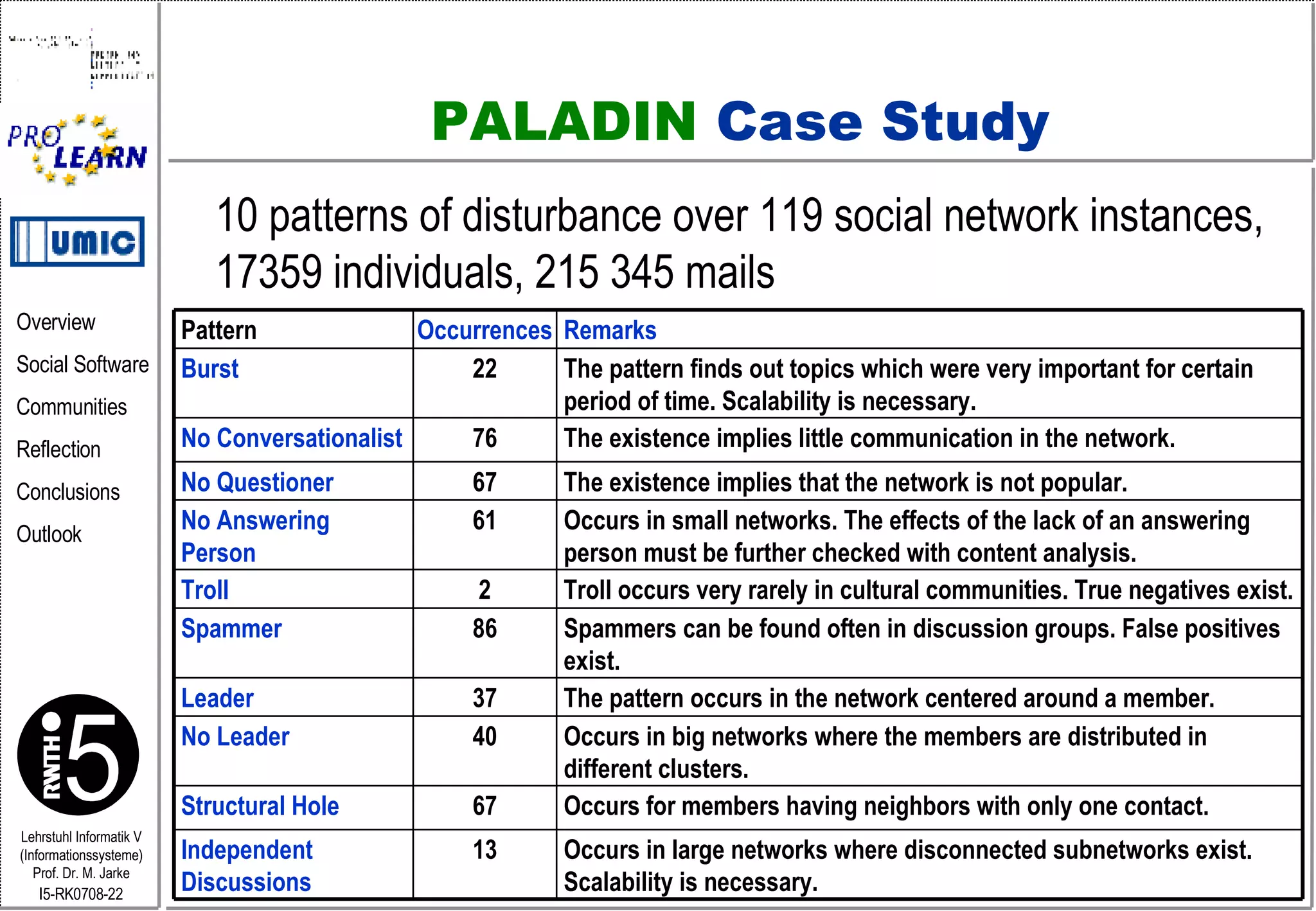
PALADIN  Case Study 10 patterns of disturbance over 119 social network instances, 17359 individuals, 215 345 mails Occurs in big networks where the members are distributed in different clusters. 40 No Leader Occurs for members having neighbors with only one contact. 67 Structural Hole Occurs in large networks where disconnected subnetworks exist. Scalability is necessary. 13 Independent Discussions The pattern occurs in the network centered around a member. 37 Leader Spammers can be found often in discussion groups. False positives exist. 86 Spammer Troll occurs very rarely in cultural communities. True negatives exist. 2 Troll Occurs in small networks. The effects of the lack of an answering person must be further checked with content analysis. 61 No Answering Person The existence implies that the network is not popular. 67 No Questioner The existence implies little communication in the network. 76 No Conversationalist The pattern finds out topics which were very important for certain period of time. Scalability is necessary. 22 Burst Remarks Occurrences Pattern
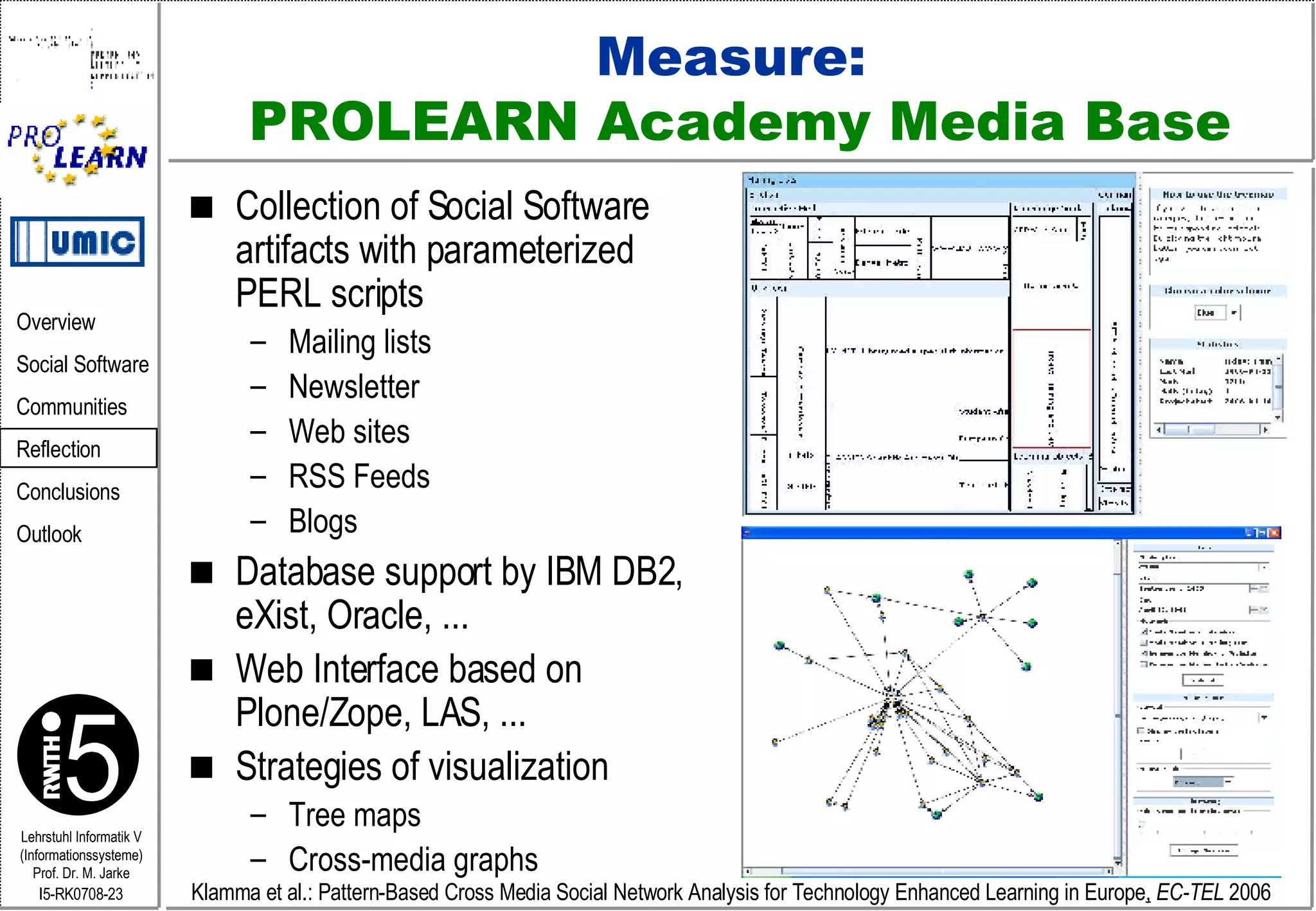
Measure:  PROLEARN Academy Media Base Collection of Social Software artifacts with parameterized PERL scripts Mailing lists Newsletter Web sites RSS Feeds Blogs Database support by IBM DB2, eXist, Oracle, ... Web Interface based on Plone/Zope, LAS, ... Strategies of visualization Tree maps Cross-media graphs Klamma et al.: Pattern-Based Cross Media Social Network Analysis for Technology Enhanced Learning in Europe ,   EC-TEL  2006
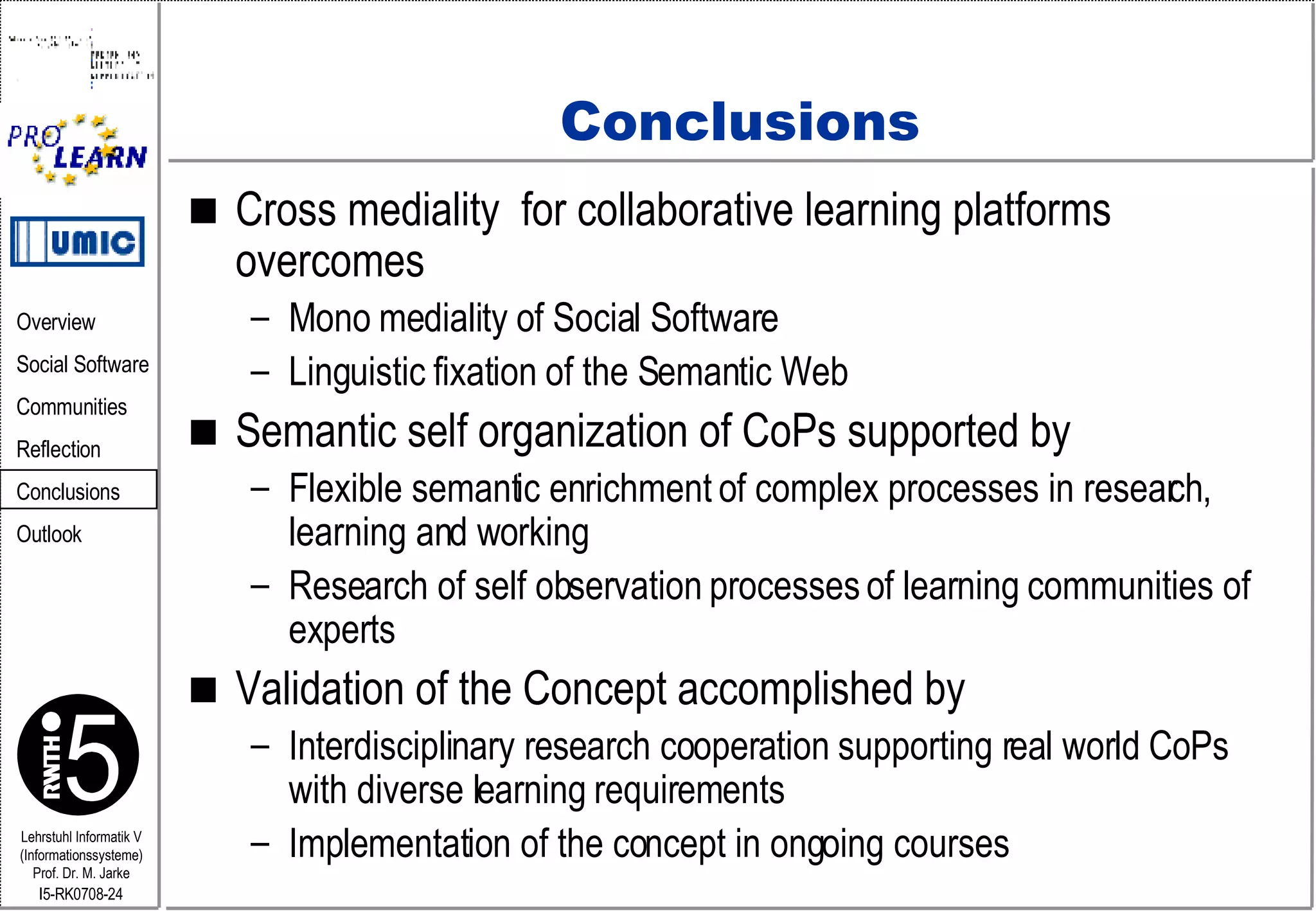
Conclusions Cross m ediality  for collaborative learning platforms overcomes Mono  mediality  of Social Software Linguistic fixation of the Semantic Web Semantic self organization of CoPs supported by Flexible semantic enrichment of complex processes in research, learning and working Research of self observation processes of learning communities of experts Validation of the Concept accomplished by Interdisciplinary research cooperation supporting real world CoPs with diverse learning requirements Implementation of the concept in ongoing courses
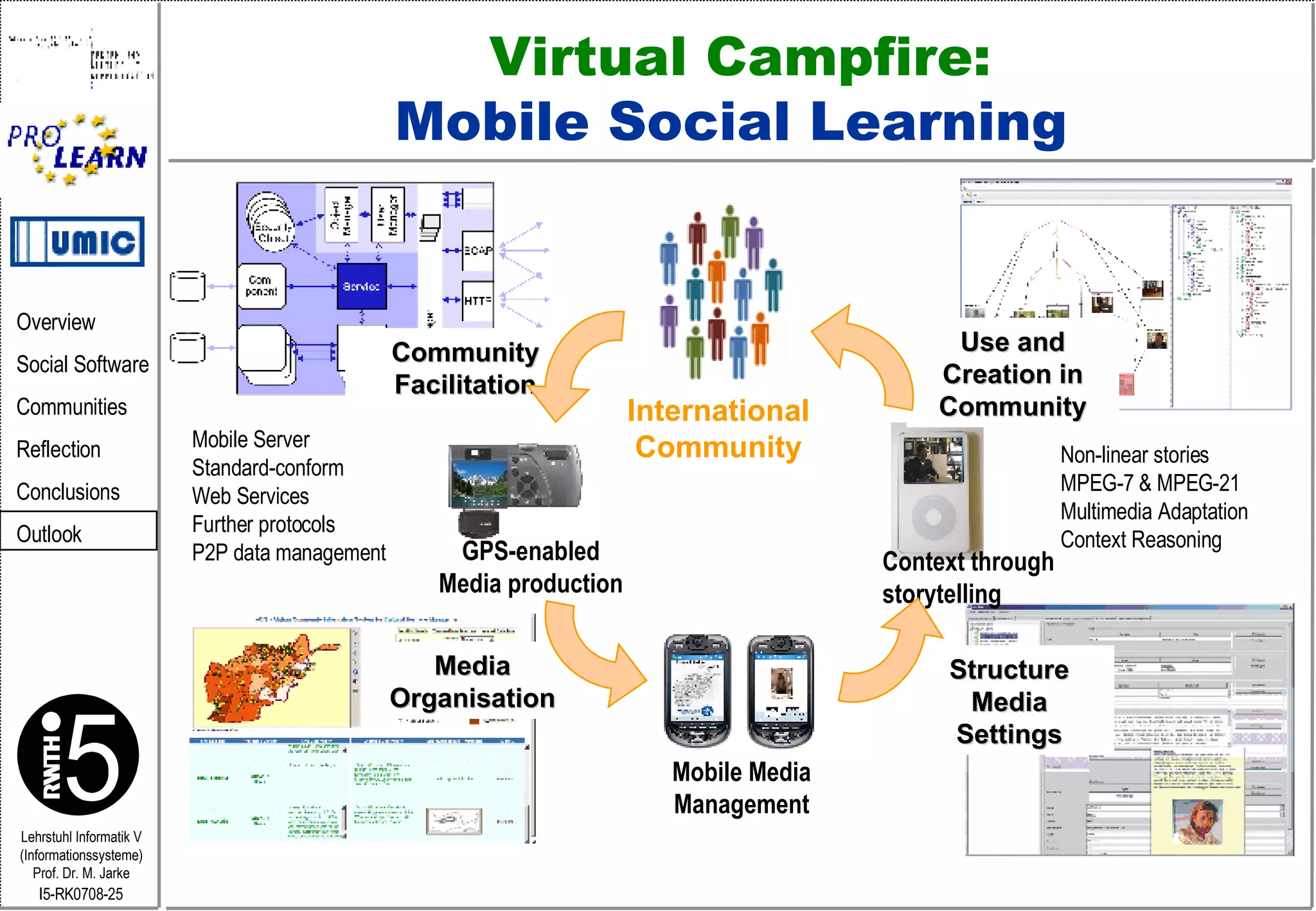
Virtual Campfire: Mobile Social Learning  International Community GPS-enabled Media production Mobile Media Management Context through storytelling  Community Facilitation Use and Creation in Community Media Organisation Structure Media Settings Mobile Server Standard-conform  Web Services Further protocols P2P data management Non-linear stories MPEG-7 & MPEG-21 Multimedia Adaptation Context Reasoning

Social Software and Community Information Systems

  • 1.
    Ralf Klamma RWTHAachen University SCOOP Workshop Bremen, August 30, 2007 Social Software and Community Information Systems
  • 2.
    Agenda Social Softwareis not enough for Community Information Systems ATLAS Framework Infrastructures for Cross-Media Community Information Systems Self-observation tools for learning communities Conclusions and Outlooks
  • 3.
    Social Software SecondLife 7 WOW 70 MySpace 171 Skype 120 MSN Space 11 LiveJournal 4 Wikipedia 3 Second Life Users (in Millions, by the end of 2006) Social Software Data is the Next Intel Inside -> Unique data Users Add Value -> no restrictions, Inclusive Network Effects by Default -> Collective Intelligence Some Rights Reserved -> Standards, Remix The Perpetual Beta -> Smaller modular Components Cooperate, Don't Control -> Light Web Services, Loose Syndication of data and systems (RSS, Mash-ups) Software Above the Level of a Single Device -> Software mobile and ubiquitous The Long Tail -> Small Communities O‘Reilly: What is Web 2.0?, 2005
  • 4.
    Social Software andCommunities: The Long Tail & Fragmentation The Web is a scale free, fragmented network Power Laws (Pareto Distribution etc.) 95 % of users are in the long tail (Communities) Collaboration and Learning is based on trust and passion Islands Tendrils IN Continent Central Core OUT Continent Tubes Barabasi: Linked – The New Science of Networks, 2002 Anderson: The Long Tail: Why the Future of Business is Selling Less of More, 2006
  • 5.
    Communities of practiceCommunity of practice (CoP) as the basic concept for community information systems Communities of practice are groups of people who share a concern or a passion for something they do and who interact regularly to learn how to do it better Usability & Sociability Wenger: Communities of Practice: Learning, Meaning and Identity, 1998 Preece: Online Communities: Designing Usability, Supporting Sociability, 2000
  • 6.
    Key Community FeaturesMutual engagement (ME) If you are aware of "what matters" in the scope of a community your engagement is enabled Joint enterprises (JE) CoPs and theirs members can follow the situations happening around them and because of them Shared repertoire (SR) Legitimate peripheral participation: from borders to the center; from novices to experts
  • 7.
    Challenges in SocialSoftware Operational support not satisfying Mono-mediality „ Sticky“ metadata Interoperability only with APIs (Mash-ups) Lacking learning semantics not feasible No reflective support „ Quality control by feet“ Undefined social norms Constitutive impact of media not understood
  • 8.
    Challenges for Community Information Systems Operational Support (Usability) Can we support CoPs with the collaborative creation of complex multimedia learning objects ? Can CoPs make use of metadata over the frontiers of media and standards? Can we support CoPs by personalized learning and networking strategies in Social Software? How do adaptive, mobile web-based interfaces for CoPs look like? Reflective Support (Sociability) Can CoPs continuously elicitate and implement requirements for learning and teaching? How much computer science support is needed? Can CoPs learn meaningful social Interaction and make use of disturbances? How can CoPs record their complex their complex media learning traces and how they can deal with them? Can CoPs maintain or even improve their agency (Learning, Researching, Working) in the Web 2.0?
  • 9.
    Learning Support forCoP: Reflective Collaborative Support Cross-Media Community Information Systems Self-observation tools for Communities Measure, Analyses, Simulate Socio-technical information system Development Jarke, Klamma: Social Software and Reflective Information Systems, 2006 Klamma, Spaniol, Cao: MPEG-7 Compliant Community Hosting, JUKM, Springer 2006 M. Kalz, M. Specht, R. Klamma, M. A. Chatti, R. Koper: Kompetenzentwicklung in Lernnetzwerken für das lebenslange Lernen, 2007
  • 10.
    Cross-Media Theory oftranscription Pre-“texts“ Transcript Cross-Media Transcription Understand and Critisize Jäger, Stanitzek: Transkribieren - Medien/Lektüre 2002 Strategies of transcriptivity Collection of learning materials are re-structured by new media Design is specific for media and communities by default Strategies of addressing Social Software promotes the globalization of address spaces Personalization and adaptive strategies are mission critical for CoPs Strategies of localisation Re-organization of local practices is stimulated by new media like Social Software Need to model practice explicitly
  • 11.
    Babylonian Talmud: A very old Hypertext Scroll/book/printed book Talmud schools (Jeshiwot) Authoritative knowledge source Dialogic encyclopedia Structure of complex texts Connected knowledge Transcribe? Address? Localize?
  • 12.
    CESE: Multi-lingual Cross-Media System Published in: DS-NELL 2000, ICALT 2002, ICWL 2002, WWW 2003
  • 13.
    VEL 2.0: Multimedia Learning Platform for Entrepreneurs Constructivist Learning Approach Authentic Videos Multimedia Tagging Semantic Zapping  Open and explorative learning platforms für CoPs
  • 14.
    Implementation in Academic Courses Rohde, Klamma, Jarke, Wulf: Reality is our laboratory: communities of practice in applied computer science, B & IT 2007 Rohde, Klamma, Wulf: Establishing Communities of Practice among Students and Start-up Companies, CSCL, 2005 Course and lab „Hightech Entrepreneurship and new Media“ Several instances at RWTH Aachen University and University of Siegen
  • 15.
    Validation of theConcept Klamma, Spaniol, Cao: MPEG-7 Compliant Community Hosting, JUKM, Springer 2006 CESE : Hypertext Environment for Talmud tractates MARS : Transcription of electro-acoustic music SOCRATES : Chat for Communities of Aphasics MECCA : Collaborative Screening of Movies VEL 2.0 : Virtual Entrepreneurship Lab NMV & MEDINA : Dublin Core & MPEG-7 based Media Tagging ACIS : GIS-Multimedia Management for Cultural Heritage MIST : Non-linear Story-Telling PROLEARN Academy, GRAECULUS, Multimedia Metadata, CUELC, Bamyian Valley : Community Portals Cross-Media Community Information Systems Self-observation tools for Communities Measure, Analyses, Simulate Socio-technical information system Development
  • 16.
    Challenges for Community Information Systems Operational Support (Usability) Can we support CoPs with the ´collaborative creation of complex multimedia learning objects? Can CoPs make use of metadata over the frontiers of media and standards? Can we support CoPs by personalized learning and networking strategies in Social Software? How do adaptive, mobile web-based interfaces for CoPs look like? Reflective Support (Sociability) Can CoPs continuously elicitate and implement requirements for learning and teaching? How much computer science support is needed? Can CoPs learn meaningful social Interaction and make use of disturbances? How can CoPs record their complex their c omplex media learning traces and how they can deal with them? Can CoPs maintain or even improve their agency (Learning, Researching, Working) in the Web 2.0?
  • 17.
    Solution idea forReflective Support: Cross-Media Social Network Analysis Interdisciplinary multidimensional model of digital networks Social network analysis (SNA) is defining measures for social relations Actor network theory (ANT) is connecting human and media agents I* framework is defining strategic goals and dependencies Theory of media transcriptions is studying cross-media knowledge social software Wiki, Blog, Podcast, IM, Chat, Email, Newsgroup, Chat … i*-Dependencies (Structural, Cross-media) Members ( Social Network Analysis : Centrality, Efficiency) network of artifacts Microcontent, Blog entry , Message, Burst, Thread, Comment, Conversation, Feedback (Rating) network of members Communities of practice Media Networks
  • 18.
    Simplified Meta Model for ANT using Latour Actor Attribute has isA isA Latour: On Recalling ANT , 1999 Klamma, Spaniol, Cao: A model for social software, IJKL 2007 Member Network Learning Service Medium Artifact stores creates is affected by belongs go represents consumes performs ranks … Match Retrieval Browse Search
  • 19.
    Modeling dependencies using the i* framework Eric S. K. Yu, Towards Modeling and Reasoning Support for Early-Phase Requirements Engineering, RE 1997 Network Coordinator Gatekeeper Hub Member Iterant Broker URL isA isA isA Coordination Artifact Communication isA Legend: Agent Goal Resource Task
  • 20.
    Disturbances in Cross-media Social Networks What is a disturbance? Sensing an incompatibility between theories exposed and theories-in-use Disturbances are starting points of learning processes Disturbances disturb, prevent … but they are creating reflection Disturbances are hard to detect or to forecast
  • 21.
    Pattern Language for PALADIN : Example Troll Troll Pattern : This pattern tries to discover the cases when a troll exists in a digital social network. A troll in the network is considered a disturbance. Disturbance : (EXISTS [medium | medium.affordance = threadArtefact]) & (EXISTS [troll |(EXISTS [thread | (thread.author = troll) & (COUNT [message | (message.author = troll) & (message.posted = thread)]) > minPosts]) & (~EXISTS[ thread 1 , message 1 | (thread 1 .author 1 != troll) & (message 1 .author = troll & message 1 .posted = thread 1 ]))])]) Forces : medium; troll; network; member; thread; message; url Force Relations : neighbour(troll, member); own thread(troll, thread) Solution : No attention must be paid to the discussions started by the troll . Rationale : The troll needs attention to continue its activities. If no attention is paid, he/she will stop participating in the discussions. Pattern Relations : Associates Spammer pattern.
  • 22.
    PALADIN CaseStudy 10 patterns of disturbance over 119 social network instances, 17359 individuals, 215 345 mails Occurs in big networks where the members are distributed in different clusters. 40 No Leader Occurs for members having neighbors with only one contact. 67 Structural Hole Occurs in large networks where disconnected subnetworks exist. Scalability is necessary. 13 Independent Discussions The pattern occurs in the network centered around a member. 37 Leader Spammers can be found often in discussion groups. False positives exist. 86 Spammer Troll occurs very rarely in cultural communities. True negatives exist. 2 Troll Occurs in small networks. The effects of the lack of an answering person must be further checked with content analysis. 61 No Answering Person The existence implies that the network is not popular. 67 No Questioner The existence implies little communication in the network. 76 No Conversationalist The pattern finds out topics which were very important for certain period of time. Scalability is necessary. 22 Burst Remarks Occurrences Pattern
  • 23.
    Measure: PROLEARNAcademy Media Base Collection of Social Software artifacts with parameterized PERL scripts Mailing lists Newsletter Web sites RSS Feeds Blogs Database support by IBM DB2, eXist, Oracle, ... Web Interface based on Plone/Zope, LAS, ... Strategies of visualization Tree maps Cross-media graphs Klamma et al.: Pattern-Based Cross Media Social Network Analysis for Technology Enhanced Learning in Europe , EC-TEL 2006
  • 24.
    Conclusions Cross mediality for collaborative learning platforms overcomes Mono mediality of Social Software Linguistic fixation of the Semantic Web Semantic self organization of CoPs supported by Flexible semantic enrichment of complex processes in research, learning and working Research of self observation processes of learning communities of experts Validation of the Concept accomplished by Interdisciplinary research cooperation supporting real world CoPs with diverse learning requirements Implementation of the concept in ongoing courses
  • 25.
    Virtual Campfire: MobileSocial Learning International Community GPS-enabled Media production Mobile Media Management Context through storytelling Community Facilitation Use and Creation in Community Media Organisation Structure Media Settings Mobile Server Standard-conform Web Services Further protocols P2P data management Non-linear stories MPEG-7 & MPEG-21 Multimedia Adaptation Context Reasoning

Editor's Notes