SOCIAL RESPONSIBILITY
Presented By:-
Jai Pandey(16MB000063)
Ruchi 16MB000064)
Surbhi (16MB000065)
IIT-ISM DHN
OBJECTIVES
•TO DEFINE ETHICS AND MORALITY
•TO UNDERSTAND THE CONCEPT OF CORPORATE SOCIAL
RESPONSIBILITY
•TO DISCUSS THE REASON BEHIND THE DEVELOPMENT OF
CSR AND LIST THE INTERNAL AND EXTERNAL DIMENSIONS
OF CSR
•TO EXAMINE THE ROLE OF GOVERNMENT POLICY IN
PROMOTING CSR AND APPRECIATE THE ROLE OF MARKET
FORCES ON CSR
•TO MAKE A BUSINESS CASE FOR CSR IN SMALL AND MEDIUM
ENTERPRISES(SMEs)
•To TABULATE THE CRITICISMS AGAINST CSR IN SMEs.
MORALITY
•Defined as the standards a society or an individual has
developed about what is wrong and what is right or good or
evil.
•Main features of moral standards:
1. Not established by an act of law or the government
legislature.
2. Occupy a higher ground and should take precedence over
other values including self-interest.
3. Based on impartial considerations.
4. Especially invoked in serious situations when something
substantial is at stake.
5. Society associates moral standards with special emotions.
ETHICS
• Moral principles that govern a person's behavior or the
conducting of an activity.
• Business ethics is the study of proper business policies
and practices regarding potentially controversial issues,
such as corporate governance, insider trading, bribery,
discrimination, corporate social responsibility and
fiduciary responsibilities.
CORPORATE SOCIAL RESPONSIBILITY
• A concept whereby companies integrate social and
environmental concerns in their business operations and in their
interaction with their stakeholders on a voluntary basis.
• CRS is the continuing commitment by business to behave
ethically and contribute to economic development while
improving the quality of life of the workforce & their families,
local communities and society at large.
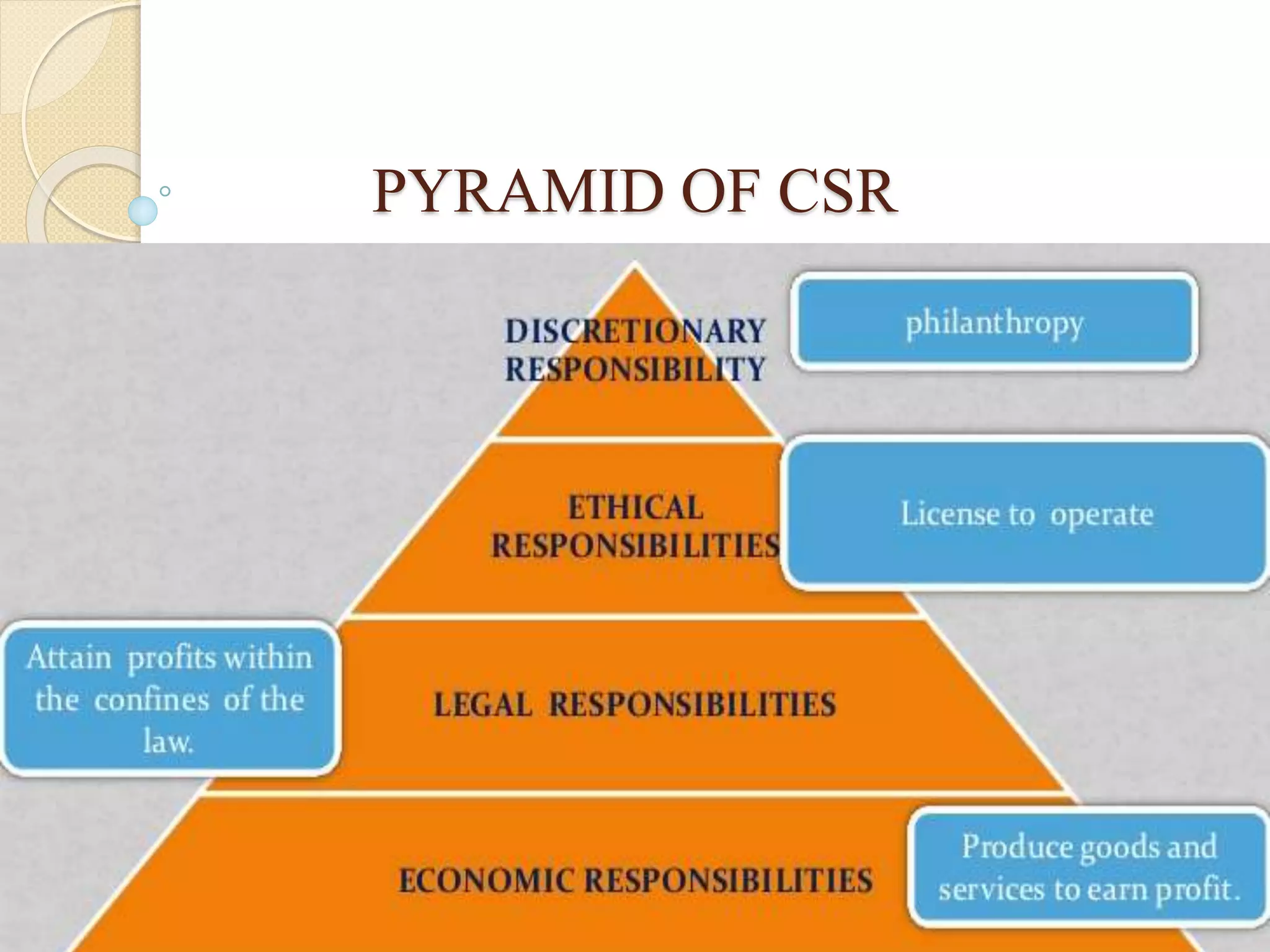
PYRAMID OF CSR
TRIPLE BOTTOM LINE CONCEPT OF
CSR
INCREASED FOCUS ON CSR
1. More Expectations
2. Getting More Investment
3. Environmental Concerns
4. Role of Media
BENEFITS OF CSR ACTIVITIES
•Better brand recognition.
•Positive business reputation.
•Increased sales and customer loyalty.
•Operational costs savings.
•Better financial performance.
•Greater ability to attract talent and retain staff.
•Organizational growth.
•Higher Customer satisfaction and loyalty
•Easier access to capital
DIMENSIONS OF CSR
•CSR agenda can be broadly divided into its
1. Internal dimensions of CSR:
• Human Resource Management
• Health and Safety at Work
• Adaptation to Change
• Management of Environmental impact and Natural
Resources
2. External dimensions of CSR:
• Local Community
• Business partners, suppliers and consumers
• Human rights
• Global environmental concerns.
Role of Government in promoting
CSR
 Guiding the business world
 Facilitating
 Incentivizing
 Certifying /Endorsing the Company
 Participating directly in CSR activities
 Auditing / Monitoring
 Exercising Control
Role of market forces in CSR
 Consumer Awareness
 Market forces
 Globalization
Business Case for CSR
 Marketing Benefits
 Business Partnership
 Cost Saving
 Improvement in Productivity
 Other Linkages
Criticism of CSR
• Imposing CSR can lead to imposing
inappropriate standards.
• Imposing CSR on SMEs is going to
severely affect their viability as they are
struggling for survival.
• CSR initiatives by small business will be
minuscule compared to initiatives taken by
large corporate bodies.
Avoiding Criticism of CSR
 CSR programmes must be based on
legitimate standards established by civil
society.
 Should be backed up by well-established
processes for measurement and reporting.
 Should be built on strong business case so
that it becomes easy to economically
justify the adoption of CSR.
 Must be flexible and based on their unique
situations.
THANK YOU

Social responsibility ppt entrepreneurship

  • 1.
    SOCIAL RESPONSIBILITY Presented By:- JaiPandey(16MB000063) Ruchi 16MB000064) Surbhi (16MB000065) IIT-ISM DHN
  • 2.
    OBJECTIVES •TO DEFINE ETHICSAND MORALITY •TO UNDERSTAND THE CONCEPT OF CORPORATE SOCIAL RESPONSIBILITY •TO DISCUSS THE REASON BEHIND THE DEVELOPMENT OF CSR AND LIST THE INTERNAL AND EXTERNAL DIMENSIONS OF CSR •TO EXAMINE THE ROLE OF GOVERNMENT POLICY IN PROMOTING CSR AND APPRECIATE THE ROLE OF MARKET FORCES ON CSR •TO MAKE A BUSINESS CASE FOR CSR IN SMALL AND MEDIUM ENTERPRISES(SMEs) •To TABULATE THE CRITICISMS AGAINST CSR IN SMEs.
  • 3.
    MORALITY •Defined as thestandards a society or an individual has developed about what is wrong and what is right or good or evil. •Main features of moral standards: 1. Not established by an act of law or the government legislature. 2. Occupy a higher ground and should take precedence over other values including self-interest. 3. Based on impartial considerations. 4. Especially invoked in serious situations when something substantial is at stake. 5. Society associates moral standards with special emotions.
  • 4.
    ETHICS • Moral principlesthat govern a person's behavior or the conducting of an activity. • Business ethics is the study of proper business policies and practices regarding potentially controversial issues, such as corporate governance, insider trading, bribery, discrimination, corporate social responsibility and fiduciary responsibilities.
  • 5.
    CORPORATE SOCIAL RESPONSIBILITY •A concept whereby companies integrate social and environmental concerns in their business operations and in their interaction with their stakeholders on a voluntary basis. • CRS is the continuing commitment by business to behave ethically and contribute to economic development while improving the quality of life of the workforce & their families, local communities and society at large.
  • 6.
  • 7.
    TRIPLE BOTTOM LINECONCEPT OF CSR
  • 8.
    INCREASED FOCUS ONCSR 1. More Expectations 2. Getting More Investment 3. Environmental Concerns 4. Role of Media
  • 9.
    BENEFITS OF CSRACTIVITIES •Better brand recognition. •Positive business reputation. •Increased sales and customer loyalty. •Operational costs savings. •Better financial performance. •Greater ability to attract talent and retain staff. •Organizational growth. •Higher Customer satisfaction and loyalty •Easier access to capital
  • 10.
    DIMENSIONS OF CSR •CSRagenda can be broadly divided into its 1. Internal dimensions of CSR: • Human Resource Management • Health and Safety at Work • Adaptation to Change • Management of Environmental impact and Natural Resources 2. External dimensions of CSR: • Local Community • Business partners, suppliers and consumers • Human rights • Global environmental concerns.
  • 11.
    Role of Governmentin promoting CSR  Guiding the business world  Facilitating  Incentivizing  Certifying /Endorsing the Company  Participating directly in CSR activities  Auditing / Monitoring  Exercising Control
  • 12.
    Role of marketforces in CSR  Consumer Awareness  Market forces  Globalization
  • 13.
    Business Case forCSR  Marketing Benefits  Business Partnership  Cost Saving  Improvement in Productivity  Other Linkages
  • 14.
    Criticism of CSR •Imposing CSR can lead to imposing inappropriate standards. • Imposing CSR on SMEs is going to severely affect their viability as they are struggling for survival. • CSR initiatives by small business will be minuscule compared to initiatives taken by large corporate bodies.
  • 15.
    Avoiding Criticism ofCSR  CSR programmes must be based on legitimate standards established by civil society.  Should be backed up by well-established processes for measurement and reporting.  Should be built on strong business case so that it becomes easy to economically justify the adoption of CSR.  Must be flexible and based on their unique situations.
  • 16.