
Corporate social Responsibility
▪ Presented By Kazi M.Mushtaq
▪ I.D# 9019
▪ Iqra University Gulshan Campus
CSR
Corporate Social Responsibility is
about aligning an organizations
activities with the social Economic and
environmental expectations of their
stakeholders
Meaning:
▪ Corporate social responsibility is a gesture of
showing the company’s concern & commitment
towards society’s sustainability & development.
▪ CSR is the ethical behaviour of a company towards
society.
Responsibility towards Society
▪ Carrying on business with moral& ethical standards.
▪ Prevention of environmental pollution.
▪ Minimizing ecological imbalance.
▪ Contributing towards the development of social
health, education
▪ Making use of appropriate technology.
▪ Overall development of locality.
Responsibility towards Government
▪ Obey rules & regulations.
▪ Regular payment of taxes.
▪ Cooperating with the Govt to promote social
values.
▪ Not to take advantage of loopholes in
business laws.
▪ Cooperating with the Govt for economic
growth & development.
Responsibility towards Shareholders
▪ To ensure a reasonable rate of
return over time.
▪ To work for the survival & the
growth of the concern.
▪ To build reputation & goodwill of
the company.
▪ To remain transparent &
accountable.
Responsibility towards Employee
▪ To provide a healthy working environment.
▪ To grant regular & fair wages.
▪ To provide welfare services.
▪ To provide training & promotion facilities.
▪ To provide reasonable working standard & norms.
▪ To provide efficient mechanism to redress worker’s grievances.
▪ Proper recognition of efficiency & hard work.
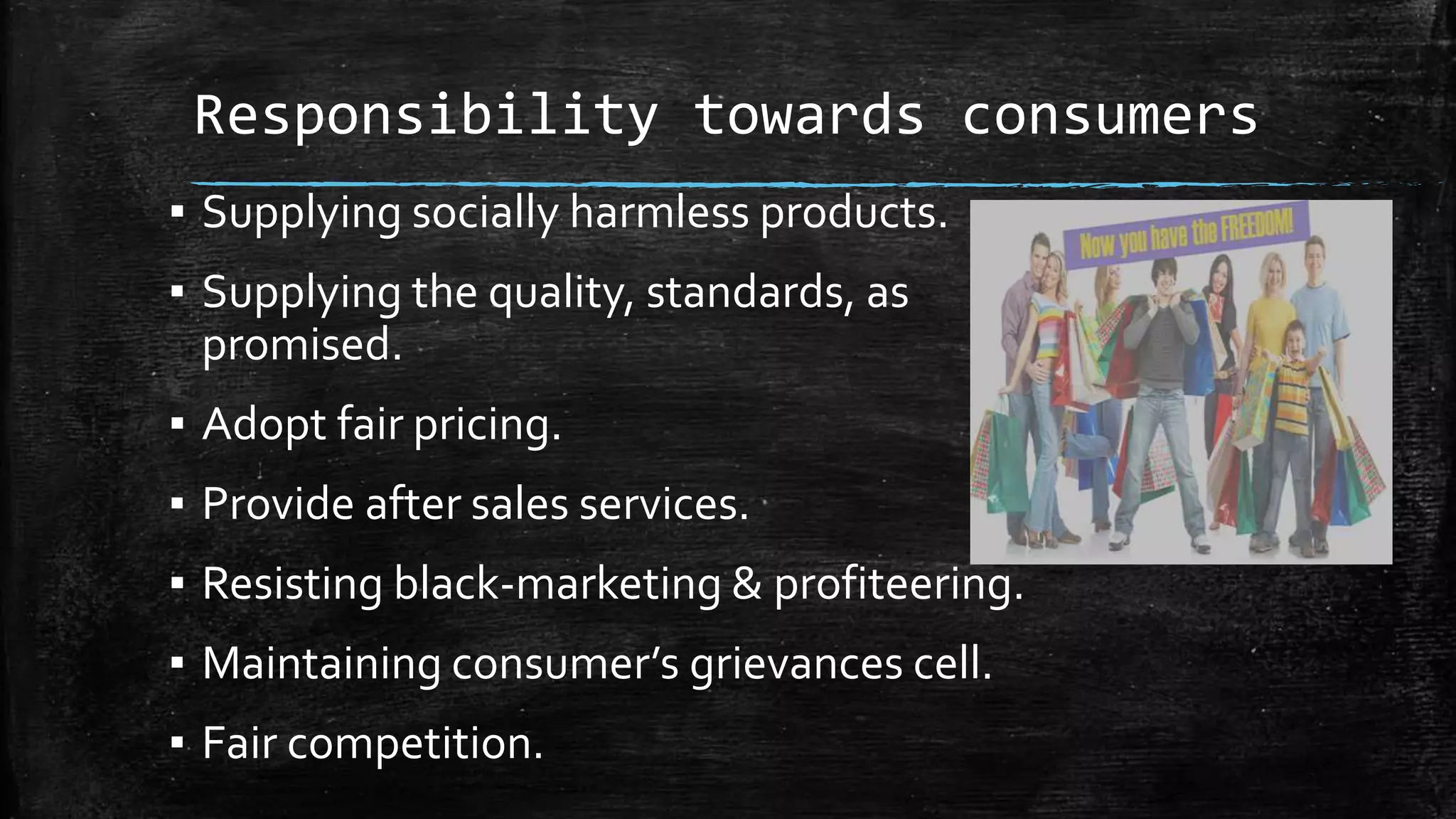
Responsibility towards consumers
▪ Supplying socially harmless products.
▪ Supplying the quality, standards, as
promised.
▪ Adopt fair pricing.
▪ Provide after sales services.
▪ Resisting black-marketing & profiteering.
▪ Maintaining consumer’s grievances cell.
▪ Fair competition.
Carroll Model(1991)
CorporateSocial Responsibility
Benefits of CSR Legislative Framework
Benefits
of CSR
Winning new
businesses
Enhancing your
influence in the industry
Attracting,
Retaining and
Maintaining a happy workforce
Increase in
customer retention
Differentiating
yourself from the
competitor
Saving money
on energy and
operating cost
Access to funding
opportunities
Media interest
and good
reputation
Enhanced
Relationship with
stakeholders
Arguments for & against the CSR
• Corporate should have some moral & social obligations to undertake for the welfare
of the society.
• Proper use of resources, capability & competence.
• The expenditure on CSR is a sort of investment.
• Company can avoid many legal complications.
• It create a better impression.
• Corporate should return a part of wealth.
Arguments against the CSR
▪ Fundamental principles of business gets violated.
▪ It vey expensive for business houses.
▪ CSR projects will not be successful.
▪ There are not the special areas of any business.
▪ CSR is to induce them to steal away the shareholders money.
CSR

CSR

  • 1.
    Corporate social Responsibility ▪Presented By Kazi M.Mushtaq ▪ I.D# 9019 ▪ Iqra University Gulshan Campus
  • 2.
    CSR Corporate Social Responsibilityis about aligning an organizations activities with the social Economic and environmental expectations of their stakeholders
  • 3.
    Meaning: ▪ Corporate socialresponsibility is a gesture of showing the company’s concern & commitment towards society’s sustainability & development. ▪ CSR is the ethical behaviour of a company towards society.
  • 4.
    Responsibility towards Society ▪Carrying on business with moral& ethical standards. ▪ Prevention of environmental pollution. ▪ Minimizing ecological imbalance. ▪ Contributing towards the development of social health, education ▪ Making use of appropriate technology. ▪ Overall development of locality.
  • 5.
    Responsibility towards Government ▪Obey rules & regulations. ▪ Regular payment of taxes. ▪ Cooperating with the Govt to promote social values. ▪ Not to take advantage of loopholes in business laws. ▪ Cooperating with the Govt for economic growth & development.
  • 6.
    Responsibility towards Shareholders ▪To ensure a reasonable rate of return over time. ▪ To work for the survival & the growth of the concern. ▪ To build reputation & goodwill of the company. ▪ To remain transparent & accountable.
  • 7.
    Responsibility towards Employee ▪To provide a healthy working environment. ▪ To grant regular & fair wages. ▪ To provide welfare services. ▪ To provide training & promotion facilities. ▪ To provide reasonable working standard & norms. ▪ To provide efficient mechanism to redress worker’s grievances. ▪ Proper recognition of efficiency & hard work.
  • 8.
    Responsibility towards consumers ▪Supplying socially harmless products. ▪ Supplying the quality, standards, as promised. ▪ Adopt fair pricing. ▪ Provide after sales services. ▪ Resisting black-marketing & profiteering. ▪ Maintaining consumer’s grievances cell. ▪ Fair competition.
  • 9.
  • 10.
    CorporateSocial Responsibility Benefits ofCSR Legislative Framework Benefits of CSR Winning new businesses Enhancing your influence in the industry Attracting, Retaining and Maintaining a happy workforce Increase in customer retention Differentiating yourself from the competitor Saving money on energy and operating cost Access to funding opportunities Media interest and good reputation Enhanced Relationship with stakeholders
  • 11.
    Arguments for &against the CSR • Corporate should have some moral & social obligations to undertake for the welfare of the society. • Proper use of resources, capability & competence. • The expenditure on CSR is a sort of investment. • Company can avoid many legal complications. • It create a better impression. • Corporate should return a part of wealth.
  • 12.
    Arguments against theCSR ▪ Fundamental principles of business gets violated. ▪ It vey expensive for business houses. ▪ CSR projects will not be successful. ▪ There are not the special areas of any business. ▪ CSR is to induce them to steal away the shareholders money.