Social life in digital societies: Trust, Reputation and Privacy
“We investigate what governs trust in the offline world, with the goal of mapping
this onto mechanisms in the online world.”

Contributors:
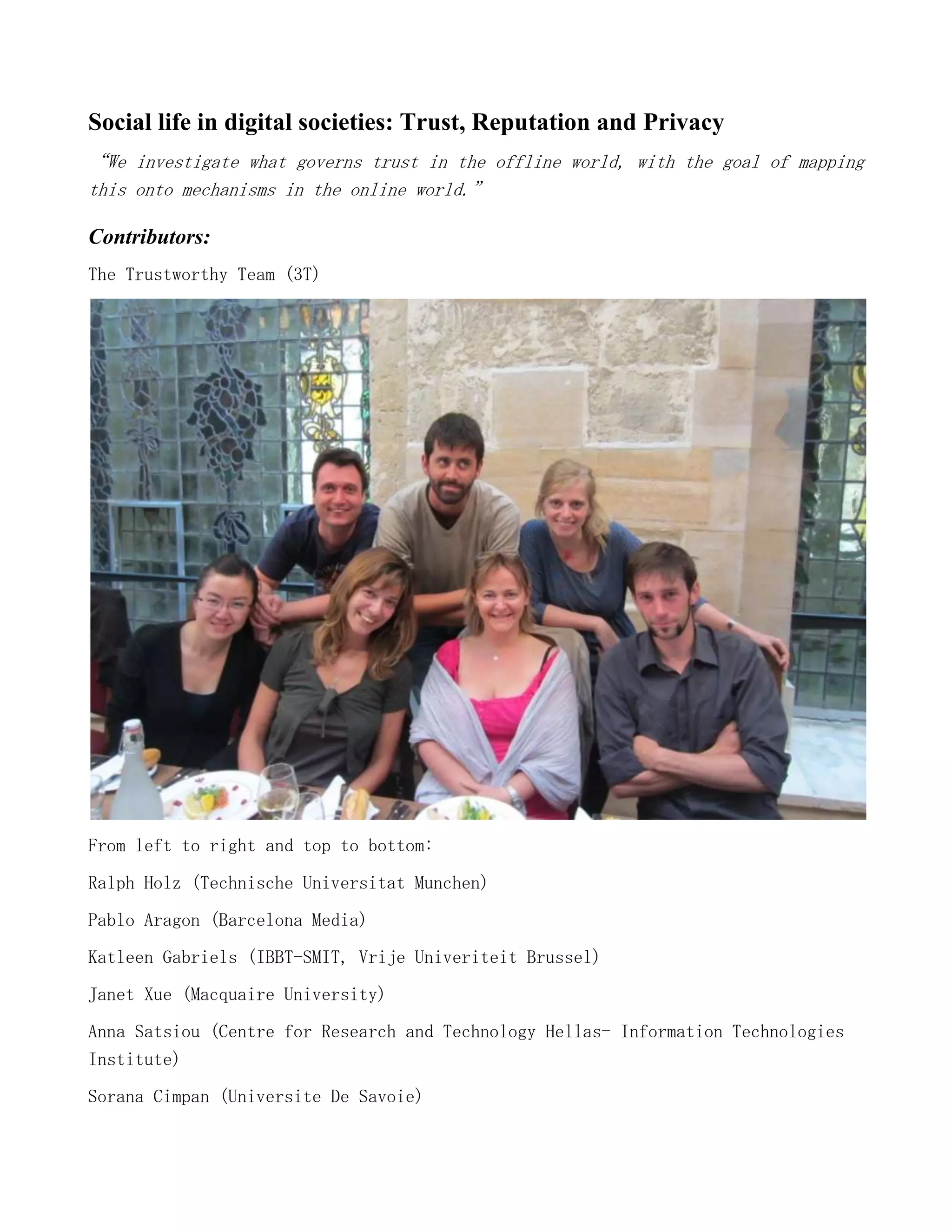
The Trustworthy Team (3T)


From left to right and top to bottom:

Ralph Holz (Technische Universitat Munchen)
Pablo Aragon (Barcelona Media)
Katleen Gabriels (IBBT-SMIT, Vrije Univeriteit Brussel)
Janet Xue (Macquaire University)
Anna Satsiou (Centre for Research and Technology Hellas- Information Technologies
Institute)
Sorana Cimpan (Universite De Savoie)
Norbert Blenn (Delft University of Technology)


Disciplines involved
The current team consists of representatives of the following disciplines:
      Computer Science (Communications, Security, Informational Retrieval, OSN
      Analysis, Graph Theory, Software Architecture)
      Philosophy (Moral philosophy/Ethics)

      Media Communication (Internet Regulation, Marketing Communications)
 We envisage the following disciplines to participate, too:
      Economics
      Law
      Psychology
      Sociology

Issues and Challenges
It is an open question how trust in a person can be built, represented and
expressed in the online world. Facebook contacts, for instance, are bidirectional,
and a poor mapping of human relationships. Additional features like contact lists
are an improvement, but are unintuitive to use and arguably lack expressiveness.
Recent research has shown that users seem to build relationships in the online
world in a way that is markedly different from their behaviour in the offline world.
There are online communities where contact is always purely virtual, but trust is
actually the essential ingredient that makes these platforms work (e.g.
Couchsurfing, Ebay).

Research Topic
Our research focuses on the role that “trust” plays in both offline and online
social life. We understand the term “social life” to refer to human relationships.
We deliberately exclude relationships between human entities and organisational or
institutional ones, e. g. human-government and human-company.


We cover the following research topics. We present these in the form of questions
and preliminary answers. The approach we suggest to follow is

      to begin with an analysis of trust in the offline world, both on a conceptual
      and operational level, its building mechanisms, and evolution

      then move to an in-depth study of the differences concerning trust between
      the offline and online realm

      with the ultimate goal of arriving at mechanisms that are able to map from
      the offline realm to the online realm, and vice-versa

      while investigating the interplay between trust, reputation and privacy in
      both worlds.

Research questions, possible answers
Most of our open questions focus on trust, as indicated above. In particular, we
propose to concentrate on the following ones (including, but not limited to):

      Conceptualisation: offline trust in general

      ◦ Conceptual/philosophical elaboration

      ◦ Psychological mechanism

      ◦ How is offline trust being built between humans?

      ◦ Historical treatise: how did the meaning of trust evolve throughout human
        history?

      ◦ Goal: Thorough multi-disciplinary understanding of trust to meet the
        following challenges

      Problematic aspects of (offline) trust

      ◦ Each discipline has its own difficulties with “trust”, notions of trust
        are different between disciplines

      ◦ Analyse problematic areas between different research areas

      ◦ How is trust propagating between humans – to which degree is it transitive?

      ◦ Goal: we arrive at an understanding of trust that incorporates essential
        aspects from different areas and forms a common denominator between them
Offline trust as a dynamically evolving property

◦ What are the factors that influence the trust evolution?

◦ How can these be expressed/mapped in/to the online world?

◦ Goal: as soon as we understand offline trust and its evolution, we can
  find ways to project this onto trust in the online realm

In-depth analysis of the similarities and dissimilarities of online/offline
trust

◦ Is there a dichotomy of offline and online trust, or is online trust
  merely an extension of offline trust?

◦ How does the online world reflect the dynamics of trust in the offline
  world?

◦ To what extent does the online world affect the notion of trust in the
  offline world?

◦ Potentially, not all aspects of offline trust can be transferred to the
  online realm. Which aspects can you transfer?

◦ In which ways has the online world made it impossible to apply the same
  mechanisms of trust? In particular, with respect to the following issues:

  ▪ Scale and speed of communication on the Internet is enormous (cf.
    Streisand effect).

  ▪ In face-to-face contact we decide in just 15s if we "like/trust" a
    person. None of that information is available in the online contact.

  ▪ Deleting data - in the offline world we can use legal means to
    delete/destroy data - but in the online world, once the data is out, it
    is almost impossible to destroy it.

◦ Goal: Understanding of differences of online and offline trust, with a
  view to establishing a mapping from one to the other

Aspect 1: trust and reputation
◦ What is reputation: Conceptual/philosophical elaboration

◦ What is its relationship to trust? Is it intrinsic to trust?

  ▪ Trust is used as a subjective (local) measure of trustworthiness

  ▪ Reputation can define the global trustworthiness of a user; as
    perceived by all the users in the network

  ▪ However, a user may trust another one despite the latter’s bad
    reputation

  ▪ Reputation can be multi-faceted (“if you have a reputation of being
    able to repair cars, I would also trust you to repair my bike”)

  ▪ Reputation does not imply automatic trust (“if you have a reputation
    of being able to repair Fiats, I don't trust you to repair my Ferrari –
    or keep a secret”)

  ▪ Further examples:

        Enforce cooperation between peer entities

        Help consumers to take decisions over products & services

◦ Dynamic evolution of the reputation

◦ When do both converge, and when do they diverge?

◦ Psychological mechanisms

◦ Identify domains where reputation is important, e. g. compare film
  recommendations to financial transactions

◦ What other factors than trust can affect the reputation of a member of a
  community?

Aspect 2: trust and privacy

◦ What is privacy's relationship to trust? Is it intrinsic to trust?

◦ Example of access control: which users in the network are allowed to
access my data

◦ When do both converge, and when do they diverge?

◦ What is the psychological and/or social link between these two?

◦ Can there be an inverse correlation between the two?

  ▪ The higher the trust the lower the privacy level imposed?

  ▪ High privacy leads to low trust?

Empirical preparations for a computational model

◦ This task brings results from the previous tasks together

◦ From the above research results, derive which data measurement points
  would be most valuable to derive empirical insights on trust

◦ Let researchers collect these empirical data by triangulation of methods

◦ Specifications of the requirements of the model

◦ Goals: understanding of empirical measurement of trust; collection of
  large data sets; requirements of the model

Computational mapping to the online world

◦ How to express all these notions computationally

◦ The other way around: how to express computational notions of trust in
  “real” world

◦ Issues we are facing:

  ▪ Trust is multi-faceted: you may trust a person to recommend a film, but
    not a restaurant, nor keep a secret

  ▪ Trust establishment in the online world between participants that have
    never met in the offline world

  ▪ How do you detect fake identities and misbehaviour in the online world?
▪ What is the relation with the robustness of a trust computation
            algorithm?

         ▪ How to prevent trust abuse? (Ranking of trustworthiness)

         ▪ How to defend against trust abuse?

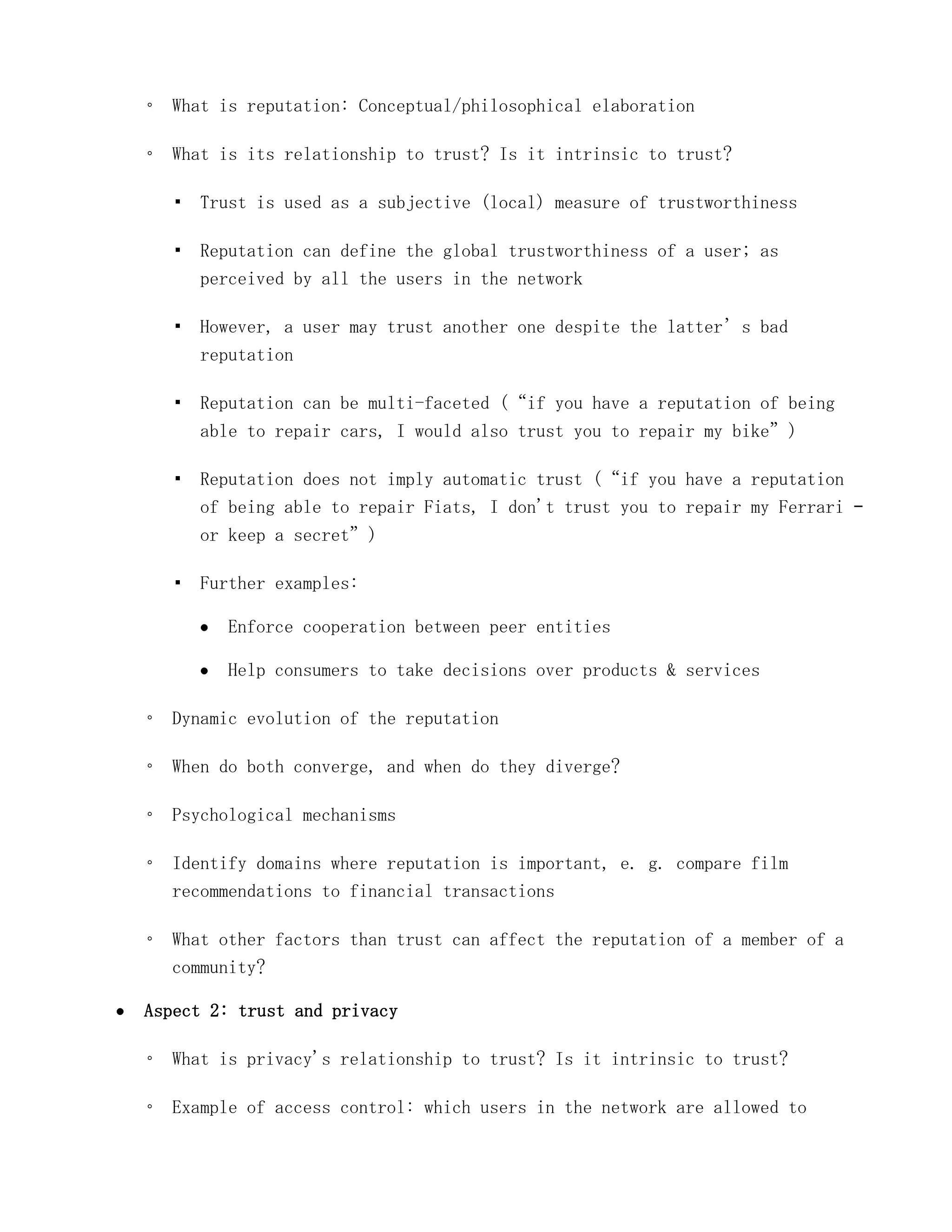
Proposed Model


In the figure above we present the procedure we propose in order to build a trust
model. We consider that the first step is to identify (i) the system where the
trust model will apply (whether it is a recommender system, a p2p network, a social
network etc, (ii) the goals of this system and (iii) how the trust model could help
to reach these goals.
The second step is to identify the various facets of trust that are meaningful in
the particular system. As we already examined, trust is multi-faceted, i.e.
different trust we pose on a particular person to keep our secrets and different
trust we pose on her/him to recommend us movies, or different trust to recommend us
furniture, as an example.
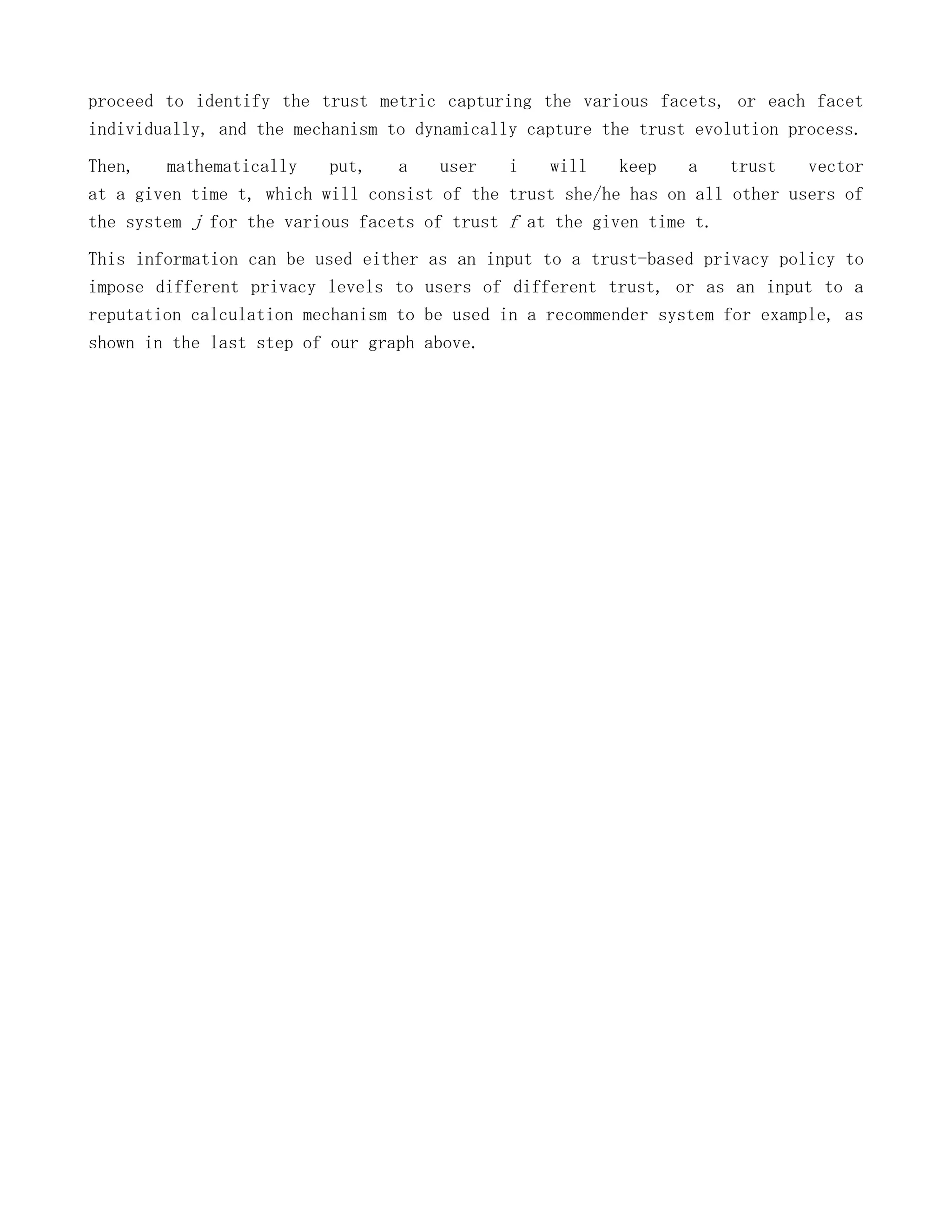
As soon as we have identified the system and the different trust facets, we can


                                                   t      t
                                                  i    {Tijf , j, f }
proceed to identify the trust metric capturing the various facets, or each facet
individually, and the mechanism to dynamically capture the trust evolution process.
Then,   mathematically    put,   a    user   i   will    keep   a    trust   vector
at a given time t, which will consist of the trust she/he has on all other users of
the system j for the various facets of trust f at the given time t.
This information can be used either as an input to a trust-based privacy policy to
impose different privacy levels to users of different trust, or as an input to a
reputation calculation mechanism to be used in a recommender system for example, as
shown in the last step of our graph above.

Social life in digital societies: Trust, Reputation and Privacy EINS summer school

  • 1.
    Social life indigital societies: Trust, Reputation and Privacy “We investigate what governs trust in the offline world, with the goal of mapping this onto mechanisms in the online world.” Contributors: The Trustworthy Team (3T) From left to right and top to bottom: Ralph Holz (Technische Universitat Munchen) Pablo Aragon (Barcelona Media) Katleen Gabriels (IBBT-SMIT, Vrije Univeriteit Brussel) Janet Xue (Macquaire University) Anna Satsiou (Centre for Research and Technology Hellas- Information Technologies Institute) Sorana Cimpan (Universite De Savoie)
  • 2.
    Norbert Blenn (DelftUniversity of Technology) Disciplines involved The current team consists of representatives of the following disciplines: Computer Science (Communications, Security, Informational Retrieval, OSN Analysis, Graph Theory, Software Architecture) Philosophy (Moral philosophy/Ethics) Media Communication (Internet Regulation, Marketing Communications) We envisage the following disciplines to participate, too: Economics Law Psychology Sociology Issues and Challenges It is an open question how trust in a person can be built, represented and expressed in the online world. Facebook contacts, for instance, are bidirectional, and a poor mapping of human relationships. Additional features like contact lists are an improvement, but are unintuitive to use and arguably lack expressiveness. Recent research has shown that users seem to build relationships in the online world in a way that is markedly different from their behaviour in the offline world. There are online communities where contact is always purely virtual, but trust is actually the essential ingredient that makes these platforms work (e.g. Couchsurfing, Ebay). Research Topic Our research focuses on the role that “trust” plays in both offline and online social life. We understand the term “social life” to refer to human relationships. We deliberately exclude relationships between human entities and organisational or institutional ones, e. g. human-government and human-company. We cover the following research topics. We present these in the form of questions
  • 3.
    and preliminary answers.The approach we suggest to follow is to begin with an analysis of trust in the offline world, both on a conceptual and operational level, its building mechanisms, and evolution then move to an in-depth study of the differences concerning trust between the offline and online realm with the ultimate goal of arriving at mechanisms that are able to map from the offline realm to the online realm, and vice-versa while investigating the interplay between trust, reputation and privacy in both worlds. Research questions, possible answers Most of our open questions focus on trust, as indicated above. In particular, we propose to concentrate on the following ones (including, but not limited to): Conceptualisation: offline trust in general ◦ Conceptual/philosophical elaboration ◦ Psychological mechanism ◦ How is offline trust being built between humans? ◦ Historical treatise: how did the meaning of trust evolve throughout human history? ◦ Goal: Thorough multi-disciplinary understanding of trust to meet the following challenges Problematic aspects of (offline) trust ◦ Each discipline has its own difficulties with “trust”, notions of trust are different between disciplines ◦ Analyse problematic areas between different research areas ◦ How is trust propagating between humans – to which degree is it transitive? ◦ Goal: we arrive at an understanding of trust that incorporates essential aspects from different areas and forms a common denominator between them
  • 4.
    Offline trust asa dynamically evolving property ◦ What are the factors that influence the trust evolution? ◦ How can these be expressed/mapped in/to the online world? ◦ Goal: as soon as we understand offline trust and its evolution, we can find ways to project this onto trust in the online realm In-depth analysis of the similarities and dissimilarities of online/offline trust ◦ Is there a dichotomy of offline and online trust, or is online trust merely an extension of offline trust? ◦ How does the online world reflect the dynamics of trust in the offline world? ◦ To what extent does the online world affect the notion of trust in the offline world? ◦ Potentially, not all aspects of offline trust can be transferred to the online realm. Which aspects can you transfer? ◦ In which ways has the online world made it impossible to apply the same mechanisms of trust? In particular, with respect to the following issues: ▪ Scale and speed of communication on the Internet is enormous (cf. Streisand effect). ▪ In face-to-face contact we decide in just 15s if we "like/trust" a person. None of that information is available in the online contact. ▪ Deleting data - in the offline world we can use legal means to delete/destroy data - but in the online world, once the data is out, it is almost impossible to destroy it. ◦ Goal: Understanding of differences of online and offline trust, with a view to establishing a mapping from one to the other Aspect 1: trust and reputation
  • 5.
    ◦ What isreputation: Conceptual/philosophical elaboration ◦ What is its relationship to trust? Is it intrinsic to trust? ▪ Trust is used as a subjective (local) measure of trustworthiness ▪ Reputation can define the global trustworthiness of a user; as perceived by all the users in the network ▪ However, a user may trust another one despite the latter’s bad reputation ▪ Reputation can be multi-faceted (“if you have a reputation of being able to repair cars, I would also trust you to repair my bike”) ▪ Reputation does not imply automatic trust (“if you have a reputation of being able to repair Fiats, I don't trust you to repair my Ferrari – or keep a secret”) ▪ Further examples: Enforce cooperation between peer entities Help consumers to take decisions over products & services ◦ Dynamic evolution of the reputation ◦ When do both converge, and when do they diverge? ◦ Psychological mechanisms ◦ Identify domains where reputation is important, e. g. compare film recommendations to financial transactions ◦ What other factors than trust can affect the reputation of a member of a community? Aspect 2: trust and privacy ◦ What is privacy's relationship to trust? Is it intrinsic to trust? ◦ Example of access control: which users in the network are allowed to
  • 6.
    access my data ◦When do both converge, and when do they diverge? ◦ What is the psychological and/or social link between these two? ◦ Can there be an inverse correlation between the two? ▪ The higher the trust the lower the privacy level imposed? ▪ High privacy leads to low trust? Empirical preparations for a computational model ◦ This task brings results from the previous tasks together ◦ From the above research results, derive which data measurement points would be most valuable to derive empirical insights on trust ◦ Let researchers collect these empirical data by triangulation of methods ◦ Specifications of the requirements of the model ◦ Goals: understanding of empirical measurement of trust; collection of large data sets; requirements of the model Computational mapping to the online world ◦ How to express all these notions computationally ◦ The other way around: how to express computational notions of trust in “real” world ◦ Issues we are facing: ▪ Trust is multi-faceted: you may trust a person to recommend a film, but not a restaurant, nor keep a secret ▪ Trust establishment in the online world between participants that have never met in the offline world ▪ How do you detect fake identities and misbehaviour in the online world?
  • 7.
    ▪ What isthe relation with the robustness of a trust computation algorithm? ▪ How to prevent trust abuse? (Ranking of trustworthiness) ▪ How to defend against trust abuse? Proposed Model In the figure above we present the procedure we propose in order to build a trust model. We consider that the first step is to identify (i) the system where the trust model will apply (whether it is a recommender system, a p2p network, a social network etc, (ii) the goals of this system and (iii) how the trust model could help to reach these goals. The second step is to identify the various facets of trust that are meaningful in the particular system. As we already examined, trust is multi-faceted, i.e. different trust we pose on a particular person to keep our secrets and different trust we pose on her/him to recommend us movies, or different trust to recommend us furniture, as an example. As soon as we have identified the system and the different trust facets, we can t t i {Tijf , j, f }
  • 8.
    proceed to identifythe trust metric capturing the various facets, or each facet individually, and the mechanism to dynamically capture the trust evolution process. Then, mathematically put, a user i will keep a trust vector at a given time t, which will consist of the trust she/he has on all other users of the system j for the various facets of trust f at the given time t. This information can be used either as an input to a trust-based privacy policy to impose different privacy levels to users of different trust, or as an input to a reputation calculation mechanism to be used in a recommender system for example, as shown in the last step of our graph above.