Social Media
Revolution, Evolution & Solution


      Cindy De Smet
     Brussel - 24/10/11
About
• Lector media,
  Faculty of teacher training Hogent
• Ph.D.-student,
  Dep. Educational studies UGent
• Blogger Edublogs.be
• Podcaster Tech45.eu
• Mail: cindy.desmet@hogent.be
@drsmetty
www.slideshare.net/smetty
Deze presentatie is
onderworpen aan de
Creative Commons
overeenkomst:

Naamsvermelding-
NietCommercieel-
GelijkDelen

                      5
You say you want a revolution
                 Well, you know
         We all want to change the world
Today’s students (digital natives)
  think and process information
       fundamentally differently
        from their predecessors.
                       (Prensky, 2001)
The single biggest problem facing education today
          is that our digital immigrant instructors,
                  who speak an outdated language
                        (that of the pre-digital age),
               are struggling to teach a population
             that speaks an entirely new language.
                                       (Prensky, 2001)
Today’s teachers have to learn to communicate in
           the language and style of their students.
This doesn’t mean changing the meaning of what is
               important, or of good thinking skills.
   But it does mean going faster, less step-by step,
more in parallel, with more random access, among
                                     other things…
                                       (Prensky, 2001)
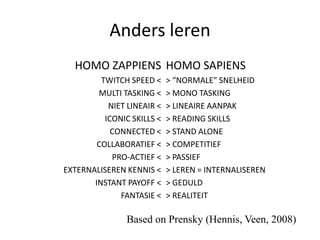
Anders leren
  HOMO ZAPPIENS HOMO SAPIENS
         TWITCH SPEED <     > “NORMALE” SNELHEID
        MULTI TASKING <     > MONO TASKING
           NIET LINEAIR <   > LINEAIRE AANPAK
          ICONIC SKILLS <   > READING SKILLS
            CONNECTED <     > STAND ALONE
        COLLABORATIEF <     > COMPETITIEF
            PRO-ACTIEF <    > PASSIEF
EXTERNALISEREN KENNIS <     > LEREN = INTERNALISEREN
       INSTANT PAYOFF <     > GEDULD
              FANTASIE <    > REALITEIT

                Based on Prensky (Hennis, Veen, 2008)
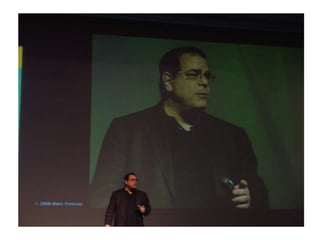
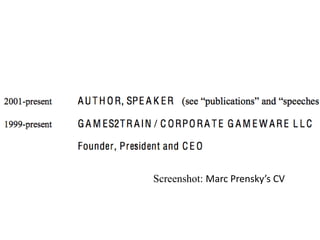
Screenshot: Marc Prensky’s CV
You tell me that it’s evolution
                  Well, you know
          We all want to change the world
A common theme from a number of recent
reports seems to be that far from being the tech-
   savvy, digitally immersed cyborgs portrayed in
much of the literature, there are some relatively
         poor information skills amongst the net
          generation and a good deal of variance.
                                    (Weller, 2011)
There is some moderate evidence that there are
             some differences in the expectations of
                         net generation learners and
         possibly an increase in dissatisfaction with
    education. There is a question of whether these
expectations are really unique to the net generation.
                                        (Weller, 2011)
What we need to be concerned about are
      the changes in the digital society.
                            (Weller, 2011)
The two key elements driving changes
                 (in other industries):
          The digitisation of content
             A global, social network
                          (Weller, 2011)
You say you want a real solution
                 Well, you know
           We’d all love to see the plan
Sociale media (didactisch)
• uitbreiding van de traditionele leeromgeving
  (vb. Google Earth)
• denk- en samenwerkingsprocessen
  transparant maken (vb. wiki, weblog)
• nieuwe communicatiemogelijkheden
  (binnen/buiten en van/naar de klas)
• creatie en delen van kennis
   (vb. PLE, Twitter, MOOC)
English translation: check Speaker notes
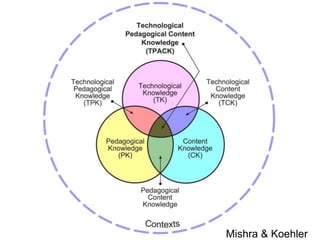
TPACK:
You are a teacher
Mishra & Koehler
Contexts


      Mishra & Koehler (2008)
Digital scholar:
Living in a digital society
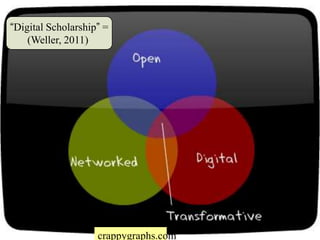
“Digital Scholarship” =
    (Weller, 2011)


                    crappygraphs.com
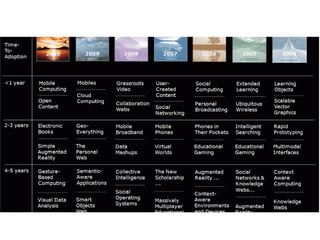
Don’t forget the other trends
Plan van aanpak
• Informeer jezelf (maak werk van een PLE)
• Kies een tool die nuttig is binnen je eigen
  onderwijspraktijk
• Begin met een kleine en eenvoudige
  toepassing
• Indien mogelijk: werk samen met collega’s of
  anderen
• Houd TPACK en de digital scholar in gedachten
English translation: check Speaker notes
Voorbeelden
Wiki’s
• Naslagwerk:
   Wiki als syllabus, als encyclopedie of als
   woordenboek
• Kladblok
• Groepsopdracht
• Meer info:
   – De Smet, De Wever (2009): didactisch gebruik van
     wiki’s. Ict en onderwijsvernieuwing, Plantyn, Afl 22
   – http://www.slideshare.net/Smetty/doe-het-met-een-wiki
Persoonlijke leeromgeving
Een PLE betekent dat je zelf helemaal kan beslissen
(Waters, 2009):
  •    welke tools je gebruikt
  •    wie er in je netwerk zit
  •    hoe je wil leren
  •    wat je wil leren
  •    wanneer je wil leren
  Meer info:
  http://www.slideshare.net/Smetty/workshop-een-
  persoonlijke-leeromgeving-ontwikkelen
You ask me for a contribution
              Well, you know
          We’re doing what we can
Referenties
• Titels: Beatles
• Dia 8 – 10: http://www.marcprensky.com/writing/
  Digital Natives, digital immigrants. A new way to look
  at ourselves and our kids (Prensky, 2001)
• Dia 11: http://www.slideshare.net/hennis/26-juni-
  presentatie-homo-zappiens-bij-kingma-roorda-
  thieme-hennis
• Dia 12: http://www.marcprensky.com/about/
Referenties
• Dia 14-17:
  The Digital Scholar: How Technology Is Transforming
  Scholarly Practice (Weller, 2011)
  http://www.bloomsburyacademic.com/view/DigitalS
  cholar_9781849666275/book-ba-
  9781849666275.xml
• Dia 19: vgl. Wilfred Rubens
  http://wilfredrubens.typepad.com/wilfred_rubens_
  weblog/2011/10/over-de-didaktiek-van-social-
  media-in-de-dagelijkse-lespraktijk-in.html
Referenties
• Dia 20 - 22: http://www.tpack.org/
  Mishra & Koehler, 2006
• Dia 24: Weller
  (2011)http://www.slideshare.net/mweller/digital-
  scholarship-debate
• Dia 26: Overview Horizon report 2004-2010
  Jochen Robes:
  http://www.flickr.com/photos/50946100@N00/4277
  533606/
  Horizon reports: http://wp.nmc.org/
• Dia 30: http://suewaters.wikispaces.com/
Leestips (nl)
   Web20opschool.be
   Web2.0 in het onderwijs:
    van Installatie tot Implementatie
    http://www.scribd.com/doc/7823399/Web20-in-het-
    onderwijs-Van-Installatie-tot-Implementatie
   23 OVC Dingen:
    http://www.prodocent.nl/mediawijsheid/
   21edingen.nl
Leestips (nl)
   Social Software in het onderwijs (Pierre Gorissen):
    http://www.gorissen.info/Pierre/files/socialsoftwarev
    2p0.pdf
   Taccle Handbook:
    http://www.taccle.eu/content/view/15/43/lang,nl/
   Maak kennis met TPACK. Hoe kan een leraar ict
    integreren in het onderwijs?
    http://redactie.kennisnet.nl/attachments/session=clo
    ud_mmbase+2215056/Nr._26_Maak_kennis_met_TP
    ACK.pdf

Social Media. Revolution, Evolution, Solution.

  • 1.
    Social Media Revolution, Evolution& Solution Cindy De Smet Brussel - 24/10/11
  • 2.
    About • Lector media, Faculty of teacher training Hogent • Ph.D.-student, Dep. Educational studies UGent • Blogger Edublogs.be • Podcaster Tech45.eu • Mail: cindy.desmet@hogent.be
  • 3.
  • 4.
  • 5.
    Deze presentatie is onderworpenaan de Creative Commons overeenkomst: Naamsvermelding- NietCommercieel- GelijkDelen 5
  • 6.
    You say youwant a revolution Well, you know We all want to change the world
  • 8.
    Today’s students (digitalnatives) think and process information fundamentally differently from their predecessors. (Prensky, 2001)
  • 9.
    The single biggestproblem facing education today is that our digital immigrant instructors, who speak an outdated language (that of the pre-digital age), are struggling to teach a population that speaks an entirely new language. (Prensky, 2001)
  • 10.
    Today’s teachers haveto learn to communicate in the language and style of their students. This doesn’t mean changing the meaning of what is important, or of good thinking skills. But it does mean going faster, less step-by step, more in parallel, with more random access, among other things… (Prensky, 2001)
  • 11.
    Anders leren HOMO ZAPPIENS HOMO SAPIENS TWITCH SPEED < > “NORMALE” SNELHEID MULTI TASKING < > MONO TASKING NIET LINEAIR < > LINEAIRE AANPAK ICONIC SKILLS < > READING SKILLS CONNECTED < > STAND ALONE COLLABORATIEF < > COMPETITIEF PRO-ACTIEF < > PASSIEF EXTERNALISEREN KENNIS < > LEREN = INTERNALISEREN INSTANT PAYOFF < > GEDULD FANTASIE < > REALITEIT Based on Prensky (Hennis, Veen, 2008)
  • 12.
  • 13.
    You tell methat it’s evolution Well, you know We all want to change the world
  • 14.
    A common themefrom a number of recent reports seems to be that far from being the tech- savvy, digitally immersed cyborgs portrayed in much of the literature, there are some relatively poor information skills amongst the net generation and a good deal of variance. (Weller, 2011)
  • 15.
    There is somemoderate evidence that there are some differences in the expectations of net generation learners and possibly an increase in dissatisfaction with education. There is a question of whether these expectations are really unique to the net generation. (Weller, 2011)
  • 16.
    What we needto be concerned about are the changes in the digital society. (Weller, 2011)
  • 17.
    The two keyelements driving changes (in other industries): The digitisation of content A global, social network (Weller, 2011)
  • 18.
    You say youwant a real solution Well, you know We’d all love to see the plan
  • 19.
    Sociale media (didactisch) •uitbreiding van de traditionele leeromgeving (vb. Google Earth) • denk- en samenwerkingsprocessen transparant maken (vb. wiki, weblog) • nieuwe communicatiemogelijkheden (binnen/buiten en van/naar de klas) • creatie en delen van kennis (vb. PLE, Twitter, MOOC) English translation: check Speaker notes
  • 20.
  • 21.
  • 22.
    Contexts Mishra & Koehler (2008)
  • 23.
    Digital scholar: Living ina digital society
  • 24.
    “Digital Scholarship” = (Weller, 2011) crappygraphs.com
  • 25.
    Don’t forget theother trends
  • 27.
    Plan van aanpak •Informeer jezelf (maak werk van een PLE) • Kies een tool die nuttig is binnen je eigen onderwijspraktijk • Begin met een kleine en eenvoudige toepassing • Indien mogelijk: werk samen met collega’s of anderen • Houd TPACK en de digital scholar in gedachten English translation: check Speaker notes
  • 28.
  • 29.
    Wiki’s • Naslagwerk: Wiki als syllabus, als encyclopedie of als woordenboek • Kladblok • Groepsopdracht • Meer info: – De Smet, De Wever (2009): didactisch gebruik van wiki’s. Ict en onderwijsvernieuwing, Plantyn, Afl 22 – http://www.slideshare.net/Smetty/doe-het-met-een-wiki
  • 30.
    Persoonlijke leeromgeving Een PLEbetekent dat je zelf helemaal kan beslissen (Waters, 2009): • welke tools je gebruikt • wie er in je netwerk zit • hoe je wil leren • wat je wil leren • wanneer je wil leren Meer info: http://www.slideshare.net/Smetty/workshop-een- persoonlijke-leeromgeving-ontwikkelen
  • 31.
    You ask mefor a contribution Well, you know We’re doing what we can
  • 32.
    Referenties • Titels: Beatles •Dia 8 – 10: http://www.marcprensky.com/writing/ Digital Natives, digital immigrants. A new way to look at ourselves and our kids (Prensky, 2001) • Dia 11: http://www.slideshare.net/hennis/26-juni- presentatie-homo-zappiens-bij-kingma-roorda- thieme-hennis • Dia 12: http://www.marcprensky.com/about/
  • 33.
    Referenties • Dia 14-17: The Digital Scholar: How Technology Is Transforming Scholarly Practice (Weller, 2011) http://www.bloomsburyacademic.com/view/DigitalS cholar_9781849666275/book-ba- 9781849666275.xml • Dia 19: vgl. Wilfred Rubens http://wilfredrubens.typepad.com/wilfred_rubens_ weblog/2011/10/over-de-didaktiek-van-social- media-in-de-dagelijkse-lespraktijk-in.html
  • 34.
    Referenties • Dia 20- 22: http://www.tpack.org/ Mishra & Koehler, 2006 • Dia 24: Weller (2011)http://www.slideshare.net/mweller/digital- scholarship-debate • Dia 26: Overview Horizon report 2004-2010 Jochen Robes: http://www.flickr.com/photos/50946100@N00/4277 533606/ Horizon reports: http://wp.nmc.org/ • Dia 30: http://suewaters.wikispaces.com/
  • 35.
    Leestips (nl)  Web20opschool.be  Web2.0 in het onderwijs: van Installatie tot Implementatie http://www.scribd.com/doc/7823399/Web20-in-het- onderwijs-Van-Installatie-tot-Implementatie  23 OVC Dingen: http://www.prodocent.nl/mediawijsheid/  21edingen.nl
  • 36.
    Leestips (nl)  Social Software in het onderwijs (Pierre Gorissen): http://www.gorissen.info/Pierre/files/socialsoftwarev 2p0.pdf  Taccle Handbook: http://www.taccle.eu/content/view/15/43/lang,nl/  Maak kennis met TPACK. Hoe kan een leraar ict integreren in het onderwijs? http://redactie.kennisnet.nl/attachments/session=clo ud_mmbase+2215056/Nr._26_Maak_kennis_met_TP ACK.pdf

Editor's Notes

  • #4 www.twitter.com/drsmetty
  • #8 http://www.flickr.com/photos/smetty/64490650/
  • #9 http://www.marcprensky.com/writing/
  • #10 http://www.marcprensky.com/writing/
  • #11 http://www.marcprensky.com/writing/
  • #15 http://www.bloomsburyacademic.com/view/DigitalScholar_9781849666275/book-ba-9781849666275.xmlWeller, p. 18
  • #16 http://www.bloomsburyacademic.com/view/DigitalScholar_9781849666275/book-ba-9781849666275.xmlWeller, p. 17
  • #17 http://www.bloomsburyacademic.com/view/DigitalScholar_9781849666275/book-ba-9781849666275.xmlWeller, p. 21
  • #18 http://www.bloomsburyacademic.com/view/DigitalScholar_9781849666275/book-ba-9781849666275.xmlWeller, p. 21, p. 29
  • #20 Eng:Social media (didactical point of view)Expansion of the traditional learning environmentMake cognitive and collaborative processes more transparentNew communication possibilities (inside/outside and from/to classroom)Creation and sharing of knowledge
  • #22 Mishra &amp; Koehler 2006, 2008
  • #27 http://wp.nmc.org/horizon2011/
  • #28 How to approach social media:Inform yourself (start a PLE)Pick a tool that is useful for the subject you teachStart with a small and easy exerciseIf possible: collaborate with colleagues or significant othersKeep in mind: TPACK &amp; digital scholar
  • #30 Wiki as a syllabus, as an encyclopedia or an dictionaryWiki as a scrapbookWiki used within collaborative learning