Social Media Plan  Case Study
2010 Making Media  Connections Conference  Social Media Plan
Summary Local annual conference bringing together nonprofit communicators, journalists and media makers during the second week of June. Increase registration numbers by building buzz leading up to the conference.
Audience Segmentation Nonprofit professionals  between the ages of 25-34 and 35-45. 60% female and 40% male living within the Chicago area. Conversationalists and Joiners Leading journalists  and news outlets between the ages 35-44 and 45-55. Creators and Conversationalists. Web advocates and bloggers  between the ages of 35-44. Creators, Conversationalists and Critics.
Content Analysis Nonprofit professionals:  News ecosystem, Media Networking, Social Media trends and Public Interest Issues. Journalists:  Information, News ecosystem and Neighborhood stories. Web advocates and bloggers:  News ecosystem, Social Media trends and Public Interest Issues.
Goals To inform audiences about the conference in order to increase registration. To educate audiences in order to build a knowledge base about the topics and issues to be discussed.
Social Media Objectives To identify online influencers, organized media channels and potential audiences through listening tactics. To create and sustain online social conversations through blogs, social networks and online news sites using buzz tactics.
Social Strategy Listening Strategy —listen in on online conversations, influencers, topics and trends. Buzz Strategy —Participate and lead conversations around topics of the conference to position the event in the market. Sustainability Strategy —provide online space for participants to continue conversing, sharing information and promote the event.
Listening Tools & Tactics Google Alerts & Search, Twitter and Technorati : identify bloggers, creators, conversationalists & topics. Twitter : Follow, list and monitor.
Conversation Tools & Tactics Wordpress : Host conference information and content, integrate with the social web and improve search engine optimization. Twitter & Facebook : Inform audiences about conversation hashtag and conference blog. Wordpress (mobile) Blog : Initiate educational conversations by  creating relevant posts and point to registration page. Yahoo events : post to events pages and direct to conference website. Facebook Page, Events, Ads : Pages provide open platform to engage audiences and to push notifications. Events to inform and to support requests and other conversations. Ads to target new audiences.
Conversation Tools & Tactics (cont.) Hootsuite Dashboard : Manage and stream line ongoing monitoring and conversations. Creation of saved searched lists to monitor hastags, keywords, conversationlists and keywords. QR Codes : Point mobile users from print to the web. CoveritLive : Live blogging throughout the day of the event to sustain conversations and provide participant support. Facebook : Monitor and continue to promote sustained online conversations.
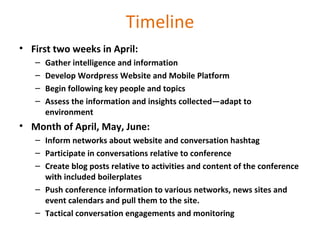
Timeline First two weeks in April:  Gather intelligence and information Develop Wordpress Website and Mobile Platform Begin following key people and topics Assess the information and insights collected—adapt to environment Month of April, May, June:  Inform networks about website and conversation hashtag Participate in conversations relative to conference Create blog posts relative to activities and content of the conference with included boilerplates Push conference information to various networks, news sites and event calendars and pull them to the site. Tactical conversation engagements and monitoring
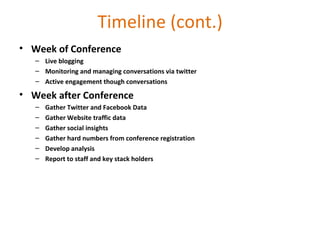
Timeline (cont.) Week of Conference Live blogging Monitoring and managing conversations via twitter Active engagement though conversations Week after Conference Gather Twitter and Facebook Data Gather Website traffic data Gather social insights Gather hard numbers from conference registration Develop analysis Report to staff and key stack holders
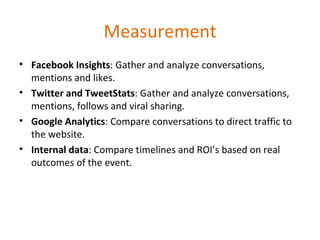
Measurement Facebook Insights : Gather and analyze conversations, mentions and likes. Twitter and TweetStats : Gather and analyze conversations, mentions, follows and viral sharing. Google Analytics : Compare conversations to direct traffic to the website. Internal data : Compare timelines and ROI’s based on real outcomes of the event.
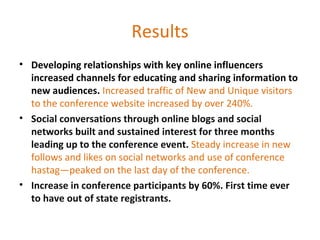
Results Developing relationships with key online influencers increased channels for educating and sharing information to new audiences.  Increased traffic of New and Unique visitors to the conference website increased by over 240%. Social conversations through online blogs and social networks built and sustained interest for three months leading up to the conference event.  Steady increase in new follows and likes on social networks and use of conference hastag—peaked on the last day of the conference. Increase in conference participants by 60%. First time ever to have out of state registrants.

Social Media Plan Case Study

  • 1.
    Social Media Plan Case Study
  • 2.
    2010 Making Media Connections Conference Social Media Plan
  • 3.
    Summary Local annualconference bringing together nonprofit communicators, journalists and media makers during the second week of June. Increase registration numbers by building buzz leading up to the conference.
  • 4.
    Audience Segmentation Nonprofitprofessionals between the ages of 25-34 and 35-45. 60% female and 40% male living within the Chicago area. Conversationalists and Joiners Leading journalists and news outlets between the ages 35-44 and 45-55. Creators and Conversationalists. Web advocates and bloggers between the ages of 35-44. Creators, Conversationalists and Critics.
  • 5.
    Content Analysis Nonprofitprofessionals: News ecosystem, Media Networking, Social Media trends and Public Interest Issues. Journalists: Information, News ecosystem and Neighborhood stories. Web advocates and bloggers: News ecosystem, Social Media trends and Public Interest Issues.
  • 6.
    Goals To informaudiences about the conference in order to increase registration. To educate audiences in order to build a knowledge base about the topics and issues to be discussed.
  • 7.
    Social Media ObjectivesTo identify online influencers, organized media channels and potential audiences through listening tactics. To create and sustain online social conversations through blogs, social networks and online news sites using buzz tactics.
  • 8.
    Social Strategy ListeningStrategy —listen in on online conversations, influencers, topics and trends. Buzz Strategy —Participate and lead conversations around topics of the conference to position the event in the market. Sustainability Strategy —provide online space for participants to continue conversing, sharing information and promote the event.
  • 9.
    Listening Tools &Tactics Google Alerts & Search, Twitter and Technorati : identify bloggers, creators, conversationalists & topics. Twitter : Follow, list and monitor.
  • 10.
    Conversation Tools &Tactics Wordpress : Host conference information and content, integrate with the social web and improve search engine optimization. Twitter & Facebook : Inform audiences about conversation hashtag and conference blog. Wordpress (mobile) Blog : Initiate educational conversations by creating relevant posts and point to registration page. Yahoo events : post to events pages and direct to conference website. Facebook Page, Events, Ads : Pages provide open platform to engage audiences and to push notifications. Events to inform and to support requests and other conversations. Ads to target new audiences.
  • 11.
    Conversation Tools &Tactics (cont.) Hootsuite Dashboard : Manage and stream line ongoing monitoring and conversations. Creation of saved searched lists to monitor hastags, keywords, conversationlists and keywords. QR Codes : Point mobile users from print to the web. CoveritLive : Live blogging throughout the day of the event to sustain conversations and provide participant support. Facebook : Monitor and continue to promote sustained online conversations.
  • 12.
    Timeline First twoweeks in April: Gather intelligence and information Develop Wordpress Website and Mobile Platform Begin following key people and topics Assess the information and insights collected—adapt to environment Month of April, May, June: Inform networks about website and conversation hashtag Participate in conversations relative to conference Create blog posts relative to activities and content of the conference with included boilerplates Push conference information to various networks, news sites and event calendars and pull them to the site. Tactical conversation engagements and monitoring
  • 13.
    Timeline (cont.) Weekof Conference Live blogging Monitoring and managing conversations via twitter Active engagement though conversations Week after Conference Gather Twitter and Facebook Data Gather Website traffic data Gather social insights Gather hard numbers from conference registration Develop analysis Report to staff and key stack holders
  • 14.
    Measurement Facebook Insights: Gather and analyze conversations, mentions and likes. Twitter and TweetStats : Gather and analyze conversations, mentions, follows and viral sharing. Google Analytics : Compare conversations to direct traffic to the website. Internal data : Compare timelines and ROI’s based on real outcomes of the event.
  • 15.
    Results Developing relationshipswith key online influencers increased channels for educating and sharing information to new audiences. Increased traffic of New and Unique visitors to the conference website increased by over 240%. Social conversations through online blogs and social networks built and sustained interest for three months leading up to the conference event. Steady increase in new follows and likes on social networks and use of conference hastag—peaked on the last day of the conference. Increase in conference participants by 60%. First time ever to have out of state registrants.

Editor's Notes

  • #2 Introduction Demetrio Maguigad
  • #3 Introduction Demetrio Maguigad