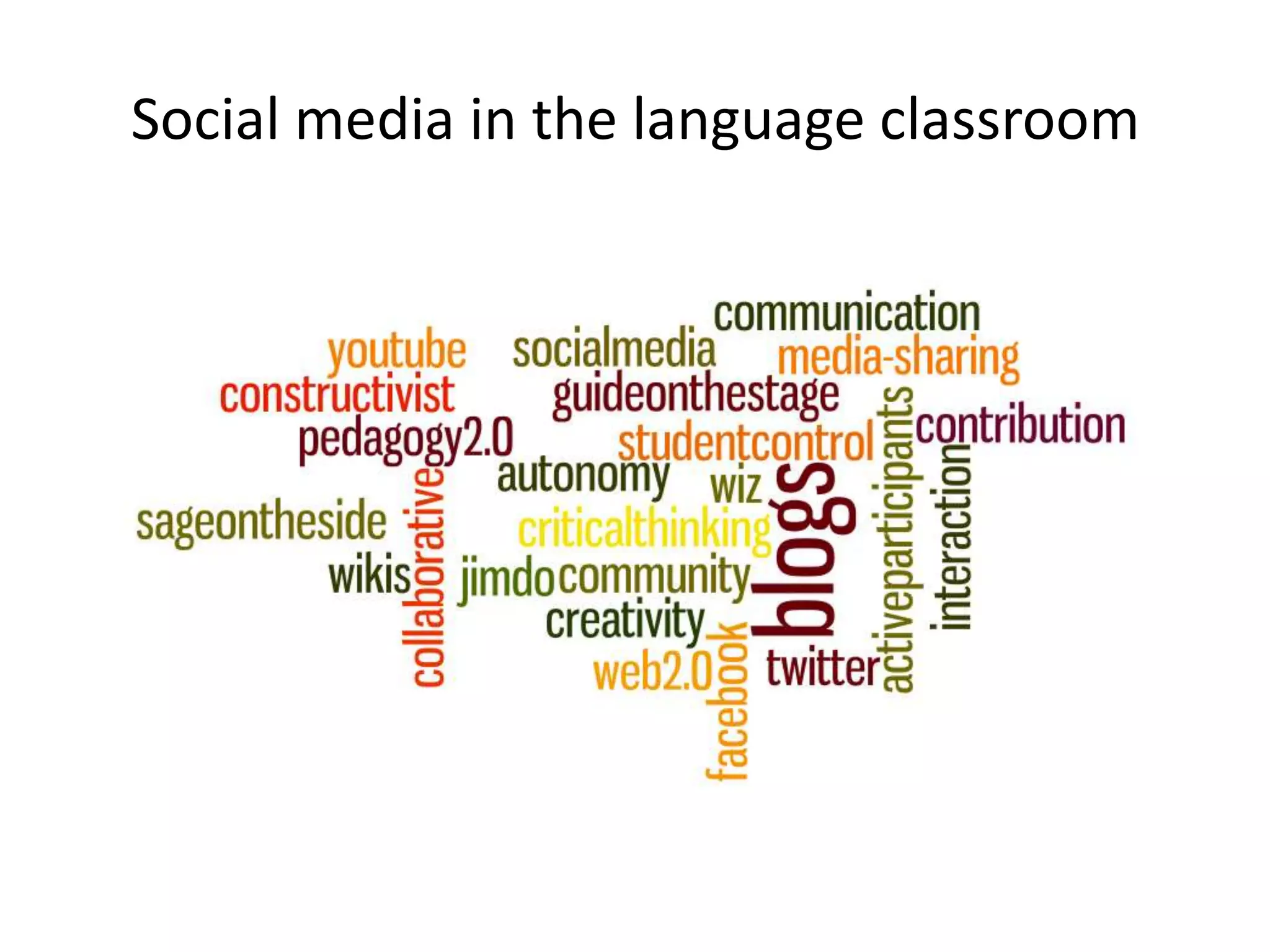
Social media in the language classroom
A web 2.0 tool for language
teaching with flash content
Study carried out by Eda Gözde Girgin
Procedia Computer Science 3 (2011)
627-631
The Project
The Goal?
- set an online classroom activity
- assess their beliefs and approaches
towards vocab learning

- making learners “technology masters”
Who? What? When? Where? How many?

•
•
•
•
•
•

Pre-Intermediate level high school students
To teach English
In Turkey – private school
In the computer laboratory
29 participants
2010
What tool?
• www.wix.com – a flash website
•
•
•
•
•
•
•

Create digital magazines
Storybooks
Texts
Add pictures
Music
Videos
Share via Facebook.
Collaboration/Teacher Support
• Peer-to-peer assessment via…
• Link to their website (wix)
• Or via Facebook
• Initial passage provided by teacher
• Teacher gave feedback
Learning benefits?
•
•
•
•
•
•

Computer skills for the pupils
Enjoyment of language learning via computer
Construct their own settings, preferences
Gain autonomy
Be part of a circle of “creation and correction”
Asynchronous chat/feedback in English?
Shortcomings?
•
•
•
•

High anxiety alleviator?
How successful was it really?
The data collected? – Control group
Questionnaire?
Shortcomings (2)?
• Questionnaire :
– I believe that language teaching via the Internet is
beneficial.

• Replace with:
– I believe that I learnt more vocabulary creating a
web page on the various topics I studied.
Shortcomings (3)?
• Questionnaire:
– I hope to use more computer programs in the
English lessons.

• Replace with:
- I hope to use wix to create other pages.
Shortcomings – the big one
• Reading/Vocabulary activity?
New research question
www.wix.com
• wix website for IDT1314
References
• Warschauer A developmental perspective on
technology in language education, TESOL
quarterly 36(3) (2002)

Social media in the language classroom

Editor's Notes

  • #2 Element of the course that really interests me. I did it’s own PLE!Using social media in the language classroom is one of the areas that allows language learning to be undertaken with a constructivist approach. Social media  From Science DirectTeaching instructor, Bilgi University, Istanbul, Turkey
  • #4 Goal – have student create their own settings of learning.The core objective – set an online classroom activity to the students and assess their beliefs and approaches towards vocabulary learning through this newly set content.It’s almost two-fold because They want to see if claims that “higher-level learning can take place in web assisted learning environments” (Tanyeli 2009 cited in Girgin 2010) are true AND“while learning languages, students will also be technology masters” (Warschauer 2002 cited in Girgin 2010)Making them tech masters who can use it as part of the communication, production of knowledge and research.
  • #5 About 14 years old
  • #6 It’s an add-on to class activity – goal to enhance vocab acquisitionGiven simple topics – pastime, leisure, music etc – and have to create their own websitesWhat did they have the chance to do?
  • #7 Topic of the weekGiven a passage to read – the inThen via a task page they clicked on a linkThey then searched for photos, unknown words, info etcDeveloping reading skillsThey then created their own wix to illustrate their writing skills.Teacher read digital mags and gave feedback.
  • #8 Capitals because did they enhance language skills? Debatable.Not enough feedback on whether they improvedFeedback via questionnaire about sts attitudes to the wix and use of tools in lang teaching.Enjoyment – anxiety … correlation.Autonomy – think for themselvesAFL Asynchronous chat – feedback in English – again higher-order thinking? Correcting each others errors.
  • #9 Does a project involving reading activities via website creation help overcome anxiety Only 9 actually created anything? What did the rest do? - contributed to the questionnaireData collected did not, in my view, assess their beliefs and approaches to vocab learning. It looked more at their enjoyment and language teaching.A control group and a more well thought out questionnaire might have given empirical evidence.The questionnaire was leading and did not seek to find out if there had been any impact on vocab learning.
  • #10 Should the questionnaire be yes/no?List what else….
  • #12 If one of the statements was about reducing learner anxiety and how flash content can reduce learner anxiety – how would this activity reduce learner anxiety? It’s fun but would it reduce their anxiety when speaking?It’s restrictive. ?