The State of
Open Research Data
Ross Mounce, Ph.D. (@RMounce)
Postdoc, University of Bath
November 15, 2014
bit.ly/stateofdata
These slides are on Slideshare here:
All textual content is
Disclaimer
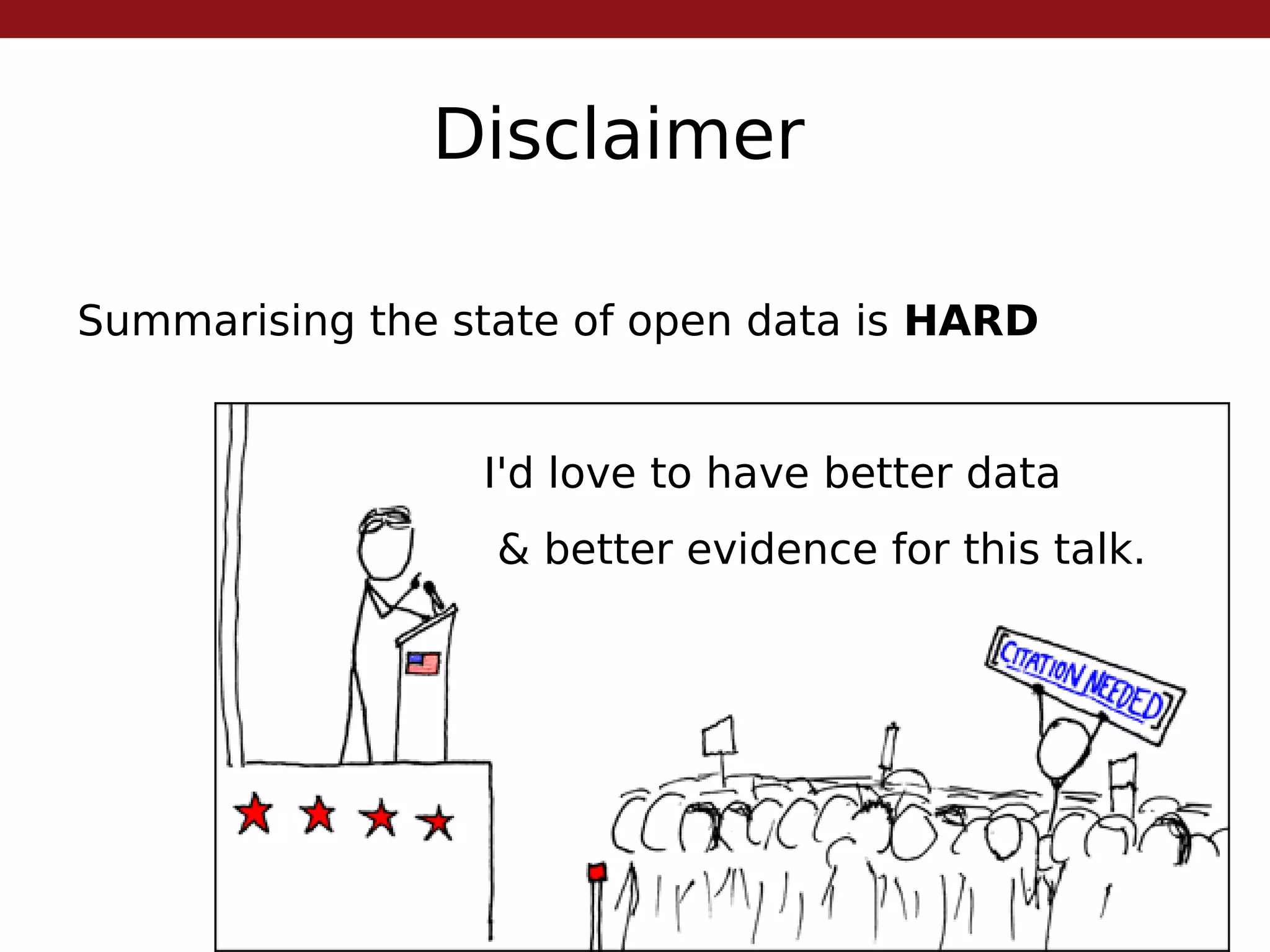
Summarising the state of open data is HARD
I'd love to have better data
& better evidence for this talk.
Disclaimer #2
Whenever I talk about data in this talk, assume I'm
talking about non-sensitive data e.g.
NOT medical data
NOT bio-weapons research data
et cetera...
Outline
●
What is open data?
●
The evolution of data availability
●
Where are we now?
●
Some goals & aspirations for the future
What exactly is open data?
From http://opendefinition.org/,
see http://opendefinition.org/od/ for more detail
Open means anyone can
freely access, use, modify,
and share for any purpose
(subject, at most, to requirements
that preserve provenance and
openness)
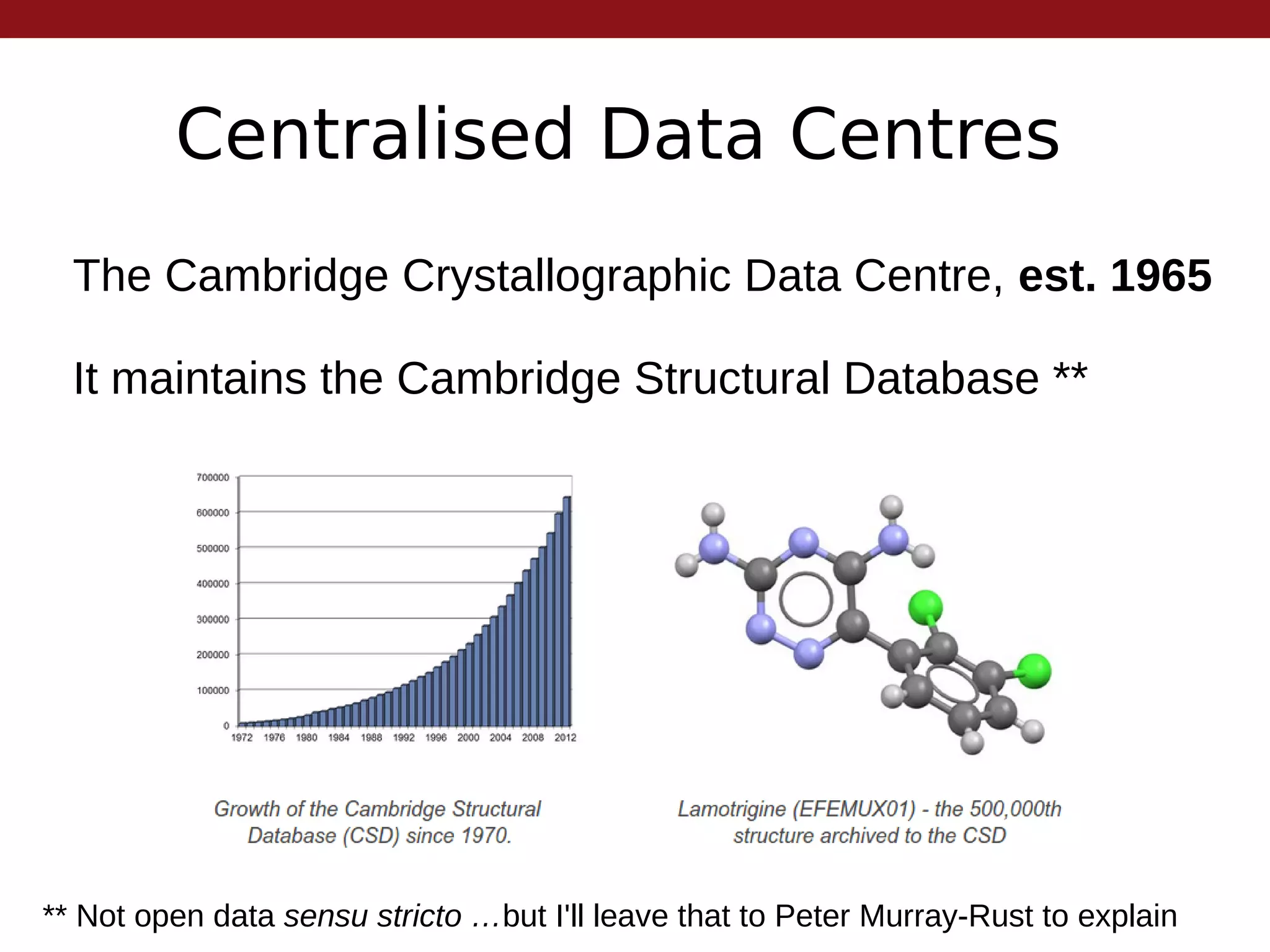
Centralised Data Centres
The Cambridge Crystallographic Data Centre, est. 1965
It maintains the Cambridge Structural Database **
** Not open data sensu stricto …but I'll leave that to Peter Murray-Rust to explain
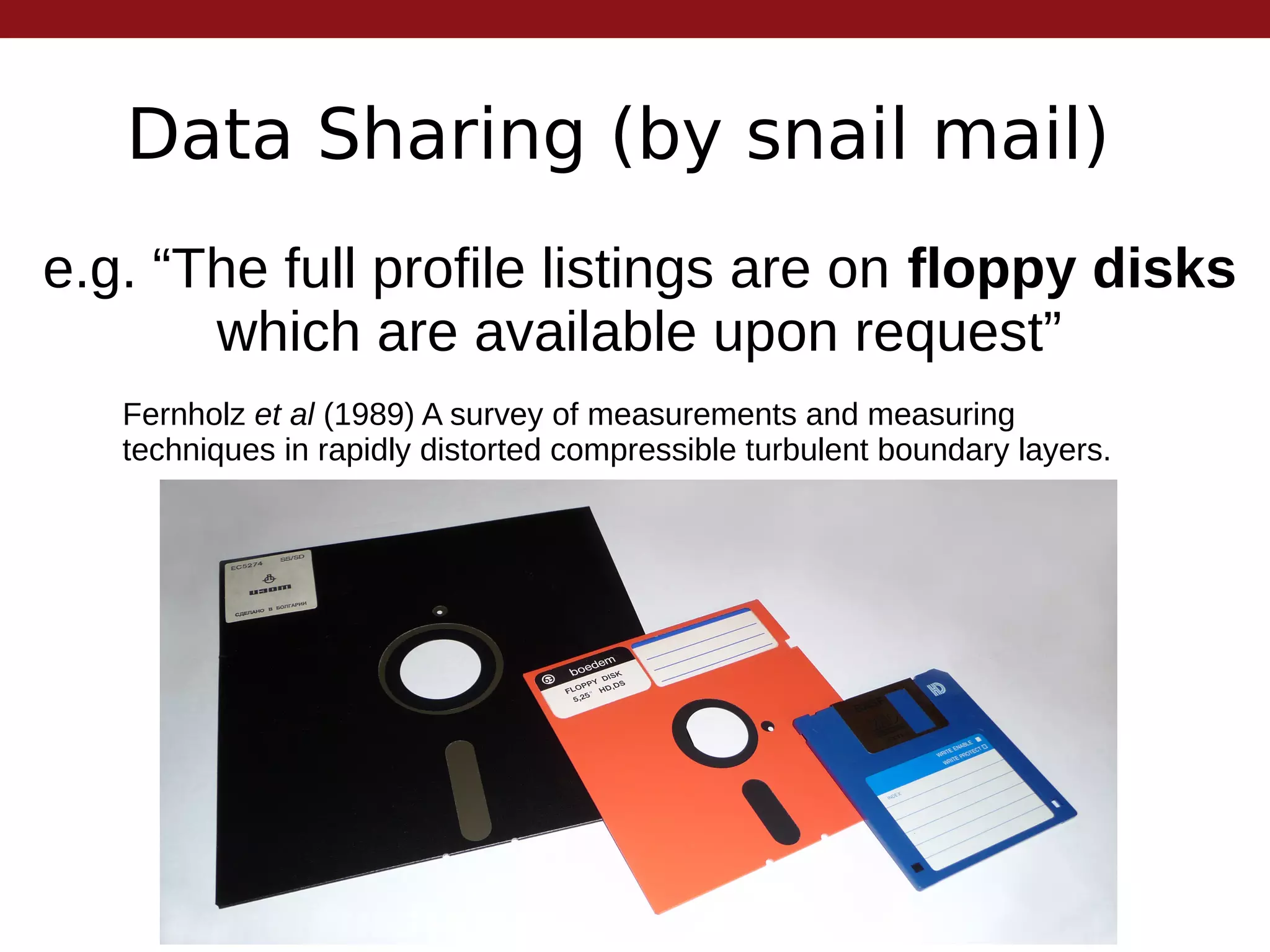
Data Sharing (by snail mail)
e.g. “The full profile listings are on floppy disks
which are available upon request”
Fernholz et al (1989) A survey of measurements and measuring
techniques in rapidly distorted compressible turbulent boundary layers.
Bilofsky & Burks (1988)
Nucleic Acids Research v16 n5
“The author will provide the
accession number to the
PROCEEDINGS [PNAS]
office to be included in a
footnote to the published
paper.”
1989
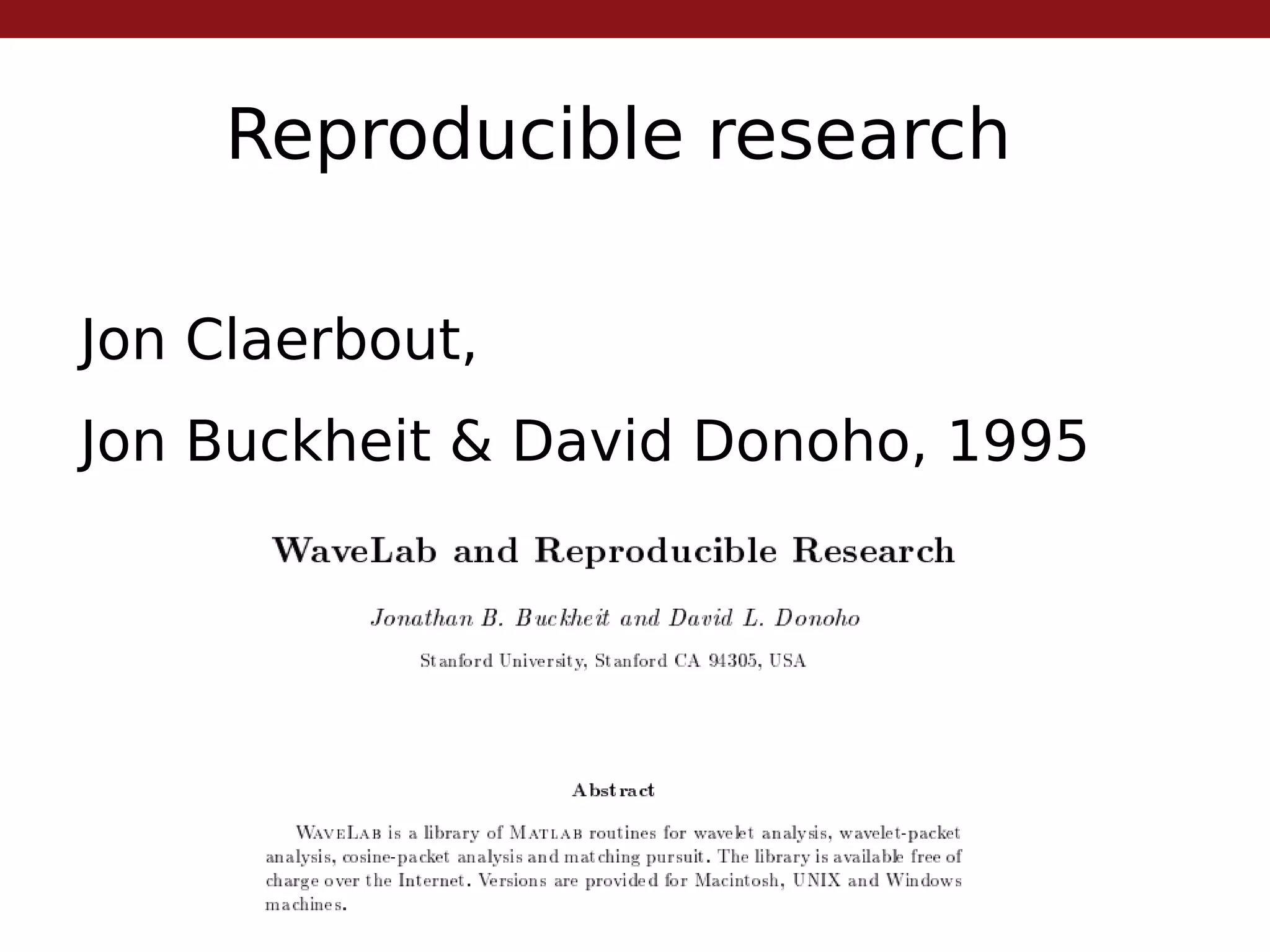
Reproducible research
Jon Claerbout,
Jon Buckheit & David Donoho, 1995
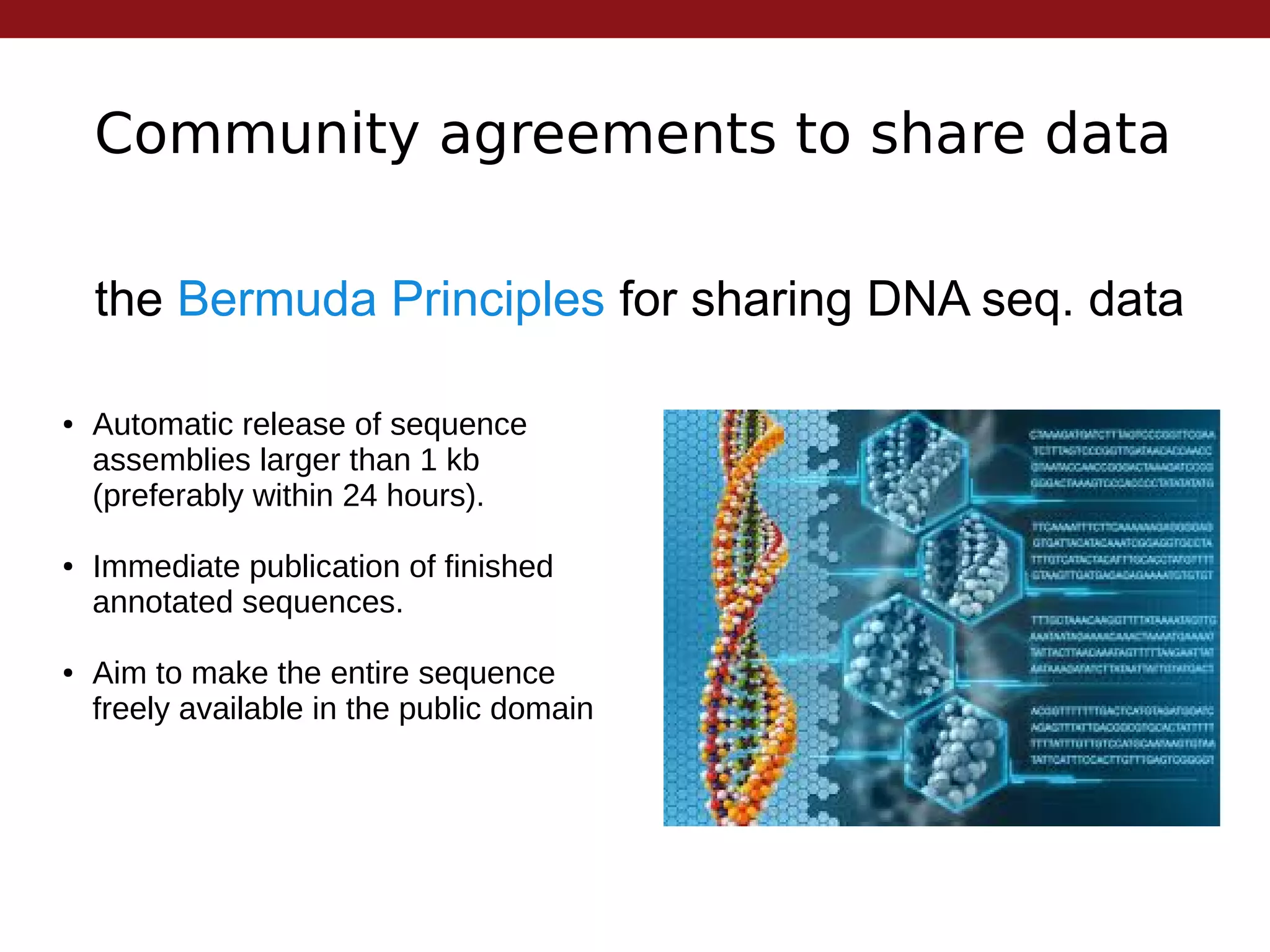
Community agreements to share data
the Bermuda Principles for sharing DNA seq. data
● Automatic release of sequence
assemblies larger than 1 kb
(preferably within 24 hours).
● Immediate publication of finished
annotated sequences.
● Aim to make the entire sequence
freely available in the public domain
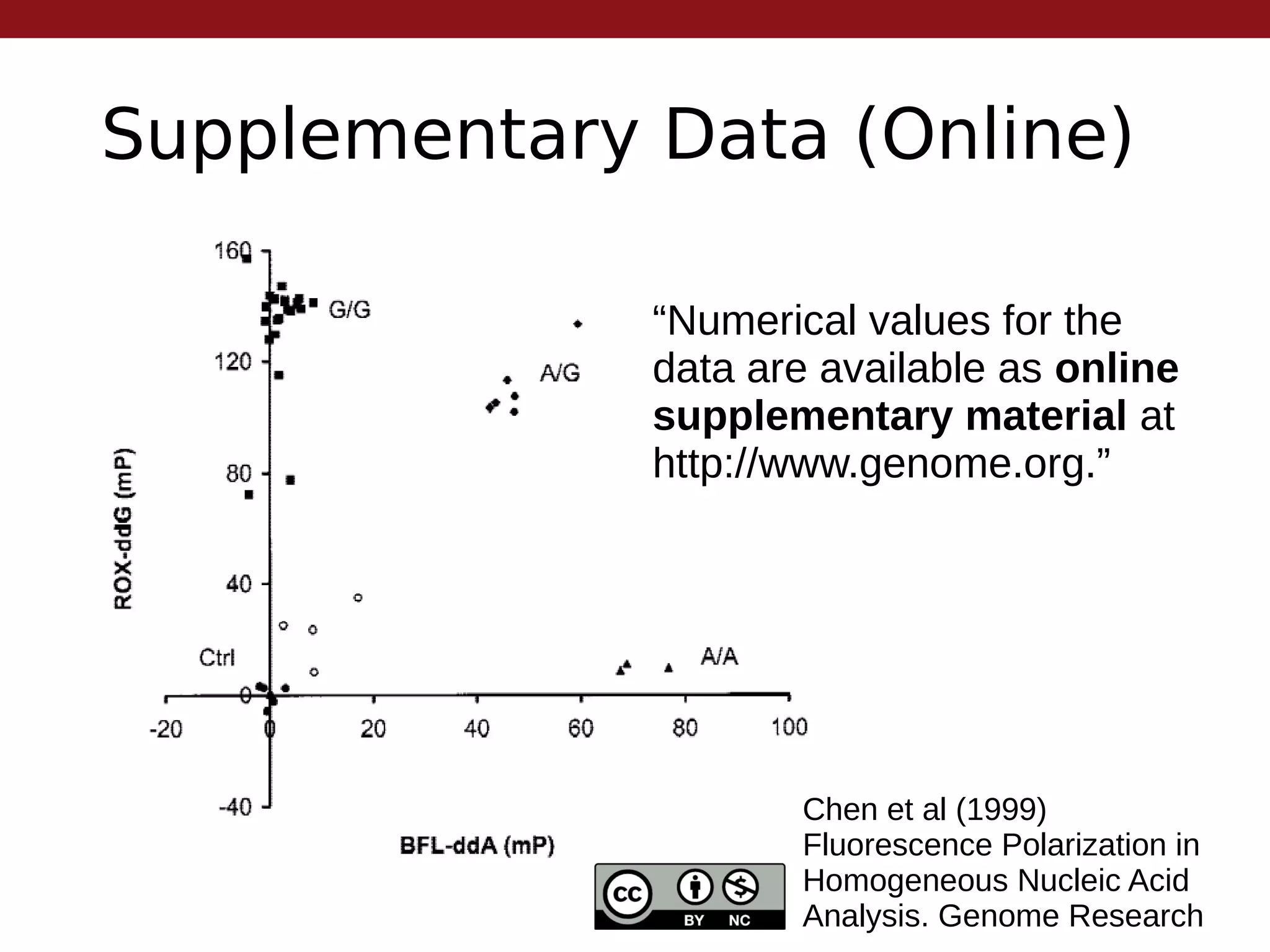
Supplementary Data (Online)
Chen et al (1999)
Fluorescence Polarization in
Homogeneous Nucleic Acid
Analysis. Genome Research
“Numerical values for the
data are available as online
supplementary material at
http://www.genome.org.”
“Each custodian of data on plant traits will retain the
right to be informed of any TRY activity that may involve
his/her data, and will have the opportunity to negotiate
whether his/her data can be used, and whether general
guidelines of authorship need to be modified in that
particular case
Custodians retain the rights to withdraw their data
at any time.”
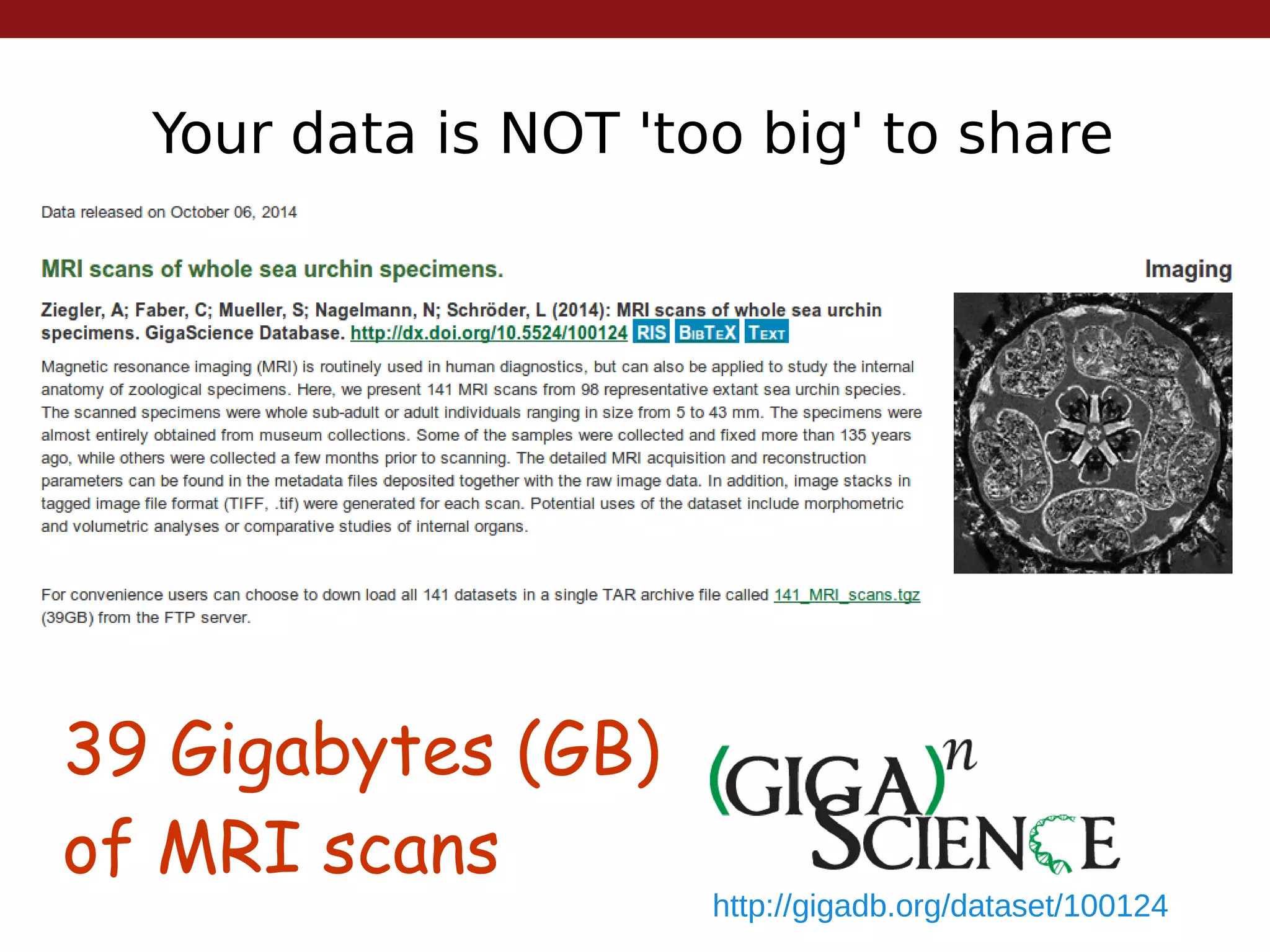
Your data is NOT 'too big' to share
http://gigadb.org/dataset/100124
39 Gigabytes (GB)
of MRI scans
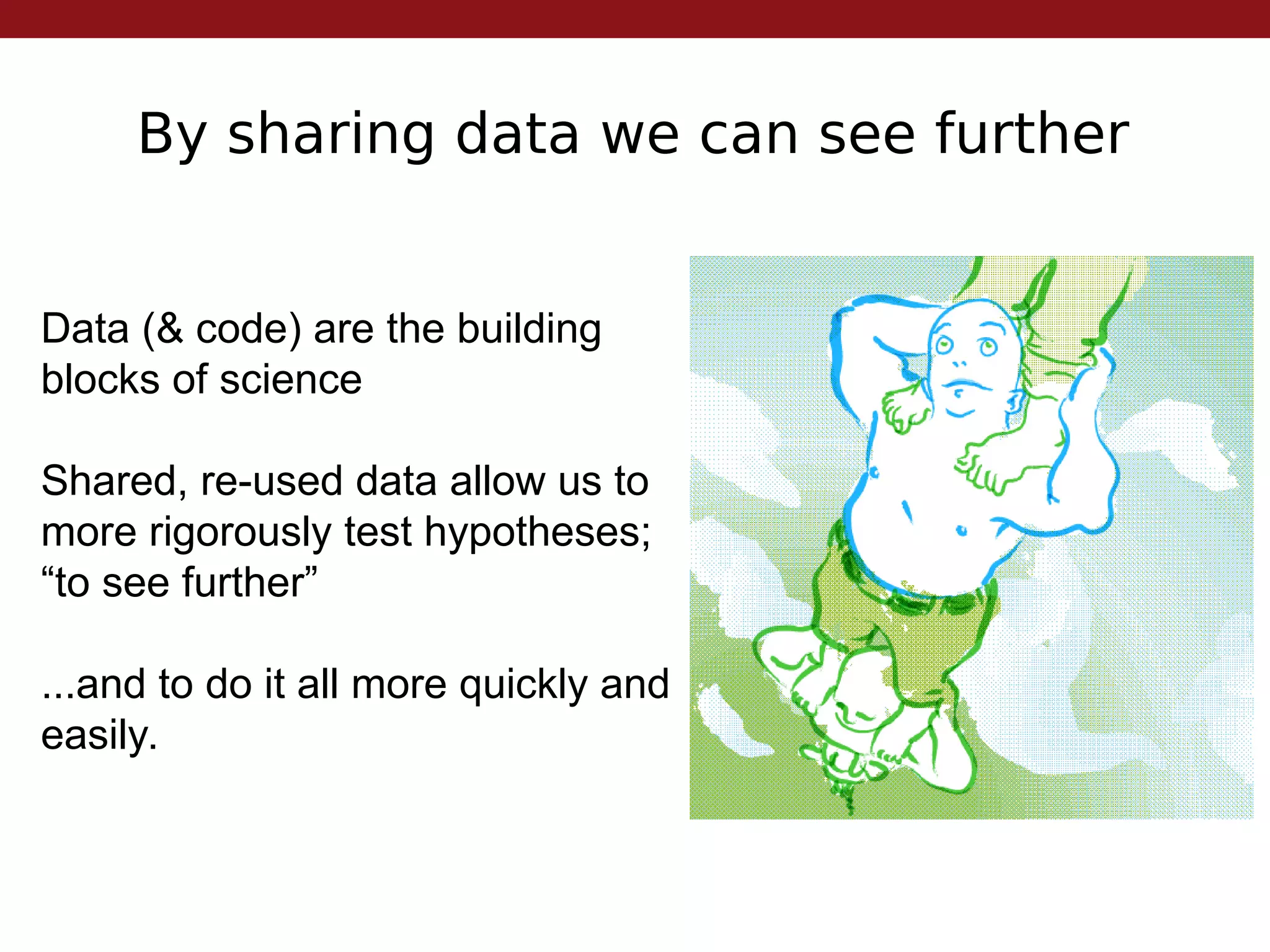
By sharing data we can see further
Data (& code) are the building
blocks of science
Shared, re-used data allow us to
more rigorously test hypotheses;
“to see further”
...and to do it all more quickly and
easily.
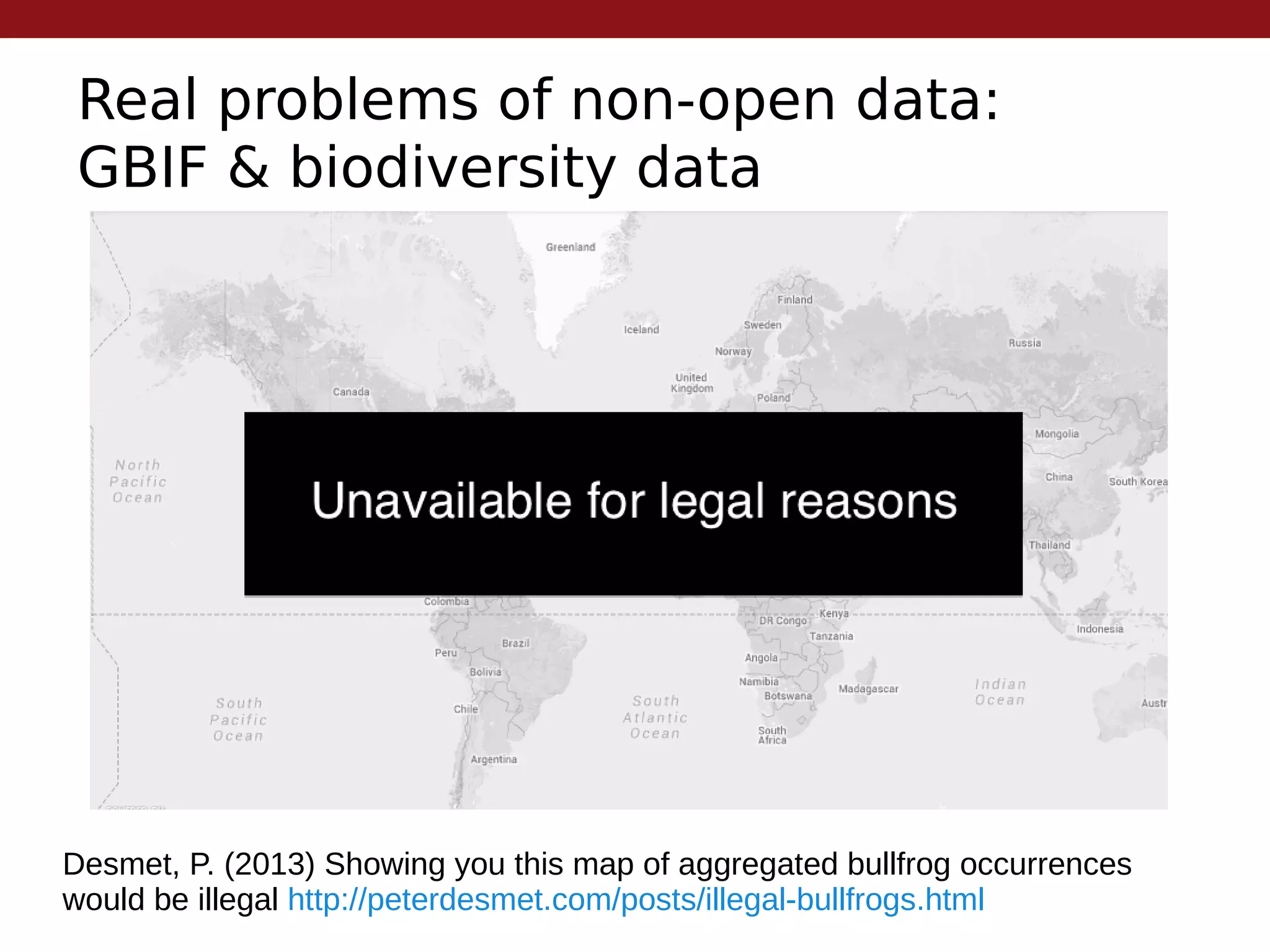
Real problems of non-open data:
GBIF & biodiversity data
Desmet, P. (2013) Showing you this map of aggregated bullfrog occurrences
would be illegal http://peterdesmet.com/posts/illegal-bullfrogs.html
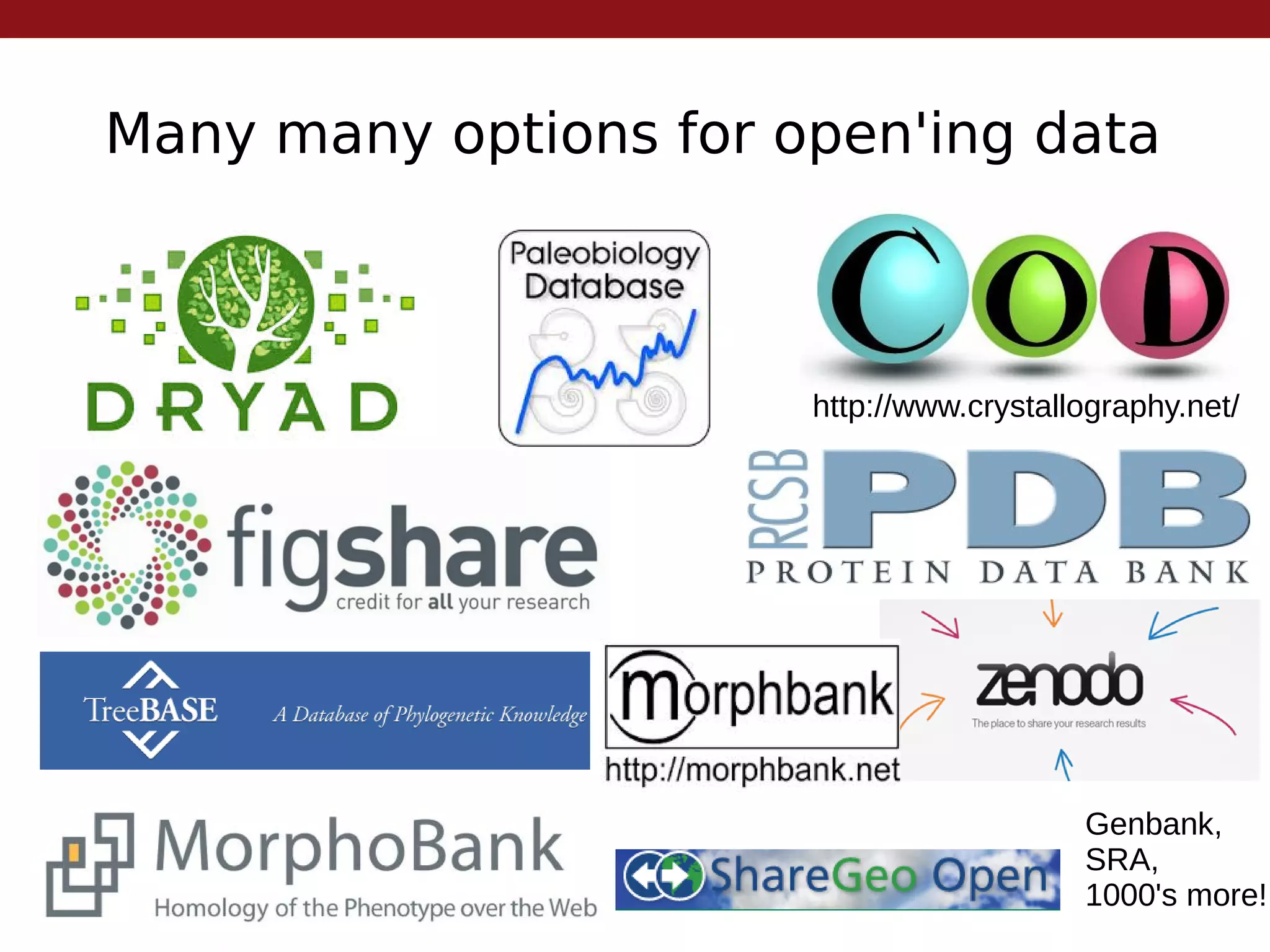
Many many options for open'ing data
Genbank,
SRA,
1000's more!
http://www.crystallography.net/
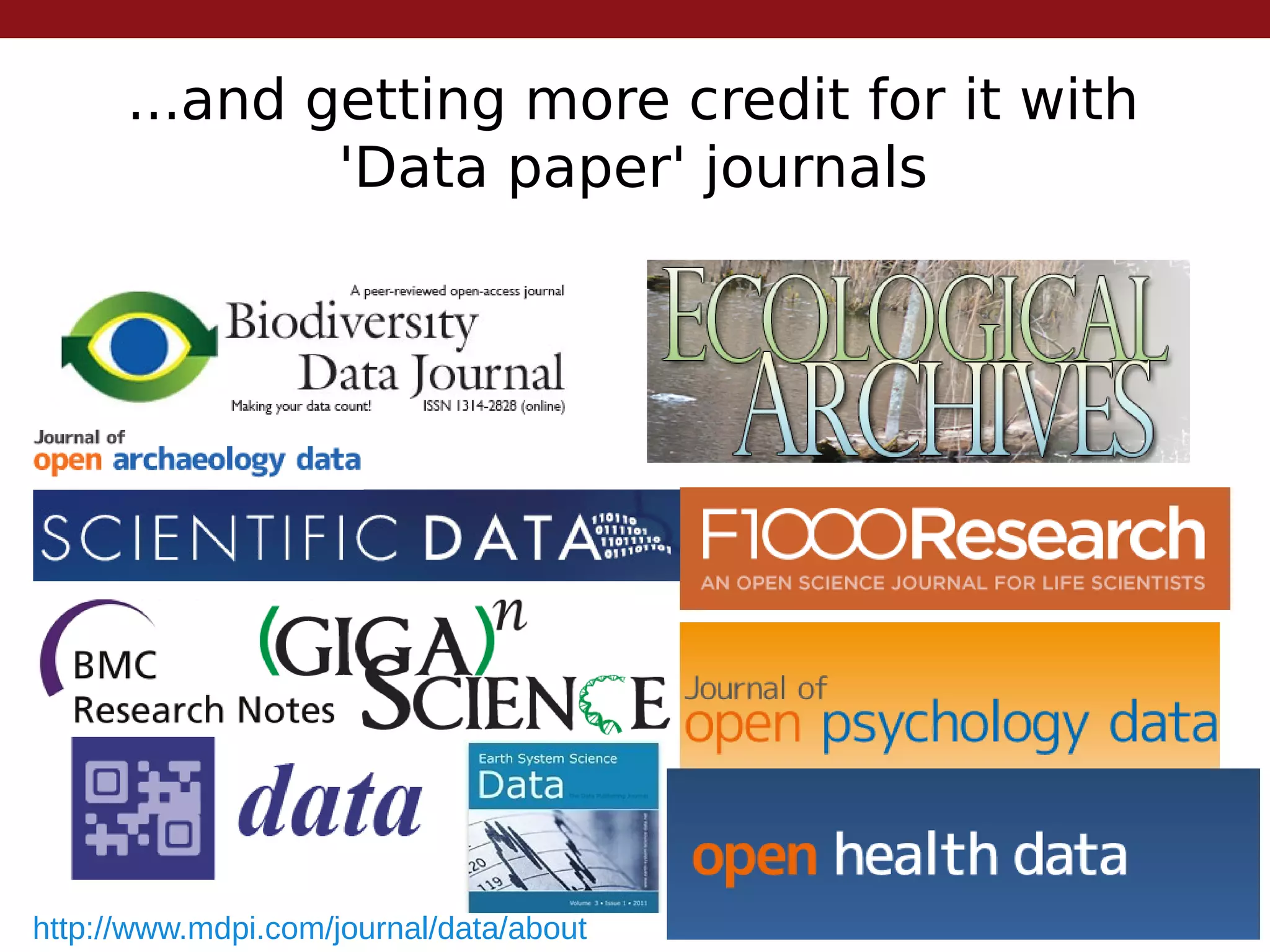
...and getting more credit for it with
'Data paper' journals
http://www.mdpi.com/journal/data/about
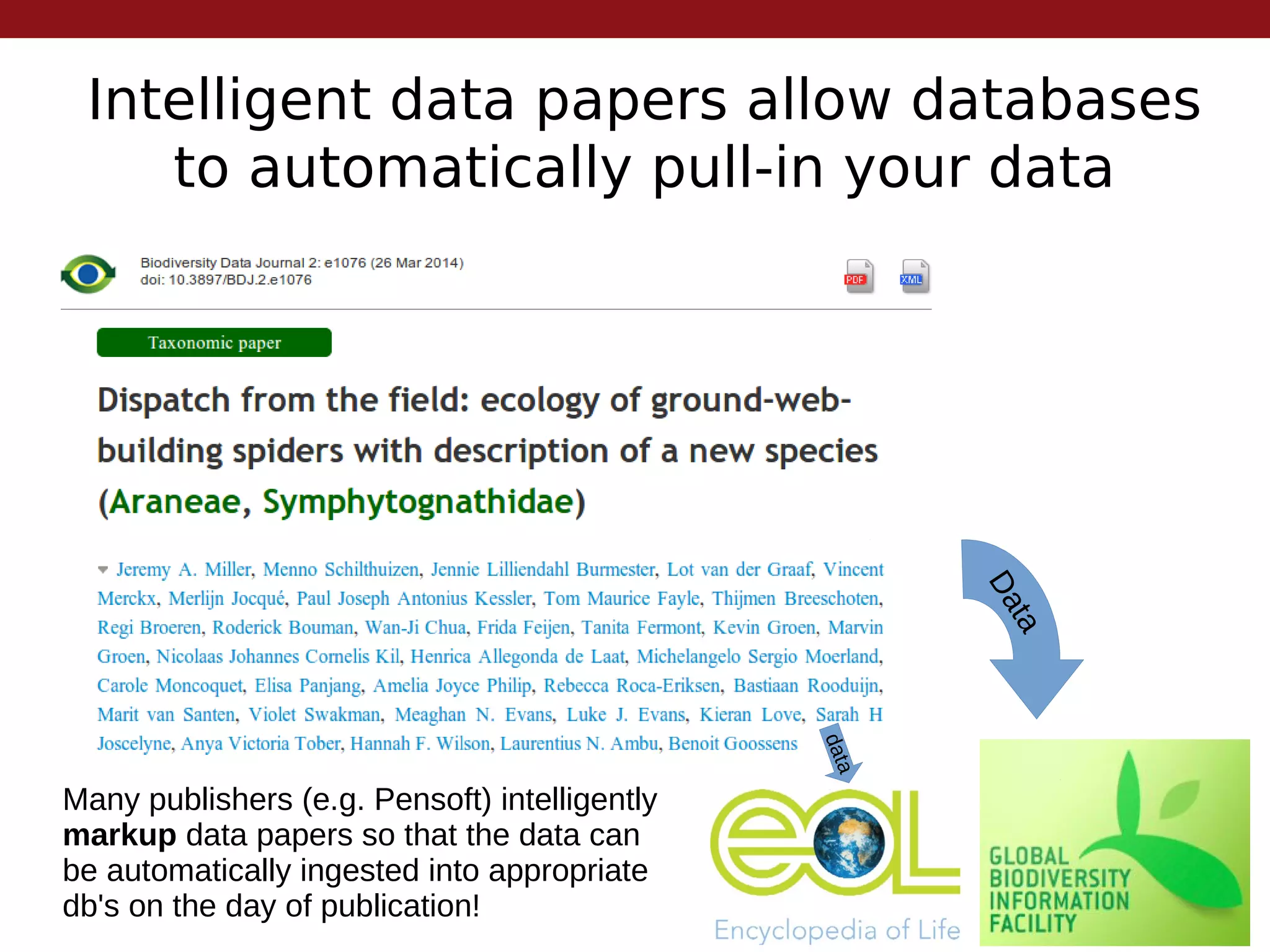
Intelligent data papers allow databases
to automatically pull-in your data
Many publishers (e.g. Pensoft) intelligently
markup data papers so that the data can
be automatically ingested into appropriate
db's on the day of publication!
Data
data
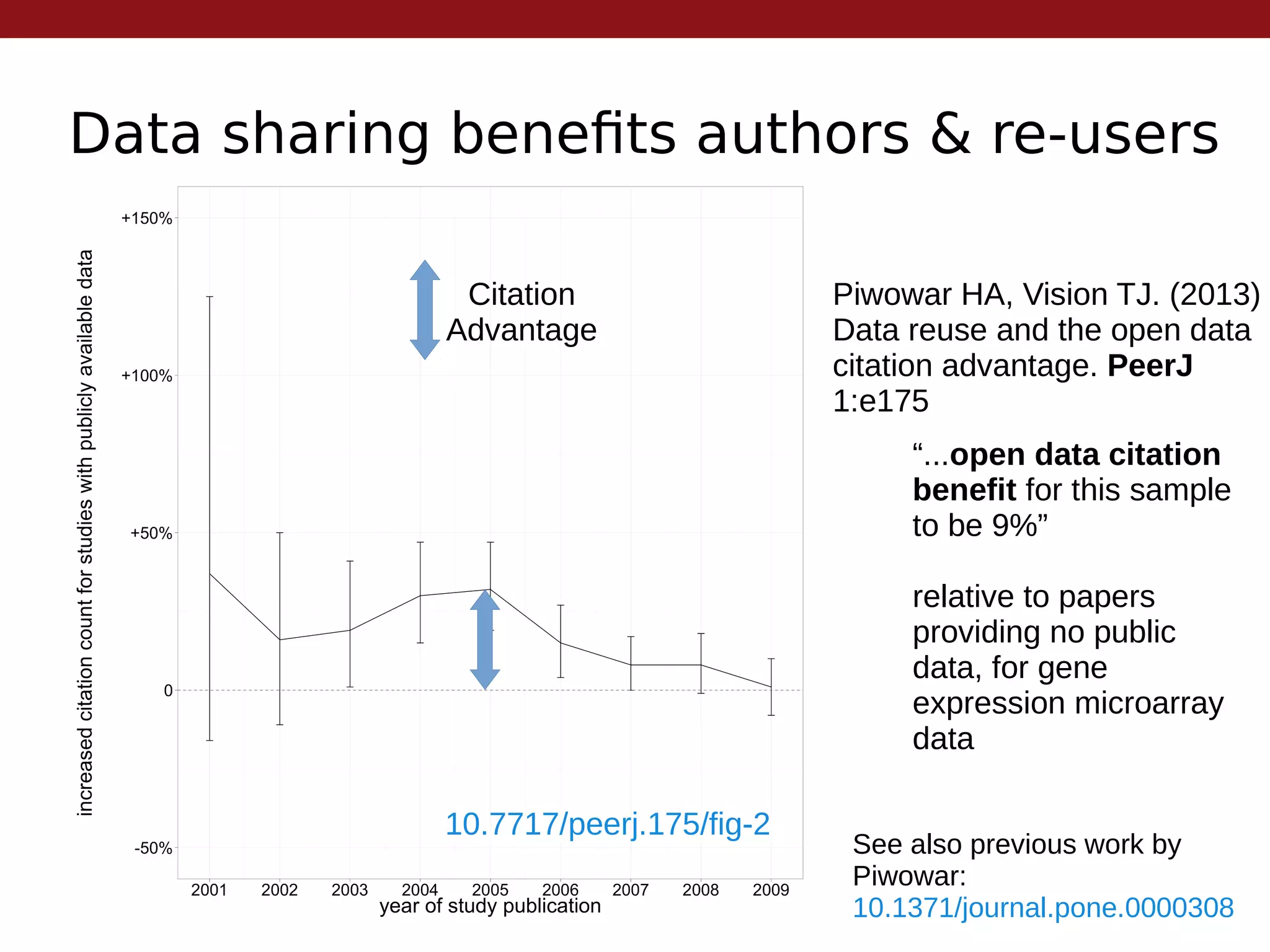
Data sharing benefits authors & re-users
Piwowar HA, Vision TJ. (2013)
Data reuse and the open data
citation advantage. PeerJ
1:e175
“...open data citation
benefit for this sample
to be 9%”
relative to papers
providing no public
data, for gene
expression microarray
data
10.7717/peerj.175/fig-2
See also previous work by
Piwowar:
10.1371/journal.pone.0000308
Citation
Advantage
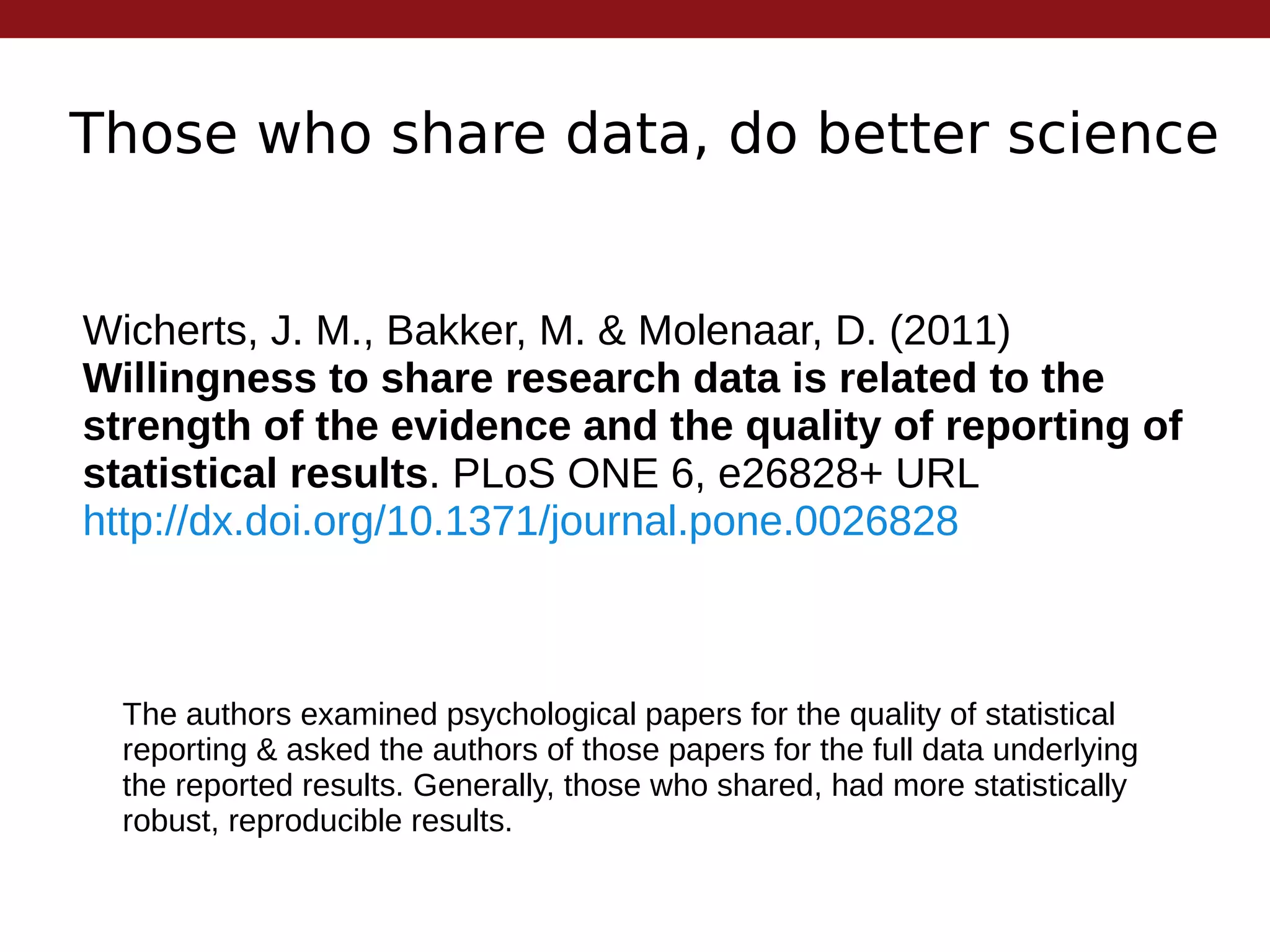
Those who share data, do better science
Wicherts, J. M., Bakker, M. & Molenaar, D. (2011)
Willingness to share research data is related to the
strength of the evidence and the quality of reporting of
statistical results. PLoS ONE 6, e26828+ URL
http://dx.doi.org/10.1371/journal.pone.0026828
The authors examined psychological papers for the quality of statistical
reporting & asked the authors of those papers for the full data underlying
the reported results. Generally, those who shared, had more statistically
robust, reproducible results.
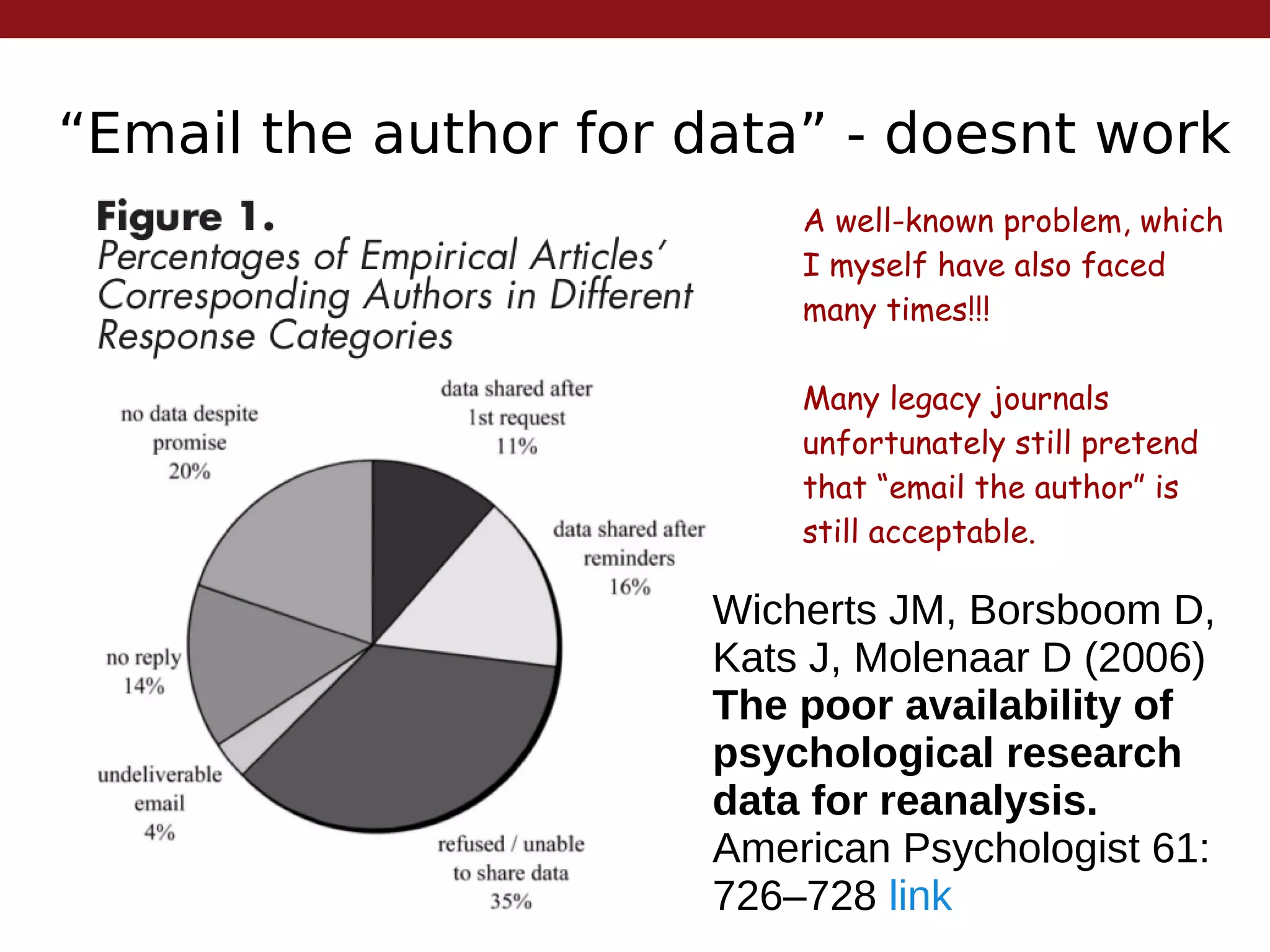
“Email the author for data” - doesnt work
Wicherts JM, Borsboom D,
Kats J, Molenaar D (2006)
The poor availability of
psychological research
data for reanalysis.
American Psychologist 61:
726–728 link
A well-known problem, which
I myself have also faced
many times!!!
Many legacy journals
unfortunately still pretend
that “email the author” is
still acceptable.
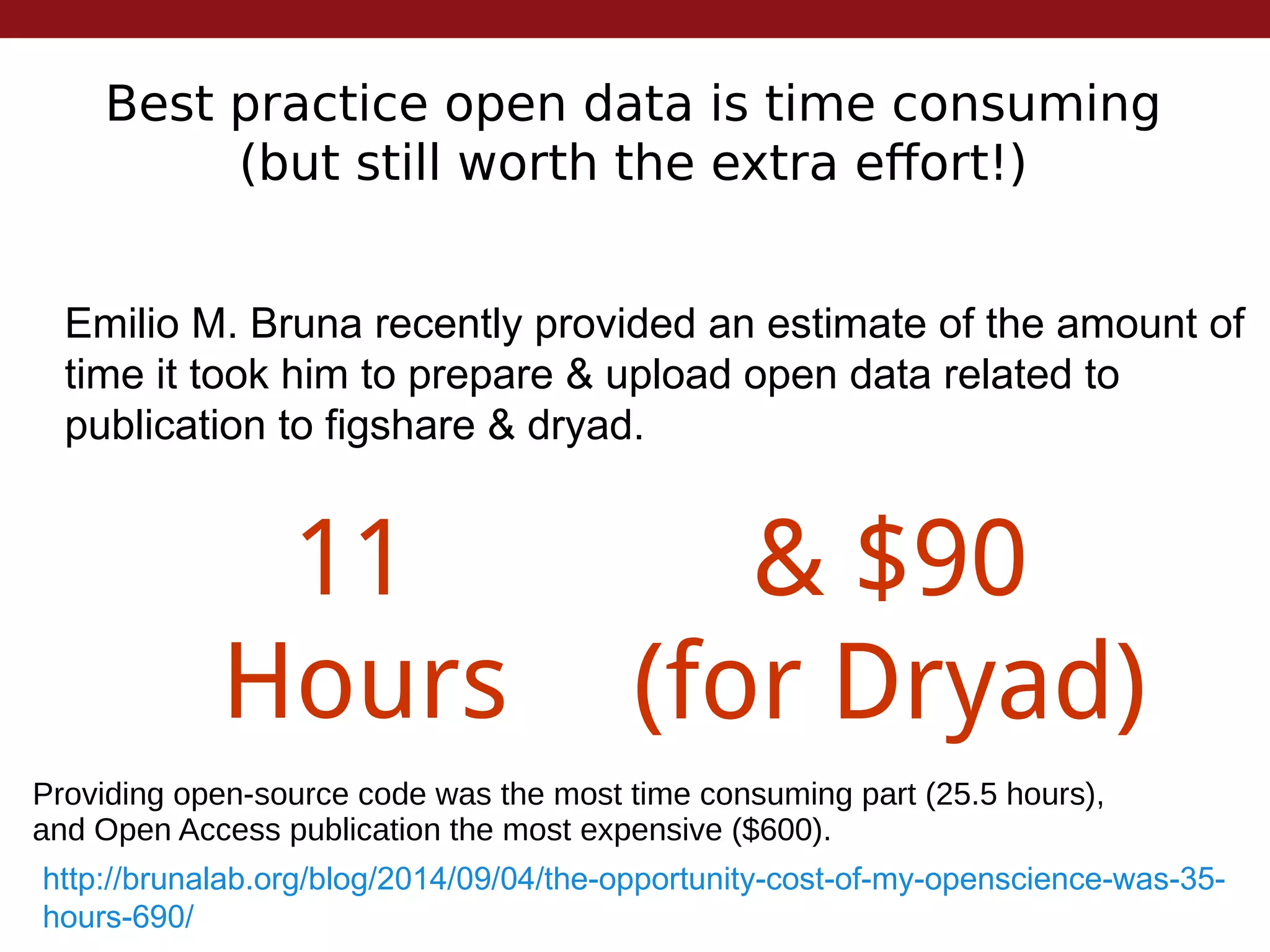
Best practice open data is time consuming
(but still worth the extra effort!)
Emilio M. Bruna recently provided an estimate of the amount of
time it took him to prepare & upload open data related to
publication to figshare & dryad.
http://brunalab.org/blog/2014/09/04/the-opportunity-cost-of-my-openscience-was-35-
hours-690/
11
Hours
& $90
(for Dryad)
Providing open-source code was the most time consuming part (25.5 hours),
and Open Access publication the most expensive ($600).
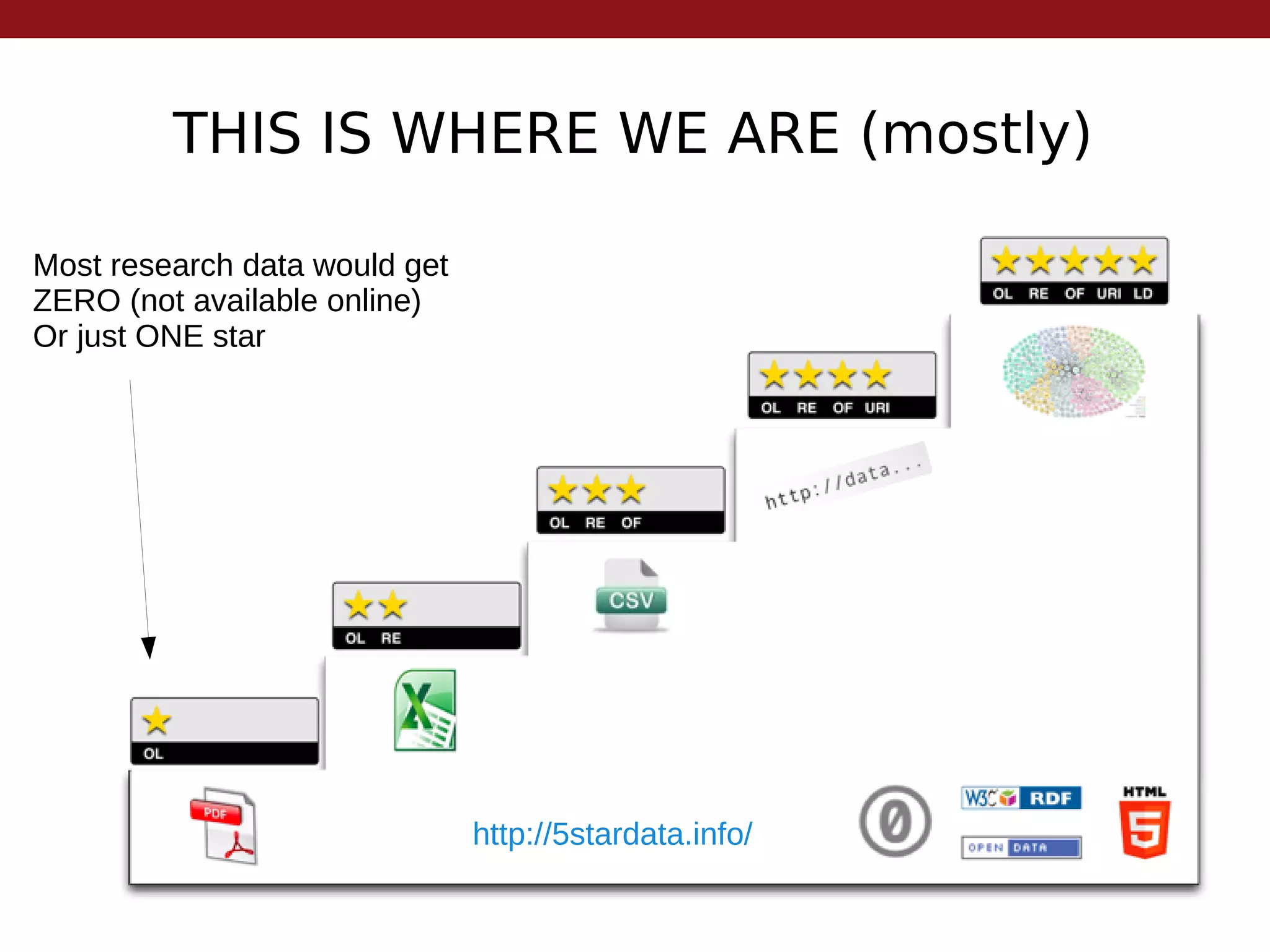
THIS IS WHERE WE ARE (mostly)
Most research data would get
ZERO (not available online)
Or just ONE star
http://5stardata.info/
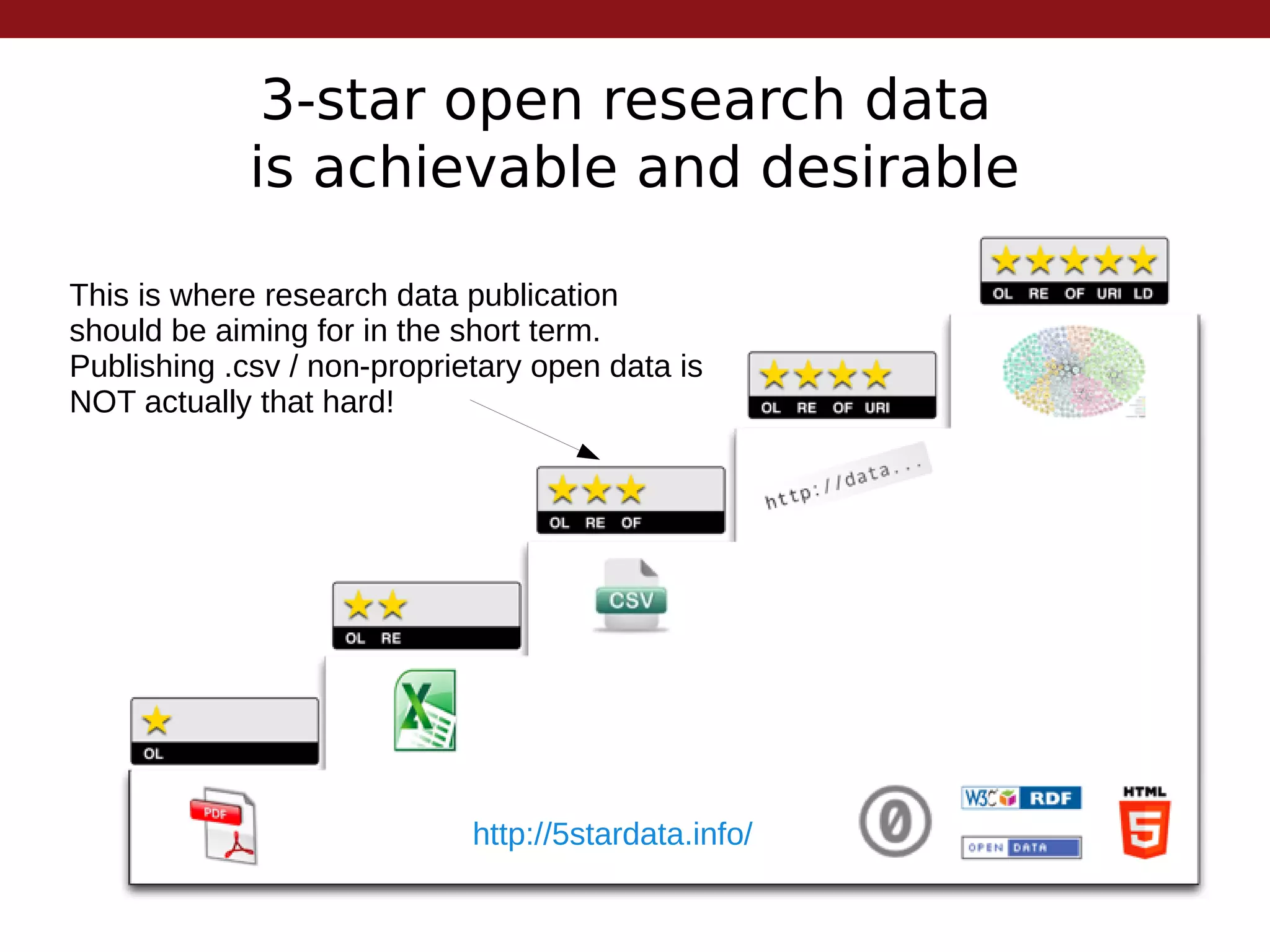
3-star open research data
is achievable and desirable
This is where research data publication
should be aiming for in the short term.
Publishing .csv / non-proprietary open data is
NOT actually that hard!
http://5stardata.info/
Imagine a world where no-one shared
their data (post-publication)
How would we know what was truth & what was lies / fraud / error?
Imagine the waste of time & resources
if everyone had to re-generate data de novo every time
How would we make progress?
Predictions for the (near) future
● Research funding bodies will tighten-up their rules to ensure
immediate post-publication data sharing. No embargoes, no bullshit.
● If no published data comes from your funded research, it will negatively
effect your future chances of funding
● Research institutions will significantly improve research data
management training for ALL staff & students, old and new alike
● Good journals will strictly enforce mandatory data sharing.
Journals that don't will get a bad reputation for irreprodcible research
● CC0 for data will become the de facto standard. Everyone will realise
that legal protection under copyright is completely the wrong tool for
ensuring the ethical use of data & appropriate authorship assignment.
Thank you!
Happy to answer all questions
ross@righttoresearch.org
@RMounce
www.righttoresearch.org
www.sparc.arl.org

The State of Open Research Data

  • 1.
    The State of OpenResearch Data Ross Mounce, Ph.D. (@RMounce) Postdoc, University of Bath November 15, 2014
  • 2.
    bit.ly/stateofdata These slides areon Slideshare here: All textual content is
  • 3.
    Disclaimer Summarising the stateof open data is HARD I'd love to have better data & better evidence for this talk.
  • 4.
    Disclaimer #2 Whenever Italk about data in this talk, assume I'm talking about non-sensitive data e.g. NOT medical data NOT bio-weapons research data et cetera...
  • 5.
    Outline ● What is opendata? ● The evolution of data availability ● Where are we now? ● Some goals & aspirations for the future
  • 6.
    What exactly isopen data? From http://opendefinition.org/, see http://opendefinition.org/od/ for more detail Open means anyone can freely access, use, modify, and share for any purpose (subject, at most, to requirements that preserve provenance and openness)
  • 7.
    Centralised Data Centres TheCambridge Crystallographic Data Centre, est. 1965 It maintains the Cambridge Structural Database ** ** Not open data sensu stricto …but I'll leave that to Peter Murray-Rust to explain
  • 8.
    Data Sharing (bysnail mail) e.g. “The full profile listings are on floppy disks which are available upon request” Fernholz et al (1989) A survey of measurements and measuring techniques in rapidly distorted compressible turbulent boundary layers.
  • 9.
    Bilofsky & Burks(1988) Nucleic Acids Research v16 n5 “The author will provide the accession number to the PROCEEDINGS [PNAS] office to be included in a footnote to the published paper.” 1989
  • 10.
    Reproducible research Jon Claerbout, JonBuckheit & David Donoho, 1995
  • 11.
    Community agreements toshare data the Bermuda Principles for sharing DNA seq. data ● Automatic release of sequence assemblies larger than 1 kb (preferably within 24 hours). ● Immediate publication of finished annotated sequences. ● Aim to make the entire sequence freely available in the public domain
  • 12.
    Supplementary Data (Online) Chenet al (1999) Fluorescence Polarization in Homogeneous Nucleic Acid Analysis. Genome Research “Numerical values for the data are available as online supplementary material at http://www.genome.org.”
  • 13.
    “Each custodian ofdata on plant traits will retain the right to be informed of any TRY activity that may involve his/her data, and will have the opportunity to negotiate whether his/her data can be used, and whether general guidelines of authorship need to be modified in that particular case Custodians retain the rights to withdraw their data at any time.”
  • 14.
    Your data isNOT 'too big' to share http://gigadb.org/dataset/100124 39 Gigabytes (GB) of MRI scans
  • 16.
    By sharing datawe can see further Data (& code) are the building blocks of science Shared, re-used data allow us to more rigorously test hypotheses; “to see further” ...and to do it all more quickly and easily.
  • 17.
    Real problems ofnon-open data: GBIF & biodiversity data Desmet, P. (2013) Showing you this map of aggregated bullfrog occurrences would be illegal http://peterdesmet.com/posts/illegal-bullfrogs.html
  • 18.
    Many many optionsfor open'ing data Genbank, SRA, 1000's more! http://www.crystallography.net/
  • 19.
    ...and getting morecredit for it with 'Data paper' journals http://www.mdpi.com/journal/data/about
  • 20.
    Intelligent data papersallow databases to automatically pull-in your data Many publishers (e.g. Pensoft) intelligently markup data papers so that the data can be automatically ingested into appropriate db's on the day of publication! Data data
  • 21.
    Data sharing benefitsauthors & re-users Piwowar HA, Vision TJ. (2013) Data reuse and the open data citation advantage. PeerJ 1:e175 “...open data citation benefit for this sample to be 9%” relative to papers providing no public data, for gene expression microarray data 10.7717/peerj.175/fig-2 See also previous work by Piwowar: 10.1371/journal.pone.0000308 Citation Advantage
  • 22.
    Those who sharedata, do better science Wicherts, J. M., Bakker, M. & Molenaar, D. (2011) Willingness to share research data is related to the strength of the evidence and the quality of reporting of statistical results. PLoS ONE 6, e26828+ URL http://dx.doi.org/10.1371/journal.pone.0026828 The authors examined psychological papers for the quality of statistical reporting & asked the authors of those papers for the full data underlying the reported results. Generally, those who shared, had more statistically robust, reproducible results.
  • 23.
    “Email the authorfor data” - doesnt work Wicherts JM, Borsboom D, Kats J, Molenaar D (2006) The poor availability of psychological research data for reanalysis. American Psychologist 61: 726–728 link A well-known problem, which I myself have also faced many times!!! Many legacy journals unfortunately still pretend that “email the author” is still acceptable.
  • 24.
    Best practice opendata is time consuming (but still worth the extra effort!) Emilio M. Bruna recently provided an estimate of the amount of time it took him to prepare & upload open data related to publication to figshare & dryad. http://brunalab.org/blog/2014/09/04/the-opportunity-cost-of-my-openscience-was-35- hours-690/ 11 Hours & $90 (for Dryad) Providing open-source code was the most time consuming part (25.5 hours), and Open Access publication the most expensive ($600).
  • 25.
    THIS IS WHEREWE ARE (mostly) Most research data would get ZERO (not available online) Or just ONE star http://5stardata.info/
  • 26.
    3-star open researchdata is achievable and desirable This is where research data publication should be aiming for in the short term. Publishing .csv / non-proprietary open data is NOT actually that hard! http://5stardata.info/
  • 27.
    Imagine a worldwhere no-one shared their data (post-publication) How would we know what was truth & what was lies / fraud / error? Imagine the waste of time & resources if everyone had to re-generate data de novo every time How would we make progress?
  • 28.
    Predictions for the(near) future ● Research funding bodies will tighten-up their rules to ensure immediate post-publication data sharing. No embargoes, no bullshit. ● If no published data comes from your funded research, it will negatively effect your future chances of funding ● Research institutions will significantly improve research data management training for ALL staff & students, old and new alike ● Good journals will strictly enforce mandatory data sharing. Journals that don't will get a bad reputation for irreprodcible research ● CC0 for data will become the de facto standard. Everyone will realise that legal protection under copyright is completely the wrong tool for ensuring the ethical use of data & appropriate authorship assignment.
  • 29.
    Thank you! Happy toanswer all questions ross@righttoresearch.org @RMounce www.righttoresearch.org www.sparc.arl.org