POLITICAL SCIENCE
-SARVESH SONAWANE
EQUALITY
WHAT IS EQUALITY?
• Equality in simple words means ‘sameness’
• The sameness may be in quality or quantity
EQUALITY IN CONTEXT TO PS
• Politically, equality
refers to sameness in
the availability and
exercise of rights,
opportunities and
choices.
• Hence in PS, the term
equality is directly
related to fundamental
rights.
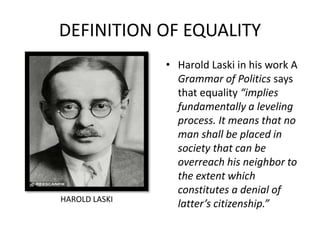
DEFINITION OF EQUALITY
• Harold Laski in his work A
Grammar of Politics says
that equality “implies
fundamentally a leveling
process. It means that no
man shall be placed in
society that can be
overreach his neighbor to
the extent which
constitutes a denial of
latter’s citizenship.”HAROLD LASKI
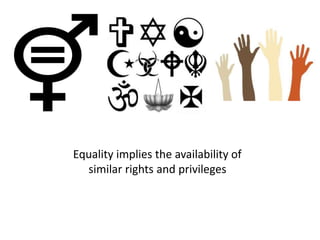
Equality implies the availability of
similar rights and privileges
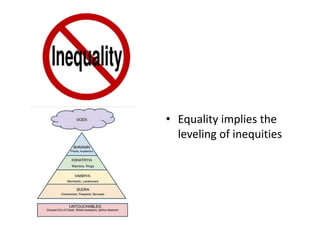
• Equality implies the
leveling of inequities
• Equality cannot be absolute
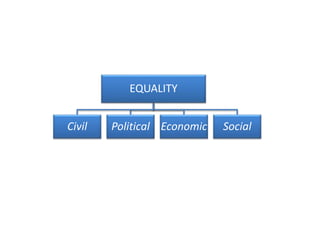
EQUALITY
Civil Political Economic Social
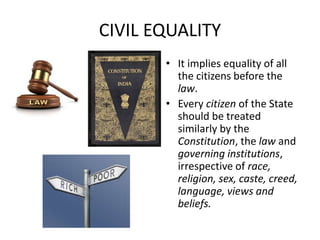
CIVIL EQUALITY
• It implies equality of all
the citizens before the
law.
• Every citizen of the State
should be treated
similarly by the
Constitution, the law and
governing institutions,
irrespective of race,
religion, sex, caste, creed,
language, views and
beliefs.
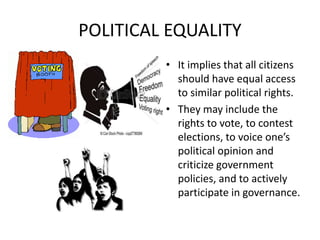
POLITICAL EQUALITY
• It implies that all citizens
should have equal access
to similar political rights.
• They may include the
rights to vote, to contest
elections, to voice one’s
political opinion and
criticize government
policies, and to actively
participate in governance.
ECONOMIC EQUALITY
• In recent years,
economic equality is
acquiring greater
significance than even
political equality.
• Economic development,
adequate employment,
reasonable wages, etc.
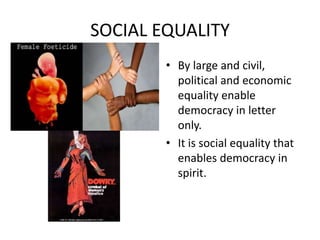
SOCIAL EQUALITY
• By large and civil,
political and economic
equality enable
democracy in letter
only.
• It is social equality that
enables democracy in
spirit.
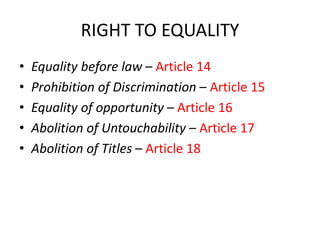
RIGHT TO EQUALITY
• Equality before law – Article 14
• Prohibition of Discrimination – Article 15
• Equality of opportunity – Article 16
• Abolition of Untouchability – Article 17
• Abolition of Titles – Article 18
CHALLENGES
• Lacuna (gap) between
law and practice
• Inadequate laws
• Unwillingness of society
to follow laws
• Lack of education and
awareness
THANK YOU

Political Science - Equality

  • 1.
  • 2.
  • 3.
    WHAT IS EQUALITY? •Equality in simple words means ‘sameness’ • The sameness may be in quality or quantity
  • 4.
    EQUALITY IN CONTEXTTO PS • Politically, equality refers to sameness in the availability and exercise of rights, opportunities and choices. • Hence in PS, the term equality is directly related to fundamental rights.
  • 5.
    DEFINITION OF EQUALITY •Harold Laski in his work A Grammar of Politics says that equality “implies fundamentally a leveling process. It means that no man shall be placed in society that can be overreach his neighbor to the extent which constitutes a denial of latter’s citizenship.”HAROLD LASKI
  • 6.
    Equality implies theavailability of similar rights and privileges
  • 7.
    • Equality impliesthe leveling of inequities
  • 8.
  • 9.
  • 10.
    CIVIL EQUALITY • Itimplies equality of all the citizens before the law. • Every citizen of the State should be treated similarly by the Constitution, the law and governing institutions, irrespective of race, religion, sex, caste, creed, language, views and beliefs.
  • 11.
    POLITICAL EQUALITY • Itimplies that all citizens should have equal access to similar political rights. • They may include the rights to vote, to contest elections, to voice one’s political opinion and criticize government policies, and to actively participate in governance.
  • 12.
    ECONOMIC EQUALITY • Inrecent years, economic equality is acquiring greater significance than even political equality. • Economic development, adequate employment, reasonable wages, etc.
  • 13.
    SOCIAL EQUALITY • Bylarge and civil, political and economic equality enable democracy in letter only. • It is social equality that enables democracy in spirit.
  • 14.
    RIGHT TO EQUALITY •Equality before law – Article 14 • Prohibition of Discrimination – Article 15 • Equality of opportunity – Article 16 • Abolition of Untouchability – Article 17 • Abolition of Titles – Article 18
  • 15.
    CHALLENGES • Lacuna (gap)between law and practice • Inadequate laws • Unwillingness of society to follow laws • Lack of education and awareness
  • 16.