Social Browsing & Information Filtering in Social Media 010011011 01100001 11110 011 0101110011010 0111011010  001001 01111  00001001111010 011011010101 01001 01111 01100001001111010 100101111  00110  1001 10110101110100100 1010100100  1101  0010  00010111010011
 
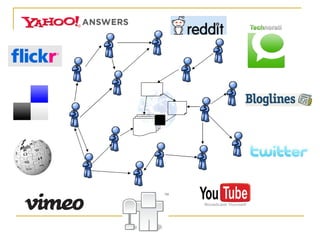
Elements of Social Web Users create content Images (Flicker), news stories (Digg, Reddit), bookmarks (del.ici.ous), videos(YouTube) Users add metadata to content Tags  Discussion Evaluation – voting, passive views
Elements of Social Web Users create social networks Add another users as friend/contacts Provide an easy interface to check friends activities. Transparency Publicly navigable content and metadata
What are we going to see ? How users of two popular social media sites. Digg – the social news aggregator  Flicker – the social photo-sharing file Use social networks.
Social News Aggregation on Digg User submit stories User vote (digg) on stories Select stories promoted to the front page based on received votes. Collaborative front page emerges from the opinions of many users, not few editors. Users create social networks by adding others as friends  Friends interface make it easy to track friends activites. Stories friends submitted  Stories friends digg (voted)
So … Claim: A new way for searching new content by browsing through the content created by their contacts via the Friend Interface. Social Browsing
Data  Digg  Digg-frontpage list of stories from the first 14 pages of Digg. Digg-all A list of stories from the first 20 pages in the upcoming stories queue. Top-users Information about the top 1020 recent active users.
Data  Flicker Explore Set consisted of the 500 “most  interesting ” images. Apex Set consisted of the most 500 most recent images to the  Apex group . Random Set Contains 480 most recent image.
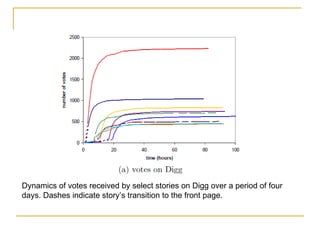
Dynamics of votes received by select stories on Digg over a period of four days. Dashes indicate story’s transition to the front page.
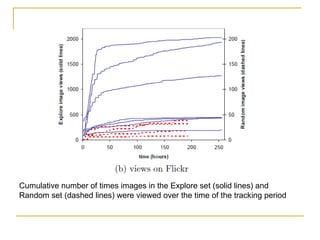
Cumulative number of times images in the Explore set (solid lines) and Random set (dashed lines) were viewed over the time of the tracking period
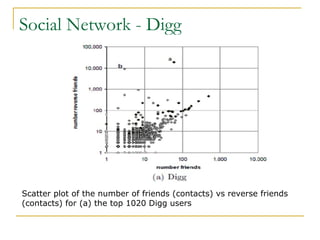
Social Network - Digg Scatter plot of the number of friends (contacts) vs reverse friends (contacts) for (a) the top 1020 Digg users
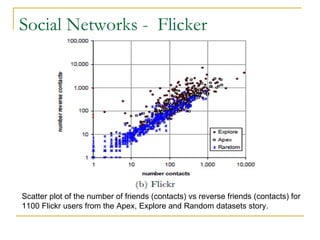
Social Networks -  Flicker Scatter plot of the number of friends (contacts) vs reverse friends (contacts) for 1100 Flickr users from the Apex, Explore and Random datasets story.
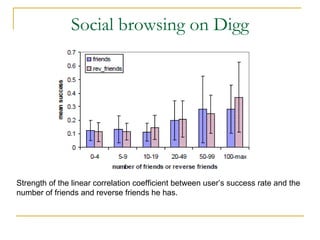
Social browsing on Digg Strength of the linear correlation coefficient between user’s success rate and the number of friends and reverse friends he has.
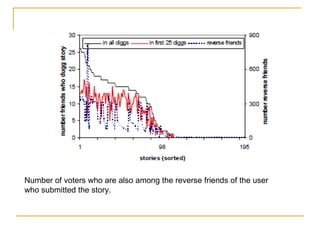
Number of voters who are also among the reverse friends of the user who submitted the story.
Claim 1: Users digg stories their friends submit Figure 5(b) Calculated Probability  probability that k of submitter’s reverse friends could have voted on the story purely by chance. P = 0.005 By enabling users to quickly digg stories submitted by friends, social networks play an important role in promoting stories to the front page.
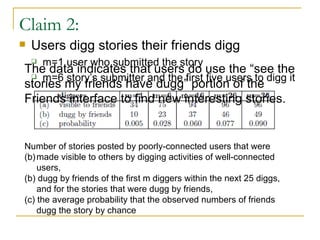
Claim 2:  Users digg stories their friends digg m=1 user who submitted the story m=6 story’s submitter and the first five users to digg it Number of stories posted by poorly-connected users that were  made visible to others by digging activities of well-connected users, (b) dugg by friends of the first m diggers within the next 25 diggs, and for the stories that were dugg by friends,  (c) the average probability that the observed numbers of friends dugg the story by chance The data indicates that users do use the “see the stories my friends have dugg” portion of the Friends interface to find new interesting stories.
Social browsing in Flicker Pools and tags Pool:  When users upload images to Flickr, they have an option to share them with different groups, each with its own image pool. Tags: users tags images with keywords which help  to improve search of the user’s own, as well as other people’s, images
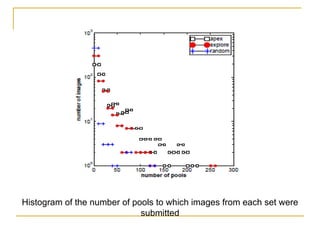
Histogram of the number of pools to which images from each set were submitted
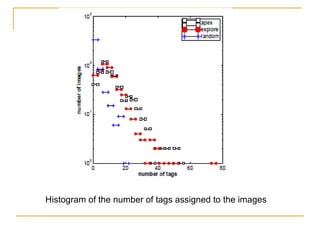
Histogram of the number of tags assigned to the images
It represents: There is considerable effort involved in sharing an image with a group, suggesting that social aspects of Flickr, such as sharing images with other users through groups and increasing the visibility of an image is very important to users, possibly more than being able to easily find them with tags.
Social Networks & Comments Names of users who commented on images in the three datasets were collected and compared them to the names of users in the image owners’ social networks.
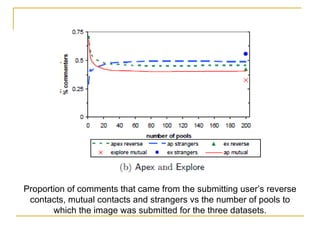
Proportion of comments that came from the submitting user’s reverse contacts, mutual contacts and strangers vs the number of pools to which the image was submitted for the three datasets.
Conclusion In their every day use of Social Web Sites, users create large quantity of data, which express their knowledge and Opinions. Content - Articles,media content, opinion pieces, etc. Meta data - Tags, ratings, discussion ,social networks Links between users, content and metadata
Social Web enables new problem solving approaches Social Information Processing Use knowledge, opinions , works of others for own information needs Collective Problem solving Efficient , robust solutions beyond the scope of individual capabilities. New solution to old information processing problems.  Information Personalization and discovery
The Future of Social Web Instead of ever clever algorithms, harness the Collective Intelligence.
The Future of Social Web 2 Instead of connecting data, the web connects people. New Applications Collaborative tools  Collective Intelligence The personalization of everything The more system learns about me, the better it should filter Discovery, not search What papers do I need to read to know about the research on social networks ?
Reference: K. Lerman (2007), Social Networks and Social Information Filtering on Digg, in Proceedings of Int. Conf. on Weblogs and Social Media, Boulder, CO,USA.
EXTRA SLIDES
Top User Digg Rank users Based on how many of their stories were promoted to front page - User with most front page stories is ranked #1 .. Top 1000 users data  Collected by scraping Digg … now available through API   - Usage statisics  How many stories user dugg, commented on User Rank - Social Networks  Friends: outgoing links A -> B:= B is a friend of A Reverse friends: incoming link A -> B := A is a reverse friend of B
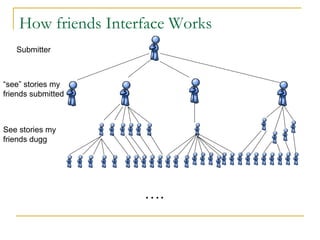
How friends Interface Works  Submitter “see” stories my friends submitted … .   See stories my friends dugg

Social Information & Browsing March 6

  • 1.
    Social Browsing &Information Filtering in Social Media 010011011 01100001 11110 011 0101110011010 0111011010 001001 01111 00001001111010 011011010101 01001 01111 01100001001111010 100101111 00110 1001 10110101110100100 1010100100 1101 0010 00010111010011
  • 2.
  • 3.
    Elements of SocialWeb Users create content Images (Flicker), news stories (Digg, Reddit), bookmarks (del.ici.ous), videos(YouTube) Users add metadata to content Tags Discussion Evaluation – voting, passive views
  • 4.
    Elements of SocialWeb Users create social networks Add another users as friend/contacts Provide an easy interface to check friends activities. Transparency Publicly navigable content and metadata
  • 5.
    What are wegoing to see ? How users of two popular social media sites. Digg – the social news aggregator Flicker – the social photo-sharing file Use social networks.
  • 6.
    Social News Aggregationon Digg User submit stories User vote (digg) on stories Select stories promoted to the front page based on received votes. Collaborative front page emerges from the opinions of many users, not few editors. Users create social networks by adding others as friends Friends interface make it easy to track friends activites. Stories friends submitted Stories friends digg (voted)
  • 7.
    So … Claim:A new way for searching new content by browsing through the content created by their contacts via the Friend Interface. Social Browsing
  • 8.
    Data Digg Digg-frontpage list of stories from the first 14 pages of Digg. Digg-all A list of stories from the first 20 pages in the upcoming stories queue. Top-users Information about the top 1020 recent active users.
  • 9.
    Data FlickerExplore Set consisted of the 500 “most interesting ” images. Apex Set consisted of the most 500 most recent images to the Apex group . Random Set Contains 480 most recent image.
  • 10.
    Dynamics of votesreceived by select stories on Digg over a period of four days. Dashes indicate story’s transition to the front page.
  • 11.
    Cumulative number oftimes images in the Explore set (solid lines) and Random set (dashed lines) were viewed over the time of the tracking period
  • 12.
    Social Network -Digg Scatter plot of the number of friends (contacts) vs reverse friends (contacts) for (a) the top 1020 Digg users
  • 13.
    Social Networks - Flicker Scatter plot of the number of friends (contacts) vs reverse friends (contacts) for 1100 Flickr users from the Apex, Explore and Random datasets story.
  • 14.
    Social browsing onDigg Strength of the linear correlation coefficient between user’s success rate and the number of friends and reverse friends he has.
  • 15.
    Number of voterswho are also among the reverse friends of the user who submitted the story.
  • 16.
    Claim 1: Usersdigg stories their friends submit Figure 5(b) Calculated Probability probability that k of submitter’s reverse friends could have voted on the story purely by chance. P = 0.005 By enabling users to quickly digg stories submitted by friends, social networks play an important role in promoting stories to the front page.
  • 17.
    Claim 2: Users digg stories their friends digg m=1 user who submitted the story m=6 story’s submitter and the first five users to digg it Number of stories posted by poorly-connected users that were made visible to others by digging activities of well-connected users, (b) dugg by friends of the first m diggers within the next 25 diggs, and for the stories that were dugg by friends, (c) the average probability that the observed numbers of friends dugg the story by chance The data indicates that users do use the “see the stories my friends have dugg” portion of the Friends interface to find new interesting stories.
  • 18.
    Social browsing inFlicker Pools and tags Pool: When users upload images to Flickr, they have an option to share them with different groups, each with its own image pool. Tags: users tags images with keywords which help to improve search of the user’s own, as well as other people’s, images
  • 19.
    Histogram of thenumber of pools to which images from each set were submitted
  • 20.
    Histogram of thenumber of tags assigned to the images
  • 21.
    It represents: Thereis considerable effort involved in sharing an image with a group, suggesting that social aspects of Flickr, such as sharing images with other users through groups and increasing the visibility of an image is very important to users, possibly more than being able to easily find them with tags.
  • 22.
    Social Networks &Comments Names of users who commented on images in the three datasets were collected and compared them to the names of users in the image owners’ social networks.
  • 23.
    Proportion of commentsthat came from the submitting user’s reverse contacts, mutual contacts and strangers vs the number of pools to which the image was submitted for the three datasets.
  • 24.
    Conclusion In theirevery day use of Social Web Sites, users create large quantity of data, which express their knowledge and Opinions. Content - Articles,media content, opinion pieces, etc. Meta data - Tags, ratings, discussion ,social networks Links between users, content and metadata
  • 25.
    Social Web enablesnew problem solving approaches Social Information Processing Use knowledge, opinions , works of others for own information needs Collective Problem solving Efficient , robust solutions beyond the scope of individual capabilities. New solution to old information processing problems. Information Personalization and discovery
  • 26.
    The Future ofSocial Web Instead of ever clever algorithms, harness the Collective Intelligence.
  • 27.
    The Future ofSocial Web 2 Instead of connecting data, the web connects people. New Applications Collaborative tools Collective Intelligence The personalization of everything The more system learns about me, the better it should filter Discovery, not search What papers do I need to read to know about the research on social networks ?
  • 28.
    Reference: K. Lerman(2007), Social Networks and Social Information Filtering on Digg, in Proceedings of Int. Conf. on Weblogs and Social Media, Boulder, CO,USA.
  • 29.
  • 30.
    Top User DiggRank users Based on how many of their stories were promoted to front page - User with most front page stories is ranked #1 .. Top 1000 users data Collected by scraping Digg … now available through API - Usage statisics How many stories user dugg, commented on User Rank - Social Networks Friends: outgoing links A -> B:= B is a friend of A Reverse friends: incoming link A -> B := A is a reverse friend of B
  • 31.
    How friends InterfaceWorks Submitter “see” stories my friends submitted … . See stories my friends dugg