Leadership
 Development in a
Learning 2.0 World
 Learn as you work. Work as you learn.


                   Tom Gram
                   Senior Director
          Leadership and Business Solutions
                 Nexient Learning
Agenda

 •   What are we talking about?
 •   Leadership Development
 •   Learning 2.0
 •   Using 2.0 for Leadership Development
 •   Implementation and Sustainment
 •   Summary
 •   Q and A


                                            Page 1 |   I0608
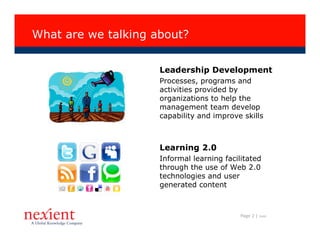
What are we talking about?


                     Leadership Development
                     Processes, programs and
                     activities provided by
                     organizations to help the
                     management team develop
                     capability and improve skills


                     Learning 2.0
                     Informal learning facilitated
                     through the use of Web 2.0
                     technologies and user
                     generated content


                                            Page 2 |   I0608
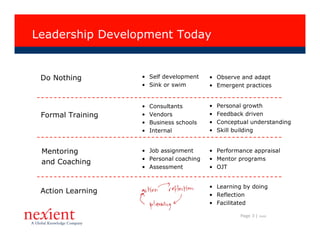
Leadership Development Today


 Do Nothing        • Self development     • Observe and adapt
                   • Sink or swim         • Emergent practices


                   •   Consultants        •   Personal growth
 Formal Training   •   Vendors            •   Feedback driven
                   •   Business schools   •   Conceptual understanding
                   •   Internal           •   Skill building


 Mentoring         • Job assignment       • Performance appraisal
                   • Personal coaching    • Mentor programs
 and Coaching
                   • Assessment           • OJT


                                          • Learning by doing
 Action Learning                          • Reflection
                                          • Facilitated

                                                     Page 3 |   I0608
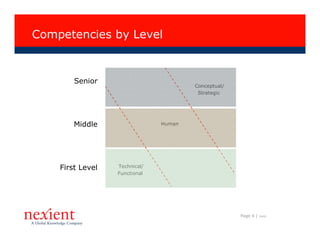
Competencies by Level


        Senior
                                       Conceptual/
                                        Strategic


        Middle                 Human


    First Level   Technical/
                  Functional


                                                     Page 4 |   I0608
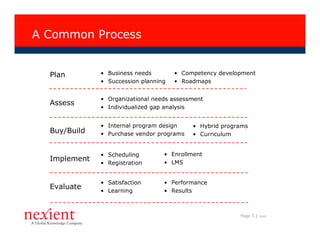
A Common Process


  Plan        • Business needs        • Competency development
              • Succession planning   • Roadmaps


              • Organizational needs assessment
  Assess
              • Individualized gap analysis


              • Internal program design    • Hybrid programs
  Buy/Build   • Purchase vendor programs   • Curriculum


              • Scheduling        • Enrollment
  Implement                       • LMS
              • Registration


              • Satisfaction      • Performance
  Evaluate    • Learning          • Results


                                                         Page 5 |   I0608
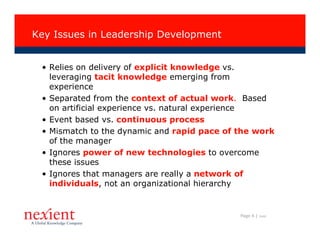
Key Issues in Leadership Development


 • Relies on delivery of explicit knowledge vs.
   leveraging tacit knowledge emerging from
   experience
 • Separated from the context of actual work. Based
   on artificial experience vs. natural experience
 • Event based vs. continuous process
 • Mismatch to the dynamic and rapid pace of the work
   of the manager
 • Ignores power of new technologies to overcome
   these issues
 • Ignores that managers are really a network of
   individuals, not an organizational hierarchy


                                             Page 6 |   I0608
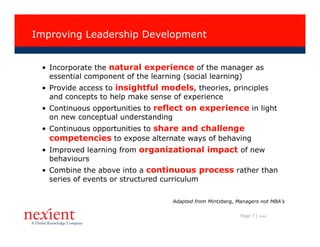
Improving Leadership Development


 • Incorporate the natural experience of the manager as
   essential component of the learning (social learning)
 • Provide access to insightful models, theories, principles
   and concepts to help make sense of experience
 • Continuous opportunities to reflect on experience in light
   on new conceptual understanding
 • Continuous opportunities to share and challenge
   competencies to expose alternate ways of behaving
 • Improved learning from organizational impact of new
   behaviours
 • Combine the above into a continuous process rather than
   series of events or structured curriculum

                                   Adapted from Mintzberg, Managers not MBA’s

                                                            Page 7 |   I0608
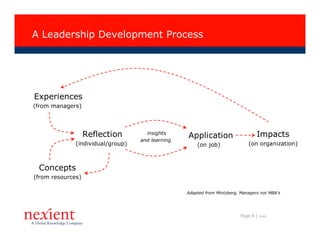
A Leadership Development Process


Experiences
(from managers)


                   Reflection        insights
                                                  Application                    Impacts
                                   and learning
              (individual/group)                      (on job)               (on organization)


 Concepts
(from resources)

                                                  Adapted from Mintzberg, Managers not MBA’s


                                                                          Page 8 |   I0608
Your Reflection

 • Share Leadership Development practices in your organization
 • What are the implications for transforming leadership development?


                                                           Page 9 |   I0608
Agenda

 •   Common Ground: What are we talking about?
 •   Leadership Development
 •   Learning 2.0
 •   Using 2.0 for Leadership Development
 •   Implementation and sustainment
 •   Summary
 •   Q and A


                                                 Page 10 |   I0608
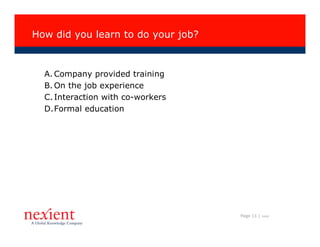
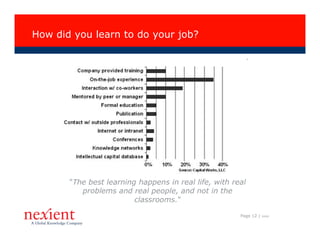
How did you learn to do your job?


  A. Company provided training
  B. On the job experience
  C. Interaction with co-workers
  D.Formal education


                                    Page 11 |   I0608
How did you learn to do your job?


       "The best learning happens in real life, with real
          problems and real people, and not in the
                         classrooms."

                                                       Page 12 |   I0608
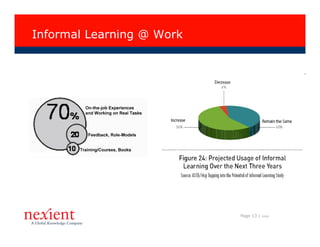
Informal Learning @ Work


                           Page 13 |   I0608
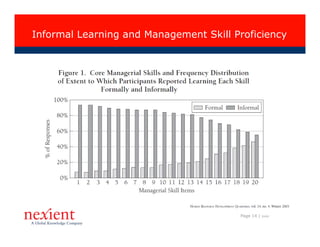
Informal Learning and Management Skill Proficiency


                                        Page 14 |   I0608
Page 15 |   I0608
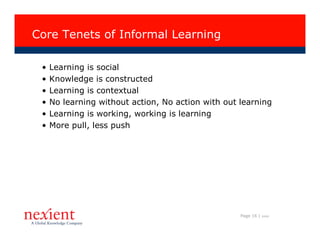
Core Tenets of Informal Learning

 •   Learning is social
 •   Knowledge is constructed
 •   Learning is contextual
 •   No learning without action, No action with out learning
 •   Learning is working, working is learning
 •   More pull, less push


                                                    Page 16 |   I0608
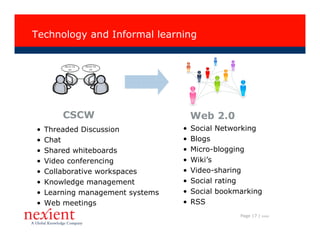
Technology and Informal learning


        CSCW                          Web 2.0
•   Threaded Discussion           •   Social Networking
•   Chat                          •   Blogs
•   Shared whiteboards            •   Micro-blogging
•   Video conferencing            •   Wiki’s
•   Collaborative workspaces      •   Video-sharing
•   Knowledge management          •   Social rating
•   Learning management systems   •   Social bookmarking
•   Web meetings                  •   RSS
                                                  Page 17 |   I0608
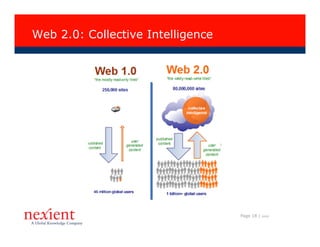
Web 2.0: Collective Intelligence


                                   Page 18 |   I0608
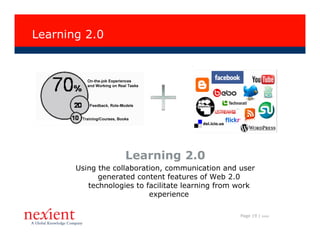
Learning 2.0


                    Learning 2.0
       Using the collaboration, communication and user
             generated content features of Web 2.0
          technologies to facilitate learning from work
                           experience

                                                   Page 19 |   I0608
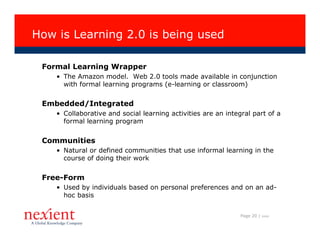
How is Learning 2.0 is being used

 Formal Learning Wrapper
    • The Amazon model. Web 2.0 tools made available in conjunction
      with formal learning programs (e-learning or classroom)


 Embedded/Integrated
    • Collaborative and social learning activities are an integral part of a
      formal learning program


 Communities
    • Natural or defined communities that use informal learning in the
      course of doing their work


 Free-Form
    • Used by individuals based on personal preferences and on an ad-
      hoc basis


                                                               Page 20 |   I0608
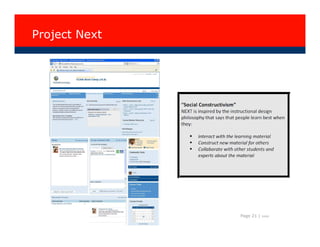
Project Next


               Page 21 |   I0608
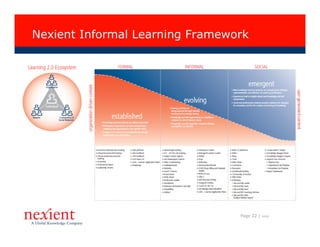
Nexient Informal Learning Framework

 • Insert EEE


                                 Page 22 |   I0608
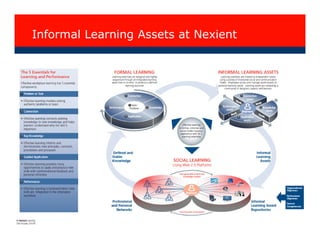
Informal Learning Assets at Nexient


                                      Page 23 |   I0608
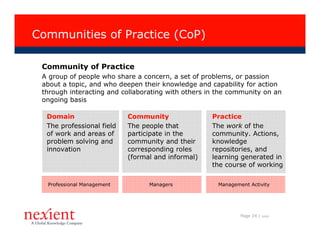
Communities of Practice (CoP)

 Community of Practice
 A group of people who share a concern, a set of problems, or passion
 about a topic, and who deepen their knowledge and capability for action
 through interacting and collaborating with others in the community on an
 ongoing basis

  Domain                    Community               Practice
  The professional field    The people that         The work of the
  of work and areas of      participate in the      community. Actions,
  problem solving and       community and their     knowledge
  innovation                corresponding roles     repositories, and
                            (formal and informal)   learning generated in
                                                    the course of working

  Professional Management         Managers           Management Activity


                                                             Page 24 |   I0608
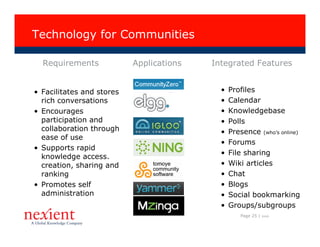
Technology for Communities

  Requirements             Applications   Integrated Features


• Facilitates and stores                    •   Profiles
  rich conversations                        •   Calendar
• Encourages                                •   Knowledgebase
  participation and                         •   Polls
  collaboration through                     •   Presence (who’s online)
  ease of use
                                            •   Forums
• Supports rapid
                                            •   File sharing
  knowledge access.
  creation, sharing and                     •   Wiki articles
  ranking                                   •   Chat
• Promotes self                             •   Blogs
  administration                            •   Social bookmarking
                                            •   Groups/subgroups
                                                   Page 25 |   I0608
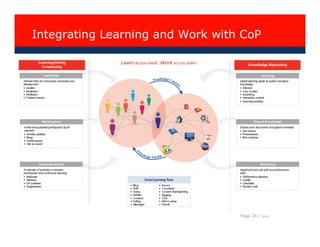
Integrating Learning and Work with CoP


                                  Page 26 |   I0608
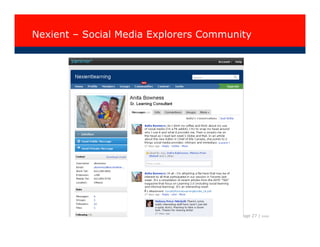
Nexient – Social Media Explorers Community


                                       Page 27 |   I0608
Agenda

 •   Common Ground: What are we talking about?
 •   Leadership development
 •   Learning 2.0
 •   Using 2.0 for Leadership Development
 •   Implementation and sustainment
 •   Summary
 •   Q and A


                                                 Page 28 |   I0608
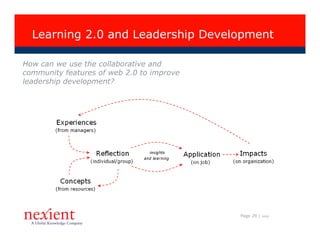
Learning 2.0 and Leadership Development

How can we use the collaborative and
community features of web 2.0 to improve
leadership development?


                                           Page 29 |   I0608
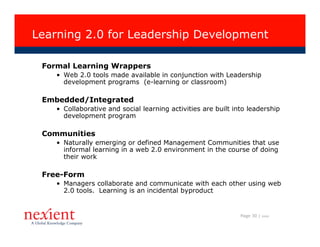
Learning 2.0 for Leadership Development

 Formal Learning Wrappers
    • Web 2.0 tools made available in conjunction with Leadership
      development programs (e-learning or classroom)

 Embedded/Integrated
    • Collaborative and social learning activities are built into leadership
      development program

 Communities
    • Naturally emerging or defined Management Communities that use
      informal learning in a web 2.0 environment in the course of doing
      their work

 Free-Form
    • Managers collaborate and communicate with each other using web
      2.0 tools. Learning is an incidental byproduct


                                                               Page 30 |   I0608
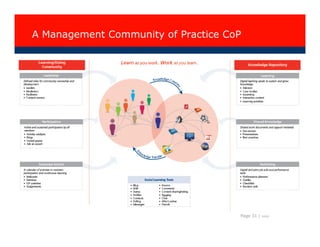
A Management Community of Practice CoP


                                     Page 31 |   I0608
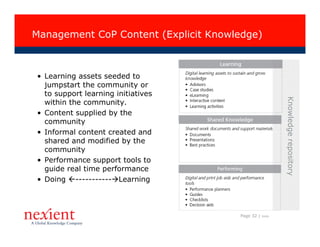
Management CoP Content (Explicit Knowledge)


• Learning assets seeded to
  jumpstart the community or
  to support learning initiatives


                                                          Knowledge repository
  within the community.
• Content supplied by the
  community
• Informal content created and
  shared and modified by the
  community
• Performance support tools to
  guide real time performance
• Doing ----------- Learning


                                      Page 32 |   I0608
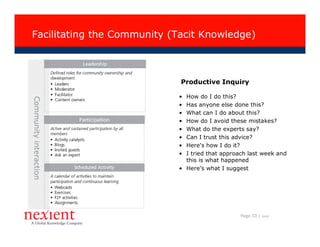
Facilitating the Community (Tacit Knowledge)


                             Productive Inquiry

                            • How do I do this?
Community interaction


                            • Has anyone else done this?
                            • What can I do about this?
                            • How do I avoid these mistakes?
                            • What do the experts say?
                            • Can I trust this advice?
                            • Here's how I do it?
                            • I tried that approach last week and
                              this is what happened
                            • Here’s what I suggest


                                                 Page 33 |   I0608
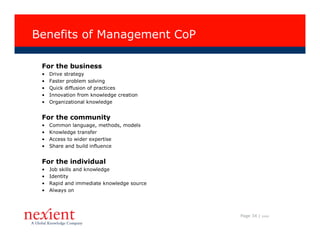
Benefits of Management CoP

 For the business
 •   Drive strategy
 •   Faster problem solving
 •   Quick diffusion of practices
 •   Innovation from knowledge creation
 •   Organizational knowledge


 For the community
 •   Common language, methods, models
 •   Knowledge transfer
 •   Access to wider expertise
 •   Share and build influence


 For the individual
 •   Job skills and knowledge
 •   Identity
 •   Rapid and immediate knowledge source
 •   Always on


                                            Page 34 |   I0608
Agenda

 •   Common Ground: What are we talking about?
 •   Leadership Development
 •   Learning 2.0
 •   Using 2.0 for Leadership Development
 •   Implementation and Sustainment
 •   Summary
 •   Q and A


                                                 Page 35 |   I0608
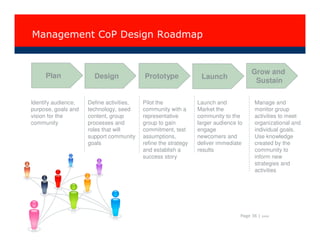
Management CoP Design Roadmap


                                                                                      Grow and
     Plan              Design             Prototype              Launch
                                                                                       Sustain

Identify audience,   Define activities,   Pilot the             Launch and             Manage and
purpose, goals and   technology, seed     community with a      Market the             monitor group
vision for the       content, group       representative        community to the       activities to meet
community            processes and        group to gain         larger audience to     organizational and
                     roles that will      commitment, test      engage                 individual goals.
                     support community    assumptions,          newcomers and          Use knowledge
                     goals                refine the strategy   deliver immediate      created by the
                                          and establish a       results                community to
                                          success story                                inform new
                                                                                       strategies and
                                                                                       activities


                                                                                 Page 36 |   I0608
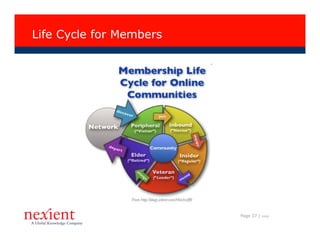
Life Cycle for Members


                         Page 37 |   I0608
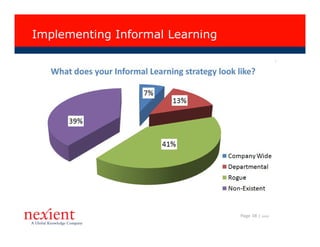
Implementing Informal Learning


                                 Page 38 |   I0608
Summary

 • Current leadership and management development will continue to
   have limited impact

 • Natural experience, productive inquiry, and reflection on action are the
   key to improving leadership development

 • Web 2.0 technologies provide a powerful opportunity to build
   experience into learning in an always available environment, but they
   are too fragmented

 • Community technologies integrate the best of web 2.0 into one
   environment and avoid the “tool many tools” problem

 • Planning, design, facilitation and sustainment of Management
   Communities of Practice will be a new competency of management
   development professionals


                                                              Page 39 |   I0608
Questions/Discussion


                   Performance X Design
                   performanceXdesign.wordpress.com


                   Training Wreck
                   danpontefract.com


                                          Page 40 |   I0608

Leadership Development in a Learning 2.0 World

  • 1.
    Leadership Development ina Learning 2.0 World Learn as you work. Work as you learn. Tom Gram Senior Director Leadership and Business Solutions Nexient Learning
  • 2.
    Agenda • What are we talking about? • Leadership Development • Learning 2.0 • Using 2.0 for Leadership Development • Implementation and Sustainment • Summary • Q and A Page 1 | I0608
  • 3.
    What are wetalking about? Leadership Development Processes, programs and activities provided by organizations to help the management team develop capability and improve skills Learning 2.0 Informal learning facilitated through the use of Web 2.0 technologies and user generated content Page 2 | I0608
  • 4.
    Leadership Development Today Do Nothing • Self development • Observe and adapt • Sink or swim • Emergent practices • Consultants • Personal growth Formal Training • Vendors • Feedback driven • Business schools • Conceptual understanding • Internal • Skill building Mentoring • Job assignment • Performance appraisal • Personal coaching • Mentor programs and Coaching • Assessment • OJT • Learning by doing Action Learning • Reflection • Facilitated Page 3 | I0608
  • 5.
    Competencies by Level Senior Conceptual/ Strategic Middle Human First Level Technical/ Functional Page 4 | I0608
  • 6.
    A Common Process Plan • Business needs • Competency development • Succession planning • Roadmaps • Organizational needs assessment Assess • Individualized gap analysis • Internal program design • Hybrid programs Buy/Build • Purchase vendor programs • Curriculum • Scheduling • Enrollment Implement • LMS • Registration • Satisfaction • Performance Evaluate • Learning • Results Page 5 | I0608
  • 7.
    Key Issues inLeadership Development • Relies on delivery of explicit knowledge vs. leveraging tacit knowledge emerging from experience • Separated from the context of actual work. Based on artificial experience vs. natural experience • Event based vs. continuous process • Mismatch to the dynamic and rapid pace of the work of the manager • Ignores power of new technologies to overcome these issues • Ignores that managers are really a network of individuals, not an organizational hierarchy Page 6 | I0608
  • 8.
    Improving Leadership Development • Incorporate the natural experience of the manager as essential component of the learning (social learning) • Provide access to insightful models, theories, principles and concepts to help make sense of experience • Continuous opportunities to reflect on experience in light on new conceptual understanding • Continuous opportunities to share and challenge competencies to expose alternate ways of behaving • Improved learning from organizational impact of new behaviours • Combine the above into a continuous process rather than series of events or structured curriculum Adapted from Mintzberg, Managers not MBA’s Page 7 | I0608
  • 9.
    A Leadership DevelopmentProcess Experiences (from managers) Reflection insights Application Impacts and learning (individual/group) (on job) (on organization) Concepts (from resources) Adapted from Mintzberg, Managers not MBA’s Page 8 | I0608
  • 10.
    Your Reflection •Share Leadership Development practices in your organization • What are the implications for transforming leadership development? Page 9 | I0608
  • 11.
    Agenda • Common Ground: What are we talking about? • Leadership Development • Learning 2.0 • Using 2.0 for Leadership Development • Implementation and sustainment • Summary • Q and A Page 10 | I0608
  • 12.
    How did youlearn to do your job? A. Company provided training B. On the job experience C. Interaction with co-workers D.Formal education Page 11 | I0608
  • 13.
    How did youlearn to do your job? "The best learning happens in real life, with real problems and real people, and not in the classrooms." Page 12 | I0608
  • 14.
    Informal Learning @Work Page 13 | I0608
  • 15.
    Informal Learning andManagement Skill Proficiency Page 14 | I0608
  • 16.
    Page 15 | I0608
  • 17.
    Core Tenets ofInformal Learning • Learning is social • Knowledge is constructed • Learning is contextual • No learning without action, No action with out learning • Learning is working, working is learning • More pull, less push Page 16 | I0608
  • 18.
    Technology and Informallearning CSCW Web 2.0 • Threaded Discussion • Social Networking • Chat • Blogs • Shared whiteboards • Micro-blogging • Video conferencing • Wiki’s • Collaborative workspaces • Video-sharing • Knowledge management • Social rating • Learning management systems • Social bookmarking • Web meetings • RSS Page 17 | I0608
  • 19.
    Web 2.0: CollectiveIntelligence Page 18 | I0608
  • 20.
    Learning 2.0 Learning 2.0 Using the collaboration, communication and user generated content features of Web 2.0 technologies to facilitate learning from work experience Page 19 | I0608
  • 21.
    How is Learning2.0 is being used Formal Learning Wrapper • The Amazon model. Web 2.0 tools made available in conjunction with formal learning programs (e-learning or classroom) Embedded/Integrated • Collaborative and social learning activities are an integral part of a formal learning program Communities • Natural or defined communities that use informal learning in the course of doing their work Free-Form • Used by individuals based on personal preferences and on an ad- hoc basis Page 20 | I0608
  • 22.
    Project Next Page 21 | I0608
  • 23.
    Nexient Informal LearningFramework • Insert EEE Page 22 | I0608
  • 24.
    Informal Learning Assetsat Nexient Page 23 | I0608
  • 25.
    Communities of Practice(CoP) Community of Practice A group of people who share a concern, a set of problems, or passion about a topic, and who deepen their knowledge and capability for action through interacting and collaborating with others in the community on an ongoing basis Domain Community Practice The professional field The people that The work of the of work and areas of participate in the community. Actions, problem solving and community and their knowledge innovation corresponding roles repositories, and (formal and informal) learning generated in the course of working Professional Management Managers Management Activity Page 24 | I0608
  • 26.
    Technology for Communities Requirements Applications Integrated Features • Facilitates and stores • Profiles rich conversations • Calendar • Encourages • Knowledgebase participation and • Polls collaboration through • Presence (who’s online) ease of use • Forums • Supports rapid • File sharing knowledge access. creation, sharing and • Wiki articles ranking • Chat • Promotes self • Blogs administration • Social bookmarking • Groups/subgroups Page 25 | I0608
  • 27.
    Integrating Learning andWork with CoP Page 26 | I0608
  • 28.
    Nexient – SocialMedia Explorers Community Page 27 | I0608
  • 29.
    Agenda • Common Ground: What are we talking about? • Leadership development • Learning 2.0 • Using 2.0 for Leadership Development • Implementation and sustainment • Summary • Q and A Page 28 | I0608
  • 30.
    Learning 2.0 andLeadership Development How can we use the collaborative and community features of web 2.0 to improve leadership development? Page 29 | I0608
  • 31.
    Learning 2.0 forLeadership Development Formal Learning Wrappers • Web 2.0 tools made available in conjunction with Leadership development programs (e-learning or classroom) Embedded/Integrated • Collaborative and social learning activities are built into leadership development program Communities • Naturally emerging or defined Management Communities that use informal learning in a web 2.0 environment in the course of doing their work Free-Form • Managers collaborate and communicate with each other using web 2.0 tools. Learning is an incidental byproduct Page 30 | I0608
  • 32.
    A Management Communityof Practice CoP Page 31 | I0608
  • 33.
    Management CoP Content(Explicit Knowledge) • Learning assets seeded to jumpstart the community or to support learning initiatives Knowledge repository within the community. • Content supplied by the community • Informal content created and shared and modified by the community • Performance support tools to guide real time performance • Doing ----------- Learning Page 32 | I0608
  • 34.
    Facilitating the Community(Tacit Knowledge) Productive Inquiry • How do I do this? Community interaction • Has anyone else done this? • What can I do about this? • How do I avoid these mistakes? • What do the experts say? • Can I trust this advice? • Here's how I do it? • I tried that approach last week and this is what happened • Here’s what I suggest Page 33 | I0608
  • 35.
    Benefits of ManagementCoP For the business • Drive strategy • Faster problem solving • Quick diffusion of practices • Innovation from knowledge creation • Organizational knowledge For the community • Common language, methods, models • Knowledge transfer • Access to wider expertise • Share and build influence For the individual • Job skills and knowledge • Identity • Rapid and immediate knowledge source • Always on Page 34 | I0608
  • 36.
    Agenda • Common Ground: What are we talking about? • Leadership Development • Learning 2.0 • Using 2.0 for Leadership Development • Implementation and Sustainment • Summary • Q and A Page 35 | I0608
  • 37.
    Management CoP DesignRoadmap Grow and Plan Design Prototype Launch Sustain Identify audience, Define activities, Pilot the Launch and Manage and purpose, goals and technology, seed community with a Market the monitor group vision for the content, group representative community to the activities to meet community processes and group to gain larger audience to organizational and roles that will commitment, test engage individual goals. support community assumptions, newcomers and Use knowledge goals refine the strategy deliver immediate created by the and establish a results community to success story inform new strategies and activities Page 36 | I0608
  • 38.
    Life Cycle forMembers Page 37 | I0608
  • 39.
  • 40.
    Summary • Currentleadership and management development will continue to have limited impact • Natural experience, productive inquiry, and reflection on action are the key to improving leadership development • Web 2.0 technologies provide a powerful opportunity to build experience into learning in an always available environment, but they are too fragmented • Community technologies integrate the best of web 2.0 into one environment and avoid the “tool many tools” problem • Planning, design, facilitation and sustainment of Management Communities of Practice will be a new competency of management development professionals Page 39 | I0608
  • 41.
    Questions/Discussion Performance X Design performanceXdesign.wordpress.com Training Wreck danpontefract.com Page 40 | I0608