11-1
Chapter 11
Consumer Behavior,
Eighth Edition
SCHIFFMAN & KANUK
Social Class and Consumer
Behavior
11-2
Social Class
The division of
members of a society
into a hierarchy of
distinct status classes,
so that members of
each class have either
higher or lower status
than members of other
classes.
11-3
Social Class and Social Status
• Status is frequently thought of as the
relative rankings of members of each social
class
– wealth
– power
– prestige
Social Comparison Theory
states that individuals
compare their
own possessions against those
of others to determine their
relative social standing.
11-4
Status Consumption
The process by which consumers actively
increase their social standing through
conspicuous consumption or possessions
11-5
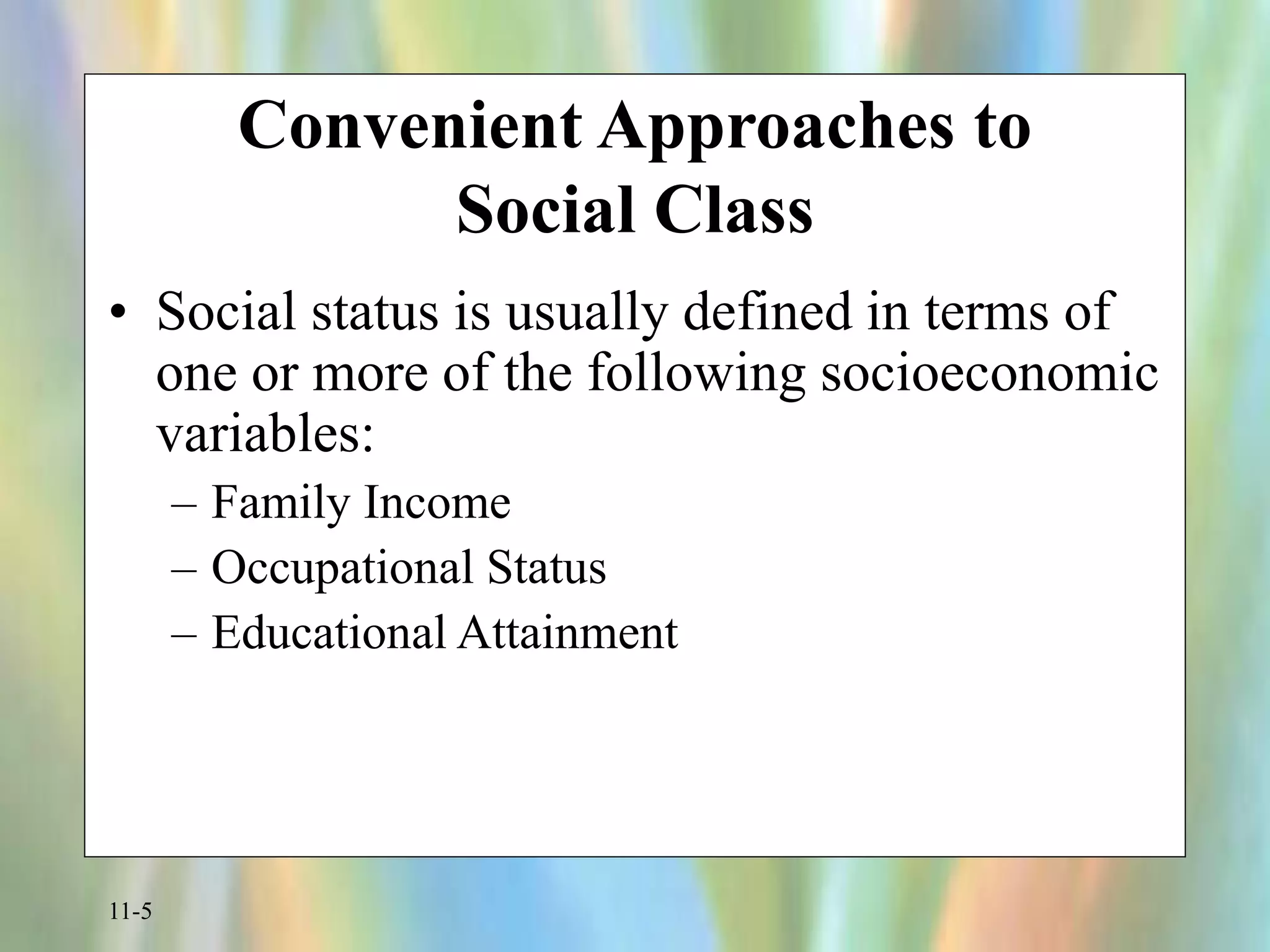
Convenient Approaches to
Social Class
• Social status is usually defined in terms of
one or more of the following socioeconomic
variables:
– Family Income
– Occupational Status
– Educational Attainment
11-6
Figure 11.1
Targeting
Upscale
Customers
11-7
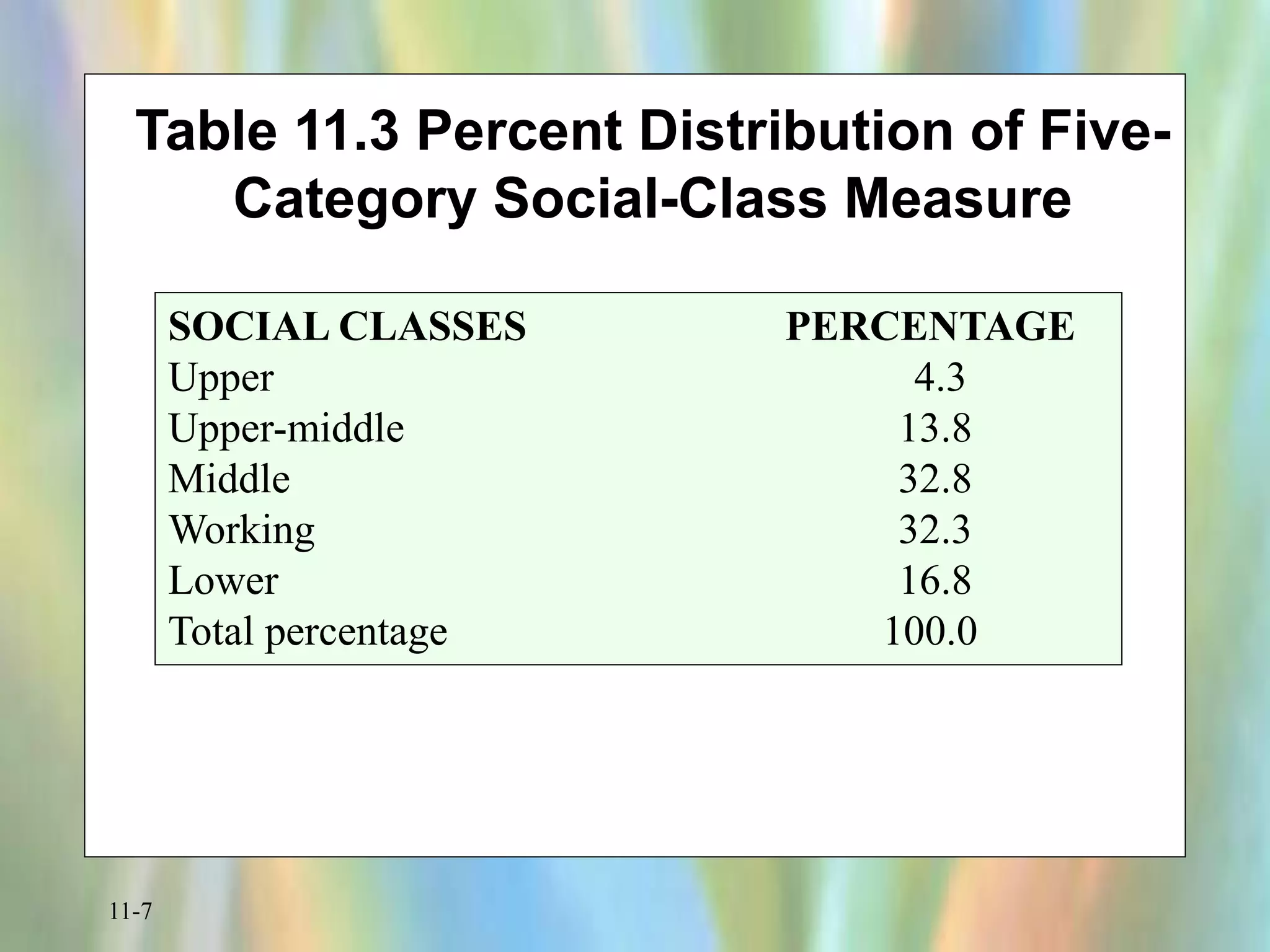
Table 11.3 Percent Distribution of Five-
Category Social-Class Measure
SOCIAL CLASSES PERCENTAGE
Upper 4.3
Upper-middle 13.8
Middle 32.8
Working 32.3
Lower 16.8
Total percentage 100.0
11-8
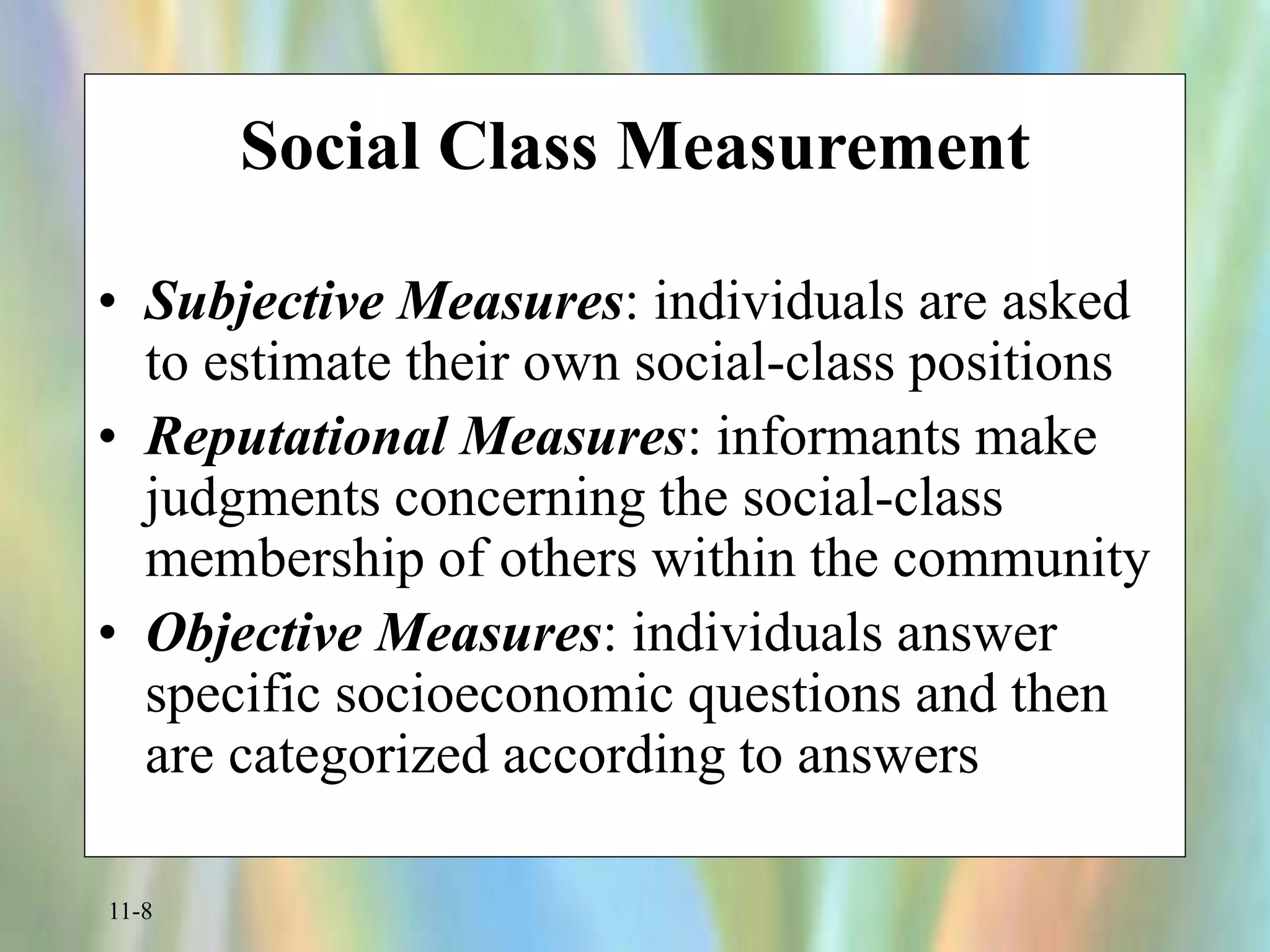
Social Class Measurement
• Subjective Measures: individuals are asked
to estimate their own social-class positions
• Reputational Measures: informants make
judgments concerning the social-class
membership of others within the community
• Objective Measures: individuals answer
specific socioeconomic questions and then
are categorized according to answers
11-9
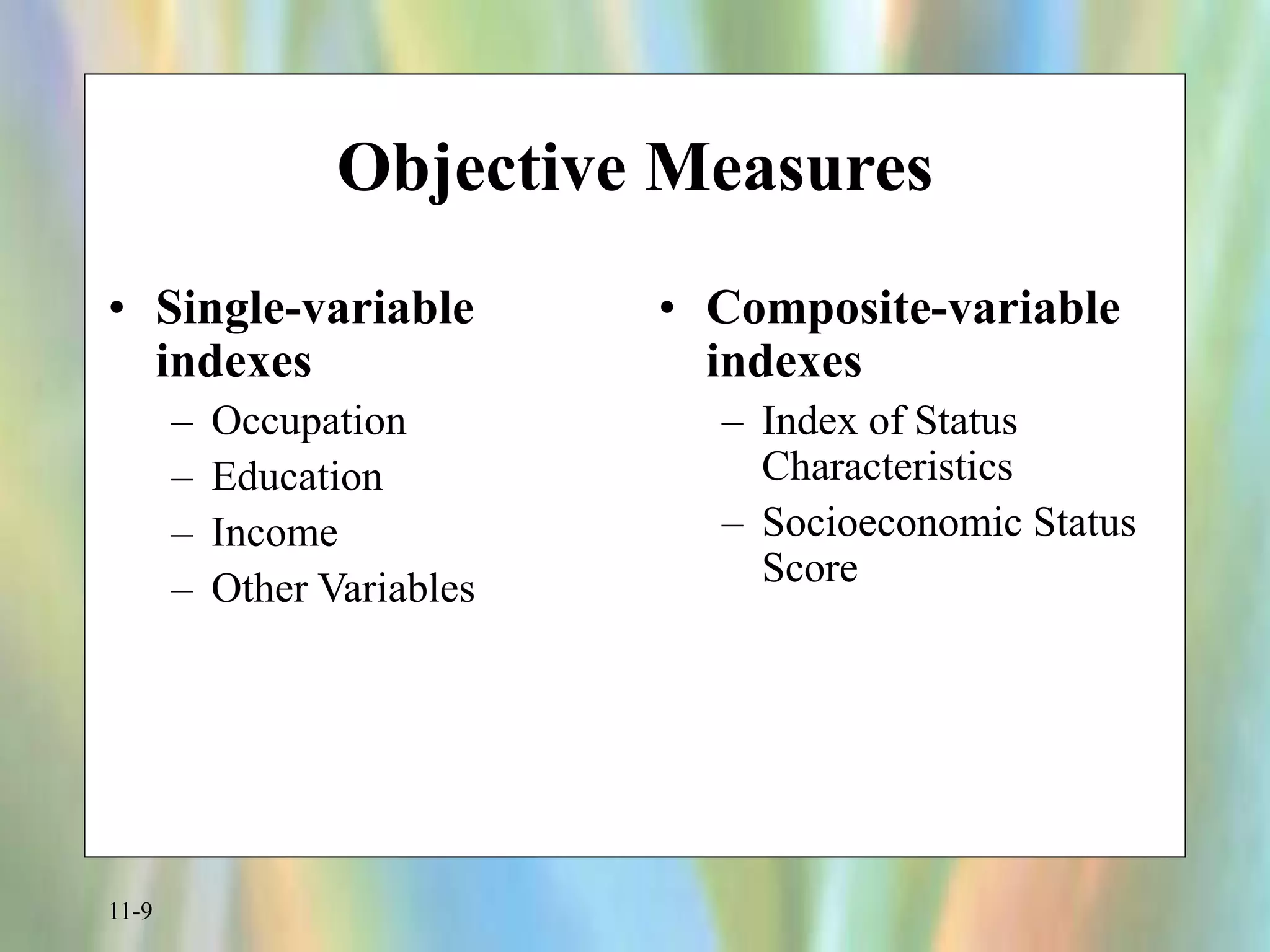
Objective Measures
• Single-variable
indexes
– Occupation
– Education
– Income
– Other Variables
• Composite-variable
indexes
– Index of Status
Characteristics
– Socioeconomic Status
Score
11-10
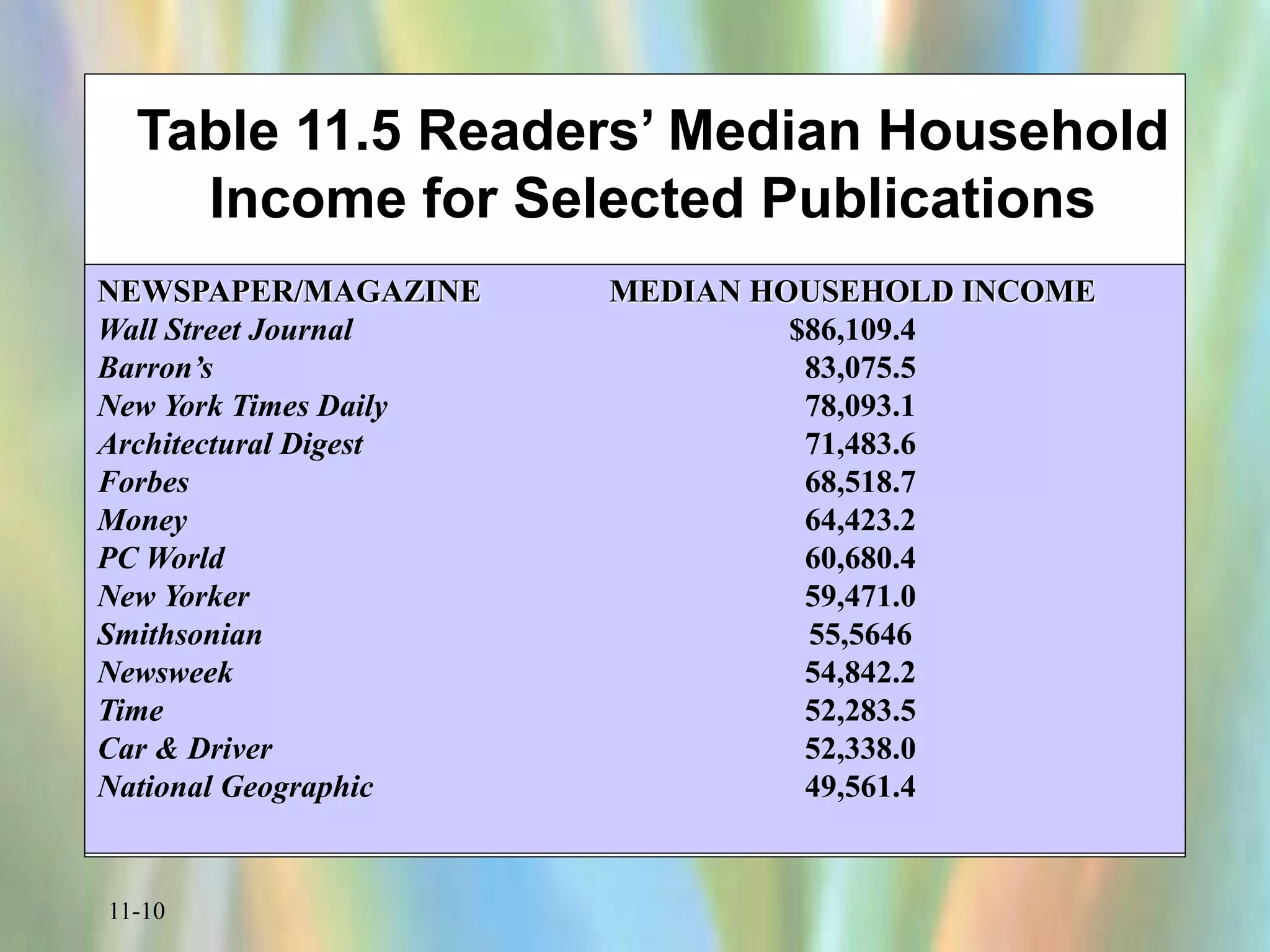
Table 11.5 Readers’ Median Household
Income for Selected Publications
NEWSPAPER/MAGAZINE MEDIAN HOUSEHOLD INCOME
Wall Street Journal $86,109.4
Barron’s 83,075.5
New York Times Daily 78,093.1
Architectural Digest 71,483.6
Forbes 68,518.7
Money 64,423.2
PC World 60,680.4
New Yorker 59,471.0
Smithsonian 55,5646
Newsweek 54,842.2
Time 52,283.5
Car & Driver 52,338.0
National Geographic 49,561.4
11-11
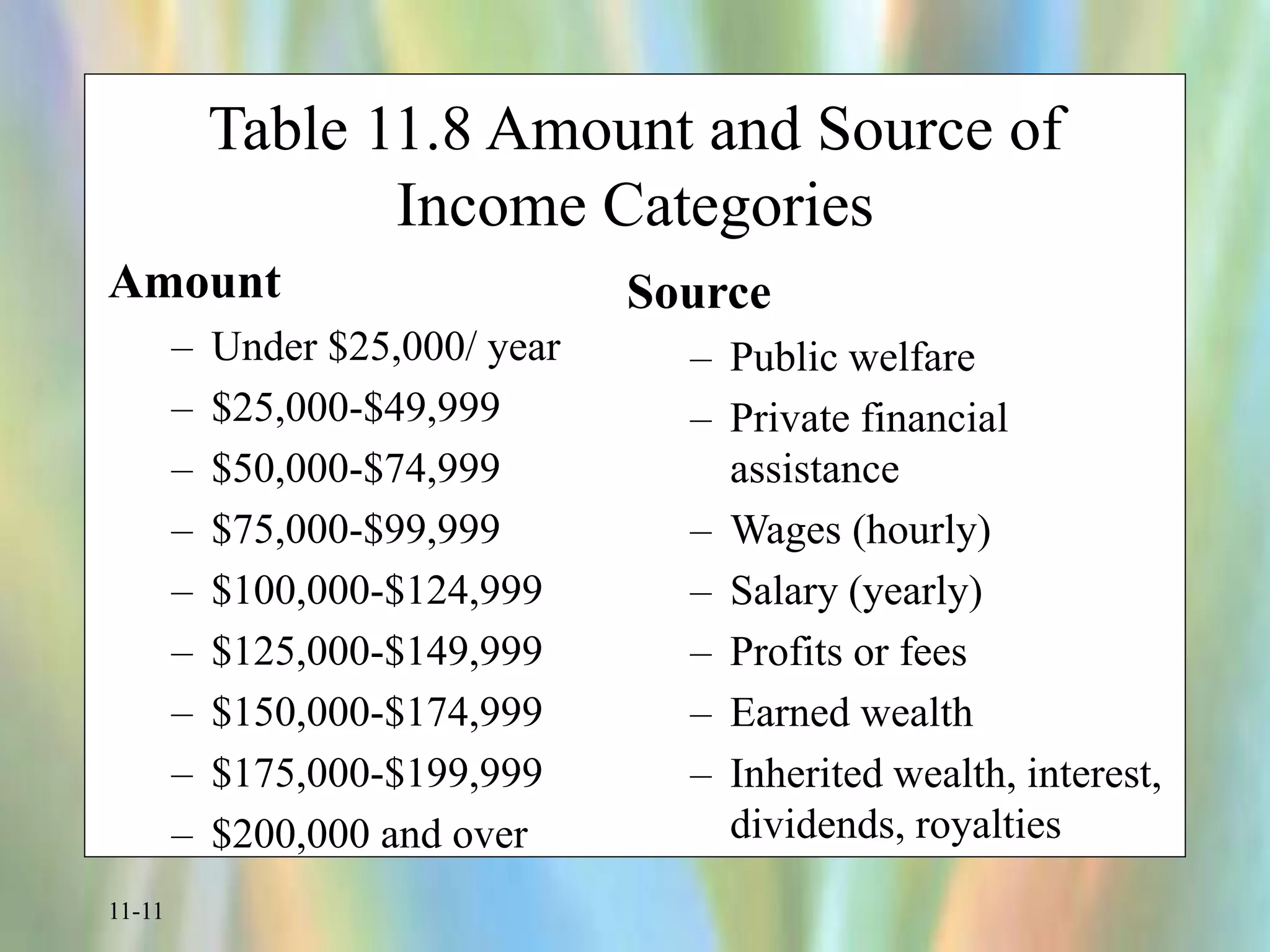
Table 11.8 Amount and Source of
Income Categories
Amount
– Under $25,000/ year
– $25,000-$49,999
– $50,000-$74,999
– $75,000-$99,999
– $100,000-$124,999
– $125,000-$149,999
– $150,000-$174,999
– $175,000-$199,999
– $200,000 and over
Source
– Public welfare
– Private financial
assistance
– Wages (hourly)
– Salary (yearly)
– Profits or fees
– Earned wealth
– Inherited wealth, interest,
dividends, royalties
11-12
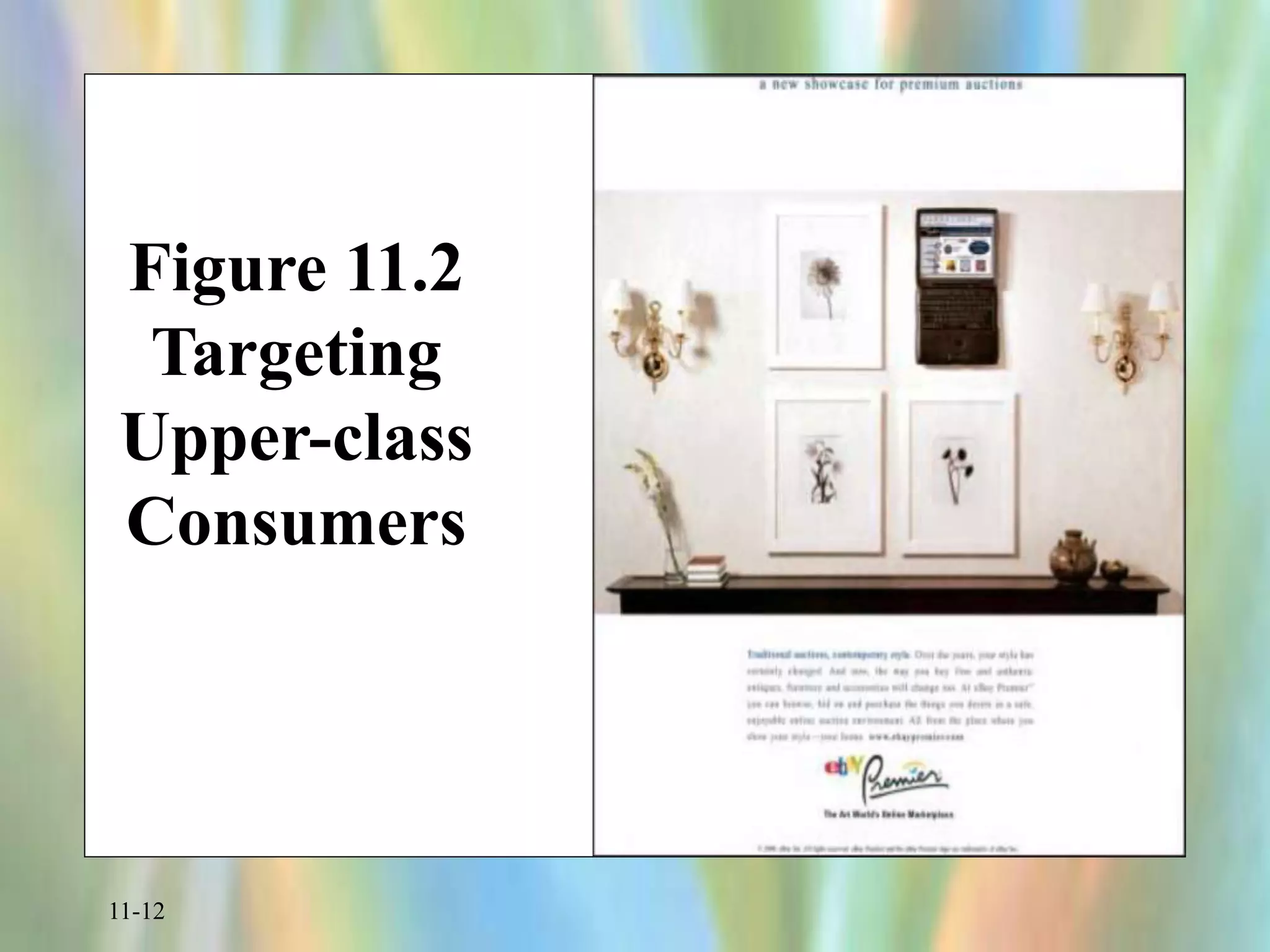
Figure 11.2
Targeting
Upper-class
Consumers
11-13
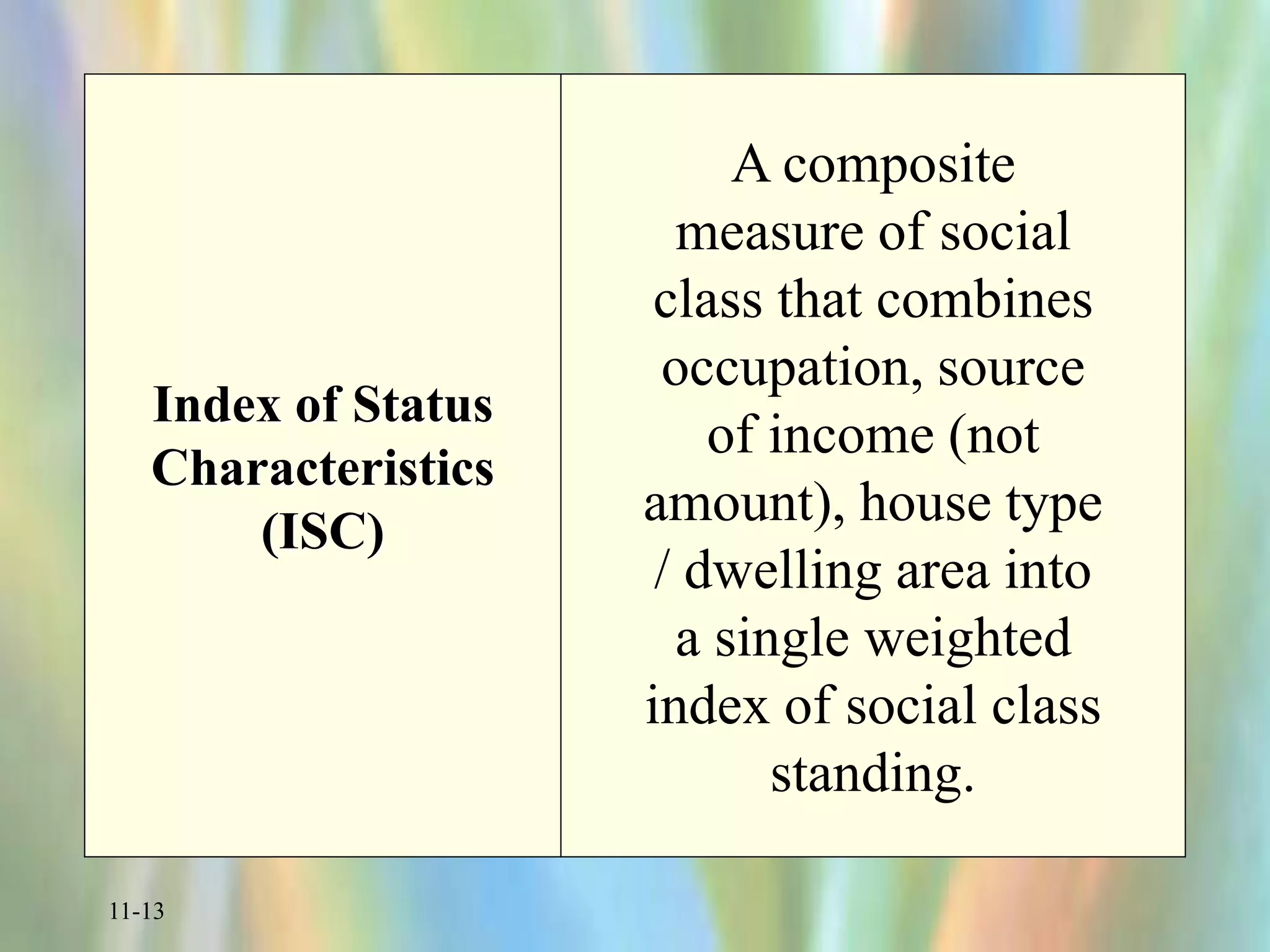
Index of Status
Characteristics
(ISC)
A composite
measure of social
class that combines
occupation, source
of income (not
amount), house type
/ dwelling area into
a single weighted
index of social class
standing.
11-14
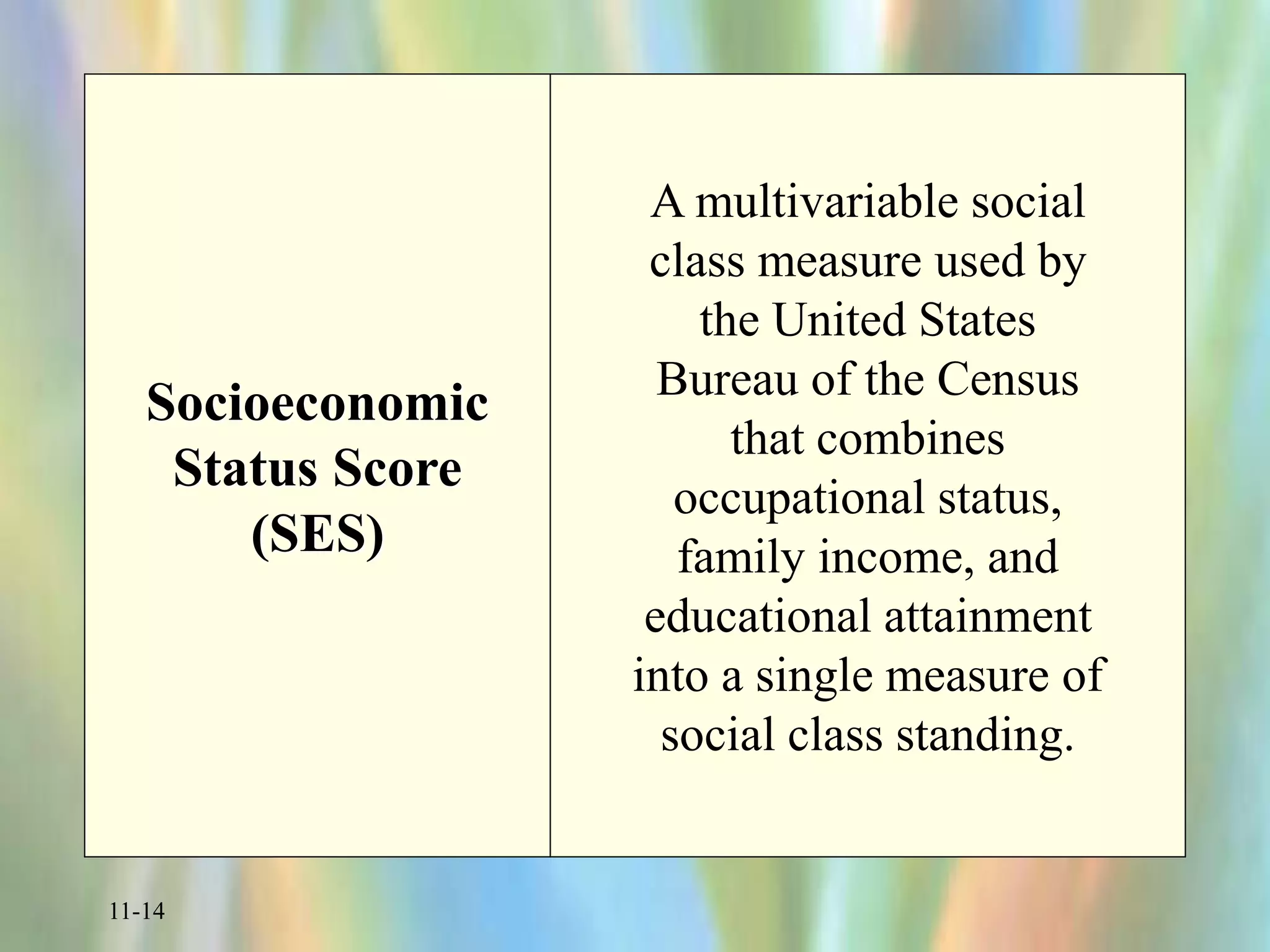
Socioeconomic
Status Score
(SES)
A multivariable social
class measure used by
the United States
Bureau of the Census
that combines
occupational status,
family income, and
educational attainment
into a single measure of
social class standing.
11-15
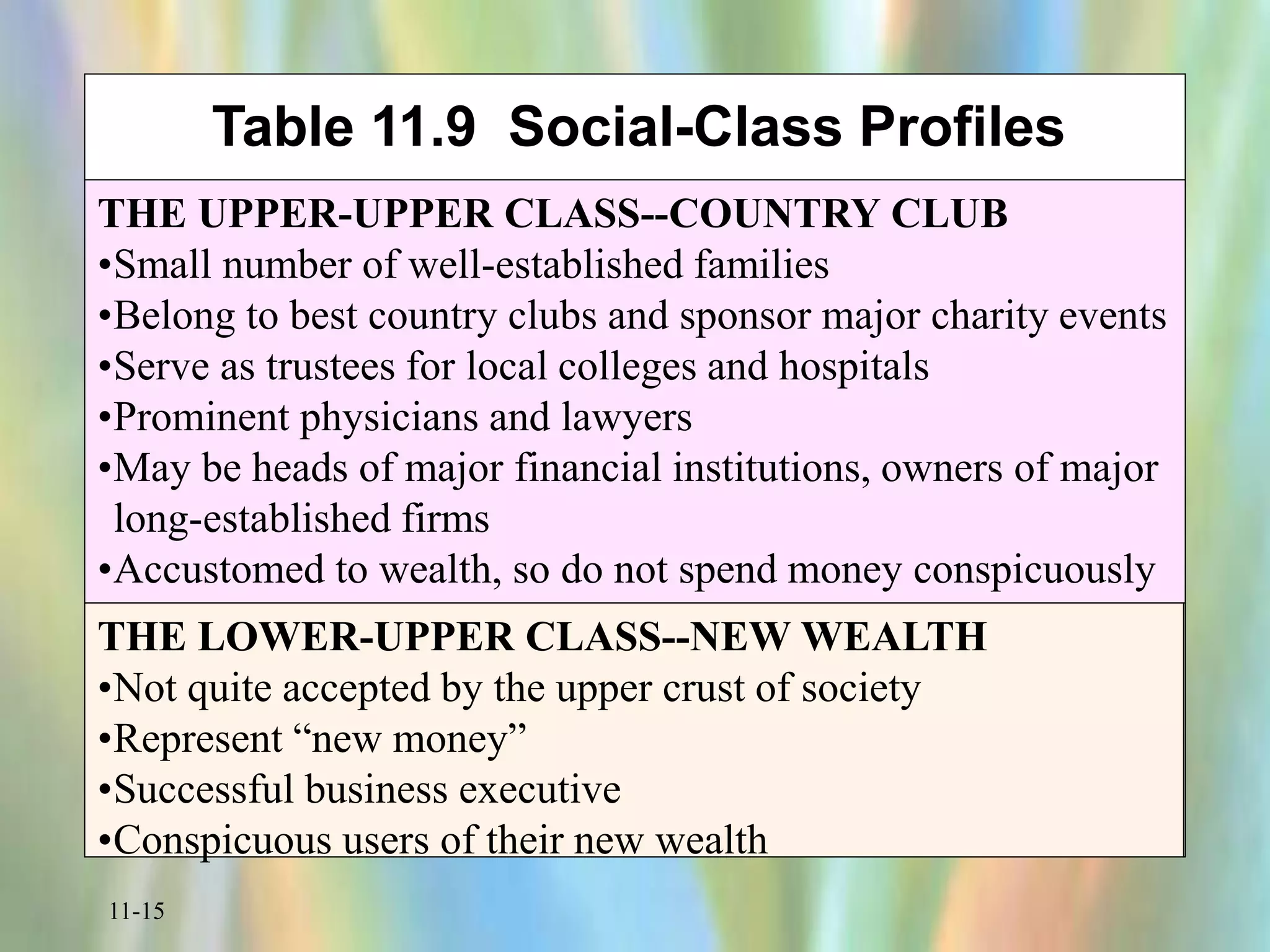
Table 11.9 Social-Class Profiles
THE UPPER-UPPER CLASS--COUNTRY CLUB
•Small number of well-established families
•Belong to best country clubs and sponsor major charity events
•Serve as trustees for local colleges and hospitals
•Prominent physicians and lawyers
•May be heads of major financial institutions, owners of major
long-established firms
•Accustomed to wealth, so do not spend money conspicuously
THE LOWER-UPPER CLASS--NEW WEALTH
•Not quite accepted by the upper crust of society
•Represent “new money”
•Successful business executive
•Conspicuous users of their new wealth
11-16
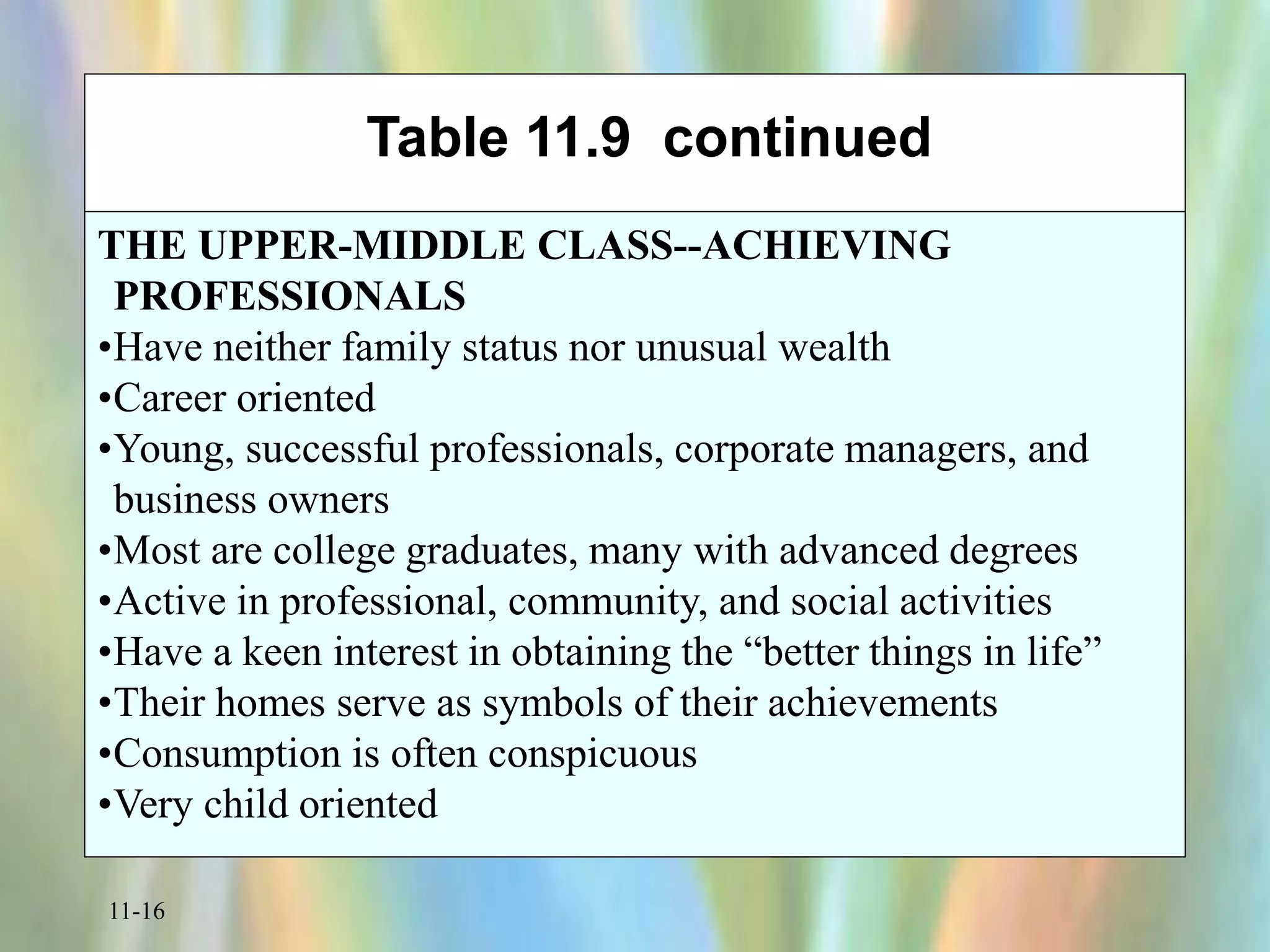
Table 11.9 continued
THE UPPER-MIDDLE CLASS--ACHIEVING
PROFESSIONALS
•Have neither family status nor unusual wealth
•Career oriented
•Young, successful professionals, corporate managers, and
business owners
•Most are college graduates, many with advanced degrees
•Active in professional, community, and social activities
•Have a keen interest in obtaining the “better things in life”
•Their homes serve as symbols of their achievements
•Consumption is often conspicuous
•Very child oriented
11-17
Table 11.9 continued
THE LOWER-MIDDLE CLASS--FAITHFUL
FOLLOWERS
•Primary non-managerial white-collar workers and highly paid
blue-collar workers
•Want to achieve “respectability” and be accepted as good
citizens
•Want their children to be well behaved
•Tend to be churchgoers and are often involved in church-
sponsored activities
•Prefer a neat and clean appearance and tend to avoid faddish
or highly-styled clothing
•Constitute a major market for do-it-yourself products
11-18
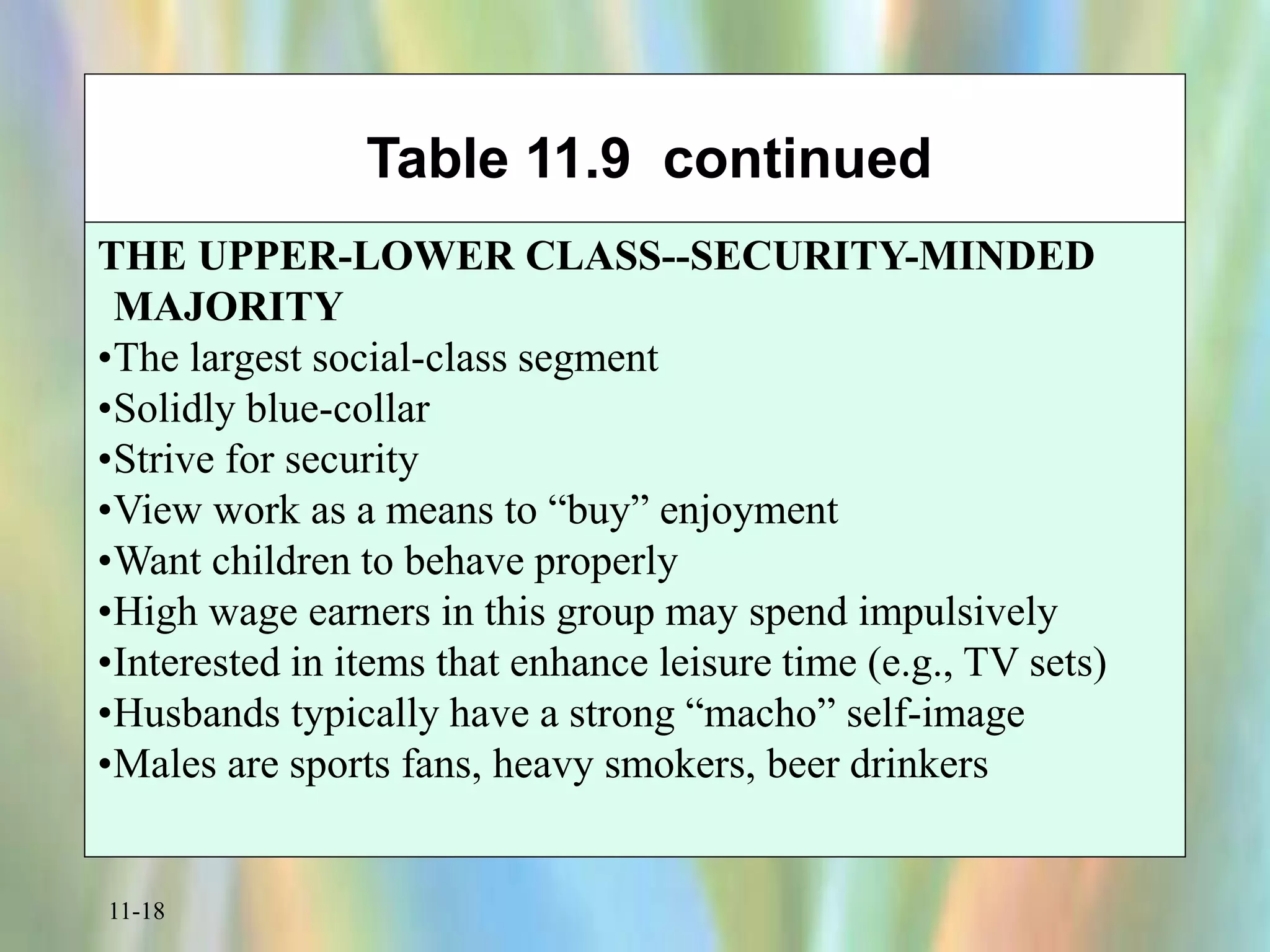
Table 11.9 continued
THE UPPER-LOWER CLASS--SECURITY-MINDED
MAJORITY
•The largest social-class segment
•Solidly blue-collar
•Strive for security
•View work as a means to “buy” enjoyment
•Want children to behave properly
•High wage earners in this group may spend impulsively
•Interested in items that enhance leisure time (e.g., TV sets)
•Husbands typically have a strong “macho” self-image
•Males are sports fans, heavy smokers, beer drinkers
11-19
Table 11.9 continued
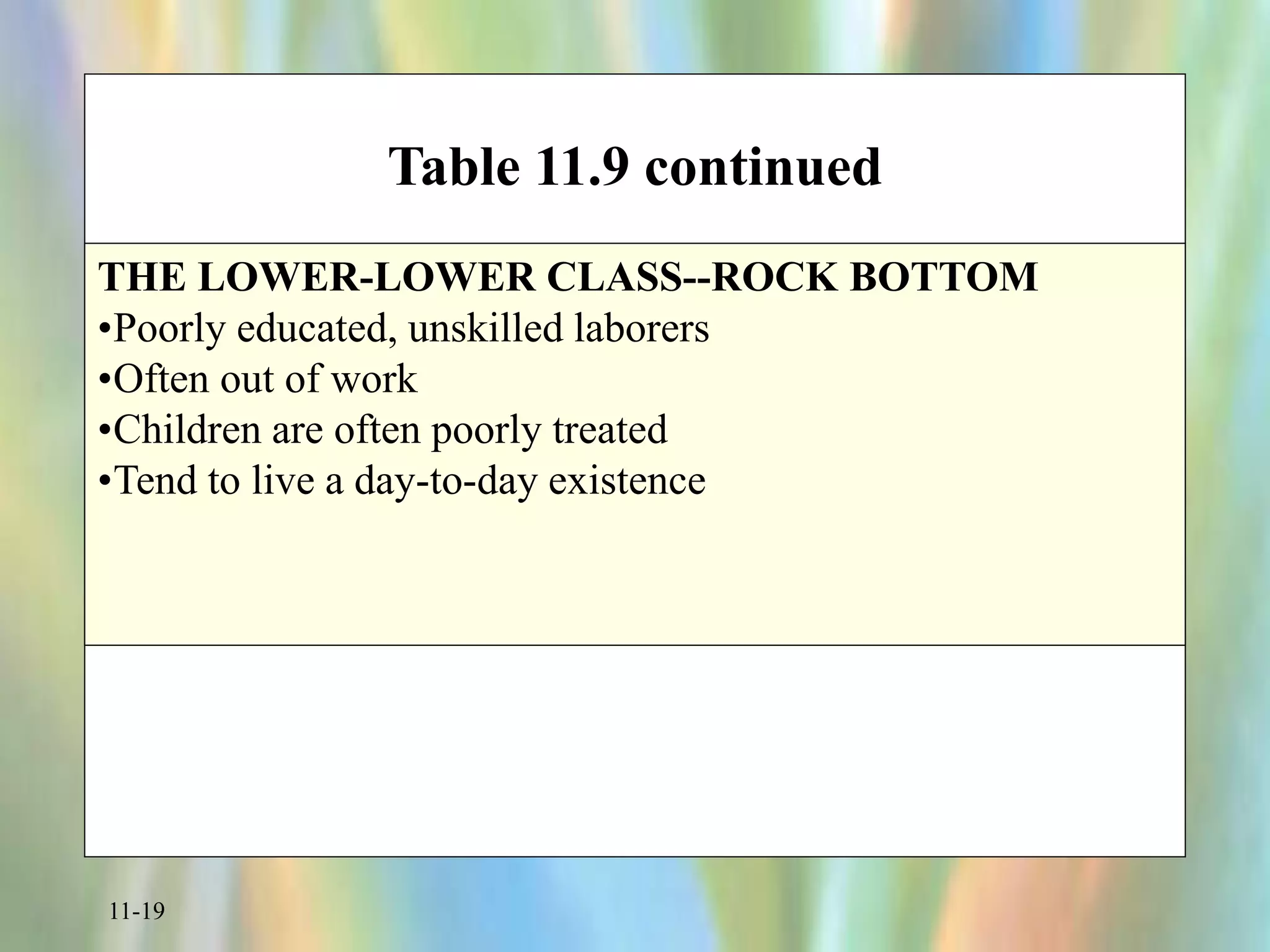
THE LOWER-LOWER CLASS--ROCK BOTTOM
•Poorly educated, unskilled laborers
•Often out of work
•Children are often poorly treated
•Tend to live a day-to-day existence
11-20
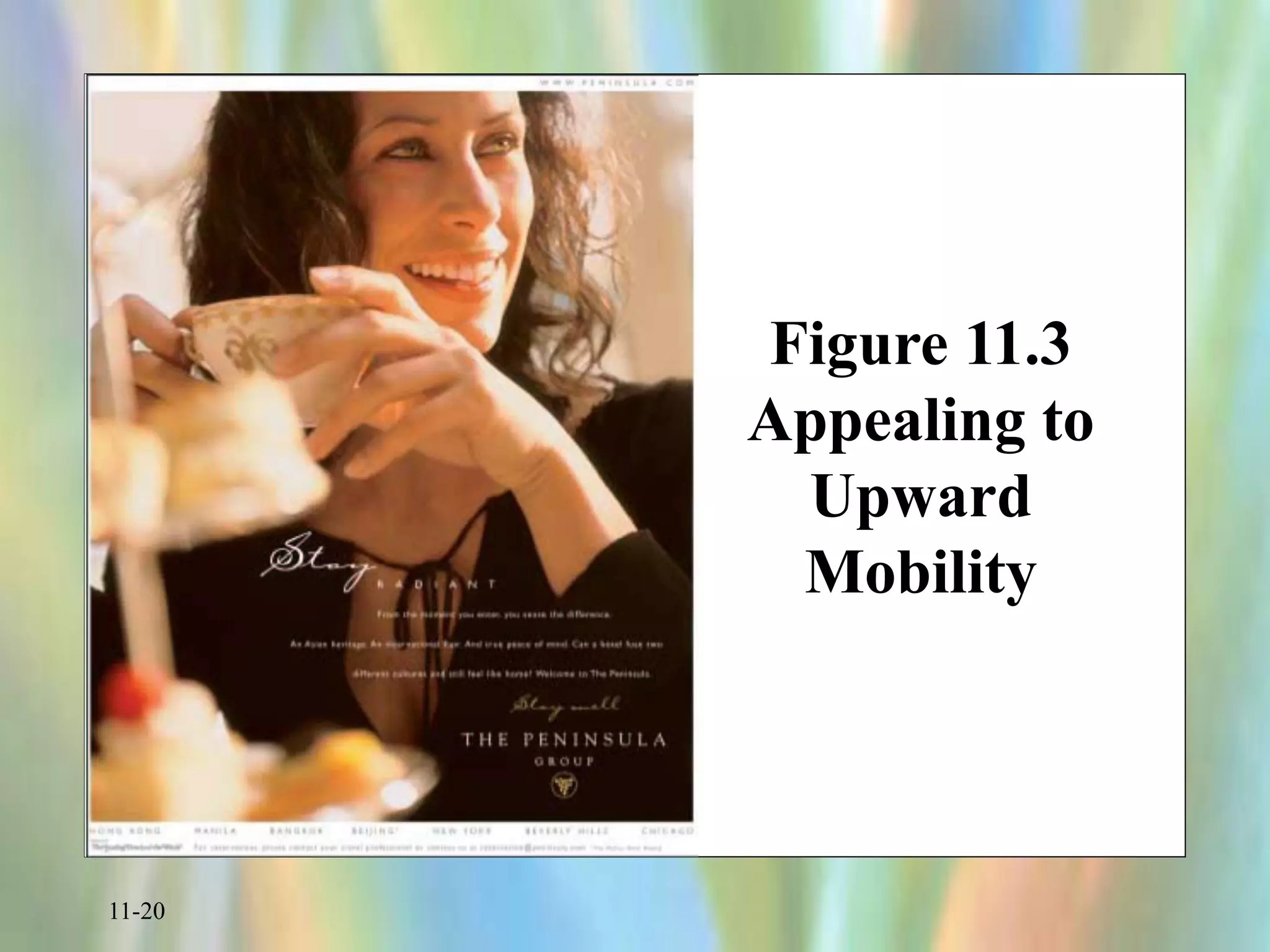
Figure 11.3
Appealing to
Upward
Mobility
11-21
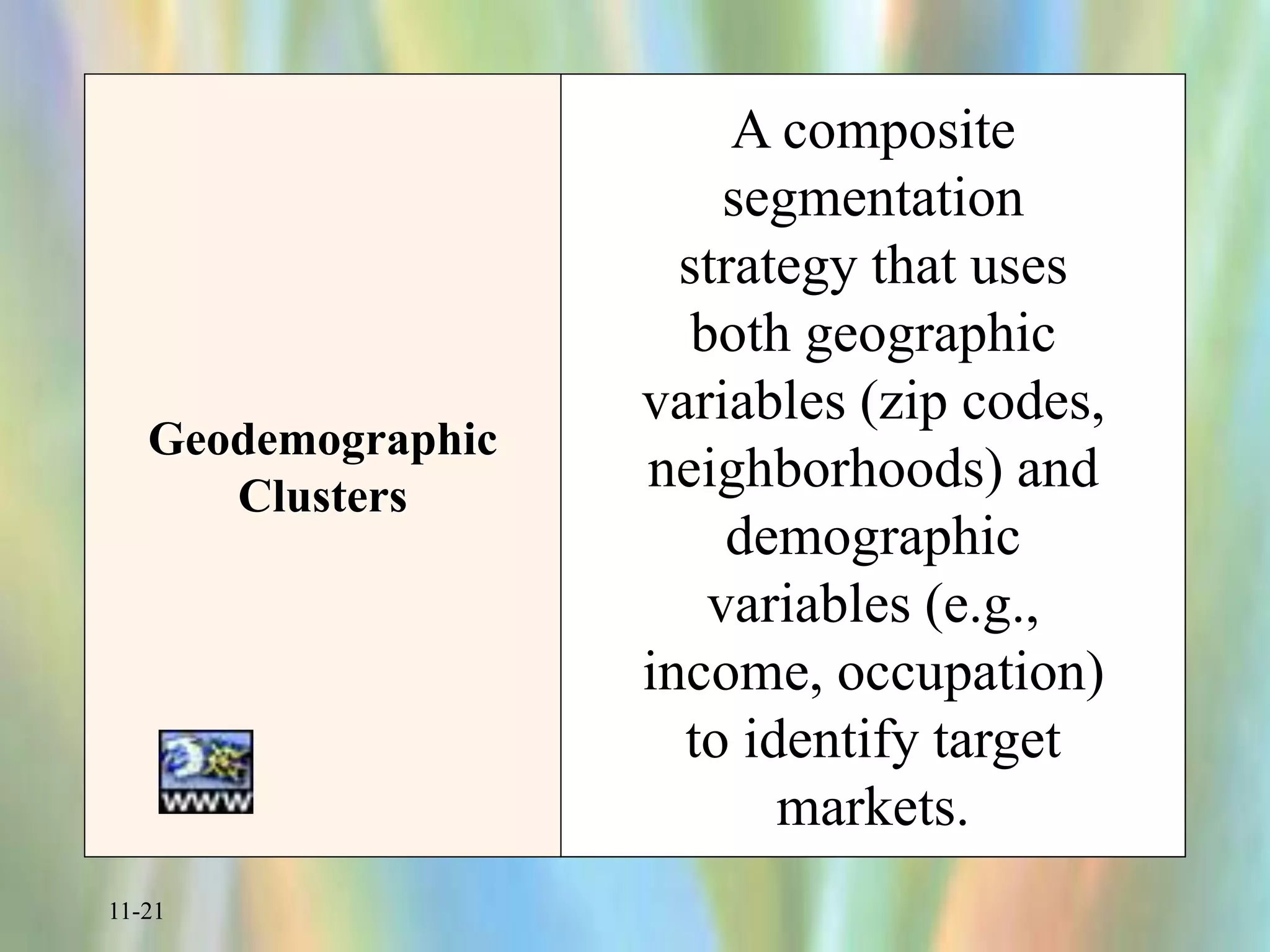
Geodemographic
Clusters
A composite
segmentation
strategy that uses
both geographic
variables (zip codes,
neighborhoods) and
demographic
variables (e.g.,
income, occupation)
to identify target
markets.
11-22
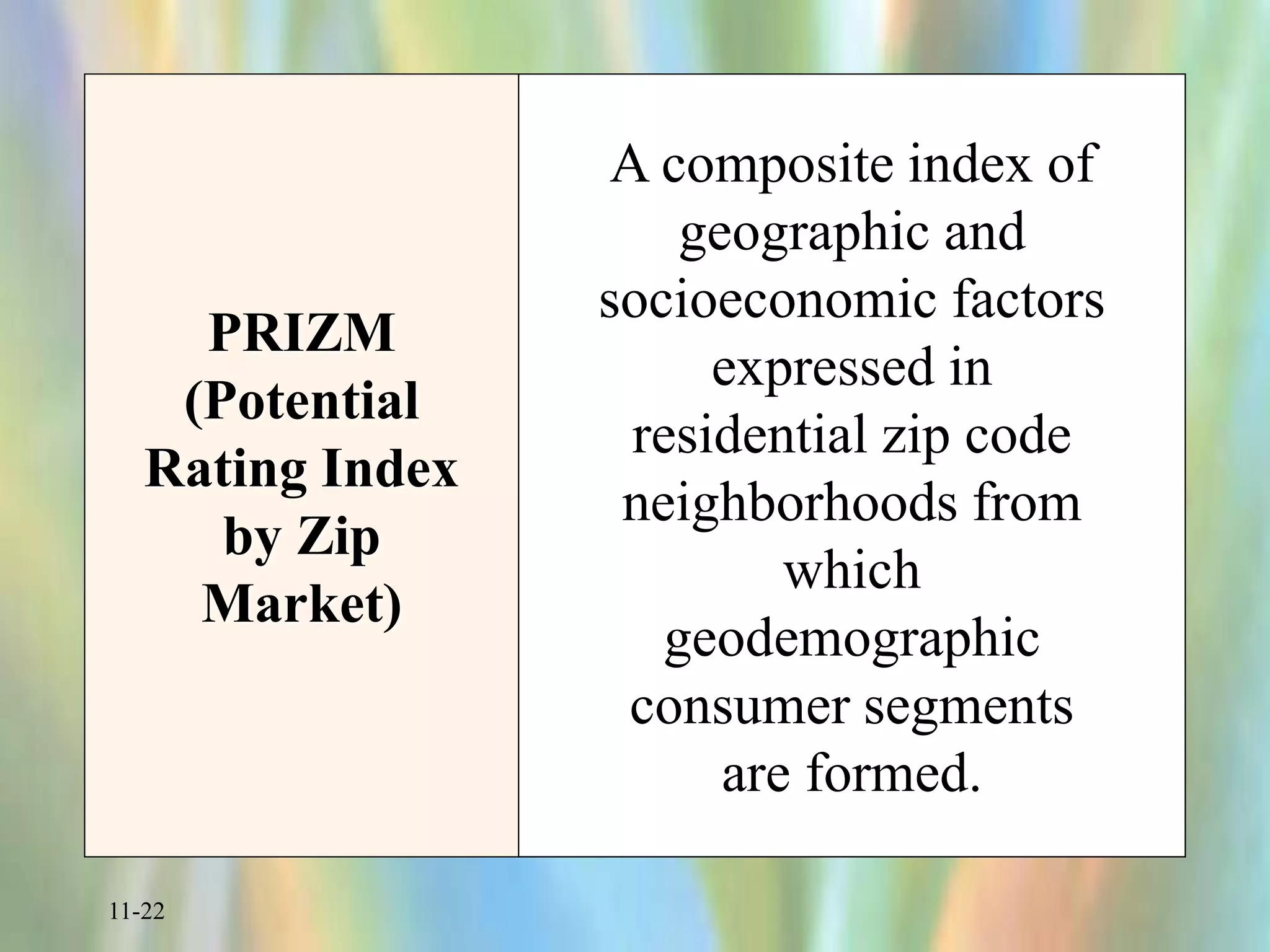
PRIZM
(Potential
Rating Index
by Zip
Market)
A composite index of
geographic and
socioeconomic factors
expressed in
residential zip code
neighborhoods from
which
geodemographic
consumer segments
are formed.
11-23
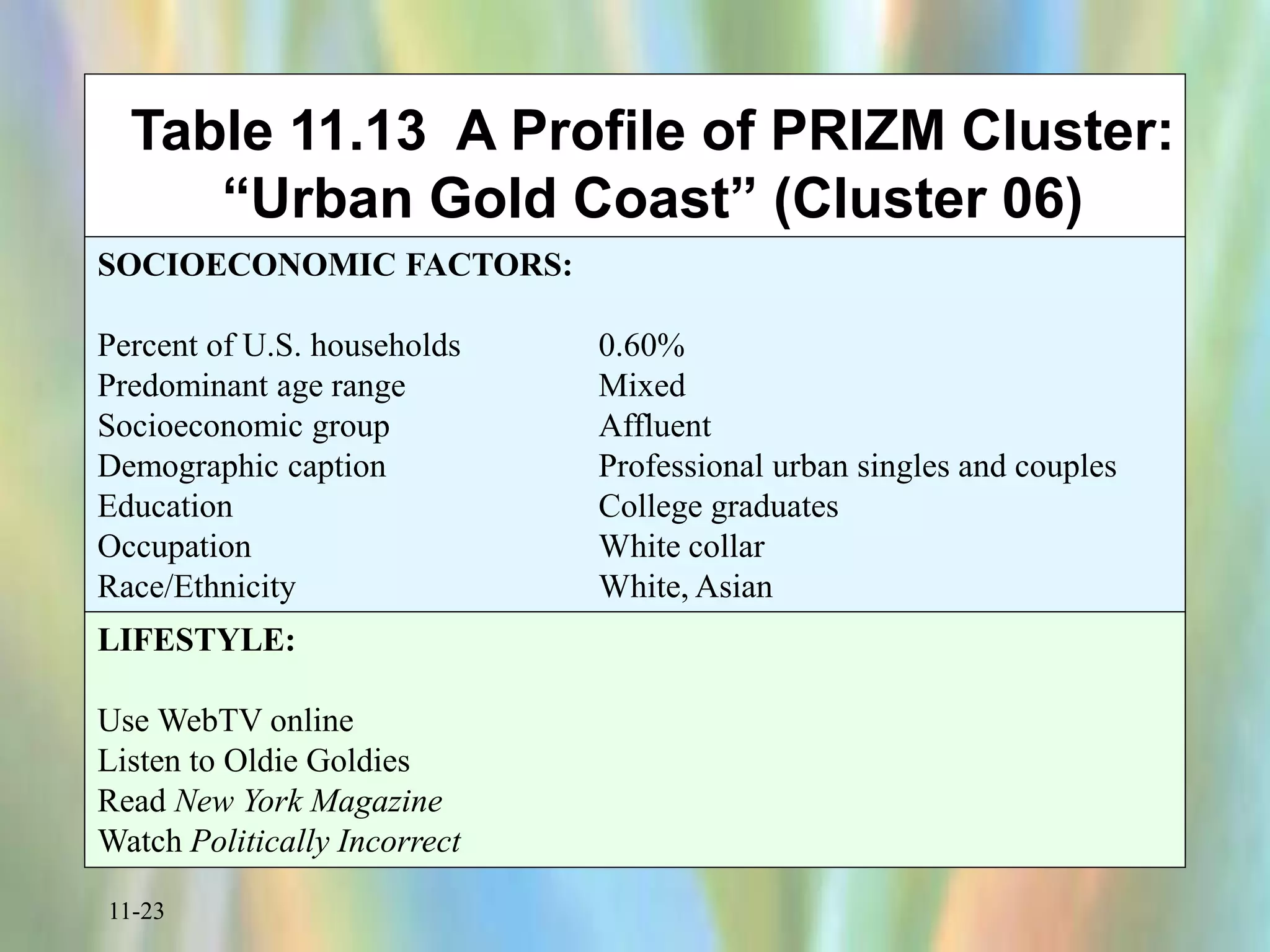
Table 11.13 A Profile of PRIZM Cluster:
“Urban Gold Coast” (Cluster 06)
SOCIOECONOMIC FACTORS:
Percent of U.S. households 0.60%
Predominant age range Mixed
Socioeconomic group Affluent
Demographic caption Professional urban singles and couples
Education College graduates
Occupation White collar
Race/Ethnicity White, Asian
LIFESTYLE:
Use WebTV online
Listen to Oldie Goldies
Read New York Magazine
Watch Politically Incorrect
11-24
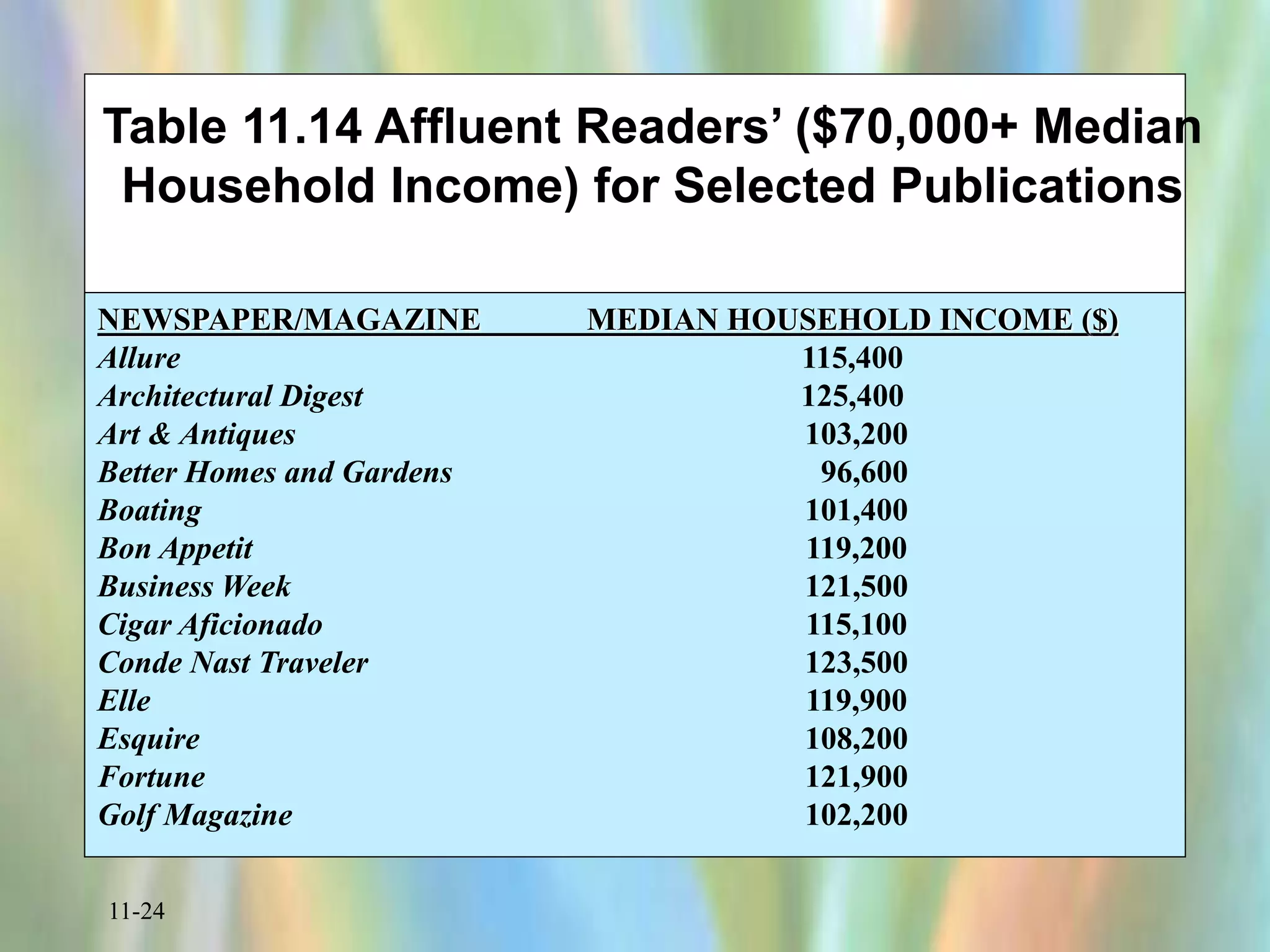
Table 11.14 Affluent Readers’ ($70,000+ Median
Household Income) for Selected Publications
NEWSPAPER/MAGAZINE MEDIAN HOUSEHOLD INCOME ($)
Allure 115,400
Architectural Digest 125,400
Art & Antiques 103,200
Better Homes and Gardens 96,600
Boating 101,400
Bon Appetit 119,200
Business Week 121,500
Cigar Aficionado 115,100
Conde Nast Traveler 123,500
Elle 119,900
Esquire 108,200
Fortune 121,900
Golf Magazine 102,200
11-25
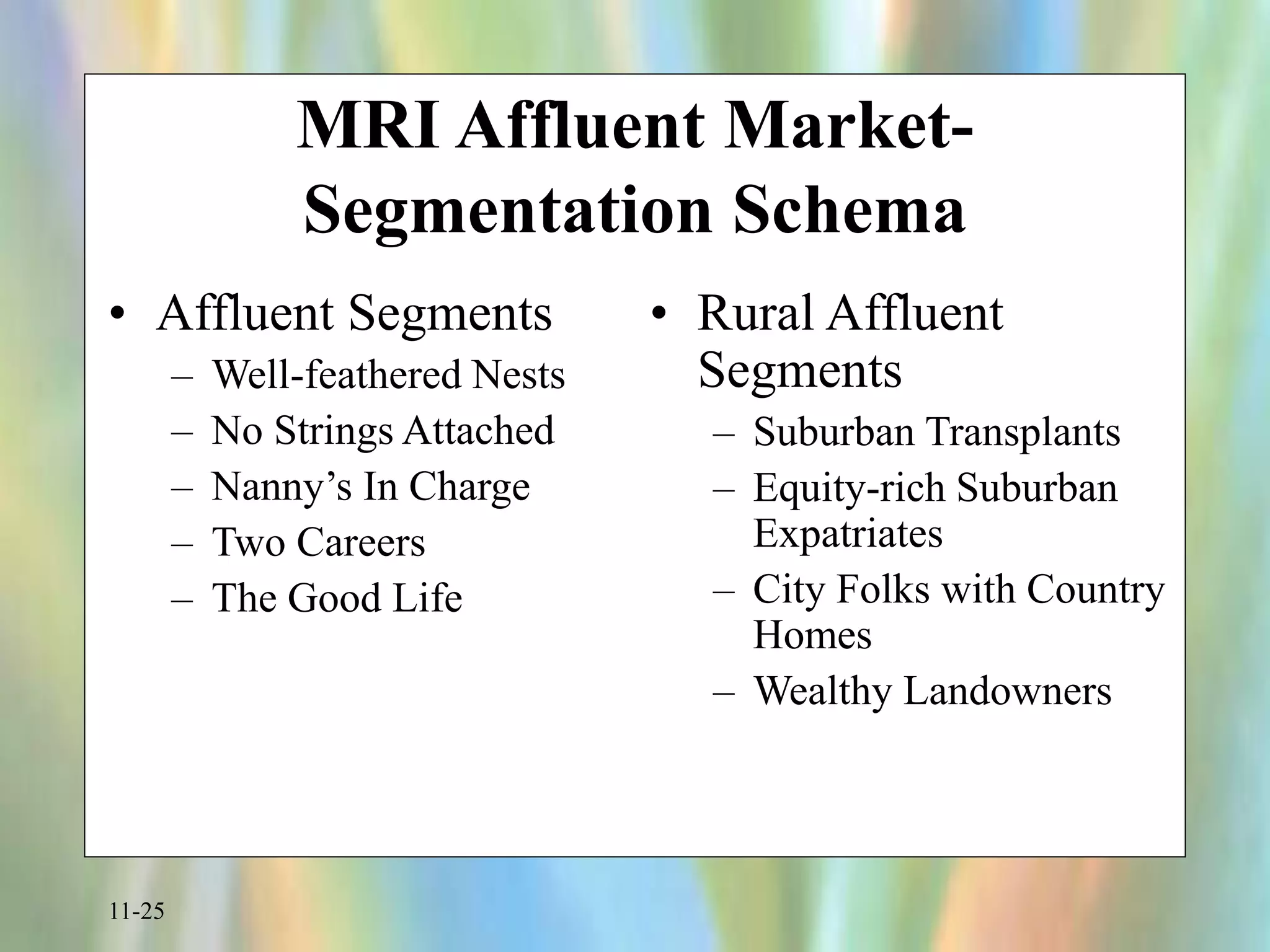
MRI Affluent Market-
Segmentation Schema
• Affluent Segments
– Well-feathered Nests
– No Strings Attached
– Nanny’s In Charge
– Two Careers
– The Good Life
• Rural Affluent
Segments
– Suburban Transplants
– Equity-rich Suburban
Expatriates
– City Folks with Country
Homes
– Wealthy Landowners
11-26
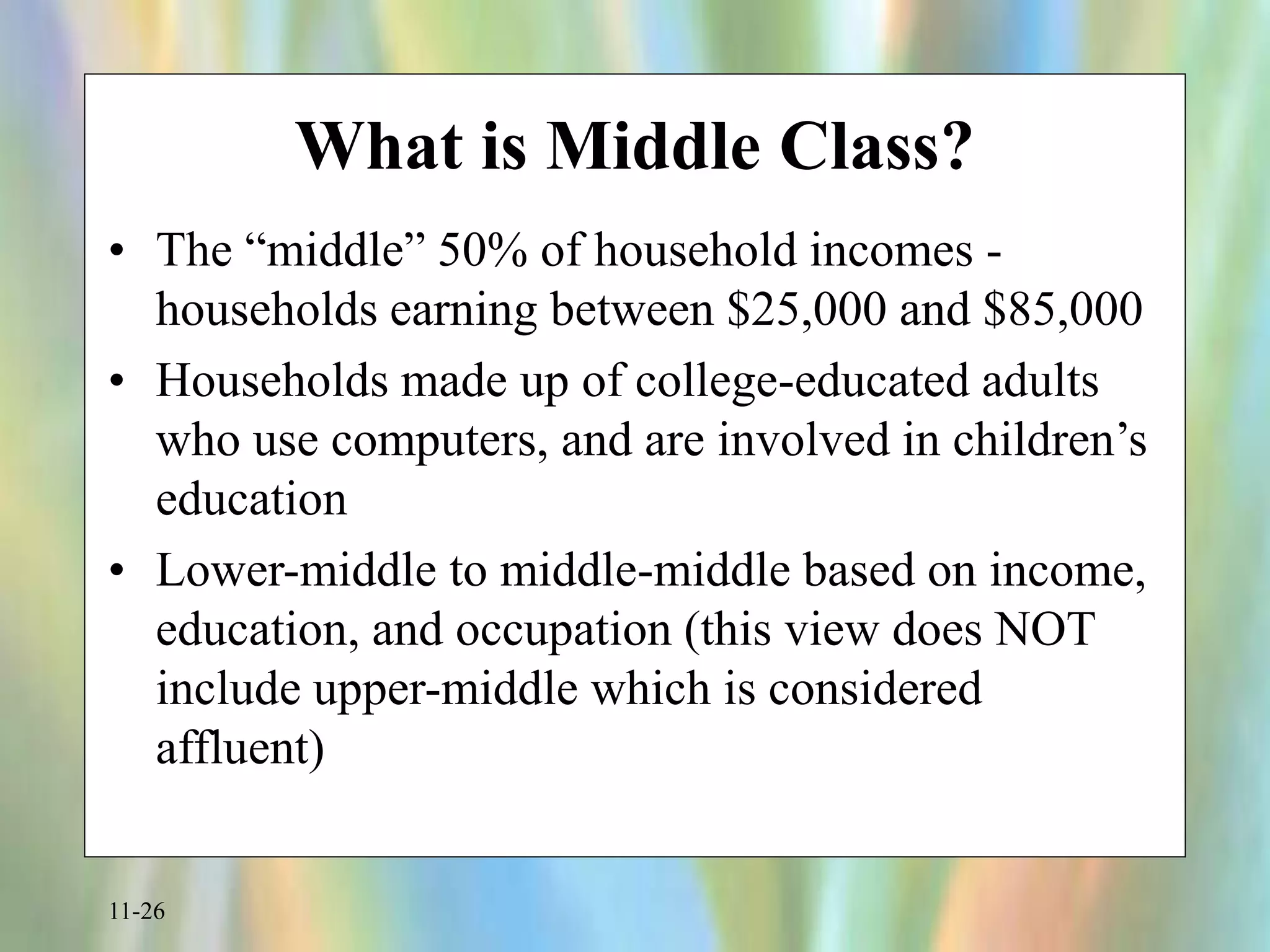
What is Middle Class?
• The “middle” 50% of household incomes -
households earning between $25,000 and $85,000
• Households made up of college-educated adults
who use computers, and are involved in children’s
education
• Lower-middle to middle-middle based on income,
education, and occupation (this view does NOT
include upper-middle which is considered
affluent)
11-27
What is Working Class?
• Households earning $34,000 or less control
more than 30% of the total income in the
U.S.
• These consumers tend to be more brand
loyal than wealthier consumers
11-28
Consumer Behavior and
Social Class
• Clothing, Fashion, and Shopping
• The Pursuit of Leisure
• Saving, Spending, and Credit
• Social Class and Communication

Consumer Social Class and Consumer Behavior schiffman11.ppt

  • 1.
    11-1 Chapter 11 Consumer Behavior, EighthEdition SCHIFFMAN & KANUK Social Class and Consumer Behavior
  • 2.
    11-2 Social Class The divisionof members of a society into a hierarchy of distinct status classes, so that members of each class have either higher or lower status than members of other classes.
  • 3.
    11-3 Social Class andSocial Status • Status is frequently thought of as the relative rankings of members of each social class – wealth – power – prestige Social Comparison Theory states that individuals compare their own possessions against those of others to determine their relative social standing.
  • 4.
    11-4 Status Consumption The processby which consumers actively increase their social standing through conspicuous consumption or possessions
  • 5.
    11-5 Convenient Approaches to SocialClass • Social status is usually defined in terms of one or more of the following socioeconomic variables: – Family Income – Occupational Status – Educational Attainment
  • 6.
  • 7.
    11-7 Table 11.3 PercentDistribution of Five- Category Social-Class Measure SOCIAL CLASSES PERCENTAGE Upper 4.3 Upper-middle 13.8 Middle 32.8 Working 32.3 Lower 16.8 Total percentage 100.0
  • 8.
    11-8 Social Class Measurement •Subjective Measures: individuals are asked to estimate their own social-class positions • Reputational Measures: informants make judgments concerning the social-class membership of others within the community • Objective Measures: individuals answer specific socioeconomic questions and then are categorized according to answers
  • 9.
    11-9 Objective Measures • Single-variable indexes –Occupation – Education – Income – Other Variables • Composite-variable indexes – Index of Status Characteristics – Socioeconomic Status Score
  • 10.
    11-10 Table 11.5 Readers’Median Household Income for Selected Publications NEWSPAPER/MAGAZINE MEDIAN HOUSEHOLD INCOME Wall Street Journal $86,109.4 Barron’s 83,075.5 New York Times Daily 78,093.1 Architectural Digest 71,483.6 Forbes 68,518.7 Money 64,423.2 PC World 60,680.4 New Yorker 59,471.0 Smithsonian 55,5646 Newsweek 54,842.2 Time 52,283.5 Car & Driver 52,338.0 National Geographic 49,561.4
  • 11.
    11-11 Table 11.8 Amountand Source of Income Categories Amount – Under $25,000/ year – $25,000-$49,999 – $50,000-$74,999 – $75,000-$99,999 – $100,000-$124,999 – $125,000-$149,999 – $150,000-$174,999 – $175,000-$199,999 – $200,000 and over Source – Public welfare – Private financial assistance – Wages (hourly) – Salary (yearly) – Profits or fees – Earned wealth – Inherited wealth, interest, dividends, royalties
  • 12.
  • 13.
    11-13 Index of Status Characteristics (ISC) Acomposite measure of social class that combines occupation, source of income (not amount), house type / dwelling area into a single weighted index of social class standing.
  • 14.
    11-14 Socioeconomic Status Score (SES) A multivariablesocial class measure used by the United States Bureau of the Census that combines occupational status, family income, and educational attainment into a single measure of social class standing.
  • 15.
    11-15 Table 11.9 Social-ClassProfiles THE UPPER-UPPER CLASS--COUNTRY CLUB •Small number of well-established families •Belong to best country clubs and sponsor major charity events •Serve as trustees for local colleges and hospitals •Prominent physicians and lawyers •May be heads of major financial institutions, owners of major long-established firms •Accustomed to wealth, so do not spend money conspicuously THE LOWER-UPPER CLASS--NEW WEALTH •Not quite accepted by the upper crust of society •Represent “new money” •Successful business executive •Conspicuous users of their new wealth
  • 16.
    11-16 Table 11.9 continued THEUPPER-MIDDLE CLASS--ACHIEVING PROFESSIONALS •Have neither family status nor unusual wealth •Career oriented •Young, successful professionals, corporate managers, and business owners •Most are college graduates, many with advanced degrees •Active in professional, community, and social activities •Have a keen interest in obtaining the “better things in life” •Their homes serve as symbols of their achievements •Consumption is often conspicuous •Very child oriented
  • 17.
    11-17 Table 11.9 continued THELOWER-MIDDLE CLASS--FAITHFUL FOLLOWERS •Primary non-managerial white-collar workers and highly paid blue-collar workers •Want to achieve “respectability” and be accepted as good citizens •Want their children to be well behaved •Tend to be churchgoers and are often involved in church- sponsored activities •Prefer a neat and clean appearance and tend to avoid faddish or highly-styled clothing •Constitute a major market for do-it-yourself products
  • 18.
    11-18 Table 11.9 continued THEUPPER-LOWER CLASS--SECURITY-MINDED MAJORITY •The largest social-class segment •Solidly blue-collar •Strive for security •View work as a means to “buy” enjoyment •Want children to behave properly •High wage earners in this group may spend impulsively •Interested in items that enhance leisure time (e.g., TV sets) •Husbands typically have a strong “macho” self-image •Males are sports fans, heavy smokers, beer drinkers
  • 19.
    11-19 Table 11.9 continued THELOWER-LOWER CLASS--ROCK BOTTOM •Poorly educated, unskilled laborers •Often out of work •Children are often poorly treated •Tend to live a day-to-day existence
  • 20.
  • 21.
    11-21 Geodemographic Clusters A composite segmentation strategy thatuses both geographic variables (zip codes, neighborhoods) and demographic variables (e.g., income, occupation) to identify target markets.
  • 22.
    11-22 PRIZM (Potential Rating Index by Zip Market) Acomposite index of geographic and socioeconomic factors expressed in residential zip code neighborhoods from which geodemographic consumer segments are formed.
  • 23.
    11-23 Table 11.13 AProfile of PRIZM Cluster: “Urban Gold Coast” (Cluster 06) SOCIOECONOMIC FACTORS: Percent of U.S. households 0.60% Predominant age range Mixed Socioeconomic group Affluent Demographic caption Professional urban singles and couples Education College graduates Occupation White collar Race/Ethnicity White, Asian LIFESTYLE: Use WebTV online Listen to Oldie Goldies Read New York Magazine Watch Politically Incorrect
  • 24.
    11-24 Table 11.14 AffluentReaders’ ($70,000+ Median Household Income) for Selected Publications NEWSPAPER/MAGAZINE MEDIAN HOUSEHOLD INCOME ($) Allure 115,400 Architectural Digest 125,400 Art & Antiques 103,200 Better Homes and Gardens 96,600 Boating 101,400 Bon Appetit 119,200 Business Week 121,500 Cigar Aficionado 115,100 Conde Nast Traveler 123,500 Elle 119,900 Esquire 108,200 Fortune 121,900 Golf Magazine 102,200
  • 25.
    11-25 MRI Affluent Market- SegmentationSchema • Affluent Segments – Well-feathered Nests – No Strings Attached – Nanny’s In Charge – Two Careers – The Good Life • Rural Affluent Segments – Suburban Transplants – Equity-rich Suburban Expatriates – City Folks with Country Homes – Wealthy Landowners
  • 26.
    11-26 What is MiddleClass? • The “middle” 50% of household incomes - households earning between $25,000 and $85,000 • Households made up of college-educated adults who use computers, and are involved in children’s education • Lower-middle to middle-middle based on income, education, and occupation (this view does NOT include upper-middle which is considered affluent)
  • 27.
    11-27 What is WorkingClass? • Households earning $34,000 or less control more than 30% of the total income in the U.S. • These consumers tend to be more brand loyal than wealthier consumers
  • 28.
    11-28 Consumer Behavior and SocialClass • Clothing, Fashion, and Shopping • The Pursuit of Leisure • Saving, Spending, and Credit • Social Class and Communication