1
Contents
What is Computer Ethics?
Professional issues
IT Issues
Why Study Professional Ethics?
Ethics in an Information Society
Ethical analysis
2
Ethical Issues: Who is morally
responsible for consequence of use ?
Social Issues: What should society
expect to allow ?
3
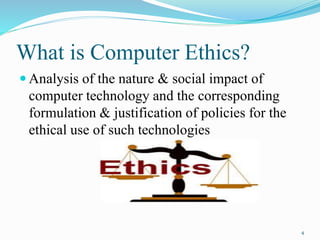
What is Computer Ethics?
 Analysis of the nature & social impact of
computer technology and the corresponding
formulation & justification of policies for the
ethical use of such technologies
4
THE RELATIONSHIP BETWEEN ETHICAL,
SOCIAL, AND POLITICAL ISSUES IN AN
INFORMATION SOCIETY
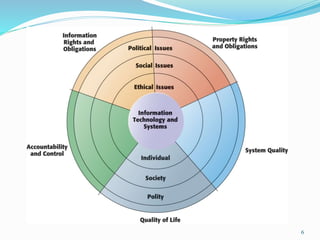
 The introduction of new information technology
has a ripple effect, raising new ethical, social, and
political issues that must be dealt with on the
individual, social, and political levels. These
issues have five moral dimensions: information
rights and obligations, property rights and
obligations, system quality, quality of life, and
accountability and control.
5
6
Model for thinking about ethical,
social, political issues
7
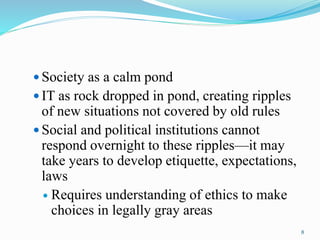
 Society as a calm pond
 IT as rock dropped in pond, creating ripples
of new situations not covered by old rules
 Social and political institutions cannot
respond overnight to these ripples—it may
take years to develop etiquette, expectations,
laws
 Requires understanding of ethics to make
choices in legally gray areas
8
Professional issues:
 Relevant to emergent technologies (e.g.
autonomous systems) there is a particular duty of
engineers to:
 identify and evaluate and, where possible,
quantify risks.
 be aware of the issues that engineering and
technology raise for society, and listen to the
aspirations and concerns of others.
 actively promote public awareness and
understanding of the impact and benefits of
engineering achievements.
9
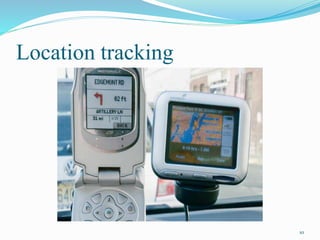
Location tracking
10
IT Issues
 Email
 Easy way to keep in touch
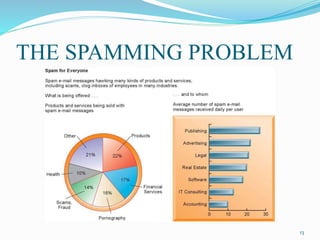
 Spam has become a real problem
 Web
 Free access to huge amounts of information
 Harmful consequences of some sites
 CDs, MP3s, MP4s
 Free or cheap copies readily available
 May be unfair to musicians
 Credit cards
 Convenience over cash and checks
 Increases possibility of identity theft
 Who owns information about transactions?
11
 Telecommuting
 Saves time, allows more flexible work hours
 Can lead to longer work hours
 May result in fewer chances for promotion
 Improved global communication network
 Allow companies to sell to entire world
 Allow companies to move jobs out of their home
countries.
 World Wide Web
 A conduit for democratic ideas?
 Another tool for totalitarian governments
12
THE SPAMMING PROBLEM
13
Why Study Professional Ethics?
 What is the point in studying engineering ethics?
What can be gained from taking an ethics course? A
professional ethics course is not about preaching
virtue so that the immoral and amoral students will
adopt a certain established set of beliefs.
 Rather, it means to increase the ability of concerned
engineers, managers and citizens, to first recognize
and then responsibly confront moral issues raised by
technological activity.
14
Ethics in an Information Society
 Responsibility:
 Accepting the potential costs, duties, and obligations
for decisions
 Accountability:
 Mechanisms for identifying responsible parties
 Liability:
 Permits individuals (and firms) to recover damages
done to them
 Due process:
 Laws are well known and understood, with an ability
to appeal to higher authorities
15
Ethical analysis
1. Identify and clearly describe the facts
2. Define the conflict or dilemma and identify
the higher-order values involved
3. Identify the stakeholders
4. Identify the options that you can
reasonably take
5. Identify the potential consequences of your
options
16
References
 https://www.raeng.org.uk/societygov/engineeringethi
cs/pdf/Autonomous_Systems_Report_09.pdf
 http://www.ieee.org/portal/pages/iportals/aboutus/et
hics/code.html
 http://www.cssl.lk/index.php?option=com_frontpage
&Itemid=66
 http://www.documents.gov.lk/Acts/2007/Computer%
20Crime%20-%20Act%2024/Act%20No.%2024E.pdf
17
THANK YOU!
18

Social and professional issuesin it

  • 1.
  • 2.
    Contents What is ComputerEthics? Professional issues IT Issues Why Study Professional Ethics? Ethics in an Information Society Ethical analysis 2
  • 3.
    Ethical Issues: Whois morally responsible for consequence of use ? Social Issues: What should society expect to allow ? 3
  • 4.
    What is ComputerEthics?  Analysis of the nature & social impact of computer technology and the corresponding formulation & justification of policies for the ethical use of such technologies 4
  • 5.
    THE RELATIONSHIP BETWEENETHICAL, SOCIAL, AND POLITICAL ISSUES IN AN INFORMATION SOCIETY  The introduction of new information technology has a ripple effect, raising new ethical, social, and political issues that must be dealt with on the individual, social, and political levels. These issues have five moral dimensions: information rights and obligations, property rights and obligations, system quality, quality of life, and accountability and control. 5
  • 6.
  • 7.
    Model for thinkingabout ethical, social, political issues 7
  • 8.
     Society asa calm pond  IT as rock dropped in pond, creating ripples of new situations not covered by old rules  Social and political institutions cannot respond overnight to these ripples—it may take years to develop etiquette, expectations, laws  Requires understanding of ethics to make choices in legally gray areas 8
  • 9.
    Professional issues:  Relevantto emergent technologies (e.g. autonomous systems) there is a particular duty of engineers to:  identify and evaluate and, where possible, quantify risks.  be aware of the issues that engineering and technology raise for society, and listen to the aspirations and concerns of others.  actively promote public awareness and understanding of the impact and benefits of engineering achievements. 9
  • 10.
  • 11.
    IT Issues  Email Easy way to keep in touch  Spam has become a real problem  Web  Free access to huge amounts of information  Harmful consequences of some sites  CDs, MP3s, MP4s  Free or cheap copies readily available  May be unfair to musicians  Credit cards  Convenience over cash and checks  Increases possibility of identity theft  Who owns information about transactions? 11
  • 12.
     Telecommuting  Savestime, allows more flexible work hours  Can lead to longer work hours  May result in fewer chances for promotion  Improved global communication network  Allow companies to sell to entire world  Allow companies to move jobs out of their home countries.  World Wide Web  A conduit for democratic ideas?  Another tool for totalitarian governments 12
  • 13.
  • 14.
    Why Study ProfessionalEthics?  What is the point in studying engineering ethics? What can be gained from taking an ethics course? A professional ethics course is not about preaching virtue so that the immoral and amoral students will adopt a certain established set of beliefs.  Rather, it means to increase the ability of concerned engineers, managers and citizens, to first recognize and then responsibly confront moral issues raised by technological activity. 14
  • 15.
    Ethics in anInformation Society  Responsibility:  Accepting the potential costs, duties, and obligations for decisions  Accountability:  Mechanisms for identifying responsible parties  Liability:  Permits individuals (and firms) to recover damages done to them  Due process:  Laws are well known and understood, with an ability to appeal to higher authorities 15
  • 16.
    Ethical analysis 1. Identifyand clearly describe the facts 2. Define the conflict or dilemma and identify the higher-order values involved 3. Identify the stakeholders 4. Identify the options that you can reasonably take 5. Identify the potential consequences of your options 16
  • 17.
    References  https://www.raeng.org.uk/societygov/engineeringethi cs/pdf/Autonomous_Systems_Report_09.pdf  http://www.ieee.org/portal/pages/iportals/aboutus/et hics/code.html http://www.cssl.lk/index.php?option=com_frontpage &Itemid=66  http://www.documents.gov.lk/Acts/2007/Computer% 20Crime%20-%20Act%2024/Act%20No.%2024E.pdf 17
  • 18.