1
2022
PROFESSIONAL ETHICS
IN SCIENCE AND ENGINEERING
2
CONTENT
- Identifying Ethical Issues
- Basic Ethical Orientations
- What is Computer Ethics?
- Computer Ethics in the Curriculum
- Computer-Related Risks
- Professional Codes
- Research Ethics
3
Course PROFESSIONAL ETHICS
IN SCIENCE AND ENGINEERING
at MDH
 All information about the course at:
http://www.idt.mdh.se/kurser/cd5590
4
Identifying Ethical
Issues
Based on: Lawrence M. Hinman, Ph.D.
Director, The Values Institute
University of San Diego
5
Ethics and Morality
What are they?
The terms ethics and morality are often used
interchangeably - indeed, they usually can
mean the same thing, and in casual
conversation there isn't a problem with
switching between one and the other.
However, there is a distinction between them in
philosophy!
6
Ethics and Morality
Etymology
Morality and ethics have same roots,
mores which means manner and
customs from the Latin and
etos which means custom and habits
from the Greek.
Robert Louden, Morality and Moral Theory
7
Ethics and Morality
What are they?
Strictly speaking, morality is used to refer
to what we would call moral conduct
while ethics is used to refer to the
formal study of moral conduct.
Ethics is also often called "moral
philosophy."
8
Ethics and Morality
 Morality: first-order set of beliefs and
practices about how to live a good life.
 Ethics: a second-order, conscious
reflection on the adequacy of our moral
beliefs.
9
MORALITY vs. ETHIC
 MORALITY - PRAXIS
 ETHICS - THEORY
10
Theoretical Ethics
 Metaethics or analytical ethics: theoretical
study that inquires into semantic, logical, and
epistemological issues in ethics. It
investigates the meaning of ethical terms, the
nature of value judgements, and the
justification of ethical theories and
judgements.
 Normative ethics: theory which justifies which
acts are morally good/bad.
11
Practical Ethics
 Engineering ethics
 Ethics of science
 Bioethics
 Medical ethics
 Environmental ethics
 Public ethics
 Media ethics
 Political ethics
12
Normative Systems
 Games
 Law
 Religion
 Morality
 Habits
13
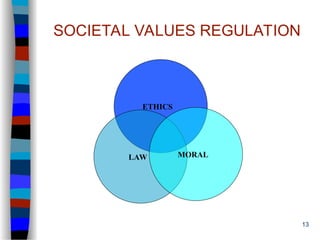
ETHICS
SOCIETAL VALUES REGULATION
LAW MORAL
14
ETICS CONTINUUM
Ethics as an Ongoing Conversation
 World changes continually, and we have to
interpret/construe it over and over again.
 We come back to ideas again and again,
finding new meaning in them.
 Professional discussions of ethical issues in
journals.
See http://www.utm.edu/research/iep/e/ethics.htm
http://www.utilitarism.net/ (in Swedish)
15
Basic Ethical
Orientations
Overview
16
On what Ethical Basis Do We Make
Moral Decisions? (1)
 Divine Command Ethics
 Utilitarianism (Consequentialism)
The action is best, which procures the
greatest happiness for the greatest
number…
 Virtue Ethics –
Maximize virtue, minimize vices
17
On What Ethical Basis Do We Make
Moral Decisions? (2)
 The Ethics of Duty (Deontological* Ethics)
– Immanuel Kant’s Moral Theory. The categorical
imperative: -- “Act so that the maxim [determining motive of
the will] may be capable of becoming a universal law for all
rational beings."
 Ethical Egoism
– “Macciavelism” – "The end justifies the means"
Nicollo Macchiavelli (The Prince) - rationalization of war
* ‘deon’ = duty
18
On What Ethical Basis Do We Make
Moral Decisions? (3)
 The Ethics of Natural and Human Rights –
all people are created ...with certain basic
rights
 Social Contract Ethics (We agree to be civil to
one another under threat of punishment from
a government established for this purpose.
[Plato, Republic. Thomas Hobbes])
 Evolutionary Ethics – Being social increases
our chances to survive
19
On What Ethical Basis Do We Make
Moral Decisions? (4)
 Existentialist Ethics The existentialists
emphasize freedom, individuality, and
subjectivity .
– Nietzsche, F. (Writings include Thus Spoke
Zarathustra, Human All Too Human, etc.)
– Sartre, J.P. (Writings include Being and
Nothingness, Nausea, etc.)
20
Moral Reason versus Moral Feeling
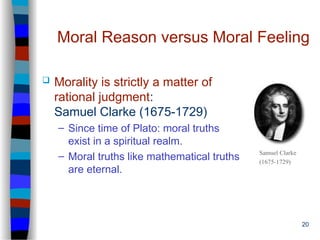
 Morality is strictly a matter of
rational judgment:
Samuel Clarke (1675-1729)
– Since time of Plato: moral truths
exist in a spiritual realm.
– Moral truths like mathematical truths
are eternal.
Samuel Clarke
(1675-1729)
21
Moral Reason versus Moral Feeling
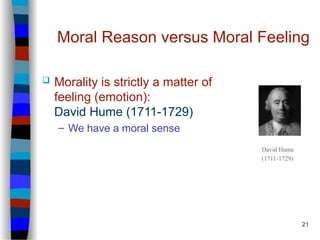
 Morality is strictly a matter of
feeling (emotion):
David Hume (1711-1729)
– We have a moral sense
David Hume
(1711-1729)
22
Policy Vacuums
For “policy vacuum”, see
Moor, J, 1985. “What is Computer Ethics”,
Metaphilosophy 16(4): 266-75.
23
A Brave New World…
24
A Brave New World…
25
A Brave New World…
26
Computer Ethics in the
Computer Science
Curriculum
Based on:
James H. Moor
http://www.southernct.edu/organizations/rccs/resources/teaching/teaching
_mono/moor/moor_definition.html
Terrell Ward Bynum
http://www.southernct.edu/organizations/rccs/resources/teaching/teaching_mo
no/bynum/bynum_human_values.html
27
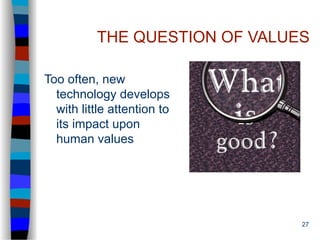
THE QUESTION OF VALUES
Too often, new
technology develops
with little attention to
its impact upon
human values
28
Computer Ethics -A Proposed Definition
 Computer ethics is the analysis of the nature
and social impact of computer technology
and the corresponding formulation and
justification of policies for the ethical use of
such technology.
29
The Revolutionary Machine
What is so special about computers?
– Computers are logically malleable in
that they can be shaped and moulded
to do any activity that can be
characterized in terms of inputs,
outputs, and connecting logical
operations - as tools for representation,
modelling and simulation
30
The Revolutionary Machine
What is special about computers?
– Computers used in communication
– Learning
– Production
– Government
– Commerce
– Entertainment
– …virtually everywhere!
31
Computing Technology and Human
Values
 Problems:
viruses, software ownership law suits,
file sharing, privacy invasion,
computer-aided bank robbery,
computerized weapons,
safety/security etc.
 As the social impact of information
technology grows, we must learn to
tackle those problems, and..
32
Computing Technology and Human
Values
 Understand the impact of computing
technology upon human values
 Minimize the damage that such technology
can do to human values, and
 Identify ways to use computer technology
to advance human values.
33
Computing Technology and Human
Values
 How can we work to make computing
technology advance human values?
Integrate computing technology and human
values in such a way that the technology
advances and protects human values, rather
than doing damage to them.
34
Why Learn Ethics?
 Convey a sense of professional
responsibility not covered in other
courses
 Deal with the true nature of computing as
a service to other human beings.
(Gotterbarn 1991)
35
Why Teach Ethics?
 Sensitize students to computer ethics
issues
 Provide tools and methods for analyzing
cases
 Provide practice in applying the tools
and methods to actual or realistic cases
 Develop in the student good judgment
and helpful intuitions -- ethical
autonomy.
36
Professional And
Ethical
Responsibilities
37
Ethics
Professional ethics concerns a person
engaged in the practice of a particular
profession.
38
Professional Ethics is about
Relations
…between…
 practicing professionals
 employee and employer
 professionals and their clients
 and on specialized technical details of the
professions
39
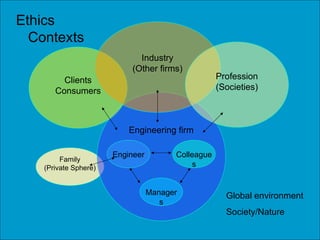
Family
(Private Sphere)
Global environment
Society/Nature
Engineering firm
Engineer Colleague
s
Manager
s
Clients
Consumers
Industry
(Other firms)
Profession
(Societies)
Ethics
Contexts
40
Engineering as Social
Experimentation
“All products of technology present some potential dangers, and
thus engineering is an inherently risky activity. In order to
underscore this fact and help in exploring its ethical
implications, we suggest that engineering should be viewed
as an experimental process. It is not, of course, an
experiment conducted solely in a laboratory under controlled
conditions. Rather, it is an experiment on a social scale
involving human subjects.”
Ethics in Engineering, Martin, M.W., Schinzinger, McGraw-Hill, 1996
41
Why Professional Ethics?
Professional Ethics is a crucial part
of the content of professionalism!
42
Computing Curricula 2001, ACM/IEEE
 Social context of computing
 Methods and tools of analysis of ethical
argument
 Professional and ethical responsibilities
 Risks and liabilities of safety-critical systems
 Intellectual property
 Privacy and civil liberties
 Social implications of the Internet
 Computer crime
 Philosophical foundations of ethics
43
Studying Codes of Ethics: The Goal
 Acquiring skill in practical ethical reasoning in
a professional domain
 Developing the ethical autonomy, i.e. the
ability and the habit to think rationally and
critically about the ethical questions.
44
Studying Codes of Ethics:
The Method
 Importance of professional knowledge and
role-specific professional obligations in
resolving professional ethical conflicts
 General principles necessary to comprehend
and apply professional codes of ethics
 Case based reasoning with applying and
interpreting codes
45
Association of Computer Machinery (ACM)
Code of Conduct
1. General Moral Imperatives
1.1 Contribute to society and human well-being
1.2 Avoid harm to others
1.3 Be honest and trustworthy
1.4 Be fair and take action not to discriminate
1.5 Honor property rights including copyrights and patents
1.6 Give proper credit for intellectual property
1.7 Respect the privacy of others
1.8 Honor Confidentiality
http://onlineethics.org/codes/ACMcode.html
46
IEEE Code of Ethics
1. accept responsibility in making engineering
decisions consistent with the safety, health
and welfare of the public, and to disclose
promptly factors that might endanger the
public or the environment;
2. avoid real or perceived conflicts of interest
whenever possible, and to disclose them to
affected parties when they do exist;
3. be honest and realistic in stating claims or
estimates based on available data;
4. reject bribery in all its forms;
47
IEEE Code of Ethics
5. improve the understanding of technology, its
appropriate application, and potential
consequences;
6. maintain and improve our technical
competence and to undertake technological
tasks for others only if qualified by training or
experience, or after full disclosure of pertinent
limitations;
7. seek, accept, and offer honest criticism of
technical work, to acknowledge and correct
errors, and to credit properly the contributions
of others;
48
IEEE Code of Ethics
8. treat fairly all persons regardless of such
factors as race, religion, gender, disability,
age, or national origin;
9. avoid injuring others, their property,
reputation, or employment by false or
malicious action;
10. assist colleagues and co-workers in their
professional development and support them
in following this code of ethics.
http://www.ieee.org/portal/index.jsp?pageID=corp_level1&path=
about/whatis&file=code.xml&xsl=generic.xsl
49
"Whistle Blowing"
"Whistle Blowing" is a matter of an individual
employee finding his or her conscience
unable to accept the actions of the company
and telling the world about them, typically via
the media.
It is always a fairly dramatic event and was
even more so in the before when the typical
view was that an employee owed total loyalty
to the employer. Employees who blow the
whistle on their employers are protected by
law. If they are fired or otherwise retaliated
against for whistle blowing, they can sue.
50
Computer-Related
Risks
51
Computer-Related Risks
Problems involving:
 Reliability
 Safety
 Security
 Privacy
 Human well-being
Book: Computer-Related Risks by Peter Neumann
(Addison-Wesley 1994; ACM Press Series)
52
Computer-Related Risks
 The Ariadne rocket, a common European
space project exploded a few seconds after
takeoff, due to a software error.
 The baggage-handling system of the Denver
International Airport. Errors in the software that
controls the system required postponement of the
official opening (Oct. 1993). By June 1994 the $ 193
million system was still not functioning, but costing $
1.1 million per day in interest and other costs. In early
1995 a manual baggage system was installed in
order to open the airport.
53
Computer-Related Risks in Technical
Systems
 Some cancer patients in the USA have
received fatal radiation overdoses from the
Therac-25, a computer-controlled radiation-
therapy machine.
 The Sizewell B nuclear power plant in
England. Some years ago it was decided to test the
subsystem which is used to close down the reactor if
a dangerous situation occurs. The results were not
comforting: the software failed almost half of them.
They were not able to find the errors in the 100 000
lines of code. Instead, they reduced the overall
expectation of the plant's performance from one
failure every 10,000 years to one every 1,000 years.
54
Computer-Related Incidents with
Commercial Aircraft
China Airlines Airbus A300 in Taipei (1998)
The Korean Air Lines B747 CFIT Accident in Guam (1997)
The FedEx MD11 Accident on Landing at Newark (1997)
The Birgen Air B757 accident near Puerto Plata (1996)
News on the Aeroperu B757 accident (1996)
The Ariane 5 Failure (1996)
The T-43A Accident near Dubrovnik (1996)
Information About the Martinair B767 EFIS-loss Incident near Boston, MA
The American Airlines B757 Accident in Cali (1995)
The A320 Maintenance Incident at Gatwick (1995)
The A330 Flight-Test Accident in Toulouse (1994)
The Tokyo-London A340 FMGS Problem (1994)
The A300 Crash in Nagoya (1994)
The A320 Accident in Warsaw(1993)
The Air Inter A320 Accident near Strasbourg(1992)
The Sydney A320/DC10 Incident (1991)
The Lauda Air B767 Accident (1991)
The British Midland B737-400 Kegworth Accident (1989)
A B747 Control Incident (1985)
The Eastern Airlines L1011 Common Mode Engine Failure Incident (1983)
A Space Shuttle Control Incident (1981)
The American Airlines DC10 Takeoff Accident in Chicago (1979)
55
PRECAUTIONARY PRINCIPLE (1)
When an activity raises threats of harm to
human health or the environment,
precautionary measures should be taken
even if some cause and effect
relationships are not fully established
scientifically.
56
PRECAUTIONARY PRINCIPLE (2)
People have a duty to take anticipatory
action to prevent harm.
The burden of proof of harmlessness of a new
technology, process, activity, or chemical lies
with the proponents, not with the general
public.
57
PRECAUTIONARY PRINCIPLE (3)
Before using a new technology, process, or
chemical, or starting a new activity, people
have an obligation to examine "a full range
of alternatives" including the alternative of
doing nothing.
Decisions applying the precautionary principle
must be open, informed, and democratic and
must include affected parties.
58
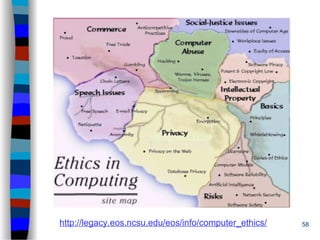
http://legacy.eos.ncsu.edu/eos/info/computer_ethics/
59
SCIENTIFIC ETHICAL
NORMS
On Being A Scientist: Responsible Conduct In
Research
http://books.nap.edu/catalog.php?record_id=4917
Free online
60
On Being A Scientist: Responsible
Conduct In Research
Table of Contents
– Front Matter i-ix Introduction 1-2
– The Social Foundations of Science 3-4
– Experimental Techniques and the Treatment of Data 4-6
– Values in Science 6-8 (skim) Conflicts of Interest 8-9
– Publication and Openness 9-12
– The Allocation of Credit 12-13
– Authorship Practices 13-15
– Error and Negligence in Science 15-16
– Misconduct in Science 16-18
– Responding to Violations of Ethical Standards 18-20
– The Scientist in Society 20-21
– Bibliography 22-24
– Appendix: Discussion of Case Studies 25-29
http://books.nap.edu/catalog.php?record_id=4917
61
SCIENTIFIC ETHICAL NORMS (1)
– Communalism requires that scientific
knowledge should be public knowledge.
– The results of research should be published.
– There should be freedom of exchange of
scientific information between scientists
everywhere.
– Scientist should be responsible to the scientific
community for the trustworthiness of their
published work.
62
SCIENTIFIC ETHICAL NORMS (2)
– Universalism requires that science be
independent of race, color, or creed and that
it should be essentially international.
63
SCIENTIFIC ETHICAL NORMS (3)
– Disinterestedness requires that the results of
bona fide scientific research should not be
manipulated to serve considerations such as
personal profit, ideology, or expediency.
In other words they should be honest and
objective which does not mean that research
should not be competitive.
64
SCIENTIFIC ETHICAL NORMS (4)
Organized skepticism requires that
statements should not be accepted
exclusively on the word of authority.
Scientists should be free to question.
The truth of any statement should finally rest on
a comparison with observed fact.
65
DIFFERENT PERSPECTIVES
66
References
 Basic material:
– MORAL PHILOSOPHY THROUGH THE AGES, James Fieser,
Mayfield Publishing Company, 2001
– ETHICS AND COMPUTING, Living Responsibly in a Computerized
World, Kevin W. Bowyer Editor, IEEE Press 2000
– ETHICS IN ENGINEERING, Mike Martin, Roland Schinzinger,
McGraw Hill, 1997
– http://ethics.acusd.edu/socialethics/
 Additional resources
Ebrary with resources can be found on the course web page:
http://www.idt.mdh.se/kurser/cd5590/

NT182 LECTURE 2 Ethics and Professionalism.ppt

  • 1.
  • 2.
    2 CONTENT - Identifying EthicalIssues - Basic Ethical Orientations - What is Computer Ethics? - Computer Ethics in the Curriculum - Computer-Related Risks - Professional Codes - Research Ethics
  • 3.
    3 Course PROFESSIONAL ETHICS INSCIENCE AND ENGINEERING at MDH  All information about the course at: http://www.idt.mdh.se/kurser/cd5590
  • 4.
    4 Identifying Ethical Issues Based on:Lawrence M. Hinman, Ph.D. Director, The Values Institute University of San Diego
  • 5.
    5 Ethics and Morality Whatare they? The terms ethics and morality are often used interchangeably - indeed, they usually can mean the same thing, and in casual conversation there isn't a problem with switching between one and the other. However, there is a distinction between them in philosophy!
  • 6.
    6 Ethics and Morality Etymology Moralityand ethics have same roots, mores which means manner and customs from the Latin and etos which means custom and habits from the Greek. Robert Louden, Morality and Moral Theory
  • 7.
    7 Ethics and Morality Whatare they? Strictly speaking, morality is used to refer to what we would call moral conduct while ethics is used to refer to the formal study of moral conduct. Ethics is also often called "moral philosophy."
  • 8.
    8 Ethics and Morality Morality: first-order set of beliefs and practices about how to live a good life.  Ethics: a second-order, conscious reflection on the adequacy of our moral beliefs.
  • 9.
    9 MORALITY vs. ETHIC MORALITY - PRAXIS  ETHICS - THEORY
  • 10.
    10 Theoretical Ethics  Metaethicsor analytical ethics: theoretical study that inquires into semantic, logical, and epistemological issues in ethics. It investigates the meaning of ethical terms, the nature of value judgements, and the justification of ethical theories and judgements.  Normative ethics: theory which justifies which acts are morally good/bad.
  • 11.
    11 Practical Ethics  Engineeringethics  Ethics of science  Bioethics  Medical ethics  Environmental ethics  Public ethics  Media ethics  Political ethics
  • 12.
    12 Normative Systems  Games Law  Religion  Morality  Habits
  • 13.
  • 14.
    14 ETICS CONTINUUM Ethics asan Ongoing Conversation  World changes continually, and we have to interpret/construe it over and over again.  We come back to ideas again and again, finding new meaning in them.  Professional discussions of ethical issues in journals. See http://www.utm.edu/research/iep/e/ethics.htm http://www.utilitarism.net/ (in Swedish)
  • 15.
  • 16.
    16 On what EthicalBasis Do We Make Moral Decisions? (1)  Divine Command Ethics  Utilitarianism (Consequentialism) The action is best, which procures the greatest happiness for the greatest number…  Virtue Ethics – Maximize virtue, minimize vices
  • 17.
    17 On What EthicalBasis Do We Make Moral Decisions? (2)  The Ethics of Duty (Deontological* Ethics) – Immanuel Kant’s Moral Theory. The categorical imperative: -- “Act so that the maxim [determining motive of the will] may be capable of becoming a universal law for all rational beings."  Ethical Egoism – “Macciavelism” – "The end justifies the means" Nicollo Macchiavelli (The Prince) - rationalization of war * ‘deon’ = duty
  • 18.
    18 On What EthicalBasis Do We Make Moral Decisions? (3)  The Ethics of Natural and Human Rights – all people are created ...with certain basic rights  Social Contract Ethics (We agree to be civil to one another under threat of punishment from a government established for this purpose. [Plato, Republic. Thomas Hobbes])  Evolutionary Ethics – Being social increases our chances to survive
  • 19.
    19 On What EthicalBasis Do We Make Moral Decisions? (4)  Existentialist Ethics The existentialists emphasize freedom, individuality, and subjectivity . – Nietzsche, F. (Writings include Thus Spoke Zarathustra, Human All Too Human, etc.) – Sartre, J.P. (Writings include Being and Nothingness, Nausea, etc.)
  • 20.
    20 Moral Reason versusMoral Feeling  Morality is strictly a matter of rational judgment: Samuel Clarke (1675-1729) – Since time of Plato: moral truths exist in a spiritual realm. – Moral truths like mathematical truths are eternal. Samuel Clarke (1675-1729)
  • 21.
    21 Moral Reason versusMoral Feeling  Morality is strictly a matter of feeling (emotion): David Hume (1711-1729) – We have a moral sense David Hume (1711-1729)
  • 22.
    22 Policy Vacuums For “policyvacuum”, see Moor, J, 1985. “What is Computer Ethics”, Metaphilosophy 16(4): 266-75.
  • 23.
  • 24.
  • 25.
  • 26.
    26 Computer Ethics inthe Computer Science Curriculum Based on: James H. Moor http://www.southernct.edu/organizations/rccs/resources/teaching/teaching _mono/moor/moor_definition.html Terrell Ward Bynum http://www.southernct.edu/organizations/rccs/resources/teaching/teaching_mo no/bynum/bynum_human_values.html
  • 27.
    27 THE QUESTION OFVALUES Too often, new technology develops with little attention to its impact upon human values
  • 28.
    28 Computer Ethics -AProposed Definition  Computer ethics is the analysis of the nature and social impact of computer technology and the corresponding formulation and justification of policies for the ethical use of such technology.
  • 29.
    29 The Revolutionary Machine Whatis so special about computers? – Computers are logically malleable in that they can be shaped and moulded to do any activity that can be characterized in terms of inputs, outputs, and connecting logical operations - as tools for representation, modelling and simulation
  • 30.
    30 The Revolutionary Machine Whatis special about computers? – Computers used in communication – Learning – Production – Government – Commerce – Entertainment – …virtually everywhere!
  • 31.
    31 Computing Technology andHuman Values  Problems: viruses, software ownership law suits, file sharing, privacy invasion, computer-aided bank robbery, computerized weapons, safety/security etc.  As the social impact of information technology grows, we must learn to tackle those problems, and..
  • 32.
    32 Computing Technology andHuman Values  Understand the impact of computing technology upon human values  Minimize the damage that such technology can do to human values, and  Identify ways to use computer technology to advance human values.
  • 33.
    33 Computing Technology andHuman Values  How can we work to make computing technology advance human values? Integrate computing technology and human values in such a way that the technology advances and protects human values, rather than doing damage to them.
  • 34.
    34 Why Learn Ethics? Convey a sense of professional responsibility not covered in other courses  Deal with the true nature of computing as a service to other human beings. (Gotterbarn 1991)
  • 35.
    35 Why Teach Ethics? Sensitize students to computer ethics issues  Provide tools and methods for analyzing cases  Provide practice in applying the tools and methods to actual or realistic cases  Develop in the student good judgment and helpful intuitions -- ethical autonomy.
  • 36.
  • 37.
    37 Ethics Professional ethics concernsa person engaged in the practice of a particular profession.
  • 38.
    38 Professional Ethics isabout Relations …between…  practicing professionals  employee and employer  professionals and their clients  and on specialized technical details of the professions
  • 39.
    39 Family (Private Sphere) Global environment Society/Nature Engineeringfirm Engineer Colleague s Manager s Clients Consumers Industry (Other firms) Profession (Societies) Ethics Contexts
  • 40.
    40 Engineering as Social Experimentation “Allproducts of technology present some potential dangers, and thus engineering is an inherently risky activity. In order to underscore this fact and help in exploring its ethical implications, we suggest that engineering should be viewed as an experimental process. It is not, of course, an experiment conducted solely in a laboratory under controlled conditions. Rather, it is an experiment on a social scale involving human subjects.” Ethics in Engineering, Martin, M.W., Schinzinger, McGraw-Hill, 1996
  • 41.
    41 Why Professional Ethics? ProfessionalEthics is a crucial part of the content of professionalism!
  • 42.
    42 Computing Curricula 2001,ACM/IEEE  Social context of computing  Methods and tools of analysis of ethical argument  Professional and ethical responsibilities  Risks and liabilities of safety-critical systems  Intellectual property  Privacy and civil liberties  Social implications of the Internet  Computer crime  Philosophical foundations of ethics
  • 43.
    43 Studying Codes ofEthics: The Goal  Acquiring skill in practical ethical reasoning in a professional domain  Developing the ethical autonomy, i.e. the ability and the habit to think rationally and critically about the ethical questions.
  • 44.
    44 Studying Codes ofEthics: The Method  Importance of professional knowledge and role-specific professional obligations in resolving professional ethical conflicts  General principles necessary to comprehend and apply professional codes of ethics  Case based reasoning with applying and interpreting codes
  • 45.
    45 Association of ComputerMachinery (ACM) Code of Conduct 1. General Moral Imperatives 1.1 Contribute to society and human well-being 1.2 Avoid harm to others 1.3 Be honest and trustworthy 1.4 Be fair and take action not to discriminate 1.5 Honor property rights including copyrights and patents 1.6 Give proper credit for intellectual property 1.7 Respect the privacy of others 1.8 Honor Confidentiality http://onlineethics.org/codes/ACMcode.html
  • 46.
    46 IEEE Code ofEthics 1. accept responsibility in making engineering decisions consistent with the safety, health and welfare of the public, and to disclose promptly factors that might endanger the public or the environment; 2. avoid real or perceived conflicts of interest whenever possible, and to disclose them to affected parties when they do exist; 3. be honest and realistic in stating claims or estimates based on available data; 4. reject bribery in all its forms;
  • 47.
    47 IEEE Code ofEthics 5. improve the understanding of technology, its appropriate application, and potential consequences; 6. maintain and improve our technical competence and to undertake technological tasks for others only if qualified by training or experience, or after full disclosure of pertinent limitations; 7. seek, accept, and offer honest criticism of technical work, to acknowledge and correct errors, and to credit properly the contributions of others;
  • 48.
    48 IEEE Code ofEthics 8. treat fairly all persons regardless of such factors as race, religion, gender, disability, age, or national origin; 9. avoid injuring others, their property, reputation, or employment by false or malicious action; 10. assist colleagues and co-workers in their professional development and support them in following this code of ethics. http://www.ieee.org/portal/index.jsp?pageID=corp_level1&path= about/whatis&file=code.xml&xsl=generic.xsl
  • 49.
    49 "Whistle Blowing" "Whistle Blowing"is a matter of an individual employee finding his or her conscience unable to accept the actions of the company and telling the world about them, typically via the media. It is always a fairly dramatic event and was even more so in the before when the typical view was that an employee owed total loyalty to the employer. Employees who blow the whistle on their employers are protected by law. If they are fired or otherwise retaliated against for whistle blowing, they can sue.
  • 50.
  • 51.
    51 Computer-Related Risks Problems involving: Reliability  Safety  Security  Privacy  Human well-being Book: Computer-Related Risks by Peter Neumann (Addison-Wesley 1994; ACM Press Series)
  • 52.
    52 Computer-Related Risks  TheAriadne rocket, a common European space project exploded a few seconds after takeoff, due to a software error.  The baggage-handling system of the Denver International Airport. Errors in the software that controls the system required postponement of the official opening (Oct. 1993). By June 1994 the $ 193 million system was still not functioning, but costing $ 1.1 million per day in interest and other costs. In early 1995 a manual baggage system was installed in order to open the airport.
  • 53.
    53 Computer-Related Risks inTechnical Systems  Some cancer patients in the USA have received fatal radiation overdoses from the Therac-25, a computer-controlled radiation- therapy machine.  The Sizewell B nuclear power plant in England. Some years ago it was decided to test the subsystem which is used to close down the reactor if a dangerous situation occurs. The results were not comforting: the software failed almost half of them. They were not able to find the errors in the 100 000 lines of code. Instead, they reduced the overall expectation of the plant's performance from one failure every 10,000 years to one every 1,000 years.
  • 54.
    54 Computer-Related Incidents with CommercialAircraft China Airlines Airbus A300 in Taipei (1998) The Korean Air Lines B747 CFIT Accident in Guam (1997) The FedEx MD11 Accident on Landing at Newark (1997) The Birgen Air B757 accident near Puerto Plata (1996) News on the Aeroperu B757 accident (1996) The Ariane 5 Failure (1996) The T-43A Accident near Dubrovnik (1996) Information About the Martinair B767 EFIS-loss Incident near Boston, MA The American Airlines B757 Accident in Cali (1995) The A320 Maintenance Incident at Gatwick (1995) The A330 Flight-Test Accident in Toulouse (1994) The Tokyo-London A340 FMGS Problem (1994) The A300 Crash in Nagoya (1994) The A320 Accident in Warsaw(1993) The Air Inter A320 Accident near Strasbourg(1992) The Sydney A320/DC10 Incident (1991) The Lauda Air B767 Accident (1991) The British Midland B737-400 Kegworth Accident (1989) A B747 Control Incident (1985) The Eastern Airlines L1011 Common Mode Engine Failure Incident (1983) A Space Shuttle Control Incident (1981) The American Airlines DC10 Takeoff Accident in Chicago (1979)
  • 55.
    55 PRECAUTIONARY PRINCIPLE (1) Whenan activity raises threats of harm to human health or the environment, precautionary measures should be taken even if some cause and effect relationships are not fully established scientifically.
  • 56.
    56 PRECAUTIONARY PRINCIPLE (2) Peoplehave a duty to take anticipatory action to prevent harm. The burden of proof of harmlessness of a new technology, process, activity, or chemical lies with the proponents, not with the general public.
  • 57.
    57 PRECAUTIONARY PRINCIPLE (3) Beforeusing a new technology, process, or chemical, or starting a new activity, people have an obligation to examine "a full range of alternatives" including the alternative of doing nothing. Decisions applying the precautionary principle must be open, informed, and democratic and must include affected parties.
  • 58.
  • 59.
    59 SCIENTIFIC ETHICAL NORMS On BeingA Scientist: Responsible Conduct In Research http://books.nap.edu/catalog.php?record_id=4917 Free online
  • 60.
    60 On Being AScientist: Responsible Conduct In Research Table of Contents – Front Matter i-ix Introduction 1-2 – The Social Foundations of Science 3-4 – Experimental Techniques and the Treatment of Data 4-6 – Values in Science 6-8 (skim) Conflicts of Interest 8-9 – Publication and Openness 9-12 – The Allocation of Credit 12-13 – Authorship Practices 13-15 – Error and Negligence in Science 15-16 – Misconduct in Science 16-18 – Responding to Violations of Ethical Standards 18-20 – The Scientist in Society 20-21 – Bibliography 22-24 – Appendix: Discussion of Case Studies 25-29 http://books.nap.edu/catalog.php?record_id=4917
  • 61.
    61 SCIENTIFIC ETHICAL NORMS(1) – Communalism requires that scientific knowledge should be public knowledge. – The results of research should be published. – There should be freedom of exchange of scientific information between scientists everywhere. – Scientist should be responsible to the scientific community for the trustworthiness of their published work.
  • 62.
    62 SCIENTIFIC ETHICAL NORMS(2) – Universalism requires that science be independent of race, color, or creed and that it should be essentially international.
  • 63.
    63 SCIENTIFIC ETHICAL NORMS(3) – Disinterestedness requires that the results of bona fide scientific research should not be manipulated to serve considerations such as personal profit, ideology, or expediency. In other words they should be honest and objective which does not mean that research should not be competitive.
  • 64.
    64 SCIENTIFIC ETHICAL NORMS(4) Organized skepticism requires that statements should not be accepted exclusively on the word of authority. Scientists should be free to question. The truth of any statement should finally rest on a comparison with observed fact.
  • 65.
  • 66.
    66 References  Basic material: –MORAL PHILOSOPHY THROUGH THE AGES, James Fieser, Mayfield Publishing Company, 2001 – ETHICS AND COMPUTING, Living Responsibly in a Computerized World, Kevin W. Bowyer Editor, IEEE Press 2000 – ETHICS IN ENGINEERING, Mike Martin, Roland Schinzinger, McGraw Hill, 1997 – http://ethics.acusd.edu/socialethics/  Additional resources Ebrary with resources can be found on the course web page: http://www.idt.mdh.se/kurser/cd5590/