4.1 © 2010 by Prentice Hall
1
Chapter
Ethical and Social Issues in
Information Systems
4.2 © 2010 by Prentice Hall
• Information rights and obligations
• Privacy
• Claim of individuals to be left alone, free from
surveillance or interference from other individuals,
organizations, or the state.
• Ability to control information about yourself
• In U.S., privacy protected by:
• First Amendment (freedom of speech)
• Fourth Amendment (unreasonable search and seizure)
• Additional federal statues
• Privacy Act of 1974
The Moral Dimensions of Information Systems
Professional Issues in Information Systems
Chapter 1 Ethical and Social Issues in Information Systems
4.3 © 2010 by Prentice Hall
• Internet Challenges to Privacy:
• Cookies
• Tiny files downloaded by Web site to visitor’s hard drive
• Identify visitor’s browser and track visits to site
• Allow Web sites to develop profiles on visitors
• Web bugs
• Tiny graphics embedded in e-mail messages and Web pages
• Designed to monitor who is reading a message and transmitting that
information to another computer on the Internet
• Spyware
• Surreptitiously installed on user’s computer
• May transmit user’s keystrokes or display unwanted ads
The Moral Dimensions of Information Systems
Professional Issues in Information Systems
Chapter 1 Ethical and Social Issues in Information Systems
4.4 © 2010 by Prentice Hall
The Moral Dimensions of Information Systems
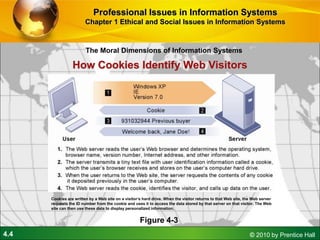
How Cookies Identify Web Visitors
Figure 4-3
Cookies are written by a Web site on a visitor’s hard drive. When the visitor returns to that Web site, the Web server
requests the ID number from the cookie and uses it to access the data stored by that server on that visitor. The Web
site can then use these data to display personalized information.
Professional Issues in Information Systems
Chapter 1 Ethical and Social Issues in Information Systems
4.5 © 2010 by Prentice Hall
• Technical solutions
• The Platform for Privacy Preferences (P3P)
• Allows Web sites to communicate privacy policies to
visitor’s Web browser – user
• User specifies privacy levels desired in browser settings
• E.g., “medium” level accepts cookies from first-party host
sites that have opt-in or opt-out policies but rejects third-
party cookies that use personally identifiable information
without an opt-in policy.
The Moral Dimensions of Information Systems
Professional Issues in Information Systems
Chapter 1 Ethical and Social Issues in Information Systems
4.6 © 2010 by Prentice Hall
• Property Rights: Intellectual Property
• Intellectual property: Intangible property of any kind
created by individuals or corporations
• Three ways that intellectual property is protected
• Trade secret: Intellectual work or product belonging to
business, not in the public domain
• Copyright: Statutory grant protecting intellectual property
from being copied for the life of the author, plus 70 years
• Patents: Grants creator of invention an exclusive monopoly
on ideas behind invention for 20 years
The Moral Dimensions of Information Systems
Professional Issues in Information Systems
Chapter 1 Ethical and Social Issues in Information Systems
4.7 © 2010 by Prentice Hall
• Challenges to Intellectual Property Rights
• Digital media different from physical media (e.g.
books)
• Ease of replication
• Ease of transmission (networks, Internet)
• Difficulty in classifying software
• Compactness
• Difficulties in establishing uniqueness
• Digital Millenium Copyright Act (DMCA)
• Makes it illegal to circumvent technology-based
protections of copyrighted materials
The Moral Dimensions of Information Systems
Professional Issues in Information Systems
Chapter 1 Ethical and Social Issues in Information Systems
4.8 © 2010 by Prentice Hall
• Accountability, Liability, Control
• Computer-related liability problems
• If software fails, who is responsible?
• If seen as a part of a machine that injures or harms,
software producer and operator may be liable
• If seen as similar to a book, difficult to hold software
author/publisher responsible
• What should liability be if software is seen as service?
Would this be similar to telephone systems not being liable
for transmitted messages (so-called “common carriers”)
The Moral Dimensions of Information Systems
Professional Issues in Information Systems
Chapter 1 Ethical and Social Issues in Information Systems
4.9 © 2010 by Prentice Hall
• System Quality: Data Quality and System
Errors
• What is an acceptable, technologically feasible level of
system quality?
• Flawless software is economically unfeasible
• Three principal sources of poor system performance:
• Software bugs, errors
• Hardware or facility failures
• Poor input data quality (most common source of business
system failure)
The Moral Dimensions of Information Systems
Professional Issues in Information Systems
Chapter 1 Ethical and Social Issues in Information Systems
4.10 © 2010 by Prentice Hall
• Quality of Life: Negative social consequences of
systems
• Balancing power: Although computing power is decentralizing,
key decision-making power remains centralized
• Rapidity of change: Businesses may not have enough time to
respond to global competition
• Maintaining boundaries: Computing and Internet use lengthens
the work-day, infringes on family, personal time
• Dependence and vulnerability: Public and private organizations
ever more dependent on computer systems
The Moral Dimensions of Information Systems
Professional Issues in Information Systems
Chapter 1 Ethical and Social Issues in Information Systems
4.11 © 2010 by Prentice Hall
• Computer crime and abuse
• Computer crime: Commission of illegal acts through use of
compute or against a computer system – computer may be
object or instrument of crime
• Computer abuse: Unethical acts, not illegal
• Spam: High costs for businesses in dealing with spam
• Employment: Reengineering work resulting in lost
jobs
The Moral Dimensions of Information Systems
Professional Issues in Information Systems
Chapter 1 Ethical and Social Issues in Information Systems
4.12 © 2010 by Prentice Hall
• Health risks:
• Repetitive stress injury (RSI)
• Largest source is computer keyboards
• Carpal Tunnel Syndrome (CTS)
• Computer vision syndrome (CVS)
• Technostress
• Role of radiation, screen emissions, low-level
electromagnetic fields
The Moral Dimensions of Information Systems
Professional Issues in Information Systems
Chapter 1 Ethical and Social Issues in Information Systems
4.13 © 2010 by Prentice Hall
End of Lecture
Professional Issues in Information Systems
Chapter 1 Ethical and Social Issues in Information Systems

CHAPTER 1 - PROFESSIONAL ISSUES (Lecture 1.2).ppt

  • 1.
    4.1 © 2010by Prentice Hall 1 Chapter Ethical and Social Issues in Information Systems
  • 2.
    4.2 © 2010by Prentice Hall • Information rights and obligations • Privacy • Claim of individuals to be left alone, free from surveillance or interference from other individuals, organizations, or the state. • Ability to control information about yourself • In U.S., privacy protected by: • First Amendment (freedom of speech) • Fourth Amendment (unreasonable search and seizure) • Additional federal statues • Privacy Act of 1974 The Moral Dimensions of Information Systems Professional Issues in Information Systems Chapter 1 Ethical and Social Issues in Information Systems
  • 3.
    4.3 © 2010by Prentice Hall • Internet Challenges to Privacy: • Cookies • Tiny files downloaded by Web site to visitor’s hard drive • Identify visitor’s browser and track visits to site • Allow Web sites to develop profiles on visitors • Web bugs • Tiny graphics embedded in e-mail messages and Web pages • Designed to monitor who is reading a message and transmitting that information to another computer on the Internet • Spyware • Surreptitiously installed on user’s computer • May transmit user’s keystrokes or display unwanted ads The Moral Dimensions of Information Systems Professional Issues in Information Systems Chapter 1 Ethical and Social Issues in Information Systems
  • 4.
    4.4 © 2010by Prentice Hall The Moral Dimensions of Information Systems How Cookies Identify Web Visitors Figure 4-3 Cookies are written by a Web site on a visitor’s hard drive. When the visitor returns to that Web site, the Web server requests the ID number from the cookie and uses it to access the data stored by that server on that visitor. The Web site can then use these data to display personalized information. Professional Issues in Information Systems Chapter 1 Ethical and Social Issues in Information Systems
  • 5.
    4.5 © 2010by Prentice Hall • Technical solutions • The Platform for Privacy Preferences (P3P) • Allows Web sites to communicate privacy policies to visitor’s Web browser – user • User specifies privacy levels desired in browser settings • E.g., “medium” level accepts cookies from first-party host sites that have opt-in or opt-out policies but rejects third- party cookies that use personally identifiable information without an opt-in policy. The Moral Dimensions of Information Systems Professional Issues in Information Systems Chapter 1 Ethical and Social Issues in Information Systems
  • 6.
    4.6 © 2010by Prentice Hall • Property Rights: Intellectual Property • Intellectual property: Intangible property of any kind created by individuals or corporations • Three ways that intellectual property is protected • Trade secret: Intellectual work or product belonging to business, not in the public domain • Copyright: Statutory grant protecting intellectual property from being copied for the life of the author, plus 70 years • Patents: Grants creator of invention an exclusive monopoly on ideas behind invention for 20 years The Moral Dimensions of Information Systems Professional Issues in Information Systems Chapter 1 Ethical and Social Issues in Information Systems
  • 7.
    4.7 © 2010by Prentice Hall • Challenges to Intellectual Property Rights • Digital media different from physical media (e.g. books) • Ease of replication • Ease of transmission (networks, Internet) • Difficulty in classifying software • Compactness • Difficulties in establishing uniqueness • Digital Millenium Copyright Act (DMCA) • Makes it illegal to circumvent technology-based protections of copyrighted materials The Moral Dimensions of Information Systems Professional Issues in Information Systems Chapter 1 Ethical and Social Issues in Information Systems
  • 8.
    4.8 © 2010by Prentice Hall • Accountability, Liability, Control • Computer-related liability problems • If software fails, who is responsible? • If seen as a part of a machine that injures or harms, software producer and operator may be liable • If seen as similar to a book, difficult to hold software author/publisher responsible • What should liability be if software is seen as service? Would this be similar to telephone systems not being liable for transmitted messages (so-called “common carriers”) The Moral Dimensions of Information Systems Professional Issues in Information Systems Chapter 1 Ethical and Social Issues in Information Systems
  • 9.
    4.9 © 2010by Prentice Hall • System Quality: Data Quality and System Errors • What is an acceptable, technologically feasible level of system quality? • Flawless software is economically unfeasible • Three principal sources of poor system performance: • Software bugs, errors • Hardware or facility failures • Poor input data quality (most common source of business system failure) The Moral Dimensions of Information Systems Professional Issues in Information Systems Chapter 1 Ethical and Social Issues in Information Systems
  • 10.
    4.10 © 2010by Prentice Hall • Quality of Life: Negative social consequences of systems • Balancing power: Although computing power is decentralizing, key decision-making power remains centralized • Rapidity of change: Businesses may not have enough time to respond to global competition • Maintaining boundaries: Computing and Internet use lengthens the work-day, infringes on family, personal time • Dependence and vulnerability: Public and private organizations ever more dependent on computer systems The Moral Dimensions of Information Systems Professional Issues in Information Systems Chapter 1 Ethical and Social Issues in Information Systems
  • 11.
    4.11 © 2010by Prentice Hall • Computer crime and abuse • Computer crime: Commission of illegal acts through use of compute or against a computer system – computer may be object or instrument of crime • Computer abuse: Unethical acts, not illegal • Spam: High costs for businesses in dealing with spam • Employment: Reengineering work resulting in lost jobs The Moral Dimensions of Information Systems Professional Issues in Information Systems Chapter 1 Ethical and Social Issues in Information Systems
  • 12.
    4.12 © 2010by Prentice Hall • Health risks: • Repetitive stress injury (RSI) • Largest source is computer keyboards • Carpal Tunnel Syndrome (CTS) • Computer vision syndrome (CVS) • Technostress • Role of radiation, screen emissions, low-level electromagnetic fields The Moral Dimensions of Information Systems Professional Issues in Information Systems Chapter 1 Ethical and Social Issues in Information Systems
  • 13.
    4.13 © 2010by Prentice Hall End of Lecture Professional Issues in Information Systems Chapter 1 Ethical and Social Issues in Information Systems