Heuristics Approaches for the Influence Maximization
Problem on Hypergraphs
Vincenzo Auletta, Francesco Cauteruccio and Diodato Ferraioli
Department of Information Engineering, Electrical Engineering and Applied Mathematics (DIEM)
University of Salerno, Italy
{auletta,fcauteruccio,dferraioli}@unisa.it
Context and Motivation
• Influence Maximization (IM)
• The aim is to find a set of nodes (seeds) in a given
network (e.g., a graph) that can maximize the spread of
information through the network under certain diffusion
processes
• Crucial for viral marketing, opinion formation, etc. [1,2]
• Higher-order Interactions
• Interactions that involve three or more entities
simultaneously
• Social systems, neuroscience, ecology, biology, etc. [3]
• Best modeled via hypergraphs [4]
• A hypergraph consists of nodes and hyperedges
• Hyperedge = subset of nodes
• What about IM on hypergraphs?
• Only a bunch of approaches in the last years [5,6]
Influence Maximization on Hypergraphs
• Given a hypergraph 𝐻 = 𝑉, 𝐸 , a value 𝑘 ∈ ℤ>0, and a diffusion process 𝜎𝐻
• Find a subset 𝑆∗
⊆ 𝑉 of 𝑘 nodes such that the expected number of infected
nodes is maximized:
𝑆∗
= 𝑎𝑟𝑔𝑚𝑎𝑥𝑆⊆𝑉, 𝑆 =𝑘𝜎𝐻(𝑆)
• Expected influence 𝜎𝐻 𝑆
• The number of reached nodes at the end of the process 𝜎𝐻 starting from the seed set 𝑆
• We consider the Suceptible-Infected (SI) model with Contact Process (CP) [6]
• A node can be either in a susceptible (S) or infected (I) state,
• An S-node can be infected by each of its neighbors in I-state with probability 𝛽
• The process iterates for 𝑇 > 0 steps
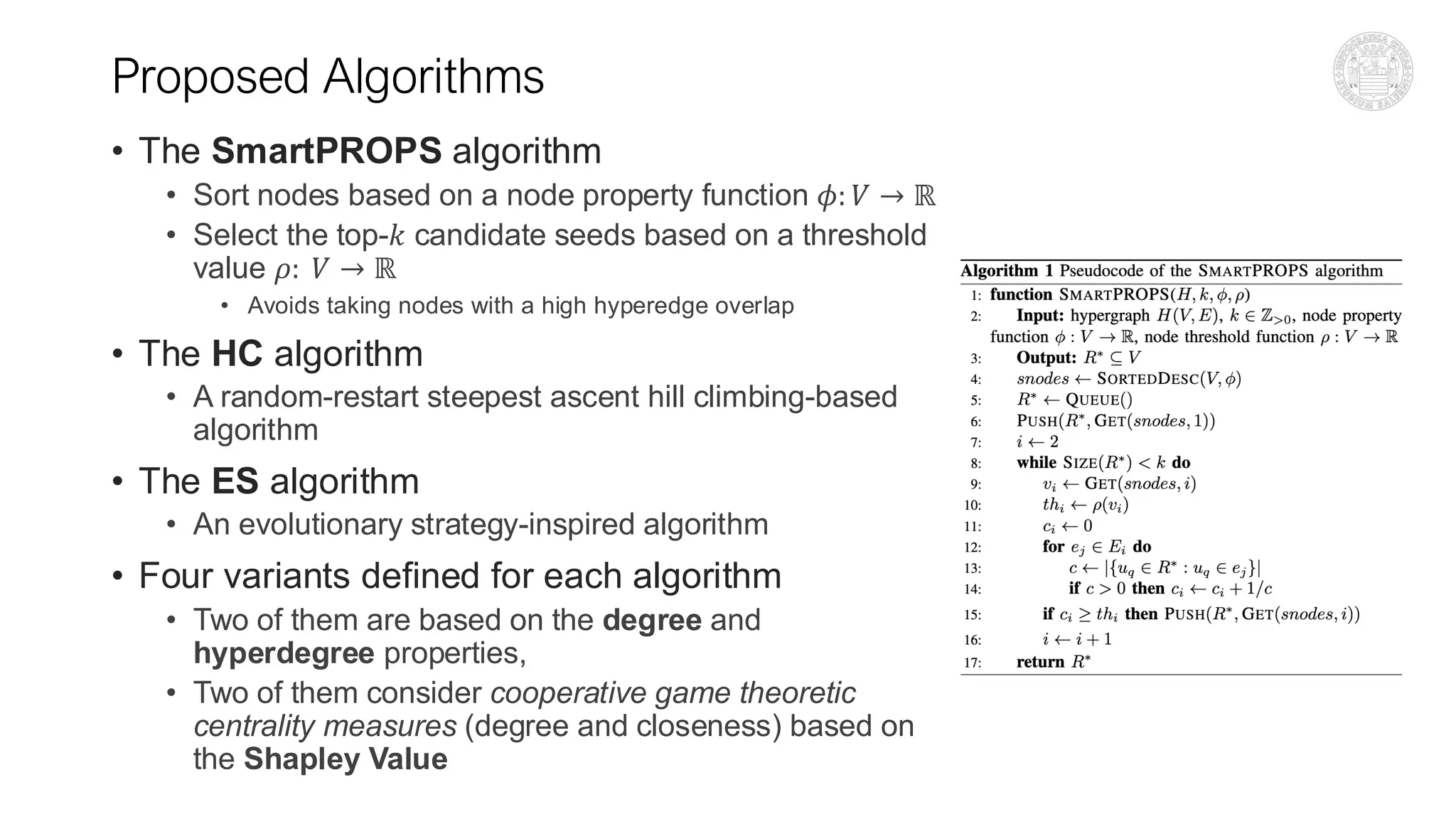
Proposed Algorithms
• The SmartPROPS algorithm
• Sort nodes based on a node property function 𝜙: 𝑉 → ℝ
• Select the top-𝑘 candidate seeds based on a threshold
value 𝜌: 𝑉 → ℝ
• Avoids taking nodes with a high hyperedge overlap
• The HC algorithm
• A random-restart steepest ascent hill climbing-based
algorithm
• The ES algorithm
• An evolutionary strategy-inspired algorithm
• Four variants defined for each algorithm
• Two of them are based on the degree and
hyperdegree properties,
• Two of them consider cooperative game theoretic
centrality measures (degree and closeness) based on
the Shapley Value
Results
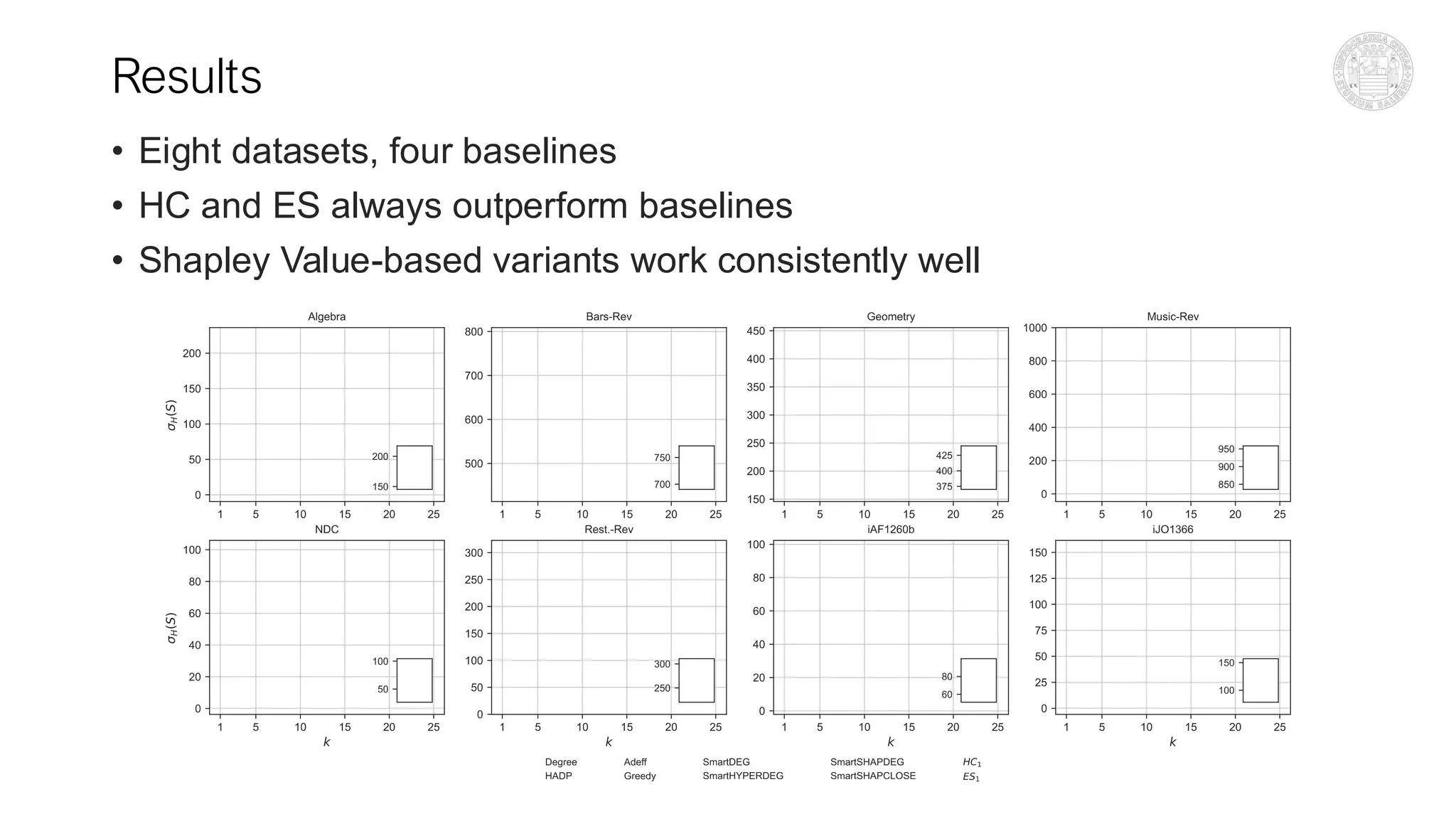
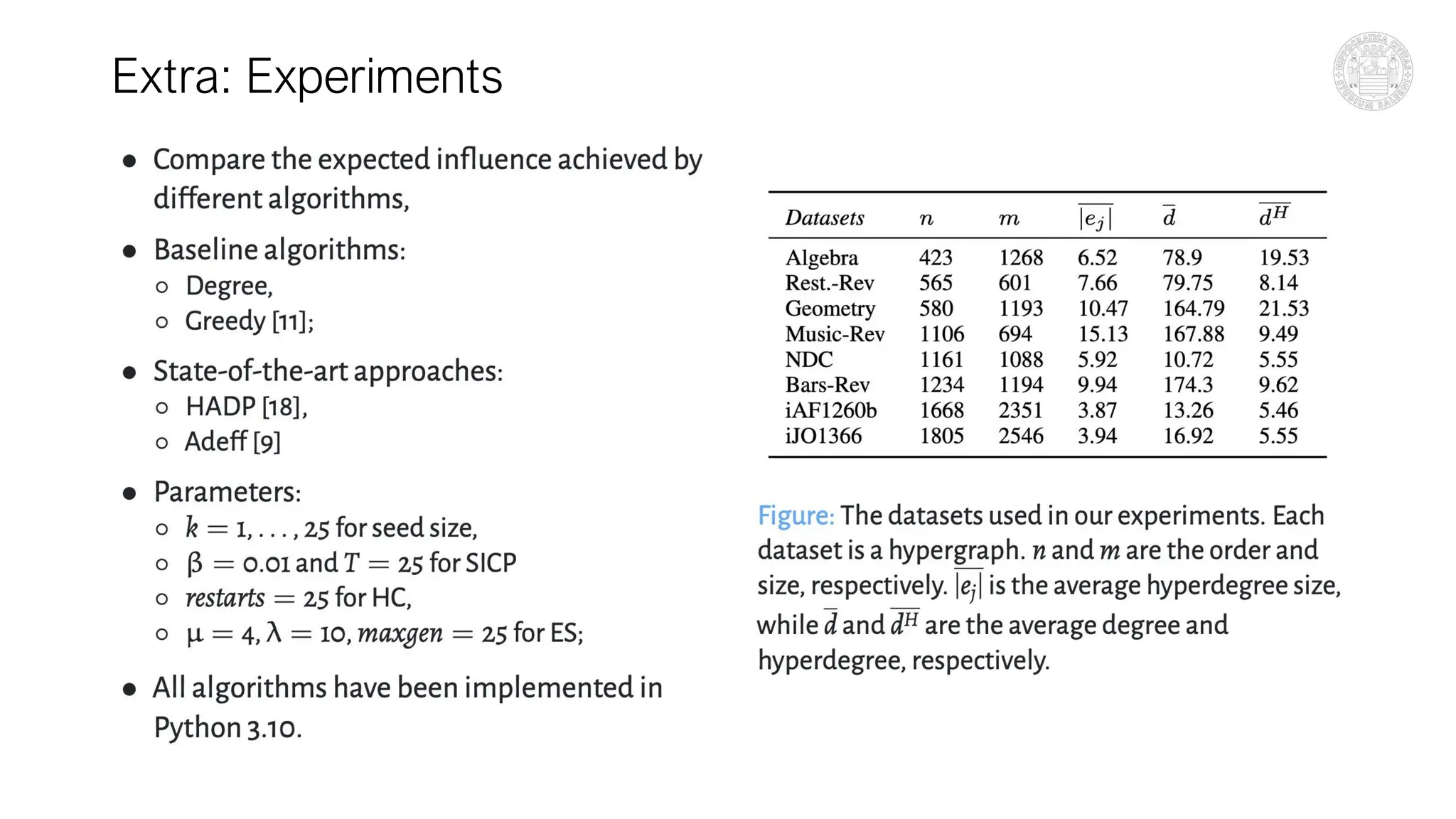
• Eight datasets, four baselines
• HC and ES always outperform baselines
• Shapley Value-based variants work consistently well
Conclusion
• We proposed two families of approaches for the IM problem on
hypergraphs
• Node properties-based approaches: SmartPROPS,
• Metaheuristics-based approaches: HC and ES
• All algorithms achieve solid performances and often outperform baselines
• Game-theoretic centrality measures are a very promising tool for addressing this
problem
• Future directions
• IM on temporal-evolving and large-scale hypergraphs
• IM variants on hypergraphs
Thanks for your attention!
These slides are available at https://bit.ly/imhg-aixia24
Francesco Cauteruccio
DIEM, University of Salerno
fcauteruccio@unisa.it
francescocauteruccio.info
Bibliography
[1] Kempe, D., Kleinberg, J., Tardos, E., 2003. Maximizing the spread of influence through a social network, in: KDD,
pp. 137–146
[2] Amoruso, M., Anello, D., Auletta, V., Cerulli, R., Ferraioli, D., Raiconi, A., 2020. Contrasting the spread of
misinformation in online social networks. Journal of Artificial Intelligence Research 69, 847–879. AI Access Foundation
[3] Battiston, F., Cencetti, G., Iacopini, I., Latora, V., Lucas, M., Patania, A., Young, J.G., Petri, G., 2020. Networks
beyond pairwise interactions: Structure and dynamics. Physics Reports 874, 1–92. Elsevier.
[4] Aksoy, S.G., Joslyn, C., Marrero, C.O., Praggastis, B., Purvine, E., 2020. Hypernetwork science via high-order
hypergraph walks. EPJ Data Science 9, 16. Springer.
[5] Xie, M., Zhan, X.X., Liu, C., Zhang, Z.K., 2023. An efficient adaptive degree-based heuristic algorithm for influence
maximization in hypergraphs. Information Processing & Management 60, 103161. Elsevier
[6] Gong, X., X., H.W., Wang, Chen, C., Zhang, W., Zhang, Y., 2024. Influence maximization on hypergraphs via multi-
hop influence estimation. Information Processing & Management 61, 103683. Elsevier
Extra: Experiments

Heuristics Approaches for the Influence Maximization Problem on Hypergraphs

  • 1.
    Heuristics Approaches forthe Influence Maximization Problem on Hypergraphs Vincenzo Auletta, Francesco Cauteruccio and Diodato Ferraioli Department of Information Engineering, Electrical Engineering and Applied Mathematics (DIEM) University of Salerno, Italy {auletta,fcauteruccio,dferraioli}@unisa.it
  • 2.
    Context and Motivation •Influence Maximization (IM) • The aim is to find a set of nodes (seeds) in a given network (e.g., a graph) that can maximize the spread of information through the network under certain diffusion processes • Crucial for viral marketing, opinion formation, etc. [1,2] • Higher-order Interactions • Interactions that involve three or more entities simultaneously • Social systems, neuroscience, ecology, biology, etc. [3] • Best modeled via hypergraphs [4] • A hypergraph consists of nodes and hyperedges • Hyperedge = subset of nodes • What about IM on hypergraphs? • Only a bunch of approaches in the last years [5,6]
  • 3.
    Influence Maximization onHypergraphs • Given a hypergraph 𝐻 = 𝑉, 𝐸 , a value 𝑘 ∈ ℤ>0, and a diffusion process 𝜎𝐻 • Find a subset 𝑆∗ ⊆ 𝑉 of 𝑘 nodes such that the expected number of infected nodes is maximized: 𝑆∗ = 𝑎𝑟𝑔𝑚𝑎𝑥𝑆⊆𝑉, 𝑆 =𝑘𝜎𝐻(𝑆) • Expected influence 𝜎𝐻 𝑆 • The number of reached nodes at the end of the process 𝜎𝐻 starting from the seed set 𝑆 • We consider the Suceptible-Infected (SI) model with Contact Process (CP) [6] • A node can be either in a susceptible (S) or infected (I) state, • An S-node can be infected by each of its neighbors in I-state with probability 𝛽 • The process iterates for 𝑇 > 0 steps
  • 4.
    Proposed Algorithms • TheSmartPROPS algorithm • Sort nodes based on a node property function 𝜙: 𝑉 → ℝ • Select the top-𝑘 candidate seeds based on a threshold value 𝜌: 𝑉 → ℝ • Avoids taking nodes with a high hyperedge overlap • The HC algorithm • A random-restart steepest ascent hill climbing-based algorithm • The ES algorithm • An evolutionary strategy-inspired algorithm • Four variants defined for each algorithm • Two of them are based on the degree and hyperdegree properties, • Two of them consider cooperative game theoretic centrality measures (degree and closeness) based on the Shapley Value
  • 5.
    Results • Eight datasets,four baselines • HC and ES always outperform baselines • Shapley Value-based variants work consistently well
  • 6.
    Conclusion • We proposedtwo families of approaches for the IM problem on hypergraphs • Node properties-based approaches: SmartPROPS, • Metaheuristics-based approaches: HC and ES • All algorithms achieve solid performances and often outperform baselines • Game-theoretic centrality measures are a very promising tool for addressing this problem • Future directions • IM on temporal-evolving and large-scale hypergraphs • IM variants on hypergraphs
  • 7.
    Thanks for yourattention! These slides are available at https://bit.ly/imhg-aixia24 Francesco Cauteruccio DIEM, University of Salerno fcauteruccio@unisa.it francescocauteruccio.info
  • 8.
    Bibliography [1] Kempe, D.,Kleinberg, J., Tardos, E., 2003. Maximizing the spread of influence through a social network, in: KDD, pp. 137–146 [2] Amoruso, M., Anello, D., Auletta, V., Cerulli, R., Ferraioli, D., Raiconi, A., 2020. Contrasting the spread of misinformation in online social networks. Journal of Artificial Intelligence Research 69, 847–879. AI Access Foundation [3] Battiston, F., Cencetti, G., Iacopini, I., Latora, V., Lucas, M., Patania, A., Young, J.G., Petri, G., 2020. Networks beyond pairwise interactions: Structure and dynamics. Physics Reports 874, 1–92. Elsevier. [4] Aksoy, S.G., Joslyn, C., Marrero, C.O., Praggastis, B., Purvine, E., 2020. Hypernetwork science via high-order hypergraph walks. EPJ Data Science 9, 16. Springer. [5] Xie, M., Zhan, X.X., Liu, C., Zhang, Z.K., 2023. An efficient adaptive degree-based heuristic algorithm for influence maximization in hypergraphs. Information Processing & Management 60, 103161. Elsevier [6] Gong, X., X., H.W., Wang, Chen, C., Zhang, W., Zhang, Y., 2024. Influence maximization on hypergraphs via multi- hop influence estimation. Information Processing & Management 61, 103683. Elsevier
  • 9.