Implementing a System-on-Chip using VHDL
Corrado Santoro
ARSLAB - Autonomous and Robotic Systems Laboratory
Dipartimento di Matematica e Informatica - Universit`a di Catania, Italy
santoro@dmi.unict.it
S.D.R. Course
Corrado Santoro A VHDL SoC
Our SoC is made of ...
A clock generator, we use the built-in 50 MHz clock
provided in the Altera DE0 board
A CPU, we will use a 32-bit RISC architecture (not
pipelined)
A ROM, where we will place (statically) our code
A Parallel I/O Port, 32-bit, connected to the 4-digit hex
display and to switches and pushbuttons
Corrado Santoro A VHDL SoC
Part I
CPU Architecture
Corrado Santoro A VHDL SoC
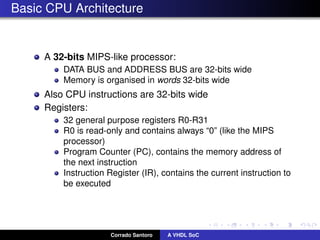
Basic CPU Architecture
A 32-bits MIPS-like processor:
DATA BUS and ADDRESS BUS are 32-bits wide
Memory is organised in words 32-bits wide
Also CPU instructions are 32-bits wide
Registers:
32 general purpose registers R0-R31
R0 is read-only and contains always “0” (like the MIPS
processor)
Program Counter (PC), contains the memory address of
the next instruction
Instruction Register (IR), contains the current instruction to
be executed
Corrado Santoro A VHDL SoC
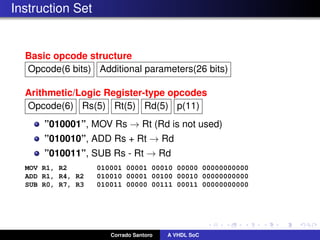
Instruction Set
Basic opcode structure
Opcode(6 bits) Additional parameters(26 bits)
Arithmetic/Logic Register-type opcodes
Opcode(6) Rs(5) Rt(5) Rd(5) p(11)
”010001”, MOV Rs → Rt (Rd is not used)
”010010”, ADD Rs + Rt → Rd
”010011”, SUB Rs - Rt → Rd
MOV R1, R2 010001 00001 00010 00000 00000000000
ADD R1, R4, R2 010010 00001 00100 00010 00000000000
SUB R0, R7, R3 010011 00000 00111 00011 00000000000
Corrado Santoro A VHDL SoC
Instruction Set
Immediate-type opcodes
Opcode(6) Rs(5) Rt(5) Immediate(16)
”001000”, ADD I Rs + Immediate → Rt
”001001”, SUB I Rs - Immediate → Rt
”000100”, BEQ, Jump to “Immediate” address if Rs = Rt
”000101”, BNE, Jump to “Immediate” address if Rs not = Rt
”100011”, LW, load word from location Rs + “Immediate” and store it into Rt
”100011”, SW, store word from Rt into location Rs + “Immediate”
ADD I R1, #5, R2 001000 00001 00010 0000000000000101
SUB I R0, #12, R7 001001 00000 00111 0000000000001100
Corrado Santoro A VHDL SoC
Instruction Set
Other instructions
Opcode(6 bits) parameter(26 bits)
”000000”, NOP
”010010”, JUMP, absolute jump to “parameter” address
”111111”, HALT
Corrado Santoro A VHDL SoC
Part II
Hardware Components
Corrado Santoro A VHDL SoC
CPU
clock, input, the main CPU clock
nRst, input, hardware RESET, active low
address bus, 32-bit, output
data bus, 32-bit, bidirectional
control bus:
nMemWr, output, active low when a memory write is executed
nMemRd, output, active low when a memory read is executed
nHalt, output, active low when the CPU is in the HALT state
Corrado Santoro A VHDL SoC
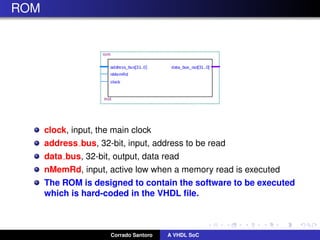
ROM
clock, input, the main clock
address bus, 32-bit, input, address to be read
data bus, 32-bit, output, data read
nMemRd, input, active low when a memory read is executed
The ROM is designed to contain the software to be executed
which is hard-coded in the VHDL file.
Corrado Santoro A VHDL SoC
Digital Output Port
clock, input, the main clock
nRst, input, RESET, active low
address bus, 32-bit, input, address to be written
data bus, 32-bit, bidirectional, data bus
nMemWr, input, active low when a memory write is executed
nMemRd, input, active low when a memory read is executed
data output, 32-bit, output, the data that has been written to the port
data input, 32-bit, input, the data that has been read from the port
The module reacts to memory address 0x8000
When a “store” instruction to address 0x8000 is executed, the written data
appears on data output pins.
When a “load” instruction from address 0x8000 is executed, the data
present on data input pins is read.
Corrado Santoro A VHDL SoC
Tri-state Outputs
Corrado Santoro A VHDL SoC
ROM Timings
ROM (and peripherals) synchronises on falling edge of the
clock
First the address to be read is set-up on the address bus (by the CPU)
Then the nMemRd signal is asserted (by the CPU)
At the next falling edge clock, the ROM recognises the nMemRd signal
and outputs, on the data bus, the word addressed (event “A”)
When the CPU has got the word from the data bus, the nMemRd signal is
de-asserted
At the next falling edge clock, the ROM recognises that nMemRd is no
more active and puts the data bus to high impedence (event “B”)
Corrado Santoro A VHDL SoC
The ROM in VHDL
§
library ieee;
...
entity rom is
port( data_bus_out: out std_logic_vector(31 downto 0);
address_bus: in std_logic_vector(31 downto 0);
nMemRd: in std_logic;
clock: in std_logic );
end rom;
architecture rom_arch of rom is
signal out_byte: std_logic_vector(31 downto 0);
begin
process(clock)
begin
if (clock’event and clock = ’0’) then -- falling edge
if nMemRd = ’0’ then
case address_bus is
when "00000000000000000000000000000000" => out_byte <= NOP;
when "00000000000000000000000000000001" => out_byte <= ADD_I & R0 & R1 & ...;
...
when others => out_byte <= HALT;
end case;
else
out_byte <= (others => ’Z’);
end if;
end if;
end process;
data_bus_out <= out_byte;
end architecture;
¦ ¥
Corrado Santoro A VHDL SoC
Parallel I/O Timings
Parallel Output Port synchronises on falling edge of the clock
First the CPU sets-up the address of the port (0x8000), on the address
bus, and the data to be written, on the data bus
Then the nMemWr signal is asserted (by the CPU)
At the next falling edge clock, the Port recognises the nMemWr signal and
copies data from the data bus to the output port (event “A”)
After some clock cycles the CPU de-asserts nMemWr signal
Corrado Santoro A VHDL SoC
The Parallel Output Port in VHDL
§
library ieee;
...
entity ParallelInOut is
port(address_bus: in std_logic_vector(31 downto 0);
data_bus: inout std_logic_vector(31 downto 0);
data_output : out std_logic_vector(31 downto 0);
data_input : in std_logic_vector(31 downto 0);
clock: in std_logic;
nMemWr: in std_logic;
nMemRd: in std_logic;
nRst: in std_logic );
end ParallelInOut;
architecture pInOut of ParallelInOut is
begin
process(clock,nRst)
begin
if nRst = ’0’ then
data_output = (others = ’1’);
data_bus = (others = ’Z’);
elsif (clock’event and clock = ’0’) then
if address_bus = x00008000 then -- address is 0x8000
if nMemWr = ’0’ then data_output = data_bus;
elsif nMemRd = ’0’ then data_bus = data_input;
else data_bus = (others = ’Z’);
end if;
end if;
end if;
end process;
end architecture;
¦ ¥
Corrado Santoro A VHDL SoC
Part III
The CPU in VHDL
Corrado Santoro A VHDL SoC
The CPU
It is implemented as a finite-state machine triggered by
the clock signal
While all peripherals react to falling edge of the clock, the
CPU reacts to rising edge
This is required to meet harware reaction times:
At the rising edge the CPU prepares the signals on
address/data/control bus to interact with a
peripheral/memory
At the (next) falling edge the peripheral/memory executes
the action on the basis of such prepared signals
States:
RESET: entered when nRst is ’0’
FETCH 0, FETCH 1: fetch phase, executed in two clock
cycles
EXEC: execute phase, with several sub-states on the basis
of the instruction of be executed
HALT: halt phase, the CPU is stopped
Corrado Santoro A VHDL SoC
The Fetch Phase
FETCH 0: The CPU (event “A”)
outputs the Program Counter to the Address Bus
puts the Data Bus to high impedence
asserts the nMemRd signal
sets the next state to FETCH 1
At the (next) falling edge the ROM (event “B”)
recognises the nMemRd signal
outputs the word data to the data bus
Corrado Santoro A VHDL SoC
The Fetch Phase
FETCH 1: The CPU (event “C”)
reads the word from the Data Bus and stores it into the
Instruction Register
de-asserts the nMemRd signal
sets the next state to EXEC
At the (next) falling edge the ROM (event “D”)
recognises de-activation of the nMemRd signal
puts the Data Bus in the high impedence state
Corrado Santoro A VHDL SoC
The CPU in VHDL (I)
§
library ieee;
...
entity CPU is
port(clock: in std_logic;
nRst: in std_logic;
data_bus: inout std_logic_vector(31 downto 0);
address_bus: out std_logic_vector(31 downto 0);
nMemRd: out std_logic;
nMemWr: out std_logic;
nHalt: out std_logic);
end CPU;
architecture my_CPU of CPU is
type state_type is (st_reset, st_fetch_0, st_fetch_1, st_exec, st_halt);
type sub_state_type is (exec_0, exec_1);
type register_array is array(0 to 7) of std_logic_vector(31 downto 0);
signal PC: std_logic_vector(31 downto 0) := (others = ’0’);
signal IR: std_logic_vector(31 downto 0) := (others = ’0’);
signal REGS: register_array;
signal state: state_type := st_halt;
signal sub_state: sub_state_type := exec_0;
begin
process(clock,nRst)
...
¦ ¥
Corrado Santoro A VHDL SoC
The CPU in VHDL (II)
§
...
process(clock,nRst)
variable op_code : std_logic_vector(5 downto 0);
variable rd, rs, rt : integer;
variable func : std_logic_vector(5 downto 0);
variable immediate_val : std_logic_vector(15 downto 0);
variable NextPC : std_logic_vector(31 downto 0);
begin
if (nRst = ’0’) then
state = st_reset;
elsif (clock’event and clock = ’1’) then -- rising edge
NextPC := PC + 1;
case state is
when st_reset = ... ;
when st_fetch_0 = ...;
when st_fetch_1 = ...;
when st_exec = ...;
when st_halt = ...;
end case;
if (state = st_exec and sub_state = exec_0) then
PC = NextPC;
end if;
end if;
end process;
end architecture;
¦ ¥
Corrado Santoro A VHDL SoC
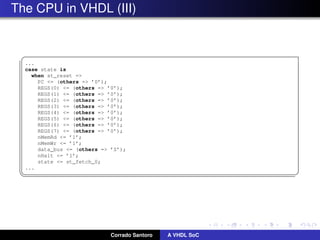
The CPU in VHDL (III)
§
...
case state is
when st_reset =
PC = (others = ’0’);
REGS(0) = (others = ’0’);
REGS(1) = (others = ’0’);
REGS(2) = (others = ’0’);
REGS(3) = (others = ’0’);
REGS(4) = (others = ’0’);
REGS(5) = (others = ’0’);
REGS(6) = (others = ’0’);
REGS(7) = (others = ’0’);
nMemRd = ’1’;
nMemWr = ’1’;
data_bus = (others = ’Z’);
nHalt = ’1’;
state = st_fetch_0;
...
¦ ¥
Corrado Santoro A VHDL SoC
The CPU in VHDL (IV)
§
...
case state is
...
when st_fetch_0 =
address_bus = PC;
nMemRd = ’0’;
state = st_fetch_1;
when st_fetch_1 =
IR = data_bus;
nMemRd = ’1’;
sub_state = exec_0;
state = st_exec;
...
¦ ¥
Corrado Santoro A VHDL SoC
The CPU in VHDL (V)
§
...
case state is
when st_exec =
if IR = NOP then
state = st_fetch_0;
else
op_code := IR(31 downto 26);
rs := conv_integer(IR(25 downto 21));
rt := conv_integer(IR(20 downto 16));
rd := conv_integer(IR(15 downto 11));
immediate_val := IR(15 downto 0);
func := IR(5 downto 0);
case op_code is
when MOV = ...;
when ADD = ...;
...
end case;
end if;
...
¦ ¥
Basic structure: Opcode(6 bits) Additional parameters(26 bits)
Arithmetic/Logic Register-type: Opcode(6) Rs(5) Rt(5) Rd(5) p(11)
Immediate-type: Opcode(6) Rs(5) Rt(5) Immediate(16)
Corrado Santoro A VHDL SoC
The CPU in VHDL (VI)
§
...
case op_code is
when MOV =
if rt /= 0 then -- do not write into R0
REGS(rt) = REGS(rs); -- move from rs to rt
end if;
state = st_fetch_0;
when ADD =
if rd /= 0 then -- do not write into R0
REGS(rd) = REGS(rs) + REGS(rt); -- add rs + rt into rd
end if;
state = st_fetch_0;
when SUBT =
if rd /= 0 then -- do not write into R0
REGS(rd) = REGS(rs) - REGS(rt); -- sub rs - rt into rd
end if;
state = st_fetch_0;
...
end case;
...
¦ ¥
Arithmetic/Logic Register-type: Opcode(6) Rs(5) Rt(5) Rd(5) p(11)
”010001”, MOV Rs → Rt (Rd is not used)
”010010”, ADD Rs + Rt → Rd
”010011”, SUB Rs - Rt → Rd
Corrado Santoro A VHDL SoC
The CPU in VHDL (VII)
§
...
op_code := IR(31 downto 26);
rs := conv_integer(IR(25 downto 21));
rt := conv_integer(IR(20 downto 16));
rd := conv_integer(IR(15 downto 11));
immediate_val := IR(15 downto 0);
func := IR(5 downto 0);
case op_code is
...
when ADD_I = -- Add Immediate
if rt /= 0 then
REGS(rt) = REGS(rs) + immediate_val;
end if;
state = st_fetch_0;
when JUMP = -- jump
NextPC := 000000  IR(25 downto 0);
state = st_fetch_0;
...
end case;
...
¦ ¥
Basic structure: Opcode(6 bits) Additional parameters(26 bits)
Immediate-type: Opcode(6) Rs(5) Rt(5) Immediate(16)
”001000”, ADD I Rs + Immediate → Rt
”010010”, JUMP, absolute jump to “parameter” address
Corrado Santoro A VHDL SoC
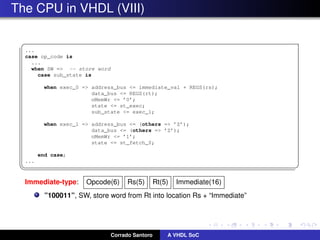
The CPU in VHDL (VIII)
§
...
case op_code is
...
when SW = -- store word
case sub_state is
when exec_0 = address_bus = immediate_val + REGS(rs);
data_bus = REGS(rt);
nMemWr = ’0’;
state = st_exec;
sub_state = exec_1;
when exec_1 = address_bus = (others = ’Z’);
data_bus = (others = ’Z’);
nMemWr = ’1’;
state = st_fetch_0;
end case;
...
¦ ¥
Immediate-type: Opcode(6) Rs(5) Rt(5) Immediate(16)
”100011”, SW, store word from Rt into location Rs + “Immediate”
Corrado Santoro A VHDL SoC
A simple “counter” program
§
0000 0000: NOP
0000 0001: ADD_I R0, R1, #1 ; R1 - R0 + 1, eqv to R1 - 1
0000 0002: SW R0, R1, #0x8000 ; MEM(R0 + 0x8000) - R1, eqv to MEM(0x8000) - R1
0000 0003: ADD_I R1, R1, #1 ; R1 - R1 + 1
0000 0004: JUMP #2 ; go to address #2
¦ ¥
§
architecture rom_arch of rom is
signal out_byte: std_logic_vector(31 downto 0);
begin
process(clock)
begin
if (clock’event and clock = ’0’) then -- falling edge
if nMemRd = ’0’ then
case address_bus is
when ..0000 = out_byte = NOP;
when ..0001 = out_byte = ADD_I  R0  R1  0000000000000001;
when ..0010 = out_byte = SW  R0  R1  1000000000000000;
when ..0011 = out_byte = ADD_I  R1  R1  0000000000000001;
when ..0100 = out_byte = JUMP  00000000000000000000000010;
when others = out_byte = HALT;
end case;
else
out_byte = (others = ’Z’);
end if;
end if;
end process;
data_bus_out = out_byte;
end architecture;
¦ ¥
Corrado Santoro A VHDL SoC
Reading Input and display data
§
0000 0000: LW R0, R1, #0x8000 ; R1 - MEM(R0 + 0x8000), eqv to R1 - MEM(0x8000)
0000 0001: SW R0, R1, #0x8000 ; MEM(R0 + 0x8000) - R1, eqv to MEM(0x8000) - R1
0000 0004: JUMP #0 ; go to address #0
¦ ¥
§
architecture rom_arch of rom is
signal out_byte: std_logic_vector(31 downto 0);
begin
process(clock)
begin
if (clock’event and clock = ’0’) then -- falling edge
if nMemRd = ’0’ then
case address_bus is
when ..00 = out_byte = LW  R0  R1  1000000000000000;
when ..01 = out_byte = SW  R0  R1  1000000000000000;
when ..10 = out_byte = JUMP  00000000000000000000000000;
when others = out_byte = (others = ’Z’);
end case;
else
out_byte = (others = ’Z’);
end if;
end if;
end process;
data_bus_out = out_byte;
end architecture;
¦ ¥
Corrado Santoro A VHDL SoC
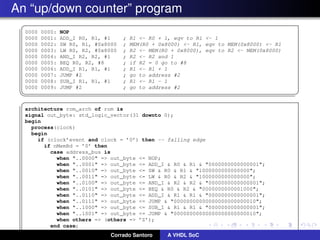
An “up/down counter” program
§
0000 0000: NOP
0000 0001: ADD_I R0, R1, #1 ; R1 - R0 + 1, eqv to R1 - 1
0000 0002: SW R0, R1, #0x8000 ; MEM(R0 + 0x8000) - R1, eqv to MEM(0x8000) - R1
0000 0003: LW R0, R2, #0x8000 ; R2 - MEM(R0 + 0x8000), eqv to R2 - MEM(0x8000)
0000 0004: AND_I R2, R2, #1 ; R2 - R2 and 1
0000 0005: BEQ R0, R2, #8 ; if R2 = 0 go to #8
0000 0006: ADD_I R1, R1, #1 ; R1 - R1 + 1
0000 0007: JUMP #2 ; go to address #2
0000 0008: SUB_I R1, R1, #1 ; R1 - R1 - 1
0000 0009: JUMP #2 ; go to address #2
¦ ¥
§
architecture rom_arch of rom is
signal out_byte: std_logic_vector(31 downto 0);
begin
process(clock)
begin
if (clock’event and clock = ’0’) then -- falling edge
if nMemRd = ’0’ then
case address_bus is
when ..0000 = out_byte = NOP;
when ..0001 = out_byte = ADD_I  R0  R1  0000000000000001;
when ..0010 = out_byte = SW  R0  R1  1000000000000000;
when ..0011 = out_byte = LW  R0  R2  1000000000000000;
when ..0100 = out_byte = AND_I  R2  R2  0000000000000001;
when ..0101 = out_byte = BEQ  R0  R2  0000000000001000;
when ..0110 = out_byte = ADD_I  R1  R1  0000000000000001;
when ..0111 = out_byte = JUMP  00000000000000000000000010;
when ..1000 = out_byte = SUB_I  R1  R1  0000000000000001;
when ..1001 = out_byte = JUMP  00000000000000000000000010;
when others = (others = ’Z’);
end case;
else
out_byte = (others = ’Z’);
Corrado Santoro A VHDL SoC
Implementing a System-on-Chip using VHDL
Corrado Santoro
ARSLAB - Autonomous and Robotic Systems Laboratory
Dipartimento di Matematica e Informatica - Universit`a di Catania, Italy
santoro@dmi.unict.it
S.D.R. Course
Corrado Santoro A VHDL SoC

Soc

  • 1.
    Implementing a System-on-Chipusing VHDL Corrado Santoro ARSLAB - Autonomous and Robotic Systems Laboratory Dipartimento di Matematica e Informatica - Universit`a di Catania, Italy santoro@dmi.unict.it S.D.R. Course Corrado Santoro A VHDL SoC
  • 2.
    Our SoC ismade of ... A clock generator, we use the built-in 50 MHz clock provided in the Altera DE0 board A CPU, we will use a 32-bit RISC architecture (not pipelined) A ROM, where we will place (statically) our code A Parallel I/O Port, 32-bit, connected to the 4-digit hex display and to switches and pushbuttons Corrado Santoro A VHDL SoC
  • 3.
  • 4.
    Basic CPU Architecture A32-bits MIPS-like processor: DATA BUS and ADDRESS BUS are 32-bits wide Memory is organised in words 32-bits wide Also CPU instructions are 32-bits wide Registers: 32 general purpose registers R0-R31 R0 is read-only and contains always “0” (like the MIPS processor) Program Counter (PC), contains the memory address of the next instruction Instruction Register (IR), contains the current instruction to be executed Corrado Santoro A VHDL SoC
  • 5.
    Instruction Set Basic opcodestructure Opcode(6 bits) Additional parameters(26 bits) Arithmetic/Logic Register-type opcodes Opcode(6) Rs(5) Rt(5) Rd(5) p(11) ”010001”, MOV Rs → Rt (Rd is not used) ”010010”, ADD Rs + Rt → Rd ”010011”, SUB Rs - Rt → Rd MOV R1, R2 010001 00001 00010 00000 00000000000 ADD R1, R4, R2 010010 00001 00100 00010 00000000000 SUB R0, R7, R3 010011 00000 00111 00011 00000000000 Corrado Santoro A VHDL SoC
  • 6.
    Instruction Set Immediate-type opcodes Opcode(6)Rs(5) Rt(5) Immediate(16) ”001000”, ADD I Rs + Immediate → Rt ”001001”, SUB I Rs - Immediate → Rt ”000100”, BEQ, Jump to “Immediate” address if Rs = Rt ”000101”, BNE, Jump to “Immediate” address if Rs not = Rt ”100011”, LW, load word from location Rs + “Immediate” and store it into Rt ”100011”, SW, store word from Rt into location Rs + “Immediate” ADD I R1, #5, R2 001000 00001 00010 0000000000000101 SUB I R0, #12, R7 001001 00000 00111 0000000000001100 Corrado Santoro A VHDL SoC
  • 7.
    Instruction Set Other instructions Opcode(6bits) parameter(26 bits) ”000000”, NOP ”010010”, JUMP, absolute jump to “parameter” address ”111111”, HALT Corrado Santoro A VHDL SoC
  • 8.
  • 9.
    CPU clock, input, themain CPU clock nRst, input, hardware RESET, active low address bus, 32-bit, output data bus, 32-bit, bidirectional control bus: nMemWr, output, active low when a memory write is executed nMemRd, output, active low when a memory read is executed nHalt, output, active low when the CPU is in the HALT state Corrado Santoro A VHDL SoC
  • 10.
    ROM clock, input, themain clock address bus, 32-bit, input, address to be read data bus, 32-bit, output, data read nMemRd, input, active low when a memory read is executed The ROM is designed to contain the software to be executed which is hard-coded in the VHDL file. Corrado Santoro A VHDL SoC
  • 11.
    Digital Output Port clock,input, the main clock nRst, input, RESET, active low address bus, 32-bit, input, address to be written data bus, 32-bit, bidirectional, data bus nMemWr, input, active low when a memory write is executed nMemRd, input, active low when a memory read is executed data output, 32-bit, output, the data that has been written to the port data input, 32-bit, input, the data that has been read from the port The module reacts to memory address 0x8000 When a “store” instruction to address 0x8000 is executed, the written data appears on data output pins. When a “load” instruction from address 0x8000 is executed, the data present on data input pins is read. Corrado Santoro A VHDL SoC
  • 12.
  • 13.
    ROM Timings ROM (andperipherals) synchronises on falling edge of the clock First the address to be read is set-up on the address bus (by the CPU) Then the nMemRd signal is asserted (by the CPU) At the next falling edge clock, the ROM recognises the nMemRd signal and outputs, on the data bus, the word addressed (event “A”) When the CPU has got the word from the data bus, the nMemRd signal is de-asserted At the next falling edge clock, the ROM recognises that nMemRd is no more active and puts the data bus to high impedence (event “B”) Corrado Santoro A VHDL SoC
  • 14.
    The ROM inVHDL § library ieee; ... entity rom is port( data_bus_out: out std_logic_vector(31 downto 0); address_bus: in std_logic_vector(31 downto 0); nMemRd: in std_logic; clock: in std_logic ); end rom; architecture rom_arch of rom is signal out_byte: std_logic_vector(31 downto 0); begin process(clock) begin if (clock’event and clock = ’0’) then -- falling edge if nMemRd = ’0’ then case address_bus is when "00000000000000000000000000000000" => out_byte <= NOP; when "00000000000000000000000000000001" => out_byte <= ADD_I & R0 & R1 & ...; ... when others => out_byte <= HALT; end case; else out_byte <= (others => ’Z’); end if; end if; end process; data_bus_out <= out_byte; end architecture; ¦ ¥ Corrado Santoro A VHDL SoC
  • 15.
    Parallel I/O Timings ParallelOutput Port synchronises on falling edge of the clock First the CPU sets-up the address of the port (0x8000), on the address bus, and the data to be written, on the data bus Then the nMemWr signal is asserted (by the CPU) At the next falling edge clock, the Port recognises the nMemWr signal and copies data from the data bus to the output port (event “A”) After some clock cycles the CPU de-asserts nMemWr signal Corrado Santoro A VHDL SoC
  • 16.
    The Parallel OutputPort in VHDL § library ieee; ... entity ParallelInOut is port(address_bus: in std_logic_vector(31 downto 0); data_bus: inout std_logic_vector(31 downto 0); data_output : out std_logic_vector(31 downto 0); data_input : in std_logic_vector(31 downto 0); clock: in std_logic; nMemWr: in std_logic; nMemRd: in std_logic; nRst: in std_logic ); end ParallelInOut; architecture pInOut of ParallelInOut is begin process(clock,nRst) begin if nRst = ’0’ then data_output = (others = ’1’); data_bus = (others = ’Z’); elsif (clock’event and clock = ’0’) then if address_bus = x00008000 then -- address is 0x8000 if nMemWr = ’0’ then data_output = data_bus; elsif nMemRd = ’0’ then data_bus = data_input; else data_bus = (others = ’Z’); end if; end if; end if; end process; end architecture; ¦ ¥ Corrado Santoro A VHDL SoC
  • 17.
    Part III The CPUin VHDL Corrado Santoro A VHDL SoC
  • 18.
    The CPU It isimplemented as a finite-state machine triggered by the clock signal While all peripherals react to falling edge of the clock, the CPU reacts to rising edge This is required to meet harware reaction times: At the rising edge the CPU prepares the signals on address/data/control bus to interact with a peripheral/memory At the (next) falling edge the peripheral/memory executes the action on the basis of such prepared signals States: RESET: entered when nRst is ’0’ FETCH 0, FETCH 1: fetch phase, executed in two clock cycles EXEC: execute phase, with several sub-states on the basis of the instruction of be executed HALT: halt phase, the CPU is stopped Corrado Santoro A VHDL SoC
  • 19.
    The Fetch Phase FETCH0: The CPU (event “A”) outputs the Program Counter to the Address Bus puts the Data Bus to high impedence asserts the nMemRd signal sets the next state to FETCH 1 At the (next) falling edge the ROM (event “B”) recognises the nMemRd signal outputs the word data to the data bus Corrado Santoro A VHDL SoC
  • 20.
    The Fetch Phase FETCH1: The CPU (event “C”) reads the word from the Data Bus and stores it into the Instruction Register de-asserts the nMemRd signal sets the next state to EXEC At the (next) falling edge the ROM (event “D”) recognises de-activation of the nMemRd signal puts the Data Bus in the high impedence state Corrado Santoro A VHDL SoC
  • 21.
    The CPU inVHDL (I) § library ieee; ... entity CPU is port(clock: in std_logic; nRst: in std_logic; data_bus: inout std_logic_vector(31 downto 0); address_bus: out std_logic_vector(31 downto 0); nMemRd: out std_logic; nMemWr: out std_logic; nHalt: out std_logic); end CPU; architecture my_CPU of CPU is type state_type is (st_reset, st_fetch_0, st_fetch_1, st_exec, st_halt); type sub_state_type is (exec_0, exec_1); type register_array is array(0 to 7) of std_logic_vector(31 downto 0); signal PC: std_logic_vector(31 downto 0) := (others = ’0’); signal IR: std_logic_vector(31 downto 0) := (others = ’0’); signal REGS: register_array; signal state: state_type := st_halt; signal sub_state: sub_state_type := exec_0; begin process(clock,nRst) ... ¦ ¥ Corrado Santoro A VHDL SoC
  • 22.
    The CPU inVHDL (II) § ... process(clock,nRst) variable op_code : std_logic_vector(5 downto 0); variable rd, rs, rt : integer; variable func : std_logic_vector(5 downto 0); variable immediate_val : std_logic_vector(15 downto 0); variable NextPC : std_logic_vector(31 downto 0); begin if (nRst = ’0’) then state = st_reset; elsif (clock’event and clock = ’1’) then -- rising edge NextPC := PC + 1; case state is when st_reset = ... ; when st_fetch_0 = ...; when st_fetch_1 = ...; when st_exec = ...; when st_halt = ...; end case; if (state = st_exec and sub_state = exec_0) then PC = NextPC; end if; end if; end process; end architecture; ¦ ¥ Corrado Santoro A VHDL SoC
  • 23.
    The CPU inVHDL (III) § ... case state is when st_reset = PC = (others = ’0’); REGS(0) = (others = ’0’); REGS(1) = (others = ’0’); REGS(2) = (others = ’0’); REGS(3) = (others = ’0’); REGS(4) = (others = ’0’); REGS(5) = (others = ’0’); REGS(6) = (others = ’0’); REGS(7) = (others = ’0’); nMemRd = ’1’; nMemWr = ’1’; data_bus = (others = ’Z’); nHalt = ’1’; state = st_fetch_0; ... ¦ ¥ Corrado Santoro A VHDL SoC
  • 24.
    The CPU inVHDL (IV) § ... case state is ... when st_fetch_0 = address_bus = PC; nMemRd = ’0’; state = st_fetch_1; when st_fetch_1 = IR = data_bus; nMemRd = ’1’; sub_state = exec_0; state = st_exec; ... ¦ ¥ Corrado Santoro A VHDL SoC
  • 25.
    The CPU inVHDL (V) § ... case state is when st_exec = if IR = NOP then state = st_fetch_0; else op_code := IR(31 downto 26); rs := conv_integer(IR(25 downto 21)); rt := conv_integer(IR(20 downto 16)); rd := conv_integer(IR(15 downto 11)); immediate_val := IR(15 downto 0); func := IR(5 downto 0); case op_code is when MOV = ...; when ADD = ...; ... end case; end if; ... ¦ ¥ Basic structure: Opcode(6 bits) Additional parameters(26 bits) Arithmetic/Logic Register-type: Opcode(6) Rs(5) Rt(5) Rd(5) p(11) Immediate-type: Opcode(6) Rs(5) Rt(5) Immediate(16) Corrado Santoro A VHDL SoC
  • 26.
    The CPU inVHDL (VI) § ... case op_code is when MOV = if rt /= 0 then -- do not write into R0 REGS(rt) = REGS(rs); -- move from rs to rt end if; state = st_fetch_0; when ADD = if rd /= 0 then -- do not write into R0 REGS(rd) = REGS(rs) + REGS(rt); -- add rs + rt into rd end if; state = st_fetch_0; when SUBT = if rd /= 0 then -- do not write into R0 REGS(rd) = REGS(rs) - REGS(rt); -- sub rs - rt into rd end if; state = st_fetch_0; ... end case; ... ¦ ¥ Arithmetic/Logic Register-type: Opcode(6) Rs(5) Rt(5) Rd(5) p(11) ”010001”, MOV Rs → Rt (Rd is not used) ”010010”, ADD Rs + Rt → Rd ”010011”, SUB Rs - Rt → Rd Corrado Santoro A VHDL SoC
  • 27.
    The CPU inVHDL (VII) § ... op_code := IR(31 downto 26); rs := conv_integer(IR(25 downto 21)); rt := conv_integer(IR(20 downto 16)); rd := conv_integer(IR(15 downto 11)); immediate_val := IR(15 downto 0); func := IR(5 downto 0); case op_code is ... when ADD_I = -- Add Immediate if rt /= 0 then REGS(rt) = REGS(rs) + immediate_val; end if; state = st_fetch_0; when JUMP = -- jump NextPC := 000000 IR(25 downto 0); state = st_fetch_0; ... end case; ... ¦ ¥ Basic structure: Opcode(6 bits) Additional parameters(26 bits) Immediate-type: Opcode(6) Rs(5) Rt(5) Immediate(16) ”001000”, ADD I Rs + Immediate → Rt ”010010”, JUMP, absolute jump to “parameter” address Corrado Santoro A VHDL SoC
  • 28.
    The CPU inVHDL (VIII) § ... case op_code is ... when SW = -- store word case sub_state is when exec_0 = address_bus = immediate_val + REGS(rs); data_bus = REGS(rt); nMemWr = ’0’; state = st_exec; sub_state = exec_1; when exec_1 = address_bus = (others = ’Z’); data_bus = (others = ’Z’); nMemWr = ’1’; state = st_fetch_0; end case; ... ¦ ¥ Immediate-type: Opcode(6) Rs(5) Rt(5) Immediate(16) ”100011”, SW, store word from Rt into location Rs + “Immediate” Corrado Santoro A VHDL SoC
  • 29.
    A simple “counter”program § 0000 0000: NOP 0000 0001: ADD_I R0, R1, #1 ; R1 - R0 + 1, eqv to R1 - 1 0000 0002: SW R0, R1, #0x8000 ; MEM(R0 + 0x8000) - R1, eqv to MEM(0x8000) - R1 0000 0003: ADD_I R1, R1, #1 ; R1 - R1 + 1 0000 0004: JUMP #2 ; go to address #2 ¦ ¥ § architecture rom_arch of rom is signal out_byte: std_logic_vector(31 downto 0); begin process(clock) begin if (clock’event and clock = ’0’) then -- falling edge if nMemRd = ’0’ then case address_bus is when ..0000 = out_byte = NOP; when ..0001 = out_byte = ADD_I R0 R1 0000000000000001; when ..0010 = out_byte = SW R0 R1 1000000000000000; when ..0011 = out_byte = ADD_I R1 R1 0000000000000001; when ..0100 = out_byte = JUMP 00000000000000000000000010; when others = out_byte = HALT; end case; else out_byte = (others = ’Z’); end if; end if; end process; data_bus_out = out_byte; end architecture; ¦ ¥ Corrado Santoro A VHDL SoC
  • 30.
    Reading Input anddisplay data § 0000 0000: LW R0, R1, #0x8000 ; R1 - MEM(R0 + 0x8000), eqv to R1 - MEM(0x8000) 0000 0001: SW R0, R1, #0x8000 ; MEM(R0 + 0x8000) - R1, eqv to MEM(0x8000) - R1 0000 0004: JUMP #0 ; go to address #0 ¦ ¥ § architecture rom_arch of rom is signal out_byte: std_logic_vector(31 downto 0); begin process(clock) begin if (clock’event and clock = ’0’) then -- falling edge if nMemRd = ’0’ then case address_bus is when ..00 = out_byte = LW R0 R1 1000000000000000; when ..01 = out_byte = SW R0 R1 1000000000000000; when ..10 = out_byte = JUMP 00000000000000000000000000; when others = out_byte = (others = ’Z’); end case; else out_byte = (others = ’Z’); end if; end if; end process; data_bus_out = out_byte; end architecture; ¦ ¥ Corrado Santoro A VHDL SoC
  • 31.
    An “up/down counter”program § 0000 0000: NOP 0000 0001: ADD_I R0, R1, #1 ; R1 - R0 + 1, eqv to R1 - 1 0000 0002: SW R0, R1, #0x8000 ; MEM(R0 + 0x8000) - R1, eqv to MEM(0x8000) - R1 0000 0003: LW R0, R2, #0x8000 ; R2 - MEM(R0 + 0x8000), eqv to R2 - MEM(0x8000) 0000 0004: AND_I R2, R2, #1 ; R2 - R2 and 1 0000 0005: BEQ R0, R2, #8 ; if R2 = 0 go to #8 0000 0006: ADD_I R1, R1, #1 ; R1 - R1 + 1 0000 0007: JUMP #2 ; go to address #2 0000 0008: SUB_I R1, R1, #1 ; R1 - R1 - 1 0000 0009: JUMP #2 ; go to address #2 ¦ ¥ § architecture rom_arch of rom is signal out_byte: std_logic_vector(31 downto 0); begin process(clock) begin if (clock’event and clock = ’0’) then -- falling edge if nMemRd = ’0’ then case address_bus is when ..0000 = out_byte = NOP; when ..0001 = out_byte = ADD_I R0 R1 0000000000000001; when ..0010 = out_byte = SW R0 R1 1000000000000000; when ..0011 = out_byte = LW R0 R2 1000000000000000; when ..0100 = out_byte = AND_I R2 R2 0000000000000001; when ..0101 = out_byte = BEQ R0 R2 0000000000001000; when ..0110 = out_byte = ADD_I R1 R1 0000000000000001; when ..0111 = out_byte = JUMP 00000000000000000000000010; when ..1000 = out_byte = SUB_I R1 R1 0000000000000001; when ..1001 = out_byte = JUMP 00000000000000000000000010; when others = (others = ’Z’); end case; else out_byte = (others = ’Z’); Corrado Santoro A VHDL SoC
  • 32.
    Implementing a System-on-Chipusing VHDL Corrado Santoro ARSLAB - Autonomous and Robotic Systems Laboratory Dipartimento di Matematica e Informatica - Universit`a di Catania, Italy santoro@dmi.unict.it S.D.R. Course Corrado Santoro A VHDL SoC