
Web-Oriented
Architecture
   (WOA)
Introduction
Dion Hinchcliffe
  • ZDNet’s Enterprise Web 2.0
      – http://blogs.zdnet.com/Hinchcliffe
  • Social Computing Magazine – Editor-in-Chief
      – http://socialcomputingmagazine.com
  • Enterprise 2.0 TV Show
      – http://e2tvshow.com

  • Hinchcliffe & Company
      – http://hinchcliffeandco.com
      – mailto:dion@hinchcliffeandco.com
  • Web 2.0 University
     – http://web20university.com
  • TWITTER: DHINCHCLIFFE
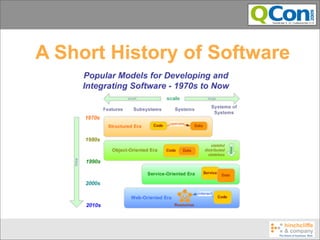
A Short History of Software
An issue of complexity
• Developers have resolved most
  architectural issues historically by:
  – Choosing the right data structures;
  – Identifying or creating algorithms, and;
  – By applying the concept of separation of
    concerns.
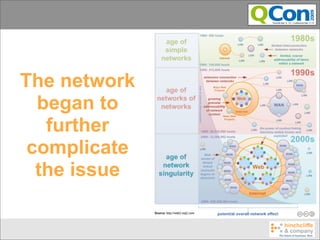
The network
  began to
   further
 complicate
  the issue
Integration has become a
  dominant, top-level activity
• “Research has shown that more than
  30 percent of IT spending is on
  integration” – Bitpipe
• “Integration consumes more than 40%
  of IT resources” – Aberdeen Group
  report
• “Software integration is up to 60% of
  enterprise software projects.” - Oracle
SOA Definition
• SOA is a modular software architecture, and
  the modules are services designed to interact
  with each other.
  – Important Note: SOA also contains higher order
    constructs such as composite applications,
    orchestration, coordination, and more exist.
• SOAs are usually based on open standards to
  encourage automatic interoperability of
  services designed separately.
A Central Goal of SOA:
     Turning Applications Into Open
               Platforms
•   Openly exposing the features of software and data to customers,
    end-users, partners, and suppliers for reuse and remixing
•   This strategy requires documenting, encouraging, and actively
    supporting the application as a platform
    – Has serious governance implications
•   Provide legal, technical, and business reasons to enable this :
    – Fair licensing, pricing, & support models
    – A vast array of services that provide data that uses need
    – A way to apply these services to business problems rapidly and
      inexpensively.
But existing SOA models
        have been challenged
• Most SOA initiatives are delivering low ROI to the
  business
• The reasons are many but boil down to:
    – SOA technologies have proven to have challenges compared to
      more successful models.
    – Top-down enterprise architecture moves slower than the
      environment changes.
    – Important avenues of SOA consumption and production points
      were often excluded from participation.
•   SOA is still, however, the dominant organizing model for enterprise
    architecture.
Key trends on the Web today
•   The growth of networked services
    with highly valuable open and
    “portable” data .
•   Users by the tens of millions putting
    modular Web parts on their blogs
    and user profiles to host the pieces
    of the Web that they want to share.
•   Businesses connecting to each other
    over the Internet via Web services by
    the hundreds of thousands.
•   The increasing realization that there
    is limited business value in single
    applications…
The Openness of 2.0 Apps
•       Building open platforms instead of stand-alone
        applications
•       Forming self-distributing ecosystems
•       Spreading products far beyond the boundaries of a site
    •     APIs, widgets, badges, syndication -> mashups
•       In other words: Being everywhere else on the network
•       Building on the shoulder of giants
•       Offering and consuming widgets, libraries, and APIs
•       The automated mass servicing of markets of low
        demand content and functionality (The Long Tail)
    •     Which represents the bulk of the demand
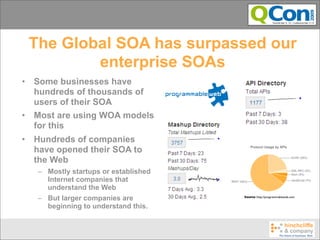
The Global SOA has surpassed our
            enterprise SOAs
•   Some businesses have
    hundreds of thousands of
    users of their SOA
•   Most are using WOA models
    for this
•   Hundreds of companies
    have opened their SOA to
    the Web
     – Mostly startups or established
       Internet companies that
       understand the Web
     – But larger companies are
       beginning to understand this.
Examples
•   Amazon and their highly successful Web Services Division
    (with hundreds of thousands of business consumers of their
    global SOA)
     – Over $300 million in revenue last year
•   Google and its numerous and varied open Web APIs from
    Google Maps to Open Social
•   eBay and billions of dollars in listings it generates through its
    public SOA
•   Applications like Twitter.com
     –   Gets 10 times the use through its APIs than from its user interface.
     –   A new generation of applications that are primarily used via their Global SOA presence.
•   Netflixprize.com, Gold Corp, and many others
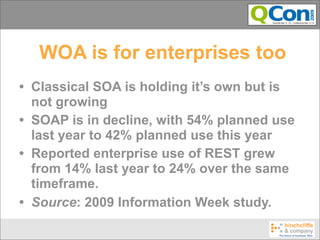
WOA is for enterprises too
• Classical SOA is holding it’s own but is
  not growing
• SOAP is in decline, with 54% planned use
  last year to 42% planned use this year
• Reported enterprise use of REST grew
  from 14% last year to 24% over the same
  timeframe.
• Source: 2009 Information Week study.
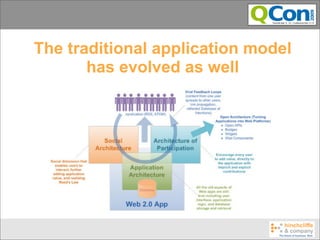
The traditional application model
       has evolved as well
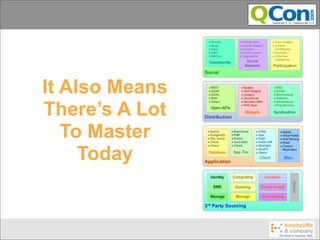
It Also Means
There’s A Lot
   To Master
     Today
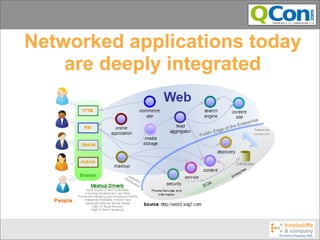
Networked applications today
    are deeply integrated
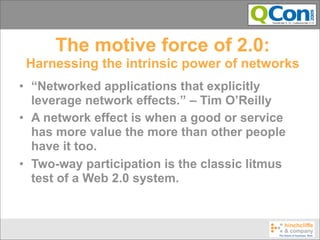
The motive force of 2.0:
 Harnessing the intrinsic power of networks
• “Networked applications that explicitly
  leverage network effects.” – Tim O’Reilly
• A network effect is when a good or service
  has more value the more than other people
  have it too.
• Two-way participation is the classic litmus
  test of a Web 2.0 system.
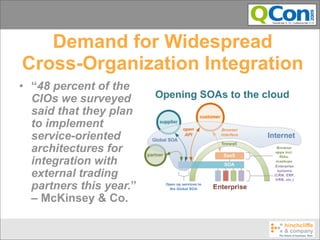
Demand for Widespread
Cross-Organization Integration
• “48 percent of the
  CIOs we surveyed
  said that they plan
  to implement
  service-oriented
  architectures for
  integration with
  external trading
  partners this year.”
  – McKinsey & Co.
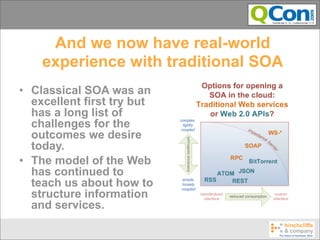
And we now have real-world
    experience with traditional SOA
• Classical SOA was an
  excellent first try but
  has a long list of
  challenges for the
  outcomes we desire
  today.
• The model of the Web
  has continued to
  teach us about how to
  structure information
  and services.
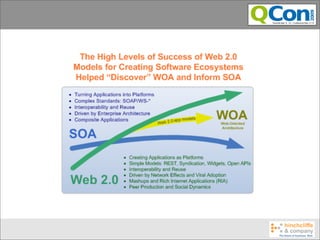
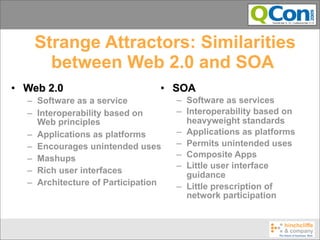
Strange Attractors: Similarities
      between Web 2.0 and SOA
• Web 2.0                       • SOA
  – Software as a service           – Software as services
  – Interoperability based on       – Interoperability based on
    Web principles                    heavyweight standards
  – Applications as platforms       – Applications as platforms
  – Encourages unintended uses      – Permits unintended uses
  – Mashups                         – Composite Apps
                                    – Little user interface
  – Rich user interfaces              guidance
  – Architecture of Participation   – Little prescription of
                                      network participation
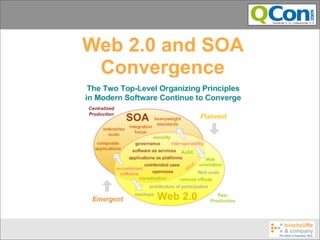
Web 2.0 and SOA
 Convergence
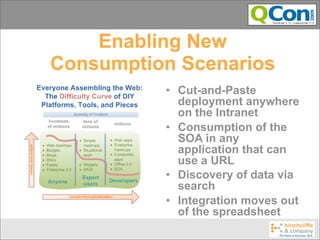
Enabling New
Consumption Scenarios
          • Cut-and-Paste
            deployment anywhere
            on the Intranet
          • Consumption of the
            SOA in any
            application that can
            use a URL
          • Discovery of data via
            search
          • Integration moves out
            of the spreadsheet
Next Generation Enterprises
    Are Leveraging Web 2.0
• A change in the way the Web is being used
• Innovative new customer interactions that
  shifts most control to users (partners,
  suppliers)
  – Control over software, data, structure, and
    processes
• Pervasive, viral, social and technical activities
  that embrace the intrinsic power of networks
• Driven by a move from push to pull-based
  systems
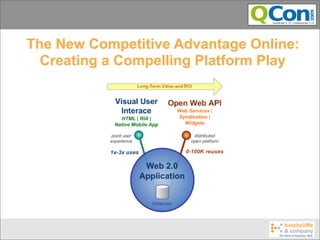
The New Competitive Advantage Online:
  Creating a Compelling Platform Play
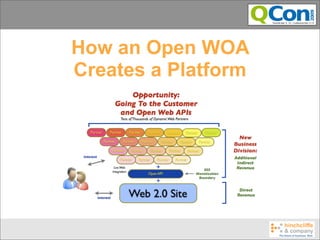
How an Open WOA
Creates a Platform
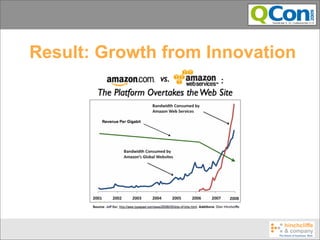
Result: Growth from Innovation
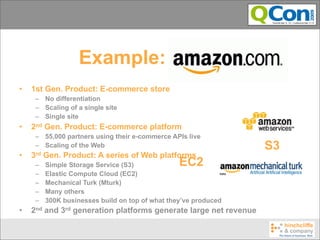
Example: Amazon
•   1st Gen. Product: E-commerce store
     – No differentiation
     – Scaling of a single site
     – Single site
•   2nd Gen. Product: E-commerce platform
     – 55,000 partners using their e-commerce APIs live
     – Scaling of the Web                                         S3
•   3rd   Gen. Product: A series of Web platforms
     –    Simple Storage Service (S3)             EC2
     –    Elastic Compute Cloud (EC2)
     –    Mechanical Turk (Mturk)
     –    Many others
     –    300K businesses build on top of what they’ve produced
•   2nd and 3rd generation platforms generate large net revenue
The New Philosophy of
     Product Distribution
• Jakob's Law states that "users
  spend most of their time using
  other people’s sites."
• You must design your products
  and services to leverage this fact
  deeply in the core of their design.
What is WOA?
The Structure of the Web
• HTTP is the foundational protocol
• When HTTP is used to transport
  hypertext, it can use links to refer to
  other parts of the Web
• These links are defined, like HTTP, by a
  standard and are known formally as
  URIs:
  – http://tools.ietf.org/html/rfc3986
URIs according to w3.org
• Uniform Resource Identifiers (URIs, aka URLs)
  are short strings that identify resources in the
  Web:
  – documents, images, downloadable files, services,
    electronic mailboxes, and other resources.
• They make resources available under a variety
  of naming schemes and access methods such
  as HTTP, FTP, and Internet mail addressable in
  the same simple way. They reduce the tedium
  of "log in to this server, then issue this magic
  command ..." down to a single click.
The Short Version

HTTP + URIs = Web
The use of HTTP has evolved
        extensively…
• There is no limit to the kind of data that can be
  transferred via HTTP
   – HTTP was originally used for transferring Web pages, images,
     and other simple resources
   – But now it’s used to transfer pages, data, programs, video
     streams, and virtually everything else
• There is no limit to the amount of data that can be
  transferred via HTTP
   – Server-side push of HTTP data is now possible by technique
• Has proven to be highly secure and scale to global use
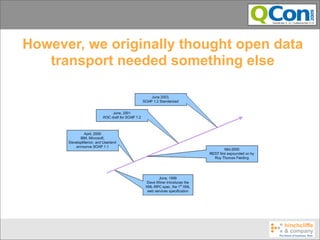
However, we originally thought open data
   transport needed something else
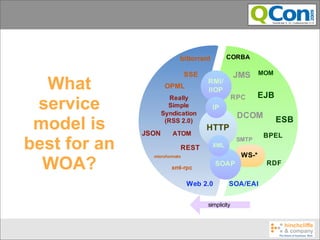
What
 service
 model is
best for an
  WOA?
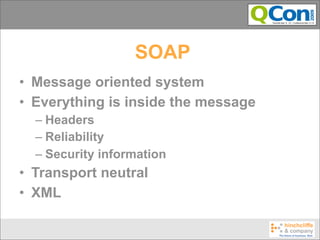
SOAP
• Message oriented system
• Everything is inside the message
  – Headers
  – Reliability
  – Security information
• Transport neutral
• XML
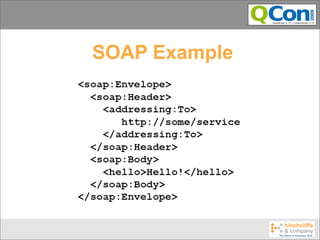
SOAP Example
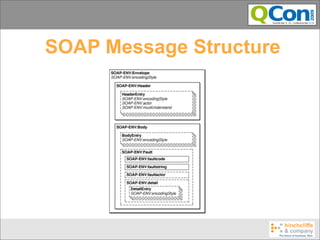
SOAP Message Structure
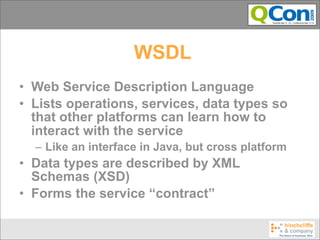
WSDL
• Web Service Description Language
• Lists operations, services, data types so
  that other platforms can learn how to
  interact with the service
  – Like an interface in Java, but cross platform
• Data types are described by XML
  Schemas (XSD)
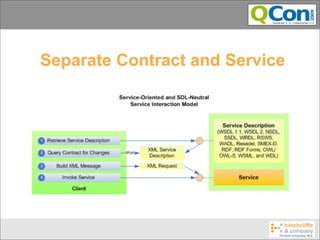
• Forms the service “contract”
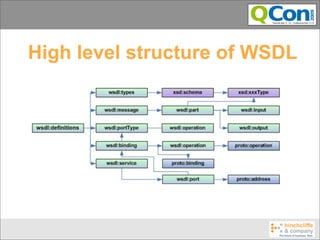
High level structure of WSDL
More on WSDL
• Can be complex (even huge)
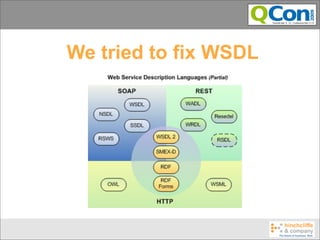
  – WSDL is obtuse
• WS-* specifications are far from
  pervasive thus services are often not
  actually interoperable
We tried to fix WSDL
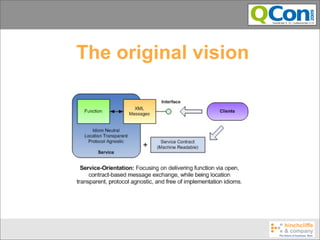
The original vision
Separate Contract and Service
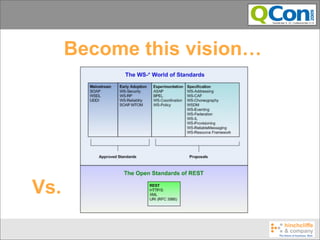
Become this vision…


Vs.
RESTful Services
• Representation State Transfer
  – Roy Fielding coined the term for his thesis
    which sought to provide the architectural
    basis for HTTP
• But what is REST exactly?
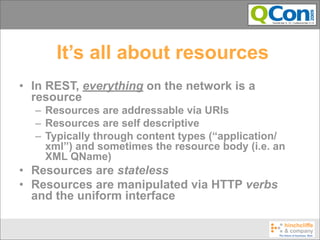
It’s all about resources
• In REST, everything on the network is a
  resource
  – Resources are addressable via URIs
  – Resources are self descriptive
  – Typically through content types (“application/
    xml”) and sometimes the resource body (i.e. an
    XML QName)
• Resources are stateless
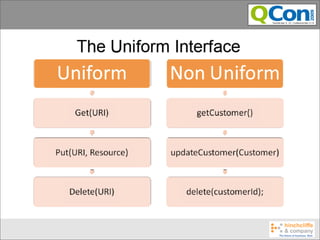
• Resources are manipulated via HTTP verbs
  and the uniform interface
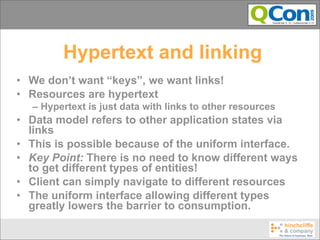
Hypertext and linking
• We don’t want “keys”, we want links!
• Resources are hypertext
  – Hypertext is just data with links to other resources
• Data model refers to other application states via
  links
• This is possible because of the uniform interface.
• Key Point: There is no need to know different ways
  to get different types of entities!
• Client can simply navigate to different resources
• The uniform interface allowing different types
  greatly lowers the barrier to consumption.
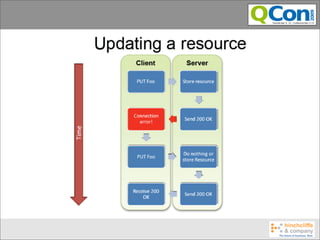
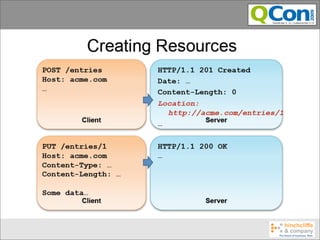
Getting a network resource
• GET is safe
  – If original GET fails, just try, try again
• Note that not all HTTP resources follow
  this rule properly
  – The rule: Be liberal in what you accept and
    strict in what you transmit
HTTP is scalable
• Just look at the size of WWW today
• HTTP has built in mechanisms for caching
  resources
  – All communication is stateless
  – Session state is kept on the Client
• Client is responsible for transitioning to
  new states
• States are represented by URIs
Basic Guidelines
• Information is stored as resources (like a Web page)
  instead of a traditional RPC Web service.
• Every resource can be located via a globally unique
  address known as a Universal Resource Identifier.
• Resources are manipulated by HTTP verbs (GET, PUT,
  POST, DELETE)
• Manipulation of network resources is performed solely
  by components on the network (essentially browsers
  and other Web servers).
• Access to resources must be layered and not require
  more than local knowledge of the network.
• Full details at: http://hinchcliffe.org/archive/
  2008/02/27/16617.aspx
Advantages to REST
• Linkability: Everything is accessible and addressable via
  a simple URL
    – Countless benefits from discoverability to consumption to
      analytics and link ecosystems
•   Simplicity (easy to provide/consume)
•   Uniform interface
•   Testable via a browser
•   No WSDL or traditional service contracts
    – Allows minimal surface area contract checking (more on
      this)
• Is easily consumed by dynamic languages such as
  Javascript or Ruby
• High performance: Works well with caches
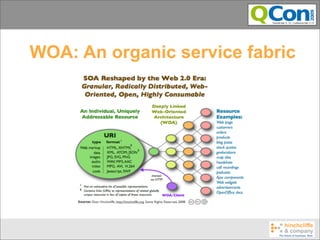
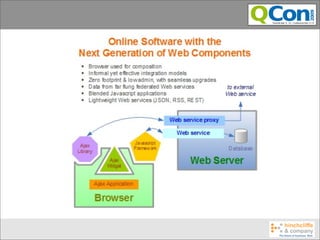
WOA: An organic service fabric
Is WOA just REST?
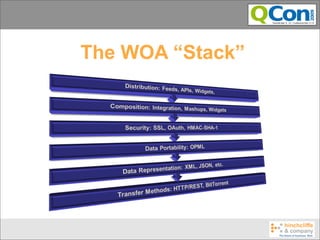
• REST is the foundational network protocol for WOA
• WOA also includes a set of consumption models including
  such things as mashups and Web widgets (explored here
  later)
• WOA also includes a set of widely-used standards and
  technologies for data representation, data exchange and
  portability that REST itself does not encompass, but is
  necessary for a proper and complete architectural
  definition.
   – http://dataportability.com is a partial list of the “other” WOA
     standards. It is not canonical given that WOA is emergent
     and not defined by a vendor or standards body.
   • Identity, security, Web applications model, new distribution
     models are not accounted for by REST alone either.
The WOA “Stack”
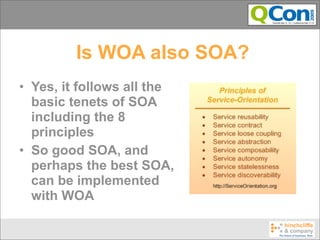
Is WOA also SOA?
• Yes, it follows all the
  basic tenets of SOA
  including the 8
  principles
• So good SOA, and
  perhaps the best SOA,
  can be implemented
  with WOA
Differences with traditional SOA #1

• SOAs tend to have a small and well-
  defined set of endpoints through which
  many types of data and data instances
  can pass.
• WOAs tend to have a very large and open-
  ended number of endpoints; one for each
  individual resource. Not an endpoint for
  each type of resource, but a URI-identified
  endpoint for each and every resource
  instance.
Differences with traditional SOA #2
• Traditional SOA builds a messaging
  layer above HTTP using SOAP and WS-
  * that provides unique and sometimes
  prohibitive constraints to the Web
  developer.
• WOA finds HTTP and related transfer
  mechanisms to be the ideal layer of
  abstraction for most applications.
Differences with traditional SOA #3
• SOA was designed from the top-down
  by vendors to be tool friendly
• WOA was emerged from the bottom up
  from the Web developer community
  naturally. It has the best support in
  simple procedural code and an XML
  parser and is widely support by modern
  Web stacks.
Differences with traditional SOA #4
• SOA uses WS-Security and other
  sophisticated standards for security,
  while WOA tends to just use HTTPS,
  OAuth, and HMAC-SHA-1.
Differences with traditional SOA #4
• SOA uses WS-Security and other
  sophisticated standards for security,
  while WOA tends to just use HTTPS,
  OAuth, and HMAC-SHA-1.
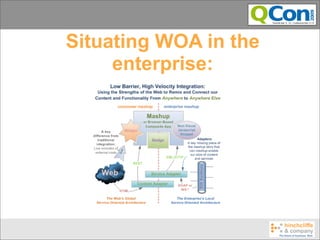
Situating WOA in the
     enterprise:
State Representation
• XML is most common
• JSON is becoming very popular
• YAML - http://yaml.org
• Fast Infoset - http://java.sun.com/
  developer/technicalArticles/xml/
  fastinfoset/
• http://jsonml.org/
What is a “mashup”?
• “A mashup is a Web site or Web application
  that seamlessly combines content from more
  than one source into an integrated
  experience.” - Wikipedia
• Content used in mashups is usually sourced
  from a 3rd party via a public interface (API)
• Other methods of sourcing content for
  mashups include Web feeds (e.g. RSS or
  Atom), and JavaScript/Flash “widgets”
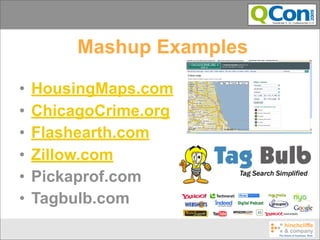
Mashup Examples

•   HousingMaps.com
•   ChicagoCrime.org
•   Flashearth.com
•   Zillow.com
•   Pickaprof.com
•   Tagbulb.com
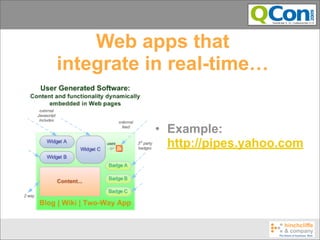
Web apps that
integrate in real-time…


          • Example:
            http://pipes.yahoo.com
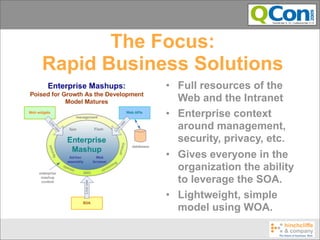
The Focus:
Rapid Business Solutions
            • Full resources of the
              Web and the Intranet
            • Enterprise context
              around management,
              security, privacy, etc.
            • Gives everyone in the
              organization the ability
              to leverage the SOA.
            • Lightweight, simple
              model using WOA.
Why is Web-Oriented Architecture
      Important for Mashups?
• The most commonly used Web service
  approaches “in the wild” turn out to be the ones
  based on the “grain” of the Web:
  – Representation State Transfer, or REST.
     • Created by Roy Fielding, the co-creator of HTTP, the
       fundamental protocol of the Web.
     • Designed to fit naturally into Internet architecture
     • Extremely simple, not a standard, just a style of using HTTP
     • Fully embraces the workings of HTTP and uses its verbs
       (GET, PUT, POST, DELETE) on top of a granular, sensical
       URL structure to indicate what is to happen.
  – RSS and ATOM
     • ATOM is REST
What does an organization
   with WOA “look” like?
• A rich web of REST resources.
• Simple tools to weave the Web of
  resources into new applications.
• Highly consumable and reusable WOA
  “parts” including widgets, gadgets, and
  embedded social apps.
  Open Web APIs exposed on the Internet to
  ad hoc partners.
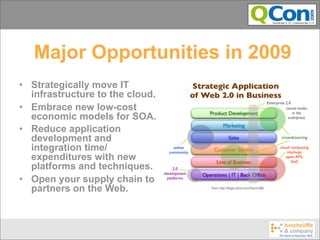
Major Opportunities in 2009
• Strategically move IT
  infrastructure to the cloud.
• Embrace new low-cost
  economic models for SOA.
• Reduce application
  development and
  integration time/
  expenditures with new
  platforms and techniques.
• Open your supply chain to
  partners on the Web.
WOA Conclusions
• WOA is already the dominant model for networked
  applications today
• But it has largely emerged under the radar (no big
  vendors behind it)
• WOA can enable the richest possible outcomes on
  the network
   – And it’s probably the shortest route to get there.
   – When in doubt, ask “What would the Web do?”
• Transition of tools, techniques, and architectural
  styles is required by most practitioners.
Wrap-up:

    Questions?
       For Slides:
dion@hinchcliffeandco.com

Web-Oriented Architecture (WOA)

  • 1.
  • 2.
    Introduction Dion Hinchcliffe • ZDNet’s Enterprise Web 2.0 – http://blogs.zdnet.com/Hinchcliffe • Social Computing Magazine – Editor-in-Chief – http://socialcomputingmagazine.com • Enterprise 2.0 TV Show – http://e2tvshow.com • Hinchcliffe & Company – http://hinchcliffeandco.com – mailto:dion@hinchcliffeandco.com • Web 2.0 University – http://web20university.com • TWITTER: DHINCHCLIFFE
  • 3.
    A Short Historyof Software
  • 4.
    An issue ofcomplexity • Developers have resolved most architectural issues historically by: – Choosing the right data structures; – Identifying or creating algorithms, and; – By applying the concept of separation of concerns.
  • 5.
    The network began to further complicate the issue
  • 6.
    Integration has becomea dominant, top-level activity • “Research has shown that more than 30 percent of IT spending is on integration” – Bitpipe • “Integration consumes more than 40% of IT resources” – Aberdeen Group report • “Software integration is up to 60% of enterprise software projects.” - Oracle
  • 7.
    SOA Definition • SOAis a modular software architecture, and the modules are services designed to interact with each other. – Important Note: SOA also contains higher order constructs such as composite applications, orchestration, coordination, and more exist. • SOAs are usually based on open standards to encourage automatic interoperability of services designed separately.
  • 8.
    A Central Goalof SOA: Turning Applications Into Open Platforms • Openly exposing the features of software and data to customers, end-users, partners, and suppliers for reuse and remixing • This strategy requires documenting, encouraging, and actively supporting the application as a platform – Has serious governance implications • Provide legal, technical, and business reasons to enable this : – Fair licensing, pricing, & support models – A vast array of services that provide data that uses need – A way to apply these services to business problems rapidly and inexpensively.
  • 9.
    But existing SOAmodels have been challenged • Most SOA initiatives are delivering low ROI to the business • The reasons are many but boil down to: – SOA technologies have proven to have challenges compared to more successful models. – Top-down enterprise architecture moves slower than the environment changes. – Important avenues of SOA consumption and production points were often excluded from participation. • SOA is still, however, the dominant organizing model for enterprise architecture.
  • 10.
    Key trends onthe Web today • The growth of networked services with highly valuable open and “portable” data . • Users by the tens of millions putting modular Web parts on their blogs and user profiles to host the pieces of the Web that they want to share. • Businesses connecting to each other over the Internet via Web services by the hundreds of thousands. • The increasing realization that there is limited business value in single applications…
  • 11.
    The Openness of2.0 Apps • Building open platforms instead of stand-alone applications • Forming self-distributing ecosystems • Spreading products far beyond the boundaries of a site • APIs, widgets, badges, syndication -> mashups • In other words: Being everywhere else on the network • Building on the shoulder of giants • Offering and consuming widgets, libraries, and APIs • The automated mass servicing of markets of low demand content and functionality (The Long Tail) • Which represents the bulk of the demand
  • 12.
    The Global SOAhas surpassed our enterprise SOAs • Some businesses have hundreds of thousands of users of their SOA • Most are using WOA models for this • Hundreds of companies have opened their SOA to the Web – Mostly startups or established Internet companies that understand the Web – But larger companies are beginning to understand this.
  • 13.
    Examples • Amazon and their highly successful Web Services Division (with hundreds of thousands of business consumers of their global SOA) – Over $300 million in revenue last year • Google and its numerous and varied open Web APIs from Google Maps to Open Social • eBay and billions of dollars in listings it generates through its public SOA • Applications like Twitter.com – Gets 10 times the use through its APIs than from its user interface. – A new generation of applications that are primarily used via their Global SOA presence. • Netflixprize.com, Gold Corp, and many others
  • 14.
    WOA is forenterprises too • Classical SOA is holding it’s own but is not growing • SOAP is in decline, with 54% planned use last year to 42% planned use this year • Reported enterprise use of REST grew from 14% last year to 24% over the same timeframe. • Source: 2009 Information Week study.
  • 15.
    The traditional applicationmodel has evolved as well
  • 16.
    It Also Means There’sA Lot To Master Today
  • 17.
    Networked applications today are deeply integrated
  • 18.
    The motive forceof 2.0: Harnessing the intrinsic power of networks • “Networked applications that explicitly leverage network effects.” – Tim O’Reilly • A network effect is when a good or service has more value the more than other people have it too. • Two-way participation is the classic litmus test of a Web 2.0 system.
  • 19.
    Demand for Widespread Cross-OrganizationIntegration • “48 percent of the CIOs we surveyed said that they plan to implement service-oriented architectures for integration with external trading partners this year.” – McKinsey & Co.
  • 20.
    And we nowhave real-world experience with traditional SOA • Classical SOA was an excellent first try but has a long list of challenges for the outcomes we desire today. • The model of the Web has continued to teach us about how to structure information and services.
  • 22.
    Strange Attractors: Similarities between Web 2.0 and SOA • Web 2.0 • SOA – Software as a service – Software as services – Interoperability based on – Interoperability based on Web principles heavyweight standards – Applications as platforms – Applications as platforms – Encourages unintended uses – Permits unintended uses – Mashups – Composite Apps – Little user interface – Rich user interfaces guidance – Architecture of Participation – Little prescription of network participation
  • 23.
    Web 2.0 andSOA Convergence
  • 24.
    Enabling New Consumption Scenarios • Cut-and-Paste deployment anywhere on the Intranet • Consumption of the SOA in any application that can use a URL • Discovery of data via search • Integration moves out of the spreadsheet
  • 25.
    Next Generation Enterprises Are Leveraging Web 2.0 • A change in the way the Web is being used • Innovative new customer interactions that shifts most control to users (partners, suppliers) – Control over software, data, structure, and processes • Pervasive, viral, social and technical activities that embrace the intrinsic power of networks • Driven by a move from push to pull-based systems
  • 26.
    The New CompetitiveAdvantage Online: Creating a Compelling Platform Play
  • 27.
    How an OpenWOA Creates a Platform
  • 28.
  • 29.
    Example: Amazon • 1st Gen. Product: E-commerce store – No differentiation – Scaling of a single site – Single site • 2nd Gen. Product: E-commerce platform – 55,000 partners using their e-commerce APIs live – Scaling of the Web S3 • 3rd Gen. Product: A series of Web platforms – Simple Storage Service (S3) EC2 – Elastic Compute Cloud (EC2) – Mechanical Turk (Mturk) – Many others – 300K businesses build on top of what they’ve produced • 2nd and 3rd generation platforms generate large net revenue
  • 30.
    The New Philosophyof Product Distribution • Jakob's Law states that "users spend most of their time using other people’s sites." • You must design your products and services to leverage this fact deeply in the core of their design.
  • 31.
  • 32.
    The Structure ofthe Web • HTTP is the foundational protocol • When HTTP is used to transport hypertext, it can use links to refer to other parts of the Web • These links are defined, like HTTP, by a standard and are known formally as URIs: – http://tools.ietf.org/html/rfc3986
  • 33.
    URIs according tow3.org • Uniform Resource Identifiers (URIs, aka URLs) are short strings that identify resources in the Web: – documents, images, downloadable files, services, electronic mailboxes, and other resources. • They make resources available under a variety of naming schemes and access methods such as HTTP, FTP, and Internet mail addressable in the same simple way. They reduce the tedium of "log in to this server, then issue this magic command ..." down to a single click.
  • 34.
  • 35.
    The use ofHTTP has evolved extensively… • There is no limit to the kind of data that can be transferred via HTTP – HTTP was originally used for transferring Web pages, images, and other simple resources – But now it’s used to transfer pages, data, programs, video streams, and virtually everything else • There is no limit to the amount of data that can be transferred via HTTP – Server-side push of HTTP data is now possible by technique • Has proven to be highly secure and scale to global use
  • 36.
    However, we originallythought open data transport needed something else
  • 37.
    What service modelis best for an WOA?
  • 38.
    SOAP • Message orientedsystem • Everything is inside the message – Headers – Reliability – Security information • Transport neutral • XML
  • 39.
  • 40.
  • 41.
    WSDL • Web ServiceDescription Language • Lists operations, services, data types so that other platforms can learn how to interact with the service – Like an interface in Java, but cross platform • Data types are described by XML Schemas (XSD) • Forms the service “contract”
  • 42.
  • 43.
    More on WSDL •Can be complex (even huge) – WSDL is obtuse • WS-* specifications are far from pervasive thus services are often not actually interoperable
  • 44.
    We tried tofix WSDL
  • 45.
  • 46.
  • 47.
  • 48.
    RESTful Services • RepresentationState Transfer – Roy Fielding coined the term for his thesis which sought to provide the architectural basis for HTTP • But what is REST exactly?
  • 49.
    It’s all aboutresources • In REST, everything on the network is a resource – Resources are addressable via URIs – Resources are self descriptive – Typically through content types (“application/ xml”) and sometimes the resource body (i.e. an XML QName) • Resources are stateless • Resources are manipulated via HTTP verbs and the uniform interface
  • 51.
    Hypertext and linking •We don’t want “keys”, we want links! • Resources are hypertext – Hypertext is just data with links to other resources • Data model refers to other application states via links • This is possible because of the uniform interface. • Key Point: There is no need to know different ways to get different types of entities! • Client can simply navigate to different resources • The uniform interface allowing different types greatly lowers the barrier to consumption.
  • 52.
    Getting a networkresource • GET is safe – If original GET fails, just try, try again • Note that not all HTTP resources follow this rule properly – The rule: Be liberal in what you accept and strict in what you transmit
  • 55.
    HTTP is scalable •Just look at the size of WWW today • HTTP has built in mechanisms for caching resources – All communication is stateless – Session state is kept on the Client • Client is responsible for transitioning to new states • States are represented by URIs
  • 56.
    Basic Guidelines • Informationis stored as resources (like a Web page) instead of a traditional RPC Web service. • Every resource can be located via a globally unique address known as a Universal Resource Identifier. • Resources are manipulated by HTTP verbs (GET, PUT, POST, DELETE) • Manipulation of network resources is performed solely by components on the network (essentially browsers and other Web servers). • Access to resources must be layered and not require more than local knowledge of the network. • Full details at: http://hinchcliffe.org/archive/ 2008/02/27/16617.aspx
  • 57.
    Advantages to REST •Linkability: Everything is accessible and addressable via a simple URL – Countless benefits from discoverability to consumption to analytics and link ecosystems • Simplicity (easy to provide/consume) • Uniform interface • Testable via a browser • No WSDL or traditional service contracts – Allows minimal surface area contract checking (more on this) • Is easily consumed by dynamic languages such as Javascript or Ruby • High performance: Works well with caches
  • 58.
    WOA: An organicservice fabric
  • 59.
    Is WOA justREST? • REST is the foundational network protocol for WOA • WOA also includes a set of consumption models including such things as mashups and Web widgets (explored here later) • WOA also includes a set of widely-used standards and technologies for data representation, data exchange and portability that REST itself does not encompass, but is necessary for a proper and complete architectural definition. – http://dataportability.com is a partial list of the “other” WOA standards. It is not canonical given that WOA is emergent and not defined by a vendor or standards body. • Identity, security, Web applications model, new distribution models are not accounted for by REST alone either.
  • 60.
  • 61.
    Is WOA alsoSOA? • Yes, it follows all the basic tenets of SOA including the 8 principles • So good SOA, and perhaps the best SOA, can be implemented with WOA
  • 62.
    Differences with traditionalSOA #1 • SOAs tend to have a small and well- defined set of endpoints through which many types of data and data instances can pass. • WOAs tend to have a very large and open- ended number of endpoints; one for each individual resource. Not an endpoint for each type of resource, but a URI-identified endpoint for each and every resource instance.
  • 63.
    Differences with traditionalSOA #2 • Traditional SOA builds a messaging layer above HTTP using SOAP and WS- * that provides unique and sometimes prohibitive constraints to the Web developer. • WOA finds HTTP and related transfer mechanisms to be the ideal layer of abstraction for most applications.
  • 64.
    Differences with traditionalSOA #3 • SOA was designed from the top-down by vendors to be tool friendly • WOA was emerged from the bottom up from the Web developer community naturally. It has the best support in simple procedural code and an XML parser and is widely support by modern Web stacks.
  • 65.
    Differences with traditionalSOA #4 • SOA uses WS-Security and other sophisticated standards for security, while WOA tends to just use HTTPS, OAuth, and HMAC-SHA-1.
  • 66.
    Differences with traditionalSOA #4 • SOA uses WS-Security and other sophisticated standards for security, while WOA tends to just use HTTPS, OAuth, and HMAC-SHA-1.
  • 67.
    Situating WOA inthe enterprise:
  • 68.
    State Representation • XMLis most common • JSON is becoming very popular • YAML - http://yaml.org • Fast Infoset - http://java.sun.com/ developer/technicalArticles/xml/ fastinfoset/ • http://jsonml.org/
  • 69.
    What is a“mashup”? • “A mashup is a Web site or Web application that seamlessly combines content from more than one source into an integrated experience.” - Wikipedia • Content used in mashups is usually sourced from a 3rd party via a public interface (API) • Other methods of sourcing content for mashups include Web feeds (e.g. RSS or Atom), and JavaScript/Flash “widgets”
  • 70.
    Mashup Examples • HousingMaps.com • ChicagoCrime.org • Flashearth.com • Zillow.com • Pickaprof.com • Tagbulb.com
  • 72.
    Web apps that integratein real-time… • Example: http://pipes.yahoo.com
  • 73.
    The Focus: Rapid BusinessSolutions • Full resources of the Web and the Intranet • Enterprise context around management, security, privacy, etc. • Gives everyone in the organization the ability to leverage the SOA. • Lightweight, simple model using WOA.
  • 74.
    Why is Web-OrientedArchitecture Important for Mashups? • The most commonly used Web service approaches “in the wild” turn out to be the ones based on the “grain” of the Web: – Representation State Transfer, or REST. • Created by Roy Fielding, the co-creator of HTTP, the fundamental protocol of the Web. • Designed to fit naturally into Internet architecture • Extremely simple, not a standard, just a style of using HTTP • Fully embraces the workings of HTTP and uses its verbs (GET, PUT, POST, DELETE) on top of a granular, sensical URL structure to indicate what is to happen. – RSS and ATOM • ATOM is REST
  • 75.
    What does anorganization with WOA “look” like? • A rich web of REST resources. • Simple tools to weave the Web of resources into new applications. • Highly consumable and reusable WOA “parts” including widgets, gadgets, and embedded social apps. Open Web APIs exposed on the Internet to ad hoc partners.
  • 76.
    Major Opportunities in2009 • Strategically move IT infrastructure to the cloud. • Embrace new low-cost economic models for SOA. • Reduce application development and integration time/ expenditures with new platforms and techniques. • Open your supply chain to partners on the Web.
  • 77.
    WOA Conclusions • WOAis already the dominant model for networked applications today • But it has largely emerged under the radar (no big vendors behind it) • WOA can enable the richest possible outcomes on the network – And it’s probably the shortest route to get there. – When in doubt, ask “What would the Web do?” • Transition of tools, techniques, and architectural styles is required by most practitioners.
  • 78.
    Wrap-up: Questions? For Slides: dion@hinchcliffeandco.com