Development Model for the
Cloud
Paradigm Shift of the Same Old Same Old?

Dr. Umit Yalcinalp,
Salesforce.com
Developer Evangelist
Computing History
Reduce Complexity, Do More

   Turing Machines
   Assembly code
   Programming Languages
   Application Frameworks
   Application Platforms
   Application Servers
   Scripting and Dynamic Languages
   …
Striving Towards Less Complexity
   Punch Cards
   Cobol
   C++
   Platforms
   Application Servers
   Scripting and Dynamic Languages
   …
Take Application Servers as an Example…
  Essential Built in services
    –  Load Balancing
    –  Memory Cache
    –  Transaction Management
    –  Connection management
  Packaging a full app (war, ear, …)
  Security/Authentication
  Messaging Infrastructure simplifies tasks
  User management
  Monitoring and Management of Apps
  Versioning
  Tooling and Composition
  Integration APIs (WS, REST, …)
However
Business App Dev Requirements stayed similar…
     Develop an application that has m abstract entities. Define relationship between
      entities.
     Display data subset j in a page and update data set if x is true.
     Implement and Deploy an application that has n users where a user can belong to
      one of k different roles
     Restrict access of data subset j to user role i
      when x is true.
     If user role has made change p, notify user roles s.
     Do {x, y, z, send email, fax, ….to m users}
      when f happens.
     Do f every {day, week, …} when s …
     Generate report on … organized by …
     Make the application extensible, customizable…
     Deploy mobile client for app that maintain disconnected data for user using dataset
      x.
     Integrate app with Twitter, feed, …
     Integrate app with Payment System, …
Challenges in traditional way of developing
apps remained…
Infrastructure Services: Hardware
Infrastructure Services: Operating System
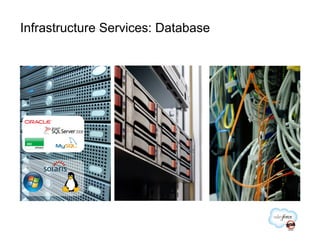
Infrastructure Services: Database
Infrastructure Services: App Server
Application Services
Operational Services
Business Services
How do many developers make this happen?
Putting it together: Duct Tape!
Complexities Abound
                               to Final Destination
                                                                                         Final
Application   Infrastructure       Application          Operational       Business       App
  Ideas          Services           Services             Services         Services
                  Network              Security          Authentication
                                                                           Ordering
                  Storage              Sharing            Availability
                                                                          Provisioning
              Operating System        Integration         Monitoring
                                                                           Licensing
                  Database          Customization         Patch Mgmt
                                                                             Billing
                 App Server         Web Services           Upgrades
                                                                           Renewal
                 Web Server              API                Backup
                                                                           Upgrades
                 Data Center        Multi-Language           NOC
                                                                           Marketing
              Disaster Recovery     Multi-Currency
                                                                             Sales
                                  Integrated Workflow
                                       Analytics
                                     Multi-Device
                                      Messaging
                                       Search
Now comes along Cloud Computing Paradigm

The chatter and buzz on the street…

   About developing services, platforms and applications
   Don’t host but use hosted resources elsewhere
   Develop with hosted services, software, platforms
   Pay as you go
   Consume as you go
   Monitor and adopt
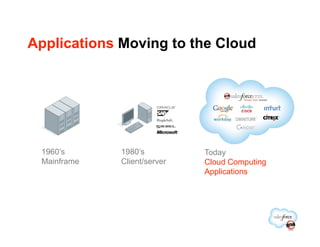
Applications Moving to the Cloud


 1960’s      1980’s          Today
 Mainframe   Client/server   Cloud Computing
                             Applications
Platforms Moving to the Cloud


 1960’s      1980’s          Today
 Mainframe   Client/server   Cloud Computing
                             Platforms
Collaboration Moving to the Cloud


        Lotus Notes                     SharePoint
        Novell GroupWise                Groove
                                        File Sharing


     1980’s                    2000s                      Today
 Work Group                  Intranet                     Social
  Computing                Computing                   Computing
Throw in a lot of new technologies …

              Map reduce


                                 Column db

                                              Data service


                        Worker task


                                       administration
            Scheduler


What does this new paradigm offer to app
             developers?…
The Three AmigoS of Cloud Computing
           Cloud Computing Platforms


  Software

                                                                   ?!
   –  Hosted apps, abstracting APIs, OS, Data storage…
  Platform


                                                                   DATA
   –  Hosted collection of APIs, abstracting OS, data storage, …
  Infrastructure
   –  Hosting virtual servers, OS and some kind of data store
?!
Abstractions and Services


    They are all over the Map
Cloud Developer Concerns:
Capabilities Managed Environment
   Abstraction Level
    –  Capabilities
    –  Constraints
   Managing the Managed Environment
   Cost Indirectly Affecting Development
Lets Look at these Cloud Computing Platforms

   Amazon WS
   Microsoft Azure
   Google App Engine (GAE)
   Force.com
Services Available:
  Virtual OS instances EC2
  Data Services
      –  S3
      –  RDS
    Additional Services:
      –  Load Balancing Servers
      –  Simple Queue Service
      –  Elastic MapReduce
         Processing Large Data Sets
           •  Job Flows on top of Hadoop
                 –  Different granularity of accessing data (i.e. Pig)
           •  Monitoring Individual Task Progress

…
Developer Perspective

   Hosting Locally Built Infrastructure Deployed Elsewhere
   Hosting Locally Built Apps
   Building Data Management Platform
   Testing/Monitoring
    –  Great Console for Infrastructure Monitoring
    –  Deployed app still responsibility of developer
Amazon AWS Activity:
   Not about OS and simple data store anymore
   Hosting
     –  Existing Infrastructure Components: JEE, DB2, …(composed images)
     –  Traditionally built apps

   What do you build with it
     –  More infrastructure: DIY app server functions for scalability & composition
          •  Load Balancing
          •  Deciding when to take resources offline (in development testing)
     –  Low Level Data Services
          •  Large Data Processing (must understand Hadoop…)

     –  Infrastructure Management Logic
   Development Methodology: It Depends!
   Managing/Debugging Your App:
     –  Console (monitoring, debugging, management (upgrades, shutdown))
     –  Remote scripts managing specific to installed components
Microsoft Azure Platform:
   Hosting Azure applications on Microsoft Cloud
   Services for backend development (Old and New)
     –  Table (Data Storage)
     –  Asynchronous Worker Tasks
     –  SQL Azure
   Develop/Deploy
     –  Requires OS+Long list of Packages Installation Locally
     –  Built/Test on local development environment
   Entry Point for developers is Visual Studio
     –  .NET libraries
     –  Local debugging
     –  Local packaging(.cspkg)/Manual deployment to location based Microsoft cloud
   Management of Remote Servers/Services
     –  Requires Server Logs Messages for managing
   Very tailored to existing Microsoft developers
     –  Java developer targeted with Third Party tools porting APIs
Google App Engine
   Services: Lean App Server Features
     –  JPA API for hiding BigTable
     –  Connection support, Cron like jobs
     –  User Administration (Google accounts/Roll your own)

   Backend development Basics
     –  BigTable/GFS
     –  Tasks Queues (experimental)

   Built/Test on local development environment
     –  Naturally independent of OS
     –  JRE + GAE

   Managed Environment Limits
   Entry Point: Eclipse
     –  Develop Locally/Deploy war file Remotely

   Remote Monitoring
     –  System Logs

   Multilanguage (Java/PHP)
Commonalities & Differences Emerge

   Abstracted Large Data Set or SQL
   Managed Environment Limits
   Asynchronous Task/Process Management
    –  Deal with Data Sets
    –  Working with Managed Environment Limits
   Delineation of Development & Production
   Art of “System Log” Recording and Monitoring
App Services and Application Requirements?
Where do the Application Requirements get
addressed?
    Next Level in PaaS:
    –  Infrastructure
    –  Application Server Capabilities


    Force.com Platform:
    Application Services + Integrated End2End Framework
First Cloud Company to Exceed:


          $1.3 Billion +
           Annual Revenue Run Rate


                                                                                                 Quarterly Revenue ($M)
FY2005    FY2006      FY2007         FY2008   FY2009                         FY2010

                                                 Revenue through fiscal quarter ended 10/31/09
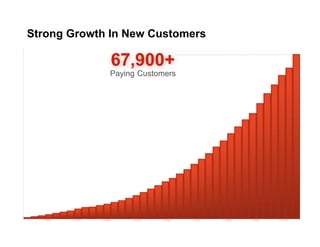
Strong Growth In New Customers

                         67,900+
                         Paying Customers


  FY2002   FY2003   FY2004    FY2005   FY2006   FY2007   FY2008   FY2009   FY2010
The Cloud Computing Model


                      Multi-tenant
                      Automatic Upgrades
                      Pay-as-you-go
                      Elastic

                     Application Development:
                     5X Faster
                     At half the cost
Force.com Platform for Building Applications
Three AmigoS and Force.com


  Software: Applications on Salesforce.com Cloud
      Customizable
      Extensible
  Platform


  Infrastructure:
        Multitenant Kernel
        Data Storage
        ISO 20071 Certified Security
        Loan Balancing
        Replication & Recovery
        Transaction Management
        Sandboxed Application
        Trust (Status Monitoring
Platform - Force.com Philosophy:
                                              •  Common Things Simple
                                                  Complex Things Possible

                                              •  Development Activity
    Distribution                                  • Declarative


                    Development Methodology
                                                  • Programmable
     Analytics

   User Interface                             •  Metadata Driven with
                                                  Shared Data Model
       Logic
                                              •  Built in: Customizable UI, Analytics,
    Integration
                                                   Distribution, Workflows
    Data Model
                                              •  Iterative Development Paradigm:
                                                   “See it as you build it”

                                              •  Application Sharing/Exchange

                                              •  Enforce Good Development Practices
                                                 Development to Production: Testing
Hello World?
Development Process

   Create an “org”: Private on SFDC cluster
    –  A collection of applications
    –  Built on top of shared metadata
    –  Every org becomes live and pre-populated with metadata
    –  Can accommodate > 1 developers depending on license
   Develop/Test
   If Sandbox, Complete Tests to Production
   Register Custom URL/Expose as Website
   “Package” specific app for AppExchange
Two Development Approaches:

   Web Interface
    –  What you build is what you see
    –  Rapid Prototyping
   Eclipse Plugin


                   The App is alive on the cloud
Application
                        Data Model
                                                              Name
Merchandise               LineItem             Invoice        IsDeleted
                                                              …


• Text                  • Lookup: 1-m
• LongText              • Master-Detail:
• RichText               Hierarchical
• Boolean
• Number
• Picklist (single or           SOQL: Object Oriented Query Language
       Multivalue)              Metadata
• …
• Computed Fields
      • Formula
      • Rollup
Business Logic

                 Declarative Logic (point and click)
                    Field Requiredness/Uniqueness
                    Audit History Tracking
                    Workflows Rules & Approval Processes


                 Formula-Based Logic (spreadsheet-like)
                    Formula Fields
                    Data Validation Rules
                    Workflows Rules & Approval Processes


                 Procedural Logic (code)
                    Apex Triggers
                    Apex Classes
Declarative Workflow: Visual Process Manager
Data Model Realized in Default UI   Unlimited Real-Time
                                      Customization
Custom Pages
Sites
Saw that even BigFoot is moving to the
Cloud…
Next Stop Wonderland:
Collaboration for the Enterprise


                        • One can follow any Entity just like a User
                        • Same Development Paradigm with Any
                        Entity in the platform
Developer’s Toolbox
  Language Runtime: Apex: Java, C# like language
    –  For creating CRUD Logic on Data Model (triggers)
    –  Executing Queries (SOQL and SOSL)
    –  Developing Controllers in conjunction with VF Pages
    –  Background Process Management
         •  Scheduled Tasks
         •  Batch Processes for handling large data sets

  Eclipse Plugin
    –  Developed using WS APIs
    –  Retains only metadata locally
    –  Allows browsing metadata, dynamic SQL and code execution
    –  Remote execution, commit of metadata, dynamic code blocks
    –  Synchronizes live development with an org on the cloud
    –  Enables versioning locally with external tools
Developer
   Integration Toolkits:
    –  Force.com WS API language bindings in target
      languages, environments
   Packaging Apps for Distribution
    –  Within an org selecting an app
    –  Requires Test Implementation

   Sandboxing
    –  A snapshot of metadata (and data) of an existing org
    –  Requires testing to move to production
   Integral Part of Development Process:
    –  Testing Framework
    –  Governance Limits
Differences in Platforms

   Degrees of Abstraction and Tight Integration with Data
    Model
   Abstraction of Application Server Capabilities
   Exposing Application Framework Capabilities
   Data Model & Handling and Managing Large Data
   Background Process & Task/Queue
   Governance Limits
   Level of Integration Support
   Level of Management Needed from Developer
   Tangible and Intangible Cost of using a platform
The Duct Tape Index for Cloud Platforms
Cloud Development Landscape
  Levels of Abstraction
  Application Composition
  Development Environment (local, remote, mixed)
  Workflow
  Development and Deployment Cycles
  Customizability / Extensibility
  Integration
  Being a Good Citizen
  Versioning
  Monitoring
  Cost of Trying out a Platform
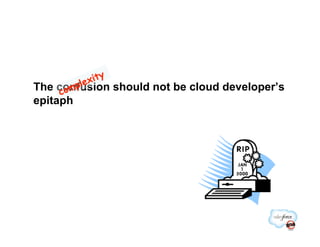
The confusion should not be cloud developer’s
epitaph
Where a developer wants to get…
Conclusion:


   Choose Your Abstraction Level Wisely:
    –  Flexibility(Roll Your Own) vs. Time to Develop(Managed)
    –  Think long term
   Being a Good Citizen is Not Optional
   Logs and Monitoring Rules in Clouds
Q & A!

http://developer.force.com!
Twitter: umityalcinalp        !
Typical Development Cycle

   Create your own image/Packaging
    –  Bundle App Server/Application
   Install/Manage Remotely
   Monitor Deployed Services to scale and use
    –  Are more servers needed?
    –  Is a bigger database needed?
    –  Do I need to shut down my servers during development?
   Manual Redeployment
User Interface: MVC Model   Programmable
                            User Interface

Development Model for The Cloud

  • 1.
    Development Model forthe Cloud Paradigm Shift of the Same Old Same Old? Dr. Umit Yalcinalp, Salesforce.com Developer Evangelist
  • 2.
    Computing History Reduce Complexity,Do More   Turing Machines   Assembly code   Programming Languages   Application Frameworks   Application Platforms   Application Servers   Scripting and Dynamic Languages   …
  • 3.
    Striving Towards LessComplexity   Punch Cards   Cobol   C++   Platforms   Application Servers   Scripting and Dynamic Languages   …
  • 4.
    Take Application Serversas an Example…   Essential Built in services –  Load Balancing –  Memory Cache –  Transaction Management –  Connection management   Packaging a full app (war, ear, …)   Security/Authentication   Messaging Infrastructure simplifies tasks   User management   Monitoring and Management of Apps   Versioning   Tooling and Composition   Integration APIs (WS, REST, …)
  • 5.
    However Business App DevRequirements stayed similar…   Develop an application that has m abstract entities. Define relationship between entities.   Display data subset j in a page and update data set if x is true.   Implement and Deploy an application that has n users where a user can belong to one of k different roles   Restrict access of data subset j to user role i when x is true.   If user role has made change p, notify user roles s.   Do {x, y, z, send email, fax, ….to m users} when f happens.   Do f every {day, week, …} when s …   Generate report on … organized by …   Make the application extensible, customizable…   Deploy mobile client for app that maintain disconnected data for user using dataset x.   Integrate app with Twitter, feed, …   Integrate app with Payment System, …
  • 6.
    Challenges in traditionalway of developing apps remained…
  • 7.
  • 8.
  • 9.
  • 10.
  • 11.
  • 12.
  • 13.
  • 14.
    How do manydevelopers make this happen?
  • 15.
  • 16.
    Complexities Abound to Final Destination Final Application Infrastructure Application Operational Business App Ideas Services Services Services Services Network Security Authentication Ordering Storage Sharing Availability Provisioning Operating System Integration Monitoring Licensing Database Customization Patch Mgmt Billing App Server Web Services Upgrades Renewal Web Server API Backup Upgrades Data Center Multi-Language NOC Marketing Disaster Recovery Multi-Currency Sales Integrated Workflow Analytics Multi-Device Messaging Search
  • 17.
    Now comes alongCloud Computing Paradigm The chatter and buzz on the street…   About developing services, platforms and applications   Don’t host but use hosted resources elsewhere   Develop with hosted services, software, platforms   Pay as you go   Consume as you go   Monitor and adopt
  • 18.
    Applications Moving tothe Cloud 1960’s 1980’s Today Mainframe Client/server Cloud Computing Applications
  • 19.
    Platforms Moving tothe Cloud 1960’s 1980’s Today Mainframe Client/server Cloud Computing Platforms
  • 20.
    Collaboration Moving tothe Cloud Lotus Notes SharePoint Novell GroupWise Groove File Sharing 1980’s 2000s Today Work Group Intranet Social Computing Computing Computing
  • 21.
    Throw in alot of new technologies … Map reduce Column db Data service Worker task administration Scheduler What does this new paradigm offer to app developers?…
  • 22.
    The Three AmigoSof Cloud Computing Cloud Computing Platforms   Software ?! –  Hosted apps, abstracting APIs, OS, Data storage…   Platform DATA –  Hosted collection of APIs, abstracting OS, data storage, …   Infrastructure –  Hosting virtual servers, OS and some kind of data store
  • 23.
  • 24.
    Abstractions and Services They are all over the Map
  • 25.
    Cloud Developer Concerns: CapabilitiesManaged Environment   Abstraction Level –  Capabilities –  Constraints   Managing the Managed Environment   Cost Indirectly Affecting Development
  • 26.
    Lets Look atthese Cloud Computing Platforms   Amazon WS   Microsoft Azure   Google App Engine (GAE)   Force.com
  • 27.
    Services Available:   VirtualOS instances EC2   Data Services –  S3 –  RDS   Additional Services: –  Load Balancing Servers –  Simple Queue Service –  Elastic MapReduce Processing Large Data Sets •  Job Flows on top of Hadoop –  Different granularity of accessing data (i.e. Pig) •  Monitoring Individual Task Progress …
  • 28.
    Developer Perspective  Hosting Locally Built Infrastructure Deployed Elsewhere   Hosting Locally Built Apps   Building Data Management Platform   Testing/Monitoring –  Great Console for Infrastructure Monitoring –  Deployed app still responsibility of developer
  • 29.
    Amazon AWS Activity:   Not about OS and simple data store anymore   Hosting –  Existing Infrastructure Components: JEE, DB2, …(composed images) –  Traditionally built apps   What do you build with it –  More infrastructure: DIY app server functions for scalability & composition •  Load Balancing •  Deciding when to take resources offline (in development testing) –  Low Level Data Services •  Large Data Processing (must understand Hadoop…) –  Infrastructure Management Logic   Development Methodology: It Depends!   Managing/Debugging Your App: –  Console (monitoring, debugging, management (upgrades, shutdown)) –  Remote scripts managing specific to installed components
  • 30.
    Microsoft Azure Platform:   Hosting Azure applications on Microsoft Cloud   Services for backend development (Old and New) –  Table (Data Storage) –  Asynchronous Worker Tasks –  SQL Azure   Develop/Deploy –  Requires OS+Long list of Packages Installation Locally –  Built/Test on local development environment   Entry Point for developers is Visual Studio –  .NET libraries –  Local debugging –  Local packaging(.cspkg)/Manual deployment to location based Microsoft cloud   Management of Remote Servers/Services –  Requires Server Logs Messages for managing   Very tailored to existing Microsoft developers –  Java developer targeted with Third Party tools porting APIs
  • 31.
    Google App Engine   Services: Lean App Server Features –  JPA API for hiding BigTable –  Connection support, Cron like jobs –  User Administration (Google accounts/Roll your own)   Backend development Basics –  BigTable/GFS –  Tasks Queues (experimental)   Built/Test on local development environment –  Naturally independent of OS –  JRE + GAE   Managed Environment Limits   Entry Point: Eclipse –  Develop Locally/Deploy war file Remotely   Remote Monitoring –  System Logs   Multilanguage (Java/PHP)
  • 32.
    Commonalities & DifferencesEmerge   Abstracted Large Data Set or SQL   Managed Environment Limits   Asynchronous Task/Process Management –  Deal with Data Sets –  Working with Managed Environment Limits   Delineation of Development & Production   Art of “System Log” Recording and Monitoring
  • 33.
    App Services andApplication Requirements?
  • 34.
    Where do theApplication Requirements get addressed? Next Level in PaaS: –  Infrastructure –  Application Server Capabilities Force.com Platform: Application Services + Integrated End2End Framework
  • 35.
    First Cloud Companyto Exceed: $1.3 Billion + Annual Revenue Run Rate Quarterly Revenue ($M) FY2005 FY2006 FY2007 FY2008 FY2009 FY2010 Revenue through fiscal quarter ended 10/31/09
  • 36.
    Strong Growth InNew Customers 67,900+ Paying Customers FY2002 FY2003 FY2004 FY2005 FY2006 FY2007 FY2008 FY2009 FY2010
  • 37.
    The Cloud ComputingModel Multi-tenant Automatic Upgrades Pay-as-you-go Elastic Application Development: 5X Faster At half the cost
  • 38.
    Force.com Platform forBuilding Applications
  • 39.
    Three AmigoS andForce.com   Software: Applications on Salesforce.com Cloud   Customizable   Extensible   Platform   Infrastructure:   Multitenant Kernel   Data Storage   ISO 20071 Certified Security   Loan Balancing   Replication & Recovery   Transaction Management   Sandboxed Application   Trust (Status Monitoring
  • 40.
    Platform - Force.comPhilosophy: •  Common Things Simple Complex Things Possible •  Development Activity Distribution • Declarative Development Methodology • Programmable Analytics User Interface •  Metadata Driven with Shared Data Model Logic •  Built in: Customizable UI, Analytics, Integration Distribution, Workflows Data Model •  Iterative Development Paradigm: “See it as you build it” •  Application Sharing/Exchange •  Enforce Good Development Practices Development to Production: Testing
  • 41.
  • 42.
    Development Process  Create an “org”: Private on SFDC cluster –  A collection of applications –  Built on top of shared metadata –  Every org becomes live and pre-populated with metadata –  Can accommodate > 1 developers depending on license   Develop/Test   If Sandbox, Complete Tests to Production   Register Custom URL/Expose as Website   “Package” specific app for AppExchange
  • 43.
    Two Development Approaches:   Web Interface –  What you build is what you see –  Rapid Prototyping   Eclipse Plugin The App is alive on the cloud
  • 44.
    Application Data Model Name Merchandise LineItem Invoice IsDeleted … • Text • Lookup: 1-m • LongText • Master-Detail: • RichText Hierarchical • Boolean • Number • Picklist (single or SOQL: Object Oriented Query Language Multivalue) Metadata • … • Computed Fields • Formula • Rollup
  • 45.
    Business Logic Declarative Logic (point and click) Field Requiredness/Uniqueness Audit History Tracking Workflows Rules & Approval Processes Formula-Based Logic (spreadsheet-like) Formula Fields Data Validation Rules Workflows Rules & Approval Processes Procedural Logic (code) Apex Triggers Apex Classes
  • 46.
  • 47.
    Data Model Realizedin Default UI Unlimited Real-Time Customization
  • 48.
  • 49.
  • 50.
    Saw that evenBigFoot is moving to the Cloud…
  • 51.
    Next Stop Wonderland: Collaborationfor the Enterprise • One can follow any Entity just like a User • Same Development Paradigm with Any Entity in the platform
  • 52.
    Developer’s Toolbox   LanguageRuntime: Apex: Java, C# like language –  For creating CRUD Logic on Data Model (triggers) –  Executing Queries (SOQL and SOSL) –  Developing Controllers in conjunction with VF Pages –  Background Process Management •  Scheduled Tasks •  Batch Processes for handling large data sets   Eclipse Plugin –  Developed using WS APIs –  Retains only metadata locally –  Allows browsing metadata, dynamic SQL and code execution –  Remote execution, commit of metadata, dynamic code blocks –  Synchronizes live development with an org on the cloud –  Enables versioning locally with external tools
  • 53.
    Developer   IntegrationToolkits: –  Force.com WS API language bindings in target languages, environments   Packaging Apps for Distribution –  Within an org selecting an app –  Requires Test Implementation   Sandboxing –  A snapshot of metadata (and data) of an existing org –  Requires testing to move to production   Integral Part of Development Process: –  Testing Framework –  Governance Limits
  • 54.
    Differences in Platforms   Degrees of Abstraction and Tight Integration with Data Model   Abstraction of Application Server Capabilities   Exposing Application Framework Capabilities   Data Model & Handling and Managing Large Data   Background Process & Task/Queue   Governance Limits   Level of Integration Support   Level of Management Needed from Developer   Tangible and Intangible Cost of using a platform
  • 55.
    The Duct TapeIndex for Cloud Platforms
  • 56.
    Cloud Development Landscape  Levels of Abstraction   Application Composition   Development Environment (local, remote, mixed)   Workflow   Development and Deployment Cycles   Customizability / Extensibility   Integration   Being a Good Citizen   Versioning   Monitoring   Cost of Trying out a Platform
  • 57.
    The confusion shouldnot be cloud developer’s epitaph
  • 58.
    Where a developerwants to get…
  • 59.
    Conclusion:   ChooseYour Abstraction Level Wisely: –  Flexibility(Roll Your Own) vs. Time to Develop(Managed) –  Think long term   Being a Good Citizen is Not Optional   Logs and Monitoring Rules in Clouds
  • 60.
  • 61.
    Typical Development Cycle   Create your own image/Packaging –  Bundle App Server/Application   Install/Manage Remotely   Monitor Deployed Services to scale and use –  Are more servers needed? –  Is a bigger database needed? –  Do I need to shut down my servers during development?   Manual Redeployment
  • 62.
    User Interface: MVCModel Programmable User Interface