What Are Design Patterns? 


          A design pattern is a formal way of
          documenting a solution to a design
          problem in a particular field of expertise.
         (Wikipedia)


                                                       2
Got EIP?
Core Principles of EIP

>   Patterns using asynchronous messaging as a style
    of integration

>   Pros
    • Scaling
    • Decoupling
>   Cons
    • Latency vs. throughput
    • Decoupling not always appropriate
                                                       4
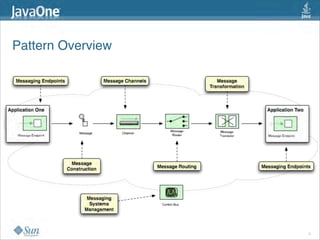
Pattern Overview


                   5
Identifying and Expressing Patterns


                                      6
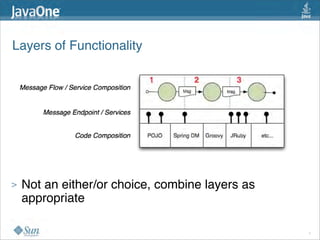
Layers of Functionality


>   Not an either/or choice, combine layers as
    appropriate

                                                 7
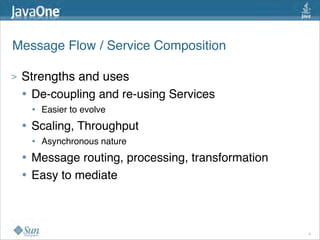
Message Flow / Service Composition

>   Strengths and uses
    • De-coupling and re-using Services
        • Easier to evolve
    •   Scaling, Throughput
        • Asynchronous nature
    •   Message routing, processing, transformation
    •   Easy to mediate


                                                      8
Message Endpoints / Services

>   Message Endpoints / Services
    • Message based interface
    • Expose coarse grained services
    • Typically stateless
    • Anticipate re-use
    • Visibility scope examples
     •   Within application
     •   Within ESB
     •   Anyone with access to JMS server
     •   External
                                            9
Code Composition

>   Strengths and uses
    • Fine grained API access
    • Stateful, fine grained interactions
     •   Low latency


>   Challenge
    • Interface tighter coupled


                                           10
Implicit and Explicit Patterns

>   Some patterns inherent in technology / framework
    • Not every pattern a "keyword"
     •   e.g. JMS publish/subscribe ...
>   Patterns realized in user code 
     •   e.g. Scatter-Gather realized in Java
>   Platform has pre-built constructs
     •   e.g. Unix pipe symbol "|" : pipes-and-filters  
     •   Route in Camel or Fuji: pipes-and-filters


                                                          11
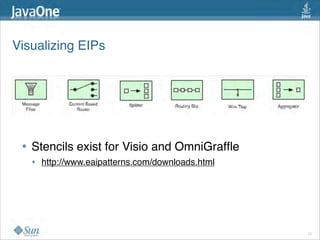
Visualizing EIPs


 • Stencils exist for Visio and OmniGraffle 
   •   http://www.eaipatterns.com/downloads.html  


                                                     12
Patterns in Practice


                       13
Gotcha - Flexibility vs. Productivity

>   Issue: Too little explicit support out-of-the-box
    • Too much roll your own
>   Issue: Explicit support out-of-the-box is too rigid
    • Does not exactly fit the use case
     •   Forced to work around or again roll your own


>   What you want is out-of-the-box productivity with
    explicit constructs AND flexibility to customize the
    constructs
                                                          14
Intro to Frameworks 

 • Apache Camel
   •   http://camel.apache.org/


 • Project Fuji / OpenESB v3
   •   http://fuji.dev.java.net/


                                   15
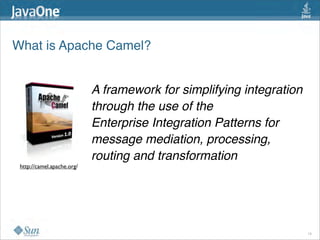
What is Apache Camel? 


                            A framework for simplifying integration
                            through the use of the 
                            Enterprise Integration Patterns for
                            message mediation, processing,
                            routing and transformation
 http://camel.apache.org/


                                                                      16
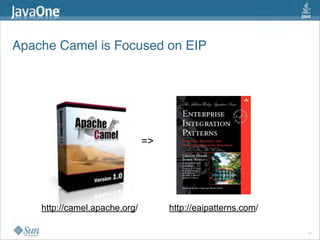
Apache Camel is Focused on EIP


                               =>


    http://camel.apache.org/        http://eaipatterns.com/

                                                              17
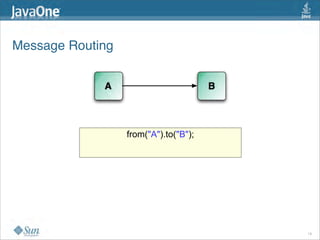
Message Routing


                  from("A").to("B");


                                       18
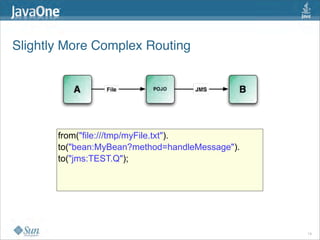
Slightly More Complex Routing


       from("file:///tmp/myFile.txt").
       to("bean:MyBean?method=handleMessage").
       to("jms:TEST.Q");


                                                 19
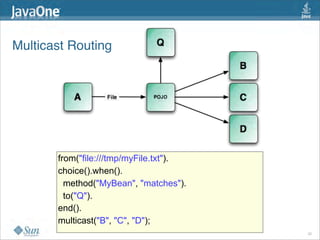
Multicast Routing


       from("file:///tmp/myFile.txt").
       choice().when().
         method("MyBean", "matches").
         to("Q").
       end().
       multicast("B", "C", "D");
                                         20
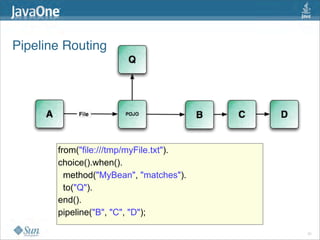
Pipeline Routing


       from("file:///tmp/myFile.txt").
       choice().when().
         method("MyBean", "matches").
         to("Q").
       end().
       pipeline("B", "C", "D");

                                         21
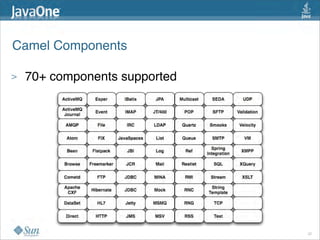
Camel Components

>    70+ components supported


                                22
What is Project Fuji? 
                                     http://fuji.dev.java.net/
>   Basis for OpenESB v3
>   Fuji Goals
    • Agility + Flexibility + Ease of Use = Productivity 
>   Service Platform to realize
    • Service Oriented Architecture (SOA)
    • Light weight SOA (aka Web Oriented Architecture)
    • Event Driven Architecture (EDA)
    • ... last but not least MOM style applications 
>   > 40 Components in OpenESB community today
                                                                 23
Interesting Properties of Fuji 

 • Convention, Configuration, Code... in that order
 • Light weight, OSGi based
 • Not JMS centric but Service Centric
   •   In-VM service composition option
   •   Choice of transport when going across VMs
       •   E.g. load balancing via http or federating using JXTA

 • Visual and textual (DSL) editing for EIPs
   •   Camel component is another option 


                                                                   24
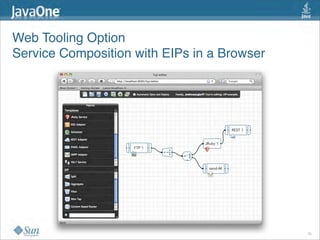
Web Tooling Option
Service Composition with EIPs in a Browser


                                             25
Web UI Gives the User...

 • All-in-one interface for service composition
     • Service Definition
     • Routing, EIPs
     • Configuration
     • Deployment
 •   Layered on textual representation (DSL)
     • Check out from version control, edit in IDE
 •   Tooling option for different preferences and skills
     • e.g. casual technologist vs, Developer
 •   Extensible
                                                           26
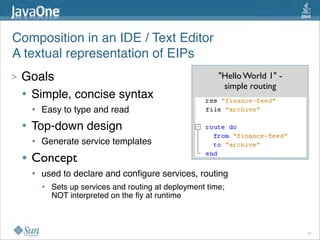
Composition in an IDE / Text Editor
A textual representation of EIPs
>   Goals                                                     "Hello World 1" - 
                                                               simple routing
    • Simple, concise syntax
        • Easy to type and read
    •   Top-down design
        • Generate service templates 
    • Concept
        •   used to declare and configure services, routing
            •   Sets up services and routing at deployment time;
                NOT interpreted on the fly at runtime


                                                                                   27
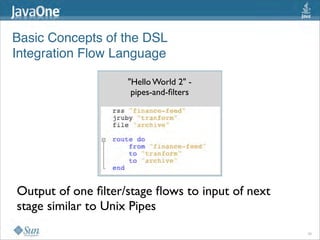
Basic Concepts of the DSL
Integration Flow Language

                    "Hello World 2" - 
                     pipes-and-filters


Output of one filter/stage flows to input of next
stage similar to Unix Pipes
                                                  28
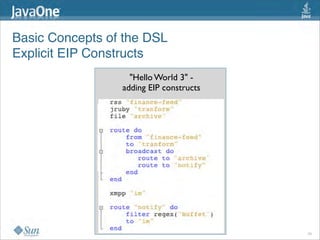
Basic Concepts of the DSL
Explicit EIP Constructs
                   "Hello World 3" - 
                 adding EIP constructs


                                         29
Example Pattern Implementations 


                                   30
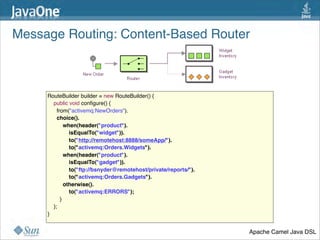
Message Routing: Content-Based Router


     RouteBuilder builder = new RouteBuilder() {
         public void configure() {
           from("activemq:NewOrders").
           choice().
               when(header("product").
                   isEqualTo("widget")).
                   to("http://remotehost:8888/someApp/").
                   to("activemq:Orders.Widgets").
               when(header("product").
                   isEqualTo("gadget")).
                   to("ftp://bsnyder@remotehost/private/reports/").
                   to("activemq:Orders.Gadgets").
               otherwise().
                   to("activemq:ERRORS");
         }
         };
     }


                                                                      Apache Camel Java DSL
                                                                                         31
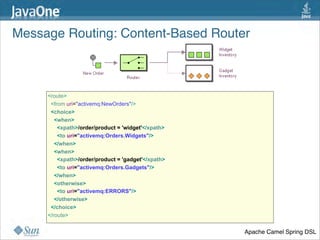
Message Routing: Content-Based Router


     <route>
      <from uri="activemq:NewOrders"/>
      <choice>
        <when>
         <xpath>/order/product = 'widget'</xpath>
         <to uri="activemq:Orders.Widgets"/>
        </when>
        <when>
         <xpath>/order/product = 'gadget'</xpath>
         <to uri="activemq:Orders.Gadgets"/>
        </when>
        <otherwise>
         <to uri="activemq:ERRORS"/>
        </otherwise>
      </choice>
     </route>


                                                    Apache Camel Spring DSL
                                                                         32
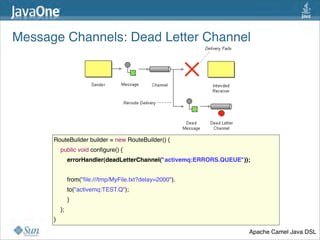
Message Channels: Dead Letter Channel 


      RouteBuilder builder = new RouteBuilder() {
          public void configure() {
              errorHandler(deadLetterChannel("activemq:ERRORS.QUEUE"));


              from("file:///tmp/MyFile.txt?delay=2000").
              to("activemq:TEST.Q");
          }
          };
      }

                                                                      Apache Camel Java DSL
                                                                                         33
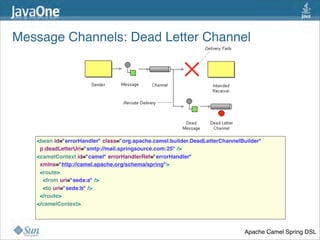
Message Channels: Dead Letter Channel 


   <bean id="errorHandler" class="org.apache.camel.builder.DeadLetterChannelBuilder"
     p:deadLetterUri="smtp://mail.springsource.com:25" />
   <camelContext id="camel" errorHandlerRef="errorHandler" 
     xmlns="http://camel.apache.org/schema/spring">
     <route>
       <from uri="seda:a" />
       <to uri="seda:b" />
     </route>
   </camelContext>


                                                                             Apache Camel Spring DSL
                                                                                                  34
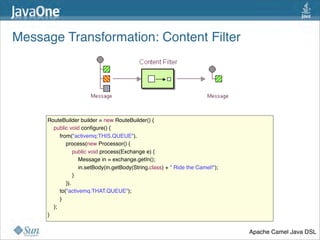
Message Transformation: Content Filter


     RouteBuilder builder = new RouteBuilder() {
         public void configure() {
             from("activemq:THIS.QUEUE").
                 process(new Processor() {
                     public void process(Exchange e) {
                         Message in = exchange.getIn();
                         in.setBody(in.getBody(String.class) + " Ride the Camel!");
             }
                 }).
             to("activemq:THAT.QUEUE");
         }
         };
     }


                                                                                      Apache Camel Java DSL
                                                                                                         35
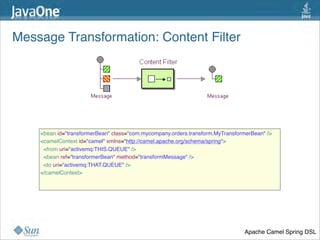
Message Transformation: Content Filter


    <bean id="transformerBean" class="com.mycompany.orders.transform.MyTransformerBean" />
    <camelContext id="camel" xmlns="http://camel.apache.org/schema/spring">
      <from uri="activemq:THIS.QUEUE" />
      <bean ref="transformerBean" method="transformMessage" />
      <to uri="activemq:THAT.QUEUE" />
    </camelContext>


                                                                               Apache Camel Spring DSL
                                                                                                    36
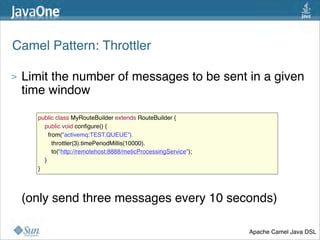
Camel Pattern: Throttler

>   Limit the number of messages to be sent in a given
    time window

      public class MyRouteBuilder extends RouteBuilder {
          public void configure() {
            from("activemq:TEST.QUEUE”).
              throttler(3).timePeriodMillis(10000).
              to("http://remotehost:8888/meticProcessingService");
        }
      }


>   (only send three messages every 10 seconds)

                                                                     Apache Camel Java DSL
                                                                                        37
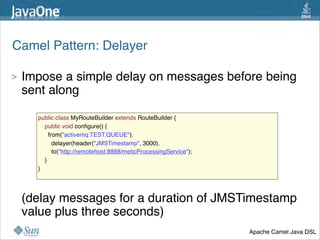
Camel Pattern: Delayer

>   Impose a simple delay on messages before being
    sent along 

      public class MyRouteBuilder extends RouteBuilder {
          public void configure() {
            from("activemq:TEST.QUEUE").
              delayer(header("JMSTimestamp", 3000).
              to("http://remotehost:8888/meticProcessingService");
        }
      }


>   (delay messages for a duration of JMSTimestamp
    value plus three seconds)
                                                                     Apache Camel Java DSL
                                                                                        38
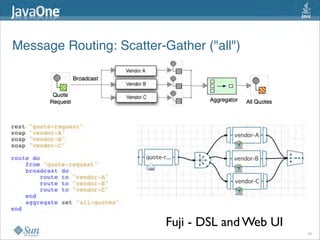
Message Routing: Scatter-Gather ("all")


                          Fuji - DSL and Web UI
                                                  39
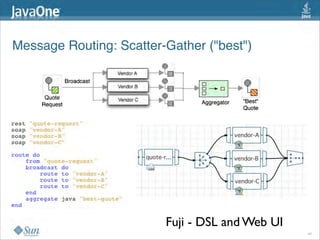
Message Routing: Scatter-Gather ("best")


                         Fuji - DSL and Web UI
                                                 40
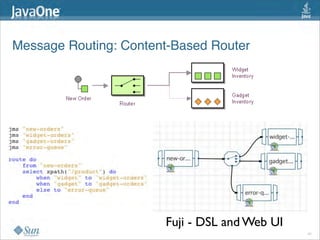
Message Routing: Content-Based Router


                       Fuji - DSL and Web UI
                                               41
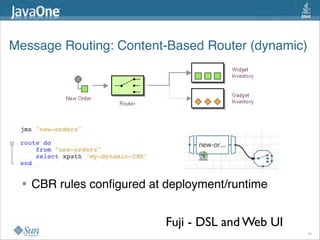
Message Routing: Content-Based Router (dynamic)


 • CBR rules configured at deployment/runtime

                          Fuji - DSL and Web UI
                                                  42
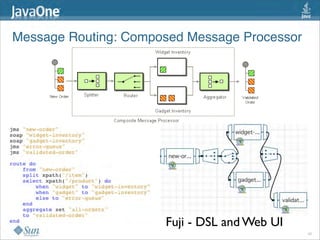
Message Routing: Composed Message Processor


                      Fuji - DSL and Web UI
                                              43
EIP Product Demo 

 • Apache Camel
 • Project Fuji


                    44
Andreas Egloff
andreas.egloff@sun.com


Bruce Snyder
bruce.snyder@springsource.com

TS 4839 - Enterprise Integration Patterns in Practice

  • 2.
    What Are DesignPatterns?  A design pattern is a formal way of documenting a solution to a design problem in a particular field of expertise. (Wikipedia) 2
  • 3.
  • 4.
    Core Principles ofEIP > Patterns using asynchronous messaging as a style of integration > Pros • Scaling • Decoupling > Cons • Latency vs. throughput • Decoupling not always appropriate 4
  • 5.
  • 6.
  • 7.
    Layers of Functionality > Not an either/or choice, combine layers as appropriate 7
  • 8.
    Message Flow /Service Composition > Strengths and uses • De-coupling and re-using Services • Easier to evolve • Scaling, Throughput • Asynchronous nature • Message routing, processing, transformation • Easy to mediate 8
  • 9.
    Message Endpoints /Services > Message Endpoints / Services • Message based interface • Expose coarse grained services • Typically stateless • Anticipate re-use • Visibility scope examples • Within application • Within ESB • Anyone with access to JMS server • External 9
  • 10.
    Code Composition > Strengths and uses • Fine grained API access • Stateful, fine grained interactions • Low latency > Challenge • Interface tighter coupled 10
  • 11.
    Implicit and ExplicitPatterns > Some patterns inherent in technology / framework • Not every pattern a "keyword" • e.g. JMS publish/subscribe ... > Patterns realized in user code  • e.g. Scatter-Gather realized in Java > Platform has pre-built constructs • e.g. Unix pipe symbol "|" : pipes-and-filters   • Route in Camel or Fuji: pipes-and-filters 11
  • 12.
    Visualizing EIPs •Stencils exist for Visio and OmniGraffle  • http://www.eaipatterns.com/downloads.html   12
  • 13.
  • 14.
    Gotcha - Flexibilityvs. Productivity > Issue: Too little explicit support out-of-the-box • Too much roll your own > Issue: Explicit support out-of-the-box is too rigid • Does not exactly fit the use case • Forced to work around or again roll your own > What you want is out-of-the-box productivity with explicit constructs AND flexibility to customize the constructs 14
  • 15.
    Intro to Frameworks  • Apache Camel • http://camel.apache.org/ • Project Fuji / OpenESB v3 • http://fuji.dev.java.net/ 15
  • 16.
    What is ApacheCamel?  A framework for simplifying integration through the use of the  Enterprise Integration Patterns for message mediation, processing, routing and transformation http://camel.apache.org/ 16
  • 17.
    Apache Camel isFocused on EIP => http://camel.apache.org/ http://eaipatterns.com/ 17
  • 18.
    Message Routing from("A").to("B"); 18
  • 19.
    Slightly More ComplexRouting from("file:///tmp/myFile.txt"). to("bean:MyBean?method=handleMessage"). to("jms:TEST.Q"); 19
  • 20.
    Multicast Routing from("file:///tmp/myFile.txt"). choice().when(). method("MyBean", "matches"). to("Q"). end(). multicast("B", "C", "D"); 20
  • 21.
    Pipeline Routing from("file:///tmp/myFile.txt"). choice().when(). method("MyBean", "matches"). to("Q"). end(). pipeline("B", "C", "D"); 21
  • 22.
    Camel Components >  70+ components supported 22
  • 23.
    What is ProjectFuji?  http://fuji.dev.java.net/ > Basis for OpenESB v3 > Fuji Goals • Agility + Flexibility + Ease of Use = Productivity  > Service Platform to realize • Service Oriented Architecture (SOA) • Light weight SOA (aka Web Oriented Architecture) • Event Driven Architecture (EDA) • ... last but not least MOM style applications  > > 40 Components in OpenESB community today 23
  • 24.
    Interesting Properties ofFuji  • Convention, Configuration, Code... in that order • Light weight, OSGi based • Not JMS centric but Service Centric • In-VM service composition option • Choice of transport when going across VMs • E.g. load balancing via http or federating using JXTA • Visual and textual (DSL) editing for EIPs • Camel component is another option  24
  • 25.
    Web Tooling Option ServiceComposition with EIPs in a Browser 25
  • 26.
    Web UI Givesthe User... • All-in-one interface for service composition • Service Definition • Routing, EIPs • Configuration • Deployment • Layered on textual representation (DSL) • Check out from version control, edit in IDE • Tooling option for different preferences and skills • e.g. casual technologist vs, Developer • Extensible 26
  • 27.
    Composition in anIDE / Text Editor A textual representation of EIPs > Goals "Hello World 1" -  simple routing • Simple, concise syntax • Easy to type and read • Top-down design • Generate service templates  • Concept • used to declare and configure services, routing • Sets up services and routing at deployment time; NOT interpreted on the fly at runtime 27
  • 28.
    Basic Concepts ofthe DSL Integration Flow Language "Hello World 2" -  pipes-and-filters Output of one filter/stage flows to input of next stage similar to Unix Pipes 28
  • 29.
    Basic Concepts ofthe DSL Explicit EIP Constructs "Hello World 3" -  adding EIP constructs 29
  • 30.
  • 31.
    Message Routing: Content-Based Router RouteBuilder builder = new RouteBuilder() {     public void configure() {       from("activemq:NewOrders").       choice().           when(header("product").               isEqualTo("widget")).               to("http://remotehost:8888/someApp/").               to("activemq:Orders.Widgets").           when(header("product").               isEqualTo("gadget")).               to("ftp://bsnyder@remotehost/private/reports/").               to("activemq:Orders.Gadgets").           otherwise().               to("activemq:ERRORS");     }     }; } Apache Camel Java DSL 31
  • 32.
    Message Routing: Content-Based Router <route> <from uri="activemq:NewOrders"/> <choice> <when> <xpath>/order/product = 'widget'</xpath> <to uri="activemq:Orders.Widgets"/> </when> <when> <xpath>/order/product = 'gadget'</xpath> <to uri="activemq:Orders.Gadgets"/> </when> <otherwise> <to uri="activemq:ERRORS"/> </otherwise> </choice> </route> Apache Camel Spring DSL 32
  • 33.
    Message Channels: Dead LetterChannel  RouteBuilder builder = new RouteBuilder() {     public void configure() {         errorHandler(deadLetterChannel("activemq:ERRORS.QUEUE"));         from("file:///tmp/MyFile.txt?delay=2000").         to("activemq:TEST.Q");     }     }; } Apache Camel Java DSL 33
  • 34.
    Message Channels: Dead LetterChannel  <bean id="errorHandler" class="org.apache.camel.builder.DeadLetterChannelBuilder"   p:deadLetterUri="smtp://mail.springsource.com:25" /> <camelContext id="camel" errorHandlerRef="errorHandler"    xmlns="http://camel.apache.org/schema/spring">   <route>     <from uri="seda:a" />     <to uri="seda:b" />   </route> </camelContext> Apache Camel Spring DSL 34
  • 35.
    Message Transformation: Content Filter RouteBuilder builder = new RouteBuilder() {     public void configure() {         from("activemq:THIS.QUEUE").             process(new Processor() {                 public void process(Exchange e) {                     Message in = exchange.getIn();                     in.setBody(in.getBody(String.class) + " Ride the Camel!");         }             }).         to("activemq:THAT.QUEUE");     }     }; } Apache Camel Java DSL 35
  • 36.
    Message Transformation: Content Filter <bean id="transformerBean" class="com.mycompany.orders.transform.MyTransformerBean" /> <camelContext id="camel" xmlns="http://camel.apache.org/schema/spring">   <from uri="activemq:THIS.QUEUE" />   <bean ref="transformerBean" method="transformMessage" />   <to uri="activemq:THAT.QUEUE" /> </camelContext> Apache Camel Spring DSL 36
  • 37.
    Camel Pattern: Throttler > Limit the number of messages to be sent in a given time window public class MyRouteBuilder extends RouteBuilder {     public void configure() {       from("activemq:TEST.QUEUE”).         throttler(3).timePeriodMillis(10000).         to("http://remotehost:8888/meticProcessingService");   } } > (only send three messages every 10 seconds) Apache Camel Java DSL 37
  • 38.
    Camel Pattern: Delayer > Impose a simple delay on messages before being sent along  public class MyRouteBuilder extends RouteBuilder {     public void configure() {       from("activemq:TEST.QUEUE").         delayer(header("JMSTimestamp", 3000).         to("http://remotehost:8888/meticProcessingService");   } } > (delay messages for a duration of JMSTimestamp value plus three seconds) Apache Camel Java DSL 38
  • 39.
  • 40.
  • 41.
  • 42.
    Message Routing: Content-Based Router(dynamic) • CBR rules configured at deployment/runtime Fuji - DSL and Web UI 42
  • 43.
    Message Routing: Composed MessageProcessor Fuji - DSL and Web UI 43
  • 44.
    EIP Product Demo  • Apache Camel • Project Fuji 44
  • 45.