PRESENTED BY:
Dr. ANAND NAHAR (9161)
BINY SARAH ABRAHAM (9162)
NEHA BHUSARI (9163)
CONTENTS
DRINK MANUFACTURING
ABOUT SNAPPLE
SWOT ANALYSIS
4 P’s
JOURNEY OF SNAPPLE
QUAKER OATS TAKEOVER
TRIAC TAKEOVER
CADBURY SCHWEPPES
CURRENT SCENERIO
Largest manufacturer in the world
Efficient manufacturing processes in the
world
High speed and low cost
Origins – civilizations
More streamlined and large-scale
MODERN ERA
1876 - Root Beer
1886 – Coca Cola ( largest soft drink manufacturer in
the world)
1966 – Gatorade
1971 – Starbucks
1972 – Snapple
1978 – Perrier and Evian
1980 - Odwalla
1981 – Red Bull
1982 – Diet Coke
1992 – Pepsi (lipton), Cola(ocean spray)
1995 – Dasani,Aquafina
ABOUT…
Leonard Marsh, Hyman Goldman and Arnold
Greenburg sold fruit juices under “Unadultered
Food Corporation”
Carbonated apple soda was part of their
beverage line; snappy apple taste
Snapple tea was introduced; Snapple Lemon
Tea was first
Today they have 50 varieties of flavored tea,
fruit juices and flavored water; ”Made from The
Best Stuff on Earth”
STRENGTH
 Brand image
 Product line
 The flavored drinks
available
SWOT
ANALYSIS
OPPURTUNITY
 Tap the youth market
 Brand image
WEAKNESS
 Differentiating its
product from “fashion
water”
 Discontinuance of
Wendy and Stern

THREAT
o Competition
o Pricing strategy
4 P’S…
PRODUCT
PRICE
PROMOTION
PLACE
PRODUCT
Product plan in the progressively competitive beverage
industry
Focused on brand recognition and brand image
Provided experiential benefits to its customers
Extended product line with an established brand image
PRICE
Premium pricing strategy was employed
Constantly review its pricing strategy
PROMOTION
Free source of communication was achieved
Secondary associations was also achieved - Wendy
Support of off-beat personalities; achieving cult- like status
Use of real and natural communication means
Importance of having a spokesperson
PLACE
Indirect channel distribution marketing strategy was
exploited
Initially had a very little supermarket strategy
Maintained strong relationship with the distributors
Inve4sting in coolers and vending machines
JOURNEY OF SNAPPLE
•1972- incorporation of Snapple.
•1990-emerged as nationally recognized
brand in beverage industry.
•1994-Quaker oats company purchased at
$1.7 billions.
•1997-sold to Triac group at $300 million.
•2000- sold to Cadbury Schweppes at
$1.45 billion
EMERGENCE
•In 1972 Leonard Marsh and Hyman
Golden started with Unadulterated Food
Power Co selling pure fruit juice.
•In 1978 created apple soda that fizzled
eventually giving drink’s name as ‘SNAP’.
•In 1980 created non carbonated ready to
drink fruit juice and ice tea.
FUND RAISING
•In Spring 1992 Thomas Lee took majority
stake at $140m.
•In December same year they issued
4million shares at the price of $20/share
and a month later it was traded at $34.
•1992 to 93 stock price risen almost 5
times.
SNAPPLE FORMULA
•Offering customers new and exotic
choices of ready to drink beverages.
•Develop its own distribution channels.
•Premium pricing--Initially prices were $1-
1.25 for 16 ounce with 30-38% margin
then they reduced.
BRAND EQUITY
•In consumer survey they suggested
Snapple name was catchy, popular and
endangered positive feelings in consumers.
•Promotion---Through national radio, TV,
consumer composed Jingle and word of
mouth publicity.
•Company's most successful ad “Wendy-
The Snapple Lady”.
NEW COMPETITION
•Pepsi along with Unilever(1992)-Introduced
Lipton iced tea, advertising campaign with
Vendla drinking Lipton.
•Tetley English beverage giant Pearle.
•Coca-Cola (1994) Introduced Fruitopia but
could not do up to the target.
•Arizona captured nearly 17% market share
priced similarly like Snapple.
TAKEOVER BY QUAKER
OATS
•In 1994 at $1.7 billion giving 17 times earnings
to Snapple.
•But neither follow regular advertising
schedule nor introduce new products quickly
enough. Also healthy reputation began to
suffer.
•They try to use Snapple's distribution network
for their product but distributors refused.
NEW STRATEGIES
•Reduced no of flavors.
•Tripled add budget.
•Pushed with new packaging.
•To process order faster from 21 days to 2
days.
BUT…
•Snapple's sales decline…………. although in
1995 Snapple maintained its no one
position because of premium pricing
policy.
•Sales dropped almost 20% per quarter, as
other giants entered into the picture.
•Then what next…………
SNAPPLE SALE
•Triac Beverage Group bought Snapple for $300
Billion in 1997.
•TBG specializes in chemical, natural gas, textile
industries.
•By 1997’s Competitors were Pepsi’s
FruitWorks,Nantucket,Campbell Soup co’s V8
Splash.
TRIAC’S STRATEGIES
•Launched new Products
•Whipper Snapple
•Snapple Farms
•Snapple Hydro
•Snapple Elements
•Nationwide Promotion Campaigns and Contests
•Television Advertising
•Website
•Brand Extension
– Hard candy,Fruits chewy candy, Whirls gummies
TRIAC’S SUCCESS
•Volume of Snapple rose to 27%
•By 2000 Snapple had 40% market share
•Revenues reached $349million
SALE AGAIN
•Cadbury Schweppes purchased Snapple for
$1.45 Billion.
•Market Capitalization of $20Billion.
•Beverages include Carbonated drinks, fruit
juices, ice teas, water.
•Brands included are
Dr.Pepper,Mott’s,Snapple,7UP,Hawaiian
Punch,Sunkist,A&W
CADBURY’S STRATEGIES
•Launched Exotic flavors and announced in
creative ways
•Nationwide Campaign
•Meal Replacement
•Official Beverage of New York
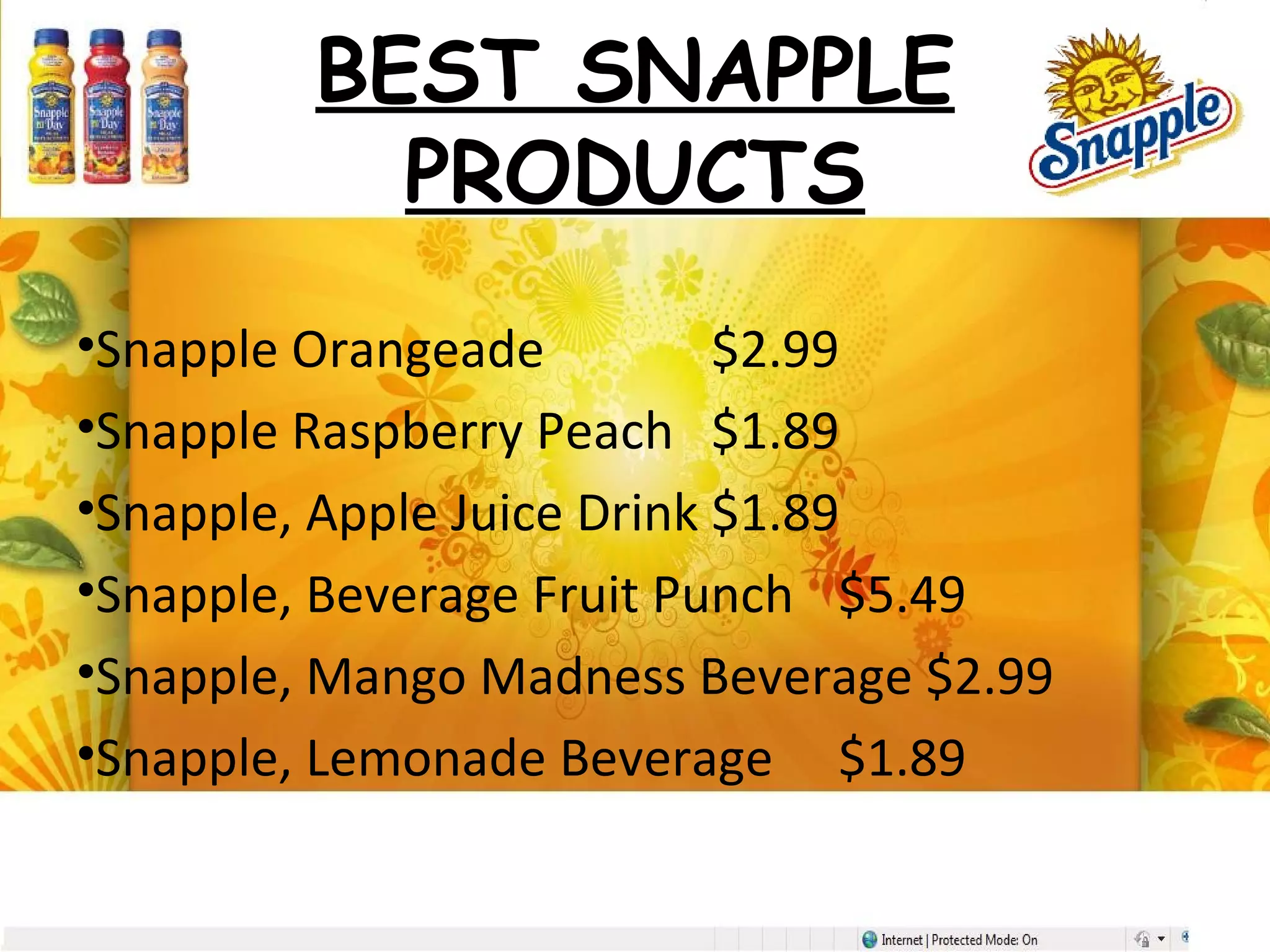
BEST SNAPPLE
PRODUCTS
•Snapple Orangeade $2.99
•Snapple Raspberry Peach $1.89
•Snapple, Apple Juice Drink $1.89
•Snapple, Beverage Fruit Punch $5.49
•Snapple, Mango Madness Beverage $2.99
•Snapple, Lemonade Beverage $1.89
CURRENT SCENARIO
% of Market
Number of Cases
(millions)
Dr Pepper Snapple Group (DPS)
/Cadbury Schweppes (CSG)
15.0 1491.3
Coca-Cola Company (KO) 42.8 4241.1
Pepsico (PEP) 31.1 3082.8
Cott (COT) 4.8 476.6
PROFIT
•Profit gained 42% compared to 2008.
•Carbonated Soft Drinks volume increased by
3% while 7UP, Sunkist soda, A&W and Canada
Dry were down a combined 3%.
•On the Non-Carbonated side, Hawaiian Punch
volume was up 3% while Snapple declined 6%.
•The company's U.S. market share of
carbonated soft drinks grew by 1.1% in the
quarter
SNAPPLE IN INDIA?
•Cadbury separating out drinks which include
Dr Pepper, 7UP, Snapple and Hawaiian
Punch
•Tata Group and Coca-cola bidding for Snapple
•Tata planning to expand in non-tea portfolio
•Tata planning to bid for Snapple at $2billion
THANK
YOU!!!!

Snapple

  • 1.
    PRESENTED BY: Dr. ANANDNAHAR (9161) BINY SARAH ABRAHAM (9162) NEHA BHUSARI (9163)
  • 2.
    CONTENTS DRINK MANUFACTURING ABOUT SNAPPLE SWOTANALYSIS 4 P’s JOURNEY OF SNAPPLE QUAKER OATS TAKEOVER TRIAC TAKEOVER CADBURY SCHWEPPES CURRENT SCENERIO
  • 3.
    Largest manufacturer inthe world Efficient manufacturing processes in the world High speed and low cost Origins – civilizations More streamlined and large-scale
  • 4.
    MODERN ERA 1876 -Root Beer 1886 – Coca Cola ( largest soft drink manufacturer in the world) 1966 – Gatorade 1971 – Starbucks 1972 – Snapple 1978 – Perrier and Evian 1980 - Odwalla 1981 – Red Bull 1982 – Diet Coke 1992 – Pepsi (lipton), Cola(ocean spray) 1995 – Dasani,Aquafina
  • 5.
    ABOUT… Leonard Marsh, HymanGoldman and Arnold Greenburg sold fruit juices under “Unadultered Food Corporation” Carbonated apple soda was part of their beverage line; snappy apple taste Snapple tea was introduced; Snapple Lemon Tea was first Today they have 50 varieties of flavored tea, fruit juices and flavored water; ”Made from The Best Stuff on Earth”
  • 6.
    STRENGTH  Brand image Product line  The flavored drinks available SWOT ANALYSIS OPPURTUNITY  Tap the youth market  Brand image WEAKNESS  Differentiating its product from “fashion water”  Discontinuance of Wendy and Stern  THREAT o Competition o Pricing strategy
  • 7.
  • 8.
    PRODUCT Product plan inthe progressively competitive beverage industry Focused on brand recognition and brand image Provided experiential benefits to its customers Extended product line with an established brand image PRICE Premium pricing strategy was employed Constantly review its pricing strategy
  • 9.
    PROMOTION Free source ofcommunication was achieved Secondary associations was also achieved - Wendy Support of off-beat personalities; achieving cult- like status Use of real and natural communication means Importance of having a spokesperson PLACE Indirect channel distribution marketing strategy was exploited Initially had a very little supermarket strategy Maintained strong relationship with the distributors Inve4sting in coolers and vending machines
  • 10.
    JOURNEY OF SNAPPLE •1972-incorporation of Snapple. •1990-emerged as nationally recognized brand in beverage industry. •1994-Quaker oats company purchased at $1.7 billions. •1997-sold to Triac group at $300 million. •2000- sold to Cadbury Schweppes at $1.45 billion
  • 11.
    EMERGENCE •In 1972 LeonardMarsh and Hyman Golden started with Unadulterated Food Power Co selling pure fruit juice. •In 1978 created apple soda that fizzled eventually giving drink’s name as ‘SNAP’. •In 1980 created non carbonated ready to drink fruit juice and ice tea.
  • 12.
    FUND RAISING •In Spring1992 Thomas Lee took majority stake at $140m. •In December same year they issued 4million shares at the price of $20/share and a month later it was traded at $34. •1992 to 93 stock price risen almost 5 times.
  • 13.
    SNAPPLE FORMULA •Offering customersnew and exotic choices of ready to drink beverages. •Develop its own distribution channels. •Premium pricing--Initially prices were $1- 1.25 for 16 ounce with 30-38% margin then they reduced.
  • 14.
    BRAND EQUITY •In consumersurvey they suggested Snapple name was catchy, popular and endangered positive feelings in consumers. •Promotion---Through national radio, TV, consumer composed Jingle and word of mouth publicity. •Company's most successful ad “Wendy- The Snapple Lady”.
  • 15.
    NEW COMPETITION •Pepsi alongwith Unilever(1992)-Introduced Lipton iced tea, advertising campaign with Vendla drinking Lipton. •Tetley English beverage giant Pearle. •Coca-Cola (1994) Introduced Fruitopia but could not do up to the target. •Arizona captured nearly 17% market share priced similarly like Snapple.
  • 16.
    TAKEOVER BY QUAKER OATS •In1994 at $1.7 billion giving 17 times earnings to Snapple. •But neither follow regular advertising schedule nor introduce new products quickly enough. Also healthy reputation began to suffer. •They try to use Snapple's distribution network for their product but distributors refused.
  • 17.
    NEW STRATEGIES •Reduced noof flavors. •Tripled add budget. •Pushed with new packaging. •To process order faster from 21 days to 2 days.
  • 18.
    BUT… •Snapple's sales decline………….although in 1995 Snapple maintained its no one position because of premium pricing policy. •Sales dropped almost 20% per quarter, as other giants entered into the picture. •Then what next…………
  • 19.
    SNAPPLE SALE •Triac BeverageGroup bought Snapple for $300 Billion in 1997. •TBG specializes in chemical, natural gas, textile industries. •By 1997’s Competitors were Pepsi’s FruitWorks,Nantucket,Campbell Soup co’s V8 Splash.
  • 20.
    TRIAC’S STRATEGIES •Launched newProducts •Whipper Snapple •Snapple Farms •Snapple Hydro •Snapple Elements •Nationwide Promotion Campaigns and Contests •Television Advertising •Website •Brand Extension – Hard candy,Fruits chewy candy, Whirls gummies
  • 21.
    TRIAC’S SUCCESS •Volume ofSnapple rose to 27% •By 2000 Snapple had 40% market share •Revenues reached $349million
  • 22.
    SALE AGAIN •Cadbury Schweppespurchased Snapple for $1.45 Billion. •Market Capitalization of $20Billion. •Beverages include Carbonated drinks, fruit juices, ice teas, water. •Brands included are Dr.Pepper,Mott’s,Snapple,7UP,Hawaiian Punch,Sunkist,A&W
  • 23.
    CADBURY’S STRATEGIES •Launched Exoticflavors and announced in creative ways •Nationwide Campaign •Meal Replacement •Official Beverage of New York
  • 24.
    BEST SNAPPLE PRODUCTS •Snapple Orangeade$2.99 •Snapple Raspberry Peach $1.89 •Snapple, Apple Juice Drink $1.89 •Snapple, Beverage Fruit Punch $5.49 •Snapple, Mango Madness Beverage $2.99 •Snapple, Lemonade Beverage $1.89
  • 25.
    CURRENT SCENARIO % ofMarket Number of Cases (millions) Dr Pepper Snapple Group (DPS) /Cadbury Schweppes (CSG) 15.0 1491.3 Coca-Cola Company (KO) 42.8 4241.1 Pepsico (PEP) 31.1 3082.8 Cott (COT) 4.8 476.6
  • 26.
    PROFIT •Profit gained 42%compared to 2008. •Carbonated Soft Drinks volume increased by 3% while 7UP, Sunkist soda, A&W and Canada Dry were down a combined 3%. •On the Non-Carbonated side, Hawaiian Punch volume was up 3% while Snapple declined 6%. •The company's U.S. market share of carbonated soft drinks grew by 1.1% in the quarter
  • 27.
    SNAPPLE IN INDIA? •Cadburyseparating out drinks which include Dr Pepper, 7UP, Snapple and Hawaiian Punch •Tata Group and Coca-cola bidding for Snapple •Tata planning to expand in non-tea portfolio •Tata planning to bid for Snapple at $2billion
  • 28.