BEDSIDE MEDICINE
WITHOUT TEARS
BEDSIDE MEDICINE
WITHOUT TEARS

SN Chugh
MD MNAMS FICP FICN FIACM FIMSA FISC

Professor of Medicine and
Head Endocrine and Metabolism
PGIMS, Rohtak, Haryana, India

JAYPEE BROTHERS
MEDICAL PUBLISHERS (P) LTD
New Delhi
Published by
Jitendar P Vij
Jaypee Brothers Medical Publishers (P) Ltd
B-3 EMCA House, 23/23B Ansari Road, Daryaganj
New Delhi 110 002, India
Phones: +91-11-23272143, +91-11-23272703, +91-11-23282021, +91-11-23245672, Rel: 32558559
Fax: +91-11-23276490, +91-11-23245683
e-mail: jaypee@jaypeebrothers.com
Visit our website: www.jaypeebrothers.com
Branches
 2/B, Akruti Society, Jodhpur Gam Road Satellite, Ahmedabad 380 015
Phones: +91-079-26926233, Rel: +91-079-32988717, Fax: +91-079-26927094
e-mail: jpamdvd@rediffmail.com
 202 Batavia Chambers, 8 Kumara Krupa Road, Kumara Park East, Bangalore 560 001
Phones: +91-80-22285971, +91-80-22382956, Rel: +91-80-32714073, Fax: +91-80-22281761
e-mail: jaypeemedpubbgl@eth.net
 282 IIIrd Floor, Khaleel Shirazi Estate, Fountain Plaza, Pantheon Road, Chennai 600 008
Phones: +91-44-28193265, +91-44-28194897, Rel: +91-44-32972089, Fax: +91-44-28193231
e-mail: jpchen@eth.net
 4-2-1067/1-3, 1st Floor, Balaji Building, Ramkote Cross Road
Hyderabad 500 095, Phones: +91-40-66610020, +91-40-24758498, Rel:+91-40-32940929,
Fax:+91-40-24758499, e-mail: jpmedpub@rediffmail.com
 No. 41/3098, B & B1, Kuruvi Building, St. Vincent Road, Kochi 682 018, Kerala
Phones: 0484-4036109, +91-0484-2395739, +91-0484-2395740, e-mail: jaypeekochi@rediffmail.com
 1-A Indian Mirror Street, Wellington Square
Kolkata 700 013, Phones: +91-33-22451926, +91-33-22276404, +91-33-22276415, Rel: +91-33-32901926
Fax: +91-33-22456075, e-mail: jpbcal@dataone.in
 106 Amit Industrial Estate, 61 Dr SS Rao Road
Near MGM Hospital, Parel, Mumbai 400 012
Phones: +91-22-24124863, +91-22-24104532, Rel: +91-22-32926896
Fax: +91-22-24160828, e-mail: jpmedpub@bom7.vsnl.net.in
 “KAMALPUSHPA” 38, Reshimbag
Opp. Mohota Science College, Umred Road
Nagpur 440 009 (MS)
Phones: Rel: 3245220, Fax: 0712-2704275
e-mail: jaypeenagpur@dataone.in

Bedside Medicine

Without Tears

© 2007, SN Chugh
All rights reserved. No part of this publication should be reproduced, stored in a retrieval system, or transmitted in any form or by any
means: electronic, mechanical, photocopying, recording, or otherwise, without the prior written permission of the author and the publisher.
This book has been published in good faith that the material provided by author is original. Every effort is made to ensure accuracy of
material, but the publisher, printer and author will not be held responsible for any inadvertent error(s). In case of any dispute, all legal
matters are to be settled under Delhi jurisdiction only.
First Edition : 2007
ISBN 81-8061-971-0
Typeset at JPBMP typesetting unit
Printed at Gopsons Papers Ltd, Sector 60, Noida
Dedicated to
My parents
Late Shri Chhabil Dass Chugh and Sanwari Devi
and my wife Dr Kiran Chugh
and
My children
Daughter Dr Ashima Chugh
Son Dr Anshul Chugh
Daughter-in-law Dr Deepti Chugh
and my teachers and students
Preface
I have realised over the years that the students are not oriented well to practical examinations and face difficulty in
the interpretation of clinical signs. They lack basic sense to analyse the symptoms and signs probably because either
they do not attend the clinical classes or they lay more stress on theoretical discussion. In clinical case discussion, the
questions are asked according to the interpretation of clinical symptoms and signs, and the students find difficulty
in answering them because they are not ready to face practical examination immediately after the theory
examination. The students prepare the subject for theory paper from the Textbook of Medicine but they do not
have too many books on practical aspects of medicine. After the theory papers, the time given to the students is
short to prepare for practical examination. They want to revise the subject as a whole for practical examinations
because the examiners in practical examination do not limit themselves only to practical aspects but also can
forward questions on theoretical aspects of medicine.
Today, the students want such a book which can orient them not only to clinical examination but also prepare
them to face theoretical discussion about the case. Keeping in view the dire necessity of a book which can cater the
needs of the students to their satisfaction and allow them to face the examination “without tears in their eyes”, I am
bringing out the first edition of this book after consultations with students, residents and my teacher colleagues. I
hope this book will not disappoint them at the hour of need.
The medicine being an ever-changing science, it is difficult to cope with the recent advances. I have attempted
to include all the available informations in the literature, so as to present this book as updated. However, “to err is
human”, and I am conscious of my deficiencies, therefore, I may be excused for any lapse or deficiency in this book
as this is written by a single author.
I extend my sincere thanks to M/s Jaypee Brothers Medical Publishers (P) Ltd., for bringing the excellent first
edition of the book. The publisher has taken special care to depict the clinical material provided to him clearly and
carefully for which I am highly indebted. My special thanks to Mr Atul Jain of Jain Book Depot, Rohtak who had
played vital role in the preparation of this book.
Mere words are not sufficient to express appreciation for my wife and children who have supported me during
this period. I can say that it was impossible for me to bring out this book without their moral support.
At last, I request the readers to convey their suggestions or comments regarding this book to the publisher or
author.

SN Chugh
Contents
1. Clinical Case Discussion

1

2. Bedside Procedures and Instruments

274

3. Commonly Used Drugs

285

4. Radiology

379

5. Electrocardiography

417

Index

443
LONG CASES
CASE 1: CHRONIC OBSTRUCTIVE PULMONARY DISEASE (COPD)
WITH OR WITHOUT COR PULMONALE
Examination

The patient (Fig. 1.1A) presented with
cough with mucoid sputum for the last 8
years. These symptoms intermittently
increased during windy or dusty
weather. No history of hemoptysis, fever,
pain chest. The sputum is white, small in
amount with no postural relation.

Inspection
Shape of the chest
• AP diameter is increased relative to
transverse diameter.
• Barrel-shaped chest: the sternum
becomes more arched, spines become
unduly concave, the AP diameter is >
transverse diameter, ribs are less
oblique (more or less horizontal),
subcostal angle is wide (may be
obtuse), intercostal spaces are
widened.

Points to be Stressed in History
•

•

•
•

Cigarette smoking. Exposure to smoke
from cigrarette or biomass and solid
fuel fires, atmospheric smoke is
important factor in pathogenesis as well
as in acute exacerbation of COPD. The
smoke has adverse effect on surfactants
and lung defence.
Precipitating factors, e.g. dusty atmosphere, air pollution and repeated upper
respiratory tract infections. They cause
acute exacerbations of the disease.
Family history: There is increased
susceptibility to develop COPD in
family of smokers than non-smokers.
Hereditary predisposition. Alpha-1antitrypsin deficiency can cause
emphysema in non-smokers adult
patients.

Physical Signs (See Table 1.1)
General Physical
•

Flexed posture (leaning forward) with
pursed-lip breathing and arms
supported on their knees or table.

Movements of the chest wall
• Bilaterally diminished

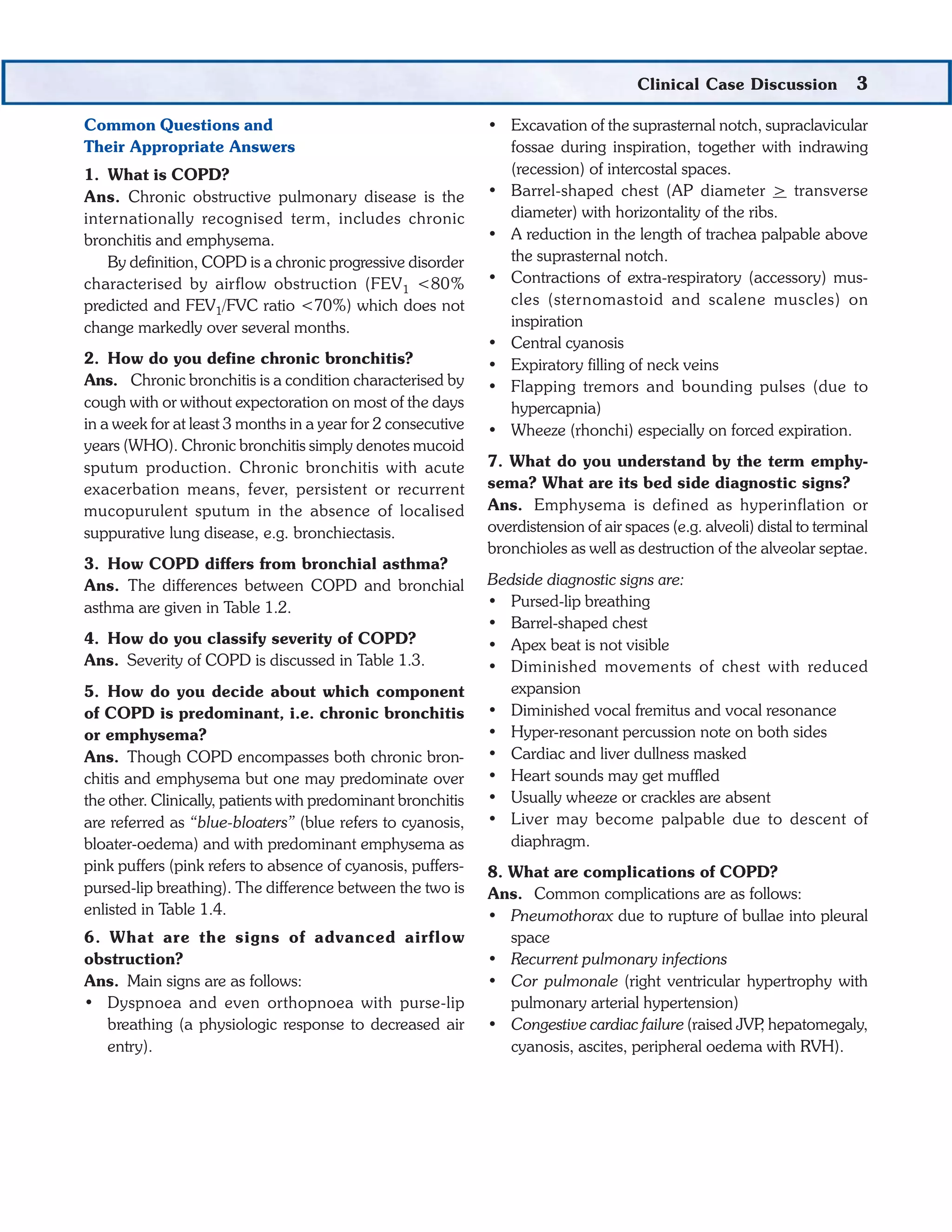
Figs 1.1A and B: Chronic obstructive
pulmonary disease (COPD): A. Patient of
COPD demonstrating central cyanosis. B.
Clinical signs of COPD (Diag)

Respiratory rate and type of breathing
• Pursed-lip breathing
• Intercostal recession (indrawing of the
ribs)
• Excavation of suprasternal, supraclavicular and infraclavicular fossae
during expiration
• Widening of subcostal angle
• Respiratory rate is increased. It is
mainly abdominal. The alae nasi and
extra-respiratory muscles are in action.
All these signs indicate hyperinflation
of lung due to advanced airflow
obstruction.

Clinical Presentations
•

Initially, the patients complain of
repeated attacks of productive cough,
usually after colds and especially during
winter months which show a steady

•

Cardiac apex beat may or may not be
visible.
2
•
•

•
•

Bedside Medicine
Central cyanosis, may be noticed in
severe COPD.
Bounding pulses (wide pulse pressure)
and flapping tremors on outstretched
hands may be present is severe COPD
with type 2 respiratory failure. These
signs suggest hypercapnia.
Disturbed consciousness with
apnoeic spells (CO2 narcosis-type 2
respiratory failure).
Raised JVP and pitting oedema feet
may be present if patient develops cor
pulmonale with congestive heart
failure.

Oedema feet without raised JVP indicate
secondary renal amyloidosis due to
pulmonary
suppuration,
e.g.
bronchiectasis, bronchitis, chest
infections.
•

Palpation
•
•

•
•
•
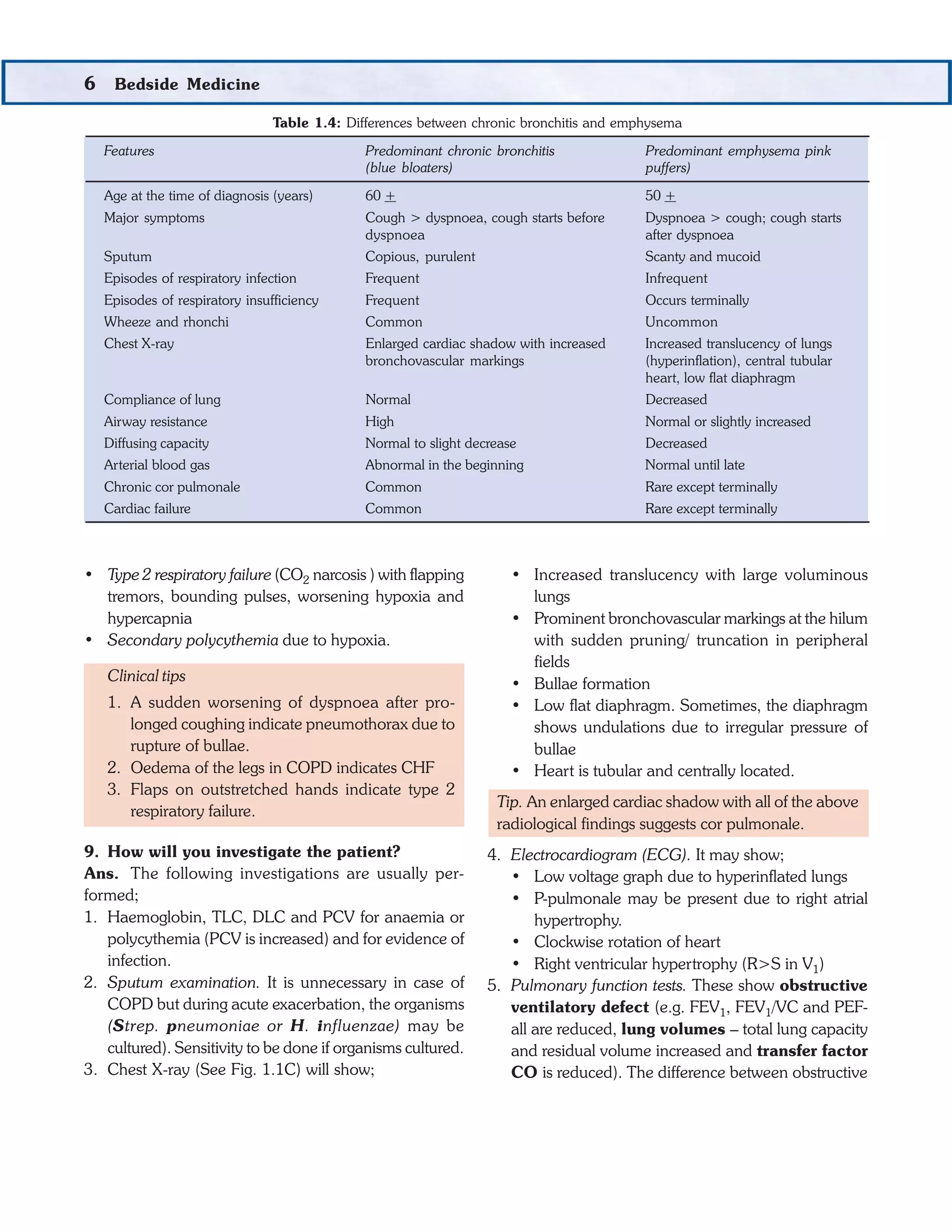
Fig. 1.1: Chest-X-ray PA view showing
hyperinflated (hyper-translucent) lungs and
tubular heart

Percussion
•
•

Respiratory rate is increased (hyperpnoea). There may be tachycardia.

•

•

•

increase in severity and duration with
successive years until cough is present
throughout the year for more than 2
years.
Later on with increase in severity of the
disease, patient may complain of
repeated chest infections, exertional
breathlessness, regular morning cough,
wheeze and occasionally chest
tightness.
Patient may present with acute
exacerbations in which he/she develops
fever, productive cough, thick mucopurulent or purulent sputum, often
streaked with blood (haemoptysis) and
increased or worsening breathlessness.
Patient may present with complications,
the commonest being cor pulmonale,
characterised by right ventricular
hypertrophy with or without failure.
The symptoms of right ventricular
failure include, pain in right
hypochondrium, ascites (swelling of
abdomen) and swelling of legs
(oedema).

Movements of the chest are diminished
bilaterally and expansion of the chest
is reduced.
Trachea is central but there may be
reduction in length of palpable trachea
above the sternal notch and there may
be tracheal descent during inspiration
(tracheal tug).
Intercostal spaces may be widened
bilaterally.
Occasionally, there may be palpable
wheeze (rhonchi) during acute
exacerbation.
Cardiac apex beat may not be palpable
due to superimposition by the
hyperinflated lungs.

•
•
•
•

A hyper-resonant note on both sides.
Cardiac dullness is either reduced or
totally masked
Liver dullness is pushed down (below
5th intercostal space).
There may be resonance over
Kronig’s isthmus and Traube’s
area (splenic dullness is masked).
Diaphragmatic excursions are reduced.
Tactile vocal fremitus may be reduced
bilaterally. It can be normal in early
cases.

Auscultation
•
•
•
•

Breath sounds may be diminished in
intensity due to diminished air entry.
Vesicular breathing with prolonged
expiration is a characteristic sign of
COPD.
Vocal resonance may be normal or
slightly diminished on both sides
equally.
Rhonchi or wheeze are common
especially during forced expiration
(expiratory wheeze/rhonchi). Sometimes crackles may be heard during
acute exacerbation of chronic
bronchitis.
Clinical Case Discussion
Common Questions and
Their Appropriate Answers
1. What is COPD?
Ans. Chronic obstructive pulmonary disease is the
internationally recognised term, includes chronic
bronchitis and emphysema.
By definition, COPD is a chronic progressive disorder
characterised by airflow obstruction (FEV 1 <80%
predicted and FEV1/FVC ratio <70%) which does not
change markedly over several months.
2. How do you define chronic bronchitis?
Ans. Chronic bronchitis is a condition characterised by
cough with or without expectoration on most of the days
in a week for at least 3 months in a year for 2 consecutive
years (WHO). Chronic bronchitis simply denotes mucoid
sputum production. Chronic bronchitis with acute
exacerbation means, fever, persistent or recurrent
mucopurulent sputum in the absence of localised
suppurative lung disease, e.g. bronchiectasis.
3. How COPD differs from bronchial asthma?
Ans. The differences between COPD and bronchial
asthma are given in Table 1.2.
4. How do you classify severity of COPD?
Ans. Severity of COPD is discussed in Table 1.3.
5. How do you decide about which component
of COPD is predominant, i.e. chronic bronchitis
or emphysema?
Ans. Though COPD encompasses both chronic bronchitis and emphysema but one may predominate over
the other. Clinically, patients with predominant bronchitis
are referred as “blue-bloaters” (blue refers to cyanosis,
bloater-oedema) and with predominant emphysema as
pink puffers (pink refers to absence of cyanosis, pufferspursed-lip breathing). The difference between the two is
enlisted in Table 1.4.
6. What are the signs of advanced airflow
obstruction?
Ans. Main signs are as follows:
• Dyspnoea and even orthopnoea with purse-lip
breathing (a physiologic response to decreased air
entry).

3

• Excavation of the suprasternal notch, supraclavicular
fossae during inspiration, together with indrawing
(recession) of intercostal spaces.
• Barrel-shaped chest (AP diameter > transverse
diameter) with horizontality of the ribs.
• A reduction in the length of trachea palpable above
the suprasternal notch.
• Contractions of extra-respiratory (accessory) muscles (sternomastoid and scalene muscles) on
inspiration
• Central cyanosis
• Expiratory filling of neck veins
• Flapping tremors and bounding pulses (due to
hypercapnia)
• Wheeze (rhonchi) especially on forced expiration.
7. What do you understand by the term emphysema? What are its bed side diagnostic signs?
Ans. Emphysema is defined as hyperinflation or
overdistension of air spaces (e.g. alveoli) distal to terminal
bronchioles as well as destruction of the alveolar septae.
Bedside diagnostic signs are:
• Pursed-lip breathing
• Barrel-shaped chest
• Apex beat is not visible
• Diminished movements of chest with reduced
expansion
• Diminished vocal fremitus and vocal resonance
• Hyper-resonant percussion note on both sides
• Cardiac and liver dullness masked
• Heart sounds may get muffled
• Usually wheeze or crackles are absent
• Liver may become palpable due to descent of
diaphragm.
8. What are complications of COPD?
Ans. Common complications are as follows:
• Pneumothorax due to rupture of bullae into pleural
space
• Recurrent pulmonary infections
• Cor pulmonale (right ventricular hypertrophy with
pulmonary arterial hypertension)
• Congestive cardiac failure (raised JVP hepatomegaly,
,
cyanosis, ascites, peripheral oedema with RVH).
Chest wall
movement

Expansion
of chest

Activity of
extrarespiratory muscles

Position of
trachea and
mediastinum

AP and transverse diameter

Vocal fremitus

Percussion
note

Breath sounds

Intensity of
breath sounds
(vocal
resonance)

Added sounds

2.

3.

4.

5.

6.

7.

8.

9.

10.

11.

Decreased
over the
area involved

Diminished
or absent
over the
area involved

Dull on the
side involved

Reduced or
absent on the
side involved

N

Shifted to
the side
involved

A

Reduced on
the side
involved

Reduced on
the side
involved

Retraction on
the side
involved

Lobar
collapse

Fine crepitations None
early coarse
crepitations later
on the area
involved

Increased
over the
area involved.
Bronchophony
and whispering
pectoriloquy
present

High-pitched
bronchial over
the area
involved

Dull on the
side involved

Increased
on the side
involved

N

N

A

Reduced on
the side
involved

Reduced on
the side
involved

N

Lobar
consolidation

Coarse
crepitations on
the area
involved

Increased
over the
area involved

Low-pitched
bronchial
over the area
involved

Impaired over
the area
involved

Increased over
the area
involved

N

Shifted to
the side
involved

A

Reduced on
the side
involved

Reduced on
the side
involved

Retraction on
the side
involved

Fibrosis/
bronchiectasis

Pleural
effusion

Coarse
crepitations on
the area
involved

Increased
over the
area involved
whisphering
pectoriloquy
present

Amphoric
bronchial
over the area
involved

Impaired over
the area
involved

Increased over
the area
involved

N

Shifted to
the side
involved

A

Pleural rub
in some cases
over the area
involved

Decreased
over the
area involved

Absent or
diminished
over the area
involved

Stony dull
on the side
involved

Reduced or
absent on the
side involved

N

Shifted to
opposite
side

A

Slightly reduced Reduced or
on the side
absent on the
involved
side involved

Slightly reduced Reduced or
on the side
absent on the
involved
side involved

N or slight
N
retraction on
the side involved

Cavity or
lung abscess

Abbreviation: N = normal; B/L = bilateral; P = present; A = absent; AP = antero-posterior

Shape of
the chest

1.

Sign

N

N or
abnormal

N

P

N

N

N

None

Decreased
on the side
involved

Absent or
diminished
on the side
involved

Rhonchi with
some coarse
crepitations on
both the sides

N

B/L vesticular
with prolonged
expiration

N or reduced
on both
sides

Abnormal
AP > T

N

P

B/L
reduced

Bilateral
diminished

Hyperinflated or
barrel shaped

Emphysema

Rhonchi,
mainly
expiratory and
high-pitched

N

B/L vesticular
with prolonged
expiration

Expiratory
rhonchi

N or
diminished

B/L vesticular with
prolonged
expiration

N or hyperHyperresonant during resonant
acute attack

N

N

N

P

B/L reduced

Bilateral
diminished

N

Acute or chronic Bronchial
bronchitis
asthma

N or hyperN
resonant on
the side involved

Reduced or
absent on the
side involved

N

Shifted to
opposite
side

A

Reduced or
absent on the
side involved

Reduced or
absent on the
side involved

N

Pneumothorax

Table 1.1: Important differential physical signs in various respiratory disorders

4
Bedside Medicine
Clinical Case Discussion

5

Table 1.2: Differentiating features between bronchial asthma and COPD
Bronchial asthma

COPD (Fig. 1.1B)

• Occurs in young age, seen in children and adults who
are atopic

Occurs in middle or old aged persons

• Allergo-inflammatory disorder, characterised by reversible
airflow obstruction, airway inflammation and bronchial
hypersensitivity.

Inflammatory disorder characterised by progressive
airway obstruction

• Short duration of symptoms (weeks or months)

Long duration of symptoms, e.g. at least 2 years

• Episodic disease with recurrent attacks

Nonepisodic usually but acute exacerbations may occur which
worsen the symptoms and disease further

• Variable nature of symptoms is a characteristic feature

Symptoms are fixed and persistent, may be progressive

• Family history of asthma, hay fever or eczema may be
positive

No positive family history

• A broad dynamic syndrome rather than static disease

A chronic progressive disorder

• Wheezing is more pronounced than cough

Cough is more pronounced and wheezing may or may not
be present

• Shape of the chest remains normal because of dynamic
airway obstruction but AP diameter may increase with
severe asthma

Barrel-shaped chest (AP diameter > transverse) in patients
with predominant emphysema

• Pursed-lip breathing is uncommon

Pursed-lip breathing common

• Respiratory movement may be normal or decreased,
tracheal tug absent. Accessory muscles of respiration may
be active and intercostal recession may be present.

Respiratory movement are usually decreased with:
• Reduced palpable length of trachea with tracheal tug
• Reduced expansion
• Excavation of suprasternal notch, supraclavicular and
infraclavicular fossae.
• Widening of subcostal angle
• Intercostal recession
• Accessory muscles of respiration hyperactive.

Table 1.3: Gold criteria for severity of COPD
Gold stage

Severity

Symptoms

Spirometry

0

At risk

Chronic cough, sputum

Normal

I

Mild

With or without chronic cough or sputum
production

FEV1/FVC <70%
FEV1=80% predicted

II

Moderate

With or without chronic cough or
sputum production

FEV1/FVC <70%
FEV1=50 to 80% predicted

III

Severe

-do-

FEV1/FVC <70%
FEV1=30-50%

IV

Very severe

-do-

FEV1/FVC <70%
FEV1 <30%
Or
FEV1 <50% predicted with respiratory
failure or signs of right heart failure
6

Bedside Medicine
Table 1.4: Differences between chronic bronchitis and emphysema
Features

Predominant chronic bronchitis
(blue bloaters)

Predominant emphysema pink
puffers)

Age at the time of diagnosis (years)

60 +

50 +

Major symptoms

Cough > dyspnoea, cough starts before
dyspnoea

Dyspnoea > cough; cough starts
after dyspnoea

Sputum

Copious, purulent

Scanty and mucoid

Episodes of respiratory infection

Frequent

Infrequent

Episodes of respiratory insufficiency

Frequent

Occurs terminally

Wheeze and rhonchi

Common

Uncommon

Chest X-ray

Enlarged cardiac shadow with increased
bronchovascular markings

Increased translucency of lungs
(hyperinflation), central tubular
heart, low flat diaphragm

Compliance of lung

Normal

Decreased

Airway resistance

High

Normal or slightly increased

Diffusing capacity

Normal to slight decrease

Decreased

Arterial blood gas

Abnormal in the beginning

Normal until late

Chronic cor pulmonale

Common

Rare except terminally

Cardiac failure

Common

Rare except terminally

• Type 2 respiratory failure (CO2 narcosis ) with flapping
tremors, bounding pulses, worsening hypoxia and
hypercapnia
• Secondary polycythemia due to hypoxia.
Clinical tips
1. A sudden worsening of dyspnoea after prolonged coughing indicate pneumothorax due to
rupture of bullae.
2. Oedema of the legs in COPD indicates CHF
3. Flaps on outstretched hands indicate type 2
respiratory failure.
9. How will you investigate the patient?
Ans. The following investigations are usually performed;
1. Haemoglobin, TLC, DLC and PCV for anaemia or
polycythemia (PCV is increased) and for evidence of
infection.
2. Sputum examination. It is unnecessary in case of
COPD but during acute exacerbation, the organisms
(Strep. pneumoniae or H. influenzae) may be
cultured). Sensitivity to be done if organisms cultured.
3. Chest X-ray (See Fig. 1.1C) will show;

• Increased translucency with large voluminous
lungs
• Prominent bronchovascular markings at the hilum
with sudden pruning/ truncation in peripheral
fields
• Bullae formation
• Low flat diaphragm. Sometimes, the diaphragm
shows undulations due to irregular pressure of
bullae
• Heart is tubular and centrally located.
Tip. An enlarged cardiac shadow with all of the above
radiological findings suggests cor pulmonale.
4. Electrocardiogram (ECG). It may show;
• Low voltage graph due to hyperinflated lungs
• P-pulmonale may be present due to right atrial
hypertrophy.
• Clockwise rotation of heart
• Right ventricular hypertrophy (R>S in V1)
5. Pulmonary function tests. These show obstructive
ventilatory defect (e.g. FEV1, FEV1/VC and PEFall are reduced, lung volumes – total lung capacity
and residual volume increased and transfer factor
CO is reduced). The difference between obstructive
Clinical Case Discussion
Table 1.5: Pulmonary function tests in obstructive and
restrictive lung defect
Test

Obstructive defect
(COPD)

Restrictive defect
(Interstitial lung
disease)

Forced expiratory
volume during one
second (FEV1)

Markedly reduced

Slightly reduced

Vital capacity (VC)

Reduced or normal Markedly reduced

FEV1/VC

Reduced

Increased or normal

Functional residual
capacity (FRC)

Increased

Reduced

Peak expiratory
flow (PEF)

Reduced

Normal

Residual volume
(RV)

Increased

Reduced

Total lung capacity

Increased

Reduced

Transfer or diffusion Normal
factor for CO
(Tco and Dco)

Low

PaO2

Decreased

Decreased

PaCO2

Increased

Low or normal

and restrictive lung defect are summarised in Table
1.5.
6. Arterial blood gas analysis may show reduced PaO2
and increased PaCO2 (hypercapnia).
7. Alpha-1 antitrypsin levels: Reduced level may occur
in emphysema (normal range is 24 to 48 mmol/L).
10. What do you understand by the term chronic
Cor pulmonale?
Ans. Chronic Cor pulmonale is defined as right
ventricular hypertrophy/dilatation secondary to chronic
disease of the lung parenchyma, vascular and/or bony
cage. Therefore its causes include;
I. Diseases of the lung (hypoxic vasoconstriction)
• COPD
• Diffuse interstitial lung disease
• Pneumoconiosis (occupational lung disease).
II. Diseases of pulmonary vasculature
• Primary pulmonary hypertension
• Recurrent pulmonary embolism
• Polyarteritis nodosa

7

III. Disorders of thoracic cage affecting lung
functions
• Severe kyphoscoliosis
• Ankylosing spondylitis
• Neuromuscular disease, e.g. poliomyelitis
• Obesity with hypoventilation (Pickwickian
syndrome)
Acute Cor pulmonale refers to acute thromboembolism where pulmonary hypertension develops due
to increased vascular resistance leading to right ventricular
dilatation with or without right ventricular failure.
11. Are cor pulmonale and right heart failure
synonymous?
Ans. No, cor pulmonale just refers to right ventricular
hypertrophy and dilatation. Right ventricular failure is a
step further of hypertrophy or dilatation, hence, is
considered as a complication of Cor pulmonale.
12. What do you understand by term obstructive
sleep-apnoea syndrome?
Ans. Obstructive sleep-apnoea syndrome is characterised by spells of apnoeas with snoring due to occlusion
of upper airway at the level of oropharynx during sleep.
Apnoeas occur when airway at the back of throat is
sucked closed during sleep. When awake, this tendency
is overcome by the action of the muscles meant for
opening the oropharynx which become hypotonic during
sleep. Partial narrowing results in snoring, complete
occlusion in apnoea and critical nar rowing in
hyperventilation. The major features include, loud
snoring, day-time somnolence, unfreshed or restless
sleep, morning headache, nocturnal choking, reduced
libido and poor performance at work, morning
drunkenness and ankle oedema. The patient’s family
report the pattern of sleep as “snore-silence-snore” cycle.
The diagnosis is made if there are more than 15 apnoeas/
hyperpnoeas in any one hour of sleep with fall in arterial
O2 saturation on ear or finger oximetry.
13. What is congenital lobar emphysema?
Ans. Infants rarely develop a check-valve mechanism
in a lobar bronchus, which leads to rapid and lifethreatening unilateral overdistension of alveoli, called
congenital lobar emphysema.
8

Bedside Medicine

14. What is unilateral emphysema? What are its
causes?
Ans. Overdistension of one lung is called unilateral
emphysema. It can be congenital or acquired (compensatory emphysema). Unilateral compensatory emphysema develops due to collapse or destruction of the whole
lung or removal of one lung.
Macleod’s or Swyer-James syndrome is characterised
by unilateral emphysema developing before the age of
8 years when the alveoli are increasing in number. This
is an incidental radiological finding but is clinically
important because such a lung is predisposed to repeated
infections. In this condition, neither there is any

obstruction nor there is destruction and overdistension
of alveoli, hence, the term emphysema is not true to this
condition. In this condition, the number of alveoli are
reduced which appear as larger airspaces with increased
translucency on X-ray.
15. What do you understand by the term bullous
emphysema?
Ans. Confluent air spaces with dimension > 1 cm are
called bullae, may occasionally be congenital but when
occur in association with generalised emphysema or
progressive fibrotic process, the condition is known as
bullous emphysema. These bullae may further enlarge
and rupture into pleural space leading to pneumothorax.
Clinical Case Discussion

9

CASE 2: CONSOLIDATION OF THE LUNG (FIG. 1.2)
Systemic Examination

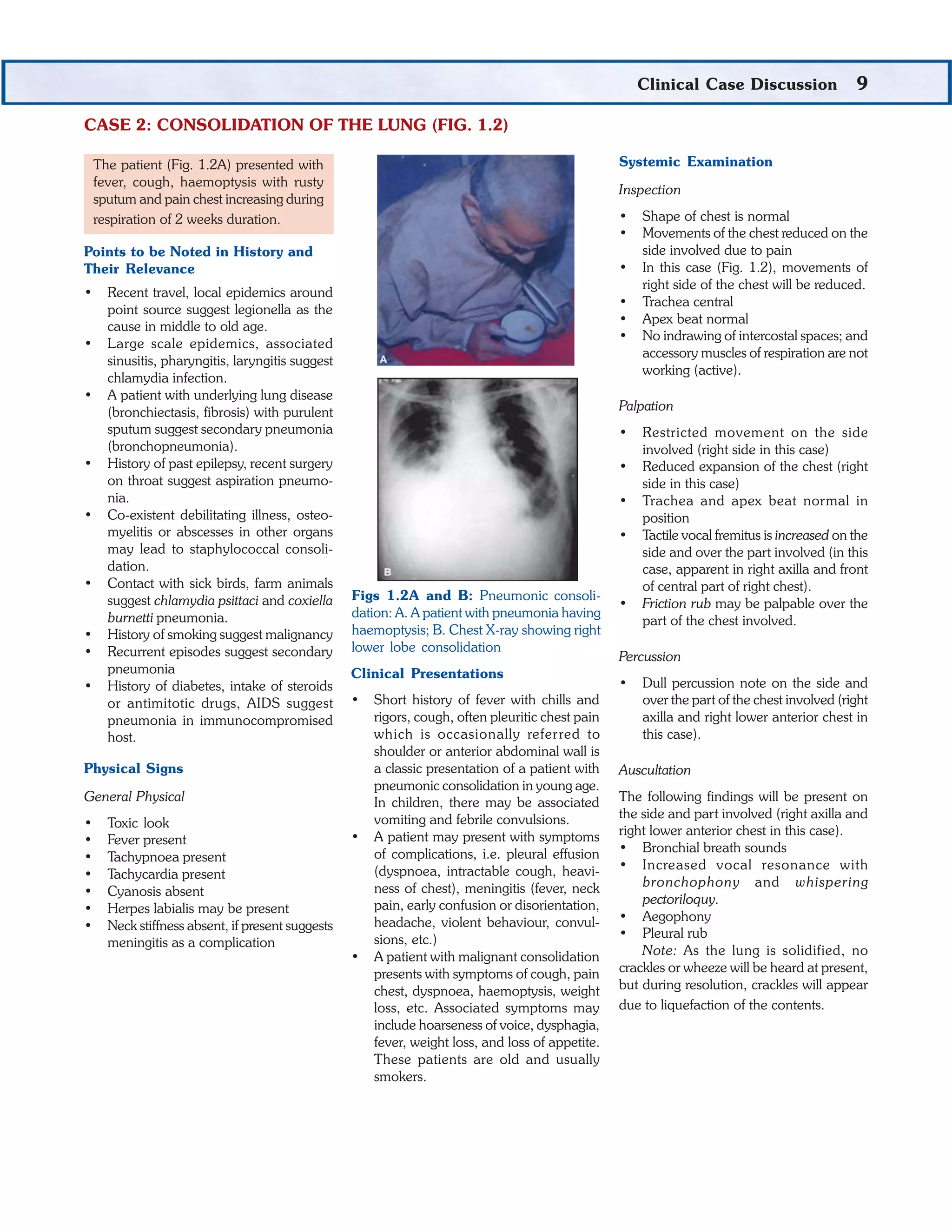
The patient (Fig. 1.2A) presented with
fever, cough, haemoptysis with rusty
sputum and pain chest increasing during
respiration of 2 weeks duration.

Inspection
•
•

Points to be Noted in History and
Their Relevance
•
•
•

•
•

•
•
•
•

Recent travel, local epidemics around
point source suggest legionella as the
cause in middle to old age.
Large scale epidemics, associated
sinusitis, pharyngitis, laryngitis suggest
chlamydia infection.
A patient with underlying lung disease
(bronchiectasis, fibrosis) with purulent
sputum suggest secondary pneumonia
(bronchopneumonia).
History of past epilepsy, recent surgery
on throat suggest aspiration pneumonia.
Co-existent debilitating illness, osteomyelitis or abscesses in other organs
may lead to staphylococcal consolidation.
Contact with sick birds, farm animals
suggest chlamydia psittaci and coxiella
burnetti pneumonia.
History of smoking suggest malignancy
Recurrent episodes suggest secondary
pneumonia
History of diabetes, intake of steroids
or antimitotic drugs, AIDS suggest
pneumonia in immunocompromised
host.

•
•
•
•

Palpation
•
•
•
•

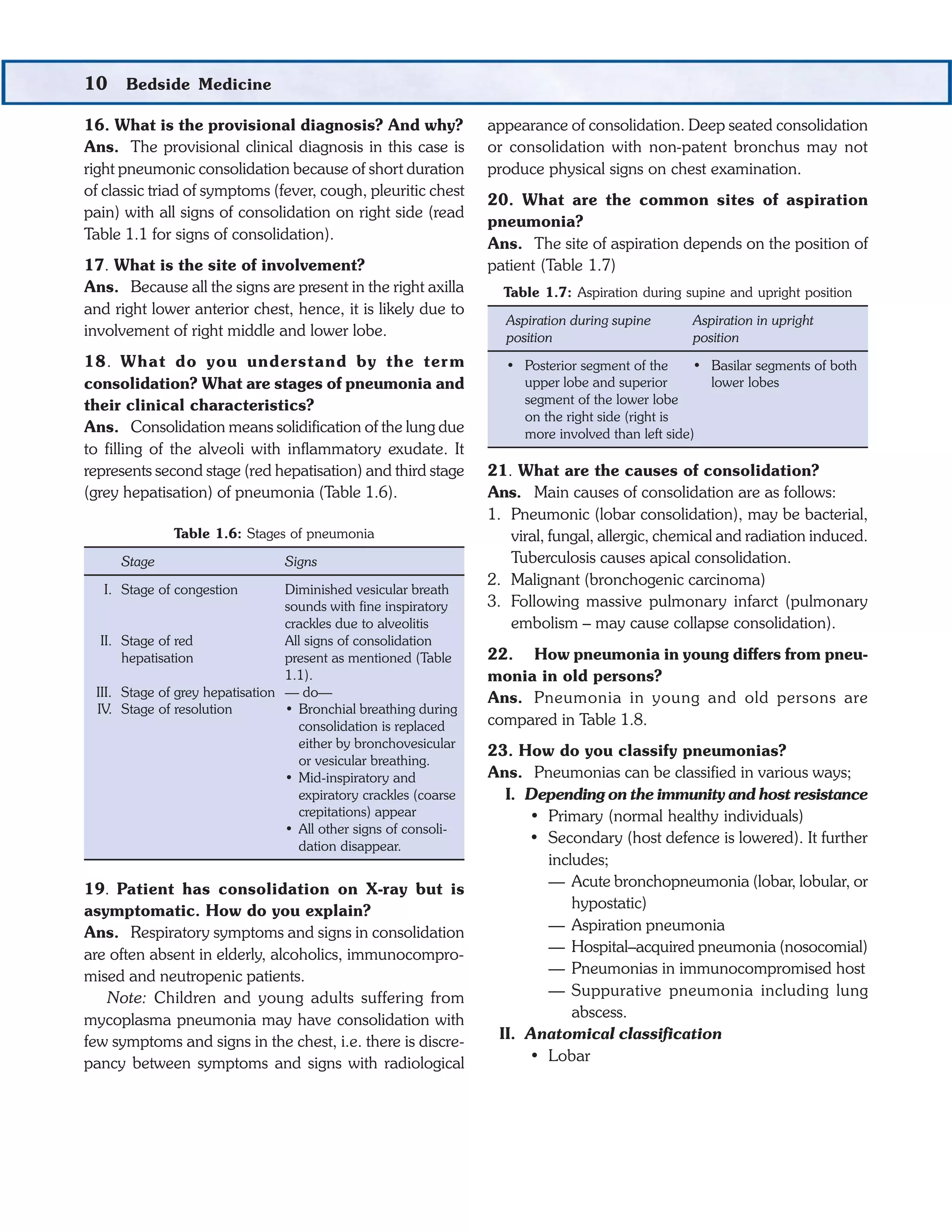
Figs 1.2A and B: Pneumonic consolidation: A. A patient with pneumonia having
haemoptysis; B. Chest X-ray showing right
lower lobe consolidation
Clinical Presentations
•

Physical Signs
General Physical
•
•
•
•
•
•
•

Toxic look
Fever present
Tachypnoea present
Tachycardia present
Cyanosis absent
Herpes labialis may be present
Neck stiffness absent, if present suggests
meningitis as a complication

Shape of chest is normal
Movements of the chest reduced on the
side involved due to pain
In this case (Fig. 1.2), movements of
right side of the chest will be reduced.
Trachea central
Apex beat normal
No indrawing of intercostal spaces; and
accessory muscles of respiration are not
working (active).

•

•

Short history of fever with chills and
rigors, cough, often pleuritic chest pain
which is occasionally refer red to
shoulder or anterior abdominal wall is
a classic presentation of a patient with
pneumonic consolidation in young age.
In children, there may be associated
vomiting and febrile convulsions.
A patient may present with symptoms
of complications, i.e. pleural effusion
(dyspnoea, intractable cough, heaviness of chest), meningitis (fever, neck
pain, early confusion or disorientation,
headache, violent behaviour, convulsions, etc.)
A patient with malignant consolidation
presents with symptoms of cough, pain
chest, dyspnoea, haemoptysis, weight
loss, etc. Associated symptoms may
include hoarseness of voice, dysphagia,
fever, weight loss, and loss of appetite.
These patients are old and usually
smokers.

•

Restricted movement on the side
involved (right side in this case)
Reduced expansion of the chest (right
side in this case)
Trachea and apex beat normal in
position
Tactile vocal fremitus is increased on the
side and over the part involved (in this
case, apparent in right axilla and front
of central part of right chest).
Friction rub may be palpable over the
part of the chest involved.

Percussion
•

Dull percussion note on the side and
over the part of the chest involved (right
axilla and right lower anterior chest in
this case).

Auscultation
The following findings will be present on
the side and part involved (right axilla and
right lower anterior chest in this case).
• Bronchial breath sounds
• Increased vocal resonance with
bronchophony and whispering
pectoriloquy.
• Aegophony
• Pleural rub
Note: As the lung is solidified, no
crackles or wheeze will be heard at present,
but during resolution, crackles will appear
due to liquefaction of the contents.
10 Bedside Medicine
16. What is the provisional diagnosis? And why?
Ans. The provisional clinical diagnosis in this case is
right pneumonic consolidation because of short duration
of classic triad of symptoms (fever, cough, pleuritic chest
pain) with all signs of consolidation on right side (read
Table 1.1 for signs of consolidation).
17. What is the site of involvement?
Ans. Because all the signs are present in the right axilla
and right lower anterior chest, hence, it is likely due to
involvement of right middle and lower lobe.
18. What do you understand by the ter m
consolidation? What are stages of pneumonia and
their clinical characteristics?
Ans. Consolidation means solidification of the lung due
to filling of the alveoli with inflammatory exudate. It
represents second stage (red hepatisation) and third stage
(grey hepatisation) of pneumonia (Table 1.6).
Table 1.6: Stages of pneumonia
Stage

Signs

I. Stage of congestion

Diminished vesicular breath
sounds with fine inspiratory
crackles due to alveolitis
II. Stage of red
All signs of consolidation
hepatisation
present as mentioned (Table
1.1).
III. Stage of grey hepatisation — do—
IV. Stage of resolution
• Bronchial breathing during
consolidation is replaced
either by bronchovesicular
or vesicular breathing.
• Mid-inspiratory and
expiratory crackles (coarse
crepitations) appear
• All other signs of consolidation disappear.

19. Patient has consolidation on X-ray but is
asymptomatic. How do you explain?
Ans. Respiratory symptoms and signs in consolidation
are often absent in elderly, alcoholics, immunocompromised and neutropenic patients.
Note: Children and young adults suffering from
mycoplasma pneumonia may have consolidation with
few symptoms and signs in the chest, i.e. there is discrepancy between symptoms and signs with radiological

appearance of consolidation. Deep seated consolidation
or consolidation with non-patent bronchus may not
produce physical signs on chest examination.
20. What are the common sites of aspiration
pneumonia?
Ans. The site of aspiration depends on the position of
patient (Table 1.7)
Table 1.7: Aspiration during supine and upright position
Aspiration during supine
position

Aspiration in upright
position

• Posterior segment of the
• Basilar segments of both
upper lobe and superior
lower lobes
segment of the lower lobe
on the right side (right is
more involved than left side)

21. What are the causes of consolidation?
Ans. Main causes of consolidation are as follows:
1. Pneumonic (lobar consolidation), may be bacterial,
viral, fungal, allergic, chemical and radiation induced.
Tuberculosis causes apical consolidation.
2. Malignant (bronchogenic carcinoma)
3. Following massive pulmonary infarct (pulmonary
embolism – may cause collapse consolidation).
22. How pneumonia in young differs from pneumonia in old persons?
Ans. Pneumonia in young and old persons are
compared in Table 1.8.
23. How do you classify pneumonias?
Ans. Pneumonias can be classified in various ways;
I. Depending on the immunity and host resistance
• Primary (normal healthy individuals)
• Secondary (host defence is lowered). It further
includes;
— Acute bronchopneumonia (lobar, lobular, or
hypostatic)
— Aspiration pneumonia
— Hospital–acquired pneumonia (nosocomial)
— Pneumonias in immunocompromised host
— Suppurative pneumonia including lung
abscess.
II. Anatomical classification
• Lobar
Clinical Case Discussion
Table 1.8: Differentiating features of pneumonia in
younger and older persons
Pneumonia in young

Pneumonia in old

• Primary (occurs in previously Secondary (previous lung
healthy individuals)
disease or immunocompromised state)
• Common organisms are;
Common organisms are;
pneumococci, mycoplasma, pneumococci, H. influenzae,
chlamydia, coxiella
legionella
• Florid symptoms and signs Few or no symptoms and
signs
• Systemic manifestations are More pronounced systemic
less pronounced
features
• Complications are less
Complications are frequent
frequent
• Resolution is early
Resolution may be delayed
• Response to treatment is
Response to treatment is
good and dramatic
slow

• Lobular (bronchopneumonia, bilateral)
• Segmental (hypostatic pneumonia).
III. Aetiological classification
• Infective, e.g. bacterial, viral, mycoplasma,
fungi, protozoal, pneumocystis carinii
• Chemical – induced ( lipoid pneumonia, fumes,
gases, aspiration of vomitus)
• Radiation
• Hypersensitivity/ allergic reactions.
IV. Empiricist’s classification (commonly used)
• Community–acquired pneumonia (S. pneumoniae, Mycoplasma, Chlamydia, legionella, H.
influenzae, virus, fungi, anaerobes, mycobacterium)
• Hospital–acquired pneumonia (Pseudomonas,
B. proteus, Klebsiella, Staphycoccus, oral
anaerobes)
• Pneumonia in immunocompromised host
(Pneumocystis carinii, Mycobacterium, S.
pneumoniae, H. influenzae).
24. What are the characteristics of viral pneumonia?
Ans. Characteristics of viral pneumonia are as follows:
• Constitutional symptoms, e.g. headache, malaise,
myalgia, anorexia are predominant (commonly due
to influenza, parainfluenza, measles and respiratory
syncytial virus).

11

• There may be no respiratory symptoms or signs and
consolidation may just be discovered on chest X-ray
• Cough, at times, with mucoid expectoration.
• Haemoptysis, chest pain (pleuritic) and pleural
effusion are rare
• Paucity of physical signs in the chest
• Chest X-ray shows reticulonodular pattern instead of
lobar consolidation
• Spontaneous resolution with no response to
antibiotics
• WBC count is normal.
25. What are the characteristics of various
bacterial pneumonias?
Ans. Characteristics of bacterial pneumonias are
enlisted in Table 1.9.
26. What are the complications of pneumonia?
Ans. Common complications of pneumonia are;
• Pleural effusion and empyema thoracis
• Lung abscess
• Pneumothorax
• Meningitis
• Circulatory failure (Waterhouse – Friedrichson’s
syndrome)
• Septic arthritis
• Pericarditis
• Peritonitis
• Peripheral thrombophlebitis
• Herpes labialis (secondary infection).
27. What are the causes of recurrent pneumonia?
Ans. Recurrent pneumonias mean two or more attacks
within a few weeks. It is due to either reduced/lowered
resistance or there is a local predisposing factor, i.e.
• Chronic bronchitis
• Hypogammaglobinaemia
• Pharyngeal pouch
• Bronchial tumour
28. What is normal resolution? What is delayed
resolution and nonresolution? What are the
causes of delayed or non-resolution of pneumonia?
Ans. Normal resolution in a patient with pneumonia
means disappearance of symptoms and signs within
two weeks of onset and radiological clearance within
12 Bedside Medicine
Table 1.9: Clinical and radiological features of bacterial pneumonias
Pathogens
Common organisms
Pneumococcal pneumonia

Clinical features

Radiological features

Young to middle aged, rapid onset, high fever,
chills, and rigors, pleuritic chest pain, herpes
simplex labialis, rusty sputum. Toxic look,
tachypnoea and tachycardia. All signs of
consolidation present

Lobar consolidation (dense uniform
opacity), one or more lobes

Mycoplasma pneumoniae

• Children and young adults (5-15 years),
Patchy or lobar consolidation. Hilar
insidious onset, headache, systemic features. lymphadenopathy present
Often few signs in the chest. IgM cold
agglutinins detected by ELISA
• Erythema nodosum, myocarditis, pericarditis
rash,meningoencephalitis,hemolytic anaemia

Legionella

• Middle to old age, history of recent travel,
local epidemics around point source, e.g.
cooling tower, air conditioner
• Headache, malaise, myalgia, high fever,
dry cough, GI symptoms
• Confusion, hepatitis, hyponatraemia,
hypoalbuminaemia

Shadowing continues to spread despite
antibiotics and often slow to resolve

• Old age, often underlying lung disease
(COPD), purulent sputum, pleural effusion
common

Bronchopneumonia
Signs of underlying disease present and
are more pronounced

Staphylococcal pneumonia

• Occurs at extremes of ages, coexisting
debilitating illness, often complicates viral
infection
• Can arise from, or cause abscesses in other
organs, e.g. osteomyelitis
• Presents as bilateral pneumonia, cavitation
is frequent

Lobar or segmental thin walled abscess
formation (pneumatocoeles)

Klebsiella

Systemic disturbances marked, widespread
consolidation often in upper lobes. Red-currant
jelly sputum, lung abscess and cavitation
frequent

Consolidation with expansion of the
affected lobes, bulging of interlobar
fissure

Uncommon organisms
H. influenzae

four weeks. Delayed resolution means when physical
signs persist for more than two weeks and radiological
findings persist beyond four weeks after proper antibiotic
therapy. Causes are;
• Inappropriate antibiotic therapy
• Presence of a complication (pleural effusion,
empyema)
• Depressed immunity, e.g. diabetes, alcoholism,
steroids therapy, neutropenia, AIDS, hypogammaglobulinaemia

• Partial obstruction of a bronchus by a foreign body
like denture or malignant tumour
• Fungal or atypical pneumonia
• Pneumonia due to SLE and pulmonary infarction or
due to recurrent aspirations in GERD or Cardia
achalasia.
Non-resolution means radiological findings persisting
beyond eight weeks after proper antibiotic therapy.
Causes are;
• Neoplasm
• Underlying lung disease, e.g. bronchiectasis
Clinical Case Discussion
• Virulent organisms, e.g. Staphylococcus, Klebsiella
• Underlying diabetes
• Old age.
29. How do you diagnose pleural effusion in a
patient with consolidation?
Ans. The clues to the diagnosis are:
• History suggestive of pneumnoia (fever, pain chest,
haemoptysis, cough) and persistence of these
symptoms beyond 2-4 weeks
• Signs of pleural effusion, e.g. stony dull percussion
note, shifting of trachea and mediastinum.
• The obliteration of costophrenic angle in presence of
consolidation on chest X-ray.
30. What is the mechanism of trachea being
shifted to same side in consolidation?
Ans. Usually, trachea remains central in a case of
consolidation but may be shifted to the same side if;
• Consolidation is associated with collapse on the same
side (Collapse consolidation due to malignancy)
• Consolidation is associated with underlying old
fibrosis on the same side.
31. What is typical or atypical pneumonia
syndrome?
Ans. The typical pneumonia syndrome is characterised
by sudden onset of fever, productive cough, pleuritic chest
pain, signs of consolidation in the area of radiological
abnormality. This is caused by S. pneumoniae, H.
influenzae, oral anaerobes and aerboes (mixed flora).
The atypical pneumonia syndrome is characterised
by insidious onset, a dry cough, predominant extrapulmonary symptoms such as headache, myalgia,
malaise, fatigue, sore throat, nausea, vomiting and
diarrhoea, and abnormalities on the chest X-day despite
minimal or no physical signs of pulmonary involvement.
It is produced by M. pneumoniae, L. pneumophilia, P.
carinii, S. pneumoniae, C. psittaci, Coxiella burnetii and
some fungi (H. capsulatum).
32. What will be the features in malignant
consolidation?
Ans. Common features in malignant consolidation are;
• Patient will be old and usually smoker

13

• History of dry persistent hacking cough, dyspnoea,
hemoptysis, pleuritic chest pain.
• There will be weight loss, emaciation due to malignant
cachexia.
• Cervical lymphadenopathy may be present.
• Trachea will be central, i.e. but is shifted to same side
if there is associated collapse or to the opposite if
associated with pleural effusion.
• All signs of consolidation, i.e. diminished movements,
reduced expansion, dull percussion note, bronchial
breathing may be present if bronchus is occluded.
The bronchial breathing is from the adjoining patent
bronchi. The bronchial breathing will, however, be
absent if there is partial bronchial obstruction.
• Signs and symptoms of local spread, i.e. pleura
(pleural effusion), to hilar lymph nodes (dysphagia
due to oesophageal compression, dysphonia due to
recurrent laryngeal nerve involvement, diaphragmatic
paralysis due to phrenic nerve involvement, superior
vena cava compression), brachial plexus involvement
(i.e. pancoast tumour producing monoplegia),
cervical lymphadenopathy (Horner’s syndrome–
cervical sympathetic compression) may be evident.
• Sometimes, signs of distant metastases, e.g. hepatomegaly, spinal deformities, fracture of rib(s) are
present.
33. What are the pulmonary manifestations of
bronchogenic carcinoma?
Ans. It may present as;
• Localised collapse of the lung due to partial bronchial
obstruction.
• Consolidation – a solid mass lesion
• Cavitation Secondary degeneration and necrosis in
a malignant tumour leads to a cavity formation.
• Mediastinal syndrome It will present with features of
compression of structures present in various
compartments of mediastinum (superior, anterior,
middle and posterior). These include;
• Superior vena cava obstruction with oedema of
face, suffused eyes with chemosis, distended
nonpulsatile neck veins, and prominent veins over
the upper part of the chest as well as forehead.
14 Bedside Medicine

•

•
•
•
•
•
•

(Read case discussion on superior mediastinal
compression).
Dysphonia and bovine cough due to compression
of recurrent laryngeal nerve, stridor due to tracheal
obstruction
Dysphagia due to oesophageal compression
Diaphragmatic paralysis – phrenic nerve compression
Intercostal neuralgia due to infiltration of
intercostal nerves
Pericardial effusion due to infiltration of pericardium, myocarditis (arrhythmias, heart failure).
Thoracic duct compression leading to chylous
pleural effusion
Brachial plexus compression (pancoast tumour)
producing monoplegia

34. What are the extrapulmonary nonmetastatic
manifestations of carcinoma lung?
Ans. The paraneoplastic/nonmetastatic extrapulmonary manifestations occur in patients with oat cell
carcinoma and are not due to local or distant metastatic
spread. These are;
A. Endocrinal (hormones produced by the tumour)
ACTH—Cushing’s syndrome
PTH—Hypercalcaemia
ADH—Hyponatraemia
Insulin–like peptide—Hypoglycaemia
Serotonin—Carcinoid syndrome

B.
C.
D.

E.

F.
G.

Erythropoietin—Polycythaemia
Sex hormone—Gynaecomastia
Skeletal – Digital clubbing
Skin, e.g. Acanthosis nigricans, pruritus
Neurological
• Encephalopathy
• Myelopathy
• Myopathy
• Amyotrophy
• Neuropathy
Muscular
• Polymyositis, dermatomyositis
• Myasthenia –myopathic syndrome (LambertEaton syndrome)
Vascular
• Migratory thrombophlebitis
Hematological
• Hemolytic anaemia
• Thrombocytopenia

35. Where do the distant metastases occur in
bronchogenic carcinoma
Ans. It spreads to distant organs in three ways;
• Lymphatic spread involves mediastinal, cervical and
axillary lymph nodes
• Hematogenous spread involves liver, brain, skin, bone
and subcutaneous tissue
• Transbronchial spread leads to involvement of other
side.
Clinical Case Discussion

15

CASE 3: PLEURAL EFFUSION AND EMPYEMA THORACIS

Systemic Examination

The patient (Fig. 1.3B) presented with
fever, pain chest, dyspnoea for the last
1 month. No associated cough or
haemoptysis.

Inspection
•
•

Points to be Noted in History
•
•
•
•
•
•
•
•
•

•

History of fever, cough, rigors, removal
of fluid in the past
History of trauma
Past/present history of tuberculosis,
malignancy
Occupational history
Any skin rash, swelling of joints, lymphadenopathy
Any history of dysentery in the past
Haemoptysis
Is there history of oedema, pain
abdomen, distension of abdomen
(ascites), oedema legs
Any menstrual irregularity in female

Palpation
•
•
•
•
•
•

Treatment History
General Physical Examination
(GPE)
•
•
•
•
•
•
•
•
•
•
•
•

Any puffiness of face or malar flush or
rash
Fever
Tachypnoea
Tachycardia
Patient prefers to lie in lateral position
on uninvolved side
Emaciation
Cervical lymph nodes may be palpable
if effusion is tubercular
Neck veins may be full due to kinking
of superior vena cava
Signs of underlying cause
Oedema may be present if pleural
effusion is due to systemic disorder
Look for any rash, arthritis/arthralgia
Note the vitals, pulse, BP temperature
,
and respiration.

Increased respiratory rate
Restricted respiratory movement on
affected side (left side in this case)
Intercostal spaces are full and appear
widened on the affected side (left side
in this case)

Figs 1.3A and B: Pleural effusion left
side: A. Chest X-ray; B. Fluid drainage
Presenting symptoms
•
•
•

Fever, non-productive cough and
pleuritic chest pain
Heaviness/tightness of chest in massive
effusion
Dyspnoea due to compression collapse
of the lung by large amount of fluid and
shift of the mediastinum to opposite
side leading to reduction of vital
capacity

Diminished movement on the side
involved (left side in this case)
Chest expansion on measurement is
reduced
Trachea and apex beat (mediastinum
shifted to opposite side (right side in this
case)
Vocal fremitus reduced or absent on
affected side (left side in this case)
No tenderness
Occasionally, in early effusion, pleural
rub may be palpable

Percussion
•
•
•
•
•
•

Stony dull note over the area of effusion
on the affected side (left side in this
case)
Rising dullness in axilla (S-shaped Ellis’
curve) due to capillary action
Skodiac band of resonance at the upper
level of effusion because of compensatory emphysema
Traube’s area is dull on percussion
No shifting dullness
No tenderness

Auscultation
•

Breath sounds are absent over the fluid
(left side in this case)
• Vocal resonance is reduced over the
area of effusion (left side in this case)
• Sometimes, bronchial breathing
(tubular – high pitched, bronchophony
and whispering pectoriloquy and
aegophony present at the upper border
(apex) of pleural effusion (left interscapular region in this case)
• Pleural rub can be heard in some cases
16 Bedside Medicine
36. What do you understand by pleural effusion?
Ans. Normal pleural space on each side contains
50-150 ml of fluid but excessive collection of fluid above
the normal value is called pleural effusion which may or
may not be detected clinically. Fluid between 150300 ml can be detected radiologically by chest X-ray
(obliteration of costophrenic angle). More than 500 ml
fluid can be detected clinically.
Note USG of the chest is the earliest means of detecting
the small amount of fluid.
37. What are the causes of pleural effusion?
Ans. Pleural fluid may be clear (hydrothorax) or turbid
(pyothorax), may be blood stained (haemorrhagic) or
milky white (chylous).
Biochemically, the fluid may be transudate or
exudate; the differences between the two are
summarised in Table 1.10. The diagnosis of various types
of fluid are given in Table 1.11.
Various types of effusions and their causes are given
in Table 1.12.
Table 1.10: Characteristics of pleural fluid
Fluid

Transudate
(SFAG > 1.1)

Exudate
(SFAG < 1.1)

1. Appearance

Clear, light
yellow

Straw-coloured,
turbid or purulent,
milky or haemorrhagic

2. Protein

< 3 g% or
>3 g% or >50% of
<50% of serum serum proteins
proteins

3. Serum/fluid
albumin
gradient

>1.1

<1.1

4. Glucose

Normal

Low

5. pH

>7.3

<7.3

6. Cells (WBCs)

<1000/mm3

Usually >1000/mm3

7. Fluid LDH

<2/3rd of
serum LDH

>2/3rd of serum LDH

8. Fluid/serum
LDH ratio

<0.6

>0.6

9. Fluid deaminase levels

Low

High

10. Fluid
cholesterol

Low

High

11. Culture

Sterile

May yield organisms

SFAG = Serum / fluid albumin gradient.

Table 1.11: Causes of pleural effusion
depending on the fluid characteristic
Common
I. Transudate (SFAG > 1.1)
• Congestive heart failure
• Cirrhosis of liver
• Nephrotic syndrome
• Hypoproteinaemia due
to any cause
• Pericardial effusion

Uncommon
• Superior vena cava
obstruction
• Myxoedema
• Pulmonary emboli
• Peritoneal dialysis

II. Exudate (SFAG < 1.1)
• Infections e.g. tubercular, • Chylothorax
bacterial (pneumonia), viral • Pancreatitis
• Malignancy, e.g. broncho- • Esophageal perforation
genic (common), mesothe- • Subphrenic abscess
lioma (rare)
• Post-cardiac injury
• Collagen vascular disorders syndrome
e.g. SLE, rheumatoid
• Uraemia
arthritis, Wegener’s
• Radiation injury
granulomatosis
• Iatrogenic
• Pericarditis
Drug-induced effusion, e.g
• Meig’s syndrome
Nitrofurantoin
• Sarcoidosis
Dantrolene
• Asbestosis
Methysergide
• Ruptured liver abscess
Bromocriptine
into pleural space
Procarbazine
Amiodarone

38. What are causes of unilateral, bilateral and
recurrent pleural effusion?
Ans. Causes of various types of pleural effusion are
given in Table 1.12:
I. Bilateral pleural effusion. The causes are;
• Congestive heart failure
• Collagen vascular diseases, e.g. SLE, rheumatoid arthritis
• Lymphoma and leukaemias
• Bilateral tubercular effusion (rare)
• Pulmonary infarction
II. Unilateral pleural effusion. The causes are;
Right-sided effusion
• Rupture of acute amoebic liver abscess into
pleura
• Cirrhosis of the liver
• Congestive cardiac failure
• Meig’s syndrome—fibroma of ovary with
pleural effusion and ascites
Clinical Case Discussion
Table 1.12: Various types of fluids and their causes
Chylous (milky) effusion (Triglyceride > 1000 mg% with
many large fat globules)
• Nephrotic syndrome
• Tubercular
• Malignancy
• Lymphoma
• Filariasis
• Myxoedema
• Trauma to chest wall
Ether extraction dissolves fat and leads to clearing;
confirms true chylous nature of fluid.
Chyliform (fat present is not derived from thoracic duct but
from degenerated leucocytes and tumour cells). The fat
globules are small. Causes are:
• Tubercular
• Carcinoma of lung and pleura
Pseudochylous. Milky appearance is not due to fat but due to
albumin, calcium, phosphate and lecithine. Causes are;
• Tuberculosis
• Nephrosis
• Heart disease
• Malignancy
Alkalinisation dissolves cellular protein and clears
the fluid thus differentiates it from trye chylous
Cholesterol effusion (Glistening opalescent appearances of
fluid due to cholesterol crystals). Causes are;
• Long standing effusion, e.g. tuberculosis, carcinoma,
nephrotic syndrome, myxoedema and post-myocardial
infarction.
Haemorrhagic effusion (Hemothorax, e.g. blood stained
fluid or fluid containing RBCs)
• Neoplasm, e.g. primary or secondary pleural mesothelioma
• Chest trauma (during paracentesis)
• Tubercular effusion
• Leukaemias and lymphoma
• Pulmonary infarction
• Bleeding diathesis
• Anticoagulant therapy
• Acute haemorrhagic pancreatitis

III. Causes of recurrent pleural effusion
• Malignancy lung (e.g. bronchogenic, mesothelioma)
• Pulmonary tuberculosis
• Congestive heart failure
• Collagen vascular disorder
39. What is empyema thoracis? What are its
causes?
Ans. Collection of pus or purulent material in the
pleural cavity is called empyema thoracic.

1.

2.

3.

4.

5.

6.

17

The causes are:
Diseases of the lung (Infection travels from the lung
to the pleura either by contiguity or by rupture)
• Lung abscess
• Pneumonia
• Tuberculosis
• Infection
• Bronchiectasis
• Bronchopleural fistula
Diseases of the abdominal viscera (spread of infection
from abdominal viscera to pleura)
• Liver abscess (ruptured or unruptured)
• Subphrenic abscess
• Perforated peptic ulcer
Diseases of the mediastinum There may be infective
focus in the mediastinum from which it spreads to
the pleura.
• Cold abscess
• Oesophageal perforation
• Osteomyelitis
Trauma with superadded infection
• Chest wall injuries (gun-shot wound, stab wound)
• Postoperative
Iatrogenic Infection introduced during procedure.
• Chest aspiration
• Liver biopsy
Blood-borne infection e.g. septicemia.

40. What are physical signs of empyema thoracis?
Ans.
• Patient has a toxic look and prostration
• Signs of toxaemia (fever, tachypnoea and tachycardia). There is hectic rise of temperature with chills
and rigors.
• Digital clubbing may be evident
• Intercostal spaces are full and may be tender
• All signs of pleural effusion will be present except
rising dullness in axilla. This is due to collection of
thick pus rather than clear fluid which does not obey
the law of capillary action.
• The skin is red, oedematous and glossy overlying
empyema of recent onset. There may be a scar mark
of an intercostal drainage (tube aspiration).
• Rarely, a subcutaneous swelling on the chest wall may
be seen called empyema necessitans. The swelling
increases with coughing.
18 Bedside Medicine
Tip: The presence of signs of toxaemia (toxic look,
fever, tachypnoea, tachycardia, sweating) in a patient
with pleural effusion indicates empyema thoracis
41. What is massive pleural effusion?
Ans. It refers to a large collection of fluid causing gross
shifting of the mediastinum to the opposite side with stony
dull note extending upto 2nd intercostal space or above
on front of the chest.
42. What is phantom tumour?
Ans. This is nothing but an interlobar effusion (effusion
in interlobar fissure) producing a rounded homogenous
opacity on chest X-ray. This mimics a tumour due to its
dense opacity but disappears with resolution of effusion,
hence, called phantom tumour. This is occasionally seen
in patients with congestive heart failure and disappears
with diuretic therapy.
43. What is subpulmonic effusion? How will
diagnose it?
Ans. A collection of fluid below the lung and above
the diaphragm is called subpulmonic effusion. This is
suspected when diaphragm is unduly elevated on that
side on chest X-ray. Chest X-ray taken in lateral decubitus
position shows pleural effusion (layering out of the
opacity along the lateral chest wall) which confirms the
diagnosis.
44. How do you explain the position of trachea
either as central or to the same side in a case
with pleural effusion?
Ans. Remember that negative intrapleural pressure on
both sides keeps the trachea central, but, it is shifted to
opposite side when a positive pressure develops in one
of the interpleural space, therefore, midline trachea
despite pleural effusion on one side could be due to?
• Mild pleural effusion (insignificant positive pressure
develops)
• Loculated or encysted pleural effusion (positive
pressure develops but not transmitted to opposite
side–no pushing effect).
• Bilateral pleural effusion (both pleural cavities have
positive pressure that neutralise each other’s effect)
• Pleural effusion associated with apical fibrosis (fibrosis
pulls the trachea to same side and neutralises the
pushing effect of pleural effusion on the same side)

• Malignant pleural effusion with absorption collapse
due to endobronchial obstruction. Due to collapse,
trachea tries to shift towards the same side but pushing
effect of effusion keeps it central in position.
• Collapse consolidation due to any cause (Isolated
collapse and isolated consolidation has opposing
effects).
Trachea can be shifted to same side in a case of
effusion, if an underlying lung disease (e.g. collapse or
fibrosis on the same side) exerts a pulling effect on the
trachea and overcomes the pushing effect of effusion.
45. What are signs at the apex (upper level) of
pleural effusion?
Ans. The following signs develops only and occasionally
in moderate (500-1000 ml) pleural effusion.
• Rising dullness; S-shaped Ellis curve in axilla
• Skodiac resonance – a band of hyper-resonance due
to compensatory emphysema
• Bronchial breathing – high pitched tubular with bronchophony, whispering pectoriloquy and aegophony
• Pleural rub – rarely
46. What are the causes of recurrent filling of
pleural effusion after paracentesis?
Ans. Recurrent filling of the pleural effusion means
appearance of the fluid to same level or above it on Xray chest within few days (rapid filling) to weeks (slow
filling) after removal of the fluid. That is the reason, a
chest X-ray is taken before and after removal of the fluid
to know the result of the procedure, its complications
and later on its refilling. The causes are;
1. Rapid refilling of pleural effusion
• Malignancy
• Acute tuberculosis
2. Slow refilling
• Tubercular effusion on treatment
• Congestive cardiac failure – slow response or no
response to conventional diuretics
• Collagen vascular disorders
• Meig’s syndrome
47. What are the complications of pleural
effusion?
Ans. Common complications of pleural effusion are;
• Thickened pleura (indicates healed pleural effusion)
Clinical Case Discussion
• Empyema thoracis – spontaneous or iatrogenic
(during tapping of effusion with introduction of
infection with improperly sterilised needle)
• Nonexpansion of the lung. Usually , after removal
of pleural fluid, there is re-expansion of the
compressed lung immediately, but sometimes in long
standing cases, it may not occur due to underlying
fibrosis.
• Acute pulmonary oedema is a procedural complication, develops with sudden withdrawl of a large
amount of fluid. It is uncommon.
• Hydropneumothorax is again iatrogenic
(procedural complication) due to lung injury and
leakage of air into pleural space during pleural
aspiration. To know this complication, a repeat Xray chest is necessary after aspiration.
• Cachexia may develop in long-standing and
malignant pleural effusion.
48. What are causes of lymphadenopathy with
pleural effusion?
Ans. Common causes are:
• Tubercular lymphadenitis with pleural effusion (lymph
node in cervical, axillary, mediastinal regions may
be enlarged)
• Lymphomas (effusion with generalised lymphadenopathy and splenomegaly)
• Acute lymphoblastic leukaemia (cervical and axillary
lymph nodes enlargement)
• Malignancy lung (scalene node, Virchow’s gland,
mediastinal lymph node)
• Collagen vascular disorder (generalised lymphadenopathy)
• Sarcoidosis (cervical, bilateral hilar lymphadenopathy).
49. What are differences between tubercular and
malignant pleural effusion?
Ans. Tubercular and malignant pleural effusions are
differentiated in Table 1.13.
50. How will you investigate a case of pleural
effusion?
Ans. A pleural effusion being of varied aetiology, needs
investigations for confirmation of the diagnosis as well
as to find out the cause.

19

Table 1.13: Differentiating features of tubercular and
malignant pleural effusion
Tubercular
A. Clinical characteristics
• Commonest cause of
effusion in all age groups
• Slow, insidious onset,
can be acute or sudden
• Slow filling
• Cough, fever (evening
rise), hemoptysis, night
sweats are common
complaints
• Cervical, axillary lymph
nodes may be enlarged
• Weakness, loss of weight
present
• Clubbing uncommon
• No signs of local
compression

Malignant
Common cause in old age
• Acute sudden onset

• Rapid filling
Cough, hemoptysis,
dyspnoea, tightness of chest,
hoarseness of voice are
presenting symptoms
• Scalene nodes or Virchow’s
gland enlarged
• Marked cachexia and
prostration
• Clubbing common
• Signs of local compression
e.g. superior vena cava
(prominent neck vein and
chest veins), trachea
(dysphonia, oesophagus
dysphagia, and phrenic
nerve diaphragmatic
paralysis) may be accompanying symptoms
• Localised crackles or
• Localised wheeze or
rhonchi may be present
rhonchi common than
depending on the site and crackles
type of lung involvement
B. Fluid characteristics
• Straw-coloured exudate • Hemorrhagic, exudate
• Lymphocytes present
• Malignant cells may be
present along with RBCs
• Cob-web coagulum on • RBCs may settle down on
standing
standing if haemorrhagic

1. Routine blood tests (TLC, DLC and ESR). High ESR
and lymphocytosis go in favour of tubercular effusion.
2. Blood biochemistry
• Serum amylase for pancreatitis
• Autoantibodies for collagen vascular disorders
• Rheumatoid factor for rheumatoid arthritis
3. Chest X-ray (PA view, Fig. 1.3A) shows;
• A lower homogenous opacity with a curved upper
border which is concave medially but rising
laterally towards the axilla.
• Obliteration of costophrenic angle. It is the earliest
sign hence, present in all cases of pleural effusion
20 Bedside Medicine

4.
5.

6.
7.

irrespective of its cause except loculated or
encysted effusion.
• Shift of trachea and mediastinum to opposite side
• Lateral view is done to differentiate it from lobar
consolidation
• Lateral decubitus view is taken in case of
subpulmonic effusion
• Repeat X-ray chest after therapeutic aspiration of
fluid
Sputum examination
• For AFB and malignant cells
Mantoux test. It is not much of diagnostic value, may
be positive in tuberculosis, negative in sarcoidosis,
lymphoma and disseminated (miliary) tuberculosis
or tubercular effusion in patients with AIDS.
FNAC of lymph node, if found enlarged
Ultrasonography is done to confirm the diagnosis and
to mark the site for aspiration, and to find out the
cause

8. CT scan and MRI are usually not required for
diagnosis, but can be carried out to find out the
cause wherever appropriate, and to differentiate
localised effusion from pleural tumour.
9. Aspiration of pleura fluid for;
Confirmation of diagnosis. At least 50 ml of fluid is
to be removed and subjected to
• biochemistry (transudate/exudate)
• cytology (for malignant cells, RBCs, WBCs)
• smear examination (e.g. Gram’ stain, ZiehlNeelsen stain, special stains for malignant cells)
• Culture for AFB. Recently introduced BACTEC
system gives result within 7 days.
• For indications of pleural aspiration, read bed
side procedures and instruments used.
10. Bronchoscopy in a suspected case of bronchogenic
carcinoma
11. Pleural biopsy to find out the cause
12. Thoracoscopy to inspect the pleura so as to find
out the cause. It is done rarely.
Clinical Case Discussion

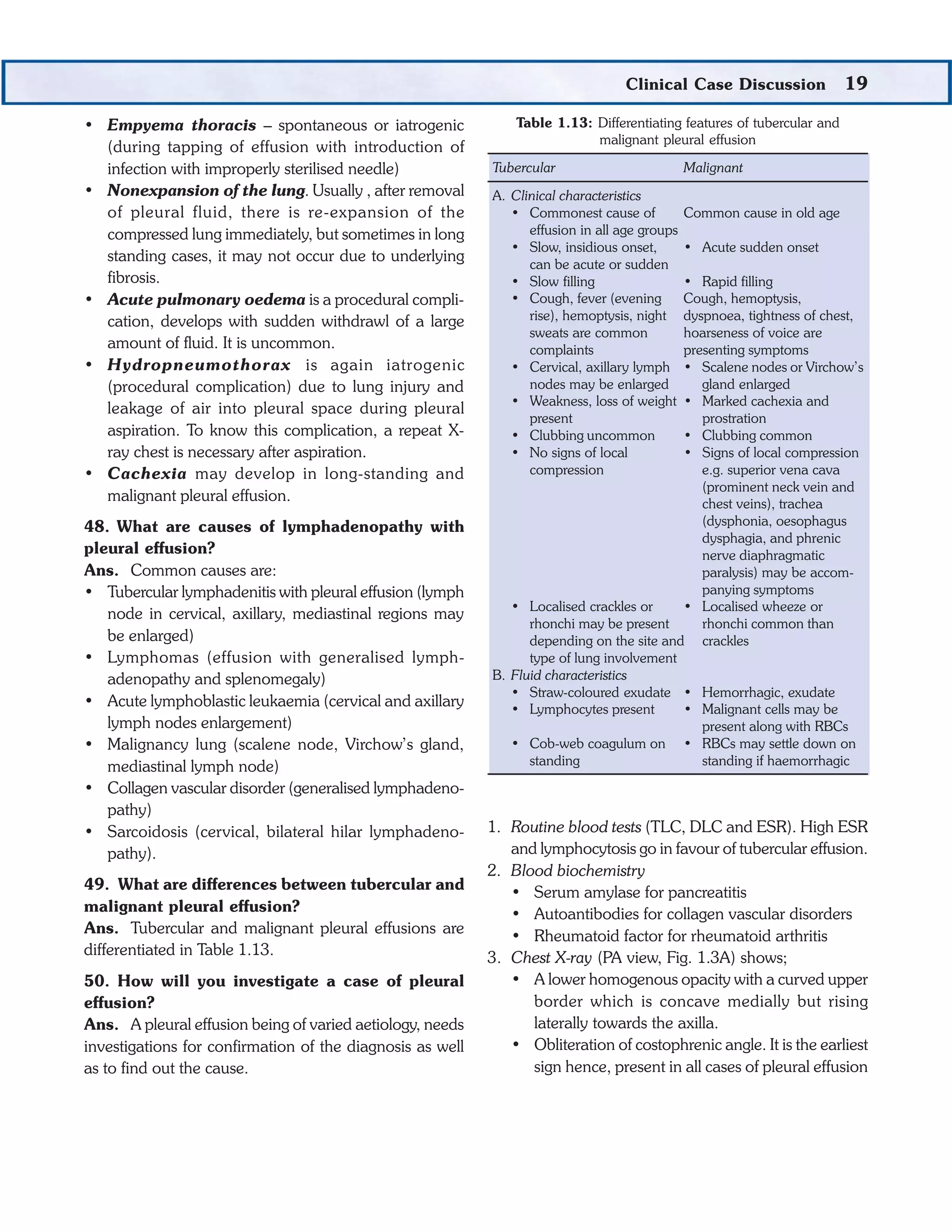
21

CASE 4: PNEUMOTHORAX
Systemic Examination

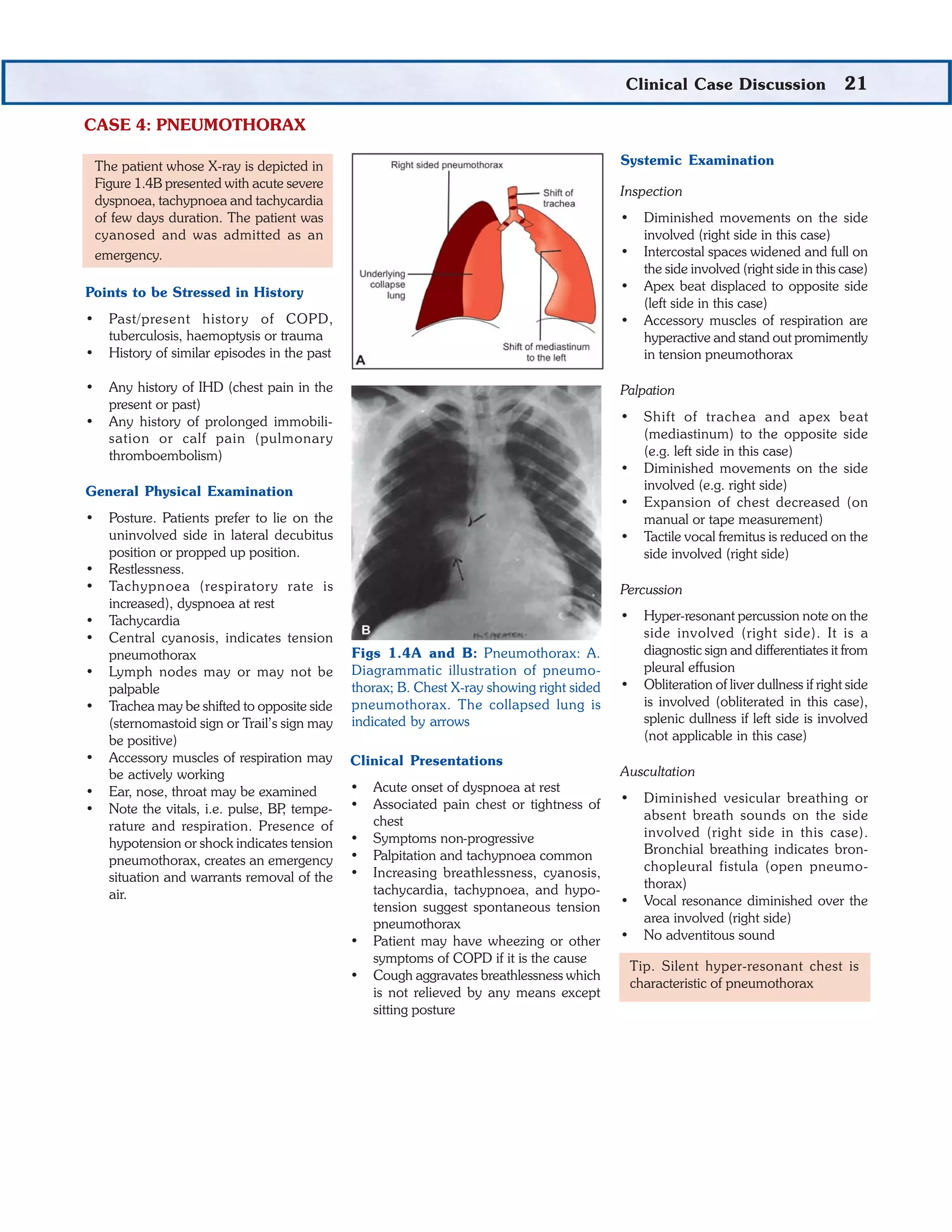
The patient whose X-ray is depicted in
Figure 1.4B presented with acute severe
dyspnoea, tachypnoea and tachycardia
of few days duration. The patient was
cyanosed and was admitted as an
emergency.

Inspection
•
•

Diminished movements on the side
involved (right side in this case)
Intercostal spaces widened and full on
the side involved (right side in this case)
Apex beat displaced to opposite side
(left side in this case)
Accessory muscles of respiration are
hyperactive and stand out promimently
in tension pneumothorax

Points to be Stressed in History

•

•

Past/present histor y of COPD,
tuberculosis, haemoptysis or trauma
History of similar episodes in the past

•

Any history of IHD (chest pain in the
present or past)
Any history of prolonged immobilisation or calf pain (pulmonary
thromboembolism)

Palpation

•
•
•

•
•

General Physical Examination
•
•
•
•
•
•
•
•
•
•

Posture. Patients prefer to lie on the
uninvolved side in lateral decubitus
position or propped up position.
Restlessness.
Tachypnoea (respiratory rate is
increased), dyspnoea at rest
Tachycardia
Central cyanosis, indicates tension
pneumothorax
Lymph nodes may or may not be
palpable
Trachea may be shifted to opposite side
(sternomastoid sign or Trail’s sign may
be positive)
Accessory muscles of respiration may
be actively working
Ear, nose, throat may be examined
Note the vitals, i.e. pulse, BP tempe,
rature and respiration. Presence of
hypotension or shock indicates tension
pneumothorax, creates an emergency
situation and warrants removal of the
air.

•
•

Shift of trachea and apex beat
(mediastinum) to the opposite side
(e.g. left side in this case)
Diminished movements on the side
involved (e.g. right side)
Expansion of chest decreased (on
manual or tape measurement)
Tactile vocal fremitus is reduced on the
side involved (right side)

Percussion
•
Figs 1.4A and B: Pneumothorax: A.
Diagrammatic illustration of pneumothorax; B. Chest X-ray showing right sided
pneumothorax. The collapsed lung is
indicated by arrows
Clinical Presentations
•
•
•
•
•

•
•

Acute onset of dyspnoea at rest
Associated pain chest or tightness of
chest
Symptoms non-progressive
Palpitation and tachypnoea common
Increasing breathlessness, cyanosis,
tachycardia, tachypnoea, and hypotension suggest spontaneous tension
pneumothorax
Patient may have wheezing or other
symptoms of COPD if it is the cause
Cough aggravates breathlessness which
is not relieved by any means except
sitting posture

•

Hyper-resonant percussion note on the
side involved (right side). It is a
diagnostic sign and differentiates it from
pleural effusion
Obliteration of liver dullness if right side
is involved (obliterated in this case),
splenic dullness if left side is involved
(not applicable in this case)

Auscultation
•

•
•

Diminished vesicular breathing or
absent breath sounds on the side
involved (right side in this case).
Bronchial breathing indicates bronchopleural fistula (open pneumothorax)
Vocal resonance diminished over the
area involved (right side)
No adventitous sound
Tip. Silent hyper-resonant chest is
characteristic of pneumothorax
22 Bedside Medicine
51. What is pneumothorax?
Ans. Presence of air in the pleural cavity is called
pneumothorax.
52. How do you classify pneumothorax?
Ans. The pneumothorax is divided into two categories;
spontaneous and traumatic. The spontaneous pneumothorax may be primary (underlying lung is healthy) or
secondary (occurs as a complication of some lung
disease). The traumatic pneumothorax results from
trauma (e.g. chest injury or procedural trauma). The
causes of pneumothorax are given in Table 1.14.
53. What are various types of pneumothorax and
their clinical features?
Ans. Table 1.15 discusses various types of pneumothorax and their clinical features.
54. What are differences between a large air cyst
or bulla and pneumothorax?
Ans. Table 1.16 differentiates between bulla and
pneumothorax.
55. What is recurrent spontaneous pneumothorax?
Ans. This refers to occurrence of second episode of
pneumothorax within few weeks following the first
episode. It occurs due to rupture of subpleural blebs or
bullae in patients suffering from COPD. It is serious
condition, needs chemical pleurodhesis (instillation of
kaolin, talcom, minocycline or 10% glucose into pleural
space) or by surgical pleurodhesis (achieved by pleural
abrasions or parietal pleurectomy at thoracotomy or
thoracoscopy). The causes of recurrent pneumothorax
are given in Table 1.17.
Caution Patient who are at increased risk of developing
recurrent pneumothorax after the first episode (e.g.
flying or diving personnel) should undergo preventive
treat-ment (respiratory exercises) after first episode. The
respiratory exercises include to inflate air pillows, balloons
or football bladder. It will also help to achieve expansion
of the collapsed lung.
56. What are the complications of pneumothorax?
Ans. Common complications of pneumothorax are;
• Hydropneumothorax
• Empyema thoracis, pyopneumothorax
• Hemopneumothorax
• Thickened pleura

Table 1.14: Causes of pneumothorax
1. Spontaneous
A. Primary
• Rupture of apical subpleural bleb or bulla in young
patients
• Subpleural emphysematous bullae in old patients
• Rupture of the pulmonary end of pleuropulmonary
adhesion. The risk factors for it include;
• Tall body habitus
• Smoking
• Marfan’s syndrome
• Mitral valve prolapse
• Going to high altitude
• Bronchial anatomical abnormalities
B. Secondary
• COPD
• Pulmonary tuberculosis (subpleural focus) usually
results in hydropneumothorax
• Infections, e.g. necrotising pneumonia, staphylococcal
lung abscess, usually result in hydropneumothorax or
pyopeumothorax
• Occupational lung disease, e.g. silicosis, coal-worker’s
pneumoconiosis
• Malignancy lung
• Interstitial lung disease
• Catamenial (endometeriosis in females)
• Miscellaneous, e.g. oesophageal rupture, cystic
fibrosis, Caisson’s disease, asthma, pulmonary infarct,
post radiation etc.
2. Traumatic
Injury
Iatrogenic (procedural)
• Blunt injury to the
• Pleural tap
chest or abdomen
• Pleural biopsy, lung biopsy
• Penetrating chest injury • Bronchoscopy, endoscopy
and sclerotherapy
3. Induced (artificial)
• It was induced in the past to obliterate a tubercular cavity
but is now obsolete term.

• Acute circulatory failure – cardiac tamponade in
tension pneumothorax
• Atelectasis of the lung
• Surgical emphysema and pneumomediastinum.
57. What do you understand by the term subcutaneous emphysema: What are its causes?
Ans. Subcutaneous emphysema (or surgical emphysema – an older term) refers to presence of air in the
subcutaneous space either formed by necrotising
inflammation of the tissue by gas-forming organisms (gas
gangrene) or by leakage of air from the lungs or
neighbouring hollow structures. The causes are;
• Pneumothorax
Clinical Case Discussion

23

Table 1.15: Types of pneumothorax and their clinical features
Feature

Closed (Fig. 1.4A)

Open

Tension (valvular)

Pathogenesis

The rupture site (opening gets
closed and underlying lung is
collapsed (deflated). There is
no communication between
bronchus and the pleural space

The opening between the bronchus
and pleural space does not close,
remains patent, hence, called
bronchopleural fistula

The communication between
bronchus and pleural space persists
and acts as a check valve (air can
get in but cannot get out)

Mean pleural
pressure

Negative (less than atmospheric
pressure) hence, air can get
absorbed and lung re-expands

Mean pleural pressure is atmospheric, hence, lung cannot reexpand. Secondly, due to patent
communication, pneumothorax is
likely to be infected leading to
pyopneumothorax – a common
complication

Mean pleural pressure is positive,
hence, there is compression collapse
of the underlying lung. It is an
emergency situation because mean
pleural pressure goes on building
due to constant air entry during
inspiration resulting in mediastinal
shift and impaired venous return
leading to cardiac tamponade
requiring urgent drainage.

Causes

• Rupture of subpleural bleb or
emphysematous bullae
• COPD
• Spontaneous due to congenital
bleb rupture
• Rupture of pulmonary end of
pleural adhesion
• Secondary to lung disease
• Chest injury

•
•
•
•
•
•
•

• It can occur due to any cause
• Catamenial pneumothorax
(endometeriosis in female)

Symptoms

• Mild cases may be asymptomatic
and only chest X-ray may show
pneumothorax
• Some patients may present with
breathlessness, pain chest/tightness
of chest
• Onset of dyspnoea may be
acute or subacute

• Majority of patients with bronchopleural fistula present with cough,
fever, mucopurulent or purulent
expectoration. Dyspnoea is
minimal.
• Some complain of splash of fluid
in the chest during jumping (e.g.
hydropneumothorax)

• The presenting symptoms
includes acute onset of dyspnoea,
cough, tachypnoea, tachycardia
• Cough worsens dyspnoea. No
relieving factor known except
sitting position
• Hypotension or shock and central
cyanosis may be present due to
cardiac tamponade.

Signs on the
side involved

• Reduced chest movement
• Shift of trachea and mediastinum
to opposite side
• Hyper-resonant note
• Markedly- diminished or absent
breath sounds
• Vocal fremitus and resonance are
also reduced
• Coin test is positive

• All signs of closed pneumothorax present plus
• Crack-pot sounds on percussion
• Amphoric breath sounds with
increased vocal resonance
• Succussion splash indicates
hydropneumothorax
• Shifting dullness present if
hydropneumothorax develops
• Coin test may be positive

• All signs of closed pneumothorax
present plus
• Dyspnoea, tachypnoea,
tachycardia, cyanosis
• Pulsus paradoxus
• Neck veins full, markedly raised JVP
• Hypotension
• Obtunded consciousness
• Progressive mediastinal shift to
opposite side with labored respiration

Plan of treatment

• Observation till air is
automatically absorbed
• Water-seal drainage, if
necessary

• Water seal drainage
• Treat hydro or pyopneumothorax with proper antibiotic
• Thoracic surgeon consultation
should be sought

• Immediate relief can be given by
putting a wide bore needle (No. 20)
in second intercostal space in sitting
position in mid-clavicular line on the
side involved followed by water-seal
drainage system.
• Antitubercular drugs / antibiotic
therapy as considered appropriate
• O2 inhalation and propped up position
• Resuscitation of shock
• Morphine 5-10 mg subcutaneous

Tubercular cavity
Lung abscess
Necrotising pneumonia
Chest trauma
Barotrauma
Empyema thoracic
Lung resection
24 Bedside Medicine
Table 1.16: Differentiating features of bulla from pneumothorax
Large air cyst or bulla

Pneumothorax

May be congenital or
acquired
Mediastinum not shifted
(trachea central)

Acquired usually

Mediastinum shifted to opposite
side (trachea shifted to opposite
side)
No underlying collapse
Collapse of the lung is demarcated
of the lung on chest X-ray from the pneumothorax by a thin
line on chest X-ray
Table 1.17: Causes of recurrent pneumothorax
• Rupture of apical subpleural bleb or emphysematous
bullae.
• Cystic fibrosis
• Rupture of lung cysts
• Rupture of bronchogenic carcinoma or oesophageal
carcinoma
• Catamenial pneumothorax
• AIDS
• Interstitial lung disease

• Rib fracture or flail chest with leakage of air
• Fractures of paranasal sinuses
• Perforation of a hollow viscus, e.g. oesophagus or
larynx (spontaneous or procedural)
• Gas gangrene
Always look for subcutaneous emphysema in a case
of pneumothroax by palpation with pressure of fingers
over the side involved. There will be palpable crepitus
on finger pressure.
58. How will you investigate a patient with
pneumothorax?
Ans. Investigations are done for sake of diagnosis and
to find out the cause.
1. Chest X-ray (PA view, Fig. 1.4B) should be done
first of all before any other investigation in case of
suspected pneumothorax. It is done in erect position,
sometimes expiratory film is taken especially in small
pneumothorax. The radiological features are;
• Increased translucency of the lung on the side
involved with absence of peripheral lung markings.
• The underlying lung is collapsed which is separated from airless peripheral translucent shadow
(pneumothorax) by a pencil – sharp border.
• Mediastinum is shifted to opposite side
• Costophrenic angle is clear
• Underlying lung disease may be apparent such
as a tubercular cavity.

2. Routine blood tests, e.g. TLC, DLC, ESR, (raised
ESR with relative mononuclear leucocytosis suggest
tubercular aetiology).
3. Montaux test may be positive in tuberculosis
4. Sputum for AFB (3 consecutive specimens)
5. Pulmonary function tests (FEV1, FEV1/VC ratio, PFR
etc. for COPD).
59. What are similarities and dissimilarities
between pleural effusion and pneumothorax?
Ans. Similarities and dissimilarities are as follows:
• Some clinical features on chest examination whether
there is air or fluid in the pleural space are similar
due to shift of the mediastinum to opposite side and
collapse of the underlying lung as a result of positive
intrapleural pressure (normally there is negative
pressure in the pleural space on both sides which
keeps the mediastinum in the centre). The similarity
of signs include diminished movements and
expansion, fullness of intercostal spaces on the side
involved, shift of mediastinum to opposite side,
hyperactivity of extra-respiratory muscles, diminished
or bronchial breath sounds and decreased or
increased vocal resonance with no added sounds.
• The dissimilarities include hyper-resonant note on
percussion in pneumothorax with obliteration or
masking of liver dullness in right-sided pneumothorax
and splenic dullness on left side pneumothorax. In
pleural effusion, the percussion note is stony-dull on
the side and over the part involved. The dullness is
continuous with liver dullness on right side and
cardiac dullness on left side with obliteration of
resonance of Traube’s area.
Tip. Absolute similarity is silent chest, i.e. no added
sounds in both the conditions.
Absolute dissimilarity is hyper-resonant note in
pneumothorax and stony dull in pleural effusion
Note: Bronchial breath sounds with increased vocal
resonance can occur both in pleural effusion (at the
upper level or apex) and bronchopleural fistula (open
pneumothorax).
N.B. Questions regarding water-seal intercostal tube
drainage, its indications, complications and reasons for
non-expansion of the lungs after drainage have been
discussed in instruments and procedures (Chapter 2).
Clinical Case Discussion

25

CASE 5: HYDROPNEUMOTHORAX
Systemic Examination

The patient whose X-ray is depicted as
Figure 1.5B presented with fever, cough
with expectoration, mucopurulent foul
smelling without haemoptysis. The
patient gave history of some abnormal
sounds (crack-pots) on running or
walking.

Inspection
•

Palpation
•

Points to be Noted in the History
•
•
•
•

•
•

Patient is orthopnoeic, sitting in the bed
Fever
Tachypnoea, tachycardia
Cyanosis
Clubbing of fingers present in
pyopneumothorax
Accessory muscles of respiration may
be active
Shift of trachea and mediastinum to
opposite side – Sternomastoid sign or
Trail sign may be positive.

Signs similar to open pneumothorax

Percussion

History of fever or injury in the past.
History of tuberculosis in the past
Any history of pain chest, haemoptysis
or a cardiac disorder.
Any history of drainage of fluid in the
past.

•

•

General Physical Examination
•
•
•
•
•

Signs similar to open pneumothorax

•

A horizontal fluid level, above which
percussion note is hyper- resonant and
below which it is stony dull – hence,
there is a clear cut transition between
a hyperresonant to stony dull note
Shifting dullness present because fluid
has space (occupied by air) to shift
Coin test is usually not positive.

Auscultation
Figs 1.5A and B: Hydropneumothorax:
A. Bronchopleural fistula with hydropneumothorax (right side); B. Chest X-ray
(PA view) shows hydropneumothorax (left
side)

•
•

•

Succession splash present
Amphoric bronchial breathing in
bronchopleural fistula – a common
cause of hydropneumothorax
Tingling sounds heard

Clinical Presentation
•
•
•
•

Dyspnoea at rest, cough
Pain chest or heaviness in chest
Splashing sound during jumping
Fever, high grade with chills and rigors
if pyopneumothorax

60. What is hydropneumothorax?
Ans. The presence of both air (above) and fluid
(below) in pleural cavity is called hydropneumothorax.
If instead of fluid, pus collects along with air, then it is
called pyopneumothorax. Similarly collection of air and
blood is called haemopneumothorax.
61. What are the differences between hydropneumothorax and pleural effusion?
Ans. Table 1.18 differentiates between hydropneumothorax and pleural effusion.
62. What are the causes of hydropneumothorax?
Ans. Common causes of hydropneumothorax are;

• Rupture of subpleural tubercular cavity (commonest
cause)
• Rupture of lung abscess – actually it causes
pyopneumothorax
• Penetrating chest injury with infection – again a cause
of haemopneumothorax
• Acute pulmonary infarction (embolism)
• Following cardiac surgery
• Iatrogenic, i.e. introduction of the air during aspiration
of pleural effusion
• Pneumothorax. Actually bronchopleural fistula (open
pneumothorax) of tubercular aetiology is the
commonest cause, but sympathetic collection of fluid
26 Bedside Medicine
Table 1.18: Differentiating features of hydropneumothorax
and pleural effusion
Hydropneumothorax
(Fig. 1.5A)

Pleural effusion

• Shifting dullness on
percussion present

Shifting dullness absent (the
rising dullness – Ellis S-shaped
curve is now-a-days obsolete
term)
No such level

• Horizontal fluid level, i.e.
there is transition between
hyper- resonant note (above)
and stony dull note (below)
• Succussion splash present No succussion splash
• Tingling sounds especially No such sound
after cough may be
audible
• Coin-test sound in upper
Coin – test negative
part of hydropneumothorax may occasionally be
positive
• Diminished breath sounds Sometimes, a tubular
and vocal resonance except bronchial breathing with
in bronchopleural fistula
increased vocal resonance
where amphoric breath
(bronchophony, whispering
sounds may be heard
pectoriloquy and aegophony)
present over the top of effusion

in closed and tension pneumothorax may also lead
to hydropneumothorax.
63. How will you explain absent shifting dullness,
if present in a case of hydropneumothorax?
Ans. Hydropneumothorax contains air above
(occupying a large space) and fluid below (occupying
smaller space), both in moderate amount and are
separated by a horizontal level (a line seen in peripheral
lung field on chest X-ray, Fig. 1.5B)). Shifting dullness is
present because fluid has space to shift by displacing air.
Therefore, shifting dullness in hydropneumothorax will
be absent if above mentioned conditions are not fulfilled.
• Loculated or encysted hydropneumothorax (both air
and fluid are tightly packed)
• Too little air in hydropneumothorax
• Too much fluid in hydropneumothorax
• Thick viscid pus (sometime in pyopneumothorax).
64. What are the characteristic features of
pyopneumothorax?
Ans. The patient will have all the clinical features of
hydropneumothorax plus
• Presence of toxic look and prostration

• Hectic fever with chills and rigors
• Tachycardia, tachypnoea and clubbing of fingers
• Intercostal tenderness and tenderness during
percussion (patient winces during percussion).
65. What are the differences between empyema
thoracis and pyopneumothorax?
Ans. Clinical features of both empyema thoracis and
pyopneumothorax are similar (hectic fever, signs of
toxaemia, intercostal tenderness, diminished movements
and diminished or absent breath sounds).
The differentiating features between the two are same
as in case of pleural effusion versus hydropneumothorax
such as presence of a horizontal level (transition between
hyper- resonant and stony dull percussion note), shifting
dullness, succussion splash in pyopneumothorax but not
in case of empyema thoracis. However, it will be difficult
to differentiate a loculated pyopneumothorax from
empyema thoracis because of absence of above
mentioned features.
66. How will you differentiate between a lung
abscess and pyopneumothorax?
Ans. Table 1.19 differentiates between lung abscess and
pyopneumothorax.
Table 1.19: Differentiating features between
pyopneumothorax and lung abscess
Pyopneumothorax

Lung abscess

• Cough and expectoration
minimal
• Shift of the mediastinum
and trachea to opposite
side
• Added sounds are absent

Copious purulent expectoration
is a predominant feature
No shift of trachea or
mediastinum

• Chest X-ray will show
horizontal level starting
from the periphery
• Vocal fremitus, breath
sounds and vocal resonance diminished or
absent

Added sounds such as crackles
will be present
A horizontal fluid level does not
touch the periphery of the lung
Vocal fremitus and vocal
resonance may be decreased
(cavity full of pus) or increased
if lung abscess is empty and
superficially placed. There can
be a bronchial breathing as
heard over a cavity

67. How will you investigate a patient with pyopneumothorax?
Ans. Investigations are as follows:
Clinical Case Discussion
1. Routine blood tests such as TLC, DLC and ESR for
leucocytosis as an evidence of infection
2. Sputum examination for culture and sensitivity
3. Chest X-ray (PA view) will show;
• A horizontal fluid level
• Increased radiolucency above the horizontal level
without lung markings with a homogeneous
opacity below the horizontal level (Fig. 1.5B)
• Shifting of trachea and mediastinum to the
opposite side
X-ray should be taken in upright position to show a
fluid level
• The collapsed lung due to compression from
outside is usually hidden within homogeneous
opacity of fluid and may not be visible on X-ray.

27

4. Aspiration of fluid or the thick exudate (pus) will be
done which is sent for culture and sensitivity.
68. Name the diagnostic signs of hydropneumothorax/pyopneumothorax. How will you elicit
them?
Ans. Diagnostic signs are as follows:
1. A horizontal level, i.e. upper part of hydropneumothorax is hyper-resonant due to presence of air and
lower part is dull due to presence of fluid/pus
2. Shifting dullness
3. Succussion splash
4. Tingling sounds on auscultation.
To elicit these signs, Read Clinical Methods in
Medicine by SN Chugh.
28 Bedside Medicine
CASE 6: COLLAPSE OF THE LUNG
Systemic Examination

The patient whose X-ray (Fig. 1.6A) is
depicted presented with cough, dry
hacking without haemoptysis and acute
breathlessness.

Inspection
•
•

Points to be Noted in the History
•
•
•
•

Past history of tuberculosis or malignancy
Any history of swelling in the neck,
axilla or groin
Past history of mumps, measles and
whooping cough during childhood
Past history of rheumatic heart disease
or pericardial disease (fever, chest
pain).

•
•
•
•

Flattening or depression of the chest
on affected side
Crowding of the ribs and narrowing of
intercostal spaces
Diminished movements on the side
involved
Shifting of trachea, apex beat towards
the side involved (pulling effect) – Trail’s
sign
Kyphoscoliosis may result in longstanding collapsed lung with fibrosis
Drooping of shoulder if apex of the lung
is collapsed

General Physical Examination

Palpation

Look for the followings;
• Patient may dyspnoeic, orthopnoeic if
major bronchus is involved
• Central cyanosis
• Tachypnoea, tachycardia
• Fever± (develops in fibrosing alveolitis
or in bronchogenic carcinoma)

•
•
•
•

Figs 1.6A and B: A. Chest X-ray showing
collapse of right upper lobe; B.
Diagrammatic illustration of collapse lung

Shifting of trachea and mediastinum to
the same side
Reduced movements of the chest on
involved side
Reduced expansion of the chest on side
involved
Vocal fremitus on the affected side may
be;
— Diminished or absent if bronchus
is totally occluded
— Increased if bronchus is patent.

Percussion

Clinical Presentations

•

•
•
•

Auscultation

Pain on the affected side
Breathlessness
Dry cough and fever

Presence of symptoms depends on;
•
•
•

Rapidity with which they develop
Amount of the lung involved
Presence or absence of infection

Impaired or dull note on the side
affected

Collapse with obstructed bronchus
•
•
•

Diminished or absent breath sounds
Diminished/absent vocal resonance
No added sounds

Collapse with patent bronchus
• Tubular bronchial breath sounds
• Increased vocal resonance with bronchophony and whispering pectoriloquy
• Coarse crackles may be heard
occasionally
Clinical Case Discussion
69. What do you understand by the term collapse
of the lung?
Ans. Pulmonary collapse or atelectasis is defined as
“airlessness with shrinkage” of a part or the whole lung.
Atelectasis may be present since birth (atelectasis
neonatorum) due to failure of the lung to expand, or
may occur anytime during life (acquired atelectasis) due
to absorption of air secondary to obstruction, compression, contraction or surfactant loss.
70. What are various types of collapse?
Ans. Localised/ hemithoracic loss of lung volume
(collapse of the lung) can occur with patent bronchus or
with occluded bronchus (obstructive collapse) or there
is compression of the lung from outside (intrapleural
positive pressure), hence, it is of two main types;
1. Obstructive collapse (absorption or resorption
collapse, Fig. 1.6B). It occurs due to absorption of
air distal to obstruction in the alveoli. The site of
obstruction can be central or peripheral.
i. Central obstructive collapse is with obstructed
major bronchus
ii. Peripheral obstructive (absorption) collapse is
always with patent surrounding bronchis.
2. Compression collapse (Relaxation collapse). It occurs
from relaxation of the lung due to pleural disease (e.g.
pleural effusion, pneumothorax and hydropneumothorax).
71. What are the causes of collapse of the lung?
Ans.
1. Obstructive (absorption collapse)
A. Central (major bronchus) The causes are;
Common
• Bronchial adenoma or
carcinoma
• Enlarged tracheobronchial
lymph nodes (malignant,
tubercular)
• Inhaled foreign body, Misplaced endotracheal tube
• Mucus plugging

Rare
• Aortic aneurysm
• Giant left atrium
• Congenital bronchial
atresia
• Stricture/stenosis
• Pericardial effusion

B. Peripheral (divisions of bronchus/bronchi)
• Pneumonias
• Mucus plugging (sputum retention)

29

• Asthma
• Pulmonary eosinophilia
2. Compression collapse (relaxation collapse)
• Pleural effusion
• Pneumothorax
• Hydropneumothorax, pyopneumothorax,
hemopneumothorax.
72. What are the clinical differences between
central obstructive and peripheral obstructive
collapse?
Ans. Remember that peripheral collapse does not
involve the major bronchus, involves divisions of
bronchus or bronchi with the result the collapse occurs
with patent bronchus (i.e. surrounding bronchi are
patent) while, central obstruction of a major bronchus
leads to collapse of all its divisions, hence, the whole
lobe is airless with no patent bronchus. The differentiating
features are summarised in Table 1.20. The causes of
both types of obstructive bronchus are given above.
Signs of compression collapse means signs of pleural
effusion/pneumothorax. The underlying collapsed
lung is silent (relaxed hence called relaxation collapse).
In this type of collapse, trachea and mediastinum is
shifted to the opposite side due to pushing effect of
fluid/air.
73. What are the clinical pulmonary presentations
of bronchogenic carcinoma?
Ans. Clinical pulmonary presentations of bronchogenic
carcinoma are;
• Collapse
• Cavitation
• Mediastinal compression/obstruction-superior vena
cava syndrome
• Pancoast’s tumour- Apical carcinoma may involve
brachial plexus producing monoplegia
• Consolidation—a solid tumour
• Pleural effusion—rapid filling, haemorrhagic.
74. How will you investigate a patient with lobar
collapse?
Ans. Investigations of lobar collapse are;
• Routine blood examination
• Sputum examination – cytology, microbiology and
culture
30 Bedside Medicine
Table 1.20: Differentiative features of central obstructive and peripheral obstruction collapse of lung
Feature

Central obstructive collapse
(occluded bronchus)

Peripheral obstructive collapse
(patent bronchus)

•
•
•
•

To the same side
On the same side
Absent on the side involved
Decreased/absent on the side involved

To the same side
On the same side
Tubular (bronchial) breath sounds
Increased vocal resonance with whispering
pectoriloquy
• Mucus plugging, ipsilateral bronchial cast or
clot
Collapse with open bronchus

Shift of trachea and mediastinum
Elevated dome of the diaphragm
Breath sounds
Vocal resonance

• Common cause
• CT scan or chest X-ray
• Signs on the other side

• Tumour or lymph node or a foreign
body
Collapse with loss of open bronchus
sign— Golden’s “S” sign
Signs of compensatory emphysema
i.e. hyper-resonant note, vesicular
breathing with prolonged expiration

• Chest X-ray (PA and lateral view). It will show;
• Homogeneous opacity of the collapsed lung
• Displacement of trachea and cardiac shadow
(mediastinum) to the diseased (involved) side
• Crowding of the ribs with reduction of intercosal
spaces due to loss of volume of the lung on the
side involved
• Elevation of hemidiaphragm on the side involved
• Pleural effusion on the side involved if collapse is
due to malignancy of lung
• Sometimes, the radiological features of underlying
cause (hilar lymphadenopathy), foreign body may
be evident
• CT scan to find out the cause
• Bronchoscopy to find out the cause and to take biopsy
• Scalene node biopsy, if lymph node enlarged or
malignancy lung suspected
• Pleural fluid examination if pleural effusion present.
Note: Investigations of compression collapse are same
as that of pleural effusion.

No signs of compensatory emphysema on the
other side

75. What are the differences between collapse of
the lung and localised fibrosis?
Ans. Table 1.21 differentiates between collapse and
fibrosis.
Table 1.21: Differentiating features of lung
collapse and fibrosis
Feature

Collapse

Fibrosis

Onset
Chest wall
Breath sounds

Acute
Flattened
Absent

Chronic
Retracted
Feeble but never
absent

76. What are the complications of collapse?
Ans. Common complications of collapse are:
• Secondary infection
• Spontaneous pneumothorax from ruptured bullae of
compensatory emphysema on the uninvolved side
of the lung.
Clinical Case Discussion

31

CASE 7: DIFFUSE FIBROSING ALVEOLITIS
Systemic Examination

The patient (i.e. a coal-mine worker)
whose CT scan is depicted as Figure
1.7A presented with progressive
dyspnoea and cough for the last 2 years.
The dyspnoea was exertional in the
begining, increased to occur now at rest.
There was history of associated fever,
weight loss, malaise and fatigue.

Inspection
•
•
•

Increased respiratory rate
Bilateral symmetrical reduction in chest
movements
Accessory muscles of respiration may
be hyperactive

Points to be Noted in the History

Palpation

•

•
•
•

•
•
•
•
•

Past history of tuberculosis or lung
suppuration
Any history of radiation exposure
Any history of joint pain, arthralgia,
rash
Drug history
Occupational history, e.g. coal miner
stone cutter, farmer or industrial worker
Past history of rheumatic heart disease
or any other cardiac disorders.

General Physical Examination
•
•
•
•
•
•

Dyspnoea, orthopnoea
Tachypnoea
Central cyanosis (if severe)
Clubbing of the fingers
Signs of occupation
Raised JVP and ankle oedema if severe
disease

Reduced bilateral chest movements
Reduced expansion of the chest
Bilateral reduction of vocal fremitus

Percussion
•

Dullness on percussion at lung bases
on both sides

Auscultation
•
Figs 1.7A and B: A. CT scan chest
showing honey-comb appearance in a
patient with diffuse fibrosing alveolitis,
B. Diagrammatic illustration

•
•

Bilateral crackles (end- inspiratory) at
both the bases (lower zones) of the
lungs
Vesicular breathing diminished in
intensity
Vocal resonance bilaterally diminished

Other system examination
Clinical Presentation
•
•
•
•

Progressive exertional dyspnoea
Persistent dry cough
Fever, weight loss, fatigue
At the late stages, patient may complain
of symptoms of cor pulmonale
(abdominal pain due to hepatomegaly,
ascites, swelling legs)

77. What is your clinical diagnosis?
Ans. The patient being an occupational workers (coalminer), developed symptoms of progressive dyspnoea
and cough, fever and weight loss, the probable diagnosis
will be occupational lung disease (e.g. coal-miner
pneumoconiosis).
78. What do you understand by fibrosis of the
lung? What are its causes?
Ans. Fibrosis of the lung means replacement of lung
parenchyma by fibrous tissue. It occurs usually as a
reactive process or a healing /reparative process.

•

Signs of right heart failure (raised JVP
,
hepatomegaly, central cyanosis and
pitting oedema)

Causes
1. Focal fibrosis
• Pneumoconiosis
2. Reparative fibrosis /replacement fibrosis
• Tuberculosis
• Following bronchiectasis, lung abscess, pulmonary
infarction
• Following radiation
3. Interstitial fibrosis (it is bilateral fibrosis of alveolar
walls and septa)
32 Bedside Medicine
A. Pulmonary origin
• Hypersensitivity
• Diffuse fibrosing alveolitis (Fig. 1.7B)
• Farmer’s lung
• Collagen vascular disorders
• SLE
• Systemic sclerosis
• Rheumatoid arthritis (rheumatoid lung)
• Lymphangitis carcinomatosis
• Drug-induced, e.g. busulphan, bleomycin,
nitrofurantoin, methysergide, hydralazine,
hexamethonium
• Miscellaneous
• Sarcoidosis
• Aspiration pneumonitis
• Histiocytosis
• Tuberous sclerosis
• Xanthomatosis
B. Cardiac origin
• Multiple pulmonary infarcts
• Mitral stenosis
C. Idiopathic
• Hamman-Rich disease.
79. What is Hamman-Rich syndrome? What are
its clinical features?
Ans. Diffuse interstitial fibrosis or fibrosing alveolitis of
acute onset, progressive course of unknown aetiology is
called Hamman-Rich syndrome. It is characterised by
progressive dyspnoea, dry cough, fever, weight loss and
signs of bilateral fibrosis of the lung.
The clinical characteristics (physical signs) have
already been described in the beginning.
80. How will you investigate a patient with
cryptogenic fibrosing alveolitis?
Ans. The common investigations are as follows:
1. Routine blood tests
2. Blood for rheumatoid factor and antinuclear
antibodies
3. Chest X-ray (PA view) shows;
• Diffuse pulmonary opacities in the lower zones
peripherally.
• The hemidiaphragm are high and the lungs
appear small

4.

5.

6.
7.

• In advanced disease, there may be “honey-comb”
appearance of the lungs in which diffuse
pulmonary shadowing is interspersed with small
cystic translucencies.
High resolution CT scan may show honey-combing
and scarring, most marked peripherally in both the
lungs. CT scan is useful in early diagnosis when chest
X-ray may not show the radiological changes.
Pulmonary function tests. There is restrictive ventilatory defect with reduction in FEV1 and vital capacity
(VC). The carbon monoxide transfer factor is low and
lung volumes are reduced (Read pulmonary function
tests in the beginning of this chapter – Table 1.5).
Bronchoalveolar lavage and transbronchial biopsy
may sometimes be helpful
Open lung biopsy for histological patterns of
idiopathic cases of interstitial lung disease.

81. What is respiratory bronchiolitis?
Ans. Respiratory bronchiolitis is an interstitial lung
disease of smokers in which there is accumulation of
pigment-laden macrophages in the respiratory bronchioles and adjacent alveoli leading to mononuclear cell
infiltration and fibrosis. It may reverse on cessation of
smoking.
Clinical picture is similar to cryptogenic fibrosing
alveolitis.
82. What is farmer’s lung?
Ans. It is an occupational lung disease caused by an
inhalation of organic dust (mouldy hay, straw, grain),
characterised by features of extrinsic allergic alveolitis (e.g.
headache, muscle pains, malaise, pyrexia, dry cough and
breathlessness without wheeze) which may progress to
irreversible pulmonary fibrosis.
The pathogenic mechanism is local immune response
to fungal antigen, e.g. micropolyspora faenae or
aspergillus fumigatus.
The diagnosis is based on; (i) clinical features,
(ii) characteristic radiological features as described above,
(iii) high-resolution CT scan and (iv) identification of
potential antigen by ELISA or precipitin antibody test.
The treatment is removal of the source of antigen
wherever possible and a course of 3-4 week of prednisolone (40 mg/day) may arrest the process.
Clinical Case Discussion
83. What is coal-worker’s pneumoconiosis?
Ans. The disease follows prolonged inhalation of coal
dust hence, is an occupational lung disease seen in coalworkers. The condition is subdivided into simple
pneumoconiosis and progressive massive fibrosis for both
clinical purposes and certification.
The simple coal miner’s pneumoconiosis is
reversible (it does not progress if miner leaves the
industry), non-progressive and radiologically characterised by nodulation without cavitation. On the other
hand, progressive massive fibrosis – a variety of coal
miner’s pneumoconiosis is irreversible, progressive and
radiologically characterised by large dense masses, single
or multiple, occur mainly in upper lobes associated with
cavitation. Tuberculosis may be a complication. It carries
poor prognosis.
84. What is Caplan’s Syndrome?
Ans. It consists of association of rheumatoid arthritis
(positive rheumatoid factor) in patients with coal worker’s
pneumoconiosis with rounded fibrotic nodules (nodular

33

shadowing) 0.5 to 5 cm in diameter distributed mainly
in the periphery of the lung field.
Caplan’s syndrome—Rheumatoid arthritis plus coalworker’s pneumoconiasis.
85. What is Silicosis?
Ans. This disease is caused by inhalation of silica dust
or quartz particles, characterised by progressive development of hard nodules which coalesce as the disease
progresses followed by fibrosis. The clinical and radiological features are similar to coal worker’s pneumoconiosis
though changes tend to be more marked in the upper
lobe. The hilar shadow may be enlarged; egg-shell
calcification in the hilar lymph node is a distinct feature.
Tuberculosis may be a complication and may modify
the silicotic process with ensuring caseation and
calcification. The disease progresses even when the
exposure to dust ceases.
86. What is asbestosis? What are its possible
effects on respiratory tract?
Ans. Table 1.22 explains features of asbestosis and its
side effects on respiratory tract.

Table 1.22: Features of asbestosis
Asbestosis is an occupational lung disorder, occurs due
to exposure to fibrous mineral asbestos in certain
occupations such as in the mining and milling of the
mineral. The main types of mineral asbestos involved
in asbestosis are;
• Chrysolite (white asbestos – a common factor)
• Crocidolite (blue asbestos – uncommon factor)
• A mosite (brown) asbestos –a rare factor)
The possible effects of asbestosis are depicted in
Figure 1.7C.

Fig. 1.7C: Asbestos; its possible effects on the respiratory
tract
34 Bedside Medicine
CASE 8 CAVITY WITH FIBROSIS
Systemic Examination

The young patient whose X-ray is
depicted (Fig. 1.8A) presented with
cough, fever, haemoptysis and weight
loss for the last 6 months. There was
history of weakness and decreased
appetite and night sweats.

Inspection
•

Palpation

Points to be Noted in the History

•

•
•

•

•

•

Onset and progression of the symptoms
Past history of tuberculosis or malignancy
Past history of pneumonia (e.g. fever,
cough, haemoptysis and pain chest) or
lung suppuration (cough with mucopurulent or purulent sputum)
Any history of headache, vomiting,
visual disturbance or neurological
deficit.

General Physical Examination
•
•
•
•
•
•
•

Patient may be ill-looking, emaciated
Repeated coughing and bringing out a
large amount of sputum
Tachypnoea and tachycardia
Fever
Clubbing of fingers and toes
Weight loss
Oedema feet if secondary amyloidosis
develops and involves the kidneys

Diminished movement on the side
involved (right side in this case)

•
Fig. 1.8A: Chest X-ray (PA view)
showing a cavity with fibrosis
Clinical Presentations
•
•

•

Cough, fever and night sweats,
weakness may be initial manifestations
of tubercular cavity
Cough, massive expectoration, fever,
purulent sputum with postural and
diurnal variation suggest lung abscess
or bronchiectasis
Cough, hemoptysis, breathlessness,
fever, weight loss, anorexia suggest
malignancy as the cause of cavity.

87. What is your clinical diagnosis?
Ans. In view of history of cough, fever, haemoptysis of
6 months duration and signs of cavitation in this patient
suggest either a tubercular or a malignant cavity in the
lung.
88. What do you understand by the term “cavity”?
Ans. Pulmonary cavity is an area of liquefaction
necrosis within the lung parenchyma in communication
with a patent bronchus. The cavity may be empty or
may be filled with secretions and infected material.

Movements of the chest reduced on the
side involved (right side in this case)
Expansion of the chest is reduced if
cavity is large
Shift of trachea and mediastinum to the
same side if there is a large cavity with
fibrosis (right side in this case)

Percussion
•

Dull percussion note over the cavity.
Rest of the lung is normally resonant

Auscultation
•
•
•
•
•

Amphoric or cavernous bronchial
breathing over the cavity
Increased vocal resonance over the
area of cavity with bronchophony
Mid-inspiratory and expiratory crackles
Post-tussive crackles
Crackpot sounds

Note: All the above mentioned signs will
be present only if the cavity is large,
super ficial and communicates with
bronchus. Deep seated cavity may not
produce any physical sign.

Pseudocavity means appearance of a cavity on chest
X-ray which may be obtained with summation of
shadows of vessels, ribs and calcification.
89. What are causes of cavitation in the lung?
Ans. Common causes are:
1. Infection
• Tuberculosis
• Lung abscess
• Bronchiectasis
• Fungal infection
• Ruptured hydatid cyst with infection
Clinical Case Discussion
2. Congenital
• Infected bronchogenic cyst
• Sequestration
• Polycystic lungs
3. Neoplasm
• Bronchogenic carcinoma
• Metastasis
• Lymphoma
4. Trauma
• Resolving haematoma
5. Immunological
• Rheumatoid arthritis
• Wegener’s granulomatosis
6. Vascular
• Pulmonary infarction
7. Infected emphysematous bullae.
90. What are the various types of cavity seen in
the lung?
Ans. Types of cavities are as follows:
1. Thin-walled A cavity is surrounded by a thin walled
margin of lung tissue. The margin may be irregular,
shaggy in lung abscess (staphylococcal) and
bronchogenic carcinoma while it is smooth and
regular in tuberculosis, lung cyst, emphysematous
bullae, hydatid cyst and fungal infection.
2. Thicked walled A thick wall is formed by thick
exudative material or heaps of cells such as in lung
abscess, tuberculosis and bronchogenic carcinoma.
91. What are the physical signs of a cavity?
Ans. Typically, a superficial large cavity communicating
with the bronchus produces signs which depend on
whether the cavity is empty or filled with fluid at the
time of examination. The signs of cavity are given in
Table 1.23.
92. What is amphoric breath sounds? What are
its causes?
Ans. Read clinical methods by Prof. S.N. Chugh.
93. What type of bronchial breathing occur over
a cavity?
Ans.
• Thin walled cavity with narrow bronchus produces
amphoric bronchial breathing
• Thick walled cavity with patent (narrow or wide)
bronchus produces cavernous breathing.

35

Table 1.23: Physical signs over a cavity
Sign

Empty

Filled

• Movement of chest
on the side and
area involved
• Retraction/flattening
of chest
• Tactile vocal fremitus
and vocal resonance
• Percussion note
• Breath sounds

Diminished

Diminished

Present

Present

Increased
Crackpot sound
Amphoric/
cavernous
Present

Decreased
Diminished
Diminished

Absent

Present

• Whispering
pectoriloquy
• Post-tussive crackles/
rales

Absent

94. What are its complications of a tubercular
cavity?
Ans.
• A source of intercurrent infections
• Meningitis (tubercular) or miliary tuberculosis
• Secondary amyloidosis in case of long-standing cavity
• Hydropneumothorax.
• Chronic cavity may lead to malnutrition or hypoproteinaemia
95. What do understand by the term lung abscess?
What are its causes?
Ans. Definition It is defined as collection of purulent
material in a localised necrotic area of the lung
parenchyma. It is a suppurative lung disease.
Causes Most of the lung abscesses are pyogenic in
origin, but, sometimes it may be nonpyogenic such as
necrosis in a tumour followed by cavitation and collection
of material. This is called malignant lung abscess. The
causes of the abscesses are given in Table 1.24.
96. What are its clinical features?
Ans. Clinical presentations and examinations of lung
abscess are given in Table 1.25.
97. How will you investigate a case with lung
abscess?
Ans. The aims of investigations are:
i. To localise the site of an abscess
ii. To determine the underlying cause
36 Bedside Medicine
Table 1.24: Causes of lung abscess
1. Necrotising infection
a. Pyogenic, e.g. Staph. aureus, klebsiella, group A
streptococci, bacteriodes, anaerobes, nocardia
b. Tubercular – a tubercular cavity with collection of
purulent material
c. Fungi, e.g. aspergillus, histoplasma
d. Amoebic lung abscess secondary to liver abscess
2. Embolic infarction with cavity formation
• Thromboembolism of the lung
• Metastatic lung abscess
3. Malignancy of the lung with cavitation
• Bronchogenic carcinoma with secondary degeneration and cavitation
• Metastatic lung abscess
4. Miscellaneous
• Infected congenital cysts
• Coal miner’s pneumoconiosis

iii. To plan the treatment
iv. To detect complications.
The tests done are;
• Blood examination for anaemia and leucocytosis.
Raised ESR that suggests infection especially
tuberculosis (markedly elevated).
• Sputum examination for isolation of the organisms
(Gram’s staining, Ziehl-Neelsen stain), for cytology
including malignant cell; and culture and sensitivity.
• Blood culture to isolate the organism. It is mostly
sterile.
• Urine examination for proteinuria, pus cells and
casts. Albuminuria indicates secondary renal
amyloidosis.

Table 1.25: Physical and systemic examinations of lung abscess
General physical examination

Systemic examination

• Toxic look
• Fever, sweating, tachycardia,
tachypnoea
• Poor nutrition
• ± cyanosis
• Clubbing of the fingers present
• Oedema of legs if secondary
renal amyloidosis or hypoproteinaemia due to massive
expectoration develops
• Foul smelling (foetid) sputum and
breath (haliotosis)
• Source of infection in upper
respiratory tract, e.g. tonsillar or
parapharyngeal abscess or
throat sepsis may be evident
• Cervical lymphadenopathy
may be present

• All the signs present in a cavity filled with
secretion/ necrotic material will be present as
discussed above
• In case of rupture lung abscess, either the
signs of empyema thoracis, or pyopneumothorax as discussed earlier will be present
• In case of rupture amoebic liver abscess, there
will be history of expectoration of anchovy
sauce sputum with tender hepatomegaly
• In case of malignancy, there will be marked
weight loss, cachexia, haemoptysis with signs
of collapse or consolidation. In addition, there
may be features of metastatic spread to the
mediastinal lymph nodes or evidence of
compression of neighbouring structures

Fig. 1.8B: Chest X-ray PA view
showing lung abscess on right side ()

Clinical presentations
• Fever, sweating, palpitations, tachypnoea
• Copious purulent or mucopurulent
sputum with diurnal (more in the
morning) and postural (more in lying
down than sitting position) relation
• Haemoptysis
• Pain chest due to pleuritis if pleura
involved
• May present with symptoms of underlying disease e.g. tuberculosis, amoebic
liver abscess, malignancy lung
• May present with complication e.g.
meningitis, empyema thoracis
Clinical Case Discussion
• Chest X-ray (PA view—Fig. 1.8B and lateral view)
will show;
• An area of consolidation with breakdown and
translucency. The walls of the abscess may be
outlined
• The presence of a fluid level inside the translucent
area confirms the diagnosis
• Empyema, if develops, will be detected by
radiological appearance of a pleural effusion (read
radiological appearance of pleural effusion)
Lateral film will show the site of an abscess depending
on the position of patient at the time of abscess formation
(Table 1.26).
• Bronchoscopic aspiration for diagnosis. The aspirate
is subjected to cytology, microbiology and culture
• Aspiration of empyema – if develops.
98. What are the complications of a lung abscess?
Ans. Common complications are:

37

Table 1.26: Localisation of lung abscess
1. Patient lying down position
A. Right lung (commonest site)
• Posterior segment of upper and superior segment
of lower lobe
2. Patient in upright position
• Basal segments of both the lobes
Note: The lung abscess is more common on right side due to
less obliquity of right bronchus

•
•
•
•
•
•
•

Involvement of other lung (transbronchial spread)
Septicaemia, toxaemia
Meningitis, brain abscess
Empyema and pyopneumothorax
Secondary renal amyloidosis
Massive haemoptysis
Emaciation and hypoproteinaemia in long-standing
cases.
38 Bedside Medicine
CASE 9: PULMONARY TUBERCULOSIS
Systemic Examination

The patient whose X-ray is depicted
(Fig. 1.9A) presented with cough, fever,
haemoptysis, pain chest and weakness
for the last 8 months. There was history
of loss of weight, appetite and night
sweats.
History
•
•
•
•
•

Write chief complaints in chronological
order
Note the onset and progression of the
symptoms
History of fever, cough, haemoptysis,
breathlessness, pain chest/discomfort,
any neurological deficit
Any history of weight loss, decreased
appetite right sweats or evening rise in
temperature
Ask complaints pertaining to other
systems.

General Physical Examination
•
•
•
•
•
•
•

Ill-look
Phylictenular conjunctivitis
Cervical or axillary lymphadenopathy
Look for various sites for anaemia,
jaundice cyanosis and oedema feet
Look for JVP trachea etc.
,
Note any clubbing of the fingers
Any joint involvement.

Figs 1.9A and B: Primary pulmonary
tuberculosis. Consequences if left untreated
are (Fig. 1.9A):
1. The primary focus may spread to hilar
or mediastinal lymph node to form
primary or Ghon’s focus
2. Direct extension of primary focus into
other part of lung
3. Extension of primary focus to bronchus
4. Extension of primary focus to pleura
5. Dissemination into blood stream
leading to miliary tuberculosis
Clinical Presentations (Fig. 1.9B)
Major manifestations
1. A cavity
2. Consolidation or collapse
3. Pleural effusion/empyema
4. Miliary tuberculosis
5. Hydropneumothorax or branchopleural fistula
6. Hilar lymphadenopathy
7. Bronchiectasis.

Inspection
• Shape and symmetry of chest, Note any
building or retraction.
• Look at the movements of chest at every
quadrant of chest. Compare both sides
with each other.
• Look at the apex beat e.g. location.
• Look for any distended veins or scar
mark or mark for aspiration over the
chest.
• Count the respiratory rate and note the
type of breathing.
• Look for pulsations in supraclavicular
fossa, epigastrium or other sites.
Palpation
• Palpate the apex beat to confirm its
position.
• Palpate the trachea for any deviation.
• Note the expansion of the chest and
measure it.
• Compare the vocal fremitus on both
the sides.
• Palpate the intercostal space for any
widening or narrowing.
• Palpate the crepitus or crackles or rub if
any.
Percussion
• Percuss the lungs for resonance.
• Define cardiac and liver dullness.
• Percuss 2nd left and right intercostal
spaces for dullness or resonance.
• Percuss directly the clavicles and
supraclavicular areas for resonance.
Auscultation
• Hear the breath sounds and note the
character and intensity and compare
them or both the sides.
• Hear for any added sounds e.g.
crackles, wheezes rub etc.
• Vocal resonance to be compared on
both sides for increase or decreases.
• Elicit other specific signs depending on
the underlying disease e.g. succession
splash, coin test etc.
Other Systems
• Examine the spine for deformity and
tenderness
• Examine abdomen for fluid or any
organ enlargement
• Examine eyes for phylectenular
conjunctivitis or choroid tubercles.
• Elicit the signs of meningitis if suspected.
Clinical Case Discussion
99. What do you understand by the term primary
pulmonary tuberculosis? How does it differ from
post-primary tuberculosis?
Ans. Infection with M. tuberculosis occurring most
frequently through inhalation of infected droplets with
the primary involvement of the lung is called primary
pulmonary tuberculosis. Following inhalation, of M.
tuberculosis, a subpleural lesion (Ghon focus) develops
that causes rapid transport of bacilli to the regional (hilar)
lymph nodes leading to development of primary complex
(Table 1.27). The fate of the primary complex is as
follows:
1. It may heal spontaneously within 1-2 months and
tuberculin skin test becomes positive.
2. Spread of the primary focus to hilar and mediastinal
lymph nodes to form primary complex which in most
cases heals spontaneously.
3. It may remain dormant, becomes reactivated when
the body defenses are lowered.
4. Direct extension of primary focus – called progressive
pulmonary tuberculosis merging with post-primary
TB.
5. Hematogenous spread leading to miliary tuberculosis, or tubercular meningitis.
Table 1.27: Primary focus
•
•
•

Subpleural lesion (Ghon focus)
Draining lymphatics from this focus to hilar lymph nodes
Hilar lymphadenopathy

Clinical Features of Primary Tuberculosis
I. Symptoms and signs of infection, i.e. fever,
influenza like illness , primary complex, skin test
conversion.
II. Symptoms and signs of the disease, i.e. lymphadenopathy (hilar, paratracheal, mediastinal),
collapse or consolidation (right middle lobe), obstructive emphysema, pleural effusion, endobronchial tuberculosis, miliary tuberculosis or, meningitis
and pericarditis.
III. Symptoms and signs of hypersensitivity, e.g.
erythema nodosum, phylectenular conjunctivitis,
dactylitis.

39

Clinical Features of Post-primary
Pulmonary Tuberculosis
However, 85-90% of patients develop latent infection
(positive tuberculin test or radiographic evidence of selfhealed tuberculosis); and within this group 5-10%
reactivate during their life-time resulting in post-primary
disease, predominantly pulmonary (50% smear
positive). Re-exposure to these smear – positive
pulmonary tuberculosis may result in post-primary
disease/ tuberculosis. The difference between progressive
primary complex and post-primary tuberculosis are
enlisted in Table 1.28.
Table 1.28: Differences between progressive primary and
postprimary tuberculosis
Progressive primary complex

Post-primary tuberculosis

Common in children
1. Hilar lymphadenopathy
2.
3.
4.
5.
6.

Common in adult
Absence of lymph node
enlargement
Subpleural focus or focus in Usually apical fibrosis
any part of the lung
Cavitation rare
Cavitation common
Fibrosis uncommon
Fibrosis common
Miliary tuberculosis common Miliary tuberculosis
uncommon
Direct extension of primary Re-exposure to smear
focus
positive pulmonary disease

100. What are clinical presentations of postprimary pulmonary tuberculosis?
Ans. Clinical presentations are as follows:
• Chronic cough, haemoptysis with signs and symptoms
of a cavity or collapse/fibrosis
• Pyrexia of unknown origin (PUO)
• Unresolved pneumonia (consolidation)
• Pleural effusion
• Asymptomatic (diagnosed on chest X-ray)
• Weight loss, night sweats, evening rise of temperature,
general debility (cryptic tuberculosis)
• Spontaneous pneumothorax.
101. What is time table of tuberculosis?
Ans. As already described, in 85-90% cases the
primary complex heals spontaneous with or without
calcification. In 10-15% cases, multiplication of
tubercular bacilli is not contained and lymph nodes
40 Bedside Medicine
enlargement results in either local pressure effects or
lymphatic spread to the pleura or pericardium or rupture
into adjacent bronchus or pulmonary blood vessel. The
time table of tuberculosis is given in Table 1.29.
Table 1.29: Time table of tuberculosis
Time from infection
3-8 weeks
3-6 months
Within 1 year
Within 3 years
From 3 years
onwards
Around 8 years

Manifestations
• Primary complex, positive tuberculin
skin test, erythema nodosum
• Collapse and bronchiectasis, adult
pulmonary tuberculosis, miliary
tuberculosis
• Pneumonia, pleural effusion
• Tuberculosis affecting bones, lymph
node, joints, GI tract and genitourinary
• Post-primary disease due to
reactivation or Reinfection
• Urinary tract disease

102. What is cryptic tuberculosis? What is its
presentation?
Ans. The term ‘cryptic’ means ‘hidden’. A patient of
tuberculosis with normal chest radiograph is called cryptic
tuberculosis. Its presentation is as follows;
• Age over 60 years
• Intermittent low grade fever (PUO) with night sweats
and evening rise
• Unexplained weight loss, general debility
• Hepatosplenomegaly (seen in 25% cases only)
• Normal chest X-ray
• Negative tuberculin skin test
• Leukaemoid reaction or pancytopenia
• Confirmation is done by biopsy (liver or bone
marrow).
103. What are the stigmata of tuberculosis (evidence of present or past infection or disease)?
Ans. Stigmata attached with the tuberculosis are as
follows:
• Phylectenular conjunctivitis
• Erythema nodosum
• Tubercular lymphadenopathy with or without scars
and sinuses
• Thickened, beaded spermatic cord
• Scrofuloderma
• Positive Mantoux test

• Localised gibbus, spinal deformity, paravertebral soft
tissue swelling.
104. What are the chronic complication of pulmonary tuberculosis?
Ans. Common complications of pulmonary TB include;
1. Pulmonary complications
• Massive haemoptysis
• Cor pulmonale
• Fibrosis/emphysema (compensatory)
• Recurrent infections
• Tubercular empyema
• Lung/pleural calcification
• Obstructive airway disease (endobronchial)
• Bronchiectasis
• Bronchopleural fistula
2. Non-pulmonary complications
• Empyema necessitans
• Laryngitis
• Enteritis following ingestion of infected sputum
• Anorectal disease following ingestion of infected
sputum
• Amyloidosis (secondary)
• Poncet’s polyarthritis
105. How will you investigate a case of pulmonary
tuberculosis?
Ans. Investigations are as follows:
1. Routine blood examination, i.e. TLC, DLC, ESR for
anaemia, leucocytosis. Raised ESR and C-reactive
protein suggest tuberculosis.
2. Montoux test is non-specific (low sensitivity and
specificity)
3. Sputum (induced by nebulised hypertonic saline, if
not expectorated), or gastric lavage (mainly used for
children) or bronchoalveolar lavage for acid-fast bacilli
isolation (Ziehl-Neelsen stain) and culture.
4. Chest X-ray (AP PA and lateral and lordotic views)
,
for radiological manifestations of tuberculosis in
the lungs. The varied manifestations are;
• Soft fluffy shadow (confluent)
• Apical infiltration
• Dense nodular opacities.
• Miliary mottling shadows (miliary tuberculosis)
• A cavity or multiple cavities (irregular, thin walled)
Clinical Case Discussion
•
•
•
•
•

Fibrocaseous lesions
Tuberculoma
Calcification – lung and/or pleura
Bronchiectasis especially in the upper zones
Mediastinal (unilateral) lymphadenopathy
(enlarged hilar lymph nodes)
• Primary complex (Ghon focus) in children

41

5. CT scan for diagnosis and differential diagnosis
6. PCR (polymerase chain reaction) with blood or any
other fluid
7. ADA (adenosine deaminase) levels increase in
tuberculosis
8. Transbronchial biopsy.
42 Bedside Medicine
CASE 10: BRONCHIAL ASTHMA
Systemic Examination

The patient (Fig. 1.10) presented with
acute attack of breathlessness and
cough. There was no history of pain
chest or haemoptysis. There was history
of such attacks in the past.
Important Points to be noted in
History
• Present history should cover the present
symptoms in details.
• Past history should include any history
of cough and cold in the childhood,
chronic exposure to dust and smoke.
Any history of recurrent attacks of nasal
discharge and angioneurotic oedema.
• Personal history .e.g. smoking, alcohol,
occupation, habits, diet
• Family history of bronchial asthma, hay
fever and eczema
General Physical Examination
•

•

•
•
•

•
•

•
•
•

Resting position Patient is dyspnoeic
and tachypnoeic during acute attack,
sits in prop up position and uses
extrarespiratory muscles for respiration
Pulse Tachycardia is usually present in
acute attack. Marked tachycardia and
bounding pulses indicate CO2 narcosis
(retention). Presence of pulsus paradoxus indicates severe acute asthma
BP and temperature normal
Cyanosis is present in severe acute
asthma
Level of consciousness Patients with
mild attacks are fully conscious but
anxious looking. Marked anxiety,
drowsiness and restlessness indicate
increasing severity of air way
obstruction
Respiration. Rate is more, respiration
is rapid and shallow
Speech If the patient can speak easily
and in full sentences, the dyspnoea is
mild. Monosyllabic speech suggests
moderate dyspnoea. Inability to speak
indicate severe asthma
Flapping tremors (asterixis) on
outstretched hands, papilloedema, and
bounding pulses indicate CO2 narcosis
Nasal examination for polyp or allergic
rhinitis. Throat examination for septic
focus
Skin examination for allergy

Fig. 1.10: A patient of acute severe
asthma being nebulised
Clinical Presentations
• Typical symptoms include wheeze,
breathlessness, cough and tightness of
chest. These symptoms may occur for
the first time at any age and may be
episodic or persistent.
• Episodic asthma presents with
intermittent acute attacks, remains
asymptomatic between attacks. The
precipitating factor is either respiratory
viral infection or exposure to allergans.
This type of asthma occurs in children
or young adults who are atopic.
• Persistent asthma presents with chronic
wheezing and breathlessness, has to be
differentiated from left heart failure
(cardiac asthma). This is called adult
onset asthma seen in older non-atopic
individuals. Typically there is diurnal
pattern in symptoms and PEF shows
morning diping. Cough and wheezing
are nocturnal and disturb the sleephence called nocturnal asthma.

Inspection
Patient is dyspnoeic at rest
• Accessory muscles of respiration and
alae nasi are working
• Respiratory rate is increased
• Audible wheezing
• Excavation of suprasternal notch and
supraclavicular fossae may be present
with recession of intercostal spaces
during inspiration
• Shape of the chest normal, but there
may be pigeon-shape chest in long
standing childhood asthma
• Tracheal tug absent
Palpation
• Trachea is central
• Apex beat may not be palpable due to
overinflated lungs
• Movements of the chest are bilaterally
and symmetrically decreased.
• Expansion of the chest on the
measurement is reduced
• Vocal fremitus is reduced uniformly on
both the sides
• Wheeze/rhonchi may be palpable
Percussion
• Resonant note all over the chest
• Liver dullness intact at normal 5th
intercostal space in right mid-clavicular
line
• Normal cardiac dullness
Auscultation
•
•
•
•
•

Vesicular breathing with prolonged
expiration present all over the chest
Vocal resonance reduced uniformly all
over the chest
Polyphonic expiratory and inspiratory
wheezes (rhonchi) are heard over the
chest
Coarse crackles at both the bases
No pleural rub
Clinical Case Discussion
106. What do you understand by the term bronchial asthma?
Ans. Bronchial asthma is defined as a disorder
characterised by chronic airway inflammation and
increased responsiveness of tracheobronchial tree to a
variety of stimuli resulting in temporary narrowing of
the air passages leading to symptoms of cough, wheeze,
tightness of chest and dyspnoea. Airflow obstruction is
transient and reversible with treatment. It is not a uniform
disease but rather a dynamic clinical syndrome
comprising of two common distinct pattern; (i) episodic
asthma in which acute attacks are precipitated by
allergens or infection by respiratory virus. These attacks
are short-lived and patient in-between attacks is
symptom-free. These attacks are common in children
who are atopic hence, called extrinsic asthma. The other
pattern (ii) is persistent form in which there is chronic
wheeze and breathlessness, these cases resemble patients
of COPD. These individuals are nonatopic, and asthma
develops in old age – called intrinsic asthma.
107. What are the difference between extrinsic
and intrinsic asthma?
Ans. Table 1.30 differentiates atopic and nonatopic
asthma.
108. What is acute severe asthma?
Ans. This term has replaced the previous horrifying
term status asthmaticus. It is defined as either an acute
attack of prolonged asthma or paroxysmal attacks of
acute asthma where there is no remission of attacks
in-between and they are not controlled by conventional
bronchodilators. It is a life – threatening emergency, needs
proper diagnosis and urgent treatment. The diagnosis is
suggested by;
• Acute dyspnoea, orthopnoea with wheeze, tachycardia, tachypnoea and perspiration.
• Central cyanosis
• Dry (unproductive) cough with mucoid expectoration
• Respiratory distress with hyperactivity of extrarespiratory muscles (accessory muscles of respiration)
• Pulsus paradoxus
• Diminished breath sounds due to reduced air entry
and minimal or absence of high-pitched polyphonic
rhonchi (wheezes)

43

Table 1.30: Differentiating features of extrinsic and
intrinsic asthma
Extrinsic asthma (atopic)

Intrinsic asthma (non-atopic)

• Episodic, sudden onset
•
•
•
•
•

•
•
•
•

Non-episodic, chronic or
persistent
Early onset or childhood Late onset or adult asthma
asthma
More wheeze, less cough More cough, less wheeze
Mostly seasonal
Mostly non-seasonal
Attacks may occur at any Mostly attacks occur at night
time of the day or night (nocturnal)
Diurnal pattern, e.g.
Non-diurnal pattern
symptoms and peak
expiratory flow show
morning dipping with
subsequent recovery
Non-exercise induced
Exercise-induced attacks
attacks
Positive family history of No family history
an allergic disorder
Skin hypersensitivity
Skin tests negative
tests positive
Sodium cromoglycate
Not effective
is most effective

Silent chest is a characteristic feature of acute severe
asthma and is an ominous sign
• PEFR (peak expiratory flow rate) is <50% of
predicted or patient’s best.
109. What are the parameters of assessment of
severity of asthma?
Ans. The parameters of life-threatening asthma are;
1. Bed side parameters of severity
• Pulse rate >110/min
• Pulsus paradoxus
• Tachypnoea (rapid shallow respiration)
• Unable to speak in sentences
• PEF <50% of predicted or <100 L/min
2. Life-threatening parameters
• Cannot speak
• Central cyanosis
• Exhaustion, confusion, obtunded consciousness
• Bradycadia
• ”Silent chest”
• Uncontrolled PEF
3. Investigative parameters of life-threatening asthma
• A normal (5-6 kPa) or high CO2 tension
44 Bedside Medicine
Table 1.31: Various allergans and other substances likely to provoke an attack of asthma
Allergan

Efficacy/propensity

Preventive measures

1. More common
• Pollens

Low

• Try to avoid exposure to flowering vegetation
• Keep bed room windows closed
• Vacuum cleaning of the matress daily
• Shake out the blankets and bed sheets daily
• Dust bed room thoroughly
Avoid contact with animal pets, e.g. dogs, cats, horses, etc
Substitute foam pillows and terylene quilts
Avoid all preparations of relevant drugs
Do not allow the insect web to collect

•

House dust

• Animal dander
• Feathers in pillows or quilts
• Drugs
• Insect web
2. Less Common
• Food/food items
• Chemicals/pollutants

Low/doubtful
High
High
High
High
Low
High

Identify and eliminate them from diet
Avoid exposure to chemicals/pollutants and/or change of an
occupation

• Severe hypoxaemia (< 8 kPA) especially if being
treated with O2
• A low pH or high (H+ ) i.e. acidosis
110. What are various precipitating factors of
asthma and how to avoid them?
Ans. It is a hard fact that certain allergens/ drugs can
precipitate asthma in sensitised individual, their
knowledge is essential so as to prevent the development
of life-threatening situation. The allergans encountered
at home or at work place are listed in the box along
with preventive measures (Table 1.31).
111. What is persistent rhonchus/wheeze? What
are its causes?
Ans. A localised wheeze persisting in a localised area
could be due to
• Bronchiostenosis
• Foreign body obstruction
• Bronchiol adenoma.
112. What are precipitating factors for acute
attack of asthma?
Ans. 1. Allergans (Read Table 1.31)
2. Pharmacological stimuli e.g. drugs such as;
• Asprin and NSAIDs
• Beta blockers
• Colouring agents e.g. tartrazine
• Sulfiting agents e.g. potassium metabisulfite,
potassium and sodium bisulfite, sodium sulfite and
SO2 which are used in food industries. Exhusure

3.

4.

5.
6.
7.

usually follows ingestion of these compouds in
food and beverages e.g. Salads, fresh fruit,
potatoes, shellfish and wine.
Environmental and air pollutions.
• Ozone, nitrous dioxide and SO2
• Dust, fumes, pollens
Occupational factors
• Metal salts e.g. platinum, chrome, nickle
• Wood and vegetable dusts e.g. grain, flour, cast
or bean, coffee beans, gum acacia etc.
• Drugs e.g. antibiotics, piperazine.
• Industrial chemicals and plastics e.g. dyes
• Biological enzymes e.g. laundry detergents and
pancreatic enzymes
• Animal and insect dusts and secretions
Infections e.g. viral
Exercise
Emotional stress

113. What is wheeze? What are its types? What
are its causes?
Ans. Read Clinical methods of Prof. S.N. Chugh.
114. What are the causes of recurrent bronchospasm?
Ans. • Bronchial asthma
• Carcinoid tumour
• Recurrent pulmonary embols
• Chronic bronchitis with acute exacerbation
• Recurrent LVF (cardiac asthma)
Clinical Case Discussion
115. How does bronchial asthma differ from chronic bronchitis?
Ans. See the Table 1.32
Table 1.32: Differences between bronchial asthma and chronical bronchitis
Feature
Onset

Asthma
Acute

Chronic bronchitis
Slow, insidious

Age

Usually middle age or old patients

Pathogenesis

Childhood, adolescents and
middle age
Allergic

H/o Smoking

Absent

Present

Family history

May be positive

Negative

H/o Allergy e.g.
rhinitis, hay fever eczema

Present

Absent

Duration of symptoms

No fixed duration

At least of 2 yrs duration

Nature of symptoms and signs

Intermittent episodic

Persistent, acute exacerbation can occur

Seasonal variation

Present

Absent

Symptoms

Dyspnoea > cough

Cough > dyspnoea

Signs

Wheezes/rhonchi are
more pronunced than crackles

Both wheezes
and crackles are present

Sputum and
blood eosinophilia
Pulmonary function tests

Common

Uncommon

Usually normal

Usually abnormal

Allergic-inflammatory

45
46 Bedside Medicine
CASE 11: BRONCHIECTASIS
Systemic Examination

The patient (Fig. 1.11A) presented with
history of cough with massive purulent
(foul smelling) expectoration more than
250 ml a day with frequent streaking of
the sputum with blood. The cough and
expectoration was more in the morning
in left lateral position.

Inspection
•
•
•
•

Points to be Noted in the History
•
•
•
•
•
•
•

Write the complaints in chronological
order and detail them.
Ask specifically about the amount of
sputum, colour, consistency, smell etc.
Is there any relationship between
posture and cough?
Past histor y of tuberculosis or
childhood measles, mumps or
whooping cough.
Past history of recurrent fever or chest
infection or asthma.
Any history of oedema feet, swelling of
the abdomen etc.
Any history of fever, headache,
vomiting, or neurological deficit.

Palpation
• Chest may be retracted with diminished
movements and crowding of the ribs
in the lower parts (s). There may be
palpable wheeze or rhonchi and coarse
mid-inspiratory and expiratory crackles.
Percussion
The percussion note is impaired over the
area involved.
Auscultation
• Breath sounds may be bronchial, with
coarse,
bubbling
leathery
midinspiratory and expiratory crackles
• Vocal reasonance may be increased
N.B. All the signs will be seen on both sides
in bilateral disease.

General Physical Examination
•
•
•
•
•
•
•
•

Patient may be dyspnoeic and has lots
of coughing (coughing-coughingcoughing)
Toxic look and fever if patient develops
severe infection
Pulse rate increased
Respiratory rate may be high
Nutrition may be poor due to hypoproteinaemia as a result of massive
expectoration
Cyanosis may be present, if disease is
bilateral and severe or patient develops
respiratory failure or cor pulmonale
Clubbing of fingers and toes common;
may be grade I to IV
Oedema feet if there is cor pulmonale
or hypoproteinaemia

The affected side of the chest may be
retracted
There may be diminished movement
on the side involved
There is wasting of muscles of thorax
Look for the apex beat for dextrocardia.

Figs 1.11A to C: A. A patient with
bronchiectasis bringing out massive
mucoid expectoration; B. X-ray chest; C.
Diagram
Clinical Presentations
• Chronic cough, massive expectoration
related to diurnal variation and posture
• Recurrent haemoptysis
• Recurrent pneumonias (fever, cough,
pain chest due to pleurisy)
• Dyspnoea and wheezing
• Associated systemic symptoms, e.g.
fever, weight loss, anaemia, weakness
• Oedema feet due to development of
either cor pulmonale or involvement of
kidney by secondary amyloidosis
Clinical Case Discussion
116. What do you understand by the term
bronchiectasis?
Ans. Bronchiectasis is a localised irreversible dilatation
and distortion of bronchi. Although the definition is based
on histopathological changes, yet clinical diagnosis is
applied when chronic and recurrent infections occur in
the dilated airways resulting in collection of secretions
within them leading to massive expectoration, more so
in the morning. It may be focal and unilateral (involvement of airway within limited region of the lung
parenchyma) or diffuse and bilateral.
117. What are its pathological types?
Ans. Pathological types of bronchiectasis are:
1. Cylindrical bronchiectasis. The bronchi are uniformly
dilated
2. Varicose bronchiectasis. The affected bronchi have
irregular or beeded pattern of dilatation.
3. Saccular (cystic) bronchiectasis. The bronchi have
ballooned or cystic appearance.
These pathological shapes can only be seen on
bronchoscopy and CT scan.
118. What are the causes of bronchiectasis?
Ans. The causes of bronchiectasis are enlisted in Table
1.33. The most common cause is infection of bronchi
with or without obstruction. Impaired pulmonary
defense mechanisms such as immunoglobulin deficiency,
cystic fibrosis may lead to bronchiectasis by repeated
infections without obstruction. Some noninfective causes
also lead to bronchiectasis.
119. What is kartagener’s syndrome?
Ans. It consists of the following:
• Sinusitis
• Dextrocardia
• Bronchiectasis
• Primary ciliary dyskinesia. Because normal sperm
motility also depends on proper ciliary function, males
are generally infertile.
120. What is dry or wet bronchiectasis?
Ans. Chronic cough with massive purulent sputum,
more in the morning and in one of the lateral or lying
down position (postural relation depends on the side
(s) involved), haemoptysis and dilated airways on the

47

Table 1.33: Causes of bronchiectasis
1. Infective
i. Bacterial, e.g. P. aeruginosa, H. influenzae, S. aureus,
Klebsiella, E. coli, B. proteus, M. tuberculosis, mycoplasma, pertussis (a rare cause)
ii. Viral, e.g. measles, influenza virus, adenovirus, HIV
iii. Fungal – rare
2. Obstructive
• Endobronchial benign neoplasm (carcinoid tumour)
• COPD
• Foreign body aspiration leading to atelectasis and
bronchiectasis in children
• Bronchiostenosis due to impacted secretions
• Extrinsic compression by enlarged lymph node
3. Noninfective
• Allergic bronchopulmonary aspergillosis
• Alpha-1 – antitrypsin deficiency
• Cystic fibrosis
• Kartagener’s syndrome – primary ciliary dyskinesis leads
to impaired bacterial clearance.

bronchoscopy or high resolution CT scan are characteristic features of wet bronchiectasis.
The term dry bronchiectasis refers to either asymptomatic disease or a disease with nonproductive cough
associated with bronchiectasis in an upper lobe.
121. How will you investigate a case of bronchiectasis?
Ans. Following investigations are to be done:
• Haemoglobin, TLC, DLC, ESR. Polymorphonuclear
leucocytosis with raised ESR suggest acute infection.
There may be normocytic normochromic anaemia
due to repeated infections.
• Sputum for culture and sensitivity. The sputum
volume, colour, cellular elements are useful guide for
active infection. Sputum for eosinophilia provides a
clue to asthma and/or bronchopulmonary aspergillosis.
• Urine examination for proteinuria if amyloidosis is
being suspected.
• Blood culture and sensitivity if there is evidence of
bacteraemia or septicaemia
• Chest X-ray (PA view). The chest X-ray (Fig. 1.11B)
may be normal with mild disease or may show prominent (dilated) cystic spaces (saccular bronchiectasis)
either with or without air-fluid levels, corresponding
to the dilated airways. These dilated airways are often
48 Bedside Medicine
crowded together in parallel, when seen longitudinally, appear as “tram-tracks”, and when seen in
cross section appear as, “ring shadows”. These may
be difficult to distinguish from enlarged airspaces due
to bullous emphysema or from regions of
honeycombing in patients with severe interstitial lung
disease. Because these spaces may be filled with
secretions, the lumen may appear dense rather than
radiolucent, producing opaque tubular or branched
tubular structures.
• Bronchography shows an excellent visualisation of
bronchiectatic airways, but, now-a-days is not done
because of availability of high resolution CT scan.
• High resolution CT scan will show dilated airways in
one or both of the lower lobes or in an upper lobe.
When seen in cross-section, the dilated airways have
a ring like appearance.
• Fibreoptic bronchoscopy. It is done to find out the
cause. When the bronchiectasis is focal, fibreoptic
bronchoscopy may show an underlying endobronchial obstruction. Bronchiectasis of upper lobe is

common either due to tuberculosis or bronchopulmonary aspergillosis.
• Pulmonary function tests. These tests demonstrate
airway obstruction as a consequence of diffuse
bronchiectasis or associated COPD. Pulmonary
function tests are useful to define the extent, severity
of the disease, need for bronchodilators and to plan
surgery.
• Specific tests for aspergillosis i.e. precipitin test and
measurement of serum IgE.
122. What are the complications of bronchiectasis?
Ans. Common complications are as follows:
• Recurrent pneumonias (e.g. repeated infections)
• Bacteraemia and septicaemia
• Massive haemoptysis (from dilated bronchial vessels)
leading to pulmonary apoplexy
• Right ventricular failure or cor pulmonale
• Secondary amyloidosis
• Meningitis or brain abscess
• Aspergilloma (fungal ball) in a bronchiectatic cavity.
Clinical Case Discussion

49

CASE 12: JAUNDICE
Systemic Examination

The patient (Fig. 1.12) presented with
fever for few days followed by jaundice
and dark colouration of urine. There
was history of pain abdomen, distaste
to food.

Abdominal Examination for
•

Pointed to be noted in History
A complete medical history is perhaps the
most important part of evaluation. Ask for
the following;
• Duration of jaundice
• Any change in appetite, taste, weight
and bowel habits
• Any history of blood transfusions, IV
injections, tattooing, unprotected sexual
activity
• Recent travel history
• Exposure to people with jaundice either
in the family, or locality or outside
• Exposure to possibly contaminated food
• Occupational exposure to hepatotoxins
or chemicals
• Detailed drug history, i.e. taken in the
past or are being taken. History of taking
herbal or indigenous medicine
• History of alcohol intake
• History of pregnancy
• History of epistaxis, haematemesis or
bleeding tendency
• Family history for congenital hyperbilirubinaemia, i.e. Gilbert’s, CrigglerNajjar and Dubin-Johnson and Rotor
syndromes
• Presence of any accompanying symptoms such as arthralgias, myalgias,
weight loss, fever, pain in abdomen,
pruritus and change in colour of stool
or urine
• Symptoms of encephalopathy, i.e.
mental features.
General Physical Examination
• Assess the patient’s nutritional status
• Look for stigmatas of chronic liver
disease. These are commonly seen in
alcoholic cirrhosis.
– Spider naevi
– Palmar erythema
– Gynaecomastia
– Caput medusae
– Duputyren’s contracture
– Parotid glands enlargement
– Testicular atrophy, axillary and
pubic hair loss

•
•
Fig. 1.12: A patient with jaundice
Clinical Presentations
The clinical presentation of a case with
jaundice varies according to the cause.
1. Patients with hepatitis present with
fever, abdominal pain, jaundice, tender
hepatomegaly, anorexia, distaste to
food and smoking.
2. Patients with haemolytic jaundice
complain of insidious onset and long
duration of jaundice with dark coloured
urine and stools.
3. Patients with obstructive jaundice
present with abdominal pain, pruritus
and acholic stools in case the bile duct
stone is the cause; while carcinoma of
the pancreas produces painless
progressive jaundice with palpable gall
bladder.
4. Patient with cirrhosis of liver present
with features of portal hypertension
(ascites, haematemesis, malaena,
splenomegaly) and jaundice develops
during decompensation of liver disease,
i.e. hepatic encephalopathy (mental
features will be present)
5. Jaundice may present during each
pregnancy in a patient with benign
intrahepatic cholestatic jaundice of
pregnancy.
6. A young patient with recurrent jaundice
of long duration usually suffer from
congenital hyperbilirubinaemia.

•
•
•

Hepatomegaly, e.g. note, size, shape,
surface, movement with respiration,
consistency and whether pulsatile or
not. Elicit tenderness
Splenomegaly–define its characteristics
Ascites, elicit all the signs for detection
of fluid
Prominent venous collaterals or veins
must be looked for. Determine the flow
of blood
Look at the hernial sites
Look for scratch marks.

Other Systems Examination
•

Cardiovascular, i.e. valvular heart
disease, pericardial effusion

Respiratory System for
•

Pleural effusion especially right-sided

Examination of excreta
•
•

Urine
Stool.
50 Bedside Medicine
• Look for enlarged lymph nodes
– An enlarged left supraclavicular
node (Virchow’s node) or
periumbilical nodule (Sister Mary
Joseph’s nodule) suggests an
abdominal malignancy
• JVP and other signs of right heart
failure
• Look for pulse rate (bradycardia in
obstructive jaundice), anaemia and
scratch marks, Xanthelasma/xanthomatosis occur due to hypercholesteraemia in obstructive jaundice.

123. How do you define jaundice? Where will you
look for jaundice?
Ans. Jaundice or icterus refers to yellow disolouration
of sclera, conjunctiva, mucous membrane of the tongue
and skin due to raised serum bilirubin. Normal serum
bilirubin is 0.3 to 1.5 mg%. Scleral staining or jaundice
becomes clinically evident when serum bilirubin is at
least 3.0 mg/dl. Raised bilirubin in between 1.5 and 3
mg/dl indicates subclinical jaundice.
Sites to be seen for Jaundice
Jaundice should be seen in sclera in broad day light
because scleral icterus is difficult to examine in the
presence of tube light or fluorescent light because of
yellow reflection.
Jaundice first appears in sclera due to affinity of
bilirubin to stain elastin in sclera. A second place to
examine the jaundice is underneath tongue.
124. What are other causes of yellow disolouration of tissue?
Ans. Besides jaundice, other causes are;
• Carotenoderma (hypercarotenaemia) due to excessive consumption of fruits and vegetables rich in
carotene (e.g. carrots, oranges, squash, peeches)
• Use of antimalarial drug, e.g. mepacrine, quinacrine
• Excessive exposure to phenols
Carotenoderma can be distinguished from jaundice
by sparing of the sclera while it stains all other tissues.
On the other hand, quinacrine stains the sclera
125. What are the causes of jaundice?
Ans. Jaundice reflects hyperbilirubinemia, indicates an
imbalance between bilirubin production and clearance.
Increased production and decreased clearance are the

underlying mechanisms for production of jaundice.
Hyperbilirubinaemia may result from (i) overproduction
of bilirubin, (ii) impaired uptake, conjugation or
excretion of bilirubin, or (iii) regurgitation of
unconjugated or conjugated bilirubin from damaged
hepatocytes or bile ducts. Unconjugated hyperbilirubinaemia results from either overproduction or
impaired uptake or conjugation of bilirubin. On the other
hand, conjugated hyperbilirubinaemia is due to
decreased excretion into the bile ductules or backward
leakage of the pigment. The causes of jaundice are
tabulated (Table 1.34).
126. How do you classify jaundice?
Ans. Jaundice is classified in different ways;
1. Based on colouration of sclera
• Medical jaundice (yellow colouration)
• Surgical jaundice (greenish yellow colouration). The
green colour is produced by oxidation of bilirubin to
biliverdin in long- standing cases of jaundice.
2. Based on the etiology
• Haemolytic or prehepatic (excessive destruction of
RBCs)
• Hepatic (cause lies inside the liver)
• Obstructive or posthepatic (cause lies outside the liver
in extrahepatic biliary system)
3. Based on chemical nature of bilirubin
• Unconjugated hyperbilirubinaemia
• Conjugated hyperbilirubinaemia (conjugated
bilirubin is > 50% of total bilirubin. The normal
conjugated bilirubin is just 15-20%)
127. What are characteristic features of hemolytic
jaundice?
Ans. These are as follows;
Clinical Case Discussion
Table 1.34: Causes of jaundice depending on
the type of hyperbilirubinaemia
Jaundice with predominantly unconjugated
hyperbilirubinaemia
1. Hemolysis (excessive destruction of RBCs and/or
ineffective erythropoiesis)
• Intracorpuscular or extracorpuscular defects
• Drug-induced especially in patients with G6PD
deficiency
• Infections, e.g. malaria, viral
• Immune haemolysis
• Microangiopathic haemolytic anaemia
• Paroxysmal nocturnal haemoglobinuria
• Ineffective erythropoiesis due to folate, v.t. B12 and
iron deficiency and thalassemia
2. Decresed uptake of bilirubin
• Drugs, sepsis
• Hepatitis (acute or chronic), decompensated cirrhosis
• Gilbert’s syndrome (congenital defect)
3. Decreased conjugation of bilirubin
• Neonatal jaundice
• Gilbert’s and Crigler-Najjar syndrome – type I
(complete absence) type-II (partial deficiency of
enzyme glucuronyl transferase)
Jaundice with predominantly conjugated
hyperbilirubinaemia
1. Cholestasis
A. Intrahepatic
• Congenital (Dubin-Johnson and Rotor syndrome)
• Benign intrahepatic cholestasis
• Cholestatic jaundice of pregnancy
• Drugs and alcohol
• Hepatitis (acute and chronic)
• Primary biliary cirrhosis
• Hodgkin’s lymphoma
• Postoperative
B. Extrahepatic
• Bile duct stone, stricture
• Parasite (round worm)
• Trauma to bile duct
• Bile duct obstruction due to tumour (bile duct,
pancreas, duodenum)
• Secondaries in liver or at porta-hepatis
• Pancreatitis
• Choledochal cyst

• Anaemia with mild jaundice
• Freshly voided urine is not yellow, becomes yellow
on standing due to conversion of excessive urobilinogen in the urine to urobilin on oxidation
• Preceding history of fever (malaria, viral), or intake
of drugs if patient is G6PD deficient or intake of heavy
metals.
• Typical facies, e.g. chipmunk facies seen in

51

thalassaemia due to excessive marrow expansion
leading to frontal bossing and maxillary marrow
hyperplasia
• Mild hepatosplenomegaly. The liver is nontender
• No pruritus or itching. No xanthelasma/xanthomatosis
• Peripheral blood film examination and other tests
for haemolysis will confirm the diagnosis.
128. What is differential diagnosis of hepatocellular jaundice?
Ans. Common causes of hepatocellular jaundice are
differentiated in Table 1.35.
129. What are clinical characteristic of obstructive jaundice?
Ans. The clinical characteristics are;
• Deep yellow or greenish yellow jaundice – called
surgical jaundice
• Pruritus or itching present due to retention of bile salts
• Urine is dark coloured due to excretion of bile
pigments but stools are clay-coloured (acholic)
• There may be associated pain abdomen, severe,
colicky with intermittent jaundice, if bile duct stone is
the cause
• Gall bladder is palpable if bile duct is obstructed
either by an impacted stone or by carcinoma of head
of pancreas
• Slowing of pulse rate or bradycardia may occur due
to retention of bile salts
• Fever, shaking chills and rigors with jaundice indicate
cholangitis
• In long-standing obstructive jaundice, xanthomas,
weight loss, malabsorption or steatorrhoea may occur
• Conjugated hyperbilirubinaemia with dilatation of
intrahepatic or extrahepatic ducts on USG confirm
the diagnosis.
130. What are characteristics of various viral
hepatitis?
Ans. The characteristics of viral hepatitis are enlisted in
Table 1.36.
131. What are causes of acute hepatitis?
Ans. Hepatitis occurs due to a variety of infective and
noninfective causes (Table 1.37).
132. What are causes of prolonged jaundice (i.e.
duration > 6 months)?
Ans. Causes of prolonged jaundice are as follows:
52 Bedside Medicine
Table 1.35: Differential diagnosis of hepatocellular jaundice
Viral hepatitis
• Fever followed by
jaundice. As the
jaundice appears,
fever disappears
• Anorexia, nausea
and vomiting,
distaste to food and
smoking
• Arthralgia, myalgia,
headache,
pharyngitis, cough,
fatigue, malaise
• Dark coloured urine
and clay-coloured
or normal coloured
stool
• History of exposure
to a patient with
jaundice or use of
contaminated food
or I.V. injection/
blood transfusion or
sexual contact, etc.
• Hepatomegaly.
Liver is moderately
enlarged, soft,
tender, smooth
• Splenomegaly in
20% cases only

Autoimmune hepatitis
• Insidious onset.
Chronic course
• Common in females
• Fever with jaundice,
anorexia, fatigue,
arthralgia, vitiligo,
epistaxis.
Amenorrhoea is the
rule
• Sometimes a
“cushingoid” face with
acne, hirsutism, pink
cutaneous striae
• Bruises may be seen
• Hepatosplenomegaly,
spider telangiectasis are
characteristic
• Other autoimmune
disorders maybe
associated
• Serological tests for
specific autoantibodies confirm the
diagnosis

Alcoholic hepatitis
• History of alcoholism
• Anorexia, weight loss
• Stigmata of chronic
liver disease (spider
naevi, palmar
erythema, gynecomastia, testicular,
atrophy, Dupuytren’s
contractures, parotid
enlargement) may be
present
• Jaundice with
enlarged tender liver
• May be associated
with other
manifestations of
alcoholism, e.g.
cardiomyopathy,
peripheral
neuropathy

• Chronic hepatitis or cholestatic viral hepatitis, chronic
autoimmune hepatitis
• Cirrhosis of liver
• Malignancy liver
• Haemolytic jaundice (e.g. thalassaemia)
• Congenital hyperbilirubinaemia
• Drug- induced
• Alcoholic hepatitis
• Primary biliary cirrhosis
• Wilson’s disease
• Obstructive jaundice (extrahepatic biliary obstruction).
133. What are complications of acute viral
hepatitis?
Ans. Complications are common in type B or type C
viral hepatitis; type A hepatitis usually resolves
spontaneously. The complications are;
• Fulminant hepatitis – a dreadful complication
• Cholestatic viral hepatitis
• Relapsing hepatitis (transient subclinical infection)

Carcinoma of liver

Drug induced

• Common in old age
• Progressive jaundice
with loss of appetite
and weight
• Liver enlarged,
tender, hard,
nodular. Hepatic rub
may be heard
• Anaemia, fever
lymphadenopathy in
neck and marked
cachexia present
• Jaundice is deep
yellow or greenish
• Ascites may be
present
• Evidence of
metastatic spread to
lungs, bone, etc
• USG and liver biopsy
will confirm the
diagnosis

• History of intake of
hepatotoxic drugs,
e.g. INH, rifampicin
oral contraceptives
• Malaise before the
onset of jaundice
• Occasionally rash,
fever, arthralgia
present
• Liver is enlarged and
tender
• Tests for viral
hepatitis are negative

• Chronic carrier state
• Chronic hepatitis
• Post-hepatitis syndrome (symptoms persist but
biochemical investigations normal)
• Cirrhosis of the liver
• Hepatocellular carcinoma.
134. What is carrier state in hepatitis?
Ans. Some asymptomatic patients carrying the HbsAg
for more than 6 months after the episode of acute
hepatitis B are called chronic carriers. Carrier stage does
not exist in hepatitis A and E. These carriers are potential
source of transmission of infection.
135. How will you investigate a case with acute
viral hepatitis?
Ans. Following are the investigations:
1. TLC and DLC may show leucopenia or lymphopenia, atypical lymphocytes may be seen. The ESR
may be high.
Clinical Case Discussion

53

Table 1.36: Distinguishing features of main hepatitis viruses
Virus

A

B

C

D

E

Group

Enterovirus

Hepadna

Flavivirus

Delta particle
—
(incomplete virus)

Nucleic acid

RNA

DNA

RNA

RNA

Size

27 nm

40-42 nm

30-35 nm

35 nm

27 nm

Incubation period in weeks

2-6

4-26

2-20

5-9

3-8

Faeco-oral

Yes

No

No

No

Yes

Parenteral (blood)

Uncommon

Yes

Yes

Yes

Yes

RNA

Spread

Saliva (kissing)

Yes

Yes

Yes

—

—

Sexual act

Uncommon

Yes

Uncommon

Yes

Unknown

Vertical transmission

No

Yes

Uncommon

Yes

No

Incidence

Not known

5-10%

>50%

—

—

Severity

Mild

Often severe

Moderate

Unknown

Mild to moderate

Active

Vaccine

Vaccine

No

Prevented by
hepatitis B

No

Passive

Immune serum
globulins

Hyperimmune
serum globulins

No

Virus infection

No

Prognosis

Good

Worst with age
and debility

Moderate

Same as with
hepatitis B

Good

Chronic infection

Prevention

Table 1.37: Causes of acute hepatitis
Infective
• Viral, e.g. hepatitis A,B,C,D,E, Epstein-Bar r virus,
cytomegalovirus, herpes simplex and yellow fever virus
• Postviral
Reye’s syndrome in children (aspirin-induced)
• Nonviral, e.g. leptospira, toxoplasma, coxiella
Noninfective
• Drugs, e.g. paracetamol, halothane, INH, rifampicin,
chlorpromazine, methyldopa, oral contraceptives
• Poisons, e.g. carbon tetrachloride, mushrooms, aflatoxin
• Metabolic, e.g. Wilson’s disease, pregnancy
• Vascular, e.g. CHF Budd-Chiari syndrome, oral contra,
ceptives

2. Hepatic profile
• Serum bilirubin raised, equally divided between
conjugated and unconjugated fractions, or
sometimes conjugated fraction may predominate
(cholestatic phase).

• Serum transaminases (SGOT/SGPT) are raised
more than ten times (400-4000 IU).
• Serum alkaline phosphatase may or may not be
raised; if raised, indicates cholestasis
• Plasma albumin is normal, may become low if
jaundice is prolonged.
• Prothrombin time is normal, if increased, indicates
extensive hepatocellular damage and bad
prognosis
• Urine may show;
– Urobilinogen in urine, appears during preicteric phase, disappears with onset of jaundice
and reappears during recovery.
– Bilirubinuria occurs during subclinical stage
– Presence of bile salt and bile pigment indicates
cholestasis
– Stool may be normal coloured or clay–
coloured (obstructive jaundice)
54 Bedside Medicine
Table 1.38: Serological tests
Stage
IgM
Incubation period
Acute hepatitis
early
Established
Convalescene
3-6 weeks
6-9 months
Past-infection more
than 1 year
Chronic infection
Usual
Immunisation
without infection

HbsAg Anti-HBc
IgG Anti HBs

(+)
(+)

(+)
(+)

(–)
(–)

(–)
(–)

(+)

(+)

(+)

(–)

(±)
(–)
(–)

(±)
(–)
(–)

(+)
(+)
(+)

(±)
(+)
(+)

(+)
(–)

(–)
(–)

(+)
(–)

(–)
(+)

(+) positive; (–) negative; (±)positive or negative
Note:Presence of HbeAg indicate active replication of virus at
the onset, it followed by production of anti-Hbc. Persistence of
HbeAg indicates infectivity

3. Ultrasound of liver may reveal hepatomegaly with
normal echotexture. CT scan is not superior to USG.
4. Serological tests (Table 1.38) These are done in
hepatitis B.
136. What are extrahepatic manifestations of
hepatitis B virus infection?
Ans. Extrahepatic manifestations are as follows:
• Serum sickness like syndrome
• Polyarthritis
• Acute glomerulonephritis (immune complex)
• Atypical pneumonia
• Aplastic anaemia or agranulocytosis
• Autoimmune haemolytic anaemia
• Guillain-Barre syndrome
• Skin rashes (urticaria).
137. What is acute fulminant hepatitis? How
does it present clinically?
Ans. Acute fulminant hepatitis is said to be present
when a previously healthy person develops acute
hepatitis and goes into acute hepatic insufficiency/failure
within 2 weeks of illness. This is due to acute massive
necrosis (acute yellow atrophy) with shrinkage of liver
(liver span <10 cm on USG).

The causes are; Type B, C and D viral infection, drugs,
pregnancy, Wilson’s disease and liver poisons
(mushrooms, carbon tetrachloride, phosphorous) and
Reye’s syndrome in children.
The symptoms and signs of acute fulminant hepatitis
are due to acute hepatic encephalopathy without stigmatas of the liver disease and signs of portal hypertension.
138. What is chronic hepatitis? What are its
causes?
Ans. It is defined as an inflammation of the liver (acute
viral hepatitis) lasting for > 6 months. The causes are;
• Autoimmune hepatitis
• Hepatitis B, C, D
• Drug-induced hepatitis
• Wilson’s disease
• Alcoholic hepatitis
• Alpha-1 antitrypsin deficiency
The diagnosis of chronic hepatitis is made when
clinical and biochemical evidence of hepatitis (e.g.
jaundice, raised liver enzymes) persist for >6 months.
The diagnosis is confirmed by liver biopsy and blood
serology.
139. Whom will you advise prophylaxis against
hepatitis B (Table 1.39)
Ans. The indications are given in Table 1.39. Recently
there has been mass prophylaxis program for hepatitis
B in general population in India.
Table 1.39: Indications for hepatitis B
vaccination in endemic areas
•
•
•
•
•
•
•

•

Parenteral drug abusers
Male homosexuals
Close contacts (relatives or sexual partners) of infected
persons
Patients receiving maintenance dialysis
Laboratory staff
Medical personnel
– Dentists
– Surgeons/obstetricians
Medical /paramedical staff of:
– Intensive care department
– Accident and emergency department
– Endoscopy units
– Oncology units
Nursing staff involved in care of such patients
Clinical Case Discussion

55

CASE 13: ASCITES
History

Systemic Examination

The patient (Fig. 1.13) presented with
progressive distension of abdomen with
abdominal discomfort and dyspnoea. No
history of jaundice or haematemesis. No
history of oedema feet or puffiness of face.
No history of palpitation, PND or orthopnoea. No past history of jaundice or
rheumatic fever. No history of pain chest,
cough with expectoration or haemoptysis.

Inspection
•
•

•

Points to be Noted on History
•
•

Onset and progression of symptoms
Past history of jaundice, haematemesis,
RHD, tuberculosis, etc.
• Personal history-alcoholism
• Family history, e.g. cirrhosis, Wilson’s
disease, haemachromatosis.
General Physical Examination
Look for the followings;

Fig. 1.13: A patient with ascites. Note the
distended abdomen with everted umbilicus
and a ventral hernia () above the small
umbilical hernia
Clinical Presentations
•

• Face: vacant look, emaciated face and
•

•
•
•
•
•

•
•
•

sunken cheeks indicate cirrhosis of the
liver
Mental features, e.g. confusion,
disorientation, disturbed sleep pattern,
bizarre handwriting, disturbed speech
with jaundice indicate hepatic
encephalopathy
Puffiness of face with periorbital
oedema. It occurs in nephrotic
syndrome
Generalised or localised lymph adenopathy (e.g. tubercular, malignancy
collagen vascular disorders)
Raised JVP and cyanosis (congestive
heart failure, constrictive pericarditis)
Cyanosis, clubbing of fingers (e.g.
bacterial endocarditis, hepatic
encephalopathy)
Stigmatas of chronic liver disease, e.g.
muscle wasting, gynaecomastia,
testicular atrophy, loss of axillary and
pubic hair, parotid enlargement and
Dupuytren’s contractures)
Palmar erythema or painful fingertips
or gangrene or flapping tremors
Pedal oedema
Signs of multiple nutrients deficiency
e.g. angular stomatitis, cheilosis, anaemia, atrophic or bald tongue, muscle
flabbyness, wasting and pigmentation
of tongue and mucous membranes.

•

•

•

•

Often considerable number of patients
with ascites may go unnoticed for
weeks or months either because of
coexistent obesity or because the ascites
formation has been insidious, without
pain or localising symptoms.
Ascites may first be noticed by the
patient as an abdominal swelling with
progressive increase in belt or size of
clothing.
Progressive abdominal distension due
to ascites produces sensation of
stretching or pulling of the flanks or
groins and vague low back pain.
Tense ascites may produce an increase
in intra-abdominal pressure resulting in
indigestion and heart burn due to
gastroesophageal reflux; or dyspnoea,
orthopnoea and tachypnoea due to
elevated domes of diaphragm and
abdominal wall hernias (inguinal or
abdominal).
Patient may complain of respiratory
embarrassment due to massive ascites
or right sided pleural effusion due to
leakage of ascitic fluid through
lymphatic channels in diaphragm. A
large pleural effusion obscuring the
most of the lung may occasionally
develop, is known as hepatic hydrothorax.

•
•

Fullness of flanks or tense abdominal
distension
The umbilicus is either transversely slit
e.g. smiling umbilicus (moderate
ascites) or everted with or without
umbilical hernia (massive ascites)
Prominent distended veins over the
abdomen or around umbilicus (caput
medusae) in a patient with cirrhotic
portal hypertension or inferior vena
cava obstruction
Ventral, umbilical or inguinal hernia
may or may not be seen
There may be a mark of tapping of
ascites (a mark with staining of tincture)

Palpation
•
•
•

•
•

Increased abdominal girth
Tenderness of abdomen in peritonitis
with ascites
Flow of blood in distended veins is
away from the umbilicus in portal
hypertension and from below upwards
in IVC obstruction
Palpable spleen in a patient with ascites
(by dipping method) indicate portal
hypertension
Hepatomagaly. It indicates Budd-Chiari
syntrome (malignancy or pastnecrotic
nodular conolasis)

Percussion
•
•
•
•

Percussion note is dull. Dullness is
more marked in flanks with central
sparing
Shifting dullness is present in moderate
ascites but becomes absent in huge
ascites
Fluid thrill is present in huge ascites,
moderate ascites and localised ascites
but absent in mild ascites
Puddle’s sign (dullness around
umbilicus in knee-elbow position) is
positive in mild ascites

Auscultation
•
•

A venous hum around umbilicus
indicate cirrhotic portal hypertension
(Cruveihlier-Bombgarten’s syndrome)
A bruit over the liver indicate malignancy or recent biopsy has been taken.
56 Bedside Medicine
140. How do you define ascites?
Ans. Normal amount of fluid in the peritoneal cavity is
100-150 ml of lymph, not detected by any means.
Abnormal collection of fluid (>300 ml) in the peritoneum
is called ascites. This amount is detected on USG
abdomen. Significant amount of fluid (>500 ml)
produces fullness of flanks on lying down position, is
detected clinically. Larger amount of fluid (e.g. 1 litre)
produces horse-shoe shape of the abdomen. Tense
ascites means the peritoneal cavity is filled with free fluid
producing cardio-respiratory embarrassment.
141. What are causes of ascites?
Ans. Ascites occurs due to transudation of fluid into
peritoneum in hypoproteinaemic states or exudation into
peritoneum by inflammation or infiltration of peritoneum
by malignant process. The common causes are given in
Tables 1.40 and 1.41.
Table 1.40: Causes of ascites
Systemic (ascites with
oedema)

Local (ascites only without
oedema)

• Nephrotic syndrome
• Cirrhosis of the liver
• Hypoproteinaemia:
nutritional or following
chronic diarrhoea or malabsorption
• Congestive heart failure
or constrictive pericarditis
• Malignancy liver
• Meig’s syndrome
(ovarian tumour)
• Hypothyroidism

• Peritonitis (serous, exudative)
• Tuberculosis
• Malignancy with secondaries
in peritoneum
• Spontaneous bacterial
peritonitis
• Pancreatitis
• Portal vein thrombosis
• Hepatic vein thrombosis
(Budd-Chiari syndrome)
• Chylous ascites

142. What is differential diagnosis of ascites?
Ans. The differential diagnosis of ascites depends on
the cause of ascites and whether ascites is a part of
generalised anasarca (ascites, oedema, fluid in serous
cavities) or is localised.
1. Ascites of nephrotic syndrome: Puffiness of face
in the morning, pitting ankle oedema, slowly
developing ascites with or without anaemia indicate
ascites to be of renal origin. The massive albuminuria
confirms the diagnosis.

Table 1.41: Causes of ascites depending on the nature of fluid
Transudate (serum/ascitic fluid albumin gradient
> 1.1)
• Non-inflammatory fluid, serous or straw coloured
• Fluid protein content <3.0 g/dl (or <50% of serum
proteins)
• Specific gravity low or normal
• Occasional cell, mostly mesothelial
• Serum-ascites albumin gradient >1.1 g/dl (serum
albumin minus ascitic fluid albumin)
Causes
• Nephrotic syndrome
• Congestive heart failure, pericadial effusion
• Hypoproteinaemia, protein-losing states
• Cirrhosis of the liver
• Meig’s syndrome
Exudate (serum/ascitic fluid albumin gradient
> 1.1)
• Inflammatory thick, turbid or mucinous, haemorrhagic
or straw coloured fluid
• Protein content >3.0 g/dl (>50% of serum proteins)
• Specific gravity is high
• Cell count (100-1000 cells/mm 3 ), mostly either
mononuclear or neutrophils
• Serum-ascites albumin gradient <1.1 g/dl
Causes
• Peritonitis, e.g. pyogenic, tubercular, malignant, subacute
bacterial
• Leukaemias, lymphomas
• Chylous ascites
• Budd-Chiari syndrome
• Pancreatitis (pancreatic ascites)

2. Ascites due to cirrhosis of the liver: Past history
of jaundice or chronic liver disease, with history of
recent episode of haematemesis and jaundice in a
patient with ascites suggest cirrhosis. The gynaecomastia, loss of axillary and pubic hair, weakness,
weight loss are stigmata of chronic liver disease.
Prominent abdominal veins, splenomegaly suggest
portal hypertension due to cirrhosis.
3. Ascites due to hypoproteinaemia: Anaemia,
multiple deficiencies, muscle flabbyness and atony
of muscles with ascites and oedema indicate
hypoproteinaemia to be its cause. The patient may
have history of chronic diarrhoea or recurrent
diarrhoea.
4. Ascites of congestive heart failure: Raised JVP
,
tender hepatomegaly, dyspnoea, orthopnoea,
paroxysmal nocturnal dyspnoea (PND),
Clinical Case Discussion
cardiomegaly with or without murmurs, ascites,
oedema with or without peripheral cyanosis are
points in favour of congestive heart failure as the
cause of ascites.
5. Tubercular ascites: A slow developing ascites with
anorexia, low grade fever, common occurrence in
females than males, night sweats and evening rise of
fever with or without any evidence of tuberculosis
elsewhere are points in favour of tubercular ascites if
it develops in young age.
6. Malignant ascites: Rapid filling tense ascites in old
age with decrease or loss of appetite, marked
cachexia, haemorrhagic nature of ascites could be
due to malignancy anywhere in the abdomen with
secondaries in the peritoneum.
143. What is chylous ascites? What are its
causes?
Ans. It is the presence of milky fluid containing lymph
in the peritoneal cavity. Milky fluid (turbidity) may be
due to large number of cells (e.g. leucocytes,
degenerated cells or tumour cells) or due to increased
amount of protein content called pseudochylous.
Causes
Chylous ascites is most commonly due to obstruction to
the lymphatics or thoracic duct, contains a large amount
of triglycerides, and results from;
1. Trauma or penetrating abdominal injury to the
thoracic duct
2. Tumours
3. Tuberculosis with lymphadenitis
4. Filariasis (filarial worms obstructing the lymphatics).
Turbidity of fluid disappears after extraction with
ether; a diagnostic clue to the presence of fat and
differentiates it from pseudochylous ascites.
Pseudochylous ascites refers to increased amount of
proteins and calcium in the fluid leading to turbidity which
is not dissolved by ether.
Chyliform ascites means a large number of cells
(leucocytes, degenerated epithelial cells or tumour cells)
as the cause of turbidity which disappears on extraction
with alkali.
144. What is mucinous ascites?
Ans. Rarely, ascitic fluid may be mucinous (gelatinous)

57

in character, giving lobulated (jelly like mass) appearance
to the ascites. The fluid thrill and shifting dullness are
absent. It is difficult to aspirate (ascitic tap is dry). It may
be either due to pseudomyxoma peritonei (rupture of
mucocele of appendix or mucinous ovarian cyst) or
rarely colloid carcinoma of stomach or colon with
peritoneal metastases.
145. What important points will you ask in
history from a patient with ascites?
Ans. The followings points are to be noted in a case of
ascites:
• Onset, e.g. sudden or gradual
• Past history of rheumatic fever, joint pain, jaundice,
alcoholism, haematemesis or malena. Low grade
fever or past history of tuberculosis or polyarthritis
• Decrease or loss of appetite
• Diet and nutrition
• Cough and hemoptysis (present or past)
• Loss of weight
• Prolonged history of diarrhoea >3 months, alteration
in bowel habits
• Pain abdomen (acute pancreatitis)
• History of puffiness of face or oedema.
146. What is refractory ascites?
Ans. It is defined as ascites nonresposive to optimal
medical therapy; occurs in 10-20% cases. The factors
that lead to refractory ascites are;
i. Noncompliance of salt restriction
ii. Hepatorenal syndrome, e.g. functional renal failure
in cirrhosis of the liver
iii. Low serum sodium or failure of diuretic therapy
iv. Infections or subacute bacterial peritonitis
v. Superimposition of hepatoma
vi. GI bleeding
vii. Development of hepatic or portal vein thrombosis.
147. What are physical signs of ascites?
Ans. Read “Clinical Methods in Medicine” by Dr SN
Chugh.
148. What are physical signs of mild, moderate
and massive ascites?
Ans. The signs are given in the Table 1.42
58 Bedside Medicine
Table 1.42: Physical signs in various grades of ascites
Grade

Signs

0
1
2
3

Puddle’s sign
Shifting dullness present fluid thrill absent
Shifting dullness and fluid thrill present
Fluid thrill present, shifting dullness absent

Minimol
Mild
Moderate
Massive

N.B. Localised ascites will behave like massive ascites, hence, in
this also fluid thrill will be present and shifting dullness absent.

149. What are the causes of rapid filling of
ascites?
Ans.
• Malignancy (primary and secondary)
• Tuberculosis
• Chylous
• Spontaneous bacterial peritonitis
• Budd-Chiari syndrome.
150. What are causes of purulent and hemorrhagic ascites?
Ans. They are depicted in Table 1.43.
Table 1.43: Purulent vs haemorrhagic ascites
Purulent ascites

Haemorrhagic ascites

• Pyogenic peritonitis

• Abdominal trauma or trauma
during tapping of ascites
• Malignancy of peritoneum
(primary or secondary)
• Tubercular peritonitis

• Septicaemia
• Ruptured amoebic liver
abscess
• Pelvic inflammatory
disease
• Penetrating abdominal
trauma with introduction
of infection

• Bleeding diathesis
• Acute haemorrhagic
pancreatitis

151. What are the causes of ascites disproportionate to oedema feet (ascite precoax)?
Ans. These are as follows:
• Constrictive pericarditis
• Restrictive cardiomyopathy
• Hepatic vein thrombosis
• Cirrhosis of liver
• Tubercular peritonitis
• Intra-abdominal malignancy
• Meig’s syndrome

152. What are the causes of hepatosplenomegaly
with ascites?
Ans. Hepatosplenomegaly with ascites indicates
lymphoreticular malignancy, leukaemia, malignancy of
liver, secondaries in the liver, hepatic vein thrombosis
(Budd-Chiari syndrome), postnecrotic cirrhosis,
congestive heart failure, pericardial effusion.
153. How will you investigate a patient with
ascites?
Ans. Investigations are done to confirm the diagnosis
and to find out its cause. These include;
1. Blood examination: Anaemia may be present.
Presence of neutrophilic leucocytosis indicates
infection.
2. Urine examination: Massive albuminuria (>3.5 g/
day) is present in nephrotic syndrome. Small amount
of proteinuria occurs in pericardial effusion and
congestive heart failure.
3. Stool for occult blood: If present, may indicate
gastrointestinal malignancy as the cause of ascites.
4. Ultrasonography: It is of proven value in detecting
ascites, presence of a masses, evaluation of size of
liver and spleen, portal vein diameter and presence
of collaterals.
5. Plain X-ray abdomen in standing position is useful. It
may show ground glass opacity or diffuse haziness
with loss of psoas muscle shadow. It may show
intestinal obstruction (3-5 fluid levels in step-ladder
pattern), raised right dome suggests either amoebic
liver abscess or hepatoma.
6. Diagnostic paracentesis: 50-100 ml of ascitic fluid is
withdrawn with the help of a needle and biochemically analysed to establish the aetiology of ascites and
to plan its treatment. It is also sent for bacteriological
examination. The differences between transudative
and exudative ascites with their respective causes have
already been discussed.
7. Serum-ascites albumin gradient: The albumin in
serum and ascitic fluid is determined to calculate the
gradient. The serum albumin minus ascitic fluid
albumin determines the gradient. The gradient >1.1
g/dl indicates transudative ascites and <1.1 g/dl
indicates exudative ascites. The fluid protein <50%
of serum protein also indicates transudate; while
> 50% indicates exudate.
Clinical Case Discussion
8. Further investigations are done to find out the cause,
e.g. serum proteins, serum cholestrol for nephrotic
syndrome, X-ray chest, ECG, Echo for congestive
heart failure/pericadial effusion, liver function tests
and tests for portal hypertension.
154. What does paracentesis mean? What are its
indications?
Ans. Paracentesis means removal of fluid. Paracentesis
of ascitic fluid is indicated as follows:
i. Diagnostic: A diagnostic tap of ascitic fluid is done
by putting the needle in the flank in one of lateral
positions. The fluid removed is 50-100 ml for
diagnostic purpose, i.e. for biochemical, cytological
and bacteriological analysis.
ii. Therapeutic: It is done as a part of treatment. Ascitic
fluid is rich in proteins, hence should not be
routinely tapped. It is removed if patient has
cardiorespiratory embarrassment (acute respiratory
distress with tachycardia). The amount of fluid
removed depends on the relief of symptoms or
maximum of 3-5 litres of fluid may be removed in
one setting. Repeated tapping should be avoided
unless absolutely necessary as this may predispose
to secondary infection of peritoneum and also
causes protein loss.
iii. Refractory ascites (nonresponse to treatment)
iv. Paracentesis is attempted before needle biopsy of
liver, ultrasonogoraphy or for better palpation of
underlying viscera.

59

155. What are complications of paracentesis?
Ans. Common complications of paracentesis are as
follows:
• Sudden withdrawal of a large amount of fluid may
lead to dilatation of splanchnic blood vessels with
subsequent development of shock.
• Introduction of infection (peritonitis) if sterile
precautions are not observed.
• Hypoproteinaemia. Ascitic fluid is rich in proteins,
repeated large amount of aspiration may lead to
development of hypoproteinaemia.
• Precipitation of hepatic coma. Sudden withdrawal of
ascites in a patient with cirrhotic portal hypertension
may precipitate hepatic encephalopathy
• Constant oozing of the ascites due to formation of a
track (especially in tense ascites).
156. What are sequale/complications of a
ascites?
Ans. These are as follows:
• Right sided pleural effusion due to leakage of ascitic
fluid through lymphatic channels in the diaphragm.
• Spontaneous bacterial peritonitis
• Abdominal hernia (umbilical, inguinal) and diverication of recti due to tense ascites as a result of
increased intraabdominal pressure
• Functional renal failure
• Mesenteric venous thrombosis.
Note: for differentiation of ascites from ovarian cyst and
distended urinary bladder, read clinical methods in
Medicine by Prof. S.N. Chugh.
60 Bedside Medicine
CASE 14: HEPATOMEGALY
Systemic Examination

The patient (Fig. 1.14) presented with
pain in the abdomen especially in right
hypochondrium with swinging
temperature, chills and rigors of 2 weeks
duration. There was past history of loose
motions and blood. Pain was move
marked in left lateral position.

Inspection
•
•
•
•
•

Points to be noted in History
•
•
•
•
•
•
•
•

Present history of dysentery or GI
disorder
Any history of bleeding from any site
History of fever, pigmentation, neck
swelling, jaundice
Full drug history
Past history of tuberculosis, jaundice,
diabetes, RHD
Personal history, e.g. alcoholism
Nutritional history
Family history of polycystic disease.

General Physical Examination
•
•
•
•
•
•
•

Assess the nutritional status
Examine neck for lymph nodes, JVP
Look at the skin for purpuric spots,
ecchymosis, bruises, pigmentation
Note anaemia, cyanosis, jaundice,
palmer erythema, spider angiomata
Look for stigmatas of chronic liver
disease
Note pedal oedema
Examine vitals, e.g. respiration, pulse,
temperature and BP

Fig. 1.14: A patient with hepatomegaly
Clinical Presentations
Patients having hepatomegaly present with;
1. No symptoms (asymptomatic) Hepatomegaly is detected during routine
examination.
2. Pain in right upper quadrant: It occurs
in acute hepatomegaly due to stretching
of the capsule of the liver which is painsensitive structure.
3. Mass in right hypochondrium.
4. Patients may present with fever,
jaundice, distaste for food, dark urine
and sometimes pruritus.
5. Patient may present, acute pain with
fever and chills. This may occur
following an episode of dysentery.

Palpation
•

•
•
•

•
•
•

Define upper and lower borders of the
liver and calculate the liver span was
22 cm in this case
Hydatid sign if hydatid cyst is syspected
Percuss flanks for ascites.

Auscultation
•
•

•

158. How do you define hepatomegaly?
Ans. Liver is placed just below the right dome of

Define the mass and study its
characteristics, e.g. solid or cystic,
smooth or irregular, soft, firm or hard,
tender or nontender, etc. Note whether
it is pulsatile or not
Elicit intercostal tenderness (thumbing
sign). It was positive in this case.
Elicit the signs of ascites if suspected
Palpable the abdomen for other mass
or masses such as spleen or lymph
nodes.

Percussion

•

157. What is your clinical diognosis and why?
Ans. In view of painful mass in right hypochondrium
with swinging temperature and chills, positive intercostal
tenderness with massive hepatomegaly without Jaundice
and signs of portal hypertension; and past history of
dysentery the diagnosis of amoebic liver abscess is most
likely.

A right upper quadrantic fullness due
to mass that moves with respiration
(present in this case)
Umbilicus is normal unless ascites
present
Normal abdominal movements
Hernia sites are usually normal
Prominent abdominal veins and collateral with flow away from umbilicus
suggest portal hypertension

A bruit indicates a vascular hepatic
tumour
A rub indicates hepatic infarction or a
nodular liver
A venous hum around umbilicus
indicates portal hypertension
Auscultate for bowel sounds.

diaphragm and its edge is normally palpable on deep
inspiration in right hypochondrium in some people and
in children. The palpable liver does not mean hepatomegaly because if liver is displaced downwards due to
any cause (emphysema, subphrenic abscess) it becomes
palpable. Therefore, before commenting on hepatomegaly, the upper border must be defined by percussion
in midclavicular line. Upper border of liver dullness is in
5th intercostal space.
Clinical Case Discussion
Hepatomegaly refers to actual enlargement of liver
(enlarged liver span) without being displaced
downwards, i.e. the upper border of liver dullness
stays as normal.
159. What are the causes of palpable liver
without its actual enlargement?
Ans. This denotes downwards displacement of normal
liver due to;
• Emphysema
• Thin and lean person
• Subphrenic abscess (right side)
• Visceroptosis
• Any mass or fluid interposed between liver and the
diaphragm will push liver downwards e.g.
subpulmonic effusion. Massive right sided pleural
effusion or pneumothorax.
160. Where are the points to be noted in hepatic
enlargement?
Ans. Following are important points:
1. Extent of enlargement. Liver span should be
defined. Normal liver span is 10-14 cm. Less than
10 cm is considered as acute fulminant hepatitis
(acute yellow atrophy) and >14 cm is taken as
hepatomegaly.
2. Movements with respiration. Liver always moves
with respiration, i.e. descends 1-3 cm downwards
with deep inspiration.
3. Tenderness (tender or nontender). Tender hepatomegaly suggests acute enlargement or infarction.
4. Edge (sharp or blunt)
5. Surface (smooth, irregular or nodular)
6. Consistency (soft, firm, hard)
7. Upper border of liver dullness (normal or shifted)
8. Whether left lobe is enlarged or not. Is there any
enlargement of caudate lobe?
9. Any rub, bruit, venous hum.
10. Any pulsation (intrinsic or transmitted).
161. What are the causes of hepatomegaly?
Ans. Table 1.44 explains the causes of hepatic enlargement.
162. What are the common causes of mild to
moderate hepatomegaly?
Ans. They are;
• Typhoid fever, tuberculosis

61

Table 1.44: Aetiology of hepatic enlargement
1. Vascular
• Congestive heart failure (CHF)
• Pericardial effusion or constrictive pericarditis
• Hepatic vein thrombosis (Budd-Chiari syndrome)
• Haemolytic anaemia
2. Bile duct obstruction (Cholestasis)
• Bile duct stone
• Tumour
3. Infiltrative
• Leukaemias (acute and chronic leukaemia especially
chronic myeloid leukaemia)
• Lymphoma
• Fatty liver (e.g. alcoholism, diabetes, malnutrition)
• Amyloidosis
• Fat storage diseases such as Gaucher’s disease,
Niemann-Pick’s disease in children.
• Granulomatous hepatitis (e.g. typhoid, tuberculosis
and sarcoidosis)
4. Parasitic
• Malaria
• Kala azar
• Hydatid disease
• Amoebic liver abscess
5. Infective/inflammatory
• Hepatitis
• Typhoid fever
6. Tumours
• Hepatocellular carcinoma
• Secondaries or metastatic deposits in liver
7. Rare
• Polycystic disease of the liver
• Haemangioma of liver
• A large hepatic cyst

• Leukaemias
• Congestive splenomegaly (e.g. CHF, pericardial
effusion)
• Budd-Chiari syndrome
• Haemolytic anaemia
• A haemangioma or congenital cyst
• Fatty liver
• Postnecrotic cirrhosis
163. What is differential diagnosis?
Ans. The followings are differential conditions:
Congestive Hepatomegaly
It is due to chronic venous congestion of the liver as a
result of congestive heart failure due to any cause, (i.e.
constrictive pericarditis, pericardial effusion) and hepatic
62 Bedside Medicine
vein thrombosis (Budd-Chiari syndrome). Symptoms
of dyspnoea, orthpnoea, paroxysmal nocturnal
dyspnoea and cough with physical signs such as raised
JVP cyanosis, peripheral oedema, crackles at both lung
,
bases, heart murmurs, cardiomegaly and hepatomegaly
indicate congestive heart failure. Nonvisible apex, pulsus
paradoxus, low pulse pressure, widening of cardiac
dullness and dullness of 2nd and 3rd left space, feeble
heart sounds with other peripheral signs of congestive
heart failure indicates hepatomegaly due to either
constrictive pericarditis or pericardial effusion. In hepatic
vein thrombosis (Budd-Chiari syndrome), there is an
intractable ascites, jaundice, prominent abdominal veins
and collaterals formation due to development of portal
hypertension. Hepatomegaly is a part of the syndrome.
In these congestive states, liver is moderately or
massively enlarged, tender, has smooth surface and
round well defined edge. Further investigations should
be done to confirm the diagnosis. Management depends
on the underlying cause.
Inflammatory Hepatomegaly
Inflammation of liver due to hepatitis or typhoid fever
produces enlargement of liver. In hepatitis, there is history
of fever, distaste for food, nausea, vomiting followed by
jaundice and pain in right hypochondrium. Typhoid
fever is characterised by moderate to high grade fever,
abdominal symptoms (nausea, vomiting, diarrhoea with
or without blood), tenderness of abdomen, rose spots
and slow pulse rate. At about 7 to 10th day of illness,
spleen also becomes enlarged.
Liver in inflammatory disorders shows mild to
moderate enlargement, is tender and has smooth
surface. Further investigations are required to confirm
the respective inflammatory cause.
Infiltrative Hepatomegaly
Liver becomes enlarged when it gets infiltrated with
leukaemic cells or lymphoma cells or with fat and
glycogen. Fatty infiltration of liver occurs in pregnancy,
malnutrition, diabetes mellitus and alcoholism. Fatty liver
is mildly enlarged, non-tender and has smooth surface.
In leukaemia, there is evidence of anaemia, bleeding
tendency (purpuric spots, ecchymosis, epistaxis, bruising

etc), fever, lymph node enlargement and splenomegaly;
while fever with hepatosplenomegaly and lymphadenopathy are characteristics of lymphoma. Peripheral blood
film examination will confirm the diagnosis. In these
disorders, liver is moderately enlarged, soft to firm in
consistency, nontender with smooth surface. Further
investigations are needed to confirm the diagnosis.
Hepatomegaly Due to Parasitic Infection/Infestations
Malaria, kala-azar, hydatic disease and amoebic infection
can produce hepatomegaly by various mechanisms.
Malaria produces massive enlargement of liver along
with other characteristics, such as fever of several days
duration with classical bouts on alternate days with
shaking chills and rigors. Jaundice is also common due
to hepatitis or haemolysis. There is splenomegaly.
Hepatomegaly is non-tender. Peripheral blood film will
confirm the diagnosis of this condition.
Fever, hyperpigmentation of skin, especially face and
hands, hepatosplenomegaly and anaemia support the
diagnosis of kala-azar in endemic area. The diagnosis
can easily be confirmed by demonstrating the parasite
in stained smears of aspirate of bone marrow, lymph
nodes, spleen or liver or by culture of these aspirates.
Hydatid disease of liver produces cystic enlargement
with positive hydatic sign on percussion with peripheral
eosinophilia. USG is useful for confirming the diagnosis.
Hematological Disorders
All types of anaemia, especially haemolytic anaemia, lead
to mild to moderate non-tender hepatomegaly. The
presence of mild jaundice, dark coloured urine and stools
with mild to moderate hepatosplenomegaly support the
diagnosis of haemolytic anaemia. The diagnosis is further
confirmed by tests for haemolysis and peripheral blood
film examination. Malaria can also produce haemolysis,
jaundice and hepatomegaly as already discussed.
Tumours of Liver
The tumours (primary or secondary) can enlarge the
liver. Liver in malignancy is massively enlarged, tender
and has nodular surface and hard consistency. Friction
rub may be audible in some cases. Jaundice, pruritus
may or may not be present, depending on the presence
Clinical Case Discussion
or absence of cholestasis. USG and biopsy of liver will
confirm the diagnosis.
Hepatomegaly Due to Diseases of Liver
Post-hepatitic or post-necrotic cirrhosis can produce nontender, mild to moderate hepatomegaly with other
stigmatas of cirrhosis and portal hypertension (muscle
wasting, loss of axillary and pubic hair, gynaecomastia,
palmar erythema, spider angiomata, ascites, caput
medusae and splenomegaly). The diagnosis is confirmed
by liver biopsy and by biochemical and radiological tests.
164. What are the causes of tender hepatomegaly?
Ans. Causes are as below:
• Acute viral hepatitis
• Amoebic liver abscess
• Congestive hepatomegaly (e.g. CHF constrictive
,
pericarditis, pericardial effusion, Budd-Chiari
syndrome)
• Pyogenic liver abscess
• Malignancy of the liver
• Perihepatitis (e.g. after biopsy or hepatic infarct)
• Infected hydatid cyst.
165. What are the causes of enlargement of left
lobe?
Ans. Causes are as below:
• Amoebic liver abscess (left lobe abscess)
• Hepatoma
• Metastases in liver.
166. What are different consistencies of the
liver?
Ans. Table 1.45 explains the answer.
Table 1.45: Differential diagnosis of hepatomegaly
depending on consistency of liver
Consistency
Soft
Firm
Hard

Causes
Congestive heart failure, viral hepatitis, fatty
liver, acute malaria, visceroptosis (drooping
of liver)
Cirrhosis, chronic malaria and kala-azar,
hepatic amoebiasis, lymphoma
Hepatocellular carcinoma, metastases in liver,
chronic myeloid leukaemia, myelofibrosis

63

167. What are the causes of irregular surface of
liver?
Ans. Followings are causes:
• Cirrhosis (micronodular or macronodular)
• Secondaries in the liver
• Hepatocellular carcinoma
• Hepatic abscesses (pyogenic, amoebic)
• Multiple hepatic cysts.
168. What are the causes of massive hepatomegaly?
Ans. Massive hepatomegaly means enlargement
> 8 cm below the costal margin. The causes are:
1. Malignancy liver (primary or secondary)
2. Amoebic liver abscess
3. Chronic malaria and kala-azar
4. Hepatitis (sometimes)
5. Hodgkin’s disease
6. Polycystic liver disease
N.B. Acute malaria does not hepatomegaly
169. What are the causes of hepatic bruit and
rub?
Ans. Followings are the causes:
Bruit
• Hepatocellular carcinoma
• Haemangioma liver
Rub
•
•
•
•

Following liver biopsy
Hepatic infarction (embolic)
Perihepatitis due to any cause
Carcinoma of liver

170. What do you understand by pulsatile liver?
How will you demonstrate it?
Ans. Pulsatile liver means pulsations felt over the liver
which could be;
1. Intrinsic pulsations due to;
• Tricuspid regurgitation (systolic pulsations) either
organic or functional
• Hemangioma of the liver
2. Transmitted pulsation from right ventricle due to
• Right ventricular hypertrophy.
64 Bedside Medicine
Method of Demonstration of Pulsations of Liver

Significance

The presystolic or systolic pulsations of the heart can be
transmitted to venous circulation in the liver in the
presence of tricuspid incompetence, which can be
detected as follows;
• Make the patient to sit in a chair, stand on the right
side of the patient
• Place your right palm over liver in right hypochondrium and left palm over the back in the same
manner as used for bimanual palpation.
• Ask the patient to hold his breath after taking deep
inspiration
• Observed the lifting and separation of hands from
the side with each heart beat.

• Liver span is actually reduced when liver is small and
shruken (acute fulminant hepatitis) or masked when
free air is present below the diaphragm as from a
perforated viscus (liver dullness is masked, hence,
span appears to be reduced).
• Liver span is increased when liver is enlarged not
when liver is displaced.
• Serial observations may show a decreasing span of
dullness with resolution of hepatitis, CHF or less
commonly with progression of fulminant hepatitis.
• It is used to define actual vs apparent enlargement
of liver.
– Actual or real enlargement means palpable liver
with increase in liver span.
– Apparent enlargement means liver is palpable
without being actually enlarged (liver span is
normal). It is displaced downwards by right sided
pleural effusion, pneumothorax, COPD or low
diaphragm.

In case of pulsatile liver, the hands are lifted and
separated to some extent.
Clinical Tip
In case of pulsatile liver, always look for other signs of
tricuspid regurgitation (engorged pulsatile neck veins, v
and y collapse and a pansystolic murmur) and congestive
heart failure (cyanosis, dyspnoea, oedema).
171. What do you understand by the term liver
span? What is its significance?
Ans. The liver span is the vertical distance between
the upper and lower borders of the liver which is defined
either clinically (on percussion) or on ultrasound. Normal
liver span in an adult is variable (10-14 cm), greater in
men than in women, greater in tall people than in short.

172. What is Reidle lobe of the liver?
Ans. Reidle’ lobe of liver is a tongue like projection of
the right lobe of the liver, represents a variation in shape
of the normal liver. It is commonly found in females or
those with a lanky built. It is usually mistaken for a gallbladder or right kidney, can be differentiated on
ultrasound.
Clinical Case Discussion

65

CASE 15: PORTAL HYPERTENSION
Systemic Examination

The patient (Fig. 1.15A) presented with
distension of abdomen, weakness, dull
abdominal ache and mild exertional
dyspnoea for the last 3 months. There
was history of haematemesis and
jaundice in the past.

Inspection
•
•

Points to noted in the History

•

•

•

•
•
•
•

History of fever, jaundice, bleeding
from any site
History of disturbance in consciousness, sleep or behavior problem
Past history of alcoholism, drug intake,
jaundice, delivery (in female)
Family history of jaundice or similar
illness
Nutritional history.

•

Palpation
•

General Physical Examination
•
•
•

•

•

•
•
•
•
•

Look for hepatic facies, e.g. earthy
look, sunken (hollow) cheek and malar
prominence—present in this case
Assess nutritional status—poor in this
case
Look for stigmatas of cirrhosis (wasting
of muscles, palmar erythema, spider
angiomatas, testicular atrophy, gynaecomastia, bilateral parotid enlargement
and Dupuytren’s contractures). Few
stigmatas were present.
Look for signs of hepatic insufficiency,
i.e. mental features, jaundice, bleeding
(purpura, ecchymosis and bruising)
clubbing of fingers, flapping tremors.
Look for signs of portal hypertension,
e.g. ascites, collaterals formation and
fetor hepaticus, splenomegaly. Ascites
and splenomegaly present.
Look for anaemia, jaundice, KeyserFleischer’s rings
Look for signs of malnutrition and
vitamin deficiency
Look for peripheral pitting oedema.
Which was present.
Look for signs of CHF or pericardial
effusion, e.g. raised JVP cyanosis, neck
,
pulsations etc.
Note the vital signs, e.g. temperature,
respiration, BP and pulse.

Skin over the abdomen may be thin,
shiny due to oedema of abdominal wall
Abdominal distension with increased
abdominal girth—present in this case.
Prominent veins with flow of blood
away from umbilicus
Hernias (umbilical or inguinal) may or
may not be present
Umbilicus may be everted or transversely slit (smiling umbilicus) in
presence of ascites (umbilicus was
transversely slit in this case).

•
•
•

Liver was palpable, nontender, firm
with sharp irregular margins. Left lobe
was enlarged. In some cases, liver may
not be palpable
Spleen was also palpable, nontender,
soft to firm
Ascites was detected by fluid thrill
Flow of blood in dilated veins was away
from umbilicus.

Note: Palpate the liver and spleen by
dipping method in presence of ascites.
Percussion
•
Figs 1.15A and B: A. Patient with symptoms and signs of portal hypertension due
to cirrhosis of the liver.; B. Classification of
portal hypertension depending on the site
of obstruction
Clinical Presentations
Patients usually present with;
• Progressive distension of abdomen,
swelling of legs, haematemesis and
maelena (e.g. portal hypertension)
• Fatigue, weight loss, flatulent dyspepsia,
anorexia, malnutrition, muscle wasting
drowsiness, disturbed sleep pattern
(e.g. hepatic encephalopathy)

•
•

Shifting dullness confirmed the
presence of ascites
Flanks were dull with central sparing
Liver and splenic areas were dull.

Auscultation
Hear for;
• Bruit over liver. It indicates malignant
liver
• Rub. It indicates perihepatitis due to
infarction or may be heard over a
nodule
• Venus hum around umbilicus. Its
presence indicates portal hypertension
(Cruveihlier-Bomgarten’s syndrome)
66 Bedside Medicine
173. What is your clinical diagnosis and why?
Ans. The clinical diagnosis is cirrhotic portal
hypertension without hepatic encephalopathy. The
points in favour are;
• Long history
• Past history of Jaundice and haematemesis
• Poor nutritional status e.g. shunken cheeks
• Presence of sligmatas of cirrhosis
• Presence of ascites, splenomagaly and collattrds with
flow of blood a way from umbilicus
• Pitting oedems.
174. What is portal hypertension? How do the
patients present with it?
Ans. Normal portal venous pressure is low (5 to 10
mmHg) because vascular resistance in hepatic sinusoids
is minimal. Portal hypertension is defined as elevated
portal venous pressure more than 10 mmHg, results
from increased resistance to portal blood flow. As the
portal venous system lacks valves, therefore, obstruction
at any level between right side of the heart and portal
vein will result in retrograde transmission of elevated
blood pressure.
Portal hypertension results in congestion of viscera
(stomach and intestine), formation of collaterals and
subsequent rupture, and precipitation of hepatic failure.
Patient commonly present with;
• Variceal bleeding, e.g. hematemesis; malena, piles
• Chronic iron deficiency anaemia due to congestive
gastropathy and repeated minor bleeding.
• Abdominal distension (ascites), splenomegaly.
• Spontaneous bacterial peritonitis.
• Symptoms and signs of hepatic encephalopathy
(discussed below) may be associated with portal
hypertension.
• Oliguria/anuria due to hepatorenal syndrome
• Hypersplenism leading to pancytopenia.
175. How do you classify of portal hypertension?
Ans. Increased portal pressure can occur at three levels
relative to hepatic sinusoids (Fig. 1.15B).
1. Presinusoidal. It means obstruction in the presinusoidal compartment outside the liver (between
sinusoids and portal vein).
2. Sinusoidal. Obstruction occurs within the liver itself
at the level of sinusoids.
3. Postsinusoidal. Obstruction is outside the liver at the

level of hepatic veins, inferior vena cava or beyond
sinusoids within liver (veno-occlusive disease).
176. What are the causes of portal hypertension?
Ans. Cirrhosis is the most common cause, accounts
for >90% of cases (Table 1.46).
Table 1.46: Causes of portal hypertension depending on the
site of obstruction
1. Postsinusoidal
• Extrahepatic postsinusoidal, e.g. Budd-Chiari
syndrome
• Intrahepatic postsinusoidal, e.g. veno-occlusive
disease
2. Sinusoidal
• Cirrhosis of the liver
• Cystic liver disease
• Metastases in the liver
• Nodular transformations of the liver
3. Presinusoidal
• Intrahepatic presinusoidal, e.g. schistosomiasis,
sarcoidosis, congenital hepatic fibrosis, drugs and
toxins, lymphoma, leukaemic infiltrations, primary
biliary cirrhosis.
• Extrahepatic presinusoidal, e.g. por tal vein
thrombosis, abdominal trauma, compression of
portal vein at porta hepatis by malignant nodules
or lymph node, pancreatitis.

177. Define noncirrhotic portal hypertension.
What are its causes?
Ans. This is defined as portal hypertension without
hepatocellular damage and lack of nodular regeneration
activity in the liver. These cases manifest usually with
splenomegaly anaemia, recurrent variceal bleed and
chances of hepatic encephalopathy are remote.
This disorder is usually associated with either
congenital or acquired hepatic fibrosis, which may be
localised or generalised. Some causes of noncirrhotic
portal fibrosis are given in Table 1.47.
Table 1.47: Causes of noncirrhotic portal fibrosis
1. Idiopathic portal hypertension (noncirrhotic
portal fibrosis, Banti’s syndrome)
• Intrahepatic fibrosis and phlebosclerosis
• Portal and splenic vein sclerosis
• Portal and splenic vein thrombosis
2. Schistosomiasis (pipe-stem fibrosis with presinusoidal
portal hypertension)
3. Congenital hepatic fibrosis
4. Lymphomatous infiltration around portal triad
Clinical Case Discussion
178. What are difference between cirrhotic and
noncirrhotic portal hypertension?
Ans. Differences between cirrhotic and noncirrhotic
portal hypertension are given in the Table 1.48.
Table 1.48: Differentiation between cirrhotic and noncirrhotic
portal-hypertension
Cirrhotic

Noncirrhotic

• Slow insidious onset
• Ascites present
• Recurrent haematemesis
uncommon
•
•
•
•

• Acute or sudden
• Ascites absent
• Recurrent haematemesis is
common and presenting
feature
Anaemia moderate
• Anaemia severe
Hepatic encephalopathy
• Hepatic encephalopathy
common
uncommon
Oedema present
• No edema
Liver biopsy shows cirrhosis • No evidence of cirrhosis;
only portal fibrosis seen

179. Define cirrhosis of the liver. What are its
clinical characteristics?
Ans. Cirrhosis is the pathological term, denotes
irreversible destruction of liver cells (necrosis) followed
by fibrosis and nodular regeneration of the liver cells in
such a way that the normal liver architecture is lost.
Clinical Features of Cirrhosis
Cirrhosis may be totally asymptomatic, and in life time
may be found incidentally at surgery or may just be
associated with isolated hepatomegaly. The liver in
cirrhosis may be large or small. When palpable, it is firm,
nodular, nontender with sharp and irregular borders.
It may present with nonspecific complaints such as
weakness, fatigue, muscle cramps, weight loss, nausea,
vomiting, anorexia and abdominal discomfort.
The common clinical features of the cirrhosis are due
to either liver cell failure with or without hepatic encephalopathy or portal hypertension.
I. Signs of liver cell failure
• Hepatomegaly or small shrunken liver
• Jaundice, fever
• Circulatory changes, e.g. palmar erythema,
spider angiomata, cyanosis (due to AV shunting
in lungs), clubbing of the fingers, tachycardia,
bounding pulses, hyperdynamic circulation.

67

• Endocrinal changes, e.g.
– Loss of libido, hair loss
– Gynecomastia, testicular atrophy, impotence
in males
– Breast atrophy, irregular menses, amenorrhoea in females
• Haemorrhagic manifestations, e.g.
– Bruises, epistaxis, purpura, menorrhagia
• Miscellaneous
– Diffuse pigmentation
– White nails
– Dupuytren’s contractures
– Parotid enlargement.
II. Signs of portal hypertension
• Splenomegaly
• Collateral vessels formation at gastrooesophageal junction, around the umbilicus, behind the
liver and in the rectum.
• Vericeal bleeding (haematemesis and malaena)
• Fetor hepaticus due to excretion of mercaptans
in breath.
III. Hepatic encephalopathy. It comprises of features of liver cells failure described above plus
mental feature described below;
• Mental features (e.g. reduced alertness, restlessness, behavioral changes, bizarre handwriting,
disturbance in sleep rhythm, drowsiness, confusion, disorientation, yawning, and hiccups).
In late stages, convulsions may occur and
patient lapses into coma.
180. What are precipitating factors for hepatic
encephalopathy?
Ans. There are certain factors that push the patient
with compensated cirrhosis liver into decompensation
phase (hepatic encelphalopathy). These include;
• Drugs-like sedatives, hypnotics
• Gastrointestinal bleeding (e.g. varices, peptic ulcer,
congestive gastropathy)
• Excessive protein intake
• Diuretics producing hypokalaemia and alkalosis
• Rapid removal of large amount of ascitic fluid in one
setting (>3L)
• Acute alcoholic bout
• Constipation
68 Bedside Medicine
• Infections and septicaemia, surgery
• Azotaemia (uraemia)
• Portosystemic shunts, e.g. spontaneous or surgical.
181. What is probable pathogenesis of hepatic
encephalopathy?
Ans. Although, hepatic encephalopathy is called
ammonia encephalopathy but NH3 is not only the culprit.
The possible mechanisms are;
• Increased NH3 levels in blood
• Increased levels of short-chain fatty acids
• Increase in false neurotransmitters like octopamine
and rise in GABA level (true neurotransmitter)
• Rise in methionine levels
• Rise in certain amino acids (ratio of aromatic amino
acids to branched chain amino acid is increased).
All these products described above are retained in
blood in higher concentration due to combined effect of
liver cell failure (decreased metabolism) and portosystemic shunting (delivery of these substances into
circulation by bypassing the liver).
182. How do you stage/grade the hepatic encephalopathy?
Ans. Clinical staging of hepatic encephalopathy is
important in following the course of illness and to plan
the treatment as well as to assess the response to therapy
(Table 1.49).
Table 1.49: Clinical staging of hepatic encephalopathy
Stage
I

II

Mental features

Tremors EEG change

Euphoria or depression, +/–
confusion, disorientation, disturbance of
speech and sleep
pattern
Lethargy, moderate
+
confusion

III

Marked confusion,
incoherent speech,
drowsy but arousable

+

IV

Coma, initially
responsive to noxious
stimuli, later unresponsive

–

Normal EEG

High voltage
triphasic slow waves
(abnormal EEG)
High voltage
Triphasic waves
(2-5/sec)
(abnormal EEG)
Delta activity
(abnormal EEG)

183. What are diagnostic criteria for hepatic
encephalopathy?
Ans. The four major criteria are:
1. Evidence of acute or chronic hepatocellular disease
with extensive portosystemic collaterals
2. Slowly deterioration of consciousness from reduced
awareness to confusion, disorientation, drowsiness or
stupor and finally into coma.
3. Shifting combination of neurological signs including
asterixis (tremors), rigidity, hyper-reflexia, extensor
plantar response and rarely seizures.
4. EEG changes. Symmetric high voltage triphasic waves
changing to delta slow activity.
184. What will you look on general physical examination in a patient with cirrhosis of the liver?
Ans. Examination of a patient with cirrhosis is as
follows: (Read case summary also in the beginning)
General Physical Signs
Look for;
• Malnutrition, vitamin deficiency
• Anaemia
• Jaundice (icterus)
• Hepatic facies, e.g. earthy look, shunken shiny eye
balls, muddy facial expression, sunken cheeks with
malar prominence, pinched up nose and parched
lips, icteric tinge of conjunctiva
• Oedema feet
• Obvious swelling of abdomen
• Wasting of muscles
• Foul smell (fetor hepaticus)
• Flapping tremors
• Keyser-Fleischer’s ring
• Cyanosis.
Skin Changes
Look for the followings;
• Spider naevi
• Pigmentation of skin
• Gynaecomastia and testicular atrophy in males
• Palmar erythema
• Scanty axillary and pubic hair in male, breast atrophy
in females
Clinical Case Discussion
• White nails
• Dupuytren’s contracture.
185. What are complications of cirrhosis?
Ans. Followings are complications:
• Portal hypertension (fatal variceal bleeding)
• Hepatocellular failure and subsequent hepatic
encephalopathy
• Spontaneous bacterial peritonitis
• Septicaemia
• Increased incidence of peptic ulcer and hepatocellular
carcinoma
• Nutritional debility (e.g. anaemia, hypoproteinaemia)
• Hepatorenal syndrome. It is functional acute renal
failure in a patient with cirrhosis of the liver, develops
due to circulatory or haemodynamic changes. The
exact aetiology is unknown. The kidneys structurally
are normal but functionally abnormal, hence called
functional renal failure. The prognosis is poor.
Hepatorenal syndrome rarely can develop in hepatitis
also.
• Haemorrhagic tendency.
186. What are the causes of death in cirrhosis?
Ans. Common causes are as follows:
1. Most common cause is fatal septicaemia (gramnegative)
2. Hepatic encephalopathy
3. Cerebral oedema
4. Fatal bleeding
5. Renal failure (hepatorenal syndrome)
6. Hypoglycaemia, hypokalaemia etc.
187. What are causes of upper GI bleed in
cirrhosis of liver?
Ans. The causes are:
1. Oesophageal varices
2. Gastric varices/erosions
3. Congestive gastropathy
4. Gastroduodenal ulcerations
5. Mallory-Weiss tear
6. Bleeding tendencies
188. How will you investigate a case with
cirrhosis of the liver?
Ans. Investigations of cirrhosis are as follows:

69

1. Complete haemogram and ESR, may show:
• Anaemia. Anaemia in cirrhosis is due to haematemesis, malaena, anorexia with poor intake of
nutrients, piles, malabsorprtion and hypersplenism. Anaemia is commonly microcytic and
hypochromic.
• Pancytopenia (anaemia, leucopenia and
thrombocytopenia) is due to hypersplenism.
• Raised ESR indicates infections.
2. Stool for occult blood (Guaiac test) may be
positive. Bleeding in cirrhosis is intermittent, hence,
test may be performed at least for 3 consecutive
days. Vitamin C intake may give false positive result.
3. Rectal examination for internal piles
4. Chest X-ray for lung pathology or pleural effusion
5. Hepatic profile
• Total serum proteins and albumin may be low.
The albumin/ globulin ratio is altered.
• Serum bilirubin is normal or raised
• Serum transaminases are normal or mildly
elevated
• Alkaline phosphatase is mildly elevated
• Serum cholesterol is low
• Prothrombin time is normal or increased and
does not return to normal with vitamin K
therapy. Low PT is bad prognostic sign
• Viral markers (HbAg) are negative
• Serum autoantibodies, antinuclear, anti-smooth
muscle and antimitochondrial antibodies level
increase in autoimmune hepatitis, cryptogenic
cirrhosis and biliary cirrhosis.
• Serum immunoglobulins, e.g. IgG is increased
in autoimmune hepatitis, IgA increased in
alcoholic cirrhosis and IgM in primary biliary
cirrhosis.
6. Other blood tests, e.g. serum copper (Wilson’s
disease), iron (haemochromatosis), serum alpha1-antitrypsin (cystic fibrosis) and serum alphafetoprotein (hepatocellular carcinoma).
7. Imaging
• Ultrasound for liver may reveal change in size,
shape and echotexture of the liver. Fatty change
and fibrosis produce diffuse increased
echogenicity. The presence of ascites, portal vein
70 Bedside Medicine
diameter (>14 mm indicates portal hypertension), presence of varices and splenomegaly
can be determined on USG.
• Barium swallow for oesophageal varices (wormeaten appearance due to multiple filling
defects).
• CT scan is not better than USG in cirrhosis of
liver.
8. Upper GI endoscopy shows oesophageal and
gastric varices, peptic ulcer or congestive gastropathy (petechial haemorrhages both old and new,
seen in gastric mucosa- mosaic pattern of red and
yellow mucosa).
9. Pressure measurement studies
• Percutaneous intrasplenic pressure is increased
in portal hypertension.
• Wedged hepatic venous pressure is increased.

10. Dynamic flow studies. These may show
distortion of hepatic vasulature or portal vase
thrombosis
• Doppler ultrasound for visualisation of portal
venous system and duplex Doppler for
measurement of portal blood flow.
• Portal venography by digital substraction
angiography.
11. Electroencephalogram (EEG) may show
triphasic pattern in hepatic encephalopathy.
12. Liver biopsy. It is a gold standard test to confirm
the diagnosis of cirrhosis and helps to find out its
cause. Special stains can be done for iron and
copper.
13. Tapping of the ascites. Ascites is transudative
(serum albumin/ascites albumin gradient > 1.1).
The fluid should be sent for cytology, biochemistry
and for culture if bacterial peritonitis is suspected.
Clinical Case Discussion

71

CASE 16: CHRONIC DIARRHOEA AND MALABSORPTION
Systemic Examinations

The 14 years male adolescent (Fig.
1.16) was brought by the mother with
complaints of stunted growth and
reduction in weight. There was history
of chronic diarrhoea since childhood.
There was history of intermittent loose
motion since then.
Points to be Noted in History
•
•
•
•
•
•

History of fever, worm expulsion or
recurrent episodes of diarrhoea
Any relation of diarrhoea with food or
milk
History of oedema feet, distension of
abdomen
Developmental history including
milestones
Nutritional history
Family history

General Physical Examination
•
•
•

•

•
•

Record height and weight, and
calculate BMI
General appearance, e.g. facial
puffiness, protuberant abdomen
Look for deficiency signs of nutrients
e.g. protein (weakness, muscle wasting,
flabbyness, oedema, protuberant
abdomen, thin-peppary skin), fat (thin
extremities, sunken cheeks, flat buttocks
and thin chest, etc.
Look for signs of vitamin deficiency,
e.g. xerosis, bitot’s spots, cheilosis,
angular stomatitis, spongy and
bleeding gums, bowing of the legs,
rickety rosary, purpuric or ecchymotic
patches, peripheral neuropathy and
anaemia
Record pulse, BP temperature and
,
respiration
Look for lymphadenopathy any where
in the body e.g. neck, axilla, groin, etc.

Fig. 1.16: An adolescent with stunted
growth and chronic diarrhoea. There was
anaemia, oedema feet of a signs of multiple
nutrient deficiency.
Clinical Presentations (Fig. 1.16)
These patients present with;
1. Passage of loose stools >3 per day for
the last 3 months.
2. Patients may complain of nonspecific
symptoms, e.g. ill health, weakness,
fatigue, weight loss with signs and
symptoms of malnutrition, anaemia,
vitamins and mineral deficiency.
3. Specific symptoms and signs
depending on the underlying cause;
• Fever, pain abdomen, diarrhoea
with or without blood may suggest
underlying inflammatory bowel
disease.
• Presence of oedema face and feet,
anaemia, muscle wasting and
weight loss indicate hypoproteinaemia due to protein-losing
enteropathy.
• The presence of steatorrhoea
(large, offensive stools with increased fat content) indicates either
pancreatic or hepatic cause of
malabsorption.
• Diarrhoea with features of Vit. B12
deficiency (red tongue- glossitis,
macrocytic anaemia, peripheral
neuropathy and subacute combined degeneration of the cord)
indicate chronic gastritis or
malabsorption due to involvement
of terminal ileum (site of vit. B12
absorption) due to any cause or
bacterial proliferation in blind loop
syndrome or stricture of bowel.
• Diarrhoea following ingestion of
milk or milk products indicate milk
allergy or lactose intolerance.

All the major systems have to be examined.
I. Abdomen
• Note abdominal protuberance
flabby abdominal muscle and
oedema of abdominal wall
• Look for the signs of ascites due
to hypoproteinaemia
• Look for enlargement of spleen,
liver due to anaemia or intercurrent infection
• Look for any abdominal lymph
nodes.
II. CVS Examination
• Examine the heart for any
enlargement, murmur, rub or
abnormal sound
III. Examination of nervous system
• Look for evidence of beri-beri,
Korsakott Wernicke’s encephalopathy, peripheral neuropathy or
mental subnormality
IV. Endocrine and metabolism
• Look for signs of hypopituitarism, hypothyroidism, rickets
V. Other systems
• Respiratory system for any evidence of tuberculosis or infection
• Skin for any dryness, bleeding
etc
• Joints.
• Haematopoietic system for
anaemia, bleeding.
72 Bedside Medicine
189. What is probable diagnosis of the patient
in picture?
Ans. In an adolescent child with diarrhoea since
childhood, reduced weight and height, history of delayed
milestones, presence of anaemia, protuberant abdomen,
muscle wasting, oedema feet, signs of multiple nutrients
and vitamins deficiency, the clinical diagnosis of
malabsorption syndrome is most likely.
190. How do you define diarrhoea?
Ans. Diarrhoea is defined as passage of frequent loose
stools, i.e. more than 3 in a day. Quantitatively it is
defined as faecal output >200 mg/day when dietary
fibre content is low.
Acute diarrhoea means rapid onset of diarrhoea
occurring in an otherwise healthy person not lasting for
more than 2 weeks. It is usually infective in origin (viral
or bacterial).
Chronic diarrhoea refers to slow onset of diarrhoea
persisting for more than 3 months. It is usually a symptom
of some underlying disease or malabsorption syndrome.
Malabsorption syndrome refers to defective absorption of one or more essential nutrients through the
intestine. The malabsorption may be specific or
generalised. The examples of specific malabsorption
include lactose intolerance, vitamin B12 malabsorption etc.
191. What are causes of malabsorption?
Ans. Malabsorption may be due to diseases of pancrease, GI tract and the liver. The causes of
malabsorption are given in Table 1.50.
192. What are the common causes of chronic
diarrhoea?
Ans. The causes are:
• Inflammatory bowel disease, e.g. ulcerative colitis,
Crohn’s disease
• Coeliac disease (gluten-induced) or tropical sprue
• Intestinal diseases, e.g. tuberculosis, stricture, fistula
• Worm infestations, e.g. giardiasis
• Pancreatic disease, e.g. chronic pancreatitis,
malignancy
• Endocrinal causes, e.g. diabetes, Addison’s disease,
thyrotoxicosis, etc.
193. How will you investigate a case of malabsorption?
Ans. The various tests of malabsorption of different
nutrients are enlisted in Table 1.51.

Table 1.50: Causes of malabsorption syndrome
A. Pancreatic disorders (disorders of maldigestion)
1. Chronic pancreatitis
2. Cystic fibrosis
3. Malignancy pancreas
4. Ulcerogenic tumours of pancreas (Zollinger-Ellison’s
syndrome)
B. Disorders causing deficiency of bile acids/bile
salts
1. Interruption of enterohepatic circulation of
bile acids/salts or reduced bile salt concentration.
a. Illeal resection or inflammatory bowel disease
b. Parenchymal liver disease or cholestasis (intra or
extrahepatic)
2. Abnormal bacterial proliferation in small
intestine leading to bile salt deconjugation
a. Blind loop (stagnant loop) syndrome
b. Strictures or fistulas of small intestine
c. Hypomotility of small intestine due to diabetes
3. Drugs causing sequestration or precipitation
of bile salts, e.g. neomycin and cholestyramine
4. Inadequate absorptive surface
a. Intestinal resection or bypass surgery of intestine.
5. Mucosal defects of absorption (inflammatory,
infiltrative or infective disorders)
a. Tropical sprue .
b. Lymphoma
c. Whipple’s disease
d. Radiation enteritis
e. Amyloidosis
f. Giardiasis
g. Scleroderma
h. Eosinophilic enteritis
i. Dermatitis herpetiformis
C. Biochemical or genetic abnormalities
1. Coeliac disease (gluten-induced enteropathy)
2. Disaccharidase deficiency
3. Hypogammaglobulinaemia
4. Abetalipoproteinaemia
D. Endocrinal or metabolic defects
a. Diabetes mellitus
b. Addison’s disease
c. Carcinoid syndrome
d. Hyperthyroidism
E. Specific malabsorption (mucosa is histologically
normal)
a. Lactase deficiency
b. Vitamin B12 malabsorption

194. How will you diagnose malabsorption?
Ans. Diagnosis of malabsorption is based on:
1. Symptoms and signs suggestive of malabsorption
(diarrhoea >3 months with deficiency signs of one
or more nutrients).
Clinical Case Discussion
Table 1.51: Investigations for malabsorption
Test

I.

Normal values

Fat absorption
1. Faecal fat (24 hours excretion)
2. Fat in stools (%)

II. Carbohydrate absorption
1. D-xylose absorption (25.0 g oral dose)
2. Hydrogen breath test (oral 50.0 gm lactose and
breath H2 measured every hour for 4 hours)
III. Protein absorption
1. Faecal clearance of endogenous alpha-1 antitrypsin
measured in three days collection of stools
2. Nitrogen excretion (3-5 days collection of stools)
IV. Vitamins absorption
1. Radioactive B12 absorption test (0.5 g of labelled
Vit. B12 is given orally followed 2 hrs later by
1000 g of non-labelled B12 given by IM injection.
Radioactivity in the urine is seen after 24 hours)
V. Other tests
1. Breath tests
a. Breath 14CO 2 (14C xylose)
b. Bile salt breath test (radioactive)

Malabsorption
(non-tropical
sprue)

Maldigestion
(pancreatic
insufficiency)

< 6.0 g/day
<6

> 6.0 g/day
< 9.5 and > 6

>6.0 g/day
>9.5 (steatorrhoea)

5 hours urinary
excretion >4.5 g
Less than 10 ppm
above baseline in
any sample

Decreased

Normal

Increased

Normal

Absent in stools

Increased

Increased

< 2.5 g/day

>2.5 g/day

>2.5 g/day

>16% radioactivity
in urine

Frequently
decreased

Frequently decreased

Normal

2. Blood tests
a. Serum calcium

9-11 mg/dl

Normal

b. Serum albumin

VI.

Minimal amount
Decreased
< 1% dose excreted
14CO in 4 hrs
Normal
2

3.5-5.5 g/dl

c. Serum iron
d. Serum vit. A
Miscellaneous
1. Bacterial (culture)

80-150 g/dl
>100 IU/dl

2. Secretin test

3. Barium study (follow through)

Volume
(1.8 ml/kg/hr)
and bicarbonate
(>80 mmol/L)
Concentration in
duodenal aspirate
Normal pattern

4. Small intestine biopsy

Normal mucosa

<105 organisms/ml

Frequently
decreased
Frequently
decreased
Decreased
Decreased
Normal but
abnormal in
blind loop
syndrome
Normal

Normal

Normal
Normal
Decreased
Normal

Abnormal

Flocculations
Normal pattern
and segmentations of barium
column
(malabsorption
pattern –see text)
Abnormal
Normal

73
74 Bedside Medicine
2. Biochemical tests or other investigations documenting
the evidence of malabsorption to one or more
nutrients.
3. Radiology of small intestine may show either
gastrointestinal motility disorder, fistula, stricture,
Zollinger-Ellison’s syndrome or characteristic intestinal
changes of malabsorption, i.e. breaking up of barium
column with segmentation, clumping and coarsening
of mucosal folds (Moulage’s sign).
4. Biopsy and histopathology of small intestine shows
partial villious atrophy with lymphocytic infiltration.
195. What are diagnostic criteria for nontropical
sprue?
Ans. Diagnostic clues to nontropical sprue (coeliac
disease) are given in Table 1.52.
Table 1.52: Diagnostic criteria for nontropical sprue
1. Clinical

2.

3.

4.

5.

Symptoms and signs of long
duration suggestive of
malabsorption (Table 1.61)
Biochemical
Positive evidence of fat, carbohydrate, protein, vit. B12 , folate
malabsorption (Table 1.59)
Immunological
Antigliadin, antireticulin and
antiendomysial antibodies are
seen in high titres in majority of
patients
Histopathology of
Villous or subvillous atrophy with
small intestine
mononuclear cells infiltration of
lamina propria and submucosa
Therapeutic response Clinical, biochemical and
histopathological improvement on
gluten-free diet

196. What are symptoms and signs of malabsorption syndrome?
Ans. Due to fecal loss of certain nutrients, vitamins and
minerals, their deficiency symptoms and signs appear
(Table 1.53).
197. What is Traveller’s diarrhoea?
Ans. It is an acute infective diarrhoea frequently seen
in tourists caused by the following pathogenic organisms;
• Enterotoxigenic E. coli
• Shigella
• Salmonella
• Campylobacter

Table 1.53: Deficiency signs in malabsorption syndrome
Deficiency

Signs and symptoms

Vitamin A

• Night blindness, xerosis, Bitot’s
spots, keratomalacia, dryness of
eyes and follicular hyperkeratosis of
skin
• Scurvy
• Rickets in children and osteomalacia
in adults
• Bleeding tendencies
• Bald tongue, angular cheilosis,
stomatitis, glossitis, peripheral
neuropathy, subacute combined
degeneration,
megaloblastic
anaemia, dermatitis and dementia
(pellagra)

Vitamin C
Vitamin D
Vit. K
Vitamin B complex

Deficiency of nutrients •
(carbohydrate, proteins,
fats)
•
Iron deficiency
•
Calcium deficiency
•
Potassium deficiency
Sodium and water
depletion

Vague ill health, fatigue, weight
loss
Muscle wasting and oedema
Anaemia
Bone pain, tetany, paraesthesias,
muscle wasting
• Distension of abdomen, diminished
bowel sounds, vomiting, muscle
weakness and EKG changes
• Nocturia, hypotension

• Rota virus
• Giardia intestinal, Entamoeba histolytica.
It is characterised by sudden onset of diarrhoea with
watery stools, fever, nausea, vomiting, abdominal pain
which lasts for 2-3 days. On examination, there may be
diffuse tenderness of abdomen. Treatment is tetracycline
or ciprofloxacin plus metronidazole combination with
correction of dehydration.
198. What is pseudomembraneous colitis?
Ans. It is an antibiotic-induced diarrhoea caused by
an opportunistic commensal clostridium difficile. It can
occur in immunocompromised state also. The antibiotics
incriminated are: ampicillin, clindamycin and cephalosporins.
199. What is spurious diarrhoea?
Ans. It occurs following faecal impaction in constipated
patients, seen in old persons, characterised by sense of
incomplete evacuation and gaseous distension with
diarrhoea. It is relieved by enema.
Clinical Case Discussion
200. What do you know about blind-loop syndrome? What are its causes?
Ans. The term refers to small intestinal abnormality
associated with outgrowth of bacteria (bacterial count is
>10 8 /ml) causing steatorrhoea, and vitamin B 12
malabsorption, both of which improve dramatically after
oral antibiotic therapy. This also called “contaminated
bowel syndrome”, or “small intestinal stasis syndrome”.
Normally the small intestine is either sterile or contain
< 104 organism/ml.
The causes are:
• Gastric surgery
• Diverticulosis
• Fistulae
• Bowel resection
• Diabetic autonomic neuropathy
• Hypogammaglobulinemia.
All these structural abnormalities lead to delivery of
the coliform bacteria from colon to small intestine and
predispose to their proliferation.
The triphasic malabsorption test for vitamin B12 as
detailed below is diagnostic.
Stage I. Malabsorption without replacement of
intrinsic factor
Stage 2. Malabsorption persists with replacement of
intrinsic factor
Stage 3. Malabsorption to B12 improves after a 5-7
days course of antibiotic therapy.
201. What is lactose intolerance?
Ans. It occurs due to deficiency of an enzyme lactase –
a disaccharidase which normally hydrolyses lactose to
glucose and galactose. The deficiency may be primary
(inherited) or secondary (acquired), is characterised by
abdominal colic, distension of abdomen and increased
flatus followed by diarrhoea on ingestion of milk;
withdrawal or substitution therapy with enzyme lactase
improves the condition.
202. What do you understand by the term
protein-losing enteropathy?
Ans. The term implies excessive loss of proteins through
the GI tract leading to hypoproteinaemia and its clinical
manifestations such as oedema face and feet, muscle
wasting (flabbiness of muscles) and weight loss.

75

A variety of disorders lead to it (Table 1.54).
Table 1.54: Disorders producing protein-losing enteropathy
1. Disorders of stomach
a. Hypertrophic gastritis (Menetrier’s disease)
b. Gastric tumours
2. Disorders of intestine
a. Intestinal lymphangiectasia
b. Whipple’s disease
c. Tropical sprue
d. Coeliac disease (nontropical sprue)
e. Intestinal tuberculosis
f. Parasitic infections
g. Lymphoma
h. Allergic gastroenteropathy
i. Inflammatory bowel disease, e.g. regional enteritis
3. Cardiac disorders
a. Congestive heart failure
b. Constrictive pericarditis

The diagnosis of protein-losing enteropathy is
confirmed by measurement of fecal nitrogen content
(increased) and fecal clearance of alpha-1-antitrypsin
or 51Cr labelled albumin after I.V. injection. Excessive
intestinal clearance of alpha-1-antitrypsin >13 ml/day
(normal <13 ml/day) confirms the diagnosis.
203. What is the difference between food
intolerance and food allergy?
Ans. Food intolerance is an adverse reaction to food.
It is not immune–mediated and results from a wide range
of mechanisms such as contaminants in food,
preservatives and lactase deficiency etc.
Food allergy is an immune–mediated disorder due
to IgE antibodies and type I hypersensitivity reaction to
food. The most common food associated with allergy
are; milk, egg, soya bean and shellfish. Food allergy may
manifest as:
• Oral allergy syndrome—contact with certain fruit
juices results in urticaria and angioedema of lips and
oropharynx.
• Allergic gastroenteropathy leading to diarrhoea with
discharge of eosinophils in the stools.
• Gastrointestinal anaphylaxis leading to nausea,
vomiting, diarrhoea, and sometimes cardiovascular
or respiratory collapse.
• Diagnosis is confirmed by double–blind placebo–
controlled food challenges.
76 Bedside Medicine
Table 1.55: Clinical features of two common inflammatory bowel disorders
Features

Crohn’s disease

Ulcerative colitis

Presenting symptoms

Diarrhoea and pain abdomen in right
lower quadrant with tenderness and
guarding

Palpation

A mass may be palpable on abdominal
and/or rectal examination. It is an inflammatory mass
Recurrent abdominal colics are common
due to obstruction

Diarrhoea with blood, mucus and pus. Pain
in left lower abdomen and fever may be
present. Tenderness in left side of abdomen
or left iliac fossa
No mass palpable

Colics/diffuse pain

Signs and symptoms of malabsorption Moderate diarrhoea and fever. Stools are
loose or well formed. Features of malabsorption of fat, carbohydrate, protein,
Vit. D and Vit. B12 are common.
These patients have anaemia, weight loss,
growth retardation (in children)
Relapses or remissions
Common
Stricture/anal fissure
Common
Abscess and fistulas
Common
Carcinoma in situ
Less common
Systemic involvement (hepatic,
Less common
ocular, skin, ankylosing spondylitis, arthritis)

No colicky pain. Toxic megacolon may
produce diffuse pain associated with
distension of abdomen and stoppage of loose
motions
Patients have severe diarrhoea with tenesmus.
Anaemia, weight loss present. Malabsorptive
features are less common but dehydration
common
Common
Less common
Less common
More common in long-standing disease
More common

Note: These distinctions in clinical features are arbitrary and should not be interpreted in absolute sense.

204. What are inflammatory bowel disorders?
Ans. These are nonspecific inflammatory disorders of
bowel having similar aetiopathogenesis, pathology,
investigations, complications and treatment. Exact causes
of these disorders are unknown. Two common disorders
are:

• Crohn’s disease
• Ulcerative colitis
The clinical characteristics of both these disorders are
compared in Table 1.55.
Clinical Case Discussion

77

CASE 17: ACUTE NEPHRITIC SYNDROME
Systemic Examinations

The female patient (Fig.1.17A) presented with pain abdomen, puffiness of face
and possed dark coloured small amount
of urine < 400 ml (Fig. 1.17B). The
followed an episode of fever for 3
weeks.

I. Examination of CVS
• Look for the signs of
cardiomegaly. Auscultate the
heart for any murmur or rub or
abnormal sound (3rd hear t
sound)
II. Examination of lungs
• Auscultate the lungs for crackles
or rales for fluid overload or
noncardiogenic pulmonary
oedema due to LVF
III. Examination of abdomen
• Inspect the abdomen for
distension or ascites
• Elicit the signs for presence of
ascites or oedema of abdominal
wall
• Palpate the abdomen for any
organ enlargement
IV. Examination of CNS
• Note the features of hypertensive-encephalopathy
• Fundoscopy

Points to be noted in history
Age
•

•
•
•
•
•
•

The patient is usually a child or
adolescent
Ask for the following;
History of fever, sore throat,
tonsilitis, pharyngitis, otitis media
or cellulitis
History of collagen vascular disorder or a haematological disorder
History of vaccination (DPT)
History of oliguria, puffiness of
face, change in colour of urine
H/O drug rash, jaundice breathelessness, headache and oedema
feet
History of disturbance in consciousness, lazziness, lethargy, nausea,
vomiting, pruritus, palpitation
(features of uraemia).

General physical examination
Look for
• Face (periorbital oedema, puffiness
present)
• Pulse and BP (BP is high)
• JVP It is raised
.
• Oedema feet, sacral oedema
present
• Note the change in colour of urine
(red, brown, or smoky).

Figs 1.17A to C: A: A young female patient
having puffiness of face. B: 24 hour Urine of the
patient which is small in amount smoky and
shows RBCs and proteinuria. C: Clinical
manifestations of acute nephritic syndrome
(diagram)
Clinical Presentations
•

•
•
•
•

The patients usually children or young adults
present with the complaints of puffiness of face
especially around the eyes in the early hours of
the morning on getting out of bed (Fig. 1.17A).
They may complain of reduced urine output or
change in colouration of the urine (Fig. 1.17B).
They may complain of headache, fatigue,
weakness, breathlessness, cough, haemoptysis
due to hypertension or left heart failure.
Sometimes they may present with symptoms and
signs of underlying disease.
Sometimes they may present with fractures of
hypertensive encephalopathy (mental changes,
headache seizures) or uraemia (GI symptoms or
ill health).
78 Bedside Medicine
205. What is the clinical diagnosis of the patient
in picture?
Ans. The young female patient presenting with
morning puffiness of face, oliguria, smoky urine and
hypertension probably has acute nephritic syndrome as
the first possibility due to any cause.
206. How do you define acute nephritic
syndrome?
Ans. Acute nephritic syndrome is characterised by an
acute transient inflammatory process involving mainly
the glomeruli and to lesser extent the tubules, manifests
clinically with oliguria, hypertension, haematuria,
oedema and rapid renal failure. Acute glome
rulonephritis (AGN) is interchangeably used as acute
nephritic syndrome.
The term rapidly proliferative glomerulonephritis
(RPGN) is used for those patients of AGN who do not
go into remissions, spontaneously develop acute renal
failure over a period of weeks to months. These patients
belong to either a primary glomerular disease or a
complicating multisystem disease (secondary glomerular
disease).
207. What are clinical hallmark of acute nephritic syndrome and what is their pathogenesis?
Ans. The clinical hallmarks of acute nephritic syndrome
are depicted in Figure 1.17C. Their pathogenesis is given
in the box.
ACUTE NEPHRITIC SYNDROME
Feature

Mechanism (Cause)

• Early morning puffiness or • Collection of fluid in loose
periorbital oedema
periorbital tissue
• Haematuria (gross or
• Glomerular inflammation
microscopic)
• Hypertension
• Retention of Na and H2O
• Oedema
• Retention of salt, H2O and
hypertension
• Uraemia
• Retention of urea and
creatinine
• Oliguria
• Reduced GFR

208. What is its etiopathogenesis?
Ans. It is an immune complex glomerulonephritis
characterised by production of antibodies against
glomerular antigen, deposition of immune complexes

in the walls of glomerular capillaries which modify the
immune system leading to inflammation of the glomeruli.
The stepwise pathogenesis is given in Table 1.56.
Table 1.56: Stepwise pathogenesis of nephritic syndrome
1. Binding of antibodies directed against glomerular
basement membrane antigen
2. Trapping of soluble immune complexes in the glomerular capillary wall (subepithelial or sub-endothelial).
3. In situ immune complex formation between circulating
antibody and fixed antigen or antigen planted either in
the mesangium and/ or in capillary wall.
4. Action of circulating primed T cells with macrophages.

209. What are causes of acute nephritic
syndrome?
Ans. All the causes that lead to acute glomerular injury
may lead to acute nephritic syndrome (Table 1.57).
Table 1.57: Causes of AGN (acute nephritic syndrome)
I. Infectious diseases
a. Post-streptococcal glomerulonephritis
b. Non-streptococcal glomerulonephritis
i. Bacterial: Infective endocarditis staphylococcal and
pneumococcal infection, typhoid, syphilis and
meningococcaemia
ii. Viral: Hepatitis B, infectious mononucleosis,
mumps, measles, coxsackie and echoviruses
iii. Parasitic – malaria
II. Systemic disorders
Systemic lupus erythematosus (SLE), Vasculitis, HenochSchonlein purpura, Goodpasture’s syndrome
III. Primary glomerular diseases
Mesangiocapillary glomerulonephritis, mesangial
proliferative glomerulonephritis
IV. Miscellaneous
Guillain-Barre syndrome, serum sickness, DPT
vaccination, IgA nephropathy

210. What are the causes of rapidly proliferative
glomerulonephritis (RPGN)?
Ans. It is a complication of acute glomerulonephritis
or a manifestations of a multisystem disease (Table 1.58).
The clinical features are summarised in Table 1.59.
211. Eneumerate the complications of acute
nephritic syndrome.
Ans. Complications are either due to retention of salt
and water (volume overload) or hypertension or
capillaritis. These include;
• Fluid overload
Clinical Case Discussion
Table 1.58: Causes of RPGN
I. Infectious diseases
a. Poststreptococcal glomerulonephritis
b. Infective endocarditis
II. Multisystem diseases
a. Systemic lupus erythematosus (SLE)
b. Goodpasture’s syndrome
c. Vasculitis
d. Henoch-Schonlein purpura
III. Primary glomerular disease
a. Idiopathic
b. Mesangiocapillary glomerulonephritis
c. Membraneous glomerulonephritis (anti-glomerular
basement membrane antibodies nephritis)
Table 1.59: Clinical manifestations of rapidly proliferative
glomerulonephritis
1. Signs and symptoms of azotemia
Nausea, vomiting, weakness. The azotemia develops early
and progresses faster.
2. Signs and symptoms of acute glomerulonephritis
It includes oliguria, abdominal flank pain due to large
kidneys, haematuria, hypertension and proteinuria

•
•
•
•

Hypertensive encephalopathy
Acute left heart failure
Noncardiogenic pulmonary oedema
Rapidly progressive glomerulonephritis (RPGN)

79

Table 1.60: Investigations of acute nephritic syndrome
Investigation
1.
2.

Urine microscopy
Urine complete

3.

Positive finding
1. RBCs and red cell casts
2. High Sp. gravity, proteinuria present
3. May be elevated

Blood urea and serum
creatinine
4. Culture (throat swab,
4. Nephrogenic streptococci –
discharge from ear, swab
not always
from infected skin)
5. ASO titre
5. Elevated in post-streptococcal nephritis
6. C3 level
6. Reduced
7. Antinuclear antibody
7. Present in significant titres
(ANA)
in lupus (SLE) nephritis
8. X-ray chest
8. Cardiomegaly, pulmonary
oedema – not always
9. Renal imaging
9. Usually normal or large
(Ultrasound)
kidneys
10. Renal biopsy
10. Glomerulonephritis

• Uraemia
• Massive hemoptysis
212. How will you proceed to investigate a
patient with acute nephritic syndrome?
Ans. The investigations to be done are given in Table
1.60.
80 Bedside Medicine
CASE 18: NEPHROTIC SYNDROME
A-18-year male (Fig. 1.18) presented with
complaints of puffiness of face in the
morning, oedema feet and distension of
the abdomen for the last 1 year. Patient is
passing normal amount of urine of normal
colour. There is no history of headache,
blurring of vision, dizziness, breathlessness
or orthopnoea nausea, vomiting. There is
no history of disturbance in consciousness.

Systemic Examination
1. Abdomen –distended, presence of
ascites, oedema of abdominal wall,
shiny skin, nontender renal angle,
scrotal (or vulval) oedema, presence of
hydrocoele
2. Respiratory system. Thoraco-abdominal respiration, oedema chest wall and
legs, pleural effusions. Sometimes
evidence of infection
3. CVS examination- non contributory.

Points to be noted in the history
Ask the followings on history;
• Symptoms, their duration, progression,
relapse or remission, aggravating and
relieving factors, diurnal variation
• History of jaundice, sore throat,
diabetes, neck swelling (lymphoma)
• Past history of infections (malaria,
leprosy) collagen vascular disorder
(SLE), skin rashes
• Drug history and history of alcoholism
General Physical Examination
•
•
•
•
•
•
•
•
•

General appearance – moon facies or
puffiness of face, periorbital oedema
xanthelasma
Nutritional status
Look for jaundice, anaemia, cyanosis
Neck veins for JVP
Lymph nodes
Pulse and BP
Skin for alopecia, rash, xanthomas
Feet for pitting oedema
External genitalia for oedema and
hydrocoele.

Fig. 1.18: A patient with puffiness of face
and oedema feet. There was ascites and
scrotal oedema. There was no anaemia,
jaundice or cyanosis. Blood pressure was
normal. CVS examination was normal
Clinical Presentations
•

•
•

•

The patients usually children, adolescents or adults present with puffiness
of eyelids or periorbital oedema
especially in the morning on awakening
followed by oedema face and feet (Fig.
1.18).
Patients with progressive disease
present with ascites and generalised
anasarca.
Patients may present with complications, e.g. pulmonary infection,
pleural effusion, thromboembolism,
renal vein thrombosis, protein malnutrition and microcytic hypochromic
anaemia.
Patients may present with symptoms
and signs of underlying disorder, i.e.
infections (malaria, leprosy, syphilis,
streptococcal sore throat), collagen
vascular disorders, lymphomas,
diabetes mellitus and toxaemia of
pregnancy or hypertension.
Clinical Case Discussion
213. How do you define nephrotic syndrome?
Ans. Nephrotic syndrome is defined as a heterogenous
clinical complex comprising of following features;
1. Massive proteinuria >3.5 g/day or protein/creatinine
ratio of >400 mg/mmol
2. Hypoalbuminaemia/ hypoproteinaemia
3. Pitting pedal oedema
4. Hyperlipidaemia and lipiduria
5. Hypercoagulopathy.
214. What are its causes?
Ans. A wide variety of disease processes including
immunological disorders, toxic injuries, metabolic
abnormalities, biochemical defects and vascular disorders
involving the glomeruli can lead to it (Table 1.61).

Table 1.61: Common causes of nephrotic syndrome
1. Primary glomerular diseases
a. Minimal change disease
b. Mesangioproliferative glomerulonephritis
c. Membraneous glomerulonephritis
d. Membranoproliferative glomerulonephritis (crescents
formation)
e. Focal glomerulosclerosis
2. Secondary to other diseases
A. Infections
a. Post-streptococcal glomerulonephritis
b. Post-streptococcal endocarditis
c. Secondary syphilis
d. Malaria (vivax and malariae infection)
e. Lepromatous leprosy
B. Drugs and toxins
Gold, mercury, penicillamine, captopril, antitoxins,
antivenoms and contrast media
C. Neoplasm
a. Wilms’ tumour in children
b. Hodgkin and non-Hodgkins lymphoma
c. Leukaemia
D. Systemic disorders
a. Systemic lupus erythematosus (SLE)
b. Goodpasture’s syndrome
c. Vasculitis, e.g. polyarteritis nodosa
d. Amyloidosis
e. Diabetes mellitus
E. Heredo-Familial
a. Congenital nephrotic syndrome
b. Alport’s syndrome
F. Miscellaneous
a. Toxaemia of pregnancy
b. Renovascular hypertension

81

215. What is the clinical diagnosis of the patient
in picture?
Ans. Presence of morning puffiness of face follwed by
oedema feet during day time with ascites without
hypertension in a young patient suggests the possibility
of Nephrotic syndrome.
216. What is its differential diagnosis?
Ans. The differential diagnosis of nephrotic syndrome
lies within the causes of ascites with anasarca (read
differential diagnosis of ascites).
217. What is its etiopathogenesis?
Ans. Massive proteinuria >3.5 g/day is an essential
criteria for the diagnosis. Other components are its
consequences as described in Table 1.62.
Table 1.62: Pathogenesis of components
of nephrotic syndrome
Components

Pathogenesis

Proteinuria

Altered permeability of GBM and the
podocytes and their slit diaphragms
HypoalbumiIncreased urinary protein loss not
naemia
compensated by increased hepatic synthesis
of albumin
Oedema
Decreased oncotic pressure and stimulation
of renin–angiotensin system resulting in salt
and H2O retention.
Hyperlipidaemia Increased hepatic lipoprotein synthesis
and lipiduria
triggered by reduced oncotic pressure
Hypercoagul• Increased urinary loss of antithrombin III
ability
• Altered levels and/or activity of protein C
and S
• Hyperfibrinogenaemia
• Impaired fibrinolysis
• Increased platelet aggregation.

218. How will you investigate such a patient?
Ans. Investigations of nephrotic patient are as follows:
1. Urine examination reveals proteinuria and casts (fatty
casts). Haematuria is uncommon.
2. 24 hours urine shows excretion of albumin or
proteins >3.5 g or protein/ creatinine ratio >400
mg/mmol. In early stages of the disease or in patients
receiving treatment, the proteinuria may be less.
3. Serum lipids. Low density lipoproteins and cholesterol
are increased in majority of the patients. Hyperlipidaemia is an integral component of the syndrome.
82 Bedside Medicine
4. Serum proteins or albumin. Total serum proteins may
be normal or low. Serum albumin is usually low
<3 g/dl, also forms an important diagnostic criteria.
5. Other renal function tests, e.g. blood urea, creatinine,
creatinine clearance and electrolytes are normal in
uncomplicated cases, become abnormal if renal
failure sets in.
6. Chest X-ray may show hydrothorax.
7. Ultrasound of abdomen. It may show normal, small
or large kidneys depending on the cause. Amyloid
and diabetic kidneys are large; while kidneys in
glomerulonephritis are small.
8. Renal biopsy. It is done in adult nephrotic syndrome
to show the nature of underlying disease, to predict
the prognosis and response to treatment.
Renal biopsy is not required in majority of children
with nephrotic syndrome as most of them belong to
minimal change disease and respond to steroids.
219. What is selective and nonselective proteinuria?
Ans. Selective proteinuria means filtration of low
molecular weight proteins especially the albumin through
the glomeruli. It is seen in minimal change glomerulonephritis and early phase of other glomerulonephritis.
These cases respond well to steroids.
Nonselective proteinuria means filtration of albumin
along with high molecular weight proteins, e.g. globulins,
antithrombin III, transferrin, immunoglobulins,
thyroxine- binding globulins calciferol-binding globulin,
etc. This occurs in advanced glomerular disease and does
not respond to steroids. It is a bad prognostic sign. The
loss of these proteins constitute the clinical spectrum of
the nephrotic syndrome in adults.
220. What is the differences between glomerular
proteinuria and tubular proteinuria?
Ans. Following are the differences:
Glomerular proteinuria. The damage to the glomeruli
allows filtration of larger molecular weight proteins
especially the albumin. The presence of albumin in the
urine is sure sign of glomerular abnormality. The
proteinuria in glomerular disease is >1 g/day. The
severity of proteinuria is a marker for an increased risk
of progressive loss of renal function. The glomerular
proteinuria is associated with cellular casts (RBCs, WBCs)
which are dysmorphic, i.e. get distorted as they pass
through the glomerulus.

Tubular proteinuria is secretion of Tamm-Horsefall
proteins or excretion of low molecular weight proteins
especially retinol-binding proteins, -macroglobin. The
proteinuria is <1 g/day occurs in tubulo-interstitial
diseases. Tubulointerstitial diseases are not the cause of
either nephritic or nephrotic syndrome. The casts in
tubulointestinal diseases are epithelial or granular.
221. What are characteristics of minimal change
disease (MCD) or lipoid nephrosis, nil disease or
foot process disease?
Ans. The characteristic features are:
i. Most common cause of nephrotic syndrome in
children (70-80%) and more common in males
than females.
ii. It is named so because light microscopy of renal
biopsy specimen does not reveal any abnormality
of glomeruli. Electron microscopy reveals effacement of the foot processes of epithelial cells
iii. Proteinuria is highly selective.
iv. Haematuria is uncommon.
v. Spontaneous relapses and remissions are common.
vi. Majority of the patients respond promptly to steroids.
The disease may disappear after steroid therapy.
vii. Progression to acute renal failure is rare.
viii. Prognosis is good.
222. What are characteristics of membraneous
glomerulonephritis?
Ans. The characteristic features are as follows:
i. It is a leading cause of nephrotic syndrome in adults
(30-40%) but is a rare cause in children.
ii. It has peak incidence between the ages of 30 and
50 years, more common in males.
iii. It is named so because the light microscopy of renal
biopsy specimen shows diffuse thickening of
glomerular basement membrane (GBM) which is
most apparent on PAS staining
iv. Proteinuria is nonselective
v. Haematuria is common (50%)
vi. Spontaneous remissions may occur in only 3040% patients
vii. Renal vein thrombosis is a common complication.
viii. Response to steroids therapy is inconsistent, it may
reduce proteinuria but does not induce remission.
ix. 10-20% cases progress to end-stage renal disease
(ESRD) requiring transplantation of kidney.
Clinical Case Discussion
223. What are complications of nephrotic
syndrome?
Ans. Common complications are as follows:
1. Vascular
• Accelerated atherogenesis due to hyperlipidaemia
leading to accelerated hypertension and early
coronary artery disease.
• Peripheral arterial or venous thrombosis, renal vein
thrombosis and pulmonary embolism due to
hypercoaguable state.
2. Metabolic
• Protein malnutrition
• Iron-resistant microcytic hypochromic anaemia
• Hypocalcaemia and secondary hyperparathyroidism.
3. Infections

• It occurs commonly in type I diabetes than type 2
diabetes
• Usually develops as a long-term microvascular
complication of diabetes (duration of diabetes >10
years)
• Common presentation is moderate to massive
proteinuria. Hypertension may develop later on.
• With the onset of this lesion, the requirement of insulin
falls due to excretion of insulin antibodies in urine.
• Progresses to end-stage renal disease (ESRD) over a
period of few years.
• The characteristic histological lesion is nodular
glomerulosclerosis.
227. How does nephrotic syndrome differ from
nephritic syndrome?
Ans. The differences are tabulated (Table 1.63)

• Pneumococcal and staphylococcal infections (respiratory and peritonitis) due to depressed immunity
(low levels of IgG).
4. Chronic renal failure
224. What are causes of hypertension in nephrotic syndrome?
Ans. Hypertension is not a feature of nephrotic
syndrome, but may be seen in diseases that cause
nephrotic syndrome such as;
• Diabetic nephropathy
• SLE and polyarteritis nodosa
• Nephrotic syndrome complicated by CRF
• Focal glomerulosclerosis is commonly associated with
hypertension.
225. What is indication of renal biopsy in
nephrotic syndrome?
Ans. The renal biopsy is done for following reasons:
• To confirm the diagnosis
• To know the underlying pathological lesion
• To plan future treatment
• To predict the prognosis and response to treatment.
226. What is the common pathological lesion in
diabetic nephropathy?
Ans. Kimmelstiel-Wilson syndrome (diabetic nodular
glomerulosclerosis) is the common pathological lesion.

83

Table 1.63: Differences between nephrotic and
nephritic syndrome
Feature

Nephrotic
syndrome

Nephritic
syndrome

Onset

Slow, insidious
chronic disorder

Sudden, acute
renal disorder

Proteinuria

Massive > 3.5 g/d

Moderate 1-2 g/d

Hyperlipidaemia
and lipiduria
with faulty casts

Present

Absent

Hypertension
Volume of
urine passed
in 24 hr

Not a feature
Normal

An important feature
Oliguria

Haematuria

Not common

A common and
integral component
of syndrome

Acute renal
failure

Uncommon

Common

Relapse and
remission

Commom

Uncommon

Course

Chronic
progressive
disorder

70-80% cases
recover completely
while others pass on
to RPGN
84

Bedside Medicine

CASE 19: ANAEMIA

The patient has pale tongue, conjunctival
along with puffiness of face

Figs 1.19A and B: A. A patient with severe anaemia. B. Clinical features of anaemia
A 19 years female (Fig. 1.19A) presented
with pallor, fatigue, malaise, weakness
and breathelessness on exertion. There
was no history of fever, loose motion,
blood loss, any surgery. No history of
drug intake. She has generalised pallor
with slight puffiness of face.
Points to be noted in History
•
•
•
•
•
•
•
•

Symptoms and their analysis
History of fever, blood loss, drug intake
loose motion, jaundice, dysphagia,
vomiting
Menstrual history, history of recent
delivery and blood loss if any
History of piles or repeated haematemesis
Nutritional history
Past history of tuberculosis, bleeding,
any surgery, trauma, repeated
abortions/deliveries
Personal history, e.g. alcoholism
Family history of jaundice.

General Physical Signs
•
•
•
•

Facial apprearance or look
Puffiness of face or periorbital oedema
Look for anaemia at different sites,
koilonychia, platynychia, bleeding
from gums or nose
Neck examination for JVP lymphnodes
,
and thyroid

Clinical Presentations
•

•

•

Patients with mild anaemia are asymptomatic. Anaemia is discovered on
routine haemoglobin estimation done
for some other purposes. On symptomatic enquiry, they may admit history
of occasional exertional dyspnoea,
palpitations and fatigue.
Patients with severe anaemia usually
complain of weakness, weight loss,
dyspnoea, palpitation, throbbing headache, dizziness, tinnitis and menstrual
irregularity in females, tingling in
extremities and GI symptoms (nausea,
anorexia).
Anaemia may be a presenting feature
of certain chronic disorders, e.g. malabsorption, chronic renal failure,
chronic blood loss (haematemesis,
malaena, menorrhagia) or malignant
disorders.

Note Anaemia is a sign not a complete
diagnosis, hence, cause of anaemia must
be mentioned in the diagnosis e.g.
malabsorption with anaemia, CRF with
anaemia etc.

Systemic Examinations
I. Examination of CVS
Inspection
• Look for apex beat, e.g.
location, type
• Any chest deformity
• Chest movements
Palpation
• Trachea—Note
any
deviation
• Apex beat—confirm the
findings of inspection
• Chest movements and
expansion
Percussion
• Heart borders, cardiac and
liver dullness
• Lung resonance
Auscultation
• Heart, e.g. sounds, murmurs, if any murmur, note its
various characteristics
• Lung sounds, e.g. breath
sounds, crackles and rales
II. Examination of abdomen
Inspection
• Contour, shape of umbilicus,
hernial sites, any swelling or
mass or distension
Palpation
• Palpate for any mass
Clinical Case Discussion
•
•
•
•

Pulse, BP temp, respiration
,
Skin for any bleeding spots or rash
Oedema feet
Look for deficiency signs of hypoproteinaemia, e.g. flabby muscles,
wasting, thin skin.

228. What is the clinical diagnosis of the patient
in picture?
Ans. The young patient presented with exertional
breathlessness, fatigue and malaise. She was found to
have generalised pallor and paleness of mucous
membrane. The clinical diagnosis is anaemia the cause
of which is nutritional.
229. How do you define anaemia?
Ans. A hemoglobin level < 11.0% g in an adult female
and < 12.0 g% in an adult male is taken as anaemia.
230. What are symptoms and signs of anaemia?
Ans. For symptoms – read clinical presentations. For
sign – see Figure 1.19B.
231. What are the causes of anaemia?
Ans. The common clinical causes of anaemia in India
are:
• Nutritional, e.g. deficient intake of iron, folate and
protein in diet
• Hookworm infestation
• Chronic blood loss, e.g. piles, haematemesis,
menorrhagia, malaena etc.
• Chronic diarrhoea and malabsorption.
• Pregnancy associated anaemia
• Hypoproteinaemia, e.g. nephrotic syndrome,
cirrhosis liver
• Haemolytic anaemia, e.g. malarial parasite or druginduced in G6PD deficiency.
• Anaemia of chronic infection, e.g. tuberculosis, SLE,
rheumatoid arthritis.
• Anaemia associated with malignancies, e.g. leukaemia,
lymphoma, carcinoma stomach, colon etc.
• Hereditary anaemia.

85

•

Palpate for liver, spleen and
kidneys
• Elicit any tenderness
Percussion
• Percussion note. Note over
the mass if present. Define
upper border of the liver
Auscultation
Hear for sound, bruit or rub
III. Examination of CNS
• Look for signs of neuropathy
IV. Endocrine system
• Look for signs of hyper or
hypothyroidism.

232. What are common causes of iron deficiency
anaemia (microcytic hypochromic)?
Ans. Common causes are as follows:
1. Nutritional deficiency, e.g. inadequate iron intake
2. Increased demands, e.g. pregnancy and lactation
3. Blood loss
• GI loss, e.g. bleeding peptic ulcer, piles, haematemesis, hookworm disease
• Uterine, e.g. menorrhagia, repeated abortions,
dysfunctional uterine bleeding
• Renal – haematuria
• Nose – epistaxis
• Lung – haemoptysis
4. Malabsorption due to any cause.
233. What are clinical signs of iron deficiency
anaemia?
Ans. Clinical signs are:
• Pallor
• Glossitis, angular stomatitis, cheilosis
• Koilonychia
• Dysphagia (Plummer – Vinson syndrome)
• Mild splenomegaly
• History of pica (eating of strange items, e.g. coal,
earth).
234. What is sideroblastic anaemia (nonutilisation of iron)? What are its causes?
Ans. A red cell containing iron is called siderocyte. A
developing erythroblast with one or two iron granules is
called sideroblast. Iron granules free in cytoplasm of RBCs
are normal, but when they form a ring round the nucleus
in red cells, then they are considered abnormal and called
ring sideroblasts. The anaemia in which ring sideroblasts
86

Bedside Medicine

are present is called sideroblastic anaemia. It is due to
nonutilisation of the iron in the bone marrow resulting
in accumulation of iron as granules in developing red
cells. Sideroblastic anaemia may be primary (hereditary
or congenital) or secondary (acquired). The causes are:
1. Hereditary (congenital)
2. Acquired
• Inflammatory conditions
• Malignancies
• Megaloblastic anaemias
• Hypothyroidism
• Drug induced
• Lead poisoning
• Pyridoxine deficiency.
235. What are causes of megaloblastic anaemia?
Ans. It occurs due either to folate or Vit. B12 deficiency
or both. The causes are:
1. Nutritional, e.g. inadequate intake, alcoholism.
2. Increased demands of folic acid, e.g. pregnancy,
lactation.
3. Following haemolysis
4. Malabsorption syndrome;
• Ileal disease
• Gastrectomy
• Blind – loop syndrome
5. Drug induced, e.g. anticonvulsants, methotrexate, oral
contraceptive, pyrimethamine.
6. Parasitic infestation, e.g. Diphylobothrium latum.
236. What are causes of haemolytic anaemia?
Ans. (Read haemolytic jaundice).
237. What are causes of aplastic anaemia?
Ans. Followings are the causes:
1. Primary – red cell aplasia.
2. Secondary
i. Drugs
• Dose related, e.g. methotrexate, busulfan,
nitrosourea
• Idiosyncratic, e.g. chloramphenicol, sulpha
drugs, phenylbutazone, gold salts.
ii. Toxic chemicals, e.g. insecticides, arsenicals,
benezene derivatives
iii. Infections, e.g. viral hepatitis, AIDS, other viral
infections

iv. Miscellaneous, e.g. irradiation, pregnancy,
paroxysmal nocturnal haemoglobinuria.
238. What are causes of reticulocytosis and
reticulopenia?
Ans. Reticulocyte is a young red cell with basophilic
cytoplasm (polychromasia). It matures into an adult RBC
within 3 days. The normal reticulocyte count is 0.5-2%
in adults and 2-6% in infants. An absolute increase in
reticulocyte count is called reticulocytosis. The causes
are;
• Haemolytic anaemia
• Accelerated erythropoiesis
• Polycythemia rubra vera
Reticulocytopenia means low reticulocyte count
(< 0.5%) is seen in aplastic anaemia and megaloblastic
anaemia.
239. Name the chronic systemic diseases associated with anaemia
Ans. Following are the systemic diseases:
• Chronic infections, e.g. tuberculosis, SABE, osteomyelitis, lung suppuration
• Collagen vascular disorders, e.g. SLE
• Rheumatoid arthritis
• Malignancy anywhere in the body
• Chronic renal failure
• Endocrinal disorders, e.g. Addison’s disease,
myxedema, thyrotoxicosis, panhypopituitarism
• Cirrhosis of the liver especially alcoholic.
240. What is morphological classification of
anaemia?
Ans. Morphological classification refers to average size
and haemoglobin concentration of RBCs.
1. Microcytic hypochromic (reduced MCV, MCH and
MCHC )
• Iron deficiency anaemia
• Sideroblastic anaemia
• Thalassaemia
• Anaemia of chronic infection
2. Normocytic normochromic (MCV, MCH and MCHC
normal)
• Haemolytic anaemia
• Aplastic anaemia
Clinical Case Discussion
3. Macrocytic (MCV is high. MCH and MCHC relative
low)
• Folate and Vit. B12 deficiency (read the causes of
megaloblastic anaemia)
4. Dimorphic anaemia (microcytic as well as macrocytic)
• Nutritional deficiency
• Pregnancy
• Malabsorption syndrome
• Hookworm infestation.
241. What are diagnostic clues to hookworm
infestation?
Ans. The clues are:
• Occupation (e.g. workers in tea – garden, farmers,
coal-miners)
• History of walking bare-footed
• Presence of ground itch in interdigital spaces
• Pain abdomen (epigastrium simulating peptic ulcer)
• History of pica
• Diarrhoea or steatorrhoea
• Iron deficiency or dimorphic anaemia
• Prevalence of hookworm disease in that area.
242. How will you investigate a patient with
anaemia?
Ans. Investigations are done to confirm anaemia and
to find out the cause of anaemia:
Test to Confirm Anaemia
• Haemoglobin and red cell count
• Peripheral blood film for type of anaemia and to find
out any abnormality of the shape of RBCs and
presence of malarial parasite or any other abnormal
cells. Reticulocytosis indicates accelerated erythropoiesis.
• Bone marrow examination. It provides assessment
of cellularity, details of developing RBCs, assessment
of iron store, presence of marrow infiltration by
parasites, fungi and secondary carcinoma.

87

Specific Tests
For iron deficiency anaemia
• Serum iron is low
• Iron binding capacity is raised
• Serum ferritin low.
For megaloblastic anaemia
• Plasma LDH markedly elevated
• Serum iron elevated
• Serum ferratin elevated
• Serum bilirubin – unconjugated hyperbilirubinaemia
• Antiparietal cell antibodies and an abnormal Vit. B12
absorption, studies (Schilling test) may be observed
in Vit B12 deficiency anaemia or pernicious anaemia.
• Serum folate levels/ Red cell folate levels.
For Haemolytic anaemias
• PBF for morphology of the RBCs (spherocytes,
ovalocytes, elliptocytes, sickle cells) and for malarial
parasite
• Haemoglobin electrophoresis for thalassaemia (HbF
> 2%)
• Coombs’ test (direct and indirect)—may be abnormal
• Osmotic fragility test may be positive
• Serum bilirubin shows unconjugated hyperbilirubinemia
• Red cell survival studies may reveal decreased survival
• Sickling test positive in sickle cell anaemia.
243. What are causes of refractory anaemia?
Ans. The anaemia that does not respond to appropriate
treatment given for optimal period is called refractory
anaemia. The causes are:
• Aplastic anaemia
• Thalassaemia
• Sideroblastic anaemia (pyridoxine-responsive)
• Refractory anaemia due to myelodysplastic
syndrome.
• Anaemia due to leukaemia, e.g. erythroleukaemia
or aleukaemic leukaemia,
88

Bedside Medicine

CASE 20: LEUKEMIA
Systemic Examination

A patient (Fig. 1.20A) presented with
fever, dyspnoea and bleeding from the
nose. There was history of a big mass
in the left hypochondrium with dragging
pain. Another patient (Fig. 1.20B)
presenting with bleeding from the gums,
excoriation of mouth. fever, breathelessness and pallor. There was also
history of mass abdomen and pain
abdomen.

Examination of abdomen
Inspection
•
•
•

Palpation

Points to be Noted in History
•
•
•
•
•
•

•

Onset and progression of symptoms
History of fever, sore throat, ulceration
in the mouth
History of bleeding from any site, e.g.
gum, nose, urine, sputum, skin
History of weakness of any part of the
body, convulsions
History of visual impairment or loss
History of breathlessness, fatigue or
pain abdomen.

•

•
•
•
•
•
•

A palpable mass in left and right
hypochondrium. Described its
characteristics
Any tenderness of abdomen.

Percussion
•
•
•

Percuss over the mass. There will be
dullness over splenic and liver mass
Normal abdominal resonance
Define the upper border of liver to
confirm liver enlargement

Auscultation

General Physical Examination
•
•

A mass in the left Rypo-chondrium.
Describe all its characteristics
Shape and position of the umbilicus
may be normal or disorted by the mass
if it is huge
Hernial sites normal.

• Ausculate the bowel sounds
• Ausculate over the mass for any bruit,
rub etc.

Face: expression, puffiness
Oral cavity, e.g. gum bleeding, anaemia
or excoriation or aphthaus ulceration
Neck examination for JVP, lymphadenopathy, thyroid enlargement
Pulse, BP, temperature and respiration
Hands for koilonychia or platynychia,
clubbing, sublingual haematoma or
bleeding
Skin for bleeding spots or ecchymotic
patches
Elicit sternal tenderness
Oedema feet

Other Systems
CVS Examination
•
•
•

Look for anaemia
Auscultate for sounds, murmurs or
rubs
Looks for signs of CHF
.

Nervous System
•

Figs 1.20A to C: Chronic myeloid
leukaemia. A. Patient presented with
epistaxis. B. Patient presented with gum
bleeding. C. Clinical manifestation of CML
(diagram)
Clinical Presentations
•

Patients with acute leukaemia usually
children or adolescents present with
acute onset of symptoms and signs of
bone marrow failure, i.e. anaemia
(pallor lethargy, dyspnoea, palpitations,

Look for entrapment neuropathy, e.g.
carpel tunnel syndrome or peripheral
neuropathy.
Clinical Case Discussion

•

89

etc.), thrombocytopenia (bleeding
from gums, epistaxis, petechiae and
spontaneous
bruising)
and
neutropenia (infections leading to
fever, excoriation of mouth and
respiratory infection). They may also
present with hepatosplenomegaly
and/ or lymphadenopathy.
Patients with chronic leukaemia
usually middle aged or old persons
present with insidious onset of
symptoms of anaemia, bone pain,
infections (fever) and bleeding
tendencies. These cases especially with
chronic myeloid leukaemia present
with mass abdomen while that of
chronic lymphoid leukaemia with
lymphadenopathy and splenomegaly.
A significant number of cases are
discovered incidentally.
Hepatosplenomegaly with anaemia is
classic feature of CML. A mass
abdomen with dragging pain is a
presenting feature

244. What is the clinical diagnosis of the patients
in picture?
Ans. Both the patients are young and presented with
bleeding from nose (A) and gums (B) with a mass in left
abdomen (both patients), the diagnosis of chronic
myeloid leukaemia is most likely.
245. How do you define leukaemia? What is
subleukemic or aleukaemia leukaemia?
Ans. The leukaemias are a group of white cell disorders
characterised by malignant transformation of blood white
cells primarily in the bone marrow resulting in increased
number of primitive white cells (blasts cells) in the bone
marrow which ultimately spill into peripheral blood
raising the total leucocyte count in peripheral blood.
Subleukaemic or aleukaemic leukaemia is defined
as the presence of immature cells in the bone marrow
with little or no spilling into peripheral blood, hence,
the WBC count is not high; may be normal or even
reduced. The diagnosis is confirmed on bone marrow
examination.
246. What is difference between acute and
chronic leukaemia?
Ans. Depending on the clinical behaviour of leukaemia,
it has been classified into acute and chronic. In acute

leukaemia, the history is short and life expectancy
without treatment is short while in chronic leukaemias,
the patient is unwell for months and survives for years.
The difference between acute and chronic leukaemia
are summarised in Table 1.64.
Table 1.64: Differentiation between acute
and chronic leukaemias
Acute

Chronic

Common in children and
adolescents
Acute onset
Presentation is bone marrow
failure i.e. anaemia, thrombocytopenia and leucopenia
with their systemic effects
Cell count varies in
thousands, usually does
not cross a lac
Predominant cell type is
blast cells

Common in adults and old age

Blast cells usually exceed
30% in the marrow
Prognosis is bad, usually
months to a year

Slow insidious onset
Presentation is extramedullary
hematopoiesis, e.g.
hepatosplenomegaly
Cell count varies in lacs

Predominant cell type is cytic
cells (myelocytic, premyelocytic,
metamyelocytic)
Blast cells are usually less than
10%
Prognosis is good usually few
years
90

Bedside Medicine

247. How do you classify leukaemias?
Ans. The leukaemia on the basis of cell types are
classified into myeloid and lymphoid and on the basis of
natural history into acute and chronic as described above.
The subclassification of leukemia is depicted in Table 1.65.
Table 1.65: Subclassification of leukaemia
1. Acute lymphoblastic
• Common type (Pre B)
• T cell
• B cell
• Undifferentiated
2. Acute myeloid (FAB* classification)
Mo= Undifferentiated
M1= Minimal differentiation
M2= Differentiated
M3=Promyelocytic
M4=Myelomonocytic
M5=Monocytic
M6=Erythrocytic
M7=Megakaryocytic
3. Chronic lymphocytic/lymphoid
• B cell – common
• T cell – rare
4. Chronic myeloid
• Ph’ positive
• Ph’ negative, BCR – abl positive
• Ph’ negative
• Eosinophilic leukaemia
FAB = French, American, British
Ph’ = Philadelphia chromosome
BCR = Break point cluster region abl; Abelson oncogene

248. What are symptoms and signs of leukaemia?
Ans. Clinical symptoms are:
1. Symptoms due to anaemia
• Weakness
• Dyspnoea
• Pallor
• Tachycardia
2. Symptoms due to hypermetabolism
• Weight loss
• Lassitude
• Anorexia
• Night sweats
3. Symptoms due to hyperplasia of bone marrow
or infiltration of marrow by leukaemic cells
• Bone pain
• Sternal or iliac tenderness

4. Symptoms due to infection
• Fever
• Perspiration
5. Bleeding tendencies
• Easy bruising, ecchymosis
• Epistaxis
• Menorrhagia
• Hematomas
6. Symptoms of hyperuricaemia produced by drug
treatment
• Asymptomatic
• Uric acid stones
• Precipitation of an attack of gout
• Uric acid nephropathy
249. How will you arrive at the diagnosis of
CML? What is its differential diagnosis?
Ans. CML is diagnosed on the clinical findings and
confirmed on investigations.
• Clinical findings in CML
• Adult patient
• Gradual onset of dragging pain and mass in the
left hypochondrium
• Progressive anaemia; anorexia, abdominal
fullness, marked weight loss
• Moderate hepatomegaly with huge splenomegaly
(> 8 cm below the costal margin)
• Sternal tenderness
Confirmation of CML
• Peripheral blood and bone marrow examination
• Ph’ chromosome, if present, clinches the diagnosis
• Low leucocyte alkaline phosphatase score
• RNA analysis for presence of BCR-abl oncogene
Differential Diagnosis
Differential diagnosis of CML is actually the differential
diagnosis of hepatosplenomegaly (read hepatosplenomegaly and splenomegaly).
250. What are causes of bleeding gums?
Ans. • Leukaemias, e.g. acute (myelomonocytic
common) and chronic (CML)
• Bleeding disorders, e.g. thrombocytopenia scurvy
• Dilantin toxicity (hypertrophy cum gum bleeding)
• Gingival disorders
• Local trauma
Clinical Case Discussion
251. What are causes of sternal tenderness?
Ans. Sternal tenderness is usually due to expansion of
the bone marrow due to its proliferation, hence, can be
present in all those conditions which cause bone marrow
proliferation, i.e.
• Acute leukaemia (AML and ALL)
• CML
• Severe anaemia especially acute haemolytic anaemia
or crisis
• Multiple myeloma
• Following sternal puncture. This is easily diagnosed
by the presence of either sternal puncture mark or
attached cotton seal or benzene stain over sternum.
252. What are complications of CML?
Ans. Common complications of CML are as follows:
• Blastic crisis or blastic transformation of CML
• Haemorrhage or bleeding
• Recurrent infections (respiratory infection common)
• Hyperuricaemia (due to disease as well as treatment)
• Leukaemic infiltration in cranial nerves (compression
neuropathy), pleura (pleural effusion), bones
(paraplegia)
• Priaprism – persistent painful erection of penis
• Infarction or rupture of the spleen. Presence of splenic

rub indicates infarction; while tender spleen can occur
both in infarction and rupture.
Conversion of CML to acute leukemia indicates blastic
crisis.
253. What is blastic crisis?
Ans. It refers to transformation of chronic stable phase
of chronic leukaemia into acute unstable phase characterised by progressive anaemia, onset of severe bleeding
(e.g. petechiae, bruises, epistaxis, GI bleed) and on
examination one would find;
• Sternal tenderness
• Appearance of lymphadenopathy (due to transformation to ALL).
The diagnosis is confirmed by peripheral blood
examination which shows >30% blast cells (usually in
CML, blast cells are <10%).
N.B.: Blastic crisis in CML is seen in patients with long duration of disease being treated with myelosuppressive drugs.
254. What are differences between acute myeloid and acute lymphoid leukaemia?
Ans. The ALL is common in children while AML is
common in adults. The contrasting features of two types
of leukaemia are summarised in Table 1.66.

Table 1.66: Two common types of acute leukaemia—similarities and dissimilarities
Feature

AML

Age

Adults (15-40 years)

Children (<15 years)

Incidence

Constitutes 20% of childhood leukaemia

Constitute 80% of childhood leukaemia

Symptoms

Fever, tiredness, bleeding manifestations,
mouth ulceration and recurrent infections

Same as AML. Bone pain and tenderness
common

Physical findings

Hepatosplenomegaly (+)
Lymphadenopathy (+)
Gum hypertrophy (+)
Bone tenderness (+)
Chloroma (common) i.e. localised tumour
masses in orbit, skin and other tissue
Anaemia (++)
Leukaemic meningitis (uncommon)
Sternal tenderness (++)

Hepatosplenomegaly (+++)
Lymphadenopathy (++)
Gum hypertrophy (++)
Bone tenderness (++)
Chloroma – rare

Low to high WBC count with predominant
myeloblasts (>30%)

Low to high WBC count with predominant
lymphoblasts

Cytochemical

Myeloperoxidase positive

PAS positive

Stain

Sudan black positive

—

Remissions

Remission rate is low, duration of
remission short

Remission rate high and duration of
remission prolonged

Laboratory findings

91

Signs used (+) means present (++) to (+++) means a marked feature

ALL

Anaemia (+++)
Leukaemic meningitis (common)
Sternal tenderness (++)
92

Bedside Medicine
Table 1.67: Similarities and dissimilarities between CML and CLL

Feature

CML

CLL

Age
Onset
Symptoms and signs

Peak age 55 years
Insidious
Hepatosplenomegaly marked
Anaemia early
Lymphadenopathy uncommon
Sternal tenderness present
Blast crisis (common)
Very high WBC count with predominant
myelocytes and metamyelocytes
Philadelphia chromosome positive
Good
Good

Peak age 65 years
Very insidious
Hepatosplenomegaly mild
Anaemia develops late
Lymphadenopathy is common presentation
Sternal tenderness absent
Blast crisis (uncommon)
WBC count high, predominant cells are
lymphocytes
Philadelphia chromosome negative
Excellent
Excellent

Laboratory findings

Response to treatment
Prognosis

255. What are similarities between CML and
CLL? How they differ from each other?
Ans. Table 1.67 differentiates between CML and CLL.
256. What is significance of Philadelphia
Chromosome?
Ans. The significances are:
• The philadelphia chromosome (Ph’) results from
reciprocal translocation between the parts of long
arms of chromosomes 9 and 22.
• Found in 90% cases of CML. Rest 10% are
philadelphia chromosome negative. It is considered
as diagnostic tool for CML.
• Ph’-chromosome positive cases have better prognosis
than Ph’- chromosome negative cases.
• It is found in myeloid and erythroid series of blood
cells in bone marrow. It is never seen in lymphocytes.
• It can differentiate AML from blastic crisis in CML
• Philadelphia chromosome is positive throughout the
course of the disease during treatment, however,
philadelphia positive cells decrease with alphainterferon and Initab mesylate (STI 571) therapy.
257. How will you investigate a case with CML?
Ans. Investigations are as follows:
1. Blood examination
• Haemoglobin and RBC count. They are low

2.

3.
4.
5.
6.

• WBC count high (1-5 lac/mm3 ). Differential count
shows 20-30% myelocytes, 20-25% metamyelocytes, 2-3% promyelocytes and rest are polymorphs. Myeloblasts (< 10%) may be seen.
There may be increase in basophils and
eosinophils in early disease.
• Platelet count – normal to increased in early stages
but decreased in late stages.
Bone marrow examination. It is not must for diagnosis
as presence of immature cells (>30%) in the
peripheral blood are sufficient for diagnosis. It shows
increased myelocyte series of cells with increased
myeloid and erythroid ratio (20:1). Bone marrow is
hypercellular. Myeloblasts >30% in the bone marrow
in CML indicates blastic crisis.
Chromosomal study for philadelphia chromosome.
It is positive in 90% cases
RNA analysis for BCR-abl oncogene
Leucocyte alkaline phosphatase score is diminished
Other tests
• High uric acid and LDH level
• High serum Vit. B12 level

258. What is busulphan lung?
Ans. Interstitial lung fibrosis seen during therapy with
busulphan is called busulphan lung.
Clinical Case Discussion

93

CASE 21: LYMPHADENOPATHY
Systemic Examinations

The patient 30 year male (Fig. 1.21)
presented with multiple swelling in the
neck with low grade fever, fatigue and
malaise for the last 8 months.
Points to be Noted in History
•
•
•
•
•
•

Any history of swelling in the axilla or
groin
Any history of pain abdomen or mass
abdomen (e.g. spleen and/or liver)
Any history of fever, night sweats,
fatigue, malaise and weight loss
Any history of cough, dyspnoea or
hoarseness of voice (for hilar lymphadenopathy)
Any history of injury or infection of neck
or extremity
Past history of fever, tuberculosis,
malignancy or injury/infection.

General Physical Examination
•
•

•

•

•
•

Face for puffiness or oedema
Mouth for anaemia or evidence of
infection
Skin for evidence of bleeding or
infection.
Neck. Examine the lymph nodes and
describe the number, consistency,
tenderness, matting, adherence to
underlying structures or overlying skin.
Note the temperature over the mass.
Look for JVP and thyroid. Examine
axilla and inguinal region in addition
to all other sites of lymph node.
Examine the neck for preauricular,
post-auricular, submental, etc (see Fig.
1.21B).
Look for engorgement of neck/chest
veins, suffusion of the face and
cyanosis (e.g. superior mediastinal
compression).
Pulse, BP respiration and temperature
Look for anaemia, jaundice, oedema,
etc.

Fig. 1.21: A patient with cervical
lymphadenopathy presented with mass
in the neck which has irregular surface, is
form in consistency, adherent to overlying
skin with a sinus and skin discolouration
Clinical Presentations
1. Asymptomatic. Lymphadenopathy
may be an incidental finding in patients
being examined for various reasons.
2. When symptomatic, the symptoms
may vary according to size, site and
cause of involvement. They may
present with:
• Multiple swellings at one site or at
different sites, e.g. neck, axillae and
groins.
• Mediastinal lymph node enlargement may present as superior
mediastinal compression syndrome
or superior vena caval obstruction
syndrome
• Intra-aortic abdominal lymph node
enlargement produce pain
abdomen and mass abdomen.
3. Patients may present with P.U.O.
(fever), night sweats, weight loss or pain
in the nodes.
4. Patients may present with the symptoms and signs of basic disease, e.g.
leukaemia, lymphoma, acute infections
etc. and lymphadenopathy is a part
and parcel of the clinical spectrum.

I. Examination of abdomen
• Inspect the abdomen for any
swelling or protubernace
• Palpate the abdomen for liver,
spleen or lymph node enlargement
• Look for the presence of ascites.
II. Examination of respirator system
• Inspect the chest for any
retraction or deformity
• Palpate the trachea for any
deviation
• Look for any evidence of
mediastinal shift due to lung
collapse
• Look for signs of superior
mediastinal compression, e.g.
periorbital oedema, chemosis,
conjunctival suffusion, prominence of neck veins and veins
over the chest, absent venous
pulsation in the neck.
III. Examination of haematopoietic
system
• Look for any evidence of
purpuric or ecchymotic patches
• Elicit sternal tenderness
• Any evidence of infection
• Ocular fundus examination.
94

Bedside Medicine

259. What the clinical diagnosis of the patient
in picture?
Ans. The presence of a lobulated irregular mass with
irregular surface, form inconsistency, not mobile, fixed
to the skin with formation of a sinus and skin
pigmentation indicate a lymph node mass due to
tuberculosis, e.g. tubercular lymphadenitis with
sacrofuloderma.
260. How do you define lymphadenopathy? What
is meant by significant lymphadenopathy?
Ans. Lymphadenopathy literally means enlargement
of lymph nodes which may be significant or insignificant.
Significant lymphadenopathy means enlargement that
needs further evaluation. Lymph nodes enlargement
> 1 cm in size any where in the body is considered as
significant except the groin where > 2 cm size of the
lymph node is considered significant. Insignificant
enlargement means nonspecific, small lymph nodes
usually <0.5 cm in diameter, may be palpable due to
past infection.
261. What are the causes of lymphadenopathy?
Ans. Localised or regional lymphadenopathy implies
involvement of a single anatomical area. A generalised
adenopathy has been defined as involvement of three
or more noncontiguous lymph node areas. Many of
the causes of lymphadenopathy (Table 1.68) can
produce localised or generalised adenopathy, so this
distinction is of limited utility in differential diagnosis.
262. What are common causes of generalised
lymphadenopathy?
Ans. Nevertheless, generalised lymphadenopathy is
frequently associated with nonmalignant disorders rather
than malignant disorders. The common causes are:
• Tuberculosis
• Infectious mononucleosis
• Toxoplasmosis
• AIDS and other viral infections
• Collagen vascular disorders, e.g. SLE, mixed
connective tissue disorders
• Leukaemias, e.g. acute and chronic lymphocytic
leukaemias
• Lymphomas (Hodgkin’s and non-Hodgkin’s).

Table 1.68: Diseases associated with lymphadenopathy
1. Infectious diseases
a. Viral infections, e.g infectious mononucleosis
syndromes (EBV, CMV), infectious hepatitis, HIV,
herpes infections.
b. Bacterial infections, e.g. streptococcal, staphylococcal, salmonella, brucella, pasteurella pestis.
c. Fungal infections, e.g. histoplasmosis, coccidioidomycosis
d. Mycobacterial infections, e.g. tuberculosis, leprosy.
e. Spirochetal, e.g. syphilis, leptospirosis
f. Parasitic, e.g. toxoplasmosis
2. Immunological disease
• Rheumatoid arthritis, juvenile rheumatoid arthritis
• Mixed connective tissue disorders
• SLE, dermatomyositis
• Sjogren’s syndrome
• Serum sickness
• Drug hypersensitivity, e.g. diphenhydantoin, gold,
hydralazine, carbamazepine, allopurinol, etc.
• Graft vs host disease
• Silicone – associated
• Primary biliary cirrhosis
3. Neoplastic disorders
• Primary, e.g. leukaemia, lymphomas
• Metastatic or secondary, e.g. breast, lung, thyroid,
stomach
4. Lipid storage diseases, e.g. Gaucher’s disease,
Niemann–Pick’s disease, Tangier disease.
5. Miscellaneous
• Amyloidosis
• Sarcoidosis
• Histiocytosis X
• Inflammatory pseudotumour of lymph node
• Mucocutaneous lymph node syndrome (Kawasaki’s
disease)
• Castlemen’s disease (giant lymph node hyperplasia)
• Familial mediterranean fever

263. What is differential diagnosis of localised
or regional adenopathy?
Ans. The site of localised lymphadenopathy may
provide a useful clue to the cause (Table 1.69).
264. How will you proceed to diagnose a case of
lymphadenopathy?
Ans. Points to be noted in lymphadenopathy are:
• Site
• Size and shape
• Consistency or texture (soft, firm, hard, rubbery)
• Tenderness (present or absent)
• Fixation (mobile or fixed to the underlying or
overlying structures)
Clinical Case Discussion

95

Table 1.69: Site of involvement of lymph node as a clue to the diagnosis
Site

Cause(s)

Occipital adenopathy

Scalp infection

Preauricular adenopathy

Conjunctival infection

Left supraclavicular lymph node (Virchow’s gland)

Metastasis from gastric or gastrointestinal cancer

Supraclavicular nodes enlargement

• Tuberculosis, sarcoidosis, toxoplasmosis
• Metastases from lung, breast, testis or ovary

Axillary lymphadenopathy

• Injuries of upper limb
• Localised infection of ipsilateral upper extremity
• Malignancies, e.g. melanoma, lymphoma and breast carcinoma

Inguinal lymphadenopathy

• Infections or trauma of lower extremity, plague
• Sexually transmitted diseases, e.g. lymphogranuloma venereum,
primary syphilis, genital herpes or chancroid
• Lymphomas and metastases from rectum and genitalia

Thoracic lymph nodes (hilar lymphadenopathy)

• Tuberculosis, sarcoidosis, fungal infection
• Lymphoma, malignancy lung with metastases in lymph node

Abdominal lymphadenopathy (retroperitoneal, para-aortic)

• Tuberculosis (mesenteric lymphadenitis)
• Lymphoma
• Metastases from the abdominal viscera

•
•
•
•
•
•

Matted or discrete
Local temperature is raised or not (hot or cold)
Change in colour of the skin – sacrofuloderma
Margins – defined or ill-defined
Associated features
Associated splenomegaly or hepatosplenomegaly.

265. What are the causes of painful tender lymph
nodes?
Ans. The causes are:
1. Acute inflammation or infection
• Viral – infectious mononucleosis
• Bacterial – pyogenic infections, tuberculosis,
brucellosis, plague, diphtheria, leprosy
• Parasitic – toxoplasmosis
• Fungal infections
2. Immunological causes
• SLE and other collagen vascular disorders
• Rheumatoid arthritis
3. Neoplastic
• Acute leukaemia (lymphoblastic)
• Metastases in the lymph node
Note Tenderness or pain in lymphadenopathy is due
to stretching of the capsule as a result of rapid or
sudden enlargement of lymph node due to any cause

266. What are the causes of fixation of the lymph
nodes to surrounding structures?
Ans. The causes are:
• Tuberculosis
• Malignancy or metastases in the lymph nodes
267. What are the causes of lymphadenopathy
with splenomegaly?
Ans. The casues are:
• Infectious mononucleosis
• Lymphoma
• Acute or chronic leukaemia especially lymphatic
• Sarcoidosis
• Collagen vascular disorders, e.g. SLE, RA
• Toxoplasmosis
• Cat-scratch disease
• Disseminated or miliary tuberculosis.
268. How will you investigate for a case with
lymphadenopathy?
Ans. The investigations are done to find out the cause.
They are planned depending on the site and type of
involvement.
1. Complete hemogram. Presence of anaemia (low
haemoglobin) with lymphadenopathy indicates
chronic infections, chronic disorders (e.g. rheumatoid
96

Bedside Medicine

arthritis, or felty syndrome, SLE) or malignant disease
(e.g. leukaemias, lymphomas, metastasis). Anaemia
in these conditions is normocytic and normochromic.
Complete blood count can provide useful data
for diagnosis of acute or chronic leukaemia
(leucocytosis with immature cells), infectious
mononucleosis (leucopenia), lymphoma, pyogenic
infections (leucocytosis) or immune cytopenias in
illness like SLE.
Raised ESR suggests tuberculosis, rheumatoid
arthritis, SLE, acute infections.
2. Serological tests
• To demonstrate antibodies specific to components
of EBV, CMV, HIV and other viruses, toxoplasma
gondii, brucella
• VDRL test for syphilis
• Antinuclear antibodies, LE cell phenomenon and
anti-DNA antibodies for SLE and other collagen
vascular disorders
• Rheumatoid factor for rheumatoid arthritis
3. Blood culture for causative organism in acute
infections
4. Chest X-ray. It will reveal hilar or mediastinal lymph
node enlargement, if any. Unilateral hilar lymph node
enlargement usually suggests malignancy lung or
tuberculosis; bilateral enlargement indicates
sarcoidosis, histoplasmosis or lymphoma.
The chest X-ray will also confirm the involvement of
lung in acute infections, tuberculosis, and primary or
metastatic lung tumours.
5. Imaging techniques (ultrasound, colour Doppler
ultrasonography, CT scan, MRI) have been employed
to differentiate benign from malignant lymph nodes
especially in head and neck cancer. These techniques

especially USG have been used to demonstrate the
ratio of long (L) axis to short (S) axis in cervical nodes.
An L/S ratio of <2.0 is used to distinguish between
benign and malignant lymph nodes in head and neck
cancer and has sensitivity and specificity of 95%. This
ratio has greater sensitivity and specificity than
palpation or measurement of either the long or short
axis alone.
Ultrasonography or CT scan abdomen will also
reveal lymph node enlargement in the chest and
abdomen (mesenteric, para-aortic) which are not
palpable on per abdomen examination. These
imaging techniques are used for staging lymphomas
and to detect enlargement of spleen before it becomes
palpable.
6. Lymph node biopsy. The indications for lymph node
biopsy are imprecise inspite of so many studies done
in this regard, yet it remains a valuable diagnostic
tool. It is useful to carry out lymph node biopsy;
• If history and physical findings suggest a
malignancy, i.e. a solitary, hard, nontender
cervical node in an older patient who is chronic
smoker.
• Supraclavicular lymphadenopathy
• Generalised or solitary lymphadenopathy with
splenomegaly suggestive of lymphoma.
Fine needle aspiration should not be performed as
the first diagnostic procedure. Most diagnoses require
more tissue than obtained on FNAC.
• A
young
patient
with
peripheral
lymphadenopathy (lymph node size >2 cm in
diameter with abnormal chest X-ray.
Generally, any lymph node >2 cm in diameter should
be biopsied for aetiological diagnosis.
Clinical Case Discussion

97

CASE 22: SPLENOMEGALY
Systemic Examinations

A female patient (Fig. 1.22A) presented
with a mass in the left hypochondrium
and associated dragging pain. There
was no history of fever, haematemesis
or bleeding from any site. She gave
history of weakness and exertional
dyspnoea. No history of jaundice or
druk intake or prolonged cough in the
past.
Points to be Noted in History
•
•
•
•
•

History of fever, sore throat bleeding
from nose, mouth, rectum, etc.
History of piles and/or haematemesis,
jaundice
History of palpitation, dyspnoea,
orthopnoea and PND
Any history of weight loss, fatigue, night
sweats
Past history of jaundice haematemesis,
RHD, tuberculosis, malignancy.

General Physical Examination
•
•
•
•
•
•
•

Face for puffiness or oedema
Mouth for any evidence of infection,
ulceration or excoriation or thrush
Tongue—look for anaemia
Neck for lymphadenopathy, JVP,
thyroid enlargement
Pulse, BP respiration and temeperature
,
Hands for clubbing, splinter haemorrhage, Roth’s spots, gangrene
Feet for oedema.

Figs 1.22A and B: A. A patient with
massive (> 8 cm) splenomegaly producing
left hypochondriac protrusion; B. Method
of palpation for splenomegaly (diagram)
Clinical Presentations
•
•

•

•

Splenomegaly may be asymptomatic
and without any disease
Pain and dragging sensation in the left
upper quadrant is a common presentation with chronic splenomegaly.
Massive splenomegaly can produce
early satiety.
Acute pain in left upper quadrant may
result due to acute splenomegaly with
stretching of the capsule, infarction
(vascular occlusion of splenic vessels in
subacute bacterial endocarditis, sickle
cell crisis in children ) or inflammation
(perisplenitis) of the spleen.
Rupture of the spleen either from
trauma or infiltrative disease means
rupture of the capsule with intraperitoneal bleeding, may result in shock,
hypotension and death. The rupture
itself may be painless. The disease
associated with rupture of spleen
include; chronic leukaemias, myelofibrosis, congestive splenomegaly.

I. Examination of abdomen
• Look for any swelling or protuberance of abdomen especially
in left hypochondria region
• Palpate the abdomen for
enlargement of spleen, liver and
lymph nodes. In case spleen or
liver is enlarged, note the details
of characteristics of liver or
splenic mass
• Percussion over the mass. In a
case with splenomegaly percuss
for Traube’s area for dullness. In
case of hepatomegaly, define the
upper border of liver dullness on
percussion and record the liver
span by measurement
• Auscultate over the mass for any
rub, bruit etc.
II. Examination of respiratory system
• Examine for signs of hilar
lymphadenopathy (e.g. superior
mediastinal syndrome—read
short case discussion on it)
• Look for signs of LHF
III. Examination of CVS
• Inspect the precordium for any
precordial bulge or cardiac
enlargement
• Palpate the apex for any evidence of derivation/shift or thrill
• Ausculate the heart for sounds,
murmurs or rub and for evidence
of LVF or pericardial disease
especially pericardial effusion or
rheumatic valvular disease
IV. Examination of Blood
• Look for signs of haemorrhage
or bleeding into the skin or
organ
• Elicit sternal tenderness.
98

Bedside Medicine

269. How do you define splenomegaly?
Ans. Splenomegaly literally means enlargement of
spleen. Palpable spleen means its enlargement 2 to 3 times
than normal. Normal spleen measures 12 × 7 cm on
ultrasonography, radionuclide scan and CT scan. Spleen
is palpable in 1-3% normal individuals without any cause.
Its incidence in normal population in New Guinea has
been reported to be very high (upto 60%). Spleen is said
to be enlarged if its span on USG is > 14 cm.
270. What are the causes of splenomegaly?
Ans. Many of the diseases associated with splenomegaly are listed in Table 1.70. They are grouped
according to presumed basic mechanisms responsible for
spleen enlargement.
The differential diagnostic possibilities narrow down
when the spleen is massively enlarged (>8 cm below
the costal margin and its dried weight is >1000 g) (Table
1.71).
271. What are the causes of palpable spleen
without is enlargement?
Ans. Normally spleen may be palpable without being
enlarged in;
• Some children below 10 years of age
• Thin lean persons
• COPD (spleen is pushed down by hyperinflated lung
• Visceroptosis (drooping of viscera including spleen)
272. What are causes of splenomegaly with fever?
Ans. Spleen enlarges within few days to few weeks of
fever
• Bacterial endocarditis
• Acute malaria
• Kala-azar
• Tuberculosis
• Infectious mononucleosis
• Histoplasmosis
• Typhoid fever
• Acute leukaemia
• Lymphoma
• SLE
• Haemolytic crisis
273. What are the causes of splenomegaly with
anaemia?
Ans. The causes are:
• Bacterial endocarditis

Table 1.70: Diseases associated with splenomegaly
1. Infective disorders (immune system hyperplasia)
a. Bacterial, e.g. endocarditis, septicaemia, tuberculosis, salmonella
b. Viral, e.g. hepatitis, AIDS, infectious mononucleosis
c. Protozoal, e.g. malaria, leishmania, trypanosomiasis
d. Spirochetal, e.g. syphilitic
e. Fungal, e.g. histoplasmosis
2. Inflammatory/granulomatous disorders (disordered immune regulation)
• Rheumatoid arthritis, Felty’s syndrome
• Collagen vascular disorders, e.g. SLE
• Immune haemolytic anaemia
• Sarcoidosis
• Immune thrombocytopenias
3. Congestive splenomegaly (abnormal splenic or
portal blood flow)
• Hepatic vein thrombosis (Budd-Chiari’s syndrome)
• Portal vein obstruction/ thrombosis
• Congestive heart failure
• Pericardial effusion
• Primary portal hypertension (Banti’s spleen)
• Secondary portal hypertension
• Splenic vein thrombosis
• Hepatic schistosomiasis
4. Diseases associated with haemolysis (reticuloendothelial system hyperplasia)
• Spherocytosis
• Ovalocytosis
• Paroxysmal nocturnal haemoglobinuria
• Sickle cell disease
• Thalassaemia
5. Infiltrative diseases of the spleen
A. Intra or extracellular depositions
• Amyloidosis
• Fatty infiltration, e.g. Gaucher’s and Niemann –
Pick’s disease
• Hyperlipidaemia
• Hurler’s syndrome
• Tangier disease
B. Benign and malignant cellular infiltration
• Leukaemias (acute and chronic, lymphoid,
myeloid, monocytic)
• Lymphomas (Hodgkin’s and non-Hodgkin’s)
• Myeloproliferative disorders (e.g. polycythaemia
rubra vera)
• Metastatic tumours
• Eosinophilic granuloma
• Histiocytosis X
• Splenic cysts
6. Miscellaneous
• Iron deficiency anaemia
• Idiopathic splenomegaly
• Hyperthyroidism
• Berylliosis
Clinical Case Discussion

99

Table 1.71: Causes of various grades of splenomegaly
Mild

Moderate

Massive

•
•
•
•
•

•
•
•
•
•

•
•
•
•
•
•
•
•
•
•

Congestive heart failure
Bacterial endocarditis
Typhoid fever
SLE
Acute malaria (chronic malaria
produces massive
splenomegaly)
• Rheumatoid arthritis

Cirrhosis of liver with portal hypertension
Hepatitis
Haemolytic anaemia
Infectious mononucleosis
Amyloidosis

• Splenic abscess or cyst
• Idiopathic thrombocytopenic purpura

• Hemolytic anaemia
• Cirrhotic portal hypertension with repeated
haematemesis
• Myeloproliferative syndromes
• Malaria
• Felty’s syndrome
• SLE
• Rheumatoid arthritis.
274. What are causes of splenomegaly with
jaundice?
Ans. Jaundice may be haemolytic or hepatic
• Cirrhosis of liver
• Acute viral hepatitis (uncommon)
• Acute malaria (P falciparum) due to haemolysis
.
• Hepatic vein thrombosis (Budd-Chiari syndrome)
• Haemolytic anaemia
• Lymphoma
• Miliary tuberculosis
275. What are the common causes of fever,
lymphadenopathy, splenomegaly with or without
rash?
Ans. The conditions are:
• Infectious mononucleosis
• Sarcoidosis
• Acute leukaemia or blast crisis in chronic leukaemia
• SLE
• Lymphoma
• Felty’s syndrome

Chronic malaria and kala-azar
Chronic myeloid leukaemia (CML)
Myelofibrosis/myelosclerosis
Chronic lymphatic leukaemia (CLL)
Hairy cell leukaemia
Polycythemia rubra vera
Sarcoidosis
Autoimmune haemolytic anaemia
Lymphomas
Gaucher’s disease in children

276. What are the causes of splenomegaly with
ascites?
Ans. The causes are:
• Portal hypertension
• Budd-Chiari syndrome
• Lymphoma
• CML
• Viral hepatitis with hepatocellular failure
277. What are the causes of splenic rub? Where
do you hear it? What does it indicate?
Ans. Splenic rub can be heard over the enlarged spleen
with stethoscope in conditions associated with splenic
infarction (perisplenitis) due to vascular occlusion of
spleen. The patient complains of acute left upper
quadrantic pain abdomen which may radiate to tip of
left shoulder. The spleen is enlarged and tender. The
causes are:
• Subacute bacterial endocrditis
• Chronic myeloid leukaemia
• Sickle cell anaemia
• Following splenic puncture for diagnosis of kala-azar
Splenic rub is heard over the spleen or left lower chest
during respiration
278. What is hypersplenism? What are its
causes?
Ans. Hypersplenism refers to overactivity of the splenic
function, has nothing to do with the size of the spleen. It
is characterised by a tetrad consisting of;
• Splenomegaly of any size
100 Bedside Medicine
• Cytopenias/pancytopenias (anaemia, leucopenia
and/or thrombocytopenia)
• Normal or hypercellular marrow
• Reversibility following splenectomy
Causes of Hypersplenisms are:
•
•
•
•

Lymphoma
Cirrhosis of the liver
Myeloproliferative disorders
Connective tissue disorders
Pancytopenia of hypersplenism differs from pancytopenia due to aplastic anaemia by hypercellular or normal
bone marrow. It is due to the fact that in hypersplenism,
all the formed elements of blood (RBCs, WBCs and
platelets) are being destroyed in the spleen which
stimulates the bone marrow and makes it hypercellular.
On the other hand, in aplastic anaemia, bone marrow is
hypocellular due to aplasia or hypoplasia of the marrow
elements.
279. What are causes of hyposplenism or
asplenia?
Ans. It refers to virtual absence of spleen (asplenia) or
malfunctioning spleen (hyposplenism). It is usually
associated with;
• Dextrocardia
• Sickle cell disease leading to multiple infarcts
• Coeliac disease
• Fanconi’s anaemia (aplastic anaemia with hypoplasia
of spleen, kidney, thymus, etc.)
• Surgical removal of the spleen.
• Splenic irradiation for autoimmune or neoplastic
disease.
280. How will you investigate a patient with
splenomegaly?
Ans. The investigations to be done are:
• Haemoglobin and RBCs count. Haemoglobin is low
in thalassemia major, SLE, cirrhotic portal hypertension and increased in polycythaemia rubra vera.
• WBC count. Granulocyte counts may be normal,
decreased (Felty’s syndrome, congestive splenomegaly, aleukaemic leukaemia) or increased (infections, or inflammatory disease, myeloproliferative
disorders).
• Other investigations are same as discussed under
hepatosplenomegaly (read them there).

281. What are indications of splenectomy
(removal of spleen)?
Ans. Indications are:
1. For immune-mediated destruction of one or more
cellular blood elements, for example, in immune
thrombocytopenia
2. For sickle cell crises (splenic sequestration) in young
children
3. For correlation (reversibility) of cytopenias in patients
with hypersplenism
4. For disease control in patients with splenic rupture.
5. More often splenectomy is performed in stage III and
IV of Hodgkin’s disease.
6. For symptom control in patients with massive
splenomegaly
282. What are the clincal manifestations of
splenectomy?
Ans. These will be:
• Marked variations in size and shape of RBCs
(anisocytosis, poikilocytosis)
• Presence of Howell-Jolly bodies (nuclear remnants),
Heinz bodies (denatured Hb), basophilic stippling and
an occasional nucleated RBC in the peripheral blood.
283. What will be the consequences of
splenectomy?
Ans. The consequences will be:
1. The most serious consequence of splenectomy is
predisposition to bacterial infections, particularly with
S. pneumoniae, H. influenzae and some gramnegative enteric organisms. They should be immunised against these organisms. The vaccination
recommended are given in the box.
2. The splenectomised patients are more susceptible to
a parasitic disease – babesiosis, hence, they should
avoid visit to areas where the parasite – Babesia is
endemic.
Vaccination before and after splenectomy
The Advisory Committee on Immunisation Practices
recommends that pneumococcal vaccine should be
administered to all patients before elective splenectomy and a repeat dose of vaccination 5 years later.
The vaccination against N. meningitidis should also
be given to patients in whom elective splenectomy is
planned.
Clinical Case Discussion
284. What is Traube’s area? What is its
significance?
Ans. Normal Traube’s area is bounded above by the
lung resonance, below the costal margins on the right
side by left border of the liver and on the left by the
normal splenic dullness. It lies in left lower chest behind
9th, 10th and 11th rib.
• Normally it is resonant because it is occupied by
stomach (tympanic note)
• It becomes dull in:
— Left side pleural effusion
— Splenomegaly
— Distended stomach with fluid or solid growth.

101

285. What are differences between a splenic and
left renal mass?
Ans. Read clinical method vol. I by Prof. SN Chugh.
286. How will you palpate spleen in the presence
of ascites?
Ans. For method of palpation of spleen (Fig. 1.22B),
read clinical methods. However, in the presence of
ascites, spleen is palpated by dipping method.
287. What are characteristics of a splenic mass?
Ans. Read Clinical Method in Medicine Vol. I.
288. What are other causes of mass in left
hypochondrium?
Ans. Read Clinical Method in Medicine.
102

Bedside Medicine

CASE 23: HEPATOSPLENOMEGALY
Systemic Examination

The patient (not in picture) presented
with gradual onset of fever, malaise,
weakness. There was history of masses
in the abdomen with dyspnoea, pallor.
Patient gave history of taking antimalarial drug following which the fever
subsided.

I.

Points to be Noted in History
•
•
•

History of fever or sore throat,
jaundice, bleeding from any site
History of palpitation, breathlessness
orthopnoea, PND
Any history of infection, mouth
ulcerations, mouth thrush, excoriation,
etc.

General Physical Examination
Look at
• Face for puffiness, oedema
• Mouth for ulceration, excoriation or
thrush
• Tongue for anaemia. Look other sites
for anaemia
• Neck for lymph node enlargement,
JVP and thyroid enlargement
• Pulse, BP temperature and respiration
,
• Hands for koilonychia, platynychia,
splinter haemorrhage, clubbing
• Feet for oedema

Fig. 1.23: Hepatosplenomegaly—a
diagram
Clinical Presentation of
Hepatosplenomegaly
These patients usually present either with
dull ache or pain in right and left
hypochondrium, but most of the time they
may complain of masses in the abdomen
(Fig. 1.23).

289. What are the causes of hepatosplenomegaly?
Ans. The causes are:
1. Infections, e.g. malaria, kala azar, typhoid, acute
miliary or disseminated tuberculosis, viral hepatitis
(occasional) and brucellosis.
2. Blood disorders, e.g. haemolytic anaemia, chronic
myeloid leukaemia, lymphoma, polycythemia rubra
vera , chronic lymphatic leukaemia, acute leukaemias.
3. Extramedullary erythropoiesis, e.g. myelofibrosis,
myelosclerosis.
4. Diseases of liver, e.g. cirrhosis, Budd-Chiari
syndrome.
5. Congestive hepatosplenomegaly, e.g. pericardial
effusion, constrictive pericarditis and congestive
cardiac failure (cardiomyopathy)

Abdomen
• Look for any swelling or bulge
• Palpate the masses in the
abdomen and describe their
characteristics
• Percuss for Traube’s area for
splenic dullness and define the
upper border of the liver for its
enlargement and liver span
measurement
• Auscultate over the mass(es) for
any bruit or rub
II. CVS examination
• Examine the heart for any
enlargement, murmur, sounds or
rub
• Look for the signs of valvular heart
disease, LVF SABE and pericardial
,
disease especially pericardial
effusion
III. Examination of blood
• Look for any haemorrhage into the
skin or joint or organ
• Examine ocular fundi for
haemorrhage

6. Infiltrative disorders, e.g. amyloidosis
7. Miscellaneous, e.g. sarcoidosis.
290. What is the differential diagnosis of
hepatosplenomegaly in an adult?
Ans. The conditions that come into differential
diagnosis are discussed below.
Chronic Malaria:
The characteristic features are;
• Patient belongs to an endemic zone
• Fever with chills and rigors. Fever may come on
alternate days periodically
• Anaemia and mild jaundice may be present if
haemolysis occurs
• Massive splenomegaly with moderate hepatomegaly,
firm to hard and nontender
Clinical Case Discussion
• Diagnosis is confirmed by demonstration of the
parasite in the peripheral blood.
Chronic Kala-azar
• Patient belongs to an endemic area
• Double rise or peak in temperature (biphasic pattern)
in 24 hours may be present
• Patient is well despite symptoms and signs
• The skin is dry and pigmented
• Hepatosplenomegaly in which spleen is massively
enlarged while liver enlargement is moderate. Both
are firm and nontender.
• The diagnosis is confirmed by demonstration of LD
bodies in buffy coat preparations of blood or in the
bone marrow smear or lymph node, liver, or spleen
aspirates (splenic puncture).
Thalassaemia (Colley’s Anaemia)
• A heredofamilial disorder of haemoglobin (haemoglobinopathy) hence, the patient is usually a child or
young person with positive family history.
• Stunded growth and mangoloid facies
• Moderate hepatosplenomegaly, nontender, soft to
firm
• Severe anaemia and mild jaundice (haemolysis)
• Anaemia is microcytic and hypochromic
• Leg ulcers
• Diagnosis is confirmed by radiological study of skull
and presence of abnormal hemoglobin (HbF >2%)
on electrophoresis.
Haemolytic Anaemia
• Granual onset of anaemia
• Mild jaundice
• Dark coloured urine and stool during an episode of
haemolysis
• Moderate nontender hepatosplenomegaly
• Positive tests for haemolysis will confirm the diagnosis.
Chronic Myeloid Leukaemia
• Patient is middle aged or old aged person with slow
onset of symptoms
• The presenting symptoms are dragging pain in left
hypochondrium due to massive splenomegaly and
profound weakness, weight loss and sweating.

103

• Moderate anaemia
• Hepatosplenomegaly due to extramedullary erythropoiesis. The spleen is massively enlarged (>8 cm),
firm to hard and occasionally a splenic rub may be
present if a splenic infarct occurs. The liver is
moderately enlarged.
• Sternal tenderness is present
• Diagnosis is confirmed by presence of anaemia, high
WBC count (in lacs) with immature WBCs (myelocytes, metamyelocytes and promyelocytes with few
myeloblasts (<10%).
Lymphoma
• Painless progressive enlargement of cervical, axillary
and inguinal lymph nodes, discrete, firm, but rubbery
in consistency in Hodgkin’s lymphoma.
• Fever, weight loss, weakness, pruritus with drenching
night sweats may occur
• Moderate hepatosplenomegaly
• Moderate anaemia
• Eosinophilia present
• Lymph node biopsy is diagnostic.
Cirrhosis (Postnecrotic) of Liver
• Symptoms and signs of chronic liver disease, e.g.
weakness, malaise, muscle wasting.
• Past history of jaundice, e.g. viral hepatitis
• Features of portal hypertension, e.g. haematemesis,
malena, splenomegaly, fetor hepaticus, caput
medusae or distended veins on the abdomen with
ascites.
• Moderate hepatosplenomegaly, firm, nontender
• Diagnosis is made by oesophageal varices,
splenoportal venography and liver biopsy
• Presence of other stigmatas of cirrhosis (Read case
discussion on Cirrhosis of Liver).
Budd-Chiari syndrome (Hepatic Vein Thrombosis)
• Gradual onset of symptoms
• The triad of signs and symptoms includes; gross
intractable ascites, jaundice and massive tender
hepatomegaly.
• Splenomegaly will occur along with hepatomegaly
in patients who develop portal hypertension. Other
signs of portal hypertension will also appear.
104

Bedside Medicine

• Peripheral oedema is present if there is inferior vena
cava obstruction
• The diagnosis is confirmed on (i) Doppler ultrasound
(obliteration of hepatic veins, reversed flow or
associated portal vein thrombosis), (ii) CT scan
showing enlargement of caudate lobe, (iii) hepatic
venography showing obstruction of hepatic veins and
(iv) liver biopsy demonstrates centrilobular congestion
with fibrosis.
Enteric Fever
• History of fever which rises in step-ladder pattern,
headache, diarrhoea or constipation, epistaxis, cough,
rose spots over skin and relative bradycardia.
• The tongue is red (angry-looking)
• Mild to moderate hepatosplenomegaly which is soft
and tender, appears on 7th to 10th of fever
• Diagnosis is confirmed by blood culture and rising
titres of antibodies on widal test.
Myelofibrosis/Myelosclerosis
• It may be primary or secondary to toxins, malignant
infiltration of bone marrow, lymphoma or irradiation.
• Massive splenomegaly with moderate hepatomegaly
due to extramedullary hematopoiesis. Splenic rub
may be present occasionally.
• Leucoerythroblastic blood picture with high platelet
count
• Ground glass appearance of bones on X-ray
• Bone marrow examination may yield a “dry tap”,
hence, trephine biopsy is needed to confirm the
diagnosis.
Miliary Tuberculosis
• Gradual onset of symptoms with fever, anorexia,
weight loss and night sweats
• Cough, breathlessness, headache, hemoptysis may
be present
• Tachycardia, tachypnoea with few chest signs such
as fine crackles.
• Mild to moderate hepatosplenomegaly
• Signs of meningitis may be present. CSF shows
changes of meningitis

• Fundus examination may reveal choroid tubercles
(25% cases)
• Leucocytosis is absent
• Montoux test is negative
• Chest X-ray shows miliary mottling shadows widely
distributed in both the lungs
• Sputum examination may or may not be positive.
Amyloidosis
• It is secondary to suppurative lung disease (lung
abscess, bronchiectasis), Crohn’s disease, multiple
myeloma, rheumatoid arthritis, leprosy
• Macroglossia may be present
• Mild to moderate hepatosplenomegaly
• Evidence of renal involvement, i.e. massive
proteinuria (nephrotic syndrome)
• Other associated involvement include malabsorption, lymphadenopathy, peripheral neuropathy,
cardiomyopathy
• The diagnosis is confirmed on liver, gingival or rectal
biopsy.
291. What are the causes of fever with hepatosplenomegaly?
Ans. The presence of fever indicates infection or
inflammation, hence, may be associated with leucocytosis
or leucopenia. The causes are:
• Parasitic infections, e.g. malaria, kala-azar
• Bacterial infection, e.g. enteric fever, brucellosis,
miliary tuberculosis
• Viral infection, e.g. acute lupoid hepatitis
• Acute leukaemia and lymphoma
• Haemolytic crisis.
292. What are the causes of hepatosplenomegaly
with lmphadenopathy?
Ans. The liver, spleen and lymph nodes constitute the
lymphoreticular system, hence, the disorders involving
this system will produce their enlargement such as;
• Acute leukaemia especially ALL in children
• Lymphoma (Hodgkin’s and non-Hodgkin’s)
• Miliary tuberculosis
• Sarcoidosis
• AIDS
• Infectious mononucleosis
• Collagen vascular disorder, e.g. SLE.
Clinical Case Discussion
293. What are the causes of hepatosplenomegaly
with jaundice?
Ans. Jaundice in presence of hepatosplenomegaly
occurs either due to decompensation of liver or infection
of the liver or due to haemolysis. The causes are:
• Cirrhosis of liver with decompensation
• Budd-Chiari syndrome (hepatic vein thrombosis)
• Lupoid hepatitis
• Malaria (falciparum infection producing haemolysis)
• Lymphoma (especially non-Hodgkin’s)
• Miliary tuberculosis.
294. What are conditions that produce hepatosplenomegaly with ascites?
Ans. Ascites in the presence of hepatosplenomegaly
may be a sign of portal hypertension or hepatocellular
failure or may be due to malignant infiltration of the
peritoneum. The causes are:
• Cirrhosis liver with portal hypertension
• Budd-Chiari syndrome with portal hypertension
• Chronic myeloid leukaemia
• Lymphoma (non-Hodgkin’s)
• Subacute or lupoid hepatitis with or without
hepatocellular failure.
295. What are the causes of congestive hepatosplenomegaly?
Ans. The conditions are:
• Congestive heart failure
• Pericardial effusion/Constrictive pericarditis
• Budd-Chiari syndrome
• Extramedullary erythropoiesis, e.g. chronic myeloid
leukaemia, myeloid metaplasia.
296. How will you investigate a case of hepatosplenomegaly?
Ans. The investigations to be done are:
1. TLC and DLC. Leucocytosis indicates pyogenic
infections, polycythaemia and leukaemia while
leucopenia occurs in malaria, enteric fever, kala-azar.
Pancytopenia indicates hypersplenism.
2. Peripheral blood film for MP kala-azar (LD bodies)
,
and haemolytic anaemia (abnormal type of cells) or
other types of anaemia. Reticulocytosis indicates
haemolytic anaemia. Presence of premature WBCs
indicate leukaemia (acute or chronic).

105

3. Blood culture for enteric
4. Special tests
• Paul-Bunnell test for infectious mononucleosis
• Widal test for typhoid and brucella
• Serum bilirubin for jaundice
• Aldehyde test for kala azar
• Tests for haemolysis, e.g. osmotic fragility,
Coomb’s test
5. Radiology
• Chest X-ray for:
– miliary tuberculosis (miliary mottling)
– lymphoma and sarcoidosis (mediastinal
widening due to mediastinal lymphadenopathy)
• X-ray bones
– Skull (‘Hair on end’ appearance in thalassaemia)
– Long bones, e.g. expansion of lower ends of
the bone in Gaucher’s disease. Increased
density of the bones in myelofibrosis or myelosclerosis
6. USG of abdomen
• To confirm hepatosplenomegaly
• To detect the presence of ascites, portal hypertension (portal vein diameter >14 mm) and
dilated venous collaterals.
• To detect echogenic pattern of the liver (heterogenous pattern indicates cirrhosis)
7. Biopsy
• Lymph node biopsy for tuberculosis, sarcoidosis
and lymphoma
• Liver biopsy for cirrhosis of the liver and
amyloidosis
• Bone marrow biopsy (trephine) for myelofibrosis
• Bone marrow aspiration for leukaemia, lymphoma Gaucher’s disease and, hypersplenism
(pancytopenia with hypercellular marrow), splenic
aspirate for kala-azar.
8. Skin tests
• Mantoux test for tuberculosis
• Kveim test for sarcoidosis (not done now-a-days)
9. CT scan abdomen
• To detect lymph node enlargement
• To confirm the findings on USG
• To stage the lymphoma.
106

Bedside Medicine

CASE 24: THYROTOXICOSIS
Systemic Examination

The young female (Fig. 1.24) presented with
palpitation, drenching sweats and a neck
swelling. There was history of off and on
loose motions and she had lost 3 kg weight
past 1 month.

I.

Examination of the patient revealed-tachycardia, rapid collapsing pulse, exophthalmose, staring look, lid log and lid retraction.
The thyroid was enlarged with smooth
texture. A bruit was heard over the thyroid.
Points to be Noted in History
•

Record the chief complaints in chronological order and describe their details
• Ask for any restlessness, irritability,
behavior change, hyperexcitability
• Ask for weight loss, increased appetite,
nausea, vomiting, diarrhoea
Fig. 1.24: Graves’ disease
• Ask for palpitation, breathlessness, heat
intolerance
• Ask for menstrual irregularity, loss of Clinical Presentations
libido, gynaecomastia, etc
• Patients usually present with goitre
(swelling in the neck) and symptoms of
General Physical Examination
thyrotoxicosis. These are cases of
• Look at the face for perspiration, staring
Graves’ disease and nodular goitre
look, exophthalmose, loss of frowning or
(Fig. 1.24).
wrinkling
• Patients may present with unexplained
• Look for eye signs of thyrotoxicosis, e.g.
weight loss inspite of good appetite,
lid lag, lid retraction, exophthalmos,
without any diarrhoea or malabsorpophthalmoplegia, loss of accommodation
tion. These are usually cases of occult
• Examine neck for thyroid enlargement.
thyrotoxicosis.
Describe the size, shape, measurement,
• Patients may present with arrhythmias
palpate thyroid for smooth texture or
(atrial fibrillation) especially old patients
nodularity and auscultate for bruit.
• The young patients present with
Examine the neck veins for JVP
symptoms of sympathetic overactivity,
• Record the pulse, BP temperature and
,
i.e. palpitations, nervousness, sweating,
respiration
insomnia, tremulousness, weakness,
• Look at the hands for tremors, clubbing,
menstrual irregularity (in females)
moistness, perspiration, warmth, palmar
• Patients may present with psychiatric
erythema
manifestations, e.g. irritability, anger,
• Examine feet for oedema and legs for
hyperactivity, depression
pretibial myxoedema
Note: Patients present in variety of ways
because thyrotoxicosis disturbs the general
metabolism in such a way that every system
is affected and patient may present with
symptoms related to any system.

CVS examination
• Inspect the apex beat and look for
cardiac enlargement
• Palpate the apex beat, define its
location and other characters
• Percuss the heart for cardiomegaly
• Ausculate the heart for third heart
sound, murmurs(s) or any other
abnormal sound or rub
II. Respiratory system
• Examine for crackles and rales for
LVF
III. Nervous system
• Higher function testing for
psychosis
• Abnormal movements, e.g.
tremors, choreoathetosis
• Examine for peripheral neuropathy,
proximal myopathy, etc.
Clinical Case Discussion

107

Table 1.72: Causes of thyrotoxicosis
Common (>95%)
•

Graves’ disease

•

Multinodular goitre

•

Autonomously functioning
solitary thyroid nodule

Less common (3-5%)

Rare (<1%)

• Thyroiditis, e.g. subacute (de Quervain’s and
• Pituitary or ectopic
postpartum)
TSH by a tumour
• Drug-induced (e.g. amiodarone, radioactive
• Thyroid carcinoma
contrast media or iodine prophylaxis programme)
• Factitious (self-induced)
• Struma ovarii

297. What is the clinical diagnosis of the patient
in picture?
Ans. The young female has symptoms and signs
suggestive of thyrotoxicosis with diffuse thyroid
enlargement. The probable diagnosis is Grave’s disease.
298. How do you define thyrotoxicosis?
Ans. Thyrotoxicosis implies a state of hyperthyroidism
in which the thyroid hormone is toxic to the tissues
producing clinical features; while hyperthyroidism simply
implies excessive thyroid function. However, both are
not synonymous, yet are used interchangeably.
299. What is Graves’ disease?
Ans. It is an autoimmune disorder characterised by
hyperthyroidism, diffuse goitre, ophthalmopathy and
dermopathy (pretibial myxedema) and thyroid acropatchy (clubbing of fingers). A thyroid scan and
antithyroid antibodies (TPO, TRAb) are diagnostic.
300. What are the causes of thyrotoxicosis?
Ans. Causes of thyrotoxicosis are described in Table
1.72.
301. What are symptoms and signs of
thyrotoxicosis?
Ans. See the Table 1.73. The symptoms and signs are
due to sympathetic stimulation induced by excess of
thyroid hormones.
302. How do you classify the eye changes in
Graves’ disease?
Ans. Many scoring systems have been used to gauge
the extent and severity of orbital changes in Graves’
disease. As a mnemonic, the NOSPECS scheme is used
to class the eye signs as follows;
o = No sign or symptom

1
2
3
4
5
6

=
=
=
=
=
=

Only sign (lid lag or retraction), no symptoms
Soft tissue involvement (pretibial myxoedema)
Proptosis (>22 mm)
Extraocular muscle involvement (diplopia)
Corneal involvement
Sight loss

303. What is pretibial myxoedema?
Ans. Pretibial myxoedema is a sign of Graves’ disease.
The name justifies the site of skin changes, i.e. over the
anterior and lateral aspects of the lower leg in front of
tibia. The typical skin change is noninflamed, indurated,
pink or purple colour plaque giving an “orange-skin”
appearance. Nodular involvement can uncommonly
occur.
304. What is the differential diagnosis of thyrotoxicosis?
Ans. The two common conditions causing thyrotoxicosis are compared in the Table 1.74.
305. How will you investigate a case of thyrotoxicosis?
Ans. The investigations to be performed are:
1. Measurement of radioactive iodine uptake. It
is increased.
2. Thyroid hormones. The total or free T3 and T4
are increased while TSH is decreased in primary
thyrotoxicosis (Graves’ disease or MNG); while all
the three are increased in secondary (pituitary or
ectopic) thyrotoxicosis
3. Ultrasound of thyroid will demonstrate either the
diffuse (Graves’ disease) or multinodular goitre.
4. Thyroid scan. A radionuclide scan of thyroid either
by 131 I or 99m Tc will demonstrate functioning thyroid
108

Bedside Medicine

Table 1.73: Symptoms and signs of Grave’s disease or
hyperthyroidism
1. Goitre (e.g. diffuse or nodular)
• Diffuse goitre indicates Grave’s disease
• Nodularity indicates toxic nodular
(single or multiple) goitre
2. Gastrointestinal
• Weight loss in spite of good appetite
• Vomiting
• Diarrhoea or steatorrhoea
3. Cardiovascular
• High resting pulse rate or tachycardia
• Good volume pulse with wide pulse pressure
(> 60 mmHg)
• Exertional dyspnoea
• Arrhythmias (atrial fibrillation is common)
• Precipitation of angina in a patient
• With ischaemic heart disease or cardiac failure
• Systolic hypertension
4. Neuromuscular
• Nervousness, irritability
• Restlessness, psychosis
• Tremors of hands
• Muscular weakness mostly proximal
• Exaggerated tendon reflexes
5. Dermatological
• Perspiration (moist hands, increased sweating or hyperhydrosis). Warm and vasodilated peripheries
• Clubbing of fingers (rare)
• Loss of hair
• Pre-tibial myxoedema
• Redness of palms (palmar erythema)
• Thyroid acropachy
6. Reproductive
• Menstrual irregularity (amenorrhoea is common)
• Abortions
• Infertility
• Loss of libido or impotence
7. Ophthalmological
• Lid lag or lid retraction
• Wide palpebral fissure
• Diplopia or ophthalmoplegia
• Staring look
• Exophthalmos
• Excessive watering of eyes
8. Miscellaneous
• Heat intolerance
• Out brust of anger
• Excessive thirst
• Fatiguability or apathy

tissue. It will show diffuse increased uptake in Graves’
disease but increased or decreased uptake in
multinodular goitre. A hot nodule means increased
uptake while cold nodule indicates decreased

Table 1.74: Differential diagnosis of thyrotoxicosis
Feature

Graves’ disease

Toxic multinodular
goitre

• Age
• Sex

Young age
Common in
females
Diffuse, firm,
smooth. Bruit is
heard commonly
Common
May occur

Old age
Common in
females
Nodular, firm to
hard, irregular
surface. No bruit
Uncommon
Does not occur

Moderate to
severe
Common
Uncommon

Mild to moderate

Autoimmune, may
be associated with
other autoimmune
diseases
Drug therapy

Autonomous

• Goitre
• Eye signs
• Dermopathy
(pertibial
myxoedema)
• Severity of
thyrotoxicosis
• Atrial fibrillation
• Compressive
symptoms
• Cause

• Treatment of
choice

5.

6.
7.

8.

More common
Common

Surgery or
radioactive iodine

uptake. Thyroid scan will also detect an ectopic
thyroid tissue in the neck or chest.
Antithyroid antibodies. Antithyroid antibodies are
detected in Graves’ disease and Hashimoto’s
thyroiditis. TRAb antibodies and TPO antibodies are
raised in Graves’ disease.
Needle biopsy of the thyroid is done in MNG to
detect underlying malignancy.
Other tests such as ECG for tachycardias and
arrhythmias.
• CT scan or MRI, TSH suppression tests for
pituitary origin of thyrotoxicosis.
Other biochemical abnormalities are; (i) raised
bilirubin and transferases, (ii) raised calcium and
glycosuria or impaired glucose tolerance. These are
due to other autoimmune diseases associated with
it.

306. What are eye signs in Graves’ disease?
Ans. Followings are the symptoms and signs of eye
involvement in thyrotoxicosis;
• Grittiness, excessive lacrimation
• Chemosis
• Exophthalmos or proptosis, corneal ulceration
Clinical Case Discussion
• Lid retraction, lid lag
• External ophthalmoplegia, diplopia
• Papilloedema, loss of visual acquity.
307. Name the other autoimmune diseases
associated with thyrotoxicosis.
Ans. These are:
• Diabetes mellitus
• Hyperparathyroidism
• Chronic active hepatitis
• Autoimmune haemolytic anaemia
308. What is subclinical hyperthyroidism?
Ans. In this condition, the serum T3 and T4 are normal
and lie in the upper limit of their respective reference
range and the serum TSH is undetectable. This
combination is found in patients with nodular goitre.
These patients are at increased risk of atrial fibrillation
and osteoporosis, hence, the consensus view is to treat
such cases with 131 I. As these cases can transform to
overt hyperthyroidism, therefore, annual review is
mandatory.
309. What is thyroiditis (hyperthyroidism
with reduced iodine uptake)?
Ans. In patients with hyperthyroidism, the RAIU is
usually high but a low or negligible uptake of iodine
occurs in some rare causes of hyperthyroidism such as
thyroiditis (subacute or postpartum). If a radioactive
iodine uptake (RAIU) test is not routinely performed in
patients with hyperthyroidism, such cases are likely to
be missed and inappropriate treatment may be given.
1. Subacute (de Quervain’s) thyroiditis. It is a viral –
induced (coxsackie, mumps, adenovirus) thyroiditis
in which there is release of colloid and thyroid
hormones into circulation leading to hyperthyroidism.
It is characterised by fever, pain in the region of
thyroid gland which may radiate to angle of the jaw
and the ears, made worse by swallowing, coughing
and movements of neck. The thyroid gland is
enlarged and tender. It is seen in young females
20-40 years.
The thyroid hormones levels are high for 4-6
weeks but RAIU is low indicating transient hyperthyroidism which is followed by asymptomatic
hypothyroidism and finally erythyroid state is
achieved with full recovery within 3-6 months. No

109

treatment is required except steroids and betablockers
for initial period of hyperthyroidism.
2. Postpartum thyroiditis. It is subacute autoimmune
thyroiditis occurring during postpartum period or
within 6 month of delivery. These women exhibit
biochemical disturbances of thyroid function reflecting
hyperthyroidism, hypothyroidism and hyperthyroidism followed by hypothyroidism lasting for few
weeks. These patients have antithyroid peroxidase
(TPO) antibodies in the serum in early pregnancy.
Thyroid biopsy shows lymphocytic thyroiditis. These
patients are asymptomatic. Thyroid scan shows low
iodine uptake.
Postpartum thyroiditis tends to recur after subsequent
pregnancies, hence may ultimately lead to permanent
hypothyroidism.No treatment is needed except
betablockers during early period of hyperthyroidism.
310. What are the complications of hyperthyroidism?
Ans. They are:
1. Precipitation of angina in a patient with IHD and CHF
and digitalis toxicity in patients with valvular heart
disease receiving digitalis.
2. Cardiac arrhythmias (atrial fibrillation is commonest)
3. Thyrotoxic myopathy (proximal muscle weakness)
4. Thyrotoxic hypokalaemic periodic paralysis
5. Thyrotoxic crisis/thyroid storm
6. Malabsorption syndrome.
311. What are the eye signs of thyrotoxicosis?
Ans. The various eye signs are:
Von Graefe’s: Upper lid lag
Joffroys’: Absence of wrinkling on forehead when asked
to look upwards with face inclined downward.
Gilford’s: Non-retraction of upper lid manually.
Loclur’s: Stare look.
Naffziger’s: Protrusion from super ciliary phase
Dalrympte’s: Visible upper sclera.
Moebius: Failure to converge eyeballs.
Stellwags’: Stare look, infrequent blinking, widening of
palpebral fissure.
N.B.: Read the signs and their method of demonstration
in clinical methods in medicine by Dr SN Chugh.
110

Bedside Medicine

CASE 25: HYPOTHYROIDISM
The young girl (12 yr) (Fig. 1.25A)
presented with puffiness of face, weight
gain, hoarseness of voice, protuberent
abdomen, laziness, and lethargy. She has
dropped schooling at the age of 10. She
has delayed milestones and has mental
insufficiency according to the parents.
The another patient 35 yr F (Fig. 1.25B)
presented with recent weight gain,
constipation, cold intolerance and
puffiness of face with hoarseness of voice.
Examination revealed mental insufficiency (IQ 50%) in patient Fig. 1.25A,
otherwise both the patients have coarse
facial features, thick lips, puffiness of face,
thick dry rough skin, bradycardia,
hoarseness and nonpitting pedal
oedema. The patient Fig. 1.25B has
hypertension (BP 150/100 mmHg).
Points to be noted in history

Systemic Examination
I.

Figs 1.25A and B: Hypothyroidism.
A. Cretinism (infantile onset of hypothyroidism); B. Adult hypothyroidism

• Onset of symptoms and their
progression
Clinical Presentations
• History of recent weight gain, change
in appearance, malaise and tiredness 1. Infants (<1 year) present with mental
retardation, pot belly, large protuding
and slowness of activity
tongue (macroglossia), flat nose, dry skin,
• History of cold intolerance, change in
sparse hair and delayed milestones of
mood or behavior disturbance,
development. Other features of hypothyroideafness
dism are present. The condition is called
• History of arthralgia, myalgia, dryness
Cretinism. This may persist in childhood.
of skin, decreased sweating
• History of menstrual irregularity, poor 2. The adolescents with hypothyroidism
libido, sterlity
(juvenile hypothyroidism) present with short
• History of anorexia, constipation
stature, retarded growth, poor performance
• History of delayed milestones, slow
at school, delayed puberty and sexual
mentation or mental insufficiency in a
maturation. Other features of adult
child
hypothyroidism are present.
General Physical Examination (GPE) 3. The adult patients present usually with
myxedema in which features of hypo• Face. Note puffiness or periorbital
thyroidism are associated with myxomatous
oedema, coarse thick facial appearchanges in skin (dry, toad-like skin, puffiness
ance, rounded face
of face, hands and feet), larynx (hoarseness
• Eyes for xanthelasma
of voice or slurred speech), and ear (leading
• Tongue
Large
protruding
to deafness). They may complain of carpel
(macroglossia)
tunnel syndrome (entrapment neuropathy).
• Lips thick
• Neck examination for JVP, thyroid 4. Majority of the women with mild
hypothyroidism present with increase in
enlargement and lymph node
weight, menstrual irregularity, mental
• Pulse, BP temp. and respiration
,
feature (depression) or slowness of activity
• Skin Note the texture, dryness, coarse
and generalised ache and pains.
(toad-like)
• Hair The hair are sparse, thin, brittle in
hypothyroidism
• Hands Dry cold hands, thick skin,
creases of palm prominent
• Feet Note dryness and nonpitting
oedema

CVS examination
• Examine the heart for evidence of
CHF and pericardial effusion
II. Examination of abdomen
• For adynamic ileus and any organ
enlargement
III. Nervous system
• Higher function for mental
insufficiency
• VIII nerve exam for deafness
• Motor system for myopathy
(proximal), myotonia and for
delayed reflexes
• Sensory system for peripheral
neuropathy, carpal tunnel
syndrome
IV. Respiratory system
• Chest wall is thick with decreased
and slow movements
Clinical Case Discussion

111

Table 1.75: Symptoms and signs of adult hypothyroidism
General features

Tiredness, weight gain, cold intolerance, hoarseness of voice and lethargy are common. Somnolence
and goitre are less common. Non-pitting oedema over feet and legs common. “Peaches and cream”
complexion may occur

Cardiovascular

Slow pulse rate or bradycardia, hypertension and xanthelasma are common
Pericardial effusion, precipitation of angina and cardiac failure less common

Neuromuscular

Aches and pains, delayed relaxation of ankle jerks, muscle stiffness are common
Carpal tunnel syndrome, deafness, psychosis, depression, myotonia and proximal myopathy are less
common

Haematological

Anaemia may be present

Dermatological

Dry thick skin (toad skin), sparse hair including loss of hair on lateral third of eyebrow, nonpitting
oedema are common. Hypothermia is common. Vitiligo and alopecia are rare

Reproductive

Menorrhagia, infertility (common), galactorrhoea and impotence (less common)

Gastrointestinal

Constipation (common) and adynamic ileus (less common)

312. What is your clinical diagnosis:
Ans. The patient I (12F) has features suggestive of
hypothyroidism (cretinism). Read the features in next
question. The patient 2, adult female has all features
suggestive of myxoedema (adult-hypothyroidism).
313. What are the clinical features of hypothyroidism in these cases?
Ans. The clinical features of hypothyroidism are
tabulated (Table 1.75).
314. What is hypothyroidism?
Ans. Hypothyroidism is a clinical condition reflecting
hypofunctioning of thyroid gland, characterised by low
levels of circulating thyroid hormones. It is called primary
when the cause of it lies in the thyroid gland itself. It
becomes secondary when hypothyroidism occurs due
to disease of anterior pituitary or hypothalamus.
Goitrous hypothyroidism means enlargement of
thyroid gland associated with hypothyroidism.
Subclinical hypothyroidism means biochemical
evidence of hypothyroidism (low to normal T3 and T4
but raised TSH) without any symptoms of hypothyroidism (asymptomatic hypothyroidism). The cause of
subclinical hypothyroidism are same as described under
transient hypothyroidism. It may persist for many years.
Treatment with replacement therapy with small dose of
thyroxine is indicated.
Transient hypothyroidism refers to a state of reversible
thyroid function, often observed during the first 6 months
of:

1. Subtotal thyroidectomy or 131I treatment of Graves’
disease
2. Post-thyrotoxic phase of subacute thyroiditis
3. Postpartum thyroiditis
4. In some neonates, transplacental passage of TSH
receptors- binding antibodies (TRAbs) from the
mother with Graves’ disease or autoimmuune thyroid
disease may cause transient hypothyroidism.
Congenital hypothyroidism is asymptomatic state
detected during routine screening of TSH levels in spot
blood samples obtained 5-7 days after birth. It results
either from thyroid agenesis, ectopic hypoplastic glands
or from dyshormogenesis. Early detection and early
treatment with replacement thyroxine therapy is
mandatory to prevent irreversible brain damage.
315. What are the causes of hypothyroidism?
Ans. These are:
1. Spontaneous atrophic or idiopathic hypothyroidism
2. Goitrous hypothyroidism
• Hashimoto’s thyroiditis
• Iodine deficiency
• Drug-induced (PAS, phenylbutazone, lithium,
iodides)
• Dyshormogenesis
3. Postablative
• Following surgery
• Following 131I
4. Transient during thyroiditis
• Subacute
• Postpartum
112

Bedside Medicine
Table 1.76: Thyroid hormone levels in various forms of
hypothyroidism

5. Maternally transmitted (iodides, antithyroid drugs,
TRABs antibodies)
316. What is Hashimoto’s thyroiditis?
Ans. It is an autoimmune thyroiditis characterised by:
• A common cause of goitrous hypothyroidism
• More common in females in age group of 20-50 years
• Goitre is diffuse, firm or rubbery in consistency
• 25% of patients presents with hypothyroidism at the
onset, while others develop it subsequently.
• Majority of the patients (90%) have thyroid
peroxidase antibodies present in the serum.
• Small doses of thyroxine (50 g) are needed to
overcome hypothyroidism as well as to suppress TSH.
317. What is Pendred’s syndrome?
Ans. It is a genetically determined syndrome
(autosomal inheritance) consisting of a combination of
dyshormonogenetic goitre and nerve deafness. The
dyshormogenesis is due to deficiency of intrathyroidial
peroxidase enzyme.
318. What is the relation between iodine and
hypothyroidism?
Ans. Both iodine deficiency and iodine excess can
produce hypothyroidism.
Iodine when taken for prolonged period (iodine
excess) in the form of expectorants containing potassium
iodide or use of amiodarone (contains a significant
amount of iodine) may cause goitrous hypothyroidism
by inhibiting the release of thyroid hormones. This is
common in patients with underlying autoimmune
thyroiditis.
Iodine deficiency in certain parts of the world
especially Himalayas, produces endemic goitre (>70%
of the population is affected). Most of the patients usually
are euthyroid and have normal or raised TSH levels. In
general, more severe is the iodine deficiency, the greater
is the incidence of hypothyroidism.
319. How will you diagnose hypothyroidism?
Ans. The diagnosis is made on the basis of:
1. Clinical manifestations
2. Investigations
The investigations are done to confirm the diagnosis,
to differentiate between primary and secondary hypothy-

Hormone

Primary

Secondary

Subclinical

T3

Low

Low

T4

Low

Low

TSH

High

Low

Normal (lower
limit of normal)
Normal (lower
limit of normal)
Slightly high

roidism, for follow-up of treatment and to monitor the
response. The TSH levels are used to monitor the
response to treatment (Table 1.76).
Other Tests
• Serum cholesterol is high
• ECG may show bradycardia, low voltage graph and
ST-T changes
• Blood examination may reveal anaemia (usually
normocytic or macrocytic)
• Thyroid peroxidase antibodies (TPO) help to find out
the cause of hypothyroidism. Their presence indicate
autoimmune thyroiditis as the cause of hypothyroidism.
• X-ray chest. It may be normal or may show cardiomegaly due to pericardial effusion – common in
primary rather than secondary hypothyroidism.
• Photomotogram – recording of ankle jerk shows slowcontraction and delayed relaxation.
320. How does simple goitre differ from goitrous
hypothyroidism?
Ans. The difference between simple diffuse goitre and
Hashimoto’s thyroiditis are given in Table 1.77.
321. What are the complications of myxedema?
Ans. Complications arise as a result of infiltration of
myxomatous tissue in various other structures, especially
in primary myxedema.
1. CVS, e.g. pericardial effusion, restrictive cardiomyopathy, conduction disturbances
2. Respiratory. Cor pulmonale, type 2 respiratory
failure
3. Myxedematous madness and myxedema coma
4. Entrapement neuropathy (Carpal-Tunnel syndrome).
Clinical Case Discussion

113

Table 1.77: Differentiation between two common diffuse goitre
Features

Simple diffuse goitre

Goitre due to Hashimoto thyroiditis

Age

Common in young girls (15-25 years) or during
pregnancy

Common in young females (20-50 years)

Thyroid enlargement

Mild, tends to be noticed by friends and relatives

Large, visible from distance

Goitre

Soft, nontender

Firm, tender

Prevalence

Endemic or sporadic

Sporadic

Symptoms

Asymptomatic or there is a tight sensation in neck
Patient seeks medical attention from asthetic
point of view

Pain radiating to jaw or neck, increased
during swallowing, coughing and neck
movements

Cause

Suboptimal dietary iodine intake and minor
degrees of dyshormogenesis

Autoimmune disease, may be associated
with other autoimmune conditions

Thyroid status

Normal

25% cases are hypothyroid at presentation,
others become later on. Initially, there may
be transient thyrotoxicosis

Thyroid antibodies
(TPO antibodies)

Negative

Positive (95% cases)
114

Bedside Medicine

CASE 26: DIABETESE MELLITUS
I. 18 years male (Fig. 1.26A) presented
with diabetic ketoacidosis as an
emergency. On recovery he gave
history of polyuria, polydipsia,
polyphagia and weakness.
II. A 45 years female (Fig. 1.26B)
presented with history of polyuria,
polydipsia and puffiness of face and
oedema feet. She admitted a past
history of diabetes for the last 5 yrs
taking antidiabetic medication.
Points to be noted in history
•
•

Onset of symptoms and their course
Fig. 1.26A: Type 1 diabetes
Ask any history of fever, cough,
expectoration, haemoptysis, pain chest,
night sweats, fatigue, etc.
• Ask for history of dysuria, pyuria,
increased frequency, burning micturition
• History of chronic diarrhoea, vomiting,
gastric distension
• History of breathlessness, orthopnoea,
PND, etc.
• Ask for oedema feet or legs
• History of menstrual irregularity, sterlity,
vaginal discharge etc.
• History of paraesthesias, loss of sensations, motor deficit (monoplegia,
Fig. 1.26B: Type 2 diabetes
paraplegia, etc), facial asymmetry
deafness, mental features, disturbance in Clinical Presentations
consciousness
• Ask for symptoms of hypoglycaemia 1. Asymptomatic diabetes. The diabetes
is detected on investigations.
such as profuse sweating, palpitation, air
2. Type 1 diabetics (acute presentation)
hunger, nausea and convulsions, etc.
• Type I diabetics present with a
• History of visual disturbance or visual
symptom triad of polyuria, polyloss or decreased vision.
dipsia and polyphagia along with
weakness and marked weight loss.
General Physical Examination
3. Subacute presentation: The clinical
• Body habitus/fat distribution
onset may be over several months;
• Dry mouth/dehydration (dry tongue)
occurs commonly in older patients who
• Air hunger
complain of thirst, polyuria, weight loss,
• Skin and mucosal sepsis, candidiasis
lack of energy, visual disturbance,
• Skin pigmentation, vitiligo, dermopathy
changes in eye-refraction and pruritus
• Weight loss (insulin deficiency)
vulvae (in females).
• Obesity-may be abdominal (insulin 4. Type 1 diabetics may also present with
resistance)
complications such as ketoacidosis,
• White spots on shoes (glycosuria)
diabetic neuropathy and/or nephro• Deep sighing respiration (Kussmaul
pathy.
breathing)
5. Type 2 diabetics present in different
• Eyes for xanthelasma, evidence of
speciality with different complaints
infection
(Table 1.78).
• Ear for infection and deafness

Systemic Examination
I.

Nervous System

• Test higher mental functions.
• Cranial nerve examination.
Visual acuity
• Distance vision using Snellen chart at
6 metres
• Near vision using standard reading
chart
• Impaired visual acuity may indicate the
presence of diabetic eye disease, and
serial decline may suggest development
or progression in severity.
Lens opacification
• Look for the red reflex using the ophthalmoscope held 30 cm from the eye
• The presence of lens opacities or
cataract should be noted.
Fundus examination
• The pupils must be dilated with a
mydriatic (e.g. tropicamide) and
examined in a dark clear room.
• Features of diabetic retinopathy should
be noted including evidence of previous
laser treatment which leaves photocoagulation scars.
Sensations; test the followings;
• Light touch.
• Vibration sense: use of 128 Hz tuning
fork over big toe/malleoli
• Pin-prick: use pin.
• Pain: pressure over Achilles tendon, calf
tenderness on squeezing
• Proprioception: test position sense at
big toe
• Test for distal anaesthesia/ hypoaesthesia in glove- stocking distribution
Reflexes
• Test plantar and ankle reflexes.
II. Cardiovascular System
•
•

Pulses. Palpate all the peripheral pulses.
Capillary refill should be tested
Examine the heart for cardiomegaly.
Auscultate the heart for any murmur
or rub or an abnormal sound

III. Respiratory System
•

Examine for any evidence of tuberculosis, pneumonia, pleural effusion or
empyema
Clinical Case Discussion
Neck examination for JVP, lymph
nodes enlargement and carotid
pulsations
Record pulse, BP temperature and
,
respiration.

IV. Examination of Abdomen

Insulin injection sites
Main areas used and the abnormalities
thereof
• Anterior abdominal wall
• Upper thighs/buttocks
• Upper outer arms
• Lumps (lipodystrophy)
• Subcutaneous fat deposition
(lipohypertrophy)
• Subcutaneous fat loss (lipoatrophy;
associated with injection of unpurified
animal insulins—now rare)
• Erythema, infection (rare)

115

V. Genitourinary System

•
•

Examination of the Hands
•

•
•
•
•

Limited joint mobility (sometimes called
‘cheiroarthropathy) may be present, this
is the inability to extend (5 to 180°) the
metacarpophalangeal or interphalangeal joints of at least one finger billaterally. The effect can be demonstrated
in the prayer sign. causes painless
stiffness in the hands, and it occasionally
affects the wrists and shoulders.
Dupuytren’s contracture is common in
diabetes and may include nodules or
thickening of the skin and knuckle pads
Carpal tunnel syndrome is common in
diabetes and presents with wrist pain
radiating to the hand
Trigger finger (flexor tenosynovitis) may
be present in people with diabetes
Muscle-wasting /sensory changes may
be present as features of a peripheral
sensorimotor neuropathy, although this
is more common in the lower limbs.

Examination of the Feet
•

•
•

Look for evidence of callus formation
on weight-bearing areas, clawing of the
toes (a feature of neuropathy), loss of
the plantar arch, discolouration of the
skin (ischemia), localised infection and
the presence of ulcers.
Deformity of the feet may be present,
especially in Charcot neuroarthropathy.
Fungal infection may affect skin
between toes, and nails.

Examination of Legs
•
•
•
•

Muscle wasting, sensory abnormality
Granuloma annulare
Hair loss
Tendon reflexes lost

•
•

•

•

Palpate for liver, spleen or kidney
enlargement
Palpate for any other mass

Examine the penis for evidence of
infection or discharge per urethra.
Examine scrotum and epididymus for
tenderness or swelling
Examine vulva and vagina for
evidence of infection and discharge.
Peform per vaginal examination also.
116

Bedside Medicine

322. How do you define diabetes mellitus and
impaired glucose tolerance (IGT)?
Ans. A clinical syndrome of hyperglycaemia with or
without glycosuria either due to lack of insulin (type 1)
or insufficiency of insulin with insulin resistance (type 2)
is termed diabetes mellitus.
Impaired glucose tolerance (IGT): is defined as an
abnormal response to 75 g of oral glucose on glucose
tolerance test. Fasting blood sugar < 126 mg and postprandial glucose between 180 to 200 mg indicate IGT.
323. What is gestational diabetes mellitus
(GDM)?
Ans. Glucose tolerance is impaired during pregnancy,
results as a result of insulin resistance related to metabolic
changes of late pregnancy, increases insulin requirement
and may lead to impaired glucose tolerance and GDM.
GDM occurs in about 4% women during pregnancy
which reverts to normal glucose tolerance in postpartum,
but there is risk of developing permanent DM later in
life.
324. What is the clinical presentations of type
2 diabetes?
Ans. See the Table 1.78.
325. How do you classify diabetes?
Ans. Diabetes mellitus (DM) has been classified on the
basis of pathogenic process as opposed to earlier criteria
of age of onset and type of therapy. The broad categories
of DM are type 1 and type 2. Type I is divided into A
and B. A means immunological destruction of pancreas
leading to insulin deficiency (autoimmune type) while B
is nonautoimmune idiopathic (Table 1.79). Type 2 DM
is heterogenous group of disorders characterised by
variable degree of insulin resistance, impaired glucose
secretion and increased glucose production. Type 2 DM
is preceded by a period of abnormal glucose homeostasis
classified as impaired fasting glycaemia or impaired
glucose tolerance.
326. What is pathogenesis of type 1 diabetes?
Ans. It is considered as an autoimmune disorder. The
various criteria of autoimmunity are given in the
Box 1.1. Genetic susceptibility is a major determinant
while environmental factors act as a trigger to initiate
autoimmune destruction of beta cells of the pancreas.

Table 1.78: Clinical presentation of type 2 DM (NIDDM)
These patients present to different specialities or superspecialities
with following features which arise as a result of complications.
The organs/systems involvment and their presenting features are
as follows:
Organ/system affected

Clinical presentation

• Eye

• Recurrent styes, chalazion, anterior
uveitis (hypopyon), frequent change of
glasses due to error of refraction, visual
impairment due to premature development of cataract or retinopathy
• Urinary tract • Urinary tract infections, acute pyelitis or
pyelonephritis, nephrotic syndrome
• GI tract
• Chronic diarrhoea, malabsorption,
gastroparesis (dilatation of stomach)
• Genital tract • Females present with pruritus vulvae,
vaginal discharge, menstrual irregularities, recurrent abortions, infertility,
etc.
• Cardiovascular • Ischemic heart disease, hypertension,
peripheral vascular disease (cold
extremities, absent peripheral pulses,
gangrene or diabetic foot)
• Nervous
• Peripheral neuritis (tingling sensations in
the extremities with numbness) symptoms of autonomic neuropathy (Table
1.93), cerebral ischemic episodes and
strokes.
• Skin
• Multiple boils, carbuncles, abscesses,
non-healing wounds, mucocutaneous
candidiasis
• Respiratory
• Pneumonias, lung abscess, tuberculosis,
etc.

The genetic predisposition is HLA linked class II genes
at D locus (DR3 and D4) on short arm of chromosome
6. Immunological response results in production of
class II beta cell specific molecules which play a role in
autoimmune destruction. Beta cell mass declines, insulin
secretion becomes progressively impaired although
normal glucose tolerance is maintained. The rate of
decline of beta-cell mass varies with some patients
progressing rapidly to clinical diabetes, while other
evolving slowly. Features of diabetes will appear once
> 80% of beta cells have been destroyed. At this point,
residual functional existing beta cells are insufficient in
number to maintain glucose tolerance. Thus, there is a
transition period between impaired glucose tolerance with
increase in requirement of insulin to frank diabetes. After
the onset of type IA diabetes, there is “honey-moon”
Clinical Case Discussion
Table 1.79: Classification of DM based on aetiology
I. Type 1 diabetes mellitus (beta-cell destruction with
absolute insulin deficiency)
A. Immune-mediated
B. Unknown mechanism (idiopathic)
II. Type 2 DM (either due to insulin resistance with relative
insulin deficiency or insulin secretion defect with insulin
resistance)
III. Other specific types of diabetes
A. Genetic defect of beta-cell function leading to gene
mutation)
• MODY I (hepatocyte nuclear transcription factor
(HNF-4-alpha)
• MODY 2 (Glucokinase). MODY3 (HNF-1-alpha)
MODY4 (insulin promotor factor, MODY5 (HNF1-beta), MODY 6(Neuro DI)
• Proinsulin or insulin conversion
B. Genetic defect in insulin action
• Type I insulin resistant.
• Lipodystrophy syndromes
C. Pancreatic diabetes (pancreatitis, hemochromatosis,
cystic fibrosis)
D. Endocrinopathies (acromegaly, Cushing’s syndrome,
thyrotoxicosis, pheochromocytoma)
E. Drug and chemical induced
F. Other genetic syndromes, e.g. Down’s and Klinefelter’s
syndrome, DIDMOAD (diabetes insipidus, DM, optic
atrophy and deafness) Turner’s syndrome, hereditary
ataxia, Huntington’s chorea, Laurence-Moon-Biedl and
dystrophic myotonia
IV. Gestational diabetes mellitus (GDM)

period of 1 to 2 years during which glycaemic control is
achieved with modest dose of insulin or rarely, insulin is
not required. This is a transient or fleeting phase of
endogenous insulin production from beta cells, which
subsequently disappears as the autoimmune process
progresses and ultimately individual becomes completely
insulin deficient.
Box 1.1: Points in favour of autoimmunity
•
•
•
•
•

HLA linkage
Its association with other autoimmune disorders
Lymphocytic infiltration of beta cells pancreas
Circulating anti-insulin antibodies
Recurrence of beta cells destruction in pancreas

327. What is pathogenesis of clinical features
of type 1 diabetes and ketoacidosis?
Ans. Lack of insulin stimulates counter-regulatory
hormone release, e.g. glucagon, GH and catecholamines

117

Table 1.80: General clinical characteristics
of type 1 and type 2 DM
Features
1.
2.
3.
4.

IDDM (Type 1) NIDDM (Type 2)
(Fig. 1.26A)
(Fig. 1.26B)

Gene locus
Age of onset
Onset of symptoms
Body weight

Chromosome 6
< 30 years
Rapid
Thin, lean

5. Duration of
symptoms
6. Presenting features
7. Ketonuria
8. Complications at
the time of
diagnosis
9. Family history
10. Plasma insulin
11. Choice of
treatment
12. Mortality if untreated

Weeks

Chromosome 11
> 30 years
Slow
Normal weight or
obese
Months or years

Polyuria,
polydipsia
polyphagia
Present
(Ketone-prone)
Absent

Present with
different complications
Absent
(Ketone-resistant)
Present (10-20%)

Negative
Low or absent
Insulin

Positive
Normal to high
Oral hypoglycemics

High

Low

in addition to stimulation of catabolism of nutrients
producing neoglucogenesis, glycogenolysis and liposis
and subsequently ketoacidosis. Lack of insulin results in
hyperglycaemia due to increased hepatic output of glucose
and poor peripheral utilisation of glucose. Glycosuria,
osmotic diuresis and salt and water loss are its
consequences which produce various clinical features of
type I diabetes. Diabetic ketoacidosis is an acute metabolic
complication, requires urgent diagnosis and management.
328. What are the differences between type 1
and type 2 DM?
Ans. Table 1.80 deals with general clinical characteristics of type 1 and type 2 DM.
329. How do you diagnose DM?
Ans. Table 1.81 describes criteria for diagnosing
diabetes mellitus and other related complications.
330. What is hyperosmolar Nonketotic Diabetic
Coma? How does it differ from diabetic ketotic
coma?
Ans. It is common in elderly people with type 2 diabetes
with several weeks history of polyuria, weight loss and
diminished oral intake followed by confusion and coma.
118

Bedside Medicine
Table 1.81: American Diabetic Association (1997) criteria endorsed by WHO (1998)
for diagnosis of diabetes or other related conditions
Condition

Venous plasma glucose concentration in mg% (mmol/L)

Normal
Diabetes

Fasting
<110 (6.1)
>126

Postprandial (2 hr GTT)
<140 (7.3)
>200

Or
Symptoms of diabetes plus random blood sugar > 200 mg% (11.1 mmol/l
Impaired fasting glycaemia
Impaired glucose tolerance

110-126 ( 6.1-7.0)
<126 (7.0)

<140 (7.8)
>140 but <200 (7.8-11.1)

Note: 2 hours GTT means following 75 g glucose load. Venous blood glucose concentration is
lower than capillary blood. Whole blood glucose is lower than plasma because RBC contain
little glucose.

The physical examination reveals marked dehydration,
hypotension, tachycardia and altered mental status. The
GI symptoms and Kussmaul acidotic breathing are
notably absent. The precipitating factors are:
• Any concurrent illness, infection, sepsis
• Acute event such as MI, stroke
• Following procedures such as- haemodialysis
The biochemical characteristics of this coma
include:
• Hyperglycaemia (blood glucose >600 mg%)
• Hyperosmolality (>350 mOsm/l). Normal osmolality
280-290 mOsm/l.
• Absent or minimal ketone body in the blood or urine.
The marked dehydration and relative deficiency of
insulin are presumed to be factors for absence of
ketosis in this coma. Acidosis is also absent.
• Pre-renal azotemia
The two common types of coma in type 2 diabetes
are compared in Table 1.82.
331. Name the various types of coma in DM.
Ans. These are:
1. Diabetic ketotic coma
2. Hyperosmolar hyperglycaemic, nonketotic coma
3. Hypoglycaemic coma
4. Lactic acidosis coma.
332. What are chronic or late complications of
DM?
Ans. Chronic complications can be divided into
vascular and nonvascular (Table 1.83); the vascular are

Table 1.82: Differentiating features between two types of
coma in diabetics
Feature

Hyperosmolar
non-ketotic coma

Diabetic ketotic coma

Occurrence

Type 2 diabetes

Type I diabetes

Precipitating
factors

Procedure, drugs,
Too much food with
documented
no or little insulin or
infection. MI, stroke infection

Blood glucose

Usually >600 mg%

Usually <600 mg%

Osmolality

Markedly increased
(>350 mOsm/l)

Slightly increased

Ketosis

Absent or minimal

Present

Acidosis
(Kussmaul
breathing)

Absent

Present

Insulin

Small dose required Large dose required

Fluids

Half normal saline
(0.45% NaCl)

Normal saline

Mortality

Not high

Very high

further divided into microvascular and macrovascular.
Since type 2 DM has a long asymptomatic period of
hyperglycaemia, many individuals with type 2 DM have
complications at the time of diagnosis.
333. What are pathogenic mechanisms for
complications of DM?
Ans. The pathogenic mechanisms are:
• Activation of polyol pathway
• Formation of advanced glycation end products
(AGEs) leading to endothelial dysfunction
Clinical Case Discussion
Table 1.83: Chronic or long-term complications of DM
I. Vascular
A. Microvascular
i. Eye disease
• Retinopathy (see Table 1.85)
• Macular edema
ii. Neuropathy, e.g. sensory, motor, mixed, autonomic
(see Table 1.84)
iii. Nephropathy
B. Macrovascular
• Coronary artery disease
• Peripheral vascular disease
• Cerebrovascular disease
• Diabetic foot
• Hypertension
II. Others/nonvascular
• Gastrointestinal, e.g. gastroparesis, diarrhoea
• Genitourinary (nephropathy (Fig. 1.26E)/sexual
dysfunction)
• Dermatologic
• Infections/pressure sore (Fig. 1.26D)
• Cataracts
• Glaucoma

• Activation of protein kinase-C-second messanger
system
• Oxidative stress
All these mechanisms lead to endothelial dysfunction
and development of vascular complications.
334. What are various neurological complications in DM? How do you manage them?
Ans. These may be somatic or autonomic (Table 1.84).
335. What are the autonomic disturbances in
diabetes?
Ans. Read the Table 1.84.
336. What is glucosylated haemoglobin? What
is its significance?
Ans. The haemoglobin (Hb) gets glucosylated due to
formation of a covalent bond between glucose molecule
and -chain of haemoglobin. Glucosylated Hb is related
to prevailing glucose concentration, hence, hyperglycaemia and its excursions lead to increased glycosylation.
Glycosylated Hb is expressed as percentage of normal
haemoglobin (4-8% depending on the technique of
measurement).

119

It is parameter of long-term control (i.e. past 6 weeks)
of DM because its is an index of average blood glucose
concentration over the life of the hemoglobin molecule
(e.g. approx 6 weeks). Its higher values reflect various
grades of control of DM. The target value of glucosylated
Hb (HbA1c) for control of diabetes is < 7% so as to
retard or delay the onset of complications.
337. What is diabetic retinopathy? What are
ocular fundi changes in DM?
Ans. The involvement of retina (basement membrane,
blood vessels) in diabetes is called diabetic retinopathy.
It is an important cause of blindness among diabetics.
Early detection and early management are essential.
Ocular fundi should be checked regularly to detect
asymptomatic disease. The fundosocopic findings are
given in Table 1.85.
The dot (microaneurysms) and blot (leakage of blood
into deeper layer) haemorrhages are the earliest and
characteristic findings of background retinopathy in
DM.
338. What are the clinical stages and time
course of diabetic nephropathy?
Ans. The clinical stages and their time course is as
follows:
1. Stage of microalbuminuria (incipient nephropathy).
It takes 5 years for its appearance
2. Overt proteinuria (non-nephrotic range). They take
5-10 years for development
3. Nephrotic syndrome (Fig. 1.26). It takes 5-10 years
for development
4. Renal failure/insufficiency
Both these stages take
5. End stage renal disease
10-15 years for their
(ESRD)
development
339. Why dose of insulin decreases in diabetic
nephropathy?
Ans. It is due to:
• Excretion of insulin binding antibodies with albumin
in urine
• Decreased degradation of insulin
• CRF tends to impair neoglucogenesis
120

Bedside Medicine
Table 1.84: Classification, clinical features and steps of management of diabetic neuropathy

Classification
1. Somatic
a. Symmetric sensory and
distal

b. Asymmetric, motor,
proximal (diabetic
amyotrophy)

Mononeuropathy
• Mononeuritis (cranial or spinal)
• Mononeuritis multiplex

2. Autonomic (visceral)
a. Cardiovascular

Symptoms and signs

• Tingling or burning sensation in the extremities • To maintain near or near normal
(hands and feet), nocturnal pain in limbs,
metabolic control on long-term
numbness and coldness of extremities.
basis with insulin
• Glove and stocking type of anaesthesia
• Insulin is better for control than
• Loss of tendon reflexes and muscle wasting
OHA
• Disorganisation of joints (Charcot’s joints)
• Symptomatic relief of pain in
• Abnormal gait (wide based, thumping gait)
extremities is achieved by anti• Nerve conduction velocity delayed in distal parts depressants (imipramine or
amitryptyline) or by anti-epileptics
(dilantin or carbamazepine or
gabapentine or valproate)
• Lower motor neuron paralysis with wasting of
• Aldolase reductase inhibitors
muscles
may be useful, if available.
• Hyper or hypoasthesia may be present on
• Optimal control will not only
anterior aspect of thighs.
delay the progress of neuropathy
• Lower limbs are commonly involved than
but metabolic complications may
upper limbs.
even be reversed
• Tendon reflexes are lost on affected side
• Lumbosacral area is site of involvement
• 3rd and 6th cranial nerves involvement common
producing diplopia and loss of eye movements
• Carpal tunnel syndrome with ulnar and median
nerve involvement (wrist drop)
• Foot drop; due to sciatic or popliteal nerve
involvement
• Vertigo, giddiness and blurring of vision due to
postural hypotension, resting tachycardia and
fixed heart rate

b. Gastrointestinal

• Nausea, vomiting, abdominal distension,
nocturnal diarrhoea, constipation due to
colonic atony, gastroparesis, dysphagia due to
oesophageal atony

c. Genitourinary

Loss of libido, impotence, urinary incontinence,
difficulty in micturition (atony of bladder)

d. Pseudomotor plus Vasomotor

• Abnormal or gustatory sweating, anhydrosis,
fissuring of feet, cold extremities, dependent
oedema
• Constriction of pupils, absent or delayed light
reflex

e. Eye (Pupils)

Treatment

• Support the limbs by stockings
• Fludrocortisone therapy to raise
BP
• Monitor Na+ , K+ and BP
• For gastroparesis use
metoclopamide
• Itopride or mosapride
(prokinetic) 5-15 mg/day
• For diarrhoea, tetracycline
250 mg after every 6 hours
• Penile prosthesis (silicon rods)
• Injection of papaverine into
corpora cavernosa
• Avoid betablockers, methyldopa,
other antihypertensives
• Propantheline 15 mg t.i.d. may
relieve gustatory sweating
Clinical Case Discussion

121

Table 1.85: Fundoscopic findings in diabetic retinopathy
•
•
•
•
•
•
•

Microaneurysms (earlier to appear as dark spots/dots)
Retinal haemorrhage (blot haemorrhage)
Hard and soft exudates (cotton wool exudates)
Neovascularisation (new vessels formation)
Pre-retinal haemorrhage
Vitreous haemorrhage
Retinitis proliferans, fibrosis and retinal detachment

340. What are GI complications of DM?
Ans. Gastrointestinal complications in DM are:
• Candidiasis or fungal infections of oral cavity (an
opportunistic infection)
• Diabetic oesophageal hypomotility and gastroparesis
• Chronic gastritis
• Diabetic enteropathy
• Pancreatitis (chronic) causing steatorrhoea
• Hepatomegaly (fatty infiltration)
• Acalculous cholecystitis.

Fig. 1.26C: Diabetic foot

341. Name the various microvascular complications of diabetes.
Ans. Read the Table 1.83.
342. What is microalbuminuria? What is its
significance?
Ans. Microalbuminuria is defined as:
i. Loss of < 300 mg of albumin in urine over 24 hrs
ii. Albumin excretion rate in urine is 20 g/min
It indicates early diabetic nephropathy, a stage from
which nephropathy can be reversed with tight metabolic
control.
343. What is diabetic foot?
Ans. Examination of foot is an important part of clinical
evaluation of a case with diabetes (Fig. 1.26C).
The clinical features of diabetic foot are given in Table
1.86. Diabetic foot results as a result of neuropathy,
vasculopathy and infections.
344. How will manage a case of type 2 DM?
Ans. The essential steps in the management of type 2
diabetes are represented in the flow chart (Fig. 1.26F).
345. How will you classify oral hypoglycemics?
Ans. Read Unit V—Drug therapy.

Fig. 1.26D: Pressure sore. The wound is infected ()

346. What do you understand by the term insulin
sensitizers? Name them. What are their
advantages?
Ans. Insulin sensitizers are the drugs which lower the
blood sugar in type 2 DM by sensitizing the insulin
122

Bedside Medicine
Table 1.86: Features of diabetic foot

Neuropathy

Vasculopathy

•
•
•

• Claudication
• Rest pain

Paraesthesia
Numbness
Pain

Structural damage
• Ulcer
• Sepsis
• Abscess
• Osteomyelitis
• Digital gangrene
• Charcot joint

receptors to insulin hence, overcome insulin resistance
and hyperinsulinemia in type 2 DM. They are:
• Biguanides, e.g. metformin
• Thiazolidinedione derivatives, e.g. rosiglitazone,
proglitazone.
Advantages are:
• Hypoglycemia is rare as compared to insulin secretagogues, e.g. sulphonylureas

Fig. 1.26E: Nephrotic syndrome in a patient with diabetes of
> 10 years duration. Note the gross oedema and puffiness of
face

Fig. 1.26F: Management of type 2 diabetic mellitus
Clinical Case Discussion
• They lower the blood lipid
• They lower the mortality and morbidity
• They can be used to lower blood sugar in patients
with impaired glucose tolerance (IGI).
Warning: The insulin sensitizers need the presence of
insulin for their action, hence, cannot be used in type 1
diabetes mellitus.
347. What are key points (Do’s and Don’ts) in
the management of type 2 DM?
Ans. The Do’s and Don’t’s are tabulated (Table 1.87)
and illustrated in the Figure 1.26G.
348. How will you investigate a case with DM?
Ans. The various investigations done are:
1. Blood
• TLC, DLC, ESR for an evidence of infection
• Sugar (fasting and PP) for diagnosis and monitoring of diabetes

123

• HbAIc (glycosylated Hb) for long-term management of diabetes
• Serum lipids for hyperlipidaemia – a common
finding in DM
2. Urine examination for specific gravity, pus cells, RBCs,
proteins, sugar, casts and culture and sensitivity.
3. ECG for diagnosis of silent myocardial infarction or
hypertension
4. Chest X-ray for pulmonary tuberculosis, fungal
infections, cardiomegaly
5. Fundus examination for diabeteic retinoapthy
6. Other investigations are specifically performed
depending on the system involved.
349. What are parameters used for control of
DM?
Ans. Parameters of control are;
i. Urine sugar (negative or just positive)
ii. Blood sugar, e.g.
F. < 126 mg%
PP < 200 mg%

Fig. 1.26G: Key points in the management of type 2 diabetes mellitus
124

Bedside Medicine
Table 1.87: Do’s and Don’ts in the management of type 2 DM
Do’s

Diet

Dont’s

Eat a balanced diet
Eat fibre rich foods

Avoid consumption of sweetened beverages,
fried foods, alcohol, red-meat, honey, jaggery,
sugar, and bakery products
Do not skip your meal

Consume small, frequent meals
Exercise

Exercise should be low to moderate in intensity
Consult your doctor before starting any exercise
Remember to walk and exercise daily
Keep sugar or something sweet, e.g. candy, to avoid
low blood sugar levels

Do not exercise if your blood sugar values
are low or high and diabetes is not under
control
Do not exercise on an empty stomach

Foot

Keep your feet clean, warm and dry
Change daily clean, soft socks and wear well
fitting shoes
Examine your shoes daily for cracks, pebbles, nails
and other irregularities

Do not use alcohol based solutions. It makes
your feet dry.
Never walk barefooted
Never apply heat of any kind to your feet
Do not cut corns or calluses yourself

Eye

Consult your doctor if you have pain in your eyes
Have an yearly eye examination done by your doctor

Do not neglect any infection in your eyes.

*Adapted from 2004 clinical practice recommendations by ADA

iii. Serum lipids
HDL
M > 40 mg/dl and F > 60 mg/dl
LDL < 100 mg/dl
Triglycerides < 150 mg/dl
iv. Hb A1c (glycosylated Hb)
• < 6% with a check once in 3 months
350. What is hypoglycemia?
Ans. It is defined as blood glucose level <45 mg%
(2.5 mmol/L). Hypoglycaemia is classified traditionally
into (i) postprandial (occurs in response to meals) and
(ii) fasting. Fasting hypoglycaemia usually occurs in the
presence of disease while postprandial occurs in the
absence of a recogniseable disease (Table 1.88). The
factors responsible for hypoglycaemia are given in Table
1.89.
351. What are the symptoms and signs of
hypoglycaemia?
Ans. Symptoms and signs of hypoglycaemia occur due
to effects of low levels of glucose per se as well as
stimulation of sympathetic system. These are given in
Table 1.90.
There is a great degree of variation among individuals
in awareness of symptoms of hypoglycaemia in diabetes.
Some patients may feel symptoms when blood sugar is

Table 1.88: Classification of hypoglycaemia
1. Postprandial hypoglycaemia
• Alimentary, e.g. dumping syndrome (following gastric
surgery) due to hyperinsulinaemia and idiopathic (true
or pseudohypoglycaemia)
• Galactosaemia and hereditary fructose intolerance
(common causes of hypoglycaemia in children)
2. Fasting hypoglycaemia
i. Hyperinsulinism
• Insulinoma (pancreatic beta-islet cell tumour)
• Non-pancreatic tumour secreting insulin- like
growth factor I
• Excessive exogenous insulin
• Drugs, e.g. sulphonylurea, quinine, salicylates,
propranolol, pentamidine
ii. Endocrinal causes
• Hypopituitarism. Addison’s disease.
• Glucagon and catecholamines deficiency
iii. Liver diseases
• Severe hepatitis
• Cirrhosis of liver
iv. Renal disease
• Renal failure
v. Enzymatic defects
• G6 phosphatase
• Liver phosphorylase
• Pyruvate carboxylase
• Glycogen synthetase
vi. Substrate deficiency
• Malnutrition
• Pregnancy
Clinical Case Discussion
Table 1.89: Factors responsbile for hypoglycaemia in diabetes

125

Table 1.90: Symptoms and signs of hypoglycaemia
•

CVS: Palpitation, tachycardia, anxiety cardiac arrhythmias
CNS: Tremors, confusion, headache, tiredness, difficulty
in concentration, incordination, slurred speech, drowsiness, convulsions, plantars extensors, coma
GI tract: Nausea, vomiting
Skin: Sweating, hypothermia

The factors are:
1. Intake of too little food or no food but insulin is taken as
regular
2. Unaccustomed exercise is attempted but preceding dose
of insulin is not reduced
3. Alcohol intake
4. Poorly designed insulin regimen. There is mismatch
between insulin administration and food habits
5. Defective counter-regulatory mechanisms such as release
of glucagon and catecholamines in diabetes. They are antiinsulin in action.
6. Impaired gastric emptying. This produces mismatch
between intake of food and insulin action
7. Malabsorption of food
8. Factitious (self-induced) hypoglycaemia
9. An unrecognised low renal threshold for glucose. Attempts
to render the urine sugar-free will inevitably produces
hypoglycaemia
10. Renal failure. The kidneys are important sites for the
clearance of insulin which tends to accumulate if renal
failure is present .

Occasionally, a few patients feel symptoms when blood
sugar is even > 45 mg%. Actually these are the patients
who are aware of these symptoms, hence may feel them
early before glucose levels fall to low levels. The
mechanism of this variation is not understood. Hypoglycaemia is reversible with administration of glucose,
symptoms and signs may disappear rapidly if it is insulin
induced but may take sometime if induced by oral
hypoglycaemics.

<45 mg% while others may not appreciate the symptoms
even when blood glucose level is less than 40 mg%.

352. What are the differences between diabetic
and hypoglycemic coma?
Ans. Differentiation between hyperglycaemic and
hypoglycaemic coma are tabulated in Table 1.91.

•
•
•

Table 1.91: Hypoglycaemic vs diabetic coma
Features

Hypoglycaemic coma

Diabetic coma

History

Regular dose of insulin and no food

Too little or no insulin but food is taken as regular

Precipitating factor

Severe unaccustomed exercise

Untreated/hidden infection

Symptoms

No vomit/occasional vomit

Frequent vomiting with abdominal pain

Physical signs

•
•
•
•
•
•
•

•
•
•
•
•
•
•

Urine examination

No glucose, no ketone

Glucose and ketones bodies are present

Blood

Low blood glucose
Bicarbonate level and pH normal

High blood glucose
Low bicarbonate and pH.

Skin and tongue moist
Pulse is bounding
Normal breathing
No air hunger
No abnormal smell of breath
Tendon reflexes brisk
Plantars are extensor

They are dry due to dehydration
Weak/feeble pulse
Rapid shallow breathing (kussmaul)
Air hunger present
Smell of acetone
Diminished
Plantars are normal (flexor)
126

Bedside Medicine

CASE 27: AORTIC STENOSIS (AS)
Systemic examination

The patient (not shown) present with
history of exertional dyspnoea and off
and on chest pain. There was history
of pain in right hypochondrium and
oedema legs and feet. The
auscultatory findings of the patient are
depicted in the Fig. 1.27A.

Inspection
• Apex beat may be normally placed or
displaced down beyond left 5th
intercostal space outside the midclavicular line due to left ventricular
hypertrophy/ enlargement. It is forceful
and sustained.

Points to be noted on history
•
•
•
•
•

Exertional dyspnoea
Angina pectoris
Cough, hemoptysis,dyspnoea,
orthopnoea, PND due to left heart
failure
Exertional syncope due to low
cardiac output
Sudden death

General physical examination
• Pulse is low volume, anacrotic, slow
rising
• Pulse pressure is low
• Jugular venous pressure is raised if
right heart failure develops.
Prominent ‘a’ wave may be seen
• Ankle edema may be present if
heart failure develops

Fig. 1.27A: Aortic stenosis. Auscultatory
findings and haemodynamic consequences
Clinical Presentations
1. Asymptomatic. It may be asymptomatic, detected on examination as an
incidental finding. Congenital or mild.
AS remain asymptomatic throughout
life
2. Patients of moderate or severe AS may
complain of palpitation, dyspnoea,
anginal pain etc.
3. Patients with severe AS may also
complain of syncope or giddiness and
vertigo.

353. What is aortic stenosis? What are its types?
Ans. Aortic stenosis is defined as narrowing of the aortic
orifice due to valve or wall involvement leading to left
ventricular outflow obstruction (pressure overload).

Palpation
• Apex beat may be normally placed or
displaced downwards and outwards
due to left ventricular hypertrophy. It is
forceful and sustained (heaving)
• Left ventricular thrust may be palpable
• P2 may become palpable if pulmonary
hypertension develops.
Percussion
• Cardiac dullness is within normal limits.
Auscultation
• A mid-systolic ejection murmur which
is diamond-shaped (crescendodecrescendo) often with thrill best
heard at right 2nd space (A1 area) or
left 3rd space (A2 area), is radiated to
carotid vessels and downwards to apex.
Murmur is best heard in sitting position
with patient bending forward. An
ejection click (EC) is heard in valvular
aortic stenosis (Fig. 1.27A). Second
heart sound is short and feeble, normal
or paradoxically split.
• Other systems examination
1. Respiratory system
Basal rales at both the bases of the
lungs
2. Abdomen
• Hepatomegaly may be present
• No ascites, no splenomegaly

Types and Forms

2. Congenital subvalvular AS. This congenital anomaly
is produced by either a membraneous diaphragm or
a fibrous ridge just below the aortic valve, or
asymmetrical hypertrophy of the interventricular
septum—called idiopathic hypertrophic subaortic
stenosis (IHSS).

1. Valvular aortic stenosis (bicuspid aortic valve). It is
the commonest type of congenital aortic stenosis.

3. Supravalvular AS. This uncommon congenital
anomaly is produced by narrowing of the ascending
Clinical Case Discussion
aorta or by a fibrous diaphragm with a small opening
just above the aortic valve. It is commonly seen in
William’s syndrome (Table 1.92).
Table 1.92: William’s syndrome
•
•
•
•

Elfin facies, e.g. broad forehad, pointed chin, upturned
nose, hypertelorism, peg-shaped incissors, low set ears.
Supravalvular aortic stenosis
Mental retardation
Hypercalcaemia

354. What are causes of aortic stenosis?
Ans. The likely aetiology varies with the age of the
patient. The possible causes are summarised in Table
1.93.
Table 1.93: Causes of aortic stenosis

127

356. How will you investigate a patient with AS?
Ans. Following investigations are done:
1. Electrocardiogram (ECG) may show left atrial and
left ventricular hypertrophy with strain, i.e. ST-T wave
changes due to myocardial ischemia may be present.
Left bundle branch block may occur sometimes.
2. Chest X-ray: It may be normal. Sometimes, heart is
enlarged due to a left ventricular hypertrophy. Poststenotic dilatation of aorta may be seen in some cases.
Lateral view may show calcification of aortic valve.
3. Echocardiography (Fig. 1.27B). It will show left
ventricular enlargement and hypertrophy, calcification
of valve and decreased left ventricular function.
4. Doppler echocardiography: demonstrates the
systolic gradient across the valve, detects presence
and absence of aortic regurgitation.

1. Infants, children, adolescents
• Congenital aortic stenosis (valvular)
• Congenital subvalvular aortic stenosis
• Congenital supravalvular aortic stenosis
2. Young adults and middle-aged persons
• Calcification and fibrosis of congenitally bicuspid
aortic valve
• Rheumatic aortic stenosis
3. Old age
• Senile degenerative aortic stenosis
• Calcification of bicuspid valve
• Rheumatic aortic stenosis

355. What are important features of aortic
stenosis?
Ans. Common features of AS are:
• Dyspnoea, angina and syncope on exertion
• Slow rising sustained low volume pulse called
anacrotic pulse
• Low systolic pressure with low pulse pressure
(< 20 mmHg)
• Apex beat down and out or may be normal with
heaving in character
• Cardiomegaly
• Ejection click and ejection systolic murmur and a thrill
in aortic area conducted to carotids. The same
murmur is also heard at apex
• Basal crackles and rales. Signs of pulmonary
congestion may be present (LVF).

Fig. 1.27B: Aortic stenosis. Color Doppler Echocardiogram
showing aortic stenosis with gradient of 50 mm across the valve

357. How will you differentiate among three
common types of AS?
Ans. The differential diagnosis of aortic stenosis lies
among its three types:
1. Valvular AS (its important features have already been
listed)
2. Subvalvular aortic stenosis (idiopathic hypertrophic
subaortic stenosis –IHSS). The features are:
• Dyspnoea, angina pectoris, fatigue and syncope
• Double apical impulse (apex beat)
• A rapidly rising carotid arterial pulse
128

Bedside Medicine

• Pulsus bisferiense (double upstroke)
• A harsh, diamond-shape ejection systolic murmur
without ejection click is best heard at lower left
sternal border as well as at the apex. It does not
radiate to neck vessels. It becomes louder with
valsalva manoeuvre.
• Early diastolic murmur of aortic regurgitation may
also be heard in some patients.
• No post-stenotic dilatation
• Second heart sound is normal, single.
3. Supravalvular aortic stenosis
• Unequal BP in both arms, i.e. right arm > left
arm
• May be associated with other features of William’s
syndrome
• No ejection click, only ejection systolic murmur
• Systolic thrill is more pronounced and radiates to
the neck vessels but not to the apex
• A2 is accentuated
• No poststenotic dilatation.
358. What are the complications of AS?
Ans. Common complications are as follows:
• Left ventricular failure
• Congestive cardiac failure
• Infective endocarditis
• Arrhythmias
• Precipitation of angina
• Sudden death. It is more common in hypertrophic
cardiomyopathy (HOCM).
359. How will you differentiate between aortic
stenosis and pulmonary stenosis?
Ans. Differences between AS and PS are dealt with in
Table 1.94.
360. What are characteristics of severe aortic
stenosis?
Ans. Aortic stenosis is said to be severe when:
• Pulse character is slowly rising plateau
• Pulse pressure is narrow
• Signs of LVF present
• S2 is soft, single or paradoxically split
• Presence of S4
• Systolic thrill and late peaking of ejection systolic
murmur

Table 1.94: Differentiation between aortic stenosis and
pulmonary stenosis (PS)
Features

AS

PS

Pulse

Small amplitude,
Normal
anacrotic, parvus or
tardus

BP

Low systolic

Normal

Apex beat

Heaving

Normal

Second heart sound A2 soft

P2 soft

Splitting of S2

Wide

Reverse

Location of systolic Aortic area,
murmur
conducted to
carotids

Pulmonary area.
No conduction

Relation to
respiration

No change

Increases on
inspiration

Associated
ventricular
hypertrophy

LVH

RVH

• Cardiac catheterisation reveals transvalvular gradient
>60 mmHg
361. What are causes of systolic murmur in
aortic and pulmonary area?
Ans. The murmurs in this area are ejection or mid
systolic. The causes of ejection systolic murmur (ESM)
are given in Table 1.95.
Table 1.95: Systolic murmurs at base of the heart
Aortic area (A1 and A2) (right 2nd and left 3rd space)
• AS
• Systemic hypertension
• Coarctation of the aorta
• Aneurysm of the ascending aorta
• Atherosclerosis of the aorta (old age)
• Functional flow murmur in AR
Pulmonary area (left 2nd interspace)
• Pulmonary stenosis
• Pulmonary hypertension
• Cor pulmonale (acute or chronic)
• Hyperkinetic states, e.g. anaemia, thyrotoxicosis, fever,
pregnancy
• Congenital heart diseases, e.g. ASD, VSD, Fallot’s
tetralogy
• Innocent (benign) murmur
Clinical Case Discussion
362. What are benign (innocent) murmurs?
Ans. These murmurs are flow murmurs without organic
cause, commonly seen in children due to;
• Hyperkinetic circulatory state in children especially
during exercise, crying or fever.
• Increasd resistance of the pulmonary vascular bed
Characteristics:
• Usually systolic localised to pulmonary outflow tract
• There is no associated thrill
• Best heard in supine position, may disappear in
upright position
• Heart sounds are normal.
363. What is a hemic murmur?
Ans. It is an ejection systolic murmur heard at the
pulmonary area due to rapid blood flow in a patient with
severe anaemia. It is due to hyperkinetic circulatory state
combined with dilatation of pulmonary artery and its
vasculature.
Note: hemic murmurs are also functional ejection
systolic murmur similar to heard in various hyperkinetic
states.

129

364. What are functional murmurs?
Ans. These murmurs occur in the absence of organic
heart disease , are due to turbulence produced by rapid
flow of blood across a normal valve. These may be
systolic and diastolic (Table 1.96). These murmurs are
not loud, are localised in nature, and usually not
associated with thrill. They are haemodynamically
insignificant, do not produce cardiomegaly.
Table 1.96: Functional murmurs
Systolic
• Systolic murmur across pulmonary valve in left to right
shunt, e.g. ASD, VSD
• Functional systolic murmur in aortic area in patients with
severe AR
Diastolic
• Grahm-Steell murmur (early diastolic) due to pulmonary
regurgitation in pulmonary hypertension
• Apical mid-diastolic murmur (Austin-Flint murmur) in
severe AR.
130

Bedside Medicine

CASE 28: AORTIC REGURGITATION (AR)
Examination of CVS

A patient (not shown) presented with
palpitation, dyspnoea and off and on
chest pain. The auscultatory findings are
depicted in the Fig. 1.28. The patient had
mild oedema feet.

Inspection
• Apex beat is displaced down and
outside the midclavicular line and is
forceful
• Left ventricular thrust
• Pulsations in suprasternal notch and
epigastrium are usually seen.

History–points to be noted
•
•
•
•
•
•
•

Onset of symptoms and their course
Ask the history of cough, dyspnoea,
orthopnoea, PND
Ask for history of haemoptysis, anginal
pain, headache
History of fever
History of oedema feet and legs
History of loss of function of any part,
i.e. paralysis
Past history of sore throat, skin infection
or arthralgia (fleeting) or joint pain
(arthritis).

General physical examination
•
•
•
•
•
•
•
•
•
•
•
•
•
•
•

Face for appearance, i.e. dyspnoeic or
orthopnoeic, ill-look. Note puffiness or
facial oedema
Mouth. Look the tongue and mucous
membrane for anaemia or bleeding or
evidence of infection, high-arch palate
Neck examination for venous pulsations, arterial pulsation (read below)
and JVP lymph nodes
,
Pulse, BP respiration and temperature
,
Note the following other peripheral
signs in case of AR
Collapsing or good volume pulse (wide
pulse pressure)
Bounding peripheral pulses
Dancing carotids (Corrigan’s sign)
Capillary pulsations in nail beds
(Quineke’s sign)
Pistol shots sound and Duroziez’s sign/
murmur
Head nodding with carotid pulse—
Musset’s sign
Hill’s sign (BP in lower limb > upper
limbs)
Cyanosis (peripheral, central or both)
may be present
Pitting ankle oedema may be present
Tender hepatomegaly if right heart
failure present.

All these peripheral signs may not be
evident in mild AR. In our case, they were
present indicating severe AR.

Lean the patient forward with breath held
in expiration to hear the early diastolic
murmur, best heard in A2 area (left 2nd
intercostal space)
Fig. 1.28: Aortic regurgitation
AORTIC REGURGITATION (AR)
Clinical Presentations
I.
•
•
•

Mild to moderate AR
Often asymptomatic
Palpitation—pounding of heart is a
common symptom
Symptoms of left heart failure appear
but late

II. Severe AR
• Symptoms of heart failure, i.e. dyspnoea, orthopnoea, PND are present
at onset
• Angina pectoris is frequent complaint
• Arrhythmias are uncommon.

Palpation
• Apex beat is forceful and sustained
• No thrill is palpable
• Tender hepatomegaly if right heart
failure present.
Percussion
• Cardiac dullness is within normal limits.
Ascultation
• An early diastolic murmur is best heard
in A2 area (3rd left intercostal space)
or A1 area (2nd right intercostal space)
in sitting position with patient leaning
forward and during held expiration
• An ejection systolic murmur in the same
area. It is due to increased stroke
volume. It may also radiate to neck
vessels
• Austin flint (soft, middiastolic) murmur
at apex in severe AR.
• Second heart sound is soft and feeble
• Signs of left heart failure (fine endinspiratory rales at bases of lungs).
Clinical Case Discussion

131

Table 1.97: Signs and symptoms of aortic regurgitation (AR)
Symptoms

Signs of moderate to severe AR

Mild to moderate AR
• Often asymptomatic
• Palpitation- pounding of heart is a common symptom
• Symptoms of left heart failure appear but late

Peripheral signs*
• Collapsing or good volume pulse (wide pulse pressure)
• Bounding peripheral pulses
• Dancing carotids (Corrigan’s sign)
• Capillary pulsation in nail beds (Quincke’s sign)
• Pistol shot sound and Duroziez’s sign/ murmur
• Head nodding with carotid pulse de Musset’s sign
• Hill’s sign (BP in lower limbs >upper limbs)
• Cyanosis (peripheral, central or both) may be present
• Fundus examination will reveal capillary pulsations
• Pitting ankle oedema may be present
• Tender hepatomegaly if right heart failure present

Severe AR
• Symptoms of heart failure, i.e. dyspnoea, orthopnoea,
PND are present at onset
• Angina pectoris is frequent complaint
• Arrhythmias are uncommon

*All these peripheral signs may not be evident in mild AR because these indicates wide pulse pressure due to significant aortic
run-off into the heart.

365. What is your provisional diagnosis. In this
case?
Ans. In view of clinical features and ausculatory
findings, the provisional diagnosis is aortic regurgitation
with congestive cardiac failure without evidence of
endocarditis or thromboembolic complication. The cause
of AR is to be found out.
366. Is it severe or mild to moderate AR?
Ans. The presence of all the signs of wide pulse pressure
indicate severe AR in this patient. However, the signs
and symptoms depending on severity are described in
Table 1.97 and clinical examinations and clinical
features presented in Table 1.98 and Figure 1.28,
respectively.
367. How do you define AR?
Ans. When blood is pushed by left ventricle into the
aorta during systole, a part of it regurgitates back into
same ventricle during diastole due to inadequate closure
of the aortic valve, called aortic regurgitation. It leads to
volume overload of the left ventricle resulting in its
hypertrophy and enlargement.
368. What are its causes?
Ans. The causes are:
I. Congenital
• Bicuspid valve
II. Acquired
• Rheumatic heart disease
• Infective endocarditis (acute regurgitation)
• Trauma leading to valve rupture

Table 1.98: Examination of CVS
Inspection
• Apex beat is displaced down and outside the midclavicular
line and is forceful
• Left ventricular thrust
• Pulsations in suprasternal notch and epigastrium are usually
seen
• Pulmonary artery pulsation in second left intercostal space
may be visible
Palpation
• Apex beat is forceful and sustained (heaving)
• No thrill is palpable
• Left parasternal heave present
• Tender hepatomegaly if right heart failure develops
Percussion
• Cardiac dullness corresponds with the apex beat
Auscultation
• An early diastolic murmur is best heard in A2 area (3rd left
intercostal space) or A1 area (2nd right intercostal space) in
sitting position with patient leaning forward and during held
expiration (Fig. 1.28)
• An ejection systolic murmur in the same area. It is due to
increased stroke volume. It may also radiate to neck vessels.
It is present only when severe AR is present
• Austil-Flint (soft mid-diastolic) murmur at apex in severe
AR
• Second heart sound is soft and feeble
• Signs of left heart failure (fine end-inspiratory rales at bases
of lungs)

•
•
•
•
•

Atherosclerosis
Marfan’s syndrome (aortic dilatation)
Syphilitic aortitis
Ankylosing spondylitis, rheumatoid arthritis
Dissecting aneurysm of ascending aorta.
132

Bedside Medicine
Table 1.99: Differential diagnosis of AR

Rheumatic AR

Syphilitic AR

Aortic dilatation (Marfan’s syndrome)

Young age group

Older age group

Young age

History of rheumatic fever in the past

History of sexual exposure

Eunuchoidism (lower segment >upper
segment, arachnodactyly)

Other valves may be involved

Usually an isolated lesion

Mitral valve may be involved (floppy mitral
valve syndrome)

Diastolic thrill absent

Thrill may be present

Aortic pulsation in suprasternal notch. No thrill

A2diminished or absent

A2 may be loud (tambour like)

A2 normal

Murmur best heard in left 3rd space
(A2 area)

Murmur best heard in right second or
3rd space along right sternal border

Murmur heard in second right and third left
intercostal space

Peripheral signs present

Peripheral signs are marked, AustinFlint murmur may be present

Peripheral signs are usually absent.

Causes of Acute AR

Table 1.100: Differentiation between AR and PR

• Acute bacterial endocarditis
• Trauma to the chest
• Acute dissection of the aorta.

Feature

Peripheral signs of Present
wide pulse pressure

Absent

369. What are clinical features of acute AR?
Ans. The clinical features of acute AR will be:
• An acutely ill patient with severe breathlessness, chest
discomfort
• Acute left ventricular failure (LVF)
• Peripheral signs of AR will be absent.

Apex beat

Hyperdynamic

Normal

Site of early
diastolic murmur

Best heard in
aortic area

Best heart in
pulmonary area

370. Differential diagnosis of AR.
Ans. The common causes of AR are compared clinically
in the Table 1.99.
371. What are differences between AR and PR
(pulmonary regurgitation)?
Ans. These are summarised in Table 1.100.
372. How will you decide whether MDM in mitral
area is due to severe AR or due to associated
MS?
Ans. The mid-diastolic murmur in AR may be confused
with MDM of MS though both lesions may coexist. The
differentiation are given in Table 1.101.
373. How will you investigate a patient with AR?
Ans. Following investigations are done:
1. Chest X-ray (PA view) may show;
• Cardiomegaly (LV enlargement-boot shaped
heart)

AR

PR

Relation of murmur None
to respiration

Increases with
inspiration

Ventricular enlargement

LVH RVH

Table 1.101: Differential diagnosis of MDM in AR
Feature

Severe AR (AustinFlint murmur)

AR with MS

Peripheral signs of AR

Florid

Masked

Character of murmur

Soft

Rough and
rumble

First heart sound (S1)

Normal

Loud

Opening snap (OS)

Absent

Present

LA enlargement

Absent

Present

Calcification of mitral
valve

Absent

May be present

Echocardiogram

Normal

Suggestive of MS

• Dilatation of ascending aorta
• Aortic knuckle prominent
2. ECG may show
• LVH and left atrial hypertrophy in moderate to
severe AR
Clinical Case Discussion
• ST segment depression and T wave inversion due
to left ventricular strain
3. Echocardiogram. It detects;
• Left ventricular enlargement, hyperdynamic left
ventricle
• Fluttering of anterior mitral leaflet in severe AR
• Aortic root dilatation
• Vegetations may be detected in a case with
endocarditis
• Assessment of LV function
4. Colour Doppler flow studies detect the reflux through
aortic valve and its magnitude
374. What are complications of AR?
Ans. Following are common complications:
• Acute LVF
• Infective endocarditis
• CHF
• Cardiac arrhythmias
• Heart blocks (calcific aortic valve)
• Precipitation of angina.
375. What are the causes of an ejection systolic
murmur in aortic area? How will you differentiate
them?
Ans. The ejection systolic murmur in aortic area occurs
either in severe AR or when AR is associated with AS or

133

isolated AS. The AS has already been discussed. The
diffrerences between severe AR or AR with AS are
compared in Table 1.102.
Table 1.102: Differential diagnosis of an ejection systolic
murmur (ESM) in AR
Feature

Severe AR

AR with AS

Signs of wide pulse
Present
pressure (waterhammer pulse,
Corrigan’s sign,
dancing carotids and
pistol shot sounds
etc).

Absent

Systolic BP

High systolic

Normal or low
systolic

Ejection click

Absent

Present

Radiation of murmur Usually localised, Widely radiated to
may radiate to
neck vessels as well
neck vessels
as to apex
Systolic thrill

Absent

Present

376. How will you decide the dominance of a
lesion in combined AS and AR?
Ans. The features of dominant AS or AR in combined
aortic lesion are given in Table 1.103.

Table 1.103: Dominant aortic stenosis vs aortic regurgitation in combined AS and AR
Features
I. Symptoms
• Exertional angina
• Dyspnoea on effort
• Fatigue
• Syncope
• Palpitation
II. Signs
Pulse
BP
Peripheral signs of AR
Apex beat
Thrill
S3
S4
Ejection click
Diastolic murmur
Systolic murmur

Dominant AS

Dominant AR

All are marked

Chest pain, dyspnoea, palpitation
common

Low volume
Pulsus bisferiens (tidal wave prominent
than percussion wave)
• Low systolic BP
• Low pulse pressure
Masked
Heaving
Systolic
Absent
May be present
Present
Short early diastolic
Marked, radiating to neck vessels

High volume collapsing pulse
Pulsus bisferiens (percussion wave
prominent than tidal wave)
• High systolic BP
• Wide pulse pressure
Marked
Hyperdynamic
No thrill
Present
Absent
Absent
Prominent early diastolic
Present, does not radiate to neck vessels
134

Bedside Medicine

CASE 29: MITRAL STENOSIS
I. Estimation of Heart (CVS)

The patient (not shown) presented with
off and on cough and expectoration with
dyspnoea and PND for the last 4-5 years.
There was history of pain abdomen,
oedema feet and haemoptysis off and on.
His auscultatory findings are depicted in
Fig. 1.29.

Inspection
•
•
•

History–points to be noted

•

•
•
•
•

•

•
•
•

History of orthopnoea, PND
Any history of pain chest, haemoptysis
History of dizziness, vertigo or syncope
History of fever, joint pain or urinary
disturbance
History of pain abdomen, oedema feet
or legs
History of any paralysis (motor or
sensory deficit)
History of missing of heart beat.

Past history
• History of sore throat, joint pain, rash
or abnormal movement or skin
infection
• History of recurrent chest pain or
haemoptysis.
Physical Signs
•

Mitral facies – A characteristic bilateral,
cyanotic or dusky pink hue (malar
flush) on cheeks.
• Low volume pulse, which may be
irregularly irregular if atrial fibrillation
is present.
• Low pulse pressure
• Raised jugular venous pressure and ‘a’
wave on jugular venous pulse will be
absent in atrial fibrillation
• Cold extremities: Extremities are usually
warm but may be cold in severe mitral
stenosis or due to embolisation.
• Pitting ankle oedema
Note: Always look for the signs of bacterial
endocarditis (Read Case 31) or acute
rheumatic activity in a case of MS, if
complicated.

Fig. 1.29: Mitral stenosis. Hemodynamic
effects and auscultatory findings in MS Roll
the patient to the left to hear MDM (low
pitched mid-diastolic rumbling murmur,
which is best heard with the bell of
stethoscope
Clinical Presentations
1. The patients of mild MS may be
asymptomatic and a presystolic
murmur may be an evidence which
increases on exercise.
2. Patients of mild to moderate MS
present with symptoms of low cardiac
output, e.g. syncope, fatigue, weakness.
They may have exertional dyspnoea
only.
3. Patients of moderate to severe MS
present with symptoms and signs of left
heart failure followed by right heart
failure and congestive cardiac failure.
4. These cases of MS of any severity may
present with features of embolisation
(e.g. hemiplegia, recurrent haemoptysis, gangrene of peripheral parts) due
to thrombus either in left atrium or
peripheral venous system; the
formation of which is triggered by either
a to transient arrhythmias (e.g. AF) or
LVF or CHF
.

Apex beat is normally situated
Apex beat is displaced outwards but not
downwards
Pulsation of pulmonary artery may be
visible in 2nd left intercostal space.
Epigastric pulsations may be visible due
to right ventricular hypertrophy.
Left parasternal lift may be visible.

Palpation
•
•
•
•
•
•

Apex beat is palpable and tapping in
character
An apical diastolic thrill may be
palpable in left lateral position
Ist heart sound at apex (mitral area)
may become palpable, best demonstrated in left lateral position.
Parasternal heave is usually present
Second sound (pulmonary component)
may become palpable at left 2nd
intercostal space
Right ventricular pulsations may be
palpable in epigastrium.

Percussion
•
•

Left border of heart corresponds with
apex beat
2nd and 3rd left intercostal spaces may
become dull due to pulmonary
hypertension.

Auscultation
1. Mitral area (apex)
• Heart beats may be irregular due to
atrial fibrillation
• First heart sound is loud and
banging, short and snappy
• A mid-diastolic murmur, best heard
in left lateral position with the bell of
stethoscope. It is rough and rumble.
It is accentuated during late diastole
called ‘presystolic accentuation’. A
presystolic murmur without middiastolic murmur is an early sign of
mitral stenosis, and in mild mitral
stenosis this may be the only finding.
Clinical Case Discussion

135

• Opening snap (OS) is present. It is
snapping sound heard after 2nd
heart sound. Its proximity to S 2
determines the severity of mitral
stenosis. Nearer the opening snap to
2nd heart sound, more severe is the
mitral stenosis. It is absent if valve
becomes calcified.
2. Pulmonary area (left 2nd intercostal
space)
• Loud 2nd heart sound due to
pulmonary arterial hypertension
• There may be an ejection systolic or
an early diastolic murmur (GrahamSteell murmur) due to pulmonary
regurgitation.
• Splitting of 2nd heart sound becomes
narrow
3. Tricuspid area (lower left para-sternal
border)
There may be a pansystolic murmur
due to functional tricuspid regurgitation
which may develop in cases with severe
mitral stenosis.
4. Aortic area (right 2nd intercostal
space)
Normal 2nd heart sound heard. No
abnormality detected in this area.
II. Examination of Other Systems
(i) Examination of lungs
There may be fine crepitations (endinspiratory crackles) at both the bases
of lungs due to LHF There may be
.
hydrothorax (pleural effusion)
(ii) Examination of abdomen
Liver is enlarged, soft and tender.
Ascites may be present. Spleen gets
enlarged in presence of subacute
bacterial endocarditis.
(iii) Examination of nervous system
• Monoplegia/hemiplegia due to
embolism
• Sydenham’s chorea
• Optic fundi for Roth’s spots.

377. What is the clinical diagnosis?
Ans. In view of symptoms and physical signs described
in this case, the patient appears to have RHD with MS,
sinus rhythm (say AF if present), CHF without infective
endocarditis or acute rheumatic activity.
378. What are common features of MS?
Ans. The common features of MS and their pathogenesis is described in the Box 1.2.

379. What are the common causes of mitral
stenosis?
Ans. The causes are:
1. Rheumatic, MS is invariably rheumatic in origin.
2. Congenital, e.g. parachute mitral valve where all
chordae tendinae are inserted into a single papillary
muscle
3. Rarely- carcinoid syndrome, SLE, endomyocardial
fibrosis, Hurler’s syndrome.
136

Bedside Medicine
Box 1.2: Clinical manifestations of MS

1. Symptoms due to low cardiac output, e.g.
• fatigue
• tiredness
• weakness
• lethargy
2. Symptoms of pulmonary congestion (left heart failure),
e.g.
• dyspnoea,
• orthopnoea,
• paroxysmal nocturnal dyspnoea (PND)
• haemoptysis
3. Symptoms of right heart failure, e.g.
• puffiness of face and oedema of legs
• pain in right hypochondrium due to hepatomegaly
4. Symptoms due to embolisation, e.g.
• right sided embolisation leads to haemoptysis and pain
chest
• left sided or systemic embolisation leads to hemiplegia,
acute pain abdomen (infarction of viscera), loss of
peripheral pulses or gangrene, etc.
5. Symptoms related to arrhythmias, e.g.
• palpitation,
• missing of beat(s).

380. How do you define mitral stenosis? What
are its hemodynamic consequences?
Ans. The normal mitral valve orifice is 4-6 cm2 (average
5 cm2) in diastole in adults. Narrowing of the mitral valve
is called mitral stenosis. The symptoms arise due to
haemodynamic disturbances such as rise in left atrial
pressures, pulmonary arterial pressure when valve orifice
is reduced to half of its original size (2.0 cm2 approx).
Mitral stenosis is severe when orifice is 1cm2 or less and
said to be critical. The haemodynamic consequences in
severe stenosis include rise in left atrial, pulmonary
venous pressure and pulmonary oedema (LVF) followed
by pulmonary arterial hypertension and right heart
failure. This is called backward failure theory of heart
failure.
Functional Mitral Stenosis refers to functional obstruction
to inflow of blood from left atrium to left ventricle, is due
to rapid flow through a normal valve as seen in (i)
hyperdynamic circulation (VSD, ASD, PDA, thyrotoxicosis, anaemia etc) and (ii) in severe mitral regurgitation.
Severe aortic regurgitation produces functional MS by
partially narrowing the valve by regurgitant jet.

In organic lesion, the valve is deformed while in
functional MS, the valve is normal.
381. How do you diagnose MS? What are points
that favor diagnosis of MS?
Ans. Characteristics of mitral stenosis are as follows:
1. Palpable apex beat. Apex beat is palpable and tapping
in character (tapping character is due to palpable first
heart sound)
2. Loud first heart sound(S1). Due to persistent rise in
left atrial pressure, the diastolic gradient across the
mitral valve is increased that keeps the valve cusps
wide open at the end of diastole with the result when
ventricular systole starts, the widely opened mitral
valve cusps close rapidly like a thud producing a loud
S1.
3. Mid-diastolic murmur (MDM) with presystolic accentuation. The murmur is rough, rumbing, low-pitched,
low frequency, of variable duration, best heard at the
apex in left lateral position with bell of the stethoscope.
The murmur is mid-diastolic because there is no flow
of blood across mitral valve in isovolumetric
relaxation phase (early diastole).
There is presystolic accentuation of the murmur.
The last part of the ventricular filling in diastole
depends on the atrial boost which normally is small
but increased in MS due to raised left atrial pressure,
hence, accentuation of the murmur.
4. Opening snap (OS). This is a snappy, sound produced
due to sudden forceful opening of the mitral valve
during diastole due elevated left atrial pressure. It is
heard in expiration with diaphragm of stethoscope
at or just medial to cardiac apex. This sound follows
aortic component of second heart sound (A2) by 0.05
to 0.1 sec.
Significance
• The presence of OS indicates organic MS
• The OS indicates that mitral valve is still pliable (i.e.
not calcified). It disappears if valve is calcified
• It also decides the severity of MS. Diminishing A2OS gap (gap between second heart sound and OS)
indicates increasing severity of the MS.
• It disappears following valvotomy.
Clinical Case Discussion

137

Table 1.104: Diseases /conditions causing muffling of S 1 in MS
Diseases/condition

Mechanism

1. Mitral regurgitation or aortic regurgitation
2.
3.
4.
5.

Valve cusps do not close properly due to dilatation of the valve
ring
Mitral valve calcification
Valve cusps are immobile
Acute rheumatic carditis and digitalis toxicity or overdosage P-R interval is prolonged
Myocardial infarction or dilated heart (gross CHF)
The valve does not close completely as the forces that close the
valve are diminished
Emphysema, pericardial effusion, obesity, rotation of
All these conditions do not affect the mitral valve, hence
the heart
production of S1 is normal, but its transmission through the chest
is diminished.

Note: Atrial fibrillation and complete heart block produce varying intensity of the first heart sound

382. What are the causes of loud S1?
Ans. Following are causes:
• Mitral stenosis
• Tricuspid stenosis
• In tachycardia. S1 is loud due to short P-R.
• Hyperkinetic circulation (exercise, anaemia,
thyrotoxicosis, fever, pregnancy, etc). This is due to
rapid flow across the valves which keeps them wide
open (functional MS), hence, their closure produces
loud S1.
• Short P-R interval. P-R interval influences the heart
rate,short P-R causes loud S1 while long P-R causes
muffling of S1. The short P-R interval is seen in WPW
syndrome and in tachycardias.
• Children or young adults (physiological)
383. What are the causes of muffling of S1 in
MS? What are the causes of changing S1?
Ans. Certain conditions/diseases when associated with
MS produce muffling of S1 (Table 1.104). The causes of
changing 1st sound are given in the footnote of the table.
384. What are causes of mid-diastolic murmur
(MDM) at the apex?
Ans. In addition to MS, the other conditions/diseases
that lead to mid-diastolic murmur are;
1. Active rheumatic carditis (valvitis). It produces a soft
mid-diastolic (Carey-Coomb’s) murmur without loud
S1, opening snap and diastolic thrill. It is due to
oedema of valve cusps just producing obstruction.
The murmur disappears as soon as the acute
condition is over.

2. Severe aortic regurgitation (Austin-Flint murmur). It
is due to functional MS produced by the aortic
regurgitant jet striking against the anterior mitral leaflet
forcing its partial closure. The murmur has following
characteristics;
• It is neither associated with loud S1 or presystolic
accentuation
• Opening snap is absent
• No thrill
• The patient has florid signs of severe AR (read
aortic regurgitation)
3. Functional mid-diastolic murmur (increased flow
through a normal valve). This is seen in left to right
shunts (VSD, ASD, PDA) or in hyperdynamic
circulation. The murmur is soft, not associated with
thrill and opening snap. The third heart sound (S3)
due to rapid filling of the heart may be present.
4. Severe mitral regurgitation
• A soft mid-diastolic murmur with a pansystolic
murmur and S3 indicates severe MR.
5. Left atrial myxoma. A pedunculated myxoma may
strike against the valve in diastole producing signs of
MS with mid-diastolic murmur. The characteristic
features of atrial myxoma are:
• Tumour plop—a sound produced by striking of
myxoma against the valve.
• Disappearance or change in the intensity and
character of the murmur during lying down. The
murmur is best heard in sitting position.
• No associated thrill or opening snap.
• Constitutional symptoms (fever, weight loss,
arthralgia, rash) or embolic episodes may occur
138

Bedside Medicine

• Confirmation of diagnosis is done by 2-Dechocardiography
6. Tricuspid stenosis. The murmur has similar characteristics as in MS, but is best heard at left sternal edge.
7. Ball valve thrombus. It floats in the left atrium and
produces functional MS similar to atrial myxoma from
which it is differentiated by 2-D echocardiography.
385. What are the causes of split S1?
Ans. Normally the two components of 1st sound (e.g.
mitral and tricuspid) cannot be heard separately.
However, the S1 gets split under following conditions:
i. RBBB
ii. Mitral or tricuspid stenosis
iii. Ventricular pacing.
386. What does presystolic murmur in MS indicate? What do you mean by presystolic accentuation of MDM in MS?
Ans. Presystolic murmur vs presystolic accentuation of
MDM in MS is as follows:
The presystolic murmur is due to forceful atrial
contractions against the stenotic mitral valve. The
presystolic murmur without other auscultatory findings
of MS, indicates mild MS; on the other hand in sinus
rhythm presystolic accentuation of the mid-diastolic
murmur indicates severe mitral stenosis. Presystolic
accentuation of MDM disappears in AF and big atrial
thrombus.
387.
Ans.
•
•
•
•

What are the causes of opening snap?
Following are the causes:
Mitral strenosis
Tricuspid stenosis
Left to right shunt (VSD, ASD, PDA)
Sometimes in severe MR.

388.
Ans.
•
•

What is Lutembacher’s syndrome?
It comprises of:
Atrial septal defect ASD)
MS (rheumatic in origin)

389. How do you decide the severity of mitral
stenosis?
Ans. The auscultatory findings that determine the
severity of MS are:
• Lower volume pulse and low pulse pressure

• Cold peripheral extremities
• Longer duration of the mid-diastolic murmur with
the pre-systolic accentuation.
• Proximity of the OS to second heart sound. More
near is the OS to the aortic component of second
heart sound, more severe is the MS.
390. What is juvenile mitral stenosis?
Ans. In the West, MS is seen usually in 4th or 5th
decade, but in India, it develops early and may be seen
in children commonly. The criteria for juvenile MS are:
• Occurs below 18 years of age
• It is usually severe (pin-point mitral valve)
• Atrial fibrillation is uncommon.
• Calcification of valve uncommon
• Needs immediate surgical correction.
391. What are signs of pulmonary arterial hypertension?
Ans. The signs are limited to second left intercostal
space (pulmonary area). There is prominent a wave in
neck veins which are distended. The examination of the
heart shows:
Inspection:
• There may be visible pulmonary arterial pulsations
• Parasternal heave may be visible
• Right ventricular pulsations may be seen in epigastrium
Palpation
• P2 may be palpable
• Left parasternal heave is palpable
Percussion
• The pulmonary area (second left intercostal space just
lateral to sternal edge) may be dull on percussion
Ausculation
• P2 is loud
• Second heart sound is narrowly split
• The Graham Steell murmur of pulmonary regurgitation—a high pitched diastolic decrescendo
blowing murmur along the left sternal edge
• Pulmonary ejection click
• A soft ejection systolic murmur and right-sided S3 may
be heard in severe pulmonary hypertension
Development of pulmonary hypertension is protective
mechanism as it relieves pulmonary oedema.
Clinical Case Discussion
392. How will you investigate a case with MS?
Ans. The investigations are as follows:
1. ECG: It may show left atrial hypertrophy (P mitrale),
right ventricular hypertrophy and atrial fibrillation.
2. Chest X-ray: Mitralised heart: Left atrium is
conspicuously prominent on left border of heart which
is straightend. There is double atrial shadow. Signs
of pulmonary congestion present. Pulmonary conus
is prominent.
3. Echocardiogram shows;
• Thickened immobile mitral cusps.
• Reduced rate of diastolic filling (EF slope is
flattened)
• Reduced valve orifice area
• Left atrial thrombus, if present
4. Cardiac catheterisation
Pressure gradient between LA and LV.
393. What are the complications of mitral
stenosis?
Ans. Common complications are as follows:
1. Acute pulmonary oedema (left heart failure). In
patients with MS, the left ventricle is hypoplastic
(under-filled) hence, pulmonary oedema is due to
elevated left atrial pressure transmitted to
pulmonary veins resulting in transudation.
In mitral stenosis, there is initial left heart failure – left
atrial failure with congestion of the lungs followed by
right ventricular failure or congestive heart failure
2. Pulmonary hypertension and right heart failure
3. Arrhythmias, e.g. atrial fibrillation, atrial flutter,
VPCs
4. Left atrial thrombus with systemic embolisation
leading to stroke, Lerische’s syndrome – occlusion
of bifurcation of aorta
5. Recurrent massive haemoptysis leading to
haemosiderosis
6. Infective endocarditis – rare. It is common in mitral
regurgitation than stenosis
7. Recurrent pulmonary infections due to chronic
passive venous lung congestion
8. Complications produced by enlarged left atrium

139

• Otner’s syndrome. Hoarseness of voice due to
compression of recurrent laryngeal nerve.
• Dysphagia (compression of oesophagus)
• Clot in the left atrium gives rise to embolisation
in sinus rhythm
• Collapse of the lung due to pressure on left
bronchus
9. Sudden death due to ball valve thrombus – a big
thrombus fits like a ball into mitral valve.
10. Interlobar effusion (phantom tumour) or
hydrothorax (pleural effusion).
394. What are clinical signs of acute pulmonary
oedema?
Ans. Read mitral regurgitation.
395. What are the causes of pulmonary oedema?
Ans. The pulmonary oedema may be cardiogenic (left
ventricular or left atrial failure, high CVP and PCWP and
,
,
engorged neck veins) or noncardiogenic (normal left
ventricular and atrial pressure, normal CVP and PCWP
and neck veins). The noncardiogenic pulmonary oedema
is also called adult respiratory distress syndrome (ARDS).
The causes are given in Table 1.105.
Table 1.105: Causes of pulmonary oedema
1. Cardiogenic
• Left heart failure (e.g. mitral and aortic valve disease,
HT)
• Acute MI
• Cardiac arrhythmias
• Acute pulmonary thromboembolism
2. Noncardiogenic
• Severe sepsis
• Inhalation of toxic and irritant gases (phosgene,
phosphine (PH3), hyperbaric O2)
• High altitude pulmonary oedema
• Drowning or near drowning
• Aspiration of gastric contents or corrosive poisoning
• Aluminium phosphide poisoning (insecticide, pesticide)
• Acute haemorrhagic pancreatitis
• Narcotic overdose
• Snake bite
• Acute fulminant hepatitis (hepatic failure)
• Sudden removal of air (pneumothorax) or fluid (pleural
effusion) from thoracic cavity
• Fluid overload
• Chronic renal failure (CRF), Goodpasture’s syndrome
140

Bedside Medicine

CASE 30: MITRAL REGURGITATION
The patient (not shown) presented with
complaints of palpitation, dyspnoea,
PND and chest discomfort. There was
history of cough with no haemoptysis.
Patient has history of pain abdomen and
oedema feet.
Examination revealed normal pulse,
BP IVP Apex beat was down and outside
,
.
the midclavicular line in 5th intercostal
space, forceful and diffuse. Left parasternal heave present. A systolic thrill present
at apex. The auscultatory findings included soft and muffled S1, a pansystolic
murmur, a third heart sound (Fig. 1.30).

Systemic Examination
Inspection
• Apex beat is displaced down beyond
5th intercostal space outside the
midclavicular line and is diffuse but
forceful.
• Pulmonary artery pulsations in 2nd left
intercostal space may be seen.
• Left parasternal left/heave may be
visible.

History–Points to be asked/noted
Ask for the followings;
• Exertional dyspnoea, nocturnal
dyspnoea, palpitation
• Symptoms of acute pulmonary oedema,
e.g. cough, frothy sputum, dyspnoea at
rest and haemoptysis
• Fatigue, weakness, tiredness due to
reduced cardiac output.
• Puffiness of face, ankle or leg swelling,
ascites due to right heart failure.
• History of trauma to chest or cardiac
surgery.
Past History
• Ask for history of sore throat, skin
infection, rheumatic fever (joint pain)
• History of recurrent chest infections,
fever, paralysis
Signs
• Pulse may be good volume or normal
volume. It is usually regular but becomes
irregular in presence of atrial fibrillation
or ventricular ectopics.
• Pulse pressure may be wide or normal.
Note BP temperature and respiration.
,
• Cyanosis (peripheral or central or both)
may be present.
• Raised jugular venous pressure with
prominent ‘a’ wave in severe pulmonary
hypertension and ‘v’ wave if TR
develops
• Pitting pedal oedema
• Look for signs of bacterial endocarditis,
e.g. fever, splinter haemorrhage,
Janeway’s lesion, palmar erythema,
clubbing of fingers, painful fingertips or
gangrenous finger(s), cold extremities,
red colouration of urine

Fig. 1.30: Mitral regurgitation. Hemodynamic effects and auscultatory findings
Clinical Presentations
•

•
•

•

The patient may be entirely asymptomatic, murmur is often detected in
medical board examination more often
in young females without any apparent
disability
These patients may present with
symptoms of left heart failure (cough,
dyspnoea, PND, haemoptysis, etc.)
These patient in addition to above
symptoms may present with complications, e.g. hemiplegia, gangrene of
finger, toes
Acute mitral regurgitation may present
as acute LHF in a patient with acute
MI due to rupture of papillary muscle
or chordae tendinae

Palpation
• Left parasternal heave may be
palpable.
• Displaced down and out forceful apex
beat.
• Systolic thrill at apex may be palpable.
• P2 may be palpable in pulmonary area
in pulmonary hypertension
Percussion
• Left border of heart corresponds to
apex beat, i.e. dullness does not extend
beyond apex beat.
Auscultation
• First heart sound soft or muffled and
burried in the pansystolic murmur
• Pansystolic murmur at apex, highpitched soft and radiates to left axilla,
heard with diaphragm of the
stethoscope in expiration
• Third heart sound (S3) may be present,
is caused by rapid flow of blood
causing tensing of papillary muscle,
chordae tendine and valve leaflets.
• P2 may be loud and narrowly split.
Ejection systolic and/or diastolic
murmur (Graham-Steell) at 2nd left
space. These are signs of pulmonary
arterial hypertension.
Examination of other systems
1. Respiratory system
• Tachypnoea may be present
• Crackles and rales at bases of lungs
2. Abdominal examination
• Mild tender hepatomegaly
• No ascites, no splenomegaly.
Clinical Case Discussion

141

• Look for signs of acute rheumatic
activity, e.g. arthritis, fever, erythema
marginatum, subcutaneous nodules, etc.
• Note for the presence of features of
Marfan’s syndrome, e.g. tall stature
arachnoidactyly, high-arched palate,
ectopia lentis.

396. What is the clinical diagnosis in this case?
Ans. The symptoms and signs suggest the diagnosis of
mitral regurgitation (MR) in this case.
397. How do you define mitral regurgitation?
What are its haemodynamic consequences?
Ans. Regurgitation of blood through the mitral valve
during systole is called mitral regurgitation.
Haemodynamic Consequences
Normally mitral valve closes during ventricular systole,
but in mitral regurgitation, a small volume of blood
regurgitates back into left atrium during systole in addition
to left ventricular ejection into the aorta, leading to left
atrial enlargement due to volume overload. During
diastole, a large volume of blood from overloaded left
atrium rushes to the left ventricle producing its subsequent
enlargement, hence, the consequences of MR are:
• Dilatation of left atrium (giant atrium). It occurs first
of all.
• Dilatation of left ventricle due to volume overload
leading to subsequent LVF
.
• The back flow of blood from overloaded left atrium
produces lung congestion, pulmonary oedema and
subsequent pulmonary arterial hypertension.
• Ultimately pulmonary arterial hypertension leads to
right ventricular hypertrophy, then its failure leading
to congestion of various viscera called congestive
heart failure.
398. What are the causes of mitral regurgitation?
Ans. The mitral regurgitation occurs commonly from
the dilatation of the mitral ring in rheumatic heart disease
or due to diseases of myocardium and endocardium
producing insufficient closure of the valve, though
structurally valve may be normal. It may be either due
to papillary muscle dysfunction or chordae tendinae
rupture in patients with MI. The causes are given in Table
1.106.

Table 1.106: Causes of mitral regurgitation
1. Rheumatic (less common)
• Rheumatic heart disease, acute rheumatic fever
2. Non-rheumatic (common)
• Mitral valve prolapse
• Myocarditis
• Acute MI (due to papillary muscle dysfunction or
rupture of chorae tendinae producing acute mitral
regurgitation)
• Infective endocarditis
• Dilated cardiomyopathy
• Trauma during valvotomy
• Marfan’s syndrome
• SLE (Libman-Sack’s endocarditis)
• Rarely congenital
3. Left ventricular dilatation (volvering dilatation)
Secondary to;
• Aortic valve disease, e.g. AS, AR or both
• Systemic hypertension
Note: Isolated mitral regurgitation is commonly nonrheumatic in origin.

399. Where are characteristics of severe MR?
Ans. Characteristic features of severe MR are as follows:
i. General physical signs
• A good volume pulse with wide pulse pressure
• Raised JVP with prominent ‘a’ wave due to
severe pulmonary hypertension, and a prominent ‘v’ wave if there is associated TR
• Bilateral pitting pedal oedema
ii. Signs of left ventricular hypertrophy/failure
• Apex beat is hyperdynamic and goes down and
out. A systolic thrill may be palpable.
iii. Signs of RVH
• Left parasternal heave
• Epigastric pulsation
• Signs of severe pulmonary hypertension (Read
signs of pulmonary hypertension in MS).
iv. Auscultatory signs of mitral regurgitation
• The S1 is generally muffled, soft or burried
within pansystolic murmur
• A pansystolic murmur radiating to left axilla
142

Bedside Medicine
• S3 may be audible due to rapid filling of left
ventricle
• A short-soft diastolic murmur even in the
absence of MS (functional MS) may be heard
• An S4 is audible in acute severe MR
• An OS may be heard in the absence of MS.
Usually OS indicates associated MS but can be
heard in severe MR.

Electrocardiogram
• P mitral, P- pulmonale or bifid P wave of biatrial
enlargement with severe LVH.
• Atrial fibrillation common
Colour Doppler is the most accurate noninvasive
technique for detection and estimation of severe MR.
400. What is pansystolic murmur and what are
its causes?
Ans. Pansystolic murmur is described as follows:
Definition
A pansystolic or holosystolic murmur starts with the first
heart sound (S1) and continues throughout the systole
and embraces S2. It has uniform intensity hence called
holosystolic.
Mechanism
As the left ventricle in MR is overloaded, its pressure
exceeds LA pressure just after the first heart sound, hence,
the regurgitant jet of blood starts flowing from LV to LA
producing systolic murmur that continues throughout
systole up to S2 until LA pressure exceeds the LV pressure
to stop the jet.
Causes
1. MR due to any cause (read the causes in the Table
1.118).
2. TR. The pansystolic murmur is best audible in the
tricuspid area (left parasternal), increases in intensity
with inspiration (Carvallo’s sign) and does not radiate
to axilla. There may be prominent ‘v’ waves in JVP
and liver may be pulsatile.
3. Ventricular septal defect (mala de Roger). The
murmur is rough, pansystolic, best heard across the

chest (on both sides of sternum). Very often, there is
an associated thrill.
4. Functional murmur. These murmurs are usually soft,
mostly midsystolic, may be pansystolic and do not
radiate to the axilla. No change with posture and
respiration.
401. What does mid-diastolic murmur in MR
indicate?
Ans. It indicates the followings:
1. Associated MS (i.e. MR with MS)
2. Severe MR with functional MS
402. What are causes of acute MR?
Ans. Causes of acute MR are:
• Acute myocardial infarction with either rupture of
papillary muscle or chordae tendinae.
• Subacute or acute bacterial endocarditis with rupture
of valve cusps or chordae tendinae.
• Traumatic rupture of chordae tendinae.
403. What are characteristics of mitral valve
prolapse syndrome (Barlow’s syndrome, midsystolic click-murmur syndrome, floppy mitral valve
syndrome)?
Ans. The characteristic features of mitral valve prolapse
(MVP) are:
• This is myxomatous degeneration of the mitral leaflets
resulting in redundant mitral leaflets that prolapse into
LA during systole.
• It is commonly seen in young females.
• It is asymptomatic and mid-systolic murmur or the
click or both may be the only evidence.
• The prolapse of the posterior cusp (common) radiates
the murmur towards right side while that of anterior
cusp radiates the murmur to left axilla.
• It is commonly associated with ventricular arrhythmias, hence, -blockers are indicated for symptom
relief and prophylaxis.
404.
Ans.
•
•
•

What the causes of mitral valve prolapse?
Following are causes:
Marfan’s syndrome
Ehlers-Danlos syndrome
Collagen vascular disorders (genetically
determined)
Clinical Case Discussion
• Straight-back syndrome (a thoracid cage
abnormality)
• As a sequel of acute rheumatic fever
• Ischaemic heart disease
• Cardiomyopathy.
405. What is Cooing or ‘Sea guill’ murmur?
Ans. When a patient of MR either develops SABE or
rupture of chordae tendinae, a systolic murmur appears
that has either a cooing or sea guill quality – here the
chordae tendinae act like strings of a musical instrument.
This type of murmur is also found in acute myocardial
infarction with rupture of chordae tendinae and rarely
in acute rheumatic carditis.
406. What is effect of Valsalva manoeuvre on
MR?
Ans. The systolic murmur of MR is increased by
isometric strain (hand – grip ) but is reduced during the
Valsalva manoeuvre.
407. What are clinical signs of congestive heart
failure?
Ans. Following are signs of congestive heart failure:
• Extremities may be cold or pale.
• Tachycardia and tachypnoea.
• Profuse sweating or perspiration.
• Central cyanosis.
• Low volume pulse or pulsus alternans.
• Cheyne – Stokes breathing.
• Third heart sound (S3). Ventricular gallop rhythm
means triple rhythm (S1, S2, S3 sounds) with tachycardia – is so named because it resembles with the
cadence produced by galloping of a horse).
• Fine basal pulmonary rales /crackles.
• Expiratory wheezing.
• Hydrothorax or pleural effusion.
• Oliguria and nocturia.
• Cardiomegaly with other signs of basic heart disease
(For signs of basic heart disease, one should read the
specific disorder).
408. How will you arrive at the diagnosis of congestive heart failure (CHF)?
Ans. The diagnosis of CHF is based on presence of
some combinations of the clinical manifestations described in Table 1.107, together with the findings characteristics of one of the underlying forms of heart disease.

143

Table 1.107: Framingham criteria for diagnosis of CHF
Major criteria
• Paroxysmal nocturnal dyspnoea (PND)
• Distended neck veins
• Cardiomegaly
• Rales
• Acute pulmonary oedema
• S3 gallop
• Increased venous pressure (>16 cm H2O)
• Positive hepatojugular reflux
Minor criteria
• Peripheral pitting oedema
• Night cough
• Dyspnoea on exertion
• Hepatomegaly
• Pleural effusion (hydrothorax)
• Reduced vital capacity by 1/3 of normal
• Tachycardia (> 120 bpm)
NB: To establish the diagnosis of CHF at least one major
,
and two minor criteria are required

409. What are the causes of right heart failure?
Ans. Following are the causes:
1. Pulmonary valve disease
• Pulmonary stenosis
• Pulmonary hypertension due to any cause
• Acute cor pulmonale (pulmonary thromboembolism)
• Chronic cor pulmonale
2. Tricuspid diseases
• Tricuspid stenosis
• Tricuspid regurgitation (dilated cardiomyopathy)
• Ebstein anomaly
3. Depressed myocardial contractility
• Right ventricular infarction
• Right ventricular dysplasia (right ventricular
cardiomyopathy)
• Myocarditis
4. Secondary to left heart failure. The left ventricular failure ultimately may lead to right ventricular
failure.
410. What are the complications of MR?
Ans. Complications of MR are:
• Acute LVF (acute pulmonary oedema). It is characterised by persistent coughing with bringing out of
small amount of frothy pink coloured sputum with
increasing breathlessness, orthopnoea, PND,
144

•
•
•
•

Bedside Medicine

tachypnoea, tachycardia and central cyanosis. The
chest shows diffuse bilateral crackles and rales
throughout both lungs. The X-ray is diagnostic.
Infective endocarditis.
CHF and deep vein thrombosis.
Arrhythmias, e.g. ventricular ectopics, atrial fibrillation
common. Atrial fibrillation is due to giant left atrium.
Giant left atrium may produce pressure symptoms,
e.g. hoarseness, dysphagia.

411. How will you investigate a patient with MR?
Ans. Investigations required are as follows:
1. Chest X-ray. It may show;
• Cardiac shadow is enlarged and occupies >50%
of transthoracic diameter.
• The left atrium may be massively enlarged and
forms the right border of the heart.
• The left ventricle is also enlarged producing bootshaped heart.
• There may be pulmonary venous congestion (e.g.
upper lobar veins prominent producing increased
bronchovascular marking or there may be diffuse
haze from hilum to periphery – pulmonary
oedema), interstitial oedema (Kerley’s B lines) and
sometimes interlobar fissure effusion or
hydrothorax.
• Mitral valve calcification may occur, seen in
penetrating films.
2. ECG. It may show;
• Right atrial, left atrial or biatrial hypertrophy
• LV or biventricular hypertrophy
• AF
3. Echocardiogram and Doppler imaging. The 2.Dechocardiogram is useful for assessing the cause of
MR and for estimating the LV function and ejection
fractions. Left atrium is enlarged. Vegetations may
be seen in infective endocarditis. The echocardiogram
shows characteristic feature of MVPS (incomplete
coaptation of anterior and posterior leaflets).
4. Colour Doppler flow study is most accurate diagnostic technique for detection and quantification of
MR.

412. What are the cause of LVH? What are its
ECG characteristics?
Ans. Reas section on ECG or read Practical Electrocardiography by Dr SN Chugh.
413. How will you treat a patient with MR?
Ans. Treatment consists of symptomatic relief to be
provided by medical treatment and permanent relief by
surgical treatment (valve replacement).
1. Medical treatment
• Salt restriction
• Digitalis and diuretics
• Bronchodilatation if there is severe bronchospasm
• Vasodilators (ACE-inhibitors) to reduce the
regurgitant flow in severe cases.
• Prophylaxis. Penicillin prophylaxis is must.
2. Surgical treatment is valve replacement
414. How will you decide clinically the dominance of mitral valve lesion in a patient with
combined mitral valve disease (MS and MR)?
Ans. The dominance is decided by features described
in Table 1.108.
415. What are signs of digitalis toxicity?
Ans. The signs are as follows:
1. GI manifestations, e.g. anorexia, nausea, vomiting.
These are earliest to appear.
2. Cardiac arrhythmias and conduction disturbances
• Premature ventricular complexes (VPCs) usually
ventricular bigeminy or multiforme.
• Nonparoxysmal atrial tachycardia with block
• Varying degrees of AV block
• Sinoatrial block (SA block)
• Ventricular tachycardia; bidirectional ventricular
tachycardia is mainly due to digitalis
• Ventricular fibrillation
3. Miscellaneous effects
• Weight loss
• Cardiac cachexia
• Gynaecomastia
• Yellow vision (xanthopsia)
• Mental features, e.g. agitation
Clinical Case Discussion

145

Table 1.108: Features of dominant MS or MR in combined valvular lesion
Feature

Dominant MS

Dominant MR

1. Clinical presentations

Dyspnoea on exertion orthopnoea and
PND. Palpitation is uncommon occurs
if AF present

Palpitations common, followed by
dyspnoea, orthopnoea and PND

Marked

Mild

Normal volume
Within normal limits
Heaving
Grade I
Soft or muffled
Absent
Present
• Soft pansystolic murmur radiating to
axilla with a systolic thrill
• Soft mid-diastolic murmur

Chest X-ray

Low volume
Low systolic
Tapping
Grade III
Short, loud and snappy
Present
Absent
• Rough and rumbling diastolic murmur
with thrill
• Pansystolic murmur present,
does not radiate to axilla
Mitralised heart

ECG

RVH with left axis deviation

2. Symptoms
• Haemoptysis and PND
• Symptoms of CHF
• Systemic embolisation
• Lung congestion
3. Signs
Pulse
BP
Apex
Left parasternal heave
First heart sound
Opening snap
Third heart sound (S3)
Murmur and thrill

416.
Ans.
•
•
•
•
•

How will you treat digitalis toxicity?
The steps of treatment are:
Stop digoxin
Stop diuretic
Give potassium
Give phenytoin for digitalis-induced arrhythmias
Give digitalis Fab antibody

417. Mention recent Jones Criteria for acute
rheumatic fever.
Ans. Table 1.109 explains the John’s criteria for acute
rheumatic fever.

Cardiomegaly with giant left atrium
forming right heart border
LVH with right axis deviation

Table 1.109: Jone’s diagnostic criteria for
acute rheumatic fever
1. Major
• Carditis
• Polyarthritis
• Chorea
• Erythema marginatum
• Subcutaneous nodules
2. Minor
• Fever
• Arthralgia
• Previous rheumatic fever
• Raised ESR or C-reactive protein
• Leucocytosis
• First degree or second degree AV block
The diagnosis is definite if;
• Two or more major manifestations are present, or
• One major and two or more minor manifestations
Plus
• Supporting evidence of preceding streptococcal infection,
recent scarlet fever, raised ASO titres or other streptococcal
antibody titre, positive throat culture, or echocardiographic
evidence of carditis.
146

Bedside Medicine

CASE 31: INFECTIVE ENDOCARDITIS
Systemic Examination

The patient presented with palpitation,
cough, breathlessness and chest discomfort. There was history of PND and
oedema of feet off and on for the last
few years. He was taking treatment and
oedema and breathlessness relieved.
Now he complained of fever with chills,
rigors and diaphoresis. He developed
gangrene of the fingers (Fig. 1.31A)
suddenly

1. CVS
• Inspection
• Palpation
• Percussion
• Auscultation
2. Other systems
• Nervous system for motor or
sensory deficit due to embolisation. Examine ocular fundi
• Respiratory system for pulmonary embolism, infection, LVF
• Kidneys for pain and tenderness in renal area or hematuria.
• Palpate for splenomegaly and
hepatomegaly

History—Points to be Noted
•
•
•
•
•
•
•

•
•
•
•

Dyspnoea, palpitation, cough, chest
discomfort due to basic heart disease,
i.e. valvular or congenital lesion
Fever with chills, diaphoresis
Symptoms of complications such as
CHF or systemic embolisation e.g.
cold extremity, hemiplegia,haematuria
Visual disturbance or visual loss
Onset, duration of symptoms.
History of fever, sore throat
History of procedure or dental
extraction in a patient with underlying
congenital or acquired valvular heart
disease
History of recent cardiac surgery
History of I.V. drug misuse
History of sepsis, skin infection
Ask about Past history of rheumatic
or congenital heart disease

General Physical Examination
•
•
•
•
•

•
•
•

General look-toxic. Patient is febrile
Weight loss
The skin may show purpuric spot,
ecchymosis, Janeway lesion
Neck for JVP and lymphadenopathy
Extremities. Look for coldness
• Clubbing of fingers
• Digital gangrene
• Splinter haemorrhage
• Osler’s nodes
• Painful finger tips
Eyes for subconjunctival haemorrhage, Roth’s spots
Look for anaemia, cyanosis, jaundice,
oedema
Examine vitals, e.g. pulse, BP respi,
ration and temperature

Figs 1.31A and B: Infective-endocarditis
A. Gangrenous fingers, hand and forearm on
left side due to embolic occlusion of brachial
artery on Doppler study. The patient had cold
extremities with absent brachial and radial pulses
on left side. B. Clinical features of endocarditis
Clinical Presentations
1. Acute endocarditis caused by more virulent
organisms mostly staphylococcus aureas involves
normal heart valves or cardiac structures, produces
acute fibrile illness with fever, chills, diaphoresis and
acute onset of regurgitant murmur due to damage
to valves and cardiac structures, with septic
embolisation to various viscera and peripheral
structures.
2. Subacute infective endocarditis caused by less
virulent organisms such as bacteria i.e. (Streptococci,
pneumococci, Staphylococci, fastidious gramnegative coccobacilli, HACEK group- Hemophilus,
Actinobaccillus, Cardiobacterium, Eikenella and
Kingella), fungi (candida) or rickettsia cause insidious
onset of fever with chills and rigors, changing or new
cardiac murmurs, precipitation of CHF and
embolisation to viscera and peripheral structures in
a patient who is already suffering from either a
congenital heart disease or acquired rheumatic heart
disease or has undergone cardiac surgery or has
prosthetic valve.
Clinical Case Discussion

147

418. What is your clinical diagnosis?
Ans. In view of history suggestive of some heart disease
with CHF combined with embolic occlusion of brachial
artery with gangrenous fingers, the provisional diagnosis
is infective endocarditis due to underlying cardiac
disorder which will be apparent on physical signs and
on investigations.

hematogenously seeds the extracardiac sites, and if
untreated, progresses to death within weeks.
Subacute endocarditis follows an indolent course,
causes structural cardiac damage slowly and rarely causes
metastatic infection, and is gradually progressive unless
complicatd by a major embolic event or rupture of
mycotic aneurysm.

419. How you do define endocarditis?
Ans. Infective endocarditis is due to microbial infection
of a heart valve (native, prosthetic), the lining of a cardiac
chamber, or blood vessels or a congenital septal defect
or a congenital anomaly. The causative organism is either
a bacterium or a fungus or a rickettsia (Q fever
endocarditis or chlamydia).
Acute endocarditis is usually bacterial in origin, has
rapid onset, fulminant course causing destruction of
cardiac structures, perforation of valve cusps and

420. What are symptoms and signs of endocarditis? What is their pathogenesis?
Ans. The symptoms and signs (Table 1.110) are due to
• Infection and fluctuating toxaemia
• Embolisation
• Immune-complex mechanism
• Anaemia
421. What are complications of endocarditis?
Ans. Common complications are:
1. Heart failure. Endocarditis may precipitate or

Table 1.110: The symptoms and signs of infective endocarditis
Organ

Symptoms

Signs (Fig. 1.31B)

General

Fever, nausea, anorexia, sweating, weakness

Temperature is raised, weight loss is present

Heart

Dyspnoea, palpitations, cough, pain chest

•
•
•
•
•

Lung

Haemoptysis, chest pain

Pleuritic rub due to embolic pulmonary infarct may be
present

CNS

Headache, toxic encephlopathy, meningitis

Monoplegia or hemiplegia due to embolisation

Blood vessles

Coldness of extremities

• Loss of peripheral pulses due to embolisation

Tachycardia
Changing or appearance of new murmurs
Conduction defects
CHF
Muffling of heart sounds

Hands

• Digital gangrene
• Clubbing of the fingers
• Splinter haemorrhages
• Osler’s nodes (painful tender swellings at fingertips)
Janeway’s lesion (large nontender maculopapular
eruptions in palm and sole)

Skin

• Petechial haemorrhage
• Purpuric spots

Eyes
Kidneys

Redness of eyes, visual disturbance, sudden
blindness

• Subconjunctival hemorrhage
• Roth’s spots

• Haematuria

• Renal angle tender

• Acute flank pain
Spleen

Pain in splenic area

• Splenomegaly
• Splenic infarct (rub)

Blood

Pallor, lassitude, fatigue

• Anaemia
148

Bedside Medicine

aggravate the heart failure which may occur following
a tear in a leaflet, ruptured chordae tendinae,
dehiscence of a prosthetic valve or perforation of
interventricular septum
2. Embolisation to any organ producing an infarct
3. Neurological complications. Embolic stroke is the
most common neurological complication. Intracranial
haemorrhage may occur due to ruptured mycotic
aneurysm or rupture of an artery due to septic
arteritis. Meningitis and brain abscess can occur.
4. Septicaemia.
422. What are clinical features of acute bacterial
endocarditis?
Ans. Clinical features are as follows:
• Often involves the normal heart valves and has rapid
downhill course.
• Staphylococcus is the commonest pathogen
• Right sided involvement is common because it is
common in I.V. drug users. Pneumonia is common.
• Clubbing is not a feature.
• Source of infection is evident, i.e. Staphylococcal
abscess or pneumococcal meningitis.
• Cardiac and renal failure develop rapidly.
• Perforation of cusps (aortic, mitral) may occur leading
to acute valvular regurgitation.
423. What is right sided endocarditis?
Ans. Main features are as follows:
• Commonly caused by S. aureus.
• Tricuspid valve is commonly affected producing
regurgitation. Pulmonary valve involvement is rare.
• Involvement of right ventricular wall is common in
VSD.
• Common in drug addicts using I.V line for drug
delivery. It may occur in immunocompromised
patients and those with burns
• Prognosis is better
• Systemic embolisation is rare. Lung infarction or
pulmonary infection (lung abscess, empyema,
pneumonias) are common.
424. When do you suspect infective endocarditis
in a patient with heart lesion?
Ans. Diagnosis of infective endocarditis is suspected in
each and every patient of rheumatic valvular heart

disease or a congenital heart disease developing fever,
tachycardia, worsening dyspnoea or congestive heart
failure or an embolic episode, e.g. monoplegia/
hemiplegia, haematuria, etc.
The clinical supportive features include:
• Fever (swinging temperature)
• Pallor, anaemia, toxic look, tachypnoea and
tachycardia
• Clubbing of the fingers
• Splenomegaly (mild)
• Microscopic haematuria
• Embolic manifestations
425. Name the predisposing factors for endocarditis.
Ans. Predisposing factors are:
1. Valvular heart disease. Mitral and aortic valvular
lesion predispose to infective endocarditis. Regurgitant lesions are more prone to produce endocarditis
as the regurgitant jet damages the mural endocardium
and predisposes to seeding of the organism. The
mitral valve involvement is commoner than aortic.
The tricuspid valve is involved in right sided
endocarditis. Pulmonary valve is rarely involved.
2. Congenital heart disease. The VSD, PDA and bicuspid aortic valve are common predisposing lesions. It
occurs on low pressure side of the ventricular septum
i.e. on right ventricular endocardium in VSD.
The ASD does not lead to endocarditis.
3. Prosthetic valve or a foreign body also predispose to
endocarditis.
4. Immunocompromised state either due to disease
(diabetes, malignancy) or due to drugs (steroids and
immunosuppressive drugs) predispose to it. In such
patients acute bacterial endocarditis is common.
5. Intravenous drug abusers
6. Prior heart surgery (valvotomy, balloon dilatation and
valve replacement).
426. How will you investigate a patient suspected of endocarditis?
Ans. Investigations required are as follows:
1. Blood examination. There may be anaemia
(normocytic normochromic) leucocytosis and raised
ESR and high C-reactive protein levels
2. Urine examination reveals mild albuminuria and
microscopic haematuria. Gross haematuria is rare
Clinical Case Discussion
3. Immune- complex titre and rheumatoid factor titres
may be elevated
4. Blood culture. Isolation of the micro-organism from
blood cultures is crucial not only for diagnosis but
also for determination of antimicrobial sensitivity and
planning the management. In the absence of prior
antibiotic therapy; a total of 3 blood culture sets,
ideally with the first separated from the last by at least
1 hour should be obtained from different venipuncture sites over 24 hour. If the cultures remain negative
after 48 to 72 hours; two or three additional blood
culture, including a lysis–centrifugation culture, should
be obtained, and the laboratory should be asked to
pursue fastidious microorganisms by prolonging the
incubation time and performing special subcultures.
It is likely that 95-100% of all cultures obtained
will be positive and that one of the first two cultures
will be positive in at least 98% of patients. Blood
culture obtained just prior to temperature peak will
give a higher yield. Blood culture is likely to be sterile
if patient has already received antibiotic.
5. Echocardiogram. Vegetations may be identified as
small, sessile or polypoidal masses on heart valves
or congenital defects. Transthoracic echocardiography is noninvasive and exceptionally specific, but
has sensitivity of 65%. Transoesophageal echocardiography offers the greatest sensitivity for detection of
vegetations.
6. Serological tests. Serological tests including
polymerase chain reaction can be used to identify
some organisms that are difficult to recover from the
blood culture.
427. What are the diagnostic criteria for
endocarditis?
Ans. The diagnosis of infective endocarditis is established with certainty only if culture from the vegetations
is positive. Nevertheless, a highly sensitive and specific
diagnostic criteria – Duke’s criteria has been developed
on the basis of clinical, laboratory and echocardiogrpahic
findings (Table 1.111).

149

Table 1.111: The Duke criteria for the clinical diagnosis of
infective endocarditis
Infective endocarditis is definite if following criteria
using specific definitions listed below are met;
Two major criteria or
One major and three minor criteria or
Five minor criteria
Major criteria
1. Positive blood culture
i. Typical microorganism for infective endocarditis from
two separate blood cultures
• Viridans streptococci, Streptococcus bovis, HACEK
group , Staphylococcus aureus or
Community-acquired enterococci in the absence of
a primary focus, or
ii. Persistently positive blood culture, defined as recovery
of a microorganism consistent with infective endocarditis from:
• Blood cultures drawn >12 hour apart; or
• All of three or a majority of four or more separate
blood cultures, with first and last drawn at least
1 hour apart
• Single positive blood culture for Coxiella burentti
or phase 1 IgG antibody titer of >1:800
2. Evidence of endocardial involvement
• Positive echocardiogram, i.e.
Oscillating intracardiac mass on a valve or supporting
structures or in the path of regurgitant jet or in implanted
material, in the absence of an alternative anatomic
explanation, or
• Abscess, or
• New partial dehiscence of prosthetic valve, or
• New valvular regurgitation (increase or change in
preexisting murmur not sufficient)
Minor criteria
1. Predisposition: predisposing heart condition or injection
drug use
2. Fever = 38°C (=100.4°F)
3. Vascular phenomena: major arterial emboli, septic
pulmonary infarcts, mycotic aneurysm, intracardial
haemorrhage, conjunctival haemorrhage, Janeway lesions
4. Immunologic phenomena: glomerulonephritis, Osler’s
nodes, Roth’s spots, rheumatoid factor
5. Microbiologic evidence: positive blood culture but not
meeting major criterion as noted previously for serologic
evidence of active infection with organism consistent with
infective endocarditis
• Excluding single positive culture for coagulase-negative
staphylocci and diphtheroids, which are common culture
contaminants, and organisms that do not cause
endocarditis frequently, such as gram-negative bacilli
Abbrev: HACEK, Hemophilus, Actinobacillus, Cardiobacterium,
Eikenella, Kingella.
150

Bedside Medicine

CASE 32: COR PULMONALE
Systemic Examination

A-60-year male (Fig. 1.32A) presented
with cough, breathlessness, progressive
in nature for the last 7 years. He has been
taking treatment and getting relief on and
off. Now for the last 1 month, he
complains of increase in breathlessness,
cough and oedema of legs and feet.

1. Examination of respiratory system
• Inspection
There will be evi• Palpation
dence of COPD or
• Percussion
other chronic lung
• Auscultation disease
2. Examination of CVS
Inspection
• Apex beat may be normally placed
or centrally placed or displaced
outwards but not downwards or
may not be visible
• No other visible pulsation

History–Points to be noted
Ask about;
• Cough, its frequency, seasonal relation,
nocturnal etc.
• Sputum production, quantity, colour,
smell, consistency and history of
haemoptysis
• Any recent change in the symptoms.
History of recent fever, sore throat or
loose motions
• History of swelling feet, abdomen
(hepatomegaly)
• Ask for any aggravating or relieving
factors
• Take full drug history, drug being taken
and their effect
Past history
• Cough or expectoration in the past
• History of allergy or rhinitis or asthma
in the past
Personal history
• History of smoking, alcoholism,
exposure to dust or fumes
Occupational history
General Physical Examination
•

•
•
•
•
•
•

Patient is orthopnoiec, sitting with
hands on cardiac table or legs dangling/hanging from the bed to relieve
breathlessness
Cyanosis present
Neck veins distended. JVP raised.
There may be v and y collapse due to
TR.
Pulse and respiratory rate increased
Warm extremities, clubbing of fingers
and oedema feet may be present
Purse-lip breathing may be present
Action of extra-respiratory muscles, i.e.
there may be hyperactivity

Palpation
• Apex beat may be palpable outside
the midclavicular line
• Parasternal heave present
• Right ventricular pulsations palpable
in epigastrium
Percussion
• Cardiac dullness may be masked or
just limited to centre

Figs 1.32A and B: A. Chronic cor pulmonale. The patient has signs of COPD. Note
the purse lip breathing, cyanotic spells. The
patient has oedema and raised JVP Note
.
the common position adopted by patient
with COPD and acute exacerbation with
cor pulmonale to get relief from
breathlessness. B. Clinical signs of chronic
cor pulmonale (diagram).

Clinical Presentation
• Patients suffering from chronic lung
disease (obstructive or suppurative or
interstitial) present with signs of right
ventricular failure (distended neck veins,
cyanosis, tender hepatomegaly and
pitting edema).
• A patient with chronic chest deformity,
e.g. kyphoscoliosis may present with
symptoms of progressive dyspnoea,
worsening cough over the last few years.
They may complain of pain abdomen
and oedema feet due to right heart
failure.

Auscultation
• Heart sounds normal
• Second heart sound narrowly split
• There may be an ejection systolic
murmur in P2 area and a pansystolic
murmur in tricuspid area
3. Abdominal examination
• Liver is enlarged, soft, tender and
may be pulsatile if TR present
• There may signs of ascites.
Clinical Case Discussion
428. What is your clinical diagnosis?
Ans. The symptoms and signs suggest COPD with
chronic cor pulmonale without respiratory failure.
429. How do you define cor pulmonale?
Ans. Chronic cor pulmonale is defined as right
ventricular hypertrophy or dilatation secondary to the
disease of the lung parenchyma, pulmonary vasculature,
thoracic cage and ventilatory control.
Acute cor pulmonale is defined clinically as acute right
ventricular hypertrophy or dilatation secondary to acute
pulmonary thromboembolism.
430. What are the causes of chronic cor pulmonale?
Ans. Chronic cor pulmonale is secondary to development of pulmonary arterial hypertension which may be
primary (idiopathic) or secondary due to disease of
pulmonary vasculature or pulmonary parenchyma or
thoracic cage. The causes are described in Table 1.112.
431. What are clinical features of chronic cor
pulmonale due to COPD?
Ans. The clinical signs (Fig. 1.32B) are divided into two
parts;
1. Clinical signs of COPD (read case discussion on
COPD). However, few important clincal signs are;
• Pursed -lip breathing
• Use of accessory muscles of respiration
• Barrel-shape chest
• Cyanosis
• Restricted chest movements and expansion
Table 1.112: Causes of cor pulmonale
1. Hypoxic vasoconstriction
• COPD, cystic fibrosis
• Chronic hypoventilation
• Obesity
• Sleep apnoea
• Neuromuscular disease
• Chest wall dysfunction
• Idiopathic
2. Occlusion of pulmonary vascular bed
• Pulmonary thromboembolism
• Primary pulmonary hypertension
• Pulmonary angitis
• Sickle cell disease
3. Parenchymal lung disease
• Hypertrophic emphysema
• Diffuse bilateral bronchiectasis
• Diffuse interstitial lung disease

151

•
•
•
•

Reduced palpable length of trachea
Intercostal indrawing
Vocal fremitus reduced
Percussion note hyper-resonant, cardiac dullness
and liver dullness masked
• Harsh vesicular breathing with prolonged
expiration
• Crackles and rhonchi/rales.
2. Clinical signs of pulmonary arterial hypertension (PH) Here due to presence of COPD, some
signs of PH will be masked such as pulsations of
pulmonary artery in second left interspace and
cardiac apex beat and dullness. The physical signs
which will be present include.
A. General physical
• Pulse-low volume
• Neck veins – distended. JVP raised and ‘a’ wave
prominent
B. Signs on chest examination
Inspection
• Epigastric pulsations due to RV hypertrophy
• Pulmonary artery pulsations in 2nd left interspace
may not be visbile due to hyperinflated lungs covering
the artery
Palpation
• Apex beat may not be visible
• P2 is palpable
• Left parasternal heave may be present due to RVH.
Percussion
• Cardiac dullness will be masked due to hyperinflated
lungs or limited to centre (heart is pushed centrally
by the overdistended lungs).
Auscultation
•
•
•
•
•

Loud P2 – an ejection click may be present
Ejection systolic murmur
Close or narrow splitting of S2
Graham-Steell murmur
Right sided S3.

432. Does definition of cor pulmonale include
right heart failure? What are its signs?
Ans. Right heart failure is not included in the definition
of chronic cor pulmonale. It is a complication of cor
pulmonale.
152

Bedside Medicine

The signs of right ventricular failure are:
• Raised JVP/distended neck veins with v and y
collapse
• Hepatojugular reflux will be positive
• Liver will be enlarged and tender, may be pulsatile
if functional TR present
• A pansystolic murmur of TR, heard best in left
parasternal edge or in epigastrium
• Pitting pedal oedema and/or ascites.
433. How do you classify pulmonary arterial
hypertension?
Ans. See Table 1.113.
Table 1.113: Classification of pulmonary hypertension
I. Primary pulmonary hypertension
• Idiopathic
II. Secondary pulmonary hypertension
• Passive or reactive (from left sided heart lesions) such
as MS, MR, AS and AR
• Hyperkinetic (left to right shunt), e.g.ASD, VSD, PDA
• Vasoconstrictive (hypoxic) chronic cor pulmonale
• Obstructive (reduction in vascular bed), e.g.pulmonary
thromboemoblism (acute cor pulmonale)
• Obliterative, e.g.
• Pulmonary angitis/vasculitis
• Sickle cell disease
• SLE, PAN, CREST syndrome

434. What is normal pulmonary arterial pressure? What is pressure in pulmonary hypertension?
Ans. Normal pulmonary arterial pressure 18-25/6-10
mmHg.
In pulmonary hypertension;
• Pulmonary artery systolic pressure is >30 mmHg
• Mean pulmonary artery wedge pressure is
>20 mmHg
435. What are causes of TR? Name its two
characteristics?
Ans. The causes of TR are given in the box:
Causes of TR
1. Right ventricular dilatation secondary to pulmonary
hypertension
2. Rheumatic heart disease
3. Right sided endocarditis in drug abusers
4. Right ventricular infarction
5. Carcinoid syndrome

The two characteristics signs of TR are:
1. Distented neck veins with typical ‘V’ and ‘Y’
collapse
2. Palsatile liver.
436. How will you investigate a patient with cor
pulmonale?
Ans. Investigations required are as follows:
1. Chest X-ray. It will show;
• Cardiomegaly
• Pulmonary conus is prominent
• Hilar bronchovascular markings prominent with
pruning of the peripheral pulmonary vessels
• Signs of COPD (emphysema) on X-ray will be
evident (read radiology section)
2. ECG. It will show
• Low voltage graph
• Right axis deviation, clockwise rotation
• Right atrial hypertrophy (P- pulmonale)
• Right ventricular hypertrophy (R>S orR:S >1 in
lead V1 but both complexes being small)
• SI,SII, and SIII syndrome
• ST-T wave changes
• Arrhythmias (MAT—multifocal atrial tachycardia
is common)
3. Echocardiography It will show right atrial and right
ventricular enlargement. Interventricular septum is
displaced leftward. Colour Doppler may reveal
functional TR
4. MRI is useful to measure RV mass, wall thickness,
and ejection fraction
5. Ventilation and perfusion scan
6. Systemic venography and Doppler study may reveal
deep vein thrombosis
7. Cardiac catheterisation for measurement of pulmonary vascular pressures, calculation of pulmonary
vascular resistance and response to vasodilator
therapy.
437. What are the complications of cor
pulmonale?
Ans. Following are complications:
• Right heart failure
• Secondary polycythemia
• Deep vein thrombosis
• Cardiac arrhythmias (multifocal atrial tachycardia,
ventricular arrhythmias)
Clinical Case Discussion

153

CASE 33: HEMIPLEGIA
Examination

A young female (18 yrs-Fig. 1.33)
presented with cough and breathless on
exertion for the last 4 yrs. She was well
on treatment. There was no history of
orthopnoea, PND, haemoptysis or pain
chest. Now for the last 2 days, she is
complaining of weakness of right half of
the body with deviation of face. After
recovery, she was able to walk and the
picture was taken to show the gait.
History—Points to be Noted
•
•
•
•
•
•
•
•

Note the date and time of onset of
stroke
Mode of onset, e.g. sudden or gradual
Evaluation of paralysis, i.e. whether it
was TIA, stroke-in-evolution or
completed stroke
Any known precipitatating factor(s)
Progress or course of paralysis, e.g.
improving, stationary or deteriorating
or waxing and waning
Any associated motor and sensory
symptoms
Any disturbance of consciousness/
convulsion, visual disturbance, speech
disturbance
Symptoms of raised intracranial
tension

Past History
•
•
•
•

Fig. 1.33: A young female with hemiplegia walking with circumducting gait. She
has recovered recently from stroke
Clinical Presentations
•

•

Patient usually complain of weakness
of one half of the body with asymmetry
of face. There may be complaints of
sensory and speech disturbance.
In addition to weakness, patient may
complain of symptoms of the underlying disorder if it is the cause, i.e.
hypertension, diabetes, TIA, rheumatic
heart disease (valvular lesion Fig.
1.33), cardiomyopathy, etc.

History of similar episodes in the past
which recovered completely (TIA)
History of head injury or epilepsy
History of HT, diabetes, RHD, meningitis, tuberculosis, migraine, exposure
to sexually transmitted diseases
Intake of oral contraceptive.

1. General physical
• Is patient conscious or cooperative?
• Posture of the patient
• Neck examination for pulsations,
lymph node, thyroid
• Vitals, e.g. pulse, BP and
temperature
• Oedema
• Any obvious deformity
2. Nervous system (read proper nervous
system examination)
• Higher functions
• Cranial nerves (UMN or LMN
paralysis of 7th nerve), fundus for
papilloedema
• Neck rigidity absent
• Motor system examination
• There will be UMNs signs on
the side of the body involved
(i.e. opposite to the CNS
lesion) if lesion is above the
cervical cord
• Gait will be spastic
• Cerebellar and autonomic
functions normal
• Speech involved if dominant
hemisphere is the site of lesion
• Sensory system may show hemianaesthesia or may be normal
3. Other systems examination
• CVS
• Respiratory
• GI tract and genitourinary
• Lymphoreticular system

Family history, e.g. HT, DM, Epilepsy,
migraine and similar illness in other family
members.
Personal history. History of overweight
or obesity, smoking, alcoholism.

438. What is your clinical diagnosis?
Ans. In view of the presentation of weakness of right
half of the body with full recovery, the patient appears
to be a case of young CVA (left) with right sided
hemiplegia.

439. What is the commonest cause of young
CVA?
Ans. There is a long list of causes of young stroke but
three common causes are;
154

Bedside Medicine

1. CVA either due to embolism in a patient with RHD
or some other form of heart disease or cerebral
thrombosis or TIA or haemorrhage.
2. Head injury or trauma.
3. Procoagulant states;
• Arteritis (SLE)
• Antiphospholipid syndrome
• Puerperium
• Protein C or S deficiency
• Hyperfibrinogenaemia
440. What is hemiplegia? What are its various
types?
Ans. Hemiplegia is defined as complete loss of motor
functions (paralysis) on one half of the body; whereas
partial loss of motor function is designated as
hemiparesis. It is usually due to UMN lesion at any level
from the cerebrum to spinal cord. The tracts involved
are ascending and descending motor tracts especially the
pyramidal tracts.
Hemiplegia is said to be complete if UMN 7th nerve
palsy accompanies the hemiplegia and is considered
incomplete in the absence of its involvement.
Terminology used for Hemiplegia
1. Crossed hemiplegia. It refers to ipsilateral LMN
paralysis of one of the cranial nerves with contralateral
(opposite side) hemiplegia. It signifies the brainstem
as the site of the lesion.
2. Uncrossed hemipelgia. It refers to UMN 7th nerve
palsy on the side of hemiplegia (i.e. both being
opposite to cerebral lesion). For example, if UMN 7th
nerve palsy and hemiplegia are on the left side, the
cerebral lesion is on the right side.
3. Dense hemiplegia. The complete loss of voluntary
functions (weakness) of equal magnitude in both
upper and lower limbs on the side of the body
involved constitutes dense hemiplegia. This signifies
an internal capsular lesion as corticospinal fibres are
condensed there.
4. Pure motor hemiplegia. Isolated unilateral involvement of corticospinal tract gives rise to pure motor
hemiplegia. Usually, internal capsular lesion produces
hemiplegia associated with hemianaesthesia. A

lacunar (small vessel) infarct of posterior limb of the
internal capsule produces pure motor hemiplegia.
5. Pseudobulbar palsy. Bilateral corticospinal tracts
involvement (double hemiplegia) in the medulla
oblongata above the bulbar nuclei produces a syndrome of pseudobulbar palsy, which is characterised
by dysarthria, dysphagia with bifacial paralysis and
emotional lability. The jaw jerk is exaggerated.
Pure motor hemiplegia, pure sensory hemiplegia,
ataxic hemiballismus syndrome and syndrome of
pseudobulbar palsy are few examples of small vessel
(lacunar) infarct.
6. Stuttering hemiplegia. Transient speech disturbance
(aphasia, dysarthria) with hemiplegia indicates
stuttering hemiplegia, is due to progressive occlusion
of internal carotid artery (stroke-in-evolution). It
ultimately results in completed stroke.
7. Transient ischemic attack or transient hemiplegia. It
is sudden transient loss of motor function (paralysis)
on one side of the body which recovers completely
within 24 hours.
8. Homolateral hemiplegia. It means hemiplegia
occurring on the same side of the lesion, is seen in
unilateral cervical spinal cord lesion (BrownSequard’s syndrome) because descending
corticospinal tracts have already crossed at the level
of the medulla, hence, they now represent the same
side of cerebral hemisphere.
441. What are the causes of hemiplegia?
Ans. The vascular diseases of the cerebrum
(thrombosis, embolism, haemorrhage) exceed all other
causes of hemiplegia. Trauma to the brain is second
common cause followed by uncommon causes such as
tumours, infections, demyelination and degenerative
disorders (Table 1.114).
442. What do you mean by the term stroke? How
do you classify it?
Ans. A stroke is defined as a neurological deficit occurring as a result of CVA (atherosclerosis, thrombosis, embolism and haemorrhage). Stroke in clinical practice is used
for haemiplegia but actually it implies more than that.
Clinical Case Discussion
Table 1.114: Causes of hemiplegia
1. Organic causes
A. Cerebrovascular disease
• Transient ischaemic attack (TIA)
• Progressive atherosclerosis (stroke-in-evolution,
completed stroke)
• Internal carotid artery aneurysm or AV mal
formations
• Cerebral thrombosis, embolism, haemorrhage
• Cerebral arteritis
• Dural sinus thrombosis
B. Traumatic disorders
• Brain contusion (concussion)
• Subdural haematoma
C. Brain tumours
D. Infective disorders, e.g. brain abscess, meningitis,
encephalitis, tuberculosis, syphilis
E. Demyelinating disorders
• Multiple sclerosis
2. Functional, e.g. hysteria

Classification
1. TIA. It means transient hemiplegia or neurological
deficit occurring as a result of ischaemia which
recovers within 24 hours.
2. Stroke-in-evolution. The neurological deficit worsens
gradually or in a step-wise pattern over hours or days
3. Completed stroke. Neurological deficit is complete
at the onset and persists for days to weeks and often
permanently.
4. Reversible ischemic neurological deficit (RIND). It
means neurological deficit persisting for more than
24 hours but recovers totally within 3 weeks.
5. Partial nonprogressive stroke. As the name suggests,
the neurological deficit is partial that persists for more
than 3 weeks without any further progression.
443. How will you localise the lesion in a case
with hemiplegia?
Ans. The site or the level of lesion can be deduced from
associated neurological signs.
1. Cortical or subcortical (corona radiata) lesion
The cortical lesions usually produce monoplegia,
hence, hemiplegia is of rare occurrence, but can occur
if the cortical lesion extends downward into
subcortical area (corona radiata). The characteristic
features of cortical/subcortical lesion are:

155

i. Contralateral hemiplegia of uncrossed type
ii. Convulsions (Jacksonian) may occur
iii. Speech disturbance (aphasia) if dominant
hemisphere is involved. The dominant hemisphere is decided from handedness of a person.
If a person is right-handed, the left hemisphere
is dominant and contains the speech area.
iv. Cortical type of sensory loss (astereognosis, loss
of sense of position, tactile localisation, and twopoint discrimination)
v. Anosognosia, visual field defect
vi. Supranuclear 7th nerve palsy
2. Internal capsular lesions
• Contralateral hemiplegia of uncrossed type
• Contralateral hemianaesthesia
• Dense hemiplegia – complete paralysis of face,
upper and lower limbs
• UMN paralysis of 7th nerve
• No convulsion, no speech, taste or visual
disturbance.
A pure motor isolated dense hemiplegia affecting
simultaneously the face, arm and leg indicates a lesion
in the posterior limb of internal capsule – a lacunar
infarct
3. Midbrain lesion
• Contralateral hemiplegia of crossed type
• The 3rd nerve nuclear paralysis with contralateral
hemiplegia constitutes Weber’s syndrome
• Contralateral hemianaesthesia and analgesia
4. Pontine lesion
• Contralateral hemiplegia of crossed type
• Contralateral hemianaesthesia and analgesia
• Ipsilateral 6th or 7th cranial nerve paralysis (LMN
type) with contralateral hemiplegia is called
Millard-Gubler syndrome
• Constriction of pupil (Horner’s syndrome) on the
same side of the lesion due to involvement of
sympathetic fibres
• Ataxic hemiplegia with or without dysarthria
indicates a lacunar infarct
5. Medulla oblongata lesion
A. Features of medial medullary syndrome
Ipsilateral
• Paralysis of half of tongue (XII nerve palsy)
156

Bedside Medicine

Contralateral
• Upper and lower limbs UMN paralysis sparing
face
• Impaired tactile and proprioceptive sensations
B. Features of lateral medullary syndrome
(Wallenberg’s syndrome)
Ipsilateral (same side of lesion)
• Facial numbness (Vth nerve involvement)
• Ataxia, nystagmus (cerebellar involvement)
• Horner’s syndrome (sympathetic involvement)
• IX and X nerve palsy
• Loss of posterior column sensations
Contralateral (Opposite side)
• Spinothalamic (pain, touch, temperature) sensory
loss
• Hemiparesis (mild, unusual)
6. Spinal cord (C1-C4) lesion
• Brown-Sequard syndrome (Read spinal cord
lesion).
444. How will you evaluate an unconscious
patient for evidence of hemiplegia?
Ans. The evaluation includes:
Head and Neck
Patient should be examined for evidence of trauma and
neck stiffness.
Pupils
1. Fixed dilatation of one pupil indicates herniation of
uncus of temporal lobe (coning) and compression of
third nerve. This could be due to raised intracranial
tension or may be observed during lumbar puncture
in a patient with raised intracranial tension if
precautions are not exercised for slow decompression.
2. ‘Pinpoint’ pupils. ‘Fixed pin-point pupils’ occur in
pontine lesion (pontine haemorrhage) due to sympathetic involvement
3. Mid-dilated pupils. Fixed mid-dilated pupil may be
seen in midbrain lesion
4. Horner’s syndrome (Ipsilateral pupillary constriction,
ptosis, enophthalmos, anhidrosis, loss of ciliospinal
reflex) occurs with lesions of the hypothalamus and
also in “coning”.
Ocular Fundi
These should be examined for papilloedema

Vestibulo-ocular Reflex (Doll’s Head Reflux)
Passive head rotation causes conjugate deviation of eyes
in the direction opposite to the induced head movement
(doll’s head reflex). This reflex is lost in deep coma. It is
absent in brainstem lesions.
Abnormalities of Conjugate Deviation
i. Sustained conjugate lateral gaze occurs towards the
side of a destructive hemispheric lesion (i.e. the eyes
look towards normal limbs)
ii. In pontine lesion, sustained conjugate lateral gaze
occurs away from the side of lesion, i.e. ‘towards
the paralysed limbs’
iii. Skew deviation (one eye rolled upwards and the
other downwards) is a rare sign, indicates brainstem lesions
iv. Ocular bobbing. These are sudden, brisk, down–
ward—diving eye movements seen in pontine or
cerebellar haemorrhage.
Motor System Examination
• In hemiparesis, there is abnormal flaccidity of the
limbs on the affected side. Raise both the upper limbs
and then release them suddenly, the paralysed limb
falls to the ground with a thud rapidly than nonparalysed limb
• Facial asymmetry (drooping of one side of face),
unilateral dribbling, or blowing in and out of the
paralysed cheek indicate 7th nerve palsy
• Asymmetry of tendon reflexes. In deep coma, the
reflexes may be absent and even plantars are extensor.
Occasionally, asymmetry of reflexes helps to point
out the side of lesion
• Decerebrate or decorticate posture indicates cerebral
lesion.
445. What is hysterical hemiplegia?
Ans. In hysterical hemiplegia, the patient drags the
affected leg along the ground behind the body and does
not circumduct the leg or use it to support the body
weight. At times, hemiplegic leg is pushed ahead of the
patient and used mainly for support. The arm on the
affected side remains limp and is kept by the side of the
body and does not develop flexed posture commonly
Clinical Case Discussion
seen in hemiplegia from organic causes (Fig. 1.33). The
characteristic signs of hysterical hemiplegia are:
1. Hysterical gait
2. Normal tone. The affected limbs show normal
resistance to passive manipulation or there may be
increasing resistance being offered by the patient as
limb is being moved. The patient is asked to move
the limb, the movement is seen to be slow and jerky,
often with contraction of both agonist and antagonist
muscles simultaneously or intermittently.
3. The tendon reflexes are normal on both the sides
4. Plantars are flexor or down-going
5. Often there is loss of all forms of sensations (touch,
pain, smell, vision and hearing) on the paralysed
side— a group of sensory changes that is never seen
in organic brain disease.
6. Hoover’s sign and Babinski’s combined leg flexion
tests are helpful in distinguishing hysterical from
organic hemiplegia.
“To elicit Hoover’s sign, the supine patient is asked
to raise one leg from the bed against resistance. In a
normal individual the back of heel of contralateral leg
presses firmly down, and the same is true for organic
hemiplegia when attempts are made to lift the paralysed
leg. The hysterical patient will press down the supposedly
paralysed limb more strongly under these circumstances
which can be appreciated by placing a hand below the
normal heel.
In Babinski’s combined leg flexion test, the patient
with organic hemiplegia is asked to sit up on the bed
from lying down position without using his/her arms; in
doing this, the paralysed leg flexes (if power is good) at
the hip and heel is lifted from the bed, while the heel of
the normal leg is pressed into the bed which is
appreciated by putting the hand below the heel. This
sign is absent in hysterical hemiplegia”.
446. How will you proceed to diagnose a case
of hemiplegia? What clinical conditions will you
keep in mind in a case with hemiplegia?
Ans. Clinical evaluation of hemiplegia rests on history,
clinical examination and investigations. A protocol of
questionnaire is given in Table 1.115. The differential
diagnosis includes to find out its cause and to localise
the site of the lesion. Functional disorders such as

157

Table 1.115: Clinical evaluation of a case with hemiplegia
Note the followings;
• Age
• Onset- acute (sudden, catastrophic) subacute or chronic
Acute onset suggests cerebral haemorrhage
• Disturbance in consciousness. Majority of the patients with
cerebral thrombosis and embolism retain consciousness
• Disturbance of speech (aphasia, dysarthria, dysphonia)
• History of nasal regurgitation, drooling of saliva from the
angle of the mouth, facial asymmetry
• Trauma
• Convulsions- Generalised convulsions preceding the
paralysis; Todd’s paralysis (postictal) indicate ICSOL
(intracranial space occupying lesion), hypertensive
encephalopathy. Convulsions, fever and paralysis indicate
meningitis, cerebral abscess, encephalitis
• Disturbance of smell, taste, vision (visual field defect,
diplopia)
• Headache – severe, persistent or mild. Severe headache
associated with hemiplegia points out either subarachnoid
haemorrhage or cerebral haemorrhage or hypertensive
encephalopathy. Headache preceding paralysis suggests
ICSOL or subdural haematoma
• History of diabetes, hypertension, familial hyperlipidemia,
obesity, pregnancy, delivery (puerperium), bleeding or
coagulation disorders, hypercoaguable states, etc.
• Symptoms and signs of cardiovascular and pulmonary
disease
• Symptoms and signs of infections
• Symptoms and signs of raised intracranial tension

hysterical hemiplegia should be differentiated from
organic one.
447. How will you describe the complete diagnosis in a case with hemiplegia?
Ans. The complete diagnosis includes:
• Clinical diagnosis such as CVA left side with
hemiplegia right side
• Site of lesion—internal capsule
• Net neurological deficit, e.g.
• Pyramidal tract
• Posterior column
• Spinothalamic tract
• Type of lesion, e.g. vascular (middle cerebral
artery thrombosis, embolism, etc.)
• Aetiology—atherosclerotic or embolic from heart
lesion.
The common clinical conditions that come to the
mind are vascular lesions, i.e. (i) cerebral thrombosis,
(ii) cerebral haemorrhage, (iii) cerebral embolism; space
158

Bedside Medicine
Table 1.116: Differential diagnosis of cerebrovascular accidents with hemiplegia

Features

Cerebral thrombosis

Cerebral embolism

Cerebral haemorrhage

Onset

Sudden, may be slow
(stroke-in-evolution)

Abrupt like bolt from the blue

Sudden, catastrophic

Premonitory symptoms

May be present in the form of
TIA

Absent

May be present in the form
of speech disturbance or
attacks of weakness in a limb

Consciousness

Preserved or there may be
slight confusion

Preserved, sometimes patient
may be dazed or drowsy

Usually semiconscious or
unconscious

Headache

Absent but occurs if cerebral
oedema develops

Absent

Severe, persistent

Neck stiffness

Absent

Absent

Present if bleed leaks into
subarachnoid space

Neurological deficit

Slowly developing

Maximum at the onset,
followed by initiation of
recovery

Rapidly developing and
progressive

Precipitating or predisposing
conditions

‘Hypertension, diabetes,
dyslipidaemia, hypothyroidism,
hypercoagulable states
(pregnancy, puerperium, oral
contraceptives), dehydration
or shock

Evidence of source of
embolisation, i.e. heart disease
(ischaemic, rheumatic),
aneurysm (arterial, ventricular),
thrombosis (atherosclerosis,
atrial)

Precipitated by stress, exertion,
physical act, sudden rise in BP
.
Atheromatous arteries,
aneurysm of arteries or AV
malformations predispose to
haemorrhage

Symptoms and signs of
raised intracranial tension

Absent

Absent

May be present if bleed leaks
into subarachnoid space

Recovery

Slow, may be partial or complete Rapid, recovery is the rule

occupying lesion, demyelinating and degenerative lesion
and functional disorders. The three common cerebrovascular lesions that can produce hemiplegia are
compared in Table 1.116.
448. What are the characteristic features of
hemiplegia due to a brain tumour? What are false
localising signs?
Ans. They are given in Table 1.117.
449. What are features of hemiplegia due to
chronic subdural haematoma?
Ans. The features of hemiplegia in chronic subdural
haematoma are:
i. There may be history of injury or fall. Patient may
have underlying liver disease, bleeding diathesis or
may be on anticoagulants
ii. Slow or chronic onset with fluctuating headache,
slow thinking, confusion, drowsiness, personality
changes, seizures, etc

Slow, if patient recovers.
Residual damage persists

Table 1.117: Hemiplegia due to brain tumour
1. Slow onset and slow progression
2. Focal symptoms – Jacksonian fits (focal epilepsy),
aphasia, hemiplegia or monoplegia
3. Symptoms and signs of raised intracranial tension, e.g.
• Headache, vomiting, papilloedema
• Bradycardia, slight rise in BP rise in respiratory rate
,
• Mental features – confusion, disorientation, emotional
apathy, depression, somnolence, urinary and faecal
incontinence
• Epileptic seizures
• False localising sign
• Unilateral 6th nerve palsy (diplopia with lateral
deviation of the eye), sometimes it may be
bilateral
• Bilateral plantar extensor response
• Bilateral grasp reflexes
• Cerebellar signs
• Fixed dilated pupils

iii. There may be lucid interval (weeks, months or more
than a year) between the onset of injury and
symptoms
Clinical Case Discussion
iv. Hemiplegia is uncrossed, due to compression effect
on pyramidal tracts
v. Symptoms and signs of raised intracranial tension
vi. Hemianopia, hemianaesthesia, aphasia, epilepsy
are seldom observed as structures subserving these
functions are deeply situated and are not
compressed easily.
450. List the predisposing factors for CVA (hemiplegia).
Ans. The following are the risk factors for accelerated
atherogenesis prodisposing to cerebral thrombosis (CVA).
These must be taken into account in the past/ present
history (Table 1.118).
Table 1.118: Risk factors in CVA
•
•
•
•
•
•
•
•
•
•
•

Systemic hypertension
Diabetes
Hyperlipidaemia (familial or nonfamilial)
Homocysteinaemia and homocysteinuria
Deficiency of proteins C and S
Strong family history
Smoking
Obesity
Oral contraceptives
Hyperviscosity syndrome, e.g. polycythemia, antiphospholipid syndrome
Increasing age (old age)

451. What are features of atherosclerosis?
Ans. Following are the features:
• Age >60 years
• There may be past history of IHD/TIA/intermittent
claudication
• Risk factor may be present (Table 1.118 above)
• The radial pulse or other vessel walls may be
thickened and palpable
• There may be suprasternal pulsations
• Weak carotids and even a bruit may be present
• Signs of hyperlipidaemia (e.g. xanthomas or
xanthelasma) may be evident occasionally
• Signs of senility, e.g. wrinkled face, corneal arcus,
frontal baldness may be present
• Fundus examination may reveal arteriosclerotic
changes (A:V nipping)
• BP may show systolic hypertension
• Chest X-ray may reveal unfolding or calcification of
arch of aorta (ring shaped calcification).

159

452. What are causes of recur rent CVA/
hemiplegia?
Ans. Causes are:
• TIA (transient ischaemia attack) is common cause
• Post-epilepsy – Todd’s paralysis
• Hypertensive encephalopathy
• Migrainous hemiplegia (vasospastic hemiplegia)
• Hysterical hemiplegia.
453. What are the causes of stroke in young?
Ans. Causes are:
• Cerebral embolism from a cardiac source, commonly
rheumatic valvular disease
• Subarachnoid haemorrhage (rupture of Berry
aneurysm or AV malformations or anticoagulant
therapy)
• Hyperviscosity syndrome, e.g. polycythaemia, postpartum state, oral contraceptive
• Arteritis, e.g. tubercular, syphilitic, Takayasu’s disease,
collagen vascular disease
• Premature or accelerated atherogenesis, e.g. familial
hyperlipidaemia, hypertriglyceridaemia, diabetes,
nephrotic syndrome, hypothyroidism
• Demyelinating disease, e.g. multiple sclerosis
• Head injury
• Inflammatory disease, e.g. meningitis, encephalitis,
cerebral abscess, tuberculoma, cerebral malaria
• Migrainous
• Intracranial neoplasm, e.g. primary or secondary
• Procoagulant states, e.g. protein C and S deficiency,
homocysteinaemia, antithrombin –1 deficiency,
antiphospholipid syndrome.
454. What are bladder and bowel disturbances
in the hemiplegia?
Ans. Unilateral involvement of bladder usually does not
produce much symptoms, hence, in hemiplegia, there
can be either hesitancy or precipitancy. In unconscious
patient with hemiplegia, condom drainage or indwelling
catheterisation is necessary to prevent bed-wetting
455. What is the usual clinical course of
hemiplegia?
Ans. A patient of hemiplegia may pass through the
following stages:
1. Stage of neuronal shock. It is state when the reflex
activity is suppressed, i.e. there is hypotonia. Jerks
160

Bedside Medicine
Table 1.119: Blood supply of internal capsule

Limb

Upper half

Lower half

Anterior

Middle cerebral
artery

Anterior cerebral
artery

Posterior

Middle cerebral
artery

Anterior choroidal and
Posterior communicating artery

are absent and plantars are silent. This stage may not
be seen in all cases of hemiplegia, but commonly seen
in acute onset hemiplegia. This lasts for 2-3 weeks
2. Stage of recovoery: After 2-3 weeks, the recovery
starts.The face recovers first. Power returns in the
extensors of lower limb and flexors of the upper limb.
Finer movements of the fingers and hand recover last
to a variable extent.
3. Stage of residual paralysis. The only deficit is little
spasticity and a hemiplegic gait.
456. What is blood supply of internal capsule?
Ans. Blood supply of internal capsule are described in
Table 1.119.
457. What is anterior cerebral artery syndrome?
Ans. Occlusion of anterior cerebral artery (anterior
cerebral artery syndrome) produces certain clinical
features depending on the site of block such as:

Symptoms and signs

Area involved

Monoplegia involving
lower limb and paresis of
opposite arm to lesser
degree (incomplete
hemiplegia)

Motor leg area. Arm area of
cortex or its descending fibres in
corona radiata

Loss of cortical sensations
over lower limb involved

Sensory leg area

Urinary in continence

Paracentral lobule (bladder area)

Contralateral primitive
reflexes, e.g. grasp, sucking
present

Supplemental motor area

Akinetic mutism

Cingulate gyrus

Gait apraxia

Frontal cortex near leg area

458. How will you investigate a patient with
hemiplegia?
Ans. Investigations are done for diagnosis, to find out
the underlying cause and risk factors. They are given in
Table 1.120.
Table 1.120: Investigations for a patient with hemiplegia
Purpose
1. For vascular episode
2. For underlying vascular
cause
3. For risk factors

Test(s)
CT scan/MRI
ECG,cardiac ultrasound, MRA,
(MR angiography) Doppler ultrasound, carotid angiography
Blood count, serum cholesterol,
blood glucose, clotting or thrombophilia screen
Clinical Case Discussion

161

CASE 34: PARAPLEGIA
Examination

A patient (not shown) presented with
weakness of both lower limbs which was
slowly progressive with difficulty in
passing urine. There was history of
numbness of both the lower limbs below
the umbilicus. There was no history of
fever or trauma preceding to this illness.
The physical signs of the patients are
diagrammatically represented in Fig.
1.34.
History—Points to be Noted
• Note date and time of onset of
paralysis
• Mode of onset (sudden or gradual)
• Precipitating factors, e.g. spinal
trauma, vaccination
• Progress of paralysis, e.g. increasing,
stationary, progressive, waxing or
waning type
• Motor symptoms including inability or
difficulty in walking
• Sensory symptoms, e.g. root pain,
sensation of pins and needles,
numbness, history of a constriction
band around the waist.
Past history
Ask for;
• History of fever, tuberculosis,
exposure to STD
• History of similar episodes in the past
• History of spinal trauma
• History of diabetes, HT
• History of alcoholism
• Pain in back
Family history
• Diabetes, HT
• History of paraplegia in other
members of the family
• Tuberculosis

Fig. 1.34: Compression paraplegia with
transverse thoracic spinal cord lesion with
definite level. There are UMN signs below
the site of compression. There is bilateral
loss of all sensory modalities below the
level of compression
Clinical Presentations
• Weakness of both lower limbs
• Numbness of both lower limbs
• Difficulty in passing urine and stool

1. General physical: Note the
following;
• Consciousness or cooperative,
posture
• Neck for lymphadenopathy
• Vitals, e.g. pulse, BP and temperature
• Skin, e.g. pigmentation, neurofibroma
II. Nervous system. Examine;
• Higher functions
• Neck rigidity
• Cranial nerves
• Cerebellar functions
• Motor system including gait
• Sensory system
III. Examination of spine
• Kyphosis, scoliosis, gibbus, tenderness and spina bifida (a tuff of
hair)
IV. Other systems
• Respiratory system examination
for tuberculosis, bronchogenic
carcinoma and lymphoma
• CVS-as discussed in hemiplegia
• GI tract for hepatosplenomegaly,
ascites
• Lymphoreticular system for sternal
tenderness, haemorrhagic spots
and lymphadenopathy

Unilateral Compression
(Brown-Sequard syndrome) The signs are:
i. Ipsilateral in the side compression)
pyramidal signs
ii. Contralateral (opposite to the side
involved) spinothalamic sensory loss
of pain, touch and temperature

459. What is your clinical diagnosis?
Ans. Presence of UMN signs in both lower limbs with
localised LMN signs over the lower part of chest, suggest
the provisional diagnosis of compression paraplegia.

460. What does paraplegia mean?
Ans. It refers to complete loss of motor functions
(paralysis) of both lower limbs. Partial weakness is
designated as paraparesis.
162

Bedside Medicine
Table 1.121: Distinction between paraplegia-in-extension and paraplegia-in-flexion

Feature

Paraplegia-in-extension

Paraplegia-in-flexion

Posture

Lower limbs adopt an extension posture
and extensor muscles are spastic. Extensor
spasms occur
Only pyramidal tracts involved

Lower limbs adopt flexed posture.
Intermittent flexor spasms occur in which there is
flexion of both lower limbs
Both pyramidal and extrapyramidal tracts are
involved

Hip extended and adducted, knee extended
and feet plantar-flexed
Clasp-knife spasticity in extensor groups
of muscles
Exaggerated
Extensor
Absent

Thigh and knee flexed, feet dorsiflexed

Diminished
Extensor but evokes flexor spasms
Present

Absent

Present

Neurological deficit
Clinical features
Positions of limbs
Tone
Tendon jerks
Plantar response
Incontinence of bowel and
bladder
Mass reflex*

Rigidity in flexor groups of muscles

N.B. *Mass reflex is an enlarged area of hyperexcitability of reflex activity. Just stroking the skin of either lower limbs or lower
abdominal wall, produces the reflex evacuation of the bladder and bowel with reflex flexor spasms of the lower limbs and lower
trunk muscles.

461. What is cerebral paraplegia? What are its
causes?
Ans. The lower limbs and bladder (micturition centre)
are represented in paracentral lobule (about upper one
inch of cerebral cortex), hence, lesion of this area
produces paraplegia with bladder disturbance (retention
urine) and cortical type of sensory loss. There may be
associated headache, vomiting and convulsions or
Jacksonian fits.
The causes are:
• Cerebral diplegia
• Superior sagittal sinus thrombosis
• Parasagittal meningioma
• Thrombosis of unpaired anterior cerebral artery
• Gun shot injury of paracentral lobule
• Internal hydrocephalus
462. What is spastic paraplegia?
Ans. The involvement of spinal cord and cerebrum
produces spastic (UMN) paraplegia. Spastic paraplegia
is of two types;
• Paraplegia-in-extension
• Paraplegia-in-flexion
The difference between paraplegia-in-extension
and paraplegia-in-flexion are summarised in Table
1.121.

463. What is clinical course of compression
paraplegia?
Ans. Initially, due to involvement (compression) of
pyramidal tracts, there is paraplegia-in-extension due to
increased tone of antegravity muscles as a result of intact
extrapyramidal system. When extrapyramidal system is
involved (tectospinal, rubrospinal, vestibulospinal), the
paraplegia-in-flexion develops resulting in flexors spasms,
contractures and deformity (Table 1.121).
464. What is flaccid paraplegia?
Ans. Flaccid papralysis means lower motor neuron type
of paralysis resulting from the diseases involving anterior
horns cells, radicals, peripheral nerves and muscles (Table
1.122). Acute onset of UMN type of paralysis may be
Table 1.122: Causes of flaccid paralysis
Sites

Causes

•
•

Anterior horn cells
Nerve root

•

Peripheral nerves

•

Myoneural junction

•

Muscles

Poliomyelitis
Radiculitis, polyradiculoneuropathy, tabes dorsalis,
Cauda equina
GB syndrome, peripheral
neuropathies
Myasthenic gravis, Myastheniamyopathic syndrome (LambertEaton syndrome) periodic
paralysis (hypo or hyperkalaemic)
Myopathy
Clinical Case Discussion
flaccid instead of spastic if patient is in shock state. A
hysterical patient may also present with LMN type of
paraplegia. The cause are summarised in Table 1.122.
465. What are the causes of spastic paraplegia?
Ans. It may be due to compression of the spinal cord
or without it. Spinal cord tumours are the most common
cause of compression (Table 1.123).
The central causes of spastic paraplegia have already
been listed.
466. How will differentiate between extramedullary and intramedullary spinal cord compression?
Ans. Table 1.124 differentiates between these two
spinal cord compressions.
467. How will you calculate the level of spinal
segments in relation to vertebra in a case with
compression paraplegia?
Ans. In case of compression, if vertebra involved is
known, then calculation of spinal segment is done as
follows:
Vertebra

Spinal segment

•
•
•
•

For cervical vertebrae
For 1-6 thoracic vertebrae
For 7-9 thoracic vertebrae
The T10 vertebra overlies
The T11 vertebra overlies
•
• The T12 vertebra overlies

: Add 1
: Add 2
: Add 3
: L1 and L2
: L3 and L4
: L5 segment

163

Table 1.123: Common cause of spastic paraplegia
I. Compressive
A. Extramedullary
i. Intradural
• Meningioma, neurofibroma, arachnoiditis
ii. Extradural
• Pott’s disease (caries spine)
• Ver tebral neoplasms, e.g. metastases,
myeloma
• Pachymeningitis
• Prolapsed intervertebral disc
• Epidural abscess or haemorrhage
• Fracture dislocation of vertebra, Paget’s
disease, osteoporosis
B. Intramedullary
• Syringomyelia, haematomyelia
• Intramedullary tumour, e.g. ependymoma,
glioma
• Spinal cord abscess (e.g. pyogenic, tuberculosis)
II. Non-compressive
• Motor neurone disease especially amyotrophic lateral
sclerosis
• Multiple sclerosis, postvaccinal myelitis
• Acute transverse myelitis
• Subacute combined degeneration (Vit. B12 deficiency)
• Lathyrism
• Syringomyelia
• Hereditory spastic paraplegia
• Tropical spastic paraplegia
• Radiation myelopathy

• The L1 overlies the sacral and coccygeal segments.
NB: If spinal segment involved is known than vertebral
level can be calculated as detailed above.

Table 1.124: Differentiation between extramedullary and intramedullary spinal cord compression
Feature

Extramedullary

Intramedullary

Root pain

Common

Rare

UMN signs

Early and prominent

Late feature and are less prominent

LMN signs

Segmental at the site of compression

Extends to involve few segments with atrophy
and fasciculations

Reflexes

Brisk, early feature

Less brisk, late feature

Sensory deficit

Contralateral loss of pain and temperature Dissociated sensory loss
with ipsilateral loss of proprioception

Sacral sparing

Absent

Present

Bowel and bladder
involvement

Late

Early

Trophic changes

Unusual

Common

Vertebral tenderness

May be present

Absent

CSF changes

Froin’s syndrome common

Rare
164

Bedside Medicine

468. What is hemisection of spinal cord?
Ans. The characteristic features of the hemisection of
spinal cord are:
Brown-sequard syndrome It is hemi-section of spinal
cord, commonly due to gun shot injury. It consists of;
• Contralateral loss of pain and temperature with
ipsilateral loss of posterior column sensations
• Monoplegia or hemiplegia on the same side of the
lesion below the site of involvement
• UMNs signs below the level of lesion i.e. exaggerated
tendon jerks and plantar extensors. Superficial reflexes
are lost
• A band of hyperaesthesia at the level of compression.
469. How will you distinguish compressive from
noncompressive myelopathy?
Ans. The absolute characteristic of compression of the
cord is either motor loss (loss of tendon jerk, muscle
wasting, fasciculations) or a sensory sign (hyperesthesia,
analgesia) at the site of compression while no such
phenomenon is seen in noncompressive myelopathy. The
distinction between the two is tabulated (Table 1.125).
Table 1.125: Distinction between compressive and
noncompressive myelopathy
Compressive

Non-compressive

Bone changes, i.e. deformity,
tenderness present
Girdle like pain present
(root pain)
Upper level of sensory
loss present
Zone of hyperaesthesia may
be present
Usually of gradual onset
Asymmetrical involvement
of limbs
Flexor spasms common
Bowel and bladder
involvement is early
Commonest cause is caries
spine

No bony change
No root pain
No definite level
Absent
Usually of acute onset
Symmetrical involvement
of limbs
Absent
Late involvement
Commonest cause motor
neuron disease

Read Neurological Examination in Clinical
Method in Medicine by Dr SN Chug
• Grading of power
• UMN signs
• LMN signs

470. What are the causes of cord compression
at multiple sites?
Ans. Following are the causes:
• Arachnoiditis (tubercular—there is patchy
involvement
• Neurofibromatosis
• Multiple discs prolapse
• Secondary deposits
• Cervical spondylosis
471. What are the causes of paraplegia without
sensory loss?
Ans. Causes are:
• Hereditory spastic paraplegia
• Lathyrism
• GB syndrome
• Amyotrophic lateral sclerosis
• Fluorosis
472. What are the causes of paraplegia with loss
of deep tendon jerks?
Ans. In paraplegia, the tendon jerks are brisk. They can
only become absent when either patient is in spinal shock
or there is involvement of afferent or efferent side of the
reflex arc. The causes are:
• Neuronal shock (spinal shock). All jerks are absent
• Radiculitis—the jerk whose root is involved will be
absent
• Peripheral neuropathy—bilateral ankle jerk will be
absent
• Presence of bed-sores or complicating UTI. The reflex
activity in this complication may be suppressed
leading to loss of most reflexes
• Hematomyelia (sudden haemorrhage from AV
malformation) or myelomalacia cause loss of reflexes.
473. What are the causes of Quadriplegia?
Ans. Quadriplegia means weakness of all the four limbs.
Therefore, cause may lie in the brain or spinal cord
anywhere from the cortex to spinal level T1. The lesion
must be bilateral. The causes are;
1. Cerebral palsy
2. Bilateral brainstem lesion
3. High cervical cord compression, e.g. craniovertebral anomaly, high spinal cord injury, etc.
4. Multiple sclerosis
Clinical Case Discussion
5.
6.
7.
8.
9.
10.

Motor neuron disease
Acute anterior poliomyelitis
Guillain-Barré syndrome
Peripheral neuropathy
Myopathy or polymyositis
Periodic paralysis (transient quadriplegia).

474. What are the causes and clinical features
of high cervical cord compression?
Ans. The features of high cervical cord compression
are tabulated in Table 1.126.
Table 1.126: Features and causes of high
cervical cord compression
Causes
1. Craniovertebral anomalies, e.g. platybasia, basilar impression, atlantoaxial dislocation, Klippel-Feil anomaly, ArnoldChiari malformation
2. High cervical cord (C1-C4) lesion, e.g. due to craniovertebral
anomaly, fracture dislocation, haematomyelia, cervical
spondylosis, cord tumours, caries spine.
Features
• A triad of short neck, low hair line and restricted cervical
movements
• Spastic quadriparesis of gradual onset, involving one limb
followed by the other or
• Spastic paraplegia with;
Horner’s syndrome
XI nerve palsy
V nerve palsy (spinal tract of Vth) nerve leading to loss of
sensation over face e.g. 1st and 2nd division of V)
Vertical nystagmas
• Cerebellar signs may be present
• Mirror image movement, impaired sense of position and
vibration

475. How will you localise of the lesion in compressive myelopathy?
Ans. Diagnostic clues to lesions at different sites are
depicted in Table 1.127.
476. How do you differentiate between conus
medullaris and cauda equina syndrome?
Ans. The conus medullaris is the terminal portion/ point
at which spinal cord ends and cauda equina (a bunch of
roots) starts. Therefore, the main distinctions between
the two is the plantars extensor and symmetrical LMN
signs in conus medullaris; while plantar are flexor or not
elicitable with asymmetric LMN paralysis in cauda equina
syndrome (Table 1.128).

165

Table 1.127: Lesions at different sites and their signs
Site of lesion
(spinal segment)

Symptoms and signs

High cervical cord • UMN quadriplegia
lesion e.g. at C1-C4 • There may be weakness of respiratory
muscles or diaphragmatic palsy
• There may be suboccipital pain
radiating to neck and shoulder
Lesion at C4-C5
Quadriparesis without respiratory or
diaphragmatic palsy
Lesion at C5-C6
• Quadriplegia (UMN type)
• Loss of biceps and supinator reflexes
• Inversion of supinator indicates lesion
at C5
Lesion at C7-C8
• UMN quadriparesis
• Normal biceps and supinator jerks
• Loss of triceps and finger flexion
reflexes
• There is paralysis of finger and wrist
flexion
Note: Horner’s syndrome may occur at any level of cervical
cord compression
Lesion above T6
• Paraplegia with loss of all abdominal
reflexes
• There is a level of sensory loss over
the chest
• Deep tendon reflexes below compression are exaggerated and plantars
are extensor
Lesion T7-T9
• Paraplegia (UMN) with loss of upper
abdominal reflexes
Lesions at T9-T10
• Umbilicus is turned downwards
during rising test (Beever’s sign)
Lesion T10-T12
• Paralysis of both lower limbs (UMN
type of paraplegia)
• Upper abdominal reflexes are spared
but lower abdominal reflexes are lost
• Umbilicus is turned upwards during
rising test due to paralysis of lower part
of rectus abdominis. (Beever’s sign
actually indicates lesions at T9 and T10
Lesion of L1 and L2 • Paraplegia (UMN) with loss of
cremasteric reflex
• Deep tendon jerks below the level of
compression exaggerated
Lesion of L3-L4
• Paraplegia with loss of knee jerks and
preservation of ankle jerks
Lesion of L5 and S1 • Paralysis of movements of foot and
ankle, flexion at knee and extension of
thigh. There is loss of ankle jerks
166

Bedside Medicine

Table 1.128: Differentiating features between conus
medullaris and cauda equina syndrome
Conus medullaris lesion

Cauda equina syndrome

Bilateral symmetrical
involvement of both lower
limbs

Asymmetric involvement of both
lower limbs

No root pain

Severe low back or root pain

No limb weakness
Asymmetric limb weakness
Bilateral saddle anaesthesia Asymmetric sensory loss
The bulbocavernous (S2-S4) Variable areflexia depending on
and anal reflexes (S4-S5)
the roots involved
are absent
Bladder and bowel disturbance common

They are relatively spared

Plantars are extensor but
not always

Plantars are normal or not
elicitable

477. What are symptoms and signs of spinal cord
compression?
Ans. In spinal cord compression, certain symptoms and
signs (motor and sensory) appear at the site of compression as well as below the compression (Table 1.129).
478. What are classical features of acute transvese myelitis?
Ans. Following are classical features:
• Acute onset of fever with flaccid paralysis. There may
be neck or back pain
• Cause is mostly viral
• Bladder involvement is early
• Girdle constriction (constriction band) around the
waist is common indicating mid-thoracic region as
the common site of involvement
• Variable degree of sensory loss (complete or
incomplete) below the level of the lesion. A zone of
hyperesthesia may be present between the area of
sensory loss and area of normal sensation
• There is loss of all tendon reflexes (areflexia) due to
spinal shock. Abdominal reflexes are absent. Plantar
are not extensors. As the spinal shock passes off,
hyper-reflexia returns with plantar extensor response.
479.
Ans.
•
•
•

What are causes of episodic weakness?
Causes are:
Myasthenia gravis
Hyperthyroidism
Periodic paralysis (hypokalaemic, hyperkalaemic)

Table 1.129: Symptoms and signs of spinal cord compression
Symptoms
1. Pain: Localised pain over the spine or in a root distribution
which may be aggravated by coughing, sneezing or straining
Girdle-like sensation or sense of constriction band at the
level of lesion suggests posterior column involvement
2. Sensory: Paraesthesia or numbness in the lower limbs which
spreads upwards
3. Motor: Weakness, heaviness or stiffness of the limbs most
commonly the legs
4. Sphinctors: Urgency or hesistancy of micturition leading
eventually to urinary retention
Signs
1. Sensory deficit
A. At the level of compression: A zone of hyperesthesia or
hyperalgesia points towards the level of compression
B. Below the level of compression: There is loss of sensations
carried by spinothalamic tracts and posterior columns
2. Motor
A. At the level of compression
• Atrophy of a muscle
• Loss of a deep tendon reflex, if the segmental supply
of the reflex is interrupted
• The loss of lower abdominal reflex with preservation
of upper abdominal reflex indicates the lesion at
T9-T10
B. Below the level of lesion
• All deep tendon reflexes exaggarated
• All superficial reflexes lost
• Tone increased, power decreased
• Plantars are extensor
• Retention of urine

• Conn’s syndrome (primary hyperaldosteronism)
• Botulinum poisoning
• Guillain-Barré syndrome
480. What is Lathyrism?
Ans. It is a slowly evolving epidemic spastic paraplegia
due to consumption of ‘khesari dal’ (lathyrus sativus)
for prolonged period. It occurs in areas where drought
are commonly seen, e.g. UP Bihar, Rajasthan and MP
,
where poor people consume often a mixture of wheat,
Bengal gram and Khesari dal – called “birri”. It may
involve many families in a locality. The causative factor
is BOAA – a neurotoxin. Initially, patients complain of
nocturnal muscle cramps, stiffness of limbs and inability
to walk. Ultimately due to increasing spasticity they pass
through one-stick stage (scissor type gait), two-stick stage
(patient uses two sticks to walk) and crawler stage (patient
crawls on hands).
Clinical Case Discussion
481. What are causes of optic atrophy and
paraplegia?
Ans. Optic atrophy may be part and parcel of the
disease causing paraplegia.
• Hereditary (Friedreich’s ) ataxia
• Neuromyelitis optica (Devic’s disease—a demyelinating disorder)
• Eale’s disease
• Subacute myelo-optic neuropathy, alcohol-induced
• Infections-like tuberculosis and syphilis
• Deficiency states, e.g. subacute combined degeneration, pellagra.
482. How does tuberculosis cause paraplegia?
Ans. This is as follows:
1. Compression of the cord by cold abscess (extradural
compression)
2. Tubercular arachnoiditis or pachymeningitis
3. Tubercular endarteritis (vascular phenomenon)
producing myelomalacia of the cord
4. Tubercular myelitis, i.e. extension of the lesion from
outside to within.
483. How will you investigate the case with
paraplegia?
Ans. Investigations are:
1. Routine blood tests (TLC, DLC, ESR)
2. Urine examination, urine for culture and sensitivity
3. Blood biochemistry, e.g. urea, creatinine, electrolytes
4. Chest X-ray for tuberculosis or malignancy lung or
lymphoma
5. Lymph node biopsy – if lymph node enlarged
6. CSF examination. Features of Froin’s syndrome below
the level of compression will be evident if spinal
tumour is the cause of spinal block.
– Low CSF pressure
– Xanthochromia
– Increased protein
– Normal cellular count
– Positive Queckensted test (i.e. no rise in CSF
pressure following compression of internal jugular
vein)

167

7. CT myelography to determine the site and type of
compression. Now-a-days it has been replaced by
MRI.
The CT myelography may show;
i. Meniscus sign in intradural compression
ii. Brush border sign in extradural tumours
iii. Candle-wax or Candle-guttering appearance in
arachnoiditis
iv. Expansion sign in syringomyelia
8. MRI to find out the cause of compression
9. Other tests depending on the cause or disease.
484. What is albumino-cytological dissociation?
Ans. It refers to increased protein content in CSF with
no parallel rise in cell count, hence, the word dissociation
is used. The causes are:
• GB syndrome
• Froin’s syndrome (spinal block due to a spinal
tumour)
• Acoustic neurofibroma
• Cauda equina syndrome.
485. What are causes of xanthochromia (yellow
colouration of CSF)?
Ans. Following are the causes:
• Old subarachnoid haemorrhage
• GB syndrome
• Froin’s syndrome
• Acoustic neuroma
• Deep jaundice.
486. What is tropical spastic paraplegia (HTLV1 associated myelopathy)?
Ans. It is common in females (3rd, 4th decades)
associated with HTLV-1 infection where the patient
develops gradual onset of weakness of legs (paraplegia)
which progresses and patient becomes confined to wheel
chair within 10 years. This is UMN spastic paraplegia
without sensory disturbance. Bladder disturbance and
constipation are common. This is an example of
noncompressive progressive myelopathy. The diagnosis
is suggested by seropositivity for HTLV-1.
168

Bedside Medicine

CASE 35: PERIPHERAL NEUROPATHY
Systemic Examinaton
(Read CNS Examination)

The patient (Fig. 1.35A) presented with
following complaints:
1. Sensations of pins and needles (tingling
and numbness) in the distal parts of all
the four limbs
2. Weakness of all the limbs especially distal
parts
3. Thinning of legs

•
•
•

Motor function
• Look the posture (usually decubitus)
and foot drop
• Note the nutrition, tone, power and
coordination of the muscles
• Elicit the tendon jerks. Bilateral ankle
jerks are usually absent

History—Points to be Noted
•
•
•
•
•
•
•
•

Note the duration and onset of symptoms
Initiation and distribution of sensory
disturbance (i.e. glove-stocking
anesthesia)
Evolution of weakness (proximal or
distal). Was there any difficulty in holding
the things?
Progression of symptoms, e.g. stationary,
progressive, recovering or waxing and
waning
Is there any history of weakness of
respiratory muscles or facial muscles.
Difficulty in coughing or breathing?
History of taking drugs (e.g. INH)
Any precipitating factor or illness
Bowel and bladder disturbance.

Sensory system
• Test superficial and deep sensations
including cortical sensations. They are
lost in the peripheral parts
• Palpate the various long nerves (ulnar,
radial, common peroneal). They may
be palpable in diabetes, leprosy,
hereditary polyneuropathy
Other system examination
1. CVS for sounds, bruits and murmurs
2. Respiratory system for evidence of
tuberculosis, sarcoidosis, malignancy
3. GI tract for hepatosplenomegaly
4. Lymphoreticular system for lymph
node enlargement

Past History
Ask for;
• Alcoholism
• Headache, vomiting, convulsions
• Diplopia, dysphagia, nasal regurgitation
• Past history of spinal trauma
• History of fever, contact with a patient of
tuberculosis, exposure to STD, vaccination
• History of systemic illness, i.e. diabetes,
renal failure, chronic liver disease,
diarrhoea or malabsorption, etc.
• History of exposure to solvents, pesticides
or heavy metals.
Family History
•

History of similar illness in other family
members.

General Physical Examination
•
•
•
•

•

Consciousness and behaviour
Look for anaemia, jaundice, oedema
Look for signs of vitamin deficiencies i.e.
tongue, eyes, mucous membranes
Look for alcoholic stigmata, e.g. gynaecomastia, testicular atrophy, muscle
wasting, parotid enlargement, palmar
erythema or flushing of face. Look at the
skin for hypopigmented or hyperpigmented patches, scar or burn mark
Record pulse, BP and temperature

Higher functions
Cranial nerves
Neck rigidity

Figs 1.35A and B: Peripheral neuropathy. A. A patient with bilateral foot
drop due to peripheral neuropathy.
B. Glove-stocking type of anaesthesia
(diagram).
Clinical Presentations
•

•

These patients may present with
acute onset of areflexi paralysis of
all the four limbs called post-infective polyneuritis (Guillain-Barré
syndrome)
Chronic cases of peripheral neuropathy present with paraesthesias
(tingling and numbness) of hands
and feet with weakness and thinning
of legs with or without wrist or foot
drop
Clinical Case Discussion
487. What is clinical presentations of peripheral
neuropathy? Name the terms used in relation to
neuropathy?
Ans. Clinical presentations are:
• Distal paraesthesias (pins and needles sensation) is
the presenting symptom usually first affecting the feet
and then the hands and subsequently progressing
upwards but stopping short below the knees and
elbows.
• Loss of all types of sensations in a glove-stocking
distribution (Fig. 1.35B). Patient may be unaware of
injury or burn marks on the hands in smokers and
on the feet in labourers.
• Distal weakness of all the four limbs leading to
bilateral foot drop and or/bilateral wrist drop.
• There may be autonomic disturbances in peripheral
parts, i.e. postural oedema, cold extremities etc.
Terminology Used in Relation to Neuropathy
Neuropathy means a pathological process affecting a
peripheral nerve or nerves
Mononeuropathy refers to a process affecting a single
nerve (radial, ulnar, median, etc).

169

Multiple mononeuropathy (mononeuritis multiplex) refers to a process involving several or multiple
long nerves.
Polyneuropathy or peripheral neuropathy refers to
a diffuse symmetrical disease process involving the
peripheral parts and progressing proximally.
Radiculopathy means a disease process affecting the
nerve roots (motor or sensory).
488. What are the causes of peripheral
neuropathy?
Ans. There are numerous causes of peripheral neuropathy, out of which some are common such as diabetes,
toxins (alcohol or drug induced), Guillain-Barre syndrome, leprosy and chronic renal failure (Table 1.130).
489. What are causes of acute onset peripheral
neuropathy?
Ans. Causes are:
• GB syndrome
• Diabetes mellitus
• Drugs (TOCP Arsenic)
,
• Diphtheria
• Porphyria
• Paraneoplastic syndrome

Table 1.130: Aetiology of peripheral neuropathy
Type

Common

Uncommon

Rare

Metabolic/endocrinal

• Multiple myeloma
• Cryoglobulinaemia

Porphyria

Toxic

• Diabetes
• Chronic renal failure
• Amyloidosis
• Hypothyroidism
• Liver cell failure
Alcohol induced

Drug induced (e.g. INH, vincristine,
phenytoin, NFT)

Inflammatory or infective

Guillain-Barre syndrome

Heavy metals (Pb, As,
Hg) and organic
solvents (TOCP)
Multiple motor
neuropathy with
conduction block

Genetic

—

Deficiency states

—

Others

—
—

Chronic inflammatory demyelinating
polyneuropathy, connective tissue
diseases, e.g. SLE, PAN, Sjögren’s
syndrome and infective (leprosy
diphtheria, typhoid fever, HIV)
Hereditary motor and sensory
neuropathies (Charcot, Marie-Tooth)
• Vit. B1 deficiency
• Vit. B12 deficiency
Malignant disease
(paraneoplastic neuropathy)
Critical illness neuropathy

Other hereditary
neuropathies
Vit. A and E, pyridoxine
deficiency
170

Bedside Medicine

490. What are the causes of predominant motor
neuropathy?
Ans. Causes are:
• G.B. syndrome (70%)
• Porphyria
• Connective tissue diseases, e.g. SLE, PAN
• Hereditary polyneuropathy
• Acute motor axonal neuropathy
• Delayed neurotoxicity due to organophosphates
(TOCP TCP)
,
• Diphtheria
• Lead intoxication
• Hypoglycaemia
• High doses of dapsone.
491. What are the causes of pure sensory neuropathy?
Ans. Causes are:
• Hereditary sensory neuropathy
• Paraneoplastic syndrome
• Leprosy
• HIV
• Thalidomide toxicity
• Pentamidine sensory neuropathy
• Cisplatin (antineoplastic)
• Sjögren’s syndrome
• Dysproteinaemia
492. What are the causes of recurrent neuropathy?
Ans. These patients may have several attacks of
neuropathy. The common causes are:
• Porphyria
• Chronic inflammatory demyelinating polyneuropathy
(CIDP)
• Alcoholic neuropathy
• Occupational toxic neuropathy.
493. What are the causes of peripheral neuropathies with predominant autonomic neuropathy?
Ans. Most varieties of polyneuropathy affect autonomic
functions to a mild extent, but certain neuropathies may
have predominant autonomic dysfunction. The causes
are;
• Diabetes mellitus

•
•
•
•
•

Porphyria
Alcoholism
Leprosy
Amyloidosis
G.B. syndrome

494. How do you classify neuropathy in diabetes
mellitus?
Ans. Neuropathy is a microvascular complication of
diabetes, occur commonly in type 2 than in type I
diabetes. It may be symmetric or asymmetric, motor,
sensory or mixed (Table 1.131).
Table 1.131: Classification of diabetic neuropathy
depending on distribution pattern
1. Symmetric
a. Distal, primarily sensory polyneuropathy (mainly
large fibre, small fibre or mixed type)
b. Autonomic neuropathy
c. Chronically evolving proximal motor neuropathy
2. Asymmetric
a. Acute or subacute proximal motor neuropathy
(diabetic amyotrophy)
b. Cranial mononeuropathy (3rd and 6th cranial nerve
involved)
c. Truncal neuropathy
d. Entrapment neuropathy in the limbs (ulnar, median
nerve)

495. How do you diagnose peripheral neuropathy?
Ans. The diagnosis of peripheral neuropathy is based
on the peripheral signs which are:
1. Sensory loss of all modalities in glove-stocking
fashion in both upper and lower limbs, i.e.
• Loss of sensations carried by spinothalamic tract,
e.g. pain, temperature, crude touch
• Loss of sensations carried by posterior column,
e.g. vibration sense, joint position sense, deep
pressure and and fine touch
2. Loss of motor functions, i.e.
• Wasting of small muscles of hands and feet.
• Loss of deep peripheral jerks in lower limbs, e.g.
ankle
• Loss of deep peripheral jerks of upper limb, e.g.
supinator and finger flexion
• Bilateral wrist or foot drop.
Clinical Case Discussion
3. Autonomic dysfunction (read features of
autonomic neuropathy p. 120)
4. Confirmation of diagnosis is made by nerve
conduction studies. Nerve conduction studies can
distinguish demyelinating neuropathy from axonal
neuropathy.
• In demyelinating neuropathy, there is slowing of
conduction velocity, dispersion of evoked
compound action potentials, conduction block
and marked prolongation of distal latencies.
• In contrast in axonal type, there is reduction in
amplitude of evoked compound action potentials
with preservation of nerve conduction velocity.
496. What are various symptoms of axonal and
demyelinating neuropathies? What are their
causes?
Ans. The distinction between axonal and demyelinating
polyneuropathy is mainly based on the electrophysiological studies. Both axonal and demyelinating neuropathies present in a similar manner, can be acute, subacute
and chronic. The causes are given in Table 1.132.
Table 1.132: Major types of neuropathy
( axonal vs demyelinating)
Type

Axonal

Acute

Porphyria, toxic (As) All forms of GB
GB syndrome
syndrome
Toxic/metabolic
Relapsing form of CIDP
Toxic or metabolic
Hereditary
Hereditary
Inflammatory
Diabetic
Autoimmune
Dysproteinaemia
Dysproteinaemia
Toxic/metabolic

Subacute
Chronic

Demyelinating

497. What is differential diagnosis of polyneuropathy?
Ans. The differential diagnosis lies between its various
causes. The characteristics of some common causes of
neuropathies are discussed here.
1. Guillain-Barré Syndrome. The characteristic
features are:
• It is an acute, frequently severe and fulminant
polyradiculopathy of autoimmune origin

171

• Peak incidence between 20-50 years
• It manifests as rapidly evolving areflexic (LMN
type) motor paralysis with or without sensory
disturbance
• It usually starts from the lower extremities followed
by upper extremities or all the four limbs may be
involved simultaneously (uncommon). The legs
are more affected than arms
• The lower cranial nerves are also frequently
involved, causing bulbar weakness. The VII cranial
nerve is frequently involved producing LMN type
of paralysis. Bilateral involvement is common
though it can occur unilaterally.
• Deep tendon reflexes are diminished in the limbs
• Bowel and bladder are rarely involved
• Plantars are either flexor or not elicitable
• Sensorium is clear throughout the illness
• The usual variant is Miller-Fischer syndrome which
comprises of a triad of ophthalmoplegia, ataxia
and areflexia.
The diagnostic criteria are listed in Table 1.133.
Table 1.133: Diagnostic criteria for Guillain-Barré Syndrome
Essential

Supportive

• Progressive weakness
•
of 2 or more limbs due
to neuropathy
• Areflexia (loss of reflexes) •
• Disease course <4 weeks •
• Exclusion of other causes
of LMN type of paraplegia •
or quadriplegia
•

Relative symmetric weakness

Mild sensory involvement
Facial and other cranial nerve
involvement
Absence of fever
Typical CSF changes (acellularity, rise in protein)
• Electrophysiologic evidence of
demyelination

2. Diabetic peripheral neuropathy
• History of diabetes, i.e. type I (polyuria, polydipsia
or polyphagia) or type 2 (impaired wound healing,
infections, etc.)
• History of intake of either insulin or OHA
• Duration of diabetes is longer
• A triad of retinopathy, neuropathy and nephropathy may occur but these complications can
occur individually also
172

3.

4.

5.

6.

7.

Bedside Medicine

• History of susceptibility to infection, weakness,
impaired wound healing
• The various types of neuropathy in diabetes have
already been described.
Leprosy
• Typical ‘Leonine’ facies
• Typical hypopigmented and anaesthetic skin
lesions
• Palpable peripheral nerves with peripheral
neuropathy
• Trophic changes
Diphtheric neuropathy
• Common in children, but now rarely observed due
to effective immunisation against diphtheria
• Palatal weakness followed by pupillary paralysis
and sensorimotor neuropathy
• Cranial nerves 3rd, 6th, 7th, 9th and 10th may
be involved
• The condition develops 2-6 weeks after the onset
of disease
• Myocarditis may occur in two-thirds of patients
with diphtheria. It manifests on ECG as arrhythmias, conduction blocks, ST-T changes and CHF.
Prophyric neuropathy
• Acute intermittent porphyria produces attacks of
paroxysmal neuropathy simulating G.B.
syndrome
• This is associated with abdominal colic, confusion,
autonomic disturbances and later coma
• Alcohol and barbiturates precipitate the attacks
Arsenical neuropathy
• Rain-drop skin lesions with hyperkeratosis of
palms and soles
• People of known geographical area using deep
tube-well water are mainly affected
• Mee’s line (white transverse ridges on nails) are
diagnostic
• Presence of anaemia with or without jaundice
(hepatic involvement)
• Diagnosis is confirmed by estimation of arsenic
in skin, nails, hair and urine
Neuropathies with HIV infection
• Distal, symmetric, mainly sensory polyneuropathy
which evolves slowly in symptomatic HIV disease,

is associated with encephalopathy and myelopathy
• GB syndrome or chronic inflammatory demyelinating polyneuropathy (CIDP) may occur
following conversion to seropositivity and during
the asymptomatic phase of the disease.
8. Neoplastic neuropathy. Polyneuropathy is
sometimes seen as a non-metastatic manifestation of
a malignancy (paraneoplastic syndrome) which may
be motor or sensorimotor.
In multiple myeloma and other dysproteinaemias,
the polyneuropathy occurs due to demyelination
associated with allergic reaction within peripheral
nerves. The POEMS syndrome is an example of
polyneuropathy in multiple myeloma in which
P stands for chronic inflammatory demyelinating
polyneuropathy
O stands for organomegaly (hepatomegaly)
E stands for endocrinopathy (gynaecomastia and
atrophic testes)
M stands for M band on electrophoresis
S stands for skin pigmentation.
9. Hereditary neuropathy (Charcot-Marie-Tooth
disease)
• An autosomal dominant/recessive/X-linked
transmission. It occurs in first and second decades
of life.
• Sensorimotor neuropathy characterised by distal
muscle weakness and atrophy, impaired sensations, absent or hypoactive deep tendon reflexes
• Pattern of involvement is feet and legs followed
by hands and forearm
• High-steppage gait with frequent falling due to
bilateral foot drop
• Foot deformity (pes cavus, high arch feet) and
hand deformity due to atrophy of intrinsic muscles
of the hands.
10. Chronic inflammatory demyelinating polyneuropathy (CIDP)
• It is a chronic G.B. syndrome, affects young
adults
• Onset is gradual, sometimes subacute, and the
initial episode is indistinguishable from that of
GB syndrome
Clinical Case Discussion
• It is a sensorimotor neuropathy with predominant motor findings, but a small number of
patients may present with pure syndrome of
sensory ataxia.
• Some patients experience a chronic progressive
course, whereas, others have a relapsing and
remitting course.
• Some patients may have cranial nerve
involvement including external ophthalmoplegia
The diagnosis is confirmed on typical CSF findings
and electrophysiological studies which show
findings similar to GB syndrome.
11. Triorthocresylphosphate (TOCP) neuropathy
It is called ‘ginger paralysis’ owing to consumption
of fluid extract of ginger which was used in the
manufacture of bootleg alcohol and was
adulterated with TOCP It is pure motor neuropathy
.
characterised by bilateral foot and hand drop. It
occurs 10-20 days after consumption of adulterated
food (cooking - oil ) or drink.
498. What are the causes of foot drop?
Ans. Paralysis of extensors of foot and peronei muscles
produces foot drop. The common causes are;
• Peripheral neuropathy (bilateral foot-drop)
• Common peroneal nerve palsy (unilateral foot-drop)
• PIVD (lesion involving L5) produces unilateral or
bilateral foot drop
• Motor neuron disease (bilateral foot-drop)
• Sciatic nerve lesion (unilateral foot-drop)
• Peroneal muscle atrophy (bilateral foot-drop)
499. What are the causes of wrist-drop?
Ans. Paralysis of the extensors of wrist produces wristdrop. The patient is not able to extend the wrist and
fingers when asked to do so. In an attempted extension
of fingers, there will be flexion of metacarpophalangheal
joints and extension of the interphalangeal joints due to
unopposed action of lumbricals and interossei.
Causes
• Radial nerve palsy
• Lead neuropathy
• Other peripheral neuropathies

173

500. What are characteristics of root (radicular)
lesion?
Ans. Following are characteristics:
• Lesion of the anterior (motor) root(s) produces
weakness and atrophy of the muscles innervated by
these roots.
• Irritative lesion of posterior (sensory) root produces
root pain (increases with coughing), hyperalgesia (calf
tender on squeezing) or hyperaesthesia related to the
segment irritated. In compressive lesion (radiculopathy), there is segmental sensory loss such as in
PIVD or cauda equina syndrome (saddle-shape
anaesthesia).
501. What is mononeuritis? What are characteristics of various mononeuropathies?
Ans. Involvement of a single nerve (mononeuritis) is
either acute (compression) or chronic (entrapment). In
both, the demyelination predominates, but some axonal
degeneration also occurs.
Acute compression usually affects nerves which are
superficially placed at some point/region (e.g. the
common peroneal nerve at the head of fibula). Entrapment occurs when a nerve passes through a relatively
narrow or tight anatomical compartment (e.g. carpel
tunnel). These conditions are diagnosed by clinical
features and confirmation is done by conduction studies
and EMG.
The symptoms and signs of various mononeuropathies are given in Table 1.134.
502. What are the causes of carpal tunnel syndrome (median nerve compression)?
Ans. These are:
• Hypothyroidism or myxedema
• Diabetes mellitus
• Pregnancy
• Obesity
• Acromegaly
• Rheumatoid arthritis
• Idiopathic
503. What do you understand by the term mononeuritis multiplex (multiple mononeuropathy)?
Ans. Mononeuritis multiplex refers to simultaneous or
sequential involvement of individual non-contiguous
174

Bedside Medicine
Table 1.134: Symptoms and signs of mononeuropathies

Nerve

Symptoms

1. Upper extremities
Median (carpal
Nocturnal pain and tingling sensatunnel syndrome)
tions on the palm and fingers waking
the patient from sleep. Pain may
extend to arm and shoulder
Ulnar
Tingling on medial (ulnar) border
of hand; wasting and weakness
of hand muscles
Radial
Wrist drop, weakness of fingers
extension and hand supination

Muscle weakness

Sensory loss

Abductor pollicis brevis

Lateral palm and thumb, index,
middle and half ring finger (radial
three and half fingers)

All hand muscles except
abductor pollicis brevis

Medial palm and little and half
ring finger (one and half medial
fingers)
Dorsum of the thumb

Wrist and finger’s extensors,
and supinator

2. Lower extremities
Common peroneal
Lateral cutaneous
(Meralgia
paraesthetica)
Femoral (L2-L4)
(diabetic amyotrophy)
Sciatic (L4-S3)
Posterior tibial (tarsal
tunnel syndrome)

Foot-drop
Tingling and paraesthesia on
lateral aspect of thigh

Dorsiflexers and everter of foot
Nil

Nil or dorsum of foot
Lateral border of thigh

Hip flexion and knee extension
difficult
Severe leg weakness below knee,
flail foot and severe disability
Pain and numbness of sole, weak
toe flexors

Anterior thigh muscles and
loss of knee jerk
Hamstring muscles, hip abductor
and all muscles below knee
Calf muscles, toe flexors and
intrinsic foot muscles

Front of thigh and lateral aspect
on the back of thigh
—

nerve trunks either partially or completely evolving over
days to years. Usually there is ischemia of long nerves
due to vasculitis involving vasa nervosa which renders
the nerves prone to mechanical compression. The causes
are;
• Diabetes mellitus
• Leprosy
• Collagen vascular disorders
• Sarcoidosis
• Amyloidosis
• Malignancy
• Neurofibromatosis
• AIDS
• Hypereosinophilic syndrome
• Cryoglobulinaemia

—

504. What are the causes of brachial plexus
lesions? What are characteristic features of these
lesions?
Ans. Trauma or injury (stab or gun shot) is the
commonest cause of damage to the brachial plexus. The
injury commonly occurs during forced separation of head
and shoulder, during a fall, or following excessive
abduction of the arm. Other causes include invasion of
the plexus by neoplasia involving cervical lymph nodes
or pulmonary apex (Pancoast’s tumour), compression
of the thoracic outlet (cervical rib or a fibrous band) and
damage due to radiation to the axillary area. One or
more spinal nerves may be involved by lesion of the
cervical spine such as Klippel-Feil syndrome, fusion of
vertebrae, fracture dislocation, prolapsed intervertebral
disc, caries spine or malignant deposits. The plexus may
be damaged by stabs or gun-shot wounds, by fracture
of clavicle and by dislocation of upper end of the
humerus. The clinical signs of brachial plexus lesions are
given in Table 1.135.
Clinical Case Discussion

175

Table 1.135: Physical signs in brachial plexus lesions
Location

Root(s) affected

Weakness of muscles

Sensory loss

1. Upper plexus (Erb’s paralysis)

C5 (C6)

Biceps, deltoid, spinati, rhomboids,
brachioradialis, triceps, serratus
anterior. Biceps and supinator jerks
are lost

Small area over deltoid

Causes. Indirect violence resulting in the nerve being torn by undue separation of head and shoulder, such as birth injury. In adults,
it may occur during fall from a motor cycle on one side. Occasionally, it occurs following general anaesthesia in patients in whom,
during the operation the arm has been held abducted and externally rotated
2. Lower plexus (DejerineKlumpke paralysis)

T1 (C8)

All small muscles of hand, claw
hand (ulnar/wrist flexors)

Ulnar border of hand/forearm

Causes: Birth injury or may be produced by a fall during which patient tries to save himself by clutching something with the hand
3. Thoracic outlet syndrome
(cervical rib or a fibrous band)

C8/T1

Small muscles of hands, ulnar/
forearm muscles

Ulnar border of hand/forearm
(upper arm)
176

Bedside Medicine

SHORT/SPOT CASES
CASE 36: CUSHING’S SYNDROME
The male patient (Fig. 1.36) presented with puffiness of
face, headache and weight gain. Examination revealed
moon face (plethoric face), hypertension, and oedema.
There were truncal obesity and abdominal striae. His
left lower limb was in plaster (visible) due to fracture.

Fig. 1.36: Cushing’s syndrome

505. What is your diagnosis? What are the
causes of moon face?
Ans. The symptoms and signs suggests the diagnosis
of Cushing’s syndrome in the patient in picture which
could be iatrogenic (steroid-induced) or due to disease
(excess secretion of corticosteroids).
The moon face just implies rounded face due to
oedema irrespective of its cause.
The causes of moon faces are:
• Cushing’s syndrome/Cushing’s disease
• Nephrotic syndrome (there is associated marked
periorbital oedema producing boggy lower lids)
• Acute nephritic syndrome (periorbital oedema
with narrowing of palpebral fissure).
• Hypothyroidism/cretinism (puffiness of face, thick
skin, coarse facial features, large tongue, thick lips)
• Superior mediastinal compression syndrome
(suffused face, prominent neck and facial veins)
• Angioneurotic oedema of face.
506. What is differential diagnosis of moon face?
Ans. The characteristic features of the disorders
producing moon face are:

1. Cushing’s syndrome
The characteristic features include;
• Moon face, obesity (truncal or centripetal), camel
hump
• Weight gain, hypertension, oedema
• Cutaneous striae, easy bruising, back pain, muscle
weakness, osteoporosis
• Acne, hirsutism, menstrual irregulairty
• Emotional changes
• Pigmentation and hypokalaemic alkalosis
• Raised blood cortisol levels (loss of diurnol
pattern), raised urinary excretion of 17-OH corticosteroid and dexamethasone suppression test will
confirm the diagnosis
2. Nephrotic syndrome
Read the features in clinical case discussion No. 18
3. Nephritic syndrome (read case discussion no. 17)
4. Myxoedema (Read case discussion no. 25)
5. Superior mediastinal syndrome (read case discussion
no. 64). The characteristic features are;
• Cough, dyspnoea, chest pain
• Engorged but nonpulsatile neck veins
• Puffiness of face or moon face, cyanosis
• Hoarseness of voice, Horner’s syndrome, vocal
cord paralysis
• Paralysis of hemidiaphragm
6. Angioneurotic oedema
• Type I hypersensitivity reaction, commonly due
to drugs, e.g. ACE inhibitor
• Diffuse swelling of the eyelids, face (moon face),
lips, tongue, hands, genital or other parts of the
body
• Associated with itching
• Congenital variety is due to C1 esterase deficiency
• Wheezing, shortness of breath, headache, nausea,
vomiting, arthalgia may occur as systemic
manifestations
• Glottis may be involved producing suffocation
• The condition reverses with use of adrenaline,
antihistamine and a steroid.
507. What are common indications of steroid
therapy?
Ans. The indications of steroids therapy depending on
mechanisms of action are enlisted in Table 1.136.
Clinical Case Discussion

177

Table 1.136: Actions and indications of steroid therapy
Action

Uses

•
•
•
•

Anti-inflammatory agents
Antiallergic agent
Antilymphocytic
Immunosuppressive

•
•
•
•

•
•
•
•

Antifibroblastic agent to prevent adhesions
As replacement therapy in its deficiency
To lower intracranial tension
As a diagnostic test to suppress raised levels
of endogenous steroids

•
•
•
•

Rheumatoid arthritis, acute rheumatic carditis
Allergic skin conditions (urticaria), anaphylactic shock, acute severe asthma
Acute lymphatic leukaemia
Nephrotic syndrome, SLE and other collagen vascular disorders,
interstitial lung disease, in organ transplantation to prevent rejection
Used locally or systemically in joint disease, pericardial and pleural effusion
Addison’s disease, Sheehan’s syndrome
Cerebral oedema, CVA, benign raised intracranial tension
Dexamethasone or steroid suppression test

508. What are its contraindications?
Ans. The ‘check list’ prior to use of steroids include;
• Presence of tuberculosis or other chronic infection
• Glucose intolerance or history of gestational
diabetes or presence of diabetes
• History of peptic ulcer, gastritis or hematemesis
or malena (positive occult blood in stool)
• Hypertension
• Osteoperosis or postmenopausal women
• Previous history of psychological disorders.
509. What are side effects of steroids?
Ans. Read Unit 3–Commonly used drugs.
510. What is Cushing’s disease?
Ans. It is a disease state characterised by excessive
secretion of ACTH from the anterior pituitary leading to
bilateral adenal hyperplasia and hypercortisol state
(excessive steroid production).
511. What are characteristics of Cushing’s
syndrome due to ectopic ACTH production?
Ans. The features are:
• Acute onset of symptoms
• Hyperpigmentation
• Hypertension and oedema are more common
• Hypokalaemic alkalosis a characteristic feature
• The diagnosis is confirmed by markedly elevated
ACTH level (> 300 ng/l)
512. What is Nelson’s syndrome?
Ans. This is characterised by increased ACTH production, hyperpigmentation and erosion of sella turcica due
to development of chromophobe adenoma in patients
with Cushing’s disease who have undergone bilateral
adrenalectomy. This syndrome will not occur if pituitary
has also been irradiated after bilateral adrenalectomy.

513. How do you classify steroids?
Ans. Read Unit 3, Commonly used drugs.
514. How will you investigate a case with
Cushing’s syndrome?
Ans. Investigations are:
1. Blood examination for eosinopenia and neutrophilia
2. Serum sodium (hypernatraemia), K+ (hypokalaemia) and pH (alkalosis)
3. Urinary excretion of 17-hydroxycorticosteroids
increased
4. Glucose tolerance test may show impaired
tolerance or frank diabetes (seen <20% cases)
5. X-ray skull and spine:-X-ray skull may show
enlargement of pituitary fossa if a pituitary tumour
is suspected to be the cause. X-ray spines may show
cord-fish vertebrae or fish-mouth appearance of
intervertebral disc spaces
6. CT scan abdomen for adrenals may show a adrenal
mass (adenoma or carcinoma) if adrenal is the
cause
7. Plasma cortisol level elevated: There is loss of
circadian rhythm
8. Plasma ACTH levels: They are high in ectopic
ACTH production by a nonpituitary tumour, may
be normal to high in pituitary tumour
9. Dexamethasone suppression test: There is no
suppression of cortisol secretion in Cushing’s
syndrome
10. Metyrapone test: It differentiates between ACTH
dependent Cushing’s disease (exaggerated
response) and non-ACTH dependent Cushing
syndrome (no response)
178

Bedside Medicine

515. Name the abdominal striae.
Ans. The striae are named as follows:
• Silvery white striae/striae gravidarum due to
pregnancy or following delivery.
• Pink striae due to Cushing’s syndrome or steroid
excess.
516. What is Conn’s syndrome? What are differences between primary and secondary hyperaldosteronism?
Ans. Conn’s syndrome is primary hyperaldosteronism
due to adenoma or hyperplasia of adrenal cortex or
idiopathic in origin.
Secondary hyperaldosteronism means raised
aldosterone levels due to oedematous states or low
sodium such as seen in nephrotic syndrome, cirrhosis of
the liver and congestive heart failure.
The differences between the two are given in the Table
1.137.
Table 1.137: Distinction between primary and secondary
hyperaldosteronism
Primary
hyperaldosteronism

Secondary
hyperaldosteronism

• It is due to involvement
of adrenal cortex

It is secondary to
oedematous states or
low sodium
No hypertension

• Hypertension is a
characteristic feature
• Hypokalaemia is a
characteristic feature
with all its symptoms
and signs
• Plasma aldosterone
levels elevated but
renin activity is
suppressed

Hypokalaemia occurs,
commonly due to
use of diuretics
Plasma aldosterone
and plasma renin
activity elevated

517. What is normal serum K+ level? What are
the causes of hypokalaemia?
Ans. Normal serum K+ level is 3.5 to 5.5 mEq/L.
Hypokalaemia is said to be present when serum K+ is
<3.0 mEq/L. The common causes are;
1. Diuretics
2. GI tract diseases, e.g. diarrhoea or malabsorption
3. Metabolic alkalosis
4. Renal tubular acidosis

5.
6.
7.
8.
9.

Deficient dietary intake
Cushing’s syndrome
Conn’s syndrome
Bartter’s syndrome
Insulin effect as well as diabetic ketoacidosis.

518. What are characteristic features of hypokalaemia?
Ans. These are;
I. Neuromuscular
• Muscle weakness, fatigue
• Abdominal distension, adynamic ileus
• Distension of bladder, constipation
• Hyporeflexia
II. Renal
Metabolic alkalosis
III. Cardiac
• ECG changes, e.g. appearance of U waves,
prolonged QTc, ST depression and T wave
inversion
• Arrhythmias, e.g. ectopics, torsade de pointes.
519. What is the pathogenesis of truncal obesity
in Cushing’s syndrome?
Ans. It is due to redistribution of fat to central part under
the effect of glucocorticoids.
520. Name the hormones secreted by adrenal
cortex and their effects.
Ans. The hormones secreted and their effects are
tabulated (Table 1.138).
521. What are endocrinal causes of obesity?
Ans. Cushing syndrome
• Hypothyroidism
• Hypogonadism (e.g. Frohlich’s syndrome, LaurenceMoon-Biedl syndrome, Pradev-Willi syndrome)
• Type 2 diabetes
• Following pregnancy and postpartum.
522. What is android and gynoid obesity? What
is their significance?
Ans. Android obesity (e.g. abdominal or central
obesity) is due to collection of fat in the abdomen above
the waist producing apple-shaped body. It is associated
with increased risk of CHD, HT, DM and dyslipidaemia.
Clinical Case Discussion
Gynoid obesity is due to collection of fat below the waist
i.e. on the hips and buttocks producing pear-shaped
body. It predisposed the individual to mechanical
complications, e.g. OA, varicose veins etc.

179

Table 1.138: Adrenocorticol hormones
Hormone

Effect

1. Aldosterone
Retention of
(mineraloNa+ and H2O
corticoid)
2. Glucocorticoids Redistribution
of fat
• Mobilisation
of proteins from
supportive tissues,
e.g. subcutaneous,
bone and muscles
• CNS effects
•  ACTH in
Cushing’s disease
3. Adrenal
androgens

Virilisation

Symptoms and signs
Oedema, hypertension,
weight gain
Truncal obesity,
moon faces, camel
hump
• Striae
• Easy bruising
• Back pain,
fracture,
osteoporosis
• Emotional
changes and
personality changes
• Pigmentation
• Hypokalaemic
alkalosis
• Hirsutism and
menstrual
irregularity
180

Bedside Medicine

CASE 37: ADDISON’S DISEASE
Figure 1.37 depicts features of Addison’s disease.
The female patient presented with weakness, weight
loss and pigmentation of face, buccal mucosa and palms.
There is history of diarrhoea off and on. BP was 80/60
mmHg. The clinical findings of the patient are depicted
in Figure 1.37.

• Hemochromatosis
• Adrenal infarction
525. What is primary or secondary Addison’s
disease? How do they differ?
Ans. Primary Addison’s disease indicates adrenal
involvement with high ACTH level due to feedback
mechanism.
Secondary Addison’s disease means involvement of
either pituitary or hypothalamus with decreased ACTH
levels.
The differences are given in the Box 1.3.
Box 1.3: Differences between primary and secondary
Addison’s disease
Primary

Fig. 1.37: Addison’s disease. A young female presented with
shunken cheeks, breast atrophy following postpartum bleeding
(Sheehan syndrome—postpartum pituitary necrosis)

523. What is your clinical diagnosis?
Ans. The symptom triad of weakness, weight loss
(glucocorticoids insufficiency), hypotension (mineralocorticoids insufficiency) and pigmentation of face and
other sun-exposed areas (ACTH excess) suggests the
diagnosis of Addison’s disease.
524. What are the causes of Addison’s disease?
Ans. The causes are:
I. Common
• Autoimmune (90%)
• Congenital adrenal hyperplasia
• Pituitary necrosis (Sheehan’s syndrome)
• MEN Type I, II syndromes
• Tuberculosis, fungal infections (histoplasmosis,
coccidioidomycosis, etc.) involving adrenals
• Bilateral adrenalectomy
II. Rare
• Metastatic tumours (bilateral)
• Amyloidosis, sarcoidosis
• Waterhouse-Friderichsen’s syndrome (adrenal
haemorrhage in meningococcaemia), HIV disease

Secondary

• Adrenal cortex
is involved
• Glucocorticoids,
mineralocorticoids
and androgens are
low but ACTH is high
• Pigmentation is common

Either pituitary or
hypothalamus involved
All the three hormones
secreted by the adrenal
cortex are low along
with ACTH
Pigmentation is rare

526. What are MEN Type I and MEN Type II
syndromes?
Ans. MEN means multiple endocrinal neoplasia causing
syndromes of hormone excess.
MEN Type I (Werner’s syndrome). It is characterised
by neoplasia of parathyroid, pituitary and pancreatic
islet cells.
MEN Type II (Medullary thyroid carcinoma,
pheochromocytoma plus other neoplasia)
A (Sipple syndrome): It consists of medullary thyroid
carcinoma, pheochromocytoma, parathyroid
adenoma.
B (Mucosal neuroma syndrome): It includes
medullary thyroid carcinoma, pheochromocytoma,
mucosal and gastrointestinal neuromas, marfanoid
features.
527. What is adrenal crisis? What are its causes?
Ans. The rapid and overwhelming intensification of
chronic adrenal insufficiency usually precipitated by stress
or sepsis is called adrenal crisis. Alternatively, acute
adrenal insufficiency means acute involvement of bilateral
adrenal glands in previously healthy subjects.
Clinical Case Discussion
The causes are;
1. Septicaemia with pseudomonas or meningococcaemia (Waterhouse-Friderichsen syndrome)
2. Coagulation defect or anticoagulant therapy
3. Birth trauma in newborn
4. Idiopathic adrenal vein thrombosis or following
venography
5. Sudden withdrawl of steroids in a patient with
adrenal atrophy owing to chronic steroid administration.
6. Congenital adrenal hyperplasia or those with poor
adrenal reserve precipitated by steroid synthesis
inhibiting drugs (Ketoconazole).
528. How will you treat Adrenal crisis? (Read
Emergency Medicine by Dr SN Chugh)
Ans. Treatment is as follows;
• Find out the cause or precipitating factor and remove
or treat it appropriately.
• Replacement of glucocorticoids. Intravenous hydrocortisone (100 mg bolus) followed by continuous
infusion of 10 mg/hr. Alternatively 100 mg bolus IV
followed by same dose after every 6 hours.
• Replacement of sodium and water deficit by 5%
glucose in normal saline solution. If patient has
dehydration, several litres of saline solution may be
infused over few hours.
• Treatment of hypotension: Replacement of fluid,
sodium and glucocorticoids is sufficient to treat
hypotension. Dopamine/ dobutamine infusion may
be indicated as an adjunct to volume depletion in
severe cases.
• Once patient is stablised, steroids dosage is tapered
over next few days to maintenance doses orally.
529. How will you diagnose Addison’s disease?
Ans. The diagnosis depends on clinical features and
investigations. The clinical suspicion arises when patient
presents with hypotension with
• Weight loss, malaise, nausea, vomiting, weakness
• Diarrhoea—painless and progressive
• Pigmentation of sun-exposed areas, elbow, knees,
creases of palm, knuckles, mucous membrane of the
mouth, scars, etc.
The diagnosis is confirmed on investigations (Box
1.4).

181

Box 1.4: Investigations for Addison’s disease
Test
1. Basal plasma
cortisol levels
e.g. morning
and evening
2. ACTH
3. ACTH
stimulation
test
4. Serum Na+
5. Serum K+
6. Plasma
glucose
7. Aldosterone
level

Primary
Addison’s

Secondary
Addison’s

Low

Low

High
Cortisol
level does
not rise
Low
High
Normal
to low in
severe disease
Low

Low
Subnormal
rise
Low
Normal to high
Normal
Low to
normal

530. What are the common conditions associated with hypotension?
Ans. The common conditions are
I. Hypovolaemia
• Excessive blood loss, e.g. external or internal
haemorrhage, ruptured ectopic pregnancy, etc
• Excessive fluid loss, e.g. vomiting, diarrhoea,
burns, diabetes mellitus or inspidous or diuresis
and internal sequestration of fluid (e.g.
peritonitis, pancreatitis, intestinal obstruction)
II. Hypotension due to cardiac origin
Acute MI, arrhythmias, myocarditis, rupture of
interventricular septum, acute aortic regurgitation
or dissection and myocardial depression due to
drugs
III. Hypotension due to vasodilation
Septic shock, neurogenic shock, anaphylaxis, druginduced (e.g. nitrates Ca++ channel blockers,
ganglion blockers, postural hypotension)
IV. Extra cardiac obstructive shock/hypotension
• Pericardial effusion, constructive pericarditis,
pulmonary embolism, coarctation of aorta
V. Miscellaneous
• Thyroid crisis, myxoedema coma, Addison’s
disease, cyanide and CO poisoning and
endotoxaemia.
182

Bedside Medicine

CASE 38: TETANY
The patient is 30 years female who presented with
weakness, weight loss, intermittent muscle spasms
especially involving the hands, feet and face. While taking
the BP the patient developed carpel spasms as shown in
,
Figure 1.38.

Table 1.139: Causes of hypocalcaemia
A.PTH absent
i. Hereditary hypoparathyroidism- DiGeorge syndrome
(a rare disorder), Candidiasis endocrinopathy associated with
familial autoimmune polyglandular deficiency syndrome
ii. Acquired hypoparathyroidism, e.g. following surgical
removal or irradiation damage
iii. Hypomagnesaemia due to any cause
B. PTH ineffective
i. Chronic renal failure
ii. Vit. D deficiency, e.g. rickets, osteomalacia, drug induced
(phenytoin)
iii. Vit. D resistance
- Vit. D resistant rickets (type II)
- Intestinal malabsorption
iv. Pseudohypoparathyroidism, e.g. Albright syndrome (short
stature, round face, brachydactyly and heterotopic
calcification
C.PTH overwhelmed
i. Severe, acute hyperphosphataemia
• Tumour lysis
• Acute renal failure
• Rhabdomyolysis
ii. Osteitis fibrosa cystica following parathyroidectomy

Fig. 1.38A: Tetany. A patient with hypoparathyroidism
showing provoked carpo-pedal spasms (Trousseau’s sign)

Fig. 1.38B: Spontaneous carpopedal spasm in tetany. Note
the main D’ accoucher’s or obstetrician’s hand

531. What is your diagnosis?
Ans. In view of induced carpopedal spasm (Trousseau’s
sign) as well as history of muscle spasms, the patient
appears to have tetany.
532. Name the position of the hand.
Ans. It is called obstetrician’s hand or D’ accoucher’s
hand.

533. What are the causes of hypocalcaemia?
Ans. The functional classification of hypocalcaemia
based on the mechanisms of production is tabulated
(Table 1.139). The parathormone (PTH) is responsible
for minute-to-minute regulation of plasma calcium.
Therefore, hypocalcaemia can only occur when there is
failure of homeostatic action of PTH. Failure of PTH
response can occur due to:
i. Hereditary or acquired parathyroid gland failure
ii. PTH is either ineffective in target organs or its action
is overwhelmed by the loss of calcium from the
extracellular fluid at a rate faster than it can be
replaced leading to hypocalcaemia.
534. Name the common clinical conditions
associated with chronic hypocalcaemia.
Ans.
1. Hypoparathyroidism or pseudohypoparathyroidism
2. Rickets, osteomalacia (vit. D deficiency)
3. Chronic renal failure
4. Chronic diarrhoea, malabsorption syndrome
5. Hyperphosphataemia due to any cause, e.g.
tumour lysis, ARF
6. Acute pancreatitis
Clinical Case Discussion
535. What are causes of transient hypocalcaemia?
Ans. Transient hypocalcaemia does not produce tetany,
occurs due to;
• Severe sepsis
• Burns
• ARF
• Repeated transfusions with citrated blood
• Medications such as protamine, heparin dilantin and
glucagon.
536. Does the low calcium levels are always
associated with tetany?
Ans. No. Total low calcium is not associated with tetany
because ionised calcium may be normal in such a case.
Low ionised calcium irrespective of calcium levels is
associated with tetany. Transient hypocalcaemia is also
asymptomatic, i.e. does not produce tetany.
537. What are the causes of tetany?
Ans. Tetany could be hypocalcaemic, hypomagnesaemic or alkalotic. Every hypocalcaemia is not associated
with tetany. The low levels of ionised calcium with or
without low total calcium lead to tetany (neuromuscular
excitability). Idiopathic normocalcaemic tetany,
spasmophilia occurs in both hereditary and acquired
forms. The causes of tetany are given in Table 1.140.
Table 1.140: Causes of tetany
(low ionised Ca++ <1.1 mmol/h or 4.5 mg%)
I.
•
•
•
•
•
•

Hypocalcaemia
Malabsorption
Rickets and osteomalacia
Hypoparathyroidism
Chronic renal failure (usually tetany is prevented by acidosis)
Acute pancreatitis
Drugs, e.g. dilantin

II. Hypomagnesaemia
III.
•
•
•
•
•

Alkalosis and hypokalaemia
Repeated prolonged vomiting
Excessive intake of alkali
Hysterical hyperventilation
Primary hyperaldosteronism
Acute anion load

538. What is normal serum calcium level?
Ans. Normal level is:
• Total plasma calcium is 2.2 to 2.6 mmol/L (9-10.5
mg/dl)
• Ionised calcium is 1.1-1.4 mmol/L (4.5 to 5.6 mg/dl)

183

Usually hypocalcaemia is said to be present when
serum calcium is <8.5 mg/dl. On the other hand, hypercalcaemia is said to present when calcium is >11.0 mg/
dl.
539. What are clinical features of hypoparathyroidism?
Ans. Hypoparathyroidism is characterised by low
calcium and high phosphate level either due to deficient
production of parathormone (PTH) or its unresponsiveness. The clinical features are:
• Tetany
• Cataract
• Psychosis
• Basal ganglia calcification
• Epilepsy
• Papilloedema
• Candidiasis of nails, skin and mucous membrane
may be associated with endocrinopathy–candida
endocrinopathy.
540. What are clinical features of tetany?
Ans. Tetany may be latent or manifest. In manifest
tetany, symptoms and signs depend on the age of the
patient.
In children a characteristic triad of carpopedal spasm,
stridor (loud sound due to closure of glottis) and
convulsions may occur in various combinations. The
hands in carpopedal spasms adopt a peculiar posture in
which there is flexion at metacarphalangeal joints and
extension at the interphalangeal joints and there is
apposition of thumb (main D’accoucher hand – see the
Figure 1.38. Pedal spasms are less frequent.
• In adults. Tingling sensations (paresthesias) around
the mouth and in the hands and feet are common.
Carpopedal spasms are less frequent. Stridor and
convulsions are rare.
541. What is latent tetany?
Ans. The absence of symptoms and signs of tetany in
a patient with hypocalcemia is called latent tetany. The
tetany becomes manifest on provocative tests.
i. Troussaeu’s sign (see Fig. 1.38A). Raising the BP
above systolic level by inflation of sphygnomanometer cuff produces characteristic carpal spasms
within 3-5 minutes
ii. Chvostek’s sign. A tap at facial nerve at the angle
of jaw produces twitching of facial muscles.
542. How do you classify hypoparathyroidism?
Ans. It is classified as either true (idiopathic) or
pseudohypoparathyroidism.
184

Bedside Medicine
Table 1.141: Distinguishing features between idiopathic hypoparathyroidism and pseudohypoparathyroidism

Idiopathic hypoparathyroidism
•
•
•

Usuaully acquired
PTH levels are low
Autoimmunity plays a role in some cases

•

Besides tetany, other features include epilepsy, psychosis,
cataract, calcification of basal ganglia and papilloedema

1. True or idiopathic hypoparathyroidism is due to
deficient production of PTH. The symptoms and signs
of hypoparathyroidism are present.
2. Pseudohypoparathyroidism. It is a heritable or
congenital disorder characterised by tissue resistance
to the effects of PTH.
In pseudohypoparathyroidism, in addition to
symptoms and signs of hypoparathyroidism, there are
distinct skeletal and developmental defects- a
characteristic phenotype termed as Albright
‘hereditary osteodystrophy.’
3. Pseudopseudohypoparathyroidism. A familial
disorders in which skeletal and developmental defect
are present without signs of hypoparathyroidism. PTH
level is normal but there is resistance to its effects.
543. What are differences between true and
pseudohypoparathyroidism?
Ans. Table 1.141 presents differentiating features
between both.
544. How will you treat tetany?
Ans. The steps of treatment are:
1. Treatment of hypocalcaemia by calcium gluconate
(10% 20 ml IM or IV) followed by oral supple-

Pseudohypoparathyroidism
• Congenital
• PTH levels are high
• Non- responsiveness to PTH either due to receptor or
post-receptor defect
• Besides tetany, other features include skeletal and
developmental abnormalities such as short stature,
short 4th and 5th metacarpal or metatarsals (brachydactyly) etc.
called Albright syndrome or Albright’s hereditary
osteodystrophy

mentation of calcium and vitamin D analogue. If not
relieved by calcium, potassium and magnesium may
be tried.
2. Treatment of alkalosis
• Withdraw the alkalies if it has been the cause
• Isotonic saline IV if vomiting is the cause
• Inhalation of 5% CO2 in oxygen if hyperventilation
is the cause
• Psychotherapy for hysterical hyperventilation
545. What is the effect of hypocalcaemia on
ECG?
Ans. There is prolongation of QT (QTc) interval which
may predispose to arrhythmias similar to hypokalaemia.
546. How does hyperventilation lead to tetany?
Ans. Hyperventilation occurring frequently or if
prolonged leads to tetany by producing alkalosis due to
washing out of CO2.
547. Why does hypocalcaemia in CRF does not
lead to tetany?
Ans. Hypocalcaemia in CRF is common but tetany is
rare. It is due to the fact that ionised calcium does not
fall to such a level to produce tetany because of
associated metabolic acidosis in patients with CRF
.
Clinical Case Discussion
CASE 39: ACROMEGALY
The patient presented with coarse facial features and
short stubby fingers and large hands (Fig. 1.39). There
was associated hypertension.

185

549. What is the commonest cause of this
condition?
Ans. A pituitary tumour mostly a GH secreting
adenoma is the commonest case ( 60% of cases).
Prolactinoma is the second common cause.
550. What are the clinical features of acromegaly?
Ans. Clinical features of acromegaly depicted in Table
1.142).

Fig. 1.39: A patient with acromegaly. Note the stout built,
broad, short stubby fingers and spade like hands

548. What is the clinical diagnosis?
Ans. The coarse facial features, thick skin, short fingers,
large hands and stout built with hypertension indicate
excess of growth hormone (GH) in the adult male – a
condition called acromegaly. Thus, this patient is
acromegalic male.

551. What are the disorders of GH?
Ans. The disorders of GH are due to its excess or
deficiency.
1. Disorders due to excess of GH
• Gigantism in adolescents. It is due to excess of
GH before fusion of epiphysis
• Acromegaly in adults. It is due to excess of GH
after fusion of epiphysis leading to enlargement
of acral parts, hence, its name (Acral means distal,
megaly means large)
2. Disorders due to deficiency of GH.
• Dwarfism (short stature)
552. What are the neurological manifestations
in Acromegaly?
Ans. Neurological manifestations are as follows:
A. Cranial nerve palsy
1. Optic nerve. Pressure on the optic chiasma leads
to bitemporal hemianopia (commonest),
compression of optic nerve will lead to blindness
due to optic atrophy.

Table 1.142: Clinical features of acromegaly
System/organ

Symptoms and signs

General
Skin
Soft tissues
Viscera
Joints
Muscles
Acral parts (hands and feet)

Normal height, stout and stocky built
Thickening, excessive perspiration, acanthosis nigricans
Thick lips, macroglossia, thick nose, increase in heel pad (>22 mm)
Visceromegaly (e.g. liver, spleen, heart, tongue)
Arthropathy
Myopathy
Spade like hands, thick short and stubby fingers, large feet with increase in the size of
shoes, carpal tunnel syndrome (compression of median nerve)
Prominent ridges and furrows
Prognathism (protuding lower jaw)
Large frontal and maxillary sinuses
Visual field defects, e.g. bitemporal hemianopia or scotomas
Hypertension, galactorrhoea in females

Skull
Jaws
Sinuses
Eyes
Others
186

Bedside Medicine
Table 1.143: GH producing tumour

Tests

Results

Basal GH level
Prolactin level
Glucose tolerance suppression test by 75 g glucose
X-ray skull for pituitary fossa

High
High (in 30%)
There is either no suppression or paradoxical rise of GH
There may be enlargement of pituitary fossa with destruction of
clinoid processes
Increased (>22 mm)
Large and widened sinuses
Bitemporal hemianopia or scotoma
A small or large hypodense microadenoma may be seen

X-ray heel pad thickness
X-ray sinuses
Visual fields
CT scan

2. Paralysis of 3rd, 4th and 6th nerves leads to
external ophthalmoplegia.
3. VIIIth nerve involvement leads to deafness.
B. Peripheral nerve compression
• Carpal tunnel syndrome (median nerve
compression).
553.
What
Ans.
•
•
•
•
•
•
•

What are causes of carpal tunnel syndrome?
are its characteristic features?
Following are the causes:
Myxoedema
Pregnancy
Acromegaly
Amyloidosis (primary)
Rheumatoid arthritis
Diabetes mellitus
Compression of median nerve due to oedema,
tenosynovitis, fascitis, fracture etc.
• Osteoarthritis (rare)
• Exposure to excessive vibration, seen in tractor
drivers, mobile crane drivers and in workers
involved in grinding using drills.
• Idiopathic
It produces median nerve compression, hence leads

to:
• Pain, paraesthesias and numbness in the hand
involved
• Weakness of abductor pollicis brevis
• Tapping over the median nerve at carpal tunnel
produces paraesthesias along the cutaneous
distribution of the nerve (Tinel’s sign)
554. How can you assess activity in acromegaly?
Ans. Acromegaly is assessed for its activity as follows;

•
•
•
•
•
•

Increasing sizes of the gloves, rings and shoes
Ill –fitting of previous dentures
Excessive perspiration and increasing headache
Increasing visual loss
Excessive sebum production
Serial photographs of the patient may reveal
progressive macrosomia
• Biochemical evidence of raised GH and
somatomedian C levels
555. How will you investigate such a patient?
Ans. The investigations and the test results of a GH
secreting tumour are listed in Table 1.143.
556. What is treatment of acromegaly?
Ans. Following are treatment methods:
1. Medical: Bromocriptine, a long-acting dopamine
agonist may be used to lower the GH levels in active
disease. The dose is 15-30 mg/day in divided doses;
starting at a low dose of 2.5 mg/day and then
gradually increasing it. Side effects include nausea,
vomiting, postural hypotension, constipation and
dyskinesia.
Now-a-days a somatostatin analogue, i.e.
octreotide is used subcutaneously three times a day.
2. Surgical: Surgical treatment is indicated for pituitary
tumours with compressive symptoms. Removal of
adenoma by trans-sphenoidal route is preferred mode
of surgery.
3. Radiotherapy: Pituitary is irradiated externally by
gamma rays or by accelerated proton beam (linear
accelerator) or internally by implanting rods of yttrium
(radioactive isotope) into the pituitary gland.
Clinical Case Discussion
CASE 40: DWARFISM
An 18-year-old female presented with short stature,
decreased weight and failure of development of secondary sexual characters and menstrual irregularity (Fig.
1.40A).

Fig. 1.40: Pituitary dwarfism. An 18-year-old female pituitary
dwarf (A) compared with age and sex match control (B)

557. What is your clinical diagnosis?
Ans. The patient appears to be dwarf, the cause of
which appears to be endocrinal, i.e. hypopituitarism.
558. How do you define dwarfism and short
stature?
Ans. Dwarfism means short stature where the height
of person is much below the prescribed mormal height
in relation to his/her chronological age and sex. Short
stature is defined as height of the child >2.5 SD below
the mean for chronological age, or the growth velocity
that falls below 5th percentile on the growth velocity
curve. Dwarfism means height below 3rd percentile of
normal population of same age and sex.
559. What are the causes of short stature?
Ans. Causes of short stature are:
1. Heredofamilial
2. Constitutional delayed growth
3. Idiopathic
4. Skeletal dysplasias and rickets

187

5. Dysmorphic syndromes
• Noonan syndrome
• Down’s syndrome
• Turner’s syndrome
• Russel-Silver syndrome
6. Nutritional
• Coeliac disease
• Inflammatory bowel disease
• Poor diet intake and food faddism
7. Chronic illnesses
• Chronic infections
• Chronic renal failure
• Thalassaemia major
8. Endocrinopathies
• Isolated GH deficiency
• Hypothyroidism (cretinism)
• Hypopituitarism
• Cushing’s syndrome
• Pseudohypoparathyroidism
• Uncontrolled type I diabetes
9. Intrauterine growth retardation
560. Significance of history taking in a case with
short stature.
Ans. The natal (prenatal, intranatal and postnatal)
history, the family and personal history are important.
1. Prenatal history: Ascertain the followings:
• Age of mother at conception
• Exposure to smoking and alcohol
• TORCH infection (Toxoplasma, Rubella, CMV,
Herpes)
• Exposure to irradiation
• Any chronic illness during pregnancy
• Any thyroid disorder during pregnancy
• Exposure to drug-phenytoin
2. Intranatal
• Duration of gestation, e.g. premature delivery
• Nature of delivery, e.g. vaginal, forceps used or
caesarean section
• Birth weight
• Birth asphyxia, cry after birth
• Persistence of neonatal jaundice
3. Postnatal
• Development of milestones
188

Bedside Medicine
Table 1.144: Differential conditions for short stature

Causes

Clinical features

GH deficiency
Hypothyroidism (cretinism)
Cushing’s syndrome
Pseudohypoparathyroidism

Chubby child, frontal bossing, central obesity, high pitched voice, midline defects
Read the clinical features as a separate question
Moon face, central obesity, striae, hypertension, camel hump, hirsutism
Moon facies and obesity, short metacarpals and metatarsals, mental retardation,
tetany, epileptic convulsions, basal ganglia calcification
Rickets
Craniotabes, widened wrist joint, rickety rosary, Harrison’s sulcus, genu valgum,
scoliosis, lordosis, kyphosis, protuberant abdomen
Down syndrome (Trisomy 21)
Read the clinical features of Down’s syndrome – separate question
Noonan syndrome
Phenotype characteristics of Turner’s syndrome, microphallus and delayed puberty
are common
Achondroplasia (premature fusion of epiphyses) Normal mental and sexual development, short limbs, large head with saddle
nose, lumbar lordosis or kyphoscoliosis. They are seen as jokers in circus.
Prader-Willi syndrome
Hypotonia, obesity, hypogonadism, mental deficiency, small hands and feet with
growth retardation
Laurence-Moon-Biedl syndrome
Obesity, hypogonadism, mental retardation, polydactyly and retinitis pigmentosa

• Height gain in a year
• History of chronic or recurrent illness
4. Family history
• Parent’s height, e.g. mother and father
• Height of the siblings
• Any family history of growth delay
• Constitutional growth delay
5. Personal history
• Dietary history – caloric intake, food faddism
• Protein and calcium intake
• Scholastic performance
• Relationship with peers
561. What is differential diagnosis of short
stature?
Ans. The conditions and their clinical features associated with short stature are enlisted in Table 1.144.
562. What is Down’s syndrome? What are its
characteristic features?
Ans. Down’s syndrome is a chromosomal disorder
characterised by trisomy 21 (chromosome 21 is present
in triplicate ) as a result of nondysjunction during meiosis.
The characteristic features are:
1. Mongol facies (mongolism)
• Microcephaly
• Upward slanting eyes with epicanthical folds
• Small, low-set ears

2.

3.

4.

5.

6.
7.

• Depressed bridge of the small nose
• Widely-set eyes (hypertelorism)
• Open mouth, fissured protuding tongue
(macroglossia)
• High arched palate and small teeth
• Idiotic face
Short and broad hands (Simian hand)
The hands have
• Single palmar crease (simian crease)
• Clinodactyly (hypoplasia of middle phalanx of
little finger resulting in incurving of it)
• Missing of one crease in little finger
The feet show;
• Sandle gap, e.g. increased gap between first and
second toe
• Single longitudinal crease in the sole
The eyes show;
• Brushfield’s spot
• Cataract
• Squint
CVS
• Endocardial cushion defects (e.g. VSD, ASD,
PDA)
GI tract
• Duodenal/jejunal /biliary atresia
Neuromuscular
• Hypotonia
Clinical Case Discussion
8. Hematopoietic
• More chances of acute leukaemia
9. Skeletal
• Short stature
563. What are features of Turner’s syndrome?
Ans. It is X-linked disorder characterised by monosomy
X (45XO) and affects the females. The features of this
syndrome are:
• Short stature
• Primary amenorrhoea
• Poorly developed secondary sexual characters
• Webbing of neck
• Shield breast (flat breast)
• Cubitus valgus
• Short 4th metacarpal or metatarsal
• Coarctation of aorta
• Peripheral lymphoedema
• Nail hypoplasia.
564. What are different body proportions in
dwarfism?
1. The upper segment and lower segment are equal.
The causes are; hereditary, constitutional and
hypopituitarism
2. The upper segment is more than lower segment. The
causes are; achondroplasia and hypothyroidism
(cretinism, juvenile hypothyroidism)
3. Upper segment is less than lower segment. It occurs
in spinal deformities.
565. What is cretinism? What are its features?
How does it differ from pituitary dwarf?
Ans. Hypothyroidism dating from birth and resulting
in developmental abnormality is termed as cretinism. The
characteristic features are:
• Short stature
• Dull idiotic face
• The child is lazy and lethargic
• Coarse features with protruding tongue, broad flat
nose and widely-set eyes (hypertelorism), thick lips
• Sparse hair and dry skin
• Pot belly (protuberant abdomen) with an umbilical
hernia

189

• Impaired mental development, delayed
milestones development
• Retarded bone age
• Epiphyseal dysgenesis and delayed dentition
• Constipation
The difference between cretinism and pituitary dwrarf
are given in Table 1.145.
Table 1.145: Cretinism vs pituitary dwarfism
Cretinism

Pituitary dwarfism

Coarse facies, large tongue,
depressed nose

Chubby juvenile facies

Low or lack of intelligence

Normal intelligence

Normal sexual development

Sexual infantalism

566. How does hypothyroidism manifests in
neonates?
Ans. It manifests as
• Persistence of jaundice in neonates
• Constipation
• A hoarse cry
• Somnolence
• Feeding problem
567. How will you proceed to investigate a
patient with short stature?
Ans. Various tests and conditions for which they are
done are tabulated (Table 1.146).
568. How will you treat dwarfism?
Ans. Correction of primary medical disorder is the
treatment of choice for growth failure. The GH or IGF-1
therapy can improve the growth of the child but complete
gain of the height may not be possible without correction
of underlying cause.
• Treatment of constitutional delay of growth and
adolescence (CDGA). This condition is a normal
variant in which children have short stature with
normal growth rate during childhood. They have
delayed puberty and attenuated pubertal growth rate.
The GH is normal or low for the skeletal age but lower
than normal for chronological age. The final height
remains lower than predicted height in this group.
These cases can be managed after careful assessment
with sex steroids for few months. In girls, low dose
190

Bedside Medicine
Table 1.146: Investigations for short stature

Tests

For

Complete hemogram
ESR
Urine pH
Ca++,PO4+++ and alkaline phosphatase
Stool for ova and cysts
Blood urea, nitrogen, SGOT and SGPT
Radiology (X-ray skull and hands)
Thyroid function tests
Chromosomal karyotyping
GH level and provocative test

Anaemia (chronic infection, worm infestation)
Inflammatory bowel disease, tuberculosis
Renal tubular acidosis (RTA)
Hypoparathyroidism, metabolic bone disease
Intestinal infestation (hook worm, giardiasis)
Renal and liver disease
Bone age and pituitary fossa assessment
Primary and secondary hypothyroidism
Gonadal dysgenesis
GH deficiency

oestrogen may be used. The bone age acceleration
does not occur with this therapy.
• Treatment of GH failure: GH can be used in growth
hormone deficiency and even non-growth hormone
deficient short statured children.
The dose of human GH (recombinant) is 0.175
to 0.35 mg/kg/week subcutaneously preferably at bed
time for 6-7 weeks. The growth accelerates from 3-4
cm/yr to 10-12 cm/yr in first year. It slows down in
2nd year of therapy. Treatment is continued till target
height is achieved and then dose adjusted so that

growth of child is maintained to >4 cm/yr. The side
effects of the therapy is development of leukaemia
and intracranial tumour.
• Treatment of short stature due to other causes: GH
has been used with growth failure not due to GH
deficiency with same success. It is indicated in children
with dwarfism (>2.5 SD below the mean of age) but
do not have GH deficiency. Many of these children
show short-term increase in growth rate in response
to GH therapy but whether their final target height
will be achieved or not has not be established.
Clinical Case Discussion
CASE 41: TALL STATURE
A 17-year male presented with increase in height with
non- development of facial hair and small genitalia. His
height is 6’-3” (Fig. 1.41A).

Fig. 1.41A: Tall stature. A patient with hypogonadotrophic
hypogonadism—Kallmann syndrome

569. What is your diagnosis?
Ans. Tall stature due to hypogonadism, the cause of
which has to be found out.
570. What is stature?
Ans. Stature means total height from crown to heel.
Tall stature means height above 97th percentile of normal
population of same age and sex.
571. What is eunuchoidism?
Ans. Leydig cell failure (loss of androgens or
testosterone) prior to puberty results in hypogonadism,
arrest of sexual maturation and tall stature due to failure
of closure of the epiphyses – a condition called eunuchoidism, which in addition includes an infantile amount and
distribution of body hair and poor muscle mass.
In common sense, androgens loss
eunuchoidism

reflects

572. What do you understand by the term body
proportion? What are different body proportions
in tall stature?
Ans. Body proportion means ratio of upper segment
(vertex to pubis) to lower segment (pubis to sole) which

191

is 0.93 in adults because legs grow faster than trunk. The
different body proportions in tall stature are:
1. The upper segment is equal to lower segment (1:1)
in;
• Gigantism
• Kallmann syndrome
• Frohlich’s syndrome
• Constitutional cause
2. The lower segment > upper segment is seen in;
• Marfan’s syndrome
• Klinefelter’s syndrome
• Hypogonadism
• Homocystinuria
4. Upper segment > lower segment
• Precocious puberty
• Adrenal cortical tumours
573.
Ans.
•
•
•
•
•
•

What are causes of tall stature?
These are:
Constitutional
Racial
Marfan’s syndrome
Klinefelter’s and Reifenstein’s syndromes
Gigantism, acromegaly
Hypogonadotrophic hypogonadism (Kallmann’s
syndrome, Frohlich’s syndrome)
• Homocysteinuria
• Congenital contractural archnoidactyly
• Super-males (XYY) and super-females (triple X)

574. What is Kallmann’s syndrome?
Ans. It is a congenital disorder inherited as an X-linked
recessive trait, characterised by prepubertal hypogonadotrophic hypogonadism (low testosterone, low LH
and FSH levels) due to GnRH deficiency associated with
eunuchoidism, small testes, scanty pubic hair (Fig. 1.41A)
and anosmia (loss of smell) as a result of defect in the
developing olfactory tract. In some cases, cerebellar
dysfunction, cleft palate and congenital deafness are
present. Cryptorchidism may occur.
575. What is Marfan’s syndrome? What are its
characteristic features?
Ans. Marfan’s syndrome (Fig. 1.41B) is an autosomal
dominant disorder characterised by two of the three (a
triad) abnormalities:
1. Musculoskeletal
192

Bedside Medicine
576. What is the basic defect in Marfan’s
syndrome?
Ans. Being a heritable (autosomal dominant) disorder
of connective tissues the basic defect lies in gene mutation
of single allele of the fibrillin gene (FBNI).
577. Is eunuchoidism a feature of Marfan’s?
Ans. No, eunuchoidism refers to androgen deficiency
leading to tall stature. The patients with Marfans have
normal sex characters and sexual development.

Fig. 1.41B: Marfan’s syndrome. Note tall stature on
measurement. Height is 6’-1½”; Arm span 6’-6”
upper segment 31½”; Lower segment 42”; Ratio 0.75

2. Ocular
3. Cardiovascular
The clinical features are given in Table 1.147.
Marfan’s habitus refers to presence of some of skeletal
abnormalities without other features of Marfan’s
syndrome.
Table 1.147: Features of Marfan’s syndrome
1. Musculoskeletal
• Tall with long slender limbs
• Lower segment >upper segment
• Arachnodactyly (long slender fingers)
• Arm span > total height
• Hypotonic muscles
• Narrow face, high-arched palate and dolichocephalic skull
• Hyperextensible joints and laxity of ligaments leading to
recurrent dislocation of hip and femoral and inguinal
hernias
• Kyphoscoliosis, pectus carinatum or excavatum
• Steinberg’s sign or thumb protrusion sign- in which the
thumb when apposed across the palm protrudes beyond
the ulnar border of the hand
• Wrist sign – the thumb and little finger overlap when
elapsed around the opposite wrist.
Metacarpal index > 8 (the average ratio of lengths/
breadth of last 4 metacarpals from 2nd to 5th as seen on
X-ray).
2. Ocular
• Ectopia lentis – upward bilateral dislocation of lens, may
be seen on slit lamp examination
• Myopia with blue sclera
• Squint, nystagmus
• Iridodonesis may be seen
3. Cardiovascular
• Dissecting aneurysm of aorta
• Aortic regurgitation
• Conduction abnormalities.

578. What are causes of arachnodactyly?
Ans. 1. Marfan’s syndrome
2. Congenital contractural arachnodactyly.
579. What are features of Klinefelter’s syndrome
(47 XXY Fig. 1.41C)?
Ans.
• Eunuchoidism (lower segment > upper segment)
• Gynaecomastia
• Hypogonadism (small firm testes)
• Phenotypically male
• Buccal smear shows barr bodies (chromosomal
pattern is 47, XXY)
• Azoospermia may occur
• Gonadotropin levels are high (hypergonadotrophic hypogonodism)
• Mental subnormality (sometimes)

Fig. 1.41C: Klinefelter’s syndrome—46 XXY (hypergonadotrophic hypogonadism). Note bilateral gynaecomastia, small testes
(< 1 cm), scanty pubic hair, smaller size of penis and eunuchoidism
Clinical Case Discussion
The triad for Klinefelter’s syndrome is eunuchoidism,
gynaecomastia and hypogonadism
580. What are features of homocystinuria?
Ans. Following are the features:
• It is genetic disorder inherited as autosomal recessive
• There is reduced activity of the enzyme – cystathionine beta-synthetase
• Mental retardation

193

• Osteoporosis is common
• Ectopia lentis with displacement of lens downward
(in Marfan’s, lens is displaced upwards), glaucoma
and impaired visual acquity may result
• Thrombotic episodes may occur
• Plasma methionine and homocysteine are raised and
cysteine is low. The cyanide-nitroprusside test is
positive.
194

Bedside Medicine

CASE 42: GYNAECOMASTIA
A-18-year male presented with enlargement of breasts
with scanty facial, axillary and pubic hairs (Fig. 1.42).

• Look for signs of superior mediastinal compression
or tuberculosis or collapse of the lung
• Look for presence of leprosy
584. What are the causes of gynaecomastia?
Ans. Gynaecomastia may be physiological (newborn,
adolescence and old age) or pathological resulting from
imbalance between the circulating oestrogens and
androgens, i.e. either oestrogen excess or androgen
deficiency or insensitivity (Table 1.148).
Table 1.148: Causes of gynaecomastia

Fig. 1.42: Gynaecomastia. A young adolescent male with
bilateral gynaecomastia

581. What is the clinical diagnosis?
Ans. Bilateral gynaecomastia.
582. What is gynaecomastia?
Ans. The enlargement of breast in the male like that of
female is called gynaecomastia.
583. What are the key points to be asked or seen
in a patient with gynaecomastia?
Ans. Following are the key points to be noted:
• Age of the patient
• History of taking drugs, mumps or castration or
prostatic cancer in old persons
• Unilateral or bilateral
• Stature of the patient and look for eunuchoidism
• Palpate the breast tissue with fingers and then with
flat of the hands to confirm glandular tissue
• Examine both the testes for size, consistency
• Look for secondary sexual characters,, e.g.
moustache, axillary and pubic hair
• Look for signs of chronic liver disease and
hepatocellular failure

I. Oestrogen excess
• Testicular or adrenal tumours (oestrogen-secreting)
• Exogenous oestrogens (oestrogen use)
• Obesity
• Hereditary
II. Androgen deficiency
• hCG producing tumour, e.g. testes, liver,
• Endocrinopathies, e.g. hyperthyroidism, acromegaly,
Cushing’s syndrome, true hermaphroditism
• Miscellaneous, e.g. chronic illness, starvation/ refeeding,
cirrhosis of liver, renal failure, local trauma
• Drugs, e.g. spironolactone, oestrogen, digitalis,cimetidine,
methyldopa, isoniazid, phenothiazines, diazepam,
amphetamines, cytotoxic agents

585. How will you evaluate a case with breast
enlargement in a male?
Ans. Breast enlargement in a male may be due to
enlargement of breast tissue (gynaecomastia) or
nonbreast fatty tissue (pseudogynaecomastia). The
clinical evaluation is depicted in Table 1.149.
586. What are the causes of pseudogynaecomastia?
Ans. Causes are:
• Fat deposition
• Neoplasm
• Neurofibromatosis
• Factitious
587. How will treat a case with gynaecomastia?
Ans. Treatment of gynecomastia is:
• Find out the underlying cause and treat it, i.e.
treatment of leprosy, hepatocellular failure. If drug
is the cause, withdraw it.
Clinical Case Discussion

195

Table 1.149: Clinical evaluation of breast enlargement
Newborn
• Physiological
bilateral
gynaecomastia
• Exposure to
oestrogens

Prepubertal onset
• Drugs
• Idiopathic
• Neoplasm
(oestrogen
producing)

Pubertal onset
Genitalia
Normal
• Pubertal
•
gynaecomastia
• Klinefelter’s
syndrome
•

• Pubertal gynaecomastia is painless, self- limiting,
and disappears within 2 years.
• Therapy is indicated if gynaecomastia causes pain,
embarrassment and emotional discomfort
• Medical therapy with testosterone is indicated in
androgen deficiency. Antioestrogen therapy with

Ambiguous
Mixed gonadal
dysgenesis
Androgen
resistance
True hermaphroditism

Postpubertal
•
•
•
•
•
•
•
•

Testicular failure
Drug-induced
Cirrhosis liver
Thyrotoxicosis
CRF
Starvation/refeeding
Neoplasm
Idiopathic

tamoxifen is indicated if oestrogen excess is the
cause
• Surgery (simple mastectomy or liposuction) is
indicated if medical therapy fails or gynaecomastia
shows continued growth or for cosmetic and
psychological reasons.
196

Bedside Medicine

CASE 43: HIRSUTISM
A young 20-year female presented with excessive hair
growth on face and the body like a male (beard,
mustache, chest) (Fig. 1.43).

increased muscle mass. Therefore, hirsutism is divided
into two groups (i) without virilisation, (ii) with virilisation
(Table 1.150). Defeminisation means diminishing
female characters, e.g. decrease in breast size, loss of
female body contours, amenorrhoea.
591. How will you investigate such a case?
Ans. Following investigations are done:
1. Serum androgens
Dihydroepianderosterone (DHEAS) >8000 ng/ml and
serum testostosterone >2 ng/ml suggest adrenal
neoplasm or congenital adrenal hyperplasia

Fig. 1.43: Hirsutism. A young female patient with beard
(growth of hairs on chin)

588. What is the clinical diagnosis?
Ans. Hirsutism
589. What do you mean by hirsutism?
Ans. Hirsutism is defined as male pattern of hair growth
in women.
590. What are the causes of hirsutism? What is
virilisation and defeminisation?
Ans. Androgens are responsible for differential hair
distribution in women. Virilisation means androgen
excess in women. It causes deepening of voice, temporal
balding, acne, greasy skin, clitoromegaly, hirsutism and

2. Other hormones assay, e.g. TSH, ACTH, cortisol,
prolactin. A short ACTH stimulation test may be
performed if needed for congenital adrenal
hyperplasia.
3. LH and FSH and their ratio. The LH: FSH ratio >3:1
suggest polycystic ovarian disease.
4. Glucose tolerance test (GTT) and insulin levels for
polycystic ovarian disease. This would help to
establish insulin resistance that occurs in polycystic
ovarian disease.
5. USG of ovaries for polycystic disease (10 or more
ovarian cysts > 2 mm in diameter, increased ovarian
stroma and a thickened capsule suggest polycystic
ovarian disease).
6. Laparoscopy and biopsy of the ovary for ovarian
neoplasm
7. CT scan of adrenals for adrenal tumour.
592. What is polycystic ovarian disease?
Ans. Polycystic ovarian disease, a severe form of which
is called Stein-Leventhal syndrome is characterised by

Table 1.150: Causes of hirsutism
Hirsutism without virilisation
•
•
•
•
•
•
•

Familial
Idiopathic
Polycystic ovarian syndrome (mild)
Late-onset congenital adrenal hyperplasia
Adrenal tumours
Cushing’s syndrome, acromegaly and hyperprolactinaemia
Drug-induced

Hirsutism with virilisation
•
•
•

Polycystic ovarian syndrome (severe)
Ovarian neoplasms
Congenital adrenal hyperplasia

Note: Androgens in women are derived both from ovaries and adrenals as well as from peripheral conversion, hence, cause lies
either in the ovary or adrenal
Clinical Case Discussion
multiple ovarian cysts and excessive androgen production
from the ovaries and adrenals.
The clinical features are:
• Symptoms onset immediate after menarche
• Ammenorrhoea/oligomenorrhoea
• Hirsutism or acne
• Obesity
• Mild virilisation in severe cases
• Insulin resistance associated with menstrual
irregularity, hypertension, hyperlipidemia
• The diagnosis is confirmed by typical ultrasonic
findings and raised LH with normal or low FSH
with LH: FSH ratio >3:1.
593. What are other conditions associated with
insulin resistance?
Ans. Besides polycystic ovarian disease, the other
conditions are;
• Obesity
• Lipodystrophies
• Ataxia-telangiectasia
• Werner syndrome
• Alstrome syndrome
• Pineal hyperplasia syndrome.
594. How will you proceed to treat such a case?
Ans. The treatment is as follows;
1. In case it is drug-induced, stop the offending drug. If
it is due to a tumour, surgical removal is indicated.

197

2. Adrenal steroidogenic defects are treated with
glucocorticoids to suppress excess ACTH and inhibit
adrenal androgen secretion.
3. In idiopathic cases and in polycystic ovarian disease
both cosmetic treatment (concealment or removal of
hair from exposed skin areas) and suppression of
androgen production or antagonism of its action by
antiandrogens, e.g. cyproterone, flutamide,
spironolactone, cimetidine and 5-alpha-reductase
inhibitor (finasteride).
595.
Ans.
•
•
•

Name the few drugs that produce hirsutism?
The drugs are:
Phenytoin
• Oral contraceptives
Androgens
• Diazoxide
Psoralens
• Minoxidil

596. What is adrenal virilisation in female? What
is its commonest cause?
Ans. Adrenal androgen excess results from excessive
production of dihydroepiandrosterone and androstenedione which are converted into testosterone resulting in
virilisation, hirsutism, acne and oligomenorrhoea.
Congenital adrenal hyperplasia is the commonest
cause of virilisation in female. It is characterised by excess
of androgens with low or normal levels of glucocorticoids
and mineralocorticoids.
198

Bedside Medicine

CASE 44: BELL PALSY
’S
A young female (Fig. 1.44) presented with asymmetry
of face, difficulty in closing the eye with dribbling of saliva
from one angle of the mouth on left side of face. The
episode occurred following sudden exposure to cold wind
in the morning. Examination revealed flattening of
nasolabial fold on left side of face with inability to close
the left eye. Patient could not make furrows over her
forehead on the left side.

598. What is Bell’s palsy?
Ans. It is an acute infranuclear (LMN type) palsy of
7th cranial (facial) nerve involving all the muscles of face.
The cause is unknown (idiopathic) though a viral
aetiology is suspected. The lesion is nonsuppurative
inflammation or oedema of the nerve at the level of
stylomastoid foramen, hence, lacrimation and taste
sensation are not reduced. Hyperacusis does not occur.
599. What is Bell’s phenomenon?
Ans. An attempt to close the involved eye by the patient
with Bell’s palsy produces rolling of the eyeball upwards,
is called Bell’s phenomenon.
600. What are the differences between supranuclear (UMN) and infranuclear (LMN) 7th cranial
nerve palsy?
Ans. Read “clinical methods in medicine” Vol. I by
Dr SN Chugh.
601. How will you localise the lesion in infranuclear 7th cranial nerve paralysis?
Ans. In a lower motor neuron facial paralysis, it is
important to obtain a history of diplopia, lacrimation,
hyperacusis and taste sensation to localise the level of
the lesion (Table 1.151).

Fig. 1.44: Bell’s palsy (idiopathic 7th cranial nerve infranuclear
paralysis of left side)

597. What is your clinical diagnosis?
Ans. All the above features suggest infranuclear 7th
nerve palsy probably Bell’s palsy on left side.

602. What are the causes of facial nerve palsy?
Ans. The facial paralysis may be supranuclear (UMN
type), nuclear and infranuclear (LMN type). The causes
are enlisted in Table 1.152.
603. What is Ramsay Hunt syndrome?
Ans. It is herpetic infection of geniculate ganglion. It is
characterised by:

Table 1.151: Localisation of lesion in facial nerve paralysis.
Site of lesion
A. Stylomastoid foramen (Bell’s palsy)
B. Facial canal (chorda tympani branch is involved)
C. A higher lesion in facial canal (nerve to stapedius is
damaged)
D. Geniculate ganglion
E. In pons
F. Cerebellopontine angle

Features
A. Paralysis of all muscles of facial expression only.
B. Features described above (A) plus loss of taste sensation
from anterior two-thirds of tongue
C. Features described above in A plus hyperacusis
D. In addition to features of A, there is loss of lacrimation
and salivation. 8th nerve may also be involved
E. 6th and 7th cranial nerve palsy (Millard–Gubler syndrome)
F. The facial nerve, 8th cranial nerve and nervus intermedius
involved
Clinical Case Discussion

199

Table 1.152: Causes of facial nerve paralysis
A. Unilateral palsy
B. Bilateral palsy
I. Supranuclear paralysis
I. Supranuclear
• CVA
• Cerebral atherosclerosis
• Neoplasm
• Double hemiplegia
• Demyelinating diseases, e.g. multiple sclerosis
• Pseudobulbar palsy
II. Nuclear paralysis
II. Infranuclear and nuclear
• Brainstem infarction and neoplasm
• Acute Guillain-Barre syndrome
• Poliomyelitis
• Leprosy
III. Infranuclear paralysis
• Sarcoidosis
a. Intracranial involvement
• Leukaemia or lymphoma
• Cerebellopontine angle tumour (e.g. acoustic neuroma,
• Forceps delivery
meningioma)
• Bilateral Bell’s palsy
• Meningitis
• Bilateral otitis media
• Meningovascular syphilis
• Myasthenia gravis
• Fracture of temporal bone
• Otitis media
• Herpes zoster infection of geniculate ganglion (Ramsay Hunt Syndrome)
• Glomus jugulare tumour
b. Extracranial involvement
• Hansen’s disease (leprosy)
• Mixed parotid tumours
• Sarcoidosis
• Bell’s palsy (it is the commonest)

• Fever with headache, bodyache
• Herpetic vesicles/rash on the tympanic membrane,
external auditory meatus and pinna.
• Loss of taste in anterior two-thirds of the tongue
• Hyperacusis on the affected side
• LMN type of ipsilateral facial nerve palsy.
604. How will you diagnose bilateral UMN type
of 7th nerve paralysis?
Ans. In bilateral supranuclear palsy, the upper part of
face is not spared (i.e. total face is paralysed), hence,
there will be:
• Mask like face
• Emotion preserved
• Exaggerated jaw jerk
• Absence of Bell’s phenomenon
• Glabellar tap is positive
• Double hemiplegia (long tracts signs on both the
sides).
605. What are the complications of Bell’s palsy?
Ans. Following are the complications:
• Exposure keratitis and corneal ulceration

• Hemifacial spasms
• Crocodile tears
• Social stigma
606. What are crocodile tears?
Ans. Watering of the eye (lacrimation ) on the paralysed
side during chewing is called “Crocodile tears”. These
are due to aberrant re-innervation of the lacrimal gland
by fibres originally meant for the salivary gland.
607. What is hemifacial spasm?
Ans. Hemifacial spasm is characterised by the
narrowing of the palpebral fissure on the affected side
and pulling of the angle of the mouth due to contraction
of facial muscles. The spasms may be post-paralytic or
“essential”. The pathogenesis is compression of the facial
nerve by loops of cerebellar arteries or by AVM (arteriovenous malformation), or aneurysm or a cerebellopontine angle tumour.
608. How will you manage a case with Bell’s
palsy?
Ans. Management of Bell’s palsy includes:
1. NSAIDs for inflammation and relief of pain.
200

Bedside Medicine

2. A short course of steroids (40-60 mg of prednisolone for few days then tapered over next 2-3
weeks) is given to reduce oedema around the
nerve.
3. Galavanic current stimulation of the paralysed
muscles may help.
4. If no improvement occurs within 6 weeks, the
surgical decompression at the stylomastoid
foramen is advised.
5. Facial exercises in front of a mirror are advised.

609. What is mimic facial nerve palsy?
Ans. Mimic palsy refers to preservation of voluntary
movements but the emotional movements of the facial
muscles are lost. This is seen in frontal lobe lesion. It is
due to the fact that UMN fibres for emotion have a
different course than the pyramidal tract.
Clinical Case Discussion
CASE 45: HYDROCEPHALUS AND RAISED
INTRACRANIAL PRESSURE
A 35 years male presented with headache, generalised
in nature occurring commonly during morning hours on
getting up. There was history of projectile vomiting and
blurring of vision. There was history of convulsions but
no focal neurological deficit. Examination revealed
bilateral 6th nerve palsy and papilloedema. There was
no disturbance in consciousness. All the reflexes were
exaggerated. Sensory system was normal. No neck
stiffness was detected (Figs 1.45A and B).

201

610. What is your probable diagnosis?
Ans. The persistent morning headache with projectile
vomiting and papilloedema in a young male with no
localising sign and no net neurological deficit suggest the
diagnosis of raised intracranial tension the cause of which
has to be found out.
611. What is benign raised intracranial tension?
Ans. The term benign or idiopathic raised intracranial
pressure is used to signify increased intracranial pressure
(ICP) produced by diffuse swelling of brain and
characterised by a triad of symptoms (headache,
vomiting, papilloedema) and dilated ventricular system.
The CSF pressure is raised but CSF analysis is normal.
Neuroimaging is normal except dilated ventricles. The
other terms used for this condition are:
• Otitic hydrocephalus
• Pseudotumour cerebri
• Serous meningitis
Benign intracranial hypertension is diagnosed by
exclusion of all other causes that produce raised ICP
.

Fig. 1.45A: Patient with raised intracranial pressure

612. What are the causes of benign intracranial
hypertension (BIH)?
Ans. A variety of conditions are known to produce BIH
such as:
• Hypervitaminosis A
• Hypoparathyroidism
• Prolonged steroid therapy
• Addison’s disease
• Severe anaemia
• Pregnancy
• Middle-aged female with obesity
• Drug-induced, e.g. tetracyclines, ampicillin,
amphotericin B and ciprofloxacin.
613. What are the conditions that come into
differential diagnosis of BIH?
Ans. Two important conditions that result in identical
clinical picture are;
• Neurocysticercosis
• Cortical venous sinus thrombosis

Fig.1.45B: CT scan showing dilated ventricular system.
The () arrow indicate the causative lesion

614. What is hydrocephalus?
Ans. The term hydrocephalus (hydro means excess of
water, cephalus means head) implies dilatation of the
202

Bedside Medicine
Table 1.153: Causes of raised intracranial
pressure (ICP) or hydrocephalus

I. Congenital obstruction
• Arnold-Chiari malformation
• Aqueductal stenosis
• Dandy-Walker syndrome
• Agenesis of arachnoid villi
II. Trauma to head (head injuries)
III. Infections
• Bacterial meningitis (tubercular, pyogenic)
• Encephalitis
• Cerebellar abscess
IV. Intracranial bleed
• Cerebral haemorrhage
• Subarachnoid haemorrhage
• Hypertensive encephalopathy
V. Space occupying lesions
• Brain tumours, e.g. craniopharyngioma, medulloblastoma, astrocytoma, ependymoma, metastases
VI. Venous obstruction
• Cortical thrombophlebitis
• Dural sinus thrombosis
VII. Benign (idiopathic)
Read the causes of BIH as already discussed

ventricles of brain due to excessive accumulation of CSF
.
It may be associated with raised, normal or low ICP
.
Raised ICP with hydrocephalus is called hypertensive
hydrocephalus.
615. What are the causes of raised intracranial
tension or hydrocephalus?
Ans. All the cases of hydrocephalus have increased
intracranial pressure except normal pressure
hydrocephalus. Raised ICP results either due to excessive
production of CSF or obstruction to circulation or
impaired absorption of cerebrospinal fluid in the brain.
The causes of hydrocephalus and increased intracranial
pressure are more or less same (Table 1.153).
616. What are false localising signs?
Ans. There are certain signs which do not have
localising value, often bilateral but can be unilateral,
occur in ICP called false localising signs. These are:
• Bilateral or unilateral 6th nerve palsy
• Bilateral or unilateral 3rd nerve palsy (pupillary
changes)
• Bilateral plantar extensor responses
• Bilateral mild cerebellar dysfunction
• Mild endocrinal dysfunction.

617. What do you understand by herniation of
brain? What are various types of herniation
syndromes seen in raised ICP?
Ans. The rise in ICP is equally distributed throughout
the cranial cavity between supratentorial and
infratentorial compartments through the tentorial opening
containing the brainstem. When the tentorial opening is
blocked, then there is differential distribution of ICP
between the two compartments resulting in herniation
(protrusion of a part of brain) syndromes.
The types of herniation are:
I. Supratentorial (uncus herniation): There is herniation of uncus of medial temporal lobe resulting in;
• Contralateral hemiparesis due to compression
and displacement of ipsilateral crus cerebriKernohan Woltman Sign
• Ipsilateral hemiparesis due to compression of
contralateral crus against the tentorium – a
Kernohan’s notch. It is due to contracoup effect
seen in a mass lesion
• Pupillary dilatation and paresis of extraocular
muscles due to stretching of ipsilateral 3rd nerve.
II. Infratentorial (cerebellar tonsillar herniation).
Increased ICP in infratentorial compartment results
in tonsillar coning compressing the medulla
oblongata resulting in respiratory irregularities or
distress and cardiovascular arrest.
III. Transtentorial central herniation in which brainstem
protrudes through the tentorium resulting in;
• Occipital headache, neck rigidity
• Decorticate posturing
• Bradycardia and hypertension
• Bilateral plantar extensor responses
• Dilated and fixed pupils
• Brain death.
618. What is normal ICP?
Ans. Normal intracranial pressure within cranial cavity
measured indirectly is 5-10 mmHg. Any ICP above 15
mmHg is taken as raised intracranial pressure.
Now-a-days ICP can be measured directly by devices
implanted in the lateral ventricle or intraparenchymal
placement.
Clinical Case Discussion
619. How will you investigate such a case?
Ans. Following investigations are done:
1. X-ray skull: It may reveal sutural diastasis (separation
of sutures) in infants, thinning and increased
convolutional markings (Silver-beaten appearance)
in adolescents and adults.
In addition, the brunt of changes are seen in sellar
region, e.g. destruction of anterior clinoid processes,
enlargement of sella turcica.
2. CT scan: reveals dilatation of ventricular system,
cortical thinning, effacement of cisterns, an underlying
lesion and periventricular lucency and compression
of ventricle (s)
3. MRI: It can differentiate between vasogenic and
cytopathic cerebral oedema seen in patients with ICP
and predicts response to shunts.
4. Measurement of ICP: It confirms the diagnosis.
Ventriculography and pneumoencephalography are
not performed now-a-days.
620. What is normal pressure hydrocephalus,
occult hydrocephalus?
Ans. A syndrome of dilated ventricles with normal
intracranial pressure associated with a triad of symptoms,
i.e. dementia, ataxia and urinary incontinence in older
persons is called normal pressure hydrocephalus. This is
actually a misnomer. It is a communicating hydrocephalus in which CSF hemodynamics compromise and
result in normal pressure. Though, it may be seen in
patients with head injury, hypertensive haemorrhage or
meningitis but in majority of cases no cause is identified.
621. How will you diagnose hydrocephalus in a
child?
Ans. The diagnosis is based on:
1. Abnormal enlargement of head. An increase in
head circumference by >1 cm in every 2 weeks

2.
3.
4.

5.
6.
7.

203

on serial measurements for the first three months
of life makes the paediatrician suspicious.
Separation of sutures of skull
Buldging of anterior fontanelle
“Setting-sun sign”- the eyeballs appear to be
pushed down and upper bulbar conjunctivae
become visible
Scalp veins are dilated
High-pitched cry
The skull is resonant, gives “cracked pot sound”
on percussion (Macewen’s sign).

622. What is treatment of raised ICP or hydrocephalus?
Ans. Following treatments are advocated:
1. The drug therapy to reduce the ICP include;
• Mannitol (20%), e.g. 100 ml IV 4-6 hourly
• Glycerol (10%), e.g. 1.2 g/kg over 4 hours
• Dexamethasone (10-20 mg/day in divided doses)
• Frusemide, e.g. 20-40 mg IV
• Acetazolamide (50-75 mg/kg/day)
2. Shunt surgery
• The various shunts performed are;
• Ventriculoperitoneal shunt (commonly used)
• Endoscopic third ventriculostomy
• Endoscopic placement of a stent in cerebral
aqueduct in aqueductal stenosis.
3. Repeated lumbar puncture in a patient with benign
raised intracranial pressure may be helpful to reduce
ICP
.
204

Bedside Medicine

CASE 46: PARKINSONISM
A 60-year-male presented with history of slowness of
movements, difficulty in writing, disturbance in speech
and slowness during activity and walking. Examination
revealed mask-like face, slowness of various motor acts,
tremors at rest, soft monotonous stuttering speech and
abnormal (short-shuffling) gait. There was increased tone
(rigidity), stooped posture and reflexes were normal (Fig.
1.46).

Fig. 1.46: Parkinsonism. There is stooped posture
with short-shuffling gait

623. What is the probable clinical diagnosis and
why?
Ans. A combination of slowness of activity (bradykinesia), rigidity and tremors at rest with disturbance of
speech and gait suggest the diagnosis of Parkinsonism.
624. What is parkinsonism? What is parkinsonian plus syndrome?
Ans. Parkinsonism is a movement disorder due to
involvement of extrapyramidal system (basal ganglia) and
is characterised by tremors, rigidity, akinesia or
bradykinesia and postural disturbances. This is also called
akinetic (loss or paucity of movements) rigid (rigidity)
syndrome.
Parkinsonism plus syndrome refers to parkinsonism
plus bulbar palsy (progressive supranuclear palsy),
multiple system atrophies, e.g. olivopontocerebellar

Table 1.154: Common clinical features of parkinsonism
I. General
• Mask- like (expressionless) face
• Stooped posture/flexed posture
• Slurred speech
• Widened palpebral fissure and infrequent blinking
• Blepharospasm
• Drooling of saliva from the mouth
II. Bradykinesia or akinesia
• Slowness or difficulty in initiating voluntary acts such
as walking, rising from an easy chair or bed
• Impaired fine movements
• Poor precision of repetitive movements
III. Disturbance of gait
• Short-shuffling (festinating) gait with difficulty in
stopping
• Reduced swinging of arms during walking
• Propulsion and retropulsion
• Loss of balance on turning
IV. Tremors
• Resting tremors, suppressed by voluntary action,
disappear during sleep and aggravated by fatigue and
excitement
• Limited to distal parts, e.g. pill-rolling tremors of hands,
or may begin with rhythmic flexion/extension of hands
with pronation and supination of the forearms.
• Sometimes, there may be fast- action tremors
V. Rigidity
• Cog-wheel (more in upper limbs)
Lead pipe (more in lower limbs)
VI. Miscellaneous
• Positive glabellar tap (Myerson’s sign). Repetitive
tapping over the glabella produces a sustained blink
response with each tap in contrast to the normal
response where blinking becomes infrequent after few
taps.
• Micrographia (small hand-writing)
• Emotional lability
• Normal tendon reflexes
• Plantars are flexors

degeneration and primary autonomic failure (ShyDragger syndrome).
625. What are clinical features of Parkinsonism?
Ans. They are described in Table 1.154.
626. What are the causes of Parkinsonism?
Ans. The causes are:
1. Idiopathic Parkinson’s disease
2. Secondary parkinsonism due to;
• Viral infection, e.g. encephalitis lethargica,
Japanese B encephalitis, Creutzefeldt-Jacob
disease, subacute sclerosing panencephalitis
Clinical Case Discussion
• Toxins, e.g. manganese, MPTP (I-methyl 4-phenyl
tetrahydropyridine), Carbon disulphide
• Hypoxia, e.g. cyanide, carbon monoxide
• Vascular, e.g. atherosclerotic
• Metabolic, e.g. Wilson’s disease, hypoparathyroidism
• Head injury, e.g. Punch-drunk syndrome
• Brain tumours.
627. What is festinating gait of Parkinsonism?
Ans. It comprises of:
• Slow movements
• Narrow-based gait
• Short shuffling steps taken rapidly as if patient is
chasing his/her centre of gravity
• Stooped posture with head-tilting forwards
• Sometimes, the feet may appear to be glued to the
floor, so called freezing phenomenon
• The fall is characteristic like a telegraph pole. There
is tendency to frequent forward falls due to postural
instability.
• There is propulsion (push test) and retropulsion (pull
test). The patient starts walking forward and backward
when pushed or pulled.
• Due to postural instability, patient can not stop
himself/herself when pushed or pulled
• There is infrequent swinging of the arms during
walking.
628. What is glabellar sign (Refer to Table
1.154)?
Ans. Read Clinical Methods Vol. I by Prof S.N. Chugh.
629. What autonomic disturbances occur in
Parkinsonism?
Ans. The common features of autonomic disturbance
in parkinsonism are:
• Constipation
• Frequency of micturition
• Nocturia
• Excessive salivation and drooling of saliva from
the mouth
• Orthostatic hypotension
• Feeling of cold
• Postural oedema
• Impotence

205

Autonomic disturbances are common and early in shyDragger syndrome (Parkinsonism plus syndrome).
630. What are changes in higher mental functions
in Parkinsonism?
Ans. Following changes can be observed:
• Emotional lability (e.g. spontaneous laughter is
common in manganese poisoning)
• Depression-mask like face, mood disturbance
• Anxiety
• Frontal lobe dysfunction
• Dementia is uncommon
631. What are the drugs available for treatment
of parkinsonism?
Ans. The anti-parkinsonian drugs are;
1. Levodopa preparations
1. Levodopa (1500-6000 mg/day)
The various combinations of L-dopa are;
• Carbidopa/levodopa (25/100, 10/100, 25/
250). Dose is 300-1000 mg of L-dopa /day
• Benserazide/levodopa (25/100 12.5/50) dose is
600-800 mg of L-dopa/day
• Controlled release carbidopa/levodopa (50/200).
Dose is 200-800 mg/day
2. Amantidine (100-200 mg/day)
3. Anticholinergics
• Trihexyphenidyl (4-8 mg/day)
• Benztropine (1-1.5 mg/day)
4. Antihistaminics
• Diphenyhydramine (50-100 mg/day)
• Orphenadrine (150-200 mg/day)
5. Dopamine agonists
• Bromocryptine (5-10 mg/day)
• Pergolide (0.1-0.2 mg/day)
6. MAO-B inhibitor
• Selegiline (5-10 mg/day)
632. What is golden rule for the use of
antiparkinsonian drugs?
Ans. “Start low and go slow”.
633. What is type of speech in Parkinsonism?
Ans. The voice becomes soft (hypophonic), monotonous and stuttering. The speech is rapid than normal.
In advanced cases, speech is reduced to muttering.
Dribbling of saliva is common.
206

Bedside Medicine

634. What is Shy-Drager syndrome?
Ans. It is called Parkinsonism plus syndrome and
includes:
• Parkinsonism. Rest tremors are early followed by
gait and postural abnormality
• Autonomic disturbance (dysautonomia), e.g.
orthostatic hypotension, sphincter disturbance and
impotence
• In addition, patients may have laryngeal stridor
and pyramidal features.
635. What are the causes of slowness of
movements?
Ans. Causes are:
• Parkinsonism
• Hypothyroidism
• Depression
636. What is Wilson’s disease?
Ans. This is rare and treatable inherited (autosomal
recessive) disorder of copper metabolism in which copper

is deposited in the basal ganglia (choreoathetosis),
around the cornea (Kayser-Fleischer rings) and in the
liver (cirrhosis) due to low levels of ceruloplasmin (copper
binding protein). It occurs in young patients, therefore,
young patients with cirrhosis must be screened for this
condition.
The diagnosis if suspected is confirmed by;
1. A serum ceruloplasmin level <200 mg/L and
Kayser-Fleischer rings
OR
2. A serum ceruloplasmin level <200 mg/L and
a concentration of copper in liver biopsy
>200 g/g dry weight.
Note: Read the clinical methods for answers to the
following questions.
1. What is tremor?
2. What is difference between fine and coarse tremors?
3. What are the causes of tremors at rest?
4. What is benign essential tremor?
Clinical Case Discussion
CASE 47: CHOREA
A 36-years-male presented with wide flinging abnormal
movements of upper limbs at rest. They were brief, and
initiated by sudden voluntary act. They subsided during
sleep. Patient had mental retardation (IQ 50-50%), and
positive family history. Examination revealed no evidence
of heart disease or arthritis or subcutaneous nodule or
erythema marginatum. Neurological examination
revealed wide-flinging, quasi-purposive involuntary
movements and hypotonia. Jerks were normal. Plantars
were flexor (Fig. 1.47).

Fig. 1.47: Chorea

637. What is your probable diagnosis and why?
Ans. Wide-flinging dancing movements of upper limbs
at rest with no other finding in CVS and neurological
examination suggest the diagnosis of chorea but presence
of mental retardation and positive family history for the
disease go in favour of Huntington’s chorea.
638. What is chorea?
Ans. Choreiform movements are rapid, brief, jerky or
wide-flinging, nonrepetitive and quasipurposive
movements limited to face, limbs and tongue.
These movements are completely irregular and
variable in time, rhythm, character and place of origin.
Chorea literally means a dance, hence movements
called dancing movements

207

639. What are the causes of chorea?
Ans. The causes are:
1. Hereditary
• Huntington’s chorea
• Benign hereditary chorea
• Ataxia telengiectasia
• Wilson’s disease
2. Infectious
• Sydenham’s (rheumatic ) chorea
• Postencephalitic chorea
3. Metabolic
• Thyrotoxicosis
• Hypoparathyroidism
• Pregnancy (chorea gravidarum)
4. Immunological
• SLE
• Henoch-Schönlein purpura
5. Drug and toxins
• Oral contraceptive, lithium, L-dopa, phenothiazines
• Alcohol
• Carbon monoxide, hypoxia, manganese
6. Miscellaneous
• CVA (Hemiplegic/chorea)
• Senile
• Tumour (e.g. paraneoplastic)
• Trauma
• Hypernatraemia
640. What are cardinal features of chorea?
Ans. Cardinal features are:
1. Pronator sign: Ask the patient to raise both upper
limbs above the head, the hands will get pronated if
chorea is present.
2. Waxing and waning of the grip- called “milking” grip
or milking sign”. It is noticed when patient is asked to
squeeze the examiner’s hands or fingers tightly.
3. Dinner-fork deformity: This refers to position of the
fingers when patient is asked to stretch out the hands
and spread the fingers. There is hyperextension of
elbows, hyperpronation of forearms, flexion of wrists
with hyperextended fingers (metacarpophalangeal
joints are extended with separation of fingers). It is
due to hypotonia.
208

Bedside Medicine
Table 1.155: Chorea vs athetosis
Features

Chorea

Athetosis

1.
2.
3.
4.

Site of lesion
Prevalence
Tone
Movements

Caudate nucleus
Common
Decreased
Rapid, continuous, uninterrupted and
quasipurposive

5.
6.
7.
8.

Effect of excitement
Parts involved
Tongue
Deep tendon jerks

Increased
Proximal more than distal
Lizard tongue
Pendular or hung-up

Putamen
Uncommon
Increased
Slow and sinuous writhing movements, i.e.
extension and supination of the arm with
alternating flexion and extension of fingers
No effect
Distal parts involved more than proximal
Chewing tongue
Normal

4. Hypotonia and instability. It is elicited by
• Pendular knee jerk or hung-up reflex (a choreic
movement is superimposed on a tendon jerk)
• Lizard or reptile tongue. When patient is asked to
protrude the tongue; he/she does it and takes it
back with reptile speed. The tongue when
projected looks like a bag of worms.
641. How will you diagnose chorea?
Ans. The diagnosis of chorea is clinical. Perform all the
signs described above.
The simplest way to diagnose chorea is to ask the
patient to raise the arms above the head with hands
facing each other (Fig. 1.47). If chorea is present, the
patient will tend to pronate the arms and rapid jerky
movements of upper limbs will appear.
642. What is the site of lesion in chorea?
Ans. Caudate nucleus.
643. What is hemichorea?
Ans. Choreic movements limited to one half of the
body is called hemichorea. Usually chorea is generalised
and bilateral.
644. What is “pure chorea”?
Ans. Pure chorea means isolated rheumatic chorea
when other rheumatic manifestations (Jones major
criteria) are not seen. This is a due to the fact that chorea
is a delayed manifestation of rheumatic fever when
carditis and arthritis and other rheumatic features either
have not appeared or have disappeared.
645. What are the differences between
Syndemham’s chorea and Huntington’s chorea?
Ans. Read Clinical Methods in Medicine vol. I by
Dr. S.N.Chugh.

646. What are various involuntary movements?
Ans. Read clinical methods in medicine vol. I.
647. What is athetosis? How will you differentiate it from chorea?
Ans. Athetosis means instability of posture. It is defined
as slow sinuous writhing involuntary movements
involving the wrist, fingers and ankle (peripheral parts of
a limb). The lesion is in the putamen. Its differentiation
from chorea is given in Table 1.155.
648. What is chorea gravidarum?
Ans. It is actually rheumatic chorea manifesting during
pregnancy or postpartum period.
649. What are conditions that produce irregular,
rapid jerky movements of limbs?
Ans. These are;
1. Tics. They are controlled by voluntary effort
2. Chorea
3. Hemiballismus
They are not suppressed by
4. Myoclonus
voluntary effort
650. What is myoclonus? What are its common
causes?
Ans. Myoclonus is rapid, irregular jerky movements of
a limb due to contraction of a single muscle or a group
of muscles. They occur spontaneously at rest, in response
to sensory stimuli or voluntary movements.
The common causes are:
• Cerebral hypoxia (posthypoxic intention myoclonus)
• Lipid-storage disease
• Encephalitis or Creutzfeldt-Jacob disease
• Metabolic encephalopathies, e.g. liver cell failure,
renal failure, respiratory failure, electrolyte imbalance,
etc.
• A feature of myoclonic epilepsy.
Clinical Case Discussion
CASE 48. CEREBELLAR ATAXIA
A young patient presented with unsteadiness of gait and
tendency to fall on either side of the body of few months
duration. The ataxia was progressive and associated with
speech disturbance. Examination revealed dysarthria,
nystagmus, lower limbs weakness, loss of lower limb
reflexes and plantars were extensors. There was loss of
joint and position sense in the lower limbs. Scoliosis and
pes cavus were present. Romberg’s sign was negative
(Fig. 1.48).

Fig. 1.48: Cerebellar ataxia. Note the unsteadiness during
standing (patient is being supported on both the sides)

651. What is probable diagnosis? Give reasons
in favour of your diagnosis?
Ans. Progressive ataxia in a young person with
dysarthria, nystagmus, loss of lower limbs reflexes and
sense of position and vibration with plantars extensor
indicate cerebellar ataxia, probably Friedreich’s ataxia.
Negative Romberg’s sign supports the diagnosis and
differentiates it from sensory ataxia.
652. What is Friedreich’s ataxia?
Ans. It is heredofamilial ataxia (autosomal recessive)
characterised by progressive degeneration of dorsal root
ganglia, spinocerebellar tracts, corticospinal tracts and
Purkinge cells of cerebellum.
653. What are various cerebellar signs?
Ans. As the cerebellum maintains, tone, posture,
coordination and integrates the voluntary and automatic
movements, hence, the tests performed are based on

209

these functions. A unilateral cerebellar lesion will produce
these signs on the same side (ipsilateral).
1. Hypotonia: There is hypotonia on the side involved.
The limbs are flaccid both at rest and on passive
movements.
2. Titubation: Nodding of head may be present.
3. Signs of incoordination in upper limbs: Following
signs indicating incoordination in the upper limbs will
appear;
• Intention tremors: The tremors appear as the
patient approaches his/her target/goal. For
example, ask the patient to touch his/her nose with
index finger, the tremors appear as nose is
approached.
• Finger nose test: This is a useful test, and positive
on the side involved.
• Finger to finger test- In cerebellar disease, there
will be past-pointing (past-pointing is positive)
• Dysmetria
Read all these signs in
• Dyssynergia
Clinical Methods in
Medicine by Prof S.N.
• Dysdiadochokinesia
Chugh
• Rebound phenomenon
4. Signs of incoordination in lower limbs
• Knee-heel test (positive on the side involved)
• Tandem walking (heel-to-toe walking). Patient
sways on the side involved
• Romberg’s sign. Patient sways to the side involved
when he/she stands with eyes open with feet
together
• Abnormal gait Patient sways or tends to fall to the
side involved while walking
5. Nystagmus with fast component to the side of lesion
6. Speech, e.g. dysarthria (Staccato or scanning speech).
All these signs/tests have already been described and
discussed in “Clinical Methods in Medicine” by Prof. S.N.
Chugh.
654. What are the causes of cerebellar ataxia?
Ans. The cerebellar ataxia may be with bilateral
symmetrical signs or with unilateral signs. It can be
acute, subacute or chronic. The causes are given in Table
1.156.
655. What are diagnostic criteria for Friedreich’s
ataxia?
Ans. The diagnostic criteria (modified from Harding)
are depicted in Table 1.157.
210

Bedside Medicine
Table 1.156: Causes of cerebellar ataxia
Acute and subacute (<6 weeks)

I. With bilateral signs
Chronic (> 6 months)

• Acute cerebellitis, e.g. viral, bacterial (enteric)
• Post – infectious syndrome
• Toxins and drugs, e.g. alcohol, lithium, hydantoin,
barbiturates
• Lyme disease
• Nutritional (B1,B12 deficiency)
Acute

• Hereditary ataxias, e.g. autosomal dominant
(spinocerebellar) and autosomal recessive Friedreich’s ataxia
• Paraneoplastic syndrome
• Hypothyroidism
• Tabes dorsalis

II. With unilateral signs
Chronic

• Vascular, e.g. cerebellar hemorrhage, infarction
or subdural hematoma
• Infection, e.g. cerebellar abscess
• Neoplasm, e.g. glioma and metastatic tumour
• Demyelinating, e.g. multiple sclerosis, AIDS
related multifocal leucoencephalopathy

656. What are the causes of absent ankle jerk
with extensor plantars response?
Ans. Following are the causes:
• Friedreich’s ataxia
• Tabes dorsalis
• Nutritional deficiency of B1 and B12 with ataxia
• Paraneoplastic syndrome
657. What are the features of central (vermis)
cerebellar lesion?
Ans. Following are the features:
• Head nodding (titubation)
• Truncal ataxia
• Positive heel-to-toe gait (tandem gait)
• Difficulty in sitting, rising from a chair, standing
and walking. There is unsteadiness and swaying
during these activities
658. What is the type of tremors in cerebellar
disease?
Ans. Intention tremors. An intention tremor is an
involuntary movement (e.g. tremor) which becomes
prominent during voluntary movement towards a target.
It is absent at rest. It is demonstrated by asking the patient
to touch the tip of his/her nose, tremors in the fingers
appear as nose is approached.

• Congenital, e.g. Dandy- Walker syndrome,
Arnold-Chiari malformation
• Secondary gliosis in a vascular lesion
• Old demyelinating plaques detected on MRI/CT

Table 1.157: Diagnostic criteria for Friedreich’s ataxia (FA)
I. Essential criteria
• Progressive ataxia
• Young age (<25 years)
• Extensor plantar responses
• Absent ankle and knee jerks
• Dysarthria (after 5 years of onset of symptoms)
• Motor nerve conduction velocity >40 m/sec in upper
limbs with small or absent sensory action potential
II. Additional criteria (present in 2/3 rd patients)
• Pyramidal weakness in lower limbs
• Distal loss of joint position and vibration sense in lower
limbs
• Scoliosis
• Abnormal ECG (wide spread T wave inversion and
ventricular hypertrophy)
III. Other supportive features (present in <50% patients)
• Nystagmus, optic atrophy
• Pes cavus
• Distal weakness and wasting
• Diabetes
• Deafness

659. What are various types of ataxias?
Ans. Ataxia is a movement disorder. A movement
needs coordination of cortex, cerebellum, the reflex arc
and impulses from the eyes, ears (labyrinth) and cervical
spine. Hence, ataxia is of following types:
1. Cerebellar (read the causes)
Clinical Case Discussion

211

Table 1.158: Distinction between sensory and cerebellar ataxia
Features

Sensory ataxia

Cerebellar ataxia

Muscle power
Deep tendon reflexes
Cerebellar signs
Posterior column sensations
Plantar reflex
Charcoat joint and trophic changes
Romberg’s sign
Gait
Common causes

Diminished
Lost
Absent
Lost
Lost
Present
Positive
High-steppage or stamping gait
Tabes dorsalis and peripheral neuropathy

Normal
Pendular or hung-up
Present
Preserved
Extensor response or normal
Absent
Negative
Broad - based gait
Friedreich’s ataxia, multiple sclerosis

2. Sensory (e.g. peripheral neuropathy, subacute
combined degeneration, tabes dorsalis)
3. Labyrinthine or vertiginous ataxia, e.g. labyrinthitis,
Meniere’s disease, streptomycin - induced
4. Central (lesion lies in the medulla)
5. Miscellaneous, e.g. ataxia due to severe muscular
weakness and hypotonia.

Romberg’s Sign

660. What is sensory ataxia? What are its
causes? What is Romberg’s sign? How will you
differentiate it from cerebellar ataxia?
Ans. Sensory ataxia results from defective proprioceptive sensations (posterior column involvement),
hence, does not occur with eyes open, as sense of position is compensated by open eyes. Thus, sensory ataxia
manifests or gets increased when the eyes are closed.

661. What is vertiginous ataxia?
Vertiginous (labyrinthine) ataxia is a disorder of gait
associated with vertigo, dizziness and light-headedness.
The causes of labyrinthine ataxia are due to involvement
of labyrinth;
• Acute labyrinthitis
• Meniere’s disease
• Vestibular neuronitis
• Streptomycin-induced
Vertiginous ataxia resembles cerebellar ataxia except
that vertigo and dizziness accompany the former but not
the later.

Causes
Sense of proprioception is affected by lesions of
peripheral nerves, sensory root, posterior column and
post-central gyrus in parietal lobe, hence causes are:
1. Lesion of peripheral nerves, e.g. neuropathy due to
any cause
2. Sensory root lesion, e.g. tabes dorsalis, radiculopathy
(disc prolapse)
3. Posterior column involvement, e.g. multiple sclerosis,
syringomyelia and intramedullary compression
4. Perietal lobe lesion (sensory cortex involvement), e.g.
vascular lesion or a tumour.
Sensory ataxia is differentiated from cerebellar ataxia in
Table 1.158.

It is a sign of sensory ataxia. It is said to be positive if a
person can stand without swaying when eyes are open
but tends to sway when eyes are closed.
It is negative in cerebellar lesions as person tends to
sway with eyes open as well as closed.
False positive Romberg’s sign may occur in hysteria.

Labyrinthine ataxia also occurs more when the eyes
are open than when the eyes are closed. Romberg’s
signs is negative
662. Name the ataxias in which Romberg’s sign
is negative.
Ans. • Cerebellar ataxia
• Vertiginous ataxia
• Labyrinthine ataxia
663. What are the signs suggestive of posterior
column involvement?
Ans. Following are the signs:
212

Bedside Medicine

1. Sensory disturbances
• Girdle-like sensation at the level of compression
• Deep sensations (sense of position, vibration), fine
touch (light touch, two-point discrimination and
sense of localisation, stereognosis, graphesthesia
etc) are lost.
• Superficial sensations, e.g. pain, touch (crude) and
temperature are preserved
• Romberg’s sign is positive
• Lhermitte’s sign is positive

2. Motor disturbances
• Loss of coordination, e.g. sensory ataxia
• Tone is diminished
• Power normal
3. Reflexes
• Deep tendon jerks absent but superficial reflexes
preserved
• Plantars are flexor
• No bladder or bowel disturbance
Clinical Case Discussion
CASE 49: MYOTONIA
A 50 years male presented with weakness of distal groups
of muscles of extremities. He also complained of frontal
baldness and abnormal facial appearance and dysarthria.
Examination revealed wasting of distal muscles,
myotonia (poor hand - grip relaxation), bilateral ptosis
and cataract (Figs 1.49A and B).

213

The inherited rare types of myotonias are;
1. Myotonia dystrophica
2. Myotonia congenita (Thomsen’s disease)
3. Proximal myotonic myopathy. It is characterised
by myotonia in middle aged persons with proximal
muscle weakness and cataract. It is also inherited
as autosomal dominant.
666. What is clinical significance of myotonia?
Ans. These patients of myotonia tolerate the anaesthesia poorly, hence, it is essential to recognise them.

Figs 1.49A and B: Myotonia dystrophica. A. Note the frontal
baldness, abnormal facial appearance and dysarthria. B. Note
the wasting of small muscles of hand

664. What is the probable clinical diagnosis?
Ans. Presence of myotonia (disturbed tone) along with
wasting of distal muscles in a 50-year male who presented
with frontal baldness, abnormal facial expression and
dysarthria suggest the diagnosis of dystrophic myotonia.
665. What is myotonia? What are its type?
Ans. Myotonia is defined as continued muscle
contraction with poor relaxation after the cessation of
voluntary effort. Myotonias are inherited disorders
(autosomal dominant).

667. What are the clinical characteristics of
dystrophia myotonica (mytonia dystrophica)?
Ans. It is an autosomal dominant condition
characterised by;
• Late age of onset (20-50 years)
• Progressive distal muscle weakness
• Bilateral ptosis
• “Hatchet-face appearance” due to atrophy of
temporalis, masseter, sternomastoid and facial
muscles (Fig. 1.49A)
• Dysarthria due to weakness of palatal, pharyngeal
and tongue muscles
• Myotonia can be demonstrated by percusion over
the tongue, thenar eminence and wrist extensor
muscles. There is delayed hand-grip relaxation.
• Other associated features;
• Frontal baldness
• Cataract
• Mental retardation
• Cardiomyopathy and conduction defects
• Hypogonadism and small pituitary fossa
• Glucose intolerance
• Low serum IgG.
668. What is myotonia congenita?
Ans. This is also an autosomal dominant disorder,
milder form occurs in childhood and persists throughout
life. Severe form occurs in infants of affected mothers
and characterised by facial and bulbar muscle weakness
and respiratory insufficiency and mental retardation.
This myotonia is accentuated by rest, cold and is more
noticeable on starting the activity following prolonged
rest. There may be diffuse hypertrophy of the muscles.
Strength is well preserved.
214

Bedside Medicine

669. How do you test temporalis and sternomastoids?
Ans. Read “Clinical Methods in Medicine” Vol. I.
670. How will you demonstrate myotonia at the
bed side?
Ans. The methods of demonstration are:
1. Hand grip: There is poor relaxation of hand grip
during shaking hand with the patient.
2. Percussion: Percussion over the thenar eminence
produces a dimple which disappears (relaxes)
slowly.
Similarly percussion over the tongue produces
the same above phenomenon.
3. Slow relexation of eye after closure. Ask the
patient to close the eyes forcibly, and now ask
him to open the eyes. The patient opens the eyes
slower than normal.

671. How will you investigate such a case?
Ans. Investigations are:
• Serum CK level. It may be normal or mildly
elevated
• EMG (electromyography). It is diagnostic, shows
high frequency waxing and waning discharges and
a myopathic pattern.
• Muscle biopsy. It shows type I fibres with increased
numbers of central nuclei, ring fibres and
sarcolemmal masses.
672.
Ans.
•
•
•
•

Name the drugs useful in myotonia?
Drugs used in myotonia are:
Phenytoin
Quinine
Procainamide
Mexiletine.
Clinical Case Discussion
CASE 50: MYOPATHY
A 6-year M (Fig. 1.50A) presented with progressive
weakness of muscles of lower limbs and difficulty in
walking and in climbing stairs. There was history of
difficulty in running and boarding a bus. Patient has no
history of mental changes. There was no history of bowel
and bladder disturbances. There was no respiratory and
cardiovascular complaints.
Examination revealed pseudohypertrophy of the calf
muscles and Gower’s sign was positive. The knee and
ankle jerks were diminished. Plantars were flexor. Sensory
system was normal. Respiratory and cardiovascular
systems were essentially normal.

Fig. 1.50A: Duchenne muscular dystrophy

673. What is your probable diagnosis and why?
Ans. The muscle weakness, pseudohypertrophy of
calves, positive Gower’s signs, loss of tendon reflexes in
the lower limbs with normal plantars with no sensory
involvement suggest the diagnosis of a primary muscle
disorder, i.e. myopathy. In view of his age of onset and
positive family history the child has Duchenne type of
myopathy.
674. What is myopathy?
Ans. Myopathy (muscular dystrophy) is defined as
genetically determined primary degeneration of muscle
fibres without an evidence of involvement of central or
peripheral nervous system.

215

675. How do you classify myopathies?
Ans. The myopathy being heredofamilial disorders are
classified on the basis of inheritance (Table 1.159).
Table 1.159: Classification of hereditary myopathies
I. X-linked
• Duchenne type (severe type of pseudohypertrophic
muscular dystrophy)
• Becker type (milder form with pseudohypertrophy)
II. Autosomal recessive
• Limbs girdle (e.g. scapulohumeral or pelvi-femoral)
• Congenital muscular dystrophy
III. Autosomal dominant
• Facioscapulohumeral (Landouzy- Dejerine type)
• Scapuloperoneal
• Oculopharnygeal or ocular
• Distal myopathy

676. What are the characteristic features of
Duchenne type of muscular dystrophy?
Ans. Male child presents with difficulty in climbing stairs
and getting up from sitting position. Other features are:
• Positive family history
• Slow onset and progressive disease
• Mental retardation (may be present)
• Positive Gower’s sign
• Pseudohypertrophy of the calves and atrophy of
other limb muscles
• Jerks may be normal or diminished
• Normal sensory system and sphincter control
• No fasciculations
• Waddling gait
677. What are similarities and dissimilarities
between Duchenne and Becker muscular
dystrophies?
Ans. These are given in Table 1.160.
678. What are the differences between pseudohypertrophy and true hypertrophy (hypertrophic
musculorum vera ) of muscles?
Ans. These are given in Table 1.161.
679. What are the causes of pseudohypertrophy
of muscles?
Ans. Causes are:
• Duchenne muscular dystrophy (DMD)
• Myxoedema (hypothyroidism)
216

Bedside Medicine
Table 1.160 Similarities and dissimilarities between Duchenne and Becker type of myopathy

Similarities
• Both are X-linked (mutation of dystrophin gene), progressive myopathies
• Positive family history
• Positive Gower’s sign
• Presence of pseudohypertrophy
• EMG and muscle biopsy findings
• Treatment protocol
Dissimilarities
Feature

Duchenne type

Becker type

•
•
•
•
•
•
•

• Infancy or childhood
• Severe
• Common
• Common
• Common
• Early
• Death occurs before second decade

•
•
•
•
•
•
•

Age of onset
Severity
Mental retardation
Cardiomyopathy and ECG abnormalities
Kyphoscoliosis
Respiratory involvement
Prognosis

Adolescence or adult onset
Mild
Uncommon
Uncommon
Uncommon
Late
Death before second decade is rare

Table 1.161: Pseudohypertrophy vs true hypertrophy
Pseudohypertrophy

True hypertrophy

Muscle bulk is due to deposition of fibrofatty tissue
Muscles are doughy to feel (elasticity is lost)
Muscles are firm and globular on contraction
The muscles are weak and hypotonic in spite of bulky size
Muscles showing pseudohypertrophy are; calf muscles, glutei,
quadriceps, deltoids and infraspinati. Tongue muscles
may be involved

Muscle bulk is due to increase in muscle mass
Muscles are soft and elastic
Muscles are hard and globular on contraction
The muscles are stronger than normal
Muscles showing true hypertrophy include calf
muscles or glutei and quadriceps

•
•

Glycogen storage disease
Trichinosis

680. Which muscles are not involved in
Duchenne muscle dystrophy?
Ans. The muscles spared in DMD are; facial and small
muscles of hand.

muscle weakness of pelvic and shoulder girdle muscles
(Fig. 1.50B). It affects both males and females in the age
groups of 10-40 years. Diaphragm may be involved

681. What are the causes of true hypertrophy of
muscle?
Ans. Causes are:
• Labourers (manual hard work)
• Athletes
• Myotonia
• Cysticercosis in the muscles
• Hypertrophic musculorum vera (a rare inherited
disorder).
682. What is limb girdle myopathy?
Ans. Limb girdle myopathy transmitted as autosomal
dominant or recessive inheritance, is characterised by

Fig. 1.50B: Fascioscapulohumeral myopathy. Note the wasting
of shoulder girdle muscles leading to winging of scapulae
Clinical Case Discussion
producing respiratory insufficiency. The disease is
progressive and varies from family to family. Cardiac
involvement (cardiomyopathy) may lead to CHF or
arrhythmias. CK levels are elevated. EMG and muscle
biopsy reveal myopathic pattern.
683. What are the causes of proximal muscle
weakness?
Ans. The causes of proximal muscle weakness
(myopathy) are:
• Muscular dystrophies
• Collagen vascular disorders, e.g. polymyositis
• Diabetic amyotrophy
• Endocrinal myopathy, e.g. cushing’s syndrome,
thyrotoxicosis
• Metabolic myopathies, e.g. hypokalaemic
• Porphyria
• Guillain-Barré syndrome
• Myasthenic- myopathic syndrome
• Drug-induced, i.e. steroid, triamcinolone
• Paraneoplastic syndrome
684. What are the causes of distal muscle
weakness?
• Distal myopathy of Gower
• Charcoat-Marie-Tooth disease
• Familial polyneuropathy or acquired
polyneuropathy
• Myotonia dystrophica
• Guillain-Barré syndrome (postinfective)
• Chronic inflammatory demyelinating polyneuropathy (CIDP).
685. What is Gower’s sign? What are conditions
in which Gower’s sign is positive?
Ans. When the patient is asked to stand from lying
down, he adopts a peculiar manner of rising – called
Gower’s rising sign or Gower’s sign. To demonstrate this
sign, the patient (child) is asked to sit on the floor and
then rise. In rising from the floor, the affected child gets
up first on his hands and knees (see Fig. 1.50A), brings
the legs close to the arms, then “climbs up” the legs to
the erect position.
Significance: This sign indicates just the proximal (pelvic
girdle) muscle weakness, hence, is not specific for
Duchenne muscular dystrophy (DMD). It may be present
in following conditions.

217

• Proximal myopathy involving legs (pelvic girdle)
due to any cause
• Myasthenia gravis with proximal limb muscles
involvement
• Polymyositis
• Spinal muscular dystrophy
• Endocrinal myopathy
686. What is Waddling gait?
Ans. It is akin to the “gait of a duck”. In this type of gait,
patient walks on a wide base and sways from side to
side during walking. The heels and toes are brought down
simultaneously. There is increase in lumbar lordosis. It
indicates the proximal muscle weakness and is seen in
proximal myopathy. The other causes are:
• Duchenne muscular dystrophy
• Advanced pregnancy
• Bilateral dislocation of hips
• Osteomalacia
• Sometimes huge ascites.
687. What is winging of scapulae?
Ans. This is lifting off the scapula from the chest when
patient attempts abduction and forward movement, e.g.
pressing against a wall in standing position. This is due
to weakness of scapular stabiliser muscles, is seen in
facioscapulohumeral myopathy (Fig. 1.50B).
688. What is oculopharyngeal myopathy?
Ans. It is an autosomal dominant disorder,
characterised by;
• Late onset (5th or 6th decade)
• Ptosis (bilateral), external ophthalmoplegia
(limitation of eye movements with sparing of
pupillary reaction for light and accommodation).
• Diplopia is not a feature
• Dysphagia resulting in pooling of secretions and
repeated episodes of aspiration
• There may be involvement of facial, neck and limb
muscles (occasional)
689. What are causes of bilateral ptosis?
Ans. Read clinical methods in Medicine Vol. I.
690. What are the causes of muscle wasting?
Ans. • LMN lesion
• UMN lesion with disuse atrophy
218 Bedside Medicine
Table 1.162: Myasthenia vs oculopharyngeal myopathy
Myasthenia
1. An autoimmune disorder (anticholinergic receptors
antibodies present)
2. Can occur in any age group
3. Common in females
4. Defect lies in neurotransmission at neuromuscular junction
5. Muscle weakness is intermittent, worsened by repetitive
use and relieved by rest and anticholinergics
6. Bilateral ptosis with diplopia
7. Exacerbations and remissions common
8. Facial muscles and muscles of mastication are commonly
involved. Limb muscles are also involved
9. Thymoma may be associated
10. Repetitive nerve stimulation (reduction in the amplitude
of evoked response) and anticholinergic receptors
antibodies tests are positive and diagnostic
11. Steroids, immunosuppressive drugs, thymomectomy,
plasmapheresis and IV immunoglobulins are therapeutic
options

•
•
•
•
•
•

Muscular dystrophies
Disseminated malignancy (malignant cachexia)
Diabetes mellitus
Thyrotoxicosis
Advanced malnutrition or debility
Anorexia nervosa

691. How will you investigate a case of
myopathy?
Ans. Following investigations are helpful;
• CK (creatinine kinase) enzyme serial estimation.
The levels are increased
• EMG shows myopathic pattern
• Muscle biopsy confirms the diagnosis by showing
changes of muscle degeneration and regeneration
without any cellular infiltration. There is decreased
level of dystrophin in the muscles demonstrated
by immunochemical staining (Western blot)

Oculopharyngeal myopathy
• Heredofamilial disorder
•
•
•
•

Commoner in younger age
Occurs in both sexes
Defect lies in the muscles (intrinsic muscle disease)
Weakness is stationary and progressive

• Bilateral ptosis without diplopia. Progressive external
ophthalmoplegia is presenting feature
• Slowly progressive disease
• They are rarely or occasionally involved. Involvement of
limb muscles is uncommon
• No link with thymoma
• EMG and muscle biopsy are specific but anticholinergic
receptor antibodies are absent
• No treatment, hence, no therapeutic option

• ECG changes are present if cardiac muscle is
involved (cardiomyopathy). These include tall R
waves in V1 and V2, deep Q waves in V5-V6 and
RBBB.
Note: Read testing of individual muscle in clinical
methods in medicine vol. 1 by Prof SN Chugh.
692. What is myasthenia gravis? How does it
differ from oculopharyngeal myopathy?
Ans. Myasthenia gravis is an autoimmune disorder of
neuromuscular junctions characterised by weakness and
fatiguability of muscles worsened by repetitive use with
a tendency to recover with rest and anticholinergic drugs.
The underlying defect is a decrease in the number of
acetycholine receptors (AchRs) at neuromuscular
junctions due to antibody-mediated autoimmune attack.
The differences between myopathy and myasthesia
gravis are given in Table 1.162.
Clinical Case Discussion
CASE 51: WASTING OF SMALL MUSCLES OF
HAND AND CLAW HANDS
The patient (30M) presented with thinning of palms of
the hands without pain, paraesthesias or numbness along
with weakness of both the lower limbs. There was history
of widespread twitchings of the muscle. There was no
history of bowel and bladder disturbance. Examination
revealed wasting of thenar and hypothenar eminence
with clawing of hands. The knuckles and bony
prominences of hands were prominent. There was
hollowing of dorsal interosseous spaces. No trophic
changes or sensory loss. Upper limb reflexes were
exaggerated despite wasting. In the lower limbs. There
were exaggerated deep tendon reflexes with ankle clonus.
Plantars were bilateral extensors.

Fig. 1.51: Wasting of small muscles of hands

693. What is the probable diagnosis and why?
Ans. The probable diagnosis is motor neuron disease.
The points in favour of the diagnosis are:
1. Wasting of small muscles of hands with exaggerated reflexes in upper limbs despite wasting
2. Diffuse widespread twitchings (fasciculations)
3. UMN type of quadriplegia (spastic quadriplegia)
4. No sensory loss or trophic changes.
694. What are the causes of wasting of small
muscles of hands?
Ans. The involvement of lower motor neuron in the
upper limbs from its origin (anterior horn cells) to its end

219

(muscle) can produce wasting of small muscles of the
hand. Depending on the site of involvement, the causes
are divided into various groups:
I. Diseases involving the anterior horn cells (AHC)
• Poliomyelitis
• Motor neuron disease (amyotrophic lateral
sclerosis)
• Syringomyelia
• Intramedullary tumours (gliomas, ependymoma)
II. Diseases involving motor (anterior) nerve roots
(radiculopathy)
• Leptomeningitis
• Arachnoiditis (patchy)
• Cervical spondylosis
• Neuralgic amyotrophy
III. Lesions in brachial plexus
• Birth injury (Klumpke’s paralysis – C8-T1)
• Cervical rib
• Thoracic inlet-syndrome
IV. Peripheral nerve lesions
• Peripheral neuropathy
• Peroneal muscular atrophy involving the upper
limbs also
• Carpal tunnel syndrome
• Median and ulnar nerve palsy due to injuries
V. Diseases of the muscles
• Distal myopathy (early and late onset)
• Myotonia dystrophica
• Volkmann’s ischaemic contractures
• Muscular ischaemia due to peripheral vascular
disease
VI. Disuse atrophy (reflex wasting, Sudeck’s atrophy)
• Rheumatoid arthritis
• Post-paralytic (UMN paralysis)
• Post-fracture
VII. As a part and parcel of systemic wasting
• Malignancy, diabetes, thyrotoxicosis, tuberculosis
and nutritional
• Paraneoplastic.
695. Which nerve roots supply small muscles of
hands?
Ans. C8 and T1 nerve roots
696. How will you test small muscles of hands?
Ans. Read “Clinical methods in Medicine Vol.I”
220 Bedside Medicine
697. What are the causes of fasciculations?
Ans. Read “Clinical methods in Medicine Vol. I”
698. How do you diagnose a cervical rib
clinically?
Ans. The cervical rib is suspected clinically when the
patient complains of pain along the ulnar border of the
hand and forearm. Examination reveals sensory loss in
the distribution of T1 with wasting of the thenar muscles.
Horner’s syndrome may occur. The Adson’s test is
positive.
Adson’s test: This is positive in cervical rib and thoracic
outlet syndrome. The examiner feels the pulse of sitting
patient by standing behind the patient. Now patient is
instructed to turn the head on the affected side and asked
to take deep breath. The pulse either get diminished or
obliterated on the side affected during this manoeuver.
699. Name the muscles of thenar and hypothenar
eminence.
Ans. Following are the muscles:
Muscles of thenar eminence Muscles of hypothenar eminence
• Abductor pollicis brevis
• Flexor pollicis brevis
• Opponens pollicis

• Abductor digiti minimi
• Flexor digiti minimi
• Opponens digiti minimi

700. What is claw hand? What are its causes?
Ans. Read case discussion on peripheral neuropathy.
Paralysis of interossi and lumbricals produce claw hand.
701. What is wrist drop?
Ans. Read case discussion on peripheral neuropathy.
702. What are trophic changes? Name the trophic
changes in skin?
Ans. Trophic changes are neurogenic in origin, involve
skin, its appendages and joints (charcot joint), occur due
to repeated trauma in the region of anaesthesia.
The trophic changes in the skin include;
• Dry and rough skin with lack of sweating
• Pigmentation
• Fall of hairs (hypotrichosis)
• Local cyanosis or oedema
• Nails are brittle
• Trophic ulcers.

703. What are sites of trophic changes? What are
its causes?
Ans. Trophic changes are common at pressure points
such as:
• On the lateral malleolus
• Back of heel of the foot/feet
• Over the sacrum (classical site for bed sore)
• Back of shoulder girdle.
The causes are same as that of Charcot joint.
704. What is Charcot joint? What are its causes?
Ans. It is a neuropathic joint characterised by:
• Painless joint swelling (e.g. knee, hip, shoulder joint)
• Hypermobile joint
• Disorganised and destroyed joint
• Loose bodies or osteophytes in the joint cavity
• Palpable crepitus
The causes of Charcot’s joint are:
• Peripheral neuropathies, commonly due to leprosy,
diabetes and hereditary sensory neuropathy
• Syringomyelia (upper limb joints are commonly
involved)
• Tabes dorsalis (lower limb joints are commonly
involved)
For Charcot joint, always test for the sensations.
705. How will you arrive at the aetiological
diagnosis of wasting of small muscles of hands?
Ans. History and physical examination will help to find
out the cause of wasting of small muscles of hand.
1. History: Wasting since childhood is common with
poliomyelitis and birth injury (Klumpke’s paralysis)
2. Ask for neck pain: It occurs in cervical spondylosis,
cervical rib and intra or extramedullary tumour
3. Fasciculations with brisk tendon reflexes in the
case described above indicate amyotrophy lateral
sclerosis
4. Symmetrical joint involvement - Rheumatoid
arthritis
5. Trophic changes in hands –, e.g. leprosy, syringomyelia, cervical rib
6. Thickened ulnar nerve – leprosy
7. No sensory loss indicates motor neuron disease
while dissociated sensory loss indicates syringomyelia.
Clinical Case Discussion
CASE 52: ALOPECIA
A female patient (Fig. 1.52) presented with loss of hair
on the scalp. Examination showed patchy loss of hair
on the scalp.

Fig. 1.52: Alopecia areata. A young female with non-scarring
loss of scalp hair

706. What is the most likely diagnosis?
Ans. • Alopecia areata is probable diagnosis. Sudden
onset of patchy hair loss in an adult suggests
alopecia areata.
707. What is alopcia areata?
Ans. It is probable an autoimmune disorder involving,
skin, hair, and nails causing patchy nonscarring alopecia
with pitting, ridging and furrowing of nails.
708. What is alopecia totalis and alopecia
universalis?
Ans. If all the hair on the scalp are lost, it is called
alopecia totalis, and if there is complete loss of body
hair, it is called alopecia universalis.
709. What are the causes of alopecia?
Ans. These are given in Table 1.163.
710.
Ans.
1.
2.
3.

What are the sites of alopecia areata?
The sites are:
Scalp
Beard, eyebrows and eyelashes
Moustache.

711. What is pathognomonic sign of alopecia
areata?
Ans. The presence of “exclamation mark hair” at the
periphery of lesion is the pathognomonic sign.

221

Table 1.163: Causes of alopecia
1. Nonscarring alopecia
A. Primary cutaneous disorders
• Telogen effluvium
• Androgenic alopecia
• Alopecia areata
• Taenia capitis
• Traumatic alopecia
B. Drugs, e.g. Thallium, heparin, anti-metabolites,
hypervitaminosis
C. Systemic diseases
• SLE
• Secondary syphilis
• Hypo and hyperthyroidism
• Deficiency of proteins, biotin and Zn
• HIV infection
II. Scarring alopecia
A. Primary cutaneous disorders
• Cutaneous lupus
• Lichen planus
• Folliculitis decalvans
• Linear scleroderma (morphea)
B. Systemic diseases
• SLE
• Sarcoidosis
• Cutaneous metastases

712. Which systemic disorders are associated
with alopecia areata?
Ans. Alopecia areata being an immune-mediated noninflammatory disorder is associated with other
autoimmune disorders such as:
• Autoimmune thyroid disorders
• Vitiligo
• Pernicious anaemia
• Atopy
713. What is the commonest cause of alopecia.
Ans. Alopecia areata.
714. Name the commonest systemic disorder
producing alopecia.
Ans. SLE
715. What is treatment of alopecia areata?
Ans. • Minoxidil
• Psoralens with UVA/UYA sol (topical and
systemic) and steroids (topical and systemic).
716. What is trichotillomania?
Ans. It is mechanical pulling of hair leading to broken
hair.
222 Bedside Medicine
Table 1.164: Diagnosis and differential diagnosis, pathogenesis and treatment of various
nonscarring alopecia including alopecia areata
Condition

Clinical features

Pathogenesis

Treatment

Alopecia areata

• Well-circumscribed patchy areas • The germinal zones of the hair • Topical anthralin, intralesional
of hair loss, 2-5 cm in diameter
follicles are surrounded by
and systemic steroids, topical
• Extensive involvement may lead
T-lymphocytes leading to
contact sensitizer
to hair loss on other hair-bearing
cessation of hair growth and
surfaces of the body
club-hair formation
• Nail pitting, ridges, and furrows • Hereditary (Down’s syndrome),
can be seen
stress, endocrinal and other
autoimmune disorders like
Addison’s disease, hyper and
hypothyroidism, vitiligo,
pernicious anaemia may be
associated

Telogen effluvium

• Sudden diffuse shedding
off normal hairs
• Causes include certain major
stresses, e.g. pregnancy,
postpartum, acute severe
infection, acute psychiatric
illness, emotional or physical
trauma
• Reversible without treatment

Androgenic
alopeciae
(common male
baldness)

• Symmetric diffuse hair loss in
fronto-central (midline)
area of the scalp
• Recession of anterior, posterior
and lateral hair lines in all men
and some women

Tinea capitis

Traumatic alopecia

Stresses cause the normally
asynchronous growth cycles
of individual hair to become
synchronous, therefore large
number of growing hairs
(anagen) simultaneously enter
the dying (telogen) phase

• Increased sensitivity of affected
hairs to testosterone
• Increased levels of circulating
androgens (ovarian and
adrenal source in women)

Hair loss varies from scaling with
minimal hair loss to discrete
patches with black dots (broken
hairs) to boggy plaque with
pustules (kerion)
• Broken hairs
• Irregular outline

Invasion of hairs by
dermatophytes

• Traction with curlers, rubber
bands, braiding
• Exposure to heat or chemicals
• Mechanical pulling
(trichotillomania)

717. What is differential diagnosis of alopecia
areata?
Ans. All the causes of nonscarring alopecia (primary

•
•
•
•

No treatment required
Only observation
Discontinue the offending drug
Check thyroid functions

If no evidence of hyperandrogen state then topical
minoxidil ± tretinoin; hair
transplant or wig wearing
on the scalp
• Oral griesofulvin plus 2.5%
selenium sulphide or
ketoconazole shampoo
• Examine other family members
• Discontinue the offending hair
style or chemical treatment
• Hair clipping and
psychotherapy for
trichotillomania

cutaneous disorders) come into the differential diagnosis
and pathogenesis of alopecia areata is tabulated (Table
1.164).
Clinical Case Discussion
CASE 53: ERYTHEMA NODOSUM
The patient presented with bilateral painful small nodules
over the skin after taking some drug. There was
associated history of fever and arthralgia. The nodules
were tender and palpable (Fig. 1.153).

Fig. 1.53: Erythema nodosum over the skin

718. Describe the skin lesions. What is your
clinical diagnosis?
Ans. • The lesions are multiple, red erythematous
nodules which are non-itchy but painful and
tender
• They are bilateral and symmetrical (only one side
is shown)
• They are present on the shin
The probable clinical diagnosis is Erythema
Nodosum.
719. What is erythema nodosum? What is
common site of this lesion?
Ans. Erythema nodosum is a panniculitis (inflammation
of fat) characterised by painful, tender, subcutaneous,
red (erythematous) nodules. The lesions are present on
the extensor surfaces, e.g. anterior portion of leg (over
the shin), thigh, upper arm or forearm.
Shin is the commonest site
720. What are the common causes of erythema
nodosum?
Ans. Common causes are:
• Primary pulmonary tuberculosis

223

• Infections, e.g. -hemolyticus streptococci,
yersinia, salmonella and chlamydia
• Lepromatous leprosy
• Inflammatory bowel disease, e.g. ulcerative colitis
or Crohn’s disease
• Sarcoidosis
• Drug hypersensitivity, e.g. sulphonamides,
penicillins, oral contraceptives and barbiturates
• Fungal infections, e.g. histoplasmosis or
coccidiodomycosis
• Behcet’s syndrome
• Brucellosis
• Rarely in rheumatic fever.
721. What is basic pathology of the lesion?
Ans. This is type III (immune complex) hypersensitivity
reaction, involves the fat (panniculitis) and the blood
vessels (vasculitis).
The shin is the commonest site of involvement
because foreign proteins and bacteria are slowly removed
from the “front of the legs” due to poor lymphatic
drainage.
722. What are other common skin lesions over
the shin?
Ans. In additon to erythema nodosum, other lesions
are:
• Pretibial myxoedema (a feature of Graves’
dermopathy)
• Necrobiosis lipoidica diabeticorum (seen in
diabetes)
• Lichen amyloidosis.
723. What is erythema nodosum leprosum?
Ans. Read the question on lepra reactions in leprosy.
724. What are the causes of red (erythematous),
subcutaneous nodules?
Ans. Causes are:
1. Inflammed epidermal inclusion cysts, acne cysts and
furuncles
2. Panniculitis due to any cause. The various forms of
presentation of panniculitis are;
• Erythema nodosum
• Erythema induration/nodular vasculitis
• Lupus profundus (seen in lupus vulgaris)
224 Bedside Medicine
• Weber-Christian disease
• Alpha-1-antitrypsin deficiency
• Fat necrosis due to pancreatic disease
• Factitious
3. Cutaneous/systemic vasculitis
• Polyarteritis nodosa
• Allergic granulomatosis
• Wegener’s granulomatosis
4. Cutaneous metastases
725. What is Panniculitis?
Ans. It is inflammation of subcutaneous fat,
characterised by tender nodules either singly or in
multiple crops.
Causes
•
•
•
•

Collagen vascular disorders
Lymphoma
Pancreatitis
NB. Erythema nodosum is a common example
of panniculitis

726. What is vasculitis? What are its causes?
Ans. Vasculitis is inflammation of the blood vessels, can
be due to:
1. Infections
2. Drugs
3. Immunological diseases, e.g. SLE, dermatomyositis,
systemic sclerosis, rheumatoid arthritis, polyarteritis
nodosa, Wegener’s granulomatosis
4. Malignant diseases.
727. What are cutaneous manifestations of
vasculitis?
Ans. The cutaneous features are:
1. Erythema, e.g. generalised rash, palmar erythema,
erythema multiforme, erythema nodosum
2. Purpura, e.g. purpuric spots, palpable purpura
3. Dactylitis, digital ulceration, gangrene.

728. What is small vessel vasculitis? Name
various conditions associated with small vessel
vasculitis.
Ans. Involvement of small vessels in vasculitic process
is called small vessel vasculitis. It is commonly ANCA
associated vasculitis. The conditions are:
1. Churg-Strauss syndrome
2. Microscopic polyangitis
3. Wegener’s granulomatosis
4. Anaphylactoid purpura
5. Hypersensitivity (cutaneous) vasculitis
6. Essential cryoglobulinaemic vasculitis.
729. What is erythema multiforme? What are its
causes? What is Stevens-Johnson’s syndrome?
Ans. Erythema multiforme is an abnormal cutaneous
vascular reaction to a number of stimuli.
The causes of erythema multiforme are:
1. Herpes simplex viral infection
2. Bacterial (streptococcus, mycoplasma) infection
3. Fungal infection, e.g. histoplasmosis
4. Parasitic infestations
5. Drugs, e.g. sulphonamides, barbiturates
6. Systemic diseases, e.g. SLE, lymphoreticular
malignancies
7. Pregnancy.
Stevens-Johnson’s syndrome is severe or major
form of erythema multiforme characterised by erosions
of skin and mucous membrane with haemorrhagic
crusting, may lead to shock or hypotension creating an
emergency situation in dermatology.
730. What is Behcet syndrome?
Ans. It is a syndrome of recurrent oro-genital mucocutaneous ulceration of unknown aetiology. Systemic
manifestations involving the eyes, joints, brain may also
occur. The mucocutaneous lesions are treated by
colchicine or thalidomide while systemic manifestations
require steroids or anti-mitotic drugs.
Clinical Case Discussion
CASE 54: HYPERPIGMENTATION
A male 25 years presented with diffuse hyperpigmentation (Fig. 1.54). There was no history of loose motion
and weakness. Examination revealed normal BP with
pigmentation of hands and tongue. There were no signs
of nutrients or vitamins deficiency.

225

Table 1.165: Causes of hyperpigmentation
I. Localised
(i) Epidermal alteration
• Seborrhoeic keratosis
• Acanthosis nigricans
(ii) Proliferation of melanocytes
• Lentigo, systemic diseases, e.g. Peutz-Jeghers,
LEOPARD syndromes, xeroderma pigmentosa
• Melanoma
• Nevus, NAME and LAMB syndromes
(iii) Increased melanin production
• Ephelides (freckles)
• Café-au-lait spots
II. Generalised
(i) Endocrinopathies
• Addison’s disease. Nelson’s syndrome
• Ectopic ACTH production. Cushing’s syndrome
(ii) Metabolic
• Porphyria cutanea tarda
• Hemochromatosis
• Vit B12 and folate deficiency
• Pellagra
• Malabsorption, whipple disease

Fig. 1.54: Hyperpigmentation. Note the black pigmentation of
face, tongue and hands

731. What is your diagnosis?
Ans. Hyperpigmentation, probably idiopathic.
732. What is hyperpigmentation? What are its
causes?
Ans. Abnormal increased pigmentation is called
hyperpigmentation which may be localised (due to skin
disorders) or generalised (due to systemic disorders).
The localised forms are due to increased epidermal
alteration, melanocytes proliferation, or an increased
melanin production. The generalised forms occur due
to darkening of the skin usually of equal intensity over
the entire body or pigmentation may be accentuated in
the sun-exposed areas. The causes of hyperpigmentation
are tabulated (Table 1.165).
733. What are the sites to be seen for hyperpigmentation?
Ans. Sites of inspection are:
• Face
• Inside the buccal cavity especially inner sides of
cheeks (commonly for Addison’s disease,

(iii) Autoimmune
• Biliary cirrhosis
• Scleroderma, SLE
• POEM syndrome
(iv) Melanosis secondary to metastatic melanoma
(v) Drugs and metals
• Minocycline, cancer chemotherapy, clofazimine,
psoralens, bleomycin
• Heavy metals, e.g. gold, arsenic, silver and lead

malabsorption, Peutz-Jegher’s syndrome) and
palate
• Palmar creases (Addison’s disease)
• General skin over pressure points, scar, palms and
soles
734. What is kala-azar? What is the type and site
of pigmentation?
Ans. Kala-azar (Hindi version “black fever”) is caused
by Leishmania, hence called leishmaniasis.
The skin lesions including hyperpigmentation develop
in some patients during or within a few months of therapy
(e.g. in East Africa) or years after therapy (e.g. in India).
The lesions are pigmented macules, papules, nodules or
patches typically seen over the face around the mouth,
on the temple and forehead. Persons with skin lesions
act as reserviors of infections.
226 Bedside Medicine
735. What is Addison’s disease?
Ans. Read Addison’s disease as a separate case.
736. What are the sites of pigmentation in
Addison’s disease?
Ans. Sites are:
1. Pressure points (elbow)
2. Normally pigmented areas (areola, genitalia,
knuckles, palmar creases and scars)
3. Mucous membranes (mouth).
737. What do you understand by hemochromatosis? What is the site and type of pigmentation in this disease?
Ans. Hemochromatosis is a common disorder of iron
storage in which inappropriate increase in iron absorption
from the intestine results in excessive iron deposition into
the parenchymal cells of liver, pancrease, heart and
pituitary leading to their dysfunction. The characteristic
feature of the disease are;
• Autosomal recessive disorder
• Excessive skin pigmentation, e.g. bronze
pigmentation
• Diabetes mellitis (bronze diabetes)
• Cardiac involvement, e.g. cardiomyopathy, CHF
• Hepatic enlargment (cirrhosis of liver,
hepatocellular carcinoma in advanced disease)
• Arthropathy
• Hypogonadism, e.g. loss of libido, testicular
atrophy
Skin pigmentation is called bronze pigmentation,
occurs due to excessive deposition of melanin and iron,
gives a metallic or slate grey hue to the skin. The
pigmentation is diffuse and generalised but may be more
pronounced on the face , neck, extensor surfaces of lower
forearms, dorsum of the hand, lower legs, genitalia and
in scars.
738. What is Peutz-Jegher’s syndrome?
Ans. It is heritable (autosomal dominant) disorder
characterised by polyposis of small intestine and colon
with mucocutaneous (circumoral) pigmentation and
tumours of the ovary, breast, pancreas and endometrium.
The chances of malignant transformation of polyposis
are rare.

739. What is chloasma or melasma?
Ans. This is symmetrical hyperpigmentation seen on
malar prominences and bridge of the nose mostly in
young females (very rare in males) precipitated by
pregnancy (chloasma gravidarum) or following
prolonged use of oral contraceptives – called mask of
pregnancy.
740. What is malar flush? What is plethroric
face?
• Read malar flush in mitral stenosis (mitral facies).
• The plethoric or suffused or congested face is
discussed in Cushing’s syndrome and SVC
obstruction.
741. Name the syndromes associated with
localised hyperpigmentation (lentigines)?
Ans.
1. LEOPARD syndrome
• L stands for lentigines (localised multiple
hyperpigmentation)
• E stands for ECG abnormalities (conduction
defects)
• O for ocular hypertelorism
• P stands for pulmonary stenosis and aortic stenosis
• A stands for abnormal genitalia (cryptorchidism,
hypospadias)
• R stands for retardation of growth
• D stands for deafness – sensorineural
2. NAME and LAMB syndromes
Localised pigmentation, e.g. lentigines are associated with
atrial myxomas in two syndromes, i.e. NAME (Naevus,
Atrial myxoma, Myxoid neurofibroma and Ephelidis) and
LAMB (Lentigines, atrial myxoma, Mucocutaneous
myxomas and Blue naevi). These patients can have
endocrinopathies in the form of Cushing’s syndrome,
acromegaly or sexual precocity.
742. What is lentigines? How do they differ from
freckles?
Ans. Lentigines are light brown or dark brown macules
of varying sizes (1 mm-10 mm), discrete and present on
any part of the body. The differences between freckles
and lentigines are given in the Box 1.5.
Clinical Case Discussion
Box 1.5: Freckles vs lentigines
Freckles

Lentigines

• Individuals are
fair-skined
• Located to photoexposed
areas
• Variable in colour,
e.g. light to dark
• Darken on exposure to
sunlight

Any skin colour
Any part of the skin
and even mucosa
Each lesion is of
uniform colour
No change in colour

227

743. What are endocrinal causes of pigmentation?
Ans. See the Table 1.165.
744. Name the drugs producing pigmentation.
Ans. See the Table 1.165.
228 Bedside Medicine
CASE 55: LEPROSY
A patient presented with few hypopigmented anaesthetic
macules (Fig. 1.55A) with loss of hair and dryness. On
examination, ulnar nerves were palpable and firm to feel.
No other organomegaly.

747. How do you classify leprosy? What are its
different clinical types?
Ans. Depending on the cell-mediated immunity (CMI),
the leprosy is classified into two polar forms and a
borderline form (Fig. 1.55B).

Fig. 1.55B: Clinical types of leprosy depending on host
immune status/CMI
Note: Lepromatous leprosy means multibacillary (highly
bacillated), low resistance with systemic disease; while tuberculoid
leprosy means paucibacillary, high resistance with localised
disease.
Fig. 1.55A: Leprosy

745. What is probable clinical diagnosis and why?
Ans. Tuberculoid leprosy. The palpable nerves with
hypopigmented anaesthetic patches are characteristic
features of T. leprosy.
746. How is it caused? What is mode of transmission?
Ans. It is caused by Mycobacterium leprae – a grampositive acid-fast and alcohol – fast bacillus-called
Hansen’s bacillus.
Mode of Transmission
Man is only reservior of infection, hence, untreated
patients with extensive disease (smear positive) are
potential source of transmission to healthy persons. The
routes of transmission are; nasal (aerosol) and oral while
skin contact may also be a mode if lesion is ulcerated.
Foamites and vectors do not play any role in its
transmission.

748. What are the clinical features of leprosy?
Ans. Three common clinical types are compared in
Table 1.166. Incubation period is 3-5 years.
749. What are systemic manifestations of
leprosy?
Ans. The systemic manifestations are common only in
lepromatous leprosy due to low resistance/CMI. The
manifestations are;
1. Hepatosplenomegaly/lymphadenopathy
2. Nephrotic syndrome
3. Symmetric peripheral neuropathy with gloves and
stocking type of anaesthesia
4. Granulomatous uveitis and keratitis
5. Leonine facies (Fig. 1.55C): The features are;
• Lines on the forehead become deeper as well as
upper central incisor teeth loosen or may fall.
There is hoarse voice.
• Loss of hair on lateral thirds of eyebrows and
thickened eyebrows.
• Saddle deformity of nose
Clinical Case Discussion

229

Table 1.166: Clinical features of three common types of leprosy
Feature

Tuberculoid (TT)

Borderline (BB)

Lepromatous (LL)

• No. of lesion

One to three

Many

Numerous

• Distribution

Localised

Widespread asymmetrical

Generalised symmetrical

• Size of lesion

Large

All sizes

Small lesions

• Margin/edge

Well defined

Ring lesions

Vague

• Surface

Dry and hair loss present

Some dry, some smooth

—

• Sensation over lesion

Impaired

Larger lesion may have
impaired sensation

Impaired sensation over periphery

• Type of sensory loss

Localised

Localised

Glove and stocking type of
anaesthesia (peripheral neuropathy)

• Nerves (nerve twigs or
peripheral nerves)

Limited, thickened and
may be palpable

Many regional nerves
thickened

Symmetrical peripheral
neuropathy with trophic changes

• Hepatosplenomegaly /
lymphadenopathy

Absent

May or may not be present

Present usually

• Skin smear

Negative

Negative /positive

Positive

• Lepromin test

Highly positive

Just positive

Negative

•
•
•
•
•
•
•
•
•

Amyloidosis
Diabetic neuropathy
Sarcoidosis
Charcoat–Marie – Tooth disease
Idiopathic hypertrophic neuropathy
Neurofibromatosis
Acromegaly
Post-Guillain-Barre syndrome
Dejerine–Sottas type neuropathy or Refsum’s
disease

• Perforation of nasal septum
• Thickened skin of face due to massive infiltration
especially ear lobes
6. Testicular atrophy and gynaecomastia
7. Anaemia, e.g. haemolytic, megaloblastic or iron
deficiency.

751. What are conditions that produce leonine–
like face?
Ans. Causes are:
• Albright’s disease
• Carcinoid syndrome
• Amyloidosis
• Cleidocranial dysostosis
• Primary hypertrophic osteoarthropathy
• B-cell lymphoma

750. What are causes of thickened peripheral
nerves?
Ans. Causes are:
• Leprosy

752.
Ans.
•
•

Fig. 1.55C: Lepromatous leprosy. Note the typical
face in this type of leprosy

What are complications of leprosy?
Complications are:
Crippling deformities
Blindness
230 Bedside Medicine
• Tuberculosis
• Secondary amyloidosis
• Social stigma
753. What is lepromin test? What is its
significance?
Ans. Lepromin is suspension of autoclaved M. leprae
obtained from human or armadillos. 0.1 ml is injected
intradermally and test result is read after 48-72 hours
(Fernandez reaction) and 4 weeks (Mitsuda reaction).
Fernandez reaction represents the delayed hypersensitivity while Mitsuda reaction represents cell-mediated
immunity (CMI).
The test is strongly positive in tuberculoid leprosy,
just positive in borderline tuberculoid and negative in
lepromatous. In borderline it is weakly positive and
negative in borderline lepromatous.
754. What is borderline leprosy?
Ans. The borderline portion of the leprosy spectum
(Fig. 1.50B ) lies between the tuberculoid and
lepromatous poles and is further subdivided into;
• Borderline tuberculoid (BT)
• Borderline or dimorphous (BB)
• Borderline lepromatous (BL)
Classification within the borderline region is less
precise than at the poles. Lesions tend to increase in
number and heterogeneity but decrease in individual size
as the lepromatous pole is reached. The skin lesions of
borderline tuberculoid leprosy generally resemble those
of tuberculoid disease but are more numerous and less
well defined. Involvement of multiple peripheral nerve
trunks are more common than in polar tuberculoid
leprosy.
The borderline disease states are unstable and may
shift towards lepromatous form in untreated patient or
toward the tuberculolid pole during treatment. Change
of one polar type to other is rare.
755. What are various reactions in leprosy?
Ans.
1. Type I lepra reaction (reversal reaction). It can
complicate all the three borderline (BB, BT, BL) types,
existing skin lesions develop erythema and swelling,
new lesions may appear and the nerves become

tender. It is managed by aspirin, corticosteroid and
chloroquine.
2. Type II Lepra reaction or erythema nodosum
leprosum (ENL).
It occurs in lepromatous (LL) or borderline
lepromatous (BL) patients. It occurs in patients in their
second year of treatment. Tender, inflamed
subcutaneous nodules develop in crops with pain in
the nerves. Fever, arthritis, lymphadenopathy may
accompany severe ENL. Each nodule lasts for a week
or two but new crops may continue to appear.
It is treated by analgesics, antipyretics, thalidomide
(contraindicated in pregnancy) or steroid and
increasing the dose of clofazimine.
ENL develops due to immune–mediated (immune
complex) reaction.
3. Lucio phenomenon. It is characterised by arteritis, is
limited to patients with diffuse infiltrative nonnodular lepromatous leprosy. The patients develop
angular ulcers. It is a complication rather than reaction.
756. What are disabilities/deformities in
leprosy?
Ans. These are given in Table 1.167
757. What is differential diagnosis of leprosy?
Ans. A D/D of skin lesion are as follows:
The skin lesion in leprosy has to be differentiated from
other conditions given below. The hypoaesthetic lesion
and involvement of peripheral nerve trunks in the areas
involved are characteristics of leprosy.
• SLE
• Lupus vulgaris (tuberculosis of skin)
• Sarcoidosis
• Yaws
• Dermal leismaniasis
758. What is claw hand? What are its causes?
Ans. Claw hand (main-en-griff): is a condition where
the metacarpophalangeal (MCP) joints are
hyperextended and the PIP and DIP joints are flexed.
Claw hand is produced by paralysis of interossei and
lumbricals (small muscles of hand)
Clinical Case Discussion

231

Table 1.167: Disabilities/ deformities in leprosy
Site

Nerve

Disability

Deformities if any

Face

Facial nerve
Trigeminal

• Lagophthalmos (inability to close the eyes)
• Corneal anaesthesia

Exposure keratitis
Exposure keratitis and blindness

Hand

Ulnar

• Clawing of 4th and 5th fingers
• Anaesthesia over the little and inner half of
ring finger
• Loss of abduction and apposition of thumb
• Anaesthesia over the thumb, index, middle
and outer half of ring finger
• Claw hand
• Loss of sensations over the whole palm
• Wrist drop
• Loss of sensations and sweat over the back
of hand

Deformities of these fingers

Median nerve
Ulnar and median
Radial

Foot

Common peroneal
and lateral popliteal
Posterior tibial

•
•
•
•

Claw hand deformity and contracture
• Contractures
• Ulceration

Foot drop
• Contractures
Anaesthesia over lower leg and dorsum of foot • Trophic ulcers on the leg
Claw toes
• Contractures of toes
Anaesthesia and loss of sweat over the
• Trophic ulceration
sole of foot

The causes and differential diagnosis of claw-hand
include;
1. Combined lesion of ulnar and median nerve by
injury or leprosy
2. Cervical rib or thoracic inlet syndrome involving
lower trunk of brachial plexus
3. Klumpke’s paralysis
4. Motor neuron disease
5. Syringomyelia and intramedullary tumours.
759. What is differential diagnosis of peripheral
neuropathy?
Ans. Read case discussion on peripheral neuropathy.
760. How do you diagnoses leprosy?
Ans. Diagnosis is based on clinical examination and
investigations such as,
1. Slit skin smear stained with modified Ziehl-Neilsen
method to detect the lepra bacillus at a concentration
>104 /g of tissue. Bacteriological index (number of
bacilli living or dead) is calculated on 6 points
logarithmic scale.
Bacteriological Index in LL is 5-6
Bacteriological index in TT is 0

Deformities of these fingers

The morphological scale (MI) of smear (% of all bacilli
that stain solidly indicating living bacilli) is also calculated.
This confirms the diagnosis.
2. Skin biopsy: It is done where diagnosis is in doubt
and to classify the disease accurately.
3. Nerve biopsy: It is done in pure neuritic leprosy.
4. Lepromin test
5. Sweat function test by pilocarpine or
acetylcholine. Loss of sweat indicate leprosy.
6. Fluorescent leprosy antibody absorption (FLAABS) test to detect M. lepra specific antibody.
7. ELISA for antibody.
8. Polymerase chain reaction (PCR).
761. How do you treat leprosy?
Ans. The WHO and NLEP regimens for treatment of
paucibacillary (tuberculoid, borderline tuberculoid and
indeterminate classes) and multibacillary (borderline
lepromatous, lepromatous leprosy and indeterminate
classes) leprosy are tabulated (Table 1.168).
Side Effects of Anti-leprosy Drug:
1. Clofazimine – red colouration of skin, urine and body
secretions, abdominal pain, anorexia, nausea,
vomiting, pruritus
232 Bedside Medicine
Table 1.168: WHO and NLEP regimens for leprosy
Group

Drugs

1. Paucibacillary (PB), i.e.
BT, BB and TT

• Rifampicin
• DDS

2. Multibacillary (MB), i.e.
BL, LL

•
•
•
•

Rifampicin
Clofazimine
Dapsone
Clofazimine

Adult dose (mg)

Regimen

Duration

600
100

One monthly supervised
Daily self-administered

6 monthly pulses to
maximum of 9 month

600
300
100
50

Once monthly supervised
Daily self-administered

12 monthly pulses to
maximum of 18
months

2. Dapsone – exfoliative dermatitis, hemolytic anemia,
agranulocytosis, hepatitis, psychosis and
hypoproteinaemia.
762. What are uses of rifampicin (bactericidal
drug)?
Ans.
• Tuberculosis and other atypical mycobacterial
infection
• Leprosy
• For prophylaxis of meningococcal meningitis
• Legionnaires’ disease
• Brucellosis (given alongwith other drugs)
• Eradication of carrier state of typhoid (along with
co-trimoxazole)
• Endocarditis (Staph. aureus, Corynebacterium).
It is given along with vancomycin.

763. Name the other drugs used in leprosy. What
is the possibility of vaccine in leprosy?
Ans. Other drugs used are;
• Acedapson (DADDS)
• Ethionamide
• Thiocetazone
• Thiobutosine
• Minocycline
• Ofloxacin
Vaccine: Attempts have been made to achieve quicker
control of leprosy after the drugs have killed the lepra
bacilli. For this various agents like BCG and
myocobacterial vaccine (BCG + killed M. lepra, killed
ICRC vaccine and kill M.W.) are being tried.
Clinical Case Discussion
CASE 56: RAYNAUD’S PHENOMENON
The patient presented with episodes of pain and
paraesthesias of the finger-tips followed by changes in
the colour of the skin (Fig. 1.56). Examination revealed
cyanosis of the fingers without clubbing. On symptomatic
enquiries, patient admitted paleness before bluishness
of fingers and after sometimes there was return of normal
skin colour on rubbing the fingers. There was no evidence
of digital gangrene.

233

765. What is Raynaud’s phenomenon?
Ans. Raynaud’s phenomenon is characterised by
episodic vasospasms of digital arteries leading to sequential
development of tricolour response (digital blanching,
cyanosis and rubor) of the fingers or toes following cold
exposure and subsequent return on rewarming.
In this phenomenon, patient experiences pallor or
whiteness of fingers or toes when exposed to cold
environment or touching a cold object. Emotional stress
precipitates this phenomenon.
766. What is pathophysiology of Raynaud’s
phenomenon?
Ans. Raynaud’s phenomenon is cold-induced episodic
digital ischemia secondary to reflex sympathetic
vasoconstriction or an enhanced vascular responsiveness
to cold or normal sympathetic stimuli.
The tricolour response and its pathogenesis is
described in Table 1.169.
767. How do you classify Raynaud’s phenomenon?
Ans. It is divided into two categories:
1. Raynaud’s disease. It is idiopathic where no cause
is known.
2. Secondary Raynaud’s phenomenon. It is
secondary to some identifiable or known cause.

Fig. 1.56A: Raynaud’s phenomenon. Note the bluish fingers
of left hand. Pulse was normal. This was the second phase of
tricolour response of Raynaud’s phenomenon

764. What is your clinical diagnosis?
Ans. The episodic nature of change in colour of the
skin from pale to blue (cyanosis) and then red (rubor)
without any digital gangrene indicates vasospastic
disorder probably Raynaud’s phenomenon.

768. What is Raynaud’s disease?
Ans. It is primary idiopathic Raynaud’s phenomenon.
The term is used when the secondary causes of
Raynaud’s phenomenon have been excluded, hence,
it is diagnosed by exclusion.
It affects young females (20-40 years); and is confined
to fingers more frequently than toes. Examination is
entirely normal. Peripheral (radial, ulnar and pedal)
pulses are normal.

Table 1.169: Tricolour response in Raynaud’s phenomenon
Colour
Pallor or whiteness
Bluishness (cyanosis)

Mechanism

Digital ischemia due to vasoconstriction
Local capillaries and venules dilate and cyanosis results from deoxygenated blood present in
these vessels
Redness (Rubor)
Resolution of vasospasm and reactive hyperaemia due to vasodilatation and return of blood
flow imparts a bright red colour to the digits
Note: Although tricolour response is characteristic of Raynaud’s phenomenon but some patients may experience only pallor and
cyanosis or only cyanosis
234 Bedside Medicine
The patients tend to have attacks of pain and
paraesthesias with tricolour response which resolves
completely in most of the cases or may improve
spontaneously in about 15 per cent cases; while in
30 per cent cases it may progress.
769. What are the causes of secondary
Raynaud’s phenomenon?
Ans. The causes are given in Table 1.170.
Table 1.170: Causes of Raynaud’s phenomenon
1.

2.

3.
4.

5.

6.

7.

Collagen vascular disorders
• Scleroderma
• SLE
• Rheumatoid arthritis
• Dermatomyositis and polymyositis
Occlusive arterial disease
• Atherosclerosis of peripheral vessels
• Thromboangiitis obliterans (Buerger’s disease)
• Thoracic outlet syndrome
Primary pulmonary hypertension
Neurological disorders
• Intervertebral disc disease
• Syringomyelia
• Spinal tumours
• Poliomyelitis
• Stroke
• Carpal tunnel syndrome
Blood dyscrasias
• Myeloproliferative disorders
• Cryoglobulinaemia
• Waldenström’s macroglobulinaemia
• Cold agglutinins
Trauma
• Mechanical injury, e.g. typing, piano-playing, vibration,
etc.
• Cold injury
• Hammer hand syndrome
• Electric shock
Drug-induced
• Ergot derivatives, methysergide, betablockers, bleomycin,
vinblastine, cisplatin

770. What are the six common causes of
Raynaud’s phenomenon?
Ans. 1. Raynaud’s disease (idiopathic)
2. Collagen vascular diseases, e.g. SLE,
scleroderma
3. Primary pulmonary hypertension
4. Cold injury
5. Myeloproliferative disorders, e.g. leukaemia
6. Thoracic outlet syndrome.

771. What is treatment of Raynaud’s phenomenon?
Ans. Most of the patients have mild attacks, do not
need treatment except reassurance and protection of
the body from exposure to cold by warm clothings, gloves
and socks.
• Drug treatment: It is indicated in severe cases. The
calcium channel blockers, e.g. nifedipine (10-30 mg
tds) and diltiazem (30-90 mg tds) decrease the
frequency and severity of attacks. Postsynaptic alpha
blockers, e.g. prazosin (1-5 mg tds), doxazosin and
tetrazosin may be effective. Long-term use of
reserpine (0.25-0.5 mg q.i.d.) therapy is not
recommended due to adverse effects.
Treatment with vasodilator prostaglandins is under
investigation.
• Surgical sympathectomy is helpful in those cases who
are resistant to medical therapy.
772. What is scleroderma? What are its type and
manifestations?
Ans. Scleroderma – also called systemic sclerosis is a
multisystem disorder of unknown aetiology characterised
by inflammatory, vascular and fibrotic changes in the
skin, blood vessels and internal organs (chiefly GI tract,
heart, lungs, and kidneys). Immunological mechanism
leading to vascular damage and stimulation of fibroblasts
are considered responsible for it.
Types
1. Diffuse cutaneous scleroderma. It involves skin of
proximal and distal extremities, face and trunk.
Visceral involvement occurs in early course of the
disease.
2. Limited cutaneous scleroderma or CREST syndrome
It is characterised by Calcinosis, Raynaud’s phenomenon, Esophageal dysmotility, Sclerodactyly and
Telangiectasia. Skin involvement is limited to face and
extremities distal to elbows. It has better prognosis.
Clinical manifestations are tabulated (Table 1.171)
Diagnosis is based on clinical manifestations, physical
examination (especially of face and extremities) and
confirmation is done by skin biopsy (Table 1.172).
773. Name the localised form of scleroderma.
Ans. Localized forms are:
• CREST syndrome
Clinical Case Discussion
Table 1.171: Clinical manifestations of scleroderma
1. Cutaneous
• Raynaud’s phenomenon with puffy finger (90% cases )
is the presenting manifestation
• Thickening of skin which is tightly bound to underlying
subcutaneous tissues, e.g. extremities, face and trunk
• Mat-like telangiectasia
• Calcinosis cutis on pressure points
These features constitute CREST syndrome
2. Musculoskeletal
• Symmetrical polyarthritis
• Carpal tunnel syndrome
• Proximal muscle weakness or myopathy
3. GI tract
• Esophageal hypomotility (e.g. heart burn, GERD,
dysphasia)
• Intestinal hypofunction, e.g. pseudo-obstruction,
malabsorption, chronic constipation
4. Pulmonary
• Aspiration pneumonia/alveolitis
• Fibrosis or interstitial lung disease
• Restriction of chest movements (hidebound chest)
• Hypertension, it may lead to cor pulmonale
5. Cardiac
• Pericarditis
• Cardiomyopathy (restrictive)
• Conduction defects /arrhythmias
• Hypertension and left vetricular failure
6. Renal
• Hypertension
• Renal failure

235

• Morphea (single or multiple plaques of skin
induration)
• En coup de- sabre (e.g. linear scleroderma of one
side of face. It may be associated with facial
hemiatrophy).
774. What is mixed connective tissue disease
(MCTD)?
Ans. It is an overlap syndrome comprising of features
of SLE, scleroderma, polymyositis and rheumatoid
arthritis. It is accompanied by high titres of circulating
antibodies to nuclear ribonucleoprotein (NRNP) antigen.
775. What is differential diagnosis of scleroderma?
Ans.
1. Read the differential diagnosis of Raynaud’s
phenomenon
2. Read vasculitis in case discussion on erythema
nodosum.
776. What is treatment of systemic sclerosis
(scleroderma)?
Ans. The treatment is as follows:
1. Regular exercises to maintain flexibility of the limbs
2. Drug treatment
• D-penicillamine (diminishes cross-linkage
collagen)

Table 1.172: Physical sign in scleroderma
Face in scleroderma
• Expressionless (mask-like) face
• Absence of normal skin wrinkling
• Pinched out nose or beaking of nose
• Microstomia
• Telangiectation of fingers, face, lips, tongue etc.
• Inability to open the mouth
• Skin is glossy and shiny
• Pigmentation and depigmentation
Hands in scleroderma
• Sclerodactyly, e.g. skin is thick and tight bound on the fingers and cannot be
lifted (Fig. 1.56B)
• Symmetrical puffy fingers
• Limitation of movements (extension and flexion of fingers) leading to
contractures
• The fingertips may lose soft tissue (pulp atrophy) and develop digital ulcers
(Fig. 1.56B) and scars
• Skin is dry, coarse but shiny with loss of hairs
• Nail fold changes include thrombi
• Digital ‘infacts and gangrene
• Pseudoclubbing may be present due to bone resorption of terminal phalanx

Fig. 1.56B: Systemic sclerosis.
Sclerodactyly with stellate fingertip ulcers
236 Bedside Medicine
• Colchicine (inhibits procollagen conversion to
collagen)
• PABA
• Vitamin E
• Dimethyl sulphoxide
3. Symptomatic treatment
• For reflex oesophagitis (use mosapride or itopride)
• For myositis – use steroids
• For articular symptoms – use NSAIDs
• Antibiotics for infection
• ACE inhibitors for hypertension
4. Treatment of Raynaud’s phenomenon- already
described.
777.
Ans.
•
•
•

What are the uses of Colchicine?
Uses are:
Acute gout
Scleroderma
Primary biliary cirrhosis

•
•
•
•
•
•

Amyloidosis
Psoriasis
Familial Mediterranean Fever
Chromosomal study
Behcet’s syndrome
Myelofibrosis

778. Name the drugs that produce scleroderma
like illness.
Ans. Drugs are:
• Bleomycin
• Vinylchloride
• Pentazocine
779. What is systemic sclerosis sine scleroderma?
Ans. Systemic sclerosis in which there is visceral
involvement only without Raynaud’s phenomenon or
other skin manifestations is called systemic sclerosis sine
scleroderma.
Clinical Case Discussion
CASE 57: SUBCUTANEOUS SWELLINGS/
MASSES
A patient (Fig. 1.57) presented with subcutaneous
swellings (arrows), nontender which are present diffusely
on the body. Examination revealed rubbery multiple
swellings located along the distribution of peripheral
nerves under the skin which can be moved from side to
side but not from above downwards. There was no
evidence of pigmentation, hypertension or deafness.
There was positive family history. The patient even
brought his son for the examination and treatment of
these swellings.

Fig. 1.57: Neurofibromatosis. Note the multiple
subcutaneous swellings. Family history was positive in this case

780. What is the clinical diagnosis in this case
and why?
Ans. The multiple subcutaneous swellings along the
peripheral nerves, soft in consistency, nontender, moving
from side to side only, indicate subcutaneous
neurofibromas.
781. What are the causes of subcutaneous
swellings?
Ans. The causes are:
• Neurofibromatosis
• Rheumatoid nodules
• Rheumatic nodules
• Leprosy
• Cysticercosis

•
•
•
•
•
•
•

237

Xanthomas
Lipomas, fibromas
Calcinosis
Osler’s nodes
Gouty tophi
Skin metastases from carcinomas
Panniculitis (erythema nodosum)

782. What do you understand by neurofibromas?
Ans. Neurofibromas are multiple benign tumours of
the peripheral nerves, comprising of Schwann cells and
fibroblasts. They are fixed to the nerves from which they
arise, hence, can only be moved from side to side. They
are soft, usually nontender (sometimes painful and
tender) and exhibit the “button–hole” sign, i.e. they
invaginate into the skin with pressure.
783. What is neurofibromatosis? What are its
types?
Ans. Neurofibromatosis is an inherited autosomal
dominant condition characterised by neurofibromas and
pigmented lesions of the skin, e.g. cafe-au-lait spots and
phakomatosis (collection of neuroglial tissue) of retina.
Types
1. Neurofibromatosis type I (von Recklinghausen’s
disease) is peripheral type of neurofibromatosis.
Mutation of the neurofibromatosis gene I (NF1)
causes it. The gene is situated on chromsome 17 that
encodes a protein called neurofibromin. The features
of the disease are;
1. Multiple cutaneous or subcutaneous
neurofibromas
2. Compressive radioculopathy or neuropathy
3. Café-au-lait spots (> 6 in number and > 1.5 cm
in diameter)
4. Hemartomas of iris (Lisch nodules)
5. Axillary freckling
6. Pseudoarthrosis of tibia
7. Hydrocephalus, sclerosis, short stature,
hypertension (pheochromocytomas), epilepsy and
mental retardation may occur.
2. Neurofibromatosis type 2. It is central type of
neurofibromatosis. Mutation of gene NF2 causes it.
The gene is situated over the chromosome 22 that
encodes a protein called neurofibromin 2,
238 Bedside Medicine
Schwannomin or merlin. The features of this type of
disease are:
1. Bilateral acoustic Schwannomas
2. Predisposition to development of meningiomas,
gliomas and Schwannomas
3. Cataract (juvenile posterior subcapsular lenticular
opacity)
4. Multiple café-au-lait spots
5. Peripheral neurofibromas.
784. What are the common causes of café-aulait spots?
• Neurofibromatosis
• Albright’s disease (polyostotic fibrous dysplasia)
• Tuberous sclerosis
• Ataxia telengiectasia
• Multiple endocrine adenomatosis type III
• Occasionally occur normally usually <3 in
number
• Watson’s syndrome (neurofibromatosis with
pulmonary stenosis)
Café-au-lait spots are commonly seen on the trunk.
785. What are the common sites of cutaneous
neurofibromas? What is plexiform neurofibromatosis?
Ans. Sites of cutaneous neurofibromatosis are;
• Sides of the neck
• Extremities
Plexiform neurofibromatosis refers to diffuse
overgrowth of the skin and subcutaneous tissue leading
to large folds of the skin. The common sites are temple,
upper eyelids and back of the neck. Elephantiasis
neurofibromatosa is severe form of this variety involving
the lower limbs.
786. What is pachydermocele?
Ans. It is a variety of neurofibromatosis in which coils
of soft tissue hang around the neck.
787. What is phakomatoses? What are conditions
associated with it?
Ans. Phakomatoses include a group of genetic disorders in which a variety of developmental abnormalities
involve the skin, nervous system, retina and other organs.
The causes are;

1. von Recklinghausen’s disease
2. Von Hippel-Lindau syndrome
3. Multiple endocrine neoplasia I (Werner’s
syndrome)
4. Retinoblastoma
5. Tuberous sclerosis
6. Sturge-Weber disease
7. Turcot’s syndrome
These are also called congenital or hereditary
neurocutaneous syndromes.
Phakoma is seen as a greyish circular mass about the
size of the half of the disc in the retina and is produced
by collection of abnormal glial tissue
788. What is xanthomas and xanthelasma? What
are their causes?
Ans. Xanthomas are yellow-coloured cutaneous
papules / nodules or plaques, commonly associated with
hyperlipidaemia (hypertriglyceridemia), occur mainly on
the extensor surfaces of the extremities and buttocks.
Types of Xanthomas
I. Planus xanthomas
• Xanthelasma on the eyelids
• Tendinous xanthomas seen on achilles and
extensor finger tendon
• Plane xanthomas seen on palmar creases, face,
upper trunk and scars
II. Tuberous xanthomas. They are seen over the
large joints (elbow, wrist, knee, ankle) and buttocks.
They are seen in patient’s with hypercholestrolemia
due to prolonged cholestasis.
Common causes of xanthomas
• Familial hyperlipidaemia and hypercholesterolemia
• Biliary cirrhosis or prolonged cholestasis
• Uncontrolled diabetes mellitus
• Multiple myeloma or monoclonal gammopathy
• Hypothyroidism
• Nephrotic syndrome or chronic renal failure
• Obesity
• Drug induced hyperlipidaemia
789. What do you understand about gouty tophi?
Ans. Tophi are yellow – coloured, firm, small swellings
that, occur in gout due to deposition of crystals of
Clinical Case Discussion
monosodium urate in the skin around the joints
particularly of the hands and feet. Other sites of tophi
are;
• Helix of the ear
• Olecranon and prepatellar bursae
• Achilles tendon
• Ulnar surface of forearm
• Other pressure points.
Diagnosis is confirmed by demonstration of urate
crystals in the aspirated contents of a lesion under
polarised light. Urate crystals are needle-shaped and
negatively birefringent.
790. What is calcinosis? What are its causes?
Ans. Calcinosis cutis is a condition in which insoluble
calcium salts are deposited in the dermis. Widespread
calcinosis affecting the skin, subcutaneous tissue and the
muscles is called calcinosis universalis.
In calcinosis, nodule/ plaques are distributed
symmetrically over the extremities and trunk.
Major Categories of Calcinosis

239

3. Iatrogenic due to leakage of calcium salt during
injection
4. Idiopathic
Causes of calcinosis
1. Collagen vascular diseases, e.g. scleroderma,
CREST syndrome, dermatomyositis
2. Trauma
3. Post-inflammatory/postinfective
4. Neoplasia.
791. How will you differentiate rheumatoid
nodules from rheumatic nodules?
Ans. The differences are tabulated (Table 1.173).
792. What is cutaneous cysticercosis?
Ans. Cutaneous or muscular cysticercosis produces
small, firm nodules in the voluntary muscles anywhere
in the body. These nodules are palpable and contain the
calcified cyst of Taenia solium. Patients are usually porkeaters and may have features of neurocysticercosis
(epilepsy, hydrocephalus, behavioral or mental changes
and fluctuating neurological signs).

1. Dystrophic. seen in collagen vascular diseases
2. Metastatic. This follows hypercalcaemia or
hyperphosphataemia
Table 1.173: Distinction between rheumatoid and rheumatic nodules
Features

Rheumatoid nodule

Rheumatic nodule

Size
Locations

Large
Over extensor surfaces of elbow , back of
head, over sacrum in bed- riddened
patients and extensor tendons of fingers
and toes

Small
Situated over the bony prominences or pressure points

Tenderness
Fixation
Incidence
Association

Nontender
Often fixed
Common
Associated with active rheumatoid
arthritis (seropositive)

May be tender
Often free
Uncommon
Associated with active carditis (John’s criteria)
240 Bedside Medicine
CASE 58: SCABIES
A patient (Fig. 1.58) presented with intense itching of
upper limbs, e.g. hands, fingers, forearms, scrotum and
groin, worst at night or after a hot bath. Examination
revealed, scratch marks over the fingers, arm, forearms,
scrotum and groin. Papulo-vesicular lesions were also
seen between fingers, axillae, belt line, buttocks, thighs
and scrotum.

Outbreaks occur in nursing homes, mental institutions
and hospitals.
795. What is pathognomonic lesion of scabies?
What is its characteristic distribution? Which
areas are spared?
Ans. Burrow or tunnel is the pathognomonic lesion.
Burrows appear as dark wavy lines in the epidermis
caused by tunnelling of the mite in the skin and end in a
small pearly bleb that contains the female mite.
The Characteristic Distribution of Burrows;
The areas involved are:
• Webs of the fingers, volar aspect of wrist, ulnar
border of forearm and arms, anterior axillary folds
• Scrotum, penis, vulva, groin and medial aspects
of thigh and webs of toes
Areas spared are:
• Face, scalp, neck, palms and soles.

Fig. 1.58: Scabies

793. What is probable clinical diagnosis?
Ans. Scabies
794. How is scabies caused? How does it get
transmitted?
Ans. The scabies is caused by infestation by an
ectoparasite – Sarcoptes scabiei, a human itch mite. Gravid
female mites burrow beneath the skin (stratum corneum)
for a month, depositing the eggs. Nymphs hatch out from
these eggs and mature into adults on the surface of the
skin, where they mate and subsequently reinvade the
skin of the same or another person.
Transfer of newly fertilized female mites from person
to person by intimate personal contact is the mode of
transmission of scabies. Medical practitioners are,
therefore, at particular risk of infestation.
The crowding, uncleanliness, promiscuity are the
precipitating factors. Transmission via sharing of the
contaminated bedding, clothing, towel, is infrequent
because these mites cannot survive more than a day
without host contact.

796.
Ans.
•
•

Name the various lesions in scabies.
Various lesions are:
Typical burrows seen as wavy lines
Small papules and pustules often accompanied
by eczematous plaques
• Pustules or nodules
• Crusted scabies and prominent fissuring can occur
due to bacteraemia in AIDS patients.

797. What is non-itchy (Norwegian) scabies?
Ans. Features of non-itchy scabies are:
• Crusted (or Norwegian) scabies is a non-itchy
scabies. It results from hyperinfestation with
thousands or millions of mites; the predisposing
conditions being steroids use, immunocompromised state and neurological or psychiatric
illness (mentally retarded patients)
798. Why is the itch nocturnal in scabies?
Ans. The mites need a warm environment to move,
hence, when patient retires in a warm bed at night, the
mites start moving within the burrows and cause itch.
799. How do you diagnose scabies?
Ans. The diagnostic clues are:
• Pruritus and polymorphic skin lesions at
characteristic locations
Clinical Case Discussion
• Burrows or comedones
• Itching either nocturnal or occur after a hot bath
• History of involvement of several members of the
family due to household contact
• Biopsy or scrappings of papulovesicular lesions
for mite, its eggs or fecal matter may also be
confirmative.
• Burrows unroofed with a sterile needle or scalpel
blade and scrapings taken and transferred to a
glass slide on which 10% potassium hydroxide is
kept. The slide is then examined under microscope
for mite, its eggs or its fecal pellets which confirm
the diagnosis.
800.
Ans.
•
•
•
•
•
•
•
•
•

Which skin conditions lead to itching?
The conditions are:
Scabies
Urticaria
Lichan planus
Ringworm
Psoriasis
Dermatitis herpetiformis
Eczematous dermatitis
Pediculosis
Insect bite

801. What are the medical causes of generalised
pruritus?
Ans. Medical causes are:
• Cholestasis (obstructive jaundice)
• Chronic renal failure (CRF)
• Polycythemia rubra vera
• Carcinoid syndrome
• Systemic anaphylaxis
• Systemic mastocytosis
• Thyrotoxicosis
• Diabetes mellitus
• Drug – induced
• Psychogenic
• Pregnancy

241

802.
Ans.
•
•

What are complications of scabies?
Common complications of scabies are:
Superinfection, e.g. pyoderma
Acute glomerulonephritis due to sensitisation to
nephrogenic strains of streptococci (superinfection)
• Eczematous dermatitis due to prolonged itching
or sensitisation from parasite
• Complication due to treatment, e.g. sulphur
dermatitis.

803. How do you treat scabies?
• Family contacts to be screened and treated
simultaneously
• Secondary infection is treated by antibiotics
• Medicine used and instructions given to the patient
are:
Medicines used:
1. Twenty-five percent benzylbenzoate
2. Unguentum sulphur
3. Gamma benzene hexachloride (1%) – not to be
used in pregnant women and infant
4. Monosulfiram used as soap
5. Topical thiabendazole
6. Permethrin (5% cream)
7. Malathione (0.5%)
8. Ivermectin (200 g/kg/orally as a single dose).
Patients with crusted scabies (Norwegian variety)
require two or more doses of ivermectin.
Method of use
Patient is advised to take bath with soap and H2O. During
bath, patient must scrub his body to open the burrows
and then allow the skin to dry. Now apply the specific
medicine from neck to foot for 3 consecutive days. Patient
should take bath daily and wear fresh garments. Clean
or autoclave the bed-sheets and used garments.
• Antihistamines and calamine lotion may be used
to relieve itching
• Patient’s nail should be cut properly. His daily
used articles (towel, pillow, bedsheet) to be kept
separately.
242 Bedside Medicine
CASE 59: PSORIASIS
The patient (Fig. 1.59) presented with itching and silvery
scaly lesion mainly on the extensor surfaces. Scraping
or removal of the scales left behind bleeding spots.

Fig. 1.59: Psoriasis. Note dry, scaly plagues on the extensor
surfaces of extremites and trunk

804. What is your probable spot diagnosis?
Ans. Psoriasis
805. What do you understand by psoriasis?
Ans. It is a common chronic inflammatory skin
disorder clinically characterised by red erythematous
plaques covered with silvery white scales.
806. What are the characteristics of psoriatic
lesion?
Ans. The characteristics of psoriatic lesions are:
1. Classic lesion is a well defined erythematous
plaque covered with silvery–white adherent scales
2. The lesions are distributed over the extensor
surfaces (e.g. knees, elbows, buttocks), may also
involve scalp, hands, palms and soles
3. The skin lesions are pruritic
4. Traumatized areas often develop lesions of
psoriasis by local spread (Koebner phenomenon)
5. On grattage, characteristic coherence of scales can
be seen as if one scratches a wax candle (signe
de la tache de bougie)

6. Scrapping or removal of scales leaves behind
punctate bleeding spots (Auspitz’s sign) is
diagnostic
7. Associated findings include psoriatic arthritis and
nail changes (onycholysis, pitting or thickening of
nail plate with accumulation of subungal debris).
807. What is its aetiology?
Ans. Following are causes:
1. Genetic basis. Psoriasis occurs in families (50%
patients with psoriasis have positive family
history). HLA studies have shown increased
frequency of HLA – B13, HLA – B17 and HLABW16 in the affected patients. Twin studies report
70% concordance rate among monozygotic twins.
2. Immunological basis. Evidence has accumulated indicating a role of T cells in pathophysiology
of psoriasis. There is persistent activation of T cells
by the antigen as a result of autoreactivity or by
the cytokines such as interleukin 2 released from
keratinocytes during chemical/physical or UV
injury.
3. Precipitating factors. Skin trauma, winter
season, emotional stress, depression, infection,
pregnancy and upper respiratory infection
precipitate it.
4. Drugs. Beta blockers, NSAIDs, lithium, calcium
channel blockers, chloroquine, valproate,
carbamazepine, clonidine, penicillin, tetracyclines,
glibenclamide and topical coal tar precipitate
psoriasis.
808. What are clinical forms of psoriasis?
Ans. The forms are explained in Table 1.174.
809. What is psoriatic arthropathy (PA)?
Ans. It is an inflammatory arthritis that occurs in 5 to
10 per cent of patients with psoriasis with negative rheumatoid factor (seronegative arthritis). It is commonly
associated with HLA-B 27. Five distinct types recognised
are:
1. Oligoarticular PA. It is asymmetrical involvement
of single or few small joints of fingers. This is
commonest type (38%)
2. Rheumatoid type. It is symmetrical seronegative
arthritis involving the small joints (30%).
Clinical Case Discussion

243

Table 1.174: Clinical forms of psoriasis
Forms

Clinical characteristics of lesions

Numular
Guttate
Exfoliative
Pustular (palmo-plantar type)
Generalised pustular (Von Zumbusch psoriasis)

Discoid, coin shaped lesion (commonest form)
Drop-like, small sized lesions
Erythrodermic scaly dermatitis
Superficial pustules containing sterile pus are seen on palms and soles
Rare. Generalised pustules with signs of toxaemia, e.g. fever, headache,
myalgia are evident
Penis and vulva are the site of lesion
Instead of extensor surfaces, flexural sites are affected
Fairly common, not associated with alopecia
Onycholysis, pitting of nail plates, subungal hyperkeratosis,
yellow discolouration etc.

Genital type
Flexural (intertriginous)
Scalp psoriasis
Psoriasis unguis (nail psoriasis)

3. Classical psoriatic arthropathy. This is arthritis
involving the distal interphalangeal joints (16%)
4. Psoriatic spondylitis (Sacroilitis and/or spondylitis).
This constitues 15% cases of PA.
5. Arthritis mutilans. Severe destructive arthritis (5%)
producing gross deformities of joints of hands and
feet.
810. What are the dermatological causes of
pitting nails?
Ans. Dermatological causes are:
• Psoriasis unguis
• Eczema
• Alopecia areata
811. Name the skin diseases precipitated by
trauma (positive Koebner’s phenomenon).
Ans. These are as follows:
• Psoriasis
• Lichan planus
• Viral warts
812.
Ans.
•
•
•
•

What are histological changes in psoriasis?
Following are the changes:
Hyperkeratosis and parakeratosis
Absence of granular layer
Hyperplasia of stratum malpighii
Dilated and tortuous blood vessels in dermal
papillae
• Microabscesses of Munro in the horny layer

813. How will you investigate a case with
psoriasis?
Ans. Following are the investigations:

• TLC, DLC for an evidence of infection
• Rheumatoid factor
• Skin scrappings and nail clippings may be
examined for tinea (fungal infection has to be
differentiated from psoriasis)
• Skin biopsy. It is rarely required.
• X-rays of hands and feet may show fish tail or
“pencil-in-cup” deformity if joints are involved.
Subarticular erosions and later cystic destruction
of bones may occur. Sacroilitis may occur.
814. What will you treat such a case?
Ans. • Triggering factors should be found out and
eliminated
• Good diet with supplementation of iron and
folate
• Any focus of infection may be treated with
antibiotics
A. Topical treatment: It consists of;
1. Dithranol (anthralin). It inhibits keratinocytes
proliferation by activated T cells and inhibits
formation of interleukins.
Ingram regimen consists of coal tar bath, exposure
to UV rays and application of anthralin (0.1 to
0.8%) in Lassar’s paste to psoriatic plaques.
2. Crude coal tar preparation with keratolytic salicylic
acid is used as ointment. It may be combined with
UV light or anthralin as described above.
3. Local steroid ointments
4. Vitamin D analogue (calcipotriol) is used locally
5. Topical preparation of retinoic acid derivatives
(0.1%)
244 Bedside Medicine
6. Systemic therapy plus/Tazarotene-aretinoid is used
as 0.1% gel.
B. Systemic therapy
PUVA therapy. Administration of psoralens (p stands for
Psoralens) and subsequent long wave UVA radiation is
called PUVA therapy. Oral psoralens (8 - methoxy
psolarens) is followed 2 hours later by UVA therapy. Two
to four sittings per week are necessary (total 10-20
sittings). UVB is useful in winter season.
Other drugs used are:
1. Methotrexate (2.5-5 mg orally at 12 hours interval,
3 consecutive doses in a week). Cycloporine A
may be given 3-5 mg/kg.
2. Mycophenolate Mofetil – an immunosuppressant
is used in the dose of 2-3 mg/day

3. Oral Retinoids (etretinate, treatinoin) are used as
immuno-modulators in psoriasis. Dose is 0.5-1
mg/kg daily for 4-20 weeks.
4. Oral corticosteroids may be used judiciously in
refractory psoriasis, psoriatic arthropathy and in
erythrodermic form of psoriasis.
5. NSAIDs are used for arthropathy.
815.
Ans.
•
•
•
•
•
•
•

Name the common scaly lesions of skin.
Common scaly lesions are:
Psoriasis
Seborrhoeic dermatitis
Eczema
Ringworm
Pityriasis (all the varieties)
Lichen planus
Exfoliative dermatitis.
Clinical Case Discussion
CASE 60: PITYRIASIS VERSICOLOR (TINEA
VERSICOLOR)
The patient (Fig. 1.60) presented with non-itchy
depigmented scaly skin lesions on the back of the chest
and side of the neck.

Fig. 1.60: Pityriasis versicolor

816. What is your diagnosis? Describe the skin
lesions. How is it caused?
Ans. The diagnosis is:
• Pityriasis versicolor
The lesions are well defined hypopigmented macules with
fine branny scales of different shapes and sizes. These
are non-itchy.
Sites involved are:
• Front and back of the chest, side of neck, upper
arm and face.
It is caused by M furfur – a parasitic form of
saprophytic yeast often called pityrosporum
orbiculare.
817.
Ans.
•
•
•

What are its precipitating factors?
These are as follows:
Profuse sweating
Diabetes mellitus
Pregnancy.

818. How do you confirm the diagnosis?
Ans. The diagnosis is confirmed by demonstration of
fungal hyphe in the scraped scales treated with KOH
(10% solution) taken on a slide and examined under
microscope.

245

819. What are the causes of hypopigmented
macules?
Ans. Following are the causes:
1. Tuberculoid leprosy (the hypopigmented macules are
anaesthetic)
2. Vitiligo (idiopathic or associated with other
autoimmune disease)
3. Pityriasis alba and pityriasis versicolor
4. Following burn (H/o burn)
5. Tuberous sclerosis (Shagreen patch). There is history
of epilepsy, low intelligence and sebaceous adenoma.
It may be familial.
6. Prolonged use of chloroquine in rheumatoid arthritis
and SLE
7. Psoriasis
8. Albinism
820. What is ringworm? What are characteristics
of its lesions? How do you diagnose it? Describe
the treatment.
Ans. Ringworm (Tinea corporis) is a fungal skin
infection caused by fungi like Trichophyton, Epidermophyton or Microsporum. The characteristic lesions are:
• Single or multiple, small or large, usually circular
having a ring of active margin made up of
erythematous papules or tiny vessels (papulovesicular scaly active border).
• Lesions resolve centrally and progress peripherally
to produce ring-like configuration, hence, the
name ringworm.
• The lesion may fluoresce bluish green under
Wood’s lamp.
Diagnosis: It is diagnosed by demonstration of fungi
(hyphe and spores) when skin scales, hair or nails are
mounted in KOH for several hours and examined under
microscope.
821. What are various sites and types of tineasis?
Ans. These are given in Table 1.175.
822. What is treatment of ringworm?
Ans. Following are treatments
1. General measures
• Correction of contributory factor, e.g. diabetes,
HIV, hot humid environment, occlusive clothings
and footwear
246 Bedside Medicine
Table 1.175: Various sites and types of tineasis
Name
•
•
•
•
•
•
•

Tinea corporis
T. cruris (“Dhobi” itch)
T. capitis
T. pedis
T. manuum
T. Barbae
T. unguium

Site of involvement
•
•
•
•
•
•
•

The whole body
Thighs and buttocks
Scalp
Foot
Hand
Beard
Nail

2. Topical antifungals
• Clotrimazole, miconazole, ketoconazole,
terbinafin, are used in lotion, cream or powder.
Lotions and powders are desirable for
intertriginous area and hairy area (scalp)
3. Systemic antifungals
• Griseofulvin (micronised) 250 mg twice a day (10
mg/kg/day in children) was till recently the
standard treatment for dermatophytosis. The
duration of treatment varies from 4 weeks (tinea
cruris) to 1-2 years (tinea unguium) depending
on the site involved. Now other safe and effective
drugs are available as described below
• Ketoconazole is effective in dose of 200 mg once
a day, itraconazole is safer and effective (100200 mg/day) or fluconazole (150 mg/week orally)
or terbinafine 250 mg /day is highly effective
against all dermatophytes.
Indications for systemic therapy include tinea
unguium, tinea pedis, tinea manuum, tinea capitis;
widespread or unresponsive or recurring infections of
any site in presence of diabetes, immunodeficiency
and obesity.

823. Name the various fungal infection of the skin
Ans. These are divided into superficial and deep
infections.
1. Superficial fungal infection:
• P versicolor
.
• Tinea infection
• Candidiasis
2. Deep fungal infection
• Mycotic mycetoma
• Sporotrichosis
• Chromomycosis
824.
HIV.
Ans.
•
•
•
•
825.
Ans.
•
•

Name the opportunistic fungal infection in
These are as follows:
Cryptococosis
Mucormycosis
Aspergillosis
Candidiasis

What is the treatment of P versicolor?
.
The treatment includes;
Maintain good personal hygiene
Topical sodium thiosulphate (25-40% solution)
locally is inexpensive therapy used daily for
3 weeks
• Selenium sulphide 2.5% locally at night and wash
off in the following morning; 2-3 applications are
adequate, weekly shampoo for 3-4 weeks should
accompany
• Topical antifungal solutions such as 1%
clotrimazole, 2% miconazole, 1% tolnafitate and
2% ketoconazole are effective.
• For recurrence, weekly use of selenium sulphide
or zinc pyrithionate shampoo are useful.
Clinical Case Discussion
CASE 61:SYSTEMIC LUPUS
ERYTHEMATOSUS (SLE)
A 20-year female (Fig. 1.61) presented with malar rash,
oedema face, alopecia, fever, polyarthritis and fatigue.
Examination showed hypertension (BP 180/100 mmHg).
There was no positive finding on systemic examination.

Fig. 1.61: Systemic lupus erythematosus.
Note the butterfly (heliotrophic) rash

826. What is your probable clinical diagnosis?
Ans. The malar rash (butter-fly rash) with alopecia,
hypertension and polyarthritis in a female patient suggest
the diagnosis of systemic lupus erythematosus (SLE).
827. Describe the face of the patient.
Ans. The patient has typical lupus face consisting of;
• Classical photosensitive ‘butter fly’ rash over the
nose extending over the malar areas
• Patchy alopecia
• Lupus hairs – short broken hair seen above the
forehead
• Oral ulcers seen on opening the mouth.
828. What do you understand by the term SLE?
Ans. Systemic lupus erythematosus is a inflammatory
disease of unknown aetiology, characterised by
inflammation and damage to different tissues and cells
by pathogenic autoantibodies and immune complexes.
829. What are skin manifestations of SLE?
Ans. The cutaneous manifestations of SLE can be

247

divided into acute, subacute and chronic (i.e. discoid
LE). In addition to ‘butter-fly rash’, the other lesions are:
• Ill-defined, discrete erythematous papules
(papulosquamous form) on the back, chest,
shoulders and extensor surfaces of arms and
hands. There is associated scaling
• Sometimes annular lesions resembling erythema
multiforme may appear as an oral or circular
erythematous papules
• Purpura
• Bullous lesion
• Panniculitis
• Digital infarcts
• Livedo reticularis
• Raynaud’s phenomenon
• Angioneurotic oedema
• Pigmentation and patchy alopecia.
830. What is discoid lupus?
Ans. Discoid lupus is a chronic skin lesion in SLE
characterised by:
• Circular lesions with an erythematous rim over
the face, scalp or external ears
• Follicular plugging (thick scales occlude the hair
follicles). When scales are removed, its underside
will show small excrescences that correlate with
the openings of hair follicles and is termed a
“carpet track appearance”. This finding is specific
for DLE
• Long-standing lesions develop scarring and
atrophy
• Hypopigmentation
• Telengiectasia
Note: Only 5 to 10% patients with DLE develop systemic
involvement (i.e. turn into SLE). On the other hand, DLE
occurs in 20% patients of SLE. DLE is associated with
positive antinuclear factor (ANF) and normal
complement. Direct immunofluorescence microscopy
shows deposits of immunoglobulin and complement at
the basement membrane in 90% cases.
831. What are the causes of SLE?
Ans. Aetiological factors incriminated in SLE are:
1. Genetic
HLA B8, DR3, DR2
Inherited complement deficiencies, C4 null allele
248 Bedside Medicine
2. Environmental
• UV light
• Physical and emotional stress
• Infection
• Female sex hormones
• Drugs, e.g. procainamide, quinidine, hydralazine,
methyldopa, isoniazide, chlorpromazine
832. What are clinical manifestations of SLE?
Ans. They are tabulated (Table 1.176) according to
frequency of occurrence.
833. What are the criteria for diagnosis of SLE?
Ans. Following are the criteria for diagnosis:
1. Malar rash
2. Discoid rash
3. Photosensitivity
4. Oral ulcers
5. Arthritis (nonerosive polyarthritis)
6. Serositis (pleuritis or pericarditis)
7. Renal involvement, e.g.
i. Proteinuria >0.5 g /d or
ii. > 3+ or
iii. Cellular casts
8. Neurological, e.g.
• Seizure or psychosis without any other cause
9. Hematological
• Hemolytic anaemia or leukopenia (<4000/l) or
• Lymphopenia (<1500/l) or
• Thrombocytopenia (< 1 lac/l) in the absence
of an offending drug
10. Immunological evidence
• Positive LE cells or
• Anti-ds DNA or anti-Sm antibodies or false
positive VDRL.
11. Antinuclear antibodies
• An abnormal titre of ANAs (positive ANA) in the
absence of drugs known to induce it.
N.B.: If four of these eleven criteria are met at any time
during the course of the disease, a diagnosis of SLE can
be made with 98 per cent specificity and 97 per cent
sensitivity.
834. Name the autoantibodies in SLE.
Ans. The autoantibodies in SLE are:
1. Antinuclear antibodies against multiple nuclear

Table 1.176: Frequency-wise clinical manifestations of SLE
1. General systemic (95%)
Fatigue, fever, malaise, anorexia, weight loss
II. Musculoskeletal (95%)
• Arthralgia /arthritis
• Myositis/myopathy
III. Cutaneous (80%)
• Malar rash
• Photosensitivity
• Oral ulcers
• Discoid rash
• Alopecia
• Vasculitis
• Panniculitis
IV. Hematological (70%)
• Anaemia, leucopenia, thrombocytopenia
• Lupus anticoagulant (anti-phospholipid syndrome)
• Splenomegaly and lymphadenopathy
V. Neurological (50%)
• Headache, migraine
• Cognitive dysfunction
• Organic brain syndromes (e.g. psychosis, seizures)
• Cranial nerve involvement, hemiplegia
• Transverse myelitis
• Peripheral neuropathy
• Extrapyramidal disorders (chorea) and cerebellar
dysfunction
VI. Cardiopulmonary (50%)
• Pleurisy
• Pericarditis/ myocarditis
• Endocarditis (Libman-Sachs)
• Pneumonitis
• Pleural effusion
• Interstitial fibrosis/fibrosing alveolitis
• ARDS
• Heart blocks and arrhythmias
VII. Renal (50%)
• Proteinuria, haematuria
• Nephrotic syndrome
• Renal failure
• Urinary tract infection
VIII. Ocular (50%)
• Conjunctivitis /episcleritis
• Retinal vasculitis
• Sicca syndrome
IX. GI tract (30%)
• Nausea, anorexia, diarrhoea
• Abnormal liver enzymes
• Vasculitis with bleeding
• Arterial/ venous thrombosis
X. Foetal loss (30% of pregnancies)
Clinical Case Discussion

2.
3.
4.
5.
6.
7.
8.

9.
10.
11.
12.

antigens. These are sensitive but not specific
autoantibodies
Anti-ds DNA is more specific than anti-s DNA
Anti-Sm (specific for SLE)
Anti-RNP – present in mixed connective tissue
disease.
Anti-RO (SS-A) is associated with ANA negative
lupus,
Anti-LA (SS-B) occurs in neonatal lupus, in elderly
Sjögren’s syndrome
Anti-histone, e.g. drug–induced lupus
Antiphospholipid, antibodies (e.g. three types are
recognised such as lupus anticoaogulant, anticardiolipin and false positive serology for syphilis)
Anti-erythrocytes antibodies
Anti-platelet, anti-lymphocyte antibodies
Anti-neuronal, e.g. in diffuse CNS lupus
Anti-ribosomal P e.g. in psychosis, CNS lupus.
,

835. What is an autoantibody? Which antibody
is more sensitive and which one is more specific
for SLE?
Ans. Autoantibody means antibody produced against
own (self) antigen. Antinuclear antibodies (ANAs) mean
antibodies produced against nuclear components of a cell.
Antinuclear antibodies are the best screening test as
they are more sensitive. A positive ANA test is not specific
for SLE as it is produced by;
• Normal individual (low titre)
• Other autoimmune diseases
• Viral infections
• Chronic inflammatory diseases
• Several drugs induce ANA
Anti-Sm is specific for SLE
836. What are antiphospholipid antibodies and
what is their significance in SLE?
Ans. A syndrome resulting from the production of
antiphospholipid antibodies (e.g. lupus anticoagulant.
anticardiolipin and false-positive VDRL) is called
antiphospholipid syndrome, commonly seen in SLE and
other autoimmune disorders.
The presence of these antibodies is associated with;
• Increased coagulopathy (arterial, venous thrombosis)
• Foetal loss

249

• Thrombocytopenia
• Valvular heart disease
837. What is antiphospholipid antibody syndrome
(APS)? How do you classify them? What are its
clinical presentation and treatment?
Ans. The antiphospholipid antibody syndrome (APS)
is said to be present if the patient has persistently elevated
(twice at least 3 months apart) levels of anti-phospholipid
antibody and/or positive lupus anticoagulant test, and
the presence of one of the following, i.e. arterial or venous
thrombosis, foetal loss, thrombocytopenia.
Causes of APS
1. Primary – no definite cause is known.
2. Secondary
• SLE
• Drug-induced lupus
• Infections
• Malignancy.
Clinical features of APS
•
•
•
•
•
•
•

Recurrent thromboembolism
Recurrent foetal loss (2 or more)
Livedo reticularis
Nonstroke neurological manifestations
Valvular heart disease
Thrombocytopenia
Catastrophic vascular occlusion

Classification of APS
Type I : DVT with pulmonary embolism
Type 2 : Coronary and peripheral artery thrombosis
Type 3 : Cerebrovascular or retinal artery thrombosis
Type 4 : Mixed type
Treatment
• Anticoagulants, e.g. heparin including low
molecular weight (LMWH)
• Antiplatelets, e.g. aspirin
• Intravenous immunoglobulins (IgG)
• Immunosuppressants and steroids.
838. How will you investigate a case of SLE?
Ans. The investigations done are:
• Haemoglobin for anaemia. ESR will be raised
250 Bedside Medicine
• Total leucocyte and differential leucocyte count
for leucopenia, lymphopenia and thrombocytopenia
• Urine for hematuria and proteinuria and casts
• Serological tests for syphilis – may be positive
• Autoantibodies detection. The ANA, anti-Sm,
anti-DNA and antiphospholids antibodies are
done commonly
• Coombs’ test – Direct test may be positive
• Serum complement - low
• Other tests depending on the organ/system
involvement.
839. What is the treatment of SLE?
Ans. Treatment according to severity is as follows;
I. Therapy for mild to moderate disease
• Bed rest
• NSAIDs and Cox-2 inhibitors
• Antimalarials, e.g. hydroxy-chloroquine,
chloroquine for treating lupus rashes and arthritis
that do not respond to NSAIDs. Chloroquine
200 mg/day is given. Patient is advised eye checkup after every 6 months.
II. Therapy for SLE with life-threatening manifestations
• Topical steroids are used for skin lesions.
• Systemic steroids are used in SLE with lifethreatening manifestations such as glomer-

•

•

•
•
•

•

ulonephritis, haemolytic anaemia, myo-pericarditis, CNS involvement and thrombotic
thrombocytopenic purpura. The initial dose is 0.5
to 2 mg/kg (average 40-60 mg) orally/ daily for
4-6 weeks, followed by tapered dose 5-10 mg /
week to sustain remission.
Methyl – prednisolone can also be used in the
dose of 1 g daily for 3 days followed 0.5 to 1 mg/
kg/day of oral prednisolone.
Lupus nephritis needs renal biopsy for confirmation. Focal renal lesions respond to steroids.
However, diffuse proliferative or membrano
proliferative forms of nephritis (WHO grades III,
IV, V) need cyclophosphamide or azathioprine
along with steroids. Dialysis is indicated in renal
failure.
Antiphospholipid syndrome is treated with aspirin
and anticoagulation
Infection is treated with appropriate antibiotics
Pregnancy with lupus. SLE is controlled with the
lowest dose of prednisolone for the shortest
period. Pregnancy with recurrent foetal loss and
antiphospholipid antibodies is treated with aspirin
and low molecular heparin.
SLE with thrombotic thrombocytopenic purpura
or haemolytic uremic syndrome is treated by
plasmapheresis.
Clinical Case Discussion
CASE 62: PURPURA
A female patient (Fig. 1.62) presented with reddish bluish
spots on the upper limbs, trunk and legs. There was no
history of itching, fever, joint pains or drug intake.
Examination revealed that spots were not elevated from
the surface of skin and did not blanch with pressure.
They were distributed all over the body.

251

The characteristic feature of purpuric spots is that they
do not blanch with pressure by a pin head or glass
slide. This feature differentiates it from vasculitis
produced by vasodilatation that blanches with
pressure. The telengiectasia, mosquito bite marks,
spider naevi blanch on pressure, hence, can easily be
differentiated.
842. What are the causes of purpura?
Ans. Purpura may be elevated from the surface
(palpable) or may be in line with the surface of the skin
(nonpalpable). Primary cutaneous disorders and some
systemic diseases produce nonpalpable purpura. Palpable
purpura is seen in leucocytoclastic vasculitis or allergic
vasculitis (Henoch-Schönlein purpura), polyarteritis
nodosa and can occur due to infective emboli (e.g.
meningococcaemia, disseminated gonococcal infection,
Rocky Mountain spotted fever). The causes are tabulated
(Table 1.177). Purpuric spots occur either due to platelet
defect (qualitative and quantitative) or vessels wall
abnormalities, e.g. vasculitis.

Fig. 1.62: Thrombocytopenic purpura.
Note the generalised purpuric spots

840. Describe these spots and what is your
clinical diagnosis?
Ans. These spots are haemorrhagic (bluish red), not
elevated from the surface and do not blanch with
pressure. They are present on the extremities and front
and back of the chest.
The diagnosis is nonpalpable purpura.
841. What is purpura? How does it differ from
petechiae and ecchymosis? What is its characteristic feature?
Ans. Purpura is defined as hemorrhagic spots of pinhead size, occurs due to extravasation of blood (RBCs)
into the dermis.
Petechiae are smaller haemorrhagic spots (> 2 mm)
while purpuric spots are larger (> 3 mm). The ecchymosis
or bruises are still larger purpuric spots/ lesions.
Hematoma is a large collection of blood in the skin
producing swelling with fluctuation sign positive.

843. What are the causes of non-thrombocytopenic purpura?
Ans. Causes are as follows:
• Infections, e.g. meningococcal, gonococcal,
rickettsial and viral
• Allergic purpura (Henoch-Schönlein)
• Hereditary telengiectasia
• Drug – induced
• Senile purpura
• Purpura simplex (Devil’s pinches)
• Steroid - induced (Cushing’s syndrome)
• Paraproteinaemia
• Vasculitis
• Uraemia
844. What are causes of thrombocytopenic
purpura?
Ans. Thrombocytopenia is caused by one of the three
mechanisms:
1. Decreased bone marrow production
2. Increased splenic sequestration
3. Increased /accelerated destruction
Depending on these mechanisms, the causes of
thrombocytopenia are summarised in Table 1.178.
252 Bedside Medicine
Table 1.177: Causes of purpura

Table 1.178: Causes of thrombocytopenia

I. Primary skin disorders
a. Non-palpable purpura
– Trauma
– Solar purpura
– Steroid (Cushing’s) purpura
– Capillaritis
– Livedo vasculitis
II. Systemic disorders
a. Non-palpable
i. Platelet defect
• Thrombocytopenia, e.g. idiopathic thrombocytopenic
purpura (ITP)
• Abnormal platelet function

I. Decreased bone marrow production
• Aplasia/hypoplasia of marrow
• Fanconi syndrome
• Myelophthisic process (malignant infiltration of marrow)
• Deficiency states, e.g folic acid, vit. B12
• Paroxysmal noctural haemoglobinuria
• Drugs / physical
• Myelofibrosis

ii. Vascular fragility
• Amyloidosis
• Scurvy
• Connective tissue disease, e.g. Ehlers-Danlos
syndrome
iii. Thrombosis
• Disseminated intravascular coagulation (DIC)
• Cryoglobulinaemia
• Thrombotic thrombocytopenic purpura
• Warfarin reaction
iv. Emboli
• Cholestrol
• Fat
v. Immune-complex
• Gardner-Diamond syndrome
• Waldenstrom’s hypergammaglobulinaemic purpura
b. Palpable
i. Vasculitis
• Allergic purpura (Henoch – Schönlein)
• PAN (polyarteritis nodosa)
ii. Infectious emboli
• Meningococcaemia
• Disseminated gonoccal infection
• Rocky Mountain spotted fever
• Ecthyma gangrenosum

845. What are clinical characteristic of ITP?
Ans. The three clinical characteristics are:
1. Bleeding is the characteristic feature of ITP which
occurs at the following sites;
• Skin, e.g. petechiae, purpura, ecchymosis
• Mucous membrane and gum bleeding
• Nasal bleeding (epistaxis)
• Genitourinary tract bleeding (haematuria,
menorrhagia)
• Intracranial and intra-abdominal bleeding

II. Increased splenic sequestration
• Infective
• Congestive
• Neoplastic
III. Increased/Accelerated destruction of platelets
A. Immune
• Idiopathic (immune) thrombocytopenic purpura (ITP)
• SLE
• Lymphoreticular disorders
• Hypothyroidism
• Drugs
B. Non-immune
• Thrombotic thrombocytopenic purpura
• Disseminated intravascular coagulation (comsumptive coagulopathy)
• Valvular disorders (microangiopathic)

2. Reduced platelet count
3. Hypercellular marrow with megakaryocytosis.
846. Name the drugs that cause thrombocytopenic purpura.
Ans. The drugs either suppress platelet production in
marrow or cause accelerated platelet destruction. The
causes are;
I. Drugs causing suppression of platelets
production
• Myelosuppressive drugs, e.g. cytosine arabinoside,
daunorubicin, cyclophosphamide, busulfan,
methotrexate, 6-MP Vinca alkaloids
,
• Thiazide diuretics
• Ethanol (binge drinker)
• Oestrogen.
II. Drugs producing immunological destruction
of platelets
• Antibiotics, e.g. sulphonamide, tetracyclines,
novobiocin, PAS, rifampicin, chloramphenicol
• Cinchona alkaloids, e.g. quinine, quinidine
• Sedatives, hypnotic, and anticonvulsants
(carbamazepine)
Clinical Case Discussion
•
•
•
•
•

Digoxin
Alpha - methyldopa
Anti – inflammatory, e.g. aspirin, phenylbutazone
Chloroquine, gold salts, arsenicals
Insecticides

847. What are causes of splenomegaly with
purpura?
Ans. Following are the causes:
1. Lymphoreticular malignancy, e.g. leukaemia and
lymphoma, acute blastic crisis of CML and CLL
2. Infections, e.g. subacute infective endocarditis,
septicaemia
3. Connective tissue disorders, e.g. SLE
4. Myelofibrosis
5. Hypersplenism: Though hypersplenism means
hyperfunction of the spleen. The term has nothing to
do with the size, but hypersplenism is usually
associated with splenomegaly. The causes are;
• Portal hypertension
• Myeloproliferative disease
• Lymphoma
848. What is Henoch–Schnölein purpura
(Anaphylactoid purpura)?
Ans. It is self-limiting type of vasculitis, occurs in
children and young adults, characterised by purpuric
spots or urticarial rash on the extensor surfaces of the
arms and legs, polyarthralgia or arthritis, abdominal colic
and haematuria (focal glomerulonephritis). The
syndrome follows an episode of URI or streptococcal
pharyngitis. All the coagulation tests are normal despite
purpura. Bleeding time is normal.
849. How will you investigate a case with
purpura?
Ans. The investigations are as follows:
• Haemoglobin – may be low
• Urine for haematuria, proteinuria
• Platelet count – low in thrombocytopenic purpura,
normal in non-thrombocytopenic purpura
• Bleeding time is prolonged. Clotting time is
normal.
• PTTK and PT (prothrombin time) are normal

253

• Antiplatelets antibodies. They are present in
immune thrombocytopenic purpura
• Serological tests for hepatitis, cytomegalovirus,
Epstein- Barr virus and HIV
• Bone marrow examination. It should be done
when platelet count is >50,000/µl and there is
no bleeding
• Antinuclear antibodies (ANAs) for SLE
• USG for spleen enlargement
• Radio-labelled platelets and their destruction in
the spleen will confirm hypersplenism.
850. What is treatment of ITP?
Ans. This is as follows:
• Specific therapy is not necessary unless platelet
count is <20,000/l. Analgesic (codeine and
paracetamol) may be used for pain or fever
• Corticosteroids are used to control bleeding in
acute ITP Oral prednisolone is given in dose of
.
40-60 mg/day for few weeks followed by tapering
of the dose to maintenance dose of 5-10 mg/day
• IV immunoglobulin (IVIG) is reserved for patients
with severe thrombocytopenia and clinical
bleeding who fail to respond to steroids and other
measures
• Blood transfusions/ platelets transfusion is given
to raise the platelet count is severe thrombocytopenia.
• Splenectomy. It is indicated in patients with ITP
who are resistant to other measures
• Immunosuppressive therapy. Patients who remain
thrombocytopenic after steroid therapy or splenectomy or who relapse within months to years after
initial therapy are candidates for immunosuppression with azathioprine, cyclophosphamide or
vincristine/vinblastine.
851. How do you diagnose asplenia or hyposplenia?
Ans. The diagnostic signs are:
1. Presence of Howell–Jolly bodies, Heinz bodies
and basophilic. stippling in RBCs. There is marked
anisocytosis and poikilocytosis
2. USG will show absence of spleen
3. Radionuclide scan for spleen will confirm its
absence.
254 Bedside Medicine
852. What are the risks of splenectomy?
Ans. The risks are:
1. Increased susceptibility to bacterial infection by
capsular organisms, e.g. S. pneumoniae, H.
influenzae and some gram-negative organisms.
Immunisation against these may be done before
splenectomy.
2. There is increased susceptibility to parasitic
disease, e.g. babesiosis in certain endemic areas.
The vaccination schedule before and after splenectomy has already been discussed in case discussion on
splenomegaly.
853. What is Dengue Haemorrhagic Fever? What
is Hess capillary test?
Ans. Dengue is a mosquito –borne (Aedes aegypti) viral
infection caused by one of the 4 types of flavi viruses
(dengue ito 4), occurs in epidemics, and is characterised
by febrile illness (classic dengue), bleeding manifestations
(dengue haemorrhagic fever) and shock (dengue shock
syndrome).
Dengue haemorrhagic fever is characterised by all
manifestations of classic dengue fever, thrombocytopenia
(platelet count <1 lac), vascular instability and increased
permeability and local haemorrhage (spontaneous
petechiae and/or purpura) with positive tourniquet test

called Hess capillary test. The haemorrhage in dengue
is due to combined effect of vascular damage and
thrombocytopenia.
Hess capillary test (Tourniquet test)
It is positive in dengue fever and severe thrombocytopenia (ITP). It indicates vascular insability.
It is performed by blood pressure cuff wrapped in
upper arm and BP is raised and maintained between
systolic or diastolic (usually around 100 mmHg) for 5
minutes. The haemorrhagic spots are counted in a circle
marked on the mid-forearm with a diameter of one inch.
The haemorrhagic spots more than10 are abnormal,
indicate positive test.
854. What is critical platelet count?
Ans. Critical platelet count means the lowest platelet
count at which spontaneous bleeding into the skin, brain
or internal organs may occur and may be fatal. The
critical count is <20,000/ul. The count between 20,000/
ul and 50,000/ul leads to bleeding only after minor
trauma or stress.
855. What is difference between bleeding and
clotting disorder?
Ans. Read Clinical Methods in Medicine Vol. I.
Clinical Case Discussion
CASE 63: CYANOTIC CONGENITAL HEART
DISEASE
A 14-year female presented with cyanotic spells
(bluishnes during exertion), syncope and tachypnoea.
On symptomatic equiry, it was found that she had
bluishness of tongue and nails since infancy and
childhood which increased during crying or on waking
up from sleep. The parents admitted that child used to
sit in squatting position after playing. The examination
revealed cyanosis, clubbing (Fig. 1.63) and an ejection
systolic murmur in 2nd left intercostal space with loud
single second heart sound.

255

858. What is the cause of cyanosis in Fallot’s
tetralogy?
Ans. This is due to mixing of the unoxygenated blood
from right ventricle to left ventricle through VSD as the
shunt between two ventricles is either bidirectional (blood
flows from either ventricles depending on the pressure)
or from right to left and the over-rided aorta gets mixed
blood from both the ventricles leading to cyanosis.
Note: Right to left shunt produces cyanosis; left to
right shunt does not.
859. Name few common cyanotic and acyanotic
congenital heart disease.
Ans. These are as follows:
Cyanotic congenital heart disease
•
•
•
•
•
•
•
•

Fallot’s tetralogy
Transposition of great vessels
Total anomalous pulmonary venous drainage
Single ventricle
Truncus arteriosus
Tricuspid atresia
Ebstein’s anomaly (some cases are cyanotic)
Eisenmenger’s complex and syndrome.

Acyanotic congenital heart disease. These are either with
left to right shunt or with outflow tract obstruction.
Fig. 1.63: Congenital cyanotic heart disease. A young female
with Fallot’s tetralogy. Note the drum-stick clubbing and central
cyanosis

856. What is the clinical provisional diagnosis?
Ans. The patient has cyanotic congenital heart disease–
Fallot’s tetralogy.
857. What are the components of Fallot’s
tetralogy, triology and pentalogy?
Ans. Table 1.179 describes all the components of
Fallot’s.

1. Left to right shunt
• ASD, VSD, PDA
• Endocardial cushion defects
• Rupture of sinus of valsalva
• Coronary arteriovenous fistula
II. Obstructive lesions
• Coarctation of aorta
• Congenital aortic stenosis
• Congenital pulmonary stenosis

Table 1.179: Components of Fallot’s tetralogy, triology and pentalogy
Fallot’s tetralogy
•
•
•
•

VSD
Pulmonary stenosis
Right ventricular hypertrophy
Over-riding of aorta

Fallot’s triology
•
•
•

VSD
ASD
Pulmonary stenosis

Fallot’s pentalogy
•

ASD is added to
Fallot’s tetralogy to
make it pentalogy
256 Bedside Medicine
860. What is the cause of ejection systolic
murmur in this case?
Ans. In Fallot’s tetralogy, there is pulmonary stenosis
which produces an ejection systolic murmur and single
second heart sound. The pulmonary stenosis in Fallot’s
tetralogy may be infundibular (common) or valvular
(uncommon).
861. Why VSD in Fallot’s does not produce
murmur?
Ans. Murmur is produced due to presence of a flow
gradient across a congenital defect or a valve. In Fallot’s,
the shunt at VSD level is more or less balanced without
much flow gradient across the defect, hence, murmur is
not produced.
862. What is Eisenmenger’s complex and
Eisenmenger’s syndrome?
Ans. In VSD, there is usually left to right shunt.
Eisenmenger’s complex means a VSD with reversal
of shunt (right - left).

Eisenmenger’s syndrome means reversal of any left
to right shunt (e.g. ASD, PDA) except VSD.
863. How does squatting position helps in Fallot’s
tetralogy?
Ans. Squatting is the posture adopted by children with
Fallot’s tetralogy in which child sits with flexed hips and
knees. It helps to reduce venous return of desaturated
blood and an increase in peripheral vascular resistance,
thus, reduces right to left shunting and improves cerebral
oxygenation. This posture reduces cyanotic spells.
864. What are genetic and environmental factors
implicated in congenital heart diseases?
The various factors associated with congenital heart
disease are tabulated (Table 1.180).
865. What is ASD? What are its type and physical
signs?
Ans. Atrial septal defect (ASD) is a common cardiac
anomaly manifestating in adults more commonly in
women. In this condition, there is defect in atrial septum

Table 1.180: Genetic and environmental factors and associated congenital heart disease
I.

Genetic factors

A.

Chromosomal defects

Associated Cardiac defects

•
•
•
•
•
•

VSD, ASD, PDA, Fallot’s tetralogy
VSD, ASD, PDA
VSD, PDA
Coarctation of aorta
VSD
PDA

B.

II.

Trisomy 21 (Down’s syndrome)
Trisomy 13 (Patau’s syndrome)
Trisomy 18 (Edward’s syndrome)
Turner’s syndrome (45X0)
Cri-du-chat (Short arm delition –5)
XXXY and XXXXX

Single gene defect
• Ellis-Van Creveld (R)
• Carpenter’ syndrome (R)
• Holt-Oram (D)
• Noonan syndrome (D)
Environmental factors
• Maternal rubella
• Maternal alcohol abuse
• Coxsackie virus
• Thalidomide
• Maternal SLE
• Maternal DM

Abbrev. ASD – atrial septal defect
VSD – ventricular septal defect
PDA – patent ductus arteriosus

Associated cardiac defects

ASD, single atrium
PDA, ASD
ASD, VSD
Pulmonary stenosis, aortic stenosis, ASD
PDA, peripheral pulmonary stenosis
Septal defects (ASD, VSD)
PDA, VSD
ASD, VSD, truncus arteriosus
Congenital complete heart block
VSD, transposition of great vessels, coarctation
of aorta
Clinical Case Discussion
Table 1.181: Classification of ASD
Types
Ostium secundum
(commonest)
Sinus venosus
Coronary sinus
Ostium primum (rare)

Defects
At the level of fossa ovalis
Posterior to foramen ovale
Inferior and anterior to foramen
ovale
Anterior and inferior to foramen
ovale and cleft mitral and
tricuspid valves

leading to shunting of blood from left atrium to right
atrium (LA-RA). It is acyanotic congenital heart
disease.
Types and defects are given in Table 1.181.
Physical signs in ASD are;
1. Sternal impulse (heave). There is right ventricular
impulse or heave
2. Sounds. Ist sound is loud. The second heart sound
is loud, fixed and widely split.
3. Murmurs
• A grade 2 or 3 pulmonary ejection or midsystolic
murmur best heard at 2nd or 3rd left interspace
• A short diastolic flow murmur in tricuspid area
(e.g. at lower left sternal border).
Both these murmurs are flow murmurs. There is no
murmur due to left to right shunt across the defect
because of low pressure gradient between two atria.
866. What are characteristics of VSD?
Ans. Ventricular septal defect is the commonest
congenital heart disease (25-30% of all congenital heart
diseases) in which there is abnormal communication
between left and right ventricles at ventricular septal level
leading to shunting of blood from left to right (L  R)
hence, it is acyanotic heart disease.
Types of defect
1. Perimembraneous (membraneous part of septum
involved)
2. Muscular (muscular part involved)
The haemodynamics in VSD include shunting of
oxygenated blood from left to right ventricle causing
overloading of right ventricle, consequently the
pulmonary artery and lungs (pulmonary plethora).

257

The physical signs include;
Apex beat: hyperkinetic, ill–sustained
Sternal lift/heave (left sternal heave)
Thrill –Palpable systolic thrill at left sternal edge/ or
across the sternum
Sounds
• First and second heart sounds are masked by
pansystolic murmur in the left parasternal region
as well as across the sternum
• The second heart sound may be normal or loud
with wide or normal splitting or narrow splitting if
pulmonary arterial hypertension develops
• A third heart sound (S3) may be heard.
Murmurs
• A pansystolic or holosystolic murmur heard across
the sternum. The pansystolic murmur is replaced by
an ejection systolic or short systolic murmur in a large
VSD due to sudden equalisation of pressures and
early loss of gradient across the defect.
• With large shunts, an apical mid-diastolic flow
murmur may also be heard.
867. What are the causes of pansystolic murmur?
Ans. Causes are as follows:
• VSD
• Mitral regurgitation/mitral valve prolapse
• Tricuspid regurgitation
• Rupture of chordae tendinae
• Rupture of interventricular septum
• Dilated cardiomyopathy
• Left heart failure due to dilatation of mitral valve ring.
868. What is maladie de roger?
Ans. It is asymptomatic small haemodynamically
insignificant VSD where a pansystolic murmur is the only
evidence.
869. What is PDA? What are its characteristics?
Ans. The ductus arteriosus is normally present in the
foetus and allows the right ventricular output to enter
the descending aorta as the lungs are non-functioning
and the pulmonary circulation is not essential in
foetal life.
It closes within 24-48 hours after birth as the lungs
expands and pulmonary circulation established.
Premature babies commonly have PDA (patent ductus
258 Bedside Medicine
arteriosus) which closes spontaneously when the baby
reaches the full term.
PDA means persistence of ductus arteriosus after birth
leading to shunting of blood from aorta to pulmonary
artery (L R shunt).
This is the commonest lesion in babies with rubella
syndrome, prematue baby and babies born at high
altitude. Haemodynamics include a continuous flow of
blood from the aorta to pulmonary artery during systole
leading to overloading of the lungs (pulmonary plethora)
and left atrium and left ventricle.
Physical Signs
Signs of hyperdynamic circulation, e.g. bounding
peripheral pulses, tachycardia, pulsations in supraternal
notch and carotid pulsations, wide pulse pressure.
Apex beat – hyperkinetic /forceful but ill sustained
Thrill – A systolic or continuous thrill may be palpable
rarely at the 2nd left intersapce.
Sounds
• The first sound is loud
• The second sound is loud with narrow split in small
shunts but paradoxically split in large shunt.
• A third heart sound at the apex is common
Murmurs
• A continuous ‘machinery’ murmur (Gibson’s murmur) is heard at 2nd left intercostal space below
clavicle
• A mid-diastolic murmur (flow murmur) at apex due
to left to right shunt.

•
•
•
•

Coronary arteriovenous fistulae
Pulmonary arteriovenous fistula
Heard over the collateral vessels
Peripheral pulmonary artery stenosis

871. What are radiological characteristics of left
to right shunts? (Read the radiological section 4)
Ans. Chest X-ray (PA view) shows;
• Prominent heart shadow or cardiomegaly with
left ventricular configuration
• The pulmonary conus is prominent
• Pulmonary plethora (increased bronchovascular
marking from hilum to periphery) present
• The aortic knuckle is also prominent
872. What are clinical hallmarks of a large left
to right shunt?
Ans. The clinical hallmarks are due to hyperkinetic
circulation with systemic overloading. The various signs
are;
• Bounding pulses, may be water-hammer
• Prominent carotid and suprasternal pulsations
• Palpable parasternal heave
• Hyperkinetic apical impulse
• Loud sounds (1st and 2nd) and presence of 3rd
heart sound
• Flow murmurs across the valves usually middiastolic either at mitral or tricuspid valve or an
ejection systolic murmur across the semilunar
valves.

870. What is a continuous murmur? What are its
causes?
Ans. A continuous murmur is defined as a murmur
which starts with the first heart sound (S1), continues
throughout the systole and peaks at the second heart
sound (S2) and spills into diastole after the sound
(waning character).

873. What is the site of infective endocarditis in
left to right shunt?
Ans. The infective endocarditis develops where the jet
of blood flow strikes the ventricle or the vessel, i.e. right
ventricular wall in VSD and wall of pulmonary vessel in
PDA. The endocarditis in ASD is rare due to slow flow
of blood.

Causes

874. Which congenital heart diseases can cause
atrial fibrillation?
Ans. The disease are:
• ASD
• Ebstein anomaly

• PDA
• Aortopulmonary window
• Rupture of sinus of valsalva into right atrium or
ventricle
Clinical Case Discussion
CASE 64: SUPERIOR MEDIASTINAL
COMPRESSION
A patient (Fig. 1.64) presented with cough, dyspnoea,
fever, chest discomfort, puffiness of face, hoarseness of
voice. The examination showed suffused face, cyanosis,
prominent engorged neck veins with absent pulsations
and hoarseness of voice. There was enlargement of
cervical lymph nodes. Heart was essentially normal.

259

Table 1.182: Causes of superior mediastinal compression
I.

Enlarged lymph nodes
• Tuberculosis
• Lymphoma
• Sarcoidosis
• Leukaemia

II.

Thymus
• Thymic hyperplasia or thymoma

III.

Thyroid
• Retrosternal goitre

IV.

Aorta
• Aortic aneurysm

V.
VI.

Oesophageal lesions
• Carcinoma
Tumours
• Vascular
• Teratoma

878. What are symptoms and signs of superior
mediastinal compression or superior vena cava
compression (SVC)?
Ans. These are enlisted in Table 1.183.

Fig. 1.64: Superior mediastinal compression due to a mass in
the mediastinum. Note the prominent neck veins and veins over
the upper part of chest above the nipple line

875. What do the symptoms and signs indicate?
Ans. The symptoms and signs indicate superior
mediastinal compression.
876. What is superior mediastinal compression?
Ans. Superior mediastinum is an area bounded above
by thoracic inlet, below by the upper part of heart and
vessels, anteriorly by sternum and posteriorly by spines.
It contains, lymph nodes, thymus, aortic arch, trachea,
superior vena cava, oesophagus and connective tissue.
Compression in this area due to any cause results in
pressure on these structures including superior vena cava
leading to clinical picture of superior mediastinal
syndrome or superior vena cava syndrome.
877. What are the causes of superior mediastinal
compression?
Ans. They are summarised in Table 1.182.

879. How the neck veins look like in superior
mediastinal compression (SMC)?
Ans.
• The neck veins are engorged, dilated and may
be tortuous
• Venous pulsations are absent
• Hepatojugular reflux is positive.
• There is no inspiratory collapse of the veins due
to obstruction between veins and right atrium.
880. What conditions will you keep in mind in
such a case?
Ans. All the conditions that produce puffiness of face
will come into differential diagnosis.
• Pericardial effusion/constrictive pericarditis
• Cardiomyopathy (restrictive, dilated)
• CHF
• Cor pulmonale
• Valvular heart diseases
881. How will you investigate such a case?
Ans. The investigations are as follows:
1. TLC, DLC for tuberculosis, lymphoma and leukaemia
2. Chest X-ray (PA view) to identify the anatomical site
of tumour and its effects, i.e.:
• Mediastinal widening
260 Bedside Medicine
Table 1.183: Clinical features of superior mediastinal compression
Structure compressed
i. Trachea
ii. Oesophagus
iii. Bronchus
iv. Nerves
–
Recurrent laryngeal
–
Phrenic
–
Cervical symphathetic
v. Vessels
–
Superior vena cava
–
–

3.
4.
5.
6.
7.

Azygos vein
Lymphatics

Symptoms and signs
Respiratory distress, stridor, cough
Dysphagia (solids and liquids)
It is usually not involved except in bronchogenic carcinoma,
producing collapse of the lung
Hoarseness of voice, bovine cough, stridor
Breathlessness and hiccough
Horner’s syndrome
Suffused and puffy face, visual disturbances, headache, alteration
in consciousness, prominent engorged neck veins without pulsations, chemosis
Right sided pleural effusion
Non-pitting oedema of upper thorax, chylothorax

• Collapse or atelectasis
• Malignancy lung
• Pleural effusion
• Raised hemidiaphragm (phrenic nerve palsy)
• Rarely pericardial effusion
Sputum for AFB and malignant cells
FNAC or excision biopsy of palpable lymph node
(scalene node, Virchow’s gland or any other node)
Pleural fluid aspiration and pleural biopsy
Barium swallow for oesophageal compression
CT scan of thorax or lung scan or thyroid scan.

882. What is inferior vena caval compression
(IVC) syndrome?
Ans. Compression or obstruction of inferior vena cava
occurs due to ascites, tumours of the abdomen or pelvis,
pregnant uterus, thrombosis extending from pelvic veins,
membraneous obstruction, oral contraceptives use and
myeloproliferative disorders. The clinical picture resulting
from IVC obstruction include:
• Oedema (pitting ) of legs with dilated veins over the
legs
• Collateral veins are seen over the abdomen, flanks
and back
• Direction of blood flow in abdominal veins is “below
upwards”
• Ascites
• Chronic venous ulcer and staining of ankles in chronic
cases
• Signs of portal hypertension (post-hepatic) if venous
obstruction is above the joining of hepatic veins

883. What is pneumomediastinum?
Ans. Pneumomediastinum means collection of air into
the mediastinal space.
The causes are;
1. Alveolar rupture with dissection of air into the
mediastinum
• Acute severe asthma
• Pneumocystis carinii pneumonia
2. Perforation of oesophagus, trachea or bronchi
• Aspiration of a foreign body
• Severe straining during coughing or vomiting in
children. Weight lifting and glass blowing may also
predispose to it.
• Manipulation (iatrogenic)
• Blunt trauma to the chest
3. Dissection of air from the neck or abdomen into the
mediastinum
• Blunt trauma to neck
• Difficult parturition
• Perforation of a hollow viscus and collection of
air into retroperitoneal space and then dissection
into mediastinum.
Clinical Signs
• Subcutaneous emphysema in suprasternal notch with
pain and dyspnoea
• Hamman’s mediastinal sign – a crunching sound
synchronous with heart beat is best heard in left lateral
decubitus position on compression of mediastinum
with palm of the hand.
• Chest X-ray shows air column parallel to heart and
aorta, best seen in lateral film.
Clinical Case Discussion
Table 1.184: Causes of pericarditis

CASE 65: PERICARDITIS WITH EFFUSION
The patient presented with chest pain, dyspnoea,
distension of the abdomen and oedema feet. There was
past history of fever without cough and haemoptysis.
Examination of CVS revealed pericardial rub with
enlargement of cardiac area of dullness and feeble heart
sounds. The neck veins were engorged and JVP was
raised with prominent X-descent. Kussmaul’s sign was
negative (Fig. 1.65).

A. Idiopathic or nonspecific
B. Infections
• Viral, e.g. coxsackie virus A and B, echovirus, mumps,
adenovirus, hepatitis, HIV
• Bacterial, e.g. tubercular, pyogenic organisms
(pneumococci, staphylococci, strepococci and Neisseria)
• Fungal, e.g. histoplasmosis, candida, blastomycosis,
(coccidioidomycosis)
• Parasitic, e.g. echinococcus, amoebiasis and filariasis
C. Non-infectious
i.
ii.
iii.
iv.
v.
vi.
vii.
viii.

Fig. 1.65: Pericarditis with effusion. The diagnostic
pericardiocentesis is being done

884. What is the clinical provisional diagnosis?
Ans. Pericarditis with pericardial effusion.
885. How do you classify pericarditis?
Ans. Depending on the duration, pericarditis is classifed
as;
1. Acute pericarditis (< 6 weeks)
• Fibrinous
• Serous or sanguineous
2. Subacute pericarditis (6 weeks to 6 months)
• Effusive – constrictive
• Constrictive
3. Chronic pericarditis (> 6 months)
• Constrictive
• Effusive (with pericardial effusion)
• Adhesive (non-constrictive).
886. What are the causes of pericarditis?
Ans. They are tabulated (Table 1.184).

261

Postmyocardial infarction
Metabolic, e.g. uraemia, hypercholestrolemia
Endocrinal, e.g. myxoedema
Neoplastic, e.g. primary (benign or malignant) and
secondary (metastases from lung and breast cancer)
Traumatic, e.g. penetrating and non-penetrating injury
Aortic dissection (blood leakage into pericardium)
Post-radiation
Familial mediterranean fever (FMF).

D. Hypersensitivity or autoimmune
• Rheumatic fever
• Collagen vascular disorders, e.g. SLE, rheumatoid
arthritis, scleroderma, acute rheumatic fever
• Drug-induced, e.g. procainamide, hydralazine,
isoniazide, phenytoin, doxorubicin, methyldopa
• Post-cardiac injury, e.g. postmyocardial infarction
(Dressler’s syndrome), post-pericardiotomy

887. What is pericardial rub? What does it
indicate? What are its characteristics? How does
it differ from pleuropericardial rub?
Ans. It is an adventitious sound produced by rubbing
of visceral and parietal pericardium, hence, has a rubbing
or scratching quality. It may have presystolic, systolic or
early diastolic components which means rub may be
heard in a part of systole or throughout systole or in
early diastole.
It explains the pain due to pericarditis. The pericardium being pain-sensitive structure leads to pain during
rubbing or scratching of its layers against each other.
Its characteristics are:
• High pitched, scratching and grating sound or to
and fro leathery sound
• It is heard over precordium at the left lower sternal
border on pressure with diaphragm of the
stethoscope
262 Bedside Medicine
• It is best heard during expiration with patient in
the sitting position and leaning forward
• It is inconsistent, may appear intermittently
• It may disappear after few hours and may appear
next day
• It may be heard during a part of systole or
throughout systole or in early diastole.
It does not have any relation to respiration, hence,
differs from pleuropericardial rub (Read the Clinical
Methods in Medicine Vol. I).
Its differentiation from continuous murmur are given
in Table 1.185.
888. What are clinical characteristics of acute
pericarditis?
Ans. Pain, a pericardial rub and characteristic ECG
changes (ST segment elevation with concavity upwards
in more than two or three standard leads and V2-V6) are
clinical hallmarks (a triad) of acute pericarditis.
889. What are ECG changes in acute pericarditis?
Ans. Read Practical Electrocardiography by Prof. S.N.
Chugh
890. When does pericardial rub disappear in
pericarditis?
Ans. As pericarditis indicates friction between two layers
of the pericardium, the rub persists as long as friction
persists in pericarditis, may disappear with appearance
of massive pericardial effusion or development of chronic
calcific pericarditis. It is possible to hear a pericardial rub
in effusive pericarditis (pericarditis with minimal
effusion).

891. What are characteristics of pericardial
effusion?
Ans. The pericardial cavity contains about 50 ml or
less of pericardial fluid, which may be detected on
echocardiography. The pericardial effusion means
collection of fluid (exudate, transudate, pus or blood) in
the pericardial cavity more than normal but the signs
will appear only if it is more than 200 ml.
The symptoms are:
• Pain, central in origin having all characteristics
described in pericarditis
• Dyspnoea due to compression of lung and bronchi
• Dry hacking cough, hoarseness of voice and
dysphagia due to compression of trachea, recurrent
laryngeal nerve and oesophagus respectively.
The signs of pericardial effusion are given in Table
1.186.
892. What is cardiac tamponade? What are its
salient features?
Ans. It is defined as acute massive collection of fluid
leading to an impaired filling of ventricles due to rising
intrapericardial pressure. There is decrease in stroke
volume due to impaired cardiac contractions.
Note. Tamponade is associated with acute or rapid
collection of fluid; whereas large pericardial effusion
which has developed slowly may not result in
tamponade.
Its salient features are;
• Breathlessness, cyanosis and patient assumes
knee-chest position
• Tachycardia
• Pulsus paradoxus, low volume pulse
• Raised JVP Neck veins full and pulsations present
.

Table 1.185: Differences between a continuous murmur and pericardial rub
Pericardial rub
•
•
•
•
•

Continuous murmur

Rubbing or scratching sound
Heard either in a part of systole or diastole
Best heard in sitting position during expiration with
patient sitting up and leaning forward
Associated with pain
Inconsistent and intermittent in character, i.e. may appear
and then disappear for few hours

Soft musical or machinery sound
Heard both in systole and diastole
Heard in all positions
Not associated with pain
Consistent in character
Clinical Case Discussion
Table 1.186: Signs of pericardial effusion
General physical signs
• Pulsus paradoxus
• Low pulse pressure
• Cyanosis may or may not be present
• Neck veins are distended and Kussmaul’s sign is absent
• Pitting oedema feet
Systemic examination
Inspection
• Precordium may be bulging including xiphisternum
• Apex is not visible
• No other pulsations are visible
Palpation
• Apex beat is either feeble or not palpable
• A pericardial rub may be palpable
• No other pulsations palpable
• Palpable tender liver (tender hepatomegaly)
Percussion
• Increase in area of cardiac dullness. Shifting cardiac
dullness may be present (area of cardiac dullness
decreases on sitting)
• There is an area of dullness, on right side of sternum in
5th intercostal space (Rotch’s sign)
• An area of dullness in the left interscapular region with
bronchial breathing and aegophony (Edward’s sign). This
is due to compression of base of the lung
Auscultation
• Heart sounds are muffled
• A pericardial rub may be heard
Other signs
• Tender hepatomegaly
• Ascites

• Fall in BP with low pulse pressure. There may be
hypotension or shock
• Kussmaul’s sign (paradoxical rise in JVP during
inspiration) is absent
• Muffled heart sounds

263

Rising venous pressure, fall in arterial pressure and
quiet heart constitute a triad of cardiac tamponade
Treatment (Read Medical Emergencies by Prof. S.N.
Chugh)
It is two fold;
• Pericardiocentesis (removal of pericardial fluid)
• Treatment of the underlying cause.
893. What is chronic constrictive pericarditis?
Ans. The disorder results following healing of acute
fibrinous or serofibrinous pericarditis or a chronic
pericardial effusion leading to obliteration of the
pericardial sac with granulation tissue and ultimately a
firm scar encasing the heart is formed. Like pericardial
effusion, it also interferes with filling of the ventricles.
The causes of constrictive pericarditis are:
A. Infectious
• Tubercular pericarditis (commonest)
• Pyogenic pericarditis
• Acute viral pericarditis
• Fungal (histoplasmosis) pericarditis
B. Non-infectious
• Neoplasm
• Post-radiation
• Post-traumatic
• Following cardiac surgery
• Collagen vascular disorder, e.g. SLE, rheumatoid arthritis
• Chronic renal failure treated by haemodialysis
The clinical features resemble with that of cardiac
tamponade, right heart failure (Table 1.187).
264 Bedside Medicine
Table 1.187: Distinction between chronic constrictive pericarditis, pericardial effusion and right ventricular failure
Features

Pericardial effusion

Constrictive pericarditis

Right heart failure

A. Clinical
Pulsus paradoxus
Jugular veins, e.g.
Prominent y descent
Prominent x descent

Common

Absent

Absent or rare

Absent
Present

Present
Absent

Rare
Rare

Kussmaul’s sign

Absent

Present

Absent

Third heart sound (S3)

Absent

Absent

May be present

Pericardial knock (rub)

Absent

Often present

Absent

B. ECG
Low voltage graph

Present

May be present

Absent

Electrical alternans

Present

Absent

Absent

Absent

Present

Absent

Pericardial calcification

Absent

Often present

Absent

Pericardial effusion

Present

Absent

Absent

C. Echocardiography
Thickened pericardium

RV size

Usually small

Normal

Enlarged

Right atrial collapse

Present

Absent

Absent

Increasd early filing with
increased mitral flow velocity

Absent

Present

May be present

Exaggerated respiratory
variation in flow velocity

Present

Present

Absent

Absent

Present

Absent

Present

Present

Absent or present

D. CT and MRI
Thickened/calcified pericardium
E. Cardiac catheterisation
Equalisation of diastolic
ventricular pressure pulsessquare root sign
Clinical Case Discussion
CASE 66: POLYARTHRITIS
A young female presented with history of long duration
(few years) of joint pains involving the small joints of
both the hands followed by deformities (Fig. 1.66).

Fig. 1.66: Polyarthritis. A young female patient with bilateral
symmetrical deforming polyarthritis-rheumatoid arthritis. Note the
various deformities

894. What is probable diagnosis and why?
Ans. The probable diagnosis is rheumatoid arthritis.
The points in favour of diagnosis are:
1. Small joints involvement (polyarthritis)
2. Bilateral symmetrical distribution
3. Swan-neck deformities with ulnar deviation of
hands (deformities).
895. What is rheumatoid arthritis (RA)?
Ans. Rheumatoid arthritis is an immuno-inflammatory
system disorder involving the synovial joints and extraarticular tissue leading to bilateral symmetrical
polyarthritis with morning stiffness and extra-articular
manifestations.
896. What are its diagnosis criteria?
Ans. The American College of Rheumatology (ACR)
has laid down criteria for diagnosis and classification
(Read Clinical Methods in Medicine Vol. I by Prof SN
Chugh).

265

897. What are the early symptoms and signs in
RA?
Ans. The symptoms and signs for early diagnosis of
RA are;
1. Insidious onset of polyarthritis with aches and pains
in the joints
2. Prolonged morning stiffness (for 6 weeks or longer)
3. Swelling of multiple involved joints for 6 weeks or
longer
4. Slowly progressive signs of inflammation of joints, e.g.
pain, tenderness, warmth and erythema for > 6
weeks
5. Symmetric joint involvement.
898. Which are the joints involved in rheumatoid
arthritis?
Ans. The joints commonly involved are:
1. Small joints of hands, e.g. proximal interphalangeal (PIP) and metacarpophalangeal (MCP) joints
are commonly involved. Distal interphalangeal
joints (DIP) are rarely involved
2. Wrist joint(s)
3. Elbow joint(s)
4. Knee joint(s)
5. Arthritis of forefoot, ankle and subtalar joints
6. Axial joints (joints of upper cervical spines)
899. What are extra-articular manifestations in
RA?
Ans. They are give in Table 1.188.
900.
Ans.
1.
2.
3.

What are the causes of anaemia in RA?
The causes are:
Anaemia of chronic disease
Iron deficiency (blood loss, NSAIDs)
Bone marrow suppression due to drugs used in
the treatment (penicillamine, gold, cytotoxic)
4. Folate and vitamin B12 deficiency
5. Haemolysis caused by drugs.

Anaemia commonly is due to chronic disease and is
normocytic normochromic and correlates well with
the disease activity.
901. What are laboratory findings in RA?
Ans. • Normocytic normochromic anaemia
266 Bedside Medicine
Table 1.188: Extra-articular features in RA
I. Systemic
• Fever,weight loss, anorexia, fatigue
II. Musculoskeletal
• Bursitis
• Tenosynovitis
• Muscle wasting
III. Skin
• Rheumatoid nodules
• Vasculitis
• Ulcers and gangrene
• Pyoderma gangrenosa
• Skin – fold infarcts
IV. Eye
• Episcleritis, conjunctivitis
• Sicca syndrome
• Scleritis (scleromalacia)
V. Cardiac
• Endocarditis, myocarditis, pericarditis
• Aortitis, aortic regurgitation (AR)
• Conduction defects
VI. Respiratory
• Pleural effusion
• Bronchiolitis, fibrosing alveolitis
• Nodules
• Caplan’s syndrome
VII. Haematological (Reticuloendothelial)
• Anaemia
• Thrombocytosis, eosinophilia
• Felty’s syndrome
• Splenomegaly
VIII. Neurological
• Entrapement neuropathy
• Cervical compression
• Peripheral neuropathy
• Mononeuritis multiplex
IX. Miscellaneous
• Amyloidosis
• Systemic vasculitis

•
•
•
•
•
•
•
•

Thrombocytosis, eosinophilia
Raised ESR
Raised C-reactive protein
Raised ferritin concentration as an acute phase
protein
Low serum iron and total iron binding capacity
Raised serum globulins
Presence of rheumatoid factor (RF)
Raised serum alkaline phosphatase activity

902. What is rheumatoid factor? What is its
significance?
Ans. Rheumatoid factors are autoantibodies reactive
with Fc portion of IgG.
Significance
• The factor is present in 70% cases of RA
• The factor is not specific as it is present in 5% of
healthy persons
• A large number of conditions are associated with
presence of rheumatoid factors such as SLE,
chronic active hepatitis, sarcoidosis, interstitial
pulmonary fibrosis, infectious mononucleosis,
hepatitis B, tuberculosis, leprosy, syphilis, SABE
visceral leishmaniasis, schistosomiasis and
malaria.
903. What are the causes of polyarthritis?
Ans. The causes are:
1. Rheumatoid arthritis
2. Viral arthritis
3. Juvenile idiopathic arthritis
4. SLE
5. Psoriatic arthritis
6. Generalised/nodular osteoarthritis
7. Metabolic arthritis (hemachromatosis, acromegaly)
8. Gout
9. Pyrophosphate (crystal-induced)
10. Hyperlipidaemia
Note: Causes 1 to 6 produce symmetrical involvement
while causes 7 to 10 cause asymmetrical polyarthritis.
904. What are the causes of arthritis involving
the small joints and large joints?
Ans. Depending on the joints involvement, the causes
are given in Table 1.189.
905. What is Reiter’s syndrome? What are its
causes?
Ans. It is an inflammatory reactive arthritis associated
with rash, urethritis, conjunctivitis, uveitis and oral ulcers.
Two types are recognised:
1. Following gastrointestinal infection with Shigella,
Salmonella, Yersinia or Campylobactor (enteric)
2. Following nongonococcal (non-specific)
urethritis
Clinical Case Discussion
Table 1.189: Arthritis of small joints and large joints
Small joint arthritis
• Rheumatoid arthritis
• Reactive arthritis
• Gout
• Enteropathic arthritis
• Nodular osteoarthritis
• Psoriatic arthritis
• SLE
• Metabolic (haemochromatosis)
Large joint arthritis
• Reactive arthritis
• Psoriatic arthritis
• Ankylosing spondylitis
• Inflammatory bowel disease associated arthritis
Note: Reactive arthritis, enteropathic arthritis and psoriatic
arthritis involve both small as well as large joints.

906.
Ans.
1.
2.
3.
4.
5.

Name the arthritis associated with HLA-B27.
These are as follows:
Ankylosing spondylitis
Rheumatoid arthritis
Reactive arthritis or Reiter’s syndrome
Post-dysenteric or enteropathic arthritis
Psoriatic arthritis.

907. What is Felty’s syndrome?
Ans. It is characterised by chronic RA, splenomegaly,
neutropenia and occasionally anaemia and thrombocytopenia (pancytopenia).
908. What is Caplan’s syndrome?
Ans. It is characterised by seropositive rheumatoid
arthritis with pneumoconiosis of the lung (nodular
opacities with fibrosis). It is commonly seen in coalminer’s.
909. How will you treat a case of rheumatoid
arthritis?
Ans. The aims of treatment are;
• Relief of pain and reduction of inflammation
• Maintenance of function
• Protection of articular structures from damage
• Control of systemic involvement.
Treatment modalities
1. Medical therapy
i. NSAIDs (Cox- I and Cox-2 inhibitors)
ii. Corticosteroids

267

iii. Disease modiifying antirheumatic drugs (DMARDs)DMARDs are used early in the disease to modify
the course of RA, and to retard the development
of erosions or facilitate their healing. The agents
used include; gold (IM), antimalarial (chloroquine,
hydroxychloroquine), penicillamine, sulphasalazine, antimitotics (methotrexate, azathioprine
cyclosporine) and leflunamide
iv. Biological agents. Recently tumour necrosis factors
(TNF alpha), blocking monoclonal antibody have
been introduced
II. Surgical treatment
• Decompression for carpal tunnel syndrome and
ulnar nerve involvement
• Synovectomy for persistent synovitis
• Excision arthroplasty
• Arthrodhesis
• Joint replacement
• Fixation of joint (for atlanto-axial sublaxation)
910. What are the causes of seronegative
arthritis?
Ans. Absence of rheumatoid factor indicates seronegative arthritis. The causes are:
• Ankylosing spondylitis
• Reiter’s syndrome (reactive arthritis)
• Arthritis associated with inflammatory bowel
disease
• Psoriatic arthritis
• Undifferentiated spondyloarthropathies
• Juvenile chronic arthritis
• Gout and pseudogout.
911. What is gout and pseudogout? What is gouty
arthritis?
Ans. Gout is an inflammatory response to the
deposition of monosodium urate monohydrate (MSUM)
crystals in the articular and periarticular tissue secondary
to hyperuricaemia.
Pseudogout: The word pseudogout refers to gout like
presentation in calcium pyrophosphate dihydrate (CPPD)
crystals induced disease. The crystals evoke an
inflammatory response similar to gout. The crystal
deposition disease is not a primary disorder but is
268 Bedside Medicine
secondary to osteoarthritis and is a common occurrence.
Gouty arthritis: It may be acute gouty arthritis or
chronic erosive, deforming arthritis (tophaceous gout)
Acute gouty arthritis is characterised by acute
attack of pain involving the big toe (first metacarpophalangeal joint) with fever and chills occurring at night
disturbing the sleep of the patient. Arthritis may
uncommonly involve other joints also.
Chronic erosive gouty arthritis occurs after many
years of repeated attacks of acute gout, is characterised
by deposition of urate crystals (tophi) in and around the
joint leading to joint inflammation, erosion and deformity.
The common joints involved are big toe, feet and hand
joints.
912. How will you treat gout?
Ans. The treatment is as follows:

I. Treatment of acute attack
• NSAIDs
• Colchicine
• Local and systemic steroids.
II. Recurrent or chronic gout
• Reverse the underlying cause of hyperuricaemia,
e.g stop diuretics and alcohol
• Treat associated condition if present, i.e. obesity,
hyperlipidaemia, hypertension
• Correct life-style patterns, e.g. avoid high purine
diet, exertion, starvation and dehydration
• Lower plasma urate levels either by allopurinol,
probenecid or colchicine
• Continue prophylactic doses of colchicine or
NSAIDs for few months even after normalisation
of hyperuricaemia.
Clinical Case Discussion
CASE 67: ADULT POLYCYSTIC KIDNEY
DISEASE
A 40-year male patient presented with abdominal pain
localised to the flanks with headache and dysuria. There
was history of mass in the right side of abdomen. There
was no history of fever. There was history of such a
disease in the family. Examination revealed hypertension
and bilateral palpable kidneys with soft and cystic feel.
The USG showed (Fig. 1.67) the enlarged kidneys with
multiple cysts in both the kidneys.

A. Ultrasonography showing multiple (renal cysts in a patient
with adult polycystic kidney disease)

269

3. Presence of hypertension
4. Bilateral palpable kidneys
914. What is adult polycystic kidneys disease
(ADPKD)?
Ans. Adult polycystic kidney disease is a heredofamilial
(autosomal dominant and autosomal recessive) disorder
in which cysts are present in kidneys making it palpable
and enlarged. These cysts cause compression of the
intervening renal tissue and progressive loss of excretory
function.
915. What is genetic defect in ADPKD?
Ans. Three forms of autosomal dominant genes have
been recognised;
1. ADPKD1 gene accounts for 90% of cases and the
gene has been localised to short arm of chromosome 16.
2. ADPKD2 gene is less common (10%) and is
localised to short arm of chromosome 4. These
patients develop symptoms and renal failure later
than ADPKD1.
3. ADPKD3 gene has been documented but has not
been mapped to any specific chromosome
Both ADPKD1 and ADPKD2 encode for the
polycystins 1 and 2, the mutation of which leads
to the disease.
916. What are the cause of pain abdomen in
ADPKD?
Ans. The causes of acute pain are;
1. Urinary tract obstruction by clot or stone
2. UTI
3. Sudden haemorrhage into a cyst.

Figs 1.67A and B: Adult polycystic kidney disease (ADPKD)

917. What is the cause of hypertension in
ADPKD?
Ans. Hypertension is secondary to intrarenal ischemia
from distortion of renal vasculature leading to stimulation
of renin-angiotensin – aldosterone system.

913. What is probable diagnosis and why?
Ans. The probable diagnosis is adult polycystic kidney
disease. The points in favour of the diagnosis are;
1. History of flank pain with dysuria
2. Positive family history

918. What are extra-renal manifestations of
ADPKD?
Ans. These are as follows:
1. Cysts in the other organs, i.e. liver, spleen, pancreas and ovaries. Hepatic cysts are commonest
(50-75% cases)

B. Diagrammatic representation of features
of adult polycystic kidney disease
270 Bedside Medicine
2. Intracranial aneurysms can occur in 5-10% cases
and may bleed leading to subarachnoid
haemorrhage
3. Diverticulosis of the colon may occur and patients
are more vulnerable to perforation than general
population
4. Mitral valve prolapse (25% cases).
919. What are the causes of palpable kidney or
kidneys?
Ans. Read the Clinical Methods in Medicine Vol. I.
920. What are the characteristic of renal mass?
Ans. The characteristic of renal mass are:
Inspection of abdomen
• Fullness of renal angle on the side involved
Palpation
• An irregular mass in lumbar region(s).
• Moves slightly with respiration vertically (up and
down)
• Sometimes, bilateral masses are palpable
(polycystic kidney disease)
• Soft, cystic or firm in consistency
• Bimanual palpable mass
• Ballottable mass
Percussion
• A band of resonance elicitable over the mass.
921. What are the causes of mass in lumbar
region?
Ans. Read the “Clinical Methods in Medicine” Vol. I.
922. How will you diagnose a case of ADPKD?
Ans. Ultrasound is the preferred technique for
diagnosis of symptomatic patients and for screening of
asymptomatic family members. It has replaced
intravenous pyelography (IVP), used to be done
previously for diagnosis.
At least 3-5 cysts in each kidney is standard diagnostic
criteria for ADPKD
• IVP: It has been superceded by USG. It detects
cysts and distortion of pelvicalceal system and gives
typical “Spidery–leg appearance”

• CT scan: It is more sensitive than USG in detection
of small cysts.
• Genetic linkage analysis: Genetic probes are
available for analysis. The genetic analysis is
reserved for cases where radiographic imaging is
negative and there is need to confirm the
diagnosis, for example, screening of family
members for potential kidney donation.
923. What are complications of ADPKD?
Ans.
• Recurrent urinary tract infection including infection
of the cyst (pyocyst)
• Urinary tract obstruction
• Nephrolithiasis (calcium oxalate and uric acid
stones) is common
• End-stage renal disease (ESRD) due to
progressive decline of renal function is a late
complication
• Renal failure.
924. How will you treat ADPKD?
Ans. As it is genetically related disorder, hence, there
is no definite treatment. The aim of treatment is to retard
the progress of the disease and preserve renal function
as long as possible by:
• Control of hypertension by antihypertensives
especially ACE inhibitors
• Treatment of urinary tract infection by
appropriate antibiotics
• Relief of chronic pain by an analgesic. If no relief,
cyst may be punctured and sclerosed with ethanol.
925.
Ans.
1.
2.
3.

What are the causes of renal cysts?
The causes are;
ADPKD (autosomal dominant)
ADPKD (autosomal recessive)
Tuberous sclerosis (Adenoma sebaceum,
shagreen patch, benign tumours of CNS, renal
angiomyolipomas and renal cysts may occur)
4. Von Hippel-Lindau disease (e.g. haemangioblastoma of retina and CNS; bilateral renal cysts
may occur)
5. Medullary spongy kidney
6. Medullary cystic disease.
Clinical Case Discussion
CASE 68: ILEOCAECAL MASS
A patient presented with abdominal pain, dull aching in
character associated with slight distension of abdomen
and constipation. There was normal passage of flatus.
Prior to this, patient gave history of off and on alternate
diarrhoea and constipation.
Examination revealed dilated loops of gut visible in
the central part of abdomen. There was a ill-defined
irregular mass palpable in the right iliac fossa (Fig. 1.68A),
firm, tender. The abdomen was resonant including the
mass on percussion. There were increased bowel sounds
on auscultation. The per rectal examination was normal.
The barium meals examination of the patient is depicted
(Fig. 1.68B).

271

926. What is your probable diagnosis and why?
Ans. The probable diagnosis is subacute intestinal
obstruction due to ileocaecal mass. The points in favour
are;
• History (dull abdominal pain, central distension
and constipation)
• Visible and palpable dilated loops of gut
• Resonant percussion note
• Increased bowel sound
The mass is ileocaecal because:
• The mass is in the right iliac fossa
• It is firm, tender and resonant on percussion
• Associated features of subacute intestinal
obstruction present.
927. What are causes of a mass in the right iliac
fossa? What are causes of ileocaecal mass?
Ans. Causes of mass in right iliac fossa are:
• An appendicular lump
• An ileocaecal mass (read its causes)
• Ileopsoas abscess
• Gallbladder mass
• Undescended kidney or testis
• Uterine or tubo-ovarian mass.
Causes of Ileocaecal Mass

Fig. 1.68A: The site of the mass in right iliac fossa

Fig. 1.68B: Ileocaecal tuberculosis. There is narrowing of
terminal ileum and caecum is pulled up on barium meal follow
through study

•
•
•
•
•
•
•
•

Hyperplastic ileocaecal tuberculosis
Amoebic typhilitis
Carcinoma of caecum and colon
Inflammatory bowel disease
Fungal granuloma (aspergilloma)
Lymphoma
Impaction of round worms
Carcinoid tumour.

928. What are characteristics of ileocaecal
tuberculosis?
Ans. These are as follows:
• An irregular firm tender mass that slips under your
fingers on palpation
• Symptoms and signs of intermittent subacute
intestinal obstruction, e.g. vomiting, distension,
constipation, visible gut loops, increased peristaltic
sounds
272 Bedside Medicine
• History of alternate diarrhoea and constipation,
night sweats and low grade fever
• Weight loss, emaciation
• Supportive evidence of tuberculosis elsewhere,
e.g. lung, abdominal or cervical lymph nodes,
ascites.
Barium meal study may show pulled up caecum,
ulceration and stricture of ileum, multiple areas of
dilatation, narrowing and matting of small bowel loops
and a filling defect. The study is not to be performed in
the presence of subacute intestinal obstruction where
barium enema may be done to visualise the filling defect.
929. What are the characteristics of carcinoma
of colon?
Ans. Read the Clinical Methods in Surgery.
930. What are characteristic of amoebic
typhilitis?
Ans. These are as follows:
• An irregular, firm, tender lump
• Past or present history of amoebic dysentery
• History of pain abdomen and tender descending
colon
• Stools are positive for E. histolytica.
931. What are the characteristics of Crohn’s colitis
or disease?
Ans. These are as follows:
• An inflammatory boggy swelling or mass of
adherent loops of intestine. It is soft and tender.
• Associated symptoms such as fever, right
quadrantic abdominal pain, diarrhoea (often
without blood), fatigue and weight loss
• Mild anaemia, aphthous ulceration of mouth,
stomatitis, glossitis, cheilosis due to malabsorption
may sometimes be seen.
• There may be associated anorectal complications
such as fistulae, fissures and perirectal abscess
• Extracolonic manifestations such as arthritis may
also occur
• Sigmoidoscopy and radiological studies are
important for diagnosis. Barium meal study may
show cobble–stone appearance of the mucosa
and fistulous tracts. Barium enema may reveal
rectal sparing, presence of skip lesions, small

ulcerations occurring on small irregular nodules.
Fibreoptic colonoscopy and mucosal biopsy will
confirm the diagnosis.
932.
cular
Ans.
•
•

•
•
•
•
•
•

What are the characteristics of an appendilump?
These are as follows:
An irregular, firm, tender lump often fixed but may
show slight mobility.
History of recurrent attacks of periumbilical pain
with vomiting, settling down to the right lower
quadrant
Fever and leucocytosis
Guarding and muscular rigidity on palpation
Rebound tenderness may be present, indicates
peritoneal inflammation around the appendix
Positive Rovsing’s and psoas sign
Obturator sign may be positive
USG of abdomen may help in the diagnosis.

933. What are clinical presentation of abdominal
tuberculosis?
Ans. These are:
1. Ascites due to tubercular peritonitis
2. Ileocaceal tuberculosis, e.g. hyperplastic and
ulcerative
3. Tuberculosis of lymph node (tabes mesenterica)
4. Tuberculous abscess, e.g. liver and spleen.
934. What are the clinical presentation of
intestinal tuberculosis?
Ans. These are as follows:
I. Nonspecific symptoms of pain abdomen, low grade
fever with evening rise, night sweats, decreased
appetite and weight loss. The abdominal examination may show dilated loops of gut with doughy
feel.
II. Patients may present with symptoms and signs of
subacute intestinal obstruction. These are due to
multiple areas of narrowing.
III. Diarrhoea and malabsorption. Diarrhoea is
common in ulcerative type of tuberculosis. Blood
and frank pus in the stool is rare. The malabsorption
in intestinal tuberculosis is due to decreased
absorptive surface area as a result of;
• Extensive ulceration
Clinical Case Discussion
• Lymphatic obstruction
• Bacterial overgrowth (Blind loop syndrome)
IV. Acute intestinal obstruction due to stricture
formation
V. Perforation and fistula formation is rare in intestinal
tuberculosis.
935. What is carcinoid tumour and carcinoid
syndrome?
Ans. Carcinoid tumour originates from enterochromaffin cells (APUD cells) of the intestine and the
sites being appendix, terminal ileum and rectum.
Clinically it is asymptomatic until they metastasise in the
liver and produce carcinoid syndrome.

273

The carcinoid syndrome is characterised by;
• Bluish–red flushing on face and trunk due to
vasodilatation occurring spontaneously or during
an attack of pain abdomen
• Gastrointestinal hurry producing pain and
recurrent watery diarrhoea
• Cardiac abnormalities, e.g. pulmonary stenosis
and tricuspid incompetence
• Bronchial carcinoid produces recurrent attacks of
wheezing
• Hepatomegaly due to metastases in symptomatic
patients.
LUMBAR PUNCTURE (LP)
It is a bedside procedure done to remove cerebrospinal
fluid (CSF) from the subarachnoid space by puncturing
it at or below L2-L3 intervertebral space. The spinal cord
ends at the level of L1 vertebra after which there is a culde-sac (dilatation of subarachnoid space) from which
CSF can be removed. The instrument used for the
purpose is called lumbar puncture (LP) needle (Fig. 2.1).
Indications
I. Diagnostic
CSF is removed for diagnosis of the following conditions:
i. CNS infections/inflammation
• Encephalitis
• Meningitis
• Multiple sclerosis
• Myelitis
• Acute post-infective polyneuritis (Guillain-Barre
syndrome)
ii. Subarachnoid haemorrhage (to be done after
fundus examination)
iii. Infiltrative conditions
• Carcinomatous meningitis

Fig. 2.1: Lumbar puncture needle;
Stilet (upper) and needle (lower)

• Lymphoma and leucaemic infiltration of
meninges
iv. To confirm raised intracranial pressure when CT
scan excludes the danger of brain-stem herniation
• Benign raised intracranial tension
• Cerebral venous sinus thrombosis
v. Instillation of contrast media or an isotope
• Myelography (CT myelography)
• Cisternography.
II. Therapeutic
Lumbar puncture is done for treatment purpose;
i. Administration of intrathecal antibiotics or tetanus
immunoglobulin
ii. Administration of antileucaemic drugs in ALL
iii. Spinal anaesthesia
iv. Removal of CSF to lower the pressure in benign
intracranial hypertension
III. Other uses of LP needle
i. Used as aspiration needle for tapping fluids from a
cavity, e.g. ascites, pleural effusion.
Contraindications
i. Thrombocytopenia and coagulation disorders
ii. Depressed consciousness especially if focal
neurological signs present. CT scan to be done
initially to rule out raised intracranial pressure or
mass lesion. LP should not be performed in
presence of raised intracranial pressure or a mass
lesion
iii. Papilloedema
Bedside Procedures and Instruments
iv. Skin infection at the site of lumbar puncture. It is
not a contraindication, LP can be done one space
higher
v. Lumbar meningomyelocoele.
Normal CSF and findings in meningitis are given in
Table 2.1.
Complications
• Brainstem herniation or cerebellar coning: To avoid
this LP should not be done in presence of gross
papilloedema. In dire emergency, slow removal of
CSF by keeping the stillet inside the needle is advised
and signs of brainstem herniation to be looked for
(change in size of pupil).
• Introduction of infection: To avoid it, aseptic
precautions are to be followed.
• Postspinal headache: Measures to avoid/treat it are;
i. Remove the fluid slowly
ii. Put the needle obliquely into subarachnoid
space

275

iii. Put the patient in prone position if headache
develops.
Procedure
Site—L3-L4 Interspace
1. The patient is placed on the edge of the bed or a
table in the left lateral position with knees drawn upto
the abdomen and neck is gently flexed so as to bring
them as close as possible.
2. The 3rd and 4th lumbar spines are palpated by rolling
the fingers on the spine. The 4th lumbar spine usually
lies on a line joining the iliac crests and L3 is just
above it. The interspace between L3 and L4 is
defined.
3. Under aseptic precaution, local infiltrative anaesthesia
(xylocaine 2%) is used at the site of puncture (L3-L4).
4. The LP needle is pushed through the skin in the
midline, it is pressed steadily forwards and slightly
towards the head. When the needle is felt to penetrate
the duramater (a sudden release of resistance), the

Table 2.1: Differential diagnosis of CSF findings in meningitis
Finding

Pyogenic meningitis Tubercular
meningitis

Viral meningitis

Fungal meningitis

Carcinomatous
meningitis

Gross appearance

Turbid

Clear

Clear

Clear or
haemorrhagic

CSF pressure

Elevated

Elevated

Normal

Elevated

Elevated

Proteins

Elevated
(>45 mg/dl)

Elevated

Normal or slightly
elevated

Elevated

Elevated

Glucose

Markedly reduced
(<30 mg/dl)

Moderately reduced Normal
(< 40 mg/dl)

Reduced

Normal

Cells

>1000 cells/ml
mainly polymorphs

>400 cells/ml
mainly mononuclear

25-500 cells/ml
Mononuclear or
mainly lymphocytes lymphocyte
pleocytosis

Malignant cells may
be seen

Isolation of
organism

Gram’s stain is
positive

Acid fast stained
smear positive in
10-40% cases

Not possible

India-ink or fungal
wet mounts of CSF
positive

—

PCR for detection
of DNA sequence

Detection of
bacterial DNA is
just research test

M. tuberculosis
DNA positive in
70-80% cases

Viral specific DNA
or RNA from CSF
positive

Cryptococcal antigen —
is specific and
positive

Culture

Positive in >80%
cases

Positive <50%
cases. It is a gold
standard to make
diagnosis

Viral culture results
disappointing
because of cumbersome procedure

Positive for fungi

Clear or straw
coloured, cob-web
seen on standing

—
276 Bedside Medicine
stilet is withdrawn and a few drops of CSF are allowed
to escape.
5. The CSF pressure can be measured by connecting a
manometer to the needle. The normal CSF pressure
is 60-150 mm H2O. It rises and falls with respiration
and heart beat.
7. Specimens are procured in three sterile vials/tubes
and sent to laboratory. An additional sample in which
sugar level can be measured together with
simultaneous blood sugar sample should be taken
when relevant (e.g. meningitis).
8. Now the needle is removed, the site is sealed with a
wisp of cotton soaked in tincture. The patient is made
to lie flat to avoid a postspinal headache.
Dry Tap
It means CSF does not come out through the LP needle,
could be due to:
1. Improper positioning of the needle, i.e. needle is not
in the subarachnoid space. This is common cause.
2. Subarachnoid space is obliterated by a tumour or
adhesive arachnoiditis.

• Secondary carcinoma
• Myelofibrosis/agnogenic myeloid metaplasia
2. Cytopenias
• Neutropenia
• Thrombocytopenia
• Anaemias including aplastic
• Pancytopenia
3. Myeloproliferative disorders
4. Infections, e.g. bone marrow aspirate is used for
culture of typhoid, tuberculosis, where other tests are
negative but suspicion is high.
Contraindications
• Severe thrombocytopenia (count <20,000/μl) or a
coagulation defect
• Osteomyelitis/infection at the site of puncture.
Complications
• Bone pain
• Haemorrhage
• Infection.

BONE MARROW ASPIRATION

Procedures

It is done in adults to aspirate the marrow from sternum
or posterior iliac crests because of being superficial and
accessible (all flat bones and vertebrae contain bone
marrow in adults). If aspiration fails then a trephine bone
marrow biopsy is done, if necessary. The instrument
used in the procedure is bone marrow aspiration needle
(Fig. 2.2).

Site—Mid-manubrium sterni region in adults and iliac
crest in children.
1. The patient is made to lie flat on the bed and skin is
shaved over the sternum.
2. The site is cleansed with antiseptic solution many
times.
3. The site is infiltrated with local anaesthesia under
aseptic precaution.
4. The bone marrow needle is introduced at the site
vertically and bone marrow is aspirated with the help
of syringe attached to the needle.
5. Make the smear of bone marrow on the slide by
discarding or shedding off the peripheral blood and
send it for examination.
6. Remove the needle, paint the site with a cotton wisp
soaked with tincture benzoin.

Indications of Bone Marrow Aspiration
1. Bone marrow infiltration
• Leucaemia/lymphoma

Dry Tap
Fig. 2.2: Bone marrow aspiration needle

No bone marrow aspirated when the needle is in place.
It could be due to:
Bedside Procedures and Instruments
1. Faulty technique.
2. Myelofibrosis, e.g. marrow replaced by fibrosis
3. Marrow packed tightly with infiltrates, hence, is
difficult to aspirate.
TISSUE BIOPSY NEEDLE
Biopsy means taking a small amount of tissue percutaneously from the intact organ with the help of a
needle called tissue biopsy needle (Figs 2.3A and B).
The Vim-Silverman’s needle (A) is more traumatising than
trucut needle (B), which is a disposable needle.
Uses
It is used to take the biopsy from kidney, liver, pleura in
diseased state for diagnosis and differential diagnosis.
Liver Biopsy
Liver biopsy is now performed under ultrasound or CT
guidance particularly when specific lesions need to be
biopsied.

277

Laparoscopic guided liver biopsy is done through a
small incision in the abdominal wall under local
anaesthesia.
A transjugular approach is used when liver biopsy is
essential but coagulation studies prevent percutaneous
approach.
Indications
1.
2.
3.
4.

Unexplained hepatomegaly or hepatosplenomegaly
Chronic hepatitis and cirrhosis of the liver
Persistently abnormal liver function tests
Suspected systemic or infiltrative disease, e.g.
sarcoidosis, miliary tuberculosis or fever of unknown
origin (PUO), Wilson’s disease
5. Suspected primary or metastatic liver tumour
6. Screening the relatives of patients with certain
diseases, e.g. haemochromatosis
7. Operative biopsy may sometimes be valuable as in
the staging of lymphoma.
Contraindications
• Uncooperative patient or patient who refuses to give
a written consent.
• Impaired haemostatis (prothrombin time prolonged
by 3 sec or more over control or PTT or BT prolonged
and platelet count less than 80 × 109/L).
• Tense ascites.
• Extrahepatic cholestasis.
• When there is possibility of a hydatid cyst.
Complications
• Haemorrhage
• Infection
• Pleurisy, perihepatitis producing shoulder and
abdominal pain
• Biliary peritonitis.
Renal Biopsy
Indications

Figs 2.3A and B: Tissue biopsy needles:
A. Vim-Silverman B. Trucut (disposable)

• Asymptomatic proteinuria (>1 g/day) or haematuria
(occasional indication).
• Adult nephrotic syndrome. In nephrotic syndrome in
children, it can be done only if proteinuria persists
after a trial of steroids.
278 Bedside Medicine
• Unexplained renal failure where kidneys are normalsized on ultrasound.
• Failure to recover from assumed reversible acute renal
failure.
• Systemic disease with renal involvement, e.g. SLE,
sarcoidosis, amyloidosis (occasional).
Contraindications
• Uncooperative patient or patient who refuses to give
a written consent.
• Single kidney
• Small contracted kidneys (technically difficult,
histology is difficult to interpret and prognosis remains
unaltered).
• Bleeding diathesis.
• Uncontrolled hypertension.
• Perinephric abscess or pyonephrosis, hydronephrosis
or polycystic kidney disease.
Complications
•
•
•
•
•

Macroscopic haematuria (about 20%).
Pain in the flank, sometimes referred to shoulder tip.
Perirenal haematoma.
Transient AV fistula or aneurysm formation.
Introduction of infection.

Pleural Biopsy
It is done always in the presence of pleural effusion for
diagnosis and differential diagnosis.
ASPIRATION (PARACENTESIS)
Paracentesis means aspiration of fluid accumulated in
one of the serous cavities. It is done to remove the excess
of fluid with the help of a wide bore needle called
aspiration needle (Fig. 2.4). Excess of fluid can
accumulate under pathological conditions in pleural

Fig. 2.4: Aspiration needle

cavity (pleural effusion/empyema) or pericardial cavity
(pericardial effusion) and peritoneal cavity (ascites).
Paracentesis of Pleural Fluid
Indications
A. Diagnostic
• For diagnosis and differential diagnosis of pleural
effusion, e.g. transudate or exudate.
• Tubercular pleural effusion when fever and
toxaemia not subsiding after 4 weeks of antitubercular therapy.
B. Therapeutic
• To relieve dyspnoea, if there is cardiorespiratory
embarassment.
• Empyema thoracis: If fluid removed on first
occasion is pus, then intercostal drainage with the
help of self-retaining tube/catheter should be
attempted.
Complications
• Pulmonary oedema may develop with sudden
removal of a large amount of fluid. It is rare.
• Hydropneumothorax (iatrogenic): Air may be sucked
into pleural cavity during the procedure, hence
X-ray chest to be done after aspiration.
Paracentesis of Ascites (Ascitic Tap)
Indications
• For diagnosis and differential diagnosis of ascites.
About 20-50 ml of fluid is removed.
• Tense ascites producing cardiorespiratory
embarrassment; fluid (2-3 L) is removed to relieve
dyspnoea.
Complications
• Leakage of ascitic fluid (continuous soakage of
clothes)
• Introduction of infection
• Repeated frequent tapping may result in anaemia,
hypoproteinaemia.
Bedside Procedures and Instruments
Paracentesis of Pericardial Fluid
Indications
• For diagnostic purpose to determine the nature of
fluid. About 20-50 ml of fluid is removed.
• Cardiac tamponade to relieve dyspnoea. Fluid is
removed as much as possible.
Complications
• Haemorrhage or bleeding
• Infection
• Injury to liver or diaphragm if subcostal approach is
used to remove the fluid.
• Shoulder pain.
Tapping of Liver Abscess
Liver abscess is mostly amoebic but could be pyogenic
in origin. Tubercular abscess is rare.
Indications
Liver abscess is tapped under following situations:
1. When pyogenic origin of the abscess is suspected. It
is tapped to differentiate amoebic from pyogenic
abscess.
2. A large left lobe abscess (>10 cm).
3. Impending rupture: Abscess should be tapped
irrespective of its size, if it is superficial and poses a
danger to rupture.
4. Abscess not responding to treatment.
TRACHEOSTOMY
Tracheostomy means opening of the trachea to the
surface through which a tracheostomy tube (Fig. 2.5) is

Fig. 2.5: Tracheostomy tube

279

inserted and cuffed to maintain ventilation and to aspirate
the secretions.
Indications
1. In unconscious patients with depressed pharyngeal
or cough reflexes, e.g. neuromuscular respiratory
paralysis.
2. In tetanus to maintain ventilation.
3. In laryngeal/pharyngeal obstruction (nasopharyngeal
carcinoma, diphtheria).
4. Systemic anaphylaxis and angioedema when patient
becomes cyanosed.
Complications
Early
• Surgical complications, e.g. haemorrhage, pneumothorax.
• Subcutaneous emphysema.
Intermediate
• Erosion of tracheal cartilage.
• Erosion of innominate artery.
• Infection.
Late
• Tracheal stenosis
• Collapse of tracheal rings at the level of stoma.
ENDOTRACHEAL INTUBATION
It refers to putting the endotracheal tube (Fig. 2.6) into
the trachea through laryngeal opening via mouth.
Indications
It is done for respiratory support.
1. Cardiorespiratory arrest.
2. Acute respiratory failure.
3. Prophylactic postoperative ventilation in poor risk
patients with depressed respiration and profuse
secretions.
4. During general anaesthesia.
5. Head injuries producing unconsciousness and
depressed respiration.
280 Bedside Medicine

Fig. 2.6: An endotracheal tube

6. Chest injuries/lung contusion.
7. Respiratory depression in poisoning.
8. Systemic anaphylaxis and angioedema when patient
is cyanosed.
Complications
• Tube may slip into one of the bronchus or in
oesophagus.
• Migration of the tube out of trachea.
• Obstruction of the tube due to kinking or secretions.
• Mucosal oedema and ulceration of trachea due to
tube.
• Damage to cricoarytenoid cartilage.
• Tracheal stenosis (late complications).
NASOGASTRIC INTUBATION
(RYLE’S TUBE INTUBATION)
Ryle’s tube (Fig. 2.7) is a fine bore rubber or plasticsilicon tube used for nasogastric intubation. The tube is
passed intranasally or through the mouth into the
stomach, the position of which is confirmed either by
passing the air through the tube into stomach and
simultaneous hearing of hussing sound by stethoscope
or by aspiration of food material or by X-ray.
Indications
1. Nutritional supplementation: It is used in hospitalised
patients for internal feeding required in those patients
who cannot eat, should not eat, will not eat or cannot
eat enough, such as:
• Unconscious patients
• Neurological dysphagia (dysphagia without
oesophageal obstruction)

Fig. 2.7: Nasogastric (Ryle’s) tube.
(The tube for adult is a long fine bore (30 inches) with distal end
blind containing oval bulb and has side-holes. It is passed by this
end through nose into stomach. The proximal end is open to which
syringe is attached. From proximal to distal end it has four marks
indicating end of oesophagus, cardia of stomach, pylorus of
stomach, and the duodenum)

2.
3.

4.
5.
6.
7.

• Post-traumatic or postoperative or post-radiation
weakness
• In patients with burns.
Nutritional support (Ryle’s tube feeding) for malnourished children/adults.
For gastrointestinal decompression in acute intestinal obstruction, paralytic ileus (perforation),
haemorrhage and acute pancreatitis.
Gastric lavage in patients with drug overdose or
poisoning.
To remove fluid for gastric analysis.
For drug delivery in unconscious patients.
For diagnosis of acute oesophageal or gastric bleed.

Complications
Immediate
• Regurgitation and aspiration of gastric contents into
lung (pneumonia)
• Blockage of the tube.
Late (prolonged use)
• GI side-effects, the most common being diarrhoea
• Metabolic complications after prolonged feeding
including hyperglycaemia, hyperkalaemia as well as
low levels of potassium, magnesium, calcium and
phosphate
Bedside Procedures and Instruments

281

Contraindications
• Acute urethritis
Complications
•
•
•
•
•
Figs 2.8A and B: Urinary catheters: (A) Simple rubber catheter
(Upper – Large; Lower – Small), (B) Self-retaining catheter
(Foley’s)

• Ulceration of nasal and oesophageal tissues leading
to stricture formation.
URINARY CATHETERISATION
It is a method to remove the urine from the urinary
bladder by passing a catheter (Figs 2.8A and B) through
the urethera. Catheterisation may be done just once or
repeatedly by a simple catheter or continuously by putting
a self-retaining catheter for few days.

Haemorrhage
Creation of false passage
Introduction of infection
Blockage of urethera leading to retention
Uretheral ulceration and stricture formation on
prolonged use.

Precaution
• Self-retaining catheter should be irrigated with an
antiseptic solution daily
• Self-retaining catheter preferably be changed after few
days
• Urine culture and sensitivity may be done when
patient develops unexplained fever.
OXYGEN DELIVERY DEVICES

• Unconscious patient
• Peripheral circulatory failure to monitor urinary output
• Paraplegia with bladder involvement (incontinence
or retention of urine)
• Neurogenic bladder
• Inoperable prostatic carcinoma.

Oxygen can be delivered by many devices such as nasal
catheter, simple face-mask and venturi-mask (fixedperformance device) to spontaneously breathing patients.
Oxygen is initially given either by nasal catheter or via
face-masks (Figs 2.9A to C).
In majority of patients, except COPD with CO2
narcosis, the concentration of O2 given is not important
and O2 can be given by simple nasal catheter or face
mask (Figs 2.9A and B). With these devices, O 2
concentration varies from 35-55% with O2 flow rates
between 6-10 L/min. Nasal catheter or simple face mask
are often preferred because they are less troublesome
and do not interfere with feeding or speaking. Fixed
performance mask (venturi mask – Fig. 2.9C) is used in
patients with COPD with elevated PaCO2 (type II
respiratory failure) where concentration of O2 delivered
is very important and through this the desired concentration of O2 can be delivered and controlled.

Other uses

Indications of Oxygen Therapy

• For cystography
• Simple catheter can be used as a tourniquet, as a
stent or as a sling

• Type I (hypoxaemic) respiratory failure
• Type II (hypercapnoic) respiratory failure (COPD with
acute exacerbation)

Indications or Uses
Catheterisation just once (by simple catheter)
•
•
•
•
•
•

Retention of urine due to reversible cause
Before or during delivery
To differentiate anuria from retention of urine
To obtain urine specimen from an unconscious patient
To differentiate pelvic swelling from distended bladder
Before cystoscopy.

Continuous urinary drainage
(by self-retaining catheter)
282 Bedside Medicine

Fig. 2.9A: Nasal oxygen catheter (holes at the end)

Fig. 2.9B: Nasal oxygen set

Fig. 2.10: Nasopharyngeal suction catheter
Note: Simple urinary catheter, nasopharyngeal suction catheter
and simple nasal catheter can be confused with each other.Note
the following:
1. Simple urinary catheter is wide bored rubber tube with a hole
on the side at distal end
2. Nasal oxygen catheter is a narrow lumen rubber catheter open
on both the ends with many side holes at the distal end
3. Suction catheter is a narrow bored plastic catheter with a hole
on one side, and on the tip

•
•
•
•
•
•
•
•

Shock
Asphyxia (e.g. hanging)
Acute myocardial infarction
Cardiac tamponade
Acute severe asthma/status asthmaticus
Acute pulmonary oedema
Tension pneumothorax
Carbon monoxide poisoning.

Complications
• Damage to the lung leading to acute pulmonary
oedema. This is due to liberation of O2 free radicals
due to hyperoxia (high concentration of O2).
NASOPHARYNGEAL SUCTION CATHETER

Fig. 2.9C: Venturi mask (masks are available
to deliver 24%, 28% and 35% O2)

It is a small lumen rubber or plastic catheter having
holes on the sides for entry of secretion. It is blind at
distal end, the proximal end is connected to the suction
apparatus (Fig. 2.10).
Bedside Procedures and Instruments
Indications for Suction
• Unconscious patient
• Tetanus (through tracheostomy tube)
• Cardiac arrest. It is done during cardiopulmonary
resuscitation
• Excessive bronchial secretion during drug overdoses
or poisoning (organophosphorus compounds)
• Respiratory failure to maintain clear airways
• Drug anaesthesia, surgery and postoperatively.
INTRAVENOUS LINE ACCESS (IV ACCESS)
To procure IV line and its preservation is an important
and preliminary step in management of dehydration,
shock, cardiac arrest and any unconscious patient. The
IV line can be procured and maintained by simple needle,
scalp vein set (Fig. 2.11A) and by cannula (Branula
Fig. 2.11B).
Indications
1. Emergency: It should be precured on urgent basis
during following conditions:

283

• Cardiac arrest
• Shock
• Unconscious or comatosed patient
• Diabetic ketoacidosis or hypoglycaemic coma
• Acute gastroenteritis and pancreatitis
• Acute dehydration or fluid loss/blood loss.
2. Immediate
• Acute attack of bronchial asthma
• Respiratory failure
• Anaphylactic reactions
• Acute myocardial infarction
• Thyrotoxic crisis
• Hypercalcaemic crisis
• Poisoning.
3. Others
• For drug administration
• For fluid therapy who is not accepting orally, or
for nutritional support during therapy for cancer,
fistulae and severe inflammatory bowel disease
• Forced diuresis
• For transfusion of blood and blood products
• Dialysis.
Complications
•
•
•
•

Thrombophlebitis
Pain at the site of puncture
Introduction of infection
Transmission of hepatitis or AIDS.

INTRAVENOUS INFUSION SET
It is transmission line containing a bulb near the proximal
end to see the rate of flow. At one end it has a plastic
nozzle for connection to the bottle or bag. At the other
end, it is connected to intravenous line (Fig. 2.12).
Indications
• For transfusion of fluids, crystalloid and colloids
• For blood or blood product transfusion.
MOUTH GAG

Figs 2.11A and B: (A) Scalp vein set, (B) Cannula (Branula)

It is a wide noncompressible transparent tube with a wide
hole (Fig. 2.13) to maintain patent airway during anaesthesia and in an unconscious patient as tongue may fall
284 Bedside Medicine

Fig. 2.12: Intravenous infusion set

Fig. 2.14: Gastric (stomach) lavage tube

2. To prevent falling of tongue in an unconscious patient.
3. To maintain patent airway prior to endotracheal
intubation.
STOMACH (GASTRIC) LAVAGE TUBE
This is a wide bore rubber tube having a cup at one end
for entry and exist of fluid. There is a bulb in the middle.
The other end (gastric end) lies in the stomach (Fig. 2.14).
Indications
Fig. 2.13: Mouth gag

back on oropharynx and may obstruct respiratory airway
during anaesthesia or unconsciousness.
Indications
1. To prevent falling of tongue during repeated attacks
of epilepsy or status epilepticus. It also protects the
tongue from injury during these episodes.

• Gastric lavage is attempted in poisoning or drug
overdosage.
Contraindications
• Corrosive poisoning
Note: Ryle’s tube can be used for gastric lavage also.
DRUGS USED IN CARDIOLOGY
CARDIOVASCULAR DRUGS
Categorisation of drugs used in disorders of
cardiovascular system is:
CARDIAC STIMULANT
a. Cardiac stimulants, e.g. glycosides, (digoxin, digitoxin,
anabine) and amrinone (inamrinone). They are
discussed in Table 3.1.
b. Sympathomimetic amines e.g. noradrenaline,
adrenaline, isoproterenol (isoprenaline), dopamine
and dobutamine. They have been dealt separately.
ANTI-ARRHYTHMIC DRUGS
(Vaughan William classification (Table 3.2)
Class I (Block Na Channels)
1A: Drugs that reduce Vmax and prolong action potential
duration
• Quinidine
• Procainamide
• Disopyramide
1B: Drugs that do not reduce Vmax but prolong action
potential duration
• Mexiletine
• Phenytoin
• Lidocaine
• Tocainide
1C: Drugs that reduce Vmax , primarily slow conduction
and can prolong refractoriness
• Flecainide
• Propafenone
• Moricizine

Class II: Betablockers (block beta-adrenergic
receptors)
• Propranolol, metoprolol, alenolol, timolol, oxyprenolol, sotalol, bisoprolol, mebivolol, carvedilol
Class III: Drugs block potassium channels and
block multiple phases of the action potential and
prolong repolarisation
• Amiodarone, sotalol, bretylium and N-acetylprocainamide, ibutilide, dofetilide
Class IV: Calcium channel blockers
• Diltiazem, verapamil and others
Other antiarrhythmic drugs
• Adenosine
• Digitalis
Betablockers
Beta receptors can be separated into two categories; (i)
that affect the heart (β1) and (ii) that affect predominantly
blood vessels (β2) or the bronchi. Therefore β1 receptors
produce cardiac stimulation and β2 receptors produce
bronchodilation and vasodilation. Cardioselective β1
blockers antagonise the β1-cardiostimulatory effects and
have less effect on β2-responses. Nonselective-beta
blockers antagonise the effects of both β1 and β2 receptors. At high doses, even selective betablockers also block
β2 receptors.
Some betablockers (alprenolol, oxyprenolol, pindolol)
possess “intrinsic sympathomimetic activity” i.e. they
slightly activate the β-receptors. These drugs are as
efficacious as other betablockers without intrinsic sympathomimetic activity and may cause less slowing of heart
1.

Amrinone

Cardiac stimulants
Digoxin

Drug

Uses

• Positive inotropic effect
(increases CO), vasodilator agent (decreases
preload and afterload)

• It enhances excitability,
automaticity and ectopic
impulse formation

Short-term management
of CHF in patients
unresponsive to
digitalis, diuretics and
vasodilators

• Positive inotropic effect in • CHF
normal, nonfailing hyper- • To slow the ventritrophied and failing hearts
cular response
• Negative chronotropic
in atrial fibrillation
effect (slows conduction
and atrial flutter
through AV node by
• To terminate PSVT
increasing effective
refractory period by an
enhanced vagal effect)

Mechanism of action

Side effects

contd...

Avoid mixing in
dextrose
Incompatible with
furosemide
May exacerbate myocardial
ischaemia or worsen
ventricular ectopy

Avoid administration
within 2 hours of antacid
May be proarrhythmic
Monitor K+ and correct
hypovolumia
Its serum level increase
with verapamil, quinidine
and amiodarone
For digitalis induced
arrhythmias use phenytoin,
or a betablocker or
lidocaine
Fab antibodies are
used for severe
intoxication

Special remarks

Oral: Loading dose
1. Early: Anorexia,
•
0.25-0.5 mg stat
nausea, vomiting due
then 0.25 mg every
to effect of
•
4 hr × 2 doses
drug on medullary
•
Maintenance dose (0.25
centres.
mg on alternate days or • Cardiac e.g. VPCs,
•
5 days in a week)
bigeminy rhythm,
IV Loading dose:
nonparoxysmal SVT
0.25-0.5 mg slow
with block (Wenckebach) •
IV bolus, then 0.25 mg
ventricular tachycardia,
IV after 2-4 hours, then
ventricular fibrillation
followed by oral drug.
• Sinus arrhythmias,
(sinus arrest, SA blocks), •
AV junctional and multifocal or bidirectional VT
2. Chronic intoxication
• Exacerbation of heart
failure, weight loss,
cachexia,neuralgias,
gynaecomastia, yellow
vision, delirium
IV Loading dose:
• GI tract symptoms e.g.
•
0.75 mg/kg over 2-3
nausea, vomiting, pain
min, may be repeated
abdomen, anorexia
•
after 30 min
• Cardiac symptoms,
Maintenance infusion
hypotension, tachy•
5-15 μg/kg/min (dose
cardia arrhythmias
titrated according to
• Hepatotoxicity
response). Do not
(jaundice)
exceed 10 mg/kg in a
• Hypersensitivity reactions
day
e.g. pericarditis, pleuritis,
myositis, vasculitis, ascites
• Lungs: nodular pulmonary shadows, hypoxaemia, cough, fever,
chest pain

Dose

Table 3.1: Cardiac stimulants

286 Bedside Medicine
BLOCK NA+ CHANNELS

Reduce Vmax and prolong
action potential duration

—do—

CLASS I

1A.

• Quinidine

Do not reduce Vmax ,
shorten action potential
duration

—do—

—do—

—do—

1. B.

• Mexiletine

• Phenytoin

• Lidocaine

• Procainamide —do—

Mechanism of action

Drug

200-300 mg
6-8 hr daily orally
400-600 mg every
2-3 hourly until reverted then
200-300 mg 6-8 hourly

Dose

• Digital induced ventricular
arrhythmias
• As an antiepileptic
• For neuropathic pains
e.g. trigeminal neuralgia,
diabetic neuropathy
Ventricular arrhythmias

Ventricular arrhythmias

Loading dose: 1-1.5 mg/kg
IV push, may be repeated as
0.5-1.5 mg/kg IV after
5-15 minutes followed by drip

Oral: 100 mg bid or tid
IV: Dilantinisation
500-1000 mg as IV drip
followed by 100 mg tid
orally or IV

200-400 mg tid upto
upto 1200 mg/day/oral
IV 200-250 mg IV infusion
at a rate of 1 mg/min

—do—
250-1000 mg every
Cardiac arrhythmias
3-6 hourly IM until oral
associated with anaesthesia, therapy possible
surgery

PSVT, atrial fibrillation

VT and SVT; APC/VPC

Uses

Table 3.2: Antiarrhythmic drugs

• Same as above
• May induce lupus syndrome

• Monitor for GI distress
• Monitor blood, liver, kidney
functions
• Monitor ECG and serum levels
• Contraindications are acute
infection, AV block, myocarditis,
cardiac insufficiency, thrombocytopenia, prolong Q-T
syndrome, myasthenia, digitalis
toxicity, pregnancy

Remarks

• Nervousness, dizziness
blurred vision, tremors
numbness, tinnitis, nausea
vomiting
• Bradycardia, hypotension
cardiovascular collapse

Contd...

• BP monitoring and ECG
control essential
• Bradycardia, AV blocks
and cardiac decompensation are its contraindications

• Nausea, vomiting,
• Monitor ECG and BP
constipation
• Proarrhythmic drug may
• Bradycardia, hypotension
induce torsades de pointes
• Confusion, convulsions
ataxia and CNS disturbance
• Hepatitis, blood dyscrasias
Read side effects in
• Read antiepileptics
antiepileptic drugs

• Hepatitis, cardiac toxicity
• Nausea, vomiting, diarrhoea
abdominal pain, dizziness
sweating, headache
• Haemolytic anaemia
agranulocytosis, thrombocytopenic purpura
• Bradycardia, hypotension
• Allergy, rash, angioneurotic
oedema, flushing
• Cinchonism, e.g. impaired
hearing

Side effects

Commonly Used Drugs

287
Mechanism of action

1. C

Uses

Side effects

—do—

Class II (betablocker)
drug but has class III
properties also

• Sotalol

• Approved only to treat
ventricular
tachyarrhythmias

• Life-threatening
ventricular arrhythmias
unresponsive to conventional drugs
• Drug-resistant ventricular tachyarrhythmias

600-800 mg/day
for 4 weeks then
400 mg/day
IV for VT: 15 mg/min
as infusion for 10
minutes followed by
1 mg/min for 6 hours
for the next several
days as necessary
VF: 5 mg/kg I.V (diluted
both 50-100 ml
of 5% dextrose) push;
if no response, then
10 mg/kg I.V push
(diluted with 50-100 ml
of dextrose) then maintain
infusion at 1-2 mg/min (do
not exceed 30-35 mg/kg/day)
Oral: 80 bid to
320 mg/day

• Rapid IV infusion
may cause hypotension
• Avoid in digitalis toxicity

Contd...

• Side effects of beta blockers • Watch for proarrhythmic
may occur
effect
• Reduce the dose in
• Monitor QT interval,
renal insufficiency

• Orthostatic hypotension
• Nausea, vomiting
• Increased salivation and
parotid pain

• Monitor ECG for
bradycardia, prolongation
of PR, QRS and QTC intervals
• May increase serum levels
of digoxin, class I drugs
• High IV dose infusion
may cause hypotension

• Monitor liver and thyroid
function
• Half life is 13-107 days
• May be proarrhythmic

• Bretylium
tosylate

• Supraventricular arrhythmias e.g. AV nodal,
AV reentry, junctional
tachycardia, atrial
flutter and fibrillation

Liver toxicity
GI symptoms
Pulmonary fibrosis
Photosensitivity
Hypothyroidism or
hyperthyroidism
• Disorders of thyroid function
e.g. hyper and hypothyroidism
• Cardiac toxicity e.g.
bradycardia, ventricular
tachyarrhythmias
• Neuropathy

•
•
•
•
•

—do—

• Amiadarone

Oral: Loading dose
800 to 1600 mg/day for
1-3 weeks

DRUGS BLOCK K+ CHANNELS, BLOCK MULTIPLE PHASES OF ACTION POTENTIAL AND PROLONG REPOLARISATION

CLASS III
• Potentially life threatening
ventricular arrhythmias
unresponsive to conventional therapy

Read betablockers. They are discussed separately

BETABLOCKERS

CLASS II

• Monitor ECG
• May be proarrhythmic

Remarks

• Flecainide
—do—
• Encainide
—do—
• Propafenone —do—

• 50-100 mg 12 hourly orally
• 25-50 mg 8 hourly orally
• 150 mg tid orally
(upto 300 mg tid)

Dose

Supraventricular and
Ventricular arrhythmias
e.g. VT

Reduce Vmax primarily,
slow conduction and can
prolong refractoriness

Drug

Table contd..

288 Bedside Medicine
• Slows conduction
through AV node,
interrupts reentry pathway in AV node
• Vasodilator

• Hypomagnesaemia can
precipitate dysarrhythmias and pump failure
• Electrolyte plays an
important role in initiation and maintenance
of cardiac muscle
contraction
• Membrane stabilising
agent and vasodilator

• Adenosine

• Magnesium

OTHER ANTIARRHYTHMICS

• Used for treatment of
refractory epilepsy
and bronchial asthma

• Refractory life-threatening
arrhythmias (VT and VF)
not responding to
conventional drugs
• Torsade de pointes
• Post myocardial infarction
arrhythmias

• Narrow QRS complex
paroxysmal supraventricular tachycardia
(PSVT)
• Used for pharmacological stress testing

Side effects

• Flushing; dyspnoea,
headache, chest pressure
• Hypotension
• Bradycardia and conduction disturbances

CALCIUM CHANNEL BLOCKERS—READ THE TEXT (DISCUSSED SEPARATELY)

Dose

CLASS IV

Uses

Mechanism of action

Drug

Table contd..

• Flushing, headache,
tachycardia, hypotension

IV: 6 mg IV push over
1-3 seconds (follow
with 20 ml NS flush),
if no response in 1-2
min; then 12 mg rapid
IV push

For refractory VF/VT;
1-2 g diluted in 100 ml
5% dextrose and infuse
over 1-2 min
Post MI: 1-2 g (8-16 mEq)
in 50-100 ml in 5% dextrose
and infuse over 5-60 minutes
and follow 0.5-1.0 g/hr
IV over 24 hr

• Can be used to determine
origin of wide QRS
tachycardia (ineffective
in the presence of VT)
• Short half-life (<5 sec)
• May produce transient
bradycardia and
ventricular ectopy
• Do not use in 2nd and
3 degree AV block or sick
sinus syndrome unless
pacemaker is in situ
• May cause hypotension
or asystole

Remarks

Commonly Used Drugs

289
290 Bedside Medicine
rate, less prolongation of AV conduction. They have been
shown to produce less depression of LV functions than
betablockers without intrinsic sympathomimetic effect.
Only nonselective betablockers without intrinsic
sympathomimetic activity have been demonstrated to
reduce mortality in patients with myocardial infarction.
Actions
1. Antihypertensive: Both selective and nonselective
betablockers antagonise the sympathetic effects on
the heart, thus, lower cardiac output and arterial pressure. Metoprolol and atenolol, both cardioselective
betablockers are preferred as antihypertensives.
2. Antianginal effect: Both cardioselective and nonselective betablockers are used in treatment of angina
(stable, unstable and postmyocardial) because they
reduce myocardial respsonse to sympathetic
stimulation and decrease myocardial O2 demand.
3. Antiarrhythmic effect: All betablockers are classified
class II antiarrhythmics except sotalol (has both class
II and III effects). They are used in a variety of cardiac
arrhythmias e.g. sinus tachycardia, anxiety neurosis
with tachycardia, atrial flutter, atrial fibrillation,
paroxysmal atrial tachycardia and ventricular
arrhythmias. The antiarrhythmic effects is achieved
by blockade of β1 receptors in the myocardium rather
than quinidine like effect (some betablockers exert
local anaesthetic and quinidine like effect). They delay
conduction through AV node, hence, reduce heart
rate response in atrial fibrillation or PSVT.
4. Anti-thyroid: Nonselective betablockers without
intrinsic sympathomimetic activity are used to block
the sympathetic stimulation in thyrotoxicosis, hence,
are used for relief of thyrotoxic symptoms. In addition,
they depress peripheral conversion of T4 to T3 and
exert mild anti-thyroid effect.
Uses of betablockers They are used in the treatment of:
• Hypertension
• Angina
• Arrhythmias
• Some patients of CHF (e.g. carvidelol)
• Phaeochromocytoma
• Mitral valve prolapse
• Anxiety neurosis

•
•
•
•
•

Thyrotoxicosis
Migrainous headache
Essential tremors
Glaucoma (timolol eye drops)
Esmolol is the only betablocker used in the treatment
of narrow QRS tachycardia (PSVT).

Drugs and Dosage
Atenolol
Metoprolol

Propranolol

Nadolol
Sotalol
Timolol
Carvidelol
Esmolol

Oral: 25-150 mg daily
25-450 mg in divided doses/day orally
IV: Acute MI: 5 mg I.V push over 2 min
× 3 doses then 50 mg orally every 6
hourly
Oral: 10-80 mg bid or qid upto 320 mg/
day
IV: 0.5-3.0 mg I.V push, may be
repeated in 2 min then after every 4
hour
Oral: 40-120 mg/day upto 240 mg
Oral: 80 mg bid upto 320 mg/day
Oral: 10-20 mg bid to max of 60 mg
Oral: 3.75 to 12.5 mg/day
IV infusion: Loading dose 500 mg/kg
over 1 minute followed by 50 mg/kg/
min infusion over 4 min; may be
repeated with increase in maintenance
dose at interval of 5 min (do not exceed
200 mg/kg/min)

Adverse Effects
They are due to betablockade (Box 3.1).
Box 3.1: Adverse effects of betablockers
Cardiovascular

Noncardiovascular

• Hypotension, bradycardia,
AV blocks, precipitation of
CHF, cold extremities,
• Raynaud’s phenomenon

•
•
•
•

Bronchospasm
Hypoglycaemia
Allergic manifestations
Dizziness, insomnia,
vivid dreams, depression,
headache, muscle cramps
• Nasal stuffiness, tiredness
• Vomiting, diarrhoea,
constipation
Commonly Used Drugs
Contraindications
•
•
•
•
•
•

AV blocks
Gross CHF refractory to digitalis
Bronchial asthma or allergic conditions
Cardiogenic shock
Anaesthesia
Oesophageal stricture and/or obstructive changes in
GI tract

291

height of action potential, shorten muscle action
potential and prolong its duration, hence, are
classified as class IV antiarrhythmic.
2. They depress the conduction through AV node.
Pacemaker activity of SA node is also depressed.
3. They are vasodilators, hence, reduce the preload, for
which they are used in CHF and HT.
Indications
(Table 3.3)

Special precaution to be observed
• Betablockers should not be stopped abruptly. They
should be withdrawn slowly
• They should not be used in CHF unless patient is
fully digitalised. Carvidolol and nebivolol are only
used in CHF
.
• They should be avoided in combination with calcium
channel blockers because of their potentiating effects
• Avoid their use in diabetes mellitus as they may mask
features of hypoglycaemia, if it develops.
• When used I.V, give slowly or with atropine so to
avoid severe bradycardia
• Pregnancy safety has not be proved
Calcium Channel Blockers
Actions
1. They block slow inward calcium current in all cardiac
fibres including SA and AV nodes, thus, reduce the

Side effects and contraindications/special precaution
See the Box 3.2.
Classification
The WHO has classified Ca++ antagonists according to
their pharmacological and clinical effects.
Class I (Verapamil) agents, in vivo, they have most
potent negative inotropic effect. Their depressant effect
may precipitate CHF. They cannot be used with
betablocker.
Class II (Nifedipine, nicardipine, amlodipine)
agents do not depress conduction or contraction,
therefore, the risk of precipitation of CHF is reduced.
Therefore, they can be used in combination with
betablockers as they even may reverse some of the
negative inotropic effects of betablockers.

Table 3.3: Calcium channel blockers-indications, drug and dose
Indications
•
•
•
•

Antianginal, coronary spasm (prinzmetal’s angina)
Hypertension
Non-Q wave MI (Non-ST elevation MI)
Control of ventricular rate in supraventricular
tachycardia, atrial fibrillation and atrial flutter
• Hypertrophic cardiomyopathy
• Vasospastic phenomenon e.g. Raynaud’s
phenomenon
• A combination of Ca++ antagonist (nifedipine,
amlodipine) with nitrates form an effective
combination for treatment of angina with
heart failure, sick sinus syndrome
or AV conduction disturbance

Drug

Route

Dosage

Diltiazem:

Oral:
IV:

Verapamil

Oral:
IV

Nifedipine
Sublingual

Oral:

Amlodipine

Oral:

30-120 mg tid or qid
0.25 mg/kg I.V push over 2 min; after
15 min 0.35 mg/kg I.V push over
2 minute
40-120 mg tid or qid
2.5-5 mg I.V push over 2 min after
15-30 min may repeat 5-10 mg
I.V push over 2 min to a total of 20 mg
10-40 mg tid or qid upto 160 mg/day
5-10 mg SL to be repeated
if necessary
5-10 mg bid

Note: Nifedipine and amlodipine can only be combined with betablockers, otherwise combination of diltiazem and verapamil
with betablockers is detrimental
292 Bedside Medicine
Box 3.2: Calcium channel blockers
Side effects

Contraindications

• Dizziness, headache, flushes,
fatigue, ankle oedema
• Nausea, vomiting,
constipation
• Reflex tachycardia
• Allergies
• Gynaecomastia
• Gingival hyperplasia
• Reversible liver function
impairment
• IV administration may
lead to decreased HR,
(bradycardia), hypotension,
depressed myocardial
contractility, (CHF) Rarely
2nd and 3rd degree AV block

• Cardiogenic shock
• 2nd and 3rd degree
AV block
• Severe bradycardia
• Sick sinus syndrome
• Uncompensated CHF
• Severe LV dysfunction
• Atrial flutter or fibrillation
with accessory bypass

Drug Interactions:
Digoxin, betablockers, antiarrhythmics,theophylline,
carbamazepine, phenytoin,
rifampicin etc.

Precautions
• Pregnancy, lactation
• Poor cardiac reserve
• First degree AV block,
bradycardia, conduction
disturbances
• Acute phase of MI
• Concomitant use of
betablockers
• Hepatic and renal
impairment

e. Angiotensin receptors blockers: They include losartan,
irbesartan, candesartan
f. Calcium channel blockers: They include, nifedipine
amlodipine, felodipine, nicardipine, diltiazem,
verapamil
Choice of Antihypertensive During Pregnancy
The safety of antihypertensive during pregnancy is
depicted in Table 3.5.
Hypertension in Elderly
Antihypertensive therapy reduces the incidence of
cardiovascular complications. This benefit is evident upto
85 years of age. The criteria for treatment include diastolic
blood pressure ≥100 mm Hg or systolic ≥160 mm Hg
over 3 to 6 months observation. A low dose of thiazide
is the first drug of choice with addition of a betablocker
when required.
Antihypertensive drug choices in specific situations
Table 3.6.

Class III agents (e.g. diltiazem). It has a little or
negligible negative inotropic effect. It has a selective effect
on coronary arteries with little effect on peripheral vessels,
hence, does not cause reflex tachycardia.
ANTIHYPERTENSIVES
Drugs used in the treatment of hypertension according
to site of action are tabulated (Table 3.4).
a. Diuretics—Read diuretics
b. Anti-adrenergic
i. Central acting e.g. clonidine, methyldopa
ii. Autonomic ganglia e.g. trimethaphan
iii. Nerve endings e.g. reserpine, guanethidine
iv. Alpha blockers e.g. phentolamine, phenoxybenzamine, prazosin
v. Betablockers
vi. Alpha/betablockers e.g. labetalol
c. Vasodilators: Vascular smooth muscle relaxants e.g.
hydralazine, minoxidil, diazoxide, nitroprusside
d. Angiotensin converting enzyme inhibitors (ACE
inhibitors): They include; captopril, enalapril,
benasepril, fosinopril, lisinopril and ramipril

ANTIANGINAL DRUGS
Angina can be stable (due to atheromatous plaques in
the coronary artery) or unstable (due to plaque rupture)
It is important to differentiate between the two. The antianginal drugs include;
1. Nitrates
2. Betablockers (already discussed)
3. Calcium channel blockers (already discussed)
4. Potassium channel activators
Most patients of angina pectoris are usually treated
with betablockers or calcium channel blockers. However,
short-acting nitrates can play an important role both as
prophylactic (drug to be taken before exertion) and
during acute chest pain occurring at rest or exertion.
Nitrates are also used as sole therapy in elderly patients
with infrequent attacks.
Nitrates
Actions
1. Their precise mechanism of action is unknown but
appears to depend on their conversion to the nitrate
Have been discussed
separately

Diuretics

Betablockers
Alpha and Beta
receptor blocker

Oral: 1-10 mg twice
a day

Prazosin

Read as already discussed
Labetalol
Oral: 100-600 mg twice
a day; I.V: 2 mg/min

Oral: 10-50 mg once
or twice a day

Oral: 1-5 mg bolus

Phentolamine
Phenoxybenzamine

Oral: 10-15 mg/day

Guanethidine

Alpha receptors
blocker

Oral: 0.05-0.25 mg
daily

Reserpine

Nerve endings, e.g.
Adrenolytic

I.V: 1-6 mg/min

Trimethaphan

I.V: 250-1000 mg
4-6 hourly

Oral: 250-1000 mg
twice daily

Oral: 0.05-0.6 mg twice
daily

Dosage

Autonomic ganglia
blocker

Methyldopa (also
acts by blocking
sympathetic nerves)

Antiadrenergic Drugs
Central
Clonidine

Drug

Site of action

—

Similar

• Mild to moderate
hypertension
• Raynaud’s phenomenon

Suspected or proved
pheochromocytoma
Proved pheochromocytoma

• Mild to moderate
hypertension in young
• Raynaud’s phenomenon
Moderate to severe
hypertension

Severe and malignant
hypertension

Similar

Use with caution in
elderly

Phaeochromocytoma,
coronary artery disease,
cerebrovascular
insufficiency, MAO
inhibitor therapy
Severe coronary artery
disease
—

Severe coronary artery
disease, severe cerebrovascular insufficiency,
diabetes on hypoglycaemic therapy,
glaucoma, prostatism
Pheochromocytoma,
peptic ulcer, depression,
MAO inhibitor therapy

Contd...

Similar to betablockers
with more postural effects

Tachycardia, weakness,
dizziness, flushing
Postural hypotension, miosis,
tachycardia, dry mouth, nasal
congestion
Sudden syncope, headache,
sedation, dizziness,
tachycardia, dry mouth, fluid
retention

Postural hypotension,
bradycardia, dry mouth,
diarrhoea, impaired
ejaculation, oedema, asthma

Depression, nightmares, nasal
congestion, dyspepsia,
diarrhoea, impotence

Postural hypotension, sedation,
dry mouth, impotence,
constipation, fluid retention,
depression, sleep disturbance,
rebound hypertension after
abrupt withdrawal
Postural hypotension, sedation,
fatigue, diarrhoea, impaired
ejaculation, fever, gynaecomastia, lactation, positive
Coomb’s test, chronic
hepatitis, ulcerative
colitis, SLE like syndrome
Postural hypotension, visual
symptoms, dry mouth,
constipation, urinary retention,
impotence

Contraindication/cautions Common side effects

• Mild to moderate
• Phaeochromocytoma
hypertension
• Hepatic disease
• Drug of choice for hyper- • During MAO
tension in pregnancy
inhibitor treatment
• Intravenously used for
malignant hypertension

• Mild to moderate
hypertension
• Hypertension with
renal disease

Indications

Table 3.4: Antihypertensive drugs

Commonly Used Drugs

293
IV 1-3 mg/kg upto
150 mg rapidly
IV: 0.5-8 (mg/kg/min)

Diazoxide

Oral: 2.5-40 mg/day
Oral: 10-40 mg/day
Oral: 10-40 mg/day
Oral: 5-40 mg/day
Oral: 2.5-20 mg/day
Oral: 2-4 mg/day

Enalapril
Benazepril
Fosinopril
Lisnopril
Ramipril
Perindopril

Oral: 150-300 mg once
or twice/day

• Mild to moderate
hypertension
• Renal hypertension
• Diabetic nephropathy
with hypertension

• Mild to moderate
hypertension
• Renal artery stenosis
(unilateral)
• CHF refractory to
digoxin and diuretics
• Hypertension with renal
failure (S. creatinine
< 3.5 mg%)
• Nephrotic syndrome to
reduce albuminuria

Severe to malignant
hypertension
Malignant hypertension

Severe hypertension

As an adjuvant to
treatment of moderate
to severe hypertension

Indications

• Pregnancy
• Bilateral renal
artery stenosis

• Renal failure (reduce
the dose)
• Bilateral renal artery
stenosis
• Pregnancy

Diabetes, hyperuricaemia, CHF

Severe coronary artery
disease

Lupus erythematosus
(SLE), severe coronary
artery disease

• Hypotension, acute renal
failure in bilateral renal
artery stenosis,
hyperkalaemia

Same as captopril, but cough
and angioedema can
be more frequent. All are given
once daily dose but sideeffects are reduced if given
twice a day

Leucopenia, pancytopenia,
hypotension, angioedema,
cough, urticarial rash, fever,
loss of taste, acute renal
failure in bilateral renal
artery stenosis,
hyperkalaemia

Headache, tachycardia,
angina, nausea, anorexia,
vomiting, diarrhoea, SLE
syndrome, rash, oedema
Tachycardia, aggravation of
angina, fluid retention, hair
growth (hypertrichosis),
coarsening of facial features,
pericardial effusion
Hyperglycaemia, hyperuricaemia, fluid retention
apprehension, weakness,
nausea, vomiting,
diaphoresis, muscle
twitching, cyanide toxicity

Contraindication/cautions Common side effects

Note: Previously adopted step-ladder pattern of treatment for hypertension is obsolete now-a-days. The drug is chosen depending on the situation. Initially, monotherapy is instituted in all grades of hypertension,
substituted by polytherapy depending on the severity of hypertension, specific situation and response to treatment. Diuretics and betablockers/calcium channel blockers are preferred for initial therapy.

Irbesarten

Oral: 25-50 mg
once or twice/day

Oral: 12.5-75 mg
twice a day

Captopril

Angiotensin Receptor Blockers (ARBs)
They block angiotensin Losarten
receptors

The drugs by blocking
the ACE, suppress the
angiotensin II
formation, thus,
affect primarily
renin-angiotensin
aldosterone system

Angiotensin Converting Enzyme (ACE) Inhibitors

Calcium Channel Blockers
Read as already discussed

Oral: 2.5-40 mg twice
a day

Minoxidil

Nitroprusside

Oral: 10-75 mg 4 times
a day

Hydralazine

Vasodilators
Vascular smooth
muscle

Dosage

Drug

Site of action

Table contd..

294 Bedside Medicine
Commonly Used Drugs

295

Table 3.5: Safety of antihypertensive during pregnancy
Class of drug

Safety

Recommendation

Methyldopa
Betablockers

Safe
Limited experience in first trimester.
Use in late pregnancy can cause
neonatal hypoglycaemia and
bradycardia
Limited experience
Theoretical risk of compromising
uteroplacental blood flow
Serious problems in the fetus may
occur such as oligohydramnios and
renal dysfunction, especially after
exposure in 2nd and 3rd trimester

Treatment of choice
Avoid in first trimester, if possible

Calcium channel blockers
Diuretics
ACE inhibitors

Second-line treatment
Avoid
Contraindicated

Note:
1. In the second and third trimester, antihypertensive agents are not indicated unless the diastolic pressure
exceeds 95 mm of Hg.
2. Hypertensive female becoming pregnant and pregnancy with hypertension (pregnancy-induced hypertension,
eclampsia, pre-eclampsia) are different terms but treatment remains same.
Table 3.6: Choice of antihypertensive in specific conditions
Condition

Preferred

Alternative/Avoid

Diabetes Mellitus

• ACE-inhibitor
• ARB (angiotensin receptor blocker)
• Calcium antagonist
α1-antagonist

• Avoid thiazide diuretic
• Avoid betablockers

Hyperlipidaemia
Angina
Heart failure
Asthma
Peripheral vascular disease
Elderly patients

• Betablockers
• Calcium antagonist
ACE inhibitor
—do—
Calcium antagonist
Low dose thiazide and/or a calcium
channel blocker

ion which is considered to generate oxide. This is
possibly the same molecule as “endothelial derived
relaxation factor (EDRF), the endogenous nitrate”
responsible for vasodilation in hypoxia. Therefore,
the predominant effect of nitrates is vasodilation of
the venous capacitance vessels (reduction of preload
on the heart). This reduction of preload reduces the
pressure in the ventricles which, in turn, reduces wall
tension, hence, reduces myocardial O2 demand. They
also dilate arteriolar vessels, thus, also reduce
afterload on the heart with the result the amount of
work of the heart is reduced.

• ACE inhibitor
• Calcium antagonist
• Avoid diuretic and betablockers
Diuretics and α1-antagonists
Avoid betablockers
α1-antagonist, Avoid betablockers

2. In addition, they may increase coronary blood flow
(a little effect), but they appear to redistribute blood
to ischaemic areas particularly the subendocardial
regions which are subject to the greatest amount of
pressure during systole.
By both these actions, they relieve angina both
exertional and vasospastic.
Uses
1. Prophylaxis and treatment of angina. They are used
in exertional angina and to relieve coronary spasm
in Prinzemetal angina (rest angina).
296 Bedside Medicine
Table 3.7: Commonly used nitrates
Drug

Usual dose

Side effects

Contraindications

1. Sublingual nitroglycerine

0.3-0.6 mg

Intolerance or side effects

2. Isosorbide dinitrate
(short-acting)

80-120 mg

3. Transdermal nitroglycerine
(skin patch)
4. Isosorbide-5 mononitrate
(long-acting)

0.4-1.2 mg/hr
for 12-24 hr
20-30 mg bid
or 40 mg od

Headache, flushing, dizziness,
tachycardia, hypotension
Flushing, headache dizziness,
tachycardia, GI upset and sleep
disturbance, methaemoglobinaemia,
cyanosis
Same as above
Same as above

Same as above

2. Being smooth muscle relaxant, they find a place in
the treatment of gastrooesophageal spasms and
nutcracker oesophagus.
3. Intravenous nitrates can be used in unstable angina,
acute myocardial infarction with or without left heart
failure, to control blood pressure in pre-operative
hypertension and treatment of malignant hypertension. They can be used for control of hypertension
during surgery.
4. Being, venodilators they reduce portal venous
pressure, may, sometimes be useful for treatment of
acute variceal bleed due to portal hypertension.
5. Nitrates with calcium channel blockers can be used
for treatment of angina with CHF sick sinus syndrome
,
and conduction disturbance.
Drug dosage and route of administration (Table 3.7).
Potassium Channel Activator (Nicorandil)
Nicorandil belongs to a new class of antianginal agents
called potassium channel activators. It causes venoarteriolar dilatation. It acts by increasing membrane
conductance to K+ ions which causes hyperpolarisation
of vascular smooth muscle membrane, thus reducing their
excitability and leading to arteriolar dilatation. Unlike,
nitrates, tolerance does not develop to nicorandil-an
added advantage over nitrates. Being both venous and
arteriolar dilator, it increases coronary blood flow and
perfusion of poststenotic regions of the myocardium
without causing a “coronary steal-syndrome” and restores

As above. There may be worsening
of ischaemia on withdrawal
Same as above

the balance between O2 supply and demand of the
myocardium and thereby relieving angina. It does not
affect HR or BP in patients with angina.
Uses
It is used either as a monotherapy or in combination
with other antianginal drugs.
Side-effects
Headache, vasodilation, vomiting, dizziness, asthenia,
hypotension, and/or tachycardia at high rates.
ANTIPLATELET AGENTS
These drugs inhibit platelet functions (adhesion and
aggregation) and play a role in the management of
patients with arterial vascular disease and thromboembolism. Commonly used drugs and their dosage, side effects
are given in Table 3.8. These drugs include:
1. Inhibitor of platelet cyclo-oxygenase activity, e.g.
aspirin, dipyridamole
2. Inhibitor of ADP-induced platelet aggregation, e.g.
ticlodipine and clopidogrel.
Indications and Contraindications (Box 3.3)
They are used in variety of conditions either alone or in
combination with anticoagulants for reduction of
frequency of transient ischaemic attacks in patients with
CVA and progression of unstable angina to myocardial
infarction.
Commonly Used Drugs

297

Table 3.8: Commonly used antiplatelet agents
Drug

Action

Dose

Side effects

Aspirin

Irreversibly inactivates the
enzyme cyclo-oxygenase and
thereby inhibit platelet
production of thromboxane A2
Inhibits ADP-induced
platelet aggregation

150-300 mg as a single
dose in a day

• It may cause allergic or
asthmatic reactions, GI
intolerance

250 mg twice
daily with food

• GI symptoms (e.g. nausea,
vomiting, abdominal pain,
diarrhoea)
• Skin rashes
• Neutropenia, GI haemorrhage
• Headache, tinnitis
• Neutropenia, haemorrhage,
agranulocytosis
• Skin rash
• GI symptoms e.g. nausea,
dyspepsia, gastritis, constipation
• Thrombotic thrombocytopenic
purpura

Tidofidine

Clopidogrel

Inhibits ADP-induced
platelet aggregation

A combination of aspirin Over all inhibition of
and clopidogrel
platelets aggregation

Box 3.3: Indications and contraindications for
antiplatelet therapy
Indications
1. Cardiovascular
• Unstable angina pectoris
• Primary prevention of
myocardial infarction
• Secondary prevention of
MI
• Following coronary bypass grafting
• Following insertion of
a stent or prosthetic valve

Contraindication
•
•
•
•
•
•

2. Cerebrovascular
• Treatment ischaemic stroke,
completed stroke
• Secondary prevention of
CVA
3. Renal disease
• To maintain the patency
of AV cannula
• To slow the progression of
glomerular disease
4. Miscellaneous
• Peripheral vascular disease
• Prevention of micro and
macrovascular complications
of type 2 diabetes

Peptic ulcer
Haemophilia
Bleeding disorders
Lactation
Haemodialysis patients
Active bleeding

300 mg as a loading
dose followed by
75 mg once daily
Aspirin and clopidogrel
in usual dosage

ANTICOAGULANTS
These agents retard fibrin deposition on established
thrombi and prevent the formation of new thrombi. The
drugs include;
1. Heparin—for acute or immediate anticoagulation as
well as for long-term administration.
2. Oral anticoagulants—for chronic or long-term
anticoagulation.
Indications
1. Acute venous thrombosis and pulmonary embolism.
2. Chronic oral anticoagulation is used to prevent
cerebral arterial embolism from cardiac sources such
as ventricular mural thrombi, atrial thrombi, or
prosthetic valve thrombi or thrombi from an atherosclerotic, partially occluded or stenosed carotid or
vertebral artery.
3. They are used, less successfully, to treat peripheral or
mesenteric arterial thrombosis and dural sinus
thrombosis.
Acute Anticoagulation with Heparin
Action Heparin acts as an anticoagulant by inhibiting a
number of activated factors (thrombin, XIIa, XIa, Xa,
298 Bedside Medicine
IXa, VIIa) and binds to and activate antithrombin III. It
is an extremely potent anticoagulant that can dramatically
reduce thrombin generation and fibrin formation in
patients with acute venous and arterial thrombosis and
embolism. It is given as IV infusion at a rate sufficient to
raise the activated partial thromboplastin time (APTT)
or INR to 2-2.5 times the patient’s preheparin APTT/
INR. This requires infusion of approximately 1000 USP
units/hour and is continued for 2-3 days while patients
are begun on oral anticoagulants simultaneously to
achieve appropriate prolongation of prothrombin time
during shifting period.
Alternative to continuous IV infusion, heparin can be
administered as 5000 units four times a day either
subcutaneously or intravenously.

iii. The low-molecular weight heparin is less immunogenic, hence, less likely to cause thrombocytopenia
iv. Low molecular weight heparin can be given to
outpatients
Indication for anticoagulation with heparin
Heparin anticoagulation is the treatment of choice for
acute venous thrombosis. The indications, dose and route
of administration of heparin are given in Table 3.9.
Chronic Oral Anticoagulation
The oral anticoagulants include two groups
1. Coumarins e.g. warfarin and dicumarol
2. Indandiones e.g. phenindione
Actions

Types of heparin
1. Unfractionated
2. Low-molecular weight heparin
The low molecular weight heparin has many
advantages over unfractionated heparin;
i. The low molecular weight heparin can be
administered subcutaneously once or twice daily
ii. Their pharmacokinetics are so predictable that
APTT monitoring is not, required.

Both these groups of drugs reduce the activity of vitamin
K dependent clotting factors (prothrombin, VII, IX and
X) by interfering with their synthesis in the liver. Their
effect does not become apparent until the body’s existing
supplies of vitamin K dependent factors has been
exhausted, that is why, they take 2-3 days for the
anticoagulant effect to develop fully. Similarly on
withdrawal, the anticoagulant activity will not disappear

Table 3.9: Anticoagulant therapy with heparin
Indications

Dose (USP units)

Route of administration

1.
2.

5000 q 12 hr
10,000 q 12 h

Subcutaneous
Subcutaneous

5000 as bolus then
1000 q per hour
5,000 as bolus then
1000 q per hour
1000 q per hour

Intravenous

5000 as bolus then further
5000 if session of dialysis
exceeds 4 hr

I.V into arterial line of
circuit prior to session of
dialysis

3.
4.
5.
6.

Prophylaxis in general surgery
Prophylaxis in medical conditions such as patients
with CHF cardiomyopathy or myocardial infarction
,
Treatment of unstable angina and non-ST elevation
myocardial infarction (NSTEMI)
Acute pulmonary embolism (venous thromboembolism)
Venous thromboembolism (prophylaxis in pregnancy,
warfarin failure or chronic disseminated intravascular
coagulation)
Haemodialysis

Low molecular heparin (Flaxaprin, enoxaprin)
1. Prophylaxis in general surgery:
2.

Deep vein thrombosis:

3.

Haemodialysis:

Intravenous
Subcutaneous pump

Flaxaprin 3200 U or enoxaprin 2000 U (20 mg) deep subcutaneous
2 hour before surgery then daily for 7-10 days
Flaxaprin 6400/day for 5-7 days or Enoxaprin 1-1.5 mg/kg/day until oral
anticoagulation is achieved
Enoxaprin 1 mg/kg into arterial line of circuit prior to dialysis then 0.5-1 mg/kg
may be given again if session exceeds 4 hrs of dialysis
Commonly Used Drugs

299

Table 3.10: Oral anticoagulants
Drug

Dose

Warfarin

5-10 mg/day then titrate • Treatment, prevention and
the dose to achieve
recurrence of deep vein
effective anticoagulation
thrombosis and pulmonary
or cerebral embolism
8-12 mg Ist day,
• Prophylaxis for left atrial or
4-8 mg 2nd day,
ventricular thrombi
maintenance dose
• Prophylactic therapy for
1-8 mg/day so as
paroxysmal atrial fibrillation
to achieve effective
or prosthetic valve
anticoagulation
• Patients with lupus
anticoagulants and risk
of thromboembolism
• Patients with chronic
indwelling venous
catheter to prevent
clot formation at the
catheter tip

Dicoumarol

Indications

Effective anticoagulation
Effective anticoagulation means the
prolongation of prothrombin time (PT)
of the patient by 1.5 to 2 times than
the control. The International Normalised
Ratio (INR) or PTI (%) is the well recognised method for effective anticoagulation
which is calculated as follows
(PT of the patient ) ISI
INR = ________________________
Normal PT
PT of patient
PTI (%) = _________________ × 100
Normal PT
Note: The intensity of anticoagulation
to be achieved depends on the
INR or PTI (%) and varies
with clinical conditions from
1.5 to 4 times

Table 3.11: Side effects and contraindication of anticoagulants
Drug

Contraindication

Side effects

Heparin

Haemorrhagic conditions
Bleeding tendencies
Severe liver or kidney disease
Uncontrolled hypertension
Pre-existing tendency to haemorrhage
e.g. peptic ulcer, cerebrovascular
haemorrhage
• Severe hepatic or renal disease
• Pregnancy

•
•
•
•
Oral coumarine derivative •

Special precautions
• Antibiotics
• Fat malabsorption
• Sensitivity to these drugs is increased by
aspirin, indomethacin, methyldopa, clofibrate
• Sensitivity is decreased by barbiturates,
rifampicin, haloperidol, hence, if therapy
with these drug is stopped, anticoagulant
effect may be increased. Therefore, careful
control of dosage with careful and frequent
monitoring of PT is essential

until the liver has once again produced these factors.
As discussed earlier, patient should remain on heparin
until the appropriate dose of oral anticoagulant is
achieved.

•
•
•
•
•
•
•
•
•
•

Haemorrhage is common
Hypersensitivity reactions
Thrombocytopenia
Alopecia
Osteoporosis on prolonged use
Haemorrhage
Dermatitis
Fever
Nausea, diarrhoea
A painful purple discolouration
of toes and skin necrosis

• Dose and indications of oral anticoagulants (Table
3.10)
• Side effects and contraindications of anticoagulants
(Table 3.11).
300 Bedside Medicine
FIBRINOLYTIC OR THROMBOLYTIC AGENTS

Parameters of Fibrinolysis

Fibrinolysis is an important part of normal haemostatic
process, is initiated by the release of tissue plasminogen
activator (tPA) or pro-urokinase (Pro UK) from endothelial cells. The fibrinolytic drugs actually accelerate the
process of fibrinolysis by preferentially activating plasminogen which, is adsorbed on to fibrin clot, is converted
into plasmin (proteolytic enzyme) which lyses the fibrin
clot or thrombus to achieve thrombolysis or fibrinolysis.

• Fall in fibrinogen level
• Prolongation of the thrombin time and euglobulin
lysis time

Drugs
The pharmacologic agents being used to accelerate clot
dissolution are either derived from natural products or
are chemically modified derivatives. They differ with
respect to fibrin specificity and some types of complications. For example, some patients have antistreptococcal antibodies in the blood that may react with
streptokinase and reduce its potency and cause
immunogenic or fibrile reaction. Similarly streptokinase
can only be used once or twice for this purpose because
antibodies are formed against it after its first use.
Indications, Dosage, Side Effects
Table 3.12.

Precautions During Streptokinase Therapy
Some patients may develop acute allergic symptoms
including urticaria and occasionally serum sickness
reactions. The corticosteroids and antihistaminics should
be at the bedside for such an event. However, some
physicians use concomitant use of corticosteroids and
an antihistaminic agent to avoid such reaction. Blood
pressure, pulse and ECG should be continuously
monitored.
Success of Coronary Thrombolysis in Acute MI
The thrombolysis should be attempted as early as
possible within first 6 hrs when clot is fibrinous (fresh).
Delayed use of streptokinase may make it unsuccessful.
The parameters of successful thrombolysis are;
1. Relief of pain or cardiac symptoms.
2. Return of elevated ST segment to normal or near
normal level or reduction in ST elevation by
>50%
3. Reperfusion arrhythmias e.g. nodal ectopics,
idionodal rhythm or first degree AV block.

Table 3.12: Fibrinolytic agents
Agent

Indications

Dose

Adverse effects

1. Recombinant tissue
plasminogen activator
(rt PA)
(Source-recombinant)

Lysis of coronary arterial
thrombi in acute MI

Localised bleeding, intracerebral
haemorrhage, bleeding into
GI and urinary tract.
Nausea, vomiting, headache,
rash, pruritus

2. Urokinase (UK)
(source: renal tubular
cell cultures)

• Thrombolysis in acute MI,
deep vein thrombosis,
peripheral arterial
occlusion
• Clot lysis in acute MI
• Acute thrombosis of arteries
• Pulmonary embolism
• Deep vein thrombosis
• Veno-occlusive disease of liver

• 100 mg IV over 3 hours
in hospital only
• Current regimen is
15 mg bolus followed
by 50 mg IV over 30
min then rest 35 mg
over one hour
4400 I.U/ kg
over 10-30 min IV

3. Streptokinase
(source: β-haemolytic
streptococci)

• Bleeding (localised
or intracerebral or GI
tract) nausea and vomiting

For acute MI:
•
750,000-1.5 million
IU over one hour
For Deep vein thrombosis
1.5 million IU over 6 hours

Haemorrhage, hypotension,
arrhythmias, febrile
reactions, anaphylaxis (rare)
pulmonary oedema,
nausea, vomiting

Note: Heparin should be started at the same time as an fibrinolytic agent and continued for 7-10 days.
Commonly Used Drugs

301

DIURETICS

Loop Diuretics

Definition

The loop diuretics are physiologically similar but differ
chemically. They are most potent diuretics and remain
effective despite the elimination of extracellular fluid
volume where other diuretics loose their effectiveness.
These drugs are effective orally and intravenously. Due
to their effectiveness, they are useful in all emergency
oedematous states, particularly in refractory heart failure
and pulmonary oedema. These are even effective in
patients with hyponatraemia, hypoalbuminaemia,
hypochloraemia, hypokalaemia and reductions in GFR
and to produce a diuresis in patients in whom thiazide
diuretics and aldosterone antagonists, alone or in
combination are ineffective. In refractory heart failure,
the action of loop diuretics may be potentiated by
intravenous administration and the addition of other
diuretics.

These are the drugs which produce natriuresis with
obligatory loss of water.
Indications
They are used in following conditions;
1. Congestive heart failure due to any cause
2. Cirrhosis of liver with oedema
3. Nephrotic syndrome (nephrotic oedema)
4. Hypoproteinaemia with edematous state
5. Treatment of hypertension
6. Toxaemia of pregnancy
7. Forced diuresis for dialysable poison (salicylates,
barbiturate) and hypercalcaemia
All diuretics are effective in eliminating oedematous
states, but the selection of diuretics is more difficult, and
abnormality in serum electrolytes must be taken into
account. Overtreatment must be avoided, since, resultant
hypovolemia may reduce cardiac output, interfere with
renal functions and produce profound weakness and
lethargy.
Because of different sites of actions they can be used
in combinations. They can be used as an adjunct to
appropriate therapy directed against the cause of the
disease with oedema such as these can be combined
with digoxin, antihypertensives and so on. They
potentiate digitalis toxicity due to hypokalaemia.
The hypokalaemia is a dangerous side effect of potent
loop diuretic e.g. fursemide, hence, a K+ sparing diuretic
may be combined, but, this combination becomes again
dangerous in hyperkalaemia associated with oedematous
state i.e. renal failure.
Commonly Used Diuretics
Thiazides and Related Diuretics
Actions: They induce diuresis by inhibiting selective renal
tubular reabsorption of sodium and chloride chiefly in
the early distal tubule (cortical diluting segment). Some
also exhibit weak carbonic anhydrase inhibiting activity.
All diuretics increase renal excretion of sodium and
chloride in approximately equal amounts (Table 3.13).

Actions
They reversibly inhibit the reabsorption of Na+, K+, Cl+
in the thick ascending limb of Henle’s loop. They may
also induce renal cortical vasodilation and can produce
rates of urine formation that may be as high as onefourth of GFR (glomerular filtration rate).
Commonly used loop diuretics (Tabe 3.14)
This group include bumetanide, fursemide, torsamide
and ethacrynic acid
Potassium-sparing diuretics
This group include;
1. Aldosterone antagonists-spironolactone
2. Triamterene and amiloride
Actions
Spironolactone competitively inhibits the distal tubular
reabsorption of sodium and excretion of potassium by
antagonising the action of aldosterone on the distal
tubules. Thus, diuresis occurs with excretion of sodium
and retention of potassium hence called potassium
sparing effect. Its specific indication is to produce diuresis
where oedematous state is associated with hyperaldosteronism, i.e. cirrhosis of liver, CHF and nephrotic
syndrome.
302 Bedside Medicine
Table 3.13: Commonly used thiazide diuretics and similar compounds
Drug

Dose

Contraindications/caution

Frequent side effects

Hydrochlorthiazide

Oral: 12.5-25 mg
daily or twice daily

Anuria, hepatic coma,
concomitant lithium therapy,
diabetes mellitus, hyperuricaemia,
primary hyperaldosteronism
and hypersensitivity to
thiazides

• GI symptoms: nausea,
vomiting, anorexia
• CNS: headache, dizziness,
paraesthesias
• Blood—blood dyscrasias
• Metabolic: hyperglycaemia,
hyperuricaemia, hypercalcaemia,
hypokalaemia
• CVS: orthostatic hypotension
• Skin: photosensitivity, rash

Note: K+ supplementation must be made with their use
Chlorthalidone
(not thiazide, but
has similar action)

50-100 mg
orally on alternate
days as single dose

Severe renal failure,
pregnancy, lactation,
diabetes, gout

Metolazone
(Quinethazine
derivative having
similar action to
thiazide but is
not a thiazide)

5-10 mg/day
orally as a
single dose

• GI symptoms
• Cardiac arrhythmias
• Hypokalaemia,
hypomagnesaemia
• Photosensitivity, rash
• Blood dyscrasias
• Postural hypotension, fatigue,
weakness
• Impotence
• Rarely jaundice
• Hypokalaemia
• GI symptoms
• Fatigue weakness
• Photosensitivity, rash

Pregnancy, lactation
diabetes, gout,

Note: Metolazone has been reported to be effective in the presence of moderate renal failure

Table 3.14: Commonly used loop diuretics
Drug

Dosage

Contraindication/caution

Side-effects

Comment

Fursemide

Oral: 20-80 mg as a
single dose or divided
IV 20-80 mg or IM or slow
IV daily or as required
Children 1 mg/kg body wt.
daily (max 20 mg/day)
orally or IV

•
•
•
•
•

Torsemide

Oral: 10-40 mg as a
single or divided dose
I.V 10-20 mg

•
•
•
•
•
•
•
•
•

• It potentiates digitalis
toxicity
• Potassium must be
supplemented when
used alone
• It can be combined
with a potassium
sparing diuretic
• Not recommended
for children
• GI symptoms
• Blood dyscrasias
• Hypotension, dizziness

Hepatic coma,
Hypovolemia, hypotension
Hyponatremia, hypokalaemia
Addison’s disease
Caution in patients
with diabetes, gout,
pregnancy, lactation
Same as above

GI upset, malaise
Rash
Deafness
Gout
Blood dyscrasias
Hypokalaemia
Hyperglycaemia
Hypocalcaemia
Electrolyte and
metabolic disturbances
• Dry mouth, headache
• Cramps

Note: It potentiales digitalis toxicity due to hypokalaemia, hence either K+ is supplemented during its use or a combination of
potassium sparing diuretics may be employed
Commonly Used Drugs

303

Table 3.15: Potassium-sparing diuretics
Drug

Dose

Contraindications/caution Side effects

Spironolactone

Oral: 25-100 mg
three times a day

• Hyperkalaemia
• Anuria
• Renal failure

Triamterene

Oral: 100 mg once
or twice a day

Same as above

Amiloride

5 mg once a
day (max dose 20 mg)

Same as above

Triamterene and amiloride exert renal effects similar
to that of spironolactone (i.e. block Na+ , K+ , H+
exchange in distal tubules) with a major difference that
their action does not depend on the presence of
aldosterone, hence, are useful in adrenalectomised state.
The dose indications and contraindication and side
effects are given in the Table 3.15.
Carbonic-anhydrase inhibitor (acetazolamide)
It inhibits renal carbonic anhydrase resulting in increased
cation excretion, mainly as sodium and potassium
together with bicarbonate. The urine becomes alkaline
and the diuresis becomes self-limiting as metabolic
acidosis develops.
Inhibition of carbonic anhydrase in the eye results in
reduction of intraocular pressure by reducing the
formation of aqueous humour.
Uses
• Adjunctive treatment of CHF
• Certain epilepsies e.g. petit mal
• Chronic simple glaucoma and post-operatively in
acute closed angle glaucoma

•
•
•
•
•
•
•
•

Comment

GI distress
Mental confusion
Ataxia
Rashes
Gynaecomastia
Impotence
Menstrual abnormalities
Hyperkalaemia

• Monitor for electrolyte
imbalance
• Most effective when
used with thiazide
or loop diuretics
• Risk of hypokalaemia
is reduced by combining
it with potassium-losing
diuretics
• Nausea, vomiting, diarrhoea, Same as above
headache granulocytopenia,
eosinophilia, acidosis, skin
rash, orthostatic hypotension,
hyperkalaemia
• GI upset, rash, blood
Same as above
dyscrasias, orthostatic
hypotension, reduced
alertness, acidosis, calcium
depletion, hyperkalaemia
minor psychiatric disturbance
(rare)

Contraindications
Sodium and potassium depletion, marked renal, hepatic
and adenocortical insufficiency, hyperchloraemic
acidosis.
Side effects
Nausea, vomiting, anorexia, confusion, headache, ataxia,
paraesthesias, polyuria, rash, blood dyscrasias
Dose: 250-1 g daily orally
Choice of a diuretic
1. Orally administered thiazides and metolazone are the
agents of choice in the treatment of mild to moderate
cardiac oedema not associated with hyperglycaemia,
hyperuricaemia or hypokalaemia.
2. In patients with heart failure or cirrhosis of liver where
oedema is associated with secondary hyperaldosteronism, a combination of thiazide or loop diuretic with
spironolactone is quite effective.
3. Loop diuretics either alone or in combination of
spironolactone or triamterene are the agents of choice
in patients with severe heart failure refractory to other
diuretics.
304 Bedside Medicine
4. In severe heart failure, the combination of a thiazide,
a loop diuretic and a potassium-sparing diuretic is
required.
Indications for high dose parenteral fursemide
•
•
•
•
•

Acute renal failure
Forced diuresis for poisoning and hypercalcaemia
Acute pulmonary oedema
Decongestive therapy in acute cerebral oedema
Hypertensive encephalopathy or related emergencies

BP Because of this action, it is used in hypotension
.
and shock.
3. Dobutamine: A congener of dopamine with relative
selectivity for β1 receptors and with a greater effect
on myocardial contractility than on heart rate, is used
in treatment of shock and in congestive heart failure
in combination with vasodilators. Dobutamine is also
in used pharmacological stress testing in conjunction
with radionuclide imaging or with echocardiography
for the diagnosis of demand-induced myocardial
ischaemia.

SYMPATHOMIMETICS

Beta-receptors Agonists

Sympathomimetic amines activate the adrenergic
receptors either directly or release noradrenaline from
the sympathetic nerve endings (indirect action). Many
drugs have both direct and indirect effects.
1. Epinephrine (adrenaline) or norepinephrine
(noradrenaline): They stimulate the adrenergic
receptors directly. Noradrenaline is employed to
support the circulation and elevate the BP in
hypotensive states. Vasoconstriction is the major
effect, although cardiac stimulation occurs as well. It
is used in hypotension and shock.
Adrenaline (epinephrine) is also a pressure agent,
has special usefulness in treatment of allergic
conditions, especially those associated with anaphylaxis. Adrenaline antagonises the effects of histamine
and other mediators on vascular and visceral smooth
muscle and is useful in the treatment of bronchospasm
or bronchial asthma in children.
2. Dopamine: It is an adrenergic agonist. Its effect is
dose-dependant.
At low dose, it exerts a positive inotropic effect by
direct action of β1-cardiac receptors and by indirect
release of norepinephrine from sympathetic nerve
endings in the heart. At lower doses, it acts as
vasodilator of renal and mesenteric vessels and
facilitates sodium excretion and diuresis. Because of
this action, it is used in oliguric conditions associated
with intense vasoconstriction as an adjunct to diuretic
therapy.
At higher infusion rates interaction with α-adrenergic receptors result in vasoconstriction, an increase
in peripheral vascular resistance and an elevation of

Isoproterenol, a direct acting beta-receptors agonist,
stimulates the heart, decreases peripheral resistance and
relaxes bronchial smooth muscle. It raises the cardiac
output and accelerates AV conduction while increasing
the automaticity of ventricular pacemakers. It is used in
the treatment of AV block and bronchospasm. Selective
β2-receptors agonists (terbutaline, salbutamol, salmeterol,
metaproterenol etc.) are used as bronchodilators by
inhalation (read bronchodilators)
Alpha-adrenergic Agonists
Phenylephrine and methoxamine are direct-acting alphaagonists (stimulants) that raise the BP by causing
peripheral vasoconstriction. They are used in treatment
of hypotension and paroxysmal supraventricular
tachycardia (PSVT). In the latter case, they decrease the
heart rate by increasing cardiac vagal tone through reflex
baroreceptor stimulation. Phenylephrine is also used as
nasal decongestant for the treatment of allergic rhinitis
and upper respiratory infections (URI).
Miscellaneous sympathomimetics with mixed actions
Ephedrine has both direct beta-receptor agonist effect
as well as indirect effect by release of norepinephrine on
sympathetic nerve endings. It is primarily used as a
bronchodilator.
Pseudoephedrine a congener of ephedrine is a less
potent bronchodilator, hence, is used as a nasal decongestant.
Metariminol (mephentine) has both direct and indirect
effects on sympathetic nervous system. It was used in
the treatment of hypotensive states but is obsolete nowa-days.
Commonly Used Drugs

305

Table 3.16: Some commonly used sympathomimetics
Drug

Uses

Dose and Route

Side-effects

Epinephrine
(Adrenaline)

• Anaphylaxis

300-500 mg SC or IM

• Acute asthma in
children
• Cardiac arrest (asystole)

• Palpitation,
•
tachycardia and
sweating
• Hypotension
•

Norepinephrine
(noradrenaline)

• Shock
• Hypotension

(0.3-0.5 ml of 1:1000
dilution, infuse 25-50 mg
IV slowly every 5-15 minutes,
titrate as needed)
2-4 mg base/min IV;
titrate according to response

Isoproterenol

• Cardiogenic shock
• Bradyarrhythmias

0.5-5 mg/min; titrate
according to response

• AV block
• Asthma

Comment
Nonselective alpha and
beta stimulant,
increases BP and HR
Bronchodilation

Inhalation

Dobutamine

Phenylephrine

• Refractory CHF
• Cardiogenic shock
• Acute oliguric state
• It is not a dopaminergic
Hypotension
PSVT

Dopamine

• Shock
• Oliguric state

Bromocriptine

• Prolactinoma
• Amenorrhoea-galactorrhoea syndrome
• Acromegaly
• Parkinsonism

—do—

—do—

• Alpha and β1-stimulant
• Vasoconstriction
predominates
• Extravasation causes
tissue necrosis; infuse
through IV cannula
• Nonselective beta-agonist
• Increases HR and
contractility

• Dilates bronchi and
tachycardia can also
occur
2.5-25 μg/kg/min IV infusion
—do—
• Selective β1-agonist with
maximum effect on
cardiac contractility than
HR
2-5 mg SC or IM
—do—
Selective α1 agonist; useful
0.1-0.5 mg IV
in hypotension due to spinal
anaesthesia
150-800 mg slow IV push
Pressure effect induces
vagotonic response
• 2-5 μg/kg/min IV (dopaminergic —do—
• Pharmacological effects
range, vasodilator effect)
are dose-dependent;
• 5-10 μg/kg/min IV
renal and mesenteric
(dopaminergic and beta range)
vasodilation predomi• 10-20 μg/kg/min IV (beta range)
nates at lower doses;
• 20-50 μg/kg/min IV (alpha range)
cardiac stimulation and
vasoconstriction develop
as the dose is increased
• It is dopaminergic agonist
2.5 mg orally bid or tid
Nausea, vomiting, • Selective agonist of D2
dizziness, fatigue
receptor; inhibits
postural hypoprolactin secretion
5-15 mg orally tid or qid
tension, vaso• Useful for parkinsonism
1.25 to 2.5 mg at bedtime,
spasm, CNS
sensitive to levodopa
increased upto 10-40 mg/day
• Lowers growth hormone
in divided doses
levels in majority of
patients with acromegaly

Dopaminergic Agonists The dopamine (D2) receptors
agonist bromocriptine is used to suppress prolactin
secretion in prolactinoma and galactorrhoeaamenorrhoea syndrome.

Apomorphine, another D2 receptor agoinst is used
to induce vomiting.
Dose, Route and Indications
They are tabulated (Table 3.16)
306 Bedside Medicine
PARASYMPATHOMIMETICS

DRUG USED IN CNS AND PSYCHIATRY

These include;

ANALGESICS AND ANTIPYRETICS

Cholinergic Agonists

Analgesics are the drugs that relieve pain while antipyretics bring the temperature down during pyrexia.
Assessment of pain is essential for its correct
management because pain is subjective phenomenon
based on the individual own interpretation and clinical
signs. Pain may be acute or chronic having variable
characteristics. The pain may be organic or psychogenic
in origin. An attempt should always to made to find out
the cause of pain and to treat it appropriately; for
example, use of hormone or hormone antagonists in
gynaecological pain; and consider alternative approaches
or adjunct therapy if pain is not controlled.

They stimulate cholinergic receptors. Bethanechol is the
only cholinergic agonist in general use, stimulates
gastrointestinal and genitourinary smooth muscle with
minimal effect on CVS
Uses
1. Treatment of urinary retention without outflow tract
obstruction
2. Postvagotomy gastric atony
3. Gastroesophageal reflux disease
Pilocarpine and carbachol are topical cholinergic
agonists used in the treatment of glaucoma.
Cholinesterase Inhibitors
Cholinesterase inhibitors diminish the inactivation of
acetylcholine, hence, enhance parasympathetic stimulation. Organophosphorous compound are potent
cholinesterase inhibitor, used principally as insecticides
and are primarily of toxological interest.
The drugs used clinically include;
1. Physostigmine—a tertiary amine penetrates the
CNS well, hence, acts as central cholinesterase
inhibitor. Dose is 1-2 mg IV slowly, when as
required.
2. Neostigmine, pyridostigmine, edrophonium etc
are quaternary amines, do not penetrate CNS,
act at neuromuscular junction.
Uses
i. For treatment of myasthenia gravis
ii. For termination of neuromuscular blockade following general anaesthesia
iii. Reversal of intoxication by agents with a central
anticholinergic action
iv. Cholinesterase inhibitors induce vagotonic response
in the heart and may be useful in terminating attacks
of paroxysmal supraventricular tachycardia.
Edrophonium 5 mg IV (after 1 mg as test dose) is
used for this purpose

Analgesic Ladder
The WHO analgesic ladder (Fig. 3.1) ascending from
non-opiates through weak opiates to strong opiates
according to severity of pain (1. mild 2. moderate 3.
severe) is widely regarded as best approach to the
management of acute pain, chronic non-malignant pain
and chronic malignant pain. The goal of treatment in all
types of pain irrespective of its cause is to achieve
symptom relief and improve the patient’s quality of life.
A. Non-opiate Analgesics
1. Salicylates (aspirin, salicylamide, sodium
salicylate)
Actions
All exert analgesic, antipyretic and anti-inflammatory
actions which are due to an inhibition of prostaglandin
synthesis (cyclo-oxygenase inhibitor). Their analgesic

3
2
1

Strong opiate analgesic e.g. morphine,
oxycodone
Weak opiate analgesics e.g. dextropropoxyphene,
codeine, teramadol etc.

Non-opiate analgesic e.g. aspirin, paracetamol,
NSAIDs etc.
Fig 3.1: WHO analgesic ladder
Commonly Used Drugs
effect is due to their peripheral anti-inflammatory action
as well as a central effect on hypothalamus. Aspirin in
lower doses also inhibit platelet aggregation (anti-platelet
action).
Uses
1. They are used as anti-inflammatory agents in the
treatment of rheumatoid arthritis, rheumatic fever,
osteoarthritis and other rheumatic conditions.
2. Aspirin is used in acute painful conditions such as
headache, arthralgia, myalgia and other non-specific
conditions requiring mild analgesia.
3. It is also used as an antipyretic.
4. Aspirin in lower doses (100-300 mg) is used as an
antiplatelet agent (Read anti-platelet agents) in the
treatment of certain vascular disorders e.g. transient
ischaemic attacks, angina. Prophylactically, it is used
as an antiplatelet in CVA, post-myocardial angina,
atherogenesis in diabetes and hypertension.
Contraindications
•
•
•
•
•

Peptic ulcer and erosive gastritis
Lactation
Bleeding disorders
Previous hypersensitivity
Concomitant use of probenecid or other uricosuric
agents (reduces uricosuric effect)

Caution
• Bronchial asthma
• Low prothrombin time
• Full term pregnancy
Side effects
• Gastric irritation, pain abdomen and gastric erosion,
haematemesis.
• Asthma
• Previous allergy
• Reye’s syndrome. The drug controller has recommended that aspirin should not be given to children below
12 years of age because of increased risk of development of Reye’s syndrome.
Dose 600 mg orally to be repeated after 4 hours.

307

p-Aminophenol Derivatives (Paracetamol)
Actions
These compounds exert analgesic and antipyretic activity
but no anti-inflammatory effect. Their mechanism of
action is similar to aspirin.
Uses
Relief of pain, fever (pyrexia)
Contraindication: Analgesic nephropathy
Dose: 1-2 g orally 3-4 times a day (max 8 g/day)
Side effects: Nausea, vomiting, dyspepsia, haematological changes; large dose produce hepatotoxicity and
analgesic nephropathy.
Nonsteroidal Anti-inflammatory Drugs
(NSAIDs)
Besides aspirin, there are several additional nonsteroidal
anti-inflammatory drugs (NSAIDs) to treat musculoskeletal and inflammatory disorders.
Actions
All these drugs are cyclo-oxygenase inhibitor (Coxinhibitor), hence, interfere with prostaglandin synthesis.
They have analgesic, anti-inflammatory and antipyretic
properties.
Research has further revealed two isoforms of cyclooxygenase (Cox). The first isoform (Cox-I) is present in
cells and tissues including, stomach, kidneys while
Cox-2 is induced in response to inflammation, hence,
Cox-I inhibitor are responsible for most of the side effects
such as gastric erosion, renal toxicity while Cox-2 inhibitors (Box 3.4) are presumed to be safe, more potent with
fewer side-effects devoid of gastric and renal
toxicity. Most of the NSAIDs have property to inhibit both
Cox I and 2.
Uses
1. They are used as anti-inflammatory analgesic drugs
in variety of pain due to musculoskeletal disorders
(low back pain, soft tissue rheumatism). Their
analgesic property is comparable to paracetamol.
308 Bedside Medicine
Box 3.4: Cox-2 inhibitors
A. Partially selective cyclo-oxygenase-2 inhibitors
Aceclofenac
Meloxicam
Nabumetone

100-200 mg/day
7.5-15 mg/day
500-1500 mg/day

B. Selective Cox-2 inhibitors
Rofecoxib
Celecoxib

12.5-25 mg/day

2. They are used as anti-inflammatory drugs for
treatment of rheumatoid arthritis, osteoarthritis,
ankylosing spondylitis and inflammatory bowel
disease.
Safety profile
Recent evidence on 7 drugs have put some commonly
used NSAIDs into three categories (Box 3.5).
Box. 3.5: Safety profile of NSAIDs
1. Low risk
Ibuprofen
2. Average risk
• Diclofenac

Dose
Side effects
< 1600 mg/day Dyspepsia, GI bleeding,
rarely thrombocytopenia
75-150 mg/day

• Epigastric pain, nausea,
headache, dizziness,
rash, oedema, peptic
ulcer, GI bleed, hepatic
and renal toxicity
• Indomethacin 75-150 mg/day • GI intolerance, dizziness,
CNS effects, blood
dyscrasias
• Naproxen
500-1000 mg/day• Rash, GI intolerance,
tinnitis, vertigo, blood
dyscrasias
• Piroxicam
10-30 mg/day
• GI disturbance, oedema,
CNS effects, malaise,
tinnitis
3.High risk
Azapropazone 1200-1800 mg/day

Side Effects
• GI tract; nausea, vomiting, abdominal pain and
haematemesis due to acute gastric erosion
• Fluid retention
• Nephrotoxicity—interstitial nephritis
• Skin—rash
• Hepatotoxicity

• Rarely asthma and anaphylaxis
Opiates Analgesic
Weak opiates such as dextropropoxyphene, codeine,
dihydrocodeine are used along with aspirin and
paracetamol for relief of moderate pain.
The side effects of codeine are nausea and
constipation. Strong opiates (morphine, oxycodone,
fentanyl, hydromorphone, methadone and pentazocine)
are strong analgesic but habit-forming and constipating
agents.
Indications
• As an antitussive agent e.g. dihydrocodeine
• As an anti-diarrhoeal agent e.g. codeine
• Severe continuous pain such as pain of acute
myocardial infarction, cancer pain etc.
• Acute musculoskeletal pain not responding to nonopiate analgesic. They may be added as adjunctive
therapy..
• Anaesthetic premedication
Doses and Side Effects
Table 3.17.
Contraindications of narcotic analgesics
•
•
•
•

Bronchial asthma
Severe liver disease
Head injury or raised intracranial tension
Respiratory depression

Anticonvulsant and Antiarrhythmics
as Analgesics
Anticonvulsants and antiarrhythmics increase the
threshold for pain, hence, are useful in neuropathic pain
such as trigeminal neuralgia, diabetic neuropathy, postherpetic neuralgia.
These include:
Phenytoin
300 mg/day
Carbamazepine
200-300 mg 6 hrly
Clonazepam
1 mg 6 hourly
Mexiletine
150-300 mg at 6-12 hours
intervals
Sodium valproate 400-600 mg/day
Gabapentine
Commonly Used Drugs

309

Table 3.17: Narcotic analgesic; usual dosage and intervals
Drug

Parenteral dose (mg)

Oral dose (mg)

Side effects

Comment

Codeine

30-60 q 4 hr

30-60 q 4 hr

Morphine

10 q 4 hr

60 q 4 hr

Hydromorphine

1-2 q 4 hr

2-4 q 4 hr

Pethidine

—

Methadone

50-100 to be
repeated
10 q 6-8 hr

Nausea, constipation
• It is also used as an
dependence, CNS depression,
anti-tussive agent
hypotension, respiratory
depression, decreased
urine output
Constipation, respiratory
• To be used for
depression, addiction,
short time
diaphoresis, nausea,
vagotonic bradycardia
Same
• Short acting than
morphine
Similar to morphine
—

20 q 6-8 hr

Similar

Pentazocin

30-60 mg 4 hrly

15-30 mg 6-8 hrly

Fentanyl

—

—

• Sedation, dizziness,
hallucinations, nausea
vomiting, diaphoresis,
tachycardia, HT and
respiratory depression
—

• Delayed sedation due
to long action

Transdermal patch used
as alternative to morphine

Antidote to opiates is naloxone

Tricyclic antidepressants as analgesics
These agents are extremely useful for the management
of patients with chronic pain though they have been
developed for the treatment of depression. The
mechanism of action is unknown. The analgesic effect
of antidepressants has a (i) rapid onset of action and
occurs at a lower dose that is required for treatment of
depression (ii) patient who are not depressed also get
relief of chronic pain with these drugs (iii) there is
evidence that they potentiate the analgesic effects of
opiates, hence, are useful adjuncts for treatment of
intractable or severe pain of malignant tumours. The
painful conditions that respond to antidepressants are
given in Box 3.6.
Doses
• Amitryptyline 25-300 mg orally in divided doses in
a day
• Imipramine 75-400 mg/day in divided doses
• Doxepin 75-400 mg/day in divided doses

Box 3.6: Painful conditions that respond
to tricyclic antidepressants
•
•
•
•
•
•
•

Postherpetic neuralgia
Diabetic neuropathy
Tension headache
Migrain headache
Rheumatoid arthritis
Chronic low back pain
Cancer

Antiepileptics or Anticonvulsants
A seizure is defined as a paroxysmal event due to
abnormal excessive hypersynchronous discharges from
an aggregate of CNS neurons.
Epilepsy is different from seizure. It is defined as a
condition in which a person has recurrent seizures due
to a chronic underlying process. This definition implies
that a person with a single seizure or recurrent seizures
due to correct or removable circumstances does not
necessarily have epilepsy. Epilepsy refers to a clinical
310 Bedside Medicine
phenomenon rather than a single disease. The
classification of seizures is given in Box 3.7.

ii. Ictal phase
iii. Post ictal phase - e.g. confusion, automatism or
behavioural changes.

Box 3.7: Classification of seizures
1. Partial seizures
A. Simple partial seizures (with motor, sensory, autonomic
or psychic signs). Consciousness is preserved.
B. Complex partial seizure where consciousness is lost.
C. Partial seizures with secondary generalisation (tonicclonic variety).
2. Primary Generalised Seizure
A. Absence (Petit mal). Common in children
B. Tonic-clonic (grand mal)
C. Tonic
D. Myoclonic
3. Unclassified
A. Neonatal seizure
B. Infantile spasms (seen in < 14 of age)

Jacksonian Epilepsy (Focal Epilepsy)
It implies partial motor seizures with begining of abnormal
motor movements in a restricted region such as fingers
or toes and gradually progressing over seconds to minutes
to include a large portion of the extremity or whole
extremity.

Absence Seizures (Petit mal)
These are common in children, characterised by sudden,
brief lapses of consciousness accompanied by subtle
bilateral motor signs such as rapid blinking of eyelids,
chewing movements or clonic movements of the hands.
The EEG is characteristic with spike-and-wave discharge.
Grand Mal (Tonic-Clonic) Seizures
These are generalised seizures which begin abruptly
without warning and have tonic phase (tonic contraction
of the muscles throughout the body) and clonic phase
(periods of muscle relaxation or tonic muscle contraction
leading to muscular flaccidity, excessive salivation and
bowel and bladder incontinence). The conscious is lost
during seizure and it may be prolonged.
Tonic Seizures
These are variants of grand mal that include pure tonic
contractions of the muscles lasting only for a few seconds.

Todd’s Paralysis

Atonic Seizures

The patients of Jacksonian fits experience a localised
paralysis or paresis due to exhaustion of hyperexcitable
neurons that occurs minutes to many hours in the
involved region following the seizure. Recovery is the
rule in this phenomenon.

They are characterised by sudden loss of muscle tone
lasting for 1 to 2 seconds with impaired consciousness.
There is no postictal confusion. A very brief seizure may
cause a quick head drop or nodding movement while a
longer will cause the patient to collapse and sudden fall.

Epilepsia Partialis Continua

Myoclonic Seizures

It implies focal or partial seizure that may continue for
hours or days. This condition is often refractory to
medical therapy.

These are characterised by myoclonic jerks i.e. a sudden
and brief muscle contractions that may involve one part
of the body or the entire body. These are generalised
seizures, hence, consciousness is lost. The EEG is
characteristic i.e. bilateral synchronous spike-and-wave
discharges.

Complex-Partial Seizures
These are characterised by focal seizural activity
accompanied by inability to respond to visual and verbal
commands during seizure. The patient is unconscious
during seizures. It has three stages.
i. Aura (pre-ictal phase)

Neonatal Seizures
These are characterised by brief episodes of apnoea, eye
deviation, eye blinking or repetitive movements of arm
Commonly Used Drugs
and legs, hence, are subtle in manifestations. An EEG is
critical for diagnosis in such cases.
Infantile Spasms
These are seen in infants (< 1 yr of age) and are characterised by abrupt movements of head, trunk or limbs
that often occur in clusters (groups) of 10-20 movements
per episode.
The classic spasm is sudden flexion of the neck and
abdomen with extension of the limbs (Jack-Knife seizures)
The EEG shows hypoarrhythmia which consists of
high-voltage slow multifocal spikes and a variety of other
pleomorphic abnormalities.
Febrile Seizures/Convulsions
These are the most common seizures seen in childhood,
are associated with fever but without evidence of CNS
infection or other defined causes. The patients often have
a family history of either febrile convulsions or epilepsy.
The typical scenario is a child who develops tonic-clonic
seizure during a rising phase of temperature of a febrile
episode (i.e. during the first day). These seizures may be

311

simple partial (no loss of consciousness) or complex
partial (loss of consciousness). They may be recurrent in
one third cases.
Causes
See the Table 3.18.
Uses
These drugs are used for
1. Control of various types of seizures/epilepsy
2. Phenytoin is used for digitalis-induced arrhythmias
3. Phenytoin, carbamazepine and valproate, gabapentine are used for control of pain due to trigeminal
neuralgia, diabetic neuropathy and other neuropathies
4. Carbamazepine is used for prophylaxis of manicdepressive illness.
Choice of Drug in Epilepsy
Table 3.19.
Drugs, Dosage and side effects (Table 3.20)

Table 3.18: The causes of seizures
Neonates
(< 1 month)
•
•
•
•

•

•
•

Infants and children
(< 12 yrs)

Adolescent

Perinatal hypoxia
• Febrile seizures
•
and ischaemia
• Genetic disorder
•
Intracranial
(metabolic or
•
bleed or trauma
degenerative)
•
Meningitis
• Meningitis, encephalitis •
Metabolic• Developmental
•
abnormalities
disorders
(hypoglycaemia,
• Head trauma
hypocalcaemia,
• Idiopathic
hypomagnesemia,
pyridoxine deficiency
Drug withdrawal
(babies born to
mothers using
neurotoxic drugs)
Developmental
disorders
Genetic disorders
(metabolic and
degenerative)

Head trauma
Genetic disorders
Brain tumor
Illicit drug abuse
Idiopathic
Meningitis, encephalitis

Adults

Old persons

•
•
•
•
•

•
•
•
•

Head trauma
Alcohol withdrawal
Illucit drug abuse
Brain tumour
Idiopathic

CVA
Brain tumor
Alcohol withdrawal
Metabolic diseases
(uraemia, hepatic
failure, electrolyte
disturbances,
hypoglycaemia
• Alzheimer’s disease
and other
degenerative
disorder
• Idiopathic
312 Bedside Medicine
Table 3.19: Choice of antiepileptic drugs in various types of epilepsy
Epilepsy

First line drug (s)

Alternatives

1. Grand mal (tonic-clonic)

• Phenytoin
• Carbamazepine
• Sodium valproate
• Primidone
-do-

• Phenobarbitone
• Clobazam
• Clonazepam

2. Focal (partial) seizures
3. Petit mal
4. Myoclonic
5. Status
Epilepticus

•
•
•
•
•

Sodium valproate
Sodium valproate
Clonazepam
Clonazepam
Phenytoin

Pregnancy, Lactation and Antiepileptic Drugs
• Most women with epilepsy who become pregnant will
have an uncomplicated gestation and deliver a
normal baby. During pregnancy, there may be a
change in frequency and severity of seizures, hence,
monitor the serum level of anti-epileptic drugs and
see the patient at frequent intervals.
• There is an increased risk of teratogenicity associated
with use of antiepileptic drugs; for example neural
tube defects associated with carbamazepine,
phenytoin and valproate. Therefore, woman who
become pregnant while taking these drugs should be
advised antenatal screening (α-fetoprotein measurement and USG scan during second trimester).
• To counteract the neural tubal defect, folic acid 5 mg
daily should be recommended before and during
pregnancy.
• To reduce the risk of neonatal bleeding associated
with the use of carbamazepine, phenytoin and
phenobarbitone, prophylactic vit K, is recommended
for mothers before delivery and as well as for
neonates.
• Breast feeding is acceptable with all antiepileptic drugs
taken in normal doses except barbiturates and
ethosuximide.
• Current recommendations are that women who
become pregnant on antiepileptic drug should
continue it during pregnancy in effective or optimal
dose. They are advised to continue folate throughout
pregnancy.

• Phenobarbitone, primidone,
lamotrigene, Gabapentine
• Ethosuximide
• Carbamazepine
• Phenytoin
• Diazepam, Lorazepam
• Paraldehyde

• Drugs used in pregnancy include phenytoin,
carbamazepine and valproate (Table 3.21).
PSYCHOTROPIC DRUGS
Definition: Drugs used to treat psychiatric illnesses are
collectively called as psychotropic drugs. They are
classified according to there mode of action (Table 3.22).
ANTI-PSYCHOTIC (NEUROLEPTIC) DRUGS
Actions: These drugs act by blocking central dopamine
receptors (D1 and D2), thus reduce the psychomotor
excitement and control many of the symptoms of
psychotic disorder without causing disinhibition,
confusion or sleep. They possess sedative, hypnotic and
antipsychotic properties.
Uses
• Acute schizophrenia
• To prevent relapse in chronic schizophrenia
• Mania
• Acute confusional states
• In low doses, they are used to treat anxiety.
• Phenothiazines are useful in the treatment of vomiting
(antiemetic), alcoholism, intractable hic-cups, overdosage of hallucinogenic compounds and choreiform
movements. Promethazine is used as an anti-allergic
agent.
Contraindications
• Subcortical brain damage
• Coma
Action

It increases the
seizure threshold
in the motor cortex
possibly by interfering
with movements of
ions e.g. Na+ and Ca++
through cell
membranes

It increases seizure
threshold by inhibiting
Na+-dependant
action potentials

It increases brain
levels of the inhibitory
neurotransmitter
GABA

Drug

Phenytoin
or dilantin

Carbamazepine

Valproic acid
(monotherapy
or adjuvant
therapy)

• Tonic-clonic
generalised seizures
• Focal seizures
• Absence seizures
• Myoclonic seizures
• Prophylaxis in manicdepressive illness
(mood elevator
/stabiliser)

• Tonic-clonic seizure
• Focal onset seizure
• Trigeminal neuralgia
• Prophylaxis in manicdepressive illness
(mood stabliser/
elevator)

• Grand mal seizure
• Psychomotor seizures
• Focal onset seizure
• Cardiac arrhythmias
especially digitalisinduced
• Trigeminal neuralgia
• Seizures following
head injury or
neurosurgery
• Pain due to diabetic
or other neuropathy

Uses
Neurologic

Injections
1. Status Epilepticus
• Adults: Initially
10-15 mg/kg IV slowly
(not exceeding 50 mg/min)
then 100 mg IV or orally
every 6-8 hours
• Children: 10-20 mg (kg IV slowly
2. Neurosurgery prophylaxis
• 250 mg IV slowly 6-12 hourly
3. Cardiac arrhythmias
• 3-5 mg/kg by slow IV
infusion; repeat if necessary
Oral
• Ataxia
• Adults, start 100-200 mg
• Diplopia
once or twice daily and
• Vertigo
then increase slowly to
• Dizziness
400 mg 2-3 times/day.
• Children
• upto 1 yr: 100-200 mg/d
• 1-5 yrs: 200-400 mg/d
• 6-10 yrs: 400-600 mg/d
• 11-15 yrs: 600-1000 mg/d
• Total daily dose is
given in divided doses
Oral
• Ataxia
Adults 600 mg bid then
• Tremers
increase by 200 mg at
• Drowsiness
3 days interval
or sedation
(max 2.5 g/day)
Children <20 kg: 200mg initial dose
> 20 kg: Initial dose is
400 mg daily and then
increase slowly to achieve
control (max 35 mg/day)

Oral: Adults: Initially
• Alaxia
3-4 mg/kg daily
• Confusion
or 200-300 mg daily
• Incoordination
(as a single dose or
• Cerebellar features
two divided doses).
e.g. ataxia
Usual dose 200-400
(max 600 mg/day)
Children: Usual dose 4-6 mg/kg
(Max. 300 mg)

Dose and Intervals

Table 3.20: Commonly used antiepileptic drugs

• Liver toxicity
• Thrombocytopenia
• G I upset
• Weight gain
• Alopecia
• Skin rash

• Aplastic
anaemia
• Leukopaenia
• GI upset
• Hepatotoxicity

• Gum hyperplasia
• Lymph node
enlargement/
hyperplasia
• Osteomalacia
• Excessive
hair growth
• Coarsening
of facial
features
• Skin rash

Systemic

Side effects

Levels decreased
by phenobarbitone,
carbamazepine
and phenytoin

Contd..

• Level decreased by
phenobarbitone and
phenytoin
• Level increased by
erythromycin and
isoniazid

• Isoniazid and
sulphonamides increase
its levels
• Phenobarbitone and
carbamazepine
decrease its levels

Drug interactions

Commonly Used Drugs

313
Action

It exerts antiepileptic effect by
CNS depression

It increases the
seizural threshold
by CNS depression

Being a structural
analogue of GABA,
increases GABA
synthesis and release

It suppresses burst-firing
neurons by inhibiting
Na+-dependent action
potentials

CNS depressant

Ethosuximide
(Zarontin)

Gabapentine

Lamotrigine

Clonazepam

Primidone
(mysoline)

Phenobarbitone

It is converted in the
body to phenobarbitone
and its anti-epileptic
properties are due to
both phenobarbitone
and the parent drug

Drug

Table contd...

• Absence seizure
• Myoclonic seizure

• Focal onset seizure

• Focal onset seizure
• Diabetic neuropathy
• Trigeminal neuralgia

• Petit mal

• Tonic-clonic seizure
• Focal-onset seizure
• As a hypnotic
• Used as an
anaesthetic agent
• Status epilepticus
• Pre-eclampsia

• Tonic-clonic seizure
• Focal onset seizure

Uses

• Dizziness
• Diplopia
• Sedation
• Ataxia
• Headache

• Sedation
• Dizziness
• Ataxia
• Fatigue

• Ataxia
• Lethargy
• Headache

• Sedation
• Dizziness
• Confused state
• Depression
• Decreased libido

Neurologic

Oral
Adult, Start 0.5 mg bid, then
• Lethargy
increase 0.5 mg after 3-7 days
• Dizziness
to reach upto 4-8 mg/day.
• Sedation
Children
• Ataxia
2-5 yrs. Initial 0.5 mg in two
divided doses then increase it
upto 1.5 to 3 mg/day.
6-12 yrs 0.75 mg in two divided doses,
then increase to reach 3-6 mg/day

Oral
• Start as 125-250 mg
at bed time and double
the dose after 3 days,
then increase it by 250 mg
after every 3 days till control
is achieved. Usual dose
750-1000 mg bid or tid.
Oral: 30-210 mg daily
in divided doses.
IV.
For status: epilepticus
400-800 mg
Eclampsia: 300 mg
both are given in
divided doses 2-4 hourly
Oral: Adult: Start with 500 mg
and increase slowly to 1-1.5 g/
daily
Children: Start 250 mg
and increase upto 1.0 g/
day in divided doses
Oral Adult
1st day-300 mg once/day
2nd day-300 mg twice/day
3rd day-300 mg thrice/day
Now increase the dose slowly
three times a day to reach max
of 800 mg tid.
Children: Not recommended
150-500 mg bid.

Dose and Intervals

Anorexia

• Skin rash
• Stevens-Johnson
syndrome

• GI upset

• G I upset
• Skin rash
• Bone marrow
depression

Skin rash

Same as phenobarbitone

Systemic

Side effects

Levels increased
by valproic acid and
phenytoin

Drug interactions

314 Bedside Medicine
Commonly Used Drugs

315

Table 3.21: Safety of common antiepileptics during pregnancy
Drugs

Suspected adverse effects

Phenytoin

Fetal hydantoin syndrome
(Facial dysmorphism, cleft palate
and lip, cardiac defects, digital
hypoplasia and nail dysplasia)
Increased risk of neural
tube defects
Aminocentesis should be
offered if abnormality suggested

Carbamazepine and
Sodium valproate

Phenobarbitone
and primidone
Benzodiazepines
Newer drugs e.g.
gabapentin, lomotrigene
topiramate, vigabatrin

Comments

• α-fetoprotein should be measured at
16 weeks gestation

Increased risk of nonspecific defects
Increased risk of oral clefts
syndrome
Risk unknown

• Consider possibility of
neonatal withdrawal syndrome
• Neonatal withdrawal
• Taper dose and withdraw
before delivery if possible.
• Older agents are preferred during pregnancy
at present

Table 3.22: Classification of psychotropic drugs
Action

Main Groups

Uses

Antipsychotic

Acute and chronic
schizophrenia, acute confusion,
mania

Antidepressant

• Phenothiazines
Butyrophenones
Thioxanthenes
Substituted Benzamides
Benzisoxazole
• Tricyclic and related drug

Mood-Stabilising

• Selective 5 HT (serotonin)
inhibitors
• Tetracyclic
• Mono-oxidase inhibitors
Lithium

Anxiolytics

Carbamazepine
Benzodiazepines
Beta-blockers
Buspirone, Azapirone

• Circulatory collapse
• Impaired liver function
• Blood dyscrasias

• Depressive illness, obsessive
compulsive disorder, nocturnal
enuresis, neuropathic pain
disorders
• Depression where sedation is not required
• Obsessive-compulsive disorders.
Depressive illness
Depressive illness, phobic disorders
Prophylaxis of mania
depression, acute mania,
mood disorders
Prophylaxis of manic depression
• Anxiety and anxiety related disorders
• Insomnia
• Alcohol withdrawal
Anxiety (somatic symptoms)
Anxiety disorders

Side-effects (Box 3.8)
Dosage: The dosage of various groups of antipsychotic
drugs is given in the Box 3.9.
316 Bedside Medicine
Box 3.8: Adverse effects of antipsychotic drugs
A. Extrapyrimidal
• Acute dystonia
• Parkinsonism
• Tardive dyskinesia
• Akathiasia
B. Autonomic
• Hypotension
• Failure of ejaculation
C. Anticholinergic (atropine-like effects)
• Dry mouth
• Urinary retention
• Constipation
• Blurred vision
D. Metabolic
• Weight gain
E. Rare-effects
• Hypersensitivity
• Cholestatic jaundice
• Leucopenia
• Skin reactions
F. Miscellaneous (others)
• Precipitation of glaucoma
• Galactorrhoea-Amenorrhoea
• Cardiac arrhythmias
• Seizures
• Retinal degeneration (with thioridazine in high doses)

has to be monitored by blood count and it must be
stopped if neutropenia develops.
Indications of phenothiazines (Parenteral or oral). The
parenteral therapy is given during acute conditions.
1. As an antipsychotic drug: They are used in the
treatment of acute schizophrenia and to prevent its
relapse.
2. Mania and acute confusional states.
3. As an anxiolytic and hypnotics.
4. Antiemetic. Used to prevent nausea and vomiting.
They block dopamine receptors in chemoreceptor
trigger zone.
5. Alcoholism
6. Premedication in anaesthesia
7. Intractable hic-cups
8. Overdosages of hallucinogenic compounds, e.g.
LSD
9. Promethazine is used as an anti-allergic
10. To prevent choreiform movements in rheumatic
chorea
11. Induction of hypothermia
Toxicity (Overdosage) of Phenothiazines

Box 3.9: Antipsychotic drugs dosage
Group

Drug

Usual dose

Phenothiazines

• Chlorpromazine
• Thioridazine
• Trifenperazine
• Fluphenazine
Haloperidol
Flupenthixol
Plmozide

100-150 mg/day
50-80 mg/day
5-30 mg/day
20-100 mg/day
5-30 mg/day
40-200 mg
fortnightly
4-30 mg/day

• Sulpiride
• Remoxipride
Clozapine
Resperidone

600-1800 mg/day
150-450 mg/day
25-900 mg/day
2-16 mg/day

Butyrophenones
Thioxanthenes
Diphenylbutyl
peperidines
Substituted
benzamides
Dibenzodiazepine
Benzisoxazole

The groups of anti-psychotic drugs differ in their
indications for use and side-effects. Clozapine and
resperidone have a much lower incidence of extrapyrimidal side-effects probably because of their strong
blocking effect on serotonin (S2) receptors and relatively
weaker dopamine receptors (D2) blockade. Neutropenia
and agranulocytosis are serious side-effect i.e. the drug

Phenothiazines cause less depression of consciousness
and respiration than other sedatives. The features of
toxicity include;
I. CVS: Hypotension, shock, sinus tachycardia and
cardiac arrhythmias (particularly with thoridazine)
Treatment: Arrhythmias may respond to correction of
hypoxia and acidosis but antiarrhythmic drugs may also
be needed.
II. Dystonic reactions (particularly with prochlorperazine
and trifluperazine) and convulsions may occur in severe
cases
Treatment: Dystonic reactions are rapidly abolished by
injection of drugs such as benztropine or procyclidine.
Antidepressants and Mood Disorders
Depression: It is a disorder of mood, behaviour and
affect. It is unipolar primary affective disorder in
which patient is gloomy, despodent and sad (depressed
mood).
Commonly Used Drugs
Mood-disorders: These disorders are characterised by
the disturbance in the regulation of mood behavior and
affect. They are divided into:
1. Primary affective disorders
• Unipolar - depression and mania, the recurrences
always take either a depressive form (depression)
or elation of mood (mania).
• Bipolar - manic-depression. The recurrences are
both manic (elation of mood) and depression
(depressive mood)
2. Secondary affective disorders. They follow
another psychiatric (alcoholism, schizophrenia) or
physical illness
Treatment of depression requires co-ordination of
short-term symptom, remission with long-term continuation and maintenance strategies designed to prevent
relapse and recurrence.

317

ANTIDEPRESSANTS
There is no ideal anti-depressant: no current compound
has rapid onset of action, moderate half-life, low sideeffect profile, a meningful relationship between dose and
blood level and minimal interaction with other drug.
Therefore, a rational approach to select an anti depressant to use involves knowledge of differences in
pharmacokinetic activity and matching of patient
preference and medical history with metabolic and side
effect profile of the drug considered. About 60 to 70%
of all depressed patients respond to any antidepressant
drug chosen (Table 3.23) if it is given in a sufficient dose
for 6-8 weeks.
Antidepressants should be prescribed in limited
quantity at one time as they are dangerous in over
dosage. Newer antidepressants (5 HT reuptake inhibitors) are less dangerous as compared to older tricyclics.

Table 3.23: Some commonly used antidepressants and side effects
Drug
A. Tricyclic
First generation
Amitriptyline
Imipramine
Dothiepin
Clomiplamine

Second-generation
Amoxapine
Trazadone
Maprotiline
B. Tetracyclic
• Mianserin
C. Selective 5 HT
reuptake inhibitors
(SSRIs)
D. MAO inhibitors

Usual dose

Adverse effects

All produce following side effects
• Sedation (antihistaminic effect).
75-150 mg (<6 yr-10 mg
• Anticholinergic effects e.g. dry mouth, constipation,
6>10-20 mg 11-16 yrs: 50 mg)
urinary hesistancy, blurred vision
75-150 mg (<12 yrs-25 mg)
• Extrapyrimidal effects e.g. tremors, dystonia,
75-150 mg (>12 yrs-50 mg)
dyskinesia.
75-150 mg
• CVS effects e.g. hypotension, arrhythmias
• Sexual dysfunction e.g. impotence, impaired ejaculation.
• Seizures, insomnia
• Other effects e.g. weight gain, headache, agranulocytosis
150-250 (max 300 mg)
150-250 mg
150-200 mg

More potent, side effects less
Amoxapine carries the risk of tardive dyskinesia; maprotiline
may produce seizure.

30-60 mg

Cardiovascular and anticholinergic side effects are less.

Fluoxetine
Fluroxamine
Sertraline
Paroxetine
Phenelzine
Tranylcypromine
Moclobemide

20-80 mg /day
100-200 mg/day
50-100 mg/day
20-50 mg/day
60-90 mg/day
20-40 mg/day
300-600 mg/day

Not recommended
in children

Note: Start with the lowest dose and increase it gradually to achieve therapeutic response and then reduce the dose to half as
maintenance dose.
318 Bedside Medicine
It takes about a week or more of continuous treatment
for suppression of symptoms. Optimal level of therapy
should continue for another week before dose reduction
is attempted. Premature withdrawal of medication can
lead to recurrences of symptoms. Remission generally
occurs after 3-12 months or even longer. Some patients
respond to maintenance therapy with half of the
therapeutic dose for several months to prevent a relapse.
In recurrent depression, prophylactic maintenance
therapy may be needed for several years.
Prescribing more than one antidepressant at the same
time (polytherapy) is not recommended. Not only it may
constitute a hazard but there is no evidence that sideeffects are minimized by the combinations.
Mixed preparations of an antidepressant with an
anxiolytic are not recommended because individual
doses need to be adjusted separately. Besides, antidepressants are given for long duration while anxiolytics are to
be prescribed for brief periods.
Tricyclic Antidepressants
Action: They inhibit the re-uptake of amines (noradrenaline and 5-HT) at synaptic clefts and this action has
been used to support the hypothesis that affective
disorders (e.g. depression) result from a deficiency of
these amines which serve as neurotransmitters in the
CNS. These are the drug of choice in the treatment of
depressive illness. There is a delay of 2 to 3 weeks
between the start of treatment and the onset of
therapeutic effects.
Uses
1. Primary affective disorders such as depression.
2. Secondary affective disorders e.g. depression
associated with medical illness.
3. Along with anxiolytic, they are used for agitated
depression.
4. Nocturnal enuresis or bed-wetting not due to an
organic cause. A single dose at bed time for 6 weeks
of either imipramine or amitriptyline is prescribed.
5. Neuropathic pains e.g. trigeminal neuralgia, postherpetic neuralgia, diabetic neuropathy, etc.

Dose and Side-effects Table 3.23.
Tricyclic antidepressants have anticholinergic and
extrapyramidal side effects which are less with second
generation tricyclics such as trazadone, amoxapine,
bupropion, etc.
Tetracyclic Antidepressants
(e.g. mianserin, maprotiline)
They differ structurally and in mechanism of action from
tricyclic antidepressants. Mianserin is an alpha2-adrenoreceptor antagonist, also inhibits 5-HT uptake (weak
effect)
Cardiovascular and anticholinergic effects are
markedly reduced. Mianserin has sedatory effect.
Selective Serotonin Reuptake
Inhibitors (SSRIs)
They include: Fluoxetine, Fluroxamine, Paroxetine and
Sertraline).
Actions: They are selective inhibitors of 5-HT reuptake
producing an increase in the amount of this neurotransmitter at central synapses.
Side-effects: They have little or no effect on reuptake of
other central neurotransmitters and so are virtually free
of noradrenergic and cholinergic side effects. The side
effects include; headache, nausea, anorexia, sleep
impairment, sexual dysfunction, akathisia (an inner sense
of restlessness and anxiety). A serious side effect of
concern is serotonin syndrome thought to result from
hyperstimulation of brain-stem 5-HT1A receptors and
characterised by myoclonus, agitation, abdominal
cramping, hyperpyrexia, hypertension, and potentially
death.
Drug interactions of SSRI
1. MAO inhibitors. They precipitate serotonin syndromean absolute contraindication.
2. Serotonin agonists e.g. tryptophan, fenfluramine
3. Antipsychotics, beta-blockers, calcium-channel
blockers, codeine, terfenadine etc.
4. Anticoagulants
5. Quindine
Dose See the Table 3.23.
Commonly Used Drugs

319

Monoamine Oxidase Inhibitors
(MAO Inhibitors)

Side Effects of Antidepressants and
Their Management

They include: Phenelgine, Tranylcypromine

They are given in the Table 3.24. The side effects are
mostly dose-related, hence, to be managed with
reduction in the dose and measures to relieve symptoms.

Actions: They inhibit the metabolism of noradrenaline
and 5-hydroxy-tryptamine (serotonin), hence, increase
the availability of these neurotransmitters in CNS.
Uses
1. They are less effective than tricyclics for severe
depressive illness but are especially effective for milder
illness.
2. They are effective particularly when depression is
associated with anxiety and phobic symptoms.
3. They are useful in management of primary phobic
disorders.
Side effects: The common side effects include orthostatic
hypotension, weight gain, insomnia, and sexual
dysfunction.
Caution or Drug Interactions
They should not be used with:
i. Foods rich in tyramine such as cheese, pickled
herrings, degraded protein and red wine. There is
risk of hypertensive crisis.
ii. Amphetamines and opiates
iii. Dosage: The dosage of antidepressants are given
in the Table 3.23.

Mood Elevators/Stabilisers
They include:
1. Lithium carbonate: It is used in the treatment of mania
and manic-depressive psychoses.
2. Carbamazepine is also effective in mania
3. Sodium valproate is equally effective in acute mania
Dosage and Side Effects Table 3.25.
ANXIOLYTICS AND HYPNOTICS
These drugs relieve anxiety and its related symptoms and
some may induce sleep. Anxiolytics include, benzodiazepine, betablockers and azapirone (buspirone).
Benzodiazepines
These include: chlordiazepoxide, alprazolam, clonazepam, clobazam, diazepam, flurazepam, lorazepam,
nitrazepam and oxazepam.
Actions: They exert sedative, anxiolytic, muscle relaxant
and anticonvulsant actions for which they are used in
medicine.

Table 3.24: Antidepressants side-effects and their management
Symptoms

Management with special comment

Gastrointestinal e.g. nausea, loss of
appetite
Diarrhoea
Constipation
Sexual dysfunction e.g. impotence,
impaired ejaculation

Usually short lived. Consider temporary dose reduction or administer with
food and antacids
Famotidine 20-40 mg/day
Wait for tolerance. Diet change, stool softner and exercise. Avoid laxatives
• Consider drug reduction; drug holiday
• Bethanechol, 10-20 mg 2 hr before activity or cyproheptadine 4-8 mg 2 hr before
activity or amantadine 100 mg bid/tid.
Tolerance unlikely, increase fluid and salt-intake. Use calf exercises/calf support;
flurocortisone 0.025 mg/day.
Wait for tolerance. Maintain good oral hygiene; Use artificial tears, sugar free gum
Antiparkinsonian drugs are ineffective. Use dose reduction/slow increase, lorazepam
0.5 mg bid or propranolol 10-20 mg bid.
Schedule all doses for the morning, trazodone 50-100 mg at night
Coffee, tea, schedule all dosing for bed time.
Evaluate diet, stress, other drugs, try dose reduction, amitriptyline 50 mg/day
Decrease carbohydrate, exercise, consider fluoxetine.

Orthostatic hypotension
Anticholinergic e.g. dry mouth, eyes
Tremors
Insomnia
Sedation
Headache
Weight gain
320 Bedside Medicine
Table 3.25: Commonly used mood stabilisers
Drug

Dose

Side-effects and other effects

Lithium carbonate

Starting dose
300 mg bid/tid
Therapeutic blood
level 0.8-1.2 mEq/L

Carbamazepine

Starting dose;
200 mg/bid
Therapeutic blood
level: 4-12 mg/ml
Starting dose;
250 mg tid.
Therapeutic blood
level: 50-125 mg/ml

• Common side-effects - nausea, anorexia, diarrhoea,
tremors, thirst, polyuria, fatigue, weight gain
acne, neutrophilia, hypothyroidism.
• Blood levels increased by thiazides, tetracycline, NSAIDs
• Blood levels decreased by bronchodilators,
verapamil and carbonic anhydrase inhibitors
• Rare side-effects-Neurotoxicity, renal
toxicity, cardiotoxicity, hypercalcaemia.
Nausea, anorexia, sedation, rash,
dizziness, ataxia
Rare side effects; hyponatraemia,
agranulocytosis, Stevens-Johnson syndrome
Nausea, anorexia, weight gain,
Sedation, tremors, rash, alopecia
Rare side-effects: Pancreatitis,
hepatotoxicity, Stevens-Johnson syndrome

Valproic acid

Box 3.10: Common anxiolytic drugs

Uses
1. Chlordiazepoxide, diazepam, lorazepam and
oxazepam, all are used in the treatment of anxiety
and tension. Alprazolam is used as a day-time
transquilliser. They are also used in phobic disorders,
acute stress disorder and post-traumatic stress
disorders.
2. Chlordiazepoxide and diazepam are also used in the
treatment of muscular spasms e.g. during anaesthesia
and in tetanus.
3. Nitrazepam and flurazepam are used as hypnotics for
insomnia.
4. Parenteral diazepam is used:
1. As a muscle relaxant to relieve spasms in tetanus
and as premedication during anaesthesia.
2. Status epilepticus
3. Convulsions due to various causes
4. Acute severe anxiety or medical illness
5. As a sedative for surgical and other procedures
6. Alcohol withdrawal.
Dosage: The dosages of common anxiolytic drug are
given in the Box 3.10.
Side-Effects
1. CNS effects e.g. drowsiness, light headedness,
confusion, ataxia, vertigo, drug-dependence.

Group

Drug

Usual dose

Benzodiazepines

Diazepam
Chlordiazepoxide
Nitrozepam
Temazepam
Propranolol
Buspirone

2-30 mg/day
5-30 mg/day
5-10 mg/day
10-20 mg at night
20-80 mg/day
10-45 mg/day

Betablocker
Azapirone

Note:
1. A short course of benzodiazepine is mostly preferred.
Administration should be at the lowest dose possible and
perscribed on an as-needed basis as symptoms warrant.
2. Benzodiazepines should not be prescribed for more than
4-6 weeks because of development of tolerance and the
risk of abuse and dependence.

2.
3.
4.
5.
6.
7.
8.

GI symptoms—nausea, gastric upset
Hypotension
Visual disturbance
Skin rashes
Urinary retention
Change in libido
Rare side effects include blood disorders and jaundice

Dependence and Withdrawal Symptoms
The benzodiazepines are known to cause dependence
and withdrawal symptoms in many patients who have
taken them for 6 weeks or more. Withdrawal symptoms
occur especially with short-acting benzodiazepines
Commonly Used Drugs
(alprazolam, oxazepam) and if medication is stopped
abruptly, the withdrawal symptoms may appear (listed
in the Box 3.11).
Box 3.11: Benzodiazepine withdrawal symptoms
•
•
•

Anxiety, confusion
Epileptic seizures
Heightened sensory
perceptions

• Hallucinations
• Ataxia
• Paranoid delusions

Method of withdrawal
Benzodiazepines withdrawal can be a problem and may
be dangerous, hence, they are withdrawn slowly in stepwise fashion i.e one-eight of their daily dose is reduced
after every two weeks to prevent withdrawal symptoms.
Patients who are taking a benzodiazepine other than
diazepam, can be transferred to diazepam in the following
manner.
Step I: Transfer to an equivalent dose of diazepam to be
taken at night.
Equivalent doses: Approximately 5 mg of diazepam
is equal to:
Chlordiazepoxide 15 mg
Alprozolam
0.5-1 mg
Lorazepam
0.5 mg
Nitrozepam
5 mg
Oxazepam
15 mg
Temazepam
10 mg
Step 2 Reduce the diazepam dose by 2.5 mg every two
weeks. If withdrawal symptoms occur, maintain the dose
till symptoms improve.
Step 3 Reduce the dose further, if necessary in smaller
steps. It is better to reduce too slowly than too quickly.
Step 4 Stop completely. Duration needed to complete
withdrawal can take a month or even a year or more.
Betablockers should only be given, if other measures
fail.

DRUGS USED IN GASTROENTEROLOGY
Avoid adrenaline in patients with cardiovascular disease.
H2-Blockers (anti-hypersecretory agents)
Action
They block the responses initiated by H2-receptors
stimulation such as gastric acid output.

321

Preparations
• Cimetidine—Not used now-a-days because of sideeffects
• Ranitidine
• Famotidine
• Nizatidine
Uses
•
•
•
•
•

Healing of peptic (duodenal) ulcer
Reflux oesophagitis/gastroesophageal reflux disease
Zollinger-Ellison’s syndrome
Drug-induced acute gastric erosions
Fulminant hepatic failure to reduce the incidence of
gastric erosions
• Poisoning—corrosive, aluminium phosphide
• Cerebrovascular accidents especially subarachnoid
haemorrhage to reduce the incidence of stress
induced acute gastric erosions
• Nonspecific dyspepsias or nonulcer dyspepsia.
Side Effects
• Dizziness, somnolence, fatigue, confusion and
transient rashes
• Liver dysfunction i.e. rise in serum aminotransferases
• Blood—thrombocytopenia and leucopenia
• Hypersensitivity reactions, anaphylaxis
• Breast symptoms such as gynaecomastia is seen with
cimetidine, rare with ranitidine
Special Precautions
• Famotidine is not recommended for children
• They are not recommended in impaired renal
function, pregnancy and lactation
Dose
Oral
Ranitidine—150 mg bid or 300 mg at bedtime
Famotidine—40 mg at bed time daily or 20 mg bid
Nizatidine—300 mg at bed time daily or 150 mg bid
Injections
• Ranitidine 150 mg IV slowly then 150 mg bid I.V
infusion 12 hourly depending on the clinical condition
322 Bedside Medicine
Table 3.26: Proton pump inhibitors
Drug

Short-term

Maintenance

Side effects

Omperazole

20-40 mg once daily

20 mg at night

Hypergastrinemia, diarrhoea, nausea,
headache, skin rashes, dizziness, drowsiness,
insomnia, myalgia, arthralgia and drug
interactions with warfarin, phenytoin

Lansprazole

30 mg once daily

15 mg at night

Same as above

Pantoprazole

40 mg once daily

Not recommended

Same as above

Esmoprazole

20 mg once daily

do

Rabeprazole

20 mg once daily

do

Side effects are less and it is more
potent than others
do

• Famotidine 20 mg I.V slowly over 2 minutes then 20
mg IV infusion 12 hourly depending on the clinical
condition

H pylori Infections
• The conditions associated with H. pylori infection are
given in Box 3.12.

Proton Pump Inhibitors
Hydrogen ions, accompanied by chloride ions are
secreted in response to the activity of H+/K+ ATPase
(proton pump) from the parietal cell membrane of gastric
mucosa. The proton pump is the final step in production
of gastric acid.

Box 3.12: Clinical association of H. pylori infections
•
•
•
•

Diagnosis of H. pylori Infection (Table 3.27)

Actions
These are benzimidazole compounds that specifically and
irreversibly inhibit proton pump (H + /K + ATPase
inhibitors) action and are most powerful inhibitors of
gastric acid secretion. The maximum inhibition occurs
within 3-6 hours after an oral dose.
Preparations and Doses Table 3.26.
Uses
• NSAIDs and aspirin-induced acute gastric erosions
• Duodenal and gastric ulcers. In duodenal ulcer, it is
used for eradication of H. pylori and to promote
healing of the ulcer
• Reflux oesophagitis or gastrointestinal reflux disease
• Zollinger-Ellison’s syndrome

Duodenal ulcer—Strong association
Gastric ulcer—Strong association
Gastric cancer—Less common association
Gastric β-cell lymphoma—Less common association

Table 3.27: Diagnostic methods of H. pylori infection
1.

2.

Noninvasive tests
• Serology: Kits are available. The test lacks sensitivity
and specificity, hence, is good for population studies
• Urea breath test. It has high sensitivity and specificity
but is costly
Invasive methods (Gastric biopsy)
• Histology. It is sensitive, specific and cheap but it takes
several days to process. False negatives occur
• Rapid urease test. It is cheap, quick and specific but is
less sensitive
• Microbial culture. It is gold standard for diagnosis. It is
laborious procedure

Eradication of H. pylori
The antibiotic regimen is given in Table 3.28.
Anticholinergics (cholinergic receptors
blocking agents)

Contraindications

Definition

• Pregnancy and lactation
• Not recommended for children

Anticholinergics inhibit parasympathomimetic action with
the result that;
Commonly Used Drugs

323

Table 3.28: Antibiotic regimens for H. pylori eradication
1. Triple Drug Regimens
First line
OCM/LCM
• Omeprazole 40 mg OD
or
Lansprazole 30 mg
12 hourly
plus
• Clarithromycin 500 mg
12 hourly
plus
• Metronidazole 400 mg
12 hourly
“Triple Regimen”

OAC/LAC
• Omeprazole 40 mg OD
or
Lansprazole 30 mg
12 hourly
plus
• Amoxicillin 500 mg
12 hourly
plus
• Clarithromycin 500 mg
12 hourly
“Triple drug Regimen”

Second line
OAM/LAM
• Omeprazole 40 mg OD
or
Lansprazole 30 mg
12 hourly
plus
• Amoxicillin 500 mg
12 hourly
plus
• Metronidazole 400 mg
12 hourly
“Triple drug Regimen”

BAM
• Bismuth (CBS)
125 mg 6 hourly
plus
• Amoxicillin 500 mg
12 hourly
plus
• Metronidazole 400 mg
12 hourly
“Triple drug Regimen”

Duration 7 days

7 days

7-10 days

14 days

Efficacy

90%

85%

80%

90%

2. Dual Drug Regimen
• Omeprazole 40 mg OD
plus
• Clarithromycin 500 mg tid

For two weeks. It is less effective but more costly

i. They reduce secretion and motility of the stomach
and intestines
ii. They increase heart rate and enhance atrioventricular conduction
iii. They reverse cholinergic-mediated bronchoconstriction and diminish respiratory tract secretions
Preparations
These include: Dicyclomine, ambutonium, atropine,
belladonna alkaloids, glycopyrronium, hyocine,
hyoscyamine, isopropamide, mepenzolate, pipenzolate,
piperidolate, poidine, clidinium and ipratropium etc.
Uses
They are used as;
• Antispasmodics to relieve gripping pain by smooth
muscle relaxation
• Antidiarrhoeal agents to reduce motility
• Anti-peptic ulcer medication
• Irritable bowel syndrome to relieve spasms
• Atropine is used in complete heart block and OP
compounds poisoning (read atropine).

Side-effects
Dry mouth, thirst, dizziness, fatigue, sedation, blurred
vision, rash, constipation, loss of appetite, nausea,
headache, urinary retention and tachycardia.
Contraindications
• Glaucoma
• Obstructive disease of GI tract and intestinal atony
or paralytic ileus
• Obstructive uropathy
• Myasthenia gravis
• Toxic megacolon in ulcerative colitis
• Hiatus hernia associated with reflux oesophagitis
Special Precautions
They are to be used carefully in;
i. Pregnancy and lactation
ii. Prostatic enlargement
iii. Pyloric stenosis
iv. Autonomic neuropathy
v. Hyperthyroidism
vi. Children
vii. Where tachycardia is undesirable
viii. Elderly patients
324 Bedside Medicine
Dosage
Oral
• Oxyphenonium bromide
5-10 mg 4 times a day
• Dicyclomine (10 mg tab)
10-20 mg 4 times a day
• Propantheline (15 mg
tab) 15 mg 3 times a day
before meals and 30 mg
(2 tab) at night
• Hyoscine (10 mg tab)
20 mg 4 times a day
children above 6 years
10 mg three times a day

Parenteral
• Inj hyoscine (20 mg/
ml) 20-40 mg (IM, SC
and IV) 3 or 4 times a
day
• Inj atropine (0.6 mg/ml)
1-2 mg IV Dose
depends on clinical
situations (Table 3.29)
Inhalation
• Ipratropium
(Table 3.29)

Atropine and its Congeners/Derivatives
Actions and Uses
1. Atropine blocks muscarinic cholinergic receptors, with
little effect on cholinergic transmission at the
autonomic ganglia and neuromuscular junctions,
hence, CNS effects of atropine or atropine-like drugs
are due to blockade of muscarinic synapes. Because
of this action, it is used in treatment of organophosphorous poisoning.
2. Atropine increases heart rate and enhances atrioventricular conduction. Because of these actions, it
may be useful in combating sinus bradycardia or heart
block associated with increase vagal tone (vagolytic
effect).

3. Atropine reverses cholinergically mediated bronchoconstriction and diminishes respiratory tract secretions. Because of these actions;
i. It is used as pre-anaesthetic medication.
ii. Its cogener ipratropium is used in acute severe
asthma by inhalation (inhalor)
4. It decreases GI motility and secretion. Because of
these actions its various derivatives and congeners
such as propantheline, isopropamide and glycopyrrolates are used in patients with peptic ulcer and
diarrhoeal syndromes/diseases.
5. Anticholinergics or atropine like drugs, e.g. benzhexol,
benztropine, orphenadrine, procyclidine are used in
the treatment of parkinsonism and drug-induced
extrapyramidal disorders (read antiparkinsonism
drugs).
Anticholinesterase Agents or
Acetylcholinesterase Inhibitors
Acetylcholine is a neurotransmitter at the autonomic
ganglia, at the postganglionic parasympathetic nerve
endings, at the postganglionic sympathetic nerve endings
innervating the sweat glands, and at the skeletal muscle
end plate (neuromuscular junction).
Anticholinesterase causes hydrolysis of acetylcholine
and inactivates the neurotransmitter at cholinergic
synapses. This enzyme is present as true cholinesterase
within neurons and is distinct from pseudocholinesterase present in plasma and nonneuronal tissue.
The pharmacological effects of anticholinesterase agents

Table 3.29: Cholinergic receptors blocking agents
Agent

Dose and route

Comment

• Bradycardia
and hypotension

0.4-1.0 mg I.V
1-2 hours

• Heart block

1. Atropine

Indication

Competitive inhibition of M1 and
M2 receptor; blocks haemodynamic
changes associated with increased
vagal tone

1-2 mg stat then oral
propantheline 15 mg tid
1-2.0 mg every 5-10 min till the
• Competitive inhibition of
signs of atropinsation (dry mouth,
muscarinic receptors
mid-dilated pupil and increase in
heart rate) appear, then slowly
reduce the dose and withdraw it
over a period of 5-7 days
500 mg by inhalation
Anticholinergic bronchodilator
(nebulizer) tid or qid

• Organophosphorous
poisoning

2. Ipratropium

• Asthma
• COPD
Commonly Used Drugs

325

Table 3.30: Anticholinesterase agents—doses and indications
Agent

Indication

Dose and route

Comment

Physostigmine

• Treatment of myasthenia
gravis

Oral 60 mg
3 to 5 times daily

• Central cholinergic blockade
produced by overdose of
atropine and tricyclic
antidepressants
Paroxysmal supraventricular
tachycardia

IV 1-2 mg
slowly

• Action begins within 15-30
minutes and lasts for 4 hours
• At least partial improvement in
most myasthenic patients
although improvement is
complete in few patients
• Tertiary amine; penetrates the
CNS well and may cause seizure

Edrophonium

Neostigmine

• Myasthenia gravis treatment
• Central neuromuscular
blockade

• Postoperative intestinal
atony
• Urinary retention

5 mg IV (after 1.0 mg of
test dose)
Oral: 15-30 mg at suitable
intervals through out the
day
(Total dose 75-300 mg)
Children
< 6 yr initial dose 7.5 mg
> 6 yr initial dose 15 mg
Parenteral (SC or IM)
1 to 2.5 mg at suitable
interval throughout the day
(Usual dose 5-20 mg)
IM or SC at a dose of
of 1 to 2.5 mg
IM or SC at a dose of
1 to 2.5 mg

are due to inhibition of neuronal (true) acetylcholinesterase.

Contraindications

Actions and Uses

• Induces vagotonic response,
rapid onset, short duration of
action; effects reversed by
atropine
• It is quarternary amine,
does not penetrate CNS
• It is contraindicated
in intestinal and urinary
obstruction

Special Precautions

Acetylcholinesterase (cholinesterase) inhibitors enhance
the effects of parasympathetic stimulation by diminishing
the inactivation of acetylcholine (Ach). They are
used;
i. In treatment of myasthenia gravis.
ii. Termination of neuromuscular blockade following
general anaesthesia.
iii. Reversal of intoxication produced by agents having
central anticholinergic action e.g. atropine.
iv. Cholinesterase inhibitors induce a vagotonic
response in the heart and may be useful in
terminating attacks of paroxysmal supraventricular
tachycardia.

• Intestinal and urinary obstruction.
• Asthma, bradycardia, recent MI, epilepsy, hypotension, Parkinsonism, vagotonia, peptic ulcer,
pregnancy and lactation.
Side Effects
• Nausea, vomiting, diarrhoea, increased salivation and
abdominal cramps.
Dosage See the Table 3.30.
Signs of Overdose
• GI discomfort increased bronchial secretions
sweating, involuntary defecation and micturition,
miosis, nystagmus, bradycardia, agitation,
hypotension, fasciculations and paralysis.
326 Bedside Medicine
Dopamine Antagonist

Uses

Drugs

• Gastro-oesophageal reflux disease (GERD)
• Constipation (chronic)
• Gastroparesis associated with diabetes, systemic
sclerosis and autonomic neuropathy.

• Phenothiazines (oral and parenteral)
• Metoclopramide (oral and parenteral)
• Domperidone (oral)
Actions and Uses
1. Anti-emetic: Dopamine antagonists suppress
proemetic stimuli by blocking D2 receptors in
chemoreceptor trigger zone. They are useful in
relieving nausea and vomiting due to variety of
conditions including those due to cytotoxic drugs.
They are used prophylactically to prevent postoperative vomiting.
2. Prokinetic effect: Due to reduction in motility and
increasing the tone of lower oesophageal sphincter,
they are used for treatment of reflux oesophagitis or
gastro-oesophageal reflux disease and gastritis.
3. They are also used for hyperacidity, nonulcer
dyspepsia, hiatus hernia and hic-cups.
Side Effects
• Extrapyramidal reactions, e.g. dystonia and tardive
dyskinesia, parkinsonism
• CNS—depression, restlessness, drowsiness neuroleptic malignant syndrome
• Raised serum prolactin levels e.g. galactorrhoea in
nonlactating mothers.
Contraindications
• Phaeochromocytoma and recent GI surgery
Dose
10 mg two or three times daily orally or parenterally.
Prokinetic Agents
Actions
• They felicitate or restore gastrointestinal motility by
indirectly enhancing acetylcholine release from
myenteric plexus
• They increase the tone of the lower oesophageal
sphincter
• They reduce gastric acid secretion also

Contraindications
• Not recommended for children
• Personal or family history of prolonged QT or
ventricular arrhythmias, irregular heart beats or
abnormal ECG and marked bradycardia
• Persistent vomiting or dehydration
• Pregnancy
• GI haemorrhage, obstruction or perforation
• Hypokalaemia or hypomagnesaemia
Side Effects
• GI symptoms—abdominal cramps, borborygmi,
diarrhoea
• CNS symptoms—headache, extrapyrimidal effects,
convulsions
• Urinary—increased urinary frequency
• Cardiac-arrhythmias
• Liver function abnormalities
• Hyperprolactinaemia.
Preparation and Dosage
• Cisapride—It is a banned drug due to potential
arrhythmogenic effect
• Mosapride—10 mg 3-4 times a day orally
• Itopride—10 mg 2-3 times a day.

HORMONES
CALCIUM AND PARATHARMONE
Normal adult plasma calcium level is 2.2 to 2.6 mmol/L
(9 to 10.5 mg%) and ionised calcium is 1.1-1.4 mmol/L
(4.5-5.6 mg%)
The calcium in plasma is present in three forms i.e.
unbound or free calcium ions (ionised calcium), bound
calcium (ions bound to plasma proteins) and diffusible
complexes. The concentration of ionised calcium
influences many cellular functions (neuromuscular) and
Commonly Used Drugs
is subjected to tight hormonal control especially through
paratharmone (PTH).
Precautions
Never take the blood sample for calcium with the help
of tourniquet or by manual compression of arm.
It is ionised calcium which is significant clinically
hence, it should be measured by calcium specific
electrodes.
If ionised calcium cannot be measured, then protein
bound fraction can be calculated as follows
% protein bound Ca = 0.8 × albumin (g/L) + 0.2 ×
globulin (g/L) + 3
By substracting protein bound calcium from total
calcium, one can calculate ionised calcium (approx).
Caution
The serum calcium should not be interpreted in
isolation but with concentration of serum proteins
which is an important determinant for which correction may be sometimes necessary. The correction is
“Add 1 mg/dl to the serum calcium level for every Ig/
dl fall in the serum albumin level below 4 g/dl. For
example, if serum calcium is 7.8 mg% but serum
albumin is 3 g/dl then stated serum calcium (corrected)
will be 7.8 + 1 = 8.8 mg/dl which is within normal
range”.

327

Box 3.13: Causes of hypocalcaemia
1. Increased phosphate levels
• Chronic renal failure
• Phosphate therapy
2. Drugs
• Calcitonin
• Diphosphonates
3. Hypoparathyroidism (Congenital or acquired)
• Congenital deficiency e.g. DiGeorge’s syndrome
(intellectual impairment, cataract, calcification of
basal ganglia, congenital cardiac and developmental
defects, impaired immune response)
• Idiopathic (autoimmune) hypoparathyroidism
• Following neck exploration e.g. thyroidectomy,
parathyroidectomy
4. Resistance to paratharmone (PTH)
• Pseudohypoparathyroidism
5. Vitamin D related
• Vitamin D deficiency
• Resistance to Vit. D
6. Miscellaneous
• Acute pancreatitis
• Citrated blood transfusions

Trousseau’s sign: The inflation of the sphygmomanometer cuff above diastolic blood pressure or 100 mm of
Hg for 3 minutes induces tetanic spasms of fingers and
wrist.
Chvostek’s sign: Tapping over facial nerve near stylomastoid foramen results in twitching of facial muscles.

Hypocalcaemia

Causes (see the Box 3.14)

Chronic hypocalcaemia characterised by neuromuscular
irritability and neuropsychiatric manifestations such as
paraesthesias, numbness (circumoral), cramps, tetany,
convulsions, laryngeal stridor and psychosis results from
a variety of causes (Box 3.13).

For neuromuscular function, calcium, potassium and
magnesium are essential, hence, low levels of these
cations lead to tetany. Alkalosis leads to tetany while
acidosis prevents it.

Tetany
Definition
This is a clinical condition characterised by low levels of
ionised calcium (<4.8 mg%) leading to increased
neuromuscular excitability. In this condition, total levels
of calcium may even remain normal.
Latent tetany: Two clinical signs are helpful in latent
tetany.

Box 3.14: Causes of tetany
Hypocalcaemic
• Malabsorption
• Osteomalacia
• Acute pancreatitis
• CRF
• Anticonvulsants
e.g. dilantin
Hypomagnesemic
• Idiopathic

Alkalotic and hypokalaemic
• Repeated vomiting
• Excessive intake of alkalies
• Hystericol hyperventilation
• Primary hyperaldosteronism
• Acute anionload (e.g.
citrate, lactate, HCO3)
328 Bedside Medicine
Indications of parenteral calcium
gluconate and chloride
1. Calcium gluconate
• Tetany due to any cause
• Hyperkalaemia
• Hypermagnesaemia
• Acute hypoparathyroidism
• Pseudohypoparathyroidism
2. Calcium chloride is used in cardiac arrest and
aluminium phosphide intoxications
ANTI-DIABETIC AGENTS
Oral Hypoglycaemics (OHA)
Classification: They are classified into two groups;
1. Insulin secretogogues (they stimulate insulin
secretion by β-cells of pancreas)
A. Sulfonylureas
i. First generation: Chlorpropamide, tolbutamide,
Acetohexamide, Tolazomide
ii. Second generation: Glibenclamide, glipizide,
gliclazide, glimepride
B. Nonsulphonylureas
i. Meglitinide derivative-Repaglinide, Nateglinide.

ii. Extrapancreatic: This effect includes an increase in
the number of insulin receptors and enhancing the
insulin-mediated glucose transport independent of
increased insulin binding (pancreatic effect).
Indications of Sulphonylureas
1. Monotherapy: Type 2 diabetes (NIDDM)—Nonobese
patients not controlled on diet and excercise are
candidates for monotherapy.
2. Combination therapy: They can be used in obese type
2 diabetics not controlled on diet, excercise and
maximum dose of metformin (a biguanide)
3. Other uses: Chlorpropamide is useful in the treatment
of patients of diabetes insipidous as it sensities the
renal tubule to antidiuretic hormone [ADH].
4. Repaglinide or nateglinide has also been used for
control of postprandial hyperglycaemia.
Dosage (Box 3.15)
Contraindications
• Type I diabetes
• Metabolic decompensation with acidosis
Box 3.15: Oral hypoglycaemic agents (OHA)

2. Insulin Sensitizers

Agent

A. Biguanides e.g. metformin, phenformin
B. Thiazolidinediones derivaties e.g. rosiglitazone,
pioglitazone
C. Anti-obesity drugs
D. Chromium piconitate

First generation drugs
Acetohexamide
Chlorpropamide
Tolbutamide
Tolazamide

3. Inhibitors of carbohydrate absorption
(a-glucosidase inhibitors)
• Acarbose, miglitol, vouglibose
4. Miscellaneous
• Glucagon like peptide-I
• Guargum
• Vanadium salts
Sulphonylureas
Mechanisms of Action
i. Pancreatic: They stimulate β-cells of the pancreas
by binding to receptors i.e sulphonylurea receptors.

Usual daily Doses
Duration of
dose (mg) per day action in hours
200-500
100-500
500-3000
100-1000

1-2
1
2-3
1-2

12-18
60
6-12
12-14

Second generation drugs
Glibenclamide
Glipizide
Gliclazide
Glimepiride

2.5-20
2.5-30
40-320
1-6 mg

1-2
2-3
1-2
1

12-24
6-12
12-24
upto 24

Meglitinide
Repaglinide
Nateglinide

1-4
30-60

1
1

upto 24
upto 24 hr

Biguanides
Metformin

1500-3000

1-2

upto 24

2-8
15-45

1
1

upto 24
upto 24

Thiazolidinediones
derivatives
Rosiglitazone
Pioglitazone
Commonly Used Drugs
• Diabetic coma or precoma
• Renal or hepatic insufficiency
• Pregnancy
• Patients exposed to unusual stress
• Hypersensitivity to sulphonamides
Note: The contraindications of OHA are actually
indications of insulin.
Nonsulfonylureas (e.g. repaglinide, nateglinide)
Action
• They have action similar to sulfonylurea
Uses
• They are used as an alternative to sulfonylurea.
• In addition they are useful as a monotherapy or
polytherapy for control of postprandial hyperglycaemia.
Side Effects
They include, hypoglycaemia, weight gain, nausea,
diarrhoea, skin reactions, paraesthesias, cholestatic
jaundice, blood dyscrasias and dilutional hyponatremia.
Insulin Sensitizers
It includes: biguanides and thiazolidinedione derivatives
e.g. rosiglitazone, pioglitazone
Actions: Recently, it has been proposed that the insulin
resistance—a characteristic feature of type 2 diabetes is
due to insulin receptors.
Proliferative Peroxime Activating Receptors gamma
(PPAR-γ) are associated with obesity and insulin resistance. Insulin sensitizers (metformin and thiazolidinedione derivatives-rosiglitazone and pioglitazone) act
by stimulating these receptors and overcome insulin
resistance and hyperglycaemia of obese diabetics. By
sensitizing the receptors to insulin, they cause peripheral
utilisation of glucose in peripheral tissues. Both these
sensitizers differ slightly in their site of actions i.e.
metformin inhibits hepatic ouput of glucose more than
peripheral utilisation; while thiazolidinedione derivatives
are more specific to increase peripheral utilisation of
glucose than hepatic output. Due to their different site of
actions, they can now be combined for obese type 2

329

diabetes not controlled with either. In addition, they
improve the lipid profile of diabetics.
Indications of biguanides
1. Monotherapy: They are used in obese type 2 diabetics
not controlled on diet and exercise
2. Combination therapy: They can be combined with
sulphonylurea or thiazolidinedione derivatives if type
2 obese diabetic is not controlled on maximum doses
of metformin. It can be used with insulin.
3. Other uses: Metformin is used as antiobesity drug due
to its anorectic effect (appetite killer)
4. They are used to lower blood sugar in patients with
impaired glucose tolerance (IGT) to prevent diabetes.
Side effects of biguanides
Nasuea, vomiting, anorexia, diarrhoea, metallic taste,
weakness and rashes. Lactic acidosis occurs with
metformin but infrequently. Hypoglycaemia does not
occur with either of them.
Thiazolidinedione Derivatives
Actions. They stimulate PPAR-γ receptors as described
above, thus, increase the peripheral utilisation of glucose
in the tissues. They need the presence of insulin for their
action.
Uses
• Monotherapy in type 2 diabetes
• Combination therapy. They can be combined with
sulphonylurea or metformin if type 2 diabetes is not
controlled with either of them.
• They are used to overcome insulin resistance in
polycystic ovarian syndrome
• They can be used in patients with IGT to prevent
diabetes.
Side effects of thiazolidinediones: upper respiratory
symptoms, headache, light headedness , GI symptoms,
weight gain, weakness, oedema and occasionally
hypoglycaemia.
Contraindications
1. Old age >65 years
330 Bedside Medicine
Box 3.16: Physiological actions of insulin
Actions
Metabolism

Stimulation

Carbohydrates

• Uptake of glucose by
peripheral tissues
• Glucogenesis and
glycolysis
• Phosphorylation of
glucose
Triglyceride and fatty
acid synthesis
Protein synthesis and
aminoacid transport
Cellular uptake of
potassium

Lipids
Proteins
Potassium (K+)

Inhibition
Gluconeogenesis
and glucogenolysis

• Lipolysis and
ketogenesis
• Protein
degradation
___

2. In the presence of renal insufficiency, hepatic insufficiency, cardiovascular disease, pulmonary embolism,
tissue hypoxia, pancreatitis, excessive alcohol intake
or concomitant use of diuretics.
Insulins
Actions of Insulin (Box 3.16)
Insulin Preparations
Insulin preparations contain either bovine, porcine or
human insulin. Bovine and porcine insulins are obtained
from the pancreas of cattle and pigs respectively, both
these insulins are unpurified (contain contaminants >10
parts per million) and antigenic in nature, and may lead
to complications. Purification of insulin is done to reduce
the level of contaminants to less than 10 parts per million.
This purification greatly reduces the antigenicity of the
products. In this respect, it must be remembered that
bovine insulin which differs from human insulin in their
aminoacids, is inherently more antigenic than porcine
insulin which differ from human by only one aminoacid.
Human insulin is obtained by either enzymatically
replacing alanine with threonine in the porcine insulin
molecule or by recombinant DNA techniques using
bacteria E.Coli. Both processes produce a molecule
which is identical to human insulin. These insulins are
less immunogenic (antigenic), hence insulin complications such as lipodystrophy, allergic reactions or acquired
insulin resistance which were seen with unpurified insulin
has virtually been abolished.

Table 3.31: Main human (purified) insulins and
their duration of action
Insulin

Duration of action (hrs)

I. Unmodified
Action starts-within half
A: Rapid/short acting
an hour
(neurtal or acid soluble
Peak- 2-3 hrs
• Actrapid*
Duration-6 hrs
• Nordisulin*
• Humulin-S**
II. Modified (Depot)
Action starts 1-4 hrs
(Cloudy solution, contain
Duration-upto 12-36 hrs
protamine in isophane or
NPH and Zn++ in Lente
prep)
A. Intermediate Acting
12 hrs (approx)
• Monotard*
• Insulatard*
• Humulin-I**
B. Long Acting
• Ultratard*
24-36 hrs
• Humilin Zn*
• Humulin-U**
> 36 hrs
III. Biphasic-Acting
Action starts within half an
(stable premixed preparation hour, reaches its peak
containing fixed proportions at 4-6 hr and remains upto
of soluble (rapid acting) and 12 hr
Isophane (intermediate
acting) insulin such as 10:90,
20:80, 30:70, 40:60, 50:50.
• Mixtard 30:70
• Humulin 30:70
IV. Insulin analogues
• Insulin lispro
3-5
• Insulin aspart
3-5
• Insulin galargin
24
In India, insulins are available in 40 units per ml in 10 ml vials;
in USA and Britain, they are available as single strength i.e. 100
units/ml.
*Manufactured by Novo-Nordisk
**Manufactured by EI-Lilly

Classification of Insulin
The insulins are classified according to there mode of
action irrespective of origin of insulin. They are listed in
the Table 3.31.
Now-a-day human insulins are manufactured by
recombinant DNA technology
Indications of Insulin
1. Type I diabetes (IDDM)-An absolute indication.
Commonly Used Drugs
2. Diabetic ketoacidosis or hyperosmolar non-ketotic
coma
3. Types 2 diabetes (NIDDM) with primary or secondary
sulfonylurea failure in nonobese persons.
4. Type 2 obese diabetics not responding to maximal
doses of sulfonylurea, metformin and thiazolidinediones derivatives.
5. Gestational diabetes or diabetes with pregnancy.
In this case, only purified, soluble human insulin is
used for bringing round-the-clock normoglycaemia
or near normoglycaemia.
6. Type 2 diabetics undergoing surgery, having
complications, stress or acute infections or not
controlled on OHA (Fig. 3.2).
7. Non-diabetic indications
• Insulin with glucose therapy is useful for treatment
of hyperkalaemia/hypermagnesaemia
• Insulin-induced hypoglycaemia is a test for GH
secretion.
• To prevent acute glucotoxicity post-operatively,
neutralisation of glucose is done by insulin.
Side-Effects
1. Hypoglycaemia. This is main side-effect of all types
of insulins; the Somogyi effect and Dawn phenomenon may occur (Table 3.32).
2. Lipodystrophy (tumefaction) at the site of injection.
To prevent this, site of injection of insulin should be
changed frequently so that same area is not used more
than once a month.
3. Weight gain.
4. Insulin resistance. It is defined as insulin requirement
>200 units/day. It is due to anti-insulin antibodies. It
is not seen now-a-days with purified insulins.

331

5. Allergic reactions
The last two side-effects are not seen usually with
purified insulins as they are less immunogenic.
The Somogyi effect and Dawn Phenomenons
These two phenomena may be seen in patients receiving
insulin, more common in children than adults. The
differences are given in the Table 3.32.
Warning: Do not jump to increase the night dose of
insulin on finding high levels of fasting blood sugar in
patients who were previously controlled on the same
dose of insulin because it could be due to either of
two phenomenons and insulin is useful in one and
dangerous in other. To differentiate between the two
an early morning sample for blood sugar at 3 AM may
be taken. The low value indicates Somogyi
phenomenon while high value indicates Dawn
phenomenon.
Regimens of Insulin Therapy
1. Conventional: single injections with each major
meal(s). This is called two-dose or three dose regimen.
2. Multiple subcutaneous injection of soluble insulin in
gestational diabetes.
3. Continuous subcutaneous insulin by insulin delivery
device such as insulin pump or pen injector. This is
given in educated and motivated patients who do
not have visual impairment, can learn and practise
the technique. It is easy, convenient, can be used in
public places or restaurants or when patient is on tour
or travel. This regimen can be used to treat diabetic
ketoacidosis with soluble insulin.

Table 3.32: Distinction between Somogyi effect and Dawn phenomenon
Somogyi effect
• Early hypoglycaemia followed by rebound hyperglycaemia
(Hypoglycaemia begets hyperglycaemia)
• It is due to excess of night dose of insulin.
• Early morning symptoms of hypoglycaemia
• It is due to counter-regulatory hormones mechanism
e.g. release of glucagon, epinephrine and norepinephrine,
cortisol and GH
• It is abolished by reducing night dose of insulin

Dawn phenomenon
Early hyperglycaemia which is not rebound phenomenon
It is due to insufficient night dose.
Early morning symptoms of hyperglycaemia
It is due to nocturnal release of GH and increased
insulin clearance in early morning hours
• It requires an increase in night dose of insulin
332 Bedside Medicine

Fig. 3.2: Use of Insulin in Type 2 diabetes mellitus
Box 3.17: Insulin dose and dosing schedule
Total dose calculation =0.5-1.0 U/kg/day
1. Two-dose regimen
Type of Insulin
Insulin combination
such as mixtard
(30:70)
2. Three-dose regimen
Insulin
Type
Percentage (%)
of total dose
3. Multiple dose
Type of insulin

Dose and Frequency distribution
Pre-breakfast
Pre-dinner
2/3 rd of total
dose

1/3 rd of total dose

Pre-breakfast

Pre-lunch

Pre-dinner

Plain
25%

Plain
15%

NPH or Lente
60%

Lispro

Lispro

Galargine

Calcuation of Insulin dose and dosing schedule
(Box 3.17).
Assessment of Metabolic Control
• Urine estimation for sugar

• Self-monitoring of blood glucose e.g. fasting and
postprandial
• Glycosylated Hb (HbAI or HbAIc) It is done quarterly
in all patients. It is formed by nonenzymatic glycation
of aminoacids of β-chain of Hb. It gives assessment
Commonly Used Drugs
of control of preceding 3 months. The values of
HbA1c is more reliable and 1-1.5% lower than HbA1.
Normal value of HbA1c is <6%.
There is close relationship between metabolic control
and the incidence of vascular complications. The results
of DCCT and UKPDS trials have concluded that diabetic
complications are preventable and can be delayed with
tight control (near normal glycaemia). The targets of
assessment defined in various studies is to keep HbA1c
< 7% to prevent or delay the complications. The criteria
recommended by European NIDDM Policy Group (Box
3.18) are Valid and well accepted.
Box 3.18: European NIDDM Policy Group
Target for control of DM
Parameter

Good

Acceptable

Poor

Blood sugar (mg/dl)
Fasting

80-120

<140

>140

Postprandial

80-160

<180

>180

HbA1% (HbAlc%)

<8.5(<6.5)8.5-9.5(<7.5) >9.5 (>8.5)

Urine glucose (%)

0

<0.5

>0.5

Total cholesterol (mg%)

200

<250

>250

HDL Cholesterol (mg/dl)

40

>35

<35

Triglyceride (mg/dl)

150

<200

>200

Note: Value of HbA1c is lower i.e. <6% is normal, value between
6.0-6.5, 6.5-7.5 and 7.5-8.5% indicate excellent, good and fair
control respectively. Values >8.5% indicate poor control.

Antithyroid Drugs
Actions
These drugs block the synthesis of thyroid hormones in
the thyroid gland. Propylthiouracil in addition also
decreases peripheral conversion of thyroxin (T4) to triiodothyronine (T3), i.e. a betablock effect.
Drugs
1. Carbimazole is a commonly used drug, methimazole
is its active metabolite. The period of treatment. dose
schedule and side-effects are given in Table 3.33.
2. Propylthiouracil. It is used in patents who are sensitive
to carbimazole. It is more potent but dosage is 10
times higher than carbimazole. It is drug of choice
for patients of thyrotoxicosis with pregnancy.
3. Potassium Iodide. It is not routinely used drug. It is
indicated in hyperthyroidism to decrease vascularity
in patients before undergoing surgery. It is helpful to
control thyroid crisis or storm as an adjuvant to other
drugs, hence, used in the emergency situation.
4. Betablockers. A nonselective betablocker
(propranolol 120-160 mg/day or metoprolol 50 mg/
day) is used for symptomatic relief. They prevent the
conversion of T4 to T3 in peripheral tissue. They are
used;
i. Along with antithyroid drugs during initial period
of 2-3 weeks.

Table 3.33: Two commonly employed antithyroid drugs with their dose and duration in thyrotoxicosis
Period
1. Intial (0-3 weeks)

Drug and dosage

Purpose

High dose
• Carbimazole (15-20 mg 8 hourly or
1 mg/kg/day in divided dosage)
• Propylthiouracil-150-300 mg every
8 hourly

To overcome the thyroid overactivity

Moderate dose:
Carbimazole 10 mg 8 hourly or
propylthiouracil 150 mg 8 hourly

To bring euthyroid state

Maintenance dose:
Carbimazole 5-20 mg/day or
propylthiouracil 150 mg/day

To maintain normal T3, T4,TSH levels

2. Later on (4-8 weeks)

3. Lastly (12-24 months)

333
334 Bedside Medicine
ii. Following 131I treatment. It is used for short
period.
iii. During preparation of patient for surgery.
iv. For transient thyrotoxicosis during thyroiditis.
Indications of antithyroid drugs
i. Initial treatment of all hyperthyroid patients
ii. Treatment of choice for young patients with
hyperthyroidism
iii. Propylthiouracil is used for thyrotoxicosis during
pregnancy
iv. Small goitre with thyrotoxicosis.
v. Preparation of patients for thyroidectomy or
radioactive iodine therapy
Contraindications
• Hypersensitivity
• Carbimazole is to be avoided during pregnancy and
lactation
Side effects
• Leucopenia
• Agranulocytosis. Patient on carbimazole should have
full blood counts every week
• Allergic rash
• Drug fever
• Arthralgias
Q. What are treatment modalities available for
thyrotoxicosis?
1. Antithyroid drugs—already discussed
2. Radioactive treatment: The dose of radioactive
iodine 131I is empirical (usually 5-10 mci orally). A
second dose may be repeated after 3 months if no
improvement.
Indications
• Patients more than 40 yrs of age (after completion of
family)
• Recurrence following surgery
• Multinodular toxic goitre (treatment of choice)
Contraindications
• Pregnancy

• Mothers desirous of having a child.
• Older patients who refuse to undergo surgery.
Side effects
• Hypothyroidism
• Congenital malformations in offsprings
• Susceptibility to carcinogenesis may be increased in
the thyroids of children.
3. Subtotal thyroidectomy
Indications
•
•
•
•

Large goitre or multinodular goitre with thyrotoxicosis
Frequent relapse on drug treatment
Young patients with hypersensitivity to drug therapy
Poor drug compliance

Side effects
• Vocal cord paralysis due to damage to recurrent
laryngeal nerve during surgery
• Wound infection
• Haemorrhage
• Hypothyroidism
• Hypoparathyroidism
Thyroxine Replacement Therapy
Preparations
Liothyronine, thyroxine (L-thyroxine), Liotrix (T4/T3 4:1)
Thyroid extract USP
.
Action
They increase the metabolic rate with subsequent
increase in catabolism.
Uses
• Hypothyroidism (myxoedema, cretinism), subclinical
hypothyroidism, postpartum thyroiditis
• Various conditions associated with subnormal
metabolism
• To suppress TSH in simple puberty goitre to reduce
its size
• Myxoedematous coma
Commonly Used Drugs

335

Box 3.19: Dosage and side effects of various thyroid preparations
Preparation

Average daily dose

Side effects

L-thyroxine

100-150 mg/day
as single dose (max 300 mg)
50 mg
24 units
120-180 mg

Palpitation, tachycardia
anginal pain, weight
loss, diarrhoea,
restlessness, irritability,
flushing, headache, sweating

L-thyronine
Liotrix (T4/T3=4:1)
Thyroid extract USP

Precautions
1. In neonatal, infantile and juvenile hypothyroidism,
full replacement therapy or large dose therapy should
be instituted as soon as possible, otherwise, the
chances of normal intellect development and growth
will be poor.
2. In patients of myxoedema with heart disease, a small
inital dose should be started, otherwise, angina will
be precipitated.
3. In some adults, hypothyroidism should be treated
rapidly such as myxoedema coma or patients
prepared for emergency surgery. In these patients,
intravenous administration of L-thyroxine, in
conjunction with use of hydrocortisone is indicated,
but injectable preparation of thyroid hormone is not
available, hence, oral therapy is usually employed.
4. In known or strongly suspected cases of pituitary or
hypothalamic hypothyroidism, thyroid replacement
should not be instituted until treatment with
hydrocortisone has been initiated, since acute adrenal
insufficiency will get precipited by increase in
metabolic rate induced by thyroxine.
5. Otherwise, in known case of adult hypothyroidism,
start with small dose and then increase the dose at
interval of 2 weeks till normal metabolic state is
achieved.
6. The parameter of metabolic control is return of TSH
to normal or near normal level in hypothyroidism
due to thyroid origin; while level of T3 is parameter
of control in suprathyroidal hypothyroidism where
levels of TSH are erratic and not reliable.
Doses and side effects (Box 3.19).

SOMATOSTATIN (INHIBITOR OF GROWTH
HORMONE RELEASE)
Actions
It is produced by the pancreas, inhibits the release of
GH from pituitary. In addition, it has ability to inhibit
secretions of various endocrine and exocrine glands e.g.
gastric, pancreatic.
Uses
1. In the management of GI haemorrhage from
oesophageal varices, gastric or duodenal ulcers or
acute erosive or haemorrhagic gastritis.
2. Adjuvant treatment in pancreatic, biliary and intestinal
fistulae.
3. Prophylaxis and treatment of post-operative complications following pancreatic surgery.
4. Adjuvant treatment in diabetic ketoacidosis.
Dose: 250 mcg by slow I.V bolus over 3-5 min,
continuous infusion 3 mg administered over 12 hours
by infusion in either saline or 5% dextrose.
Contraindication: Pregnancy, immediate postpartum
period, lactation
Side-effects: Nausea, vomiting, vertigo, flushing
Precaution: Type I diabetes in whom blood glucose to
be monitored every 3-4 hourly.
Somatostatin Analogue (Octerotide)
Action
It lowers GH level in acromegaly.
336 Bedside Medicine
Indications
1. Octreotide is used for short-term treatment of
acromegaly prior to pituitary surgery. It lowers GH
level to <5 mg/L in 50% cases of acromegaly.
2. Long-term treatment for acromegaly when surgery,
dopamine agonists or radiotherapy are ineffective or
inappropriate.
3. As an interim measure before radiotherapy becomes
effective in acromegaly.
4. It is used in management of GI haemorrhage.
Dose
Adult Initially 0.05-0.1 mg 2-3 times daily by SC injection.
Optimum dose 0.2-0.3 mg/day and maximum 1.5 mg/
day.
Contraindications: Pregnancy, lactation
Side effect: Reaction at injection site, GI upset, gallstones
and biliary colic.
Rarely, hyper or hypoglycaemia, loss of hair, hepatic
dysfunction, acute pancreatitis
SOMATOTROPHIN (GH)
Uses
1. Growth failure in children due to deficiency of
endogenous GH.
Dose: 0.09 IU/kg body weight SC injection daily or
0.02 IU/kg three times a week by SC or IM injection
2. Turner Syndrome (0.09 to 0.1 IU/kg daily by SC
injection increasing to 0.11-0.14 IU/kg daily if
required)
3. Growth failure in prepubertal children due to chronic
renal failure
Dose: 0.15 IU/kg daily by SC injection
Contraindication: Epiphyseal fusion, progressive
intracranial lesion
Side effects: Hypothyroidism, oedema, pain at injection
site and lipoatrophy
ORAL CONTRACEPTIVES
Definition
These are the drugs (pills) used against contraception
and contain an oestrogen and a progesterone.

Contraindications
1. Thrombophlebitis or thromboembolic disorders or
past history of such disorders.
2. Cerebrovascular or coronary artery disease.
3. Known or suspected carcinoma breast and known
or suspected oestrogen dependent neoplasia.
4. Undiagnosed abnormal vaginal bleeding.
5. Known or suspected carcinoma of genital organs.
6. Known or suspected pregnancy.
7. Hepatic dysfunction, cholestatic jaundice or benign
intrahepatic cholestatis, Dubin-Johnson or Rotar
syndromes.
8. Sickle cell anemia
9. Abnormal lipid metabolism
10. Depression, migraine, epilepsy,otosclerosis,
inappropriate hyperprolactinaemia, pills to be used
with caution in these disorders.
Adverse effects/caution
1. Use of oral contraceptive may be associated with
increased risk of thromboembolism, stroke,
myocardial infarction, hepatic adenoma, gallbladder disease and hypertension. Should any of
these occur or be suspected, treatment should be
discontinued. The risk of myocardial infarction is
increased in females above the age of 40 years
especially in the presence of other coronary risk
factors.
2. Optic neuritis and retinal vein thrombosis have been
reported. Discontinue drug pending examination
if there is unexplained sudden partial or complete
visual loss.
3. Ectopic as well as intrauterine pregnancy may occur
in contraceptive failure.
4. The first spontaneous ovulation after stopping the
oral contraceptive is sometime delayed or there is
evidence of temporary impairment of fertility in
women who discontinue oral contraceptives, but
is not a proven fact.
5. Oral contraceptives may diminish the quantity and
quality of the milk of lactating women.
6. Chances of benign breast tumours among the user
have been well documented.
Commonly Used Drugs
7. They impair glucose tolerance and predispose to
diabetes. In diabetes, they may increase insulin
requirement.
8. Oral contraceptive may cause some degree of fluid
retention. Certain disorders such as cardiac or
hepatic insufficiency, migraine and asthma may be
aggravated.
9. Patient should be warned that vulvovaginal
moniliasis may occur or recur, and may require
appropriate treatment.
10. Pyridoxine and plasma folate levels may be
depressed by oral contraceptives, hence, should be
supplemented.
Drug Interactions
1. Antiepileptics (e.g. phenytoin, carbamazepine,
ethosuximide), rifampicin, antibiotics (ampicillin,
tetracyclines, chloramphenicol), barbiturates, chloral
hydrate may reduce the efficacy of oral contraceptives
and may lead to contraceptive failure.
2. Oral contraceptives reduce the efficacy of oral
anticoagulants.
3. Oral contraceptives reduce the metabolism of
antidepressants (imipramine) and lead to increased
plasma levels
Missed Pill
Most of oral contraceptive pills are usually taken on 5th
day of menstrual cycle and continued daily for 21 days
without break for successful contraception. It must be
remembered that the critical time for loss of protection is
when a pill is omitted either at the begining or at the end
of a cycle which lengthens the pill free interval (normal
interval is 7 days approx). If a woman forgets to take the
pill, she should be advised to take it as soon as possible
preferably within 12 hours; and if she takes after that
period, it may not work. Even when she restarts taking
the pill, she may not be protected for next 7 days, hence,
alternative family planning method must be adopted for
protection.
Emergency contraception: It is designed to prevent
pregnancy after unprotected sex. The precise mode of
action is uncertain but the pill probably works by delaying
or inhibiting the ovulation.

337

Preparation: The emergency contraceptive pill consists
of 100 mcg of ethinyloestradiol and 0.5 mg of
levonorgestrel.
Dose: The first dose is to be taken within 72 hours of
unprotected sex followed by next dose of same pill 12
hours later. Therefore, 2 tablets will make one course.
Side effects: Nausea, vomiting are common side effects
and if they occur within 2 hours of ingestion of either
the first or second dose, an extra dose should be taken
immediately. An antiemetic drug taken one hour before
the dose reduces the risk of nausea and vomiting.
Note: Only preparation of progesterone can also be used
in place of a combined pill. The dose is 750 mcg of
levonorgestrel. The dose schedule is exactly the same as
described above
Follow-up: Abstinence from intercourse or careful use of
barrier method should be taken during that cycle. The
woman must be seen again after about 3 weeks after
treatment to ensure that it has been successful.
Androgens and Antiandrogens
Male Sex Hormone (Androgens-testosterone)
Action: In normal male, they inhibit pituitary gonadotrophin secretion and depress spermatogenesis
Uses
1. As replacement therapy in castrated males
2. Male hypergonadotrophic hypogonadism (established)
3. Cryptorchidism
4. Delayed puberty (androgen insufficiency)
5. Osteoporosis due to androgen deficiency-androgens
act as anabolic hormones
6. Aplastic anaemia. Androgens stimulate haematopoiesis
7. They are used sometimes in cases of advanced breast
carcinoma in women
Contraindications: Known or suspected male carcinoma
breast or prostatic carcinoma; nephrosis, hypercalcaemia,
IHD and CHF
.
Caution: Used with caution in patients of myocardial
infarction, renal insufficiency, hypertension, prepubertal
boys, nephrotic syndrome.
338 Bedside Medicine
Side effects: Priapism, oligospermia and fluid retention,
weight gain, increased bone growth, hypercalcaemia,
virilism in women, premature closure of epiphyses,
decreased male fertility.
Dose: Free testosterone or testosterone propionate
• 25-50 mg I.M twice a week for 4-6 weeks
Oral testosterone undecanoate: 120-160 mg/day for
2-3 weeks then 40-120 mg daily according to response.
Danazol
It is a synthetic steroid which suppresses pituitary
gonadotrophin. It has no oestrogenic or progestational
activity.
Uses
1. It is used in endometriosis, menorrhagia, benign
breast disorders, premenstrual syndrome. Dose is
variable.
2. Gynaecomastia and precocious puberty 100-400 mg
daily for 2-3 months orally. Gynaecomastia due to
liver disease is a contraindication.
Contraindications: Pregnancy, lactation, porphyria, renal
and cardiac oedema
Adverse reaction: Nausea, vomiting, rashes, dizziness,
flushing, muscle spasm, anabolic effect (fluid retention,
weight gain), headache, emotional lability, jaundice,
benign intracranial hypertension.
GONADOTROPHINS (FSH AND LH)
Actions
FSH
a. Female: It stimulates maturation of ovarian follicles.
It does not cause ovulation
b. Men: It induces spermatogenesis by acting on
seminiferous tubules in the testes
LH
a. Female: It acts on the matured follicle causing
secretion of oestrogens, follicle rupture, formation of
corpus luteum and secretion of progesterone
b. Male: It stimulates interstitial cells to form androgens.
Preparations
1. Human chorionic gonadotrophin (HCG) from the
urine of pregnant women has activity similar to LH.

2. Gonadotrophin prepared from the urine of pregnant
mares has mixed FSH and LH activity but
predominantly FSH activity.
Uses
Combination of FSH and LH are used in:
i. Anovulatory infertility, threatened habitual
abortions
ii. Hypogonadotrophic hypogonadism in males
iii. Cryptorchidism
iv. Oligospermia
Side effects: Oedema, headache, mood changes,
tiredness, hypersensitivity reactions, sexual precocity
Drugs and Impotence
Impotence simply refers to failure to achieve erection,
ejaculation or both.
Drug Therapy
1. Sildenafil: It is 5-phosphodiesterase inhibitor,prevents
breakdown of GMP(cylic) in corpora and prolongs
smooth muscle relaxation. It is useful in psychogenic
impotence. It is taken orally 50-100 mg one hour
before intercourse. Side-effects include,headache,
nasal congestion,flushing, visual disturbance. It should
be avoided in patients with IHD, CVA, sickle cell
disease, hypotension and severe hepatic insufficiency.
2. Alprostadil (Prostaglandin E-1) Self injection into
corpora covernosa produces erection in men in 90%
patients with psychogenic, neurogenic, and mild to
moderate vascular impotence. It is also used for
neonatal congenital heart defects.
Contraindications: The diseases which predispose to
prolonged erection e.g. anaemia, leukaemia, multiple
myeloma or drugs.
Dose: 2-5 mcg by direct intracavernosal injection,
increasing by 2.5 mcg to obtain desirable effect e.g.
erection for not more than 1 hr. Usual dose is 10-20
mcg and maximum is 60 mcg.
Side effects: Painful erection, prolonged erection,
haematoma at site of injection, fibrosis, penile deviations, systemic effects (hypotension, arrhythmias,
dizziness, headache, vagal shock and collapse).
Commonly Used Drugs
3. Penile prosthesis: They are alternative to impotent
patients refractory to other forms of therapy.

Abuse

Anabolic Steroids

Contraindications

They include:
• Nandrolone decanoate
• Nandrolone phenylpropionate
• Oxymethalone
• Stanazolol

339

• Pregnancy
• Prostatic and male breast carcinoma
• Selected cases of female breast carcinoma
Side effects (Table 3.34).
RECOMBINANT HUMAN ERYTHROPOIETIN

Actions
Anabolic drugs favour the increased retention of nitrogen,
calcium, sodium, potassium, chloride and phosphate
(positive balance), lead to an increase in skeletal weight,
water retention and increased growth of bone (anabolism), oxymethalone in this group has an erythropoietic
effect.
Uses
1.
2.
3.
4.
5.
6.
7.

They are abused for improving performance by athletes.

General debility or wasting diseases
Uraemia
Senile and post-menopausal osteoporosis
Post-surgical convalescence
To promote growth in undernourished children
Adjuvant to steroid therapy
Oxymethalone and stanazolol may be used to
stimulate erythropoiesis in aplastic anaemia.

Action: It stimulates the erythropoiesis by its action on
the mesenchymal stem cells in the bone marrow. This
action is similar to endogenous erythropoietin secreted
by the kidneys.
Indications: Administration of recombinant erythropoietin
is the treatment of choice for anaemia in patients with
chronic renal failure both before and after dialysis.
Treatment is instituted if the haematocrit is less than 30%.
Dose: The starting dose is approximately 25-50 units /
kg/ three times a week either subcutaneously (SC) or
intravenously (IV). Increase in dosage may be needed
after 8-12 weeks with monitoring of haematocrit after
every 2-4 weeks.
Causes of Erythropoietin Resistence
• Iron deficiency
• Aluminium toxicity

Table 3.34: Common anabolic steroid
Drug

Dosage

Side effects

Comment

• Nandrolone
phenylpropionate
• Nandrolone
decanoate

Adult 25-50 mg I.M/week
Children 5-10 mg I.M/week
Adult: 25-50 I.M every
3 weeks
Children: 5-15 mg I.M
after every 3 week
Oral: Adult. 2 mg tid
Children. 2 mg bid
Oral: 2-4 mg tid with meals

• Oedema, virilisation
in women, hypercalcaemia

• Short-acting preparation

- same -

• Long-acting preparation

• Stanazolol

• Oxymethalone

Oral: 2 mg/kg/day in divided
doses

• Hepatotoxicity, virilisation
• Can be used in aplastic
in women and pre-pubertal
anaemia
children, rashes, dyspepsia,
cramps, headache.
• Hepatotoxicity, jaundice,
• For aplastic anaemia, therapy
oedema, virilisation,
is used for 2-6 months
hypercalcaemia, hyperlipidaemia
340 Bedside Medicine
• Marrow fibrosis from hyperparathyroidism
• Chronic inflammatory states
• Primary hematological disease.
Special precaution: About 30% patients on chronic
erythropoietin therapy may have increase in severity of
hypertension which should be treated appropriately by
antihypertensive therapy.
Causes of anaemia in CRF: The anaemia is normocytic
normochronic. It is due to;
• Iron or folate or both deficiency
• Haemolysis (extracorpuscular destruction)
• Bone marrow suppression by uraemic toxins
• Impaired erythropoietin synthesis
• Bleeding from GI tract (chronic blood loss)
• Blood loss is exaggerated in patients on haemodialysis
because of use of heparin during dialysis and the
retention of blood in the dialyzer and associated
tubing.

2.

CORTICOSTEROIDS

4.

The adrenal cortex secrets glucocorticoid (hydrocortisone
or cortisol) which has major effect on intermediary
metabolism, and mineralocorticoid (aldosterone) which
has major effect on minerals (sodium and potassium)
metabolism.
Normal glucocorticoid secretion is 15-30 mg with
pronounced circadian rhythm; increases upto 300 mg
during acute stress.
Normal mineralocorticoid secretion is 50-250 mg.
Corticosteroids secretion is controlled by ACTH by
feedback mechanism.

3.

5.

Actions
1. Metabolic functions: Physiological effects of glucocorticoids include the regulation of carbohydrate,
protein, nucleic acid and lipid metabolism.
• Carbohydrate metabolism: Glucocorticoids raise
blood sugar levels by promoting hepatic glucose
synthesis (gluconeogenesis) and inhibit peripheral
utilisation of glucose by inhibiting insulin action
(anti-insulin effect)

6.

• Protein metabolism: Glucocorticoids result in
protein catabolism with the result that there is
increased protein breakdown and nitrogen
excretion. This action results in mobilisation of
proteins from peripheral tissues such as bone,
muscle, skin and connective tissue for catabolism
• Nucleic acid: They inhibit the synthesis of nucleic
acid in most body tissues
• Fat metabolism: They regulate fatty acid
mobilisation by enhancing the activation of
cellular lipase by lipid-mobilising hormones (e.g.
catecholamines and pituitary peptides). This
results in redistribution of fat
Anti-inflammatory: They have anti-inflammatory
properties probably related to suppression of
inflammatory cytokines (inhibit the production and
action of the mediators of inflammation e.g
lymphokines and prostaglandins).
Antiallergic: They inhibit the release of allergic
substances from the eosinophils.
Immunosuppressive: At higher doses (1 mg/kg),
the antibody production is reduced and lysosomal
membranes are stabilised. Due to this effect,
corticosteriods are used as immunosuppressive drugs.
Water and electrolyte metabolism: Cortisol at
high doses promotes renal tubular sodium reabsorption and its subsequent retention and in exchange
causes loss of potassium in the urine. There is passive
movement of water along with sodium. This results
in hypokalaemia with fluid and Na+ retention
resulting in hypertension and oedema.
It also regulates the extracellular fluid volume by
retarding the migration of water into the cells. This
fluid overload is overcome by solute free water
clearance by inhibition of vasopressin secretion by
corticosteroids. This action prevents water
intoxication.
Suppression of pituitary peptides (ACTH, βendorphin and β-lipoproteins): Cortisol suppresses the secretion of pituitary peptides and the secretion
of hypothalamic CRH and vasopressin. The
suppression of ACTH and CRH is via pituitary adrenal
axis. Due to this action, it is used as a diagnostic tool
Commonly Used Drugs
(dexamethasone suppression test) for diagnosis and
differential diagnosis of Cushing’s syndrome.
Uses
Because of above mentioned actions, they are systemically used in variety of disorders. Before using them, one
must consider that “they are like a glass to be handled
with care”. Therefore, corticosteroids should not be used
unless the benefits clearly overweigh the hazards. In any
event the lowest dose which will produce desired
response should be employed. In certain diseases such
as exfoliative dermatitis, pemphigus, acute leukaemia,
higher doses may be required justifiably because
complications of treatment are likely to be less serious
than the effects of the disease itself. The initial dose of
the drug should be tapered slowly so as to avoid
“Addisonian crisis”. Their prolonged use may result in
“steroid-dependence”. The common uses are given in
the Table 3.35.
Side Effects
The clinical picture of cushing’s syndrome is due to
excessive secretion of endogenous glucocorticoids. If
corticosteroids are given from outside for prolonged
period, will also result in features simultating Cushing’s
syndrome (cushingoid features), conveniently called
iatrogenic Cushing’s syndrome. The side effects are
summarized in the Table 3.36.
Q. What are life-saving indications of steroids?
1. Adrenal crisis: It is acute adrenal insufficiency precipitated by sepsis, trauma, anticoagulant therapy or
sudden withdrawal of steroids from a patient with
presumed adrenal atrophy owing to chronic steroid
administration.
2. Acute systemic anaphylaxis.
3. Acute severe asthma with hypoxia (status
asthmaticus).
4. Acute cerebral oedema.
5. Waterhouse-Friderichsen syndrome: It is acute adrenal
insufficiency associated with septicaemia due to
Pseudomonas or meningococcemia in children
without an evidence of prior adrenal insufficiency
(healthy children).

341

Table 3.35: Common indications for systemic corticosteroids
1. GI tract disorders
• Coeliac disease (gluten-induced enteropathy)
• Inflammatory bowel disease
2. Liver disease
• Autoimmune hepatitis
• Alcoholic liver disease (severe)
• Primary biliary cirrhosis
3a. Lymphoreticular disorders
• Hodgkin’s disease (MOPP regimen)
• Non-Hodgkin lymphoma(CHOP regimen)
3b. Skin disorders
• Exfoliative dermatitis
• Skin allergies
• Pemphigus
• Anaphylaxis (systemic) and urticaria
4. Blood disorders
• Autoimmune haemolytic anaemia
• Acute leukaemias
• Multiple myeloma (melphalan plus prednisolone)
• Idiopathic thrombocytopenic purpura
• Blood transfusion reactions
5. Joint and connective tissue disorders
• Rheumatoid arthritis
• Collagen vascular disorders such as SLE, dermatomyositis, Sjögren’s syndrome
• Eosinophilic fasciitis
• Relapsing polychondritis
• Systemic vasculitis
6. Neurological disorders
• Cerebral oedema
• Demyelinating disorders
• Bell’s palsy
• Myasthenia gravis
7. Respiratory disorders
• Bronchial asthma
• Hypersensitivity pneumonitis (severe)
• Idiopathic pulmonary fibrosis (interstitial lung disease)
• ARDS (early stage)
8. Renal disorders
• Immune-complex glomerulonephritis and nephrotic
syndrome
• Nephropathy associated with collagen vascular disorders
• Hypersensitivity nephropathy
9. Cardiovascular disorders
• Acute rheumatic carditis in children
• Some cases of myocarditis associated with conduction
blocks
10. Endocrinal disorders
• Adrenocortical insufficiency (Addison’s disease) or
following bilateral adrenalectomy
• Panhypopituitarism
• Thyrotoxic crisis
• Grave’s ophthalmopathy (severe)
• Subacute thyroiditis
342 Bedside Medicine
Table 3.36: Side effects of systemic corticosteroids
Endocrine
• Moon-like face
• Truncal obesity, camel hump
• Excessive hair growth
(hirsutism)
• Impotence
• Menstrual irregularity
• Growth suppression
• Suppression of hypothalamo-pituitary-adrenal
axis
Metabolic
• Fluid and sodium retention
leading to oedema
• Negative Ca++, K+ and
nitrogen balance
• Hyperglycaemia
• Hyperlipoproteinaemia
• Hypokalaemic alkalosis
Skin
• Acne, striae (pink)
• Bruising
• Skin atrophy
• Impaired wound healing
Immunological
• Reactivation of tuberculosis
• Suppression of delayed
hypersensitivity (tuberculin
test will be negative in a
person on steroids)
• Susceptibility to infections

Musculoskeletal
• Myopathy and weakness
• Osteoporosis, spontaneous fractures
• Avascular necrosis
• Suppression of bone
growth in children
GI tract
• Peptic ulcer
• Pancreatitis
Cardiovascular
• Hypertension
• CHF
Ocular
• Glaucoma
• Cataract
CNS
• Change in mood and
personality
• Steroid psychosis
• Benign intracranial
hypertension

6. Acute attack of multiple sclerosis or acute
disseminated encephalomyelitis.
7. Unexplained shock.
Contraindications
The patients must be screened for following disorders
before use either by history or by investigations.
1. Chronic infection such as tuberculosis. Steroids may
reactivate the tuberculosis. It should not be used in
presence of viral and fungal infections. In addition,
person on steroids should not undergo immunisation.
2. Diabetes mellitus. Steroids may unmask or aggravate
diabetes mellitus. Patient of glucose intolerance may
develop frank diabetes called chemical diabetes.
3. Osteoporosis due to any cause.
4. Peptic ulcer, gastric hypersecretion or esophagitis.
There will be exacerbation of symptoms and
increased risk of peptic ulcer perforation.
5. Hypertension, CHF thromboembolic tendencies.
,
6. Psychological diseases—psychosis
7. Renal failure.
Preparations
The various preparations with their duration of action
and glucocorticoid and mineralocorticoid activity are
summarized in the Table 3.37.

Table 3.37: Commonly used glucocorticoid preparations
Name

Biological half
life (hrs)

Dose

Comment

Short acting
Hydrocortisone
Cortisone
Intermediate acting
Prednisone
Prednisolone

< 12 hours

I.V 100-200 mg after 6 hrs

• They have equal glucocorticoid
and mineralocorticoid activity

12-36 hrs
Oral 10-20 mg/day
as single dose
60 mg/day (severe case)
IV or IM 1gm/day

Methyl prednisolone
Triamcinolone
Long-acting
• Betamethasone

• Dexamethasone

> 48 hrs

Oral 0.5-5 mg/day
I.V or I.M 4-20 mg
three or 4 times a day
if required
Oral 0.5-10 mg
IV or IM 0.5-20 mg
repeated as required

• They are 4-5 times more potent
than short acting drugs
• They have potent glucocorticoid
activity with less mineralocorticoid
effect
• Methyl prednisolone has least
mineralocorticoid effect
• They are 5 times more potent
than intermediate acting and
20-25 times than short acting drugs
• They have excellent glucocorticoid
activity with least mineralocorticoid
effect
Commonly Used Drugs

343

Precautions before use

Uses

• Use them when absolutely necessary. Balance the
risks vs benefits of steroids
• Use the smallest effective dose. The dosage of steroids
is less when used as anti-inflammatory agents than
for immunosuppression
• Withdrawal of glucocorticoids following long-term
use: Reduce the dose of steroid gradually by 5 mg
every 3-5 days and eventually to discontinue a daily
steroid dose under most circumstances. Withdrawal
of steroids should be initiated by first shifting the
patient on alternate day schedule on the same dose.
Patients who have been on alternate day programme
for a month or more experience less difficulty during
termination regimen. The dose is gradually reduced
and finally discontinued after a replacement dose has
been reached (e.g. 5 to 10 mg prednisolone)
In patients on high dose daily steroid therapy, it is
advised to reduce the dose slowly to 20 mg
prednisolone daily as a single dose before shifting to
alternate-day therapy. If a patient cannot tolerate an
alternate-day regimen, consideration should be given
to the possibility that the patient has developed
primary adrenal insufficiency.
• When used as replacement therapy for Addison’s
disease, two-third dose should be given in the
morning and one-third dose in the evening to
maintain circadian rhythm.
• For long-term use of steroids, initial steroid program
often requires daily or more frequent doses of
intermediate acting steroid (prednisolone) to achieve
the desired effect. Once desired effect is achieved,
attempt should be made to switch on alternate-daymorning programme before withdrawal.

• It is used in pituitary adrenal insufficiency
• It is used as a diagnostic test for differential diagnosis
of Cushing’s syndrome to determine its cause
• It can be used in all other conditions where steroids
are indicated except as replacement therapy where
steroids only are given.
Q. What are indications for high-dose corticosteroid therapy?
• Status asthmaticus (acute severe asthma)
• Cerebral oedema
• For immunosuppression
• Unexplained shock
• Enteric encephalopathy: It is used as an adjunct to
antimicrobial therapy.
INFECTIONS, INFESTATIONS AND
VACCINATION
ANTIMICROBIAL DRUGS/AGENTS
• These are drugs/agents used against microbes
• Infection means presence of bacteria in the host
• Disease means reaction to the infection
Stages of Bacterial Infection and Disease
I. Bacterial entry and colonization of the host
II. Invasion by bacteria and growth in host tissue and
liberation of toxic substances (toxins)
III. The host response.
The organisms causing infection are given in the
Box 3.20.
Box 3.20: Gram-positive and negative organisms

Route of administration
The routes are oral, parenteral, intra-ocular, intradermal,
topical, intrarectal (retention enema) intrapleural and
intrarticular.
ACTH
• It is a naturally synthesised hormone by pituitary
gland

Gram-positive organisms
• Cocci e.g. staphylococci, streptococci
• Bacilli e.g.C. diphtheria, listeria, clostridium, B. anthrax
Gram-negative organisms
• Cocci e.g. meningococci, gonococci
• Bacilli e.g. brucella, bordetella (pertussis, haemophilus,
V. cholerae, enterobacteriaceae (e.g. E. coli, salmonella,
shigella), compylobacter, helicobacter, yersinia, tularemia,
pseudomonas, klebsiella, legionella etc.
344 Bedside Medicine
Mechanisms of Action

Indications of Ampicillin/Amoxycillin

1. Inhibition of cell wall synthesis
• β-lactams (penicillins and cephalosporins)
• Vancomycin
• Bacitracin
2. Inhibition of protein synthesis
• Macrolides
• Lincosamides
• Chloramphenicol
• Tetracyclines
• Aminoglycosides
• Mupirocin
3. Inhibition of bacterial metabolism
• Sulphonamides and trimethoprim
4. Inhibition of nucleic acid synthesis or activity
• Rifampicin
• Metronidazole
• Nitrofurantoin • Quinolones
• Novobiocin
5. Alteration of cell membrane permeability
• Gramicidin
• Polymyxins
Q. What is spectrum and uses of penicillin G?
Ans. The organisms sensitive to penicillin and diseases
caused by them are as follows;
Organisms

Diseases

• Spirocheates
• Streptococci (group A
and B viridan and
streptococcus
pneumoniae)

Syphilis, yaws, leptospirosis
Group A and B streptococcal
infections i.e. upper and lower
respiratory tract infections,
urinary tract infection, cellulitis,
endocarditis, peridental infection,
brain abscess, meningitis,
puerperal sepsis, empyema
Meningococcemia and
meningococcal meningitis
Gonococcal infections i.e.
uretheritis
Tetanus and clostridial infection,
e.g. clostridia perfringes (gas
gangrene).
Penicillin is not effective against C.
difficile infection i.e. pseudomembraneous colitis
Actinomycosis
Peri-dental infections
Anthrax infection

• Meningococcal
infection
• Neisseria
• Clostridia except
myonecrosis

• Actinomyces
• Bacteriodes
• Anthrax

i. In addition to above mentioned diseases where
ampicillin can be used, the other indications are
infections caused by;
• E. coli producing urinary tract infection
• Salmonella causing enteric fever and salmonella
enteric infections
• Shigella causing bacillary dysentery
• H. influenzae causing meningitis
ii. Ampicillin/amoxycillin is used in regimen for
H. pylori eradication.
Name the β-lactamase inhibitors and What are
their Uses?
β-lactamase inhibitors are;
• Clavulanic acid
• Sulbactam
• Tazobactam
Uses
They are added to ampicillin, amoxycillin, ticarcillin or
piperacillin to extend the spectrum of these agents to
cover many other organisms such as E. coli, Klebsiella,
B-proteus, H. influenzae and β-lactamase producing
staphylococci.
Q. Name the antipseudomonal penicillins
• Read the classification (Table 3.38).
Q. Name the long-acting penicillins. What are its
indications?
A. Benzathine penicillin—(commercial vials contain, 6
millions and 12 millions units for IM use)
Oral penicillins
• Becampicillin hydrochloride
• Phenoxymethyl penicillin (penicillin V)
• Penicillin potassium
Uses
• Prophylaxis against SABE
Commonly Used Drugs

345

Table 3.38: Classification and parenteral preparations of β-lactam antibiotics
Class
1. Penicillins
A. β-lactam susceptible
• Narrow spectrum
• Enteric active
• Enteric-active and
anti-pseudomonal
B. β-lactam-resistant
• Antistaphylococcal
• Combination with
β-lactamase inhibitors
2. Cephalosporins
A. First generation
B. Second generation
• Haemophilus active
• Bacteriodes active
C. Third generation
• Extended spectrum
• Extended spectrum
and antipseudomonal
D. Fourth generation
3. Carbapenems
4. Monobactams

Parenteral preparations

Penicillin G, procaine penicillin, benzathine penicillin
Ampicillin, amoxicillin
Carbenicillin, ticarcillin
mezlocillin, azlocillin, piperacillin
Methicillin, oxacillin, nafcillin
Ticarcillin plus clavulanic acid
Ampicillin plus sulbactam
Piperacillin plus tazobactam
cefazolin, cephalothin, cephradine, cephalexin, cefadroxil
cefamandole, cefuroxime, cefonicid, ceforanide
cefoxitin, cefotetan, cefmetazole
ceftriaxone, cefotaxime, ceftizoxime
ceftazidime, cefoperazone
cefepime, cefpicome
Imipenem cilastatin
Aztreonam

• Used for treatment of recurrent streptococcal
infections where therapy for prolonged period with
penicillin is desired such as syphilis, pyoderma, posttraumatic tetanus
Side Effects
It includes
• Skin rashes
• Pruritus
• Urticaria
• Herxheimer’s reaction e.g. Jerisch Herxheimer
reactions
• GI tract symptoms—nausea, vomiting, pseudomembraneous colitis
• Blood—thrombocytopenia, leucopenia, eosinophilia
• Rise in transaminases
• Irritation at the injection site. IV therapy may cause
vein irritation and phlebitis
• High parenteral therapy may produce CNS toxicity
including convulsions

• Prolonged therapy will result in opportunistic infection
by resistant organisms
Precautions
Serious and sometimes fatal hypersensitivity reactions
(anaphylactoid) may occur, hence, care should be taken
in patients with known allergies such as hay fever, asthma,
urticaria, nasal allergy etc. It should be used with caution
in patients with infectious mononucleosis, or lymphatic
leukaemia since they are susceptible to penicillin induced
rashes. During prolonged therapy, blood counts, hepatic
and renal functions are to be monitored.
Dosage Schedule
See Table 3.39.
Injectable penicillin combinations
The common combinations used are;
• Ampicillin plus cloxacillin
• Ampicillin plus salbactum
346 Bedside Medicine
Table 3.39: Drugs dose and duration
Meningitis
1. Pneumococcal

Benzyl penicillin or cefotaxime

2. Meningococcal

Penicillin as above

3. H. influenzae

Chloramphenicol
or cefotaxim

24 million units of penicillin/24 hr given
in divided doses at 4 hours interval or
cefotaxime 2 g every 6 hr. Duration of
therapy is 10-14 days.
In addition give rifampicin for 2 days
before hospital discharge
Chloramphenicol (1 g I.V every 6 hrly) or
cefotaxime IV 2 g after every 6 hrs.

Endocarditis
1. Penicillin sensitive
streptococci
Penicillins injectable preparations sharing pharmacological class
Generic name and their combinations
Ampicillin (injections and oral)
Combinations
• Ampicillin plus cloxacillin
• Ampicillin + cloxacillin
• Ampicillin + sulbactam
• Tircacillin + clavulanic acid

Amoxycillin (available as oral and parenteral prep)
Combinations
Amoxicillin + cloxacillin
Amoxicillin + clavulanic acid
Piperacillin Tazobactam

• Amoxycillin plus cloxacillin
• Amoxycillin plus clavulanic acid
• Ticarcillin plus clavulanic acid
Monotherapy vs Combination Therapy
The common rule for antibacterial therapy is that if the
infecting organism is identified, the most specific agent
according to culture and sensitivity may be used. The
advantage of monotherapy are;
i. It does not alter the normal flora and thus limits
the overgrowth of resistant nosocomial organisms
e.g. candida albicans, enterococci, clostridium
difficile or methicillin resistant staphylococci.
ii. It is devoid of potential toxicity of multi-drug
regimens.
iii. Less costly.
Advantage of Combination Therapy
In certain circumstances, there is need for the use of more
than one antimicrobial agent such as;
• Prevention of emergence of resistant mutants

• Synergistic or additive activity. The combination
therapy may be more effective if it contains drugs
having synergistic action. The best example is
combination of trimethoprim plus sulphamethoxazole
(cotrimoxazole)
• Infections caused by multiple potential pathogens e.g.
intra-abdominal or pelvic abscess, brain abscess,
infection of a limb in diabetics, fever in neutropenic
patients, aspiration pneumonia in hospitalised
patients, septic shock or sepsis syndrome.
Action of penicillins
All penicillins exert a bactericidal action against
susceptible bacteria by inhibiting cell wall synthesis.
Spectrum of penicillins
1. Narrow spectrum penicillins: Benzathine
penicillin, benzyl penicillin, phenoxymethyl penicillin
and procaine penicillin have narrow spectrum of
activity and are mainly active against gram-positive
bacilli, both gram-positive and gram-negative cocci
and spirochaetes.
Commonly Used Drugs
Cloxacillin and flucloxacillin have a similar spectrum
of activity to benzylpenicillin but are also active against
penicillinase (α lactamase) producing organism such
as S. aureus.
2. Broad spectrum penicillins: Amoxycillin,
ampicillin, carbenicillin have a broader spectrum of
activity than benzylpenicillin because of being active
against a much larger number of gram-negative
organisms including E. coli, Salmonella and H.
influenzae. Carbenicillin is also active against
Pseudomonas aeruginosa.
Cephalosporins
Action
The cephalosporins are broad-spectrum bactericidal
agents which inhibit bacterial cell wall synthesis.
Spectrum
Susceptible organisms include a wide variety of grampositive and gram-negative organisms. These include a
haemolytic streptococci, strept. pneumoniae, staph.
aureus (both penicillin sensitive and resistant), Neisseria
gonorrhoea, N. meningitides, P. mirabilis and some
strains of E. coli, Klebsiella sp. and H. influenzae.
Second and third generations cephalosporins show
improved activity against a range of organisms including
E. coli, indole-positive Proteus sp., enterobacter and
haemophilus sp. Third generation cephalosporins also
show activity against Pseudomonas aeruginosa.
Uses
Based on their antibacterial spectrum, they are used in
treatment of;
i. Respiratory tract infections
ii. Genitourinary infections
iii. Soft tissue infections
iv. Bone and joint infections
v. Septicaemia
vi. Intra-abdominal infections

347

Preparations
Both oral and parenteral preparations are available
(Box 3.21).
Box 3.21: Preparations of cephalosporins
Oral

Parenteral

First generation
Cephalexin
—
Second generation Cefaclor cefadroxil —
Third generation —
cefotaxime,
cefoperazone,
ceftriaxone ceftazidime
Fourth generation —
Cefepime

Side Effects
• False positive reactions in the urine for glucose
• Blood e.g. positive direct Coomb’s test, leucopenia,
eosinophilia, granulocytopenia
• Liver e.g. transient rise in transaminases (SGOT/
SGPT), and alkaline phosphatase
• Kidney e.g. elevation in serum creatinine and blood
urea especially with first generation
• GI tract e.g. nausea, abdominal pain, diarrhoea,
vomiting, phlebitis at injection sites
• Hypersensitivity reactions e.g. fever, rash (maculopapular), urticaria
Precautions
• Impaired renal function. The third generation are safe.
Dose may be adjusted
• Overgrowth of opportunistic infections after
prolonged use
• Use first generation cephalosporin with caution in
patients receiving aminoglycoside antibiotic as
combination may potentiate nephrotoxicity.
Macrolides
Drugs/Preparations
Erythromycin, roxithromycin, azithromycin, clarithromycin, all are oral preparations. No parenteral
preparation is available.
348 Bedside Medicine
Actions

Preparations

They inhibit bacterial protein synthesis.

Oral—Neomycin
Parenteral—gentamicin, amikacin, tobramycin,
kanamycin, streptomycin, spectinomycin

Bacterial Spectrum
Erythromycin

Azithromycin

Clarithromycin

Indications

Streptococci, pneumococci staphylococci, mycoplasma
H. influenzae,
Legionella,
N. gonococci,
T. pallidum
and Chlamydia

Same as
erythromycin
but more effective
against Chlamydia
infection

Same as
erythromycin. It is
used in combination with proton
pump inhibitor for
gastric infections
due to H. pylori

1. They are among the drug of choice for any suspected
gram-negative bacterial infection particularly in
neutropenic patients and in patients with haematological malignancies.
2. They are synergistically bactericidal in combination
with a penicillin, hence, the combination is used for
the treatment of staphylococcal, enterococcal or
streptococcal viridans endocarditis.
3. They are usually combined with a β-lactam antibiotic
for treatment of gram-negative septicaemia.
4. They are used for severe respiratory tract infections.
5. Streptomycin is still one of the drugs of choice in initial
therapy for tularemia, plague, glanders and
brucellosis. It is first-line agent for the treatment of
tuberculosis. Amikacin, kanamycin, capreomycin all
injectable preparations are used as second line
antitubercular drugs.
6. Neomycin is also used topically for skin infections
due to susceptible organisms and orally for
sterilisation of gut in hepatic encephalopathy.

Indications
• Skin infections
• Ear infections
• Respiratory infections. Drug of choice for mycoplasma
pneumoniae
• Gonococcal infections
• Used as an alternative to penicillin in patients with
penicillin hypersensitivity such as prophylaxis against
bacterial endocarditis
• Clarithromycin is used in combination with proton
pump inhibitor for gastric infection caused by H.
pylori.
Side Effects
• GI symptoms—nausea, vomiting, abdominal pain
• Skin—rashes, urticaria, allergic reactions such as
anaphylaxis
• Cholestatic jaundice
Aminoglycosides

Side Effects
• Reversible ototoxicity, nephrotoxicity, headache,
rashes, thrombocytopenia and joint pain.
• Streptomycin in addition to above produces peri-oral
paraesthesias, hepatotoxicity and superinfections.

Actions

Special Precautions

The aminoglycosides are bactericidal agents in vitro at
low concentrations with activity limited to facultative
gram-negative bacteria and staphylococci.

Being nephrotoxic, renal function should be manitored
and dose of the drug (e.g. gentamicin a commonly used
aminoglycoside) should be adjusted according to serum
creatinine level.

Bacterial Spectrum
• Gram-negative bacilli e.g. E. coli, Kleb. pneumoniae,
Pseudomonas, B. proteus, Enterobacter, Seratia
species.
• Staphylococci including penicillin-resistant strains

Contraindications
• Severe renal failure
• Pregnancy. It crosses the placenta and can cause
eighth nerve damage in the foetus
Commonly Used Drugs

349

• Neonates (except in life-threatening situations)
• Streptomycin is contraindicated in patients receiving
neuromuscular blockers
• Hypersensitivity

Chloramphenicol

Lincosamides

Microbial Spectrum

Action

• All species of rickettsia
• Large viruses of psittacosis, lymphogranuloma group
• Gram-negative bacterial infections e.g. Salmonella
typhi, Haemophilus influenzae, B. pertussis, E. coli
and Shigella, Brucella, Klebsiella and Proteus sp. and
Treponema pallidum
• It’s activity against gram-positive bacteria is much less
than penicillin

They inhibit bacterial protein synthesis. Bacterial
spectrum includes gram-positive cocci similar to
erythromycin. It is effective against anaerobes.
Preparations
It includes
• Clindamycin (parenteral)
• Lincomycin (oral and parenteral)
Uses
•
•
•
•

Staphylococcal bone and joint infections
Peritonitis
Endocarditis prophylaxis
Anaerobic infections

Contraindications
• Diarrhoeal states
• Neuromuscular blocking agents use

Action
It inhibits bacterial protein synthesis (bacteriostatic).

Uses
1. This antibiotic is rarely used in adults because of the
rare idiosyncratic side effect of irreversible bonemarrow aplasia. It is used only when it is the only
suitable drug in the treatment of life-threatening
infections.
2. It remains one of the drug of choice for treatment of
typhoid and paratyphoid fevers, plague, H. influenzae
and other severe Salmonella infections.
3. It is still useful for treatment of brucellosis and
Pneumococcal meningitis.
Contraindications

Special Precautions
• Hepatic and renal impairment
• Discontinue its use if persistent diarrhoea or colitis
develops
• Monitor liver function and blood counts on prolonged
therapy
• Avoid it during pregnancy and breast feeding
Side Effects
GI tract—diarrhoea, pseudomembraneous colitis
Liver—jaundice, altered liver functions
Skin—rash, pain, induration and abscess after IM inj
Blood—agranulocytosis and thrombocytopenia.

•
•
•
•

Hypersensitivity
Porphyria
Pregnancy and lactation
Concomitant use of penicillin

Precautions
•
•
•
•

Avoid repeated use and prolonged treatment
Monitor regular blood counts before and after therapy
Reduce the dose during hepatic and renal impairment
There is possibility of superinfections

Drug Interactions
• Rifampicin
• Phenobarbitone and phenytoin
350 Bedside Medicine
• Anticoagulants (warfarin) and sulphonamides action
is enhanced
Side Effects
• Blood dyscrasias e.g. aplastic anaemia (both
idiosyncracy and dose related) and bone marrow
suppression
• Grey syndrome in new-born and premature infants
(Grey-baby)
• GI symptoms—nausea, vomiting, diarrhoea, dry
mouth
• CNS—optic and peripheral neuropathy
• Skin—allergic skin reactions
• Nocturnal haemoglobinuria reported.
Preparation
Both oral and injectable (vial)
Tetracyclines
Actions
They have broad spectrum bacteriostatic (inhibit protein
synthesis) activity. Their value has considerably decreased
owing to increased bacterial resistance.
Microbial Spectrum
Susceptible organisms include
• Chlamydia infection (trachoma, psittacosis, salpingitis, uretheritis and lymphogranuloma venereum).
Doxycycline is drug of choice
• Rickettsia (Q fever)
• Mycoplasma (respiratory and genital infections)
• Brucella (doxycycline with rifampicin)
• Spirochaete (Lyme disease and relapsing fever
leptospirosis, syphilis) infection
• Actinomycosis (used when there is penicillin
hypersensitivity because penicillin is the drug of
choice)
• Gram-positive cocci
• Vibrio infection (cholera)
Preparations
Tetracycline—only oral
Oxytetracycline (both oral and injectable—terramycine)
Chlortetracycline (oral)

Dimethylchlortetracycline (oral)
Doxycycline (oral)
Minocycline (oral)
Uses
•
•
•
•

Acute exacerbation of chronic bronchitis
Acne vulgaris
Cholera
Brucellosis, chlamydia, mycoplasma and rickettsial
infections
• Pleural effusions due to malignancy or cirrhosis. It is
instilled into pleural effusion for pleurodhesis
• Pelvic inflammatory disease in combination with
metronidazole
Side Effects
• GI symptoms—gastric upsets, glossitis, stomatitis,
proctitis
• Skin—rashes, photosensitivity
• Superinfection e.g. by fungi
• Teeth discolouration (yellow-grey brown), enamel
hypoplasia, reduces fibula growth in children
• Allergic reactions, pain and local irritation on IM
injection
• Hepatotoxicity
Contraindications
•
•
•
•

Pregnancy
SLE
Lactation
Severe renal insufficiency

Special Precaution
• Avoid its use with milk, food, antacid, iron supplement, oral contraceptive, penicillin and anticoagulants
• Avoid its use in children below 8 yrs
• Reduce the dose in renal failure
• Use carefully in hepatic insufficiency.
Fluoroquinolones
The fluoroquinolones have excellent activity against most
facultative gram-negative rods, fair activity against
Commonly Used Drugs
staphylococci, variable to poor activity against streptococci and no activity against anaerobes.
Actions
They are bactericidal drugs and act by inhibiting the
enzyme responsible for maintaining the structure of DNA.

351

5. They are used in prophylaxis in surgery and
endoscopy.
6. Ofloxacin and ciprofloxacin are used as second-line
antitubercular drugs.
Cautions

Both oral and parenteral preparations are available. The
oral absorption of these drugs is good to excellent and
there is greatest activity against P. aeruginosa especially
of ciprofloxacin.

Fluoroquinolones should be used with caution in patients
with epilepsy or a history of epilepsy, in hepatic and renal
impairment, in pregnancy, during breast feeding, and in
children and adolescents (arthropathy has developed in
weight-bearing joints in young animals but human
evidence lacking).

Formulations

Side Effects

Parenteral
• Ciprofloxacin
• Ofloxacin
• Pefloxacin
Oral
• Norfloxacin
• Ciprofloxacin
• Ofloxacin
• Lomefloxacin
• Levofloxacin
• Pefloxacin
• Sparfloxacin
• Gatifloxacin

Common
• GI tract—nausea, vomiting, abdominal pain,
diarrhoea (rarely pseudomembraneous colitis)
• CNS—headache, dizziness, sleep disorders
• Allergic—fever, rash, anaphylaxis, photosensitivity
and pruritus
• Kidneys—rise in blood urea and S. creatinine
• Liver—rise in serum transaminases and bilirubin
• Blood—eosinophilia, leucopenia, thrombocytopenia
and altered prothrombin concentration

Preparations

Indications
1. Oral norfloxacin can be used for urinary tract
infections and has been recommended for infectious
diarrhoea.
2. However, quinolones other than norfloxacin should
be used for gram-negative infections. The injectable
ciprofloxacin and ofloxacin are best for this purpose.
3. The quinolones are among the drug of choice for
complicated urinary tract infections, bacterial
gastroenteritis and typhoid fever and may be useful
in therapy for chronic infections caused by gramnegative organisms such as osteomyelitis and chronic
otitis externa.
4. They are useful in respiratory and soft tissue infections
and gonococcal infections.

Less common
• Loss of appetite
• Disturbance of vision, taste and smell
• Hypoglycaemia, renal and hepatic impairment
• Restlessness, depression, hallucinations and confusion
• Raised intracranial tension
Note: The drug should be discontinued if mental,
neurological or hypersensitivity reactions occur.
Nitroimidazoles
Action
They have bactericidal activity against anaerobic bacteria
and are amoebicidal drugs.
Preparations
• Metronidazole (oral and injectable)
• Tinidazol (oral)
• Secnidazol (oral)
352 Bedside Medicine
• Satronidazole (oral)
• Ornidazole (oral).
Uses

• For prophylaxis, for vascular, urological, biliary tract
surgery
500 mg I.V infusion on induction only
For appendicectomy and colorectal surgery
500 mg I.V on induction plus 8 and 16 hours
postoperatively

1. They are principally used for infections caused by
anaerobic bacteria such as Vincent’s angina (purulent
gingivitis) and pelvic inflammatory disease, lung
infection e.g. bronchiectasis .
2. Nonspecific vaginitis or trichomoniasis.
3. They are useful for intestinal and extra-intestinal
amoebic infection, specifically used for amoebic liver
abscess.
4. They are useful against giardiasis.
5. They are used for intra-abdominal infection, peritonitis, genital or puerperal sepsis.

•
•
•
•
•

Contraindications

Second line

• Ist trimester of pregnancy, blood dyscrasias, lactation,
hypersensitivity and neurological disorders
Drug Interactions
• Alcohol (antabuse effect or disulfiram-like reactions)
• Anticoagulants, phenobarbitone, phenytoin,
disulfiram
Side Effects
• Abdominal distress, furred tongue, pseudomembraneous colitis (rare) stomatitis, glossitis
(occasional), unpleasant metallic taste, neutropenia,
urticaria, angioedema, CNS disturbances, dark urine,
neuropathy and epileptiform seizures on long-term
use.
Indications of metronidazole infusion
(500 mg/100 ml bottle)
• Anaerobic infection i.e. gut perforation, peritonitis
post-puerperal sepsis
• Amoebic liver abscess if patient is not taking orally
• Antibiotic prophylaxis for surgery
Dose: 100 ml (500 mg) 8 hourly in adults and children
above 12 yrs.
Below 12 years—7.5 mg/kg 8 hourly

Antitubercular Drugs
First line (Table 3.40)
Isoniazid
Rifampicin
Pyrazinamide
Ethambutol
Streptomycin (injectable)

•
•
•
•
•
•
•

PAS (paraminosalicylic acid)
Ethionamide
Cycloserine
Kanamycin, amikacin, capreomycin
Thiacetazone
Rifabutin
Quinolones (ciprofloxacin, ofloxacin and
sparfloxacin)
First line drugs being most effective are a
necessary component of any short-course therapeutic
regimen, while second line drugs are less effective than
first line and much more frequently elicit severe reactions.
They are used only for treatment of patients with
tuberculosis resistant to first-line drugs.
Treatment regimen
1. Pleuropulmonary tuberculosis
A short course regimen
a. Initial phase (2 months)—4 drugs
— Rifampicin (450 mg)
— Isoniazid (300 mg)
— Pyrazinamide (1.5 g)
— Ethambutol (800 mg)
Note: Initial phase (intensive phase) is designed
to reduce the population of viable bacteria as
rapidly as possible and to prevent emergence of
drug resistant bacteria.
It is both bacteriostatic
and bactericidal drug
It is bacteriostatic against
resting bacilli and
bactericidal against
rapidly multiplying
organisms both extracellularly and intracellularly

Isoniazid (both oral
and injectable)

Rifampicin (oral)

Pyrazinamide (oral)

Ethambutol (oral)

Streptomycin,
amikacin,
capreomycin

1.

2.

3.

4.

5.

These drugs inhibits bacterial
protein synthesis
(bactericidal) for
rapidly dividing
extracellular
mycobacteria. These drugs
poorly diffuse into
CSF

Bacteriostatic against
rapidly growing
mycobacterium

• Bactericidal drug,
used in short-course
therapy for tuberculosis.
It has excellent CSF
penetration, hence, a
preferred drug in
tubercular meningitis

i. It has both intracellular
and extracellular
bactericidal activity
i.e. blocks RNA synthesis
by inhibiting DNA dependent RNA polymerase
ii. It is also effective against
a wide spectrum of
gram-positive and
gram-negative organisms

Mechanism of action

Drug
Hepatotoxicity
Peripheral neuropathy
Rash and fever
Acne
Anaemia
Arthritic symptoms
SLE like syndrome
Optic neuropathy,
seizures and
psychiatric symptoms

• Ototoxicity
• Renal toxicity
• Less common
are i.e. peri-oral
paraesthesias,
eosinophilia, rash
and drug fever

• Hyperuricaemia (rare)

• Retrobulbar optic
neuritis (dose related)

• Hepatotoxicity
• Hyperuricaemia
• Polyarthralgias

Hepatotoxicity
Rash
Flu-like syndrome
Red-orange coloured
urine
• Drug interaction

•
•
•
•

•
•
•
•
•
•
•
•

Side effects

Adults: 0.5 to 1.0 g
(10-15 mg/kg) daily or
five times a week
Children: 20-40 mg/kg
with a maximum of
1.0 g/day

Adults: 15 mg/kg as
a single dose daily
For retreatment 25 mg/kg
daily for 2 months then
15 mg/kg daily
For intermittent therapy
50 mg/kg twice a week

Adults: 1.5 g to 2 g
daily (15 to 30 mg/kg)

Adult: 450-600 mg
(10 mg/kg) daily
or twice a week
children. 10-20 mg/kg

1. Usual dose 300 mg
(5 mg/kg) in adults
In children: 10-15
mg/kg with maximum
of 300 mg
2. For intermittent
therapy, a maximum
dose of 900 mg
twice or thrice a week
is used with vitamin B6

Dose

Table 3.40: Common antitubercular drugs

• Limit the dose and duration
of therapy as far as possible
• Avoid daily therapy in
old persons (> 60 yrs)
• Monitor blood urea and serum
creatinine levels
• Ask daily for symptoms of ototoxicity i.e.
tinnitis, vertigo, dizziness and decreased hearing
• Perform audiometry if possible before and
during course of therapy if needed
• Stop the drug at first development of
adverse effect

• Avoid in children due to its
visual toxicity
• Use the lowest dose 15 mg/kg/day
• Monitor visual acuity (eye chart) and
red-green colour vision (ishihara colour
chart/book) monthly, stop the drug at first
change in vision

• Monitor SGPT and hepatitis
symptoms
• Limit the dose to 15-30 mg/kg
• Monitor uric acid levels in patients
of gout or renal failure

• Limit alcohol consumption
• Monitor SGPT and hepatitis symptoms
• Reassure the patient that dark urine
is due to drug itself
• Stop the drug if symptoms of
hepatitis or jaundice develops.

• Limit alcohol consumption
• Monitor SGPT and hepatitis symptoms
• Stop the drug at first symptom
of hepatitis (nausea, vomiting, anorexia
and flu-like symptoms)
• Concomitant administration of vit B6 reduces
the incidence of peripheral neuritis,
optic neuritis and seizures
• Now-a-days all oral packs of
of anti-tubercular drugs incorporate vit B6

Management in case of toxicity

Commonly Used Drugs

353
354 Bedside Medicine
b. Continuous phase ( 4 months). Two drugs used
are”
• Rifampicin (450 mg)
• Isoniazid (300 mg)
2. Extrapulmonary tuberculosis (bone and joint,
meningitis, pericardial disease)
The continuous phase in these type of tuberculosis is
extended up to 1 year or more while initial phase is same.
Treatment During Special Circumstances
Although clinical trials of extrapulmonary tuberculosis are
limited, therefore, the available data indicate that all
forms of tuberculosis can be treated with short course 6
month regimen used for pulmonary tuberculosis. However, the American Academy of Paediatrics recommends
that children with bone and joint tuberculosis, tubercular
meningitis, or miliary tuberculosis receive a minimum of

12 months of treatment. Now-a-days it is applicable to
adults also.
1. Renal failure: As a rule patient with renal failure should
not receive aminoglycosides as they are nephrotoxic.
Ethambutol in renal failure should be used only if
serum levels can be monitored. Isoniazid, rifampicin
and pyrazinamide may be given in the usual dosage
in cases with mild to moderate renal failure but dosage
of isoniazid and pyrazinamide should be reduced for
all patients with severe renal failure except those
undergoing haemodialysis.
2. Hepatic disease: The majority of first line antitubercular drugs i.e. isoniazid, rifampicin and pyrazinamide
being hepatotoxic should be avoided in hepatic
disease. Patients with severe hepatic disease may be
treated with streptomycin and ethambutol and, if
required, with isoniazid and rifampicin under close

Table 3.41: Recommended regimens for the treatment of tuberculosis
Indication

Initial phase (Bactericidal phase)

Continuation phase (sterilisation phase)

Duration
(months)

Drugs

Duration
(months)

Drugs

New smear or culture positive case

2

HRZE

4

HR*

New culture negative case

2

HRZE

2

HR*

Intolerance to H

2

RZE

7

RE

Intolerance to R

2

HES (± 2)

16

HE

Intolerance to Z

2

HRE

7

HR

Pregnancy

2

HRE

7

HR

Failure and relapse †

—

—

—

—

Standard retreatment
(susceptibility testing
not available)

3

HRZES ‡

5

HRE

Resistance to H+R

Throughout
(12-18)

ZE + 0 + S
(or another
injectable drug)

—

—

Resistance to all first line drugs

Throughout (24) Injectable agent —
x + 3 of these
4: ethionamide,
cycloserine, PAS, 0

—

All drugs can be given daily or intermittently three times a week throughout or twice a week after initial phase of daily therapy.
Regimen is tailred according to the results of drug susceptibility test.
‡ streptomycin treatment should be discontinued after 2 months
x Amikacin, kanamycin or capreomycin (all injectable aminoglucosides). Treatment with all of these agents should be discontinued
after 2 to 6 months depending on the response and patient’s tolerance.
Abbreviation
H = Isoniazid, R = Rifampicin, Z = Pyrazinamide, E = Ethambutol, S = Streptomycin, O = Ofloxacin, PAS = Para-aminosalicylic
acid
Commonly Used Drugs
supervision. The use of pyrazinamide by patients with
liver cell failure should be avoided.
3. HIV or AIDS: Patients with HIV or AIDS appear to
respond well to standard 6 months therapy, although
treatment may need to be prolonged if the response
is suboptimal.
4. Pregnancy: The regimen of choice for pregnant
women is 9 months of treatment (HRE for 2 months
and HR for 7 months). Streptomycin is contraindicated during pregnancy as it causes 8th nerve damage
in foetus. Pyrazinamide should be avoided during
pregnancy.
5. Lactation and breast feeding: Treatment of
tuberculosis is not a contraindication to breast feeding;
most of the drugs administered will be present in small
quantities in breast milk, but their concentration will
be too low to provide any benefit or damage.
Preventive of tuberculosis
It includes:
i. Treatment of infectious cases with appropriate
therapy until cure.
ii. BCG vaccination
iii. Preventive chemotherapy
BCG Vaccination
BCG vaccine was derived from a attenuated strain of
M. Bovis and was first administered in human in 1921.
Many BCG vaccines are available worldwide but vaccine
efficacy varies from 80% to nil. A Cohort study conducted
in areas where infants are vaccinated at birth has found
higher rates of efficacy in the protection of infants and
young children from serious forms of tuberculosis i.e.
tubercular meningitis and miliary tuberculosis.
BCG vaccine is recommended routinely at birth in
countries with high tuberculosis prevalence. In countries
such as USA where it is not recommended for routine
use, the vaccination is indicated only for PPD negative
infants and children who are at high risk of intimate or
prolonged exposure to patients with tuberculosis and who
cannot take prophylactic isoniazid.
BCG vaccination is safe. The local tissue response
begins 2-3 weeks after vaccination with scar formation
and healing occurs within 3 months. Side effects include;

355

ulceration at vaccination site and regional lymphadenitis,
osteomyelitis (rare), disseminated BCG infection in HIV
patients.
Preventive Chemotherapy
It is a major component of tuberculosis control in USA,
involves the administration of isoniazid to persons with
latent tuberculosis and a high risk of active disease. It is
recommended that 6-12 months course of isoniazid
reduces risk of active tuberculosis in infected people by
90% or more. In the absence of re-infection, the protection is life-long. It has now been shown that isoniazid
prophylaxis reduces rates of tuberculosis among person
with HIV infection.
For prophylaxis, candidates are identified by PPD skin
testing (Mantoux test 5 units of PPD intradermal). The
positive reactions for close contacts of infectious cases,
person with HIV infection, and previously untreated
persons whose X-ray is consistent with healed tuberculosis
are considered for prophylaxis if an area of induration is
5 mm in diameter at 48 to 72 hours (Table 3.42). A 10
mm cut off is used to define positive reactions in most
other persons at-risk. For persons with low risk of
developing tuberculosis, if infected, a cutoff of 15 mm is
used.
Contraindications for Prophylaxis
• Presence of active liver disease
• Older patients
• Alcoholics
Drug Resistant Tuberculosis
Resistance to individual drug arises by spontaneous point
mutation in the mycobacterial genome which occurs at
low rate. There is no cross resistance among the
commonly used anti-tubercular drugs. The development
of drug resistance is invariably the result of monotherapy
i.e. patient is not taking the two initial drug or poor
compliance of the patient to properly prescribed therapy
either due to poverty or ignorance. Drug resistance may
be primary (a patient who has not been previously
treated) or acquired (during the course of treatment with
inappropriate regimen). Multidrug resistant tuberculosis
or isoniazid/rifampicin resistant tuberculosis is emerging
356 Bedside Medicine
Table 3.42: Recommendations for isoniazid prophylaxis (American Thoracic Society
and the Centre for Disease Control and Prevention 1994)
Risk group

Mantoux test
(mm at 48-72 hr)

Duration of
treatment (months)

• HIV infected persons
• Close contacts of tuberculosis patients
• Persons with healed fibrotic lesion at
chest X-ray
• Recently infected persons
• Persons with high risk medical
conditions (DM, prolonged steroids
therapy, other immunosuppressive
therapy, haematological or RES
disease, drug abuser, end stage
renal disease etc.)
• High risk group < 35 yrs of age ‡
• Low risk group (< 35 yrs)

> 5*
>5†
>5

12
6 (9 for children)
12

> 10
> 10

6
6-12

> 10
> 15

6
6

* Anergic HIV infected persons with an estimated risk of tuberculosis of 10% may also be considered
candidates
† Tuberculin negative contacts especially children should receive prophylaxis for 2 or 3 months after
contact ends and should be retested (Mantoux test). Those whose results remain negative should
discontinue prophylaxis.
‡ It includes persons born in high-prevalence countries, members of medically underserved low-income
populations and residents of long-term-care facilities.
Isoniazide is administered in a dose of 5 mg/kg/day (upto 300 mg) or 15 mg/kg (upto 900 mg) twice a
week for 6 to 12 months; the longer course is recommended for persons with HIV infection and for
those with abnormal chest X-ray.

fast but can be prevented by adherence to the principles
of sound therapy; the inclusion of at least two bactericidal
drugs to which the organism is susceptible. In clinical
practice, five drugs are commonly used in the initial
phase.
The treatment of individual drug resistant tuberculosis
is given in the Table 3.41. For strains resistant to isoniazid
and rifampicin, combination of ethambutol, pyrazinamide and streptomycin is used and if there is resistance
to streptomycin also then amikacin is used. The treatment
is continued for prolonged period of 12-18 months and
for at least 9 months after sputum culture conversion.
Many authorities add ofloxacin to this regimen.
If there is resistant to all first-line drugs, cure may be
obtained with a combination of three drugs chosen from
ethionamide, cycloserine, PAS and ofloxacin plus one
drug chosen from amikacin, kanamycin and capreomycin
(Table 3.41). The optimal duration of therapy for MDR
tuberculosis in 24 months.

ANTI-AMOEBIC DRUGS
(AMOEBICIDAL DRUGS)
The drugs used to treat amoebiasis can be classified into
two groups depending on the site of action.
i. Luminal amoebicides: They are poorly absorbed
and reach higher concentrations in the intestines.
Their activity is limited to cysts and trophozoites
close to mucosa. The drugs are;
• Iodoquinol
• Paromomycin
• Diloxanide furoate
Indications (Table 3.43)
• Eradication of cysts in patients with amoebic
colitis or a liver abscess
• Treatment of asymptomatic carriers
Now-a-days probes are available for differentiation of nonpathogenic from pathogenic cysts,
however, it is prudent to treat asymptomatic
individuals who pass cysts.
Commonly Used Drugs
Table 3.43: Drug therapy for amoebiasis
1. Asymptomatic carrier (luminicidal agents)
• Iodoquinol (650 mg tab): 650 mg bid for 20 days
• Iodochlorohydroxyquine (250 mg tab): 500 mg tid
for 10 days
• Diloxanide furoate (500 mg tab): 500 mg tid for 10
days
• Paromomycin (250 mg tab): 500 mg tid for 10 days
2. Acute amoebic colitis (amoebic dysentery)
• Metronidazole (200 or 400 mg tab or 200 mg bottle
for infusion): 400-800 mg orally or 200 mg IV
infusion tid for 5-10 days
or
• Tinidazole (300 or 600 mg tab): 600 mg bid orally
for 10 days
plus
Luminal agent as given above. Now-a-day combinations of oral metronidazole or tinidazole with
diloxanide furoate are available
3. Amoebic liver abscess
• Metronidazole: 800 mg oral or 200 mg IV tid for
5 to 10 days
or
• Tinidazole: 600 mg bid orally for 10 days or 2.0 g
oral as single dose
or
• Secnidazole: 2.0 g oral as single dose
plus
Luminal agent (diloxanide furoate 500 mg tid × 10
day)

ii. Tissue amoebicides: They reach higher concentration in blood and tissues after oral or parenteral
administration. The drugs are nitroimidazole
compounds;
• Metronidazole (oral and IV)
• Tinidazole
• Secnidazole
• Satronidazole
• Ornidazole
Indications (Table 3.43)
• Patient with amoebic colitis should be treated
with I.V or oral metronidazole (400-800 mg tid
for 5-10 days orally) or tinidazole (600 mg bid
for 5 days orally) or ornidazole (400 mg bid for
5 days)
• For giardiasis, oral metronidazole 200-400 mg
tid for 5-10 days
• Amoebic liver abscess. Metronidazole (oral or
IV) is the drug of choice. The usefulness of

357

nitroimidazole in single-dose or abbreviated
regimens is important in endemic areas where
access to hospitalization is limited
Infection by Free Living Amoebas
Genera include:
1. Acanthamoeba
2. Naegleria
Naegleria Infection
Source of infection: Lakes, taps, hotsprings, swimming
pools, heating and air-conditioning units and even from
the nasal passages of healthy children.
Portal of entry: Nasal route
Infecting agent: Infection follows the aspiration of water
contaminated with trophozoites or cysts or the inhalation
of contaminated dust.
Disease: Amoebic meningoencephalitis
Diagnosis
• CSF shows elevated proteins and low sugar. The CSF
pressure is elevated with high WBC count (upto
20,000 cells/ml)
• Detection of mobile trophozoites in wet mounts of
fresh CSF
Treatment High doses of amphotericin B and rifampicin
may be used but prognosis is poor.
Acanthamoeba Infection
Source of infection
The primary focus lies in the sinuses, skin or lungs.
Mode of spread: Haematogenous
Clinical manifestations
1. Granulomatous amoebic encephalitis
2. Keratitis
Predisposing factors It occurs typically in chronically ill
or debilitated patients. Risk factors include lymphoreticular disorders, chemotherapy, steroids therapy, SLE and
AIDS.
Diagnosis
• The syndrome mimics a space occupying lesion
358 Bedside Medicine
• CT scan reveals cortical and subcortical lesions of
decreased density consistent with embolic infarct
• CSF is having elevated pressure, hence, its examination may not be indicated in all patient; wherever
it is done, trophozoites may be isolated on fresh
mount of CSF
ANTIMALARIAL DRUGS
The properties of antimalarial drugs are summarized in
the Table 3.45.
Treatment Goals
1. To suppress acute proxysm of uncomplicated malaria.
2. Radical cure to prevent relapse except in falciparum
infection. Primaquine is the only drug used for this
purpose.
Indications of Antimalarials
• Treatment of uncomplicated and complicated malaria
• Eradication of malarial parasite (radical cure)
• Prevention and prophylaxis of malaria. Drug used
for prophylaxis are given in the Table 3.44
• Antimalarial chloroquine is also used in treatment of
amoebic liver abscess, as a disease modifying agent
in rheumatoid arthritis (DMARD) and in skin lesions
of systemic lupus erythrematosus
Treatment of Malaria
1. Uncomplicated malaria (acute attack)
• Relief of fever by using antipyretic (paracetamol)
and tepid sponging

Box 3.22: Treatment of uncomplicated malaria
Oral chloroquine 600 mg base (10 mg/kg) followed by 300
mg (5 mg/kg) after 6 hr and then 150 mg twice a day for 2-3
days
plus
Primaquine 15 mg daily for 14 days is added for radical cure
for patients with P ovale or P vivax infection after laboratory
.
.
tests for G6PD deficiency have been proved negative.

Box 3.23: Treatment of severe malaria
For severe malaria or patient is unable to take oral drug,
chloroquine 300 mg base (5 mg/kg) by constant rate infusion
over 4-8 hrs followed by three 8 hours infusions of 5 mg/kg
(300 mg base) each

• Infection due to P. vivax, P. ovale and P. malariae
and known strains of P. falciparum should be
treated with oral chloroquine (Box 3.22)
2. For severe malaria or when patient is not able to take
medicine orally then injectable dose of chloroquine
(Box 3.23) may be given initially followed by oral
treatment as soon as patient improves and start taking
orally.
Treatment of Chloroquine Resistant Malaria (Table 3.44)
In areas of chloroquine resistant strains, a combination
of sulfadoxine and pyrimethamine may be used. When
there is resistance to this combination as well, either
quinine plus tetracycline/or doxycycline or mefloquine
or artesunate/artemether should be used. Tetracycline
and doxycycline cannot be given to pregnant women or

Table 3.44: Recommended dosage of anti-malarial drugs used in chloroquine resistant cases
Drug

Uncomplicated malaria (oral)

Tablet of sulphadoxine (500 mg) 2 tablets as single oral dose
plus pyrimethamine (25 mg)
(combination)
Mefloquine
• For semimmune: 15 mg/kg base as a single dose
• For resistant or nonimmune case; 15 mg/kg
followed by second dose of 10 mg/kg after 8-12 hrs
Quinine
• 600 mg (10 mg/kg) at 8 hours intervals daily for 7 days
combined with tetracycline 250 mg qid or doxycycline
3 mg/kg (200 mg) once daily
Artesunate or Artemether
• Two doses of 100 mg (3 mg/kg) on the Ist day
followed by 50 mg (1 mg/kg) twice daily on
the following 4-6 days. Total dose is
10 mg/kg or 600 mg

Complicated malaria (parenteral)
—

—
• 20 mg/kg IV infusion over 4 hours
than 10 mg/kg after every 8 hours
till patient starts taking orally.
• 120 mg (2.4 mg/kg) IV or
IM stat followed by
60 mg (1.2 mg/kg) daily
for next 4 days
Commonly Used Drugs

359

Table 3.45: Properties of antimalarial drugs
Drug(s)

Pharmacokinetics

Action

Minor side effects

Major side effects

Quinine,quinidine

Good oral and IM
absorption

Acts mainly
on trophozoite
stage of all
malarial species in blood,
kills the gametocytes
of P. vivax, P. ovale
and P. malariae.
No action in liver
stages

•
•
•
•
•
•
•

Common
• Hypoglycaemia

Chloroquine

Good oral absorption,
very rapid IM
and SC absorption

Similar to quinine but
more rapid

Mefloquine

Adequate oral
absorption. No
parenteral prep.

As for quinine

Tetracyclines

Excellent absorption

Weak antimalarial,
should not be used
alone for treatment

Halofantrine

Variable absorption

As for quinine, but
more rapid

Artemisinin
derivatives, artemether, artesunate

Good oral absorption
variable in IM absorption

Trimethoprime

Good oral absorption
variable IM absorption

Proguanil
(chloroquanil)

Good oral absorption

Primaquine

Complete oral
absorption

Broader range,
specificity and more
rapid action than
other drugs
• Acts on the mature
forms at blood stages
• Casual prophylactic
drug, not used
for treatment
• Radical cure
• Some activity
against blood stage
infection, used to
eradicate exoerythrocytic (hepatic)
forms of P. vivax and
P. ovale and to
prevent relapses
• Kills gametocytes
of P falciparum
.

Bitter taste,
Cinchonism,
Tinnitis
Heating loss
Nausea, vomiting
Postural hypotension
QT prolongation
on ECG
Rare
• Diarrhoea, rash and
visual disturbance
Bitter taste, nausea,
dysphoria, pruritus
postural hypotension
Rare
Accomodation
difficulties, rash

Nausea, giddiness,
dysphoria, confusion
Sleeplessness, nightmares
GI intolerance, discolouration of teeth, deposition
in growing bones, photosensitivity, moniliasis,
benign raised intracranial hypertension
Diarrhoea

Fever and reduction
in reticulocyte count

Well tolerated

Mouth ulcers and
alopecia (rare)
Nausea, vomiting
diarrhoea, abdominal
pain, hemolysis,
methaemoglobinaemia

Rare
• Hypotension, blindness,
deafness, cardiac arrhythmias
hemolytic anaemia,
thrombocytopenia
cholestatic jaundice,
neuromuscular paralysis
Acute
• Hypotension or shock (IM)
• Cardiac arrhythmias
• Neuropsychiatric reactions
Chronic
• Retinopathy
• Skeletal and cardiac
myopathy
• Neuropsychiatric reactions,
convulsions

• Renal failure in patients
with impaired renal functions

Prolonged QT on ECG, AV
conduction delay, cardiac
arrhythmias
Neurotoxicity reported
in animals but not in humans

Megaloblastic anaemia,
pancytopenia, pulmonary
infiltrates
Megaloblastic anaemia

Massive haemolysis in
patients with G6 PD deficiency

Note
• Tetracycline and doxycycline should not be used in pregnancy and in children below 8 years
• Halofantrine should not be used by patients with long QT intervals or known conduction disturbances or in those taking a drug that affect
ventricular repolarisation i.e. quinine/quinidine, mefloquine, chloroquine, neuroleptics, tricyclic antidepressants, terfenadine or astemizole
360 Bedside Medicine
to children below 8 yrs of age. Recommended dosage
of drugs used in chloroquine resistant malaria and severe
malaria are given in the Table 3.44.
Chemoprophylaxis for Malaria
Antimalarial prophylaxis is still a matter of controversy.
Chemoprophylaxis is never entirely reliable and malaria
remains in differential diagnosis of fever in patients who
travelled to endemic areas, even if they are taking
prophylactic antimalarial drugs.
Recommendations for prophylaxis depend on:
i. A knowledge of local patterns of plasmodium
sensitivity to drugs.
ii. Chances of acquiring malarial infection.
Indications
1. All pregnant women at risk should receive
prophylaxis.
2. Antimalarial prophylaxis should be considered for
children between the ages of 3 months and 4 years
in areas where malaria causes high mortality in
childhood.
3. Children born to nonimmune mothers in endemic
areas should receive prophylaxis from birth.
4. Travellers visiting the endemic areas of malaria. They
should start taking antimalarial drugs at least 1 week
before departure to endemic areas and continue for
4 weeks after the traveller has left the endemic area.

Proguanil is considered the safest drug during
pregnancy. The prophylactic use of pyrimethamine
and sulfadoxine is not recommended because of
severe side effects.
5. Recently daily primaquine (8-aminoquinoline used
for radical cure) has been found effective for
prophylaxis of P. falciparum and P. vivax malaria,
further studies are needed for confirmation.
The drugs used and their dosages for chemoprophylaxis of malaria are summarised in Table 3.46.
Multidrug Resistant Malaria
Drug used are:
1. Mefloquine
2. Artemisinin and derivatives (artemether and
artesunate).
Complications of Malaria

Drugs (Table 3.45)

These are commonly observed with falciparum infection.
1. Cerebral malaria
2. Black-water fever. This is common due to drugs used
in malaria rather than malaria itself.
3. Acute renal failure (ARF)
4. Granulomatous hepatitis
5. Hypoglycaemia (may be quinine-induced)
6. Haematological abnormalities—anaemia, thrombocytopenia, pancytopenia, DIC
7. Aspiration pneumonia
8. Lactic acidosis
9. Noncardiogenic pulmonary oedema

1. Chloroquine remains the drug of choice for prevention of infection with drug sensitive P falciparum and
.
with the other human malarial species. It is well
tolerated, cheap and safe during pregnancy. The side
effects of the drug are depicted in Table 3.43.
2. Mefloquine has become the antimalarial prophylactic
agent of choice for much of the tropics because it is
effective against chloroquine and multidrug resistant
falciparum malaria. It is also well tolerated drug but
is costly.
3. Doxycycline is an effective alternative to mefloquine.
4. In the past, pyrimethamine and proguanil have been
administered widely, but resistant strains of both
P. falciparum and P. vivax have limited their use.

Q. What are the features of severe falciparum
infection (> 20% RBCs are parasitised)?
Ans. The features are;
• CNS—Cerebral malaria (coma, convulsions)
• Renal—Blackwater fever (haemoglobinuria) and
acute tubular necrosis
• Blood—Anaemia, thrombocytopenia, pancytopenia
and DIC
• Respiratory—ARDS
• Metabolic—Hypoglycaemia (children), metabolic
acidosis
• Liver—Jaundice (haemolytic, hepatocellular)
• GI tract—Diarrhoea
• Miscellaneous—Shock, hyperpyrexia
Commonly Used Drugs

361

Table 3.46: Chemoprophylaxis of malaria
Drug

Indication

Chloroquine

Used in areas where malaria
is chloroquine sensitive
Used in areas where there is
chloroquine resistant malaria

300 mg base/week orally

5 mg/kg orally once a week

250 mg salt/week orally

Doxycycline

An alternative to mefloquine

100 mg/day orally

•
•
•
•
•
•

Proguanil

Used simultaneously with
chloroquine as an alternative to
mefloquine or doxycycline

200 mg orally once a day
in combination with
oral weekly chloroquine

Primaquine

Used for travellers only after
testing for G6PD deficiency,
post-exposure prevention
for relapsing malaria

15 mg base orally once a
day for 14 days

Mefloquine

Dose

Adult

Q. What are chronic complications of malaria in
endemic areas (endemic malarial infections)?

Children

< 15 kg (5 mg/kg)
15-19 kg (1/4 tab/week)
20-30 kg (1/2 tab/week)
31-45 kg (3/4 tab/week)
> 45 kg (1 tab/week)
> 8 yr of age (2 mg/kg/day with
maximum of 100 mg daily orally)
< 2 yr (50 mg/day)
2-6 yr (100 mg/day)
7-10 yr (150 mg/day)
>10 yr (200 mg/day)
0.3 mg of base/kg orally once a day
for 14 days

Indications

Acyclovir and Valacyclovir (available both oral and
IV preprations)

1. Herpes simplex virus (HSV) type I and II infections
such as genital infections, encephalitis etc.
2. Varicella zoster (chicken pox, shingles) infections
3. Epstein-Barr virus (EBV) infections
Note: It does not eradicate viruses and is effective only
if started at the onset of infection. It can save lives in
herpes simplex and varicella-zoster infections in the
immunocompromised host. It can also be given to
immunocompromised patients for prevention of
recurrence and prophylaxis of herpes simplex infection.
It causes chromosomal breakage at high doses, hence,
should be avoided during pregnancy.
Indications, route or administration and dosage are
tabulated (Table 3.47).

Mechanism of action

Valacyclovir

They act by interfering with DNA synthesis. To become
effective, it must first be phosphorylated by a virus-specific
enzyme thymidine kinase in the virus infected cells; this
process does not occur in non-infected cells. Therefore,
the drug causes selective inhibition of DNA synthesis in
virus-infected cells only.

Valacyclovir exhibits 3-5 times more greater viability than
acyclovir.

• Tropical splenomegaly (hyperreactive malarial
splenomegaly—an abnormal immune response to
repeated malarial infections)
• Quartan malarial nephropathy (malarial-induced
nephrotic syndrome due to soluble immune complex
glomerular injury due to repeated malarial infections)
• Burkitt’s lymphoma and Epstein-Barr virus infection
due to immunosuppression induced by repeated
malarial infections
ANTIVIRAL AGENTS

Dose
• Oral: 1 g tid for 7 days
• IV: 5 mg/kg every 8 hours.
362 Bedside Medicine
Table 3.47: Indications, route of administration and dosage of acyclovir
Infection

Route

Dosage

Comment

1. Varicella
• Immunocompetent host

Oral

20 mg/kg (max 800 mg)
4 or 5 times a day
500 mg/m2 q 8 h for 10 days
10 mg/kg q 8 h for 10 days
30 mg/kg per day as continuous
infusion over 12 hr for 14-21 days

Treatment benefits reported if
started within 24 hours of rash
Same
It is a drug of choice
Serious morbidity is frequent despite
therapy

IV
Oral
Oral

5 mg/kg q 8 hour for 5-10 days
200 mg 5 times a day for 10 days

The IV route is preferred for severe
infections or with neurological
complications

IV
Oral
Oral
IV

250 mg/m2 q 8 h for 7 days
400 mg 5 times a day for 10 days
200 mg qid
5 mg/kg q 12 h

Choice of route of administration
depend on severity of infections
It is administered during period of
immunosuppression e.g. antimitotic
drugs or after transplantation

IV

500 mg/m2 q 8 h for 7 day

Oral

800 mg 5 times daily for 7-10
days

It is effective in localised zoster,
particularly when given early
It causes faster resolution of skin
lesion

• Immunocompromised host IV
2. Herpes-simplex encephalitis
IV
3. Neonatal herpes simplex
IV
4. Genital herpes simplex
• Primary (Treatment)
• Recurrent (Treatment)
5. Mucocutaneous herpes
simplex in immunocompromised host
Treatment
Prevention of recurrences
during intense immunosuppression
6. Herpes zoster infections
Immunocompromised host
Immunocompetent host

Side Effects
These are well tolerated drug with fewer side effects.
1. Renal dysfunction
2. CNS changes-lethargy and tremors
Caution in Pregnancy

Parenteral initial therapy 5 mg/kg I.V every 12 hours
for 14-21 days then 5 mg/kg per day or 5 times a week
as a maintenance dose for the period of immunosuppression
Side effects Neutropenia and bone marrow suppression.

Both the drugs should be avoided during pregnancy.

Vidarabine (available as IV prep)

Gancyclovir

Mechanism of Action

It is an analogue of acyclovir, is active against HSV and
VZV and is more active than acyclovir against CMV. The
mechanism of action is similar.

It inhibits DNA synthesis. It is effective similar to acyclovir
against HSV-1 and HSV-2, VZV and EBV.
Indications

Indications

Similar to acyclovir

It is approved for the treatment of CMV retinitis in
immunocompromised host and for prevention of CMV
disease in transplanted recipients.

Dose

Dose
Oral 1.0 g three times a day for the period of immunosuppression

10-15 mg/kg/day as constant infusion over 12 hours
Side effects
• Haematological—anaemia, leucopaenia, thrombocytopenia
• Neurotoxicity—neuropathy
Commonly Used Drugs

363

Ribavirin (Aerosolised, oral and IV prep)

Indications

It inhibits wide range of DNA and RNA viruses.

1. They show beneficial effects on genital warts when
administered intralesionally or systemically.
2. Chronic hepatitis B
3. Chronic hepatitis C or non-A, non B

Indications
1. It has been used to treat respiratory syncytial virus
(RSV) infections in infants and less extensively to treat
parainfluenza virus infections in children and influenza
virus A and B infections in adults. Aerosolised ribavirin
has been licensed for treatment of bronchiolitis in
infants.
2. Acute hepatitis
3. Herpes virus infections
Dose Oral 200 mg 4 times daily for 3-5 days in adults
and 10 mg/kg/day in children.
Side effects Hypotension, cardiac arrest and respiratory
effects.
Contraindications Pregnancy, severe hepatic and renal
impairment.
Amantadine and Rimatadine (Oral prep. only)
Mechanism of Action
They inhibit viral replication probably by preventing
uncoding of the infecting virus particles.
Indications
• They are used for the prophylaxis and treatment of
influenza A virus.
• Amantadine is used for treatment of parkinsonism.
Dose Adult: 200 mg/day orally for period at risk (2-3
weeks) if used for prevention and for 5 to 7 days if used
for treatment
Children: 9 yr (5 mg/kg/day max. upto 150 mg/day)
Side effects Livedo reticularis, peripheral oedema, rash
and CNS disturbances.
Contraindications Pregnancy, lactation, severe renal
disease, H/O convulsions or peptic ulceration.
Interferons (Parenteral prep. only)
Interferons (α, β and γ) are cytokines that exhibit antiviral,
immunomodulating and antiproliferative properties.

Dosage See the Table 3.48.
ANTIRETROVIRAL DRUGS (ANTI-HIV DRUGS)
The drugs used in HIV infection include;
• Zidovudine
• Stavudine
• Didanosine
• Zalcitabine
• Squinavir
• Lamivudine
Mechanism of Action
They inhibit the replication of HIV-1 and HIV-2 through
competitive inhibition of reverse transcriptase and
through chain termination of viral DNA synthesis.
Dosage: The drugs are discussed in brief in the Table
3.49.
Side-effects of Nucleoside Analogues
• Haemopoietic—anaemia, neutropenia, leucopenia
• GI tract—abdominal upset, anorexia, nausea,
malaise
• Hypersensitivity—anaphylaxis, fever, rash
• Neurological—fatigue, asthenia, headache,
convulsions, neuropathy, paraesthesias
• Liver—jaundice, hepatomegaly
• Lactic acidosis
• Rare—pancreatitis.
VACCINES AND ANTITOXINS
Immunoglobulins
They are used for passive immunization. The protection
offered is immediate but short-lasting.
Classes
1. Normal immunoglobulin
i. It is prepared from pooled human plasma and are
used for protection against hepatitis A and measles.
364 Bedside Medicine
Table 3.48: Interferones
Disease

Drug

Route

Dose

Comment

1. Chronic hepatitis B

Interferon α2B

SC or IM

5 million units daily
for 16 weeks

2. Chronic hepatitis C
or non-A, non B

Interferon α2B

SC or IM

3 million units thrice
weekly for 24 weeks

Hepatitis B antigen (HBAg) and DNA
are eliminated in 33-37% cases.
Histological improvement occurs
Serum alanine t
Sn chugh   bedside medicine without tears

Sn chugh bedside medicine without tears

  • 2.
  • 3.
    BEDSIDE MEDICINE WITHOUT TEARS SNChugh MD MNAMS FICP FICN FIACM FIMSA FISC Professor of Medicine and Head Endocrine and Metabolism PGIMS, Rohtak, Haryana, India JAYPEE BROTHERS MEDICAL PUBLISHERS (P) LTD New Delhi
  • 4.
    Published by Jitendar PVij Jaypee Brothers Medical Publishers (P) Ltd B-3 EMCA House, 23/23B Ansari Road, Daryaganj New Delhi 110 002, India Phones: +91-11-23272143, +91-11-23272703, +91-11-23282021, +91-11-23245672, Rel: 32558559 Fax: +91-11-23276490, +91-11-23245683 e-mail: jaypee@jaypeebrothers.com Visit our website: www.jaypeebrothers.com Branches  2/B, Akruti Society, Jodhpur Gam Road Satellite, Ahmedabad 380 015 Phones: +91-079-26926233, Rel: +91-079-32988717, Fax: +91-079-26927094 e-mail: jpamdvd@rediffmail.com  202 Batavia Chambers, 8 Kumara Krupa Road, Kumara Park East, Bangalore 560 001 Phones: +91-80-22285971, +91-80-22382956, Rel: +91-80-32714073, Fax: +91-80-22281761 e-mail: jaypeemedpubbgl@eth.net  282 IIIrd Floor, Khaleel Shirazi Estate, Fountain Plaza, Pantheon Road, Chennai 600 008 Phones: +91-44-28193265, +91-44-28194897, Rel: +91-44-32972089, Fax: +91-44-28193231 e-mail: jpchen@eth.net  4-2-1067/1-3, 1st Floor, Balaji Building, Ramkote Cross Road Hyderabad 500 095, Phones: +91-40-66610020, +91-40-24758498, Rel:+91-40-32940929, Fax:+91-40-24758499, e-mail: jpmedpub@rediffmail.com  No. 41/3098, B & B1, Kuruvi Building, St. Vincent Road, Kochi 682 018, Kerala Phones: 0484-4036109, +91-0484-2395739, +91-0484-2395740, e-mail: jaypeekochi@rediffmail.com  1-A Indian Mirror Street, Wellington Square Kolkata 700 013, Phones: +91-33-22451926, +91-33-22276404, +91-33-22276415, Rel: +91-33-32901926 Fax: +91-33-22456075, e-mail: jpbcal@dataone.in  106 Amit Industrial Estate, 61 Dr SS Rao Road Near MGM Hospital, Parel, Mumbai 400 012 Phones: +91-22-24124863, +91-22-24104532, Rel: +91-22-32926896 Fax: +91-22-24160828, e-mail: jpmedpub@bom7.vsnl.net.in  “KAMALPUSHPA” 38, Reshimbag Opp. Mohota Science College, Umred Road Nagpur 440 009 (MS) Phones: Rel: 3245220, Fax: 0712-2704275 e-mail: jaypeenagpur@dataone.in Bedside Medicine Without Tears © 2007, SN Chugh All rights reserved. No part of this publication should be reproduced, stored in a retrieval system, or transmitted in any form or by any means: electronic, mechanical, photocopying, recording, or otherwise, without the prior written permission of the author and the publisher. This book has been published in good faith that the material provided by author is original. Every effort is made to ensure accuracy of material, but the publisher, printer and author will not be held responsible for any inadvertent error(s). In case of any dispute, all legal matters are to be settled under Delhi jurisdiction only. First Edition : 2007 ISBN 81-8061-971-0 Typeset at JPBMP typesetting unit Printed at Gopsons Papers Ltd, Sector 60, Noida
  • 5.
    Dedicated to My parents LateShri Chhabil Dass Chugh and Sanwari Devi and my wife Dr Kiran Chugh and My children Daughter Dr Ashima Chugh Son Dr Anshul Chugh Daughter-in-law Dr Deepti Chugh and my teachers and students
  • 6.
    Preface I have realisedover the years that the students are not oriented well to practical examinations and face difficulty in the interpretation of clinical signs. They lack basic sense to analyse the symptoms and signs probably because either they do not attend the clinical classes or they lay more stress on theoretical discussion. In clinical case discussion, the questions are asked according to the interpretation of clinical symptoms and signs, and the students find difficulty in answering them because they are not ready to face practical examination immediately after the theory examination. The students prepare the subject for theory paper from the Textbook of Medicine but they do not have too many books on practical aspects of medicine. After the theory papers, the time given to the students is short to prepare for practical examination. They want to revise the subject as a whole for practical examinations because the examiners in practical examination do not limit themselves only to practical aspects but also can forward questions on theoretical aspects of medicine. Today, the students want such a book which can orient them not only to clinical examination but also prepare them to face theoretical discussion about the case. Keeping in view the dire necessity of a book which can cater the needs of the students to their satisfaction and allow them to face the examination “without tears in their eyes”, I am bringing out the first edition of this book after consultations with students, residents and my teacher colleagues. I hope this book will not disappoint them at the hour of need. The medicine being an ever-changing science, it is difficult to cope with the recent advances. I have attempted to include all the available informations in the literature, so as to present this book as updated. However, “to err is human”, and I am conscious of my deficiencies, therefore, I may be excused for any lapse or deficiency in this book as this is written by a single author. I extend my sincere thanks to M/s Jaypee Brothers Medical Publishers (P) Ltd., for bringing the excellent first edition of the book. The publisher has taken special care to depict the clinical material provided to him clearly and carefully for which I am highly indebted. My special thanks to Mr Atul Jain of Jain Book Depot, Rohtak who had played vital role in the preparation of this book. Mere words are not sufficient to express appreciation for my wife and children who have supported me during this period. I can say that it was impossible for me to bring out this book without their moral support. At last, I request the readers to convey their suggestions or comments regarding this book to the publisher or author. SN Chugh
  • 7.
    Contents 1. Clinical CaseDiscussion 1 2. Bedside Procedures and Instruments 274 3. Commonly Used Drugs 285 4. Radiology 379 5. Electrocardiography 417 Index 443
  • 8.
    LONG CASES CASE 1:CHRONIC OBSTRUCTIVE PULMONARY DISEASE (COPD) WITH OR WITHOUT COR PULMONALE Examination The patient (Fig. 1.1A) presented with cough with mucoid sputum for the last 8 years. These symptoms intermittently increased during windy or dusty weather. No history of hemoptysis, fever, pain chest. The sputum is white, small in amount with no postural relation. Inspection Shape of the chest • AP diameter is increased relative to transverse diameter. • Barrel-shaped chest: the sternum becomes more arched, spines become unduly concave, the AP diameter is > transverse diameter, ribs are less oblique (more or less horizontal), subcostal angle is wide (may be obtuse), intercostal spaces are widened. Points to be Stressed in History • • • • Cigarette smoking. Exposure to smoke from cigrarette or biomass and solid fuel fires, atmospheric smoke is important factor in pathogenesis as well as in acute exacerbation of COPD. The smoke has adverse effect on surfactants and lung defence. Precipitating factors, e.g. dusty atmosphere, air pollution and repeated upper respiratory tract infections. They cause acute exacerbations of the disease. Family history: There is increased susceptibility to develop COPD in family of smokers than non-smokers. Hereditary predisposition. Alpha-1antitrypsin deficiency can cause emphysema in non-smokers adult patients. Physical Signs (See Table 1.1) General Physical • Flexed posture (leaning forward) with pursed-lip breathing and arms supported on their knees or table. Movements of the chest wall • Bilaterally diminished Figs 1.1A and B: Chronic obstructive pulmonary disease (COPD): A. Patient of COPD demonstrating central cyanosis. B. Clinical signs of COPD (Diag) Respiratory rate and type of breathing • Pursed-lip breathing • Intercostal recession (indrawing of the ribs) • Excavation of suprasternal, supraclavicular and infraclavicular fossae during expiration • Widening of subcostal angle • Respiratory rate is increased. It is mainly abdominal. The alae nasi and extra-respiratory muscles are in action. All these signs indicate hyperinflation of lung due to advanced airflow obstruction. Clinical Presentations • Initially, the patients complain of repeated attacks of productive cough, usually after colds and especially during winter months which show a steady • Cardiac apex beat may or may not be visible.
  • 9.
    2 • • • • Bedside Medicine Central cyanosis,may be noticed in severe COPD. Bounding pulses (wide pulse pressure) and flapping tremors on outstretched hands may be present is severe COPD with type 2 respiratory failure. These signs suggest hypercapnia. Disturbed consciousness with apnoeic spells (CO2 narcosis-type 2 respiratory failure). Raised JVP and pitting oedema feet may be present if patient develops cor pulmonale with congestive heart failure. Oedema feet without raised JVP indicate secondary renal amyloidosis due to pulmonary suppuration, e.g. bronchiectasis, bronchitis, chest infections. • Palpation • • • • • Fig. 1.1: Chest-X-ray PA view showing hyperinflated (hyper-translucent) lungs and tubular heart Percussion • • Respiratory rate is increased (hyperpnoea). There may be tachycardia. • • • increase in severity and duration with successive years until cough is present throughout the year for more than 2 years. Later on with increase in severity of the disease, patient may complain of repeated chest infections, exertional breathlessness, regular morning cough, wheeze and occasionally chest tightness. Patient may present with acute exacerbations in which he/she develops fever, productive cough, thick mucopurulent or purulent sputum, often streaked with blood (haemoptysis) and increased or worsening breathlessness. Patient may present with complications, the commonest being cor pulmonale, characterised by right ventricular hypertrophy with or without failure. The symptoms of right ventricular failure include, pain in right hypochondrium, ascites (swelling of abdomen) and swelling of legs (oedema). Movements of the chest are diminished bilaterally and expansion of the chest is reduced. Trachea is central but there may be reduction in length of palpable trachea above the sternal notch and there may be tracheal descent during inspiration (tracheal tug). Intercostal spaces may be widened bilaterally. Occasionally, there may be palpable wheeze (rhonchi) during acute exacerbation. Cardiac apex beat may not be palpable due to superimposition by the hyperinflated lungs. • • • • A hyper-resonant note on both sides. Cardiac dullness is either reduced or totally masked Liver dullness is pushed down (below 5th intercostal space). There may be resonance over Kronig’s isthmus and Traube’s area (splenic dullness is masked). Diaphragmatic excursions are reduced. Tactile vocal fremitus may be reduced bilaterally. It can be normal in early cases. Auscultation • • • • Breath sounds may be diminished in intensity due to diminished air entry. Vesicular breathing with prolonged expiration is a characteristic sign of COPD. Vocal resonance may be normal or slightly diminished on both sides equally. Rhonchi or wheeze are common especially during forced expiration (expiratory wheeze/rhonchi). Sometimes crackles may be heard during acute exacerbation of chronic bronchitis.
  • 10.
    Clinical Case Discussion CommonQuestions and Their Appropriate Answers 1. What is COPD? Ans. Chronic obstructive pulmonary disease is the internationally recognised term, includes chronic bronchitis and emphysema. By definition, COPD is a chronic progressive disorder characterised by airflow obstruction (FEV 1 <80% predicted and FEV1/FVC ratio <70%) which does not change markedly over several months. 2. How do you define chronic bronchitis? Ans. Chronic bronchitis is a condition characterised by cough with or without expectoration on most of the days in a week for at least 3 months in a year for 2 consecutive years (WHO). Chronic bronchitis simply denotes mucoid sputum production. Chronic bronchitis with acute exacerbation means, fever, persistent or recurrent mucopurulent sputum in the absence of localised suppurative lung disease, e.g. bronchiectasis. 3. How COPD differs from bronchial asthma? Ans. The differences between COPD and bronchial asthma are given in Table 1.2. 4. How do you classify severity of COPD? Ans. Severity of COPD is discussed in Table 1.3. 5. How do you decide about which component of COPD is predominant, i.e. chronic bronchitis or emphysema? Ans. Though COPD encompasses both chronic bronchitis and emphysema but one may predominate over the other. Clinically, patients with predominant bronchitis are referred as “blue-bloaters” (blue refers to cyanosis, bloater-oedema) and with predominant emphysema as pink puffers (pink refers to absence of cyanosis, pufferspursed-lip breathing). The difference between the two is enlisted in Table 1.4. 6. What are the signs of advanced airflow obstruction? Ans. Main signs are as follows: • Dyspnoea and even orthopnoea with purse-lip breathing (a physiologic response to decreased air entry). 3 • Excavation of the suprasternal notch, supraclavicular fossae during inspiration, together with indrawing (recession) of intercostal spaces. • Barrel-shaped chest (AP diameter > transverse diameter) with horizontality of the ribs. • A reduction in the length of trachea palpable above the suprasternal notch. • Contractions of extra-respiratory (accessory) muscles (sternomastoid and scalene muscles) on inspiration • Central cyanosis • Expiratory filling of neck veins • Flapping tremors and bounding pulses (due to hypercapnia) • Wheeze (rhonchi) especially on forced expiration. 7. What do you understand by the term emphysema? What are its bed side diagnostic signs? Ans. Emphysema is defined as hyperinflation or overdistension of air spaces (e.g. alveoli) distal to terminal bronchioles as well as destruction of the alveolar septae. Bedside diagnostic signs are: • Pursed-lip breathing • Barrel-shaped chest • Apex beat is not visible • Diminished movements of chest with reduced expansion • Diminished vocal fremitus and vocal resonance • Hyper-resonant percussion note on both sides • Cardiac and liver dullness masked • Heart sounds may get muffled • Usually wheeze or crackles are absent • Liver may become palpable due to descent of diaphragm. 8. What are complications of COPD? Ans. Common complications are as follows: • Pneumothorax due to rupture of bullae into pleural space • Recurrent pulmonary infections • Cor pulmonale (right ventricular hypertrophy with pulmonary arterial hypertension) • Congestive cardiac failure (raised JVP hepatomegaly, , cyanosis, ascites, peripheral oedema with RVH).
  • 11.
    Chest wall movement Expansion of chest Activityof extrarespiratory muscles Position of trachea and mediastinum AP and transverse diameter Vocal fremitus Percussion note Breath sounds Intensity of breath sounds (vocal resonance) Added sounds 2. 3. 4. 5. 6. 7. 8. 9. 10. 11. Decreased over the area involved Diminished or absent over the area involved Dull on the side involved Reduced or absent on the side involved N Shifted to the side involved A Reduced on the side involved Reduced on the side involved Retraction on the side involved Lobar collapse Fine crepitations None early coarse crepitations later on the area involved Increased over the area involved. Bronchophony and whispering pectoriloquy present High-pitched bronchial over the area involved Dull on the side involved Increased on the side involved N N A Reduced on the side involved Reduced on the side involved N Lobar consolidation Coarse crepitations on the area involved Increased over the area involved Low-pitched bronchial over the area involved Impaired over the area involved Increased over the area involved N Shifted to the side involved A Reduced on the side involved Reduced on the side involved Retraction on the side involved Fibrosis/ bronchiectasis Pleural effusion Coarse crepitations on the area involved Increased over the area involved whisphering pectoriloquy present Amphoric bronchial over the area involved Impaired over the area involved Increased over the area involved N Shifted to the side involved A Pleural rub in some cases over the area involved Decreased over the area involved Absent or diminished over the area involved Stony dull on the side involved Reduced or absent on the side involved N Shifted to opposite side A Slightly reduced Reduced or on the side absent on the involved side involved Slightly reduced Reduced or on the side absent on the involved side involved N or slight N retraction on the side involved Cavity or lung abscess Abbreviation: N = normal; B/L = bilateral; P = present; A = absent; AP = antero-posterior Shape of the chest 1. Sign N N or abnormal N P N N N None Decreased on the side involved Absent or diminished on the side involved Rhonchi with some coarse crepitations on both the sides N B/L vesticular with prolonged expiration N or reduced on both sides Abnormal AP > T N P B/L reduced Bilateral diminished Hyperinflated or barrel shaped Emphysema Rhonchi, mainly expiratory and high-pitched N B/L vesticular with prolonged expiration Expiratory rhonchi N or diminished B/L vesticular with prolonged expiration N or hyperHyperresonant during resonant acute attack N N N P B/L reduced Bilateral diminished N Acute or chronic Bronchial bronchitis asthma N or hyperN resonant on the side involved Reduced or absent on the side involved N Shifted to opposite side A Reduced or absent on the side involved Reduced or absent on the side involved N Pneumothorax Table 1.1: Important differential physical signs in various respiratory disorders 4 Bedside Medicine
  • 12.
    Clinical Case Discussion 5 Table1.2: Differentiating features between bronchial asthma and COPD Bronchial asthma COPD (Fig. 1.1B) • Occurs in young age, seen in children and adults who are atopic Occurs in middle or old aged persons • Allergo-inflammatory disorder, characterised by reversible airflow obstruction, airway inflammation and bronchial hypersensitivity. Inflammatory disorder characterised by progressive airway obstruction • Short duration of symptoms (weeks or months) Long duration of symptoms, e.g. at least 2 years • Episodic disease with recurrent attacks Nonepisodic usually but acute exacerbations may occur which worsen the symptoms and disease further • Variable nature of symptoms is a characteristic feature Symptoms are fixed and persistent, may be progressive • Family history of asthma, hay fever or eczema may be positive No positive family history • A broad dynamic syndrome rather than static disease A chronic progressive disorder • Wheezing is more pronounced than cough Cough is more pronounced and wheezing may or may not be present • Shape of the chest remains normal because of dynamic airway obstruction but AP diameter may increase with severe asthma Barrel-shaped chest (AP diameter > transverse) in patients with predominant emphysema • Pursed-lip breathing is uncommon Pursed-lip breathing common • Respiratory movement may be normal or decreased, tracheal tug absent. Accessory muscles of respiration may be active and intercostal recession may be present. Respiratory movement are usually decreased with: • Reduced palpable length of trachea with tracheal tug • Reduced expansion • Excavation of suprasternal notch, supraclavicular and infraclavicular fossae. • Widening of subcostal angle • Intercostal recession • Accessory muscles of respiration hyperactive. Table 1.3: Gold criteria for severity of COPD Gold stage Severity Symptoms Spirometry 0 At risk Chronic cough, sputum Normal I Mild With or without chronic cough or sputum production FEV1/FVC <70% FEV1=80% predicted II Moderate With or without chronic cough or sputum production FEV1/FVC <70% FEV1=50 to 80% predicted III Severe -do- FEV1/FVC <70% FEV1=30-50% IV Very severe -do- FEV1/FVC <70% FEV1 <30% Or FEV1 <50% predicted with respiratory failure or signs of right heart failure
  • 13.
    6 Bedside Medicine Table 1.4:Differences between chronic bronchitis and emphysema Features Predominant chronic bronchitis (blue bloaters) Predominant emphysema pink puffers) Age at the time of diagnosis (years) 60 + 50 + Major symptoms Cough > dyspnoea, cough starts before dyspnoea Dyspnoea > cough; cough starts after dyspnoea Sputum Copious, purulent Scanty and mucoid Episodes of respiratory infection Frequent Infrequent Episodes of respiratory insufficiency Frequent Occurs terminally Wheeze and rhonchi Common Uncommon Chest X-ray Enlarged cardiac shadow with increased bronchovascular markings Increased translucency of lungs (hyperinflation), central tubular heart, low flat diaphragm Compliance of lung Normal Decreased Airway resistance High Normal or slightly increased Diffusing capacity Normal to slight decrease Decreased Arterial blood gas Abnormal in the beginning Normal until late Chronic cor pulmonale Common Rare except terminally Cardiac failure Common Rare except terminally • Type 2 respiratory failure (CO2 narcosis ) with flapping tremors, bounding pulses, worsening hypoxia and hypercapnia • Secondary polycythemia due to hypoxia. Clinical tips 1. A sudden worsening of dyspnoea after prolonged coughing indicate pneumothorax due to rupture of bullae. 2. Oedema of the legs in COPD indicates CHF 3. Flaps on outstretched hands indicate type 2 respiratory failure. 9. How will you investigate the patient? Ans. The following investigations are usually performed; 1. Haemoglobin, TLC, DLC and PCV for anaemia or polycythemia (PCV is increased) and for evidence of infection. 2. Sputum examination. It is unnecessary in case of COPD but during acute exacerbation, the organisms (Strep. pneumoniae or H. influenzae) may be cultured). Sensitivity to be done if organisms cultured. 3. Chest X-ray (See Fig. 1.1C) will show; • Increased translucency with large voluminous lungs • Prominent bronchovascular markings at the hilum with sudden pruning/ truncation in peripheral fields • Bullae formation • Low flat diaphragm. Sometimes, the diaphragm shows undulations due to irregular pressure of bullae • Heart is tubular and centrally located. Tip. An enlarged cardiac shadow with all of the above radiological findings suggests cor pulmonale. 4. Electrocardiogram (ECG). It may show; • Low voltage graph due to hyperinflated lungs • P-pulmonale may be present due to right atrial hypertrophy. • Clockwise rotation of heart • Right ventricular hypertrophy (R>S in V1) 5. Pulmonary function tests. These show obstructive ventilatory defect (e.g. FEV1, FEV1/VC and PEFall are reduced, lung volumes – total lung capacity and residual volume increased and transfer factor CO is reduced). The difference between obstructive
  • 14.
    Clinical Case Discussion Table1.5: Pulmonary function tests in obstructive and restrictive lung defect Test Obstructive defect (COPD) Restrictive defect (Interstitial lung disease) Forced expiratory volume during one second (FEV1) Markedly reduced Slightly reduced Vital capacity (VC) Reduced or normal Markedly reduced FEV1/VC Reduced Increased or normal Functional residual capacity (FRC) Increased Reduced Peak expiratory flow (PEF) Reduced Normal Residual volume (RV) Increased Reduced Total lung capacity Increased Reduced Transfer or diffusion Normal factor for CO (Tco and Dco) Low PaO2 Decreased Decreased PaCO2 Increased Low or normal and restrictive lung defect are summarised in Table 1.5. 6. Arterial blood gas analysis may show reduced PaO2 and increased PaCO2 (hypercapnia). 7. Alpha-1 antitrypsin levels: Reduced level may occur in emphysema (normal range is 24 to 48 mmol/L). 10. What do you understand by the term chronic Cor pulmonale? Ans. Chronic Cor pulmonale is defined as right ventricular hypertrophy/dilatation secondary to chronic disease of the lung parenchyma, vascular and/or bony cage. Therefore its causes include; I. Diseases of the lung (hypoxic vasoconstriction) • COPD • Diffuse interstitial lung disease • Pneumoconiosis (occupational lung disease). II. Diseases of pulmonary vasculature • Primary pulmonary hypertension • Recurrent pulmonary embolism • Polyarteritis nodosa 7 III. Disorders of thoracic cage affecting lung functions • Severe kyphoscoliosis • Ankylosing spondylitis • Neuromuscular disease, e.g. poliomyelitis • Obesity with hypoventilation (Pickwickian syndrome) Acute Cor pulmonale refers to acute thromboembolism where pulmonary hypertension develops due to increased vascular resistance leading to right ventricular dilatation with or without right ventricular failure. 11. Are cor pulmonale and right heart failure synonymous? Ans. No, cor pulmonale just refers to right ventricular hypertrophy and dilatation. Right ventricular failure is a step further of hypertrophy or dilatation, hence, is considered as a complication of Cor pulmonale. 12. What do you understand by term obstructive sleep-apnoea syndrome? Ans. Obstructive sleep-apnoea syndrome is characterised by spells of apnoeas with snoring due to occlusion of upper airway at the level of oropharynx during sleep. Apnoeas occur when airway at the back of throat is sucked closed during sleep. When awake, this tendency is overcome by the action of the muscles meant for opening the oropharynx which become hypotonic during sleep. Partial narrowing results in snoring, complete occlusion in apnoea and critical nar rowing in hyperventilation. The major features include, loud snoring, day-time somnolence, unfreshed or restless sleep, morning headache, nocturnal choking, reduced libido and poor performance at work, morning drunkenness and ankle oedema. The patient’s family report the pattern of sleep as “snore-silence-snore” cycle. The diagnosis is made if there are more than 15 apnoeas/ hyperpnoeas in any one hour of sleep with fall in arterial O2 saturation on ear or finger oximetry. 13. What is congenital lobar emphysema? Ans. Infants rarely develop a check-valve mechanism in a lobar bronchus, which leads to rapid and lifethreatening unilateral overdistension of alveoli, called congenital lobar emphysema.
  • 15.
    8 Bedside Medicine 14. Whatis unilateral emphysema? What are its causes? Ans. Overdistension of one lung is called unilateral emphysema. It can be congenital or acquired (compensatory emphysema). Unilateral compensatory emphysema develops due to collapse or destruction of the whole lung or removal of one lung. Macleod’s or Swyer-James syndrome is characterised by unilateral emphysema developing before the age of 8 years when the alveoli are increasing in number. This is an incidental radiological finding but is clinically important because such a lung is predisposed to repeated infections. In this condition, neither there is any obstruction nor there is destruction and overdistension of alveoli, hence, the term emphysema is not true to this condition. In this condition, the number of alveoli are reduced which appear as larger airspaces with increased translucency on X-ray. 15. What do you understand by the term bullous emphysema? Ans. Confluent air spaces with dimension > 1 cm are called bullae, may occasionally be congenital but when occur in association with generalised emphysema or progressive fibrotic process, the condition is known as bullous emphysema. These bullae may further enlarge and rupture into pleural space leading to pneumothorax.
  • 16.
    Clinical Case Discussion 9 CASE2: CONSOLIDATION OF THE LUNG (FIG. 1.2) Systemic Examination The patient (Fig. 1.2A) presented with fever, cough, haemoptysis with rusty sputum and pain chest increasing during respiration of 2 weeks duration. Inspection • • Points to be Noted in History and Their Relevance • • • • • • • • • Recent travel, local epidemics around point source suggest legionella as the cause in middle to old age. Large scale epidemics, associated sinusitis, pharyngitis, laryngitis suggest chlamydia infection. A patient with underlying lung disease (bronchiectasis, fibrosis) with purulent sputum suggest secondary pneumonia (bronchopneumonia). History of past epilepsy, recent surgery on throat suggest aspiration pneumonia. Co-existent debilitating illness, osteomyelitis or abscesses in other organs may lead to staphylococcal consolidation. Contact with sick birds, farm animals suggest chlamydia psittaci and coxiella burnetti pneumonia. History of smoking suggest malignancy Recurrent episodes suggest secondary pneumonia History of diabetes, intake of steroids or antimitotic drugs, AIDS suggest pneumonia in immunocompromised host. • • • • Palpation • • • • Figs 1.2A and B: Pneumonic consolidation: A. A patient with pneumonia having haemoptysis; B. Chest X-ray showing right lower lobe consolidation Clinical Presentations • Physical Signs General Physical • • • • • • • Toxic look Fever present Tachypnoea present Tachycardia present Cyanosis absent Herpes labialis may be present Neck stiffness absent, if present suggests meningitis as a complication Shape of chest is normal Movements of the chest reduced on the side involved due to pain In this case (Fig. 1.2), movements of right side of the chest will be reduced. Trachea central Apex beat normal No indrawing of intercostal spaces; and accessory muscles of respiration are not working (active). • • Short history of fever with chills and rigors, cough, often pleuritic chest pain which is occasionally refer red to shoulder or anterior abdominal wall is a classic presentation of a patient with pneumonic consolidation in young age. In children, there may be associated vomiting and febrile convulsions. A patient may present with symptoms of complications, i.e. pleural effusion (dyspnoea, intractable cough, heaviness of chest), meningitis (fever, neck pain, early confusion or disorientation, headache, violent behaviour, convulsions, etc.) A patient with malignant consolidation presents with symptoms of cough, pain chest, dyspnoea, haemoptysis, weight loss, etc. Associated symptoms may include hoarseness of voice, dysphagia, fever, weight loss, and loss of appetite. These patients are old and usually smokers. • Restricted movement on the side involved (right side in this case) Reduced expansion of the chest (right side in this case) Trachea and apex beat normal in position Tactile vocal fremitus is increased on the side and over the part involved (in this case, apparent in right axilla and front of central part of right chest). Friction rub may be palpable over the part of the chest involved. Percussion • Dull percussion note on the side and over the part of the chest involved (right axilla and right lower anterior chest in this case). Auscultation The following findings will be present on the side and part involved (right axilla and right lower anterior chest in this case). • Bronchial breath sounds • Increased vocal resonance with bronchophony and whispering pectoriloquy. • Aegophony • Pleural rub Note: As the lung is solidified, no crackles or wheeze will be heard at present, but during resolution, crackles will appear due to liquefaction of the contents.
  • 17.
    10 Bedside Medicine 16.What is the provisional diagnosis? And why? Ans. The provisional clinical diagnosis in this case is right pneumonic consolidation because of short duration of classic triad of symptoms (fever, cough, pleuritic chest pain) with all signs of consolidation on right side (read Table 1.1 for signs of consolidation). 17. What is the site of involvement? Ans. Because all the signs are present in the right axilla and right lower anterior chest, hence, it is likely due to involvement of right middle and lower lobe. 18. What do you understand by the ter m consolidation? What are stages of pneumonia and their clinical characteristics? Ans. Consolidation means solidification of the lung due to filling of the alveoli with inflammatory exudate. It represents second stage (red hepatisation) and third stage (grey hepatisation) of pneumonia (Table 1.6). Table 1.6: Stages of pneumonia Stage Signs I. Stage of congestion Diminished vesicular breath sounds with fine inspiratory crackles due to alveolitis II. Stage of red All signs of consolidation hepatisation present as mentioned (Table 1.1). III. Stage of grey hepatisation — do— IV. Stage of resolution • Bronchial breathing during consolidation is replaced either by bronchovesicular or vesicular breathing. • Mid-inspiratory and expiratory crackles (coarse crepitations) appear • All other signs of consolidation disappear. 19. Patient has consolidation on X-ray but is asymptomatic. How do you explain? Ans. Respiratory symptoms and signs in consolidation are often absent in elderly, alcoholics, immunocompromised and neutropenic patients. Note: Children and young adults suffering from mycoplasma pneumonia may have consolidation with few symptoms and signs in the chest, i.e. there is discrepancy between symptoms and signs with radiological appearance of consolidation. Deep seated consolidation or consolidation with non-patent bronchus may not produce physical signs on chest examination. 20. What are the common sites of aspiration pneumonia? Ans. The site of aspiration depends on the position of patient (Table 1.7) Table 1.7: Aspiration during supine and upright position Aspiration during supine position Aspiration in upright position • Posterior segment of the • Basilar segments of both upper lobe and superior lower lobes segment of the lower lobe on the right side (right is more involved than left side) 21. What are the causes of consolidation? Ans. Main causes of consolidation are as follows: 1. Pneumonic (lobar consolidation), may be bacterial, viral, fungal, allergic, chemical and radiation induced. Tuberculosis causes apical consolidation. 2. Malignant (bronchogenic carcinoma) 3. Following massive pulmonary infarct (pulmonary embolism – may cause collapse consolidation). 22. How pneumonia in young differs from pneumonia in old persons? Ans. Pneumonia in young and old persons are compared in Table 1.8. 23. How do you classify pneumonias? Ans. Pneumonias can be classified in various ways; I. Depending on the immunity and host resistance • Primary (normal healthy individuals) • Secondary (host defence is lowered). It further includes; — Acute bronchopneumonia (lobar, lobular, or hypostatic) — Aspiration pneumonia — Hospital–acquired pneumonia (nosocomial) — Pneumonias in immunocompromised host — Suppurative pneumonia including lung abscess. II. Anatomical classification • Lobar
  • 18.
    Clinical Case Discussion Table1.8: Differentiating features of pneumonia in younger and older persons Pneumonia in young Pneumonia in old • Primary (occurs in previously Secondary (previous lung healthy individuals) disease or immunocompromised state) • Common organisms are; Common organisms are; pneumococci, mycoplasma, pneumococci, H. influenzae, chlamydia, coxiella legionella • Florid symptoms and signs Few or no symptoms and signs • Systemic manifestations are More pronounced systemic less pronounced features • Complications are less Complications are frequent frequent • Resolution is early Resolution may be delayed • Response to treatment is Response to treatment is good and dramatic slow • Lobular (bronchopneumonia, bilateral) • Segmental (hypostatic pneumonia). III. Aetiological classification • Infective, e.g. bacterial, viral, mycoplasma, fungi, protozoal, pneumocystis carinii • Chemical – induced ( lipoid pneumonia, fumes, gases, aspiration of vomitus) • Radiation • Hypersensitivity/ allergic reactions. IV. Empiricist’s classification (commonly used) • Community–acquired pneumonia (S. pneumoniae, Mycoplasma, Chlamydia, legionella, H. influenzae, virus, fungi, anaerobes, mycobacterium) • Hospital–acquired pneumonia (Pseudomonas, B. proteus, Klebsiella, Staphycoccus, oral anaerobes) • Pneumonia in immunocompromised host (Pneumocystis carinii, Mycobacterium, S. pneumoniae, H. influenzae). 24. What are the characteristics of viral pneumonia? Ans. Characteristics of viral pneumonia are as follows: • Constitutional symptoms, e.g. headache, malaise, myalgia, anorexia are predominant (commonly due to influenza, parainfluenza, measles and respiratory syncytial virus). 11 • There may be no respiratory symptoms or signs and consolidation may just be discovered on chest X-ray • Cough, at times, with mucoid expectoration. • Haemoptysis, chest pain (pleuritic) and pleural effusion are rare • Paucity of physical signs in the chest • Chest X-ray shows reticulonodular pattern instead of lobar consolidation • Spontaneous resolution with no response to antibiotics • WBC count is normal. 25. What are the characteristics of various bacterial pneumonias? Ans. Characteristics of bacterial pneumonias are enlisted in Table 1.9. 26. What are the complications of pneumonia? Ans. Common complications of pneumonia are; • Pleural effusion and empyema thoracis • Lung abscess • Pneumothorax • Meningitis • Circulatory failure (Waterhouse – Friedrichson’s syndrome) • Septic arthritis • Pericarditis • Peritonitis • Peripheral thrombophlebitis • Herpes labialis (secondary infection). 27. What are the causes of recurrent pneumonia? Ans. Recurrent pneumonias mean two or more attacks within a few weeks. It is due to either reduced/lowered resistance or there is a local predisposing factor, i.e. • Chronic bronchitis • Hypogammaglobinaemia • Pharyngeal pouch • Bronchial tumour 28. What is normal resolution? What is delayed resolution and nonresolution? What are the causes of delayed or non-resolution of pneumonia? Ans. Normal resolution in a patient with pneumonia means disappearance of symptoms and signs within two weeks of onset and radiological clearance within
  • 19.
    12 Bedside Medicine Table1.9: Clinical and radiological features of bacterial pneumonias Pathogens Common organisms Pneumococcal pneumonia Clinical features Radiological features Young to middle aged, rapid onset, high fever, chills, and rigors, pleuritic chest pain, herpes simplex labialis, rusty sputum. Toxic look, tachypnoea and tachycardia. All signs of consolidation present Lobar consolidation (dense uniform opacity), one or more lobes Mycoplasma pneumoniae • Children and young adults (5-15 years), Patchy or lobar consolidation. Hilar insidious onset, headache, systemic features. lymphadenopathy present Often few signs in the chest. IgM cold agglutinins detected by ELISA • Erythema nodosum, myocarditis, pericarditis rash,meningoencephalitis,hemolytic anaemia Legionella • Middle to old age, history of recent travel, local epidemics around point source, e.g. cooling tower, air conditioner • Headache, malaise, myalgia, high fever, dry cough, GI symptoms • Confusion, hepatitis, hyponatraemia, hypoalbuminaemia Shadowing continues to spread despite antibiotics and often slow to resolve • Old age, often underlying lung disease (COPD), purulent sputum, pleural effusion common Bronchopneumonia Signs of underlying disease present and are more pronounced Staphylococcal pneumonia • Occurs at extremes of ages, coexisting debilitating illness, often complicates viral infection • Can arise from, or cause abscesses in other organs, e.g. osteomyelitis • Presents as bilateral pneumonia, cavitation is frequent Lobar or segmental thin walled abscess formation (pneumatocoeles) Klebsiella Systemic disturbances marked, widespread consolidation often in upper lobes. Red-currant jelly sputum, lung abscess and cavitation frequent Consolidation with expansion of the affected lobes, bulging of interlobar fissure Uncommon organisms H. influenzae four weeks. Delayed resolution means when physical signs persist for more than two weeks and radiological findings persist beyond four weeks after proper antibiotic therapy. Causes are; • Inappropriate antibiotic therapy • Presence of a complication (pleural effusion, empyema) • Depressed immunity, e.g. diabetes, alcoholism, steroids therapy, neutropenia, AIDS, hypogammaglobulinaemia • Partial obstruction of a bronchus by a foreign body like denture or malignant tumour • Fungal or atypical pneumonia • Pneumonia due to SLE and pulmonary infarction or due to recurrent aspirations in GERD or Cardia achalasia. Non-resolution means radiological findings persisting beyond eight weeks after proper antibiotic therapy. Causes are; • Neoplasm • Underlying lung disease, e.g. bronchiectasis
  • 20.
    Clinical Case Discussion •Virulent organisms, e.g. Staphylococcus, Klebsiella • Underlying diabetes • Old age. 29. How do you diagnose pleural effusion in a patient with consolidation? Ans. The clues to the diagnosis are: • History suggestive of pneumnoia (fever, pain chest, haemoptysis, cough) and persistence of these symptoms beyond 2-4 weeks • Signs of pleural effusion, e.g. stony dull percussion note, shifting of trachea and mediastinum. • The obliteration of costophrenic angle in presence of consolidation on chest X-ray. 30. What is the mechanism of trachea being shifted to same side in consolidation? Ans. Usually, trachea remains central in a case of consolidation but may be shifted to the same side if; • Consolidation is associated with collapse on the same side (Collapse consolidation due to malignancy) • Consolidation is associated with underlying old fibrosis on the same side. 31. What is typical or atypical pneumonia syndrome? Ans. The typical pneumonia syndrome is characterised by sudden onset of fever, productive cough, pleuritic chest pain, signs of consolidation in the area of radiological abnormality. This is caused by S. pneumoniae, H. influenzae, oral anaerobes and aerboes (mixed flora). The atypical pneumonia syndrome is characterised by insidious onset, a dry cough, predominant extrapulmonary symptoms such as headache, myalgia, malaise, fatigue, sore throat, nausea, vomiting and diarrhoea, and abnormalities on the chest X-day despite minimal or no physical signs of pulmonary involvement. It is produced by M. pneumoniae, L. pneumophilia, P. carinii, S. pneumoniae, C. psittaci, Coxiella burnetii and some fungi (H. capsulatum). 32. What will be the features in malignant consolidation? Ans. Common features in malignant consolidation are; • Patient will be old and usually smoker 13 • History of dry persistent hacking cough, dyspnoea, hemoptysis, pleuritic chest pain. • There will be weight loss, emaciation due to malignant cachexia. • Cervical lymphadenopathy may be present. • Trachea will be central, i.e. but is shifted to same side if there is associated collapse or to the opposite if associated with pleural effusion. • All signs of consolidation, i.e. diminished movements, reduced expansion, dull percussion note, bronchial breathing may be present if bronchus is occluded. The bronchial breathing is from the adjoining patent bronchi. The bronchial breathing will, however, be absent if there is partial bronchial obstruction. • Signs and symptoms of local spread, i.e. pleura (pleural effusion), to hilar lymph nodes (dysphagia due to oesophageal compression, dysphonia due to recurrent laryngeal nerve involvement, diaphragmatic paralysis due to phrenic nerve involvement, superior vena cava compression), brachial plexus involvement (i.e. pancoast tumour producing monoplegia), cervical lymphadenopathy (Horner’s syndrome– cervical sympathetic compression) may be evident. • Sometimes, signs of distant metastases, e.g. hepatomegaly, spinal deformities, fracture of rib(s) are present. 33. What are the pulmonary manifestations of bronchogenic carcinoma? Ans. It may present as; • Localised collapse of the lung due to partial bronchial obstruction. • Consolidation – a solid mass lesion • Cavitation Secondary degeneration and necrosis in a malignant tumour leads to a cavity formation. • Mediastinal syndrome It will present with features of compression of structures present in various compartments of mediastinum (superior, anterior, middle and posterior). These include; • Superior vena cava obstruction with oedema of face, suffused eyes with chemosis, distended nonpulsatile neck veins, and prominent veins over the upper part of the chest as well as forehead.
  • 21.
    14 Bedside Medicine • • • • • • • (Readcase discussion on superior mediastinal compression). Dysphonia and bovine cough due to compression of recurrent laryngeal nerve, stridor due to tracheal obstruction Dysphagia due to oesophageal compression Diaphragmatic paralysis – phrenic nerve compression Intercostal neuralgia due to infiltration of intercostal nerves Pericardial effusion due to infiltration of pericardium, myocarditis (arrhythmias, heart failure). Thoracic duct compression leading to chylous pleural effusion Brachial plexus compression (pancoast tumour) producing monoplegia 34. What are the extrapulmonary nonmetastatic manifestations of carcinoma lung? Ans. The paraneoplastic/nonmetastatic extrapulmonary manifestations occur in patients with oat cell carcinoma and are not due to local or distant metastatic spread. These are; A. Endocrinal (hormones produced by the tumour) ACTH—Cushing’s syndrome PTH—Hypercalcaemia ADH—Hyponatraemia Insulin–like peptide—Hypoglycaemia Serotonin—Carcinoid syndrome B. C. D. E. F. G. Erythropoietin—Polycythaemia Sex hormone—Gynaecomastia Skeletal – Digital clubbing Skin, e.g. Acanthosis nigricans, pruritus Neurological • Encephalopathy • Myelopathy • Myopathy • Amyotrophy • Neuropathy Muscular • Polymyositis, dermatomyositis • Myasthenia –myopathic syndrome (LambertEaton syndrome) Vascular • Migratory thrombophlebitis Hematological • Hemolytic anaemia • Thrombocytopenia 35. Where do the distant metastases occur in bronchogenic carcinoma Ans. It spreads to distant organs in three ways; • Lymphatic spread involves mediastinal, cervical and axillary lymph nodes • Hematogenous spread involves liver, brain, skin, bone and subcutaneous tissue • Transbronchial spread leads to involvement of other side.
  • 22.
    Clinical Case Discussion 15 CASE3: PLEURAL EFFUSION AND EMPYEMA THORACIS Systemic Examination The patient (Fig. 1.3B) presented with fever, pain chest, dyspnoea for the last 1 month. No associated cough or haemoptysis. Inspection • • Points to be Noted in History • • • • • • • • • • History of fever, cough, rigors, removal of fluid in the past History of trauma Past/present history of tuberculosis, malignancy Occupational history Any skin rash, swelling of joints, lymphadenopathy Any history of dysentery in the past Haemoptysis Is there history of oedema, pain abdomen, distension of abdomen (ascites), oedema legs Any menstrual irregularity in female Palpation • • • • • • Treatment History General Physical Examination (GPE) • • • • • • • • • • • • Any puffiness of face or malar flush or rash Fever Tachypnoea Tachycardia Patient prefers to lie in lateral position on uninvolved side Emaciation Cervical lymph nodes may be palpable if effusion is tubercular Neck veins may be full due to kinking of superior vena cava Signs of underlying cause Oedema may be present if pleural effusion is due to systemic disorder Look for any rash, arthritis/arthralgia Note the vitals, pulse, BP temperature , and respiration. Increased respiratory rate Restricted respiratory movement on affected side (left side in this case) Intercostal spaces are full and appear widened on the affected side (left side in this case) Figs 1.3A and B: Pleural effusion left side: A. Chest X-ray; B. Fluid drainage Presenting symptoms • • • Fever, non-productive cough and pleuritic chest pain Heaviness/tightness of chest in massive effusion Dyspnoea due to compression collapse of the lung by large amount of fluid and shift of the mediastinum to opposite side leading to reduction of vital capacity Diminished movement on the side involved (left side in this case) Chest expansion on measurement is reduced Trachea and apex beat (mediastinum shifted to opposite side (right side in this case) Vocal fremitus reduced or absent on affected side (left side in this case) No tenderness Occasionally, in early effusion, pleural rub may be palpable Percussion • • • • • • Stony dull note over the area of effusion on the affected side (left side in this case) Rising dullness in axilla (S-shaped Ellis’ curve) due to capillary action Skodiac band of resonance at the upper level of effusion because of compensatory emphysema Traube’s area is dull on percussion No shifting dullness No tenderness Auscultation • Breath sounds are absent over the fluid (left side in this case) • Vocal resonance is reduced over the area of effusion (left side in this case) • Sometimes, bronchial breathing (tubular – high pitched, bronchophony and whispering pectoriloquy and aegophony present at the upper border (apex) of pleural effusion (left interscapular region in this case) • Pleural rub can be heard in some cases
  • 23.
    16 Bedside Medicine 36.What do you understand by pleural effusion? Ans. Normal pleural space on each side contains 50-150 ml of fluid but excessive collection of fluid above the normal value is called pleural effusion which may or may not be detected clinically. Fluid between 150300 ml can be detected radiologically by chest X-ray (obliteration of costophrenic angle). More than 500 ml fluid can be detected clinically. Note USG of the chest is the earliest means of detecting the small amount of fluid. 37. What are the causes of pleural effusion? Ans. Pleural fluid may be clear (hydrothorax) or turbid (pyothorax), may be blood stained (haemorrhagic) or milky white (chylous). Biochemically, the fluid may be transudate or exudate; the differences between the two are summarised in Table 1.10. The diagnosis of various types of fluid are given in Table 1.11. Various types of effusions and their causes are given in Table 1.12. Table 1.10: Characteristics of pleural fluid Fluid Transudate (SFAG > 1.1) Exudate (SFAG < 1.1) 1. Appearance Clear, light yellow Straw-coloured, turbid or purulent, milky or haemorrhagic 2. Protein < 3 g% or >3 g% or >50% of <50% of serum serum proteins proteins 3. Serum/fluid albumin gradient >1.1 <1.1 4. Glucose Normal Low 5. pH >7.3 <7.3 6. Cells (WBCs) <1000/mm3 Usually >1000/mm3 7. Fluid LDH <2/3rd of serum LDH >2/3rd of serum LDH 8. Fluid/serum LDH ratio <0.6 >0.6 9. Fluid deaminase levels Low High 10. Fluid cholesterol Low High 11. Culture Sterile May yield organisms SFAG = Serum / fluid albumin gradient. Table 1.11: Causes of pleural effusion depending on the fluid characteristic Common I. Transudate (SFAG > 1.1) • Congestive heart failure • Cirrhosis of liver • Nephrotic syndrome • Hypoproteinaemia due to any cause • Pericardial effusion Uncommon • Superior vena cava obstruction • Myxoedema • Pulmonary emboli • Peritoneal dialysis II. Exudate (SFAG < 1.1) • Infections e.g. tubercular, • Chylothorax bacterial (pneumonia), viral • Pancreatitis • Malignancy, e.g. broncho- • Esophageal perforation genic (common), mesothe- • Subphrenic abscess lioma (rare) • Post-cardiac injury • Collagen vascular disorders syndrome e.g. SLE, rheumatoid • Uraemia arthritis, Wegener’s • Radiation injury granulomatosis • Iatrogenic • Pericarditis Drug-induced effusion, e.g • Meig’s syndrome Nitrofurantoin • Sarcoidosis Dantrolene • Asbestosis Methysergide • Ruptured liver abscess Bromocriptine into pleural space Procarbazine Amiodarone 38. What are causes of unilateral, bilateral and recurrent pleural effusion? Ans. Causes of various types of pleural effusion are given in Table 1.12: I. Bilateral pleural effusion. The causes are; • Congestive heart failure • Collagen vascular diseases, e.g. SLE, rheumatoid arthritis • Lymphoma and leukaemias • Bilateral tubercular effusion (rare) • Pulmonary infarction II. Unilateral pleural effusion. The causes are; Right-sided effusion • Rupture of acute amoebic liver abscess into pleura • Cirrhosis of the liver • Congestive cardiac failure • Meig’s syndrome—fibroma of ovary with pleural effusion and ascites
  • 24.
    Clinical Case Discussion Table1.12: Various types of fluids and their causes Chylous (milky) effusion (Triglyceride > 1000 mg% with many large fat globules) • Nephrotic syndrome • Tubercular • Malignancy • Lymphoma • Filariasis • Myxoedema • Trauma to chest wall Ether extraction dissolves fat and leads to clearing; confirms true chylous nature of fluid. Chyliform (fat present is not derived from thoracic duct but from degenerated leucocytes and tumour cells). The fat globules are small. Causes are: • Tubercular • Carcinoma of lung and pleura Pseudochylous. Milky appearance is not due to fat but due to albumin, calcium, phosphate and lecithine. Causes are; • Tuberculosis • Nephrosis • Heart disease • Malignancy Alkalinisation dissolves cellular protein and clears the fluid thus differentiates it from trye chylous Cholesterol effusion (Glistening opalescent appearances of fluid due to cholesterol crystals). Causes are; • Long standing effusion, e.g. tuberculosis, carcinoma, nephrotic syndrome, myxoedema and post-myocardial infarction. Haemorrhagic effusion (Hemothorax, e.g. blood stained fluid or fluid containing RBCs) • Neoplasm, e.g. primary or secondary pleural mesothelioma • Chest trauma (during paracentesis) • Tubercular effusion • Leukaemias and lymphoma • Pulmonary infarction • Bleeding diathesis • Anticoagulant therapy • Acute haemorrhagic pancreatitis III. Causes of recurrent pleural effusion • Malignancy lung (e.g. bronchogenic, mesothelioma) • Pulmonary tuberculosis • Congestive heart failure • Collagen vascular disorder 39. What is empyema thoracis? What are its causes? Ans. Collection of pus or purulent material in the pleural cavity is called empyema thoracic. 1. 2. 3. 4. 5. 6. 17 The causes are: Diseases of the lung (Infection travels from the lung to the pleura either by contiguity or by rupture) • Lung abscess • Pneumonia • Tuberculosis • Infection • Bronchiectasis • Bronchopleural fistula Diseases of the abdominal viscera (spread of infection from abdominal viscera to pleura) • Liver abscess (ruptured or unruptured) • Subphrenic abscess • Perforated peptic ulcer Diseases of the mediastinum There may be infective focus in the mediastinum from which it spreads to the pleura. • Cold abscess • Oesophageal perforation • Osteomyelitis Trauma with superadded infection • Chest wall injuries (gun-shot wound, stab wound) • Postoperative Iatrogenic Infection introduced during procedure. • Chest aspiration • Liver biopsy Blood-borne infection e.g. septicemia. 40. What are physical signs of empyema thoracis? Ans. • Patient has a toxic look and prostration • Signs of toxaemia (fever, tachypnoea and tachycardia). There is hectic rise of temperature with chills and rigors. • Digital clubbing may be evident • Intercostal spaces are full and may be tender • All signs of pleural effusion will be present except rising dullness in axilla. This is due to collection of thick pus rather than clear fluid which does not obey the law of capillary action. • The skin is red, oedematous and glossy overlying empyema of recent onset. There may be a scar mark of an intercostal drainage (tube aspiration). • Rarely, a subcutaneous swelling on the chest wall may be seen called empyema necessitans. The swelling increases with coughing.
  • 25.
    18 Bedside Medicine Tip:The presence of signs of toxaemia (toxic look, fever, tachypnoea, tachycardia, sweating) in a patient with pleural effusion indicates empyema thoracis 41. What is massive pleural effusion? Ans. It refers to a large collection of fluid causing gross shifting of the mediastinum to the opposite side with stony dull note extending upto 2nd intercostal space or above on front of the chest. 42. What is phantom tumour? Ans. This is nothing but an interlobar effusion (effusion in interlobar fissure) producing a rounded homogenous opacity on chest X-ray. This mimics a tumour due to its dense opacity but disappears with resolution of effusion, hence, called phantom tumour. This is occasionally seen in patients with congestive heart failure and disappears with diuretic therapy. 43. What is subpulmonic effusion? How will diagnose it? Ans. A collection of fluid below the lung and above the diaphragm is called subpulmonic effusion. This is suspected when diaphragm is unduly elevated on that side on chest X-ray. Chest X-ray taken in lateral decubitus position shows pleural effusion (layering out of the opacity along the lateral chest wall) which confirms the diagnosis. 44. How do you explain the position of trachea either as central or to the same side in a case with pleural effusion? Ans. Remember that negative intrapleural pressure on both sides keeps the trachea central, but, it is shifted to opposite side when a positive pressure develops in one of the interpleural space, therefore, midline trachea despite pleural effusion on one side could be due to? • Mild pleural effusion (insignificant positive pressure develops) • Loculated or encysted pleural effusion (positive pressure develops but not transmitted to opposite side–no pushing effect). • Bilateral pleural effusion (both pleural cavities have positive pressure that neutralise each other’s effect) • Pleural effusion associated with apical fibrosis (fibrosis pulls the trachea to same side and neutralises the pushing effect of pleural effusion on the same side) • Malignant pleural effusion with absorption collapse due to endobronchial obstruction. Due to collapse, trachea tries to shift towards the same side but pushing effect of effusion keeps it central in position. • Collapse consolidation due to any cause (Isolated collapse and isolated consolidation has opposing effects). Trachea can be shifted to same side in a case of effusion, if an underlying lung disease (e.g. collapse or fibrosis on the same side) exerts a pulling effect on the trachea and overcomes the pushing effect of effusion. 45. What are signs at the apex (upper level) of pleural effusion? Ans. The following signs develops only and occasionally in moderate (500-1000 ml) pleural effusion. • Rising dullness; S-shaped Ellis curve in axilla • Skodiac resonance – a band of hyper-resonance due to compensatory emphysema • Bronchial breathing – high pitched tubular with bronchophony, whispering pectoriloquy and aegophony • Pleural rub – rarely 46. What are the causes of recurrent filling of pleural effusion after paracentesis? Ans. Recurrent filling of the pleural effusion means appearance of the fluid to same level or above it on Xray chest within few days (rapid filling) to weeks (slow filling) after removal of the fluid. That is the reason, a chest X-ray is taken before and after removal of the fluid to know the result of the procedure, its complications and later on its refilling. The causes are; 1. Rapid refilling of pleural effusion • Malignancy • Acute tuberculosis 2. Slow refilling • Tubercular effusion on treatment • Congestive cardiac failure – slow response or no response to conventional diuretics • Collagen vascular disorders • Meig’s syndrome 47. What are the complications of pleural effusion? Ans. Common complications of pleural effusion are; • Thickened pleura (indicates healed pleural effusion)
  • 26.
    Clinical Case Discussion •Empyema thoracis – spontaneous or iatrogenic (during tapping of effusion with introduction of infection with improperly sterilised needle) • Nonexpansion of the lung. Usually , after removal of pleural fluid, there is re-expansion of the compressed lung immediately, but sometimes in long standing cases, it may not occur due to underlying fibrosis. • Acute pulmonary oedema is a procedural complication, develops with sudden withdrawl of a large amount of fluid. It is uncommon. • Hydropneumothorax is again iatrogenic (procedural complication) due to lung injury and leakage of air into pleural space during pleural aspiration. To know this complication, a repeat Xray chest is necessary after aspiration. • Cachexia may develop in long-standing and malignant pleural effusion. 48. What are causes of lymphadenopathy with pleural effusion? Ans. Common causes are: • Tubercular lymphadenitis with pleural effusion (lymph node in cervical, axillary, mediastinal regions may be enlarged) • Lymphomas (effusion with generalised lymphadenopathy and splenomegaly) • Acute lymphoblastic leukaemia (cervical and axillary lymph nodes enlargement) • Malignancy lung (scalene node, Virchow’s gland, mediastinal lymph node) • Collagen vascular disorder (generalised lymphadenopathy) • Sarcoidosis (cervical, bilateral hilar lymphadenopathy). 49. What are differences between tubercular and malignant pleural effusion? Ans. Tubercular and malignant pleural effusions are differentiated in Table 1.13. 50. How will you investigate a case of pleural effusion? Ans. A pleural effusion being of varied aetiology, needs investigations for confirmation of the diagnosis as well as to find out the cause. 19 Table 1.13: Differentiating features of tubercular and malignant pleural effusion Tubercular A. Clinical characteristics • Commonest cause of effusion in all age groups • Slow, insidious onset, can be acute or sudden • Slow filling • Cough, fever (evening rise), hemoptysis, night sweats are common complaints • Cervical, axillary lymph nodes may be enlarged • Weakness, loss of weight present • Clubbing uncommon • No signs of local compression Malignant Common cause in old age • Acute sudden onset • Rapid filling Cough, hemoptysis, dyspnoea, tightness of chest, hoarseness of voice are presenting symptoms • Scalene nodes or Virchow’s gland enlarged • Marked cachexia and prostration • Clubbing common • Signs of local compression e.g. superior vena cava (prominent neck vein and chest veins), trachea (dysphonia, oesophagus dysphagia, and phrenic nerve diaphragmatic paralysis) may be accompanying symptoms • Localised crackles or • Localised wheeze or rhonchi may be present rhonchi common than depending on the site and crackles type of lung involvement B. Fluid characteristics • Straw-coloured exudate • Hemorrhagic, exudate • Lymphocytes present • Malignant cells may be present along with RBCs • Cob-web coagulum on • RBCs may settle down on standing standing if haemorrhagic 1. Routine blood tests (TLC, DLC and ESR). High ESR and lymphocytosis go in favour of tubercular effusion. 2. Blood biochemistry • Serum amylase for pancreatitis • Autoantibodies for collagen vascular disorders • Rheumatoid factor for rheumatoid arthritis 3. Chest X-ray (PA view, Fig. 1.3A) shows; • A lower homogenous opacity with a curved upper border which is concave medially but rising laterally towards the axilla. • Obliteration of costophrenic angle. It is the earliest sign hence, present in all cases of pleural effusion
  • 27.
    20 Bedside Medicine 4. 5. 6. 7. irrespectiveof its cause except loculated or encysted effusion. • Shift of trachea and mediastinum to opposite side • Lateral view is done to differentiate it from lobar consolidation • Lateral decubitus view is taken in case of subpulmonic effusion • Repeat X-ray chest after therapeutic aspiration of fluid Sputum examination • For AFB and malignant cells Mantoux test. It is not much of diagnostic value, may be positive in tuberculosis, negative in sarcoidosis, lymphoma and disseminated (miliary) tuberculosis or tubercular effusion in patients with AIDS. FNAC of lymph node, if found enlarged Ultrasonography is done to confirm the diagnosis and to mark the site for aspiration, and to find out the cause 8. CT scan and MRI are usually not required for diagnosis, but can be carried out to find out the cause wherever appropriate, and to differentiate localised effusion from pleural tumour. 9. Aspiration of pleura fluid for; Confirmation of diagnosis. At least 50 ml of fluid is to be removed and subjected to • biochemistry (transudate/exudate) • cytology (for malignant cells, RBCs, WBCs) • smear examination (e.g. Gram’ stain, ZiehlNeelsen stain, special stains for malignant cells) • Culture for AFB. Recently introduced BACTEC system gives result within 7 days. • For indications of pleural aspiration, read bed side procedures and instruments used. 10. Bronchoscopy in a suspected case of bronchogenic carcinoma 11. Pleural biopsy to find out the cause 12. Thoracoscopy to inspect the pleura so as to find out the cause. It is done rarely.
  • 28.
    Clinical Case Discussion 21 CASE4: PNEUMOTHORAX Systemic Examination The patient whose X-ray is depicted in Figure 1.4B presented with acute severe dyspnoea, tachypnoea and tachycardia of few days duration. The patient was cyanosed and was admitted as an emergency. Inspection • • Diminished movements on the side involved (right side in this case) Intercostal spaces widened and full on the side involved (right side in this case) Apex beat displaced to opposite side (left side in this case) Accessory muscles of respiration are hyperactive and stand out promimently in tension pneumothorax Points to be Stressed in History • • Past/present histor y of COPD, tuberculosis, haemoptysis or trauma History of similar episodes in the past • Any history of IHD (chest pain in the present or past) Any history of prolonged immobilisation or calf pain (pulmonary thromboembolism) Palpation • • • • • General Physical Examination • • • • • • • • • • Posture. Patients prefer to lie on the uninvolved side in lateral decubitus position or propped up position. Restlessness. Tachypnoea (respiratory rate is increased), dyspnoea at rest Tachycardia Central cyanosis, indicates tension pneumothorax Lymph nodes may or may not be palpable Trachea may be shifted to opposite side (sternomastoid sign or Trail’s sign may be positive) Accessory muscles of respiration may be actively working Ear, nose, throat may be examined Note the vitals, i.e. pulse, BP tempe, rature and respiration. Presence of hypotension or shock indicates tension pneumothorax, creates an emergency situation and warrants removal of the air. • • Shift of trachea and apex beat (mediastinum) to the opposite side (e.g. left side in this case) Diminished movements on the side involved (e.g. right side) Expansion of chest decreased (on manual or tape measurement) Tactile vocal fremitus is reduced on the side involved (right side) Percussion • Figs 1.4A and B: Pneumothorax: A. Diagrammatic illustration of pneumothorax; B. Chest X-ray showing right sided pneumothorax. The collapsed lung is indicated by arrows Clinical Presentations • • • • • • • Acute onset of dyspnoea at rest Associated pain chest or tightness of chest Symptoms non-progressive Palpitation and tachypnoea common Increasing breathlessness, cyanosis, tachycardia, tachypnoea, and hypotension suggest spontaneous tension pneumothorax Patient may have wheezing or other symptoms of COPD if it is the cause Cough aggravates breathlessness which is not relieved by any means except sitting posture • Hyper-resonant percussion note on the side involved (right side). It is a diagnostic sign and differentiates it from pleural effusion Obliteration of liver dullness if right side is involved (obliterated in this case), splenic dullness if left side is involved (not applicable in this case) Auscultation • • • Diminished vesicular breathing or absent breath sounds on the side involved (right side in this case). Bronchial breathing indicates bronchopleural fistula (open pneumothorax) Vocal resonance diminished over the area involved (right side) No adventitous sound Tip. Silent hyper-resonant chest is characteristic of pneumothorax
  • 29.
    22 Bedside Medicine 51.What is pneumothorax? Ans. Presence of air in the pleural cavity is called pneumothorax. 52. How do you classify pneumothorax? Ans. The pneumothorax is divided into two categories; spontaneous and traumatic. The spontaneous pneumothorax may be primary (underlying lung is healthy) or secondary (occurs as a complication of some lung disease). The traumatic pneumothorax results from trauma (e.g. chest injury or procedural trauma). The causes of pneumothorax are given in Table 1.14. 53. What are various types of pneumothorax and their clinical features? Ans. Table 1.15 discusses various types of pneumothorax and their clinical features. 54. What are differences between a large air cyst or bulla and pneumothorax? Ans. Table 1.16 differentiates between bulla and pneumothorax. 55. What is recurrent spontaneous pneumothorax? Ans. This refers to occurrence of second episode of pneumothorax within few weeks following the first episode. It occurs due to rupture of subpleural blebs or bullae in patients suffering from COPD. It is serious condition, needs chemical pleurodhesis (instillation of kaolin, talcom, minocycline or 10% glucose into pleural space) or by surgical pleurodhesis (achieved by pleural abrasions or parietal pleurectomy at thoracotomy or thoracoscopy). The causes of recurrent pneumothorax are given in Table 1.17. Caution Patient who are at increased risk of developing recurrent pneumothorax after the first episode (e.g. flying or diving personnel) should undergo preventive treat-ment (respiratory exercises) after first episode. The respiratory exercises include to inflate air pillows, balloons or football bladder. It will also help to achieve expansion of the collapsed lung. 56. What are the complications of pneumothorax? Ans. Common complications of pneumothorax are; • Hydropneumothorax • Empyema thoracis, pyopneumothorax • Hemopneumothorax • Thickened pleura Table 1.14: Causes of pneumothorax 1. Spontaneous A. Primary • Rupture of apical subpleural bleb or bulla in young patients • Subpleural emphysematous bullae in old patients • Rupture of the pulmonary end of pleuropulmonary adhesion. The risk factors for it include; • Tall body habitus • Smoking • Marfan’s syndrome • Mitral valve prolapse • Going to high altitude • Bronchial anatomical abnormalities B. Secondary • COPD • Pulmonary tuberculosis (subpleural focus) usually results in hydropneumothorax • Infections, e.g. necrotising pneumonia, staphylococcal lung abscess, usually result in hydropneumothorax or pyopeumothorax • Occupational lung disease, e.g. silicosis, coal-worker’s pneumoconiosis • Malignancy lung • Interstitial lung disease • Catamenial (endometeriosis in females) • Miscellaneous, e.g. oesophageal rupture, cystic fibrosis, Caisson’s disease, asthma, pulmonary infarct, post radiation etc. 2. Traumatic Injury Iatrogenic (procedural) • Blunt injury to the • Pleural tap chest or abdomen • Pleural biopsy, lung biopsy • Penetrating chest injury • Bronchoscopy, endoscopy and sclerotherapy 3. Induced (artificial) • It was induced in the past to obliterate a tubercular cavity but is now obsolete term. • Acute circulatory failure – cardiac tamponade in tension pneumothorax • Atelectasis of the lung • Surgical emphysema and pneumomediastinum. 57. What do you understand by the term subcutaneous emphysema: What are its causes? Ans. Subcutaneous emphysema (or surgical emphysema – an older term) refers to presence of air in the subcutaneous space either formed by necrotising inflammation of the tissue by gas-forming organisms (gas gangrene) or by leakage of air from the lungs or neighbouring hollow structures. The causes are; • Pneumothorax
  • 30.
    Clinical Case Discussion 23 Table1.15: Types of pneumothorax and their clinical features Feature Closed (Fig. 1.4A) Open Tension (valvular) Pathogenesis The rupture site (opening gets closed and underlying lung is collapsed (deflated). There is no communication between bronchus and the pleural space The opening between the bronchus and pleural space does not close, remains patent, hence, called bronchopleural fistula The communication between bronchus and pleural space persists and acts as a check valve (air can get in but cannot get out) Mean pleural pressure Negative (less than atmospheric pressure) hence, air can get absorbed and lung re-expands Mean pleural pressure is atmospheric, hence, lung cannot reexpand. Secondly, due to patent communication, pneumothorax is likely to be infected leading to pyopneumothorax – a common complication Mean pleural pressure is positive, hence, there is compression collapse of the underlying lung. It is an emergency situation because mean pleural pressure goes on building due to constant air entry during inspiration resulting in mediastinal shift and impaired venous return leading to cardiac tamponade requiring urgent drainage. Causes • Rupture of subpleural bleb or emphysematous bullae • COPD • Spontaneous due to congenital bleb rupture • Rupture of pulmonary end of pleural adhesion • Secondary to lung disease • Chest injury • • • • • • • • It can occur due to any cause • Catamenial pneumothorax (endometeriosis in female) Symptoms • Mild cases may be asymptomatic and only chest X-ray may show pneumothorax • Some patients may present with breathlessness, pain chest/tightness of chest • Onset of dyspnoea may be acute or subacute • Majority of patients with bronchopleural fistula present with cough, fever, mucopurulent or purulent expectoration. Dyspnoea is minimal. • Some complain of splash of fluid in the chest during jumping (e.g. hydropneumothorax) • The presenting symptoms includes acute onset of dyspnoea, cough, tachypnoea, tachycardia • Cough worsens dyspnoea. No relieving factor known except sitting position • Hypotension or shock and central cyanosis may be present due to cardiac tamponade. Signs on the side involved • Reduced chest movement • Shift of trachea and mediastinum to opposite side • Hyper-resonant note • Markedly- diminished or absent breath sounds • Vocal fremitus and resonance are also reduced • Coin test is positive • All signs of closed pneumothorax present plus • Crack-pot sounds on percussion • Amphoric breath sounds with increased vocal resonance • Succussion splash indicates hydropneumothorax • Shifting dullness present if hydropneumothorax develops • Coin test may be positive • All signs of closed pneumothorax present plus • Dyspnoea, tachypnoea, tachycardia, cyanosis • Pulsus paradoxus • Neck veins full, markedly raised JVP • Hypotension • Obtunded consciousness • Progressive mediastinal shift to opposite side with labored respiration Plan of treatment • Observation till air is automatically absorbed • Water-seal drainage, if necessary • Water seal drainage • Treat hydro or pyopneumothorax with proper antibiotic • Thoracic surgeon consultation should be sought • Immediate relief can be given by putting a wide bore needle (No. 20) in second intercostal space in sitting position in mid-clavicular line on the side involved followed by water-seal drainage system. • Antitubercular drugs / antibiotic therapy as considered appropriate • O2 inhalation and propped up position • Resuscitation of shock • Morphine 5-10 mg subcutaneous Tubercular cavity Lung abscess Necrotising pneumonia Chest trauma Barotrauma Empyema thoracic Lung resection
  • 31.
    24 Bedside Medicine Table1.16: Differentiating features of bulla from pneumothorax Large air cyst or bulla Pneumothorax May be congenital or acquired Mediastinum not shifted (trachea central) Acquired usually Mediastinum shifted to opposite side (trachea shifted to opposite side) No underlying collapse Collapse of the lung is demarcated of the lung on chest X-ray from the pneumothorax by a thin line on chest X-ray Table 1.17: Causes of recurrent pneumothorax • Rupture of apical subpleural bleb or emphysematous bullae. • Cystic fibrosis • Rupture of lung cysts • Rupture of bronchogenic carcinoma or oesophageal carcinoma • Catamenial pneumothorax • AIDS • Interstitial lung disease • Rib fracture or flail chest with leakage of air • Fractures of paranasal sinuses • Perforation of a hollow viscus, e.g. oesophagus or larynx (spontaneous or procedural) • Gas gangrene Always look for subcutaneous emphysema in a case of pneumothroax by palpation with pressure of fingers over the side involved. There will be palpable crepitus on finger pressure. 58. How will you investigate a patient with pneumothorax? Ans. Investigations are done for sake of diagnosis and to find out the cause. 1. Chest X-ray (PA view, Fig. 1.4B) should be done first of all before any other investigation in case of suspected pneumothorax. It is done in erect position, sometimes expiratory film is taken especially in small pneumothorax. The radiological features are; • Increased translucency of the lung on the side involved with absence of peripheral lung markings. • The underlying lung is collapsed which is separated from airless peripheral translucent shadow (pneumothorax) by a pencil – sharp border. • Mediastinum is shifted to opposite side • Costophrenic angle is clear • Underlying lung disease may be apparent such as a tubercular cavity. 2. Routine blood tests, e.g. TLC, DLC, ESR, (raised ESR with relative mononuclear leucocytosis suggest tubercular aetiology). 3. Montaux test may be positive in tuberculosis 4. Sputum for AFB (3 consecutive specimens) 5. Pulmonary function tests (FEV1, FEV1/VC ratio, PFR etc. for COPD). 59. What are similarities and dissimilarities between pleural effusion and pneumothorax? Ans. Similarities and dissimilarities are as follows: • Some clinical features on chest examination whether there is air or fluid in the pleural space are similar due to shift of the mediastinum to opposite side and collapse of the underlying lung as a result of positive intrapleural pressure (normally there is negative pressure in the pleural space on both sides which keeps the mediastinum in the centre). The similarity of signs include diminished movements and expansion, fullness of intercostal spaces on the side involved, shift of mediastinum to opposite side, hyperactivity of extra-respiratory muscles, diminished or bronchial breath sounds and decreased or increased vocal resonance with no added sounds. • The dissimilarities include hyper-resonant note on percussion in pneumothorax with obliteration or masking of liver dullness in right-sided pneumothorax and splenic dullness on left side pneumothorax. In pleural effusion, the percussion note is stony-dull on the side and over the part involved. The dullness is continuous with liver dullness on right side and cardiac dullness on left side with obliteration of resonance of Traube’s area. Tip. Absolute similarity is silent chest, i.e. no added sounds in both the conditions. Absolute dissimilarity is hyper-resonant note in pneumothorax and stony dull in pleural effusion Note: Bronchial breath sounds with increased vocal resonance can occur both in pleural effusion (at the upper level or apex) and bronchopleural fistula (open pneumothorax). N.B. Questions regarding water-seal intercostal tube drainage, its indications, complications and reasons for non-expansion of the lungs after drainage have been discussed in instruments and procedures (Chapter 2).
  • 32.
    Clinical Case Discussion 25 CASE5: HYDROPNEUMOTHORAX Systemic Examination The patient whose X-ray is depicted as Figure 1.5B presented with fever, cough with expectoration, mucopurulent foul smelling without haemoptysis. The patient gave history of some abnormal sounds (crack-pots) on running or walking. Inspection • Palpation • Points to be Noted in the History • • • • • • Patient is orthopnoeic, sitting in the bed Fever Tachypnoea, tachycardia Cyanosis Clubbing of fingers present in pyopneumothorax Accessory muscles of respiration may be active Shift of trachea and mediastinum to opposite side – Sternomastoid sign or Trail sign may be positive. Signs similar to open pneumothorax Percussion History of fever or injury in the past. History of tuberculosis in the past Any history of pain chest, haemoptysis or a cardiac disorder. Any history of drainage of fluid in the past. • • General Physical Examination • • • • • Signs similar to open pneumothorax • A horizontal fluid level, above which percussion note is hyper- resonant and below which it is stony dull – hence, there is a clear cut transition between a hyperresonant to stony dull note Shifting dullness present because fluid has space (occupied by air) to shift Coin test is usually not positive. Auscultation Figs 1.5A and B: Hydropneumothorax: A. Bronchopleural fistula with hydropneumothorax (right side); B. Chest X-ray (PA view) shows hydropneumothorax (left side) • • • Succession splash present Amphoric bronchial breathing in bronchopleural fistula – a common cause of hydropneumothorax Tingling sounds heard Clinical Presentation • • • • Dyspnoea at rest, cough Pain chest or heaviness in chest Splashing sound during jumping Fever, high grade with chills and rigors if pyopneumothorax 60. What is hydropneumothorax? Ans. The presence of both air (above) and fluid (below) in pleural cavity is called hydropneumothorax. If instead of fluid, pus collects along with air, then it is called pyopneumothorax. Similarly collection of air and blood is called haemopneumothorax. 61. What are the differences between hydropneumothorax and pleural effusion? Ans. Table 1.18 differentiates between hydropneumothorax and pleural effusion. 62. What are the causes of hydropneumothorax? Ans. Common causes of hydropneumothorax are; • Rupture of subpleural tubercular cavity (commonest cause) • Rupture of lung abscess – actually it causes pyopneumothorax • Penetrating chest injury with infection – again a cause of haemopneumothorax • Acute pulmonary infarction (embolism) • Following cardiac surgery • Iatrogenic, i.e. introduction of the air during aspiration of pleural effusion • Pneumothorax. Actually bronchopleural fistula (open pneumothorax) of tubercular aetiology is the commonest cause, but sympathetic collection of fluid
  • 33.
    26 Bedside Medicine Table1.18: Differentiating features of hydropneumothorax and pleural effusion Hydropneumothorax (Fig. 1.5A) Pleural effusion • Shifting dullness on percussion present Shifting dullness absent (the rising dullness – Ellis S-shaped curve is now-a-days obsolete term) No such level • Horizontal fluid level, i.e. there is transition between hyper- resonant note (above) and stony dull note (below) • Succussion splash present No succussion splash • Tingling sounds especially No such sound after cough may be audible • Coin-test sound in upper Coin – test negative part of hydropneumothorax may occasionally be positive • Diminished breath sounds Sometimes, a tubular and vocal resonance except bronchial breathing with in bronchopleural fistula increased vocal resonance where amphoric breath (bronchophony, whispering sounds may be heard pectoriloquy and aegophony) present over the top of effusion in closed and tension pneumothorax may also lead to hydropneumothorax. 63. How will you explain absent shifting dullness, if present in a case of hydropneumothorax? Ans. Hydropneumothorax contains air above (occupying a large space) and fluid below (occupying smaller space), both in moderate amount and are separated by a horizontal level (a line seen in peripheral lung field on chest X-ray, Fig. 1.5B)). Shifting dullness is present because fluid has space to shift by displacing air. Therefore, shifting dullness in hydropneumothorax will be absent if above mentioned conditions are not fulfilled. • Loculated or encysted hydropneumothorax (both air and fluid are tightly packed) • Too little air in hydropneumothorax • Too much fluid in hydropneumothorax • Thick viscid pus (sometime in pyopneumothorax). 64. What are the characteristic features of pyopneumothorax? Ans. The patient will have all the clinical features of hydropneumothorax plus • Presence of toxic look and prostration • Hectic fever with chills and rigors • Tachycardia, tachypnoea and clubbing of fingers • Intercostal tenderness and tenderness during percussion (patient winces during percussion). 65. What are the differences between empyema thoracis and pyopneumothorax? Ans. Clinical features of both empyema thoracis and pyopneumothorax are similar (hectic fever, signs of toxaemia, intercostal tenderness, diminished movements and diminished or absent breath sounds). The differentiating features between the two are same as in case of pleural effusion versus hydropneumothorax such as presence of a horizontal level (transition between hyper- resonant and stony dull percussion note), shifting dullness, succussion splash in pyopneumothorax but not in case of empyema thoracis. However, it will be difficult to differentiate a loculated pyopneumothorax from empyema thoracis because of absence of above mentioned features. 66. How will you differentiate between a lung abscess and pyopneumothorax? Ans. Table 1.19 differentiates between lung abscess and pyopneumothorax. Table 1.19: Differentiating features between pyopneumothorax and lung abscess Pyopneumothorax Lung abscess • Cough and expectoration minimal • Shift of the mediastinum and trachea to opposite side • Added sounds are absent Copious purulent expectoration is a predominant feature No shift of trachea or mediastinum • Chest X-ray will show horizontal level starting from the periphery • Vocal fremitus, breath sounds and vocal resonance diminished or absent Added sounds such as crackles will be present A horizontal fluid level does not touch the periphery of the lung Vocal fremitus and vocal resonance may be decreased (cavity full of pus) or increased if lung abscess is empty and superficially placed. There can be a bronchial breathing as heard over a cavity 67. How will you investigate a patient with pyopneumothorax? Ans. Investigations are as follows:
  • 34.
    Clinical Case Discussion 1.Routine blood tests such as TLC, DLC and ESR for leucocytosis as an evidence of infection 2. Sputum examination for culture and sensitivity 3. Chest X-ray (PA view) will show; • A horizontal fluid level • Increased radiolucency above the horizontal level without lung markings with a homogeneous opacity below the horizontal level (Fig. 1.5B) • Shifting of trachea and mediastinum to the opposite side X-ray should be taken in upright position to show a fluid level • The collapsed lung due to compression from outside is usually hidden within homogeneous opacity of fluid and may not be visible on X-ray. 27 4. Aspiration of fluid or the thick exudate (pus) will be done which is sent for culture and sensitivity. 68. Name the diagnostic signs of hydropneumothorax/pyopneumothorax. How will you elicit them? Ans. Diagnostic signs are as follows: 1. A horizontal level, i.e. upper part of hydropneumothorax is hyper-resonant due to presence of air and lower part is dull due to presence of fluid/pus 2. Shifting dullness 3. Succussion splash 4. Tingling sounds on auscultation. To elicit these signs, Read Clinical Methods in Medicine by SN Chugh.
  • 35.
    28 Bedside Medicine CASE6: COLLAPSE OF THE LUNG Systemic Examination The patient whose X-ray (Fig. 1.6A) is depicted presented with cough, dry hacking without haemoptysis and acute breathlessness. Inspection • • Points to be Noted in the History • • • • Past history of tuberculosis or malignancy Any history of swelling in the neck, axilla or groin Past history of mumps, measles and whooping cough during childhood Past history of rheumatic heart disease or pericardial disease (fever, chest pain). • • • • Flattening or depression of the chest on affected side Crowding of the ribs and narrowing of intercostal spaces Diminished movements on the side involved Shifting of trachea, apex beat towards the side involved (pulling effect) – Trail’s sign Kyphoscoliosis may result in longstanding collapsed lung with fibrosis Drooping of shoulder if apex of the lung is collapsed General Physical Examination Palpation Look for the followings; • Patient may dyspnoeic, orthopnoeic if major bronchus is involved • Central cyanosis • Tachypnoea, tachycardia • Fever± (develops in fibrosing alveolitis or in bronchogenic carcinoma) • • • • Figs 1.6A and B: A. Chest X-ray showing collapse of right upper lobe; B. Diagrammatic illustration of collapse lung Shifting of trachea and mediastinum to the same side Reduced movements of the chest on involved side Reduced expansion of the chest on side involved Vocal fremitus on the affected side may be; — Diminished or absent if bronchus is totally occluded — Increased if bronchus is patent. Percussion Clinical Presentations • • • • Auscultation Pain on the affected side Breathlessness Dry cough and fever Presence of symptoms depends on; • • • Rapidity with which they develop Amount of the lung involved Presence or absence of infection Impaired or dull note on the side affected Collapse with obstructed bronchus • • • Diminished or absent breath sounds Diminished/absent vocal resonance No added sounds Collapse with patent bronchus • Tubular bronchial breath sounds • Increased vocal resonance with bronchophony and whispering pectoriloquy • Coarse crackles may be heard occasionally
  • 36.
    Clinical Case Discussion 69.What do you understand by the term collapse of the lung? Ans. Pulmonary collapse or atelectasis is defined as “airlessness with shrinkage” of a part or the whole lung. Atelectasis may be present since birth (atelectasis neonatorum) due to failure of the lung to expand, or may occur anytime during life (acquired atelectasis) due to absorption of air secondary to obstruction, compression, contraction or surfactant loss. 70. What are various types of collapse? Ans. Localised/ hemithoracic loss of lung volume (collapse of the lung) can occur with patent bronchus or with occluded bronchus (obstructive collapse) or there is compression of the lung from outside (intrapleural positive pressure), hence, it is of two main types; 1. Obstructive collapse (absorption or resorption collapse, Fig. 1.6B). It occurs due to absorption of air distal to obstruction in the alveoli. The site of obstruction can be central or peripheral. i. Central obstructive collapse is with obstructed major bronchus ii. Peripheral obstructive (absorption) collapse is always with patent surrounding bronchis. 2. Compression collapse (Relaxation collapse). It occurs from relaxation of the lung due to pleural disease (e.g. pleural effusion, pneumothorax and hydropneumothorax). 71. What are the causes of collapse of the lung? Ans. 1. Obstructive (absorption collapse) A. Central (major bronchus) The causes are; Common • Bronchial adenoma or carcinoma • Enlarged tracheobronchial lymph nodes (malignant, tubercular) • Inhaled foreign body, Misplaced endotracheal tube • Mucus plugging Rare • Aortic aneurysm • Giant left atrium • Congenital bronchial atresia • Stricture/stenosis • Pericardial effusion B. Peripheral (divisions of bronchus/bronchi) • Pneumonias • Mucus plugging (sputum retention) 29 • Asthma • Pulmonary eosinophilia 2. Compression collapse (relaxation collapse) • Pleural effusion • Pneumothorax • Hydropneumothorax, pyopneumothorax, hemopneumothorax. 72. What are the clinical differences between central obstructive and peripheral obstructive collapse? Ans. Remember that peripheral collapse does not involve the major bronchus, involves divisions of bronchus or bronchi with the result the collapse occurs with patent bronchus (i.e. surrounding bronchi are patent) while, central obstruction of a major bronchus leads to collapse of all its divisions, hence, the whole lobe is airless with no patent bronchus. The differentiating features are summarised in Table 1.20. The causes of both types of obstructive bronchus are given above. Signs of compression collapse means signs of pleural effusion/pneumothorax. The underlying collapsed lung is silent (relaxed hence called relaxation collapse). In this type of collapse, trachea and mediastinum is shifted to the opposite side due to pushing effect of fluid/air. 73. What are the clinical pulmonary presentations of bronchogenic carcinoma? Ans. Clinical pulmonary presentations of bronchogenic carcinoma are; • Collapse • Cavitation • Mediastinal compression/obstruction-superior vena cava syndrome • Pancoast’s tumour- Apical carcinoma may involve brachial plexus producing monoplegia • Consolidation—a solid tumour • Pleural effusion—rapid filling, haemorrhagic. 74. How will you investigate a patient with lobar collapse? Ans. Investigations of lobar collapse are; • Routine blood examination • Sputum examination – cytology, microbiology and culture
  • 37.
    30 Bedside Medicine Table1.20: Differentiative features of central obstructive and peripheral obstruction collapse of lung Feature Central obstructive collapse (occluded bronchus) Peripheral obstructive collapse (patent bronchus) • • • • To the same side On the same side Absent on the side involved Decreased/absent on the side involved To the same side On the same side Tubular (bronchial) breath sounds Increased vocal resonance with whispering pectoriloquy • Mucus plugging, ipsilateral bronchial cast or clot Collapse with open bronchus Shift of trachea and mediastinum Elevated dome of the diaphragm Breath sounds Vocal resonance • Common cause • CT scan or chest X-ray • Signs on the other side • Tumour or lymph node or a foreign body Collapse with loss of open bronchus sign— Golden’s “S” sign Signs of compensatory emphysema i.e. hyper-resonant note, vesicular breathing with prolonged expiration • Chest X-ray (PA and lateral view). It will show; • Homogeneous opacity of the collapsed lung • Displacement of trachea and cardiac shadow (mediastinum) to the diseased (involved) side • Crowding of the ribs with reduction of intercosal spaces due to loss of volume of the lung on the side involved • Elevation of hemidiaphragm on the side involved • Pleural effusion on the side involved if collapse is due to malignancy of lung • Sometimes, the radiological features of underlying cause (hilar lymphadenopathy), foreign body may be evident • CT scan to find out the cause • Bronchoscopy to find out the cause and to take biopsy • Scalene node biopsy, if lymph node enlarged or malignancy lung suspected • Pleural fluid examination if pleural effusion present. Note: Investigations of compression collapse are same as that of pleural effusion. No signs of compensatory emphysema on the other side 75. What are the differences between collapse of the lung and localised fibrosis? Ans. Table 1.21 differentiates between collapse and fibrosis. Table 1.21: Differentiating features of lung collapse and fibrosis Feature Collapse Fibrosis Onset Chest wall Breath sounds Acute Flattened Absent Chronic Retracted Feeble but never absent 76. What are the complications of collapse? Ans. Common complications of collapse are: • Secondary infection • Spontaneous pneumothorax from ruptured bullae of compensatory emphysema on the uninvolved side of the lung.
  • 38.
    Clinical Case Discussion 31 CASE7: DIFFUSE FIBROSING ALVEOLITIS Systemic Examination The patient (i.e. a coal-mine worker) whose CT scan is depicted as Figure 1.7A presented with progressive dyspnoea and cough for the last 2 years. The dyspnoea was exertional in the begining, increased to occur now at rest. There was history of associated fever, weight loss, malaise and fatigue. Inspection • • • Increased respiratory rate Bilateral symmetrical reduction in chest movements Accessory muscles of respiration may be hyperactive Points to be Noted in the History Palpation • • • • • • • • • Past history of tuberculosis or lung suppuration Any history of radiation exposure Any history of joint pain, arthralgia, rash Drug history Occupational history, e.g. coal miner stone cutter, farmer or industrial worker Past history of rheumatic heart disease or any other cardiac disorders. General Physical Examination • • • • • • Dyspnoea, orthopnoea Tachypnoea Central cyanosis (if severe) Clubbing of the fingers Signs of occupation Raised JVP and ankle oedema if severe disease Reduced bilateral chest movements Reduced expansion of the chest Bilateral reduction of vocal fremitus Percussion • Dullness on percussion at lung bases on both sides Auscultation • Figs 1.7A and B: A. CT scan chest showing honey-comb appearance in a patient with diffuse fibrosing alveolitis, B. Diagrammatic illustration • • Bilateral crackles (end- inspiratory) at both the bases (lower zones) of the lungs Vesicular breathing diminished in intensity Vocal resonance bilaterally diminished Other system examination Clinical Presentation • • • • Progressive exertional dyspnoea Persistent dry cough Fever, weight loss, fatigue At the late stages, patient may complain of symptoms of cor pulmonale (abdominal pain due to hepatomegaly, ascites, swelling legs) 77. What is your clinical diagnosis? Ans. The patient being an occupational workers (coalminer), developed symptoms of progressive dyspnoea and cough, fever and weight loss, the probable diagnosis will be occupational lung disease (e.g. coal-miner pneumoconiosis). 78. What do you understand by fibrosis of the lung? What are its causes? Ans. Fibrosis of the lung means replacement of lung parenchyma by fibrous tissue. It occurs usually as a reactive process or a healing /reparative process. • Signs of right heart failure (raised JVP , hepatomegaly, central cyanosis and pitting oedema) Causes 1. Focal fibrosis • Pneumoconiosis 2. Reparative fibrosis /replacement fibrosis • Tuberculosis • Following bronchiectasis, lung abscess, pulmonary infarction • Following radiation 3. Interstitial fibrosis (it is bilateral fibrosis of alveolar walls and septa)
  • 39.
    32 Bedside Medicine A.Pulmonary origin • Hypersensitivity • Diffuse fibrosing alveolitis (Fig. 1.7B) • Farmer’s lung • Collagen vascular disorders • SLE • Systemic sclerosis • Rheumatoid arthritis (rheumatoid lung) • Lymphangitis carcinomatosis • Drug-induced, e.g. busulphan, bleomycin, nitrofurantoin, methysergide, hydralazine, hexamethonium • Miscellaneous • Sarcoidosis • Aspiration pneumonitis • Histiocytosis • Tuberous sclerosis • Xanthomatosis B. Cardiac origin • Multiple pulmonary infarcts • Mitral stenosis C. Idiopathic • Hamman-Rich disease. 79. What is Hamman-Rich syndrome? What are its clinical features? Ans. Diffuse interstitial fibrosis or fibrosing alveolitis of acute onset, progressive course of unknown aetiology is called Hamman-Rich syndrome. It is characterised by progressive dyspnoea, dry cough, fever, weight loss and signs of bilateral fibrosis of the lung. The clinical characteristics (physical signs) have already been described in the beginning. 80. How will you investigate a patient with cryptogenic fibrosing alveolitis? Ans. The common investigations are as follows: 1. Routine blood tests 2. Blood for rheumatoid factor and antinuclear antibodies 3. Chest X-ray (PA view) shows; • Diffuse pulmonary opacities in the lower zones peripherally. • The hemidiaphragm are high and the lungs appear small 4. 5. 6. 7. • In advanced disease, there may be “honey-comb” appearance of the lungs in which diffuse pulmonary shadowing is interspersed with small cystic translucencies. High resolution CT scan may show honey-combing and scarring, most marked peripherally in both the lungs. CT scan is useful in early diagnosis when chest X-ray may not show the radiological changes. Pulmonary function tests. There is restrictive ventilatory defect with reduction in FEV1 and vital capacity (VC). The carbon monoxide transfer factor is low and lung volumes are reduced (Read pulmonary function tests in the beginning of this chapter – Table 1.5). Bronchoalveolar lavage and transbronchial biopsy may sometimes be helpful Open lung biopsy for histological patterns of idiopathic cases of interstitial lung disease. 81. What is respiratory bronchiolitis? Ans. Respiratory bronchiolitis is an interstitial lung disease of smokers in which there is accumulation of pigment-laden macrophages in the respiratory bronchioles and adjacent alveoli leading to mononuclear cell infiltration and fibrosis. It may reverse on cessation of smoking. Clinical picture is similar to cryptogenic fibrosing alveolitis. 82. What is farmer’s lung? Ans. It is an occupational lung disease caused by an inhalation of organic dust (mouldy hay, straw, grain), characterised by features of extrinsic allergic alveolitis (e.g. headache, muscle pains, malaise, pyrexia, dry cough and breathlessness without wheeze) which may progress to irreversible pulmonary fibrosis. The pathogenic mechanism is local immune response to fungal antigen, e.g. micropolyspora faenae or aspergillus fumigatus. The diagnosis is based on; (i) clinical features, (ii) characteristic radiological features as described above, (iii) high-resolution CT scan and (iv) identification of potential antigen by ELISA or precipitin antibody test. The treatment is removal of the source of antigen wherever possible and a course of 3-4 week of prednisolone (40 mg/day) may arrest the process.
  • 40.
    Clinical Case Discussion 83.What is coal-worker’s pneumoconiosis? Ans. The disease follows prolonged inhalation of coal dust hence, is an occupational lung disease seen in coalworkers. The condition is subdivided into simple pneumoconiosis and progressive massive fibrosis for both clinical purposes and certification. The simple coal miner’s pneumoconiosis is reversible (it does not progress if miner leaves the industry), non-progressive and radiologically characterised by nodulation without cavitation. On the other hand, progressive massive fibrosis – a variety of coal miner’s pneumoconiosis is irreversible, progressive and radiologically characterised by large dense masses, single or multiple, occur mainly in upper lobes associated with cavitation. Tuberculosis may be a complication. It carries poor prognosis. 84. What is Caplan’s Syndrome? Ans. It consists of association of rheumatoid arthritis (positive rheumatoid factor) in patients with coal worker’s pneumoconiosis with rounded fibrotic nodules (nodular 33 shadowing) 0.5 to 5 cm in diameter distributed mainly in the periphery of the lung field. Caplan’s syndrome—Rheumatoid arthritis plus coalworker’s pneumoconiasis. 85. What is Silicosis? Ans. This disease is caused by inhalation of silica dust or quartz particles, characterised by progressive development of hard nodules which coalesce as the disease progresses followed by fibrosis. The clinical and radiological features are similar to coal worker’s pneumoconiosis though changes tend to be more marked in the upper lobe. The hilar shadow may be enlarged; egg-shell calcification in the hilar lymph node is a distinct feature. Tuberculosis may be a complication and may modify the silicotic process with ensuring caseation and calcification. The disease progresses even when the exposure to dust ceases. 86. What is asbestosis? What are its possible effects on respiratory tract? Ans. Table 1.22 explains features of asbestosis and its side effects on respiratory tract. Table 1.22: Features of asbestosis Asbestosis is an occupational lung disorder, occurs due to exposure to fibrous mineral asbestos in certain occupations such as in the mining and milling of the mineral. The main types of mineral asbestos involved in asbestosis are; • Chrysolite (white asbestos – a common factor) • Crocidolite (blue asbestos – uncommon factor) • A mosite (brown) asbestos –a rare factor) The possible effects of asbestosis are depicted in Figure 1.7C. Fig. 1.7C: Asbestos; its possible effects on the respiratory tract
  • 41.
    34 Bedside Medicine CASE8 CAVITY WITH FIBROSIS Systemic Examination The young patient whose X-ray is depicted (Fig. 1.8A) presented with cough, fever, haemoptysis and weight loss for the last 6 months. There was history of weakness and decreased appetite and night sweats. Inspection • Palpation Points to be Noted in the History • • • • • • Onset and progression of the symptoms Past history of tuberculosis or malignancy Past history of pneumonia (e.g. fever, cough, haemoptysis and pain chest) or lung suppuration (cough with mucopurulent or purulent sputum) Any history of headache, vomiting, visual disturbance or neurological deficit. General Physical Examination • • • • • • • Patient may be ill-looking, emaciated Repeated coughing and bringing out a large amount of sputum Tachypnoea and tachycardia Fever Clubbing of fingers and toes Weight loss Oedema feet if secondary amyloidosis develops and involves the kidneys Diminished movement on the side involved (right side in this case) • Fig. 1.8A: Chest X-ray (PA view) showing a cavity with fibrosis Clinical Presentations • • • Cough, fever and night sweats, weakness may be initial manifestations of tubercular cavity Cough, massive expectoration, fever, purulent sputum with postural and diurnal variation suggest lung abscess or bronchiectasis Cough, hemoptysis, breathlessness, fever, weight loss, anorexia suggest malignancy as the cause of cavity. 87. What is your clinical diagnosis? Ans. In view of history of cough, fever, haemoptysis of 6 months duration and signs of cavitation in this patient suggest either a tubercular or a malignant cavity in the lung. 88. What do you understand by the term “cavity”? Ans. Pulmonary cavity is an area of liquefaction necrosis within the lung parenchyma in communication with a patent bronchus. The cavity may be empty or may be filled with secretions and infected material. Movements of the chest reduced on the side involved (right side in this case) Expansion of the chest is reduced if cavity is large Shift of trachea and mediastinum to the same side if there is a large cavity with fibrosis (right side in this case) Percussion • Dull percussion note over the cavity. Rest of the lung is normally resonant Auscultation • • • • • Amphoric or cavernous bronchial breathing over the cavity Increased vocal resonance over the area of cavity with bronchophony Mid-inspiratory and expiratory crackles Post-tussive crackles Crackpot sounds Note: All the above mentioned signs will be present only if the cavity is large, super ficial and communicates with bronchus. Deep seated cavity may not produce any physical sign. Pseudocavity means appearance of a cavity on chest X-ray which may be obtained with summation of shadows of vessels, ribs and calcification. 89. What are causes of cavitation in the lung? Ans. Common causes are: 1. Infection • Tuberculosis • Lung abscess • Bronchiectasis • Fungal infection • Ruptured hydatid cyst with infection
  • 42.
    Clinical Case Discussion 2.Congenital • Infected bronchogenic cyst • Sequestration • Polycystic lungs 3. Neoplasm • Bronchogenic carcinoma • Metastasis • Lymphoma 4. Trauma • Resolving haematoma 5. Immunological • Rheumatoid arthritis • Wegener’s granulomatosis 6. Vascular • Pulmonary infarction 7. Infected emphysematous bullae. 90. What are the various types of cavity seen in the lung? Ans. Types of cavities are as follows: 1. Thin-walled A cavity is surrounded by a thin walled margin of lung tissue. The margin may be irregular, shaggy in lung abscess (staphylococcal) and bronchogenic carcinoma while it is smooth and regular in tuberculosis, lung cyst, emphysematous bullae, hydatid cyst and fungal infection. 2. Thicked walled A thick wall is formed by thick exudative material or heaps of cells such as in lung abscess, tuberculosis and bronchogenic carcinoma. 91. What are the physical signs of a cavity? Ans. Typically, a superficial large cavity communicating with the bronchus produces signs which depend on whether the cavity is empty or filled with fluid at the time of examination. The signs of cavity are given in Table 1.23. 92. What is amphoric breath sounds? What are its causes? Ans. Read clinical methods by Prof. S.N. Chugh. 93. What type of bronchial breathing occur over a cavity? Ans. • Thin walled cavity with narrow bronchus produces amphoric bronchial breathing • Thick walled cavity with patent (narrow or wide) bronchus produces cavernous breathing. 35 Table 1.23: Physical signs over a cavity Sign Empty Filled • Movement of chest on the side and area involved • Retraction/flattening of chest • Tactile vocal fremitus and vocal resonance • Percussion note • Breath sounds Diminished Diminished Present Present Increased Crackpot sound Amphoric/ cavernous Present Decreased Diminished Diminished Absent Present • Whispering pectoriloquy • Post-tussive crackles/ rales Absent 94. What are its complications of a tubercular cavity? Ans. • A source of intercurrent infections • Meningitis (tubercular) or miliary tuberculosis • Secondary amyloidosis in case of long-standing cavity • Hydropneumothorax. • Chronic cavity may lead to malnutrition or hypoproteinaemia 95. What do understand by the term lung abscess? What are its causes? Ans. Definition It is defined as collection of purulent material in a localised necrotic area of the lung parenchyma. It is a suppurative lung disease. Causes Most of the lung abscesses are pyogenic in origin, but, sometimes it may be nonpyogenic such as necrosis in a tumour followed by cavitation and collection of material. This is called malignant lung abscess. The causes of the abscesses are given in Table 1.24. 96. What are its clinical features? Ans. Clinical presentations and examinations of lung abscess are given in Table 1.25. 97. How will you investigate a case with lung abscess? Ans. The aims of investigations are: i. To localise the site of an abscess ii. To determine the underlying cause
  • 43.
    36 Bedside Medicine Table1.24: Causes of lung abscess 1. Necrotising infection a. Pyogenic, e.g. Staph. aureus, klebsiella, group A streptococci, bacteriodes, anaerobes, nocardia b. Tubercular – a tubercular cavity with collection of purulent material c. Fungi, e.g. aspergillus, histoplasma d. Amoebic lung abscess secondary to liver abscess 2. Embolic infarction with cavity formation • Thromboembolism of the lung • Metastatic lung abscess 3. Malignancy of the lung with cavitation • Bronchogenic carcinoma with secondary degeneration and cavitation • Metastatic lung abscess 4. Miscellaneous • Infected congenital cysts • Coal miner’s pneumoconiosis iii. To plan the treatment iv. To detect complications. The tests done are; • Blood examination for anaemia and leucocytosis. Raised ESR that suggests infection especially tuberculosis (markedly elevated). • Sputum examination for isolation of the organisms (Gram’s staining, Ziehl-Neelsen stain), for cytology including malignant cell; and culture and sensitivity. • Blood culture to isolate the organism. It is mostly sterile. • Urine examination for proteinuria, pus cells and casts. Albuminuria indicates secondary renal amyloidosis. Table 1.25: Physical and systemic examinations of lung abscess General physical examination Systemic examination • Toxic look • Fever, sweating, tachycardia, tachypnoea • Poor nutrition • ± cyanosis • Clubbing of the fingers present • Oedema of legs if secondary renal amyloidosis or hypoproteinaemia due to massive expectoration develops • Foul smelling (foetid) sputum and breath (haliotosis) • Source of infection in upper respiratory tract, e.g. tonsillar or parapharyngeal abscess or throat sepsis may be evident • Cervical lymphadenopathy may be present • All the signs present in a cavity filled with secretion/ necrotic material will be present as discussed above • In case of rupture lung abscess, either the signs of empyema thoracis, or pyopneumothorax as discussed earlier will be present • In case of rupture amoebic liver abscess, there will be history of expectoration of anchovy sauce sputum with tender hepatomegaly • In case of malignancy, there will be marked weight loss, cachexia, haemoptysis with signs of collapse or consolidation. In addition, there may be features of metastatic spread to the mediastinal lymph nodes or evidence of compression of neighbouring structures Fig. 1.8B: Chest X-ray PA view showing lung abscess on right side () Clinical presentations • Fever, sweating, palpitations, tachypnoea • Copious purulent or mucopurulent sputum with diurnal (more in the morning) and postural (more in lying down than sitting position) relation • Haemoptysis • Pain chest due to pleuritis if pleura involved • May present with symptoms of underlying disease e.g. tuberculosis, amoebic liver abscess, malignancy lung • May present with complication e.g. meningitis, empyema thoracis
  • 44.
    Clinical Case Discussion •Chest X-ray (PA view—Fig. 1.8B and lateral view) will show; • An area of consolidation with breakdown and translucency. The walls of the abscess may be outlined • The presence of a fluid level inside the translucent area confirms the diagnosis • Empyema, if develops, will be detected by radiological appearance of a pleural effusion (read radiological appearance of pleural effusion) Lateral film will show the site of an abscess depending on the position of patient at the time of abscess formation (Table 1.26). • Bronchoscopic aspiration for diagnosis. The aspirate is subjected to cytology, microbiology and culture • Aspiration of empyema – if develops. 98. What are the complications of a lung abscess? Ans. Common complications are: 37 Table 1.26: Localisation of lung abscess 1. Patient lying down position A. Right lung (commonest site) • Posterior segment of upper and superior segment of lower lobe 2. Patient in upright position • Basal segments of both the lobes Note: The lung abscess is more common on right side due to less obliquity of right bronchus • • • • • • • Involvement of other lung (transbronchial spread) Septicaemia, toxaemia Meningitis, brain abscess Empyema and pyopneumothorax Secondary renal amyloidosis Massive haemoptysis Emaciation and hypoproteinaemia in long-standing cases.
  • 45.
    38 Bedside Medicine CASE9: PULMONARY TUBERCULOSIS Systemic Examination The patient whose X-ray is depicted (Fig. 1.9A) presented with cough, fever, haemoptysis, pain chest and weakness for the last 8 months. There was history of loss of weight, appetite and night sweats. History • • • • • Write chief complaints in chronological order Note the onset and progression of the symptoms History of fever, cough, haemoptysis, breathlessness, pain chest/discomfort, any neurological deficit Any history of weight loss, decreased appetite right sweats or evening rise in temperature Ask complaints pertaining to other systems. General Physical Examination • • • • • • • Ill-look Phylictenular conjunctivitis Cervical or axillary lymphadenopathy Look for various sites for anaemia, jaundice cyanosis and oedema feet Look for JVP trachea etc. , Note any clubbing of the fingers Any joint involvement. Figs 1.9A and B: Primary pulmonary tuberculosis. Consequences if left untreated are (Fig. 1.9A): 1. The primary focus may spread to hilar or mediastinal lymph node to form primary or Ghon’s focus 2. Direct extension of primary focus into other part of lung 3. Extension of primary focus to bronchus 4. Extension of primary focus to pleura 5. Dissemination into blood stream leading to miliary tuberculosis Clinical Presentations (Fig. 1.9B) Major manifestations 1. A cavity 2. Consolidation or collapse 3. Pleural effusion/empyema 4. Miliary tuberculosis 5. Hydropneumothorax or branchopleural fistula 6. Hilar lymphadenopathy 7. Bronchiectasis. Inspection • Shape and symmetry of chest, Note any building or retraction. • Look at the movements of chest at every quadrant of chest. Compare both sides with each other. • Look at the apex beat e.g. location. • Look for any distended veins or scar mark or mark for aspiration over the chest. • Count the respiratory rate and note the type of breathing. • Look for pulsations in supraclavicular fossa, epigastrium or other sites. Palpation • Palpate the apex beat to confirm its position. • Palpate the trachea for any deviation. • Note the expansion of the chest and measure it. • Compare the vocal fremitus on both the sides. • Palpate the intercostal space for any widening or narrowing. • Palpate the crepitus or crackles or rub if any. Percussion • Percuss the lungs for resonance. • Define cardiac and liver dullness. • Percuss 2nd left and right intercostal spaces for dullness or resonance. • Percuss directly the clavicles and supraclavicular areas for resonance. Auscultation • Hear the breath sounds and note the character and intensity and compare them or both the sides. • Hear for any added sounds e.g. crackles, wheezes rub etc. • Vocal resonance to be compared on both sides for increase or decreases. • Elicit other specific signs depending on the underlying disease e.g. succession splash, coin test etc. Other Systems • Examine the spine for deformity and tenderness • Examine abdomen for fluid or any organ enlargement • Examine eyes for phylectenular conjunctivitis or choroid tubercles. • Elicit the signs of meningitis if suspected.
  • 46.
    Clinical Case Discussion 99.What do you understand by the term primary pulmonary tuberculosis? How does it differ from post-primary tuberculosis? Ans. Infection with M. tuberculosis occurring most frequently through inhalation of infected droplets with the primary involvement of the lung is called primary pulmonary tuberculosis. Following inhalation, of M. tuberculosis, a subpleural lesion (Ghon focus) develops that causes rapid transport of bacilli to the regional (hilar) lymph nodes leading to development of primary complex (Table 1.27). The fate of the primary complex is as follows: 1. It may heal spontaneously within 1-2 months and tuberculin skin test becomes positive. 2. Spread of the primary focus to hilar and mediastinal lymph nodes to form primary complex which in most cases heals spontaneously. 3. It may remain dormant, becomes reactivated when the body defenses are lowered. 4. Direct extension of primary focus – called progressive pulmonary tuberculosis merging with post-primary TB. 5. Hematogenous spread leading to miliary tuberculosis, or tubercular meningitis. Table 1.27: Primary focus • • • Subpleural lesion (Ghon focus) Draining lymphatics from this focus to hilar lymph nodes Hilar lymphadenopathy Clinical Features of Primary Tuberculosis I. Symptoms and signs of infection, i.e. fever, influenza like illness , primary complex, skin test conversion. II. Symptoms and signs of the disease, i.e. lymphadenopathy (hilar, paratracheal, mediastinal), collapse or consolidation (right middle lobe), obstructive emphysema, pleural effusion, endobronchial tuberculosis, miliary tuberculosis or, meningitis and pericarditis. III. Symptoms and signs of hypersensitivity, e.g. erythema nodosum, phylectenular conjunctivitis, dactylitis. 39 Clinical Features of Post-primary Pulmonary Tuberculosis However, 85-90% of patients develop latent infection (positive tuberculin test or radiographic evidence of selfhealed tuberculosis); and within this group 5-10% reactivate during their life-time resulting in post-primary disease, predominantly pulmonary (50% smear positive). Re-exposure to these smear – positive pulmonary tuberculosis may result in post-primary disease/ tuberculosis. The difference between progressive primary complex and post-primary tuberculosis are enlisted in Table 1.28. Table 1.28: Differences between progressive primary and postprimary tuberculosis Progressive primary complex Post-primary tuberculosis Common in children 1. Hilar lymphadenopathy 2. 3. 4. 5. 6. Common in adult Absence of lymph node enlargement Subpleural focus or focus in Usually apical fibrosis any part of the lung Cavitation rare Cavitation common Fibrosis uncommon Fibrosis common Miliary tuberculosis common Miliary tuberculosis uncommon Direct extension of primary Re-exposure to smear focus positive pulmonary disease 100. What are clinical presentations of postprimary pulmonary tuberculosis? Ans. Clinical presentations are as follows: • Chronic cough, haemoptysis with signs and symptoms of a cavity or collapse/fibrosis • Pyrexia of unknown origin (PUO) • Unresolved pneumonia (consolidation) • Pleural effusion • Asymptomatic (diagnosed on chest X-ray) • Weight loss, night sweats, evening rise of temperature, general debility (cryptic tuberculosis) • Spontaneous pneumothorax. 101. What is time table of tuberculosis? Ans. As already described, in 85-90% cases the primary complex heals spontaneous with or without calcification. In 10-15% cases, multiplication of tubercular bacilli is not contained and lymph nodes
  • 47.
    40 Bedside Medicine enlargementresults in either local pressure effects or lymphatic spread to the pleura or pericardium or rupture into adjacent bronchus or pulmonary blood vessel. The time table of tuberculosis is given in Table 1.29. Table 1.29: Time table of tuberculosis Time from infection 3-8 weeks 3-6 months Within 1 year Within 3 years From 3 years onwards Around 8 years Manifestations • Primary complex, positive tuberculin skin test, erythema nodosum • Collapse and bronchiectasis, adult pulmonary tuberculosis, miliary tuberculosis • Pneumonia, pleural effusion • Tuberculosis affecting bones, lymph node, joints, GI tract and genitourinary • Post-primary disease due to reactivation or Reinfection • Urinary tract disease 102. What is cryptic tuberculosis? What is its presentation? Ans. The term ‘cryptic’ means ‘hidden’. A patient of tuberculosis with normal chest radiograph is called cryptic tuberculosis. Its presentation is as follows; • Age over 60 years • Intermittent low grade fever (PUO) with night sweats and evening rise • Unexplained weight loss, general debility • Hepatosplenomegaly (seen in 25% cases only) • Normal chest X-ray • Negative tuberculin skin test • Leukaemoid reaction or pancytopenia • Confirmation is done by biopsy (liver or bone marrow). 103. What are the stigmata of tuberculosis (evidence of present or past infection or disease)? Ans. Stigmata attached with the tuberculosis are as follows: • Phylectenular conjunctivitis • Erythema nodosum • Tubercular lymphadenopathy with or without scars and sinuses • Thickened, beaded spermatic cord • Scrofuloderma • Positive Mantoux test • Localised gibbus, spinal deformity, paravertebral soft tissue swelling. 104. What are the chronic complication of pulmonary tuberculosis? Ans. Common complications of pulmonary TB include; 1. Pulmonary complications • Massive haemoptysis • Cor pulmonale • Fibrosis/emphysema (compensatory) • Recurrent infections • Tubercular empyema • Lung/pleural calcification • Obstructive airway disease (endobronchial) • Bronchiectasis • Bronchopleural fistula 2. Non-pulmonary complications • Empyema necessitans • Laryngitis • Enteritis following ingestion of infected sputum • Anorectal disease following ingestion of infected sputum • Amyloidosis (secondary) • Poncet’s polyarthritis 105. How will you investigate a case of pulmonary tuberculosis? Ans. Investigations are as follows: 1. Routine blood examination, i.e. TLC, DLC, ESR for anaemia, leucocytosis. Raised ESR and C-reactive protein suggest tuberculosis. 2. Montoux test is non-specific (low sensitivity and specificity) 3. Sputum (induced by nebulised hypertonic saline, if not expectorated), or gastric lavage (mainly used for children) or bronchoalveolar lavage for acid-fast bacilli isolation (Ziehl-Neelsen stain) and culture. 4. Chest X-ray (AP PA and lateral and lordotic views) , for radiological manifestations of tuberculosis in the lungs. The varied manifestations are; • Soft fluffy shadow (confluent) • Apical infiltration • Dense nodular opacities. • Miliary mottling shadows (miliary tuberculosis) • A cavity or multiple cavities (irregular, thin walled)
  • 48.
    Clinical Case Discussion • • • • • Fibrocaseouslesions Tuberculoma Calcification – lung and/or pleura Bronchiectasis especially in the upper zones Mediastinal (unilateral) lymphadenopathy (enlarged hilar lymph nodes) • Primary complex (Ghon focus) in children 41 5. CT scan for diagnosis and differential diagnosis 6. PCR (polymerase chain reaction) with blood or any other fluid 7. ADA (adenosine deaminase) levels increase in tuberculosis 8. Transbronchial biopsy.
  • 49.
    42 Bedside Medicine CASE10: BRONCHIAL ASTHMA Systemic Examination The patient (Fig. 1.10) presented with acute attack of breathlessness and cough. There was no history of pain chest or haemoptysis. There was history of such attacks in the past. Important Points to be noted in History • Present history should cover the present symptoms in details. • Past history should include any history of cough and cold in the childhood, chronic exposure to dust and smoke. Any history of recurrent attacks of nasal discharge and angioneurotic oedema. • Personal history .e.g. smoking, alcohol, occupation, habits, diet • Family history of bronchial asthma, hay fever and eczema General Physical Examination • • • • • • • • • • Resting position Patient is dyspnoeic and tachypnoeic during acute attack, sits in prop up position and uses extrarespiratory muscles for respiration Pulse Tachycardia is usually present in acute attack. Marked tachycardia and bounding pulses indicate CO2 narcosis (retention). Presence of pulsus paradoxus indicates severe acute asthma BP and temperature normal Cyanosis is present in severe acute asthma Level of consciousness Patients with mild attacks are fully conscious but anxious looking. Marked anxiety, drowsiness and restlessness indicate increasing severity of air way obstruction Respiration. Rate is more, respiration is rapid and shallow Speech If the patient can speak easily and in full sentences, the dyspnoea is mild. Monosyllabic speech suggests moderate dyspnoea. Inability to speak indicate severe asthma Flapping tremors (asterixis) on outstretched hands, papilloedema, and bounding pulses indicate CO2 narcosis Nasal examination for polyp or allergic rhinitis. Throat examination for septic focus Skin examination for allergy Fig. 1.10: A patient of acute severe asthma being nebulised Clinical Presentations • Typical symptoms include wheeze, breathlessness, cough and tightness of chest. These symptoms may occur for the first time at any age and may be episodic or persistent. • Episodic asthma presents with intermittent acute attacks, remains asymptomatic between attacks. The precipitating factor is either respiratory viral infection or exposure to allergans. This type of asthma occurs in children or young adults who are atopic. • Persistent asthma presents with chronic wheezing and breathlessness, has to be differentiated from left heart failure (cardiac asthma). This is called adult onset asthma seen in older non-atopic individuals. Typically there is diurnal pattern in symptoms and PEF shows morning diping. Cough and wheezing are nocturnal and disturb the sleephence called nocturnal asthma. Inspection Patient is dyspnoeic at rest • Accessory muscles of respiration and alae nasi are working • Respiratory rate is increased • Audible wheezing • Excavation of suprasternal notch and supraclavicular fossae may be present with recession of intercostal spaces during inspiration • Shape of the chest normal, but there may be pigeon-shape chest in long standing childhood asthma • Tracheal tug absent Palpation • Trachea is central • Apex beat may not be palpable due to overinflated lungs • Movements of the chest are bilaterally and symmetrically decreased. • Expansion of the chest on the measurement is reduced • Vocal fremitus is reduced uniformly on both the sides • Wheeze/rhonchi may be palpable Percussion • Resonant note all over the chest • Liver dullness intact at normal 5th intercostal space in right mid-clavicular line • Normal cardiac dullness Auscultation • • • • • Vesicular breathing with prolonged expiration present all over the chest Vocal resonance reduced uniformly all over the chest Polyphonic expiratory and inspiratory wheezes (rhonchi) are heard over the chest Coarse crackles at both the bases No pleural rub
  • 50.
    Clinical Case Discussion 106.What do you understand by the term bronchial asthma? Ans. Bronchial asthma is defined as a disorder characterised by chronic airway inflammation and increased responsiveness of tracheobronchial tree to a variety of stimuli resulting in temporary narrowing of the air passages leading to symptoms of cough, wheeze, tightness of chest and dyspnoea. Airflow obstruction is transient and reversible with treatment. It is not a uniform disease but rather a dynamic clinical syndrome comprising of two common distinct pattern; (i) episodic asthma in which acute attacks are precipitated by allergens or infection by respiratory virus. These attacks are short-lived and patient in-between attacks is symptom-free. These attacks are common in children who are atopic hence, called extrinsic asthma. The other pattern (ii) is persistent form in which there is chronic wheeze and breathlessness, these cases resemble patients of COPD. These individuals are nonatopic, and asthma develops in old age – called intrinsic asthma. 107. What are the difference between extrinsic and intrinsic asthma? Ans. Table 1.30 differentiates atopic and nonatopic asthma. 108. What is acute severe asthma? Ans. This term has replaced the previous horrifying term status asthmaticus. It is defined as either an acute attack of prolonged asthma or paroxysmal attacks of acute asthma where there is no remission of attacks in-between and they are not controlled by conventional bronchodilators. It is a life – threatening emergency, needs proper diagnosis and urgent treatment. The diagnosis is suggested by; • Acute dyspnoea, orthopnoea with wheeze, tachycardia, tachypnoea and perspiration. • Central cyanosis • Dry (unproductive) cough with mucoid expectoration • Respiratory distress with hyperactivity of extrarespiratory muscles (accessory muscles of respiration) • Pulsus paradoxus • Diminished breath sounds due to reduced air entry and minimal or absence of high-pitched polyphonic rhonchi (wheezes) 43 Table 1.30: Differentiating features of extrinsic and intrinsic asthma Extrinsic asthma (atopic) Intrinsic asthma (non-atopic) • Episodic, sudden onset • • • • • • • • • Non-episodic, chronic or persistent Early onset or childhood Late onset or adult asthma asthma More wheeze, less cough More cough, less wheeze Mostly seasonal Mostly non-seasonal Attacks may occur at any Mostly attacks occur at night time of the day or night (nocturnal) Diurnal pattern, e.g. Non-diurnal pattern symptoms and peak expiratory flow show morning dipping with subsequent recovery Non-exercise induced Exercise-induced attacks attacks Positive family history of No family history an allergic disorder Skin hypersensitivity Skin tests negative tests positive Sodium cromoglycate Not effective is most effective Silent chest is a characteristic feature of acute severe asthma and is an ominous sign • PEFR (peak expiratory flow rate) is <50% of predicted or patient’s best. 109. What are the parameters of assessment of severity of asthma? Ans. The parameters of life-threatening asthma are; 1. Bed side parameters of severity • Pulse rate >110/min • Pulsus paradoxus • Tachypnoea (rapid shallow respiration) • Unable to speak in sentences • PEF <50% of predicted or <100 L/min 2. Life-threatening parameters • Cannot speak • Central cyanosis • Exhaustion, confusion, obtunded consciousness • Bradycadia • ”Silent chest” • Uncontrolled PEF 3. Investigative parameters of life-threatening asthma • A normal (5-6 kPa) or high CO2 tension
  • 51.
    44 Bedside Medicine Table1.31: Various allergans and other substances likely to provoke an attack of asthma Allergan Efficacy/propensity Preventive measures 1. More common • Pollens Low • Try to avoid exposure to flowering vegetation • Keep bed room windows closed • Vacuum cleaning of the matress daily • Shake out the blankets and bed sheets daily • Dust bed room thoroughly Avoid contact with animal pets, e.g. dogs, cats, horses, etc Substitute foam pillows and terylene quilts Avoid all preparations of relevant drugs Do not allow the insect web to collect • House dust • Animal dander • Feathers in pillows or quilts • Drugs • Insect web 2. Less Common • Food/food items • Chemicals/pollutants Low/doubtful High High High High Low High Identify and eliminate them from diet Avoid exposure to chemicals/pollutants and/or change of an occupation • Severe hypoxaemia (< 8 kPA) especially if being treated with O2 • A low pH or high (H+ ) i.e. acidosis 110. What are various precipitating factors of asthma and how to avoid them? Ans. It is a hard fact that certain allergens/ drugs can precipitate asthma in sensitised individual, their knowledge is essential so as to prevent the development of life-threatening situation. The allergans encountered at home or at work place are listed in the box along with preventive measures (Table 1.31). 111. What is persistent rhonchus/wheeze? What are its causes? Ans. A localised wheeze persisting in a localised area could be due to • Bronchiostenosis • Foreign body obstruction • Bronchiol adenoma. 112. What are precipitating factors for acute attack of asthma? Ans. 1. Allergans (Read Table 1.31) 2. Pharmacological stimuli e.g. drugs such as; • Asprin and NSAIDs • Beta blockers • Colouring agents e.g. tartrazine • Sulfiting agents e.g. potassium metabisulfite, potassium and sodium bisulfite, sodium sulfite and SO2 which are used in food industries. Exhusure 3. 4. 5. 6. 7. usually follows ingestion of these compouds in food and beverages e.g. Salads, fresh fruit, potatoes, shellfish and wine. Environmental and air pollutions. • Ozone, nitrous dioxide and SO2 • Dust, fumes, pollens Occupational factors • Metal salts e.g. platinum, chrome, nickle • Wood and vegetable dusts e.g. grain, flour, cast or bean, coffee beans, gum acacia etc. • Drugs e.g. antibiotics, piperazine. • Industrial chemicals and plastics e.g. dyes • Biological enzymes e.g. laundry detergents and pancreatic enzymes • Animal and insect dusts and secretions Infections e.g. viral Exercise Emotional stress 113. What is wheeze? What are its types? What are its causes? Ans. Read Clinical methods of Prof. S.N. Chugh. 114. What are the causes of recurrent bronchospasm? Ans. • Bronchial asthma • Carcinoid tumour • Recurrent pulmonary embols • Chronic bronchitis with acute exacerbation • Recurrent LVF (cardiac asthma)
  • 52.
    Clinical Case Discussion 115.How does bronchial asthma differ from chronic bronchitis? Ans. See the Table 1.32 Table 1.32: Differences between bronchial asthma and chronical bronchitis Feature Onset Asthma Acute Chronic bronchitis Slow, insidious Age Usually middle age or old patients Pathogenesis Childhood, adolescents and middle age Allergic H/o Smoking Absent Present Family history May be positive Negative H/o Allergy e.g. rhinitis, hay fever eczema Present Absent Duration of symptoms No fixed duration At least of 2 yrs duration Nature of symptoms and signs Intermittent episodic Persistent, acute exacerbation can occur Seasonal variation Present Absent Symptoms Dyspnoea > cough Cough > dyspnoea Signs Wheezes/rhonchi are more pronunced than crackles Both wheezes and crackles are present Sputum and blood eosinophilia Pulmonary function tests Common Uncommon Usually normal Usually abnormal Allergic-inflammatory 45
  • 53.
    46 Bedside Medicine CASE11: BRONCHIECTASIS Systemic Examination The patient (Fig. 1.11A) presented with history of cough with massive purulent (foul smelling) expectoration more than 250 ml a day with frequent streaking of the sputum with blood. The cough and expectoration was more in the morning in left lateral position. Inspection • • • • Points to be Noted in the History • • • • • • • Write the complaints in chronological order and detail them. Ask specifically about the amount of sputum, colour, consistency, smell etc. Is there any relationship between posture and cough? Past histor y of tuberculosis or childhood measles, mumps or whooping cough. Past history of recurrent fever or chest infection or asthma. Any history of oedema feet, swelling of the abdomen etc. Any history of fever, headache, vomiting, or neurological deficit. Palpation • Chest may be retracted with diminished movements and crowding of the ribs in the lower parts (s). There may be palpable wheeze or rhonchi and coarse mid-inspiratory and expiratory crackles. Percussion The percussion note is impaired over the area involved. Auscultation • Breath sounds may be bronchial, with coarse, bubbling leathery midinspiratory and expiratory crackles • Vocal reasonance may be increased N.B. All the signs will be seen on both sides in bilateral disease. General Physical Examination • • • • • • • • Patient may be dyspnoeic and has lots of coughing (coughing-coughingcoughing) Toxic look and fever if patient develops severe infection Pulse rate increased Respiratory rate may be high Nutrition may be poor due to hypoproteinaemia as a result of massive expectoration Cyanosis may be present, if disease is bilateral and severe or patient develops respiratory failure or cor pulmonale Clubbing of fingers and toes common; may be grade I to IV Oedema feet if there is cor pulmonale or hypoproteinaemia The affected side of the chest may be retracted There may be diminished movement on the side involved There is wasting of muscles of thorax Look for the apex beat for dextrocardia. Figs 1.11A to C: A. A patient with bronchiectasis bringing out massive mucoid expectoration; B. X-ray chest; C. Diagram Clinical Presentations • Chronic cough, massive expectoration related to diurnal variation and posture • Recurrent haemoptysis • Recurrent pneumonias (fever, cough, pain chest due to pleurisy) • Dyspnoea and wheezing • Associated systemic symptoms, e.g. fever, weight loss, anaemia, weakness • Oedema feet due to development of either cor pulmonale or involvement of kidney by secondary amyloidosis
  • 54.
    Clinical Case Discussion 116.What do you understand by the term bronchiectasis? Ans. Bronchiectasis is a localised irreversible dilatation and distortion of bronchi. Although the definition is based on histopathological changes, yet clinical diagnosis is applied when chronic and recurrent infections occur in the dilated airways resulting in collection of secretions within them leading to massive expectoration, more so in the morning. It may be focal and unilateral (involvement of airway within limited region of the lung parenchyma) or diffuse and bilateral. 117. What are its pathological types? Ans. Pathological types of bronchiectasis are: 1. Cylindrical bronchiectasis. The bronchi are uniformly dilated 2. Varicose bronchiectasis. The affected bronchi have irregular or beeded pattern of dilatation. 3. Saccular (cystic) bronchiectasis. The bronchi have ballooned or cystic appearance. These pathological shapes can only be seen on bronchoscopy and CT scan. 118. What are the causes of bronchiectasis? Ans. The causes of bronchiectasis are enlisted in Table 1.33. The most common cause is infection of bronchi with or without obstruction. Impaired pulmonary defense mechanisms such as immunoglobulin deficiency, cystic fibrosis may lead to bronchiectasis by repeated infections without obstruction. Some noninfective causes also lead to bronchiectasis. 119. What is kartagener’s syndrome? Ans. It consists of the following: • Sinusitis • Dextrocardia • Bronchiectasis • Primary ciliary dyskinesia. Because normal sperm motility also depends on proper ciliary function, males are generally infertile. 120. What is dry or wet bronchiectasis? Ans. Chronic cough with massive purulent sputum, more in the morning and in one of the lateral or lying down position (postural relation depends on the side (s) involved), haemoptysis and dilated airways on the 47 Table 1.33: Causes of bronchiectasis 1. Infective i. Bacterial, e.g. P. aeruginosa, H. influenzae, S. aureus, Klebsiella, E. coli, B. proteus, M. tuberculosis, mycoplasma, pertussis (a rare cause) ii. Viral, e.g. measles, influenza virus, adenovirus, HIV iii. Fungal – rare 2. Obstructive • Endobronchial benign neoplasm (carcinoid tumour) • COPD • Foreign body aspiration leading to atelectasis and bronchiectasis in children • Bronchiostenosis due to impacted secretions • Extrinsic compression by enlarged lymph node 3. Noninfective • Allergic bronchopulmonary aspergillosis • Alpha-1 – antitrypsin deficiency • Cystic fibrosis • Kartagener’s syndrome – primary ciliary dyskinesis leads to impaired bacterial clearance. bronchoscopy or high resolution CT scan are characteristic features of wet bronchiectasis. The term dry bronchiectasis refers to either asymptomatic disease or a disease with nonproductive cough associated with bronchiectasis in an upper lobe. 121. How will you investigate a case of bronchiectasis? Ans. Following investigations are to be done: • Haemoglobin, TLC, DLC, ESR. Polymorphonuclear leucocytosis with raised ESR suggest acute infection. There may be normocytic normochromic anaemia due to repeated infections. • Sputum for culture and sensitivity. The sputum volume, colour, cellular elements are useful guide for active infection. Sputum for eosinophilia provides a clue to asthma and/or bronchopulmonary aspergillosis. • Urine examination for proteinuria if amyloidosis is being suspected. • Blood culture and sensitivity if there is evidence of bacteraemia or septicaemia • Chest X-ray (PA view). The chest X-ray (Fig. 1.11B) may be normal with mild disease or may show prominent (dilated) cystic spaces (saccular bronchiectasis) either with or without air-fluid levels, corresponding to the dilated airways. These dilated airways are often
  • 55.
    48 Bedside Medicine crowdedtogether in parallel, when seen longitudinally, appear as “tram-tracks”, and when seen in cross section appear as, “ring shadows”. These may be difficult to distinguish from enlarged airspaces due to bullous emphysema or from regions of honeycombing in patients with severe interstitial lung disease. Because these spaces may be filled with secretions, the lumen may appear dense rather than radiolucent, producing opaque tubular or branched tubular structures. • Bronchography shows an excellent visualisation of bronchiectatic airways, but, now-a-days is not done because of availability of high resolution CT scan. • High resolution CT scan will show dilated airways in one or both of the lower lobes or in an upper lobe. When seen in cross-section, the dilated airways have a ring like appearance. • Fibreoptic bronchoscopy. It is done to find out the cause. When the bronchiectasis is focal, fibreoptic bronchoscopy may show an underlying endobronchial obstruction. Bronchiectasis of upper lobe is common either due to tuberculosis or bronchopulmonary aspergillosis. • Pulmonary function tests. These tests demonstrate airway obstruction as a consequence of diffuse bronchiectasis or associated COPD. Pulmonary function tests are useful to define the extent, severity of the disease, need for bronchodilators and to plan surgery. • Specific tests for aspergillosis i.e. precipitin test and measurement of serum IgE. 122. What are the complications of bronchiectasis? Ans. Common complications are as follows: • Recurrent pneumonias (e.g. repeated infections) • Bacteraemia and septicaemia • Massive haemoptysis (from dilated bronchial vessels) leading to pulmonary apoplexy • Right ventricular failure or cor pulmonale • Secondary amyloidosis • Meningitis or brain abscess • Aspergilloma (fungal ball) in a bronchiectatic cavity.
  • 56.
    Clinical Case Discussion 49 CASE12: JAUNDICE Systemic Examination The patient (Fig. 1.12) presented with fever for few days followed by jaundice and dark colouration of urine. There was history of pain abdomen, distaste to food. Abdominal Examination for • Pointed to be noted in History A complete medical history is perhaps the most important part of evaluation. Ask for the following; • Duration of jaundice • Any change in appetite, taste, weight and bowel habits • Any history of blood transfusions, IV injections, tattooing, unprotected sexual activity • Recent travel history • Exposure to people with jaundice either in the family, or locality or outside • Exposure to possibly contaminated food • Occupational exposure to hepatotoxins or chemicals • Detailed drug history, i.e. taken in the past or are being taken. History of taking herbal or indigenous medicine • History of alcohol intake • History of pregnancy • History of epistaxis, haematemesis or bleeding tendency • Family history for congenital hyperbilirubinaemia, i.e. Gilbert’s, CrigglerNajjar and Dubin-Johnson and Rotor syndromes • Presence of any accompanying symptoms such as arthralgias, myalgias, weight loss, fever, pain in abdomen, pruritus and change in colour of stool or urine • Symptoms of encephalopathy, i.e. mental features. General Physical Examination • Assess the patient’s nutritional status • Look for stigmatas of chronic liver disease. These are commonly seen in alcoholic cirrhosis. – Spider naevi – Palmar erythema – Gynaecomastia – Caput medusae – Duputyren’s contracture – Parotid glands enlargement – Testicular atrophy, axillary and pubic hair loss • • Fig. 1.12: A patient with jaundice Clinical Presentations The clinical presentation of a case with jaundice varies according to the cause. 1. Patients with hepatitis present with fever, abdominal pain, jaundice, tender hepatomegaly, anorexia, distaste to food and smoking. 2. Patients with haemolytic jaundice complain of insidious onset and long duration of jaundice with dark coloured urine and stools. 3. Patients with obstructive jaundice present with abdominal pain, pruritus and acholic stools in case the bile duct stone is the cause; while carcinoma of the pancreas produces painless progressive jaundice with palpable gall bladder. 4. Patient with cirrhosis of liver present with features of portal hypertension (ascites, haematemesis, malaena, splenomegaly) and jaundice develops during decompensation of liver disease, i.e. hepatic encephalopathy (mental features will be present) 5. Jaundice may present during each pregnancy in a patient with benign intrahepatic cholestatic jaundice of pregnancy. 6. A young patient with recurrent jaundice of long duration usually suffer from congenital hyperbilirubinaemia. • • • Hepatomegaly, e.g. note, size, shape, surface, movement with respiration, consistency and whether pulsatile or not. Elicit tenderness Splenomegaly–define its characteristics Ascites, elicit all the signs for detection of fluid Prominent venous collaterals or veins must be looked for. Determine the flow of blood Look at the hernial sites Look for scratch marks. Other Systems Examination • Cardiovascular, i.e. valvular heart disease, pericardial effusion Respiratory System for • Pleural effusion especially right-sided Examination of excreta • • Urine Stool.
  • 57.
    50 Bedside Medicine •Look for enlarged lymph nodes – An enlarged left supraclavicular node (Virchow’s node) or periumbilical nodule (Sister Mary Joseph’s nodule) suggests an abdominal malignancy • JVP and other signs of right heart failure • Look for pulse rate (bradycardia in obstructive jaundice), anaemia and scratch marks, Xanthelasma/xanthomatosis occur due to hypercholesteraemia in obstructive jaundice. 123. How do you define jaundice? Where will you look for jaundice? Ans. Jaundice or icterus refers to yellow disolouration of sclera, conjunctiva, mucous membrane of the tongue and skin due to raised serum bilirubin. Normal serum bilirubin is 0.3 to 1.5 mg%. Scleral staining or jaundice becomes clinically evident when serum bilirubin is at least 3.0 mg/dl. Raised bilirubin in between 1.5 and 3 mg/dl indicates subclinical jaundice. Sites to be seen for Jaundice Jaundice should be seen in sclera in broad day light because scleral icterus is difficult to examine in the presence of tube light or fluorescent light because of yellow reflection. Jaundice first appears in sclera due to affinity of bilirubin to stain elastin in sclera. A second place to examine the jaundice is underneath tongue. 124. What are other causes of yellow disolouration of tissue? Ans. Besides jaundice, other causes are; • Carotenoderma (hypercarotenaemia) due to excessive consumption of fruits and vegetables rich in carotene (e.g. carrots, oranges, squash, peeches) • Use of antimalarial drug, e.g. mepacrine, quinacrine • Excessive exposure to phenols Carotenoderma can be distinguished from jaundice by sparing of the sclera while it stains all other tissues. On the other hand, quinacrine stains the sclera 125. What are the causes of jaundice? Ans. Jaundice reflects hyperbilirubinemia, indicates an imbalance between bilirubin production and clearance. Increased production and decreased clearance are the underlying mechanisms for production of jaundice. Hyperbilirubinaemia may result from (i) overproduction of bilirubin, (ii) impaired uptake, conjugation or excretion of bilirubin, or (iii) regurgitation of unconjugated or conjugated bilirubin from damaged hepatocytes or bile ducts. Unconjugated hyperbilirubinaemia results from either overproduction or impaired uptake or conjugation of bilirubin. On the other hand, conjugated hyperbilirubinaemia is due to decreased excretion into the bile ductules or backward leakage of the pigment. The causes of jaundice are tabulated (Table 1.34). 126. How do you classify jaundice? Ans. Jaundice is classified in different ways; 1. Based on colouration of sclera • Medical jaundice (yellow colouration) • Surgical jaundice (greenish yellow colouration). The green colour is produced by oxidation of bilirubin to biliverdin in long- standing cases of jaundice. 2. Based on the etiology • Haemolytic or prehepatic (excessive destruction of RBCs) • Hepatic (cause lies inside the liver) • Obstructive or posthepatic (cause lies outside the liver in extrahepatic biliary system) 3. Based on chemical nature of bilirubin • Unconjugated hyperbilirubinaemia • Conjugated hyperbilirubinaemia (conjugated bilirubin is > 50% of total bilirubin. The normal conjugated bilirubin is just 15-20%) 127. What are characteristic features of hemolytic jaundice? Ans. These are as follows;
  • 58.
    Clinical Case Discussion Table1.34: Causes of jaundice depending on the type of hyperbilirubinaemia Jaundice with predominantly unconjugated hyperbilirubinaemia 1. Hemolysis (excessive destruction of RBCs and/or ineffective erythropoiesis) • Intracorpuscular or extracorpuscular defects • Drug-induced especially in patients with G6PD deficiency • Infections, e.g. malaria, viral • Immune haemolysis • Microangiopathic haemolytic anaemia • Paroxysmal nocturnal haemoglobinuria • Ineffective erythropoiesis due to folate, v.t. B12 and iron deficiency and thalassemia 2. Decresed uptake of bilirubin • Drugs, sepsis • Hepatitis (acute or chronic), decompensated cirrhosis • Gilbert’s syndrome (congenital defect) 3. Decreased conjugation of bilirubin • Neonatal jaundice • Gilbert’s and Crigler-Najjar syndrome – type I (complete absence) type-II (partial deficiency of enzyme glucuronyl transferase) Jaundice with predominantly conjugated hyperbilirubinaemia 1. Cholestasis A. Intrahepatic • Congenital (Dubin-Johnson and Rotor syndrome) • Benign intrahepatic cholestasis • Cholestatic jaundice of pregnancy • Drugs and alcohol • Hepatitis (acute and chronic) • Primary biliary cirrhosis • Hodgkin’s lymphoma • Postoperative B. Extrahepatic • Bile duct stone, stricture • Parasite (round worm) • Trauma to bile duct • Bile duct obstruction due to tumour (bile duct, pancreas, duodenum) • Secondaries in liver or at porta-hepatis • Pancreatitis • Choledochal cyst • Anaemia with mild jaundice • Freshly voided urine is not yellow, becomes yellow on standing due to conversion of excessive urobilinogen in the urine to urobilin on oxidation • Preceding history of fever (malaria, viral), or intake of drugs if patient is G6PD deficient or intake of heavy metals. • Typical facies, e.g. chipmunk facies seen in 51 thalassaemia due to excessive marrow expansion leading to frontal bossing and maxillary marrow hyperplasia • Mild hepatosplenomegaly. The liver is nontender • No pruritus or itching. No xanthelasma/xanthomatosis • Peripheral blood film examination and other tests for haemolysis will confirm the diagnosis. 128. What is differential diagnosis of hepatocellular jaundice? Ans. Common causes of hepatocellular jaundice are differentiated in Table 1.35. 129. What are clinical characteristic of obstructive jaundice? Ans. The clinical characteristics are; • Deep yellow or greenish yellow jaundice – called surgical jaundice • Pruritus or itching present due to retention of bile salts • Urine is dark coloured due to excretion of bile pigments but stools are clay-coloured (acholic) • There may be associated pain abdomen, severe, colicky with intermittent jaundice, if bile duct stone is the cause • Gall bladder is palpable if bile duct is obstructed either by an impacted stone or by carcinoma of head of pancreas • Slowing of pulse rate or bradycardia may occur due to retention of bile salts • Fever, shaking chills and rigors with jaundice indicate cholangitis • In long-standing obstructive jaundice, xanthomas, weight loss, malabsorption or steatorrhoea may occur • Conjugated hyperbilirubinaemia with dilatation of intrahepatic or extrahepatic ducts on USG confirm the diagnosis. 130. What are characteristics of various viral hepatitis? Ans. The characteristics of viral hepatitis are enlisted in Table 1.36. 131. What are causes of acute hepatitis? Ans. Hepatitis occurs due to a variety of infective and noninfective causes (Table 1.37). 132. What are causes of prolonged jaundice (i.e. duration > 6 months)? Ans. Causes of prolonged jaundice are as follows:
  • 59.
    52 Bedside Medicine Table1.35: Differential diagnosis of hepatocellular jaundice Viral hepatitis • Fever followed by jaundice. As the jaundice appears, fever disappears • Anorexia, nausea and vomiting, distaste to food and smoking • Arthralgia, myalgia, headache, pharyngitis, cough, fatigue, malaise • Dark coloured urine and clay-coloured or normal coloured stool • History of exposure to a patient with jaundice or use of contaminated food or I.V. injection/ blood transfusion or sexual contact, etc. • Hepatomegaly. Liver is moderately enlarged, soft, tender, smooth • Splenomegaly in 20% cases only Autoimmune hepatitis • Insidious onset. Chronic course • Common in females • Fever with jaundice, anorexia, fatigue, arthralgia, vitiligo, epistaxis. Amenorrhoea is the rule • Sometimes a “cushingoid” face with acne, hirsutism, pink cutaneous striae • Bruises may be seen • Hepatosplenomegaly, spider telangiectasis are characteristic • Other autoimmune disorders maybe associated • Serological tests for specific autoantibodies confirm the diagnosis Alcoholic hepatitis • History of alcoholism • Anorexia, weight loss • Stigmata of chronic liver disease (spider naevi, palmar erythema, gynecomastia, testicular, atrophy, Dupuytren’s contractures, parotid enlargement) may be present • Jaundice with enlarged tender liver • May be associated with other manifestations of alcoholism, e.g. cardiomyopathy, peripheral neuropathy • Chronic hepatitis or cholestatic viral hepatitis, chronic autoimmune hepatitis • Cirrhosis of liver • Malignancy liver • Haemolytic jaundice (e.g. thalassaemia) • Congenital hyperbilirubinaemia • Drug- induced • Alcoholic hepatitis • Primary biliary cirrhosis • Wilson’s disease • Obstructive jaundice (extrahepatic biliary obstruction). 133. What are complications of acute viral hepatitis? Ans. Complications are common in type B or type C viral hepatitis; type A hepatitis usually resolves spontaneously. The complications are; • Fulminant hepatitis – a dreadful complication • Cholestatic viral hepatitis • Relapsing hepatitis (transient subclinical infection) Carcinoma of liver Drug induced • Common in old age • Progressive jaundice with loss of appetite and weight • Liver enlarged, tender, hard, nodular. Hepatic rub may be heard • Anaemia, fever lymphadenopathy in neck and marked cachexia present • Jaundice is deep yellow or greenish • Ascites may be present • Evidence of metastatic spread to lungs, bone, etc • USG and liver biopsy will confirm the diagnosis • History of intake of hepatotoxic drugs, e.g. INH, rifampicin oral contraceptives • Malaise before the onset of jaundice • Occasionally rash, fever, arthralgia present • Liver is enlarged and tender • Tests for viral hepatitis are negative • Chronic carrier state • Chronic hepatitis • Post-hepatitis syndrome (symptoms persist but biochemical investigations normal) • Cirrhosis of the liver • Hepatocellular carcinoma. 134. What is carrier state in hepatitis? Ans. Some asymptomatic patients carrying the HbsAg for more than 6 months after the episode of acute hepatitis B are called chronic carriers. Carrier stage does not exist in hepatitis A and E. These carriers are potential source of transmission of infection. 135. How will you investigate a case with acute viral hepatitis? Ans. Following are the investigations: 1. TLC and DLC may show leucopenia or lymphopenia, atypical lymphocytes may be seen. The ESR may be high.
  • 60.
    Clinical Case Discussion 53 Table1.36: Distinguishing features of main hepatitis viruses Virus A B C D E Group Enterovirus Hepadna Flavivirus Delta particle — (incomplete virus) Nucleic acid RNA DNA RNA RNA Size 27 nm 40-42 nm 30-35 nm 35 nm 27 nm Incubation period in weeks 2-6 4-26 2-20 5-9 3-8 Faeco-oral Yes No No No Yes Parenteral (blood) Uncommon Yes Yes Yes Yes RNA Spread Saliva (kissing) Yes Yes Yes — — Sexual act Uncommon Yes Uncommon Yes Unknown Vertical transmission No Yes Uncommon Yes No Incidence Not known 5-10% >50% — — Severity Mild Often severe Moderate Unknown Mild to moderate Active Vaccine Vaccine No Prevented by hepatitis B No Passive Immune serum globulins Hyperimmune serum globulins No Virus infection No Prognosis Good Worst with age and debility Moderate Same as with hepatitis B Good Chronic infection Prevention Table 1.37: Causes of acute hepatitis Infective • Viral, e.g. hepatitis A,B,C,D,E, Epstein-Bar r virus, cytomegalovirus, herpes simplex and yellow fever virus • Postviral Reye’s syndrome in children (aspirin-induced) • Nonviral, e.g. leptospira, toxoplasma, coxiella Noninfective • Drugs, e.g. paracetamol, halothane, INH, rifampicin, chlorpromazine, methyldopa, oral contraceptives • Poisons, e.g. carbon tetrachloride, mushrooms, aflatoxin • Metabolic, e.g. Wilson’s disease, pregnancy • Vascular, e.g. CHF Budd-Chiari syndrome, oral contra, ceptives 2. Hepatic profile • Serum bilirubin raised, equally divided between conjugated and unconjugated fractions, or sometimes conjugated fraction may predominate (cholestatic phase). • Serum transaminases (SGOT/SGPT) are raised more than ten times (400-4000 IU). • Serum alkaline phosphatase may or may not be raised; if raised, indicates cholestasis • Plasma albumin is normal, may become low if jaundice is prolonged. • Prothrombin time is normal, if increased, indicates extensive hepatocellular damage and bad prognosis • Urine may show; – Urobilinogen in urine, appears during preicteric phase, disappears with onset of jaundice and reappears during recovery. – Bilirubinuria occurs during subclinical stage – Presence of bile salt and bile pigment indicates cholestasis – Stool may be normal coloured or clay– coloured (obstructive jaundice)
  • 61.
    54 Bedside Medicine Table1.38: Serological tests Stage IgM Incubation period Acute hepatitis early Established Convalescene 3-6 weeks 6-9 months Past-infection more than 1 year Chronic infection Usual Immunisation without infection HbsAg Anti-HBc IgG Anti HBs (+) (+) (+) (+) (–) (–) (–) (–) (+) (+) (+) (–) (±) (–) (–) (±) (–) (–) (+) (+) (+) (±) (+) (+) (+) (–) (–) (–) (+) (–) (–) (+) (+) positive; (–) negative; (±)positive or negative Note:Presence of HbeAg indicate active replication of virus at the onset, it followed by production of anti-Hbc. Persistence of HbeAg indicates infectivity 3. Ultrasound of liver may reveal hepatomegaly with normal echotexture. CT scan is not superior to USG. 4. Serological tests (Table 1.38) These are done in hepatitis B. 136. What are extrahepatic manifestations of hepatitis B virus infection? Ans. Extrahepatic manifestations are as follows: • Serum sickness like syndrome • Polyarthritis • Acute glomerulonephritis (immune complex) • Atypical pneumonia • Aplastic anaemia or agranulocytosis • Autoimmune haemolytic anaemia • Guillain-Barre syndrome • Skin rashes (urticaria). 137. What is acute fulminant hepatitis? How does it present clinically? Ans. Acute fulminant hepatitis is said to be present when a previously healthy person develops acute hepatitis and goes into acute hepatic insufficiency/failure within 2 weeks of illness. This is due to acute massive necrosis (acute yellow atrophy) with shrinkage of liver (liver span <10 cm on USG). The causes are; Type B, C and D viral infection, drugs, pregnancy, Wilson’s disease and liver poisons (mushrooms, carbon tetrachloride, phosphorous) and Reye’s syndrome in children. The symptoms and signs of acute fulminant hepatitis are due to acute hepatic encephalopathy without stigmatas of the liver disease and signs of portal hypertension. 138. What is chronic hepatitis? What are its causes? Ans. It is defined as an inflammation of the liver (acute viral hepatitis) lasting for > 6 months. The causes are; • Autoimmune hepatitis • Hepatitis B, C, D • Drug-induced hepatitis • Wilson’s disease • Alcoholic hepatitis • Alpha-1 antitrypsin deficiency The diagnosis of chronic hepatitis is made when clinical and biochemical evidence of hepatitis (e.g. jaundice, raised liver enzymes) persist for >6 months. The diagnosis is confirmed by liver biopsy and blood serology. 139. Whom will you advise prophylaxis against hepatitis B (Table 1.39) Ans. The indications are given in Table 1.39. Recently there has been mass prophylaxis program for hepatitis B in general population in India. Table 1.39: Indications for hepatitis B vaccination in endemic areas • • • • • • • • Parenteral drug abusers Male homosexuals Close contacts (relatives or sexual partners) of infected persons Patients receiving maintenance dialysis Laboratory staff Medical personnel – Dentists – Surgeons/obstetricians Medical /paramedical staff of: – Intensive care department – Accident and emergency department – Endoscopy units – Oncology units Nursing staff involved in care of such patients
  • 62.
    Clinical Case Discussion 55 CASE13: ASCITES History Systemic Examination The patient (Fig. 1.13) presented with progressive distension of abdomen with abdominal discomfort and dyspnoea. No history of jaundice or haematemesis. No history of oedema feet or puffiness of face. No history of palpitation, PND or orthopnoea. No past history of jaundice or rheumatic fever. No history of pain chest, cough with expectoration or haemoptysis. Inspection • • • Points to be Noted on History • • Onset and progression of symptoms Past history of jaundice, haematemesis, RHD, tuberculosis, etc. • Personal history-alcoholism • Family history, e.g. cirrhosis, Wilson’s disease, haemachromatosis. General Physical Examination Look for the followings; Fig. 1.13: A patient with ascites. Note the distended abdomen with everted umbilicus and a ventral hernia () above the small umbilical hernia Clinical Presentations • • Face: vacant look, emaciated face and • • • • • • • • • sunken cheeks indicate cirrhosis of the liver Mental features, e.g. confusion, disorientation, disturbed sleep pattern, bizarre handwriting, disturbed speech with jaundice indicate hepatic encephalopathy Puffiness of face with periorbital oedema. It occurs in nephrotic syndrome Generalised or localised lymph adenopathy (e.g. tubercular, malignancy collagen vascular disorders) Raised JVP and cyanosis (congestive heart failure, constrictive pericarditis) Cyanosis, clubbing of fingers (e.g. bacterial endocarditis, hepatic encephalopathy) Stigmatas of chronic liver disease, e.g. muscle wasting, gynaecomastia, testicular atrophy, loss of axillary and pubic hair, parotid enlargement and Dupuytren’s contractures) Palmar erythema or painful fingertips or gangrene or flapping tremors Pedal oedema Signs of multiple nutrients deficiency e.g. angular stomatitis, cheilosis, anaemia, atrophic or bald tongue, muscle flabbyness, wasting and pigmentation of tongue and mucous membranes. • • • • Often considerable number of patients with ascites may go unnoticed for weeks or months either because of coexistent obesity or because the ascites formation has been insidious, without pain or localising symptoms. Ascites may first be noticed by the patient as an abdominal swelling with progressive increase in belt or size of clothing. Progressive abdominal distension due to ascites produces sensation of stretching or pulling of the flanks or groins and vague low back pain. Tense ascites may produce an increase in intra-abdominal pressure resulting in indigestion and heart burn due to gastroesophageal reflux; or dyspnoea, orthopnoea and tachypnoea due to elevated domes of diaphragm and abdominal wall hernias (inguinal or abdominal). Patient may complain of respiratory embarrassment due to massive ascites or right sided pleural effusion due to leakage of ascitic fluid through lymphatic channels in diaphragm. A large pleural effusion obscuring the most of the lung may occasionally develop, is known as hepatic hydrothorax. • • Fullness of flanks or tense abdominal distension The umbilicus is either transversely slit e.g. smiling umbilicus (moderate ascites) or everted with or without umbilical hernia (massive ascites) Prominent distended veins over the abdomen or around umbilicus (caput medusae) in a patient with cirrhotic portal hypertension or inferior vena cava obstruction Ventral, umbilical or inguinal hernia may or may not be seen There may be a mark of tapping of ascites (a mark with staining of tincture) Palpation • • • • • Increased abdominal girth Tenderness of abdomen in peritonitis with ascites Flow of blood in distended veins is away from the umbilicus in portal hypertension and from below upwards in IVC obstruction Palpable spleen in a patient with ascites (by dipping method) indicate portal hypertension Hepatomagaly. It indicates Budd-Chiari syntrome (malignancy or pastnecrotic nodular conolasis) Percussion • • • • Percussion note is dull. Dullness is more marked in flanks with central sparing Shifting dullness is present in moderate ascites but becomes absent in huge ascites Fluid thrill is present in huge ascites, moderate ascites and localised ascites but absent in mild ascites Puddle’s sign (dullness around umbilicus in knee-elbow position) is positive in mild ascites Auscultation • • A venous hum around umbilicus indicate cirrhotic portal hypertension (Cruveihlier-Bombgarten’s syndrome) A bruit over the liver indicate malignancy or recent biopsy has been taken.
  • 63.
    56 Bedside Medicine 140.How do you define ascites? Ans. Normal amount of fluid in the peritoneal cavity is 100-150 ml of lymph, not detected by any means. Abnormal collection of fluid (>300 ml) in the peritoneum is called ascites. This amount is detected on USG abdomen. Significant amount of fluid (>500 ml) produces fullness of flanks on lying down position, is detected clinically. Larger amount of fluid (e.g. 1 litre) produces horse-shoe shape of the abdomen. Tense ascites means the peritoneal cavity is filled with free fluid producing cardio-respiratory embarrassment. 141. What are causes of ascites? Ans. Ascites occurs due to transudation of fluid into peritoneum in hypoproteinaemic states or exudation into peritoneum by inflammation or infiltration of peritoneum by malignant process. The common causes are given in Tables 1.40 and 1.41. Table 1.40: Causes of ascites Systemic (ascites with oedema) Local (ascites only without oedema) • Nephrotic syndrome • Cirrhosis of the liver • Hypoproteinaemia: nutritional or following chronic diarrhoea or malabsorption • Congestive heart failure or constrictive pericarditis • Malignancy liver • Meig’s syndrome (ovarian tumour) • Hypothyroidism • Peritonitis (serous, exudative) • Tuberculosis • Malignancy with secondaries in peritoneum • Spontaneous bacterial peritonitis • Pancreatitis • Portal vein thrombosis • Hepatic vein thrombosis (Budd-Chiari syndrome) • Chylous ascites 142. What is differential diagnosis of ascites? Ans. The differential diagnosis of ascites depends on the cause of ascites and whether ascites is a part of generalised anasarca (ascites, oedema, fluid in serous cavities) or is localised. 1. Ascites of nephrotic syndrome: Puffiness of face in the morning, pitting ankle oedema, slowly developing ascites with or without anaemia indicate ascites to be of renal origin. The massive albuminuria confirms the diagnosis. Table 1.41: Causes of ascites depending on the nature of fluid Transudate (serum/ascitic fluid albumin gradient > 1.1) • Non-inflammatory fluid, serous or straw coloured • Fluid protein content <3.0 g/dl (or <50% of serum proteins) • Specific gravity low or normal • Occasional cell, mostly mesothelial • Serum-ascites albumin gradient >1.1 g/dl (serum albumin minus ascitic fluid albumin) Causes • Nephrotic syndrome • Congestive heart failure, pericadial effusion • Hypoproteinaemia, protein-losing states • Cirrhosis of the liver • Meig’s syndrome Exudate (serum/ascitic fluid albumin gradient > 1.1) • Inflammatory thick, turbid or mucinous, haemorrhagic or straw coloured fluid • Protein content >3.0 g/dl (>50% of serum proteins) • Specific gravity is high • Cell count (100-1000 cells/mm 3 ), mostly either mononuclear or neutrophils • Serum-ascites albumin gradient <1.1 g/dl Causes • Peritonitis, e.g. pyogenic, tubercular, malignant, subacute bacterial • Leukaemias, lymphomas • Chylous ascites • Budd-Chiari syndrome • Pancreatitis (pancreatic ascites) 2. Ascites due to cirrhosis of the liver: Past history of jaundice or chronic liver disease, with history of recent episode of haematemesis and jaundice in a patient with ascites suggest cirrhosis. The gynaecomastia, loss of axillary and pubic hair, weakness, weight loss are stigmata of chronic liver disease. Prominent abdominal veins, splenomegaly suggest portal hypertension due to cirrhosis. 3. Ascites due to hypoproteinaemia: Anaemia, multiple deficiencies, muscle flabbyness and atony of muscles with ascites and oedema indicate hypoproteinaemia to be its cause. The patient may have history of chronic diarrhoea or recurrent diarrhoea. 4. Ascites of congestive heart failure: Raised JVP , tender hepatomegaly, dyspnoea, orthopnoea, paroxysmal nocturnal dyspnoea (PND),
  • 64.
    Clinical Case Discussion cardiomegalywith or without murmurs, ascites, oedema with or without peripheral cyanosis are points in favour of congestive heart failure as the cause of ascites. 5. Tubercular ascites: A slow developing ascites with anorexia, low grade fever, common occurrence in females than males, night sweats and evening rise of fever with or without any evidence of tuberculosis elsewhere are points in favour of tubercular ascites if it develops in young age. 6. Malignant ascites: Rapid filling tense ascites in old age with decrease or loss of appetite, marked cachexia, haemorrhagic nature of ascites could be due to malignancy anywhere in the abdomen with secondaries in the peritoneum. 143. What is chylous ascites? What are its causes? Ans. It is the presence of milky fluid containing lymph in the peritoneal cavity. Milky fluid (turbidity) may be due to large number of cells (e.g. leucocytes, degenerated cells or tumour cells) or due to increased amount of protein content called pseudochylous. Causes Chylous ascites is most commonly due to obstruction to the lymphatics or thoracic duct, contains a large amount of triglycerides, and results from; 1. Trauma or penetrating abdominal injury to the thoracic duct 2. Tumours 3. Tuberculosis with lymphadenitis 4. Filariasis (filarial worms obstructing the lymphatics). Turbidity of fluid disappears after extraction with ether; a diagnostic clue to the presence of fat and differentiates it from pseudochylous ascites. Pseudochylous ascites refers to increased amount of proteins and calcium in the fluid leading to turbidity which is not dissolved by ether. Chyliform ascites means a large number of cells (leucocytes, degenerated epithelial cells or tumour cells) as the cause of turbidity which disappears on extraction with alkali. 144. What is mucinous ascites? Ans. Rarely, ascitic fluid may be mucinous (gelatinous) 57 in character, giving lobulated (jelly like mass) appearance to the ascites. The fluid thrill and shifting dullness are absent. It is difficult to aspirate (ascitic tap is dry). It may be either due to pseudomyxoma peritonei (rupture of mucocele of appendix or mucinous ovarian cyst) or rarely colloid carcinoma of stomach or colon with peritoneal metastases. 145. What important points will you ask in history from a patient with ascites? Ans. The followings points are to be noted in a case of ascites: • Onset, e.g. sudden or gradual • Past history of rheumatic fever, joint pain, jaundice, alcoholism, haematemesis or malena. Low grade fever or past history of tuberculosis or polyarthritis • Decrease or loss of appetite • Diet and nutrition • Cough and hemoptysis (present or past) • Loss of weight • Prolonged history of diarrhoea >3 months, alteration in bowel habits • Pain abdomen (acute pancreatitis) • History of puffiness of face or oedema. 146. What is refractory ascites? Ans. It is defined as ascites nonresposive to optimal medical therapy; occurs in 10-20% cases. The factors that lead to refractory ascites are; i. Noncompliance of salt restriction ii. Hepatorenal syndrome, e.g. functional renal failure in cirrhosis of the liver iii. Low serum sodium or failure of diuretic therapy iv. Infections or subacute bacterial peritonitis v. Superimposition of hepatoma vi. GI bleeding vii. Development of hepatic or portal vein thrombosis. 147. What are physical signs of ascites? Ans. Read “Clinical Methods in Medicine” by Dr SN Chugh. 148. What are physical signs of mild, moderate and massive ascites? Ans. The signs are given in the Table 1.42
  • 65.
    58 Bedside Medicine Table1.42: Physical signs in various grades of ascites Grade Signs 0 1 2 3 Puddle’s sign Shifting dullness present fluid thrill absent Shifting dullness and fluid thrill present Fluid thrill present, shifting dullness absent Minimol Mild Moderate Massive N.B. Localised ascites will behave like massive ascites, hence, in this also fluid thrill will be present and shifting dullness absent. 149. What are the causes of rapid filling of ascites? Ans. • Malignancy (primary and secondary) • Tuberculosis • Chylous • Spontaneous bacterial peritonitis • Budd-Chiari syndrome. 150. What are causes of purulent and hemorrhagic ascites? Ans. They are depicted in Table 1.43. Table 1.43: Purulent vs haemorrhagic ascites Purulent ascites Haemorrhagic ascites • Pyogenic peritonitis • Abdominal trauma or trauma during tapping of ascites • Malignancy of peritoneum (primary or secondary) • Tubercular peritonitis • Septicaemia • Ruptured amoebic liver abscess • Pelvic inflammatory disease • Penetrating abdominal trauma with introduction of infection • Bleeding diathesis • Acute haemorrhagic pancreatitis 151. What are the causes of ascites disproportionate to oedema feet (ascite precoax)? Ans. These are as follows: • Constrictive pericarditis • Restrictive cardiomyopathy • Hepatic vein thrombosis • Cirrhosis of liver • Tubercular peritonitis • Intra-abdominal malignancy • Meig’s syndrome 152. What are the causes of hepatosplenomegaly with ascites? Ans. Hepatosplenomegaly with ascites indicates lymphoreticular malignancy, leukaemia, malignancy of liver, secondaries in the liver, hepatic vein thrombosis (Budd-Chiari syndrome), postnecrotic cirrhosis, congestive heart failure, pericardial effusion. 153. How will you investigate a patient with ascites? Ans. Investigations are done to confirm the diagnosis and to find out its cause. These include; 1. Blood examination: Anaemia may be present. Presence of neutrophilic leucocytosis indicates infection. 2. Urine examination: Massive albuminuria (>3.5 g/ day) is present in nephrotic syndrome. Small amount of proteinuria occurs in pericardial effusion and congestive heart failure. 3. Stool for occult blood: If present, may indicate gastrointestinal malignancy as the cause of ascites. 4. Ultrasonography: It is of proven value in detecting ascites, presence of a masses, evaluation of size of liver and spleen, portal vein diameter and presence of collaterals. 5. Plain X-ray abdomen in standing position is useful. It may show ground glass opacity or diffuse haziness with loss of psoas muscle shadow. It may show intestinal obstruction (3-5 fluid levels in step-ladder pattern), raised right dome suggests either amoebic liver abscess or hepatoma. 6. Diagnostic paracentesis: 50-100 ml of ascitic fluid is withdrawn with the help of a needle and biochemically analysed to establish the aetiology of ascites and to plan its treatment. It is also sent for bacteriological examination. The differences between transudative and exudative ascites with their respective causes have already been discussed. 7. Serum-ascites albumin gradient: The albumin in serum and ascitic fluid is determined to calculate the gradient. The serum albumin minus ascitic fluid albumin determines the gradient. The gradient >1.1 g/dl indicates transudative ascites and <1.1 g/dl indicates exudative ascites. The fluid protein <50% of serum protein also indicates transudate; while > 50% indicates exudate.
  • 66.
    Clinical Case Discussion 8.Further investigations are done to find out the cause, e.g. serum proteins, serum cholestrol for nephrotic syndrome, X-ray chest, ECG, Echo for congestive heart failure/pericadial effusion, liver function tests and tests for portal hypertension. 154. What does paracentesis mean? What are its indications? Ans. Paracentesis means removal of fluid. Paracentesis of ascitic fluid is indicated as follows: i. Diagnostic: A diagnostic tap of ascitic fluid is done by putting the needle in the flank in one of lateral positions. The fluid removed is 50-100 ml for diagnostic purpose, i.e. for biochemical, cytological and bacteriological analysis. ii. Therapeutic: It is done as a part of treatment. Ascitic fluid is rich in proteins, hence should not be routinely tapped. It is removed if patient has cardiorespiratory embarrassment (acute respiratory distress with tachycardia). The amount of fluid removed depends on the relief of symptoms or maximum of 3-5 litres of fluid may be removed in one setting. Repeated tapping should be avoided unless absolutely necessary as this may predispose to secondary infection of peritoneum and also causes protein loss. iii. Refractory ascites (nonresponse to treatment) iv. Paracentesis is attempted before needle biopsy of liver, ultrasonogoraphy or for better palpation of underlying viscera. 59 155. What are complications of paracentesis? Ans. Common complications of paracentesis are as follows: • Sudden withdrawal of a large amount of fluid may lead to dilatation of splanchnic blood vessels with subsequent development of shock. • Introduction of infection (peritonitis) if sterile precautions are not observed. • Hypoproteinaemia. Ascitic fluid is rich in proteins, repeated large amount of aspiration may lead to development of hypoproteinaemia. • Precipitation of hepatic coma. Sudden withdrawal of ascites in a patient with cirrhotic portal hypertension may precipitate hepatic encephalopathy • Constant oozing of the ascites due to formation of a track (especially in tense ascites). 156. What are sequale/complications of a ascites? Ans. These are as follows: • Right sided pleural effusion due to leakage of ascitic fluid through lymphatic channels in the diaphragm. • Spontaneous bacterial peritonitis • Abdominal hernia (umbilical, inguinal) and diverication of recti due to tense ascites as a result of increased intraabdominal pressure • Functional renal failure • Mesenteric venous thrombosis. Note: for differentiation of ascites from ovarian cyst and distended urinary bladder, read clinical methods in Medicine by Prof. S.N. Chugh.
  • 67.
    60 Bedside Medicine CASE14: HEPATOMEGALY Systemic Examination The patient (Fig. 1.14) presented with pain in the abdomen especially in right hypochondrium with swinging temperature, chills and rigors of 2 weeks duration. There was past history of loose motions and blood. Pain was move marked in left lateral position. Inspection • • • • • Points to be noted in History • • • • • • • • Present history of dysentery or GI disorder Any history of bleeding from any site History of fever, pigmentation, neck swelling, jaundice Full drug history Past history of tuberculosis, jaundice, diabetes, RHD Personal history, e.g. alcoholism Nutritional history Family history of polycystic disease. General Physical Examination • • • • • • • Assess the nutritional status Examine neck for lymph nodes, JVP Look at the skin for purpuric spots, ecchymosis, bruises, pigmentation Note anaemia, cyanosis, jaundice, palmer erythema, spider angiomata Look for stigmatas of chronic liver disease Note pedal oedema Examine vitals, e.g. respiration, pulse, temperature and BP Fig. 1.14: A patient with hepatomegaly Clinical Presentations Patients having hepatomegaly present with; 1. No symptoms (asymptomatic) Hepatomegaly is detected during routine examination. 2. Pain in right upper quadrant: It occurs in acute hepatomegaly due to stretching of the capsule of the liver which is painsensitive structure. 3. Mass in right hypochondrium. 4. Patients may present with fever, jaundice, distaste for food, dark urine and sometimes pruritus. 5. Patient may present, acute pain with fever and chills. This may occur following an episode of dysentery. Palpation • • • • • • • Define upper and lower borders of the liver and calculate the liver span was 22 cm in this case Hydatid sign if hydatid cyst is syspected Percuss flanks for ascites. Auscultation • • • 158. How do you define hepatomegaly? Ans. Liver is placed just below the right dome of Define the mass and study its characteristics, e.g. solid or cystic, smooth or irregular, soft, firm or hard, tender or nontender, etc. Note whether it is pulsatile or not Elicit intercostal tenderness (thumbing sign). It was positive in this case. Elicit the signs of ascites if suspected Palpable the abdomen for other mass or masses such as spleen or lymph nodes. Percussion • 157. What is your clinical diognosis and why? Ans. In view of painful mass in right hypochondrium with swinging temperature and chills, positive intercostal tenderness with massive hepatomegaly without Jaundice and signs of portal hypertension; and past history of dysentery the diagnosis of amoebic liver abscess is most likely. A right upper quadrantic fullness due to mass that moves with respiration (present in this case) Umbilicus is normal unless ascites present Normal abdominal movements Hernia sites are usually normal Prominent abdominal veins and collateral with flow away from umbilicus suggest portal hypertension A bruit indicates a vascular hepatic tumour A rub indicates hepatic infarction or a nodular liver A venous hum around umbilicus indicates portal hypertension Auscultate for bowel sounds. diaphragm and its edge is normally palpable on deep inspiration in right hypochondrium in some people and in children. The palpable liver does not mean hepatomegaly because if liver is displaced downwards due to any cause (emphysema, subphrenic abscess) it becomes palpable. Therefore, before commenting on hepatomegaly, the upper border must be defined by percussion in midclavicular line. Upper border of liver dullness is in 5th intercostal space.
  • 68.
    Clinical Case Discussion Hepatomegalyrefers to actual enlargement of liver (enlarged liver span) without being displaced downwards, i.e. the upper border of liver dullness stays as normal. 159. What are the causes of palpable liver without its actual enlargement? Ans. This denotes downwards displacement of normal liver due to; • Emphysema • Thin and lean person • Subphrenic abscess (right side) • Visceroptosis • Any mass or fluid interposed between liver and the diaphragm will push liver downwards e.g. subpulmonic effusion. Massive right sided pleural effusion or pneumothorax. 160. Where are the points to be noted in hepatic enlargement? Ans. Following are important points: 1. Extent of enlargement. Liver span should be defined. Normal liver span is 10-14 cm. Less than 10 cm is considered as acute fulminant hepatitis (acute yellow atrophy) and >14 cm is taken as hepatomegaly. 2. Movements with respiration. Liver always moves with respiration, i.e. descends 1-3 cm downwards with deep inspiration. 3. Tenderness (tender or nontender). Tender hepatomegaly suggests acute enlargement or infarction. 4. Edge (sharp or blunt) 5. Surface (smooth, irregular or nodular) 6. Consistency (soft, firm, hard) 7. Upper border of liver dullness (normal or shifted) 8. Whether left lobe is enlarged or not. Is there any enlargement of caudate lobe? 9. Any rub, bruit, venous hum. 10. Any pulsation (intrinsic or transmitted). 161. What are the causes of hepatomegaly? Ans. Table 1.44 explains the causes of hepatic enlargement. 162. What are the common causes of mild to moderate hepatomegaly? Ans. They are; • Typhoid fever, tuberculosis 61 Table 1.44: Aetiology of hepatic enlargement 1. Vascular • Congestive heart failure (CHF) • Pericardial effusion or constrictive pericarditis • Hepatic vein thrombosis (Budd-Chiari syndrome) • Haemolytic anaemia 2. Bile duct obstruction (Cholestasis) • Bile duct stone • Tumour 3. Infiltrative • Leukaemias (acute and chronic leukaemia especially chronic myeloid leukaemia) • Lymphoma • Fatty liver (e.g. alcoholism, diabetes, malnutrition) • Amyloidosis • Fat storage diseases such as Gaucher’s disease, Niemann-Pick’s disease in children. • Granulomatous hepatitis (e.g. typhoid, tuberculosis and sarcoidosis) 4. Parasitic • Malaria • Kala azar • Hydatid disease • Amoebic liver abscess 5. Infective/inflammatory • Hepatitis • Typhoid fever 6. Tumours • Hepatocellular carcinoma • Secondaries or metastatic deposits in liver 7. Rare • Polycystic disease of the liver • Haemangioma of liver • A large hepatic cyst • Leukaemias • Congestive splenomegaly (e.g. CHF, pericardial effusion) • Budd-Chiari syndrome • Haemolytic anaemia • A haemangioma or congenital cyst • Fatty liver • Postnecrotic cirrhosis 163. What is differential diagnosis? Ans. The followings are differential conditions: Congestive Hepatomegaly It is due to chronic venous congestion of the liver as a result of congestive heart failure due to any cause, (i.e. constrictive pericarditis, pericardial effusion) and hepatic
  • 69.
    62 Bedside Medicine veinthrombosis (Budd-Chiari syndrome). Symptoms of dyspnoea, orthpnoea, paroxysmal nocturnal dyspnoea and cough with physical signs such as raised JVP cyanosis, peripheral oedema, crackles at both lung , bases, heart murmurs, cardiomegaly and hepatomegaly indicate congestive heart failure. Nonvisible apex, pulsus paradoxus, low pulse pressure, widening of cardiac dullness and dullness of 2nd and 3rd left space, feeble heart sounds with other peripheral signs of congestive heart failure indicates hepatomegaly due to either constrictive pericarditis or pericardial effusion. In hepatic vein thrombosis (Budd-Chiari syndrome), there is an intractable ascites, jaundice, prominent abdominal veins and collaterals formation due to development of portal hypertension. Hepatomegaly is a part of the syndrome. In these congestive states, liver is moderately or massively enlarged, tender, has smooth surface and round well defined edge. Further investigations should be done to confirm the diagnosis. Management depends on the underlying cause. Inflammatory Hepatomegaly Inflammation of liver due to hepatitis or typhoid fever produces enlargement of liver. In hepatitis, there is history of fever, distaste for food, nausea, vomiting followed by jaundice and pain in right hypochondrium. Typhoid fever is characterised by moderate to high grade fever, abdominal symptoms (nausea, vomiting, diarrhoea with or without blood), tenderness of abdomen, rose spots and slow pulse rate. At about 7 to 10th day of illness, spleen also becomes enlarged. Liver in inflammatory disorders shows mild to moderate enlargement, is tender and has smooth surface. Further investigations are required to confirm the respective inflammatory cause. Infiltrative Hepatomegaly Liver becomes enlarged when it gets infiltrated with leukaemic cells or lymphoma cells or with fat and glycogen. Fatty infiltration of liver occurs in pregnancy, malnutrition, diabetes mellitus and alcoholism. Fatty liver is mildly enlarged, non-tender and has smooth surface. In leukaemia, there is evidence of anaemia, bleeding tendency (purpuric spots, ecchymosis, epistaxis, bruising etc), fever, lymph node enlargement and splenomegaly; while fever with hepatosplenomegaly and lymphadenopathy are characteristics of lymphoma. Peripheral blood film examination will confirm the diagnosis. In these disorders, liver is moderately enlarged, soft to firm in consistency, nontender with smooth surface. Further investigations are needed to confirm the diagnosis. Hepatomegaly Due to Parasitic Infection/Infestations Malaria, kala-azar, hydatic disease and amoebic infection can produce hepatomegaly by various mechanisms. Malaria produces massive enlargement of liver along with other characteristics, such as fever of several days duration with classical bouts on alternate days with shaking chills and rigors. Jaundice is also common due to hepatitis or haemolysis. There is splenomegaly. Hepatomegaly is non-tender. Peripheral blood film will confirm the diagnosis of this condition. Fever, hyperpigmentation of skin, especially face and hands, hepatosplenomegaly and anaemia support the diagnosis of kala-azar in endemic area. The diagnosis can easily be confirmed by demonstrating the parasite in stained smears of aspirate of bone marrow, lymph nodes, spleen or liver or by culture of these aspirates. Hydatid disease of liver produces cystic enlargement with positive hydatic sign on percussion with peripheral eosinophilia. USG is useful for confirming the diagnosis. Hematological Disorders All types of anaemia, especially haemolytic anaemia, lead to mild to moderate non-tender hepatomegaly. The presence of mild jaundice, dark coloured urine and stools with mild to moderate hepatosplenomegaly support the diagnosis of haemolytic anaemia. The diagnosis is further confirmed by tests for haemolysis and peripheral blood film examination. Malaria can also produce haemolysis, jaundice and hepatomegaly as already discussed. Tumours of Liver The tumours (primary or secondary) can enlarge the liver. Liver in malignancy is massively enlarged, tender and has nodular surface and hard consistency. Friction rub may be audible in some cases. Jaundice, pruritus may or may not be present, depending on the presence
  • 70.
    Clinical Case Discussion orabsence of cholestasis. USG and biopsy of liver will confirm the diagnosis. Hepatomegaly Due to Diseases of Liver Post-hepatitic or post-necrotic cirrhosis can produce nontender, mild to moderate hepatomegaly with other stigmatas of cirrhosis and portal hypertension (muscle wasting, loss of axillary and pubic hair, gynaecomastia, palmar erythema, spider angiomata, ascites, caput medusae and splenomegaly). The diagnosis is confirmed by liver biopsy and by biochemical and radiological tests. 164. What are the causes of tender hepatomegaly? Ans. Causes are as below: • Acute viral hepatitis • Amoebic liver abscess • Congestive hepatomegaly (e.g. CHF constrictive , pericarditis, pericardial effusion, Budd-Chiari syndrome) • Pyogenic liver abscess • Malignancy of the liver • Perihepatitis (e.g. after biopsy or hepatic infarct) • Infected hydatid cyst. 165. What are the causes of enlargement of left lobe? Ans. Causes are as below: • Amoebic liver abscess (left lobe abscess) • Hepatoma • Metastases in liver. 166. What are different consistencies of the liver? Ans. Table 1.45 explains the answer. Table 1.45: Differential diagnosis of hepatomegaly depending on consistency of liver Consistency Soft Firm Hard Causes Congestive heart failure, viral hepatitis, fatty liver, acute malaria, visceroptosis (drooping of liver) Cirrhosis, chronic malaria and kala-azar, hepatic amoebiasis, lymphoma Hepatocellular carcinoma, metastases in liver, chronic myeloid leukaemia, myelofibrosis 63 167. What are the causes of irregular surface of liver? Ans. Followings are causes: • Cirrhosis (micronodular or macronodular) • Secondaries in the liver • Hepatocellular carcinoma • Hepatic abscesses (pyogenic, amoebic) • Multiple hepatic cysts. 168. What are the causes of massive hepatomegaly? Ans. Massive hepatomegaly means enlargement > 8 cm below the costal margin. The causes are: 1. Malignancy liver (primary or secondary) 2. Amoebic liver abscess 3. Chronic malaria and kala-azar 4. Hepatitis (sometimes) 5. Hodgkin’s disease 6. Polycystic liver disease N.B. Acute malaria does not hepatomegaly 169. What are the causes of hepatic bruit and rub? Ans. Followings are the causes: Bruit • Hepatocellular carcinoma • Haemangioma liver Rub • • • • Following liver biopsy Hepatic infarction (embolic) Perihepatitis due to any cause Carcinoma of liver 170. What do you understand by pulsatile liver? How will you demonstrate it? Ans. Pulsatile liver means pulsations felt over the liver which could be; 1. Intrinsic pulsations due to; • Tricuspid regurgitation (systolic pulsations) either organic or functional • Hemangioma of the liver 2. Transmitted pulsation from right ventricle due to • Right ventricular hypertrophy.
  • 71.
    64 Bedside Medicine Methodof Demonstration of Pulsations of Liver Significance The presystolic or systolic pulsations of the heart can be transmitted to venous circulation in the liver in the presence of tricuspid incompetence, which can be detected as follows; • Make the patient to sit in a chair, stand on the right side of the patient • Place your right palm over liver in right hypochondrium and left palm over the back in the same manner as used for bimanual palpation. • Ask the patient to hold his breath after taking deep inspiration • Observed the lifting and separation of hands from the side with each heart beat. • Liver span is actually reduced when liver is small and shruken (acute fulminant hepatitis) or masked when free air is present below the diaphragm as from a perforated viscus (liver dullness is masked, hence, span appears to be reduced). • Liver span is increased when liver is enlarged not when liver is displaced. • Serial observations may show a decreasing span of dullness with resolution of hepatitis, CHF or less commonly with progression of fulminant hepatitis. • It is used to define actual vs apparent enlargement of liver. – Actual or real enlargement means palpable liver with increase in liver span. – Apparent enlargement means liver is palpable without being actually enlarged (liver span is normal). It is displaced downwards by right sided pleural effusion, pneumothorax, COPD or low diaphragm. In case of pulsatile liver, the hands are lifted and separated to some extent. Clinical Tip In case of pulsatile liver, always look for other signs of tricuspid regurgitation (engorged pulsatile neck veins, v and y collapse and a pansystolic murmur) and congestive heart failure (cyanosis, dyspnoea, oedema). 171. What do you understand by the term liver span? What is its significance? Ans. The liver span is the vertical distance between the upper and lower borders of the liver which is defined either clinically (on percussion) or on ultrasound. Normal liver span in an adult is variable (10-14 cm), greater in men than in women, greater in tall people than in short. 172. What is Reidle lobe of the liver? Ans. Reidle’ lobe of liver is a tongue like projection of the right lobe of the liver, represents a variation in shape of the normal liver. It is commonly found in females or those with a lanky built. It is usually mistaken for a gallbladder or right kidney, can be differentiated on ultrasound.
  • 72.
    Clinical Case Discussion 65 CASE15: PORTAL HYPERTENSION Systemic Examination The patient (Fig. 1.15A) presented with distension of abdomen, weakness, dull abdominal ache and mild exertional dyspnoea for the last 3 months. There was history of haematemesis and jaundice in the past. Inspection • • Points to noted in the History • • • • • • • History of fever, jaundice, bleeding from any site History of disturbance in consciousness, sleep or behavior problem Past history of alcoholism, drug intake, jaundice, delivery (in female) Family history of jaundice or similar illness Nutritional history. • Palpation • General Physical Examination • • • • • • • • • • Look for hepatic facies, e.g. earthy look, sunken (hollow) cheek and malar prominence—present in this case Assess nutritional status—poor in this case Look for stigmatas of cirrhosis (wasting of muscles, palmar erythema, spider angiomatas, testicular atrophy, gynaecomastia, bilateral parotid enlargement and Dupuytren’s contractures). Few stigmatas were present. Look for signs of hepatic insufficiency, i.e. mental features, jaundice, bleeding (purpura, ecchymosis and bruising) clubbing of fingers, flapping tremors. Look for signs of portal hypertension, e.g. ascites, collaterals formation and fetor hepaticus, splenomegaly. Ascites and splenomegaly present. Look for anaemia, jaundice, KeyserFleischer’s rings Look for signs of malnutrition and vitamin deficiency Look for peripheral pitting oedema. Which was present. Look for signs of CHF or pericardial effusion, e.g. raised JVP cyanosis, neck , pulsations etc. Note the vital signs, e.g. temperature, respiration, BP and pulse. Skin over the abdomen may be thin, shiny due to oedema of abdominal wall Abdominal distension with increased abdominal girth—present in this case. Prominent veins with flow of blood away from umbilicus Hernias (umbilical or inguinal) may or may not be present Umbilicus may be everted or transversely slit (smiling umbilicus) in presence of ascites (umbilicus was transversely slit in this case). • • • Liver was palpable, nontender, firm with sharp irregular margins. Left lobe was enlarged. In some cases, liver may not be palpable Spleen was also palpable, nontender, soft to firm Ascites was detected by fluid thrill Flow of blood in dilated veins was away from umbilicus. Note: Palpate the liver and spleen by dipping method in presence of ascites. Percussion • Figs 1.15A and B: A. Patient with symptoms and signs of portal hypertension due to cirrhosis of the liver.; B. Classification of portal hypertension depending on the site of obstruction Clinical Presentations Patients usually present with; • Progressive distension of abdomen, swelling of legs, haematemesis and maelena (e.g. portal hypertension) • Fatigue, weight loss, flatulent dyspepsia, anorexia, malnutrition, muscle wasting drowsiness, disturbed sleep pattern (e.g. hepatic encephalopathy) • • Shifting dullness confirmed the presence of ascites Flanks were dull with central sparing Liver and splenic areas were dull. Auscultation Hear for; • Bruit over liver. It indicates malignant liver • Rub. It indicates perihepatitis due to infarction or may be heard over a nodule • Venus hum around umbilicus. Its presence indicates portal hypertension (Cruveihlier-Bomgarten’s syndrome)
  • 73.
    66 Bedside Medicine 173.What is your clinical diagnosis and why? Ans. The clinical diagnosis is cirrhotic portal hypertension without hepatic encephalopathy. The points in favour are; • Long history • Past history of Jaundice and haematemesis • Poor nutritional status e.g. shunken cheeks • Presence of sligmatas of cirrhosis • Presence of ascites, splenomagaly and collattrds with flow of blood a way from umbilicus • Pitting oedems. 174. What is portal hypertension? How do the patients present with it? Ans. Normal portal venous pressure is low (5 to 10 mmHg) because vascular resistance in hepatic sinusoids is minimal. Portal hypertension is defined as elevated portal venous pressure more than 10 mmHg, results from increased resistance to portal blood flow. As the portal venous system lacks valves, therefore, obstruction at any level between right side of the heart and portal vein will result in retrograde transmission of elevated blood pressure. Portal hypertension results in congestion of viscera (stomach and intestine), formation of collaterals and subsequent rupture, and precipitation of hepatic failure. Patient commonly present with; • Variceal bleeding, e.g. hematemesis; malena, piles • Chronic iron deficiency anaemia due to congestive gastropathy and repeated minor bleeding. • Abdominal distension (ascites), splenomegaly. • Spontaneous bacterial peritonitis. • Symptoms and signs of hepatic encephalopathy (discussed below) may be associated with portal hypertension. • Oliguria/anuria due to hepatorenal syndrome • Hypersplenism leading to pancytopenia. 175. How do you classify of portal hypertension? Ans. Increased portal pressure can occur at three levels relative to hepatic sinusoids (Fig. 1.15B). 1. Presinusoidal. It means obstruction in the presinusoidal compartment outside the liver (between sinusoids and portal vein). 2. Sinusoidal. Obstruction occurs within the liver itself at the level of sinusoids. 3. Postsinusoidal. Obstruction is outside the liver at the level of hepatic veins, inferior vena cava or beyond sinusoids within liver (veno-occlusive disease). 176. What are the causes of portal hypertension? Ans. Cirrhosis is the most common cause, accounts for >90% of cases (Table 1.46). Table 1.46: Causes of portal hypertension depending on the site of obstruction 1. Postsinusoidal • Extrahepatic postsinusoidal, e.g. Budd-Chiari syndrome • Intrahepatic postsinusoidal, e.g. veno-occlusive disease 2. Sinusoidal • Cirrhosis of the liver • Cystic liver disease • Metastases in the liver • Nodular transformations of the liver 3. Presinusoidal • Intrahepatic presinusoidal, e.g. schistosomiasis, sarcoidosis, congenital hepatic fibrosis, drugs and toxins, lymphoma, leukaemic infiltrations, primary biliary cirrhosis. • Extrahepatic presinusoidal, e.g. por tal vein thrombosis, abdominal trauma, compression of portal vein at porta hepatis by malignant nodules or lymph node, pancreatitis. 177. Define noncirrhotic portal hypertension. What are its causes? Ans. This is defined as portal hypertension without hepatocellular damage and lack of nodular regeneration activity in the liver. These cases manifest usually with splenomegaly anaemia, recurrent variceal bleed and chances of hepatic encephalopathy are remote. This disorder is usually associated with either congenital or acquired hepatic fibrosis, which may be localised or generalised. Some causes of noncirrhotic portal fibrosis are given in Table 1.47. Table 1.47: Causes of noncirrhotic portal fibrosis 1. Idiopathic portal hypertension (noncirrhotic portal fibrosis, Banti’s syndrome) • Intrahepatic fibrosis and phlebosclerosis • Portal and splenic vein sclerosis • Portal and splenic vein thrombosis 2. Schistosomiasis (pipe-stem fibrosis with presinusoidal portal hypertension) 3. Congenital hepatic fibrosis 4. Lymphomatous infiltration around portal triad
  • 74.
    Clinical Case Discussion 178.What are difference between cirrhotic and noncirrhotic portal hypertension? Ans. Differences between cirrhotic and noncirrhotic portal hypertension are given in the Table 1.48. Table 1.48: Differentiation between cirrhotic and noncirrhotic portal-hypertension Cirrhotic Noncirrhotic • Slow insidious onset • Ascites present • Recurrent haematemesis uncommon • • • • • Acute or sudden • Ascites absent • Recurrent haematemesis is common and presenting feature Anaemia moderate • Anaemia severe Hepatic encephalopathy • Hepatic encephalopathy common uncommon Oedema present • No edema Liver biopsy shows cirrhosis • No evidence of cirrhosis; only portal fibrosis seen 179. Define cirrhosis of the liver. What are its clinical characteristics? Ans. Cirrhosis is the pathological term, denotes irreversible destruction of liver cells (necrosis) followed by fibrosis and nodular regeneration of the liver cells in such a way that the normal liver architecture is lost. Clinical Features of Cirrhosis Cirrhosis may be totally asymptomatic, and in life time may be found incidentally at surgery or may just be associated with isolated hepatomegaly. The liver in cirrhosis may be large or small. When palpable, it is firm, nodular, nontender with sharp and irregular borders. It may present with nonspecific complaints such as weakness, fatigue, muscle cramps, weight loss, nausea, vomiting, anorexia and abdominal discomfort. The common clinical features of the cirrhosis are due to either liver cell failure with or without hepatic encephalopathy or portal hypertension. I. Signs of liver cell failure • Hepatomegaly or small shrunken liver • Jaundice, fever • Circulatory changes, e.g. palmar erythema, spider angiomata, cyanosis (due to AV shunting in lungs), clubbing of the fingers, tachycardia, bounding pulses, hyperdynamic circulation. 67 • Endocrinal changes, e.g. – Loss of libido, hair loss – Gynecomastia, testicular atrophy, impotence in males – Breast atrophy, irregular menses, amenorrhoea in females • Haemorrhagic manifestations, e.g. – Bruises, epistaxis, purpura, menorrhagia • Miscellaneous – Diffuse pigmentation – White nails – Dupuytren’s contractures – Parotid enlargement. II. Signs of portal hypertension • Splenomegaly • Collateral vessels formation at gastrooesophageal junction, around the umbilicus, behind the liver and in the rectum. • Vericeal bleeding (haematemesis and malaena) • Fetor hepaticus due to excretion of mercaptans in breath. III. Hepatic encephalopathy. It comprises of features of liver cells failure described above plus mental feature described below; • Mental features (e.g. reduced alertness, restlessness, behavioral changes, bizarre handwriting, disturbance in sleep rhythm, drowsiness, confusion, disorientation, yawning, and hiccups). In late stages, convulsions may occur and patient lapses into coma. 180. What are precipitating factors for hepatic encephalopathy? Ans. There are certain factors that push the patient with compensated cirrhosis liver into decompensation phase (hepatic encelphalopathy). These include; • Drugs-like sedatives, hypnotics • Gastrointestinal bleeding (e.g. varices, peptic ulcer, congestive gastropathy) • Excessive protein intake • Diuretics producing hypokalaemia and alkalosis • Rapid removal of large amount of ascitic fluid in one setting (>3L) • Acute alcoholic bout • Constipation
  • 75.
    68 Bedside Medicine •Infections and septicaemia, surgery • Azotaemia (uraemia) • Portosystemic shunts, e.g. spontaneous or surgical. 181. What is probable pathogenesis of hepatic encephalopathy? Ans. Although, hepatic encephalopathy is called ammonia encephalopathy but NH3 is not only the culprit. The possible mechanisms are; • Increased NH3 levels in blood • Increased levels of short-chain fatty acids • Increase in false neurotransmitters like octopamine and rise in GABA level (true neurotransmitter) • Rise in methionine levels • Rise in certain amino acids (ratio of aromatic amino acids to branched chain amino acid is increased). All these products described above are retained in blood in higher concentration due to combined effect of liver cell failure (decreased metabolism) and portosystemic shunting (delivery of these substances into circulation by bypassing the liver). 182. How do you stage/grade the hepatic encephalopathy? Ans. Clinical staging of hepatic encephalopathy is important in following the course of illness and to plan the treatment as well as to assess the response to therapy (Table 1.49). Table 1.49: Clinical staging of hepatic encephalopathy Stage I II Mental features Tremors EEG change Euphoria or depression, +/– confusion, disorientation, disturbance of speech and sleep pattern Lethargy, moderate + confusion III Marked confusion, incoherent speech, drowsy but arousable + IV Coma, initially responsive to noxious stimuli, later unresponsive – Normal EEG High voltage triphasic slow waves (abnormal EEG) High voltage Triphasic waves (2-5/sec) (abnormal EEG) Delta activity (abnormal EEG) 183. What are diagnostic criteria for hepatic encephalopathy? Ans. The four major criteria are: 1. Evidence of acute or chronic hepatocellular disease with extensive portosystemic collaterals 2. Slowly deterioration of consciousness from reduced awareness to confusion, disorientation, drowsiness or stupor and finally into coma. 3. Shifting combination of neurological signs including asterixis (tremors), rigidity, hyper-reflexia, extensor plantar response and rarely seizures. 4. EEG changes. Symmetric high voltage triphasic waves changing to delta slow activity. 184. What will you look on general physical examination in a patient with cirrhosis of the liver? Ans. Examination of a patient with cirrhosis is as follows: (Read case summary also in the beginning) General Physical Signs Look for; • Malnutrition, vitamin deficiency • Anaemia • Jaundice (icterus) • Hepatic facies, e.g. earthy look, shunken shiny eye balls, muddy facial expression, sunken cheeks with malar prominence, pinched up nose and parched lips, icteric tinge of conjunctiva • Oedema feet • Obvious swelling of abdomen • Wasting of muscles • Foul smell (fetor hepaticus) • Flapping tremors • Keyser-Fleischer’s ring • Cyanosis. Skin Changes Look for the followings; • Spider naevi • Pigmentation of skin • Gynaecomastia and testicular atrophy in males • Palmar erythema • Scanty axillary and pubic hair in male, breast atrophy in females
  • 76.
    Clinical Case Discussion •White nails • Dupuytren’s contracture. 185. What are complications of cirrhosis? Ans. Followings are complications: • Portal hypertension (fatal variceal bleeding) • Hepatocellular failure and subsequent hepatic encephalopathy • Spontaneous bacterial peritonitis • Septicaemia • Increased incidence of peptic ulcer and hepatocellular carcinoma • Nutritional debility (e.g. anaemia, hypoproteinaemia) • Hepatorenal syndrome. It is functional acute renal failure in a patient with cirrhosis of the liver, develops due to circulatory or haemodynamic changes. The exact aetiology is unknown. The kidneys structurally are normal but functionally abnormal, hence called functional renal failure. The prognosis is poor. Hepatorenal syndrome rarely can develop in hepatitis also. • Haemorrhagic tendency. 186. What are the causes of death in cirrhosis? Ans. Common causes are as follows: 1. Most common cause is fatal septicaemia (gramnegative) 2. Hepatic encephalopathy 3. Cerebral oedema 4. Fatal bleeding 5. Renal failure (hepatorenal syndrome) 6. Hypoglycaemia, hypokalaemia etc. 187. What are causes of upper GI bleed in cirrhosis of liver? Ans. The causes are: 1. Oesophageal varices 2. Gastric varices/erosions 3. Congestive gastropathy 4. Gastroduodenal ulcerations 5. Mallory-Weiss tear 6. Bleeding tendencies 188. How will you investigate a case with cirrhosis of the liver? Ans. Investigations of cirrhosis are as follows: 69 1. Complete haemogram and ESR, may show: • Anaemia. Anaemia in cirrhosis is due to haematemesis, malaena, anorexia with poor intake of nutrients, piles, malabsorprtion and hypersplenism. Anaemia is commonly microcytic and hypochromic. • Pancytopenia (anaemia, leucopenia and thrombocytopenia) is due to hypersplenism. • Raised ESR indicates infections. 2. Stool for occult blood (Guaiac test) may be positive. Bleeding in cirrhosis is intermittent, hence, test may be performed at least for 3 consecutive days. Vitamin C intake may give false positive result. 3. Rectal examination for internal piles 4. Chest X-ray for lung pathology or pleural effusion 5. Hepatic profile • Total serum proteins and albumin may be low. The albumin/ globulin ratio is altered. • Serum bilirubin is normal or raised • Serum transaminases are normal or mildly elevated • Alkaline phosphatase is mildly elevated • Serum cholesterol is low • Prothrombin time is normal or increased and does not return to normal with vitamin K therapy. Low PT is bad prognostic sign • Viral markers (HbAg) are negative • Serum autoantibodies, antinuclear, anti-smooth muscle and antimitochondrial antibodies level increase in autoimmune hepatitis, cryptogenic cirrhosis and biliary cirrhosis. • Serum immunoglobulins, e.g. IgG is increased in autoimmune hepatitis, IgA increased in alcoholic cirrhosis and IgM in primary biliary cirrhosis. 6. Other blood tests, e.g. serum copper (Wilson’s disease), iron (haemochromatosis), serum alpha1-antitrypsin (cystic fibrosis) and serum alphafetoprotein (hepatocellular carcinoma). 7. Imaging • Ultrasound for liver may reveal change in size, shape and echotexture of the liver. Fatty change and fibrosis produce diffuse increased echogenicity. The presence of ascites, portal vein
  • 77.
    70 Bedside Medicine diameter(>14 mm indicates portal hypertension), presence of varices and splenomegaly can be determined on USG. • Barium swallow for oesophageal varices (wormeaten appearance due to multiple filling defects). • CT scan is not better than USG in cirrhosis of liver. 8. Upper GI endoscopy shows oesophageal and gastric varices, peptic ulcer or congestive gastropathy (petechial haemorrhages both old and new, seen in gastric mucosa- mosaic pattern of red and yellow mucosa). 9. Pressure measurement studies • Percutaneous intrasplenic pressure is increased in portal hypertension. • Wedged hepatic venous pressure is increased. 10. Dynamic flow studies. These may show distortion of hepatic vasulature or portal vase thrombosis • Doppler ultrasound for visualisation of portal venous system and duplex Doppler for measurement of portal blood flow. • Portal venography by digital substraction angiography. 11. Electroencephalogram (EEG) may show triphasic pattern in hepatic encephalopathy. 12. Liver biopsy. It is a gold standard test to confirm the diagnosis of cirrhosis and helps to find out its cause. Special stains can be done for iron and copper. 13. Tapping of the ascites. Ascites is transudative (serum albumin/ascites albumin gradient > 1.1). The fluid should be sent for cytology, biochemistry and for culture if bacterial peritonitis is suspected.
  • 78.
    Clinical Case Discussion 71 CASE16: CHRONIC DIARRHOEA AND MALABSORPTION Systemic Examinations The 14 years male adolescent (Fig. 1.16) was brought by the mother with complaints of stunted growth and reduction in weight. There was history of chronic diarrhoea since childhood. There was history of intermittent loose motion since then. Points to be Noted in History • • • • • • History of fever, worm expulsion or recurrent episodes of diarrhoea Any relation of diarrhoea with food or milk History of oedema feet, distension of abdomen Developmental history including milestones Nutritional history Family history General Physical Examination • • • • • • Record height and weight, and calculate BMI General appearance, e.g. facial puffiness, protuberant abdomen Look for deficiency signs of nutrients e.g. protein (weakness, muscle wasting, flabbyness, oedema, protuberant abdomen, thin-peppary skin), fat (thin extremities, sunken cheeks, flat buttocks and thin chest, etc. Look for signs of vitamin deficiency, e.g. xerosis, bitot’s spots, cheilosis, angular stomatitis, spongy and bleeding gums, bowing of the legs, rickety rosary, purpuric or ecchymotic patches, peripheral neuropathy and anaemia Record pulse, BP temperature and , respiration Look for lymphadenopathy any where in the body e.g. neck, axilla, groin, etc. Fig. 1.16: An adolescent with stunted growth and chronic diarrhoea. There was anaemia, oedema feet of a signs of multiple nutrient deficiency. Clinical Presentations (Fig. 1.16) These patients present with; 1. Passage of loose stools >3 per day for the last 3 months. 2. Patients may complain of nonspecific symptoms, e.g. ill health, weakness, fatigue, weight loss with signs and symptoms of malnutrition, anaemia, vitamins and mineral deficiency. 3. Specific symptoms and signs depending on the underlying cause; • Fever, pain abdomen, diarrhoea with or without blood may suggest underlying inflammatory bowel disease. • Presence of oedema face and feet, anaemia, muscle wasting and weight loss indicate hypoproteinaemia due to protein-losing enteropathy. • The presence of steatorrhoea (large, offensive stools with increased fat content) indicates either pancreatic or hepatic cause of malabsorption. • Diarrhoea with features of Vit. B12 deficiency (red tongue- glossitis, macrocytic anaemia, peripheral neuropathy and subacute combined degeneration of the cord) indicate chronic gastritis or malabsorption due to involvement of terminal ileum (site of vit. B12 absorption) due to any cause or bacterial proliferation in blind loop syndrome or stricture of bowel. • Diarrhoea following ingestion of milk or milk products indicate milk allergy or lactose intolerance. All the major systems have to be examined. I. Abdomen • Note abdominal protuberance flabby abdominal muscle and oedema of abdominal wall • Look for the signs of ascites due to hypoproteinaemia • Look for enlargement of spleen, liver due to anaemia or intercurrent infection • Look for any abdominal lymph nodes. II. CVS Examination • Examine the heart for any enlargement, murmur, rub or abnormal sound III. Examination of nervous system • Look for evidence of beri-beri, Korsakott Wernicke’s encephalopathy, peripheral neuropathy or mental subnormality IV. Endocrine and metabolism • Look for signs of hypopituitarism, hypothyroidism, rickets V. Other systems • Respiratory system for any evidence of tuberculosis or infection • Skin for any dryness, bleeding etc • Joints. • Haematopoietic system for anaemia, bleeding.
  • 79.
    72 Bedside Medicine 189.What is probable diagnosis of the patient in picture? Ans. In an adolescent child with diarrhoea since childhood, reduced weight and height, history of delayed milestones, presence of anaemia, protuberant abdomen, muscle wasting, oedema feet, signs of multiple nutrients and vitamins deficiency, the clinical diagnosis of malabsorption syndrome is most likely. 190. How do you define diarrhoea? Ans. Diarrhoea is defined as passage of frequent loose stools, i.e. more than 3 in a day. Quantitatively it is defined as faecal output >200 mg/day when dietary fibre content is low. Acute diarrhoea means rapid onset of diarrhoea occurring in an otherwise healthy person not lasting for more than 2 weeks. It is usually infective in origin (viral or bacterial). Chronic diarrhoea refers to slow onset of diarrhoea persisting for more than 3 months. It is usually a symptom of some underlying disease or malabsorption syndrome. Malabsorption syndrome refers to defective absorption of one or more essential nutrients through the intestine. The malabsorption may be specific or generalised. The examples of specific malabsorption include lactose intolerance, vitamin B12 malabsorption etc. 191. What are causes of malabsorption? Ans. Malabsorption may be due to diseases of pancrease, GI tract and the liver. The causes of malabsorption are given in Table 1.50. 192. What are the common causes of chronic diarrhoea? Ans. The causes are: • Inflammatory bowel disease, e.g. ulcerative colitis, Crohn’s disease • Coeliac disease (gluten-induced) or tropical sprue • Intestinal diseases, e.g. tuberculosis, stricture, fistula • Worm infestations, e.g. giardiasis • Pancreatic disease, e.g. chronic pancreatitis, malignancy • Endocrinal causes, e.g. diabetes, Addison’s disease, thyrotoxicosis, etc. 193. How will you investigate a case of malabsorption? Ans. The various tests of malabsorption of different nutrients are enlisted in Table 1.51. Table 1.50: Causes of malabsorption syndrome A. Pancreatic disorders (disorders of maldigestion) 1. Chronic pancreatitis 2. Cystic fibrosis 3. Malignancy pancreas 4. Ulcerogenic tumours of pancreas (Zollinger-Ellison’s syndrome) B. Disorders causing deficiency of bile acids/bile salts 1. Interruption of enterohepatic circulation of bile acids/salts or reduced bile salt concentration. a. Illeal resection or inflammatory bowel disease b. Parenchymal liver disease or cholestasis (intra or extrahepatic) 2. Abnormal bacterial proliferation in small intestine leading to bile salt deconjugation a. Blind loop (stagnant loop) syndrome b. Strictures or fistulas of small intestine c. Hypomotility of small intestine due to diabetes 3. Drugs causing sequestration or precipitation of bile salts, e.g. neomycin and cholestyramine 4. Inadequate absorptive surface a. Intestinal resection or bypass surgery of intestine. 5. Mucosal defects of absorption (inflammatory, infiltrative or infective disorders) a. Tropical sprue . b. Lymphoma c. Whipple’s disease d. Radiation enteritis e. Amyloidosis f. Giardiasis g. Scleroderma h. Eosinophilic enteritis i. Dermatitis herpetiformis C. Biochemical or genetic abnormalities 1. Coeliac disease (gluten-induced enteropathy) 2. Disaccharidase deficiency 3. Hypogammaglobulinaemia 4. Abetalipoproteinaemia D. Endocrinal or metabolic defects a. Diabetes mellitus b. Addison’s disease c. Carcinoid syndrome d. Hyperthyroidism E. Specific malabsorption (mucosa is histologically normal) a. Lactase deficiency b. Vitamin B12 malabsorption 194. How will you diagnose malabsorption? Ans. Diagnosis of malabsorption is based on: 1. Symptoms and signs suggestive of malabsorption (diarrhoea >3 months with deficiency signs of one or more nutrients).
  • 80.
    Clinical Case Discussion Table1.51: Investigations for malabsorption Test I. Normal values Fat absorption 1. Faecal fat (24 hours excretion) 2. Fat in stools (%) II. Carbohydrate absorption 1. D-xylose absorption (25.0 g oral dose) 2. Hydrogen breath test (oral 50.0 gm lactose and breath H2 measured every hour for 4 hours) III. Protein absorption 1. Faecal clearance of endogenous alpha-1 antitrypsin measured in three days collection of stools 2. Nitrogen excretion (3-5 days collection of stools) IV. Vitamins absorption 1. Radioactive B12 absorption test (0.5 g of labelled Vit. B12 is given orally followed 2 hrs later by 1000 g of non-labelled B12 given by IM injection. Radioactivity in the urine is seen after 24 hours) V. Other tests 1. Breath tests a. Breath 14CO 2 (14C xylose) b. Bile salt breath test (radioactive) Malabsorption (non-tropical sprue) Maldigestion (pancreatic insufficiency) < 6.0 g/day <6 > 6.0 g/day < 9.5 and > 6 >6.0 g/day >9.5 (steatorrhoea) 5 hours urinary excretion >4.5 g Less than 10 ppm above baseline in any sample Decreased Normal Increased Normal Absent in stools Increased Increased < 2.5 g/day >2.5 g/day >2.5 g/day >16% radioactivity in urine Frequently decreased Frequently decreased Normal 2. Blood tests a. Serum calcium 9-11 mg/dl Normal b. Serum albumin VI. Minimal amount Decreased < 1% dose excreted 14CO in 4 hrs Normal 2 3.5-5.5 g/dl c. Serum iron d. Serum vit. A Miscellaneous 1. Bacterial (culture) 80-150 g/dl >100 IU/dl 2. Secretin test 3. Barium study (follow through) Volume (1.8 ml/kg/hr) and bicarbonate (>80 mmol/L) Concentration in duodenal aspirate Normal pattern 4. Small intestine biopsy Normal mucosa <105 organisms/ml Frequently decreased Frequently decreased Decreased Decreased Normal but abnormal in blind loop syndrome Normal Normal Normal Normal Decreased Normal Abnormal Flocculations Normal pattern and segmentations of barium column (malabsorption pattern –see text) Abnormal Normal 73
  • 81.
    74 Bedside Medicine 2.Biochemical tests or other investigations documenting the evidence of malabsorption to one or more nutrients. 3. Radiology of small intestine may show either gastrointestinal motility disorder, fistula, stricture, Zollinger-Ellison’s syndrome or characteristic intestinal changes of malabsorption, i.e. breaking up of barium column with segmentation, clumping and coarsening of mucosal folds (Moulage’s sign). 4. Biopsy and histopathology of small intestine shows partial villious atrophy with lymphocytic infiltration. 195. What are diagnostic criteria for nontropical sprue? Ans. Diagnostic clues to nontropical sprue (coeliac disease) are given in Table 1.52. Table 1.52: Diagnostic criteria for nontropical sprue 1. Clinical 2. 3. 4. 5. Symptoms and signs of long duration suggestive of malabsorption (Table 1.61) Biochemical Positive evidence of fat, carbohydrate, protein, vit. B12 , folate malabsorption (Table 1.59) Immunological Antigliadin, antireticulin and antiendomysial antibodies are seen in high titres in majority of patients Histopathology of Villous or subvillous atrophy with small intestine mononuclear cells infiltration of lamina propria and submucosa Therapeutic response Clinical, biochemical and histopathological improvement on gluten-free diet 196. What are symptoms and signs of malabsorption syndrome? Ans. Due to fecal loss of certain nutrients, vitamins and minerals, their deficiency symptoms and signs appear (Table 1.53). 197. What is Traveller’s diarrhoea? Ans. It is an acute infective diarrhoea frequently seen in tourists caused by the following pathogenic organisms; • Enterotoxigenic E. coli • Shigella • Salmonella • Campylobacter Table 1.53: Deficiency signs in malabsorption syndrome Deficiency Signs and symptoms Vitamin A • Night blindness, xerosis, Bitot’s spots, keratomalacia, dryness of eyes and follicular hyperkeratosis of skin • Scurvy • Rickets in children and osteomalacia in adults • Bleeding tendencies • Bald tongue, angular cheilosis, stomatitis, glossitis, peripheral neuropathy, subacute combined degeneration, megaloblastic anaemia, dermatitis and dementia (pellagra) Vitamin C Vitamin D Vit. K Vitamin B complex Deficiency of nutrients • (carbohydrate, proteins, fats) • Iron deficiency • Calcium deficiency • Potassium deficiency Sodium and water depletion Vague ill health, fatigue, weight loss Muscle wasting and oedema Anaemia Bone pain, tetany, paraesthesias, muscle wasting • Distension of abdomen, diminished bowel sounds, vomiting, muscle weakness and EKG changes • Nocturia, hypotension • Rota virus • Giardia intestinal, Entamoeba histolytica. It is characterised by sudden onset of diarrhoea with watery stools, fever, nausea, vomiting, abdominal pain which lasts for 2-3 days. On examination, there may be diffuse tenderness of abdomen. Treatment is tetracycline or ciprofloxacin plus metronidazole combination with correction of dehydration. 198. What is pseudomembraneous colitis? Ans. It is an antibiotic-induced diarrhoea caused by an opportunistic commensal clostridium difficile. It can occur in immunocompromised state also. The antibiotics incriminated are: ampicillin, clindamycin and cephalosporins. 199. What is spurious diarrhoea? Ans. It occurs following faecal impaction in constipated patients, seen in old persons, characterised by sense of incomplete evacuation and gaseous distension with diarrhoea. It is relieved by enema.
  • 82.
    Clinical Case Discussion 200.What do you know about blind-loop syndrome? What are its causes? Ans. The term refers to small intestinal abnormality associated with outgrowth of bacteria (bacterial count is >10 8 /ml) causing steatorrhoea, and vitamin B 12 malabsorption, both of which improve dramatically after oral antibiotic therapy. This also called “contaminated bowel syndrome”, or “small intestinal stasis syndrome”. Normally the small intestine is either sterile or contain < 104 organism/ml. The causes are: • Gastric surgery • Diverticulosis • Fistulae • Bowel resection • Diabetic autonomic neuropathy • Hypogammaglobulinemia. All these structural abnormalities lead to delivery of the coliform bacteria from colon to small intestine and predispose to their proliferation. The triphasic malabsorption test for vitamin B12 as detailed below is diagnostic. Stage I. Malabsorption without replacement of intrinsic factor Stage 2. Malabsorption persists with replacement of intrinsic factor Stage 3. Malabsorption to B12 improves after a 5-7 days course of antibiotic therapy. 201. What is lactose intolerance? Ans. It occurs due to deficiency of an enzyme lactase – a disaccharidase which normally hydrolyses lactose to glucose and galactose. The deficiency may be primary (inherited) or secondary (acquired), is characterised by abdominal colic, distension of abdomen and increased flatus followed by diarrhoea on ingestion of milk; withdrawal or substitution therapy with enzyme lactase improves the condition. 202. What do you understand by the term protein-losing enteropathy? Ans. The term implies excessive loss of proteins through the GI tract leading to hypoproteinaemia and its clinical manifestations such as oedema face and feet, muscle wasting (flabbiness of muscles) and weight loss. 75 A variety of disorders lead to it (Table 1.54). Table 1.54: Disorders producing protein-losing enteropathy 1. Disorders of stomach a. Hypertrophic gastritis (Menetrier’s disease) b. Gastric tumours 2. Disorders of intestine a. Intestinal lymphangiectasia b. Whipple’s disease c. Tropical sprue d. Coeliac disease (nontropical sprue) e. Intestinal tuberculosis f. Parasitic infections g. Lymphoma h. Allergic gastroenteropathy i. Inflammatory bowel disease, e.g. regional enteritis 3. Cardiac disorders a. Congestive heart failure b. Constrictive pericarditis The diagnosis of protein-losing enteropathy is confirmed by measurement of fecal nitrogen content (increased) and fecal clearance of alpha-1-antitrypsin or 51Cr labelled albumin after I.V. injection. Excessive intestinal clearance of alpha-1-antitrypsin >13 ml/day (normal <13 ml/day) confirms the diagnosis. 203. What is the difference between food intolerance and food allergy? Ans. Food intolerance is an adverse reaction to food. It is not immune–mediated and results from a wide range of mechanisms such as contaminants in food, preservatives and lactase deficiency etc. Food allergy is an immune–mediated disorder due to IgE antibodies and type I hypersensitivity reaction to food. The most common food associated with allergy are; milk, egg, soya bean and shellfish. Food allergy may manifest as: • Oral allergy syndrome—contact with certain fruit juices results in urticaria and angioedema of lips and oropharynx. • Allergic gastroenteropathy leading to diarrhoea with discharge of eosinophils in the stools. • Gastrointestinal anaphylaxis leading to nausea, vomiting, diarrhoea, and sometimes cardiovascular or respiratory collapse. • Diagnosis is confirmed by double–blind placebo– controlled food challenges.
  • 83.
    76 Bedside Medicine Table1.55: Clinical features of two common inflammatory bowel disorders Features Crohn’s disease Ulcerative colitis Presenting symptoms Diarrhoea and pain abdomen in right lower quadrant with tenderness and guarding Palpation A mass may be palpable on abdominal and/or rectal examination. It is an inflammatory mass Recurrent abdominal colics are common due to obstruction Diarrhoea with blood, mucus and pus. Pain in left lower abdomen and fever may be present. Tenderness in left side of abdomen or left iliac fossa No mass palpable Colics/diffuse pain Signs and symptoms of malabsorption Moderate diarrhoea and fever. Stools are loose or well formed. Features of malabsorption of fat, carbohydrate, protein, Vit. D and Vit. B12 are common. These patients have anaemia, weight loss, growth retardation (in children) Relapses or remissions Common Stricture/anal fissure Common Abscess and fistulas Common Carcinoma in situ Less common Systemic involvement (hepatic, Less common ocular, skin, ankylosing spondylitis, arthritis) No colicky pain. Toxic megacolon may produce diffuse pain associated with distension of abdomen and stoppage of loose motions Patients have severe diarrhoea with tenesmus. Anaemia, weight loss present. Malabsorptive features are less common but dehydration common Common Less common Less common More common in long-standing disease More common Note: These distinctions in clinical features are arbitrary and should not be interpreted in absolute sense. 204. What are inflammatory bowel disorders? Ans. These are nonspecific inflammatory disorders of bowel having similar aetiopathogenesis, pathology, investigations, complications and treatment. Exact causes of these disorders are unknown. Two common disorders are: • Crohn’s disease • Ulcerative colitis The clinical characteristics of both these disorders are compared in Table 1.55.
  • 84.
    Clinical Case Discussion 77 CASE17: ACUTE NEPHRITIC SYNDROME Systemic Examinations The female patient (Fig.1.17A) presented with pain abdomen, puffiness of face and possed dark coloured small amount of urine < 400 ml (Fig. 1.17B). The followed an episode of fever for 3 weeks. I. Examination of CVS • Look for the signs of cardiomegaly. Auscultate the heart for any murmur or rub or abnormal sound (3rd hear t sound) II. Examination of lungs • Auscultate the lungs for crackles or rales for fluid overload or noncardiogenic pulmonary oedema due to LVF III. Examination of abdomen • Inspect the abdomen for distension or ascites • Elicit the signs for presence of ascites or oedema of abdominal wall • Palpate the abdomen for any organ enlargement IV. Examination of CNS • Note the features of hypertensive-encephalopathy • Fundoscopy Points to be noted in history Age • • • • • • • The patient is usually a child or adolescent Ask for the following; History of fever, sore throat, tonsilitis, pharyngitis, otitis media or cellulitis History of collagen vascular disorder or a haematological disorder History of vaccination (DPT) History of oliguria, puffiness of face, change in colour of urine H/O drug rash, jaundice breathelessness, headache and oedema feet History of disturbance in consciousness, lazziness, lethargy, nausea, vomiting, pruritus, palpitation (features of uraemia). General physical examination Look for • Face (periorbital oedema, puffiness present) • Pulse and BP (BP is high) • JVP It is raised . • Oedema feet, sacral oedema present • Note the change in colour of urine (red, brown, or smoky). Figs 1.17A to C: A: A young female patient having puffiness of face. B: 24 hour Urine of the patient which is small in amount smoky and shows RBCs and proteinuria. C: Clinical manifestations of acute nephritic syndrome (diagram) Clinical Presentations • • • • • The patients usually children or young adults present with the complaints of puffiness of face especially around the eyes in the early hours of the morning on getting out of bed (Fig. 1.17A). They may complain of reduced urine output or change in colouration of the urine (Fig. 1.17B). They may complain of headache, fatigue, weakness, breathlessness, cough, haemoptysis due to hypertension or left heart failure. Sometimes they may present with symptoms and signs of underlying disease. Sometimes they may present with fractures of hypertensive encephalopathy (mental changes, headache seizures) or uraemia (GI symptoms or ill health).
  • 85.
    78 Bedside Medicine 205.What is the clinical diagnosis of the patient in picture? Ans. The young female patient presenting with morning puffiness of face, oliguria, smoky urine and hypertension probably has acute nephritic syndrome as the first possibility due to any cause. 206. How do you define acute nephritic syndrome? Ans. Acute nephritic syndrome is characterised by an acute transient inflammatory process involving mainly the glomeruli and to lesser extent the tubules, manifests clinically with oliguria, hypertension, haematuria, oedema and rapid renal failure. Acute glome rulonephritis (AGN) is interchangeably used as acute nephritic syndrome. The term rapidly proliferative glomerulonephritis (RPGN) is used for those patients of AGN who do not go into remissions, spontaneously develop acute renal failure over a period of weeks to months. These patients belong to either a primary glomerular disease or a complicating multisystem disease (secondary glomerular disease). 207. What are clinical hallmark of acute nephritic syndrome and what is their pathogenesis? Ans. The clinical hallmarks of acute nephritic syndrome are depicted in Figure 1.17C. Their pathogenesis is given in the box. ACUTE NEPHRITIC SYNDROME Feature Mechanism (Cause) • Early morning puffiness or • Collection of fluid in loose periorbital oedema periorbital tissue • Haematuria (gross or • Glomerular inflammation microscopic) • Hypertension • Retention of Na and H2O • Oedema • Retention of salt, H2O and hypertension • Uraemia • Retention of urea and creatinine • Oliguria • Reduced GFR 208. What is its etiopathogenesis? Ans. It is an immune complex glomerulonephritis characterised by production of antibodies against glomerular antigen, deposition of immune complexes in the walls of glomerular capillaries which modify the immune system leading to inflammation of the glomeruli. The stepwise pathogenesis is given in Table 1.56. Table 1.56: Stepwise pathogenesis of nephritic syndrome 1. Binding of antibodies directed against glomerular basement membrane antigen 2. Trapping of soluble immune complexes in the glomerular capillary wall (subepithelial or sub-endothelial). 3. In situ immune complex formation between circulating antibody and fixed antigen or antigen planted either in the mesangium and/ or in capillary wall. 4. Action of circulating primed T cells with macrophages. 209. What are causes of acute nephritic syndrome? Ans. All the causes that lead to acute glomerular injury may lead to acute nephritic syndrome (Table 1.57). Table 1.57: Causes of AGN (acute nephritic syndrome) I. Infectious diseases a. Post-streptococcal glomerulonephritis b. Non-streptococcal glomerulonephritis i. Bacterial: Infective endocarditis staphylococcal and pneumococcal infection, typhoid, syphilis and meningococcaemia ii. Viral: Hepatitis B, infectious mononucleosis, mumps, measles, coxsackie and echoviruses iii. Parasitic – malaria II. Systemic disorders Systemic lupus erythematosus (SLE), Vasculitis, HenochSchonlein purpura, Goodpasture’s syndrome III. Primary glomerular diseases Mesangiocapillary glomerulonephritis, mesangial proliferative glomerulonephritis IV. Miscellaneous Guillain-Barre syndrome, serum sickness, DPT vaccination, IgA nephropathy 210. What are the causes of rapidly proliferative glomerulonephritis (RPGN)? Ans. It is a complication of acute glomerulonephritis or a manifestations of a multisystem disease (Table 1.58). The clinical features are summarised in Table 1.59. 211. Eneumerate the complications of acute nephritic syndrome. Ans. Complications are either due to retention of salt and water (volume overload) or hypertension or capillaritis. These include; • Fluid overload
  • 86.
    Clinical Case Discussion Table1.58: Causes of RPGN I. Infectious diseases a. Poststreptococcal glomerulonephritis b. Infective endocarditis II. Multisystem diseases a. Systemic lupus erythematosus (SLE) b. Goodpasture’s syndrome c. Vasculitis d. Henoch-Schonlein purpura III. Primary glomerular disease a. Idiopathic b. Mesangiocapillary glomerulonephritis c. Membraneous glomerulonephritis (anti-glomerular basement membrane antibodies nephritis) Table 1.59: Clinical manifestations of rapidly proliferative glomerulonephritis 1. Signs and symptoms of azotemia Nausea, vomiting, weakness. The azotemia develops early and progresses faster. 2. Signs and symptoms of acute glomerulonephritis It includes oliguria, abdominal flank pain due to large kidneys, haematuria, hypertension and proteinuria • • • • Hypertensive encephalopathy Acute left heart failure Noncardiogenic pulmonary oedema Rapidly progressive glomerulonephritis (RPGN) 79 Table 1.60: Investigations of acute nephritic syndrome Investigation 1. 2. Urine microscopy Urine complete 3. Positive finding 1. RBCs and red cell casts 2. High Sp. gravity, proteinuria present 3. May be elevated Blood urea and serum creatinine 4. Culture (throat swab, 4. Nephrogenic streptococci – discharge from ear, swab not always from infected skin) 5. ASO titre 5. Elevated in post-streptococcal nephritis 6. C3 level 6. Reduced 7. Antinuclear antibody 7. Present in significant titres (ANA) in lupus (SLE) nephritis 8. X-ray chest 8. Cardiomegaly, pulmonary oedema – not always 9. Renal imaging 9. Usually normal or large (Ultrasound) kidneys 10. Renal biopsy 10. Glomerulonephritis • Uraemia • Massive hemoptysis 212. How will you proceed to investigate a patient with acute nephritic syndrome? Ans. The investigations to be done are given in Table 1.60.
  • 87.
    80 Bedside Medicine CASE18: NEPHROTIC SYNDROME A-18-year male (Fig. 1.18) presented with complaints of puffiness of face in the morning, oedema feet and distension of the abdomen for the last 1 year. Patient is passing normal amount of urine of normal colour. There is no history of headache, blurring of vision, dizziness, breathlessness or orthopnoea nausea, vomiting. There is no history of disturbance in consciousness. Systemic Examination 1. Abdomen –distended, presence of ascites, oedema of abdominal wall, shiny skin, nontender renal angle, scrotal (or vulval) oedema, presence of hydrocoele 2. Respiratory system. Thoraco-abdominal respiration, oedema chest wall and legs, pleural effusions. Sometimes evidence of infection 3. CVS examination- non contributory. Points to be noted in the history Ask the followings on history; • Symptoms, their duration, progression, relapse or remission, aggravating and relieving factors, diurnal variation • History of jaundice, sore throat, diabetes, neck swelling (lymphoma) • Past history of infections (malaria, leprosy) collagen vascular disorder (SLE), skin rashes • Drug history and history of alcoholism General Physical Examination • • • • • • • • • General appearance – moon facies or puffiness of face, periorbital oedema xanthelasma Nutritional status Look for jaundice, anaemia, cyanosis Neck veins for JVP Lymph nodes Pulse and BP Skin for alopecia, rash, xanthomas Feet for pitting oedema External genitalia for oedema and hydrocoele. Fig. 1.18: A patient with puffiness of face and oedema feet. There was ascites and scrotal oedema. There was no anaemia, jaundice or cyanosis. Blood pressure was normal. CVS examination was normal Clinical Presentations • • • • The patients usually children, adolescents or adults present with puffiness of eyelids or periorbital oedema especially in the morning on awakening followed by oedema face and feet (Fig. 1.18). Patients with progressive disease present with ascites and generalised anasarca. Patients may present with complications, e.g. pulmonary infection, pleural effusion, thromboembolism, renal vein thrombosis, protein malnutrition and microcytic hypochromic anaemia. Patients may present with symptoms and signs of underlying disorder, i.e. infections (malaria, leprosy, syphilis, streptococcal sore throat), collagen vascular disorders, lymphomas, diabetes mellitus and toxaemia of pregnancy or hypertension.
  • 88.
    Clinical Case Discussion 213.How do you define nephrotic syndrome? Ans. Nephrotic syndrome is defined as a heterogenous clinical complex comprising of following features; 1. Massive proteinuria >3.5 g/day or protein/creatinine ratio of >400 mg/mmol 2. Hypoalbuminaemia/ hypoproteinaemia 3. Pitting pedal oedema 4. Hyperlipidaemia and lipiduria 5. Hypercoagulopathy. 214. What are its causes? Ans. A wide variety of disease processes including immunological disorders, toxic injuries, metabolic abnormalities, biochemical defects and vascular disorders involving the glomeruli can lead to it (Table 1.61). Table 1.61: Common causes of nephrotic syndrome 1. Primary glomerular diseases a. Minimal change disease b. Mesangioproliferative glomerulonephritis c. Membraneous glomerulonephritis d. Membranoproliferative glomerulonephritis (crescents formation) e. Focal glomerulosclerosis 2. Secondary to other diseases A. Infections a. Post-streptococcal glomerulonephritis b. Post-streptococcal endocarditis c. Secondary syphilis d. Malaria (vivax and malariae infection) e. Lepromatous leprosy B. Drugs and toxins Gold, mercury, penicillamine, captopril, antitoxins, antivenoms and contrast media C. Neoplasm a. Wilms’ tumour in children b. Hodgkin and non-Hodgkins lymphoma c. Leukaemia D. Systemic disorders a. Systemic lupus erythematosus (SLE) b. Goodpasture’s syndrome c. Vasculitis, e.g. polyarteritis nodosa d. Amyloidosis e. Diabetes mellitus E. Heredo-Familial a. Congenital nephrotic syndrome b. Alport’s syndrome F. Miscellaneous a. Toxaemia of pregnancy b. Renovascular hypertension 81 215. What is the clinical diagnosis of the patient in picture? Ans. Presence of morning puffiness of face follwed by oedema feet during day time with ascites without hypertension in a young patient suggests the possibility of Nephrotic syndrome. 216. What is its differential diagnosis? Ans. The differential diagnosis of nephrotic syndrome lies within the causes of ascites with anasarca (read differential diagnosis of ascites). 217. What is its etiopathogenesis? Ans. Massive proteinuria >3.5 g/day is an essential criteria for the diagnosis. Other components are its consequences as described in Table 1.62. Table 1.62: Pathogenesis of components of nephrotic syndrome Components Pathogenesis Proteinuria Altered permeability of GBM and the podocytes and their slit diaphragms HypoalbumiIncreased urinary protein loss not naemia compensated by increased hepatic synthesis of albumin Oedema Decreased oncotic pressure and stimulation of renin–angiotensin system resulting in salt and H2O retention. Hyperlipidaemia Increased hepatic lipoprotein synthesis and lipiduria triggered by reduced oncotic pressure Hypercoagul• Increased urinary loss of antithrombin III ability • Altered levels and/or activity of protein C and S • Hyperfibrinogenaemia • Impaired fibrinolysis • Increased platelet aggregation. 218. How will you investigate such a patient? Ans. Investigations of nephrotic patient are as follows: 1. Urine examination reveals proteinuria and casts (fatty casts). Haematuria is uncommon. 2. 24 hours urine shows excretion of albumin or proteins >3.5 g or protein/ creatinine ratio >400 mg/mmol. In early stages of the disease or in patients receiving treatment, the proteinuria may be less. 3. Serum lipids. Low density lipoproteins and cholesterol are increased in majority of the patients. Hyperlipidaemia is an integral component of the syndrome.
  • 89.
    82 Bedside Medicine 4.Serum proteins or albumin. Total serum proteins may be normal or low. Serum albumin is usually low <3 g/dl, also forms an important diagnostic criteria. 5. Other renal function tests, e.g. blood urea, creatinine, creatinine clearance and electrolytes are normal in uncomplicated cases, become abnormal if renal failure sets in. 6. Chest X-ray may show hydrothorax. 7. Ultrasound of abdomen. It may show normal, small or large kidneys depending on the cause. Amyloid and diabetic kidneys are large; while kidneys in glomerulonephritis are small. 8. Renal biopsy. It is done in adult nephrotic syndrome to show the nature of underlying disease, to predict the prognosis and response to treatment. Renal biopsy is not required in majority of children with nephrotic syndrome as most of them belong to minimal change disease and respond to steroids. 219. What is selective and nonselective proteinuria? Ans. Selective proteinuria means filtration of low molecular weight proteins especially the albumin through the glomeruli. It is seen in minimal change glomerulonephritis and early phase of other glomerulonephritis. These cases respond well to steroids. Nonselective proteinuria means filtration of albumin along with high molecular weight proteins, e.g. globulins, antithrombin III, transferrin, immunoglobulins, thyroxine- binding globulins calciferol-binding globulin, etc. This occurs in advanced glomerular disease and does not respond to steroids. It is a bad prognostic sign. The loss of these proteins constitute the clinical spectrum of the nephrotic syndrome in adults. 220. What is the differences between glomerular proteinuria and tubular proteinuria? Ans. Following are the differences: Glomerular proteinuria. The damage to the glomeruli allows filtration of larger molecular weight proteins especially the albumin. The presence of albumin in the urine is sure sign of glomerular abnormality. The proteinuria in glomerular disease is >1 g/day. The severity of proteinuria is a marker for an increased risk of progressive loss of renal function. The glomerular proteinuria is associated with cellular casts (RBCs, WBCs) which are dysmorphic, i.e. get distorted as they pass through the glomerulus. Tubular proteinuria is secretion of Tamm-Horsefall proteins or excretion of low molecular weight proteins especially retinol-binding proteins, -macroglobin. The proteinuria is <1 g/day occurs in tubulo-interstitial diseases. Tubulointerstitial diseases are not the cause of either nephritic or nephrotic syndrome. The casts in tubulointestinal diseases are epithelial or granular. 221. What are characteristics of minimal change disease (MCD) or lipoid nephrosis, nil disease or foot process disease? Ans. The characteristic features are: i. Most common cause of nephrotic syndrome in children (70-80%) and more common in males than females. ii. It is named so because light microscopy of renal biopsy specimen does not reveal any abnormality of glomeruli. Electron microscopy reveals effacement of the foot processes of epithelial cells iii. Proteinuria is highly selective. iv. Haematuria is uncommon. v. Spontaneous relapses and remissions are common. vi. Majority of the patients respond promptly to steroids. The disease may disappear after steroid therapy. vii. Progression to acute renal failure is rare. viii. Prognosis is good. 222. What are characteristics of membraneous glomerulonephritis? Ans. The characteristic features are as follows: i. It is a leading cause of nephrotic syndrome in adults (30-40%) but is a rare cause in children. ii. It has peak incidence between the ages of 30 and 50 years, more common in males. iii. It is named so because the light microscopy of renal biopsy specimen shows diffuse thickening of glomerular basement membrane (GBM) which is most apparent on PAS staining iv. Proteinuria is nonselective v. Haematuria is common (50%) vi. Spontaneous remissions may occur in only 3040% patients vii. Renal vein thrombosis is a common complication. viii. Response to steroids therapy is inconsistent, it may reduce proteinuria but does not induce remission. ix. 10-20% cases progress to end-stage renal disease (ESRD) requiring transplantation of kidney.
  • 90.
    Clinical Case Discussion 223.What are complications of nephrotic syndrome? Ans. Common complications are as follows: 1. Vascular • Accelerated atherogenesis due to hyperlipidaemia leading to accelerated hypertension and early coronary artery disease. • Peripheral arterial or venous thrombosis, renal vein thrombosis and pulmonary embolism due to hypercoaguable state. 2. Metabolic • Protein malnutrition • Iron-resistant microcytic hypochromic anaemia • Hypocalcaemia and secondary hyperparathyroidism. 3. Infections • It occurs commonly in type I diabetes than type 2 diabetes • Usually develops as a long-term microvascular complication of diabetes (duration of diabetes >10 years) • Common presentation is moderate to massive proteinuria. Hypertension may develop later on. • With the onset of this lesion, the requirement of insulin falls due to excretion of insulin antibodies in urine. • Progresses to end-stage renal disease (ESRD) over a period of few years. • The characteristic histological lesion is nodular glomerulosclerosis. 227. How does nephrotic syndrome differ from nephritic syndrome? Ans. The differences are tabulated (Table 1.63) • Pneumococcal and staphylococcal infections (respiratory and peritonitis) due to depressed immunity (low levels of IgG). 4. Chronic renal failure 224. What are causes of hypertension in nephrotic syndrome? Ans. Hypertension is not a feature of nephrotic syndrome, but may be seen in diseases that cause nephrotic syndrome such as; • Diabetic nephropathy • SLE and polyarteritis nodosa • Nephrotic syndrome complicated by CRF • Focal glomerulosclerosis is commonly associated with hypertension. 225. What is indication of renal biopsy in nephrotic syndrome? Ans. The renal biopsy is done for following reasons: • To confirm the diagnosis • To know the underlying pathological lesion • To plan future treatment • To predict the prognosis and response to treatment. 226. What is the common pathological lesion in diabetic nephropathy? Ans. Kimmelstiel-Wilson syndrome (diabetic nodular glomerulosclerosis) is the common pathological lesion. 83 Table 1.63: Differences between nephrotic and nephritic syndrome Feature Nephrotic syndrome Nephritic syndrome Onset Slow, insidious chronic disorder Sudden, acute renal disorder Proteinuria Massive > 3.5 g/d Moderate 1-2 g/d Hyperlipidaemia and lipiduria with faulty casts Present Absent Hypertension Volume of urine passed in 24 hr Not a feature Normal An important feature Oliguria Haematuria Not common A common and integral component of syndrome Acute renal failure Uncommon Common Relapse and remission Commom Uncommon Course Chronic progressive disorder 70-80% cases recover completely while others pass on to RPGN
  • 91.
    84 Bedside Medicine CASE 19:ANAEMIA The patient has pale tongue, conjunctival along with puffiness of face Figs 1.19A and B: A. A patient with severe anaemia. B. Clinical features of anaemia A 19 years female (Fig. 1.19A) presented with pallor, fatigue, malaise, weakness and breathelessness on exertion. There was no history of fever, loose motion, blood loss, any surgery. No history of drug intake. She has generalised pallor with slight puffiness of face. Points to be noted in History • • • • • • • • Symptoms and their analysis History of fever, blood loss, drug intake loose motion, jaundice, dysphagia, vomiting Menstrual history, history of recent delivery and blood loss if any History of piles or repeated haematemesis Nutritional history Past history of tuberculosis, bleeding, any surgery, trauma, repeated abortions/deliveries Personal history, e.g. alcoholism Family history of jaundice. General Physical Signs • • • • Facial apprearance or look Puffiness of face or periorbital oedema Look for anaemia at different sites, koilonychia, platynychia, bleeding from gums or nose Neck examination for JVP lymphnodes , and thyroid Clinical Presentations • • • Patients with mild anaemia are asymptomatic. Anaemia is discovered on routine haemoglobin estimation done for some other purposes. On symptomatic enquiry, they may admit history of occasional exertional dyspnoea, palpitations and fatigue. Patients with severe anaemia usually complain of weakness, weight loss, dyspnoea, palpitation, throbbing headache, dizziness, tinnitis and menstrual irregularity in females, tingling in extremities and GI symptoms (nausea, anorexia). Anaemia may be a presenting feature of certain chronic disorders, e.g. malabsorption, chronic renal failure, chronic blood loss (haematemesis, malaena, menorrhagia) or malignant disorders. Note Anaemia is a sign not a complete diagnosis, hence, cause of anaemia must be mentioned in the diagnosis e.g. malabsorption with anaemia, CRF with anaemia etc. Systemic Examinations I. Examination of CVS Inspection • Look for apex beat, e.g. location, type • Any chest deformity • Chest movements Palpation • Trachea—Note any deviation • Apex beat—confirm the findings of inspection • Chest movements and expansion Percussion • Heart borders, cardiac and liver dullness • Lung resonance Auscultation • Heart, e.g. sounds, murmurs, if any murmur, note its various characteristics • Lung sounds, e.g. breath sounds, crackles and rales II. Examination of abdomen Inspection • Contour, shape of umbilicus, hernial sites, any swelling or mass or distension Palpation • Palpate for any mass
  • 92.
    Clinical Case Discussion • • • • Pulse,BP temp, respiration , Skin for any bleeding spots or rash Oedema feet Look for deficiency signs of hypoproteinaemia, e.g. flabby muscles, wasting, thin skin. 228. What is the clinical diagnosis of the patient in picture? Ans. The young patient presented with exertional breathlessness, fatigue and malaise. She was found to have generalised pallor and paleness of mucous membrane. The clinical diagnosis is anaemia the cause of which is nutritional. 229. How do you define anaemia? Ans. A hemoglobin level < 11.0% g in an adult female and < 12.0 g% in an adult male is taken as anaemia. 230. What are symptoms and signs of anaemia? Ans. For symptoms – read clinical presentations. For sign – see Figure 1.19B. 231. What are the causes of anaemia? Ans. The common clinical causes of anaemia in India are: • Nutritional, e.g. deficient intake of iron, folate and protein in diet • Hookworm infestation • Chronic blood loss, e.g. piles, haematemesis, menorrhagia, malaena etc. • Chronic diarrhoea and malabsorption. • Pregnancy associated anaemia • Hypoproteinaemia, e.g. nephrotic syndrome, cirrhosis liver • Haemolytic anaemia, e.g. malarial parasite or druginduced in G6PD deficiency. • Anaemia of chronic infection, e.g. tuberculosis, SLE, rheumatoid arthritis. • Anaemia associated with malignancies, e.g. leukaemia, lymphoma, carcinoma stomach, colon etc. • Hereditary anaemia. 85 • Palpate for liver, spleen and kidneys • Elicit any tenderness Percussion • Percussion note. Note over the mass if present. Define upper border of the liver Auscultation Hear for sound, bruit or rub III. Examination of CNS • Look for signs of neuropathy IV. Endocrine system • Look for signs of hyper or hypothyroidism. 232. What are common causes of iron deficiency anaemia (microcytic hypochromic)? Ans. Common causes are as follows: 1. Nutritional deficiency, e.g. inadequate iron intake 2. Increased demands, e.g. pregnancy and lactation 3. Blood loss • GI loss, e.g. bleeding peptic ulcer, piles, haematemesis, hookworm disease • Uterine, e.g. menorrhagia, repeated abortions, dysfunctional uterine bleeding • Renal – haematuria • Nose – epistaxis • Lung – haemoptysis 4. Malabsorption due to any cause. 233. What are clinical signs of iron deficiency anaemia? Ans. Clinical signs are: • Pallor • Glossitis, angular stomatitis, cheilosis • Koilonychia • Dysphagia (Plummer – Vinson syndrome) • Mild splenomegaly • History of pica (eating of strange items, e.g. coal, earth). 234. What is sideroblastic anaemia (nonutilisation of iron)? What are its causes? Ans. A red cell containing iron is called siderocyte. A developing erythroblast with one or two iron granules is called sideroblast. Iron granules free in cytoplasm of RBCs are normal, but when they form a ring round the nucleus in red cells, then they are considered abnormal and called ring sideroblasts. The anaemia in which ring sideroblasts
  • 93.
    86 Bedside Medicine are presentis called sideroblastic anaemia. It is due to nonutilisation of the iron in the bone marrow resulting in accumulation of iron as granules in developing red cells. Sideroblastic anaemia may be primary (hereditary or congenital) or secondary (acquired). The causes are: 1. Hereditary (congenital) 2. Acquired • Inflammatory conditions • Malignancies • Megaloblastic anaemias • Hypothyroidism • Drug induced • Lead poisoning • Pyridoxine deficiency. 235. What are causes of megaloblastic anaemia? Ans. It occurs due either to folate or Vit. B12 deficiency or both. The causes are: 1. Nutritional, e.g. inadequate intake, alcoholism. 2. Increased demands of folic acid, e.g. pregnancy, lactation. 3. Following haemolysis 4. Malabsorption syndrome; • Ileal disease • Gastrectomy • Blind – loop syndrome 5. Drug induced, e.g. anticonvulsants, methotrexate, oral contraceptive, pyrimethamine. 6. Parasitic infestation, e.g. Diphylobothrium latum. 236. What are causes of haemolytic anaemia? Ans. (Read haemolytic jaundice). 237. What are causes of aplastic anaemia? Ans. Followings are the causes: 1. Primary – red cell aplasia. 2. Secondary i. Drugs • Dose related, e.g. methotrexate, busulfan, nitrosourea • Idiosyncratic, e.g. chloramphenicol, sulpha drugs, phenylbutazone, gold salts. ii. Toxic chemicals, e.g. insecticides, arsenicals, benezene derivatives iii. Infections, e.g. viral hepatitis, AIDS, other viral infections iv. Miscellaneous, e.g. irradiation, pregnancy, paroxysmal nocturnal haemoglobinuria. 238. What are causes of reticulocytosis and reticulopenia? Ans. Reticulocyte is a young red cell with basophilic cytoplasm (polychromasia). It matures into an adult RBC within 3 days. The normal reticulocyte count is 0.5-2% in adults and 2-6% in infants. An absolute increase in reticulocyte count is called reticulocytosis. The causes are; • Haemolytic anaemia • Accelerated erythropoiesis • Polycythemia rubra vera Reticulocytopenia means low reticulocyte count (< 0.5%) is seen in aplastic anaemia and megaloblastic anaemia. 239. Name the chronic systemic diseases associated with anaemia Ans. Following are the systemic diseases: • Chronic infections, e.g. tuberculosis, SABE, osteomyelitis, lung suppuration • Collagen vascular disorders, e.g. SLE • Rheumatoid arthritis • Malignancy anywhere in the body • Chronic renal failure • Endocrinal disorders, e.g. Addison’s disease, myxedema, thyrotoxicosis, panhypopituitarism • Cirrhosis of the liver especially alcoholic. 240. What is morphological classification of anaemia? Ans. Morphological classification refers to average size and haemoglobin concentration of RBCs. 1. Microcytic hypochromic (reduced MCV, MCH and MCHC ) • Iron deficiency anaemia • Sideroblastic anaemia • Thalassaemia • Anaemia of chronic infection 2. Normocytic normochromic (MCV, MCH and MCHC normal) • Haemolytic anaemia • Aplastic anaemia
  • 94.
    Clinical Case Discussion 3.Macrocytic (MCV is high. MCH and MCHC relative low) • Folate and Vit. B12 deficiency (read the causes of megaloblastic anaemia) 4. Dimorphic anaemia (microcytic as well as macrocytic) • Nutritional deficiency • Pregnancy • Malabsorption syndrome • Hookworm infestation. 241. What are diagnostic clues to hookworm infestation? Ans. The clues are: • Occupation (e.g. workers in tea – garden, farmers, coal-miners) • History of walking bare-footed • Presence of ground itch in interdigital spaces • Pain abdomen (epigastrium simulating peptic ulcer) • History of pica • Diarrhoea or steatorrhoea • Iron deficiency or dimorphic anaemia • Prevalence of hookworm disease in that area. 242. How will you investigate a patient with anaemia? Ans. Investigations are done to confirm anaemia and to find out the cause of anaemia: Test to Confirm Anaemia • Haemoglobin and red cell count • Peripheral blood film for type of anaemia and to find out any abnormality of the shape of RBCs and presence of malarial parasite or any other abnormal cells. Reticulocytosis indicates accelerated erythropoiesis. • Bone marrow examination. It provides assessment of cellularity, details of developing RBCs, assessment of iron store, presence of marrow infiltration by parasites, fungi and secondary carcinoma. 87 Specific Tests For iron deficiency anaemia • Serum iron is low • Iron binding capacity is raised • Serum ferritin low. For megaloblastic anaemia • Plasma LDH markedly elevated • Serum iron elevated • Serum ferratin elevated • Serum bilirubin – unconjugated hyperbilirubinaemia • Antiparietal cell antibodies and an abnormal Vit. B12 absorption, studies (Schilling test) may be observed in Vit B12 deficiency anaemia or pernicious anaemia. • Serum folate levels/ Red cell folate levels. For Haemolytic anaemias • PBF for morphology of the RBCs (spherocytes, ovalocytes, elliptocytes, sickle cells) and for malarial parasite • Haemoglobin electrophoresis for thalassaemia (HbF > 2%) • Coombs’ test (direct and indirect)—may be abnormal • Osmotic fragility test may be positive • Serum bilirubin shows unconjugated hyperbilirubinemia • Red cell survival studies may reveal decreased survival • Sickling test positive in sickle cell anaemia. 243. What are causes of refractory anaemia? Ans. The anaemia that does not respond to appropriate treatment given for optimal period is called refractory anaemia. The causes are: • Aplastic anaemia • Thalassaemia • Sideroblastic anaemia (pyridoxine-responsive) • Refractory anaemia due to myelodysplastic syndrome. • Anaemia due to leukaemia, e.g. erythroleukaemia or aleukaemic leukaemia,
  • 95.
    88 Bedside Medicine CASE 20:LEUKEMIA Systemic Examination A patient (Fig. 1.20A) presented with fever, dyspnoea and bleeding from the nose. There was history of a big mass in the left hypochondrium with dragging pain. Another patient (Fig. 1.20B) presenting with bleeding from the gums, excoriation of mouth. fever, breathelessness and pallor. There was also history of mass abdomen and pain abdomen. Examination of abdomen Inspection • • • Palpation Points to be Noted in History • • • • • • • Onset and progression of symptoms History of fever, sore throat, ulceration in the mouth History of bleeding from any site, e.g. gum, nose, urine, sputum, skin History of weakness of any part of the body, convulsions History of visual impairment or loss History of breathlessness, fatigue or pain abdomen. • • • • • • • A palpable mass in left and right hypochondrium. Described its characteristics Any tenderness of abdomen. Percussion • • • Percuss over the mass. There will be dullness over splenic and liver mass Normal abdominal resonance Define the upper border of liver to confirm liver enlargement Auscultation General Physical Examination • • A mass in the left Rypo-chondrium. Describe all its characteristics Shape and position of the umbilicus may be normal or disorted by the mass if it is huge Hernial sites normal. • Ausculate the bowel sounds • Ausculate over the mass for any bruit, rub etc. Face: expression, puffiness Oral cavity, e.g. gum bleeding, anaemia or excoriation or aphthaus ulceration Neck examination for JVP, lymphadenopathy, thyroid enlargement Pulse, BP, temperature and respiration Hands for koilonychia or platynychia, clubbing, sublingual haematoma or bleeding Skin for bleeding spots or ecchymotic patches Elicit sternal tenderness Oedema feet Other Systems CVS Examination • • • Look for anaemia Auscultate for sounds, murmurs or rubs Looks for signs of CHF . Nervous System • Figs 1.20A to C: Chronic myeloid leukaemia. A. Patient presented with epistaxis. B. Patient presented with gum bleeding. C. Clinical manifestation of CML (diagram) Clinical Presentations • Patients with acute leukaemia usually children or adolescents present with acute onset of symptoms and signs of bone marrow failure, i.e. anaemia (pallor lethargy, dyspnoea, palpitations, Look for entrapment neuropathy, e.g. carpel tunnel syndrome or peripheral neuropathy.
  • 96.
    Clinical Case Discussion • 89 etc.),thrombocytopenia (bleeding from gums, epistaxis, petechiae and spontaneous bruising) and neutropenia (infections leading to fever, excoriation of mouth and respiratory infection). They may also present with hepatosplenomegaly and/ or lymphadenopathy. Patients with chronic leukaemia usually middle aged or old persons present with insidious onset of symptoms of anaemia, bone pain, infections (fever) and bleeding tendencies. These cases especially with chronic myeloid leukaemia present with mass abdomen while that of chronic lymphoid leukaemia with lymphadenopathy and splenomegaly. A significant number of cases are discovered incidentally. Hepatosplenomegaly with anaemia is classic feature of CML. A mass abdomen with dragging pain is a presenting feature 244. What is the clinical diagnosis of the patients in picture? Ans. Both the patients are young and presented with bleeding from nose (A) and gums (B) with a mass in left abdomen (both patients), the diagnosis of chronic myeloid leukaemia is most likely. 245. How do you define leukaemia? What is subleukemic or aleukaemia leukaemia? Ans. The leukaemias are a group of white cell disorders characterised by malignant transformation of blood white cells primarily in the bone marrow resulting in increased number of primitive white cells (blasts cells) in the bone marrow which ultimately spill into peripheral blood raising the total leucocyte count in peripheral blood. Subleukaemic or aleukaemic leukaemia is defined as the presence of immature cells in the bone marrow with little or no spilling into peripheral blood, hence, the WBC count is not high; may be normal or even reduced. The diagnosis is confirmed on bone marrow examination. 246. What is difference between acute and chronic leukaemia? Ans. Depending on the clinical behaviour of leukaemia, it has been classified into acute and chronic. In acute leukaemia, the history is short and life expectancy without treatment is short while in chronic leukaemias, the patient is unwell for months and survives for years. The difference between acute and chronic leukaemia are summarised in Table 1.64. Table 1.64: Differentiation between acute and chronic leukaemias Acute Chronic Common in children and adolescents Acute onset Presentation is bone marrow failure i.e. anaemia, thrombocytopenia and leucopenia with their systemic effects Cell count varies in thousands, usually does not cross a lac Predominant cell type is blast cells Common in adults and old age Blast cells usually exceed 30% in the marrow Prognosis is bad, usually months to a year Slow insidious onset Presentation is extramedullary hematopoiesis, e.g. hepatosplenomegaly Cell count varies in lacs Predominant cell type is cytic cells (myelocytic, premyelocytic, metamyelocytic) Blast cells are usually less than 10% Prognosis is good usually few years
  • 97.
    90 Bedside Medicine 247. Howdo you classify leukaemias? Ans. The leukaemia on the basis of cell types are classified into myeloid and lymphoid and on the basis of natural history into acute and chronic as described above. The subclassification of leukemia is depicted in Table 1.65. Table 1.65: Subclassification of leukaemia 1. Acute lymphoblastic • Common type (Pre B) • T cell • B cell • Undifferentiated 2. Acute myeloid (FAB* classification) Mo= Undifferentiated M1= Minimal differentiation M2= Differentiated M3=Promyelocytic M4=Myelomonocytic M5=Monocytic M6=Erythrocytic M7=Megakaryocytic 3. Chronic lymphocytic/lymphoid • B cell – common • T cell – rare 4. Chronic myeloid • Ph’ positive • Ph’ negative, BCR – abl positive • Ph’ negative • Eosinophilic leukaemia FAB = French, American, British Ph’ = Philadelphia chromosome BCR = Break point cluster region abl; Abelson oncogene 248. What are symptoms and signs of leukaemia? Ans. Clinical symptoms are: 1. Symptoms due to anaemia • Weakness • Dyspnoea • Pallor • Tachycardia 2. Symptoms due to hypermetabolism • Weight loss • Lassitude • Anorexia • Night sweats 3. Symptoms due to hyperplasia of bone marrow or infiltration of marrow by leukaemic cells • Bone pain • Sternal or iliac tenderness 4. Symptoms due to infection • Fever • Perspiration 5. Bleeding tendencies • Easy bruising, ecchymosis • Epistaxis • Menorrhagia • Hematomas 6. Symptoms of hyperuricaemia produced by drug treatment • Asymptomatic • Uric acid stones • Precipitation of an attack of gout • Uric acid nephropathy 249. How will you arrive at the diagnosis of CML? What is its differential diagnosis? Ans. CML is diagnosed on the clinical findings and confirmed on investigations. • Clinical findings in CML • Adult patient • Gradual onset of dragging pain and mass in the left hypochondrium • Progressive anaemia; anorexia, abdominal fullness, marked weight loss • Moderate hepatomegaly with huge splenomegaly (> 8 cm below the costal margin) • Sternal tenderness Confirmation of CML • Peripheral blood and bone marrow examination • Ph’ chromosome, if present, clinches the diagnosis • Low leucocyte alkaline phosphatase score • RNA analysis for presence of BCR-abl oncogene Differential Diagnosis Differential diagnosis of CML is actually the differential diagnosis of hepatosplenomegaly (read hepatosplenomegaly and splenomegaly). 250. What are causes of bleeding gums? Ans. • Leukaemias, e.g. acute (myelomonocytic common) and chronic (CML) • Bleeding disorders, e.g. thrombocytopenia scurvy • Dilantin toxicity (hypertrophy cum gum bleeding) • Gingival disorders • Local trauma
  • 98.
    Clinical Case Discussion 251.What are causes of sternal tenderness? Ans. Sternal tenderness is usually due to expansion of the bone marrow due to its proliferation, hence, can be present in all those conditions which cause bone marrow proliferation, i.e. • Acute leukaemia (AML and ALL) • CML • Severe anaemia especially acute haemolytic anaemia or crisis • Multiple myeloma • Following sternal puncture. This is easily diagnosed by the presence of either sternal puncture mark or attached cotton seal or benzene stain over sternum. 252. What are complications of CML? Ans. Common complications of CML are as follows: • Blastic crisis or blastic transformation of CML • Haemorrhage or bleeding • Recurrent infections (respiratory infection common) • Hyperuricaemia (due to disease as well as treatment) • Leukaemic infiltration in cranial nerves (compression neuropathy), pleura (pleural effusion), bones (paraplegia) • Priaprism – persistent painful erection of penis • Infarction or rupture of the spleen. Presence of splenic rub indicates infarction; while tender spleen can occur both in infarction and rupture. Conversion of CML to acute leukemia indicates blastic crisis. 253. What is blastic crisis? Ans. It refers to transformation of chronic stable phase of chronic leukaemia into acute unstable phase characterised by progressive anaemia, onset of severe bleeding (e.g. petechiae, bruises, epistaxis, GI bleed) and on examination one would find; • Sternal tenderness • Appearance of lymphadenopathy (due to transformation to ALL). The diagnosis is confirmed by peripheral blood examination which shows >30% blast cells (usually in CML, blast cells are <10%). N.B.: Blastic crisis in CML is seen in patients with long duration of disease being treated with myelosuppressive drugs. 254. What are differences between acute myeloid and acute lymphoid leukaemia? Ans. The ALL is common in children while AML is common in adults. The contrasting features of two types of leukaemia are summarised in Table 1.66. Table 1.66: Two common types of acute leukaemia—similarities and dissimilarities Feature AML Age Adults (15-40 years) Children (<15 years) Incidence Constitutes 20% of childhood leukaemia Constitute 80% of childhood leukaemia Symptoms Fever, tiredness, bleeding manifestations, mouth ulceration and recurrent infections Same as AML. Bone pain and tenderness common Physical findings Hepatosplenomegaly (+) Lymphadenopathy (+) Gum hypertrophy (+) Bone tenderness (+) Chloroma (common) i.e. localised tumour masses in orbit, skin and other tissue Anaemia (++) Leukaemic meningitis (uncommon) Sternal tenderness (++) Hepatosplenomegaly (+++) Lymphadenopathy (++) Gum hypertrophy (++) Bone tenderness (++) Chloroma – rare Low to high WBC count with predominant myeloblasts (>30%) Low to high WBC count with predominant lymphoblasts Cytochemical Myeloperoxidase positive PAS positive Stain Sudan black positive — Remissions Remission rate is low, duration of remission short Remission rate high and duration of remission prolonged Laboratory findings 91 Signs used (+) means present (++) to (+++) means a marked feature ALL Anaemia (+++) Leukaemic meningitis (common) Sternal tenderness (++)
  • 99.
    92 Bedside Medicine Table 1.67:Similarities and dissimilarities between CML and CLL Feature CML CLL Age Onset Symptoms and signs Peak age 55 years Insidious Hepatosplenomegaly marked Anaemia early Lymphadenopathy uncommon Sternal tenderness present Blast crisis (common) Very high WBC count with predominant myelocytes and metamyelocytes Philadelphia chromosome positive Good Good Peak age 65 years Very insidious Hepatosplenomegaly mild Anaemia develops late Lymphadenopathy is common presentation Sternal tenderness absent Blast crisis (uncommon) WBC count high, predominant cells are lymphocytes Philadelphia chromosome negative Excellent Excellent Laboratory findings Response to treatment Prognosis 255. What are similarities between CML and CLL? How they differ from each other? Ans. Table 1.67 differentiates between CML and CLL. 256. What is significance of Philadelphia Chromosome? Ans. The significances are: • The philadelphia chromosome (Ph’) results from reciprocal translocation between the parts of long arms of chromosomes 9 and 22. • Found in 90% cases of CML. Rest 10% are philadelphia chromosome negative. It is considered as diagnostic tool for CML. • Ph’-chromosome positive cases have better prognosis than Ph’- chromosome negative cases. • It is found in myeloid and erythroid series of blood cells in bone marrow. It is never seen in lymphocytes. • It can differentiate AML from blastic crisis in CML • Philadelphia chromosome is positive throughout the course of the disease during treatment, however, philadelphia positive cells decrease with alphainterferon and Initab mesylate (STI 571) therapy. 257. How will you investigate a case with CML? Ans. Investigations are as follows: 1. Blood examination • Haemoglobin and RBC count. They are low 2. 3. 4. 5. 6. • WBC count high (1-5 lac/mm3 ). Differential count shows 20-30% myelocytes, 20-25% metamyelocytes, 2-3% promyelocytes and rest are polymorphs. Myeloblasts (< 10%) may be seen. There may be increase in basophils and eosinophils in early disease. • Platelet count – normal to increased in early stages but decreased in late stages. Bone marrow examination. It is not must for diagnosis as presence of immature cells (>30%) in the peripheral blood are sufficient for diagnosis. It shows increased myelocyte series of cells with increased myeloid and erythroid ratio (20:1). Bone marrow is hypercellular. Myeloblasts >30% in the bone marrow in CML indicates blastic crisis. Chromosomal study for philadelphia chromosome. It is positive in 90% cases RNA analysis for BCR-abl oncogene Leucocyte alkaline phosphatase score is diminished Other tests • High uric acid and LDH level • High serum Vit. B12 level 258. What is busulphan lung? Ans. Interstitial lung fibrosis seen during therapy with busulphan is called busulphan lung.
  • 100.
    Clinical Case Discussion 93 CASE21: LYMPHADENOPATHY Systemic Examinations The patient 30 year male (Fig. 1.21) presented with multiple swelling in the neck with low grade fever, fatigue and malaise for the last 8 months. Points to be Noted in History • • • • • • Any history of swelling in the axilla or groin Any history of pain abdomen or mass abdomen (e.g. spleen and/or liver) Any history of fever, night sweats, fatigue, malaise and weight loss Any history of cough, dyspnoea or hoarseness of voice (for hilar lymphadenopathy) Any history of injury or infection of neck or extremity Past history of fever, tuberculosis, malignancy or injury/infection. General Physical Examination • • • • • • Face for puffiness or oedema Mouth for anaemia or evidence of infection Skin for evidence of bleeding or infection. Neck. Examine the lymph nodes and describe the number, consistency, tenderness, matting, adherence to underlying structures or overlying skin. Note the temperature over the mass. Look for JVP and thyroid. Examine axilla and inguinal region in addition to all other sites of lymph node. Examine the neck for preauricular, post-auricular, submental, etc (see Fig. 1.21B). Look for engorgement of neck/chest veins, suffusion of the face and cyanosis (e.g. superior mediastinal compression). Pulse, BP respiration and temperature Look for anaemia, jaundice, oedema, etc. Fig. 1.21: A patient with cervical lymphadenopathy presented with mass in the neck which has irregular surface, is form in consistency, adherent to overlying skin with a sinus and skin discolouration Clinical Presentations 1. Asymptomatic. Lymphadenopathy may be an incidental finding in patients being examined for various reasons. 2. When symptomatic, the symptoms may vary according to size, site and cause of involvement. They may present with: • Multiple swellings at one site or at different sites, e.g. neck, axillae and groins. • Mediastinal lymph node enlargement may present as superior mediastinal compression syndrome or superior vena caval obstruction syndrome • Intra-aortic abdominal lymph node enlargement produce pain abdomen and mass abdomen. 3. Patients may present with P.U.O. (fever), night sweats, weight loss or pain in the nodes. 4. Patients may present with the symptoms and signs of basic disease, e.g. leukaemia, lymphoma, acute infections etc. and lymphadenopathy is a part and parcel of the clinical spectrum. I. Examination of abdomen • Inspect the abdomen for any swelling or protubernace • Palpate the abdomen for liver, spleen or lymph node enlargement • Look for the presence of ascites. II. Examination of respirator system • Inspect the chest for any retraction or deformity • Palpate the trachea for any deviation • Look for any evidence of mediastinal shift due to lung collapse • Look for signs of superior mediastinal compression, e.g. periorbital oedema, chemosis, conjunctival suffusion, prominence of neck veins and veins over the chest, absent venous pulsation in the neck. III. Examination of haematopoietic system • Look for any evidence of purpuric or ecchymotic patches • Elicit sternal tenderness • Any evidence of infection • Ocular fundus examination.
  • 101.
    94 Bedside Medicine 259. Whatthe clinical diagnosis of the patient in picture? Ans. The presence of a lobulated irregular mass with irregular surface, form inconsistency, not mobile, fixed to the skin with formation of a sinus and skin pigmentation indicate a lymph node mass due to tuberculosis, e.g. tubercular lymphadenitis with sacrofuloderma. 260. How do you define lymphadenopathy? What is meant by significant lymphadenopathy? Ans. Lymphadenopathy literally means enlargement of lymph nodes which may be significant or insignificant. Significant lymphadenopathy means enlargement that needs further evaluation. Lymph nodes enlargement > 1 cm in size any where in the body is considered as significant except the groin where > 2 cm size of the lymph node is considered significant. Insignificant enlargement means nonspecific, small lymph nodes usually <0.5 cm in diameter, may be palpable due to past infection. 261. What are the causes of lymphadenopathy? Ans. Localised or regional lymphadenopathy implies involvement of a single anatomical area. A generalised adenopathy has been defined as involvement of three or more noncontiguous lymph node areas. Many of the causes of lymphadenopathy (Table 1.68) can produce localised or generalised adenopathy, so this distinction is of limited utility in differential diagnosis. 262. What are common causes of generalised lymphadenopathy? Ans. Nevertheless, generalised lymphadenopathy is frequently associated with nonmalignant disorders rather than malignant disorders. The common causes are: • Tuberculosis • Infectious mononucleosis • Toxoplasmosis • AIDS and other viral infections • Collagen vascular disorders, e.g. SLE, mixed connective tissue disorders • Leukaemias, e.g. acute and chronic lymphocytic leukaemias • Lymphomas (Hodgkin’s and non-Hodgkin’s). Table 1.68: Diseases associated with lymphadenopathy 1. Infectious diseases a. Viral infections, e.g infectious mononucleosis syndromes (EBV, CMV), infectious hepatitis, HIV, herpes infections. b. Bacterial infections, e.g. streptococcal, staphylococcal, salmonella, brucella, pasteurella pestis. c. Fungal infections, e.g. histoplasmosis, coccidioidomycosis d. Mycobacterial infections, e.g. tuberculosis, leprosy. e. Spirochetal, e.g. syphilis, leptospirosis f. Parasitic, e.g. toxoplasmosis 2. Immunological disease • Rheumatoid arthritis, juvenile rheumatoid arthritis • Mixed connective tissue disorders • SLE, dermatomyositis • Sjogren’s syndrome • Serum sickness • Drug hypersensitivity, e.g. diphenhydantoin, gold, hydralazine, carbamazepine, allopurinol, etc. • Graft vs host disease • Silicone – associated • Primary biliary cirrhosis 3. Neoplastic disorders • Primary, e.g. leukaemia, lymphomas • Metastatic or secondary, e.g. breast, lung, thyroid, stomach 4. Lipid storage diseases, e.g. Gaucher’s disease, Niemann–Pick’s disease, Tangier disease. 5. Miscellaneous • Amyloidosis • Sarcoidosis • Histiocytosis X • Inflammatory pseudotumour of lymph node • Mucocutaneous lymph node syndrome (Kawasaki’s disease) • Castlemen’s disease (giant lymph node hyperplasia) • Familial mediterranean fever 263. What is differential diagnosis of localised or regional adenopathy? Ans. The site of localised lymphadenopathy may provide a useful clue to the cause (Table 1.69). 264. How will you proceed to diagnose a case of lymphadenopathy? Ans. Points to be noted in lymphadenopathy are: • Site • Size and shape • Consistency or texture (soft, firm, hard, rubbery) • Tenderness (present or absent) • Fixation (mobile or fixed to the underlying or overlying structures)
  • 102.
    Clinical Case Discussion 95 Table1.69: Site of involvement of lymph node as a clue to the diagnosis Site Cause(s) Occipital adenopathy Scalp infection Preauricular adenopathy Conjunctival infection Left supraclavicular lymph node (Virchow’s gland) Metastasis from gastric or gastrointestinal cancer Supraclavicular nodes enlargement • Tuberculosis, sarcoidosis, toxoplasmosis • Metastases from lung, breast, testis or ovary Axillary lymphadenopathy • Injuries of upper limb • Localised infection of ipsilateral upper extremity • Malignancies, e.g. melanoma, lymphoma and breast carcinoma Inguinal lymphadenopathy • Infections or trauma of lower extremity, plague • Sexually transmitted diseases, e.g. lymphogranuloma venereum, primary syphilis, genital herpes or chancroid • Lymphomas and metastases from rectum and genitalia Thoracic lymph nodes (hilar lymphadenopathy) • Tuberculosis, sarcoidosis, fungal infection • Lymphoma, malignancy lung with metastases in lymph node Abdominal lymphadenopathy (retroperitoneal, para-aortic) • Tuberculosis (mesenteric lymphadenitis) • Lymphoma • Metastases from the abdominal viscera • • • • • • Matted or discrete Local temperature is raised or not (hot or cold) Change in colour of the skin – sacrofuloderma Margins – defined or ill-defined Associated features Associated splenomegaly or hepatosplenomegaly. 265. What are the causes of painful tender lymph nodes? Ans. The causes are: 1. Acute inflammation or infection • Viral – infectious mononucleosis • Bacterial – pyogenic infections, tuberculosis, brucellosis, plague, diphtheria, leprosy • Parasitic – toxoplasmosis • Fungal infections 2. Immunological causes • SLE and other collagen vascular disorders • Rheumatoid arthritis 3. Neoplastic • Acute leukaemia (lymphoblastic) • Metastases in the lymph node Note Tenderness or pain in lymphadenopathy is due to stretching of the capsule as a result of rapid or sudden enlargement of lymph node due to any cause 266. What are the causes of fixation of the lymph nodes to surrounding structures? Ans. The causes are: • Tuberculosis • Malignancy or metastases in the lymph nodes 267. What are the causes of lymphadenopathy with splenomegaly? Ans. The casues are: • Infectious mononucleosis • Lymphoma • Acute or chronic leukaemia especially lymphatic • Sarcoidosis • Collagen vascular disorders, e.g. SLE, RA • Toxoplasmosis • Cat-scratch disease • Disseminated or miliary tuberculosis. 268. How will you investigate for a case with lymphadenopathy? Ans. The investigations are done to find out the cause. They are planned depending on the site and type of involvement. 1. Complete hemogram. Presence of anaemia (low haemoglobin) with lymphadenopathy indicates chronic infections, chronic disorders (e.g. rheumatoid
  • 103.
    96 Bedside Medicine arthritis, orfelty syndrome, SLE) or malignant disease (e.g. leukaemias, lymphomas, metastasis). Anaemia in these conditions is normocytic and normochromic. Complete blood count can provide useful data for diagnosis of acute or chronic leukaemia (leucocytosis with immature cells), infectious mononucleosis (leucopenia), lymphoma, pyogenic infections (leucocytosis) or immune cytopenias in illness like SLE. Raised ESR suggests tuberculosis, rheumatoid arthritis, SLE, acute infections. 2. Serological tests • To demonstrate antibodies specific to components of EBV, CMV, HIV and other viruses, toxoplasma gondii, brucella • VDRL test for syphilis • Antinuclear antibodies, LE cell phenomenon and anti-DNA antibodies for SLE and other collagen vascular disorders • Rheumatoid factor for rheumatoid arthritis 3. Blood culture for causative organism in acute infections 4. Chest X-ray. It will reveal hilar or mediastinal lymph node enlargement, if any. Unilateral hilar lymph node enlargement usually suggests malignancy lung or tuberculosis; bilateral enlargement indicates sarcoidosis, histoplasmosis or lymphoma. The chest X-ray will also confirm the involvement of lung in acute infections, tuberculosis, and primary or metastatic lung tumours. 5. Imaging techniques (ultrasound, colour Doppler ultrasonography, CT scan, MRI) have been employed to differentiate benign from malignant lymph nodes especially in head and neck cancer. These techniques especially USG have been used to demonstrate the ratio of long (L) axis to short (S) axis in cervical nodes. An L/S ratio of <2.0 is used to distinguish between benign and malignant lymph nodes in head and neck cancer and has sensitivity and specificity of 95%. This ratio has greater sensitivity and specificity than palpation or measurement of either the long or short axis alone. Ultrasonography or CT scan abdomen will also reveal lymph node enlargement in the chest and abdomen (mesenteric, para-aortic) which are not palpable on per abdomen examination. These imaging techniques are used for staging lymphomas and to detect enlargement of spleen before it becomes palpable. 6. Lymph node biopsy. The indications for lymph node biopsy are imprecise inspite of so many studies done in this regard, yet it remains a valuable diagnostic tool. It is useful to carry out lymph node biopsy; • If history and physical findings suggest a malignancy, i.e. a solitary, hard, nontender cervical node in an older patient who is chronic smoker. • Supraclavicular lymphadenopathy • Generalised or solitary lymphadenopathy with splenomegaly suggestive of lymphoma. Fine needle aspiration should not be performed as the first diagnostic procedure. Most diagnoses require more tissue than obtained on FNAC. • A young patient with peripheral lymphadenopathy (lymph node size >2 cm in diameter with abnormal chest X-ray. Generally, any lymph node >2 cm in diameter should be biopsied for aetiological diagnosis.
  • 104.
    Clinical Case Discussion 97 CASE22: SPLENOMEGALY Systemic Examinations A female patient (Fig. 1.22A) presented with a mass in the left hypochondrium and associated dragging pain. There was no history of fever, haematemesis or bleeding from any site. She gave history of weakness and exertional dyspnoea. No history of jaundice or druk intake or prolonged cough in the past. Points to be Noted in History • • • • • History of fever, sore throat bleeding from nose, mouth, rectum, etc. History of piles and/or haematemesis, jaundice History of palpitation, dyspnoea, orthopnoea and PND Any history of weight loss, fatigue, night sweats Past history of jaundice haematemesis, RHD, tuberculosis, malignancy. General Physical Examination • • • • • • • Face for puffiness or oedema Mouth for any evidence of infection, ulceration or excoriation or thrush Tongue—look for anaemia Neck for lymphadenopathy, JVP, thyroid enlargement Pulse, BP respiration and temeperature , Hands for clubbing, splinter haemorrhage, Roth’s spots, gangrene Feet for oedema. Figs 1.22A and B: A. A patient with massive (> 8 cm) splenomegaly producing left hypochondriac protrusion; B. Method of palpation for splenomegaly (diagram) Clinical Presentations • • • • Splenomegaly may be asymptomatic and without any disease Pain and dragging sensation in the left upper quadrant is a common presentation with chronic splenomegaly. Massive splenomegaly can produce early satiety. Acute pain in left upper quadrant may result due to acute splenomegaly with stretching of the capsule, infarction (vascular occlusion of splenic vessels in subacute bacterial endocarditis, sickle cell crisis in children ) or inflammation (perisplenitis) of the spleen. Rupture of the spleen either from trauma or infiltrative disease means rupture of the capsule with intraperitoneal bleeding, may result in shock, hypotension and death. The rupture itself may be painless. The disease associated with rupture of spleen include; chronic leukaemias, myelofibrosis, congestive splenomegaly. I. Examination of abdomen • Look for any swelling or protuberance of abdomen especially in left hypochondria region • Palpate the abdomen for enlargement of spleen, liver and lymph nodes. In case spleen or liver is enlarged, note the details of characteristics of liver or splenic mass • Percussion over the mass. In a case with splenomegaly percuss for Traube’s area for dullness. In case of hepatomegaly, define the upper border of liver dullness on percussion and record the liver span by measurement • Auscultate over the mass for any rub, bruit etc. II. Examination of respiratory system • Examine for signs of hilar lymphadenopathy (e.g. superior mediastinal syndrome—read short case discussion on it) • Look for signs of LHF III. Examination of CVS • Inspect the precordium for any precordial bulge or cardiac enlargement • Palpate the apex for any evidence of derivation/shift or thrill • Ausculate the heart for sounds, murmurs or rub and for evidence of LVF or pericardial disease especially pericardial effusion or rheumatic valvular disease IV. Examination of Blood • Look for signs of haemorrhage or bleeding into the skin or organ • Elicit sternal tenderness.
  • 105.
    98 Bedside Medicine 269. Howdo you define splenomegaly? Ans. Splenomegaly literally means enlargement of spleen. Palpable spleen means its enlargement 2 to 3 times than normal. Normal spleen measures 12 × 7 cm on ultrasonography, radionuclide scan and CT scan. Spleen is palpable in 1-3% normal individuals without any cause. Its incidence in normal population in New Guinea has been reported to be very high (upto 60%). Spleen is said to be enlarged if its span on USG is > 14 cm. 270. What are the causes of splenomegaly? Ans. Many of the diseases associated with splenomegaly are listed in Table 1.70. They are grouped according to presumed basic mechanisms responsible for spleen enlargement. The differential diagnostic possibilities narrow down when the spleen is massively enlarged (>8 cm below the costal margin and its dried weight is >1000 g) (Table 1.71). 271. What are the causes of palpable spleen without is enlargement? Ans. Normally spleen may be palpable without being enlarged in; • Some children below 10 years of age • Thin lean persons • COPD (spleen is pushed down by hyperinflated lung • Visceroptosis (drooping of viscera including spleen) 272. What are causes of splenomegaly with fever? Ans. Spleen enlarges within few days to few weeks of fever • Bacterial endocarditis • Acute malaria • Kala-azar • Tuberculosis • Infectious mononucleosis • Histoplasmosis • Typhoid fever • Acute leukaemia • Lymphoma • SLE • Haemolytic crisis 273. What are the causes of splenomegaly with anaemia? Ans. The causes are: • Bacterial endocarditis Table 1.70: Diseases associated with splenomegaly 1. Infective disorders (immune system hyperplasia) a. Bacterial, e.g. endocarditis, septicaemia, tuberculosis, salmonella b. Viral, e.g. hepatitis, AIDS, infectious mononucleosis c. Protozoal, e.g. malaria, leishmania, trypanosomiasis d. Spirochetal, e.g. syphilitic e. Fungal, e.g. histoplasmosis 2. Inflammatory/granulomatous disorders (disordered immune regulation) • Rheumatoid arthritis, Felty’s syndrome • Collagen vascular disorders, e.g. SLE • Immune haemolytic anaemia • Sarcoidosis • Immune thrombocytopenias 3. Congestive splenomegaly (abnormal splenic or portal blood flow) • Hepatic vein thrombosis (Budd-Chiari’s syndrome) • Portal vein obstruction/ thrombosis • Congestive heart failure • Pericardial effusion • Primary portal hypertension (Banti’s spleen) • Secondary portal hypertension • Splenic vein thrombosis • Hepatic schistosomiasis 4. Diseases associated with haemolysis (reticuloendothelial system hyperplasia) • Spherocytosis • Ovalocytosis • Paroxysmal nocturnal haemoglobinuria • Sickle cell disease • Thalassaemia 5. Infiltrative diseases of the spleen A. Intra or extracellular depositions • Amyloidosis • Fatty infiltration, e.g. Gaucher’s and Niemann – Pick’s disease • Hyperlipidaemia • Hurler’s syndrome • Tangier disease B. Benign and malignant cellular infiltration • Leukaemias (acute and chronic, lymphoid, myeloid, monocytic) • Lymphomas (Hodgkin’s and non-Hodgkin’s) • Myeloproliferative disorders (e.g. polycythaemia rubra vera) • Metastatic tumours • Eosinophilic granuloma • Histiocytosis X • Splenic cysts 6. Miscellaneous • Iron deficiency anaemia • Idiopathic splenomegaly • Hyperthyroidism • Berylliosis
  • 106.
    Clinical Case Discussion 99 Table1.71: Causes of various grades of splenomegaly Mild Moderate Massive • • • • • • • • • • • • • • • • • • • • Congestive heart failure Bacterial endocarditis Typhoid fever SLE Acute malaria (chronic malaria produces massive splenomegaly) • Rheumatoid arthritis Cirrhosis of liver with portal hypertension Hepatitis Haemolytic anaemia Infectious mononucleosis Amyloidosis • Splenic abscess or cyst • Idiopathic thrombocytopenic purpura • Hemolytic anaemia • Cirrhotic portal hypertension with repeated haematemesis • Myeloproliferative syndromes • Malaria • Felty’s syndrome • SLE • Rheumatoid arthritis. 274. What are causes of splenomegaly with jaundice? Ans. Jaundice may be haemolytic or hepatic • Cirrhosis of liver • Acute viral hepatitis (uncommon) • Acute malaria (P falciparum) due to haemolysis . • Hepatic vein thrombosis (Budd-Chiari syndrome) • Haemolytic anaemia • Lymphoma • Miliary tuberculosis 275. What are the common causes of fever, lymphadenopathy, splenomegaly with or without rash? Ans. The conditions are: • Infectious mononucleosis • Sarcoidosis • Acute leukaemia or blast crisis in chronic leukaemia • SLE • Lymphoma • Felty’s syndrome Chronic malaria and kala-azar Chronic myeloid leukaemia (CML) Myelofibrosis/myelosclerosis Chronic lymphatic leukaemia (CLL) Hairy cell leukaemia Polycythemia rubra vera Sarcoidosis Autoimmune haemolytic anaemia Lymphomas Gaucher’s disease in children 276. What are the causes of splenomegaly with ascites? Ans. The causes are: • Portal hypertension • Budd-Chiari syndrome • Lymphoma • CML • Viral hepatitis with hepatocellular failure 277. What are the causes of splenic rub? Where do you hear it? What does it indicate? Ans. Splenic rub can be heard over the enlarged spleen with stethoscope in conditions associated with splenic infarction (perisplenitis) due to vascular occlusion of spleen. The patient complains of acute left upper quadrantic pain abdomen which may radiate to tip of left shoulder. The spleen is enlarged and tender. The causes are: • Subacute bacterial endocrditis • Chronic myeloid leukaemia • Sickle cell anaemia • Following splenic puncture for diagnosis of kala-azar Splenic rub is heard over the spleen or left lower chest during respiration 278. What is hypersplenism? What are its causes? Ans. Hypersplenism refers to overactivity of the splenic function, has nothing to do with the size of the spleen. It is characterised by a tetrad consisting of; • Splenomegaly of any size
  • 107.
    100 Bedside Medicine •Cytopenias/pancytopenias (anaemia, leucopenia and/or thrombocytopenia) • Normal or hypercellular marrow • Reversibility following splenectomy Causes of Hypersplenisms are: • • • • Lymphoma Cirrhosis of the liver Myeloproliferative disorders Connective tissue disorders Pancytopenia of hypersplenism differs from pancytopenia due to aplastic anaemia by hypercellular or normal bone marrow. It is due to the fact that in hypersplenism, all the formed elements of blood (RBCs, WBCs and platelets) are being destroyed in the spleen which stimulates the bone marrow and makes it hypercellular. On the other hand, in aplastic anaemia, bone marrow is hypocellular due to aplasia or hypoplasia of the marrow elements. 279. What are causes of hyposplenism or asplenia? Ans. It refers to virtual absence of spleen (asplenia) or malfunctioning spleen (hyposplenism). It is usually associated with; • Dextrocardia • Sickle cell disease leading to multiple infarcts • Coeliac disease • Fanconi’s anaemia (aplastic anaemia with hypoplasia of spleen, kidney, thymus, etc.) • Surgical removal of the spleen. • Splenic irradiation for autoimmune or neoplastic disease. 280. How will you investigate a patient with splenomegaly? Ans. The investigations to be done are: • Haemoglobin and RBCs count. Haemoglobin is low in thalassemia major, SLE, cirrhotic portal hypertension and increased in polycythaemia rubra vera. • WBC count. Granulocyte counts may be normal, decreased (Felty’s syndrome, congestive splenomegaly, aleukaemic leukaemia) or increased (infections, or inflammatory disease, myeloproliferative disorders). • Other investigations are same as discussed under hepatosplenomegaly (read them there). 281. What are indications of splenectomy (removal of spleen)? Ans. Indications are: 1. For immune-mediated destruction of one or more cellular blood elements, for example, in immune thrombocytopenia 2. For sickle cell crises (splenic sequestration) in young children 3. For correlation (reversibility) of cytopenias in patients with hypersplenism 4. For disease control in patients with splenic rupture. 5. More often splenectomy is performed in stage III and IV of Hodgkin’s disease. 6. For symptom control in patients with massive splenomegaly 282. What are the clincal manifestations of splenectomy? Ans. These will be: • Marked variations in size and shape of RBCs (anisocytosis, poikilocytosis) • Presence of Howell-Jolly bodies (nuclear remnants), Heinz bodies (denatured Hb), basophilic stippling and an occasional nucleated RBC in the peripheral blood. 283. What will be the consequences of splenectomy? Ans. The consequences will be: 1. The most serious consequence of splenectomy is predisposition to bacterial infections, particularly with S. pneumoniae, H. influenzae and some gramnegative enteric organisms. They should be immunised against these organisms. The vaccination recommended are given in the box. 2. The splenectomised patients are more susceptible to a parasitic disease – babesiosis, hence, they should avoid visit to areas where the parasite – Babesia is endemic. Vaccination before and after splenectomy The Advisory Committee on Immunisation Practices recommends that pneumococcal vaccine should be administered to all patients before elective splenectomy and a repeat dose of vaccination 5 years later. The vaccination against N. meningitidis should also be given to patients in whom elective splenectomy is planned.
  • 108.
    Clinical Case Discussion 284.What is Traube’s area? What is its significance? Ans. Normal Traube’s area is bounded above by the lung resonance, below the costal margins on the right side by left border of the liver and on the left by the normal splenic dullness. It lies in left lower chest behind 9th, 10th and 11th rib. • Normally it is resonant because it is occupied by stomach (tympanic note) • It becomes dull in: — Left side pleural effusion — Splenomegaly — Distended stomach with fluid or solid growth. 101 285. What are differences between a splenic and left renal mass? Ans. Read clinical method vol. I by Prof. SN Chugh. 286. How will you palpate spleen in the presence of ascites? Ans. For method of palpation of spleen (Fig. 1.22B), read clinical methods. However, in the presence of ascites, spleen is palpated by dipping method. 287. What are characteristics of a splenic mass? Ans. Read Clinical Method in Medicine Vol. I. 288. What are other causes of mass in left hypochondrium? Ans. Read Clinical Method in Medicine.
  • 109.
    102 Bedside Medicine CASE 23:HEPATOSPLENOMEGALY Systemic Examination The patient (not in picture) presented with gradual onset of fever, malaise, weakness. There was history of masses in the abdomen with dyspnoea, pallor. Patient gave history of taking antimalarial drug following which the fever subsided. I. Points to be Noted in History • • • History of fever or sore throat, jaundice, bleeding from any site History of palpitation, breathlessness orthopnoea, PND Any history of infection, mouth ulcerations, mouth thrush, excoriation, etc. General Physical Examination Look at • Face for puffiness, oedema • Mouth for ulceration, excoriation or thrush • Tongue for anaemia. Look other sites for anaemia • Neck for lymph node enlargement, JVP and thyroid enlargement • Pulse, BP temperature and respiration , • Hands for koilonychia, platynychia, splinter haemorrhage, clubbing • Feet for oedema Fig. 1.23: Hepatosplenomegaly—a diagram Clinical Presentation of Hepatosplenomegaly These patients usually present either with dull ache or pain in right and left hypochondrium, but most of the time they may complain of masses in the abdomen (Fig. 1.23). 289. What are the causes of hepatosplenomegaly? Ans. The causes are: 1. Infections, e.g. malaria, kala azar, typhoid, acute miliary or disseminated tuberculosis, viral hepatitis (occasional) and brucellosis. 2. Blood disorders, e.g. haemolytic anaemia, chronic myeloid leukaemia, lymphoma, polycythemia rubra vera , chronic lymphatic leukaemia, acute leukaemias. 3. Extramedullary erythropoiesis, e.g. myelofibrosis, myelosclerosis. 4. Diseases of liver, e.g. cirrhosis, Budd-Chiari syndrome. 5. Congestive hepatosplenomegaly, e.g. pericardial effusion, constrictive pericarditis and congestive cardiac failure (cardiomyopathy) Abdomen • Look for any swelling or bulge • Palpate the masses in the abdomen and describe their characteristics • Percuss for Traube’s area for splenic dullness and define the upper border of the liver for its enlargement and liver span measurement • Auscultate over the mass(es) for any bruit or rub II. CVS examination • Examine the heart for any enlargement, murmur, sounds or rub • Look for the signs of valvular heart disease, LVF SABE and pericardial , disease especially pericardial effusion III. Examination of blood • Look for any haemorrhage into the skin or joint or organ • Examine ocular fundi for haemorrhage 6. Infiltrative disorders, e.g. amyloidosis 7. Miscellaneous, e.g. sarcoidosis. 290. What is the differential diagnosis of hepatosplenomegaly in an adult? Ans. The conditions that come into differential diagnosis are discussed below. Chronic Malaria: The characteristic features are; • Patient belongs to an endemic zone • Fever with chills and rigors. Fever may come on alternate days periodically • Anaemia and mild jaundice may be present if haemolysis occurs • Massive splenomegaly with moderate hepatomegaly, firm to hard and nontender
  • 110.
    Clinical Case Discussion •Diagnosis is confirmed by demonstration of the parasite in the peripheral blood. Chronic Kala-azar • Patient belongs to an endemic area • Double rise or peak in temperature (biphasic pattern) in 24 hours may be present • Patient is well despite symptoms and signs • The skin is dry and pigmented • Hepatosplenomegaly in which spleen is massively enlarged while liver enlargement is moderate. Both are firm and nontender. • The diagnosis is confirmed by demonstration of LD bodies in buffy coat preparations of blood or in the bone marrow smear or lymph node, liver, or spleen aspirates (splenic puncture). Thalassaemia (Colley’s Anaemia) • A heredofamilial disorder of haemoglobin (haemoglobinopathy) hence, the patient is usually a child or young person with positive family history. • Stunded growth and mangoloid facies • Moderate hepatosplenomegaly, nontender, soft to firm • Severe anaemia and mild jaundice (haemolysis) • Anaemia is microcytic and hypochromic • Leg ulcers • Diagnosis is confirmed by radiological study of skull and presence of abnormal hemoglobin (HbF >2%) on electrophoresis. Haemolytic Anaemia • Granual onset of anaemia • Mild jaundice • Dark coloured urine and stool during an episode of haemolysis • Moderate nontender hepatosplenomegaly • Positive tests for haemolysis will confirm the diagnosis. Chronic Myeloid Leukaemia • Patient is middle aged or old aged person with slow onset of symptoms • The presenting symptoms are dragging pain in left hypochondrium due to massive splenomegaly and profound weakness, weight loss and sweating. 103 • Moderate anaemia • Hepatosplenomegaly due to extramedullary erythropoiesis. The spleen is massively enlarged (>8 cm), firm to hard and occasionally a splenic rub may be present if a splenic infarct occurs. The liver is moderately enlarged. • Sternal tenderness is present • Diagnosis is confirmed by presence of anaemia, high WBC count (in lacs) with immature WBCs (myelocytes, metamyelocytes and promyelocytes with few myeloblasts (<10%). Lymphoma • Painless progressive enlargement of cervical, axillary and inguinal lymph nodes, discrete, firm, but rubbery in consistency in Hodgkin’s lymphoma. • Fever, weight loss, weakness, pruritus with drenching night sweats may occur • Moderate hepatosplenomegaly • Moderate anaemia • Eosinophilia present • Lymph node biopsy is diagnostic. Cirrhosis (Postnecrotic) of Liver • Symptoms and signs of chronic liver disease, e.g. weakness, malaise, muscle wasting. • Past history of jaundice, e.g. viral hepatitis • Features of portal hypertension, e.g. haematemesis, malena, splenomegaly, fetor hepaticus, caput medusae or distended veins on the abdomen with ascites. • Moderate hepatosplenomegaly, firm, nontender • Diagnosis is made by oesophageal varices, splenoportal venography and liver biopsy • Presence of other stigmatas of cirrhosis (Read case discussion on Cirrhosis of Liver). Budd-Chiari syndrome (Hepatic Vein Thrombosis) • Gradual onset of symptoms • The triad of signs and symptoms includes; gross intractable ascites, jaundice and massive tender hepatomegaly. • Splenomegaly will occur along with hepatomegaly in patients who develop portal hypertension. Other signs of portal hypertension will also appear.
  • 111.
    104 Bedside Medicine • Peripheraloedema is present if there is inferior vena cava obstruction • The diagnosis is confirmed on (i) Doppler ultrasound (obliteration of hepatic veins, reversed flow or associated portal vein thrombosis), (ii) CT scan showing enlargement of caudate lobe, (iii) hepatic venography showing obstruction of hepatic veins and (iv) liver biopsy demonstrates centrilobular congestion with fibrosis. Enteric Fever • History of fever which rises in step-ladder pattern, headache, diarrhoea or constipation, epistaxis, cough, rose spots over skin and relative bradycardia. • The tongue is red (angry-looking) • Mild to moderate hepatosplenomegaly which is soft and tender, appears on 7th to 10th of fever • Diagnosis is confirmed by blood culture and rising titres of antibodies on widal test. Myelofibrosis/Myelosclerosis • It may be primary or secondary to toxins, malignant infiltration of bone marrow, lymphoma or irradiation. • Massive splenomegaly with moderate hepatomegaly due to extramedullary hematopoiesis. Splenic rub may be present occasionally. • Leucoerythroblastic blood picture with high platelet count • Ground glass appearance of bones on X-ray • Bone marrow examination may yield a “dry tap”, hence, trephine biopsy is needed to confirm the diagnosis. Miliary Tuberculosis • Gradual onset of symptoms with fever, anorexia, weight loss and night sweats • Cough, breathlessness, headache, hemoptysis may be present • Tachycardia, tachypnoea with few chest signs such as fine crackles. • Mild to moderate hepatosplenomegaly • Signs of meningitis may be present. CSF shows changes of meningitis • Fundus examination may reveal choroid tubercles (25% cases) • Leucocytosis is absent • Montoux test is negative • Chest X-ray shows miliary mottling shadows widely distributed in both the lungs • Sputum examination may or may not be positive. Amyloidosis • It is secondary to suppurative lung disease (lung abscess, bronchiectasis), Crohn’s disease, multiple myeloma, rheumatoid arthritis, leprosy • Macroglossia may be present • Mild to moderate hepatosplenomegaly • Evidence of renal involvement, i.e. massive proteinuria (nephrotic syndrome) • Other associated involvement include malabsorption, lymphadenopathy, peripheral neuropathy, cardiomyopathy • The diagnosis is confirmed on liver, gingival or rectal biopsy. 291. What are the causes of fever with hepatosplenomegaly? Ans. The presence of fever indicates infection or inflammation, hence, may be associated with leucocytosis or leucopenia. The causes are: • Parasitic infections, e.g. malaria, kala-azar • Bacterial infection, e.g. enteric fever, brucellosis, miliary tuberculosis • Viral infection, e.g. acute lupoid hepatitis • Acute leukaemia and lymphoma • Haemolytic crisis. 292. What are the causes of hepatosplenomegaly with lmphadenopathy? Ans. The liver, spleen and lymph nodes constitute the lymphoreticular system, hence, the disorders involving this system will produce their enlargement such as; • Acute leukaemia especially ALL in children • Lymphoma (Hodgkin’s and non-Hodgkin’s) • Miliary tuberculosis • Sarcoidosis • AIDS • Infectious mononucleosis • Collagen vascular disorder, e.g. SLE.
  • 112.
    Clinical Case Discussion 293.What are the causes of hepatosplenomegaly with jaundice? Ans. Jaundice in presence of hepatosplenomegaly occurs either due to decompensation of liver or infection of the liver or due to haemolysis. The causes are: • Cirrhosis of liver with decompensation • Budd-Chiari syndrome (hepatic vein thrombosis) • Lupoid hepatitis • Malaria (falciparum infection producing haemolysis) • Lymphoma (especially non-Hodgkin’s) • Miliary tuberculosis. 294. What are conditions that produce hepatosplenomegaly with ascites? Ans. Ascites in the presence of hepatosplenomegaly may be a sign of portal hypertension or hepatocellular failure or may be due to malignant infiltration of the peritoneum. The causes are: • Cirrhosis liver with portal hypertension • Budd-Chiari syndrome with portal hypertension • Chronic myeloid leukaemia • Lymphoma (non-Hodgkin’s) • Subacute or lupoid hepatitis with or without hepatocellular failure. 295. What are the causes of congestive hepatosplenomegaly? Ans. The conditions are: • Congestive heart failure • Pericardial effusion/Constrictive pericarditis • Budd-Chiari syndrome • Extramedullary erythropoiesis, e.g. chronic myeloid leukaemia, myeloid metaplasia. 296. How will you investigate a case of hepatosplenomegaly? Ans. The investigations to be done are: 1. TLC and DLC. Leucocytosis indicates pyogenic infections, polycythaemia and leukaemia while leucopenia occurs in malaria, enteric fever, kala-azar. Pancytopenia indicates hypersplenism. 2. Peripheral blood film for MP kala-azar (LD bodies) , and haemolytic anaemia (abnormal type of cells) or other types of anaemia. Reticulocytosis indicates haemolytic anaemia. Presence of premature WBCs indicate leukaemia (acute or chronic). 105 3. Blood culture for enteric 4. Special tests • Paul-Bunnell test for infectious mononucleosis • Widal test for typhoid and brucella • Serum bilirubin for jaundice • Aldehyde test for kala azar • Tests for haemolysis, e.g. osmotic fragility, Coomb’s test 5. Radiology • Chest X-ray for: – miliary tuberculosis (miliary mottling) – lymphoma and sarcoidosis (mediastinal widening due to mediastinal lymphadenopathy) • X-ray bones – Skull (‘Hair on end’ appearance in thalassaemia) – Long bones, e.g. expansion of lower ends of the bone in Gaucher’s disease. Increased density of the bones in myelofibrosis or myelosclerosis 6. USG of abdomen • To confirm hepatosplenomegaly • To detect the presence of ascites, portal hypertension (portal vein diameter >14 mm) and dilated venous collaterals. • To detect echogenic pattern of the liver (heterogenous pattern indicates cirrhosis) 7. Biopsy • Lymph node biopsy for tuberculosis, sarcoidosis and lymphoma • Liver biopsy for cirrhosis of the liver and amyloidosis • Bone marrow biopsy (trephine) for myelofibrosis • Bone marrow aspiration for leukaemia, lymphoma Gaucher’s disease and, hypersplenism (pancytopenia with hypercellular marrow), splenic aspirate for kala-azar. 8. Skin tests • Mantoux test for tuberculosis • Kveim test for sarcoidosis (not done now-a-days) 9. CT scan abdomen • To detect lymph node enlargement • To confirm the findings on USG • To stage the lymphoma.
  • 113.
    106 Bedside Medicine CASE 24:THYROTOXICOSIS Systemic Examination The young female (Fig. 1.24) presented with palpitation, drenching sweats and a neck swelling. There was history of off and on loose motions and she had lost 3 kg weight past 1 month. I. Examination of the patient revealed-tachycardia, rapid collapsing pulse, exophthalmose, staring look, lid log and lid retraction. The thyroid was enlarged with smooth texture. A bruit was heard over the thyroid. Points to be Noted in History • Record the chief complaints in chronological order and describe their details • Ask for any restlessness, irritability, behavior change, hyperexcitability • Ask for weight loss, increased appetite, nausea, vomiting, diarrhoea Fig. 1.24: Graves’ disease • Ask for palpitation, breathlessness, heat intolerance • Ask for menstrual irregularity, loss of Clinical Presentations libido, gynaecomastia, etc • Patients usually present with goitre (swelling in the neck) and symptoms of General Physical Examination thyrotoxicosis. These are cases of • Look at the face for perspiration, staring Graves’ disease and nodular goitre look, exophthalmose, loss of frowning or (Fig. 1.24). wrinkling • Patients may present with unexplained • Look for eye signs of thyrotoxicosis, e.g. weight loss inspite of good appetite, lid lag, lid retraction, exophthalmos, without any diarrhoea or malabsorpophthalmoplegia, loss of accommodation tion. These are usually cases of occult • Examine neck for thyroid enlargement. thyrotoxicosis. Describe the size, shape, measurement, • Patients may present with arrhythmias palpate thyroid for smooth texture or (atrial fibrillation) especially old patients nodularity and auscultate for bruit. • The young patients present with Examine the neck veins for JVP symptoms of sympathetic overactivity, • Record the pulse, BP temperature and , i.e. palpitations, nervousness, sweating, respiration insomnia, tremulousness, weakness, • Look at the hands for tremors, clubbing, menstrual irregularity (in females) moistness, perspiration, warmth, palmar • Patients may present with psychiatric erythema manifestations, e.g. irritability, anger, • Examine feet for oedema and legs for hyperactivity, depression pretibial myxoedema Note: Patients present in variety of ways because thyrotoxicosis disturbs the general metabolism in such a way that every system is affected and patient may present with symptoms related to any system. CVS examination • Inspect the apex beat and look for cardiac enlargement • Palpate the apex beat, define its location and other characters • Percuss the heart for cardiomegaly • Ausculate the heart for third heart sound, murmurs(s) or any other abnormal sound or rub II. Respiratory system • Examine for crackles and rales for LVF III. Nervous system • Higher function testing for psychosis • Abnormal movements, e.g. tremors, choreoathetosis • Examine for peripheral neuropathy, proximal myopathy, etc.
  • 114.
    Clinical Case Discussion 107 Table1.72: Causes of thyrotoxicosis Common (>95%) • Graves’ disease • Multinodular goitre • Autonomously functioning solitary thyroid nodule Less common (3-5%) Rare (<1%) • Thyroiditis, e.g. subacute (de Quervain’s and • Pituitary or ectopic postpartum) TSH by a tumour • Drug-induced (e.g. amiodarone, radioactive • Thyroid carcinoma contrast media or iodine prophylaxis programme) • Factitious (self-induced) • Struma ovarii 297. What is the clinical diagnosis of the patient in picture? Ans. The young female has symptoms and signs suggestive of thyrotoxicosis with diffuse thyroid enlargement. The probable diagnosis is Grave’s disease. 298. How do you define thyrotoxicosis? Ans. Thyrotoxicosis implies a state of hyperthyroidism in which the thyroid hormone is toxic to the tissues producing clinical features; while hyperthyroidism simply implies excessive thyroid function. However, both are not synonymous, yet are used interchangeably. 299. What is Graves’ disease? Ans. It is an autoimmune disorder characterised by hyperthyroidism, diffuse goitre, ophthalmopathy and dermopathy (pretibial myxedema) and thyroid acropatchy (clubbing of fingers). A thyroid scan and antithyroid antibodies (TPO, TRAb) are diagnostic. 300. What are the causes of thyrotoxicosis? Ans. Causes of thyrotoxicosis are described in Table 1.72. 301. What are symptoms and signs of thyrotoxicosis? Ans. See the Table 1.73. The symptoms and signs are due to sympathetic stimulation induced by excess of thyroid hormones. 302. How do you classify the eye changes in Graves’ disease? Ans. Many scoring systems have been used to gauge the extent and severity of orbital changes in Graves’ disease. As a mnemonic, the NOSPECS scheme is used to class the eye signs as follows; o = No sign or symptom 1 2 3 4 5 6 = = = = = = Only sign (lid lag or retraction), no symptoms Soft tissue involvement (pretibial myxoedema) Proptosis (>22 mm) Extraocular muscle involvement (diplopia) Corneal involvement Sight loss 303. What is pretibial myxoedema? Ans. Pretibial myxoedema is a sign of Graves’ disease. The name justifies the site of skin changes, i.e. over the anterior and lateral aspects of the lower leg in front of tibia. The typical skin change is noninflamed, indurated, pink or purple colour plaque giving an “orange-skin” appearance. Nodular involvement can uncommonly occur. 304. What is the differential diagnosis of thyrotoxicosis? Ans. The two common conditions causing thyrotoxicosis are compared in the Table 1.74. 305. How will you investigate a case of thyrotoxicosis? Ans. The investigations to be performed are: 1. Measurement of radioactive iodine uptake. It is increased. 2. Thyroid hormones. The total or free T3 and T4 are increased while TSH is decreased in primary thyrotoxicosis (Graves’ disease or MNG); while all the three are increased in secondary (pituitary or ectopic) thyrotoxicosis 3. Ultrasound of thyroid will demonstrate either the diffuse (Graves’ disease) or multinodular goitre. 4. Thyroid scan. A radionuclide scan of thyroid either by 131 I or 99m Tc will demonstrate functioning thyroid
  • 115.
    108 Bedside Medicine Table 1.73:Symptoms and signs of Grave’s disease or hyperthyroidism 1. Goitre (e.g. diffuse or nodular) • Diffuse goitre indicates Grave’s disease • Nodularity indicates toxic nodular (single or multiple) goitre 2. Gastrointestinal • Weight loss in spite of good appetite • Vomiting • Diarrhoea or steatorrhoea 3. Cardiovascular • High resting pulse rate or tachycardia • Good volume pulse with wide pulse pressure (> 60 mmHg) • Exertional dyspnoea • Arrhythmias (atrial fibrillation is common) • Precipitation of angina in a patient • With ischaemic heart disease or cardiac failure • Systolic hypertension 4. Neuromuscular • Nervousness, irritability • Restlessness, psychosis • Tremors of hands • Muscular weakness mostly proximal • Exaggerated tendon reflexes 5. Dermatological • Perspiration (moist hands, increased sweating or hyperhydrosis). Warm and vasodilated peripheries • Clubbing of fingers (rare) • Loss of hair • Pre-tibial myxoedema • Redness of palms (palmar erythema) • Thyroid acropachy 6. Reproductive • Menstrual irregularity (amenorrhoea is common) • Abortions • Infertility • Loss of libido or impotence 7. Ophthalmological • Lid lag or lid retraction • Wide palpebral fissure • Diplopia or ophthalmoplegia • Staring look • Exophthalmos • Excessive watering of eyes 8. Miscellaneous • Heat intolerance • Out brust of anger • Excessive thirst • Fatiguability or apathy tissue. It will show diffuse increased uptake in Graves’ disease but increased or decreased uptake in multinodular goitre. A hot nodule means increased uptake while cold nodule indicates decreased Table 1.74: Differential diagnosis of thyrotoxicosis Feature Graves’ disease Toxic multinodular goitre • Age • Sex Young age Common in females Diffuse, firm, smooth. Bruit is heard commonly Common May occur Old age Common in females Nodular, firm to hard, irregular surface. No bruit Uncommon Does not occur Moderate to severe Common Uncommon Mild to moderate Autoimmune, may be associated with other autoimmune diseases Drug therapy Autonomous • Goitre • Eye signs • Dermopathy (pertibial myxoedema) • Severity of thyrotoxicosis • Atrial fibrillation • Compressive symptoms • Cause • Treatment of choice 5. 6. 7. 8. More common Common Surgery or radioactive iodine uptake. Thyroid scan will also detect an ectopic thyroid tissue in the neck or chest. Antithyroid antibodies. Antithyroid antibodies are detected in Graves’ disease and Hashimoto’s thyroiditis. TRAb antibodies and TPO antibodies are raised in Graves’ disease. Needle biopsy of the thyroid is done in MNG to detect underlying malignancy. Other tests such as ECG for tachycardias and arrhythmias. • CT scan or MRI, TSH suppression tests for pituitary origin of thyrotoxicosis. Other biochemical abnormalities are; (i) raised bilirubin and transferases, (ii) raised calcium and glycosuria or impaired glucose tolerance. These are due to other autoimmune diseases associated with it. 306. What are eye signs in Graves’ disease? Ans. Followings are the symptoms and signs of eye involvement in thyrotoxicosis; • Grittiness, excessive lacrimation • Chemosis • Exophthalmos or proptosis, corneal ulceration
  • 116.
    Clinical Case Discussion •Lid retraction, lid lag • External ophthalmoplegia, diplopia • Papilloedema, loss of visual acquity. 307. Name the other autoimmune diseases associated with thyrotoxicosis. Ans. These are: • Diabetes mellitus • Hyperparathyroidism • Chronic active hepatitis • Autoimmune haemolytic anaemia 308. What is subclinical hyperthyroidism? Ans. In this condition, the serum T3 and T4 are normal and lie in the upper limit of their respective reference range and the serum TSH is undetectable. This combination is found in patients with nodular goitre. These patients are at increased risk of atrial fibrillation and osteoporosis, hence, the consensus view is to treat such cases with 131 I. As these cases can transform to overt hyperthyroidism, therefore, annual review is mandatory. 309. What is thyroiditis (hyperthyroidism with reduced iodine uptake)? Ans. In patients with hyperthyroidism, the RAIU is usually high but a low or negligible uptake of iodine occurs in some rare causes of hyperthyroidism such as thyroiditis (subacute or postpartum). If a radioactive iodine uptake (RAIU) test is not routinely performed in patients with hyperthyroidism, such cases are likely to be missed and inappropriate treatment may be given. 1. Subacute (de Quervain’s) thyroiditis. It is a viral – induced (coxsackie, mumps, adenovirus) thyroiditis in which there is release of colloid and thyroid hormones into circulation leading to hyperthyroidism. It is characterised by fever, pain in the region of thyroid gland which may radiate to angle of the jaw and the ears, made worse by swallowing, coughing and movements of neck. The thyroid gland is enlarged and tender. It is seen in young females 20-40 years. The thyroid hormones levels are high for 4-6 weeks but RAIU is low indicating transient hyperthyroidism which is followed by asymptomatic hypothyroidism and finally erythyroid state is achieved with full recovery within 3-6 months. No 109 treatment is required except steroids and betablockers for initial period of hyperthyroidism. 2. Postpartum thyroiditis. It is subacute autoimmune thyroiditis occurring during postpartum period or within 6 month of delivery. These women exhibit biochemical disturbances of thyroid function reflecting hyperthyroidism, hypothyroidism and hyperthyroidism followed by hypothyroidism lasting for few weeks. These patients have antithyroid peroxidase (TPO) antibodies in the serum in early pregnancy. Thyroid biopsy shows lymphocytic thyroiditis. These patients are asymptomatic. Thyroid scan shows low iodine uptake. Postpartum thyroiditis tends to recur after subsequent pregnancies, hence may ultimately lead to permanent hypothyroidism.No treatment is needed except betablockers during early period of hyperthyroidism. 310. What are the complications of hyperthyroidism? Ans. They are: 1. Precipitation of angina in a patient with IHD and CHF and digitalis toxicity in patients with valvular heart disease receiving digitalis. 2. Cardiac arrhythmias (atrial fibrillation is commonest) 3. Thyrotoxic myopathy (proximal muscle weakness) 4. Thyrotoxic hypokalaemic periodic paralysis 5. Thyrotoxic crisis/thyroid storm 6. Malabsorption syndrome. 311. What are the eye signs of thyrotoxicosis? Ans. The various eye signs are: Von Graefe’s: Upper lid lag Joffroys’: Absence of wrinkling on forehead when asked to look upwards with face inclined downward. Gilford’s: Non-retraction of upper lid manually. Loclur’s: Stare look. Naffziger’s: Protrusion from super ciliary phase Dalrympte’s: Visible upper sclera. Moebius: Failure to converge eyeballs. Stellwags’: Stare look, infrequent blinking, widening of palpebral fissure. N.B.: Read the signs and their method of demonstration in clinical methods in medicine by Dr SN Chugh.
  • 117.
    110 Bedside Medicine CASE 25:HYPOTHYROIDISM The young girl (12 yr) (Fig. 1.25A) presented with puffiness of face, weight gain, hoarseness of voice, protuberent abdomen, laziness, and lethargy. She has dropped schooling at the age of 10. She has delayed milestones and has mental insufficiency according to the parents. The another patient 35 yr F (Fig. 1.25B) presented with recent weight gain, constipation, cold intolerance and puffiness of face with hoarseness of voice. Examination revealed mental insufficiency (IQ 50%) in patient Fig. 1.25A, otherwise both the patients have coarse facial features, thick lips, puffiness of face, thick dry rough skin, bradycardia, hoarseness and nonpitting pedal oedema. The patient Fig. 1.25B has hypertension (BP 150/100 mmHg). Points to be noted in history Systemic Examination I. Figs 1.25A and B: Hypothyroidism. A. Cretinism (infantile onset of hypothyroidism); B. Adult hypothyroidism • Onset of symptoms and their progression Clinical Presentations • History of recent weight gain, change in appearance, malaise and tiredness 1. Infants (<1 year) present with mental retardation, pot belly, large protuding and slowness of activity tongue (macroglossia), flat nose, dry skin, • History of cold intolerance, change in sparse hair and delayed milestones of mood or behavior disturbance, development. Other features of hypothyroideafness dism are present. The condition is called • History of arthralgia, myalgia, dryness Cretinism. This may persist in childhood. of skin, decreased sweating • History of menstrual irregularity, poor 2. The adolescents with hypothyroidism libido, sterlity (juvenile hypothyroidism) present with short • History of anorexia, constipation stature, retarded growth, poor performance • History of delayed milestones, slow at school, delayed puberty and sexual mentation or mental insufficiency in a maturation. Other features of adult child hypothyroidism are present. General Physical Examination (GPE) 3. The adult patients present usually with myxedema in which features of hypo• Face. Note puffiness or periorbital thyroidism are associated with myxomatous oedema, coarse thick facial appearchanges in skin (dry, toad-like skin, puffiness ance, rounded face of face, hands and feet), larynx (hoarseness • Eyes for xanthelasma of voice or slurred speech), and ear (leading • Tongue Large protruding to deafness). They may complain of carpel (macroglossia) tunnel syndrome (entrapment neuropathy). • Lips thick • Neck examination for JVP, thyroid 4. Majority of the women with mild hypothyroidism present with increase in enlargement and lymph node weight, menstrual irregularity, mental • Pulse, BP temp. and respiration , feature (depression) or slowness of activity • Skin Note the texture, dryness, coarse and generalised ache and pains. (toad-like) • Hair The hair are sparse, thin, brittle in hypothyroidism • Hands Dry cold hands, thick skin, creases of palm prominent • Feet Note dryness and nonpitting oedema CVS examination • Examine the heart for evidence of CHF and pericardial effusion II. Examination of abdomen • For adynamic ileus and any organ enlargement III. Nervous system • Higher function for mental insufficiency • VIII nerve exam for deafness • Motor system for myopathy (proximal), myotonia and for delayed reflexes • Sensory system for peripheral neuropathy, carpal tunnel syndrome IV. Respiratory system • Chest wall is thick with decreased and slow movements
  • 118.
    Clinical Case Discussion 111 Table1.75: Symptoms and signs of adult hypothyroidism General features Tiredness, weight gain, cold intolerance, hoarseness of voice and lethargy are common. Somnolence and goitre are less common. Non-pitting oedema over feet and legs common. “Peaches and cream” complexion may occur Cardiovascular Slow pulse rate or bradycardia, hypertension and xanthelasma are common Pericardial effusion, precipitation of angina and cardiac failure less common Neuromuscular Aches and pains, delayed relaxation of ankle jerks, muscle stiffness are common Carpal tunnel syndrome, deafness, psychosis, depression, myotonia and proximal myopathy are less common Haematological Anaemia may be present Dermatological Dry thick skin (toad skin), sparse hair including loss of hair on lateral third of eyebrow, nonpitting oedema are common. Hypothermia is common. Vitiligo and alopecia are rare Reproductive Menorrhagia, infertility (common), galactorrhoea and impotence (less common) Gastrointestinal Constipation (common) and adynamic ileus (less common) 312. What is your clinical diagnosis: Ans. The patient I (12F) has features suggestive of hypothyroidism (cretinism). Read the features in next question. The patient 2, adult female has all features suggestive of myxoedema (adult-hypothyroidism). 313. What are the clinical features of hypothyroidism in these cases? Ans. The clinical features of hypothyroidism are tabulated (Table 1.75). 314. What is hypothyroidism? Ans. Hypothyroidism is a clinical condition reflecting hypofunctioning of thyroid gland, characterised by low levels of circulating thyroid hormones. It is called primary when the cause of it lies in the thyroid gland itself. It becomes secondary when hypothyroidism occurs due to disease of anterior pituitary or hypothalamus. Goitrous hypothyroidism means enlargement of thyroid gland associated with hypothyroidism. Subclinical hypothyroidism means biochemical evidence of hypothyroidism (low to normal T3 and T4 but raised TSH) without any symptoms of hypothyroidism (asymptomatic hypothyroidism). The cause of subclinical hypothyroidism are same as described under transient hypothyroidism. It may persist for many years. Treatment with replacement therapy with small dose of thyroxine is indicated. Transient hypothyroidism refers to a state of reversible thyroid function, often observed during the first 6 months of: 1. Subtotal thyroidectomy or 131I treatment of Graves’ disease 2. Post-thyrotoxic phase of subacute thyroiditis 3. Postpartum thyroiditis 4. In some neonates, transplacental passage of TSH receptors- binding antibodies (TRAbs) from the mother with Graves’ disease or autoimmuune thyroid disease may cause transient hypothyroidism. Congenital hypothyroidism is asymptomatic state detected during routine screening of TSH levels in spot blood samples obtained 5-7 days after birth. It results either from thyroid agenesis, ectopic hypoplastic glands or from dyshormogenesis. Early detection and early treatment with replacement thyroxine therapy is mandatory to prevent irreversible brain damage. 315. What are the causes of hypothyroidism? Ans. These are: 1. Spontaneous atrophic or idiopathic hypothyroidism 2. Goitrous hypothyroidism • Hashimoto’s thyroiditis • Iodine deficiency • Drug-induced (PAS, phenylbutazone, lithium, iodides) • Dyshormogenesis 3. Postablative • Following surgery • Following 131I 4. Transient during thyroiditis • Subacute • Postpartum
  • 119.
    112 Bedside Medicine Table 1.76:Thyroid hormone levels in various forms of hypothyroidism 5. Maternally transmitted (iodides, antithyroid drugs, TRABs antibodies) 316. What is Hashimoto’s thyroiditis? Ans. It is an autoimmune thyroiditis characterised by: • A common cause of goitrous hypothyroidism • More common in females in age group of 20-50 years • Goitre is diffuse, firm or rubbery in consistency • 25% of patients presents with hypothyroidism at the onset, while others develop it subsequently. • Majority of the patients (90%) have thyroid peroxidase antibodies present in the serum. • Small doses of thyroxine (50 g) are needed to overcome hypothyroidism as well as to suppress TSH. 317. What is Pendred’s syndrome? Ans. It is a genetically determined syndrome (autosomal inheritance) consisting of a combination of dyshormonogenetic goitre and nerve deafness. The dyshormogenesis is due to deficiency of intrathyroidial peroxidase enzyme. 318. What is the relation between iodine and hypothyroidism? Ans. Both iodine deficiency and iodine excess can produce hypothyroidism. Iodine when taken for prolonged period (iodine excess) in the form of expectorants containing potassium iodide or use of amiodarone (contains a significant amount of iodine) may cause goitrous hypothyroidism by inhibiting the release of thyroid hormones. This is common in patients with underlying autoimmune thyroiditis. Iodine deficiency in certain parts of the world especially Himalayas, produces endemic goitre (>70% of the population is affected). Most of the patients usually are euthyroid and have normal or raised TSH levels. In general, more severe is the iodine deficiency, the greater is the incidence of hypothyroidism. 319. How will you diagnose hypothyroidism? Ans. The diagnosis is made on the basis of: 1. Clinical manifestations 2. Investigations The investigations are done to confirm the diagnosis, to differentiate between primary and secondary hypothy- Hormone Primary Secondary Subclinical T3 Low Low T4 Low Low TSH High Low Normal (lower limit of normal) Normal (lower limit of normal) Slightly high roidism, for follow-up of treatment and to monitor the response. The TSH levels are used to monitor the response to treatment (Table 1.76). Other Tests • Serum cholesterol is high • ECG may show bradycardia, low voltage graph and ST-T changes • Blood examination may reveal anaemia (usually normocytic or macrocytic) • Thyroid peroxidase antibodies (TPO) help to find out the cause of hypothyroidism. Their presence indicate autoimmune thyroiditis as the cause of hypothyroidism. • X-ray chest. It may be normal or may show cardiomegaly due to pericardial effusion – common in primary rather than secondary hypothyroidism. • Photomotogram – recording of ankle jerk shows slowcontraction and delayed relaxation. 320. How does simple goitre differ from goitrous hypothyroidism? Ans. The difference between simple diffuse goitre and Hashimoto’s thyroiditis are given in Table 1.77. 321. What are the complications of myxedema? Ans. Complications arise as a result of infiltration of myxomatous tissue in various other structures, especially in primary myxedema. 1. CVS, e.g. pericardial effusion, restrictive cardiomyopathy, conduction disturbances 2. Respiratory. Cor pulmonale, type 2 respiratory failure 3. Myxedematous madness and myxedema coma 4. Entrapement neuropathy (Carpal-Tunnel syndrome).
  • 120.
    Clinical Case Discussion 113 Table1.77: Differentiation between two common diffuse goitre Features Simple diffuse goitre Goitre due to Hashimoto thyroiditis Age Common in young girls (15-25 years) or during pregnancy Common in young females (20-50 years) Thyroid enlargement Mild, tends to be noticed by friends and relatives Large, visible from distance Goitre Soft, nontender Firm, tender Prevalence Endemic or sporadic Sporadic Symptoms Asymptomatic or there is a tight sensation in neck Patient seeks medical attention from asthetic point of view Pain radiating to jaw or neck, increased during swallowing, coughing and neck movements Cause Suboptimal dietary iodine intake and minor degrees of dyshormogenesis Autoimmune disease, may be associated with other autoimmune conditions Thyroid status Normal 25% cases are hypothyroid at presentation, others become later on. Initially, there may be transient thyrotoxicosis Thyroid antibodies (TPO antibodies) Negative Positive (95% cases)
  • 121.
    114 Bedside Medicine CASE 26:DIABETESE MELLITUS I. 18 years male (Fig. 1.26A) presented with diabetic ketoacidosis as an emergency. On recovery he gave history of polyuria, polydipsia, polyphagia and weakness. II. A 45 years female (Fig. 1.26B) presented with history of polyuria, polydipsia and puffiness of face and oedema feet. She admitted a past history of diabetes for the last 5 yrs taking antidiabetic medication. Points to be noted in history • • Onset of symptoms and their course Fig. 1.26A: Type 1 diabetes Ask any history of fever, cough, expectoration, haemoptysis, pain chest, night sweats, fatigue, etc. • Ask for history of dysuria, pyuria, increased frequency, burning micturition • History of chronic diarrhoea, vomiting, gastric distension • History of breathlessness, orthopnoea, PND, etc. • Ask for oedema feet or legs • History of menstrual irregularity, sterlity, vaginal discharge etc. • History of paraesthesias, loss of sensations, motor deficit (monoplegia, Fig. 1.26B: Type 2 diabetes paraplegia, etc), facial asymmetry deafness, mental features, disturbance in Clinical Presentations consciousness • Ask for symptoms of hypoglycaemia 1. Asymptomatic diabetes. The diabetes is detected on investigations. such as profuse sweating, palpitation, air 2. Type 1 diabetics (acute presentation) hunger, nausea and convulsions, etc. • Type I diabetics present with a • History of visual disturbance or visual symptom triad of polyuria, polyloss or decreased vision. dipsia and polyphagia along with weakness and marked weight loss. General Physical Examination 3. Subacute presentation: The clinical • Body habitus/fat distribution onset may be over several months; • Dry mouth/dehydration (dry tongue) occurs commonly in older patients who • Air hunger complain of thirst, polyuria, weight loss, • Skin and mucosal sepsis, candidiasis lack of energy, visual disturbance, • Skin pigmentation, vitiligo, dermopathy changes in eye-refraction and pruritus • Weight loss (insulin deficiency) vulvae (in females). • Obesity-may be abdominal (insulin 4. Type 1 diabetics may also present with resistance) complications such as ketoacidosis, • White spots on shoes (glycosuria) diabetic neuropathy and/or nephro• Deep sighing respiration (Kussmaul pathy. breathing) 5. Type 2 diabetics present in different • Eyes for xanthelasma, evidence of speciality with different complaints infection (Table 1.78). • Ear for infection and deafness Systemic Examination I. Nervous System • Test higher mental functions. • Cranial nerve examination. Visual acuity • Distance vision using Snellen chart at 6 metres • Near vision using standard reading chart • Impaired visual acuity may indicate the presence of diabetic eye disease, and serial decline may suggest development or progression in severity. Lens opacification • Look for the red reflex using the ophthalmoscope held 30 cm from the eye • The presence of lens opacities or cataract should be noted. Fundus examination • The pupils must be dilated with a mydriatic (e.g. tropicamide) and examined in a dark clear room. • Features of diabetic retinopathy should be noted including evidence of previous laser treatment which leaves photocoagulation scars. Sensations; test the followings; • Light touch. • Vibration sense: use of 128 Hz tuning fork over big toe/malleoli • Pin-prick: use pin. • Pain: pressure over Achilles tendon, calf tenderness on squeezing • Proprioception: test position sense at big toe • Test for distal anaesthesia/ hypoaesthesia in glove- stocking distribution Reflexes • Test plantar and ankle reflexes. II. Cardiovascular System • • Pulses. Palpate all the peripheral pulses. Capillary refill should be tested Examine the heart for cardiomegaly. Auscultate the heart for any murmur or rub or an abnormal sound III. Respiratory System • Examine for any evidence of tuberculosis, pneumonia, pleural effusion or empyema
  • 122.
    Clinical Case Discussion Neckexamination for JVP, lymph nodes enlargement and carotid pulsations Record pulse, BP temperature and , respiration. IV. Examination of Abdomen Insulin injection sites Main areas used and the abnormalities thereof • Anterior abdominal wall • Upper thighs/buttocks • Upper outer arms • Lumps (lipodystrophy) • Subcutaneous fat deposition (lipohypertrophy) • Subcutaneous fat loss (lipoatrophy; associated with injection of unpurified animal insulins—now rare) • Erythema, infection (rare) 115 V. Genitourinary System • • Examination of the Hands • • • • • Limited joint mobility (sometimes called ‘cheiroarthropathy) may be present, this is the inability to extend (5 to 180°) the metacarpophalangeal or interphalangeal joints of at least one finger billaterally. The effect can be demonstrated in the prayer sign. causes painless stiffness in the hands, and it occasionally affects the wrists and shoulders. Dupuytren’s contracture is common in diabetes and may include nodules or thickening of the skin and knuckle pads Carpal tunnel syndrome is common in diabetes and presents with wrist pain radiating to the hand Trigger finger (flexor tenosynovitis) may be present in people with diabetes Muscle-wasting /sensory changes may be present as features of a peripheral sensorimotor neuropathy, although this is more common in the lower limbs. Examination of the Feet • • • Look for evidence of callus formation on weight-bearing areas, clawing of the toes (a feature of neuropathy), loss of the plantar arch, discolouration of the skin (ischemia), localised infection and the presence of ulcers. Deformity of the feet may be present, especially in Charcot neuroarthropathy. Fungal infection may affect skin between toes, and nails. Examination of Legs • • • • Muscle wasting, sensory abnormality Granuloma annulare Hair loss Tendon reflexes lost • • • • Palpate for liver, spleen or kidney enlargement Palpate for any other mass Examine the penis for evidence of infection or discharge per urethra. Examine scrotum and epididymus for tenderness or swelling Examine vulva and vagina for evidence of infection and discharge. Peform per vaginal examination also.
  • 123.
    116 Bedside Medicine 322. Howdo you define diabetes mellitus and impaired glucose tolerance (IGT)? Ans. A clinical syndrome of hyperglycaemia with or without glycosuria either due to lack of insulin (type 1) or insufficiency of insulin with insulin resistance (type 2) is termed diabetes mellitus. Impaired glucose tolerance (IGT): is defined as an abnormal response to 75 g of oral glucose on glucose tolerance test. Fasting blood sugar < 126 mg and postprandial glucose between 180 to 200 mg indicate IGT. 323. What is gestational diabetes mellitus (GDM)? Ans. Glucose tolerance is impaired during pregnancy, results as a result of insulin resistance related to metabolic changes of late pregnancy, increases insulin requirement and may lead to impaired glucose tolerance and GDM. GDM occurs in about 4% women during pregnancy which reverts to normal glucose tolerance in postpartum, but there is risk of developing permanent DM later in life. 324. What is the clinical presentations of type 2 diabetes? Ans. See the Table 1.78. 325. How do you classify diabetes? Ans. Diabetes mellitus (DM) has been classified on the basis of pathogenic process as opposed to earlier criteria of age of onset and type of therapy. The broad categories of DM are type 1 and type 2. Type I is divided into A and B. A means immunological destruction of pancreas leading to insulin deficiency (autoimmune type) while B is nonautoimmune idiopathic (Table 1.79). Type 2 DM is heterogenous group of disorders characterised by variable degree of insulin resistance, impaired glucose secretion and increased glucose production. Type 2 DM is preceded by a period of abnormal glucose homeostasis classified as impaired fasting glycaemia or impaired glucose tolerance. 326. What is pathogenesis of type 1 diabetes? Ans. It is considered as an autoimmune disorder. The various criteria of autoimmunity are given in the Box 1.1. Genetic susceptibility is a major determinant while environmental factors act as a trigger to initiate autoimmune destruction of beta cells of the pancreas. Table 1.78: Clinical presentation of type 2 DM (NIDDM) These patients present to different specialities or superspecialities with following features which arise as a result of complications. The organs/systems involvment and their presenting features are as follows: Organ/system affected Clinical presentation • Eye • Recurrent styes, chalazion, anterior uveitis (hypopyon), frequent change of glasses due to error of refraction, visual impairment due to premature development of cataract or retinopathy • Urinary tract • Urinary tract infections, acute pyelitis or pyelonephritis, nephrotic syndrome • GI tract • Chronic diarrhoea, malabsorption, gastroparesis (dilatation of stomach) • Genital tract • Females present with pruritus vulvae, vaginal discharge, menstrual irregularities, recurrent abortions, infertility, etc. • Cardiovascular • Ischemic heart disease, hypertension, peripheral vascular disease (cold extremities, absent peripheral pulses, gangrene or diabetic foot) • Nervous • Peripheral neuritis (tingling sensations in the extremities with numbness) symptoms of autonomic neuropathy (Table 1.93), cerebral ischemic episodes and strokes. • Skin • Multiple boils, carbuncles, abscesses, non-healing wounds, mucocutaneous candidiasis • Respiratory • Pneumonias, lung abscess, tuberculosis, etc. The genetic predisposition is HLA linked class II genes at D locus (DR3 and D4) on short arm of chromosome 6. Immunological response results in production of class II beta cell specific molecules which play a role in autoimmune destruction. Beta cell mass declines, insulin secretion becomes progressively impaired although normal glucose tolerance is maintained. The rate of decline of beta-cell mass varies with some patients progressing rapidly to clinical diabetes, while other evolving slowly. Features of diabetes will appear once > 80% of beta cells have been destroyed. At this point, residual functional existing beta cells are insufficient in number to maintain glucose tolerance. Thus, there is a transition period between impaired glucose tolerance with increase in requirement of insulin to frank diabetes. After the onset of type IA diabetes, there is “honey-moon”
  • 124.
    Clinical Case Discussion Table1.79: Classification of DM based on aetiology I. Type 1 diabetes mellitus (beta-cell destruction with absolute insulin deficiency) A. Immune-mediated B. Unknown mechanism (idiopathic) II. Type 2 DM (either due to insulin resistance with relative insulin deficiency or insulin secretion defect with insulin resistance) III. Other specific types of diabetes A. Genetic defect of beta-cell function leading to gene mutation) • MODY I (hepatocyte nuclear transcription factor (HNF-4-alpha) • MODY 2 (Glucokinase). MODY3 (HNF-1-alpha) MODY4 (insulin promotor factor, MODY5 (HNF1-beta), MODY 6(Neuro DI) • Proinsulin or insulin conversion B. Genetic defect in insulin action • Type I insulin resistant. • Lipodystrophy syndromes C. Pancreatic diabetes (pancreatitis, hemochromatosis, cystic fibrosis) D. Endocrinopathies (acromegaly, Cushing’s syndrome, thyrotoxicosis, pheochromocytoma) E. Drug and chemical induced F. Other genetic syndromes, e.g. Down’s and Klinefelter’s syndrome, DIDMOAD (diabetes insipidus, DM, optic atrophy and deafness) Turner’s syndrome, hereditary ataxia, Huntington’s chorea, Laurence-Moon-Biedl and dystrophic myotonia IV. Gestational diabetes mellitus (GDM) period of 1 to 2 years during which glycaemic control is achieved with modest dose of insulin or rarely, insulin is not required. This is a transient or fleeting phase of endogenous insulin production from beta cells, which subsequently disappears as the autoimmune process progresses and ultimately individual becomes completely insulin deficient. Box 1.1: Points in favour of autoimmunity • • • • • HLA linkage Its association with other autoimmune disorders Lymphocytic infiltration of beta cells pancreas Circulating anti-insulin antibodies Recurrence of beta cells destruction in pancreas 327. What is pathogenesis of clinical features of type 1 diabetes and ketoacidosis? Ans. Lack of insulin stimulates counter-regulatory hormone release, e.g. glucagon, GH and catecholamines 117 Table 1.80: General clinical characteristics of type 1 and type 2 DM Features 1. 2. 3. 4. IDDM (Type 1) NIDDM (Type 2) (Fig. 1.26A) (Fig. 1.26B) Gene locus Age of onset Onset of symptoms Body weight Chromosome 6 < 30 years Rapid Thin, lean 5. Duration of symptoms 6. Presenting features 7. Ketonuria 8. Complications at the time of diagnosis 9. Family history 10. Plasma insulin 11. Choice of treatment 12. Mortality if untreated Weeks Chromosome 11 > 30 years Slow Normal weight or obese Months or years Polyuria, polydipsia polyphagia Present (Ketone-prone) Absent Present with different complications Absent (Ketone-resistant) Present (10-20%) Negative Low or absent Insulin Positive Normal to high Oral hypoglycemics High Low in addition to stimulation of catabolism of nutrients producing neoglucogenesis, glycogenolysis and liposis and subsequently ketoacidosis. Lack of insulin results in hyperglycaemia due to increased hepatic output of glucose and poor peripheral utilisation of glucose. Glycosuria, osmotic diuresis and salt and water loss are its consequences which produce various clinical features of type I diabetes. Diabetic ketoacidosis is an acute metabolic complication, requires urgent diagnosis and management. 328. What are the differences between type 1 and type 2 DM? Ans. Table 1.80 deals with general clinical characteristics of type 1 and type 2 DM. 329. How do you diagnose DM? Ans. Table 1.81 describes criteria for diagnosing diabetes mellitus and other related complications. 330. What is hyperosmolar Nonketotic Diabetic Coma? How does it differ from diabetic ketotic coma? Ans. It is common in elderly people with type 2 diabetes with several weeks history of polyuria, weight loss and diminished oral intake followed by confusion and coma.
  • 125.
    118 Bedside Medicine Table 1.81:American Diabetic Association (1997) criteria endorsed by WHO (1998) for diagnosis of diabetes or other related conditions Condition Venous plasma glucose concentration in mg% (mmol/L) Normal Diabetes Fasting <110 (6.1) >126 Postprandial (2 hr GTT) <140 (7.3) >200 Or Symptoms of diabetes plus random blood sugar > 200 mg% (11.1 mmol/l Impaired fasting glycaemia Impaired glucose tolerance 110-126 ( 6.1-7.0) <126 (7.0) <140 (7.8) >140 but <200 (7.8-11.1) Note: 2 hours GTT means following 75 g glucose load. Venous blood glucose concentration is lower than capillary blood. Whole blood glucose is lower than plasma because RBC contain little glucose. The physical examination reveals marked dehydration, hypotension, tachycardia and altered mental status. The GI symptoms and Kussmaul acidotic breathing are notably absent. The precipitating factors are: • Any concurrent illness, infection, sepsis • Acute event such as MI, stroke • Following procedures such as- haemodialysis The biochemical characteristics of this coma include: • Hyperglycaemia (blood glucose >600 mg%) • Hyperosmolality (>350 mOsm/l). Normal osmolality 280-290 mOsm/l. • Absent or minimal ketone body in the blood or urine. The marked dehydration and relative deficiency of insulin are presumed to be factors for absence of ketosis in this coma. Acidosis is also absent. • Pre-renal azotemia The two common types of coma in type 2 diabetes are compared in Table 1.82. 331. Name the various types of coma in DM. Ans. These are: 1. Diabetic ketotic coma 2. Hyperosmolar hyperglycaemic, nonketotic coma 3. Hypoglycaemic coma 4. Lactic acidosis coma. 332. What are chronic or late complications of DM? Ans. Chronic complications can be divided into vascular and nonvascular (Table 1.83); the vascular are Table 1.82: Differentiating features between two types of coma in diabetics Feature Hyperosmolar non-ketotic coma Diabetic ketotic coma Occurrence Type 2 diabetes Type I diabetes Precipitating factors Procedure, drugs, Too much food with documented no or little insulin or infection. MI, stroke infection Blood glucose Usually >600 mg% Usually <600 mg% Osmolality Markedly increased (>350 mOsm/l) Slightly increased Ketosis Absent or minimal Present Acidosis (Kussmaul breathing) Absent Present Insulin Small dose required Large dose required Fluids Half normal saline (0.45% NaCl) Normal saline Mortality Not high Very high further divided into microvascular and macrovascular. Since type 2 DM has a long asymptomatic period of hyperglycaemia, many individuals with type 2 DM have complications at the time of diagnosis. 333. What are pathogenic mechanisms for complications of DM? Ans. The pathogenic mechanisms are: • Activation of polyol pathway • Formation of advanced glycation end products (AGEs) leading to endothelial dysfunction
  • 126.
    Clinical Case Discussion Table1.83: Chronic or long-term complications of DM I. Vascular A. Microvascular i. Eye disease • Retinopathy (see Table 1.85) • Macular edema ii. Neuropathy, e.g. sensory, motor, mixed, autonomic (see Table 1.84) iii. Nephropathy B. Macrovascular • Coronary artery disease • Peripheral vascular disease • Cerebrovascular disease • Diabetic foot • Hypertension II. Others/nonvascular • Gastrointestinal, e.g. gastroparesis, diarrhoea • Genitourinary (nephropathy (Fig. 1.26E)/sexual dysfunction) • Dermatologic • Infections/pressure sore (Fig. 1.26D) • Cataracts • Glaucoma • Activation of protein kinase-C-second messanger system • Oxidative stress All these mechanisms lead to endothelial dysfunction and development of vascular complications. 334. What are various neurological complications in DM? How do you manage them? Ans. These may be somatic or autonomic (Table 1.84). 335. What are the autonomic disturbances in diabetes? Ans. Read the Table 1.84. 336. What is glucosylated haemoglobin? What is its significance? Ans. The haemoglobin (Hb) gets glucosylated due to formation of a covalent bond between glucose molecule and -chain of haemoglobin. Glucosylated Hb is related to prevailing glucose concentration, hence, hyperglycaemia and its excursions lead to increased glycosylation. Glycosylated Hb is expressed as percentage of normal haemoglobin (4-8% depending on the technique of measurement). 119 It is parameter of long-term control (i.e. past 6 weeks) of DM because its is an index of average blood glucose concentration over the life of the hemoglobin molecule (e.g. approx 6 weeks). Its higher values reflect various grades of control of DM. The target value of glucosylated Hb (HbA1c) for control of diabetes is < 7% so as to retard or delay the onset of complications. 337. What is diabetic retinopathy? What are ocular fundi changes in DM? Ans. The involvement of retina (basement membrane, blood vessels) in diabetes is called diabetic retinopathy. It is an important cause of blindness among diabetics. Early detection and early management are essential. Ocular fundi should be checked regularly to detect asymptomatic disease. The fundosocopic findings are given in Table 1.85. The dot (microaneurysms) and blot (leakage of blood into deeper layer) haemorrhages are the earliest and characteristic findings of background retinopathy in DM. 338. What are the clinical stages and time course of diabetic nephropathy? Ans. The clinical stages and their time course is as follows: 1. Stage of microalbuminuria (incipient nephropathy). It takes 5 years for its appearance 2. Overt proteinuria (non-nephrotic range). They take 5-10 years for development 3. Nephrotic syndrome (Fig. 1.26). It takes 5-10 years for development 4. Renal failure/insufficiency Both these stages take 5. End stage renal disease 10-15 years for their (ESRD) development 339. Why dose of insulin decreases in diabetic nephropathy? Ans. It is due to: • Excretion of insulin binding antibodies with albumin in urine • Decreased degradation of insulin • CRF tends to impair neoglucogenesis
  • 127.
    120 Bedside Medicine Table 1.84:Classification, clinical features and steps of management of diabetic neuropathy Classification 1. Somatic a. Symmetric sensory and distal b. Asymmetric, motor, proximal (diabetic amyotrophy) Mononeuropathy • Mononeuritis (cranial or spinal) • Mononeuritis multiplex 2. Autonomic (visceral) a. Cardiovascular Symptoms and signs • Tingling or burning sensation in the extremities • To maintain near or near normal (hands and feet), nocturnal pain in limbs, metabolic control on long-term numbness and coldness of extremities. basis with insulin • Glove and stocking type of anaesthesia • Insulin is better for control than • Loss of tendon reflexes and muscle wasting OHA • Disorganisation of joints (Charcot’s joints) • Symptomatic relief of pain in • Abnormal gait (wide based, thumping gait) extremities is achieved by anti• Nerve conduction velocity delayed in distal parts depressants (imipramine or amitryptyline) or by anti-epileptics (dilantin or carbamazepine or gabapentine or valproate) • Lower motor neuron paralysis with wasting of • Aldolase reductase inhibitors muscles may be useful, if available. • Hyper or hypoasthesia may be present on • Optimal control will not only anterior aspect of thighs. delay the progress of neuropathy • Lower limbs are commonly involved than but metabolic complications may upper limbs. even be reversed • Tendon reflexes are lost on affected side • Lumbosacral area is site of involvement • 3rd and 6th cranial nerves involvement common producing diplopia and loss of eye movements • Carpal tunnel syndrome with ulnar and median nerve involvement (wrist drop) • Foot drop; due to sciatic or popliteal nerve involvement • Vertigo, giddiness and blurring of vision due to postural hypotension, resting tachycardia and fixed heart rate b. Gastrointestinal • Nausea, vomiting, abdominal distension, nocturnal diarrhoea, constipation due to colonic atony, gastroparesis, dysphagia due to oesophageal atony c. Genitourinary Loss of libido, impotence, urinary incontinence, difficulty in micturition (atony of bladder) d. Pseudomotor plus Vasomotor • Abnormal or gustatory sweating, anhydrosis, fissuring of feet, cold extremities, dependent oedema • Constriction of pupils, absent or delayed light reflex e. Eye (Pupils) Treatment • Support the limbs by stockings • Fludrocortisone therapy to raise BP • Monitor Na+ , K+ and BP • For gastroparesis use metoclopamide • Itopride or mosapride (prokinetic) 5-15 mg/day • For diarrhoea, tetracycline 250 mg after every 6 hours • Penile prosthesis (silicon rods) • Injection of papaverine into corpora cavernosa • Avoid betablockers, methyldopa, other antihypertensives • Propantheline 15 mg t.i.d. may relieve gustatory sweating
  • 128.
    Clinical Case Discussion 121 Table1.85: Fundoscopic findings in diabetic retinopathy • • • • • • • Microaneurysms (earlier to appear as dark spots/dots) Retinal haemorrhage (blot haemorrhage) Hard and soft exudates (cotton wool exudates) Neovascularisation (new vessels formation) Pre-retinal haemorrhage Vitreous haemorrhage Retinitis proliferans, fibrosis and retinal detachment 340. What are GI complications of DM? Ans. Gastrointestinal complications in DM are: • Candidiasis or fungal infections of oral cavity (an opportunistic infection) • Diabetic oesophageal hypomotility and gastroparesis • Chronic gastritis • Diabetic enteropathy • Pancreatitis (chronic) causing steatorrhoea • Hepatomegaly (fatty infiltration) • Acalculous cholecystitis. Fig. 1.26C: Diabetic foot 341. Name the various microvascular complications of diabetes. Ans. Read the Table 1.83. 342. What is microalbuminuria? What is its significance? Ans. Microalbuminuria is defined as: i. Loss of < 300 mg of albumin in urine over 24 hrs ii. Albumin excretion rate in urine is 20 g/min It indicates early diabetic nephropathy, a stage from which nephropathy can be reversed with tight metabolic control. 343. What is diabetic foot? Ans. Examination of foot is an important part of clinical evaluation of a case with diabetes (Fig. 1.26C). The clinical features of diabetic foot are given in Table 1.86. Diabetic foot results as a result of neuropathy, vasculopathy and infections. 344. How will manage a case of type 2 DM? Ans. The essential steps in the management of type 2 diabetes are represented in the flow chart (Fig. 1.26F). 345. How will you classify oral hypoglycemics? Ans. Read Unit V—Drug therapy. Fig. 1.26D: Pressure sore. The wound is infected () 346. What do you understand by the term insulin sensitizers? Name them. What are their advantages? Ans. Insulin sensitizers are the drugs which lower the blood sugar in type 2 DM by sensitizing the insulin
  • 129.
    122 Bedside Medicine Table 1.86:Features of diabetic foot Neuropathy Vasculopathy • • • • Claudication • Rest pain Paraesthesia Numbness Pain Structural damage • Ulcer • Sepsis • Abscess • Osteomyelitis • Digital gangrene • Charcot joint receptors to insulin hence, overcome insulin resistance and hyperinsulinemia in type 2 DM. They are: • Biguanides, e.g. metformin • Thiazolidinedione derivatives, e.g. rosiglitazone, proglitazone. Advantages are: • Hypoglycemia is rare as compared to insulin secretagogues, e.g. sulphonylureas Fig. 1.26E: Nephrotic syndrome in a patient with diabetes of > 10 years duration. Note the gross oedema and puffiness of face Fig. 1.26F: Management of type 2 diabetic mellitus
  • 130.
    Clinical Case Discussion •They lower the blood lipid • They lower the mortality and morbidity • They can be used to lower blood sugar in patients with impaired glucose tolerance (IGI). Warning: The insulin sensitizers need the presence of insulin for their action, hence, cannot be used in type 1 diabetes mellitus. 347. What are key points (Do’s and Don’ts) in the management of type 2 DM? Ans. The Do’s and Don’t’s are tabulated (Table 1.87) and illustrated in the Figure 1.26G. 348. How will you investigate a case with DM? Ans. The various investigations done are: 1. Blood • TLC, DLC, ESR for an evidence of infection • Sugar (fasting and PP) for diagnosis and monitoring of diabetes 123 • HbAIc (glycosylated Hb) for long-term management of diabetes • Serum lipids for hyperlipidaemia – a common finding in DM 2. Urine examination for specific gravity, pus cells, RBCs, proteins, sugar, casts and culture and sensitivity. 3. ECG for diagnosis of silent myocardial infarction or hypertension 4. Chest X-ray for pulmonary tuberculosis, fungal infections, cardiomegaly 5. Fundus examination for diabeteic retinoapthy 6. Other investigations are specifically performed depending on the system involved. 349. What are parameters used for control of DM? Ans. Parameters of control are; i. Urine sugar (negative or just positive) ii. Blood sugar, e.g. F. < 126 mg% PP < 200 mg% Fig. 1.26G: Key points in the management of type 2 diabetes mellitus
  • 131.
    124 Bedside Medicine Table 1.87:Do’s and Don’ts in the management of type 2 DM Do’s Diet Dont’s Eat a balanced diet Eat fibre rich foods Avoid consumption of sweetened beverages, fried foods, alcohol, red-meat, honey, jaggery, sugar, and bakery products Do not skip your meal Consume small, frequent meals Exercise Exercise should be low to moderate in intensity Consult your doctor before starting any exercise Remember to walk and exercise daily Keep sugar or something sweet, e.g. candy, to avoid low blood sugar levels Do not exercise if your blood sugar values are low or high and diabetes is not under control Do not exercise on an empty stomach Foot Keep your feet clean, warm and dry Change daily clean, soft socks and wear well fitting shoes Examine your shoes daily for cracks, pebbles, nails and other irregularities Do not use alcohol based solutions. It makes your feet dry. Never walk barefooted Never apply heat of any kind to your feet Do not cut corns or calluses yourself Eye Consult your doctor if you have pain in your eyes Have an yearly eye examination done by your doctor Do not neglect any infection in your eyes. *Adapted from 2004 clinical practice recommendations by ADA iii. Serum lipids HDL M > 40 mg/dl and F > 60 mg/dl LDL < 100 mg/dl Triglycerides < 150 mg/dl iv. Hb A1c (glycosylated Hb) • < 6% with a check once in 3 months 350. What is hypoglycemia? Ans. It is defined as blood glucose level <45 mg% (2.5 mmol/L). Hypoglycaemia is classified traditionally into (i) postprandial (occurs in response to meals) and (ii) fasting. Fasting hypoglycaemia usually occurs in the presence of disease while postprandial occurs in the absence of a recogniseable disease (Table 1.88). The factors responsible for hypoglycaemia are given in Table 1.89. 351. What are the symptoms and signs of hypoglycaemia? Ans. Symptoms and signs of hypoglycaemia occur due to effects of low levels of glucose per se as well as stimulation of sympathetic system. These are given in Table 1.90. There is a great degree of variation among individuals in awareness of symptoms of hypoglycaemia in diabetes. Some patients may feel symptoms when blood sugar is Table 1.88: Classification of hypoglycaemia 1. Postprandial hypoglycaemia • Alimentary, e.g. dumping syndrome (following gastric surgery) due to hyperinsulinaemia and idiopathic (true or pseudohypoglycaemia) • Galactosaemia and hereditary fructose intolerance (common causes of hypoglycaemia in children) 2. Fasting hypoglycaemia i. Hyperinsulinism • Insulinoma (pancreatic beta-islet cell tumour) • Non-pancreatic tumour secreting insulin- like growth factor I • Excessive exogenous insulin • Drugs, e.g. sulphonylurea, quinine, salicylates, propranolol, pentamidine ii. Endocrinal causes • Hypopituitarism. Addison’s disease. • Glucagon and catecholamines deficiency iii. Liver diseases • Severe hepatitis • Cirrhosis of liver iv. Renal disease • Renal failure v. Enzymatic defects • G6 phosphatase • Liver phosphorylase • Pyruvate carboxylase • Glycogen synthetase vi. Substrate deficiency • Malnutrition • Pregnancy
  • 132.
    Clinical Case Discussion Table1.89: Factors responsbile for hypoglycaemia in diabetes 125 Table 1.90: Symptoms and signs of hypoglycaemia • CVS: Palpitation, tachycardia, anxiety cardiac arrhythmias CNS: Tremors, confusion, headache, tiredness, difficulty in concentration, incordination, slurred speech, drowsiness, convulsions, plantars extensors, coma GI tract: Nausea, vomiting Skin: Sweating, hypothermia The factors are: 1. Intake of too little food or no food but insulin is taken as regular 2. Unaccustomed exercise is attempted but preceding dose of insulin is not reduced 3. Alcohol intake 4. Poorly designed insulin regimen. There is mismatch between insulin administration and food habits 5. Defective counter-regulatory mechanisms such as release of glucagon and catecholamines in diabetes. They are antiinsulin in action. 6. Impaired gastric emptying. This produces mismatch between intake of food and insulin action 7. Malabsorption of food 8. Factitious (self-induced) hypoglycaemia 9. An unrecognised low renal threshold for glucose. Attempts to render the urine sugar-free will inevitably produces hypoglycaemia 10. Renal failure. The kidneys are important sites for the clearance of insulin which tends to accumulate if renal failure is present . Occasionally, a few patients feel symptoms when blood sugar is even > 45 mg%. Actually these are the patients who are aware of these symptoms, hence may feel them early before glucose levels fall to low levels. The mechanism of this variation is not understood. Hypoglycaemia is reversible with administration of glucose, symptoms and signs may disappear rapidly if it is insulin induced but may take sometime if induced by oral hypoglycaemics. <45 mg% while others may not appreciate the symptoms even when blood glucose level is less than 40 mg%. 352. What are the differences between diabetic and hypoglycemic coma? Ans. Differentiation between hyperglycaemic and hypoglycaemic coma are tabulated in Table 1.91. • • • Table 1.91: Hypoglycaemic vs diabetic coma Features Hypoglycaemic coma Diabetic coma History Regular dose of insulin and no food Too little or no insulin but food is taken as regular Precipitating factor Severe unaccustomed exercise Untreated/hidden infection Symptoms No vomit/occasional vomit Frequent vomiting with abdominal pain Physical signs • • • • • • • • • • • • • • Urine examination No glucose, no ketone Glucose and ketones bodies are present Blood Low blood glucose Bicarbonate level and pH normal High blood glucose Low bicarbonate and pH. Skin and tongue moist Pulse is bounding Normal breathing No air hunger No abnormal smell of breath Tendon reflexes brisk Plantars are extensor They are dry due to dehydration Weak/feeble pulse Rapid shallow breathing (kussmaul) Air hunger present Smell of acetone Diminished Plantars are normal (flexor)
  • 133.
    126 Bedside Medicine CASE 27:AORTIC STENOSIS (AS) Systemic examination The patient (not shown) present with history of exertional dyspnoea and off and on chest pain. There was history of pain in right hypochondrium and oedema legs and feet. The auscultatory findings of the patient are depicted in the Fig. 1.27A. Inspection • Apex beat may be normally placed or displaced down beyond left 5th intercostal space outside the midclavicular line due to left ventricular hypertrophy/ enlargement. It is forceful and sustained. Points to be noted on history • • • • • Exertional dyspnoea Angina pectoris Cough, hemoptysis,dyspnoea, orthopnoea, PND due to left heart failure Exertional syncope due to low cardiac output Sudden death General physical examination • Pulse is low volume, anacrotic, slow rising • Pulse pressure is low • Jugular venous pressure is raised if right heart failure develops. Prominent ‘a’ wave may be seen • Ankle edema may be present if heart failure develops Fig. 1.27A: Aortic stenosis. Auscultatory findings and haemodynamic consequences Clinical Presentations 1. Asymptomatic. It may be asymptomatic, detected on examination as an incidental finding. Congenital or mild. AS remain asymptomatic throughout life 2. Patients of moderate or severe AS may complain of palpitation, dyspnoea, anginal pain etc. 3. Patients with severe AS may also complain of syncope or giddiness and vertigo. 353. What is aortic stenosis? What are its types? Ans. Aortic stenosis is defined as narrowing of the aortic orifice due to valve or wall involvement leading to left ventricular outflow obstruction (pressure overload). Palpation • Apex beat may be normally placed or displaced downwards and outwards due to left ventricular hypertrophy. It is forceful and sustained (heaving) • Left ventricular thrust may be palpable • P2 may become palpable if pulmonary hypertension develops. Percussion • Cardiac dullness is within normal limits. Auscultation • A mid-systolic ejection murmur which is diamond-shaped (crescendodecrescendo) often with thrill best heard at right 2nd space (A1 area) or left 3rd space (A2 area), is radiated to carotid vessels and downwards to apex. Murmur is best heard in sitting position with patient bending forward. An ejection click (EC) is heard in valvular aortic stenosis (Fig. 1.27A). Second heart sound is short and feeble, normal or paradoxically split. • Other systems examination 1. Respiratory system Basal rales at both the bases of the lungs 2. Abdomen • Hepatomegaly may be present • No ascites, no splenomegaly Types and Forms 2. Congenital subvalvular AS. This congenital anomaly is produced by either a membraneous diaphragm or a fibrous ridge just below the aortic valve, or asymmetrical hypertrophy of the interventricular septum—called idiopathic hypertrophic subaortic stenosis (IHSS). 1. Valvular aortic stenosis (bicuspid aortic valve). It is the commonest type of congenital aortic stenosis. 3. Supravalvular AS. This uncommon congenital anomaly is produced by narrowing of the ascending
  • 134.
    Clinical Case Discussion aortaor by a fibrous diaphragm with a small opening just above the aortic valve. It is commonly seen in William’s syndrome (Table 1.92). Table 1.92: William’s syndrome • • • • Elfin facies, e.g. broad forehad, pointed chin, upturned nose, hypertelorism, peg-shaped incissors, low set ears. Supravalvular aortic stenosis Mental retardation Hypercalcaemia 354. What are causes of aortic stenosis? Ans. The likely aetiology varies with the age of the patient. The possible causes are summarised in Table 1.93. Table 1.93: Causes of aortic stenosis 127 356. How will you investigate a patient with AS? Ans. Following investigations are done: 1. Electrocardiogram (ECG) may show left atrial and left ventricular hypertrophy with strain, i.e. ST-T wave changes due to myocardial ischemia may be present. Left bundle branch block may occur sometimes. 2. Chest X-ray: It may be normal. Sometimes, heart is enlarged due to a left ventricular hypertrophy. Poststenotic dilatation of aorta may be seen in some cases. Lateral view may show calcification of aortic valve. 3. Echocardiography (Fig. 1.27B). It will show left ventricular enlargement and hypertrophy, calcification of valve and decreased left ventricular function. 4. Doppler echocardiography: demonstrates the systolic gradient across the valve, detects presence and absence of aortic regurgitation. 1. Infants, children, adolescents • Congenital aortic stenosis (valvular) • Congenital subvalvular aortic stenosis • Congenital supravalvular aortic stenosis 2. Young adults and middle-aged persons • Calcification and fibrosis of congenitally bicuspid aortic valve • Rheumatic aortic stenosis 3. Old age • Senile degenerative aortic stenosis • Calcification of bicuspid valve • Rheumatic aortic stenosis 355. What are important features of aortic stenosis? Ans. Common features of AS are: • Dyspnoea, angina and syncope on exertion • Slow rising sustained low volume pulse called anacrotic pulse • Low systolic pressure with low pulse pressure (< 20 mmHg) • Apex beat down and out or may be normal with heaving in character • Cardiomegaly • Ejection click and ejection systolic murmur and a thrill in aortic area conducted to carotids. The same murmur is also heard at apex • Basal crackles and rales. Signs of pulmonary congestion may be present (LVF). Fig. 1.27B: Aortic stenosis. Color Doppler Echocardiogram showing aortic stenosis with gradient of 50 mm across the valve 357. How will you differentiate among three common types of AS? Ans. The differential diagnosis of aortic stenosis lies among its three types: 1. Valvular AS (its important features have already been listed) 2. Subvalvular aortic stenosis (idiopathic hypertrophic subaortic stenosis –IHSS). The features are: • Dyspnoea, angina pectoris, fatigue and syncope • Double apical impulse (apex beat) • A rapidly rising carotid arterial pulse
  • 135.
    128 Bedside Medicine • Pulsusbisferiense (double upstroke) • A harsh, diamond-shape ejection systolic murmur without ejection click is best heard at lower left sternal border as well as at the apex. It does not radiate to neck vessels. It becomes louder with valsalva manoeuvre. • Early diastolic murmur of aortic regurgitation may also be heard in some patients. • No post-stenotic dilatation • Second heart sound is normal, single. 3. Supravalvular aortic stenosis • Unequal BP in both arms, i.e. right arm > left arm • May be associated with other features of William’s syndrome • No ejection click, only ejection systolic murmur • Systolic thrill is more pronounced and radiates to the neck vessels but not to the apex • A2 is accentuated • No poststenotic dilatation. 358. What are the complications of AS? Ans. Common complications are as follows: • Left ventricular failure • Congestive cardiac failure • Infective endocarditis • Arrhythmias • Precipitation of angina • Sudden death. It is more common in hypertrophic cardiomyopathy (HOCM). 359. How will you differentiate between aortic stenosis and pulmonary stenosis? Ans. Differences between AS and PS are dealt with in Table 1.94. 360. What are characteristics of severe aortic stenosis? Ans. Aortic stenosis is said to be severe when: • Pulse character is slowly rising plateau • Pulse pressure is narrow • Signs of LVF present • S2 is soft, single or paradoxically split • Presence of S4 • Systolic thrill and late peaking of ejection systolic murmur Table 1.94: Differentiation between aortic stenosis and pulmonary stenosis (PS) Features AS PS Pulse Small amplitude, Normal anacrotic, parvus or tardus BP Low systolic Normal Apex beat Heaving Normal Second heart sound A2 soft P2 soft Splitting of S2 Wide Reverse Location of systolic Aortic area, murmur conducted to carotids Pulmonary area. No conduction Relation to respiration No change Increases on inspiration Associated ventricular hypertrophy LVH RVH • Cardiac catheterisation reveals transvalvular gradient >60 mmHg 361. What are causes of systolic murmur in aortic and pulmonary area? Ans. The murmurs in this area are ejection or mid systolic. The causes of ejection systolic murmur (ESM) are given in Table 1.95. Table 1.95: Systolic murmurs at base of the heart Aortic area (A1 and A2) (right 2nd and left 3rd space) • AS • Systemic hypertension • Coarctation of the aorta • Aneurysm of the ascending aorta • Atherosclerosis of the aorta (old age) • Functional flow murmur in AR Pulmonary area (left 2nd interspace) • Pulmonary stenosis • Pulmonary hypertension • Cor pulmonale (acute or chronic) • Hyperkinetic states, e.g. anaemia, thyrotoxicosis, fever, pregnancy • Congenital heart diseases, e.g. ASD, VSD, Fallot’s tetralogy • Innocent (benign) murmur
  • 136.
    Clinical Case Discussion 362.What are benign (innocent) murmurs? Ans. These murmurs are flow murmurs without organic cause, commonly seen in children due to; • Hyperkinetic circulatory state in children especially during exercise, crying or fever. • Increasd resistance of the pulmonary vascular bed Characteristics: • Usually systolic localised to pulmonary outflow tract • There is no associated thrill • Best heard in supine position, may disappear in upright position • Heart sounds are normal. 363. What is a hemic murmur? Ans. It is an ejection systolic murmur heard at the pulmonary area due to rapid blood flow in a patient with severe anaemia. It is due to hyperkinetic circulatory state combined with dilatation of pulmonary artery and its vasculature. Note: hemic murmurs are also functional ejection systolic murmur similar to heard in various hyperkinetic states. 129 364. What are functional murmurs? Ans. These murmurs occur in the absence of organic heart disease , are due to turbulence produced by rapid flow of blood across a normal valve. These may be systolic and diastolic (Table 1.96). These murmurs are not loud, are localised in nature, and usually not associated with thrill. They are haemodynamically insignificant, do not produce cardiomegaly. Table 1.96: Functional murmurs Systolic • Systolic murmur across pulmonary valve in left to right shunt, e.g. ASD, VSD • Functional systolic murmur in aortic area in patients with severe AR Diastolic • Grahm-Steell murmur (early diastolic) due to pulmonary regurgitation in pulmonary hypertension • Apical mid-diastolic murmur (Austin-Flint murmur) in severe AR.
  • 137.
    130 Bedside Medicine CASE 28:AORTIC REGURGITATION (AR) Examination of CVS A patient (not shown) presented with palpitation, dyspnoea and off and on chest pain. The auscultatory findings are depicted in the Fig. 1.28. The patient had mild oedema feet. Inspection • Apex beat is displaced down and outside the midclavicular line and is forceful • Left ventricular thrust • Pulsations in suprasternal notch and epigastrium are usually seen. History–points to be noted • • • • • • • Onset of symptoms and their course Ask the history of cough, dyspnoea, orthopnoea, PND Ask for history of haemoptysis, anginal pain, headache History of fever History of oedema feet and legs History of loss of function of any part, i.e. paralysis Past history of sore throat, skin infection or arthralgia (fleeting) or joint pain (arthritis). General physical examination • • • • • • • • • • • • • • • Face for appearance, i.e. dyspnoeic or orthopnoeic, ill-look. Note puffiness or facial oedema Mouth. Look the tongue and mucous membrane for anaemia or bleeding or evidence of infection, high-arch palate Neck examination for venous pulsations, arterial pulsation (read below) and JVP lymph nodes , Pulse, BP respiration and temperature , Note the following other peripheral signs in case of AR Collapsing or good volume pulse (wide pulse pressure) Bounding peripheral pulses Dancing carotids (Corrigan’s sign) Capillary pulsations in nail beds (Quineke’s sign) Pistol shots sound and Duroziez’s sign/ murmur Head nodding with carotid pulse— Musset’s sign Hill’s sign (BP in lower limb > upper limbs) Cyanosis (peripheral, central or both) may be present Pitting ankle oedema may be present Tender hepatomegaly if right heart failure present. All these peripheral signs may not be evident in mild AR. In our case, they were present indicating severe AR. Lean the patient forward with breath held in expiration to hear the early diastolic murmur, best heard in A2 area (left 2nd intercostal space) Fig. 1.28: Aortic regurgitation AORTIC REGURGITATION (AR) Clinical Presentations I. • • • Mild to moderate AR Often asymptomatic Palpitation—pounding of heart is a common symptom Symptoms of left heart failure appear but late II. Severe AR • Symptoms of heart failure, i.e. dyspnoea, orthopnoea, PND are present at onset • Angina pectoris is frequent complaint • Arrhythmias are uncommon. Palpation • Apex beat is forceful and sustained • No thrill is palpable • Tender hepatomegaly if right heart failure present. Percussion • Cardiac dullness is within normal limits. Ascultation • An early diastolic murmur is best heard in A2 area (3rd left intercostal space) or A1 area (2nd right intercostal space) in sitting position with patient leaning forward and during held expiration • An ejection systolic murmur in the same area. It is due to increased stroke volume. It may also radiate to neck vessels • Austin flint (soft, middiastolic) murmur at apex in severe AR. • Second heart sound is soft and feeble • Signs of left heart failure (fine endinspiratory rales at bases of lungs).
  • 138.
    Clinical Case Discussion 131 Table1.97: Signs and symptoms of aortic regurgitation (AR) Symptoms Signs of moderate to severe AR Mild to moderate AR • Often asymptomatic • Palpitation- pounding of heart is a common symptom • Symptoms of left heart failure appear but late Peripheral signs* • Collapsing or good volume pulse (wide pulse pressure) • Bounding peripheral pulses • Dancing carotids (Corrigan’s sign) • Capillary pulsation in nail beds (Quincke’s sign) • Pistol shot sound and Duroziez’s sign/ murmur • Head nodding with carotid pulse de Musset’s sign • Hill’s sign (BP in lower limbs >upper limbs) • Cyanosis (peripheral, central or both) may be present • Fundus examination will reveal capillary pulsations • Pitting ankle oedema may be present • Tender hepatomegaly if right heart failure present Severe AR • Symptoms of heart failure, i.e. dyspnoea, orthopnoea, PND are present at onset • Angina pectoris is frequent complaint • Arrhythmias are uncommon *All these peripheral signs may not be evident in mild AR because these indicates wide pulse pressure due to significant aortic run-off into the heart. 365. What is your provisional diagnosis. In this case? Ans. In view of clinical features and ausculatory findings, the provisional diagnosis is aortic regurgitation with congestive cardiac failure without evidence of endocarditis or thromboembolic complication. The cause of AR is to be found out. 366. Is it severe or mild to moderate AR? Ans. The presence of all the signs of wide pulse pressure indicate severe AR in this patient. However, the signs and symptoms depending on severity are described in Table 1.97 and clinical examinations and clinical features presented in Table 1.98 and Figure 1.28, respectively. 367. How do you define AR? Ans. When blood is pushed by left ventricle into the aorta during systole, a part of it regurgitates back into same ventricle during diastole due to inadequate closure of the aortic valve, called aortic regurgitation. It leads to volume overload of the left ventricle resulting in its hypertrophy and enlargement. 368. What are its causes? Ans. The causes are: I. Congenital • Bicuspid valve II. Acquired • Rheumatic heart disease • Infective endocarditis (acute regurgitation) • Trauma leading to valve rupture Table 1.98: Examination of CVS Inspection • Apex beat is displaced down and outside the midclavicular line and is forceful • Left ventricular thrust • Pulsations in suprasternal notch and epigastrium are usually seen • Pulmonary artery pulsation in second left intercostal space may be visible Palpation • Apex beat is forceful and sustained (heaving) • No thrill is palpable • Left parasternal heave present • Tender hepatomegaly if right heart failure develops Percussion • Cardiac dullness corresponds with the apex beat Auscultation • An early diastolic murmur is best heard in A2 area (3rd left intercostal space) or A1 area (2nd right intercostal space) in sitting position with patient leaning forward and during held expiration (Fig. 1.28) • An ejection systolic murmur in the same area. It is due to increased stroke volume. It may also radiate to neck vessels. It is present only when severe AR is present • Austil-Flint (soft mid-diastolic) murmur at apex in severe AR • Second heart sound is soft and feeble • Signs of left heart failure (fine end-inspiratory rales at bases of lungs) • • • • • Atherosclerosis Marfan’s syndrome (aortic dilatation) Syphilitic aortitis Ankylosing spondylitis, rheumatoid arthritis Dissecting aneurysm of ascending aorta.
  • 139.
    132 Bedside Medicine Table 1.99:Differential diagnosis of AR Rheumatic AR Syphilitic AR Aortic dilatation (Marfan’s syndrome) Young age group Older age group Young age History of rheumatic fever in the past History of sexual exposure Eunuchoidism (lower segment >upper segment, arachnodactyly) Other valves may be involved Usually an isolated lesion Mitral valve may be involved (floppy mitral valve syndrome) Diastolic thrill absent Thrill may be present Aortic pulsation in suprasternal notch. No thrill A2diminished or absent A2 may be loud (tambour like) A2 normal Murmur best heard in left 3rd space (A2 area) Murmur best heard in right second or 3rd space along right sternal border Murmur heard in second right and third left intercostal space Peripheral signs present Peripheral signs are marked, AustinFlint murmur may be present Peripheral signs are usually absent. Causes of Acute AR Table 1.100: Differentiation between AR and PR • Acute bacterial endocarditis • Trauma to the chest • Acute dissection of the aorta. Feature Peripheral signs of Present wide pulse pressure Absent 369. What are clinical features of acute AR? Ans. The clinical features of acute AR will be: • An acutely ill patient with severe breathlessness, chest discomfort • Acute left ventricular failure (LVF) • Peripheral signs of AR will be absent. Apex beat Hyperdynamic Normal Site of early diastolic murmur Best heard in aortic area Best heart in pulmonary area 370. Differential diagnosis of AR. Ans. The common causes of AR are compared clinically in the Table 1.99. 371. What are differences between AR and PR (pulmonary regurgitation)? Ans. These are summarised in Table 1.100. 372. How will you decide whether MDM in mitral area is due to severe AR or due to associated MS? Ans. The mid-diastolic murmur in AR may be confused with MDM of MS though both lesions may coexist. The differentiation are given in Table 1.101. 373. How will you investigate a patient with AR? Ans. Following investigations are done: 1. Chest X-ray (PA view) may show; • Cardiomegaly (LV enlargement-boot shaped heart) AR PR Relation of murmur None to respiration Increases with inspiration Ventricular enlargement LVH RVH Table 1.101: Differential diagnosis of MDM in AR Feature Severe AR (AustinFlint murmur) AR with MS Peripheral signs of AR Florid Masked Character of murmur Soft Rough and rumble First heart sound (S1) Normal Loud Opening snap (OS) Absent Present LA enlargement Absent Present Calcification of mitral valve Absent May be present Echocardiogram Normal Suggestive of MS • Dilatation of ascending aorta • Aortic knuckle prominent 2. ECG may show • LVH and left atrial hypertrophy in moderate to severe AR
  • 140.
    Clinical Case Discussion •ST segment depression and T wave inversion due to left ventricular strain 3. Echocardiogram. It detects; • Left ventricular enlargement, hyperdynamic left ventricle • Fluttering of anterior mitral leaflet in severe AR • Aortic root dilatation • Vegetations may be detected in a case with endocarditis • Assessment of LV function 4. Colour Doppler flow studies detect the reflux through aortic valve and its magnitude 374. What are complications of AR? Ans. Following are common complications: • Acute LVF • Infective endocarditis • CHF • Cardiac arrhythmias • Heart blocks (calcific aortic valve) • Precipitation of angina. 375. What are the causes of an ejection systolic murmur in aortic area? How will you differentiate them? Ans. The ejection systolic murmur in aortic area occurs either in severe AR or when AR is associated with AS or 133 isolated AS. The AS has already been discussed. The diffrerences between severe AR or AR with AS are compared in Table 1.102. Table 1.102: Differential diagnosis of an ejection systolic murmur (ESM) in AR Feature Severe AR AR with AS Signs of wide pulse Present pressure (waterhammer pulse, Corrigan’s sign, dancing carotids and pistol shot sounds etc). Absent Systolic BP High systolic Normal or low systolic Ejection click Absent Present Radiation of murmur Usually localised, Widely radiated to may radiate to neck vessels as well neck vessels as to apex Systolic thrill Absent Present 376. How will you decide the dominance of a lesion in combined AS and AR? Ans. The features of dominant AS or AR in combined aortic lesion are given in Table 1.103. Table 1.103: Dominant aortic stenosis vs aortic regurgitation in combined AS and AR Features I. Symptoms • Exertional angina • Dyspnoea on effort • Fatigue • Syncope • Palpitation II. Signs Pulse BP Peripheral signs of AR Apex beat Thrill S3 S4 Ejection click Diastolic murmur Systolic murmur Dominant AS Dominant AR All are marked Chest pain, dyspnoea, palpitation common Low volume Pulsus bisferiens (tidal wave prominent than percussion wave) • Low systolic BP • Low pulse pressure Masked Heaving Systolic Absent May be present Present Short early diastolic Marked, radiating to neck vessels High volume collapsing pulse Pulsus bisferiens (percussion wave prominent than tidal wave) • High systolic BP • Wide pulse pressure Marked Hyperdynamic No thrill Present Absent Absent Prominent early diastolic Present, does not radiate to neck vessels
  • 141.
    134 Bedside Medicine CASE 29:MITRAL STENOSIS I. Estimation of Heart (CVS) The patient (not shown) presented with off and on cough and expectoration with dyspnoea and PND for the last 4-5 years. There was history of pain abdomen, oedema feet and haemoptysis off and on. His auscultatory findings are depicted in Fig. 1.29. Inspection • • • History–points to be noted • • • • • • • • • History of orthopnoea, PND Any history of pain chest, haemoptysis History of dizziness, vertigo or syncope History of fever, joint pain or urinary disturbance History of pain abdomen, oedema feet or legs History of any paralysis (motor or sensory deficit) History of missing of heart beat. Past history • History of sore throat, joint pain, rash or abnormal movement or skin infection • History of recurrent chest pain or haemoptysis. Physical Signs • Mitral facies – A characteristic bilateral, cyanotic or dusky pink hue (malar flush) on cheeks. • Low volume pulse, which may be irregularly irregular if atrial fibrillation is present. • Low pulse pressure • Raised jugular venous pressure and ‘a’ wave on jugular venous pulse will be absent in atrial fibrillation • Cold extremities: Extremities are usually warm but may be cold in severe mitral stenosis or due to embolisation. • Pitting ankle oedema Note: Always look for the signs of bacterial endocarditis (Read Case 31) or acute rheumatic activity in a case of MS, if complicated. Fig. 1.29: Mitral stenosis. Hemodynamic effects and auscultatory findings in MS Roll the patient to the left to hear MDM (low pitched mid-diastolic rumbling murmur, which is best heard with the bell of stethoscope Clinical Presentations 1. The patients of mild MS may be asymptomatic and a presystolic murmur may be an evidence which increases on exercise. 2. Patients of mild to moderate MS present with symptoms of low cardiac output, e.g. syncope, fatigue, weakness. They may have exertional dyspnoea only. 3. Patients of moderate to severe MS present with symptoms and signs of left heart failure followed by right heart failure and congestive cardiac failure. 4. These cases of MS of any severity may present with features of embolisation (e.g. hemiplegia, recurrent haemoptysis, gangrene of peripheral parts) due to thrombus either in left atrium or peripheral venous system; the formation of which is triggered by either a to transient arrhythmias (e.g. AF) or LVF or CHF . Apex beat is normally situated Apex beat is displaced outwards but not downwards Pulsation of pulmonary artery may be visible in 2nd left intercostal space. Epigastric pulsations may be visible due to right ventricular hypertrophy. Left parasternal lift may be visible. Palpation • • • • • • Apex beat is palpable and tapping in character An apical diastolic thrill may be palpable in left lateral position Ist heart sound at apex (mitral area) may become palpable, best demonstrated in left lateral position. Parasternal heave is usually present Second sound (pulmonary component) may become palpable at left 2nd intercostal space Right ventricular pulsations may be palpable in epigastrium. Percussion • • Left border of heart corresponds with apex beat 2nd and 3rd left intercostal spaces may become dull due to pulmonary hypertension. Auscultation 1. Mitral area (apex) • Heart beats may be irregular due to atrial fibrillation • First heart sound is loud and banging, short and snappy • A mid-diastolic murmur, best heard in left lateral position with the bell of stethoscope. It is rough and rumble. It is accentuated during late diastole called ‘presystolic accentuation’. A presystolic murmur without middiastolic murmur is an early sign of mitral stenosis, and in mild mitral stenosis this may be the only finding.
  • 142.
    Clinical Case Discussion 135 •Opening snap (OS) is present. It is snapping sound heard after 2nd heart sound. Its proximity to S 2 determines the severity of mitral stenosis. Nearer the opening snap to 2nd heart sound, more severe is the mitral stenosis. It is absent if valve becomes calcified. 2. Pulmonary area (left 2nd intercostal space) • Loud 2nd heart sound due to pulmonary arterial hypertension • There may be an ejection systolic or an early diastolic murmur (GrahamSteell murmur) due to pulmonary regurgitation. • Splitting of 2nd heart sound becomes narrow 3. Tricuspid area (lower left para-sternal border) There may be a pansystolic murmur due to functional tricuspid regurgitation which may develop in cases with severe mitral stenosis. 4. Aortic area (right 2nd intercostal space) Normal 2nd heart sound heard. No abnormality detected in this area. II. Examination of Other Systems (i) Examination of lungs There may be fine crepitations (endinspiratory crackles) at both the bases of lungs due to LHF There may be . hydrothorax (pleural effusion) (ii) Examination of abdomen Liver is enlarged, soft and tender. Ascites may be present. Spleen gets enlarged in presence of subacute bacterial endocarditis. (iii) Examination of nervous system • Monoplegia/hemiplegia due to embolism • Sydenham’s chorea • Optic fundi for Roth’s spots. 377. What is the clinical diagnosis? Ans. In view of symptoms and physical signs described in this case, the patient appears to have RHD with MS, sinus rhythm (say AF if present), CHF without infective endocarditis or acute rheumatic activity. 378. What are common features of MS? Ans. The common features of MS and their pathogenesis is described in the Box 1.2. 379. What are the common causes of mitral stenosis? Ans. The causes are: 1. Rheumatic, MS is invariably rheumatic in origin. 2. Congenital, e.g. parachute mitral valve where all chordae tendinae are inserted into a single papillary muscle 3. Rarely- carcinoid syndrome, SLE, endomyocardial fibrosis, Hurler’s syndrome.
  • 143.
    136 Bedside Medicine Box 1.2:Clinical manifestations of MS 1. Symptoms due to low cardiac output, e.g. • fatigue • tiredness • weakness • lethargy 2. Symptoms of pulmonary congestion (left heart failure), e.g. • dyspnoea, • orthopnoea, • paroxysmal nocturnal dyspnoea (PND) • haemoptysis 3. Symptoms of right heart failure, e.g. • puffiness of face and oedema of legs • pain in right hypochondrium due to hepatomegaly 4. Symptoms due to embolisation, e.g. • right sided embolisation leads to haemoptysis and pain chest • left sided or systemic embolisation leads to hemiplegia, acute pain abdomen (infarction of viscera), loss of peripheral pulses or gangrene, etc. 5. Symptoms related to arrhythmias, e.g. • palpitation, • missing of beat(s). 380. How do you define mitral stenosis? What are its hemodynamic consequences? Ans. The normal mitral valve orifice is 4-6 cm2 (average 5 cm2) in diastole in adults. Narrowing of the mitral valve is called mitral stenosis. The symptoms arise due to haemodynamic disturbances such as rise in left atrial pressures, pulmonary arterial pressure when valve orifice is reduced to half of its original size (2.0 cm2 approx). Mitral stenosis is severe when orifice is 1cm2 or less and said to be critical. The haemodynamic consequences in severe stenosis include rise in left atrial, pulmonary venous pressure and pulmonary oedema (LVF) followed by pulmonary arterial hypertension and right heart failure. This is called backward failure theory of heart failure. Functional Mitral Stenosis refers to functional obstruction to inflow of blood from left atrium to left ventricle, is due to rapid flow through a normal valve as seen in (i) hyperdynamic circulation (VSD, ASD, PDA, thyrotoxicosis, anaemia etc) and (ii) in severe mitral regurgitation. Severe aortic regurgitation produces functional MS by partially narrowing the valve by regurgitant jet. In organic lesion, the valve is deformed while in functional MS, the valve is normal. 381. How do you diagnose MS? What are points that favor diagnosis of MS? Ans. Characteristics of mitral stenosis are as follows: 1. Palpable apex beat. Apex beat is palpable and tapping in character (tapping character is due to palpable first heart sound) 2. Loud first heart sound(S1). Due to persistent rise in left atrial pressure, the diastolic gradient across the mitral valve is increased that keeps the valve cusps wide open at the end of diastole with the result when ventricular systole starts, the widely opened mitral valve cusps close rapidly like a thud producing a loud S1. 3. Mid-diastolic murmur (MDM) with presystolic accentuation. The murmur is rough, rumbing, low-pitched, low frequency, of variable duration, best heard at the apex in left lateral position with bell of the stethoscope. The murmur is mid-diastolic because there is no flow of blood across mitral valve in isovolumetric relaxation phase (early diastole). There is presystolic accentuation of the murmur. The last part of the ventricular filling in diastole depends on the atrial boost which normally is small but increased in MS due to raised left atrial pressure, hence, accentuation of the murmur. 4. Opening snap (OS). This is a snappy, sound produced due to sudden forceful opening of the mitral valve during diastole due elevated left atrial pressure. It is heard in expiration with diaphragm of stethoscope at or just medial to cardiac apex. This sound follows aortic component of second heart sound (A2) by 0.05 to 0.1 sec. Significance • The presence of OS indicates organic MS • The OS indicates that mitral valve is still pliable (i.e. not calcified). It disappears if valve is calcified • It also decides the severity of MS. Diminishing A2OS gap (gap between second heart sound and OS) indicates increasing severity of the MS. • It disappears following valvotomy.
  • 144.
    Clinical Case Discussion 137 Table1.104: Diseases /conditions causing muffling of S 1 in MS Diseases/condition Mechanism 1. Mitral regurgitation or aortic regurgitation 2. 3. 4. 5. Valve cusps do not close properly due to dilatation of the valve ring Mitral valve calcification Valve cusps are immobile Acute rheumatic carditis and digitalis toxicity or overdosage P-R interval is prolonged Myocardial infarction or dilated heart (gross CHF) The valve does not close completely as the forces that close the valve are diminished Emphysema, pericardial effusion, obesity, rotation of All these conditions do not affect the mitral valve, hence the heart production of S1 is normal, but its transmission through the chest is diminished. Note: Atrial fibrillation and complete heart block produce varying intensity of the first heart sound 382. What are the causes of loud S1? Ans. Following are causes: • Mitral stenosis • Tricuspid stenosis • In tachycardia. S1 is loud due to short P-R. • Hyperkinetic circulation (exercise, anaemia, thyrotoxicosis, fever, pregnancy, etc). This is due to rapid flow across the valves which keeps them wide open (functional MS), hence, their closure produces loud S1. • Short P-R interval. P-R interval influences the heart rate,short P-R causes loud S1 while long P-R causes muffling of S1. The short P-R interval is seen in WPW syndrome and in tachycardias. • Children or young adults (physiological) 383. What are the causes of muffling of S1 in MS? What are the causes of changing S1? Ans. Certain conditions/diseases when associated with MS produce muffling of S1 (Table 1.104). The causes of changing 1st sound are given in the footnote of the table. 384. What are causes of mid-diastolic murmur (MDM) at the apex? Ans. In addition to MS, the other conditions/diseases that lead to mid-diastolic murmur are; 1. Active rheumatic carditis (valvitis). It produces a soft mid-diastolic (Carey-Coomb’s) murmur without loud S1, opening snap and diastolic thrill. It is due to oedema of valve cusps just producing obstruction. The murmur disappears as soon as the acute condition is over. 2. Severe aortic regurgitation (Austin-Flint murmur). It is due to functional MS produced by the aortic regurgitant jet striking against the anterior mitral leaflet forcing its partial closure. The murmur has following characteristics; • It is neither associated with loud S1 or presystolic accentuation • Opening snap is absent • No thrill • The patient has florid signs of severe AR (read aortic regurgitation) 3. Functional mid-diastolic murmur (increased flow through a normal valve). This is seen in left to right shunts (VSD, ASD, PDA) or in hyperdynamic circulation. The murmur is soft, not associated with thrill and opening snap. The third heart sound (S3) due to rapid filling of the heart may be present. 4. Severe mitral regurgitation • A soft mid-diastolic murmur with a pansystolic murmur and S3 indicates severe MR. 5. Left atrial myxoma. A pedunculated myxoma may strike against the valve in diastole producing signs of MS with mid-diastolic murmur. The characteristic features of atrial myxoma are: • Tumour plop—a sound produced by striking of myxoma against the valve. • Disappearance or change in the intensity and character of the murmur during lying down. The murmur is best heard in sitting position. • No associated thrill or opening snap. • Constitutional symptoms (fever, weight loss, arthralgia, rash) or embolic episodes may occur
  • 145.
    138 Bedside Medicine • Confirmationof diagnosis is done by 2-Dechocardiography 6. Tricuspid stenosis. The murmur has similar characteristics as in MS, but is best heard at left sternal edge. 7. Ball valve thrombus. It floats in the left atrium and produces functional MS similar to atrial myxoma from which it is differentiated by 2-D echocardiography. 385. What are the causes of split S1? Ans. Normally the two components of 1st sound (e.g. mitral and tricuspid) cannot be heard separately. However, the S1 gets split under following conditions: i. RBBB ii. Mitral or tricuspid stenosis iii. Ventricular pacing. 386. What does presystolic murmur in MS indicate? What do you mean by presystolic accentuation of MDM in MS? Ans. Presystolic murmur vs presystolic accentuation of MDM in MS is as follows: The presystolic murmur is due to forceful atrial contractions against the stenotic mitral valve. The presystolic murmur without other auscultatory findings of MS, indicates mild MS; on the other hand in sinus rhythm presystolic accentuation of the mid-diastolic murmur indicates severe mitral stenosis. Presystolic accentuation of MDM disappears in AF and big atrial thrombus. 387. Ans. • • • • What are the causes of opening snap? Following are the causes: Mitral strenosis Tricuspid stenosis Left to right shunt (VSD, ASD, PDA) Sometimes in severe MR. 388. Ans. • • What is Lutembacher’s syndrome? It comprises of: Atrial septal defect ASD) MS (rheumatic in origin) 389. How do you decide the severity of mitral stenosis? Ans. The auscultatory findings that determine the severity of MS are: • Lower volume pulse and low pulse pressure • Cold peripheral extremities • Longer duration of the mid-diastolic murmur with the pre-systolic accentuation. • Proximity of the OS to second heart sound. More near is the OS to the aortic component of second heart sound, more severe is the MS. 390. What is juvenile mitral stenosis? Ans. In the West, MS is seen usually in 4th or 5th decade, but in India, it develops early and may be seen in children commonly. The criteria for juvenile MS are: • Occurs below 18 years of age • It is usually severe (pin-point mitral valve) • Atrial fibrillation is uncommon. • Calcification of valve uncommon • Needs immediate surgical correction. 391. What are signs of pulmonary arterial hypertension? Ans. The signs are limited to second left intercostal space (pulmonary area). There is prominent a wave in neck veins which are distended. The examination of the heart shows: Inspection: • There may be visible pulmonary arterial pulsations • Parasternal heave may be visible • Right ventricular pulsations may be seen in epigastrium Palpation • P2 may be palpable • Left parasternal heave is palpable Percussion • The pulmonary area (second left intercostal space just lateral to sternal edge) may be dull on percussion Ausculation • P2 is loud • Second heart sound is narrowly split • The Graham Steell murmur of pulmonary regurgitation—a high pitched diastolic decrescendo blowing murmur along the left sternal edge • Pulmonary ejection click • A soft ejection systolic murmur and right-sided S3 may be heard in severe pulmonary hypertension Development of pulmonary hypertension is protective mechanism as it relieves pulmonary oedema.
  • 146.
    Clinical Case Discussion 392.How will you investigate a case with MS? Ans. The investigations are as follows: 1. ECG: It may show left atrial hypertrophy (P mitrale), right ventricular hypertrophy and atrial fibrillation. 2. Chest X-ray: Mitralised heart: Left atrium is conspicuously prominent on left border of heart which is straightend. There is double atrial shadow. Signs of pulmonary congestion present. Pulmonary conus is prominent. 3. Echocardiogram shows; • Thickened immobile mitral cusps. • Reduced rate of diastolic filling (EF slope is flattened) • Reduced valve orifice area • Left atrial thrombus, if present 4. Cardiac catheterisation Pressure gradient between LA and LV. 393. What are the complications of mitral stenosis? Ans. Common complications are as follows: 1. Acute pulmonary oedema (left heart failure). In patients with MS, the left ventricle is hypoplastic (under-filled) hence, pulmonary oedema is due to elevated left atrial pressure transmitted to pulmonary veins resulting in transudation. In mitral stenosis, there is initial left heart failure – left atrial failure with congestion of the lungs followed by right ventricular failure or congestive heart failure 2. Pulmonary hypertension and right heart failure 3. Arrhythmias, e.g. atrial fibrillation, atrial flutter, VPCs 4. Left atrial thrombus with systemic embolisation leading to stroke, Lerische’s syndrome – occlusion of bifurcation of aorta 5. Recurrent massive haemoptysis leading to haemosiderosis 6. Infective endocarditis – rare. It is common in mitral regurgitation than stenosis 7. Recurrent pulmonary infections due to chronic passive venous lung congestion 8. Complications produced by enlarged left atrium 139 • Otner’s syndrome. Hoarseness of voice due to compression of recurrent laryngeal nerve. • Dysphagia (compression of oesophagus) • Clot in the left atrium gives rise to embolisation in sinus rhythm • Collapse of the lung due to pressure on left bronchus 9. Sudden death due to ball valve thrombus – a big thrombus fits like a ball into mitral valve. 10. Interlobar effusion (phantom tumour) or hydrothorax (pleural effusion). 394. What are clinical signs of acute pulmonary oedema? Ans. Read mitral regurgitation. 395. What are the causes of pulmonary oedema? Ans. The pulmonary oedema may be cardiogenic (left ventricular or left atrial failure, high CVP and PCWP and , , engorged neck veins) or noncardiogenic (normal left ventricular and atrial pressure, normal CVP and PCWP and neck veins). The noncardiogenic pulmonary oedema is also called adult respiratory distress syndrome (ARDS). The causes are given in Table 1.105. Table 1.105: Causes of pulmonary oedema 1. Cardiogenic • Left heart failure (e.g. mitral and aortic valve disease, HT) • Acute MI • Cardiac arrhythmias • Acute pulmonary thromboembolism 2. Noncardiogenic • Severe sepsis • Inhalation of toxic and irritant gases (phosgene, phosphine (PH3), hyperbaric O2) • High altitude pulmonary oedema • Drowning or near drowning • Aspiration of gastric contents or corrosive poisoning • Aluminium phosphide poisoning (insecticide, pesticide) • Acute haemorrhagic pancreatitis • Narcotic overdose • Snake bite • Acute fulminant hepatitis (hepatic failure) • Sudden removal of air (pneumothorax) or fluid (pleural effusion) from thoracic cavity • Fluid overload • Chronic renal failure (CRF), Goodpasture’s syndrome
  • 147.
    140 Bedside Medicine CASE 30:MITRAL REGURGITATION The patient (not shown) presented with complaints of palpitation, dyspnoea, PND and chest discomfort. There was history of cough with no haemoptysis. Patient has history of pain abdomen and oedema feet. Examination revealed normal pulse, BP IVP Apex beat was down and outside , . the midclavicular line in 5th intercostal space, forceful and diffuse. Left parasternal heave present. A systolic thrill present at apex. The auscultatory findings included soft and muffled S1, a pansystolic murmur, a third heart sound (Fig. 1.30). Systemic Examination Inspection • Apex beat is displaced down beyond 5th intercostal space outside the midclavicular line and is diffuse but forceful. • Pulmonary artery pulsations in 2nd left intercostal space may be seen. • Left parasternal left/heave may be visible. History–Points to be asked/noted Ask for the followings; • Exertional dyspnoea, nocturnal dyspnoea, palpitation • Symptoms of acute pulmonary oedema, e.g. cough, frothy sputum, dyspnoea at rest and haemoptysis • Fatigue, weakness, tiredness due to reduced cardiac output. • Puffiness of face, ankle or leg swelling, ascites due to right heart failure. • History of trauma to chest or cardiac surgery. Past History • Ask for history of sore throat, skin infection, rheumatic fever (joint pain) • History of recurrent chest infections, fever, paralysis Signs • Pulse may be good volume or normal volume. It is usually regular but becomes irregular in presence of atrial fibrillation or ventricular ectopics. • Pulse pressure may be wide or normal. Note BP temperature and respiration. , • Cyanosis (peripheral or central or both) may be present. • Raised jugular venous pressure with prominent ‘a’ wave in severe pulmonary hypertension and ‘v’ wave if TR develops • Pitting pedal oedema • Look for signs of bacterial endocarditis, e.g. fever, splinter haemorrhage, Janeway’s lesion, palmar erythema, clubbing of fingers, painful fingertips or gangrenous finger(s), cold extremities, red colouration of urine Fig. 1.30: Mitral regurgitation. Hemodynamic effects and auscultatory findings Clinical Presentations • • • • The patient may be entirely asymptomatic, murmur is often detected in medical board examination more often in young females without any apparent disability These patients may present with symptoms of left heart failure (cough, dyspnoea, PND, haemoptysis, etc.) These patient in addition to above symptoms may present with complications, e.g. hemiplegia, gangrene of finger, toes Acute mitral regurgitation may present as acute LHF in a patient with acute MI due to rupture of papillary muscle or chordae tendinae Palpation • Left parasternal heave may be palpable. • Displaced down and out forceful apex beat. • Systolic thrill at apex may be palpable. • P2 may be palpable in pulmonary area in pulmonary hypertension Percussion • Left border of heart corresponds to apex beat, i.e. dullness does not extend beyond apex beat. Auscultation • First heart sound soft or muffled and burried in the pansystolic murmur • Pansystolic murmur at apex, highpitched soft and radiates to left axilla, heard with diaphragm of the stethoscope in expiration • Third heart sound (S3) may be present, is caused by rapid flow of blood causing tensing of papillary muscle, chordae tendine and valve leaflets. • P2 may be loud and narrowly split. Ejection systolic and/or diastolic murmur (Graham-Steell) at 2nd left space. These are signs of pulmonary arterial hypertension. Examination of other systems 1. Respiratory system • Tachypnoea may be present • Crackles and rales at bases of lungs 2. Abdominal examination • Mild tender hepatomegaly • No ascites, no splenomegaly.
  • 148.
    Clinical Case Discussion 141 •Look for signs of acute rheumatic activity, e.g. arthritis, fever, erythema marginatum, subcutaneous nodules, etc. • Note for the presence of features of Marfan’s syndrome, e.g. tall stature arachnoidactyly, high-arched palate, ectopia lentis. 396. What is the clinical diagnosis in this case? Ans. The symptoms and signs suggest the diagnosis of mitral regurgitation (MR) in this case. 397. How do you define mitral regurgitation? What are its haemodynamic consequences? Ans. Regurgitation of blood through the mitral valve during systole is called mitral regurgitation. Haemodynamic Consequences Normally mitral valve closes during ventricular systole, but in mitral regurgitation, a small volume of blood regurgitates back into left atrium during systole in addition to left ventricular ejection into the aorta, leading to left atrial enlargement due to volume overload. During diastole, a large volume of blood from overloaded left atrium rushes to the left ventricle producing its subsequent enlargement, hence, the consequences of MR are: • Dilatation of left atrium (giant atrium). It occurs first of all. • Dilatation of left ventricle due to volume overload leading to subsequent LVF . • The back flow of blood from overloaded left atrium produces lung congestion, pulmonary oedema and subsequent pulmonary arterial hypertension. • Ultimately pulmonary arterial hypertension leads to right ventricular hypertrophy, then its failure leading to congestion of various viscera called congestive heart failure. 398. What are the causes of mitral regurgitation? Ans. The mitral regurgitation occurs commonly from the dilatation of the mitral ring in rheumatic heart disease or due to diseases of myocardium and endocardium producing insufficient closure of the valve, though structurally valve may be normal. It may be either due to papillary muscle dysfunction or chordae tendinae rupture in patients with MI. The causes are given in Table 1.106. Table 1.106: Causes of mitral regurgitation 1. Rheumatic (less common) • Rheumatic heart disease, acute rheumatic fever 2. Non-rheumatic (common) • Mitral valve prolapse • Myocarditis • Acute MI (due to papillary muscle dysfunction or rupture of chorae tendinae producing acute mitral regurgitation) • Infective endocarditis • Dilated cardiomyopathy • Trauma during valvotomy • Marfan’s syndrome • SLE (Libman-Sack’s endocarditis) • Rarely congenital 3. Left ventricular dilatation (volvering dilatation) Secondary to; • Aortic valve disease, e.g. AS, AR or both • Systemic hypertension Note: Isolated mitral regurgitation is commonly nonrheumatic in origin. 399. Where are characteristics of severe MR? Ans. Characteristic features of severe MR are as follows: i. General physical signs • A good volume pulse with wide pulse pressure • Raised JVP with prominent ‘a’ wave due to severe pulmonary hypertension, and a prominent ‘v’ wave if there is associated TR • Bilateral pitting pedal oedema ii. Signs of left ventricular hypertrophy/failure • Apex beat is hyperdynamic and goes down and out. A systolic thrill may be palpable. iii. Signs of RVH • Left parasternal heave • Epigastric pulsation • Signs of severe pulmonary hypertension (Read signs of pulmonary hypertension in MS). iv. Auscultatory signs of mitral regurgitation • The S1 is generally muffled, soft or burried within pansystolic murmur • A pansystolic murmur radiating to left axilla
  • 149.
    142 Bedside Medicine • S3may be audible due to rapid filling of left ventricle • A short-soft diastolic murmur even in the absence of MS (functional MS) may be heard • An S4 is audible in acute severe MR • An OS may be heard in the absence of MS. Usually OS indicates associated MS but can be heard in severe MR. Electrocardiogram • P mitral, P- pulmonale or bifid P wave of biatrial enlargement with severe LVH. • Atrial fibrillation common Colour Doppler is the most accurate noninvasive technique for detection and estimation of severe MR. 400. What is pansystolic murmur and what are its causes? Ans. Pansystolic murmur is described as follows: Definition A pansystolic or holosystolic murmur starts with the first heart sound (S1) and continues throughout the systole and embraces S2. It has uniform intensity hence called holosystolic. Mechanism As the left ventricle in MR is overloaded, its pressure exceeds LA pressure just after the first heart sound, hence, the regurgitant jet of blood starts flowing from LV to LA producing systolic murmur that continues throughout systole up to S2 until LA pressure exceeds the LV pressure to stop the jet. Causes 1. MR due to any cause (read the causes in the Table 1.118). 2. TR. The pansystolic murmur is best audible in the tricuspid area (left parasternal), increases in intensity with inspiration (Carvallo’s sign) and does not radiate to axilla. There may be prominent ‘v’ waves in JVP and liver may be pulsatile. 3. Ventricular septal defect (mala de Roger). The murmur is rough, pansystolic, best heard across the chest (on both sides of sternum). Very often, there is an associated thrill. 4. Functional murmur. These murmurs are usually soft, mostly midsystolic, may be pansystolic and do not radiate to the axilla. No change with posture and respiration. 401. What does mid-diastolic murmur in MR indicate? Ans. It indicates the followings: 1. Associated MS (i.e. MR with MS) 2. Severe MR with functional MS 402. What are causes of acute MR? Ans. Causes of acute MR are: • Acute myocardial infarction with either rupture of papillary muscle or chordae tendinae. • Subacute or acute bacterial endocarditis with rupture of valve cusps or chordae tendinae. • Traumatic rupture of chordae tendinae. 403. What are characteristics of mitral valve prolapse syndrome (Barlow’s syndrome, midsystolic click-murmur syndrome, floppy mitral valve syndrome)? Ans. The characteristic features of mitral valve prolapse (MVP) are: • This is myxomatous degeneration of the mitral leaflets resulting in redundant mitral leaflets that prolapse into LA during systole. • It is commonly seen in young females. • It is asymptomatic and mid-systolic murmur or the click or both may be the only evidence. • The prolapse of the posterior cusp (common) radiates the murmur towards right side while that of anterior cusp radiates the murmur to left axilla. • It is commonly associated with ventricular arrhythmias, hence, -blockers are indicated for symptom relief and prophylaxis. 404. Ans. • • • What the causes of mitral valve prolapse? Following are causes: Marfan’s syndrome Ehlers-Danlos syndrome Collagen vascular disorders (genetically determined)
  • 150.
    Clinical Case Discussion •Straight-back syndrome (a thoracid cage abnormality) • As a sequel of acute rheumatic fever • Ischaemic heart disease • Cardiomyopathy. 405. What is Cooing or ‘Sea guill’ murmur? Ans. When a patient of MR either develops SABE or rupture of chordae tendinae, a systolic murmur appears that has either a cooing or sea guill quality – here the chordae tendinae act like strings of a musical instrument. This type of murmur is also found in acute myocardial infarction with rupture of chordae tendinae and rarely in acute rheumatic carditis. 406. What is effect of Valsalva manoeuvre on MR? Ans. The systolic murmur of MR is increased by isometric strain (hand – grip ) but is reduced during the Valsalva manoeuvre. 407. What are clinical signs of congestive heart failure? Ans. Following are signs of congestive heart failure: • Extremities may be cold or pale. • Tachycardia and tachypnoea. • Profuse sweating or perspiration. • Central cyanosis. • Low volume pulse or pulsus alternans. • Cheyne – Stokes breathing. • Third heart sound (S3). Ventricular gallop rhythm means triple rhythm (S1, S2, S3 sounds) with tachycardia – is so named because it resembles with the cadence produced by galloping of a horse). • Fine basal pulmonary rales /crackles. • Expiratory wheezing. • Hydrothorax or pleural effusion. • Oliguria and nocturia. • Cardiomegaly with other signs of basic heart disease (For signs of basic heart disease, one should read the specific disorder). 408. How will you arrive at the diagnosis of congestive heart failure (CHF)? Ans. The diagnosis of CHF is based on presence of some combinations of the clinical manifestations described in Table 1.107, together with the findings characteristics of one of the underlying forms of heart disease. 143 Table 1.107: Framingham criteria for diagnosis of CHF Major criteria • Paroxysmal nocturnal dyspnoea (PND) • Distended neck veins • Cardiomegaly • Rales • Acute pulmonary oedema • S3 gallop • Increased venous pressure (>16 cm H2O) • Positive hepatojugular reflux Minor criteria • Peripheral pitting oedema • Night cough • Dyspnoea on exertion • Hepatomegaly • Pleural effusion (hydrothorax) • Reduced vital capacity by 1/3 of normal • Tachycardia (> 120 bpm) NB: To establish the diagnosis of CHF at least one major , and two minor criteria are required 409. What are the causes of right heart failure? Ans. Following are the causes: 1. Pulmonary valve disease • Pulmonary stenosis • Pulmonary hypertension due to any cause • Acute cor pulmonale (pulmonary thromboembolism) • Chronic cor pulmonale 2. Tricuspid diseases • Tricuspid stenosis • Tricuspid regurgitation (dilated cardiomyopathy) • Ebstein anomaly 3. Depressed myocardial contractility • Right ventricular infarction • Right ventricular dysplasia (right ventricular cardiomyopathy) • Myocarditis 4. Secondary to left heart failure. The left ventricular failure ultimately may lead to right ventricular failure. 410. What are the complications of MR? Ans. Complications of MR are: • Acute LVF (acute pulmonary oedema). It is characterised by persistent coughing with bringing out of small amount of frothy pink coloured sputum with increasing breathlessness, orthopnoea, PND,
  • 151.
    144 • • • • Bedside Medicine tachypnoea, tachycardiaand central cyanosis. The chest shows diffuse bilateral crackles and rales throughout both lungs. The X-ray is diagnostic. Infective endocarditis. CHF and deep vein thrombosis. Arrhythmias, e.g. ventricular ectopics, atrial fibrillation common. Atrial fibrillation is due to giant left atrium. Giant left atrium may produce pressure symptoms, e.g. hoarseness, dysphagia. 411. How will you investigate a patient with MR? Ans. Investigations required are as follows: 1. Chest X-ray. It may show; • Cardiac shadow is enlarged and occupies >50% of transthoracic diameter. • The left atrium may be massively enlarged and forms the right border of the heart. • The left ventricle is also enlarged producing bootshaped heart. • There may be pulmonary venous congestion (e.g. upper lobar veins prominent producing increased bronchovascular marking or there may be diffuse haze from hilum to periphery – pulmonary oedema), interstitial oedema (Kerley’s B lines) and sometimes interlobar fissure effusion or hydrothorax. • Mitral valve calcification may occur, seen in penetrating films. 2. ECG. It may show; • Right atrial, left atrial or biatrial hypertrophy • LV or biventricular hypertrophy • AF 3. Echocardiogram and Doppler imaging. The 2.Dechocardiogram is useful for assessing the cause of MR and for estimating the LV function and ejection fractions. Left atrium is enlarged. Vegetations may be seen in infective endocarditis. The echocardiogram shows characteristic feature of MVPS (incomplete coaptation of anterior and posterior leaflets). 4. Colour Doppler flow study is most accurate diagnostic technique for detection and quantification of MR. 412. What are the cause of LVH? What are its ECG characteristics? Ans. Reas section on ECG or read Practical Electrocardiography by Dr SN Chugh. 413. How will you treat a patient with MR? Ans. Treatment consists of symptomatic relief to be provided by medical treatment and permanent relief by surgical treatment (valve replacement). 1. Medical treatment • Salt restriction • Digitalis and diuretics • Bronchodilatation if there is severe bronchospasm • Vasodilators (ACE-inhibitors) to reduce the regurgitant flow in severe cases. • Prophylaxis. Penicillin prophylaxis is must. 2. Surgical treatment is valve replacement 414. How will you decide clinically the dominance of mitral valve lesion in a patient with combined mitral valve disease (MS and MR)? Ans. The dominance is decided by features described in Table 1.108. 415. What are signs of digitalis toxicity? Ans. The signs are as follows: 1. GI manifestations, e.g. anorexia, nausea, vomiting. These are earliest to appear. 2. Cardiac arrhythmias and conduction disturbances • Premature ventricular complexes (VPCs) usually ventricular bigeminy or multiforme. • Nonparoxysmal atrial tachycardia with block • Varying degrees of AV block • Sinoatrial block (SA block) • Ventricular tachycardia; bidirectional ventricular tachycardia is mainly due to digitalis • Ventricular fibrillation 3. Miscellaneous effects • Weight loss • Cardiac cachexia • Gynaecomastia • Yellow vision (xanthopsia) • Mental features, e.g. agitation
  • 152.
    Clinical Case Discussion 145 Table1.108: Features of dominant MS or MR in combined valvular lesion Feature Dominant MS Dominant MR 1. Clinical presentations Dyspnoea on exertion orthopnoea and PND. Palpitation is uncommon occurs if AF present Palpitations common, followed by dyspnoea, orthopnoea and PND Marked Mild Normal volume Within normal limits Heaving Grade I Soft or muffled Absent Present • Soft pansystolic murmur radiating to axilla with a systolic thrill • Soft mid-diastolic murmur Chest X-ray Low volume Low systolic Tapping Grade III Short, loud and snappy Present Absent • Rough and rumbling diastolic murmur with thrill • Pansystolic murmur present, does not radiate to axilla Mitralised heart ECG RVH with left axis deviation 2. Symptoms • Haemoptysis and PND • Symptoms of CHF • Systemic embolisation • Lung congestion 3. Signs Pulse BP Apex Left parasternal heave First heart sound Opening snap Third heart sound (S3) Murmur and thrill 416. Ans. • • • • • How will you treat digitalis toxicity? The steps of treatment are: Stop digoxin Stop diuretic Give potassium Give phenytoin for digitalis-induced arrhythmias Give digitalis Fab antibody 417. Mention recent Jones Criteria for acute rheumatic fever. Ans. Table 1.109 explains the John’s criteria for acute rheumatic fever. Cardiomegaly with giant left atrium forming right heart border LVH with right axis deviation Table 1.109: Jone’s diagnostic criteria for acute rheumatic fever 1. Major • Carditis • Polyarthritis • Chorea • Erythema marginatum • Subcutaneous nodules 2. Minor • Fever • Arthralgia • Previous rheumatic fever • Raised ESR or C-reactive protein • Leucocytosis • First degree or second degree AV block The diagnosis is definite if; • Two or more major manifestations are present, or • One major and two or more minor manifestations Plus • Supporting evidence of preceding streptococcal infection, recent scarlet fever, raised ASO titres or other streptococcal antibody titre, positive throat culture, or echocardiographic evidence of carditis.
  • 153.
    146 Bedside Medicine CASE 31:INFECTIVE ENDOCARDITIS Systemic Examination The patient presented with palpitation, cough, breathlessness and chest discomfort. There was history of PND and oedema of feet off and on for the last few years. He was taking treatment and oedema and breathlessness relieved. Now he complained of fever with chills, rigors and diaphoresis. He developed gangrene of the fingers (Fig. 1.31A) suddenly 1. CVS • Inspection • Palpation • Percussion • Auscultation 2. Other systems • Nervous system for motor or sensory deficit due to embolisation. Examine ocular fundi • Respiratory system for pulmonary embolism, infection, LVF • Kidneys for pain and tenderness in renal area or hematuria. • Palpate for splenomegaly and hepatomegaly History—Points to be Noted • • • • • • • • • • • Dyspnoea, palpitation, cough, chest discomfort due to basic heart disease, i.e. valvular or congenital lesion Fever with chills, diaphoresis Symptoms of complications such as CHF or systemic embolisation e.g. cold extremity, hemiplegia,haematuria Visual disturbance or visual loss Onset, duration of symptoms. History of fever, sore throat History of procedure or dental extraction in a patient with underlying congenital or acquired valvular heart disease History of recent cardiac surgery History of I.V. drug misuse History of sepsis, skin infection Ask about Past history of rheumatic or congenital heart disease General Physical Examination • • • • • • • • General look-toxic. Patient is febrile Weight loss The skin may show purpuric spot, ecchymosis, Janeway lesion Neck for JVP and lymphadenopathy Extremities. Look for coldness • Clubbing of fingers • Digital gangrene • Splinter haemorrhage • Osler’s nodes • Painful finger tips Eyes for subconjunctival haemorrhage, Roth’s spots Look for anaemia, cyanosis, jaundice, oedema Examine vitals, e.g. pulse, BP respi, ration and temperature Figs 1.31A and B: Infective-endocarditis A. Gangrenous fingers, hand and forearm on left side due to embolic occlusion of brachial artery on Doppler study. The patient had cold extremities with absent brachial and radial pulses on left side. B. Clinical features of endocarditis Clinical Presentations 1. Acute endocarditis caused by more virulent organisms mostly staphylococcus aureas involves normal heart valves or cardiac structures, produces acute fibrile illness with fever, chills, diaphoresis and acute onset of regurgitant murmur due to damage to valves and cardiac structures, with septic embolisation to various viscera and peripheral structures. 2. Subacute infective endocarditis caused by less virulent organisms such as bacteria i.e. (Streptococci, pneumococci, Staphylococci, fastidious gramnegative coccobacilli, HACEK group- Hemophilus, Actinobaccillus, Cardiobacterium, Eikenella and Kingella), fungi (candida) or rickettsia cause insidious onset of fever with chills and rigors, changing or new cardiac murmurs, precipitation of CHF and embolisation to viscera and peripheral structures in a patient who is already suffering from either a congenital heart disease or acquired rheumatic heart disease or has undergone cardiac surgery or has prosthetic valve.
  • 154.
    Clinical Case Discussion 147 418.What is your clinical diagnosis? Ans. In view of history suggestive of some heart disease with CHF combined with embolic occlusion of brachial artery with gangrenous fingers, the provisional diagnosis is infective endocarditis due to underlying cardiac disorder which will be apparent on physical signs and on investigations. hematogenously seeds the extracardiac sites, and if untreated, progresses to death within weeks. Subacute endocarditis follows an indolent course, causes structural cardiac damage slowly and rarely causes metastatic infection, and is gradually progressive unless complicatd by a major embolic event or rupture of mycotic aneurysm. 419. How you do define endocarditis? Ans. Infective endocarditis is due to microbial infection of a heart valve (native, prosthetic), the lining of a cardiac chamber, or blood vessels or a congenital septal defect or a congenital anomaly. The causative organism is either a bacterium or a fungus or a rickettsia (Q fever endocarditis or chlamydia). Acute endocarditis is usually bacterial in origin, has rapid onset, fulminant course causing destruction of cardiac structures, perforation of valve cusps and 420. What are symptoms and signs of endocarditis? What is their pathogenesis? Ans. The symptoms and signs (Table 1.110) are due to • Infection and fluctuating toxaemia • Embolisation • Immune-complex mechanism • Anaemia 421. What are complications of endocarditis? Ans. Common complications are: 1. Heart failure. Endocarditis may precipitate or Table 1.110: The symptoms and signs of infective endocarditis Organ Symptoms Signs (Fig. 1.31B) General Fever, nausea, anorexia, sweating, weakness Temperature is raised, weight loss is present Heart Dyspnoea, palpitations, cough, pain chest • • • • • Lung Haemoptysis, chest pain Pleuritic rub due to embolic pulmonary infarct may be present CNS Headache, toxic encephlopathy, meningitis Monoplegia or hemiplegia due to embolisation Blood vessles Coldness of extremities • Loss of peripheral pulses due to embolisation Tachycardia Changing or appearance of new murmurs Conduction defects CHF Muffling of heart sounds Hands • Digital gangrene • Clubbing of the fingers • Splinter haemorrhages • Osler’s nodes (painful tender swellings at fingertips) Janeway’s lesion (large nontender maculopapular eruptions in palm and sole) Skin • Petechial haemorrhage • Purpuric spots Eyes Kidneys Redness of eyes, visual disturbance, sudden blindness • Subconjunctival hemorrhage • Roth’s spots • Haematuria • Renal angle tender • Acute flank pain Spleen Pain in splenic area • Splenomegaly • Splenic infarct (rub) Blood Pallor, lassitude, fatigue • Anaemia
  • 155.
    148 Bedside Medicine aggravate theheart failure which may occur following a tear in a leaflet, ruptured chordae tendinae, dehiscence of a prosthetic valve or perforation of interventricular septum 2. Embolisation to any organ producing an infarct 3. Neurological complications. Embolic stroke is the most common neurological complication. Intracranial haemorrhage may occur due to ruptured mycotic aneurysm or rupture of an artery due to septic arteritis. Meningitis and brain abscess can occur. 4. Septicaemia. 422. What are clinical features of acute bacterial endocarditis? Ans. Clinical features are as follows: • Often involves the normal heart valves and has rapid downhill course. • Staphylococcus is the commonest pathogen • Right sided involvement is common because it is common in I.V. drug users. Pneumonia is common. • Clubbing is not a feature. • Source of infection is evident, i.e. Staphylococcal abscess or pneumococcal meningitis. • Cardiac and renal failure develop rapidly. • Perforation of cusps (aortic, mitral) may occur leading to acute valvular regurgitation. 423. What is right sided endocarditis? Ans. Main features are as follows: • Commonly caused by S. aureus. • Tricuspid valve is commonly affected producing regurgitation. Pulmonary valve involvement is rare. • Involvement of right ventricular wall is common in VSD. • Common in drug addicts using I.V line for drug delivery. It may occur in immunocompromised patients and those with burns • Prognosis is better • Systemic embolisation is rare. Lung infarction or pulmonary infection (lung abscess, empyema, pneumonias) are common. 424. When do you suspect infective endocarditis in a patient with heart lesion? Ans. Diagnosis of infective endocarditis is suspected in each and every patient of rheumatic valvular heart disease or a congenital heart disease developing fever, tachycardia, worsening dyspnoea or congestive heart failure or an embolic episode, e.g. monoplegia/ hemiplegia, haematuria, etc. The clinical supportive features include: • Fever (swinging temperature) • Pallor, anaemia, toxic look, tachypnoea and tachycardia • Clubbing of the fingers • Splenomegaly (mild) • Microscopic haematuria • Embolic manifestations 425. Name the predisposing factors for endocarditis. Ans. Predisposing factors are: 1. Valvular heart disease. Mitral and aortic valvular lesion predispose to infective endocarditis. Regurgitant lesions are more prone to produce endocarditis as the regurgitant jet damages the mural endocardium and predisposes to seeding of the organism. The mitral valve involvement is commoner than aortic. The tricuspid valve is involved in right sided endocarditis. Pulmonary valve is rarely involved. 2. Congenital heart disease. The VSD, PDA and bicuspid aortic valve are common predisposing lesions. It occurs on low pressure side of the ventricular septum i.e. on right ventricular endocardium in VSD. The ASD does not lead to endocarditis. 3. Prosthetic valve or a foreign body also predispose to endocarditis. 4. Immunocompromised state either due to disease (diabetes, malignancy) or due to drugs (steroids and immunosuppressive drugs) predispose to it. In such patients acute bacterial endocarditis is common. 5. Intravenous drug abusers 6. Prior heart surgery (valvotomy, balloon dilatation and valve replacement). 426. How will you investigate a patient suspected of endocarditis? Ans. Investigations required are as follows: 1. Blood examination. There may be anaemia (normocytic normochromic) leucocytosis and raised ESR and high C-reactive protein levels 2. Urine examination reveals mild albuminuria and microscopic haematuria. Gross haematuria is rare
  • 156.
    Clinical Case Discussion 3.Immune- complex titre and rheumatoid factor titres may be elevated 4. Blood culture. Isolation of the micro-organism from blood cultures is crucial not only for diagnosis but also for determination of antimicrobial sensitivity and planning the management. In the absence of prior antibiotic therapy; a total of 3 blood culture sets, ideally with the first separated from the last by at least 1 hour should be obtained from different venipuncture sites over 24 hour. If the cultures remain negative after 48 to 72 hours; two or three additional blood culture, including a lysis–centrifugation culture, should be obtained, and the laboratory should be asked to pursue fastidious microorganisms by prolonging the incubation time and performing special subcultures. It is likely that 95-100% of all cultures obtained will be positive and that one of the first two cultures will be positive in at least 98% of patients. Blood culture obtained just prior to temperature peak will give a higher yield. Blood culture is likely to be sterile if patient has already received antibiotic. 5. Echocardiogram. Vegetations may be identified as small, sessile or polypoidal masses on heart valves or congenital defects. Transthoracic echocardiography is noninvasive and exceptionally specific, but has sensitivity of 65%. Transoesophageal echocardiography offers the greatest sensitivity for detection of vegetations. 6. Serological tests. Serological tests including polymerase chain reaction can be used to identify some organisms that are difficult to recover from the blood culture. 427. What are the diagnostic criteria for endocarditis? Ans. The diagnosis of infective endocarditis is established with certainty only if culture from the vegetations is positive. Nevertheless, a highly sensitive and specific diagnostic criteria – Duke’s criteria has been developed on the basis of clinical, laboratory and echocardiogrpahic findings (Table 1.111). 149 Table 1.111: The Duke criteria for the clinical diagnosis of infective endocarditis Infective endocarditis is definite if following criteria using specific definitions listed below are met; Two major criteria or One major and three minor criteria or Five minor criteria Major criteria 1. Positive blood culture i. Typical microorganism for infective endocarditis from two separate blood cultures • Viridans streptococci, Streptococcus bovis, HACEK group , Staphylococcus aureus or Community-acquired enterococci in the absence of a primary focus, or ii. Persistently positive blood culture, defined as recovery of a microorganism consistent with infective endocarditis from: • Blood cultures drawn >12 hour apart; or • All of three or a majority of four or more separate blood cultures, with first and last drawn at least 1 hour apart • Single positive blood culture for Coxiella burentti or phase 1 IgG antibody titer of >1:800 2. Evidence of endocardial involvement • Positive echocardiogram, i.e. Oscillating intracardiac mass on a valve or supporting structures or in the path of regurgitant jet or in implanted material, in the absence of an alternative anatomic explanation, or • Abscess, or • New partial dehiscence of prosthetic valve, or • New valvular regurgitation (increase or change in preexisting murmur not sufficient) Minor criteria 1. Predisposition: predisposing heart condition or injection drug use 2. Fever = 38°C (=100.4°F) 3. Vascular phenomena: major arterial emboli, septic pulmonary infarcts, mycotic aneurysm, intracardial haemorrhage, conjunctival haemorrhage, Janeway lesions 4. Immunologic phenomena: glomerulonephritis, Osler’s nodes, Roth’s spots, rheumatoid factor 5. Microbiologic evidence: positive blood culture but not meeting major criterion as noted previously for serologic evidence of active infection with organism consistent with infective endocarditis • Excluding single positive culture for coagulase-negative staphylocci and diphtheroids, which are common culture contaminants, and organisms that do not cause endocarditis frequently, such as gram-negative bacilli Abbrev: HACEK, Hemophilus, Actinobacillus, Cardiobacterium, Eikenella, Kingella.
  • 157.
    150 Bedside Medicine CASE 32:COR PULMONALE Systemic Examination A-60-year male (Fig. 1.32A) presented with cough, breathlessness, progressive in nature for the last 7 years. He has been taking treatment and getting relief on and off. Now for the last 1 month, he complains of increase in breathlessness, cough and oedema of legs and feet. 1. Examination of respiratory system • Inspection There will be evi• Palpation dence of COPD or • Percussion other chronic lung • Auscultation disease 2. Examination of CVS Inspection • Apex beat may be normally placed or centrally placed or displaced outwards but not downwards or may not be visible • No other visible pulsation History–Points to be noted Ask about; • Cough, its frequency, seasonal relation, nocturnal etc. • Sputum production, quantity, colour, smell, consistency and history of haemoptysis • Any recent change in the symptoms. History of recent fever, sore throat or loose motions • History of swelling feet, abdomen (hepatomegaly) • Ask for any aggravating or relieving factors • Take full drug history, drug being taken and their effect Past history • Cough or expectoration in the past • History of allergy or rhinitis or asthma in the past Personal history • History of smoking, alcoholism, exposure to dust or fumes Occupational history General Physical Examination • • • • • • • Patient is orthopnoiec, sitting with hands on cardiac table or legs dangling/hanging from the bed to relieve breathlessness Cyanosis present Neck veins distended. JVP raised. There may be v and y collapse due to TR. Pulse and respiratory rate increased Warm extremities, clubbing of fingers and oedema feet may be present Purse-lip breathing may be present Action of extra-respiratory muscles, i.e. there may be hyperactivity Palpation • Apex beat may be palpable outside the midclavicular line • Parasternal heave present • Right ventricular pulsations palpable in epigastrium Percussion • Cardiac dullness may be masked or just limited to centre Figs 1.32A and B: A. Chronic cor pulmonale. The patient has signs of COPD. Note the purse lip breathing, cyanotic spells. The patient has oedema and raised JVP Note . the common position adopted by patient with COPD and acute exacerbation with cor pulmonale to get relief from breathlessness. B. Clinical signs of chronic cor pulmonale (diagram). Clinical Presentation • Patients suffering from chronic lung disease (obstructive or suppurative or interstitial) present with signs of right ventricular failure (distended neck veins, cyanosis, tender hepatomegaly and pitting edema). • A patient with chronic chest deformity, e.g. kyphoscoliosis may present with symptoms of progressive dyspnoea, worsening cough over the last few years. They may complain of pain abdomen and oedema feet due to right heart failure. Auscultation • Heart sounds normal • Second heart sound narrowly split • There may be an ejection systolic murmur in P2 area and a pansystolic murmur in tricuspid area 3. Abdominal examination • Liver is enlarged, soft, tender and may be pulsatile if TR present • There may signs of ascites.
  • 158.
    Clinical Case Discussion 428.What is your clinical diagnosis? Ans. The symptoms and signs suggest COPD with chronic cor pulmonale without respiratory failure. 429. How do you define cor pulmonale? Ans. Chronic cor pulmonale is defined as right ventricular hypertrophy or dilatation secondary to the disease of the lung parenchyma, pulmonary vasculature, thoracic cage and ventilatory control. Acute cor pulmonale is defined clinically as acute right ventricular hypertrophy or dilatation secondary to acute pulmonary thromboembolism. 430. What are the causes of chronic cor pulmonale? Ans. Chronic cor pulmonale is secondary to development of pulmonary arterial hypertension which may be primary (idiopathic) or secondary due to disease of pulmonary vasculature or pulmonary parenchyma or thoracic cage. The causes are described in Table 1.112. 431. What are clinical features of chronic cor pulmonale due to COPD? Ans. The clinical signs (Fig. 1.32B) are divided into two parts; 1. Clinical signs of COPD (read case discussion on COPD). However, few important clincal signs are; • Pursed -lip breathing • Use of accessory muscles of respiration • Barrel-shape chest • Cyanosis • Restricted chest movements and expansion Table 1.112: Causes of cor pulmonale 1. Hypoxic vasoconstriction • COPD, cystic fibrosis • Chronic hypoventilation • Obesity • Sleep apnoea • Neuromuscular disease • Chest wall dysfunction • Idiopathic 2. Occlusion of pulmonary vascular bed • Pulmonary thromboembolism • Primary pulmonary hypertension • Pulmonary angitis • Sickle cell disease 3. Parenchymal lung disease • Hypertrophic emphysema • Diffuse bilateral bronchiectasis • Diffuse interstitial lung disease 151 • • • • Reduced palpable length of trachea Intercostal indrawing Vocal fremitus reduced Percussion note hyper-resonant, cardiac dullness and liver dullness masked • Harsh vesicular breathing with prolonged expiration • Crackles and rhonchi/rales. 2. Clinical signs of pulmonary arterial hypertension (PH) Here due to presence of COPD, some signs of PH will be masked such as pulsations of pulmonary artery in second left interspace and cardiac apex beat and dullness. The physical signs which will be present include. A. General physical • Pulse-low volume • Neck veins – distended. JVP raised and ‘a’ wave prominent B. Signs on chest examination Inspection • Epigastric pulsations due to RV hypertrophy • Pulmonary artery pulsations in 2nd left interspace may not be visbile due to hyperinflated lungs covering the artery Palpation • Apex beat may not be visible • P2 is palpable • Left parasternal heave may be present due to RVH. Percussion • Cardiac dullness will be masked due to hyperinflated lungs or limited to centre (heart is pushed centrally by the overdistended lungs). Auscultation • • • • • Loud P2 – an ejection click may be present Ejection systolic murmur Close or narrow splitting of S2 Graham-Steell murmur Right sided S3. 432. Does definition of cor pulmonale include right heart failure? What are its signs? Ans. Right heart failure is not included in the definition of chronic cor pulmonale. It is a complication of cor pulmonale.
  • 159.
    152 Bedside Medicine The signsof right ventricular failure are: • Raised JVP/distended neck veins with v and y collapse • Hepatojugular reflux will be positive • Liver will be enlarged and tender, may be pulsatile if functional TR present • A pansystolic murmur of TR, heard best in left parasternal edge or in epigastrium • Pitting pedal oedema and/or ascites. 433. How do you classify pulmonary arterial hypertension? Ans. See Table 1.113. Table 1.113: Classification of pulmonary hypertension I. Primary pulmonary hypertension • Idiopathic II. Secondary pulmonary hypertension • Passive or reactive (from left sided heart lesions) such as MS, MR, AS and AR • Hyperkinetic (left to right shunt), e.g.ASD, VSD, PDA • Vasoconstrictive (hypoxic) chronic cor pulmonale • Obstructive (reduction in vascular bed), e.g.pulmonary thromboemoblism (acute cor pulmonale) • Obliterative, e.g. • Pulmonary angitis/vasculitis • Sickle cell disease • SLE, PAN, CREST syndrome 434. What is normal pulmonary arterial pressure? What is pressure in pulmonary hypertension? Ans. Normal pulmonary arterial pressure 18-25/6-10 mmHg. In pulmonary hypertension; • Pulmonary artery systolic pressure is >30 mmHg • Mean pulmonary artery wedge pressure is >20 mmHg 435. What are causes of TR? Name its two characteristics? Ans. The causes of TR are given in the box: Causes of TR 1. Right ventricular dilatation secondary to pulmonary hypertension 2. Rheumatic heart disease 3. Right sided endocarditis in drug abusers 4. Right ventricular infarction 5. Carcinoid syndrome The two characteristics signs of TR are: 1. Distented neck veins with typical ‘V’ and ‘Y’ collapse 2. Palsatile liver. 436. How will you investigate a patient with cor pulmonale? Ans. Investigations required are as follows: 1. Chest X-ray. It will show; • Cardiomegaly • Pulmonary conus is prominent • Hilar bronchovascular markings prominent with pruning of the peripheral pulmonary vessels • Signs of COPD (emphysema) on X-ray will be evident (read radiology section) 2. ECG. It will show • Low voltage graph • Right axis deviation, clockwise rotation • Right atrial hypertrophy (P- pulmonale) • Right ventricular hypertrophy (R>S orR:S >1 in lead V1 but both complexes being small) • SI,SII, and SIII syndrome • ST-T wave changes • Arrhythmias (MAT—multifocal atrial tachycardia is common) 3. Echocardiography It will show right atrial and right ventricular enlargement. Interventricular septum is displaced leftward. Colour Doppler may reveal functional TR 4. MRI is useful to measure RV mass, wall thickness, and ejection fraction 5. Ventilation and perfusion scan 6. Systemic venography and Doppler study may reveal deep vein thrombosis 7. Cardiac catheterisation for measurement of pulmonary vascular pressures, calculation of pulmonary vascular resistance and response to vasodilator therapy. 437. What are the complications of cor pulmonale? Ans. Following are complications: • Right heart failure • Secondary polycythemia • Deep vein thrombosis • Cardiac arrhythmias (multifocal atrial tachycardia, ventricular arrhythmias)
  • 160.
    Clinical Case Discussion 153 CASE33: HEMIPLEGIA Examination A young female (18 yrs-Fig. 1.33) presented with cough and breathless on exertion for the last 4 yrs. She was well on treatment. There was no history of orthopnoea, PND, haemoptysis or pain chest. Now for the last 2 days, she is complaining of weakness of right half of the body with deviation of face. After recovery, she was able to walk and the picture was taken to show the gait. History—Points to be Noted • • • • • • • • Note the date and time of onset of stroke Mode of onset, e.g. sudden or gradual Evaluation of paralysis, i.e. whether it was TIA, stroke-in-evolution or completed stroke Any known precipitatating factor(s) Progress or course of paralysis, e.g. improving, stationary or deteriorating or waxing and waning Any associated motor and sensory symptoms Any disturbance of consciousness/ convulsion, visual disturbance, speech disturbance Symptoms of raised intracranial tension Past History • • • • Fig. 1.33: A young female with hemiplegia walking with circumducting gait. She has recovered recently from stroke Clinical Presentations • • Patient usually complain of weakness of one half of the body with asymmetry of face. There may be complaints of sensory and speech disturbance. In addition to weakness, patient may complain of symptoms of the underlying disorder if it is the cause, i.e. hypertension, diabetes, TIA, rheumatic heart disease (valvular lesion Fig. 1.33), cardiomyopathy, etc. History of similar episodes in the past which recovered completely (TIA) History of head injury or epilepsy History of HT, diabetes, RHD, meningitis, tuberculosis, migraine, exposure to sexually transmitted diseases Intake of oral contraceptive. 1. General physical • Is patient conscious or cooperative? • Posture of the patient • Neck examination for pulsations, lymph node, thyroid • Vitals, e.g. pulse, BP and temperature • Oedema • Any obvious deformity 2. Nervous system (read proper nervous system examination) • Higher functions • Cranial nerves (UMN or LMN paralysis of 7th nerve), fundus for papilloedema • Neck rigidity absent • Motor system examination • There will be UMNs signs on the side of the body involved (i.e. opposite to the CNS lesion) if lesion is above the cervical cord • Gait will be spastic • Cerebellar and autonomic functions normal • Speech involved if dominant hemisphere is the site of lesion • Sensory system may show hemianaesthesia or may be normal 3. Other systems examination • CVS • Respiratory • GI tract and genitourinary • Lymphoreticular system Family history, e.g. HT, DM, Epilepsy, migraine and similar illness in other family members. Personal history. History of overweight or obesity, smoking, alcoholism. 438. What is your clinical diagnosis? Ans. In view of the presentation of weakness of right half of the body with full recovery, the patient appears to be a case of young CVA (left) with right sided hemiplegia. 439. What is the commonest cause of young CVA? Ans. There is a long list of causes of young stroke but three common causes are;
  • 161.
    154 Bedside Medicine 1. CVAeither due to embolism in a patient with RHD or some other form of heart disease or cerebral thrombosis or TIA or haemorrhage. 2. Head injury or trauma. 3. Procoagulant states; • Arteritis (SLE) • Antiphospholipid syndrome • Puerperium • Protein C or S deficiency • Hyperfibrinogenaemia 440. What is hemiplegia? What are its various types? Ans. Hemiplegia is defined as complete loss of motor functions (paralysis) on one half of the body; whereas partial loss of motor function is designated as hemiparesis. It is usually due to UMN lesion at any level from the cerebrum to spinal cord. The tracts involved are ascending and descending motor tracts especially the pyramidal tracts. Hemiplegia is said to be complete if UMN 7th nerve palsy accompanies the hemiplegia and is considered incomplete in the absence of its involvement. Terminology used for Hemiplegia 1. Crossed hemiplegia. It refers to ipsilateral LMN paralysis of one of the cranial nerves with contralateral (opposite side) hemiplegia. It signifies the brainstem as the site of the lesion. 2. Uncrossed hemipelgia. It refers to UMN 7th nerve palsy on the side of hemiplegia (i.e. both being opposite to cerebral lesion). For example, if UMN 7th nerve palsy and hemiplegia are on the left side, the cerebral lesion is on the right side. 3. Dense hemiplegia. The complete loss of voluntary functions (weakness) of equal magnitude in both upper and lower limbs on the side of the body involved constitutes dense hemiplegia. This signifies an internal capsular lesion as corticospinal fibres are condensed there. 4. Pure motor hemiplegia. Isolated unilateral involvement of corticospinal tract gives rise to pure motor hemiplegia. Usually, internal capsular lesion produces hemiplegia associated with hemianaesthesia. A lacunar (small vessel) infarct of posterior limb of the internal capsule produces pure motor hemiplegia. 5. Pseudobulbar palsy. Bilateral corticospinal tracts involvement (double hemiplegia) in the medulla oblongata above the bulbar nuclei produces a syndrome of pseudobulbar palsy, which is characterised by dysarthria, dysphagia with bifacial paralysis and emotional lability. The jaw jerk is exaggerated. Pure motor hemiplegia, pure sensory hemiplegia, ataxic hemiballismus syndrome and syndrome of pseudobulbar palsy are few examples of small vessel (lacunar) infarct. 6. Stuttering hemiplegia. Transient speech disturbance (aphasia, dysarthria) with hemiplegia indicates stuttering hemiplegia, is due to progressive occlusion of internal carotid artery (stroke-in-evolution). It ultimately results in completed stroke. 7. Transient ischemic attack or transient hemiplegia. It is sudden transient loss of motor function (paralysis) on one side of the body which recovers completely within 24 hours. 8. Homolateral hemiplegia. It means hemiplegia occurring on the same side of the lesion, is seen in unilateral cervical spinal cord lesion (BrownSequard’s syndrome) because descending corticospinal tracts have already crossed at the level of the medulla, hence, they now represent the same side of cerebral hemisphere. 441. What are the causes of hemiplegia? Ans. The vascular diseases of the cerebrum (thrombosis, embolism, haemorrhage) exceed all other causes of hemiplegia. Trauma to the brain is second common cause followed by uncommon causes such as tumours, infections, demyelination and degenerative disorders (Table 1.114). 442. What do you mean by the term stroke? How do you classify it? Ans. A stroke is defined as a neurological deficit occurring as a result of CVA (atherosclerosis, thrombosis, embolism and haemorrhage). Stroke in clinical practice is used for haemiplegia but actually it implies more than that.
  • 162.
    Clinical Case Discussion Table1.114: Causes of hemiplegia 1. Organic causes A. Cerebrovascular disease • Transient ischaemic attack (TIA) • Progressive atherosclerosis (stroke-in-evolution, completed stroke) • Internal carotid artery aneurysm or AV mal formations • Cerebral thrombosis, embolism, haemorrhage • Cerebral arteritis • Dural sinus thrombosis B. Traumatic disorders • Brain contusion (concussion) • Subdural haematoma C. Brain tumours D. Infective disorders, e.g. brain abscess, meningitis, encephalitis, tuberculosis, syphilis E. Demyelinating disorders • Multiple sclerosis 2. Functional, e.g. hysteria Classification 1. TIA. It means transient hemiplegia or neurological deficit occurring as a result of ischaemia which recovers within 24 hours. 2. Stroke-in-evolution. The neurological deficit worsens gradually or in a step-wise pattern over hours or days 3. Completed stroke. Neurological deficit is complete at the onset and persists for days to weeks and often permanently. 4. Reversible ischemic neurological deficit (RIND). It means neurological deficit persisting for more than 24 hours but recovers totally within 3 weeks. 5. Partial nonprogressive stroke. As the name suggests, the neurological deficit is partial that persists for more than 3 weeks without any further progression. 443. How will you localise the lesion in a case with hemiplegia? Ans. The site or the level of lesion can be deduced from associated neurological signs. 1. Cortical or subcortical (corona radiata) lesion The cortical lesions usually produce monoplegia, hence, hemiplegia is of rare occurrence, but can occur if the cortical lesion extends downward into subcortical area (corona radiata). The characteristic features of cortical/subcortical lesion are: 155 i. Contralateral hemiplegia of uncrossed type ii. Convulsions (Jacksonian) may occur iii. Speech disturbance (aphasia) if dominant hemisphere is involved. The dominant hemisphere is decided from handedness of a person. If a person is right-handed, the left hemisphere is dominant and contains the speech area. iv. Cortical type of sensory loss (astereognosis, loss of sense of position, tactile localisation, and twopoint discrimination) v. Anosognosia, visual field defect vi. Supranuclear 7th nerve palsy 2. Internal capsular lesions • Contralateral hemiplegia of uncrossed type • Contralateral hemianaesthesia • Dense hemiplegia – complete paralysis of face, upper and lower limbs • UMN paralysis of 7th nerve • No convulsion, no speech, taste or visual disturbance. A pure motor isolated dense hemiplegia affecting simultaneously the face, arm and leg indicates a lesion in the posterior limb of internal capsule – a lacunar infarct 3. Midbrain lesion • Contralateral hemiplegia of crossed type • The 3rd nerve nuclear paralysis with contralateral hemiplegia constitutes Weber’s syndrome • Contralateral hemianaesthesia and analgesia 4. Pontine lesion • Contralateral hemiplegia of crossed type • Contralateral hemianaesthesia and analgesia • Ipsilateral 6th or 7th cranial nerve paralysis (LMN type) with contralateral hemiplegia is called Millard-Gubler syndrome • Constriction of pupil (Horner’s syndrome) on the same side of the lesion due to involvement of sympathetic fibres • Ataxic hemiplegia with or without dysarthria indicates a lacunar infarct 5. Medulla oblongata lesion A. Features of medial medullary syndrome Ipsilateral • Paralysis of half of tongue (XII nerve palsy)
  • 163.
    156 Bedside Medicine Contralateral • Upperand lower limbs UMN paralysis sparing face • Impaired tactile and proprioceptive sensations B. Features of lateral medullary syndrome (Wallenberg’s syndrome) Ipsilateral (same side of lesion) • Facial numbness (Vth nerve involvement) • Ataxia, nystagmus (cerebellar involvement) • Horner’s syndrome (sympathetic involvement) • IX and X nerve palsy • Loss of posterior column sensations Contralateral (Opposite side) • Spinothalamic (pain, touch, temperature) sensory loss • Hemiparesis (mild, unusual) 6. Spinal cord (C1-C4) lesion • Brown-Sequard syndrome (Read spinal cord lesion). 444. How will you evaluate an unconscious patient for evidence of hemiplegia? Ans. The evaluation includes: Head and Neck Patient should be examined for evidence of trauma and neck stiffness. Pupils 1. Fixed dilatation of one pupil indicates herniation of uncus of temporal lobe (coning) and compression of third nerve. This could be due to raised intracranial tension or may be observed during lumbar puncture in a patient with raised intracranial tension if precautions are not exercised for slow decompression. 2. ‘Pinpoint’ pupils. ‘Fixed pin-point pupils’ occur in pontine lesion (pontine haemorrhage) due to sympathetic involvement 3. Mid-dilated pupils. Fixed mid-dilated pupil may be seen in midbrain lesion 4. Horner’s syndrome (Ipsilateral pupillary constriction, ptosis, enophthalmos, anhidrosis, loss of ciliospinal reflex) occurs with lesions of the hypothalamus and also in “coning”. Ocular Fundi These should be examined for papilloedema Vestibulo-ocular Reflex (Doll’s Head Reflux) Passive head rotation causes conjugate deviation of eyes in the direction opposite to the induced head movement (doll’s head reflex). This reflex is lost in deep coma. It is absent in brainstem lesions. Abnormalities of Conjugate Deviation i. Sustained conjugate lateral gaze occurs towards the side of a destructive hemispheric lesion (i.e. the eyes look towards normal limbs) ii. In pontine lesion, sustained conjugate lateral gaze occurs away from the side of lesion, i.e. ‘towards the paralysed limbs’ iii. Skew deviation (one eye rolled upwards and the other downwards) is a rare sign, indicates brainstem lesions iv. Ocular bobbing. These are sudden, brisk, down– ward—diving eye movements seen in pontine or cerebellar haemorrhage. Motor System Examination • In hemiparesis, there is abnormal flaccidity of the limbs on the affected side. Raise both the upper limbs and then release them suddenly, the paralysed limb falls to the ground with a thud rapidly than nonparalysed limb • Facial asymmetry (drooping of one side of face), unilateral dribbling, or blowing in and out of the paralysed cheek indicate 7th nerve palsy • Asymmetry of tendon reflexes. In deep coma, the reflexes may be absent and even plantars are extensor. Occasionally, asymmetry of reflexes helps to point out the side of lesion • Decerebrate or decorticate posture indicates cerebral lesion. 445. What is hysterical hemiplegia? Ans. In hysterical hemiplegia, the patient drags the affected leg along the ground behind the body and does not circumduct the leg or use it to support the body weight. At times, hemiplegic leg is pushed ahead of the patient and used mainly for support. The arm on the affected side remains limp and is kept by the side of the body and does not develop flexed posture commonly
  • 164.
    Clinical Case Discussion seenin hemiplegia from organic causes (Fig. 1.33). The characteristic signs of hysterical hemiplegia are: 1. Hysterical gait 2. Normal tone. The affected limbs show normal resistance to passive manipulation or there may be increasing resistance being offered by the patient as limb is being moved. The patient is asked to move the limb, the movement is seen to be slow and jerky, often with contraction of both agonist and antagonist muscles simultaneously or intermittently. 3. The tendon reflexes are normal on both the sides 4. Plantars are flexor or down-going 5. Often there is loss of all forms of sensations (touch, pain, smell, vision and hearing) on the paralysed side— a group of sensory changes that is never seen in organic brain disease. 6. Hoover’s sign and Babinski’s combined leg flexion tests are helpful in distinguishing hysterical from organic hemiplegia. “To elicit Hoover’s sign, the supine patient is asked to raise one leg from the bed against resistance. In a normal individual the back of heel of contralateral leg presses firmly down, and the same is true for organic hemiplegia when attempts are made to lift the paralysed leg. The hysterical patient will press down the supposedly paralysed limb more strongly under these circumstances which can be appreciated by placing a hand below the normal heel. In Babinski’s combined leg flexion test, the patient with organic hemiplegia is asked to sit up on the bed from lying down position without using his/her arms; in doing this, the paralysed leg flexes (if power is good) at the hip and heel is lifted from the bed, while the heel of the normal leg is pressed into the bed which is appreciated by putting the hand below the heel. This sign is absent in hysterical hemiplegia”. 446. How will you proceed to diagnose a case of hemiplegia? What clinical conditions will you keep in mind in a case with hemiplegia? Ans. Clinical evaluation of hemiplegia rests on history, clinical examination and investigations. A protocol of questionnaire is given in Table 1.115. The differential diagnosis includes to find out its cause and to localise the site of the lesion. Functional disorders such as 157 Table 1.115: Clinical evaluation of a case with hemiplegia Note the followings; • Age • Onset- acute (sudden, catastrophic) subacute or chronic Acute onset suggests cerebral haemorrhage • Disturbance in consciousness. Majority of the patients with cerebral thrombosis and embolism retain consciousness • Disturbance of speech (aphasia, dysarthria, dysphonia) • History of nasal regurgitation, drooling of saliva from the angle of the mouth, facial asymmetry • Trauma • Convulsions- Generalised convulsions preceding the paralysis; Todd’s paralysis (postictal) indicate ICSOL (intracranial space occupying lesion), hypertensive encephalopathy. Convulsions, fever and paralysis indicate meningitis, cerebral abscess, encephalitis • Disturbance of smell, taste, vision (visual field defect, diplopia) • Headache – severe, persistent or mild. Severe headache associated with hemiplegia points out either subarachnoid haemorrhage or cerebral haemorrhage or hypertensive encephalopathy. Headache preceding paralysis suggests ICSOL or subdural haematoma • History of diabetes, hypertension, familial hyperlipidemia, obesity, pregnancy, delivery (puerperium), bleeding or coagulation disorders, hypercoaguable states, etc. • Symptoms and signs of cardiovascular and pulmonary disease • Symptoms and signs of infections • Symptoms and signs of raised intracranial tension hysterical hemiplegia should be differentiated from organic one. 447. How will you describe the complete diagnosis in a case with hemiplegia? Ans. The complete diagnosis includes: • Clinical diagnosis such as CVA left side with hemiplegia right side • Site of lesion—internal capsule • Net neurological deficit, e.g. • Pyramidal tract • Posterior column • Spinothalamic tract • Type of lesion, e.g. vascular (middle cerebral artery thrombosis, embolism, etc.) • Aetiology—atherosclerotic or embolic from heart lesion. The common clinical conditions that come to the mind are vascular lesions, i.e. (i) cerebral thrombosis, (ii) cerebral haemorrhage, (iii) cerebral embolism; space
  • 165.
    158 Bedside Medicine Table 1.116:Differential diagnosis of cerebrovascular accidents with hemiplegia Features Cerebral thrombosis Cerebral embolism Cerebral haemorrhage Onset Sudden, may be slow (stroke-in-evolution) Abrupt like bolt from the blue Sudden, catastrophic Premonitory symptoms May be present in the form of TIA Absent May be present in the form of speech disturbance or attacks of weakness in a limb Consciousness Preserved or there may be slight confusion Preserved, sometimes patient may be dazed or drowsy Usually semiconscious or unconscious Headache Absent but occurs if cerebral oedema develops Absent Severe, persistent Neck stiffness Absent Absent Present if bleed leaks into subarachnoid space Neurological deficit Slowly developing Maximum at the onset, followed by initiation of recovery Rapidly developing and progressive Precipitating or predisposing conditions ‘Hypertension, diabetes, dyslipidaemia, hypothyroidism, hypercoagulable states (pregnancy, puerperium, oral contraceptives), dehydration or shock Evidence of source of embolisation, i.e. heart disease (ischaemic, rheumatic), aneurysm (arterial, ventricular), thrombosis (atherosclerosis, atrial) Precipitated by stress, exertion, physical act, sudden rise in BP . Atheromatous arteries, aneurysm of arteries or AV malformations predispose to haemorrhage Symptoms and signs of raised intracranial tension Absent Absent May be present if bleed leaks into subarachnoid space Recovery Slow, may be partial or complete Rapid, recovery is the rule occupying lesion, demyelinating and degenerative lesion and functional disorders. The three common cerebrovascular lesions that can produce hemiplegia are compared in Table 1.116. 448. What are the characteristic features of hemiplegia due to a brain tumour? What are false localising signs? Ans. They are given in Table 1.117. 449. What are features of hemiplegia due to chronic subdural haematoma? Ans. The features of hemiplegia in chronic subdural haematoma are: i. There may be history of injury or fall. Patient may have underlying liver disease, bleeding diathesis or may be on anticoagulants ii. Slow or chronic onset with fluctuating headache, slow thinking, confusion, drowsiness, personality changes, seizures, etc Slow, if patient recovers. Residual damage persists Table 1.117: Hemiplegia due to brain tumour 1. Slow onset and slow progression 2. Focal symptoms – Jacksonian fits (focal epilepsy), aphasia, hemiplegia or monoplegia 3. Symptoms and signs of raised intracranial tension, e.g. • Headache, vomiting, papilloedema • Bradycardia, slight rise in BP rise in respiratory rate , • Mental features – confusion, disorientation, emotional apathy, depression, somnolence, urinary and faecal incontinence • Epileptic seizures • False localising sign • Unilateral 6th nerve palsy (diplopia with lateral deviation of the eye), sometimes it may be bilateral • Bilateral plantar extensor response • Bilateral grasp reflexes • Cerebellar signs • Fixed dilated pupils iii. There may be lucid interval (weeks, months or more than a year) between the onset of injury and symptoms
  • 166.
    Clinical Case Discussion iv.Hemiplegia is uncrossed, due to compression effect on pyramidal tracts v. Symptoms and signs of raised intracranial tension vi. Hemianopia, hemianaesthesia, aphasia, epilepsy are seldom observed as structures subserving these functions are deeply situated and are not compressed easily. 450. List the predisposing factors for CVA (hemiplegia). Ans. The following are the risk factors for accelerated atherogenesis prodisposing to cerebral thrombosis (CVA). These must be taken into account in the past/ present history (Table 1.118). Table 1.118: Risk factors in CVA • • • • • • • • • • • Systemic hypertension Diabetes Hyperlipidaemia (familial or nonfamilial) Homocysteinaemia and homocysteinuria Deficiency of proteins C and S Strong family history Smoking Obesity Oral contraceptives Hyperviscosity syndrome, e.g. polycythemia, antiphospholipid syndrome Increasing age (old age) 451. What are features of atherosclerosis? Ans. Following are the features: • Age >60 years • There may be past history of IHD/TIA/intermittent claudication • Risk factor may be present (Table 1.118 above) • The radial pulse or other vessel walls may be thickened and palpable • There may be suprasternal pulsations • Weak carotids and even a bruit may be present • Signs of hyperlipidaemia (e.g. xanthomas or xanthelasma) may be evident occasionally • Signs of senility, e.g. wrinkled face, corneal arcus, frontal baldness may be present • Fundus examination may reveal arteriosclerotic changes (A:V nipping) • BP may show systolic hypertension • Chest X-ray may reveal unfolding or calcification of arch of aorta (ring shaped calcification). 159 452. What are causes of recur rent CVA/ hemiplegia? Ans. Causes are: • TIA (transient ischaemia attack) is common cause • Post-epilepsy – Todd’s paralysis • Hypertensive encephalopathy • Migrainous hemiplegia (vasospastic hemiplegia) • Hysterical hemiplegia. 453. What are the causes of stroke in young? Ans. Causes are: • Cerebral embolism from a cardiac source, commonly rheumatic valvular disease • Subarachnoid haemorrhage (rupture of Berry aneurysm or AV malformations or anticoagulant therapy) • Hyperviscosity syndrome, e.g. polycythaemia, postpartum state, oral contraceptive • Arteritis, e.g. tubercular, syphilitic, Takayasu’s disease, collagen vascular disease • Premature or accelerated atherogenesis, e.g. familial hyperlipidaemia, hypertriglyceridaemia, diabetes, nephrotic syndrome, hypothyroidism • Demyelinating disease, e.g. multiple sclerosis • Head injury • Inflammatory disease, e.g. meningitis, encephalitis, cerebral abscess, tuberculoma, cerebral malaria • Migrainous • Intracranial neoplasm, e.g. primary or secondary • Procoagulant states, e.g. protein C and S deficiency, homocysteinaemia, antithrombin –1 deficiency, antiphospholipid syndrome. 454. What are bladder and bowel disturbances in the hemiplegia? Ans. Unilateral involvement of bladder usually does not produce much symptoms, hence, in hemiplegia, there can be either hesitancy or precipitancy. In unconscious patient with hemiplegia, condom drainage or indwelling catheterisation is necessary to prevent bed-wetting 455. What is the usual clinical course of hemiplegia? Ans. A patient of hemiplegia may pass through the following stages: 1. Stage of neuronal shock. It is state when the reflex activity is suppressed, i.e. there is hypotonia. Jerks
  • 167.
    160 Bedside Medicine Table 1.119:Blood supply of internal capsule Limb Upper half Lower half Anterior Middle cerebral artery Anterior cerebral artery Posterior Middle cerebral artery Anterior choroidal and Posterior communicating artery are absent and plantars are silent. This stage may not be seen in all cases of hemiplegia, but commonly seen in acute onset hemiplegia. This lasts for 2-3 weeks 2. Stage of recovoery: After 2-3 weeks, the recovery starts.The face recovers first. Power returns in the extensors of lower limb and flexors of the upper limb. Finer movements of the fingers and hand recover last to a variable extent. 3. Stage of residual paralysis. The only deficit is little spasticity and a hemiplegic gait. 456. What is blood supply of internal capsule? Ans. Blood supply of internal capsule are described in Table 1.119. 457. What is anterior cerebral artery syndrome? Ans. Occlusion of anterior cerebral artery (anterior cerebral artery syndrome) produces certain clinical features depending on the site of block such as: Symptoms and signs Area involved Monoplegia involving lower limb and paresis of opposite arm to lesser degree (incomplete hemiplegia) Motor leg area. Arm area of cortex or its descending fibres in corona radiata Loss of cortical sensations over lower limb involved Sensory leg area Urinary in continence Paracentral lobule (bladder area) Contralateral primitive reflexes, e.g. grasp, sucking present Supplemental motor area Akinetic mutism Cingulate gyrus Gait apraxia Frontal cortex near leg area 458. How will you investigate a patient with hemiplegia? Ans. Investigations are done for diagnosis, to find out the underlying cause and risk factors. They are given in Table 1.120. Table 1.120: Investigations for a patient with hemiplegia Purpose 1. For vascular episode 2. For underlying vascular cause 3. For risk factors Test(s) CT scan/MRI ECG,cardiac ultrasound, MRA, (MR angiography) Doppler ultrasound, carotid angiography Blood count, serum cholesterol, blood glucose, clotting or thrombophilia screen
  • 168.
    Clinical Case Discussion 161 CASE34: PARAPLEGIA Examination A patient (not shown) presented with weakness of both lower limbs which was slowly progressive with difficulty in passing urine. There was history of numbness of both the lower limbs below the umbilicus. There was no history of fever or trauma preceding to this illness. The physical signs of the patients are diagrammatically represented in Fig. 1.34. History—Points to be Noted • Note date and time of onset of paralysis • Mode of onset (sudden or gradual) • Precipitating factors, e.g. spinal trauma, vaccination • Progress of paralysis, e.g. increasing, stationary, progressive, waxing or waning type • Motor symptoms including inability or difficulty in walking • Sensory symptoms, e.g. root pain, sensation of pins and needles, numbness, history of a constriction band around the waist. Past history Ask for; • History of fever, tuberculosis, exposure to STD • History of similar episodes in the past • History of spinal trauma • History of diabetes, HT • History of alcoholism • Pain in back Family history • Diabetes, HT • History of paraplegia in other members of the family • Tuberculosis Fig. 1.34: Compression paraplegia with transverse thoracic spinal cord lesion with definite level. There are UMN signs below the site of compression. There is bilateral loss of all sensory modalities below the level of compression Clinical Presentations • Weakness of both lower limbs • Numbness of both lower limbs • Difficulty in passing urine and stool 1. General physical: Note the following; • Consciousness or cooperative, posture • Neck for lymphadenopathy • Vitals, e.g. pulse, BP and temperature • Skin, e.g. pigmentation, neurofibroma II. Nervous system. Examine; • Higher functions • Neck rigidity • Cranial nerves • Cerebellar functions • Motor system including gait • Sensory system III. Examination of spine • Kyphosis, scoliosis, gibbus, tenderness and spina bifida (a tuff of hair) IV. Other systems • Respiratory system examination for tuberculosis, bronchogenic carcinoma and lymphoma • CVS-as discussed in hemiplegia • GI tract for hepatosplenomegaly, ascites • Lymphoreticular system for sternal tenderness, haemorrhagic spots and lymphadenopathy Unilateral Compression (Brown-Sequard syndrome) The signs are: i. Ipsilateral in the side compression) pyramidal signs ii. Contralateral (opposite to the side involved) spinothalamic sensory loss of pain, touch and temperature 459. What is your clinical diagnosis? Ans. Presence of UMN signs in both lower limbs with localised LMN signs over the lower part of chest, suggest the provisional diagnosis of compression paraplegia. 460. What does paraplegia mean? Ans. It refers to complete loss of motor functions (paralysis) of both lower limbs. Partial weakness is designated as paraparesis.
  • 169.
    162 Bedside Medicine Table 1.121:Distinction between paraplegia-in-extension and paraplegia-in-flexion Feature Paraplegia-in-extension Paraplegia-in-flexion Posture Lower limbs adopt an extension posture and extensor muscles are spastic. Extensor spasms occur Only pyramidal tracts involved Lower limbs adopt flexed posture. Intermittent flexor spasms occur in which there is flexion of both lower limbs Both pyramidal and extrapyramidal tracts are involved Hip extended and adducted, knee extended and feet plantar-flexed Clasp-knife spasticity in extensor groups of muscles Exaggerated Extensor Absent Thigh and knee flexed, feet dorsiflexed Diminished Extensor but evokes flexor spasms Present Absent Present Neurological deficit Clinical features Positions of limbs Tone Tendon jerks Plantar response Incontinence of bowel and bladder Mass reflex* Rigidity in flexor groups of muscles N.B. *Mass reflex is an enlarged area of hyperexcitability of reflex activity. Just stroking the skin of either lower limbs or lower abdominal wall, produces the reflex evacuation of the bladder and bowel with reflex flexor spasms of the lower limbs and lower trunk muscles. 461. What is cerebral paraplegia? What are its causes? Ans. The lower limbs and bladder (micturition centre) are represented in paracentral lobule (about upper one inch of cerebral cortex), hence, lesion of this area produces paraplegia with bladder disturbance (retention urine) and cortical type of sensory loss. There may be associated headache, vomiting and convulsions or Jacksonian fits. The causes are: • Cerebral diplegia • Superior sagittal sinus thrombosis • Parasagittal meningioma • Thrombosis of unpaired anterior cerebral artery • Gun shot injury of paracentral lobule • Internal hydrocephalus 462. What is spastic paraplegia? Ans. The involvement of spinal cord and cerebrum produces spastic (UMN) paraplegia. Spastic paraplegia is of two types; • Paraplegia-in-extension • Paraplegia-in-flexion The difference between paraplegia-in-extension and paraplegia-in-flexion are summarised in Table 1.121. 463. What is clinical course of compression paraplegia? Ans. Initially, due to involvement (compression) of pyramidal tracts, there is paraplegia-in-extension due to increased tone of antegravity muscles as a result of intact extrapyramidal system. When extrapyramidal system is involved (tectospinal, rubrospinal, vestibulospinal), the paraplegia-in-flexion develops resulting in flexors spasms, contractures and deformity (Table 1.121). 464. What is flaccid paraplegia? Ans. Flaccid papralysis means lower motor neuron type of paralysis resulting from the diseases involving anterior horns cells, radicals, peripheral nerves and muscles (Table 1.122). Acute onset of UMN type of paralysis may be Table 1.122: Causes of flaccid paralysis Sites Causes • • Anterior horn cells Nerve root • Peripheral nerves • Myoneural junction • Muscles Poliomyelitis Radiculitis, polyradiculoneuropathy, tabes dorsalis, Cauda equina GB syndrome, peripheral neuropathies Myasthenic gravis, Myastheniamyopathic syndrome (LambertEaton syndrome) periodic paralysis (hypo or hyperkalaemic) Myopathy
  • 170.
    Clinical Case Discussion flaccidinstead of spastic if patient is in shock state. A hysterical patient may also present with LMN type of paraplegia. The cause are summarised in Table 1.122. 465. What are the causes of spastic paraplegia? Ans. It may be due to compression of the spinal cord or without it. Spinal cord tumours are the most common cause of compression (Table 1.123). The central causes of spastic paraplegia have already been listed. 466. How will differentiate between extramedullary and intramedullary spinal cord compression? Ans. Table 1.124 differentiates between these two spinal cord compressions. 467. How will you calculate the level of spinal segments in relation to vertebra in a case with compression paraplegia? Ans. In case of compression, if vertebra involved is known, then calculation of spinal segment is done as follows: Vertebra Spinal segment • • • • For cervical vertebrae For 1-6 thoracic vertebrae For 7-9 thoracic vertebrae The T10 vertebra overlies The T11 vertebra overlies • • The T12 vertebra overlies : Add 1 : Add 2 : Add 3 : L1 and L2 : L3 and L4 : L5 segment 163 Table 1.123: Common cause of spastic paraplegia I. Compressive A. Extramedullary i. Intradural • Meningioma, neurofibroma, arachnoiditis ii. Extradural • Pott’s disease (caries spine) • Ver tebral neoplasms, e.g. metastases, myeloma • Pachymeningitis • Prolapsed intervertebral disc • Epidural abscess or haemorrhage • Fracture dislocation of vertebra, Paget’s disease, osteoporosis B. Intramedullary • Syringomyelia, haematomyelia • Intramedullary tumour, e.g. ependymoma, glioma • Spinal cord abscess (e.g. pyogenic, tuberculosis) II. Non-compressive • Motor neurone disease especially amyotrophic lateral sclerosis • Multiple sclerosis, postvaccinal myelitis • Acute transverse myelitis • Subacute combined degeneration (Vit. B12 deficiency) • Lathyrism • Syringomyelia • Hereditory spastic paraplegia • Tropical spastic paraplegia • Radiation myelopathy • The L1 overlies the sacral and coccygeal segments. NB: If spinal segment involved is known than vertebral level can be calculated as detailed above. Table 1.124: Differentiation between extramedullary and intramedullary spinal cord compression Feature Extramedullary Intramedullary Root pain Common Rare UMN signs Early and prominent Late feature and are less prominent LMN signs Segmental at the site of compression Extends to involve few segments with atrophy and fasciculations Reflexes Brisk, early feature Less brisk, late feature Sensory deficit Contralateral loss of pain and temperature Dissociated sensory loss with ipsilateral loss of proprioception Sacral sparing Absent Present Bowel and bladder involvement Late Early Trophic changes Unusual Common Vertebral tenderness May be present Absent CSF changes Froin’s syndrome common Rare
  • 171.
    164 Bedside Medicine 468. Whatis hemisection of spinal cord? Ans. The characteristic features of the hemisection of spinal cord are: Brown-sequard syndrome It is hemi-section of spinal cord, commonly due to gun shot injury. It consists of; • Contralateral loss of pain and temperature with ipsilateral loss of posterior column sensations • Monoplegia or hemiplegia on the same side of the lesion below the site of involvement • UMNs signs below the level of lesion i.e. exaggerated tendon jerks and plantar extensors. Superficial reflexes are lost • A band of hyperaesthesia at the level of compression. 469. How will you distinguish compressive from noncompressive myelopathy? Ans. The absolute characteristic of compression of the cord is either motor loss (loss of tendon jerk, muscle wasting, fasciculations) or a sensory sign (hyperesthesia, analgesia) at the site of compression while no such phenomenon is seen in noncompressive myelopathy. The distinction between the two is tabulated (Table 1.125). Table 1.125: Distinction between compressive and noncompressive myelopathy Compressive Non-compressive Bone changes, i.e. deformity, tenderness present Girdle like pain present (root pain) Upper level of sensory loss present Zone of hyperaesthesia may be present Usually of gradual onset Asymmetrical involvement of limbs Flexor spasms common Bowel and bladder involvement is early Commonest cause is caries spine No bony change No root pain No definite level Absent Usually of acute onset Symmetrical involvement of limbs Absent Late involvement Commonest cause motor neuron disease Read Neurological Examination in Clinical Method in Medicine by Dr SN Chug • Grading of power • UMN signs • LMN signs 470. What are the causes of cord compression at multiple sites? Ans. Following are the causes: • Arachnoiditis (tubercular—there is patchy involvement • Neurofibromatosis • Multiple discs prolapse • Secondary deposits • Cervical spondylosis 471. What are the causes of paraplegia without sensory loss? Ans. Causes are: • Hereditory spastic paraplegia • Lathyrism • GB syndrome • Amyotrophic lateral sclerosis • Fluorosis 472. What are the causes of paraplegia with loss of deep tendon jerks? Ans. In paraplegia, the tendon jerks are brisk. They can only become absent when either patient is in spinal shock or there is involvement of afferent or efferent side of the reflex arc. The causes are: • Neuronal shock (spinal shock). All jerks are absent • Radiculitis—the jerk whose root is involved will be absent • Peripheral neuropathy—bilateral ankle jerk will be absent • Presence of bed-sores or complicating UTI. The reflex activity in this complication may be suppressed leading to loss of most reflexes • Hematomyelia (sudden haemorrhage from AV malformation) or myelomalacia cause loss of reflexes. 473. What are the causes of Quadriplegia? Ans. Quadriplegia means weakness of all the four limbs. Therefore, cause may lie in the brain or spinal cord anywhere from the cortex to spinal level T1. The lesion must be bilateral. The causes are; 1. Cerebral palsy 2. Bilateral brainstem lesion 3. High cervical cord compression, e.g. craniovertebral anomaly, high spinal cord injury, etc. 4. Multiple sclerosis
  • 172.
    Clinical Case Discussion 5. 6. 7. 8. 9. 10. Motorneuron disease Acute anterior poliomyelitis Guillain-Barré syndrome Peripheral neuropathy Myopathy or polymyositis Periodic paralysis (transient quadriplegia). 474. What are the causes and clinical features of high cervical cord compression? Ans. The features of high cervical cord compression are tabulated in Table 1.126. Table 1.126: Features and causes of high cervical cord compression Causes 1. Craniovertebral anomalies, e.g. platybasia, basilar impression, atlantoaxial dislocation, Klippel-Feil anomaly, ArnoldChiari malformation 2. High cervical cord (C1-C4) lesion, e.g. due to craniovertebral anomaly, fracture dislocation, haematomyelia, cervical spondylosis, cord tumours, caries spine. Features • A triad of short neck, low hair line and restricted cervical movements • Spastic quadriparesis of gradual onset, involving one limb followed by the other or • Spastic paraplegia with; Horner’s syndrome XI nerve palsy V nerve palsy (spinal tract of Vth) nerve leading to loss of sensation over face e.g. 1st and 2nd division of V) Vertical nystagmas • Cerebellar signs may be present • Mirror image movement, impaired sense of position and vibration 475. How will you localise of the lesion in compressive myelopathy? Ans. Diagnostic clues to lesions at different sites are depicted in Table 1.127. 476. How do you differentiate between conus medullaris and cauda equina syndrome? Ans. The conus medullaris is the terminal portion/ point at which spinal cord ends and cauda equina (a bunch of roots) starts. Therefore, the main distinctions between the two is the plantars extensor and symmetrical LMN signs in conus medullaris; while plantar are flexor or not elicitable with asymmetric LMN paralysis in cauda equina syndrome (Table 1.128). 165 Table 1.127: Lesions at different sites and their signs Site of lesion (spinal segment) Symptoms and signs High cervical cord • UMN quadriplegia lesion e.g. at C1-C4 • There may be weakness of respiratory muscles or diaphragmatic palsy • There may be suboccipital pain radiating to neck and shoulder Lesion at C4-C5 Quadriparesis without respiratory or diaphragmatic palsy Lesion at C5-C6 • Quadriplegia (UMN type) • Loss of biceps and supinator reflexes • Inversion of supinator indicates lesion at C5 Lesion at C7-C8 • UMN quadriparesis • Normal biceps and supinator jerks • Loss of triceps and finger flexion reflexes • There is paralysis of finger and wrist flexion Note: Horner’s syndrome may occur at any level of cervical cord compression Lesion above T6 • Paraplegia with loss of all abdominal reflexes • There is a level of sensory loss over the chest • Deep tendon reflexes below compression are exaggerated and plantars are extensor Lesion T7-T9 • Paraplegia (UMN) with loss of upper abdominal reflexes Lesions at T9-T10 • Umbilicus is turned downwards during rising test (Beever’s sign) Lesion T10-T12 • Paralysis of both lower limbs (UMN type of paraplegia) • Upper abdominal reflexes are spared but lower abdominal reflexes are lost • Umbilicus is turned upwards during rising test due to paralysis of lower part of rectus abdominis. (Beever’s sign actually indicates lesions at T9 and T10 Lesion of L1 and L2 • Paraplegia (UMN) with loss of cremasteric reflex • Deep tendon jerks below the level of compression exaggerated Lesion of L3-L4 • Paraplegia with loss of knee jerks and preservation of ankle jerks Lesion of L5 and S1 • Paralysis of movements of foot and ankle, flexion at knee and extension of thigh. There is loss of ankle jerks
  • 173.
    166 Bedside Medicine Table 1.128:Differentiating features between conus medullaris and cauda equina syndrome Conus medullaris lesion Cauda equina syndrome Bilateral symmetrical involvement of both lower limbs Asymmetric involvement of both lower limbs No root pain Severe low back or root pain No limb weakness Asymmetric limb weakness Bilateral saddle anaesthesia Asymmetric sensory loss The bulbocavernous (S2-S4) Variable areflexia depending on and anal reflexes (S4-S5) the roots involved are absent Bladder and bowel disturbance common They are relatively spared Plantars are extensor but not always Plantars are normal or not elicitable 477. What are symptoms and signs of spinal cord compression? Ans. In spinal cord compression, certain symptoms and signs (motor and sensory) appear at the site of compression as well as below the compression (Table 1.129). 478. What are classical features of acute transvese myelitis? Ans. Following are classical features: • Acute onset of fever with flaccid paralysis. There may be neck or back pain • Cause is mostly viral • Bladder involvement is early • Girdle constriction (constriction band) around the waist is common indicating mid-thoracic region as the common site of involvement • Variable degree of sensory loss (complete or incomplete) below the level of the lesion. A zone of hyperesthesia may be present between the area of sensory loss and area of normal sensation • There is loss of all tendon reflexes (areflexia) due to spinal shock. Abdominal reflexes are absent. Plantar are not extensors. As the spinal shock passes off, hyper-reflexia returns with plantar extensor response. 479. Ans. • • • What are causes of episodic weakness? Causes are: Myasthenia gravis Hyperthyroidism Periodic paralysis (hypokalaemic, hyperkalaemic) Table 1.129: Symptoms and signs of spinal cord compression Symptoms 1. Pain: Localised pain over the spine or in a root distribution which may be aggravated by coughing, sneezing or straining Girdle-like sensation or sense of constriction band at the level of lesion suggests posterior column involvement 2. Sensory: Paraesthesia or numbness in the lower limbs which spreads upwards 3. Motor: Weakness, heaviness or stiffness of the limbs most commonly the legs 4. Sphinctors: Urgency or hesistancy of micturition leading eventually to urinary retention Signs 1. Sensory deficit A. At the level of compression: A zone of hyperesthesia or hyperalgesia points towards the level of compression B. Below the level of compression: There is loss of sensations carried by spinothalamic tracts and posterior columns 2. Motor A. At the level of compression • Atrophy of a muscle • Loss of a deep tendon reflex, if the segmental supply of the reflex is interrupted • The loss of lower abdominal reflex with preservation of upper abdominal reflex indicates the lesion at T9-T10 B. Below the level of lesion • All deep tendon reflexes exaggarated • All superficial reflexes lost • Tone increased, power decreased • Plantars are extensor • Retention of urine • Conn’s syndrome (primary hyperaldosteronism) • Botulinum poisoning • Guillain-Barré syndrome 480. What is Lathyrism? Ans. It is a slowly evolving epidemic spastic paraplegia due to consumption of ‘khesari dal’ (lathyrus sativus) for prolonged period. It occurs in areas where drought are commonly seen, e.g. UP Bihar, Rajasthan and MP , where poor people consume often a mixture of wheat, Bengal gram and Khesari dal – called “birri”. It may involve many families in a locality. The causative factor is BOAA – a neurotoxin. Initially, patients complain of nocturnal muscle cramps, stiffness of limbs and inability to walk. Ultimately due to increasing spasticity they pass through one-stick stage (scissor type gait), two-stick stage (patient uses two sticks to walk) and crawler stage (patient crawls on hands).
  • 174.
    Clinical Case Discussion 481.What are causes of optic atrophy and paraplegia? Ans. Optic atrophy may be part and parcel of the disease causing paraplegia. • Hereditary (Friedreich’s ) ataxia • Neuromyelitis optica (Devic’s disease—a demyelinating disorder) • Eale’s disease • Subacute myelo-optic neuropathy, alcohol-induced • Infections-like tuberculosis and syphilis • Deficiency states, e.g. subacute combined degeneration, pellagra. 482. How does tuberculosis cause paraplegia? Ans. This is as follows: 1. Compression of the cord by cold abscess (extradural compression) 2. Tubercular arachnoiditis or pachymeningitis 3. Tubercular endarteritis (vascular phenomenon) producing myelomalacia of the cord 4. Tubercular myelitis, i.e. extension of the lesion from outside to within. 483. How will you investigate the case with paraplegia? Ans. Investigations are: 1. Routine blood tests (TLC, DLC, ESR) 2. Urine examination, urine for culture and sensitivity 3. Blood biochemistry, e.g. urea, creatinine, electrolytes 4. Chest X-ray for tuberculosis or malignancy lung or lymphoma 5. Lymph node biopsy – if lymph node enlarged 6. CSF examination. Features of Froin’s syndrome below the level of compression will be evident if spinal tumour is the cause of spinal block. – Low CSF pressure – Xanthochromia – Increased protein – Normal cellular count – Positive Queckensted test (i.e. no rise in CSF pressure following compression of internal jugular vein) 167 7. CT myelography to determine the site and type of compression. Now-a-days it has been replaced by MRI. The CT myelography may show; i. Meniscus sign in intradural compression ii. Brush border sign in extradural tumours iii. Candle-wax or Candle-guttering appearance in arachnoiditis iv. Expansion sign in syringomyelia 8. MRI to find out the cause of compression 9. Other tests depending on the cause or disease. 484. What is albumino-cytological dissociation? Ans. It refers to increased protein content in CSF with no parallel rise in cell count, hence, the word dissociation is used. The causes are: • GB syndrome • Froin’s syndrome (spinal block due to a spinal tumour) • Acoustic neurofibroma • Cauda equina syndrome. 485. What are causes of xanthochromia (yellow colouration of CSF)? Ans. Following are the causes: • Old subarachnoid haemorrhage • GB syndrome • Froin’s syndrome • Acoustic neuroma • Deep jaundice. 486. What is tropical spastic paraplegia (HTLV1 associated myelopathy)? Ans. It is common in females (3rd, 4th decades) associated with HTLV-1 infection where the patient develops gradual onset of weakness of legs (paraplegia) which progresses and patient becomes confined to wheel chair within 10 years. This is UMN spastic paraplegia without sensory disturbance. Bladder disturbance and constipation are common. This is an example of noncompressive progressive myelopathy. The diagnosis is suggested by seropositivity for HTLV-1.
  • 175.
    168 Bedside Medicine CASE 35:PERIPHERAL NEUROPATHY Systemic Examinaton (Read CNS Examination) The patient (Fig. 1.35A) presented with following complaints: 1. Sensations of pins and needles (tingling and numbness) in the distal parts of all the four limbs 2. Weakness of all the limbs especially distal parts 3. Thinning of legs • • • Motor function • Look the posture (usually decubitus) and foot drop • Note the nutrition, tone, power and coordination of the muscles • Elicit the tendon jerks. Bilateral ankle jerks are usually absent History—Points to be Noted • • • • • • • • Note the duration and onset of symptoms Initiation and distribution of sensory disturbance (i.e. glove-stocking anesthesia) Evolution of weakness (proximal or distal). Was there any difficulty in holding the things? Progression of symptoms, e.g. stationary, progressive, recovering or waxing and waning Is there any history of weakness of respiratory muscles or facial muscles. Difficulty in coughing or breathing? History of taking drugs (e.g. INH) Any precipitating factor or illness Bowel and bladder disturbance. Sensory system • Test superficial and deep sensations including cortical sensations. They are lost in the peripheral parts • Palpate the various long nerves (ulnar, radial, common peroneal). They may be palpable in diabetes, leprosy, hereditary polyneuropathy Other system examination 1. CVS for sounds, bruits and murmurs 2. Respiratory system for evidence of tuberculosis, sarcoidosis, malignancy 3. GI tract for hepatosplenomegaly 4. Lymphoreticular system for lymph node enlargement Past History Ask for; • Alcoholism • Headache, vomiting, convulsions • Diplopia, dysphagia, nasal regurgitation • Past history of spinal trauma • History of fever, contact with a patient of tuberculosis, exposure to STD, vaccination • History of systemic illness, i.e. diabetes, renal failure, chronic liver disease, diarrhoea or malabsorption, etc. • History of exposure to solvents, pesticides or heavy metals. Family History • History of similar illness in other family members. General Physical Examination • • • • • Consciousness and behaviour Look for anaemia, jaundice, oedema Look for signs of vitamin deficiencies i.e. tongue, eyes, mucous membranes Look for alcoholic stigmata, e.g. gynaecomastia, testicular atrophy, muscle wasting, parotid enlargement, palmar erythema or flushing of face. Look at the skin for hypopigmented or hyperpigmented patches, scar or burn mark Record pulse, BP and temperature Higher functions Cranial nerves Neck rigidity Figs 1.35A and B: Peripheral neuropathy. A. A patient with bilateral foot drop due to peripheral neuropathy. B. Glove-stocking type of anaesthesia (diagram). Clinical Presentations • • These patients may present with acute onset of areflexi paralysis of all the four limbs called post-infective polyneuritis (Guillain-Barré syndrome) Chronic cases of peripheral neuropathy present with paraesthesias (tingling and numbness) of hands and feet with weakness and thinning of legs with or without wrist or foot drop
  • 176.
    Clinical Case Discussion 487.What is clinical presentations of peripheral neuropathy? Name the terms used in relation to neuropathy? Ans. Clinical presentations are: • Distal paraesthesias (pins and needles sensation) is the presenting symptom usually first affecting the feet and then the hands and subsequently progressing upwards but stopping short below the knees and elbows. • Loss of all types of sensations in a glove-stocking distribution (Fig. 1.35B). Patient may be unaware of injury or burn marks on the hands in smokers and on the feet in labourers. • Distal weakness of all the four limbs leading to bilateral foot drop and or/bilateral wrist drop. • There may be autonomic disturbances in peripheral parts, i.e. postural oedema, cold extremities etc. Terminology Used in Relation to Neuropathy Neuropathy means a pathological process affecting a peripheral nerve or nerves Mononeuropathy refers to a process affecting a single nerve (radial, ulnar, median, etc). 169 Multiple mononeuropathy (mononeuritis multiplex) refers to a process involving several or multiple long nerves. Polyneuropathy or peripheral neuropathy refers to a diffuse symmetrical disease process involving the peripheral parts and progressing proximally. Radiculopathy means a disease process affecting the nerve roots (motor or sensory). 488. What are the causes of peripheral neuropathy? Ans. There are numerous causes of peripheral neuropathy, out of which some are common such as diabetes, toxins (alcohol or drug induced), Guillain-Barre syndrome, leprosy and chronic renal failure (Table 1.130). 489. What are causes of acute onset peripheral neuropathy? Ans. Causes are: • GB syndrome • Diabetes mellitus • Drugs (TOCP Arsenic) , • Diphtheria • Porphyria • Paraneoplastic syndrome Table 1.130: Aetiology of peripheral neuropathy Type Common Uncommon Rare Metabolic/endocrinal • Multiple myeloma • Cryoglobulinaemia Porphyria Toxic • Diabetes • Chronic renal failure • Amyloidosis • Hypothyroidism • Liver cell failure Alcohol induced Drug induced (e.g. INH, vincristine, phenytoin, NFT) Inflammatory or infective Guillain-Barre syndrome Heavy metals (Pb, As, Hg) and organic solvents (TOCP) Multiple motor neuropathy with conduction block Genetic — Deficiency states — Others — — Chronic inflammatory demyelinating polyneuropathy, connective tissue diseases, e.g. SLE, PAN, Sjögren’s syndrome and infective (leprosy diphtheria, typhoid fever, HIV) Hereditary motor and sensory neuropathies (Charcot, Marie-Tooth) • Vit. B1 deficiency • Vit. B12 deficiency Malignant disease (paraneoplastic neuropathy) Critical illness neuropathy Other hereditary neuropathies Vit. A and E, pyridoxine deficiency
  • 177.
    170 Bedside Medicine 490. Whatare the causes of predominant motor neuropathy? Ans. Causes are: • G.B. syndrome (70%) • Porphyria • Connective tissue diseases, e.g. SLE, PAN • Hereditary polyneuropathy • Acute motor axonal neuropathy • Delayed neurotoxicity due to organophosphates (TOCP TCP) , • Diphtheria • Lead intoxication • Hypoglycaemia • High doses of dapsone. 491. What are the causes of pure sensory neuropathy? Ans. Causes are: • Hereditary sensory neuropathy • Paraneoplastic syndrome • Leprosy • HIV • Thalidomide toxicity • Pentamidine sensory neuropathy • Cisplatin (antineoplastic) • Sjögren’s syndrome • Dysproteinaemia 492. What are the causes of recurrent neuropathy? Ans. These patients may have several attacks of neuropathy. The common causes are: • Porphyria • Chronic inflammatory demyelinating polyneuropathy (CIDP) • Alcoholic neuropathy • Occupational toxic neuropathy. 493. What are the causes of peripheral neuropathies with predominant autonomic neuropathy? Ans. Most varieties of polyneuropathy affect autonomic functions to a mild extent, but certain neuropathies may have predominant autonomic dysfunction. The causes are; • Diabetes mellitus • • • • • Porphyria Alcoholism Leprosy Amyloidosis G.B. syndrome 494. How do you classify neuropathy in diabetes mellitus? Ans. Neuropathy is a microvascular complication of diabetes, occur commonly in type 2 than in type I diabetes. It may be symmetric or asymmetric, motor, sensory or mixed (Table 1.131). Table 1.131: Classification of diabetic neuropathy depending on distribution pattern 1. Symmetric a. Distal, primarily sensory polyneuropathy (mainly large fibre, small fibre or mixed type) b. Autonomic neuropathy c. Chronically evolving proximal motor neuropathy 2. Asymmetric a. Acute or subacute proximal motor neuropathy (diabetic amyotrophy) b. Cranial mononeuropathy (3rd and 6th cranial nerve involved) c. Truncal neuropathy d. Entrapment neuropathy in the limbs (ulnar, median nerve) 495. How do you diagnose peripheral neuropathy? Ans. The diagnosis of peripheral neuropathy is based on the peripheral signs which are: 1. Sensory loss of all modalities in glove-stocking fashion in both upper and lower limbs, i.e. • Loss of sensations carried by spinothalamic tract, e.g. pain, temperature, crude touch • Loss of sensations carried by posterior column, e.g. vibration sense, joint position sense, deep pressure and and fine touch 2. Loss of motor functions, i.e. • Wasting of small muscles of hands and feet. • Loss of deep peripheral jerks in lower limbs, e.g. ankle • Loss of deep peripheral jerks of upper limb, e.g. supinator and finger flexion • Bilateral wrist or foot drop.
  • 178.
    Clinical Case Discussion 3.Autonomic dysfunction (read features of autonomic neuropathy p. 120) 4. Confirmation of diagnosis is made by nerve conduction studies. Nerve conduction studies can distinguish demyelinating neuropathy from axonal neuropathy. • In demyelinating neuropathy, there is slowing of conduction velocity, dispersion of evoked compound action potentials, conduction block and marked prolongation of distal latencies. • In contrast in axonal type, there is reduction in amplitude of evoked compound action potentials with preservation of nerve conduction velocity. 496. What are various symptoms of axonal and demyelinating neuropathies? What are their causes? Ans. The distinction between axonal and demyelinating polyneuropathy is mainly based on the electrophysiological studies. Both axonal and demyelinating neuropathies present in a similar manner, can be acute, subacute and chronic. The causes are given in Table 1.132. Table 1.132: Major types of neuropathy ( axonal vs demyelinating) Type Axonal Acute Porphyria, toxic (As) All forms of GB GB syndrome syndrome Toxic/metabolic Relapsing form of CIDP Toxic or metabolic Hereditary Hereditary Inflammatory Diabetic Autoimmune Dysproteinaemia Dysproteinaemia Toxic/metabolic Subacute Chronic Demyelinating 497. What is differential diagnosis of polyneuropathy? Ans. The differential diagnosis lies between its various causes. The characteristics of some common causes of neuropathies are discussed here. 1. Guillain-Barré Syndrome. The characteristic features are: • It is an acute, frequently severe and fulminant polyradiculopathy of autoimmune origin 171 • Peak incidence between 20-50 years • It manifests as rapidly evolving areflexic (LMN type) motor paralysis with or without sensory disturbance • It usually starts from the lower extremities followed by upper extremities or all the four limbs may be involved simultaneously (uncommon). The legs are more affected than arms • The lower cranial nerves are also frequently involved, causing bulbar weakness. The VII cranial nerve is frequently involved producing LMN type of paralysis. Bilateral involvement is common though it can occur unilaterally. • Deep tendon reflexes are diminished in the limbs • Bowel and bladder are rarely involved • Plantars are either flexor or not elicitable • Sensorium is clear throughout the illness • The usual variant is Miller-Fischer syndrome which comprises of a triad of ophthalmoplegia, ataxia and areflexia. The diagnostic criteria are listed in Table 1.133. Table 1.133: Diagnostic criteria for Guillain-Barré Syndrome Essential Supportive • Progressive weakness • of 2 or more limbs due to neuropathy • Areflexia (loss of reflexes) • • Disease course <4 weeks • • Exclusion of other causes of LMN type of paraplegia • or quadriplegia • Relative symmetric weakness Mild sensory involvement Facial and other cranial nerve involvement Absence of fever Typical CSF changes (acellularity, rise in protein) • Electrophysiologic evidence of demyelination 2. Diabetic peripheral neuropathy • History of diabetes, i.e. type I (polyuria, polydipsia or polyphagia) or type 2 (impaired wound healing, infections, etc.) • History of intake of either insulin or OHA • Duration of diabetes is longer • A triad of retinopathy, neuropathy and nephropathy may occur but these complications can occur individually also
  • 179.
    172 3. 4. 5. 6. 7. Bedside Medicine • Historyof susceptibility to infection, weakness, impaired wound healing • The various types of neuropathy in diabetes have already been described. Leprosy • Typical ‘Leonine’ facies • Typical hypopigmented and anaesthetic skin lesions • Palpable peripheral nerves with peripheral neuropathy • Trophic changes Diphtheric neuropathy • Common in children, but now rarely observed due to effective immunisation against diphtheria • Palatal weakness followed by pupillary paralysis and sensorimotor neuropathy • Cranial nerves 3rd, 6th, 7th, 9th and 10th may be involved • The condition develops 2-6 weeks after the onset of disease • Myocarditis may occur in two-thirds of patients with diphtheria. It manifests on ECG as arrhythmias, conduction blocks, ST-T changes and CHF. Prophyric neuropathy • Acute intermittent porphyria produces attacks of paroxysmal neuropathy simulating G.B. syndrome • This is associated with abdominal colic, confusion, autonomic disturbances and later coma • Alcohol and barbiturates precipitate the attacks Arsenical neuropathy • Rain-drop skin lesions with hyperkeratosis of palms and soles • People of known geographical area using deep tube-well water are mainly affected • Mee’s line (white transverse ridges on nails) are diagnostic • Presence of anaemia with or without jaundice (hepatic involvement) • Diagnosis is confirmed by estimation of arsenic in skin, nails, hair and urine Neuropathies with HIV infection • Distal, symmetric, mainly sensory polyneuropathy which evolves slowly in symptomatic HIV disease, is associated with encephalopathy and myelopathy • GB syndrome or chronic inflammatory demyelinating polyneuropathy (CIDP) may occur following conversion to seropositivity and during the asymptomatic phase of the disease. 8. Neoplastic neuropathy. Polyneuropathy is sometimes seen as a non-metastatic manifestation of a malignancy (paraneoplastic syndrome) which may be motor or sensorimotor. In multiple myeloma and other dysproteinaemias, the polyneuropathy occurs due to demyelination associated with allergic reaction within peripheral nerves. The POEMS syndrome is an example of polyneuropathy in multiple myeloma in which P stands for chronic inflammatory demyelinating polyneuropathy O stands for organomegaly (hepatomegaly) E stands for endocrinopathy (gynaecomastia and atrophic testes) M stands for M band on electrophoresis S stands for skin pigmentation. 9. Hereditary neuropathy (Charcot-Marie-Tooth disease) • An autosomal dominant/recessive/X-linked transmission. It occurs in first and second decades of life. • Sensorimotor neuropathy characterised by distal muscle weakness and atrophy, impaired sensations, absent or hypoactive deep tendon reflexes • Pattern of involvement is feet and legs followed by hands and forearm • High-steppage gait with frequent falling due to bilateral foot drop • Foot deformity (pes cavus, high arch feet) and hand deformity due to atrophy of intrinsic muscles of the hands. 10. Chronic inflammatory demyelinating polyneuropathy (CIDP) • It is a chronic G.B. syndrome, affects young adults • Onset is gradual, sometimes subacute, and the initial episode is indistinguishable from that of GB syndrome
  • 180.
    Clinical Case Discussion •It is a sensorimotor neuropathy with predominant motor findings, but a small number of patients may present with pure syndrome of sensory ataxia. • Some patients experience a chronic progressive course, whereas, others have a relapsing and remitting course. • Some patients may have cranial nerve involvement including external ophthalmoplegia The diagnosis is confirmed on typical CSF findings and electrophysiological studies which show findings similar to GB syndrome. 11. Triorthocresylphosphate (TOCP) neuropathy It is called ‘ginger paralysis’ owing to consumption of fluid extract of ginger which was used in the manufacture of bootleg alcohol and was adulterated with TOCP It is pure motor neuropathy . characterised by bilateral foot and hand drop. It occurs 10-20 days after consumption of adulterated food (cooking - oil ) or drink. 498. What are the causes of foot drop? Ans. Paralysis of extensors of foot and peronei muscles produces foot drop. The common causes are; • Peripheral neuropathy (bilateral foot-drop) • Common peroneal nerve palsy (unilateral foot-drop) • PIVD (lesion involving L5) produces unilateral or bilateral foot drop • Motor neuron disease (bilateral foot-drop) • Sciatic nerve lesion (unilateral foot-drop) • Peroneal muscle atrophy (bilateral foot-drop) 499. What are the causes of wrist-drop? Ans. Paralysis of the extensors of wrist produces wristdrop. The patient is not able to extend the wrist and fingers when asked to do so. In an attempted extension of fingers, there will be flexion of metacarpophalangheal joints and extension of the interphalangeal joints due to unopposed action of lumbricals and interossei. Causes • Radial nerve palsy • Lead neuropathy • Other peripheral neuropathies 173 500. What are characteristics of root (radicular) lesion? Ans. Following are characteristics: • Lesion of the anterior (motor) root(s) produces weakness and atrophy of the muscles innervated by these roots. • Irritative lesion of posterior (sensory) root produces root pain (increases with coughing), hyperalgesia (calf tender on squeezing) or hyperaesthesia related to the segment irritated. In compressive lesion (radiculopathy), there is segmental sensory loss such as in PIVD or cauda equina syndrome (saddle-shape anaesthesia). 501. What is mononeuritis? What are characteristics of various mononeuropathies? Ans. Involvement of a single nerve (mononeuritis) is either acute (compression) or chronic (entrapment). In both, the demyelination predominates, but some axonal degeneration also occurs. Acute compression usually affects nerves which are superficially placed at some point/region (e.g. the common peroneal nerve at the head of fibula). Entrapment occurs when a nerve passes through a relatively narrow or tight anatomical compartment (e.g. carpel tunnel). These conditions are diagnosed by clinical features and confirmation is done by conduction studies and EMG. The symptoms and signs of various mononeuropathies are given in Table 1.134. 502. What are the causes of carpal tunnel syndrome (median nerve compression)? Ans. These are: • Hypothyroidism or myxedema • Diabetes mellitus • Pregnancy • Obesity • Acromegaly • Rheumatoid arthritis • Idiopathic 503. What do you understand by the term mononeuritis multiplex (multiple mononeuropathy)? Ans. Mononeuritis multiplex refers to simultaneous or sequential involvement of individual non-contiguous
  • 181.
    174 Bedside Medicine Table 1.134:Symptoms and signs of mononeuropathies Nerve Symptoms 1. Upper extremities Median (carpal Nocturnal pain and tingling sensatunnel syndrome) tions on the palm and fingers waking the patient from sleep. Pain may extend to arm and shoulder Ulnar Tingling on medial (ulnar) border of hand; wasting and weakness of hand muscles Radial Wrist drop, weakness of fingers extension and hand supination Muscle weakness Sensory loss Abductor pollicis brevis Lateral palm and thumb, index, middle and half ring finger (radial three and half fingers) All hand muscles except abductor pollicis brevis Medial palm and little and half ring finger (one and half medial fingers) Dorsum of the thumb Wrist and finger’s extensors, and supinator 2. Lower extremities Common peroneal Lateral cutaneous (Meralgia paraesthetica) Femoral (L2-L4) (diabetic amyotrophy) Sciatic (L4-S3) Posterior tibial (tarsal tunnel syndrome) Foot-drop Tingling and paraesthesia on lateral aspect of thigh Dorsiflexers and everter of foot Nil Nil or dorsum of foot Lateral border of thigh Hip flexion and knee extension difficult Severe leg weakness below knee, flail foot and severe disability Pain and numbness of sole, weak toe flexors Anterior thigh muscles and loss of knee jerk Hamstring muscles, hip abductor and all muscles below knee Calf muscles, toe flexors and intrinsic foot muscles Front of thigh and lateral aspect on the back of thigh — nerve trunks either partially or completely evolving over days to years. Usually there is ischemia of long nerves due to vasculitis involving vasa nervosa which renders the nerves prone to mechanical compression. The causes are; • Diabetes mellitus • Leprosy • Collagen vascular disorders • Sarcoidosis • Amyloidosis • Malignancy • Neurofibromatosis • AIDS • Hypereosinophilic syndrome • Cryoglobulinaemia — 504. What are the causes of brachial plexus lesions? What are characteristic features of these lesions? Ans. Trauma or injury (stab or gun shot) is the commonest cause of damage to the brachial plexus. The injury commonly occurs during forced separation of head and shoulder, during a fall, or following excessive abduction of the arm. Other causes include invasion of the plexus by neoplasia involving cervical lymph nodes or pulmonary apex (Pancoast’s tumour), compression of the thoracic outlet (cervical rib or a fibrous band) and damage due to radiation to the axillary area. One or more spinal nerves may be involved by lesion of the cervical spine such as Klippel-Feil syndrome, fusion of vertebrae, fracture dislocation, prolapsed intervertebral disc, caries spine or malignant deposits. The plexus may be damaged by stabs or gun-shot wounds, by fracture of clavicle and by dislocation of upper end of the humerus. The clinical signs of brachial plexus lesions are given in Table 1.135.
  • 182.
    Clinical Case Discussion 175 Table1.135: Physical signs in brachial plexus lesions Location Root(s) affected Weakness of muscles Sensory loss 1. Upper plexus (Erb’s paralysis) C5 (C6) Biceps, deltoid, spinati, rhomboids, brachioradialis, triceps, serratus anterior. Biceps and supinator jerks are lost Small area over deltoid Causes. Indirect violence resulting in the nerve being torn by undue separation of head and shoulder, such as birth injury. In adults, it may occur during fall from a motor cycle on one side. Occasionally, it occurs following general anaesthesia in patients in whom, during the operation the arm has been held abducted and externally rotated 2. Lower plexus (DejerineKlumpke paralysis) T1 (C8) All small muscles of hand, claw hand (ulnar/wrist flexors) Ulnar border of hand/forearm Causes: Birth injury or may be produced by a fall during which patient tries to save himself by clutching something with the hand 3. Thoracic outlet syndrome (cervical rib or a fibrous band) C8/T1 Small muscles of hands, ulnar/ forearm muscles Ulnar border of hand/forearm (upper arm)
  • 183.
    176 Bedside Medicine SHORT/SPOT CASES CASE36: CUSHING’S SYNDROME The male patient (Fig. 1.36) presented with puffiness of face, headache and weight gain. Examination revealed moon face (plethoric face), hypertension, and oedema. There were truncal obesity and abdominal striae. His left lower limb was in plaster (visible) due to fracture. Fig. 1.36: Cushing’s syndrome 505. What is your diagnosis? What are the causes of moon face? Ans. The symptoms and signs suggests the diagnosis of Cushing’s syndrome in the patient in picture which could be iatrogenic (steroid-induced) or due to disease (excess secretion of corticosteroids). The moon face just implies rounded face due to oedema irrespective of its cause. The causes of moon faces are: • Cushing’s syndrome/Cushing’s disease • Nephrotic syndrome (there is associated marked periorbital oedema producing boggy lower lids) • Acute nephritic syndrome (periorbital oedema with narrowing of palpebral fissure). • Hypothyroidism/cretinism (puffiness of face, thick skin, coarse facial features, large tongue, thick lips) • Superior mediastinal compression syndrome (suffused face, prominent neck and facial veins) • Angioneurotic oedema of face. 506. What is differential diagnosis of moon face? Ans. The characteristic features of the disorders producing moon face are: 1. Cushing’s syndrome The characteristic features include; • Moon face, obesity (truncal or centripetal), camel hump • Weight gain, hypertension, oedema • Cutaneous striae, easy bruising, back pain, muscle weakness, osteoporosis • Acne, hirsutism, menstrual irregulairty • Emotional changes • Pigmentation and hypokalaemic alkalosis • Raised blood cortisol levels (loss of diurnol pattern), raised urinary excretion of 17-OH corticosteroid and dexamethasone suppression test will confirm the diagnosis 2. Nephrotic syndrome Read the features in clinical case discussion No. 18 3. Nephritic syndrome (read case discussion no. 17) 4. Myxoedema (Read case discussion no. 25) 5. Superior mediastinal syndrome (read case discussion no. 64). The characteristic features are; • Cough, dyspnoea, chest pain • Engorged but nonpulsatile neck veins • Puffiness of face or moon face, cyanosis • Hoarseness of voice, Horner’s syndrome, vocal cord paralysis • Paralysis of hemidiaphragm 6. Angioneurotic oedema • Type I hypersensitivity reaction, commonly due to drugs, e.g. ACE inhibitor • Diffuse swelling of the eyelids, face (moon face), lips, tongue, hands, genital or other parts of the body • Associated with itching • Congenital variety is due to C1 esterase deficiency • Wheezing, shortness of breath, headache, nausea, vomiting, arthalgia may occur as systemic manifestations • Glottis may be involved producing suffocation • The condition reverses with use of adrenaline, antihistamine and a steroid. 507. What are common indications of steroid therapy? Ans. The indications of steroids therapy depending on mechanisms of action are enlisted in Table 1.136.
  • 184.
    Clinical Case Discussion 177 Table1.136: Actions and indications of steroid therapy Action Uses • • • • Anti-inflammatory agents Antiallergic agent Antilymphocytic Immunosuppressive • • • • • • • • Antifibroblastic agent to prevent adhesions As replacement therapy in its deficiency To lower intracranial tension As a diagnostic test to suppress raised levels of endogenous steroids • • • • Rheumatoid arthritis, acute rheumatic carditis Allergic skin conditions (urticaria), anaphylactic shock, acute severe asthma Acute lymphatic leukaemia Nephrotic syndrome, SLE and other collagen vascular disorders, interstitial lung disease, in organ transplantation to prevent rejection Used locally or systemically in joint disease, pericardial and pleural effusion Addison’s disease, Sheehan’s syndrome Cerebral oedema, CVA, benign raised intracranial tension Dexamethasone or steroid suppression test 508. What are its contraindications? Ans. The ‘check list’ prior to use of steroids include; • Presence of tuberculosis or other chronic infection • Glucose intolerance or history of gestational diabetes or presence of diabetes • History of peptic ulcer, gastritis or hematemesis or malena (positive occult blood in stool) • Hypertension • Osteoperosis or postmenopausal women • Previous history of psychological disorders. 509. What are side effects of steroids? Ans. Read Unit 3–Commonly used drugs. 510. What is Cushing’s disease? Ans. It is a disease state characterised by excessive secretion of ACTH from the anterior pituitary leading to bilateral adenal hyperplasia and hypercortisol state (excessive steroid production). 511. What are characteristics of Cushing’s syndrome due to ectopic ACTH production? Ans. The features are: • Acute onset of symptoms • Hyperpigmentation • Hypertension and oedema are more common • Hypokalaemic alkalosis a characteristic feature • The diagnosis is confirmed by markedly elevated ACTH level (> 300 ng/l) 512. What is Nelson’s syndrome? Ans. This is characterised by increased ACTH production, hyperpigmentation and erosion of sella turcica due to development of chromophobe adenoma in patients with Cushing’s disease who have undergone bilateral adrenalectomy. This syndrome will not occur if pituitary has also been irradiated after bilateral adrenalectomy. 513. How do you classify steroids? Ans. Read Unit 3, Commonly used drugs. 514. How will you investigate a case with Cushing’s syndrome? Ans. Investigations are: 1. Blood examination for eosinopenia and neutrophilia 2. Serum sodium (hypernatraemia), K+ (hypokalaemia) and pH (alkalosis) 3. Urinary excretion of 17-hydroxycorticosteroids increased 4. Glucose tolerance test may show impaired tolerance or frank diabetes (seen <20% cases) 5. X-ray skull and spine:-X-ray skull may show enlargement of pituitary fossa if a pituitary tumour is suspected to be the cause. X-ray spines may show cord-fish vertebrae or fish-mouth appearance of intervertebral disc spaces 6. CT scan abdomen for adrenals may show a adrenal mass (adenoma or carcinoma) if adrenal is the cause 7. Plasma cortisol level elevated: There is loss of circadian rhythm 8. Plasma ACTH levels: They are high in ectopic ACTH production by a nonpituitary tumour, may be normal to high in pituitary tumour 9. Dexamethasone suppression test: There is no suppression of cortisol secretion in Cushing’s syndrome 10. Metyrapone test: It differentiates between ACTH dependent Cushing’s disease (exaggerated response) and non-ACTH dependent Cushing syndrome (no response)
  • 185.
    178 Bedside Medicine 515. Namethe abdominal striae. Ans. The striae are named as follows: • Silvery white striae/striae gravidarum due to pregnancy or following delivery. • Pink striae due to Cushing’s syndrome or steroid excess. 516. What is Conn’s syndrome? What are differences between primary and secondary hyperaldosteronism? Ans. Conn’s syndrome is primary hyperaldosteronism due to adenoma or hyperplasia of adrenal cortex or idiopathic in origin. Secondary hyperaldosteronism means raised aldosterone levels due to oedematous states or low sodium such as seen in nephrotic syndrome, cirrhosis of the liver and congestive heart failure. The differences between the two are given in the Table 1.137. Table 1.137: Distinction between primary and secondary hyperaldosteronism Primary hyperaldosteronism Secondary hyperaldosteronism • It is due to involvement of adrenal cortex It is secondary to oedematous states or low sodium No hypertension • Hypertension is a characteristic feature • Hypokalaemia is a characteristic feature with all its symptoms and signs • Plasma aldosterone levels elevated but renin activity is suppressed Hypokalaemia occurs, commonly due to use of diuretics Plasma aldosterone and plasma renin activity elevated 517. What is normal serum K+ level? What are the causes of hypokalaemia? Ans. Normal serum K+ level is 3.5 to 5.5 mEq/L. Hypokalaemia is said to be present when serum K+ is <3.0 mEq/L. The common causes are; 1. Diuretics 2. GI tract diseases, e.g. diarrhoea or malabsorption 3. Metabolic alkalosis 4. Renal tubular acidosis 5. 6. 7. 8. 9. Deficient dietary intake Cushing’s syndrome Conn’s syndrome Bartter’s syndrome Insulin effect as well as diabetic ketoacidosis. 518. What are characteristic features of hypokalaemia? Ans. These are; I. Neuromuscular • Muscle weakness, fatigue • Abdominal distension, adynamic ileus • Distension of bladder, constipation • Hyporeflexia II. Renal Metabolic alkalosis III. Cardiac • ECG changes, e.g. appearance of U waves, prolonged QTc, ST depression and T wave inversion • Arrhythmias, e.g. ectopics, torsade de pointes. 519. What is the pathogenesis of truncal obesity in Cushing’s syndrome? Ans. It is due to redistribution of fat to central part under the effect of glucocorticoids. 520. Name the hormones secreted by adrenal cortex and their effects. Ans. The hormones secreted and their effects are tabulated (Table 1.138). 521. What are endocrinal causes of obesity? Ans. Cushing syndrome • Hypothyroidism • Hypogonadism (e.g. Frohlich’s syndrome, LaurenceMoon-Biedl syndrome, Pradev-Willi syndrome) • Type 2 diabetes • Following pregnancy and postpartum. 522. What is android and gynoid obesity? What is their significance? Ans. Android obesity (e.g. abdominal or central obesity) is due to collection of fat in the abdomen above the waist producing apple-shaped body. It is associated with increased risk of CHD, HT, DM and dyslipidaemia.
  • 186.
    Clinical Case Discussion Gynoidobesity is due to collection of fat below the waist i.e. on the hips and buttocks producing pear-shaped body. It predisposed the individual to mechanical complications, e.g. OA, varicose veins etc. 179 Table 1.138: Adrenocorticol hormones Hormone Effect 1. Aldosterone Retention of (mineraloNa+ and H2O corticoid) 2. Glucocorticoids Redistribution of fat • Mobilisation of proteins from supportive tissues, e.g. subcutaneous, bone and muscles • CNS effects •  ACTH in Cushing’s disease 3. Adrenal androgens Virilisation Symptoms and signs Oedema, hypertension, weight gain Truncal obesity, moon faces, camel hump • Striae • Easy bruising • Back pain, fracture, osteoporosis • Emotional changes and personality changes • Pigmentation • Hypokalaemic alkalosis • Hirsutism and menstrual irregularity
  • 187.
    180 Bedside Medicine CASE 37:ADDISON’S DISEASE Figure 1.37 depicts features of Addison’s disease. The female patient presented with weakness, weight loss and pigmentation of face, buccal mucosa and palms. There is history of diarrhoea off and on. BP was 80/60 mmHg. The clinical findings of the patient are depicted in Figure 1.37. • Hemochromatosis • Adrenal infarction 525. What is primary or secondary Addison’s disease? How do they differ? Ans. Primary Addison’s disease indicates adrenal involvement with high ACTH level due to feedback mechanism. Secondary Addison’s disease means involvement of either pituitary or hypothalamus with decreased ACTH levels. The differences are given in the Box 1.3. Box 1.3: Differences between primary and secondary Addison’s disease Primary Fig. 1.37: Addison’s disease. A young female presented with shunken cheeks, breast atrophy following postpartum bleeding (Sheehan syndrome—postpartum pituitary necrosis) 523. What is your clinical diagnosis? Ans. The symptom triad of weakness, weight loss (glucocorticoids insufficiency), hypotension (mineralocorticoids insufficiency) and pigmentation of face and other sun-exposed areas (ACTH excess) suggests the diagnosis of Addison’s disease. 524. What are the causes of Addison’s disease? Ans. The causes are: I. Common • Autoimmune (90%) • Congenital adrenal hyperplasia • Pituitary necrosis (Sheehan’s syndrome) • MEN Type I, II syndromes • Tuberculosis, fungal infections (histoplasmosis, coccidioidomycosis, etc.) involving adrenals • Bilateral adrenalectomy II. Rare • Metastatic tumours (bilateral) • Amyloidosis, sarcoidosis • Waterhouse-Friderichsen’s syndrome (adrenal haemorrhage in meningococcaemia), HIV disease Secondary • Adrenal cortex is involved • Glucocorticoids, mineralocorticoids and androgens are low but ACTH is high • Pigmentation is common Either pituitary or hypothalamus involved All the three hormones secreted by the adrenal cortex are low along with ACTH Pigmentation is rare 526. What are MEN Type I and MEN Type II syndromes? Ans. MEN means multiple endocrinal neoplasia causing syndromes of hormone excess. MEN Type I (Werner’s syndrome). It is characterised by neoplasia of parathyroid, pituitary and pancreatic islet cells. MEN Type II (Medullary thyroid carcinoma, pheochromocytoma plus other neoplasia) A (Sipple syndrome): It consists of medullary thyroid carcinoma, pheochromocytoma, parathyroid adenoma. B (Mucosal neuroma syndrome): It includes medullary thyroid carcinoma, pheochromocytoma, mucosal and gastrointestinal neuromas, marfanoid features. 527. What is adrenal crisis? What are its causes? Ans. The rapid and overwhelming intensification of chronic adrenal insufficiency usually precipitated by stress or sepsis is called adrenal crisis. Alternatively, acute adrenal insufficiency means acute involvement of bilateral adrenal glands in previously healthy subjects.
  • 188.
    Clinical Case Discussion Thecauses are; 1. Septicaemia with pseudomonas or meningococcaemia (Waterhouse-Friderichsen syndrome) 2. Coagulation defect or anticoagulant therapy 3. Birth trauma in newborn 4. Idiopathic adrenal vein thrombosis or following venography 5. Sudden withdrawl of steroids in a patient with adrenal atrophy owing to chronic steroid administration. 6. Congenital adrenal hyperplasia or those with poor adrenal reserve precipitated by steroid synthesis inhibiting drugs (Ketoconazole). 528. How will you treat Adrenal crisis? (Read Emergency Medicine by Dr SN Chugh) Ans. Treatment is as follows; • Find out the cause or precipitating factor and remove or treat it appropriately. • Replacement of glucocorticoids. Intravenous hydrocortisone (100 mg bolus) followed by continuous infusion of 10 mg/hr. Alternatively 100 mg bolus IV followed by same dose after every 6 hours. • Replacement of sodium and water deficit by 5% glucose in normal saline solution. If patient has dehydration, several litres of saline solution may be infused over few hours. • Treatment of hypotension: Replacement of fluid, sodium and glucocorticoids is sufficient to treat hypotension. Dopamine/ dobutamine infusion may be indicated as an adjunct to volume depletion in severe cases. • Once patient is stablised, steroids dosage is tapered over next few days to maintenance doses orally. 529. How will you diagnose Addison’s disease? Ans. The diagnosis depends on clinical features and investigations. The clinical suspicion arises when patient presents with hypotension with • Weight loss, malaise, nausea, vomiting, weakness • Diarrhoea—painless and progressive • Pigmentation of sun-exposed areas, elbow, knees, creases of palm, knuckles, mucous membrane of the mouth, scars, etc. The diagnosis is confirmed on investigations (Box 1.4). 181 Box 1.4: Investigations for Addison’s disease Test 1. Basal plasma cortisol levels e.g. morning and evening 2. ACTH 3. ACTH stimulation test 4. Serum Na+ 5. Serum K+ 6. Plasma glucose 7. Aldosterone level Primary Addison’s Secondary Addison’s Low Low High Cortisol level does not rise Low High Normal to low in severe disease Low Low Subnormal rise Low Normal to high Normal Low to normal 530. What are the common conditions associated with hypotension? Ans. The common conditions are I. Hypovolaemia • Excessive blood loss, e.g. external or internal haemorrhage, ruptured ectopic pregnancy, etc • Excessive fluid loss, e.g. vomiting, diarrhoea, burns, diabetes mellitus or inspidous or diuresis and internal sequestration of fluid (e.g. peritonitis, pancreatitis, intestinal obstruction) II. Hypotension due to cardiac origin Acute MI, arrhythmias, myocarditis, rupture of interventricular septum, acute aortic regurgitation or dissection and myocardial depression due to drugs III. Hypotension due to vasodilation Septic shock, neurogenic shock, anaphylaxis, druginduced (e.g. nitrates Ca++ channel blockers, ganglion blockers, postural hypotension) IV. Extra cardiac obstructive shock/hypotension • Pericardial effusion, constructive pericarditis, pulmonary embolism, coarctation of aorta V. Miscellaneous • Thyroid crisis, myxoedema coma, Addison’s disease, cyanide and CO poisoning and endotoxaemia.
  • 189.
    182 Bedside Medicine CASE 38:TETANY The patient is 30 years female who presented with weakness, weight loss, intermittent muscle spasms especially involving the hands, feet and face. While taking the BP the patient developed carpel spasms as shown in , Figure 1.38. Table 1.139: Causes of hypocalcaemia A.PTH absent i. Hereditary hypoparathyroidism- DiGeorge syndrome (a rare disorder), Candidiasis endocrinopathy associated with familial autoimmune polyglandular deficiency syndrome ii. Acquired hypoparathyroidism, e.g. following surgical removal or irradiation damage iii. Hypomagnesaemia due to any cause B. PTH ineffective i. Chronic renal failure ii. Vit. D deficiency, e.g. rickets, osteomalacia, drug induced (phenytoin) iii. Vit. D resistance - Vit. D resistant rickets (type II) - Intestinal malabsorption iv. Pseudohypoparathyroidism, e.g. Albright syndrome (short stature, round face, brachydactyly and heterotopic calcification C.PTH overwhelmed i. Severe, acute hyperphosphataemia • Tumour lysis • Acute renal failure • Rhabdomyolysis ii. Osteitis fibrosa cystica following parathyroidectomy Fig. 1.38A: Tetany. A patient with hypoparathyroidism showing provoked carpo-pedal spasms (Trousseau’s sign) Fig. 1.38B: Spontaneous carpopedal spasm in tetany. Note the main D’ accoucher’s or obstetrician’s hand 531. What is your diagnosis? Ans. In view of induced carpopedal spasm (Trousseau’s sign) as well as history of muscle spasms, the patient appears to have tetany. 532. Name the position of the hand. Ans. It is called obstetrician’s hand or D’ accoucher’s hand. 533. What are the causes of hypocalcaemia? Ans. The functional classification of hypocalcaemia based on the mechanisms of production is tabulated (Table 1.139). The parathormone (PTH) is responsible for minute-to-minute regulation of plasma calcium. Therefore, hypocalcaemia can only occur when there is failure of homeostatic action of PTH. Failure of PTH response can occur due to: i. Hereditary or acquired parathyroid gland failure ii. PTH is either ineffective in target organs or its action is overwhelmed by the loss of calcium from the extracellular fluid at a rate faster than it can be replaced leading to hypocalcaemia. 534. Name the common clinical conditions associated with chronic hypocalcaemia. Ans. 1. Hypoparathyroidism or pseudohypoparathyroidism 2. Rickets, osteomalacia (vit. D deficiency) 3. Chronic renal failure 4. Chronic diarrhoea, malabsorption syndrome 5. Hyperphosphataemia due to any cause, e.g. tumour lysis, ARF 6. Acute pancreatitis
  • 190.
    Clinical Case Discussion 535.What are causes of transient hypocalcaemia? Ans. Transient hypocalcaemia does not produce tetany, occurs due to; • Severe sepsis • Burns • ARF • Repeated transfusions with citrated blood • Medications such as protamine, heparin dilantin and glucagon. 536. Does the low calcium levels are always associated with tetany? Ans. No. Total low calcium is not associated with tetany because ionised calcium may be normal in such a case. Low ionised calcium irrespective of calcium levels is associated with tetany. Transient hypocalcaemia is also asymptomatic, i.e. does not produce tetany. 537. What are the causes of tetany? Ans. Tetany could be hypocalcaemic, hypomagnesaemic or alkalotic. Every hypocalcaemia is not associated with tetany. The low levels of ionised calcium with or without low total calcium lead to tetany (neuromuscular excitability). Idiopathic normocalcaemic tetany, spasmophilia occurs in both hereditary and acquired forms. The causes of tetany are given in Table 1.140. Table 1.140: Causes of tetany (low ionised Ca++ <1.1 mmol/h or 4.5 mg%) I. • • • • • • Hypocalcaemia Malabsorption Rickets and osteomalacia Hypoparathyroidism Chronic renal failure (usually tetany is prevented by acidosis) Acute pancreatitis Drugs, e.g. dilantin II. Hypomagnesaemia III. • • • • • Alkalosis and hypokalaemia Repeated prolonged vomiting Excessive intake of alkali Hysterical hyperventilation Primary hyperaldosteronism Acute anion load 538. What is normal serum calcium level? Ans. Normal level is: • Total plasma calcium is 2.2 to 2.6 mmol/L (9-10.5 mg/dl) • Ionised calcium is 1.1-1.4 mmol/L (4.5 to 5.6 mg/dl) 183 Usually hypocalcaemia is said to be present when serum calcium is <8.5 mg/dl. On the other hand, hypercalcaemia is said to present when calcium is >11.0 mg/ dl. 539. What are clinical features of hypoparathyroidism? Ans. Hypoparathyroidism is characterised by low calcium and high phosphate level either due to deficient production of parathormone (PTH) or its unresponsiveness. The clinical features are: • Tetany • Cataract • Psychosis • Basal ganglia calcification • Epilepsy • Papilloedema • Candidiasis of nails, skin and mucous membrane may be associated with endocrinopathy–candida endocrinopathy. 540. What are clinical features of tetany? Ans. Tetany may be latent or manifest. In manifest tetany, symptoms and signs depend on the age of the patient. In children a characteristic triad of carpopedal spasm, stridor (loud sound due to closure of glottis) and convulsions may occur in various combinations. The hands in carpopedal spasms adopt a peculiar posture in which there is flexion at metacarphalangeal joints and extension at the interphalangeal joints and there is apposition of thumb (main D’accoucher hand – see the Figure 1.38. Pedal spasms are less frequent. • In adults. Tingling sensations (paresthesias) around the mouth and in the hands and feet are common. Carpopedal spasms are less frequent. Stridor and convulsions are rare. 541. What is latent tetany? Ans. The absence of symptoms and signs of tetany in a patient with hypocalcemia is called latent tetany. The tetany becomes manifest on provocative tests. i. Troussaeu’s sign (see Fig. 1.38A). Raising the BP above systolic level by inflation of sphygnomanometer cuff produces characteristic carpal spasms within 3-5 minutes ii. Chvostek’s sign. A tap at facial nerve at the angle of jaw produces twitching of facial muscles. 542. How do you classify hypoparathyroidism? Ans. It is classified as either true (idiopathic) or pseudohypoparathyroidism.
  • 191.
    184 Bedside Medicine Table 1.141:Distinguishing features between idiopathic hypoparathyroidism and pseudohypoparathyroidism Idiopathic hypoparathyroidism • • • Usuaully acquired PTH levels are low Autoimmunity plays a role in some cases • Besides tetany, other features include epilepsy, psychosis, cataract, calcification of basal ganglia and papilloedema 1. True or idiopathic hypoparathyroidism is due to deficient production of PTH. The symptoms and signs of hypoparathyroidism are present. 2. Pseudohypoparathyroidism. It is a heritable or congenital disorder characterised by tissue resistance to the effects of PTH. In pseudohypoparathyroidism, in addition to symptoms and signs of hypoparathyroidism, there are distinct skeletal and developmental defects- a characteristic phenotype termed as Albright ‘hereditary osteodystrophy.’ 3. Pseudopseudohypoparathyroidism. A familial disorders in which skeletal and developmental defect are present without signs of hypoparathyroidism. PTH level is normal but there is resistance to its effects. 543. What are differences between true and pseudohypoparathyroidism? Ans. Table 1.141 presents differentiating features between both. 544. How will you treat tetany? Ans. The steps of treatment are: 1. Treatment of hypocalcaemia by calcium gluconate (10% 20 ml IM or IV) followed by oral supple- Pseudohypoparathyroidism • Congenital • PTH levels are high • Non- responsiveness to PTH either due to receptor or post-receptor defect • Besides tetany, other features include skeletal and developmental abnormalities such as short stature, short 4th and 5th metacarpal or metatarsals (brachydactyly) etc. called Albright syndrome or Albright’s hereditary osteodystrophy mentation of calcium and vitamin D analogue. If not relieved by calcium, potassium and magnesium may be tried. 2. Treatment of alkalosis • Withdraw the alkalies if it has been the cause • Isotonic saline IV if vomiting is the cause • Inhalation of 5% CO2 in oxygen if hyperventilation is the cause • Psychotherapy for hysterical hyperventilation 545. What is the effect of hypocalcaemia on ECG? Ans. There is prolongation of QT (QTc) interval which may predispose to arrhythmias similar to hypokalaemia. 546. How does hyperventilation lead to tetany? Ans. Hyperventilation occurring frequently or if prolonged leads to tetany by producing alkalosis due to washing out of CO2. 547. Why does hypocalcaemia in CRF does not lead to tetany? Ans. Hypocalcaemia in CRF is common but tetany is rare. It is due to the fact that ionised calcium does not fall to such a level to produce tetany because of associated metabolic acidosis in patients with CRF .
  • 192.
    Clinical Case Discussion CASE39: ACROMEGALY The patient presented with coarse facial features and short stubby fingers and large hands (Fig. 1.39). There was associated hypertension. 185 549. What is the commonest cause of this condition? Ans. A pituitary tumour mostly a GH secreting adenoma is the commonest case ( 60% of cases). Prolactinoma is the second common cause. 550. What are the clinical features of acromegaly? Ans. Clinical features of acromegaly depicted in Table 1.142). Fig. 1.39: A patient with acromegaly. Note the stout built, broad, short stubby fingers and spade like hands 548. What is the clinical diagnosis? Ans. The coarse facial features, thick skin, short fingers, large hands and stout built with hypertension indicate excess of growth hormone (GH) in the adult male – a condition called acromegaly. Thus, this patient is acromegalic male. 551. What are the disorders of GH? Ans. The disorders of GH are due to its excess or deficiency. 1. Disorders due to excess of GH • Gigantism in adolescents. It is due to excess of GH before fusion of epiphysis • Acromegaly in adults. It is due to excess of GH after fusion of epiphysis leading to enlargement of acral parts, hence, its name (Acral means distal, megaly means large) 2. Disorders due to deficiency of GH. • Dwarfism (short stature) 552. What are the neurological manifestations in Acromegaly? Ans. Neurological manifestations are as follows: A. Cranial nerve palsy 1. Optic nerve. Pressure on the optic chiasma leads to bitemporal hemianopia (commonest), compression of optic nerve will lead to blindness due to optic atrophy. Table 1.142: Clinical features of acromegaly System/organ Symptoms and signs General Skin Soft tissues Viscera Joints Muscles Acral parts (hands and feet) Normal height, stout and stocky built Thickening, excessive perspiration, acanthosis nigricans Thick lips, macroglossia, thick nose, increase in heel pad (>22 mm) Visceromegaly (e.g. liver, spleen, heart, tongue) Arthropathy Myopathy Spade like hands, thick short and stubby fingers, large feet with increase in the size of shoes, carpal tunnel syndrome (compression of median nerve) Prominent ridges and furrows Prognathism (protuding lower jaw) Large frontal and maxillary sinuses Visual field defects, e.g. bitemporal hemianopia or scotomas Hypertension, galactorrhoea in females Skull Jaws Sinuses Eyes Others
  • 193.
    186 Bedside Medicine Table 1.143:GH producing tumour Tests Results Basal GH level Prolactin level Glucose tolerance suppression test by 75 g glucose X-ray skull for pituitary fossa High High (in 30%) There is either no suppression or paradoxical rise of GH There may be enlargement of pituitary fossa with destruction of clinoid processes Increased (>22 mm) Large and widened sinuses Bitemporal hemianopia or scotoma A small or large hypodense microadenoma may be seen X-ray heel pad thickness X-ray sinuses Visual fields CT scan 2. Paralysis of 3rd, 4th and 6th nerves leads to external ophthalmoplegia. 3. VIIIth nerve involvement leads to deafness. B. Peripheral nerve compression • Carpal tunnel syndrome (median nerve compression). 553. What Ans. • • • • • • • What are causes of carpal tunnel syndrome? are its characteristic features? Following are the causes: Myxoedema Pregnancy Acromegaly Amyloidosis (primary) Rheumatoid arthritis Diabetes mellitus Compression of median nerve due to oedema, tenosynovitis, fascitis, fracture etc. • Osteoarthritis (rare) • Exposure to excessive vibration, seen in tractor drivers, mobile crane drivers and in workers involved in grinding using drills. • Idiopathic It produces median nerve compression, hence leads to: • Pain, paraesthesias and numbness in the hand involved • Weakness of abductor pollicis brevis • Tapping over the median nerve at carpal tunnel produces paraesthesias along the cutaneous distribution of the nerve (Tinel’s sign) 554. How can you assess activity in acromegaly? Ans. Acromegaly is assessed for its activity as follows; • • • • • • Increasing sizes of the gloves, rings and shoes Ill –fitting of previous dentures Excessive perspiration and increasing headache Increasing visual loss Excessive sebum production Serial photographs of the patient may reveal progressive macrosomia • Biochemical evidence of raised GH and somatomedian C levels 555. How will you investigate such a patient? Ans. The investigations and the test results of a GH secreting tumour are listed in Table 1.143. 556. What is treatment of acromegaly? Ans. Following are treatment methods: 1. Medical: Bromocriptine, a long-acting dopamine agonist may be used to lower the GH levels in active disease. The dose is 15-30 mg/day in divided doses; starting at a low dose of 2.5 mg/day and then gradually increasing it. Side effects include nausea, vomiting, postural hypotension, constipation and dyskinesia. Now-a-days a somatostatin analogue, i.e. octreotide is used subcutaneously three times a day. 2. Surgical: Surgical treatment is indicated for pituitary tumours with compressive symptoms. Removal of adenoma by trans-sphenoidal route is preferred mode of surgery. 3. Radiotherapy: Pituitary is irradiated externally by gamma rays or by accelerated proton beam (linear accelerator) or internally by implanting rods of yttrium (radioactive isotope) into the pituitary gland.
  • 194.
    Clinical Case Discussion CASE40: DWARFISM An 18-year-old female presented with short stature, decreased weight and failure of development of secondary sexual characters and menstrual irregularity (Fig. 1.40A). Fig. 1.40: Pituitary dwarfism. An 18-year-old female pituitary dwarf (A) compared with age and sex match control (B) 557. What is your clinical diagnosis? Ans. The patient appears to be dwarf, the cause of which appears to be endocrinal, i.e. hypopituitarism. 558. How do you define dwarfism and short stature? Ans. Dwarfism means short stature where the height of person is much below the prescribed mormal height in relation to his/her chronological age and sex. Short stature is defined as height of the child >2.5 SD below the mean for chronological age, or the growth velocity that falls below 5th percentile on the growth velocity curve. Dwarfism means height below 3rd percentile of normal population of same age and sex. 559. What are the causes of short stature? Ans. Causes of short stature are: 1. Heredofamilial 2. Constitutional delayed growth 3. Idiopathic 4. Skeletal dysplasias and rickets 187 5. Dysmorphic syndromes • Noonan syndrome • Down’s syndrome • Turner’s syndrome • Russel-Silver syndrome 6. Nutritional • Coeliac disease • Inflammatory bowel disease • Poor diet intake and food faddism 7. Chronic illnesses • Chronic infections • Chronic renal failure • Thalassaemia major 8. Endocrinopathies • Isolated GH deficiency • Hypothyroidism (cretinism) • Hypopituitarism • Cushing’s syndrome • Pseudohypoparathyroidism • Uncontrolled type I diabetes 9. Intrauterine growth retardation 560. Significance of history taking in a case with short stature. Ans. The natal (prenatal, intranatal and postnatal) history, the family and personal history are important. 1. Prenatal history: Ascertain the followings: • Age of mother at conception • Exposure to smoking and alcohol • TORCH infection (Toxoplasma, Rubella, CMV, Herpes) • Exposure to irradiation • Any chronic illness during pregnancy • Any thyroid disorder during pregnancy • Exposure to drug-phenytoin 2. Intranatal • Duration of gestation, e.g. premature delivery • Nature of delivery, e.g. vaginal, forceps used or caesarean section • Birth weight • Birth asphyxia, cry after birth • Persistence of neonatal jaundice 3. Postnatal • Development of milestones
  • 195.
    188 Bedside Medicine Table 1.144:Differential conditions for short stature Causes Clinical features GH deficiency Hypothyroidism (cretinism) Cushing’s syndrome Pseudohypoparathyroidism Chubby child, frontal bossing, central obesity, high pitched voice, midline defects Read the clinical features as a separate question Moon face, central obesity, striae, hypertension, camel hump, hirsutism Moon facies and obesity, short metacarpals and metatarsals, mental retardation, tetany, epileptic convulsions, basal ganglia calcification Rickets Craniotabes, widened wrist joint, rickety rosary, Harrison’s sulcus, genu valgum, scoliosis, lordosis, kyphosis, protuberant abdomen Down syndrome (Trisomy 21) Read the clinical features of Down’s syndrome – separate question Noonan syndrome Phenotype characteristics of Turner’s syndrome, microphallus and delayed puberty are common Achondroplasia (premature fusion of epiphyses) Normal mental and sexual development, short limbs, large head with saddle nose, lumbar lordosis or kyphoscoliosis. They are seen as jokers in circus. Prader-Willi syndrome Hypotonia, obesity, hypogonadism, mental deficiency, small hands and feet with growth retardation Laurence-Moon-Biedl syndrome Obesity, hypogonadism, mental retardation, polydactyly and retinitis pigmentosa • Height gain in a year • History of chronic or recurrent illness 4. Family history • Parent’s height, e.g. mother and father • Height of the siblings • Any family history of growth delay • Constitutional growth delay 5. Personal history • Dietary history – caloric intake, food faddism • Protein and calcium intake • Scholastic performance • Relationship with peers 561. What is differential diagnosis of short stature? Ans. The conditions and their clinical features associated with short stature are enlisted in Table 1.144. 562. What is Down’s syndrome? What are its characteristic features? Ans. Down’s syndrome is a chromosomal disorder characterised by trisomy 21 (chromosome 21 is present in triplicate ) as a result of nondysjunction during meiosis. The characteristic features are: 1. Mongol facies (mongolism) • Microcephaly • Upward slanting eyes with epicanthical folds • Small, low-set ears 2. 3. 4. 5. 6. 7. • Depressed bridge of the small nose • Widely-set eyes (hypertelorism) • Open mouth, fissured protuding tongue (macroglossia) • High arched palate and small teeth • Idiotic face Short and broad hands (Simian hand) The hands have • Single palmar crease (simian crease) • Clinodactyly (hypoplasia of middle phalanx of little finger resulting in incurving of it) • Missing of one crease in little finger The feet show; • Sandle gap, e.g. increased gap between first and second toe • Single longitudinal crease in the sole The eyes show; • Brushfield’s spot • Cataract • Squint CVS • Endocardial cushion defects (e.g. VSD, ASD, PDA) GI tract • Duodenal/jejunal /biliary atresia Neuromuscular • Hypotonia
  • 196.
    Clinical Case Discussion 8.Hematopoietic • More chances of acute leukaemia 9. Skeletal • Short stature 563. What are features of Turner’s syndrome? Ans. It is X-linked disorder characterised by monosomy X (45XO) and affects the females. The features of this syndrome are: • Short stature • Primary amenorrhoea • Poorly developed secondary sexual characters • Webbing of neck • Shield breast (flat breast) • Cubitus valgus • Short 4th metacarpal or metatarsal • Coarctation of aorta • Peripheral lymphoedema • Nail hypoplasia. 564. What are different body proportions in dwarfism? 1. The upper segment and lower segment are equal. The causes are; hereditary, constitutional and hypopituitarism 2. The upper segment is more than lower segment. The causes are; achondroplasia and hypothyroidism (cretinism, juvenile hypothyroidism) 3. Upper segment is less than lower segment. It occurs in spinal deformities. 565. What is cretinism? What are its features? How does it differ from pituitary dwarf? Ans. Hypothyroidism dating from birth and resulting in developmental abnormality is termed as cretinism. The characteristic features are: • Short stature • Dull idiotic face • The child is lazy and lethargic • Coarse features with protruding tongue, broad flat nose and widely-set eyes (hypertelorism), thick lips • Sparse hair and dry skin • Pot belly (protuberant abdomen) with an umbilical hernia 189 • Impaired mental development, delayed milestones development • Retarded bone age • Epiphyseal dysgenesis and delayed dentition • Constipation The difference between cretinism and pituitary dwrarf are given in Table 1.145. Table 1.145: Cretinism vs pituitary dwarfism Cretinism Pituitary dwarfism Coarse facies, large tongue, depressed nose Chubby juvenile facies Low or lack of intelligence Normal intelligence Normal sexual development Sexual infantalism 566. How does hypothyroidism manifests in neonates? Ans. It manifests as • Persistence of jaundice in neonates • Constipation • A hoarse cry • Somnolence • Feeding problem 567. How will you proceed to investigate a patient with short stature? Ans. Various tests and conditions for which they are done are tabulated (Table 1.146). 568. How will you treat dwarfism? Ans. Correction of primary medical disorder is the treatment of choice for growth failure. The GH or IGF-1 therapy can improve the growth of the child but complete gain of the height may not be possible without correction of underlying cause. • Treatment of constitutional delay of growth and adolescence (CDGA). This condition is a normal variant in which children have short stature with normal growth rate during childhood. They have delayed puberty and attenuated pubertal growth rate. The GH is normal or low for the skeletal age but lower than normal for chronological age. The final height remains lower than predicted height in this group. These cases can be managed after careful assessment with sex steroids for few months. In girls, low dose
  • 197.
    190 Bedside Medicine Table 1.146:Investigations for short stature Tests For Complete hemogram ESR Urine pH Ca++,PO4+++ and alkaline phosphatase Stool for ova and cysts Blood urea, nitrogen, SGOT and SGPT Radiology (X-ray skull and hands) Thyroid function tests Chromosomal karyotyping GH level and provocative test Anaemia (chronic infection, worm infestation) Inflammatory bowel disease, tuberculosis Renal tubular acidosis (RTA) Hypoparathyroidism, metabolic bone disease Intestinal infestation (hook worm, giardiasis) Renal and liver disease Bone age and pituitary fossa assessment Primary and secondary hypothyroidism Gonadal dysgenesis GH deficiency oestrogen may be used. The bone age acceleration does not occur with this therapy. • Treatment of GH failure: GH can be used in growth hormone deficiency and even non-growth hormone deficient short statured children. The dose of human GH (recombinant) is 0.175 to 0.35 mg/kg/week subcutaneously preferably at bed time for 6-7 weeks. The growth accelerates from 3-4 cm/yr to 10-12 cm/yr in first year. It slows down in 2nd year of therapy. Treatment is continued till target height is achieved and then dose adjusted so that growth of child is maintained to >4 cm/yr. The side effects of the therapy is development of leukaemia and intracranial tumour. • Treatment of short stature due to other causes: GH has been used with growth failure not due to GH deficiency with same success. It is indicated in children with dwarfism (>2.5 SD below the mean of age) but do not have GH deficiency. Many of these children show short-term increase in growth rate in response to GH therapy but whether their final target height will be achieved or not has not be established.
  • 198.
    Clinical Case Discussion CASE41: TALL STATURE A 17-year male presented with increase in height with non- development of facial hair and small genitalia. His height is 6’-3” (Fig. 1.41A). Fig. 1.41A: Tall stature. A patient with hypogonadotrophic hypogonadism—Kallmann syndrome 569. What is your diagnosis? Ans. Tall stature due to hypogonadism, the cause of which has to be found out. 570. What is stature? Ans. Stature means total height from crown to heel. Tall stature means height above 97th percentile of normal population of same age and sex. 571. What is eunuchoidism? Ans. Leydig cell failure (loss of androgens or testosterone) prior to puberty results in hypogonadism, arrest of sexual maturation and tall stature due to failure of closure of the epiphyses – a condition called eunuchoidism, which in addition includes an infantile amount and distribution of body hair and poor muscle mass. In common sense, androgens loss eunuchoidism reflects 572. What do you understand by the term body proportion? What are different body proportions in tall stature? Ans. Body proportion means ratio of upper segment (vertex to pubis) to lower segment (pubis to sole) which 191 is 0.93 in adults because legs grow faster than trunk. The different body proportions in tall stature are: 1. The upper segment is equal to lower segment (1:1) in; • Gigantism • Kallmann syndrome • Frohlich’s syndrome • Constitutional cause 2. The lower segment > upper segment is seen in; • Marfan’s syndrome • Klinefelter’s syndrome • Hypogonadism • Homocystinuria 4. Upper segment > lower segment • Precocious puberty • Adrenal cortical tumours 573. Ans. • • • • • • What are causes of tall stature? These are: Constitutional Racial Marfan’s syndrome Klinefelter’s and Reifenstein’s syndromes Gigantism, acromegaly Hypogonadotrophic hypogonadism (Kallmann’s syndrome, Frohlich’s syndrome) • Homocysteinuria • Congenital contractural archnoidactyly • Super-males (XYY) and super-females (triple X) 574. What is Kallmann’s syndrome? Ans. It is a congenital disorder inherited as an X-linked recessive trait, characterised by prepubertal hypogonadotrophic hypogonadism (low testosterone, low LH and FSH levels) due to GnRH deficiency associated with eunuchoidism, small testes, scanty pubic hair (Fig. 1.41A) and anosmia (loss of smell) as a result of defect in the developing olfactory tract. In some cases, cerebellar dysfunction, cleft palate and congenital deafness are present. Cryptorchidism may occur. 575. What is Marfan’s syndrome? What are its characteristic features? Ans. Marfan’s syndrome (Fig. 1.41B) is an autosomal dominant disorder characterised by two of the three (a triad) abnormalities: 1. Musculoskeletal
  • 199.
    192 Bedside Medicine 576. Whatis the basic defect in Marfan’s syndrome? Ans. Being a heritable (autosomal dominant) disorder of connective tissues the basic defect lies in gene mutation of single allele of the fibrillin gene (FBNI). 577. Is eunuchoidism a feature of Marfan’s? Ans. No, eunuchoidism refers to androgen deficiency leading to tall stature. The patients with Marfans have normal sex characters and sexual development. Fig. 1.41B: Marfan’s syndrome. Note tall stature on measurement. Height is 6’-1½”; Arm span 6’-6” upper segment 31½”; Lower segment 42”; Ratio 0.75 2. Ocular 3. Cardiovascular The clinical features are given in Table 1.147. Marfan’s habitus refers to presence of some of skeletal abnormalities without other features of Marfan’s syndrome. Table 1.147: Features of Marfan’s syndrome 1. Musculoskeletal • Tall with long slender limbs • Lower segment >upper segment • Arachnodactyly (long slender fingers) • Arm span > total height • Hypotonic muscles • Narrow face, high-arched palate and dolichocephalic skull • Hyperextensible joints and laxity of ligaments leading to recurrent dislocation of hip and femoral and inguinal hernias • Kyphoscoliosis, pectus carinatum or excavatum • Steinberg’s sign or thumb protrusion sign- in which the thumb when apposed across the palm protrudes beyond the ulnar border of the hand • Wrist sign – the thumb and little finger overlap when elapsed around the opposite wrist. Metacarpal index > 8 (the average ratio of lengths/ breadth of last 4 metacarpals from 2nd to 5th as seen on X-ray). 2. Ocular • Ectopia lentis – upward bilateral dislocation of lens, may be seen on slit lamp examination • Myopia with blue sclera • Squint, nystagmus • Iridodonesis may be seen 3. Cardiovascular • Dissecting aneurysm of aorta • Aortic regurgitation • Conduction abnormalities. 578. What are causes of arachnodactyly? Ans. 1. Marfan’s syndrome 2. Congenital contractural arachnodactyly. 579. What are features of Klinefelter’s syndrome (47 XXY Fig. 1.41C)? Ans. • Eunuchoidism (lower segment > upper segment) • Gynaecomastia • Hypogonadism (small firm testes) • Phenotypically male • Buccal smear shows barr bodies (chromosomal pattern is 47, XXY) • Azoospermia may occur • Gonadotropin levels are high (hypergonadotrophic hypogonodism) • Mental subnormality (sometimes) Fig. 1.41C: Klinefelter’s syndrome—46 XXY (hypergonadotrophic hypogonadism). Note bilateral gynaecomastia, small testes (< 1 cm), scanty pubic hair, smaller size of penis and eunuchoidism
  • 200.
    Clinical Case Discussion Thetriad for Klinefelter’s syndrome is eunuchoidism, gynaecomastia and hypogonadism 580. What are features of homocystinuria? Ans. Following are the features: • It is genetic disorder inherited as autosomal recessive • There is reduced activity of the enzyme – cystathionine beta-synthetase • Mental retardation 193 • Osteoporosis is common • Ectopia lentis with displacement of lens downward (in Marfan’s, lens is displaced upwards), glaucoma and impaired visual acquity may result • Thrombotic episodes may occur • Plasma methionine and homocysteine are raised and cysteine is low. The cyanide-nitroprusside test is positive.
  • 201.
    194 Bedside Medicine CASE 42:GYNAECOMASTIA A-18-year male presented with enlargement of breasts with scanty facial, axillary and pubic hairs (Fig. 1.42). • Look for signs of superior mediastinal compression or tuberculosis or collapse of the lung • Look for presence of leprosy 584. What are the causes of gynaecomastia? Ans. Gynaecomastia may be physiological (newborn, adolescence and old age) or pathological resulting from imbalance between the circulating oestrogens and androgens, i.e. either oestrogen excess or androgen deficiency or insensitivity (Table 1.148). Table 1.148: Causes of gynaecomastia Fig. 1.42: Gynaecomastia. A young adolescent male with bilateral gynaecomastia 581. What is the clinical diagnosis? Ans. Bilateral gynaecomastia. 582. What is gynaecomastia? Ans. The enlargement of breast in the male like that of female is called gynaecomastia. 583. What are the key points to be asked or seen in a patient with gynaecomastia? Ans. Following are the key points to be noted: • Age of the patient • History of taking drugs, mumps or castration or prostatic cancer in old persons • Unilateral or bilateral • Stature of the patient and look for eunuchoidism • Palpate the breast tissue with fingers and then with flat of the hands to confirm glandular tissue • Examine both the testes for size, consistency • Look for secondary sexual characters,, e.g. moustache, axillary and pubic hair • Look for signs of chronic liver disease and hepatocellular failure I. Oestrogen excess • Testicular or adrenal tumours (oestrogen-secreting) • Exogenous oestrogens (oestrogen use) • Obesity • Hereditary II. Androgen deficiency • hCG producing tumour, e.g. testes, liver, • Endocrinopathies, e.g. hyperthyroidism, acromegaly, Cushing’s syndrome, true hermaphroditism • Miscellaneous, e.g. chronic illness, starvation/ refeeding, cirrhosis of liver, renal failure, local trauma • Drugs, e.g. spironolactone, oestrogen, digitalis,cimetidine, methyldopa, isoniazid, phenothiazines, diazepam, amphetamines, cytotoxic agents 585. How will you evaluate a case with breast enlargement in a male? Ans. Breast enlargement in a male may be due to enlargement of breast tissue (gynaecomastia) or nonbreast fatty tissue (pseudogynaecomastia). The clinical evaluation is depicted in Table 1.149. 586. What are the causes of pseudogynaecomastia? Ans. Causes are: • Fat deposition • Neoplasm • Neurofibromatosis • Factitious 587. How will treat a case with gynaecomastia? Ans. Treatment of gynecomastia is: • Find out the underlying cause and treat it, i.e. treatment of leprosy, hepatocellular failure. If drug is the cause, withdraw it.
  • 202.
    Clinical Case Discussion 195 Table1.149: Clinical evaluation of breast enlargement Newborn • Physiological bilateral gynaecomastia • Exposure to oestrogens Prepubertal onset • Drugs • Idiopathic • Neoplasm (oestrogen producing) Pubertal onset Genitalia Normal • Pubertal • gynaecomastia • Klinefelter’s syndrome • • Pubertal gynaecomastia is painless, self- limiting, and disappears within 2 years. • Therapy is indicated if gynaecomastia causes pain, embarrassment and emotional discomfort • Medical therapy with testosterone is indicated in androgen deficiency. Antioestrogen therapy with Ambiguous Mixed gonadal dysgenesis Androgen resistance True hermaphroditism Postpubertal • • • • • • • • Testicular failure Drug-induced Cirrhosis liver Thyrotoxicosis CRF Starvation/refeeding Neoplasm Idiopathic tamoxifen is indicated if oestrogen excess is the cause • Surgery (simple mastectomy or liposuction) is indicated if medical therapy fails or gynaecomastia shows continued growth or for cosmetic and psychological reasons.
  • 203.
    196 Bedside Medicine CASE 43:HIRSUTISM A young 20-year female presented with excessive hair growth on face and the body like a male (beard, mustache, chest) (Fig. 1.43). increased muscle mass. Therefore, hirsutism is divided into two groups (i) without virilisation, (ii) with virilisation (Table 1.150). Defeminisation means diminishing female characters, e.g. decrease in breast size, loss of female body contours, amenorrhoea. 591. How will you investigate such a case? Ans. Following investigations are done: 1. Serum androgens Dihydroepianderosterone (DHEAS) >8000 ng/ml and serum testostosterone >2 ng/ml suggest adrenal neoplasm or congenital adrenal hyperplasia Fig. 1.43: Hirsutism. A young female patient with beard (growth of hairs on chin) 588. What is the clinical diagnosis? Ans. Hirsutism 589. What do you mean by hirsutism? Ans. Hirsutism is defined as male pattern of hair growth in women. 590. What are the causes of hirsutism? What is virilisation and defeminisation? Ans. Androgens are responsible for differential hair distribution in women. Virilisation means androgen excess in women. It causes deepening of voice, temporal balding, acne, greasy skin, clitoromegaly, hirsutism and 2. Other hormones assay, e.g. TSH, ACTH, cortisol, prolactin. A short ACTH stimulation test may be performed if needed for congenital adrenal hyperplasia. 3. LH and FSH and their ratio. The LH: FSH ratio >3:1 suggest polycystic ovarian disease. 4. Glucose tolerance test (GTT) and insulin levels for polycystic ovarian disease. This would help to establish insulin resistance that occurs in polycystic ovarian disease. 5. USG of ovaries for polycystic disease (10 or more ovarian cysts > 2 mm in diameter, increased ovarian stroma and a thickened capsule suggest polycystic ovarian disease). 6. Laparoscopy and biopsy of the ovary for ovarian neoplasm 7. CT scan of adrenals for adrenal tumour. 592. What is polycystic ovarian disease? Ans. Polycystic ovarian disease, a severe form of which is called Stein-Leventhal syndrome is characterised by Table 1.150: Causes of hirsutism Hirsutism without virilisation • • • • • • • Familial Idiopathic Polycystic ovarian syndrome (mild) Late-onset congenital adrenal hyperplasia Adrenal tumours Cushing’s syndrome, acromegaly and hyperprolactinaemia Drug-induced Hirsutism with virilisation • • • Polycystic ovarian syndrome (severe) Ovarian neoplasms Congenital adrenal hyperplasia Note: Androgens in women are derived both from ovaries and adrenals as well as from peripheral conversion, hence, cause lies either in the ovary or adrenal
  • 204.
    Clinical Case Discussion multipleovarian cysts and excessive androgen production from the ovaries and adrenals. The clinical features are: • Symptoms onset immediate after menarche • Ammenorrhoea/oligomenorrhoea • Hirsutism or acne • Obesity • Mild virilisation in severe cases • Insulin resistance associated with menstrual irregularity, hypertension, hyperlipidemia • The diagnosis is confirmed by typical ultrasonic findings and raised LH with normal or low FSH with LH: FSH ratio >3:1. 593. What are other conditions associated with insulin resistance? Ans. Besides polycystic ovarian disease, the other conditions are; • Obesity • Lipodystrophies • Ataxia-telangiectasia • Werner syndrome • Alstrome syndrome • Pineal hyperplasia syndrome. 594. How will you proceed to treat such a case? Ans. The treatment is as follows; 1. In case it is drug-induced, stop the offending drug. If it is due to a tumour, surgical removal is indicated. 197 2. Adrenal steroidogenic defects are treated with glucocorticoids to suppress excess ACTH and inhibit adrenal androgen secretion. 3. In idiopathic cases and in polycystic ovarian disease both cosmetic treatment (concealment or removal of hair from exposed skin areas) and suppression of androgen production or antagonism of its action by antiandrogens, e.g. cyproterone, flutamide, spironolactone, cimetidine and 5-alpha-reductase inhibitor (finasteride). 595. Ans. • • • Name the few drugs that produce hirsutism? The drugs are: Phenytoin • Oral contraceptives Androgens • Diazoxide Psoralens • Minoxidil 596. What is adrenal virilisation in female? What is its commonest cause? Ans. Adrenal androgen excess results from excessive production of dihydroepiandrosterone and androstenedione which are converted into testosterone resulting in virilisation, hirsutism, acne and oligomenorrhoea. Congenital adrenal hyperplasia is the commonest cause of virilisation in female. It is characterised by excess of androgens with low or normal levels of glucocorticoids and mineralocorticoids.
  • 205.
    198 Bedside Medicine CASE 44:BELL PALSY ’S A young female (Fig. 1.44) presented with asymmetry of face, difficulty in closing the eye with dribbling of saliva from one angle of the mouth on left side of face. The episode occurred following sudden exposure to cold wind in the morning. Examination revealed flattening of nasolabial fold on left side of face with inability to close the left eye. Patient could not make furrows over her forehead on the left side. 598. What is Bell’s palsy? Ans. It is an acute infranuclear (LMN type) palsy of 7th cranial (facial) nerve involving all the muscles of face. The cause is unknown (idiopathic) though a viral aetiology is suspected. The lesion is nonsuppurative inflammation or oedema of the nerve at the level of stylomastoid foramen, hence, lacrimation and taste sensation are not reduced. Hyperacusis does not occur. 599. What is Bell’s phenomenon? Ans. An attempt to close the involved eye by the patient with Bell’s palsy produces rolling of the eyeball upwards, is called Bell’s phenomenon. 600. What are the differences between supranuclear (UMN) and infranuclear (LMN) 7th cranial nerve palsy? Ans. Read “clinical methods in medicine” Vol. I by Dr SN Chugh. 601. How will you localise the lesion in infranuclear 7th cranial nerve paralysis? Ans. In a lower motor neuron facial paralysis, it is important to obtain a history of diplopia, lacrimation, hyperacusis and taste sensation to localise the level of the lesion (Table 1.151). Fig. 1.44: Bell’s palsy (idiopathic 7th cranial nerve infranuclear paralysis of left side) 597. What is your clinical diagnosis? Ans. All the above features suggest infranuclear 7th nerve palsy probably Bell’s palsy on left side. 602. What are the causes of facial nerve palsy? Ans. The facial paralysis may be supranuclear (UMN type), nuclear and infranuclear (LMN type). The causes are enlisted in Table 1.152. 603. What is Ramsay Hunt syndrome? Ans. It is herpetic infection of geniculate ganglion. It is characterised by: Table 1.151: Localisation of lesion in facial nerve paralysis. Site of lesion A. Stylomastoid foramen (Bell’s palsy) B. Facial canal (chorda tympani branch is involved) C. A higher lesion in facial canal (nerve to stapedius is damaged) D. Geniculate ganglion E. In pons F. Cerebellopontine angle Features A. Paralysis of all muscles of facial expression only. B. Features described above (A) plus loss of taste sensation from anterior two-thirds of tongue C. Features described above in A plus hyperacusis D. In addition to features of A, there is loss of lacrimation and salivation. 8th nerve may also be involved E. 6th and 7th cranial nerve palsy (Millard–Gubler syndrome) F. The facial nerve, 8th cranial nerve and nervus intermedius involved
  • 206.
    Clinical Case Discussion 199 Table1.152: Causes of facial nerve paralysis A. Unilateral palsy B. Bilateral palsy I. Supranuclear paralysis I. Supranuclear • CVA • Cerebral atherosclerosis • Neoplasm • Double hemiplegia • Demyelinating diseases, e.g. multiple sclerosis • Pseudobulbar palsy II. Nuclear paralysis II. Infranuclear and nuclear • Brainstem infarction and neoplasm • Acute Guillain-Barre syndrome • Poliomyelitis • Leprosy III. Infranuclear paralysis • Sarcoidosis a. Intracranial involvement • Leukaemia or lymphoma • Cerebellopontine angle tumour (e.g. acoustic neuroma, • Forceps delivery meningioma) • Bilateral Bell’s palsy • Meningitis • Bilateral otitis media • Meningovascular syphilis • Myasthenia gravis • Fracture of temporal bone • Otitis media • Herpes zoster infection of geniculate ganglion (Ramsay Hunt Syndrome) • Glomus jugulare tumour b. Extracranial involvement • Hansen’s disease (leprosy) • Mixed parotid tumours • Sarcoidosis • Bell’s palsy (it is the commonest) • Fever with headache, bodyache • Herpetic vesicles/rash on the tympanic membrane, external auditory meatus and pinna. • Loss of taste in anterior two-thirds of the tongue • Hyperacusis on the affected side • LMN type of ipsilateral facial nerve palsy. 604. How will you diagnose bilateral UMN type of 7th nerve paralysis? Ans. In bilateral supranuclear palsy, the upper part of face is not spared (i.e. total face is paralysed), hence, there will be: • Mask like face • Emotion preserved • Exaggerated jaw jerk • Absence of Bell’s phenomenon • Glabellar tap is positive • Double hemiplegia (long tracts signs on both the sides). 605. What are the complications of Bell’s palsy? Ans. Following are the complications: • Exposure keratitis and corneal ulceration • Hemifacial spasms • Crocodile tears • Social stigma 606. What are crocodile tears? Ans. Watering of the eye (lacrimation ) on the paralysed side during chewing is called “Crocodile tears”. These are due to aberrant re-innervation of the lacrimal gland by fibres originally meant for the salivary gland. 607. What is hemifacial spasm? Ans. Hemifacial spasm is characterised by the narrowing of the palpebral fissure on the affected side and pulling of the angle of the mouth due to contraction of facial muscles. The spasms may be post-paralytic or “essential”. The pathogenesis is compression of the facial nerve by loops of cerebellar arteries or by AVM (arteriovenous malformation), or aneurysm or a cerebellopontine angle tumour. 608. How will you manage a case with Bell’s palsy? Ans. Management of Bell’s palsy includes: 1. NSAIDs for inflammation and relief of pain.
  • 207.
    200 Bedside Medicine 2. Ashort course of steroids (40-60 mg of prednisolone for few days then tapered over next 2-3 weeks) is given to reduce oedema around the nerve. 3. Galavanic current stimulation of the paralysed muscles may help. 4. If no improvement occurs within 6 weeks, the surgical decompression at the stylomastoid foramen is advised. 5. Facial exercises in front of a mirror are advised. 609. What is mimic facial nerve palsy? Ans. Mimic palsy refers to preservation of voluntary movements but the emotional movements of the facial muscles are lost. This is seen in frontal lobe lesion. It is due to the fact that UMN fibres for emotion have a different course than the pyramidal tract.
  • 208.
    Clinical Case Discussion CASE45: HYDROCEPHALUS AND RAISED INTRACRANIAL PRESSURE A 35 years male presented with headache, generalised in nature occurring commonly during morning hours on getting up. There was history of projectile vomiting and blurring of vision. There was history of convulsions but no focal neurological deficit. Examination revealed bilateral 6th nerve palsy and papilloedema. There was no disturbance in consciousness. All the reflexes were exaggerated. Sensory system was normal. No neck stiffness was detected (Figs 1.45A and B). 201 610. What is your probable diagnosis? Ans. The persistent morning headache with projectile vomiting and papilloedema in a young male with no localising sign and no net neurological deficit suggest the diagnosis of raised intracranial tension the cause of which has to be found out. 611. What is benign raised intracranial tension? Ans. The term benign or idiopathic raised intracranial pressure is used to signify increased intracranial pressure (ICP) produced by diffuse swelling of brain and characterised by a triad of symptoms (headache, vomiting, papilloedema) and dilated ventricular system. The CSF pressure is raised but CSF analysis is normal. Neuroimaging is normal except dilated ventricles. The other terms used for this condition are: • Otitic hydrocephalus • Pseudotumour cerebri • Serous meningitis Benign intracranial hypertension is diagnosed by exclusion of all other causes that produce raised ICP . Fig. 1.45A: Patient with raised intracranial pressure 612. What are the causes of benign intracranial hypertension (BIH)? Ans. A variety of conditions are known to produce BIH such as: • Hypervitaminosis A • Hypoparathyroidism • Prolonged steroid therapy • Addison’s disease • Severe anaemia • Pregnancy • Middle-aged female with obesity • Drug-induced, e.g. tetracyclines, ampicillin, amphotericin B and ciprofloxacin. 613. What are the conditions that come into differential diagnosis of BIH? Ans. Two important conditions that result in identical clinical picture are; • Neurocysticercosis • Cortical venous sinus thrombosis Fig.1.45B: CT scan showing dilated ventricular system. The () arrow indicate the causative lesion 614. What is hydrocephalus? Ans. The term hydrocephalus (hydro means excess of water, cephalus means head) implies dilatation of the
  • 209.
    202 Bedside Medicine Table 1.153:Causes of raised intracranial pressure (ICP) or hydrocephalus I. Congenital obstruction • Arnold-Chiari malformation • Aqueductal stenosis • Dandy-Walker syndrome • Agenesis of arachnoid villi II. Trauma to head (head injuries) III. Infections • Bacterial meningitis (tubercular, pyogenic) • Encephalitis • Cerebellar abscess IV. Intracranial bleed • Cerebral haemorrhage • Subarachnoid haemorrhage • Hypertensive encephalopathy V. Space occupying lesions • Brain tumours, e.g. craniopharyngioma, medulloblastoma, astrocytoma, ependymoma, metastases VI. Venous obstruction • Cortical thrombophlebitis • Dural sinus thrombosis VII. Benign (idiopathic) Read the causes of BIH as already discussed ventricles of brain due to excessive accumulation of CSF . It may be associated with raised, normal or low ICP . Raised ICP with hydrocephalus is called hypertensive hydrocephalus. 615. What are the causes of raised intracranial tension or hydrocephalus? Ans. All the cases of hydrocephalus have increased intracranial pressure except normal pressure hydrocephalus. Raised ICP results either due to excessive production of CSF or obstruction to circulation or impaired absorption of cerebrospinal fluid in the brain. The causes of hydrocephalus and increased intracranial pressure are more or less same (Table 1.153). 616. What are false localising signs? Ans. There are certain signs which do not have localising value, often bilateral but can be unilateral, occur in ICP called false localising signs. These are: • Bilateral or unilateral 6th nerve palsy • Bilateral or unilateral 3rd nerve palsy (pupillary changes) • Bilateral plantar extensor responses • Bilateral mild cerebellar dysfunction • Mild endocrinal dysfunction. 617. What do you understand by herniation of brain? What are various types of herniation syndromes seen in raised ICP? Ans. The rise in ICP is equally distributed throughout the cranial cavity between supratentorial and infratentorial compartments through the tentorial opening containing the brainstem. When the tentorial opening is blocked, then there is differential distribution of ICP between the two compartments resulting in herniation (protrusion of a part of brain) syndromes. The types of herniation are: I. Supratentorial (uncus herniation): There is herniation of uncus of medial temporal lobe resulting in; • Contralateral hemiparesis due to compression and displacement of ipsilateral crus cerebriKernohan Woltman Sign • Ipsilateral hemiparesis due to compression of contralateral crus against the tentorium – a Kernohan’s notch. It is due to contracoup effect seen in a mass lesion • Pupillary dilatation and paresis of extraocular muscles due to stretching of ipsilateral 3rd nerve. II. Infratentorial (cerebellar tonsillar herniation). Increased ICP in infratentorial compartment results in tonsillar coning compressing the medulla oblongata resulting in respiratory irregularities or distress and cardiovascular arrest. III. Transtentorial central herniation in which brainstem protrudes through the tentorium resulting in; • Occipital headache, neck rigidity • Decorticate posturing • Bradycardia and hypertension • Bilateral plantar extensor responses • Dilated and fixed pupils • Brain death. 618. What is normal ICP? Ans. Normal intracranial pressure within cranial cavity measured indirectly is 5-10 mmHg. Any ICP above 15 mmHg is taken as raised intracranial pressure. Now-a-days ICP can be measured directly by devices implanted in the lateral ventricle or intraparenchymal placement.
  • 210.
    Clinical Case Discussion 619.How will you investigate such a case? Ans. Following investigations are done: 1. X-ray skull: It may reveal sutural diastasis (separation of sutures) in infants, thinning and increased convolutional markings (Silver-beaten appearance) in adolescents and adults. In addition, the brunt of changes are seen in sellar region, e.g. destruction of anterior clinoid processes, enlargement of sella turcica. 2. CT scan: reveals dilatation of ventricular system, cortical thinning, effacement of cisterns, an underlying lesion and periventricular lucency and compression of ventricle (s) 3. MRI: It can differentiate between vasogenic and cytopathic cerebral oedema seen in patients with ICP and predicts response to shunts. 4. Measurement of ICP: It confirms the diagnosis. Ventriculography and pneumoencephalography are not performed now-a-days. 620. What is normal pressure hydrocephalus, occult hydrocephalus? Ans. A syndrome of dilated ventricles with normal intracranial pressure associated with a triad of symptoms, i.e. dementia, ataxia and urinary incontinence in older persons is called normal pressure hydrocephalus. This is actually a misnomer. It is a communicating hydrocephalus in which CSF hemodynamics compromise and result in normal pressure. Though, it may be seen in patients with head injury, hypertensive haemorrhage or meningitis but in majority of cases no cause is identified. 621. How will you diagnose hydrocephalus in a child? Ans. The diagnosis is based on: 1. Abnormal enlargement of head. An increase in head circumference by >1 cm in every 2 weeks 2. 3. 4. 5. 6. 7. 203 on serial measurements for the first three months of life makes the paediatrician suspicious. Separation of sutures of skull Buldging of anterior fontanelle “Setting-sun sign”- the eyeballs appear to be pushed down and upper bulbar conjunctivae become visible Scalp veins are dilated High-pitched cry The skull is resonant, gives “cracked pot sound” on percussion (Macewen’s sign). 622. What is treatment of raised ICP or hydrocephalus? Ans. Following treatments are advocated: 1. The drug therapy to reduce the ICP include; • Mannitol (20%), e.g. 100 ml IV 4-6 hourly • Glycerol (10%), e.g. 1.2 g/kg over 4 hours • Dexamethasone (10-20 mg/day in divided doses) • Frusemide, e.g. 20-40 mg IV • Acetazolamide (50-75 mg/kg/day) 2. Shunt surgery • The various shunts performed are; • Ventriculoperitoneal shunt (commonly used) • Endoscopic third ventriculostomy • Endoscopic placement of a stent in cerebral aqueduct in aqueductal stenosis. 3. Repeated lumbar puncture in a patient with benign raised intracranial pressure may be helpful to reduce ICP .
  • 211.
    204 Bedside Medicine CASE 46:PARKINSONISM A 60-year-male presented with history of slowness of movements, difficulty in writing, disturbance in speech and slowness during activity and walking. Examination revealed mask-like face, slowness of various motor acts, tremors at rest, soft monotonous stuttering speech and abnormal (short-shuffling) gait. There was increased tone (rigidity), stooped posture and reflexes were normal (Fig. 1.46). Fig. 1.46: Parkinsonism. There is stooped posture with short-shuffling gait 623. What is the probable clinical diagnosis and why? Ans. A combination of slowness of activity (bradykinesia), rigidity and tremors at rest with disturbance of speech and gait suggest the diagnosis of Parkinsonism. 624. What is parkinsonism? What is parkinsonian plus syndrome? Ans. Parkinsonism is a movement disorder due to involvement of extrapyramidal system (basal ganglia) and is characterised by tremors, rigidity, akinesia or bradykinesia and postural disturbances. This is also called akinetic (loss or paucity of movements) rigid (rigidity) syndrome. Parkinsonism plus syndrome refers to parkinsonism plus bulbar palsy (progressive supranuclear palsy), multiple system atrophies, e.g. olivopontocerebellar Table 1.154: Common clinical features of parkinsonism I. General • Mask- like (expressionless) face • Stooped posture/flexed posture • Slurred speech • Widened palpebral fissure and infrequent blinking • Blepharospasm • Drooling of saliva from the mouth II. Bradykinesia or akinesia • Slowness or difficulty in initiating voluntary acts such as walking, rising from an easy chair or bed • Impaired fine movements • Poor precision of repetitive movements III. Disturbance of gait • Short-shuffling (festinating) gait with difficulty in stopping • Reduced swinging of arms during walking • Propulsion and retropulsion • Loss of balance on turning IV. Tremors • Resting tremors, suppressed by voluntary action, disappear during sleep and aggravated by fatigue and excitement • Limited to distal parts, e.g. pill-rolling tremors of hands, or may begin with rhythmic flexion/extension of hands with pronation and supination of the forearms. • Sometimes, there may be fast- action tremors V. Rigidity • Cog-wheel (more in upper limbs) Lead pipe (more in lower limbs) VI. Miscellaneous • Positive glabellar tap (Myerson’s sign). Repetitive tapping over the glabella produces a sustained blink response with each tap in contrast to the normal response where blinking becomes infrequent after few taps. • Micrographia (small hand-writing) • Emotional lability • Normal tendon reflexes • Plantars are flexors degeneration and primary autonomic failure (ShyDragger syndrome). 625. What are clinical features of Parkinsonism? Ans. They are described in Table 1.154. 626. What are the causes of Parkinsonism? Ans. The causes are: 1. Idiopathic Parkinson’s disease 2. Secondary parkinsonism due to; • Viral infection, e.g. encephalitis lethargica, Japanese B encephalitis, Creutzefeldt-Jacob disease, subacute sclerosing panencephalitis
  • 212.
    Clinical Case Discussion •Toxins, e.g. manganese, MPTP (I-methyl 4-phenyl tetrahydropyridine), Carbon disulphide • Hypoxia, e.g. cyanide, carbon monoxide • Vascular, e.g. atherosclerotic • Metabolic, e.g. Wilson’s disease, hypoparathyroidism • Head injury, e.g. Punch-drunk syndrome • Brain tumours. 627. What is festinating gait of Parkinsonism? Ans. It comprises of: • Slow movements • Narrow-based gait • Short shuffling steps taken rapidly as if patient is chasing his/her centre of gravity • Stooped posture with head-tilting forwards • Sometimes, the feet may appear to be glued to the floor, so called freezing phenomenon • The fall is characteristic like a telegraph pole. There is tendency to frequent forward falls due to postural instability. • There is propulsion (push test) and retropulsion (pull test). The patient starts walking forward and backward when pushed or pulled. • Due to postural instability, patient can not stop himself/herself when pushed or pulled • There is infrequent swinging of the arms during walking. 628. What is glabellar sign (Refer to Table 1.154)? Ans. Read Clinical Methods Vol. I by Prof S.N. Chugh. 629. What autonomic disturbances occur in Parkinsonism? Ans. The common features of autonomic disturbance in parkinsonism are: • Constipation • Frequency of micturition • Nocturia • Excessive salivation and drooling of saliva from the mouth • Orthostatic hypotension • Feeling of cold • Postural oedema • Impotence 205 Autonomic disturbances are common and early in shyDragger syndrome (Parkinsonism plus syndrome). 630. What are changes in higher mental functions in Parkinsonism? Ans. Following changes can be observed: • Emotional lability (e.g. spontaneous laughter is common in manganese poisoning) • Depression-mask like face, mood disturbance • Anxiety • Frontal lobe dysfunction • Dementia is uncommon 631. What are the drugs available for treatment of parkinsonism? Ans. The anti-parkinsonian drugs are; 1. Levodopa preparations 1. Levodopa (1500-6000 mg/day) The various combinations of L-dopa are; • Carbidopa/levodopa (25/100, 10/100, 25/ 250). Dose is 300-1000 mg of L-dopa /day • Benserazide/levodopa (25/100 12.5/50) dose is 600-800 mg of L-dopa/day • Controlled release carbidopa/levodopa (50/200). Dose is 200-800 mg/day 2. Amantidine (100-200 mg/day) 3. Anticholinergics • Trihexyphenidyl (4-8 mg/day) • Benztropine (1-1.5 mg/day) 4. Antihistaminics • Diphenyhydramine (50-100 mg/day) • Orphenadrine (150-200 mg/day) 5. Dopamine agonists • Bromocryptine (5-10 mg/day) • Pergolide (0.1-0.2 mg/day) 6. MAO-B inhibitor • Selegiline (5-10 mg/day) 632. What is golden rule for the use of antiparkinsonian drugs? Ans. “Start low and go slow”. 633. What is type of speech in Parkinsonism? Ans. The voice becomes soft (hypophonic), monotonous and stuttering. The speech is rapid than normal. In advanced cases, speech is reduced to muttering. Dribbling of saliva is common.
  • 213.
    206 Bedside Medicine 634. Whatis Shy-Drager syndrome? Ans. It is called Parkinsonism plus syndrome and includes: • Parkinsonism. Rest tremors are early followed by gait and postural abnormality • Autonomic disturbance (dysautonomia), e.g. orthostatic hypotension, sphincter disturbance and impotence • In addition, patients may have laryngeal stridor and pyramidal features. 635. What are the causes of slowness of movements? Ans. Causes are: • Parkinsonism • Hypothyroidism • Depression 636. What is Wilson’s disease? Ans. This is rare and treatable inherited (autosomal recessive) disorder of copper metabolism in which copper is deposited in the basal ganglia (choreoathetosis), around the cornea (Kayser-Fleischer rings) and in the liver (cirrhosis) due to low levels of ceruloplasmin (copper binding protein). It occurs in young patients, therefore, young patients with cirrhosis must be screened for this condition. The diagnosis if suspected is confirmed by; 1. A serum ceruloplasmin level <200 mg/L and Kayser-Fleischer rings OR 2. A serum ceruloplasmin level <200 mg/L and a concentration of copper in liver biopsy >200 g/g dry weight. Note: Read the clinical methods for answers to the following questions. 1. What is tremor? 2. What is difference between fine and coarse tremors? 3. What are the causes of tremors at rest? 4. What is benign essential tremor?
  • 214.
    Clinical Case Discussion CASE47: CHOREA A 36-years-male presented with wide flinging abnormal movements of upper limbs at rest. They were brief, and initiated by sudden voluntary act. They subsided during sleep. Patient had mental retardation (IQ 50-50%), and positive family history. Examination revealed no evidence of heart disease or arthritis or subcutaneous nodule or erythema marginatum. Neurological examination revealed wide-flinging, quasi-purposive involuntary movements and hypotonia. Jerks were normal. Plantars were flexor (Fig. 1.47). Fig. 1.47: Chorea 637. What is your probable diagnosis and why? Ans. Wide-flinging dancing movements of upper limbs at rest with no other finding in CVS and neurological examination suggest the diagnosis of chorea but presence of mental retardation and positive family history for the disease go in favour of Huntington’s chorea. 638. What is chorea? Ans. Choreiform movements are rapid, brief, jerky or wide-flinging, nonrepetitive and quasipurposive movements limited to face, limbs and tongue. These movements are completely irregular and variable in time, rhythm, character and place of origin. Chorea literally means a dance, hence movements called dancing movements 207 639. What are the causes of chorea? Ans. The causes are: 1. Hereditary • Huntington’s chorea • Benign hereditary chorea • Ataxia telengiectasia • Wilson’s disease 2. Infectious • Sydenham’s (rheumatic ) chorea • Postencephalitic chorea 3. Metabolic • Thyrotoxicosis • Hypoparathyroidism • Pregnancy (chorea gravidarum) 4. Immunological • SLE • Henoch-Schönlein purpura 5. Drug and toxins • Oral contraceptive, lithium, L-dopa, phenothiazines • Alcohol • Carbon monoxide, hypoxia, manganese 6. Miscellaneous • CVA (Hemiplegic/chorea) • Senile • Tumour (e.g. paraneoplastic) • Trauma • Hypernatraemia 640. What are cardinal features of chorea? Ans. Cardinal features are: 1. Pronator sign: Ask the patient to raise both upper limbs above the head, the hands will get pronated if chorea is present. 2. Waxing and waning of the grip- called “milking” grip or milking sign”. It is noticed when patient is asked to squeeze the examiner’s hands or fingers tightly. 3. Dinner-fork deformity: This refers to position of the fingers when patient is asked to stretch out the hands and spread the fingers. There is hyperextension of elbows, hyperpronation of forearms, flexion of wrists with hyperextended fingers (metacarpophalangeal joints are extended with separation of fingers). It is due to hypotonia.
  • 215.
    208 Bedside Medicine Table 1.155:Chorea vs athetosis Features Chorea Athetosis 1. 2. 3. 4. Site of lesion Prevalence Tone Movements Caudate nucleus Common Decreased Rapid, continuous, uninterrupted and quasipurposive 5. 6. 7. 8. Effect of excitement Parts involved Tongue Deep tendon jerks Increased Proximal more than distal Lizard tongue Pendular or hung-up Putamen Uncommon Increased Slow and sinuous writhing movements, i.e. extension and supination of the arm with alternating flexion and extension of fingers No effect Distal parts involved more than proximal Chewing tongue Normal 4. Hypotonia and instability. It is elicited by • Pendular knee jerk or hung-up reflex (a choreic movement is superimposed on a tendon jerk) • Lizard or reptile tongue. When patient is asked to protrude the tongue; he/she does it and takes it back with reptile speed. The tongue when projected looks like a bag of worms. 641. How will you diagnose chorea? Ans. The diagnosis of chorea is clinical. Perform all the signs described above. The simplest way to diagnose chorea is to ask the patient to raise the arms above the head with hands facing each other (Fig. 1.47). If chorea is present, the patient will tend to pronate the arms and rapid jerky movements of upper limbs will appear. 642. What is the site of lesion in chorea? Ans. Caudate nucleus. 643. What is hemichorea? Ans. Choreic movements limited to one half of the body is called hemichorea. Usually chorea is generalised and bilateral. 644. What is “pure chorea”? Ans. Pure chorea means isolated rheumatic chorea when other rheumatic manifestations (Jones major criteria) are not seen. This is a due to the fact that chorea is a delayed manifestation of rheumatic fever when carditis and arthritis and other rheumatic features either have not appeared or have disappeared. 645. What are the differences between Syndemham’s chorea and Huntington’s chorea? Ans. Read Clinical Methods in Medicine vol. I by Dr. S.N.Chugh. 646. What are various involuntary movements? Ans. Read clinical methods in medicine vol. I. 647. What is athetosis? How will you differentiate it from chorea? Ans. Athetosis means instability of posture. It is defined as slow sinuous writhing involuntary movements involving the wrist, fingers and ankle (peripheral parts of a limb). The lesion is in the putamen. Its differentiation from chorea is given in Table 1.155. 648. What is chorea gravidarum? Ans. It is actually rheumatic chorea manifesting during pregnancy or postpartum period. 649. What are conditions that produce irregular, rapid jerky movements of limbs? Ans. These are; 1. Tics. They are controlled by voluntary effort 2. Chorea 3. Hemiballismus They are not suppressed by 4. Myoclonus voluntary effort 650. What is myoclonus? What are its common causes? Ans. Myoclonus is rapid, irregular jerky movements of a limb due to contraction of a single muscle or a group of muscles. They occur spontaneously at rest, in response to sensory stimuli or voluntary movements. The common causes are: • Cerebral hypoxia (posthypoxic intention myoclonus) • Lipid-storage disease • Encephalitis or Creutzfeldt-Jacob disease • Metabolic encephalopathies, e.g. liver cell failure, renal failure, respiratory failure, electrolyte imbalance, etc. • A feature of myoclonic epilepsy.
  • 216.
    Clinical Case Discussion CASE48. CEREBELLAR ATAXIA A young patient presented with unsteadiness of gait and tendency to fall on either side of the body of few months duration. The ataxia was progressive and associated with speech disturbance. Examination revealed dysarthria, nystagmus, lower limbs weakness, loss of lower limb reflexes and plantars were extensors. There was loss of joint and position sense in the lower limbs. Scoliosis and pes cavus were present. Romberg’s sign was negative (Fig. 1.48). Fig. 1.48: Cerebellar ataxia. Note the unsteadiness during standing (patient is being supported on both the sides) 651. What is probable diagnosis? Give reasons in favour of your diagnosis? Ans. Progressive ataxia in a young person with dysarthria, nystagmus, loss of lower limbs reflexes and sense of position and vibration with plantars extensor indicate cerebellar ataxia, probably Friedreich’s ataxia. Negative Romberg’s sign supports the diagnosis and differentiates it from sensory ataxia. 652. What is Friedreich’s ataxia? Ans. It is heredofamilial ataxia (autosomal recessive) characterised by progressive degeneration of dorsal root ganglia, spinocerebellar tracts, corticospinal tracts and Purkinge cells of cerebellum. 653. What are various cerebellar signs? Ans. As the cerebellum maintains, tone, posture, coordination and integrates the voluntary and automatic movements, hence, the tests performed are based on 209 these functions. A unilateral cerebellar lesion will produce these signs on the same side (ipsilateral). 1. Hypotonia: There is hypotonia on the side involved. The limbs are flaccid both at rest and on passive movements. 2. Titubation: Nodding of head may be present. 3. Signs of incoordination in upper limbs: Following signs indicating incoordination in the upper limbs will appear; • Intention tremors: The tremors appear as the patient approaches his/her target/goal. For example, ask the patient to touch his/her nose with index finger, the tremors appear as nose is approached. • Finger nose test: This is a useful test, and positive on the side involved. • Finger to finger test- In cerebellar disease, there will be past-pointing (past-pointing is positive) • Dysmetria Read all these signs in • Dyssynergia Clinical Methods in Medicine by Prof S.N. • Dysdiadochokinesia Chugh • Rebound phenomenon 4. Signs of incoordination in lower limbs • Knee-heel test (positive on the side involved) • Tandem walking (heel-to-toe walking). Patient sways on the side involved • Romberg’s sign. Patient sways to the side involved when he/she stands with eyes open with feet together • Abnormal gait Patient sways or tends to fall to the side involved while walking 5. Nystagmus with fast component to the side of lesion 6. Speech, e.g. dysarthria (Staccato or scanning speech). All these signs/tests have already been described and discussed in “Clinical Methods in Medicine” by Prof. S.N. Chugh. 654. What are the causes of cerebellar ataxia? Ans. The cerebellar ataxia may be with bilateral symmetrical signs or with unilateral signs. It can be acute, subacute or chronic. The causes are given in Table 1.156. 655. What are diagnostic criteria for Friedreich’s ataxia? Ans. The diagnostic criteria (modified from Harding) are depicted in Table 1.157.
  • 217.
    210 Bedside Medicine Table 1.156:Causes of cerebellar ataxia Acute and subacute (<6 weeks) I. With bilateral signs Chronic (> 6 months) • Acute cerebellitis, e.g. viral, bacterial (enteric) • Post – infectious syndrome • Toxins and drugs, e.g. alcohol, lithium, hydantoin, barbiturates • Lyme disease • Nutritional (B1,B12 deficiency) Acute • Hereditary ataxias, e.g. autosomal dominant (spinocerebellar) and autosomal recessive Friedreich’s ataxia • Paraneoplastic syndrome • Hypothyroidism • Tabes dorsalis II. With unilateral signs Chronic • Vascular, e.g. cerebellar hemorrhage, infarction or subdural hematoma • Infection, e.g. cerebellar abscess • Neoplasm, e.g. glioma and metastatic tumour • Demyelinating, e.g. multiple sclerosis, AIDS related multifocal leucoencephalopathy 656. What are the causes of absent ankle jerk with extensor plantars response? Ans. Following are the causes: • Friedreich’s ataxia • Tabes dorsalis • Nutritional deficiency of B1 and B12 with ataxia • Paraneoplastic syndrome 657. What are the features of central (vermis) cerebellar lesion? Ans. Following are the features: • Head nodding (titubation) • Truncal ataxia • Positive heel-to-toe gait (tandem gait) • Difficulty in sitting, rising from a chair, standing and walking. There is unsteadiness and swaying during these activities 658. What is the type of tremors in cerebellar disease? Ans. Intention tremors. An intention tremor is an involuntary movement (e.g. tremor) which becomes prominent during voluntary movement towards a target. It is absent at rest. It is demonstrated by asking the patient to touch the tip of his/her nose, tremors in the fingers appear as nose is approached. • Congenital, e.g. Dandy- Walker syndrome, Arnold-Chiari malformation • Secondary gliosis in a vascular lesion • Old demyelinating plaques detected on MRI/CT Table 1.157: Diagnostic criteria for Friedreich’s ataxia (FA) I. Essential criteria • Progressive ataxia • Young age (<25 years) • Extensor plantar responses • Absent ankle and knee jerks • Dysarthria (after 5 years of onset of symptoms) • Motor nerve conduction velocity >40 m/sec in upper limbs with small or absent sensory action potential II. Additional criteria (present in 2/3 rd patients) • Pyramidal weakness in lower limbs • Distal loss of joint position and vibration sense in lower limbs • Scoliosis • Abnormal ECG (wide spread T wave inversion and ventricular hypertrophy) III. Other supportive features (present in <50% patients) • Nystagmus, optic atrophy • Pes cavus • Distal weakness and wasting • Diabetes • Deafness 659. What are various types of ataxias? Ans. Ataxia is a movement disorder. A movement needs coordination of cortex, cerebellum, the reflex arc and impulses from the eyes, ears (labyrinth) and cervical spine. Hence, ataxia is of following types: 1. Cerebellar (read the causes)
  • 218.
    Clinical Case Discussion 211 Table1.158: Distinction between sensory and cerebellar ataxia Features Sensory ataxia Cerebellar ataxia Muscle power Deep tendon reflexes Cerebellar signs Posterior column sensations Plantar reflex Charcoat joint and trophic changes Romberg’s sign Gait Common causes Diminished Lost Absent Lost Lost Present Positive High-steppage or stamping gait Tabes dorsalis and peripheral neuropathy Normal Pendular or hung-up Present Preserved Extensor response or normal Absent Negative Broad - based gait Friedreich’s ataxia, multiple sclerosis 2. Sensory (e.g. peripheral neuropathy, subacute combined degeneration, tabes dorsalis) 3. Labyrinthine or vertiginous ataxia, e.g. labyrinthitis, Meniere’s disease, streptomycin - induced 4. Central (lesion lies in the medulla) 5. Miscellaneous, e.g. ataxia due to severe muscular weakness and hypotonia. Romberg’s Sign 660. What is sensory ataxia? What are its causes? What is Romberg’s sign? How will you differentiate it from cerebellar ataxia? Ans. Sensory ataxia results from defective proprioceptive sensations (posterior column involvement), hence, does not occur with eyes open, as sense of position is compensated by open eyes. Thus, sensory ataxia manifests or gets increased when the eyes are closed. 661. What is vertiginous ataxia? Vertiginous (labyrinthine) ataxia is a disorder of gait associated with vertigo, dizziness and light-headedness. The causes of labyrinthine ataxia are due to involvement of labyrinth; • Acute labyrinthitis • Meniere’s disease • Vestibular neuronitis • Streptomycin-induced Vertiginous ataxia resembles cerebellar ataxia except that vertigo and dizziness accompany the former but not the later. Causes Sense of proprioception is affected by lesions of peripheral nerves, sensory root, posterior column and post-central gyrus in parietal lobe, hence causes are: 1. Lesion of peripheral nerves, e.g. neuropathy due to any cause 2. Sensory root lesion, e.g. tabes dorsalis, radiculopathy (disc prolapse) 3. Posterior column involvement, e.g. multiple sclerosis, syringomyelia and intramedullary compression 4. Perietal lobe lesion (sensory cortex involvement), e.g. vascular lesion or a tumour. Sensory ataxia is differentiated from cerebellar ataxia in Table 1.158. It is a sign of sensory ataxia. It is said to be positive if a person can stand without swaying when eyes are open but tends to sway when eyes are closed. It is negative in cerebellar lesions as person tends to sway with eyes open as well as closed. False positive Romberg’s sign may occur in hysteria. Labyrinthine ataxia also occurs more when the eyes are open than when the eyes are closed. Romberg’s signs is negative 662. Name the ataxias in which Romberg’s sign is negative. Ans. • Cerebellar ataxia • Vertiginous ataxia • Labyrinthine ataxia 663. What are the signs suggestive of posterior column involvement? Ans. Following are the signs:
  • 219.
    212 Bedside Medicine 1. Sensorydisturbances • Girdle-like sensation at the level of compression • Deep sensations (sense of position, vibration), fine touch (light touch, two-point discrimination and sense of localisation, stereognosis, graphesthesia etc) are lost. • Superficial sensations, e.g. pain, touch (crude) and temperature are preserved • Romberg’s sign is positive • Lhermitte’s sign is positive 2. Motor disturbances • Loss of coordination, e.g. sensory ataxia • Tone is diminished • Power normal 3. Reflexes • Deep tendon jerks absent but superficial reflexes preserved • Plantars are flexor • No bladder or bowel disturbance
  • 220.
    Clinical Case Discussion CASE49: MYOTONIA A 50 years male presented with weakness of distal groups of muscles of extremities. He also complained of frontal baldness and abnormal facial appearance and dysarthria. Examination revealed wasting of distal muscles, myotonia (poor hand - grip relaxation), bilateral ptosis and cataract (Figs 1.49A and B). 213 The inherited rare types of myotonias are; 1. Myotonia dystrophica 2. Myotonia congenita (Thomsen’s disease) 3. Proximal myotonic myopathy. It is characterised by myotonia in middle aged persons with proximal muscle weakness and cataract. It is also inherited as autosomal dominant. 666. What is clinical significance of myotonia? Ans. These patients of myotonia tolerate the anaesthesia poorly, hence, it is essential to recognise them. Figs 1.49A and B: Myotonia dystrophica. A. Note the frontal baldness, abnormal facial appearance and dysarthria. B. Note the wasting of small muscles of hand 664. What is the probable clinical diagnosis? Ans. Presence of myotonia (disturbed tone) along with wasting of distal muscles in a 50-year male who presented with frontal baldness, abnormal facial expression and dysarthria suggest the diagnosis of dystrophic myotonia. 665. What is myotonia? What are its type? Ans. Myotonia is defined as continued muscle contraction with poor relaxation after the cessation of voluntary effort. Myotonias are inherited disorders (autosomal dominant). 667. What are the clinical characteristics of dystrophia myotonica (mytonia dystrophica)? Ans. It is an autosomal dominant condition characterised by; • Late age of onset (20-50 years) • Progressive distal muscle weakness • Bilateral ptosis • “Hatchet-face appearance” due to atrophy of temporalis, masseter, sternomastoid and facial muscles (Fig. 1.49A) • Dysarthria due to weakness of palatal, pharyngeal and tongue muscles • Myotonia can be demonstrated by percusion over the tongue, thenar eminence and wrist extensor muscles. There is delayed hand-grip relaxation. • Other associated features; • Frontal baldness • Cataract • Mental retardation • Cardiomyopathy and conduction defects • Hypogonadism and small pituitary fossa • Glucose intolerance • Low serum IgG. 668. What is myotonia congenita? Ans. This is also an autosomal dominant disorder, milder form occurs in childhood and persists throughout life. Severe form occurs in infants of affected mothers and characterised by facial and bulbar muscle weakness and respiratory insufficiency and mental retardation. This myotonia is accentuated by rest, cold and is more noticeable on starting the activity following prolonged rest. There may be diffuse hypertrophy of the muscles. Strength is well preserved.
  • 221.
    214 Bedside Medicine 669. Howdo you test temporalis and sternomastoids? Ans. Read “Clinical Methods in Medicine” Vol. I. 670. How will you demonstrate myotonia at the bed side? Ans. The methods of demonstration are: 1. Hand grip: There is poor relaxation of hand grip during shaking hand with the patient. 2. Percussion: Percussion over the thenar eminence produces a dimple which disappears (relaxes) slowly. Similarly percussion over the tongue produces the same above phenomenon. 3. Slow relexation of eye after closure. Ask the patient to close the eyes forcibly, and now ask him to open the eyes. The patient opens the eyes slower than normal. 671. How will you investigate such a case? Ans. Investigations are: • Serum CK level. It may be normal or mildly elevated • EMG (electromyography). It is diagnostic, shows high frequency waxing and waning discharges and a myopathic pattern. • Muscle biopsy. It shows type I fibres with increased numbers of central nuclei, ring fibres and sarcolemmal masses. 672. Ans. • • • • Name the drugs useful in myotonia? Drugs used in myotonia are: Phenytoin Quinine Procainamide Mexiletine.
  • 222.
    Clinical Case Discussion CASE50: MYOPATHY A 6-year M (Fig. 1.50A) presented with progressive weakness of muscles of lower limbs and difficulty in walking and in climbing stairs. There was history of difficulty in running and boarding a bus. Patient has no history of mental changes. There was no history of bowel and bladder disturbances. There was no respiratory and cardiovascular complaints. Examination revealed pseudohypertrophy of the calf muscles and Gower’s sign was positive. The knee and ankle jerks were diminished. Plantars were flexor. Sensory system was normal. Respiratory and cardiovascular systems were essentially normal. Fig. 1.50A: Duchenne muscular dystrophy 673. What is your probable diagnosis and why? Ans. The muscle weakness, pseudohypertrophy of calves, positive Gower’s signs, loss of tendon reflexes in the lower limbs with normal plantars with no sensory involvement suggest the diagnosis of a primary muscle disorder, i.e. myopathy. In view of his age of onset and positive family history the child has Duchenne type of myopathy. 674. What is myopathy? Ans. Myopathy (muscular dystrophy) is defined as genetically determined primary degeneration of muscle fibres without an evidence of involvement of central or peripheral nervous system. 215 675. How do you classify myopathies? Ans. The myopathy being heredofamilial disorders are classified on the basis of inheritance (Table 1.159). Table 1.159: Classification of hereditary myopathies I. X-linked • Duchenne type (severe type of pseudohypertrophic muscular dystrophy) • Becker type (milder form with pseudohypertrophy) II. Autosomal recessive • Limbs girdle (e.g. scapulohumeral or pelvi-femoral) • Congenital muscular dystrophy III. Autosomal dominant • Facioscapulohumeral (Landouzy- Dejerine type) • Scapuloperoneal • Oculopharnygeal or ocular • Distal myopathy 676. What are the characteristic features of Duchenne type of muscular dystrophy? Ans. Male child presents with difficulty in climbing stairs and getting up from sitting position. Other features are: • Positive family history • Slow onset and progressive disease • Mental retardation (may be present) • Positive Gower’s sign • Pseudohypertrophy of the calves and atrophy of other limb muscles • Jerks may be normal or diminished • Normal sensory system and sphincter control • No fasciculations • Waddling gait 677. What are similarities and dissimilarities between Duchenne and Becker muscular dystrophies? Ans. These are given in Table 1.160. 678. What are the differences between pseudohypertrophy and true hypertrophy (hypertrophic musculorum vera ) of muscles? Ans. These are given in Table 1.161. 679. What are the causes of pseudohypertrophy of muscles? Ans. Causes are: • Duchenne muscular dystrophy (DMD) • Myxoedema (hypothyroidism)
  • 223.
    216 Bedside Medicine Table 1.160Similarities and dissimilarities between Duchenne and Becker type of myopathy Similarities • Both are X-linked (mutation of dystrophin gene), progressive myopathies • Positive family history • Positive Gower’s sign • Presence of pseudohypertrophy • EMG and muscle biopsy findings • Treatment protocol Dissimilarities Feature Duchenne type Becker type • • • • • • • • Infancy or childhood • Severe • Common • Common • Common • Early • Death occurs before second decade • • • • • • • Age of onset Severity Mental retardation Cardiomyopathy and ECG abnormalities Kyphoscoliosis Respiratory involvement Prognosis Adolescence or adult onset Mild Uncommon Uncommon Uncommon Late Death before second decade is rare Table 1.161: Pseudohypertrophy vs true hypertrophy Pseudohypertrophy True hypertrophy Muscle bulk is due to deposition of fibrofatty tissue Muscles are doughy to feel (elasticity is lost) Muscles are firm and globular on contraction The muscles are weak and hypotonic in spite of bulky size Muscles showing pseudohypertrophy are; calf muscles, glutei, quadriceps, deltoids and infraspinati. Tongue muscles may be involved Muscle bulk is due to increase in muscle mass Muscles are soft and elastic Muscles are hard and globular on contraction The muscles are stronger than normal Muscles showing true hypertrophy include calf muscles or glutei and quadriceps • • Glycogen storage disease Trichinosis 680. Which muscles are not involved in Duchenne muscle dystrophy? Ans. The muscles spared in DMD are; facial and small muscles of hand. muscle weakness of pelvic and shoulder girdle muscles (Fig. 1.50B). It affects both males and females in the age groups of 10-40 years. Diaphragm may be involved 681. What are the causes of true hypertrophy of muscle? Ans. Causes are: • Labourers (manual hard work) • Athletes • Myotonia • Cysticercosis in the muscles • Hypertrophic musculorum vera (a rare inherited disorder). 682. What is limb girdle myopathy? Ans. Limb girdle myopathy transmitted as autosomal dominant or recessive inheritance, is characterised by Fig. 1.50B: Fascioscapulohumeral myopathy. Note the wasting of shoulder girdle muscles leading to winging of scapulae
  • 224.
    Clinical Case Discussion producingrespiratory insufficiency. The disease is progressive and varies from family to family. Cardiac involvement (cardiomyopathy) may lead to CHF or arrhythmias. CK levels are elevated. EMG and muscle biopsy reveal myopathic pattern. 683. What are the causes of proximal muscle weakness? Ans. The causes of proximal muscle weakness (myopathy) are: • Muscular dystrophies • Collagen vascular disorders, e.g. polymyositis • Diabetic amyotrophy • Endocrinal myopathy, e.g. cushing’s syndrome, thyrotoxicosis • Metabolic myopathies, e.g. hypokalaemic • Porphyria • Guillain-Barré syndrome • Myasthenic- myopathic syndrome • Drug-induced, i.e. steroid, triamcinolone • Paraneoplastic syndrome 684. What are the causes of distal muscle weakness? • Distal myopathy of Gower • Charcoat-Marie-Tooth disease • Familial polyneuropathy or acquired polyneuropathy • Myotonia dystrophica • Guillain-Barré syndrome (postinfective) • Chronic inflammatory demyelinating polyneuropathy (CIDP). 685. What is Gower’s sign? What are conditions in which Gower’s sign is positive? Ans. When the patient is asked to stand from lying down, he adopts a peculiar manner of rising – called Gower’s rising sign or Gower’s sign. To demonstrate this sign, the patient (child) is asked to sit on the floor and then rise. In rising from the floor, the affected child gets up first on his hands and knees (see Fig. 1.50A), brings the legs close to the arms, then “climbs up” the legs to the erect position. Significance: This sign indicates just the proximal (pelvic girdle) muscle weakness, hence, is not specific for Duchenne muscular dystrophy (DMD). It may be present in following conditions. 217 • Proximal myopathy involving legs (pelvic girdle) due to any cause • Myasthenia gravis with proximal limb muscles involvement • Polymyositis • Spinal muscular dystrophy • Endocrinal myopathy 686. What is Waddling gait? Ans. It is akin to the “gait of a duck”. In this type of gait, patient walks on a wide base and sways from side to side during walking. The heels and toes are brought down simultaneously. There is increase in lumbar lordosis. It indicates the proximal muscle weakness and is seen in proximal myopathy. The other causes are: • Duchenne muscular dystrophy • Advanced pregnancy • Bilateral dislocation of hips • Osteomalacia • Sometimes huge ascites. 687. What is winging of scapulae? Ans. This is lifting off the scapula from the chest when patient attempts abduction and forward movement, e.g. pressing against a wall in standing position. This is due to weakness of scapular stabiliser muscles, is seen in facioscapulohumeral myopathy (Fig. 1.50B). 688. What is oculopharyngeal myopathy? Ans. It is an autosomal dominant disorder, characterised by; • Late onset (5th or 6th decade) • Ptosis (bilateral), external ophthalmoplegia (limitation of eye movements with sparing of pupillary reaction for light and accommodation). • Diplopia is not a feature • Dysphagia resulting in pooling of secretions and repeated episodes of aspiration • There may be involvement of facial, neck and limb muscles (occasional) 689. What are causes of bilateral ptosis? Ans. Read clinical methods in Medicine Vol. I. 690. What are the causes of muscle wasting? Ans. • LMN lesion • UMN lesion with disuse atrophy
  • 225.
    218 Bedside Medicine Table1.162: Myasthenia vs oculopharyngeal myopathy Myasthenia 1. An autoimmune disorder (anticholinergic receptors antibodies present) 2. Can occur in any age group 3. Common in females 4. Defect lies in neurotransmission at neuromuscular junction 5. Muscle weakness is intermittent, worsened by repetitive use and relieved by rest and anticholinergics 6. Bilateral ptosis with diplopia 7. Exacerbations and remissions common 8. Facial muscles and muscles of mastication are commonly involved. Limb muscles are also involved 9. Thymoma may be associated 10. Repetitive nerve stimulation (reduction in the amplitude of evoked response) and anticholinergic receptors antibodies tests are positive and diagnostic 11. Steroids, immunosuppressive drugs, thymomectomy, plasmapheresis and IV immunoglobulins are therapeutic options • • • • • • Muscular dystrophies Disseminated malignancy (malignant cachexia) Diabetes mellitus Thyrotoxicosis Advanced malnutrition or debility Anorexia nervosa 691. How will you investigate a case of myopathy? Ans. Following investigations are helpful; • CK (creatinine kinase) enzyme serial estimation. The levels are increased • EMG shows myopathic pattern • Muscle biopsy confirms the diagnosis by showing changes of muscle degeneration and regeneration without any cellular infiltration. There is decreased level of dystrophin in the muscles demonstrated by immunochemical staining (Western blot) Oculopharyngeal myopathy • Heredofamilial disorder • • • • Commoner in younger age Occurs in both sexes Defect lies in the muscles (intrinsic muscle disease) Weakness is stationary and progressive • Bilateral ptosis without diplopia. Progressive external ophthalmoplegia is presenting feature • Slowly progressive disease • They are rarely or occasionally involved. Involvement of limb muscles is uncommon • No link with thymoma • EMG and muscle biopsy are specific but anticholinergic receptor antibodies are absent • No treatment, hence, no therapeutic option • ECG changes are present if cardiac muscle is involved (cardiomyopathy). These include tall R waves in V1 and V2, deep Q waves in V5-V6 and RBBB. Note: Read testing of individual muscle in clinical methods in medicine vol. 1 by Prof SN Chugh. 692. What is myasthenia gravis? How does it differ from oculopharyngeal myopathy? Ans. Myasthenia gravis is an autoimmune disorder of neuromuscular junctions characterised by weakness and fatiguability of muscles worsened by repetitive use with a tendency to recover with rest and anticholinergic drugs. The underlying defect is a decrease in the number of acetycholine receptors (AchRs) at neuromuscular junctions due to antibody-mediated autoimmune attack. The differences between myopathy and myasthesia gravis are given in Table 1.162.
  • 226.
    Clinical Case Discussion CASE51: WASTING OF SMALL MUSCLES OF HAND AND CLAW HANDS The patient (30M) presented with thinning of palms of the hands without pain, paraesthesias or numbness along with weakness of both the lower limbs. There was history of widespread twitchings of the muscle. There was no history of bowel and bladder disturbance. Examination revealed wasting of thenar and hypothenar eminence with clawing of hands. The knuckles and bony prominences of hands were prominent. There was hollowing of dorsal interosseous spaces. No trophic changes or sensory loss. Upper limb reflexes were exaggerated despite wasting. In the lower limbs. There were exaggerated deep tendon reflexes with ankle clonus. Plantars were bilateral extensors. Fig. 1.51: Wasting of small muscles of hands 693. What is the probable diagnosis and why? Ans. The probable diagnosis is motor neuron disease. The points in favour of the diagnosis are: 1. Wasting of small muscles of hands with exaggerated reflexes in upper limbs despite wasting 2. Diffuse widespread twitchings (fasciculations) 3. UMN type of quadriplegia (spastic quadriplegia) 4. No sensory loss or trophic changes. 694. What are the causes of wasting of small muscles of hands? Ans. The involvement of lower motor neuron in the upper limbs from its origin (anterior horn cells) to its end 219 (muscle) can produce wasting of small muscles of the hand. Depending on the site of involvement, the causes are divided into various groups: I. Diseases involving the anterior horn cells (AHC) • Poliomyelitis • Motor neuron disease (amyotrophic lateral sclerosis) • Syringomyelia • Intramedullary tumours (gliomas, ependymoma) II. Diseases involving motor (anterior) nerve roots (radiculopathy) • Leptomeningitis • Arachnoiditis (patchy) • Cervical spondylosis • Neuralgic amyotrophy III. Lesions in brachial plexus • Birth injury (Klumpke’s paralysis – C8-T1) • Cervical rib • Thoracic inlet-syndrome IV. Peripheral nerve lesions • Peripheral neuropathy • Peroneal muscular atrophy involving the upper limbs also • Carpal tunnel syndrome • Median and ulnar nerve palsy due to injuries V. Diseases of the muscles • Distal myopathy (early and late onset) • Myotonia dystrophica • Volkmann’s ischaemic contractures • Muscular ischaemia due to peripheral vascular disease VI. Disuse atrophy (reflex wasting, Sudeck’s atrophy) • Rheumatoid arthritis • Post-paralytic (UMN paralysis) • Post-fracture VII. As a part and parcel of systemic wasting • Malignancy, diabetes, thyrotoxicosis, tuberculosis and nutritional • Paraneoplastic. 695. Which nerve roots supply small muscles of hands? Ans. C8 and T1 nerve roots 696. How will you test small muscles of hands? Ans. Read “Clinical methods in Medicine Vol.I”
  • 227.
    220 Bedside Medicine 697.What are the causes of fasciculations? Ans. Read “Clinical methods in Medicine Vol. I” 698. How do you diagnose a cervical rib clinically? Ans. The cervical rib is suspected clinically when the patient complains of pain along the ulnar border of the hand and forearm. Examination reveals sensory loss in the distribution of T1 with wasting of the thenar muscles. Horner’s syndrome may occur. The Adson’s test is positive. Adson’s test: This is positive in cervical rib and thoracic outlet syndrome. The examiner feels the pulse of sitting patient by standing behind the patient. Now patient is instructed to turn the head on the affected side and asked to take deep breath. The pulse either get diminished or obliterated on the side affected during this manoeuver. 699. Name the muscles of thenar and hypothenar eminence. Ans. Following are the muscles: Muscles of thenar eminence Muscles of hypothenar eminence • Abductor pollicis brevis • Flexor pollicis brevis • Opponens pollicis • Abductor digiti minimi • Flexor digiti minimi • Opponens digiti minimi 700. What is claw hand? What are its causes? Ans. Read case discussion on peripheral neuropathy. Paralysis of interossi and lumbricals produce claw hand. 701. What is wrist drop? Ans. Read case discussion on peripheral neuropathy. 702. What are trophic changes? Name the trophic changes in skin? Ans. Trophic changes are neurogenic in origin, involve skin, its appendages and joints (charcot joint), occur due to repeated trauma in the region of anaesthesia. The trophic changes in the skin include; • Dry and rough skin with lack of sweating • Pigmentation • Fall of hairs (hypotrichosis) • Local cyanosis or oedema • Nails are brittle • Trophic ulcers. 703. What are sites of trophic changes? What are its causes? Ans. Trophic changes are common at pressure points such as: • On the lateral malleolus • Back of heel of the foot/feet • Over the sacrum (classical site for bed sore) • Back of shoulder girdle. The causes are same as that of Charcot joint. 704. What is Charcot joint? What are its causes? Ans. It is a neuropathic joint characterised by: • Painless joint swelling (e.g. knee, hip, shoulder joint) • Hypermobile joint • Disorganised and destroyed joint • Loose bodies or osteophytes in the joint cavity • Palpable crepitus The causes of Charcot’s joint are: • Peripheral neuropathies, commonly due to leprosy, diabetes and hereditary sensory neuropathy • Syringomyelia (upper limb joints are commonly involved) • Tabes dorsalis (lower limb joints are commonly involved) For Charcot joint, always test for the sensations. 705. How will you arrive at the aetiological diagnosis of wasting of small muscles of hands? Ans. History and physical examination will help to find out the cause of wasting of small muscles of hand. 1. History: Wasting since childhood is common with poliomyelitis and birth injury (Klumpke’s paralysis) 2. Ask for neck pain: It occurs in cervical spondylosis, cervical rib and intra or extramedullary tumour 3. Fasciculations with brisk tendon reflexes in the case described above indicate amyotrophy lateral sclerosis 4. Symmetrical joint involvement - Rheumatoid arthritis 5. Trophic changes in hands –, e.g. leprosy, syringomyelia, cervical rib 6. Thickened ulnar nerve – leprosy 7. No sensory loss indicates motor neuron disease while dissociated sensory loss indicates syringomyelia.
  • 228.
    Clinical Case Discussion CASE52: ALOPECIA A female patient (Fig. 1.52) presented with loss of hair on the scalp. Examination showed patchy loss of hair on the scalp. Fig. 1.52: Alopecia areata. A young female with non-scarring loss of scalp hair 706. What is the most likely diagnosis? Ans. • Alopecia areata is probable diagnosis. Sudden onset of patchy hair loss in an adult suggests alopecia areata. 707. What is alopcia areata? Ans. It is probable an autoimmune disorder involving, skin, hair, and nails causing patchy nonscarring alopecia with pitting, ridging and furrowing of nails. 708. What is alopecia totalis and alopecia universalis? Ans. If all the hair on the scalp are lost, it is called alopecia totalis, and if there is complete loss of body hair, it is called alopecia universalis. 709. What are the causes of alopecia? Ans. These are given in Table 1.163. 710. Ans. 1. 2. 3. What are the sites of alopecia areata? The sites are: Scalp Beard, eyebrows and eyelashes Moustache. 711. What is pathognomonic sign of alopecia areata? Ans. The presence of “exclamation mark hair” at the periphery of lesion is the pathognomonic sign. 221 Table 1.163: Causes of alopecia 1. Nonscarring alopecia A. Primary cutaneous disorders • Telogen effluvium • Androgenic alopecia • Alopecia areata • Taenia capitis • Traumatic alopecia B. Drugs, e.g. Thallium, heparin, anti-metabolites, hypervitaminosis C. Systemic diseases • SLE • Secondary syphilis • Hypo and hyperthyroidism • Deficiency of proteins, biotin and Zn • HIV infection II. Scarring alopecia A. Primary cutaneous disorders • Cutaneous lupus • Lichen planus • Folliculitis decalvans • Linear scleroderma (morphea) B. Systemic diseases • SLE • Sarcoidosis • Cutaneous metastases 712. Which systemic disorders are associated with alopecia areata? Ans. Alopecia areata being an immune-mediated noninflammatory disorder is associated with other autoimmune disorders such as: • Autoimmune thyroid disorders • Vitiligo • Pernicious anaemia • Atopy 713. What is the commonest cause of alopecia. Ans. Alopecia areata. 714. Name the commonest systemic disorder producing alopecia. Ans. SLE 715. What is treatment of alopecia areata? Ans. • Minoxidil • Psoralens with UVA/UYA sol (topical and systemic) and steroids (topical and systemic). 716. What is trichotillomania? Ans. It is mechanical pulling of hair leading to broken hair.
  • 229.
    222 Bedside Medicine Table1.164: Diagnosis and differential diagnosis, pathogenesis and treatment of various nonscarring alopecia including alopecia areata Condition Clinical features Pathogenesis Treatment Alopecia areata • Well-circumscribed patchy areas • The germinal zones of the hair • Topical anthralin, intralesional of hair loss, 2-5 cm in diameter follicles are surrounded by and systemic steroids, topical • Extensive involvement may lead T-lymphocytes leading to contact sensitizer to hair loss on other hair-bearing cessation of hair growth and surfaces of the body club-hair formation • Nail pitting, ridges, and furrows • Hereditary (Down’s syndrome), can be seen stress, endocrinal and other autoimmune disorders like Addison’s disease, hyper and hypothyroidism, vitiligo, pernicious anaemia may be associated Telogen effluvium • Sudden diffuse shedding off normal hairs • Causes include certain major stresses, e.g. pregnancy, postpartum, acute severe infection, acute psychiatric illness, emotional or physical trauma • Reversible without treatment Androgenic alopeciae (common male baldness) • Symmetric diffuse hair loss in fronto-central (midline) area of the scalp • Recession of anterior, posterior and lateral hair lines in all men and some women Tinea capitis Traumatic alopecia Stresses cause the normally asynchronous growth cycles of individual hair to become synchronous, therefore large number of growing hairs (anagen) simultaneously enter the dying (telogen) phase • Increased sensitivity of affected hairs to testosterone • Increased levels of circulating androgens (ovarian and adrenal source in women) Hair loss varies from scaling with minimal hair loss to discrete patches with black dots (broken hairs) to boggy plaque with pustules (kerion) • Broken hairs • Irregular outline Invasion of hairs by dermatophytes • Traction with curlers, rubber bands, braiding • Exposure to heat or chemicals • Mechanical pulling (trichotillomania) 717. What is differential diagnosis of alopecia areata? Ans. All the causes of nonscarring alopecia (primary • • • • No treatment required Only observation Discontinue the offending drug Check thyroid functions If no evidence of hyperandrogen state then topical minoxidil ± tretinoin; hair transplant or wig wearing on the scalp • Oral griesofulvin plus 2.5% selenium sulphide or ketoconazole shampoo • Examine other family members • Discontinue the offending hair style or chemical treatment • Hair clipping and psychotherapy for trichotillomania cutaneous disorders) come into the differential diagnosis and pathogenesis of alopecia areata is tabulated (Table 1.164).
  • 230.
    Clinical Case Discussion CASE53: ERYTHEMA NODOSUM The patient presented with bilateral painful small nodules over the skin after taking some drug. There was associated history of fever and arthralgia. The nodules were tender and palpable (Fig. 1.153). Fig. 1.53: Erythema nodosum over the skin 718. Describe the skin lesions. What is your clinical diagnosis? Ans. • The lesions are multiple, red erythematous nodules which are non-itchy but painful and tender • They are bilateral and symmetrical (only one side is shown) • They are present on the shin The probable clinical diagnosis is Erythema Nodosum. 719. What is erythema nodosum? What is common site of this lesion? Ans. Erythema nodosum is a panniculitis (inflammation of fat) characterised by painful, tender, subcutaneous, red (erythematous) nodules. The lesions are present on the extensor surfaces, e.g. anterior portion of leg (over the shin), thigh, upper arm or forearm. Shin is the commonest site 720. What are the common causes of erythema nodosum? Ans. Common causes are: • Primary pulmonary tuberculosis 223 • Infections, e.g. -hemolyticus streptococci, yersinia, salmonella and chlamydia • Lepromatous leprosy • Inflammatory bowel disease, e.g. ulcerative colitis or Crohn’s disease • Sarcoidosis • Drug hypersensitivity, e.g. sulphonamides, penicillins, oral contraceptives and barbiturates • Fungal infections, e.g. histoplasmosis or coccidiodomycosis • Behcet’s syndrome • Brucellosis • Rarely in rheumatic fever. 721. What is basic pathology of the lesion? Ans. This is type III (immune complex) hypersensitivity reaction, involves the fat (panniculitis) and the blood vessels (vasculitis). The shin is the commonest site of involvement because foreign proteins and bacteria are slowly removed from the “front of the legs” due to poor lymphatic drainage. 722. What are other common skin lesions over the shin? Ans. In additon to erythema nodosum, other lesions are: • Pretibial myxoedema (a feature of Graves’ dermopathy) • Necrobiosis lipoidica diabeticorum (seen in diabetes) • Lichen amyloidosis. 723. What is erythema nodosum leprosum? Ans. Read the question on lepra reactions in leprosy. 724. What are the causes of red (erythematous), subcutaneous nodules? Ans. Causes are: 1. Inflammed epidermal inclusion cysts, acne cysts and furuncles 2. Panniculitis due to any cause. The various forms of presentation of panniculitis are; • Erythema nodosum • Erythema induration/nodular vasculitis • Lupus profundus (seen in lupus vulgaris)
  • 231.
    224 Bedside Medicine •Weber-Christian disease • Alpha-1-antitrypsin deficiency • Fat necrosis due to pancreatic disease • Factitious 3. Cutaneous/systemic vasculitis • Polyarteritis nodosa • Allergic granulomatosis • Wegener’s granulomatosis 4. Cutaneous metastases 725. What is Panniculitis? Ans. It is inflammation of subcutaneous fat, characterised by tender nodules either singly or in multiple crops. Causes • • • • Collagen vascular disorders Lymphoma Pancreatitis NB. Erythema nodosum is a common example of panniculitis 726. What is vasculitis? What are its causes? Ans. Vasculitis is inflammation of the blood vessels, can be due to: 1. Infections 2. Drugs 3. Immunological diseases, e.g. SLE, dermatomyositis, systemic sclerosis, rheumatoid arthritis, polyarteritis nodosa, Wegener’s granulomatosis 4. Malignant diseases. 727. What are cutaneous manifestations of vasculitis? Ans. The cutaneous features are: 1. Erythema, e.g. generalised rash, palmar erythema, erythema multiforme, erythema nodosum 2. Purpura, e.g. purpuric spots, palpable purpura 3. Dactylitis, digital ulceration, gangrene. 728. What is small vessel vasculitis? Name various conditions associated with small vessel vasculitis. Ans. Involvement of small vessels in vasculitic process is called small vessel vasculitis. It is commonly ANCA associated vasculitis. The conditions are: 1. Churg-Strauss syndrome 2. Microscopic polyangitis 3. Wegener’s granulomatosis 4. Anaphylactoid purpura 5. Hypersensitivity (cutaneous) vasculitis 6. Essential cryoglobulinaemic vasculitis. 729. What is erythema multiforme? What are its causes? What is Stevens-Johnson’s syndrome? Ans. Erythema multiforme is an abnormal cutaneous vascular reaction to a number of stimuli. The causes of erythema multiforme are: 1. Herpes simplex viral infection 2. Bacterial (streptococcus, mycoplasma) infection 3. Fungal infection, e.g. histoplasmosis 4. Parasitic infestations 5. Drugs, e.g. sulphonamides, barbiturates 6. Systemic diseases, e.g. SLE, lymphoreticular malignancies 7. Pregnancy. Stevens-Johnson’s syndrome is severe or major form of erythema multiforme characterised by erosions of skin and mucous membrane with haemorrhagic crusting, may lead to shock or hypotension creating an emergency situation in dermatology. 730. What is Behcet syndrome? Ans. It is a syndrome of recurrent oro-genital mucocutaneous ulceration of unknown aetiology. Systemic manifestations involving the eyes, joints, brain may also occur. The mucocutaneous lesions are treated by colchicine or thalidomide while systemic manifestations require steroids or anti-mitotic drugs.
  • 232.
    Clinical Case Discussion CASE54: HYPERPIGMENTATION A male 25 years presented with diffuse hyperpigmentation (Fig. 1.54). There was no history of loose motion and weakness. Examination revealed normal BP with pigmentation of hands and tongue. There were no signs of nutrients or vitamins deficiency. 225 Table 1.165: Causes of hyperpigmentation I. Localised (i) Epidermal alteration • Seborrhoeic keratosis • Acanthosis nigricans (ii) Proliferation of melanocytes • Lentigo, systemic diseases, e.g. Peutz-Jeghers, LEOPARD syndromes, xeroderma pigmentosa • Melanoma • Nevus, NAME and LAMB syndromes (iii) Increased melanin production • Ephelides (freckles) • Café-au-lait spots II. Generalised (i) Endocrinopathies • Addison’s disease. Nelson’s syndrome • Ectopic ACTH production. Cushing’s syndrome (ii) Metabolic • Porphyria cutanea tarda • Hemochromatosis • Vit B12 and folate deficiency • Pellagra • Malabsorption, whipple disease Fig. 1.54: Hyperpigmentation. Note the black pigmentation of face, tongue and hands 731. What is your diagnosis? Ans. Hyperpigmentation, probably idiopathic. 732. What is hyperpigmentation? What are its causes? Ans. Abnormal increased pigmentation is called hyperpigmentation which may be localised (due to skin disorders) or generalised (due to systemic disorders). The localised forms are due to increased epidermal alteration, melanocytes proliferation, or an increased melanin production. The generalised forms occur due to darkening of the skin usually of equal intensity over the entire body or pigmentation may be accentuated in the sun-exposed areas. The causes of hyperpigmentation are tabulated (Table 1.165). 733. What are the sites to be seen for hyperpigmentation? Ans. Sites of inspection are: • Face • Inside the buccal cavity especially inner sides of cheeks (commonly for Addison’s disease, (iii) Autoimmune • Biliary cirrhosis • Scleroderma, SLE • POEM syndrome (iv) Melanosis secondary to metastatic melanoma (v) Drugs and metals • Minocycline, cancer chemotherapy, clofazimine, psoralens, bleomycin • Heavy metals, e.g. gold, arsenic, silver and lead malabsorption, Peutz-Jegher’s syndrome) and palate • Palmar creases (Addison’s disease) • General skin over pressure points, scar, palms and soles 734. What is kala-azar? What is the type and site of pigmentation? Ans. Kala-azar (Hindi version “black fever”) is caused by Leishmania, hence called leishmaniasis. The skin lesions including hyperpigmentation develop in some patients during or within a few months of therapy (e.g. in East Africa) or years after therapy (e.g. in India). The lesions are pigmented macules, papules, nodules or patches typically seen over the face around the mouth, on the temple and forehead. Persons with skin lesions act as reserviors of infections.
  • 233.
    226 Bedside Medicine 735.What is Addison’s disease? Ans. Read Addison’s disease as a separate case. 736. What are the sites of pigmentation in Addison’s disease? Ans. Sites are: 1. Pressure points (elbow) 2. Normally pigmented areas (areola, genitalia, knuckles, palmar creases and scars) 3. Mucous membranes (mouth). 737. What do you understand by hemochromatosis? What is the site and type of pigmentation in this disease? Ans. Hemochromatosis is a common disorder of iron storage in which inappropriate increase in iron absorption from the intestine results in excessive iron deposition into the parenchymal cells of liver, pancrease, heart and pituitary leading to their dysfunction. The characteristic feature of the disease are; • Autosomal recessive disorder • Excessive skin pigmentation, e.g. bronze pigmentation • Diabetes mellitis (bronze diabetes) • Cardiac involvement, e.g. cardiomyopathy, CHF • Hepatic enlargment (cirrhosis of liver, hepatocellular carcinoma in advanced disease) • Arthropathy • Hypogonadism, e.g. loss of libido, testicular atrophy Skin pigmentation is called bronze pigmentation, occurs due to excessive deposition of melanin and iron, gives a metallic or slate grey hue to the skin. The pigmentation is diffuse and generalised but may be more pronounced on the face , neck, extensor surfaces of lower forearms, dorsum of the hand, lower legs, genitalia and in scars. 738. What is Peutz-Jegher’s syndrome? Ans. It is heritable (autosomal dominant) disorder characterised by polyposis of small intestine and colon with mucocutaneous (circumoral) pigmentation and tumours of the ovary, breast, pancreas and endometrium. The chances of malignant transformation of polyposis are rare. 739. What is chloasma or melasma? Ans. This is symmetrical hyperpigmentation seen on malar prominences and bridge of the nose mostly in young females (very rare in males) precipitated by pregnancy (chloasma gravidarum) or following prolonged use of oral contraceptives – called mask of pregnancy. 740. What is malar flush? What is plethroric face? • Read malar flush in mitral stenosis (mitral facies). • The plethoric or suffused or congested face is discussed in Cushing’s syndrome and SVC obstruction. 741. Name the syndromes associated with localised hyperpigmentation (lentigines)? Ans. 1. LEOPARD syndrome • L stands for lentigines (localised multiple hyperpigmentation) • E stands for ECG abnormalities (conduction defects) • O for ocular hypertelorism • P stands for pulmonary stenosis and aortic stenosis • A stands for abnormal genitalia (cryptorchidism, hypospadias) • R stands for retardation of growth • D stands for deafness – sensorineural 2. NAME and LAMB syndromes Localised pigmentation, e.g. lentigines are associated with atrial myxomas in two syndromes, i.e. NAME (Naevus, Atrial myxoma, Myxoid neurofibroma and Ephelidis) and LAMB (Lentigines, atrial myxoma, Mucocutaneous myxomas and Blue naevi). These patients can have endocrinopathies in the form of Cushing’s syndrome, acromegaly or sexual precocity. 742. What is lentigines? How do they differ from freckles? Ans. Lentigines are light brown or dark brown macules of varying sizes (1 mm-10 mm), discrete and present on any part of the body. The differences between freckles and lentigines are given in the Box 1.5.
  • 234.
    Clinical Case Discussion Box1.5: Freckles vs lentigines Freckles Lentigines • Individuals are fair-skined • Located to photoexposed areas • Variable in colour, e.g. light to dark • Darken on exposure to sunlight Any skin colour Any part of the skin and even mucosa Each lesion is of uniform colour No change in colour 227 743. What are endocrinal causes of pigmentation? Ans. See the Table 1.165. 744. Name the drugs producing pigmentation. Ans. See the Table 1.165.
  • 235.
    228 Bedside Medicine CASE55: LEPROSY A patient presented with few hypopigmented anaesthetic macules (Fig. 1.55A) with loss of hair and dryness. On examination, ulnar nerves were palpable and firm to feel. No other organomegaly. 747. How do you classify leprosy? What are its different clinical types? Ans. Depending on the cell-mediated immunity (CMI), the leprosy is classified into two polar forms and a borderline form (Fig. 1.55B). Fig. 1.55B: Clinical types of leprosy depending on host immune status/CMI Note: Lepromatous leprosy means multibacillary (highly bacillated), low resistance with systemic disease; while tuberculoid leprosy means paucibacillary, high resistance with localised disease. Fig. 1.55A: Leprosy 745. What is probable clinical diagnosis and why? Ans. Tuberculoid leprosy. The palpable nerves with hypopigmented anaesthetic patches are characteristic features of T. leprosy. 746. How is it caused? What is mode of transmission? Ans. It is caused by Mycobacterium leprae – a grampositive acid-fast and alcohol – fast bacillus-called Hansen’s bacillus. Mode of Transmission Man is only reservior of infection, hence, untreated patients with extensive disease (smear positive) are potential source of transmission to healthy persons. The routes of transmission are; nasal (aerosol) and oral while skin contact may also be a mode if lesion is ulcerated. Foamites and vectors do not play any role in its transmission. 748. What are the clinical features of leprosy? Ans. Three common clinical types are compared in Table 1.166. Incubation period is 3-5 years. 749. What are systemic manifestations of leprosy? Ans. The systemic manifestations are common only in lepromatous leprosy due to low resistance/CMI. The manifestations are; 1. Hepatosplenomegaly/lymphadenopathy 2. Nephrotic syndrome 3. Symmetric peripheral neuropathy with gloves and stocking type of anaesthesia 4. Granulomatous uveitis and keratitis 5. Leonine facies (Fig. 1.55C): The features are; • Lines on the forehead become deeper as well as upper central incisor teeth loosen or may fall. There is hoarse voice. • Loss of hair on lateral thirds of eyebrows and thickened eyebrows. • Saddle deformity of nose
  • 236.
    Clinical Case Discussion 229 Table1.166: Clinical features of three common types of leprosy Feature Tuberculoid (TT) Borderline (BB) Lepromatous (LL) • No. of lesion One to three Many Numerous • Distribution Localised Widespread asymmetrical Generalised symmetrical • Size of lesion Large All sizes Small lesions • Margin/edge Well defined Ring lesions Vague • Surface Dry and hair loss present Some dry, some smooth — • Sensation over lesion Impaired Larger lesion may have impaired sensation Impaired sensation over periphery • Type of sensory loss Localised Localised Glove and stocking type of anaesthesia (peripheral neuropathy) • Nerves (nerve twigs or peripheral nerves) Limited, thickened and may be palpable Many regional nerves thickened Symmetrical peripheral neuropathy with trophic changes • Hepatosplenomegaly / lymphadenopathy Absent May or may not be present Present usually • Skin smear Negative Negative /positive Positive • Lepromin test Highly positive Just positive Negative • • • • • • • • • Amyloidosis Diabetic neuropathy Sarcoidosis Charcoat–Marie – Tooth disease Idiopathic hypertrophic neuropathy Neurofibromatosis Acromegaly Post-Guillain-Barre syndrome Dejerine–Sottas type neuropathy or Refsum’s disease • Perforation of nasal septum • Thickened skin of face due to massive infiltration especially ear lobes 6. Testicular atrophy and gynaecomastia 7. Anaemia, e.g. haemolytic, megaloblastic or iron deficiency. 751. What are conditions that produce leonine– like face? Ans. Causes are: • Albright’s disease • Carcinoid syndrome • Amyloidosis • Cleidocranial dysostosis • Primary hypertrophic osteoarthropathy • B-cell lymphoma 750. What are causes of thickened peripheral nerves? Ans. Causes are: • Leprosy 752. Ans. • • Fig. 1.55C: Lepromatous leprosy. Note the typical face in this type of leprosy What are complications of leprosy? Complications are: Crippling deformities Blindness
  • 237.
    230 Bedside Medicine •Tuberculosis • Secondary amyloidosis • Social stigma 753. What is lepromin test? What is its significance? Ans. Lepromin is suspension of autoclaved M. leprae obtained from human or armadillos. 0.1 ml is injected intradermally and test result is read after 48-72 hours (Fernandez reaction) and 4 weeks (Mitsuda reaction). Fernandez reaction represents the delayed hypersensitivity while Mitsuda reaction represents cell-mediated immunity (CMI). The test is strongly positive in tuberculoid leprosy, just positive in borderline tuberculoid and negative in lepromatous. In borderline it is weakly positive and negative in borderline lepromatous. 754. What is borderline leprosy? Ans. The borderline portion of the leprosy spectum (Fig. 1.50B ) lies between the tuberculoid and lepromatous poles and is further subdivided into; • Borderline tuberculoid (BT) • Borderline or dimorphous (BB) • Borderline lepromatous (BL) Classification within the borderline region is less precise than at the poles. Lesions tend to increase in number and heterogeneity but decrease in individual size as the lepromatous pole is reached. The skin lesions of borderline tuberculoid leprosy generally resemble those of tuberculoid disease but are more numerous and less well defined. Involvement of multiple peripheral nerve trunks are more common than in polar tuberculoid leprosy. The borderline disease states are unstable and may shift towards lepromatous form in untreated patient or toward the tuberculolid pole during treatment. Change of one polar type to other is rare. 755. What are various reactions in leprosy? Ans. 1. Type I lepra reaction (reversal reaction). It can complicate all the three borderline (BB, BT, BL) types, existing skin lesions develop erythema and swelling, new lesions may appear and the nerves become tender. It is managed by aspirin, corticosteroid and chloroquine. 2. Type II Lepra reaction or erythema nodosum leprosum (ENL). It occurs in lepromatous (LL) or borderline lepromatous (BL) patients. It occurs in patients in their second year of treatment. Tender, inflamed subcutaneous nodules develop in crops with pain in the nerves. Fever, arthritis, lymphadenopathy may accompany severe ENL. Each nodule lasts for a week or two but new crops may continue to appear. It is treated by analgesics, antipyretics, thalidomide (contraindicated in pregnancy) or steroid and increasing the dose of clofazimine. ENL develops due to immune–mediated (immune complex) reaction. 3. Lucio phenomenon. It is characterised by arteritis, is limited to patients with diffuse infiltrative nonnodular lepromatous leprosy. The patients develop angular ulcers. It is a complication rather than reaction. 756. What are disabilities/deformities in leprosy? Ans. These are given in Table 1.167 757. What is differential diagnosis of leprosy? Ans. A D/D of skin lesion are as follows: The skin lesion in leprosy has to be differentiated from other conditions given below. The hypoaesthetic lesion and involvement of peripheral nerve trunks in the areas involved are characteristics of leprosy. • SLE • Lupus vulgaris (tuberculosis of skin) • Sarcoidosis • Yaws • Dermal leismaniasis 758. What is claw hand? What are its causes? Ans. Claw hand (main-en-griff): is a condition where the metacarpophalangeal (MCP) joints are hyperextended and the PIP and DIP joints are flexed. Claw hand is produced by paralysis of interossei and lumbricals (small muscles of hand)
  • 238.
    Clinical Case Discussion 231 Table1.167: Disabilities/ deformities in leprosy Site Nerve Disability Deformities if any Face Facial nerve Trigeminal • Lagophthalmos (inability to close the eyes) • Corneal anaesthesia Exposure keratitis Exposure keratitis and blindness Hand Ulnar • Clawing of 4th and 5th fingers • Anaesthesia over the little and inner half of ring finger • Loss of abduction and apposition of thumb • Anaesthesia over the thumb, index, middle and outer half of ring finger • Claw hand • Loss of sensations over the whole palm • Wrist drop • Loss of sensations and sweat over the back of hand Deformities of these fingers Median nerve Ulnar and median Radial Foot Common peroneal and lateral popliteal Posterior tibial • • • • Claw hand deformity and contracture • Contractures • Ulceration Foot drop • Contractures Anaesthesia over lower leg and dorsum of foot • Trophic ulcers on the leg Claw toes • Contractures of toes Anaesthesia and loss of sweat over the • Trophic ulceration sole of foot The causes and differential diagnosis of claw-hand include; 1. Combined lesion of ulnar and median nerve by injury or leprosy 2. Cervical rib or thoracic inlet syndrome involving lower trunk of brachial plexus 3. Klumpke’s paralysis 4. Motor neuron disease 5. Syringomyelia and intramedullary tumours. 759. What is differential diagnosis of peripheral neuropathy? Ans. Read case discussion on peripheral neuropathy. 760. How do you diagnoses leprosy? Ans. Diagnosis is based on clinical examination and investigations such as, 1. Slit skin smear stained with modified Ziehl-Neilsen method to detect the lepra bacillus at a concentration >104 /g of tissue. Bacteriological index (number of bacilli living or dead) is calculated on 6 points logarithmic scale. Bacteriological Index in LL is 5-6 Bacteriological index in TT is 0 Deformities of these fingers The morphological scale (MI) of smear (% of all bacilli that stain solidly indicating living bacilli) is also calculated. This confirms the diagnosis. 2. Skin biopsy: It is done where diagnosis is in doubt and to classify the disease accurately. 3. Nerve biopsy: It is done in pure neuritic leprosy. 4. Lepromin test 5. Sweat function test by pilocarpine or acetylcholine. Loss of sweat indicate leprosy. 6. Fluorescent leprosy antibody absorption (FLAABS) test to detect M. lepra specific antibody. 7. ELISA for antibody. 8. Polymerase chain reaction (PCR). 761. How do you treat leprosy? Ans. The WHO and NLEP regimens for treatment of paucibacillary (tuberculoid, borderline tuberculoid and indeterminate classes) and multibacillary (borderline lepromatous, lepromatous leprosy and indeterminate classes) leprosy are tabulated (Table 1.168). Side Effects of Anti-leprosy Drug: 1. Clofazimine – red colouration of skin, urine and body secretions, abdominal pain, anorexia, nausea, vomiting, pruritus
  • 239.
    232 Bedside Medicine Table1.168: WHO and NLEP regimens for leprosy Group Drugs 1. Paucibacillary (PB), i.e. BT, BB and TT • Rifampicin • DDS 2. Multibacillary (MB), i.e. BL, LL • • • • Rifampicin Clofazimine Dapsone Clofazimine Adult dose (mg) Regimen Duration 600 100 One monthly supervised Daily self-administered 6 monthly pulses to maximum of 9 month 600 300 100 50 Once monthly supervised Daily self-administered 12 monthly pulses to maximum of 18 months 2. Dapsone – exfoliative dermatitis, hemolytic anemia, agranulocytosis, hepatitis, psychosis and hypoproteinaemia. 762. What are uses of rifampicin (bactericidal drug)? Ans. • Tuberculosis and other atypical mycobacterial infection • Leprosy • For prophylaxis of meningococcal meningitis • Legionnaires’ disease • Brucellosis (given alongwith other drugs) • Eradication of carrier state of typhoid (along with co-trimoxazole) • Endocarditis (Staph. aureus, Corynebacterium). It is given along with vancomycin. 763. Name the other drugs used in leprosy. What is the possibility of vaccine in leprosy? Ans. Other drugs used are; • Acedapson (DADDS) • Ethionamide • Thiocetazone • Thiobutosine • Minocycline • Ofloxacin Vaccine: Attempts have been made to achieve quicker control of leprosy after the drugs have killed the lepra bacilli. For this various agents like BCG and myocobacterial vaccine (BCG + killed M. lepra, killed ICRC vaccine and kill M.W.) are being tried.
  • 240.
    Clinical Case Discussion CASE56: RAYNAUD’S PHENOMENON The patient presented with episodes of pain and paraesthesias of the finger-tips followed by changes in the colour of the skin (Fig. 1.56). Examination revealed cyanosis of the fingers without clubbing. On symptomatic enquiries, patient admitted paleness before bluishness of fingers and after sometimes there was return of normal skin colour on rubbing the fingers. There was no evidence of digital gangrene. 233 765. What is Raynaud’s phenomenon? Ans. Raynaud’s phenomenon is characterised by episodic vasospasms of digital arteries leading to sequential development of tricolour response (digital blanching, cyanosis and rubor) of the fingers or toes following cold exposure and subsequent return on rewarming. In this phenomenon, patient experiences pallor or whiteness of fingers or toes when exposed to cold environment or touching a cold object. Emotional stress precipitates this phenomenon. 766. What is pathophysiology of Raynaud’s phenomenon? Ans. Raynaud’s phenomenon is cold-induced episodic digital ischemia secondary to reflex sympathetic vasoconstriction or an enhanced vascular responsiveness to cold or normal sympathetic stimuli. The tricolour response and its pathogenesis is described in Table 1.169. 767. How do you classify Raynaud’s phenomenon? Ans. It is divided into two categories: 1. Raynaud’s disease. It is idiopathic where no cause is known. 2. Secondary Raynaud’s phenomenon. It is secondary to some identifiable or known cause. Fig. 1.56A: Raynaud’s phenomenon. Note the bluish fingers of left hand. Pulse was normal. This was the second phase of tricolour response of Raynaud’s phenomenon 764. What is your clinical diagnosis? Ans. The episodic nature of change in colour of the skin from pale to blue (cyanosis) and then red (rubor) without any digital gangrene indicates vasospastic disorder probably Raynaud’s phenomenon. 768. What is Raynaud’s disease? Ans. It is primary idiopathic Raynaud’s phenomenon. The term is used when the secondary causes of Raynaud’s phenomenon have been excluded, hence, it is diagnosed by exclusion. It affects young females (20-40 years); and is confined to fingers more frequently than toes. Examination is entirely normal. Peripheral (radial, ulnar and pedal) pulses are normal. Table 1.169: Tricolour response in Raynaud’s phenomenon Colour Pallor or whiteness Bluishness (cyanosis) Mechanism Digital ischemia due to vasoconstriction Local capillaries and venules dilate and cyanosis results from deoxygenated blood present in these vessels Redness (Rubor) Resolution of vasospasm and reactive hyperaemia due to vasodilatation and return of blood flow imparts a bright red colour to the digits Note: Although tricolour response is characteristic of Raynaud’s phenomenon but some patients may experience only pallor and cyanosis or only cyanosis
  • 241.
    234 Bedside Medicine Thepatients tend to have attacks of pain and paraesthesias with tricolour response which resolves completely in most of the cases or may improve spontaneously in about 15 per cent cases; while in 30 per cent cases it may progress. 769. What are the causes of secondary Raynaud’s phenomenon? Ans. The causes are given in Table 1.170. Table 1.170: Causes of Raynaud’s phenomenon 1. 2. 3. 4. 5. 6. 7. Collagen vascular disorders • Scleroderma • SLE • Rheumatoid arthritis • Dermatomyositis and polymyositis Occlusive arterial disease • Atherosclerosis of peripheral vessels • Thromboangiitis obliterans (Buerger’s disease) • Thoracic outlet syndrome Primary pulmonary hypertension Neurological disorders • Intervertebral disc disease • Syringomyelia • Spinal tumours • Poliomyelitis • Stroke • Carpal tunnel syndrome Blood dyscrasias • Myeloproliferative disorders • Cryoglobulinaemia • Waldenström’s macroglobulinaemia • Cold agglutinins Trauma • Mechanical injury, e.g. typing, piano-playing, vibration, etc. • Cold injury • Hammer hand syndrome • Electric shock Drug-induced • Ergot derivatives, methysergide, betablockers, bleomycin, vinblastine, cisplatin 770. What are the six common causes of Raynaud’s phenomenon? Ans. 1. Raynaud’s disease (idiopathic) 2. Collagen vascular diseases, e.g. SLE, scleroderma 3. Primary pulmonary hypertension 4. Cold injury 5. Myeloproliferative disorders, e.g. leukaemia 6. Thoracic outlet syndrome. 771. What is treatment of Raynaud’s phenomenon? Ans. Most of the patients have mild attacks, do not need treatment except reassurance and protection of the body from exposure to cold by warm clothings, gloves and socks. • Drug treatment: It is indicated in severe cases. The calcium channel blockers, e.g. nifedipine (10-30 mg tds) and diltiazem (30-90 mg tds) decrease the frequency and severity of attacks. Postsynaptic alpha blockers, e.g. prazosin (1-5 mg tds), doxazosin and tetrazosin may be effective. Long-term use of reserpine (0.25-0.5 mg q.i.d.) therapy is not recommended due to adverse effects. Treatment with vasodilator prostaglandins is under investigation. • Surgical sympathectomy is helpful in those cases who are resistant to medical therapy. 772. What is scleroderma? What are its type and manifestations? Ans. Scleroderma – also called systemic sclerosis is a multisystem disorder of unknown aetiology characterised by inflammatory, vascular and fibrotic changes in the skin, blood vessels and internal organs (chiefly GI tract, heart, lungs, and kidneys). Immunological mechanism leading to vascular damage and stimulation of fibroblasts are considered responsible for it. Types 1. Diffuse cutaneous scleroderma. It involves skin of proximal and distal extremities, face and trunk. Visceral involvement occurs in early course of the disease. 2. Limited cutaneous scleroderma or CREST syndrome It is characterised by Calcinosis, Raynaud’s phenomenon, Esophageal dysmotility, Sclerodactyly and Telangiectasia. Skin involvement is limited to face and extremities distal to elbows. It has better prognosis. Clinical manifestations are tabulated (Table 1.171) Diagnosis is based on clinical manifestations, physical examination (especially of face and extremities) and confirmation is done by skin biopsy (Table 1.172). 773. Name the localised form of scleroderma. Ans. Localized forms are: • CREST syndrome
  • 242.
    Clinical Case Discussion Table1.171: Clinical manifestations of scleroderma 1. Cutaneous • Raynaud’s phenomenon with puffy finger (90% cases ) is the presenting manifestation • Thickening of skin which is tightly bound to underlying subcutaneous tissues, e.g. extremities, face and trunk • Mat-like telangiectasia • Calcinosis cutis on pressure points These features constitute CREST syndrome 2. Musculoskeletal • Symmetrical polyarthritis • Carpal tunnel syndrome • Proximal muscle weakness or myopathy 3. GI tract • Esophageal hypomotility (e.g. heart burn, GERD, dysphasia) • Intestinal hypofunction, e.g. pseudo-obstruction, malabsorption, chronic constipation 4. Pulmonary • Aspiration pneumonia/alveolitis • Fibrosis or interstitial lung disease • Restriction of chest movements (hidebound chest) • Hypertension, it may lead to cor pulmonale 5. Cardiac • Pericarditis • Cardiomyopathy (restrictive) • Conduction defects /arrhythmias • Hypertension and left vetricular failure 6. Renal • Hypertension • Renal failure 235 • Morphea (single or multiple plaques of skin induration) • En coup de- sabre (e.g. linear scleroderma of one side of face. It may be associated with facial hemiatrophy). 774. What is mixed connective tissue disease (MCTD)? Ans. It is an overlap syndrome comprising of features of SLE, scleroderma, polymyositis and rheumatoid arthritis. It is accompanied by high titres of circulating antibodies to nuclear ribonucleoprotein (NRNP) antigen. 775. What is differential diagnosis of scleroderma? Ans. 1. Read the differential diagnosis of Raynaud’s phenomenon 2. Read vasculitis in case discussion on erythema nodosum. 776. What is treatment of systemic sclerosis (scleroderma)? Ans. The treatment is as follows: 1. Regular exercises to maintain flexibility of the limbs 2. Drug treatment • D-penicillamine (diminishes cross-linkage collagen) Table 1.172: Physical sign in scleroderma Face in scleroderma • Expressionless (mask-like) face • Absence of normal skin wrinkling • Pinched out nose or beaking of nose • Microstomia • Telangiectation of fingers, face, lips, tongue etc. • Inability to open the mouth • Skin is glossy and shiny • Pigmentation and depigmentation Hands in scleroderma • Sclerodactyly, e.g. skin is thick and tight bound on the fingers and cannot be lifted (Fig. 1.56B) • Symmetrical puffy fingers • Limitation of movements (extension and flexion of fingers) leading to contractures • The fingertips may lose soft tissue (pulp atrophy) and develop digital ulcers (Fig. 1.56B) and scars • Skin is dry, coarse but shiny with loss of hairs • Nail fold changes include thrombi • Digital ‘infacts and gangrene • Pseudoclubbing may be present due to bone resorption of terminal phalanx Fig. 1.56B: Systemic sclerosis. Sclerodactyly with stellate fingertip ulcers
  • 243.
    236 Bedside Medicine •Colchicine (inhibits procollagen conversion to collagen) • PABA • Vitamin E • Dimethyl sulphoxide 3. Symptomatic treatment • For reflex oesophagitis (use mosapride or itopride) • For myositis – use steroids • For articular symptoms – use NSAIDs • Antibiotics for infection • ACE inhibitors for hypertension 4. Treatment of Raynaud’s phenomenon- already described. 777. Ans. • • • What are the uses of Colchicine? Uses are: Acute gout Scleroderma Primary biliary cirrhosis • • • • • • Amyloidosis Psoriasis Familial Mediterranean Fever Chromosomal study Behcet’s syndrome Myelofibrosis 778. Name the drugs that produce scleroderma like illness. Ans. Drugs are: • Bleomycin • Vinylchloride • Pentazocine 779. What is systemic sclerosis sine scleroderma? Ans. Systemic sclerosis in which there is visceral involvement only without Raynaud’s phenomenon or other skin manifestations is called systemic sclerosis sine scleroderma.
  • 244.
    Clinical Case Discussion CASE57: SUBCUTANEOUS SWELLINGS/ MASSES A patient (Fig. 1.57) presented with subcutaneous swellings (arrows), nontender which are present diffusely on the body. Examination revealed rubbery multiple swellings located along the distribution of peripheral nerves under the skin which can be moved from side to side but not from above downwards. There was no evidence of pigmentation, hypertension or deafness. There was positive family history. The patient even brought his son for the examination and treatment of these swellings. Fig. 1.57: Neurofibromatosis. Note the multiple subcutaneous swellings. Family history was positive in this case 780. What is the clinical diagnosis in this case and why? Ans. The multiple subcutaneous swellings along the peripheral nerves, soft in consistency, nontender, moving from side to side only, indicate subcutaneous neurofibromas. 781. What are the causes of subcutaneous swellings? Ans. The causes are: • Neurofibromatosis • Rheumatoid nodules • Rheumatic nodules • Leprosy • Cysticercosis • • • • • • • 237 Xanthomas Lipomas, fibromas Calcinosis Osler’s nodes Gouty tophi Skin metastases from carcinomas Panniculitis (erythema nodosum) 782. What do you understand by neurofibromas? Ans. Neurofibromas are multiple benign tumours of the peripheral nerves, comprising of Schwann cells and fibroblasts. They are fixed to the nerves from which they arise, hence, can only be moved from side to side. They are soft, usually nontender (sometimes painful and tender) and exhibit the “button–hole” sign, i.e. they invaginate into the skin with pressure. 783. What is neurofibromatosis? What are its types? Ans. Neurofibromatosis is an inherited autosomal dominant condition characterised by neurofibromas and pigmented lesions of the skin, e.g. cafe-au-lait spots and phakomatosis (collection of neuroglial tissue) of retina. Types 1. Neurofibromatosis type I (von Recklinghausen’s disease) is peripheral type of neurofibromatosis. Mutation of the neurofibromatosis gene I (NF1) causes it. The gene is situated on chromsome 17 that encodes a protein called neurofibromin. The features of the disease are; 1. Multiple cutaneous or subcutaneous neurofibromas 2. Compressive radioculopathy or neuropathy 3. Café-au-lait spots (> 6 in number and > 1.5 cm in diameter) 4. Hemartomas of iris (Lisch nodules) 5. Axillary freckling 6. Pseudoarthrosis of tibia 7. Hydrocephalus, sclerosis, short stature, hypertension (pheochromocytomas), epilepsy and mental retardation may occur. 2. Neurofibromatosis type 2. It is central type of neurofibromatosis. Mutation of gene NF2 causes it. The gene is situated over the chromosome 22 that encodes a protein called neurofibromin 2,
  • 245.
    238 Bedside Medicine Schwannominor merlin. The features of this type of disease are: 1. Bilateral acoustic Schwannomas 2. Predisposition to development of meningiomas, gliomas and Schwannomas 3. Cataract (juvenile posterior subcapsular lenticular opacity) 4. Multiple café-au-lait spots 5. Peripheral neurofibromas. 784. What are the common causes of café-aulait spots? • Neurofibromatosis • Albright’s disease (polyostotic fibrous dysplasia) • Tuberous sclerosis • Ataxia telengiectasia • Multiple endocrine adenomatosis type III • Occasionally occur normally usually <3 in number • Watson’s syndrome (neurofibromatosis with pulmonary stenosis) Café-au-lait spots are commonly seen on the trunk. 785. What are the common sites of cutaneous neurofibromas? What is plexiform neurofibromatosis? Ans. Sites of cutaneous neurofibromatosis are; • Sides of the neck • Extremities Plexiform neurofibromatosis refers to diffuse overgrowth of the skin and subcutaneous tissue leading to large folds of the skin. The common sites are temple, upper eyelids and back of the neck. Elephantiasis neurofibromatosa is severe form of this variety involving the lower limbs. 786. What is pachydermocele? Ans. It is a variety of neurofibromatosis in which coils of soft tissue hang around the neck. 787. What is phakomatoses? What are conditions associated with it? Ans. Phakomatoses include a group of genetic disorders in which a variety of developmental abnormalities involve the skin, nervous system, retina and other organs. The causes are; 1. von Recklinghausen’s disease 2. Von Hippel-Lindau syndrome 3. Multiple endocrine neoplasia I (Werner’s syndrome) 4. Retinoblastoma 5. Tuberous sclerosis 6. Sturge-Weber disease 7. Turcot’s syndrome These are also called congenital or hereditary neurocutaneous syndromes. Phakoma is seen as a greyish circular mass about the size of the half of the disc in the retina and is produced by collection of abnormal glial tissue 788. What is xanthomas and xanthelasma? What are their causes? Ans. Xanthomas are yellow-coloured cutaneous papules / nodules or plaques, commonly associated with hyperlipidaemia (hypertriglyceridemia), occur mainly on the extensor surfaces of the extremities and buttocks. Types of Xanthomas I. Planus xanthomas • Xanthelasma on the eyelids • Tendinous xanthomas seen on achilles and extensor finger tendon • Plane xanthomas seen on palmar creases, face, upper trunk and scars II. Tuberous xanthomas. They are seen over the large joints (elbow, wrist, knee, ankle) and buttocks. They are seen in patient’s with hypercholestrolemia due to prolonged cholestasis. Common causes of xanthomas • Familial hyperlipidaemia and hypercholesterolemia • Biliary cirrhosis or prolonged cholestasis • Uncontrolled diabetes mellitus • Multiple myeloma or monoclonal gammopathy • Hypothyroidism • Nephrotic syndrome or chronic renal failure • Obesity • Drug induced hyperlipidaemia 789. What do you understand about gouty tophi? Ans. Tophi are yellow – coloured, firm, small swellings that, occur in gout due to deposition of crystals of
  • 246.
    Clinical Case Discussion monosodiumurate in the skin around the joints particularly of the hands and feet. Other sites of tophi are; • Helix of the ear • Olecranon and prepatellar bursae • Achilles tendon • Ulnar surface of forearm • Other pressure points. Diagnosis is confirmed by demonstration of urate crystals in the aspirated contents of a lesion under polarised light. Urate crystals are needle-shaped and negatively birefringent. 790. What is calcinosis? What are its causes? Ans. Calcinosis cutis is a condition in which insoluble calcium salts are deposited in the dermis. Widespread calcinosis affecting the skin, subcutaneous tissue and the muscles is called calcinosis universalis. In calcinosis, nodule/ plaques are distributed symmetrically over the extremities and trunk. Major Categories of Calcinosis 239 3. Iatrogenic due to leakage of calcium salt during injection 4. Idiopathic Causes of calcinosis 1. Collagen vascular diseases, e.g. scleroderma, CREST syndrome, dermatomyositis 2. Trauma 3. Post-inflammatory/postinfective 4. Neoplasia. 791. How will you differentiate rheumatoid nodules from rheumatic nodules? Ans. The differences are tabulated (Table 1.173). 792. What is cutaneous cysticercosis? Ans. Cutaneous or muscular cysticercosis produces small, firm nodules in the voluntary muscles anywhere in the body. These nodules are palpable and contain the calcified cyst of Taenia solium. Patients are usually porkeaters and may have features of neurocysticercosis (epilepsy, hydrocephalus, behavioral or mental changes and fluctuating neurological signs). 1. Dystrophic. seen in collagen vascular diseases 2. Metastatic. This follows hypercalcaemia or hyperphosphataemia Table 1.173: Distinction between rheumatoid and rheumatic nodules Features Rheumatoid nodule Rheumatic nodule Size Locations Large Over extensor surfaces of elbow , back of head, over sacrum in bed- riddened patients and extensor tendons of fingers and toes Small Situated over the bony prominences or pressure points Tenderness Fixation Incidence Association Nontender Often fixed Common Associated with active rheumatoid arthritis (seropositive) May be tender Often free Uncommon Associated with active carditis (John’s criteria)
  • 247.
    240 Bedside Medicine CASE58: SCABIES A patient (Fig. 1.58) presented with intense itching of upper limbs, e.g. hands, fingers, forearms, scrotum and groin, worst at night or after a hot bath. Examination revealed, scratch marks over the fingers, arm, forearms, scrotum and groin. Papulo-vesicular lesions were also seen between fingers, axillae, belt line, buttocks, thighs and scrotum. Outbreaks occur in nursing homes, mental institutions and hospitals. 795. What is pathognomonic lesion of scabies? What is its characteristic distribution? Which areas are spared? Ans. Burrow or tunnel is the pathognomonic lesion. Burrows appear as dark wavy lines in the epidermis caused by tunnelling of the mite in the skin and end in a small pearly bleb that contains the female mite. The Characteristic Distribution of Burrows; The areas involved are: • Webs of the fingers, volar aspect of wrist, ulnar border of forearm and arms, anterior axillary folds • Scrotum, penis, vulva, groin and medial aspects of thigh and webs of toes Areas spared are: • Face, scalp, neck, palms and soles. Fig. 1.58: Scabies 793. What is probable clinical diagnosis? Ans. Scabies 794. How is scabies caused? How does it get transmitted? Ans. The scabies is caused by infestation by an ectoparasite – Sarcoptes scabiei, a human itch mite. Gravid female mites burrow beneath the skin (stratum corneum) for a month, depositing the eggs. Nymphs hatch out from these eggs and mature into adults on the surface of the skin, where they mate and subsequently reinvade the skin of the same or another person. Transfer of newly fertilized female mites from person to person by intimate personal contact is the mode of transmission of scabies. Medical practitioners are, therefore, at particular risk of infestation. The crowding, uncleanliness, promiscuity are the precipitating factors. Transmission via sharing of the contaminated bedding, clothing, towel, is infrequent because these mites cannot survive more than a day without host contact. 796. Ans. • • Name the various lesions in scabies. Various lesions are: Typical burrows seen as wavy lines Small papules and pustules often accompanied by eczematous plaques • Pustules or nodules • Crusted scabies and prominent fissuring can occur due to bacteraemia in AIDS patients. 797. What is non-itchy (Norwegian) scabies? Ans. Features of non-itchy scabies are: • Crusted (or Norwegian) scabies is a non-itchy scabies. It results from hyperinfestation with thousands or millions of mites; the predisposing conditions being steroids use, immunocompromised state and neurological or psychiatric illness (mentally retarded patients) 798. Why is the itch nocturnal in scabies? Ans. The mites need a warm environment to move, hence, when patient retires in a warm bed at night, the mites start moving within the burrows and cause itch. 799. How do you diagnose scabies? Ans. The diagnostic clues are: • Pruritus and polymorphic skin lesions at characteristic locations
  • 248.
    Clinical Case Discussion •Burrows or comedones • Itching either nocturnal or occur after a hot bath • History of involvement of several members of the family due to household contact • Biopsy or scrappings of papulovesicular lesions for mite, its eggs or fecal matter may also be confirmative. • Burrows unroofed with a sterile needle or scalpel blade and scrapings taken and transferred to a glass slide on which 10% potassium hydroxide is kept. The slide is then examined under microscope for mite, its eggs or its fecal pellets which confirm the diagnosis. 800. Ans. • • • • • • • • • Which skin conditions lead to itching? The conditions are: Scabies Urticaria Lichan planus Ringworm Psoriasis Dermatitis herpetiformis Eczematous dermatitis Pediculosis Insect bite 801. What are the medical causes of generalised pruritus? Ans. Medical causes are: • Cholestasis (obstructive jaundice) • Chronic renal failure (CRF) • Polycythemia rubra vera • Carcinoid syndrome • Systemic anaphylaxis • Systemic mastocytosis • Thyrotoxicosis • Diabetes mellitus • Drug – induced • Psychogenic • Pregnancy 241 802. Ans. • • What are complications of scabies? Common complications of scabies are: Superinfection, e.g. pyoderma Acute glomerulonephritis due to sensitisation to nephrogenic strains of streptococci (superinfection) • Eczematous dermatitis due to prolonged itching or sensitisation from parasite • Complication due to treatment, e.g. sulphur dermatitis. 803. How do you treat scabies? • Family contacts to be screened and treated simultaneously • Secondary infection is treated by antibiotics • Medicine used and instructions given to the patient are: Medicines used: 1. Twenty-five percent benzylbenzoate 2. Unguentum sulphur 3. Gamma benzene hexachloride (1%) – not to be used in pregnant women and infant 4. Monosulfiram used as soap 5. Topical thiabendazole 6. Permethrin (5% cream) 7. Malathione (0.5%) 8. Ivermectin (200 g/kg/orally as a single dose). Patients with crusted scabies (Norwegian variety) require two or more doses of ivermectin. Method of use Patient is advised to take bath with soap and H2O. During bath, patient must scrub his body to open the burrows and then allow the skin to dry. Now apply the specific medicine from neck to foot for 3 consecutive days. Patient should take bath daily and wear fresh garments. Clean or autoclave the bed-sheets and used garments. • Antihistamines and calamine lotion may be used to relieve itching • Patient’s nail should be cut properly. His daily used articles (towel, pillow, bedsheet) to be kept separately.
  • 249.
    242 Bedside Medicine CASE59: PSORIASIS The patient (Fig. 1.59) presented with itching and silvery scaly lesion mainly on the extensor surfaces. Scraping or removal of the scales left behind bleeding spots. Fig. 1.59: Psoriasis. Note dry, scaly plagues on the extensor surfaces of extremites and trunk 804. What is your probable spot diagnosis? Ans. Psoriasis 805. What do you understand by psoriasis? Ans. It is a common chronic inflammatory skin disorder clinically characterised by red erythematous plaques covered with silvery white scales. 806. What are the characteristics of psoriatic lesion? Ans. The characteristics of psoriatic lesions are: 1. Classic lesion is a well defined erythematous plaque covered with silvery–white adherent scales 2. The lesions are distributed over the extensor surfaces (e.g. knees, elbows, buttocks), may also involve scalp, hands, palms and soles 3. The skin lesions are pruritic 4. Traumatized areas often develop lesions of psoriasis by local spread (Koebner phenomenon) 5. On grattage, characteristic coherence of scales can be seen as if one scratches a wax candle (signe de la tache de bougie) 6. Scrapping or removal of scales leaves behind punctate bleeding spots (Auspitz’s sign) is diagnostic 7. Associated findings include psoriatic arthritis and nail changes (onycholysis, pitting or thickening of nail plate with accumulation of subungal debris). 807. What is its aetiology? Ans. Following are causes: 1. Genetic basis. Psoriasis occurs in families (50% patients with psoriasis have positive family history). HLA studies have shown increased frequency of HLA – B13, HLA – B17 and HLABW16 in the affected patients. Twin studies report 70% concordance rate among monozygotic twins. 2. Immunological basis. Evidence has accumulated indicating a role of T cells in pathophysiology of psoriasis. There is persistent activation of T cells by the antigen as a result of autoreactivity or by the cytokines such as interleukin 2 released from keratinocytes during chemical/physical or UV injury. 3. Precipitating factors. Skin trauma, winter season, emotional stress, depression, infection, pregnancy and upper respiratory infection precipitate it. 4. Drugs. Beta blockers, NSAIDs, lithium, calcium channel blockers, chloroquine, valproate, carbamazepine, clonidine, penicillin, tetracyclines, glibenclamide and topical coal tar precipitate psoriasis. 808. What are clinical forms of psoriasis? Ans. The forms are explained in Table 1.174. 809. What is psoriatic arthropathy (PA)? Ans. It is an inflammatory arthritis that occurs in 5 to 10 per cent of patients with psoriasis with negative rheumatoid factor (seronegative arthritis). It is commonly associated with HLA-B 27. Five distinct types recognised are: 1. Oligoarticular PA. It is asymmetrical involvement of single or few small joints of fingers. This is commonest type (38%) 2. Rheumatoid type. It is symmetrical seronegative arthritis involving the small joints (30%).
  • 250.
    Clinical Case Discussion 243 Table1.174: Clinical forms of psoriasis Forms Clinical characteristics of lesions Numular Guttate Exfoliative Pustular (palmo-plantar type) Generalised pustular (Von Zumbusch psoriasis) Discoid, coin shaped lesion (commonest form) Drop-like, small sized lesions Erythrodermic scaly dermatitis Superficial pustules containing sterile pus are seen on palms and soles Rare. Generalised pustules with signs of toxaemia, e.g. fever, headache, myalgia are evident Penis and vulva are the site of lesion Instead of extensor surfaces, flexural sites are affected Fairly common, not associated with alopecia Onycholysis, pitting of nail plates, subungal hyperkeratosis, yellow discolouration etc. Genital type Flexural (intertriginous) Scalp psoriasis Psoriasis unguis (nail psoriasis) 3. Classical psoriatic arthropathy. This is arthritis involving the distal interphalangeal joints (16%) 4. Psoriatic spondylitis (Sacroilitis and/or spondylitis). This constitues 15% cases of PA. 5. Arthritis mutilans. Severe destructive arthritis (5%) producing gross deformities of joints of hands and feet. 810. What are the dermatological causes of pitting nails? Ans. Dermatological causes are: • Psoriasis unguis • Eczema • Alopecia areata 811. Name the skin diseases precipitated by trauma (positive Koebner’s phenomenon). Ans. These are as follows: • Psoriasis • Lichan planus • Viral warts 812. Ans. • • • • What are histological changes in psoriasis? Following are the changes: Hyperkeratosis and parakeratosis Absence of granular layer Hyperplasia of stratum malpighii Dilated and tortuous blood vessels in dermal papillae • Microabscesses of Munro in the horny layer 813. How will you investigate a case with psoriasis? Ans. Following are the investigations: • TLC, DLC for an evidence of infection • Rheumatoid factor • Skin scrappings and nail clippings may be examined for tinea (fungal infection has to be differentiated from psoriasis) • Skin biopsy. It is rarely required. • X-rays of hands and feet may show fish tail or “pencil-in-cup” deformity if joints are involved. Subarticular erosions and later cystic destruction of bones may occur. Sacroilitis may occur. 814. What will you treat such a case? Ans. • Triggering factors should be found out and eliminated • Good diet with supplementation of iron and folate • Any focus of infection may be treated with antibiotics A. Topical treatment: It consists of; 1. Dithranol (anthralin). It inhibits keratinocytes proliferation by activated T cells and inhibits formation of interleukins. Ingram regimen consists of coal tar bath, exposure to UV rays and application of anthralin (0.1 to 0.8%) in Lassar’s paste to psoriatic plaques. 2. Crude coal tar preparation with keratolytic salicylic acid is used as ointment. It may be combined with UV light or anthralin as described above. 3. Local steroid ointments 4. Vitamin D analogue (calcipotriol) is used locally 5. Topical preparation of retinoic acid derivatives (0.1%)
  • 251.
    244 Bedside Medicine 6.Systemic therapy plus/Tazarotene-aretinoid is used as 0.1% gel. B. Systemic therapy PUVA therapy. Administration of psoralens (p stands for Psoralens) and subsequent long wave UVA radiation is called PUVA therapy. Oral psoralens (8 - methoxy psolarens) is followed 2 hours later by UVA therapy. Two to four sittings per week are necessary (total 10-20 sittings). UVB is useful in winter season. Other drugs used are: 1. Methotrexate (2.5-5 mg orally at 12 hours interval, 3 consecutive doses in a week). Cycloporine A may be given 3-5 mg/kg. 2. Mycophenolate Mofetil – an immunosuppressant is used in the dose of 2-3 mg/day 3. Oral Retinoids (etretinate, treatinoin) are used as immuno-modulators in psoriasis. Dose is 0.5-1 mg/kg daily for 4-20 weeks. 4. Oral corticosteroids may be used judiciously in refractory psoriasis, psoriatic arthropathy and in erythrodermic form of psoriasis. 5. NSAIDs are used for arthropathy. 815. Ans. • • • • • • • Name the common scaly lesions of skin. Common scaly lesions are: Psoriasis Seborrhoeic dermatitis Eczema Ringworm Pityriasis (all the varieties) Lichen planus Exfoliative dermatitis.
  • 252.
    Clinical Case Discussion CASE60: PITYRIASIS VERSICOLOR (TINEA VERSICOLOR) The patient (Fig. 1.60) presented with non-itchy depigmented scaly skin lesions on the back of the chest and side of the neck. Fig. 1.60: Pityriasis versicolor 816. What is your diagnosis? Describe the skin lesions. How is it caused? Ans. The diagnosis is: • Pityriasis versicolor The lesions are well defined hypopigmented macules with fine branny scales of different shapes and sizes. These are non-itchy. Sites involved are: • Front and back of the chest, side of neck, upper arm and face. It is caused by M furfur – a parasitic form of saprophytic yeast often called pityrosporum orbiculare. 817. Ans. • • • What are its precipitating factors? These are as follows: Profuse sweating Diabetes mellitus Pregnancy. 818. How do you confirm the diagnosis? Ans. The diagnosis is confirmed by demonstration of fungal hyphe in the scraped scales treated with KOH (10% solution) taken on a slide and examined under microscope. 245 819. What are the causes of hypopigmented macules? Ans. Following are the causes: 1. Tuberculoid leprosy (the hypopigmented macules are anaesthetic) 2. Vitiligo (idiopathic or associated with other autoimmune disease) 3. Pityriasis alba and pityriasis versicolor 4. Following burn (H/o burn) 5. Tuberous sclerosis (Shagreen patch). There is history of epilepsy, low intelligence and sebaceous adenoma. It may be familial. 6. Prolonged use of chloroquine in rheumatoid arthritis and SLE 7. Psoriasis 8. Albinism 820. What is ringworm? What are characteristics of its lesions? How do you diagnose it? Describe the treatment. Ans. Ringworm (Tinea corporis) is a fungal skin infection caused by fungi like Trichophyton, Epidermophyton or Microsporum. The characteristic lesions are: • Single or multiple, small or large, usually circular having a ring of active margin made up of erythematous papules or tiny vessels (papulovesicular scaly active border). • Lesions resolve centrally and progress peripherally to produce ring-like configuration, hence, the name ringworm. • The lesion may fluoresce bluish green under Wood’s lamp. Diagnosis: It is diagnosed by demonstration of fungi (hyphe and spores) when skin scales, hair or nails are mounted in KOH for several hours and examined under microscope. 821. What are various sites and types of tineasis? Ans. These are given in Table 1.175. 822. What is treatment of ringworm? Ans. Following are treatments 1. General measures • Correction of contributory factor, e.g. diabetes, HIV, hot humid environment, occlusive clothings and footwear
  • 253.
    246 Bedside Medicine Table1.175: Various sites and types of tineasis Name • • • • • • • Tinea corporis T. cruris (“Dhobi” itch) T. capitis T. pedis T. manuum T. Barbae T. unguium Site of involvement • • • • • • • The whole body Thighs and buttocks Scalp Foot Hand Beard Nail 2. Topical antifungals • Clotrimazole, miconazole, ketoconazole, terbinafin, are used in lotion, cream or powder. Lotions and powders are desirable for intertriginous area and hairy area (scalp) 3. Systemic antifungals • Griseofulvin (micronised) 250 mg twice a day (10 mg/kg/day in children) was till recently the standard treatment for dermatophytosis. The duration of treatment varies from 4 weeks (tinea cruris) to 1-2 years (tinea unguium) depending on the site involved. Now other safe and effective drugs are available as described below • Ketoconazole is effective in dose of 200 mg once a day, itraconazole is safer and effective (100200 mg/day) or fluconazole (150 mg/week orally) or terbinafine 250 mg /day is highly effective against all dermatophytes. Indications for systemic therapy include tinea unguium, tinea pedis, tinea manuum, tinea capitis; widespread or unresponsive or recurring infections of any site in presence of diabetes, immunodeficiency and obesity. 823. Name the various fungal infection of the skin Ans. These are divided into superficial and deep infections. 1. Superficial fungal infection: • P versicolor . • Tinea infection • Candidiasis 2. Deep fungal infection • Mycotic mycetoma • Sporotrichosis • Chromomycosis 824. HIV. Ans. • • • • 825. Ans. • • Name the opportunistic fungal infection in These are as follows: Cryptococosis Mucormycosis Aspergillosis Candidiasis What is the treatment of P versicolor? . The treatment includes; Maintain good personal hygiene Topical sodium thiosulphate (25-40% solution) locally is inexpensive therapy used daily for 3 weeks • Selenium sulphide 2.5% locally at night and wash off in the following morning; 2-3 applications are adequate, weekly shampoo for 3-4 weeks should accompany • Topical antifungal solutions such as 1% clotrimazole, 2% miconazole, 1% tolnafitate and 2% ketoconazole are effective. • For recurrence, weekly use of selenium sulphide or zinc pyrithionate shampoo are useful.
  • 254.
    Clinical Case Discussion CASE61:SYSTEMIC LUPUS ERYTHEMATOSUS (SLE) A 20-year female (Fig. 1.61) presented with malar rash, oedema face, alopecia, fever, polyarthritis and fatigue. Examination showed hypertension (BP 180/100 mmHg). There was no positive finding on systemic examination. Fig. 1.61: Systemic lupus erythematosus. Note the butterfly (heliotrophic) rash 826. What is your probable clinical diagnosis? Ans. The malar rash (butter-fly rash) with alopecia, hypertension and polyarthritis in a female patient suggest the diagnosis of systemic lupus erythematosus (SLE). 827. Describe the face of the patient. Ans. The patient has typical lupus face consisting of; • Classical photosensitive ‘butter fly’ rash over the nose extending over the malar areas • Patchy alopecia • Lupus hairs – short broken hair seen above the forehead • Oral ulcers seen on opening the mouth. 828. What do you understand by the term SLE? Ans. Systemic lupus erythematosus is a inflammatory disease of unknown aetiology, characterised by inflammation and damage to different tissues and cells by pathogenic autoantibodies and immune complexes. 829. What are skin manifestations of SLE? Ans. The cutaneous manifestations of SLE can be 247 divided into acute, subacute and chronic (i.e. discoid LE). In addition to ‘butter-fly rash’, the other lesions are: • Ill-defined, discrete erythematous papules (papulosquamous form) on the back, chest, shoulders and extensor surfaces of arms and hands. There is associated scaling • Sometimes annular lesions resembling erythema multiforme may appear as an oral or circular erythematous papules • Purpura • Bullous lesion • Panniculitis • Digital infarcts • Livedo reticularis • Raynaud’s phenomenon • Angioneurotic oedema • Pigmentation and patchy alopecia. 830. What is discoid lupus? Ans. Discoid lupus is a chronic skin lesion in SLE characterised by: • Circular lesions with an erythematous rim over the face, scalp or external ears • Follicular plugging (thick scales occlude the hair follicles). When scales are removed, its underside will show small excrescences that correlate with the openings of hair follicles and is termed a “carpet track appearance”. This finding is specific for DLE • Long-standing lesions develop scarring and atrophy • Hypopigmentation • Telengiectasia Note: Only 5 to 10% patients with DLE develop systemic involvement (i.e. turn into SLE). On the other hand, DLE occurs in 20% patients of SLE. DLE is associated with positive antinuclear factor (ANF) and normal complement. Direct immunofluorescence microscopy shows deposits of immunoglobulin and complement at the basement membrane in 90% cases. 831. What are the causes of SLE? Ans. Aetiological factors incriminated in SLE are: 1. Genetic HLA B8, DR3, DR2 Inherited complement deficiencies, C4 null allele
  • 255.
    248 Bedside Medicine 2.Environmental • UV light • Physical and emotional stress • Infection • Female sex hormones • Drugs, e.g. procainamide, quinidine, hydralazine, methyldopa, isoniazide, chlorpromazine 832. What are clinical manifestations of SLE? Ans. They are tabulated (Table 1.176) according to frequency of occurrence. 833. What are the criteria for diagnosis of SLE? Ans. Following are the criteria for diagnosis: 1. Malar rash 2. Discoid rash 3. Photosensitivity 4. Oral ulcers 5. Arthritis (nonerosive polyarthritis) 6. Serositis (pleuritis or pericarditis) 7. Renal involvement, e.g. i. Proteinuria >0.5 g /d or ii. > 3+ or iii. Cellular casts 8. Neurological, e.g. • Seizure or psychosis without any other cause 9. Hematological • Hemolytic anaemia or leukopenia (<4000/l) or • Lymphopenia (<1500/l) or • Thrombocytopenia (< 1 lac/l) in the absence of an offending drug 10. Immunological evidence • Positive LE cells or • Anti-ds DNA or anti-Sm antibodies or false positive VDRL. 11. Antinuclear antibodies • An abnormal titre of ANAs (positive ANA) in the absence of drugs known to induce it. N.B.: If four of these eleven criteria are met at any time during the course of the disease, a diagnosis of SLE can be made with 98 per cent specificity and 97 per cent sensitivity. 834. Name the autoantibodies in SLE. Ans. The autoantibodies in SLE are: 1. Antinuclear antibodies against multiple nuclear Table 1.176: Frequency-wise clinical manifestations of SLE 1. General systemic (95%) Fatigue, fever, malaise, anorexia, weight loss II. Musculoskeletal (95%) • Arthralgia /arthritis • Myositis/myopathy III. Cutaneous (80%) • Malar rash • Photosensitivity • Oral ulcers • Discoid rash • Alopecia • Vasculitis • Panniculitis IV. Hematological (70%) • Anaemia, leucopenia, thrombocytopenia • Lupus anticoagulant (anti-phospholipid syndrome) • Splenomegaly and lymphadenopathy V. Neurological (50%) • Headache, migraine • Cognitive dysfunction • Organic brain syndromes (e.g. psychosis, seizures) • Cranial nerve involvement, hemiplegia • Transverse myelitis • Peripheral neuropathy • Extrapyramidal disorders (chorea) and cerebellar dysfunction VI. Cardiopulmonary (50%) • Pleurisy • Pericarditis/ myocarditis • Endocarditis (Libman-Sachs) • Pneumonitis • Pleural effusion • Interstitial fibrosis/fibrosing alveolitis • ARDS • Heart blocks and arrhythmias VII. Renal (50%) • Proteinuria, haematuria • Nephrotic syndrome • Renal failure • Urinary tract infection VIII. Ocular (50%) • Conjunctivitis /episcleritis • Retinal vasculitis • Sicca syndrome IX. GI tract (30%) • Nausea, anorexia, diarrhoea • Abnormal liver enzymes • Vasculitis with bleeding • Arterial/ venous thrombosis X. Foetal loss (30% of pregnancies)
  • 256.
    Clinical Case Discussion 2. 3. 4. 5. 6. 7. 8. 9. 10. 11. 12. antigens.These are sensitive but not specific autoantibodies Anti-ds DNA is more specific than anti-s DNA Anti-Sm (specific for SLE) Anti-RNP – present in mixed connective tissue disease. Anti-RO (SS-A) is associated with ANA negative lupus, Anti-LA (SS-B) occurs in neonatal lupus, in elderly Sjögren’s syndrome Anti-histone, e.g. drug–induced lupus Antiphospholipid, antibodies (e.g. three types are recognised such as lupus anticoaogulant, anticardiolipin and false positive serology for syphilis) Anti-erythrocytes antibodies Anti-platelet, anti-lymphocyte antibodies Anti-neuronal, e.g. in diffuse CNS lupus Anti-ribosomal P e.g. in psychosis, CNS lupus. , 835. What is an autoantibody? Which antibody is more sensitive and which one is more specific for SLE? Ans. Autoantibody means antibody produced against own (self) antigen. Antinuclear antibodies (ANAs) mean antibodies produced against nuclear components of a cell. Antinuclear antibodies are the best screening test as they are more sensitive. A positive ANA test is not specific for SLE as it is produced by; • Normal individual (low titre) • Other autoimmune diseases • Viral infections • Chronic inflammatory diseases • Several drugs induce ANA Anti-Sm is specific for SLE 836. What are antiphospholipid antibodies and what is their significance in SLE? Ans. A syndrome resulting from the production of antiphospholipid antibodies (e.g. lupus anticoagulant. anticardiolipin and false-positive VDRL) is called antiphospholipid syndrome, commonly seen in SLE and other autoimmune disorders. The presence of these antibodies is associated with; • Increased coagulopathy (arterial, venous thrombosis) • Foetal loss 249 • Thrombocytopenia • Valvular heart disease 837. What is antiphospholipid antibody syndrome (APS)? How do you classify them? What are its clinical presentation and treatment? Ans. The antiphospholipid antibody syndrome (APS) is said to be present if the patient has persistently elevated (twice at least 3 months apart) levels of anti-phospholipid antibody and/or positive lupus anticoagulant test, and the presence of one of the following, i.e. arterial or venous thrombosis, foetal loss, thrombocytopenia. Causes of APS 1. Primary – no definite cause is known. 2. Secondary • SLE • Drug-induced lupus • Infections • Malignancy. Clinical features of APS • • • • • • • Recurrent thromboembolism Recurrent foetal loss (2 or more) Livedo reticularis Nonstroke neurological manifestations Valvular heart disease Thrombocytopenia Catastrophic vascular occlusion Classification of APS Type I : DVT with pulmonary embolism Type 2 : Coronary and peripheral artery thrombosis Type 3 : Cerebrovascular or retinal artery thrombosis Type 4 : Mixed type Treatment • Anticoagulants, e.g. heparin including low molecular weight (LMWH) • Antiplatelets, e.g. aspirin • Intravenous immunoglobulins (IgG) • Immunosuppressants and steroids. 838. How will you investigate a case of SLE? Ans. The investigations done are: • Haemoglobin for anaemia. ESR will be raised
  • 257.
    250 Bedside Medicine •Total leucocyte and differential leucocyte count for leucopenia, lymphopenia and thrombocytopenia • Urine for hematuria and proteinuria and casts • Serological tests for syphilis – may be positive • Autoantibodies detection. The ANA, anti-Sm, anti-DNA and antiphospholids antibodies are done commonly • Coombs’ test – Direct test may be positive • Serum complement - low • Other tests depending on the organ/system involvement. 839. What is the treatment of SLE? Ans. Treatment according to severity is as follows; I. Therapy for mild to moderate disease • Bed rest • NSAIDs and Cox-2 inhibitors • Antimalarials, e.g. hydroxy-chloroquine, chloroquine for treating lupus rashes and arthritis that do not respond to NSAIDs. Chloroquine 200 mg/day is given. Patient is advised eye checkup after every 6 months. II. Therapy for SLE with life-threatening manifestations • Topical steroids are used for skin lesions. • Systemic steroids are used in SLE with lifethreatening manifestations such as glomer- • • • • • • ulonephritis, haemolytic anaemia, myo-pericarditis, CNS involvement and thrombotic thrombocytopenic purpura. The initial dose is 0.5 to 2 mg/kg (average 40-60 mg) orally/ daily for 4-6 weeks, followed by tapered dose 5-10 mg / week to sustain remission. Methyl – prednisolone can also be used in the dose of 1 g daily for 3 days followed 0.5 to 1 mg/ kg/day of oral prednisolone. Lupus nephritis needs renal biopsy for confirmation. Focal renal lesions respond to steroids. However, diffuse proliferative or membrano proliferative forms of nephritis (WHO grades III, IV, V) need cyclophosphamide or azathioprine along with steroids. Dialysis is indicated in renal failure. Antiphospholipid syndrome is treated with aspirin and anticoagulation Infection is treated with appropriate antibiotics Pregnancy with lupus. SLE is controlled with the lowest dose of prednisolone for the shortest period. Pregnancy with recurrent foetal loss and antiphospholipid antibodies is treated with aspirin and low molecular heparin. SLE with thrombotic thrombocytopenic purpura or haemolytic uremic syndrome is treated by plasmapheresis.
  • 258.
    Clinical Case Discussion CASE62: PURPURA A female patient (Fig. 1.62) presented with reddish bluish spots on the upper limbs, trunk and legs. There was no history of itching, fever, joint pains or drug intake. Examination revealed that spots were not elevated from the surface of skin and did not blanch with pressure. They were distributed all over the body. 251 The characteristic feature of purpuric spots is that they do not blanch with pressure by a pin head or glass slide. This feature differentiates it from vasculitis produced by vasodilatation that blanches with pressure. The telengiectasia, mosquito bite marks, spider naevi blanch on pressure, hence, can easily be differentiated. 842. What are the causes of purpura? Ans. Purpura may be elevated from the surface (palpable) or may be in line with the surface of the skin (nonpalpable). Primary cutaneous disorders and some systemic diseases produce nonpalpable purpura. Palpable purpura is seen in leucocytoclastic vasculitis or allergic vasculitis (Henoch-Schönlein purpura), polyarteritis nodosa and can occur due to infective emboli (e.g. meningococcaemia, disseminated gonococcal infection, Rocky Mountain spotted fever). The causes are tabulated (Table 1.177). Purpuric spots occur either due to platelet defect (qualitative and quantitative) or vessels wall abnormalities, e.g. vasculitis. Fig. 1.62: Thrombocytopenic purpura. Note the generalised purpuric spots 840. Describe these spots and what is your clinical diagnosis? Ans. These spots are haemorrhagic (bluish red), not elevated from the surface and do not blanch with pressure. They are present on the extremities and front and back of the chest. The diagnosis is nonpalpable purpura. 841. What is purpura? How does it differ from petechiae and ecchymosis? What is its characteristic feature? Ans. Purpura is defined as hemorrhagic spots of pinhead size, occurs due to extravasation of blood (RBCs) into the dermis. Petechiae are smaller haemorrhagic spots (> 2 mm) while purpuric spots are larger (> 3 mm). The ecchymosis or bruises are still larger purpuric spots/ lesions. Hematoma is a large collection of blood in the skin producing swelling with fluctuation sign positive. 843. What are the causes of non-thrombocytopenic purpura? Ans. Causes are as follows: • Infections, e.g. meningococcal, gonococcal, rickettsial and viral • Allergic purpura (Henoch-Schönlein) • Hereditary telengiectasia • Drug – induced • Senile purpura • Purpura simplex (Devil’s pinches) • Steroid - induced (Cushing’s syndrome) • Paraproteinaemia • Vasculitis • Uraemia 844. What are causes of thrombocytopenic purpura? Ans. Thrombocytopenia is caused by one of the three mechanisms: 1. Decreased bone marrow production 2. Increased splenic sequestration 3. Increased /accelerated destruction Depending on these mechanisms, the causes of thrombocytopenia are summarised in Table 1.178.
  • 259.
    252 Bedside Medicine Table1.177: Causes of purpura Table 1.178: Causes of thrombocytopenia I. Primary skin disorders a. Non-palpable purpura – Trauma – Solar purpura – Steroid (Cushing’s) purpura – Capillaritis – Livedo vasculitis II. Systemic disorders a. Non-palpable i. Platelet defect • Thrombocytopenia, e.g. idiopathic thrombocytopenic purpura (ITP) • Abnormal platelet function I. Decreased bone marrow production • Aplasia/hypoplasia of marrow • Fanconi syndrome • Myelophthisic process (malignant infiltration of marrow) • Deficiency states, e.g folic acid, vit. B12 • Paroxysmal noctural haemoglobinuria • Drugs / physical • Myelofibrosis ii. Vascular fragility • Amyloidosis • Scurvy • Connective tissue disease, e.g. Ehlers-Danlos syndrome iii. Thrombosis • Disseminated intravascular coagulation (DIC) • Cryoglobulinaemia • Thrombotic thrombocytopenic purpura • Warfarin reaction iv. Emboli • Cholestrol • Fat v. Immune-complex • Gardner-Diamond syndrome • Waldenstrom’s hypergammaglobulinaemic purpura b. Palpable i. Vasculitis • Allergic purpura (Henoch – Schönlein) • PAN (polyarteritis nodosa) ii. Infectious emboli • Meningococcaemia • Disseminated gonoccal infection • Rocky Mountain spotted fever • Ecthyma gangrenosum 845. What are clinical characteristic of ITP? Ans. The three clinical characteristics are: 1. Bleeding is the characteristic feature of ITP which occurs at the following sites; • Skin, e.g. petechiae, purpura, ecchymosis • Mucous membrane and gum bleeding • Nasal bleeding (epistaxis) • Genitourinary tract bleeding (haematuria, menorrhagia) • Intracranial and intra-abdominal bleeding II. Increased splenic sequestration • Infective • Congestive • Neoplastic III. Increased/Accelerated destruction of platelets A. Immune • Idiopathic (immune) thrombocytopenic purpura (ITP) • SLE • Lymphoreticular disorders • Hypothyroidism • Drugs B. Non-immune • Thrombotic thrombocytopenic purpura • Disseminated intravascular coagulation (comsumptive coagulopathy) • Valvular disorders (microangiopathic) 2. Reduced platelet count 3. Hypercellular marrow with megakaryocytosis. 846. Name the drugs that cause thrombocytopenic purpura. Ans. The drugs either suppress platelet production in marrow or cause accelerated platelet destruction. The causes are; I. Drugs causing suppression of platelets production • Myelosuppressive drugs, e.g. cytosine arabinoside, daunorubicin, cyclophosphamide, busulfan, methotrexate, 6-MP Vinca alkaloids , • Thiazide diuretics • Ethanol (binge drinker) • Oestrogen. II. Drugs producing immunological destruction of platelets • Antibiotics, e.g. sulphonamide, tetracyclines, novobiocin, PAS, rifampicin, chloramphenicol • Cinchona alkaloids, e.g. quinine, quinidine • Sedatives, hypnotic, and anticonvulsants (carbamazepine)
  • 260.
    Clinical Case Discussion • • • • • Digoxin Alpha- methyldopa Anti – inflammatory, e.g. aspirin, phenylbutazone Chloroquine, gold salts, arsenicals Insecticides 847. What are causes of splenomegaly with purpura? Ans. Following are the causes: 1. Lymphoreticular malignancy, e.g. leukaemia and lymphoma, acute blastic crisis of CML and CLL 2. Infections, e.g. subacute infective endocarditis, septicaemia 3. Connective tissue disorders, e.g. SLE 4. Myelofibrosis 5. Hypersplenism: Though hypersplenism means hyperfunction of the spleen. The term has nothing to do with the size, but hypersplenism is usually associated with splenomegaly. The causes are; • Portal hypertension • Myeloproliferative disease • Lymphoma 848. What is Henoch–Schnölein purpura (Anaphylactoid purpura)? Ans. It is self-limiting type of vasculitis, occurs in children and young adults, characterised by purpuric spots or urticarial rash on the extensor surfaces of the arms and legs, polyarthralgia or arthritis, abdominal colic and haematuria (focal glomerulonephritis). The syndrome follows an episode of URI or streptococcal pharyngitis. All the coagulation tests are normal despite purpura. Bleeding time is normal. 849. How will you investigate a case with purpura? Ans. The investigations are as follows: • Haemoglobin – may be low • Urine for haematuria, proteinuria • Platelet count – low in thrombocytopenic purpura, normal in non-thrombocytopenic purpura • Bleeding time is prolonged. Clotting time is normal. • PTTK and PT (prothrombin time) are normal 253 • Antiplatelets antibodies. They are present in immune thrombocytopenic purpura • Serological tests for hepatitis, cytomegalovirus, Epstein- Barr virus and HIV • Bone marrow examination. It should be done when platelet count is >50,000/µl and there is no bleeding • Antinuclear antibodies (ANAs) for SLE • USG for spleen enlargement • Radio-labelled platelets and their destruction in the spleen will confirm hypersplenism. 850. What is treatment of ITP? Ans. This is as follows: • Specific therapy is not necessary unless platelet count is <20,000/l. Analgesic (codeine and paracetamol) may be used for pain or fever • Corticosteroids are used to control bleeding in acute ITP Oral prednisolone is given in dose of . 40-60 mg/day for few weeks followed by tapering of the dose to maintenance dose of 5-10 mg/day • IV immunoglobulin (IVIG) is reserved for patients with severe thrombocytopenia and clinical bleeding who fail to respond to steroids and other measures • Blood transfusions/ platelets transfusion is given to raise the platelet count is severe thrombocytopenia. • Splenectomy. It is indicated in patients with ITP who are resistant to other measures • Immunosuppressive therapy. Patients who remain thrombocytopenic after steroid therapy or splenectomy or who relapse within months to years after initial therapy are candidates for immunosuppression with azathioprine, cyclophosphamide or vincristine/vinblastine. 851. How do you diagnose asplenia or hyposplenia? Ans. The diagnostic signs are: 1. Presence of Howell–Jolly bodies, Heinz bodies and basophilic. stippling in RBCs. There is marked anisocytosis and poikilocytosis 2. USG will show absence of spleen 3. Radionuclide scan for spleen will confirm its absence.
  • 261.
    254 Bedside Medicine 852.What are the risks of splenectomy? Ans. The risks are: 1. Increased susceptibility to bacterial infection by capsular organisms, e.g. S. pneumoniae, H. influenzae and some gram-negative organisms. Immunisation against these may be done before splenectomy. 2. There is increased susceptibility to parasitic disease, e.g. babesiosis in certain endemic areas. The vaccination schedule before and after splenectomy has already been discussed in case discussion on splenomegaly. 853. What is Dengue Haemorrhagic Fever? What is Hess capillary test? Ans. Dengue is a mosquito –borne (Aedes aegypti) viral infection caused by one of the 4 types of flavi viruses (dengue ito 4), occurs in epidemics, and is characterised by febrile illness (classic dengue), bleeding manifestations (dengue haemorrhagic fever) and shock (dengue shock syndrome). Dengue haemorrhagic fever is characterised by all manifestations of classic dengue fever, thrombocytopenia (platelet count <1 lac), vascular instability and increased permeability and local haemorrhage (spontaneous petechiae and/or purpura) with positive tourniquet test called Hess capillary test. The haemorrhage in dengue is due to combined effect of vascular damage and thrombocytopenia. Hess capillary test (Tourniquet test) It is positive in dengue fever and severe thrombocytopenia (ITP). It indicates vascular insability. It is performed by blood pressure cuff wrapped in upper arm and BP is raised and maintained between systolic or diastolic (usually around 100 mmHg) for 5 minutes. The haemorrhagic spots are counted in a circle marked on the mid-forearm with a diameter of one inch. The haemorrhagic spots more than10 are abnormal, indicate positive test. 854. What is critical platelet count? Ans. Critical platelet count means the lowest platelet count at which spontaneous bleeding into the skin, brain or internal organs may occur and may be fatal. The critical count is <20,000/ul. The count between 20,000/ ul and 50,000/ul leads to bleeding only after minor trauma or stress. 855. What is difference between bleeding and clotting disorder? Ans. Read Clinical Methods in Medicine Vol. I.
  • 262.
    Clinical Case Discussion CASE63: CYANOTIC CONGENITAL HEART DISEASE A 14-year female presented with cyanotic spells (bluishnes during exertion), syncope and tachypnoea. On symptomatic equiry, it was found that she had bluishness of tongue and nails since infancy and childhood which increased during crying or on waking up from sleep. The parents admitted that child used to sit in squatting position after playing. The examination revealed cyanosis, clubbing (Fig. 1.63) and an ejection systolic murmur in 2nd left intercostal space with loud single second heart sound. 255 858. What is the cause of cyanosis in Fallot’s tetralogy? Ans. This is due to mixing of the unoxygenated blood from right ventricle to left ventricle through VSD as the shunt between two ventricles is either bidirectional (blood flows from either ventricles depending on the pressure) or from right to left and the over-rided aorta gets mixed blood from both the ventricles leading to cyanosis. Note: Right to left shunt produces cyanosis; left to right shunt does not. 859. Name few common cyanotic and acyanotic congenital heart disease. Ans. These are as follows: Cyanotic congenital heart disease • • • • • • • • Fallot’s tetralogy Transposition of great vessels Total anomalous pulmonary venous drainage Single ventricle Truncus arteriosus Tricuspid atresia Ebstein’s anomaly (some cases are cyanotic) Eisenmenger’s complex and syndrome. Acyanotic congenital heart disease. These are either with left to right shunt or with outflow tract obstruction. Fig. 1.63: Congenital cyanotic heart disease. A young female with Fallot’s tetralogy. Note the drum-stick clubbing and central cyanosis 856. What is the clinical provisional diagnosis? Ans. The patient has cyanotic congenital heart disease– Fallot’s tetralogy. 857. What are the components of Fallot’s tetralogy, triology and pentalogy? Ans. Table 1.179 describes all the components of Fallot’s. 1. Left to right shunt • ASD, VSD, PDA • Endocardial cushion defects • Rupture of sinus of valsalva • Coronary arteriovenous fistula II. Obstructive lesions • Coarctation of aorta • Congenital aortic stenosis • Congenital pulmonary stenosis Table 1.179: Components of Fallot’s tetralogy, triology and pentalogy Fallot’s tetralogy • • • • VSD Pulmonary stenosis Right ventricular hypertrophy Over-riding of aorta Fallot’s triology • • • VSD ASD Pulmonary stenosis Fallot’s pentalogy • ASD is added to Fallot’s tetralogy to make it pentalogy
  • 263.
    256 Bedside Medicine 860.What is the cause of ejection systolic murmur in this case? Ans. In Fallot’s tetralogy, there is pulmonary stenosis which produces an ejection systolic murmur and single second heart sound. The pulmonary stenosis in Fallot’s tetralogy may be infundibular (common) or valvular (uncommon). 861. Why VSD in Fallot’s does not produce murmur? Ans. Murmur is produced due to presence of a flow gradient across a congenital defect or a valve. In Fallot’s, the shunt at VSD level is more or less balanced without much flow gradient across the defect, hence, murmur is not produced. 862. What is Eisenmenger’s complex and Eisenmenger’s syndrome? Ans. In VSD, there is usually left to right shunt. Eisenmenger’s complex means a VSD with reversal of shunt (right - left). Eisenmenger’s syndrome means reversal of any left to right shunt (e.g. ASD, PDA) except VSD. 863. How does squatting position helps in Fallot’s tetralogy? Ans. Squatting is the posture adopted by children with Fallot’s tetralogy in which child sits with flexed hips and knees. It helps to reduce venous return of desaturated blood and an increase in peripheral vascular resistance, thus, reduces right to left shunting and improves cerebral oxygenation. This posture reduces cyanotic spells. 864. What are genetic and environmental factors implicated in congenital heart diseases? The various factors associated with congenital heart disease are tabulated (Table 1.180). 865. What is ASD? What are its type and physical signs? Ans. Atrial septal defect (ASD) is a common cardiac anomaly manifestating in adults more commonly in women. In this condition, there is defect in atrial septum Table 1.180: Genetic and environmental factors and associated congenital heart disease I. Genetic factors A. Chromosomal defects Associated Cardiac defects • • • • • • VSD, ASD, PDA, Fallot’s tetralogy VSD, ASD, PDA VSD, PDA Coarctation of aorta VSD PDA B. II. Trisomy 21 (Down’s syndrome) Trisomy 13 (Patau’s syndrome) Trisomy 18 (Edward’s syndrome) Turner’s syndrome (45X0) Cri-du-chat (Short arm delition –5) XXXY and XXXXX Single gene defect • Ellis-Van Creveld (R) • Carpenter’ syndrome (R) • Holt-Oram (D) • Noonan syndrome (D) Environmental factors • Maternal rubella • Maternal alcohol abuse • Coxsackie virus • Thalidomide • Maternal SLE • Maternal DM Abbrev. ASD – atrial septal defect VSD – ventricular septal defect PDA – patent ductus arteriosus Associated cardiac defects ASD, single atrium PDA, ASD ASD, VSD Pulmonary stenosis, aortic stenosis, ASD PDA, peripheral pulmonary stenosis Septal defects (ASD, VSD) PDA, VSD ASD, VSD, truncus arteriosus Congenital complete heart block VSD, transposition of great vessels, coarctation of aorta
  • 264.
    Clinical Case Discussion Table1.181: Classification of ASD Types Ostium secundum (commonest) Sinus venosus Coronary sinus Ostium primum (rare) Defects At the level of fossa ovalis Posterior to foramen ovale Inferior and anterior to foramen ovale Anterior and inferior to foramen ovale and cleft mitral and tricuspid valves leading to shunting of blood from left atrium to right atrium (LA-RA). It is acyanotic congenital heart disease. Types and defects are given in Table 1.181. Physical signs in ASD are; 1. Sternal impulse (heave). There is right ventricular impulse or heave 2. Sounds. Ist sound is loud. The second heart sound is loud, fixed and widely split. 3. Murmurs • A grade 2 or 3 pulmonary ejection or midsystolic murmur best heard at 2nd or 3rd left interspace • A short diastolic flow murmur in tricuspid area (e.g. at lower left sternal border). Both these murmurs are flow murmurs. There is no murmur due to left to right shunt across the defect because of low pressure gradient between two atria. 866. What are characteristics of VSD? Ans. Ventricular septal defect is the commonest congenital heart disease (25-30% of all congenital heart diseases) in which there is abnormal communication between left and right ventricles at ventricular septal level leading to shunting of blood from left to right (L  R) hence, it is acyanotic heart disease. Types of defect 1. Perimembraneous (membraneous part of septum involved) 2. Muscular (muscular part involved) The haemodynamics in VSD include shunting of oxygenated blood from left to right ventricle causing overloading of right ventricle, consequently the pulmonary artery and lungs (pulmonary plethora). 257 The physical signs include; Apex beat: hyperkinetic, ill–sustained Sternal lift/heave (left sternal heave) Thrill –Palpable systolic thrill at left sternal edge/ or across the sternum Sounds • First and second heart sounds are masked by pansystolic murmur in the left parasternal region as well as across the sternum • The second heart sound may be normal or loud with wide or normal splitting or narrow splitting if pulmonary arterial hypertension develops • A third heart sound (S3) may be heard. Murmurs • A pansystolic or holosystolic murmur heard across the sternum. The pansystolic murmur is replaced by an ejection systolic or short systolic murmur in a large VSD due to sudden equalisation of pressures and early loss of gradient across the defect. • With large shunts, an apical mid-diastolic flow murmur may also be heard. 867. What are the causes of pansystolic murmur? Ans. Causes are as follows: • VSD • Mitral regurgitation/mitral valve prolapse • Tricuspid regurgitation • Rupture of chordae tendinae • Rupture of interventricular septum • Dilated cardiomyopathy • Left heart failure due to dilatation of mitral valve ring. 868. What is maladie de roger? Ans. It is asymptomatic small haemodynamically insignificant VSD where a pansystolic murmur is the only evidence. 869. What is PDA? What are its characteristics? Ans. The ductus arteriosus is normally present in the foetus and allows the right ventricular output to enter the descending aorta as the lungs are non-functioning and the pulmonary circulation is not essential in foetal life. It closes within 24-48 hours after birth as the lungs expands and pulmonary circulation established. Premature babies commonly have PDA (patent ductus
  • 265.
    258 Bedside Medicine arteriosus)which closes spontaneously when the baby reaches the full term. PDA means persistence of ductus arteriosus after birth leading to shunting of blood from aorta to pulmonary artery (L R shunt). This is the commonest lesion in babies with rubella syndrome, prematue baby and babies born at high altitude. Haemodynamics include a continuous flow of blood from the aorta to pulmonary artery during systole leading to overloading of the lungs (pulmonary plethora) and left atrium and left ventricle. Physical Signs Signs of hyperdynamic circulation, e.g. bounding peripheral pulses, tachycardia, pulsations in supraternal notch and carotid pulsations, wide pulse pressure. Apex beat – hyperkinetic /forceful but ill sustained Thrill – A systolic or continuous thrill may be palpable rarely at the 2nd left intersapce. Sounds • The first sound is loud • The second sound is loud with narrow split in small shunts but paradoxically split in large shunt. • A third heart sound at the apex is common Murmurs • A continuous ‘machinery’ murmur (Gibson’s murmur) is heard at 2nd left intercostal space below clavicle • A mid-diastolic murmur (flow murmur) at apex due to left to right shunt. • • • • Coronary arteriovenous fistulae Pulmonary arteriovenous fistula Heard over the collateral vessels Peripheral pulmonary artery stenosis 871. What are radiological characteristics of left to right shunts? (Read the radiological section 4) Ans. Chest X-ray (PA view) shows; • Prominent heart shadow or cardiomegaly with left ventricular configuration • The pulmonary conus is prominent • Pulmonary plethora (increased bronchovascular marking from hilum to periphery) present • The aortic knuckle is also prominent 872. What are clinical hallmarks of a large left to right shunt? Ans. The clinical hallmarks are due to hyperkinetic circulation with systemic overloading. The various signs are; • Bounding pulses, may be water-hammer • Prominent carotid and suprasternal pulsations • Palpable parasternal heave • Hyperkinetic apical impulse • Loud sounds (1st and 2nd) and presence of 3rd heart sound • Flow murmurs across the valves usually middiastolic either at mitral or tricuspid valve or an ejection systolic murmur across the semilunar valves. 870. What is a continuous murmur? What are its causes? Ans. A continuous murmur is defined as a murmur which starts with the first heart sound (S1), continues throughout the systole and peaks at the second heart sound (S2) and spills into diastole after the sound (waning character). 873. What is the site of infective endocarditis in left to right shunt? Ans. The infective endocarditis develops where the jet of blood flow strikes the ventricle or the vessel, i.e. right ventricular wall in VSD and wall of pulmonary vessel in PDA. The endocarditis in ASD is rare due to slow flow of blood. Causes 874. Which congenital heart diseases can cause atrial fibrillation? Ans. The disease are: • ASD • Ebstein anomaly • PDA • Aortopulmonary window • Rupture of sinus of valsalva into right atrium or ventricle
  • 266.
    Clinical Case Discussion CASE64: SUPERIOR MEDIASTINAL COMPRESSION A patient (Fig. 1.64) presented with cough, dyspnoea, fever, chest discomfort, puffiness of face, hoarseness of voice. The examination showed suffused face, cyanosis, prominent engorged neck veins with absent pulsations and hoarseness of voice. There was enlargement of cervical lymph nodes. Heart was essentially normal. 259 Table 1.182: Causes of superior mediastinal compression I. Enlarged lymph nodes • Tuberculosis • Lymphoma • Sarcoidosis • Leukaemia II. Thymus • Thymic hyperplasia or thymoma III. Thyroid • Retrosternal goitre IV. Aorta • Aortic aneurysm V. VI. Oesophageal lesions • Carcinoma Tumours • Vascular • Teratoma 878. What are symptoms and signs of superior mediastinal compression or superior vena cava compression (SVC)? Ans. These are enlisted in Table 1.183. Fig. 1.64: Superior mediastinal compression due to a mass in the mediastinum. Note the prominent neck veins and veins over the upper part of chest above the nipple line 875. What do the symptoms and signs indicate? Ans. The symptoms and signs indicate superior mediastinal compression. 876. What is superior mediastinal compression? Ans. Superior mediastinum is an area bounded above by thoracic inlet, below by the upper part of heart and vessels, anteriorly by sternum and posteriorly by spines. It contains, lymph nodes, thymus, aortic arch, trachea, superior vena cava, oesophagus and connective tissue. Compression in this area due to any cause results in pressure on these structures including superior vena cava leading to clinical picture of superior mediastinal syndrome or superior vena cava syndrome. 877. What are the causes of superior mediastinal compression? Ans. They are summarised in Table 1.182. 879. How the neck veins look like in superior mediastinal compression (SMC)? Ans. • The neck veins are engorged, dilated and may be tortuous • Venous pulsations are absent • Hepatojugular reflux is positive. • There is no inspiratory collapse of the veins due to obstruction between veins and right atrium. 880. What conditions will you keep in mind in such a case? Ans. All the conditions that produce puffiness of face will come into differential diagnosis. • Pericardial effusion/constrictive pericarditis • Cardiomyopathy (restrictive, dilated) • CHF • Cor pulmonale • Valvular heart diseases 881. How will you investigate such a case? Ans. The investigations are as follows: 1. TLC, DLC for tuberculosis, lymphoma and leukaemia 2. Chest X-ray (PA view) to identify the anatomical site of tumour and its effects, i.e.: • Mediastinal widening
  • 267.
    260 Bedside Medicine Table1.183: Clinical features of superior mediastinal compression Structure compressed i. Trachea ii. Oesophagus iii. Bronchus iv. Nerves – Recurrent laryngeal – Phrenic – Cervical symphathetic v. Vessels – Superior vena cava – – 3. 4. 5. 6. 7. Azygos vein Lymphatics Symptoms and signs Respiratory distress, stridor, cough Dysphagia (solids and liquids) It is usually not involved except in bronchogenic carcinoma, producing collapse of the lung Hoarseness of voice, bovine cough, stridor Breathlessness and hiccough Horner’s syndrome Suffused and puffy face, visual disturbances, headache, alteration in consciousness, prominent engorged neck veins without pulsations, chemosis Right sided pleural effusion Non-pitting oedema of upper thorax, chylothorax • Collapse or atelectasis • Malignancy lung • Pleural effusion • Raised hemidiaphragm (phrenic nerve palsy) • Rarely pericardial effusion Sputum for AFB and malignant cells FNAC or excision biopsy of palpable lymph node (scalene node, Virchow’s gland or any other node) Pleural fluid aspiration and pleural biopsy Barium swallow for oesophageal compression CT scan of thorax or lung scan or thyroid scan. 882. What is inferior vena caval compression (IVC) syndrome? Ans. Compression or obstruction of inferior vena cava occurs due to ascites, tumours of the abdomen or pelvis, pregnant uterus, thrombosis extending from pelvic veins, membraneous obstruction, oral contraceptives use and myeloproliferative disorders. The clinical picture resulting from IVC obstruction include: • Oedema (pitting ) of legs with dilated veins over the legs • Collateral veins are seen over the abdomen, flanks and back • Direction of blood flow in abdominal veins is “below upwards” • Ascites • Chronic venous ulcer and staining of ankles in chronic cases • Signs of portal hypertension (post-hepatic) if venous obstruction is above the joining of hepatic veins 883. What is pneumomediastinum? Ans. Pneumomediastinum means collection of air into the mediastinal space. The causes are; 1. Alveolar rupture with dissection of air into the mediastinum • Acute severe asthma • Pneumocystis carinii pneumonia 2. Perforation of oesophagus, trachea or bronchi • Aspiration of a foreign body • Severe straining during coughing or vomiting in children. Weight lifting and glass blowing may also predispose to it. • Manipulation (iatrogenic) • Blunt trauma to the chest 3. Dissection of air from the neck or abdomen into the mediastinum • Blunt trauma to neck • Difficult parturition • Perforation of a hollow viscus and collection of air into retroperitoneal space and then dissection into mediastinum. Clinical Signs • Subcutaneous emphysema in suprasternal notch with pain and dyspnoea • Hamman’s mediastinal sign – a crunching sound synchronous with heart beat is best heard in left lateral decubitus position on compression of mediastinum with palm of the hand. • Chest X-ray shows air column parallel to heart and aorta, best seen in lateral film.
  • 268.
    Clinical Case Discussion Table1.184: Causes of pericarditis CASE 65: PERICARDITIS WITH EFFUSION The patient presented with chest pain, dyspnoea, distension of the abdomen and oedema feet. There was past history of fever without cough and haemoptysis. Examination of CVS revealed pericardial rub with enlargement of cardiac area of dullness and feeble heart sounds. The neck veins were engorged and JVP was raised with prominent X-descent. Kussmaul’s sign was negative (Fig. 1.65). A. Idiopathic or nonspecific B. Infections • Viral, e.g. coxsackie virus A and B, echovirus, mumps, adenovirus, hepatitis, HIV • Bacterial, e.g. tubercular, pyogenic organisms (pneumococci, staphylococci, strepococci and Neisseria) • Fungal, e.g. histoplasmosis, candida, blastomycosis, (coccidioidomycosis) • Parasitic, e.g. echinococcus, amoebiasis and filariasis C. Non-infectious i. ii. iii. iv. v. vi. vii. viii. Fig. 1.65: Pericarditis with effusion. The diagnostic pericardiocentesis is being done 884. What is the clinical provisional diagnosis? Ans. Pericarditis with pericardial effusion. 885. How do you classify pericarditis? Ans. Depending on the duration, pericarditis is classifed as; 1. Acute pericarditis (< 6 weeks) • Fibrinous • Serous or sanguineous 2. Subacute pericarditis (6 weeks to 6 months) • Effusive – constrictive • Constrictive 3. Chronic pericarditis (> 6 months) • Constrictive • Effusive (with pericardial effusion) • Adhesive (non-constrictive). 886. What are the causes of pericarditis? Ans. They are tabulated (Table 1.184). 261 Postmyocardial infarction Metabolic, e.g. uraemia, hypercholestrolemia Endocrinal, e.g. myxoedema Neoplastic, e.g. primary (benign or malignant) and secondary (metastases from lung and breast cancer) Traumatic, e.g. penetrating and non-penetrating injury Aortic dissection (blood leakage into pericardium) Post-radiation Familial mediterranean fever (FMF). D. Hypersensitivity or autoimmune • Rheumatic fever • Collagen vascular disorders, e.g. SLE, rheumatoid arthritis, scleroderma, acute rheumatic fever • Drug-induced, e.g. procainamide, hydralazine, isoniazide, phenytoin, doxorubicin, methyldopa • Post-cardiac injury, e.g. postmyocardial infarction (Dressler’s syndrome), post-pericardiotomy 887. What is pericardial rub? What does it indicate? What are its characteristics? How does it differ from pleuropericardial rub? Ans. It is an adventitious sound produced by rubbing of visceral and parietal pericardium, hence, has a rubbing or scratching quality. It may have presystolic, systolic or early diastolic components which means rub may be heard in a part of systole or throughout systole or in early diastole. It explains the pain due to pericarditis. The pericardium being pain-sensitive structure leads to pain during rubbing or scratching of its layers against each other. Its characteristics are: • High pitched, scratching and grating sound or to and fro leathery sound • It is heard over precordium at the left lower sternal border on pressure with diaphragm of the stethoscope
  • 269.
    262 Bedside Medicine •It is best heard during expiration with patient in the sitting position and leaning forward • It is inconsistent, may appear intermittently • It may disappear after few hours and may appear next day • It may be heard during a part of systole or throughout systole or in early diastole. It does not have any relation to respiration, hence, differs from pleuropericardial rub (Read the Clinical Methods in Medicine Vol. I). Its differentiation from continuous murmur are given in Table 1.185. 888. What are clinical characteristics of acute pericarditis? Ans. Pain, a pericardial rub and characteristic ECG changes (ST segment elevation with concavity upwards in more than two or three standard leads and V2-V6) are clinical hallmarks (a triad) of acute pericarditis. 889. What are ECG changes in acute pericarditis? Ans. Read Practical Electrocardiography by Prof. S.N. Chugh 890. When does pericardial rub disappear in pericarditis? Ans. As pericarditis indicates friction between two layers of the pericardium, the rub persists as long as friction persists in pericarditis, may disappear with appearance of massive pericardial effusion or development of chronic calcific pericarditis. It is possible to hear a pericardial rub in effusive pericarditis (pericarditis with minimal effusion). 891. What are characteristics of pericardial effusion? Ans. The pericardial cavity contains about 50 ml or less of pericardial fluid, which may be detected on echocardiography. The pericardial effusion means collection of fluid (exudate, transudate, pus or blood) in the pericardial cavity more than normal but the signs will appear only if it is more than 200 ml. The symptoms are: • Pain, central in origin having all characteristics described in pericarditis • Dyspnoea due to compression of lung and bronchi • Dry hacking cough, hoarseness of voice and dysphagia due to compression of trachea, recurrent laryngeal nerve and oesophagus respectively. The signs of pericardial effusion are given in Table 1.186. 892. What is cardiac tamponade? What are its salient features? Ans. It is defined as acute massive collection of fluid leading to an impaired filling of ventricles due to rising intrapericardial pressure. There is decrease in stroke volume due to impaired cardiac contractions. Note. Tamponade is associated with acute or rapid collection of fluid; whereas large pericardial effusion which has developed slowly may not result in tamponade. Its salient features are; • Breathlessness, cyanosis and patient assumes knee-chest position • Tachycardia • Pulsus paradoxus, low volume pulse • Raised JVP Neck veins full and pulsations present . Table 1.185: Differences between a continuous murmur and pericardial rub Pericardial rub • • • • • Continuous murmur Rubbing or scratching sound Heard either in a part of systole or diastole Best heard in sitting position during expiration with patient sitting up and leaning forward Associated with pain Inconsistent and intermittent in character, i.e. may appear and then disappear for few hours Soft musical or machinery sound Heard both in systole and diastole Heard in all positions Not associated with pain Consistent in character
  • 270.
    Clinical Case Discussion Table1.186: Signs of pericardial effusion General physical signs • Pulsus paradoxus • Low pulse pressure • Cyanosis may or may not be present • Neck veins are distended and Kussmaul’s sign is absent • Pitting oedema feet Systemic examination Inspection • Precordium may be bulging including xiphisternum • Apex is not visible • No other pulsations are visible Palpation • Apex beat is either feeble or not palpable • A pericardial rub may be palpable • No other pulsations palpable • Palpable tender liver (tender hepatomegaly) Percussion • Increase in area of cardiac dullness. Shifting cardiac dullness may be present (area of cardiac dullness decreases on sitting) • There is an area of dullness, on right side of sternum in 5th intercostal space (Rotch’s sign) • An area of dullness in the left interscapular region with bronchial breathing and aegophony (Edward’s sign). This is due to compression of base of the lung Auscultation • Heart sounds are muffled • A pericardial rub may be heard Other signs • Tender hepatomegaly • Ascites • Fall in BP with low pulse pressure. There may be hypotension or shock • Kussmaul’s sign (paradoxical rise in JVP during inspiration) is absent • Muffled heart sounds 263 Rising venous pressure, fall in arterial pressure and quiet heart constitute a triad of cardiac tamponade Treatment (Read Medical Emergencies by Prof. S.N. Chugh) It is two fold; • Pericardiocentesis (removal of pericardial fluid) • Treatment of the underlying cause. 893. What is chronic constrictive pericarditis? Ans. The disorder results following healing of acute fibrinous or serofibrinous pericarditis or a chronic pericardial effusion leading to obliteration of the pericardial sac with granulation tissue and ultimately a firm scar encasing the heart is formed. Like pericardial effusion, it also interferes with filling of the ventricles. The causes of constrictive pericarditis are: A. Infectious • Tubercular pericarditis (commonest) • Pyogenic pericarditis • Acute viral pericarditis • Fungal (histoplasmosis) pericarditis B. Non-infectious • Neoplasm • Post-radiation • Post-traumatic • Following cardiac surgery • Collagen vascular disorder, e.g. SLE, rheumatoid arthritis • Chronic renal failure treated by haemodialysis The clinical features resemble with that of cardiac tamponade, right heart failure (Table 1.187).
  • 271.
    264 Bedside Medicine Table1.187: Distinction between chronic constrictive pericarditis, pericardial effusion and right ventricular failure Features Pericardial effusion Constrictive pericarditis Right heart failure A. Clinical Pulsus paradoxus Jugular veins, e.g. Prominent y descent Prominent x descent Common Absent Absent or rare Absent Present Present Absent Rare Rare Kussmaul’s sign Absent Present Absent Third heart sound (S3) Absent Absent May be present Pericardial knock (rub) Absent Often present Absent B. ECG Low voltage graph Present May be present Absent Electrical alternans Present Absent Absent Absent Present Absent Pericardial calcification Absent Often present Absent Pericardial effusion Present Absent Absent C. Echocardiography Thickened pericardium RV size Usually small Normal Enlarged Right atrial collapse Present Absent Absent Increasd early filing with increased mitral flow velocity Absent Present May be present Exaggerated respiratory variation in flow velocity Present Present Absent Absent Present Absent Present Present Absent or present D. CT and MRI Thickened/calcified pericardium E. Cardiac catheterisation Equalisation of diastolic ventricular pressure pulsessquare root sign
  • 272.
    Clinical Case Discussion CASE66: POLYARTHRITIS A young female presented with history of long duration (few years) of joint pains involving the small joints of both the hands followed by deformities (Fig. 1.66). Fig. 1.66: Polyarthritis. A young female patient with bilateral symmetrical deforming polyarthritis-rheumatoid arthritis. Note the various deformities 894. What is probable diagnosis and why? Ans. The probable diagnosis is rheumatoid arthritis. The points in favour of diagnosis are: 1. Small joints involvement (polyarthritis) 2. Bilateral symmetrical distribution 3. Swan-neck deformities with ulnar deviation of hands (deformities). 895. What is rheumatoid arthritis (RA)? Ans. Rheumatoid arthritis is an immuno-inflammatory system disorder involving the synovial joints and extraarticular tissue leading to bilateral symmetrical polyarthritis with morning stiffness and extra-articular manifestations. 896. What are its diagnosis criteria? Ans. The American College of Rheumatology (ACR) has laid down criteria for diagnosis and classification (Read Clinical Methods in Medicine Vol. I by Prof SN Chugh). 265 897. What are the early symptoms and signs in RA? Ans. The symptoms and signs for early diagnosis of RA are; 1. Insidious onset of polyarthritis with aches and pains in the joints 2. Prolonged morning stiffness (for 6 weeks or longer) 3. Swelling of multiple involved joints for 6 weeks or longer 4. Slowly progressive signs of inflammation of joints, e.g. pain, tenderness, warmth and erythema for > 6 weeks 5. Symmetric joint involvement. 898. Which are the joints involved in rheumatoid arthritis? Ans. The joints commonly involved are: 1. Small joints of hands, e.g. proximal interphalangeal (PIP) and metacarpophalangeal (MCP) joints are commonly involved. Distal interphalangeal joints (DIP) are rarely involved 2. Wrist joint(s) 3. Elbow joint(s) 4. Knee joint(s) 5. Arthritis of forefoot, ankle and subtalar joints 6. Axial joints (joints of upper cervical spines) 899. What are extra-articular manifestations in RA? Ans. They are give in Table 1.188. 900. Ans. 1. 2. 3. What are the causes of anaemia in RA? The causes are: Anaemia of chronic disease Iron deficiency (blood loss, NSAIDs) Bone marrow suppression due to drugs used in the treatment (penicillamine, gold, cytotoxic) 4. Folate and vitamin B12 deficiency 5. Haemolysis caused by drugs. Anaemia commonly is due to chronic disease and is normocytic normochromic and correlates well with the disease activity. 901. What are laboratory findings in RA? Ans. • Normocytic normochromic anaemia
  • 273.
    266 Bedside Medicine Table1.188: Extra-articular features in RA I. Systemic • Fever,weight loss, anorexia, fatigue II. Musculoskeletal • Bursitis • Tenosynovitis • Muscle wasting III. Skin • Rheumatoid nodules • Vasculitis • Ulcers and gangrene • Pyoderma gangrenosa • Skin – fold infarcts IV. Eye • Episcleritis, conjunctivitis • Sicca syndrome • Scleritis (scleromalacia) V. Cardiac • Endocarditis, myocarditis, pericarditis • Aortitis, aortic regurgitation (AR) • Conduction defects VI. Respiratory • Pleural effusion • Bronchiolitis, fibrosing alveolitis • Nodules • Caplan’s syndrome VII. Haematological (Reticuloendothelial) • Anaemia • Thrombocytosis, eosinophilia • Felty’s syndrome • Splenomegaly VIII. Neurological • Entrapement neuropathy • Cervical compression • Peripheral neuropathy • Mononeuritis multiplex IX. Miscellaneous • Amyloidosis • Systemic vasculitis • • • • • • • • Thrombocytosis, eosinophilia Raised ESR Raised C-reactive protein Raised ferritin concentration as an acute phase protein Low serum iron and total iron binding capacity Raised serum globulins Presence of rheumatoid factor (RF) Raised serum alkaline phosphatase activity 902. What is rheumatoid factor? What is its significance? Ans. Rheumatoid factors are autoantibodies reactive with Fc portion of IgG. Significance • The factor is present in 70% cases of RA • The factor is not specific as it is present in 5% of healthy persons • A large number of conditions are associated with presence of rheumatoid factors such as SLE, chronic active hepatitis, sarcoidosis, interstitial pulmonary fibrosis, infectious mononucleosis, hepatitis B, tuberculosis, leprosy, syphilis, SABE visceral leishmaniasis, schistosomiasis and malaria. 903. What are the causes of polyarthritis? Ans. The causes are: 1. Rheumatoid arthritis 2. Viral arthritis 3. Juvenile idiopathic arthritis 4. SLE 5. Psoriatic arthritis 6. Generalised/nodular osteoarthritis 7. Metabolic arthritis (hemachromatosis, acromegaly) 8. Gout 9. Pyrophosphate (crystal-induced) 10. Hyperlipidaemia Note: Causes 1 to 6 produce symmetrical involvement while causes 7 to 10 cause asymmetrical polyarthritis. 904. What are the causes of arthritis involving the small joints and large joints? Ans. Depending on the joints involvement, the causes are given in Table 1.189. 905. What is Reiter’s syndrome? What are its causes? Ans. It is an inflammatory reactive arthritis associated with rash, urethritis, conjunctivitis, uveitis and oral ulcers. Two types are recognised: 1. Following gastrointestinal infection with Shigella, Salmonella, Yersinia or Campylobactor (enteric) 2. Following nongonococcal (non-specific) urethritis
  • 274.
    Clinical Case Discussion Table1.189: Arthritis of small joints and large joints Small joint arthritis • Rheumatoid arthritis • Reactive arthritis • Gout • Enteropathic arthritis • Nodular osteoarthritis • Psoriatic arthritis • SLE • Metabolic (haemochromatosis) Large joint arthritis • Reactive arthritis • Psoriatic arthritis • Ankylosing spondylitis • Inflammatory bowel disease associated arthritis Note: Reactive arthritis, enteropathic arthritis and psoriatic arthritis involve both small as well as large joints. 906. Ans. 1. 2. 3. 4. 5. Name the arthritis associated with HLA-B27. These are as follows: Ankylosing spondylitis Rheumatoid arthritis Reactive arthritis or Reiter’s syndrome Post-dysenteric or enteropathic arthritis Psoriatic arthritis. 907. What is Felty’s syndrome? Ans. It is characterised by chronic RA, splenomegaly, neutropenia and occasionally anaemia and thrombocytopenia (pancytopenia). 908. What is Caplan’s syndrome? Ans. It is characterised by seropositive rheumatoid arthritis with pneumoconiosis of the lung (nodular opacities with fibrosis). It is commonly seen in coalminer’s. 909. How will you treat a case of rheumatoid arthritis? Ans. The aims of treatment are; • Relief of pain and reduction of inflammation • Maintenance of function • Protection of articular structures from damage • Control of systemic involvement. Treatment modalities 1. Medical therapy i. NSAIDs (Cox- I and Cox-2 inhibitors) ii. Corticosteroids 267 iii. Disease modiifying antirheumatic drugs (DMARDs)DMARDs are used early in the disease to modify the course of RA, and to retard the development of erosions or facilitate their healing. The agents used include; gold (IM), antimalarial (chloroquine, hydroxychloroquine), penicillamine, sulphasalazine, antimitotics (methotrexate, azathioprine cyclosporine) and leflunamide iv. Biological agents. Recently tumour necrosis factors (TNF alpha), blocking monoclonal antibody have been introduced II. Surgical treatment • Decompression for carpal tunnel syndrome and ulnar nerve involvement • Synovectomy for persistent synovitis • Excision arthroplasty • Arthrodhesis • Joint replacement • Fixation of joint (for atlanto-axial sublaxation) 910. What are the causes of seronegative arthritis? Ans. Absence of rheumatoid factor indicates seronegative arthritis. The causes are: • Ankylosing spondylitis • Reiter’s syndrome (reactive arthritis) • Arthritis associated with inflammatory bowel disease • Psoriatic arthritis • Undifferentiated spondyloarthropathies • Juvenile chronic arthritis • Gout and pseudogout. 911. What is gout and pseudogout? What is gouty arthritis? Ans. Gout is an inflammatory response to the deposition of monosodium urate monohydrate (MSUM) crystals in the articular and periarticular tissue secondary to hyperuricaemia. Pseudogout: The word pseudogout refers to gout like presentation in calcium pyrophosphate dihydrate (CPPD) crystals induced disease. The crystals evoke an inflammatory response similar to gout. The crystal deposition disease is not a primary disorder but is
  • 275.
    268 Bedside Medicine secondaryto osteoarthritis and is a common occurrence. Gouty arthritis: It may be acute gouty arthritis or chronic erosive, deforming arthritis (tophaceous gout) Acute gouty arthritis is characterised by acute attack of pain involving the big toe (first metacarpophalangeal joint) with fever and chills occurring at night disturbing the sleep of the patient. Arthritis may uncommonly involve other joints also. Chronic erosive gouty arthritis occurs after many years of repeated attacks of acute gout, is characterised by deposition of urate crystals (tophi) in and around the joint leading to joint inflammation, erosion and deformity. The common joints involved are big toe, feet and hand joints. 912. How will you treat gout? Ans. The treatment is as follows: I. Treatment of acute attack • NSAIDs • Colchicine • Local and systemic steroids. II. Recurrent or chronic gout • Reverse the underlying cause of hyperuricaemia, e.g stop diuretics and alcohol • Treat associated condition if present, i.e. obesity, hyperlipidaemia, hypertension • Correct life-style patterns, e.g. avoid high purine diet, exertion, starvation and dehydration • Lower plasma urate levels either by allopurinol, probenecid or colchicine • Continue prophylactic doses of colchicine or NSAIDs for few months even after normalisation of hyperuricaemia.
  • 276.
    Clinical Case Discussion CASE67: ADULT POLYCYSTIC KIDNEY DISEASE A 40-year male patient presented with abdominal pain localised to the flanks with headache and dysuria. There was history of mass in the right side of abdomen. There was no history of fever. There was history of such a disease in the family. Examination revealed hypertension and bilateral palpable kidneys with soft and cystic feel. The USG showed (Fig. 1.67) the enlarged kidneys with multiple cysts in both the kidneys. A. Ultrasonography showing multiple (renal cysts in a patient with adult polycystic kidney disease) 269 3. Presence of hypertension 4. Bilateral palpable kidneys 914. What is adult polycystic kidneys disease (ADPKD)? Ans. Adult polycystic kidney disease is a heredofamilial (autosomal dominant and autosomal recessive) disorder in which cysts are present in kidneys making it palpable and enlarged. These cysts cause compression of the intervening renal tissue and progressive loss of excretory function. 915. What is genetic defect in ADPKD? Ans. Three forms of autosomal dominant genes have been recognised; 1. ADPKD1 gene accounts for 90% of cases and the gene has been localised to short arm of chromosome 16. 2. ADPKD2 gene is less common (10%) and is localised to short arm of chromosome 4. These patients develop symptoms and renal failure later than ADPKD1. 3. ADPKD3 gene has been documented but has not been mapped to any specific chromosome Both ADPKD1 and ADPKD2 encode for the polycystins 1 and 2, the mutation of which leads to the disease. 916. What are the cause of pain abdomen in ADPKD? Ans. The causes of acute pain are; 1. Urinary tract obstruction by clot or stone 2. UTI 3. Sudden haemorrhage into a cyst. Figs 1.67A and B: Adult polycystic kidney disease (ADPKD) 917. What is the cause of hypertension in ADPKD? Ans. Hypertension is secondary to intrarenal ischemia from distortion of renal vasculature leading to stimulation of renin-angiotensin – aldosterone system. 913. What is probable diagnosis and why? Ans. The probable diagnosis is adult polycystic kidney disease. The points in favour of the diagnosis are; 1. History of flank pain with dysuria 2. Positive family history 918. What are extra-renal manifestations of ADPKD? Ans. These are as follows: 1. Cysts in the other organs, i.e. liver, spleen, pancreas and ovaries. Hepatic cysts are commonest (50-75% cases) B. Diagrammatic representation of features of adult polycystic kidney disease
  • 277.
    270 Bedside Medicine 2.Intracranial aneurysms can occur in 5-10% cases and may bleed leading to subarachnoid haemorrhage 3. Diverticulosis of the colon may occur and patients are more vulnerable to perforation than general population 4. Mitral valve prolapse (25% cases). 919. What are the causes of palpable kidney or kidneys? Ans. Read the Clinical Methods in Medicine Vol. I. 920. What are the characteristic of renal mass? Ans. The characteristic of renal mass are: Inspection of abdomen • Fullness of renal angle on the side involved Palpation • An irregular mass in lumbar region(s). • Moves slightly with respiration vertically (up and down) • Sometimes, bilateral masses are palpable (polycystic kidney disease) • Soft, cystic or firm in consistency • Bimanual palpable mass • Ballottable mass Percussion • A band of resonance elicitable over the mass. 921. What are the causes of mass in lumbar region? Ans. Read the “Clinical Methods in Medicine” Vol. I. 922. How will you diagnose a case of ADPKD? Ans. Ultrasound is the preferred technique for diagnosis of symptomatic patients and for screening of asymptomatic family members. It has replaced intravenous pyelography (IVP), used to be done previously for diagnosis. At least 3-5 cysts in each kidney is standard diagnostic criteria for ADPKD • IVP: It has been superceded by USG. It detects cysts and distortion of pelvicalceal system and gives typical “Spidery–leg appearance” • CT scan: It is more sensitive than USG in detection of small cysts. • Genetic linkage analysis: Genetic probes are available for analysis. The genetic analysis is reserved for cases where radiographic imaging is negative and there is need to confirm the diagnosis, for example, screening of family members for potential kidney donation. 923. What are complications of ADPKD? Ans. • Recurrent urinary tract infection including infection of the cyst (pyocyst) • Urinary tract obstruction • Nephrolithiasis (calcium oxalate and uric acid stones) is common • End-stage renal disease (ESRD) due to progressive decline of renal function is a late complication • Renal failure. 924. How will you treat ADPKD? Ans. As it is genetically related disorder, hence, there is no definite treatment. The aim of treatment is to retard the progress of the disease and preserve renal function as long as possible by: • Control of hypertension by antihypertensives especially ACE inhibitors • Treatment of urinary tract infection by appropriate antibiotics • Relief of chronic pain by an analgesic. If no relief, cyst may be punctured and sclerosed with ethanol. 925. Ans. 1. 2. 3. What are the causes of renal cysts? The causes are; ADPKD (autosomal dominant) ADPKD (autosomal recessive) Tuberous sclerosis (Adenoma sebaceum, shagreen patch, benign tumours of CNS, renal angiomyolipomas and renal cysts may occur) 4. Von Hippel-Lindau disease (e.g. haemangioblastoma of retina and CNS; bilateral renal cysts may occur) 5. Medullary spongy kidney 6. Medullary cystic disease.
  • 278.
    Clinical Case Discussion CASE68: ILEOCAECAL MASS A patient presented with abdominal pain, dull aching in character associated with slight distension of abdomen and constipation. There was normal passage of flatus. Prior to this, patient gave history of off and on alternate diarrhoea and constipation. Examination revealed dilated loops of gut visible in the central part of abdomen. There was a ill-defined irregular mass palpable in the right iliac fossa (Fig. 1.68A), firm, tender. The abdomen was resonant including the mass on percussion. There were increased bowel sounds on auscultation. The per rectal examination was normal. The barium meals examination of the patient is depicted (Fig. 1.68B). 271 926. What is your probable diagnosis and why? Ans. The probable diagnosis is subacute intestinal obstruction due to ileocaecal mass. The points in favour are; • History (dull abdominal pain, central distension and constipation) • Visible and palpable dilated loops of gut • Resonant percussion note • Increased bowel sound The mass is ileocaecal because: • The mass is in the right iliac fossa • It is firm, tender and resonant on percussion • Associated features of subacute intestinal obstruction present. 927. What are causes of a mass in the right iliac fossa? What are causes of ileocaecal mass? Ans. Causes of mass in right iliac fossa are: • An appendicular lump • An ileocaecal mass (read its causes) • Ileopsoas abscess • Gallbladder mass • Undescended kidney or testis • Uterine or tubo-ovarian mass. Causes of Ileocaecal Mass Fig. 1.68A: The site of the mass in right iliac fossa Fig. 1.68B: Ileocaecal tuberculosis. There is narrowing of terminal ileum and caecum is pulled up on barium meal follow through study • • • • • • • • Hyperplastic ileocaecal tuberculosis Amoebic typhilitis Carcinoma of caecum and colon Inflammatory bowel disease Fungal granuloma (aspergilloma) Lymphoma Impaction of round worms Carcinoid tumour. 928. What are characteristics of ileocaecal tuberculosis? Ans. These are as follows: • An irregular firm tender mass that slips under your fingers on palpation • Symptoms and signs of intermittent subacute intestinal obstruction, e.g. vomiting, distension, constipation, visible gut loops, increased peristaltic sounds
  • 279.
    272 Bedside Medicine •History of alternate diarrhoea and constipation, night sweats and low grade fever • Weight loss, emaciation • Supportive evidence of tuberculosis elsewhere, e.g. lung, abdominal or cervical lymph nodes, ascites. Barium meal study may show pulled up caecum, ulceration and stricture of ileum, multiple areas of dilatation, narrowing and matting of small bowel loops and a filling defect. The study is not to be performed in the presence of subacute intestinal obstruction where barium enema may be done to visualise the filling defect. 929. What are the characteristics of carcinoma of colon? Ans. Read the Clinical Methods in Surgery. 930. What are characteristic of amoebic typhilitis? Ans. These are as follows: • An irregular, firm, tender lump • Past or present history of amoebic dysentery • History of pain abdomen and tender descending colon • Stools are positive for E. histolytica. 931. What are the characteristics of Crohn’s colitis or disease? Ans. These are as follows: • An inflammatory boggy swelling or mass of adherent loops of intestine. It is soft and tender. • Associated symptoms such as fever, right quadrantic abdominal pain, diarrhoea (often without blood), fatigue and weight loss • Mild anaemia, aphthous ulceration of mouth, stomatitis, glossitis, cheilosis due to malabsorption may sometimes be seen. • There may be associated anorectal complications such as fistulae, fissures and perirectal abscess • Extracolonic manifestations such as arthritis may also occur • Sigmoidoscopy and radiological studies are important for diagnosis. Barium meal study may show cobble–stone appearance of the mucosa and fistulous tracts. Barium enema may reveal rectal sparing, presence of skip lesions, small ulcerations occurring on small irregular nodules. Fibreoptic colonoscopy and mucosal biopsy will confirm the diagnosis. 932. cular Ans. • • • • • • • • What are the characteristics of an appendilump? These are as follows: An irregular, firm, tender lump often fixed but may show slight mobility. History of recurrent attacks of periumbilical pain with vomiting, settling down to the right lower quadrant Fever and leucocytosis Guarding and muscular rigidity on palpation Rebound tenderness may be present, indicates peritoneal inflammation around the appendix Positive Rovsing’s and psoas sign Obturator sign may be positive USG of abdomen may help in the diagnosis. 933. What are clinical presentation of abdominal tuberculosis? Ans. These are: 1. Ascites due to tubercular peritonitis 2. Ileocaceal tuberculosis, e.g. hyperplastic and ulcerative 3. Tuberculosis of lymph node (tabes mesenterica) 4. Tuberculous abscess, e.g. liver and spleen. 934. What are the clinical presentation of intestinal tuberculosis? Ans. These are as follows: I. Nonspecific symptoms of pain abdomen, low grade fever with evening rise, night sweats, decreased appetite and weight loss. The abdominal examination may show dilated loops of gut with doughy feel. II. Patients may present with symptoms and signs of subacute intestinal obstruction. These are due to multiple areas of narrowing. III. Diarrhoea and malabsorption. Diarrhoea is common in ulcerative type of tuberculosis. Blood and frank pus in the stool is rare. The malabsorption in intestinal tuberculosis is due to decreased absorptive surface area as a result of; • Extensive ulceration
  • 280.
    Clinical Case Discussion •Lymphatic obstruction • Bacterial overgrowth (Blind loop syndrome) IV. Acute intestinal obstruction due to stricture formation V. Perforation and fistula formation is rare in intestinal tuberculosis. 935. What is carcinoid tumour and carcinoid syndrome? Ans. Carcinoid tumour originates from enterochromaffin cells (APUD cells) of the intestine and the sites being appendix, terminal ileum and rectum. Clinically it is asymptomatic until they metastasise in the liver and produce carcinoid syndrome. 273 The carcinoid syndrome is characterised by; • Bluish–red flushing on face and trunk due to vasodilatation occurring spontaneously or during an attack of pain abdomen • Gastrointestinal hurry producing pain and recurrent watery diarrhoea • Cardiac abnormalities, e.g. pulmonary stenosis and tricuspid incompetence • Bronchial carcinoid produces recurrent attacks of wheezing • Hepatomegaly due to metastases in symptomatic patients.
  • 281.
    LUMBAR PUNCTURE (LP) Itis a bedside procedure done to remove cerebrospinal fluid (CSF) from the subarachnoid space by puncturing it at or below L2-L3 intervertebral space. The spinal cord ends at the level of L1 vertebra after which there is a culde-sac (dilatation of subarachnoid space) from which CSF can be removed. The instrument used for the purpose is called lumbar puncture (LP) needle (Fig. 2.1). Indications I. Diagnostic CSF is removed for diagnosis of the following conditions: i. CNS infections/inflammation • Encephalitis • Meningitis • Multiple sclerosis • Myelitis • Acute post-infective polyneuritis (Guillain-Barre syndrome) ii. Subarachnoid haemorrhage (to be done after fundus examination) iii. Infiltrative conditions • Carcinomatous meningitis Fig. 2.1: Lumbar puncture needle; Stilet (upper) and needle (lower) • Lymphoma and leucaemic infiltration of meninges iv. To confirm raised intracranial pressure when CT scan excludes the danger of brain-stem herniation • Benign raised intracranial tension • Cerebral venous sinus thrombosis v. Instillation of contrast media or an isotope • Myelography (CT myelography) • Cisternography. II. Therapeutic Lumbar puncture is done for treatment purpose; i. Administration of intrathecal antibiotics or tetanus immunoglobulin ii. Administration of antileucaemic drugs in ALL iii. Spinal anaesthesia iv. Removal of CSF to lower the pressure in benign intracranial hypertension III. Other uses of LP needle i. Used as aspiration needle for tapping fluids from a cavity, e.g. ascites, pleural effusion. Contraindications i. Thrombocytopenia and coagulation disorders ii. Depressed consciousness especially if focal neurological signs present. CT scan to be done initially to rule out raised intracranial pressure or mass lesion. LP should not be performed in presence of raised intracranial pressure or a mass lesion iii. Papilloedema
  • 282.
    Bedside Procedures andInstruments iv. Skin infection at the site of lumbar puncture. It is not a contraindication, LP can be done one space higher v. Lumbar meningomyelocoele. Normal CSF and findings in meningitis are given in Table 2.1. Complications • Brainstem herniation or cerebellar coning: To avoid this LP should not be done in presence of gross papilloedema. In dire emergency, slow removal of CSF by keeping the stillet inside the needle is advised and signs of brainstem herniation to be looked for (change in size of pupil). • Introduction of infection: To avoid it, aseptic precautions are to be followed. • Postspinal headache: Measures to avoid/treat it are; i. Remove the fluid slowly ii. Put the needle obliquely into subarachnoid space 275 iii. Put the patient in prone position if headache develops. Procedure Site—L3-L4 Interspace 1. The patient is placed on the edge of the bed or a table in the left lateral position with knees drawn upto the abdomen and neck is gently flexed so as to bring them as close as possible. 2. The 3rd and 4th lumbar spines are palpated by rolling the fingers on the spine. The 4th lumbar spine usually lies on a line joining the iliac crests and L3 is just above it. The interspace between L3 and L4 is defined. 3. Under aseptic precaution, local infiltrative anaesthesia (xylocaine 2%) is used at the site of puncture (L3-L4). 4. The LP needle is pushed through the skin in the midline, it is pressed steadily forwards and slightly towards the head. When the needle is felt to penetrate the duramater (a sudden release of resistance), the Table 2.1: Differential diagnosis of CSF findings in meningitis Finding Pyogenic meningitis Tubercular meningitis Viral meningitis Fungal meningitis Carcinomatous meningitis Gross appearance Turbid Clear Clear Clear or haemorrhagic CSF pressure Elevated Elevated Normal Elevated Elevated Proteins Elevated (>45 mg/dl) Elevated Normal or slightly elevated Elevated Elevated Glucose Markedly reduced (<30 mg/dl) Moderately reduced Normal (< 40 mg/dl) Reduced Normal Cells >1000 cells/ml mainly polymorphs >400 cells/ml mainly mononuclear 25-500 cells/ml Mononuclear or mainly lymphocytes lymphocyte pleocytosis Malignant cells may be seen Isolation of organism Gram’s stain is positive Acid fast stained smear positive in 10-40% cases Not possible India-ink or fungal wet mounts of CSF positive — PCR for detection of DNA sequence Detection of bacterial DNA is just research test M. tuberculosis DNA positive in 70-80% cases Viral specific DNA or RNA from CSF positive Cryptococcal antigen — is specific and positive Culture Positive in >80% cases Positive <50% cases. It is a gold standard to make diagnosis Viral culture results disappointing because of cumbersome procedure Positive for fungi Clear or straw coloured, cob-web seen on standing —
  • 283.
    276 Bedside Medicine stiletis withdrawn and a few drops of CSF are allowed to escape. 5. The CSF pressure can be measured by connecting a manometer to the needle. The normal CSF pressure is 60-150 mm H2O. It rises and falls with respiration and heart beat. 7. Specimens are procured in three sterile vials/tubes and sent to laboratory. An additional sample in which sugar level can be measured together with simultaneous blood sugar sample should be taken when relevant (e.g. meningitis). 8. Now the needle is removed, the site is sealed with a wisp of cotton soaked in tincture. The patient is made to lie flat to avoid a postspinal headache. Dry Tap It means CSF does not come out through the LP needle, could be due to: 1. Improper positioning of the needle, i.e. needle is not in the subarachnoid space. This is common cause. 2. Subarachnoid space is obliterated by a tumour or adhesive arachnoiditis. • Secondary carcinoma • Myelofibrosis/agnogenic myeloid metaplasia 2. Cytopenias • Neutropenia • Thrombocytopenia • Anaemias including aplastic • Pancytopenia 3. Myeloproliferative disorders 4. Infections, e.g. bone marrow aspirate is used for culture of typhoid, tuberculosis, where other tests are negative but suspicion is high. Contraindications • Severe thrombocytopenia (count <20,000/μl) or a coagulation defect • Osteomyelitis/infection at the site of puncture. Complications • Bone pain • Haemorrhage • Infection. BONE MARROW ASPIRATION Procedures It is done in adults to aspirate the marrow from sternum or posterior iliac crests because of being superficial and accessible (all flat bones and vertebrae contain bone marrow in adults). If aspiration fails then a trephine bone marrow biopsy is done, if necessary. The instrument used in the procedure is bone marrow aspiration needle (Fig. 2.2). Site—Mid-manubrium sterni region in adults and iliac crest in children. 1. The patient is made to lie flat on the bed and skin is shaved over the sternum. 2. The site is cleansed with antiseptic solution many times. 3. The site is infiltrated with local anaesthesia under aseptic precaution. 4. The bone marrow needle is introduced at the site vertically and bone marrow is aspirated with the help of syringe attached to the needle. 5. Make the smear of bone marrow on the slide by discarding or shedding off the peripheral blood and send it for examination. 6. Remove the needle, paint the site with a cotton wisp soaked with tincture benzoin. Indications of Bone Marrow Aspiration 1. Bone marrow infiltration • Leucaemia/lymphoma Dry Tap Fig. 2.2: Bone marrow aspiration needle No bone marrow aspirated when the needle is in place. It could be due to:
  • 284.
    Bedside Procedures andInstruments 1. Faulty technique. 2. Myelofibrosis, e.g. marrow replaced by fibrosis 3. Marrow packed tightly with infiltrates, hence, is difficult to aspirate. TISSUE BIOPSY NEEDLE Biopsy means taking a small amount of tissue percutaneously from the intact organ with the help of a needle called tissue biopsy needle (Figs 2.3A and B). The Vim-Silverman’s needle (A) is more traumatising than trucut needle (B), which is a disposable needle. Uses It is used to take the biopsy from kidney, liver, pleura in diseased state for diagnosis and differential diagnosis. Liver Biopsy Liver biopsy is now performed under ultrasound or CT guidance particularly when specific lesions need to be biopsied. 277 Laparoscopic guided liver biopsy is done through a small incision in the abdominal wall under local anaesthesia. A transjugular approach is used when liver biopsy is essential but coagulation studies prevent percutaneous approach. Indications 1. 2. 3. 4. Unexplained hepatomegaly or hepatosplenomegaly Chronic hepatitis and cirrhosis of the liver Persistently abnormal liver function tests Suspected systemic or infiltrative disease, e.g. sarcoidosis, miliary tuberculosis or fever of unknown origin (PUO), Wilson’s disease 5. Suspected primary or metastatic liver tumour 6. Screening the relatives of patients with certain diseases, e.g. haemochromatosis 7. Operative biopsy may sometimes be valuable as in the staging of lymphoma. Contraindications • Uncooperative patient or patient who refuses to give a written consent. • Impaired haemostatis (prothrombin time prolonged by 3 sec or more over control or PTT or BT prolonged and platelet count less than 80 × 109/L). • Tense ascites. • Extrahepatic cholestasis. • When there is possibility of a hydatid cyst. Complications • Haemorrhage • Infection • Pleurisy, perihepatitis producing shoulder and abdominal pain • Biliary peritonitis. Renal Biopsy Indications Figs 2.3A and B: Tissue biopsy needles: A. Vim-Silverman B. Trucut (disposable) • Asymptomatic proteinuria (>1 g/day) or haematuria (occasional indication). • Adult nephrotic syndrome. In nephrotic syndrome in children, it can be done only if proteinuria persists after a trial of steroids.
  • 285.
    278 Bedside Medicine •Unexplained renal failure where kidneys are normalsized on ultrasound. • Failure to recover from assumed reversible acute renal failure. • Systemic disease with renal involvement, e.g. SLE, sarcoidosis, amyloidosis (occasional). Contraindications • Uncooperative patient or patient who refuses to give a written consent. • Single kidney • Small contracted kidneys (technically difficult, histology is difficult to interpret and prognosis remains unaltered). • Bleeding diathesis. • Uncontrolled hypertension. • Perinephric abscess or pyonephrosis, hydronephrosis or polycystic kidney disease. Complications • • • • • Macroscopic haematuria (about 20%). Pain in the flank, sometimes referred to shoulder tip. Perirenal haematoma. Transient AV fistula or aneurysm formation. Introduction of infection. Pleural Biopsy It is done always in the presence of pleural effusion for diagnosis and differential diagnosis. ASPIRATION (PARACENTESIS) Paracentesis means aspiration of fluid accumulated in one of the serous cavities. It is done to remove the excess of fluid with the help of a wide bore needle called aspiration needle (Fig. 2.4). Excess of fluid can accumulate under pathological conditions in pleural Fig. 2.4: Aspiration needle cavity (pleural effusion/empyema) or pericardial cavity (pericardial effusion) and peritoneal cavity (ascites). Paracentesis of Pleural Fluid Indications A. Diagnostic • For diagnosis and differential diagnosis of pleural effusion, e.g. transudate or exudate. • Tubercular pleural effusion when fever and toxaemia not subsiding after 4 weeks of antitubercular therapy. B. Therapeutic • To relieve dyspnoea, if there is cardiorespiratory embarassment. • Empyema thoracis: If fluid removed on first occasion is pus, then intercostal drainage with the help of self-retaining tube/catheter should be attempted. Complications • Pulmonary oedema may develop with sudden removal of a large amount of fluid. It is rare. • Hydropneumothorax (iatrogenic): Air may be sucked into pleural cavity during the procedure, hence X-ray chest to be done after aspiration. Paracentesis of Ascites (Ascitic Tap) Indications • For diagnosis and differential diagnosis of ascites. About 20-50 ml of fluid is removed. • Tense ascites producing cardiorespiratory embarrassment; fluid (2-3 L) is removed to relieve dyspnoea. Complications • Leakage of ascitic fluid (continuous soakage of clothes) • Introduction of infection • Repeated frequent tapping may result in anaemia, hypoproteinaemia.
  • 286.
    Bedside Procedures andInstruments Paracentesis of Pericardial Fluid Indications • For diagnostic purpose to determine the nature of fluid. About 20-50 ml of fluid is removed. • Cardiac tamponade to relieve dyspnoea. Fluid is removed as much as possible. Complications • Haemorrhage or bleeding • Infection • Injury to liver or diaphragm if subcostal approach is used to remove the fluid. • Shoulder pain. Tapping of Liver Abscess Liver abscess is mostly amoebic but could be pyogenic in origin. Tubercular abscess is rare. Indications Liver abscess is tapped under following situations: 1. When pyogenic origin of the abscess is suspected. It is tapped to differentiate amoebic from pyogenic abscess. 2. A large left lobe abscess (>10 cm). 3. Impending rupture: Abscess should be tapped irrespective of its size, if it is superficial and poses a danger to rupture. 4. Abscess not responding to treatment. TRACHEOSTOMY Tracheostomy means opening of the trachea to the surface through which a tracheostomy tube (Fig. 2.5) is Fig. 2.5: Tracheostomy tube 279 inserted and cuffed to maintain ventilation and to aspirate the secretions. Indications 1. In unconscious patients with depressed pharyngeal or cough reflexes, e.g. neuromuscular respiratory paralysis. 2. In tetanus to maintain ventilation. 3. In laryngeal/pharyngeal obstruction (nasopharyngeal carcinoma, diphtheria). 4. Systemic anaphylaxis and angioedema when patient becomes cyanosed. Complications Early • Surgical complications, e.g. haemorrhage, pneumothorax. • Subcutaneous emphysema. Intermediate • Erosion of tracheal cartilage. • Erosion of innominate artery. • Infection. Late • Tracheal stenosis • Collapse of tracheal rings at the level of stoma. ENDOTRACHEAL INTUBATION It refers to putting the endotracheal tube (Fig. 2.6) into the trachea through laryngeal opening via mouth. Indications It is done for respiratory support. 1. Cardiorespiratory arrest. 2. Acute respiratory failure. 3. Prophylactic postoperative ventilation in poor risk patients with depressed respiration and profuse secretions. 4. During general anaesthesia. 5. Head injuries producing unconsciousness and depressed respiration.
  • 287.
    280 Bedside Medicine Fig.2.6: An endotracheal tube 6. Chest injuries/lung contusion. 7. Respiratory depression in poisoning. 8. Systemic anaphylaxis and angioedema when patient is cyanosed. Complications • Tube may slip into one of the bronchus or in oesophagus. • Migration of the tube out of trachea. • Obstruction of the tube due to kinking or secretions. • Mucosal oedema and ulceration of trachea due to tube. • Damage to cricoarytenoid cartilage. • Tracheal stenosis (late complications). NASOGASTRIC INTUBATION (RYLE’S TUBE INTUBATION) Ryle’s tube (Fig. 2.7) is a fine bore rubber or plasticsilicon tube used for nasogastric intubation. The tube is passed intranasally or through the mouth into the stomach, the position of which is confirmed either by passing the air through the tube into stomach and simultaneous hearing of hussing sound by stethoscope or by aspiration of food material or by X-ray. Indications 1. Nutritional supplementation: It is used in hospitalised patients for internal feeding required in those patients who cannot eat, should not eat, will not eat or cannot eat enough, such as: • Unconscious patients • Neurological dysphagia (dysphagia without oesophageal obstruction) Fig. 2.7: Nasogastric (Ryle’s) tube. (The tube for adult is a long fine bore (30 inches) with distal end blind containing oval bulb and has side-holes. It is passed by this end through nose into stomach. The proximal end is open to which syringe is attached. From proximal to distal end it has four marks indicating end of oesophagus, cardia of stomach, pylorus of stomach, and the duodenum) 2. 3. 4. 5. 6. 7. • Post-traumatic or postoperative or post-radiation weakness • In patients with burns. Nutritional support (Ryle’s tube feeding) for malnourished children/adults. For gastrointestinal decompression in acute intestinal obstruction, paralytic ileus (perforation), haemorrhage and acute pancreatitis. Gastric lavage in patients with drug overdose or poisoning. To remove fluid for gastric analysis. For drug delivery in unconscious patients. For diagnosis of acute oesophageal or gastric bleed. Complications Immediate • Regurgitation and aspiration of gastric contents into lung (pneumonia) • Blockage of the tube. Late (prolonged use) • GI side-effects, the most common being diarrhoea • Metabolic complications after prolonged feeding including hyperglycaemia, hyperkalaemia as well as low levels of potassium, magnesium, calcium and phosphate
  • 288.
    Bedside Procedures andInstruments 281 Contraindications • Acute urethritis Complications • • • • • Figs 2.8A and B: Urinary catheters: (A) Simple rubber catheter (Upper – Large; Lower – Small), (B) Self-retaining catheter (Foley’s) • Ulceration of nasal and oesophageal tissues leading to stricture formation. URINARY CATHETERISATION It is a method to remove the urine from the urinary bladder by passing a catheter (Figs 2.8A and B) through the urethera. Catheterisation may be done just once or repeatedly by a simple catheter or continuously by putting a self-retaining catheter for few days. Haemorrhage Creation of false passage Introduction of infection Blockage of urethera leading to retention Uretheral ulceration and stricture formation on prolonged use. Precaution • Self-retaining catheter should be irrigated with an antiseptic solution daily • Self-retaining catheter preferably be changed after few days • Urine culture and sensitivity may be done when patient develops unexplained fever. OXYGEN DELIVERY DEVICES • Unconscious patient • Peripheral circulatory failure to monitor urinary output • Paraplegia with bladder involvement (incontinence or retention of urine) • Neurogenic bladder • Inoperable prostatic carcinoma. Oxygen can be delivered by many devices such as nasal catheter, simple face-mask and venturi-mask (fixedperformance device) to spontaneously breathing patients. Oxygen is initially given either by nasal catheter or via face-masks (Figs 2.9A to C). In majority of patients, except COPD with CO2 narcosis, the concentration of O2 given is not important and O2 can be given by simple nasal catheter or face mask (Figs 2.9A and B). With these devices, O 2 concentration varies from 35-55% with O2 flow rates between 6-10 L/min. Nasal catheter or simple face mask are often preferred because they are less troublesome and do not interfere with feeding or speaking. Fixed performance mask (venturi mask – Fig. 2.9C) is used in patients with COPD with elevated PaCO2 (type II respiratory failure) where concentration of O2 delivered is very important and through this the desired concentration of O2 can be delivered and controlled. Other uses Indications of Oxygen Therapy • For cystography • Simple catheter can be used as a tourniquet, as a stent or as a sling • Type I (hypoxaemic) respiratory failure • Type II (hypercapnoic) respiratory failure (COPD with acute exacerbation) Indications or Uses Catheterisation just once (by simple catheter) • • • • • • Retention of urine due to reversible cause Before or during delivery To differentiate anuria from retention of urine To obtain urine specimen from an unconscious patient To differentiate pelvic swelling from distended bladder Before cystoscopy. Continuous urinary drainage (by self-retaining catheter)
  • 289.
    282 Bedside Medicine Fig.2.9A: Nasal oxygen catheter (holes at the end) Fig. 2.9B: Nasal oxygen set Fig. 2.10: Nasopharyngeal suction catheter Note: Simple urinary catheter, nasopharyngeal suction catheter and simple nasal catheter can be confused with each other.Note the following: 1. Simple urinary catheter is wide bored rubber tube with a hole on the side at distal end 2. Nasal oxygen catheter is a narrow lumen rubber catheter open on both the ends with many side holes at the distal end 3. Suction catheter is a narrow bored plastic catheter with a hole on one side, and on the tip • • • • • • • • Shock Asphyxia (e.g. hanging) Acute myocardial infarction Cardiac tamponade Acute severe asthma/status asthmaticus Acute pulmonary oedema Tension pneumothorax Carbon monoxide poisoning. Complications • Damage to the lung leading to acute pulmonary oedema. This is due to liberation of O2 free radicals due to hyperoxia (high concentration of O2). NASOPHARYNGEAL SUCTION CATHETER Fig. 2.9C: Venturi mask (masks are available to deliver 24%, 28% and 35% O2) It is a small lumen rubber or plastic catheter having holes on the sides for entry of secretion. It is blind at distal end, the proximal end is connected to the suction apparatus (Fig. 2.10).
  • 290.
    Bedside Procedures andInstruments Indications for Suction • Unconscious patient • Tetanus (through tracheostomy tube) • Cardiac arrest. It is done during cardiopulmonary resuscitation • Excessive bronchial secretion during drug overdoses or poisoning (organophosphorus compounds) • Respiratory failure to maintain clear airways • Drug anaesthesia, surgery and postoperatively. INTRAVENOUS LINE ACCESS (IV ACCESS) To procure IV line and its preservation is an important and preliminary step in management of dehydration, shock, cardiac arrest and any unconscious patient. The IV line can be procured and maintained by simple needle, scalp vein set (Fig. 2.11A) and by cannula (Branula Fig. 2.11B). Indications 1. Emergency: It should be precured on urgent basis during following conditions: 283 • Cardiac arrest • Shock • Unconscious or comatosed patient • Diabetic ketoacidosis or hypoglycaemic coma • Acute gastroenteritis and pancreatitis • Acute dehydration or fluid loss/blood loss. 2. Immediate • Acute attack of bronchial asthma • Respiratory failure • Anaphylactic reactions • Acute myocardial infarction • Thyrotoxic crisis • Hypercalcaemic crisis • Poisoning. 3. Others • For drug administration • For fluid therapy who is not accepting orally, or for nutritional support during therapy for cancer, fistulae and severe inflammatory bowel disease • Forced diuresis • For transfusion of blood and blood products • Dialysis. Complications • • • • Thrombophlebitis Pain at the site of puncture Introduction of infection Transmission of hepatitis or AIDS. INTRAVENOUS INFUSION SET It is transmission line containing a bulb near the proximal end to see the rate of flow. At one end it has a plastic nozzle for connection to the bottle or bag. At the other end, it is connected to intravenous line (Fig. 2.12). Indications • For transfusion of fluids, crystalloid and colloids • For blood or blood product transfusion. MOUTH GAG Figs 2.11A and B: (A) Scalp vein set, (B) Cannula (Branula) It is a wide noncompressible transparent tube with a wide hole (Fig. 2.13) to maintain patent airway during anaesthesia and in an unconscious patient as tongue may fall
  • 291.
    284 Bedside Medicine Fig.2.12: Intravenous infusion set Fig. 2.14: Gastric (stomach) lavage tube 2. To prevent falling of tongue in an unconscious patient. 3. To maintain patent airway prior to endotracheal intubation. STOMACH (GASTRIC) LAVAGE TUBE This is a wide bore rubber tube having a cup at one end for entry and exist of fluid. There is a bulb in the middle. The other end (gastric end) lies in the stomach (Fig. 2.14). Indications Fig. 2.13: Mouth gag back on oropharynx and may obstruct respiratory airway during anaesthesia or unconsciousness. Indications 1. To prevent falling of tongue during repeated attacks of epilepsy or status epilepticus. It also protects the tongue from injury during these episodes. • Gastric lavage is attempted in poisoning or drug overdosage. Contraindications • Corrosive poisoning Note: Ryle’s tube can be used for gastric lavage also.
  • 292.
    DRUGS USED INCARDIOLOGY CARDIOVASCULAR DRUGS Categorisation of drugs used in disorders of cardiovascular system is: CARDIAC STIMULANT a. Cardiac stimulants, e.g. glycosides, (digoxin, digitoxin, anabine) and amrinone (inamrinone). They are discussed in Table 3.1. b. Sympathomimetic amines e.g. noradrenaline, adrenaline, isoproterenol (isoprenaline), dopamine and dobutamine. They have been dealt separately. ANTI-ARRHYTHMIC DRUGS (Vaughan William classification (Table 3.2) Class I (Block Na Channels) 1A: Drugs that reduce Vmax and prolong action potential duration • Quinidine • Procainamide • Disopyramide 1B: Drugs that do not reduce Vmax but prolong action potential duration • Mexiletine • Phenytoin • Lidocaine • Tocainide 1C: Drugs that reduce Vmax , primarily slow conduction and can prolong refractoriness • Flecainide • Propafenone • Moricizine Class II: Betablockers (block beta-adrenergic receptors) • Propranolol, metoprolol, alenolol, timolol, oxyprenolol, sotalol, bisoprolol, mebivolol, carvedilol Class III: Drugs block potassium channels and block multiple phases of the action potential and prolong repolarisation • Amiodarone, sotalol, bretylium and N-acetylprocainamide, ibutilide, dofetilide Class IV: Calcium channel blockers • Diltiazem, verapamil and others Other antiarrhythmic drugs • Adenosine • Digitalis Betablockers Beta receptors can be separated into two categories; (i) that affect the heart (β1) and (ii) that affect predominantly blood vessels (β2) or the bronchi. Therefore β1 receptors produce cardiac stimulation and β2 receptors produce bronchodilation and vasodilation. Cardioselective β1 blockers antagonise the β1-cardiostimulatory effects and have less effect on β2-responses. Nonselective-beta blockers antagonise the effects of both β1 and β2 receptors. At high doses, even selective betablockers also block β2 receptors. Some betablockers (alprenolol, oxyprenolol, pindolol) possess “intrinsic sympathomimetic activity” i.e. they slightly activate the β-receptors. These drugs are as efficacious as other betablockers without intrinsic sympathomimetic activity and may cause less slowing of heart
  • 293.
    1. Amrinone Cardiac stimulants Digoxin Drug Uses • Positiveinotropic effect (increases CO), vasodilator agent (decreases preload and afterload) • It enhances excitability, automaticity and ectopic impulse formation Short-term management of CHF in patients unresponsive to digitalis, diuretics and vasodilators • Positive inotropic effect in • CHF normal, nonfailing hyper- • To slow the ventritrophied and failing hearts cular response • Negative chronotropic in atrial fibrillation effect (slows conduction and atrial flutter through AV node by • To terminate PSVT increasing effective refractory period by an enhanced vagal effect) Mechanism of action Side effects contd... Avoid mixing in dextrose Incompatible with furosemide May exacerbate myocardial ischaemia or worsen ventricular ectopy Avoid administration within 2 hours of antacid May be proarrhythmic Monitor K+ and correct hypovolumia Its serum level increase with verapamil, quinidine and amiodarone For digitalis induced arrhythmias use phenytoin, or a betablocker or lidocaine Fab antibodies are used for severe intoxication Special remarks Oral: Loading dose 1. Early: Anorexia, • 0.25-0.5 mg stat nausea, vomiting due then 0.25 mg every to effect of • 4 hr × 2 doses drug on medullary • Maintenance dose (0.25 centres. mg on alternate days or • Cardiac e.g. VPCs, • 5 days in a week) bigeminy rhythm, IV Loading dose: nonparoxysmal SVT 0.25-0.5 mg slow with block (Wenckebach) • IV bolus, then 0.25 mg ventricular tachycardia, IV after 2-4 hours, then ventricular fibrillation followed by oral drug. • Sinus arrhythmias, (sinus arrest, SA blocks), • AV junctional and multifocal or bidirectional VT 2. Chronic intoxication • Exacerbation of heart failure, weight loss, cachexia,neuralgias, gynaecomastia, yellow vision, delirium IV Loading dose: • GI tract symptoms e.g. • 0.75 mg/kg over 2-3 nausea, vomiting, pain min, may be repeated abdomen, anorexia • after 30 min • Cardiac symptoms, Maintenance infusion hypotension, tachy• 5-15 μg/kg/min (dose cardia arrhythmias titrated according to • Hepatotoxicity response). Do not (jaundice) exceed 10 mg/kg in a • Hypersensitivity reactions day e.g. pericarditis, pleuritis, myositis, vasculitis, ascites • Lungs: nodular pulmonary shadows, hypoxaemia, cough, fever, chest pain Dose Table 3.1: Cardiac stimulants 286 Bedside Medicine
  • 294.
    BLOCK NA+ CHANNELS ReduceVmax and prolong action potential duration —do— CLASS I 1A. • Quinidine Do not reduce Vmax , shorten action potential duration —do— —do— —do— 1. B. • Mexiletine • Phenytoin • Lidocaine • Procainamide —do— Mechanism of action Drug 200-300 mg 6-8 hr daily orally 400-600 mg every 2-3 hourly until reverted then 200-300 mg 6-8 hourly Dose • Digital induced ventricular arrhythmias • As an antiepileptic • For neuropathic pains e.g. trigeminal neuralgia, diabetic neuropathy Ventricular arrhythmias Ventricular arrhythmias Loading dose: 1-1.5 mg/kg IV push, may be repeated as 0.5-1.5 mg/kg IV after 5-15 minutes followed by drip Oral: 100 mg bid or tid IV: Dilantinisation 500-1000 mg as IV drip followed by 100 mg tid orally or IV 200-400 mg tid upto upto 1200 mg/day/oral IV 200-250 mg IV infusion at a rate of 1 mg/min —do— 250-1000 mg every Cardiac arrhythmias 3-6 hourly IM until oral associated with anaesthesia, therapy possible surgery PSVT, atrial fibrillation VT and SVT; APC/VPC Uses Table 3.2: Antiarrhythmic drugs • Same as above • May induce lupus syndrome • Monitor for GI distress • Monitor blood, liver, kidney functions • Monitor ECG and serum levels • Contraindications are acute infection, AV block, myocarditis, cardiac insufficiency, thrombocytopenia, prolong Q-T syndrome, myasthenia, digitalis toxicity, pregnancy Remarks • Nervousness, dizziness blurred vision, tremors numbness, tinnitis, nausea vomiting • Bradycardia, hypotension cardiovascular collapse Contd... • BP monitoring and ECG control essential • Bradycardia, AV blocks and cardiac decompensation are its contraindications • Nausea, vomiting, • Monitor ECG and BP constipation • Proarrhythmic drug may • Bradycardia, hypotension induce torsades de pointes • Confusion, convulsions ataxia and CNS disturbance • Hepatitis, blood dyscrasias Read side effects in • Read antiepileptics antiepileptic drugs • Hepatitis, cardiac toxicity • Nausea, vomiting, diarrhoea abdominal pain, dizziness sweating, headache • Haemolytic anaemia agranulocytosis, thrombocytopenic purpura • Bradycardia, hypotension • Allergy, rash, angioneurotic oedema, flushing • Cinchonism, e.g. impaired hearing Side effects Commonly Used Drugs 287
  • 295.
    Mechanism of action 1.C Uses Side effects —do— Class II (betablocker) drug but has class III properties also • Sotalol • Approved only to treat ventricular tachyarrhythmias • Life-threatening ventricular arrhythmias unresponsive to conventional drugs • Drug-resistant ventricular tachyarrhythmias 600-800 mg/day for 4 weeks then 400 mg/day IV for VT: 15 mg/min as infusion for 10 minutes followed by 1 mg/min for 6 hours for the next several days as necessary VF: 5 mg/kg I.V (diluted both 50-100 ml of 5% dextrose) push; if no response, then 10 mg/kg I.V push (diluted with 50-100 ml of dextrose) then maintain infusion at 1-2 mg/min (do not exceed 30-35 mg/kg/day) Oral: 80 bid to 320 mg/day • Rapid IV infusion may cause hypotension • Avoid in digitalis toxicity Contd... • Side effects of beta blockers • Watch for proarrhythmic may occur effect • Reduce the dose in • Monitor QT interval, renal insufficiency • Orthostatic hypotension • Nausea, vomiting • Increased salivation and parotid pain • Monitor ECG for bradycardia, prolongation of PR, QRS and QTC intervals • May increase serum levels of digoxin, class I drugs • High IV dose infusion may cause hypotension • Monitor liver and thyroid function • Half life is 13-107 days • May be proarrhythmic • Bretylium tosylate • Supraventricular arrhythmias e.g. AV nodal, AV reentry, junctional tachycardia, atrial flutter and fibrillation Liver toxicity GI symptoms Pulmonary fibrosis Photosensitivity Hypothyroidism or hyperthyroidism • Disorders of thyroid function e.g. hyper and hypothyroidism • Cardiac toxicity e.g. bradycardia, ventricular tachyarrhythmias • Neuropathy • • • • • —do— • Amiadarone Oral: Loading dose 800 to 1600 mg/day for 1-3 weeks DRUGS BLOCK K+ CHANNELS, BLOCK MULTIPLE PHASES OF ACTION POTENTIAL AND PROLONG REPOLARISATION CLASS III • Potentially life threatening ventricular arrhythmias unresponsive to conventional therapy Read betablockers. They are discussed separately BETABLOCKERS CLASS II • Monitor ECG • May be proarrhythmic Remarks • Flecainide —do— • Encainide —do— • Propafenone —do— • 50-100 mg 12 hourly orally • 25-50 mg 8 hourly orally • 150 mg tid orally (upto 300 mg tid) Dose Supraventricular and Ventricular arrhythmias e.g. VT Reduce Vmax primarily, slow conduction and can prolong refractoriness Drug Table contd.. 288 Bedside Medicine
  • 296.
    • Slows conduction throughAV node, interrupts reentry pathway in AV node • Vasodilator • Hypomagnesaemia can precipitate dysarrhythmias and pump failure • Electrolyte plays an important role in initiation and maintenance of cardiac muscle contraction • Membrane stabilising agent and vasodilator • Adenosine • Magnesium OTHER ANTIARRHYTHMICS • Used for treatment of refractory epilepsy and bronchial asthma • Refractory life-threatening arrhythmias (VT and VF) not responding to conventional drugs • Torsade de pointes • Post myocardial infarction arrhythmias • Narrow QRS complex paroxysmal supraventricular tachycardia (PSVT) • Used for pharmacological stress testing Side effects • Flushing; dyspnoea, headache, chest pressure • Hypotension • Bradycardia and conduction disturbances CALCIUM CHANNEL BLOCKERS—READ THE TEXT (DISCUSSED SEPARATELY) Dose CLASS IV Uses Mechanism of action Drug Table contd.. • Flushing, headache, tachycardia, hypotension IV: 6 mg IV push over 1-3 seconds (follow with 20 ml NS flush), if no response in 1-2 min; then 12 mg rapid IV push For refractory VF/VT; 1-2 g diluted in 100 ml 5% dextrose and infuse over 1-2 min Post MI: 1-2 g (8-16 mEq) in 50-100 ml in 5% dextrose and infuse over 5-60 minutes and follow 0.5-1.0 g/hr IV over 24 hr • Can be used to determine origin of wide QRS tachycardia (ineffective in the presence of VT) • Short half-life (<5 sec) • May produce transient bradycardia and ventricular ectopy • Do not use in 2nd and 3 degree AV block or sick sinus syndrome unless pacemaker is in situ • May cause hypotension or asystole Remarks Commonly Used Drugs 289
  • 297.
    290 Bedside Medicine rate,less prolongation of AV conduction. They have been shown to produce less depression of LV functions than betablockers without intrinsic sympathomimetic effect. Only nonselective betablockers without intrinsic sympathomimetic activity have been demonstrated to reduce mortality in patients with myocardial infarction. Actions 1. Antihypertensive: Both selective and nonselective betablockers antagonise the sympathetic effects on the heart, thus, lower cardiac output and arterial pressure. Metoprolol and atenolol, both cardioselective betablockers are preferred as antihypertensives. 2. Antianginal effect: Both cardioselective and nonselective betablockers are used in treatment of angina (stable, unstable and postmyocardial) because they reduce myocardial respsonse to sympathetic stimulation and decrease myocardial O2 demand. 3. Antiarrhythmic effect: All betablockers are classified class II antiarrhythmics except sotalol (has both class II and III effects). They are used in a variety of cardiac arrhythmias e.g. sinus tachycardia, anxiety neurosis with tachycardia, atrial flutter, atrial fibrillation, paroxysmal atrial tachycardia and ventricular arrhythmias. The antiarrhythmic effects is achieved by blockade of β1 receptors in the myocardium rather than quinidine like effect (some betablockers exert local anaesthetic and quinidine like effect). They delay conduction through AV node, hence, reduce heart rate response in atrial fibrillation or PSVT. 4. Anti-thyroid: Nonselective betablockers without intrinsic sympathomimetic activity are used to block the sympathetic stimulation in thyrotoxicosis, hence, are used for relief of thyrotoxic symptoms. In addition, they depress peripheral conversion of T4 to T3 and exert mild anti-thyroid effect. Uses of betablockers They are used in the treatment of: • Hypertension • Angina • Arrhythmias • Some patients of CHF (e.g. carvidelol) • Phaeochromocytoma • Mitral valve prolapse • Anxiety neurosis • • • • • Thyrotoxicosis Migrainous headache Essential tremors Glaucoma (timolol eye drops) Esmolol is the only betablocker used in the treatment of narrow QRS tachycardia (PSVT). Drugs and Dosage Atenolol Metoprolol Propranolol Nadolol Sotalol Timolol Carvidelol Esmolol Oral: 25-150 mg daily 25-450 mg in divided doses/day orally IV: Acute MI: 5 mg I.V push over 2 min × 3 doses then 50 mg orally every 6 hourly Oral: 10-80 mg bid or qid upto 320 mg/ day IV: 0.5-3.0 mg I.V push, may be repeated in 2 min then after every 4 hour Oral: 40-120 mg/day upto 240 mg Oral: 80 mg bid upto 320 mg/day Oral: 10-20 mg bid to max of 60 mg Oral: 3.75 to 12.5 mg/day IV infusion: Loading dose 500 mg/kg over 1 minute followed by 50 mg/kg/ min infusion over 4 min; may be repeated with increase in maintenance dose at interval of 5 min (do not exceed 200 mg/kg/min) Adverse Effects They are due to betablockade (Box 3.1). Box 3.1: Adverse effects of betablockers Cardiovascular Noncardiovascular • Hypotension, bradycardia, AV blocks, precipitation of CHF, cold extremities, • Raynaud’s phenomenon • • • • Bronchospasm Hypoglycaemia Allergic manifestations Dizziness, insomnia, vivid dreams, depression, headache, muscle cramps • Nasal stuffiness, tiredness • Vomiting, diarrhoea, constipation
  • 298.
    Commonly Used Drugs Contraindications • • • • • • AVblocks Gross CHF refractory to digitalis Bronchial asthma or allergic conditions Cardiogenic shock Anaesthesia Oesophageal stricture and/or obstructive changes in GI tract 291 height of action potential, shorten muscle action potential and prolong its duration, hence, are classified as class IV antiarrhythmic. 2. They depress the conduction through AV node. Pacemaker activity of SA node is also depressed. 3. They are vasodilators, hence, reduce the preload, for which they are used in CHF and HT. Indications (Table 3.3) Special precaution to be observed • Betablockers should not be stopped abruptly. They should be withdrawn slowly • They should not be used in CHF unless patient is fully digitalised. Carvidolol and nebivolol are only used in CHF . • They should be avoided in combination with calcium channel blockers because of their potentiating effects • Avoid their use in diabetes mellitus as they may mask features of hypoglycaemia, if it develops. • When used I.V, give slowly or with atropine so to avoid severe bradycardia • Pregnancy safety has not be proved Calcium Channel Blockers Actions 1. They block slow inward calcium current in all cardiac fibres including SA and AV nodes, thus, reduce the Side effects and contraindications/special precaution See the Box 3.2. Classification The WHO has classified Ca++ antagonists according to their pharmacological and clinical effects. Class I (Verapamil) agents, in vivo, they have most potent negative inotropic effect. Their depressant effect may precipitate CHF. They cannot be used with betablocker. Class II (Nifedipine, nicardipine, amlodipine) agents do not depress conduction or contraction, therefore, the risk of precipitation of CHF is reduced. Therefore, they can be used in combination with betablockers as they even may reverse some of the negative inotropic effects of betablockers. Table 3.3: Calcium channel blockers-indications, drug and dose Indications • • • • Antianginal, coronary spasm (prinzmetal’s angina) Hypertension Non-Q wave MI (Non-ST elevation MI) Control of ventricular rate in supraventricular tachycardia, atrial fibrillation and atrial flutter • Hypertrophic cardiomyopathy • Vasospastic phenomenon e.g. Raynaud’s phenomenon • A combination of Ca++ antagonist (nifedipine, amlodipine) with nitrates form an effective combination for treatment of angina with heart failure, sick sinus syndrome or AV conduction disturbance Drug Route Dosage Diltiazem: Oral: IV: Verapamil Oral: IV Nifedipine Sublingual Oral: Amlodipine Oral: 30-120 mg tid or qid 0.25 mg/kg I.V push over 2 min; after 15 min 0.35 mg/kg I.V push over 2 minute 40-120 mg tid or qid 2.5-5 mg I.V push over 2 min after 15-30 min may repeat 5-10 mg I.V push over 2 min to a total of 20 mg 10-40 mg tid or qid upto 160 mg/day 5-10 mg SL to be repeated if necessary 5-10 mg bid Note: Nifedipine and amlodipine can only be combined with betablockers, otherwise combination of diltiazem and verapamil with betablockers is detrimental
  • 299.
    292 Bedside Medicine Box3.2: Calcium channel blockers Side effects Contraindications • Dizziness, headache, flushes, fatigue, ankle oedema • Nausea, vomiting, constipation • Reflex tachycardia • Allergies • Gynaecomastia • Gingival hyperplasia • Reversible liver function impairment • IV administration may lead to decreased HR, (bradycardia), hypotension, depressed myocardial contractility, (CHF) Rarely 2nd and 3rd degree AV block • Cardiogenic shock • 2nd and 3rd degree AV block • Severe bradycardia • Sick sinus syndrome • Uncompensated CHF • Severe LV dysfunction • Atrial flutter or fibrillation with accessory bypass Drug Interactions: Digoxin, betablockers, antiarrhythmics,theophylline, carbamazepine, phenytoin, rifampicin etc. Precautions • Pregnancy, lactation • Poor cardiac reserve • First degree AV block, bradycardia, conduction disturbances • Acute phase of MI • Concomitant use of betablockers • Hepatic and renal impairment e. Angiotensin receptors blockers: They include losartan, irbesartan, candesartan f. Calcium channel blockers: They include, nifedipine amlodipine, felodipine, nicardipine, diltiazem, verapamil Choice of Antihypertensive During Pregnancy The safety of antihypertensive during pregnancy is depicted in Table 3.5. Hypertension in Elderly Antihypertensive therapy reduces the incidence of cardiovascular complications. This benefit is evident upto 85 years of age. The criteria for treatment include diastolic blood pressure ≥100 mm Hg or systolic ≥160 mm Hg over 3 to 6 months observation. A low dose of thiazide is the first drug of choice with addition of a betablocker when required. Antihypertensive drug choices in specific situations Table 3.6. Class III agents (e.g. diltiazem). It has a little or negligible negative inotropic effect. It has a selective effect on coronary arteries with little effect on peripheral vessels, hence, does not cause reflex tachycardia. ANTIHYPERTENSIVES Drugs used in the treatment of hypertension according to site of action are tabulated (Table 3.4). a. Diuretics—Read diuretics b. Anti-adrenergic i. Central acting e.g. clonidine, methyldopa ii. Autonomic ganglia e.g. trimethaphan iii. Nerve endings e.g. reserpine, guanethidine iv. Alpha blockers e.g. phentolamine, phenoxybenzamine, prazosin v. Betablockers vi. Alpha/betablockers e.g. labetalol c. Vasodilators: Vascular smooth muscle relaxants e.g. hydralazine, minoxidil, diazoxide, nitroprusside d. Angiotensin converting enzyme inhibitors (ACE inhibitors): They include; captopril, enalapril, benasepril, fosinopril, lisinopril and ramipril ANTIANGINAL DRUGS Angina can be stable (due to atheromatous plaques in the coronary artery) or unstable (due to plaque rupture) It is important to differentiate between the two. The antianginal drugs include; 1. Nitrates 2. Betablockers (already discussed) 3. Calcium channel blockers (already discussed) 4. Potassium channel activators Most patients of angina pectoris are usually treated with betablockers or calcium channel blockers. However, short-acting nitrates can play an important role both as prophylactic (drug to be taken before exertion) and during acute chest pain occurring at rest or exertion. Nitrates are also used as sole therapy in elderly patients with infrequent attacks. Nitrates Actions 1. Their precise mechanism of action is unknown but appears to depend on their conversion to the nitrate
  • 300.
    Have been discussed separately Diuretics Betablockers Alphaand Beta receptor blocker Oral: 1-10 mg twice a day Prazosin Read as already discussed Labetalol Oral: 100-600 mg twice a day; I.V: 2 mg/min Oral: 10-50 mg once or twice a day Oral: 1-5 mg bolus Phentolamine Phenoxybenzamine Oral: 10-15 mg/day Guanethidine Alpha receptors blocker Oral: 0.05-0.25 mg daily Reserpine Nerve endings, e.g. Adrenolytic I.V: 1-6 mg/min Trimethaphan I.V: 250-1000 mg 4-6 hourly Oral: 250-1000 mg twice daily Oral: 0.05-0.6 mg twice daily Dosage Autonomic ganglia blocker Methyldopa (also acts by blocking sympathetic nerves) Antiadrenergic Drugs Central Clonidine Drug Site of action — Similar • Mild to moderate hypertension • Raynaud’s phenomenon Suspected or proved pheochromocytoma Proved pheochromocytoma • Mild to moderate hypertension in young • Raynaud’s phenomenon Moderate to severe hypertension Severe and malignant hypertension Similar Use with caution in elderly Phaeochromocytoma, coronary artery disease, cerebrovascular insufficiency, MAO inhibitor therapy Severe coronary artery disease — Severe coronary artery disease, severe cerebrovascular insufficiency, diabetes on hypoglycaemic therapy, glaucoma, prostatism Pheochromocytoma, peptic ulcer, depression, MAO inhibitor therapy Contd... Similar to betablockers with more postural effects Tachycardia, weakness, dizziness, flushing Postural hypotension, miosis, tachycardia, dry mouth, nasal congestion Sudden syncope, headache, sedation, dizziness, tachycardia, dry mouth, fluid retention Postural hypotension, bradycardia, dry mouth, diarrhoea, impaired ejaculation, oedema, asthma Depression, nightmares, nasal congestion, dyspepsia, diarrhoea, impotence Postural hypotension, sedation, dry mouth, impotence, constipation, fluid retention, depression, sleep disturbance, rebound hypertension after abrupt withdrawal Postural hypotension, sedation, fatigue, diarrhoea, impaired ejaculation, fever, gynaecomastia, lactation, positive Coomb’s test, chronic hepatitis, ulcerative colitis, SLE like syndrome Postural hypotension, visual symptoms, dry mouth, constipation, urinary retention, impotence Contraindication/cautions Common side effects • Mild to moderate • Phaeochromocytoma hypertension • Hepatic disease • Drug of choice for hyper- • During MAO tension in pregnancy inhibitor treatment • Intravenously used for malignant hypertension • Mild to moderate hypertension • Hypertension with renal disease Indications Table 3.4: Antihypertensive drugs Commonly Used Drugs 293
  • 301.
    IV 1-3 mg/kgupto 150 mg rapidly IV: 0.5-8 (mg/kg/min) Diazoxide Oral: 2.5-40 mg/day Oral: 10-40 mg/day Oral: 10-40 mg/day Oral: 5-40 mg/day Oral: 2.5-20 mg/day Oral: 2-4 mg/day Enalapril Benazepril Fosinopril Lisnopril Ramipril Perindopril Oral: 150-300 mg once or twice/day • Mild to moderate hypertension • Renal hypertension • Diabetic nephropathy with hypertension • Mild to moderate hypertension • Renal artery stenosis (unilateral) • CHF refractory to digoxin and diuretics • Hypertension with renal failure (S. creatinine < 3.5 mg%) • Nephrotic syndrome to reduce albuminuria Severe to malignant hypertension Malignant hypertension Severe hypertension As an adjuvant to treatment of moderate to severe hypertension Indications • Pregnancy • Bilateral renal artery stenosis • Renal failure (reduce the dose) • Bilateral renal artery stenosis • Pregnancy Diabetes, hyperuricaemia, CHF Severe coronary artery disease Lupus erythematosus (SLE), severe coronary artery disease • Hypotension, acute renal failure in bilateral renal artery stenosis, hyperkalaemia Same as captopril, but cough and angioedema can be more frequent. All are given once daily dose but sideeffects are reduced if given twice a day Leucopenia, pancytopenia, hypotension, angioedema, cough, urticarial rash, fever, loss of taste, acute renal failure in bilateral renal artery stenosis, hyperkalaemia Headache, tachycardia, angina, nausea, anorexia, vomiting, diarrhoea, SLE syndrome, rash, oedema Tachycardia, aggravation of angina, fluid retention, hair growth (hypertrichosis), coarsening of facial features, pericardial effusion Hyperglycaemia, hyperuricaemia, fluid retention apprehension, weakness, nausea, vomiting, diaphoresis, muscle twitching, cyanide toxicity Contraindication/cautions Common side effects Note: Previously adopted step-ladder pattern of treatment for hypertension is obsolete now-a-days. The drug is chosen depending on the situation. Initially, monotherapy is instituted in all grades of hypertension, substituted by polytherapy depending on the severity of hypertension, specific situation and response to treatment. Diuretics and betablockers/calcium channel blockers are preferred for initial therapy. Irbesarten Oral: 25-50 mg once or twice/day Oral: 12.5-75 mg twice a day Captopril Angiotensin Receptor Blockers (ARBs) They block angiotensin Losarten receptors The drugs by blocking the ACE, suppress the angiotensin II formation, thus, affect primarily renin-angiotensin aldosterone system Angiotensin Converting Enzyme (ACE) Inhibitors Calcium Channel Blockers Read as already discussed Oral: 2.5-40 mg twice a day Minoxidil Nitroprusside Oral: 10-75 mg 4 times a day Hydralazine Vasodilators Vascular smooth muscle Dosage Drug Site of action Table contd.. 294 Bedside Medicine
  • 302.
    Commonly Used Drugs 295 Table3.5: Safety of antihypertensive during pregnancy Class of drug Safety Recommendation Methyldopa Betablockers Safe Limited experience in first trimester. Use in late pregnancy can cause neonatal hypoglycaemia and bradycardia Limited experience Theoretical risk of compromising uteroplacental blood flow Serious problems in the fetus may occur such as oligohydramnios and renal dysfunction, especially after exposure in 2nd and 3rd trimester Treatment of choice Avoid in first trimester, if possible Calcium channel blockers Diuretics ACE inhibitors Second-line treatment Avoid Contraindicated Note: 1. In the second and third trimester, antihypertensive agents are not indicated unless the diastolic pressure exceeds 95 mm of Hg. 2. Hypertensive female becoming pregnant and pregnancy with hypertension (pregnancy-induced hypertension, eclampsia, pre-eclampsia) are different terms but treatment remains same. Table 3.6: Choice of antihypertensive in specific conditions Condition Preferred Alternative/Avoid Diabetes Mellitus • ACE-inhibitor • ARB (angiotensin receptor blocker) • Calcium antagonist α1-antagonist • Avoid thiazide diuretic • Avoid betablockers Hyperlipidaemia Angina Heart failure Asthma Peripheral vascular disease Elderly patients • Betablockers • Calcium antagonist ACE inhibitor —do— Calcium antagonist Low dose thiazide and/or a calcium channel blocker ion which is considered to generate oxide. This is possibly the same molecule as “endothelial derived relaxation factor (EDRF), the endogenous nitrate” responsible for vasodilation in hypoxia. Therefore, the predominant effect of nitrates is vasodilation of the venous capacitance vessels (reduction of preload on the heart). This reduction of preload reduces the pressure in the ventricles which, in turn, reduces wall tension, hence, reduces myocardial O2 demand. They also dilate arteriolar vessels, thus, also reduce afterload on the heart with the result the amount of work of the heart is reduced. • ACE inhibitor • Calcium antagonist • Avoid diuretic and betablockers Diuretics and α1-antagonists Avoid betablockers α1-antagonist, Avoid betablockers 2. In addition, they may increase coronary blood flow (a little effect), but they appear to redistribute blood to ischaemic areas particularly the subendocardial regions which are subject to the greatest amount of pressure during systole. By both these actions, they relieve angina both exertional and vasospastic. Uses 1. Prophylaxis and treatment of angina. They are used in exertional angina and to relieve coronary spasm in Prinzemetal angina (rest angina).
  • 303.
    296 Bedside Medicine Table3.7: Commonly used nitrates Drug Usual dose Side effects Contraindications 1. Sublingual nitroglycerine 0.3-0.6 mg Intolerance or side effects 2. Isosorbide dinitrate (short-acting) 80-120 mg 3. Transdermal nitroglycerine (skin patch) 4. Isosorbide-5 mononitrate (long-acting) 0.4-1.2 mg/hr for 12-24 hr 20-30 mg bid or 40 mg od Headache, flushing, dizziness, tachycardia, hypotension Flushing, headache dizziness, tachycardia, GI upset and sleep disturbance, methaemoglobinaemia, cyanosis Same as above Same as above Same as above 2. Being smooth muscle relaxant, they find a place in the treatment of gastrooesophageal spasms and nutcracker oesophagus. 3. Intravenous nitrates can be used in unstable angina, acute myocardial infarction with or without left heart failure, to control blood pressure in pre-operative hypertension and treatment of malignant hypertension. They can be used for control of hypertension during surgery. 4. Being, venodilators they reduce portal venous pressure, may, sometimes be useful for treatment of acute variceal bleed due to portal hypertension. 5. Nitrates with calcium channel blockers can be used for treatment of angina with CHF sick sinus syndrome , and conduction disturbance. Drug dosage and route of administration (Table 3.7). Potassium Channel Activator (Nicorandil) Nicorandil belongs to a new class of antianginal agents called potassium channel activators. It causes venoarteriolar dilatation. It acts by increasing membrane conductance to K+ ions which causes hyperpolarisation of vascular smooth muscle membrane, thus reducing their excitability and leading to arteriolar dilatation. Unlike, nitrates, tolerance does not develop to nicorandil-an added advantage over nitrates. Being both venous and arteriolar dilator, it increases coronary blood flow and perfusion of poststenotic regions of the myocardium without causing a “coronary steal-syndrome” and restores As above. There may be worsening of ischaemia on withdrawal Same as above the balance between O2 supply and demand of the myocardium and thereby relieving angina. It does not affect HR or BP in patients with angina. Uses It is used either as a monotherapy or in combination with other antianginal drugs. Side-effects Headache, vasodilation, vomiting, dizziness, asthenia, hypotension, and/or tachycardia at high rates. ANTIPLATELET AGENTS These drugs inhibit platelet functions (adhesion and aggregation) and play a role in the management of patients with arterial vascular disease and thromboembolism. Commonly used drugs and their dosage, side effects are given in Table 3.8. These drugs include: 1. Inhibitor of platelet cyclo-oxygenase activity, e.g. aspirin, dipyridamole 2. Inhibitor of ADP-induced platelet aggregation, e.g. ticlodipine and clopidogrel. Indications and Contraindications (Box 3.3) They are used in variety of conditions either alone or in combination with anticoagulants for reduction of frequency of transient ischaemic attacks in patients with CVA and progression of unstable angina to myocardial infarction.
  • 304.
    Commonly Used Drugs 297 Table3.8: Commonly used antiplatelet agents Drug Action Dose Side effects Aspirin Irreversibly inactivates the enzyme cyclo-oxygenase and thereby inhibit platelet production of thromboxane A2 Inhibits ADP-induced platelet aggregation 150-300 mg as a single dose in a day • It may cause allergic or asthmatic reactions, GI intolerance 250 mg twice daily with food • GI symptoms (e.g. nausea, vomiting, abdominal pain, diarrhoea) • Skin rashes • Neutropenia, GI haemorrhage • Headache, tinnitis • Neutropenia, haemorrhage, agranulocytosis • Skin rash • GI symptoms e.g. nausea, dyspepsia, gastritis, constipation • Thrombotic thrombocytopenic purpura Tidofidine Clopidogrel Inhibits ADP-induced platelet aggregation A combination of aspirin Over all inhibition of and clopidogrel platelets aggregation Box 3.3: Indications and contraindications for antiplatelet therapy Indications 1. Cardiovascular • Unstable angina pectoris • Primary prevention of myocardial infarction • Secondary prevention of MI • Following coronary bypass grafting • Following insertion of a stent or prosthetic valve Contraindication • • • • • • 2. Cerebrovascular • Treatment ischaemic stroke, completed stroke • Secondary prevention of CVA 3. Renal disease • To maintain the patency of AV cannula • To slow the progression of glomerular disease 4. Miscellaneous • Peripheral vascular disease • Prevention of micro and macrovascular complications of type 2 diabetes Peptic ulcer Haemophilia Bleeding disorders Lactation Haemodialysis patients Active bleeding 300 mg as a loading dose followed by 75 mg once daily Aspirin and clopidogrel in usual dosage ANTICOAGULANTS These agents retard fibrin deposition on established thrombi and prevent the formation of new thrombi. The drugs include; 1. Heparin—for acute or immediate anticoagulation as well as for long-term administration. 2. Oral anticoagulants—for chronic or long-term anticoagulation. Indications 1. Acute venous thrombosis and pulmonary embolism. 2. Chronic oral anticoagulation is used to prevent cerebral arterial embolism from cardiac sources such as ventricular mural thrombi, atrial thrombi, or prosthetic valve thrombi or thrombi from an atherosclerotic, partially occluded or stenosed carotid or vertebral artery. 3. They are used, less successfully, to treat peripheral or mesenteric arterial thrombosis and dural sinus thrombosis. Acute Anticoagulation with Heparin Action Heparin acts as an anticoagulant by inhibiting a number of activated factors (thrombin, XIIa, XIa, Xa,
  • 305.
    298 Bedside Medicine IXa,VIIa) and binds to and activate antithrombin III. It is an extremely potent anticoagulant that can dramatically reduce thrombin generation and fibrin formation in patients with acute venous and arterial thrombosis and embolism. It is given as IV infusion at a rate sufficient to raise the activated partial thromboplastin time (APTT) or INR to 2-2.5 times the patient’s preheparin APTT/ INR. This requires infusion of approximately 1000 USP units/hour and is continued for 2-3 days while patients are begun on oral anticoagulants simultaneously to achieve appropriate prolongation of prothrombin time during shifting period. Alternative to continuous IV infusion, heparin can be administered as 5000 units four times a day either subcutaneously or intravenously. iii. The low-molecular weight heparin is less immunogenic, hence, less likely to cause thrombocytopenia iv. Low molecular weight heparin can be given to outpatients Indication for anticoagulation with heparin Heparin anticoagulation is the treatment of choice for acute venous thrombosis. The indications, dose and route of administration of heparin are given in Table 3.9. Chronic Oral Anticoagulation The oral anticoagulants include two groups 1. Coumarins e.g. warfarin and dicumarol 2. Indandiones e.g. phenindione Actions Types of heparin 1. Unfractionated 2. Low-molecular weight heparin The low molecular weight heparin has many advantages over unfractionated heparin; i. The low molecular weight heparin can be administered subcutaneously once or twice daily ii. Their pharmacokinetics are so predictable that APTT monitoring is not, required. Both these groups of drugs reduce the activity of vitamin K dependent clotting factors (prothrombin, VII, IX and X) by interfering with their synthesis in the liver. Their effect does not become apparent until the body’s existing supplies of vitamin K dependent factors has been exhausted, that is why, they take 2-3 days for the anticoagulant effect to develop fully. Similarly on withdrawal, the anticoagulant activity will not disappear Table 3.9: Anticoagulant therapy with heparin Indications Dose (USP units) Route of administration 1. 2. 5000 q 12 hr 10,000 q 12 h Subcutaneous Subcutaneous 5000 as bolus then 1000 q per hour 5,000 as bolus then 1000 q per hour 1000 q per hour Intravenous 5000 as bolus then further 5000 if session of dialysis exceeds 4 hr I.V into arterial line of circuit prior to session of dialysis 3. 4. 5. 6. Prophylaxis in general surgery Prophylaxis in medical conditions such as patients with CHF cardiomyopathy or myocardial infarction , Treatment of unstable angina and non-ST elevation myocardial infarction (NSTEMI) Acute pulmonary embolism (venous thromboembolism) Venous thromboembolism (prophylaxis in pregnancy, warfarin failure or chronic disseminated intravascular coagulation) Haemodialysis Low molecular heparin (Flaxaprin, enoxaprin) 1. Prophylaxis in general surgery: 2. Deep vein thrombosis: 3. Haemodialysis: Intravenous Subcutaneous pump Flaxaprin 3200 U or enoxaprin 2000 U (20 mg) deep subcutaneous 2 hour before surgery then daily for 7-10 days Flaxaprin 6400/day for 5-7 days or Enoxaprin 1-1.5 mg/kg/day until oral anticoagulation is achieved Enoxaprin 1 mg/kg into arterial line of circuit prior to dialysis then 0.5-1 mg/kg may be given again if session exceeds 4 hrs of dialysis
  • 306.
    Commonly Used Drugs 299 Table3.10: Oral anticoagulants Drug Dose Warfarin 5-10 mg/day then titrate • Treatment, prevention and the dose to achieve recurrence of deep vein effective anticoagulation thrombosis and pulmonary or cerebral embolism 8-12 mg Ist day, • Prophylaxis for left atrial or 4-8 mg 2nd day, ventricular thrombi maintenance dose • Prophylactic therapy for 1-8 mg/day so as paroxysmal atrial fibrillation to achieve effective or prosthetic valve anticoagulation • Patients with lupus anticoagulants and risk of thromboembolism • Patients with chronic indwelling venous catheter to prevent clot formation at the catheter tip Dicoumarol Indications Effective anticoagulation Effective anticoagulation means the prolongation of prothrombin time (PT) of the patient by 1.5 to 2 times than the control. The International Normalised Ratio (INR) or PTI (%) is the well recognised method for effective anticoagulation which is calculated as follows (PT of the patient ) ISI INR = ________________________ Normal PT PT of patient PTI (%) = _________________ × 100 Normal PT Note: The intensity of anticoagulation to be achieved depends on the INR or PTI (%) and varies with clinical conditions from 1.5 to 4 times Table 3.11: Side effects and contraindication of anticoagulants Drug Contraindication Side effects Heparin Haemorrhagic conditions Bleeding tendencies Severe liver or kidney disease Uncontrolled hypertension Pre-existing tendency to haemorrhage e.g. peptic ulcer, cerebrovascular haemorrhage • Severe hepatic or renal disease • Pregnancy • • • • Oral coumarine derivative • Special precautions • Antibiotics • Fat malabsorption • Sensitivity to these drugs is increased by aspirin, indomethacin, methyldopa, clofibrate • Sensitivity is decreased by barbiturates, rifampicin, haloperidol, hence, if therapy with these drug is stopped, anticoagulant effect may be increased. Therefore, careful control of dosage with careful and frequent monitoring of PT is essential until the liver has once again produced these factors. As discussed earlier, patient should remain on heparin until the appropriate dose of oral anticoagulant is achieved. • • • • • • • • • • Haemorrhage is common Hypersensitivity reactions Thrombocytopenia Alopecia Osteoporosis on prolonged use Haemorrhage Dermatitis Fever Nausea, diarrhoea A painful purple discolouration of toes and skin necrosis • Dose and indications of oral anticoagulants (Table 3.10) • Side effects and contraindications of anticoagulants (Table 3.11).
  • 307.
    300 Bedside Medicine FIBRINOLYTICOR THROMBOLYTIC AGENTS Parameters of Fibrinolysis Fibrinolysis is an important part of normal haemostatic process, is initiated by the release of tissue plasminogen activator (tPA) or pro-urokinase (Pro UK) from endothelial cells. The fibrinolytic drugs actually accelerate the process of fibrinolysis by preferentially activating plasminogen which, is adsorbed on to fibrin clot, is converted into plasmin (proteolytic enzyme) which lyses the fibrin clot or thrombus to achieve thrombolysis or fibrinolysis. • Fall in fibrinogen level • Prolongation of the thrombin time and euglobulin lysis time Drugs The pharmacologic agents being used to accelerate clot dissolution are either derived from natural products or are chemically modified derivatives. They differ with respect to fibrin specificity and some types of complications. For example, some patients have antistreptococcal antibodies in the blood that may react with streptokinase and reduce its potency and cause immunogenic or fibrile reaction. Similarly streptokinase can only be used once or twice for this purpose because antibodies are formed against it after its first use. Indications, Dosage, Side Effects Table 3.12. Precautions During Streptokinase Therapy Some patients may develop acute allergic symptoms including urticaria and occasionally serum sickness reactions. The corticosteroids and antihistaminics should be at the bedside for such an event. However, some physicians use concomitant use of corticosteroids and an antihistaminic agent to avoid such reaction. Blood pressure, pulse and ECG should be continuously monitored. Success of Coronary Thrombolysis in Acute MI The thrombolysis should be attempted as early as possible within first 6 hrs when clot is fibrinous (fresh). Delayed use of streptokinase may make it unsuccessful. The parameters of successful thrombolysis are; 1. Relief of pain or cardiac symptoms. 2. Return of elevated ST segment to normal or near normal level or reduction in ST elevation by >50% 3. Reperfusion arrhythmias e.g. nodal ectopics, idionodal rhythm or first degree AV block. Table 3.12: Fibrinolytic agents Agent Indications Dose Adverse effects 1. Recombinant tissue plasminogen activator (rt PA) (Source-recombinant) Lysis of coronary arterial thrombi in acute MI Localised bleeding, intracerebral haemorrhage, bleeding into GI and urinary tract. Nausea, vomiting, headache, rash, pruritus 2. Urokinase (UK) (source: renal tubular cell cultures) • Thrombolysis in acute MI, deep vein thrombosis, peripheral arterial occlusion • Clot lysis in acute MI • Acute thrombosis of arteries • Pulmonary embolism • Deep vein thrombosis • Veno-occlusive disease of liver • 100 mg IV over 3 hours in hospital only • Current regimen is 15 mg bolus followed by 50 mg IV over 30 min then rest 35 mg over one hour 4400 I.U/ kg over 10-30 min IV 3. Streptokinase (source: β-haemolytic streptococci) • Bleeding (localised or intracerebral or GI tract) nausea and vomiting For acute MI: • 750,000-1.5 million IU over one hour For Deep vein thrombosis 1.5 million IU over 6 hours Haemorrhage, hypotension, arrhythmias, febrile reactions, anaphylaxis (rare) pulmonary oedema, nausea, vomiting Note: Heparin should be started at the same time as an fibrinolytic agent and continued for 7-10 days.
  • 308.
    Commonly Used Drugs 301 DIURETICS LoopDiuretics Definition The loop diuretics are physiologically similar but differ chemically. They are most potent diuretics and remain effective despite the elimination of extracellular fluid volume where other diuretics loose their effectiveness. These drugs are effective orally and intravenously. Due to their effectiveness, they are useful in all emergency oedematous states, particularly in refractory heart failure and pulmonary oedema. These are even effective in patients with hyponatraemia, hypoalbuminaemia, hypochloraemia, hypokalaemia and reductions in GFR and to produce a diuresis in patients in whom thiazide diuretics and aldosterone antagonists, alone or in combination are ineffective. In refractory heart failure, the action of loop diuretics may be potentiated by intravenous administration and the addition of other diuretics. These are the drugs which produce natriuresis with obligatory loss of water. Indications They are used in following conditions; 1. Congestive heart failure due to any cause 2. Cirrhosis of liver with oedema 3. Nephrotic syndrome (nephrotic oedema) 4. Hypoproteinaemia with edematous state 5. Treatment of hypertension 6. Toxaemia of pregnancy 7. Forced diuresis for dialysable poison (salicylates, barbiturate) and hypercalcaemia All diuretics are effective in eliminating oedematous states, but the selection of diuretics is more difficult, and abnormality in serum electrolytes must be taken into account. Overtreatment must be avoided, since, resultant hypovolemia may reduce cardiac output, interfere with renal functions and produce profound weakness and lethargy. Because of different sites of actions they can be used in combinations. They can be used as an adjunct to appropriate therapy directed against the cause of the disease with oedema such as these can be combined with digoxin, antihypertensives and so on. They potentiate digitalis toxicity due to hypokalaemia. The hypokalaemia is a dangerous side effect of potent loop diuretic e.g. fursemide, hence, a K+ sparing diuretic may be combined, but, this combination becomes again dangerous in hyperkalaemia associated with oedematous state i.e. renal failure. Commonly Used Diuretics Thiazides and Related Diuretics Actions: They induce diuresis by inhibiting selective renal tubular reabsorption of sodium and chloride chiefly in the early distal tubule (cortical diluting segment). Some also exhibit weak carbonic anhydrase inhibiting activity. All diuretics increase renal excretion of sodium and chloride in approximately equal amounts (Table 3.13). Actions They reversibly inhibit the reabsorption of Na+, K+, Cl+ in the thick ascending limb of Henle’s loop. They may also induce renal cortical vasodilation and can produce rates of urine formation that may be as high as onefourth of GFR (glomerular filtration rate). Commonly used loop diuretics (Tabe 3.14) This group include bumetanide, fursemide, torsamide and ethacrynic acid Potassium-sparing diuretics This group include; 1. Aldosterone antagonists-spironolactone 2. Triamterene and amiloride Actions Spironolactone competitively inhibits the distal tubular reabsorption of sodium and excretion of potassium by antagonising the action of aldosterone on the distal tubules. Thus, diuresis occurs with excretion of sodium and retention of potassium hence called potassium sparing effect. Its specific indication is to produce diuresis where oedematous state is associated with hyperaldosteronism, i.e. cirrhosis of liver, CHF and nephrotic syndrome.
  • 309.
    302 Bedside Medicine Table3.13: Commonly used thiazide diuretics and similar compounds Drug Dose Contraindications/caution Frequent side effects Hydrochlorthiazide Oral: 12.5-25 mg daily or twice daily Anuria, hepatic coma, concomitant lithium therapy, diabetes mellitus, hyperuricaemia, primary hyperaldosteronism and hypersensitivity to thiazides • GI symptoms: nausea, vomiting, anorexia • CNS: headache, dizziness, paraesthesias • Blood—blood dyscrasias • Metabolic: hyperglycaemia, hyperuricaemia, hypercalcaemia, hypokalaemia • CVS: orthostatic hypotension • Skin: photosensitivity, rash Note: K+ supplementation must be made with their use Chlorthalidone (not thiazide, but has similar action) 50-100 mg orally on alternate days as single dose Severe renal failure, pregnancy, lactation, diabetes, gout Metolazone (Quinethazine derivative having similar action to thiazide but is not a thiazide) 5-10 mg/day orally as a single dose • GI symptoms • Cardiac arrhythmias • Hypokalaemia, hypomagnesaemia • Photosensitivity, rash • Blood dyscrasias • Postural hypotension, fatigue, weakness • Impotence • Rarely jaundice • Hypokalaemia • GI symptoms • Fatigue weakness • Photosensitivity, rash Pregnancy, lactation diabetes, gout, Note: Metolazone has been reported to be effective in the presence of moderate renal failure Table 3.14: Commonly used loop diuretics Drug Dosage Contraindication/caution Side-effects Comment Fursemide Oral: 20-80 mg as a single dose or divided IV 20-80 mg or IM or slow IV daily or as required Children 1 mg/kg body wt. daily (max 20 mg/day) orally or IV • • • • • Torsemide Oral: 10-40 mg as a single or divided dose I.V 10-20 mg • • • • • • • • • • It potentiates digitalis toxicity • Potassium must be supplemented when used alone • It can be combined with a potassium sparing diuretic • Not recommended for children • GI symptoms • Blood dyscrasias • Hypotension, dizziness Hepatic coma, Hypovolemia, hypotension Hyponatremia, hypokalaemia Addison’s disease Caution in patients with diabetes, gout, pregnancy, lactation Same as above GI upset, malaise Rash Deafness Gout Blood dyscrasias Hypokalaemia Hyperglycaemia Hypocalcaemia Electrolyte and metabolic disturbances • Dry mouth, headache • Cramps Note: It potentiales digitalis toxicity due to hypokalaemia, hence either K+ is supplemented during its use or a combination of potassium sparing diuretics may be employed
  • 310.
    Commonly Used Drugs 303 Table3.15: Potassium-sparing diuretics Drug Dose Contraindications/caution Side effects Spironolactone Oral: 25-100 mg three times a day • Hyperkalaemia • Anuria • Renal failure Triamterene Oral: 100 mg once or twice a day Same as above Amiloride 5 mg once a day (max dose 20 mg) Same as above Triamterene and amiloride exert renal effects similar to that of spironolactone (i.e. block Na+ , K+ , H+ exchange in distal tubules) with a major difference that their action does not depend on the presence of aldosterone, hence, are useful in adrenalectomised state. The dose indications and contraindication and side effects are given in the Table 3.15. Carbonic-anhydrase inhibitor (acetazolamide) It inhibits renal carbonic anhydrase resulting in increased cation excretion, mainly as sodium and potassium together with bicarbonate. The urine becomes alkaline and the diuresis becomes self-limiting as metabolic acidosis develops. Inhibition of carbonic anhydrase in the eye results in reduction of intraocular pressure by reducing the formation of aqueous humour. Uses • Adjunctive treatment of CHF • Certain epilepsies e.g. petit mal • Chronic simple glaucoma and post-operatively in acute closed angle glaucoma • • • • • • • • Comment GI distress Mental confusion Ataxia Rashes Gynaecomastia Impotence Menstrual abnormalities Hyperkalaemia • Monitor for electrolyte imbalance • Most effective when used with thiazide or loop diuretics • Risk of hypokalaemia is reduced by combining it with potassium-losing diuretics • Nausea, vomiting, diarrhoea, Same as above headache granulocytopenia, eosinophilia, acidosis, skin rash, orthostatic hypotension, hyperkalaemia • GI upset, rash, blood Same as above dyscrasias, orthostatic hypotension, reduced alertness, acidosis, calcium depletion, hyperkalaemia minor psychiatric disturbance (rare) Contraindications Sodium and potassium depletion, marked renal, hepatic and adenocortical insufficiency, hyperchloraemic acidosis. Side effects Nausea, vomiting, anorexia, confusion, headache, ataxia, paraesthesias, polyuria, rash, blood dyscrasias Dose: 250-1 g daily orally Choice of a diuretic 1. Orally administered thiazides and metolazone are the agents of choice in the treatment of mild to moderate cardiac oedema not associated with hyperglycaemia, hyperuricaemia or hypokalaemia. 2. In patients with heart failure or cirrhosis of liver where oedema is associated with secondary hyperaldosteronism, a combination of thiazide or loop diuretic with spironolactone is quite effective. 3. Loop diuretics either alone or in combination of spironolactone or triamterene are the agents of choice in patients with severe heart failure refractory to other diuretics.
  • 311.
    304 Bedside Medicine 4.In severe heart failure, the combination of a thiazide, a loop diuretic and a potassium-sparing diuretic is required. Indications for high dose parenteral fursemide • • • • • Acute renal failure Forced diuresis for poisoning and hypercalcaemia Acute pulmonary oedema Decongestive therapy in acute cerebral oedema Hypertensive encephalopathy or related emergencies BP Because of this action, it is used in hypotension . and shock. 3. Dobutamine: A congener of dopamine with relative selectivity for β1 receptors and with a greater effect on myocardial contractility than on heart rate, is used in treatment of shock and in congestive heart failure in combination with vasodilators. Dobutamine is also in used pharmacological stress testing in conjunction with radionuclide imaging or with echocardiography for the diagnosis of demand-induced myocardial ischaemia. SYMPATHOMIMETICS Beta-receptors Agonists Sympathomimetic amines activate the adrenergic receptors either directly or release noradrenaline from the sympathetic nerve endings (indirect action). Many drugs have both direct and indirect effects. 1. Epinephrine (adrenaline) or norepinephrine (noradrenaline): They stimulate the adrenergic receptors directly. Noradrenaline is employed to support the circulation and elevate the BP in hypotensive states. Vasoconstriction is the major effect, although cardiac stimulation occurs as well. It is used in hypotension and shock. Adrenaline (epinephrine) is also a pressure agent, has special usefulness in treatment of allergic conditions, especially those associated with anaphylaxis. Adrenaline antagonises the effects of histamine and other mediators on vascular and visceral smooth muscle and is useful in the treatment of bronchospasm or bronchial asthma in children. 2. Dopamine: It is an adrenergic agonist. Its effect is dose-dependant. At low dose, it exerts a positive inotropic effect by direct action of β1-cardiac receptors and by indirect release of norepinephrine from sympathetic nerve endings in the heart. At lower doses, it acts as vasodilator of renal and mesenteric vessels and facilitates sodium excretion and diuresis. Because of this action, it is used in oliguric conditions associated with intense vasoconstriction as an adjunct to diuretic therapy. At higher infusion rates interaction with α-adrenergic receptors result in vasoconstriction, an increase in peripheral vascular resistance and an elevation of Isoproterenol, a direct acting beta-receptors agonist, stimulates the heart, decreases peripheral resistance and relaxes bronchial smooth muscle. It raises the cardiac output and accelerates AV conduction while increasing the automaticity of ventricular pacemakers. It is used in the treatment of AV block and bronchospasm. Selective β2-receptors agonists (terbutaline, salbutamol, salmeterol, metaproterenol etc.) are used as bronchodilators by inhalation (read bronchodilators) Alpha-adrenergic Agonists Phenylephrine and methoxamine are direct-acting alphaagonists (stimulants) that raise the BP by causing peripheral vasoconstriction. They are used in treatment of hypotension and paroxysmal supraventricular tachycardia (PSVT). In the latter case, they decrease the heart rate by increasing cardiac vagal tone through reflex baroreceptor stimulation. Phenylephrine is also used as nasal decongestant for the treatment of allergic rhinitis and upper respiratory infections (URI). Miscellaneous sympathomimetics with mixed actions Ephedrine has both direct beta-receptor agonist effect as well as indirect effect by release of norepinephrine on sympathetic nerve endings. It is primarily used as a bronchodilator. Pseudoephedrine a congener of ephedrine is a less potent bronchodilator, hence, is used as a nasal decongestant. Metariminol (mephentine) has both direct and indirect effects on sympathetic nervous system. It was used in the treatment of hypotensive states but is obsolete nowa-days.
  • 312.
    Commonly Used Drugs 305 Table3.16: Some commonly used sympathomimetics Drug Uses Dose and Route Side-effects Epinephrine (Adrenaline) • Anaphylaxis 300-500 mg SC or IM • Acute asthma in children • Cardiac arrest (asystole) • Palpitation, • tachycardia and sweating • Hypotension • Norepinephrine (noradrenaline) • Shock • Hypotension (0.3-0.5 ml of 1:1000 dilution, infuse 25-50 mg IV slowly every 5-15 minutes, titrate as needed) 2-4 mg base/min IV; titrate according to response Isoproterenol • Cardiogenic shock • Bradyarrhythmias 0.5-5 mg/min; titrate according to response • AV block • Asthma Comment Nonselective alpha and beta stimulant, increases BP and HR Bronchodilation Inhalation Dobutamine Phenylephrine • Refractory CHF • Cardiogenic shock • Acute oliguric state • It is not a dopaminergic Hypotension PSVT Dopamine • Shock • Oliguric state Bromocriptine • Prolactinoma • Amenorrhoea-galactorrhoea syndrome • Acromegaly • Parkinsonism —do— —do— • Alpha and β1-stimulant • Vasoconstriction predominates • Extravasation causes tissue necrosis; infuse through IV cannula • Nonselective beta-agonist • Increases HR and contractility • Dilates bronchi and tachycardia can also occur 2.5-25 μg/kg/min IV infusion —do— • Selective β1-agonist with maximum effect on cardiac contractility than HR 2-5 mg SC or IM —do— Selective α1 agonist; useful 0.1-0.5 mg IV in hypotension due to spinal anaesthesia 150-800 mg slow IV push Pressure effect induces vagotonic response • 2-5 μg/kg/min IV (dopaminergic —do— • Pharmacological effects range, vasodilator effect) are dose-dependent; • 5-10 μg/kg/min IV renal and mesenteric (dopaminergic and beta range) vasodilation predomi• 10-20 μg/kg/min IV (beta range) nates at lower doses; • 20-50 μg/kg/min IV (alpha range) cardiac stimulation and vasoconstriction develop as the dose is increased • It is dopaminergic agonist 2.5 mg orally bid or tid Nausea, vomiting, • Selective agonist of D2 dizziness, fatigue receptor; inhibits postural hypoprolactin secretion 5-15 mg orally tid or qid tension, vaso• Useful for parkinsonism 1.25 to 2.5 mg at bedtime, spasm, CNS sensitive to levodopa increased upto 10-40 mg/day • Lowers growth hormone in divided doses levels in majority of patients with acromegaly Dopaminergic Agonists The dopamine (D2) receptors agonist bromocriptine is used to suppress prolactin secretion in prolactinoma and galactorrhoeaamenorrhoea syndrome. Apomorphine, another D2 receptor agoinst is used to induce vomiting. Dose, Route and Indications They are tabulated (Table 3.16)
  • 313.
    306 Bedside Medicine PARASYMPATHOMIMETICS DRUGUSED IN CNS AND PSYCHIATRY These include; ANALGESICS AND ANTIPYRETICS Cholinergic Agonists Analgesics are the drugs that relieve pain while antipyretics bring the temperature down during pyrexia. Assessment of pain is essential for its correct management because pain is subjective phenomenon based on the individual own interpretation and clinical signs. Pain may be acute or chronic having variable characteristics. The pain may be organic or psychogenic in origin. An attempt should always to made to find out the cause of pain and to treat it appropriately; for example, use of hormone or hormone antagonists in gynaecological pain; and consider alternative approaches or adjunct therapy if pain is not controlled. They stimulate cholinergic receptors. Bethanechol is the only cholinergic agonist in general use, stimulates gastrointestinal and genitourinary smooth muscle with minimal effect on CVS Uses 1. Treatment of urinary retention without outflow tract obstruction 2. Postvagotomy gastric atony 3. Gastroesophageal reflux disease Pilocarpine and carbachol are topical cholinergic agonists used in the treatment of glaucoma. Cholinesterase Inhibitors Cholinesterase inhibitors diminish the inactivation of acetylcholine, hence, enhance parasympathetic stimulation. Organophosphorous compound are potent cholinesterase inhibitor, used principally as insecticides and are primarily of toxological interest. The drugs used clinically include; 1. Physostigmine—a tertiary amine penetrates the CNS well, hence, acts as central cholinesterase inhibitor. Dose is 1-2 mg IV slowly, when as required. 2. Neostigmine, pyridostigmine, edrophonium etc are quaternary amines, do not penetrate CNS, act at neuromuscular junction. Uses i. For treatment of myasthenia gravis ii. For termination of neuromuscular blockade following general anaesthesia iii. Reversal of intoxication by agents with a central anticholinergic action iv. Cholinesterase inhibitors induce vagotonic response in the heart and may be useful in terminating attacks of paroxysmal supraventricular tachycardia. Edrophonium 5 mg IV (after 1 mg as test dose) is used for this purpose Analgesic Ladder The WHO analgesic ladder (Fig. 3.1) ascending from non-opiates through weak opiates to strong opiates according to severity of pain (1. mild 2. moderate 3. severe) is widely regarded as best approach to the management of acute pain, chronic non-malignant pain and chronic malignant pain. The goal of treatment in all types of pain irrespective of its cause is to achieve symptom relief and improve the patient’s quality of life. A. Non-opiate Analgesics 1. Salicylates (aspirin, salicylamide, sodium salicylate) Actions All exert analgesic, antipyretic and anti-inflammatory actions which are due to an inhibition of prostaglandin synthesis (cyclo-oxygenase inhibitor). Their analgesic 3 2 1 Strong opiate analgesic e.g. morphine, oxycodone Weak opiate analgesics e.g. dextropropoxyphene, codeine, teramadol etc. Non-opiate analgesic e.g. aspirin, paracetamol, NSAIDs etc. Fig 3.1: WHO analgesic ladder
  • 314.
    Commonly Used Drugs effectis due to their peripheral anti-inflammatory action as well as a central effect on hypothalamus. Aspirin in lower doses also inhibit platelet aggregation (anti-platelet action). Uses 1. They are used as anti-inflammatory agents in the treatment of rheumatoid arthritis, rheumatic fever, osteoarthritis and other rheumatic conditions. 2. Aspirin is used in acute painful conditions such as headache, arthralgia, myalgia and other non-specific conditions requiring mild analgesia. 3. It is also used as an antipyretic. 4. Aspirin in lower doses (100-300 mg) is used as an antiplatelet agent (Read anti-platelet agents) in the treatment of certain vascular disorders e.g. transient ischaemic attacks, angina. Prophylactically, it is used as an antiplatelet in CVA, post-myocardial angina, atherogenesis in diabetes and hypertension. Contraindications • • • • • Peptic ulcer and erosive gastritis Lactation Bleeding disorders Previous hypersensitivity Concomitant use of probenecid or other uricosuric agents (reduces uricosuric effect) Caution • Bronchial asthma • Low prothrombin time • Full term pregnancy Side effects • Gastric irritation, pain abdomen and gastric erosion, haematemesis. • Asthma • Previous allergy • Reye’s syndrome. The drug controller has recommended that aspirin should not be given to children below 12 years of age because of increased risk of development of Reye’s syndrome. Dose 600 mg orally to be repeated after 4 hours. 307 p-Aminophenol Derivatives (Paracetamol) Actions These compounds exert analgesic and antipyretic activity but no anti-inflammatory effect. Their mechanism of action is similar to aspirin. Uses Relief of pain, fever (pyrexia) Contraindication: Analgesic nephropathy Dose: 1-2 g orally 3-4 times a day (max 8 g/day) Side effects: Nausea, vomiting, dyspepsia, haematological changes; large dose produce hepatotoxicity and analgesic nephropathy. Nonsteroidal Anti-inflammatory Drugs (NSAIDs) Besides aspirin, there are several additional nonsteroidal anti-inflammatory drugs (NSAIDs) to treat musculoskeletal and inflammatory disorders. Actions All these drugs are cyclo-oxygenase inhibitor (Coxinhibitor), hence, interfere with prostaglandin synthesis. They have analgesic, anti-inflammatory and antipyretic properties. Research has further revealed two isoforms of cyclooxygenase (Cox). The first isoform (Cox-I) is present in cells and tissues including, stomach, kidneys while Cox-2 is induced in response to inflammation, hence, Cox-I inhibitor are responsible for most of the side effects such as gastric erosion, renal toxicity while Cox-2 inhibitors (Box 3.4) are presumed to be safe, more potent with fewer side-effects devoid of gastric and renal toxicity. Most of the NSAIDs have property to inhibit both Cox I and 2. Uses 1. They are used as anti-inflammatory analgesic drugs in variety of pain due to musculoskeletal disorders (low back pain, soft tissue rheumatism). Their analgesic property is comparable to paracetamol.
  • 315.
    308 Bedside Medicine Box3.4: Cox-2 inhibitors A. Partially selective cyclo-oxygenase-2 inhibitors Aceclofenac Meloxicam Nabumetone 100-200 mg/day 7.5-15 mg/day 500-1500 mg/day B. Selective Cox-2 inhibitors Rofecoxib Celecoxib 12.5-25 mg/day 2. They are used as anti-inflammatory drugs for treatment of rheumatoid arthritis, osteoarthritis, ankylosing spondylitis and inflammatory bowel disease. Safety profile Recent evidence on 7 drugs have put some commonly used NSAIDs into three categories (Box 3.5). Box. 3.5: Safety profile of NSAIDs 1. Low risk Ibuprofen 2. Average risk • Diclofenac Dose Side effects < 1600 mg/day Dyspepsia, GI bleeding, rarely thrombocytopenia 75-150 mg/day • Epigastric pain, nausea, headache, dizziness, rash, oedema, peptic ulcer, GI bleed, hepatic and renal toxicity • Indomethacin 75-150 mg/day • GI intolerance, dizziness, CNS effects, blood dyscrasias • Naproxen 500-1000 mg/day• Rash, GI intolerance, tinnitis, vertigo, blood dyscrasias • Piroxicam 10-30 mg/day • GI disturbance, oedema, CNS effects, malaise, tinnitis 3.High risk Azapropazone 1200-1800 mg/day Side Effects • GI tract; nausea, vomiting, abdominal pain and haematemesis due to acute gastric erosion • Fluid retention • Nephrotoxicity—interstitial nephritis • Skin—rash • Hepatotoxicity • Rarely asthma and anaphylaxis Opiates Analgesic Weak opiates such as dextropropoxyphene, codeine, dihydrocodeine are used along with aspirin and paracetamol for relief of moderate pain. The side effects of codeine are nausea and constipation. Strong opiates (morphine, oxycodone, fentanyl, hydromorphone, methadone and pentazocine) are strong analgesic but habit-forming and constipating agents. Indications • As an antitussive agent e.g. dihydrocodeine • As an anti-diarrhoeal agent e.g. codeine • Severe continuous pain such as pain of acute myocardial infarction, cancer pain etc. • Acute musculoskeletal pain not responding to nonopiate analgesic. They may be added as adjunctive therapy.. • Anaesthetic premedication Doses and Side Effects Table 3.17. Contraindications of narcotic analgesics • • • • Bronchial asthma Severe liver disease Head injury or raised intracranial tension Respiratory depression Anticonvulsant and Antiarrhythmics as Analgesics Anticonvulsants and antiarrhythmics increase the threshold for pain, hence, are useful in neuropathic pain such as trigeminal neuralgia, diabetic neuropathy, postherpetic neuralgia. These include: Phenytoin 300 mg/day Carbamazepine 200-300 mg 6 hrly Clonazepam 1 mg 6 hourly Mexiletine 150-300 mg at 6-12 hours intervals Sodium valproate 400-600 mg/day Gabapentine
  • 316.
    Commonly Used Drugs 309 Table3.17: Narcotic analgesic; usual dosage and intervals Drug Parenteral dose (mg) Oral dose (mg) Side effects Comment Codeine 30-60 q 4 hr 30-60 q 4 hr Morphine 10 q 4 hr 60 q 4 hr Hydromorphine 1-2 q 4 hr 2-4 q 4 hr Pethidine — Methadone 50-100 to be repeated 10 q 6-8 hr Nausea, constipation • It is also used as an dependence, CNS depression, anti-tussive agent hypotension, respiratory depression, decreased urine output Constipation, respiratory • To be used for depression, addiction, short time diaphoresis, nausea, vagotonic bradycardia Same • Short acting than morphine Similar to morphine — 20 q 6-8 hr Similar Pentazocin 30-60 mg 4 hrly 15-30 mg 6-8 hrly Fentanyl — — • Sedation, dizziness, hallucinations, nausea vomiting, diaphoresis, tachycardia, HT and respiratory depression — • Delayed sedation due to long action Transdermal patch used as alternative to morphine Antidote to opiates is naloxone Tricyclic antidepressants as analgesics These agents are extremely useful for the management of patients with chronic pain though they have been developed for the treatment of depression. The mechanism of action is unknown. The analgesic effect of antidepressants has a (i) rapid onset of action and occurs at a lower dose that is required for treatment of depression (ii) patient who are not depressed also get relief of chronic pain with these drugs (iii) there is evidence that they potentiate the analgesic effects of opiates, hence, are useful adjuncts for treatment of intractable or severe pain of malignant tumours. The painful conditions that respond to antidepressants are given in Box 3.6. Doses • Amitryptyline 25-300 mg orally in divided doses in a day • Imipramine 75-400 mg/day in divided doses • Doxepin 75-400 mg/day in divided doses Box 3.6: Painful conditions that respond to tricyclic antidepressants • • • • • • • Postherpetic neuralgia Diabetic neuropathy Tension headache Migrain headache Rheumatoid arthritis Chronic low back pain Cancer Antiepileptics or Anticonvulsants A seizure is defined as a paroxysmal event due to abnormal excessive hypersynchronous discharges from an aggregate of CNS neurons. Epilepsy is different from seizure. It is defined as a condition in which a person has recurrent seizures due to a chronic underlying process. This definition implies that a person with a single seizure or recurrent seizures due to correct or removable circumstances does not necessarily have epilepsy. Epilepsy refers to a clinical
  • 317.
    310 Bedside Medicine phenomenonrather than a single disease. The classification of seizures is given in Box 3.7. ii. Ictal phase iii. Post ictal phase - e.g. confusion, automatism or behavioural changes. Box 3.7: Classification of seizures 1. Partial seizures A. Simple partial seizures (with motor, sensory, autonomic or psychic signs). Consciousness is preserved. B. Complex partial seizure where consciousness is lost. C. Partial seizures with secondary generalisation (tonicclonic variety). 2. Primary Generalised Seizure A. Absence (Petit mal). Common in children B. Tonic-clonic (grand mal) C. Tonic D. Myoclonic 3. Unclassified A. Neonatal seizure B. Infantile spasms (seen in < 14 of age) Jacksonian Epilepsy (Focal Epilepsy) It implies partial motor seizures with begining of abnormal motor movements in a restricted region such as fingers or toes and gradually progressing over seconds to minutes to include a large portion of the extremity or whole extremity. Absence Seizures (Petit mal) These are common in children, characterised by sudden, brief lapses of consciousness accompanied by subtle bilateral motor signs such as rapid blinking of eyelids, chewing movements or clonic movements of the hands. The EEG is characteristic with spike-and-wave discharge. Grand Mal (Tonic-Clonic) Seizures These are generalised seizures which begin abruptly without warning and have tonic phase (tonic contraction of the muscles throughout the body) and clonic phase (periods of muscle relaxation or tonic muscle contraction leading to muscular flaccidity, excessive salivation and bowel and bladder incontinence). The conscious is lost during seizure and it may be prolonged. Tonic Seizures These are variants of grand mal that include pure tonic contractions of the muscles lasting only for a few seconds. Todd’s Paralysis Atonic Seizures The patients of Jacksonian fits experience a localised paralysis or paresis due to exhaustion of hyperexcitable neurons that occurs minutes to many hours in the involved region following the seizure. Recovery is the rule in this phenomenon. They are characterised by sudden loss of muscle tone lasting for 1 to 2 seconds with impaired consciousness. There is no postictal confusion. A very brief seizure may cause a quick head drop or nodding movement while a longer will cause the patient to collapse and sudden fall. Epilepsia Partialis Continua Myoclonic Seizures It implies focal or partial seizure that may continue for hours or days. This condition is often refractory to medical therapy. These are characterised by myoclonic jerks i.e. a sudden and brief muscle contractions that may involve one part of the body or the entire body. These are generalised seizures, hence, consciousness is lost. The EEG is characteristic i.e. bilateral synchronous spike-and-wave discharges. Complex-Partial Seizures These are characterised by focal seizural activity accompanied by inability to respond to visual and verbal commands during seizure. The patient is unconscious during seizures. It has three stages. i. Aura (pre-ictal phase) Neonatal Seizures These are characterised by brief episodes of apnoea, eye deviation, eye blinking or repetitive movements of arm
  • 318.
    Commonly Used Drugs andlegs, hence, are subtle in manifestations. An EEG is critical for diagnosis in such cases. Infantile Spasms These are seen in infants (< 1 yr of age) and are characterised by abrupt movements of head, trunk or limbs that often occur in clusters (groups) of 10-20 movements per episode. The classic spasm is sudden flexion of the neck and abdomen with extension of the limbs (Jack-Knife seizures) The EEG shows hypoarrhythmia which consists of high-voltage slow multifocal spikes and a variety of other pleomorphic abnormalities. Febrile Seizures/Convulsions These are the most common seizures seen in childhood, are associated with fever but without evidence of CNS infection or other defined causes. The patients often have a family history of either febrile convulsions or epilepsy. The typical scenario is a child who develops tonic-clonic seizure during a rising phase of temperature of a febrile episode (i.e. during the first day). These seizures may be 311 simple partial (no loss of consciousness) or complex partial (loss of consciousness). They may be recurrent in one third cases. Causes See the Table 3.18. Uses These drugs are used for 1. Control of various types of seizures/epilepsy 2. Phenytoin is used for digitalis-induced arrhythmias 3. Phenytoin, carbamazepine and valproate, gabapentine are used for control of pain due to trigeminal neuralgia, diabetic neuropathy and other neuropathies 4. Carbamazepine is used for prophylaxis of manicdepressive illness. Choice of Drug in Epilepsy Table 3.19. Drugs, Dosage and side effects (Table 3.20) Table 3.18: The causes of seizures Neonates (< 1 month) • • • • • • • Infants and children (< 12 yrs) Adolescent Perinatal hypoxia • Febrile seizures • and ischaemia • Genetic disorder • Intracranial (metabolic or • bleed or trauma degenerative) • Meningitis • Meningitis, encephalitis • Metabolic• Developmental • abnormalities disorders (hypoglycaemia, • Head trauma hypocalcaemia, • Idiopathic hypomagnesemia, pyridoxine deficiency Drug withdrawal (babies born to mothers using neurotoxic drugs) Developmental disorders Genetic disorders (metabolic and degenerative) Head trauma Genetic disorders Brain tumor Illicit drug abuse Idiopathic Meningitis, encephalitis Adults Old persons • • • • • • • • • Head trauma Alcohol withdrawal Illucit drug abuse Brain tumour Idiopathic CVA Brain tumor Alcohol withdrawal Metabolic diseases (uraemia, hepatic failure, electrolyte disturbances, hypoglycaemia • Alzheimer’s disease and other degenerative disorder • Idiopathic
  • 319.
    312 Bedside Medicine Table3.19: Choice of antiepileptic drugs in various types of epilepsy Epilepsy First line drug (s) Alternatives 1. Grand mal (tonic-clonic) • Phenytoin • Carbamazepine • Sodium valproate • Primidone -do- • Phenobarbitone • Clobazam • Clonazepam 2. Focal (partial) seizures 3. Petit mal 4. Myoclonic 5. Status Epilepticus • • • • • Sodium valproate Sodium valproate Clonazepam Clonazepam Phenytoin Pregnancy, Lactation and Antiepileptic Drugs • Most women with epilepsy who become pregnant will have an uncomplicated gestation and deliver a normal baby. During pregnancy, there may be a change in frequency and severity of seizures, hence, monitor the serum level of anti-epileptic drugs and see the patient at frequent intervals. • There is an increased risk of teratogenicity associated with use of antiepileptic drugs; for example neural tube defects associated with carbamazepine, phenytoin and valproate. Therefore, woman who become pregnant while taking these drugs should be advised antenatal screening (α-fetoprotein measurement and USG scan during second trimester). • To counteract the neural tubal defect, folic acid 5 mg daily should be recommended before and during pregnancy. • To reduce the risk of neonatal bleeding associated with the use of carbamazepine, phenytoin and phenobarbitone, prophylactic vit K, is recommended for mothers before delivery and as well as for neonates. • Breast feeding is acceptable with all antiepileptic drugs taken in normal doses except barbiturates and ethosuximide. • Current recommendations are that women who become pregnant on antiepileptic drug should continue it during pregnancy in effective or optimal dose. They are advised to continue folate throughout pregnancy. • Phenobarbitone, primidone, lamotrigene, Gabapentine • Ethosuximide • Carbamazepine • Phenytoin • Diazepam, Lorazepam • Paraldehyde • Drugs used in pregnancy include phenytoin, carbamazepine and valproate (Table 3.21). PSYCHOTROPIC DRUGS Definition: Drugs used to treat psychiatric illnesses are collectively called as psychotropic drugs. They are classified according to there mode of action (Table 3.22). ANTI-PSYCHOTIC (NEUROLEPTIC) DRUGS Actions: These drugs act by blocking central dopamine receptors (D1 and D2), thus reduce the psychomotor excitement and control many of the symptoms of psychotic disorder without causing disinhibition, confusion or sleep. They possess sedative, hypnotic and antipsychotic properties. Uses • Acute schizophrenia • To prevent relapse in chronic schizophrenia • Mania • Acute confusional states • In low doses, they are used to treat anxiety. • Phenothiazines are useful in the treatment of vomiting (antiemetic), alcoholism, intractable hic-cups, overdosage of hallucinogenic compounds and choreiform movements. Promethazine is used as an anti-allergic agent. Contraindications • Subcortical brain damage • Coma
  • 320.
    Action It increases the seizurethreshold in the motor cortex possibly by interfering with movements of ions e.g. Na+ and Ca++ through cell membranes It increases seizure threshold by inhibiting Na+-dependant action potentials It increases brain levels of the inhibitory neurotransmitter GABA Drug Phenytoin or dilantin Carbamazepine Valproic acid (monotherapy or adjuvant therapy) • Tonic-clonic generalised seizures • Focal seizures • Absence seizures • Myoclonic seizures • Prophylaxis in manicdepressive illness (mood elevator /stabiliser) • Tonic-clonic seizure • Focal onset seizure • Trigeminal neuralgia • Prophylaxis in manicdepressive illness (mood stabliser/ elevator) • Grand mal seizure • Psychomotor seizures • Focal onset seizure • Cardiac arrhythmias especially digitalisinduced • Trigeminal neuralgia • Seizures following head injury or neurosurgery • Pain due to diabetic or other neuropathy Uses Neurologic Injections 1. Status Epilepticus • Adults: Initially 10-15 mg/kg IV slowly (not exceeding 50 mg/min) then 100 mg IV or orally every 6-8 hours • Children: 10-20 mg (kg IV slowly 2. Neurosurgery prophylaxis • 250 mg IV slowly 6-12 hourly 3. Cardiac arrhythmias • 3-5 mg/kg by slow IV infusion; repeat if necessary Oral • Ataxia • Adults, start 100-200 mg • Diplopia once or twice daily and • Vertigo then increase slowly to • Dizziness 400 mg 2-3 times/day. • Children • upto 1 yr: 100-200 mg/d • 1-5 yrs: 200-400 mg/d • 6-10 yrs: 400-600 mg/d • 11-15 yrs: 600-1000 mg/d • Total daily dose is given in divided doses Oral • Ataxia Adults 600 mg bid then • Tremers increase by 200 mg at • Drowsiness 3 days interval or sedation (max 2.5 g/day) Children <20 kg: 200mg initial dose > 20 kg: Initial dose is 400 mg daily and then increase slowly to achieve control (max 35 mg/day) Oral: Adults: Initially • Alaxia 3-4 mg/kg daily • Confusion or 200-300 mg daily • Incoordination (as a single dose or • Cerebellar features two divided doses). e.g. ataxia Usual dose 200-400 (max 600 mg/day) Children: Usual dose 4-6 mg/kg (Max. 300 mg) Dose and Intervals Table 3.20: Commonly used antiepileptic drugs • Liver toxicity • Thrombocytopenia • G I upset • Weight gain • Alopecia • Skin rash • Aplastic anaemia • Leukopaenia • GI upset • Hepatotoxicity • Gum hyperplasia • Lymph node enlargement/ hyperplasia • Osteomalacia • Excessive hair growth • Coarsening of facial features • Skin rash Systemic Side effects Levels decreased by phenobarbitone, carbamazepine and phenytoin Contd.. • Level decreased by phenobarbitone and phenytoin • Level increased by erythromycin and isoniazid • Isoniazid and sulphonamides increase its levels • Phenobarbitone and carbamazepine decrease its levels Drug interactions Commonly Used Drugs 313
  • 321.
    Action It exerts antiepilepticeffect by CNS depression It increases the seizural threshold by CNS depression Being a structural analogue of GABA, increases GABA synthesis and release It suppresses burst-firing neurons by inhibiting Na+-dependent action potentials CNS depressant Ethosuximide (Zarontin) Gabapentine Lamotrigine Clonazepam Primidone (mysoline) Phenobarbitone It is converted in the body to phenobarbitone and its anti-epileptic properties are due to both phenobarbitone and the parent drug Drug Table contd... • Absence seizure • Myoclonic seizure • Focal onset seizure • Focal onset seizure • Diabetic neuropathy • Trigeminal neuralgia • Petit mal • Tonic-clonic seizure • Focal-onset seizure • As a hypnotic • Used as an anaesthetic agent • Status epilepticus • Pre-eclampsia • Tonic-clonic seizure • Focal onset seizure Uses • Dizziness • Diplopia • Sedation • Ataxia • Headache • Sedation • Dizziness • Ataxia • Fatigue • Ataxia • Lethargy • Headache • Sedation • Dizziness • Confused state • Depression • Decreased libido Neurologic Oral Adult, Start 0.5 mg bid, then • Lethargy increase 0.5 mg after 3-7 days • Dizziness to reach upto 4-8 mg/day. • Sedation Children • Ataxia 2-5 yrs. Initial 0.5 mg in two divided doses then increase it upto 1.5 to 3 mg/day. 6-12 yrs 0.75 mg in two divided doses, then increase to reach 3-6 mg/day Oral • Start as 125-250 mg at bed time and double the dose after 3 days, then increase it by 250 mg after every 3 days till control is achieved. Usual dose 750-1000 mg bid or tid. Oral: 30-210 mg daily in divided doses. IV. For status: epilepticus 400-800 mg Eclampsia: 300 mg both are given in divided doses 2-4 hourly Oral: Adult: Start with 500 mg and increase slowly to 1-1.5 g/ daily Children: Start 250 mg and increase upto 1.0 g/ day in divided doses Oral Adult 1st day-300 mg once/day 2nd day-300 mg twice/day 3rd day-300 mg thrice/day Now increase the dose slowly three times a day to reach max of 800 mg tid. Children: Not recommended 150-500 mg bid. Dose and Intervals Anorexia • Skin rash • Stevens-Johnson syndrome • GI upset • G I upset • Skin rash • Bone marrow depression Skin rash Same as phenobarbitone Systemic Side effects Levels increased by valproic acid and phenytoin Drug interactions 314 Bedside Medicine
  • 322.
    Commonly Used Drugs 315 Table3.21: Safety of common antiepileptics during pregnancy Drugs Suspected adverse effects Phenytoin Fetal hydantoin syndrome (Facial dysmorphism, cleft palate and lip, cardiac defects, digital hypoplasia and nail dysplasia) Increased risk of neural tube defects Aminocentesis should be offered if abnormality suggested Carbamazepine and Sodium valproate Phenobarbitone and primidone Benzodiazepines Newer drugs e.g. gabapentin, lomotrigene topiramate, vigabatrin Comments • α-fetoprotein should be measured at 16 weeks gestation Increased risk of nonspecific defects Increased risk of oral clefts syndrome Risk unknown • Consider possibility of neonatal withdrawal syndrome • Neonatal withdrawal • Taper dose and withdraw before delivery if possible. • Older agents are preferred during pregnancy at present Table 3.22: Classification of psychotropic drugs Action Main Groups Uses Antipsychotic Acute and chronic schizophrenia, acute confusion, mania Antidepressant • Phenothiazines Butyrophenones Thioxanthenes Substituted Benzamides Benzisoxazole • Tricyclic and related drug Mood-Stabilising • Selective 5 HT (serotonin) inhibitors • Tetracyclic • Mono-oxidase inhibitors Lithium Anxiolytics Carbamazepine Benzodiazepines Beta-blockers Buspirone, Azapirone • Circulatory collapse • Impaired liver function • Blood dyscrasias • Depressive illness, obsessive compulsive disorder, nocturnal enuresis, neuropathic pain disorders • Depression where sedation is not required • Obsessive-compulsive disorders. Depressive illness Depressive illness, phobic disorders Prophylaxis of mania depression, acute mania, mood disorders Prophylaxis of manic depression • Anxiety and anxiety related disorders • Insomnia • Alcohol withdrawal Anxiety (somatic symptoms) Anxiety disorders Side-effects (Box 3.8) Dosage: The dosage of various groups of antipsychotic drugs is given in the Box 3.9.
  • 323.
    316 Bedside Medicine Box3.8: Adverse effects of antipsychotic drugs A. Extrapyrimidal • Acute dystonia • Parkinsonism • Tardive dyskinesia • Akathiasia B. Autonomic • Hypotension • Failure of ejaculation C. Anticholinergic (atropine-like effects) • Dry mouth • Urinary retention • Constipation • Blurred vision D. Metabolic • Weight gain E. Rare-effects • Hypersensitivity • Cholestatic jaundice • Leucopenia • Skin reactions F. Miscellaneous (others) • Precipitation of glaucoma • Galactorrhoea-Amenorrhoea • Cardiac arrhythmias • Seizures • Retinal degeneration (with thioridazine in high doses) has to be monitored by blood count and it must be stopped if neutropenia develops. Indications of phenothiazines (Parenteral or oral). The parenteral therapy is given during acute conditions. 1. As an antipsychotic drug: They are used in the treatment of acute schizophrenia and to prevent its relapse. 2. Mania and acute confusional states. 3. As an anxiolytic and hypnotics. 4. Antiemetic. Used to prevent nausea and vomiting. They block dopamine receptors in chemoreceptor trigger zone. 5. Alcoholism 6. Premedication in anaesthesia 7. Intractable hic-cups 8. Overdosages of hallucinogenic compounds, e.g. LSD 9. Promethazine is used as an anti-allergic 10. To prevent choreiform movements in rheumatic chorea 11. Induction of hypothermia Toxicity (Overdosage) of Phenothiazines Box 3.9: Antipsychotic drugs dosage Group Drug Usual dose Phenothiazines • Chlorpromazine • Thioridazine • Trifenperazine • Fluphenazine Haloperidol Flupenthixol Plmozide 100-150 mg/day 50-80 mg/day 5-30 mg/day 20-100 mg/day 5-30 mg/day 40-200 mg fortnightly 4-30 mg/day • Sulpiride • Remoxipride Clozapine Resperidone 600-1800 mg/day 150-450 mg/day 25-900 mg/day 2-16 mg/day Butyrophenones Thioxanthenes Diphenylbutyl peperidines Substituted benzamides Dibenzodiazepine Benzisoxazole The groups of anti-psychotic drugs differ in their indications for use and side-effects. Clozapine and resperidone have a much lower incidence of extrapyrimidal side-effects probably because of their strong blocking effect on serotonin (S2) receptors and relatively weaker dopamine receptors (D2) blockade. Neutropenia and agranulocytosis are serious side-effect i.e. the drug Phenothiazines cause less depression of consciousness and respiration than other sedatives. The features of toxicity include; I. CVS: Hypotension, shock, sinus tachycardia and cardiac arrhythmias (particularly with thoridazine) Treatment: Arrhythmias may respond to correction of hypoxia and acidosis but antiarrhythmic drugs may also be needed. II. Dystonic reactions (particularly with prochlorperazine and trifluperazine) and convulsions may occur in severe cases Treatment: Dystonic reactions are rapidly abolished by injection of drugs such as benztropine or procyclidine. Antidepressants and Mood Disorders Depression: It is a disorder of mood, behaviour and affect. It is unipolar primary affective disorder in which patient is gloomy, despodent and sad (depressed mood).
  • 324.
    Commonly Used Drugs Mood-disorders:These disorders are characterised by the disturbance in the regulation of mood behavior and affect. They are divided into: 1. Primary affective disorders • Unipolar - depression and mania, the recurrences always take either a depressive form (depression) or elation of mood (mania). • Bipolar - manic-depression. The recurrences are both manic (elation of mood) and depression (depressive mood) 2. Secondary affective disorders. They follow another psychiatric (alcoholism, schizophrenia) or physical illness Treatment of depression requires co-ordination of short-term symptom, remission with long-term continuation and maintenance strategies designed to prevent relapse and recurrence. 317 ANTIDEPRESSANTS There is no ideal anti-depressant: no current compound has rapid onset of action, moderate half-life, low sideeffect profile, a meningful relationship between dose and blood level and minimal interaction with other drug. Therefore, a rational approach to select an anti depressant to use involves knowledge of differences in pharmacokinetic activity and matching of patient preference and medical history with metabolic and side effect profile of the drug considered. About 60 to 70% of all depressed patients respond to any antidepressant drug chosen (Table 3.23) if it is given in a sufficient dose for 6-8 weeks. Antidepressants should be prescribed in limited quantity at one time as they are dangerous in over dosage. Newer antidepressants (5 HT reuptake inhibitors) are less dangerous as compared to older tricyclics. Table 3.23: Some commonly used antidepressants and side effects Drug A. Tricyclic First generation Amitriptyline Imipramine Dothiepin Clomiplamine Second-generation Amoxapine Trazadone Maprotiline B. Tetracyclic • Mianserin C. Selective 5 HT reuptake inhibitors (SSRIs) D. MAO inhibitors Usual dose Adverse effects All produce following side effects • Sedation (antihistaminic effect). 75-150 mg (<6 yr-10 mg • Anticholinergic effects e.g. dry mouth, constipation, 6>10-20 mg 11-16 yrs: 50 mg) urinary hesistancy, blurred vision 75-150 mg (<12 yrs-25 mg) • Extrapyrimidal effects e.g. tremors, dystonia, 75-150 mg (>12 yrs-50 mg) dyskinesia. 75-150 mg • CVS effects e.g. hypotension, arrhythmias • Sexual dysfunction e.g. impotence, impaired ejaculation. • Seizures, insomnia • Other effects e.g. weight gain, headache, agranulocytosis 150-250 (max 300 mg) 150-250 mg 150-200 mg More potent, side effects less Amoxapine carries the risk of tardive dyskinesia; maprotiline may produce seizure. 30-60 mg Cardiovascular and anticholinergic side effects are less. Fluoxetine Fluroxamine Sertraline Paroxetine Phenelzine Tranylcypromine Moclobemide 20-80 mg /day 100-200 mg/day 50-100 mg/day 20-50 mg/day 60-90 mg/day 20-40 mg/day 300-600 mg/day Not recommended in children Note: Start with the lowest dose and increase it gradually to achieve therapeutic response and then reduce the dose to half as maintenance dose.
  • 325.
    318 Bedside Medicine Ittakes about a week or more of continuous treatment for suppression of symptoms. Optimal level of therapy should continue for another week before dose reduction is attempted. Premature withdrawal of medication can lead to recurrences of symptoms. Remission generally occurs after 3-12 months or even longer. Some patients respond to maintenance therapy with half of the therapeutic dose for several months to prevent a relapse. In recurrent depression, prophylactic maintenance therapy may be needed for several years. Prescribing more than one antidepressant at the same time (polytherapy) is not recommended. Not only it may constitute a hazard but there is no evidence that sideeffects are minimized by the combinations. Mixed preparations of an antidepressant with an anxiolytic are not recommended because individual doses need to be adjusted separately. Besides, antidepressants are given for long duration while anxiolytics are to be prescribed for brief periods. Tricyclic Antidepressants Action: They inhibit the re-uptake of amines (noradrenaline and 5-HT) at synaptic clefts and this action has been used to support the hypothesis that affective disorders (e.g. depression) result from a deficiency of these amines which serve as neurotransmitters in the CNS. These are the drug of choice in the treatment of depressive illness. There is a delay of 2 to 3 weeks between the start of treatment and the onset of therapeutic effects. Uses 1. Primary affective disorders such as depression. 2. Secondary affective disorders e.g. depression associated with medical illness. 3. Along with anxiolytic, they are used for agitated depression. 4. Nocturnal enuresis or bed-wetting not due to an organic cause. A single dose at bed time for 6 weeks of either imipramine or amitriptyline is prescribed. 5. Neuropathic pains e.g. trigeminal neuralgia, postherpetic neuralgia, diabetic neuropathy, etc. Dose and Side-effects Table 3.23. Tricyclic antidepressants have anticholinergic and extrapyramidal side effects which are less with second generation tricyclics such as trazadone, amoxapine, bupropion, etc. Tetracyclic Antidepressants (e.g. mianserin, maprotiline) They differ structurally and in mechanism of action from tricyclic antidepressants. Mianserin is an alpha2-adrenoreceptor antagonist, also inhibits 5-HT uptake (weak effect) Cardiovascular and anticholinergic effects are markedly reduced. Mianserin has sedatory effect. Selective Serotonin Reuptake Inhibitors (SSRIs) They include: Fluoxetine, Fluroxamine, Paroxetine and Sertraline). Actions: They are selective inhibitors of 5-HT reuptake producing an increase in the amount of this neurotransmitter at central synapses. Side-effects: They have little or no effect on reuptake of other central neurotransmitters and so are virtually free of noradrenergic and cholinergic side effects. The side effects include; headache, nausea, anorexia, sleep impairment, sexual dysfunction, akathisia (an inner sense of restlessness and anxiety). A serious side effect of concern is serotonin syndrome thought to result from hyperstimulation of brain-stem 5-HT1A receptors and characterised by myoclonus, agitation, abdominal cramping, hyperpyrexia, hypertension, and potentially death. Drug interactions of SSRI 1. MAO inhibitors. They precipitate serotonin syndromean absolute contraindication. 2. Serotonin agonists e.g. tryptophan, fenfluramine 3. Antipsychotics, beta-blockers, calcium-channel blockers, codeine, terfenadine etc. 4. Anticoagulants 5. Quindine Dose See the Table 3.23.
  • 326.
    Commonly Used Drugs 319 MonoamineOxidase Inhibitors (MAO Inhibitors) Side Effects of Antidepressants and Their Management They include: Phenelgine, Tranylcypromine They are given in the Table 3.24. The side effects are mostly dose-related, hence, to be managed with reduction in the dose and measures to relieve symptoms. Actions: They inhibit the metabolism of noradrenaline and 5-hydroxy-tryptamine (serotonin), hence, increase the availability of these neurotransmitters in CNS. Uses 1. They are less effective than tricyclics for severe depressive illness but are especially effective for milder illness. 2. They are effective particularly when depression is associated with anxiety and phobic symptoms. 3. They are useful in management of primary phobic disorders. Side effects: The common side effects include orthostatic hypotension, weight gain, insomnia, and sexual dysfunction. Caution or Drug Interactions They should not be used with: i. Foods rich in tyramine such as cheese, pickled herrings, degraded protein and red wine. There is risk of hypertensive crisis. ii. Amphetamines and opiates iii. Dosage: The dosage of antidepressants are given in the Table 3.23. Mood Elevators/Stabilisers They include: 1. Lithium carbonate: It is used in the treatment of mania and manic-depressive psychoses. 2. Carbamazepine is also effective in mania 3. Sodium valproate is equally effective in acute mania Dosage and Side Effects Table 3.25. ANXIOLYTICS AND HYPNOTICS These drugs relieve anxiety and its related symptoms and some may induce sleep. Anxiolytics include, benzodiazepine, betablockers and azapirone (buspirone). Benzodiazepines These include: chlordiazepoxide, alprazolam, clonazepam, clobazam, diazepam, flurazepam, lorazepam, nitrazepam and oxazepam. Actions: They exert sedative, anxiolytic, muscle relaxant and anticonvulsant actions for which they are used in medicine. Table 3.24: Antidepressants side-effects and their management Symptoms Management with special comment Gastrointestinal e.g. nausea, loss of appetite Diarrhoea Constipation Sexual dysfunction e.g. impotence, impaired ejaculation Usually short lived. Consider temporary dose reduction or administer with food and antacids Famotidine 20-40 mg/day Wait for tolerance. Diet change, stool softner and exercise. Avoid laxatives • Consider drug reduction; drug holiday • Bethanechol, 10-20 mg 2 hr before activity or cyproheptadine 4-8 mg 2 hr before activity or amantadine 100 mg bid/tid. Tolerance unlikely, increase fluid and salt-intake. Use calf exercises/calf support; flurocortisone 0.025 mg/day. Wait for tolerance. Maintain good oral hygiene; Use artificial tears, sugar free gum Antiparkinsonian drugs are ineffective. Use dose reduction/slow increase, lorazepam 0.5 mg bid or propranolol 10-20 mg bid. Schedule all doses for the morning, trazodone 50-100 mg at night Coffee, tea, schedule all dosing for bed time. Evaluate diet, stress, other drugs, try dose reduction, amitriptyline 50 mg/day Decrease carbohydrate, exercise, consider fluoxetine. Orthostatic hypotension Anticholinergic e.g. dry mouth, eyes Tremors Insomnia Sedation Headache Weight gain
  • 327.
    320 Bedside Medicine Table3.25: Commonly used mood stabilisers Drug Dose Side-effects and other effects Lithium carbonate Starting dose 300 mg bid/tid Therapeutic blood level 0.8-1.2 mEq/L Carbamazepine Starting dose; 200 mg/bid Therapeutic blood level: 4-12 mg/ml Starting dose; 250 mg tid. Therapeutic blood level: 50-125 mg/ml • Common side-effects - nausea, anorexia, diarrhoea, tremors, thirst, polyuria, fatigue, weight gain acne, neutrophilia, hypothyroidism. • Blood levels increased by thiazides, tetracycline, NSAIDs • Blood levels decreased by bronchodilators, verapamil and carbonic anhydrase inhibitors • Rare side-effects-Neurotoxicity, renal toxicity, cardiotoxicity, hypercalcaemia. Nausea, anorexia, sedation, rash, dizziness, ataxia Rare side effects; hyponatraemia, agranulocytosis, Stevens-Johnson syndrome Nausea, anorexia, weight gain, Sedation, tremors, rash, alopecia Rare side-effects: Pancreatitis, hepatotoxicity, Stevens-Johnson syndrome Valproic acid Box 3.10: Common anxiolytic drugs Uses 1. Chlordiazepoxide, diazepam, lorazepam and oxazepam, all are used in the treatment of anxiety and tension. Alprazolam is used as a day-time transquilliser. They are also used in phobic disorders, acute stress disorder and post-traumatic stress disorders. 2. Chlordiazepoxide and diazepam are also used in the treatment of muscular spasms e.g. during anaesthesia and in tetanus. 3. Nitrazepam and flurazepam are used as hypnotics for insomnia. 4. Parenteral diazepam is used: 1. As a muscle relaxant to relieve spasms in tetanus and as premedication during anaesthesia. 2. Status epilepticus 3. Convulsions due to various causes 4. Acute severe anxiety or medical illness 5. As a sedative for surgical and other procedures 6. Alcohol withdrawal. Dosage: The dosages of common anxiolytic drug are given in the Box 3.10. Side-Effects 1. CNS effects e.g. drowsiness, light headedness, confusion, ataxia, vertigo, drug-dependence. Group Drug Usual dose Benzodiazepines Diazepam Chlordiazepoxide Nitrozepam Temazepam Propranolol Buspirone 2-30 mg/day 5-30 mg/day 5-10 mg/day 10-20 mg at night 20-80 mg/day 10-45 mg/day Betablocker Azapirone Note: 1. A short course of benzodiazepine is mostly preferred. Administration should be at the lowest dose possible and perscribed on an as-needed basis as symptoms warrant. 2. Benzodiazepines should not be prescribed for more than 4-6 weeks because of development of tolerance and the risk of abuse and dependence. 2. 3. 4. 5. 6. 7. 8. GI symptoms—nausea, gastric upset Hypotension Visual disturbance Skin rashes Urinary retention Change in libido Rare side effects include blood disorders and jaundice Dependence and Withdrawal Symptoms The benzodiazepines are known to cause dependence and withdrawal symptoms in many patients who have taken them for 6 weeks or more. Withdrawal symptoms occur especially with short-acting benzodiazepines
  • 328.
    Commonly Used Drugs (alprazolam,oxazepam) and if medication is stopped abruptly, the withdrawal symptoms may appear (listed in the Box 3.11). Box 3.11: Benzodiazepine withdrawal symptoms • • • Anxiety, confusion Epileptic seizures Heightened sensory perceptions • Hallucinations • Ataxia • Paranoid delusions Method of withdrawal Benzodiazepines withdrawal can be a problem and may be dangerous, hence, they are withdrawn slowly in stepwise fashion i.e one-eight of their daily dose is reduced after every two weeks to prevent withdrawal symptoms. Patients who are taking a benzodiazepine other than diazepam, can be transferred to diazepam in the following manner. Step I: Transfer to an equivalent dose of diazepam to be taken at night. Equivalent doses: Approximately 5 mg of diazepam is equal to: Chlordiazepoxide 15 mg Alprozolam 0.5-1 mg Lorazepam 0.5 mg Nitrozepam 5 mg Oxazepam 15 mg Temazepam 10 mg Step 2 Reduce the diazepam dose by 2.5 mg every two weeks. If withdrawal symptoms occur, maintain the dose till symptoms improve. Step 3 Reduce the dose further, if necessary in smaller steps. It is better to reduce too slowly than too quickly. Step 4 Stop completely. Duration needed to complete withdrawal can take a month or even a year or more. Betablockers should only be given, if other measures fail. DRUGS USED IN GASTROENTEROLOGY Avoid adrenaline in patients with cardiovascular disease. H2-Blockers (anti-hypersecretory agents) Action They block the responses initiated by H2-receptors stimulation such as gastric acid output. 321 Preparations • Cimetidine—Not used now-a-days because of sideeffects • Ranitidine • Famotidine • Nizatidine Uses • • • • • Healing of peptic (duodenal) ulcer Reflux oesophagitis/gastroesophageal reflux disease Zollinger-Ellison’s syndrome Drug-induced acute gastric erosions Fulminant hepatic failure to reduce the incidence of gastric erosions • Poisoning—corrosive, aluminium phosphide • Cerebrovascular accidents especially subarachnoid haemorrhage to reduce the incidence of stress induced acute gastric erosions • Nonspecific dyspepsias or nonulcer dyspepsia. Side Effects • Dizziness, somnolence, fatigue, confusion and transient rashes • Liver dysfunction i.e. rise in serum aminotransferases • Blood—thrombocytopenia and leucopenia • Hypersensitivity reactions, anaphylaxis • Breast symptoms such as gynaecomastia is seen with cimetidine, rare with ranitidine Special Precautions • Famotidine is not recommended for children • They are not recommended in impaired renal function, pregnancy and lactation Dose Oral Ranitidine—150 mg bid or 300 mg at bedtime Famotidine—40 mg at bed time daily or 20 mg bid Nizatidine—300 mg at bed time daily or 150 mg bid Injections • Ranitidine 150 mg IV slowly then 150 mg bid I.V infusion 12 hourly depending on the clinical condition
  • 329.
    322 Bedside Medicine Table3.26: Proton pump inhibitors Drug Short-term Maintenance Side effects Omperazole 20-40 mg once daily 20 mg at night Hypergastrinemia, diarrhoea, nausea, headache, skin rashes, dizziness, drowsiness, insomnia, myalgia, arthralgia and drug interactions with warfarin, phenytoin Lansprazole 30 mg once daily 15 mg at night Same as above Pantoprazole 40 mg once daily Not recommended Same as above Esmoprazole 20 mg once daily do Rabeprazole 20 mg once daily do Side effects are less and it is more potent than others do • Famotidine 20 mg I.V slowly over 2 minutes then 20 mg IV infusion 12 hourly depending on the clinical condition H pylori Infections • The conditions associated with H. pylori infection are given in Box 3.12. Proton Pump Inhibitors Hydrogen ions, accompanied by chloride ions are secreted in response to the activity of H+/K+ ATPase (proton pump) from the parietal cell membrane of gastric mucosa. The proton pump is the final step in production of gastric acid. Box 3.12: Clinical association of H. pylori infections • • • • Diagnosis of H. pylori Infection (Table 3.27) Actions These are benzimidazole compounds that specifically and irreversibly inhibit proton pump (H + /K + ATPase inhibitors) action and are most powerful inhibitors of gastric acid secretion. The maximum inhibition occurs within 3-6 hours after an oral dose. Preparations and Doses Table 3.26. Uses • NSAIDs and aspirin-induced acute gastric erosions • Duodenal and gastric ulcers. In duodenal ulcer, it is used for eradication of H. pylori and to promote healing of the ulcer • Reflux oesophagitis or gastrointestinal reflux disease • Zollinger-Ellison’s syndrome Duodenal ulcer—Strong association Gastric ulcer—Strong association Gastric cancer—Less common association Gastric β-cell lymphoma—Less common association Table 3.27: Diagnostic methods of H. pylori infection 1. 2. Noninvasive tests • Serology: Kits are available. The test lacks sensitivity and specificity, hence, is good for population studies • Urea breath test. It has high sensitivity and specificity but is costly Invasive methods (Gastric biopsy) • Histology. It is sensitive, specific and cheap but it takes several days to process. False negatives occur • Rapid urease test. It is cheap, quick and specific but is less sensitive • Microbial culture. It is gold standard for diagnosis. It is laborious procedure Eradication of H. pylori The antibiotic regimen is given in Table 3.28. Anticholinergics (cholinergic receptors blocking agents) Contraindications Definition • Pregnancy and lactation • Not recommended for children Anticholinergics inhibit parasympathomimetic action with the result that;
  • 330.
    Commonly Used Drugs 323 Table3.28: Antibiotic regimens for H. pylori eradication 1. Triple Drug Regimens First line OCM/LCM • Omeprazole 40 mg OD or Lansprazole 30 mg 12 hourly plus • Clarithromycin 500 mg 12 hourly plus • Metronidazole 400 mg 12 hourly “Triple Regimen” OAC/LAC • Omeprazole 40 mg OD or Lansprazole 30 mg 12 hourly plus • Amoxicillin 500 mg 12 hourly plus • Clarithromycin 500 mg 12 hourly “Triple drug Regimen” Second line OAM/LAM • Omeprazole 40 mg OD or Lansprazole 30 mg 12 hourly plus • Amoxicillin 500 mg 12 hourly plus • Metronidazole 400 mg 12 hourly “Triple drug Regimen” BAM • Bismuth (CBS) 125 mg 6 hourly plus • Amoxicillin 500 mg 12 hourly plus • Metronidazole 400 mg 12 hourly “Triple drug Regimen” Duration 7 days 7 days 7-10 days 14 days Efficacy 90% 85% 80% 90% 2. Dual Drug Regimen • Omeprazole 40 mg OD plus • Clarithromycin 500 mg tid For two weeks. It is less effective but more costly i. They reduce secretion and motility of the stomach and intestines ii. They increase heart rate and enhance atrioventricular conduction iii. They reverse cholinergic-mediated bronchoconstriction and diminish respiratory tract secretions Preparations These include: Dicyclomine, ambutonium, atropine, belladonna alkaloids, glycopyrronium, hyocine, hyoscyamine, isopropamide, mepenzolate, pipenzolate, piperidolate, poidine, clidinium and ipratropium etc. Uses They are used as; • Antispasmodics to relieve gripping pain by smooth muscle relaxation • Antidiarrhoeal agents to reduce motility • Anti-peptic ulcer medication • Irritable bowel syndrome to relieve spasms • Atropine is used in complete heart block and OP compounds poisoning (read atropine). Side-effects Dry mouth, thirst, dizziness, fatigue, sedation, blurred vision, rash, constipation, loss of appetite, nausea, headache, urinary retention and tachycardia. Contraindications • Glaucoma • Obstructive disease of GI tract and intestinal atony or paralytic ileus • Obstructive uropathy • Myasthenia gravis • Toxic megacolon in ulcerative colitis • Hiatus hernia associated with reflux oesophagitis Special Precautions They are to be used carefully in; i. Pregnancy and lactation ii. Prostatic enlargement iii. Pyloric stenosis iv. Autonomic neuropathy v. Hyperthyroidism vi. Children vii. Where tachycardia is undesirable viii. Elderly patients
  • 331.
    324 Bedside Medicine Dosage Oral •Oxyphenonium bromide 5-10 mg 4 times a day • Dicyclomine (10 mg tab) 10-20 mg 4 times a day • Propantheline (15 mg tab) 15 mg 3 times a day before meals and 30 mg (2 tab) at night • Hyoscine (10 mg tab) 20 mg 4 times a day children above 6 years 10 mg three times a day Parenteral • Inj hyoscine (20 mg/ ml) 20-40 mg (IM, SC and IV) 3 or 4 times a day • Inj atropine (0.6 mg/ml) 1-2 mg IV Dose depends on clinical situations (Table 3.29) Inhalation • Ipratropium (Table 3.29) Atropine and its Congeners/Derivatives Actions and Uses 1. Atropine blocks muscarinic cholinergic receptors, with little effect on cholinergic transmission at the autonomic ganglia and neuromuscular junctions, hence, CNS effects of atropine or atropine-like drugs are due to blockade of muscarinic synapes. Because of this action, it is used in treatment of organophosphorous poisoning. 2. Atropine increases heart rate and enhances atrioventricular conduction. Because of these actions, it may be useful in combating sinus bradycardia or heart block associated with increase vagal tone (vagolytic effect). 3. Atropine reverses cholinergically mediated bronchoconstriction and diminishes respiratory tract secretions. Because of these actions; i. It is used as pre-anaesthetic medication. ii. Its cogener ipratropium is used in acute severe asthma by inhalation (inhalor) 4. It decreases GI motility and secretion. Because of these actions its various derivatives and congeners such as propantheline, isopropamide and glycopyrrolates are used in patients with peptic ulcer and diarrhoeal syndromes/diseases. 5. Anticholinergics or atropine like drugs, e.g. benzhexol, benztropine, orphenadrine, procyclidine are used in the treatment of parkinsonism and drug-induced extrapyramidal disorders (read antiparkinsonism drugs). Anticholinesterase Agents or Acetylcholinesterase Inhibitors Acetylcholine is a neurotransmitter at the autonomic ganglia, at the postganglionic parasympathetic nerve endings, at the postganglionic sympathetic nerve endings innervating the sweat glands, and at the skeletal muscle end plate (neuromuscular junction). Anticholinesterase causes hydrolysis of acetylcholine and inactivates the neurotransmitter at cholinergic synapses. This enzyme is present as true cholinesterase within neurons and is distinct from pseudocholinesterase present in plasma and nonneuronal tissue. The pharmacological effects of anticholinesterase agents Table 3.29: Cholinergic receptors blocking agents Agent Dose and route Comment • Bradycardia and hypotension 0.4-1.0 mg I.V 1-2 hours • Heart block 1. Atropine Indication Competitive inhibition of M1 and M2 receptor; blocks haemodynamic changes associated with increased vagal tone 1-2 mg stat then oral propantheline 15 mg tid 1-2.0 mg every 5-10 min till the • Competitive inhibition of signs of atropinsation (dry mouth, muscarinic receptors mid-dilated pupil and increase in heart rate) appear, then slowly reduce the dose and withdraw it over a period of 5-7 days 500 mg by inhalation Anticholinergic bronchodilator (nebulizer) tid or qid • Organophosphorous poisoning 2. Ipratropium • Asthma • COPD
  • 332.
    Commonly Used Drugs 325 Table3.30: Anticholinesterase agents—doses and indications Agent Indication Dose and route Comment Physostigmine • Treatment of myasthenia gravis Oral 60 mg 3 to 5 times daily • Central cholinergic blockade produced by overdose of atropine and tricyclic antidepressants Paroxysmal supraventricular tachycardia IV 1-2 mg slowly • Action begins within 15-30 minutes and lasts for 4 hours • At least partial improvement in most myasthenic patients although improvement is complete in few patients • Tertiary amine; penetrates the CNS well and may cause seizure Edrophonium Neostigmine • Myasthenia gravis treatment • Central neuromuscular blockade • Postoperative intestinal atony • Urinary retention 5 mg IV (after 1.0 mg of test dose) Oral: 15-30 mg at suitable intervals through out the day (Total dose 75-300 mg) Children < 6 yr initial dose 7.5 mg > 6 yr initial dose 15 mg Parenteral (SC or IM) 1 to 2.5 mg at suitable interval throughout the day (Usual dose 5-20 mg) IM or SC at a dose of of 1 to 2.5 mg IM or SC at a dose of 1 to 2.5 mg are due to inhibition of neuronal (true) acetylcholinesterase. Contraindications Actions and Uses • Induces vagotonic response, rapid onset, short duration of action; effects reversed by atropine • It is quarternary amine, does not penetrate CNS • It is contraindicated in intestinal and urinary obstruction Special Precautions Acetylcholinesterase (cholinesterase) inhibitors enhance the effects of parasympathetic stimulation by diminishing the inactivation of acetylcholine (Ach). They are used; i. In treatment of myasthenia gravis. ii. Termination of neuromuscular blockade following general anaesthesia. iii. Reversal of intoxication produced by agents having central anticholinergic action e.g. atropine. iv. Cholinesterase inhibitors induce a vagotonic response in the heart and may be useful in terminating attacks of paroxysmal supraventricular tachycardia. • Intestinal and urinary obstruction. • Asthma, bradycardia, recent MI, epilepsy, hypotension, Parkinsonism, vagotonia, peptic ulcer, pregnancy and lactation. Side Effects • Nausea, vomiting, diarrhoea, increased salivation and abdominal cramps. Dosage See the Table 3.30. Signs of Overdose • GI discomfort increased bronchial secretions sweating, involuntary defecation and micturition, miosis, nystagmus, bradycardia, agitation, hypotension, fasciculations and paralysis.
  • 333.
    326 Bedside Medicine DopamineAntagonist Uses Drugs • Gastro-oesophageal reflux disease (GERD) • Constipation (chronic) • Gastroparesis associated with diabetes, systemic sclerosis and autonomic neuropathy. • Phenothiazines (oral and parenteral) • Metoclopramide (oral and parenteral) • Domperidone (oral) Actions and Uses 1. Anti-emetic: Dopamine antagonists suppress proemetic stimuli by blocking D2 receptors in chemoreceptor trigger zone. They are useful in relieving nausea and vomiting due to variety of conditions including those due to cytotoxic drugs. They are used prophylactically to prevent postoperative vomiting. 2. Prokinetic effect: Due to reduction in motility and increasing the tone of lower oesophageal sphincter, they are used for treatment of reflux oesophagitis or gastro-oesophageal reflux disease and gastritis. 3. They are also used for hyperacidity, nonulcer dyspepsia, hiatus hernia and hic-cups. Side Effects • Extrapyramidal reactions, e.g. dystonia and tardive dyskinesia, parkinsonism • CNS—depression, restlessness, drowsiness neuroleptic malignant syndrome • Raised serum prolactin levels e.g. galactorrhoea in nonlactating mothers. Contraindications • Phaeochromocytoma and recent GI surgery Dose 10 mg two or three times daily orally or parenterally. Prokinetic Agents Actions • They felicitate or restore gastrointestinal motility by indirectly enhancing acetylcholine release from myenteric plexus • They increase the tone of the lower oesophageal sphincter • They reduce gastric acid secretion also Contraindications • Not recommended for children • Personal or family history of prolonged QT or ventricular arrhythmias, irregular heart beats or abnormal ECG and marked bradycardia • Persistent vomiting or dehydration • Pregnancy • GI haemorrhage, obstruction or perforation • Hypokalaemia or hypomagnesaemia Side Effects • GI symptoms—abdominal cramps, borborygmi, diarrhoea • CNS symptoms—headache, extrapyrimidal effects, convulsions • Urinary—increased urinary frequency • Cardiac-arrhythmias • Liver function abnormalities • Hyperprolactinaemia. Preparation and Dosage • Cisapride—It is a banned drug due to potential arrhythmogenic effect • Mosapride—10 mg 3-4 times a day orally • Itopride—10 mg 2-3 times a day. HORMONES CALCIUM AND PARATHARMONE Normal adult plasma calcium level is 2.2 to 2.6 mmol/L (9 to 10.5 mg%) and ionised calcium is 1.1-1.4 mmol/L (4.5-5.6 mg%) The calcium in plasma is present in three forms i.e. unbound or free calcium ions (ionised calcium), bound calcium (ions bound to plasma proteins) and diffusible complexes. The concentration of ionised calcium influences many cellular functions (neuromuscular) and
  • 334.
    Commonly Used Drugs issubjected to tight hormonal control especially through paratharmone (PTH). Precautions Never take the blood sample for calcium with the help of tourniquet or by manual compression of arm. It is ionised calcium which is significant clinically hence, it should be measured by calcium specific electrodes. If ionised calcium cannot be measured, then protein bound fraction can be calculated as follows % protein bound Ca = 0.8 × albumin (g/L) + 0.2 × globulin (g/L) + 3 By substracting protein bound calcium from total calcium, one can calculate ionised calcium (approx). Caution The serum calcium should not be interpreted in isolation but with concentration of serum proteins which is an important determinant for which correction may be sometimes necessary. The correction is “Add 1 mg/dl to the serum calcium level for every Ig/ dl fall in the serum albumin level below 4 g/dl. For example, if serum calcium is 7.8 mg% but serum albumin is 3 g/dl then stated serum calcium (corrected) will be 7.8 + 1 = 8.8 mg/dl which is within normal range”. 327 Box 3.13: Causes of hypocalcaemia 1. Increased phosphate levels • Chronic renal failure • Phosphate therapy 2. Drugs • Calcitonin • Diphosphonates 3. Hypoparathyroidism (Congenital or acquired) • Congenital deficiency e.g. DiGeorge’s syndrome (intellectual impairment, cataract, calcification of basal ganglia, congenital cardiac and developmental defects, impaired immune response) • Idiopathic (autoimmune) hypoparathyroidism • Following neck exploration e.g. thyroidectomy, parathyroidectomy 4. Resistance to paratharmone (PTH) • Pseudohypoparathyroidism 5. Vitamin D related • Vitamin D deficiency • Resistance to Vit. D 6. Miscellaneous • Acute pancreatitis • Citrated blood transfusions Trousseau’s sign: The inflation of the sphygmomanometer cuff above diastolic blood pressure or 100 mm of Hg for 3 minutes induces tetanic spasms of fingers and wrist. Chvostek’s sign: Tapping over facial nerve near stylomastoid foramen results in twitching of facial muscles. Hypocalcaemia Causes (see the Box 3.14) Chronic hypocalcaemia characterised by neuromuscular irritability and neuropsychiatric manifestations such as paraesthesias, numbness (circumoral), cramps, tetany, convulsions, laryngeal stridor and psychosis results from a variety of causes (Box 3.13). For neuromuscular function, calcium, potassium and magnesium are essential, hence, low levels of these cations lead to tetany. Alkalosis leads to tetany while acidosis prevents it. Tetany Definition This is a clinical condition characterised by low levels of ionised calcium (<4.8 mg%) leading to increased neuromuscular excitability. In this condition, total levels of calcium may even remain normal. Latent tetany: Two clinical signs are helpful in latent tetany. Box 3.14: Causes of tetany Hypocalcaemic • Malabsorption • Osteomalacia • Acute pancreatitis • CRF • Anticonvulsants e.g. dilantin Hypomagnesemic • Idiopathic Alkalotic and hypokalaemic • Repeated vomiting • Excessive intake of alkalies • Hystericol hyperventilation • Primary hyperaldosteronism • Acute anionload (e.g. citrate, lactate, HCO3)
  • 335.
    328 Bedside Medicine Indicationsof parenteral calcium gluconate and chloride 1. Calcium gluconate • Tetany due to any cause • Hyperkalaemia • Hypermagnesaemia • Acute hypoparathyroidism • Pseudohypoparathyroidism 2. Calcium chloride is used in cardiac arrest and aluminium phosphide intoxications ANTI-DIABETIC AGENTS Oral Hypoglycaemics (OHA) Classification: They are classified into two groups; 1. Insulin secretogogues (they stimulate insulin secretion by β-cells of pancreas) A. Sulfonylureas i. First generation: Chlorpropamide, tolbutamide, Acetohexamide, Tolazomide ii. Second generation: Glibenclamide, glipizide, gliclazide, glimepride B. Nonsulphonylureas i. Meglitinide derivative-Repaglinide, Nateglinide. ii. Extrapancreatic: This effect includes an increase in the number of insulin receptors and enhancing the insulin-mediated glucose transport independent of increased insulin binding (pancreatic effect). Indications of Sulphonylureas 1. Monotherapy: Type 2 diabetes (NIDDM)—Nonobese patients not controlled on diet and excercise are candidates for monotherapy. 2. Combination therapy: They can be used in obese type 2 diabetics not controlled on diet, excercise and maximum dose of metformin (a biguanide) 3. Other uses: Chlorpropamide is useful in the treatment of patients of diabetes insipidous as it sensities the renal tubule to antidiuretic hormone [ADH]. 4. Repaglinide or nateglinide has also been used for control of postprandial hyperglycaemia. Dosage (Box 3.15) Contraindications • Type I diabetes • Metabolic decompensation with acidosis Box 3.15: Oral hypoglycaemic agents (OHA) 2. Insulin Sensitizers Agent A. Biguanides e.g. metformin, phenformin B. Thiazolidinediones derivaties e.g. rosiglitazone, pioglitazone C. Anti-obesity drugs D. Chromium piconitate First generation drugs Acetohexamide Chlorpropamide Tolbutamide Tolazamide 3. Inhibitors of carbohydrate absorption (a-glucosidase inhibitors) • Acarbose, miglitol, vouglibose 4. Miscellaneous • Glucagon like peptide-I • Guargum • Vanadium salts Sulphonylureas Mechanisms of Action i. Pancreatic: They stimulate β-cells of the pancreas by binding to receptors i.e sulphonylurea receptors. Usual daily Doses Duration of dose (mg) per day action in hours 200-500 100-500 500-3000 100-1000 1-2 1 2-3 1-2 12-18 60 6-12 12-14 Second generation drugs Glibenclamide Glipizide Gliclazide Glimepiride 2.5-20 2.5-30 40-320 1-6 mg 1-2 2-3 1-2 1 12-24 6-12 12-24 upto 24 Meglitinide Repaglinide Nateglinide 1-4 30-60 1 1 upto 24 upto 24 hr Biguanides Metformin 1500-3000 1-2 upto 24 2-8 15-45 1 1 upto 24 upto 24 Thiazolidinediones derivatives Rosiglitazone Pioglitazone
  • 336.
    Commonly Used Drugs •Diabetic coma or precoma • Renal or hepatic insufficiency • Pregnancy • Patients exposed to unusual stress • Hypersensitivity to sulphonamides Note: The contraindications of OHA are actually indications of insulin. Nonsulfonylureas (e.g. repaglinide, nateglinide) Action • They have action similar to sulfonylurea Uses • They are used as an alternative to sulfonylurea. • In addition they are useful as a monotherapy or polytherapy for control of postprandial hyperglycaemia. Side Effects They include, hypoglycaemia, weight gain, nausea, diarrhoea, skin reactions, paraesthesias, cholestatic jaundice, blood dyscrasias and dilutional hyponatremia. Insulin Sensitizers It includes: biguanides and thiazolidinedione derivatives e.g. rosiglitazone, pioglitazone Actions: Recently, it has been proposed that the insulin resistance—a characteristic feature of type 2 diabetes is due to insulin receptors. Proliferative Peroxime Activating Receptors gamma (PPAR-γ) are associated with obesity and insulin resistance. Insulin sensitizers (metformin and thiazolidinedione derivatives-rosiglitazone and pioglitazone) act by stimulating these receptors and overcome insulin resistance and hyperglycaemia of obese diabetics. By sensitizing the receptors to insulin, they cause peripheral utilisation of glucose in peripheral tissues. Both these sensitizers differ slightly in their site of actions i.e. metformin inhibits hepatic ouput of glucose more than peripheral utilisation; while thiazolidinedione derivatives are more specific to increase peripheral utilisation of glucose than hepatic output. Due to their different site of actions, they can now be combined for obese type 2 329 diabetes not controlled with either. In addition, they improve the lipid profile of diabetics. Indications of biguanides 1. Monotherapy: They are used in obese type 2 diabetics not controlled on diet and exercise 2. Combination therapy: They can be combined with sulphonylurea or thiazolidinedione derivatives if type 2 obese diabetic is not controlled on maximum doses of metformin. It can be used with insulin. 3. Other uses: Metformin is used as antiobesity drug due to its anorectic effect (appetite killer) 4. They are used to lower blood sugar in patients with impaired glucose tolerance (IGT) to prevent diabetes. Side effects of biguanides Nasuea, vomiting, anorexia, diarrhoea, metallic taste, weakness and rashes. Lactic acidosis occurs with metformin but infrequently. Hypoglycaemia does not occur with either of them. Thiazolidinedione Derivatives Actions. They stimulate PPAR-γ receptors as described above, thus, increase the peripheral utilisation of glucose in the tissues. They need the presence of insulin for their action. Uses • Monotherapy in type 2 diabetes • Combination therapy. They can be combined with sulphonylurea or metformin if type 2 diabetes is not controlled with either of them. • They are used to overcome insulin resistance in polycystic ovarian syndrome • They can be used in patients with IGT to prevent diabetes. Side effects of thiazolidinediones: upper respiratory symptoms, headache, light headedness , GI symptoms, weight gain, weakness, oedema and occasionally hypoglycaemia. Contraindications 1. Old age >65 years
  • 337.
    330 Bedside Medicine Box3.16: Physiological actions of insulin Actions Metabolism Stimulation Carbohydrates • Uptake of glucose by peripheral tissues • Glucogenesis and glycolysis • Phosphorylation of glucose Triglyceride and fatty acid synthesis Protein synthesis and aminoacid transport Cellular uptake of potassium Lipids Proteins Potassium (K+) Inhibition Gluconeogenesis and glucogenolysis • Lipolysis and ketogenesis • Protein degradation ___ 2. In the presence of renal insufficiency, hepatic insufficiency, cardiovascular disease, pulmonary embolism, tissue hypoxia, pancreatitis, excessive alcohol intake or concomitant use of diuretics. Insulins Actions of Insulin (Box 3.16) Insulin Preparations Insulin preparations contain either bovine, porcine or human insulin. Bovine and porcine insulins are obtained from the pancreas of cattle and pigs respectively, both these insulins are unpurified (contain contaminants >10 parts per million) and antigenic in nature, and may lead to complications. Purification of insulin is done to reduce the level of contaminants to less than 10 parts per million. This purification greatly reduces the antigenicity of the products. In this respect, it must be remembered that bovine insulin which differs from human insulin in their aminoacids, is inherently more antigenic than porcine insulin which differ from human by only one aminoacid. Human insulin is obtained by either enzymatically replacing alanine with threonine in the porcine insulin molecule or by recombinant DNA techniques using bacteria E.Coli. Both processes produce a molecule which is identical to human insulin. These insulins are less immunogenic (antigenic), hence insulin complications such as lipodystrophy, allergic reactions or acquired insulin resistance which were seen with unpurified insulin has virtually been abolished. Table 3.31: Main human (purified) insulins and their duration of action Insulin Duration of action (hrs) I. Unmodified Action starts-within half A: Rapid/short acting an hour (neurtal or acid soluble Peak- 2-3 hrs • Actrapid* Duration-6 hrs • Nordisulin* • Humulin-S** II. Modified (Depot) Action starts 1-4 hrs (Cloudy solution, contain Duration-upto 12-36 hrs protamine in isophane or NPH and Zn++ in Lente prep) A. Intermediate Acting 12 hrs (approx) • Monotard* • Insulatard* • Humulin-I** B. Long Acting • Ultratard* 24-36 hrs • Humilin Zn* • Humulin-U** > 36 hrs III. Biphasic-Acting Action starts within half an (stable premixed preparation hour, reaches its peak containing fixed proportions at 4-6 hr and remains upto of soluble (rapid acting) and 12 hr Isophane (intermediate acting) insulin such as 10:90, 20:80, 30:70, 40:60, 50:50. • Mixtard 30:70 • Humulin 30:70 IV. Insulin analogues • Insulin lispro 3-5 • Insulin aspart 3-5 • Insulin galargin 24 In India, insulins are available in 40 units per ml in 10 ml vials; in USA and Britain, they are available as single strength i.e. 100 units/ml. *Manufactured by Novo-Nordisk **Manufactured by EI-Lilly Classification of Insulin The insulins are classified according to there mode of action irrespective of origin of insulin. They are listed in the Table 3.31. Now-a-day human insulins are manufactured by recombinant DNA technology Indications of Insulin 1. Type I diabetes (IDDM)-An absolute indication.
  • 338.
    Commonly Used Drugs 2.Diabetic ketoacidosis or hyperosmolar non-ketotic coma 3. Types 2 diabetes (NIDDM) with primary or secondary sulfonylurea failure in nonobese persons. 4. Type 2 obese diabetics not responding to maximal doses of sulfonylurea, metformin and thiazolidinediones derivatives. 5. Gestational diabetes or diabetes with pregnancy. In this case, only purified, soluble human insulin is used for bringing round-the-clock normoglycaemia or near normoglycaemia. 6. Type 2 diabetics undergoing surgery, having complications, stress or acute infections or not controlled on OHA (Fig. 3.2). 7. Non-diabetic indications • Insulin with glucose therapy is useful for treatment of hyperkalaemia/hypermagnesaemia • Insulin-induced hypoglycaemia is a test for GH secretion. • To prevent acute glucotoxicity post-operatively, neutralisation of glucose is done by insulin. Side-Effects 1. Hypoglycaemia. This is main side-effect of all types of insulins; the Somogyi effect and Dawn phenomenon may occur (Table 3.32). 2. Lipodystrophy (tumefaction) at the site of injection. To prevent this, site of injection of insulin should be changed frequently so that same area is not used more than once a month. 3. Weight gain. 4. Insulin resistance. It is defined as insulin requirement >200 units/day. It is due to anti-insulin antibodies. It is not seen now-a-days with purified insulins. 331 5. Allergic reactions The last two side-effects are not seen usually with purified insulins as they are less immunogenic. The Somogyi effect and Dawn Phenomenons These two phenomena may be seen in patients receiving insulin, more common in children than adults. The differences are given in the Table 3.32. Warning: Do not jump to increase the night dose of insulin on finding high levels of fasting blood sugar in patients who were previously controlled on the same dose of insulin because it could be due to either of two phenomenons and insulin is useful in one and dangerous in other. To differentiate between the two an early morning sample for blood sugar at 3 AM may be taken. The low value indicates Somogyi phenomenon while high value indicates Dawn phenomenon. Regimens of Insulin Therapy 1. Conventional: single injections with each major meal(s). This is called two-dose or three dose regimen. 2. Multiple subcutaneous injection of soluble insulin in gestational diabetes. 3. Continuous subcutaneous insulin by insulin delivery device such as insulin pump or pen injector. This is given in educated and motivated patients who do not have visual impairment, can learn and practise the technique. It is easy, convenient, can be used in public places or restaurants or when patient is on tour or travel. This regimen can be used to treat diabetic ketoacidosis with soluble insulin. Table 3.32: Distinction between Somogyi effect and Dawn phenomenon Somogyi effect • Early hypoglycaemia followed by rebound hyperglycaemia (Hypoglycaemia begets hyperglycaemia) • It is due to excess of night dose of insulin. • Early morning symptoms of hypoglycaemia • It is due to counter-regulatory hormones mechanism e.g. release of glucagon, epinephrine and norepinephrine, cortisol and GH • It is abolished by reducing night dose of insulin Dawn phenomenon Early hyperglycaemia which is not rebound phenomenon It is due to insufficient night dose. Early morning symptoms of hyperglycaemia It is due to nocturnal release of GH and increased insulin clearance in early morning hours • It requires an increase in night dose of insulin
  • 339.
    332 Bedside Medicine Fig.3.2: Use of Insulin in Type 2 diabetes mellitus Box 3.17: Insulin dose and dosing schedule Total dose calculation =0.5-1.0 U/kg/day 1. Two-dose regimen Type of Insulin Insulin combination such as mixtard (30:70) 2. Three-dose regimen Insulin Type Percentage (%) of total dose 3. Multiple dose Type of insulin Dose and Frequency distribution Pre-breakfast Pre-dinner 2/3 rd of total dose 1/3 rd of total dose Pre-breakfast Pre-lunch Pre-dinner Plain 25% Plain 15% NPH or Lente 60% Lispro Lispro Galargine Calcuation of Insulin dose and dosing schedule (Box 3.17). Assessment of Metabolic Control • Urine estimation for sugar • Self-monitoring of blood glucose e.g. fasting and postprandial • Glycosylated Hb (HbAI or HbAIc) It is done quarterly in all patients. It is formed by nonenzymatic glycation of aminoacids of β-chain of Hb. It gives assessment
  • 340.
    Commonly Used Drugs ofcontrol of preceding 3 months. The values of HbA1c is more reliable and 1-1.5% lower than HbA1. Normal value of HbA1c is <6%. There is close relationship between metabolic control and the incidence of vascular complications. The results of DCCT and UKPDS trials have concluded that diabetic complications are preventable and can be delayed with tight control (near normal glycaemia). The targets of assessment defined in various studies is to keep HbA1c < 7% to prevent or delay the complications. The criteria recommended by European NIDDM Policy Group (Box 3.18) are Valid and well accepted. Box 3.18: European NIDDM Policy Group Target for control of DM Parameter Good Acceptable Poor Blood sugar (mg/dl) Fasting 80-120 <140 >140 Postprandial 80-160 <180 >180 HbA1% (HbAlc%) <8.5(<6.5)8.5-9.5(<7.5) >9.5 (>8.5) Urine glucose (%) 0 <0.5 >0.5 Total cholesterol (mg%) 200 <250 >250 HDL Cholesterol (mg/dl) 40 >35 <35 Triglyceride (mg/dl) 150 <200 >200 Note: Value of HbA1c is lower i.e. <6% is normal, value between 6.0-6.5, 6.5-7.5 and 7.5-8.5% indicate excellent, good and fair control respectively. Values >8.5% indicate poor control. Antithyroid Drugs Actions These drugs block the synthesis of thyroid hormones in the thyroid gland. Propylthiouracil in addition also decreases peripheral conversion of thyroxin (T4) to triiodothyronine (T3), i.e. a betablock effect. Drugs 1. Carbimazole is a commonly used drug, methimazole is its active metabolite. The period of treatment. dose schedule and side-effects are given in Table 3.33. 2. Propylthiouracil. It is used in patents who are sensitive to carbimazole. It is more potent but dosage is 10 times higher than carbimazole. It is drug of choice for patients of thyrotoxicosis with pregnancy. 3. Potassium Iodide. It is not routinely used drug. It is indicated in hyperthyroidism to decrease vascularity in patients before undergoing surgery. It is helpful to control thyroid crisis or storm as an adjuvant to other drugs, hence, used in the emergency situation. 4. Betablockers. A nonselective betablocker (propranolol 120-160 mg/day or metoprolol 50 mg/ day) is used for symptomatic relief. They prevent the conversion of T4 to T3 in peripheral tissue. They are used; i. Along with antithyroid drugs during initial period of 2-3 weeks. Table 3.33: Two commonly employed antithyroid drugs with their dose and duration in thyrotoxicosis Period 1. Intial (0-3 weeks) Drug and dosage Purpose High dose • Carbimazole (15-20 mg 8 hourly or 1 mg/kg/day in divided dosage) • Propylthiouracil-150-300 mg every 8 hourly To overcome the thyroid overactivity Moderate dose: Carbimazole 10 mg 8 hourly or propylthiouracil 150 mg 8 hourly To bring euthyroid state Maintenance dose: Carbimazole 5-20 mg/day or propylthiouracil 150 mg/day To maintain normal T3, T4,TSH levels 2. Later on (4-8 weeks) 3. Lastly (12-24 months) 333
  • 341.
    334 Bedside Medicine ii.Following 131I treatment. It is used for short period. iii. During preparation of patient for surgery. iv. For transient thyrotoxicosis during thyroiditis. Indications of antithyroid drugs i. Initial treatment of all hyperthyroid patients ii. Treatment of choice for young patients with hyperthyroidism iii. Propylthiouracil is used for thyrotoxicosis during pregnancy iv. Small goitre with thyrotoxicosis. v. Preparation of patients for thyroidectomy or radioactive iodine therapy Contraindications • Hypersensitivity • Carbimazole is to be avoided during pregnancy and lactation Side effects • Leucopenia • Agranulocytosis. Patient on carbimazole should have full blood counts every week • Allergic rash • Drug fever • Arthralgias Q. What are treatment modalities available for thyrotoxicosis? 1. Antithyroid drugs—already discussed 2. Radioactive treatment: The dose of radioactive iodine 131I is empirical (usually 5-10 mci orally). A second dose may be repeated after 3 months if no improvement. Indications • Patients more than 40 yrs of age (after completion of family) • Recurrence following surgery • Multinodular toxic goitre (treatment of choice) Contraindications • Pregnancy • Mothers desirous of having a child. • Older patients who refuse to undergo surgery. Side effects • Hypothyroidism • Congenital malformations in offsprings • Susceptibility to carcinogenesis may be increased in the thyroids of children. 3. Subtotal thyroidectomy Indications • • • • Large goitre or multinodular goitre with thyrotoxicosis Frequent relapse on drug treatment Young patients with hypersensitivity to drug therapy Poor drug compliance Side effects • Vocal cord paralysis due to damage to recurrent laryngeal nerve during surgery • Wound infection • Haemorrhage • Hypothyroidism • Hypoparathyroidism Thyroxine Replacement Therapy Preparations Liothyronine, thyroxine (L-thyroxine), Liotrix (T4/T3 4:1) Thyroid extract USP . Action They increase the metabolic rate with subsequent increase in catabolism. Uses • Hypothyroidism (myxoedema, cretinism), subclinical hypothyroidism, postpartum thyroiditis • Various conditions associated with subnormal metabolism • To suppress TSH in simple puberty goitre to reduce its size • Myxoedematous coma
  • 342.
    Commonly Used Drugs 335 Box3.19: Dosage and side effects of various thyroid preparations Preparation Average daily dose Side effects L-thyroxine 100-150 mg/day as single dose (max 300 mg) 50 mg 24 units 120-180 mg Palpitation, tachycardia anginal pain, weight loss, diarrhoea, restlessness, irritability, flushing, headache, sweating L-thyronine Liotrix (T4/T3=4:1) Thyroid extract USP Precautions 1. In neonatal, infantile and juvenile hypothyroidism, full replacement therapy or large dose therapy should be instituted as soon as possible, otherwise, the chances of normal intellect development and growth will be poor. 2. In patients of myxoedema with heart disease, a small inital dose should be started, otherwise, angina will be precipitated. 3. In some adults, hypothyroidism should be treated rapidly such as myxoedema coma or patients prepared for emergency surgery. In these patients, intravenous administration of L-thyroxine, in conjunction with use of hydrocortisone is indicated, but injectable preparation of thyroid hormone is not available, hence, oral therapy is usually employed. 4. In known or strongly suspected cases of pituitary or hypothalamic hypothyroidism, thyroid replacement should not be instituted until treatment with hydrocortisone has been initiated, since acute adrenal insufficiency will get precipited by increase in metabolic rate induced by thyroxine. 5. Otherwise, in known case of adult hypothyroidism, start with small dose and then increase the dose at interval of 2 weeks till normal metabolic state is achieved. 6. The parameter of metabolic control is return of TSH to normal or near normal level in hypothyroidism due to thyroid origin; while level of T3 is parameter of control in suprathyroidal hypothyroidism where levels of TSH are erratic and not reliable. Doses and side effects (Box 3.19). SOMATOSTATIN (INHIBITOR OF GROWTH HORMONE RELEASE) Actions It is produced by the pancreas, inhibits the release of GH from pituitary. In addition, it has ability to inhibit secretions of various endocrine and exocrine glands e.g. gastric, pancreatic. Uses 1. In the management of GI haemorrhage from oesophageal varices, gastric or duodenal ulcers or acute erosive or haemorrhagic gastritis. 2. Adjuvant treatment in pancreatic, biliary and intestinal fistulae. 3. Prophylaxis and treatment of post-operative complications following pancreatic surgery. 4. Adjuvant treatment in diabetic ketoacidosis. Dose: 250 mcg by slow I.V bolus over 3-5 min, continuous infusion 3 mg administered over 12 hours by infusion in either saline or 5% dextrose. Contraindication: Pregnancy, immediate postpartum period, lactation Side-effects: Nausea, vomiting, vertigo, flushing Precaution: Type I diabetes in whom blood glucose to be monitored every 3-4 hourly. Somatostatin Analogue (Octerotide) Action It lowers GH level in acromegaly.
  • 343.
    336 Bedside Medicine Indications 1.Octreotide is used for short-term treatment of acromegaly prior to pituitary surgery. It lowers GH level to <5 mg/L in 50% cases of acromegaly. 2. Long-term treatment for acromegaly when surgery, dopamine agonists or radiotherapy are ineffective or inappropriate. 3. As an interim measure before radiotherapy becomes effective in acromegaly. 4. It is used in management of GI haemorrhage. Dose Adult Initially 0.05-0.1 mg 2-3 times daily by SC injection. Optimum dose 0.2-0.3 mg/day and maximum 1.5 mg/ day. Contraindications: Pregnancy, lactation Side effect: Reaction at injection site, GI upset, gallstones and biliary colic. Rarely, hyper or hypoglycaemia, loss of hair, hepatic dysfunction, acute pancreatitis SOMATOTROPHIN (GH) Uses 1. Growth failure in children due to deficiency of endogenous GH. Dose: 0.09 IU/kg body weight SC injection daily or 0.02 IU/kg three times a week by SC or IM injection 2. Turner Syndrome (0.09 to 0.1 IU/kg daily by SC injection increasing to 0.11-0.14 IU/kg daily if required) 3. Growth failure in prepubertal children due to chronic renal failure Dose: 0.15 IU/kg daily by SC injection Contraindication: Epiphyseal fusion, progressive intracranial lesion Side effects: Hypothyroidism, oedema, pain at injection site and lipoatrophy ORAL CONTRACEPTIVES Definition These are the drugs (pills) used against contraception and contain an oestrogen and a progesterone. Contraindications 1. Thrombophlebitis or thromboembolic disorders or past history of such disorders. 2. Cerebrovascular or coronary artery disease. 3. Known or suspected carcinoma breast and known or suspected oestrogen dependent neoplasia. 4. Undiagnosed abnormal vaginal bleeding. 5. Known or suspected carcinoma of genital organs. 6. Known or suspected pregnancy. 7. Hepatic dysfunction, cholestatic jaundice or benign intrahepatic cholestatis, Dubin-Johnson or Rotar syndromes. 8. Sickle cell anemia 9. Abnormal lipid metabolism 10. Depression, migraine, epilepsy,otosclerosis, inappropriate hyperprolactinaemia, pills to be used with caution in these disorders. Adverse effects/caution 1. Use of oral contraceptive may be associated with increased risk of thromboembolism, stroke, myocardial infarction, hepatic adenoma, gallbladder disease and hypertension. Should any of these occur or be suspected, treatment should be discontinued. The risk of myocardial infarction is increased in females above the age of 40 years especially in the presence of other coronary risk factors. 2. Optic neuritis and retinal vein thrombosis have been reported. Discontinue drug pending examination if there is unexplained sudden partial or complete visual loss. 3. Ectopic as well as intrauterine pregnancy may occur in contraceptive failure. 4. The first spontaneous ovulation after stopping the oral contraceptive is sometime delayed or there is evidence of temporary impairment of fertility in women who discontinue oral contraceptives, but is not a proven fact. 5. Oral contraceptives may diminish the quantity and quality of the milk of lactating women. 6. Chances of benign breast tumours among the user have been well documented.
  • 344.
    Commonly Used Drugs 7.They impair glucose tolerance and predispose to diabetes. In diabetes, they may increase insulin requirement. 8. Oral contraceptive may cause some degree of fluid retention. Certain disorders such as cardiac or hepatic insufficiency, migraine and asthma may be aggravated. 9. Patient should be warned that vulvovaginal moniliasis may occur or recur, and may require appropriate treatment. 10. Pyridoxine and plasma folate levels may be depressed by oral contraceptives, hence, should be supplemented. Drug Interactions 1. Antiepileptics (e.g. phenytoin, carbamazepine, ethosuximide), rifampicin, antibiotics (ampicillin, tetracyclines, chloramphenicol), barbiturates, chloral hydrate may reduce the efficacy of oral contraceptives and may lead to contraceptive failure. 2. Oral contraceptives reduce the efficacy of oral anticoagulants. 3. Oral contraceptives reduce the metabolism of antidepressants (imipramine) and lead to increased plasma levels Missed Pill Most of oral contraceptive pills are usually taken on 5th day of menstrual cycle and continued daily for 21 days without break for successful contraception. It must be remembered that the critical time for loss of protection is when a pill is omitted either at the begining or at the end of a cycle which lengthens the pill free interval (normal interval is 7 days approx). If a woman forgets to take the pill, she should be advised to take it as soon as possible preferably within 12 hours; and if she takes after that period, it may not work. Even when she restarts taking the pill, she may not be protected for next 7 days, hence, alternative family planning method must be adopted for protection. Emergency contraception: It is designed to prevent pregnancy after unprotected sex. The precise mode of action is uncertain but the pill probably works by delaying or inhibiting the ovulation. 337 Preparation: The emergency contraceptive pill consists of 100 mcg of ethinyloestradiol and 0.5 mg of levonorgestrel. Dose: The first dose is to be taken within 72 hours of unprotected sex followed by next dose of same pill 12 hours later. Therefore, 2 tablets will make one course. Side effects: Nausea, vomiting are common side effects and if they occur within 2 hours of ingestion of either the first or second dose, an extra dose should be taken immediately. An antiemetic drug taken one hour before the dose reduces the risk of nausea and vomiting. Note: Only preparation of progesterone can also be used in place of a combined pill. The dose is 750 mcg of levonorgestrel. The dose schedule is exactly the same as described above Follow-up: Abstinence from intercourse or careful use of barrier method should be taken during that cycle. The woman must be seen again after about 3 weeks after treatment to ensure that it has been successful. Androgens and Antiandrogens Male Sex Hormone (Androgens-testosterone) Action: In normal male, they inhibit pituitary gonadotrophin secretion and depress spermatogenesis Uses 1. As replacement therapy in castrated males 2. Male hypergonadotrophic hypogonadism (established) 3. Cryptorchidism 4. Delayed puberty (androgen insufficiency) 5. Osteoporosis due to androgen deficiency-androgens act as anabolic hormones 6. Aplastic anaemia. Androgens stimulate haematopoiesis 7. They are used sometimes in cases of advanced breast carcinoma in women Contraindications: Known or suspected male carcinoma breast or prostatic carcinoma; nephrosis, hypercalcaemia, IHD and CHF . Caution: Used with caution in patients of myocardial infarction, renal insufficiency, hypertension, prepubertal boys, nephrotic syndrome.
  • 345.
    338 Bedside Medicine Sideeffects: Priapism, oligospermia and fluid retention, weight gain, increased bone growth, hypercalcaemia, virilism in women, premature closure of epiphyses, decreased male fertility. Dose: Free testosterone or testosterone propionate • 25-50 mg I.M twice a week for 4-6 weeks Oral testosterone undecanoate: 120-160 mg/day for 2-3 weeks then 40-120 mg daily according to response. Danazol It is a synthetic steroid which suppresses pituitary gonadotrophin. It has no oestrogenic or progestational activity. Uses 1. It is used in endometriosis, menorrhagia, benign breast disorders, premenstrual syndrome. Dose is variable. 2. Gynaecomastia and precocious puberty 100-400 mg daily for 2-3 months orally. Gynaecomastia due to liver disease is a contraindication. Contraindications: Pregnancy, lactation, porphyria, renal and cardiac oedema Adverse reaction: Nausea, vomiting, rashes, dizziness, flushing, muscle spasm, anabolic effect (fluid retention, weight gain), headache, emotional lability, jaundice, benign intracranial hypertension. GONADOTROPHINS (FSH AND LH) Actions FSH a. Female: It stimulates maturation of ovarian follicles. It does not cause ovulation b. Men: It induces spermatogenesis by acting on seminiferous tubules in the testes LH a. Female: It acts on the matured follicle causing secretion of oestrogens, follicle rupture, formation of corpus luteum and secretion of progesterone b. Male: It stimulates interstitial cells to form androgens. Preparations 1. Human chorionic gonadotrophin (HCG) from the urine of pregnant women has activity similar to LH. 2. Gonadotrophin prepared from the urine of pregnant mares has mixed FSH and LH activity but predominantly FSH activity. Uses Combination of FSH and LH are used in: i. Anovulatory infertility, threatened habitual abortions ii. Hypogonadotrophic hypogonadism in males iii. Cryptorchidism iv. Oligospermia Side effects: Oedema, headache, mood changes, tiredness, hypersensitivity reactions, sexual precocity Drugs and Impotence Impotence simply refers to failure to achieve erection, ejaculation or both. Drug Therapy 1. Sildenafil: It is 5-phosphodiesterase inhibitor,prevents breakdown of GMP(cylic) in corpora and prolongs smooth muscle relaxation. It is useful in psychogenic impotence. It is taken orally 50-100 mg one hour before intercourse. Side-effects include,headache, nasal congestion,flushing, visual disturbance. It should be avoided in patients with IHD, CVA, sickle cell disease, hypotension and severe hepatic insufficiency. 2. Alprostadil (Prostaglandin E-1) Self injection into corpora covernosa produces erection in men in 90% patients with psychogenic, neurogenic, and mild to moderate vascular impotence. It is also used for neonatal congenital heart defects. Contraindications: The diseases which predispose to prolonged erection e.g. anaemia, leukaemia, multiple myeloma or drugs. Dose: 2-5 mcg by direct intracavernosal injection, increasing by 2.5 mcg to obtain desirable effect e.g. erection for not more than 1 hr. Usual dose is 10-20 mcg and maximum is 60 mcg. Side effects: Painful erection, prolonged erection, haematoma at site of injection, fibrosis, penile deviations, systemic effects (hypotension, arrhythmias, dizziness, headache, vagal shock and collapse).
  • 346.
    Commonly Used Drugs 3.Penile prosthesis: They are alternative to impotent patients refractory to other forms of therapy. Abuse Anabolic Steroids Contraindications They include: • Nandrolone decanoate • Nandrolone phenylpropionate • Oxymethalone • Stanazolol 339 • Pregnancy • Prostatic and male breast carcinoma • Selected cases of female breast carcinoma Side effects (Table 3.34). RECOMBINANT HUMAN ERYTHROPOIETIN Actions Anabolic drugs favour the increased retention of nitrogen, calcium, sodium, potassium, chloride and phosphate (positive balance), lead to an increase in skeletal weight, water retention and increased growth of bone (anabolism), oxymethalone in this group has an erythropoietic effect. Uses 1. 2. 3. 4. 5. 6. 7. They are abused for improving performance by athletes. General debility or wasting diseases Uraemia Senile and post-menopausal osteoporosis Post-surgical convalescence To promote growth in undernourished children Adjuvant to steroid therapy Oxymethalone and stanazolol may be used to stimulate erythropoiesis in aplastic anaemia. Action: It stimulates the erythropoiesis by its action on the mesenchymal stem cells in the bone marrow. This action is similar to endogenous erythropoietin secreted by the kidneys. Indications: Administration of recombinant erythropoietin is the treatment of choice for anaemia in patients with chronic renal failure both before and after dialysis. Treatment is instituted if the haematocrit is less than 30%. Dose: The starting dose is approximately 25-50 units / kg/ three times a week either subcutaneously (SC) or intravenously (IV). Increase in dosage may be needed after 8-12 weeks with monitoring of haematocrit after every 2-4 weeks. Causes of Erythropoietin Resistence • Iron deficiency • Aluminium toxicity Table 3.34: Common anabolic steroid Drug Dosage Side effects Comment • Nandrolone phenylpropionate • Nandrolone decanoate Adult 25-50 mg I.M/week Children 5-10 mg I.M/week Adult: 25-50 I.M every 3 weeks Children: 5-15 mg I.M after every 3 week Oral: Adult. 2 mg tid Children. 2 mg bid Oral: 2-4 mg tid with meals • Oedema, virilisation in women, hypercalcaemia • Short-acting preparation - same - • Long-acting preparation • Stanazolol • Oxymethalone Oral: 2 mg/kg/day in divided doses • Hepatotoxicity, virilisation • Can be used in aplastic in women and pre-pubertal anaemia children, rashes, dyspepsia, cramps, headache. • Hepatotoxicity, jaundice, • For aplastic anaemia, therapy oedema, virilisation, is used for 2-6 months hypercalcaemia, hyperlipidaemia
  • 347.
    340 Bedside Medicine •Marrow fibrosis from hyperparathyroidism • Chronic inflammatory states • Primary hematological disease. Special precaution: About 30% patients on chronic erythropoietin therapy may have increase in severity of hypertension which should be treated appropriately by antihypertensive therapy. Causes of anaemia in CRF: The anaemia is normocytic normochronic. It is due to; • Iron or folate or both deficiency • Haemolysis (extracorpuscular destruction) • Bone marrow suppression by uraemic toxins • Impaired erythropoietin synthesis • Bleeding from GI tract (chronic blood loss) • Blood loss is exaggerated in patients on haemodialysis because of use of heparin during dialysis and the retention of blood in the dialyzer and associated tubing. 2. CORTICOSTEROIDS 4. The adrenal cortex secrets glucocorticoid (hydrocortisone or cortisol) which has major effect on intermediary metabolism, and mineralocorticoid (aldosterone) which has major effect on minerals (sodium and potassium) metabolism. Normal glucocorticoid secretion is 15-30 mg with pronounced circadian rhythm; increases upto 300 mg during acute stress. Normal mineralocorticoid secretion is 50-250 mg. Corticosteroids secretion is controlled by ACTH by feedback mechanism. 3. 5. Actions 1. Metabolic functions: Physiological effects of glucocorticoids include the regulation of carbohydrate, protein, nucleic acid and lipid metabolism. • Carbohydrate metabolism: Glucocorticoids raise blood sugar levels by promoting hepatic glucose synthesis (gluconeogenesis) and inhibit peripheral utilisation of glucose by inhibiting insulin action (anti-insulin effect) 6. • Protein metabolism: Glucocorticoids result in protein catabolism with the result that there is increased protein breakdown and nitrogen excretion. This action results in mobilisation of proteins from peripheral tissues such as bone, muscle, skin and connective tissue for catabolism • Nucleic acid: They inhibit the synthesis of nucleic acid in most body tissues • Fat metabolism: They regulate fatty acid mobilisation by enhancing the activation of cellular lipase by lipid-mobilising hormones (e.g. catecholamines and pituitary peptides). This results in redistribution of fat Anti-inflammatory: They have anti-inflammatory properties probably related to suppression of inflammatory cytokines (inhibit the production and action of the mediators of inflammation e.g lymphokines and prostaglandins). Antiallergic: They inhibit the release of allergic substances from the eosinophils. Immunosuppressive: At higher doses (1 mg/kg), the antibody production is reduced and lysosomal membranes are stabilised. Due to this effect, corticosteriods are used as immunosuppressive drugs. Water and electrolyte metabolism: Cortisol at high doses promotes renal tubular sodium reabsorption and its subsequent retention and in exchange causes loss of potassium in the urine. There is passive movement of water along with sodium. This results in hypokalaemia with fluid and Na+ retention resulting in hypertension and oedema. It also regulates the extracellular fluid volume by retarding the migration of water into the cells. This fluid overload is overcome by solute free water clearance by inhibition of vasopressin secretion by corticosteroids. This action prevents water intoxication. Suppression of pituitary peptides (ACTH, βendorphin and β-lipoproteins): Cortisol suppresses the secretion of pituitary peptides and the secretion of hypothalamic CRH and vasopressin. The suppression of ACTH and CRH is via pituitary adrenal axis. Due to this action, it is used as a diagnostic tool
  • 348.
    Commonly Used Drugs (dexamethasonesuppression test) for diagnosis and differential diagnosis of Cushing’s syndrome. Uses Because of above mentioned actions, they are systemically used in variety of disorders. Before using them, one must consider that “they are like a glass to be handled with care”. Therefore, corticosteroids should not be used unless the benefits clearly overweigh the hazards. In any event the lowest dose which will produce desired response should be employed. In certain diseases such as exfoliative dermatitis, pemphigus, acute leukaemia, higher doses may be required justifiably because complications of treatment are likely to be less serious than the effects of the disease itself. The initial dose of the drug should be tapered slowly so as to avoid “Addisonian crisis”. Their prolonged use may result in “steroid-dependence”. The common uses are given in the Table 3.35. Side Effects The clinical picture of cushing’s syndrome is due to excessive secretion of endogenous glucocorticoids. If corticosteroids are given from outside for prolonged period, will also result in features simultating Cushing’s syndrome (cushingoid features), conveniently called iatrogenic Cushing’s syndrome. The side effects are summarized in the Table 3.36. Q. What are life-saving indications of steroids? 1. Adrenal crisis: It is acute adrenal insufficiency precipitated by sepsis, trauma, anticoagulant therapy or sudden withdrawal of steroids from a patient with presumed adrenal atrophy owing to chronic steroid administration. 2. Acute systemic anaphylaxis. 3. Acute severe asthma with hypoxia (status asthmaticus). 4. Acute cerebral oedema. 5. Waterhouse-Friderichsen syndrome: It is acute adrenal insufficiency associated with septicaemia due to Pseudomonas or meningococcemia in children without an evidence of prior adrenal insufficiency (healthy children). 341 Table 3.35: Common indications for systemic corticosteroids 1. GI tract disorders • Coeliac disease (gluten-induced enteropathy) • Inflammatory bowel disease 2. Liver disease • Autoimmune hepatitis • Alcoholic liver disease (severe) • Primary biliary cirrhosis 3a. Lymphoreticular disorders • Hodgkin’s disease (MOPP regimen) • Non-Hodgkin lymphoma(CHOP regimen) 3b. Skin disorders • Exfoliative dermatitis • Skin allergies • Pemphigus • Anaphylaxis (systemic) and urticaria 4. Blood disorders • Autoimmune haemolytic anaemia • Acute leukaemias • Multiple myeloma (melphalan plus prednisolone) • Idiopathic thrombocytopenic purpura • Blood transfusion reactions 5. Joint and connective tissue disorders • Rheumatoid arthritis • Collagen vascular disorders such as SLE, dermatomyositis, Sjögren’s syndrome • Eosinophilic fasciitis • Relapsing polychondritis • Systemic vasculitis 6. Neurological disorders • Cerebral oedema • Demyelinating disorders • Bell’s palsy • Myasthenia gravis 7. Respiratory disorders • Bronchial asthma • Hypersensitivity pneumonitis (severe) • Idiopathic pulmonary fibrosis (interstitial lung disease) • ARDS (early stage) 8. Renal disorders • Immune-complex glomerulonephritis and nephrotic syndrome • Nephropathy associated with collagen vascular disorders • Hypersensitivity nephropathy 9. Cardiovascular disorders • Acute rheumatic carditis in children • Some cases of myocarditis associated with conduction blocks 10. Endocrinal disorders • Adrenocortical insufficiency (Addison’s disease) or following bilateral adrenalectomy • Panhypopituitarism • Thyrotoxic crisis • Grave’s ophthalmopathy (severe) • Subacute thyroiditis
  • 349.
    342 Bedside Medicine Table3.36: Side effects of systemic corticosteroids Endocrine • Moon-like face • Truncal obesity, camel hump • Excessive hair growth (hirsutism) • Impotence • Menstrual irregularity • Growth suppression • Suppression of hypothalamo-pituitary-adrenal axis Metabolic • Fluid and sodium retention leading to oedema • Negative Ca++, K+ and nitrogen balance • Hyperglycaemia • Hyperlipoproteinaemia • Hypokalaemic alkalosis Skin • Acne, striae (pink) • Bruising • Skin atrophy • Impaired wound healing Immunological • Reactivation of tuberculosis • Suppression of delayed hypersensitivity (tuberculin test will be negative in a person on steroids) • Susceptibility to infections Musculoskeletal • Myopathy and weakness • Osteoporosis, spontaneous fractures • Avascular necrosis • Suppression of bone growth in children GI tract • Peptic ulcer • Pancreatitis Cardiovascular • Hypertension • CHF Ocular • Glaucoma • Cataract CNS • Change in mood and personality • Steroid psychosis • Benign intracranial hypertension 6. Acute attack of multiple sclerosis or acute disseminated encephalomyelitis. 7. Unexplained shock. Contraindications The patients must be screened for following disorders before use either by history or by investigations. 1. Chronic infection such as tuberculosis. Steroids may reactivate the tuberculosis. It should not be used in presence of viral and fungal infections. In addition, person on steroids should not undergo immunisation. 2. Diabetes mellitus. Steroids may unmask or aggravate diabetes mellitus. Patient of glucose intolerance may develop frank diabetes called chemical diabetes. 3. Osteoporosis due to any cause. 4. Peptic ulcer, gastric hypersecretion or esophagitis. There will be exacerbation of symptoms and increased risk of peptic ulcer perforation. 5. Hypertension, CHF thromboembolic tendencies. , 6. Psychological diseases—psychosis 7. Renal failure. Preparations The various preparations with their duration of action and glucocorticoid and mineralocorticoid activity are summarized in the Table 3.37. Table 3.37: Commonly used glucocorticoid preparations Name Biological half life (hrs) Dose Comment Short acting Hydrocortisone Cortisone Intermediate acting Prednisone Prednisolone < 12 hours I.V 100-200 mg after 6 hrs • They have equal glucocorticoid and mineralocorticoid activity 12-36 hrs Oral 10-20 mg/day as single dose 60 mg/day (severe case) IV or IM 1gm/day Methyl prednisolone Triamcinolone Long-acting • Betamethasone • Dexamethasone > 48 hrs Oral 0.5-5 mg/day I.V or I.M 4-20 mg three or 4 times a day if required Oral 0.5-10 mg IV or IM 0.5-20 mg repeated as required • They are 4-5 times more potent than short acting drugs • They have potent glucocorticoid activity with less mineralocorticoid effect • Methyl prednisolone has least mineralocorticoid effect • They are 5 times more potent than intermediate acting and 20-25 times than short acting drugs • They have excellent glucocorticoid activity with least mineralocorticoid effect
  • 350.
    Commonly Used Drugs 343 Precautionsbefore use Uses • Use them when absolutely necessary. Balance the risks vs benefits of steroids • Use the smallest effective dose. The dosage of steroids is less when used as anti-inflammatory agents than for immunosuppression • Withdrawal of glucocorticoids following long-term use: Reduce the dose of steroid gradually by 5 mg every 3-5 days and eventually to discontinue a daily steroid dose under most circumstances. Withdrawal of steroids should be initiated by first shifting the patient on alternate day schedule on the same dose. Patients who have been on alternate day programme for a month or more experience less difficulty during termination regimen. The dose is gradually reduced and finally discontinued after a replacement dose has been reached (e.g. 5 to 10 mg prednisolone) In patients on high dose daily steroid therapy, it is advised to reduce the dose slowly to 20 mg prednisolone daily as a single dose before shifting to alternate-day therapy. If a patient cannot tolerate an alternate-day regimen, consideration should be given to the possibility that the patient has developed primary adrenal insufficiency. • When used as replacement therapy for Addison’s disease, two-third dose should be given in the morning and one-third dose in the evening to maintain circadian rhythm. • For long-term use of steroids, initial steroid program often requires daily or more frequent doses of intermediate acting steroid (prednisolone) to achieve the desired effect. Once desired effect is achieved, attempt should be made to switch on alternate-daymorning programme before withdrawal. • It is used in pituitary adrenal insufficiency • It is used as a diagnostic test for differential diagnosis of Cushing’s syndrome to determine its cause • It can be used in all other conditions where steroids are indicated except as replacement therapy where steroids only are given. Q. What are indications for high-dose corticosteroid therapy? • Status asthmaticus (acute severe asthma) • Cerebral oedema • For immunosuppression • Unexplained shock • Enteric encephalopathy: It is used as an adjunct to antimicrobial therapy. INFECTIONS, INFESTATIONS AND VACCINATION ANTIMICROBIAL DRUGS/AGENTS • These are drugs/agents used against microbes • Infection means presence of bacteria in the host • Disease means reaction to the infection Stages of Bacterial Infection and Disease I. Bacterial entry and colonization of the host II. Invasion by bacteria and growth in host tissue and liberation of toxic substances (toxins) III. The host response. The organisms causing infection are given in the Box 3.20. Box 3.20: Gram-positive and negative organisms Route of administration The routes are oral, parenteral, intra-ocular, intradermal, topical, intrarectal (retention enema) intrapleural and intrarticular. ACTH • It is a naturally synthesised hormone by pituitary gland Gram-positive organisms • Cocci e.g. staphylococci, streptococci • Bacilli e.g.C. diphtheria, listeria, clostridium, B. anthrax Gram-negative organisms • Cocci e.g. meningococci, gonococci • Bacilli e.g. brucella, bordetella (pertussis, haemophilus, V. cholerae, enterobacteriaceae (e.g. E. coli, salmonella, shigella), compylobacter, helicobacter, yersinia, tularemia, pseudomonas, klebsiella, legionella etc.
  • 351.
    344 Bedside Medicine Mechanismsof Action Indications of Ampicillin/Amoxycillin 1. Inhibition of cell wall synthesis • β-lactams (penicillins and cephalosporins) • Vancomycin • Bacitracin 2. Inhibition of protein synthesis • Macrolides • Lincosamides • Chloramphenicol • Tetracyclines • Aminoglycosides • Mupirocin 3. Inhibition of bacterial metabolism • Sulphonamides and trimethoprim 4. Inhibition of nucleic acid synthesis or activity • Rifampicin • Metronidazole • Nitrofurantoin • Quinolones • Novobiocin 5. Alteration of cell membrane permeability • Gramicidin • Polymyxins Q. What is spectrum and uses of penicillin G? Ans. The organisms sensitive to penicillin and diseases caused by them are as follows; Organisms Diseases • Spirocheates • Streptococci (group A and B viridan and streptococcus pneumoniae) Syphilis, yaws, leptospirosis Group A and B streptococcal infections i.e. upper and lower respiratory tract infections, urinary tract infection, cellulitis, endocarditis, peridental infection, brain abscess, meningitis, puerperal sepsis, empyema Meningococcemia and meningococcal meningitis Gonococcal infections i.e. uretheritis Tetanus and clostridial infection, e.g. clostridia perfringes (gas gangrene). Penicillin is not effective against C. difficile infection i.e. pseudomembraneous colitis Actinomycosis Peri-dental infections Anthrax infection • Meningococcal infection • Neisseria • Clostridia except myonecrosis • Actinomyces • Bacteriodes • Anthrax i. In addition to above mentioned diseases where ampicillin can be used, the other indications are infections caused by; • E. coli producing urinary tract infection • Salmonella causing enteric fever and salmonella enteric infections • Shigella causing bacillary dysentery • H. influenzae causing meningitis ii. Ampicillin/amoxycillin is used in regimen for H. pylori eradication. Name the β-lactamase inhibitors and What are their Uses? β-lactamase inhibitors are; • Clavulanic acid • Sulbactam • Tazobactam Uses They are added to ampicillin, amoxycillin, ticarcillin or piperacillin to extend the spectrum of these agents to cover many other organisms such as E. coli, Klebsiella, B-proteus, H. influenzae and β-lactamase producing staphylococci. Q. Name the antipseudomonal penicillins • Read the classification (Table 3.38). Q. Name the long-acting penicillins. What are its indications? A. Benzathine penicillin—(commercial vials contain, 6 millions and 12 millions units for IM use) Oral penicillins • Becampicillin hydrochloride • Phenoxymethyl penicillin (penicillin V) • Penicillin potassium Uses • Prophylaxis against SABE
  • 352.
    Commonly Used Drugs 345 Table3.38: Classification and parenteral preparations of β-lactam antibiotics Class 1. Penicillins A. β-lactam susceptible • Narrow spectrum • Enteric active • Enteric-active and anti-pseudomonal B. β-lactam-resistant • Antistaphylococcal • Combination with β-lactamase inhibitors 2. Cephalosporins A. First generation B. Second generation • Haemophilus active • Bacteriodes active C. Third generation • Extended spectrum • Extended spectrum and antipseudomonal D. Fourth generation 3. Carbapenems 4. Monobactams Parenteral preparations Penicillin G, procaine penicillin, benzathine penicillin Ampicillin, amoxicillin Carbenicillin, ticarcillin mezlocillin, azlocillin, piperacillin Methicillin, oxacillin, nafcillin Ticarcillin plus clavulanic acid Ampicillin plus sulbactam Piperacillin plus tazobactam cefazolin, cephalothin, cephradine, cephalexin, cefadroxil cefamandole, cefuroxime, cefonicid, ceforanide cefoxitin, cefotetan, cefmetazole ceftriaxone, cefotaxime, ceftizoxime ceftazidime, cefoperazone cefepime, cefpicome Imipenem cilastatin Aztreonam • Used for treatment of recurrent streptococcal infections where therapy for prolonged period with penicillin is desired such as syphilis, pyoderma, posttraumatic tetanus Side Effects It includes • Skin rashes • Pruritus • Urticaria • Herxheimer’s reaction e.g. Jerisch Herxheimer reactions • GI tract symptoms—nausea, vomiting, pseudomembraneous colitis • Blood—thrombocytopenia, leucopenia, eosinophilia • Rise in transaminases • Irritation at the injection site. IV therapy may cause vein irritation and phlebitis • High parenteral therapy may produce CNS toxicity including convulsions • Prolonged therapy will result in opportunistic infection by resistant organisms Precautions Serious and sometimes fatal hypersensitivity reactions (anaphylactoid) may occur, hence, care should be taken in patients with known allergies such as hay fever, asthma, urticaria, nasal allergy etc. It should be used with caution in patients with infectious mononucleosis, or lymphatic leukaemia since they are susceptible to penicillin induced rashes. During prolonged therapy, blood counts, hepatic and renal functions are to be monitored. Dosage Schedule See Table 3.39. Injectable penicillin combinations The common combinations used are; • Ampicillin plus cloxacillin • Ampicillin plus salbactum
  • 353.
    346 Bedside Medicine Table3.39: Drugs dose and duration Meningitis 1. Pneumococcal Benzyl penicillin or cefotaxime 2. Meningococcal Penicillin as above 3. H. influenzae Chloramphenicol or cefotaxim 24 million units of penicillin/24 hr given in divided doses at 4 hours interval or cefotaxime 2 g every 6 hr. Duration of therapy is 10-14 days. In addition give rifampicin for 2 days before hospital discharge Chloramphenicol (1 g I.V every 6 hrly) or cefotaxime IV 2 g after every 6 hrs. Endocarditis 1. Penicillin sensitive streptococci Penicillins injectable preparations sharing pharmacological class Generic name and their combinations Ampicillin (injections and oral) Combinations • Ampicillin plus cloxacillin • Ampicillin + cloxacillin • Ampicillin + sulbactam • Tircacillin + clavulanic acid Amoxycillin (available as oral and parenteral prep) Combinations Amoxicillin + cloxacillin Amoxicillin + clavulanic acid Piperacillin Tazobactam • Amoxycillin plus cloxacillin • Amoxycillin plus clavulanic acid • Ticarcillin plus clavulanic acid Monotherapy vs Combination Therapy The common rule for antibacterial therapy is that if the infecting organism is identified, the most specific agent according to culture and sensitivity may be used. The advantage of monotherapy are; i. It does not alter the normal flora and thus limits the overgrowth of resistant nosocomial organisms e.g. candida albicans, enterococci, clostridium difficile or methicillin resistant staphylococci. ii. It is devoid of potential toxicity of multi-drug regimens. iii. Less costly. Advantage of Combination Therapy In certain circumstances, there is need for the use of more than one antimicrobial agent such as; • Prevention of emergence of resistant mutants • Synergistic or additive activity. The combination therapy may be more effective if it contains drugs having synergistic action. The best example is combination of trimethoprim plus sulphamethoxazole (cotrimoxazole) • Infections caused by multiple potential pathogens e.g. intra-abdominal or pelvic abscess, brain abscess, infection of a limb in diabetics, fever in neutropenic patients, aspiration pneumonia in hospitalised patients, septic shock or sepsis syndrome. Action of penicillins All penicillins exert a bactericidal action against susceptible bacteria by inhibiting cell wall synthesis. Spectrum of penicillins 1. Narrow spectrum penicillins: Benzathine penicillin, benzyl penicillin, phenoxymethyl penicillin and procaine penicillin have narrow spectrum of activity and are mainly active against gram-positive bacilli, both gram-positive and gram-negative cocci and spirochaetes.
  • 354.
    Commonly Used Drugs Cloxacillinand flucloxacillin have a similar spectrum of activity to benzylpenicillin but are also active against penicillinase (α lactamase) producing organism such as S. aureus. 2. Broad spectrum penicillins: Amoxycillin, ampicillin, carbenicillin have a broader spectrum of activity than benzylpenicillin because of being active against a much larger number of gram-negative organisms including E. coli, Salmonella and H. influenzae. Carbenicillin is also active against Pseudomonas aeruginosa. Cephalosporins Action The cephalosporins are broad-spectrum bactericidal agents which inhibit bacterial cell wall synthesis. Spectrum Susceptible organisms include a wide variety of grampositive and gram-negative organisms. These include a haemolytic streptococci, strept. pneumoniae, staph. aureus (both penicillin sensitive and resistant), Neisseria gonorrhoea, N. meningitides, P. mirabilis and some strains of E. coli, Klebsiella sp. and H. influenzae. Second and third generations cephalosporins show improved activity against a range of organisms including E. coli, indole-positive Proteus sp., enterobacter and haemophilus sp. Third generation cephalosporins also show activity against Pseudomonas aeruginosa. Uses Based on their antibacterial spectrum, they are used in treatment of; i. Respiratory tract infections ii. Genitourinary infections iii. Soft tissue infections iv. Bone and joint infections v. Septicaemia vi. Intra-abdominal infections 347 Preparations Both oral and parenteral preparations are available (Box 3.21). Box 3.21: Preparations of cephalosporins Oral Parenteral First generation Cephalexin — Second generation Cefaclor cefadroxil — Third generation — cefotaxime, cefoperazone, ceftriaxone ceftazidime Fourth generation — Cefepime Side Effects • False positive reactions in the urine for glucose • Blood e.g. positive direct Coomb’s test, leucopenia, eosinophilia, granulocytopenia • Liver e.g. transient rise in transaminases (SGOT/ SGPT), and alkaline phosphatase • Kidney e.g. elevation in serum creatinine and blood urea especially with first generation • GI tract e.g. nausea, abdominal pain, diarrhoea, vomiting, phlebitis at injection sites • Hypersensitivity reactions e.g. fever, rash (maculopapular), urticaria Precautions • Impaired renal function. The third generation are safe. Dose may be adjusted • Overgrowth of opportunistic infections after prolonged use • Use first generation cephalosporin with caution in patients receiving aminoglycoside antibiotic as combination may potentiate nephrotoxicity. Macrolides Drugs/Preparations Erythromycin, roxithromycin, azithromycin, clarithromycin, all are oral preparations. No parenteral preparation is available.
  • 355.
    348 Bedside Medicine Actions Preparations Theyinhibit bacterial protein synthesis. Oral—Neomycin Parenteral—gentamicin, amikacin, tobramycin, kanamycin, streptomycin, spectinomycin Bacterial Spectrum Erythromycin Azithromycin Clarithromycin Indications Streptococci, pneumococci staphylococci, mycoplasma H. influenzae, Legionella, N. gonococci, T. pallidum and Chlamydia Same as erythromycin but more effective against Chlamydia infection Same as erythromycin. It is used in combination with proton pump inhibitor for gastric infections due to H. pylori 1. They are among the drug of choice for any suspected gram-negative bacterial infection particularly in neutropenic patients and in patients with haematological malignancies. 2. They are synergistically bactericidal in combination with a penicillin, hence, the combination is used for the treatment of staphylococcal, enterococcal or streptococcal viridans endocarditis. 3. They are usually combined with a β-lactam antibiotic for treatment of gram-negative septicaemia. 4. They are used for severe respiratory tract infections. 5. Streptomycin is still one of the drugs of choice in initial therapy for tularemia, plague, glanders and brucellosis. It is first-line agent for the treatment of tuberculosis. Amikacin, kanamycin, capreomycin all injectable preparations are used as second line antitubercular drugs. 6. Neomycin is also used topically for skin infections due to susceptible organisms and orally for sterilisation of gut in hepatic encephalopathy. Indications • Skin infections • Ear infections • Respiratory infections. Drug of choice for mycoplasma pneumoniae • Gonococcal infections • Used as an alternative to penicillin in patients with penicillin hypersensitivity such as prophylaxis against bacterial endocarditis • Clarithromycin is used in combination with proton pump inhibitor for gastric infection caused by H. pylori. Side Effects • GI symptoms—nausea, vomiting, abdominal pain • Skin—rashes, urticaria, allergic reactions such as anaphylaxis • Cholestatic jaundice Aminoglycosides Side Effects • Reversible ototoxicity, nephrotoxicity, headache, rashes, thrombocytopenia and joint pain. • Streptomycin in addition to above produces peri-oral paraesthesias, hepatotoxicity and superinfections. Actions Special Precautions The aminoglycosides are bactericidal agents in vitro at low concentrations with activity limited to facultative gram-negative bacteria and staphylococci. Being nephrotoxic, renal function should be manitored and dose of the drug (e.g. gentamicin a commonly used aminoglycoside) should be adjusted according to serum creatinine level. Bacterial Spectrum • Gram-negative bacilli e.g. E. coli, Kleb. pneumoniae, Pseudomonas, B. proteus, Enterobacter, Seratia species. • Staphylococci including penicillin-resistant strains Contraindications • Severe renal failure • Pregnancy. It crosses the placenta and can cause eighth nerve damage in the foetus
  • 356.
    Commonly Used Drugs 349 •Neonates (except in life-threatening situations) • Streptomycin is contraindicated in patients receiving neuromuscular blockers • Hypersensitivity Chloramphenicol Lincosamides Microbial Spectrum Action • All species of rickettsia • Large viruses of psittacosis, lymphogranuloma group • Gram-negative bacterial infections e.g. Salmonella typhi, Haemophilus influenzae, B. pertussis, E. coli and Shigella, Brucella, Klebsiella and Proteus sp. and Treponema pallidum • It’s activity against gram-positive bacteria is much less than penicillin They inhibit bacterial protein synthesis. Bacterial spectrum includes gram-positive cocci similar to erythromycin. It is effective against anaerobes. Preparations It includes • Clindamycin (parenteral) • Lincomycin (oral and parenteral) Uses • • • • Staphylococcal bone and joint infections Peritonitis Endocarditis prophylaxis Anaerobic infections Contraindications • Diarrhoeal states • Neuromuscular blocking agents use Action It inhibits bacterial protein synthesis (bacteriostatic). Uses 1. This antibiotic is rarely used in adults because of the rare idiosyncratic side effect of irreversible bonemarrow aplasia. It is used only when it is the only suitable drug in the treatment of life-threatening infections. 2. It remains one of the drug of choice for treatment of typhoid and paratyphoid fevers, plague, H. influenzae and other severe Salmonella infections. 3. It is still useful for treatment of brucellosis and Pneumococcal meningitis. Contraindications Special Precautions • Hepatic and renal impairment • Discontinue its use if persistent diarrhoea or colitis develops • Monitor liver function and blood counts on prolonged therapy • Avoid it during pregnancy and breast feeding Side Effects GI tract—diarrhoea, pseudomembraneous colitis Liver—jaundice, altered liver functions Skin—rash, pain, induration and abscess after IM inj Blood—agranulocytosis and thrombocytopenia. • • • • Hypersensitivity Porphyria Pregnancy and lactation Concomitant use of penicillin Precautions • • • • Avoid repeated use and prolonged treatment Monitor regular blood counts before and after therapy Reduce the dose during hepatic and renal impairment There is possibility of superinfections Drug Interactions • Rifampicin • Phenobarbitone and phenytoin
  • 357.
    350 Bedside Medicine •Anticoagulants (warfarin) and sulphonamides action is enhanced Side Effects • Blood dyscrasias e.g. aplastic anaemia (both idiosyncracy and dose related) and bone marrow suppression • Grey syndrome in new-born and premature infants (Grey-baby) • GI symptoms—nausea, vomiting, diarrhoea, dry mouth • CNS—optic and peripheral neuropathy • Skin—allergic skin reactions • Nocturnal haemoglobinuria reported. Preparation Both oral and injectable (vial) Tetracyclines Actions They have broad spectrum bacteriostatic (inhibit protein synthesis) activity. Their value has considerably decreased owing to increased bacterial resistance. Microbial Spectrum Susceptible organisms include • Chlamydia infection (trachoma, psittacosis, salpingitis, uretheritis and lymphogranuloma venereum). Doxycycline is drug of choice • Rickettsia (Q fever) • Mycoplasma (respiratory and genital infections) • Brucella (doxycycline with rifampicin) • Spirochaete (Lyme disease and relapsing fever leptospirosis, syphilis) infection • Actinomycosis (used when there is penicillin hypersensitivity because penicillin is the drug of choice) • Gram-positive cocci • Vibrio infection (cholera) Preparations Tetracycline—only oral Oxytetracycline (both oral and injectable—terramycine) Chlortetracycline (oral) Dimethylchlortetracycline (oral) Doxycycline (oral) Minocycline (oral) Uses • • • • Acute exacerbation of chronic bronchitis Acne vulgaris Cholera Brucellosis, chlamydia, mycoplasma and rickettsial infections • Pleural effusions due to malignancy or cirrhosis. It is instilled into pleural effusion for pleurodhesis • Pelvic inflammatory disease in combination with metronidazole Side Effects • GI symptoms—gastric upsets, glossitis, stomatitis, proctitis • Skin—rashes, photosensitivity • Superinfection e.g. by fungi • Teeth discolouration (yellow-grey brown), enamel hypoplasia, reduces fibula growth in children • Allergic reactions, pain and local irritation on IM injection • Hepatotoxicity Contraindications • • • • Pregnancy SLE Lactation Severe renal insufficiency Special Precaution • Avoid its use with milk, food, antacid, iron supplement, oral contraceptive, penicillin and anticoagulants • Avoid its use in children below 8 yrs • Reduce the dose in renal failure • Use carefully in hepatic insufficiency. Fluoroquinolones The fluoroquinolones have excellent activity against most facultative gram-negative rods, fair activity against
  • 358.
    Commonly Used Drugs staphylococci,variable to poor activity against streptococci and no activity against anaerobes. Actions They are bactericidal drugs and act by inhibiting the enzyme responsible for maintaining the structure of DNA. 351 5. They are used in prophylaxis in surgery and endoscopy. 6. Ofloxacin and ciprofloxacin are used as second-line antitubercular drugs. Cautions Both oral and parenteral preparations are available. The oral absorption of these drugs is good to excellent and there is greatest activity against P. aeruginosa especially of ciprofloxacin. Fluoroquinolones should be used with caution in patients with epilepsy or a history of epilepsy, in hepatic and renal impairment, in pregnancy, during breast feeding, and in children and adolescents (arthropathy has developed in weight-bearing joints in young animals but human evidence lacking). Formulations Side Effects Parenteral • Ciprofloxacin • Ofloxacin • Pefloxacin Oral • Norfloxacin • Ciprofloxacin • Ofloxacin • Lomefloxacin • Levofloxacin • Pefloxacin • Sparfloxacin • Gatifloxacin Common • GI tract—nausea, vomiting, abdominal pain, diarrhoea (rarely pseudomembraneous colitis) • CNS—headache, dizziness, sleep disorders • Allergic—fever, rash, anaphylaxis, photosensitivity and pruritus • Kidneys—rise in blood urea and S. creatinine • Liver—rise in serum transaminases and bilirubin • Blood—eosinophilia, leucopenia, thrombocytopenia and altered prothrombin concentration Preparations Indications 1. Oral norfloxacin can be used for urinary tract infections and has been recommended for infectious diarrhoea. 2. However, quinolones other than norfloxacin should be used for gram-negative infections. The injectable ciprofloxacin and ofloxacin are best for this purpose. 3. The quinolones are among the drug of choice for complicated urinary tract infections, bacterial gastroenteritis and typhoid fever and may be useful in therapy for chronic infections caused by gramnegative organisms such as osteomyelitis and chronic otitis externa. 4. They are useful in respiratory and soft tissue infections and gonococcal infections. Less common • Loss of appetite • Disturbance of vision, taste and smell • Hypoglycaemia, renal and hepatic impairment • Restlessness, depression, hallucinations and confusion • Raised intracranial tension Note: The drug should be discontinued if mental, neurological or hypersensitivity reactions occur. Nitroimidazoles Action They have bactericidal activity against anaerobic bacteria and are amoebicidal drugs. Preparations • Metronidazole (oral and injectable) • Tinidazol (oral) • Secnidazol (oral)
  • 359.
    352 Bedside Medicine •Satronidazole (oral) • Ornidazole (oral). Uses • For prophylaxis, for vascular, urological, biliary tract surgery 500 mg I.V infusion on induction only For appendicectomy and colorectal surgery 500 mg I.V on induction plus 8 and 16 hours postoperatively 1. They are principally used for infections caused by anaerobic bacteria such as Vincent’s angina (purulent gingivitis) and pelvic inflammatory disease, lung infection e.g. bronchiectasis . 2. Nonspecific vaginitis or trichomoniasis. 3. They are useful for intestinal and extra-intestinal amoebic infection, specifically used for amoebic liver abscess. 4. They are useful against giardiasis. 5. They are used for intra-abdominal infection, peritonitis, genital or puerperal sepsis. • • • • • Contraindications Second line • Ist trimester of pregnancy, blood dyscrasias, lactation, hypersensitivity and neurological disorders Drug Interactions • Alcohol (antabuse effect or disulfiram-like reactions) • Anticoagulants, phenobarbitone, phenytoin, disulfiram Side Effects • Abdominal distress, furred tongue, pseudomembraneous colitis (rare) stomatitis, glossitis (occasional), unpleasant metallic taste, neutropenia, urticaria, angioedema, CNS disturbances, dark urine, neuropathy and epileptiform seizures on long-term use. Indications of metronidazole infusion (500 mg/100 ml bottle) • Anaerobic infection i.e. gut perforation, peritonitis post-puerperal sepsis • Amoebic liver abscess if patient is not taking orally • Antibiotic prophylaxis for surgery Dose: 100 ml (500 mg) 8 hourly in adults and children above 12 yrs. Below 12 years—7.5 mg/kg 8 hourly Antitubercular Drugs First line (Table 3.40) Isoniazid Rifampicin Pyrazinamide Ethambutol Streptomycin (injectable) • • • • • • • PAS (paraminosalicylic acid) Ethionamide Cycloserine Kanamycin, amikacin, capreomycin Thiacetazone Rifabutin Quinolones (ciprofloxacin, ofloxacin and sparfloxacin) First line drugs being most effective are a necessary component of any short-course therapeutic regimen, while second line drugs are less effective than first line and much more frequently elicit severe reactions. They are used only for treatment of patients with tuberculosis resistant to first-line drugs. Treatment regimen 1. Pleuropulmonary tuberculosis A short course regimen a. Initial phase (2 months)—4 drugs — Rifampicin (450 mg) — Isoniazid (300 mg) — Pyrazinamide (1.5 g) — Ethambutol (800 mg) Note: Initial phase (intensive phase) is designed to reduce the population of viable bacteria as rapidly as possible and to prevent emergence of drug resistant bacteria.
  • 360.
    It is bothbacteriostatic and bactericidal drug It is bacteriostatic against resting bacilli and bactericidal against rapidly multiplying organisms both extracellularly and intracellularly Isoniazid (both oral and injectable) Rifampicin (oral) Pyrazinamide (oral) Ethambutol (oral) Streptomycin, amikacin, capreomycin 1. 2. 3. 4. 5. These drugs inhibits bacterial protein synthesis (bactericidal) for rapidly dividing extracellular mycobacteria. These drugs poorly diffuse into CSF Bacteriostatic against rapidly growing mycobacterium • Bactericidal drug, used in short-course therapy for tuberculosis. It has excellent CSF penetration, hence, a preferred drug in tubercular meningitis i. It has both intracellular and extracellular bactericidal activity i.e. blocks RNA synthesis by inhibiting DNA dependent RNA polymerase ii. It is also effective against a wide spectrum of gram-positive and gram-negative organisms Mechanism of action Drug Hepatotoxicity Peripheral neuropathy Rash and fever Acne Anaemia Arthritic symptoms SLE like syndrome Optic neuropathy, seizures and psychiatric symptoms • Ototoxicity • Renal toxicity • Less common are i.e. peri-oral paraesthesias, eosinophilia, rash and drug fever • Hyperuricaemia (rare) • Retrobulbar optic neuritis (dose related) • Hepatotoxicity • Hyperuricaemia • Polyarthralgias Hepatotoxicity Rash Flu-like syndrome Red-orange coloured urine • Drug interaction • • • • • • • • • • • • Side effects Adults: 0.5 to 1.0 g (10-15 mg/kg) daily or five times a week Children: 20-40 mg/kg with a maximum of 1.0 g/day Adults: 15 mg/kg as a single dose daily For retreatment 25 mg/kg daily for 2 months then 15 mg/kg daily For intermittent therapy 50 mg/kg twice a week Adults: 1.5 g to 2 g daily (15 to 30 mg/kg) Adult: 450-600 mg (10 mg/kg) daily or twice a week children. 10-20 mg/kg 1. Usual dose 300 mg (5 mg/kg) in adults In children: 10-15 mg/kg with maximum of 300 mg 2. For intermittent therapy, a maximum dose of 900 mg twice or thrice a week is used with vitamin B6 Dose Table 3.40: Common antitubercular drugs • Limit the dose and duration of therapy as far as possible • Avoid daily therapy in old persons (> 60 yrs) • Monitor blood urea and serum creatinine levels • Ask daily for symptoms of ototoxicity i.e. tinnitis, vertigo, dizziness and decreased hearing • Perform audiometry if possible before and during course of therapy if needed • Stop the drug at first development of adverse effect • Avoid in children due to its visual toxicity • Use the lowest dose 15 mg/kg/day • Monitor visual acuity (eye chart) and red-green colour vision (ishihara colour chart/book) monthly, stop the drug at first change in vision • Monitor SGPT and hepatitis symptoms • Limit the dose to 15-30 mg/kg • Monitor uric acid levels in patients of gout or renal failure • Limit alcohol consumption • Monitor SGPT and hepatitis symptoms • Reassure the patient that dark urine is due to drug itself • Stop the drug if symptoms of hepatitis or jaundice develops. • Limit alcohol consumption • Monitor SGPT and hepatitis symptoms • Stop the drug at first symptom of hepatitis (nausea, vomiting, anorexia and flu-like symptoms) • Concomitant administration of vit B6 reduces the incidence of peripheral neuritis, optic neuritis and seizures • Now-a-days all oral packs of of anti-tubercular drugs incorporate vit B6 Management in case of toxicity Commonly Used Drugs 353
  • 361.
    354 Bedside Medicine b.Continuous phase ( 4 months). Two drugs used are” • Rifampicin (450 mg) • Isoniazid (300 mg) 2. Extrapulmonary tuberculosis (bone and joint, meningitis, pericardial disease) The continuous phase in these type of tuberculosis is extended up to 1 year or more while initial phase is same. Treatment During Special Circumstances Although clinical trials of extrapulmonary tuberculosis are limited, therefore, the available data indicate that all forms of tuberculosis can be treated with short course 6 month regimen used for pulmonary tuberculosis. However, the American Academy of Paediatrics recommends that children with bone and joint tuberculosis, tubercular meningitis, or miliary tuberculosis receive a minimum of 12 months of treatment. Now-a-days it is applicable to adults also. 1. Renal failure: As a rule patient with renal failure should not receive aminoglycosides as they are nephrotoxic. Ethambutol in renal failure should be used only if serum levels can be monitored. Isoniazid, rifampicin and pyrazinamide may be given in the usual dosage in cases with mild to moderate renal failure but dosage of isoniazid and pyrazinamide should be reduced for all patients with severe renal failure except those undergoing haemodialysis. 2. Hepatic disease: The majority of first line antitubercular drugs i.e. isoniazid, rifampicin and pyrazinamide being hepatotoxic should be avoided in hepatic disease. Patients with severe hepatic disease may be treated with streptomycin and ethambutol and, if required, with isoniazid and rifampicin under close Table 3.41: Recommended regimens for the treatment of tuberculosis Indication Initial phase (Bactericidal phase) Continuation phase (sterilisation phase) Duration (months) Drugs Duration (months) Drugs New smear or culture positive case 2 HRZE 4 HR* New culture negative case 2 HRZE 2 HR* Intolerance to H 2 RZE 7 RE Intolerance to R 2 HES (± 2) 16 HE Intolerance to Z 2 HRE 7 HR Pregnancy 2 HRE 7 HR Failure and relapse † — — — — Standard retreatment (susceptibility testing not available) 3 HRZES ‡ 5 HRE Resistance to H+R Throughout (12-18) ZE + 0 + S (or another injectable drug) — — Resistance to all first line drugs Throughout (24) Injectable agent — x + 3 of these 4: ethionamide, cycloserine, PAS, 0 — All drugs can be given daily or intermittently three times a week throughout or twice a week after initial phase of daily therapy. Regimen is tailred according to the results of drug susceptibility test. ‡ streptomycin treatment should be discontinued after 2 months x Amikacin, kanamycin or capreomycin (all injectable aminoglucosides). Treatment with all of these agents should be discontinued after 2 to 6 months depending on the response and patient’s tolerance. Abbreviation H = Isoniazid, R = Rifampicin, Z = Pyrazinamide, E = Ethambutol, S = Streptomycin, O = Ofloxacin, PAS = Para-aminosalicylic acid
  • 362.
    Commonly Used Drugs supervision.The use of pyrazinamide by patients with liver cell failure should be avoided. 3. HIV or AIDS: Patients with HIV or AIDS appear to respond well to standard 6 months therapy, although treatment may need to be prolonged if the response is suboptimal. 4. Pregnancy: The regimen of choice for pregnant women is 9 months of treatment (HRE for 2 months and HR for 7 months). Streptomycin is contraindicated during pregnancy as it causes 8th nerve damage in foetus. Pyrazinamide should be avoided during pregnancy. 5. Lactation and breast feeding: Treatment of tuberculosis is not a contraindication to breast feeding; most of the drugs administered will be present in small quantities in breast milk, but their concentration will be too low to provide any benefit or damage. Preventive of tuberculosis It includes: i. Treatment of infectious cases with appropriate therapy until cure. ii. BCG vaccination iii. Preventive chemotherapy BCG Vaccination BCG vaccine was derived from a attenuated strain of M. Bovis and was first administered in human in 1921. Many BCG vaccines are available worldwide but vaccine efficacy varies from 80% to nil. A Cohort study conducted in areas where infants are vaccinated at birth has found higher rates of efficacy in the protection of infants and young children from serious forms of tuberculosis i.e. tubercular meningitis and miliary tuberculosis. BCG vaccine is recommended routinely at birth in countries with high tuberculosis prevalence. In countries such as USA where it is not recommended for routine use, the vaccination is indicated only for PPD negative infants and children who are at high risk of intimate or prolonged exposure to patients with tuberculosis and who cannot take prophylactic isoniazid. BCG vaccination is safe. The local tissue response begins 2-3 weeks after vaccination with scar formation and healing occurs within 3 months. Side effects include; 355 ulceration at vaccination site and regional lymphadenitis, osteomyelitis (rare), disseminated BCG infection in HIV patients. Preventive Chemotherapy It is a major component of tuberculosis control in USA, involves the administration of isoniazid to persons with latent tuberculosis and a high risk of active disease. It is recommended that 6-12 months course of isoniazid reduces risk of active tuberculosis in infected people by 90% or more. In the absence of re-infection, the protection is life-long. It has now been shown that isoniazid prophylaxis reduces rates of tuberculosis among person with HIV infection. For prophylaxis, candidates are identified by PPD skin testing (Mantoux test 5 units of PPD intradermal). The positive reactions for close contacts of infectious cases, person with HIV infection, and previously untreated persons whose X-ray is consistent with healed tuberculosis are considered for prophylaxis if an area of induration is 5 mm in diameter at 48 to 72 hours (Table 3.42). A 10 mm cut off is used to define positive reactions in most other persons at-risk. For persons with low risk of developing tuberculosis, if infected, a cutoff of 15 mm is used. Contraindications for Prophylaxis • Presence of active liver disease • Older patients • Alcoholics Drug Resistant Tuberculosis Resistance to individual drug arises by spontaneous point mutation in the mycobacterial genome which occurs at low rate. There is no cross resistance among the commonly used anti-tubercular drugs. The development of drug resistance is invariably the result of monotherapy i.e. patient is not taking the two initial drug or poor compliance of the patient to properly prescribed therapy either due to poverty or ignorance. Drug resistance may be primary (a patient who has not been previously treated) or acquired (during the course of treatment with inappropriate regimen). Multidrug resistant tuberculosis or isoniazid/rifampicin resistant tuberculosis is emerging
  • 363.
    356 Bedside Medicine Table3.42: Recommendations for isoniazid prophylaxis (American Thoracic Society and the Centre for Disease Control and Prevention 1994) Risk group Mantoux test (mm at 48-72 hr) Duration of treatment (months) • HIV infected persons • Close contacts of tuberculosis patients • Persons with healed fibrotic lesion at chest X-ray • Recently infected persons • Persons with high risk medical conditions (DM, prolonged steroids therapy, other immunosuppressive therapy, haematological or RES disease, drug abuser, end stage renal disease etc.) • High risk group < 35 yrs of age ‡ • Low risk group (< 35 yrs) > 5* >5† >5 12 6 (9 for children) 12 > 10 > 10 6 6-12 > 10 > 15 6 6 * Anergic HIV infected persons with an estimated risk of tuberculosis of 10% may also be considered candidates † Tuberculin negative contacts especially children should receive prophylaxis for 2 or 3 months after contact ends and should be retested (Mantoux test). Those whose results remain negative should discontinue prophylaxis. ‡ It includes persons born in high-prevalence countries, members of medically underserved low-income populations and residents of long-term-care facilities. Isoniazide is administered in a dose of 5 mg/kg/day (upto 300 mg) or 15 mg/kg (upto 900 mg) twice a week for 6 to 12 months; the longer course is recommended for persons with HIV infection and for those with abnormal chest X-ray. fast but can be prevented by adherence to the principles of sound therapy; the inclusion of at least two bactericidal drugs to which the organism is susceptible. In clinical practice, five drugs are commonly used in the initial phase. The treatment of individual drug resistant tuberculosis is given in the Table 3.41. For strains resistant to isoniazid and rifampicin, combination of ethambutol, pyrazinamide and streptomycin is used and if there is resistance to streptomycin also then amikacin is used. The treatment is continued for prolonged period of 12-18 months and for at least 9 months after sputum culture conversion. Many authorities add ofloxacin to this regimen. If there is resistant to all first-line drugs, cure may be obtained with a combination of three drugs chosen from ethionamide, cycloserine, PAS and ofloxacin plus one drug chosen from amikacin, kanamycin and capreomycin (Table 3.41). The optimal duration of therapy for MDR tuberculosis in 24 months. ANTI-AMOEBIC DRUGS (AMOEBICIDAL DRUGS) The drugs used to treat amoebiasis can be classified into two groups depending on the site of action. i. Luminal amoebicides: They are poorly absorbed and reach higher concentrations in the intestines. Their activity is limited to cysts and trophozoites close to mucosa. The drugs are; • Iodoquinol • Paromomycin • Diloxanide furoate Indications (Table 3.43) • Eradication of cysts in patients with amoebic colitis or a liver abscess • Treatment of asymptomatic carriers Now-a-days probes are available for differentiation of nonpathogenic from pathogenic cysts, however, it is prudent to treat asymptomatic individuals who pass cysts.
  • 364.
    Commonly Used Drugs Table3.43: Drug therapy for amoebiasis 1. Asymptomatic carrier (luminicidal agents) • Iodoquinol (650 mg tab): 650 mg bid for 20 days • Iodochlorohydroxyquine (250 mg tab): 500 mg tid for 10 days • Diloxanide furoate (500 mg tab): 500 mg tid for 10 days • Paromomycin (250 mg tab): 500 mg tid for 10 days 2. Acute amoebic colitis (amoebic dysentery) • Metronidazole (200 or 400 mg tab or 200 mg bottle for infusion): 400-800 mg orally or 200 mg IV infusion tid for 5-10 days or • Tinidazole (300 or 600 mg tab): 600 mg bid orally for 10 days plus Luminal agent as given above. Now-a-day combinations of oral metronidazole or tinidazole with diloxanide furoate are available 3. Amoebic liver abscess • Metronidazole: 800 mg oral or 200 mg IV tid for 5 to 10 days or • Tinidazole: 600 mg bid orally for 10 days or 2.0 g oral as single dose or • Secnidazole: 2.0 g oral as single dose plus Luminal agent (diloxanide furoate 500 mg tid × 10 day) ii. Tissue amoebicides: They reach higher concentration in blood and tissues after oral or parenteral administration. The drugs are nitroimidazole compounds; • Metronidazole (oral and IV) • Tinidazole • Secnidazole • Satronidazole • Ornidazole Indications (Table 3.43) • Patient with amoebic colitis should be treated with I.V or oral metronidazole (400-800 mg tid for 5-10 days orally) or tinidazole (600 mg bid for 5 days orally) or ornidazole (400 mg bid for 5 days) • For giardiasis, oral metronidazole 200-400 mg tid for 5-10 days • Amoebic liver abscess. Metronidazole (oral or IV) is the drug of choice. The usefulness of 357 nitroimidazole in single-dose or abbreviated regimens is important in endemic areas where access to hospitalization is limited Infection by Free Living Amoebas Genera include: 1. Acanthamoeba 2. Naegleria Naegleria Infection Source of infection: Lakes, taps, hotsprings, swimming pools, heating and air-conditioning units and even from the nasal passages of healthy children. Portal of entry: Nasal route Infecting agent: Infection follows the aspiration of water contaminated with trophozoites or cysts or the inhalation of contaminated dust. Disease: Amoebic meningoencephalitis Diagnosis • CSF shows elevated proteins and low sugar. The CSF pressure is elevated with high WBC count (upto 20,000 cells/ml) • Detection of mobile trophozoites in wet mounts of fresh CSF Treatment High doses of amphotericin B and rifampicin may be used but prognosis is poor. Acanthamoeba Infection Source of infection The primary focus lies in the sinuses, skin or lungs. Mode of spread: Haematogenous Clinical manifestations 1. Granulomatous amoebic encephalitis 2. Keratitis Predisposing factors It occurs typically in chronically ill or debilitated patients. Risk factors include lymphoreticular disorders, chemotherapy, steroids therapy, SLE and AIDS. Diagnosis • The syndrome mimics a space occupying lesion
  • 365.
    358 Bedside Medicine •CT scan reveals cortical and subcortical lesions of decreased density consistent with embolic infarct • CSF is having elevated pressure, hence, its examination may not be indicated in all patient; wherever it is done, trophozoites may be isolated on fresh mount of CSF ANTIMALARIAL DRUGS The properties of antimalarial drugs are summarized in the Table 3.45. Treatment Goals 1. To suppress acute proxysm of uncomplicated malaria. 2. Radical cure to prevent relapse except in falciparum infection. Primaquine is the only drug used for this purpose. Indications of Antimalarials • Treatment of uncomplicated and complicated malaria • Eradication of malarial parasite (radical cure) • Prevention and prophylaxis of malaria. Drug used for prophylaxis are given in the Table 3.44 • Antimalarial chloroquine is also used in treatment of amoebic liver abscess, as a disease modifying agent in rheumatoid arthritis (DMARD) and in skin lesions of systemic lupus erythrematosus Treatment of Malaria 1. Uncomplicated malaria (acute attack) • Relief of fever by using antipyretic (paracetamol) and tepid sponging Box 3.22: Treatment of uncomplicated malaria Oral chloroquine 600 mg base (10 mg/kg) followed by 300 mg (5 mg/kg) after 6 hr and then 150 mg twice a day for 2-3 days plus Primaquine 15 mg daily for 14 days is added for radical cure for patients with P ovale or P vivax infection after laboratory . . tests for G6PD deficiency have been proved negative. Box 3.23: Treatment of severe malaria For severe malaria or patient is unable to take oral drug, chloroquine 300 mg base (5 mg/kg) by constant rate infusion over 4-8 hrs followed by three 8 hours infusions of 5 mg/kg (300 mg base) each • Infection due to P. vivax, P. ovale and P. malariae and known strains of P. falciparum should be treated with oral chloroquine (Box 3.22) 2. For severe malaria or when patient is not able to take medicine orally then injectable dose of chloroquine (Box 3.23) may be given initially followed by oral treatment as soon as patient improves and start taking orally. Treatment of Chloroquine Resistant Malaria (Table 3.44) In areas of chloroquine resistant strains, a combination of sulfadoxine and pyrimethamine may be used. When there is resistance to this combination as well, either quinine plus tetracycline/or doxycycline or mefloquine or artesunate/artemether should be used. Tetracycline and doxycycline cannot be given to pregnant women or Table 3.44: Recommended dosage of anti-malarial drugs used in chloroquine resistant cases Drug Uncomplicated malaria (oral) Tablet of sulphadoxine (500 mg) 2 tablets as single oral dose plus pyrimethamine (25 mg) (combination) Mefloquine • For semimmune: 15 mg/kg base as a single dose • For resistant or nonimmune case; 15 mg/kg followed by second dose of 10 mg/kg after 8-12 hrs Quinine • 600 mg (10 mg/kg) at 8 hours intervals daily for 7 days combined with tetracycline 250 mg qid or doxycycline 3 mg/kg (200 mg) once daily Artesunate or Artemether • Two doses of 100 mg (3 mg/kg) on the Ist day followed by 50 mg (1 mg/kg) twice daily on the following 4-6 days. Total dose is 10 mg/kg or 600 mg Complicated malaria (parenteral) — — • 20 mg/kg IV infusion over 4 hours than 10 mg/kg after every 8 hours till patient starts taking orally. • 120 mg (2.4 mg/kg) IV or IM stat followed by 60 mg (1.2 mg/kg) daily for next 4 days
  • 366.
    Commonly Used Drugs 359 Table3.45: Properties of antimalarial drugs Drug(s) Pharmacokinetics Action Minor side effects Major side effects Quinine,quinidine Good oral and IM absorption Acts mainly on trophozoite stage of all malarial species in blood, kills the gametocytes of P. vivax, P. ovale and P. malariae. No action in liver stages • • • • • • • Common • Hypoglycaemia Chloroquine Good oral absorption, very rapid IM and SC absorption Similar to quinine but more rapid Mefloquine Adequate oral absorption. No parenteral prep. As for quinine Tetracyclines Excellent absorption Weak antimalarial, should not be used alone for treatment Halofantrine Variable absorption As for quinine, but more rapid Artemisinin derivatives, artemether, artesunate Good oral absorption variable in IM absorption Trimethoprime Good oral absorption variable IM absorption Proguanil (chloroquanil) Good oral absorption Primaquine Complete oral absorption Broader range, specificity and more rapid action than other drugs • Acts on the mature forms at blood stages • Casual prophylactic • Casual prophylactic drug, not used for treatment • Radical cure • Some activity against blood stage infection, used to eradicate exoerythrocytic (hepatic) forms of P. vivax and P. ovale and to prevent relapses • Kills gametocytes of P falciparum . Bitter taste, Cinchonism, Tinnitis Heating loss Nausea, vomiting Postural hypotension QT prolongation on ECG Rare • Diarrhoea, rash and visual disturbance Bitter taste, nausea, dysphoria, pruritus postural hypotension Rare Accomodation difficulties, rash Nausea, giddiness, dysphoria, confusion Sleeplessness, nightmares GI intolerance, discolouration of teeth, deposition in growing bones, photosensitivity, moniliasis, benign raised intracranial hypertension Diarrhoea Fever and reduction in reticulocyte count Well tolerated Mouth ulcers and alopecia (rare) Nausea, vomiting diarrhoea, abdominal pain, hemolysis, methaemoglobinaemia Rare • Hypotension, blindness, deafness, cardiac arrhythmias hemolytic anaemia, thrombocytopenia cholestatic jaundice, neuromuscular paralysis Acute • Hypotension or shock (IM) • Cardiac arrhythmias • Neuropsychiatric reactions Chronic • Retinopathy • Skeletal and cardiac myopathy • Neuropsychiatric reactions, convulsions • Renal failure in patients with impaired renal functions Prolonged QT on ECG, AV conduction delay, cardiac arrhythmias Neurotoxicity reported in animals but not in humans Megaloblastic anaemia, pancytopenia, pulmonary infiltrates Megaloblastic anaemia Massive haemolysis in patients with G6 PD deficiency Note • Tetracycline and doxycycline should not be used in pregnancy and in children below 8 years • Halofantrine should not be used by patients with long QT intervals or known conduction disturbances or in those taking a drug that affect ventricular repolarisation i.e. quinine/quinidine, mefloquine, chloroquine, neuroleptics, tricyclic antidepressants, terfenadine or astemizole
  • 367.
    360 Bedside Medicine tochildren below 8 yrs of age. Recommended dosage of drugs used in chloroquine resistant malaria and severe malaria are given in the Table 3.44. Chemoprophylaxis for Malaria Antimalarial prophylaxis is still a matter of controversy. Chemoprophylaxis is never entirely reliable and malaria remains in differential diagnosis of fever in patients who travelled to endemic areas, even if they are taking prophylactic antimalarial drugs. Recommendations for prophylaxis depend on: i. A knowledge of local patterns of plasmodium sensitivity to drugs. ii. Chances of acquiring malarial infection. Indications 1. All pregnant women at risk should receive prophylaxis. 2. Antimalarial prophylaxis should be considered for children between the ages of 3 months and 4 years in areas where malaria causes high mortality in childhood. 3. Children born to nonimmune mothers in endemic areas should receive prophylaxis from birth. 4. Travellers visiting the endemic areas of malaria. They should start taking antimalarial drugs at least 1 week before departure to endemic areas and continue for 4 weeks after the traveller has left the endemic area. Proguanil is considered the safest drug during pregnancy. The prophylactic use of pyrimethamine and sulfadoxine is not recommended because of severe side effects. 5. Recently daily primaquine (8-aminoquinoline used for radical cure) has been found effective for prophylaxis of P. falciparum and P. vivax malaria, further studies are needed for confirmation. The drugs used and their dosages for chemoprophylaxis of malaria are summarised in Table 3.46. Multidrug Resistant Malaria Drug used are: 1. Mefloquine 2. Artemisinin and derivatives (artemether and artesunate). Complications of Malaria Drugs (Table 3.45) These are commonly observed with falciparum infection. 1. Cerebral malaria 2. Black-water fever. This is common due to drugs used in malaria rather than malaria itself. 3. Acute renal failure (ARF) 4. Granulomatous hepatitis 5. Hypoglycaemia (may be quinine-induced) 6. Haematological abnormalities—anaemia, thrombocytopenia, pancytopenia, DIC 7. Aspiration pneumonia 8. Lactic acidosis 9. Noncardiogenic pulmonary oedema 1. Chloroquine remains the drug of choice for prevention of infection with drug sensitive P falciparum and . with the other human malarial species. It is well tolerated, cheap and safe during pregnancy. The side effects of the drug are depicted in Table 3.43. 2. Mefloquine has become the antimalarial prophylactic agent of choice for much of the tropics because it is effective against chloroquine and multidrug resistant falciparum malaria. It is also well tolerated drug but is costly. 3. Doxycycline is an effective alternative to mefloquine. 4. In the past, pyrimethamine and proguanil have been administered widely, but resistant strains of both P. falciparum and P. vivax have limited their use. Q. What are the features of severe falciparum infection (> 20% RBCs are parasitised)? Ans. The features are; • CNS—Cerebral malaria (coma, convulsions) • Renal—Blackwater fever (haemoglobinuria) and acute tubular necrosis • Blood—Anaemia, thrombocytopenia, pancytopenia and DIC • Respiratory—ARDS • Metabolic—Hypoglycaemia (children), metabolic acidosis • Liver—Jaundice (haemolytic, hepatocellular) • GI tract—Diarrhoea • Miscellaneous—Shock, hyperpyrexia
  • 368.
    Commonly Used Drugs 361 Table3.46: Chemoprophylaxis of malaria Drug Indication Chloroquine Used in areas where malaria is chloroquine sensitive Used in areas where there is chloroquine resistant malaria 300 mg base/week orally 5 mg/kg orally once a week 250 mg salt/week orally Doxycycline An alternative to mefloquine 100 mg/day orally • • • • • • Proguanil Used simultaneously with chloroquine as an alternative to mefloquine or doxycycline 200 mg orally once a day in combination with oral weekly chloroquine Primaquine Used for travellers only after testing for G6PD deficiency, post-exposure prevention for relapsing malaria 15 mg base orally once a day for 14 days Mefloquine Dose Adult Q. What are chronic complications of malaria in endemic areas (endemic malarial infections)? Children < 15 kg (5 mg/kg) 15-19 kg (1/4 tab/week) 20-30 kg (1/2 tab/week) 31-45 kg (3/4 tab/week) > 45 kg (1 tab/week) > 8 yr of age (2 mg/kg/day with maximum of 100 mg daily orally) < 2 yr (50 mg/day) 2-6 yr (100 mg/day) 7-10 yr (150 mg/day) >10 yr (200 mg/day) 0.3 mg of base/kg orally once a day for 14 days Indications Acyclovir and Valacyclovir (available both oral and IV preprations) 1. Herpes simplex virus (HSV) type I and II infections such as genital infections, encephalitis etc. 2. Varicella zoster (chicken pox, shingles) infections 3. Epstein-Barr virus (EBV) infections Note: It does not eradicate viruses and is effective only if started at the onset of infection. It can save lives in herpes simplex and varicella-zoster infections in the immunocompromised host. It can also be given to immunocompromised patients for prevention of recurrence and prophylaxis of herpes simplex infection. It causes chromosomal breakage at high doses, hence, should be avoided during pregnancy. Indications, route or administration and dosage are tabulated (Table 3.47). Mechanism of action Valacyclovir They act by interfering with DNA synthesis. To become effective, it must first be phosphorylated by a virus-specific enzyme thymidine kinase in the virus infected cells; this process does not occur in non-infected cells. Therefore, the drug causes selective inhibition of DNA synthesis in virus-infected cells only. Valacyclovir exhibits 3-5 times more greater viability than acyclovir. • Tropical splenomegaly (hyperreactive malarial splenomegaly—an abnormal immune response to repeated malarial infections) • Quartan malarial nephropathy (malarial-induced nephrotic syndrome due to soluble immune complex glomerular injury due to repeated malarial infections) • Burkitt’s lymphoma and Epstein-Barr virus infection due to immunosuppression induced by repeated malarial infections ANTIVIRAL AGENTS Dose • Oral: 1 g tid for 7 days • IV: 5 mg/kg every 8 hours.
  • 369.
    362 Bedside Medicine Table3.47: Indications, route of administration and dosage of acyclovir Infection Route Dosage Comment 1. Varicella • Immunocompetent host Oral 20 mg/kg (max 800 mg) 4 or 5 times a day 500 mg/m2 q 8 h for 10 days 10 mg/kg q 8 h for 10 days 30 mg/kg per day as continuous infusion over 12 hr for 14-21 days Treatment benefits reported if started within 24 hours of rash Same It is a drug of choice Serious morbidity is frequent despite therapy IV Oral Oral 5 mg/kg q 8 hour for 5-10 days 200 mg 5 times a day for 10 days 200 mg 5 times a day for 10 days The IV route is preferred for severe infections or with neurological complications IV Oral Oral IV 250 mg/m2 q 8 h for 7 days 400 mg 5 times a day for 10 days 200 mg qid 5 mg/kg q 12 h Choice of route of administration depend on severity of infections It is administered during period of immunosuppression e.g. antimitotic drugs or after transplantation IV 500 mg/m2 q 8 h for 7 day Oral 800 mg 5 times daily for 7-10 days It is effective in localised zoster, particularly when given early It causes faster resolution of skin lesion • Immunocompromised host IV 2. Herpes-simplex encephalitis IV 3. Neonatal herpes simplex IV 4. Genital herpes simplex • Primary (Treatment) • Recurrent (Treatment) 5. Mucocutaneous herpes simplex in immunocompromised host Treatment Prevention of recurrences during intense immunosuppression 6. Herpes zoster infections Immunocompromised host Immunocompetent host Side Effects These are well tolerated drug with fewer side effects. 1. Renal dysfunction 2. CNS changes-lethargy and tremors Caution in Pregnancy Parenteral initial therapy 5 mg/kg I.V every 12 hours for 14-21 days then 5 mg/kg per day or 5 times a week as a maintenance dose for the period of immunosuppression Side effects Neutropenia and bone marrow suppression. Both the drugs should be avoided during pregnancy. Vidarabine (available as IV prep) Gancyclovir Mechanism of Action It is an analogue of acyclovir, is active against HSV and VZV and is more active than acyclovir against CMV. The mechanism of action is similar. It inhibits DNA synthesis. It is effective similar to acyclovir against HSV-1 and HSV-2, VZV and EBV. Indications Indications Similar to acyclovir It is approved for the treatment of CMV retinitis in immunocompromised host and for prevention of CMV disease in transplanted recipients. Dose Dose Oral 1.0 g three times a day for the period of immunosuppression 10-15 mg/kg/day as constant infusion over 12 hours Side effects • Haematological—anaemia, leucopaenia, thrombocytopenia • Neurotoxicity—neuropathy
  • 370.
    Commonly Used Drugs 363 Ribavirin(Aerosolised, oral and IV prep) Indications It inhibits wide range of DNA and RNA viruses. 1. They show beneficial effects on genital warts when administered intralesionally or systemically. 2. Chronic hepatitis B 3. Chronic hepatitis C or non-A, non B Indications 1. It has been used to treat respiratory syncytial virus (RSV) infections in infants and less extensively to treat parainfluenza virus infections in children and influenza virus A and B infections in adults. Aerosolised ribavirin has been licensed for treatment of bronchiolitis in infants. 2. Acute hepatitis 3. Herpes virus infections Dose Oral 200 mg 4 times daily for 3-5 days in adults and 10 mg/kg/day in children. Side effects Hypotension, cardiac arrest and respiratory effects. Contraindications Pregnancy, severe hepatic and renal impairment. Amantadine and Rimatadine (Oral prep. only) Mechanism of Action They inhibit viral replication probably by preventing uncoding of the infecting virus particles. Indications • They are used for the prophylaxis and treatment of influenza A virus. • Amantadine is used for treatment of parkinsonism. Dose Adult: 200 mg/day orally for period at risk (2-3 weeks) if used for prevention and for 5 to 7 days if used for treatment Children: 9 yr (5 mg/kg/day max. upto 150 mg/day) Side effects Livedo reticularis, peripheral oedema, rash and CNS disturbances. Contraindications Pregnancy, lactation, severe renal disease, H/O convulsions or peptic ulceration. Interferons (Parenteral prep. only) Interferons (α, β and γ) are cytokines that exhibit antiviral, immunomodulating and antiproliferative properties. Dosage See the Table 3.48. ANTIRETROVIRAL DRUGS (ANTI-HIV DRUGS) The drugs used in HIV infection include; • Zidovudine • Stavudine • Didanosine • Zalcitabine • Squinavir • Lamivudine Mechanism of Action They inhibit the replication of HIV-1 and HIV-2 through competitive inhibition of reverse transcriptase and through chain termination of viral DNA synthesis. Dosage: The drugs are discussed in brief in the Table 3.49. Side-effects of Nucleoside Analogues • Haemopoietic—anaemia, neutropenia, leucopenia • GI tract—abdominal upset, anorexia, nausea, malaise • Hypersensitivity—anaphylaxis, fever, rash • Neurological—fatigue, asthenia, headache, convulsions, neuropathy, paraesthesias • Liver—jaundice, hepatomegaly • Lactic acidosis • Rare—pancreatitis. VACCINES AND ANTITOXINS Immunoglobulins They are used for passive immunization. The protection offered is immediate but short-lasting. Classes 1. Normal immunoglobulin i. It is prepared from pooled human plasma and are used for protection against hepatitis A and measles.
  • 371.
    364 Bedside Medicine Table3.48: Interferones Disease Drug Route Dose Comment 1. Chronic hepatitis B Interferon α2B SC or IM 5 million units daily for 16 weeks 2. Chronic hepatitis C or non-A, non B Interferon α2B SC or IM 3 million units thrice weekly for 24 weeks Hepatitis B antigen (HBAg) and DNA are eliminated in 33-37% cases. Histological improvement occurs Serum alanine t