LD COLLEGE OF ENGINEERING
PATEL TEJAS 140280119081
PATEL TRUPAL 140280119082
PATEL VATSAL 140280119083
PATHAK JUGAL 140280119084
POSHIYA DHARMANSHU 140280119085
Welcome
Theory of Production
Production is a process that create/adds value or
utility
It is the process in which the inputs are converted in
to outputs.
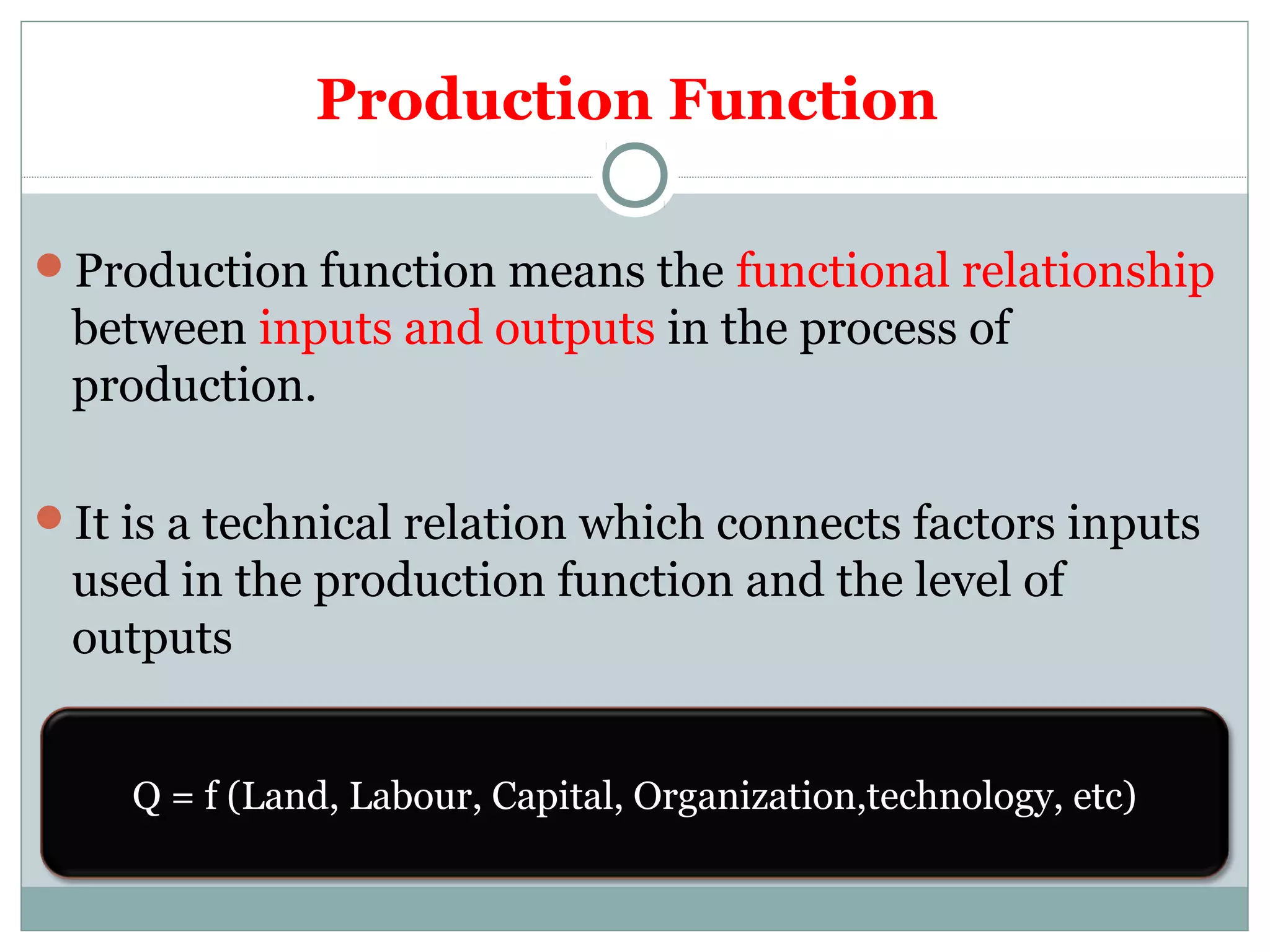
Production Function
Production function means the functional relationship
between inputs and outputs in the process of
production.
It is a technical relation which connects factors inputs
used in the production function and the level of
outputs
Q = f (Land, Labour, Capital, Organization,technology, etc)
Factors of Production
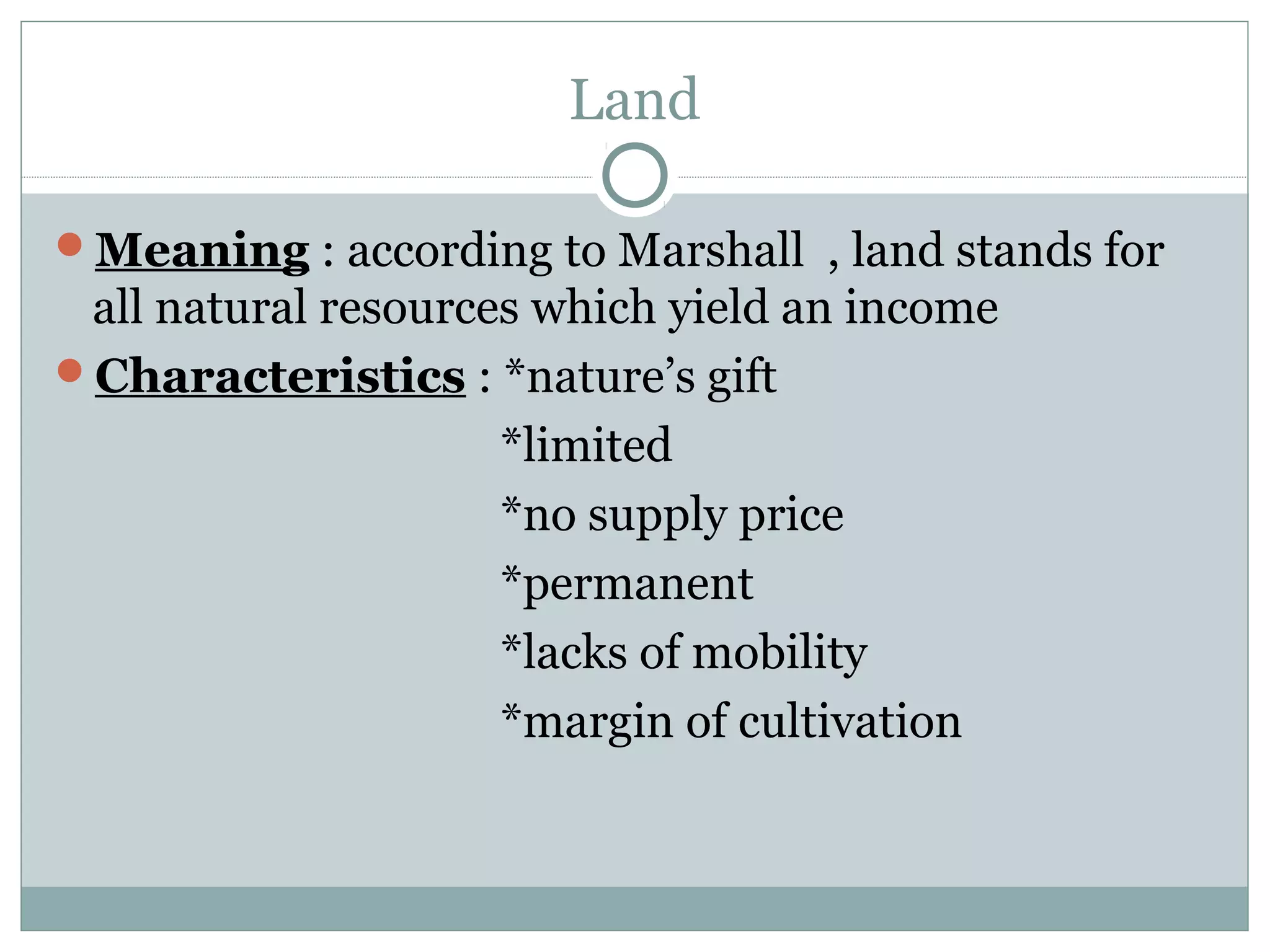
Land
Meaning : according to Marshall , land stands for
all natural resources which yield an income
Characteristics : *nature’s gift
*limited
*no supply price
*permanent
*lacks of mobility
*margin of cultivation
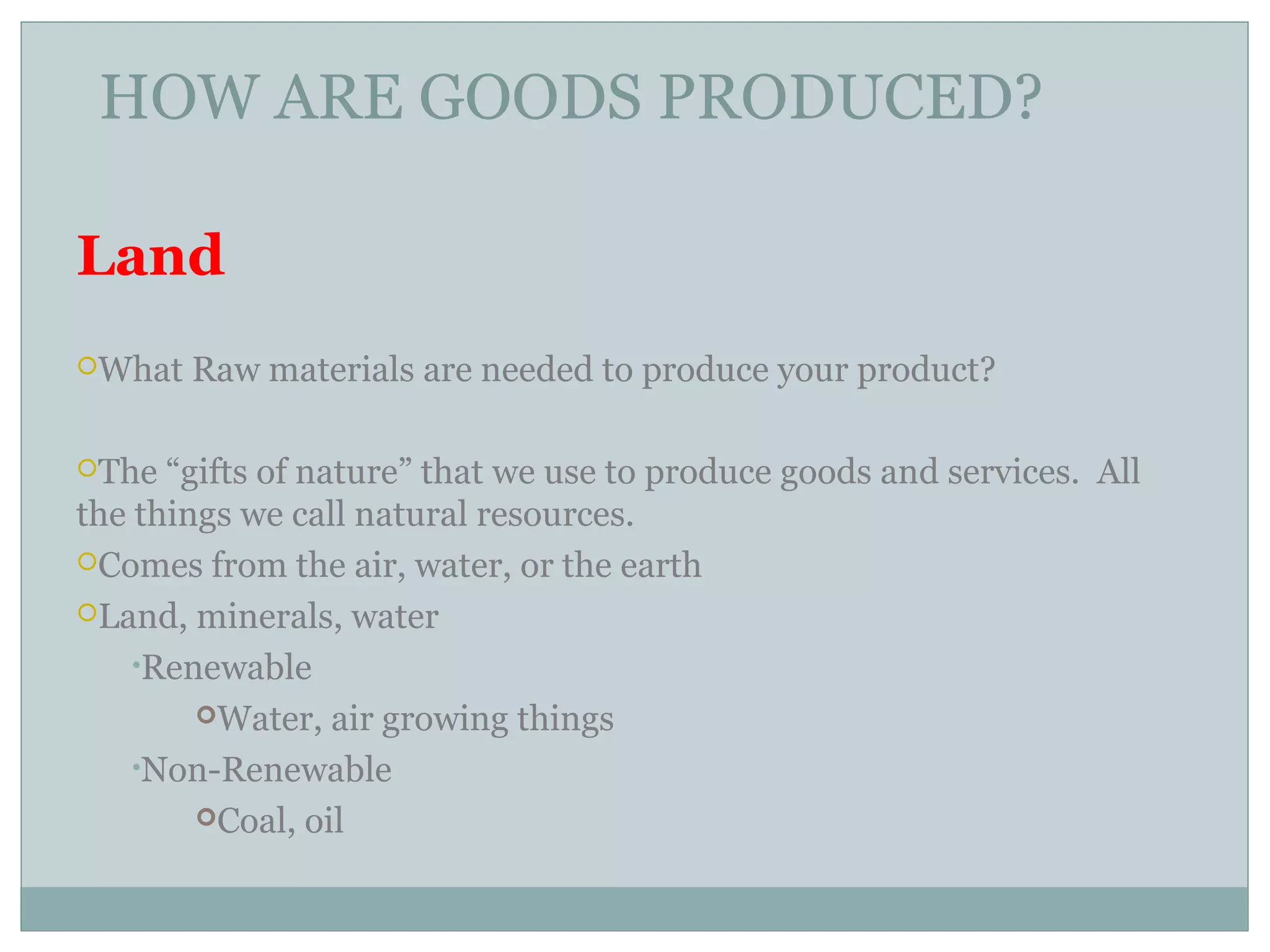
Land
What Raw materials are needed to produce your product?
The “gifts of nature” that we use to produce goods and services. All
the things we call natural resources.
Comes from the air, water, or the earth
Land, minerals, water
•Renewable
Water, air growing things
•Non-Renewable
Coal, oil
HOW ARE GOODS PRODUCED?
Nature supplies raw materials necessary to
make things
These raw materials are called Natural
Resources
Natural Resources
–Example: Chicken
noodle soup contains
chicken meat, spices,
water, and vegetables, all
of which came from the
nature
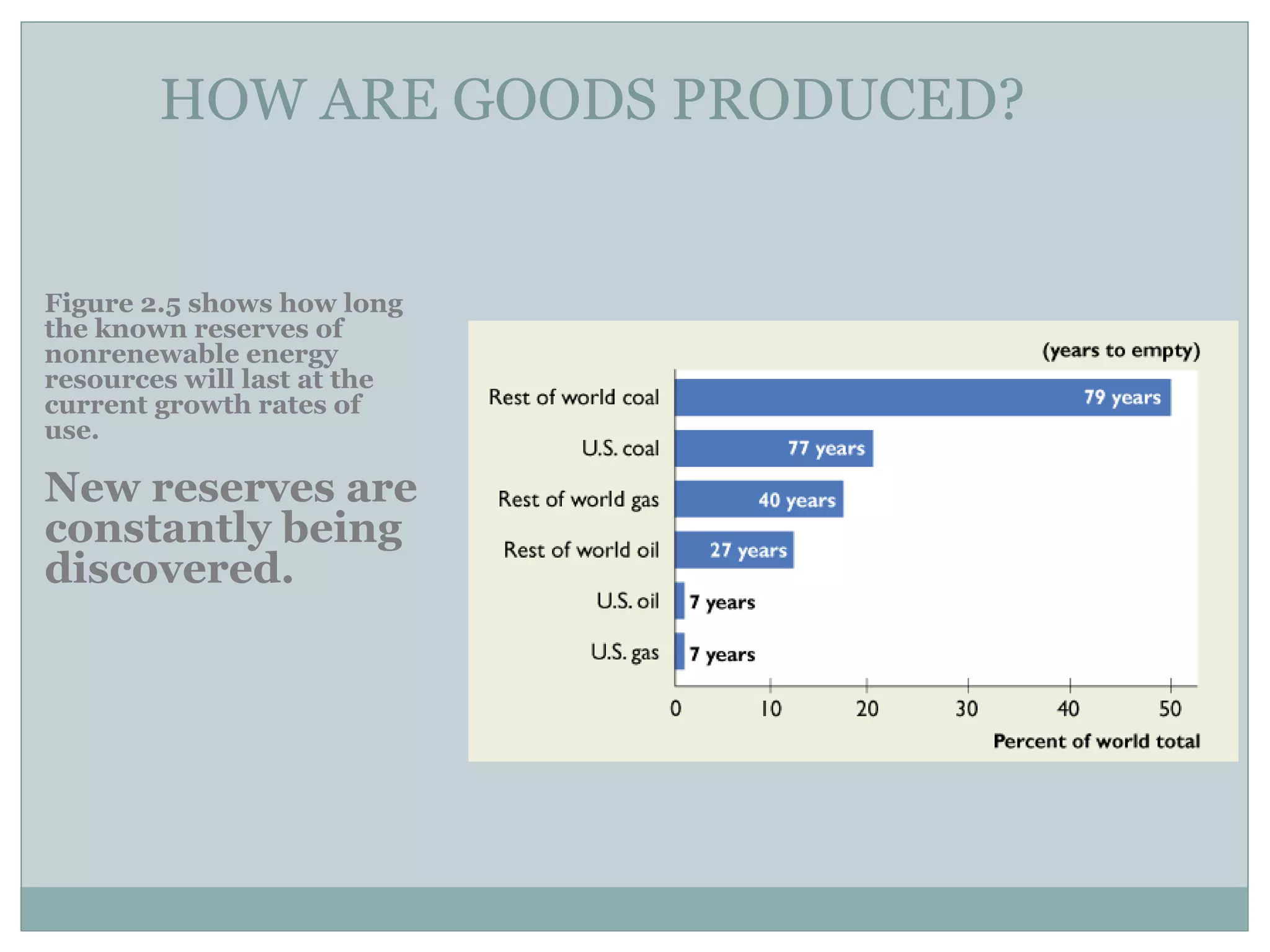
Figure 2.5 shows how long
the known reserves of
nonrenewable energy
resources will last at the
current growth rates of
use.
New reserves are
constantly being
discovered.
HOW ARE GOODS PRODUCED?
Labour
Meaning : work whether manual or mental , which
is undertaken for a monetary consideration …..
Meaning in sense of Marshall words..
• Characteristics :
* connected with labourer
* can’t preserve
* has weak bargaining power
* price of labour react rather
curiously on its supply
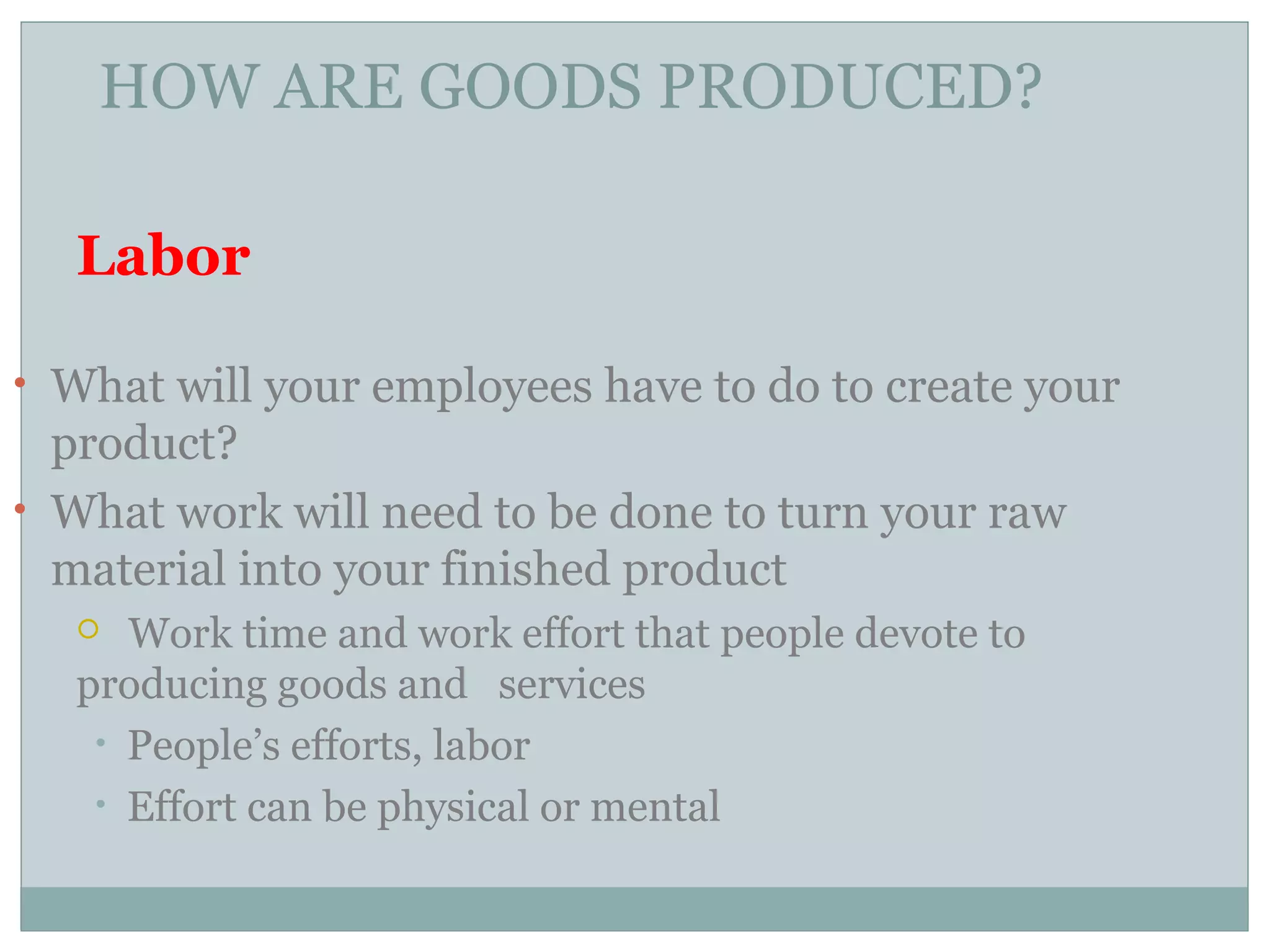
Labor
• What will your employees have to do to create your
product?
• What work will need to be done to turn your raw
material into your finished product
 Work time and work effort that people devote to
producing goods and services
• People’s efforts, labor
• Effort can be physical or mental
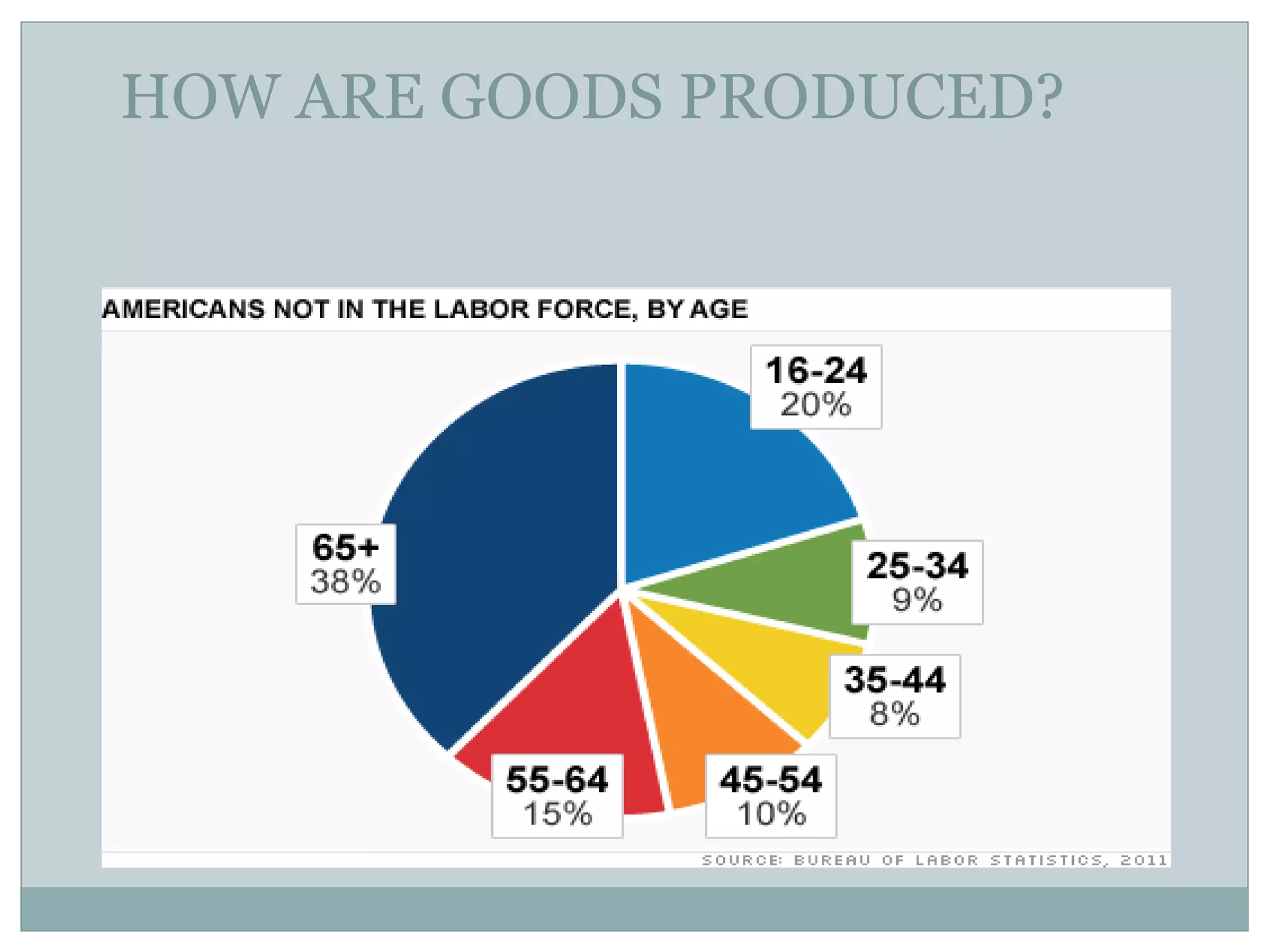
HOW ARE GOODS PRODUCED?
Human effort used to produce goods and
services is called labor
Labor can be physical or mental
Factor 2: Human Labor
•Example: to the soup, farmers raise the
animals and crops, a truck driver drives
them to a factory, and workers operate
machinery to mix and can it
(physical labor)
•Someone has to design the machines,
and think of a recipe for the soup
(mental labor)
Oil Consumption by Country
HOW ARE GOODS PRODUCED?
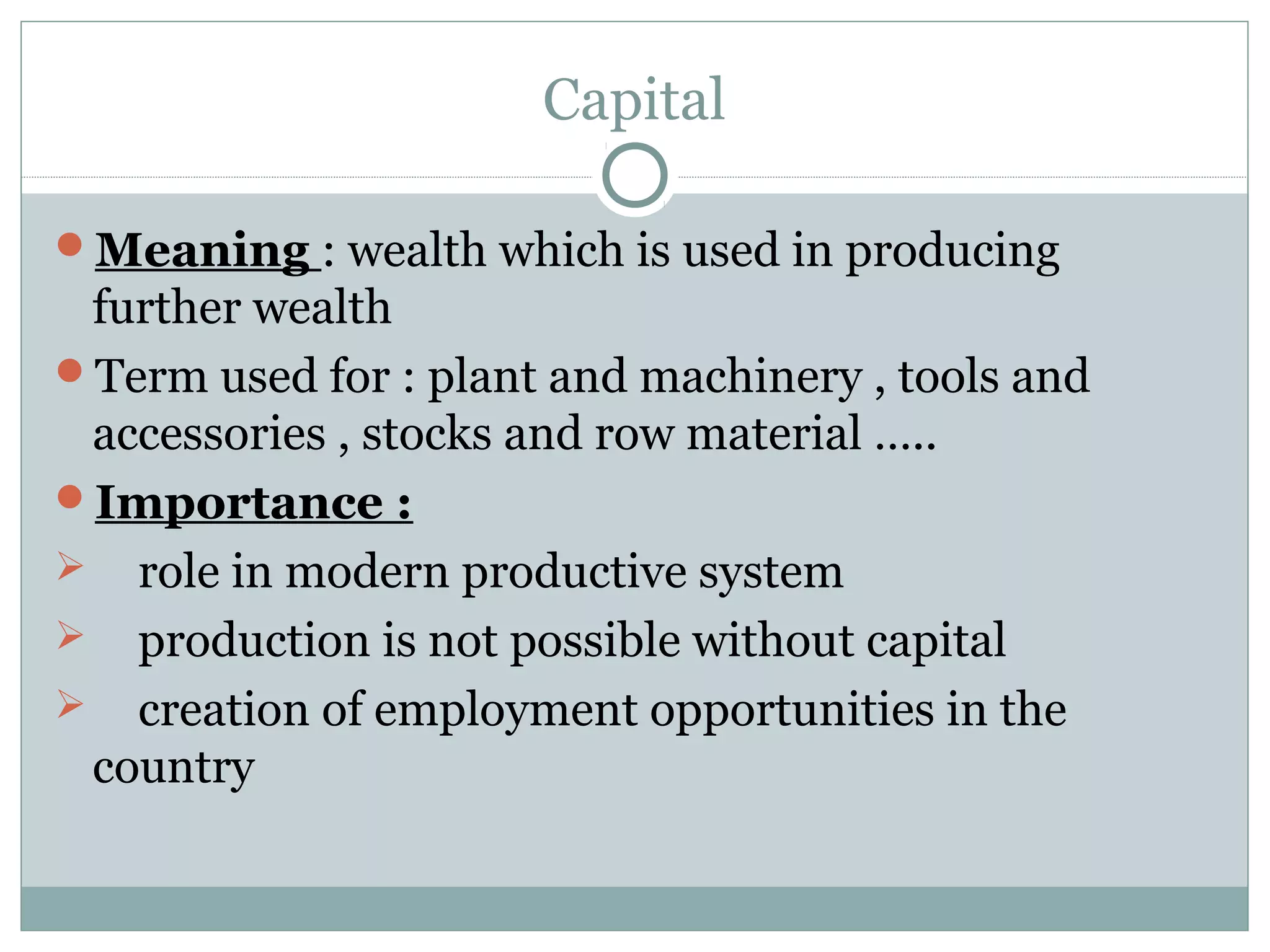
Capital
Meaning : wealth which is used in producing
further wealth
Term used for : plant and machinery , tools and
accessories , stocks and row material …..
Importance :
 role in modern productive system
 production is not possible without capital
 creation of employment opportunities in the
country
Capital
 What equipment and people will you need to create
your product
 Physical capital: What tools, machines and factories will you
needed to create your product
 Financial capital: funds the firm use to buy physical capital
 Human capital: What knowledge, skills, education and
experience will your employees need to have in order to produce
your product (for example: a seamstress , a chemist, a computer
technician )
• Goods made by people and used to produce other goods and services
• Tools, instruments, machines, buildings, and other constructions that have been
produced in the past and that businesses now use to produce goods and services.
HOW ARE GOODS PRODUCED?
Producing goods and services requires
tools and equipment
The buildings, machines, supplies, etc.
used to produce are called capital
resources, or capital goods
Factor 3: Capital Resources
•Examples: the truck used
to drive to the factory, the
machines used to can the
soup, and the factory
building itself
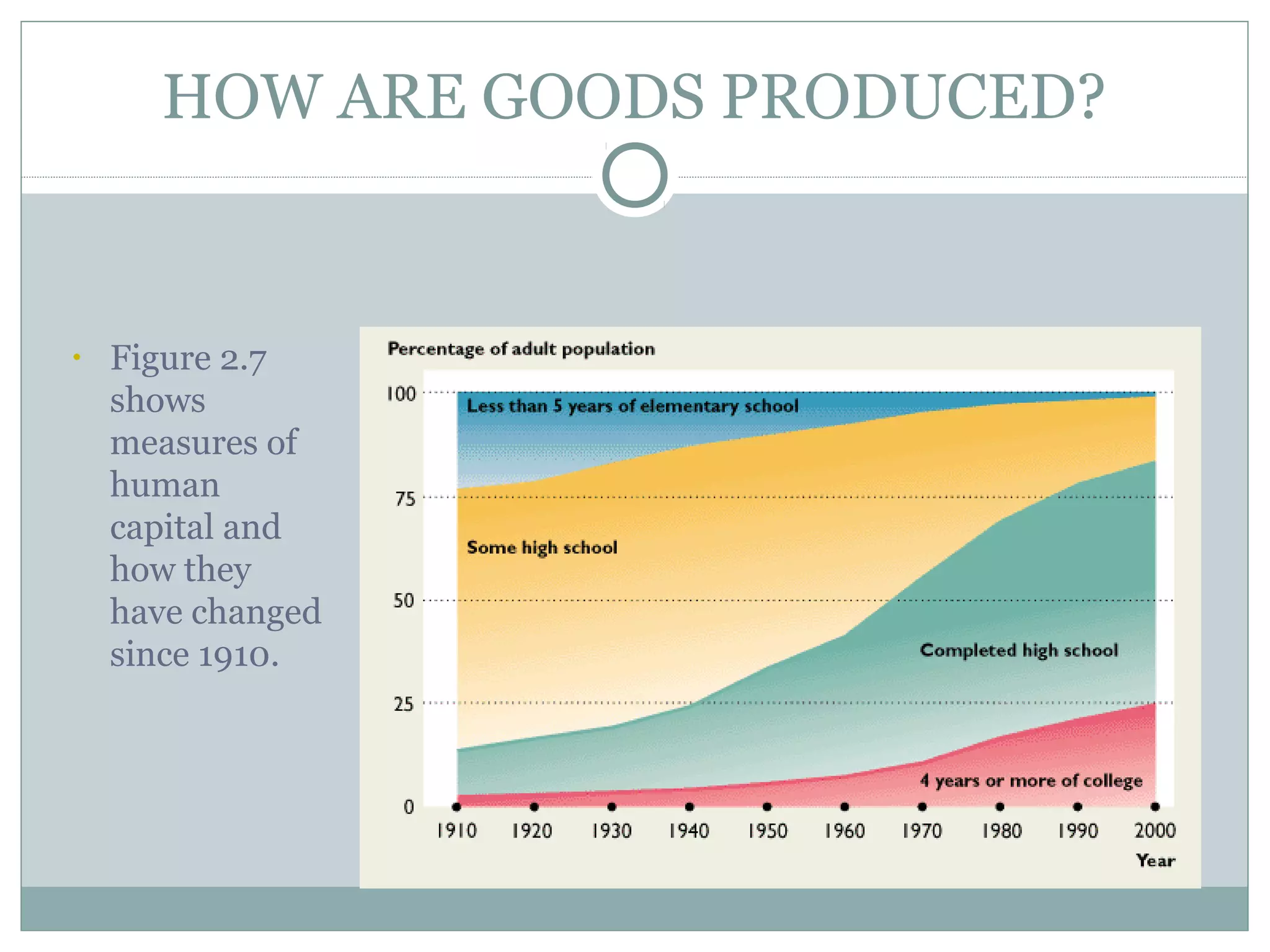
HOW ARE GOODS PRODUCED?
• Figure 2.7
shows
measures of
human
capital and
how they
have changed
since 1910.
Entrepreneur
What he /s do ???
 Co-ordinate and co-relate the other factors of
production.
Starts the work @ organize it @ supervise it.
• Functions :
 commence a business enterprise by developing new
product or by modifying the existing product.
 took the final responsibility .
 as innovator .
Entrepreneurship
 The human resource that organized and combines labor,
land, capital.
 The quantity and quality of entrepreneurship is hard to
describe and measure.
 But we can easily recognize brilliant entrepreneurs by
their enormous financial success.
 Sam Walton (Wal-Mart), Bill Gates (Microsoft), and
Michael Dell (Dell Computers) are examples of
outstanding entrepreneur's.
HOW ARE GOODS PRODUCED?
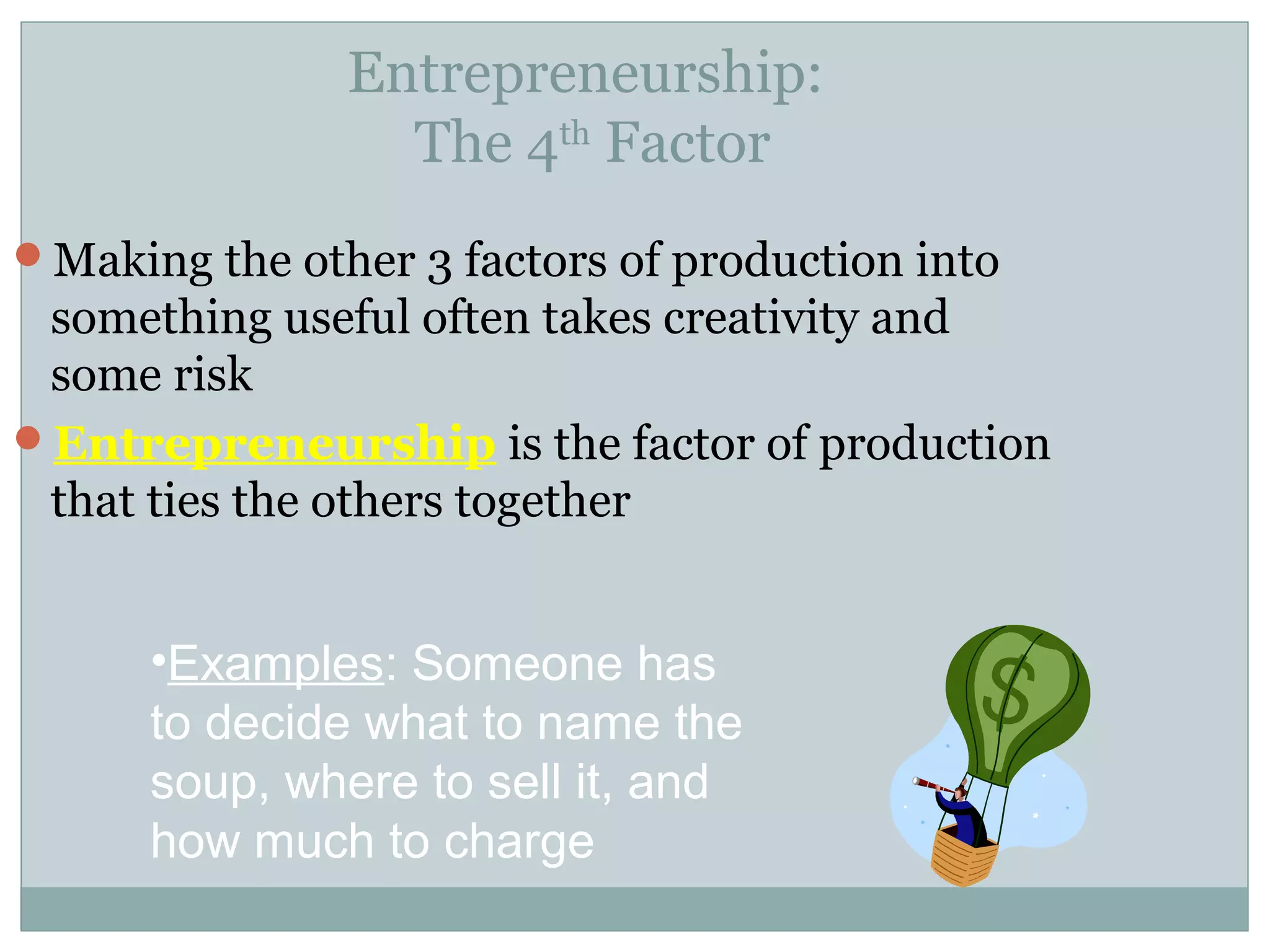
Making the other 3 factors of production into
something useful often takes creativity and
some risk
Entrepreneurship is the factor of production
that ties the others together
Entrepreneurship:
The 4th
Factor
•Examples: Someone has
to decide what to name the
soup, where to sell it, and
how much to charge
Scarcity- Nearly all resources are scare, meaning
there is a limited supply available to meet
unlimited wants
 The more scarce a resource, the more expensive
it is.
 Inverse Economic Relationship – when fruit
is out of season, supply is more scarce –
 This causes the price to increase because it is
more valuable
Influences on Entrepreneurs
Decision Making
Opportunity Cost – resources are
scare, the choice to use a resource in
one way means not using it in another.
Use a field to grow corn means the
field cannot be used to grow soy beans
Influences on Entrepreneurs
Decision Making
Productivity- is a measure of the amount of output
produced by a given amount of inputs. It reflects how
efficiently resources are being used.
This is also referred to as measuring the efficient use
of the factors of production.
 For example, the productivity of a farmer (labor)
increases with the use of a tractor (capital).
 Investing in human capital is one way to increase
productivity
Influences on Entrepreneurs
Decision Making
Influences on Entrepreneurs
Decision Making
To realize a profit, produce good/service at a cost
lower than the market price for the good or service.
Profit is the money left over from selling a good or
service after the cost of buying productive
resources have been paid.
 Minimize the use of scarce resource in production
 Maximize the productivity of the factors used in
production to keep cost as low as possible.
In order to study economic relationships, we need a sensible way to
categorize the various things in our economic world. Take a look at
this list of things that have value. Which of them would you place in
the category of LABOR? Which are LAND? Which are CAPITAL? Are
there some that don't fit in any of the three?
Some Things that Have Value:
Food in a Restaurant
Oil in the Ground
Your Mom's old House, which
you Rent to Tenants
Fish in the Ocean
Teaching
A Building Site
Food on your table
A $100 Bill
A House You Live in
A Truck
A Broadcast Frequency
Ditch Digging
Computer Programming
A Certificate for 100
Shares of Microsoft
Playing Music in the
Subway
Factors of Production
THE END

theory of production ( EEM PPT / SEM 4 GTU )

  • 1.
    LD COLLEGE OFENGINEERING PATEL TEJAS 140280119081 PATEL TRUPAL 140280119082 PATEL VATSAL 140280119083 PATHAK JUGAL 140280119084 POSHIYA DHARMANSHU 140280119085
  • 2.
  • 4.
    Theory of Production Productionis a process that create/adds value or utility It is the process in which the inputs are converted in to outputs.
  • 5.
    Production Function Production functionmeans the functional relationship between inputs and outputs in the process of production. It is a technical relation which connects factors inputs used in the production function and the level of outputs Q = f (Land, Labour, Capital, Organization,technology, etc)
  • 6.
  • 7.
    Land Meaning : accordingto Marshall , land stands for all natural resources which yield an income Characteristics : *nature’s gift *limited *no supply price *permanent *lacks of mobility *margin of cultivation
  • 8.
    Land What Raw materialsare needed to produce your product? The “gifts of nature” that we use to produce goods and services. All the things we call natural resources. Comes from the air, water, or the earth Land, minerals, water •Renewable Water, air growing things •Non-Renewable Coal, oil HOW ARE GOODS PRODUCED?
  • 9.
    Nature supplies rawmaterials necessary to make things These raw materials are called Natural Resources Natural Resources –Example: Chicken noodle soup contains chicken meat, spices, water, and vegetables, all of which came from the nature
  • 10.
    Figure 2.5 showshow long the known reserves of nonrenewable energy resources will last at the current growth rates of use. New reserves are constantly being discovered. HOW ARE GOODS PRODUCED?
  • 11.
    Labour Meaning : workwhether manual or mental , which is undertaken for a monetary consideration ….. Meaning in sense of Marshall words.. • Characteristics : * connected with labourer * can’t preserve * has weak bargaining power * price of labour react rather curiously on its supply
  • 12.
    Labor • What willyour employees have to do to create your product? • What work will need to be done to turn your raw material into your finished product  Work time and work effort that people devote to producing goods and services • People’s efforts, labor • Effort can be physical or mental HOW ARE GOODS PRODUCED?
  • 13.
    Human effort usedto produce goods and services is called labor Labor can be physical or mental Factor 2: Human Labor •Example: to the soup, farmers raise the animals and crops, a truck driver drives them to a factory, and workers operate machinery to mix and can it (physical labor) •Someone has to design the machines, and think of a recipe for the soup (mental labor)
  • 14.
  • 15.
    HOW ARE GOODSPRODUCED?
  • 16.
    HOW ARE GOODSPRODUCED?
  • 17.
    Capital Meaning : wealthwhich is used in producing further wealth Term used for : plant and machinery , tools and accessories , stocks and row material ….. Importance :  role in modern productive system  production is not possible without capital  creation of employment opportunities in the country
  • 18.
    Capital  What equipmentand people will you need to create your product  Physical capital: What tools, machines and factories will you needed to create your product  Financial capital: funds the firm use to buy physical capital  Human capital: What knowledge, skills, education and experience will your employees need to have in order to produce your product (for example: a seamstress , a chemist, a computer technician ) • Goods made by people and used to produce other goods and services • Tools, instruments, machines, buildings, and other constructions that have been produced in the past and that businesses now use to produce goods and services. HOW ARE GOODS PRODUCED?
  • 19.
    Producing goods andservices requires tools and equipment The buildings, machines, supplies, etc. used to produce are called capital resources, or capital goods Factor 3: Capital Resources •Examples: the truck used to drive to the factory, the machines used to can the soup, and the factory building itself
  • 20.
    HOW ARE GOODSPRODUCED? • Figure 2.7 shows measures of human capital and how they have changed since 1910.
  • 21.
    Entrepreneur What he /sdo ???  Co-ordinate and co-relate the other factors of production. Starts the work @ organize it @ supervise it. • Functions :  commence a business enterprise by developing new product or by modifying the existing product.  took the final responsibility .  as innovator .
  • 22.
    Entrepreneurship  The humanresource that organized and combines labor, land, capital.  The quantity and quality of entrepreneurship is hard to describe and measure.  But we can easily recognize brilliant entrepreneurs by their enormous financial success.  Sam Walton (Wal-Mart), Bill Gates (Microsoft), and Michael Dell (Dell Computers) are examples of outstanding entrepreneur's. HOW ARE GOODS PRODUCED?
  • 23.
    Making the other3 factors of production into something useful often takes creativity and some risk Entrepreneurship is the factor of production that ties the others together Entrepreneurship: The 4th Factor •Examples: Someone has to decide what to name the soup, where to sell it, and how much to charge
  • 24.
    Scarcity- Nearly allresources are scare, meaning there is a limited supply available to meet unlimited wants  The more scarce a resource, the more expensive it is.  Inverse Economic Relationship – when fruit is out of season, supply is more scarce –  This causes the price to increase because it is more valuable Influences on Entrepreneurs Decision Making
  • 25.
    Opportunity Cost –resources are scare, the choice to use a resource in one way means not using it in another. Use a field to grow corn means the field cannot be used to grow soy beans Influences on Entrepreneurs Decision Making
  • 26.
    Productivity- is ameasure of the amount of output produced by a given amount of inputs. It reflects how efficiently resources are being used. This is also referred to as measuring the efficient use of the factors of production.  For example, the productivity of a farmer (labor) increases with the use of a tractor (capital).  Investing in human capital is one way to increase productivity Influences on Entrepreneurs Decision Making
  • 27.
    Influences on Entrepreneurs DecisionMaking To realize a profit, produce good/service at a cost lower than the market price for the good or service. Profit is the money left over from selling a good or service after the cost of buying productive resources have been paid.  Minimize the use of scarce resource in production  Maximize the productivity of the factors used in production to keep cost as low as possible.
  • 28.
    In order tostudy economic relationships, we need a sensible way to categorize the various things in our economic world. Take a look at this list of things that have value. Which of them would you place in the category of LABOR? Which are LAND? Which are CAPITAL? Are there some that don't fit in any of the three? Some Things that Have Value: Food in a Restaurant Oil in the Ground Your Mom's old House, which you Rent to Tenants Fish in the Ocean Teaching A Building Site Food on your table A $100 Bill A House You Live in A Truck A Broadcast Frequency Ditch Digging Computer Programming A Certificate for 100 Shares of Microsoft Playing Music in the Subway Factors of Production
  • 29.