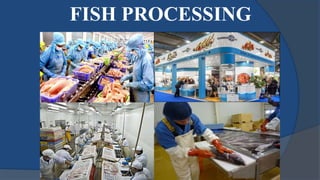
FISH PROCESSING
ASSESSMENT QUALITY ASPECT
OF FISH
Facilitator:
Abdiaziz Hussein
Hassan
SNU
Semester 7
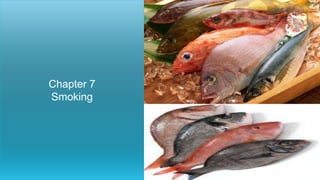
Chapter 7
Smoking
 Fish “smoking” is a process of treating fish by exposing
it to smoke from smoldering wood or plant materials.
 This process is usually characterized by a combination
of salting, drying, heating, and smoking steps in a
smoking chamber.
 Drying is done to reduce the moisture content to 10%
or less)
6/9/2024 4
Fish Smoking
 Smoked fish is fish that has been cured by smoking. Foods
have been smoked by humans throughout history.
 Originally this was done as a preservative.
 In more recent times fish is readily preserved by
refrigeration and freezing and the smoking of fish is
generally done for the unique taste and flavour imparted by
the smoking process.
6/9/2024 5
 Smoking and drying are important fish processing
methods for small-scale fisheries in countries
geographically located around the tropics. Fish is a
highly perishable food.
 Smoked and dried fish are two techniques that
represent the main and, at times, the only ways to
supply people located far from fishing sites with fish.
6/9/2024 6
 Smoking and effective drying of fish products can help
to reduce such losses and waste.
 enhanced fish operators’ livelihoods in tropical
countries where fish preservation is essential to reduce
spoilage due to insects, animals, humidity and
temperature.
 Construction of the system can be done locally and fuel
used comes from available local resources.
6/9/2024 7
Why do we smoke and dry fish?
 To extend shelf-life (up to 5–6 months with appropriate
monitoring)
 To facilitate transportation
 To maintain a consistent supply based on demand
 To reduce post-harvest losses
 To increase variety of textures and flavors, resulting in a
greater choice for consumers.
6/9/2024 8
How is fish smoking traditionally carried
out?
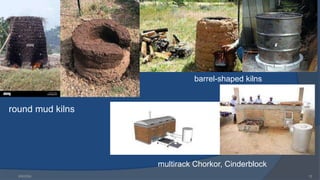
 Kilns are types of ovens that have been used to produce
smoked fish.
 They range from traditional kilns (round mud kilns, barrel-
shaped kilns) to improved ones (e.g. multirack Chorkor,
Cinderblock).
 Sun is used for drying fish in open spaces often on raised
racks.
6/9/2024 9
6/9/2024 10
round mud kilns
barrel-shaped kilns
multirack Chorkor, Cinderblock
Limitations of traditional smoking and
drying methods
 Using wood or charcoal to smoke fish increases the risk of
contaminating fish with byproducts of combustion such as
Polycyclic Aromatic Hydrocarbons (PAHs) and other
contaminants.
 PAHs can be carcinogenic and can affect the safety of food. In
addition, using traditional methods, there were losses to the by-
products (oil), much longer time for processing and quality
losses of the end product.
6/9/2024 11
How the problem can be resolved:
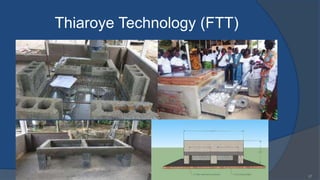
Introducing the FTT-Thiaroye
 The Thiaroye Processing
Technique (FTTThiaroye) was
pioneered by FAO.
 To date, it has been successfully
introduced and used in several
African countries, particularly with
women’s focus groups as fish
processors.
6/9/2024 12
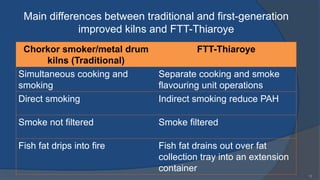
Main differences between traditional and first-generation
improved kilns and FTT-Thiaroye
Chorkor smoker/metal drum
kilns (Traditional)
FTT-Thiaroye
Simultaneous cooking and
smoking
Separate cooking and smoke
flavouring unit operations
Direct smoking Indirect smoking reduce PAH
Smoke not filtered Smoke filtered
Fish fat drips into fire Fish fat drains out over fat
collection tray into an extension
container
13
. Benefits of using FTT Thiaroye
 Meet higher international food safety requirements.
 Give the products premium quality and constant
and uniform characteristics.
 Functioning regardless of weather conditions.
This results in a minimization of post-harvest losses.
14
 Possibility to have additional revenue from process by-
products, e.g. fat gathered which can be used in soap, or it
can be used as cooking or frying oil.
 Easy to construct through expertise of local artisans and
available local materials
 Time savings in processing (from 5 hours for cooking and
smoking time depending on the size, thickness and number
of fish per operation), thus allowing processors to attend to
other business
15
 Contributes to safeguarding the environment by
reducing by half the fuel consumption and/or by
using plant materials, which are often bulky for the
environment, such as coconut husks and shells or
corn cobs, as fuel.
 In addition, this reduces the PAHs contaminants.
6/9/2024 16
Equipment needed for the FTT-
Thiaroye
1. The dual compartment frame for the vibrated kilns.
2. Lids
 Lids are used not only to cover the product during smoking and
drying but also to protect it afterwards.
 Where the processor already has a dual compartment kiln, it is
important to have FTT-Thiaroye accessories that meet the
measurements of this particular kiln
17
6/9/2024 18
Lids
compartment
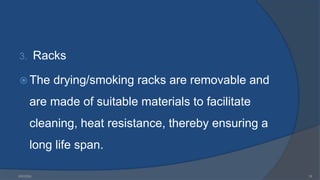
3. Racks
 The drying/smoking racks are removable and
are made of suitable materials to facilitate
cleaning, heat resistance, thereby ensuring a
long life span.
6/9/2024 19
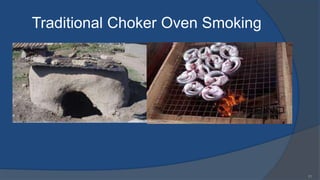
Choker Oven Smoking
 Good smoked products are more easily produced using
an improved smoking oven like the one called a “choker
oven”.
 This has a smoking pit or chamber and the fish are
placed on wooden framed racks with wire mesh and
these are stacked on the chamber.
6/9/2024 20
Traditional Choker Oven Smoking
21
 This method uses less fuel wood than traditional
methods and produces better quality products.
 Smoking should be carried out in a clean, well-ventilated
place protected from rain and animals.
 The process should not cause any problems to neighbors
or other Products.
6/9/2024 22
 For hot smoking the temperature of the middle of the fish
should reach at least 65oC during processing as this is the
temperature fish begins to cook.
 For oily / fatty fish, smoking can stop the oil causing a
colour change in the product and also stops the fish having
a rancid flavour.
 After smoking the fish should be cooled in a way which
avoids contamination with dirt, dust and bacteria.
6/9/2024 23
 Smoking equipment should be kept clean, with oil and
soot removed regularly, to avoid contamination of
products. Wood and other fuel materials like wood
shavings should be kept in a good dry place where they
do not come into contact with contaminants or fish. Only
good clean wood that has no paint or varnish on it should
be used so that the fish will not get bad chemicals on it.
6/9/2024 24
 Some wood products used for smoking can be
poisonous, putting chemicals on the fish. Such woods
and materials must not be used. Smoke drying puts
different chemicals on the fish.
 Some of these are called Polycyclic Aromatic
Hydrocarbons or PAH.
 These are thought to be harmful to consumers and to
processors.
6/9/2024 25
 The things which can affect the amount of
PAH on smoked fish are the type of wood or
fuel used, the distance between the fire and
fish, fats dripping onto the fire and causing
more smoke, direct or indirect smoking,
filtering the smoke and the length of time of
smoking process.
6/9/2024 26
Thiaroye Technology (FTT)
6/9/2024 27
Thank you
any Comments
6/9/2024 28

Lec 8 fish processing FISHe Smoking.pptx

  • 1.
  • 2.
    ASSESSMENT QUALITY ASPECT OFFISH Facilitator: Abdiaziz Hussein Hassan SNU Semester 7
  • 3.
  • 4.
     Fish “smoking”is a process of treating fish by exposing it to smoke from smoldering wood or plant materials.  This process is usually characterized by a combination of salting, drying, heating, and smoking steps in a smoking chamber.  Drying is done to reduce the moisture content to 10% or less) 6/9/2024 4
  • 5.
    Fish Smoking  Smokedfish is fish that has been cured by smoking. Foods have been smoked by humans throughout history.  Originally this was done as a preservative.  In more recent times fish is readily preserved by refrigeration and freezing and the smoking of fish is generally done for the unique taste and flavour imparted by the smoking process. 6/9/2024 5
  • 6.
     Smoking anddrying are important fish processing methods for small-scale fisheries in countries geographically located around the tropics. Fish is a highly perishable food.  Smoked and dried fish are two techniques that represent the main and, at times, the only ways to supply people located far from fishing sites with fish. 6/9/2024 6
  • 7.
     Smoking andeffective drying of fish products can help to reduce such losses and waste.  enhanced fish operators’ livelihoods in tropical countries where fish preservation is essential to reduce spoilage due to insects, animals, humidity and temperature.  Construction of the system can be done locally and fuel used comes from available local resources. 6/9/2024 7
  • 8.
    Why do wesmoke and dry fish?  To extend shelf-life (up to 5–6 months with appropriate monitoring)  To facilitate transportation  To maintain a consistent supply based on demand  To reduce post-harvest losses  To increase variety of textures and flavors, resulting in a greater choice for consumers. 6/9/2024 8
  • 9.
    How is fishsmoking traditionally carried out?  Kilns are types of ovens that have been used to produce smoked fish.  They range from traditional kilns (round mud kilns, barrel- shaped kilns) to improved ones (e.g. multirack Chorkor, Cinderblock).  Sun is used for drying fish in open spaces often on raised racks. 6/9/2024 9
  • 10.
    6/9/2024 10 round mudkilns barrel-shaped kilns multirack Chorkor, Cinderblock
  • 11.
    Limitations of traditionalsmoking and drying methods  Using wood or charcoal to smoke fish increases the risk of contaminating fish with byproducts of combustion such as Polycyclic Aromatic Hydrocarbons (PAHs) and other contaminants.  PAHs can be carcinogenic and can affect the safety of food. In addition, using traditional methods, there were losses to the by- products (oil), much longer time for processing and quality losses of the end product. 6/9/2024 11
  • 12.
    How the problemcan be resolved: Introducing the FTT-Thiaroye  The Thiaroye Processing Technique (FTTThiaroye) was pioneered by FAO.  To date, it has been successfully introduced and used in several African countries, particularly with women’s focus groups as fish processors. 6/9/2024 12
  • 13.
    Main differences betweentraditional and first-generation improved kilns and FTT-Thiaroye Chorkor smoker/metal drum kilns (Traditional) FTT-Thiaroye Simultaneous cooking and smoking Separate cooking and smoke flavouring unit operations Direct smoking Indirect smoking reduce PAH Smoke not filtered Smoke filtered Fish fat drips into fire Fish fat drains out over fat collection tray into an extension container 13
  • 14.
    . Benefits ofusing FTT Thiaroye  Meet higher international food safety requirements.  Give the products premium quality and constant and uniform characteristics.  Functioning regardless of weather conditions. This results in a minimization of post-harvest losses. 14
  • 15.
     Possibility tohave additional revenue from process by- products, e.g. fat gathered which can be used in soap, or it can be used as cooking or frying oil.  Easy to construct through expertise of local artisans and available local materials  Time savings in processing (from 5 hours for cooking and smoking time depending on the size, thickness and number of fish per operation), thus allowing processors to attend to other business 15
  • 16.
     Contributes tosafeguarding the environment by reducing by half the fuel consumption and/or by using plant materials, which are often bulky for the environment, such as coconut husks and shells or corn cobs, as fuel.  In addition, this reduces the PAHs contaminants. 6/9/2024 16
  • 17.
    Equipment needed forthe FTT- Thiaroye 1. The dual compartment frame for the vibrated kilns. 2. Lids  Lids are used not only to cover the product during smoking and drying but also to protect it afterwards.  Where the processor already has a dual compartment kiln, it is important to have FTT-Thiaroye accessories that meet the measurements of this particular kiln 17
  • 18.
  • 19.
    3. Racks  Thedrying/smoking racks are removable and are made of suitable materials to facilitate cleaning, heat resistance, thereby ensuring a long life span. 6/9/2024 19
  • 20.
    Choker Oven Smoking Good smoked products are more easily produced using an improved smoking oven like the one called a “choker oven”.  This has a smoking pit or chamber and the fish are placed on wooden framed racks with wire mesh and these are stacked on the chamber. 6/9/2024 20
  • 21.
  • 22.
     This methoduses less fuel wood than traditional methods and produces better quality products.  Smoking should be carried out in a clean, well-ventilated place protected from rain and animals.  The process should not cause any problems to neighbors or other Products. 6/9/2024 22
  • 23.
     For hotsmoking the temperature of the middle of the fish should reach at least 65oC during processing as this is the temperature fish begins to cook.  For oily / fatty fish, smoking can stop the oil causing a colour change in the product and also stops the fish having a rancid flavour.  After smoking the fish should be cooled in a way which avoids contamination with dirt, dust and bacteria. 6/9/2024 23
  • 24.
     Smoking equipmentshould be kept clean, with oil and soot removed regularly, to avoid contamination of products. Wood and other fuel materials like wood shavings should be kept in a good dry place where they do not come into contact with contaminants or fish. Only good clean wood that has no paint or varnish on it should be used so that the fish will not get bad chemicals on it. 6/9/2024 24
  • 25.
     Some woodproducts used for smoking can be poisonous, putting chemicals on the fish. Such woods and materials must not be used. Smoke drying puts different chemicals on the fish.  Some of these are called Polycyclic Aromatic Hydrocarbons or PAH.  These are thought to be harmful to consumers and to processors. 6/9/2024 25
  • 26.
     The thingswhich can affect the amount of PAH on smoked fish are the type of wood or fuel used, the distance between the fire and fish, fats dripping onto the fire and causing more smoke, direct or indirect smoking, filtering the smoke and the length of time of smoking process. 6/9/2024 26
  • 27.
  • 28.