Entrepreneurs:  The Driving Force Behind Small Businesses
The Age of the Entrepreneur A new business is born in the U.S. every 11 seconds.  Study of influential Americans:  THE  defining trend of the 21 st  century: Entrepreneurship!  One of every 25 adults is actively engaged in trying to start a new business.
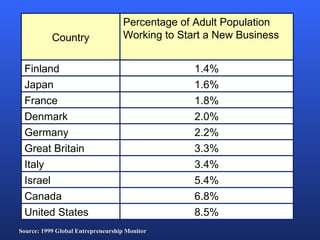
Source: 1999 Global Entrepreneurship Monitor 6.8% Canada 5.4% Israel Percentage of Adult Population Working to Start a New Business Country 8.5% United States 3.4% Italy 3.3% Great Britain 2.2% Germany 2.0% Denmark 1.8% France 1.6% Japan 1.4% Finland
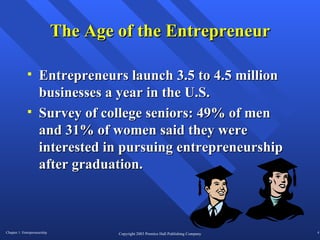
The Age of the Entrepreneur Entrepreneurs launch 3.5 to 4.5 million businesses a year in the U.S.  Survey of college seniors: 49% of men and 31% of women said they were interested in pursuing entrepreneurship after graduation.
What Is an Entrepreneur? A person who creates a new business in the face of risk and uncertainty for the purpose of achieving profit and growth by identifying opportunities and assembling the necessary resources to capitalize on those opportunities.
 
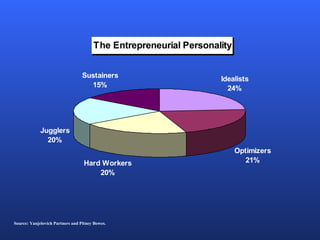
Characteristics of Entrepreneurs Desire for responsibility Preference for moderate risk Confidence in their ability to succeed Desire for immediate feedback High level of energy Future orientation Skilled in organization Value achievement over money
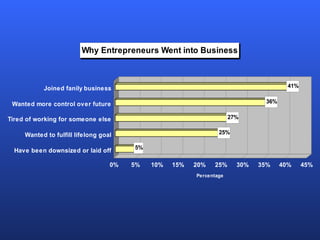
Source: Yanjelovich Partners and Pitney Bowes.
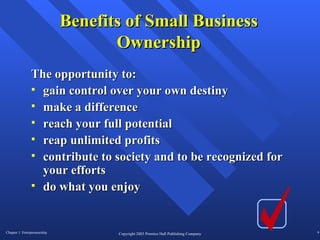
Benefits of Small Business Ownership The opportunity to: gain control over your own destiny make a difference reach your full potential reap unlimited profits contribute to society and to be recognized for your efforts do what you enjoy
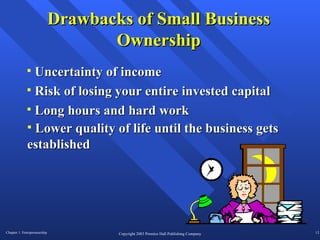
Drawbacks of Small Business Ownership Uncertainty of income Risk of losing your entire invested capital
Drawbacks of Small Business Ownership Uncertainty of income Risk of losing your entire invested capital Long hours and hard work
Drawbacks of Small Business Ownership Lower quality of life until the business gets established Uncertainty of income Risk of losing your entire invested capital Long hours and hard work
 
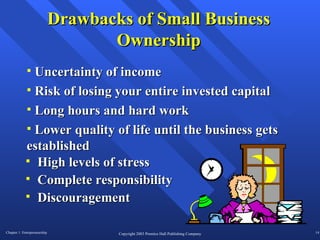
Drawbacks of Small Business Ownership High levels of stress Complete responsibility Discouragement Uncertainty of income Risk of losing your entire invested capital Long hours and hard work Lower quality of life until the business gets  established
Feeding the Entrepreneurial Fire Entrepreneurs as heroes Entrepreneurial education Economic and demographic factors Shift to a service economy
Feeding the Entrepreneurial Fire Technological advancements Independent lifestyles E-Commerce and the World Wide Web International Opportunities
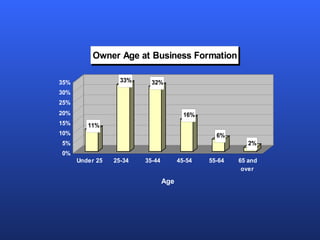
Trends in Entrepreneurship Young entrepreneurs Women
 
Minority enterprises Immigrant entrepreneurs Part-time entrepreneurs Home-based businesses Trends in Entrepreneurship Young entrepreneurs Women
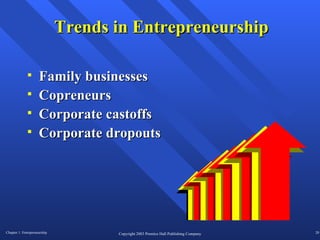
Trends in Entrepreneurship Family businesses Copreneurs Corporate castoffs Corporate dropouts
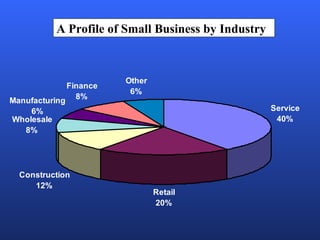
A Profile of Small Business by Industry
Small Businesses... make up 98.5% of all the businesses in the U.S. employ 52% of the nation's private sector workforce. create more jobs than big businesses. lead the way in training workers for jobs.
Small Businesses... produce 51% of the nation's GDP. account for 47% of business sales. create 4X more innovations per R & D dollar spent than medium-sized firms and 24X as many as large companies.
 
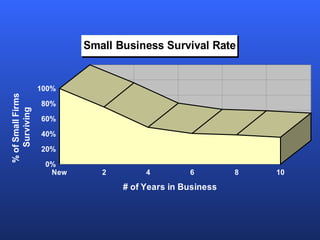
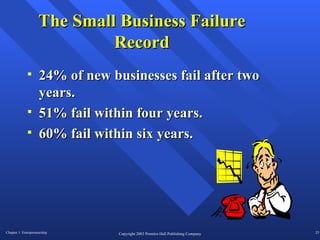
The Small Business Failure Record 24% of new businesses fail after two years. 51% fail within four years. 60% fail within six years.
Nine Deadly Mistakes of Entrepreneurship Management incompetence Lack of experience Undercapitalization Poor cash management Lack of strategic management
Nine Deadly Mistakes of Entrepreneurship Weak marketing effort Uncontrolled growth Poor location Lack of inventory control Inability to make the “entrepreneurial transition”
Putting Failure Into Perspective Failure is a natural part of the creative process. Failures are simply stepping stones along the path to success.  The “secret” to success is the ability to fail  intelligently , learning why you failed so that you can avoid making the same mistake again.
How to Avoid the Pitfalls Know your business in depth. Prepare a business plan. Manage financial resources. Understand financial statements. Learn to manage people effectively. Set your business apart from the competition.  Keep in tune with yourself.

SME Chapter 1

  • 1.
    Entrepreneurs: TheDriving Force Behind Small Businesses
  • 2.
    The Age ofthe Entrepreneur A new business is born in the U.S. every 11 seconds. Study of influential Americans: THE defining trend of the 21 st century: Entrepreneurship! One of every 25 adults is actively engaged in trying to start a new business.
  • 3.
    Source: 1999 GlobalEntrepreneurship Monitor 6.8% Canada 5.4% Israel Percentage of Adult Population Working to Start a New Business Country 8.5% United States 3.4% Italy 3.3% Great Britain 2.2% Germany 2.0% Denmark 1.8% France 1.6% Japan 1.4% Finland
  • 4.
    The Age ofthe Entrepreneur Entrepreneurs launch 3.5 to 4.5 million businesses a year in the U.S. Survey of college seniors: 49% of men and 31% of women said they were interested in pursuing entrepreneurship after graduation.
  • 5.
    What Is anEntrepreneur? A person who creates a new business in the face of risk and uncertainty for the purpose of achieving profit and growth by identifying opportunities and assembling the necessary resources to capitalize on those opportunities.
  • 6.
  • 7.
    Characteristics of EntrepreneursDesire for responsibility Preference for moderate risk Confidence in their ability to succeed Desire for immediate feedback High level of energy Future orientation Skilled in organization Value achievement over money
  • 8.
  • 9.
    Benefits of SmallBusiness Ownership The opportunity to: gain control over your own destiny make a difference reach your full potential reap unlimited profits contribute to society and to be recognized for your efforts do what you enjoy
  • 10.
    Drawbacks of SmallBusiness Ownership Uncertainty of income Risk of losing your entire invested capital
  • 11.
    Drawbacks of SmallBusiness Ownership Uncertainty of income Risk of losing your entire invested capital Long hours and hard work
  • 12.
    Drawbacks of SmallBusiness Ownership Lower quality of life until the business gets established Uncertainty of income Risk of losing your entire invested capital Long hours and hard work
  • 13.
  • 14.
    Drawbacks of SmallBusiness Ownership High levels of stress Complete responsibility Discouragement Uncertainty of income Risk of losing your entire invested capital Long hours and hard work Lower quality of life until the business gets established
  • 15.
    Feeding the EntrepreneurialFire Entrepreneurs as heroes Entrepreneurial education Economic and demographic factors Shift to a service economy
  • 16.
    Feeding the EntrepreneurialFire Technological advancements Independent lifestyles E-Commerce and the World Wide Web International Opportunities
  • 17.
    Trends in EntrepreneurshipYoung entrepreneurs Women
  • 18.
  • 19.
    Minority enterprises Immigrantentrepreneurs Part-time entrepreneurs Home-based businesses Trends in Entrepreneurship Young entrepreneurs Women
  • 20.
    Trends in EntrepreneurshipFamily businesses Copreneurs Corporate castoffs Corporate dropouts
  • 21.
    A Profile ofSmall Business by Industry
  • 22.
    Small Businesses... makeup 98.5% of all the businesses in the U.S. employ 52% of the nation's private sector workforce. create more jobs than big businesses. lead the way in training workers for jobs.
  • 23.
    Small Businesses... produce51% of the nation's GDP. account for 47% of business sales. create 4X more innovations per R & D dollar spent than medium-sized firms and 24X as many as large companies.
  • 24.
  • 25.
    The Small BusinessFailure Record 24% of new businesses fail after two years. 51% fail within four years. 60% fail within six years.
  • 26.
    Nine Deadly Mistakesof Entrepreneurship Management incompetence Lack of experience Undercapitalization Poor cash management Lack of strategic management
  • 27.
    Nine Deadly Mistakesof Entrepreneurship Weak marketing effort Uncontrolled growth Poor location Lack of inventory control Inability to make the “entrepreneurial transition”
  • 28.
    Putting Failure IntoPerspective Failure is a natural part of the creative process. Failures are simply stepping stones along the path to success. The “secret” to success is the ability to fail intelligently , learning why you failed so that you can avoid making the same mistake again.
  • 29.
    How to Avoidthe Pitfalls Know your business in depth. Prepare a business plan. Manage financial resources. Understand financial statements. Learn to manage people effectively. Set your business apart from the competition. Keep in tune with yourself.