Berlo’s SMCR
History
In 1960, David Berlo postulated Berlo’s SENDER-MESSAGE-
CHANNEL-RECEIVER (SMCR) model of communication from Shannon
Weaver’s Model of Communication (1949). He described factors
affecting the individual components in the communication making the
communication more efficient. The model also focuses on encoding and
decoding which happens before sender sends the message respectively.
Berlo’s Model has mainly, four components to describe the
communication process. They are sender, message, channel and
receiver. Each of the component is affected by many factors.
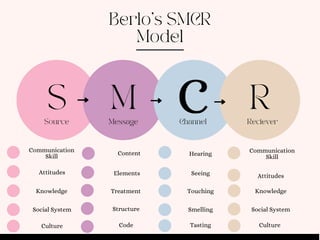
S
Source
M
Message
C
Channel
R
Reciever
Communication
Skill
Content Hearing
Attitudes Elements Seeing
Berlo’s SMCR
Model
Knowledge Treatment Touching
Social System
Culture
Structure
Code
Smelling
Tasting
Communication
Skill
Attitudes
Knowledge
Social System
Culture
Source
COMMUNICATION SKILLS– It is the skill of the individual to
communicate
ATTITUDES – This includes attitudes towards the audience,
subject and towards oneself.
KNOWLEDGE– Communicating also means that the person
needs to be knowledgeable about the subject or topic.
SOCIAL SYSTEM – The social system includes the various
aspects of society like values, beliefs, culture, religion and a
general understanding of society. It is where the
communication takes place.
CULTURE- Culture of a particular society also comes under
the social system.
S
Message
CONTENT – The body of a message, from the beginning to the end,
comprises its content.
ELEMENTS – It includes various things like language, gestures, body
language, etc. They constitute all the elements of a particular message.
Any content is accompanied by some elements.
TREATMENT – It refers to the packing of the message and the way in
which the message is conveyed or the way in which it is passed on or
delivered.
STRUCTURE– The structure of the message refers to how it is
arranged; the way people structure the message into various parts.
CODE– The code of the message refers to the means through which it
is sent and in what form. It could be, for example, language, body
language, gestures, music, etc. Even culture is a code. Through this,
people give and receive messages and communication takes place.
M
Channel
HEARING-The use of ears to receive the message.
TOUCHING-The sense of touch can be used as a channel to
communicate.
SMELLING- Smell also can be a channel to communicate.
TASTING- The tongue is a muscular organ used in the act of
eat and taste food.
C It refers to the five sense organs. The following are the five senses:
Hearing, Seeing, Touching, Smelling, Tasting
SEEING- Visual channels
Reciever
R
COMMUNICATION SKILLS– It is the skill of the individual to
communicate
ATTITUDES – This includes attitudes towards the audience,
subject and towards oneself.
KNOWLEDGE– Communicating also means that the person
needs to be knowledgeable about the subject or topic.
SOCIAL SYSTEM – The social system includes the various
aspects of society like values, beliefs, culture, religion and a
general understanding of society. It is where the
communication takes place.
CULTURE- Culture of a particular society also comes under
the social system.

SMCR (1).pdf

  • 1.
    Berlo’s SMCR History In 1960,David Berlo postulated Berlo’s SENDER-MESSAGE- CHANNEL-RECEIVER (SMCR) model of communication from Shannon Weaver’s Model of Communication (1949). He described factors affecting the individual components in the communication making the communication more efficient. The model also focuses on encoding and decoding which happens before sender sends the message respectively. Berlo’s Model has mainly, four components to describe the communication process. They are sender, message, channel and receiver. Each of the component is affected by many factors.
  • 2.
    S Source M Message C Channel R Reciever Communication Skill Content Hearing Attitudes ElementsSeeing Berlo’s SMCR Model Knowledge Treatment Touching Social System Culture Structure Code Smelling Tasting Communication Skill Attitudes Knowledge Social System Culture
  • 3.
    Source COMMUNICATION SKILLS– Itis the skill of the individual to communicate ATTITUDES – This includes attitudes towards the audience, subject and towards oneself. KNOWLEDGE– Communicating also means that the person needs to be knowledgeable about the subject or topic. SOCIAL SYSTEM – The social system includes the various aspects of society like values, beliefs, culture, religion and a general understanding of society. It is where the communication takes place. CULTURE- Culture of a particular society also comes under the social system. S
  • 4.
    Message CONTENT – Thebody of a message, from the beginning to the end, comprises its content. ELEMENTS – It includes various things like language, gestures, body language, etc. They constitute all the elements of a particular message. Any content is accompanied by some elements. TREATMENT – It refers to the packing of the message and the way in which the message is conveyed or the way in which it is passed on or delivered. STRUCTURE– The structure of the message refers to how it is arranged; the way people structure the message into various parts. CODE– The code of the message refers to the means through which it is sent and in what form. It could be, for example, language, body language, gestures, music, etc. Even culture is a code. Through this, people give and receive messages and communication takes place. M
  • 5.
    Channel HEARING-The use ofears to receive the message. TOUCHING-The sense of touch can be used as a channel to communicate. SMELLING- Smell also can be a channel to communicate. TASTING- The tongue is a muscular organ used in the act of eat and taste food. C It refers to the five sense organs. The following are the five senses: Hearing, Seeing, Touching, Smelling, Tasting SEEING- Visual channels
  • 6.
    Reciever R COMMUNICATION SKILLS– Itis the skill of the individual to communicate ATTITUDES – This includes attitudes towards the audience, subject and towards oneself. KNOWLEDGE– Communicating also means that the person needs to be knowledgeable about the subject or topic. SOCIAL SYSTEM – The social system includes the various aspects of society like values, beliefs, culture, religion and a general understanding of society. It is where the communication takes place. CULTURE- Culture of a particular society also comes under the social system.