1
Smart phone… dumb battery ?
Green IT week – May 2014
Thomas CORVAISIER – CEO, The Green Little Men
2
Smartphones are wonderful.
3
The average smartphone is charged
every day
At least.
4
5
Agenda
1. My smartphone’s battery is too small!
2. Let’s look at some technical solutions…
3. … is there another way out ?
6
My smartphone battery is way too small
And… it’s getting smaller!
7
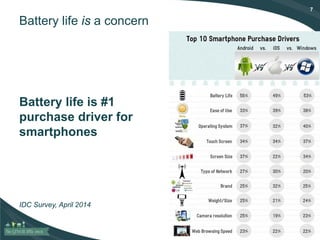
Battery life is a concern
Battery life is #1
purchase driver for
smartphones
IDC Survey, April 2014
8
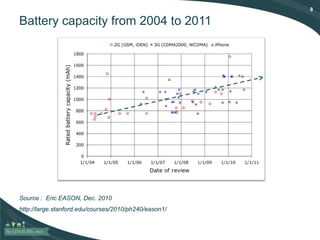
Battery capacity from 2004 to 2011
Source : Eric EASON, Dec. 2010
http://large.stanford.edu/courses/2010/ph240/eason1/
9
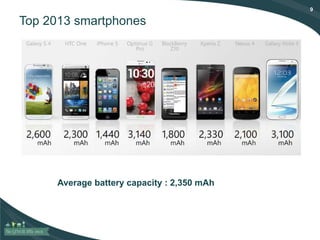
Top 2013 smartphones
Average battery capacity : 2,350 mAh
10
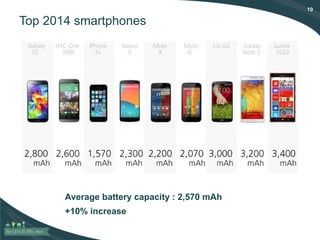
Top 2014 smartphones
Average battery capacity : 2,570 mAh
+10% increase
11
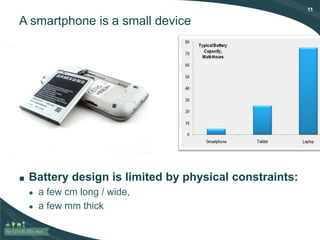
A smartphone is a small device
■ Battery design is limited by physical constraints:
● a few cm long / wide,
● a few mm thick
12
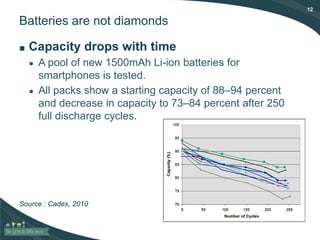
Batteries are not diamonds
■ Capacity drops with time
● A pool of new 1500mAh Li-ion batteries for
smartphones is tested.
● All packs show a starting capacity of 88–94 percent
and decrease in capacity to 73–84 percent after 250
full discharge cycles.
Source : Cadex, 2010
13
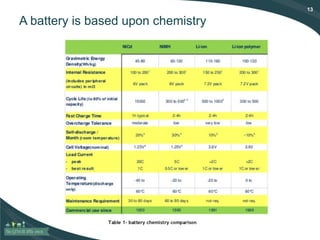
A battery is based upon chemistry
14
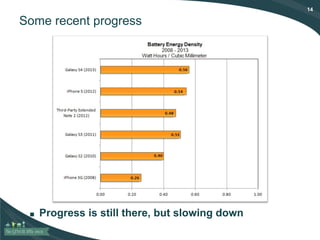
Some recent progress
■ Progress is still there, but slowing down
15
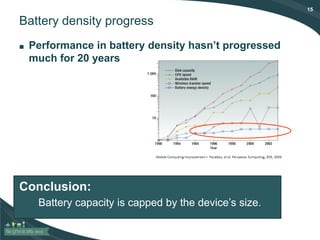
Battery density progress
■ Performance in battery density hasn’t progressed
much for 20 years
Conclusion:
● Battery capacity is capped by the device’s size.
16
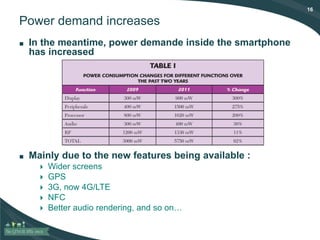
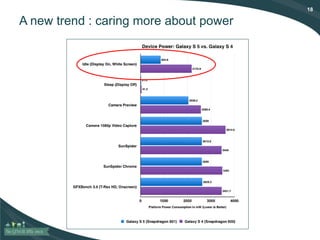
Power demand increases
■ In the meantime, power demande inside the smartphone
has increased
■ Mainly due to the new features being available :
 Wider screens
 GPS
 3G, now 4G/LTE
 NFC
 Better audio rendering, and so on…
17
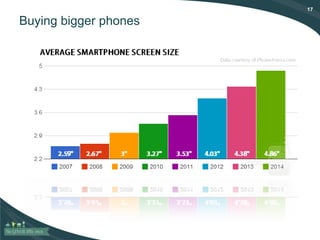
Buying bigger phones
18
A new trend : caring more about power
19
Let’s look at some solutions
20
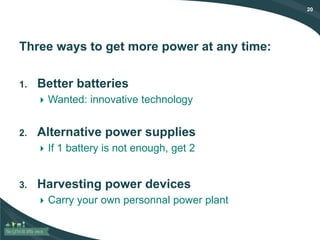
Three ways to get more power at any time:
1. Better batteries
 Wanted: innovative technology
2. Alternative power supplies
 If 1 battery is not enough, get 2
3. Harvesting power devices
 Carry your own personnal power plant
21
1 – Better batteries
■ Lithium-ion (Li-ion) batteries have established themselves as a leader in energy and
power densities for mobile applications. These batteries account for a market worth
more than $10 billion. However, the reign of Li-ion will soon be threatened by next-
generation batteries.
■ Operating systems like Microsoft Windows or Apple OS X are increasingly being
deployed in handheld smart phones and tablets and system complexities will only
grow with time and in smaller, thinner devices. Batteries are a major roadblock today
on the way to this goal: The thin, small, lightweight batteries of today simply do not
pack the energy required by truly novel consumer electronics.
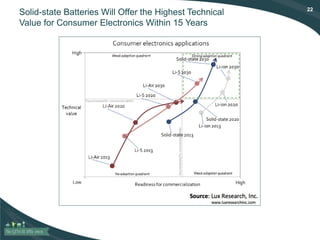
■ The incumbent, Li-ion, will put up a worthy fight but by 2020, solid-state will draw
close as current complex manufacturing processes that are a challenge today are
solved, costs fall and energy densities rise. From this foundation, it will surge past Li-
ion in technical value by 2030.
■ Li-S will also make strong progress, but won’t quite match the well-rounded value
propositions of solid-state and advancing Li-ion, finding only niche consumer
electronics applications that prize excellent specific energy above all else.
■ Li-air is a non-factor in this sector, hampered by its volumetric inefficiency and its
need for peripherals.
■ The road to technologies like Li-air, Li-S, and solid-state batteries is long, but the time
to start paying attention and tracking the development of specific companies,
technologies and applications is now.
● Source: Lux Research report “Beyond Lithium-Ion: A Roadmap for Next-Generation Batteries” — client
registration required.
22
Solid-state Batteries Will Offer the Highest Technical
Value for Consumer Electronics Within 15 Years
23
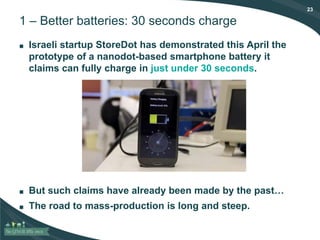
1 – Better batteries: 30 seconds charge
■ Israeli startup StoreDot has demonstrated this April the
prototype of a nanodot-based smartphone battery it
claims can fully charge in just under 30 seconds.
■ But such claims have already been made by the past…
■ The road to mass-production is long and steep.
24
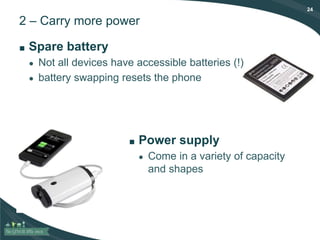
2 – Carry more power
■ Spare battery
● Not all devices have accessible batteries (!)
● battery swapping resets the phone
■ Power supply
● Come in a variety of capacity
and shapes
25
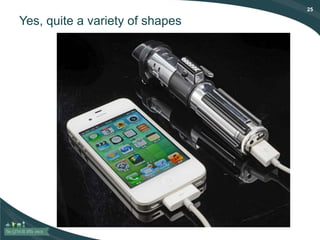
Yes, quite a variety of shapes
26
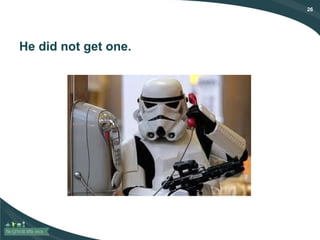
He did not get one.
27
3. Harvesting
■ Researchers have begun to think about
abandoning batteries altogether.
■ The alternative would mean harvesting
energy from sources outside of our devices
28
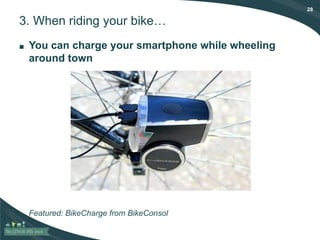
3. When riding your bike…
■ You can charge your smartphone while wheeling
around town
Featured: BikeCharge from BikeConsol
29
3. When walking, dancing…
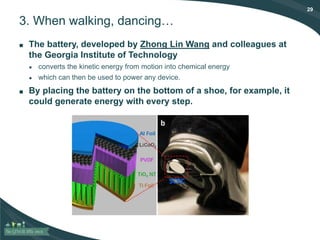
■ The battery, developed by Zhong Lin Wang and colleagues at
the Georgia Institute of Technology
● converts the kinetic energy from motion into chemical energy
● which can then be used to power any device.
■ By placing the battery on the bottom of a shoe, for example, it
could generate energy with every step.
30
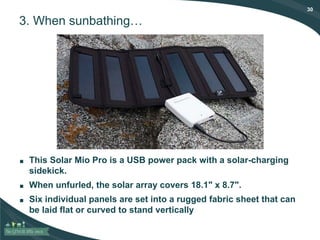
3. When sunbathing…
■ This Solar Mio Pro is a USB power pack with a solar-charging
sidekick.
■ When unfurled, the solar array covers 18.1" x 8.7".
■ Six individual panels are set into a rugged fabric sheet that can
be laid flat or curved to stand vertically
31
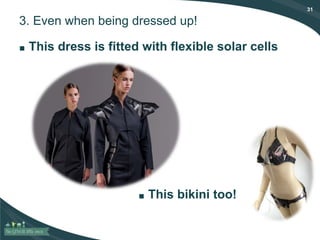
3. Even when being dressed up!
■ This dress is fitted with flexible solar cells
■ This bikini too!
32
Let’s sum it up
■ Current batteries aren’t up to the task
● And won’t be for the years to come
■ Some solutions exist
● But the trade off is always increasing bulk and cost
■ Are we stuck ?
33
34
Is there another way out of here ?
35
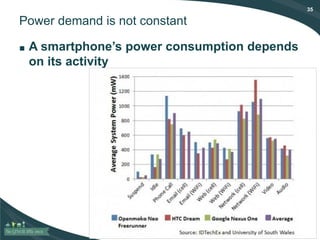
Power demand is not constant
■ A smartphone’s power consumption depends
on its activity
36
Let’s work on user’s side!
■ The aim :
● Adjust the settings constantly
 so that the device is always up and ready for the task
to perform
 Nothing less, but nothing more
● Check that each task is useful
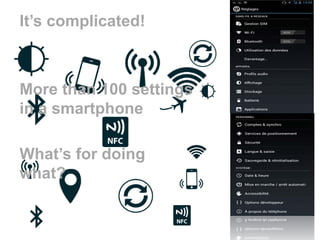
It’s complicated!
More than 100 settings
in a smartphone
What’s for doing
what?
38
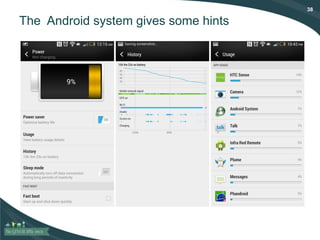
The Android system gives some hints
39
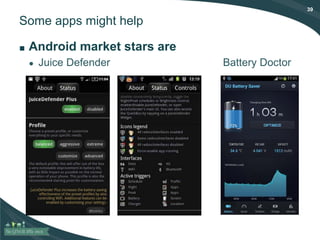
Some apps might help
■ Android market stars are
● Juice Defender Battery Doctor
40
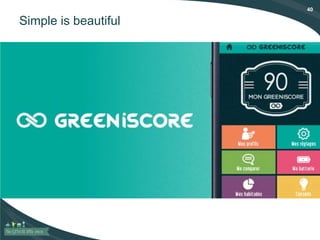
Simple is beautiful
41
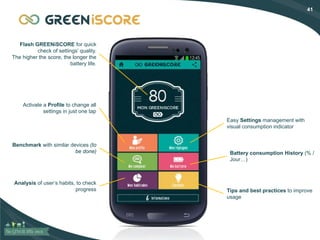
Flash GREENiSCORE for quick
check of settings’ quality.
The higher the score, the longer the
battery life.
Activate a Profile to change all
settings in just one tap
Benchmark with similar devices (to
be done)
Analysis of user’s habits, to check
progress
Easy Settings management with
visual consumption indicator
Battery consumption History (% /
Jour…)
Tips and best practices to improve
usage
42
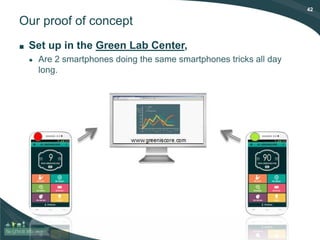
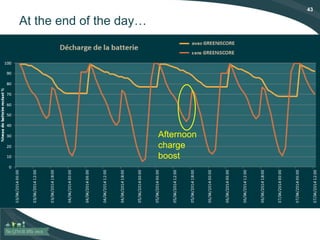
Our proof of concept
■ Set up in the Green Lab Center,
● Are 2 smartphones doing the same smartphones tricks all day
long.
43
At the end of the day…
Afternoon
charge
boost
44
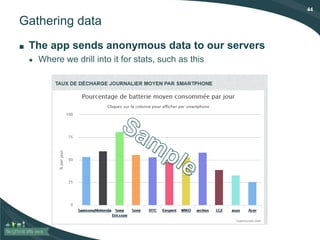
Gathering data
■ The app sends anonymous data to our servers
● Where we drill into it for stats, such as this
45
For more information
www.greeniscore.com
Download GREENiSCORE on

European Green IT Webinar 2014 - The Green Little Men (France)s

  • 1.
    1 Smart phone… dumbbattery ? Green IT week – May 2014 Thomas CORVAISIER – CEO, The Green Little Men
  • 2.
  • 3.
    3 The average smartphoneis charged every day At least.
  • 4.
  • 5.
    5 Agenda 1. My smartphone’sbattery is too small! 2. Let’s look at some technical solutions… 3. … is there another way out ?
  • 6.
    6 My smartphone batteryis way too small And… it’s getting smaller!
  • 7.
    7 Battery life isa concern Battery life is #1 purchase driver for smartphones IDC Survey, April 2014
  • 8.
    8 Battery capacity from2004 to 2011 Source : Eric EASON, Dec. 2010 http://large.stanford.edu/courses/2010/ph240/eason1/
  • 9.
    9 Top 2013 smartphones Averagebattery capacity : 2,350 mAh
  • 10.
    10 Top 2014 smartphones Averagebattery capacity : 2,570 mAh +10% increase
  • 11.
    11 A smartphone isa small device ■ Battery design is limited by physical constraints: ● a few cm long / wide, ● a few mm thick
  • 12.
    12 Batteries are notdiamonds ■ Capacity drops with time ● A pool of new 1500mAh Li-ion batteries for smartphones is tested. ● All packs show a starting capacity of 88–94 percent and decrease in capacity to 73–84 percent after 250 full discharge cycles. Source : Cadex, 2010
  • 13.
    13 A battery isbased upon chemistry
  • 14.
    14 Some recent progress ■Progress is still there, but slowing down
  • 15.
    15 Battery density progress ■Performance in battery density hasn’t progressed much for 20 years Conclusion: ● Battery capacity is capped by the device’s size.
  • 16.
    16 Power demand increases ■In the meantime, power demande inside the smartphone has increased ■ Mainly due to the new features being available :  Wider screens  GPS  3G, now 4G/LTE  NFC  Better audio rendering, and so on…
  • 17.
  • 18.
    18 A new trend: caring more about power
  • 19.
    19 Let’s look atsome solutions
  • 20.
    20 Three ways toget more power at any time: 1. Better batteries  Wanted: innovative technology 2. Alternative power supplies  If 1 battery is not enough, get 2 3. Harvesting power devices  Carry your own personnal power plant
  • 21.
    21 1 – Betterbatteries ■ Lithium-ion (Li-ion) batteries have established themselves as a leader in energy and power densities for mobile applications. These batteries account for a market worth more than $10 billion. However, the reign of Li-ion will soon be threatened by next- generation batteries. ■ Operating systems like Microsoft Windows or Apple OS X are increasingly being deployed in handheld smart phones and tablets and system complexities will only grow with time and in smaller, thinner devices. Batteries are a major roadblock today on the way to this goal: The thin, small, lightweight batteries of today simply do not pack the energy required by truly novel consumer electronics. ■ The incumbent, Li-ion, will put up a worthy fight but by 2020, solid-state will draw close as current complex manufacturing processes that are a challenge today are solved, costs fall and energy densities rise. From this foundation, it will surge past Li- ion in technical value by 2030. ■ Li-S will also make strong progress, but won’t quite match the well-rounded value propositions of solid-state and advancing Li-ion, finding only niche consumer electronics applications that prize excellent specific energy above all else. ■ Li-air is a non-factor in this sector, hampered by its volumetric inefficiency and its need for peripherals. ■ The road to technologies like Li-air, Li-S, and solid-state batteries is long, but the time to start paying attention and tracking the development of specific companies, technologies and applications is now. ● Source: Lux Research report “Beyond Lithium-Ion: A Roadmap for Next-Generation Batteries” — client registration required.
  • 22.
    22 Solid-state Batteries WillOffer the Highest Technical Value for Consumer Electronics Within 15 Years
  • 23.
    23 1 – Betterbatteries: 30 seconds charge ■ Israeli startup StoreDot has demonstrated this April the prototype of a nanodot-based smartphone battery it claims can fully charge in just under 30 seconds. ■ But such claims have already been made by the past… ■ The road to mass-production is long and steep.
  • 24.
    24 2 – Carrymore power ■ Spare battery ● Not all devices have accessible batteries (!) ● battery swapping resets the phone ■ Power supply ● Come in a variety of capacity and shapes
  • 25.
    25 Yes, quite avariety of shapes
  • 26.
    26 He did notget one.
  • 27.
    27 3. Harvesting ■ Researchershave begun to think about abandoning batteries altogether. ■ The alternative would mean harvesting energy from sources outside of our devices
  • 28.
    28 3. When ridingyour bike… ■ You can charge your smartphone while wheeling around town Featured: BikeCharge from BikeConsol
  • 29.
    29 3. When walking,dancing… ■ The battery, developed by Zhong Lin Wang and colleagues at the Georgia Institute of Technology ● converts the kinetic energy from motion into chemical energy ● which can then be used to power any device. ■ By placing the battery on the bottom of a shoe, for example, it could generate energy with every step.
  • 30.
    30 3. When sunbathing… ■This Solar Mio Pro is a USB power pack with a solar-charging sidekick. ■ When unfurled, the solar array covers 18.1" x 8.7". ■ Six individual panels are set into a rugged fabric sheet that can be laid flat or curved to stand vertically
  • 31.
    31 3. Even whenbeing dressed up! ■ This dress is fitted with flexible solar cells ■ This bikini too!
  • 32.
    32 Let’s sum itup ■ Current batteries aren’t up to the task ● And won’t be for the years to come ■ Some solutions exist ● But the trade off is always increasing bulk and cost ■ Are we stuck ?
  • 33.
  • 34.
    34 Is there anotherway out of here ?
  • 35.
    35 Power demand isnot constant ■ A smartphone’s power consumption depends on its activity
  • 36.
    36 Let’s work onuser’s side! ■ The aim : ● Adjust the settings constantly  so that the device is always up and ready for the task to perform  Nothing less, but nothing more ● Check that each task is useful
  • 37.
    It’s complicated! More than100 settings in a smartphone What’s for doing what?
  • 38.
    38 The Android systemgives some hints
  • 39.
    39 Some apps mighthelp ■ Android market stars are ● Juice Defender Battery Doctor
  • 40.
  • 41.
    41 Flash GREENiSCORE forquick check of settings’ quality. The higher the score, the longer the battery life. Activate a Profile to change all settings in just one tap Benchmark with similar devices (to be done) Analysis of user’s habits, to check progress Easy Settings management with visual consumption indicator Battery consumption History (% / Jour…) Tips and best practices to improve usage
  • 42.
    42 Our proof ofconcept ■ Set up in the Green Lab Center, ● Are 2 smartphones doing the same smartphones tricks all day long.
  • 43.
    43 At the endof the day… Afternoon charge boost
  • 44.
    44 Gathering data ■ Theapp sends anonymous data to our servers ● Where we drill into it for stats, such as this
  • 45.