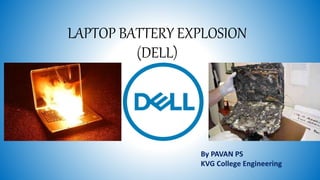
LAPTOP BATTERY EXPLOSION
(DELL)
By PAVAN PS
KVG College Engineering
INTRODUCTION
• Dell is an American multinational, computer technology company based
in Round Rock, Texas, United States, that develops, sells, repairs, and
supports computers and related products and services.
• Founder, Michael Dell, the company is one of the largest technological
corporations in the world, employing more than 103,300 people
worldwide
• Dell sells personal computers (PCs), servers, data storage
devices, network switches, software, computer peripherals, HDTVs,
cameras, printers, MP3 players, and electronics built by other
manufacturers. The company is well known for its innovations in supply
chain management and electronic commerce, particularly its direct-sales
model and its "build-to-order" or "configure to order" approach to
manufacturing—delivering individual PCs configured to customer
specifications.
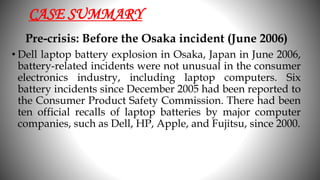
Pre-crisis: Before the Osaka incident (June 2006)
• Dell laptop battery explosion in Osaka, Japan in June 2006,
battery-related incidents were not unusual in the consumer
electronics industry, including laptop computers. Six
battery incidents since December 2005 had been reported to
the Consumer Product Safety Commission. There had been
ten official recalls of laptop batteries by major computer
companies, such as Dell, HP, Apple, and Fujitsu, since 2000.
CASE SUMMARY
Phase 2: Crisis begins: After the Osaka
incident (June 2006)
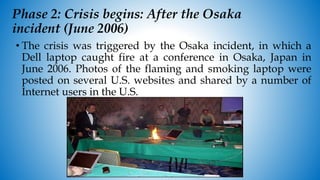
• The crisis was triggered by the Osaka incident, in which a
Dell laptop caught fire at a conference in Osaka, Japan in
June 2006. Photos of the flaming and smoking laptop were
posted on several U.S. websites and shared by a number of
Internet users in the U.S.
Conti..
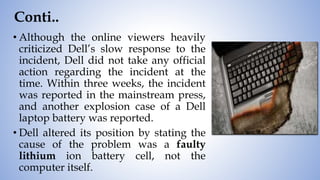
• Although the online viewers heavily
criticized Dell’s slow response to the
incident, Dell did not take any official
action regarding the incident at the
time. Within three weeks, the incident
was reported in the mainstream press,
and another explosion case of a Dell
laptop battery was reported.
• Dell altered its position by stating the
cause of the problem was a faulty
lithium ion battery cell, not the
computer itself.
Phase 3: Crisis aggravated: Dell’s battery recall
(August 14, 2006)
• Approximately two months after the Osaka incident and
one month after the news report about the incident, Dell
announced the official recall of 4.1 million laptop batteries,
which was the biggest recall of electronics in history.
• laptop manufacturer using Sony batteries had either
already experienced battery-related explosion incidents or
had a possibility of experiencing similar incidents in the
near future. However, other companies using Sony’s
batteries, such as HP and IBM (Lenovo), neither responded
to nor denied the possibility of danger from battery
overheating.
Phase 4: Battery recall expanded to other
companies.
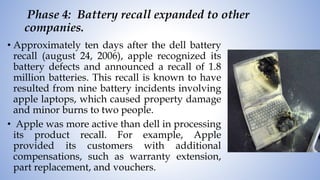
• Approximately ten days after the dell battery
recall (august 24, 2006), apple recognized its
battery defects and announced a recall of 1.8
million batteries. This recall is known to have
resulted from nine battery incidents involving
apple laptops, which caused property damage
and minor burns to two people.
• Apple was more active than dell in processing
its product recall. For example, Apple
provided its customers with additional
compensations, such as warranty extension,
part replacement, and vouchers.
Conti..
• Several PC makers (e.g., IBM, gateway, toshiba, acer,
fujitsu, hitachi, sharp, and sony), most of which
previously denied the possible danger of their laptop
batteries, joined battery recalls within a span of a few
days or weeks. In this third wave of battery recalls, 90000
to 830000 laptop were replaced by the companies.
• HP was the only company to neither announce a product
recall nor engage in any other accommodative actions.
HP kept saying that the batteries they used were safe
and no battery-related overheating incidents had been
reported.
SWOT ANALYSIS
STRENGTHS
World’s largest PC maker.
Direct to customer business
model
customer service before and
after the sale.
They have very good
branding and are one of the
most known computer in the
world
WEAKNESS
They have weak business
relationships with many
computer retailers.
Dealing with a large amount
of supplies from many
different countries can cause
large issue when products
are recalled.
OPPORTUNITY
Not depending Sony
batteries.
Technological
advancement
THREATS
With almost identical
prices, price difference is no
longer an issue for a
customer.
Competitive rivalry that
exists in the PC market
globally.
STRATEGIES
During the crisis situation Dell plans to launch Dell website
and toll free number for their customers to determine if
they need a new battery.
Dell moved toward accommodation by recalling batteries
(i.e., corrective action). Although Dell initiated a large
recall, it kept using an excuse and justification strategy
rather than issuing a full apology. Dell insisted that battery-
related overheating occurred in very few of its computers.
Although Dell handled the crisis, the battery were actually
manufactured by Sony.
Dell undertake the public view after the incident like
survey and an experiment through the public practitioners.
A Dell Laptop battery explosion

A Dell Laptop battery explosion

  • 1.
    LAPTOP BATTERY EXPLOSION (DELL) ByPAVAN PS KVG College Engineering
  • 2.
    INTRODUCTION • Dell isan American multinational, computer technology company based in Round Rock, Texas, United States, that develops, sells, repairs, and supports computers and related products and services. • Founder, Michael Dell, the company is one of the largest technological corporations in the world, employing more than 103,300 people worldwide • Dell sells personal computers (PCs), servers, data storage devices, network switches, software, computer peripherals, HDTVs, cameras, printers, MP3 players, and electronics built by other manufacturers. The company is well known for its innovations in supply chain management and electronic commerce, particularly its direct-sales model and its "build-to-order" or "configure to order" approach to manufacturing—delivering individual PCs configured to customer specifications.
  • 3.
    Pre-crisis: Before theOsaka incident (June 2006) • Dell laptop battery explosion in Osaka, Japan in June 2006, battery-related incidents were not unusual in the consumer electronics industry, including laptop computers. Six battery incidents since December 2005 had been reported to the Consumer Product Safety Commission. There had been ten official recalls of laptop batteries by major computer companies, such as Dell, HP, Apple, and Fujitsu, since 2000. CASE SUMMARY
  • 4.
    Phase 2: Crisisbegins: After the Osaka incident (June 2006) • The crisis was triggered by the Osaka incident, in which a Dell laptop caught fire at a conference in Osaka, Japan in June 2006. Photos of the flaming and smoking laptop were posted on several U.S. websites and shared by a number of Internet users in the U.S.
  • 5.
    Conti.. • Although theonline viewers heavily criticized Dell’s slow response to the incident, Dell did not take any official action regarding the incident at the time. Within three weeks, the incident was reported in the mainstream press, and another explosion case of a Dell laptop battery was reported. • Dell altered its position by stating the cause of the problem was a faulty lithium ion battery cell, not the computer itself.
  • 6.
    Phase 3: Crisisaggravated: Dell’s battery recall (August 14, 2006) • Approximately two months after the Osaka incident and one month after the news report about the incident, Dell announced the official recall of 4.1 million laptop batteries, which was the biggest recall of electronics in history. • laptop manufacturer using Sony batteries had either already experienced battery-related explosion incidents or had a possibility of experiencing similar incidents in the near future. However, other companies using Sony’s batteries, such as HP and IBM (Lenovo), neither responded to nor denied the possibility of danger from battery overheating.
  • 7.
    Phase 4: Batteryrecall expanded to other companies. • Approximately ten days after the dell battery recall (august 24, 2006), apple recognized its battery defects and announced a recall of 1.8 million batteries. This recall is known to have resulted from nine battery incidents involving apple laptops, which caused property damage and minor burns to two people. • Apple was more active than dell in processing its product recall. For example, Apple provided its customers with additional compensations, such as warranty extension, part replacement, and vouchers.
  • 8.
    Conti.. • Several PCmakers (e.g., IBM, gateway, toshiba, acer, fujitsu, hitachi, sharp, and sony), most of which previously denied the possible danger of their laptop batteries, joined battery recalls within a span of a few days or weeks. In this third wave of battery recalls, 90000 to 830000 laptop were replaced by the companies. • HP was the only company to neither announce a product recall nor engage in any other accommodative actions. HP kept saying that the batteries they used were safe and no battery-related overheating incidents had been reported.
  • 9.
    SWOT ANALYSIS STRENGTHS World’s largestPC maker. Direct to customer business model customer service before and after the sale. They have very good branding and are one of the most known computer in the world WEAKNESS They have weak business relationships with many computer retailers. Dealing with a large amount of supplies from many different countries can cause large issue when products are recalled.
  • 10.
    OPPORTUNITY Not depending Sony batteries. Technological advancement THREATS Withalmost identical prices, price difference is no longer an issue for a customer. Competitive rivalry that exists in the PC market globally.
  • 11.
    STRATEGIES During the crisissituation Dell plans to launch Dell website and toll free number for their customers to determine if they need a new battery. Dell moved toward accommodation by recalling batteries (i.e., corrective action). Although Dell initiated a large recall, it kept using an excuse and justification strategy rather than issuing a full apology. Dell insisted that battery- related overheating occurred in very few of its computers. Although Dell handled the crisis, the battery were actually manufactured by Sony. Dell undertake the public view after the incident like survey and an experiment through the public practitioners.