The Proactive Library
- Getting smarter together
Copenhagen, June 17, 2016
Mikkel Christoffersen
// Senior adviser, Copenhagen Libraries
Mikkel Christoffersen
• Senior adviser, City of Copenhagen and project
manager of ”eReolen” (national ebook platform)
• Works with digitisation, digital strategy, business
and lending models for ebooks etc.
• BA in Greek and English, MLIS
• Former consultant to ”Danish Agency for Culture”
– National representative; DG Connect MSEG on digital culture
– European framework project manager
– Nordic programme manager of Open Access R&D
More importantly
• Father of Mathilde (5)
and Josephine (12)
• The secretary in
Nyborg Karate Club
• Avid CCG player
• A horror and SF freak
• Neophyte baseball fan
Background
• Copenhagen needed a library strategy toward 2020
• We identified salient trends and megatrends
• Conclusion: The library needs to change
fundamentally
• Because the world has changed fundamentally
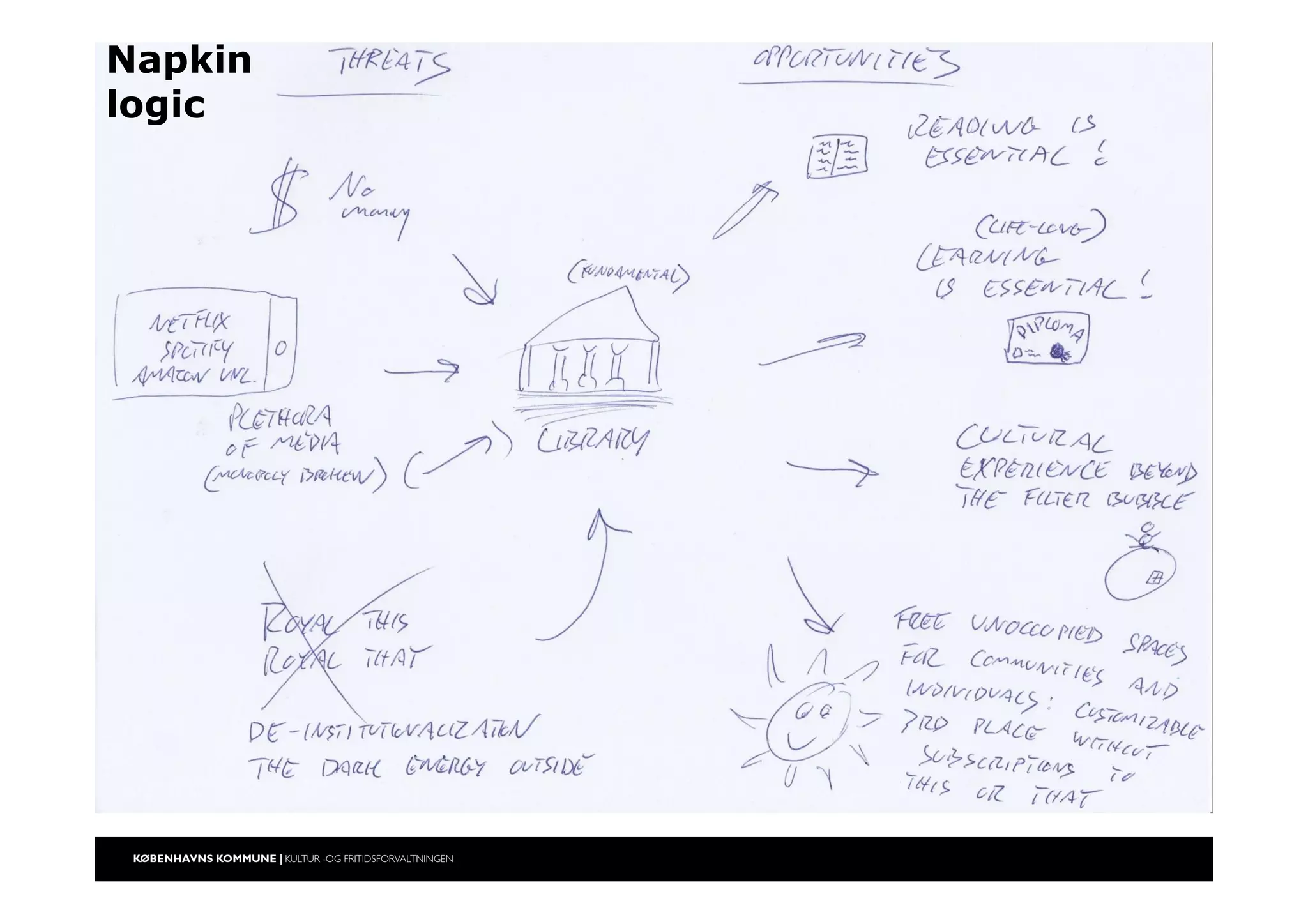
• Change brings threats and opportunities
”Opportunities are either seized or
lost. They don’t pile up.”
Hans Engell, former minister of justice
The strategy
• Strategy work
began September
2013
• Based on an
analysis of our
societal
surroundings and
megatrends
Changing framework conditions
Gøre en større
forskel for flere
københavnere
Resource strain
Cut-backs
New tasks
Reach non-users
New user needs
Media literacy
Reading skills
Life-long learning
Community
Media development
Internet-based media
Social media
Decline in loans of
physical materials
New opportunities
Digitisation
Digital service
Self-service
Citizen involvement
Need for a new
library mission
The media landscape
- the seismic shift
The open
internet
Music
Printed
books
TV
Movies
The library
The user’s information environment
in 2000
Radio
News-
papers
and
journals
https://www.oclc.org/content/dam/oclc/reports/escan/downloads/future.pdf
The open internet
Social media
E-
books
Music
Printed
books
TV
Movies and
tv-series
The library
The user’s information environment
2015
Radio
News-
papers and
journals
The user’s information
environment
The user’s information
environment
The library
collection
The library collection has
decreasing relevance
Do you help the
user by teaching
her to navigate
the green area?
Internet magazine Quartz: http://qz.com/124899/in-a-year-netflixs-competition-shifted-from-hulu-to-
hbo-to-everything/#!
Netflix is simply acknowledging that it doesn’t just
compete with other TV networks… It also competes
for attention with nearly any kind of leisure activity.
If you’re in book publishing, say, the reality is that you
don’t just have to think about the shift from paper to
tablets. You also need to worry about whether people
will use their tablets to read, or instead prefer to surf
the web, watch movies, etc.
Attention as the scarce resource
The user’s attention and time as
scarce resources
In short …
• The quasi-monopoly of being the place where
people could go for free and equal access is gone
• Copenhagen Libraries’ motto used to be:
”Everything you can imagine”
• Arguably; the internet does that better now
• But is providing access and media to people a
good place to be now anyway?
The bad place
• Everyone standing between content creator
and content consumer must prove value
• Getting content from creators to consumers is
a painful place with lots of huge players
• But it’s also a tiny thing in the whole process!
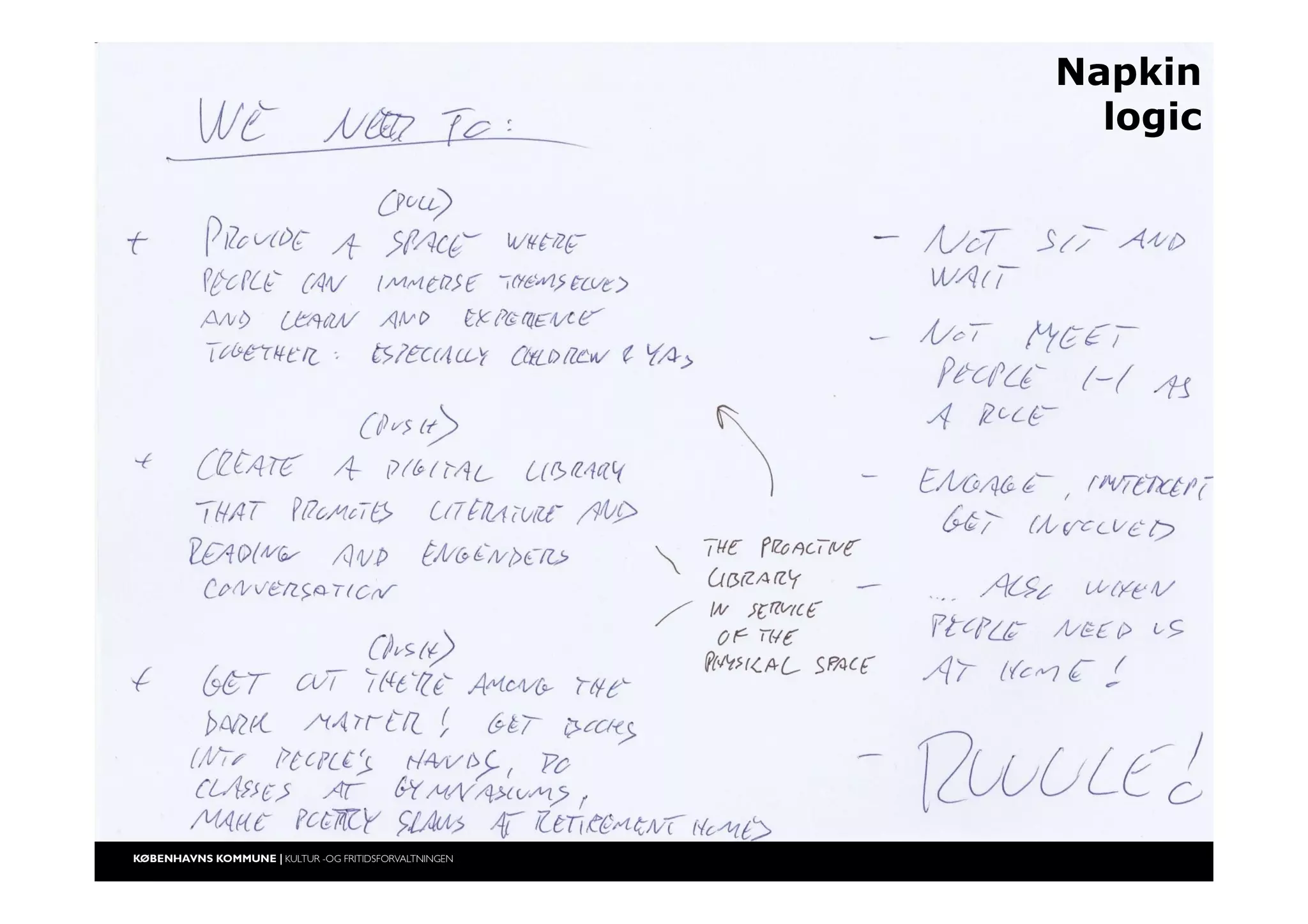
We don’t need to be the
ones handing people
the media to be
valuable! What they do
before and after is more
important
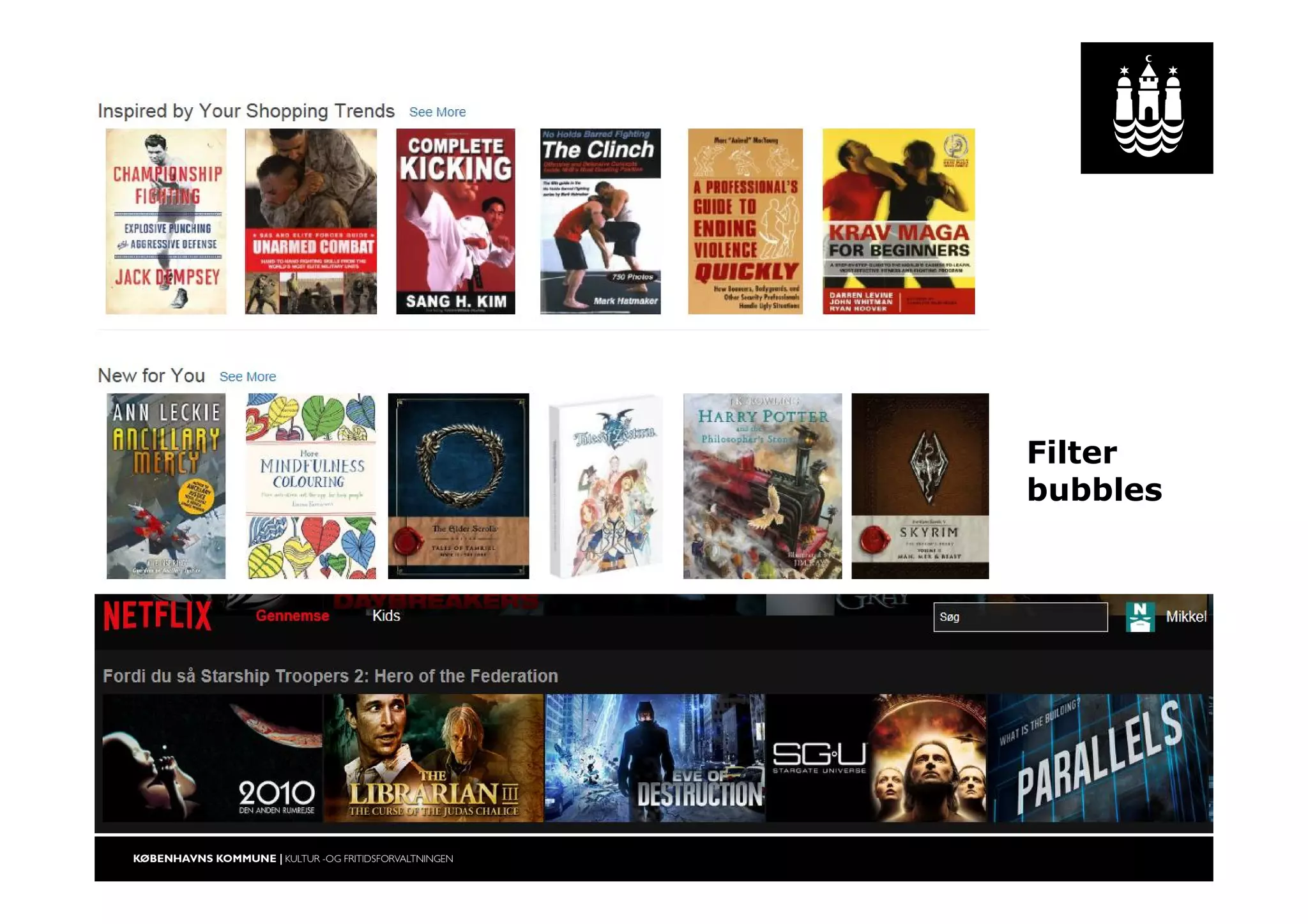
Filter
bubbles
We have ambitions!
• … on behalf of our users
• When every selfrespecting commercial service
gives you something, the library should give you
something completely new and unexpected you
didn’t know you needed!
• Read Vampire Diaries and Twilight and a
commercial service will give you The Immortal
Instruments. The library should give you James
Joyce and Medieval French poetry!
Reading and learning
- new user and societal
needs
Children’s leisure reading, intl.
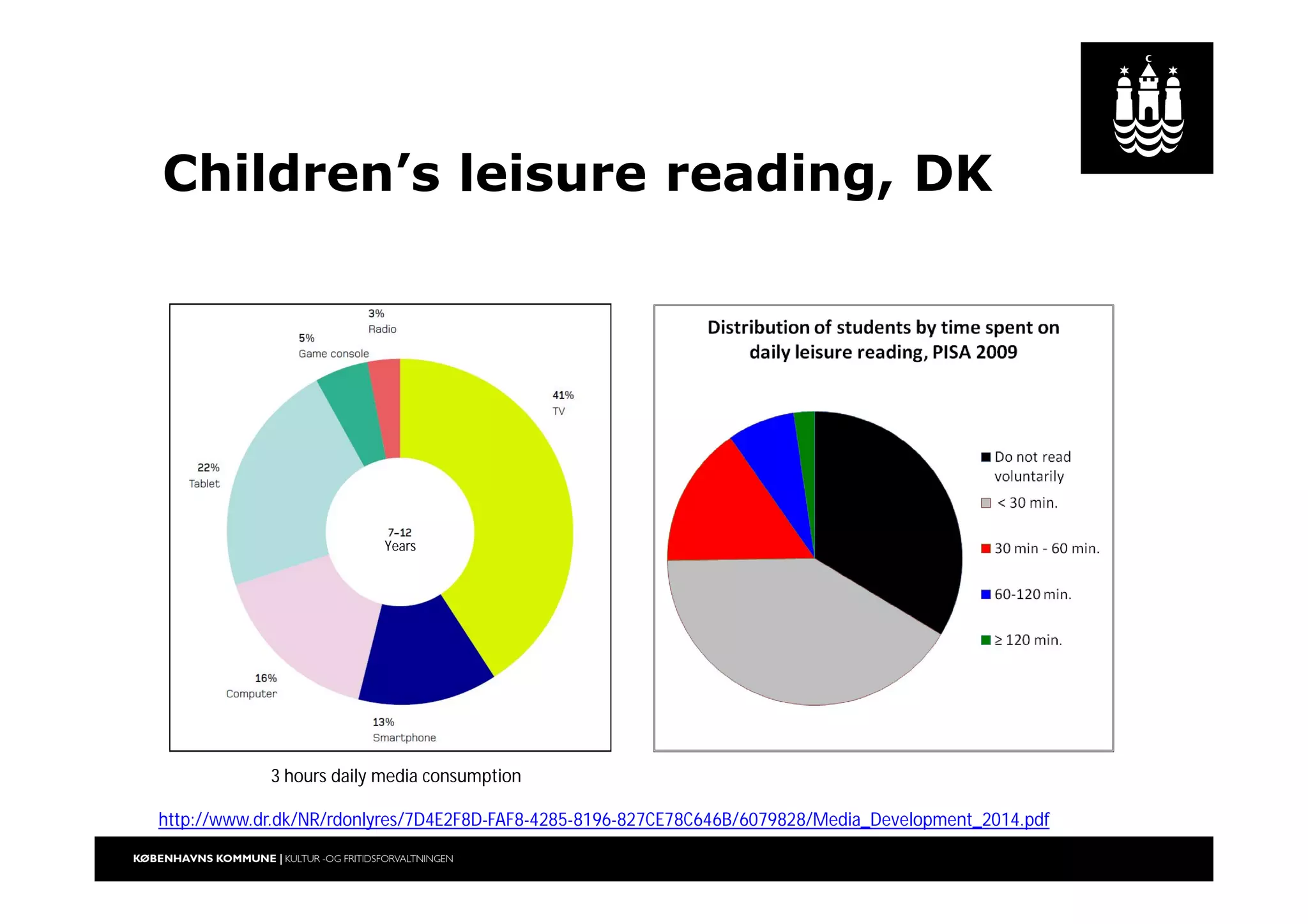
Children’s leisure reading, DK
3 hours daily media consumption
Years
http://www.dr.dk/NR/rdonlyres/7D4E2F8D-FAF8-4285-8196-827CE78C646B/6079828/Media_Development_2014.pdf
The importance of reading
“The bottom line: Fewer students today are
reading for pleasure, even though daily reading
for pleasure is associated with better performance
in school and with adult reading proficiency”
PISA in Focus, OECD 2011
Reading is the fundamental skill
• Reading underlies other skills like IT and math
• It also underlies social skills
• Don’t read well at 8?
You never catch up!
• Reading is your ticket to
culture, social communities
and learning
• You learn to read
and then your read to learn
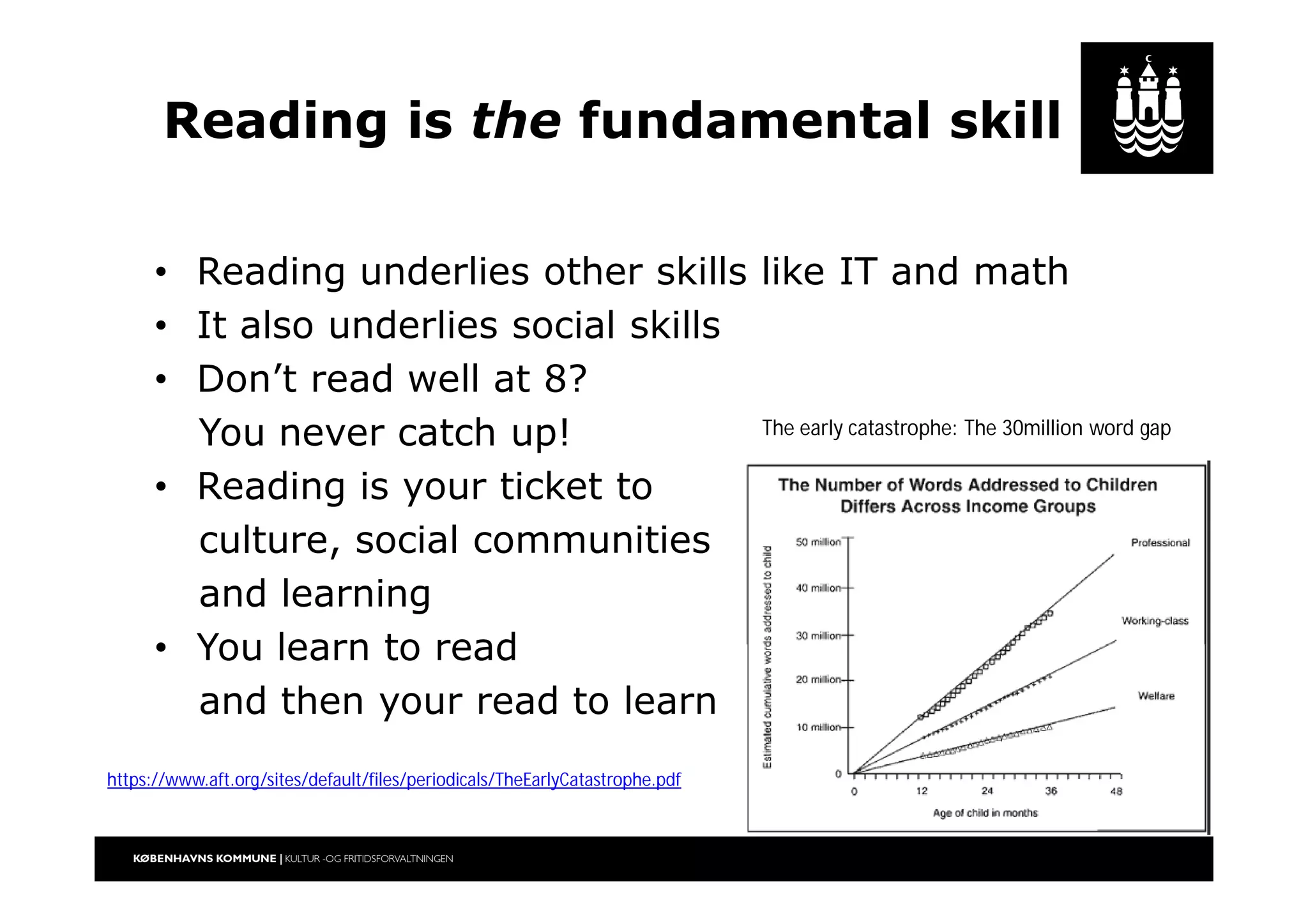
The early catastrophe: The 30million word gap
https://www.aft.org/sites/default/files/periodicals/TheEarlyCatastrophe.pdf
Globalisation and
lifelong learning
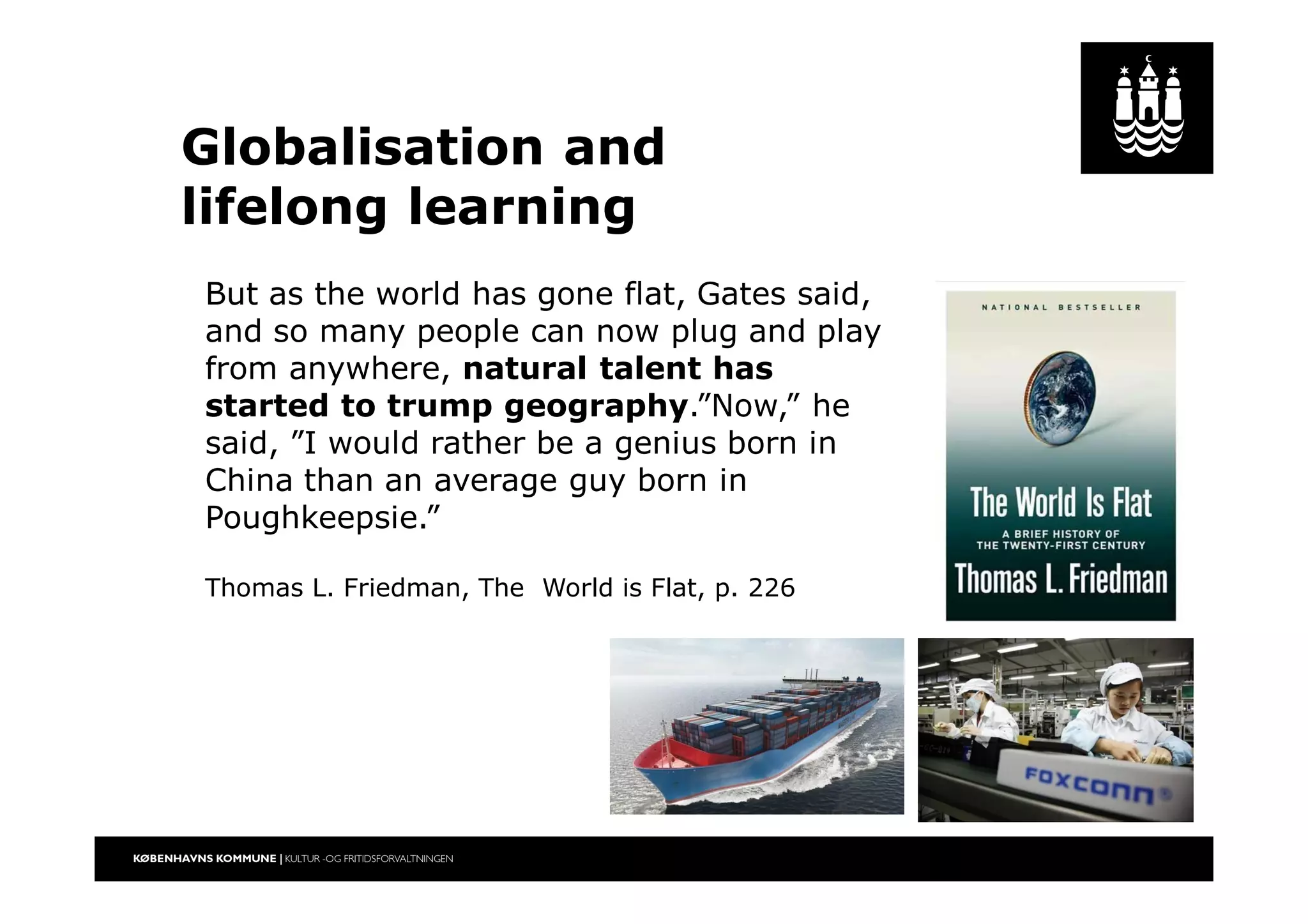
But as the world has gone flat, Gates said,
and so many people can now plug and play
from anywhere, natural talent has
started to trump geography.”Now,” he
said, ”I would rather be a genius born in
China than an average guy born in
Poughkeepsie.”
Thomas L. Friedman, The World is Flat, p. 226
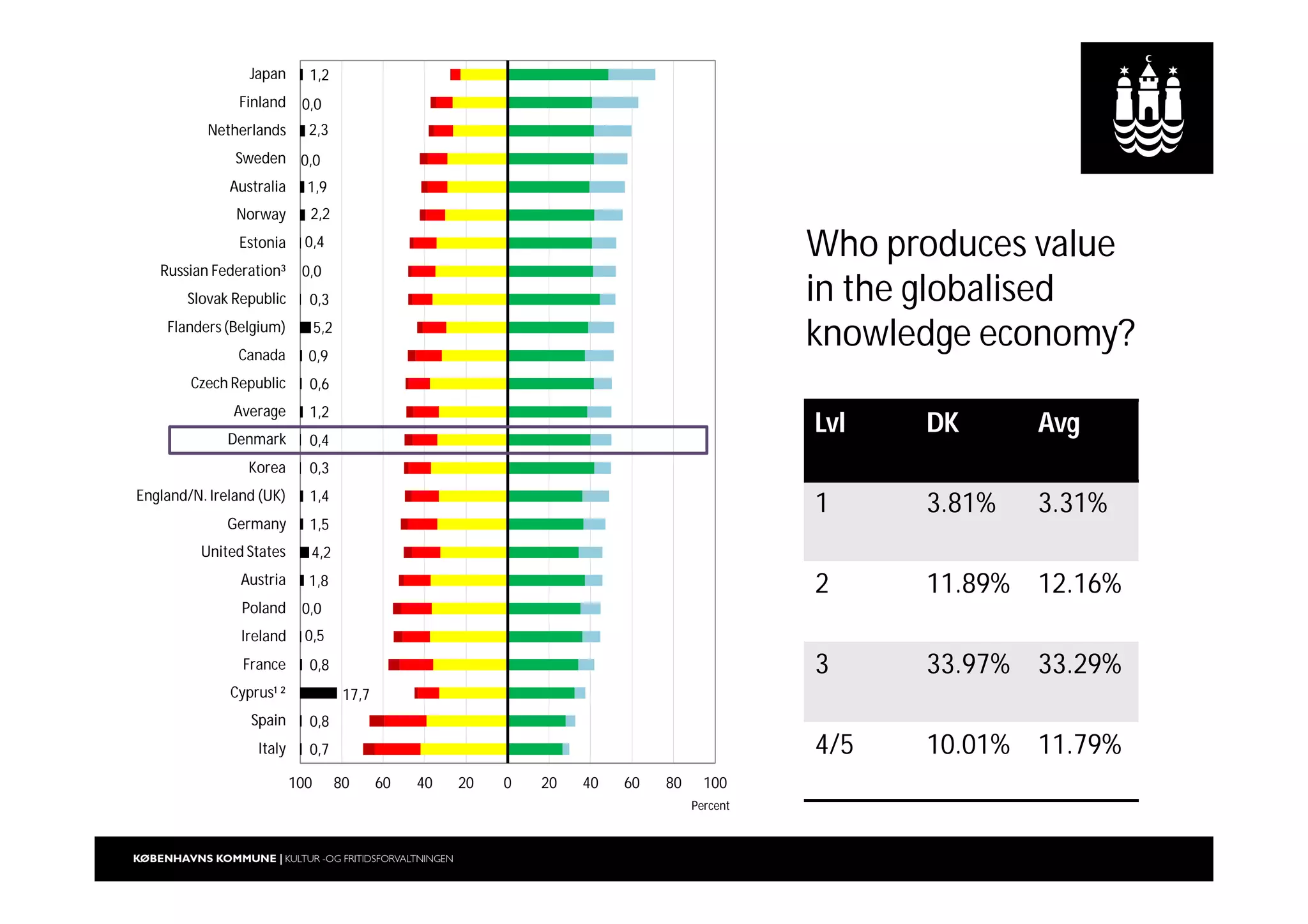
Programme for the International Assessment
of Adult Competencies (PIAAC)
• At least one in ten adults is
proficient only at or below
Level 1 in literacy or
numeracy
• In other words, significant
numbers of adults do not
possess the most basic
information-processing skills
considered necessary to
succeed in today’s world
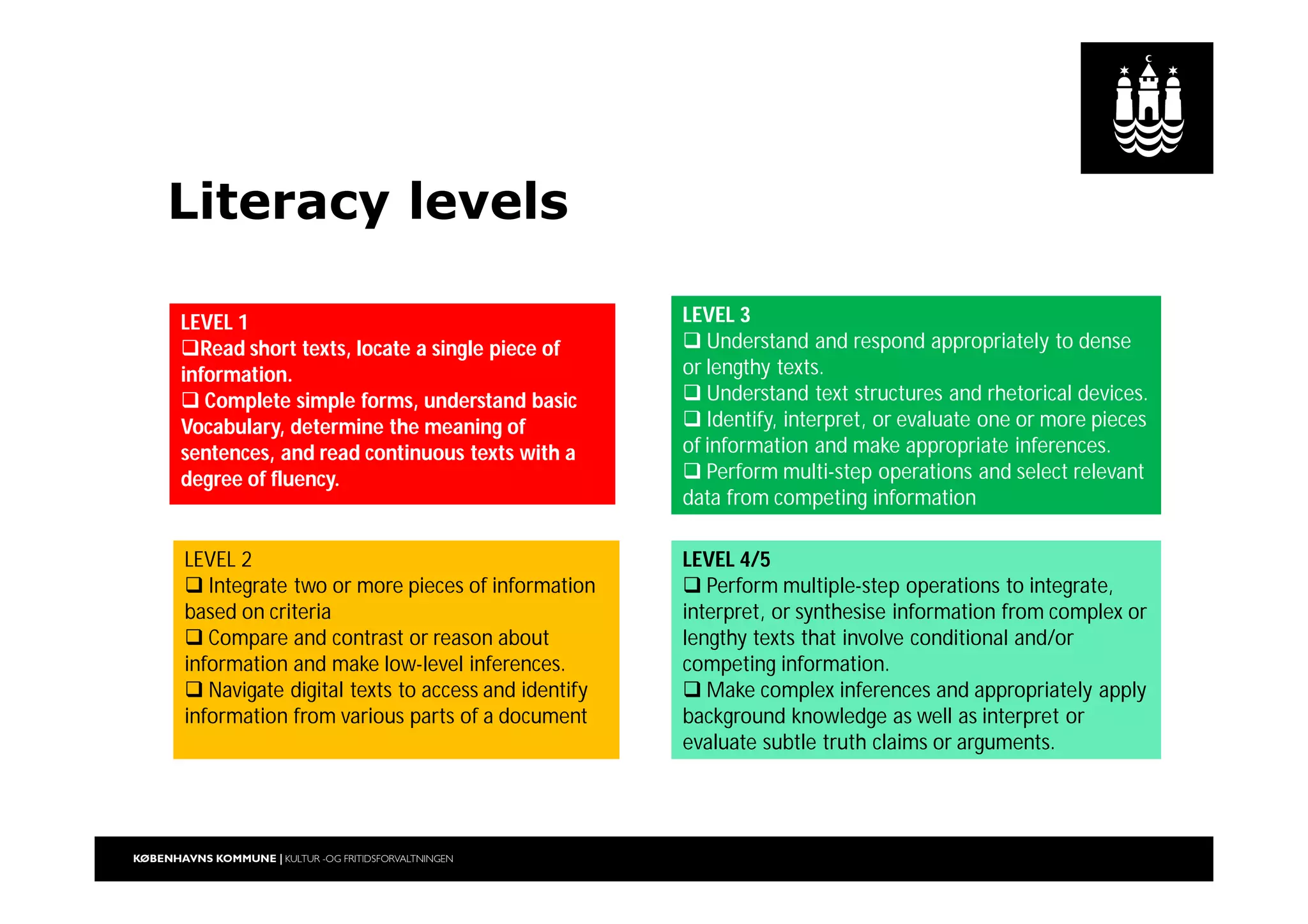
Literacy levels
LEVEL 1
Read short texts, locate a single piece of
information.
 Complete simple forms, understand basic
Vocabulary, determine the meaning of
sentences, and read continuous texts with a
degree of fluency.
LEVEL 2
 Integrate two or more pieces of information
based on criteria
 Compare and contrast or reason about
information and make low-level inferences.
 Navigate digital texts to access and identify
information from various parts of a document
LEVEL 3
 Understand and respond appropriately to dense
or lengthy texts.
 Understand text structures and rhetorical devices.
 Identify, interpret, or evaluate one or more pieces
of information and make appropriate inferences.
 Perform multi-step operations and select relevant
data from competing information
LEVEL 4/5
 Perform multiple-step operations to integrate,
interpret, or synthesise information from complex or
lengthy texts that involve conditional and/or
competing information.
 Make complex inferences and appropriately apply
background knowledge as well as interpret or
evaluate subtle truth claims or arguments.
0,7
0,8
17,7
0,8
0,5
0,0
1,8
4,2
1,5
1,4
0,3
0,4
1,2
0,6
0,9
5,2
0,3
0,0
0,4
2,2
1,9
0,0
2,3
0,0
1,2
100 80 60 40 20 0 20 40 60 80 100
Italy
Spain
Cyprus¹ ²
France
Ireland
Poland
Austria
United States
Germany
England/N. Ireland (UK)
Korea
Denmark
Average
Czech Republic
Canada
Flanders (Belgium)
Slovak Republic
Russian Federation³
Estonia
Norway
Australia
Sweden
Netherlands
Finland
Japan
Percent
Lvl DK Avg
1 3.81% 3.31%
2 11.89% 12.16%
3 33.97% 33.29%
4/5 10.01% 11.79%
Who produces value
in the globalised
knowledge economy?
Reading makes you a
better person! (if you read good things)
The crisis of the wellfare
state and why it matters
http://fremtidensbiblioteker.dk/wp/wp-
content/uploads/2013/04/Rapport_Folkebibliotekernes_samfunds%
C3%B8konomiske_v%C3%A6rdi_lang.pdf
2015 report: Public
libraries contribute a net
+€800 mn to the
economy of Denmark
annually due to their
beneficial contributions
to reading, education etc.
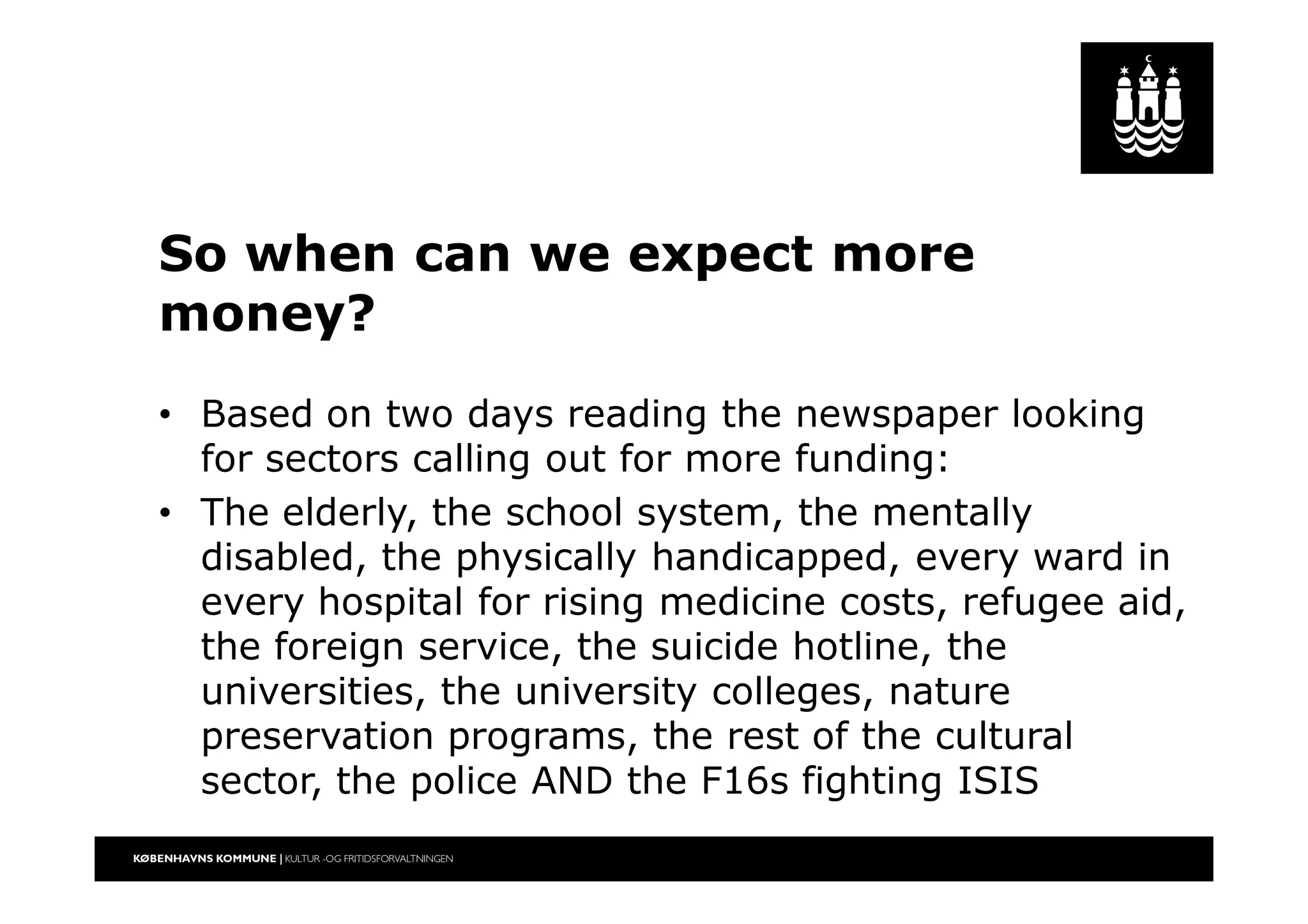
So when can we expect more
money?
• Based on two days reading the newspaper looking
for sectors calling out for more funding:
• The elderly, the school system, the mentally
disabled, the physically handicapped, every ward in
every hospital for rising medicine costs, refugee aid,
the foreign service, the suicide hotline, the
universities, the university colleges, nature
preservation programs, the rest of the cultural
sector, the police AND the F16s fighting ISIS
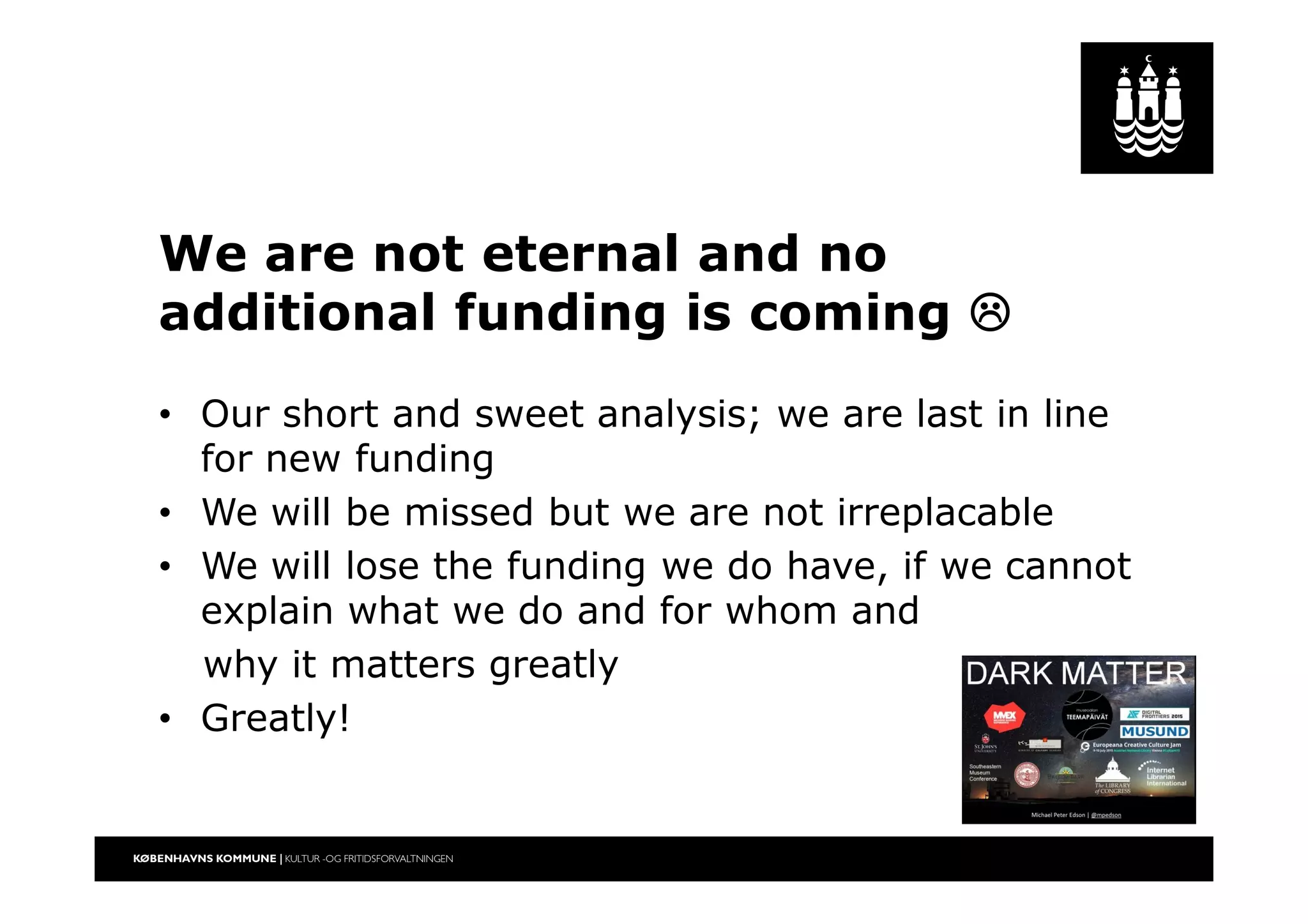
We are not eternal and no
additional funding is coming 
• Our short and sweet analysis; we are last in line
for new funding
• We will be missed but we are not irreplacable
• We will lose the funding we do have, if we cannot
explain what we do and for whom and
why it matters greatly
• Greatly!
Physical space
The future of the physical
library?
A new library space with
more people and fewer
bookcases?
Should we go all digital?
Copenhagen Libraries
We are just one app. Why should people
choose us?
Indeed; are we not all small apps in the
great iPad of life?
Physical space
• Loans are going down, attendance is going up
William Mitchell quoted by
Lorcan Dempsey in his
blog reprinted in the book
”The Network Reshapes
The Library.”
• We need more space for activities arranged by ourselves,
facilitated by ourselves or that we don’t know of
• Longer opening hours, fewer shelves, more self-directed
services, links between physical and digital library, online or
screen or phone help, collections digitised
The conclusion
Disconnect between library ends and
means
The objective of the public
libraries is to promote
information, education
and cultural activity ...
… by making available
books, periodicals, talking
books and other suitable
materials.
x
Create
knowledge
share
Workshops labs
Learning and participation
Courses, clubs and forums
Inspiration, communities and experiences
Events, presentation and interaction
Easy access and flexible library facilities
Digital library, extended opening hours and modern
physical libraries
Literature, music, movies and databases
Efficient collection development and digitisation
Digitisation
Digital service
Self service
User
involvement
Volunteers
Partnerships
The value
pyramid
Napkin
logic
Napkin
logic
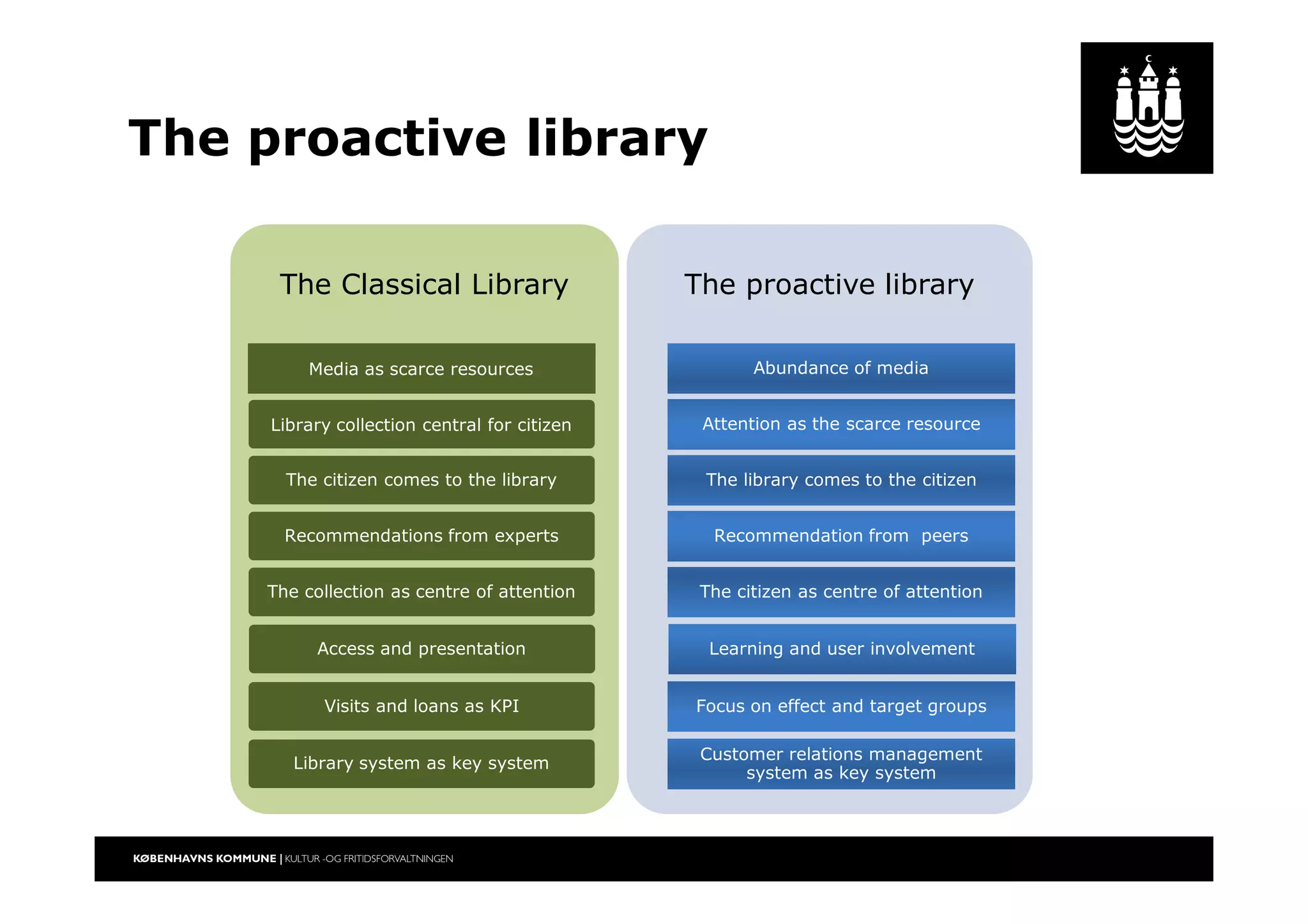
The proactive library
The Classical Library
Media as scarce resourcesMedia as scarce resources
Library collection central for citizenLibrary collection central for citizen
The citizen comes to the library
Recommendations from experts
The collection as centre of attention
Visits and loans as KPI
Library system as key system
The proactive library
Abundance of media
Attention as the scarce resource
The library comes to the citizen
Recommendation from peers
The citizen as centre of attention
Focus on effect and target groups
Customer relations management
system as key system
Access and presentation Learning and user involvement
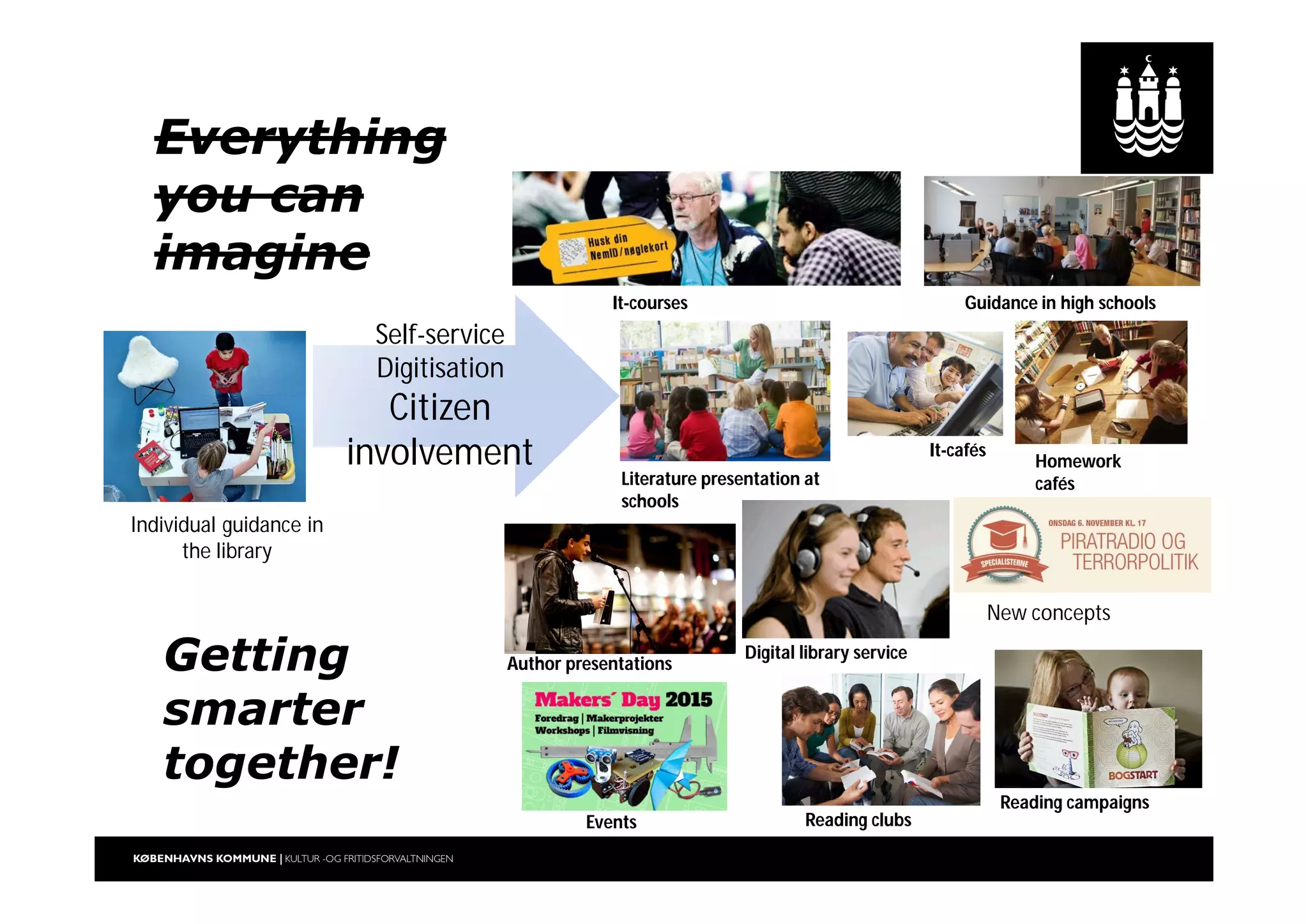
Getting
smarter
together!
Homework
cafés
It-courses
It-cafés
Literature presentation at
schools
Author presentations
Reading campaigns
Guidance in high schools
Individual guidance in
the library
Reading clubsEvents
New concepts
Digital library service
Self-service
Digitisation
Citizen
involvement
Everything
you can
imagine
The digital library
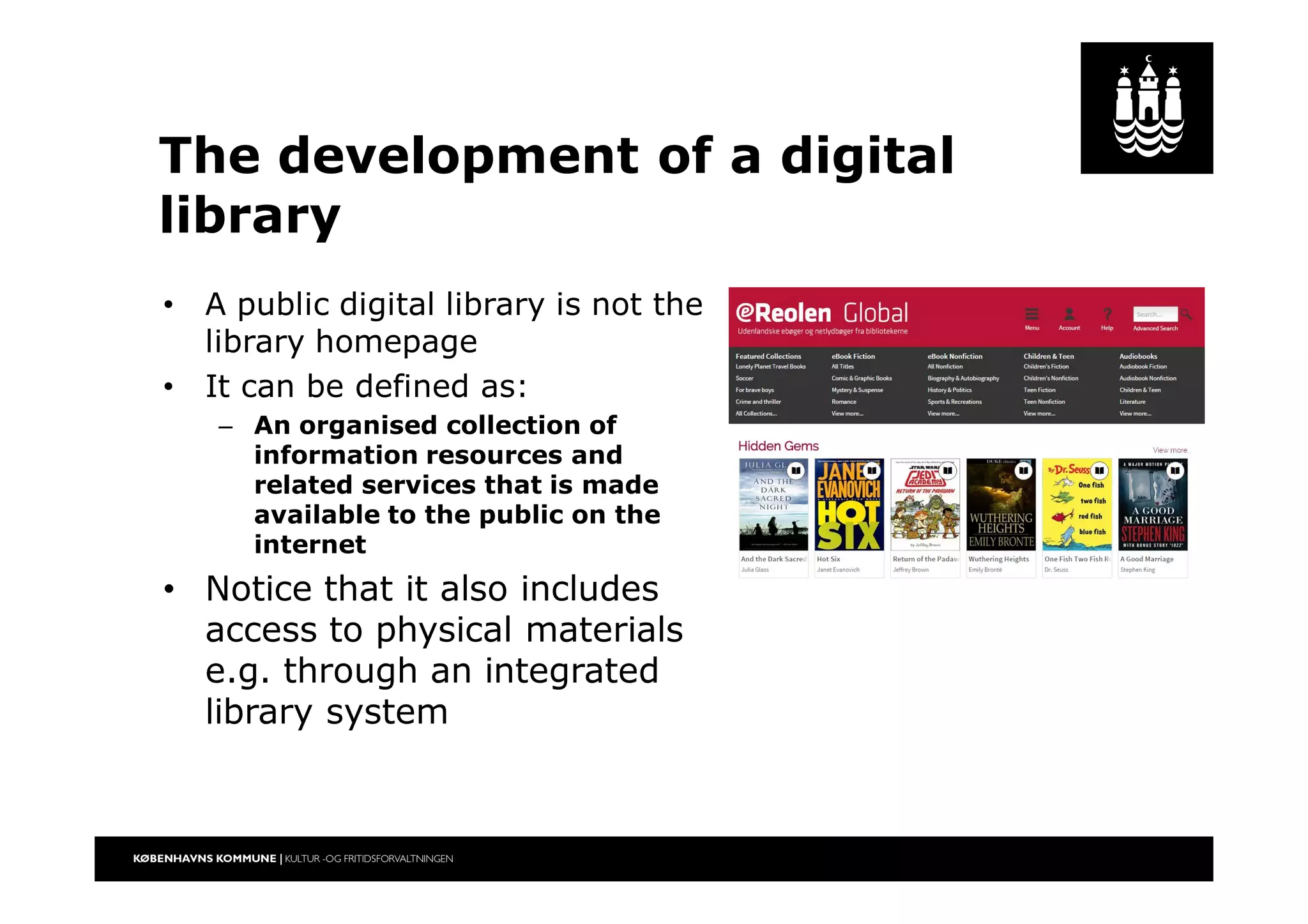
The development of a digital
library
• A public digital library is not the
library homepage
• It can be defined as:
– An organised collection of
information resources and
related services that is made
available to the public on the
internet
• Notice that it also includes
access to physical materials
e.g. through an integrated
library system
The need for a digital strategy
• A digital library can be as traditional and
irrelevant as a an outdated physical library
• For instance by relying on a homepage
• The digital library must support the overall library
strategy
• It-systems and development must support the
purpose of the digital library
• There is a need to prioritise and make choices
• If there is no plan, it is guaranteed not to work
eReolen : a cornerstone
Please see separate slideshow later 
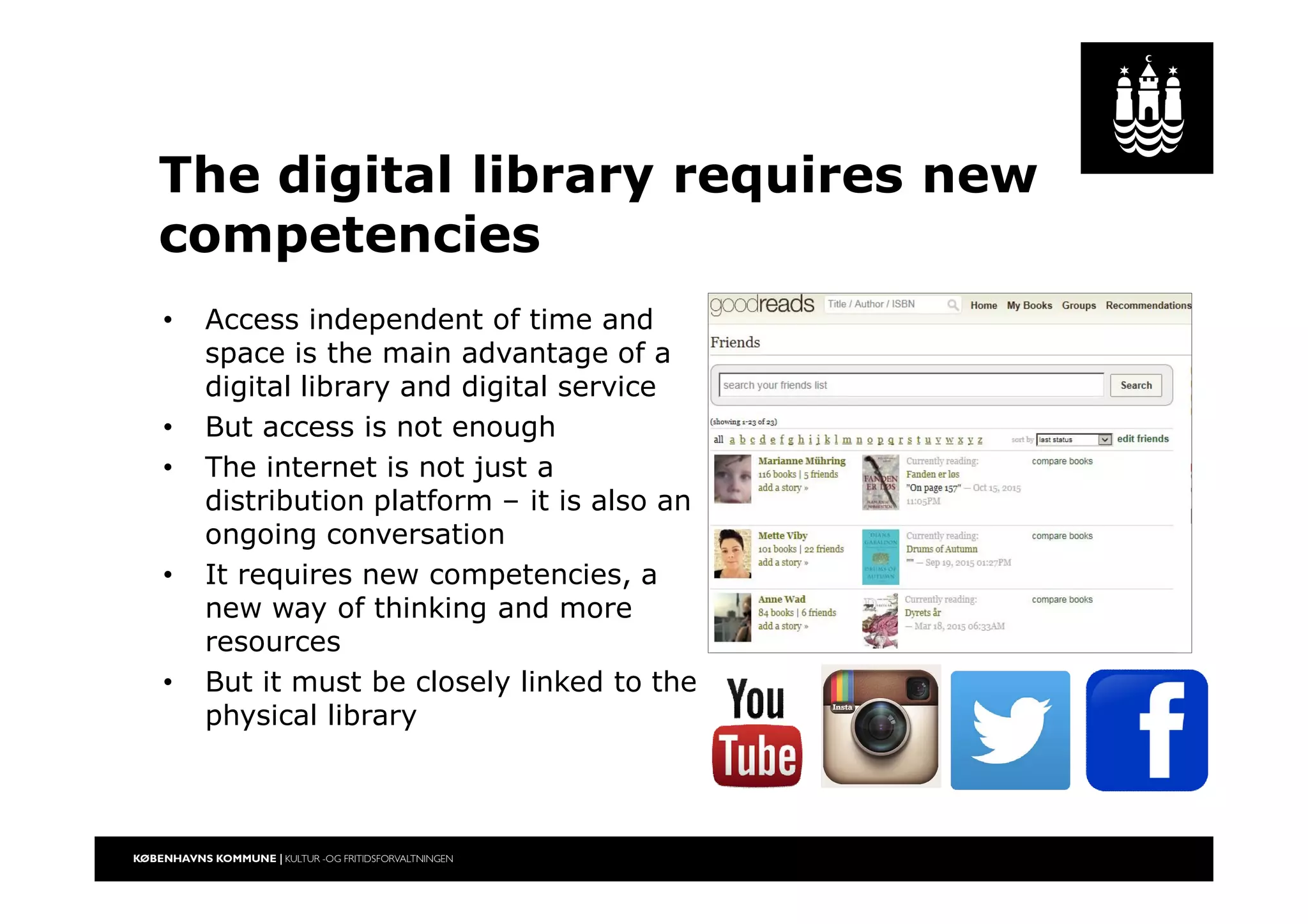
The digital library requires new
competencies
• Access independent of time and
space is the main advantage of a
digital library and digital service
• But access is not enough
• The internet is not just a
distribution platform – it is also an
ongoing conversation
• It requires new competencies, a
new way of thinking and more
resources
• But it must be closely linked to the
physical library
Social media – new expertise
Time and attention are commodities. Most marketers treat
social media as a distribution channel. They are missing the
fact that social networks are the first platforms ever that are
actually a two-way conversation. Now what makes you a
good cocktail party guest? Is it talking about yourself for
95% of the time?
http://www.slideshare.net/vaynerchuk/storytelling-slideshare-finalpdf
In a connected world, you can’t just sell copies of files. You
also have to sell context, community, convenience, and
connectivity
http://gerdleonhard.typepad.com/files/gerd-leonhard-inma-future-of-content-ideas-
1.pdf
Strategy overview
General action areas
https://bibliotek.kk.dk/sites/default/files/files/page/copenhagen_libraries_strategy_2014-2019.pdf#overlay-context=About
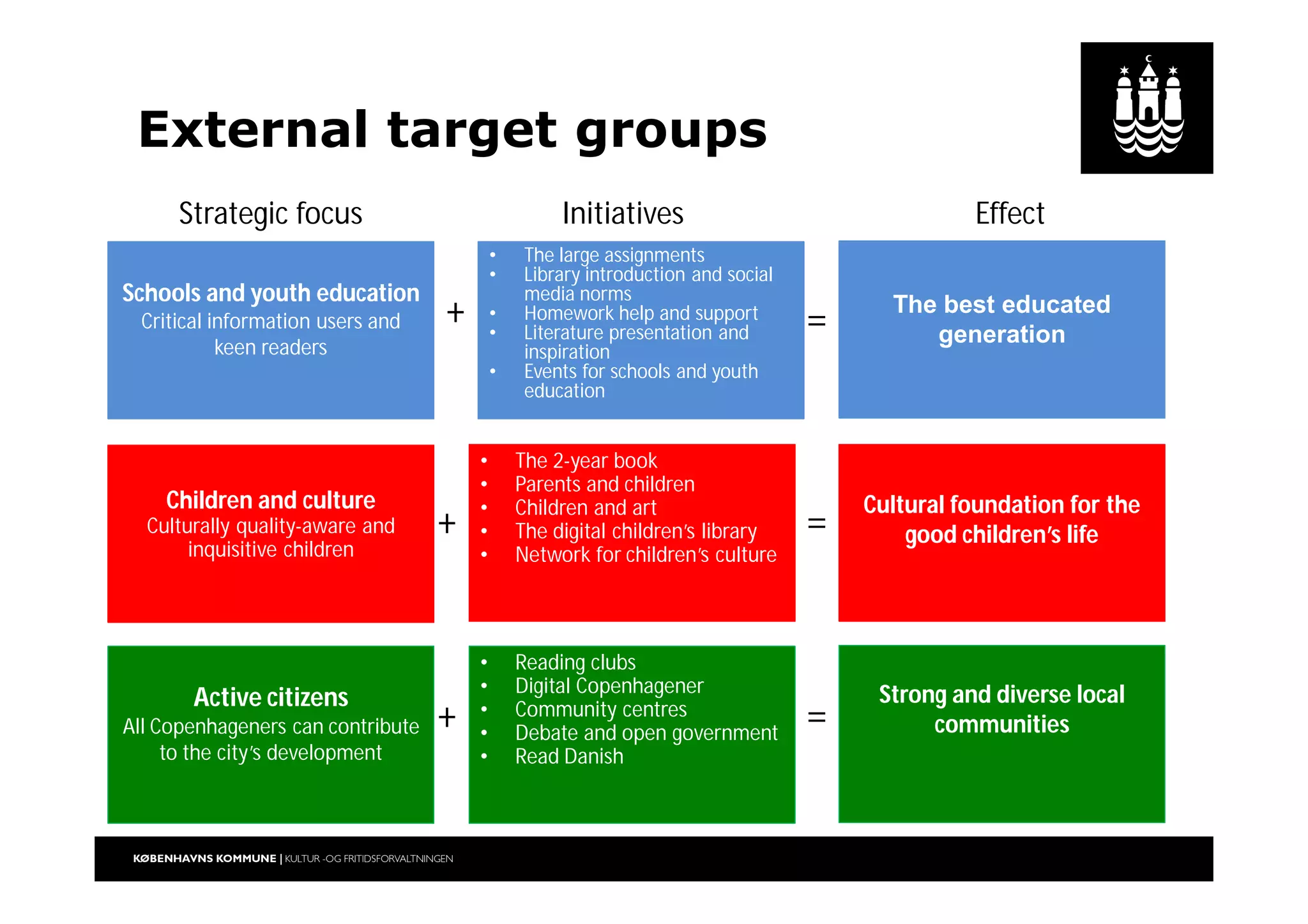
External target groups
Strategic focus Initiatives Effect
Schools and youth education
Critical information users and
keen readers
• The large assignments
• Library introduction and social
media norms
• Homework help and support
• Literature presentation and
inspiration
• Events for schools and youth
education
The best educated
generation
+ =
Active citizens
All Copenhageners can contribute
to the city’s development
• Reading clubs
• Digital Copenhagener
• Community centres
• Debate and open government
• Read Danish
Strong and diverse local
communities+ =
Children and culture
Culturally quality-aware and
inquisitive children
Cultural foundation for the
good children’s life+ =
• The 2-year book
• Parents and children
• Children and art
• The digital children’s library
• Network for children’s culture
The citizen as the library’s most
important asset
• Citizens get smarter together (than they do individually)
• The library has ambitions on behalf of the citizen – and it’s felt!
• The library must serve all citizens; but not all are created equal
• Loans are not the purpose of the library
• Digital solutions and self-service are not sufficient to fulfil the
purpose of the library
• Learning and cultural activity is enhanced by activities with other
citizens
• The library purpose is fulfilled by deliberate planned activities
• The library supports reading and digital competencies
• The library is a space for conversations among
citizens based on literature and other media
• Volunteers are not used to replace library
employees but to deliver a new and different offer
• A so-called package
• Invest €5.6 over four years; then save 1/3 of that
annually afterwards from year 4
• An implementation of the strategy
• A godsend to our digital strategy
• For some a herald of doom
https://bibliotek.kk.dk/sites/default/files/files/page/empower_the_citizens.p
df#overlay-context=About
The elements of the plan
Targeted library
service
Differentiated service
and increased self-
service
User involvement
and voluntary work
Digital service
Outreach initiatives
Investments
It-systems
Service development
Competence
development
Digitisation
Digital library
New library system
for digital media
New library system
for printed materials
More e-books
Integrated citizen
service
Integration with
libraries
Citizen service at
employment centres
and social services
Digital Copenhagener
courses
The librarians
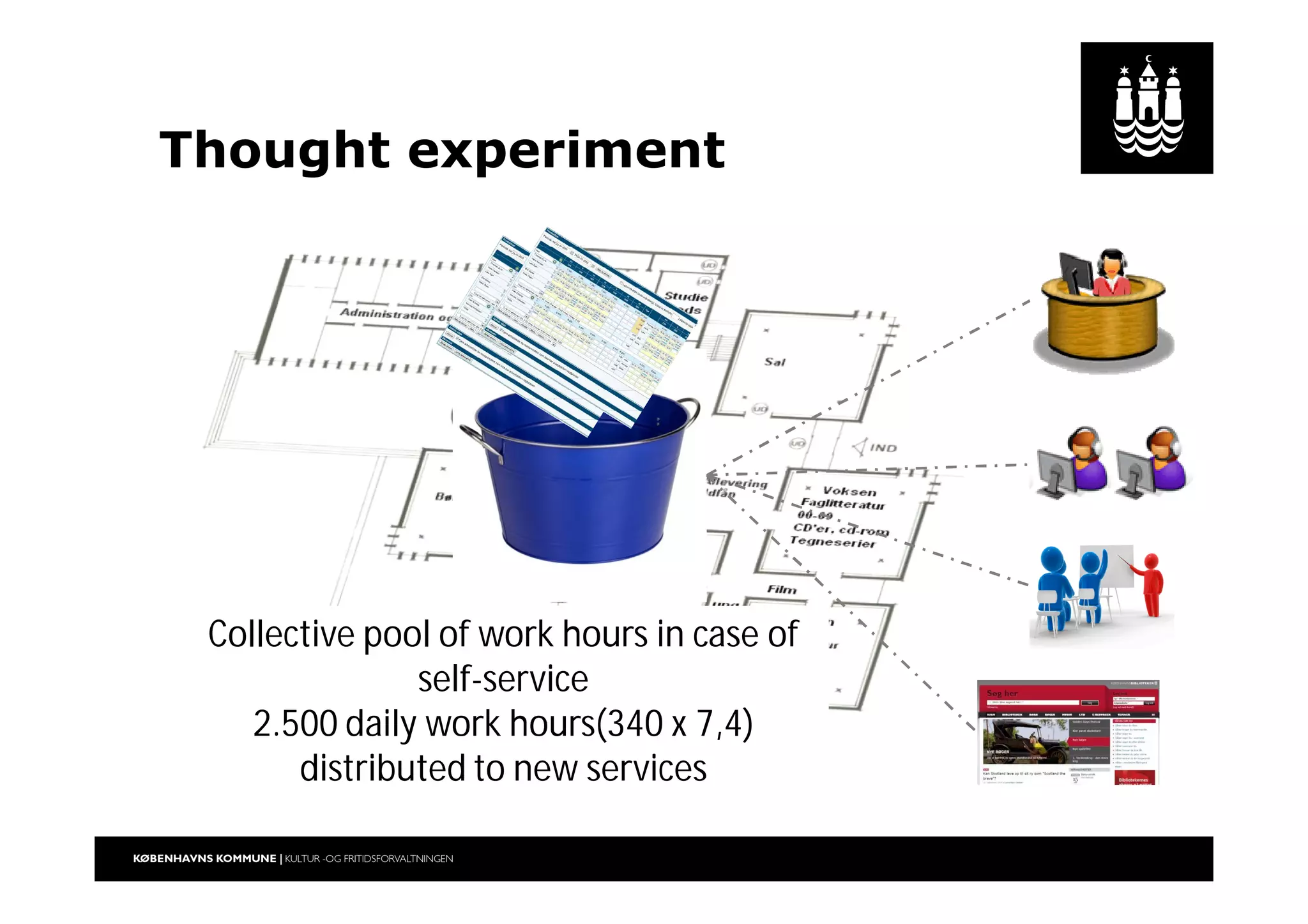
Collective pool of work hours in case of
self-service
2.500 daily work hours(340 x 7,4)
distributed to new services
Thought experiment
Digital service – call center
• Joint e-mail, phone,
chat and interactive
screen service
• Open 8 am – 10 pm
• Reduction of individual
guidance in the physical
library
• Supports growing need
for assistance with
digital materials
SCREEN TECHNOLOGY
Face to face
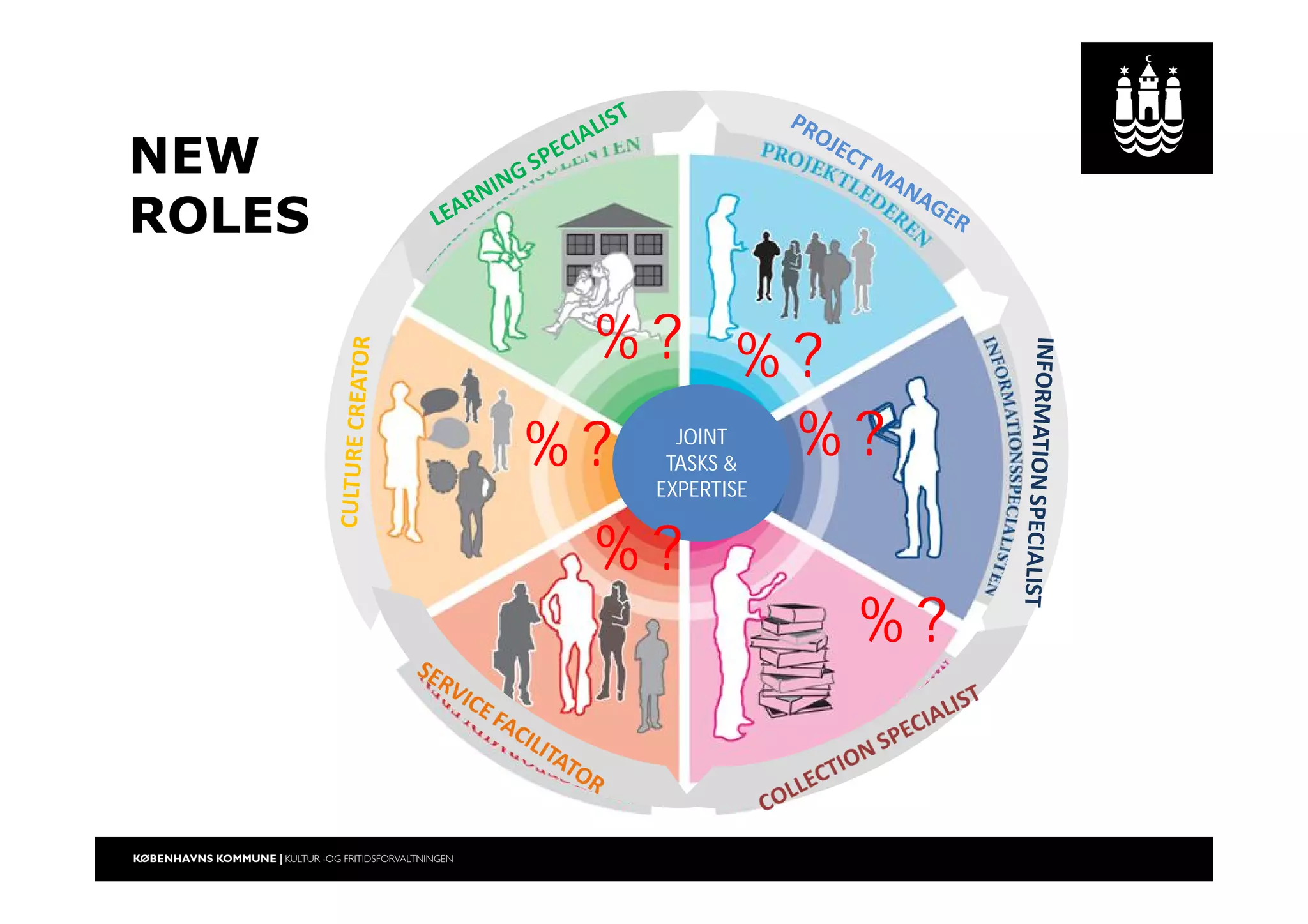
JOINT
TASKS &
EXPERTISE
NEW
ROLES
% ? % ?
% ? % ?
% ?
% ?
01-07-2016

Smarter together

  • 1.
    The Proactive Library -Getting smarter together Copenhagen, June 17, 2016 Mikkel Christoffersen // Senior adviser, Copenhagen Libraries
  • 2.
    Mikkel Christoffersen • Senioradviser, City of Copenhagen and project manager of ”eReolen” (national ebook platform) • Works with digitisation, digital strategy, business and lending models for ebooks etc. • BA in Greek and English, MLIS • Former consultant to ”Danish Agency for Culture” – National representative; DG Connect MSEG on digital culture – European framework project manager – Nordic programme manager of Open Access R&D
  • 3.
    More importantly • Fatherof Mathilde (5) and Josephine (12) • The secretary in Nyborg Karate Club • Avid CCG player • A horror and SF freak • Neophyte baseball fan
  • 4.
    Background • Copenhagen neededa library strategy toward 2020 • We identified salient trends and megatrends • Conclusion: The library needs to change fundamentally • Because the world has changed fundamentally • Change brings threats and opportunities ”Opportunities are either seized or lost. They don’t pile up.” Hans Engell, former minister of justice
  • 5.
    The strategy • Strategywork began September 2013 • Based on an analysis of our societal surroundings and megatrends
  • 6.
    Changing framework conditions Gøreen større forskel for flere københavnere Resource strain Cut-backs New tasks Reach non-users New user needs Media literacy Reading skills Life-long learning Community Media development Internet-based media Social media Decline in loans of physical materials New opportunities Digitisation Digital service Self-service Citizen involvement Need for a new library mission
  • 7.
    The media landscape -the seismic shift
  • 8.
    The open internet Music Printed books TV Movies The library Theuser’s information environment in 2000 Radio News- papers and journals https://www.oclc.org/content/dam/oclc/reports/escan/downloads/future.pdf
  • 9.
    The open internet Socialmedia E- books Music Printed books TV Movies and tv-series The library The user’s information environment 2015 Radio News- papers and journals
  • 10.
    The user’s information environment Theuser’s information environment The library collection The library collection has decreasing relevance Do you help the user by teaching her to navigate the green area?
  • 11.
    Internet magazine Quartz:http://qz.com/124899/in-a-year-netflixs-competition-shifted-from-hulu-to- hbo-to-everything/#! Netflix is simply acknowledging that it doesn’t just compete with other TV networks… It also competes for attention with nearly any kind of leisure activity. If you’re in book publishing, say, the reality is that you don’t just have to think about the shift from paper to tablets. You also need to worry about whether people will use their tablets to read, or instead prefer to surf the web, watch movies, etc. Attention as the scarce resource The user’s attention and time as scarce resources
  • 12.
    In short … •The quasi-monopoly of being the place where people could go for free and equal access is gone • Copenhagen Libraries’ motto used to be: ”Everything you can imagine” • Arguably; the internet does that better now • But is providing access and media to people a good place to be now anyway?
  • 13.
    The bad place •Everyone standing between content creator and content consumer must prove value • Getting content from creators to consumers is a painful place with lots of huge players • But it’s also a tiny thing in the whole process! We don’t need to be the ones handing people the media to be valuable! What they do before and after is more important
  • 14.
  • 15.
    We have ambitions! •… on behalf of our users • When every selfrespecting commercial service gives you something, the library should give you something completely new and unexpected you didn’t know you needed! • Read Vampire Diaries and Twilight and a commercial service will give you The Immortal Instruments. The library should give you James Joyce and Medieval French poetry!
  • 16.
    Reading and learning -new user and societal needs
  • 17.
  • 18.
    Children’s leisure reading,DK 3 hours daily media consumption Years http://www.dr.dk/NR/rdonlyres/7D4E2F8D-FAF8-4285-8196-827CE78C646B/6079828/Media_Development_2014.pdf
  • 19.
    The importance ofreading “The bottom line: Fewer students today are reading for pleasure, even though daily reading for pleasure is associated with better performance in school and with adult reading proficiency” PISA in Focus, OECD 2011
  • 20.
    Reading is thefundamental skill • Reading underlies other skills like IT and math • It also underlies social skills • Don’t read well at 8? You never catch up! • Reading is your ticket to culture, social communities and learning • You learn to read and then your read to learn The early catastrophe: The 30million word gap https://www.aft.org/sites/default/files/periodicals/TheEarlyCatastrophe.pdf
  • 21.
    Globalisation and lifelong learning Butas the world has gone flat, Gates said, and so many people can now plug and play from anywhere, natural talent has started to trump geography.”Now,” he said, ”I would rather be a genius born in China than an average guy born in Poughkeepsie.” Thomas L. Friedman, The World is Flat, p. 226
  • 22.
    Programme for theInternational Assessment of Adult Competencies (PIAAC) • At least one in ten adults is proficient only at or below Level 1 in literacy or numeracy • In other words, significant numbers of adults do not possess the most basic information-processing skills considered necessary to succeed in today’s world
  • 23.
    Literacy levels LEVEL 1 Readshort texts, locate a single piece of information.  Complete simple forms, understand basic Vocabulary, determine the meaning of sentences, and read continuous texts with a degree of fluency. LEVEL 2  Integrate two or more pieces of information based on criteria  Compare and contrast or reason about information and make low-level inferences.  Navigate digital texts to access and identify information from various parts of a document LEVEL 3  Understand and respond appropriately to dense or lengthy texts.  Understand text structures and rhetorical devices.  Identify, interpret, or evaluate one or more pieces of information and make appropriate inferences.  Perform multi-step operations and select relevant data from competing information LEVEL 4/5  Perform multiple-step operations to integrate, interpret, or synthesise information from complex or lengthy texts that involve conditional and/or competing information.  Make complex inferences and appropriately apply background knowledge as well as interpret or evaluate subtle truth claims or arguments.
  • 24.
    0,7 0,8 17,7 0,8 0,5 0,0 1,8 4,2 1,5 1,4 0,3 0,4 1,2 0,6 0,9 5,2 0,3 0,0 0,4 2,2 1,9 0,0 2,3 0,0 1,2 100 80 6040 20 0 20 40 60 80 100 Italy Spain Cyprus¹ ² France Ireland Poland Austria United States Germany England/N. Ireland (UK) Korea Denmark Average Czech Republic Canada Flanders (Belgium) Slovak Republic Russian Federation³ Estonia Norway Australia Sweden Netherlands Finland Japan Percent Lvl DK Avg 1 3.81% 3.31% 2 11.89% 12.16% 3 33.97% 33.29% 4/5 10.01% 11.79% Who produces value in the globalised knowledge economy?
  • 25.
    Reading makes youa better person! (if you read good things)
  • 26.
    The crisis ofthe wellfare state and why it matters
  • 27.
    http://fremtidensbiblioteker.dk/wp/wp- content/uploads/2013/04/Rapport_Folkebibliotekernes_samfunds% C3%B8konomiske_v%C3%A6rdi_lang.pdf 2015 report: Public librariescontribute a net +€800 mn to the economy of Denmark annually due to their beneficial contributions to reading, education etc.
  • 28.
    So when canwe expect more money? • Based on two days reading the newspaper looking for sectors calling out for more funding: • The elderly, the school system, the mentally disabled, the physically handicapped, every ward in every hospital for rising medicine costs, refugee aid, the foreign service, the suicide hotline, the universities, the university colleges, nature preservation programs, the rest of the cultural sector, the police AND the F16s fighting ISIS
  • 29.
    We are noteternal and no additional funding is coming  • Our short and sweet analysis; we are last in line for new funding • We will be missed but we are not irreplacable • We will lose the funding we do have, if we cannot explain what we do and for whom and why it matters greatly • Greatly!
  • 30.
  • 31.
    The future ofthe physical library? A new library space with more people and fewer bookcases?
  • 32.
    Should we goall digital? Copenhagen Libraries We are just one app. Why should people choose us? Indeed; are we not all small apps in the great iPad of life?
  • 33.
    Physical space • Loansare going down, attendance is going up William Mitchell quoted by Lorcan Dempsey in his blog reprinted in the book ”The Network Reshapes The Library.” • We need more space for activities arranged by ourselves, facilitated by ourselves or that we don’t know of • Longer opening hours, fewer shelves, more self-directed services, links between physical and digital library, online or screen or phone help, collections digitised
  • 34.
  • 35.
    Disconnect between libraryends and means The objective of the public libraries is to promote information, education and cultural activity ... … by making available books, periodicals, talking books and other suitable materials. x
  • 36.
    Create knowledge share Workshops labs Learning andparticipation Courses, clubs and forums Inspiration, communities and experiences Events, presentation and interaction Easy access and flexible library facilities Digital library, extended opening hours and modern physical libraries Literature, music, movies and databases Efficient collection development and digitisation Digitisation Digital service Self service User involvement Volunteers Partnerships The value pyramid
  • 37.
  • 38.
  • 39.
    The proactive library TheClassical Library Media as scarce resourcesMedia as scarce resources Library collection central for citizenLibrary collection central for citizen The citizen comes to the library Recommendations from experts The collection as centre of attention Visits and loans as KPI Library system as key system The proactive library Abundance of media Attention as the scarce resource The library comes to the citizen Recommendation from peers The citizen as centre of attention Focus on effect and target groups Customer relations management system as key system Access and presentation Learning and user involvement
  • 40.
    Getting smarter together! Homework cafés It-courses It-cafés Literature presentation at schools Authorpresentations Reading campaigns Guidance in high schools Individual guidance in the library Reading clubsEvents New concepts Digital library service Self-service Digitisation Citizen involvement Everything you can imagine
  • 41.
  • 42.
    The development ofa digital library • A public digital library is not the library homepage • It can be defined as: – An organised collection of information resources and related services that is made available to the public on the internet • Notice that it also includes access to physical materials e.g. through an integrated library system
  • 43.
    The need fora digital strategy • A digital library can be as traditional and irrelevant as a an outdated physical library • For instance by relying on a homepage • The digital library must support the overall library strategy • It-systems and development must support the purpose of the digital library • There is a need to prioritise and make choices • If there is no plan, it is guaranteed not to work
  • 44.
    eReolen : acornerstone Please see separate slideshow later 
  • 45.
    The digital libraryrequires new competencies • Access independent of time and space is the main advantage of a digital library and digital service • But access is not enough • The internet is not just a distribution platform – it is also an ongoing conversation • It requires new competencies, a new way of thinking and more resources • But it must be closely linked to the physical library
  • 46.
    Social media –new expertise Time and attention are commodities. Most marketers treat social media as a distribution channel. They are missing the fact that social networks are the first platforms ever that are actually a two-way conversation. Now what makes you a good cocktail party guest? Is it talking about yourself for 95% of the time? http://www.slideshare.net/vaynerchuk/storytelling-slideshare-finalpdf In a connected world, you can’t just sell copies of files. You also have to sell context, community, convenience, and connectivity http://gerdleonhard.typepad.com/files/gerd-leonhard-inma-future-of-content-ideas- 1.pdf
  • 47.
  • 48.
  • 49.
    External target groups Strategicfocus Initiatives Effect Schools and youth education Critical information users and keen readers • The large assignments • Library introduction and social media norms • Homework help and support • Literature presentation and inspiration • Events for schools and youth education The best educated generation + = Active citizens All Copenhageners can contribute to the city’s development • Reading clubs • Digital Copenhagener • Community centres • Debate and open government • Read Danish Strong and diverse local communities+ = Children and culture Culturally quality-aware and inquisitive children Cultural foundation for the good children’s life+ = • The 2-year book • Parents and children • Children and art • The digital children’s library • Network for children’s culture
  • 50.
    The citizen asthe library’s most important asset • Citizens get smarter together (than they do individually) • The library has ambitions on behalf of the citizen – and it’s felt! • The library must serve all citizens; but not all are created equal • Loans are not the purpose of the library • Digital solutions and self-service are not sufficient to fulfil the purpose of the library • Learning and cultural activity is enhanced by activities with other citizens • The library purpose is fulfilled by deliberate planned activities • The library supports reading and digital competencies • The library is a space for conversations among citizens based on literature and other media • Volunteers are not used to replace library employees but to deliver a new and different offer
  • 51.
    • A so-calledpackage • Invest €5.6 over four years; then save 1/3 of that annually afterwards from year 4 • An implementation of the strategy • A godsend to our digital strategy • For some a herald of doom https://bibliotek.kk.dk/sites/default/files/files/page/empower_the_citizens.p df#overlay-context=About
  • 52.
    The elements ofthe plan Targeted library service Differentiated service and increased self- service User involvement and voluntary work Digital service Outreach initiatives Investments It-systems Service development Competence development Digitisation Digital library New library system for digital media New library system for printed materials More e-books Integrated citizen service Integration with libraries Citizen service at employment centres and social services Digital Copenhagener courses
  • 53.
  • 54.
    Collective pool ofwork hours in case of self-service 2.500 daily work hours(340 x 7,4) distributed to new services Thought experiment
  • 55.
    Digital service –call center • Joint e-mail, phone, chat and interactive screen service • Open 8 am – 10 pm • Reduction of individual guidance in the physical library • Supports growing need for assistance with digital materials SCREEN TECHNOLOGY Face to face
  • 56.
  • 57.