
INFORMATION $
COMMUNICATION TECHNOLOGY
        (SSI 3013)

          SMART SCHOOL
    NURUL EZZATI BT ABU HASAN

   • D20101037500

    NORAZIRAH BINTI MOHD ARIF

   • D20101037518

    NUR IZYAN BINTI RAZALI

   • D20101037522
There Are 4 Waves of The Smart Schools
       Impemented in Malaysia


                       o Wave 1 (1999-2002)
           -The implementation on 87 schools in Malaysia
                      o Wave 2 (2002-2005)
                   -Lessons learnt from the pilot
                       o Wave 3 (2005-2010)
             -Extending the digital transformation to all
                      o Wave 4 (2010-2020)
- Technology becomes an integral part of the nation’s learning process
Wave 1 (1999-2002)


  The ICT-enabled teaching of Science and
       Mathematics in English (PPSMI)
 The government’s school computerization
project at equipping all schools with PC’s and
                computer lab
Wave 2
            (2002-2005)

 Implement teaching more effectively and
 obtain all stakeholders’ to the nationwide
  obtain all stakeholders’ to the nationwide
               implementation
                implementation
  Measures to improve the Smart School
   Measures System (SSMS) Smart School
 Management to improve the and schools’
  Management to a knowledge and schools’
     transition System (SSMS) culture
      transition to a knowledge culture
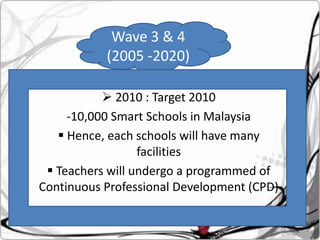
Wave 3 & 4
           (2005 -2020)

            2010 : Target 2010
     -10,000 Smart Schools in Malaysia
    Hence, each schools will have many
                  facilities
  Teachers will undergo a programmed of
Continuous Professional Development (CPD)
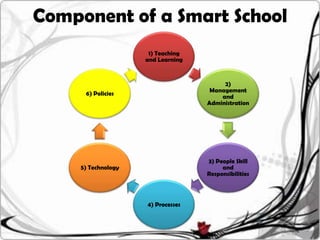
Component of a Smart School
                      1) Teaching
                     and Learning


                                         2)
                                     Management
      6) Policies
                                        and
                                    Administration


                                    3) People Skill
     5) Technology                       and
                                    Responsibilities


                     4) Processes
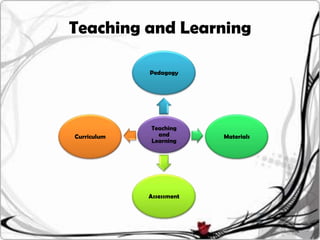
Teaching and Learning

             Pedagogy


             Teaching
Curriculum     and        Materials
             Learning


             Assessment
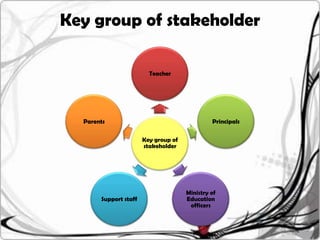
Key group of stakeholder

                         Teacher


  Parents                                      Principals

                       Key group of
                       stakeholder


                                      Ministry of
       Support staff                  Education
                                       officers
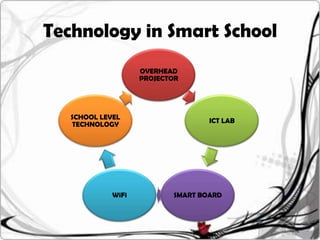
Technology in Smart School
                    OVERHEAD
                    PROJECTOR


   SCHOOL LEVEL
                                   ICT LAB
   TECHNOLOGY


             WiFi          SMART BOARD
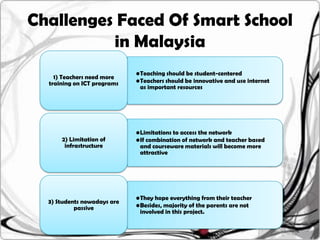
Challenges Faced Of Smart School
          in Malaysia
                             •Teaching should be student-centered
    1) Teachers need more
  training on ICT programs   •Teachers should be innovative and use internet
                              as important resources


                             •Limitations to access the network
      2) Limitation of       •If combination of network and teacher based
       infrastructure         and courseware materials will become more
                              attractive


                             •They hope everything from their teacher
  3) Students nowadays are
           passive           •Besides, majority of the parents are not
                              involved in this project.
a

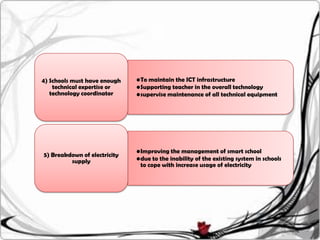
4) Schools must have enough   •To maintain the ICT infrastructure
    technical expertise or    •Supporting teacher in the overall technology
   technology coordinator     •supervise maintenance of all technical equipment


                              •Improving the management of smart school
5) Breakdown of electricity
         supply               •due to the inability of the existing system in schools
                               to cope with increase usage of electricity
THANK YOU

smart school

  • 1.
    INFORMATION $ COMMUNICATION TECHNOLOGY (SSI 3013) SMART SCHOOL NURUL EZZATI BT ABU HASAN • D20101037500 NORAZIRAH BINTI MOHD ARIF • D20101037518 NUR IZYAN BINTI RAZALI • D20101037522
  • 2.
    There Are 4Waves of The Smart Schools Impemented in Malaysia o Wave 1 (1999-2002) -The implementation on 87 schools in Malaysia o Wave 2 (2002-2005) -Lessons learnt from the pilot o Wave 3 (2005-2010) -Extending the digital transformation to all o Wave 4 (2010-2020) - Technology becomes an integral part of the nation’s learning process
  • 3.
    Wave 1 (1999-2002)  The ICT-enabled teaching of Science and Mathematics in English (PPSMI)  The government’s school computerization project at equipping all schools with PC’s and computer lab
  • 4.
    Wave 2 (2002-2005)  Implement teaching more effectively and  Implement teaching more effectively and obtain all stakeholders’ to the nationwide obtain all stakeholders’ to the nationwide implementation implementation  Measures to improve the Smart School  Measures System (SSMS) Smart School Management to improve the and schools’ Management to a knowledge and schools’ transition System (SSMS) culture transition to a knowledge culture
  • 5.
    Wave 3 &4 (2005 -2020)  2010 : Target 2010 -10,000 Smart Schools in Malaysia  Hence, each schools will have many facilities  Teachers will undergo a programmed of Continuous Professional Development (CPD)
  • 6.
    Component of aSmart School 1) Teaching and Learning 2) Management 6) Policies and Administration 3) People Skill 5) Technology and Responsibilities 4) Processes
  • 7.
    Teaching and Learning Pedagogy Teaching Curriculum and Materials Learning Assessment
  • 8.
    Key group ofstakeholder Teacher Parents Principals Key group of stakeholder Ministry of Support staff Education officers
  • 9.
    Technology in SmartSchool OVERHEAD PROJECTOR SCHOOL LEVEL ICT LAB TECHNOLOGY WiFi SMART BOARD
  • 10.
    Challenges Faced OfSmart School in Malaysia •Teaching should be student-centered 1) Teachers need more training on ICT programs •Teachers should be innovative and use internet as important resources •Limitations to access the network 2) Limitation of •If combination of network and teacher based infrastructure and courseware materials will become more attractive •They hope everything from their teacher 3) Students nowadays are passive •Besides, majority of the parents are not involved in this project.
  • 11.
    a 4) Schools musthave enough •To maintain the ICT infrastructure technical expertise or •Supporting teacher in the overall technology technology coordinator •supervise maintenance of all technical equipment •Improving the management of smart school 5) Breakdown of electricity supply •due to the inability of the existing system in schools to cope with increase usage of electricity
  • 12.