Information and
 Communication Technology
         in science
           SSI 3013

       MALAYSIAN SMART SCHOOL

NAME                             MATRIC NUMBER

DARVINA LIM CHOO KHENG           D201010XXXXX

DAYANG SUFINAH BINTI DATU TENG   D201010XXXXX

VIVIANA VELENTHIA MICHEAL        D201010XXXXX
Introduction
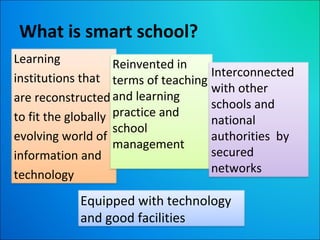
What is smart school?
Learning            Reinvented in
institutions that terms of teaching Interconnected
                                    with other
are reconstructed and learning      schools and
to fit the globally practice and    national
                    school
evolving world of                   authorities by
                    management
information and                     secured
technology                          networks

           Equipped with technology
           and good facilities
Smart School Initiative
• Produce a thinking technology-literate work
  force
• Provide all round development of the
  individual
• Provide opportunities to enhance individual
  strengths and abilities
• Increase participation of stakeholders
• Democratize education
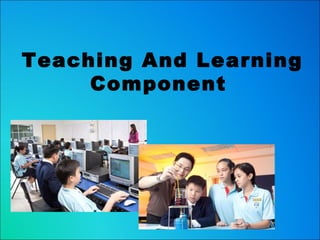
Teaching And Learning
     Component
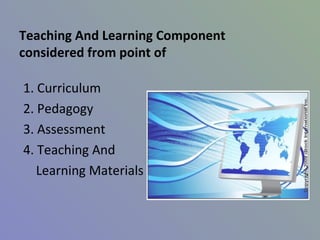
Teaching And Learning Component
considered from point of

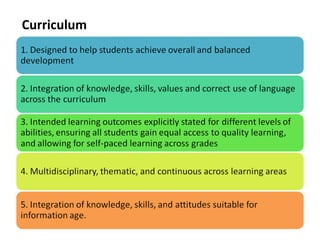
1. Curriculum
2. Pedagogy
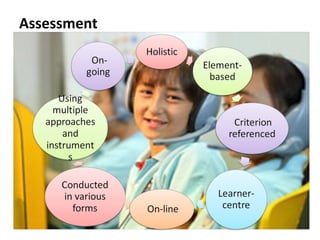
3. Assessment
4. Teaching And
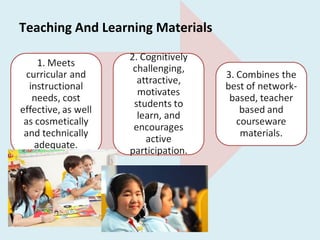
   Learning Materials
Curriculum
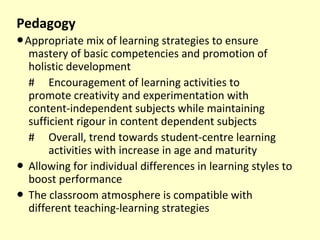
Pedagogy
●Appropriate mix of learning strategies to ensure
  mastery of basic competencies and promotion of
  holistic development
  # Encouragement of learning activities to
  promote creativity and experimentation with
  content-independent subjects while maintaining
  sufficient rigour in content dependent subjects
  # Overall, trend towards student-centre learning
       activities with increase in age and maturity
● Allowing for individual differences in learning styles to
  boost performance
● The classroom atmosphere is compatible with
  different teaching-learning strategies
Assessment
Teaching And Learning Materials
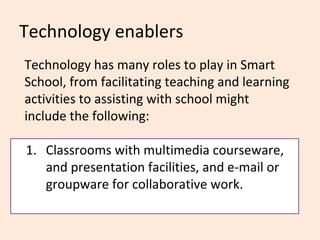
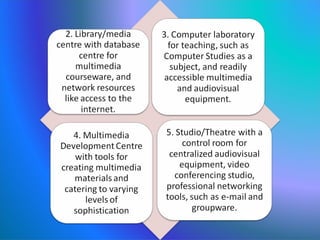
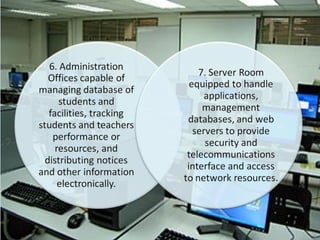
Technology enablers
Technology has many roles to play in Smart
School, from facilitating teaching and learning
activities to assisting with school might
include the following:

1. Classrooms with multimedia courseware,
   and presentation facilities, and e-mail or
   groupware for collaborative work.
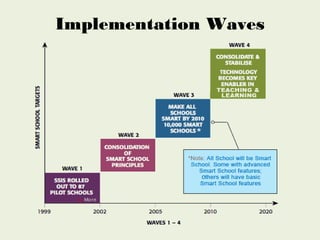
Implementation Waves
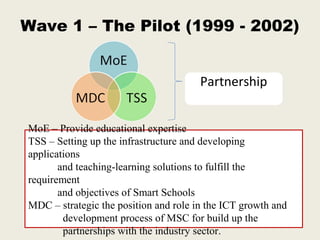
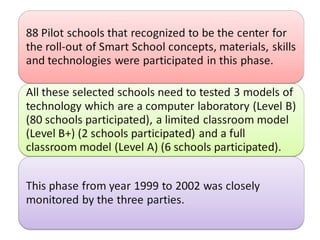
Wave 1 – The Pilot (1999 - 2002)


                                       Partnership


MoE – Provide educational expertise
TSS – Setting up the infrastructure and developing
applications
       and teaching-learning solutions to fulfill the
requirement
       and objectives of Smart Schools
MDC – strategic the position and role in the ICT growth and
        development process of MSC for build up the
        partnerships with the industry sector.
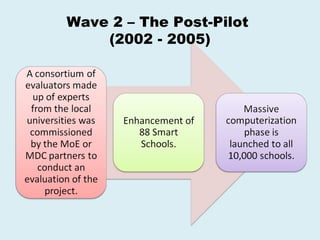
Wave 2 – The Post-Pilot
    (2002 - 2005)
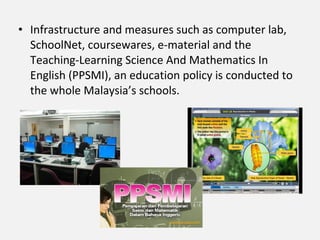
• Infrastructure and measures such as computer lab,
  SchoolNet, coursewares, e-material and the
  Teaching-Learning Science And Mathematics In
  English (PPSMI), an education policy is conducted to
  the whole Malaysia’s schools.
Wave 3 – Making All Schools Smart
           (2005 - 2010)
• At this wave, the steps of leveraging all ICT initiatives
  are taken. For examples, EduWebTV and School
  Access Centre are set up and made full use of them.
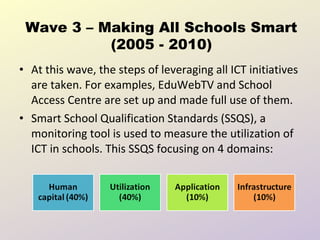
• Smart School Qualification Standards (SSQS), a
  monitoring tool is used to measure the utilization of
  ICT in schools. This SSQS focusing on 4 domains:
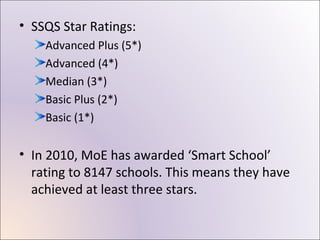
• SSQS Star Ratings:
    Advanced Plus (5*)
    Advanced (4*)
    Median (3*)
    Basic Plus (2*)
    Basic (1*)


• In 2010, MoE has awarded ‘Smart School’
  rating to 8147 schools. This means they have
  achieved at least three stars.
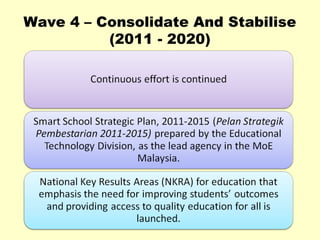
Wave 4 – Consolidate And Stabilise
          (2011 - 2020)
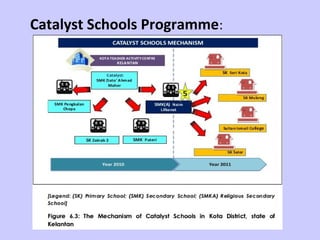
Catalyst Schools Programme:
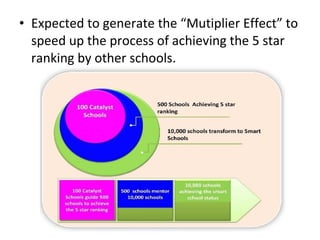
• Expected to generate the “Mutiplier Effect” to
  speed up the process of achieving the 5 star
  ranking by other schools.
• The inception of Smart School in Malaysia is a
  big leap in our local education to achieve our
  nation Vision 2020.

• The continuous effort towards making it’s a
  big success requires fully involvement of all
  the stakeholders.

Smart school mpp for blog

  • 1.
    Information and CommunicationTechnology in science SSI 3013 MALAYSIAN SMART SCHOOL NAME MATRIC NUMBER DARVINA LIM CHOO KHENG D201010XXXXX DAYANG SUFINAH BINTI DATU TENG D201010XXXXX VIVIANA VELENTHIA MICHEAL D201010XXXXX
  • 4.
  • 5.
    What is smartschool? Learning Reinvented in institutions that terms of teaching Interconnected with other are reconstructed and learning schools and to fit the globally practice and national school evolving world of authorities by management information and secured technology networks Equipped with technology and good facilities
  • 6.
    Smart School Initiative •Produce a thinking technology-literate work force • Provide all round development of the individual • Provide opportunities to enhance individual strengths and abilities • Increase participation of stakeholders • Democratize education
  • 7.
  • 8.
    Teaching And LearningComponent considered from point of 1. Curriculum 2. Pedagogy 3. Assessment 4. Teaching And Learning Materials
  • 9.
  • 10.
    Pedagogy ●Appropriate mix oflearning strategies to ensure mastery of basic competencies and promotion of holistic development # Encouragement of learning activities to promote creativity and experimentation with content-independent subjects while maintaining sufficient rigour in content dependent subjects # Overall, trend towards student-centre learning activities with increase in age and maturity ● Allowing for individual differences in learning styles to boost performance ● The classroom atmosphere is compatible with different teaching-learning strategies
  • 11.
  • 12.
  • 13.
    Technology enablers Technology hasmany roles to play in Smart School, from facilitating teaching and learning activities to assisting with school might include the following: 1. Classrooms with multimedia courseware, and presentation facilities, and e-mail or groupware for collaborative work.
  • 17.
  • 18.
    Wave 1 –The Pilot (1999 - 2002) Partnership MoE – Provide educational expertise TSS – Setting up the infrastructure and developing applications and teaching-learning solutions to fulfill the requirement and objectives of Smart Schools MDC – strategic the position and role in the ICT growth and development process of MSC for build up the partnerships with the industry sector.
  • 20.
    Wave 2 –The Post-Pilot (2002 - 2005)
  • 21.
    • Infrastructure andmeasures such as computer lab, SchoolNet, coursewares, e-material and the Teaching-Learning Science And Mathematics In English (PPSMI), an education policy is conducted to the whole Malaysia’s schools.
  • 22.
    Wave 3 –Making All Schools Smart (2005 - 2010) • At this wave, the steps of leveraging all ICT initiatives are taken. For examples, EduWebTV and School Access Centre are set up and made full use of them. • Smart School Qualification Standards (SSQS), a monitoring tool is used to measure the utilization of ICT in schools. This SSQS focusing on 4 domains:
  • 23.
    • SSQS StarRatings: Advanced Plus (5*) Advanced (4*) Median (3*) Basic Plus (2*) Basic (1*) • In 2010, MoE has awarded ‘Smart School’ rating to 8147 schools. This means they have achieved at least three stars.
  • 24.
    Wave 4 –Consolidate And Stabilise (2011 - 2020)
  • 25.
  • 26.
    • Expected togenerate the “Mutiplier Effect” to speed up the process of achieving the 5 star ranking by other schools.
  • 29.
    • The inceptionof Smart School in Malaysia is a big leap in our local education to achieve our nation Vision 2020. • The continuous effort towards making it’s a big success requires fully involvement of all the stakeholders.