The Malaysian
 Smart School
An MSC Flagship Application


     A Conceptual Blueprint


                              Smart School Project Team
Smart School Conceptual Blueprint

                                                                              Copyright © 1997 Government of Malaysia


         Smart School Project Team
         Creation date : 4 April, 1997
         Last update date : 11 July, 1997
         Related Documents
               Smart School Implementation Plan
               Smart School Conceptual Request For Proposals (Concept RFPs)


9 July, 1997                                                 Page 2                Smart School Project Team
Smart School Conceptual Blueprint

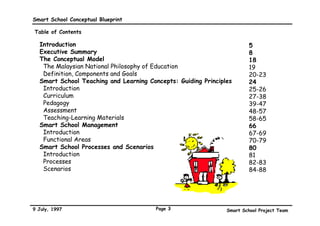
Table of Contents

  Introduction                                                          5
  Executive Summary                                                     8
  The Conceptual Model                                                  18
   The Malaysian National Philosophy of Education                       19
   Definition, Components and Goals                                     20-23
  Smart School Teaching and Learning Concepts: Guiding Principles       24
   Introduction                                                         25-26
   Curriculum                                                           27-38
   Pedagogy                                                             39-47
   Assessment                                                           48-57
   Teaching-Learning Materials                                          58-65
  Smart School Management                                               66
   Introduction                                                         67-69
   Functional Areas                                                     70-79
  Smart School Processes and Scenarios                                  80
   Introduction                                                         81
   Processes                                                            82-83
   Scenarios                                                            84-88


9 July, 1997                            Page 3                 Smart School Project Team
Smart School Conceptual Blueprint
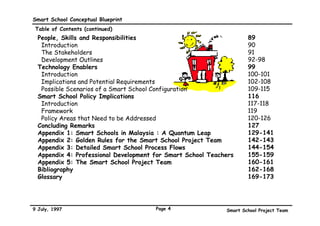
 Table of Contents (continued)
  People, Skills and Responsibilities                                89
   Introduction                                                      90
   The Stakeholders                                                  91
   Development Outlines                                              92-98
  Technology Enablers                                                99
   Introduction                                                      100-101
   Implications and Potential Requirements                           102-108
   Possible Scenarios of a Smart School Configuration                109-115
  Smart School Policy Implications                                   116
   Introduction                                                      117-118
   Framework                                                         119
   Policy Areas that Need to be Addressed                            120-126
  Concluding Remarks                                                 127
  Appendix 1: Smart Schools in Malaysia : A Quantum Leap             129-141
  Appendix 2: Golden Rules for the Smart School Project Team         142-143
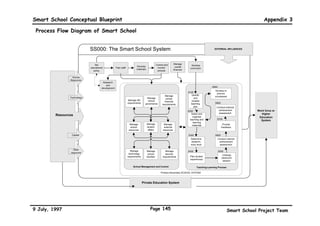
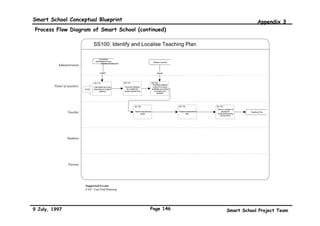
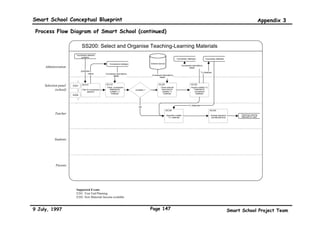
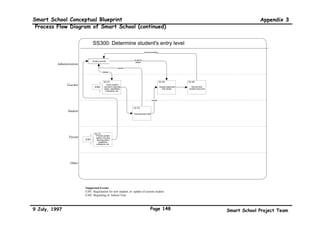
  Appendix 3: Detailed Smart School Process Flows                    144-154
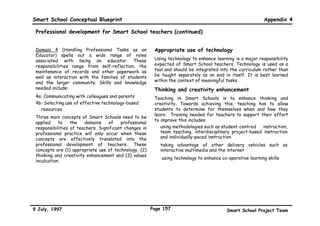
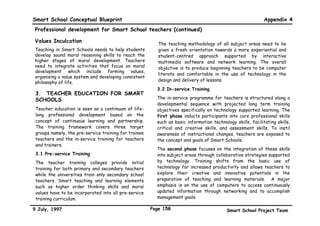
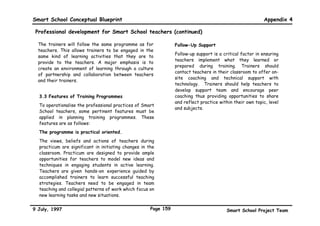
  Appendix 4: Professional Development for Smart School Teachers     155-159
  Appendix 5: The Smart School Project Team                          160-161
  Bibliography                                                       162-168
  Glossary                                                           169-173


9 July, 1997                           Page 4                Smart School Project Team
Smart School Conceptual Blueprint


         The Malaysian Smart School

                     Introduction


9 July, 1997                        Page 5   Smart School Project Team
Smart School Conceptual Blueprint                                                        Introduction


Introduction
Early in 1996, the Ministry of Education was        A set of “golden rules” were developed to guide
involved in intense discussion about “Smart         the team, so that, despite representing various
Schools”: the concept and its implications on the   interests, the team would be united in working
Malaysian education system. By late 1996, the       towards common national goals. Team members
Smart School had become one of the seven            worked collaboratively by ensuring their
flagship applications of the Multimedia Super       solutions are acceptable to all members, creating
Corridor. In January 1997, the Ministry of          visionary   solutions,   and    practising  open
Education conceptualised the vision of the          communication within the team. In addition, they
Malaysian Smart School in the document “Smart       were also guided by confidentiality provisions
Schools in Malaysia: A Quantum Leap” (Appendix      that prevented vendor competition. A set of
1).    This Blueprint is an elaboration and         these rules are attached in Appendix 2.
refinement of that vision and its features.
                                                    To produce this Blueprint, the team drew on
A    project     team,    comprising     industry   various kinds of resources. Team members made
representatives,    Multimedia      Development     study visits to Smart Schools in various parts of
Corporation officers, and officers of the           the world and reported on their findings. The
Ministry of Education, worked at producing this     combined resources of the team produced an
Blueprint. The team was convened in February        extensive bibliography of publications on the
1997 and continued its work until June 1997. The    philosophy, concepts and planning of Smart
team was charged with the task of proposing the     Schools.
necessary guidelines for launching the Smart
School.


9 July, 1997                                    Page 6                     Smart School Project Team
Smart School Conceptual Blueprint                                                     Introduction

 Introduction (continued)
  This Blueprint reflects the Malaysian          In producing this Blueprint, the team
  Smart School concept. It should be read        gratefully acknowledges the help of various
  together with the Malaysian Smart              agencies and individuals. The team would
  School Implementation Plan and the             especially like to thank the following:
  Concept Requests for Proposals (CRFPs).        • the Minister of Education, senior officials
  These documents enable companies to              of the Ministry of Education, members of
  respond and participate in the Smart             the Steering Committee;
  School system to be established. The           • various Divisions of the Ministry of
  CRFPs present a set of requirements to           Education for providing professional input
  guide companies to use their creativity          and facilities;
  and initiative to produce the best sets of     • those who helped develop a framework of
  applications for Malaysia’s Smart Schools.       pedagogy for Smart Schools;
                                                 • parents and members of the public for
  In addition to using the expertise and           providing important feedback on the draft
  experience of team members, the team             Blueprint;
  also sought the advice of a wide range of      • those who helped arrange visits to schools
  experts in the fields of education and           in various countries;
  industry.                                      • the companies which contributed towards
                                                   equipping the project team rooms with
  The Smart School Steering Committee of           hubs, computers, printers, software and
  the Ministry of Education deliberated on         peripherals.
  an earlier draft of this Blueprint and
  provided useful insights and comments
  towards its finalisation.


9 July, 1997                                   Page 7                    Smart School Project Team
Smart School Conceptual Blueprint                  Executive Summary


         The Malaysian Smart School

                              Executive
                              Summary

9 July, 1997                        Page 8   Smart School Project Team
Smart School Conceptual Blueprint                                                                  Executive Summary

Executive Summary
 Malaysia intends to transform its educational                The Smart Schools initiative is one of the seven
 system, in line with and in support of the nation’s          flagship applications that are part of Malaysia’s
 drive to fulfil Vision 2020. This Vision calls for           Multimedia Super Corridor (MSC) project. The
 sustained, productivity-driven growth, which will be         Government of Malaysia aims to capitalise on the
 achievable only with a technologically literate,             presence of leading-edge technologies and the rapid
 critically thinking work force prepared to                   development of the MSC’s infrastructure to jump-
 participate fully in the global economy of the 21st          start deployment of enabling technology to schools.
 century. At the same time, Malaysia’s National               This will be done by creating a group of 90 pilot Smart
 Philosophy of Education calls for “developing the            Schools by 1999 that will serve as the nucleus for the
 potential of individuals in a holistic and integrated        eventual nation-wide rollout of Smart School teaching
 manner, so as to produce individuals who are                 concepts and materials, skills, and technologies. By
 intellectually, spiritually, emotionally, and physically     2010, all 10,000 of Malaysia’s primary and secondary
 balanced and harmonious.” The catalyst for this              schools will be Smart Schools.
 massive transformation will be technology-
                                                              This Blueprint - like the Smart School concept itself -
 supported Smart Schools, which will improve how
                                                              is a work in progress and remains open to evolutionary
 the educational system achieves the National
                                                              refinement, including advances in pedagogy and
 Philosophy of Education, while fostering the
                                                              improvements in information technology. Consequently,
 development of a work force prepared to meet the
                                                              this document is descriptive, rather than prescriptive.
 challenges of the next century.
                                                              For a fuller understanding of the Smart School
 Transforming the educational system will entail              initiative, the Blueprint should be read with the Smart
 changing the culture and practices of Malaysia’s             School Implementation Plan, which outlines the
 primary and secondary schools, moving away from              implementation process and timetable, and the Concept
 memory-based learning designed for the average               Requests for Proposals, which define the project’s
 student to an education that stimulates thinking,            requirements.
 creativity, and caring in all students, caters to
 individual abilities and learning styles, and is based
 on more equitable access. It will require students
 to exercise greater responsibility for their own
 education, while seeking more active participation
 by parents and the wider community.
9 July, 1997                                                Page 9                         Smart School Project Team
Smart School Conceptual Blueprint                                                                   Executive Summary

Executive Summary (continued)

 This document summarises the Blueprint and is               Preparing students for the Information Age depends
 organised into eight sections:                              on an integrated strategy:

 •   Conceptual Model                                        Provide all-round development with provision for
 •   Teaching and Learning Concepts: Guiding Principles      individual abilities, offering a broad curriculum for all,
 •   Management                                              with electives, that is vertically integrated,
 •   Processes and Scenarios                                 multidisciplinary and interdisciplinary.
 •   People, Skills, and Responsibilities
                                                             Emphasise intellectual, emotional, spiritual, and
 •   Technology Enablers
                                                             physical growth, concentrating on thinking, developing
 •   Policy Implications
                                                             and applying values, and using correct language across
 •   Concluding Remarks
                                                             the curriculum.

 Conceptual Model                                            Produce a technologically literate work force that
                                                             can think critically, encouraging thought and creativity
 The Malaysian Smart School is a learning
                                                             across the curriculum and applying technology
 institution that has been systemically
                                                             effectively in teaching and learning.
 reinvented in terms of teaching-learning
 practices and school management in order to
                                                             Democratise education, offering equal access to
 prepare children for the Information Age. A
                                                             learning opportunities and accommodating differing
 Smart School will evolve over time, continuously
                                                             learning abilities, styles, and paces.
 developing its professional staff, its
 educational resources, and its administrative
                                                             Increase the participation of stakeholders, creating
 capabilities. This will allow the school to adapt
                                                             awareness of their roles and responsibilities and
 to changing conditions, while continuing to
                                                             developing the skills they need for that.
 prepare students for life in the Information
 Age. To function effectively, the Smart School
 will require appropriately skilled staff, and
 well-designed supporting processes.


9 July, 1997                                              Page 10                           Smart School Project Team
Smart School Conceptual Blueprint                                                                      Executive Summary

Executive Summary (continued)
 TEACHING AND LEARNING CONCEPTS: GUIDING                         Pedagogy
 PRINCIPLES
                                                                 The Smart School pedagogy will seek to make learning more
 The most distinctive feature of the Smart School will           interesting, motivating, stimulating, and meaningful; involve
 be a teaching and learning environment built on                 the children’s minds, spirit, and bodies in the learning
 international best practices in primary and secondary           process; build basic skills to prepare children for greater
 education.     This entails aligning the curriculum,            challenges over time; and cater for a range of needs and
 pedagogy, assessment and teaching-learning materials            capabilities among the students. The pedagogy shall:
 in a mutually reinforcing, coherent manner.                     • use an appropriate mix of learning strategies to ensure
                                                                 mastery of basic competencies and promote holistic
 Curriculum                                                      development
                                                                 • accommodate individual different learning styles, so as
 The Smart School curriculum shall be meaningful,                to boost performance
 socially responsible, multicultural, reflective, holistic,      • foster a classroom atmosphere that is compatible with
 global, open-ended, goal-based and technological. It            different teaching-learning strategies.
 shall promote holistic learning, allowing children to
 progress at their own pace, and catering for students’          Assessment
 varying capabilities, interests and needs. It will seek
 to ensure that children are educated with critical and          The Smart School’s assessment system will be distinctly
 creative thinking skills, inculcated with appropriate           different from current systems to help realise the
 values, and encouraged to improve their language                National Philosophy of Education It shall be element-based
 proficiency. Thus, the curriculum will be designed to:          and criterion-referenced to provide a more holistic and
 • help students achieve overall balanced development            accurate picture of a student’s performance. Teachers,
 • integrate knowledge, skills, values, and correct use          students and parents will be able to access on-line
 of language                                                     assessment items. Smart School assessment will be flexible
 • state explicitly intended learning outcomes for               and learner-friendly, while assuring the quality of the
 different ability levels                                        assessment information by using multiple approaches and
 • offer multidisciplinary, thematic, and continuous             instruments. It will lead to living certification, which will
 learning                                                        not only attest to a student’s cumulative accomplishments
 • foster the knowledge, skills, and attitudes                   but will also be open to continued improvement on a lifetime
 appropriate for success in the Information Age.                 basis.

9 July, 1997                                                  Page 11                           Smart School Project Team
Smart School Conceptual Blueprint                                                                 Executive Summary

Executive Summary (continued)
Teaching-learning materials                                  Further, they will need to develop and maintain a happy ,
                                                             motivated and high-performing staff, ensure the security
Smart Schools will need teaching-learning materials
                                                             of the school and its occupants, and use and manage
designed for the new teaching strategies. These
                                                             technology appropriately, effectively, and efficiently.
materials will accommodate students’ differing needs
and abilities, resulting in fuller realisation of their
                                                             PROCESSES AND SCENARIOS
capabilities and potential, and allow students to take
greater responsibility for managing and directing their      For a Smart School to achieve its educational objectives,
own learning.                                                its internal processes must be co-ordinated. Ensuring co-
                                                             ordination entails viewing these processes as a system: if
MANAGEMENT                                                   the system is well designed, providing appropriate inputs
                                                             will yield the desired outputs - namely, students ready for
The primary objective of Smart School management             higher education or active and productive participation in
will be to manage efficiently and effectively the            the work force. The Smart Schools initiative offers an
resources and processes required to support the              ideal opportunity to reassess the current schooling system,
teaching-learning functions. Management will help to         identifying problems and finding potential solutions, many
reallocate skilled human resources to more valuable          of which can be enabled by technology.
activities, save costs over the long term, improve the
quality of decisions through better access to                For the Smart School system, the major inputs are the
information, and accelerate decision making.                 resources - students, teachers, technology and tools - and
                                                             the Ministry of Education, in the form of curriculum
To fulfil its objectives, the Smart School management        specification, financing, and management and control
will need strong, professional administrators and            functions. The system proceeds through a series of sub-
teachers who can articulate school goals clearly, lead       processes - identifying and localising teaching plans,
teaching at the school, and elicit strong parental and       selecting and organising teaching-learning materials,
community support. They will need to maintain open           determining a student’s entry level, planning the student’s
communication with all constituencies, allocate              experience,    holding   classroom    sessions,   assessing
resources sensibly and equitably, track school               achievement internally, providing feedback - before
performance against financial and non-financial              delivering the student for external achievement
objectives, and provide a school environment that is         assessment, and ultimately for higher education or the
conducive to learning.                                       work force.

9 July, 1997                                              Page 12                          Smart School Project Team
Smart School Conceptual Blueprint                                                               Executive Summary

Executive Summary (continued)

 At a Smart School, these sub-processes will be               The efficiency and effectiveness of this
 constructed so that each delivers the desired output         management task can be enhanced significantly
 in an integrated manner.                                     through the use of technology. Principals in Smart
                                                              Schools will need intensive training to equip them to
 PEOPLE, SKILLS, AND RESPONSIBILITIES                         manage the new facilities, technologies and
                                                              methodologies deployed in their schools.
 The higher degree of individualised attention for
 students at a Smart School will necessitate new roles
                                                              Ministry of Education Officers
 and responsibilities for teachers, principals, Ministry
 of Education officers, support staff and parents. In         Ministry officers, comprising those at the central,
 fact, fulfilling these roles and responsibilities will       state and district levels are crucial to the successful
 require specialised training for each group.                 implementation of the Smart School project,
                                                              because they play a major role in planning, co-
 Teachers                                                     ordinating, monitoring, and evaluating Ministry
 Teacher development will be critical to the success of       programmes.     Officers will need to understand
 the Smart School.        Teachers will need intensive        thoroughly the educational objectives and policies of
 training in the use of information technology and in its     the Smart School, the information technology being
 integration into classroom activities in ways that           applied, the teaching-learning and management
 enhance thinking and creativity.          Smart School       processes, and their own roles and responsibilities in
 teachers will also need to learn to facilitate and           that context.
 encourage students in taking charge of their own
 learning. In the long term, these teachers will need to      Support Staff
 augment their skills regularly, if they are to stay          The advent of new educational processes as well as
 abreast of developments in their profession and              advanced information technology will present real
 remain confident in their application of the technology.     challenges for the support staff at Smart Schools.
                                                              It will require creating a new position, that of
 Principals                                                   Media/Technology coordinator, and it will require
                                                              existing clerical staff to learn new ways of working.
 The tasks of managing schools involves working with
 information and building on ideas collaboratively.

9 July, 1997                                            Page 13                          Smart School Project Team
Smart School Conceptual Blueprint                                                                Executive Summary

 Executive Summary (continued):
      •Media/Technology Coordinator. The coordinator's          TECHNOLOGY ENABLERS
      task will be to support teachers and the principal in
      deploying multimedia and other technologies in the        Technology alone will not make a school smart. Only
      Smart School.       The coordinator should be an          improved teaching-learning strategies, management and
      experienced teacher who also understands how best         administrative processes, and capable, well trained
      to use technology for gathering information,              people with enthusiasm for their work can do that.
      instruction, managing, and communicating.        The      However, information technology can enable the
      coordinator will also need to assist the principal in     process of transforming traditional schools into Smart
      managing software applications and in liasing with        Schools. Consequently, a nation-wide system of Smart
      technical support staff for the maintenance and           Schools will depend on advanced information technology
      upgrading of IT facilities.                               at the school, district and national levels.

      •Clerical Staff.     School clerical staff will need to   School-level technology
      build IT skills sufficiently to communicate using the
      new technology and perform their record keeping           Technology has many roles to play in a Smart School,
      functions. In addition to basic IT skills, however,       from facilitating teaching and learning activities to
      they will also need to understand the new educational     assisting with school management. Fully equipping a
      processes, so that they can give their support            school might include the following:
      wherever it is needed.                                       •Classrooms with multimedia courseware and
                                                                   presentation facilities, and e-mail or groupware for
Parents                                                            collaborative work.
Parents can play a major role in helping Smart Schools
provide individualised education for students. Research has        •Library/Media Centre with a database centre for
shown that students do better when their parents are               multimedia courseware, and network resources like
involved. This task will go beyond monitoring the child’s          access to the internet.
progress, and providing guidance, motivation, and counsel; it
will require familiarity with the new educational processes,       •Computer laboratory for teaching, such as
a willingness to assist with developing teaching-learning and      Computer Studies as a subject, and readily
assessment materials, as well as the ability to access the         accessible multimedia and audiovisual equipment.
school’s public domain databases electronically.

9 July, 1997                                             Page 14                          Smart School Project Team
Smart School Conceptual Blueprint                                                                  Executive Summary

Executive Summary (continued)
    •Multimedia Development Centre with tools for             Similarly, parents, students, and other members of the
    creating multimedia materials and catering to             community can stay in touch with the school. Students
    varying levels of sophistication.                         can keep abreast of coursework from outside of school;
                                                              parents can monitor their children’s progress or
    •Studio/Theatrette with a control room for                communicate with teachers from home; people in the
    centralised           audiovisual      equipment,         community can use the school as a centre for continued
    videoconferencing studio, preview room for audio,         learning.
    video, or laser disc materials.
    •Teachers’ Room with on-line access to courseware         District-level technology
    catalogues and databases, information and resource        School districts will need to maintain a secure network
    management systems, professional networking tools,        for communicating with schools in the area and with state
    such as e-mail and groupware.                             and national authorities, while also using the open
                                                              network for less sensitive materials. Districts will also
    •Administration Offices capable of managing               need to maintain extensive databases for many different
    databases of student and facilities, tracking             types of information, for example, assessment records of
    student and teacher performance or resources, and         student and teacher performance; human resource
    distributing    notices and   other   information         records; matters of governance, financing, and security;
    electronically.                                           and educational resources.
    •Server Room equipped to handle applications,
    management databases, and web servers; provide            National-level technology
    security; and telecommunications interface and            At the national level, interconnecting Smart Schools and
    access to network resources.                              educational authorities will involve both open and secure
                                                              networks. This will allow open access to educational
The technology will enable the school to draw on a variety    resources, facilitate collaborative work, and maintain
of external resources, while also making the school more      open communication channels with constituencies, while
accessible to the community. Students and teachers will       providing for the controlled distribution of sensitive
be able to tap into public and university libraries; access   information. In addition, there will need to be a national
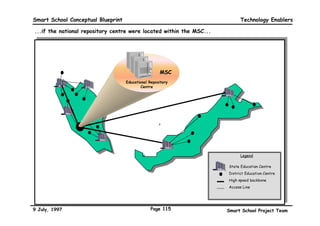
companies and industry associations; investigate museums      repository centre that is accessible to all education sites
and other archives; keep up to date with local authorities.   and maintain expedient access to the Ministry of
                                                              Education and the federal government administration.
9 July, 1997                                            Page 15                            Smart School Project Team
Smart School Conceptual Blueprint                                                              Executive Summary

Executive Summary (continued)

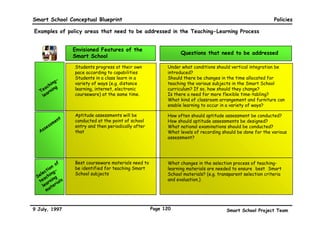
 This will require highly reliable telecommunications         Assessment. What will be the best regime for
 infrastructure to connect state and district education       comprehensively and periodically assessing student
 centres and provide international linkages. Given the        aptitudes, and what supporting infrastructure will
 Smart School initiative’s status as a flagship               that require? How can tests be administered fairly
 application, the ideal place for the national repository     in multiple ways, including on-line?
 would be in the MSC.
                                                              Selection of materials. What changes will be
                                                              needed in the process for selecting teaching-learning
 POLICY IMPLICATIONS                                          materials to ensure that the “best” Smart School
                                                              materials are chosen?
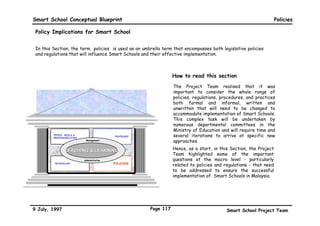
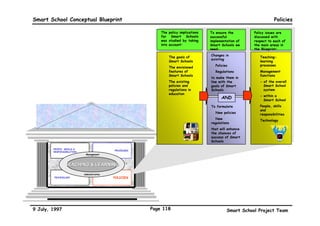
 Implementing Smart Schools successfully in Malaysia
 will be a complex task, requiring changes to existing
 policies, procedures, and practices, both written and        Management functions
 unwritten. It may also require formulating entirely
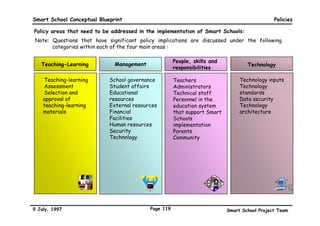
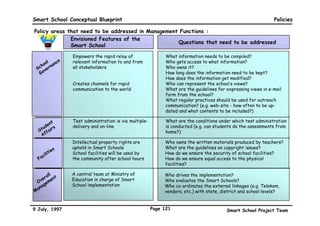
 new policies and regulations. A few of the important         School governance. What are the appropriate
 issues to be addressed include those outlined below, in      guidelines for intellectual property at a Smart
 the areas of the teaching-learning processes;                School? Who owns the information compiled at the
 management        functions;    people,   skills   and       school, and who gets access to it? Who owns the
 responsibilities; and technology.                            teaching materials produced by teachers?

                                                              Communications/public relations. How best to
 Teaching-learning processes                                  achieve the rapid relaying of relevant information to
 Teaching-learning.        What policies need to be           and from stakeholders? What channels should be
 amended, if students are to progress at their own pace       created for rapid communication with the world
 according to their own capabilities, and if students are     beyond the school and how to manage those
 to be free to learn in a variety of ways?                    channels?


9 July, 1997                                            Page 16                         Smart School Project Team
Smart School Conceptual Blueprint                                                               Executive Summary

Executive Summary (continued)

 People, skills and responsibilities                          CONCLUDING REMARKS

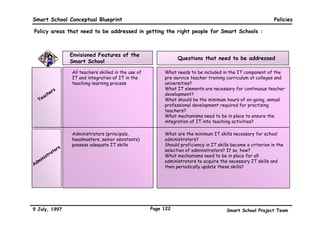
 What should be the minimum number of hours of on-            Transforming traditional schools into Smart Schools
 going, annual professional development required for          represents a major undertaking.      It will require a
 practising teachers, given their need to stay current        significant commitment of resources, but the nation will
 with advances in information technology?                     benefit from the change for many years to come.
                                                              Success will require:
 Should teachers and administrators at Smart Schools,         • support from many stakeholders, including all agencies
 having been trained in the use of information                in the educational system;
 technology, be paid more to ensure that they stay in         • sufficient funds to establish and maintain Smart
 education?                                                   Schools;
                                                              • appropriate policies, norms, and guidelines to support
                                                              the schools;
 Technology
                                                              • effective and efficient administrative practices in
                                                              each school;
 What modifications need to be made to the per capita
 grant to accommodate start-up and on-going                   • sufficient deployment of information technology to
 technology expenses?                                         enable the Smart Schools to function properly;
                                                              • continuing professional development for teachers,
 What alternative funding sources can be harnessed to         principals, and other educational personnel.
 acquire additional technological inputs?
                                                             The Smart School initiative represents an investment in
 To what extent are schools allowed to add technology        the future productivity of Malaysia’s work force and a
 that is inconsistent with agreed-upon Ministry of           down payment on the nation’s future prosperity.
 Education guidelines and technology standards?


9 July, 1997                                             Page 17                         Smart School Project Team
Smart School Conceptual Blueprint


         The Malaysian Smart School

                         Conceptual
                           Model

9 July, 1997                        Page 18   Smart School Project Team
Smart School Conceptual Blueprint                                             Conceptual Model

The Malaysian National Philosophy of Education underpins every element of the Smart School
Conceptual Model:


  “Education in Malaysia is an on-going effort towards further
     developing the potential of individuals in a holistic and
    integrated manner, so as to produce individuals who are
      intellectually, spiritually, emotionally and physically
     balanced and harmonious, based on a firm belief in and
     devotion to God. Such an effort is designed to produce
   Malaysian citizens who are knowledgeable and competent,
   who possess high moral standards, and who are responsible
  and capable of achieving high levels of personal well-being as
       well as being able to contribute to the harmony and
     betterment of the family, the society and the nation at
                               large.”


9 July, 1997                               Page 19                    Smart School Project Team
Smart School Conceptual Blueprint                                                               Conceptual Model

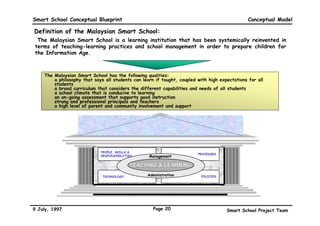
Definition of the Malaysian Smart School:
“The Malaysian Smart School is a learning institution that has been systemically reinvented in
terms of teaching-learning practices and school management in order to prepare children for
the Information Age.”


    The Malaysian Smart School has the following qualities:
    •   a philosophy that says all students can learn if taught, coupled with high expectations for all
        students
    •   a broad curriculum that considers the different capabilities and needs of all students
    •   a school climate that is conducive to learning
    •   an on-going assessment that supports good instruction
    •   strong and professional principals and teachers
    •   a high level of parent and community involvement and support


                             PEOPLE, SKILLS &
                                                                         PROCESSES
                             RESPONSIBILITIES      Management

                                           TEACHING & LEARNING

                              TECHNOLOGY          Administration          POLICIES


9 July, 1997                                         Page 20                          Smart School Project Team
Smart School Conceptual Blueprint                                                                                                 Conceptual Model

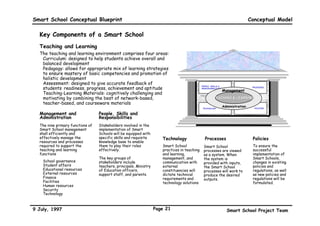
  Key Components of a Smart School
  Teaching and Learning
  The teaching and learning environment comprises four areas:
  • Curriculum: designed to help students achieve overall and
    balanced development
  • Pedagogy: allows for appropriate mix of learning strategies
    to ensure mastery of basic competencies and promotion of
    holistic development
  • Assessment: designed to give accurate feedback of
    students’ readiness, progress, achievement and aptitude
                                                                                              PEOPLE, SKILLS &
                                                                                                                                   PROCESSES
                                                                                              RESPONSIBILITIES
                                                                                                                 Management
  • Teaching-Learning Materials: cognitively challenging and
    motivating by combining the best of network-based,                                                  TEACHING & LEARNING
    teacher-based, and courseware materials
                                                                                              TECHNOLOGY
                                                                                                                 Administration     POLICIES


  Management and                  People, Skills and
  Administration                  Responsibilities
  The nine primary functions of   Stakeholders involved in the
  Smart School management         implementation of Smart
  shall efficiently and           Schools will be equipped with
  effectively manage the          specific skills and requisite       Technology                Processes                          Policies
  resources and processes         knowledge base to enable
  required to support the         them to play their roles            Smart School             Smart School                        To ensure the
  teaching and learning           effectively.                        practices in teaching    processes are viewed                successful
  functions                                                           and learning,            as a system. When                   implementation of
                                  The key groups of                   management, and          the system is                       Smart Schools,
  •   School governance           stakeholders include                communication with       provided with inputs,               changes in existing
  •   Student affairs             teachers, principals, Ministry      external                 the Smart School                    policies and
  •   Educational resources       of Education officers,              constituencies will      processes will work to              regulations, as well
  •   External resources          support staff, and parents.         dictate technical        produce the desired                 as new policies and
  •   Finance                                                         requirements and         outputs.                            regulations will be
  •   Facilities                                                      technology solutions                                         formulated.
  •   Human resources
  •   Security
  •   Technology


9 July, 1997                                                       Page 21                                         Smart School Project Team
Smart School Conceptual Blueprint                                                                             Conceptual Model

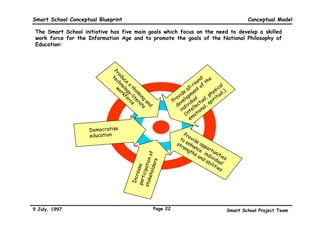
 The Smart School initiative has five main goals which focus on the need to develop a skilled
 work force for the Information Age and to promote the goals of the National Philosophy of
 Education:


                              Pr
                                o
                             te d u
                               ch c e                                              nd e
                                  n a                                           ou f t h          l
                               w o olo t h                                    -r o
                                  r k gy- i n k                            all n t            ica )
                                                                         e e              ys l ,
                                     f o lit i n                      id p m            ph i t u a
                                        r c er g a                 ov o          l   l,
                                           e at n d             P r v e l i d u a tua s p i r
                                                e                  d e d i v llec a l ,
                                                                      i n nte i o n
                                                                          (i o t
                                                                            em

                     Democratise
                     education                                         Pr
                                                                     to o v i d
                                                                  s t r enha e o p p
                                                                       e n nc o r
                                                                          gt e          t
                                                  lder o f                  hs      ind u n i t
                                                                                an              i
                                                                                   d a ividu e s
                                       stak i p a t i o n


                                                                                      b i l al
                                                       s
                                                                                           iti
                                                                                               es
                                        p a r t ase
                                              eho
                                                e
                                               ic
                                         Incr


9 July, 1997                                          Page 22                                         Smart School Project Team
Smart School Conceptual Blueprint                                                                   Conceptual Model

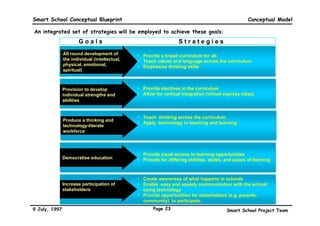
An integrated set of strategies will be employed to achieve these goals:
                      Goals                                       Strategies
               All round development of        • Provide a broad curriculum for all
               the individual (intellectual,   • Teach values and language across the curriculum
               physical, emotional,            • Emphasise thinking skills
               spiritual)


               Provision to develop            • Provide electives in the curriculum
               individual strengths and        • Allow for vertical integration (virtual express class)
               abilities


                                               • Teach thinking across the curriculum
               Produce a thinking and
                                               • Apply technology in teaching and learning
               technology-literate
               workforce


                                               • Provide equal access to learning opportunities
               Democratise education           • Provide for differing abilities, styles, and paces of learning


                                               • Create awareness of what happens in schools
               Increase participation of       • Enable easy and speedy communication with the school
               stakeholders                      using technology
                                               • Provide opportunities for stakeholders (e.g. parents,
                                                 community) to participate.
9 July, 1997                                          Page 23                             Smart School Project Team
Smart School Conceptual Blueprint


         The Malaysian Smart School

            Teaching and
         Learning Concepts:
          Guiding Principles

9 July, 1997                        Page 24   Smart School Project Team
Smart School Conceptual Blueprint                                Teaching and Learning Concepts : Guiding Principles

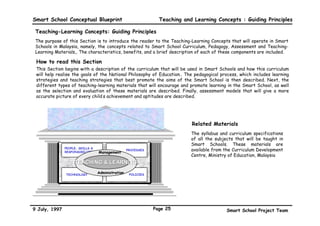
 Teaching-Learning Concepts: Guiding Principles
 The purpose of this Section is to introduce the reader to the Teaching-Learning Concepts that will operate in Smart
 Schools in Malaysia, namely, the concepts related to Smart School Curriculum, Pedagogy, Assessment and Teaching-
 Learning Materials,. The characteristics, benefits, and a brief description of each of these components are included.

 How to read this Section
 This Section begins with a description of the curriculum that will be used in Smart Schools and how this curriculum
 will help realise the goals of the National Philosophy of Education.. The pedagogical process, which includes learning
 strategies and teaching strategies that best promote the aims of the Smart School is then described. Next, the
 different types of teaching-learning materials that will encourage and promote learning in the Smart School, as well
 as the selection and evaluation of these materials are described. Finally, assessment models that will give a more
 accurate picture of every child’s achievement and aptitudes are described.


                                                                             Related Materials
                                                                             The syllabus and curriculum specifications
                                                                             of all the subjects that will be taught in
                                                                             Smart Schools. These materials are
               PEOPLE, SKILLS &
                                                   PROCESSES                 available from the Curriculum Development
               RESPONSIBILITIES   Management
                                                                             Centre, Ministry of Education, Malaysia
                    TEACHING & LEARNING

               TECHNOLOGY
                                  Administration    POLICIES


9 July, 1997                                                   Page 25                       Smart School Project Team
Smart School Conceptual Blueprint                                Teaching and Learning Concepts : Guiding Principles

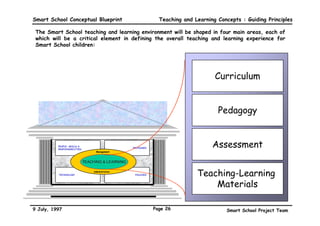
 The Smart School teaching and learning environment will be shaped in four main areas, each of
 which will be a critical element in defining the overall teaching and learning experience for
 Smart School children:


                                                                                      Curriculum


                                                                                       Pedagogy


          PEOPLE, SKILLS &
          RESPONSIBILITIES
                                                   PROCESSES
                                                                                     Assessment
                                   Management


                             TEACHING & LEARNING


          TECHNOLOGY
                                 Administration
                                                    POLICIES                   Teaching-Learning
                                                                                   Materials

9 July, 1997                                                   Page 26                    Smart School Project Team
Smart School Conceptual Blueprint                 Teaching and Learning Concepts : Guiding Principles

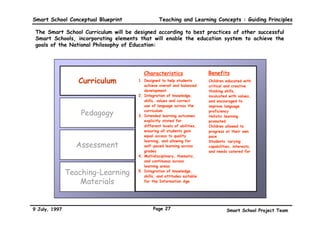
 The Smart School Curriculum will be designed according to best practices of other successful
 Smart Schools, incorporating elements that will enable the education system to achieve the
 goals of the National Philosophy of Education:


                                          Characteristics                      Benefits
                  Curriculum           1. Designed to help students
                                          achieve overall and balanced
                                                                           •   Children educated with
                                                                               critical and creative
                                          development                          thinking skills,
                                       2. Integration of knowledge,            inculcated with values,
                                          skills, values and correct           and encouraged to
                                          use of language across the           improve language

                   Pedagogy               curriculum
                                       3. Intended learning outcomes       •
                                                                               proficiency
                                                                               Holistic learning
                                          explicitly stated for                promoted
                                          different levels of abilities,   •   Children allowed to
                                          ensuring all students gain           progress at their own
                                          equal access to quality              pace
                                          learning, and allowing for       •   Students’ varying
                 Assessment               self-paced learning across           capabilities, interests,
                                          grades                               and needs catered for
                                       4, Multidisciplinary, thematic,
                                          and continuous across
                                          learning areas
               Teaching-Learning       5. Integration of knowledge,
                                          skills, and attitudes suitable
                   Materials              for the Information Age


9 July, 1997                                   Page 27                                   Smart School Project Team
Smart School Conceptual Blueprint                        Teaching and Learning Concepts : Guiding Principles

 The Malaysian Smart School Vision of Curriculum:
The curriculum shall be:
 •   MEANINGFUL. The curriculum emphasises the active construction of meaning, so that all students find
     purpose in their studies.

 •   SOCIALLY RESPONSIBLE. The curriculum develops in students a sense of social responsibility, so that they
     become aware of their obligations and duties as citizens in a democracy and are especially sensitive to the
     needs of the poor and the aged.

 •   MULTICULTURAL. The curriculum reflects and is responsive to the cultural diversity of this nation and our
     community, so that students develop a sense of pride in their own heritage and a respect for that of others.

 •   REFLECTIVE. The curriculum fosters in students the skills and attitudes of reflection, so that they are
     able to think critically, creatively, and affirmatively.

 •   HOLISTIC. The curriculum gives appropriate emphasis to all the significant aspects of growth and all the
     types of human intelligence, helping students see the connections between the separate subjects,

 •   GLOBAL. The curriculum develops in students an awareness of global interdependence in all aspects of life,
     including the environment and the economy.

 •   OPEN-ENDED. The curriculum is open-ended in two ways: it is open to revision and continued refinement;
     and it provides open access to all students, allowing them to go beyond explicitly stated learning outcomes in
     curriculum documents.

 •   GOAL-BASED. The curriculum focuses on significant goals, so that all students, including those with special
     needs, develop the critical skills and acquire the knowledge they need for effective lifelong learning and full
     functioning as citizens in a changing society.

 •   TECHNOLOGICAL. The curriculum uses technology as one delivery system, examines the influence of
     technology on students’ lives, and gives students the skills they need to use technology.

9 July, 1997                                          Page 28                           Smart School Project Team
Smart School Conceptual Blueprint               Teaching and Learning Concepts : Guiding Principles

 New elements in the Smart School curriculum will focus on all-round development of students
 appropriate for the Information Age:

 1.   Designed to help students achieve overall and balanced development


                                 ALL-ROUND DEVELOPMENT
Domains
                   Effective oral and written communication in Malay. English as a second
Communication
                   language. Emphasise multiple languages, interpersonal skills and networking.

                   Focus on acquiring knowledge. Focus on searching, generating, and using
Cognitive          knowledge with an emphasis on problem-solving and creativity.


Affective/         Instil moral and religious values. Emphasise adaptability, team-player
Emotional          characteristics, emotional balance and emotional intelligence.


 Physical/         Instil social responsibility and consciousness of health and environmental
 Social            issues. Emphasise a global orientation and inculcate work place skills and
                   attitudes.


9 July, 1997                                  Page 29                      Smart School Project Team
6PDUW6FKRRORQFHSWXDO%OXHSULQW                              7HDFKLQJDQG/HDUQLQJRQFHSWV*XLGLQJ3ULQFLSOHV

 $ZLGHYDULHWRI6NLOOV.QRZOHGJH/DQJXDJHDQG9DOXHVHOHPHQWVLQDUHDVRIVWXGZLOOIRUP
 WKHQHZXUULFXOXPIRU6PDUW6FKRROV


  ,QWHJUDWLRQRINQRZOHGJH
     VNLOOVYDOXHVDQGFRUUHFW              .QRZOHGJH
     XVHRIODQJXDJHDFURVVWKH              ‡ RQWHQW .QRZOHGJH
                                             ‡ 3UREOHP 6ROYLQJ .QRZOHGJH
     FXUULFXOXP                              ‡ (SLVWHPLF .QRZOHGJH
                                             ‡ ,QTXLU .QRZOHGJH

                                                                                       9DOXHVIRUH[DPSOH
                                                                                       ‡ RPSDVVLRQ

   6NLOOVIRUH[DPSOH                                                                ‡ 6HOI5HOLDQFH
                                                                                       ‡ +XPLOLW
   ‡ UHDWLYH DQG ULWLFDO 7KLQNLQJ 6NLOOV
                                             $UHDVRI6WXG                           ‡ 5HVSHFW
   VSHFLDO HPSKDVLV
‡ /DQJXDJH DQG RPPXQLFDWLRQ             ‡ /RYH
   ‡ 3HUVRQDO 6NLOOV
                                              ‡ ,VODPLF 5HOLJLRXV (GXFDWLRQ            ‡ -XVWLFH
   ‡ 6RFLDO 6NLOOV                            ‡ 9DOXHV 'HYHORSPHQW                     ‡ )UHHGRP
   ‡ .QRZOHGJH $FTXLVLWLRQ 6NLOOV             ‡ 6FLHQFH DQG 7HFKQRORJ                 ‡ RXUDJH
   ‡ 6FLHQWLILF 6NLOOV                        ‡ 6RFLDO 6WXGLHV
   ‡ *HQHULF 6NLOOV                           ‡ 3KVLFDO DQG +HDOWK                    ‡ 3KVLFDO DQG 0HQWDO OHDQOLQHVV

   ‡ 0DWKHPDWLFDO 6NLOOV                        'HYHORSPHQW                            ‡ +RQHVW

   ‡ (QYLURQPHQWDO 6NLOOV                     ‡ 9RFDWLRQDO DQG                         ‡ 'LOLJHQFH

   ‡ UHDWLYH 6NLOOV
                                                3HUVRQDO $ZDUHQHVV                     ‡ RRSHUDWLRQ

   ‡ ,QIRUPDWLRQ 7HFKQRORJ 6NLOOV
                                              ‡ 3UDFWLFDO DQG UHDWLYH $UWV            ‡ 0RGHUDWLRQ
                                                                                       ‡ *UDWLWXGH
                                                                                       ‡ 5DWLRQDOLW
                                                                                       ‡ 3XEOLF 6SLULWHGQHVV
                                                /DQJXDJH
                                                5HDGLQJ :ULWLQJ 2UDO
                                                RPPXQLFDWLRQ
                                                ‡ RUUHFW XVDJH
                                                ‡ (IIHFWLYH
                                                  FRPPXQLFDWLRQ


-XO                                                3DJH                      6PDUW6FKRRO3URMHFW7HDP
6PDUW6FKRRORQFHSWXDO%OXHSULQW                     7HDFKLQJDQG/HDUQLQJRQFHSWV*XLGLQJ3ULQFLSOHV

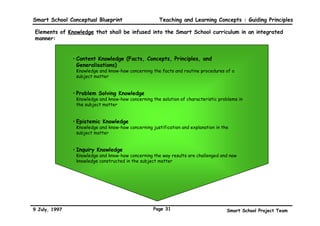
(OHPHQWVRI.QRZOHGJHWKDWVKDOOEHLQIXVHGLQWRWKH6PDUW6FKRROFXUULFXOXPLQDQLQWHJUDWHG
PDQQHU


               ‡ RQWHQW.QRZOHGJH)DFWVRQFHSWV3ULQFLSOHVDQG
                 *HQHUDOLVDWLRQV
.QRZOHGJHDQGNQRZKRZFRQFHUQLQJWKHIDFWVDQGURXWLQHSURFHGXUHVRID
                VXEMHFWPDWWHU


               ‡ 3UREOHP6ROYLQJ.QRZOHGJH
                .QRZOHGJHDQGNQRZKRZFRQFHUQLQJWKHVROXWLRQRIFKDUDFWHULVWLFSUREOHPVLQ
                WKHVXEMHFWPDWWHU


               ‡ (SLVWHPLF.QRZOHGJH
                .QRZOHGJHDQGNQRZKRZFRQFHUQLQJMXVWLILFDWLRQDQGH[SODQDWLRQLQWKH
                VXEMHFWPDWWHU


               ‡ ,QTXLU.QRZOHGJH
                .QRZOHGJHDQGNQRZKRZFRQFHUQLQJ WKHZDUHVXOWVDUHFKDOOHQJHGDQGQHZ
                NQRZOHGJHFRQVWUXFWHGLQWKHVXEMHFWPDWWHU


-XO                                       3DJH                           6PDUW6FKRRO3URMHFW7HDP
Smart School Conceptual Blueprint                          Teaching and Learning Concepts : Guiding Principles

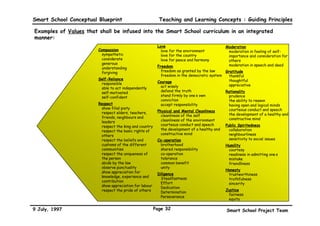
Examples of Values that shall be infused into the Smart School curriculum in an integrated
manner:
                                                          Love                                 Moderation
                        Compassion                        • love for the environment           • moderation in feeling of self-
                        • sympathetic                     • love for the country                 importance and consideration for
                        • considerate                     • love for peace and harmony           others
                        • generous                                                             • moderation in speech and deed
                        • understanding                   Freedom
                        • forgiving                       • freedom as granted by the law    Gratitude
                                                          • freedom in the democratic system • thankful
                        Self-Reliance                                                        • thoughtful
                        • responsible                     Courage
                                                          • act wisely                       • appreciative
                        • able to act independently
                        • self-motivated                  • defend the truth                   Rationality
                        • self-confident                  • stand firmly by one’s own          • prudence
                                                            conviction                         • the ability to reason
                        Respect                           • accept responsibility              • having open and logical minds
                        • show filial piety                                                    • courteous conduct and speech
                        • respect elders, teachers,       Physical and Mental Cleanliness
                                                          • cleanliness of the self            • the development of a healthy and
                          friends, neighbours and                                                constructive mind
                          leaders                         • cleanliness of the environment
                        • respect the king and country    • courteous conduct and speech       Public Spiritedness
                        • respect the basic rights of     • the development of a healthy and   • collaboration
                          others                            constructive mind                  • neighbourliness
                        • respect the beliefs and         Co-operation                         • sensitivity to social issues
                          customs of the different        • brotherhood                        Humility
                          communities                     • shared responsibility              • courtesy
                        • respect the uniqueness of       • co-operation                       • readiness in admitting one’s
                          the person                      • tolerance                            mistake
                        • abide by the law                • common benefit                     • friendliness
                        • observe punctuality             • unity
                                                                                               Honesty
                        • show appreciation for           Diligence                            • trustworthiness
                          knowledge, experience and       • Steadfastness                      • truthfulness
                          contribution                    • Effort                             • sincerity
                        • show appreciation for labour    • Dedication
                        • respect the pride of others                                          Justice
                                                          • Determination
                                                                                               • fairness
                                                          • Perseverance
                                                                                               • equity

9 July, 1997                                             Page 32                               Smart School Project Team
6PDUW6FKRRORQFHSWXDO%OXHSULQW                                         7HDFKLQJDQG/HDUQLQJRQFHSWV*XLGLQJ3ULQFLSOHV

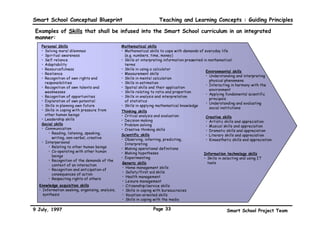
([DPSOHVRI6NLOOVWKDWVKDOOEHLQIXVHGLQWRWKH6PDUW6FKRROFXUULFXOXPLQDQLQWHJUDWHG
PDQQHU
   3HUVRQDO 6NLOOV                               0DWKHPDWLFDO VNLOOV
   ‡ 6ROYLQJ PRUDO GLOHPPDV                      ‡ 0DWKHPDWLFDO VNLOOV WR FRSH ZLWK GHPDQGV RI HYHUGD OLIH
   ‡ 6SLULWXDO DZDUHQHVV                           HJ QXPEHUV WLPH PRQH
‡ 6HOI UHOLDQFH                               ‡ 6NLOOV DW LQWHUSUHWLQJ LQIRUPDWLRQ SUHVHQWHG LQ PDWKHPDWLFDO
   ‡ $GDSWDELOLW                                  WHUPV
   ‡ 5HVRXUFHIXOQHVV                             ‡ 6NLOOV LQ XVLQJ D FDOFXODWRU
   ‡ 5HVLOLHQFH                                  ‡ 0HDVXUHPHQW VNLOOV
                                                                                                (QYLURQPHQWDO VNLOOV
                                                                                                ‡ 8QGHUVWDQGLQJ DQG LQWHUSUHWLQJ
   ‡ 5HFRJQLWLRQ RI RZQ ULJKWV DQG               ‡ 6NLOOV LQ PHQWDO FDOFXODWLRQ
                                                                                                  SKVLFDO SKHQRPHQD
     UHVSRQVLELOLWLHV                            ‡ 6NLOOV LQ HVWLPDWLRQ
                                                                                                ‡ ,QWHUDFWLQJ LQ KDUPRQ ZLWK WKH
   ‡ 5HFRJQLWLRQ RI RZQ WDOHQWV DQG              ‡ 6SDWLDO VNLOOV DQG WKHLU DSSOLFDWLRQ
                                                                                                  HQYLURQPHQW
     ZHDNQHVVHV                                  ‡ 6NLOOV UHODWLQJ WR UDWLR DQG SURSRUWLRQ
                                                                                                ‡ $SSOLQJ IXQGDPHQWDO VFLHQWLILF
   ‡ 5HFRJQLWLRQ RI RSSRUWXQLWLHV                ‡ 6NLOOV LQ DQDOVLV DQG LQWHUSUHWDWLRQ
                                                                                                  SULQFLSDOV
   ‡ ([SORUDWLRQ RI RZQ SRWHQWLDO                  RI VWDWLVWLFV
                                                                                                ‡ 8QGHUVWDQGLQJ DQG HYDOXDWLQJ
   ‡ 6NLOOV LQ SODQQLQJ RZQ IXWXUH               ‡ 6NLOOV LQ DSSOLQJ PDWKHPDWLFDO NQRZOHGJH
                                                                                                  VRFLDO LQVWLWXWLRQV
   ‡ 6NLOOV LQ FRSLQJ ZLWK SUHVVXUH IURP         7KLQNLQJ VNLOOV
     RWKHU KXPDQ EHLQJV
   ‡ /HDGHUVKLS VNLOOV
                                                 ‡ ULWLFDO DQDOVLV DQG HYDOXDWLRQ             UHDWLYH VNLOOV
                                                 ‡ 'HFLVLRQ PDNLQJ                              ‡ $UWLVWLF VNLOOV DQG DSSUHFLDWLRQ
   6RFLDO VNLOOV                                 ‡ 3UREOHP VROYLQJ                              ‡ 0XVLFDO VNLOOV DQG DSSUHFLDWLRQ
   ‡ RPPXQLFDWLRQ                               ‡ UHDWLYH WKLQNLQJ VNLOOV                     ‡ 'UDPDWLF VNLOOV DQG DSSUHFLDWLRQ
       ‡ 5HDGLQJ OLVWHQLQJ VSHDNLQJ
                                                 6FLHQWLILF VNLOOV                              ‡ /LWHUDU VNLOOV DQG DSSUHFLDWLRQ
         ZULWLQJ QRQYHUEDO FUHDWLYH
                                                 ‡ 2EVHUYLQJ LQIHUULQJ SUHGLFWLQJ            ‡ .LQDHVWKHWLF VNLOOV DQG DSSUHFLDWLRQ
   ‡ ,QWHUSHUVRQDO
                                                   ,QWHUSUHWLQJ
       ‡ 5HODWLQJ WR RWKHU KXPDQ EHLQJV
                                                 ‡ 0DNLQJ RSHUDWLRQDO GHILQLWLRQV
       ‡ RRSHUDWLQJ ZLWK RWKHU KXPDQ
         EHLQJV
                                                 ‡ 0DNLQJ KSRWKHVHV                           ,QIRUPDWLRQ WHFKQRORJ VNLOOV
                                                 ‡ ([SHULPHQWLQJ                               ‡ 6NLOOV LQ VHOHFWLQJ DQG XVLQJ ,7
       ‡ 5HFRJQLWLRQ RI WKH GHPDQGV RI WKH
         FRQWH[W RI DQ LQWHUDFWLRQ
                                                 *HQHULF VNLOOV                                  WRROV
                                                 ‡ +RPH PDQDJHPHQW VNLOOV
       ‡ 5HFRJQLWLRQ DQG DQWLFLSDWLRQ RI
                                                 ‡ 6DIHWILUVW DLG VNLOOV
         FRQVHTXHQFHV RI DFWLRQ
                                                 ‡ +HDOWK PDQDJHPHQW
       ‡ 5HVSHFWLQJ ULJKWV RI RWKHUV
                                                 ‡ /HLVXUH PDQDJHPHQW
  .QRZOHGJH DFTXLVLWLRQ VNLOOV                   ‡ LWL]HQVKLSVHUYLFH VNLOOV
  ‡ ,QIRUPDWLRQ VHHNLQJ RUJDQLVLQJ DQDOVLV   ‡ 6NLOOV LQ FRSLQJ ZLWK EXUHDXFUDFLHV
   VQWKHVLV                                     ‡ 9RFDWLRQRULHQWHG VNLOOV
                                                 ‡ 6NLOOV LQ FRSLQJ ZLWK WKH PHGLD


-XO                                                         3DJH                                   6PDUW6FKRRO3URMHFW7HDP
Smart School Conceptual Blueprint                  Teaching and Learning Concepts : Guiding Principles

Elements of Language that shall be infused into the Smart School curriculum in an integrated
manner:


               Reading, Writing and Oral Communication
               • Integration of process and content from areas of study for reading
                 and writing
               • Integration of talking and listening activities across all content areas
               • Communication with and understanding of written language
               • Construction of meaning with and from written text
               • Using and understanding spoken language in a variety of educational
                 and social setting
               • Knowledge and analysis of topic, audience, task, and messages
               • Knowledge of varied cultural influences
               • Written language competency
               • Wide variety of genre


9 July, 1997                                     Page 34                        Smart School Project Team
Smart School Conceptual Blueprint                             Teaching and Learning Concepts : Guiding Principles

 Curriculum Design for Smart Schools will incorporate elements of Vertical Integration:


                                               e
                                             pl
                                           am
 3. Intended learning outcomes                 Each subject is divided into learning areas


                                         Ex
    explicitly stated for different
    levels of abilities, ensuring all      Example of a Learning Area in the English Language
    students gain equal access to           Intended Learning Outcomes           Suggested Resources, Techniques,
    quality learning, and allowing for                                           Activities
    self-paced learning across              Level 1 (Mastery level)
                                            Listen to selected texts and           Teach the use of signal words
    grades.                                 respond to “Wh” questions
    The curriculum will reflect             Retell a story viewed or read          Listen to taped materials
    vertical integration to allow high      Read and describe events in            featuring two to three speakers
                                            narrative
    fliers to ‘surf’ through their
                                            Level 2                                Use completion exercises
    schooling years, without being
                                            Listen and respond to a variety of
    kept apart from their peers, in         texts                                  Encourage student participation
    virtual express classes.                Talk about ideas, information and      in group activities to learn how to
                                            events in texts heard or read          disagree politely
                                            Read and respond to a variety of
                                            texts                                  Role playing
                                            Level 3
                                                                                   Simulation exercises
                                            Listen for cause-effect
                                            relationships
                                            Express personal views and
                                            comments constructively on
                                            others’ opinions and views
                                            Read a variety of texts and
                                            discuss ideas, information and
                                            events


9 July, 1997                                               Page 35                                Smart School Project Team
Smart School Conceptual Blueprint                               Teaching and Learning Concepts : Guiding Principles

   Curriculum Design for Smart Schools will also incorporate elements of Horizontal Integration:

4. The curriculum will reflect                             ALL SUBJECTS IN THE SCHOOL CURRICULUM
   horizontal integration
   which features
   multidisciplinary and
   interdisciplinary


                                                                                                        o m in t edge n d
   approaches.


                                                                                                                       rm
                                                                                                                         a
                                                                                                                        ,
                           VERTICAL INTEGRATION


                                                                                                  o u des now a r

                                                                                                                    fo
                                                                                                                  ye
   A multidisciplinary


                                                                                                           e s he
                                                                                                                 l
                                                                                          r n tti ing c h
   approach is one in which


                                                                                     l e a nd a list e a
                                                                                                             k
   two or three subject


                                                                                                          r
   areas are combined in a


                                                                                d e s a area s fo


                                                                                                     tc
                                                                                             i n g tu
   single learning area that


                                                                                                   e
                                                  Grade
                                                  levels


                                                                        i n t val ing t i v
   focuses on a theme,


                                                                    o f ills, earn b j e c
   issue, problem, topic, or
   concept.


                                                                      sk ch l n g o

                                                                             e n ue
                                                                                   d
                                                                        ea arni
   An interdisciplinary


                                                                           Le
   approach combines all
   subject areas to focus
   the full array of
   disciplines on a theme,
   issue, problem, topic, or
   concept.

                                                                    HORIZONTAL INTEGRATION

9 July, 1997                                                  Page 36                                          Smart School Project Team
Smart School Conceptual Blueprint                       Teaching and Learning Concepts : Guiding Principles

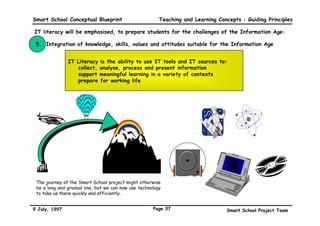
IT literacy will be emphasised, to prepare students for the challenges of the Information Age:

 5. Integration of knowledge, skills, values and attitudes suitable for the Information Age


               IT   Literacy is the ability to use IT tools and IT sources to:
               •    collect, analyse, process and present information
               •    support meaningful learning in a variety of contexts
               •    prepare for working life


 The journey of the Smart School project might otherwise
 be a long and gradual one, but we can now use technology
 to take us there quickly and efficiently.


9 July, 1997                                         Page 37                     Smart School Project Team
Smart School Conceptual Blueprint        Teaching and Learning Concepts : Guiding Principles

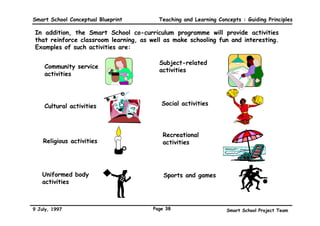
In addition, the Smart School co-curriculum programme will provide activities
that reinforce classroom learning, as well as make schooling fun and interesting.
Examples of such activities are:

                                         Subject-related
    Community service
                                         activities
    activities


    Cultural activities                   Social activities


                                          Recreational
    Religious activities                  activities


   Uniformed body                          Sports and games
   activities


9 July, 1997                           Page 38                    Smart School Project Team
Smart School Conceptual Blueprint               Teaching and Learning Concepts : Guiding Principles

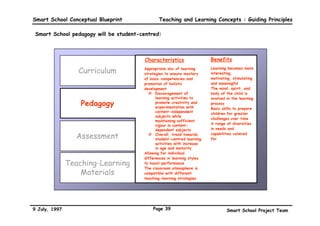
 Smart School pedagogy will be student-centred:


                                        Characteristics                       Benefits

                  Curriculum           • Appropriate mix of learning
                                         strategies to ensure mastery
                                                                          •   Learning becomes more
                                                                              interesting,
                                         of basic competencies and            motivating, stimulating
                                         promotion of holistic                and meaningful
                                         development                      •   The mind, spirit, and
                                           # Encouragement of                 body of the child is
                                               learning activities to         involved in the learning
                   Pedagogy                    promote creativity and
                                               experimentation with
                                                                              process
                                                                          •   Basic skills to prepare
                                               content-independent            children for greater
                                               subjects while
                                                                              challenges over time
                                               maintaining sufficient
                                               rigour in content-         •   A range of diversities
                                               dependent subjects             in needs and

                 Assessment                # Overall, trend towards
                                               student-centred learning
                                                                              capabilities catered
                                                                              for
                                               activities with increase
                                               in age and maturity
                                       • Allowing for individual
                                         differences in learning styles
               Teaching-Learning         to boost performance
                                       • The classroom atmosphere is
                   Materials             compatible with different
                                         teaching-learning strategies


9 July, 1997                                 Page 39                                  Smart School Project Team
Smart School Conceptual Blueprint              Teaching and Learning Concepts : Guiding Principles

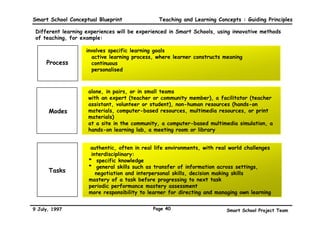
 Different learning experiences will be experienced in Smart Schools, using innovative methods
 of teaching, for example:

                    involves specific learning goals
                   • active learning process, where learner constructs meaning
     Process       • continuous
                   • personalised


                   • alone, in pairs, or in small teams
                   • with an expert (teacher or community member), a facilitator (teacher
                     assistant, volunteer or student), non-human resources (hands-on
      Modes          materials, computer-based resources, multimedia resources, or print
                     materials)
                   • at a site in the community, a computer-based multimedia simulation, a
                     hands-on learning lab, a meeting room or library


                   • authentic, often in real life environments, with real world challenges
                   • interdisciplinary:
                     * specific knowledge
                     * general skills such as transfer of information across settings,
      Tasks            negotiation and interpersonal skills, decision making skills
                   • mastery of a task before progressing to next task
                   • periodic performance mastery assessment
                   • more responsibility to learner for directing and managing own learning


9 July, 1997                                 Page 40                     Smart School Project Team
Smart School Conceptual Blueprint                                           Teaching and Learning Concepts : Guiding Principles

In Smart Schools, there will be an appropriate mix of learning strategies to ensure mastery
of basic competencies and promotion of holistic development
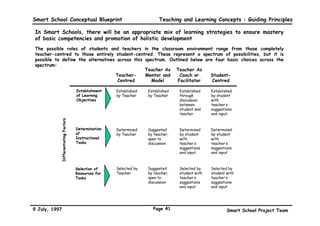
The possible roles of students and teachers in the classroom environment range from those completely
teacher-centred to those entirely student-centred. These represent a spectrum of possibilities, but it is
possible to define the alternatives across this spectrum. Outlined below are four basic choices across the
spectrum:
                                                Teacher As Teacher As
                                   Teacher-     Mentor and     Coach or    Student-
                                    Centred        Model     Facilitator    Centred

                                     Establishment   • Established   • Established   • Established    • Established
                                     of Learning       by Teacher      by Teacher      through          by student
                                     Objectives                                        discussion       with
                                                                                       between          teacher’s
                                                                                       student and      suggestions
                                                                                       teacher          and input
           Differentiating Factors


                                     Determination   • Determined    • Suggested     • Determined     • Determined
                                     of                by Teacher      by teacher,     by student       by student
                                     Instructional                     open to         with             with
                                     Tasks                             discussion      teacher’s        teacher’s
                                                                                       suggestions      suggestions
                                                                                       and input        and input


                                     Selection of    • Selected by   • Suggested     • Selected by    • Selected by
                                     Resources for     Teacher         by teacher,     student with     student with
                                     Tasks                             open to         teacher’s        teacher’s
                                                                       discussion      suggestions      suggestions
                                                                                       and input        and input


9 July, 1997                                                             Page 41                                Smart School Project Team
Smart School Conceptual Blueprint                               Teaching and Learning Concepts : Guiding Principles

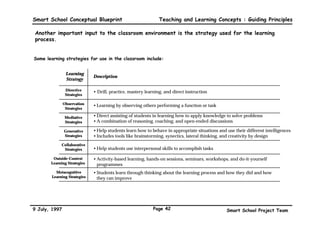
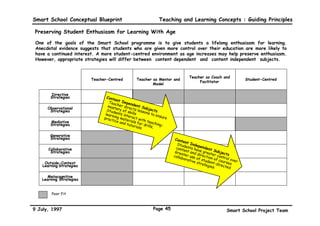
Another important input to the classroom environment is the strategy used for the learning
process.


Some learning strategies for use in the classroom include:


                Learning
                              Description
                Strategy

                Directive     • Drill, practice, mastery learning, and direct instruction
                Strategies

               Observation    • Learning by observing others performing a function or task
                Strategies

               Mediative      • Direct assisting of students in learning how to apply knowledge to solve problems
               Strategies     • A combination of reasoning, coaching, and open-ended discussions

               Generative     • Help students learn how to behave in appropriate situations and use their different intelligences
               Strategies     • Includes tools like brainstorming, synectics, lateral thinking, and creativity by design
             Collaborative
              Strategies      • Help students use interpersonal skills to accomplish tasks

        Outside-Context       • Activity-based learning, hands-on sessions, seminars, workshops, and do-it-yourself
       Learning Strategies      programmes
          Metacognitive       • Students learn through thinking about the learning process and how they did and how
        Learning Strategies     they can improve


9 July, 1997                                                 Page 42                            Smart School Project Team
Smart School Conceptual Blueprint                                                     Teaching and Learning Concepts : Guiding Principles

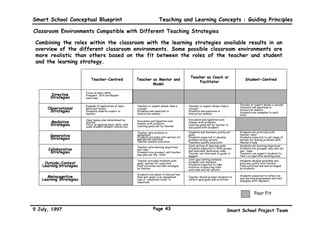
Classroom Environments Compatible with Different Teaching Strategies

 Combining the roles within the classroom with the learning strategies available results in an
 overview of the different classroom environments. Some possible classroom environments are
 more realistic than others based on the fit between the roles of the teacher and student
 and the learning strategy.

                                                                                                            Teacher as Coach or
                               Teacher-Centred                     Teacher as Mentor and                                                              Student-Centred
                                                                                                                Facilitator
                                                                           Model

                          • Focus on basic skills
         Directive        • Frequent “Drill and Repeat”
        Strategies          exercises


                          • Example of application of basic        • Teacher or expert shows class a      • Teacher or expert shows class a     • Teacher or expert shows a concept
      Observational         skills and theory                        concept                                concept                             • Students ask questions in
                                                                                                                                                  interactive session
       Strategies         • Students observe expert or             • Students ask questions in            • Students ask questions in           • Students are examples to each
                            teacher                                  interactive session                    interactive session                   other
                          • Clear lesson plan determined by                                               • Discussion and Question-and-
        Mediative           teacher                                • Discussion and Question-and-
                                                                     Answer with students                   Answer with students
        Strategies        • Focus on applying basic skills, with
                            some student-student interaction       • Learning goals set by teacher        • Learning goals set by teacher in
                                                                                                            discussion with students
                                                                   • Teacher sets problem or              • Students and teachers jointly set   • Students set priorities with
        Generative                                                   assignment
                                                                   • Students provided with options for
                                                                                                            goals
                                                                                                          • Students expected to develop
                                                                                                                                                  teacher input
                                                                                                                                                • Students expected to set range of
        Strategies                                                   appropriate solutions                  problem-solving options               options for solving problems with
                                                                   • Teacher assists execution            • Teachers assists execution            teacher’s help
                                                                   • Teacher sets learning objectives     • Joint setting of learning goals     • Students set learning objectives
       Collaborative                                                 and rules                            • Students expected to form groups
                                                                                                            and internally determine roles
                                                                                                                                                • Students are grouped, may also set
                                                                                                                                                  own “roles”
        Strategies                                                 • Students are grouped, and teacher    • Teacher can intervene to guide or   • Teachers can support students to
                                                                     may also set the “roles”               suggest                               find a co-operative working style
                                                                   • Teacher provides students with       • Joint goal setting between          • Students develop problems and
     Outside-Context                                                 goals, options for execution           students and teachers
                                                                                                          • Students expected to take             solutions jointly with teacher
    Learning Strategies                                            • Field activities and labs arranged     initiative in selecting field       • Field activities and labs arranged
                                                                     by teacher                             exercises and lab options             by students

                                                                   • Students are asked to discuss how
      Metacognitive                                                  they met goals in an assignment      • Teacher should prompt students to   • Students expected to reflect on
                                                                                                                                                  own learning programmes and hold
   Learning Strategies                                             • Use of “simulated recall” in           reflect upon goals and activities     dialogues with teachers
                                                                     classroom


                                                                                                                                                             Poor Fit


9 July, 1997                                                                     Page 43                                                  Smart School Project Team
Smart School Conceptual Blueprint                      Teaching and Learning Concepts : Guiding Principles

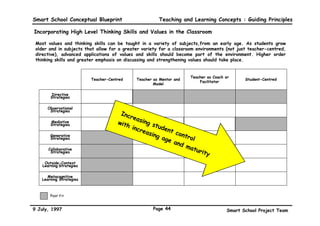
Incorporating High Level Thinking Skills and Values in the Classroom

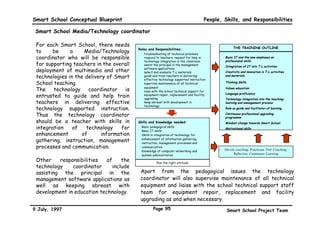
 Most values and thinking skills can be taught in a variety of subjects,from an early age. As students grow
 older and in subjects that allow for a greater variety for a classroom environments (not just teacher-centred,
 directive), advanced applications of values and skills should become part of the environment. Higher order
 thinking skills and greater emphasis on discussing and strengthening values should take place.


                                                                     Teacher as Coach or
                          Teacher-Centred    Teacher as Mentor and                           Student-Centred
                                                                         Facilitator
                                                     Model

         Directive
        Strategies

      Observational
       Strategies
                                       Inc
                                           rea
        Mediative                     with     sing
        Strategies
                                            incr    stud
                                                eas      ent
                                                    ing       con
        Generative
        Strategies                                      age      trol
                                                             and
                                                                  mat
       Collaborative                                                  urit
        Strategies                                                        y
     Outside-Context
    Learning Strategies

      Metacognitive
   Learning Strategies


        Poor Fit


9 July, 1997                                        Page 44                           Smart School Project Team
Smart School Conceptual Blueprint                                  Teaching and Learning Concepts : Guiding Principles

Preserving Student Enthusiasm for Learning With Age

 One of the goals of the Smart School programme is to give students a lifelong enthusiasm for learning.
 Anecdotal evidence suggests that students who are given more control over their education are more likely to
 have a continued interest. A more student-centred environment as age increases may help preserve enthusiasm.
 However, appropriate strategies will differ between “content dependent” and “content independent” subjects.


                                                                                    Teacher as Coach and
                          Teacher-Centred           Teacher as Mentor and                                          Student-Centred
                                                                                         Facilitator
                                                            Model

         Directive
        Strategies                Cont
                                 • Te ent Dep
                                      ac       en
                                   mast her dire dent Su
      Observational            • St ery of cts les bjects
       Strategies                   ud         s          sons
                                 learn ents int kills          to en
                                prac  ing m eract                   sure
                                            ater       w
        Mediative
                                     tice
                                          and    ials f ith tea
        Strategies                            tuto or dril ching-
                                                    rials     ls,
                                                         .
        Generative
        Strategies                                                           Cont
                                                                            • St ent Ind
                                                                                 ud       ep
       Collaborative                                                         cont ents ha endent
                                                                           • Gr   ent      ve         Su
        Strategies                                                              eate and dir greater bjects
                                                                            colla   r use     ectio    cont
                                                                                 bora     o         n      ro
                                                                                     tive f stude of cour l over
     Outside-Context                                                                      stra      nt-d    ses
                                                                                               tegi      i
    Learning Strategies                                                                            es rected

      Metacognitive
   Learning Strategies


        Poor Fit


9 July, 1997                                                   Page 45                                    Smart School Project Team
Smart School Conceptual Blueprint               Teaching and Learning Concepts : Guiding Principles

 Another key factor in choosing classroom environments is the need to deal with diversity of
 skills, abilities, and enthusiasm levels in every group of students. A growing body of research
 suggests that many students have learning styles that are not catered for in traditional
 classroom environments.

                                             Students often classified
               Highly-motivated
                                             as “at risk” usually prefer
               students prefer to work
                                             to learn in small groups -
               by themselves to working
                                             something which is not
               in groups                                                        To accommodate
                                             often done in a traditional
                                             classroom.                         diversity in
                                                                                students, teachers
               Some students appear                                             should make a point
               to work faster and enjoy
               learning more when able
                                             Some students prefer to            to include a variety
                                             move around while                  of different types
               to operate at their own       thinking about problems
               pace                                                             of lessons and
                                                                                learning
                                                                                experiences.
               Some students should
               be provided with              Some students find bright          Making use of
               additional materials that     lights very distracting.           students’ learning
               they can pursue without       Reducing lighting intensity
                                             can make concentration             styles can be
               disturbing the class
               while others finish           easier                             helpful in managing
               exercises                                                        diversity of
                                                                                motivation and
                                                                                ability in the
                Some students are                                               classroom.
                able to operate in all       Some students prefer a less
                three learning               formal classroom environment
                modalities: visual,
                auditory, and
                kinaesthetic


9 July, 1997                                 Page 46                        Smart School Project Team
Smart School Conceptual Blueprint                Teaching and Learning Concepts : Guiding Principles

The classroom atmosphere will be important to support the Smart School teaching and learning
model:

 Creating an atmosphere of respect and rapport
 • positive teacher interaction with students
 • positive student interaction

 Establishing a culture for learning
 • importance of a balance between process and content in learning
 • student pride in work
 • high expectations for learning and achievement

 Managing classroom procedures
 • collaborative management of instructional groups
 • seamless management of transitions
 • collaborative management of materials and supplies
 • collaborative performance of non-instructional tasks
 • effective supervision of volunteers and paraprofessionals

 Managing student behaviour
 • clear standards of conduct developed with students’ input
 • unobtrusive monitoring of student behaviour by teacher and peers
 • sensitive and appropriate response to student misbehaviour

 Organising physical space
 • safe and optimal use of class space and furniture
 • optimal use of all physical resources
 • equal accessibility to all learning

9 July, 1997                                   Page 47                    Smart School Project Team
Smart School Conceptual Blueprint              Teaching and Learning Concepts : Guiding Principles

The Smart School assessment system will involve a significant departure from traditional
assessment systems:


                                         Characteristics         Benefits
                  Curriculum
                                         1. Holistic             •   Help realise the
                                         2. Element-based            National Philosophy
                                         3. Criterion-               of Education
                                            referenced           •   Assure quality
                   Pedagogy              4. Learner-centred
                                                                 •   Flexible and
                                         5. On-line
                                                                     learner-friendly
                                         6. Conducted in
                                                                 •   Provide more
                                            various forms
                                         7. Using multiple           accurate picture of
                                                                     a student’s
                   Assessment               approaches and
                                                                     achievement,
                                            instruments
                                         8. On-going                 readiness,
                                                                     progress, aptitude,
                                                                     learning styles, and
               Teaching-Learning                                     abilities
                   Materials


9 July, 1997                                Page 48                        Smart School Project Team
Smart School Conceptual Blueprint              Teaching and Learning Concepts : Guiding Principles

Firstly, the Smart School assessment system shall be holistic:


   The scope of assessment in the Smart School is holistic in that it covers not only
   achievement but also readiness, progress and aptitude. Such an approach will give various
   information regarding the student’s learning styles and abilities.


                            Learners have different experiences and their levels of entry in
         Readiness
                            certain learning areas need to be assessed.


                            The student’s progress in achieving certain learning objectives
         Progress           need to be monitored. His/Her strengths and weaknesses also
                            need to be diagnosed.


                            Assessing the achievement of each intended learning outcome in a
        Achievement         learning area is necessary to indicate whether the learner is
                            ready to move on to the next area.


                            Learners’ different styles of learning and multiple intelligences
        Aptitude            have to be recognised.


9 July, 1997                                 Page 49                      Smart School Project Team
Smart School Conceptual Blueprint               Teaching and Learning Concepts : Guiding Principles

 The assessment system shall also be element-based
 Element-based assessment focuses on the elements that students possess or must develop
 through the subjects in the school curriculum. This kind of assessment provides information on
 the mastery and achievement of elements by a student.

      The following are examples of elements that may be developed through various
      subjects:
       Subject/Area of Study                  Element


        Communication                          Ability to demonstrate ideas


        Social-emotional development           Ability to work co-operatively in a
                                               group


        Cognitive development                  Ability to estimate quantities


         Science and Technology                 Ability to formulate hypotheses


9 July, 1997                                  Page 50                     Smart School Project Team
Smart School Conceptual Blueprint                  Teaching and Learning Concepts : Guiding Principles

The Smart School assessment system shall be criterion-referenced:

        Criterion-referenced assessment is a form of assessment that evaluates an individual’s
                        performance based on a predetermined set of criteria.

       The identification of constructs which have to be
       developed and instilled in an individual provides the
       quantitative dimension. In order to operationalise our               SMART SCHOOL
       National Philosophy of Education, educational
       standards need to be established. Educational
       standards are statements pertaining to the minimum
       level of attainment to be achieved by an individual
       based on a predetermined set criteria and
       operationalised by a set of performance indicators.

       National    criteria   are    statements     on    the
       characteristics and levels of quality of elements that
       needs to be developed within an individual.

       National performance indicators are statements on
       the type and features of evidence that can be
       observed while making judgements on the mastery of
       an element by an individual. Therefore assessment of
       the development of elements must be based on the
       set of criteria.


9 July, 1997                                    Page 51                     Smart School Project Team
Smart School Conceptual Blueprint             Teaching and Learning Concepts : Guiding Principles

Assessment will also be learner-centred:

                Learner-centred assessment is a flexible system of assessment which is
                                 administered on an individual basis.


          All students will be assessed when they are ready. All assessment results
          will be recorded, and the reports done accordingly.


9 July, 1997                                Page 52                    Smart School Project Team
Smart School Conceptual Blueprint             Teaching and Learning Concepts : Guiding Principles

The assessment system will be on-line


         On-line assessment means that the items for smart assessment will be stored in
          a computerised item bank and be made available to users on terminals through
                                          networking.

         The integration of technology as a tool to facilitate assessment will create
         a climate where assessment can be provided for each student virtually on
         demand.

         With item banks and networking, teachers, students, assessment workers
         can engage in assessment activities whenever they are ready.


9 July, 1997                                Page 53                    Smart School Project Team
Smart School Conceptual Blueprint                   Teaching and Learning Concepts : Guiding Principles

 Assessment will be conducted in various forms: Classroom Assessment, School-based
 Assessment and Centralised Assessment, to allow different demonstrations of strengths,
 abilities and knowledge.


                                                • determine entry points of students
                                                • diagnose students’ strengths and
                        Done prior     in
         Classroom       to, during               weaknesses
                                       order
         Assessment      and after      to      • monitor students’ progress
                        instruction             • determine instructional effectiveness
                                                • identify intellectual aptitudes


                        Done at the     in
        School-based    end of each     order   • assess achievement of each intended learning
         Assessment       learning       to       outcome in the curriculum
                            area


                                                • assess overall achievement of elements that
                         Conducted
                                        in        need to be developed in the educational
          Centralised    on demand
                                        order
                        when learner              process.
          Assessment                    to
                          is ready              • assess intellectual aptitude based on the
                                                  multiple intelligences of the student


9 July, 1997                                     Page 54                           Smart School Project Team
Smart School Conceptual Blueprint              Teaching and Learning Concepts : Guiding Principles

The Smart School assessment system will use multiple approaches and instruments to perform
Authentic, Alternative and Performance Assessments:
    Authentic, Alternative, and Performance Assessment actively involves students in a
    process that combines what is taught, how it is taught, and how it is evaluated


                                                   Authentic, alternative and performance
                                                     Authentic, alternative and performance
                                                   approach using the following instruments:
                                                     approach using the following instruments:


                                                                                                 School Records
           Classroom                               • •anecdotal records
                                                       anecdotal records
           Assessment               by means of    • •calendar records
                                                       calendar records
                                                   • •checklists
                                                       checklists
                                                   • •work samples
                                                       work samples
                                                   • •exhibitions
                                                       exhibitions

                                                   Authentic, alternative and
               School-based                        performance approach using the
                                    by means of    following instruments:
               Assessment
                                                   • checklists
                                                   • criterion-referenced tests


                                                                                                   Certification
                                                   • projects
                                                   • work samples and exhibitions

               Centralised                         Criterion-referenced
               Assessment           by means of    standardised tests
                                                   Multiple Intelligences tests

9 July, 1997                                 Page 55                       Smart School Project Team
Smart School Conceptual Blueprint                 Teaching and Learning Concepts : Guiding Principles

 Smart school assessment will also be on-going and continuous:

     Assessment is part of the teaching and learning process, and must therefore be on-going
     in nature. Hence, certification is a “living” process.

     Certification is an important aspect of
     assessment. The certification process must be
     in harmony with the nature of assessment. To
     ensure that assessment is on-going, a ‘living’         SMART SCHOOL

     certification system will be introduced. Living
     certification is based on the belief that, given
     the opportunity, an individual can improve
     himself. Therefore certification, a record of
     students’ accomplishment, should be a living
     process     whereby    data    on    educational
     accomplishment is continuously gathered.

     As the individual improves himself, data on his
     performance is updated accordingly. To realise
     this, a Lifetime Database (LTDB), where each
     learner is identified by a Single ID must be
     established.

     A Patching System which allows students to
     make improvements on his weaknesses would
     ensure that certification becomes a ‘living’
     process.

9 July, 1997                                    Page 56                    Smart School Project Team
Smart School Conceptual Blueprint               Teaching and Learning Concepts : Guiding Principles

 A living certification process will be employed for Smart Schools:


                         De
                         De                                                     Di
                                                                                Di
                       Assessment data
                                           Merged
                                           Merged          Assessment data from
                       from centralised                   school-based assessment           School-based
                                                                   provided
Centralised          assessment provided
                                                         by internal assessors, which        Assessment
                             by
Assessment            external assessors
                                                            include teachers, self,
                                                              peers and parents


As the individual              Certification Conditions
                               Certification Conditions
improves     himself,
the data on his                                                                         PATCH
performance         is
updated
accordingly.
A Patching System                                          PENDING
                                 YES
which          allows
students to make
improvements       on
his      weaknesses                         Report
would ensure that
certification
                                                                Satisfactory                    Certify
becomes a ‘living’
process.                                                           Credit
                                                                     Excellent

9 July, 1997                                  Page 57                             Smart School Project Team
6PDUW6FKRRORQFHSWXDO%OXHSULQW              7HDFKLQJDQG/HDUQLQJRQFHSWV*XLGLQJ3ULQFLSOHV

7KH6PDUW6FKRRO7HDFKLQJ/HDUQLQJ0DWHULDOVZLOOEHGHVLJQHGWRIXOOVXSSRUWWKHQHZWHDFKLQJ
OHDUQLQJVWUDWHJLHVIRU6PDUW6FKRROV


                                        KDUDFWHULVWLFV            %HQHILWV
                XUULFXOXP             0HHWVFXUULFXODU       ‡ $FFRPPRGDWHV
                                         DQGLQVWUXFWLRQDO        VWXGHQWV·GLIIHUHQW
                                         QHHGVLVFRVW           QHHGVDQGDELOLWLHV
                                         HIIHFWLYHDVZHOO       UHVXOWLQJLQWKH
                                         DVFRVPHWLFDOODQG      IXOOHUUHDOLVDWLRQRI
                 3HGDJRJ                WHFKQLFDOODGHTXDWH     VWXGHQWV·FDSDELOLWLHV
                                       RJQLWLYHO              DQGSRWHQWLDO
                                         FKDOOHQJLQJ           ‡ 6WXGHQWVWDNH
                                         DWWUDFWLYH              UHVSRQVLELOLWIRU
                                         PRWLYDWHVVWXGHQWV       PDQDJLQJDQG
                                         WROHDUQDQG            GLUHFWLQJWKHLU RZQ
               $VVHVVPHQW                HQFRXUDJHVDFWLYH        OHDUQLQJ
                                         SDUWLFLSDWLRQ
                                       RPELQHVWKHEHVW
                                         RIQHWZRUNEDVHG
           7HDFKLQJ/HDUQLQJ            WHDFKHUEDVHGDQG
                                         FRXUVHZDUH
               0DWHULDOV                 PDWHULDOV


-XO                                3DJH                           6PDUW6FKRRO3URMHFW7HDP
Smart School Conceptual Blueprint                      Teaching and Learning Concepts : Guiding Principles

 Conceptual selection and evaluation guidelines for teaching-learning materials will cover five
 main criteria:

 1. Meets curricular and instructional needs, is cost effective, as well as cosmetically and technically adequate

           COSMETIC ADEQUACY                                                   TECHNICAL ADEQUACY
     •   Graphic quality                                                   • User-friendly
     •   Video quality                                                     • Clear and comprehensive
     •   Animation quality                                                   manuals and guides
     •   Voice  sound quality
     •   Layout quality
     •   Colour and fonts quality

                                                                                 CURRICULUM ADEQUACY
     INSTRUCTION ADEQUACY
                                               COMPONENTS                       • In-line with curriculum
                                                                                  specifications
     • Promotes vertical and                    OF QUALITY                      • Promotes values, skills
       horizontal integration
     • Considers different                                                        (especially thinking skills),
       capabilities of students                                                   knowledge, and language
       and teachers                                                               across the curriculum
     • Suitable for a variety of                                                • Consistent with teaching-
       learning environments                                                      learning objectives
     • Well designed interface                                                  • Content is accurate and
     • Professionally done                                                        up-to-date
     • Adaptable to different                 COST EFFECTIVENESS                • Content is relevant to
       teaching-learning styles                                                   student’s environment
                                              • Value for money                 • Assessment is built-in


9 July, 1997                                         Page 59                          Smart School Project Team
Smart School Conceptual Blueprint                                             Teaching and Learning Concepts : Guiding Principles
 Smart School teachers will be enabled, through the use of technology, to consider students’
 individual learning preferences in designing and recommending instructional methods and
 materials:

  2.    Cognitively challenging, attractive, motivates students to learn, and encourages active participation
      e
    pl
  am


       VERBAL/LINGUISTIC                   LOGICAL/MATHEMATICAL
Ex


                                                                                     VISUAL/SPATIAL                             BODY/KINESTHETIC
       • Reading                           • Abstract Symbols/Formulas               • Visualisation                            • Folk/Creative Dance
       • Vocabulary                        • Outlining                               • Active Imagination                       • Role Playing
       • Formal Speech                     • Graphic Organisers                      • Colour Schemes                           • Physical Games
       • Journal/Diary Keeping             • Number Sequences                        • Patterns/Designs                         • Drama
       • Creative Writing                  • Calculation                             • Painting                                 • Martial Arts
       • Poetry                            • Deciphering Codes                       • Drawing                                  • Body Language
       • Verbal Debate                     • Forcing Relationships                   • Mind-mapping                             • Physical Exercise
       • Impromptu Speaking                • Syllogisms                              • Pretending                               • Mime
       • Humour/Jokes                      • Problem-Solving                         • Sculpture                                • Inventing
       • Storytelling                      • Pattern Games                           • Visual Pictures                          • Sport games


       MUSICAL/RHYTHMIC                    INTERPERSONAL                            INTRAPERSONAL
       • Rhythmic Patterns                 • Giving Feedback                        • Meditation Methods
       • Vocal Sounds/Tones                • Intuiting Others’ Feelings             • Metacognition Techniques
       • Music Composition/Creation        • Co-operative Learning Strategies       • Thinking Strategies
       • Percussion Vibrations             • Person-to-Person Communication         • Emotional Processing
       • Humming                           • Empathy Practices                      • “Know Thyself” Procedures
       • Environmental Sounds              • Division of Labour                     • Mindfulness Practices                     SMART
       • Singing                           • Collaboration Skills                   • Focusing/Concentration Skills
       • Tonal Patterns                    • Receiving Feedback                     • Higher-Order Reasoning                   SCHOOL
       • Music Performance                 • Sensing Others’ Motives
                                           • Group Projects
                                                                                    • Complex Guided Imagery
                                                                                    • “Centring” Practices
                                                                                                                               TOOLBOX

Source: Armstrong, Thomas. (1994). Multiple Intelligences in the Classroom. Alexandria, Virginia, U.S.A.: Association for Supervision and Curriculum Development


9 July, 1997                                                              Page 60                                       Smart School Project Team
Smart School Conceptual Blueprint                                             Teaching and Learning Concepts : Guiding Principles

     … because children have different learning styles, they will need a variety of materials
     to maximise their learning potential:
    pl
      e
  am


    Children Who
Ex


                                   Think                           Love                                     Need
    Are Strongly

                                   in words                      reading, writing, telling stories,       books, tapes, writing tools, paper, diaries,
     Linguistic
                                                                 playing word games.                      dialogue, discussion, debate, stories.


                                   by reasoning                  experimenting, questioning,              things to explore and think about, science
     Logical-
                                                                 figuring out logical puzzles,            materials, manipulatives, trips to the science
     Mathematical
                                                                 calculating.                             museum.

                                   in images and                 designing, drawing, visualising,         art, building blocks, video, movies, slides,
     Spatial
                                   pictures                      doodling.                                imagination games, mazes, puzzles, illustrated
                                                                                                          books.

                                   through somatic               dancing, running, jumping,               role play, drama, movement, things to build,
     Bodily-Kinaesthetic
                                   sensations                    building, touching, gesturing.           sports and physical games, tactile experiences.


                                   via rhythms and               singing, whistling, humming,             sing-along sessions, trips to concerts, music
     Musical
                                   melodies                      tapping feet and hands, listening..      playing, musical instruments.


                                   by bouncing ideas off         leading, organising, relating,           friends, group games, social gatherings,
     Interpersonal
                                   other people                  manipulating, mediating.                 community events, clubs.

                                   deeply inside of              setting goals, mediating,                time alone, self-paced projects, choices.
     Intrapersonal
                                   themselves                    dreaming, being quiet, planning


 Source: Armstrong, Thomas. (1994). Multiple Intelligences in the Classroom. Alexandria, Virginia, U.S.A.: Association for Supervision and Curriculum Development


   9 July, 1997                                                              Page 61                                       Smart School Project Team
Smart School Conceptual Blueprint               Teaching and Learning Concepts : Guiding Principles

Conventional media, commonly used in today’s educational settings, will still feature in Smart
Schools. They can be divided into three main categories.


                      Printed              3D Objects            Audio/Visual
                   (paper based)
               Examples:               Examples:            Examples:
               • Books                 • Globes             • Slide-Tapes
               • Encyclopaedias        •   Puppets          • Filmstrips
               • Magazines             •   Models           • Radio Programmes
               • Newspapers            •   Mock-ups         • TV Programmes
               • Documents             •   Collections      • Motion-picture
               • Flat Pictures         •   Specimens           films
               • Drawings/Paintings                         • Microfilms/
               • Maps                                         Microfiches
               • Graphs/Charts/                             • Audio Cards
                 Diagrams                                   • Audio Tapes
               • Posters
               • Cartoons/Comics


9 July, 1997                                  Page 62                     Smart School Project Team
Smart School Conceptual Blueprint                                         Teaching and Learning Concepts : Guiding Principles
Conventional media will be used in an integrated manner with high-technology media, for example,
computer-based teaching-learning materials...

                        MODULES                                   Virtual      Individual
                        FOR                                       reality      self-paced
                                                                                            Problem     Artificial        3.      Combines the best of
                                      Interactive   Simulation                              solving     Intelligence
                        COMPUTER
                                      story books   games
                                                                  system       learning     computer    modules
                                                                                                                                  network-based,
                        ASSISTED                                  software     modules
                        INSTRUCTION
                                                                                            games                                 teacher-based and
                                                                                                                                  courseware materials


                                                                                                        Musical
 COMPUTER-BASED MEDIA


                                      Desktop        Authoring                                          Instrument
                                                     language     Presentation Draw and     Animation                  Music
                          TOOLS       publishing                               Paint                    Digital
                                                     software     software                  software                   composition     Clip
                                      software                                 programmes               Interface
                                                                                                                       software        Art


                                                     Video
                          NETWORK-     Item          on          Interactive    On-line      Bulletin    Search                      Video          E-mail
                                                                                                                       Distance
                          BASED        bank          Demand      TV             Library      Board       Engines                     Conferencing
                                                                                                                       Learning


                                                                               Computer
                                       Database     Word
                        APPLICATION                              Spreadsheet   Assisted
                                       software     Processing
                        SOFTWARE                                 software      Design
                                                    software
                                                                               software


9 July, 1997                                                          Page 63                                      Smart School Project Team
Smart School Conceptual Blueprint                                             Teaching and Learning Concepts : Guiding Principles

 … and software that fulfil the various needs and capabilities of students

      ple                                                                           Bodily-Kinaesthetic Intelligence
    am      Linguistic Intelligence
  Ex        •Word processing programmes                                             •Hands-on construction kits that interface with
            •Typing tutors                                                           computers
            •Desktop publishing programmes                                          •Motion-simulation games
            •Electronic libraries                                                   •Virtual-reality system software
            •Interactive storybooks                                                 •Eye-hand co-ordination games
            •Word Games                                                             •Tools that plug into computers


            Logical-Mathematical                                                    Musical Intelligence
            Intelligence                                                            •Music literature tutors
            •Mathematical skills tutorials                                          •Singing software (transforms voice input
            •Computer programming tutors                                             into synthesiser sounds)
            •Logic games                                                            •Composition software
            •Science programmes                                                     •Tone recognition and melody memory enhancers
            •Critical thinking programmes                                           •Musical instrument digital interfaces (MIDI)


            Spatial Intelligence
            •Animation programmes                                                   Interpersonal Intelligence
            •Draw and Paint programmes                                              •Electronic bulletin boards
            •Electronic chess games                                                 •Simulation games
            •Spatial problem solving games
            •Electronic puzzle kits
                                                                                    Intrapersonal Intelligence
            •Clip Art programmes
                                                                                    •Personal choice software
            •Geometry programmes
                                                                                    •Career counselling software
            •Graphic presentations of knowledge
                                                                                    •Any self-paced programme

Source: Armstrong, Thomas. (994). Multiple Intelligences in the Classroom. Alexandria, Virginia, U.S.A.: Association for Supervision and Curriculum Development


9 July, 1997                                                              Page 64                                       Smart School Project Team
Smart School Conceptual Blueprint              Teaching and Learning Concepts : Guiding Principles

Teaching-learning materials will be acquired from a wide range of sources, and will no longer be
limited by resources within schools. In addition to libraries, businesses, homes, government
departments, other sources include:


                                            Internet
                                                                             Classified
       Edunet                                                                   Printed
                                                                            Directories


                                    Teaching-Learning
                                     MATERIALS 
                                       SOURCES


9 July, 1997                                 Page 65                     Smart School Project Team
Smart School Conceptual Blueprint


         The Malaysian Smart School

                   Smart School
                   Management


9 July, 1997                        Page 66   Smart School Project Team
Smart School Conceptual Blueprint                                                   Smart School Management

     Smart School Management

    This Section provides a high-level description of Smart School Management. The
    objectives of Smart School Management are to efficiently and effectively manage the
    resources and processes required to support the Teaching and Learning functions of the
    school.


                                                                         How to read this Section

                                                                         The Section begins with a
                                                                         description   of    the   key
                                                                         characteristics    of   Smart
               PEOPLE, SKILLS 
                                                   PROCESSES
                                                                         School Management. Smart
                                  Management
               RESPONSIBILITIES
                                                                         School Management functions
                                                                         are categorised into nine
                     TEACHING  LEARNING                                 broad areas and each of these
                                  Administration                         functions are also described
               TECHNOLOGY                           POLICIES
                                                                         in further detail.


9 July, 1997                                                   Page 67               Smart School Project Team
Smart School Conceptual Blueprint                                                 Smart School Management

The functional elements of the Smart School Management System is divided into nine primary
areas:


                                                                          School Governance
                                                                            Student Affairs
                                                                         Educational Resources
                                                                          External Resources
                                                                               Finance
                                                                               Facilities
               PEOPLE, SKILLS 
                                                   PROCESSES
               RESPONSIBILITIES   Management

                    TEACHING  LEARNING
                                                                          Human Resources
               TECHNOLOGY
                                  Administration    POLICIES                   Security
                                                                             Technology

9 July, 1997                                                   Page 68            Smart School Project Team
Smart School Conceptual Blueprint                                                     Smart School Management
 Primary objective of Smart School Management :
To efficiently and effectively manage the resources and processes required to support the teaching and
learning functions within Smart Schools:


                                                   Characteristics                          Benefits
     School Governance                                                                • Efficiency
                                      • Strong, professional administrators and
                                        teachers                                           - Re-allocation of skilled
        Student Affairs               • School goals articulated clearly                     human resources to
                                      • Leads teaching at the school                         more valuable activities
                                                                                           - Cost savings over the
   Educational Resources              • High level of parental and community
                                                                                             long term
                                        support and involvement
                                      • Maintains open channels of
     External Resources                 communication with all constituencies         • Effectiveness
                                      • Allocates resources to benefit the greatest        - Improves quality of
                                                                                             decisions through better
            Financial                   number of students
                                      • Tracks performance against key financial             access to information
                                        and non-financial objectives                       - Improves speed of
            Facilities                • Provides a school climate that is conducive          decision making
                                        to learning - safe, clean, caring, well
                                        organised
      Human Resources                 • Develops and maintains a happy, motivated
                                        and high performing staff
                Security              • Ensure the security of the school and its
                                        occupants
                                      • Uses and manages technology
          Technology                    appropriately, effectively and efficiently


 9 July, 1997                                       Page 69                              Smart School Project Team
Smart School Conceptual Blueprint                                                                    Smart School Management
Smart School management functional areas
The Nine Primary Functions of Smart School Management :
                                                                  • Physical Security
                                                                  • IT Security
                                                                  • Student Safety
                                                       Security

                                                                                                •   Communications/pr
                                    Technology                                School
  •   Long Term Planning                                                                        •   School Policy Making
                                                                              Governance
  •   System Implementation                                                                     •   Curriculum Management
  •   System Maintenance                                                                        •   Community Involvement
  •   Training
  •   Field Support Management
                                                                                           Student        •   Student Profiles
                                                                                           Affairs        •   Performance Evaluations
                                                                                                          •   Test Administration
                             Financial                                                                    •   Counselling
      •   Budgeting
                             Management
      •   Reporting                                  Smart School                                         •   Health, Insurance  Others
      •   Accounting
      •   Purchasing
                                                     Management
      •   Project Funding                              System
                                                                                           Educational
      •   Long Term Planning
                                                                                            Resources         • Resource Database
      •   Audit and Control
                                                                                                                Management
                                                                                                              • Input to Curriculum
                                  Human
                                                                                                                Development
                                 Resources

                                                     Facilities             External
  • Teacher Scheduling                                                     Resources
  • HR Skills Management
  • Hiring                                                                                 • Database Management
  • Promotion/transfer                                                                     • Liaison With External
    Management                                                                               Resources
  • Vacation/sickness                            •   Facility Scheduling
    Management                                   •   Maintenance
  • Staff Training Management                    •   Asset Management
                                                 •   Alternative Usage


9 July, 1997                                                  Page 70                                  Smart School Project Team
Smart School Conceptual Blueprint                                                       Smart School Management

The School Governance component will be primarily concerned with the
day-to-day management of school-wide policies and operations:


                                           Characteristics                    Benefits

                                         Empowers rapid relay of              Better school/community
               School Governance     •
                                         relevant information to and
                                                                          •
                                                                              relationship.
                                         from all stakeholders.
           •Communications/PR
           •Communications/PR                                             •   Critical progress feed-
           •School Policy
           •School Policy            •   Manages curriculum so that
                                         it is appropriate to the local
                                                                              back provided to parents
                                                                              on timely basis.
            Making
            Making                       teaching and learning

           •Curriculum
                                         environment                          Tailored according to the
           •Curriculum
                                                                          •
                                                                              students’ needs
            Management
            Management                                                    •   Timely, relevant
           •Community
           •Community                                                         information.

            Involvement
            Involvement                                                   •   Students will use their
                                                                              local environment for
               Human Resources                                                learning.

                                                                              More effective teaching
                  Security                                                •
                                                                              and learning.

                 Technology


9 July, 1997                                    Page 71                                   Smart School Project Team
Smart School Conceptual Blueprint                                                        Smart School Management

The Student Affairs component will be concerned with managing
student records and all other matters pertaining to students:


                                          Characteristics                     Benefits
                                                                              Student data available
           School Governance         •   Comprehensive Student
                                         Records System for the
                                                                          •
                                                                              on-line to those who
                                         storage, retrieval and               need it, when they need it
               Student Affairs           reporting of all student             - on restricted access.
                                         data.
           •Student Profiles
           •Student Profiles         •   Flexible off-site registration
                                                                          •   Ease of registration for
                                                                              students, parents and
           •Performance
           •Performance                  process.                             administrators.

            Evaluations
            Evaluations              •   Student attendance               •   Ability to effectively and
           •Test Administration
           •Test Administration          management capability.               efficiently manage
                                                                              attendance and respond
           •Counselling
           •Counselling              •   Automated fee collection             to problem situations.

           •Health, Insurance
           •Health, Insurance
                                         capability
                                                                          •   Improves cash handling.
             Others
             Others
                 Security
                Technology


9 July, 1997                                   Page 72                                     Smart School Project Team
Smart School Conceptual Blueprint                                                   Smart School Management

The Educational Resources component deals with managing the usage of
such resources for teaching-learning:


                                          Characteristics                Benefits

                                         Comprehensive resource          Reduces cost of
           School Governance         •
                                         database (including audio
                                                                     •
                                                                         managing resource
                                         and video) for quick and        information.
                Student Affairs          easy access by teachers
                                         and students.
                                                                     •   Allows delivery of “just-
           Educational Resources     •   Ability to deliver              in-time” educational
                                         customised assignments in       materials tailored to
           •Resource Database
           •Resource Database            print or electronic form.       individual teacher and

            Management
            Management               •   Ability to manage
                                                                         student needs.


           •Input to Curriculum
           •Input to Curriculum          curriculum software.        •   Improves management of
                                                                         resources by linking
            Development
            Development              •   Access to national and          them to the curriculum.
                                         international research
               Human Resources           database.                   •   Makes it easier for
                                                                         schools to have
                                                                         resources on-hand.
                  Security
                 Technology


9 July, 1997                                  Page 73                                Smart School Project Team
Smart School Conceptual Blueprint                                                    Smart School Management

The External Resources component deals with the management of
resources and constituencies outside the school:


                                         Characteristics                  Benefits
                                                                          Helps teachers,
           School Governance        •   Comprehensive database
                                        designed to help index all
                                                                      •
                                                                          principals, and support
                                        external resources useful         staff utilise more
               Student Affairs          for teaching-learning and         efficiently and effectively
                                        management activities.            external resources.

           Educational Resources    •   Provides and manages          •   Introduces the concept
                                        resources to enable virtual       of virtual visits designed
                                                                          to make learning and
           External Resources           visits.
                                                                          training more interesting.

           •Database
           •Database
            Management
            Management
           •Liaison with
           •Liaison with
            External Resources
            External Resources
                 Security
                Technology


9 July, 1997                                 Page 74                                   Smart School Project Team
Smart School Conceptual Blueprint                                                     Smart School Management

The Financial Management component handles the day-to-day and
long-term financial matters:


                                          Characteristics                  Benefits
                                    •   Comprehensive accounting      •   Reduces time needed for
                                        system with ability to            budgeting
           School Governance            automatically generate
                                        customised reports            •   Efficient dealings with
               Student Affairs      •   Direct interface to
                                                                          suppliers.

                                        accounting systems at the     •   More efficient and
           Educational Resources        district, state and central       effective accounting.
                                        levels.
                                                                          Improved financial
           External Resources       •   Efficient and flexible
                                                                      •
                                                                          control.
                                        reporting subsystem.
                 Financial          •   Efficient cash management
                                                                      •   More efficient monitoring

           •Budgeting
           •Budgeting                   system.

           •Reporting
           •Reporting               •   Comprehensive audit and

           •Accounting
                                        control capability to keep
           •Accounting                  track of cashflow.
           •Purchasing
           •Purchasing              •   Facilitates annual
           •Project Funding
           •Project Funding             budgeting and long-term

           •Long Term Planning
                                        planning
           •Long Term Planning
           •Audit and Control
           •Audit and Control

9 July, 1997                                   Page 75                                  Smart School Project Team
Smart School Conceptual Blueprint                                                       Smart School Management

The Facilities Management component is involved in maintaining and
managing the utilisation of school facilities:


                                           Characteristics                   Benefits

           School Governance         •   Comprehensive asset            •   Improved asset
                                         management system                  management delivers
               Student Affairs           capable of managing all            major cost reductions.
                                         inventory, fixed and current
                                         assets with direct interface
           Educational Resources         to resource databases.

                                                                            Increased revenue from
           External Resources        •   Ability to plan and manage
                                         alternate uses of school
                                                                        •
                                                                            effective use of school
                                         facilities.                        facilities.
                 Financial
                                     •   Effective facility             •   Facilities in working
                 Facilities              maintenance management             order at all times
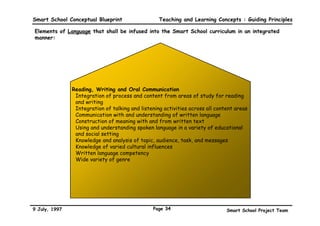

           •Facility Scheduling
           •Facility Scheduling
           •Maintenance
           •Maintenance
           •Asset Management
           •Asset Management
           •Alternative Usage
           •Alternative Usage


9 July, 1997                                    Page 76                                   Smart School Project Team
Smart School Conceptual Blueprint                                                      Smart School Management

The Human Resources Management component handles the
organisation, maintenance and development of school staff, including
teachers and school administrators:


           •Teacher Scheduling
           •Teacher Scheduling            Characteristics                    Benefits
           •HR Skills
           •HR Skills               •   Comprehensive Human             •   More efficient and
            Management
            Management                  Resource Information
                                        System (HRIS).
                                                                            effective deployment of
                                                                            teaching and
           •Hiring
           •Hiring                                                          administrative staff.

           •Promotion/transfer
           •Promotion/transfer
                                    •   Integrates all aspects of the
                                        HR function including           •   Teachers will be more
            Management
            Management                  hiring, training, vacation         aware of their situation
                                                                            and what is expected of
                                        sickness management,
           •Vacation/sickness
           •Vacation/sickness           skills training, and                them; Management will

            Management
            Management
                                        promotion management.               be aware of what
                                                                            (human) resources they
           •Staff Training
           •Staff Training          •   Manage in-school teacher            have at hand.
                                        scheduling and activities,
            Management
            Management                  as well as inter-school staff   •   Improved HR
                                        activities by means of easily       management in all
               Human Resources          accessible information              functional areas.

                                                                            Happier staff, hence
                  Security                                              •
                                                                            happier students!

                 Technology


9 July, 1997                                   Page 77                                   Smart School Project Team
Smart School Conceptual Blueprint                                                      Smart School Management

The Security Management component is responsible for physical and
student safety in the school:


                                          Characteristics                   Benefits

           School Governance        •   Comprehensive user-            •   Improved physical asset
                                        friendly features for              security management.
               Student Affairs          physical and IT security
                                                                       •   Improved security and
                                    •   Safety measures                    greater safety for
           Educational Resources        appropriate for children of        students
                                        different age groups and
                                                                           Ensures confidentiality
           External Resources           special needs                  •
                                                                           of specified data
                                    •   Security of data, accessible

           •Physical Security
                                        only to authorised
           •Physical Security           personnel
           •IT Security
           •IT Security
           •Student Safety
           •Student Safety
                 Security
                Technology


9 July, 1997                                   Page 78                                  Smart School Project Team
Smart School Conceptual Blueprint                                                    Smart School Management

The Technology Management component implements, maintains and
manages the technological components of the school:


                                          Characteristics                 Benefits

           School Governance        •   Comprehensive day-to-day     •   More efficient policy
                                        management of network,           development and
               Student Affairs          databases, IT hardware, IT       management.
                                        resources

           •Long Term Planning
                                                                         Efficient and effective
           •Long Term Planning
                                                                     •
                                    •   More realistic long-term         field support capability.
           •System
           •System                      planning for development
                                                                         All aspects of the IT
                                        of IT capability in school   •
            Implementation
            Implementation                                               function are managed in

           •System
           •System
                                                                         an efficient, cost
                                                                         effective way.
            Maintenance
            Maintenance
           •Training
           •Training
           •Field Support
           •Field Support
            Management
            Management
                Technology


9 July, 1997                                   Page 79                                 Smart School Project Team
Smart School Conceptual Blueprint


         The Malaysian Smart School

                           Processes
                              and
                           Scenarios

9 July, 1997                        Page 80   Smart School Project Team
Smart School Conceptual Blueprint                                                      Processes and Scenarios

 Smart School Processes

 The purpose of this Section is to provide the reader a glimpse of how the conceptual components elaborated in
 previous sections can be put to work. The Smart School processes, one of the four core components supporting the
 teaching-learning and management details some of the highlights of events within the school.


                                                                     How to read this Section
                                                                    This Section begins by identifying the core
                                                                    processes in the school system today, and
                                                                    the main challenges to overcome in the
                                                                    Smart School system. The Smart School
                                                                    system processes inputs and transforms
                                                                    them to the desired outputs. Following the
                                                                    discussion of the core processes, the
                                                                    Section   introduces    several   scenarios
                                                                    portraying highlights of everyday life in a
               PEOPLE, SKILLS 
                                              PROCESSES             Smart School.
               RESPONSIBILITIES Management


                    TEACHING  LEARNING
                                                                     Related Materials
               TECHNOLOGY
                             Administration    POLICIES              Appendix 3 contains high level Process Flow
                                                                     diagrams of the current and Smart School
                                                                     system.


9 July, 1997                                              Page 81                     Smart School Project Team
Smart School Conceptual Blueprint                                                                                                             Processes and Scenarios
                                                                                                           • Curriculum
 Smart School Process Goals                                                                                  specifications
                                                                                           Ministry        • Financing
                                                                                              of           • Management and control
                                                                                          Education          functions

                            SS000 The Smart School System
                                                                                                                         Conduct external
                                                                                                                           achievement
                                                                                                                            assessment
                                           Undergo             Conduct internal                                            S900
              Resources                   classroom             achievement
                                                                                             Provide
                                                                                            feedback
                                           session               assessment
                                        S500                     S600                     S700
      • (New)
        students
      • Teachers
                                                                                                                                    Students
      • Technology /
        Tools                                                                                                                       ready for
                            Identify and       Select and organise       Determine                                Outcomes
                                                                                                 Plan student                       higher
                          localise teaching     teaching-learning        student’s
                                 plan               materials            entry level
                                                                                                 experiences                        education or
                           S100                  S200                   S300                     S400
                                                                                                                                    the work
                                                                                                                                    force


 Develop or procure                                                       Manage and
                                                                                                 Administer
   courseware or                                                            operate
                                                                                                   school
    T-L materials                                                          resources
   S800
                                                                                                                                  Viewing the school process as
                                                                                                                                  a system              External
The Smart Schools flagship application provides an opportune                                                                                                       Influences

time to re-assess the current schooling system. Initially, the                                                                     Smart School Core Processes

Project Team identified the people, their skills and
responsibilities, the policies and practices, and the technology,                                                                 Apply     Resources
                                                                                                                                                        into the   To produce
                                                                                                                                                                    (desired)
                                                                                                                                                         System
tools and materials used in schools today. A conscious effort was                                                                                                   Outcomes

then made to identify the problems and challenges that the
school and its people faced in the current system. A plan was                                                                  The process flow model views the school process
                                                                                                                              The process flow model views the school process
then drawn to overcome these challenges, complemented with the                                                                 as a system. When the identified resources are
                                                                                                                              as a system. When the identified resources are
                                                                                                                               applied into the system, citizens ready for the
appropriate people development strategy, and the appropriate                                                                  applied into the system, citizens readyforce the
                                                                                                                               higher-education system or work         for are
                                                                                                                              higher-education system time, external influences
                                                                                                                               produced. At the same or work force are
use of enabling technologies.                                                                                                 produced. At the same time, external influences
                                                                                                                               may affect the school system.
                                                                                                                              may affect the school system.


9 July, 1997                                                                           Page 82                                              Smart School Project Team
Smart School Conceptual Blueprint                                                                                   Processes and Scenarios

Example of an improved process to determine the student’s entry level:
In the current schooling system, students are placed in the classroom
with little understanding of their individual needs and capabilities. Any                                Problems and Challenges to be
                                                                                                        Problems and Challenges to be
diagnosis, if done at all, is to stream students to different classes                                       addressed in Smart School
                                                                                                           addressed in Smart School
according to overall academic achievements. The individual’s strengths
and weaknesses are seldom assessed, and their different learning styles                           ••    Students are passive
                                                                                                       Students are passive
are usually not catered to. Teachers often cater to the average in the                            ••    Parents are not involved
                                                                                                       Parents are not involved
classroom.                                                                                        ••    Teachers are doing too much non-
                                                                                                       Teachers are doing too much non-
                                                                                                        teaching tasks
                                                                                                       teaching tasks
The Smart School process will change the way children are taught ;                                ••    Students need to be trained for the
                                                                                                       Students need to be trained for the
their diversity is regarded as a strength rather than a barrier to                                      Information Age
                                                                                                       Information Age
teaching. Children’s individual differences, needs, capabilities and                              ••    School is an “island”
                                                                                                       School is an “island”
learning styles are diagnosed early to enable teachers to plan the                                ••    Exam-orientated
                                                                                                       Exam-orientated
children’s learning experiences more effectively. Learning is then                                ••    Non-collaborative
                                                                                                       Non-collaborative
optimised to each child. Individual minds, spirits and physical selves are                        ••    Learning not fun
                                                                                                       Learning not fun
catered to rather than the treatment of the class as a homogeneous                                ••    Learning is not for the real world
                                                                                                       Learning is not for the real world
collective whole.                                                                                 ••    Lack of variety in the teaching materials
                                                                                                       Lack of variety in the teaching materials
                                                                                                        and methods
                                                                                                       and methods
     SS300 Determining the student’s entry level
                                                                                                  ••    Limited thinking skills
                                                                                                       Limited thinking skills

           Student records

                              Check student
                                records for                                                      Determining the student’s entry level will
                                                                                                 ensure that instruction capitalises on the
                             learning styles,
                               capabilities,
                               inclinations                                                      individual student’s strengths and
                                                                  Analyse         Recommend      preferences while simultaneously
                                                                 placement         student’s
                                                                 test results      entry level   removing barriers to learning.
        Provide student                             Take
       details, including                       placement test
         learning styles,
           capabilities,
        inclinations, etc.


9 July, 1997                                                                    Page 83                            Smart School Project Team
Smart School Conceptual Blueprint                                                                   Processes and Scenarios

  A day in the life of a Smart School student - some highlights

 • Electronically send draft of a report to
   other members of the group for their                                              • Log in attendance electronically
   comments and edits.                                                               • Browse the day’s activities on the
 • Post question to the Malay language                                                 school electronic bulletin board
   teacher about doubts on the lesson in
   class today


                                                                    7:20 a.m.                         • Participate in a video
• Play a computer-based                       8:00 p.m.                                                 conference on the
  simulation groupware                                                                                  spread of AIDS in
  game on discovering                                                                                   Asia
  Africa using virtual
  reality and sounds                                                                 8:40 a.m.
                               3:00 p.m.

                                                                                                        • Listen to the science
• Organise information
                                                    Smart School                                          teacher’s multimedia
  collected in a term                                                                                     presentation of the
  project on water                                                                                        atomic model
  pollution in the
  community and use                                                                     9:30 a.m.
  this to write a report
                               1:00 p.m.
  on current problems
  and possible solutions
                                                                                    • During break, catch up
                                                11:40 a.m.             10:30 a.m.     with electronic mail
           • Present an oral report in front of the class that is
             videotaped to go into the student portfolio

 9 July, 1997                                                Page 84                                Smart School Project Team
Smart School Conceptual Blueprint                                                                 Processes and Scenarios

A day in the life of a Smart School teacher - some highlights

                                                                                    •   Log on to computer in
           •   Evaluate a new
                                                                                        teachers’ room to check on
               commercially produced
                                                                                        homework and assignments
               courseware for Biology
                                                                                        completed by students as well
               classes based on Ministry
                                                                                        as students’ attendance for
               of Education’s guidelines
                                                                                        the day
                                            8:00 p.m.                  7:20 a.m.
 •   Attend a video-
                                                                                                         • Conduct a lesson
     conferenced State
                                                                                                           on mitosis and
     level meeting for
                                                                                                           meiosis
     Senior Biology
                                                                                                           incorporating a
     teachers to set
                                                                                                           multimedia
     State-level
                            3:00 p.m.                                                                      presentation
     standards
                                                                                         7:45 a.m.

                                                  Smart School
 •   Do an Internet search                                                                           •   Respond to
     for suitable sites for                                                                              electronic mail
     students working on the
                                                                                                         from students,
     topic of genetic
                                   12:30 a.m.                                                            parents and
     engineering                                                                   9:30 a.m.             colleagues

                                                          11:00 a.m.
                                                • Update student assessment records and
                                                  portfolios in preparation for an upcoming
                                                  parent-teacher conference

9 July, 1997                                              Page 85                               Smart School Project Team
Smart School Conceptual Blueprint                                                                Processes and Scenarios

A day in the life of a Smart School principal - some highlights

                                                              •   Participate in a video conferenced
                                                                  meeting of secondary school
                                                                  principals in the district to discuss
                                                                  discipline issues


   •   Visit “Principals’                       8:30 a.m.
       Corner”, a                                                                        •       Send e-mail to staff and
       discussion group                                                                          parents to inform about
       on the Internet                                                                           latest developments in
                                                                                                 regulations regarding
                                                                                                 student discipline
                             5:00 p.m.
                                                                           10:30 a.m.


                                                                                             •    Access a student’s
                                               Smart School                                       progress records from
   •   Respond to e-mail                                                                          the school database in
                                                                                                  preparation for a
                                                                                                  meeting with his
                            4:00 p.m.                                                             parents regarding his
                                                                                                  underachievement in
                                                                             1:00 p.m.            class

                                                2:00 p.m.

                              •   Attend staff meeting to discuss the up-
                                  coming school Sports Day and to delegate
                                  duties
9 July, 1997                                          Page 86                                Smart School Project Team
Smart School Conceptual Blueprint                                            Processes and Scenarios

A day in the life of Smart School parents - some highlights


                                                          •   E-mail son’s class teacher to
                                                              arrange for a conference to
                                                              discuss his progress in year 5
                                                              Science
                                                          •   Check e-mail for replies to
                                                              requests for donations of
                                              9:00 a.m.       equipment to the school


   •   Attend an evening
       course on
       Introduction to
       Multimedia for
       members of the                     Parents
       community conducted
       in the school         8:00 p.m.
       computer lab                                                     •   Go in to school to give a
                                                                            talk to daughter’s class
                                                                            on local ferns and share
                                                                            some interesting samples
                                                          11:00 a.m.
                                                                            of ferns with them


9 July, 1997                                Page 87                         Smart School Project Team
Smart School Conceptual Blueprint                                                                 Processes and Scenarios

The Smart School as the centre of the community - some highlights

                                                                   •   Senior citizens use the
                                                                       computers in the school
                                                                       resource centre to
                                                                       access the internet and
                                                                       use e-mail

                                                   MON - FRI                                         •    Play group session in
                                                5.00 - 8.00 p.m.                                          the playground/gym
                                                                                                     •     for children (1-5
                                                                                                          years) in the
  •   Various community                                                                                   community
      meetings are held
      in the school from                                                           MON  WED
      time to time                                                               3.00 - 4.30 p.m.


                            TUES  THURS
                           5.00 - 8.00 p.m.         Community
                                                                                                 •       “Introduction to
                                                                                                         Computing” course
                    •   Youths in the
                                                                                                         for adults in the
                        community use the
                                                                                                         community
                        schools facilities                                      MON  WED
                        for badminton and                                     7.00 - 9.00 p.m.
                        football
                                               TUES  THURS
                                              5.00 - 8.00 p.m.


9 July, 1997                                             Page 88                                 Smart School Project Team
Smart School Conceptual Blueprint


         The Malaysian Smart School

               People, Skills and
                Responsibilities

9 July, 1997                        Page 89   Smart School Project Team
Smart School Conceptual Blueprint                                                People, Skills, and Responsibilities

People, Skills and Responsibilities

The Smart School has a commitment to provide equal opportunities for all students with different needs and
capabilities so as to enhance their capacity for learning. This commitment involves the development of the main
stakeholders who are involved in the delivery of Smart School teaching. This will represent a revolutionary departure
from traditional modes of teaching currently practised. The main stakeholders will include teachers, principals,
support staff, parents and the wider community, all of whom must be prepared and enabled to guide students in
Smart Schools.

                                                                   How to read this Section
                                                                   This Section begins with the overall strategy to
                                                                   equip the main stakeholders with the necessary
                                                                   skills and knowledge in line with their roles and
                                                                   responsibilities. Next, the training outline for each
                                                                   of the main stakeholders is discussed.


                                                                   Related Materials
                                                                   Appendix 4 contains an elaboration of the
                                                                   programme for the professional development of
         PEOPLE, SKILLS 
                                                                   Smart School teachers. The main roles and
                                             PROCESSES
         RESPONSIBILITIES
                             Management
                                                                   functions of these teachers are also included.
                   TEACHING  LEARNING
                            Administration
          TECHNOLOGY                          POLICIES


9 July, 1997                                             Page 90                            Smart School Project Team
Smart School Conceptual Blueprint                                               People, Skills, and Responsibilities

 The stakeholders involved in the implementation of Smart Schools.


                                                                      TEACHERS                 What are their
                                                                                           roles/responsibilities ?

                                                                     PRINCIPALS

                                                                       SUPPORT                What knowledge,
                                                                        STAFF                skills and attitude
                                                                        OTHER
                                                                                              do they need ?
                                                                      EDUCATION
                                                                      PERSONNEL
                                                                                           What is the training
                                                                        PARENTS                required ?
                                                                      COMMUNITY

         PEOPLE, SKILLS 
                                             PROCESSES
                                                                   Each group of stakeholders will have specific
         RESPONSIBILITIES
                             Management                            responsibilities in the overall implementation of
                                                                   Smart Schools. To carry out their respective
                      TEACHING  LEARNING                          responsibilities, each stakeholder will need to be
                            Administration
                                                                   equipped with specific skills and have the requisite
         TECHNOLOGY                           POLICIES
                                                                   knowledge base and the right attitude. This
                                                                   knowledge, skills and attitude will be developed
                                                                   through exhaustive training courses tailored for
                                                                   the development of each stakeholder group.


9 July, 1997                                             Page 91                           Smart School Project Team
Smart School Conceptual Blueprint                                                          People, Skills, and Responsibilities

 Smart School Teacher Development

Teacher development will be the most critical component as teachers will be the primary deliverers of
Smart School teaching. A comprehensive teacher education programme incorporating best practices in
technology supported learning will be critical to the success of the Smart School initiative.

These teachers will need intensive              Roles and Responsibilities                      OUTLINE OF NEW EMPHASES IN TRAINING
training on Information Technology              •   Planning    and     preparation  of    Pre-service training                    In-service Training
skills and technology integration into
                                                    learning activities
                                                •   Managing a technology enriched
                                                                                            Trainee Teachers           Teachers                Trainers
classroom instructions to enhance
                                                    environment
                                                •   Delivering effective instruction
                                                                                            • IT skills                •    Phase 1: Smart     • 2 phases as for
                                                •   Handling professional tasks
thinking and creativity. In addition,                                                       • Thinking Skills
                                                                                                                           School concept
                                                                                                                           and goals, Basic
                                                                                                                                                 teachers
                                                                                                                                               • Motivation skills
Smart Schools teachers need to be                                                           • Values education             IT skills, Core
                                                                                                                           teaching skills     • Continuous
trained as “guides on the side”,
                                                                                            • Language proficiency                               professional
                                                                                                                       •    Phase 2:
                                                                                            • Technology                   Integration of        upgrading
facilitating and encouraging students to    Skills and Knowledge needed:                      integration into the
                                                                                              teaching-learning
                                                                                                                           IT into T-L
                                                                                                                           activities,
                                                                                                                                                 programme
                                                                                                                                               • Benchmarking
take charge of their own learning.          •       Designing instruction                     process                      Creativity and
                                                                                                                           innovation in T-L
                                                                                                                                                 for quality
                                            •       Assessing student learning              • Role as guide and                                  training
                                            •       Managing classroom procedures
                                                                                              facilitator of               activities and
The training should allow participants to   •       Creating environment of respect and
                                                    support
                                                                                              learning                     management


explore a wide variety of areas and
                                            •       Facilitating students in cognitively
                                                    stimulating activities
                                            •       Utilising technology for effective
strategies as well as the opportunities     •
                                                    instruction
                                                    Communicating with colleagues and
to engage in practicums that represent      •
                                                    community
                                                    Selecting use of effective resources

the reality they would face.                          Plus the right attitude                    On-site coaching, Practicum, Peer Coaching, Reflection,
                                                                                                  Demonstration, Simulation and Continuous Learning

Continuous learning is a crucial
ingredient as it is necessary for
                                            The pre-service and in-service professional development
teachers    to  keep  abreast   of
                                            programmes will have new emphases in nurturing the
development in their professional
                                            qualities and practices of teachers in order for them to
practices and to be confident with
                                            function in a technology enriched environment.
technology.
9 July, 1997                                          Page 92                                              Smart School Project Team
Smart School Conceptual Blueprint                                                              People, Skills, and Responsibilities

 Smart School Management Training for Principals

 The task of managing schools involves
                                           Roles and Responsibilities:
 working with information and building                                                                 OUTLINE OF NEW EMPHASES FOR
                                                                                                                TRAINING
 on    ideas    collaboratively.  The      • Set attainable school goals to meet the needs of
                                             students, parents, and the nation

 efficiency and effectiveness of this      • Plan programmes for the constant upgrading of
                                                                                                      PHASE 1                    PHASE 2
                                                                                                      • Smart Schools            • Application of
 management task in a Smart School           school administrators’ skills, on computer
                                             applications for administration and management,            and the                    Specific
 are enhanced through the use of             strategic planning and leadership,                         Information Age            Management
                                                                                                                                   Software
                                                                                                      •    Management
 technology.                               • Develop plans for development of his staff on IT,
                                             instructional management, and CAI                            processes and the      • Innovation and
                                                                                                          Smart School             creativity in
                                           • Constant discussion with teachers on ways to                                          management
 The change being brought about in           improve teaching strategies in facing the
                                             realities of the world of high technology, and to
                                                                                                      •    Basic IT skills:
                                                                                                          Word Processing
 the planned conversion of all               supervise them                                               and Spreadsheets

 Malaysian schools into Smart Schools                                                                 •   Overview of
                                                                                                          Multimedia
 is indeed a serious one which can         Skills and Knowledge needed :
                                                                                                          Applications in
                                                                                                          Education
 cause apprehension in all those           •     Application and translation of management            •    Motivation, team-
 involved. A major part of most                  theories into practice                                   building and
                                                                                                          collaboration
 resistance to change may be               •     Self-directing, motivation, personnel
                                                 management, leadership, innovation,
                                                                                                          skills

 attitudinal. To a smaller extent                creativity, team-building and collaboration
                                                 skills
 resistance is due to the lack of skills   •     Competency in the use of related technology          Awareness and exposure to technology in
 although there is desire to change.             for school management                                management, On-site coaching, Peer Coaching, On-
                                                                                                      the-job self training, Reflection, Demonstration,
                                           •     Competency to provide instructional                  Simulation, Continuous Learning,
                                                 leadership
 Thus, Smart School principals will
                                                         Plus the right attitude
 need to go through an intensive
 management training course to equip
 them to manage the new facilities,            A coherent training framework should be set out, with the
 technologies and methodologies to be          appropriate    emphases   on   new    technologies    and
 deployed in Smart Schools.                    methodologies.

9 July, 1997                                        Page 93                                               Smart School Project Team
Smart School Conceptual Blueprint                                              People, Skills, and Responsibilities

   Smart School Clerical Staff Development

 The school clerical staff are the school clerks, typists and office boys. Their responsibilities include
 maintaining student and staff (teaching and non-teaching) records, school finances, school
 communications, school inventories and matters pertaining to student and staff welfare.


                                     THE TRAINING OUTLINE                    In the Smart School, these tasks will
Roles and Responsibilities:
                                                                             be accomplished with the aid of
• Maintaining                  PHASE 1                 PHASE 2
                                                                             technology. The members of the
    Ø student and staff
                               • Smart School and      • Application of
      records                                                                clerical staff would need to understand
    Ø school finances            the Information         Specific
    Ø school communications                              Management          how this office automation is done.
                                 Age
    Ø school inventory                                   Software            They should be introduced to basic IT
• Manage matters pertaining    • Basic IT skills:                            skills such as word processing and
  to student and staff
                                 word processing
  welfare                                                                    spreadsheet applications.
                                 and spreadsheet
                                 applications                                Sufficient hands-on training in the
                                                                             management       application   software
Skills and Knowledge                                                         deployed in the Smart School must be
 needed:
                                                                             provided.
• Basic IT skills
                                    On-site coaching, Practicum, Peer
                                                                             Education in the new technology alone
• Word processing and
  spreadsheet applications      Coaching, Reflection, Continuous Learning,   is not enough. They need to better
• Management software           Demonstration and Simulation, On-the-job     understand the new school processes
  applications                                   training.                   and give their support wherever
     Plus the right attitude
                                                                             necessary.


 9 July, 1997                                              Page 94                       Smart School Project Team
Smart School Conceptual Blueprint                                                       People, Skills, and Responsibilities

 Smart School Media/Technology coordinator

 For each Smart School, there needs                                                                    THE TRAINING OUTLINE
                                          Roles and Responsibilities:
 to     be     a    Media/Technology      •    troubleshooting of technical problems
 coordinator who will be responsible      •    respond to teachers’ request for help in        • Basic IT and the new emphases on
                                               technology integration in the classroom           professional skills
 for supporting teachers in the overall   •    assist the principal in the management
                                                                                               • Integration of IT into T-L activities
 deployment of multimedia and other       •
                                               software applications
                                               select and evaluate T-L materials               • Creativity and innovation in T-L activities
 technologies in the delivery of Smart    •    guide and train teachers in delivering
                                               effective technology supported instruction
                                                                                                 and materials

 School teaching.                         •    supervise maintenance of all technical          • Thinking Skills
                                               equipment
 The    technology    coordinator    is   •    liase with the school technical support for
                                                                                               • Values education
                                                                                               • Language proficiency
 entrusted to guide and help train             equipment repair, replacement and facility
                                               upgrading                                       • Technology integration into the teaching-
 teachers in delivering effective         •    keep abreast with development in                  learning and management process
                                               technology
 technology supported instruction.                                                             • Role as guide and facilitator of learning

 Thus the technology coordinator                                                               • Continuous professional upgrading
                                                                                                 programme
 should be a teacher with skills in       Skills and Knowledge needed:                         • Mindset change towards Smart School
 integration    of   technology    for    • Basic pedagogical skills
                                          • Basic IT skills
                                                                                               • Motivational skills

 enhancement       of      information    • Skills in integration of technology for

 gathering, instruction, management         enhancement of information gathering,
                                            instruction, management processes and
 processes and communication.               communication
                                                                                                On-site coaching, Practicum, Peer Coaching,
                                          • Knowledge of computer networking and
                                            system administration                                     Reflection, Continuous Learning

 Other    responsibilities   of     the                Plus the right attitude
 technology    coordinator      include
 assisting the principal in the               Apart from the pedagogical issues the technology
 management software applications as          coordinator will also supervise maintenance of all technical
 well as keeping abreast with                 equipment and liaise with the school technical support staff
 development in education technology.         team for equipment repair, replacement and facility
                                              upgrading as and when necessary.
9 July, 1997                                         Page 95                                      Smart School Project Team
Smart School Conceptual Blueprint                                                         People, Skills, and Responsibilities

 Smart School Technical Support

Technical support is critical to the maintenance of all installed hardware and software to ensure
minimal disruption to the teaching-learning and management process. Thus, every Smart School should
have a well defined technical support organisational structure which will provide help-desk function to
Smart School students, teachers or administrators who require assistance in solving technical problems.

A number of organisational options can be deployed to ensure a tight, coherent centralised support
organisation backed up at the local level by self-sufficient teams based at either individual or identified
clusters of Smart Schools.

         Roles and Responsibilities:                                  POTENTIAL OPTIONS
         • troubleshooting of technical
           problems                         First Level Support
         • respond to school                School Media/Technology coordinator can provide this support. He/she will attempt
           media/technology coordinator’s   to troubleshoot any problems relating to the use of technology before routing it to
           request for technical help       the next level of support.
         • maintenance of all technical     First level support can also be provided by :
           equipment                            a. Technology savvy students.
         • communicate with the other             This can be considered as part of their co-curricular activities
           levels of technical support          b. Technology savvy teachers.
         • ensure conformity to IT policy         Due recognition and acknowledgement must be given to these teachers.

                                            Second Level Support
                                            This should be based in the school. A technician who is competent in the technology
        Skills and Knowledge needed:        deployed in the school would be the ideal support needed.
        • IT skills and knowledge
        • Computer and networking skills
                                            Subsequent Level of Support
        • Knowledge of educational and      Subsequent level of support includes all technical support beyond the school level. It
          management software and other     can be a technician who is based at the district/state level, a help-desk at the
          applications used in schools      Ministry of Education level and/or a helpdesk set up by the vendor concerned.


               Plus the right attitude


9 July, 1997                                              Page 96                                       Smart School Project Team
Smart School Conceptual Blueprint                                                                            People, Skills, and Responsibilities

 Professional Development for other Education Personnel

Officers from the various divisions of the                                              The training outline for these officers should
Education      Ministry,    State     Education                                         include:
Departments, District Education Offices need                                               • Smart School vision and objectives
to understand the educational objectives and                                                 • Their role and responsibilities in the Smart
policies of the Smart School in fulfilling their                                               School
respective roles.                                                                            • IT literacy
The training curriculum for the officers have to
                                                                                             • The teaching-learning and management
be geared towards their specific responsibilities                                              processes in the Smart School
in the Smart Schools.
                                                                                             • Application of new approaches to their tasks
Roles and Responsibilities:
• Planning                                            THE TRAINING OUTLINE
• Co-ordinating
                                     PHASE 1                             PHASE 2
• Monitoring
• Supervising                        • Understanding the                 • Application of
                                                                                                          Education officers are crucial to
• Evaluating                           concept, vision and                 Management Software            the       success      of      the
                                                                           specific to the different
                                       mission of Smart Schools
                                                                           functions of the different     implementation of the Smart
                                                                                                          School project as they play a
                                     • Smart Schools and the               divisions of the Ministry
                                       Information Age                     of Education/State
Skills and Knowledge
needed:                              • Basic IT skills, word
                                                                           Education
                                                                           Departments/District
                                                                                                          major role in the planning, co-
• Application and translation of
                                       processing and
                                       spreadsheets
                                                                           Education Offices              ordinating,    monitoring,     and
theories into practice
                                     • Overview of multimedia
                                                                                                          evaluating the implementation
• Motivational skills, personnel       applications in education                                          activities at the various levels. P
management skills and leadership
skills                                                                                                    of the training should therefore
• Self-directing skills and skills
                                                                                                          concentrate on developing the
at innovation and creativity                                                                              awareness and acceptance of
• Competency in supervising the           Briefings, Demonstrations, Simulations, On-the-job Training,    the Smart School concept.
new Smart School processes.                     Peer Coaching, Reflection, Continuous Learning

      Plus the right attitude


9 July, 1997                                                                     Page 97                              Smart School Project Team
Smart School Conceptual Blueprint                                                     People, Skills, and Responsibilities

 Parents of the Smart School students
 Parents of Smart School children play a critical role in achieving the goals of Smart Schools in
 delivering education and developing balanced and holistic students. There is a need to increase the
 participation of parents in educational processes such as in teaching-learning, development of
                                                                              educational materials, assessment,etc. A
                                                                              student’s learning opportunities stretch
Roles and Responsibilities:
                                       POSSIBLE STRATEGIES
                                                                              beyond the classrooms. Parents can be
• Personal charge of children’s                                               educational resources, and in the process
  learning experiences            • National campaign on parents in Smart
                                                                              benefit themselves as their own learning
  - monitor children’s              School
    progress                        - media (electronic/print media)          needs become a life-long endeavour.
  - guide, motivate and counsel     - road show (seminar, exhibition,         Research has also shown that children are
    children                        forum)
• Support school activities       • Parents’ Role in Smart School
                                                                              more successful in school when parents are
• Resource persons/experts in       Conference                                involved in their education.
  their own area                  • Briefing on Smart School educational      The roles and responsibilities of Smart
                                    process
                                  • Basic IT skill training at school level   School      parents    must   be    widely
                                  • Counselling and motivation seminars       acknowledged and accepted, in order to
Skills and Knowledge                - State/District level
 needed:                            - School level
                                                                              create significant buy-in for parents to
• Ability to access school’s
                                  • School tours/exhibitions of the           assume a much stronger role in the Smart
                                    technology available in school            School education process. There are a
  public domain databases
                                  • Parent support group monthly meetings
• Ability to counsel and
                                  • “IT Camps” at schools                     number of strategies that can be adopted
  motivate their children
• Ability to understand
                                  • Parents Bulletin Boards/Home Pages        to increase the participation of Smart
                                  • “School Cyber Cafés” for parents
  educational process
                                  • Launching of parent’s web-site
                                                                              School parents both in the delivery of
                                                                              education as well as in the supervision of
     Plus the right attitude
                                                                              children outside of school.


9 July, 1997                                                     Page 98                       Smart School Project Team
Smart School Conceptual Blueprint


         The Malaysian Smart School

                        Technology
                         Enablers

9 July, 1997                        Page 99   Smart School Project Team
Smart School Conceptual Blueprint                                                               Technology Enablers

 Smart School Technology Enablers


   The purpose of this Section is to suggest the technologies that will support Smart Schools in Malaysia,
   namely, the technologies and infrastructure required for the teaching-learning, management, the connectivity
   to the external constituencies and the Educational Network connecting the Smart Schools.


                                                              How to read this Section
                                                              This Section begins by illustrating the various
                                                              implications of Information Technologies to the
                                                              teaching-learning process, management, and
                                                              linkages to external constituencies. Following each
                                                              implication scenario, a chart of possible technical
                                                              solutions are presented. Next, several options of
                                                              school, district and national level technical
                                                              solutions are presented. Finally, the network
                                                              configurations for the three levels are broadly
                                                              proposed.
        PEOPLE, SKILLS 
                                            PROCESSES
        RESPONSIBILITIES
                            Management


                     TEACHING  LEARNING

                           Administration
        TECHNOLOGY                           POLICIES


9 July, 1997                                            Page 100                          Smart School Project Team
6PDUW6FKRRORQFHSWXDO%OXHSULQW                                                                       7HFKQRORJ(QDEOHUV

7KH7HFKQRORJ'HULYDWLRQ3URFHVV


                                                                                                           6PDUW6FKRRO
                                                                                 7HFKQLFDO
                                                     6PDUW6FKRRO3UDFWLFHV                                7HFKQRORJ
                                                                                   5HTXLUHPHQWV
                                                     ‡ 7HDFKLQJ	/HDUQLQJ                                 6ROXWLRQV
                                                                                 ‡ 6DPSOH$SSOLFDWLRQ
                                                     ‡ 0DQDJHPHQW6VWHP                                   ‡ 6FKRRO/HYHO
                                                                                   VROXWLRQV
                                                     ‡ ([WHUQDORQVWLWXHQFLHV                             ‡ 'LVWULFW/HYHO
                                                                                 ‡ 1HWZRUN
                                                                                                           ‡ 6WDWH/HYHO
                                                                                   5HTXLUHPHQWV
                                                                                                           ‡ 1DWLRQDO/HYHO


           3(23/( 6.,//6 	                    352(66(6
          5(63216,%,/,7,(6
                               0DQDJHPHQW


                     TEACHING  LEARNING

                              $GPLQLVWUDWLRQ
               7(+12/2*                      32/,,(6


-XO                                                         3DJH                      6PDUW6FKRRO3URMHFW7HDP
Smart School Conceptual Blueprint                                                 Technology Enablers

The Information Technology implications of the Teaching-Learning Process

  Examples of Teaching  Learning Practices       IT Implications
  Self-Exploratory Learning                       Every computer shall have access to the latest
                                                  educational materials available locally, as well as
                                                  to external resources
  Collaborative Learning                          Tools that facilitate group work within the class
                                                  and across classes
  Distance Learning                               Communication with outside constituencies using
                                                  technology, i.e., video conferencing, e-mail, video
                                                  on demand, broadcast, etc.

  Experiential Learning                           Simulation software and virtual reality to
                                                  stimulate learning

  Research, Reference, and Data Collection        Tools to search, collect and collate information


  Electronic Assessment                           On-line assessment via a standard database and
                                                  built-in assessment courseware

  Inclusive Education                             Tools to help students with disabilities cope with
                                                  learning more effectively
  Drill and Practice                              Software or courseware that allows students to
                                                  practise on their own or with peers


9 July, 1997                                 Page 102                       Smart School Project Team
Smart School Conceptual Blueprint                                                                                                              Technology Enablers

…therefore Teaching and Learning Technical Requirements for these examples might look like
the following...


                                                                                                          Central Server
                       Equipment


                                                       Local Server /


                                                                                                                           Conferencing
                                   Stand Alone


                                                                                                          / Database
                                                                        Resource *


                                                                                               Database
                                                       Database
                                   Computer


                                                                                     Network


                                                                                                                                                       (specify)
                                                                        Network


                                                                                               Regional
                                                                                               Server/
                                                                                     Secure


                                                                                                                                                       Other
                                                                                                                                           Visual
                                                                                                                                           Audio
                                                                                                                           Video
                                                 LAN
               Item
       Self-Exploratory
       Learning
       Collaborative                                                                                                                                Teleconference
       Learning
       Distance                                                                                                                                     ISDN
       Learning
       Research,Reference
       and Data Collection
       Experiential
       Learning
       Electronic
       Assessment

       Inclusive                                                                                                                                     Artificial
       Education                                                                                                                                     Intelligence


       Drill and Practice


           Must have                Nice to have       * Example: Internet


9 July, 1997                                                                   Page 103                                                   Smart School Project Team
Smart School Conceptual Blueprint                                                Technology Enablers

Information Technology Implications of the Smart School Management System

       School Management Functions         IT Implications
       School Governance                   Using computer communication i.e, video conferencing, to
                                           link the school to the Ministry of Education for
                                           administration and policy implementation purposes
       Student Affairs                     Using computers and databases to maintain student
                                           profiles.
       Educational Resources               Using computer communication to link the school’s
                                           databases to central resource databases to regulate and
                                           organise educational resources
       External Resources                  Using computer communication to link the school to external
                                           constituencies like network resources, i.e., Internet,
                                           libraries and museums for the purpose of research,
                                           reference and data collection.
       Financial Management                Using computer communication to link the school’s
                                           databases to facilitate budgeting, accounting and reporting
       Facilities                          Using computer communication to link the school’s
                                           databases to plan facility scheduling, maintenance and
                                           inventory.
       Human Resource Management           Using computer communication to link the school’s
                                           databases to the State Education Departments for human
                                           resource management purposes
       Security Management                 Using computer communication to link the school’s
                                           databases to the District Education Office for security
                                           management purposes
       Technology Management               Using computer communication for the purpose of acquiring
                                           centralised IT support for the school.


9 July, 1997                             Page 104                          Smart School Project Team
Smart School Conceptual Blueprint                                                                                     Technology Enablers

…therefore the Management System Technical Requirements might look like the
following...


                      Equipment


                                                                                                     Conferencing
                                  Stand Alone


                                                      Resource *


                                                                               Database
                                  Computer


                                                      Database


                                                                                          Database
                                                      Network


                                                                     Network


                                                                                                                                (specify)
                                                                               Regional
                                                                               Server/
                                                      Server/


                                                                                          Server/
                                                                     Secure


                                                                                          Central


                                                                                                                                Other
                                                                                                                    Visual
                                                                                                                    Audio
                                                                                                     Video
                                                      Local
                                                LAN
               Item

         School                                                                                                               ISDN
         Governance                                                                                                          Teleconference
         Student Affairs
         Management
         Educational
         Resources Mgmt
         External Resources
         Management
         Financial
         Management
         Facilities
         Management
         Human Resource
         Management                                                                                                           Smart Card

         Security                                                                                                            Smart Card
         Management
         Technology                                                                                                          Remote
         Management                                                                                                          Access


               Must have               Nice to have    * Example: Internet

9 July, 1997                                                     Page 105                                       Smart School Project Team
Smart School Conceptual Blueprint                                                      Technology Enablers

Information Technology Implications of linkages to External Constituencies
  Examples of Linkages
  to Constituencies                     IT Implications

 Other Schools                          Optimal sharing of information and resources to encourage
                                        collaborative learning on a subject among schools.

 Homes / Parents                        Distance learning enables students to keep track of school work
                                        even when they are not physically in school. Parents can access the
                                        school for feedback on their children’s progress.
 Community                              The Smart School can be a community centre to enable community
                                        involvement in school activities. The community can also use the
                                        Smart School as an on-going learning centre.

 Libraries                              Research, reference, and data collection resource available on-line

 Universities / Colleges                Distance Learning on topics by experts in the field, the provision
                                        mentor / tutor programmes, and research data.

                                        Access to information on industries, and career opportunities,
 Companies / Industries                 industrial practical training and sponsorship programmes offered
                                        by these industries.

 Museums/Archives /Science Centres      Research, reference, and data collection resource available on-line.
                                        Possible access to virtual experiences.

 Local Authorities                      On-line information about local social and cultural events to enable
                                        school participation.


9 July, 1997                                Page 106                            Smart School Project Team
Smart School Conceptual Blueprint                                                                                      Technology Enablers

…therefore External Constituency Technical Requirements might look like the following...


                      Equipment


                                                                                                   Conferencing
                                  Stand Alone


                                                                 Resource *


                                                                                        Database
                                  Computer


                                                                                        Database
                                                      Database
                                                                 Network


                                                                              Network


                                                                                                                            (specify)
                                                                                        Regional
                                                                                        Server/


                                                                                        Server/
                                                      Server/


                                                                              Secure


                                                                                        Central


                                                                                                                            Other
                                                                                                                   Visual
                                                                                                                   Audio
                                                                                                   Video
                                                      Local
                                                LAN
               Item

       Other Schools

       Homes / Parents


       Communities

       Libraries

       Universities /
        Colleges
       Companies /
        Industries
       Museums/Archives/
       Science Centres

       Local Authorities


               Must have             Nice to have       * Example: Internet


9 July, 1997                                                            Page 107                                  Smart School Project Team
Smart School Conceptual Blueprint                                                                               Technology Enablers

 Technical requirements and possible solutions at the school level:
               Varied  easy access to teaching-learning resources                  Variety of materials
Requirements         • Physical facilities e.g classroom or lab                               • Conventional materials
                     • Teaching and learning equipment including hardware and                 • Multimedia materials
                       software                                                               • Network-based
                                                                                                materials
               Conferencing facilities
                     • Distance learning
                     • Meetings  in-service training


               Classroom                                                 Studio / Theatrette
 Possible          • Multimedia courseware                                      • Control room for centralised Audio/Video equipment
 Solutions         • Presentation of teacher’s educational materials (e.g.      • Video conferencing studio
                     computers for students and teachers, audio/video           • Preview room for audio, video or laser disk (LD)
                     facilities)                                                  materials
                   • Collaborative tools e.g. e-mail, groupware
                                                                         Teachers’ Room
                                                                                • Access to courseware catalogues and database
               Library / Media Centre
                                                                                • Information and resource management systems
                   • Database centre of multimedia courseware
                   • Network resources (e.g. Internet)                          • Professional networking using e-mail and groupware
                                                                         Administration Office
               Computer laboratory                                              • Database management of students and inventories
                   • Teaching ( e.g. Computer Studies as a subject)             • Tracking (e.g. teacher and student performance,
                   • Readily accessible multimedia and Audio/Video                resources)
                     equipment                                                  • Distribution of notices / information

                                                                         Server Room
               Multimedia Development Centre                                    • Central server site (e.g. Application servers,
                   • Creation / development tools for multimedia                  Management Database server, Web server)
                     materials (e.g. preparation of presentations or            • Security measures ( e.g. Proxy server, Firewall )
                     music)                                                     • Telecommunication interface and access to Network
                   • Catering for varying levels of sophistication                resources e.g. Internet (e.g. router, modem)


9 July, 1997                                                 Page 108                                   Smart School Project Team
Smart School Conceptual Blueprint                                                                                                             Technology Enablers

    Possible scenario a school configuration


          Classroom (1-n)                    Library/Media Centre                         Computer laboratory                       Studio / Theatrette

A/V equipment                               CD jukebox
                                      hub                                  hub                                         hub


                                            • 35 Computers with headphones           • 35 Computers (1:1 ratio) with
•   7 Computers (1:5 ratio)                 • 1 CD juke box and courseware             headphones                                • 1 Video Conferencing studio
•   1 Computer for teacher                    database                               • 1 Computer for teacher                    • Audio-Video equipment
•   1 printer                               • 1 printer                              • 1 printer                                 • Document camera
•   A/V equipment (e.g. TV,VCR,projector)   • 1 Media server                         • MIDI equipment

                                                                              Switching
                                                                                Hub
                                                                                                                                                                     ISDN

          Teachers’ Room                     Administration Office                            Multimedia                     Database/
                                                                                                                             Applications              ISDN TA
                                                                                          Development Centre
                                                                                                                                                                     EduNet
                                    hub                                 hub                                            hub

                                                                                                                                                           Router


                                                                                      •   5 workstations + 10 computers
                                                                                                                                           Server Room
    • 1:1 ratio to the number of teachers     • 1:1 ratio to the number of staff      •   2 scanners + 2 colour printers     •   Web server + applications servers
      likely to be in the Teachers’ Room      • 2 printers                            •   CD-ROM production                  •   Proxy server + firewall
      at any time                             • Office Automation equipment           •   Data backup equipment              •   Network Management System
    • 1 printer                                                                       •   Content development tools (e.g.    •   Management Database
                                                                                          Non linear editing equipment,      •   Smart Card Management
                                                                                          MIDI, Authoring tools)             •   Router, ISDN TA, modem


Multi-mode fibre                            Assumption:
UTP Category 5                              Classroom size: 35


9 July, 1997                                                                       Page 109                                          Smart School Project Team
Smart School Conceptual Blueprint                                                                   Technology Enablers

  Technical requirements and possible solutions at district level


                District database                                     Secure network
Requirements           • Assessment, on-line resources,                    • Assessment data, student and staff
                         management e.g. Human                               records, governance, finance, Human
                         Resources, finance, educational                     Resources, security, educational
                         resources, technology, student                      resources, student affairs
                         affairs, external resources


                •   Centralised multi-point video conferencing
Possible        •   Secured transactions e.g. over the network
Solutions
                •   Regional server with a unique computer address for each school
                •   Information management and control


                Implementation options:
                Option A                                                 Option B
                • Secure transaction via network (software only)         • Clustered multi-point video conferencing.
                • Independent/ direct connection to district level       • Secured transaction via separate secure
                  for multi-point video conferencing                       network
                                                                         • Security measures including data encryption


 9 July, 1997                                              Page 110                           Smart School Project Team
Smart School Conceptual Blueprint                                                                    Technology Enablers

 Possible scenario of an inter-school and district education network

  Option A                                                                                                    Option B

   Database                           Database Servers            Domain        Proxy Server            Database Servers
   Servers                                                        Name
                                                                  Server                           Router
                                                              F
                     FIREWALL                                 I
                                                              R   Router
                                                              E
    Hub                                Hub                    W
                                                                                          Hub                        Hub
                                                              A
                                                              L
                                                              L


    Administrative                                                         Network Management               Administrative
                                       Administrative Users
       Users           Router                                                    System                        Users

       MCU                                               MCU                                                          MCU

    District A         Remote Login                       State                                         District B


                     ISDN


                                                     OPEN NETWORK
Primary School                                                                                      Secondary School
                                                     (e.g. INTERNET)                                                         ISDN


 Secondary School                                                                                           Primary School
9 July, 1997                                                   Page 111                         Smart School Project Team
Smart School Conceptual Blueprint                                                               Technology Enablers

 Technical requirements and possible solutions at national level


Requirements    • Access to resources over an open platform
                • Means for collaborative work
                • Open communication channels with constituencies
                • Controlled distribution of sensitive information
                • External telecommunications backbone to support widely distributed points of access


               • An education network consisting of both secured and open networks
Possible
                  – sensitive information rides on the secure network (Ministry of Education, State  District
Solutions
                    Education offices, etc.)
                  – educational resources reside on the public network (schools, libraries, etc.)

               • Schools can get into the secure network
                  – through the open network via encryption means  other security measures
                  – directly via remote access

               • The telecommunications backbone can be
                  – current telecommunications infrastructure
                  – the Multimedia Super Corridor infrastructure


9 July, 1997                                          Page 112                            Smart School Project Team
Smart School Conceptual Blueprint                                                                    Technology Enablers

Possible scenario of a national level education network
                                                   Ministry
                                                      of
                                                                                        State Education Department
            District Education office              Education


                                                         SECURED EDUCATION
                District Education office                     NETWORK                     State Education Department


                                                School
                                                                    Firewall


                                                                                                                 School
                                                                     Point of Access
                                                                                       Point of Access
   School                     Point of Access
                                                                Point of Access


                                                            OPEN NETWORK
                                                            (e.g.INTERNET)

Legend
            Access
            Network
            Security
            Access
                                                          BACK BONE NETWORK

9 July, 1997                                                   Page 113                       Smart School Project Team
Smart School Conceptual Blueprint                                                       Technology Enablers

 Technical requirements and possible solutions for the national repository centre

                   •    A national level repository centre available to all
Requirements            education sites
                   •    Expedient access to
                         •   the Ministry of Education
                         •   the Federal Government administration
                   •    Reliable telecommunications infrastructure
                   •    Capacity for international linkages and connectivity to
                        relevant repositories


Possible       •       It should reside in the Multimedia Super Corridor (MSC)
Solutions                •   Designated multimedia centre
                         •   Proximity to Putra Jaya, the new Federal administration office
                         •   MSC will have the best and guaranteed telecommunications and
                             infrastructure facilities
                         •   The Smart School Project is a key MSC Flagship Application


 9 July, 1997                                         Page 114                      Smart School Project Team
6PDUW6FKRRORQFHSWXDO%OXHSULQW                                           7HFKQRORJ(QDEOHUV

LIWKHQDWLRQDOUHSRVLWRUFHQWUHZHUHORFDWHGZLWKLQWKH06


                                                     06
                                    (GXFDWLRQDO 5HSRVLWRU
                                            HQWUH


                                                                            /HJHQG
                                                                      6WDWH (GXFDWLRQ HQWUH
                                                                      'LVWULFW (GXFDWLRQ HQWUH
                                                                      +LJK VSHHG EDFNERQH
                                                                      $FFHVV /LQH


-XO                                    3DJH              6PDUW6FKRRO3URMHFW7HDP
Smart School Conceptual Blueprint


         The Malaysian Smart School

                        Policy
                      Implications

9 July, 1997                        Page 116   Smart School Project Team
Smart School Conceptual Blueprint                                                                                     Policies

 Policy Implications for Smart School


 In this Section, the term “policies” is used as an umbrella term that encompasses both legislative policies
 and regulations that will influence Smart Schools and their effective implementation.


                                                                    How to read this section
                                                                    The Project Team realised that it was
                                                                    important to consider the whole range of
                                                                    policies, regulations, procedures, and practices
                                                                    both formal and informal, written and
                                                                    unwritten that will need to be changed to
                                                                    accommodate implementation of Smart Schools.
                                                                    This complex task will be undertaken by
                                                                    numerous departmental committees in the
                                                                    Ministry of Education and will require time and
         PEOPLE, SKILLS 
         RESPONSIBILITIES
                                             PROCESSES              several iterations to arrive at specific new
                             Management
                                                                    approaches.

                TEACHING  LEARNING                                 Hence, as a start, in this Section, the Project
                                                                    Team highlighted some of the important
                            Administration                          questions at the macro level - particularly
                                             POLICIES
         TECHNOLOGY
                                                                    related to policies and regulations - that need
                                                                    to be addressed to ensure the successful
                                                                    implementation of Smart Schools in Malaysia.


9 July, 1997                                             Page 117                            Smart School Project Team
Smart School Conceptual Blueprint                                                                                      Policies

                                                            The policy implications   To ensure the       Policy issues are
                                                            for Smart Schools         successful          discussed with
                                                            was studied by taking     implementation of   respect to each of
                                                            into account:             Smart Schools we    the main areas in
                                                                                      need:               the Blueprint:
                                                                                      Changes in
                                                            •   The goals of                              •   Teaching-
                                                                                      existing
                                                                Smart Schools                                 learning
                                                                                      • Policies              processes
                                                            •   The envisioned
                                                                features of           • Regulations       •   Management
                                                                Smart Schools                                 functions
                                                                                      to make them in
                                                            •   The existing          line with the           - of the overall
                                                                policies and          goals of Smart            Smart School
                                                                regulations in        Schools                   system
                                                                education
                                                                                                              - within a
                                                                                            AND                 Smart School
                                                                                      To formulate        •   People, skills
                                                                                                              and
                                                                                      • New policies          responsibilities
                                                                                      • New               •   Technology
                                                                                      regulations
                                                                                      that will enhance
                                                                                      the chances of
                                                                                      success of Smart
                                                                                      Schools

        PEOPLE, SKILLS 
                                            PROCESSES
        RESPONSIBILITIES
                            Management


                TEACHING  LEARNING
                           Administration
        TECHNOLOGY                          POLICIES


9 July, 1997                                            Page 118                               Smart School Project Team
Smart School Conceptual Blueprint                                                             Policies

Policy areas that need to be addressed in the implementation of Smart Schools:
Note: Questions that have significant policy implications are discussed under the following
      categories within each of the four main areas :

                                                      People, skills and
   Teaching-Learning          Management                                           Technology
                                                      responsibilities

  • Teaching-learning     • School governance    • Teachers                   • Technology inputs
  • Assessment            • Student affairs      • Administrators             • Technology
  • Selection and         • Educational          • Technical staff              standards
    approval of             resources            • Personnel in the           • Data security
    teaching-learning     • External resources     education system           • Technology
    materials             • Financial              that support Smart           architecture
                          • Facilities             Schools
                          • Human resources        implementation
                          • Security             • Parents
                          • Technology           • Community


9 July, 1997                               Page 119                        Smart School Project Team
Smart School Conceptual Blueprint                                                                                            Policies

Examples of policy areas that need to be addressed in the Teaching-Learning Process


                               Envisioned Features of the
                                                                                  Questions that need to be addressed
                               Smart School

                              • Students progress at their own          • Under what conditions should vertical integration be
                                pace according to capabilities            introduced?
                              • Students in a class learn in a          • Should there be changes in the time allocated for
           -
        ing                     variety of ways (e.g. distance            teaching the various subjects in the Smart School
      ch
    ea ning
   T r
                                learning, internet, electronic            curriculum? If so, how should they change?
    lea                         courseware) at the same time.           • Is there a need for more flexible time-tabling?
                                                                        • What kind of classroom arrangement and furniture can
                                                                          enable learning to occur in a variety of ways?

                              • Aptitude assessments will be            •   How often should aptitude assessment be conducted?
                          t
                   m   en       conducted at the point of school        •   How should aptitude assessments be designed?
          e   ss                entry and then periodically after       •   What national examinations should be conducted?
   A   ss                       that                                    •   What levels of recording should be done for the various
                                                                            assessment?


           of                 • Best courseware materials need to       • What changes in the selection process of teaching-
        on
      ti -                      be identified for teaching Smart          learning materials are needed to ensure “best” Smart
   lec ing                      School subjects                           School materials? (e.g. transparent selection criteria
 Se ach ng
  te rni ials                                                             and evaluation.)
    lea ter
      ma


9 July, 1997                                                        Page 120                           Smart School Project Team
Smart School Conceptual Blueprint                                                                               Policies

Policy areas that need to be addressed in Management Functions :
              Envisioned Features of the
                                                    Questions that need to be addressed
              Smart School

               • Empowers the rapid relay of               • What information needs to be compiled?
     ol   ce     relevant information to and from          • Who gets access to what information?
   ho rnan
 Sc ve           all stakeholders                          • Who owns it?
  Go                                                       • How long does the information need to be kept?
                                                           • How does the information get modified?
               • Creates channels for rapid                • Who can represent the school’s views?
                 communication to the world                • What are the guidelines for expressing views in e-mail
                                                             form from the school?
                                                           • What regular practices should be used for outreach
                                                             communication? (e.g. web-site - how often to be up-
                                                             dated and what contents to be included?)

               • Test administration is via multiple-      • What are the conditions under which test administration
       nt
    ude rs       delivery and on-line                        is conducted (e.g. can students do the assessments from
  St fai                                                     home?)
   Af
               • Intellectual property rights are          •   Who owns the written materials produced by teachers?
                 upheld in Smart Schools                   •   What are the guidelines on copyright issues?
         ies
    cilit      • School facilities will be used by         •   How do we ensure the security of school facilities?
  Fa             the community after school hours          •   How do we ensure equal access to the physical
                                                               facilities?

        all    • A central team at Ministry of             • Who drives the implementation?
     e r ent     Education in charge of Smart
  O v em                                                   • Who evaluates the Smart Schools?
     ag          School implementation                     • Who co-ordinates the external linkages (e.g. Telekom,
M an
                                                             vendors, etc.) with state, district and school levels?


9 July, 1997                                            Page 121                          Smart School Project Team
Smart School Conceptual Blueprint                                                                                Policies

Policy areas that need to be addressed in getting the right people for Smart Schools :


                  Envisioned Features of the
                                                                   Questions that need to be addressed
                  Smart School

                 • All teachers skilled in the use of      • What needs to be included in the IT component of the
                   IT and integration of IT in the           pre-service teacher training curriculum at colleges and
                   teaching-learning process                 universities?
         s                                                 • What IT elements are necessary for continuous teacher
       er
    ach                                                      development?
  Te                                                       • What should be the minimum hours of on-going, annual
                                                             professional development required for practising
                                                             teachers?
                                                           • What mechanisms need to be in place to ensure the
                                                             integration of IT into teaching activities?

                 • Administrators (principals,             • What are the minimum IT skills necessary for school
                   headmasters, senior assistants)           administrators?
                   possess adequate IT skills              • Should proficiency in IT skills become a criterion in the
             s
           or                                                selection of administrators? If so, how?
        rat
      st                                                   • What mechanisms need to be in place for all
  mini                                                       administrators to acquire the necessary IT skills and
Ad                                                           then periodically update these skills?


9 July, 1997                                            Page 122                          Smart School Project Team
Smart School Conceptual Blueprint                                                                               Policies

Policy areas that need to be addressed in getting the right people for Smart Schools (continued) :


                   Envisioned Features of the
                                                                   Questions that need to be addressed
                   Smart School

                  • Competent technical staff provide      • What new posts need to created in schools at the
         al         support for technology used in           district and state levels? (Are these technical positions
      nic t
    ch r            Smart Schools                            or teachers who are trained to support technology)?
  Te ppo                                                   • To what extent would teachers and students play a role?
   Su aff
                                                             (e.g. teachers with interest and expertise have a
     St
                                                             reduced teaching load to enable them to be responsible
                                                             for technology support; students to assist in technology
                                                             support as an extra curricular activity or for credit)


                  • Lecturers in teacher training          • Should the envisioned features of Smart School
              l     colleges and universities, and           teaching-learning and the use of technology in teaching-
            ne
          on oE     School Inspectors are                    learning be introduced as criteria against which to
        rs
     Pe e M t       knowledgeable about the Smart            select lecturers and school inspectors?
        th r
    in uppo         School philosophy, goals and the
        s           integral role of technology in
     o
  wh rt             teaching-learning
      a
  Sm ool tion
      h     a
   Sc ent
    lem
Imp


9 July, 1997                                            Page 123                          Smart School Project Team
Smart School Conceptual Blueprint                                                                             Policies

Policy areas that need to be addressed in getting the right people for Smart Schools (continued) :


                Envisioned Features of the
                                                                 Questions that need to be addressed
                Smart School

               • Parents can easily access academic      • Who qualifies to view students’ data?
        s        and health records of their child       • What kind of data goes on-line?
      nt         on-line
    re
  Pa


               • The Smart School is the centre of       • What facilities shall be made available for community
                 learning for the community                use? And when should they be made available?
       ity     • The community is encouraged to          • What is the extent and type of community participation
    mun
  om             participate in Smart School               that is encouraged? (e.g. Individuals coming into the
 C               activities and use Smart School           classroom as volunteer teacher aides or involved in co-
                 facilities                                curricular activities or helping students who need extra
                                                           help with their school work)


9 July, 1997                                          Page 124                          Smart School Project Team
Smart School Conceptual Blueprint                                                                                Policies

Policy areas that need to be addressed when introducing technology in Smart Schools :

                  Envisioned Features of the
                                                                    Questions that need to be addressed
                  Smart School
                 • LAN, WAN hardware and                    • What modifications need to be made to the per capita
            al
         gic       courseware are common technology           grant (PCG) to accommodate start-up and on-going
      olo          inputs in Smart Schools                    technology expenses?
   chn
 Te puts                                                    • What alternative funding sources can be harnessed by
  In                                                          Smart Schools to acquire additional technology inputs?

                 • Common technology standards              • To what extent are schools able to add technology that
         gy
      olo ds       must be adhered to in all Smart            is inconsistent with agreed-upon Ministry of Education
    hn r
  ec nda
 T a               Schools for reasons of inter-              guidelines or technology standards?
  St               operability

    ta ity       • Most data in Smart Schools will be       • Who defines security policies?
  Da cur           on-line and easily accessible            • Who grants security access rights?
   Se
                 • A central agency will co-ordinate       • Who owns and modifies architecture and technology
        gy e       the introduction of technology into       standards?
     olo tur                                               • How will legacy systems and networks be integrated into
   hn c            Smart Schools
 ec hite
T c                                                          the Smart School system?
 Ar                                                        • Who is responsible for defining a technology support
                                                             structure, modifying it and ensuring its success?
                                                           • Who is responsible for monitoring technology (hardware
                                                             and software) performance over time?
                                                           • Who will be responsible for defining guidelines that will
                                                             allow beta testing of new courseware in Smart Schools
                                                           • What role can the private sector play in the on-going
                                                             implementation (e.g. with respect to standards, technology,
                                                             architecture and policies)


9 July, 1997                                             Page 125                          Smart School Project Team
Smart School Conceptual Blueprint


         The Malaysian Smart School

                          Concluding
                           Remarks

9 July, 1997                        Page 126   Smart School Project Team
Smart School Conceptual Blueprint                                               Concluding Remarks

Concluding remarks:
The dynamic nature of a Smart School makes it      • The curriculum should be broad to cater to
obligatory and incumbent on the Project Team         the needs and different capabilities of
to propose indicators of whether or not the key      students;
objectives of such an ideal school have been
achieved.                                          • There should be competent, caring and
                                                     professional teachers
These indicators are detailed criteria that
provide clear evidence as to the extent to which   • The school climate or culture should be one
the programme is succeeding in achieving the         that is conducive to learning;
goals set out in the Malaysian National
Philosophy of Education.                           • The on-going assessment system should be
                                                     one that supports good instruction;
It is with this in mind that the Project Team
feels that some of the key criteria to measure     • There should be achievement gains recorded
the performance or success of the Smart              year by year;
School programme would comprise the following:
                                                   • There should be a decrease in discipline
                                                     referrals

                                                   • There should be a decrease in drop out rates

                                                   • There should be high level of parent and
                                                     community involvement


9 July, 1997                                 Page 127                     Smart School Project Team
Smart School Conceptual Blueprint                                                   Concluding Remarks

 Concluding remarks (continued):
To bring about these high levels of                       The Project Team also proposes that an
performance, the Project Team has identified              oversight mechanism be set up to
critical factors for success in order for Smart           monitor and assess the implementation
Schools to be established and implemented in              of Smart Schools and to oversee the
Malaysia. Among these factors so identified               balance of rights and responsibilities
are the following:                                        among the constituencies of the Smart
• There should be buy-in, support and                     School system.
  commitment from all stakeholders;
• There should be continuous professional                 With all these prerequisites and
  development      for    teachers,    principals,        conditions in place, the Project Team is
  administrators      and   other     educational         convinced that Smart Schools will
  personnel;                                              herald a new and dynamic phase in the
• There should be sufficient funds and                    nation’s    educational     development,
  resources;                                              providing a key ingredient in Malaysia’s
• Policies, regulations, norms and guidelines             march towards being a fully developed
  that support Smart Schools should be in                 nation by the year 2020.
  place;
• There should be continuous synergistic
  efforts by all agencies in the educational
  system.
• Schools should have in place processes which
  reflect the need for efficiency and
  effectiveness;
• There should be sufficient deployment of IT
  resources for enabling support including on-
  going maintenance and support.
9 July, 1997                                   Page 128                       Smart School Project Team
Smart School Conceptual Blueprint


         The Malaysian Smart School
                      Appendix 1
               Smart Schools In Malaysia:
                   A Quantum Leap

                                    Ministry of Education, Malaysia
                                             Kuala Lumpur
                                             January 1997


9 July, 1997                                   Page 129               Smart School Project Team
Smart School Conceptual Blueprint                                                                              Appendix 1

SMART SCHOOLS IN MALAYSIA : A Quantum Leap
Malaysia needs to make the critical transition from an         student - strong or weak, rich or poor - stretches to his
industrial economy to a leader in the Information Age.         fullest potential in a way that is best suited to his
In order to make this vision a reality, Malaysians need to     learning pace and style. The curriculum will therefore
make a fundamental shift towards a more technologically        recognise that students have different learning needs.
literate, thinking work force, able to perform in a global     Computer technology will allow for this flexibility and
work environment and use the tools available in the            diversity to be built into the system. This will also narrow
Information Age. To make this shift, the education             the opportunity gap between the affluent who can afford
system must undergo a radical transformation. The              advanced technology in their homes and the less affluent
schooling culture must be transformed from one that is         in society.
memory-based to one that is informed, thinking, creative
and caring, through leading-edge technology.         It is     KEY PLAYERS IN SMART SCHOOLS
against this background that Smart Schools has been            Students as Active Learners
made one of the flagship applications in the Multimedia
Super Corridor (MSC). Smart Schools is therefore no            Smart Schools will prepare students to make a
longer a fashionable luxury but the only way forward.          successful transition to the modern and more global
                                                               environment. The schools will nurture skills of creative
By the year 2010, all the approximately ten thousand           problem-solving in the face of novel situations, and
Malaysian schools will be ‘Smart Schools’. In these            students will learn to exercise courage in making
schools, learning will be self-directed, individually-paced,   decisions and assuming responsibility for them. Students
continuous and reflective. This will be made possible          will learn to process and manipulate information. They
through the provision of multimedia technology and             will be trained to think critically and to reflect on what
world-wide networking. With these facilities, learning         they have learned, as well as to transfer and apply
will shift from being teacher-centred to student-              knowledge from one discipline to another and to daily
centred, supported by a flexible and open-ended                life.
curriculum.
                                                               Students will be able to go on an information journey
Smart Schools will lead to the full democratisation of         around the world to search for and collect data. Besides
education. These schools are not for the smartest              having their own access to on-site resources, they will
students but really a smart way of ensuring that every
9 July, 1997                                             Page 130                            Smart School Project Team
Smart School Conceptual Blueprint                                                                           Appendix 1

SMART SCHOOLS IN MALAYSIA : A Quantum Leap (continued)
also have access to national as well as global resource      The less able will undergo a ‘thinner’ programme and
centres, through tools such as the Internet. In addition     proceed at a slower pace as well as be able to get more
to gaining access to databases, networking will enable       focused attention from the teacher. This will be made
interactions with other students, teachers and people all    possible with the establishment of centralised on-line
over the world. The students’ world will be widened          delivery of assessment items. The flexible assessment
through these scholastic and social contacts.                system will allow students in a physical class to work at
                                                             different levels in the same subject as well as to allow a
Networking will have the added advantage of allowing         student to progress to different levels of different
those who are unable to attend school, for any reason, to    subjects at any given time. With this, the slow learners
carry on with schoolwork from their homes. This gives        who are often forgotten will be guaranteed the attention
new meaning to the idea of absenteeism from school, as       they deserve.
learning can continue uninterrupted outside of the school
walls.
                                                             Teachers as Facilitators of Learning
Hence, students will need to be taught strategies to
competently and selectively navigate for information. In     Teachers will now play the role of ‘a guide on the side’,
addition, team effort, group collaboration, flexibility,     thus doing away with their traditional role of ‘the sage on
farsightedness and competency in international languages     the stage’. Teachers will identify goals, define direction
will be emphasised.                                          for their students, pilot their progress towards these
                                                             goals and then step back to allow the students to learn at
The Malaysian Smart Schools will also incorporate the        their own pace. They will give psychological support and
innovative concept of the virtual express class. The         encouragement. They will periodically step in to check
current system stretches the weak students and               progress, applaud strengths and efforts, identify
restricts the smartest. In the Smart Schools, technology     weaknesses, and decide what kind of practice their
will help provide the flexibility to remove this stress in   students will need.       In short, teachers will be
the system. This will allow fast learners to complete all    instrumental in creating conditions that will promote
coursework and assessments sooner than the normal            self-directed learning which is creative and independent.
duration.


9 July, 1997                                           Page 131                           Smart School Project Team
Smart School Conceptual Blueprint                                                                        Appendix 1

SMART SCHOOLS IN MALAYSIA : A Quantum Leap (continued)
Students in Smart Schools will therefore have the           monitoring of students’ progress will alert the school as
advantage of more personalised attention from their         to when interventions are necessary for both the gifted
teachers. Computers will allow teachers to delegate         and less able.
routine exercises or delivery of information, and free
them from the more mundane administrative tasks to          A vision of a day in the life of a student, teacher,
concentrate on the human facet of education. The time       principal and parent for the Smart School is in the
made available can then be utilised to mould students to    Appendix.
become good citizens with a sense of history, traditions
and values.                                                 IMPLEMENTATION OF SMART SCHOOLS
                                                            A total of 85 schools involving 85,000 students will be
                                                            operationalised as Smart Schools in January 1999. By
Administrators as Effective Managers
                                                            the year 2000, approximately 300,000 students in about
                                                            500 schools will join the move to become Smart Schools.
The third pillar of the Smart Schools will be the
streamlining of school administration through the use of    By the year 2010, all the 10,000 schools in the country
technology. This will help improve efficiency, remove       will be Smart Schools. This will involve an estimated
redundancies and radically improve access to all            enrolment of 5.8 million students and 450,000 teachers.
concerned. With school management computerised and
on-line, the principals will be able to plan, manage and    This has significant implications particularly on
utilise both human and physical resources effectively.      multimedia infrastructure deployment, training and
                                                            materials development.
Networking will facilitate the involvement of parents and
the community in school programmes, making them             Multimedia Infrastructure
effective partners in their children’s education. With      Smart Schools invariably demand a heavy investment on
databases, information on students and teachers will be     multimedia infrastructure. The hardware would include
readily accessible to legitimate parties. Students’ and     computers and peripherals, video and voice conferencing
teachers’ welfare needs can be more effectively met         equipment    and   the    backbone   telecommunication
with constant monitoring. Furthermore, systematic           infrastructure.

9 July, 1997                                          Page 132                          Smart School Project Team
Smart School Conceptual Blueprint                                                                          Appendix 1

SMART SCHOOLS IN MALAYSIA : A Quantum Leap (continued)
The     software   will  comprise    word     processors,     This training will have to devote considerable attention
spreadsheets, networking software, e-mail software,           to changing the mindset of teachers to understand that
Internet browsers, authoring tools and training software.     Smart Schools must provide the best environment for
In addition, Smart Schools will require the creation of       self-paced, self-directed, and self-accessed learning.
interlinked national and local databases and resource
centres.                                                      Initial training will be provided for 6,000 teachers for
                                                              the implementation of Smart Schools in 1999. By the
The infrastructure is not incremental to the current          year 2005, another 70,000 teachers will have to be
information technology deployment but orders of               trained.    The full implementation of Smart Schools
magnitude higher. The successful planning, procurement,       throughout the country will require the training of about
installation and maintenance will require a radical change    450,000 teachers by the year 2010.
in approach. This is essential to ensure the optimum
utilisation of the facilities, which otherwise could easily   This would involve thoroughly revamping training
become an expensive high-tech means of doing more of          programmes, significant additional infrastructure and the
the same.                                                     mobilisation of expertise, both local and foreign.

                                                              While teachers form the largest target group for
Training                                                      training, the challenge to train administrators,
                                                              supervisors, technologists and supporting staff is not
The most crucial aspect of training would be teacher          insignificant.
training. There needs to be a careful mix of intensive
training and counselling to help teachers adapt to the
new environment. This will be critical in order to dispel     Materials
the natural insecurity and fears of redundancy that will
arise from this radical paradigm shift in teaching            There is a need to make available a rapid and sustainable
methodology and hence the very role of teachers.              supply of courseware in the next year or two, and to have
                                                              these constantly replenished and updated. Courseware


9 July, 1997                                            Page 133                          Smart School Project Team
Smart School Conceptual Blueprint                                                                             Appendix 1

SMART SCHOOLS IN MALAYSIA : A Quantum Leap (continued)
has to be developed for all subjects in the curriculum and   Effective implementation of Smart Schools will require
to cater for the high fliers, the average and the slow       funding for the building of new schools with all its
learners. In this respect, perhaps the greatest challenge    multimedia infrastructure, upgrading facilities in existing
will be to prepare courseware for the slow learners.         schools and teacher training institutions, and for the
                                                             maintenance of new technology introduced. Over the
This courseware will need to exhibit the following           duration of the project, this will require several billion
features : discrete self-contained packages, interactive,    Ringgit Malaysia (RM). While the dramatic increase in
cognitively challenging, with self-assessment and built-in   budgetary allocation is necessary, it is unlikely that it will
checkpoints for teachers’ inputs.                            be sufficient to fund this mega-project. Innovative
                                                             methods such as private sector funding, corporate and
                                                             community involvement and sponsorships and smart use
The Challenges Ahead                                         of the excellent infrastructure after school hours, will
                                                             need to be explored.
To enable the smooth transition to Smart Schools, some
policy changes will be necessary. These would encompass                                  * * *
schooling structure, training and personnel requirement      Smart Schools will provide a golden opportunity for the
and certification conditions.                                Ministry of Education to implement innovations to
                                                             achieve the highest standards in education and become a
Additionally, the Ministry of Education realises that it     global leader in the field.
has to bring in leading-edge thinking and knowledge on
                                                             Obviously there is a need to learn from successful
Smart Schools to find the most practical solutions to the
                                                             existing and ongoing projects around the world and then
complex tasks inherent.       To develop and fund this
                                                             merge this learning with unique local requirements to
ambitious project, it will have to form ‘smart
                                                             create something that is beyond and more advanced.
partnerships’ with leading private companies, not only for
the implementation but also for the conceptual design        The challenge ahead is a great one, but the rewards will
phase.                                                       be just as great.


9 July, 1997                                           Page 134                             Smart School Project Team
Smart School Conceptual Blueprint                                                                       Appendix 1

SMART SCHOOLS IN MALAYSIA : Scenarios
Scenes From A Day In The Life Of A Primary                Then, he joined my study group and asked us how we
School Student                                            would explain to a visiting alien from another planet when
                                                          it/he/she (?) asks How does a tree grow?. He let us
                                                          watch a film using time-lapse photography to show us how
                                                          a seed grows into a tree in the forest.
My name is Farah. I am a Year 3 primary school student.
My friends and I came to school early this morning to
                                                          It was the most amazing thing we had ever seen. Imagine
update our school's home page on the World Wide Web.
                                                          a little seed growing into a huge angsana! My friends and
We also replied to some students in Leningrad who asked
                                                          I then thought of some appropriate answers to that
about the kind of clothes Malaysian students wear.
                                                          visiting alien's question. We presented our answers in the
                                                          form of a song, a poem, a creative movement, a drawing,
Later in the morning, during our Humanities class, we
                                                          and a dialogue.
learned about other cultures by exchanging e-mail over
the Internet with students in different parts of the
                                                          While we were busy with our fifth level module, my good
world. My teacher, Mr. Shah, said we should save our e-
                                                          friends, Nur and Lisa were studying more advanced
mail messages and prepare portfolios of our learning to
                                                          modules on their own. Three of my other classmates did
share with students in the other classes. He also said
                                                          a group study of the effects of insecticides on
that we could discuss our portfolios with him, among
                                                          household plants and crop plants. They will be ready
ourselves, and even with our parents, brothers, and
                                                          to sit for their ninth level assessment soon, I think.
sisters. I am going to ask my parents to look over my
portfolio before I submit it to Mr. Shah.

Today, we worked on different modules for Science. Half
of my class decided to study the same Science module
with Mr. Kalis' guidance. First, he made sure that
everybody in the class had a module to study, whether
alone or in a group.


9 July, 1997                                        Page 135                           Smart School Project Team
Smart School Conceptual Blueprint                                                                        Appendix 1

SMART SCHOOLS IN MALAYSIA : Scenarios (continued)
Last week, Miss Azah, our Music teacher, taught us how      Scenes From A Day In The Life Of A Secondary
to produce sounds by using household utensils and tools.    School Student
She also showed us how our bodies can produce sounds,
for example, when we hum, stamp our feet, clap our          My name is Desa. I am a Form 4 secondary school
hands, snap our fingers, thump our thighs! Today, we put    student. This morning, I came to school early to get
together many different sounds to compose a piece of        ready for my mid-year physical fitness assessment in the
music that we named Music of Sounds. Then, Miss Azah      gymnasium. My friends and I worked in pairs to assess
helped us record the music for our discograph collection    our cardiorespiratory endurance, muscular endurance,
to be put into our Music portfolio. After that, Miss Azah   muscular strength, flexibility, and body composition.
gave us a short quiz before assigning different modules     After the assessment, we received computer printouts
for us to study. Six of us were given tenth level           of our results. Then, we had a discussion with our
modules, but most of my friends were given seventh level    Physical Education teacher about our individual physical
modules. Miss Azah asked two of my classmates to go         fitness programmes for the next month. We are going to
through another sixth level module with her.                write up diets for ourselves based on information
                                                            accessed from a website regarding diets and nutrition.
When my parents picked me up from school, I had so
much to tell them. Mother said Mr. Bakar, my class
teacher, had e-mailed my monthly progress report to our     My friend, Imran, could not come to school today
home earlier in the day. She said she was glad I was        because he had sprained his foot, and his doctor wanted
enjoying school so much. Father, as usual, smiled in his    him to rest at home. My form teacher told us that
quiet way to let me know he was pleased with my             Imran's injury did not stop him from completing his
progress in school. I can't wait to go to school tomorrow   assignment at home and sending it by e-mail to school.
to tell my friends how happy my parents are!
                                                            Today, for Humanities class, ten of my classmates chose
                                                            to work on more advanced individualised tasks, while
                                                            most of my classmates preferred to study the Modern
                                                            Communications module with our teacher's guidance.


9 July, 1997                                          Page 136                          Smart School Project Team
Smart School Conceptual Blueprint                                                                        Appendix 1

SMART SCHOOLS IN MALAYSIA : Scenarios (continued)
I chose to help manage the school radio station for two    on that panel. I am looking forward to the discussion.
hours. First thing in the morning was a message from our
Principal, Mr. Ali. Then, some students from the lower     Tonight, I must prepare some questions to ask them
forms played a selection of fusion music featuring the     tomorrow. Perhaps my parents who are very concerned
use of two traditional Malay percussion instruments, the   about the spread of HIV/AIDS will help me formulate
gamelan and caklempong, in Mozart pieces. I also helped    some questions.
present commentaries on important events in the life of
the school.                                                During lunch break, my friend, Kim told me that she used
                                                           the Internet to collect information about the health of
During the Biology class, my classmates picked different   the Straits of Malacca. Yesterday, she had studied the
modules based on our interests and according to our        module on how to identify problems and solve them using
weekly progress in Biology. My study group learned about   the matrix problem-solving method. Today, she used
infectious diseases as we used the Internet to track an    that method to identify and resolve pollution problems in
outbreak of the Ebola virus in Africa. Last week, I        the Straits. Kim is particularly excited because her
learned about rates, ratios, and proportions, and worked   findings will be published on our school home page.
out a computer simulation to predict the worst case
scenario as well as the best case scenario of the
consequences of a similar outbreak in Malaysia. Today,
my friends and I used what we have learnt earlier to       Scenes From A Day In The Life Of A Teacher
track the spread of HIV infection and AIDS in Malaysia,
and to predict the consequences. Tomorrow, we will be      My name is Johan and I teach in a Smart School. Today,
talking to a panel of experts from the Malaysian AIDS      as usual, I used my smart card to register my attendance
Council. Mrs. Mohan, our Science teacher and Miss Lee,     when I entered the school. When the school bell rang, I
our Humanities teacher, had arranged the talk. That        checked my students' attendance from the computer in
means our Biology and Humanities classes will be           the Teachers' Room. All my students were present, so I
integrated tomorrow. My friends tell me that a doctor, a   did not have to telephone or e-mail any parents to
lawyer, a teacher, and an HIV positive patient would be    enquire about their children.


9 July, 1997                                         Page 137                           Smart School Project Team
Smart School Conceptual Blueprint                                                                        Appendix 1

SMART SCHOOLS IN MALAYSIA : Scenarios (continued)
In the morning, I went over to the Teachers' Resource       Just before the second break of the day, my English
Centre to review this week's assessment records of my       class communicated via the Internet with authors of
students' progress. My students had made their              children's books. The students spent about an hour
suggestions for the assignments and tasks that they         talking to some fifteen authors, asking questions that
should work on the following week. I recorded my            they had prepared yesterday. After I had graded their
agreement for most, and added my suggestions for some.      learning portfolios using a scoring rubric, I went to the
One of my colleagues told me that a few of my students      Teachers' Resource Centre to scan my students'
might be spending too much time on their Science            portfolios for transmission to the Assessment Collation
projects, and not enough time on their other                Unit in the Examination Syndicate.
assignments. I spoke to the boys concerned and they
promised they would spend extra time on their other         As I was walking to the canteen for my lunch break
assignments once they had finished their Science            today, I noticed Miss Rosy's Science class in the
project.                                                    Computer laboratory learning astronomy by accessing
                                                            NASA's Internet site. One study group had even
One of my students, Lili, had not been able to finish her   managed to get on a chat site with some former
earlier assignment because she had been ill, and she        astronauts and astronomers.
wanted to negotiate a learning contract with me to do
twice the number of assignments to make up. After some      After school, some of my colleagues and I met in the
discussion about schedules and resource materials, we       Teachers' Resource Centre to use the Internet to
decided on the substance of the contract. Lili's mother     gather, analyse, and use information from libraries and
had called me the day before to discuss her child's         universities around the world to develop data bases for
progress; after the contract had been signed, I e-mailed    teachers and students. I have been developing a data
a copy to her and included some suggestions on how she      base of twentieth century children's plays. Another
could help her daughter. I am so glad that technology has   group of my colleagues was there too, producing Contract
freed me to spend more time on my students, to get to       Activity Packages with the help of their counterparts in
know them well, and to understand their concerns, hopes,    other parts of the world. They were hard at work
and dreams.                                                 producing an interactive package on A Journey Through


9 July, 1997                                          Page 138                          Smart School Project Team
Smart School Conceptual Blueprint                                                                        Appendix 1

SMART SCHOOLS IN MALAYSIA : Scenarios (continued)
The Solar System, incorporating the use of computer        been selected to attend a thinking skills seminar, and
simulation and virtual reality. When I left to go home,     they were not able to attend to their students. Later in
some Mathematics teachers arrived to prepare                the day, Mr. Lim told me the students in the affected
embedded data videodiscs for the teaching of thinking       classes were busy working on their assignments every
skills in Mathematics.                                      time he checked on them, and he was very pleased with
                                                            their diligence and discipline.

                                                            After I had checked the students' and teachers'
Scenes From A Day In The Life Of A Principal                attendance on my office computer, I telephoned Mr. and
                                                            Mrs. Jaya to remind them of their appointment with the
My name is Ali. I am the principal of a Smart School.       students in the Humanities and Science classes. Mr. and
Today, I started my day with a visit to the school's mini   Mrs. Jaya are active members of the Careers Advisory
zoo, to say 'hello' to the orphaned baby crocodile that     Committee of the Parents-Teachers Association; Mr.
had been brought in the day before by the villagers. I      Jaya had agreed to be interviewed by some students
had already sent an e-mail to the National Zoo, and the     regarding his career as one of Malaysia's astronauts, and
director had promised to send a team of veterinarians       Mrs. Jaya had volunteered to talk about her job as a
and zoo wardens to transport the orphan to the zoo later    genetic engineer.
in the week. My team of technicians was already there,
setting up the equipment to videotape the little            During the first break of the day, I joined a group of
creature's habits for my students to study later on.        students in the school radio station who were responsible
After spending a few minutes with my favourite zoo          for the broadcasts of the day. I addressed the school
friend, a beautiful Sarawak hornbill, I walked over to my   over the public address system, and congratulated the
office.                                                     class who had won a national award for their
                                                            environmental project on lowland swamps. I also praised
Mr. Lim, the Assistant Principal, was busy arranging his    the Form 2 students for the good work they had done
schedule so that he could supervise the classes that did    cheering up the senior citizens at the old folks' home
not have teachers for the day. Two of my teachers had       yesterday.


9 July, 1997                                          Page 139                          Smart School Project Team
Smart School Conceptual Blueprint                                                                         Appendix 1

SMART SCHOOLS IN MALAYSIA : Scenarios (continued)
On my way to the Language laboratory to observe my           Mr. Zamrus, had earlier told my husband and I that our
teachers at work, the school clerk paged me to let me        son had the potential and the mental drive to be a really
know that the videoconferencing setup was ready, and to      good distance runner. I agreed to discuss a physical
remind me of my monthly Administrators' Meeting with         training and dietary programme with his teacher as soon
the Director-General of Education in an hour's time.         as possible. I received an e-mail from Mr. Zamrus, with
After discussing the purchase of some new courseware         some suggestions for Desa's training programme. I
with my Language teachers, I went back to my office for      replied to his e-mail, and we agreed that my husband and
my meeting. The meeting started off with the Director-       I would support Mr. Zamrus' school programme. I
General's briefing regarding the use of virtual reality to   checked out the website that he had suggested, and I
make the learning experience more effective and more         got some very good ideas on working out a suitable diet
vivid. My colleagues from all over the country were really   to support Desa's training programme. I forwarded my
excited about the new technology, and the discussion         e-mail discussions with Mr. Zamrus to my husband at his
became very lively. I was able to contribute to the          workplace, and he e-mailed his support almost
discussion because my eldest son had helped in the           immediately.
preparation of virtual reality games during his training
stint with the National Science Centre.                      Late last year, my husband and I had volunteered to
                                                             serve on the fund-raising committee for Desa's school.
                                                             The school needed some funds to set up a creche for the
Scenes From A Day In The Life of A Parent Of A               teachers' very young children, and a daycare centre for
Smart School Student                                         the older children. We had sent out appeal letters over
                                                             the e-mail to several companies, and late this morning,
My name is Madam Yasmin. My son, Desa is a student in a      some of them replied saying they would be happy to
secondary Smart School. This morning, before he left         contribute building materials, manpower, and cash. We
early for school, Desa told me that he was really            had happily forwarded all offers to Desa's Principal, and
interested in distance running and would like to seriously   he was also very pleased to inform us that he had
train to be a distance runner. In fact, his teacher,         received offers from some non-working parents to help
                                                             out in the creche and daycare centre.


9 July, 1997                                           Page 140                          Smart School Project Team
Smart School Conceptual Blueprint                                                                          Appendix 1

SMART SCHOOLS IN MALAYSIA : Scenarios (continued)
Last week, after a Parents-Teacher Association meeting        A    Vision  of     The    Physical   and     Multimedia
at Desa's school, a few parents, my husband and I got         Infrastructure
together to help Desa's Principal and his staff develop a
data base of resource persons, including parents so that      The Smart School will contain a web of connections
the school could set up a more effective career guidance      linking classrooms to one another and linking the school
programme. Dr. Abu offered to collate the information         to other schools of the country through the use of local
and give the diskette to Desa's Principal by this week.       and wide area networks (LAN and WAN).
This afternoon, Dr. Abu telephoned me to say that the         A primary Smart School will be equipped with computers
information had been forwarded to the Principal. He said      to the ratio of one computer to four students. Each
the first career guidance seminar was scheduled for           classroom will have three computers, and each of the
next week, and he had volunteered me and himself as           three computer labs will have thirty computers each.
panel speakers. I agreed to help since I am passionately      There will be six multi-purpose rooms with six computers
devoted to promoting veterinary science as a career for       each. The electronic resource centre will house ten
bright, caring, young men and women. Dr Abu would, of         computers. Teachers will enjoy a ratio of one computer
course, speak about the joys, trials, and tribulations of a   to five teachers. Four computers will be placed in the
general practioner's life.                                    administrative office.     All the computers will be
                                                              connected to WAN.
After dinner, Desa, my husband and I visited our
favourite bookstore to buy a library of 7000 books;         A secondary Smart School will have a ratio of one
actually, it was a CD-ROM that Desa had heard about           computer to three students. Each classroom will have
from his library teacher in school. My husband and I          four computers, and each of the four computer labs will
were amazed that technology has become so advanced.           have thirty computers. The six multi-purpose rooms will
We checked out the books contained in the CD-ROM,           have seven computers each. The electronic resource
and decided they were suitable for Desa, and us as well.      centre will house ten computers. Teachers will enjoy a
                                                              ratio of one computer to five teachers. The total
                                                              number of computers for administrative use will be eight.
                                                              Computers in the science laboratories will be stand-alone
                                                              while all other computers will be connected to WAN.


9 July, 1997                                            Page 141                          Smart School Project Team
Smart School Conceptual Blueprint


         The Malaysian Smart School
                   Appendix 2
          Golden Rules for Smart School
                  Project Team


9 July, 1997                        Page 142   Smart School Project Team
Smart School Conceptual Blueprint                                                           Appendix 2

 Golden Rules Adopted for the Smart Schools Project Team


 • All participants use the opportunity to create visionary solutions for the benefit to Malaysia,
   not opportunistic “quick-fixes”.
 • The team strives to fulfil high aspirations in developing leading concepts and comprehensive
   standards.
 • Team members work collaboratively to develop world class solutions to the benefit of all
   participants.
 • The project team will create end products and solutions that are acceptable to the entire team.
 • The Steering Committee provides guidance, not decisions between competing vendor concepts.
 • Open communication within the team but external communication through the Steering
   Committee only.
 • All team members contribute substantially.
 • Ministry of Education has the rights to the end products of the team within Malaysia; team
   members are encouraged to use all know-how and information acquired during the project,
   outside Malaysia, if not marked or identified as confidential. The Steering Committee can,
   however, release confidential materials for use outside of Malaysia.


9 July, 1997                                    Page 143                     Smart School Project Team
Smart School Conceptual Blueprint


         The Malaysian Smart School
                         Appendix 3
                   Detailed Smart School
                       Process Flows


9 July, 1997                        Page 144   Smart School Project Team
Smart School Conceptual Blueprint                                                                                                                                                     Appendix 3

 Process Flow Diagram of Smart School


                             SS000: The Smart School System                                                                                              EXTERNAL INFLUENCES


                                Set                                                                 Control and       Manage
                                                                           Develop                                                   Develop
                             educational             Train staff                                     monitor            overall
                                                                           materials                                                curriculum
                               policy                                                                schools          finances


                 Human
                Resources
                                        Research
                                           and
                                                                                                                                                       S800
                                       development
                                                                                                                                                         Develop or
                                                                                                                                  S100
                                                                                                                                                           procure
                                                                                                           Manage                    Identify
                Technology                                                                                                                               courseware
                                                                                     Manage                  school                    and
                                                                    Manage HR         school                                         localise
                                                                                                           financial
                                                                   requirements     governance                                      teaching             S900
                                                                                                         requirements
                                                                                                                                       plan               Conduct external
                                                                                                                                  S200                     achievement            Work force or
                                                                                                                                                            assessment              Higher
         Resources                                                                                                                   Select and
                                                                                                                                      organise                                     Education
                                                                                                                                    teaching and           S700
                                                                                                                                                                                    System
                                                                                                                                      learning
                                                                     Manage            Manage              Manage                                                 Provide
                                                                                                                                      materials
                                                                      school           student             external                                              Feedback
                                                                    resources           affairs           resources

                 Capital                                                                                                          S300                   S600
                                                                                                                                    Determine                 Conduct internal
                                                                                                                                    student's                  achievement
                                                                                                                                    entry level                assessment

                  Other
                                                                      Manage           Manage               Manage                S400                        S500
                resources                                           technology          school              security                                              Undergo
                                                                   requirements        facilities         requirements              Plan student
                                                                                                                                                                 classroom
                                                                                                                                    experiences
                                                                                                                                                                  session

                                                                        School Management and Control                                     Teaching-Learning Process

                                                                                                        Primary-Secondary SCHOOL SYSTEM


                                                                                  Private Education System


9 July, 1997                                                                               Page 145                                                                   Smart School Project Team
Smart School Conceptual Blueprint                                                                                                                                                 Appendix 3
Process Flow Diagram of Smart School (continued)

                                   SS100: Identify and Localise Teaching Plan

                                        Curriculum
                                     specifications from                                                 Student records
                                            Ministry of Education
          Administration

                                          subject                                                            details


                                   SS.110                           SS.115                             SS.120
        Panel of teachers          Internalise aims and              Examine syllabus
                                                                                                        Translate syllabus
                                                                                                        content to ensure
                            E101   objectives of subject              for content for                  suitability according
                                         syllabus                   student grade level                   to locality and
                                                                                                             students


                                                                               SS.125                                          SS.130               SS.135
                                                                                                                                                    Plan for creation of
                 Teacher                                                        Select instructional
                                                                                      goals
                                                                                                                               Prepare assessment
                                                                                                                                      plan
                                                                                                                                                        physical 
                                                                                                                                                    emotional learning
                                                                                                                                                                           Teaching Plan
                                                                                                                                                       environment


                 Students


                 Parents


                            Supported Events
                            E101: Year End Planning


9 July, 1997                                                                                       Page 146                                                    Smart School Project Team
Smart School Conceptual Blueprint                                                                                                                                                                                  Appendix 3

 Process Flow Diagram of Smart School (continued)

                               SS200: Select and Organise Teaching-Learning Materials
                         Courseware selection
                              guideline
                                                                                                                            Courseware catalogue             Courseware database

                                                         Courseware catalogue                 External sources
     Administration                                                                                                              Courseware descriptions,
                                                                                                                                        details
                              guidelines
                                                                                                                                                        T-L Materials
                                      criteria       Courseware descriptions,
                                                            details                            Courseware descriptions,
                                                                                                      details


    Selection panel    E201    SS.210                SS.215
                                                      Check courseware
                                                                                                      SS.220
                                                                                                        Check external
                                                                                                                                           SS.225
                                                                                                                                           Acquire suitable T-L
            (school)           Plan for courseware      database for
                                                         suitable T-L
                                                                                Available ?     No       resources for
                                                                                                          suitable T-L
                                                                                                                                              materials for
                                                                                                                                               courseware
                                    selection
                                                          materials                                        materials                            database
                       E202


                                                                                                                                        T-L Materials
                                                                                   yes
                                                                                                                 SS.230                                           SS.235
           Teacher                                                                                               Assemble suitable                                 Arrange sequence          Teaching-Learning
                                                                                                                   T-L materials                                   and allocate time         Materials for class


           Students


            Parents


                         Supported Events
                         E201: Year End Planning
                         E202: New Materials become available


9 July, 1997                                                                                  Page 147                                                                                 Smart School Project Team
Smart School Conceptual Blueprint                                                                                                                                 Appendix 3
 Process Flow Diagram of Smart School (continued)


                                  SS300: Determine student's entry level
                                                                                       recommendation


                                                                           student's
                                  Student records
                                                                            details
          Administration
                                                                 results

                                              details


                                               SS.310                                                      SS.320              SS.325
                Teacher                           Check student
                                               records for learning                                        Analyse placement      Recommend
                                    E302
                                                styles, capabilities,                                         test results     student entry level
                                                 inclinations, etc.


                                                                                                 results


                                                                           SS.315
                 Student
                                                                           Take placement test


                                    SS.310
                 Parent               Provide student
                                     details, including
                           E301       learning styles,
                                        capabilities,
                                     inclinations, etc.


                  Other


                           Supported Events
                           E301: Registration for new student, or update of current student
                           E302: Beginning of School Year


9 July, 1997                                                                                 Page 148                                                Smart School Project Team
Smart School Conceptual Blueprint                                                                                                                                                                                           Appendix 3

 Process Flow Diagram of Smart School (continued)

                             SS400: Plan Student Experiences

                               Student records                             SS.415
                                                                 details
                                                                            Schedule meeting                                                                       School resource                      Student affairs
                                                                           for teacher-student-   E405                                                                database                             database
     Administration                                                               parents

                                   details


                             SS.410                                        SS.420                                                           SS.445                           SS.450                        SS.455
            Teacher             Plan tri-partite
                      E401      meeting with                                  Plan Learning                                                                                   Decide sequence of
                                                                                                                                            Decide sequence of                                                 Decide person
                             student and parents                                 activities                                                                                   use of T-L material
                                                                                                                                             learning activities                                                 involved
                                                                                                                                                                                or courseware


                                                                           SS.425                        SS.425
            Student
                                      Student's learning goals              Set learning goals             Set own rubrics                       Student's rubric                          Time-table


                                                                                                                       SS.430
             Parent                                                                                                                                                 SS.435                                   SS.440

                                                                                                                         Provide external
                                                                                                             E402                                     E403          Volunteer to provide       E404            Volunteer to other
                                                                                                                            resources
                                                                                                                                                                        teaching aid                               activities


              Other


                         Supported Events
                         E401: Beginning of School Year
                         E402: Volunteer to provide resources
                         E403: Volunteer to provide aid
                         E404: Volunteer to other activities
                         E405: Phone, fax, e-mail students, parents to arrange schedule

9 July, 1997                                                                                      Page 149                                                                      Smart School Project Team
Smart School Conceptual Blueprint                                                                                                                                              Appendix 3

 Process Flow Diagram of Smart School (continued)

                                  SS500: Undergo Classroom Session

                                Student records                 Learning Materials
                                                                                                  External
                                                                                                 Resources        Student records
      Administration

                                    attendance


                                  SS.510                                                                           Assessment
            Teacher                                                                                                 Records
                       E501         Take attendance


                                                                                                              SS.520                                       SS.525
                                                      SS.515                         SS.515
                              Time table
             Student                                   Select Module for                Undergo the
                                                                                                                   Assess own
                                                                                                                    progress
                                                                                                                                    Satisfactory     Yes   Select subsequent
                                                                                                                                                                module
                                                       learning process               learning process


                         Student rubric
                                                                                                             No


              Parent


               Other


                          Supported Events
                          E501: Students arrive in classroom


9 July, 1997                                                                                     Page 150                                          Smart School Project Team
Smart School Conceptual Blueprint                                                                                                                                                                  Appendix 3

 Process Flow Diagram of Smart School (continued)


                               SS600: Conduct Internal Achievement Assessment
                                                                       Item bank

                           Student achievement                                               Student's previous
                                registration                                                achievement records                                Student's achievement
                                                                                                                                                       records
   Administration
                              registered student


                                                                                                                                                         SS.660
                               SS.610                 SS.615                       SS.620                         SS.625
                                                                                                                                                                              SS.655
          Teacher               Register student to
                                                                                                                                                              Score test
                    E601             undergo               Plan test                 Assemble test                  Administer test
                                  achievement                                                                                                                                 Feedback to parent
                                   assessment


                               SS.630                 SS.635                         SS.620
                                                                                                                                SS.650
                                                                                              Undergo
          Student               Indicate readiness
                                                        Select suitable
                                                            items
                                                                                            achievement
                                                                                                                                      Self score
                                                                                            assessment


                               SS.640
           Parent
                                 Counsel student


            Other


                     Supported Events
                     E601: Students register for achievement assessment
                     E602: Students arrive for achievement assessment session


9 July, 1997                                                                            Page 151                                                                           Smart School Project Team
Smart School Conceptual Blueprint                                                                                                                                                  Appendix 3

 Process Flow Diagram of Smart School (continued)


                             SS700: Provide Feedback
                                                                SS.715
                             Student achievement                 Schedule student's
                                    record                          achievement                feedback session              student achievement     Student's previous
                                                                    session with                   schedule                         record          achievement records
                                                                student, teacher and
                                                                      parents


   Administration


                                                                                              SS.720                                                                      SS.730
                             SS.710
           Teacher                                                                                  Facilitate
                                                                                                  achievement                                                             Remediate or enrich
                      E701     Plan for feedback                                       E702
                                                                                                  assessment                                                               student's learning
                                    session
                                                                                               feedback session


            Student                                                                           Time table, learning
                                                                                                     plan


                                                                                                                       SS.725
             Parent                                                                                                      Enhance family
                                                                                                                          participation in
                                                                                                                        student's learning


              Other


                      Supported Events
                      E701: Achievement assessment results arrive
                      E702: Achievement assessment feedback session’s concerned parties arrive (parents, teachers, students)


9 July, 1997                                                                            Page 152                                                   Smart School Project Team
Smart School Conceptual Blueprint                                                                                                                                                            Appendix 3

 Process Flow Diagram of Smart School (continued)


                         SS800: Develop or procure courseware

                                                                                                       SS.815              SS.820                                                         SS.825

      Courseware                                                                                            Develop T-L
                                                                                                            materials to
                                                                                                                           Acquire the required
                                                                                                                              T-L materials
                                                                                                                                                  Custom materials
                                                                                                                                                     required ?
                                                                                                                                                                              Custom
                                                                                                                                                                                             Customise T-L
                                                                                                                                                                                              materials to
       Developer                                                                                           requirements                                                                      requirements


                                                                            SS.810

                                                                             Identify developer
                                                                               for courseware                                                                 ready-made


                                                                      Yes
      Courseware
       Evaluator
                                                                                                                                                                     ID.835
                                                                                                  SS.830
                                                                                                    Raise purchase                                                    Accept T-L materials
                                               E801             Develop ?             No           requisition for T-L
                                                                                                       Materials


                                                                                                                            update details
                                                                                                                                                                        upload database


    Administrator       Courseware            Courseware supplier's
                                                                                Courseware catalogue
                    developer's directory           directory                                                                                                        Courseware database


            Other


                    Supported Events
                    E801: Software required


9 July, 1997                                                                           Page 153                                                          Smart School Project Team
Smart School Conceptual Blueprint                                                                                                                                                          Appendix 3
 Process Flow Diagram of Smart School (continued)


                             SS900: Conduct External Achievement Assessment
                                                    Student's previous
                     Item bank
                                                   achievement records                                                                                                     yes       SS.655
                    SS.620                         SS.625                          SS.640                  SS.645                      SS.650
    Examination                                                           E603
                                                                                                                                                           certification                  Certification
                                                                                          Score test          Record result             Consolidate data
       Syndicate    Register candidate                   Assemble tests


  Administration      Student achievement
                           registration                                                                                                                                    Student's achievement
                                                                                                                                                                                   records


                                    registered student


                                               SS.615                            SS.630
         Teacher                                Register student to
                                                     undergo
                                    E601                                          Administer tests
                                                  achievement
                                                   assessment


                                                                                                                              SS.635
                                                SS.610
                                                                                                                                   Undergo
          Student                                Indicate readiness
                                                                                                                    E602         achievement
                                                                                                                                 assessment


                                                                                                               no


          Parent


                      Supported Events
                      E901: Students register for achievement assessment
                      E902: Students arrive for achievement assessment session
                      E903: Score students’ achievement assessment


9 July, 1997                                                                                           Page 154                                              Smart School Project Team
Smart School Conceptual Blueprint


         The Malaysian Smart School
                       Appendix 4
                Professional Development
               for Smart School Teachers


9 July, 1997                        Page 155   Smart School Project Team
Smart School Conceptual Blueprint                                                                              Appendix 4

 Professional development for Smart School teachers


 1.      MISSION                                               1a: Designing instructional materials and resources

 To nurture the qualities and develop the professional         1b: Assessing student learning
 practice needed to facilitate learning in a technology
 enriched environment.
                                                               Domain 2 (Managing A Technology Enriched Classroom)
                                                               delineates the kind of classroom interactions that
                                                               establish a comfortable and respectful classroom
 2.     THE PROFESSIONAL PRACTICE
                                                               environment needed to promote a culture for learning.
 This framework of teacher education for Smart                 Skills and knowledge needed include:
 Schools identifies those aspects of a teacher’s
                                                               2a: Managing classroom procedures
 responsibilities that promote learning. These
 responsibilities define what teachers should know             2b: Creating an environment of respect and support
 and be able to do in carrying out their professional
 practice. They are divided into four domains namely
 (1) Planning and preparation of curriculum; (2)               Domain 3 (Delivering Effective Instruction) outlines
 Managing a technology enriched classroom; (3)                 the ways in which teachers should organise and
 Delivering effective instruction; and (4) Handling            present the content, and the roles to assume in
 professional task as an educator.                             encouraging their students to take charge of their
                                                               own learning. Skills and knowledge needed include:
                                                               3a: Facilitating students in cognitively stimulating
 Domain 1 (Planning and Preparation of the Curriculum
                                                               activities
 Content) outlines how teachers organise content and
 how it is translated into activities and exercises in         3b: Utilising technology for effective instruction
 the classroom. Skills and knowledge needed include:


9 July, 1997                                              Page 156                           Smart School Project Team
Smart School Conceptual Blueprint                                                                            Appendix 4

 Professional development for Smart School teachers (continued)


 Domain 4 (Handling Professional Tasks as an             Appropriate use of technology
 Educator) spells out a wide range of roles
 associated with being an educator. These                Using technology to enhance learning is a major responsibility
 responsibilities range from self-reflection, the        expected of Smart School teachers. Technology is used as a
 maintenance of records and other paperwork as           tool and should be integrated into the curriculum rather than
 well as interaction with the families of students       be taught separately as an end in itself. It is best learned
 and the larger community. Skills and knowledge          within the context of meaningful tasks.
 needed include:                                         Thinking and creativity enhancement
 4a: Communicating with colleagues and parents            Teaching in Smart Schools is to enhance thinking and
 4b: Selecting use of effective technology-based          creativity. Towards achieving this, teaching has to allow
   resources                                              students to determine for themselves when and how they
                                                          learn. Training needed for teachers to support their effort
 Three main concepts of Smart Schools need to be
                                                          to improve this includes:
 applied    to    the   domains     of   professional
 responsibilities of teachers. Significant changes in    • using methodologies such as student-centred     instruction,
 professional practice will only occur when these            team teaching, interdisciplinary project-based instruction
 concepts are effectively translated into the                and individually-paced instruction
 professional development of teachers.. These            •   taking advantage of other delivery vehicles such as
 concepts are (1) appropriate use of technology, (2)         interactive multimedia and the internet
 thinking and creativity enhancement and (3) values
                                                         •   using technology to enhance co-operative learning skills
 inculcation.


9 July, 1997                                            Page 157                           Smart School Project Team
Smart School Conceptual Blueprint                                                                            Appendix 4
Professional development for Smart School teachers (continued)

Values Inculcation                                        The teaching methodology of all subject areas need to be
Teaching in Smart Schools needs to help students          given a fresh orientation towards a more experiential and
develop sound moral reasoning skills to reach the         student-centred approach supported by interactive
higher stages of moral development. Teachers              multimedia software and network learning. The overall
need to integrate activities that focus on moral          objective is to produce beginning teachers to be computer
development which include forming values,
                                                          literate and comfortable in the use of technology in the
organising a value system and developing consistent
                                                          design and delivery of lessons.
philosophy of life.
                                                         3.2 In-service Training
 3. TEACHER EDUCATION FOR SMART
 SCHOOLS                                                 The in-service programme for teachers is structured along a
                                                         developmental sequence with projected long term training
 Teacher education is seen as a continuum of life-       objectives specifically on technology supported learning. The
 long professional development based on the              first phase inducts participants into core professional skills
 concept of continuous learning and partnership.         such as basic information technology skills, facilitating skills,
 The training framework covers three target              critical and creative skills, and assessment skills. To instil
 groups namely, the pre-service training for trainee     awareness of instructional changes, teachers are exposed to
 teachers and the in-service training for teachers       the concept and goals of Smart Schools.
 and trainers.
                                                         The second phase focuses on the integration of these skills
 3.1 Pre-service Training                                into subject areas through collaborative strategies supported
 The teacher training colleges provide initial           by technology. Training shifts from the basic use of
 training for both primary and secondary teachers        technology for increased productivity and allows teachers to
 while the universities train only secondary school      explore their creative and innovative potentials in the
 teachers. Smart teaching and learning elements          preparation of teaching and learning materials. A major
 such as higher order thinking skills and moral          emphasis is on the use of computers to access continuously
 values have to be incorporated into all pre-service     updated information through networking and to accomplish
 training curriculum.                                    management goals.

9 July, 1997                                           Page 158                            Smart School Project Team
Smart School Conceptual Blueprint                                                                          Appendix 4

 Professional development for Smart School teachers (continued)

  The trainers will follow the same programme as for             Follow-Up Support
  teachers. This allows trainers to be engaged in the
                                                                 Follow-up support is a critical factor in ensuring
  same kind of learning activities that they are to
                                                                 teachers implement what they learned or
  provide to the teachers. A major emphasis is to
                                                                 prepared during training. Trainers should
  create an environment of learning through a culture
                                                                 contact teachers in their classroom to offer on-
  of partnership and collaboration between teachers
                                                                 site coaching and technical support with
  and their trainers.
                                                                 technology. Trainers should help teachers to
                                                                 develop support team and encourage peer
  3.3 Features of Training Programmes                            coaching thus providing opportunities to share
                                                                 and reflect practice within their own topic, level
  To operationalise the professional practices of Smart
                                                                 and subjects.
  School teachers, some pertinent features must be
  applied in planning training programmes. These
  features are as follows:
  The programme is practical oriented.
  The views, beliefs and actions of teachers during
  practicum are significant in initiating changes in the
  classroom. Practicum are designed to provide ample
  opportunities for teachers to model new ideas and
  techniques in engaging students in active learning.
  Teachers are given ‘hands-on’ experience guided by
  accomplished trainers to learn successful teaching
  strategies. Teachers need to be engaged in team
  teaching and collegial patterns of work which focus on
  new learning tasks and new situations.


9 July, 1997                                          Page 159                           Smart School Project Team
Smart School Conceptual Blueprint


         The Malaysian Smart School
                           Appendix 5
                        The Smart School
                          Project Team


9 July, 1997                        Page 160   Smart School Project Team
Smart School Conceptual Blueprint                                                           Appendix 5

  Members of the Smart School Task Force
    The Smart School Task Force is composed of officers from the Ministry of Education and
    members of industry. The names listed below, in alphabetical order, represent those that were in
    the core of the Task Force, but there were many others, too numerous to mention here, who
    contributed in some way or another to the project.

                       Abdul Wahab Dahalan               Michael Foong
                       Abu Bakar Ab. Rahim               Mohd Sidek Abd Hamid
                       Chan Foong Mae                    Dr. Noor Azmi Ibrahim
                       Charmaine Saw                     Noor Bakar
                       Cyril Christopher Singham         Osamu Konoike
                       David Ehrlich                     Rashid Ghani
                       Dzofrain Azmi                     Dr. Rohani Abdul Hamid
                       Fami Mohd. Kunju                  Roslan Rashidi
                       Fazidah Fariyah Md. Ali           Rosma Osman
                       Gaurav Jain                       Rosana Ahmad Nordin
                       Hitoshi Kato                      Salwana Ali
                       Jaffri Ibrahim                    Dr. Siti Hawa Ahmad
                       Juhari Md. Zain                   Tan Ying Kee
                       Dr. Khodori Ahmad                 Dr. Vanaja Nethi
                       Kamarulzaman Ahmad                Vimala Pillai
                       Dr. Lee Oi Kum                    Dato' Dr. Vincent Lowe
                       Dr. Lee Ong Kim                   William H. Smith
                       Masamachi Shutoh                  Yuzari Ahmad


9 July, 1997                                  Page 161                       Smart School Project Team
Smart School Conceptual Blueprint


         The Malaysian Smart School

                      Bibliography


9 July, 1997                        Page 162   Smart School Project Team
Smart School Conceptual Blueprint                                                                                             Bibliography


A Handbook for Creating Smart Schools Http://darkwing.uoregon.edu/~ncite/smart.htm

American Association for the Advancement of Science, Project 2061 (1989, 1990) (Science for All Americans, Oxford University Press)

American Benchmarks for Science Literacy (1993) (Science for All Americans, Oxford University Press)

An introduction to Burnaby South Secondary School (Vancouver: Burnaby School District)

Abdul Fatah Hasan(1994), Kecemerlangan Minda Dalam Pembelajaran Keseluruhan Otak dan Daya Berfikir (Kuala Lumpur: Utusan
Publications)

Agnew, Palmer, et al.(1996) Multimedia in the Classroom (Allyu and Bacon Needham Heights Massachusetts)

Armstrong, Thomas(1993), 7 Kinds Of Smarts: Identifying and Developing Your Many Intelligences (New York: Plume)

Armstrong, Thomas(1994), Multiple Intelligences In The Classroom (Alexandria, Vermont: Association for Supervision and Curriculum
Development)
Barell, John(1995), Teaching For Thoughtfulness (2nd. Ed.) (New York: Longman Publishers)

Baker, Eva (Director); Herman, Joan (Associate Director); and Bain, Josie (Senior Research Associate)(1997), What Makes a Good
School? ([Report] Los Angeles: The Centre for Research on Evaluation, Standards  Student Testing (CRESST), A Research Unit of the
UCLA Graduate School of Education and Information Studies, Los Angeles, CA 90095-1522)http://cresst96.cse.ucla.edu/GoodSchool.pdf
(Last accessed: May, 1997)

Black, Paul; and Atkin, J. Myron (editors)(1996), Changing the Subject : Innovations in Science, Mathematics and Technology Education
(London: Routledge, 11 New Fetter Lane, London EC4P 4EE)

Brooks, Jacqueline Grennon; and Brooks, Martin G.(1993), In Search of Understanding: The Case for Constructivist Classrooms (Virginia:
Association for Supervision and Curriculum Development, 1250 N. Pitt Street, Alexandria, Virginia 22314)

Buzan, Tony(1988), Make The Most Of Your Mind (London: Pan)

Buzan, Tony(1993), The Mind Map Book (London: BBC Books)

Buzan, Tony(1991), Use Both Sides Of Your Brain (New York: Plume)


9 July, 1997                                                    Page 163                                  Smart School Project Team
Smart School Conceptual Blueprint                                                                                                 Bibliography


 Chapman, Carolyn(1993), If The Shoe Fits . . . How To Develop Multiple Intelligences in the Classroom (Palatine, Illinois: IRI/Skylight
 Publishing Inc)

 Clariana, Roy B.(1994), The Effects of an Integrated Learning System on Third Graders’ Mathematics and Reading Achievement(Journal
 of Computer-Based Instruction; Winter 1994, Vol. 21, No. 1) (Jostens Learning Corporation)

 Colasser, William(1992), The Quality School (Harper Perennial)

 Colasser, William(1993), The Quality School Teacher (Harper Perennial)

 Cole, Robert W. (editor)(1995), Educating Everybody’s Children: Diverse Teaching Strategies for Diverse Learners (Virginia: Association
 for Supervision and Curriculum Development, 1250 N. Pitt Street, Alexandria, Virginia 22314)

 Costa, Arthur L.; and Kallick, Bena(1995), Assessment in the Learning organisation: Shifting the Paradigm (Virginia: Association for
 Supervision and Curriculum Development, 1250 N. Pitt Street, Alexandria, Virginia 22314)

 Covey, Stephen(1989), Seven Habits of Highly Effective People (New York: Simon and Schuster)

 Covey, Stephen(1996), Tujuh Tabiat Orang Yang Amat Berkesan. (diterjemahkan oleh Leo, Ann Mean) (Kuala Lumpur: Simon and Schuster
 (Asia) Pte. Ltd)

 Cutler-Stuart, Margaret and Allan Parker(1989), Switch On Your Brain (Petaling Jaya: Pelanduk Publications Sdn. Bhd)

 Danielson , Charlotte(1996), Enhancing Professional Practice – A Framework for Teaching (Virginia: Association for Supervision and
 Curriculum Development, 1250 N. Pitt Street, Alexandria, Virginia 22314)

 DePorter, Bobbi and Mike Hernacki(1992), Quantum Learning: Unleashing The Genius In You (New York: Dell Publishing)

 Dryden, Gorden And Jeannette Vos(1994), The Learning Revolution (Jalmav Press)


9 July, 1997                                                      Page 164                                    Smart School Project Team
Smart School Conceptual Blueprint                                                                                              Bibliography


Dunn, Rita(1996), How to Implement and Supervise a Learning Style programme (Virginia: Association for Supervision and Curriculum
Development, 1250 N. Pitt Street, Alexandria, Virginia 22314)

Dwyer, David, Learning for the 21st Century: Lessons from Apple Classrooms of Tomorrow ([Report] Apple Classrooms of Tomorrow
(ACOT) programme, Learning Technologies Department, Apple Computer Inc. USA)

Educational Planning and Research Division Ministry Education of Malaysia; Harvard Institute for International Development Harvard
University Cambridge, Massachusetts; The University at Albany, Albany, New York(1997), A Plan for the Development of an Education
Management Information System for the Education Sector of the Government of Malaysia (Malaysia: Educational Management Information
System Secretariat, Educational Planning Research Division, Ministry of Education, 1997)

Education at a Glance: Analysis (1996) (Publications Service, OECD 2, rue André-Pascal, 75775 Paris CEDEX 16, France)

Education at a Glance: OECD Indicators (1996) (Publications Service, OECD 2, rue André-Pascal, 75775 Paris CEDEX 16, France)

Educating Jessica’s Generation (Reflections on Learning, Technology  the Future of K-12 Education by the Jostens Learning Education
Forum 9920 Pacific Hts. Blvd., san Diego, CA 92121))

Evaluating and Reforming Education Systems (1996) (Publications Service, OECD 2, rue André-Pascal, 75775 Paris CEDEX 16, France)

Fisher, Charles; Dwyer, David C.; and Yocam, Keith (editors)(1996), Education and Technology: Reflections on Computing in Classrooms(The
Jossey-Bass Education Series) (Apple Computer, Inc.)

Fiske, Edward B.; Reed, Sally; and Sauter, R. Craig(1992), Smart Schools, Smart Kids (New York: Simon  Schuster)

Gardner, Howard(1983), Frames of Mind: The Theory of Multiple Intelligences (New York Basic Books)

Gendlin, Eugene T.(1981), Focusing. (2nd.Ed.) (New York: Bantam Books)

Glatthorn, Allan A.(1994), Developing a Quality Curriculum (Virginia: Association for Supervision and Curriculum Development, 1250 N. Pitt
Street, Alexandria)


9 July, 1997                                                    Page 165                                    Smart School Project Team
Smart School Conceptual Blueprint                                                                                               Bibliography


Glennan, Thomas K.; and Melmed, Arthur(1996), Fostering the Use of Educational Technology:
Elements of a National Strategy ([Report] RAND (Corporate Headquarters)
 1700 Main Street
 P.O. Box 2138
 Santa Monica, California 90407-2138)http://www.rand.org/publications/MR/MR682/contents.html (Last accessed: April, 1997)

Joyce, Bruce R.; and Calhoun, Emily F.(1996), Creating Learning Experiences: The Role of Instructional Theory and Research (Virginia:
Association for Supervision and Curriculum Development, 1250 N. Pitt Street, Alexandria, Virginia 22314)

Juanda Ismail(February 3, 1997), Life-styles in high-technology school ([Newspaper article] Malaysia:, Computimes, New Straits
Times)

Kanpol, Barry(1994), Critical Pedagogy: An Introduction (Westport: Bergin  Garvey, 88 Post Road West, Westport, CT 06881)

Kementrian Pendidkan Malaysia (Malaysian Ministry of Education)(1995), Manual Prosedur Kerja dan Fail Meja – Urusan Pentadbiran,
Perkhidmatan dan Kewangan Bagi Sekolah Menegah Berasrama Penuh ([Manual] Bahagian Pembangunan Organisasi dan Perkhidmatan,
Kementrian Pendidikan Malaysia)

Kjersdam, Finn; and Enemark, Stig(1994), The Aalborg Experiment – Project Innovation in University Education (Aalborg: The faculty
of Technology and Science, Aalborg University and Aalborg University Press)

Kotler, Phiilip; Ang, Swee Hoon; Leong, Siew Meng; and Tan, Chin Tiong(1996), Marketing Management – An Asian Perspective
(Singapore: Prentice Hall, Simon  Schuster (Asia) Pte Ltd, Alexandra Distripark, Block 4, #04-31, Pasir Panjang Road)

Lazear, David(1990), Seven Ways of Knowing: Teaching for Multiple Intelligences (Palatine, Illinois: IRI/Skylight Publishing Inc)

Lazear, David(1991), Seven Ways of Teaching: The Artistry of Teaching with Multiple Intelligences (Palatine, Illinois: IRI/Skylight
Publishing Inc)

Mahathir Mohamad(31 December, 1996), Perutusan Perdana Menteri [Radio and TV broadcast]

Marzano, Robert J.; and Kendall, John S.(1996), A Comprehensive Guide to Designing Standards-Based Districts, Schools, and
Classrooms (Virginia: Association for Supervision and Curriculum Development, 1250 N. Pitt Street, Alexandria) McDonald, Joseph
P.(October, 1993), Vision and Its Foes: Beneath the Surface of School Reform (Coalition of Essential Schools)


9 July, 1997                                                     Page 166                                   Smart School Project Team
Smart School Conceptual Blueprint                                                                                            Bibliography
  Ministry Of Education, Malaysia, Buku Penerangan Kurikulum Bersepadu Sekolah Menengah (Pusat Perkembangan Kurikulum, Persiaran Duta
  off Jalan Duta, 50604 Kuala Lumpur)

  Ministry Of Education, Malaysia, Buku Penerangan Kurikulum Bersepadu Sekolah Rendah (Pusat Perkembangan Kurikulum, Persiaran Duta off
  Jalan Duta, 50604 Kuala Lumpur)

  Ministry of Education, Malaysia, programme Rakan Kongsi Pendidikan ([Paper] Presented at the Wacana Intelektual Pendidikan 1996,
  Kementerian Pendidikan Malaysia)

  Montgomery, Kathryn C.(1996), Children in the Digital Age(The American Prospect no 27 (July-August, 1996): 69-74) ([Paper] New
  Prospect, Inc. Preferred Citation)http://epn.org/prospect/27/27mont.html (Last accessed: April, 1997)

  Ostrander, Sheila; Lynn Schroeder; and Nancy Ostrander(1994), Super Learning 2000 (New York: Dell Publishing)

  Perkins, David,(1992) Smart Schools, Better Thinking and Learning for Every Child (Force Press)

  Popham, W. James(1995), Classroom Assessment: What Teachers Need To Know (Boston: Allyn and Bacon)

  Resnick, Mitchel; and Rusk, Natalie(1996), Access is Not Enough: Computer Clubhouses in the Inner City(The American Prospect no 27
  (July-August, 1996): 60-68) ([Paper] New Prospect, Inc. Preferred Citation)http://epn.org/prospect/27/27mont.html (Last accessed:
  April, 1997)

  Robbins, Anthony(1988), Unlimited Power (London: Simon and Schuster)

  Sandholtz, Judith Haymore; Ringstaff, Cathy; and Dwyer, David C.(1990), Classroom Management: Teaching in High-Tech Environments:
  Classroom Management Revisted, First-Fourth Year Findings(ACOT Report #10) ([Paper] Apple Classrooms of Tomorrow (ACOT)
  programme, Learning Technologies Department, Apple Computer Inc. USA)

  Sandholtz, Judith Haymore; Ringstaff, Cathy; and Dwyer, David C.(1997), Teaching with Technology: Creating Student-centred Classrooms
  (New York: Teachers College Press, 1234 Amsterdam Avenue, New York, N.Y. 10027)

  Sargent, Haydn(1992), Power To Choose (Singapore: Heinemann Asia)

  Schmidt, Will H.; Jorde, Doris; Cogan, Leland S.; Barrier, Emile; Gonzalo, Ignacio; Moser, Urs; Shimizu, Katsuhiko; Sawada, Toshio;
  Valverde, Gilbert A.; Mcknight, Curtis; Orawat, Richard S.l Wiley, David E.l Raizen, Senta A.l Britton, Edward D.; and Wolf, Richard
  G.(1996), Characterizing Pedgogical Flow: An Investigation of Mathematics and Science Teaching in Six Countries (Netherlands: Kluwer
  Academic Publisers, PO Box 17, 3300 AA Dordrecht, The Netherlands)


9 July, 1997                                                    Page 167                                 Smart School Project Team
Smart School Conceptual Blueprint                                                                                              Bibliography

Schmidt, William H.; McKnight, Curtis C.; Valverde, Gilbert A.; Houang, Richard T.; and Wiley, David E.(1997), Many Visions, Many Aims
Volume 1: A Cross-National Investigation of Curricular Intentions in School Mathematics (Netherlands: Kluwer Academic Publisers, PO
Box 17, 3300 AA Dordrecht, The Netherlands)

Scott, Gini Graham(1994), The Empowered Mind: How To Harness The Creative Force Within You (New Jersey, U.S.A.: Prentice Hall)

Serim, Ferdi; and Koch, Melissa(1996), NetLearning: Why teachers use the Internet (California: Songtime Studios, Inc. and O’Reilly 
Associates Inc., 101 Morris Street, Sebastopol, CA 95472)

Slavin, R.E.(1990), Co-operative learning: Theory, Research and Practice (Boston: Allyn and Bacon)
Schools for Today and Tomorrow: An International Compendium of Exemplary Educational Facilities (1996) (Publications Service, OECD,
M. le Chef du Service des Publications, OCDE 2, rue André-Pascal, 75775 Paris Cedex 16, France)

Smart Valley Vision: Schools Internet Project. Http://smartone.svi.org/PROJECTS/SCHOOLS/eduvis6.html

Stallard, Charles K.(1991), Implementing Smart School Technology at the Secondary Level ([Paper ] Presented at the Annual Convention
of the National School Boards Association)

Staples, Walter Doyle(1993), Think Like A Winner (Singapore: Heinemann Asia)

Starko, Alane Jordan, (1995), Creativity in the Classroom (Longman Publisher)

Tuman, Myron C.(1987), A Preface to Literacy : An Inquiry into Pedagogy, Practice and Progress (Alabama: The University of Alabama
Press, Tuscaloosa, Alabama 35487)

van Ments, Morry(1983), The Effective Use of Role-Play: A Handbook For Teachers and Trainers (London: Kogan Page)

Vail, Priscilla L. (1987), Smart Kids with School Problems: Things to Know and Ways to Help (Plume)

Wenger, Win and Richard Poe(1995), The Einstein Factor: A Proven New Method for Increasing Your Intelligences (Rocklin, California:
Prima Publishing)

Wood, George H.(1993), Schools that Work (Plume)

World Class: Schools on the Net(The Mckinsey Quarterly 1995 Number 4)


9 July, 1997                                                     Page 168                                  Smart School Project Team
Smart School Conceptual Blueprint


         The Malaysian Smart School

          Glossary of Terms


9 July, 1997                        Page 169   Smart School Project Team
Smart School Conceptual Blueprint                                                                    Glossary of Terms


      GlossaryWord                                                Description
 Affective              The evaluation of the affective domain of an individual within a stipulated period of time
 Assessment             based on the goals of the National Philosophy of Education.

 Assessment             An on-going process of measuring the performance of something through the use of a
                        variety of measuring instruments.
 Authentic              A process of assessment that takes into consideration learners’ different pace of learning
 Assessment             and uses a variety of measurement instruments to measure the process and product of
                        learning.
 Computer Adaptive      A test which is computer-generated and administered that can adapt itself to the needs and
 Tests                  ability level of the student.
 Construct              A thing or a human dimension for example knowledge.

 Criteria               A statement that indicates the level of attainment to be achieved by an individual in a
                        particular stage of learning.
 Criterion-Referenced   A form of assessment that evaluates an individual’s performance based on a predetermined
 Assessment             set criteria.

 De                     Data obtained from centralised assessment.

 Di                     Data obtained from school-based assessment that is conducted using standardised and
                        calibrated items from centrally controlled item banks.
 Dial-up                An Internet account that can connect any stand-alone PC directly to the Internet. The PC
                        that accesses a dial-in connection needs either a modem to connect via a regular phone line
                        or a terminal adapter (TA) to connect via an ISDN phone line.

 Domain                 Area or classification of a thing or construct.
 Domain Name            The unique name that identifies an Internet site.


9 July, 1997                                           Page 170                             Smart School Project Team

Smart School Blueprint

  • 1.
    The Malaysian SmartSchool An MSC Flagship Application A Conceptual Blueprint Smart School Project Team
  • 2.
    Smart School ConceptualBlueprint Copyright © 1997 Government of Malaysia Smart School Project Team Creation date : 4 April, 1997 Last update date : 11 July, 1997 Related Documents Smart School Implementation Plan Smart School Conceptual Request For Proposals (Concept RFPs) 9 July, 1997 Page 2 Smart School Project Team
  • 3.
    Smart School ConceptualBlueprint Table of Contents Introduction 5 Executive Summary 8 The Conceptual Model 18 The Malaysian National Philosophy of Education 19 Definition, Components and Goals 20-23 Smart School Teaching and Learning Concepts: Guiding Principles 24 Introduction 25-26 Curriculum 27-38 Pedagogy 39-47 Assessment 48-57 Teaching-Learning Materials 58-65 Smart School Management 66 Introduction 67-69 Functional Areas 70-79 Smart School Processes and Scenarios 80 Introduction 81 Processes 82-83 Scenarios 84-88 9 July, 1997 Page 3 Smart School Project Team
  • 4.
    Smart School ConceptualBlueprint Table of Contents (continued) People, Skills and Responsibilities 89 Introduction 90 The Stakeholders 91 Development Outlines 92-98 Technology Enablers 99 Introduction 100-101 Implications and Potential Requirements 102-108 Possible Scenarios of a Smart School Configuration 109-115 Smart School Policy Implications 116 Introduction 117-118 Framework 119 Policy Areas that Need to be Addressed 120-126 Concluding Remarks 127 Appendix 1: Smart Schools in Malaysia : A Quantum Leap 129-141 Appendix 2: Golden Rules for the Smart School Project Team 142-143 Appendix 3: Detailed Smart School Process Flows 144-154 Appendix 4: Professional Development for Smart School Teachers 155-159 Appendix 5: The Smart School Project Team 160-161 Bibliography 162-168 Glossary 169-173 9 July, 1997 Page 4 Smart School Project Team
  • 5.
    Smart School ConceptualBlueprint The Malaysian Smart School Introduction 9 July, 1997 Page 5 Smart School Project Team
  • 6.
    Smart School ConceptualBlueprint Introduction Introduction Early in 1996, the Ministry of Education was A set of “golden rules” were developed to guide involved in intense discussion about “Smart the team, so that, despite representing various Schools”: the concept and its implications on the interests, the team would be united in working Malaysian education system. By late 1996, the towards common national goals. Team members Smart School had become one of the seven worked collaboratively by ensuring their flagship applications of the Multimedia Super solutions are acceptable to all members, creating Corridor. In January 1997, the Ministry of visionary solutions, and practising open Education conceptualised the vision of the communication within the team. In addition, they Malaysian Smart School in the document “Smart were also guided by confidentiality provisions Schools in Malaysia: A Quantum Leap” (Appendix that prevented vendor competition. A set of 1). This Blueprint is an elaboration and these rules are attached in Appendix 2. refinement of that vision and its features. To produce this Blueprint, the team drew on A project team, comprising industry various kinds of resources. Team members made representatives, Multimedia Development study visits to Smart Schools in various parts of Corporation officers, and officers of the the world and reported on their findings. The Ministry of Education, worked at producing this combined resources of the team produced an Blueprint. The team was convened in February extensive bibliography of publications on the 1997 and continued its work until June 1997. The philosophy, concepts and planning of Smart team was charged with the task of proposing the Schools. necessary guidelines for launching the Smart School. 9 July, 1997 Page 6 Smart School Project Team
  • 7.
    Smart School ConceptualBlueprint Introduction Introduction (continued) This Blueprint reflects the Malaysian In producing this Blueprint, the team Smart School concept. It should be read gratefully acknowledges the help of various together with the Malaysian Smart agencies and individuals. The team would School Implementation Plan and the especially like to thank the following: Concept Requests for Proposals (CRFPs). • the Minister of Education, senior officials These documents enable companies to of the Ministry of Education, members of respond and participate in the Smart the Steering Committee; School system to be established. The • various Divisions of the Ministry of CRFPs present a set of requirements to Education for providing professional input guide companies to use their creativity and facilities; and initiative to produce the best sets of • those who helped develop a framework of applications for Malaysia’s Smart Schools. pedagogy for Smart Schools; • parents and members of the public for In addition to using the expertise and providing important feedback on the draft experience of team members, the team Blueprint; also sought the advice of a wide range of • those who helped arrange visits to schools experts in the fields of education and in various countries; industry. • the companies which contributed towards equipping the project team rooms with The Smart School Steering Committee of hubs, computers, printers, software and the Ministry of Education deliberated on peripherals. an earlier draft of this Blueprint and provided useful insights and comments towards its finalisation. 9 July, 1997 Page 7 Smart School Project Team
  • 8.
    Smart School ConceptualBlueprint Executive Summary The Malaysian Smart School Executive Summary 9 July, 1997 Page 8 Smart School Project Team
  • 9.
    Smart School ConceptualBlueprint Executive Summary Executive Summary Malaysia intends to transform its educational The Smart Schools initiative is one of the seven system, in line with and in support of the nation’s flagship applications that are part of Malaysia’s drive to fulfil Vision 2020. This Vision calls for Multimedia Super Corridor (MSC) project. The sustained, productivity-driven growth, which will be Government of Malaysia aims to capitalise on the achievable only with a technologically literate, presence of leading-edge technologies and the rapid critically thinking work force prepared to development of the MSC’s infrastructure to jump- participate fully in the global economy of the 21st start deployment of enabling technology to schools. century. At the same time, Malaysia’s National This will be done by creating a group of 90 pilot Smart Philosophy of Education calls for “developing the Schools by 1999 that will serve as the nucleus for the potential of individuals in a holistic and integrated eventual nation-wide rollout of Smart School teaching manner, so as to produce individuals who are concepts and materials, skills, and technologies. By intellectually, spiritually, emotionally, and physically 2010, all 10,000 of Malaysia’s primary and secondary balanced and harmonious.” The catalyst for this schools will be Smart Schools. massive transformation will be technology- This Blueprint - like the Smart School concept itself - supported Smart Schools, which will improve how is a work in progress and remains open to evolutionary the educational system achieves the National refinement, including advances in pedagogy and Philosophy of Education, while fostering the improvements in information technology. Consequently, development of a work force prepared to meet the this document is descriptive, rather than prescriptive. challenges of the next century. For a fuller understanding of the Smart School Transforming the educational system will entail initiative, the Blueprint should be read with the Smart changing the culture and practices of Malaysia’s School Implementation Plan, which outlines the primary and secondary schools, moving away from implementation process and timetable, and the Concept memory-based learning designed for the average Requests for Proposals, which define the project’s student to an education that stimulates thinking, requirements. creativity, and caring in all students, caters to individual abilities and learning styles, and is based on more equitable access. It will require students to exercise greater responsibility for their own education, while seeking more active participation by parents and the wider community. 9 July, 1997 Page 9 Smart School Project Team
  • 10.
    Smart School ConceptualBlueprint Executive Summary Executive Summary (continued) This document summarises the Blueprint and is Preparing students for the Information Age depends organised into eight sections: on an integrated strategy: • Conceptual Model Provide all-round development with provision for • Teaching and Learning Concepts: Guiding Principles individual abilities, offering a broad curriculum for all, • Management with electives, that is vertically integrated, • Processes and Scenarios multidisciplinary and interdisciplinary. • People, Skills, and Responsibilities Emphasise intellectual, emotional, spiritual, and • Technology Enablers physical growth, concentrating on thinking, developing • Policy Implications and applying values, and using correct language across • Concluding Remarks the curriculum. Conceptual Model Produce a technologically literate work force that can think critically, encouraging thought and creativity The Malaysian Smart School is a learning across the curriculum and applying technology institution that has been systemically effectively in teaching and learning. reinvented in terms of teaching-learning practices and school management in order to Democratise education, offering equal access to prepare children for the Information Age. A learning opportunities and accommodating differing Smart School will evolve over time, continuously learning abilities, styles, and paces. developing its professional staff, its educational resources, and its administrative Increase the participation of stakeholders, creating capabilities. This will allow the school to adapt awareness of their roles and responsibilities and to changing conditions, while continuing to developing the skills they need for that. prepare students for life in the Information Age. To function effectively, the Smart School will require appropriately skilled staff, and well-designed supporting processes. 9 July, 1997 Page 10 Smart School Project Team
  • 11.
    Smart School ConceptualBlueprint Executive Summary Executive Summary (continued) TEACHING AND LEARNING CONCEPTS: GUIDING Pedagogy PRINCIPLES The Smart School pedagogy will seek to make learning more The most distinctive feature of the Smart School will interesting, motivating, stimulating, and meaningful; involve be a teaching and learning environment built on the children’s minds, spirit, and bodies in the learning international best practices in primary and secondary process; build basic skills to prepare children for greater education. This entails aligning the curriculum, challenges over time; and cater for a range of needs and pedagogy, assessment and teaching-learning materials capabilities among the students. The pedagogy shall: in a mutually reinforcing, coherent manner. • use an appropriate mix of learning strategies to ensure mastery of basic competencies and promote holistic Curriculum development • accommodate individual different learning styles, so as The Smart School curriculum shall be meaningful, to boost performance socially responsible, multicultural, reflective, holistic, • foster a classroom atmosphere that is compatible with global, open-ended, goal-based and technological. It different teaching-learning strategies. shall promote holistic learning, allowing children to progress at their own pace, and catering for students’ Assessment varying capabilities, interests and needs. It will seek to ensure that children are educated with critical and The Smart School’s assessment system will be distinctly creative thinking skills, inculcated with appropriate different from current systems to help realise the values, and encouraged to improve their language National Philosophy of Education It shall be element-based proficiency. Thus, the curriculum will be designed to: and criterion-referenced to provide a more holistic and • help students achieve overall balanced development accurate picture of a student’s performance. Teachers, • integrate knowledge, skills, values, and correct use students and parents will be able to access on-line of language assessment items. Smart School assessment will be flexible • state explicitly intended learning outcomes for and learner-friendly, while assuring the quality of the different ability levels assessment information by using multiple approaches and • offer multidisciplinary, thematic, and continuous instruments. It will lead to living certification, which will learning not only attest to a student’s cumulative accomplishments • foster the knowledge, skills, and attitudes but will also be open to continued improvement on a lifetime appropriate for success in the Information Age. basis. 9 July, 1997 Page 11 Smart School Project Team
  • 12.
    Smart School ConceptualBlueprint Executive Summary Executive Summary (continued) Teaching-learning materials Further, they will need to develop and maintain a happy , motivated and high-performing staff, ensure the security Smart Schools will need teaching-learning materials of the school and its occupants, and use and manage designed for the new teaching strategies. These technology appropriately, effectively, and efficiently. materials will accommodate students’ differing needs and abilities, resulting in fuller realisation of their PROCESSES AND SCENARIOS capabilities and potential, and allow students to take greater responsibility for managing and directing their For a Smart School to achieve its educational objectives, own learning. its internal processes must be co-ordinated. Ensuring co- ordination entails viewing these processes as a system: if MANAGEMENT the system is well designed, providing appropriate inputs will yield the desired outputs - namely, students ready for The primary objective of Smart School management higher education or active and productive participation in will be to manage efficiently and effectively the the work force. The Smart Schools initiative offers an resources and processes required to support the ideal opportunity to reassess the current schooling system, teaching-learning functions. Management will help to identifying problems and finding potential solutions, many reallocate skilled human resources to more valuable of which can be enabled by technology. activities, save costs over the long term, improve the quality of decisions through better access to For the Smart School system, the major inputs are the information, and accelerate decision making. resources - students, teachers, technology and tools - and the Ministry of Education, in the form of curriculum To fulfil its objectives, the Smart School management specification, financing, and management and control will need strong, professional administrators and functions. The system proceeds through a series of sub- teachers who can articulate school goals clearly, lead processes - identifying and localising teaching plans, teaching at the school, and elicit strong parental and selecting and organising teaching-learning materials, community support. They will need to maintain open determining a student’s entry level, planning the student’s communication with all constituencies, allocate experience, holding classroom sessions, assessing resources sensibly and equitably, track school achievement internally, providing feedback - before performance against financial and non-financial delivering the student for external achievement objectives, and provide a school environment that is assessment, and ultimately for higher education or the conducive to learning. work force. 9 July, 1997 Page 12 Smart School Project Team
  • 13.
    Smart School ConceptualBlueprint Executive Summary Executive Summary (continued) At a Smart School, these sub-processes will be The efficiency and effectiveness of this constructed so that each delivers the desired output management task can be enhanced significantly in an integrated manner. through the use of technology. Principals in Smart Schools will need intensive training to equip them to PEOPLE, SKILLS, AND RESPONSIBILITIES manage the new facilities, technologies and methodologies deployed in their schools. The higher degree of individualised attention for students at a Smart School will necessitate new roles Ministry of Education Officers and responsibilities for teachers, principals, Ministry of Education officers, support staff and parents. In Ministry officers, comprising those at the central, fact, fulfilling these roles and responsibilities will state and district levels are crucial to the successful require specialised training for each group. implementation of the Smart School project, because they play a major role in planning, co- Teachers ordinating, monitoring, and evaluating Ministry Teacher development will be critical to the success of programmes. Officers will need to understand the Smart School. Teachers will need intensive thoroughly the educational objectives and policies of training in the use of information technology and in its the Smart School, the information technology being integration into classroom activities in ways that applied, the teaching-learning and management enhance thinking and creativity. Smart School processes, and their own roles and responsibilities in teachers will also need to learn to facilitate and that context. encourage students in taking charge of their own learning. In the long term, these teachers will need to Support Staff augment their skills regularly, if they are to stay The advent of new educational processes as well as abreast of developments in their profession and advanced information technology will present real remain confident in their application of the technology. challenges for the support staff at Smart Schools. It will require creating a new position, that of Principals Media/Technology coordinator, and it will require existing clerical staff to learn new ways of working. The tasks of managing schools involves working with information and building on ideas collaboratively. 9 July, 1997 Page 13 Smart School Project Team
  • 14.
    Smart School ConceptualBlueprint Executive Summary Executive Summary (continued): •Media/Technology Coordinator. The coordinator's TECHNOLOGY ENABLERS task will be to support teachers and the principal in deploying multimedia and other technologies in the Technology alone will not make a school smart. Only Smart School. The coordinator should be an improved teaching-learning strategies, management and experienced teacher who also understands how best administrative processes, and capable, well trained to use technology for gathering information, people with enthusiasm for their work can do that. instruction, managing, and communicating. The However, information technology can enable the coordinator will also need to assist the principal in process of transforming traditional schools into Smart managing software applications and in liasing with Schools. Consequently, a nation-wide system of Smart technical support staff for the maintenance and Schools will depend on advanced information technology upgrading of IT facilities. at the school, district and national levels. •Clerical Staff. School clerical staff will need to School-level technology build IT skills sufficiently to communicate using the new technology and perform their record keeping Technology has many roles to play in a Smart School, functions. In addition to basic IT skills, however, from facilitating teaching and learning activities to they will also need to understand the new educational assisting with school management. Fully equipping a processes, so that they can give their support school might include the following: wherever it is needed. •Classrooms with multimedia courseware and presentation facilities, and e-mail or groupware for Parents collaborative work. Parents can play a major role in helping Smart Schools provide individualised education for students. Research has •Library/Media Centre with a database centre for shown that students do better when their parents are multimedia courseware, and network resources like involved. This task will go beyond monitoring the child’s access to the internet. progress, and providing guidance, motivation, and counsel; it will require familiarity with the new educational processes, •Computer laboratory for teaching, such as a willingness to assist with developing teaching-learning and Computer Studies as a subject, and readily assessment materials, as well as the ability to access the accessible multimedia and audiovisual equipment. school’s public domain databases electronically. 9 July, 1997 Page 14 Smart School Project Team
  • 15.
    Smart School ConceptualBlueprint Executive Summary Executive Summary (continued) •Multimedia Development Centre with tools for Similarly, parents, students, and other members of the creating multimedia materials and catering to community can stay in touch with the school. Students varying levels of sophistication. can keep abreast of coursework from outside of school; parents can monitor their children’s progress or •Studio/Theatrette with a control room for communicate with teachers from home; people in the centralised audiovisual equipment, community can use the school as a centre for continued videoconferencing studio, preview room for audio, learning. video, or laser disc materials. •Teachers’ Room with on-line access to courseware District-level technology catalogues and databases, information and resource School districts will need to maintain a secure network management systems, professional networking tools, for communicating with schools in the area and with state such as e-mail and groupware. and national authorities, while also using the open network for less sensitive materials. Districts will also •Administration Offices capable of managing need to maintain extensive databases for many different databases of student and facilities, tracking types of information, for example, assessment records of student and teacher performance or resources, and student and teacher performance; human resource distributing notices and other information records; matters of governance, financing, and security; electronically. and educational resources. •Server Room equipped to handle applications, management databases, and web servers; provide National-level technology security; and telecommunications interface and At the national level, interconnecting Smart Schools and access to network resources. educational authorities will involve both open and secure networks. This will allow open access to educational The technology will enable the school to draw on a variety resources, facilitate collaborative work, and maintain of external resources, while also making the school more open communication channels with constituencies, while accessible to the community. Students and teachers will providing for the controlled distribution of sensitive be able to tap into public and university libraries; access information. In addition, there will need to be a national companies and industry associations; investigate museums repository centre that is accessible to all education sites and other archives; keep up to date with local authorities. and maintain expedient access to the Ministry of Education and the federal government administration. 9 July, 1997 Page 15 Smart School Project Team
  • 16.
    Smart School ConceptualBlueprint Executive Summary Executive Summary (continued) This will require highly reliable telecommunications Assessment. What will be the best regime for infrastructure to connect state and district education comprehensively and periodically assessing student centres and provide international linkages. Given the aptitudes, and what supporting infrastructure will Smart School initiative’s status as a flagship that require? How can tests be administered fairly application, the ideal place for the national repository in multiple ways, including on-line? would be in the MSC. Selection of materials. What changes will be needed in the process for selecting teaching-learning POLICY IMPLICATIONS materials to ensure that the “best” Smart School materials are chosen? Implementing Smart Schools successfully in Malaysia will be a complex task, requiring changes to existing policies, procedures, and practices, both written and Management functions unwritten. It may also require formulating entirely new policies and regulations. A few of the important School governance. What are the appropriate issues to be addressed include those outlined below, in guidelines for intellectual property at a Smart the areas of the teaching-learning processes; School? Who owns the information compiled at the management functions; people, skills and school, and who gets access to it? Who owns the responsibilities; and technology. teaching materials produced by teachers? Communications/public relations. How best to Teaching-learning processes achieve the rapid relaying of relevant information to Teaching-learning. What policies need to be and from stakeholders? What channels should be amended, if students are to progress at their own pace created for rapid communication with the world according to their own capabilities, and if students are beyond the school and how to manage those to be free to learn in a variety of ways? channels? 9 July, 1997 Page 16 Smart School Project Team
  • 17.
    Smart School ConceptualBlueprint Executive Summary Executive Summary (continued) People, skills and responsibilities CONCLUDING REMARKS What should be the minimum number of hours of on- Transforming traditional schools into Smart Schools going, annual professional development required for represents a major undertaking. It will require a practising teachers, given their need to stay current significant commitment of resources, but the nation will with advances in information technology? benefit from the change for many years to come. Success will require: Should teachers and administrators at Smart Schools, • support from many stakeholders, including all agencies having been trained in the use of information in the educational system; technology, be paid more to ensure that they stay in • sufficient funds to establish and maintain Smart education? Schools; • appropriate policies, norms, and guidelines to support the schools; Technology • effective and efficient administrative practices in each school; What modifications need to be made to the per capita grant to accommodate start-up and on-going • sufficient deployment of information technology to technology expenses? enable the Smart Schools to function properly; • continuing professional development for teachers, What alternative funding sources can be harnessed to principals, and other educational personnel. acquire additional technological inputs? The Smart School initiative represents an investment in To what extent are schools allowed to add technology the future productivity of Malaysia’s work force and a that is inconsistent with agreed-upon Ministry of down payment on the nation’s future prosperity. Education guidelines and technology standards? 9 July, 1997 Page 17 Smart School Project Team
  • 18.
    Smart School ConceptualBlueprint The Malaysian Smart School Conceptual Model 9 July, 1997 Page 18 Smart School Project Team
  • 19.
    Smart School ConceptualBlueprint Conceptual Model The Malaysian National Philosophy of Education underpins every element of the Smart School Conceptual Model: “Education in Malaysia is an on-going effort towards further developing the potential of individuals in a holistic and integrated manner, so as to produce individuals who are intellectually, spiritually, emotionally and physically balanced and harmonious, based on a firm belief in and devotion to God. Such an effort is designed to produce Malaysian citizens who are knowledgeable and competent, who possess high moral standards, and who are responsible and capable of achieving high levels of personal well-being as well as being able to contribute to the harmony and betterment of the family, the society and the nation at large.” 9 July, 1997 Page 19 Smart School Project Team
  • 20.
    Smart School ConceptualBlueprint Conceptual Model Definition of the Malaysian Smart School: “The Malaysian Smart School is a learning institution that has been systemically reinvented in terms of teaching-learning practices and school management in order to prepare children for the Information Age.” The Malaysian Smart School has the following qualities: • a philosophy that says all students can learn if taught, coupled with high expectations for all students • a broad curriculum that considers the different capabilities and needs of all students • a school climate that is conducive to learning • an on-going assessment that supports good instruction • strong and professional principals and teachers • a high level of parent and community involvement and support PEOPLE, SKILLS & PROCESSES RESPONSIBILITIES Management TEACHING & LEARNING TECHNOLOGY Administration POLICIES 9 July, 1997 Page 20 Smart School Project Team
  • 21.
    Smart School ConceptualBlueprint Conceptual Model Key Components of a Smart School Teaching and Learning The teaching and learning environment comprises four areas: • Curriculum: designed to help students achieve overall and balanced development • Pedagogy: allows for appropriate mix of learning strategies to ensure mastery of basic competencies and promotion of holistic development • Assessment: designed to give accurate feedback of students’ readiness, progress, achievement and aptitude PEOPLE, SKILLS & PROCESSES RESPONSIBILITIES Management • Teaching-Learning Materials: cognitively challenging and motivating by combining the best of network-based, TEACHING & LEARNING teacher-based, and courseware materials TECHNOLOGY Administration POLICIES Management and People, Skills and Administration Responsibilities The nine primary functions of Stakeholders involved in the Smart School management implementation of Smart shall efficiently and Schools will be equipped with effectively manage the specific skills and requisite Technology Processes Policies resources and processes knowledge base to enable required to support the them to play their roles Smart School Smart School To ensure the teaching and learning effectively. practices in teaching processes are viewed successful functions and learning, as a system. When implementation of The key groups of management, and the system is Smart Schools, • School governance stakeholders include communication with provided with inputs, changes in existing • Student affairs teachers, principals, Ministry external the Smart School policies and • Educational resources of Education officers, constituencies will processes will work to regulations, as well • External resources support staff, and parents. dictate technical produce the desired as new policies and • Finance requirements and outputs. regulations will be • Facilities technology solutions formulated. • Human resources • Security • Technology 9 July, 1997 Page 21 Smart School Project Team
  • 22.
    Smart School ConceptualBlueprint Conceptual Model The Smart School initiative has five main goals which focus on the need to develop a skilled work force for the Information Age and to promote the goals of the National Philosophy of Education: Pr o te d u ch c e nd e n a ou f t h l w o olo t h -r o r k gy- i n k all n t ica ) e e ys l , f o lit i n id p m ph i t u a r c er g a ov o l l, e at n d P r v e l i d u a tua s p i r e d e d i v llec a l , i n nte i o n (i o t em Democratise education Pr to o v i d s t r enha e o p p e n nc o r gt e t lder o f hs ind u n i t an i d a ividu e s stak i p a t i o n b i l al s iti es p a r t ase eho e ic Incr 9 July, 1997 Page 22 Smart School Project Team
  • 23.
    Smart School ConceptualBlueprint Conceptual Model An integrated set of strategies will be employed to achieve these goals: Goals Strategies All round development of • Provide a broad curriculum for all the individual (intellectual, • Teach values and language across the curriculum physical, emotional, • Emphasise thinking skills spiritual) Provision to develop • Provide electives in the curriculum individual strengths and • Allow for vertical integration (virtual express class) abilities • Teach thinking across the curriculum Produce a thinking and • Apply technology in teaching and learning technology-literate workforce • Provide equal access to learning opportunities Democratise education • Provide for differing abilities, styles, and paces of learning • Create awareness of what happens in schools Increase participation of • Enable easy and speedy communication with the school stakeholders using technology • Provide opportunities for stakeholders (e.g. parents, community) to participate. 9 July, 1997 Page 23 Smart School Project Team
  • 24.
    Smart School ConceptualBlueprint The Malaysian Smart School Teaching and Learning Concepts: Guiding Principles 9 July, 1997 Page 24 Smart School Project Team
  • 25.
    Smart School ConceptualBlueprint Teaching and Learning Concepts : Guiding Principles Teaching-Learning Concepts: Guiding Principles The purpose of this Section is to introduce the reader to the Teaching-Learning Concepts that will operate in Smart Schools in Malaysia, namely, the concepts related to Smart School Curriculum, Pedagogy, Assessment and Teaching- Learning Materials,. The characteristics, benefits, and a brief description of each of these components are included. How to read this Section This Section begins with a description of the curriculum that will be used in Smart Schools and how this curriculum will help realise the goals of the National Philosophy of Education.. The pedagogical process, which includes learning strategies and teaching strategies that best promote the aims of the Smart School is then described. Next, the different types of teaching-learning materials that will encourage and promote learning in the Smart School, as well as the selection and evaluation of these materials are described. Finally, assessment models that will give a more accurate picture of every child’s achievement and aptitudes are described. Related Materials The syllabus and curriculum specifications of all the subjects that will be taught in Smart Schools. These materials are PEOPLE, SKILLS & PROCESSES available from the Curriculum Development RESPONSIBILITIES Management Centre, Ministry of Education, Malaysia TEACHING & LEARNING TECHNOLOGY Administration POLICIES 9 July, 1997 Page 25 Smart School Project Team
  • 26.
    Smart School ConceptualBlueprint Teaching and Learning Concepts : Guiding Principles The Smart School teaching and learning environment will be shaped in four main areas, each of which will be a critical element in defining the overall teaching and learning experience for Smart School children: Curriculum Pedagogy PEOPLE, SKILLS & RESPONSIBILITIES PROCESSES Assessment Management TEACHING & LEARNING TECHNOLOGY Administration POLICIES Teaching-Learning Materials 9 July, 1997 Page 26 Smart School Project Team
  • 27.
    Smart School ConceptualBlueprint Teaching and Learning Concepts : Guiding Principles The Smart School Curriculum will be designed according to best practices of other successful Smart Schools, incorporating elements that will enable the education system to achieve the goals of the National Philosophy of Education: Characteristics Benefits Curriculum 1. Designed to help students achieve overall and balanced • Children educated with critical and creative development thinking skills, 2. Integration of knowledge, inculcated with values, skills, values and correct and encouraged to use of language across the improve language Pedagogy curriculum 3. Intended learning outcomes • proficiency Holistic learning explicitly stated for promoted different levels of abilities, • Children allowed to ensuring all students gain progress at their own equal access to quality pace learning, and allowing for • Students’ varying Assessment self-paced learning across capabilities, interests, grades and needs catered for 4, Multidisciplinary, thematic, and continuous across learning areas Teaching-Learning 5. Integration of knowledge, skills, and attitudes suitable Materials for the Information Age 9 July, 1997 Page 27 Smart School Project Team
  • 28.
    Smart School ConceptualBlueprint Teaching and Learning Concepts : Guiding Principles The Malaysian Smart School Vision of Curriculum: The curriculum shall be: • MEANINGFUL. The curriculum emphasises the active construction of meaning, so that all students find purpose in their studies. • SOCIALLY RESPONSIBLE. The curriculum develops in students a sense of social responsibility, so that they become aware of their obligations and duties as citizens in a democracy and are especially sensitive to the needs of the poor and the aged. • MULTICULTURAL. The curriculum reflects and is responsive to the cultural diversity of this nation and our community, so that students develop a sense of pride in their own heritage and a respect for that of others. • REFLECTIVE. The curriculum fosters in students the skills and attitudes of reflection, so that they are able to think critically, creatively, and affirmatively. • HOLISTIC. The curriculum gives appropriate emphasis to all the significant aspects of growth and all the types of human intelligence, helping students see the connections between the separate subjects, • GLOBAL. The curriculum develops in students an awareness of global interdependence in all aspects of life, including the environment and the economy. • OPEN-ENDED. The curriculum is open-ended in two ways: it is open to revision and continued refinement; and it provides open access to all students, allowing them to go beyond explicitly stated learning outcomes in curriculum documents. • GOAL-BASED. The curriculum focuses on significant goals, so that all students, including those with special needs, develop the critical skills and acquire the knowledge they need for effective lifelong learning and full functioning as citizens in a changing society. • TECHNOLOGICAL. The curriculum uses technology as one delivery system, examines the influence of technology on students’ lives, and gives students the skills they need to use technology. 9 July, 1997 Page 28 Smart School Project Team
  • 29.
    Smart School ConceptualBlueprint Teaching and Learning Concepts : Guiding Principles New elements in the Smart School curriculum will focus on all-round development of students appropriate for the Information Age: 1. Designed to help students achieve overall and balanced development ALL-ROUND DEVELOPMENT Domains Effective oral and written communication in Malay. English as a second Communication language. Emphasise multiple languages, interpersonal skills and networking. Focus on acquiring knowledge. Focus on searching, generating, and using Cognitive knowledge with an emphasis on problem-solving and creativity. Affective/ Instil moral and religious values. Emphasise adaptability, team-player Emotional characteristics, emotional balance and emotional intelligence. Physical/ Instil social responsibility and consciousness of health and environmental Social issues. Emphasise a global orientation and inculcate work place skills and attitudes. 9 July, 1997 Page 29 Smart School Project Team
  • 30.
    6PDUW6FKRRORQFHSWXDO%OXHSULQW 7HDFKLQJDQG/HDUQLQJRQFHSWV*XLGLQJ3ULQFLSOHV $ZLGHYDULHWRI6NLOOV.QRZOHGJH/DQJXDJHDQG9DOXHVHOHPHQWVLQDUHDVRIVWXGZLOOIRUP WKHQHZXUULFXOXPIRU6PDUW6FKRROV ,QWHJUDWLRQRINQRZOHGJH VNLOOVYDOXHVDQGFRUUHFW .QRZOHGJH XVHRIODQJXDJHDFURVVWKH ‡ RQWHQW .QRZOHGJH ‡ 3UREOHP 6ROYLQJ .QRZOHGJH FXUULFXOXP ‡ (SLVWHPLF .QRZOHGJH ‡ ,QTXLU .QRZOHGJH 9DOXHVIRUH[DPSOH ‡ RPSDVVLRQ 6NLOOVIRUH[DPSOH ‡ 6HOI5HOLDQFH ‡ +XPLOLW ‡ UHDWLYH DQG ULWLFDO 7KLQNLQJ 6NLOOV $UHDVRI6WXG ‡ 5HVSHFW VSHFLDO HPSKDVLV
  • 31.
    ‡ /DQJXDJH DQGRPPXQLFDWLRQ ‡ /RYH ‡ 3HUVRQDO 6NLOOV ‡ ,VODPLF 5HOLJLRXV (GXFDWLRQ ‡ -XVWLFH ‡ 6RFLDO 6NLOOV ‡ 9DOXHV 'HYHORSPHQW ‡ )UHHGRP ‡ .QRZOHGJH $FTXLVLWLRQ 6NLOOV ‡ 6FLHQFH DQG 7HFKQRORJ ‡ RXUDJH ‡ 6FLHQWLILF 6NLOOV ‡ 6RFLDO 6WXGLHV ‡ *HQHULF 6NLOOV ‡ 3KVLFDO DQG +HDOWK ‡ 3KVLFDO DQG 0HQWDO OHDQOLQHVV ‡ 0DWKHPDWLFDO 6NLOOV 'HYHORSPHQW ‡ +RQHVW ‡ (QYLURQPHQWDO 6NLOOV ‡ 9RFDWLRQDO DQG ‡ 'LOLJHQFH ‡ UHDWLYH 6NLOOV 3HUVRQDO $ZDUHQHVV ‡ RRSHUDWLRQ ‡ ,QIRUPDWLRQ 7HFKQRORJ 6NLOOV ‡ 3UDFWLFDO DQG UHDWLYH $UWV ‡ 0RGHUDWLRQ ‡ *UDWLWXGH ‡ 5DWLRQDOLW ‡ 3XEOLF 6SLULWHGQHVV /DQJXDJH 5HDGLQJ :ULWLQJ 2UDO RPPXQLFDWLRQ ‡ RUUHFW XVDJH ‡ (IIHFWLYH FRPPXQLFDWLRQ -XO 3DJH 6PDUW6FKRRO3URMHFW7HDP
  • 32.
    6PDUW6FKRRORQFHSWXDO%OXHSULQW 7HDFKLQJDQG/HDUQLQJRQFHSWV*XLGLQJ3ULQFLSOHV (OHPHQWVRI.QRZOHGJHWKDWVKDOOEHLQIXVHGLQWRWKH6PDUW6FKRROFXUULFXOXPLQDQLQWHJUDWHG PDQQHU ‡ RQWHQW.QRZOHGJH)DFWVRQFHSWV3ULQFLSOHVDQG *HQHUDOLVDWLRQV
  • 33.
    .QRZOHGJHDQGNQRZKRZFRQFHUQLQJWKHIDFWVDQGURXWLQHSURFHGXUHVRID VXEMHFWPDWWHU ‡ 3UREOHP6ROYLQJ.QRZOHGJH .QRZOHGJHDQGNQRZKRZFRQFHUQLQJWKHVROXWLRQRIFKDUDFWHULVWLFSUREOHPVLQ WKHVXEMHFWPDWWHU ‡ (SLVWHPLF.QRZOHGJH .QRZOHGJHDQGNQRZKRZFRQFHUQLQJMXVWLILFDWLRQDQGH[SODQDWLRQLQWKH VXEMHFWPDWWHU ‡ ,QTXLU.QRZOHGJH .QRZOHGJHDQGNQRZKRZFRQFHUQLQJ WKHZDUHVXOWVDUHFKDOOHQJHGDQGQHZ NQRZOHGJHFRQVWUXFWHGLQWKHVXEMHFWPDWWHU -XO 3DJH 6PDUW6FKRRO3URMHFW7HDP
  • 34.
    Smart School ConceptualBlueprint Teaching and Learning Concepts : Guiding Principles Examples of Values that shall be infused into the Smart School curriculum in an integrated manner: Love Moderation Compassion • love for the environment • moderation in feeling of self- • sympathetic • love for the country importance and consideration for • considerate • love for peace and harmony others • generous • moderation in speech and deed • understanding Freedom • forgiving • freedom as granted by the law Gratitude • freedom in the democratic system • thankful Self-Reliance • thoughtful • responsible Courage • act wisely • appreciative • able to act independently • self-motivated • defend the truth Rationality • self-confident • stand firmly by one’s own • prudence conviction • the ability to reason Respect • accept responsibility • having open and logical minds • show filial piety • courteous conduct and speech • respect elders, teachers, Physical and Mental Cleanliness • cleanliness of the self • the development of a healthy and friends, neighbours and constructive mind leaders • cleanliness of the environment • respect the king and country • courteous conduct and speech Public Spiritedness • respect the basic rights of • the development of a healthy and • collaboration others constructive mind • neighbourliness • respect the beliefs and Co-operation • sensitivity to social issues customs of the different • brotherhood Humility communities • shared responsibility • courtesy • respect the uniqueness of • co-operation • readiness in admitting one’s the person • tolerance mistake • abide by the law • common benefit • friendliness • observe punctuality • unity Honesty • show appreciation for Diligence • trustworthiness knowledge, experience and • Steadfastness • truthfulness contribution • Effort • sincerity • show appreciation for labour • Dedication • respect the pride of others Justice • Determination • fairness • Perseverance • equity 9 July, 1997 Page 32 Smart School Project Team
  • 35.
    6PDUW6FKRRORQFHSWXDO%OXHSULQW 7HDFKLQJDQG/HDUQLQJRQFHSWV*XLGLQJ3ULQFLSOHV ([DPSOHVRI6NLOOVWKDWVKDOOEHLQIXVHGLQWRWKH6PDUW6FKRROFXUULFXOXPLQDQLQWHJUDWHG PDQQHU 3HUVRQDO 6NLOOV 0DWKHPDWLFDO VNLOOV ‡ 6ROYLQJ PRUDO GLOHPPDV ‡ 0DWKHPDWLFDO VNLOOV WR FRSH ZLWK GHPDQGV RI HYHUGD OLIH ‡ 6SLULWXDO DZDUHQHVV HJ QXPEHUV WLPH PRQH
  • 36.
    ‡ 6HOI UHOLDQFH ‡ 6NLOOV DW LQWHUSUHWLQJ LQIRUPDWLRQ SUHVHQWHG LQ PDWKHPDWLFDO ‡ $GDSWDELOLW WHUPV ‡ 5HVRXUFHIXOQHVV ‡ 6NLOOV LQ XVLQJ D FDOFXODWRU ‡ 5HVLOLHQFH ‡ 0HDVXUHPHQW VNLOOV (QYLURQPHQWDO VNLOOV ‡ 8QGHUVWDQGLQJ DQG LQWHUSUHWLQJ ‡ 5HFRJQLWLRQ RI RZQ ULJKWV DQG ‡ 6NLOOV LQ PHQWDO FDOFXODWLRQ SKVLFDO SKHQRPHQD UHVSRQVLELOLWLHV ‡ 6NLOOV LQ HVWLPDWLRQ ‡ ,QWHUDFWLQJ LQ KDUPRQ ZLWK WKH ‡ 5HFRJQLWLRQ RI RZQ WDOHQWV DQG ‡ 6SDWLDO VNLOOV DQG WKHLU DSSOLFDWLRQ HQYLURQPHQW ZHDNQHVVHV ‡ 6NLOOV UHODWLQJ WR UDWLR DQG SURSRUWLRQ ‡ $SSOLQJ IXQGDPHQWDO VFLHQWLILF ‡ 5HFRJQLWLRQ RI RSSRUWXQLWLHV ‡ 6NLOOV LQ DQDOVLV DQG LQWHUSUHWDWLRQ SULQFLSDOV ‡ ([SORUDWLRQ RI RZQ SRWHQWLDO RI VWDWLVWLFV ‡ 8QGHUVWDQGLQJ DQG HYDOXDWLQJ ‡ 6NLOOV LQ SODQQLQJ RZQ IXWXUH ‡ 6NLOOV LQ DSSOLQJ PDWKHPDWLFDO NQRZOHGJH VRFLDO LQVWLWXWLRQV ‡ 6NLOOV LQ FRSLQJ ZLWK SUHVVXUH IURP 7KLQNLQJ VNLOOV RWKHU KXPDQ EHLQJV ‡ /HDGHUVKLS VNLOOV ‡ ULWLFDO DQDOVLV DQG HYDOXDWLRQ UHDWLYH VNLOOV ‡ 'HFLVLRQ PDNLQJ ‡ $UWLVWLF VNLOOV DQG DSSUHFLDWLRQ 6RFLDO VNLOOV ‡ 3UREOHP VROYLQJ ‡ 0XVLFDO VNLOOV DQG DSSUHFLDWLRQ ‡ RPPXQLFDWLRQ ‡ UHDWLYH WKLQNLQJ VNLOOV ‡ 'UDPDWLF VNLOOV DQG DSSUHFLDWLRQ ‡ 5HDGLQJ OLVWHQLQJ VSHDNLQJ 6FLHQWLILF VNLOOV ‡ /LWHUDU VNLOOV DQG DSSUHFLDWLRQ ZULWLQJ QRQYHUEDO FUHDWLYH ‡ 2EVHUYLQJ LQIHUULQJ SUHGLFWLQJ ‡ .LQDHVWKHWLF VNLOOV DQG DSSUHFLDWLRQ ‡ ,QWHUSHUVRQDO ,QWHUSUHWLQJ ‡ 5HODWLQJ WR RWKHU KXPDQ EHLQJV ‡ 0DNLQJ RSHUDWLRQDO GHILQLWLRQV ‡ RRSHUDWLQJ ZLWK RWKHU KXPDQ EHLQJV ‡ 0DNLQJ KSRWKHVHV ,QIRUPDWLRQ WHFKQRORJ VNLOOV ‡ ([SHULPHQWLQJ ‡ 6NLOOV LQ VHOHFWLQJ DQG XVLQJ ,7 ‡ 5HFRJQLWLRQ RI WKH GHPDQGV RI WKH FRQWH[W RI DQ LQWHUDFWLRQ *HQHULF VNLOOV WRROV ‡ +RPH PDQDJHPHQW VNLOOV ‡ 5HFRJQLWLRQ DQG DQWLFLSDWLRQ RI ‡ 6DIHWILUVW DLG VNLOOV FRQVHTXHQFHV RI DFWLRQ ‡ +HDOWK PDQDJHPHQW ‡ 5HVSHFWLQJ ULJKWV RI RWKHUV ‡ /HLVXUH PDQDJHPHQW .QRZOHGJH DFTXLVLWLRQ VNLOOV ‡ LWL]HQVKLSVHUYLFH VNLOOV ‡ ,QIRUPDWLRQ VHHNLQJ RUJDQLVLQJ DQDOVLV ‡ 6NLOOV LQ FRSLQJ ZLWK EXUHDXFUDFLHV VQWKHVLV ‡ 9RFDWLRQRULHQWHG VNLOOV ‡ 6NLOOV LQ FRSLQJ ZLWK WKH PHGLD -XO 3DJH 6PDUW6FKRRO3URMHFW7HDP
  • 37.
    Smart School ConceptualBlueprint Teaching and Learning Concepts : Guiding Principles Elements of Language that shall be infused into the Smart School curriculum in an integrated manner: Reading, Writing and Oral Communication • Integration of process and content from areas of study for reading and writing • Integration of talking and listening activities across all content areas • Communication with and understanding of written language • Construction of meaning with and from written text • Using and understanding spoken language in a variety of educational and social setting • Knowledge and analysis of topic, audience, task, and messages • Knowledge of varied cultural influences • Written language competency • Wide variety of genre 9 July, 1997 Page 34 Smart School Project Team
  • 38.
    Smart School ConceptualBlueprint Teaching and Learning Concepts : Guiding Principles Curriculum Design for Smart Schools will incorporate elements of Vertical Integration: e pl am 3. Intended learning outcomes Each subject is divided into learning areas Ex explicitly stated for different levels of abilities, ensuring all Example of a Learning Area in the English Language students gain equal access to Intended Learning Outcomes Suggested Resources, Techniques, quality learning, and allowing for Activities self-paced learning across Level 1 (Mastery level) Listen to selected texts and Teach the use of signal words grades. respond to “Wh” questions The curriculum will reflect Retell a story viewed or read Listen to taped materials vertical integration to allow high Read and describe events in featuring two to three speakers narrative fliers to ‘surf’ through their Level 2 Use completion exercises schooling years, without being Listen and respond to a variety of kept apart from their peers, in texts Encourage student participation virtual express classes. Talk about ideas, information and in group activities to learn how to events in texts heard or read disagree politely Read and respond to a variety of texts Role playing Level 3 Simulation exercises Listen for cause-effect relationships Express personal views and comments constructively on others’ opinions and views Read a variety of texts and discuss ideas, information and events 9 July, 1997 Page 35 Smart School Project Team
  • 39.
    Smart School ConceptualBlueprint Teaching and Learning Concepts : Guiding Principles Curriculum Design for Smart Schools will also incorporate elements of Horizontal Integration: 4. The curriculum will reflect ALL SUBJECTS IN THE SCHOOL CURRICULUM horizontal integration which features multidisciplinary and interdisciplinary o m in t edge n d approaches. rm a , VERTICAL INTEGRATION o u des now a r fo ye A multidisciplinary e s he l r n tti ing c h approach is one in which l e a nd a list e a k two or three subject r areas are combined in a d e s a area s fo tc i n g tu single learning area that e Grade levels i n t val ing t i v focuses on a theme, o f ills, earn b j e c issue, problem, topic, or concept. sk ch l n g o e n ue d ea arni An interdisciplinary Le approach combines all subject areas to focus the full array of disciplines on a theme, issue, problem, topic, or concept. HORIZONTAL INTEGRATION 9 July, 1997 Page 36 Smart School Project Team
  • 40.
    Smart School ConceptualBlueprint Teaching and Learning Concepts : Guiding Principles IT literacy will be emphasised, to prepare students for the challenges of the Information Age: 5. Integration of knowledge, skills, values and attitudes suitable for the Information Age IT Literacy is the ability to use IT tools and IT sources to: • collect, analyse, process and present information • support meaningful learning in a variety of contexts • prepare for working life The journey of the Smart School project might otherwise be a long and gradual one, but we can now use technology to take us there quickly and efficiently. 9 July, 1997 Page 37 Smart School Project Team
  • 41.
    Smart School ConceptualBlueprint Teaching and Learning Concepts : Guiding Principles In addition, the Smart School co-curriculum programme will provide activities that reinforce classroom learning, as well as make schooling fun and interesting. Examples of such activities are: Subject-related Community service activities activities Cultural activities Social activities Recreational Religious activities activities Uniformed body Sports and games activities 9 July, 1997 Page 38 Smart School Project Team
  • 42.
    Smart School ConceptualBlueprint Teaching and Learning Concepts : Guiding Principles Smart School pedagogy will be student-centred: Characteristics Benefits Curriculum • Appropriate mix of learning strategies to ensure mastery • Learning becomes more interesting, of basic competencies and motivating, stimulating promotion of holistic and meaningful development • The mind, spirit, and # Encouragement of body of the child is learning activities to involved in the learning Pedagogy promote creativity and experimentation with process • Basic skills to prepare content-independent children for greater subjects while challenges over time maintaining sufficient rigour in content- • A range of diversities dependent subjects in needs and Assessment # Overall, trend towards student-centred learning capabilities catered for activities with increase in age and maturity • Allowing for individual differences in learning styles Teaching-Learning to boost performance • The classroom atmosphere is Materials compatible with different teaching-learning strategies 9 July, 1997 Page 39 Smart School Project Team
  • 43.
    Smart School ConceptualBlueprint Teaching and Learning Concepts : Guiding Principles Different learning experiences will be experienced in Smart Schools, using innovative methods of teaching, for example: involves specific learning goals • active learning process, where learner constructs meaning Process • continuous • personalised • alone, in pairs, or in small teams • with an expert (teacher or community member), a facilitator (teacher assistant, volunteer or student), non-human resources (hands-on Modes materials, computer-based resources, multimedia resources, or print materials) • at a site in the community, a computer-based multimedia simulation, a hands-on learning lab, a meeting room or library • authentic, often in real life environments, with real world challenges • interdisciplinary: * specific knowledge * general skills such as transfer of information across settings, Tasks negotiation and interpersonal skills, decision making skills • mastery of a task before progressing to next task • periodic performance mastery assessment • more responsibility to learner for directing and managing own learning 9 July, 1997 Page 40 Smart School Project Team
  • 44.
    Smart School ConceptualBlueprint Teaching and Learning Concepts : Guiding Principles In Smart Schools, there will be an appropriate mix of learning strategies to ensure mastery of basic competencies and promotion of holistic development The possible roles of students and teachers in the classroom environment range from those completely teacher-centred to those entirely student-centred. These represent a spectrum of possibilities, but it is possible to define the alternatives across this spectrum. Outlined below are four basic choices across the spectrum: Teacher As Teacher As Teacher- Mentor and Coach or Student- Centred Model Facilitator Centred Establishment • Established • Established • Established • Established of Learning by Teacher by Teacher through by student Objectives discussion with between teacher’s student and suggestions teacher and input Differentiating Factors Determination • Determined • Suggested • Determined • Determined of by Teacher by teacher, by student by student Instructional open to with with Tasks discussion teacher’s teacher’s suggestions suggestions and input and input Selection of • Selected by • Suggested • Selected by • Selected by Resources for Teacher by teacher, student with student with Tasks open to teacher’s teacher’s discussion suggestions suggestions and input and input 9 July, 1997 Page 41 Smart School Project Team
  • 45.
    Smart School ConceptualBlueprint Teaching and Learning Concepts : Guiding Principles Another important input to the classroom environment is the strategy used for the learning process. Some learning strategies for use in the classroom include: Learning Description Strategy Directive • Drill, practice, mastery learning, and direct instruction Strategies Observation • Learning by observing others performing a function or task Strategies Mediative • Direct assisting of students in learning how to apply knowledge to solve problems Strategies • A combination of reasoning, coaching, and open-ended discussions Generative • Help students learn how to behave in appropriate situations and use their different intelligences Strategies • Includes tools like brainstorming, synectics, lateral thinking, and creativity by design Collaborative Strategies • Help students use interpersonal skills to accomplish tasks Outside-Context • Activity-based learning, hands-on sessions, seminars, workshops, and do-it-yourself Learning Strategies programmes Metacognitive • Students learn through thinking about the learning process and how they did and how Learning Strategies they can improve 9 July, 1997 Page 42 Smart School Project Team
  • 46.
    Smart School ConceptualBlueprint Teaching and Learning Concepts : Guiding Principles Classroom Environments Compatible with Different Teaching Strategies Combining the roles within the classroom with the learning strategies available results in an overview of the different classroom environments. Some possible classroom environments are more realistic than others based on the fit between the roles of the teacher and student and the learning strategy. Teacher as Coach or Teacher-Centred Teacher as Mentor and Student-Centred Facilitator Model • Focus on basic skills Directive • Frequent “Drill and Repeat” Strategies exercises • Example of application of basic • Teacher or expert shows class a • Teacher or expert shows class a • Teacher or expert shows a concept Observational skills and theory concept concept • Students ask questions in interactive session Strategies • Students observe expert or • Students ask questions in • Students ask questions in • Students are examples to each teacher interactive session interactive session other • Clear lesson plan determined by • Discussion and Question-and- Mediative teacher • Discussion and Question-and- Answer with students Answer with students Strategies • Focus on applying basic skills, with some student-student interaction • Learning goals set by teacher • Learning goals set by teacher in discussion with students • Teacher sets problem or • Students and teachers jointly set • Students set priorities with Generative assignment • Students provided with options for goals • Students expected to develop teacher input • Students expected to set range of Strategies appropriate solutions problem-solving options options for solving problems with • Teacher assists execution • Teachers assists execution teacher’s help • Teacher sets learning objectives • Joint setting of learning goals • Students set learning objectives Collaborative and rules • Students expected to form groups and internally determine roles • Students are grouped, may also set own “roles” Strategies • Students are grouped, and teacher • Teacher can intervene to guide or • Teachers can support students to may also set the “roles” suggest find a co-operative working style • Teacher provides students with • Joint goal setting between • Students develop problems and Outside-Context goals, options for execution students and teachers • Students expected to take solutions jointly with teacher Learning Strategies • Field activities and labs arranged initiative in selecting field • Field activities and labs arranged by teacher exercises and lab options by students • Students are asked to discuss how Metacognitive they met goals in an assignment • Teacher should prompt students to • Students expected to reflect on own learning programmes and hold Learning Strategies • Use of “simulated recall” in reflect upon goals and activities dialogues with teachers classroom Poor Fit 9 July, 1997 Page 43 Smart School Project Team
  • 47.
    Smart School ConceptualBlueprint Teaching and Learning Concepts : Guiding Principles Incorporating High Level Thinking Skills and Values in the Classroom Most values and thinking skills can be taught in a variety of subjects,from an early age. As students grow older and in subjects that allow for a greater variety for a classroom environments (not just teacher-centred, directive), advanced applications of values and skills should become part of the environment. Higher order thinking skills and greater emphasis on discussing and strengthening values should take place. Teacher as Coach or Teacher-Centred Teacher as Mentor and Student-Centred Facilitator Model Directive Strategies Observational Strategies Inc rea Mediative with sing Strategies incr stud eas ent ing con Generative Strategies age trol and mat Collaborative urit Strategies y Outside-Context Learning Strategies Metacognitive Learning Strategies Poor Fit 9 July, 1997 Page 44 Smart School Project Team
  • 48.
    Smart School ConceptualBlueprint Teaching and Learning Concepts : Guiding Principles Preserving Student Enthusiasm for Learning With Age One of the goals of the Smart School programme is to give students a lifelong enthusiasm for learning. Anecdotal evidence suggests that students who are given more control over their education are more likely to have a continued interest. A more student-centred environment as age increases may help preserve enthusiasm. However, appropriate strategies will differ between “content dependent” and “content independent” subjects. Teacher as Coach and Teacher-Centred Teacher as Mentor and Student-Centred Facilitator Model Directive Strategies Cont • Te ent Dep ac en mast her dire dent Su Observational • St ery of cts les bjects Strategies ud s sons learn ents int kills to en prac ing m eract sure ater w Mediative tice and ials f ith tea Strategies tuto or dril ching- rials ls, . Generative Strategies Cont • St ent Ind ud ep Collaborative cont ents ha endent • Gr ent ve Su Strategies eate and dir greater bjects colla r use ectio cont bora o n ro tive f stude of cour l over Outside-Context stra nt-d ses tegi i Learning Strategies es rected Metacognitive Learning Strategies Poor Fit 9 July, 1997 Page 45 Smart School Project Team
  • 49.
    Smart School ConceptualBlueprint Teaching and Learning Concepts : Guiding Principles Another key factor in choosing classroom environments is the need to deal with diversity of skills, abilities, and enthusiasm levels in every group of students. A growing body of research suggests that many students have learning styles that are not catered for in traditional classroom environments. Students often classified Highly-motivated as “at risk” usually prefer students prefer to work to learn in small groups - by themselves to working something which is not in groups To accommodate often done in a traditional classroom. diversity in students, teachers Some students appear should make a point to work faster and enjoy learning more when able Some students prefer to to include a variety move around while of different types to operate at their own thinking about problems pace of lessons and learning experiences. Some students should be provided with Some students find bright Making use of additional materials that lights very distracting. students’ learning they can pursue without Reducing lighting intensity can make concentration styles can be disturbing the class while others finish easier helpful in managing exercises diversity of motivation and ability in the Some students are classroom. able to operate in all Some students prefer a less three learning formal classroom environment modalities: visual, auditory, and kinaesthetic 9 July, 1997 Page 46 Smart School Project Team
  • 50.
    Smart School ConceptualBlueprint Teaching and Learning Concepts : Guiding Principles The classroom atmosphere will be important to support the Smart School teaching and learning model: Creating an atmosphere of respect and rapport • positive teacher interaction with students • positive student interaction Establishing a culture for learning • importance of a balance between process and content in learning • student pride in work • high expectations for learning and achievement Managing classroom procedures • collaborative management of instructional groups • seamless management of transitions • collaborative management of materials and supplies • collaborative performance of non-instructional tasks • effective supervision of volunteers and paraprofessionals Managing student behaviour • clear standards of conduct developed with students’ input • unobtrusive monitoring of student behaviour by teacher and peers • sensitive and appropriate response to student misbehaviour Organising physical space • safe and optimal use of class space and furniture • optimal use of all physical resources • equal accessibility to all learning 9 July, 1997 Page 47 Smart School Project Team
  • 51.
    Smart School ConceptualBlueprint Teaching and Learning Concepts : Guiding Principles The Smart School assessment system will involve a significant departure from traditional assessment systems: Characteristics Benefits Curriculum 1. Holistic • Help realise the 2. Element-based National Philosophy 3. Criterion- of Education referenced • Assure quality Pedagogy 4. Learner-centred • Flexible and 5. On-line learner-friendly 6. Conducted in • Provide more various forms 7. Using multiple accurate picture of a student’s Assessment approaches and achievement, instruments 8. On-going readiness, progress, aptitude, learning styles, and Teaching-Learning abilities Materials 9 July, 1997 Page 48 Smart School Project Team
  • 52.
    Smart School ConceptualBlueprint Teaching and Learning Concepts : Guiding Principles Firstly, the Smart School assessment system shall be holistic: The scope of assessment in the Smart School is holistic in that it covers not only achievement but also readiness, progress and aptitude. Such an approach will give various information regarding the student’s learning styles and abilities. Learners have different experiences and their levels of entry in Readiness certain learning areas need to be assessed. The student’s progress in achieving certain learning objectives Progress need to be monitored. His/Her strengths and weaknesses also need to be diagnosed. Assessing the achievement of each intended learning outcome in a Achievement learning area is necessary to indicate whether the learner is ready to move on to the next area. Learners’ different styles of learning and multiple intelligences Aptitude have to be recognised. 9 July, 1997 Page 49 Smart School Project Team
  • 53.
    Smart School ConceptualBlueprint Teaching and Learning Concepts : Guiding Principles The assessment system shall also be element-based Element-based assessment focuses on the elements that students possess or must develop through the subjects in the school curriculum. This kind of assessment provides information on the mastery and achievement of elements by a student. The following are examples of elements that may be developed through various subjects: Subject/Area of Study Element Communication Ability to demonstrate ideas Social-emotional development Ability to work co-operatively in a group Cognitive development Ability to estimate quantities Science and Technology Ability to formulate hypotheses 9 July, 1997 Page 50 Smart School Project Team
  • 54.
    Smart School ConceptualBlueprint Teaching and Learning Concepts : Guiding Principles The Smart School assessment system shall be criterion-referenced: Criterion-referenced assessment is a form of assessment that evaluates an individual’s performance based on a predetermined set of criteria. The identification of constructs which have to be developed and instilled in an individual provides the quantitative dimension. In order to operationalise our SMART SCHOOL National Philosophy of Education, educational standards need to be established. Educational standards are statements pertaining to the minimum level of attainment to be achieved by an individual based on a predetermined set criteria and operationalised by a set of performance indicators. National criteria are statements on the characteristics and levels of quality of elements that needs to be developed within an individual. National performance indicators are statements on the type and features of evidence that can be observed while making judgements on the mastery of an element by an individual. Therefore assessment of the development of elements must be based on the set of criteria. 9 July, 1997 Page 51 Smart School Project Team
  • 55.
    Smart School ConceptualBlueprint Teaching and Learning Concepts : Guiding Principles Assessment will also be learner-centred: Learner-centred assessment is a flexible system of assessment which is administered on an individual basis. All students will be assessed when they are ready. All assessment results will be recorded, and the reports done accordingly. 9 July, 1997 Page 52 Smart School Project Team
  • 56.
    Smart School ConceptualBlueprint Teaching and Learning Concepts : Guiding Principles The assessment system will be on-line On-line assessment means that the items for smart assessment will be stored in a computerised item bank and be made available to users on terminals through networking. The integration of technology as a tool to facilitate assessment will create a climate where assessment can be provided for each student virtually on demand. With item banks and networking, teachers, students, assessment workers can engage in assessment activities whenever they are ready. 9 July, 1997 Page 53 Smart School Project Team
  • 57.
    Smart School ConceptualBlueprint Teaching and Learning Concepts : Guiding Principles Assessment will be conducted in various forms: Classroom Assessment, School-based Assessment and Centralised Assessment, to allow different demonstrations of strengths, abilities and knowledge. • determine entry points of students • diagnose students’ strengths and Done prior in Classroom to, during weaknesses order Assessment and after to • monitor students’ progress instruction • determine instructional effectiveness • identify intellectual aptitudes Done at the in School-based end of each order • assess achievement of each intended learning Assessment learning to outcome in the curriculum area • assess overall achievement of elements that Conducted in need to be developed in the educational Centralised on demand order when learner process. Assessment to is ready • assess intellectual aptitude based on the multiple intelligences of the student 9 July, 1997 Page 54 Smart School Project Team
  • 58.
    Smart School ConceptualBlueprint Teaching and Learning Concepts : Guiding Principles The Smart School assessment system will use multiple approaches and instruments to perform Authentic, Alternative and Performance Assessments: Authentic, Alternative, and Performance Assessment actively involves students in a process that combines what is taught, how it is taught, and how it is evaluated Authentic, alternative and performance Authentic, alternative and performance approach using the following instruments: approach using the following instruments: School Records Classroom • •anecdotal records anecdotal records Assessment by means of • •calendar records calendar records • •checklists checklists • •work samples work samples • •exhibitions exhibitions Authentic, alternative and School-based performance approach using the by means of following instruments: Assessment • checklists • criterion-referenced tests Certification • projects • work samples and exhibitions Centralised Criterion-referenced Assessment by means of standardised tests Multiple Intelligences tests 9 July, 1997 Page 55 Smart School Project Team
  • 59.
    Smart School ConceptualBlueprint Teaching and Learning Concepts : Guiding Principles Smart school assessment will also be on-going and continuous: Assessment is part of the teaching and learning process, and must therefore be on-going in nature. Hence, certification is a “living” process. Certification is an important aspect of assessment. The certification process must be in harmony with the nature of assessment. To ensure that assessment is on-going, a ‘living’ SMART SCHOOL certification system will be introduced. Living certification is based on the belief that, given the opportunity, an individual can improve himself. Therefore certification, a record of students’ accomplishment, should be a living process whereby data on educational accomplishment is continuously gathered. As the individual improves himself, data on his performance is updated accordingly. To realise this, a Lifetime Database (LTDB), where each learner is identified by a Single ID must be established. A Patching System which allows students to make improvements on his weaknesses would ensure that certification becomes a ‘living’ process. 9 July, 1997 Page 56 Smart School Project Team
  • 60.
    Smart School ConceptualBlueprint Teaching and Learning Concepts : Guiding Principles A living certification process will be employed for Smart Schools: De De Di Di Assessment data Merged Merged Assessment data from from centralised school-based assessment School-based provided Centralised assessment provided by internal assessors, which Assessment by Assessment external assessors include teachers, self, peers and parents As the individual Certification Conditions Certification Conditions improves himself, the data on his PATCH performance is updated accordingly. A Patching System PENDING YES which allows students to make improvements on his weaknesses Report would ensure that certification Satisfactory Certify becomes a ‘living’ process. Credit Excellent 9 July, 1997 Page 57 Smart School Project Team
  • 61.
    6PDUW6FKRRORQFHSWXDO%OXHSULQW 7HDFKLQJDQG/HDUQLQJRQFHSWV*XLGLQJ3ULQFLSOHV 7KH6PDUW6FKRRO7HDFKLQJ/HDUQLQJ0DWHULDOVZLOOEHGHVLJQHGWRIXOOVXSSRUWWKHQHZWHDFKLQJ OHDUQLQJVWUDWHJLHVIRU6PDUW6FKRROV KDUDFWHULVWLFV %HQHILWV XUULFXOXP 0HHWVFXUULFXODU ‡ $FFRPPRGDWHV DQGLQVWUXFWLRQDO VWXGHQWV·GLIIHUHQW QHHGVLVFRVW QHHGVDQGDELOLWLHV HIIHFWLYHDVZHOO UHVXOWLQJLQWKH DVFRVPHWLFDOODQG IXOOHUUHDOLVDWLRQRI 3HGDJRJ WHFKQLFDOODGHTXDWH VWXGHQWV·FDSDELOLWLHV RJQLWLYHO DQGSRWHQWLDO FKDOOHQJLQJ ‡ 6WXGHQWVWDNH DWWUDFWLYH UHVSRQVLELOLWIRU PRWLYDWHVVWXGHQWV PDQDJLQJDQG WROHDUQDQG GLUHFWLQJWKHLU RZQ $VVHVVPHQW HQFRXUDJHVDFWLYH OHDUQLQJ SDUWLFLSDWLRQ RPELQHVWKHEHVW RIQHWZRUNEDVHG 7HDFKLQJ/HDUQLQJ WHDFKHUEDVHGDQG FRXUVHZDUH 0DWHULDOV PDWHULDOV -XO 3DJH 6PDUW6FKRRO3URMHFW7HDP
  • 62.
    Smart School ConceptualBlueprint Teaching and Learning Concepts : Guiding Principles Conceptual selection and evaluation guidelines for teaching-learning materials will cover five main criteria: 1. Meets curricular and instructional needs, is cost effective, as well as cosmetically and technically adequate COSMETIC ADEQUACY TECHNICAL ADEQUACY • Graphic quality • User-friendly • Video quality • Clear and comprehensive • Animation quality manuals and guides • Voice sound quality • Layout quality • Colour and fonts quality CURRICULUM ADEQUACY INSTRUCTION ADEQUACY COMPONENTS • In-line with curriculum specifications • Promotes vertical and OF QUALITY • Promotes values, skills horizontal integration • Considers different (especially thinking skills), capabilities of students knowledge, and language and teachers across the curriculum • Suitable for a variety of • Consistent with teaching- learning environments learning objectives • Well designed interface • Content is accurate and • Professionally done up-to-date • Adaptable to different COST EFFECTIVENESS • Content is relevant to teaching-learning styles student’s environment • Value for money • Assessment is built-in 9 July, 1997 Page 59 Smart School Project Team
  • 63.
    Smart School ConceptualBlueprint Teaching and Learning Concepts : Guiding Principles Smart School teachers will be enabled, through the use of technology, to consider students’ individual learning preferences in designing and recommending instructional methods and materials: 2. Cognitively challenging, attractive, motivates students to learn, and encourages active participation e pl am VERBAL/LINGUISTIC LOGICAL/MATHEMATICAL Ex VISUAL/SPATIAL BODY/KINESTHETIC • Reading • Abstract Symbols/Formulas • Visualisation • Folk/Creative Dance • Vocabulary • Outlining • Active Imagination • Role Playing • Formal Speech • Graphic Organisers • Colour Schemes • Physical Games • Journal/Diary Keeping • Number Sequences • Patterns/Designs • Drama • Creative Writing • Calculation • Painting • Martial Arts • Poetry • Deciphering Codes • Drawing • Body Language • Verbal Debate • Forcing Relationships • Mind-mapping • Physical Exercise • Impromptu Speaking • Syllogisms • Pretending • Mime • Humour/Jokes • Problem-Solving • Sculpture • Inventing • Storytelling • Pattern Games • Visual Pictures • Sport games MUSICAL/RHYTHMIC INTERPERSONAL INTRAPERSONAL • Rhythmic Patterns • Giving Feedback • Meditation Methods • Vocal Sounds/Tones • Intuiting Others’ Feelings • Metacognition Techniques • Music Composition/Creation • Co-operative Learning Strategies • Thinking Strategies • Percussion Vibrations • Person-to-Person Communication • Emotional Processing • Humming • Empathy Practices • “Know Thyself” Procedures • Environmental Sounds • Division of Labour • Mindfulness Practices SMART • Singing • Collaboration Skills • Focusing/Concentration Skills • Tonal Patterns • Receiving Feedback • Higher-Order Reasoning SCHOOL • Music Performance • Sensing Others’ Motives • Group Projects • Complex Guided Imagery • “Centring” Practices TOOLBOX Source: Armstrong, Thomas. (1994). Multiple Intelligences in the Classroom. Alexandria, Virginia, U.S.A.: Association for Supervision and Curriculum Development 9 July, 1997 Page 60 Smart School Project Team
  • 64.
    Smart School ConceptualBlueprint Teaching and Learning Concepts : Guiding Principles … because children have different learning styles, they will need a variety of materials to maximise their learning potential: pl e am Children Who Ex Think Love Need Are Strongly in words reading, writing, telling stories, books, tapes, writing tools, paper, diaries, Linguistic playing word games. dialogue, discussion, debate, stories. by reasoning experimenting, questioning, things to explore and think about, science Logical- figuring out logical puzzles, materials, manipulatives, trips to the science Mathematical calculating. museum. in images and designing, drawing, visualising, art, building blocks, video, movies, slides, Spatial pictures doodling. imagination games, mazes, puzzles, illustrated books. through somatic dancing, running, jumping, role play, drama, movement, things to build, Bodily-Kinaesthetic sensations building, touching, gesturing. sports and physical games, tactile experiences. via rhythms and singing, whistling, humming, sing-along sessions, trips to concerts, music Musical melodies tapping feet and hands, listening.. playing, musical instruments. by bouncing ideas off leading, organising, relating, friends, group games, social gatherings, Interpersonal other people manipulating, mediating. community events, clubs. deeply inside of setting goals, mediating, time alone, self-paced projects, choices. Intrapersonal themselves dreaming, being quiet, planning Source: Armstrong, Thomas. (1994). Multiple Intelligences in the Classroom. Alexandria, Virginia, U.S.A.: Association for Supervision and Curriculum Development 9 July, 1997 Page 61 Smart School Project Team
  • 65.
    Smart School ConceptualBlueprint Teaching and Learning Concepts : Guiding Principles Conventional media, commonly used in today’s educational settings, will still feature in Smart Schools. They can be divided into three main categories. Printed 3D Objects Audio/Visual (paper based) Examples: Examples: Examples: • Books • Globes • Slide-Tapes • Encyclopaedias • Puppets • Filmstrips • Magazines • Models • Radio Programmes • Newspapers • Mock-ups • TV Programmes • Documents • Collections • Motion-picture • Flat Pictures • Specimens films • Drawings/Paintings • Microfilms/ • Maps Microfiches • Graphs/Charts/ • Audio Cards Diagrams • Audio Tapes • Posters • Cartoons/Comics 9 July, 1997 Page 62 Smart School Project Team
  • 66.
    Smart School ConceptualBlueprint Teaching and Learning Concepts : Guiding Principles Conventional media will be used in an integrated manner with high-technology media, for example, computer-based teaching-learning materials... MODULES Virtual Individual FOR reality self-paced Problem Artificial 3. Combines the best of Interactive Simulation solving Intelligence COMPUTER story books games system learning computer modules network-based, ASSISTED software modules INSTRUCTION games teacher-based and courseware materials Musical COMPUTER-BASED MEDIA Desktop Authoring Instrument language Presentation Draw and Animation Music TOOLS publishing Paint Digital software software software composition Clip software programmes Interface software Art Video NETWORK- Item on Interactive On-line Bulletin Search Video E-mail Distance BASED bank Demand TV Library Board Engines Conferencing Learning Computer Database Word APPLICATION Spreadsheet Assisted software Processing SOFTWARE software Design software software 9 July, 1997 Page 63 Smart School Project Team
  • 67.
    Smart School ConceptualBlueprint Teaching and Learning Concepts : Guiding Principles … and software that fulfil the various needs and capabilities of students ple Bodily-Kinaesthetic Intelligence am Linguistic Intelligence Ex •Word processing programmes •Hands-on construction kits that interface with •Typing tutors computers •Desktop publishing programmes •Motion-simulation games •Electronic libraries •Virtual-reality system software •Interactive storybooks •Eye-hand co-ordination games •Word Games •Tools that plug into computers Logical-Mathematical Musical Intelligence Intelligence •Music literature tutors •Mathematical skills tutorials •Singing software (transforms voice input •Computer programming tutors into synthesiser sounds) •Logic games •Composition software •Science programmes •Tone recognition and melody memory enhancers •Critical thinking programmes •Musical instrument digital interfaces (MIDI) Spatial Intelligence •Animation programmes Interpersonal Intelligence •Draw and Paint programmes •Electronic bulletin boards •Electronic chess games •Simulation games •Spatial problem solving games •Electronic puzzle kits Intrapersonal Intelligence •Clip Art programmes •Personal choice software •Geometry programmes •Career counselling software •Graphic presentations of knowledge •Any self-paced programme Source: Armstrong, Thomas. (994). Multiple Intelligences in the Classroom. Alexandria, Virginia, U.S.A.: Association for Supervision and Curriculum Development 9 July, 1997 Page 64 Smart School Project Team
  • 68.
    Smart School ConceptualBlueprint Teaching and Learning Concepts : Guiding Principles Teaching-learning materials will be acquired from a wide range of sources, and will no longer be limited by resources within schools. In addition to libraries, businesses, homes, government departments, other sources include: Internet Classified Edunet Printed Directories Teaching-Learning MATERIALS SOURCES 9 July, 1997 Page 65 Smart School Project Team
  • 69.
    Smart School ConceptualBlueprint The Malaysian Smart School Smart School Management 9 July, 1997 Page 66 Smart School Project Team
  • 70.
    Smart School ConceptualBlueprint Smart School Management Smart School Management This Section provides a high-level description of Smart School Management. The objectives of Smart School Management are to efficiently and effectively manage the resources and processes required to support the Teaching and Learning functions of the school. How to read this Section The Section begins with a description of the key characteristics of Smart PEOPLE, SKILLS PROCESSES School Management. Smart Management RESPONSIBILITIES School Management functions are categorised into nine TEACHING LEARNING broad areas and each of these Administration functions are also described TECHNOLOGY POLICIES in further detail. 9 July, 1997 Page 67 Smart School Project Team
  • 71.
    Smart School ConceptualBlueprint Smart School Management The functional elements of the Smart School Management System is divided into nine primary areas: School Governance Student Affairs Educational Resources External Resources Finance Facilities PEOPLE, SKILLS PROCESSES RESPONSIBILITIES Management TEACHING LEARNING Human Resources TECHNOLOGY Administration POLICIES Security Technology 9 July, 1997 Page 68 Smart School Project Team
  • 72.
    Smart School ConceptualBlueprint Smart School Management Primary objective of Smart School Management : To efficiently and effectively manage the resources and processes required to support the teaching and learning functions within Smart Schools: Characteristics Benefits School Governance • Efficiency • Strong, professional administrators and teachers - Re-allocation of skilled Student Affairs • School goals articulated clearly human resources to • Leads teaching at the school more valuable activities - Cost savings over the Educational Resources • High level of parental and community long term support and involvement • Maintains open channels of External Resources communication with all constituencies • Effectiveness • Allocates resources to benefit the greatest - Improves quality of decisions through better Financial number of students • Tracks performance against key financial access to information and non-financial objectives - Improves speed of Facilities • Provides a school climate that is conducive decision making to learning - safe, clean, caring, well organised Human Resources • Develops and maintains a happy, motivated and high performing staff Security • Ensure the security of the school and its occupants • Uses and manages technology Technology appropriately, effectively and efficiently 9 July, 1997 Page 69 Smart School Project Team
  • 73.
    Smart School ConceptualBlueprint Smart School Management Smart School management functional areas The Nine Primary Functions of Smart School Management : • Physical Security • IT Security • Student Safety Security • Communications/pr Technology School • Long Term Planning • School Policy Making Governance • System Implementation • Curriculum Management • System Maintenance • Community Involvement • Training • Field Support Management Student • Student Profiles Affairs • Performance Evaluations • Test Administration Financial • Counselling • Budgeting Management • Reporting Smart School • Health, Insurance Others • Accounting • Purchasing Management • Project Funding System Educational • Long Term Planning Resources • Resource Database • Audit and Control Management • Input to Curriculum Human Development Resources Facilities External • Teacher Scheduling Resources • HR Skills Management • Hiring • Database Management • Promotion/transfer • Liaison With External Management Resources • Vacation/sickness • Facility Scheduling Management • Maintenance • Staff Training Management • Asset Management • Alternative Usage 9 July, 1997 Page 70 Smart School Project Team
  • 74.
    Smart School ConceptualBlueprint Smart School Management The School Governance component will be primarily concerned with the day-to-day management of school-wide policies and operations: Characteristics Benefits Empowers rapid relay of Better school/community School Governance • relevant information to and • relationship. from all stakeholders. •Communications/PR •Communications/PR • Critical progress feed- •School Policy •School Policy • Manages curriculum so that it is appropriate to the local back provided to parents on timely basis. Making Making teaching and learning •Curriculum environment Tailored according to the •Curriculum • students’ needs Management Management • Timely, relevant •Community •Community information. Involvement Involvement • Students will use their local environment for Human Resources learning. More effective teaching Security • and learning. Technology 9 July, 1997 Page 71 Smart School Project Team
  • 75.
    Smart School ConceptualBlueprint Smart School Management The Student Affairs component will be concerned with managing student records and all other matters pertaining to students: Characteristics Benefits Student data available School Governance • Comprehensive Student Records System for the • on-line to those who storage, retrieval and need it, when they need it Student Affairs reporting of all student - on restricted access. data. •Student Profiles •Student Profiles • Flexible off-site registration • Ease of registration for students, parents and •Performance •Performance process. administrators. Evaluations Evaluations • Student attendance • Ability to effectively and •Test Administration •Test Administration management capability. efficiently manage attendance and respond •Counselling •Counselling • Automated fee collection to problem situations. •Health, Insurance •Health, Insurance capability • Improves cash handling. Others Others Security Technology 9 July, 1997 Page 72 Smart School Project Team
  • 76.
    Smart School ConceptualBlueprint Smart School Management The Educational Resources component deals with managing the usage of such resources for teaching-learning: Characteristics Benefits Comprehensive resource Reduces cost of School Governance • database (including audio • managing resource and video) for quick and information. Student Affairs easy access by teachers and students. • Allows delivery of “just- Educational Resources • Ability to deliver in-time” educational customised assignments in materials tailored to •Resource Database •Resource Database print or electronic form. individual teacher and Management Management • Ability to manage student needs. •Input to Curriculum •Input to Curriculum curriculum software. • Improves management of resources by linking Development Development • Access to national and them to the curriculum. international research Human Resources database. • Makes it easier for schools to have resources on-hand. Security Technology 9 July, 1997 Page 73 Smart School Project Team
  • 77.
    Smart School ConceptualBlueprint Smart School Management The External Resources component deals with the management of resources and constituencies outside the school: Characteristics Benefits Helps teachers, School Governance • Comprehensive database designed to help index all • principals, and support external resources useful staff utilise more Student Affairs for teaching-learning and efficiently and effectively management activities. external resources. Educational Resources • Provides and manages • Introduces the concept resources to enable virtual of virtual visits designed to make learning and External Resources visits. training more interesting. •Database •Database Management Management •Liaison with •Liaison with External Resources External Resources Security Technology 9 July, 1997 Page 74 Smart School Project Team
  • 78.
    Smart School ConceptualBlueprint Smart School Management The Financial Management component handles the day-to-day and long-term financial matters: Characteristics Benefits • Comprehensive accounting • Reduces time needed for system with ability to budgeting School Governance automatically generate customised reports • Efficient dealings with Student Affairs • Direct interface to suppliers. accounting systems at the • More efficient and Educational Resources district, state and central effective accounting. levels. Improved financial External Resources • Efficient and flexible • control. reporting subsystem. Financial • Efficient cash management • More efficient monitoring •Budgeting •Budgeting system. •Reporting •Reporting • Comprehensive audit and •Accounting control capability to keep •Accounting track of cashflow. •Purchasing •Purchasing • Facilitates annual •Project Funding •Project Funding budgeting and long-term •Long Term Planning planning •Long Term Planning •Audit and Control •Audit and Control 9 July, 1997 Page 75 Smart School Project Team
  • 79.
    Smart School ConceptualBlueprint Smart School Management The Facilities Management component is involved in maintaining and managing the utilisation of school facilities: Characteristics Benefits School Governance • Comprehensive asset • Improved asset management system management delivers Student Affairs capable of managing all major cost reductions. inventory, fixed and current assets with direct interface Educational Resources to resource databases. Increased revenue from External Resources • Ability to plan and manage alternate uses of school • effective use of school facilities. facilities. Financial • Effective facility • Facilities in working Facilities maintenance management order at all times •Facility Scheduling •Facility Scheduling •Maintenance •Maintenance •Asset Management •Asset Management •Alternative Usage •Alternative Usage 9 July, 1997 Page 76 Smart School Project Team
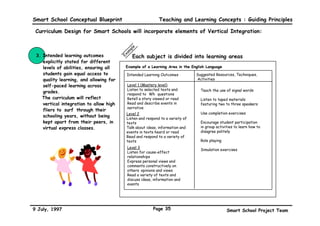
  • 80.
    Smart School ConceptualBlueprint Smart School Management The Human Resources Management component handles the organisation, maintenance and development of school staff, including teachers and school administrators: •Teacher Scheduling •Teacher Scheduling Characteristics Benefits •HR Skills •HR Skills • Comprehensive Human • More efficient and Management Management Resource Information System (HRIS). effective deployment of teaching and •Hiring •Hiring administrative staff. •Promotion/transfer •Promotion/transfer • Integrates all aspects of the HR function including • Teachers will be more Management Management hiring, training, vacation aware of their situation and what is expected of sickness management, •Vacation/sickness •Vacation/sickness skills training, and them; Management will Management Management promotion management. be aware of what (human) resources they •Staff Training •Staff Training • Manage in-school teacher have at hand. scheduling and activities, Management Management as well as inter-school staff • Improved HR activities by means of easily management in all Human Resources accessible information functional areas. Happier staff, hence Security • happier students! Technology 9 July, 1997 Page 77 Smart School Project Team
  • 81.
    Smart School ConceptualBlueprint Smart School Management The Security Management component is responsible for physical and student safety in the school: Characteristics Benefits School Governance • Comprehensive user- • Improved physical asset friendly features for security management. Student Affairs physical and IT security • Improved security and • Safety measures greater safety for Educational Resources appropriate for children of students different age groups and Ensures confidentiality External Resources special needs • of specified data • Security of data, accessible •Physical Security only to authorised •Physical Security personnel •IT Security •IT Security •Student Safety •Student Safety Security Technology 9 July, 1997 Page 78 Smart School Project Team
  • 82.
    Smart School ConceptualBlueprint Smart School Management The Technology Management component implements, maintains and manages the technological components of the school: Characteristics Benefits School Governance • Comprehensive day-to-day • More efficient policy management of network, development and Student Affairs databases, IT hardware, IT management. resources •Long Term Planning Efficient and effective •Long Term Planning • • More realistic long-term field support capability. •System •System planning for development All aspects of the IT of IT capability in school • Implementation Implementation function are managed in •System •System an efficient, cost effective way. Maintenance Maintenance •Training •Training •Field Support •Field Support Management Management Technology 9 July, 1997 Page 79 Smart School Project Team
  • 83.
    Smart School ConceptualBlueprint The Malaysian Smart School Processes and Scenarios 9 July, 1997 Page 80 Smart School Project Team
  • 84.
    Smart School ConceptualBlueprint Processes and Scenarios Smart School Processes The purpose of this Section is to provide the reader a glimpse of how the conceptual components elaborated in previous sections can be put to work. The Smart School processes, one of the four core components supporting the teaching-learning and management details some of the highlights of events within the school. How to read this Section This Section begins by identifying the core processes in the school system today, and the main challenges to overcome in the Smart School system. The Smart School system processes inputs and transforms them to the desired outputs. Following the discussion of the core processes, the Section introduces several scenarios portraying highlights of everyday life in a PEOPLE, SKILLS PROCESSES Smart School. RESPONSIBILITIES Management TEACHING LEARNING Related Materials TECHNOLOGY Administration POLICIES Appendix 3 contains high level Process Flow diagrams of the current and Smart School system. 9 July, 1997 Page 81 Smart School Project Team
  • 85.
    Smart School ConceptualBlueprint Processes and Scenarios • Curriculum Smart School Process Goals specifications Ministry • Financing of • Management and control Education functions SS000 The Smart School System Conduct external achievement assessment Undergo Conduct internal S900 Resources classroom achievement Provide feedback session assessment S500 S600 S700 • (New) students • Teachers Students • Technology / Tools ready for Identify and Select and organise Determine Outcomes Plan student higher localise teaching teaching-learning student’s plan materials entry level experiences education or S100 S200 S300 S400 the work force Develop or procure Manage and Administer courseware or operate school T-L materials resources S800 Viewing the school process as a system External The Smart Schools flagship application provides an opportune Influences time to re-assess the current schooling system. Initially, the Smart School Core Processes Project Team identified the people, their skills and responsibilities, the policies and practices, and the technology, Apply Resources into the To produce (desired) System tools and materials used in schools today. A conscious effort was Outcomes then made to identify the problems and challenges that the school and its people faced in the current system. A plan was The process flow model views the school process The process flow model views the school process then drawn to overcome these challenges, complemented with the as a system. When the identified resources are as a system. When the identified resources are applied into the system, citizens ready for the appropriate people development strategy, and the appropriate applied into the system, citizens readyforce the higher-education system or work for are higher-education system time, external influences produced. At the same or work force are use of enabling technologies. produced. At the same time, external influences may affect the school system. may affect the school system. 9 July, 1997 Page 82 Smart School Project Team
  • 86.
    Smart School ConceptualBlueprint Processes and Scenarios Example of an improved process to determine the student’s entry level: In the current schooling system, students are placed in the classroom with little understanding of their individual needs and capabilities. Any Problems and Challenges to be Problems and Challenges to be diagnosis, if done at all, is to stream students to different classes addressed in Smart School addressed in Smart School according to overall academic achievements. The individual’s strengths and weaknesses are seldom assessed, and their different learning styles •• Students are passive Students are passive are usually not catered to. Teachers often cater to the average in the •• Parents are not involved Parents are not involved classroom. •• Teachers are doing too much non- Teachers are doing too much non- teaching tasks teaching tasks The Smart School process will change the way children are taught ; •• Students need to be trained for the Students need to be trained for the their diversity is regarded as a strength rather than a barrier to Information Age Information Age teaching. Children’s individual differences, needs, capabilities and •• School is an “island” School is an “island” learning styles are diagnosed early to enable teachers to plan the •• Exam-orientated Exam-orientated children’s learning experiences more effectively. Learning is then •• Non-collaborative Non-collaborative optimised to each child. Individual minds, spirits and physical selves are •• Learning not fun Learning not fun catered to rather than the treatment of the class as a homogeneous •• Learning is not for the real world Learning is not for the real world collective whole. •• Lack of variety in the teaching materials Lack of variety in the teaching materials and methods and methods SS300 Determining the student’s entry level •• Limited thinking skills Limited thinking skills Student records Check student records for Determining the student’s entry level will ensure that instruction capitalises on the learning styles, capabilities, inclinations individual student’s strengths and Analyse Recommend preferences while simultaneously placement student’s test results entry level removing barriers to learning. Provide student Take details, including placement test learning styles, capabilities, inclinations, etc. 9 July, 1997 Page 83 Smart School Project Team
  • 87.
    Smart School ConceptualBlueprint Processes and Scenarios A day in the life of a Smart School student - some highlights • Electronically send draft of a report to other members of the group for their • Log in attendance electronically comments and edits. • Browse the day’s activities on the • Post question to the Malay language school electronic bulletin board teacher about doubts on the lesson in class today 7:20 a.m. • Participate in a video • Play a computer-based 8:00 p.m. conference on the simulation groupware spread of AIDS in game on discovering Asia Africa using virtual reality and sounds 8:40 a.m. 3:00 p.m. • Listen to the science • Organise information Smart School teacher’s multimedia collected in a term presentation of the project on water atomic model pollution in the community and use 9:30 a.m. this to write a report 1:00 p.m. on current problems and possible solutions • During break, catch up 11:40 a.m. 10:30 a.m. with electronic mail • Present an oral report in front of the class that is videotaped to go into the student portfolio 9 July, 1997 Page 84 Smart School Project Team
  • 88.
    Smart School ConceptualBlueprint Processes and Scenarios A day in the life of a Smart School teacher - some highlights • Log on to computer in • Evaluate a new teachers’ room to check on commercially produced homework and assignments courseware for Biology completed by students as well classes based on Ministry as students’ attendance for of Education’s guidelines the day 8:00 p.m. 7:20 a.m. • Attend a video- • Conduct a lesson conferenced State on mitosis and level meeting for meiosis Senior Biology incorporating a teachers to set multimedia State-level 3:00 p.m. presentation standards 7:45 a.m. Smart School • Do an Internet search • Respond to for suitable sites for electronic mail students working on the from students, topic of genetic 12:30 a.m. parents and engineering 9:30 a.m. colleagues 11:00 a.m. • Update student assessment records and portfolios in preparation for an upcoming parent-teacher conference 9 July, 1997 Page 85 Smart School Project Team
  • 89.
    Smart School ConceptualBlueprint Processes and Scenarios A day in the life of a Smart School principal - some highlights • Participate in a video conferenced meeting of secondary school principals in the district to discuss discipline issues • Visit “Principals’ 8:30 a.m. Corner”, a • Send e-mail to staff and discussion group parents to inform about on the Internet latest developments in regulations regarding student discipline 5:00 p.m. 10:30 a.m. • Access a student’s Smart School progress records from • Respond to e-mail the school database in preparation for a meeting with his 4:00 p.m. parents regarding his underachievement in 1:00 p.m. class 2:00 p.m. • Attend staff meeting to discuss the up- coming school Sports Day and to delegate duties 9 July, 1997 Page 86 Smart School Project Team
  • 90.
    Smart School ConceptualBlueprint Processes and Scenarios A day in the life of Smart School parents - some highlights • E-mail son’s class teacher to arrange for a conference to discuss his progress in year 5 Science • Check e-mail for replies to requests for donations of 9:00 a.m. equipment to the school • Attend an evening course on Introduction to Multimedia for members of the Parents community conducted in the school 8:00 p.m. computer lab • Go in to school to give a talk to daughter’s class on local ferns and share some interesting samples 11:00 a.m. of ferns with them 9 July, 1997 Page 87 Smart School Project Team
  • 91.
    Smart School ConceptualBlueprint Processes and Scenarios The Smart School as the centre of the community - some highlights • Senior citizens use the computers in the school resource centre to access the internet and use e-mail MON - FRI • Play group session in 5.00 - 8.00 p.m. the playground/gym • for children (1-5 years) in the • Various community community meetings are held in the school from MON WED time to time 3.00 - 4.30 p.m. TUES THURS 5.00 - 8.00 p.m. Community • “Introduction to Computing” course • Youths in the for adults in the community use the community schools facilities MON WED for badminton and 7.00 - 9.00 p.m. football TUES THURS 5.00 - 8.00 p.m. 9 July, 1997 Page 88 Smart School Project Team
  • 92.
    Smart School ConceptualBlueprint The Malaysian Smart School People, Skills and Responsibilities 9 July, 1997 Page 89 Smart School Project Team
  • 93.
    Smart School ConceptualBlueprint People, Skills, and Responsibilities People, Skills and Responsibilities The Smart School has a commitment to provide equal opportunities for all students with different needs and capabilities so as to enhance their capacity for learning. This commitment involves the development of the main stakeholders who are involved in the delivery of Smart School teaching. This will represent a revolutionary departure from traditional modes of teaching currently practised. The main stakeholders will include teachers, principals, support staff, parents and the wider community, all of whom must be prepared and enabled to guide students in Smart Schools. How to read this Section This Section begins with the overall strategy to equip the main stakeholders with the necessary skills and knowledge in line with their roles and responsibilities. Next, the training outline for each of the main stakeholders is discussed. Related Materials Appendix 4 contains an elaboration of the programme for the professional development of PEOPLE, SKILLS Smart School teachers. The main roles and PROCESSES RESPONSIBILITIES Management functions of these teachers are also included. TEACHING LEARNING Administration TECHNOLOGY POLICIES 9 July, 1997 Page 90 Smart School Project Team
  • 94.
    Smart School ConceptualBlueprint People, Skills, and Responsibilities The stakeholders involved in the implementation of Smart Schools. TEACHERS What are their roles/responsibilities ? PRINCIPALS SUPPORT What knowledge, STAFF skills and attitude OTHER do they need ? EDUCATION PERSONNEL What is the training PARENTS required ? COMMUNITY PEOPLE, SKILLS PROCESSES Each group of stakeholders will have specific RESPONSIBILITIES Management responsibilities in the overall implementation of Smart Schools. To carry out their respective TEACHING LEARNING responsibilities, each stakeholder will need to be Administration equipped with specific skills and have the requisite TECHNOLOGY POLICIES knowledge base and the right attitude. This knowledge, skills and attitude will be developed through exhaustive training courses tailored for the development of each stakeholder group. 9 July, 1997 Page 91 Smart School Project Team
  • 95.
    Smart School ConceptualBlueprint People, Skills, and Responsibilities Smart School Teacher Development Teacher development will be the most critical component as teachers will be the primary deliverers of Smart School teaching. A comprehensive teacher education programme incorporating best practices in technology supported learning will be critical to the success of the Smart School initiative. These teachers will need intensive Roles and Responsibilities OUTLINE OF NEW EMPHASES IN TRAINING training on Information Technology • Planning and preparation of Pre-service training In-service Training skills and technology integration into learning activities • Managing a technology enriched Trainee Teachers Teachers Trainers classroom instructions to enhance environment • Delivering effective instruction • IT skills • Phase 1: Smart • 2 phases as for • Handling professional tasks thinking and creativity. In addition, • Thinking Skills School concept and goals, Basic teachers • Motivation skills Smart Schools teachers need to be • Values education IT skills, Core teaching skills • Continuous trained as “guides on the side”, • Language proficiency professional • Phase 2: • Technology Integration of upgrading facilitating and encouraging students to Skills and Knowledge needed: integration into the teaching-learning IT into T-L activities, programme • Benchmarking take charge of their own learning. • Designing instruction process Creativity and innovation in T-L for quality • Assessing student learning • Role as guide and training • Managing classroom procedures facilitator of activities and The training should allow participants to • Creating environment of respect and support learning management explore a wide variety of areas and • Facilitating students in cognitively stimulating activities • Utilising technology for effective strategies as well as the opportunities • instruction Communicating with colleagues and to engage in practicums that represent • community Selecting use of effective resources the reality they would face. Plus the right attitude On-site coaching, Practicum, Peer Coaching, Reflection, Demonstration, Simulation and Continuous Learning Continuous learning is a crucial ingredient as it is necessary for The pre-service and in-service professional development teachers to keep abreast of programmes will have new emphases in nurturing the development in their professional qualities and practices of teachers in order for them to practices and to be confident with function in a technology enriched environment. technology. 9 July, 1997 Page 92 Smart School Project Team
  • 96.
    Smart School ConceptualBlueprint People, Skills, and Responsibilities Smart School Management Training for Principals The task of managing schools involves Roles and Responsibilities: working with information and building OUTLINE OF NEW EMPHASES FOR TRAINING on ideas collaboratively. The • Set attainable school goals to meet the needs of students, parents, and the nation efficiency and effectiveness of this • Plan programmes for the constant upgrading of PHASE 1 PHASE 2 • Smart Schools • Application of management task in a Smart School school administrators’ skills, on computer applications for administration and management, and the Specific are enhanced through the use of strategic planning and leadership, Information Age Management Software • Management technology. • Develop plans for development of his staff on IT, instructional management, and CAI processes and the • Innovation and Smart School creativity in • Constant discussion with teachers on ways to management The change being brought about in improve teaching strategies in facing the realities of the world of high technology, and to • Basic IT skills: Word Processing the planned conversion of all supervise them and Spreadsheets Malaysian schools into Smart Schools • Overview of Multimedia is indeed a serious one which can Skills and Knowledge needed : Applications in Education cause apprehension in all those • Application and translation of management • Motivation, team- involved. A major part of most theories into practice building and collaboration resistance to change may be • Self-directing, motivation, personnel management, leadership, innovation, skills attitudinal. To a smaller extent creativity, team-building and collaboration skills resistance is due to the lack of skills • Competency in the use of related technology Awareness and exposure to technology in although there is desire to change. for school management management, On-site coaching, Peer Coaching, On- the-job self training, Reflection, Demonstration, • Competency to provide instructional Simulation, Continuous Learning, leadership Thus, Smart School principals will Plus the right attitude need to go through an intensive management training course to equip them to manage the new facilities, A coherent training framework should be set out, with the technologies and methodologies to be appropriate emphases on new technologies and deployed in Smart Schools. methodologies. 9 July, 1997 Page 93 Smart School Project Team
  • 97.
    Smart School ConceptualBlueprint People, Skills, and Responsibilities Smart School Clerical Staff Development The school clerical staff are the school clerks, typists and office boys. Their responsibilities include maintaining student and staff (teaching and non-teaching) records, school finances, school communications, school inventories and matters pertaining to student and staff welfare. THE TRAINING OUTLINE In the Smart School, these tasks will Roles and Responsibilities: be accomplished with the aid of • Maintaining PHASE 1 PHASE 2 technology. The members of the Ø student and staff • Smart School and • Application of records clerical staff would need to understand Ø school finances the Information Specific Ø school communications Management how this office automation is done. Age Ø school inventory Software They should be introduced to basic IT • Manage matters pertaining • Basic IT skills: skills such as word processing and to student and staff word processing welfare spreadsheet applications. and spreadsheet applications Sufficient hands-on training in the management application software Skills and Knowledge deployed in the Smart School must be needed: provided. • Basic IT skills On-site coaching, Practicum, Peer Education in the new technology alone • Word processing and spreadsheet applications Coaching, Reflection, Continuous Learning, is not enough. They need to better • Management software Demonstration and Simulation, On-the-job understand the new school processes applications training. and give their support wherever Plus the right attitude necessary. 9 July, 1997 Page 94 Smart School Project Team
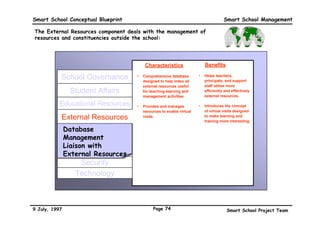
  • 98.
    Smart School ConceptualBlueprint People, Skills, and Responsibilities Smart School Media/Technology coordinator For each Smart School, there needs THE TRAINING OUTLINE Roles and Responsibilities: to be a Media/Technology • troubleshooting of technical problems coordinator who will be responsible • respond to teachers’ request for help in • Basic IT and the new emphases on technology integration in the classroom professional skills for supporting teachers in the overall • assist the principal in the management • Integration of IT into T-L activities deployment of multimedia and other • software applications select and evaluate T-L materials • Creativity and innovation in T-L activities technologies in the delivery of Smart • guide and train teachers in delivering effective technology supported instruction and materials School teaching. • supervise maintenance of all technical • Thinking Skills equipment The technology coordinator is • liase with the school technical support for • Values education • Language proficiency entrusted to guide and help train equipment repair, replacement and facility upgrading • Technology integration into the teaching- teachers in delivering effective • keep abreast with development in learning and management process technology technology supported instruction. • Role as guide and facilitator of learning Thus the technology coordinator • Continuous professional upgrading programme should be a teacher with skills in Skills and Knowledge needed: • Mindset change towards Smart School integration of technology for • Basic pedagogical skills • Basic IT skills • Motivational skills enhancement of information • Skills in integration of technology for gathering, instruction, management enhancement of information gathering, instruction, management processes and processes and communication. communication On-site coaching, Practicum, Peer Coaching, • Knowledge of computer networking and system administration Reflection, Continuous Learning Other responsibilities of the Plus the right attitude technology coordinator include assisting the principal in the Apart from the pedagogical issues the technology management software applications as coordinator will also supervise maintenance of all technical well as keeping abreast with equipment and liaise with the school technical support staff development in education technology. team for equipment repair, replacement and facility upgrading as and when necessary. 9 July, 1997 Page 95 Smart School Project Team
  • 99.
    Smart School ConceptualBlueprint People, Skills, and Responsibilities Smart School Technical Support Technical support is critical to the maintenance of all installed hardware and software to ensure minimal disruption to the teaching-learning and management process. Thus, every Smart School should have a well defined technical support organisational structure which will provide help-desk function to Smart School students, teachers or administrators who require assistance in solving technical problems. A number of organisational options can be deployed to ensure a tight, coherent centralised support organisation backed up at the local level by self-sufficient teams based at either individual or identified clusters of Smart Schools. Roles and Responsibilities: POTENTIAL OPTIONS • troubleshooting of technical problems First Level Support • respond to school School Media/Technology coordinator can provide this support. He/she will attempt media/technology coordinator’s to troubleshoot any problems relating to the use of technology before routing it to request for technical help the next level of support. • maintenance of all technical First level support can also be provided by : equipment a. Technology savvy students. • communicate with the other This can be considered as part of their co-curricular activities levels of technical support b. Technology savvy teachers. • ensure conformity to IT policy Due recognition and acknowledgement must be given to these teachers. Second Level Support This should be based in the school. A technician who is competent in the technology Skills and Knowledge needed: deployed in the school would be the ideal support needed. • IT skills and knowledge • Computer and networking skills Subsequent Level of Support • Knowledge of educational and Subsequent level of support includes all technical support beyond the school level. It management software and other can be a technician who is based at the district/state level, a help-desk at the applications used in schools Ministry of Education level and/or a helpdesk set up by the vendor concerned. Plus the right attitude 9 July, 1997 Page 96 Smart School Project Team
  • 100.
    Smart School ConceptualBlueprint People, Skills, and Responsibilities Professional Development for other Education Personnel Officers from the various divisions of the The training outline for these officers should Education Ministry, State Education include: Departments, District Education Offices need • Smart School vision and objectives to understand the educational objectives and • Their role and responsibilities in the Smart policies of the Smart School in fulfilling their School respective roles. • IT literacy The training curriculum for the officers have to • The teaching-learning and management be geared towards their specific responsibilities processes in the Smart School in the Smart Schools. • Application of new approaches to their tasks Roles and Responsibilities: • Planning THE TRAINING OUTLINE • Co-ordinating PHASE 1 PHASE 2 • Monitoring • Supervising • Understanding the • Application of Education officers are crucial to • Evaluating concept, vision and Management Software the success of the specific to the different mission of Smart Schools functions of the different implementation of the Smart School project as they play a • Smart Schools and the divisions of the Ministry Information Age of Education/State Skills and Knowledge needed: • Basic IT skills, word Education Departments/District major role in the planning, co- • Application and translation of processing and spreadsheets Education Offices ordinating, monitoring, and theories into practice • Overview of multimedia evaluating the implementation • Motivational skills, personnel applications in education activities at the various levels. P management skills and leadership skills of the training should therefore • Self-directing skills and skills concentrate on developing the at innovation and creativity awareness and acceptance of • Competency in supervising the Briefings, Demonstrations, Simulations, On-the-job Training, the Smart School concept. new Smart School processes. Peer Coaching, Reflection, Continuous Learning Plus the right attitude 9 July, 1997 Page 97 Smart School Project Team
  • 101.
    Smart School ConceptualBlueprint People, Skills, and Responsibilities Parents of the Smart School students Parents of Smart School children play a critical role in achieving the goals of Smart Schools in delivering education and developing balanced and holistic students. There is a need to increase the participation of parents in educational processes such as in teaching-learning, development of educational materials, assessment,etc. A student’s learning opportunities stretch Roles and Responsibilities: POSSIBLE STRATEGIES beyond the classrooms. Parents can be • Personal charge of children’s educational resources, and in the process learning experiences • National campaign on parents in Smart benefit themselves as their own learning - monitor children’s School progress - media (electronic/print media) needs become a life-long endeavour. - guide, motivate and counsel - road show (seminar, exhibition, Research has also shown that children are children forum) • Support school activities • Parents’ Role in Smart School more successful in school when parents are • Resource persons/experts in Conference involved in their education. their own area • Briefing on Smart School educational The roles and responsibilities of Smart process • Basic IT skill training at school level School parents must be widely • Counselling and motivation seminars acknowledged and accepted, in order to Skills and Knowledge - State/District level needed: - School level create significant buy-in for parents to • Ability to access school’s • School tours/exhibitions of the assume a much stronger role in the Smart technology available in school School education process. There are a public domain databases • Parent support group monthly meetings • Ability to counsel and • “IT Camps” at schools number of strategies that can be adopted motivate their children • Ability to understand • Parents Bulletin Boards/Home Pages to increase the participation of Smart • “School Cyber Cafés” for parents educational process • Launching of parent’s web-site School parents both in the delivery of education as well as in the supervision of Plus the right attitude children outside of school. 9 July, 1997 Page 98 Smart School Project Team
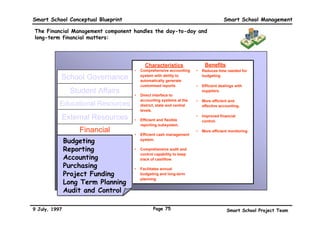
  • 102.
    Smart School ConceptualBlueprint The Malaysian Smart School Technology Enablers 9 July, 1997 Page 99 Smart School Project Team
  • 103.
    Smart School ConceptualBlueprint Technology Enablers Smart School Technology Enablers The purpose of this Section is to suggest the technologies that will support Smart Schools in Malaysia, namely, the technologies and infrastructure required for the teaching-learning, management, the connectivity to the external constituencies and the Educational Network connecting the Smart Schools. How to read this Section This Section begins by illustrating the various implications of Information Technologies to the teaching-learning process, management, and linkages to external constituencies. Following each implication scenario, a chart of possible technical solutions are presented. Next, several options of school, district and national level technical solutions are presented. Finally, the network configurations for the three levels are broadly proposed. PEOPLE, SKILLS PROCESSES RESPONSIBILITIES Management TEACHING LEARNING Administration TECHNOLOGY POLICIES 9 July, 1997 Page 100 Smart School Project Team
  • 104.
    6PDUW6FKRRORQFHSWXDO%OXHSULQW 7HFKQRORJ(QDEOHUV 7KH7HFKQRORJ'HULYDWLRQ3URFHVV 6PDUW6FKRRO 7HFKQLFDO 6PDUW6FKRRO3UDFWLFHV 7HFKQRORJ 5HTXLUHPHQWV ‡ 7HDFKLQJ /HDUQLQJ 6ROXWLRQV ‡ 6DPSOH$SSOLFDWLRQ ‡ 0DQDJHPHQW6VWHP ‡ 6FKRRO/HYHO VROXWLRQV ‡ ([WHUQDORQVWLWXHQFLHV ‡ 'LVWULFW/HYHO ‡ 1HWZRUN ‡ 6WDWH/HYHO 5HTXLUHPHQWV ‡ 1DWLRQDO/HYHO 3(23/( 6.,//6 352(66(6 5(63216,%,/,7,(6 0DQDJHPHQW TEACHING LEARNING $GPLQLVWUDWLRQ 7(+12/2* 32/,,(6 -XO 3DJH 6PDUW6FKRRO3URMHFW7HDP
  • 105.
    Smart School ConceptualBlueprint Technology Enablers The Information Technology implications of the Teaching-Learning Process Examples of Teaching Learning Practices IT Implications Self-Exploratory Learning Every computer shall have access to the latest educational materials available locally, as well as to external resources Collaborative Learning Tools that facilitate group work within the class and across classes Distance Learning Communication with outside constituencies using technology, i.e., video conferencing, e-mail, video on demand, broadcast, etc. Experiential Learning Simulation software and virtual reality to stimulate learning Research, Reference, and Data Collection Tools to search, collect and collate information Electronic Assessment On-line assessment via a standard database and built-in assessment courseware Inclusive Education Tools to help students with disabilities cope with learning more effectively Drill and Practice Software or courseware that allows students to practise on their own or with peers 9 July, 1997 Page 102 Smart School Project Team
  • 106.
    Smart School ConceptualBlueprint Technology Enablers …therefore Teaching and Learning Technical Requirements for these examples might look like the following... Central Server Equipment Local Server / Conferencing Stand Alone / Database Resource * Database Database Computer Network (specify) Network Regional Server/ Secure Other Visual Audio Video LAN Item Self-Exploratory Learning Collaborative Teleconference Learning Distance ISDN Learning Research,Reference and Data Collection Experiential Learning Electronic Assessment Inclusive Artificial Education Intelligence Drill and Practice Must have Nice to have * Example: Internet 9 July, 1997 Page 103 Smart School Project Team
  • 107.
    Smart School ConceptualBlueprint Technology Enablers Information Technology Implications of the Smart School Management System School Management Functions IT Implications School Governance Using computer communication i.e, video conferencing, to link the school to the Ministry of Education for administration and policy implementation purposes Student Affairs Using computers and databases to maintain student profiles. Educational Resources Using computer communication to link the school’s databases to central resource databases to regulate and organise educational resources External Resources Using computer communication to link the school to external constituencies like network resources, i.e., Internet, libraries and museums for the purpose of research, reference and data collection. Financial Management Using computer communication to link the school’s databases to facilitate budgeting, accounting and reporting Facilities Using computer communication to link the school’s databases to plan facility scheduling, maintenance and inventory. Human Resource Management Using computer communication to link the school’s databases to the State Education Departments for human resource management purposes Security Management Using computer communication to link the school’s databases to the District Education Office for security management purposes Technology Management Using computer communication for the purpose of acquiring centralised IT support for the school. 9 July, 1997 Page 104 Smart School Project Team
  • 108.
    Smart School ConceptualBlueprint Technology Enablers …therefore the Management System Technical Requirements might look like the following... Equipment Conferencing Stand Alone Resource * Database Computer Database Database Network Network (specify) Regional Server/ Server/ Server/ Secure Central Other Visual Audio Video Local LAN Item School ISDN Governance Teleconference Student Affairs Management Educational Resources Mgmt External Resources Management Financial Management Facilities Management Human Resource Management Smart Card Security Smart Card Management Technology Remote Management Access Must have Nice to have * Example: Internet 9 July, 1997 Page 105 Smart School Project Team
  • 109.
    Smart School ConceptualBlueprint Technology Enablers Information Technology Implications of linkages to External Constituencies Examples of Linkages to Constituencies IT Implications Other Schools Optimal sharing of information and resources to encourage collaborative learning on a subject among schools. Homes / Parents Distance learning enables students to keep track of school work even when they are not physically in school. Parents can access the school for feedback on their children’s progress. Community The Smart School can be a community centre to enable community involvement in school activities. The community can also use the Smart School as an on-going learning centre. Libraries Research, reference, and data collection resource available on-line Universities / Colleges Distance Learning on topics by experts in the field, the provision mentor / tutor programmes, and research data. Access to information on industries, and career opportunities, Companies / Industries industrial practical training and sponsorship programmes offered by these industries. Museums/Archives /Science Centres Research, reference, and data collection resource available on-line. Possible access to virtual experiences. Local Authorities On-line information about local social and cultural events to enable school participation. 9 July, 1997 Page 106 Smart School Project Team
  • 110.
    Smart School ConceptualBlueprint Technology Enablers …therefore External Constituency Technical Requirements might look like the following... Equipment Conferencing Stand Alone Resource * Database Computer Database Database Network Network (specify) Regional Server/ Server/ Server/ Secure Central Other Visual Audio Video Local LAN Item Other Schools Homes / Parents Communities Libraries Universities / Colleges Companies / Industries Museums/Archives/ Science Centres Local Authorities Must have Nice to have * Example: Internet 9 July, 1997 Page 107 Smart School Project Team
  • 111.
    Smart School ConceptualBlueprint Technology Enablers Technical requirements and possible solutions at the school level: Varied easy access to teaching-learning resources Variety of materials Requirements • Physical facilities e.g classroom or lab • Conventional materials • Teaching and learning equipment including hardware and • Multimedia materials software • Network-based materials Conferencing facilities • Distance learning • Meetings in-service training Classroom Studio / Theatrette Possible • Multimedia courseware • Control room for centralised Audio/Video equipment Solutions • Presentation of teacher’s educational materials (e.g. • Video conferencing studio computers for students and teachers, audio/video • Preview room for audio, video or laser disk (LD) facilities) materials • Collaborative tools e.g. e-mail, groupware Teachers’ Room • Access to courseware catalogues and database Library / Media Centre • Information and resource management systems • Database centre of multimedia courseware • Network resources (e.g. Internet) • Professional networking using e-mail and groupware Administration Office Computer laboratory • Database management of students and inventories • Teaching ( e.g. Computer Studies as a subject) • Tracking (e.g. teacher and student performance, • Readily accessible multimedia and Audio/Video resources) equipment • Distribution of notices / information Server Room Multimedia Development Centre • Central server site (e.g. Application servers, • Creation / development tools for multimedia Management Database server, Web server) materials (e.g. preparation of presentations or • Security measures ( e.g. Proxy server, Firewall ) music) • Telecommunication interface and access to Network • Catering for varying levels of sophistication resources e.g. Internet (e.g. router, modem) 9 July, 1997 Page 108 Smart School Project Team
  • 112.
    Smart School ConceptualBlueprint Technology Enablers Possible scenario a school configuration Classroom (1-n) Library/Media Centre Computer laboratory Studio / Theatrette A/V equipment CD jukebox hub hub hub • 35 Computers with headphones • 35 Computers (1:1 ratio) with • 7 Computers (1:5 ratio) • 1 CD juke box and courseware headphones • 1 Video Conferencing studio • 1 Computer for teacher database • 1 Computer for teacher • Audio-Video equipment • 1 printer • 1 printer • 1 printer • Document camera • A/V equipment (e.g. TV,VCR,projector) • 1 Media server • MIDI equipment Switching Hub ISDN Teachers’ Room Administration Office Multimedia Database/ Applications ISDN TA Development Centre EduNet hub hub hub Router • 5 workstations + 10 computers Server Room • 1:1 ratio to the number of teachers • 1:1 ratio to the number of staff • 2 scanners + 2 colour printers • Web server + applications servers likely to be in the Teachers’ Room • 2 printers • CD-ROM production • Proxy server + firewall at any time • Office Automation equipment • Data backup equipment • Network Management System • 1 printer • Content development tools (e.g. • Management Database Non linear editing equipment, • Smart Card Management MIDI, Authoring tools) • Router, ISDN TA, modem Multi-mode fibre Assumption: UTP Category 5 Classroom size: 35 9 July, 1997 Page 109 Smart School Project Team
  • 113.
    Smart School ConceptualBlueprint Technology Enablers Technical requirements and possible solutions at district level District database Secure network Requirements • Assessment, on-line resources, • Assessment data, student and staff management e.g. Human records, governance, finance, Human Resources, finance, educational Resources, security, educational resources, technology, student resources, student affairs affairs, external resources • Centralised multi-point video conferencing Possible • Secured transactions e.g. over the network Solutions • Regional server with a unique computer address for each school • Information management and control Implementation options: Option A Option B • Secure transaction via network (software only) • Clustered multi-point video conferencing. • Independent/ direct connection to district level • Secured transaction via separate secure for multi-point video conferencing network • Security measures including data encryption 9 July, 1997 Page 110 Smart School Project Team
  • 114.
    Smart School ConceptualBlueprint Technology Enablers Possible scenario of an inter-school and district education network Option A Option B Database Database Servers Domain Proxy Server Database Servers Servers Name Server Router F FIREWALL I R Router E Hub Hub W Hub Hub A L L Administrative Network Management Administrative Administrative Users Users Router System Users MCU MCU MCU District A Remote Login State District B ISDN OPEN NETWORK Primary School Secondary School (e.g. INTERNET) ISDN Secondary School Primary School 9 July, 1997 Page 111 Smart School Project Team
  • 115.
    Smart School ConceptualBlueprint Technology Enablers Technical requirements and possible solutions at national level Requirements • Access to resources over an open platform • Means for collaborative work • Open communication channels with constituencies • Controlled distribution of sensitive information • External telecommunications backbone to support widely distributed points of access • An education network consisting of both secured and open networks Possible – sensitive information rides on the secure network (Ministry of Education, State District Solutions Education offices, etc.) – educational resources reside on the public network (schools, libraries, etc.) • Schools can get into the secure network – through the open network via encryption means other security measures – directly via remote access • The telecommunications backbone can be – current telecommunications infrastructure – the Multimedia Super Corridor infrastructure 9 July, 1997 Page 112 Smart School Project Team
  • 116.
    Smart School ConceptualBlueprint Technology Enablers Possible scenario of a national level education network Ministry of State Education Department District Education office Education SECURED EDUCATION District Education office NETWORK State Education Department School Firewall School Point of Access Point of Access School Point of Access Point of Access OPEN NETWORK (e.g.INTERNET) Legend Access Network Security Access BACK BONE NETWORK 9 July, 1997 Page 113 Smart School Project Team
  • 117.
    Smart School ConceptualBlueprint Technology Enablers Technical requirements and possible solutions for the national repository centre • A national level repository centre available to all Requirements education sites • Expedient access to • the Ministry of Education • the Federal Government administration • Reliable telecommunications infrastructure • Capacity for international linkages and connectivity to relevant repositories Possible • It should reside in the Multimedia Super Corridor (MSC) Solutions • Designated multimedia centre • Proximity to Putra Jaya, the new Federal administration office • MSC will have the best and guaranteed telecommunications and infrastructure facilities • The Smart School Project is a key MSC Flagship Application 9 July, 1997 Page 114 Smart School Project Team
  • 118.
    6PDUW6FKRRORQFHSWXDO%OXHSULQW 7HFKQRORJ(QDEOHUV LIWKHQDWLRQDOUHSRVLWRUFHQWUHZHUHORFDWHGZLWKLQWKH06 06 (GXFDWLRQDO 5HSRVLWRU HQWUH /HJHQG 6WDWH (GXFDWLRQ HQWUH 'LVWULFW (GXFDWLRQ HQWUH +LJK VSHHG EDFNERQH $FFHVV /LQH -XO 3DJH 6PDUW6FKRRO3URMHFW7HDP
  • 119.
    Smart School ConceptualBlueprint The Malaysian Smart School Policy Implications 9 July, 1997 Page 116 Smart School Project Team
  • 120.
    Smart School ConceptualBlueprint Policies Policy Implications for Smart School In this Section, the term “policies” is used as an umbrella term that encompasses both legislative policies and regulations that will influence Smart Schools and their effective implementation. How to read this section The Project Team realised that it was important to consider the whole range of policies, regulations, procedures, and practices both formal and informal, written and unwritten that will need to be changed to accommodate implementation of Smart Schools. This complex task will be undertaken by numerous departmental committees in the Ministry of Education and will require time and PEOPLE, SKILLS RESPONSIBILITIES PROCESSES several iterations to arrive at specific new Management approaches. TEACHING LEARNING Hence, as a start, in this Section, the Project Team highlighted some of the important Administration questions at the macro level - particularly POLICIES TECHNOLOGY related to policies and regulations - that need to be addressed to ensure the successful implementation of Smart Schools in Malaysia. 9 July, 1997 Page 117 Smart School Project Team
  • 121.
    Smart School ConceptualBlueprint Policies The policy implications To ensure the Policy issues are for Smart Schools successful discussed with was studied by taking implementation of respect to each of into account: Smart Schools we the main areas in need: the Blueprint: Changes in • The goals of • Teaching- existing Smart Schools learning • Policies processes • The envisioned features of • Regulations • Management Smart Schools functions to make them in • The existing line with the - of the overall policies and goals of Smart Smart School regulations in Schools system education - within a AND Smart School To formulate • People, skills and • New policies responsibilities • New • Technology regulations that will enhance the chances of success of Smart Schools PEOPLE, SKILLS PROCESSES RESPONSIBILITIES Management TEACHING LEARNING Administration TECHNOLOGY POLICIES 9 July, 1997 Page 118 Smart School Project Team
  • 122.
    Smart School ConceptualBlueprint Policies Policy areas that need to be addressed in the implementation of Smart Schools: Note: Questions that have significant policy implications are discussed under the following categories within each of the four main areas : People, skills and Teaching-Learning Management Technology responsibilities • Teaching-learning • School governance • Teachers • Technology inputs • Assessment • Student affairs • Administrators • Technology • Selection and • Educational • Technical staff standards approval of resources • Personnel in the • Data security teaching-learning • External resources education system • Technology materials • Financial that support Smart architecture • Facilities Schools • Human resources implementation • Security • Parents • Technology • Community 9 July, 1997 Page 119 Smart School Project Team
  • 123.
    Smart School ConceptualBlueprint Policies Examples of policy areas that need to be addressed in the Teaching-Learning Process Envisioned Features of the Questions that need to be addressed Smart School • Students progress at their own • Under what conditions should vertical integration be pace according to capabilities introduced? • Students in a class learn in a • Should there be changes in the time allocated for - ing variety of ways (e.g. distance teaching the various subjects in the Smart School ch ea ning T r learning, internet, electronic curriculum? If so, how should they change? lea courseware) at the same time. • Is there a need for more flexible time-tabling? • What kind of classroom arrangement and furniture can enable learning to occur in a variety of ways? • Aptitude assessments will be • How often should aptitude assessment be conducted? t m en conducted at the point of school • How should aptitude assessments be designed? e ss entry and then periodically after • What national examinations should be conducted? A ss that • What levels of recording should be done for the various assessment? of • Best courseware materials need to • What changes in the selection process of teaching- on ti - be identified for teaching Smart learning materials are needed to ensure “best” Smart lec ing School subjects School materials? (e.g. transparent selection criteria Se ach ng te rni ials and evaluation.) lea ter ma 9 July, 1997 Page 120 Smart School Project Team
  • 124.
    Smart School ConceptualBlueprint Policies Policy areas that need to be addressed in Management Functions : Envisioned Features of the Questions that need to be addressed Smart School • Empowers the rapid relay of • What information needs to be compiled? ol ce relevant information to and from • Who gets access to what information? ho rnan Sc ve all stakeholders • Who owns it? Go • How long does the information need to be kept? • How does the information get modified? • Creates channels for rapid • Who can represent the school’s views? communication to the world • What are the guidelines for expressing views in e-mail form from the school? • What regular practices should be used for outreach communication? (e.g. web-site - how often to be up- dated and what contents to be included?) • Test administration is via multiple- • What are the conditions under which test administration nt ude rs delivery and on-line is conducted (e.g. can students do the assessments from St fai home?) Af • Intellectual property rights are • Who owns the written materials produced by teachers? upheld in Smart Schools • What are the guidelines on copyright issues? ies cilit • School facilities will be used by • How do we ensure the security of school facilities? Fa the community after school hours • How do we ensure equal access to the physical facilities? all • A central team at Ministry of • Who drives the implementation? e r ent Education in charge of Smart O v em • Who evaluates the Smart Schools? ag School implementation • Who co-ordinates the external linkages (e.g. Telekom, M an vendors, etc.) with state, district and school levels? 9 July, 1997 Page 121 Smart School Project Team
  • 125.
    Smart School ConceptualBlueprint Policies Policy areas that need to be addressed in getting the right people for Smart Schools : Envisioned Features of the Questions that need to be addressed Smart School • All teachers skilled in the use of • What needs to be included in the IT component of the IT and integration of IT in the pre-service teacher training curriculum at colleges and teaching-learning process universities? s • What IT elements are necessary for continuous teacher er ach development? Te • What should be the minimum hours of on-going, annual professional development required for practising teachers? • What mechanisms need to be in place to ensure the integration of IT into teaching activities? • Administrators (principals, • What are the minimum IT skills necessary for school headmasters, senior assistants) administrators? possess adequate IT skills • Should proficiency in IT skills become a criterion in the s or selection of administrators? If so, how? rat st • What mechanisms need to be in place for all mini administrators to acquire the necessary IT skills and Ad then periodically update these skills? 9 July, 1997 Page 122 Smart School Project Team
  • 126.
    Smart School ConceptualBlueprint Policies Policy areas that need to be addressed in getting the right people for Smart Schools (continued) : Envisioned Features of the Questions that need to be addressed Smart School • Competent technical staff provide • What new posts need to created in schools at the al support for technology used in district and state levels? (Are these technical positions nic t ch r Smart Schools or teachers who are trained to support technology)? Te ppo • To what extent would teachers and students play a role? Su aff (e.g. teachers with interest and expertise have a St reduced teaching load to enable them to be responsible for technology support; students to assist in technology support as an extra curricular activity or for credit) • Lecturers in teacher training • Should the envisioned features of Smart School l colleges and universities, and teaching-learning and the use of technology in teaching- ne on oE School Inspectors are learning be introduced as criteria against which to rs Pe e M t knowledgeable about the Smart select lecturers and school inspectors? th r in uppo School philosophy, goals and the s integral role of technology in o wh rt teaching-learning a Sm ool tion h a Sc ent lem Imp 9 July, 1997 Page 123 Smart School Project Team
  • 127.
    Smart School ConceptualBlueprint Policies Policy areas that need to be addressed in getting the right people for Smart Schools (continued) : Envisioned Features of the Questions that need to be addressed Smart School • Parents can easily access academic • Who qualifies to view students’ data? s and health records of their child • What kind of data goes on-line? nt on-line re Pa • The Smart School is the centre of • What facilities shall be made available for community learning for the community use? And when should they be made available? ity • The community is encouraged to • What is the extent and type of community participation mun om participate in Smart School that is encouraged? (e.g. Individuals coming into the C activities and use Smart School classroom as volunteer teacher aides or involved in co- facilities curricular activities or helping students who need extra help with their school work) 9 July, 1997 Page 124 Smart School Project Team
  • 128.
    Smart School ConceptualBlueprint Policies Policy areas that need to be addressed when introducing technology in Smart Schools : Envisioned Features of the Questions that need to be addressed Smart School • LAN, WAN hardware and • What modifications need to be made to the per capita al gic courseware are common technology grant (PCG) to accommodate start-up and on-going olo inputs in Smart Schools technology expenses? chn Te puts • What alternative funding sources can be harnessed by In Smart Schools to acquire additional technology inputs? • Common technology standards • To what extent are schools able to add technology that gy olo ds must be adhered to in all Smart is inconsistent with agreed-upon Ministry of Education hn r ec nda T a Schools for reasons of inter- guidelines or technology standards? St operability ta ity • Most data in Smart Schools will be • Who defines security policies? Da cur on-line and easily accessible • Who grants security access rights? Se • A central agency will co-ordinate • Who owns and modifies architecture and technology gy e the introduction of technology into standards? olo tur • How will legacy systems and networks be integrated into hn c Smart Schools ec hite T c the Smart School system? Ar • Who is responsible for defining a technology support structure, modifying it and ensuring its success? • Who is responsible for monitoring technology (hardware and software) performance over time? • Who will be responsible for defining guidelines that will allow beta testing of new courseware in Smart Schools • What role can the private sector play in the on-going implementation (e.g. with respect to standards, technology, architecture and policies) 9 July, 1997 Page 125 Smart School Project Team
  • 129.
    Smart School ConceptualBlueprint The Malaysian Smart School Concluding Remarks 9 July, 1997 Page 126 Smart School Project Team
  • 130.
    Smart School ConceptualBlueprint Concluding Remarks Concluding remarks: The dynamic nature of a Smart School makes it • The curriculum should be broad to cater to obligatory and incumbent on the Project Team the needs and different capabilities of to propose indicators of whether or not the key students; objectives of such an ideal school have been achieved. • There should be competent, caring and professional teachers These indicators are detailed criteria that provide clear evidence as to the extent to which • The school climate or culture should be one the programme is succeeding in achieving the that is conducive to learning; goals set out in the Malaysian National Philosophy of Education. • The on-going assessment system should be one that supports good instruction; It is with this in mind that the Project Team feels that some of the key criteria to measure • There should be achievement gains recorded the performance or success of the Smart year by year; School programme would comprise the following: • There should be a decrease in discipline referrals • There should be a decrease in drop out rates • There should be high level of parent and community involvement 9 July, 1997 Page 127 Smart School Project Team
  • 131.
    Smart School ConceptualBlueprint Concluding Remarks Concluding remarks (continued): To bring about these high levels of The Project Team also proposes that an performance, the Project Team has identified oversight mechanism be set up to critical factors for success in order for Smart monitor and assess the implementation Schools to be established and implemented in of Smart Schools and to oversee the Malaysia. Among these factors so identified balance of rights and responsibilities are the following: among the constituencies of the Smart • There should be buy-in, support and School system. commitment from all stakeholders; • There should be continuous professional With all these prerequisites and development for teachers, principals, conditions in place, the Project Team is administrators and other educational convinced that Smart Schools will personnel; herald a new and dynamic phase in the • There should be sufficient funds and nation’s educational development, resources; providing a key ingredient in Malaysia’s • Policies, regulations, norms and guidelines march towards being a fully developed that support Smart Schools should be in nation by the year 2020. place; • There should be continuous synergistic efforts by all agencies in the educational system. • Schools should have in place processes which reflect the need for efficiency and effectiveness; • There should be sufficient deployment of IT resources for enabling support including on- going maintenance and support. 9 July, 1997 Page 128 Smart School Project Team
  • 132.
    Smart School ConceptualBlueprint The Malaysian Smart School Appendix 1 Smart Schools In Malaysia: A Quantum Leap Ministry of Education, Malaysia Kuala Lumpur January 1997 9 July, 1997 Page 129 Smart School Project Team
  • 133.
    Smart School ConceptualBlueprint Appendix 1 SMART SCHOOLS IN MALAYSIA : A Quantum Leap Malaysia needs to make the critical transition from an student - strong or weak, rich or poor - stretches to his industrial economy to a leader in the Information Age. fullest potential in a way that is best suited to his In order to make this vision a reality, Malaysians need to learning pace and style. The curriculum will therefore make a fundamental shift towards a more technologically recognise that students have different learning needs. literate, thinking work force, able to perform in a global Computer technology will allow for this flexibility and work environment and use the tools available in the diversity to be built into the system. This will also narrow Information Age. To make this shift, the education the opportunity gap between the affluent who can afford system must undergo a radical transformation. The advanced technology in their homes and the less affluent schooling culture must be transformed from one that is in society. memory-based to one that is informed, thinking, creative and caring, through leading-edge technology. It is KEY PLAYERS IN SMART SCHOOLS against this background that Smart Schools has been Students as Active Learners made one of the flagship applications in the Multimedia Super Corridor (MSC). Smart Schools is therefore no Smart Schools will prepare students to make a longer a fashionable luxury but the only way forward. successful transition to the modern and more global environment. The schools will nurture skills of creative By the year 2010, all the approximately ten thousand problem-solving in the face of novel situations, and Malaysian schools will be ‘Smart Schools’. In these students will learn to exercise courage in making schools, learning will be self-directed, individually-paced, decisions and assuming responsibility for them. Students continuous and reflective. This will be made possible will learn to process and manipulate information. They through the provision of multimedia technology and will be trained to think critically and to reflect on what world-wide networking. With these facilities, learning they have learned, as well as to transfer and apply will shift from being teacher-centred to student- knowledge from one discipline to another and to daily centred, supported by a flexible and open-ended life. curriculum. Students will be able to go on an information journey Smart Schools will lead to the full democratisation of around the world to search for and collect data. Besides education. These schools are not for the smartest having their own access to on-site resources, they will students but really a smart way of ensuring that every 9 July, 1997 Page 130 Smart School Project Team
  • 134.
    Smart School ConceptualBlueprint Appendix 1 SMART SCHOOLS IN MALAYSIA : A Quantum Leap (continued) also have access to national as well as global resource The less able will undergo a ‘thinner’ programme and centres, through tools such as the Internet. In addition proceed at a slower pace as well as be able to get more to gaining access to databases, networking will enable focused attention from the teacher. This will be made interactions with other students, teachers and people all possible with the establishment of centralised on-line over the world. The students’ world will be widened delivery of assessment items. The flexible assessment through these scholastic and social contacts. system will allow students in a physical class to work at different levels in the same subject as well as to allow a Networking will have the added advantage of allowing student to progress to different levels of different those who are unable to attend school, for any reason, to subjects at any given time. With this, the slow learners carry on with schoolwork from their homes. This gives who are often forgotten will be guaranteed the attention new meaning to the idea of absenteeism from school, as they deserve. learning can continue uninterrupted outside of the school walls. Teachers as Facilitators of Learning Hence, students will need to be taught strategies to competently and selectively navigate for information. In Teachers will now play the role of ‘a guide on the side’, addition, team effort, group collaboration, flexibility, thus doing away with their traditional role of ‘the sage on farsightedness and competency in international languages the stage’. Teachers will identify goals, define direction will be emphasised. for their students, pilot their progress towards these goals and then step back to allow the students to learn at The Malaysian Smart Schools will also incorporate the their own pace. They will give psychological support and innovative concept of the virtual express class. The encouragement. They will periodically step in to check current system stretches the weak students and progress, applaud strengths and efforts, identify restricts the smartest. In the Smart Schools, technology weaknesses, and decide what kind of practice their will help provide the flexibility to remove this stress in students will need. In short, teachers will be the system. This will allow fast learners to complete all instrumental in creating conditions that will promote coursework and assessments sooner than the normal self-directed learning which is creative and independent. duration. 9 July, 1997 Page 131 Smart School Project Team
  • 135.
    Smart School ConceptualBlueprint Appendix 1 SMART SCHOOLS IN MALAYSIA : A Quantum Leap (continued) Students in Smart Schools will therefore have the monitoring of students’ progress will alert the school as advantage of more personalised attention from their to when interventions are necessary for both the gifted teachers. Computers will allow teachers to delegate and less able. routine exercises or delivery of information, and free them from the more mundane administrative tasks to A vision of a day in the life of a student, teacher, concentrate on the human facet of education. The time principal and parent for the Smart School is in the made available can then be utilised to mould students to Appendix. become good citizens with a sense of history, traditions and values. IMPLEMENTATION OF SMART SCHOOLS A total of 85 schools involving 85,000 students will be operationalised as Smart Schools in January 1999. By Administrators as Effective Managers the year 2000, approximately 300,000 students in about 500 schools will join the move to become Smart Schools. The third pillar of the Smart Schools will be the streamlining of school administration through the use of By the year 2010, all the 10,000 schools in the country technology. This will help improve efficiency, remove will be Smart Schools. This will involve an estimated redundancies and radically improve access to all enrolment of 5.8 million students and 450,000 teachers. concerned. With school management computerised and on-line, the principals will be able to plan, manage and This has significant implications particularly on utilise both human and physical resources effectively. multimedia infrastructure deployment, training and materials development. Networking will facilitate the involvement of parents and the community in school programmes, making them Multimedia Infrastructure effective partners in their children’s education. With Smart Schools invariably demand a heavy investment on databases, information on students and teachers will be multimedia infrastructure. The hardware would include readily accessible to legitimate parties. Students’ and computers and peripherals, video and voice conferencing teachers’ welfare needs can be more effectively met equipment and the backbone telecommunication with constant monitoring. Furthermore, systematic infrastructure. 9 July, 1997 Page 132 Smart School Project Team
  • 136.
    Smart School ConceptualBlueprint Appendix 1 SMART SCHOOLS IN MALAYSIA : A Quantum Leap (continued) The software will comprise word processors, This training will have to devote considerable attention spreadsheets, networking software, e-mail software, to changing the mindset of teachers to understand that Internet browsers, authoring tools and training software. Smart Schools must provide the best environment for In addition, Smart Schools will require the creation of self-paced, self-directed, and self-accessed learning. interlinked national and local databases and resource centres. Initial training will be provided for 6,000 teachers for the implementation of Smart Schools in 1999. By the The infrastructure is not incremental to the current year 2005, another 70,000 teachers will have to be information technology deployment but orders of trained. The full implementation of Smart Schools magnitude higher. The successful planning, procurement, throughout the country will require the training of about installation and maintenance will require a radical change 450,000 teachers by the year 2010. in approach. This is essential to ensure the optimum utilisation of the facilities, which otherwise could easily This would involve thoroughly revamping training become an expensive high-tech means of doing more of programmes, significant additional infrastructure and the the same. mobilisation of expertise, both local and foreign. While teachers form the largest target group for Training training, the challenge to train administrators, supervisors, technologists and supporting staff is not The most crucial aspect of training would be teacher insignificant. training. There needs to be a careful mix of intensive training and counselling to help teachers adapt to the new environment. This will be critical in order to dispel Materials the natural insecurity and fears of redundancy that will arise from this radical paradigm shift in teaching There is a need to make available a rapid and sustainable methodology and hence the very role of teachers. supply of courseware in the next year or two, and to have these constantly replenished and updated. Courseware 9 July, 1997 Page 133 Smart School Project Team
  • 137.
    Smart School ConceptualBlueprint Appendix 1 SMART SCHOOLS IN MALAYSIA : A Quantum Leap (continued) has to be developed for all subjects in the curriculum and Effective implementation of Smart Schools will require to cater for the high fliers, the average and the slow funding for the building of new schools with all its learners. In this respect, perhaps the greatest challenge multimedia infrastructure, upgrading facilities in existing will be to prepare courseware for the slow learners. schools and teacher training institutions, and for the maintenance of new technology introduced. Over the This courseware will need to exhibit the following duration of the project, this will require several billion features : discrete self-contained packages, interactive, Ringgit Malaysia (RM). While the dramatic increase in cognitively challenging, with self-assessment and built-in budgetary allocation is necessary, it is unlikely that it will checkpoints for teachers’ inputs. be sufficient to fund this mega-project. Innovative methods such as private sector funding, corporate and community involvement and sponsorships and smart use The Challenges Ahead of the excellent infrastructure after school hours, will need to be explored. To enable the smooth transition to Smart Schools, some policy changes will be necessary. These would encompass * * * schooling structure, training and personnel requirement Smart Schools will provide a golden opportunity for the and certification conditions. Ministry of Education to implement innovations to achieve the highest standards in education and become a Additionally, the Ministry of Education realises that it global leader in the field. has to bring in leading-edge thinking and knowledge on Obviously there is a need to learn from successful Smart Schools to find the most practical solutions to the existing and ongoing projects around the world and then complex tasks inherent. To develop and fund this merge this learning with unique local requirements to ambitious project, it will have to form ‘smart create something that is beyond and more advanced. partnerships’ with leading private companies, not only for the implementation but also for the conceptual design The challenge ahead is a great one, but the rewards will phase. be just as great. 9 July, 1997 Page 134 Smart School Project Team
  • 138.
    Smart School ConceptualBlueprint Appendix 1 SMART SCHOOLS IN MALAYSIA : Scenarios Scenes From A Day In The Life Of A Primary Then, he joined my study group and asked us how we School Student would explain to a visiting alien from another planet when it/he/she (?) asks How does a tree grow?. He let us watch a film using time-lapse photography to show us how a seed grows into a tree in the forest. My name is Farah. I am a Year 3 primary school student. My friends and I came to school early this morning to It was the most amazing thing we had ever seen. Imagine update our school's home page on the World Wide Web. a little seed growing into a huge angsana! My friends and We also replied to some students in Leningrad who asked I then thought of some appropriate answers to that about the kind of clothes Malaysian students wear. visiting alien's question. We presented our answers in the form of a song, a poem, a creative movement, a drawing, Later in the morning, during our Humanities class, we and a dialogue. learned about other cultures by exchanging e-mail over the Internet with students in different parts of the While we were busy with our fifth level module, my good world. My teacher, Mr. Shah, said we should save our e- friends, Nur and Lisa were studying more advanced mail messages and prepare portfolios of our learning to modules on their own. Three of my other classmates did share with students in the other classes. He also said a group study of the effects of insecticides on that we could discuss our portfolios with him, among household plants and crop plants. They will be ready ourselves, and even with our parents, brothers, and to sit for their ninth level assessment soon, I think. sisters. I am going to ask my parents to look over my portfolio before I submit it to Mr. Shah. Today, we worked on different modules for Science. Half of my class decided to study the same Science module with Mr. Kalis' guidance. First, he made sure that everybody in the class had a module to study, whether alone or in a group. 9 July, 1997 Page 135 Smart School Project Team
  • 139.
    Smart School ConceptualBlueprint Appendix 1 SMART SCHOOLS IN MALAYSIA : Scenarios (continued) Last week, Miss Azah, our Music teacher, taught us how Scenes From A Day In The Life Of A Secondary to produce sounds by using household utensils and tools. School Student She also showed us how our bodies can produce sounds, for example, when we hum, stamp our feet, clap our My name is Desa. I am a Form 4 secondary school hands, snap our fingers, thump our thighs! Today, we put student. This morning, I came to school early to get together many different sounds to compose a piece of ready for my mid-year physical fitness assessment in the music that we named Music of Sounds. Then, Miss Azah gymnasium. My friends and I worked in pairs to assess helped us record the music for our discograph collection our cardiorespiratory endurance, muscular endurance, to be put into our Music portfolio. After that, Miss Azah muscular strength, flexibility, and body composition. gave us a short quiz before assigning different modules After the assessment, we received computer printouts for us to study. Six of us were given tenth level of our results. Then, we had a discussion with our modules, but most of my friends were given seventh level Physical Education teacher about our individual physical modules. Miss Azah asked two of my classmates to go fitness programmes for the next month. We are going to through another sixth level module with her. write up diets for ourselves based on information accessed from a website regarding diets and nutrition. When my parents picked me up from school, I had so much to tell them. Mother said Mr. Bakar, my class teacher, had e-mailed my monthly progress report to our My friend, Imran, could not come to school today home earlier in the day. She said she was glad I was because he had sprained his foot, and his doctor wanted enjoying school so much. Father, as usual, smiled in his him to rest at home. My form teacher told us that quiet way to let me know he was pleased with my Imran's injury did not stop him from completing his progress in school. I can't wait to go to school tomorrow assignment at home and sending it by e-mail to school. to tell my friends how happy my parents are! Today, for Humanities class, ten of my classmates chose to work on more advanced individualised tasks, while most of my classmates preferred to study the Modern Communications module with our teacher's guidance. 9 July, 1997 Page 136 Smart School Project Team
  • 140.
    Smart School ConceptualBlueprint Appendix 1 SMART SCHOOLS IN MALAYSIA : Scenarios (continued) I chose to help manage the school radio station for two on that panel. I am looking forward to the discussion. hours. First thing in the morning was a message from our Principal, Mr. Ali. Then, some students from the lower Tonight, I must prepare some questions to ask them forms played a selection of fusion music featuring the tomorrow. Perhaps my parents who are very concerned use of two traditional Malay percussion instruments, the about the spread of HIV/AIDS will help me formulate gamelan and caklempong, in Mozart pieces. I also helped some questions. present commentaries on important events in the life of the school. During lunch break, my friend, Kim told me that she used the Internet to collect information about the health of During the Biology class, my classmates picked different the Straits of Malacca. Yesterday, she had studied the modules based on our interests and according to our module on how to identify problems and solve them using weekly progress in Biology. My study group learned about the matrix problem-solving method. Today, she used infectious diseases as we used the Internet to track an that method to identify and resolve pollution problems in outbreak of the Ebola virus in Africa. Last week, I the Straits. Kim is particularly excited because her learned about rates, ratios, and proportions, and worked findings will be published on our school home page. out a computer simulation to predict the worst case scenario as well as the best case scenario of the consequences of a similar outbreak in Malaysia. Today, my friends and I used what we have learnt earlier to Scenes From A Day In The Life Of A Teacher track the spread of HIV infection and AIDS in Malaysia, and to predict the consequences. Tomorrow, we will be My name is Johan and I teach in a Smart School. Today, talking to a panel of experts from the Malaysian AIDS as usual, I used my smart card to register my attendance Council. Mrs. Mohan, our Science teacher and Miss Lee, when I entered the school. When the school bell rang, I our Humanities teacher, had arranged the talk. That checked my students' attendance from the computer in means our Biology and Humanities classes will be the Teachers' Room. All my students were present, so I integrated tomorrow. My friends tell me that a doctor, a did not have to telephone or e-mail any parents to lawyer, a teacher, and an HIV positive patient would be enquire about their children. 9 July, 1997 Page 137 Smart School Project Team
  • 141.
    Smart School ConceptualBlueprint Appendix 1 SMART SCHOOLS IN MALAYSIA : Scenarios (continued) In the morning, I went over to the Teachers' Resource Just before the second break of the day, my English Centre to review this week's assessment records of my class communicated via the Internet with authors of students' progress. My students had made their children's books. The students spent about an hour suggestions for the assignments and tasks that they talking to some fifteen authors, asking questions that should work on the following week. I recorded my they had prepared yesterday. After I had graded their agreement for most, and added my suggestions for some. learning portfolios using a scoring rubric, I went to the One of my colleagues told me that a few of my students Teachers' Resource Centre to scan my students' might be spending too much time on their Science portfolios for transmission to the Assessment Collation projects, and not enough time on their other Unit in the Examination Syndicate. assignments. I spoke to the boys concerned and they promised they would spend extra time on their other As I was walking to the canteen for my lunch break assignments once they had finished their Science today, I noticed Miss Rosy's Science class in the project. Computer laboratory learning astronomy by accessing NASA's Internet site. One study group had even One of my students, Lili, had not been able to finish her managed to get on a chat site with some former earlier assignment because she had been ill, and she astronauts and astronomers. wanted to negotiate a learning contract with me to do twice the number of assignments to make up. After some After school, some of my colleagues and I met in the discussion about schedules and resource materials, we Teachers' Resource Centre to use the Internet to decided on the substance of the contract. Lili's mother gather, analyse, and use information from libraries and had called me the day before to discuss her child's universities around the world to develop data bases for progress; after the contract had been signed, I e-mailed teachers and students. I have been developing a data a copy to her and included some suggestions on how she base of twentieth century children's plays. Another could help her daughter. I am so glad that technology has group of my colleagues was there too, producing Contract freed me to spend more time on my students, to get to Activity Packages with the help of their counterparts in know them well, and to understand their concerns, hopes, other parts of the world. They were hard at work and dreams. producing an interactive package on A Journey Through 9 July, 1997 Page 138 Smart School Project Team
  • 142.
    Smart School ConceptualBlueprint Appendix 1 SMART SCHOOLS IN MALAYSIA : Scenarios (continued) The Solar System, incorporating the use of computer been selected to attend a thinking skills seminar, and simulation and virtual reality. When I left to go home, they were not able to attend to their students. Later in some Mathematics teachers arrived to prepare the day, Mr. Lim told me the students in the affected embedded data videodiscs for the teaching of thinking classes were busy working on their assignments every skills in Mathematics. time he checked on them, and he was very pleased with their diligence and discipline. After I had checked the students' and teachers' Scenes From A Day In The Life Of A Principal attendance on my office computer, I telephoned Mr. and Mrs. Jaya to remind them of their appointment with the My name is Ali. I am the principal of a Smart School. students in the Humanities and Science classes. Mr. and Today, I started my day with a visit to the school's mini Mrs. Jaya are active members of the Careers Advisory zoo, to say 'hello' to the orphaned baby crocodile that Committee of the Parents-Teachers Association; Mr. had been brought in the day before by the villagers. I Jaya had agreed to be interviewed by some students had already sent an e-mail to the National Zoo, and the regarding his career as one of Malaysia's astronauts, and director had promised to send a team of veterinarians Mrs. Jaya had volunteered to talk about her job as a and zoo wardens to transport the orphan to the zoo later genetic engineer. in the week. My team of technicians was already there, setting up the equipment to videotape the little During the first break of the day, I joined a group of creature's habits for my students to study later on. students in the school radio station who were responsible After spending a few minutes with my favourite zoo for the broadcasts of the day. I addressed the school friend, a beautiful Sarawak hornbill, I walked over to my over the public address system, and congratulated the office. class who had won a national award for their environmental project on lowland swamps. I also praised Mr. Lim, the Assistant Principal, was busy arranging his the Form 2 students for the good work they had done schedule so that he could supervise the classes that did cheering up the senior citizens at the old folks' home not have teachers for the day. Two of my teachers had yesterday. 9 July, 1997 Page 139 Smart School Project Team
  • 143.
    Smart School ConceptualBlueprint Appendix 1 SMART SCHOOLS IN MALAYSIA : Scenarios (continued) On my way to the Language laboratory to observe my Mr. Zamrus, had earlier told my husband and I that our teachers at work, the school clerk paged me to let me son had the potential and the mental drive to be a really know that the videoconferencing setup was ready, and to good distance runner. I agreed to discuss a physical remind me of my monthly Administrators' Meeting with training and dietary programme with his teacher as soon the Director-General of Education in an hour's time. as possible. I received an e-mail from Mr. Zamrus, with After discussing the purchase of some new courseware some suggestions for Desa's training programme. I with my Language teachers, I went back to my office for replied to his e-mail, and we agreed that my husband and my meeting. The meeting started off with the Director- I would support Mr. Zamrus' school programme. I General's briefing regarding the use of virtual reality to checked out the website that he had suggested, and I make the learning experience more effective and more got some very good ideas on working out a suitable diet vivid. My colleagues from all over the country were really to support Desa's training programme. I forwarded my excited about the new technology, and the discussion e-mail discussions with Mr. Zamrus to my husband at his became very lively. I was able to contribute to the workplace, and he e-mailed his support almost discussion because my eldest son had helped in the immediately. preparation of virtual reality games during his training stint with the National Science Centre. Late last year, my husband and I had volunteered to serve on the fund-raising committee for Desa's school. The school needed some funds to set up a creche for the Scenes From A Day In The Life of A Parent Of A teachers' very young children, and a daycare centre for Smart School Student the older children. We had sent out appeal letters over the e-mail to several companies, and late this morning, My name is Madam Yasmin. My son, Desa is a student in a some of them replied saying they would be happy to secondary Smart School. This morning, before he left contribute building materials, manpower, and cash. We early for school, Desa told me that he was really had happily forwarded all offers to Desa's Principal, and interested in distance running and would like to seriously he was also very pleased to inform us that he had train to be a distance runner. In fact, his teacher, received offers from some non-working parents to help out in the creche and daycare centre. 9 July, 1997 Page 140 Smart School Project Team
  • 144.
    Smart School ConceptualBlueprint Appendix 1 SMART SCHOOLS IN MALAYSIA : Scenarios (continued) Last week, after a Parents-Teacher Association meeting A Vision of The Physical and Multimedia at Desa's school, a few parents, my husband and I got Infrastructure together to help Desa's Principal and his staff develop a data base of resource persons, including parents so that The Smart School will contain a web of connections the school could set up a more effective career guidance linking classrooms to one another and linking the school programme. Dr. Abu offered to collate the information to other schools of the country through the use of local and give the diskette to Desa's Principal by this week. and wide area networks (LAN and WAN). This afternoon, Dr. Abu telephoned me to say that the A primary Smart School will be equipped with computers information had been forwarded to the Principal. He said to the ratio of one computer to four students. Each the first career guidance seminar was scheduled for classroom will have three computers, and each of the next week, and he had volunteered me and himself as three computer labs will have thirty computers each. panel speakers. I agreed to help since I am passionately There will be six multi-purpose rooms with six computers devoted to promoting veterinary science as a career for each. The electronic resource centre will house ten bright, caring, young men and women. Dr Abu would, of computers. Teachers will enjoy a ratio of one computer course, speak about the joys, trials, and tribulations of a to five teachers. Four computers will be placed in the general practioner's life. administrative office. All the computers will be connected to WAN. After dinner, Desa, my husband and I visited our favourite bookstore to buy a library of 7000 books; A secondary Smart School will have a ratio of one actually, it was a CD-ROM that Desa had heard about computer to three students. Each classroom will have from his library teacher in school. My husband and I four computers, and each of the four computer labs will were amazed that technology has become so advanced. have thirty computers. The six multi-purpose rooms will We checked out the books contained in the CD-ROM, have seven computers each. The electronic resource and decided they were suitable for Desa, and us as well. centre will house ten computers. Teachers will enjoy a ratio of one computer to five teachers. The total number of computers for administrative use will be eight. Computers in the science laboratories will be stand-alone while all other computers will be connected to WAN. 9 July, 1997 Page 141 Smart School Project Team
  • 145.
    Smart School ConceptualBlueprint The Malaysian Smart School Appendix 2 Golden Rules for Smart School Project Team 9 July, 1997 Page 142 Smart School Project Team
  • 146.
    Smart School ConceptualBlueprint Appendix 2 Golden Rules Adopted for the Smart Schools Project Team • All participants use the opportunity to create visionary solutions for the benefit to Malaysia, not opportunistic “quick-fixes”. • The team strives to fulfil high aspirations in developing leading concepts and comprehensive standards. • Team members work collaboratively to develop world class solutions to the benefit of all participants. • The project team will create end products and solutions that are acceptable to the entire team. • The Steering Committee provides guidance, not decisions between competing vendor concepts. • Open communication within the team but external communication through the Steering Committee only. • All team members contribute substantially. • Ministry of Education has the rights to the end products of the team within Malaysia; team members are encouraged to use all know-how and information acquired during the project, outside Malaysia, if not marked or identified as confidential. The Steering Committee can, however, release confidential materials for use outside of Malaysia. 9 July, 1997 Page 143 Smart School Project Team
  • 147.
    Smart School ConceptualBlueprint The Malaysian Smart School Appendix 3 Detailed Smart School Process Flows 9 July, 1997 Page 144 Smart School Project Team
  • 148.
    Smart School ConceptualBlueprint Appendix 3 Process Flow Diagram of Smart School SS000: The Smart School System EXTERNAL INFLUENCES Set Control and Manage Develop Develop educational Train staff monitor overall materials curriculum policy schools finances Human Resources Research and S800 development Develop or S100 procure Manage Identify Technology courseware Manage school and Manage HR school localise financial requirements governance teaching S900 requirements plan Conduct external S200 achievement Work force or assessment Higher Resources Select and organise Education teaching and S700 System learning Manage Manage Manage Provide materials school student external Feedback resources affairs resources Capital S300 S600 Determine Conduct internal student's achievement entry level assessment Other Manage Manage Manage S400 S500 resources technology school security Undergo requirements facilities requirements Plan student classroom experiences session School Management and Control Teaching-Learning Process Primary-Secondary SCHOOL SYSTEM Private Education System 9 July, 1997 Page 145 Smart School Project Team
  • 149.
    Smart School ConceptualBlueprint Appendix 3 Process Flow Diagram of Smart School (continued) SS100: Identify and Localise Teaching Plan Curriculum specifications from Student records Ministry of Education Administration subject details SS.110 SS.115 SS.120 Panel of teachers Internalise aims and Examine syllabus Translate syllabus content to ensure E101 objectives of subject for content for suitability according syllabus student grade level to locality and students SS.125 SS.130 SS.135 Plan for creation of Teacher Select instructional goals Prepare assessment plan physical emotional learning Teaching Plan environment Students Parents Supported Events E101: Year End Planning 9 July, 1997 Page 146 Smart School Project Team
  • 150.
    Smart School ConceptualBlueprint Appendix 3 Process Flow Diagram of Smart School (continued) SS200: Select and Organise Teaching-Learning Materials Courseware selection guideline Courseware catalogue Courseware database Courseware catalogue External sources Administration Courseware descriptions, details guidelines T-L Materials criteria Courseware descriptions, details Courseware descriptions, details Selection panel E201 SS.210 SS.215 Check courseware SS.220 Check external SS.225 Acquire suitable T-L (school) Plan for courseware database for suitable T-L Available ? No resources for suitable T-L materials for courseware selection materials materials database E202 T-L Materials yes SS.230 SS.235 Teacher Assemble suitable Arrange sequence Teaching-Learning T-L materials and allocate time Materials for class Students Parents Supported Events E201: Year End Planning E202: New Materials become available 9 July, 1997 Page 147 Smart School Project Team
  • 151.
    Smart School ConceptualBlueprint Appendix 3 Process Flow Diagram of Smart School (continued) SS300: Determine student's entry level recommendation student's Student records details Administration results details SS.310 SS.320 SS.325 Teacher Check student records for learning Analyse placement Recommend E302 styles, capabilities, test results student entry level inclinations, etc. results SS.315 Student Take placement test SS.310 Parent Provide student details, including E301 learning styles, capabilities, inclinations, etc. Other Supported Events E301: Registration for new student, or update of current student E302: Beginning of School Year 9 July, 1997 Page 148 Smart School Project Team
  • 152.
    Smart School ConceptualBlueprint Appendix 3 Process Flow Diagram of Smart School (continued) SS400: Plan Student Experiences Student records SS.415 details Schedule meeting School resource Student affairs for teacher-student- E405 database database Administration parents details SS.410 SS.420 SS.445 SS.450 SS.455 Teacher Plan tri-partite E401 meeting with Plan Learning Decide sequence of Decide sequence of Decide person student and parents activities use of T-L material learning activities involved or courseware SS.425 SS.425 Student Student's learning goals Set learning goals Set own rubrics Student's rubric Time-table SS.430 Parent SS.435 SS.440 Provide external E402 E403 Volunteer to provide E404 Volunteer to other resources teaching aid activities Other Supported Events E401: Beginning of School Year E402: Volunteer to provide resources E403: Volunteer to provide aid E404: Volunteer to other activities E405: Phone, fax, e-mail students, parents to arrange schedule 9 July, 1997 Page 149 Smart School Project Team
  • 153.
    Smart School ConceptualBlueprint Appendix 3 Process Flow Diagram of Smart School (continued) SS500: Undergo Classroom Session Student records Learning Materials External Resources Student records Administration attendance SS.510 Assessment Teacher Records E501 Take attendance SS.520 SS.525 SS.515 SS.515 Time table Student Select Module for Undergo the Assess own progress Satisfactory Yes Select subsequent module learning process learning process Student rubric No Parent Other Supported Events E501: Students arrive in classroom 9 July, 1997 Page 150 Smart School Project Team
  • 154.
    Smart School ConceptualBlueprint Appendix 3 Process Flow Diagram of Smart School (continued) SS600: Conduct Internal Achievement Assessment Item bank Student achievement Student's previous registration achievement records Student's achievement records Administration registered student SS.660 SS.610 SS.615 SS.620 SS.625 SS.655 Teacher Register student to Score test E601 undergo Plan test Assemble test Administer test achievement Feedback to parent assessment SS.630 SS.635 SS.620 SS.650 Undergo Student Indicate readiness Select suitable items achievement Self score assessment SS.640 Parent Counsel student Other Supported Events E601: Students register for achievement assessment E602: Students arrive for achievement assessment session 9 July, 1997 Page 151 Smart School Project Team
  • 155.
    Smart School ConceptualBlueprint Appendix 3 Process Flow Diagram of Smart School (continued) SS700: Provide Feedback SS.715 Student achievement Schedule student's record achievement feedback session student achievement Student's previous session with schedule record achievement records student, teacher and parents Administration SS.720 SS.730 SS.710 Teacher Facilitate achievement Remediate or enrich E701 Plan for feedback E702 assessment student's learning session feedback session Student Time table, learning plan SS.725 Parent Enhance family participation in student's learning Other Supported Events E701: Achievement assessment results arrive E702: Achievement assessment feedback session’s concerned parties arrive (parents, teachers, students) 9 July, 1997 Page 152 Smart School Project Team
  • 156.
    Smart School ConceptualBlueprint Appendix 3 Process Flow Diagram of Smart School (continued) SS800: Develop or procure courseware SS.815 SS.820 SS.825 Courseware Develop T-L materials to Acquire the required T-L materials Custom materials required ? Custom Customise T-L materials to Developer requirements requirements SS.810 Identify developer for courseware ready-made Yes Courseware Evaluator ID.835 SS.830 Raise purchase Accept T-L materials E801 Develop ? No requisition for T-L Materials update details upload database Administrator Courseware Courseware supplier's Courseware catalogue developer's directory directory Courseware database Other Supported Events E801: Software required 9 July, 1997 Page 153 Smart School Project Team
  • 157.
    Smart School ConceptualBlueprint Appendix 3 Process Flow Diagram of Smart School (continued) SS900: Conduct External Achievement Assessment Student's previous Item bank achievement records yes SS.655 SS.620 SS.625 SS.640 SS.645 SS.650 Examination E603 certification Certification Score test Record result Consolidate data Syndicate Register candidate Assemble tests Administration Student achievement registration Student's achievement records registered student SS.615 SS.630 Teacher Register student to undergo E601 Administer tests achievement assessment SS.635 SS.610 Undergo Student Indicate readiness E602 achievement assessment no Parent Supported Events E901: Students register for achievement assessment E902: Students arrive for achievement assessment session E903: Score students’ achievement assessment 9 July, 1997 Page 154 Smart School Project Team
  • 158.
    Smart School ConceptualBlueprint The Malaysian Smart School Appendix 4 Professional Development for Smart School Teachers 9 July, 1997 Page 155 Smart School Project Team
  • 159.
    Smart School ConceptualBlueprint Appendix 4 Professional development for Smart School teachers 1. MISSION 1a: Designing instructional materials and resources To nurture the qualities and develop the professional 1b: Assessing student learning practice needed to facilitate learning in a technology enriched environment. Domain 2 (Managing A Technology Enriched Classroom) delineates the kind of classroom interactions that establish a comfortable and respectful classroom 2. THE PROFESSIONAL PRACTICE environment needed to promote a culture for learning. This framework of teacher education for Smart Skills and knowledge needed include: Schools identifies those aspects of a teacher’s 2a: Managing classroom procedures responsibilities that promote learning. These responsibilities define what teachers should know 2b: Creating an environment of respect and support and be able to do in carrying out their professional practice. They are divided into four domains namely (1) Planning and preparation of curriculum; (2) Domain 3 (Delivering Effective Instruction) outlines Managing a technology enriched classroom; (3) the ways in which teachers should organise and Delivering effective instruction; and (4) Handling present the content, and the roles to assume in professional task as an educator. encouraging their students to take charge of their own learning. Skills and knowledge needed include: 3a: Facilitating students in cognitively stimulating Domain 1 (Planning and Preparation of the Curriculum activities Content) outlines how teachers organise content and how it is translated into activities and exercises in 3b: Utilising technology for effective instruction the classroom. Skills and knowledge needed include: 9 July, 1997 Page 156 Smart School Project Team
  • 160.
    Smart School ConceptualBlueprint Appendix 4 Professional development for Smart School teachers (continued) Domain 4 (Handling Professional Tasks as an Appropriate use of technology Educator) spells out a wide range of roles associated with being an educator. These Using technology to enhance learning is a major responsibility responsibilities range from self-reflection, the expected of Smart School teachers. Technology is used as a maintenance of records and other paperwork as tool and should be integrated into the curriculum rather than well as interaction with the families of students be taught separately as an end in itself. It is best learned and the larger community. Skills and knowledge within the context of meaningful tasks. needed include: Thinking and creativity enhancement 4a: Communicating with colleagues and parents Teaching in Smart Schools is to enhance thinking and 4b: Selecting use of effective technology-based creativity. Towards achieving this, teaching has to allow resources students to determine for themselves when and how they learn. Training needed for teachers to support their effort Three main concepts of Smart Schools need to be to improve this includes: applied to the domains of professional responsibilities of teachers. Significant changes in • using methodologies such as student-centred instruction, professional practice will only occur when these team teaching, interdisciplinary project-based instruction concepts are effectively translated into the and individually-paced instruction professional development of teachers.. These • taking advantage of other delivery vehicles such as concepts are (1) appropriate use of technology, (2) interactive multimedia and the internet thinking and creativity enhancement and (3) values • using technology to enhance co-operative learning skills inculcation. 9 July, 1997 Page 157 Smart School Project Team
  • 161.
    Smart School ConceptualBlueprint Appendix 4 Professional development for Smart School teachers (continued) Values Inculcation The teaching methodology of all subject areas need to be Teaching in Smart Schools needs to help students given a fresh orientation towards a more experiential and develop sound moral reasoning skills to reach the student-centred approach supported by interactive higher stages of moral development. Teachers multimedia software and network learning. The overall need to integrate activities that focus on moral objective is to produce beginning teachers to be computer development which include forming values, literate and comfortable in the use of technology in the organising a value system and developing consistent design and delivery of lessons. philosophy of life. 3.2 In-service Training 3. TEACHER EDUCATION FOR SMART SCHOOLS The in-service programme for teachers is structured along a developmental sequence with projected long term training Teacher education is seen as a continuum of life- objectives specifically on technology supported learning. The long professional development based on the first phase inducts participants into core professional skills concept of continuous learning and partnership. such as basic information technology skills, facilitating skills, The training framework covers three target critical and creative skills, and assessment skills. To instil groups namely, the pre-service training for trainee awareness of instructional changes, teachers are exposed to teachers and the in-service training for teachers the concept and goals of Smart Schools. and trainers. The second phase focuses on the integration of these skills 3.1 Pre-service Training into subject areas through collaborative strategies supported The teacher training colleges provide initial by technology. Training shifts from the basic use of training for both primary and secondary teachers technology for increased productivity and allows teachers to while the universities train only secondary school explore their creative and innovative potentials in the teachers. Smart teaching and learning elements preparation of teaching and learning materials. A major such as higher order thinking skills and moral emphasis is on the use of computers to access continuously values have to be incorporated into all pre-service updated information through networking and to accomplish training curriculum. management goals. 9 July, 1997 Page 158 Smart School Project Team
  • 162.
    Smart School ConceptualBlueprint Appendix 4 Professional development for Smart School teachers (continued) The trainers will follow the same programme as for Follow-Up Support teachers. This allows trainers to be engaged in the Follow-up support is a critical factor in ensuring same kind of learning activities that they are to teachers implement what they learned or provide to the teachers. A major emphasis is to prepared during training. Trainers should create an environment of learning through a culture contact teachers in their classroom to offer on- of partnership and collaboration between teachers site coaching and technical support with and their trainers. technology. Trainers should help teachers to develop support team and encourage peer 3.3 Features of Training Programmes coaching thus providing opportunities to share and reflect practice within their own topic, level To operationalise the professional practices of Smart and subjects. School teachers, some pertinent features must be applied in planning training programmes. These features are as follows: The programme is practical oriented. The views, beliefs and actions of teachers during practicum are significant in initiating changes in the classroom. Practicum are designed to provide ample opportunities for teachers to model new ideas and techniques in engaging students in active learning. Teachers are given ‘hands-on’ experience guided by accomplished trainers to learn successful teaching strategies. Teachers need to be engaged in team teaching and collegial patterns of work which focus on new learning tasks and new situations. 9 July, 1997 Page 159 Smart School Project Team
  • 163.
    Smart School ConceptualBlueprint The Malaysian Smart School Appendix 5 The Smart School Project Team 9 July, 1997 Page 160 Smart School Project Team
  • 164.
    Smart School ConceptualBlueprint Appendix 5 Members of the Smart School Task Force The Smart School Task Force is composed of officers from the Ministry of Education and members of industry. The names listed below, in alphabetical order, represent those that were in the core of the Task Force, but there were many others, too numerous to mention here, who contributed in some way or another to the project. Abdul Wahab Dahalan Michael Foong Abu Bakar Ab. Rahim Mohd Sidek Abd Hamid Chan Foong Mae Dr. Noor Azmi Ibrahim Charmaine Saw Noor Bakar Cyril Christopher Singham Osamu Konoike David Ehrlich Rashid Ghani Dzofrain Azmi Dr. Rohani Abdul Hamid Fami Mohd. Kunju Roslan Rashidi Fazidah Fariyah Md. Ali Rosma Osman Gaurav Jain Rosana Ahmad Nordin Hitoshi Kato Salwana Ali Jaffri Ibrahim Dr. Siti Hawa Ahmad Juhari Md. Zain Tan Ying Kee Dr. Khodori Ahmad Dr. Vanaja Nethi Kamarulzaman Ahmad Vimala Pillai Dr. Lee Oi Kum Dato' Dr. Vincent Lowe Dr. Lee Ong Kim William H. Smith Masamachi Shutoh Yuzari Ahmad 9 July, 1997 Page 161 Smart School Project Team
  • 165.
    Smart School ConceptualBlueprint The Malaysian Smart School Bibliography 9 July, 1997 Page 162 Smart School Project Team
  • 166.
    Smart School ConceptualBlueprint Bibliography A Handbook for Creating Smart Schools Http://darkwing.uoregon.edu/~ncite/smart.htm American Association for the Advancement of Science, Project 2061 (1989, 1990) (Science for All Americans, Oxford University Press) American Benchmarks for Science Literacy (1993) (Science for All Americans, Oxford University Press) An introduction to Burnaby South Secondary School (Vancouver: Burnaby School District) Abdul Fatah Hasan(1994), Kecemerlangan Minda Dalam Pembelajaran Keseluruhan Otak dan Daya Berfikir (Kuala Lumpur: Utusan Publications) Agnew, Palmer, et al.(1996) Multimedia in the Classroom (Allyu and Bacon Needham Heights Massachusetts) Armstrong, Thomas(1993), 7 Kinds Of Smarts: Identifying and Developing Your Many Intelligences (New York: Plume) Armstrong, Thomas(1994), Multiple Intelligences In The Classroom (Alexandria, Vermont: Association for Supervision and Curriculum Development) Barell, John(1995), Teaching For Thoughtfulness (2nd. Ed.) (New York: Longman Publishers) Baker, Eva (Director); Herman, Joan (Associate Director); and Bain, Josie (Senior Research Associate)(1997), What Makes a Good School? ([Report] Los Angeles: The Centre for Research on Evaluation, Standards Student Testing (CRESST), A Research Unit of the UCLA Graduate School of Education and Information Studies, Los Angeles, CA 90095-1522)http://cresst96.cse.ucla.edu/GoodSchool.pdf (Last accessed: May, 1997) Black, Paul; and Atkin, J. Myron (editors)(1996), Changing the Subject : Innovations in Science, Mathematics and Technology Education (London: Routledge, 11 New Fetter Lane, London EC4P 4EE) Brooks, Jacqueline Grennon; and Brooks, Martin G.(1993), In Search of Understanding: The Case for Constructivist Classrooms (Virginia: Association for Supervision and Curriculum Development, 1250 N. Pitt Street, Alexandria, Virginia 22314) Buzan, Tony(1988), Make The Most Of Your Mind (London: Pan) Buzan, Tony(1993), The Mind Map Book (London: BBC Books) Buzan, Tony(1991), Use Both Sides Of Your Brain (New York: Plume) 9 July, 1997 Page 163 Smart School Project Team
  • 167.
    Smart School ConceptualBlueprint Bibliography Chapman, Carolyn(1993), If The Shoe Fits . . . How To Develop Multiple Intelligences in the Classroom (Palatine, Illinois: IRI/Skylight Publishing Inc) Clariana, Roy B.(1994), The Effects of an Integrated Learning System on Third Graders’ Mathematics and Reading Achievement(Journal of Computer-Based Instruction; Winter 1994, Vol. 21, No. 1) (Jostens Learning Corporation) Colasser, William(1992), The Quality School (Harper Perennial) Colasser, William(1993), The Quality School Teacher (Harper Perennial) Cole, Robert W. (editor)(1995), Educating Everybody’s Children: Diverse Teaching Strategies for Diverse Learners (Virginia: Association for Supervision and Curriculum Development, 1250 N. Pitt Street, Alexandria, Virginia 22314) Costa, Arthur L.; and Kallick, Bena(1995), Assessment in the Learning organisation: Shifting the Paradigm (Virginia: Association for Supervision and Curriculum Development, 1250 N. Pitt Street, Alexandria, Virginia 22314) Covey, Stephen(1989), Seven Habits of Highly Effective People (New York: Simon and Schuster) Covey, Stephen(1996), Tujuh Tabiat Orang Yang Amat Berkesan. (diterjemahkan oleh Leo, Ann Mean) (Kuala Lumpur: Simon and Schuster (Asia) Pte. Ltd) Cutler-Stuart, Margaret and Allan Parker(1989), Switch On Your Brain (Petaling Jaya: Pelanduk Publications Sdn. Bhd) Danielson , Charlotte(1996), Enhancing Professional Practice – A Framework for Teaching (Virginia: Association for Supervision and Curriculum Development, 1250 N. Pitt Street, Alexandria, Virginia 22314) DePorter, Bobbi and Mike Hernacki(1992), Quantum Learning: Unleashing The Genius In You (New York: Dell Publishing) Dryden, Gorden And Jeannette Vos(1994), The Learning Revolution (Jalmav Press) 9 July, 1997 Page 164 Smart School Project Team
  • 168.
    Smart School ConceptualBlueprint Bibliography Dunn, Rita(1996), How to Implement and Supervise a Learning Style programme (Virginia: Association for Supervision and Curriculum Development, 1250 N. Pitt Street, Alexandria, Virginia 22314) Dwyer, David, Learning for the 21st Century: Lessons from Apple Classrooms of Tomorrow ([Report] Apple Classrooms of Tomorrow (ACOT) programme, Learning Technologies Department, Apple Computer Inc. USA) Educational Planning and Research Division Ministry Education of Malaysia; Harvard Institute for International Development Harvard University Cambridge, Massachusetts; The University at Albany, Albany, New York(1997), A Plan for the Development of an Education Management Information System for the Education Sector of the Government of Malaysia (Malaysia: Educational Management Information System Secretariat, Educational Planning Research Division, Ministry of Education, 1997) Education at a Glance: Analysis (1996) (Publications Service, OECD 2, rue André-Pascal, 75775 Paris CEDEX 16, France) Education at a Glance: OECD Indicators (1996) (Publications Service, OECD 2, rue André-Pascal, 75775 Paris CEDEX 16, France) Educating Jessica’s Generation (Reflections on Learning, Technology the Future of K-12 Education by the Jostens Learning Education Forum 9920 Pacific Hts. Blvd., san Diego, CA 92121)) Evaluating and Reforming Education Systems (1996) (Publications Service, OECD 2, rue André-Pascal, 75775 Paris CEDEX 16, France) Fisher, Charles; Dwyer, David C.; and Yocam, Keith (editors)(1996), Education and Technology: Reflections on Computing in Classrooms(The Jossey-Bass Education Series) (Apple Computer, Inc.) Fiske, Edward B.; Reed, Sally; and Sauter, R. Craig(1992), Smart Schools, Smart Kids (New York: Simon Schuster) Gardner, Howard(1983), Frames of Mind: The Theory of Multiple Intelligences (New York Basic Books) Gendlin, Eugene T.(1981), Focusing. (2nd.Ed.) (New York: Bantam Books) Glatthorn, Allan A.(1994), Developing a Quality Curriculum (Virginia: Association for Supervision and Curriculum Development, 1250 N. Pitt Street, Alexandria) 9 July, 1997 Page 165 Smart School Project Team
  • 169.
    Smart School ConceptualBlueprint Bibliography Glennan, Thomas K.; and Melmed, Arthur(1996), Fostering the Use of Educational Technology: Elements of a National Strategy ([Report] RAND (Corporate Headquarters) 1700 Main Street P.O. Box 2138 Santa Monica, California 90407-2138)http://www.rand.org/publications/MR/MR682/contents.html (Last accessed: April, 1997) Joyce, Bruce R.; and Calhoun, Emily F.(1996), Creating Learning Experiences: The Role of Instructional Theory and Research (Virginia: Association for Supervision and Curriculum Development, 1250 N. Pitt Street, Alexandria, Virginia 22314) Juanda Ismail(February 3, 1997), Life-styles in high-technology school ([Newspaper article] Malaysia:, Computimes, New Straits Times) Kanpol, Barry(1994), Critical Pedagogy: An Introduction (Westport: Bergin Garvey, 88 Post Road West, Westport, CT 06881) Kementrian Pendidkan Malaysia (Malaysian Ministry of Education)(1995), Manual Prosedur Kerja dan Fail Meja – Urusan Pentadbiran, Perkhidmatan dan Kewangan Bagi Sekolah Menegah Berasrama Penuh ([Manual] Bahagian Pembangunan Organisasi dan Perkhidmatan, Kementrian Pendidikan Malaysia) Kjersdam, Finn; and Enemark, Stig(1994), The Aalborg Experiment – Project Innovation in University Education (Aalborg: The faculty of Technology and Science, Aalborg University and Aalborg University Press) Kotler, Phiilip; Ang, Swee Hoon; Leong, Siew Meng; and Tan, Chin Tiong(1996), Marketing Management – An Asian Perspective (Singapore: Prentice Hall, Simon Schuster (Asia) Pte Ltd, Alexandra Distripark, Block 4, #04-31, Pasir Panjang Road) Lazear, David(1990), Seven Ways of Knowing: Teaching for Multiple Intelligences (Palatine, Illinois: IRI/Skylight Publishing Inc) Lazear, David(1991), Seven Ways of Teaching: The Artistry of Teaching with Multiple Intelligences (Palatine, Illinois: IRI/Skylight Publishing Inc) Mahathir Mohamad(31 December, 1996), Perutusan Perdana Menteri [Radio and TV broadcast] Marzano, Robert J.; and Kendall, John S.(1996), A Comprehensive Guide to Designing Standards-Based Districts, Schools, and Classrooms (Virginia: Association for Supervision and Curriculum Development, 1250 N. Pitt Street, Alexandria) McDonald, Joseph P.(October, 1993), Vision and Its Foes: Beneath the Surface of School Reform (Coalition of Essential Schools) 9 July, 1997 Page 166 Smart School Project Team
  • 170.
    Smart School ConceptualBlueprint Bibliography Ministry Of Education, Malaysia, Buku Penerangan Kurikulum Bersepadu Sekolah Menengah (Pusat Perkembangan Kurikulum, Persiaran Duta off Jalan Duta, 50604 Kuala Lumpur) Ministry Of Education, Malaysia, Buku Penerangan Kurikulum Bersepadu Sekolah Rendah (Pusat Perkembangan Kurikulum, Persiaran Duta off Jalan Duta, 50604 Kuala Lumpur) Ministry of Education, Malaysia, programme Rakan Kongsi Pendidikan ([Paper] Presented at the Wacana Intelektual Pendidikan 1996, Kementerian Pendidikan Malaysia) Montgomery, Kathryn C.(1996), Children in the Digital Age(The American Prospect no 27 (July-August, 1996): 69-74) ([Paper] New Prospect, Inc. Preferred Citation)http://epn.org/prospect/27/27mont.html (Last accessed: April, 1997) Ostrander, Sheila; Lynn Schroeder; and Nancy Ostrander(1994), Super Learning 2000 (New York: Dell Publishing) Perkins, David,(1992) Smart Schools, Better Thinking and Learning for Every Child (Force Press) Popham, W. James(1995), Classroom Assessment: What Teachers Need To Know (Boston: Allyn and Bacon) Resnick, Mitchel; and Rusk, Natalie(1996), Access is Not Enough: Computer Clubhouses in the Inner City(The American Prospect no 27 (July-August, 1996): 60-68) ([Paper] New Prospect, Inc. Preferred Citation)http://epn.org/prospect/27/27mont.html (Last accessed: April, 1997) Robbins, Anthony(1988), Unlimited Power (London: Simon and Schuster) Sandholtz, Judith Haymore; Ringstaff, Cathy; and Dwyer, David C.(1990), Classroom Management: Teaching in High-Tech Environments: Classroom Management Revisted, First-Fourth Year Findings(ACOT Report #10) ([Paper] Apple Classrooms of Tomorrow (ACOT) programme, Learning Technologies Department, Apple Computer Inc. USA) Sandholtz, Judith Haymore; Ringstaff, Cathy; and Dwyer, David C.(1997), Teaching with Technology: Creating Student-centred Classrooms (New York: Teachers College Press, 1234 Amsterdam Avenue, New York, N.Y. 10027) Sargent, Haydn(1992), Power To Choose (Singapore: Heinemann Asia) Schmidt, Will H.; Jorde, Doris; Cogan, Leland S.; Barrier, Emile; Gonzalo, Ignacio; Moser, Urs; Shimizu, Katsuhiko; Sawada, Toshio; Valverde, Gilbert A.; Mcknight, Curtis; Orawat, Richard S.l Wiley, David E.l Raizen, Senta A.l Britton, Edward D.; and Wolf, Richard G.(1996), Characterizing Pedgogical Flow: An Investigation of Mathematics and Science Teaching in Six Countries (Netherlands: Kluwer Academic Publisers, PO Box 17, 3300 AA Dordrecht, The Netherlands) 9 July, 1997 Page 167 Smart School Project Team
  • 171.
    Smart School ConceptualBlueprint Bibliography Schmidt, William H.; McKnight, Curtis C.; Valverde, Gilbert A.; Houang, Richard T.; and Wiley, David E.(1997), Many Visions, Many Aims Volume 1: A Cross-National Investigation of Curricular Intentions in School Mathematics (Netherlands: Kluwer Academic Publisers, PO Box 17, 3300 AA Dordrecht, The Netherlands) Scott, Gini Graham(1994), The Empowered Mind: How To Harness The Creative Force Within You (New Jersey, U.S.A.: Prentice Hall) Serim, Ferdi; and Koch, Melissa(1996), NetLearning: Why teachers use the Internet (California: Songtime Studios, Inc. and O’Reilly Associates Inc., 101 Morris Street, Sebastopol, CA 95472) Slavin, R.E.(1990), Co-operative learning: Theory, Research and Practice (Boston: Allyn and Bacon) Schools for Today and Tomorrow: An International Compendium of Exemplary Educational Facilities (1996) (Publications Service, OECD, M. le Chef du Service des Publications, OCDE 2, rue André-Pascal, 75775 Paris Cedex 16, France) Smart Valley Vision: Schools Internet Project. Http://smartone.svi.org/PROJECTS/SCHOOLS/eduvis6.html Stallard, Charles K.(1991), Implementing Smart School Technology at the Secondary Level ([Paper ] Presented at the Annual Convention of the National School Boards Association) Staples, Walter Doyle(1993), Think Like A Winner (Singapore: Heinemann Asia) Starko, Alane Jordan, (1995), Creativity in the Classroom (Longman Publisher) Tuman, Myron C.(1987), A Preface to Literacy : An Inquiry into Pedagogy, Practice and Progress (Alabama: The University of Alabama Press, Tuscaloosa, Alabama 35487) van Ments, Morry(1983), The Effective Use of Role-Play: A Handbook For Teachers and Trainers (London: Kogan Page) Vail, Priscilla L. (1987), Smart Kids with School Problems: Things to Know and Ways to Help (Plume) Wenger, Win and Richard Poe(1995), The Einstein Factor: A Proven New Method for Increasing Your Intelligences (Rocklin, California: Prima Publishing) Wood, George H.(1993), Schools that Work (Plume) World Class: Schools on the Net(The Mckinsey Quarterly 1995 Number 4) 9 July, 1997 Page 168 Smart School Project Team
  • 172.
    Smart School ConceptualBlueprint The Malaysian Smart School Glossary of Terms 9 July, 1997 Page 169 Smart School Project Team
  • 173.
    Smart School ConceptualBlueprint Glossary of Terms GlossaryWord Description Affective The evaluation of the affective domain of an individual within a stipulated period of time Assessment based on the goals of the National Philosophy of Education. Assessment An on-going process of measuring the performance of something through the use of a variety of measuring instruments. Authentic A process of assessment that takes into consideration learners’ different pace of learning Assessment and uses a variety of measurement instruments to measure the process and product of learning. Computer Adaptive A test which is computer-generated and administered that can adapt itself to the needs and Tests ability level of the student. Construct A thing or a human dimension for example knowledge. Criteria A statement that indicates the level of attainment to be achieved by an individual in a particular stage of learning. Criterion-Referenced A form of assessment that evaluates an individual’s performance based on a predetermined Assessment set criteria. De Data obtained from centralised assessment. Di Data obtained from school-based assessment that is conducted using standardised and calibrated items from centrally controlled item banks. Dial-up An Internet account that can connect any stand-alone PC directly to the Internet. The PC that accesses a dial-in connection needs either a modem to connect via a regular phone line or a terminal adapter (TA) to connect via an ISDN phone line. Domain Area or classification of a thing or construct. Domain Name The unique name that identifies an Internet site. 9 July, 1997 Page 170 Smart School Project Team