International Research Journal of Engineering and Technology (IRJET) e-ISSN: 2395-0056
Volume: 07 Issue: 02 | Feb 2020 www.irjet.net p-ISSN: 2395-0072
© 2020, IRJET | Impact Factor value: 7.34 | ISO 9001:2008 Certified Journal | Page 1997
IOT BASED AGRICULTURAL SYSTEM
SEELAM KAVITHA1, VIPPU SHIVA KIRAN2, MYANA SAI PAVAN3
1Student, Department of Electronics and Communication Engineering, Joginpally B.R. Engineering College,
Moinabad, Hyderabad, Telangana-500075, India
2Student, Department of Electronics and Communication Engineering, Joginpally B.R. Engineering College,
Moinabad, Hyderabad, Telangana-500075, India
3Student, Department of Electronics and Communication Engineering, Joginpally B.R. Engineering College,
Moinabad, Hyderabad, Telangana-500075, India
---------------------------------------------------------------------***---------------------------------------------------------------------
Abstract - Agriculture plays vital role in the development of
agricultural country like India. Issues concerning agriculture
have been always hindering the development of the country.
The only solution to this problem is smart agriculture by
modernizing the current traditional methods of agriculture.
Hencethe proposed method aims at making agriculture smart
using automation and IOT technologies. The main aim of this
work tends to crop development at low quantity water
consumption.In order to focuson water available totheplants
at the required time most of the farmers are wastinglotoftime
in the fields. The proposed system is developed based on the
information sent from the sensors and then calculate the
required water quantity for irrigation.Themajoradvantageof
the system is implementing of Precision Agriculture (PA) with
cloud computing, that will optimize the usage of water
fertilizers while maximizing the yield of the crops and also will
help in analyzing the weather conditions of the field.
Key Words: Internet of Things, Precision Agriculture
1. INTRODUCTION
Agriculture is considered as the basis of life for the human
species as it is the main source of food grains and other raw
materials. It plays vital role in the growth of country’s
economy. Unfortunately, many farmers still use the
traditional methods of farming which results in low yielding
of crops and fruits. But wherever automation had been
implemented and human beings had been replaced by
automatic machineries, the yield has been improved. Hence
there is need to implement modern science and technology
in the agriculture sector for increasing the yield.
There are number of other factors that affect the
productivity to great extent. Secondly, attack ofwildanimals
and birds when the crop grows up. Even after harvesting,
farmers also face problems in storage of harvested crop. So,
in order to provide solutions to all such problems, it is
necessary to develop integrated system which will take care
of all factors affecting the productivity in every stages like;
cultivation, harvesting and post harvesting storage.
This project therefore proposes a system which is useful in
monitoring the field data as well as controlling the field
operations which provides the flexibility.Theprojectaimsat
making agriculture smart using automation and IoT
technologies. The highlighting features of this project
includes Wi-Fi-module based remote controlled robot
system. Secondly, it includes smart irrigation with smart
control based on real time field data. Controlling of all these
operations will be through any remote smart device
connected to Internet and the operations will be performed
by interfacing sensors, Wi-Fi modules and actuators with
micro-controller.
2. OBJECTIVE
The main aim of this project is to provide automated
application in crop field. As the world is trending towards
new technologies and implementations it is a necessarygoal
to trend up in agriculture too. Many researches are done in
the field of agriculture and most of them signify the use of
wireless sensor network that collect data from different
sensors deployed at various nodes and send it through the
wireless protocol. The collected data provide the
information about the various environmental factors.
3. PROBLEM STATEMENT
In the existing system, there is no IoT application system
included, the authority has to go and check the fields
whether the field(Crops) has require amount of water
supplied or not.
4. BRIEF DESCRIPTION OF THE PROJECT
4.1. PROPOSED SYSTEM
The proposed system is an IoT based agricultural system,
where the system is associated with the Wi-Fi module and
android application. Thissystemprovidesinformationabout
the current water content level in fields based on the sensor
values. When the water level increased in the fields more
than require amount then the system stops watering the
field. The system will start watering the fields when the
threshold level of water in the soil reduced.
4.2. METHODOLOGY
IOT BASED AGRICULTURAL SYSTEM is a system in which
initially we need to make the connections according to the
circuit diagram. The code is very important in making the
whole equipment work. Agriculture sector being the
backbone of the Indian economy deserves security. Security
not in terms of resources only but also agricultural products
International Research Journal of Engineering and Technology (IRJET) e-ISSN: 2395-0056
Volume: 07 Issue: 02 | Feb 2020 www.irjet.net p-ISSN: 2395-0072
© 2020, IRJET | Impact Factor value: 7.34 | ISO 9001:2008 Certified Journal | Page 1998
needs security and protection at very initial stage, like
protection from attacks of rodents or insects, in fields or
grain stores.
Security systems which are being used now a days are not
smart enough to provide real time notification after sensing
the problem. Automation of farm activities can transform
agricultural domain from being manual and static to
intelligent and dynamic leading to higher production with
lesser human supervision. This paper proposes an
automated irrigation system which monitors and maintains
the desired soil moisture content via automatic watering.
Microcontroller ATMEGA328 on Arduino Uno platform is
used to implement the control unit. The setup uses soil
moisture sensors which measure the exact moisture level in
soil. This value enables the system to use appropriate
quantity of water which avoids over/under irrigation.IOTis
used to keep the farmers updated about the status of
sprinklers. Information from the sensors is regularly
updated on a webpage using Wi-Fi module modem through
which a farmer can check whether the water pump is
ON/OFF at any given time.
The entire project is divided into five major sections listed
below:
 MICROCONTROLLER
 DHT 11
 Wi-Fi MODULE
 SOIL MOISTURE SENSOR
 SUBMERSIBLE MOTOR
 RELAY
The above sections are briefly described as follows:
MICROCONTROLLER
Arduino UNO is the microcontroller used in this project, it is
based on ATmega328. It is open source electronic platform
based on easy to use software and hardware. It reads input-
light on sensor, finger on a button, etc.ithas14input/output
and 6 analog pins. The software used in this microcontroller
is ARDUINO IDE.
Wi-Fi MODULE
ESP8266 Wi-Fi module gives access to Wi-Fi or internet. It
can communicate with any microcontroller. We can directly
program it by using a desktop. It is Wi-Fi enabled(systemon
chip). It is flexible in terms of programming, has inbuilt USB
and is easily connected.
FEATURES
1. 3.3V operated, can be USB powered.
2. Uses wireless protocol 802.11b/g/n.
3. Built-in-PCB antenna on the ESP-12E chip.
4. Uses CP2102 USB Serial communication interface
module.
Fig-1: Wi-Fi MODULE
SOIL MOISTURE SENSOR
This Soil Moisture Sensor Module can be used to detect the
moisture of soil or judge if there is water around the sensor,
let the plants in your garden reachoutforhumanhelp.Insert
this module into the soil and then adjust the on-board
potentiometer to adjust the sensitivity. The sensor would
output logic HIGH/LOW when the moisture is higher/lower
than the threshold set by the potentiometer. With help of
this sensor, it will be realizable to make the plant remind
you: Hey, I am thirsty now, please give me some water.
Fig-2: SOIL MOISTURE SENSOR
DHT 11
The DHT11 is a basic, ultra-low-cost digital temperature and
humidity sensor. It uses a capacitive humidity sensor and a
thermistor to measure the surrounding air, and spits out a
digital signal on the data pin (no analog input pins needed).
It’s fairly simple to use, but requires careful timing to grab
data.
Fig-3: DHT 11
RELAY
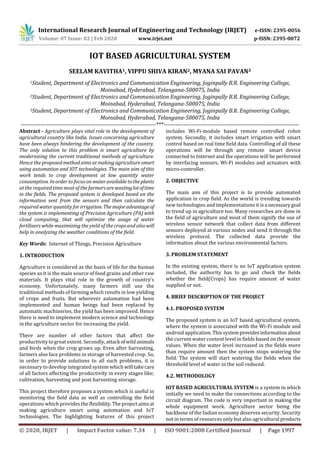
A relay is an electromechanical switch, which perform ON
and OFF operations without any human interaction.General
representation of double contact relayisshowninfig.Relays
are used where it is necessary to control a circuit by a low-
International Research Journal of Engineering and Technology (IRJET) e-ISSN: 2395-0056
Volume: 07 Issue: 02 | Feb 2020 www.irjet.net p-ISSN: 2395-0072
© 2020, IRJET | Impact Factor value: 7.34 | ISO 9001:2008 Certified Journal | Page 1999
power signal (with complete electrical isolation between
control and controlled circuits), or where several circuits
must be controlled by one signal.
Fig-4: RELAY
SUBMERSIBLE PUMP
Micro DC 3-6V Micro Submersible Pump Mini water pump
for Fountain Garden Mini water circulation System DIY
project. This is a low cost, small size Submersible Pump
Motor which can be operated from a 3 ~ 6V power supply. It
can take up to 120 liters per hour with very low current
consumption of 220mA. Just connect tube pipe to the motor
outlet, submerge it in water and power it. Make surethatthe
water level is always higher than the motor. Dry run may
damage the motor due to heating and it will also produce
noise.
Fig-5: SUBMERSIBLE PUMP
4.3. IMPLEMENTATION OF PROJECT
Fig-4: BLOCK DIAGRAM OF IMPLEMENTED PROJECT
First sensor measures the Agriculture Field Temperature,
Humidity using sensors. Sensor send the measured data to
IoT cloud using Arduino Board and Wi-Fi module.
Monitor the measured data (humidity, temperature) of
agriculture crops then accurate necessary controls relays
from motor pump switch.
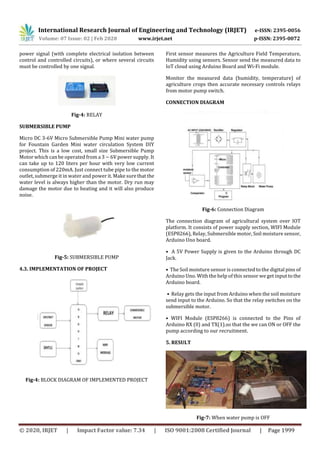
CONNECTION DIAGRAM
Fig-6: Connection Diagram
The connection diagram of agricultural system over IOT
platform. It consists of power supply section, WIFI Module
(ESP8266), Relay, Submersible motor, Soil moisture sensor,
Arduino Uno board.
• A 5V Power Supply is given to the Arduino through DC
Jack.
• The Soil moisture sensor is connected to the digital pins of
Arduino Uno. With the help of this sensor we get input tothe
Arduino board.
• Relay gets the input from Arduino when the soil moisture
send input to the Arduino. So that the relay switches on the
submersible motor.
• WIFI Module (ESP8266) is connected to the Pins of
Arduino RX (0) and TX(1).so that the we can ON or OFF the
pump according to our recruitment.
5. RESULT
Fig-7: When water pump is OFF
International Research Journal of Engineering and Technology (IRJET) e-ISSN: 2395-0056
Volume: 07 Issue: 02 | Feb 2020 www.irjet.net p-ISSN: 2395-0072
© 2020, IRJET | Impact Factor value: 7.34 | ISO 9001:2008 Certified Journal | Page 2000
Fig-8: When water pump is ON
6. CONCLUSION
The sensors are successfully interfaced with Arduino and
wireless communication is achieved. All observations and
experimental tests prove that this project is a complete
solution to the field activities irrigation problems.
Implementation of such a system in the field can definitely
help to improve the yield of the crops andaidstomanage the
water resources effectively reducing the wastage.
The proposed system can be used to switch on/off thewater
sprinkler depending on the soil moisture level sensor,
temperature sensor etc., and also there by making the
process simpler to use.
REFERENCES
[1]R.S Gaonkar, “Microprocessor Architecture
programming and application”, Wiley Eastern Ltd, New
Delhi.
[2]William Stalling, “Wireless Communication and
Networks”.
[3] Anonymous, “sensors”-www.wikipedia.com.
• www.wikipedia.com
• www.microchip.com2010.

IRJET - IoT based Agricultural System

  • 1.
    International Research Journalof Engineering and Technology (IRJET) e-ISSN: 2395-0056 Volume: 07 Issue: 02 | Feb 2020 www.irjet.net p-ISSN: 2395-0072 © 2020, IRJET | Impact Factor value: 7.34 | ISO 9001:2008 Certified Journal | Page 1997 IOT BASED AGRICULTURAL SYSTEM SEELAM KAVITHA1, VIPPU SHIVA KIRAN2, MYANA SAI PAVAN3 1Student, Department of Electronics and Communication Engineering, Joginpally B.R. Engineering College, Moinabad, Hyderabad, Telangana-500075, India 2Student, Department of Electronics and Communication Engineering, Joginpally B.R. Engineering College, Moinabad, Hyderabad, Telangana-500075, India 3Student, Department of Electronics and Communication Engineering, Joginpally B.R. Engineering College, Moinabad, Hyderabad, Telangana-500075, India ---------------------------------------------------------------------***--------------------------------------------------------------------- Abstract - Agriculture plays vital role in the development of agricultural country like India. Issues concerning agriculture have been always hindering the development of the country. The only solution to this problem is smart agriculture by modernizing the current traditional methods of agriculture. Hencethe proposed method aims at making agriculture smart using automation and IOT technologies. The main aim of this work tends to crop development at low quantity water consumption.In order to focuson water available totheplants at the required time most of the farmers are wastinglotoftime in the fields. The proposed system is developed based on the information sent from the sensors and then calculate the required water quantity for irrigation.Themajoradvantageof the system is implementing of Precision Agriculture (PA) with cloud computing, that will optimize the usage of water fertilizers while maximizing the yield of the crops and also will help in analyzing the weather conditions of the field. Key Words: Internet of Things, Precision Agriculture 1. INTRODUCTION Agriculture is considered as the basis of life for the human species as it is the main source of food grains and other raw materials. It plays vital role in the growth of country’s economy. Unfortunately, many farmers still use the traditional methods of farming which results in low yielding of crops and fruits. But wherever automation had been implemented and human beings had been replaced by automatic machineries, the yield has been improved. Hence there is need to implement modern science and technology in the agriculture sector for increasing the yield. There are number of other factors that affect the productivity to great extent. Secondly, attack ofwildanimals and birds when the crop grows up. Even after harvesting, farmers also face problems in storage of harvested crop. So, in order to provide solutions to all such problems, it is necessary to develop integrated system which will take care of all factors affecting the productivity in every stages like; cultivation, harvesting and post harvesting storage. This project therefore proposes a system which is useful in monitoring the field data as well as controlling the field operations which provides the flexibility.Theprojectaimsat making agriculture smart using automation and IoT technologies. The highlighting features of this project includes Wi-Fi-module based remote controlled robot system. Secondly, it includes smart irrigation with smart control based on real time field data. Controlling of all these operations will be through any remote smart device connected to Internet and the operations will be performed by interfacing sensors, Wi-Fi modules and actuators with micro-controller. 2. OBJECTIVE The main aim of this project is to provide automated application in crop field. As the world is trending towards new technologies and implementations it is a necessarygoal to trend up in agriculture too. Many researches are done in the field of agriculture and most of them signify the use of wireless sensor network that collect data from different sensors deployed at various nodes and send it through the wireless protocol. The collected data provide the information about the various environmental factors. 3. PROBLEM STATEMENT In the existing system, there is no IoT application system included, the authority has to go and check the fields whether the field(Crops) has require amount of water supplied or not. 4. BRIEF DESCRIPTION OF THE PROJECT 4.1. PROPOSED SYSTEM The proposed system is an IoT based agricultural system, where the system is associated with the Wi-Fi module and android application. Thissystemprovidesinformationabout the current water content level in fields based on the sensor values. When the water level increased in the fields more than require amount then the system stops watering the field. The system will start watering the fields when the threshold level of water in the soil reduced. 4.2. METHODOLOGY IOT BASED AGRICULTURAL SYSTEM is a system in which initially we need to make the connections according to the circuit diagram. The code is very important in making the whole equipment work. Agriculture sector being the backbone of the Indian economy deserves security. Security not in terms of resources only but also agricultural products
  • 2.
    International Research Journalof Engineering and Technology (IRJET) e-ISSN: 2395-0056 Volume: 07 Issue: 02 | Feb 2020 www.irjet.net p-ISSN: 2395-0072 © 2020, IRJET | Impact Factor value: 7.34 | ISO 9001:2008 Certified Journal | Page 1998 needs security and protection at very initial stage, like protection from attacks of rodents or insects, in fields or grain stores. Security systems which are being used now a days are not smart enough to provide real time notification after sensing the problem. Automation of farm activities can transform agricultural domain from being manual and static to intelligent and dynamic leading to higher production with lesser human supervision. This paper proposes an automated irrigation system which monitors and maintains the desired soil moisture content via automatic watering. Microcontroller ATMEGA328 on Arduino Uno platform is used to implement the control unit. The setup uses soil moisture sensors which measure the exact moisture level in soil. This value enables the system to use appropriate quantity of water which avoids over/under irrigation.IOTis used to keep the farmers updated about the status of sprinklers. Information from the sensors is regularly updated on a webpage using Wi-Fi module modem through which a farmer can check whether the water pump is ON/OFF at any given time. The entire project is divided into five major sections listed below:  MICROCONTROLLER  DHT 11  Wi-Fi MODULE  SOIL MOISTURE SENSOR  SUBMERSIBLE MOTOR  RELAY The above sections are briefly described as follows: MICROCONTROLLER Arduino UNO is the microcontroller used in this project, it is based on ATmega328. It is open source electronic platform based on easy to use software and hardware. It reads input- light on sensor, finger on a button, etc.ithas14input/output and 6 analog pins. The software used in this microcontroller is ARDUINO IDE. Wi-Fi MODULE ESP8266 Wi-Fi module gives access to Wi-Fi or internet. It can communicate with any microcontroller. We can directly program it by using a desktop. It is Wi-Fi enabled(systemon chip). It is flexible in terms of programming, has inbuilt USB and is easily connected. FEATURES 1. 3.3V operated, can be USB powered. 2. Uses wireless protocol 802.11b/g/n. 3. Built-in-PCB antenna on the ESP-12E chip. 4. Uses CP2102 USB Serial communication interface module. Fig-1: Wi-Fi MODULE SOIL MOISTURE SENSOR This Soil Moisture Sensor Module can be used to detect the moisture of soil or judge if there is water around the sensor, let the plants in your garden reachoutforhumanhelp.Insert this module into the soil and then adjust the on-board potentiometer to adjust the sensitivity. The sensor would output logic HIGH/LOW when the moisture is higher/lower than the threshold set by the potentiometer. With help of this sensor, it will be realizable to make the plant remind you: Hey, I am thirsty now, please give me some water. Fig-2: SOIL MOISTURE SENSOR DHT 11 The DHT11 is a basic, ultra-low-cost digital temperature and humidity sensor. It uses a capacitive humidity sensor and a thermistor to measure the surrounding air, and spits out a digital signal on the data pin (no analog input pins needed). It’s fairly simple to use, but requires careful timing to grab data. Fig-3: DHT 11 RELAY A relay is an electromechanical switch, which perform ON and OFF operations without any human interaction.General representation of double contact relayisshowninfig.Relays are used where it is necessary to control a circuit by a low-
  • 3.
    International Research Journalof Engineering and Technology (IRJET) e-ISSN: 2395-0056 Volume: 07 Issue: 02 | Feb 2020 www.irjet.net p-ISSN: 2395-0072 © 2020, IRJET | Impact Factor value: 7.34 | ISO 9001:2008 Certified Journal | Page 1999 power signal (with complete electrical isolation between control and controlled circuits), or where several circuits must be controlled by one signal. Fig-4: RELAY SUBMERSIBLE PUMP Micro DC 3-6V Micro Submersible Pump Mini water pump for Fountain Garden Mini water circulation System DIY project. This is a low cost, small size Submersible Pump Motor which can be operated from a 3 ~ 6V power supply. It can take up to 120 liters per hour with very low current consumption of 220mA. Just connect tube pipe to the motor outlet, submerge it in water and power it. Make surethatthe water level is always higher than the motor. Dry run may damage the motor due to heating and it will also produce noise. Fig-5: SUBMERSIBLE PUMP 4.3. IMPLEMENTATION OF PROJECT Fig-4: BLOCK DIAGRAM OF IMPLEMENTED PROJECT First sensor measures the Agriculture Field Temperature, Humidity using sensors. Sensor send the measured data to IoT cloud using Arduino Board and Wi-Fi module. Monitor the measured data (humidity, temperature) of agriculture crops then accurate necessary controls relays from motor pump switch. CONNECTION DIAGRAM Fig-6: Connection Diagram The connection diagram of agricultural system over IOT platform. It consists of power supply section, WIFI Module (ESP8266), Relay, Submersible motor, Soil moisture sensor, Arduino Uno board. • A 5V Power Supply is given to the Arduino through DC Jack. • The Soil moisture sensor is connected to the digital pins of Arduino Uno. With the help of this sensor we get input tothe Arduino board. • Relay gets the input from Arduino when the soil moisture send input to the Arduino. So that the relay switches on the submersible motor. • WIFI Module (ESP8266) is connected to the Pins of Arduino RX (0) and TX(1).so that the we can ON or OFF the pump according to our recruitment. 5. RESULT Fig-7: When water pump is OFF
  • 4.
    International Research Journalof Engineering and Technology (IRJET) e-ISSN: 2395-0056 Volume: 07 Issue: 02 | Feb 2020 www.irjet.net p-ISSN: 2395-0072 © 2020, IRJET | Impact Factor value: 7.34 | ISO 9001:2008 Certified Journal | Page 2000 Fig-8: When water pump is ON 6. CONCLUSION The sensors are successfully interfaced with Arduino and wireless communication is achieved. All observations and experimental tests prove that this project is a complete solution to the field activities irrigation problems. Implementation of such a system in the field can definitely help to improve the yield of the crops andaidstomanage the water resources effectively reducing the wastage. The proposed system can be used to switch on/off thewater sprinkler depending on the soil moisture level sensor, temperature sensor etc., and also there by making the process simpler to use. REFERENCES [1]R.S Gaonkar, “Microprocessor Architecture programming and application”, Wiley Eastern Ltd, New Delhi. [2]William Stalling, “Wireless Communication and Networks”. [3] Anonymous, “sensors”-www.wikipedia.com. • www.wikipedia.com • www.microchip.com2010.