Social Media for
Development
Day 1:August 7, 2013
National Computer Institute
Ruben Canlas Jr
Based on materials originally developed by
Emmanuel Lallana, PhD
for UN AP-CICT
1
Objectives
After the 2-day workshop, participants will be able to:
1. Explain what social media are and how they evolved.
2. Discuss various existing and potential issues and
applications of social media for promoting development
3. Demonstrate the actual use of social media using various
tools to run and monitor campaigns.
4. Outline the principles for an effective agency policy and
strategy towards the use of social media.
2
Day 1:Agenda
• Introduction to Social Media
• Social Media are Transforming Society
• Social Media as a Development Tool
• Group Homework
3
Day 2:Agenda
• Presentations of Group Work
• Governance by Social Media
• Public Communications through Social
Media
4
Videos
• Did you know? 2012
• Disruptive Tech
5
When you want to try a
new movie or restaurant,
who do you ask?
6
We tend to trust our
social network more.
(Even friends of friends.)
The power of social networks:
7
1. Introduction to Social
Media
8
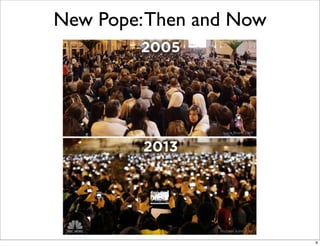
New Pope:Then and Now
9
10
11
12
13
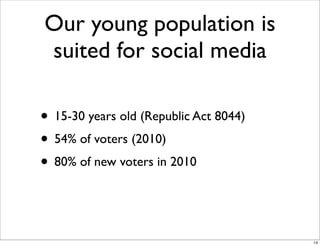
Our young population is
suited for social media
• 15-30 years old (Republic Act 8044)
• 54% of voters (2010)
• 80% of new voters in 2010
14
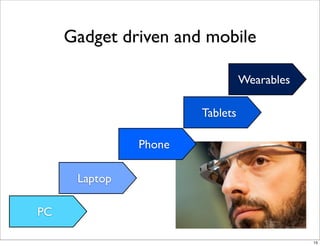
Wearables
Gadget driven and mobile
PC
Laptop
Phone
Tablets
15
So what is (are)
social media?
16
17
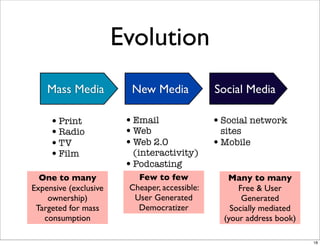
Evolution
Mass Media
•Print
•Radio
•TV
•Film
New Media
•Email
•Web
•Web 2.0
(interactivity)
•Podcasting
Social Media
•Social network
sites
•Mobile
One to many
Expensive (exclusive
ownership)
Targeted for mass
consumption
Few to few
Cheaper, accessible:
User Generated
Democratizer
Many to many
Free & User
Generated
Socially mediated
(your address book)
18
Social media defined
“Group of internet based applications... that
allow the creation and exchange of user-
generated content”
-- Dr. Emmanuel Lallana
19
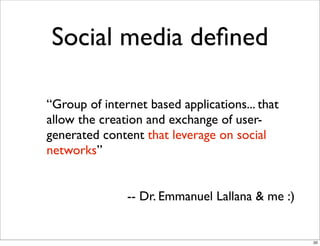
Social media defined
“Group of internet based applications... that
allow the creation and exchange of user-
generated content that leverage on social
networks”
-- Dr. Emmanuel Lallana & me :)
20
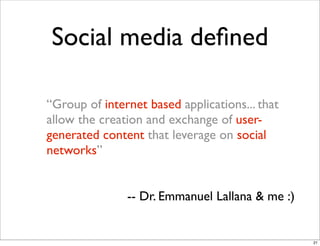
Social media defined
“Group of internet based applications... that
allow the creation and exchange of user-
generated content that leverage on social
networks”
-- Dr. Emmanuel Lallana & me :)
21
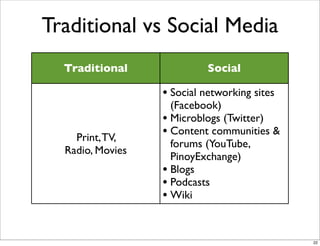
Traditional vs Social Media
Traditional Social
Print,TV,
Radio, Movies
• Social networking sites
(Facebook)
• Microblogs (Twitter)
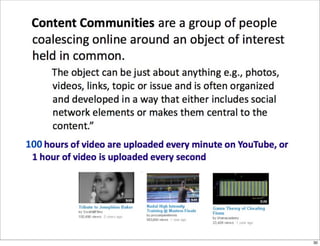
• Content communities &
forums (YouTube,
PinoyExchange)
• Blogs
• Podcasts
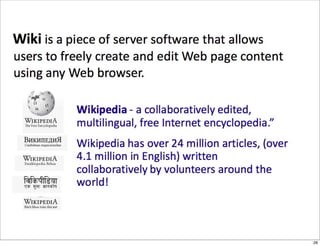
• Wiki
22
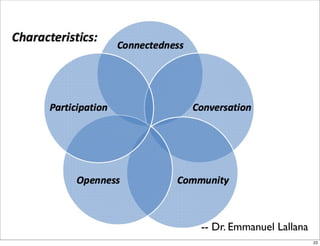
-- Dr. Emmanuel Lallana
23
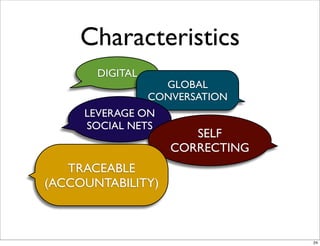
Characteristics
DIGITAL
GLOBAL
CONVERSATION
LEVERAGE ON
SOCIAL NETS
SELF
CORRECTING
TRACEABLE
(ACCOUNTABILITY)
24
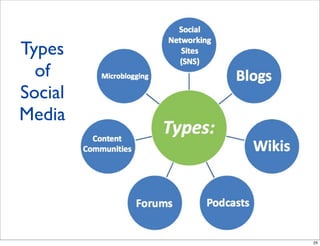
Types
of
Social
Media
25
26
27
28
29
100
30
31
• No longer one-way, broadcast
• Audience no longer passive
• Facilitates, encourages contributions and
reactions
• Promotes exchange of information between you
and audience, and among the audience
Social media is changing
public communications
32
• Thrives on connections
• Within its own Web vehicles
• Through links to other sites, resources, people,
and automatic feeds
• Creates communities
• Fellowship and relationship with others who
share common attitudes, interests, and goals.
Social media is changing
public communications
33
While social media communities are only
virtual, with members seldom meeting each
other in person, they are no less robust than
the physical communities in which we live, and
in many ways more robust from the simple fact
that barriers are removed.
Social media is changing
public communications
34
Exercise: Internet Hunt
Search for the following:
1. Definition of Digital divide
2. Use of social media for education
3. US assault on Bin Laden tweeted
4. Filipino community resources for expats
5. Famous PinoyYouTube personalities (except for Charice and
Arnel Pineda)
6. Online resources for lessons on Filipino culture: games,
language, etc
35

Social Media for Development, Part 1

  • 1.
    Social Media for Development Day1:August 7, 2013 National Computer Institute Ruben Canlas Jr Based on materials originally developed by Emmanuel Lallana, PhD for UN AP-CICT 1
  • 2.
    Objectives After the 2-dayworkshop, participants will be able to: 1. Explain what social media are and how they evolved. 2. Discuss various existing and potential issues and applications of social media for promoting development 3. Demonstrate the actual use of social media using various tools to run and monitor campaigns. 4. Outline the principles for an effective agency policy and strategy towards the use of social media. 2
  • 3.
    Day 1:Agenda • Introductionto Social Media • Social Media are Transforming Society • Social Media as a Development Tool • Group Homework 3
  • 4.
    Day 2:Agenda • Presentationsof Group Work • Governance by Social Media • Public Communications through Social Media 4
  • 5.
    Videos • Did youknow? 2012 • Disruptive Tech 5
  • 6.
    When you wantto try a new movie or restaurant, who do you ask? 6
  • 7.
    We tend totrust our social network more. (Even friends of friends.) The power of social networks: 7
  • 8.
    1. Introduction toSocial Media 8
  • 9.
  • 10.
  • 11.
  • 12.
  • 13.
  • 14.
    Our young populationis suited for social media • 15-30 years old (Republic Act 8044) • 54% of voters (2010) • 80% of new voters in 2010 14
  • 15.
    Wearables Gadget driven andmobile PC Laptop Phone Tablets 15
  • 16.
    So what is(are) social media? 16
  • 17.
  • 18.
    Evolution Mass Media •Print •Radio •TV •Film New Media •Email •Web •Web2.0 (interactivity) •Podcasting Social Media •Social network sites •Mobile One to many Expensive (exclusive ownership) Targeted for mass consumption Few to few Cheaper, accessible: User Generated Democratizer Many to many Free & User Generated Socially mediated (your address book) 18
  • 19.
    Social media defined “Groupof internet based applications... that allow the creation and exchange of user- generated content” -- Dr. Emmanuel Lallana 19
  • 20.
    Social media defined “Groupof internet based applications... that allow the creation and exchange of user- generated content that leverage on social networks” -- Dr. Emmanuel Lallana & me :) 20
  • 21.
    Social media defined “Groupof internet based applications... that allow the creation and exchange of user- generated content that leverage on social networks” -- Dr. Emmanuel Lallana & me :) 21
  • 22.
    Traditional vs SocialMedia Traditional Social Print,TV, Radio, Movies • Social networking sites (Facebook) • Microblogs (Twitter) • Content communities & forums (YouTube, PinoyExchange) • Blogs • Podcasts • Wiki 22
  • 23.
    -- Dr. EmmanuelLallana 23
  • 24.
  • 25.
  • 26.
  • 27.
  • 28.
  • 29.
  • 30.
  • 31.
  • 32.
    • No longerone-way, broadcast • Audience no longer passive • Facilitates, encourages contributions and reactions • Promotes exchange of information between you and audience, and among the audience Social media is changing public communications 32
  • 33.
    • Thrives onconnections • Within its own Web vehicles • Through links to other sites, resources, people, and automatic feeds • Creates communities • Fellowship and relationship with others who share common attitudes, interests, and goals. Social media is changing public communications 33
  • 34.
    While social mediacommunities are only virtual, with members seldom meeting each other in person, they are no less robust than the physical communities in which we live, and in many ways more robust from the simple fact that barriers are removed. Social media is changing public communications 34
  • 35.
    Exercise: Internet Hunt Searchfor the following: 1. Definition of Digital divide 2. Use of social media for education 3. US assault on Bin Laden tweeted 4. Filipino community resources for expats 5. Famous PinoyYouTube personalities (except for Charice and Arnel Pineda) 6. Online resources for lessons on Filipino culture: games, language, etc 35