
Social Media for
Development
Day 2:August 8, 2013
National Computer Institute
Ruben Canlas Jr
Based on materials originally developed by
Emmanuel Lallana, PhD
for UN AP-CICT
1Wednesday, August 14, 13
5. Public Communications
through Social Media
2Wednesday, August 14, 13
Day 2:Agenda
• Presentations of Group Work
• Governance by Social Media
• Public Communications through Social
Media
3Wednesday, August 14, 13
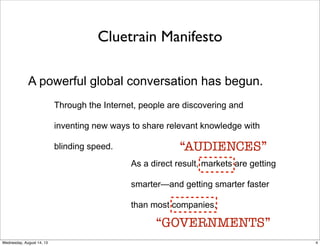
Cluetrain Manifesto
A powerful global conversation has begun.
Through the Internet, people are discovering and
inventing new ways to share relevant knowledge with
blinding speed.
As a direct result, markets are getting
smarter—and getting smarter faster
than most companies.
“AUDIENCES”
“GOVERNMENTS”
4Wednesday, August 14, 13
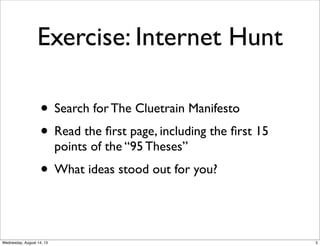
Exercise: Internet Hunt
• Search for The Cluetrain Manifesto
• Read the first page, including the first 15
points of the “95 Theses”
• What ideas stood out for you?
5Wednesday, August 14, 13
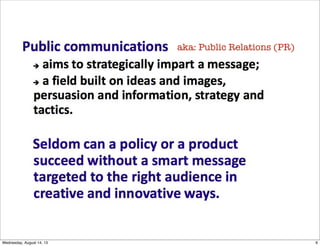
aka: Public Relations (PR)
6Wednesday, August 14, 13
7Wednesday, August 14, 13
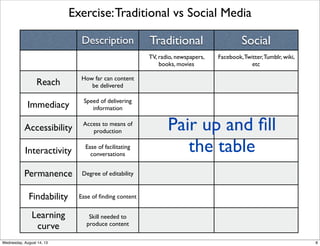
Exercise:Traditional vs Social Media
Description Traditional Social
TV, radio, newspapers,
books, movies
Facebook,Twitter,Tumblr, wiki,
etc
Reach How far can content
be delivered
Immediacy Speed of delivering
information
Accessibility Access to means of
production
Interactivity Ease of facilitating
conversations
Permanence Degree of editability
Findability Ease of finding content
Learning
curve
Skill needed to
produce content
Pair up and fill
the table
8Wednesday, August 14, 13
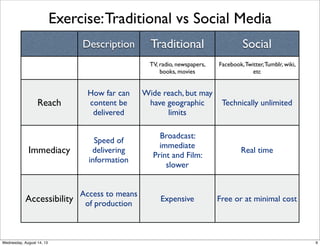
Exercise:Traditional vs Social Media
Description Traditional Social
TV, radio, newspapers,
books, movies
Facebook,Twitter,Tumblr, wiki,
etc
Reach
How far can
content be
delivered
Wide reach, but may
have geographic
limits
Technically unlimited
Immediacy
Speed of
delivering
information
Broadcast:
immediate
Print and Film:
slower
Real time
Accessibility
Access to means
of production
Expensive Free or at minimal cost
9Wednesday, August 14, 13
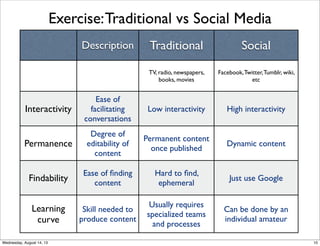
Exercise:Traditional vs Social Media
Description Traditional Social
TV, radio, newspapers,
books, movies
Facebook,Twitter,Tumblr, wiki,
etc
Interactivity
Ease of
facilitating
conversations
Low interactivity High interactivity
Permanence
Degree of
editability of
content
Permanent content
once published
Dynamic content
Findability
Ease of finding
content
Hard to find,
ephemeral
Just use Google
Learning
curve
Skill needed to
produce content
Usually requires
specialized teams
and processes
Can be done by an
individual amateur
10Wednesday, August 14, 13
11Wednesday, August 14, 13
12Wednesday, August 14, 13
13Wednesday, August 14, 13
14Wednesday, August 14, 13
15Wednesday, August 14, 13
16Wednesday, August 14, 13
Google Analytics Demo
17Wednesday, August 14, 13
Developing
SM4D Policy
Best Practices and Tips
18Wednesday, August 14, 13
19Wednesday, August 14, 13
20Wednesday, August 14, 13
21Wednesday, August 14, 13
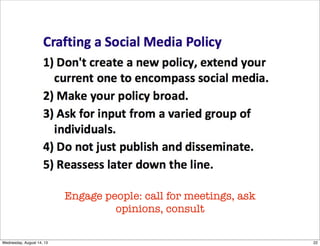
Engage people: call for meetings, ask
opinions, consult
22Wednesday, August 14, 13
23Wednesday, August 14, 13
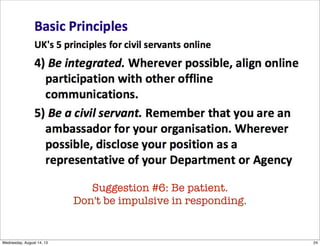
Suggestion #6: Be patient.
Don't be impulsive in responding.
24Wednesday, August 14, 13
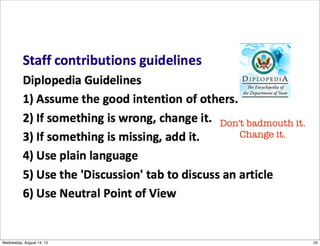
Don't badmouth it.
Change it.
25Wednesday, August 14, 13
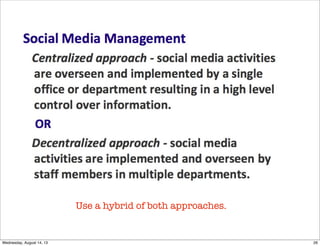
Use a hybrid of both approaches.
26Wednesday, August 14, 13
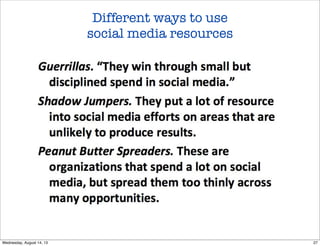
Different ways to use
social media resources
27Wednesday, August 14, 13
28Wednesday, August 14, 13
29Wednesday, August 14, 13
30Wednesday, August 14, 13
31Wednesday, August 14, 13
Tips: Don't let “anonymity” make
you do crazy things. Nothing is
totally anonymous in the internet.
32Wednesday, August 14, 13
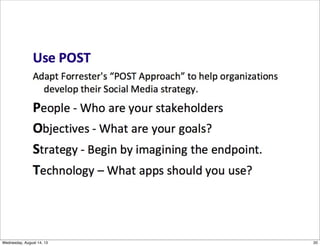
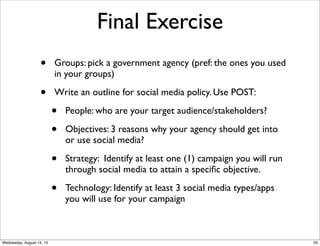
Final Exercise
• Groups: pick a government agency (pref: the ones you used
in your groups)
• Write an outline for social media policy. Use POST:
• People: who are your target audience/stakeholders?
• Objectives: 3 reasons why your agency should get into
or use social media?
• Strategy: Identify at least one (1) campaign you will run
through social media to attain a specific objective.
• Technology: Identify at least 3 social media types/apps
you will use for your campaign
33Wednesday, August 14, 13
• slideshare.net/rubencanlas
• Email: rcanlas@alumni.cmu.edu
• Twitter: @cryptonomikon
34Wednesday, August 14, 13

Social Media for Development, Part 5

  • 1.
    Social Media for Development Day2:August 8, 2013 National Computer Institute Ruben Canlas Jr Based on materials originally developed by Emmanuel Lallana, PhD for UN AP-CICT 1Wednesday, August 14, 13
  • 2.
    5. Public Communications throughSocial Media 2Wednesday, August 14, 13
  • 3.
    Day 2:Agenda • Presentationsof Group Work • Governance by Social Media • Public Communications through Social Media 3Wednesday, August 14, 13
  • 4.
    Cluetrain Manifesto A powerfulglobal conversation has begun. Through the Internet, people are discovering and inventing new ways to share relevant knowledge with blinding speed. As a direct result, markets are getting smarter—and getting smarter faster than most companies. “AUDIENCES” “GOVERNMENTS” 4Wednesday, August 14, 13
  • 5.
    Exercise: Internet Hunt •Search for The Cluetrain Manifesto • Read the first page, including the first 15 points of the “95 Theses” • What ideas stood out for you? 5Wednesday, August 14, 13
  • 6.
    aka: Public Relations(PR) 6Wednesday, August 14, 13
  • 7.
  • 8.
    Exercise:Traditional vs SocialMedia Description Traditional Social TV, radio, newspapers, books, movies Facebook,Twitter,Tumblr, wiki, etc Reach How far can content be delivered Immediacy Speed of delivering information Accessibility Access to means of production Interactivity Ease of facilitating conversations Permanence Degree of editability Findability Ease of finding content Learning curve Skill needed to produce content Pair up and fill the table 8Wednesday, August 14, 13
  • 9.
    Exercise:Traditional vs SocialMedia Description Traditional Social TV, radio, newspapers, books, movies Facebook,Twitter,Tumblr, wiki, etc Reach How far can content be delivered Wide reach, but may have geographic limits Technically unlimited Immediacy Speed of delivering information Broadcast: immediate Print and Film: slower Real time Accessibility Access to means of production Expensive Free or at minimal cost 9Wednesday, August 14, 13
  • 10.
    Exercise:Traditional vs SocialMedia Description Traditional Social TV, radio, newspapers, books, movies Facebook,Twitter,Tumblr, wiki, etc Interactivity Ease of facilitating conversations Low interactivity High interactivity Permanence Degree of editability of content Permanent content once published Dynamic content Findability Ease of finding content Hard to find, ephemeral Just use Google Learning curve Skill needed to produce content Usually requires specialized teams and processes Can be done by an individual amateur 10Wednesday, August 14, 13
  • 11.
  • 12.
  • 13.
  • 14.
  • 15.
  • 16.
  • 17.
  • 18.
    Developing SM4D Policy Best Practicesand Tips 18Wednesday, August 14, 13
  • 19.
  • 20.
  • 21.
  • 22.
    Engage people: callfor meetings, ask opinions, consult 22Wednesday, August 14, 13
  • 23.
  • 24.
    Suggestion #6: Bepatient. Don't be impulsive in responding. 24Wednesday, August 14, 13
  • 25.
    Don't badmouth it. Changeit. 25Wednesday, August 14, 13
  • 26.
    Use a hybridof both approaches. 26Wednesday, August 14, 13
  • 27.
    Different ways touse social media resources 27Wednesday, August 14, 13
  • 28.
  • 29.
  • 30.
  • 31.
  • 32.
    Tips: Don't let“anonymity” make you do crazy things. Nothing is totally anonymous in the internet. 32Wednesday, August 14, 13
  • 33.
    Final Exercise • Groups:pick a government agency (pref: the ones you used in your groups) • Write an outline for social media policy. Use POST: • People: who are your target audience/stakeholders? • Objectives: 3 reasons why your agency should get into or use social media? • Strategy: Identify at least one (1) campaign you will run through social media to attain a specific objective. • Technology: Identify at least 3 social media types/apps you will use for your campaign 33Wednesday, August 14, 13
  • 34.
    • slideshare.net/rubencanlas • Email:rcanlas@alumni.cmu.edu • Twitter: @cryptonomikon 34Wednesday, August 14, 13